Upgrade to Pro — share decks privately, control downloads, hide ads and more …

Shift Left Testing in Practice Lessons, Challen...

Sponsored · Your Podcast. Everywhere. Effortlessly. Share. Educate. Inspire. Entertain. You do you. We'll handle the rest.
Avatar for Gurzu Gurzu
April 02, 2026

Shift Left Testing in Practice Lessons, Challenges, and Impact

Shift Left Testing is the backbone of delivering high-quality software. In this session, Aashish Shrestha explained how Shift Left Testing goes beyond traditional QA by bringing testing earlier into the development lifecycle, from requirements to design and development. The talk highlighted real-world scenarios and key practices teams can adopt to catch defects sooner, improve collaboration, and build reliable, high-performing applications.

Avatar for Gurzu

Gurzu

April 02, 2026
Tweet

More Decks by Gurzu

Other Decks in Technology

Transcript

  1. Shift Left Testing in Practice Challenges, Solutions and Lessons -

    With Shift Right Insights Aashish Shrestha
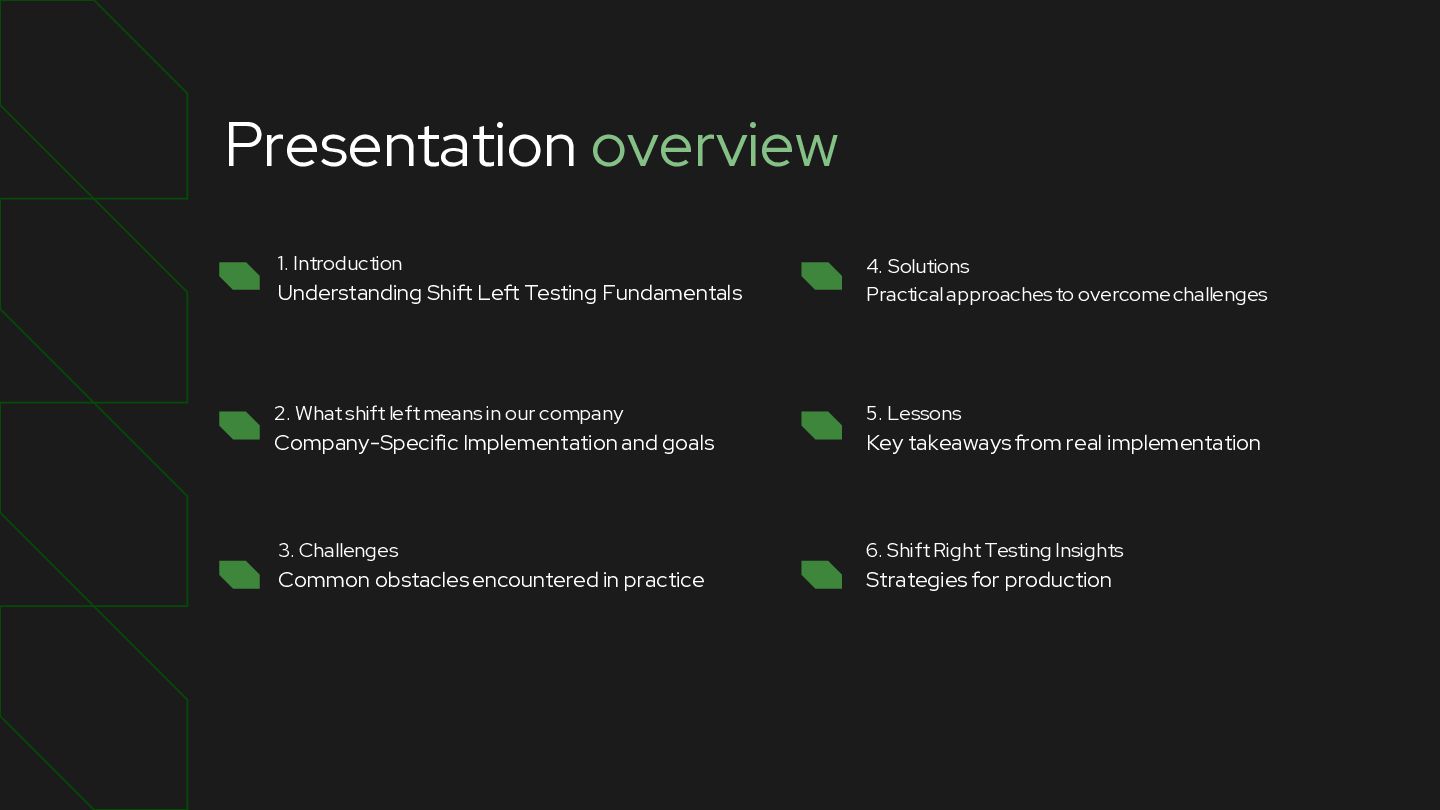
  2. 1. Introduction Understanding Shift Left Testing Fundamentals Presentation overview 2.

    What shift left means in our company Company-Specific Implementation and goals 3. Challenges Common obstacles encountered in practice 4. Solutions Practical approaches to overcome challenges 5. Lessons Key takeaways from real implementation 6. Shift Right Testing Insights Strategies for production
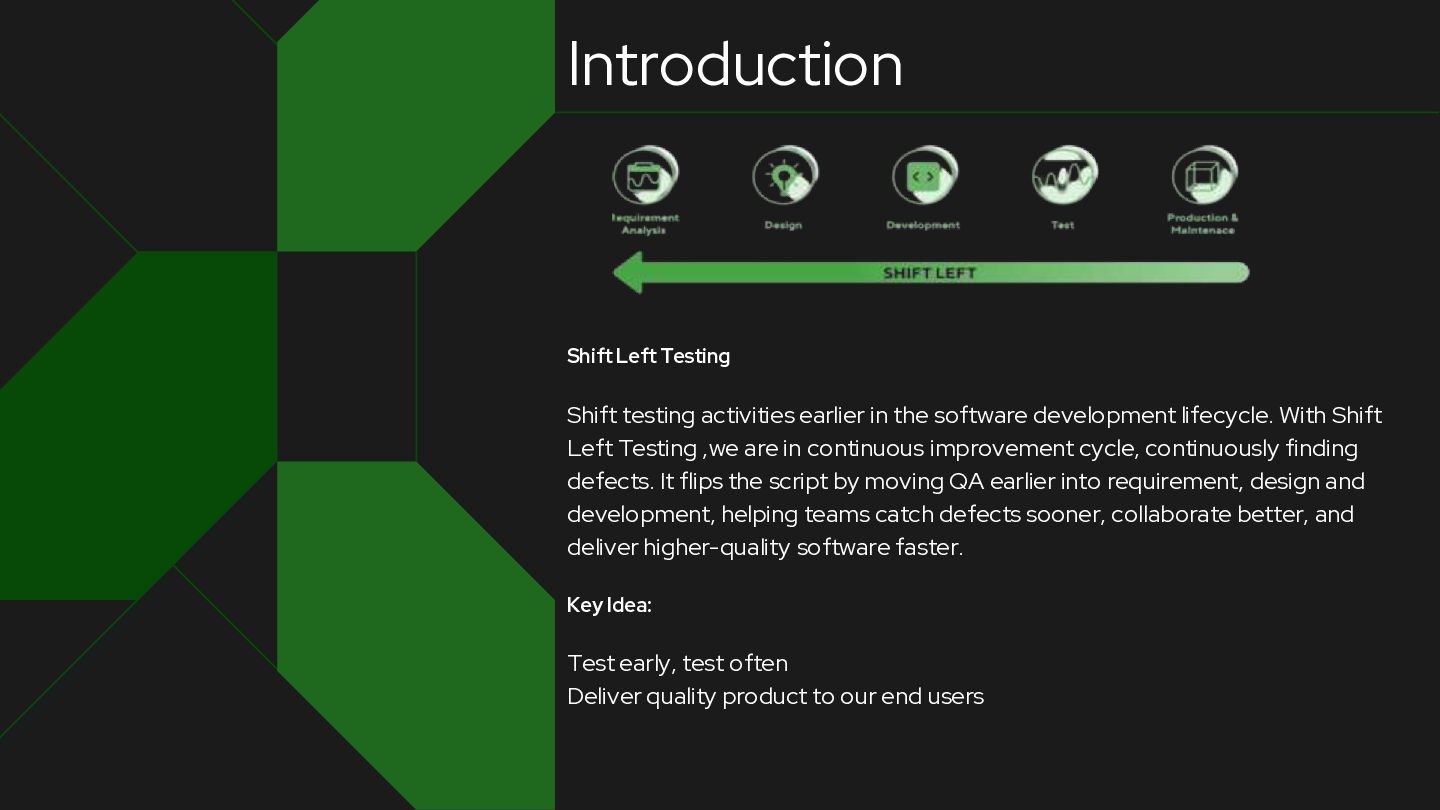
  3. Shift Left Testing Shift testing activities earlier in the software

    development lifecycle. With Shift Left Testing ,we are in continuous improvement cycle, continuously finding defects. It flips the script by moving QA earlier into requirement, design and development, helping teams catch defects sooner, collaborate better, and deliver higher-quality software faster. Key Idea: Test early, test often Deliver quality product to our end users Introduction
  4. We already do Shift Left Testing Shift left isn’t a

    new concept for our teams-its embedded in our continuous improvement cycle. We’re continuously finding and addressing defects throughout the development, collaborating across roles to catch issues before they escalate.
  5. ❏ Avoiding critical defects to go to the production ❏

    Fewer escaped defects, faster delivery and lower cost ❏ Fixing early in the SDLC rather than after deployment What shift left means in our company?
  6. Case 1: Unclear Requirement, Overlapping goals Challenges Shift Left Testing

    begins at the requirement stage, but if requirements are unclear, tests based on assumptions can turn out to be wrong, hindering the valuable time of the team. Solutions Lessons The solution to unclear requirements is a process change: Shift Left Testing demands investing in clear, well-defined requirements before implementation starts. Active Participation: Understanding the requirement. Asking the right questions, at the right time. Challenges, Solutions, Lessons
  7. Case 2: Final Product Experience Gaps Challenges Strong test coverage

    on API validations, Core Functional flows, and data quality. Product was technically stable-but gaps remained in the final user experience. Solutions Lessons Adding presentation checks to requirements Include UI and branding in acceptance criteria Create final UI validation checklist Quality means the product shouldn’t feel incomplete to users-even if it's technically stable Challenges, Solutions, Lessons
  8. Shift Right Testing Shift right reveals how the software responds

    to unfavorable situations. The intent is to evaluate how the application performs in real-world conditions. Types of Shift Right Testing: Canary Releases: Canary testing deploys a new feature to a small group of users first, allowing teams to catch issues early. Feature Flag Testing: Feature Flag Testing lets teams turn features on or off in production without redeploying, enabling safe experiments, gradual rollouts, and quick rollbacks if needed.
  9. Thank you Any Questions? Any Feedback? Your input helps us

    continuously improve our testing practices and deliver better software to our users.