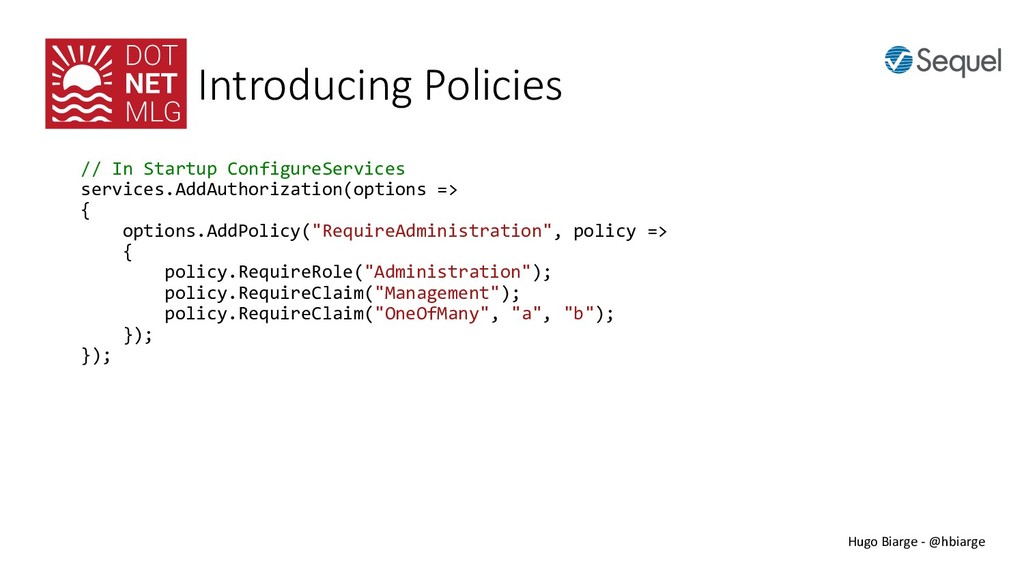
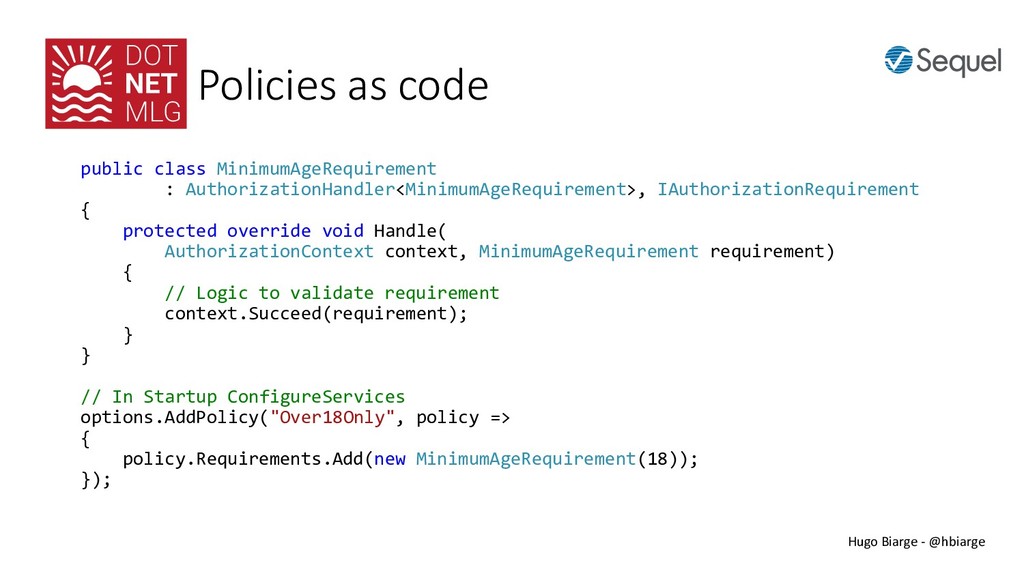
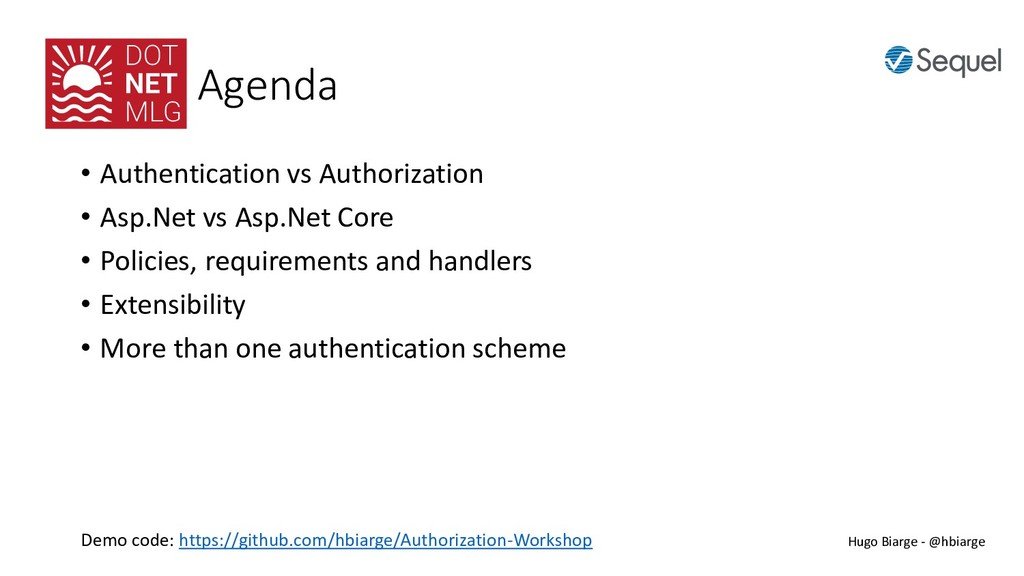
• Policies, requirements and handlers • Extensibility • More than one authentication scheme Demo code: https://github.com/hbiarge/Authorization-Workshop Hugo Biarge - @hbiarge
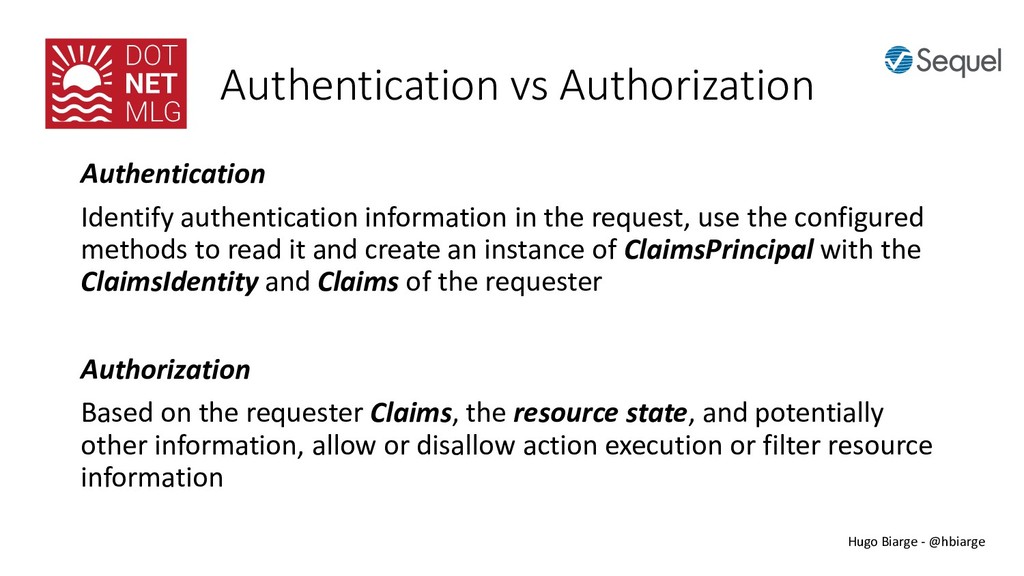
use the configured methods to read it and create an instance of ClaimsPrincipal with the ClaimsIdentity and Claims of the requester Authorization Based on the requester Claims, the resource state, and potentially other information, allow or disallow action execution or filter resource information Hugo Biarge - @hbiarge
in WebApi and MVC in the .Net Framework • They are the only “out of the box” resort to manage authorization • Supports Users and Roles • Implemented as an Authorization Filter • Executed early in the request lifecycle Hugo Biarge - @hbiarge
[AllowAnonymous] also exist in .Net Core • It makes it easy to learn and use because the behavior is the same • The underlying infrastructure is completely new • Managed as an Authorization Filter in the ResourceInvoker class in an early stage of the request lifecycle • Supports only Roles (for compatibility reasons) and Policies Hugo Biarge - @hbiarge
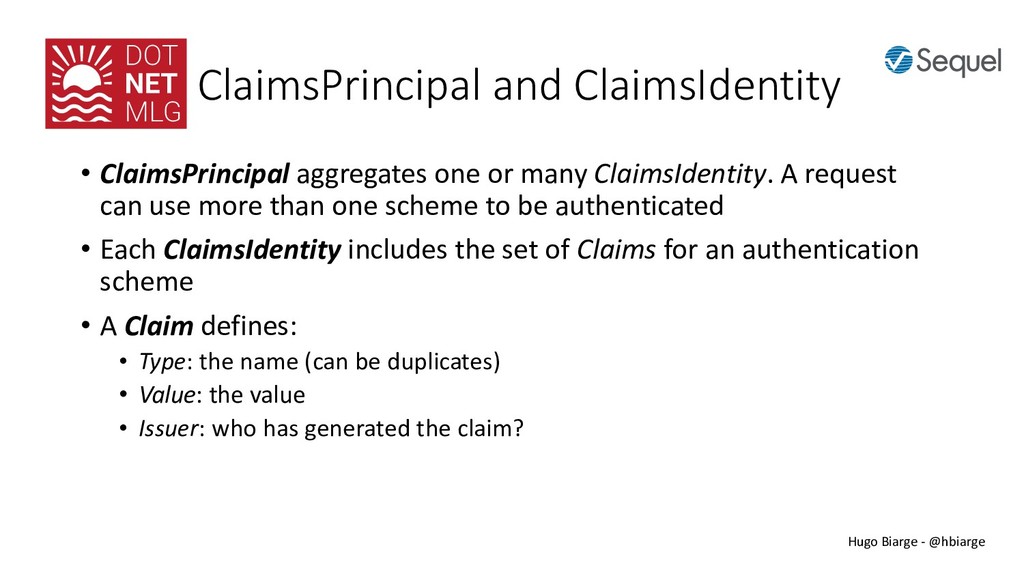
A request can use more than one scheme to be authenticated • Each ClaimsIdentity includes the set of Claims for an authentication scheme • A Claim defines: • Type: the name (can be duplicates) • Value: the value • Issuer: who has generated the claim? Hugo Biarge - @hbiarge
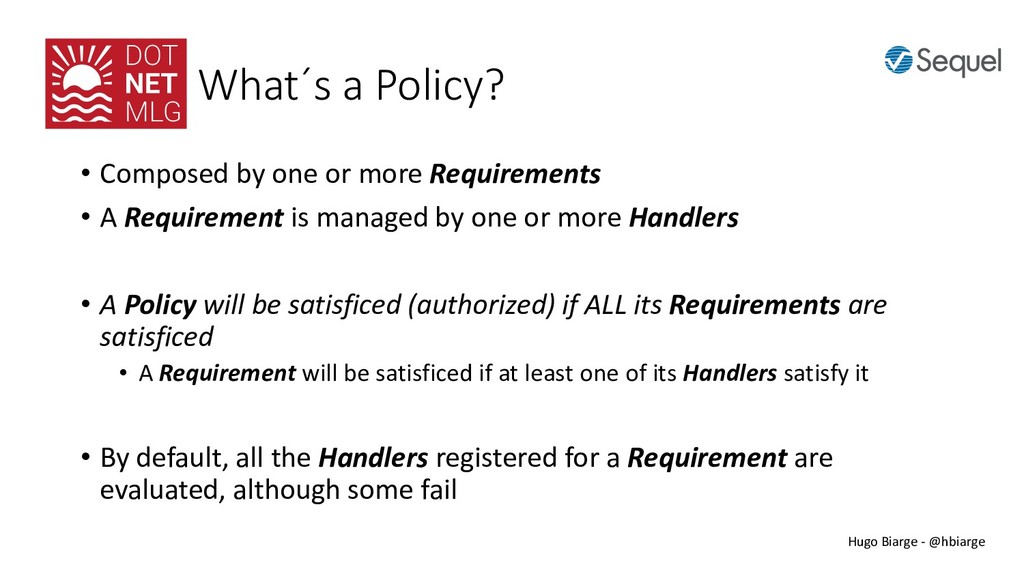
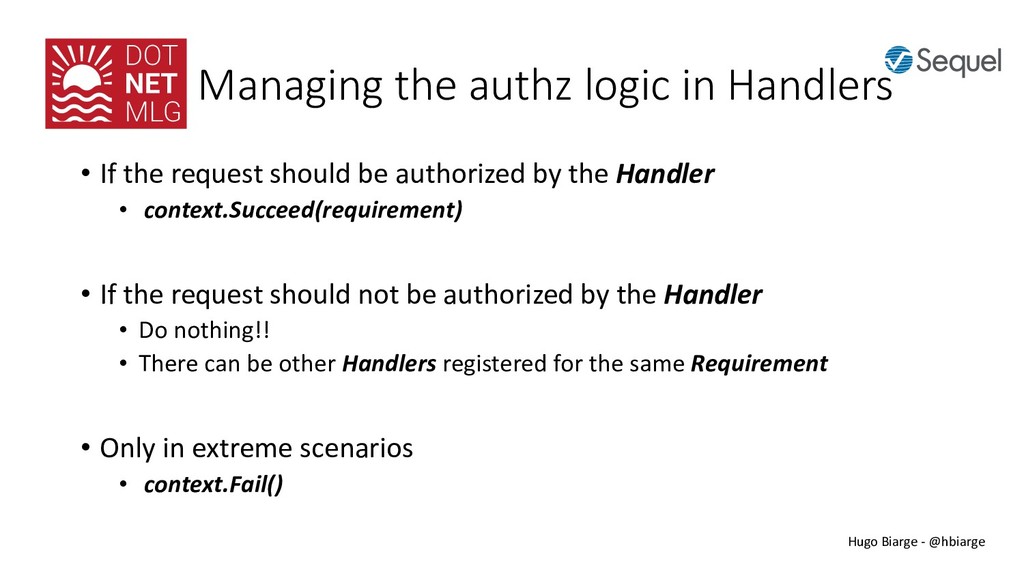
• A Requirement is managed by one or more Handlers • A Policy will be satisficed (authorized) if ALL its Requirements are satisficed • A Requirement will be satisficed if at least one of its Handlers satisfy it • By default, all the Handlers registered for a Requirement are evaluated, although some fail Hugo Biarge - @hbiarge
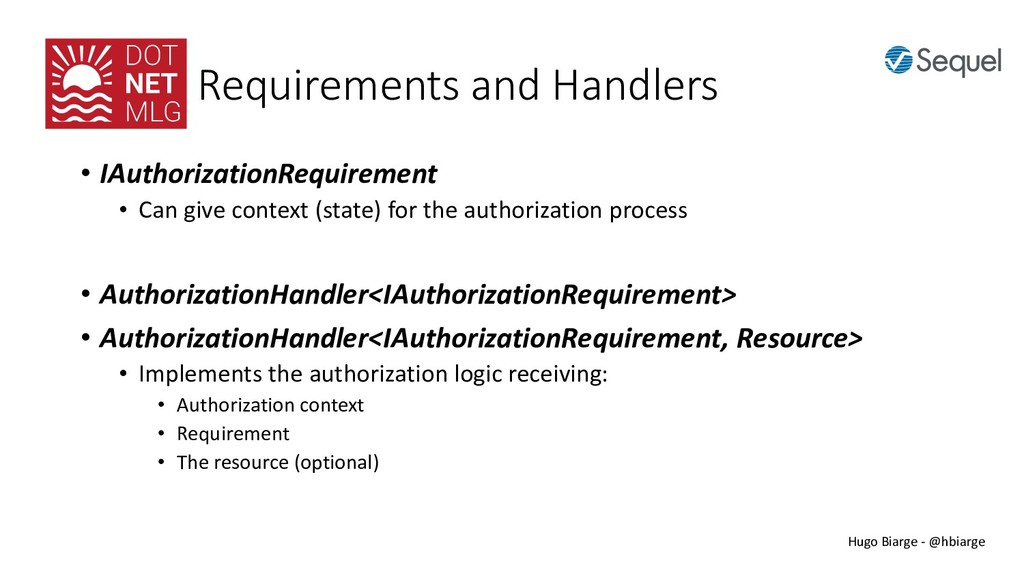
for the authorization process • AuthorizationHandler<IAuthorizationRequirement> • AuthorizationHandler<IAuthorizationRequirement, Resource> • Implements the authorization logic receiving: • Authorization context • Requirement • The resource (optional) Hugo Biarge - @hbiarge
should be authorized by the Handler • context.Succeed(requirement) • If the request should not be authorized by the Handler • Do nothing!! • There can be other Handlers registered for the same Requirement • Only in extreme scenarios • context.Fail() Hugo Biarge - @hbiarge
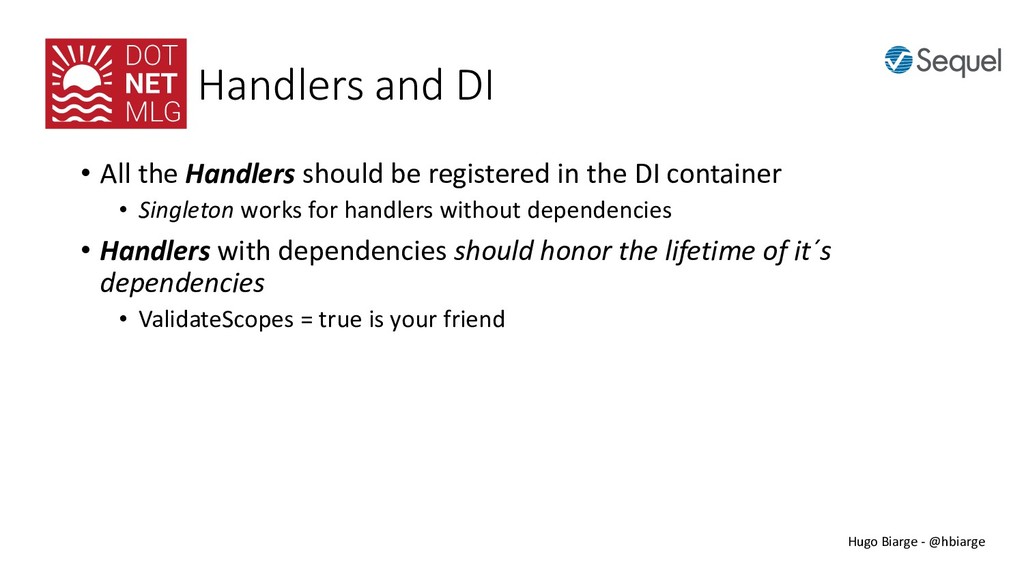
in the DI container • Singleton works for handlers without dependencies • Handlers with dependencies should honor the lifetime of it´s dependencies • ValidateScopes = true is your friend Hugo Biarge - @hbiarge
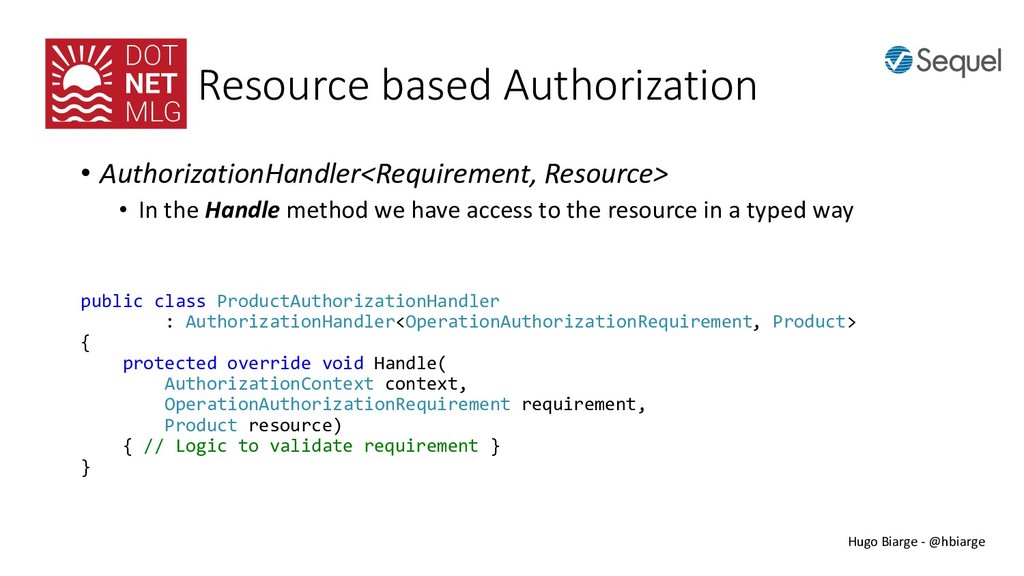
method we have access to the resource in a typed way public class ProductAuthorizationHandler : AuthorizationHandler<OperationAuthorizationRequirement, Product> { protected override void Handle( AuthorizationContext context, OperationAuthorizationRequirement requirement, Product resource) { // Logic to validate requirement } } Hugo Biarge - @hbiarge
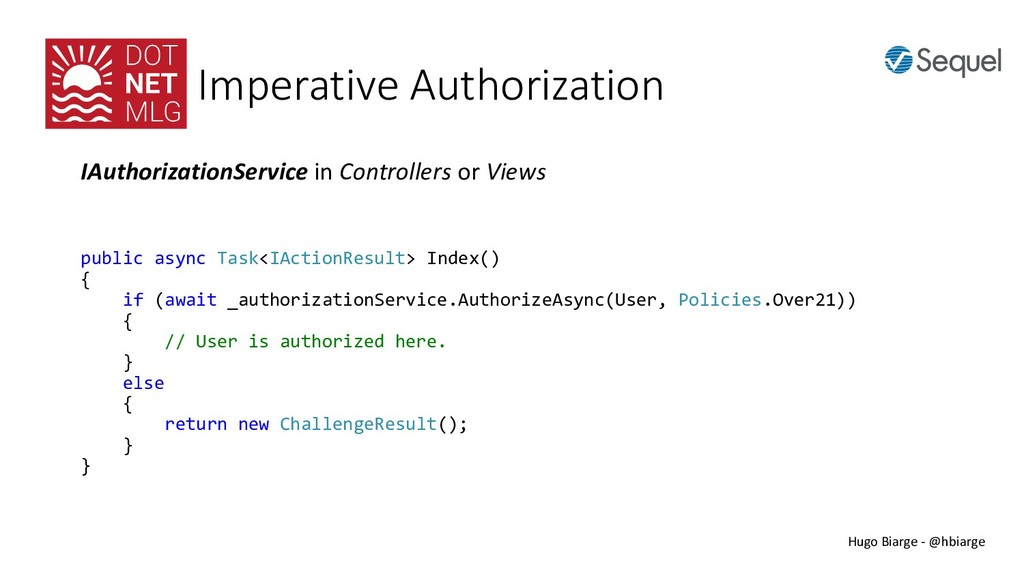
Index() { if (await _authorizationService.AuthorizeAsync(User, Policies.Over21)) { // User is authorized here. } else { return new ChallengeResult(); } } Hugo Biarge - @hbiarge
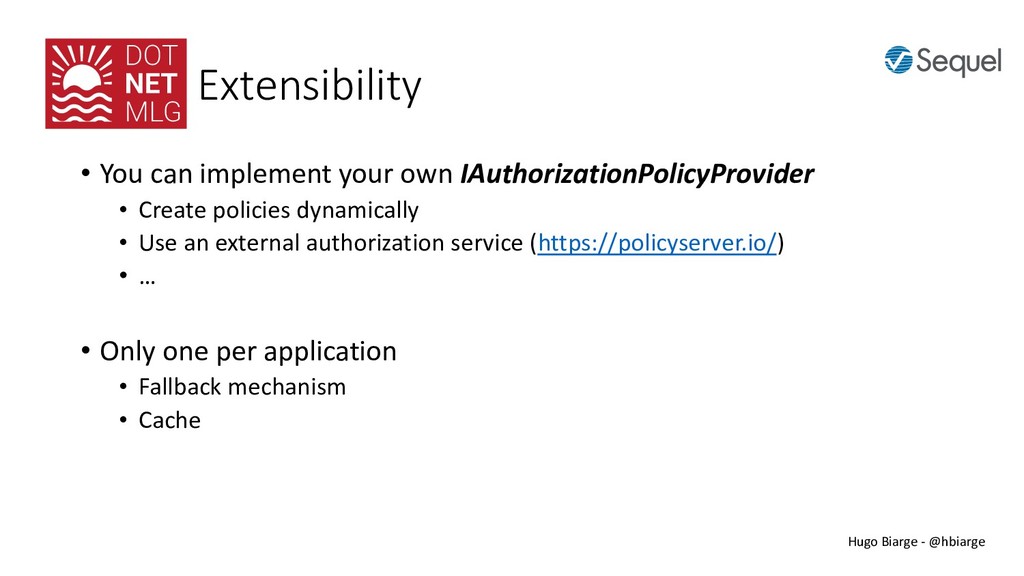
policies dynamically • Use an external authorization service (https://policyserver.io/) • … • Only one per application • Fallback mechanism • Cache Hugo Biarge - @hbiarge
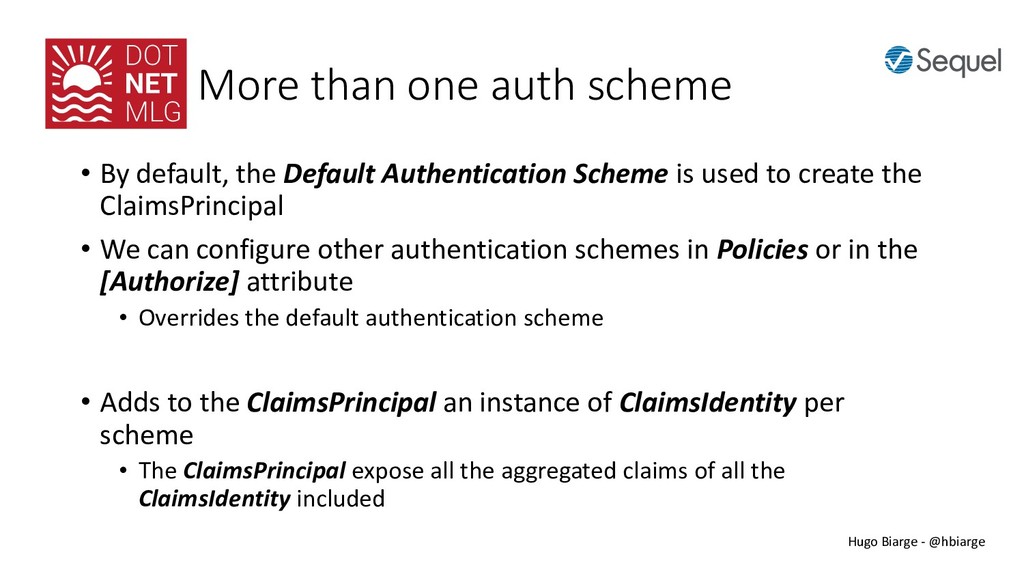
Authentication Scheme is used to create the ClaimsPrincipal • We can configure other authentication schemes in Policies or in the [Authorize] attribute • Overrides the default authentication scheme • Adds to the ClaimsPrincipal an instance of ClaimsIdentity per scheme • The ClaimsPrincipal expose all the aggregated claims of all the ClaimsIdentity included Hugo Biarge - @hbiarge


 hbiarge
 occhi
occhi
 ivry_presentationmaterials
 yuuuuuuu168
 odashi
 sh_fk2
 tsukina_7mochi
 satomasahiro2005
 daidaidai
 yahonda
 techtekt
 shugo
shugo
 jtakeda
 maggiecrowley
 shlominoach
 zakiyama
 jeffersonlam
 smashingmag
 mayunak
 cassininazir
 maltzj
 eileencodes
 katiecoart
 minecr
 akihiro_kokubo

![@hbiarge [email protected] Developer Mountain lover Hugo Biarge Software Development Engineer](https://files.speakerdeck.com/presentations/cd260f0a76294c07af99e17e212e5b3c/slide_1.jpg)
![Once upon a time… • [Authorize] and [AllowAnonymous] are used](https://files.speakerdeck.com/presentations/cd260f0a76294c07af99e17e212e5b3c/slide_4.jpg)
![But… it´s the same in Core, right? • [Authorize] and](https://files.speakerdeck.com/presentations/cd260f0a76294c07af99e17e212e5b3c/slide_5.jpg)