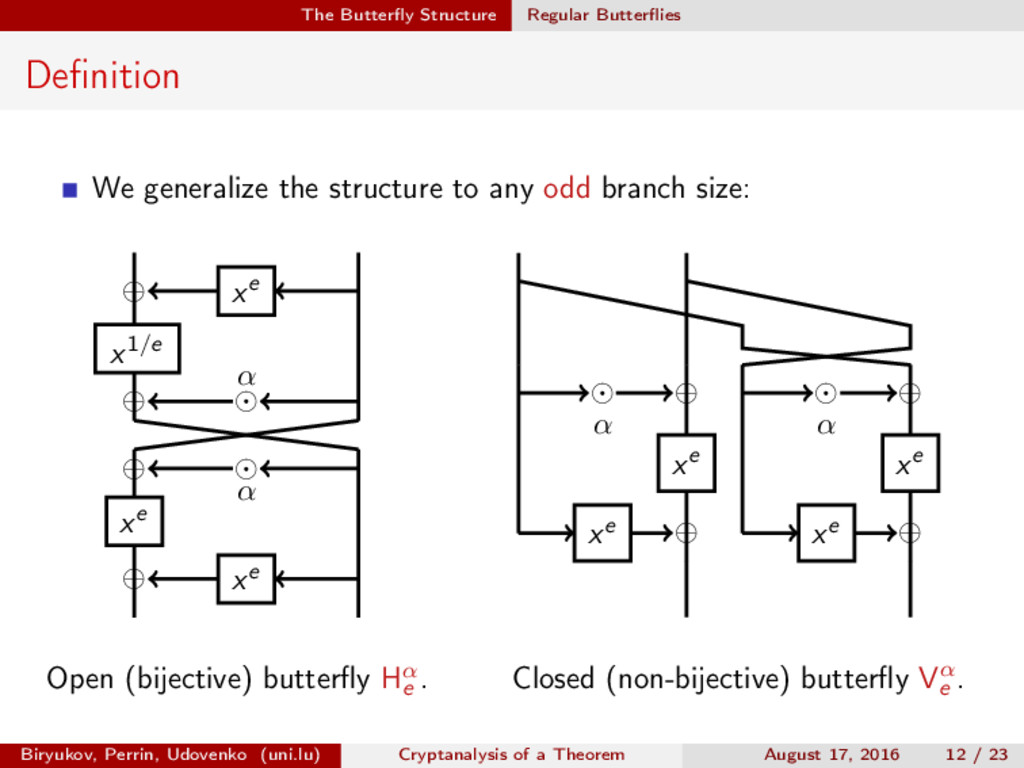
Butterfly Structure 4 Properties of the APN Permutation 5 Conclusion Biryukov, Perrin, Udovenko (uni.lu) Cryptanalysis of a Theorem August 17, 2016 1 / 23
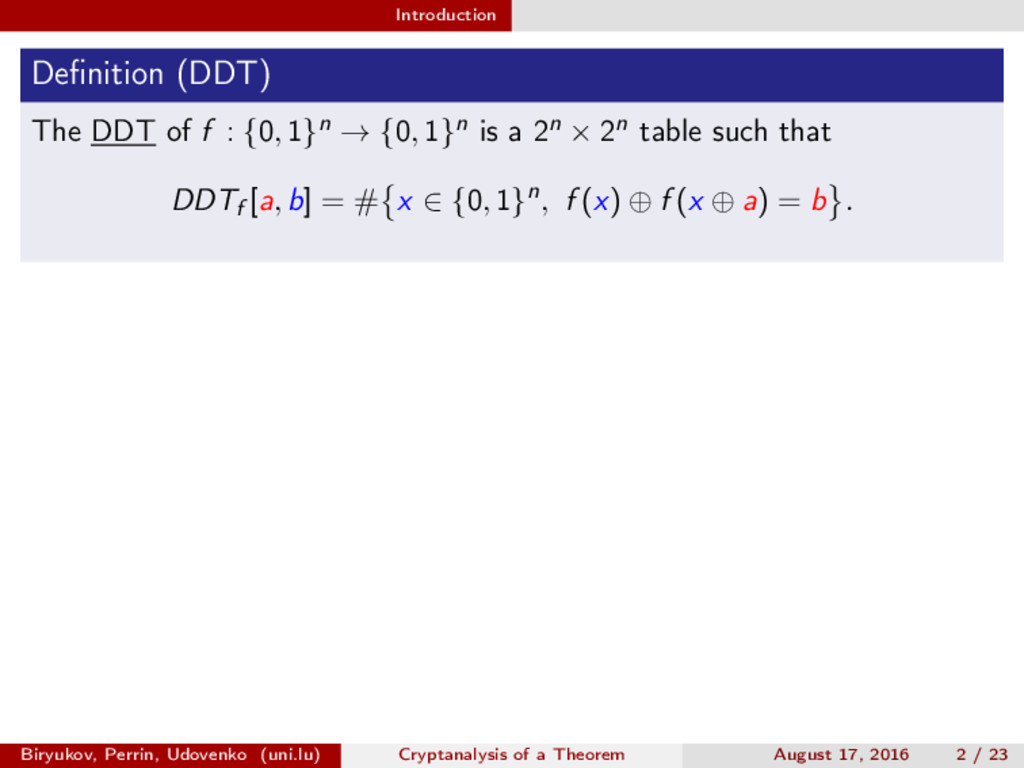
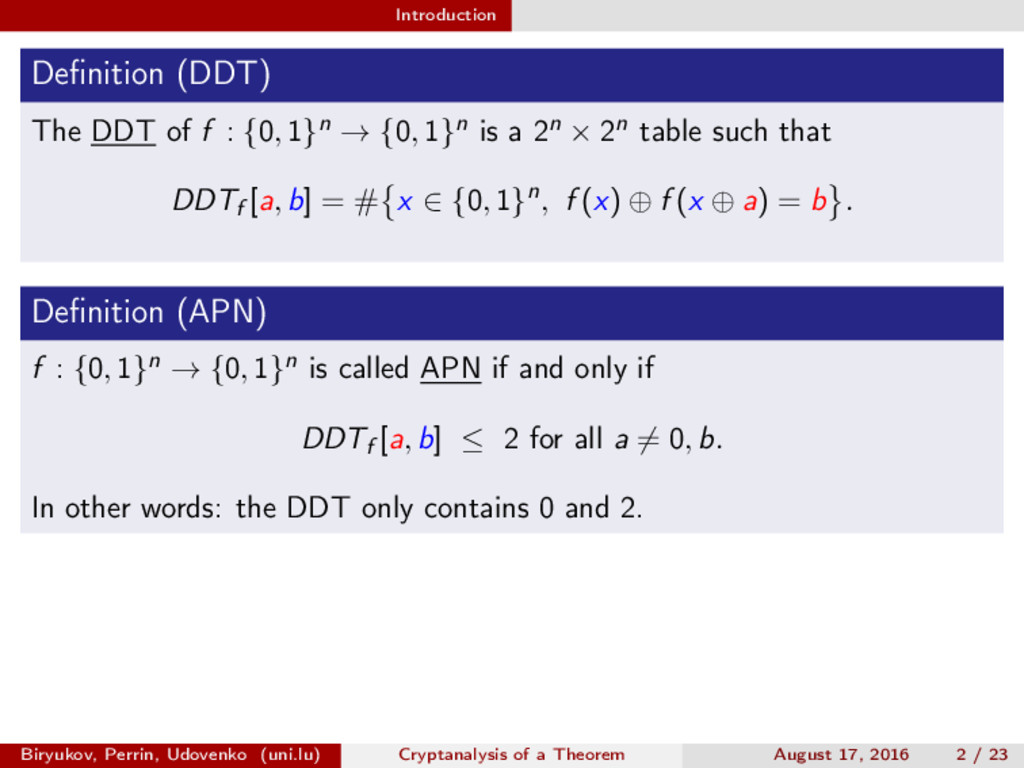
→ {0, 1}n is a 2n × 2n table such that DDTf [a, b] = #{︀x ∈ {0, 1}n, f (x) ⊕ f (x ⊕ a) = b}︀. Biryukov, Perrin, Udovenko (uni.lu) Cryptanalysis of a Theorem August 17, 2016 2 / 23
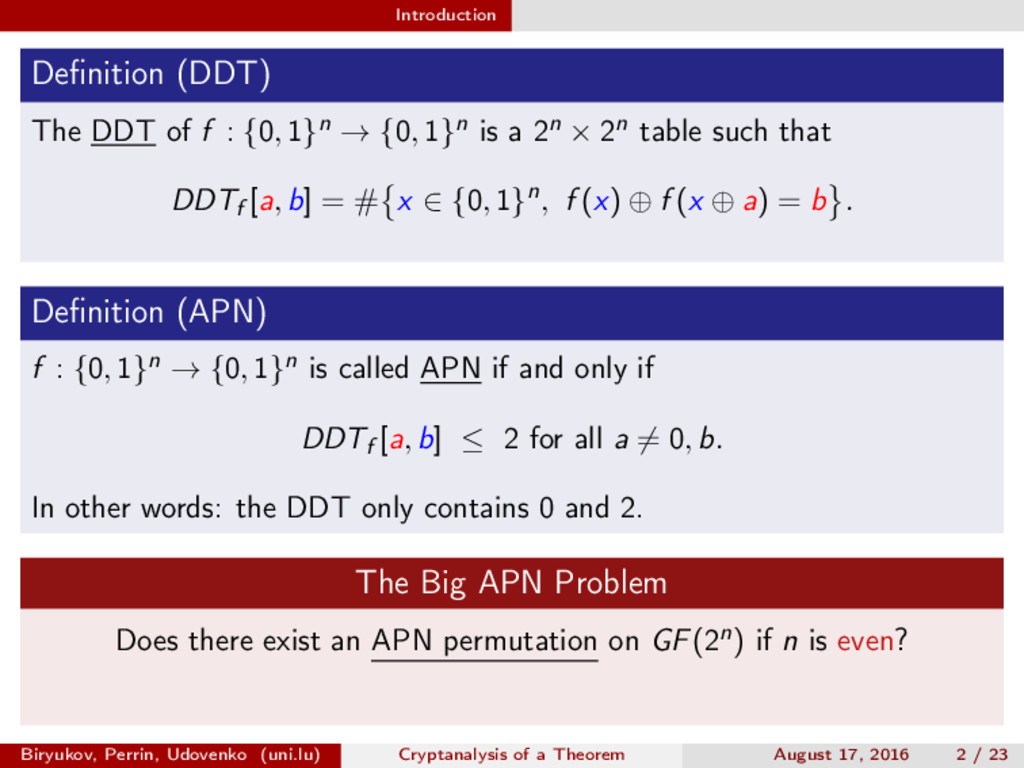
→ {0, 1}n is a 2n × 2n table such that DDTf [a, b] = #{︀x ∈ {0, 1}n, f (x) ⊕ f (x ⊕ a) = b}︀. Definition (APN) f : {0, 1}n → {0, 1}n is called APN if and only if DDTf [a, b] ≤ 2 for all a ̸= 0, b. In other words: the DDT only contains 0 and 2. Biryukov, Perrin, Udovenko (uni.lu) Cryptanalysis of a Theorem August 17, 2016 2 / 23
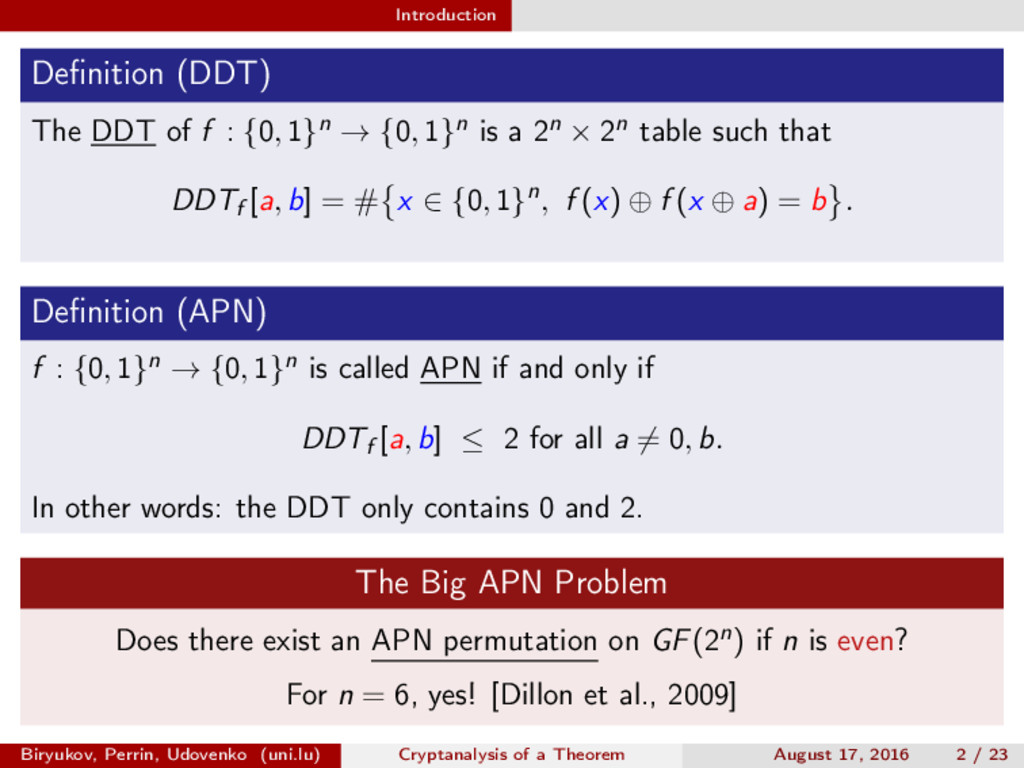
→ {0, 1}n is a 2n × 2n table such that DDTf [a, b] = #{︀x ∈ {0, 1}n, f (x) ⊕ f (x ⊕ a) = b}︀. Definition (APN) f : {0, 1}n → {0, 1}n is called APN if and only if DDTf [a, b] ≤ 2 for all a ̸= 0, b. In other words: the DDT only contains 0 and 2. The Big APN Problem Does there exist an APN permutation on GF(2n) if n is even? Biryukov, Perrin, Udovenko (uni.lu) Cryptanalysis of a Theorem August 17, 2016 2 / 23
→ {0, 1}n is a 2n × 2n table such that DDTf [a, b] = #{︀x ∈ {0, 1}n, f (x) ⊕ f (x ⊕ a) = b}︀. Definition (APN) f : {0, 1}n → {0, 1}n is called APN if and only if DDTf [a, b] ≤ 2 for all a ̸= 0, b. In other words: the DDT only contains 0 and 2. The Big APN Problem Does there exist an APN permutation on GF(2n) if n is even? For n = 6, yes! [Dillon et al., 2009] Biryukov, Perrin, Udovenko (uni.lu) Cryptanalysis of a Theorem August 17, 2016 2 / 23
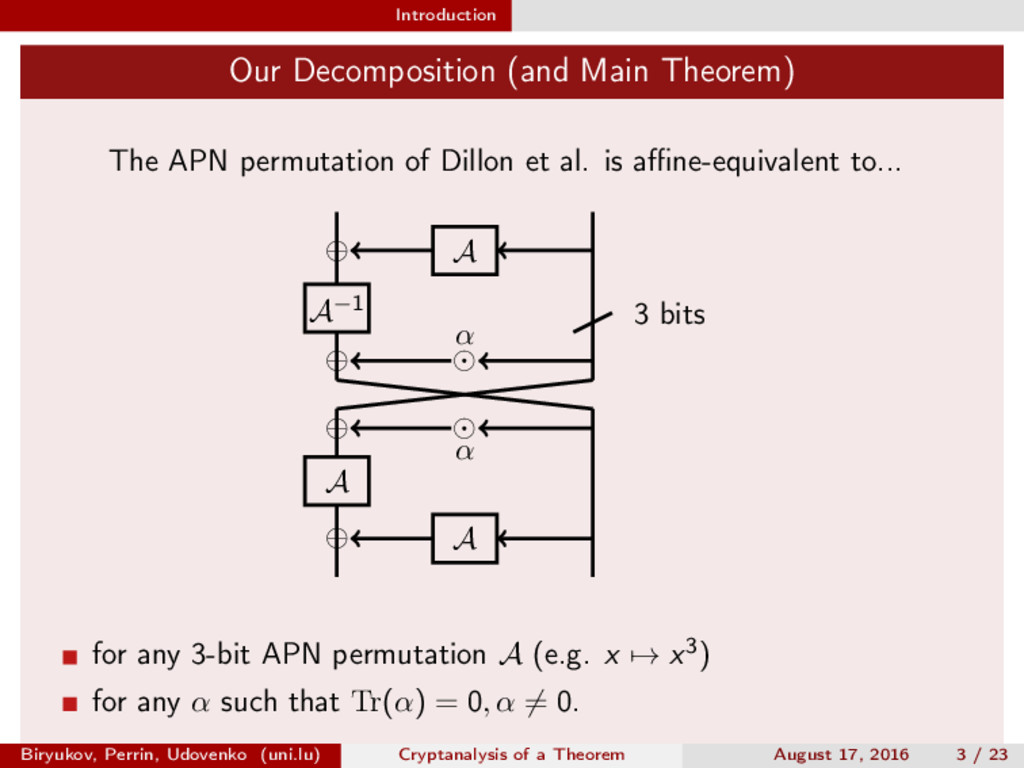
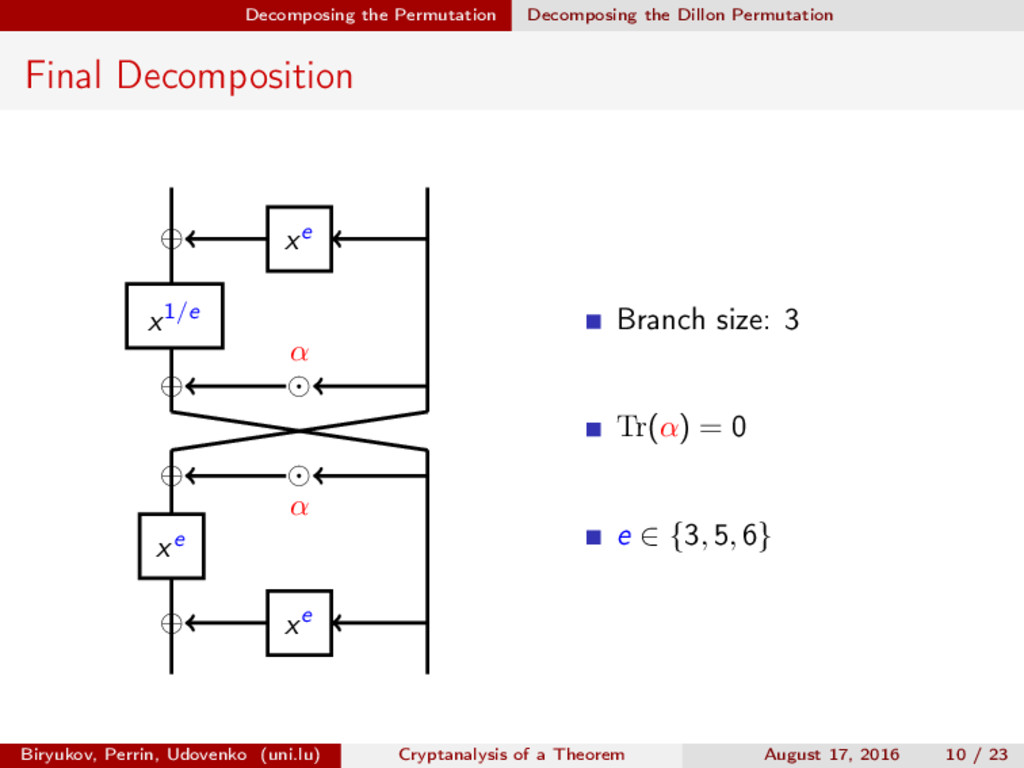
Dillon et al. is affine-equivalent to... −1 ⊙ ⊕ ⊕ 3 bits ⊙ ⊕ ⊕ for any 3-bit APN permutation (e.g. x ↦→ x3) for any such that Tr() = 0, ̸= 0. Biryukov, Perrin, Udovenko (uni.lu) Cryptanalysis of a Theorem August 17, 2016 3 / 23
S-Box Reverse-Engineering Decomposing the Dillon Permutation Implementation 3 The Butterfly Structure 4 Properties of the APN Permutation 5 Conclusion Biryukov, Perrin, Udovenko (uni.lu) Cryptanalysis of a Theorem August 17, 2016 3 / 23
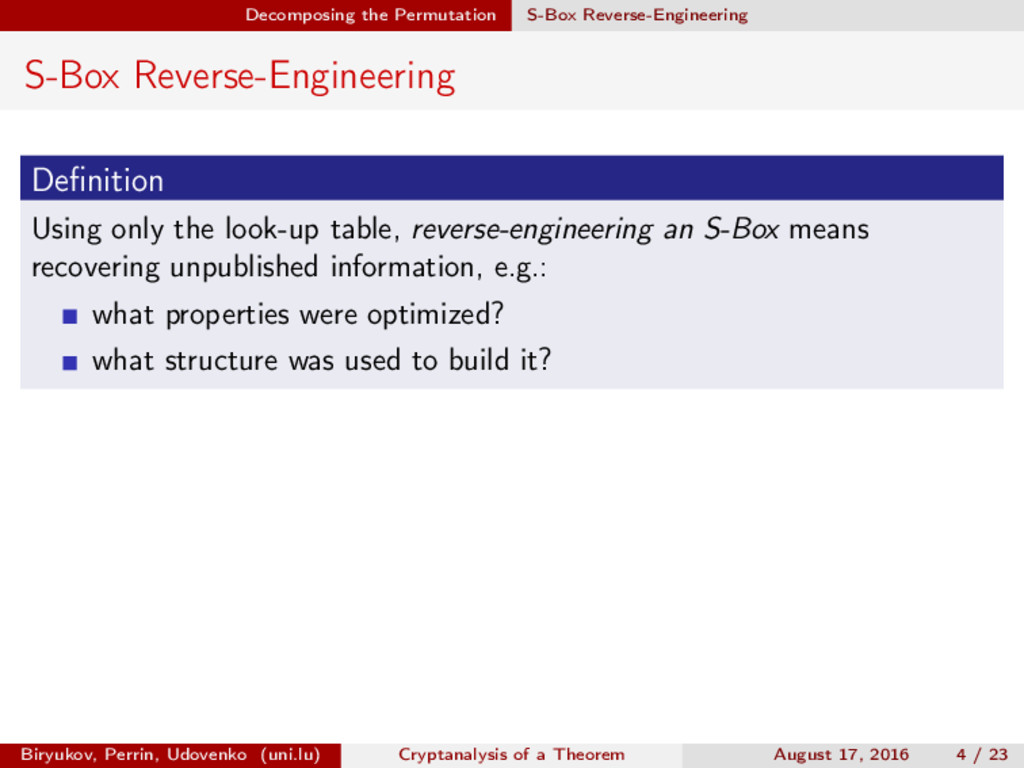
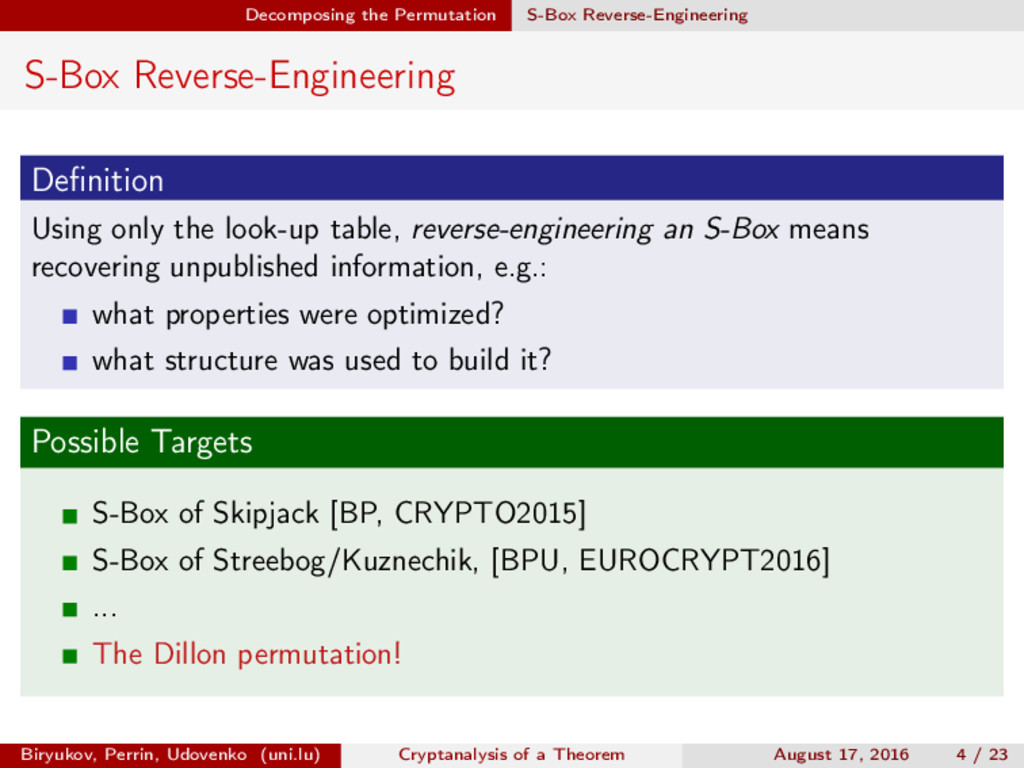
the look-up table, reverse-engineering an S-Box means recovering unpublished information, e.g.: what properties were optimized? what structure was used to build it? Biryukov, Perrin, Udovenko (uni.lu) Cryptanalysis of a Theorem August 17, 2016 4 / 23
the look-up table, reverse-engineering an S-Box means recovering unpublished information, e.g.: what properties were optimized? what structure was used to build it? Possible Targets S-Box of Skipjack [BP, CRYPTO2015] S-Box of Streebog/Kuznechik, [BPU, EUROCRYPT2016] ... The Dillon permutation! Biryukov, Perrin, Udovenko (uni.lu) Cryptanalysis of a Theorem August 17, 2016 4 / 23
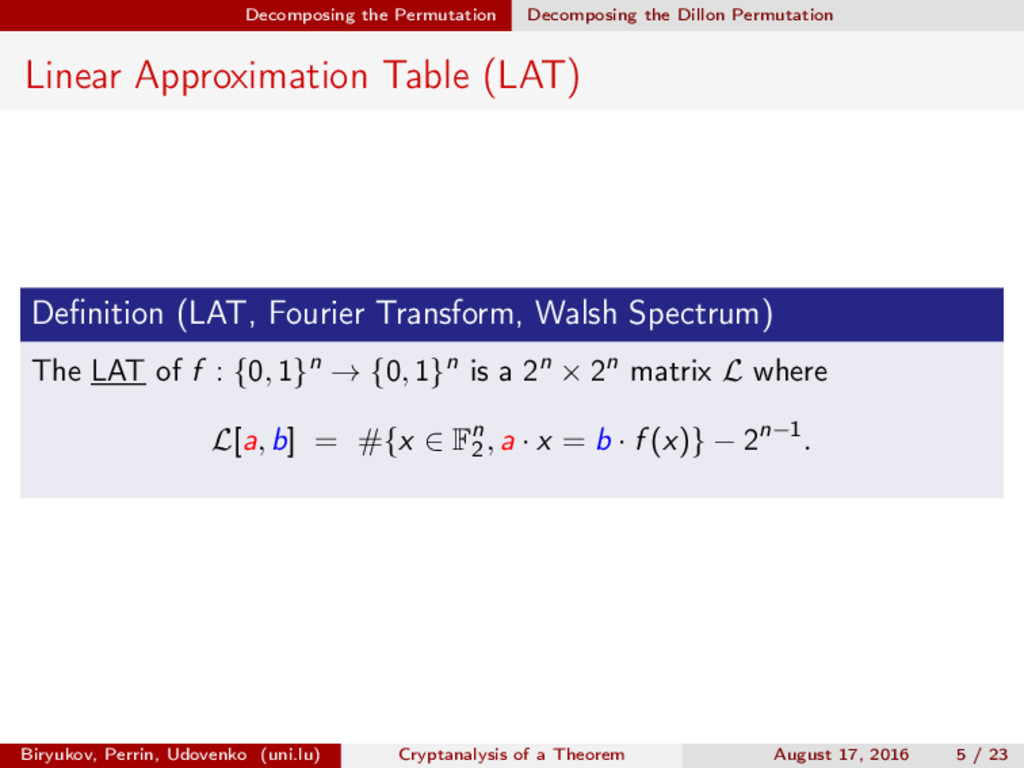
(LAT) Definition (LAT, Fourier Transform, Walsh Spectrum) The LAT of f : {0, 1}n → {0, 1}n is a 2n × 2n matrix ℒ where ℒ[a, b] = #{x ∈ Fn 2 , a · x = b · f (x)} − 2n−1. Biryukov, Perrin, Udovenko (uni.lu) Cryptanalysis of a Theorem August 17, 2016 5 / 23
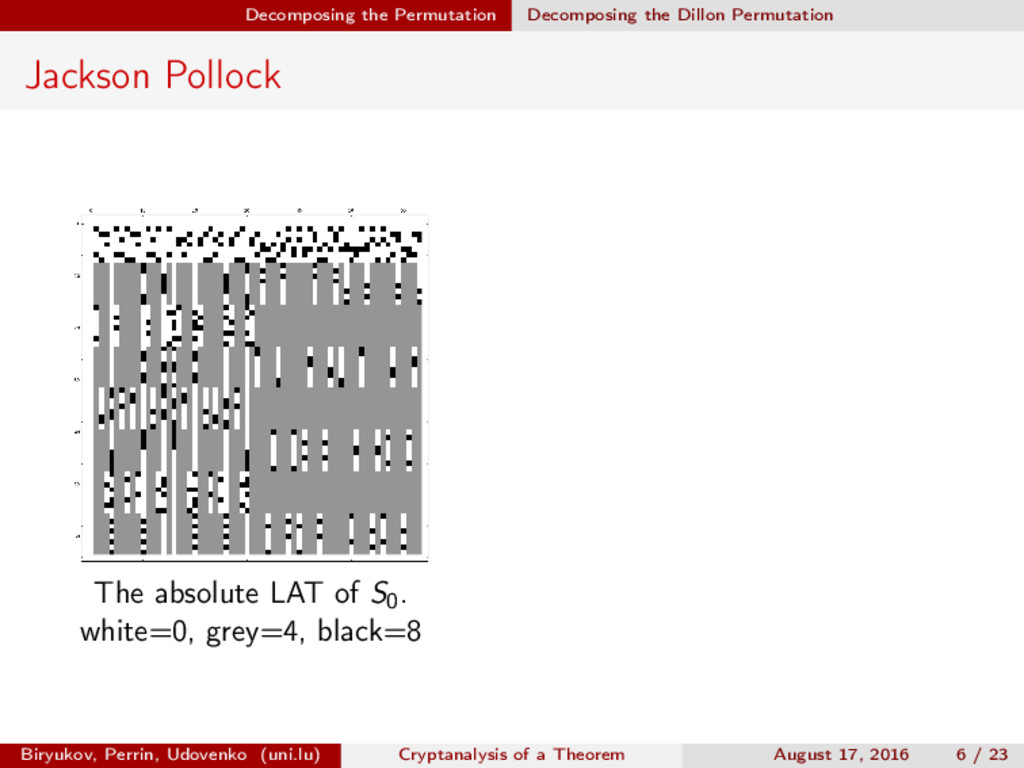
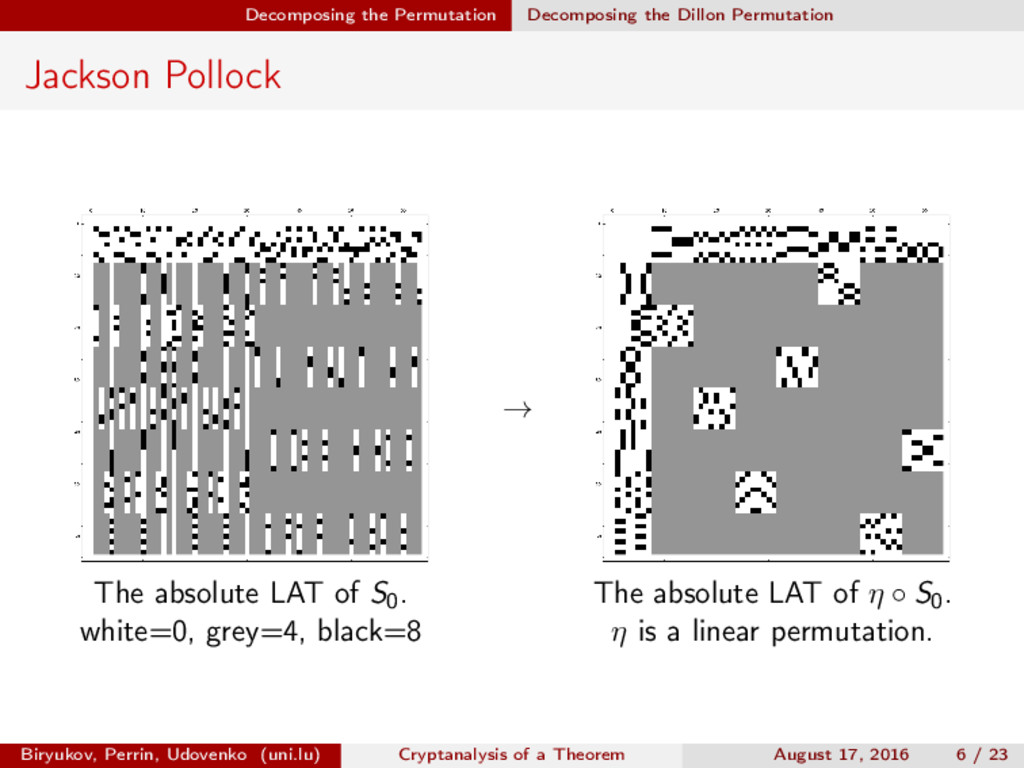
absolute LAT of S0. white=0, grey=4, black=8 → The absolute LAT of ∘ S0. is a linear permutation. Biryukov, Perrin, Udovenko (uni.lu) Cryptanalysis of a Theorem August 17, 2016 6 / 23
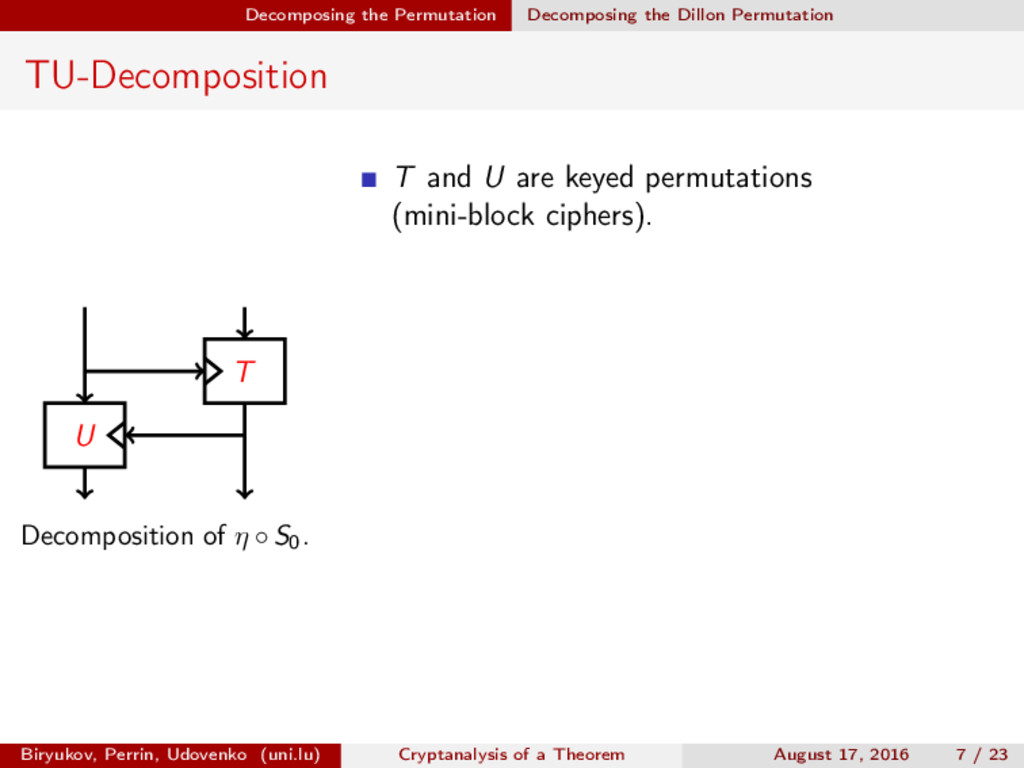
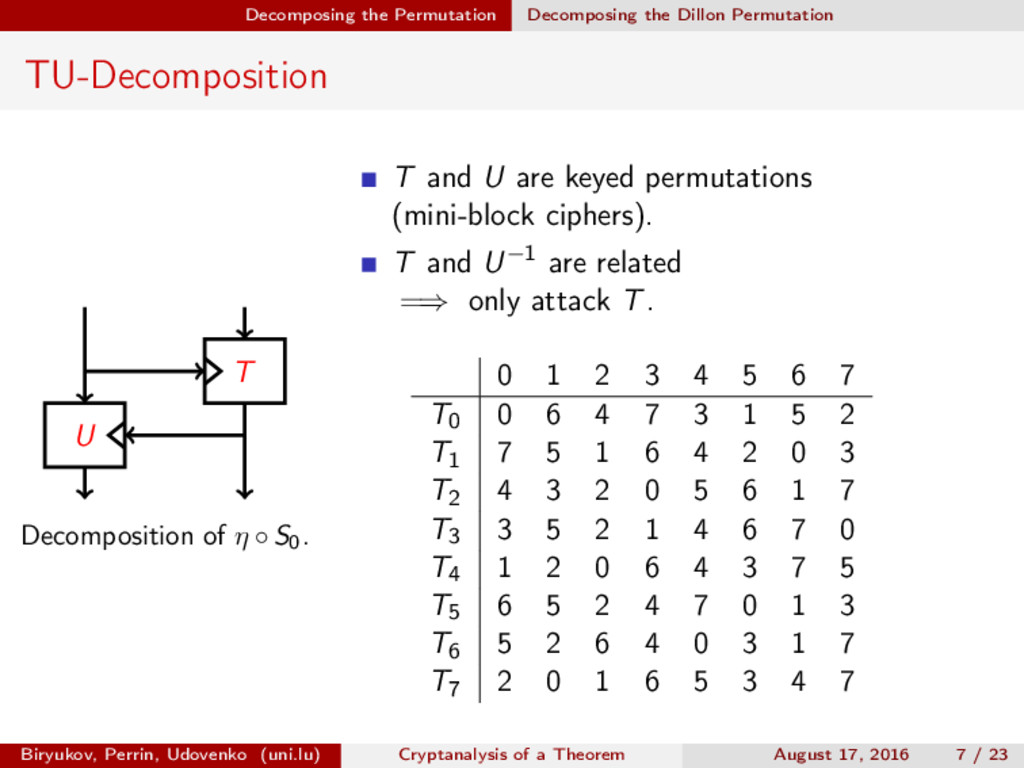
Decomposition of ∘ S0 . T and U are keyed permutations (mini-block ciphers). Biryukov, Perrin, Udovenko (uni.lu) Cryptanalysis of a Theorem August 17, 2016 7 / 23
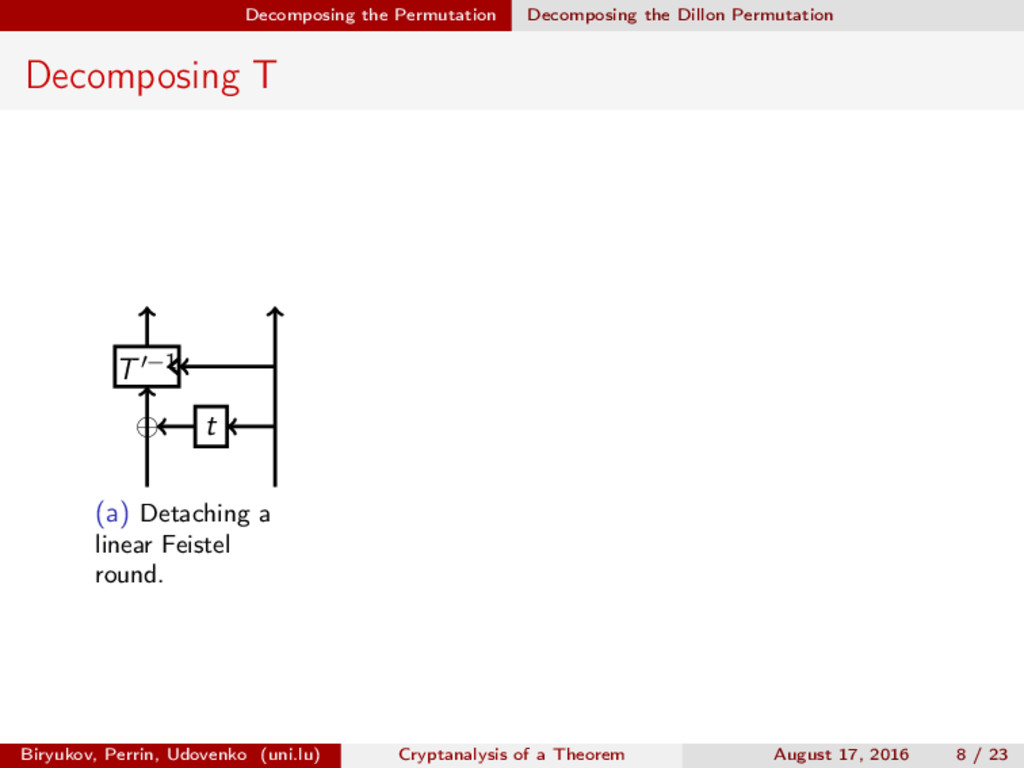
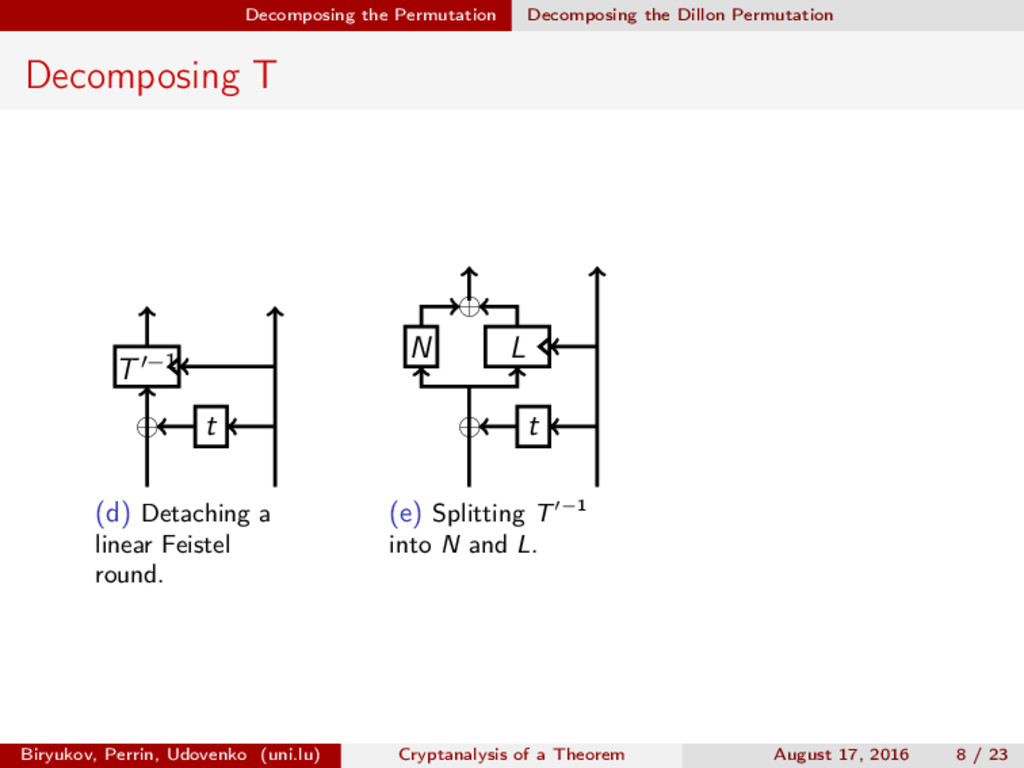
t ⊕ (d) Detaching a linear Feistel round. L t N ⊕ ⊕ (e) Splitting T′−1 into N and L. Biryukov, Perrin, Udovenko (uni.lu) Cryptanalysis of a Theorem August 17, 2016 8 / 23
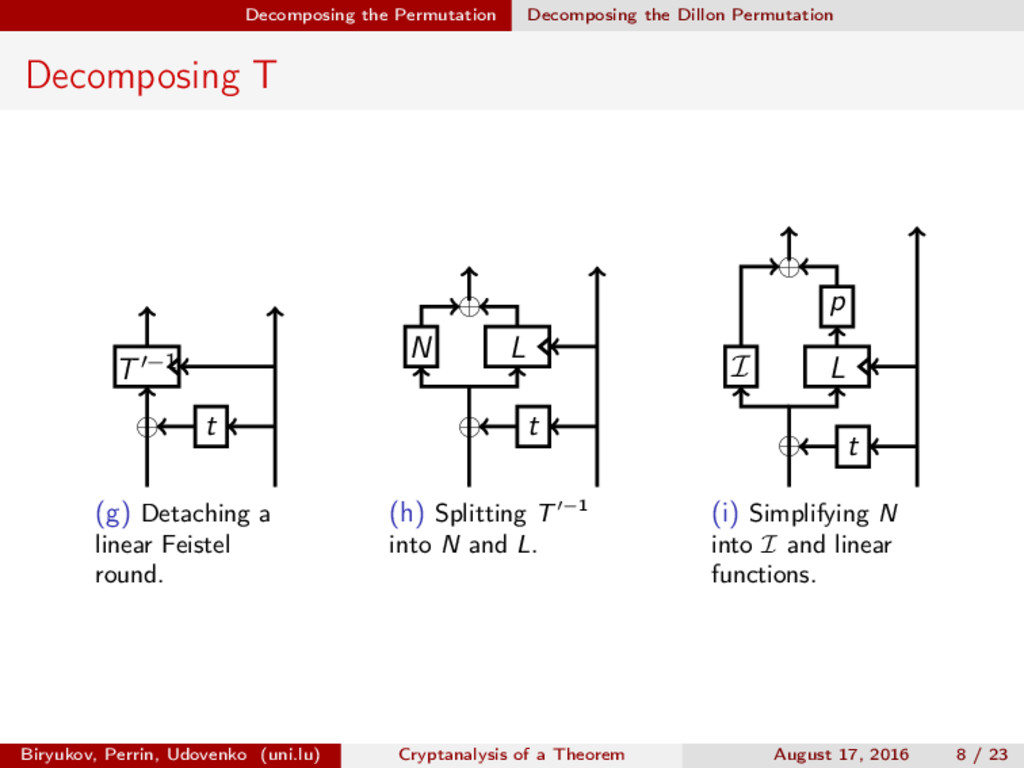
t ⊕ (g) Detaching a linear Feistel round. L t N ⊕ ⊕ (h) Splitting T′−1 into N and L. L t ℐ p ⊕ ⊕ (i) Simplifying N into ℐ and linear functions. Biryukov, Perrin, Udovenko (uni.lu) Cryptanalysis of a Theorem August 17, 2016 8 / 23
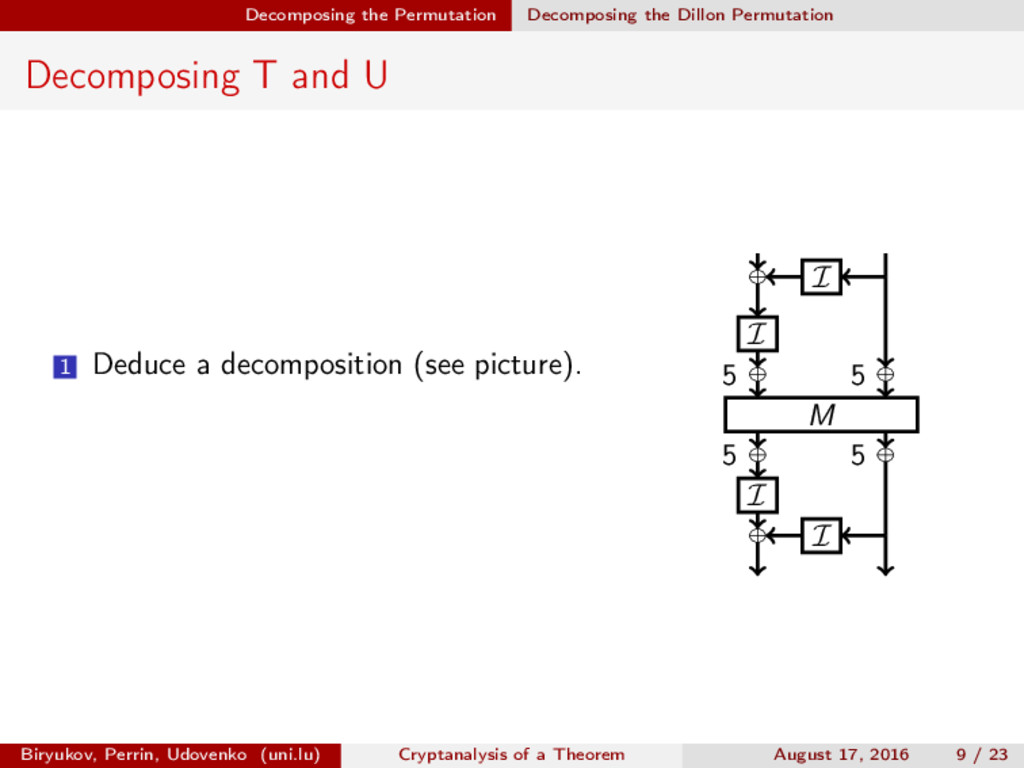
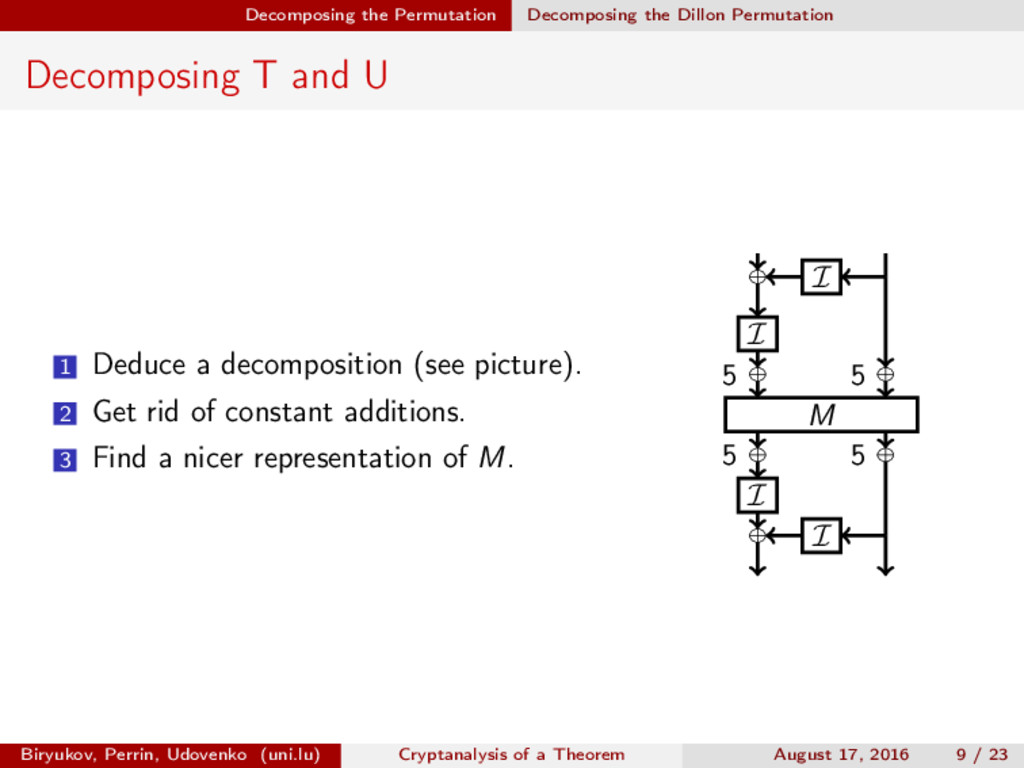
U 1 Deduce a decomposition (see picture). 2 Get rid of constant additions. 3 Find a nicer representation of M. ℐ ℐ 5 5 M 5 5 ℐ ℐ Biryukov, Perrin, Udovenko (uni.lu) Cryptanalysis of a Theorem August 17, 2016 9 / 23
3 The Butterfly Structure Regular Butterflies Feistel Networks 4 Properties of the APN Permutation 5 Conclusion Biryukov, Perrin, Udovenko (uni.lu) Cryptanalysis of a Theorem August 17, 2016 11 / 23
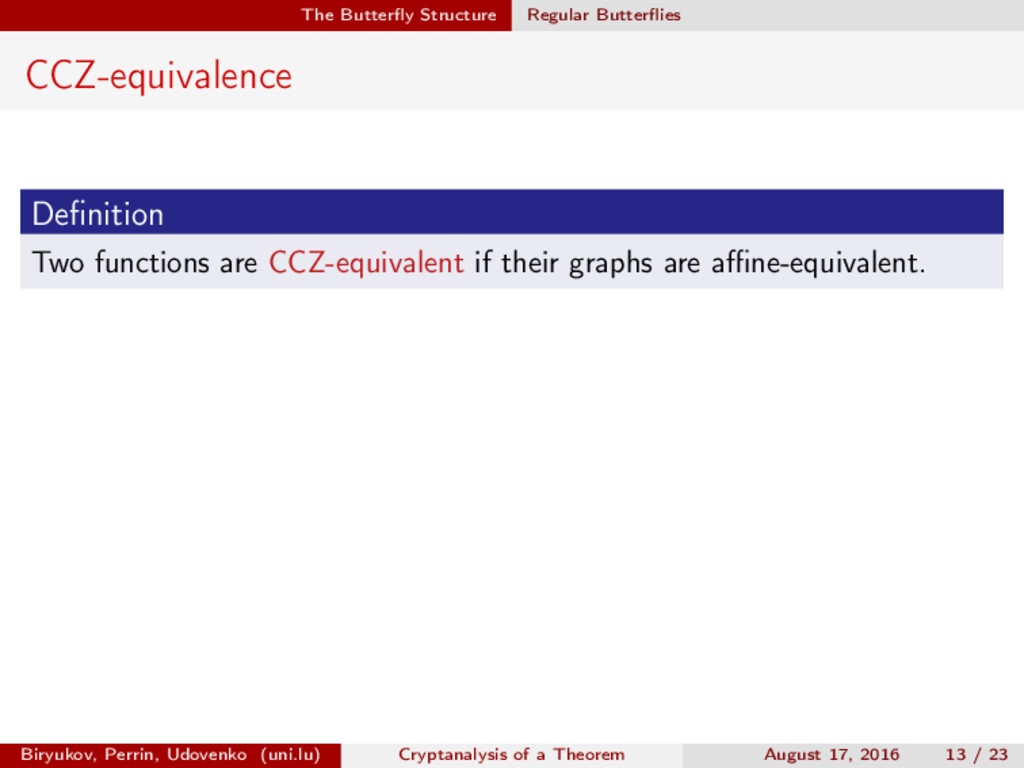
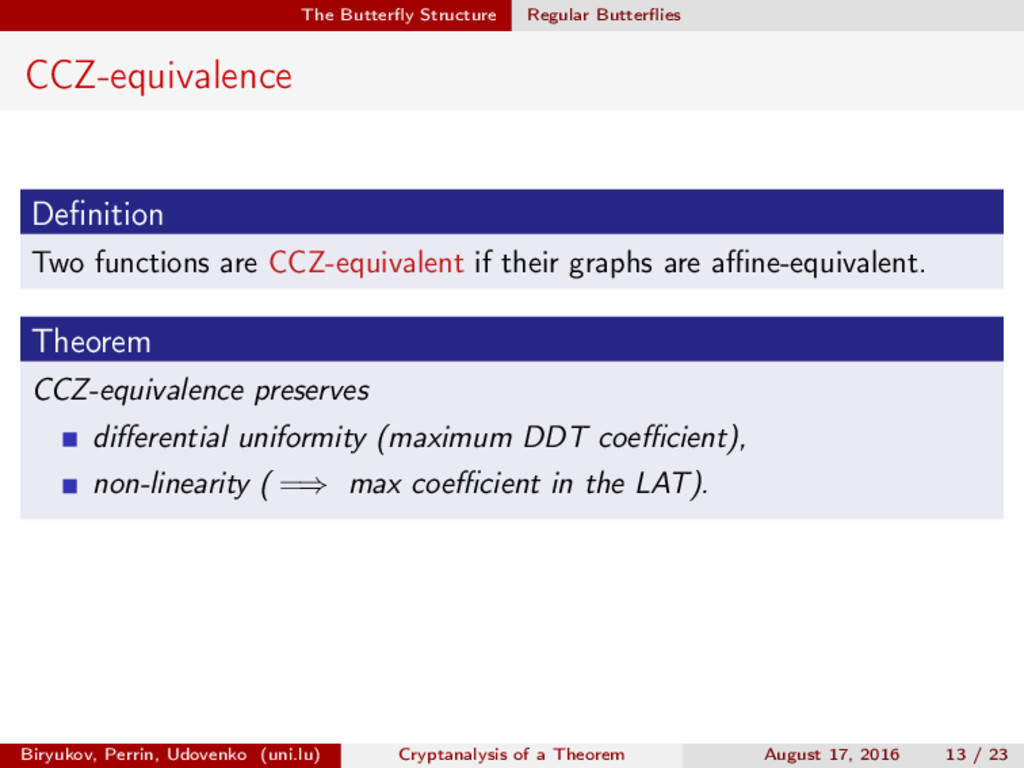
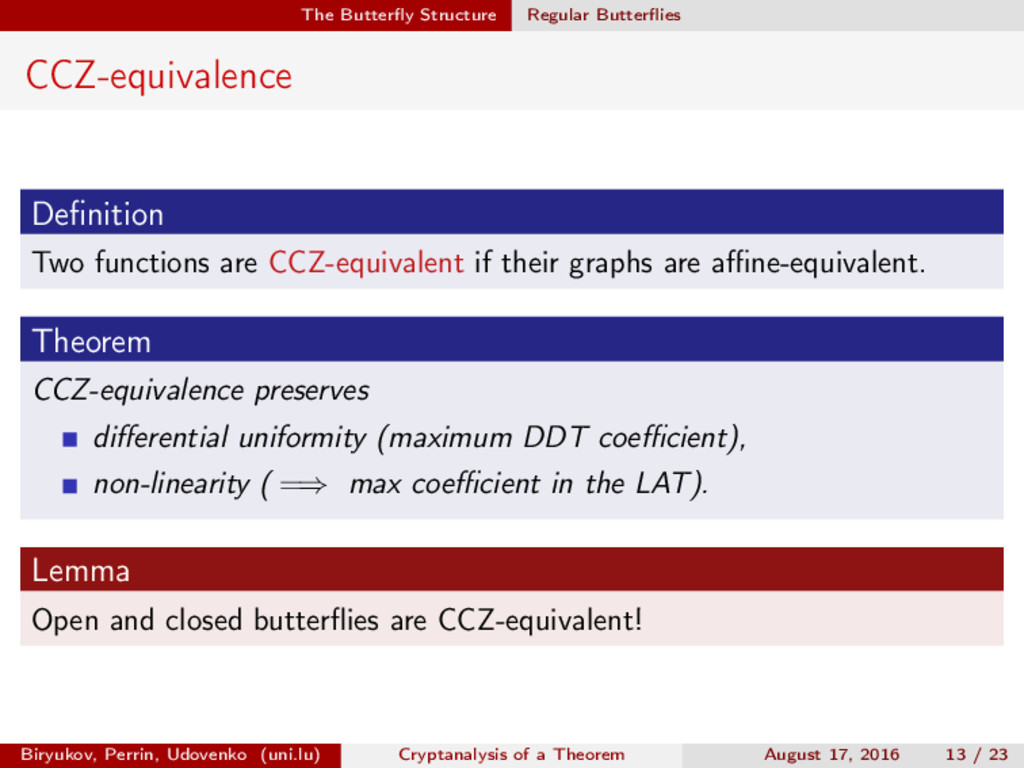
CCZ-equivalent if their graphs are affine-equivalent. Theorem CCZ-equivalence preserves differential uniformity (maximum DDT coefficient), non-linearity ( =⇒ max coefficient in the LAT). Biryukov, Perrin, Udovenko (uni.lu) Cryptanalysis of a Theorem August 17, 2016 13 / 23
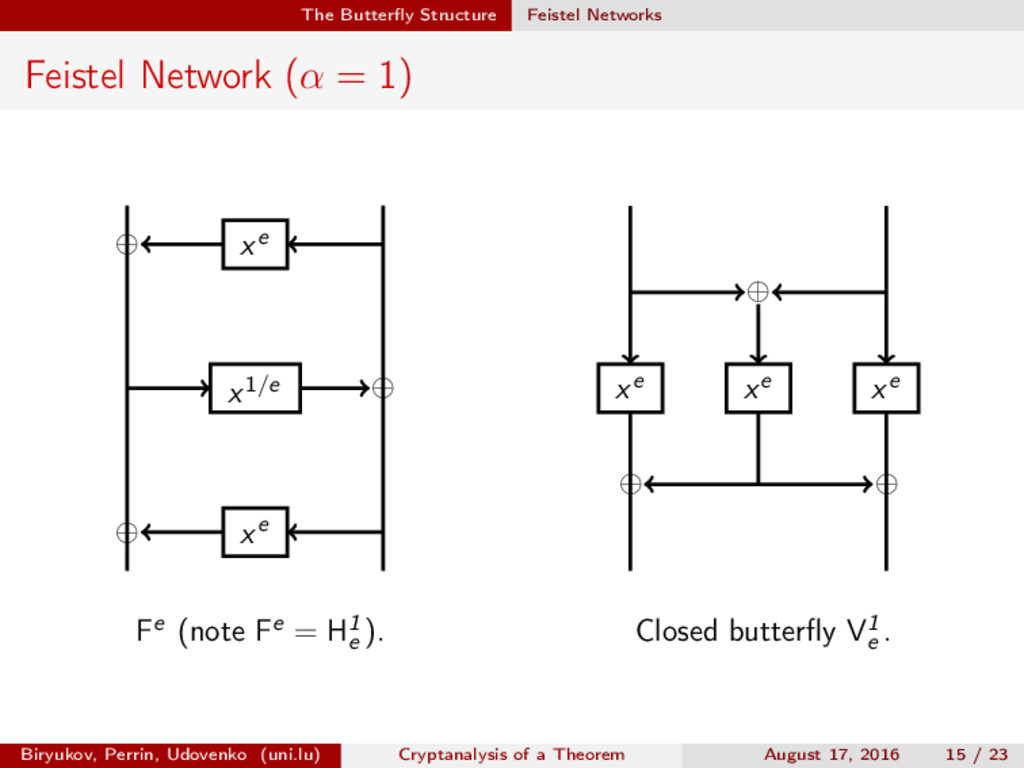
CCZ-equivalent if their graphs are affine-equivalent. Theorem CCZ-equivalence preserves differential uniformity (maximum DDT coefficient), non-linearity ( =⇒ max coefficient in the LAT). Lemma Open and closed butterflies are CCZ-equivalent! Biryukov, Perrin, Udovenko (uni.lu) Cryptanalysis of a Theorem August 17, 2016 13 / 23
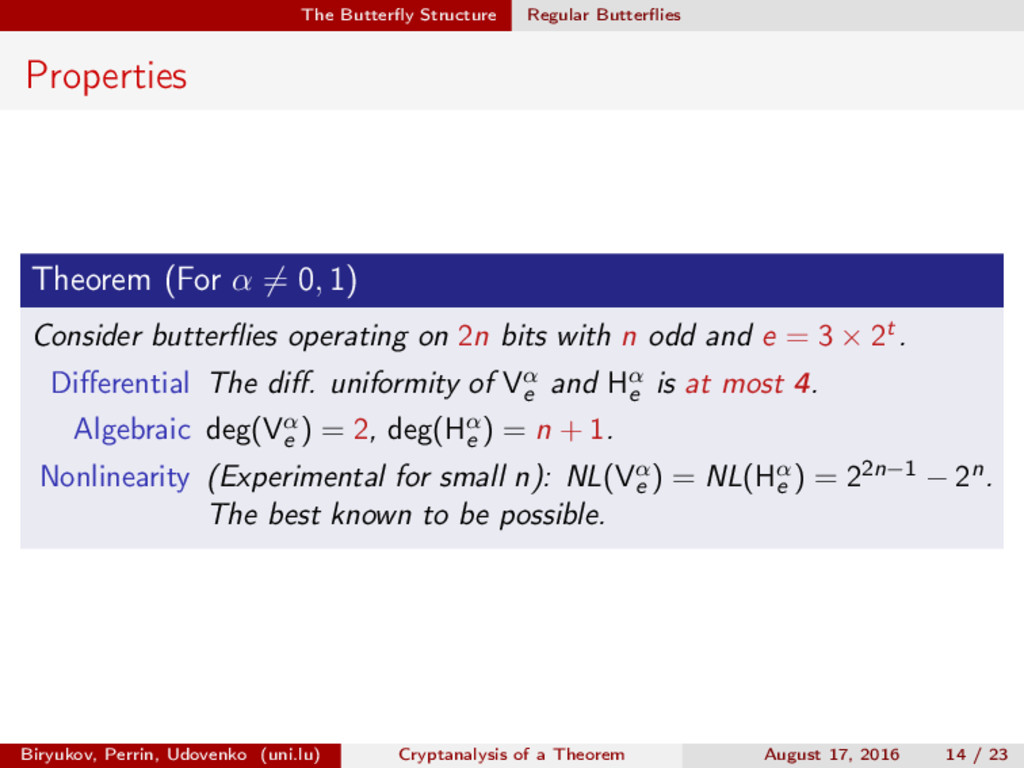
1) Consider butterflies operating on 2n bits with n odd and e = 3 × 2t. Differential The diff. uniformity of V e and H e is at most 4. Algebraic deg(V e ) = 2, deg(H e ) = n + 1. Nonlinearity (Experimental for small n): NL(V e ) = NL(H e ) = 22n−1 − 2n. The best known to be possible. Biryukov, Perrin, Udovenko (uni.lu) Cryptanalysis of a Theorem August 17, 2016 14 / 23
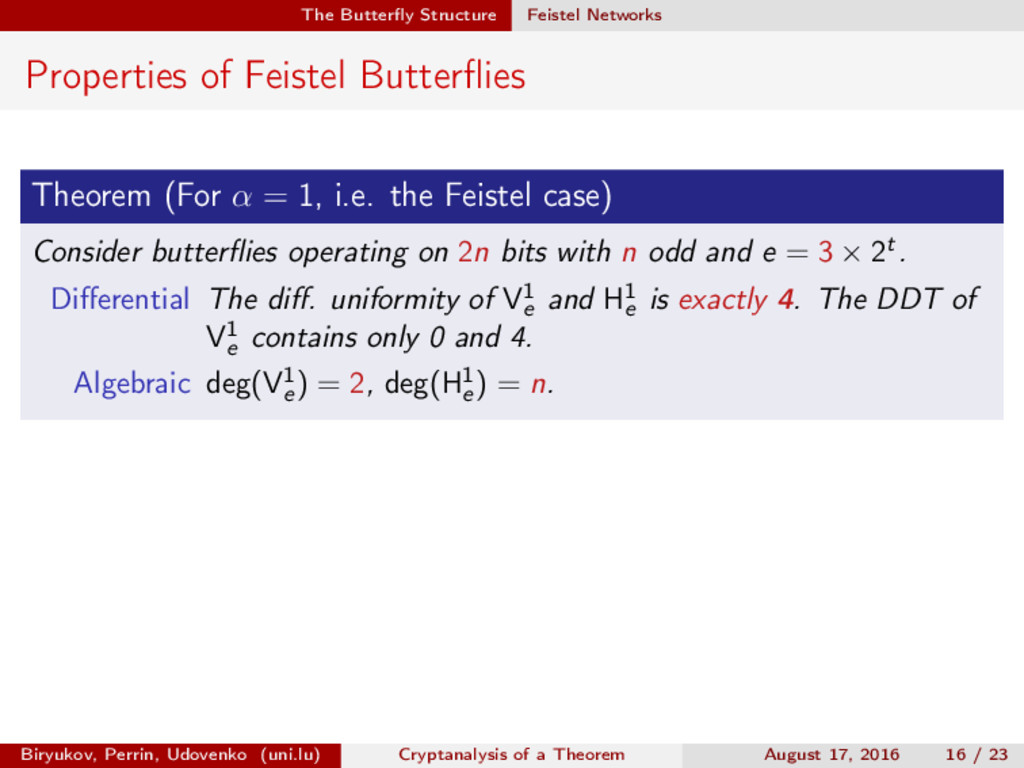
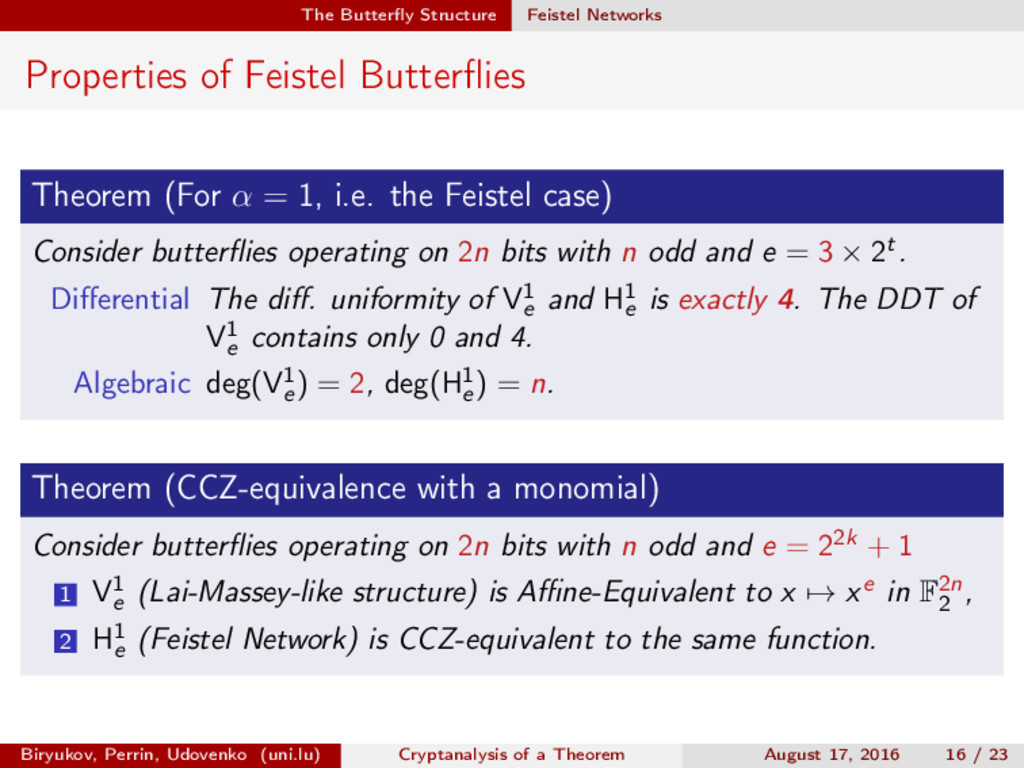
(For = 1, i.e. the Feistel case) Consider butterflies operating on 2n bits with n odd and e = 3 × 2t. Differential The diff. uniformity of V1 e and H1 e is exactly 4. The DDT of V1 e contains only 0 and 4. Algebraic deg(V1 e ) = 2, deg(H1 e ) = n. Biryukov, Perrin, Udovenko (uni.lu) Cryptanalysis of a Theorem August 17, 2016 16 / 23
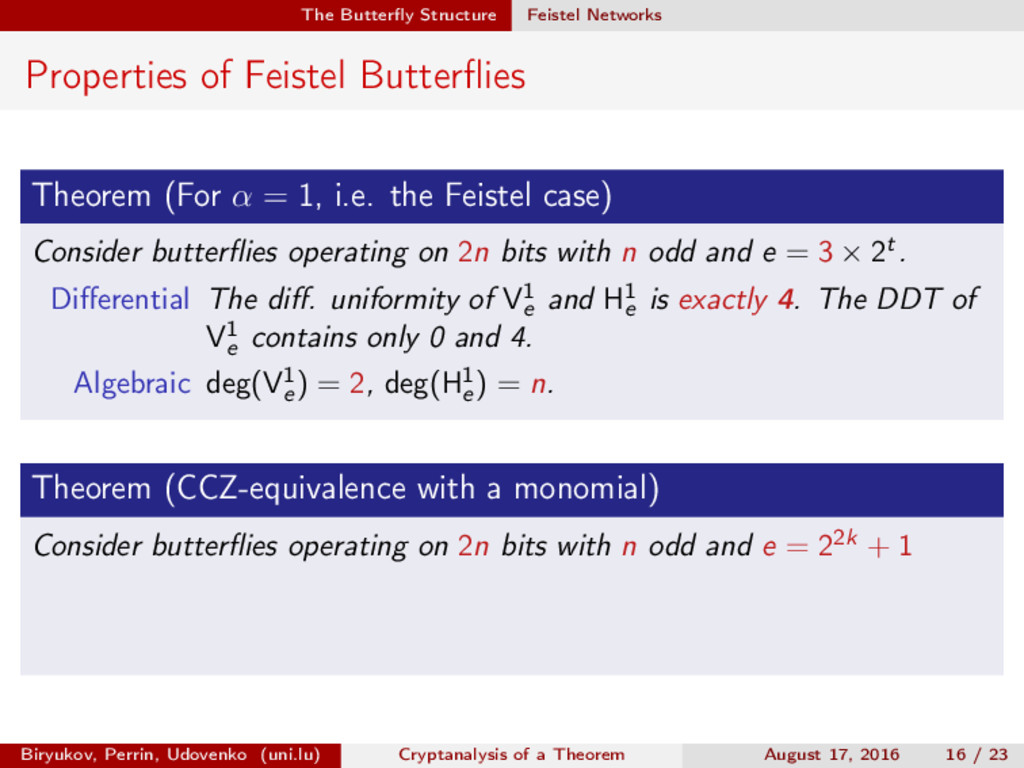
(For = 1, i.e. the Feistel case) Consider butterflies operating on 2n bits with n odd and e = 3 × 2t. Differential The diff. uniformity of V1 e and H1 e is exactly 4. The DDT of V1 e contains only 0 and 4. Algebraic deg(V1 e ) = 2, deg(H1 e ) = n. Theorem (CCZ-equivalence with a monomial) Consider butterflies operating on 2n bits with n odd and e = 22k + 1 Biryukov, Perrin, Udovenko (uni.lu) Cryptanalysis of a Theorem August 17, 2016 16 / 23
(For = 1, i.e. the Feistel case) Consider butterflies operating on 2n bits with n odd and e = 3 × 2t. Differential The diff. uniformity of V1 e and H1 e is exactly 4. The DDT of V1 e contains only 0 and 4. Algebraic deg(V1 e ) = 2, deg(H1 e ) = n. Theorem (CCZ-equivalence with a monomial) Consider butterflies operating on 2n bits with n odd and e = 22k + 1 1 V1 e (Lai-Massey-like structure) is Affine-Equivalent to x ↦→ xe in F2n 2 , 2 H1 e (Feistel Network) is CCZ-equivalent to the same function. Biryukov, Perrin, Udovenko (uni.lu) Cryptanalysis of a Theorem August 17, 2016 16 / 23
the Permutation 3 The Butterfly Structure 4 Properties of the APN Permutation 5 Conclusion Biryukov, Perrin, Udovenko (uni.lu) Cryptanalysis of a Theorem August 17, 2016 16 / 23
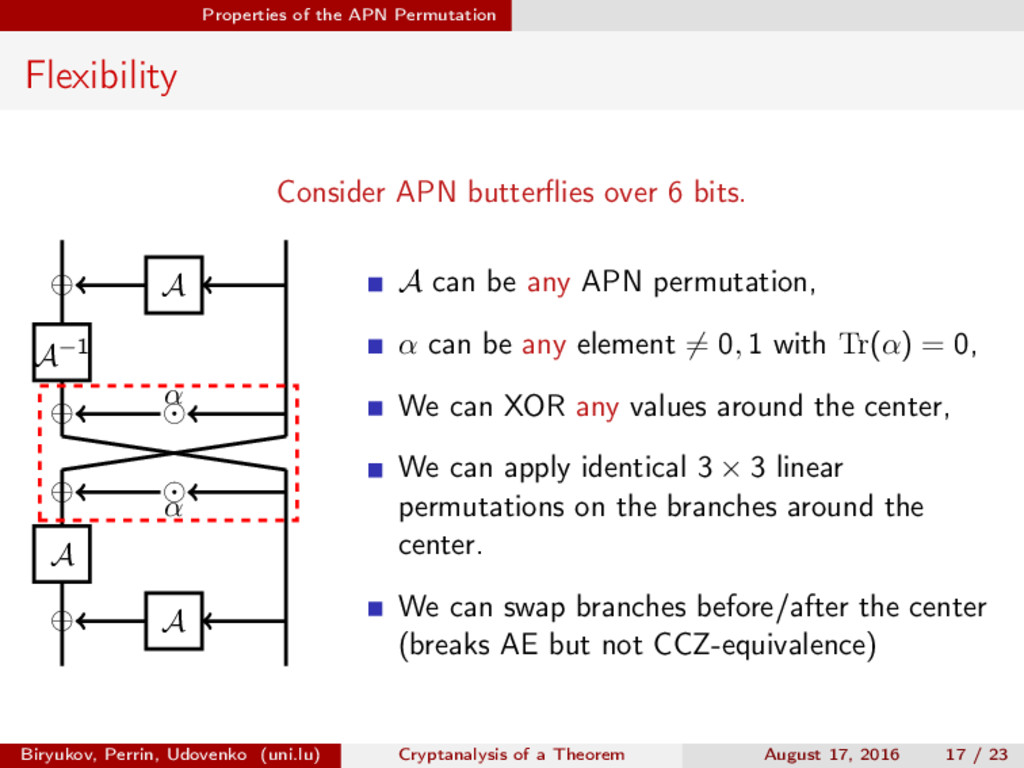
6 bits. −1 ⊙ ⊕ ⊕ ⊙ ⊕ ⊕ can be any APN permutation, can be any element ̸= 0, 1 with Tr() = 0, We can XOR any values around the center, We can apply identical 3 × 3 linear permutations on the branches around the center. We can swap branches before/after the center (breaks AE but not CCZ-equivalence) Biryukov, Perrin, Udovenko (uni.lu) Cryptanalysis of a Theorem August 17, 2016 17 / 23
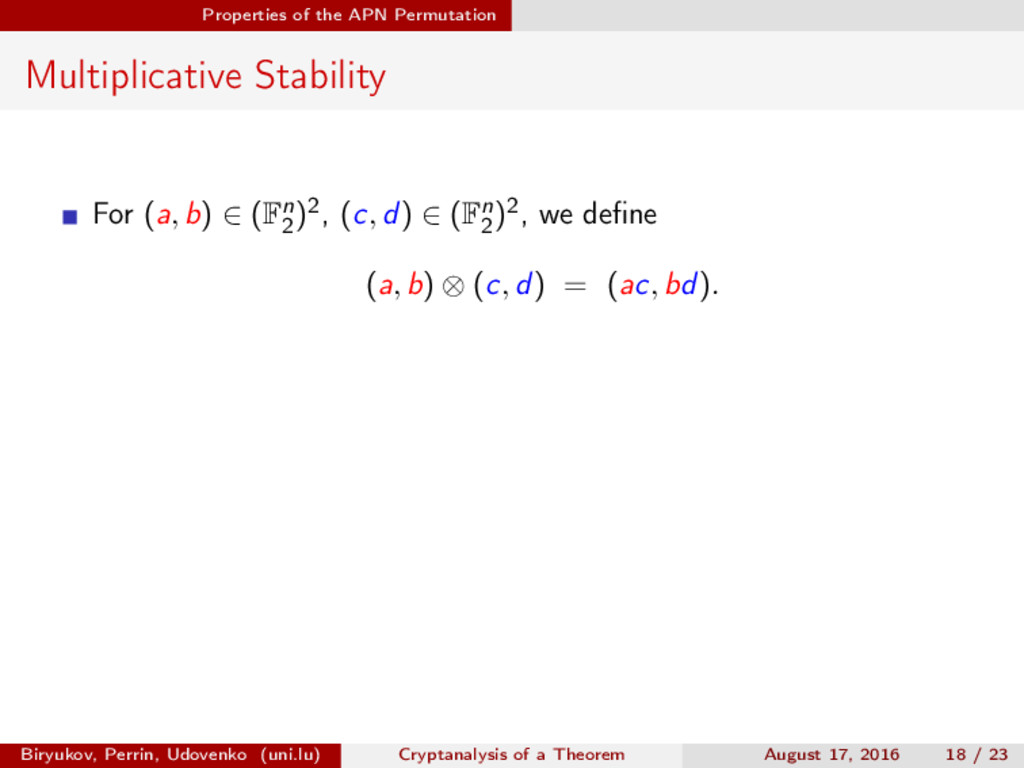
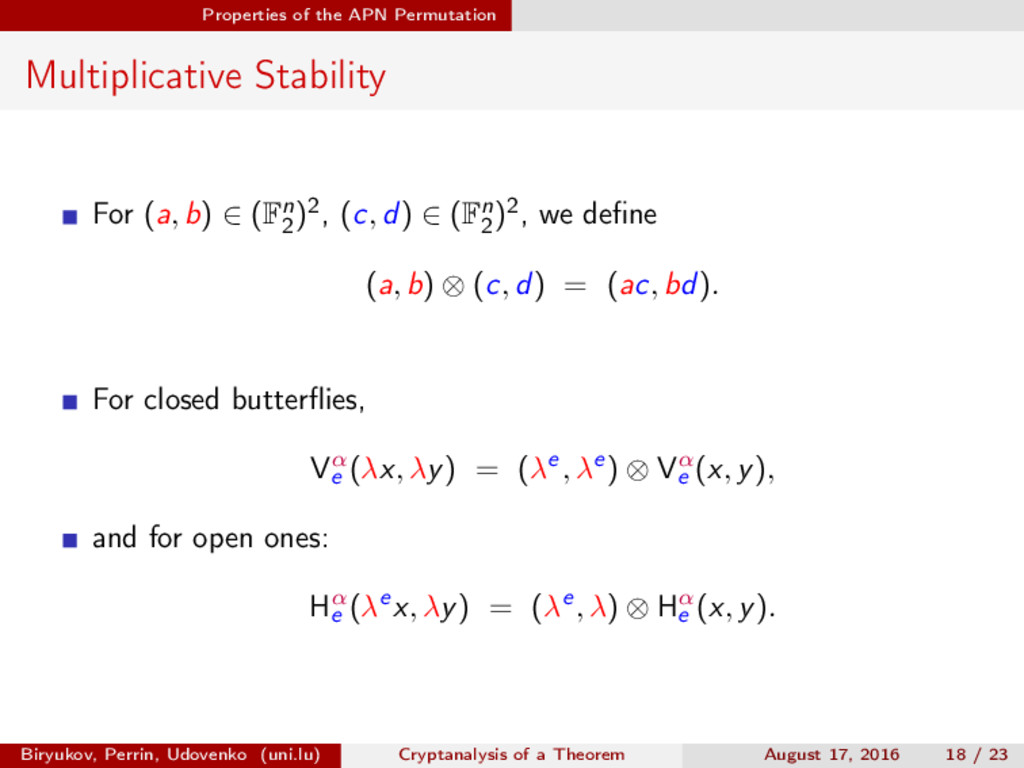
∈ (Fn 2 )2, (c, d) ∈ (Fn 2 )2, we define (a, b) ⊗ (c, d) = (ac, bd). For closed butterflies, Ve (x, y) = (e, e) ⊗ Ve (x, y), and for open ones: He (ex, y) = (e, ) ⊗ He (x, y). Biryukov, Perrin, Udovenko (uni.lu) Cryptanalysis of a Theorem August 17, 2016 18 / 23
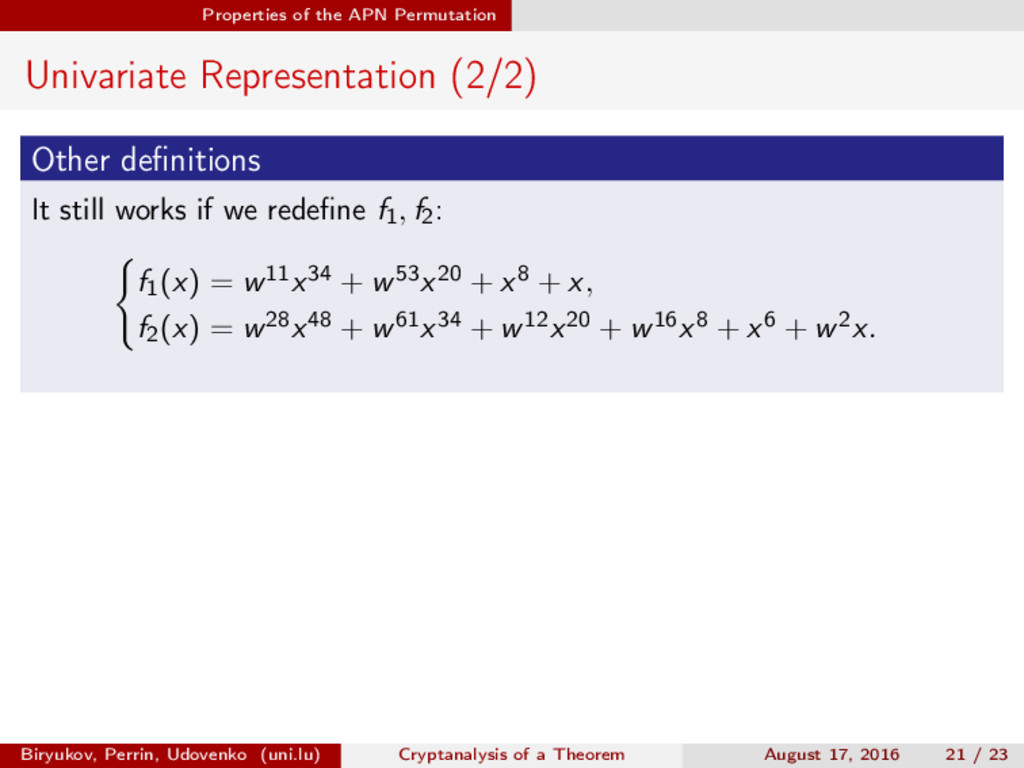
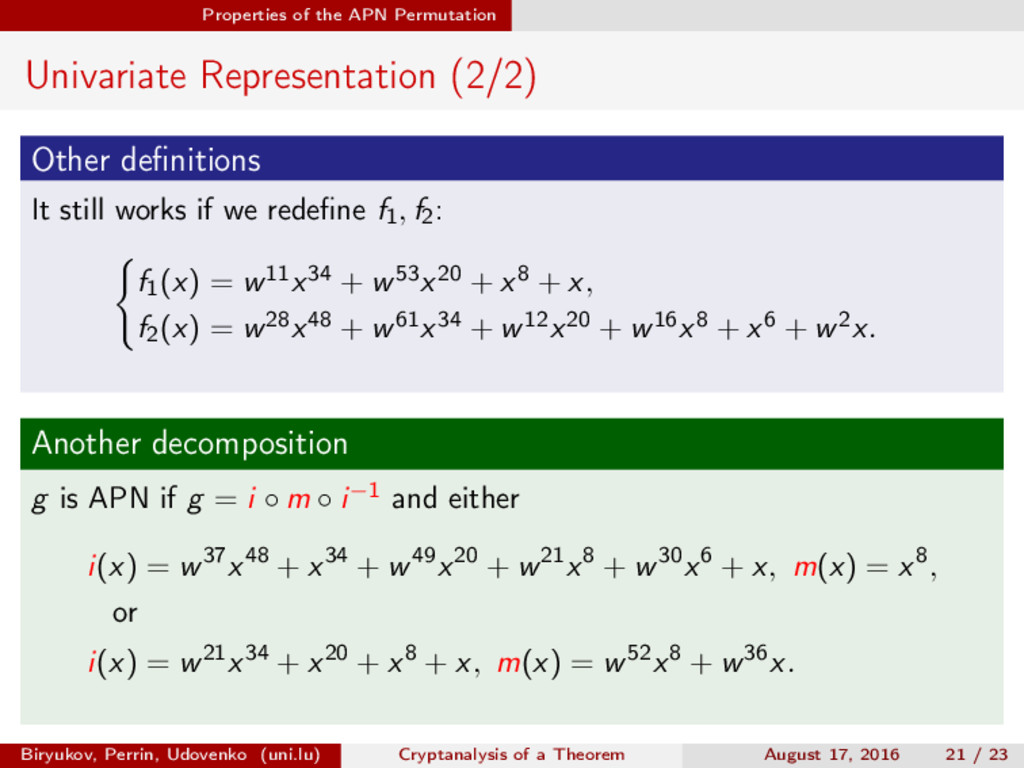
It still works if we redefine f1, f2: {︃f1(x) = w11x34 + w53x20 + x8 + x, f2(x) = w28x48 + w61x34 + w12x20 + w16x8 + x6 + w2x. Another decomposition g is APN if g = i ∘ m ∘ i−1 and either i(x) = w37x48 + x34 + w49x20 + w21x8 + w30x6 + x, m(x) = x8, or i(x) = w21x34 + x20 + x8 + x, m(x) = w52x8 + w36x. Biryukov, Perrin, Udovenko (uni.lu) Cryptanalysis of a Theorem August 17, 2016 21 / 23
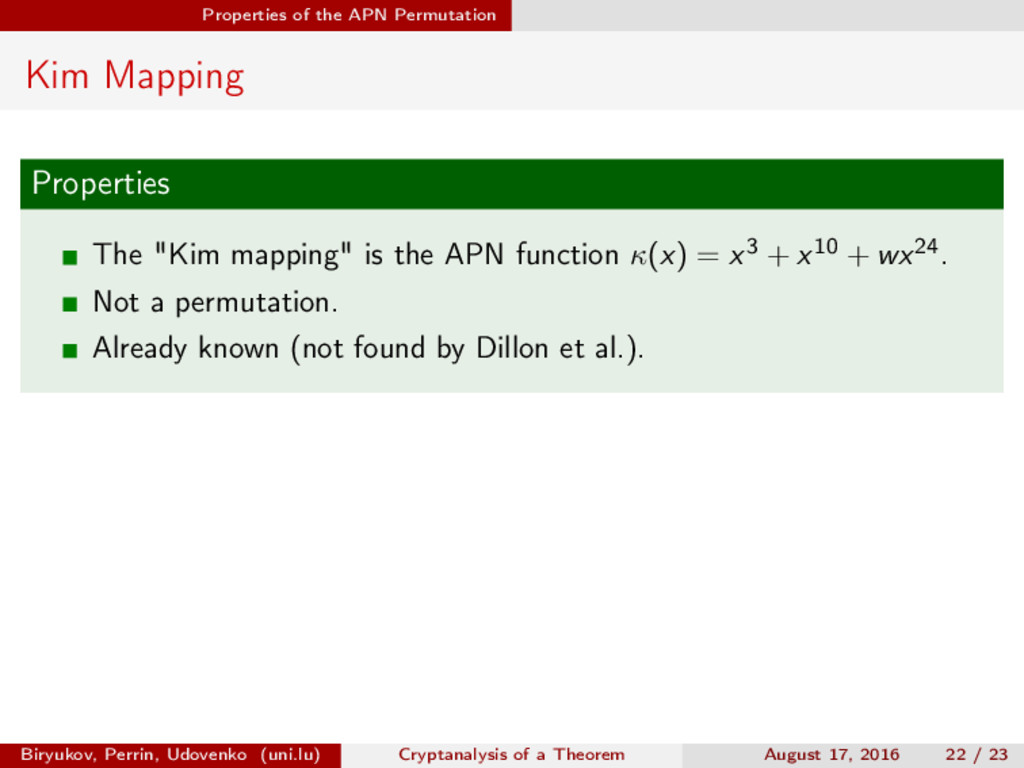
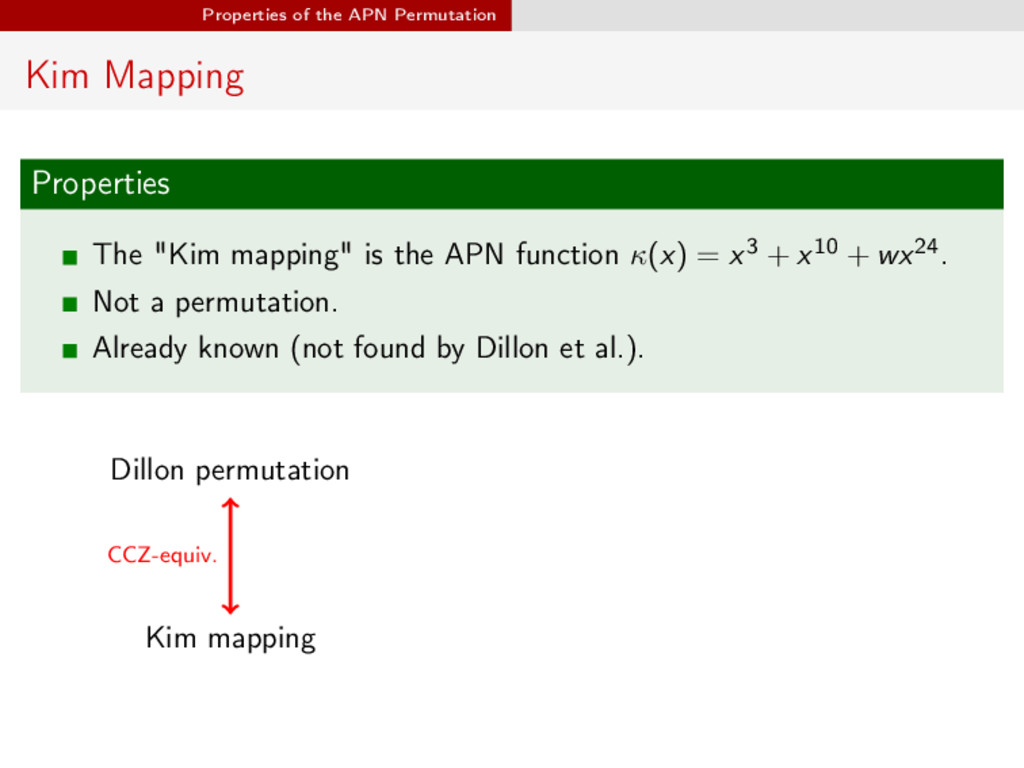
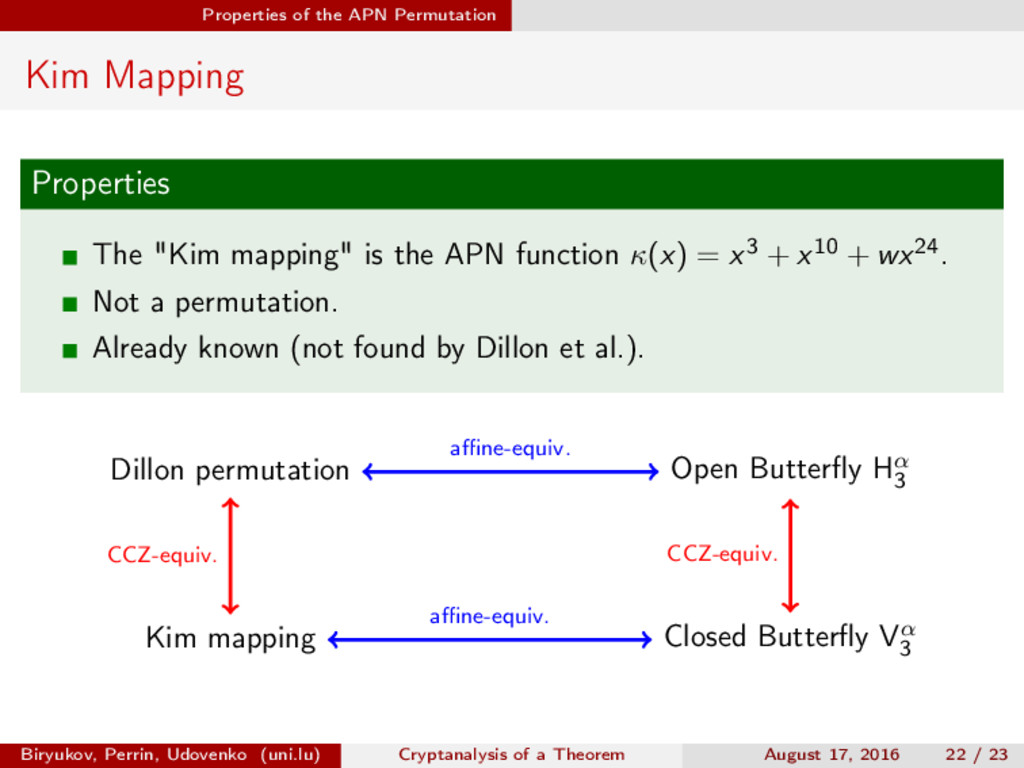
mapping" is the APN function (x) = x3 + x10 + wx24. Not a permutation. Already known (not found by Dillon et al.). Biryukov, Perrin, Udovenko (uni.lu) Cryptanalysis of a Theorem August 17, 2016 22 / 23
mapping" is the APN function (x) = x3 + x10 + wx24. Not a permutation. Already known (not found by Dillon et al.). Dillon permutation Kim mapping CCZ-equiv.
mapping" is the APN function (x) = x3 + x10 + wx24. Not a permutation. Already known (not found by Dillon et al.). Dillon permutation Kim mapping CCZ-equiv. Open Butterfly H 3 Closed Butterfly V 3 CCZ-equiv. affine-equiv. affine-equiv. Biryukov, Perrin, Udovenko (uni.lu) Cryptanalysis of a Theorem August 17, 2016 22 / 23
Butterfly Structure 4 Properties of the APN Permutation 5 Conclusion Biryukov, Perrin, Udovenko (uni.lu) Cryptanalysis of a Theorem August 17, 2016 22 / 23
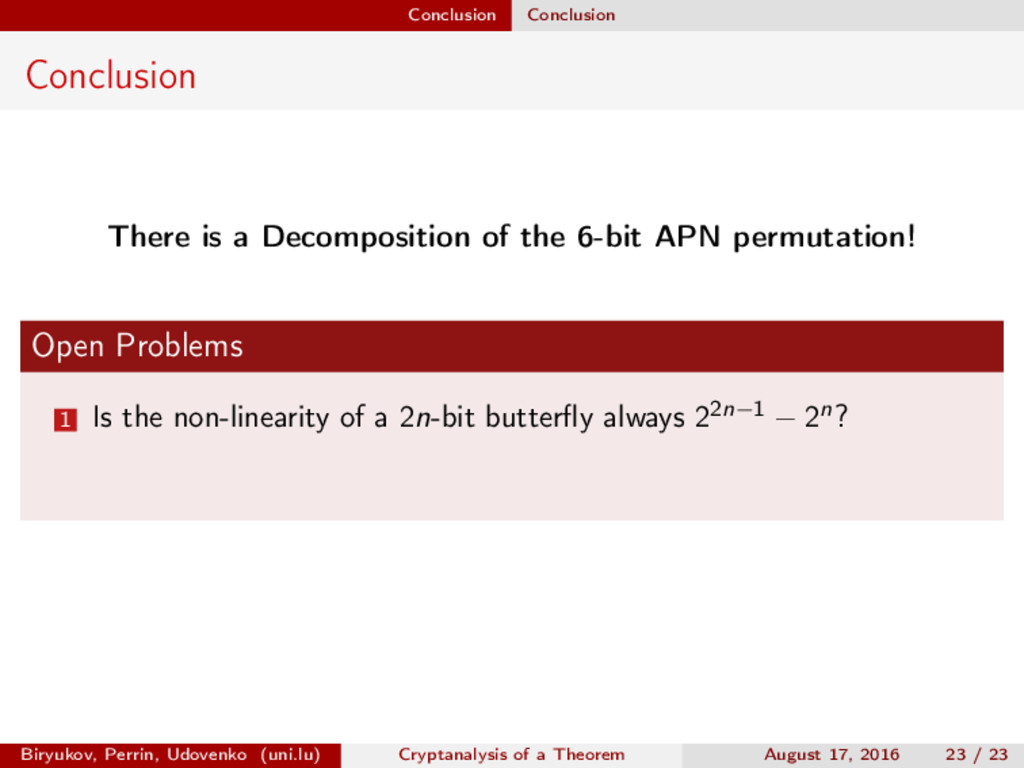
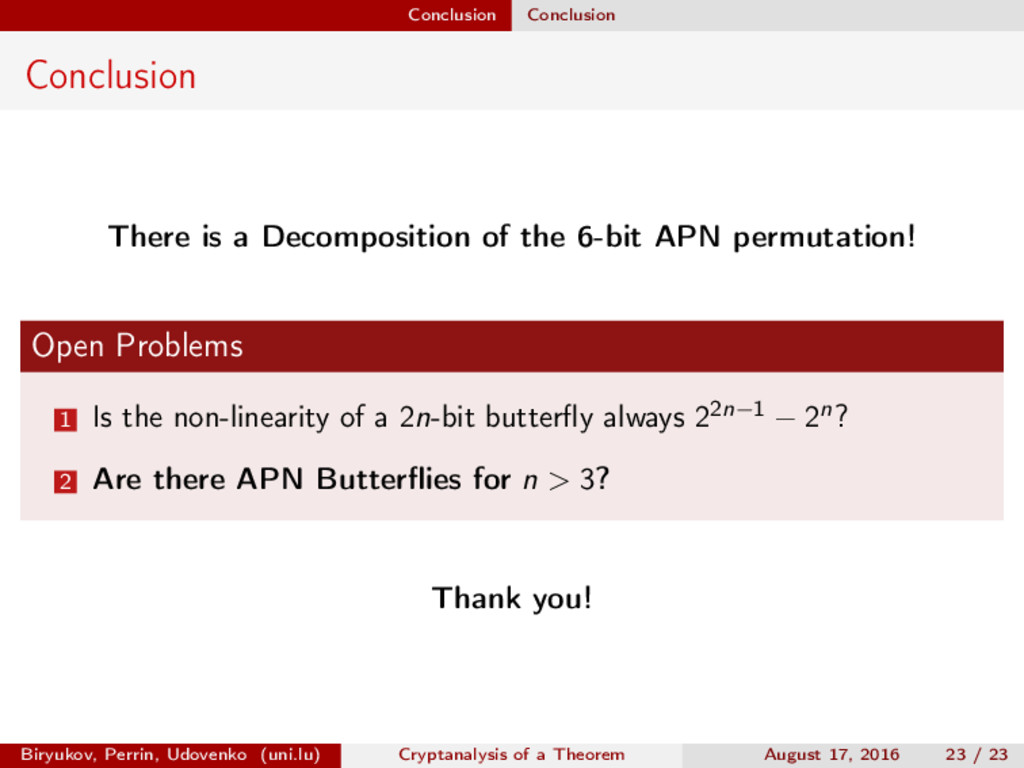
APN permutation! Open Problems 1 Is the non-linearity of a 2n-bit butterfly always 22n−1 − 2n? Biryukov, Perrin, Udovenko (uni.lu) Cryptanalysis of a Theorem August 17, 2016 23 / 23
APN permutation! Open Problems 1 Is the non-linearity of a 2n-bit butterfly always 22n−1 − 2n? 2 Are there APN Butterflies for n > 3? Thank you! Biryukov, Perrin, Udovenko (uni.lu) Cryptanalysis of a Theorem August 17, 2016 23 / 23


 hellman
 kento1109
 microbaseinc
 sishi2026
.png) satai
satai
 ayatokanada
 rikkabotan7
 datascientistsociety
 institutdelelevage
 murakawatakuya
 pman0214
 imai448
 csswizardry
 reverentgeek
 marktimemedia
 aleyda
 greggifford
 mojombo
 sergeychernyshev
 sugarenia
 ipullrank
.jpg) cargoodrich
cargoodrich