Share
Embed
Gaussian Splatting Hands-on
I have summarized the mechanism, how to create, and application examples of Gaussian Splatting.
hiroga
September 29, 2025
Transcript
47 slides
-
Gaussian Splatting Hands-on September 28, 2025 Sawara (Hiroaki Ogasawara, @xhiroga)
This deck is available on GitHub. -
About Me Hiroaki Ogasawara (Sawara) Since 2015: IBM Japan Since
2018: Software engineer/manager at an insurtech startup Since 2024: Freelance; building ML models and infrastructure at a machine learning startup Website: https://sawara.dev/ I share the latest updates on social media. Follow me! X (Twitter): @xhiroga GitHub: @xhiroga LinkedIn: @hiroga VRChat: @hiroga YouTube: @hiroga -
What to Bring for This Hands-on Smartphone with a camera
Windows PC Google account Small object you want to scan (if you have one) -
Agenda 1. What is Gaussian Splatting? 2. Create a splat
3. Works that use Gaussian Splatting -
Try It First Visit SuperSplat and explore the different splats
that are available. -
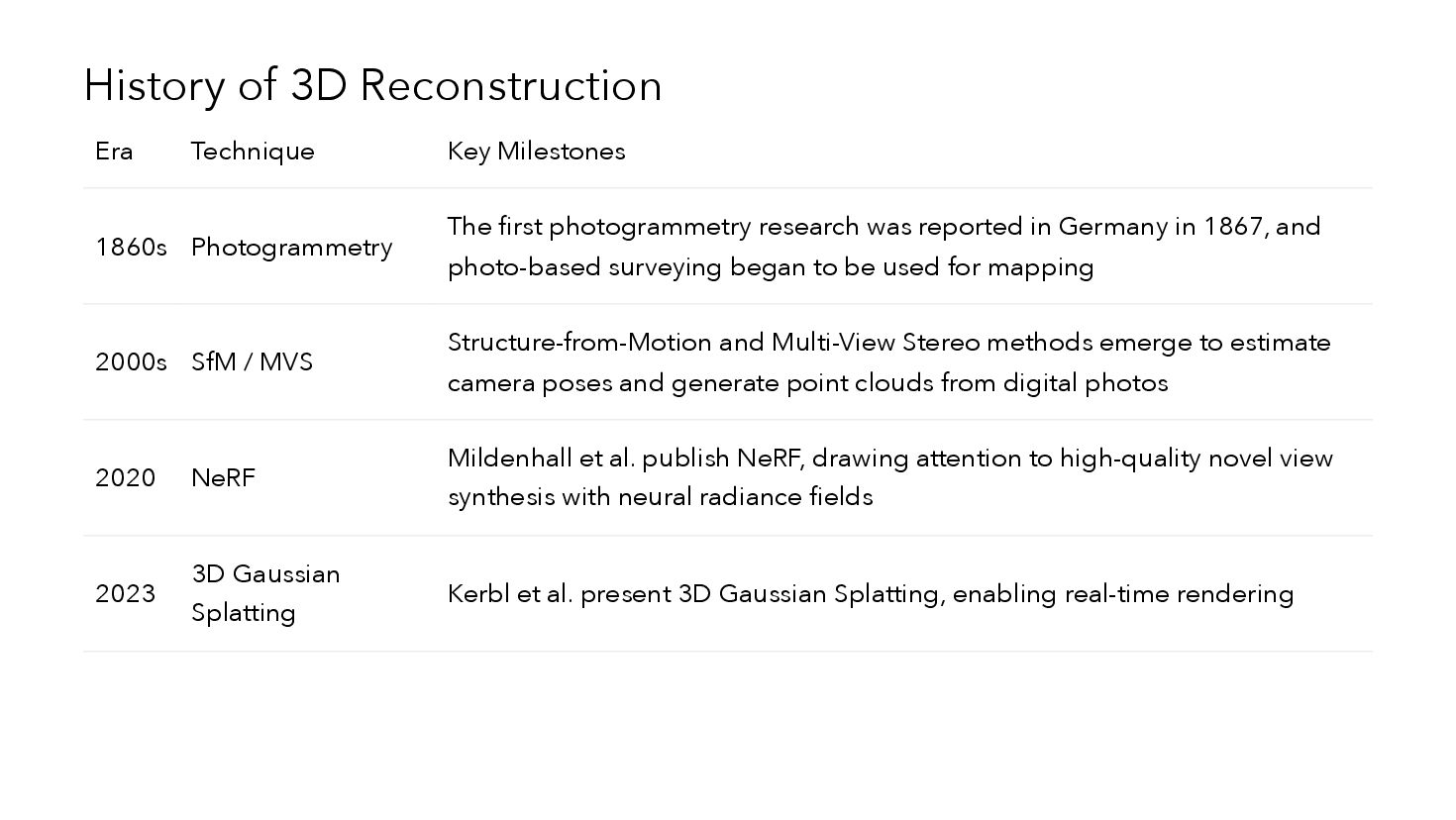
History of 3D Reconstruction Era Technique Key Milestones 1860s Photogrammetry
The first photogrammetry research was reported in Germany in 1867, and photo-based surveying began to be used for mapping 2000s SfM / MVS Structure-from-Motion and Multi-View Stereo methods emerge to estimate camera poses and generate point clouds from digital photos 2020 NeRF Mildenhall et al. publish NeRF, drawing attention to high-quality novel view synthesis with neural radiance fields 2023 3D Gaussian Splatting Kerbl et al. present 3D Gaussian Splatting, enabling real-time rendering -
Photogrammetry A method for extracting geometric properties of objects from
photographs—especially recovering 3D data from images. Photogrammetry photo (photograph) gram (drawing, record) metry (measurement) Generating mesh data from photos is often referred to as photogrammetry. -
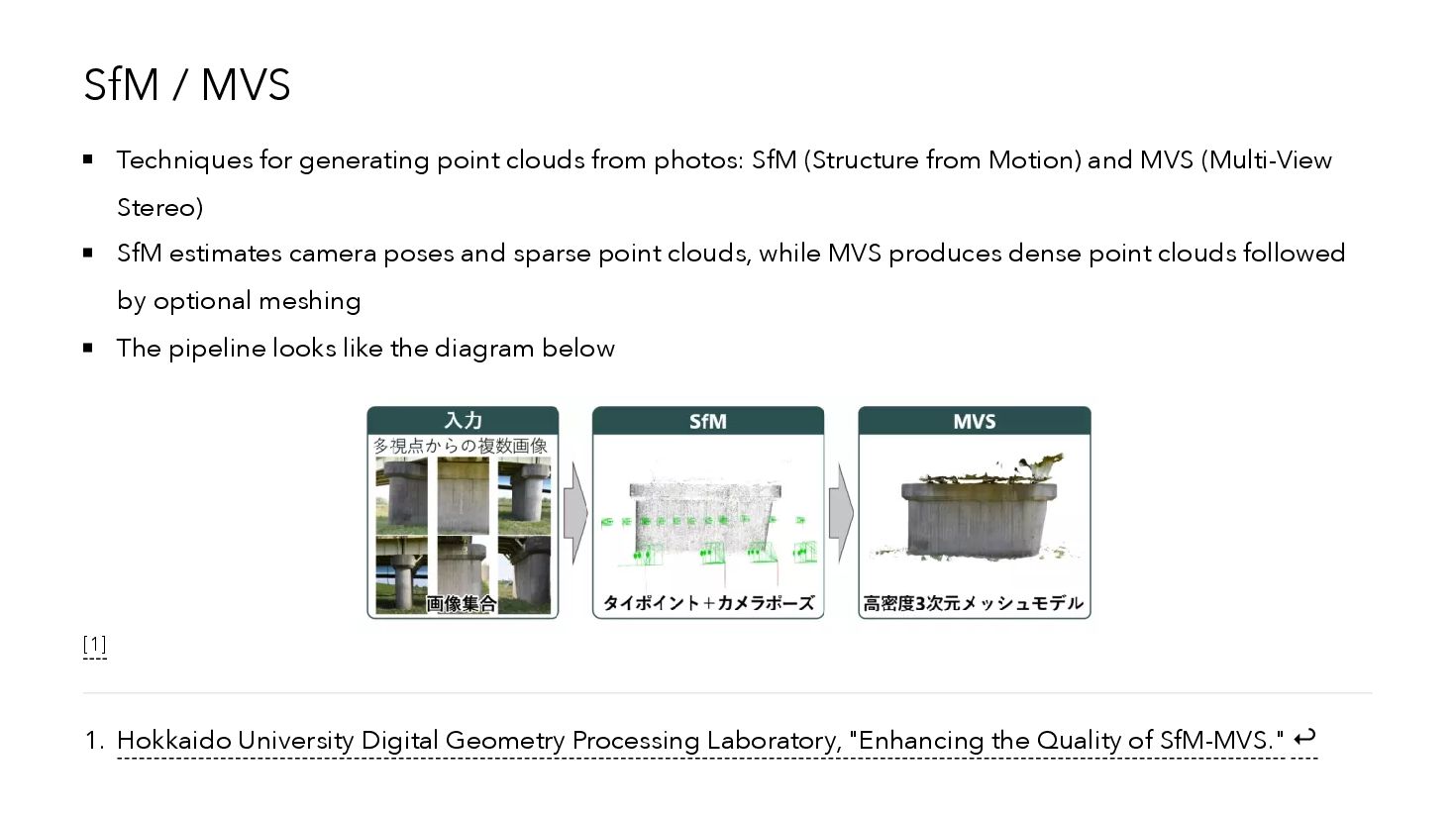
SfM / MVS Techniques for generating point clouds from photos:
SfM (Structure from Motion) and MVS (Multi-View Stereo) SfM estimates camera poses and sparse point clouds, while MVS produces dense point clouds followed by optional meshing The pipeline looks like the diagram below 1. Hokkaido University Digital Geometry Processing Laboratory, "Enhancing the Quality of SfM-MVS." ↩︎ [1] -
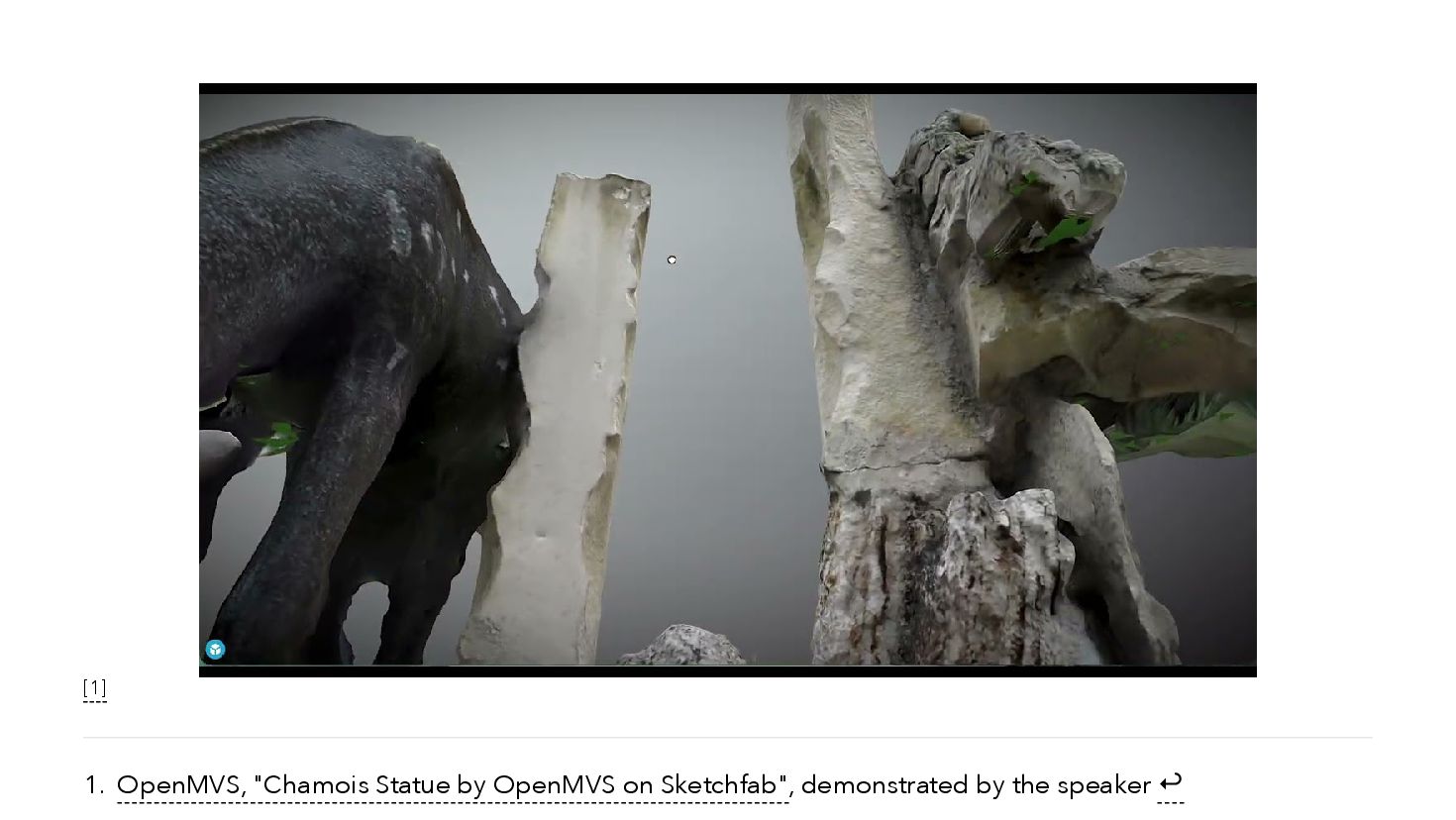
1. OpenMVS, "Chamois Statue by OpenMVS on Sketchfab", demonstrated by
the speaker ↩︎ [1] -
NeRF (2020–) Pronounced "nerf" Learns radiance and density fields in
space with neural networks to achieve high-quality novel view synthesis Output is neural network weights (e.g., .safetensors ) rather than meshes or point clouds -
Gaussian Splatting (2023–) Originally a point-cloud representation and rendering technique.
Gaussian ( ガウシアン) Gaussian refers to the normal distribution. Instead of dense point clouds or meshes, each sparse point stores scale, color, and opacity as a 3D Gaussian distribution Splatting ( スプラッティング) One approach for rendering 3D graphics data into 2D. Ray tracing: Shoot rays from the camera into the scene and render the first intersected surface Splatting: Project each point onto the screen Triangle rasterization: Fill the nearest triangles; suitable for meshes The reconstructed data is commonly called a “splat.” -
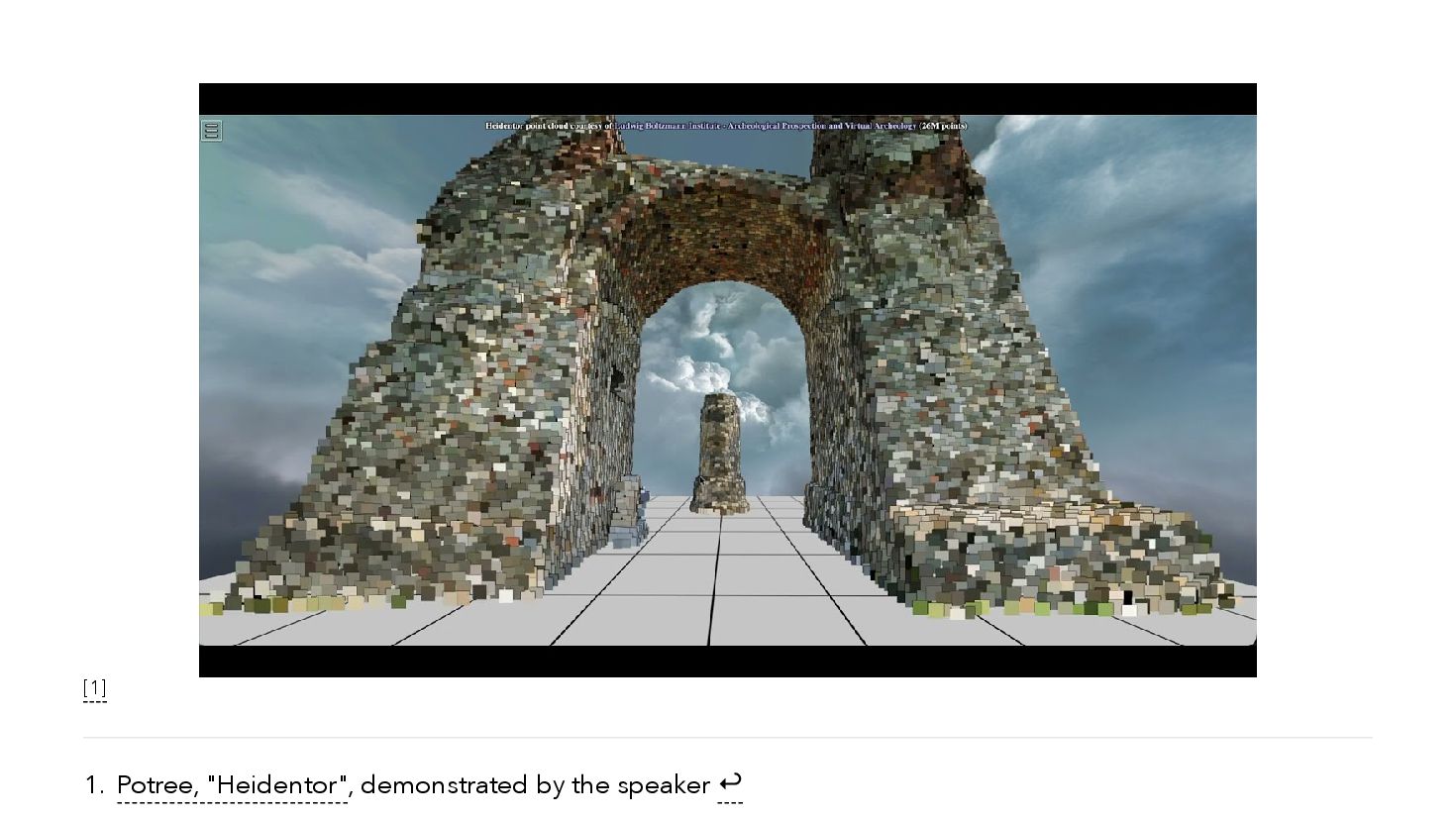
Understand Point Splatting Visually Use simple point splatting (without Gaussians)
to grasp the idea. Browse Potree #Examples. Example 1: Heidentor Example 2: Lion Example 3: Toolbar -
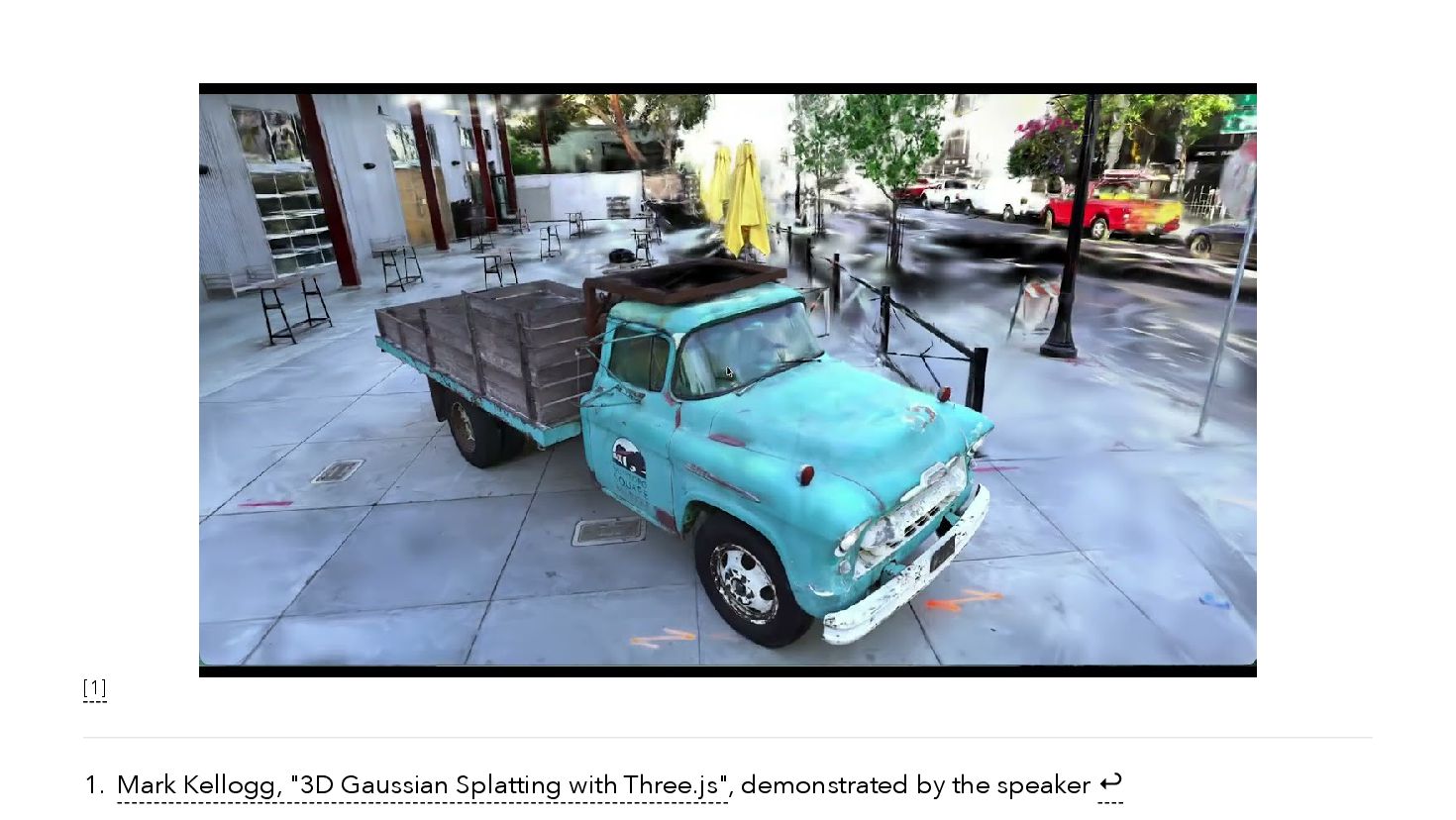
How Gaussian Splatting Works Gaussian Splatting uses the per-point opacity
and scale to let each point cover a wide area. Open the mkkellogg/GaussianSplats3D demo and press P to toggle between 3D Gaussian splatting and point-cloud rendering modes. -
1. Mark Kellogg, "3D Gaussian Splatting with Three.js", demonstrated by
the speaker ↩︎ [1] -
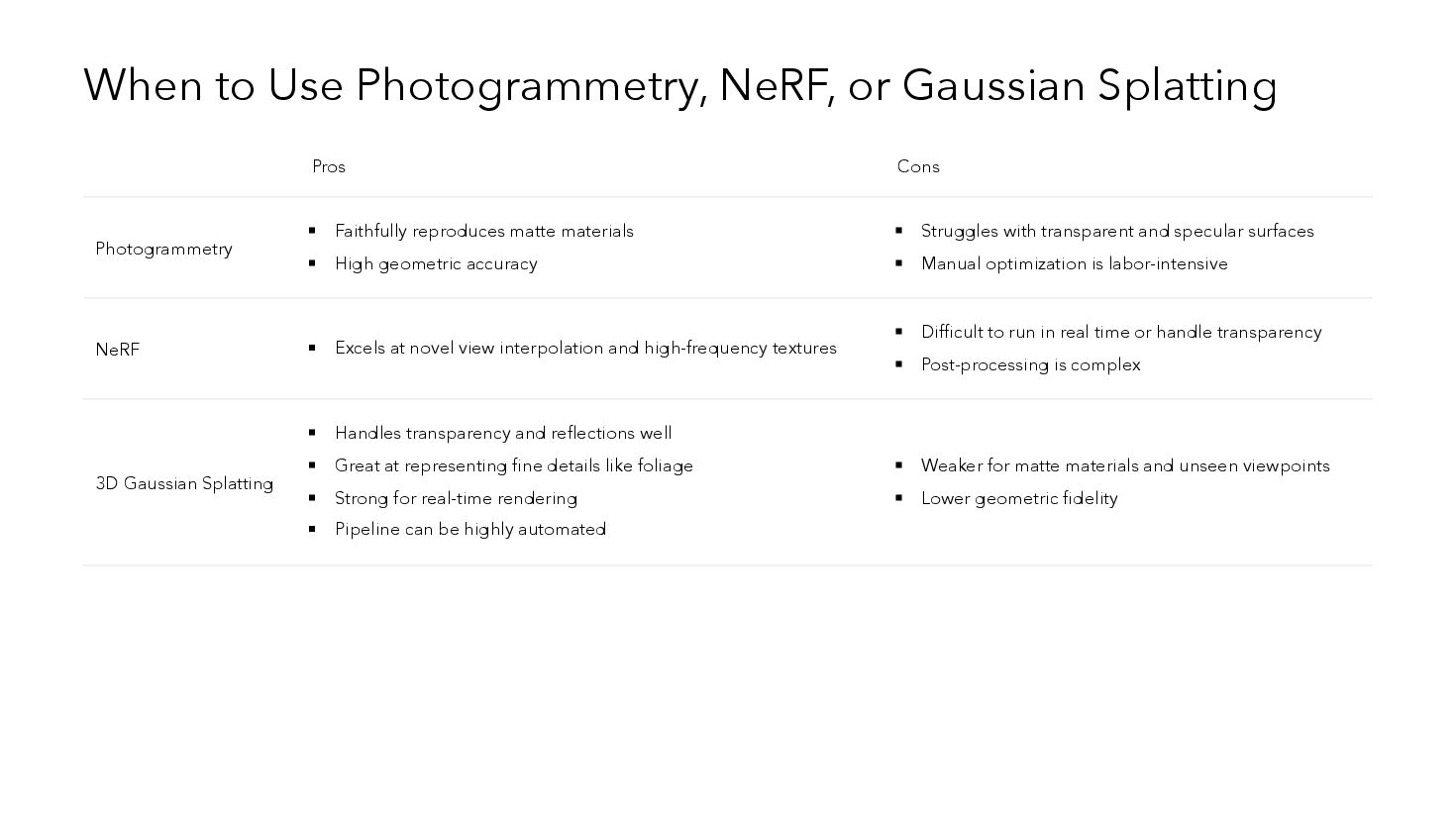
When to Use Photogrammetry, NeRF, or Gaussian Splatting Pros Cons
Photogrammetry Faithfully reproduces matte materials High geometric accuracy Struggles with transparent and specular surfaces Manual optimization is labor-intensive NeRF Excels at novel view interpolation and high-frequency textures Difficult to run in real time or handle transparency Post-processing is complex 3D Gaussian Splatting Handles transparency and reflections well Great at representing fine details like foliage Strong for real-time rendering Pipeline can be highly automated Weaker for matte materials and unseen viewpoints Lower geometric fidelity -
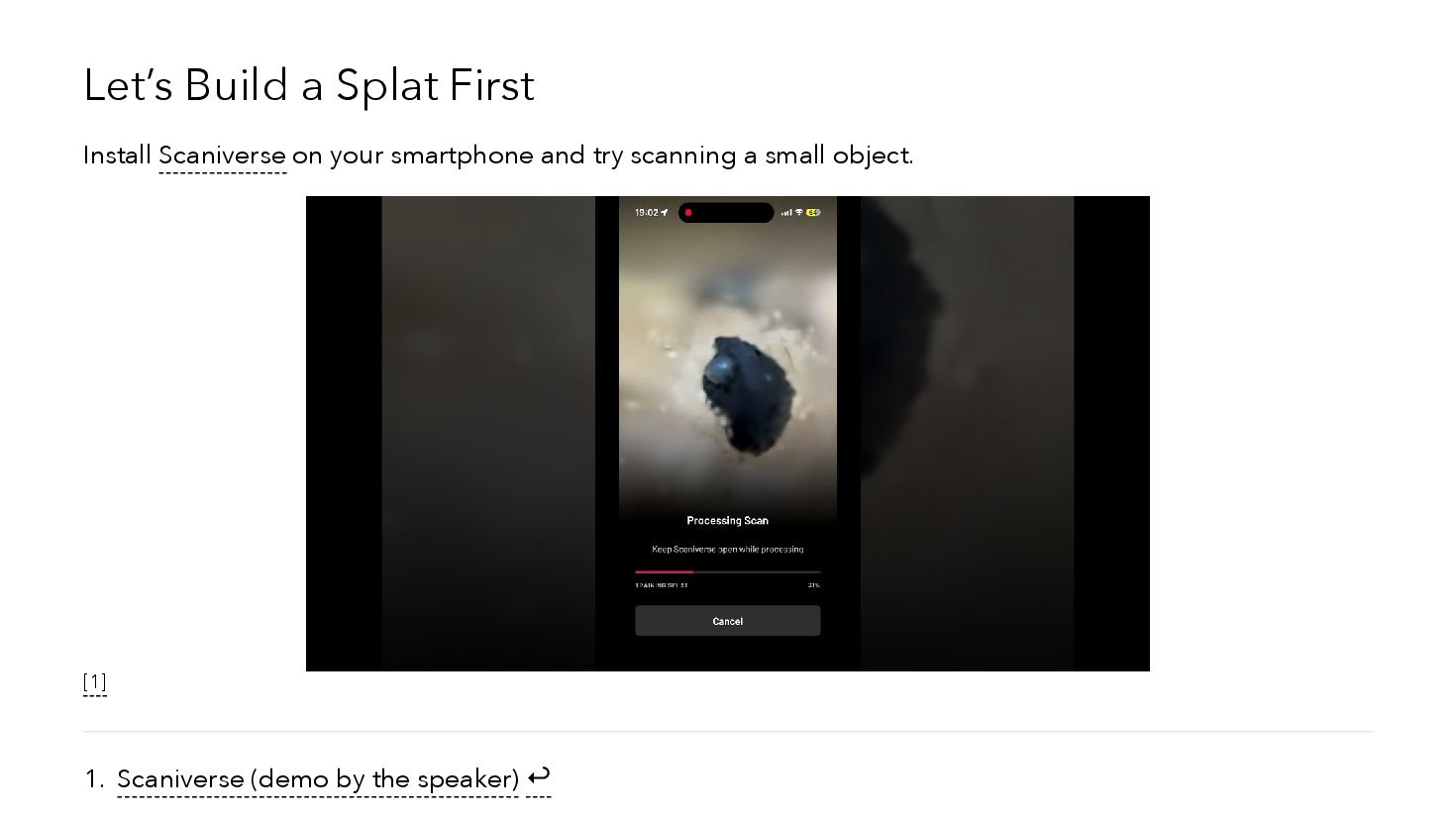
Let’s Build a Splat First Install Scaniverse on your smartphone
and try scanning a small object. 1. Scaniverse (demo by the speaker) ↩︎ [1] -
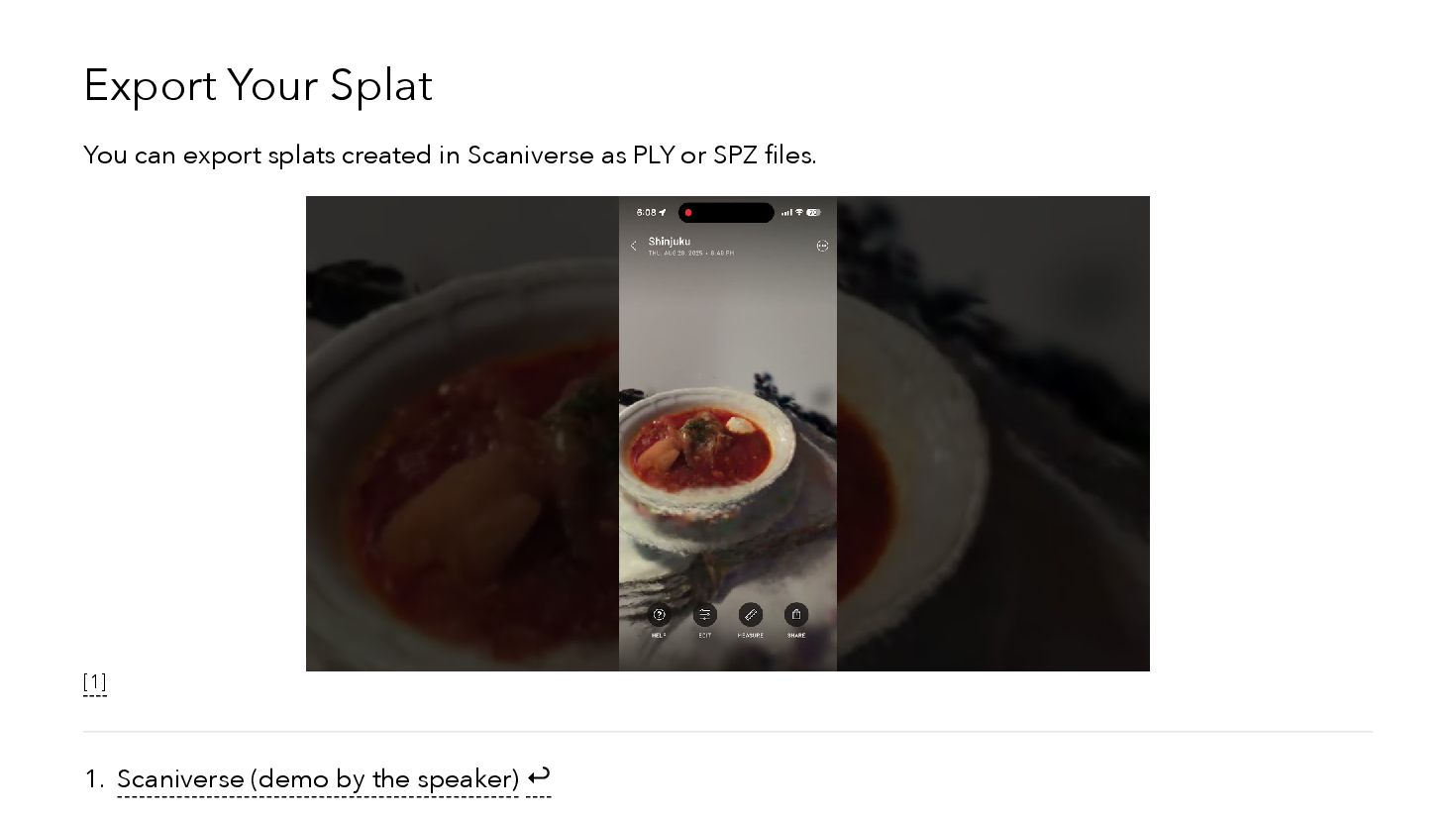
Export Your Splat You can export splats created in Scaniverse
as PLY or SPZ files. 1. Scaniverse (demo by the speaker) ↩︎ [1] -
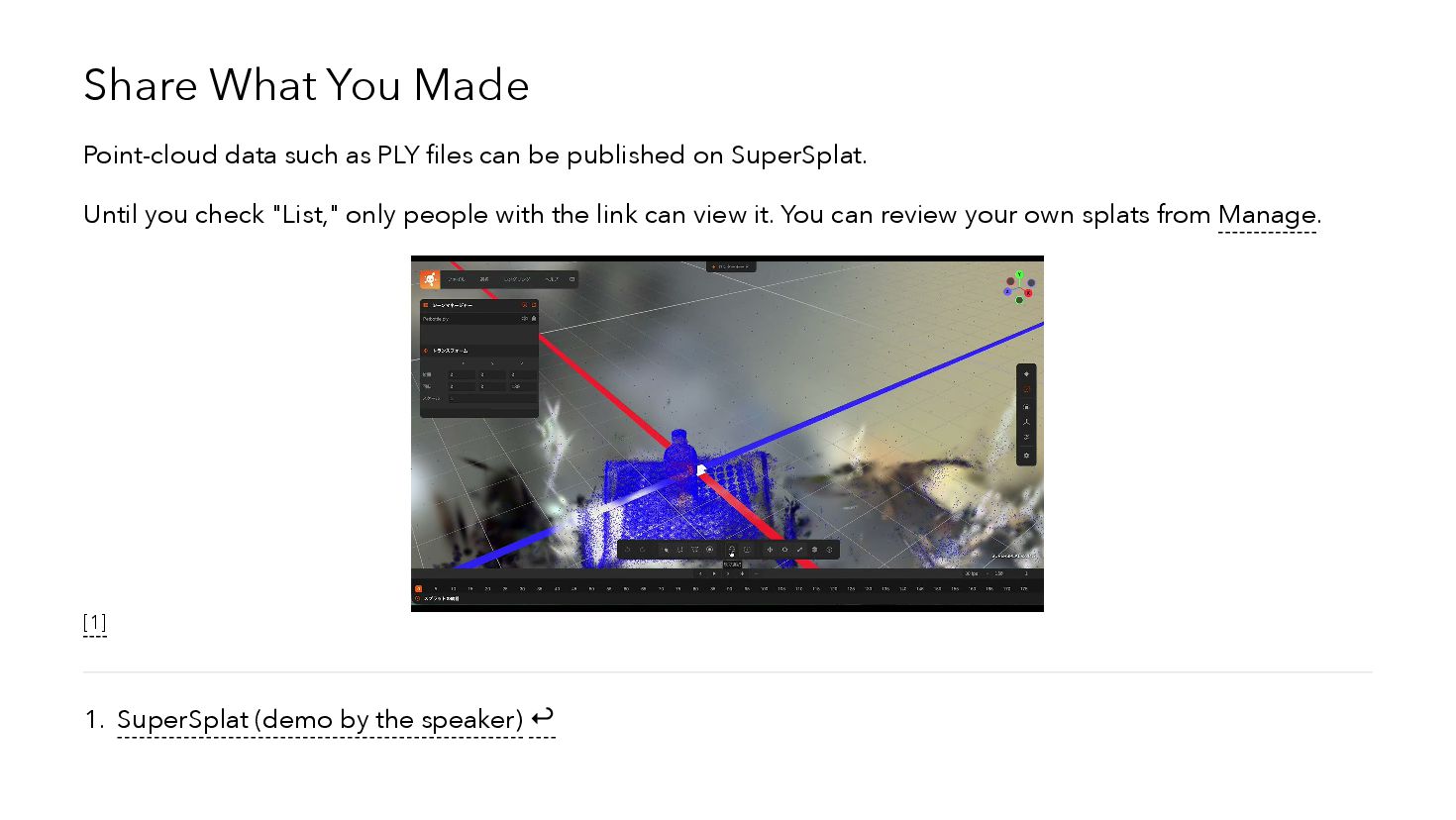
Share What You Made Point-cloud data such as PLY files
can be published on SuperSplat. Until you check "List," only people with the link can view it. You can review your own splats from Manage. 1. SuperSplat (demo by the speaker) ↩︎ [1] -
Software for Creating Gaussian Splatting Content OSS nerfstudio: Supports a
variety of image-to-3D reconstruction methods including NeRF and 3D Gaussian Splatting gsplat: Core 3DGS implementation for nerfstudio; available on PyPI ( pip install gsplat ) Inria 3DGS: Official implementation of the original “3D Gaussian Splatting for Real-Time Radiance Field Rendering” paper Commercial Software postshot: Windows application with 3DGS support. Free trial available; exporting PLY and other formats requires a paid plan. Scaniverse: 3D scanning app by Niantic of Pokémon GO fame. Supports both photogrammetry and 3D Gaussian Splatting. LumaAI: Captures on iOS/Android and processes in the cloud to generate 3DGS in about 20–30 minutes. Exports PLY, OBJ/USDZ, and other splat- friendly formats. -
Output Formats for Gaussian Splatting As of September 2025, there
is no industry-standard format dedicated to Gaussian Splatting. Key Characteristics Size / Quality Primary Use Cases & Tools PLY Originally for point clouds Uncompressed Common default in tools like nerfstudio SPLAT Originated from the official Inria implementation Smaller than PLY but implementation-dependent GraphDeco Viewer, etc. NPZ NumPy-compressed format output by Compact 3DGS Higher compression than PLY with near-lossless quality Compact-3DGS, etc. SOG WebP textures plus meta.json 15–20× smaller than PLY with lossy compression PlayCanvas, etc. SPZ Gzip-based binary proposed by Niantic Around 10× smaller than PLY with production-ready quality Scaniverse, etc. -
Workflow for Producing Gaussian Splatting Content Ryū (@lilea) has a
great guide: 🌈 Gaussian Splatting Utilization. Highly recommended. -
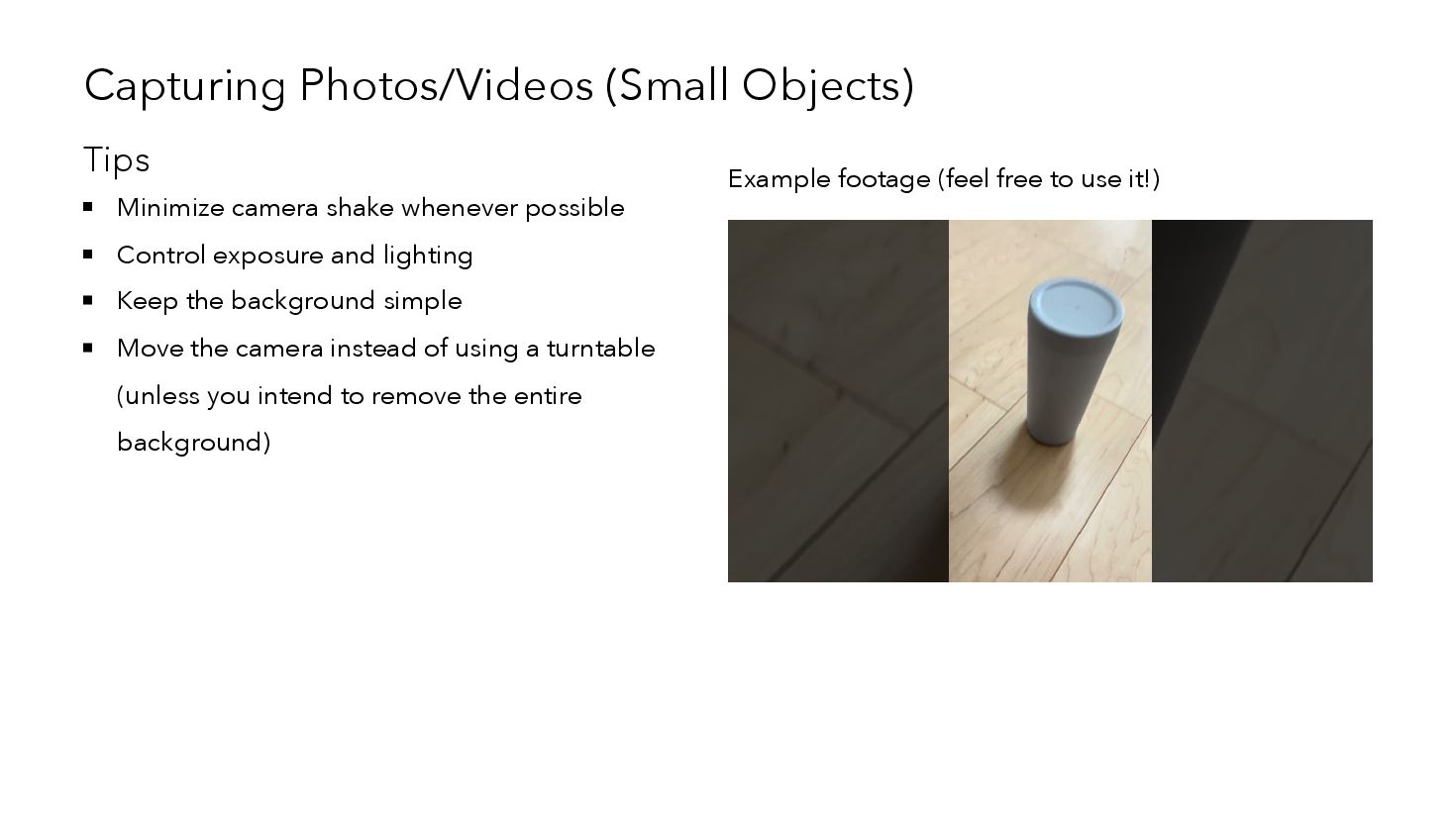
Capturing Photos/Videos (Small Objects) Tips Minimize camera shake whenever possible
Control exposure and lighting Keep the background simple Move the camera instead of using a turntable (unless you intend to remove the entire background) Example footage (feel free to use it!) -
Capturing Photos/Videos (Locations) Photogrammetry from Ryū lilea’s workshop materials is
extremely informative. (Thank you for sharing!) -
Building 3DGS with nerfstudio 1. Clone nerfstudio from GitHub (use
the xhiroga fork) 2. Install COLMAP 3. Run a command such as scripts/splatfacto.sh $VIDEO_FILE Processing time and file-size reference Example: 12-second HD video → 34 minutes total (10 minutes for COLMAP, 24 minutes for splat generation) → 35 MB PLY file -
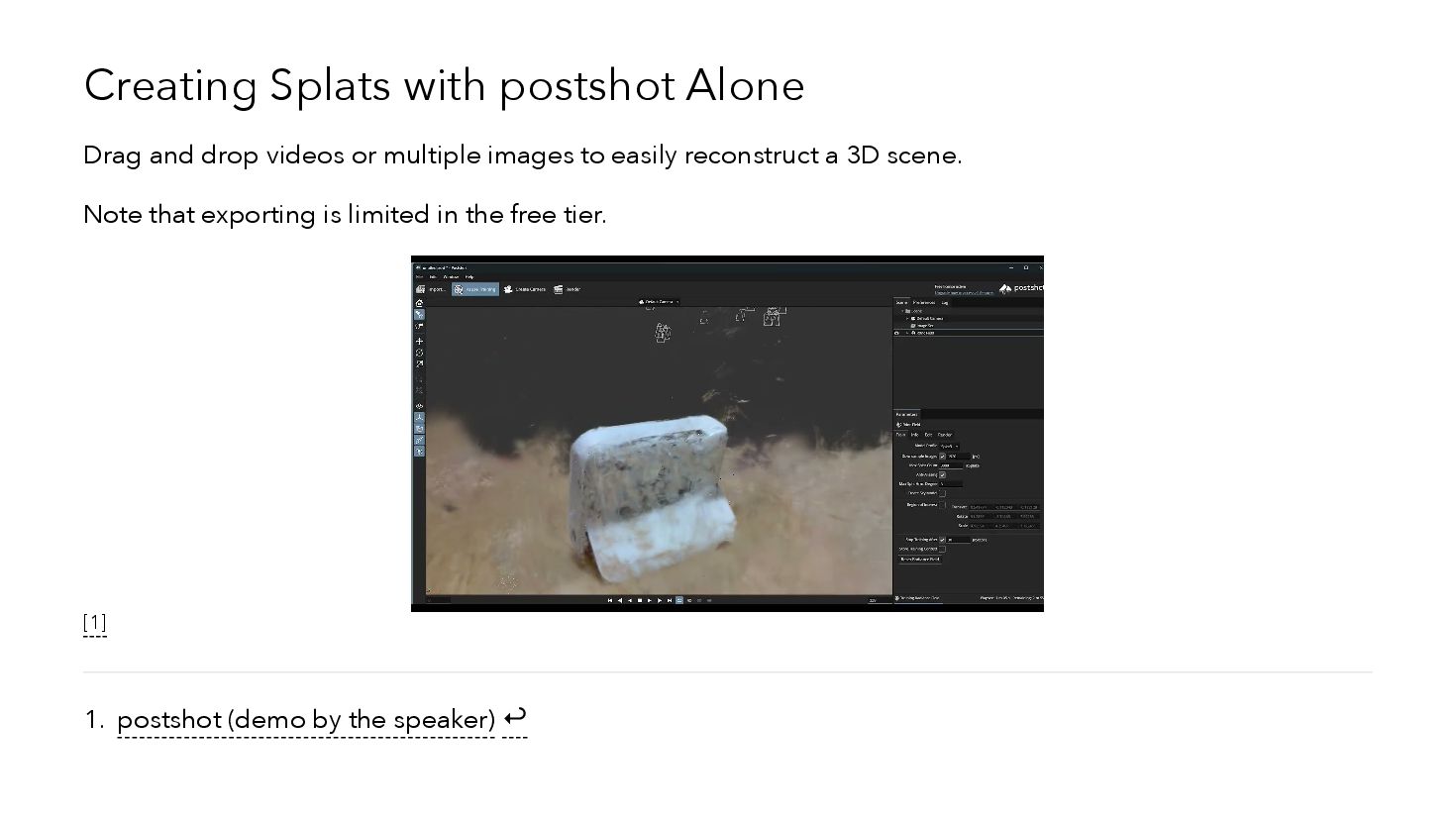
Creating Splats with postshot Alone Drag and drop videos or
multiple images to easily reconstruct a 3D scene. Note that exporting is limited in the free tier. 1. postshot (demo by the speaker) ↩︎ [1] -
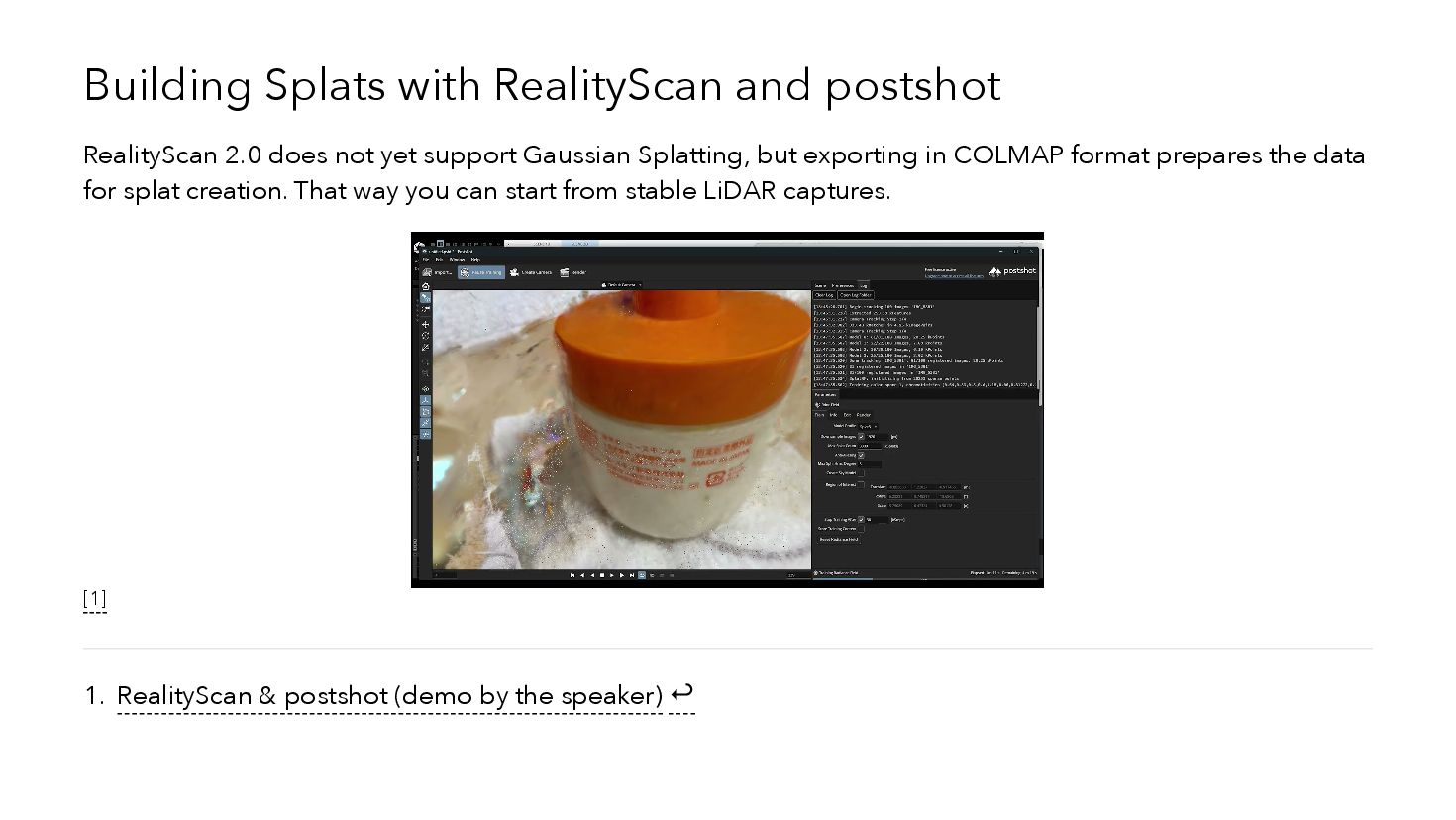
Building Splats with RealityScan and postshot RealityScan 2.0 does not
yet support Gaussian Splatting, but exporting in COLMAP format prepares the data for splat creation. That way you can start from stable LiDAR captures. 1. RealityScan & postshot (demo by the speaker) ↩︎ [1] -
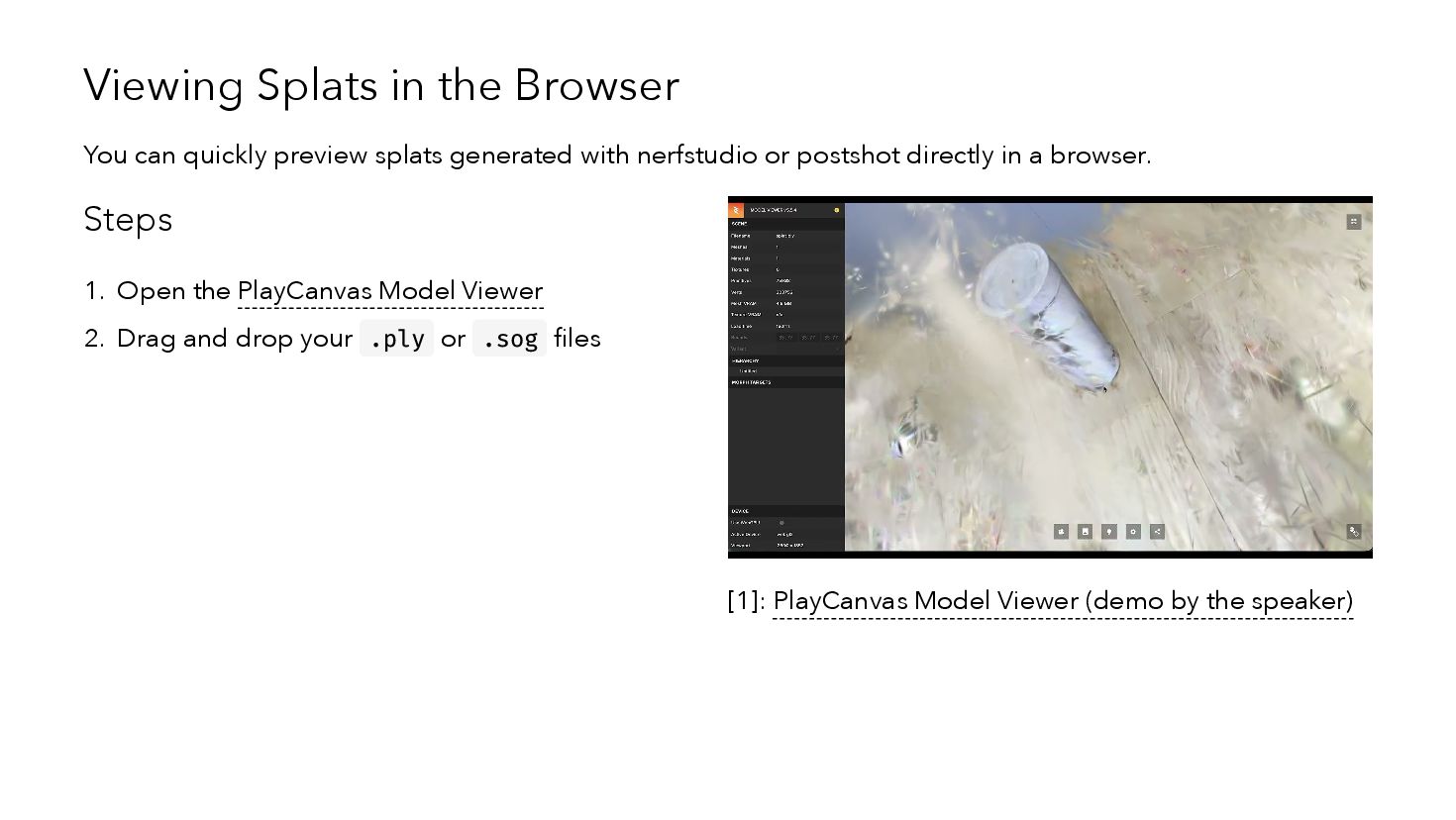
Viewing Splats in the Browser You can quickly preview splats
generated with nerfstudio or postshot directly in a browser. Steps 1. Open the PlayCanvas Model Viewer 2. Drag and drop your .ply or .sog files [1]: PlayCanvas Model Viewer (demo by the speaker) -
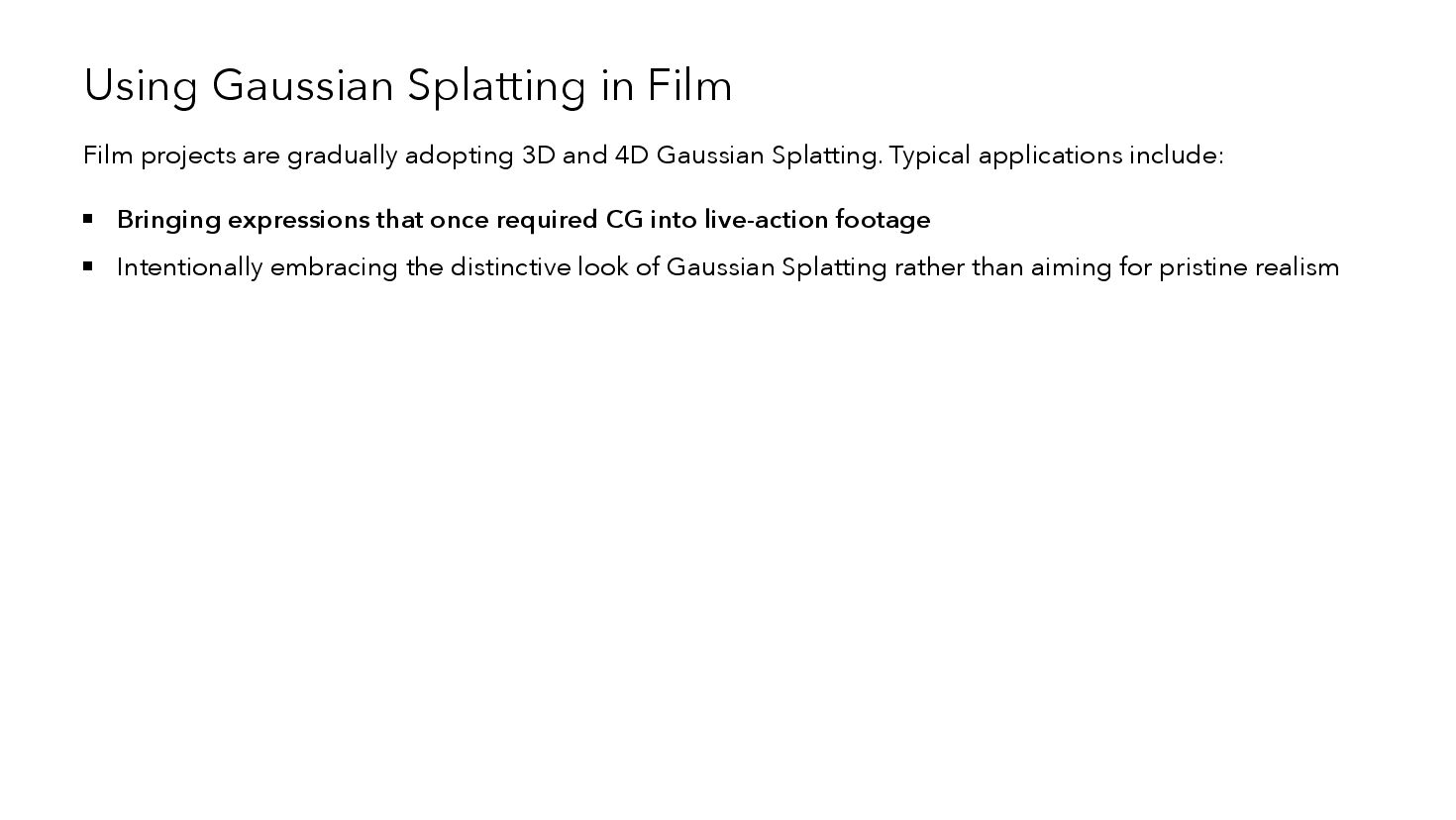
Using Gaussian Splatting in Film Film projects are gradually adopting
3D and 4D Gaussian Splatting. Typical applications include: Bringing expressions that once required CG into live-action footage Intentionally embracing the distinctive look of Gaussian Splatting rather than aiming for pristine realism -
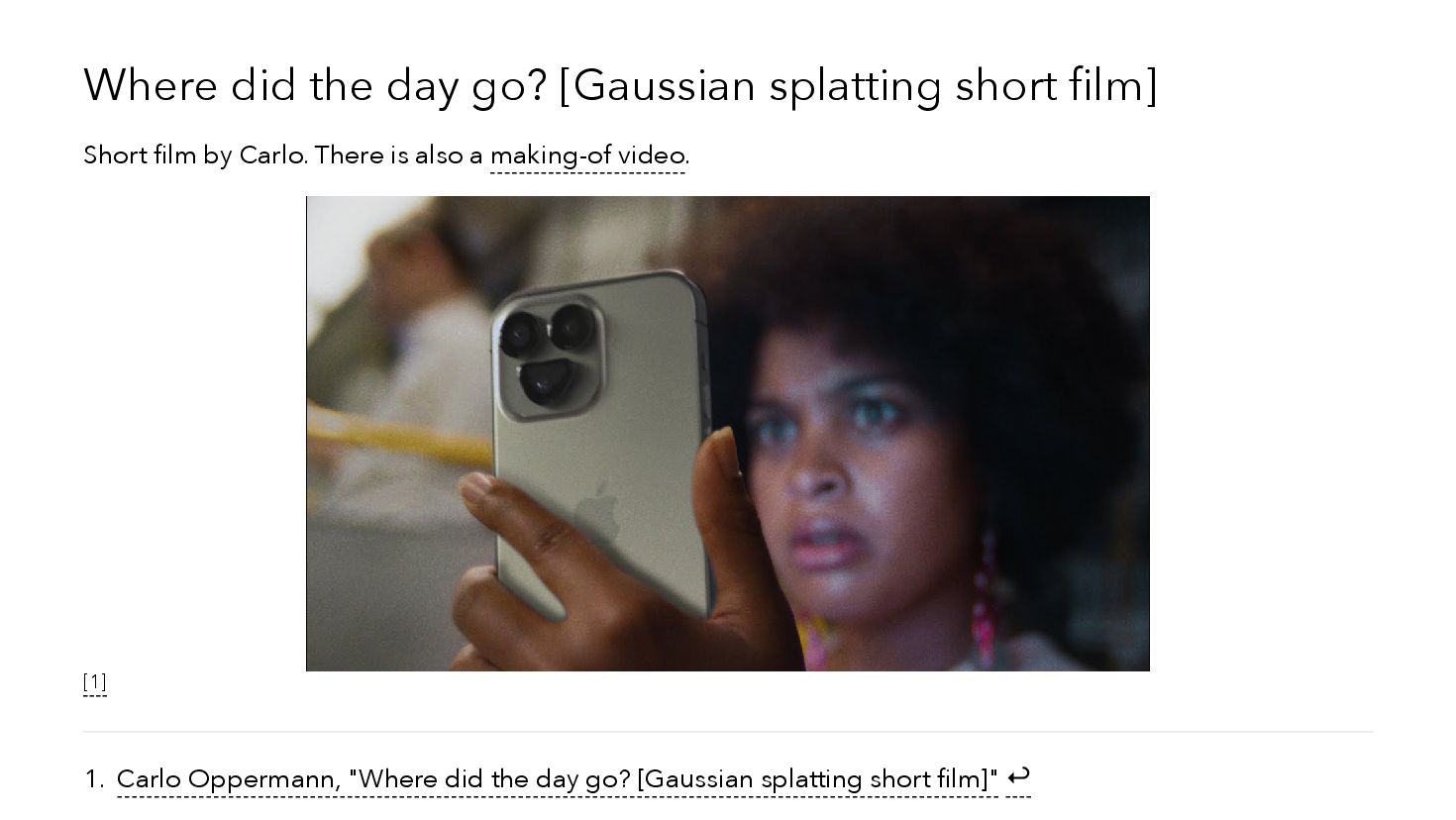
Where did the day go? [Gaussian splatting short film] Short
film by Carlo. There is also a making-of video. 1. Carlo Oppermann, "Where did the day go? [Gaussian splatting short film]" ↩︎ [1] -
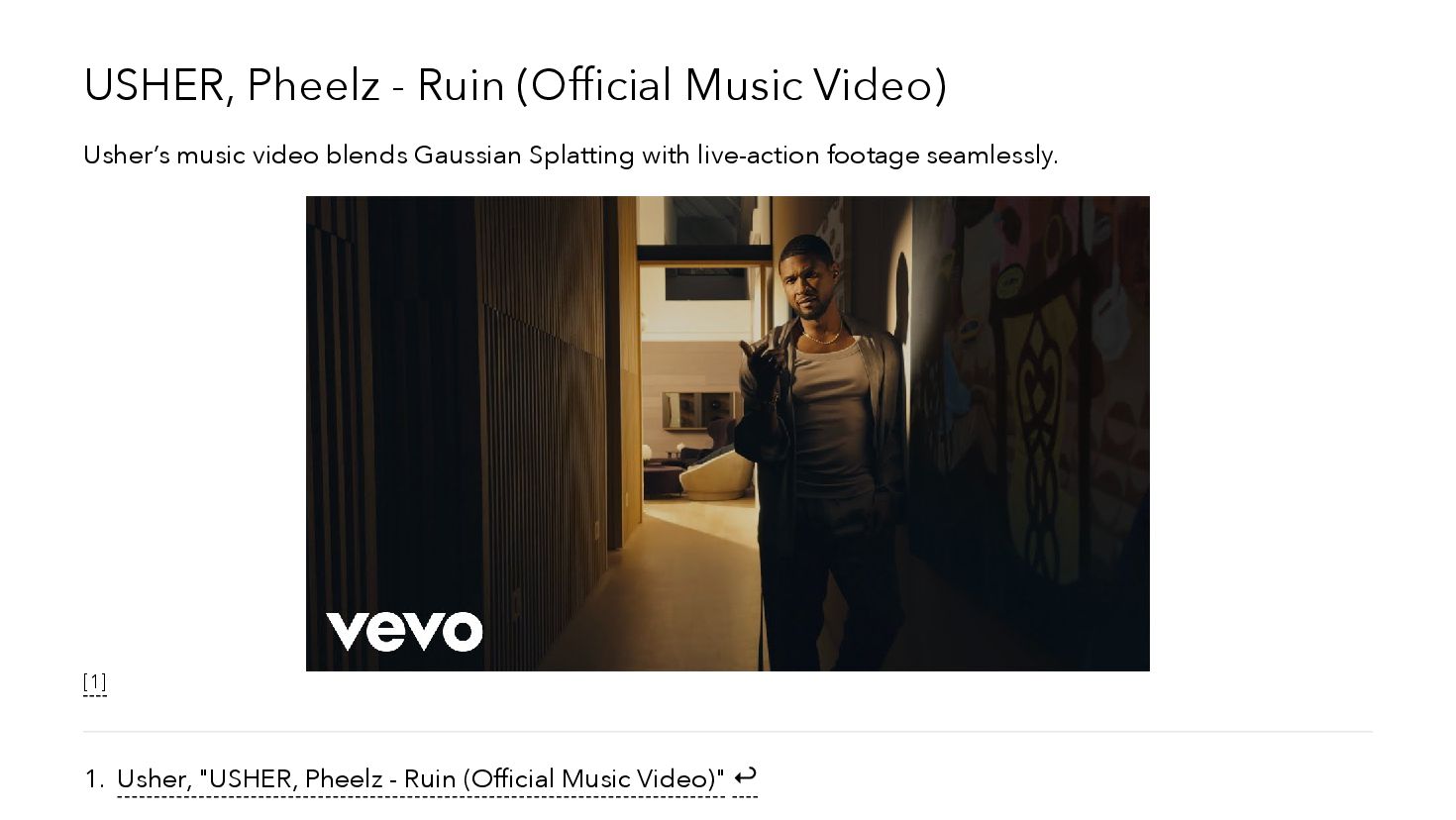
USHER, Pheelz - Ruin (Official Music Video) Usher’s music video
blends Gaussian Splatting with live-action footage seamlessly. 1. Usher, "USHER, Pheelz - Ruin (Official Music Video)" ↩︎ [1] -
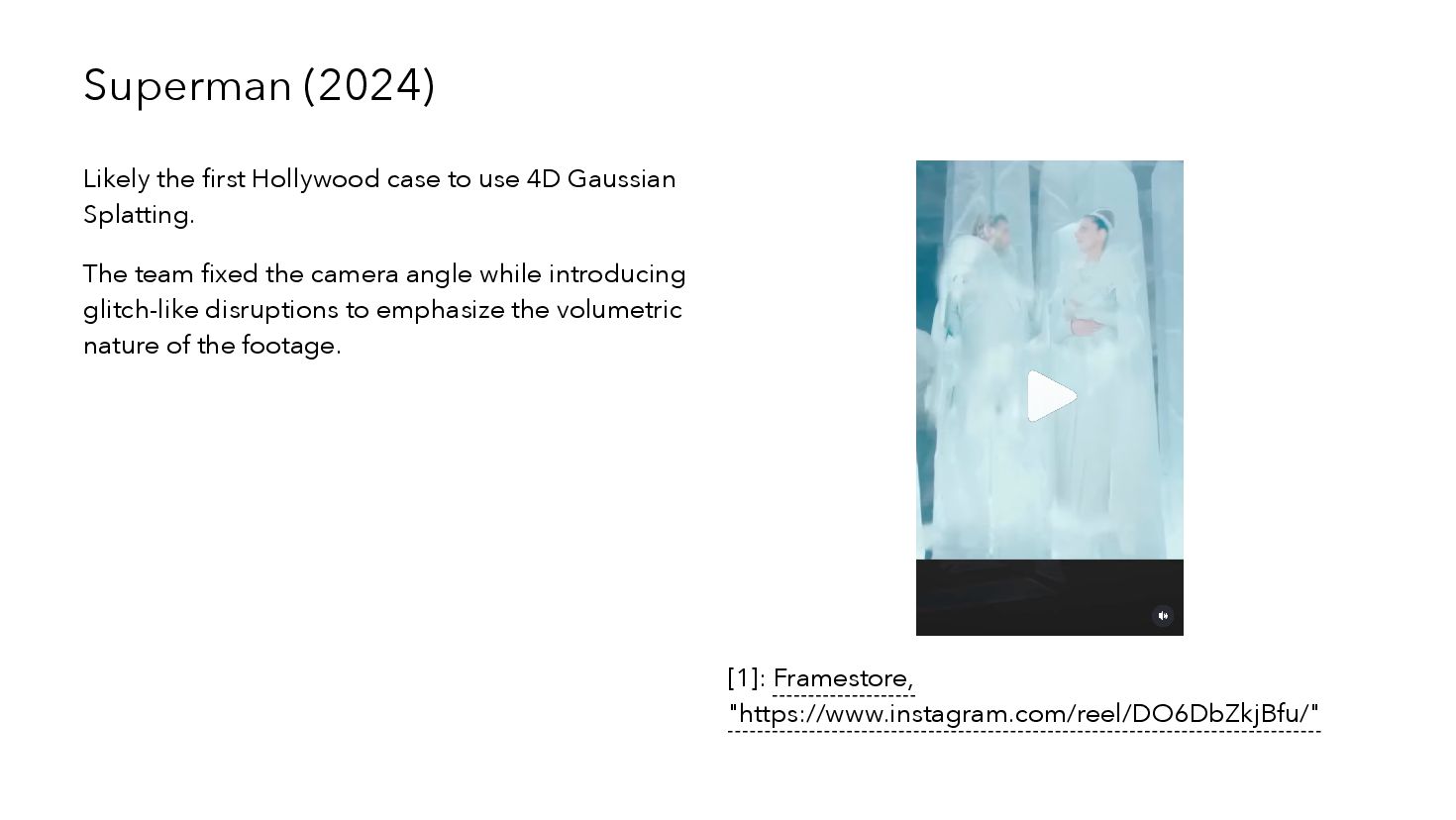
Superman (2024) Likely the first Hollywood case to use 4D
Gaussian Splatting. The team fixed the camera angle while introducing glitch-like disruptions to emphasize the volumetric nature of the footage. [1]: Framestore, "https://www.instagram.com/reel/DO6DbZkjBfu/" -
Integrating Gaussian Splatting into Applications I recommend checking out 3D
Gaussian Splatting | Awesome PlayCanvas Awesome. -
Publishing Gaussian Splatting Creations Here are a few platforms where
you can share splats you create. These are just examples. VRChat: Build your own worlds and embed splats. There is also a community library. Arrival.Space: Emerging metaverse accessible in the browser. Gracia: App that displays 3D/4D Gaussian Splatting on SteamVR and Meta Quest. Scaniverse: Supports capturing, publishing, and searching splats directly within the app. -
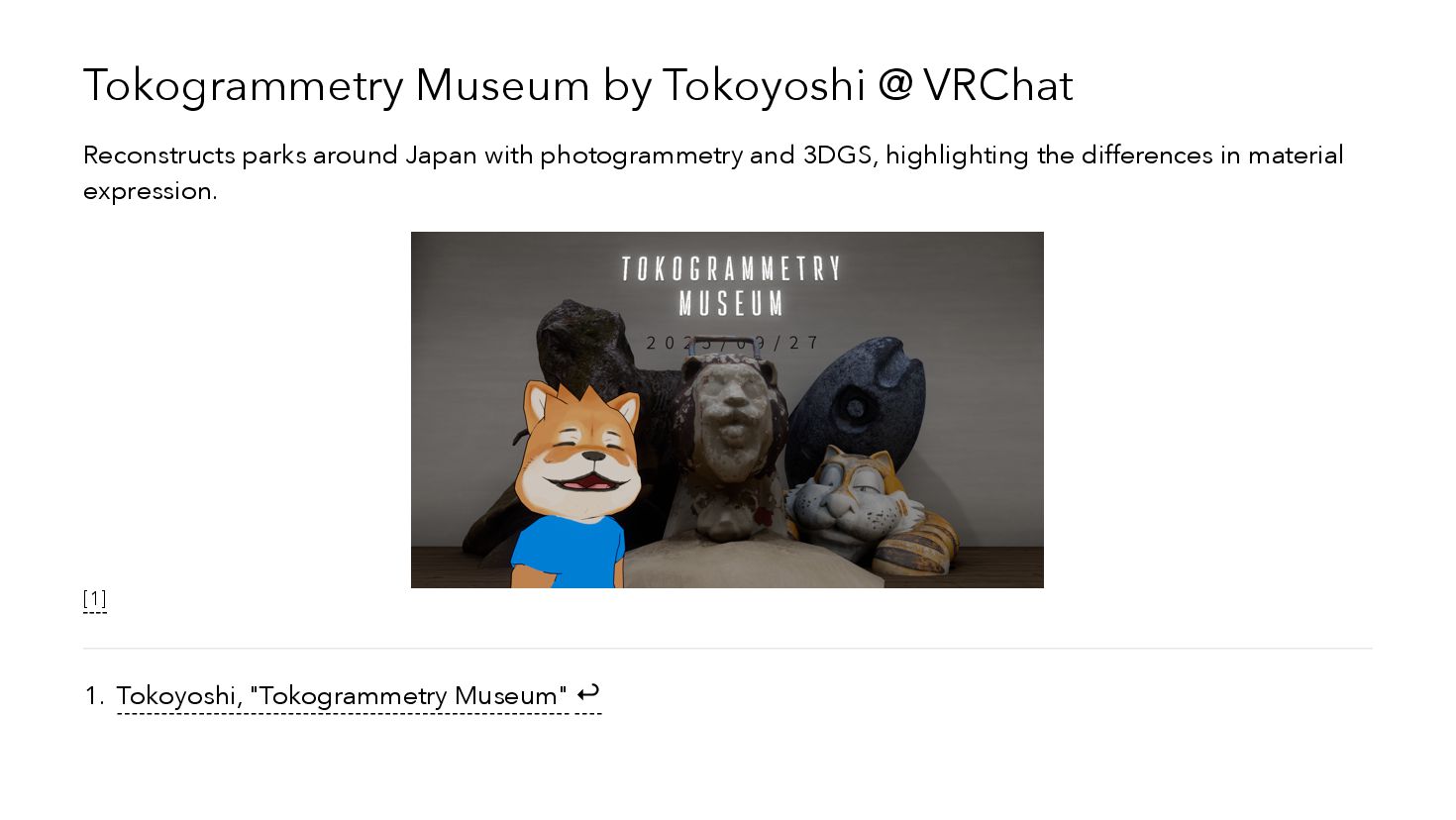
Tokogrammetry Museum by Tokoyoshi @ VRChat Reconstructs parks around Japan
with photogrammetry and 3DGS, highlighting the differences in material expression. 1. Tokoyoshi, "Tokogrammetry Museum" ↩︎ [1] -
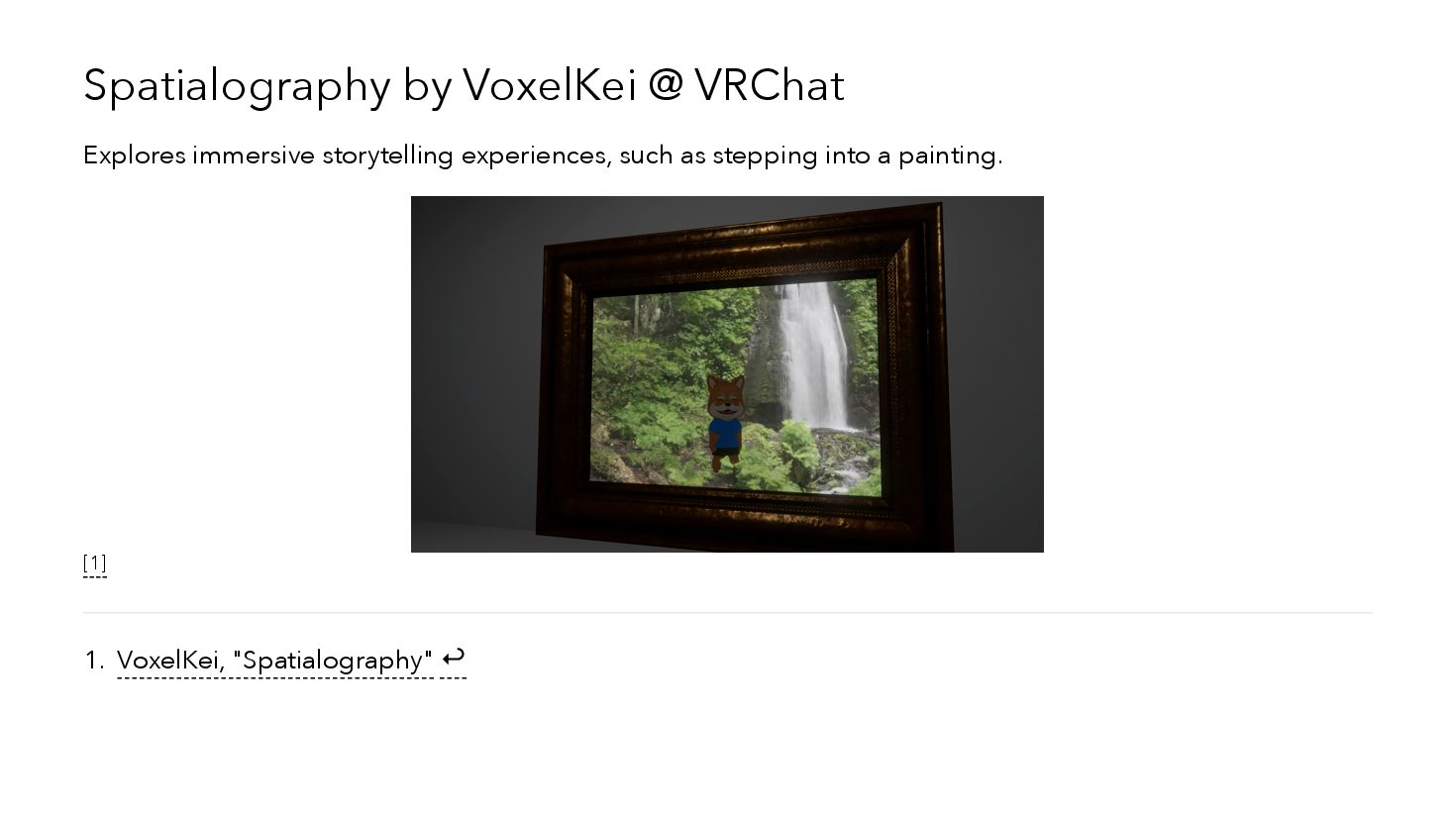
Spatialography by VoxelKei @ VRChat Explores immersive storytelling experiences, such
as stepping into a painting. 1. VoxelKei, "Spatialography" ↩︎ [1] -
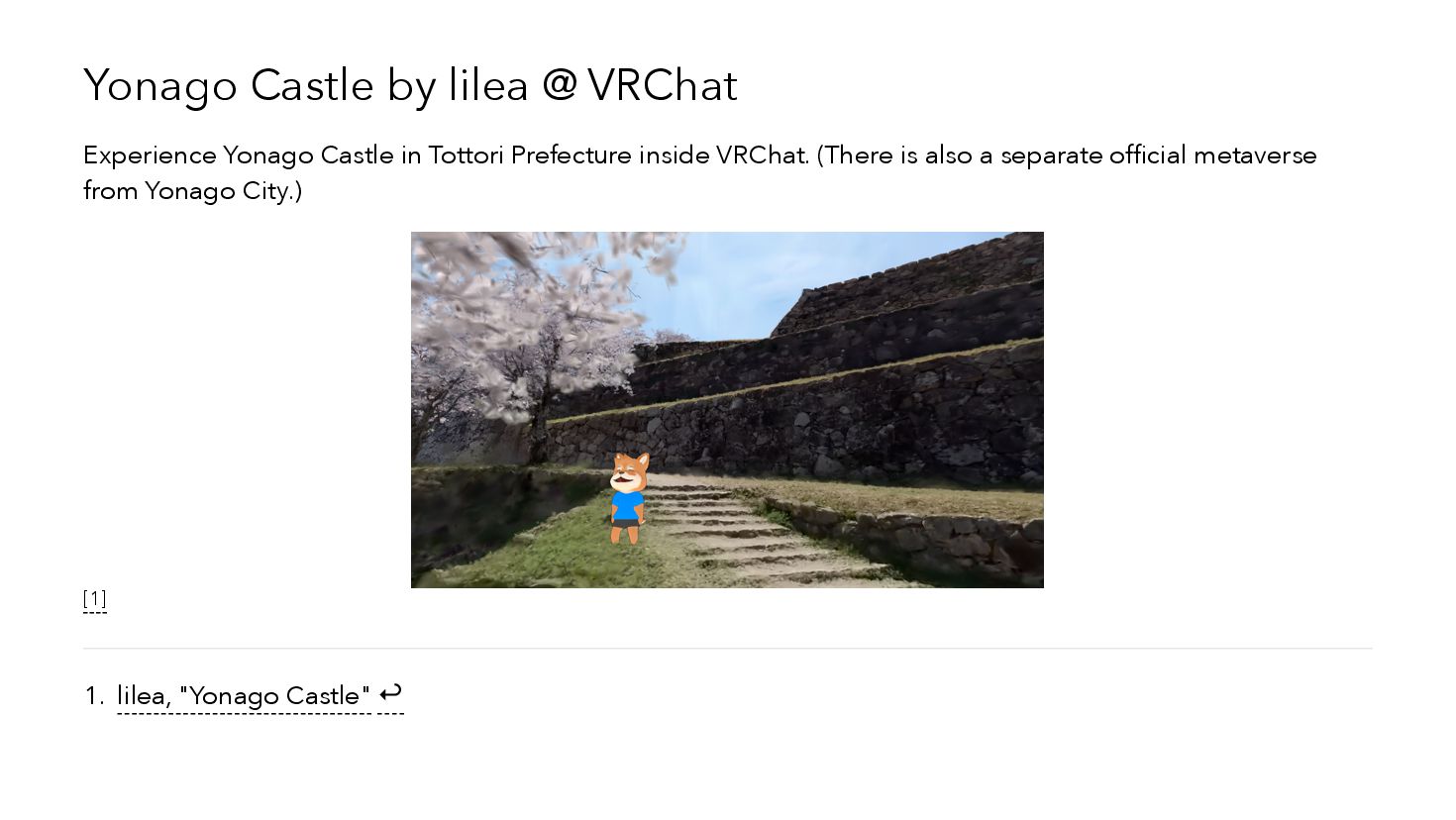
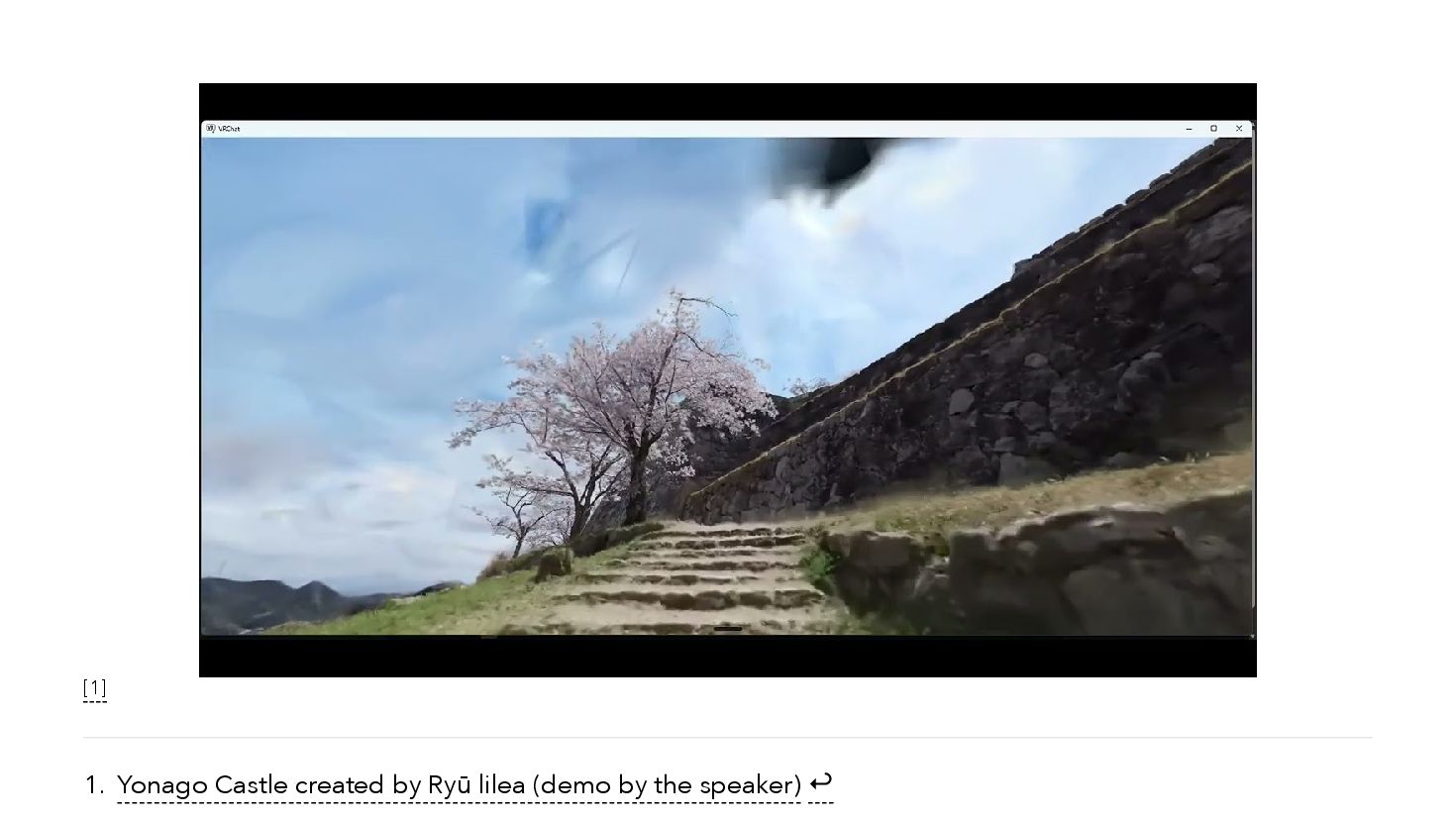
Yonago Castle by lilea @ VRChat Experience Yonago Castle in
Tottori Prefecture inside VRChat. (There is also a separate official metaverse from Yonago City.) 1. lilea, "Yonago Castle" ↩︎ [1] -
1. Yonago Castle created by Ryū lilea (demo by the
speaker) ↩︎ [1] -
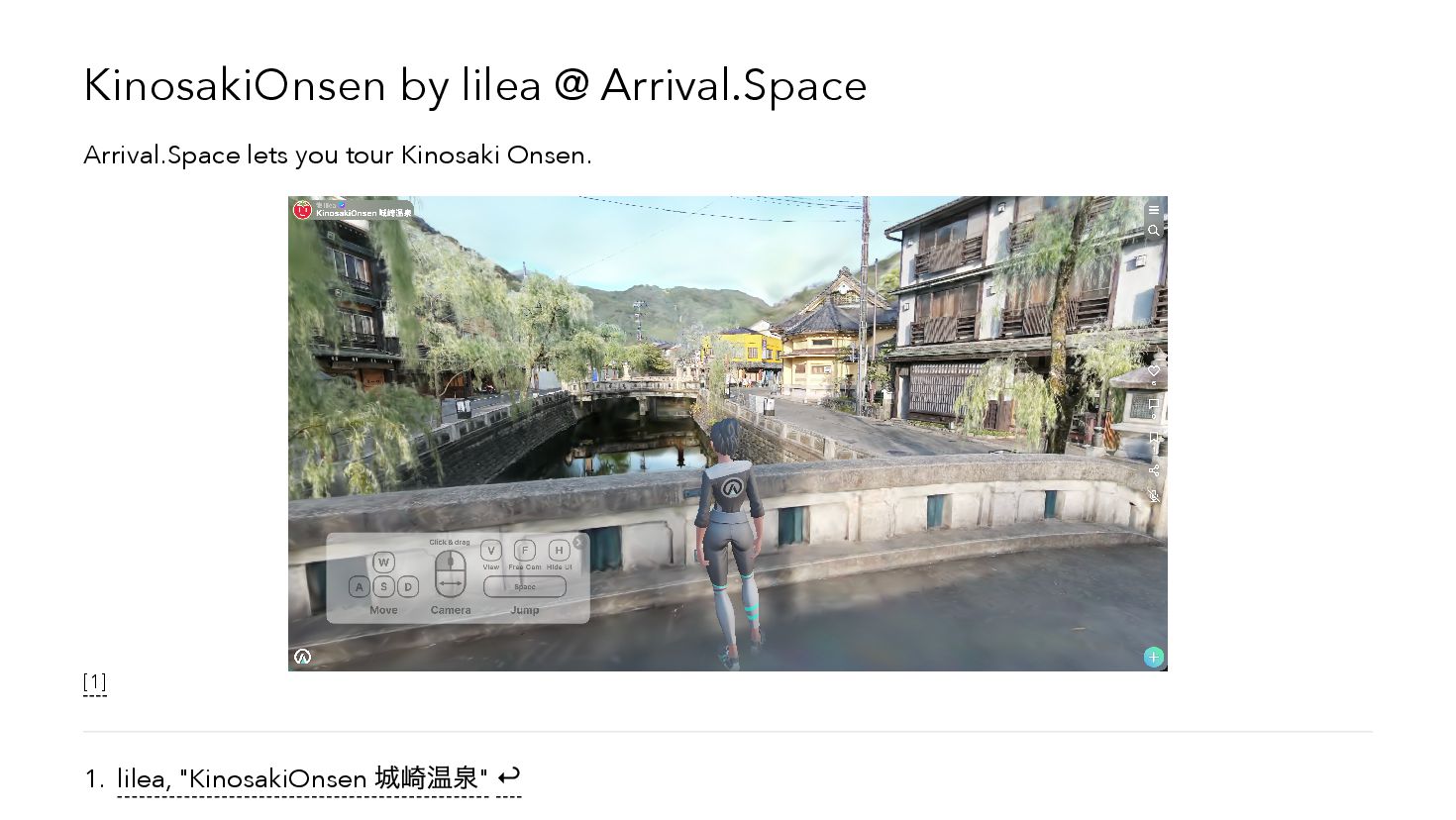
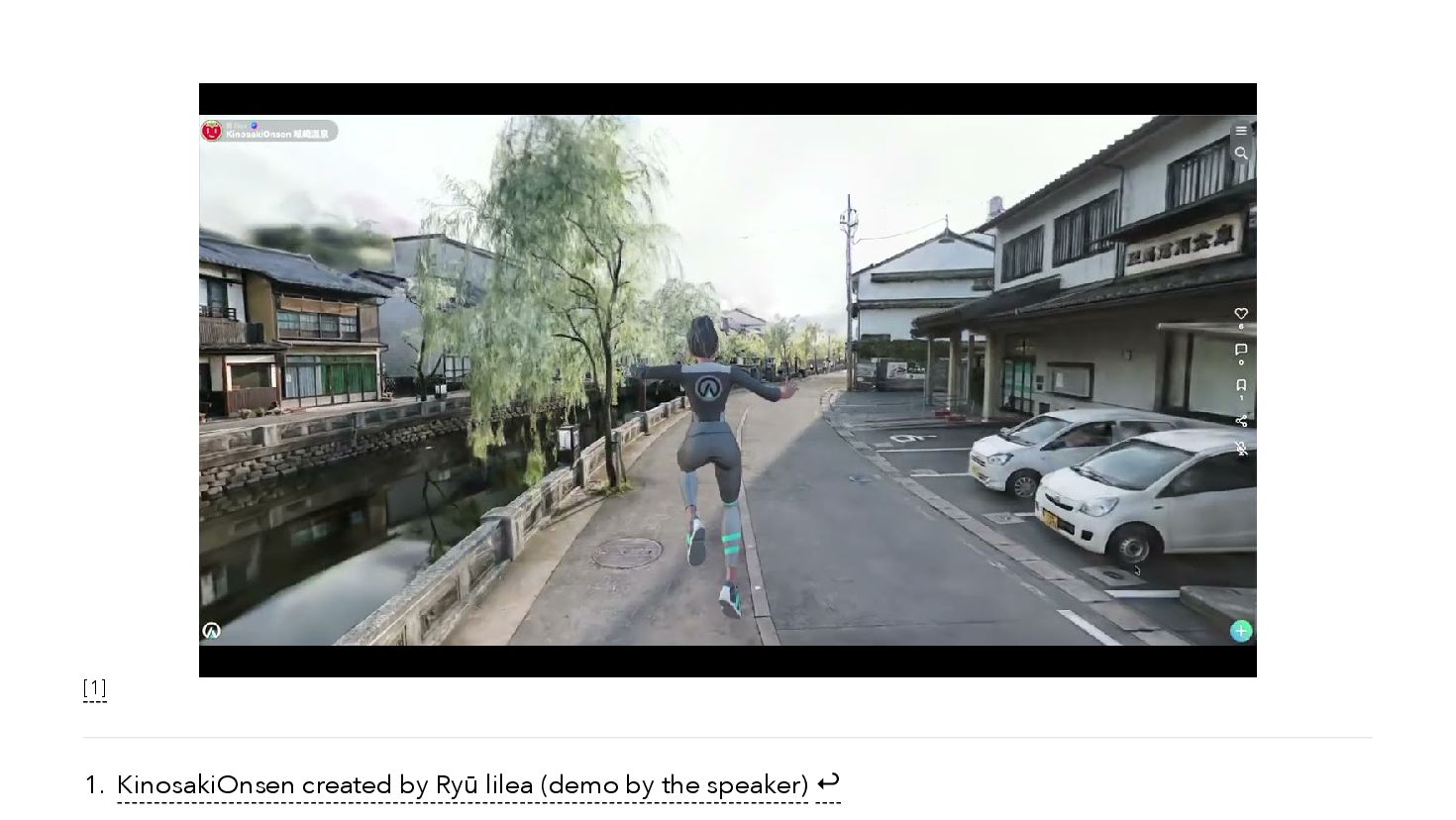
KinosakiOnsen by lilea @ Arrival.Space Arrival.Space lets you tour Kinosaki
Onsen. 1. lilea, "KinosakiOnsen 城崎温泉" ↩︎ [1] -
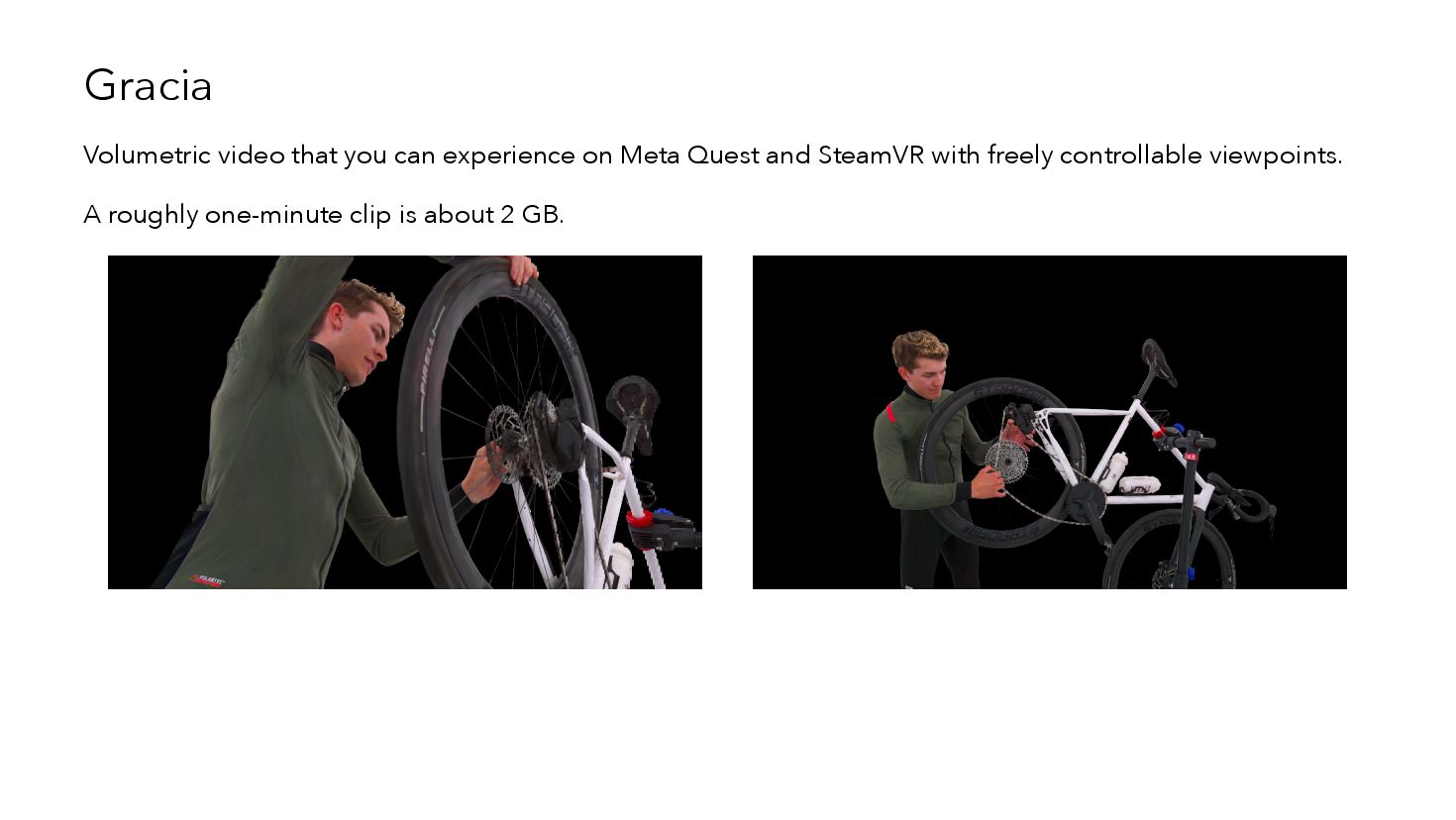
Gracia Volumetric video that you can experience on Meta Quest
and SteamVR with freely controllable viewpoints. A roughly one-minute clip is about 2 GB. -
Wrap-up We looked at how Gaussian Splatting works, how to
create splats, and how the technique is being applied. If you have any questions, feel free to contact Sawara!