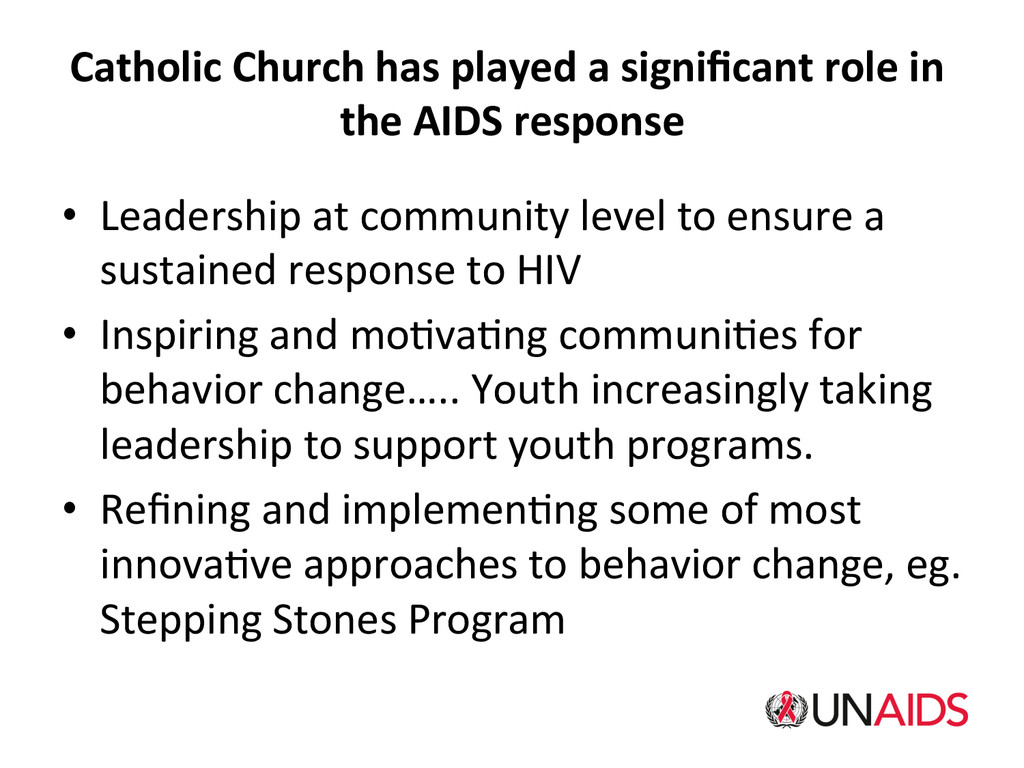
AIDS response • Leadership at community level to ensure a sustained response to HIV • Inspiring and mo8va8ng communi8es for behavior change….. Youth increasingly taking leadership to support youth programs. • Refining and implemen8ng some of most innova8ve approaches to behavior change, eg. Stepping Stones Program
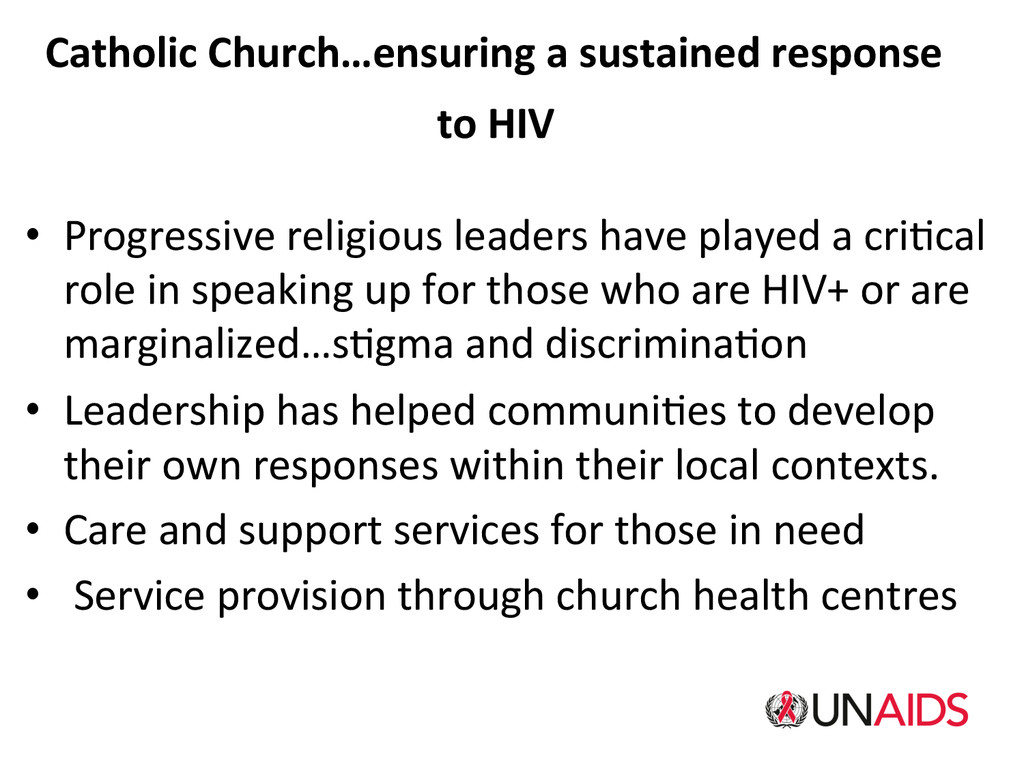
• Progressive religious leaders have played a cri8cal role in speaking up for those who are HIV+ or are marginalized…s8gma and discrimina8on • Leadership has helped communi8es to develop their own responses within their local contexts. • Care and support services for those in need • Service provision through church health centres
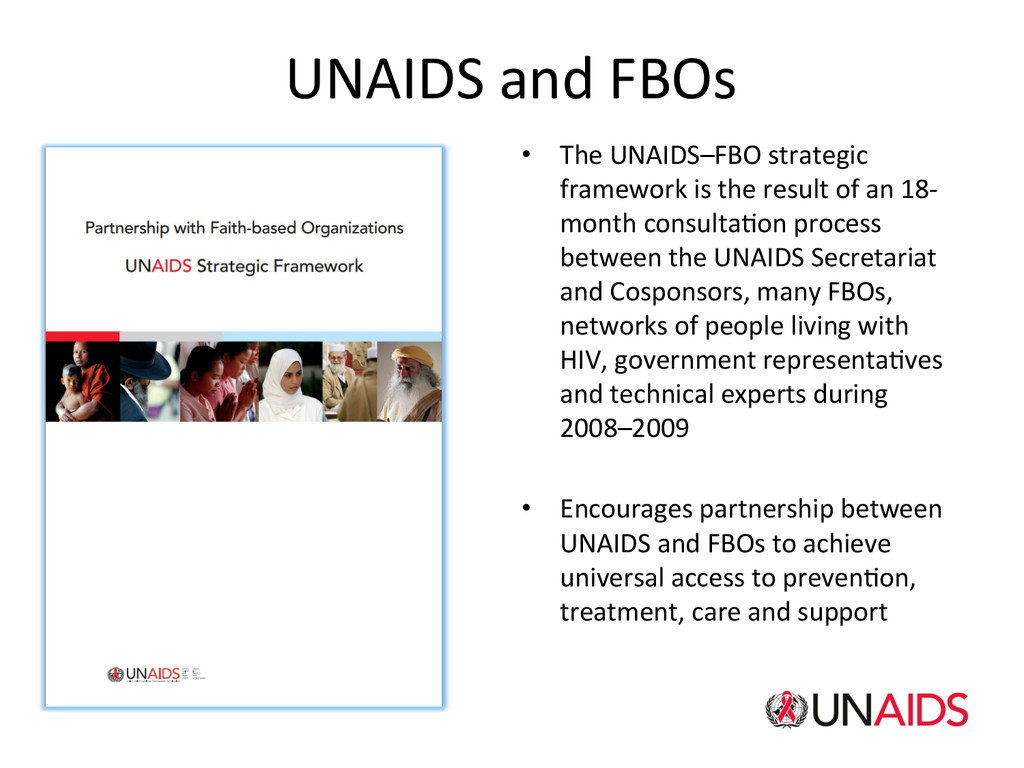
is the result of an 18-‐ month consulta8on process between the UNAIDS Secretariat and Cosponsors, many FBOs, networks of people living with HIV, government representa8ves and technical experts during 2008–2009 • Encourages partnership between UNAIDS and FBOs to achieve universal access to preven8on, treatment, care and support
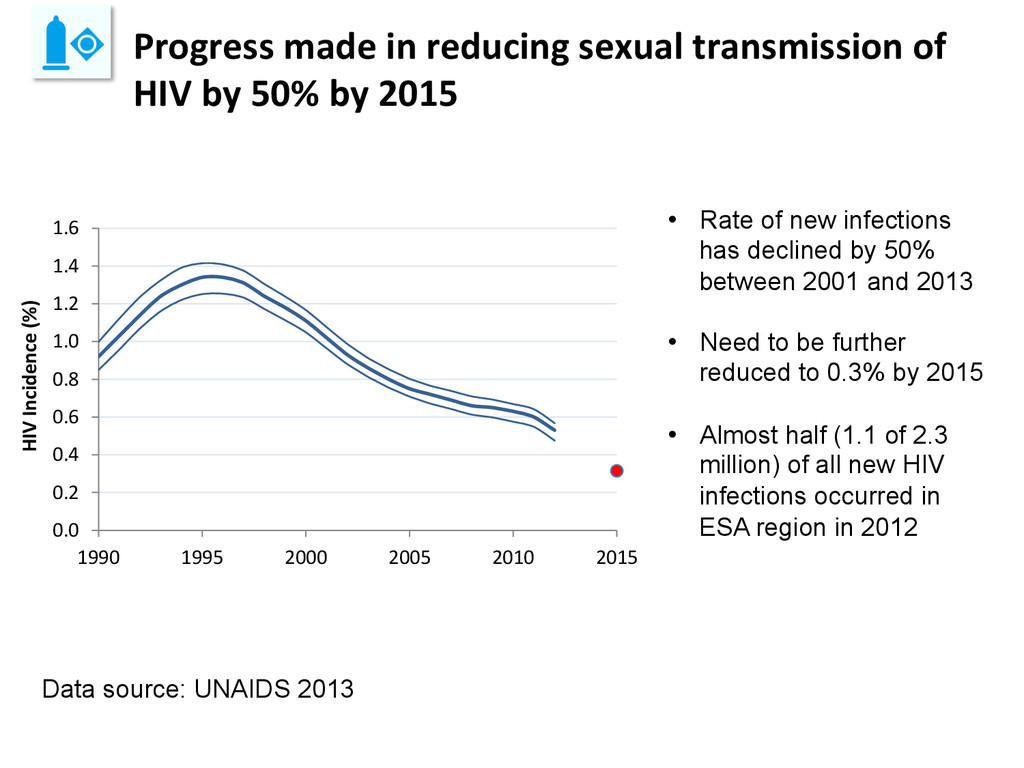
50% by 2015 • Rate of new infections has declined by 50% between 2001 and 2013 • Need to be further reduced to 0.3% by 2015 • Almost half (1.1 of 2.3 million) of all new HIV infections occurred in ESA region in 2012 0.0 0.2 0.4 0.6 0.8 1.0 1.2 1.4 1.6 1990 1995 2000 2005 2010 2015 HIV Incidence (%) Data source: UNAIDS 2013
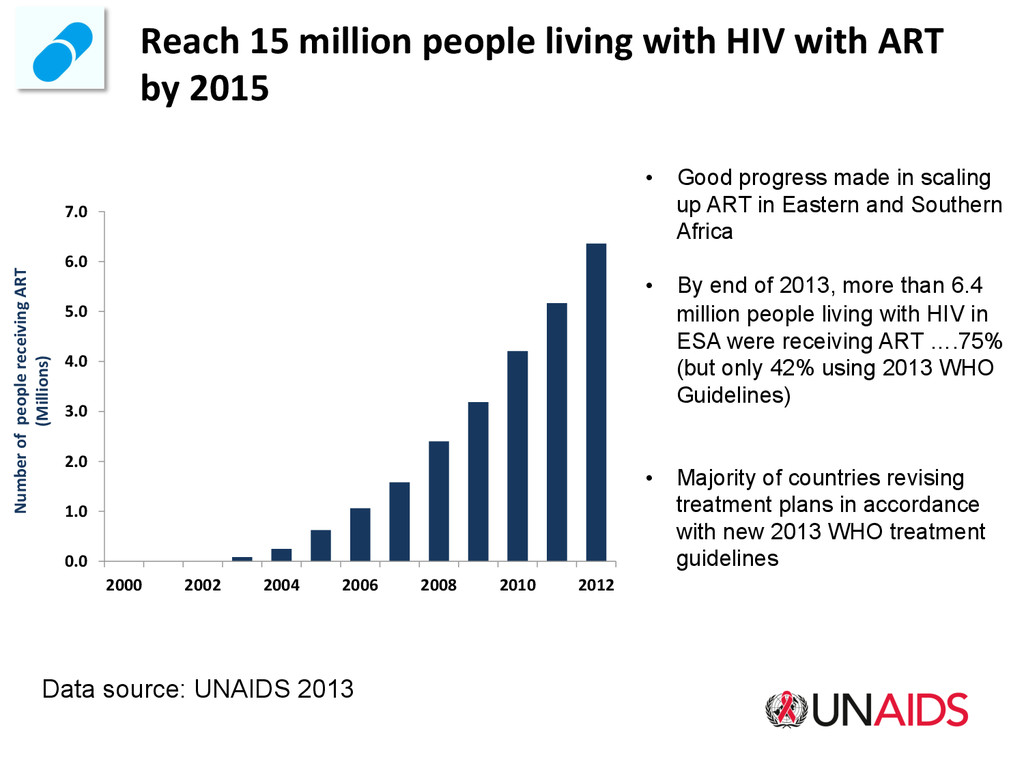
2004 2006 2008 2010 2012 Number of people receiving ART (Millions) Reach 15 million people living with HIV with ART by 2015 • Good progress made in scaling up ART in Eastern and Southern Africa • By end of 2013, more than 6.4 million people living with HIV in ESA were receiving ART ….75% (but only 42% using 2013 WHO Guidelines) • Majority of countries revising treatment plans in accordance with new 2013 WHO treatment guidelines Data source: UNAIDS 2013
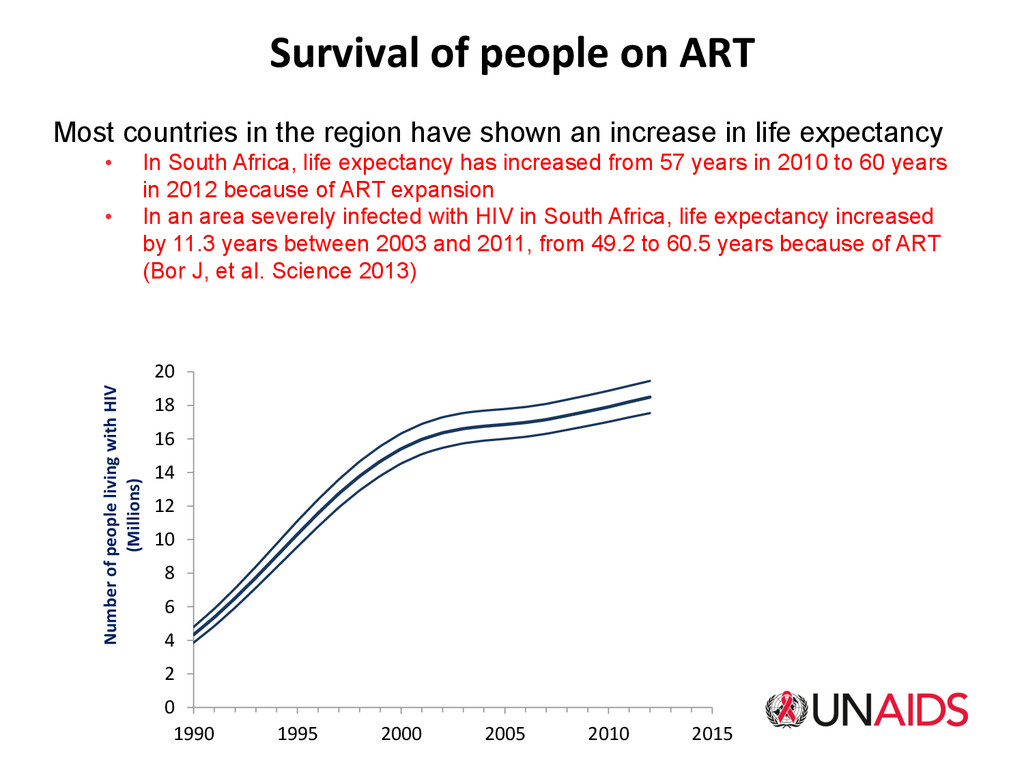
8 10 12 14 16 18 20 1990 1995 2000 2005 2010 2015 Number of people living with HIV (Millions) Most countries in the region have shown an increase in life expectancy • In South Africa, life expectancy has increased from 57 years in 2010 to 60 years in 2012 because of ART expansion • In an area severely infected with HIV in South Africa, life expectancy increased by 11.3 years between 2003 and 2011, from 49.2 to 60.5 years because of ART (Bor J, et al. Science 2013)
-‐ Speak up to ensure that ending AIDS remains part of the post 2015 agenda…to ensure that progress made is sustained. -‐ Strengthen partnerships in countries that are lagging behind, ensuring that progress is maintained in those that have made good progress -‐ Support a comprehensive HIV preven8on that leaves no one behind irrespec8ve of gender, sexual orienta8on, economic standing, etc..esp adolescent girls
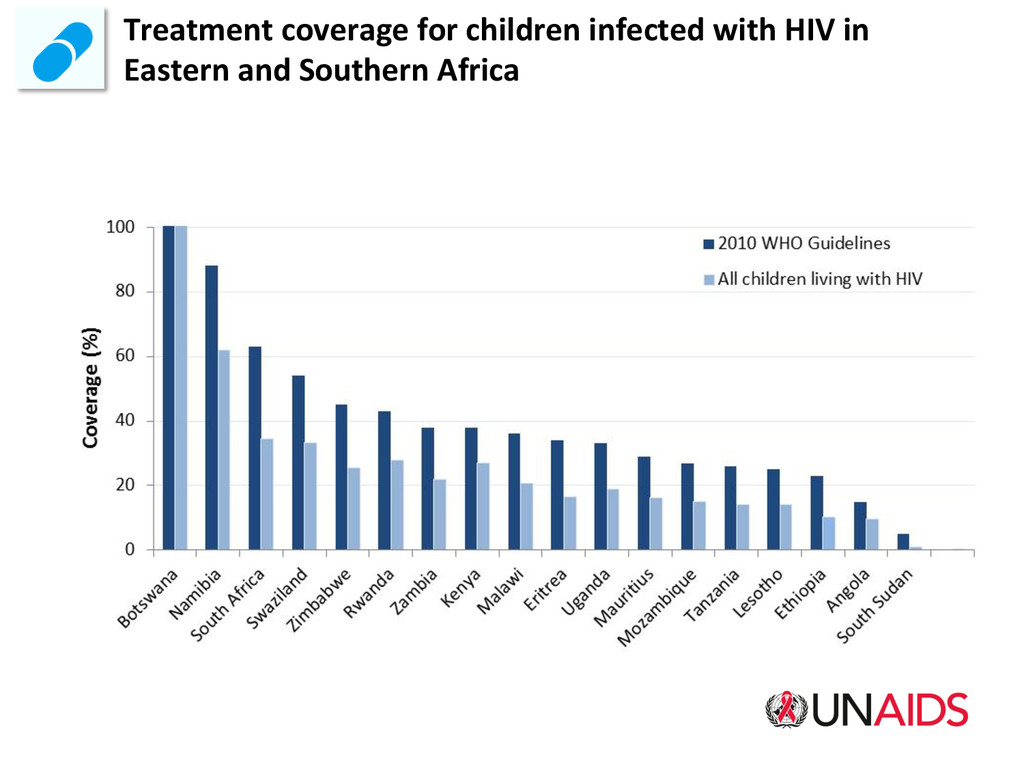
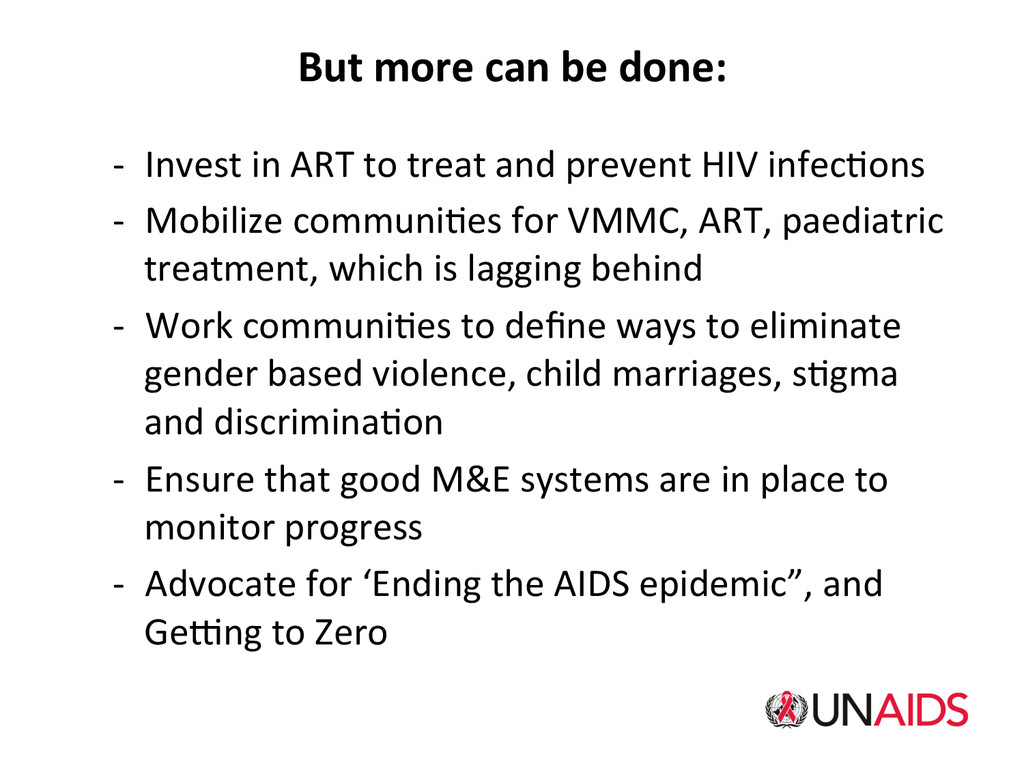
to treat and prevent HIV infec8ons -‐ Mobilize communi8es for VMMC, ART, paediatric treatment, which is lagging behind -‐ Work communi8es to define ways to eliminate gender based violence, child marriages, s8gma and discrimina8on -‐ Ensure that good M&E systems are in place to monitor progress -‐ Advocate for ‘Ending the AIDS epidemic”, and Ge`ng to Zero


 hivaidscathconf
 cassininazir
 lfama
 denniskardys
 kevinliebholz
 jct
 jnunemaker
 destraynor
 sabderemane
 chriscoyier
 aleyda
 csswizardry
 matthewcrist