Response in Asia and the Pacific Steven J. Kraus Director UNAIDS Regional Support Team, Asia and the Pacific Melbourne International AIDS Conference July 2014
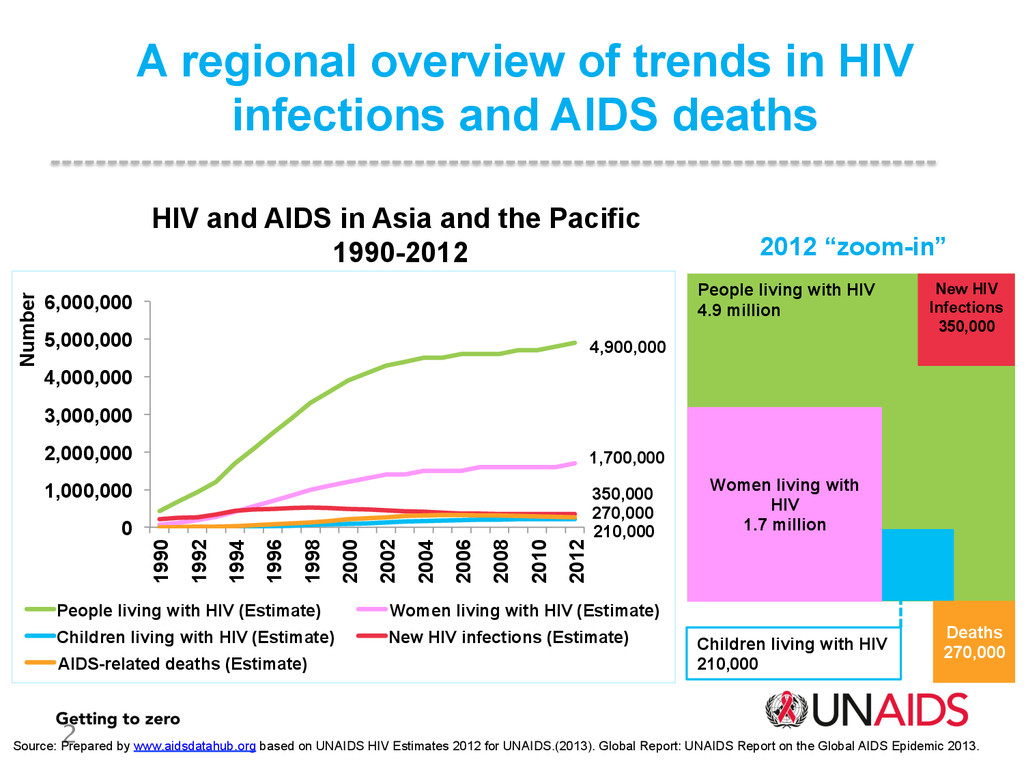
deaths 2 4,900,000 1,700,000 210,000 350,000 270,000 0 1,000,000 2,000,000 3,000,000 4,000,000 5,000,000 6,000,000 1990 1992 1994 1996 1998 2000 2002 2004 2006 2008 2010 2012 Number People living with HIV (Estimate) Women living with HIV (Estimate) Children living with HIV (Estimate) New HIV infections (Estimate) AIDS-related deaths (Estimate) People living with HIV 4.9 million Women living with HIV 1.7 million New HIV Infections 350,000 Deaths 270,000 2012 “zoom-in” Children living with HIV 210,000 Source: Prepared by www.aidsdatahub.org based on UNAIDS HIV Estimates 2012 for UNAIDS.(2013). Global Report: UNAIDS Report on the Global AIDS Epidemic 2013. HIV and AIDS in Asia and the Pacific 1990-2012
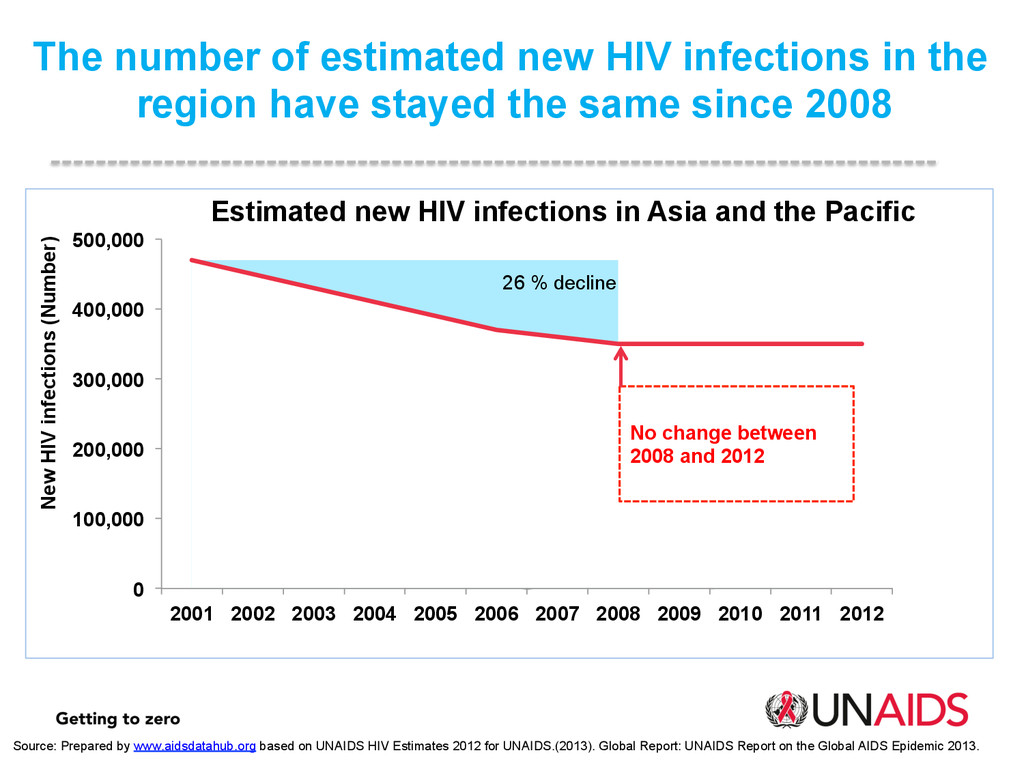
2005 2006 2007 2008 2009 2010 2011 2012 New HIV infections (Number) 26 % decline The number of estimated new HIV infections in the region have stayed the same since 2008 No change between 2008 and 2012 Source: Prepared by www.aidsdatahub.org based on UNAIDS HIV Estimates 2012 for UNAIDS.(2013). Global Report: UNAIDS Report on the Global AIDS Epidemic 2013. Estimated new HIV infections in Asia and the Pacific
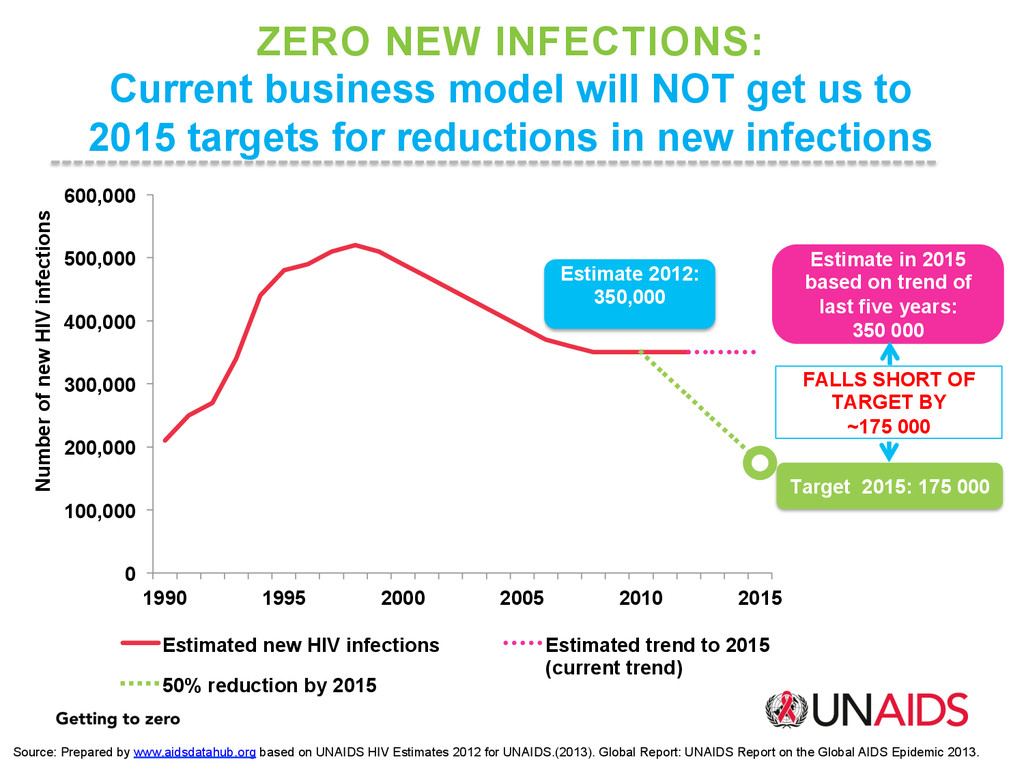
to 2015 targets for reductions in new infections 0 100,000 200,000 300,000 400,000 500,000 600,000 1990 1995 2000 2005 2010 2015 Number of new HIV infections Estimated new HIV infections Estimated trend to 2015 (current trend) 50% reduction by 2015 Estimate 2012: 350,000 Target 2015: 175 000 Estimate in 2015 based on trend of last five years: 350 000 FALLS SHORT OF TARGET BY ~175 000 Source: Prepared by www.aidsdatahub.org based on UNAIDS HIV Estimates 2012 for UNAIDS.(2013). Global Report: UNAIDS Report on the Global AIDS Epidemic 2013.
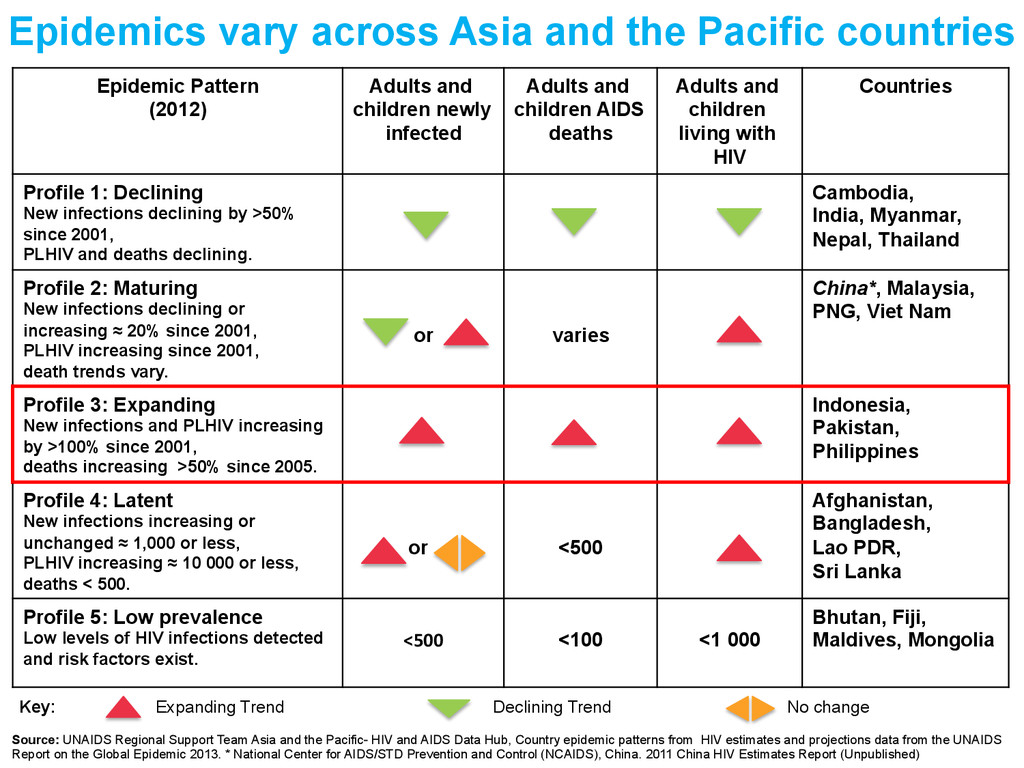
(2012) Adults and children newly infected Adults and children AIDS deaths Adults and children living with HIV Countries Profile 1: Declining New infections declining by >50% since 2001, PLHIV and deaths declining. Cambodia, India, Myanmar, Nepal, Thailand Profile 2: Maturing New infections declining or increasing ≈ 20% since 2001, PLHIV increasing since 2001, death trends vary. or varies China*, Malaysia, PNG, Viet Nam Profile 3: Expanding New infections and PLHIV increasing by >100% since 2001, deaths increasing >50% since 2005. Indonesia, Pakistan, Philippines Profile 4: Latent New infections increasing or unchanged ≈ 1,000 or less, PLHIV increasing ≈ 10 000 or less, deaths < 500. or <500 Afghanistan, Bangladesh, Lao PDR, Sri Lanka Profile 5: Low prevalence Low levels of HIV infections detected and risk factors exist. <500 <100 <1 000 Bhutan, Fiji, Maldives, Mongolia Key: Expanding Trend Declining Trend No change Source: UNAIDS Regional Support Team Asia and the Pacific- HIV and AIDS Data Hub, Country epidemic patterns from HIV estimates and projections data from the UNAIDS Report on the Global Epidemic 2013. * National Center for AIDS/STD Prevention and Control (NCAIDS), China. 2011 China HIV Estimates Report (Unpublished)
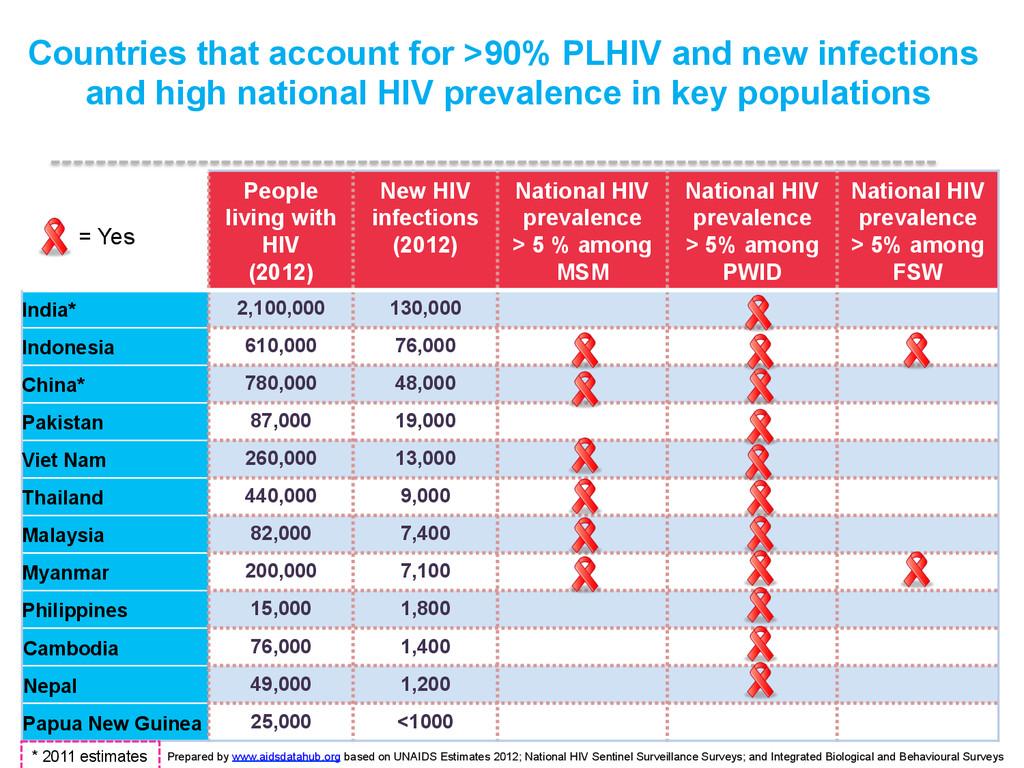
high national HIV prevalence in key populations People living with HIV (2012) New HIV infections (2012) National HIV prevalence > 5 % among MSM National HIV prevalence > 5% among PWID National HIV prevalence > 5% among FSW India* 2,100,000 130,000 Indonesia 610,000 76,000 China* 780,000 48,000 Pakistan 87,000 19,000 Viet Nam 260,000 13,000 Thailand 440,000 9,000 Malaysia 82,000 7,400 Myanmar 200,000 7,100 Philippines 15,000 1,800 Cambodia 76,000 1,400 Nepal 49,000 1,200 Papua New Guinea 25,000 <1000 Prepared by www.aidsdatahub.org based on UNAIDS Estimates 2012; National HIV Sentinel Surveillance Surveys; and Integrated Biological and Behavioural Surveys = Yes * 2011 estimates
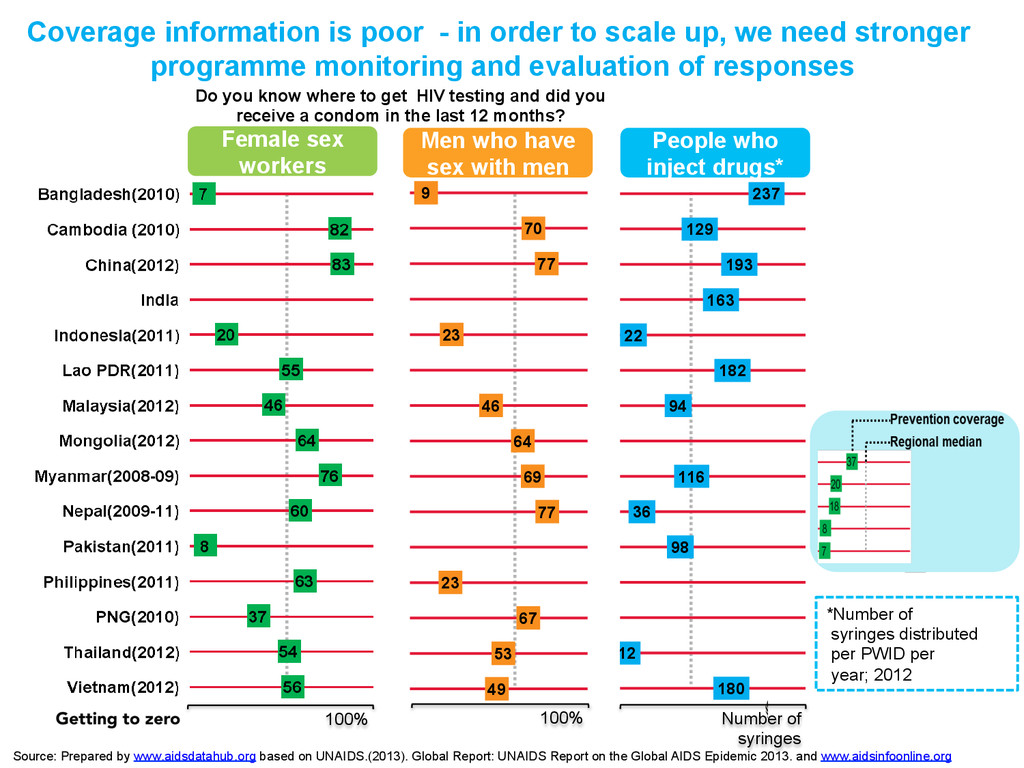
we need stronger programme monitoring and evaluation of responses Source: Prepared by www.aidsdatahub.org based on UNAIDS.(2013). Global Report: UNAIDS Report on the Global AIDS Epidemic 2013. and www.aidsinfoonline.org 100% 237 129 193 163 22 182 94 116 36 98 12 180 Bangladesh Cambodia China India Indonesia Lao PDR Malaysia Mongolia(2012) Myanmar Nepal Pakistan Philippines(2011) PNG(2010) Thailand Viet Nam 9 70 77 23 46 64 69 77 23 67 53 49 Bangladesh(2010) Cambodia(2010) China(2012) India Indonesia(2011) Lao PDR(2011) Malaysia(2012) Mongolia(2012) Myanmar(2008-09) Nepal(2009) Pakistan(2011) Philippines(2011) PNG(2010) Thailand(2012) Viet Nam(2012) Female sex workers Men who have sex with men People who inject drugs* 100% *Number of syringes distributed per PWID per year; 2012 Do you know where to get HIV testing and did you receive a condom in the last 12 months? Number of syringes
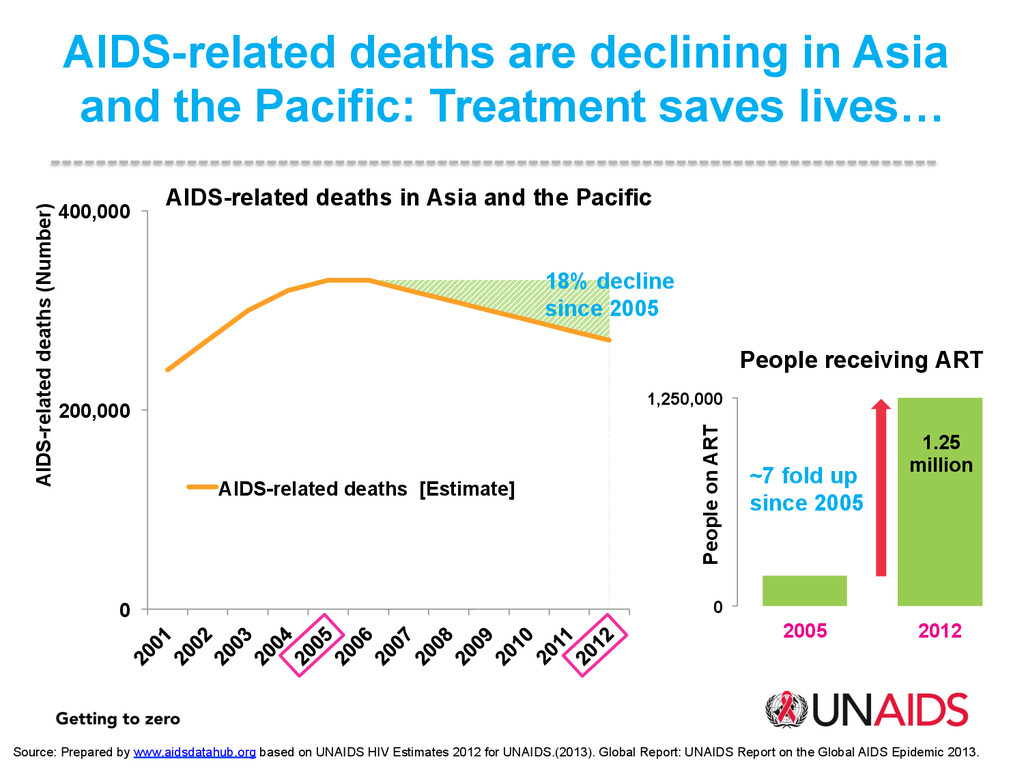
saves lives… 0 200,000 400,000 AIDS-related deaths (Number) AIDS-related deaths in Asia and the Pacific AIDS-related deaths [Estimate] 18% decline since 2005 1.25 million 0 1,250,000 2005 2012 People on ART People receiving ART ~7 fold up since 2005 Source: Prepared by www.aidsdatahub.org based on UNAIDS HIV Estimates 2012 for UNAIDS.(2013). Global Report: UNAIDS Report on the Global AIDS Epidemic 2013.
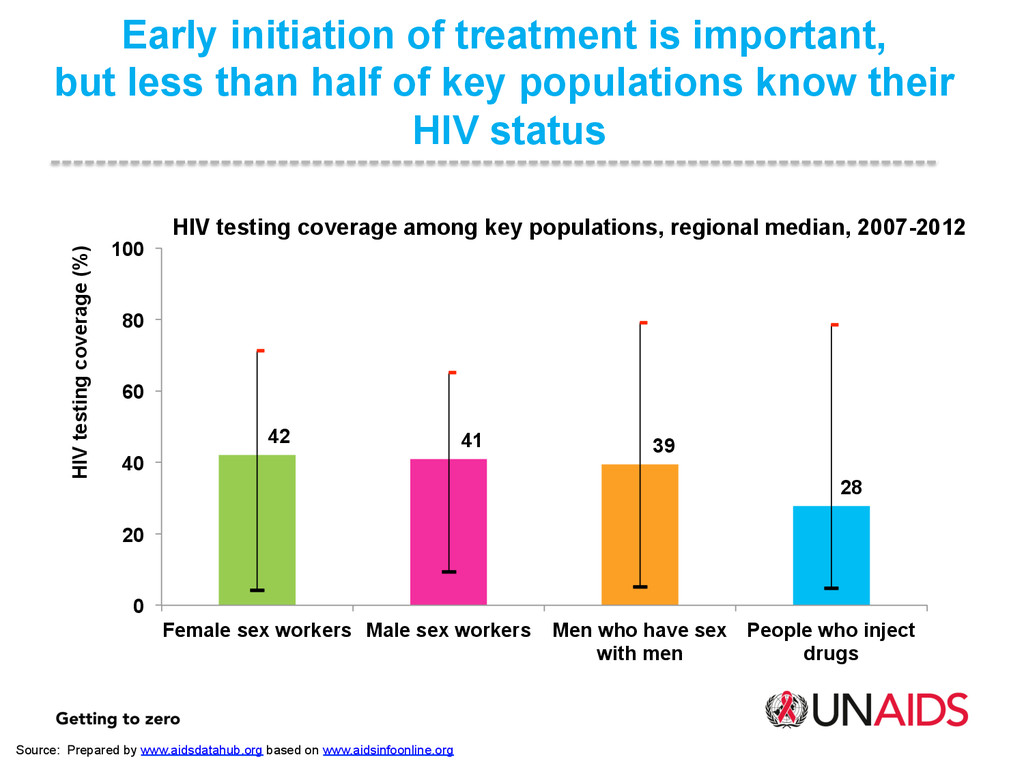
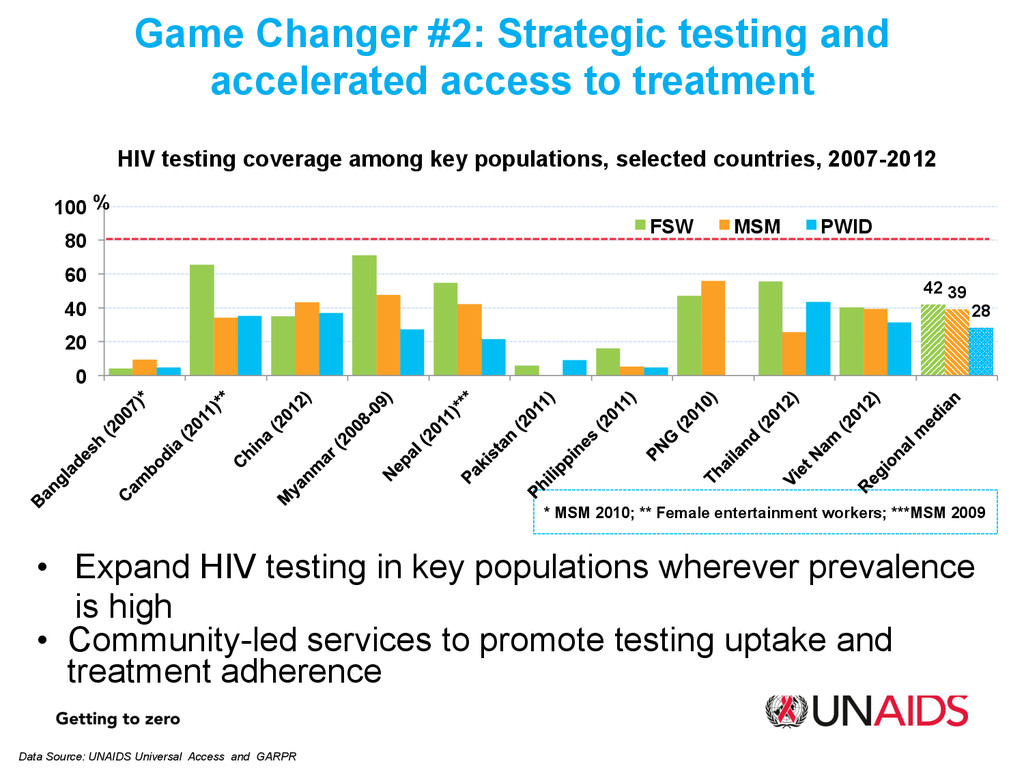
Female sex workers Male sex workers Men who have sex with men People who inject drugs HIV testing coverage (%) Early initiation of treatment is important, but less than half of key populations know their HIV status Source: Prepared by www.aidsdatahub.org based on www.aidsinfoonline.org HIV testing coverage among key populations, regional median, 2007-2012
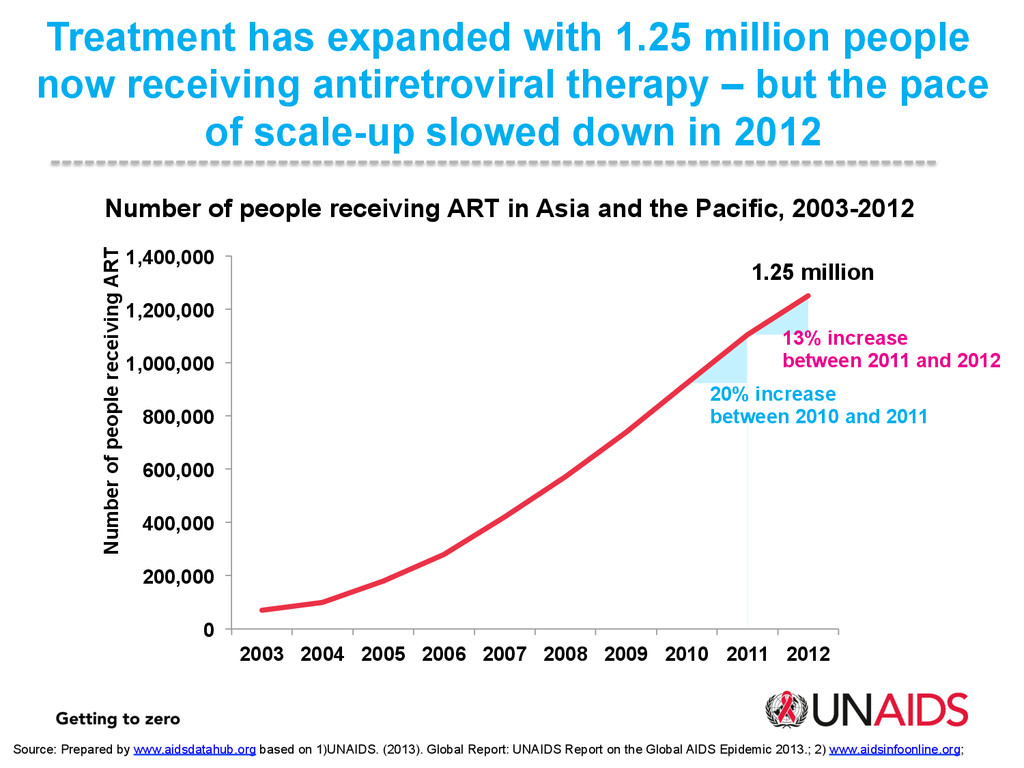
therapy – but the pace of scale-up slowed down in 2012 Source: Prepared by www.aidsdatahub.org based on 1)UNAIDS. (2013). Global Report: UNAIDS Report on the Global AIDS Epidemic 2013.; 2) www.aidsinfoonline.org; 1.25 million 0 200,000 400,000 600,000 800,000 1,000,000 1,200,000 1,400,000 2003 2004 2005 2006 2007 2008 2009 2010 2011 2012 Number of people receiving ART 13% increase between 2011 and 2012 20% increase between 2010 and 2011 Number of people receiving ART in Asia and the Pacific, 2003-2012
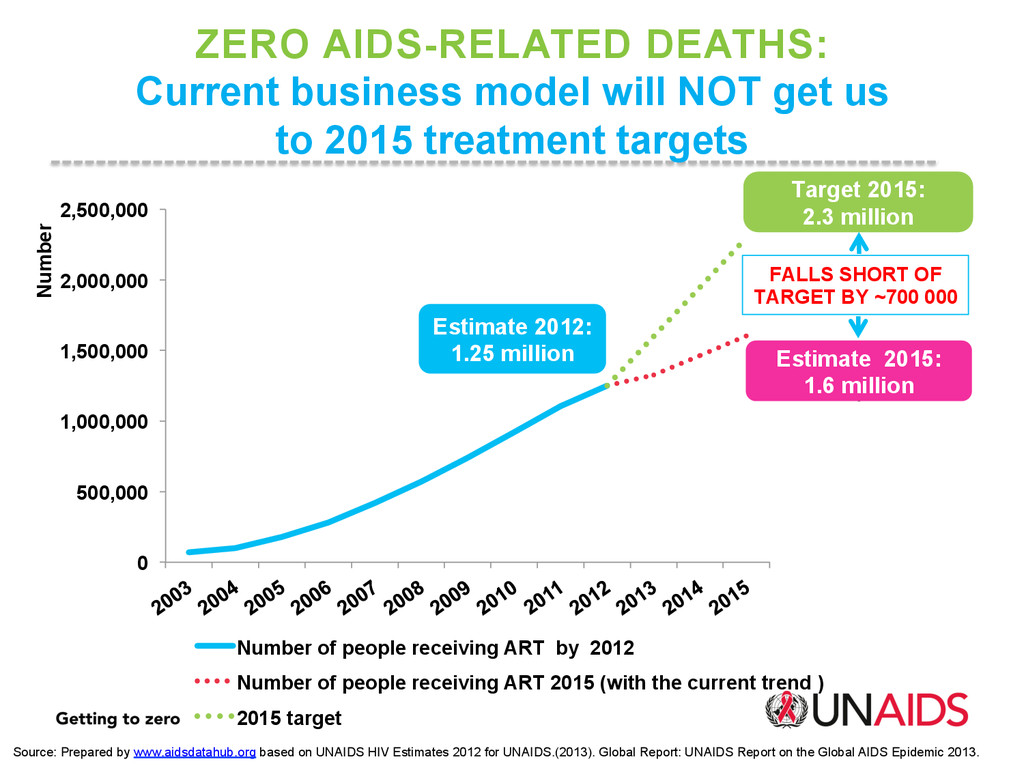
receiving ART by 2012 Number of people receiving ART 2015 (with the current trend ) 2015 target Estimate 2012: 1.25 million Estimate 2015: 1.6 million Target 2015: 2.3 million FALLS SHORT OF TARGET BY ~700 000 Source: Prepared by www.aidsdatahub.org based on UNAIDS HIV Estimates 2012 for UNAIDS.(2013). Global Report: UNAIDS Report on the Global AIDS Epidemic 2013. ZERO AIDS-RELATED DEATHS: Current business model will NOT get us to 2015 treatment targets
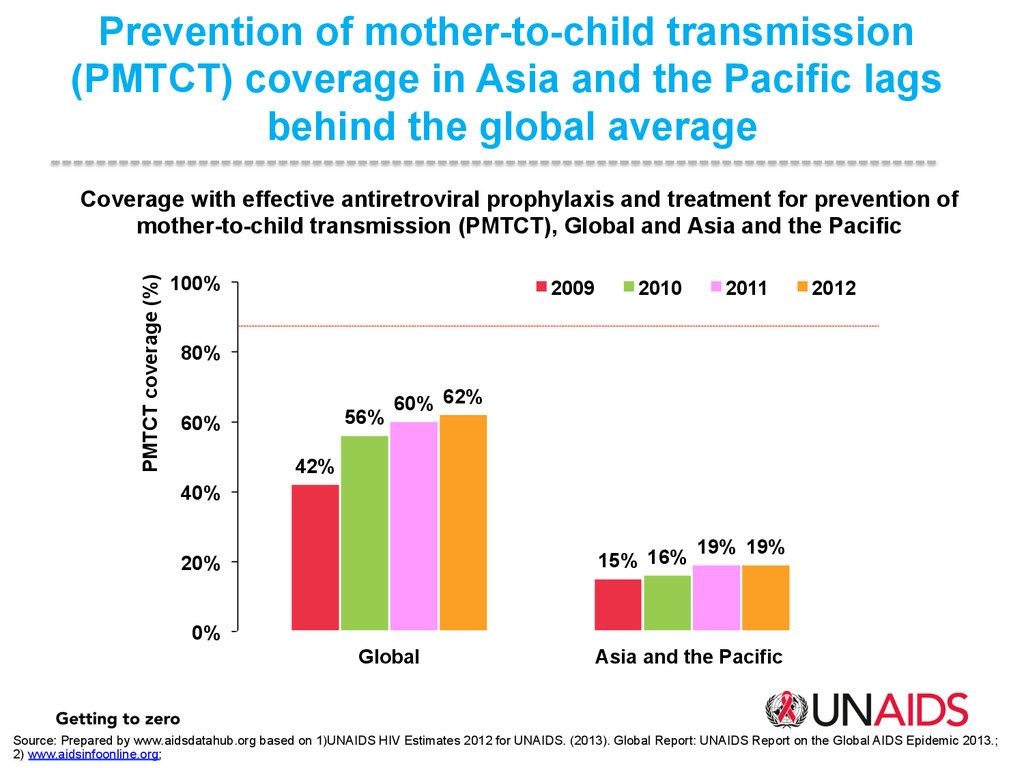
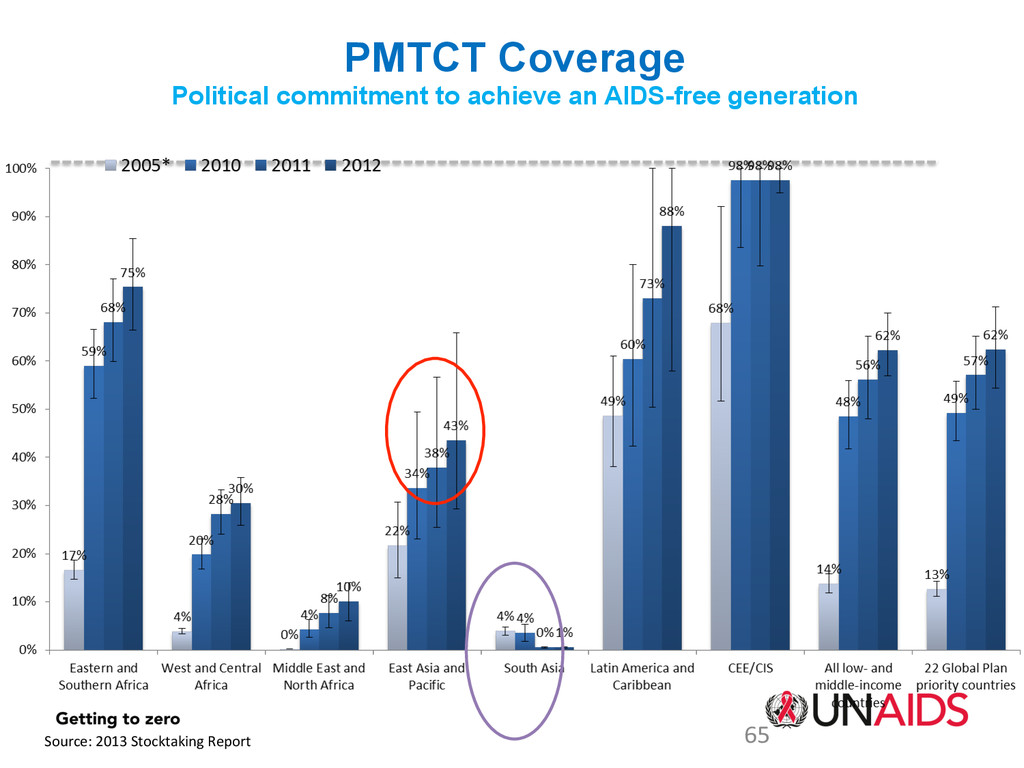
40% 60% 80% 100% Global Asia and the Pacific PMTCT coverage (%) 2009 2010 2011 2012 Prevention of mother-to-child transmission (PMTCT) coverage in Asia and the Pacific lags behind the global average Source: Prepared by www.aidsdatahub.org based on 1)UNAIDS HIV Estimates 2012 for UNAIDS. (2013). Global Report: UNAIDS Report on the Global AIDS Epidemic 2013.; 2) www.aidsinfoonline.org; Coverage with effective antiretroviral prophylaxis and treatment for prevention of mother-to-child transmission (PMTCT), Global and Asia and the Pacific
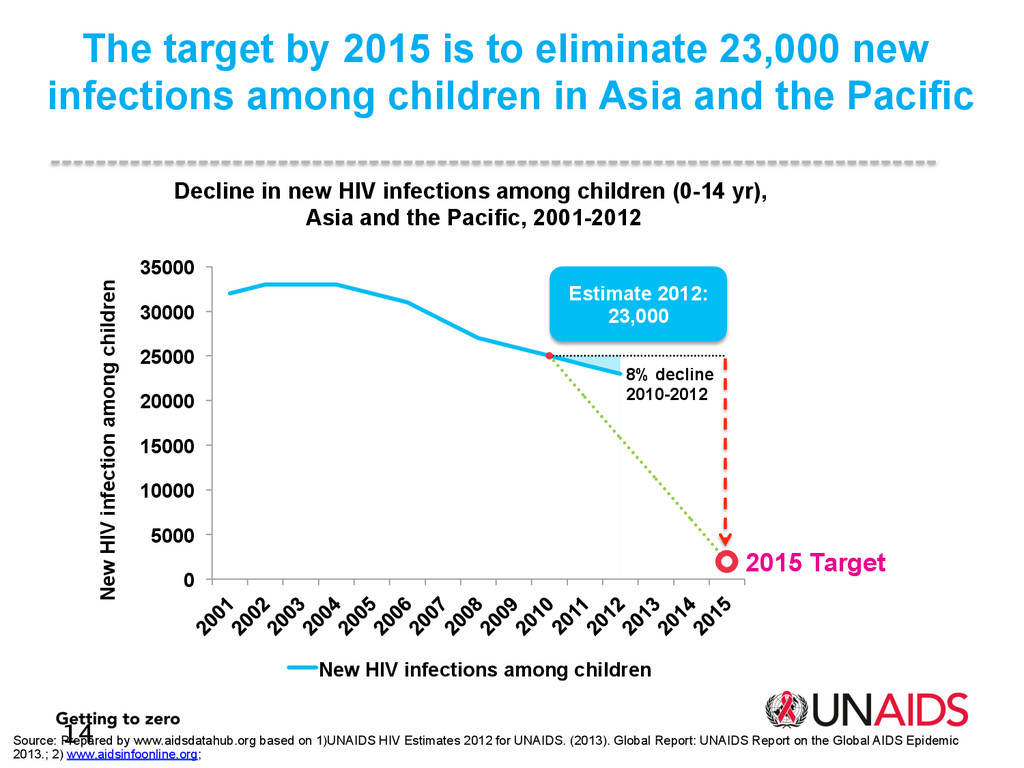
and the Pacific, 2001-2012 14 2015 Target 0 5000 10000 15000 20000 25000 30000 35000 New HIV infection among children New HIV infections among children 8% decline 2010-2012 Estimate 2012: 23,000 Source: Prepared by www.aidsdatahub.org based on 1)UNAIDS HIV Estimates 2012 for UNAIDS. (2013). Global Report: UNAIDS Report on the Global AIDS Epidemic 2013.; 2) www.aidsinfoonline.org; The target by 2015 is to eliminate 23,000 new infections among children in Asia and the Pacific
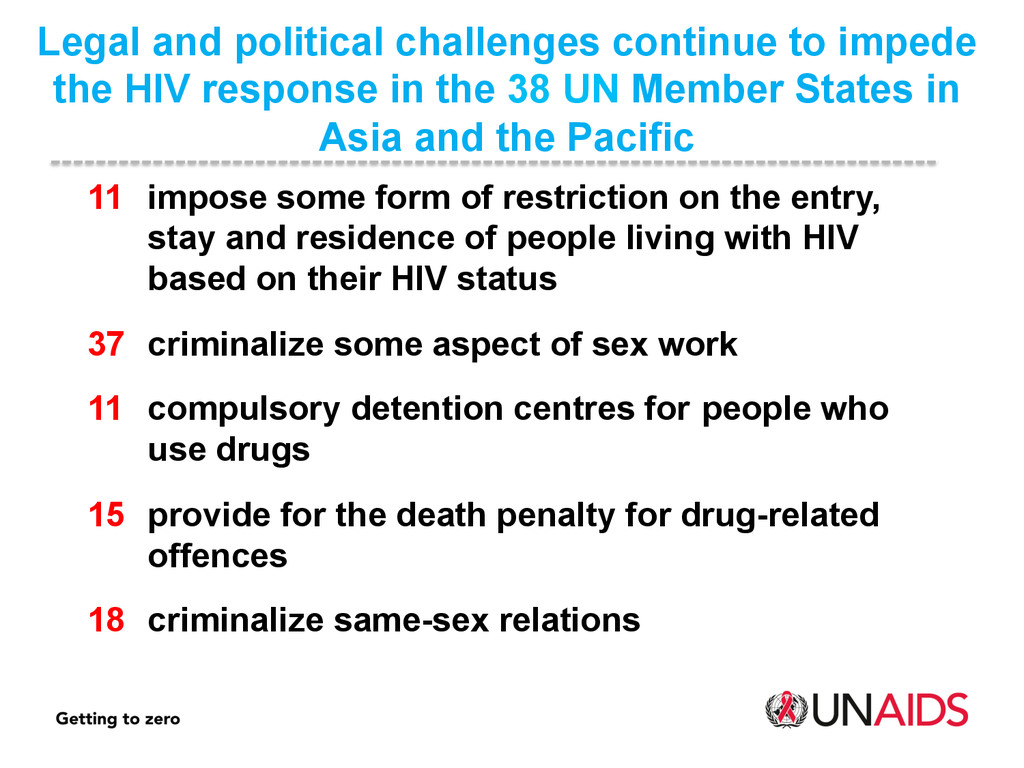
in the 38 UN Member States in Asia and the Pacific 11 impose some form of restriction on the entry, stay and residence of people living with HIV based on their HIV status 37 criminalize some aspect of sex work 11 compulsory detention centres for people who use drugs 15 provide for the death penalty for drug-related offences 18 criminalize same-sex relations
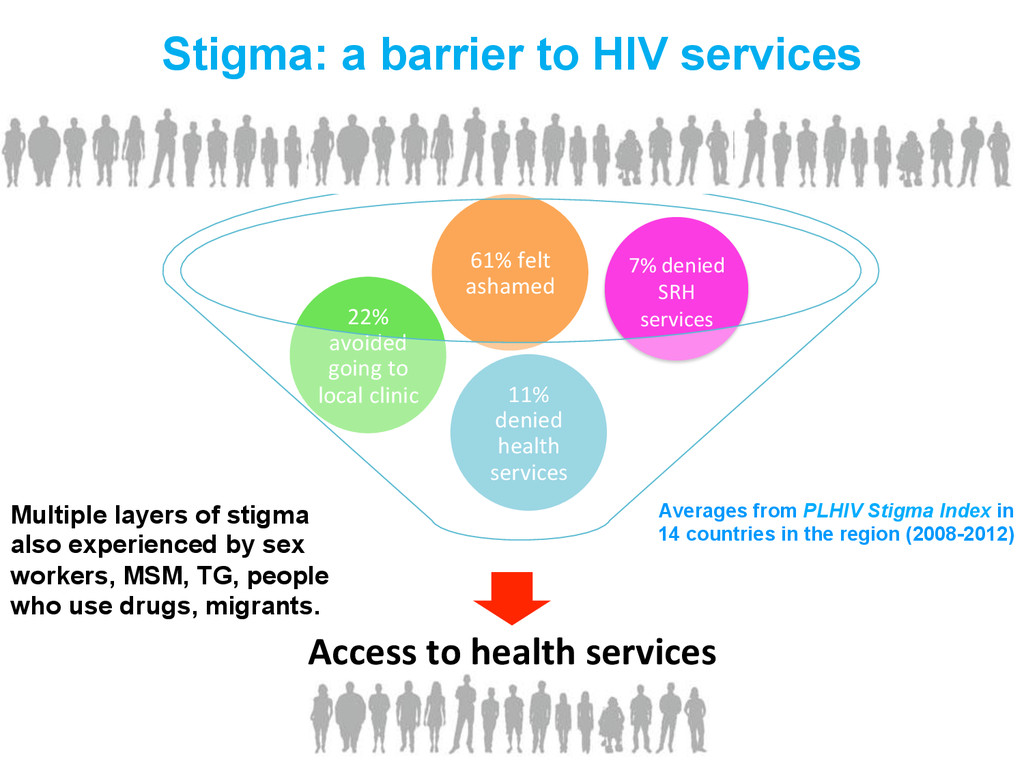
11% denied health services 22% avoided going to local clinic 61% felt ashamed Averages from PLHIV Stigma Index in 14 countries in the region (2008-2012) 7% denied SRH services Multiple layers of stigma also experienced by sex workers, MSM, TG, people who use drugs, migrants.
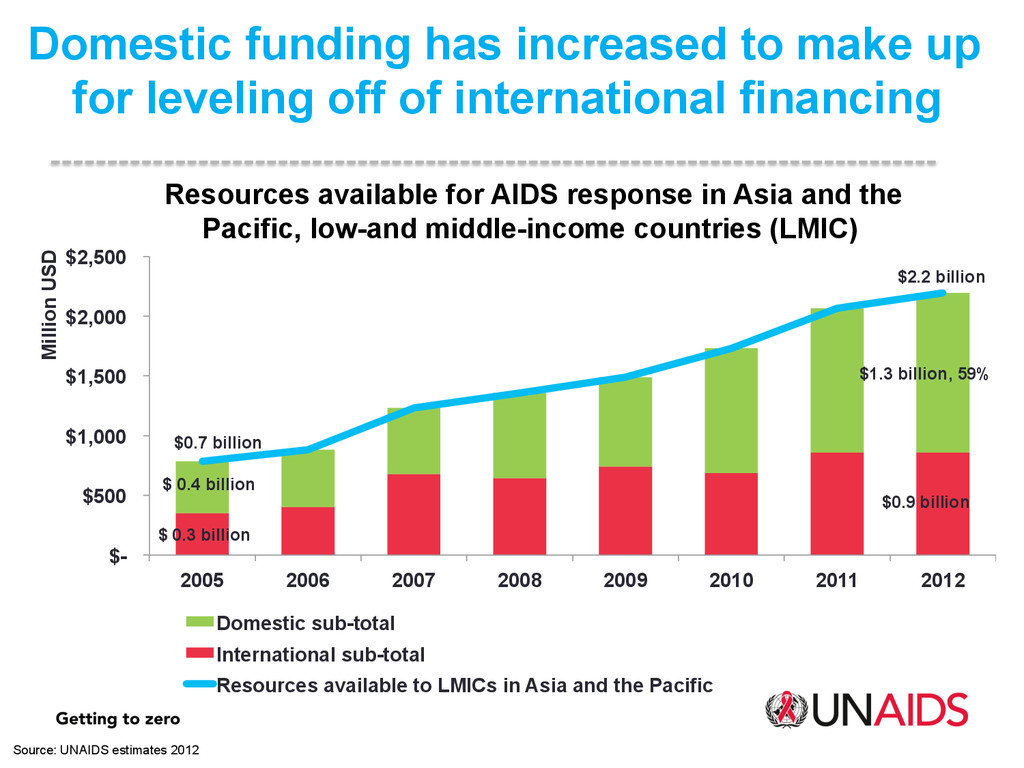
of international financing $ 0.3 billion $0.9 billion $ 0.4 billion $1.3 billion, 59% $0.7 billion $2.2 billion $- $500 $1,000 $1,500 $2,000 $2,500 2005 2006 2007 2008 2009 2010 2011 2012 Million USD Domestic sub-total International sub-total Resources available to LMICs in Asia and the Pacific Source: UNAIDS estimates 2012 Resources available for AIDS response in Asia and the Pacific, low-and middle-income countries (LMIC)
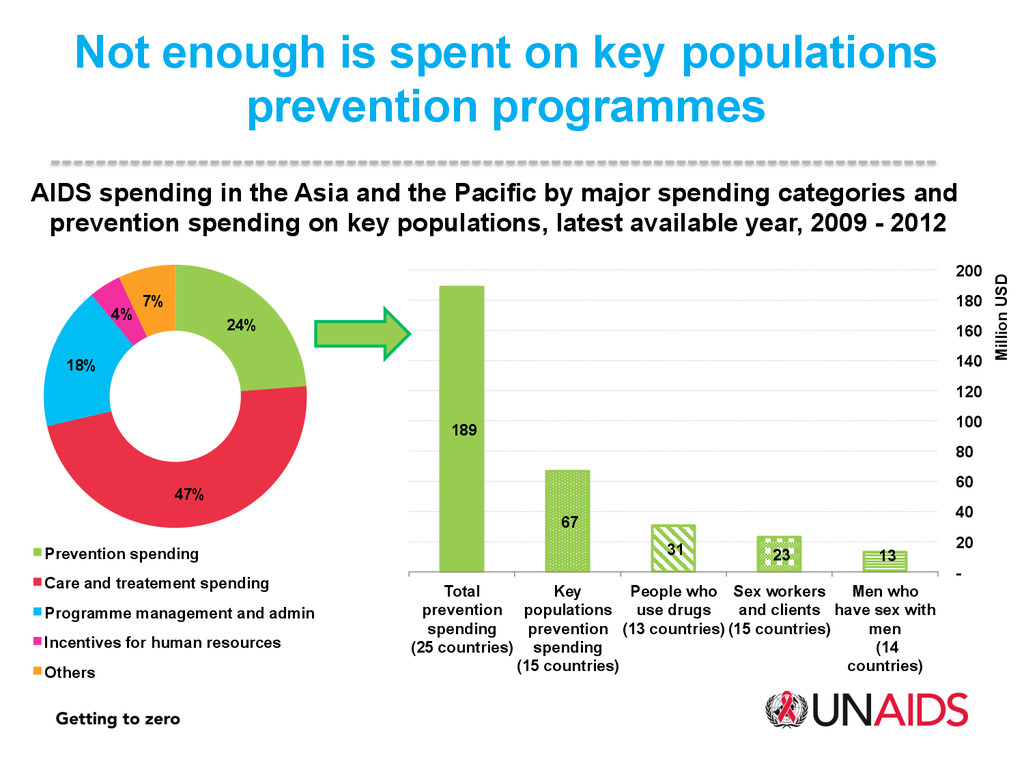
spending in the Asia and the Pacific by major spending categories and prevention spending on key populations, latest available year, 2009 - 2012 24% 47% 18% 4% 7% Prevention spending Care and treatement spending Programme management and admin Incentives for human resources Others 189 67 31 23 13 - 20 40 60 80 100 120 140 160 180 200 Total prevention spending (25 countries) Key populations prevention spending (15 countries) People who use drugs (13 countries) Sex workers and clients (15 countries) Men who have sex with men (14 countries) Million USD
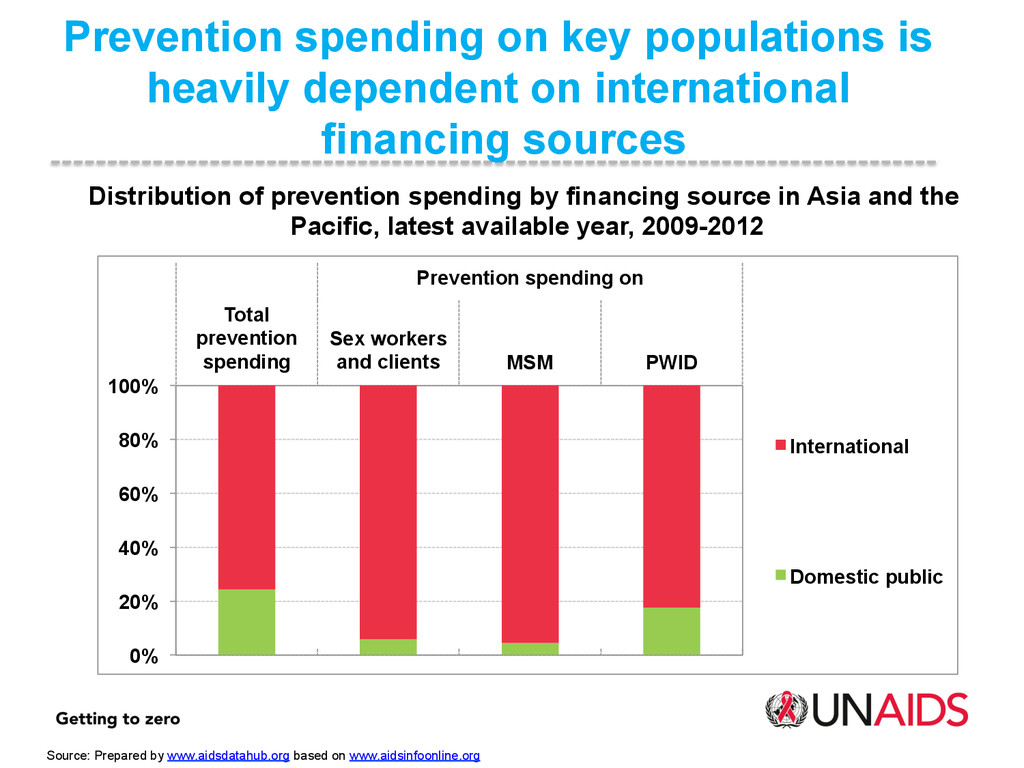
the Pacific, latest available year, 2009-2012 Source: Prepared by www.aidsdatahub.org based on www.aidsinfoonline.org Prevention spending on key populations is heavily dependent on international financing sources 0% 20% 40% 60% 80% 100% Total prevention spending Sex workers and clients MSM PWID Prevention spending on International Domestic public
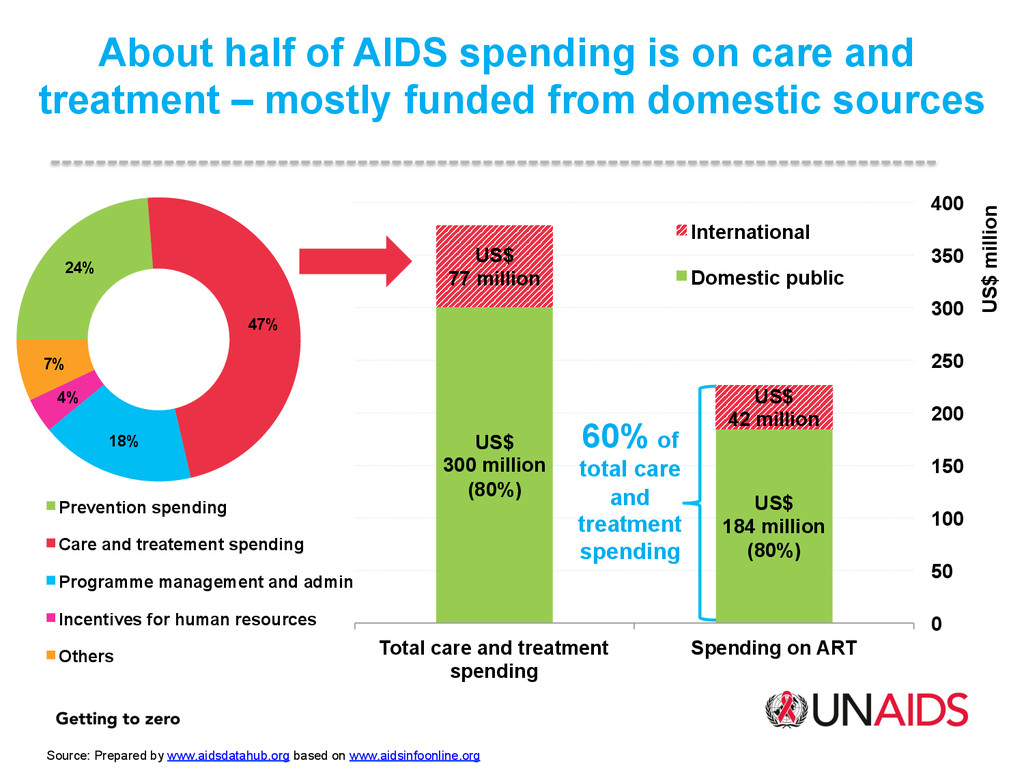
– mostly funded from domestic sources US$ 300 million (80%) US$ 184 million (80%) US$ 77 million US$ 42 million 0 50 100 150 200 250 300 350 400 Total care and treatment spending Spending on ART US$ million International Domestic public 24% 47% 18% 4% 7% Prevention spending Care and treatement spending Programme management and admin Incentives for human resources Others Source: Prepared by www.aidsdatahub.org based on www.aidsinfoonline.org 60% of total care and treatment spending
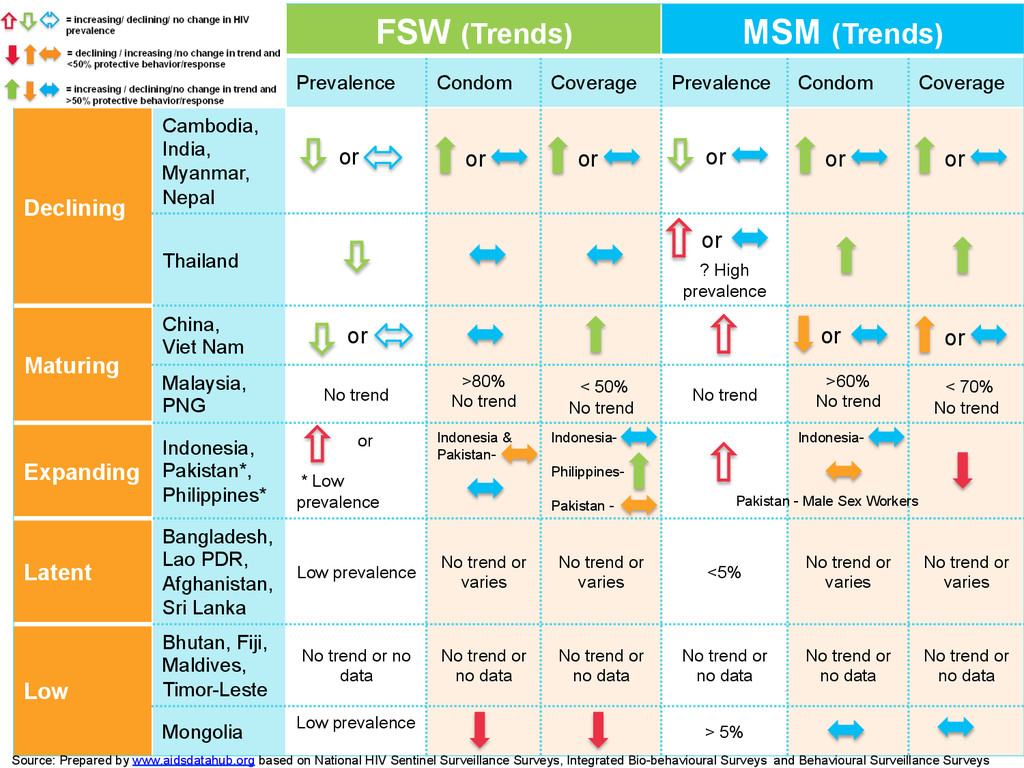
Declining Cambodia, India, Myanmar, Nepal Thailand ? High prevalence Maturing China, Viet Nam Malaysia, PNG No trend >80% No trend < 50% No trend No trend >60% No trend < 70% No trend Expanding Indonesia, Pakistan*, Philippines* or * Low prevalence Indonesia & Pakistan- Indonesia- Philippines- Pakistan - Indonesia- Latent Bangladesh, Lao PDR, Afghanistan, Sri Lanka Low prevalence No trend or varies No trend or varies <5% No trend or varies No trend or varies Low Bhutan, Fiji, Maldives, Timor-Leste No trend or no data No trend or no data No trend or no data No trend or no data No trend or no data No trend or no data Mongolia Low prevalence > 5% or or or or or or or or or or Source: Prepared by www.aidsdatahub.org based on National HIV Sentinel Surveillance Surveys, Integrated Bio-behavioural Surveys and Behavioural Surveillance Surveys Pakistan - Male Sex Workers
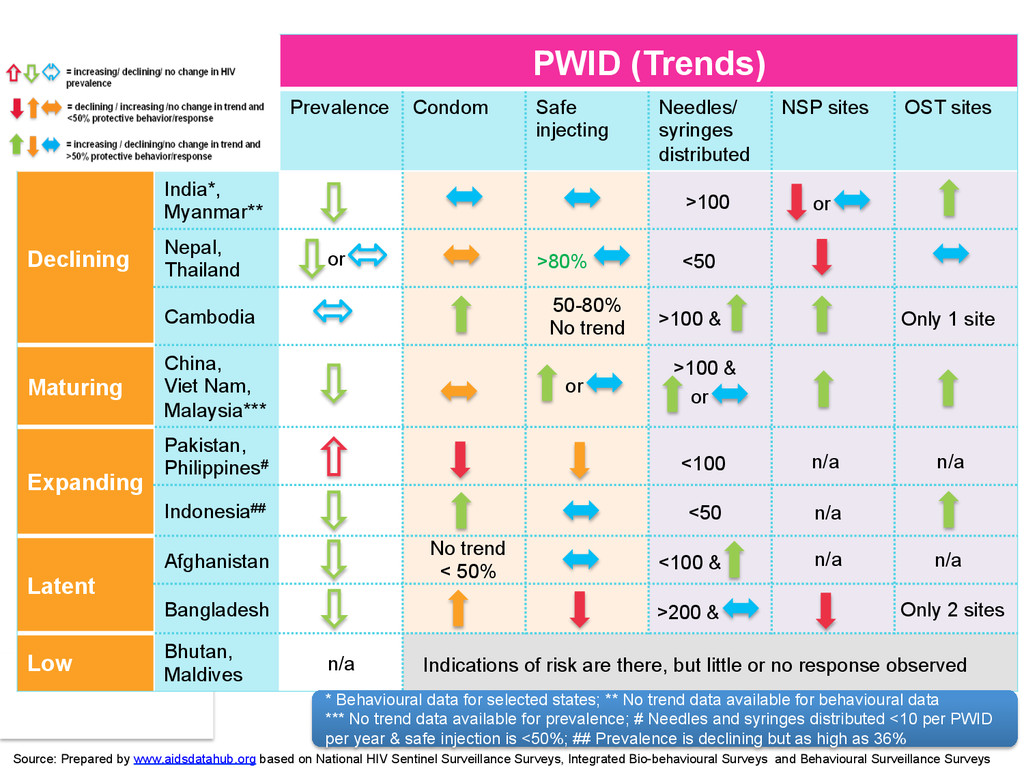
sites OST sites Declining India*, Myanmar** Nepal, Thailand Cambodia 50-80% No trend Maturing China, Viet Nam, Malaysia*** Expanding Pakistan, Philippines# Indonesia## Latent Afghanistan Bangladesh Low Bhutan, Maldives n/a >100 or <50 n/a <100 n/a n/a or or >200 & Only 2 sites <100 & n/a n/a No trend < 50% >100 & Only 1 site >80% <50 or Indications of risk are there, but little or no response observed * Behavioural data for selected states; ** No trend data available for behavioural data *** No trend data available for prevalence; # Needles and syringes distributed <10 per PWID per year & safe injection is <50%; ## Prevalence is declining but as high as 36% Source: Prepared by www.aidsdatahub.org based on National HIV Sentinel Surveillance Surveys, Integrated Bio-behavioural Surveys and Behavioural Surveillance Surveys >100 &
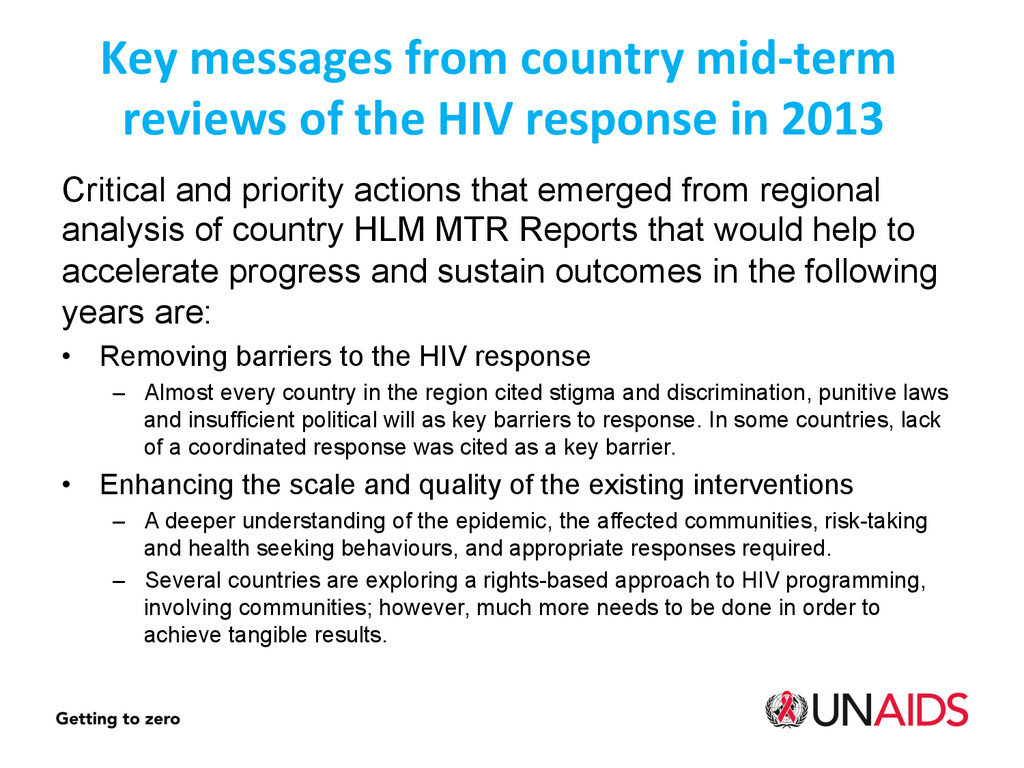
response in 2013 Critical and priority actions that emerged from regional analysis of country HLM MTR Reports that would help to accelerate progress and sustain outcomes in the following years are: • Removing barriers to the HIV response – Almost every country in the region cited stigma and discrimination, punitive laws and insufficient political will as key barriers to response. In some countries, lack of a coordinated response was cited as a key barrier. • Enhancing the scale and quality of the existing interventions – A deeper understanding of the epidemic, the affected communities, risk-taking and health seeking behaviours, and appropriate responses required. – Several countries are exploring a rights-based approach to HIV programming, involving communities; however, much more needs to be done in order to achieve tangible results.
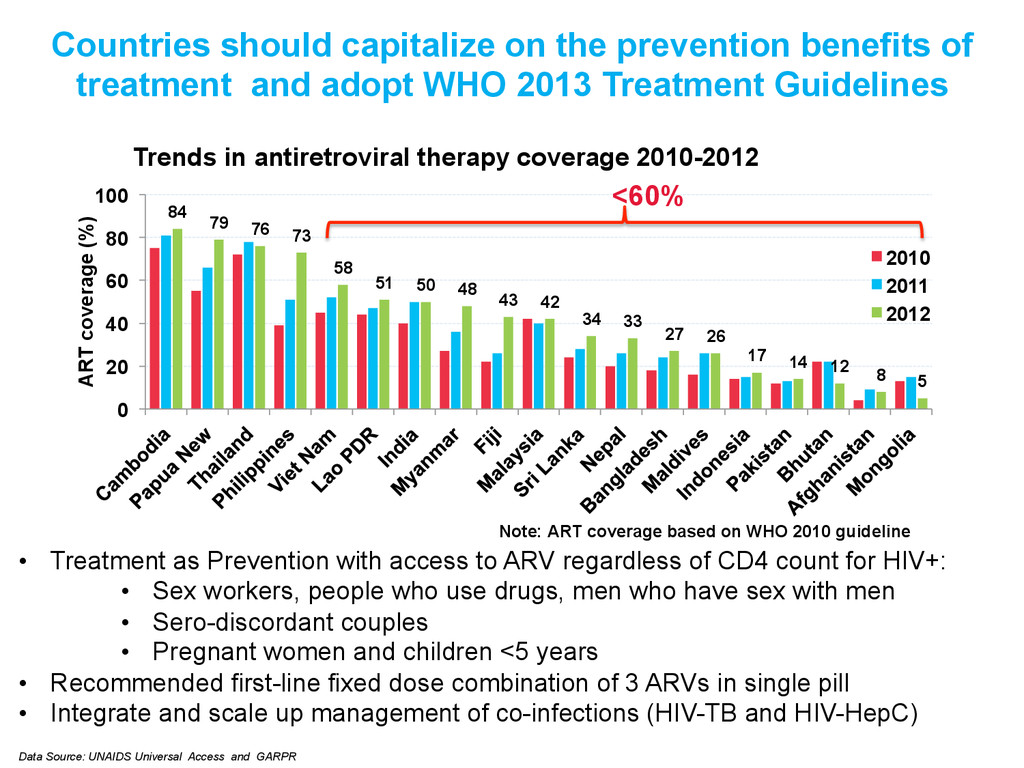
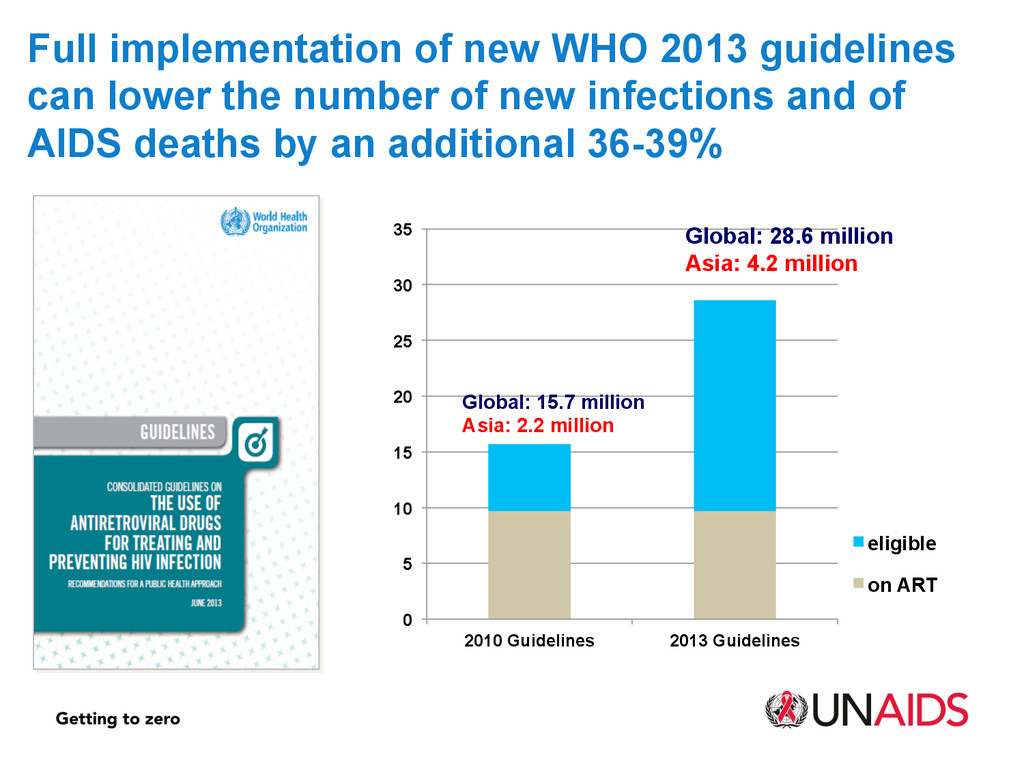
adopt WHO 2013 Treatment Guidelines • Treatment as Prevention with access to ARV regardless of CD4 count for HIV+: • Sex workers, people who use drugs, men who have sex with men • Sero-discordant couples • Pregnant women and children <5 years • Recommended first-line fixed dose combination of 3 ARVs in single pill • Integrate and scale up management of co-infections (HIV-TB and HIV-HepC) Data Source: UNAIDS Universal Access and GARPR 84 79 76 73 58 51 50 48 43 42 34 33 27 26 17 14 12 8 5 0 20 40 60 80 100 ART coverage (%) 2010 2011 2012 Note: ART coverage based on WHO 2010 guideline <60% Trends in antiretroviral therapy coverage 2010-2012
number of new infections and of AIDS deaths by an additional 36-39% 0 5 10 15 20 25 30 35 2010 Guidelines 2013 Guidelines eligible on ART Global: 28.6 million Asia: 4.2 million Global: 15.7 million Asia: 2.2 million
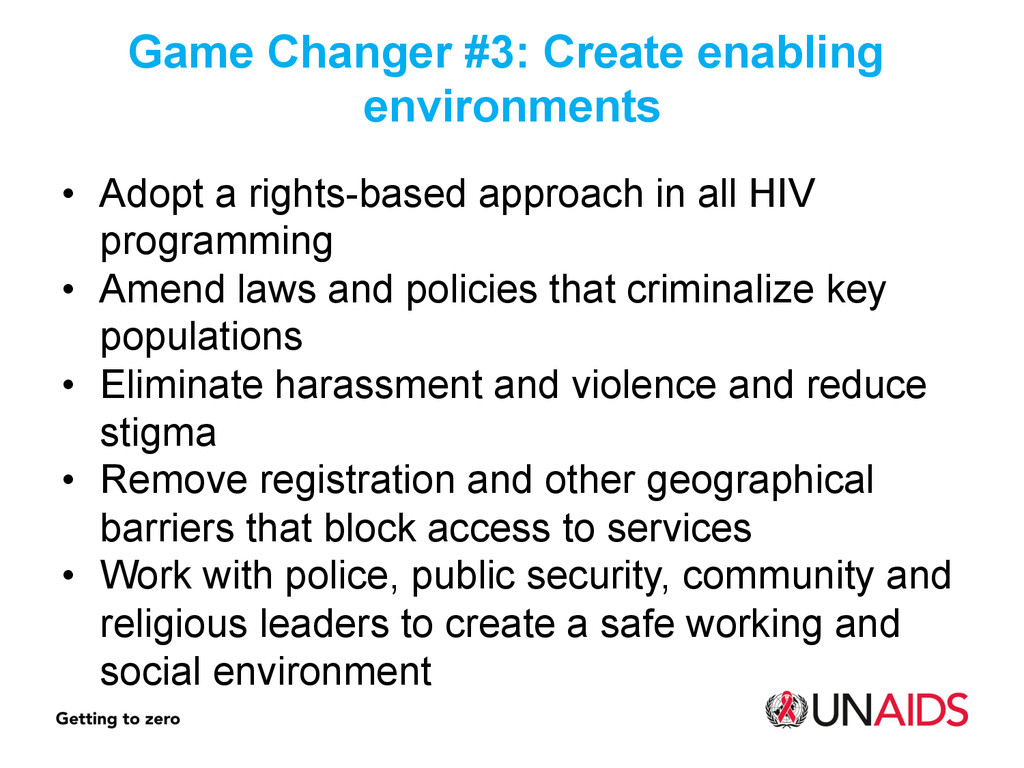
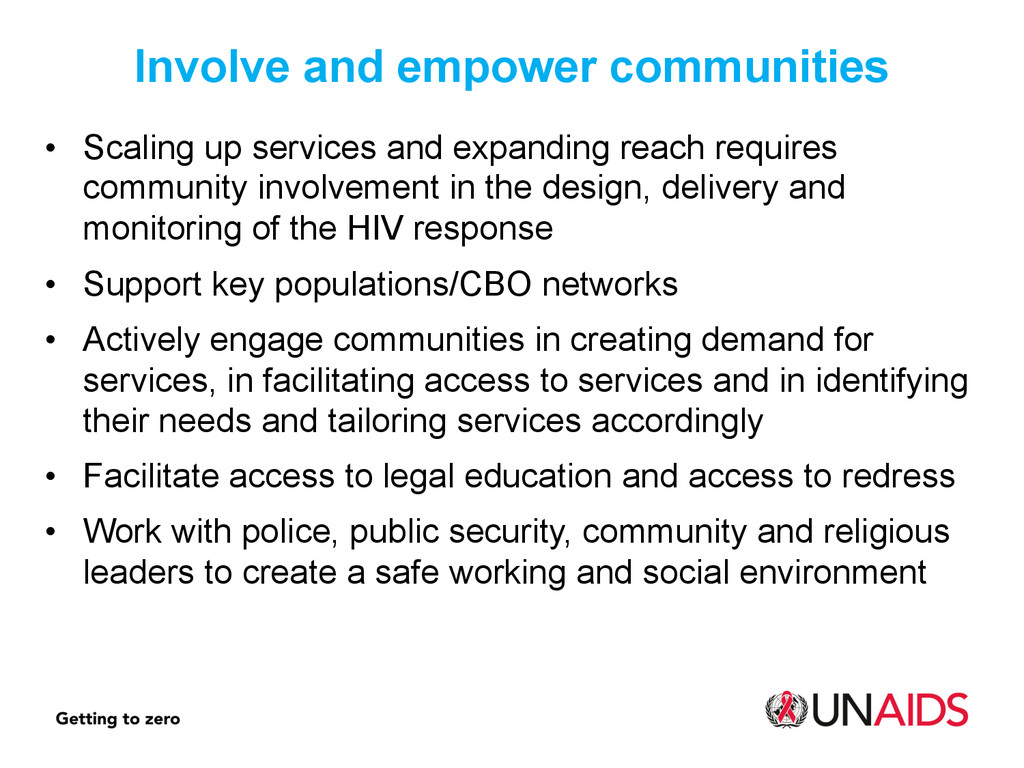
approach in all HIV programming • Amend laws and policies that criminalize key populations • Eliminate harassment and violence and reduce stigma • Remove registration and other geographical barriers that block access to services • Work with police, public security, community and religious leaders to create a safe working and social environment
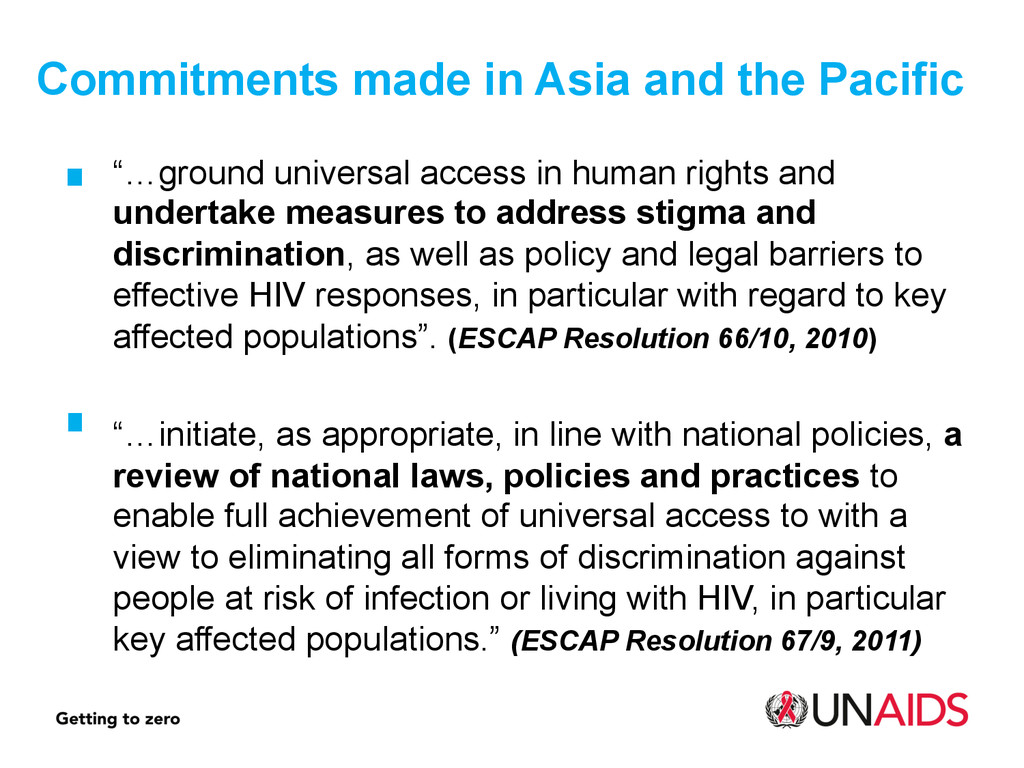
in human rights and undertake measures to address stigma and discrimination, as well as policy and legal barriers to effective HIV responses, in particular with regard to key affected populations”. (ESCAP Resolution 66/10, 2010) “…initiate, as appropriate, in line with national policies, a review of national laws, policies and practices to enable full achievement of universal access to with a view to eliminating all forms of discrimination against people at risk of infection or living with HIV, in particular key affected populations.” (ESCAP Resolution 67/9, 2011)
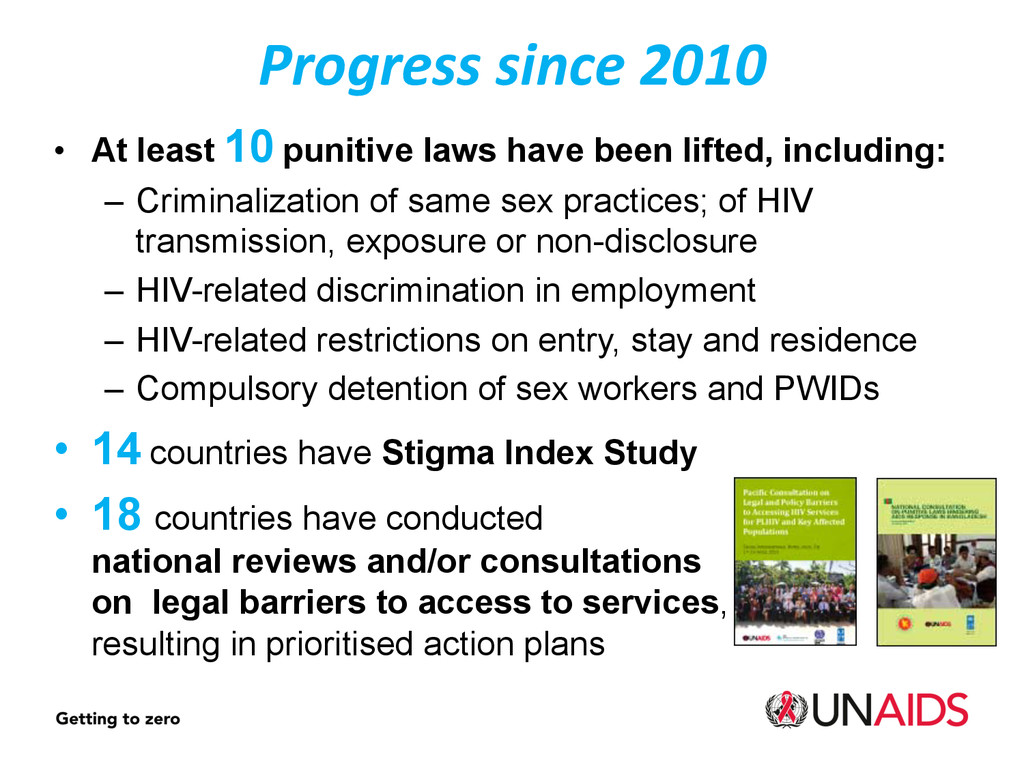
have been lifted, including: – Criminalization of same sex practices; of HIV transmission, exposure or non-disclosure – HIV-related discrimination in employment – HIV-related restrictions on entry, stay and residence – Compulsory detention of sex workers and PWIDs • 14 countries have Stigma Index Study • 18 countries have conducted national reviews and/or consultations on legal barriers to access to services, resulting in prioritised action plans
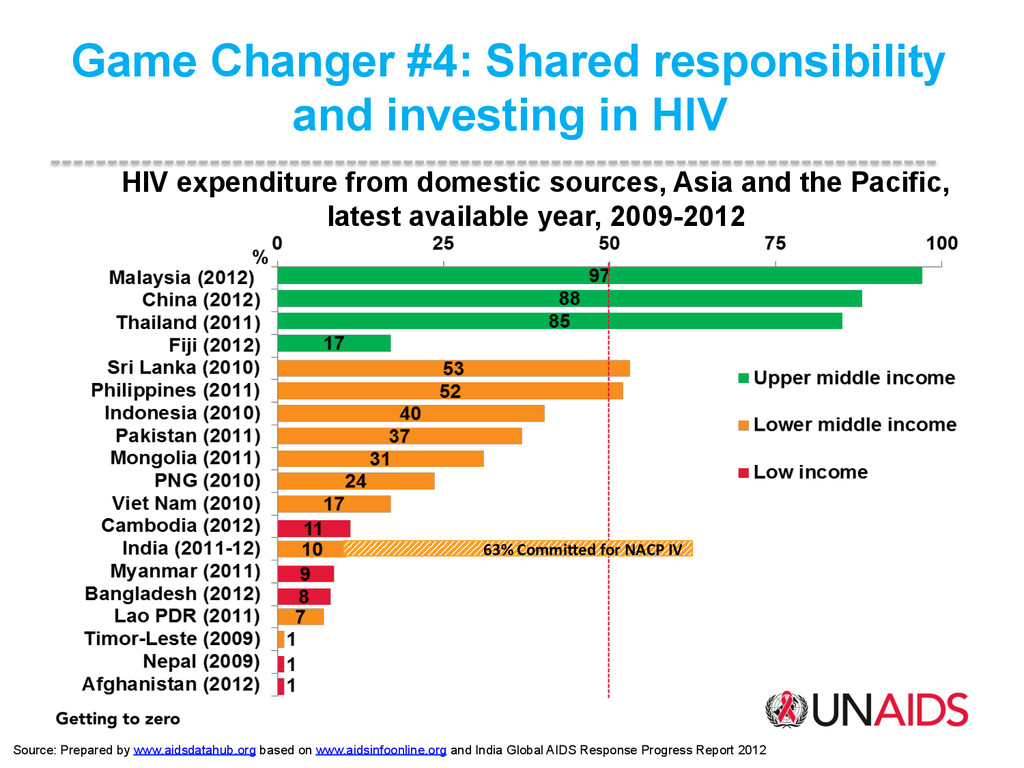
available year, 2009-2012 Source: Prepared by www.aidsdatahub.org based on www.aidsinfoonline.org and India Global AIDS Response Progress Report 2012 Game Changer #4: Shared responsibility and investing in HIV 63% CommiIed for NACP IV
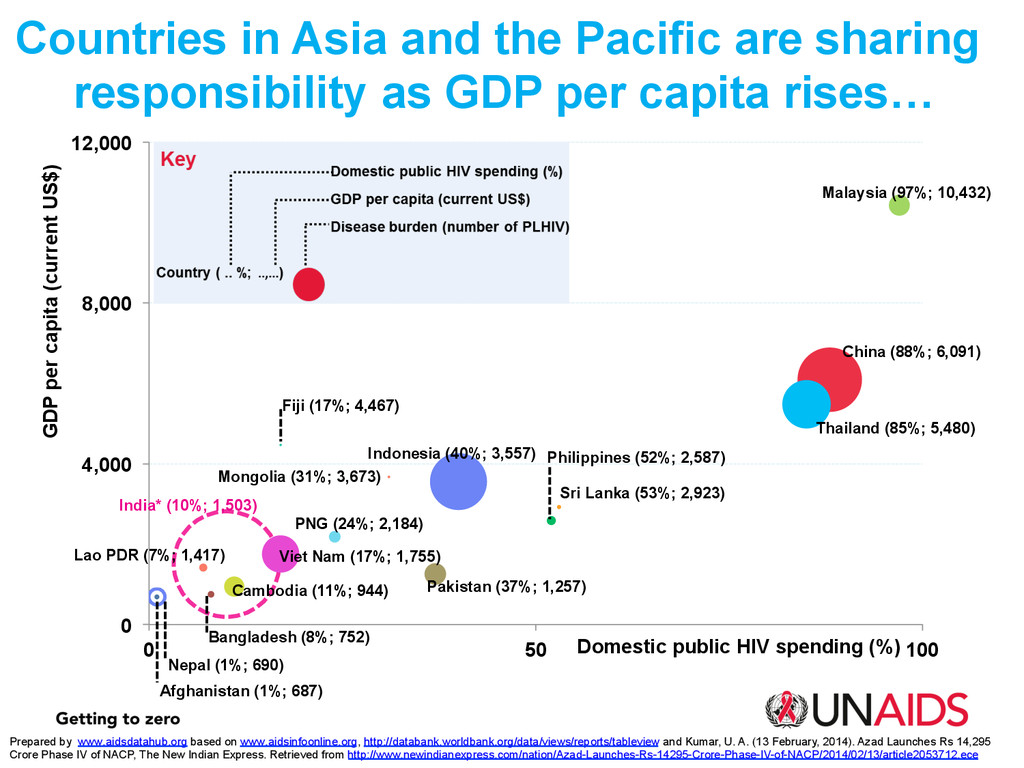
(88%; 6,091) Fiji (17%; 4,467) India* (10%; 1,503) Indonesia (40%; 3,557) Lao PDR (7%; 1,417) Malaysia (97%; 10,432) Mongolia (31%; 3,673) Nepal (1%; 690) Pakistan (37%; 1,257) PNG (24%; 2,184) Philippines (52%; 2,587) Sri Lanka (53%; 2,923) Thailand (85%; 5,480) Viet Nam (17%; 1,755) 0 4,000 8,000 12,000 0 50 100 GDP per capita (current US$) Domestic public HIV spending (%) Countries in Asia and the Pacific are sharing responsibility as GDP per capita rises… Prepared by www.aidsdatahub.org based on www.aidsinfoonline.org, http://databank.worldbank.org/data/views/reports/tableview and Kumar, U. A. (13 February, 2014). Azad Launches Rs 14,295 Crore Phase IV of NACP, The New Indian Express. Retrieved from http://www.newindianexpress.com/nation/Azad-Launches-Rs-14295-Crore-Phase-IV-of-NACP/2014/02/13/article2053712.ece
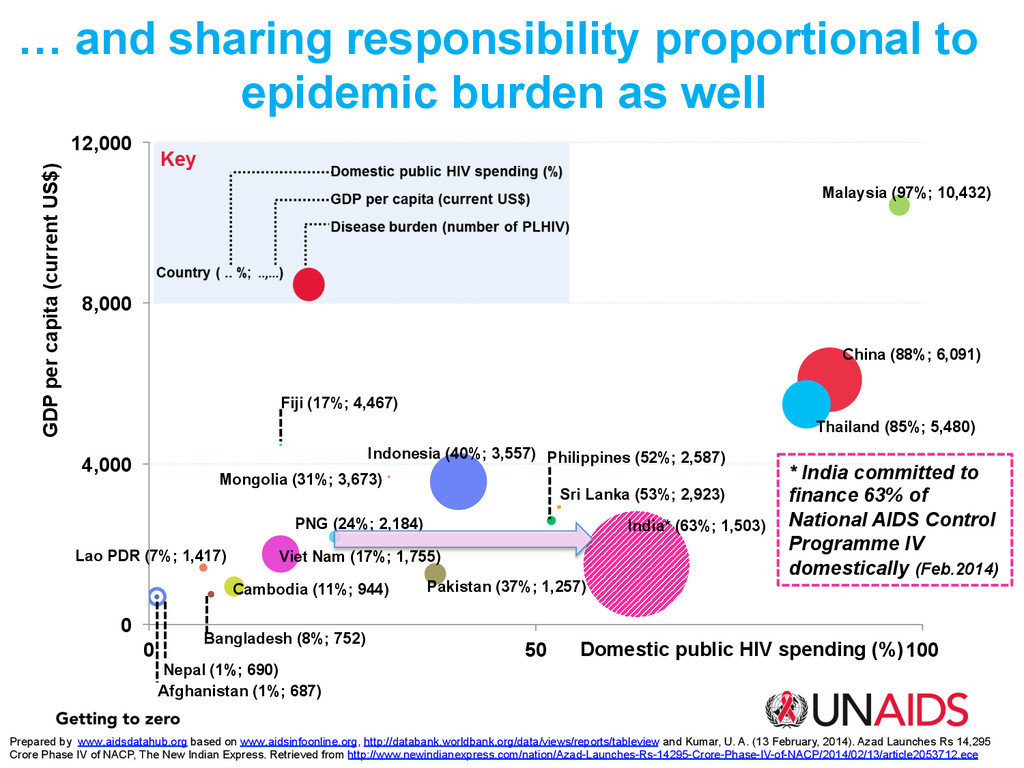
(88%; 6,091) Fiji (17%; 4,467) India* (63%; 1,503) Indonesia (40%; 3,557) Lao PDR (7%; 1,417) Malaysia (97%; 10,432) Mongolia (31%; 3,673) Nepal (1%; 690) Pakistan (37%; 1,257) PNG (24%; 2,184) Philippines (52%; 2,587) Sri Lanka (53%; 2,923) Thailand (85%; 5,480) Viet Nam (17%; 1,755) 0 4,000 8,000 12,000 0 50 100 GDP per capita (current US$) Domestic public HIV spending (%) … and sharing responsibility proportional to epidemic burden as well Prepared by www.aidsdatahub.org based on www.aidsinfoonline.org, http://databank.worldbank.org/data/views/reports/tableview and Kumar, U. A. (13 February, 2014). Azad Launches Rs 14,295 Crore Phase IV of NACP, The New Indian Express. Retrieved from http://www.newindianexpress.com/nation/Azad-Launches-Rs-14295-Crore-Phase-IV-of-NACP/2014/02/13/article2053712.ece * India committed to finance 63% of National AIDS Control Programme IV domestically (Feb.2014)
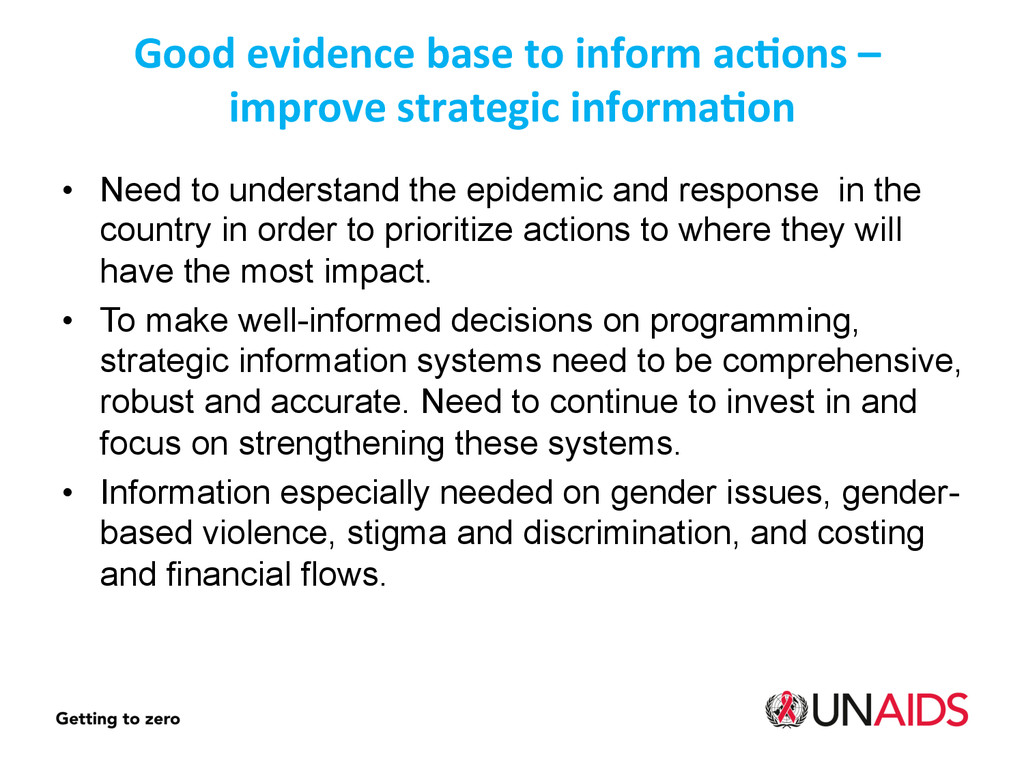
strategic informaMon • Need to understand the epidemic and response in the country in order to prioritize actions to where they will have the most impact. • To make well-informed decisions on programming, strategic information systems need to be comprehensive, robust and accurate. Need to continue to invest in and focus on strengthening these systems. • Information especially needed on gender issues, gender- based violence, stigma and discrimination, and costing and financial flows.
reach requires community involvement in the design, delivery and monitoring of the HIV response • Support key populations/CBO networks • Actively engage communities in creating demand for services, in facilitating access to services and in identifying their needs and tailoring services accordingly • Facilitate access to legal education and access to redress • Work with police, public security, community and religious leaders to create a safe working and social environment
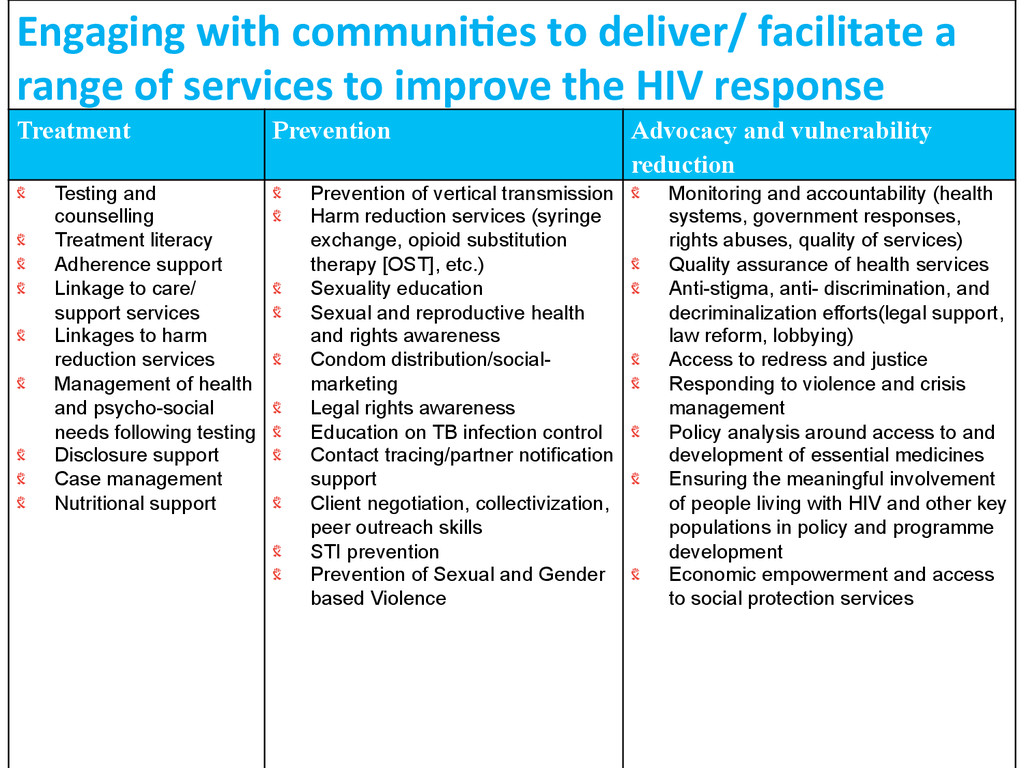
services to improve the HIV response Treatment Prevention Advocacy and vulnerability reduction " Testing and counselling " Treatment literacy " Adherence support " Linkage to care/ support services " Linkages to harm reduction services " Management of health and psycho-social needs following testing " Disclosure support " Case management " Nutritional support " Prevention of vertical transmission " Harm reduction services (syringe exchange, opioid substitution therapy [OST], etc.) " Sexuality education " Sexual and reproductive health and rights awareness " Condom distribution/social- marketing " Legal rights awareness " Education on TB infection control " Contact tracing/partner notification support " Client negotiation, collectivization, peer outreach skills " STI prevention " Prevention of Sexual and Gender based Violence " Monitoring and accountability (health systems, government responses, rights abuses, quality of services) " Quality assurance of health services " Anti-stigma, anti- discrimination, and decriminalization efforts(legal support, law reform, lobbying) " Access to redress and justice " Responding to violence and crisis management " Policy analysis around access to and development of essential medicines " Ensuring the meaningful involvement of people living with HIV and other key populations in policy and programme development " Economic empowerment and access to social protection services
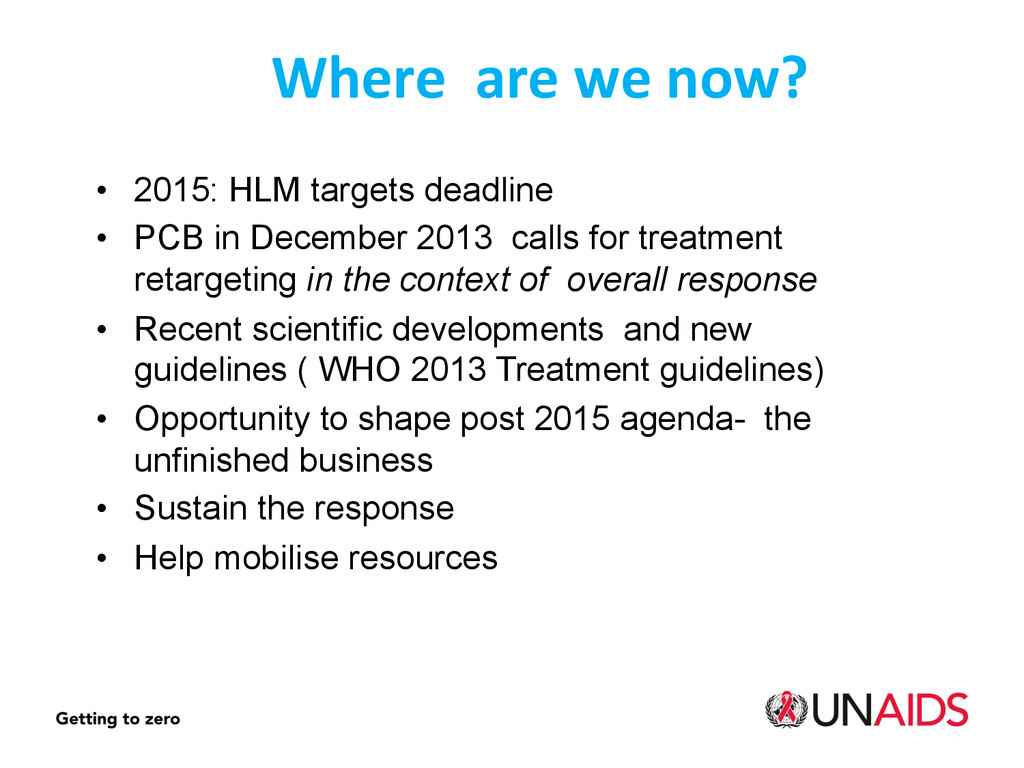
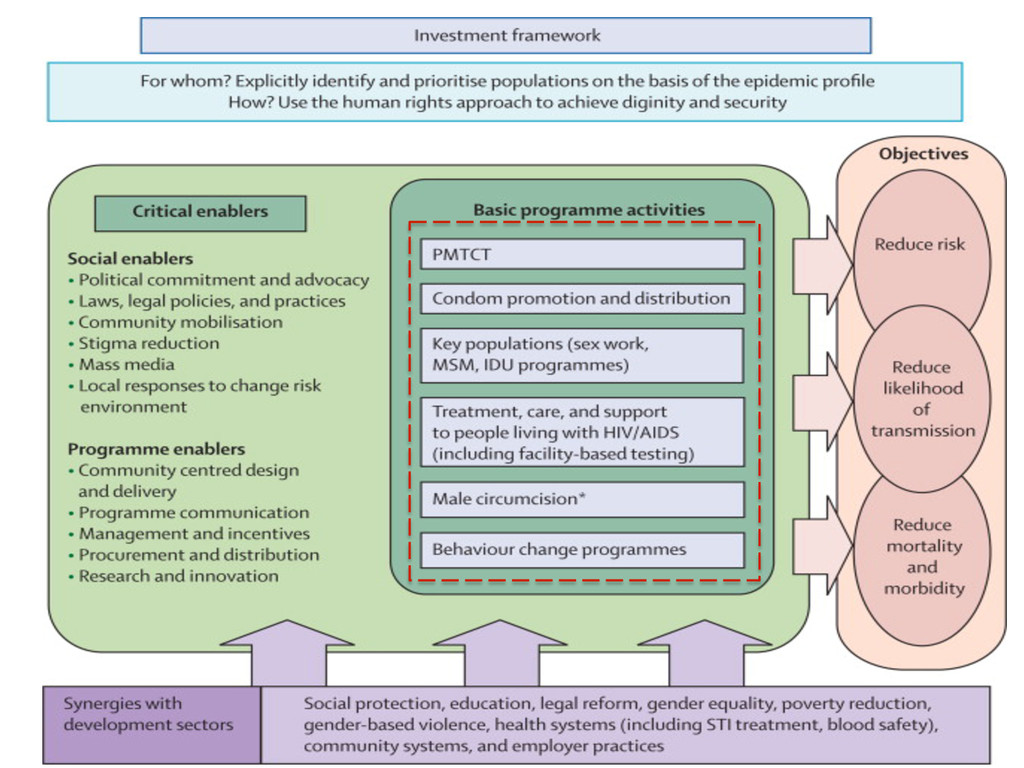
targets deadline • PCB in December 2013 calls for treatment retargeting in the context of overall response • Recent scientific developments and new guidelines ( WHO 2013 Treatment guidelines) • Opportunity to shape post 2015 agenda- the unfinished business • Sustain the response • Help mobilise resources
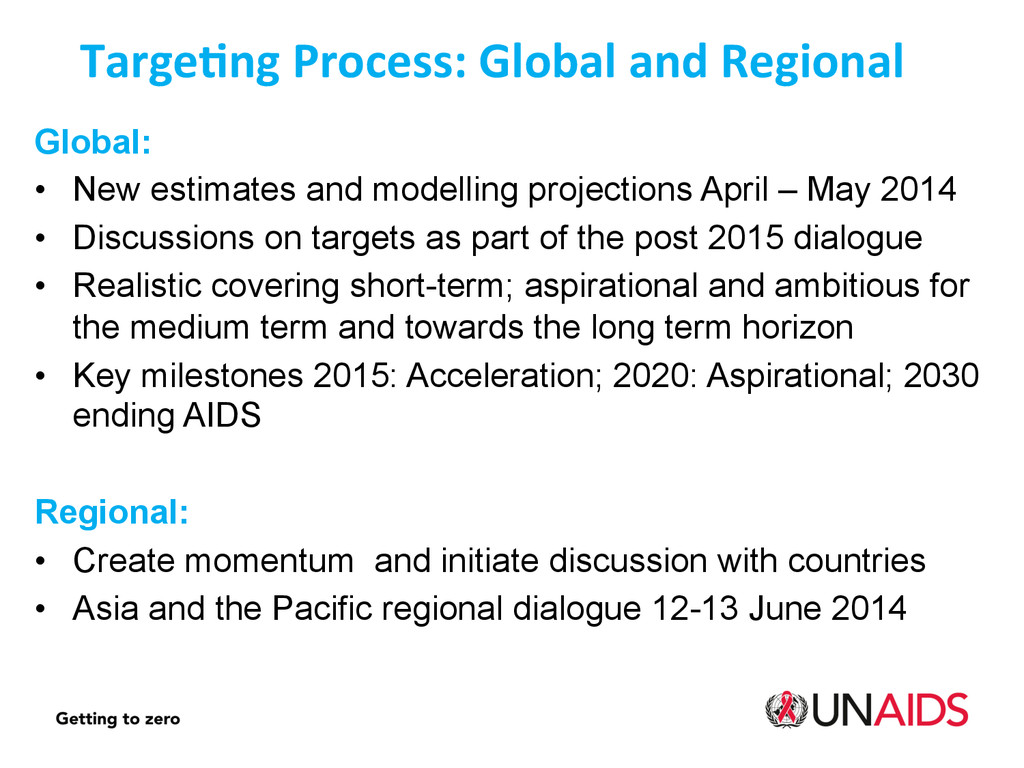
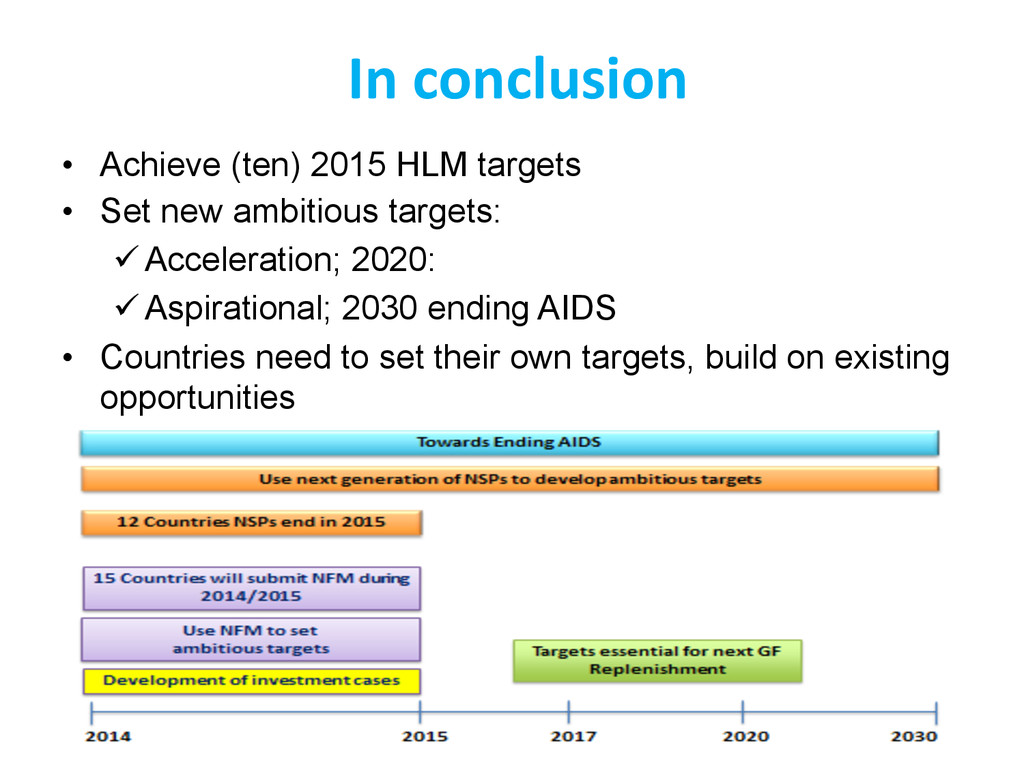
New estimates and modelling projections April – May 2014 • Discussions on targets as part of the post 2015 dialogue • Realistic covering short-term; aspirational and ambitious for the medium term and towards the long term horizon • Key milestones 2015: Acceleration; 2020: Aspirational; 2030 ending AIDS Regional: • Create momentum and initiate discussion with countries • Asia and the Pacific regional dialogue 12-13 June 2014
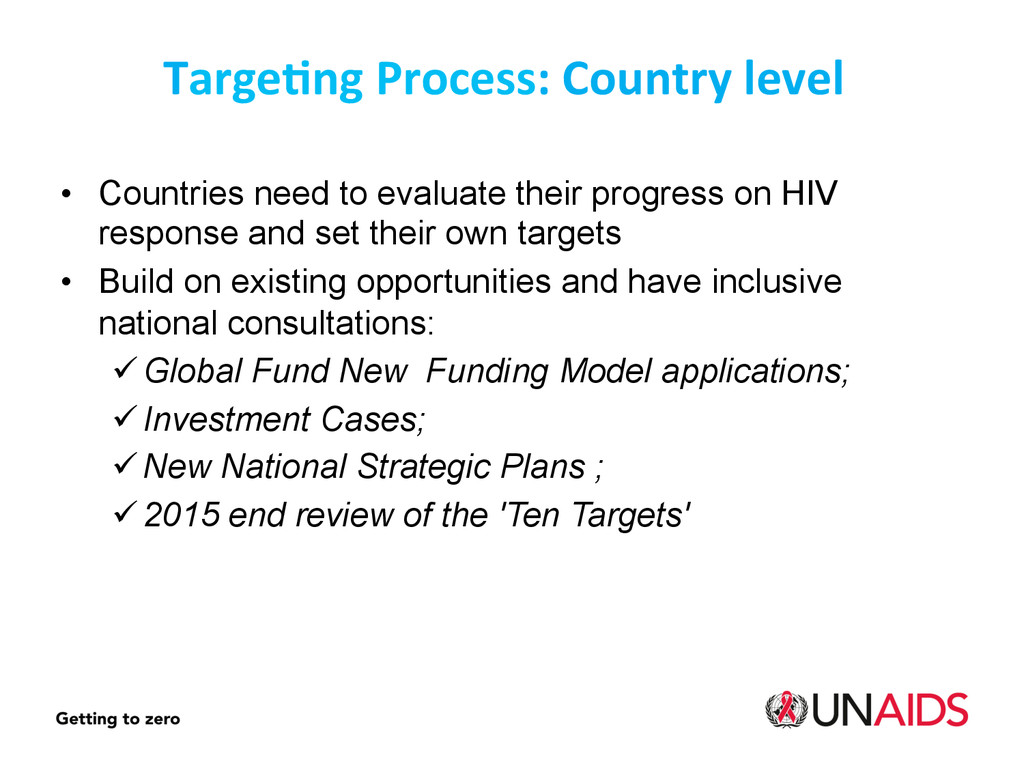
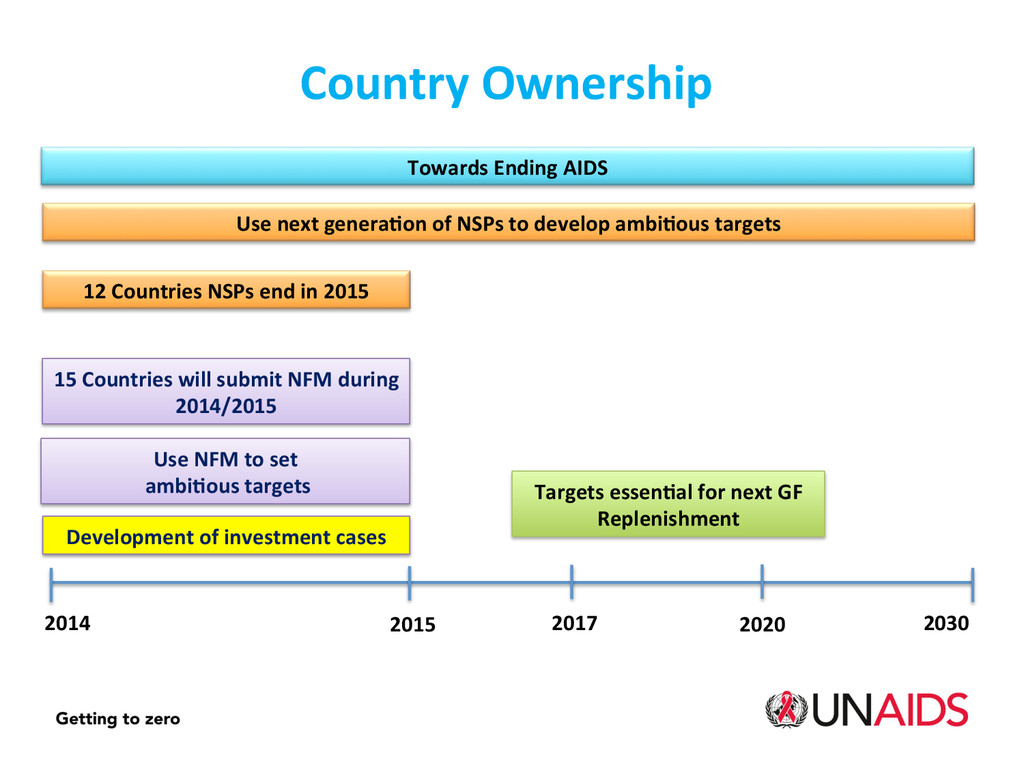
their progress on HIV response and set their own targets • Build on existing opportunities and have inclusive national consultations: ü Global Fund New Funding Model applications; ü Investment Cases; ü New National Strategic Plans ; ü 2015 end review of the 'Ten Targets'
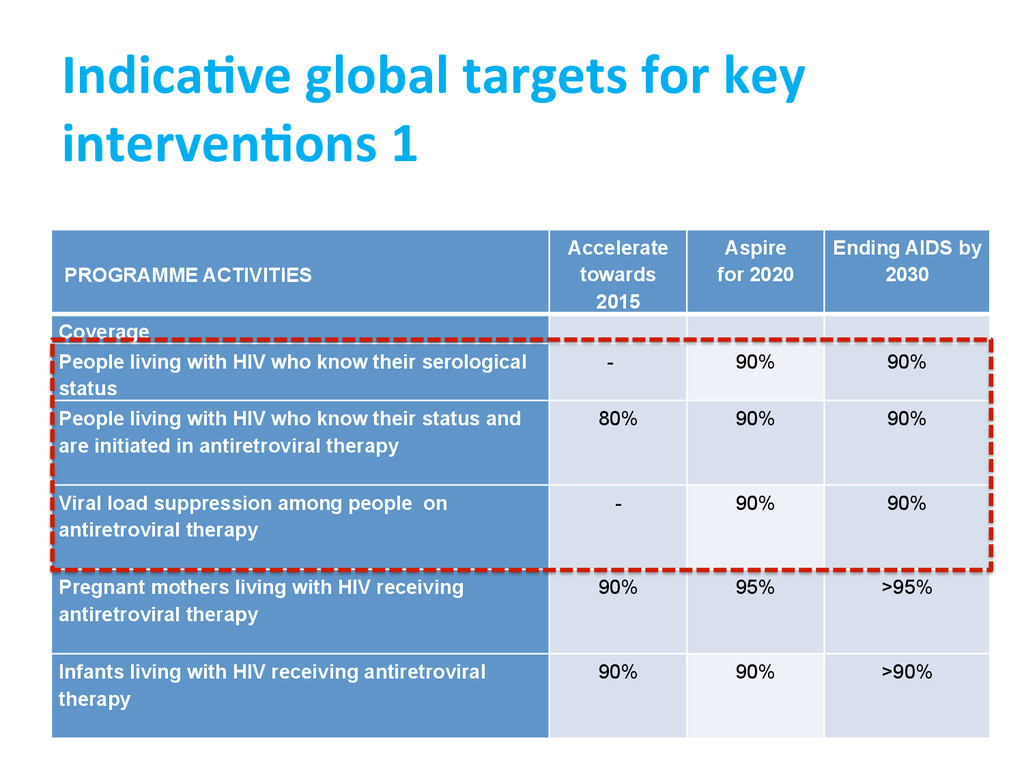
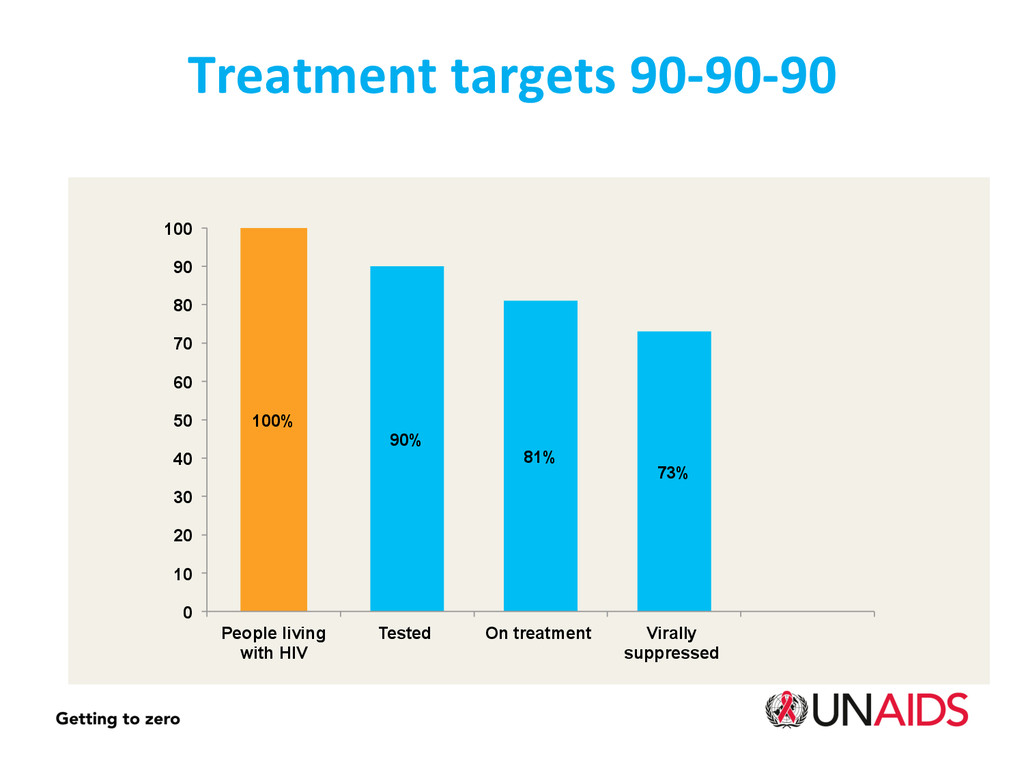
PROGRAMME ACTIVITIES Accelerate towards 2015 Aspire for 2020 Ending AIDS by 2030 Coverage People living with HIV who know their serological status - 90% 90% People living with HIV who know their status and are initiated in antiretroviral therapy 80% 90% 90% Viral load suppression among people on antiretroviral therapy - 90% 90% Pregnant mothers living with HIV receiving antiretroviral therapy 90% 95% >95% Infants living with HIV receiving antiretroviral therapy 90% 90% >90%
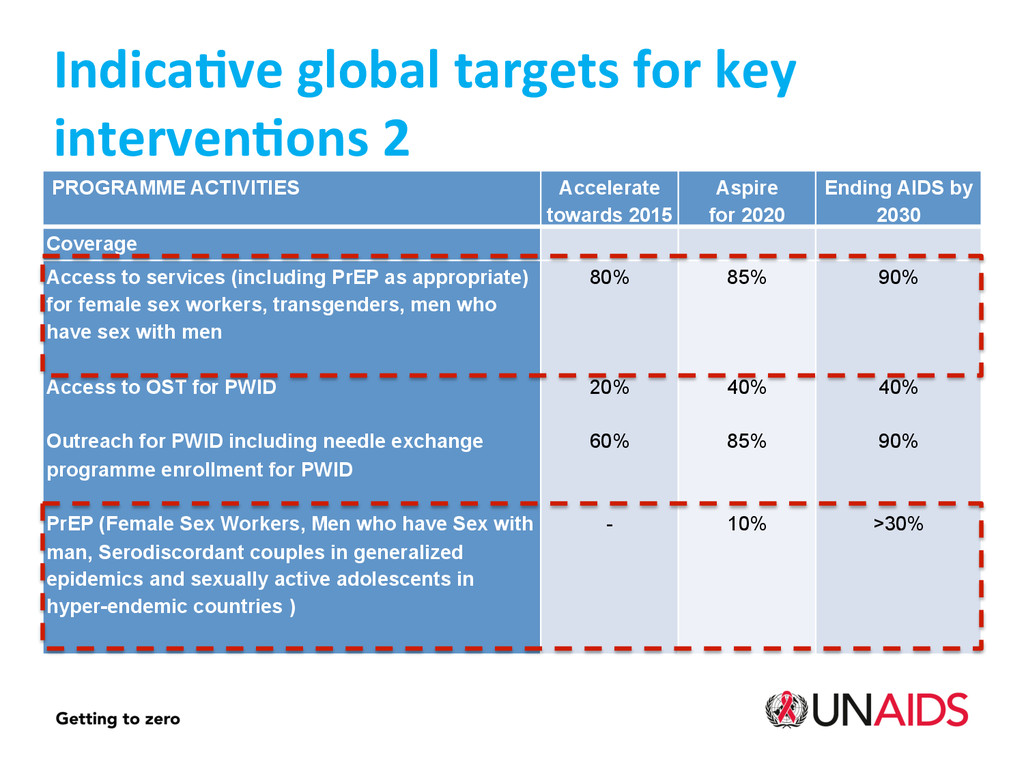
by 2030 Coverage Access to services (including PrEP as appropriate) for female sex workers, transgenders, men who have sex with men Access to OST for PWID Outreach for PWID including needle exchange programme enrollment for PWID PrEP (Female Sex Workers, Men who have Sex with man, Serodiscordant couples in generalized epidemics and sexually active adolescents in hyper-endemic countries ) 80% 20% 60% - 85% 40% 85% 10% 90% 40% 90% >30% IndicaMve global targets for key intervenMons 2
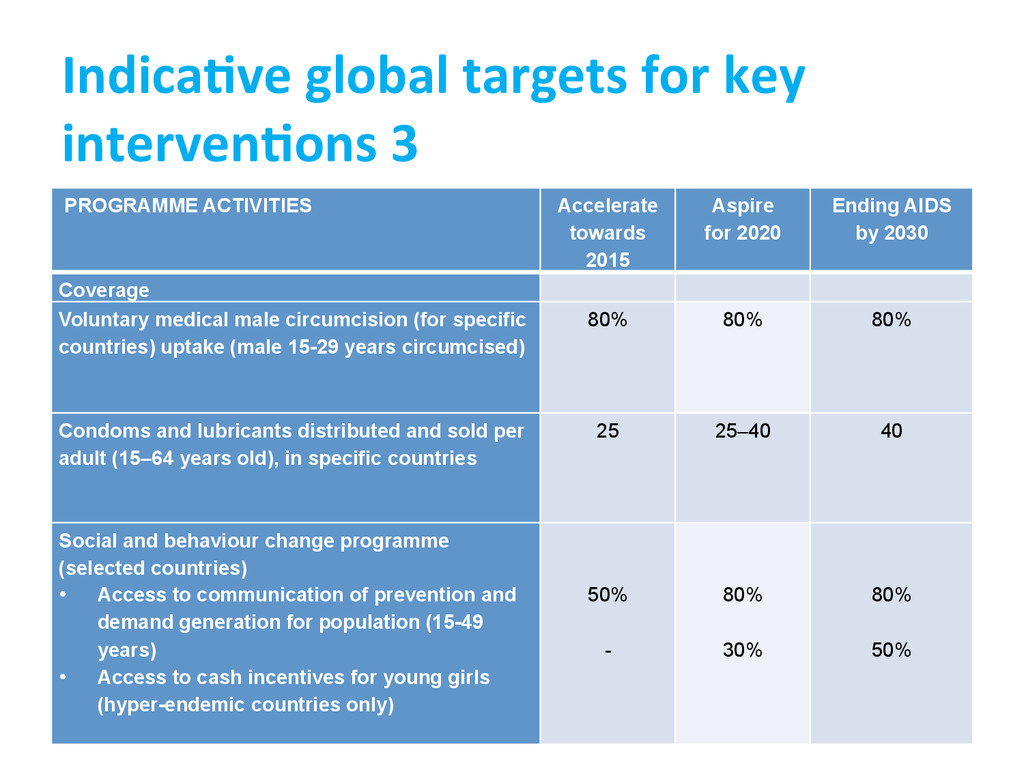
ACTIVITIES Accelerate towards 2015 Aspire for 2020 Ending AIDS by 2030 Coverage Voluntary medical male circumcision (for specific countries) uptake (male 15-29 years circumcised) 80% 80% 80% Condoms and lubricants distributed and sold per adult (15–64 years old), in specific countries 25 25–40 40 Social and behaviour change programme (selected countries) • Access to communication of prevention and demand generation for population (15-49 years) • Access to cash incentives for young girls (hyper-endemic countries only) 50% - 80% 30% 80% 50%
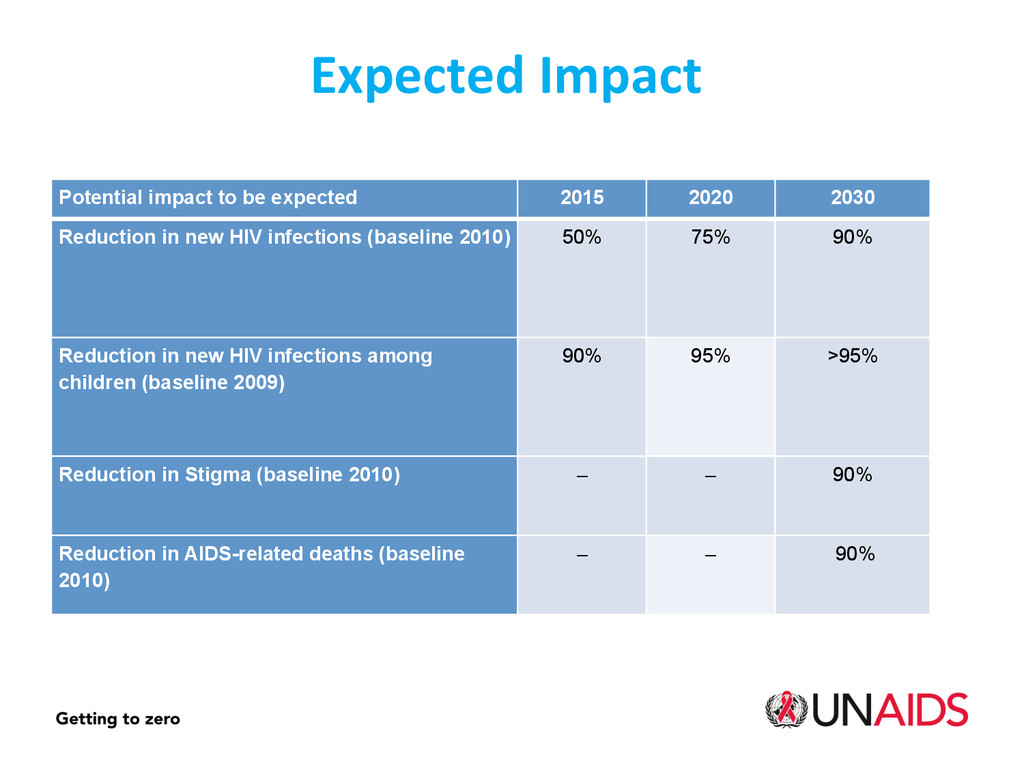
2020 2030 Reduction in new HIV infections (baseline 2010) 50% 75% 90% Reduction in new HIV infections among children (baseline 2009) 90% 95% >95% Reduction in Stigma (baseline 2010) – – 90% Reduction in AIDS-related deaths (baseline 2010) – – 90%
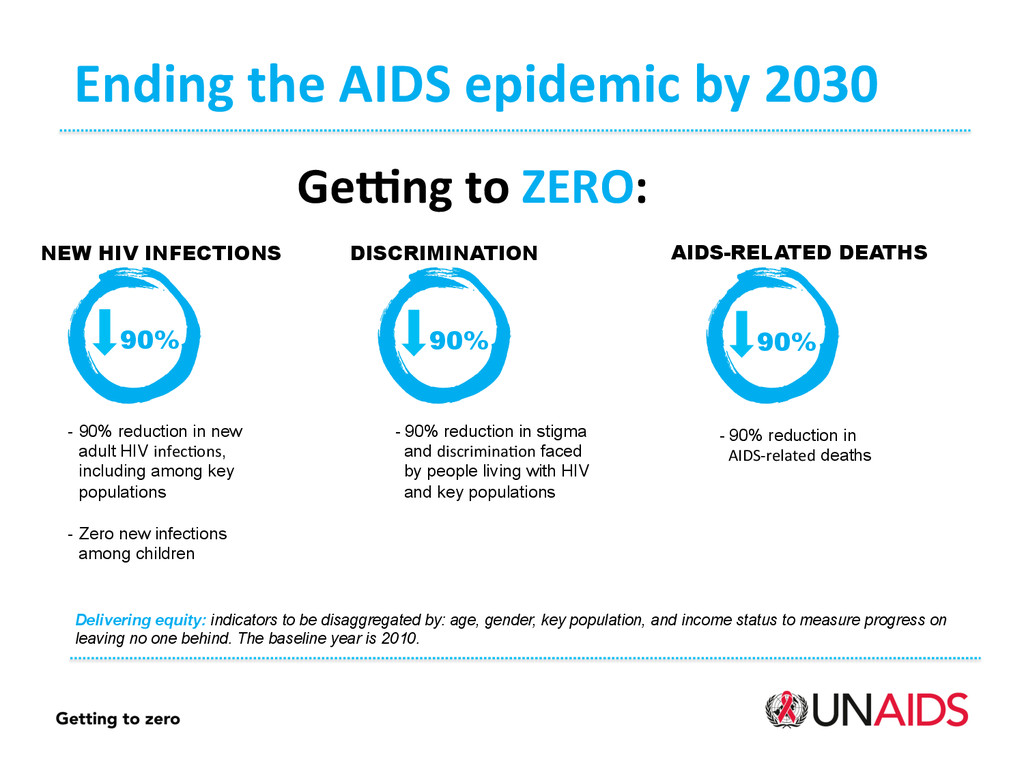
Ending the AIDS epidemic by 2030 Delivering equity: indicators to be disaggregated by: age, gender, key population, and income status to measure progress on leaving no one behind. The baseline year is 2010. - 90% reduction in new adult HIV infecHons, including among key populations - Zero new infections among children - 90% reduction in stigma and discriminaHon faced by people living with HIV and key populations - 90% reduction in AIDS-‐related deaths 90% 90% 90%
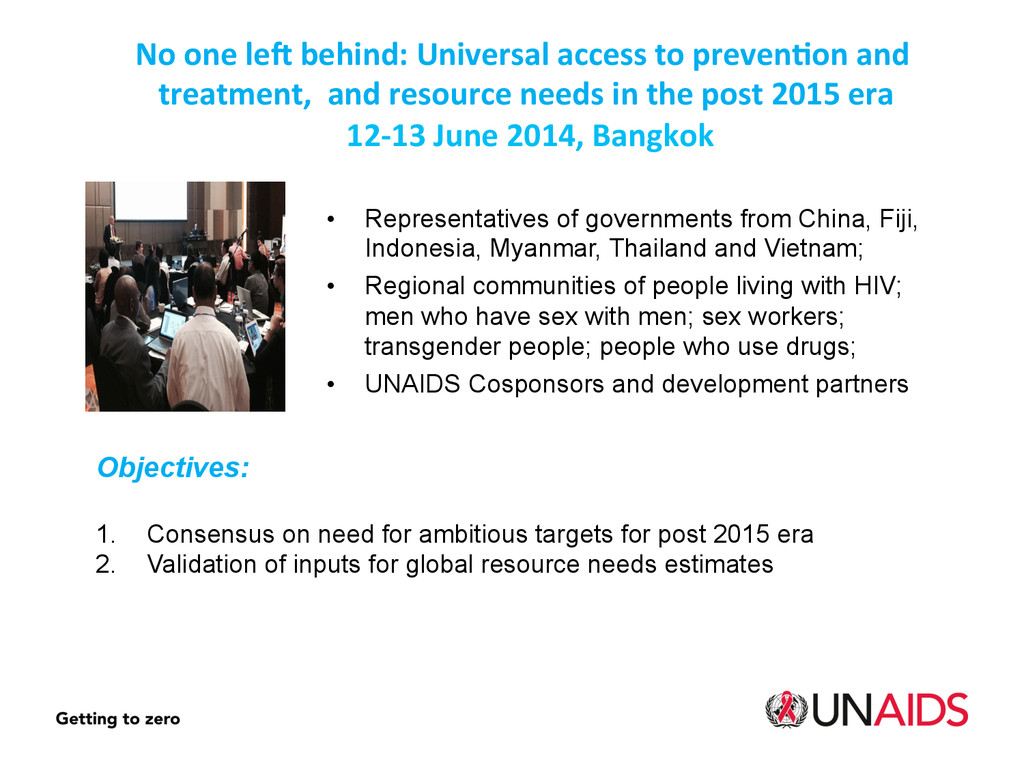
treatment, and resource needs in the post 2015 era 12-‐13 June 2014, Bangkok • Representatives of governments from China, Fiji, Indonesia, Myanmar, Thailand and Vietnam; • Regional communities of people living with HIV; men who have sex with men; sex workers; transgender people; people who use drugs; • UNAIDS Cosponsors and development partners Objectives: 1. Consensus on need for ambitious targets for post 2015 era 2. Validation of inputs for global resource needs estimates
2020 2030 Use NFM to set ambiMous targets 12 Countries NSPs end in 2015 Use next generaMon of NSPs to develop ambiMous targets Targets essenMal for next GF Replenishment Towards Ending AIDS 15 Countries will submit NFM during 2014/2015 Development of investment cases
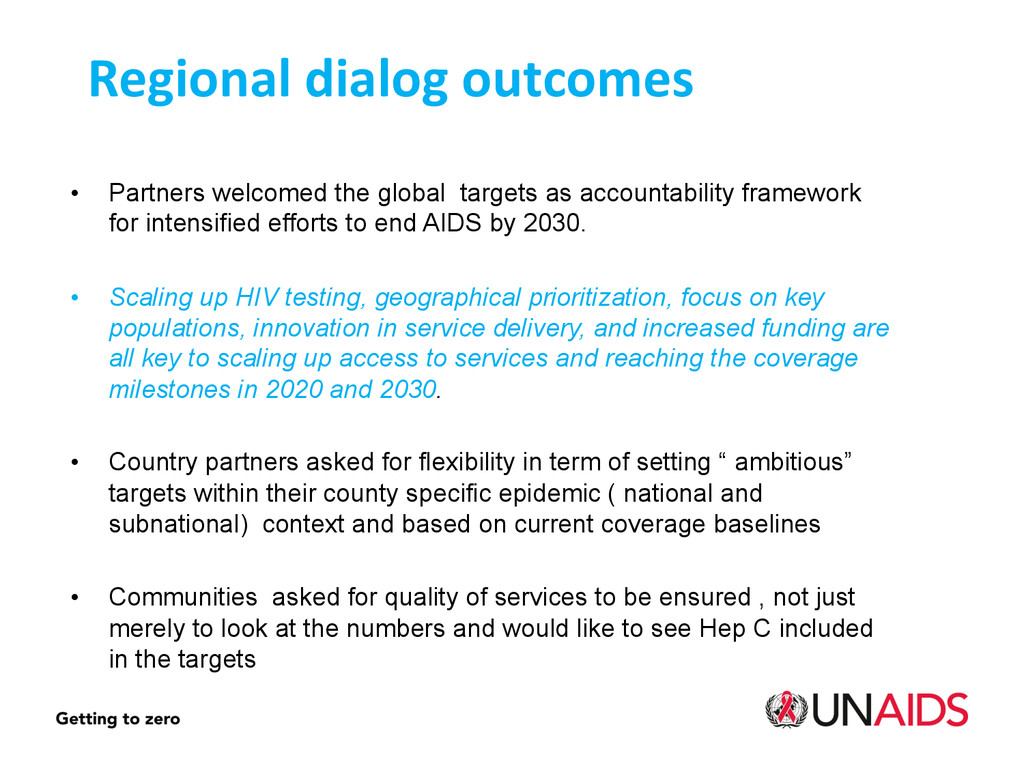
targets as accountability framework for intensified efforts to end AIDS by 2030. • Scaling up HIV testing, geographical prioritization, focus on key populations, innovation in service delivery, and increased funding are all key to scaling up access to services and reaching the coverage milestones in 2020 and 2030. • Country partners asked for flexibility in term of setting “ ambitious” targets within their county specific epidemic ( national and subnational) context and based on current coverage baselines • Communities asked for quality of services to be ensured , not just merely to look at the numbers and would like to see Hep C included in the targets
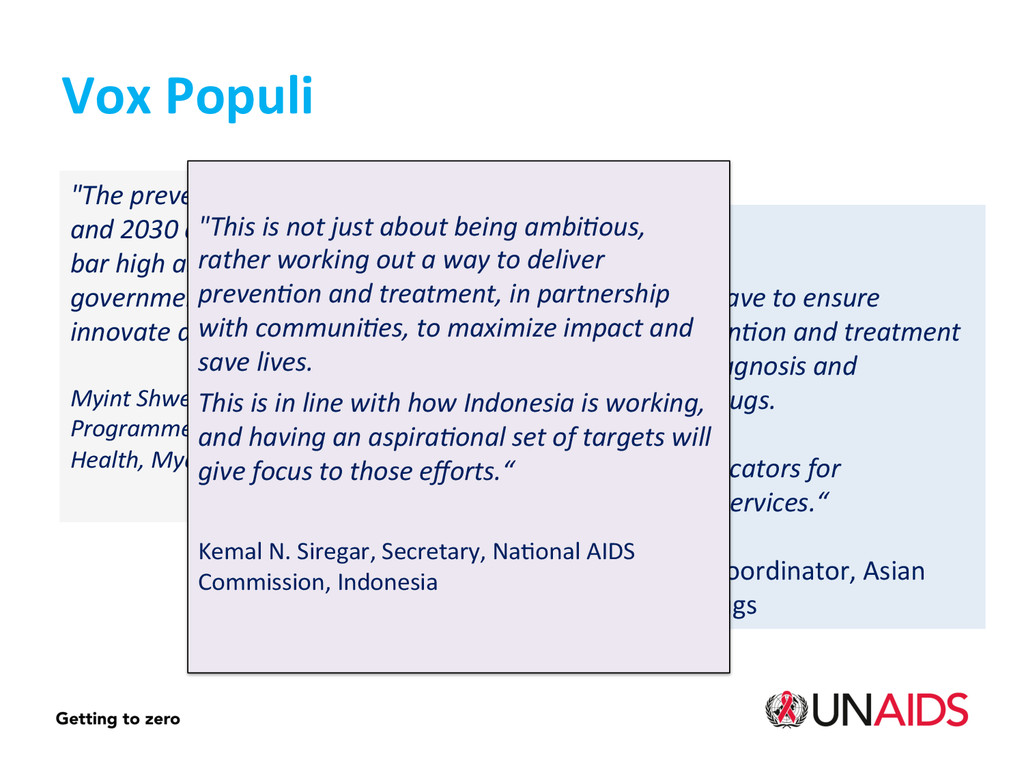
2020 and 2030 are ambi*ous, but it’s good to set the bar high as it encourages health professionals, governments and civil society to refocus, innovate and collaborate.“ Myint Shwe, Programme Manager, Na*onal AIDS Programme, Department of Health, Ministry of Health, Myanmar "We are not merely numbers. The new targets for post-‐2015 have to ensure universal access to quality preven*on and treatment services, including hepa**s C diagnosis and treatment for people who use drugs. And we should also develop indicators for community-‐led HIV tes*ng and services.“ Anand Chabungbam, Regional Coordinator, Asian Network of People Who Use Drugs "This is not just about being ambi*ous, rather working out a way to deliver preven*on and treatment, in partnership with communi*es, to maximize impact and save lives. This is in line with how Indonesia is working, and having an aspira*onal set of targets will give focus to those efforts.“ Kemal N. Siregar, Secretary, NaHonal AIDS Commission, Indonesia
• Set new ambitious targets: ü Acceleration; 2020: ü Aspirational; 2030 ending AIDS • Countries need to set their own targets, build on existing opportunities
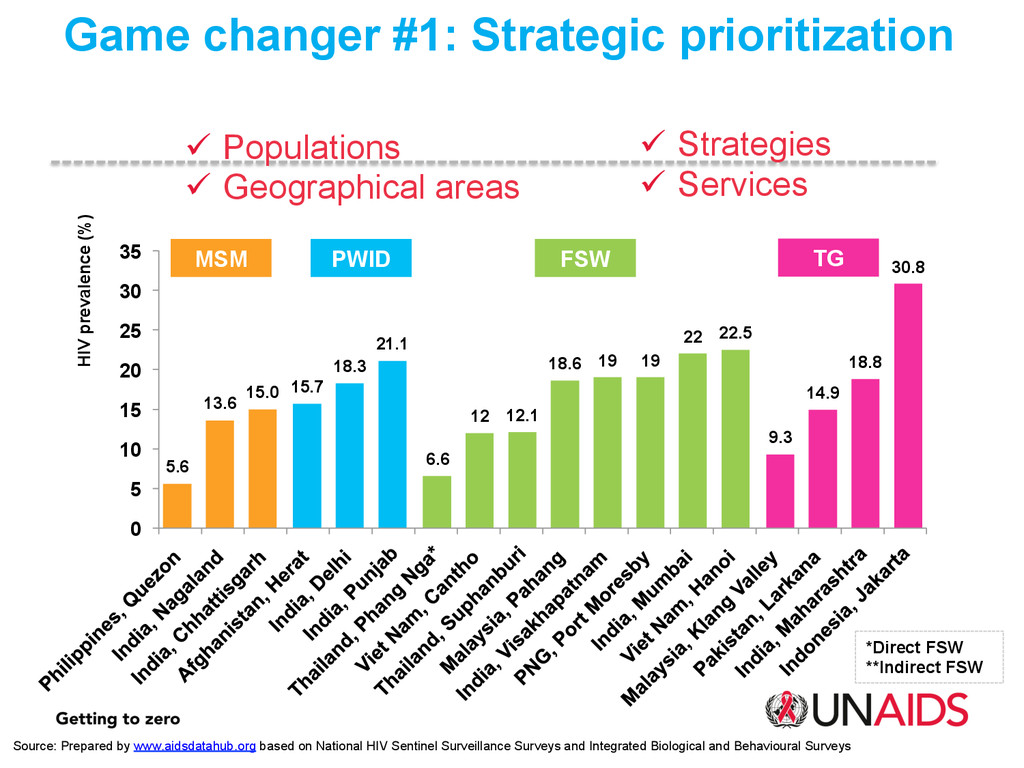
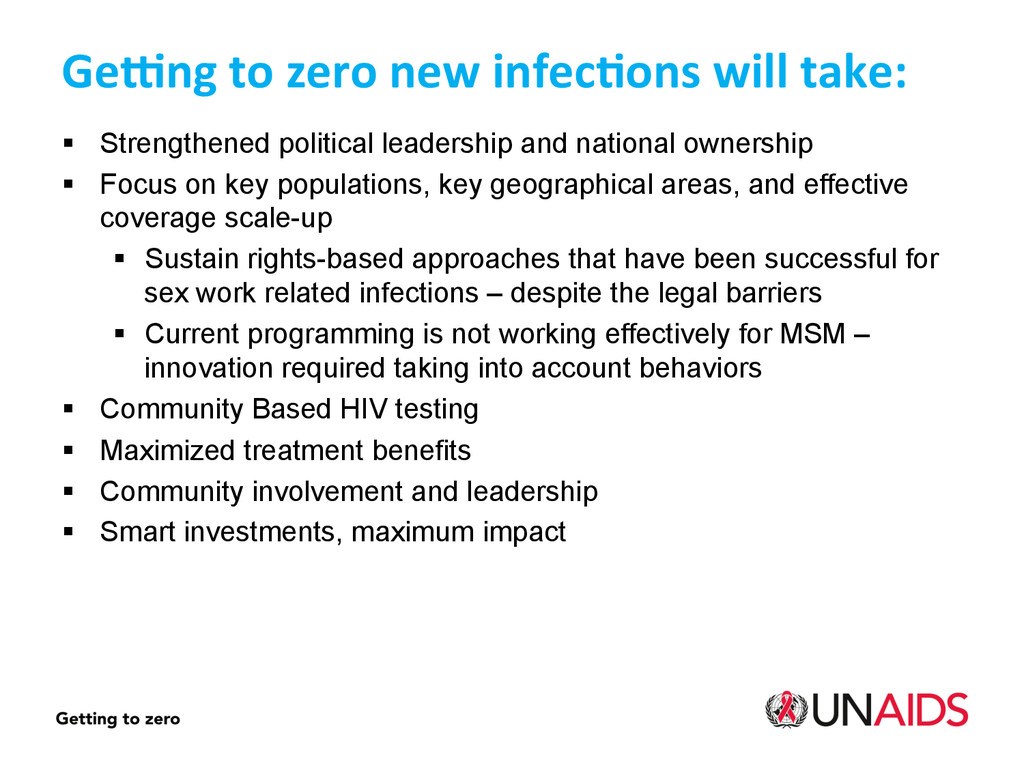
political leadership and national ownership § Focus on key populations, key geographical areas, and effective coverage scale-up § Sustain rights-based approaches that have been successful for sex work related infections – despite the legal barriers § Current programming is not working effectively for MSM – innovation required taking into account behaviors § Community Based HIV testing § Maximized treatment benefits § Community involvement and leadership § Smart investments, maximum impact
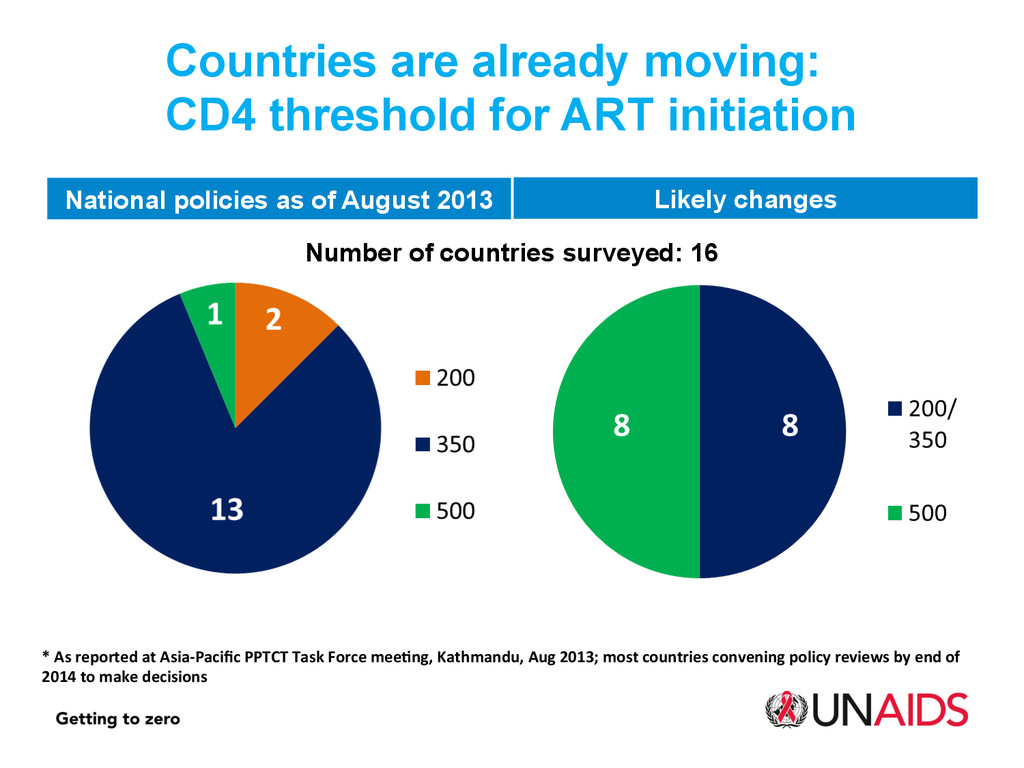
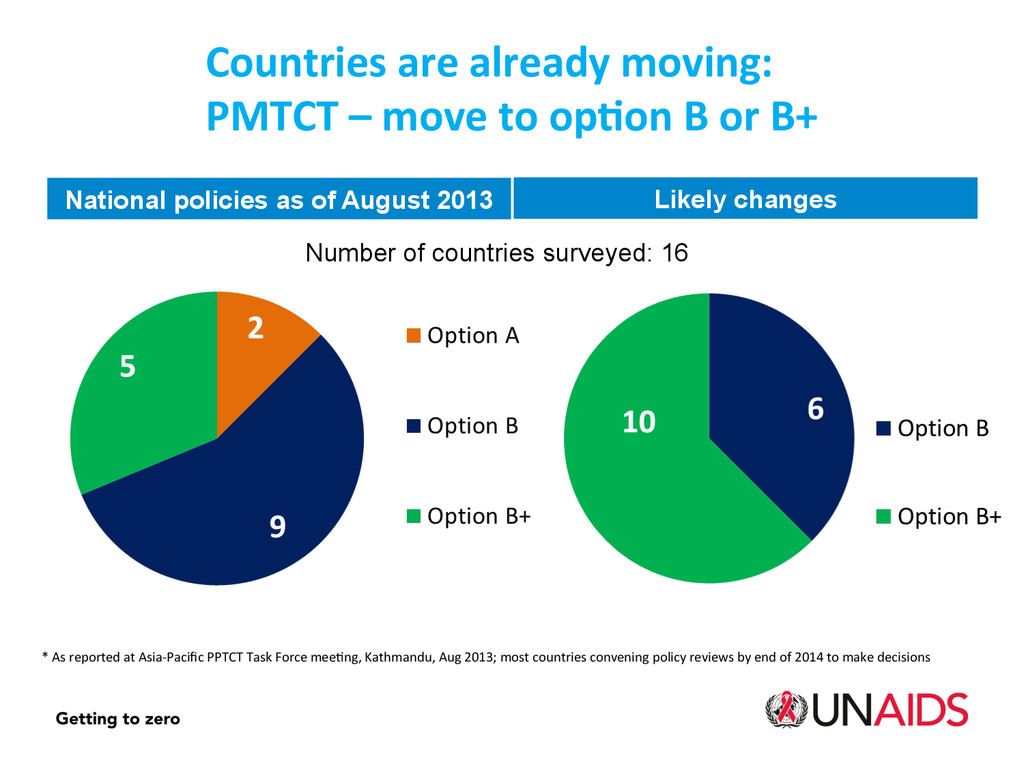
As reported at Asia-‐Pacific PPTCT Task Force meeMng, Kathmandu, Aug 2013; most countries convening policy reviews by end of 2014 to make decisions Number of countries surveyed: 16 National policies as of August 2013 Likely changes
opMon B or B+ * As reported at Asia-‐Pacific PPTCT Task Force meeHng, Kathmandu, Aug 2013; most countries convening policy reviews by end of 2014 to make decisions Number of countries surveyed: 16 National policies as of August 2013 Likely changes


 hivaidscathconf
 aleyda
 szymonslowik
 paigeccino
 jonyablonski
 mojombo
 honzajavorek
 smashingmag
 pauljervisheath
 aarron
 jcasabona
 sarafernandez
 baasie