Share
Embed
Relationships and behaviours in Scotland schools_Challenge questions
The presentation follows HMIE's visual identity and has a clear, consistent structure. It is designed as a reflective resource for school staff and leadership teams, rather than a conventional presentation delivering findings.
HMIE Scotland
October 29, 2026
Transcript
55 slides
-
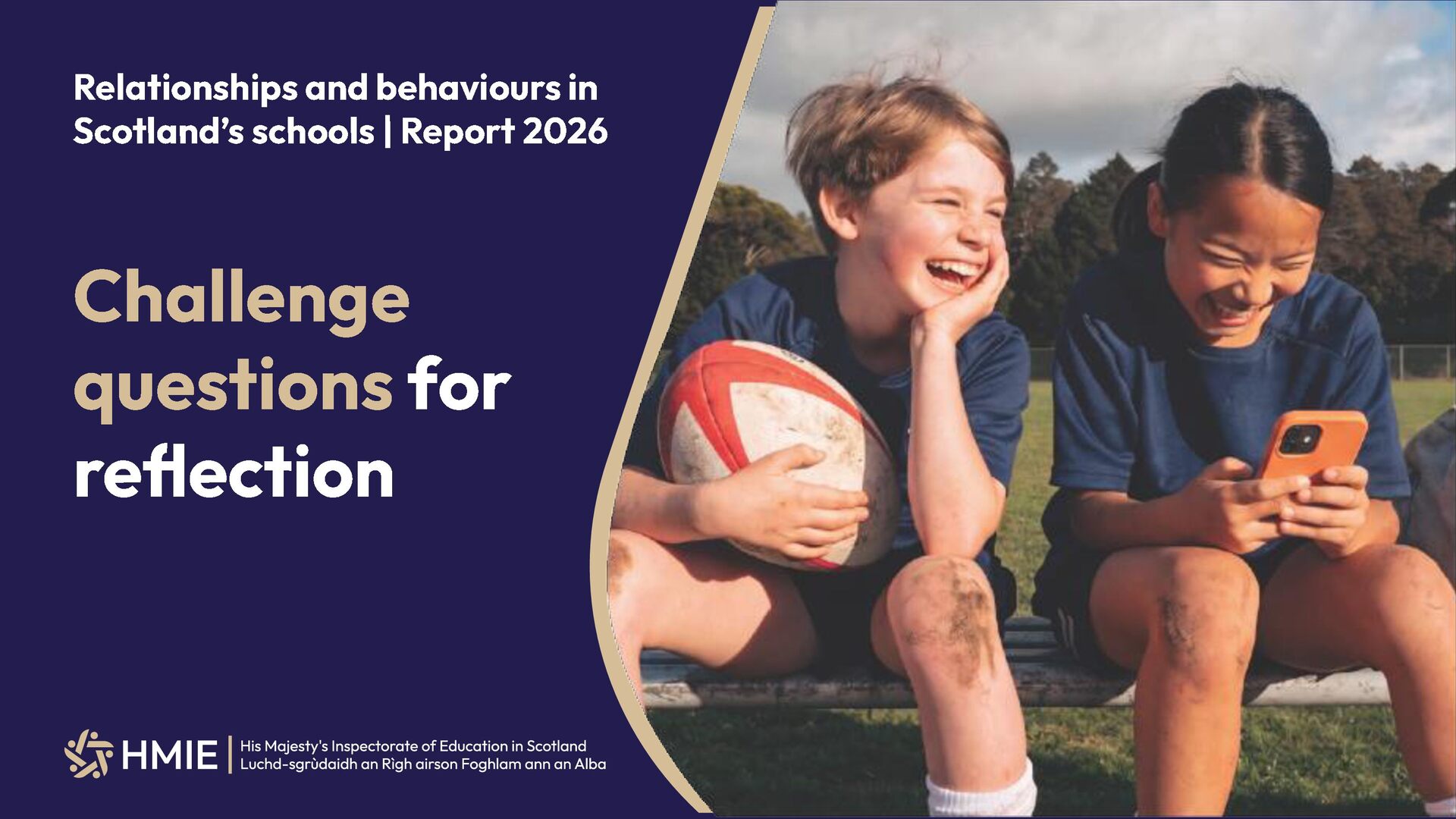
Relationships and behaviours in Scotland’s schools | Report 2026 Challenge
questions for reflection -
Understanding our strengths 1. Relationships are a clear strength across
most schools How well do children and young people feel valued and respected by adults and their peers across the school? Your reflections: -
Understanding our strengths 1. Relationships are a clear strength across
most schools What evidence do we have that positive relationships are supporting wellbeing, inclusion and engagement in learning? Your reflections: -
Understanding our strengths 1. Relationships are a clear strength across
most schools Do all groups of learners report equally positive experiences of relationships with staff and peers? Your reflections: -
Understanding our strengths 1. Relationships are a clear strength across
most schools How do we gather and act on the views of children, young people, parents and staff about relationships across the school? Your reflections: -
Understanding our strengths 1. Relationships are a clear strength across
most schools Where are the strongest examples of relational practice within our setting, and how are these shared across the school? Your reflections: -
Moving from good to better 1. Relationships are a clear
strength across most schools How consistently are nurturing, rights-based and inclusive approaches evident across all classes and stages? Your reflections: -
Moving from good to better 1. Relationships are a clear
strength across most schools Do all staff understand their role in building and sustaining positive relationships? Your reflections: -
Moving from good to better 1. Relationships are a clear
strength across most schools How effectively do relationships support attendance, participation and achievement for those most at risk of disengagement? Your reflections: -
Understanding the issue 2. Low-level disruption impacts learning Do staff
have a shared understanding of what constitutes low-level disruption? Your reflections: -
Understanding the issue 2. Low-level disruption impacts learning How frequently
does low-level disruption occur and in which contexts is it most evident? Your reflections: -
Understanding the issue 2. Low-level disruption impacts learning To what
extent does low-level disruption affect learning, teaching and attainment? Your reflections: -
Understanding the issue 2. Low-level disruption impacts learning How confident
are staff in addressing low-level disruption consistently and effectively? Your reflections: -
Exploring causes 2. Low-level disruption impacts learning What factors may
be contributing to low-level disruption in our school? Your reflections: -
Exploring causes 2. Low-level disruption impacts learning Are there patterns
linked to particular times of day, curriculum areas, or learner groups? Your reflections: -
Exploring causes 2. Low-level disruption impacts learning How well do
our learning environments, curriculum and pedagogy promote engagement and reduce disruption? Your reflections: -
Improving practice 2. Low-level disruption impacts learning How consistently are
expectations for behaviour understood and applied across the school? Your reflections: -
Improving practice 2. Low-level disruption impacts learning What professional learning
do staff need to strengthen relational approaches? Your reflections: -
Improving practice 2. Low-level disruption impacts learning How do we
measure whether our interventions are reducing disruption and improving learning? Your reflections: -
Understanding impact 3. Serious disruptive or violent behaviour is less
common but has a significant impact How well do we understand the impact of serious incidents on learners, staff and the wider school community? Your reflections: -
Understanding impact 3. Serious disruptive or violent behaviour is less
common but has a significant impact How effectively do we support those who have been affected by serious or violent behaviour? Your reflections: -
Understanding impact 3. Serious disruptive or violent behaviour is less
common but has a significant impact What arrangements are in place to protect staff wellbeing following significant incidents? Your reflections: -
Responding effectively 3. Serious disruptive or violent behaviour is less
common but has a significant impact Are roles, responsibilities and escalation procedures clearly understood by all staff? Your reflections: -
Responding effectively 3. Serious disruptive or violent behaviour is less
common but has a significant impact How consistently are serious incidents responded to across the school? Your reflections: -
Responding effectively 3. Serious disruptive or violent behaviour is less
common but has a significant impact How well do we balance support for individual learners with the safety and wellbeing of others? Your reflections: -
Responding effectively 3. Serious disruptive or violent behaviour is less
common but has a significant impact How effectively do we engage parents, carers and partner agencies when serious concerns arise? Your reflections: -
Prevention 3. Serious disruptive or violent behaviour is less common
but has a significant impact How well do we identify learners who may require additional support before behaviours escalate? Your reflections: -
Prevention 3. Serious disruptive or violent behaviour is less common
but has a significant impact Are risk assessments, planning and interventions sufficiently robust and regularly reviewed? Your reflections: -
Prevention 3. Serious disruptive or violent behaviour is less common
but has a significant impact How effectively are multiagency partners involved in supporting children and young people with complex needs? Your reflections: -
Evaluating our systems 4. Recording of incidents is inconsistent How
confident are we that all significant incidents are recorded accurately and consistently? Your reflections: -
Evaluating our systems 4. Recording of incidents is inconsistent Do
staff have a shared understanding of what should be recorded and when? Your reflections: -
Evaluating our systems 4. Recording of incidents is inconsistent Are
incidents involving racism, prejudice and discrimination recorded in line with guidance? Your reflections: -
Using data effectively 4. Recording of incidents is inconsistent What
does our incident data tell us about trends, patterns and emerging concerns? Your reflections: -
Using data effectively 4. Recording of incidents is inconsistent Are
there groups of learners who are disproportionately involved in incidents, either as those displaying behaviours or those affected? Your reflections: -
Using data effectively 4. Recording of incidents is inconsistent How
effectively do we use data to inform prevention, intervention and resource allocation? Your reflections: -
Using data effectively 4. Recording of incidents is inconsistent How
regularly is incident data reviewed by senior leaders and staff? Your reflections: -
Strengthening accountability 4. Recording of incidents is inconsistent How do
we assure ourselves that incidents are not underreported? Your reflections: -
Strengthening accountability 4. Recording of incidents is inconsistent What quality
assurance processes are in place to ensure consistency and accuracy? Your reflections: -
Strengthening accountability 4. Recording of incidents is inconsistent How do
we communicate outcomes and learning from incident data to staff, learners and families? Your reflections: -
Shared understanding and consistency 5. Consistent whole-school approaches deliver better
outcomes Is there a clear, shared vision for relationships and behaviour across the school community? Your reflections: -
Shared understanding and consistency 5. Consistent whole-school approaches deliver better
outcomes How consistently are policies and approaches implemented by all staff? Your reflections: -
Shared understanding and consistency 5. Consistent whole-school approaches deliver better
outcomes Do learners and families understand the school's expectations and approaches? Your reflections: -
Shared understanding and consistency 5. Consistent whole-school approaches deliver better
outcomes How do we know that practice is consistent across classes, departments and stages? Your reflections: -
Professional learning and leadership 5. Consistent whole-school approaches deliver better
outcomes What professional learning has the greatest impact on improving relationships and behaviour? Your reflections: -
Professional learning and leadership 5. Consistent whole-school approaches deliver better
outcomes How effectively do leaders model and promote the school's approach? Your reflections: -
Professional learning and leadership 5. Consistent whole-school approaches deliver better
outcomes How do we support new staff to understand and apply our expectations and practices? Your reflections: -
Inclusion and support 5. Consistent whole-school approaches deliver better outcomes
How well do our approaches meet the needs of children and young people with additional support needs? Your reflections: -
Inclusion and support 5. Consistent whole-school approaches deliver better outcomes
Are interventions equitable, inclusive and rights-based? Your reflections: -
Inclusion and support 5. Consistent whole-school approaches deliver better outcomes
How effectively do we work with partners to coordinate support around children and families? Your reflections: -
Evaluating impact 5. Consistent whole-school approaches deliver better outcomes What
evidence shows that our whole-school approach is improving outcomes? Your reflections: -
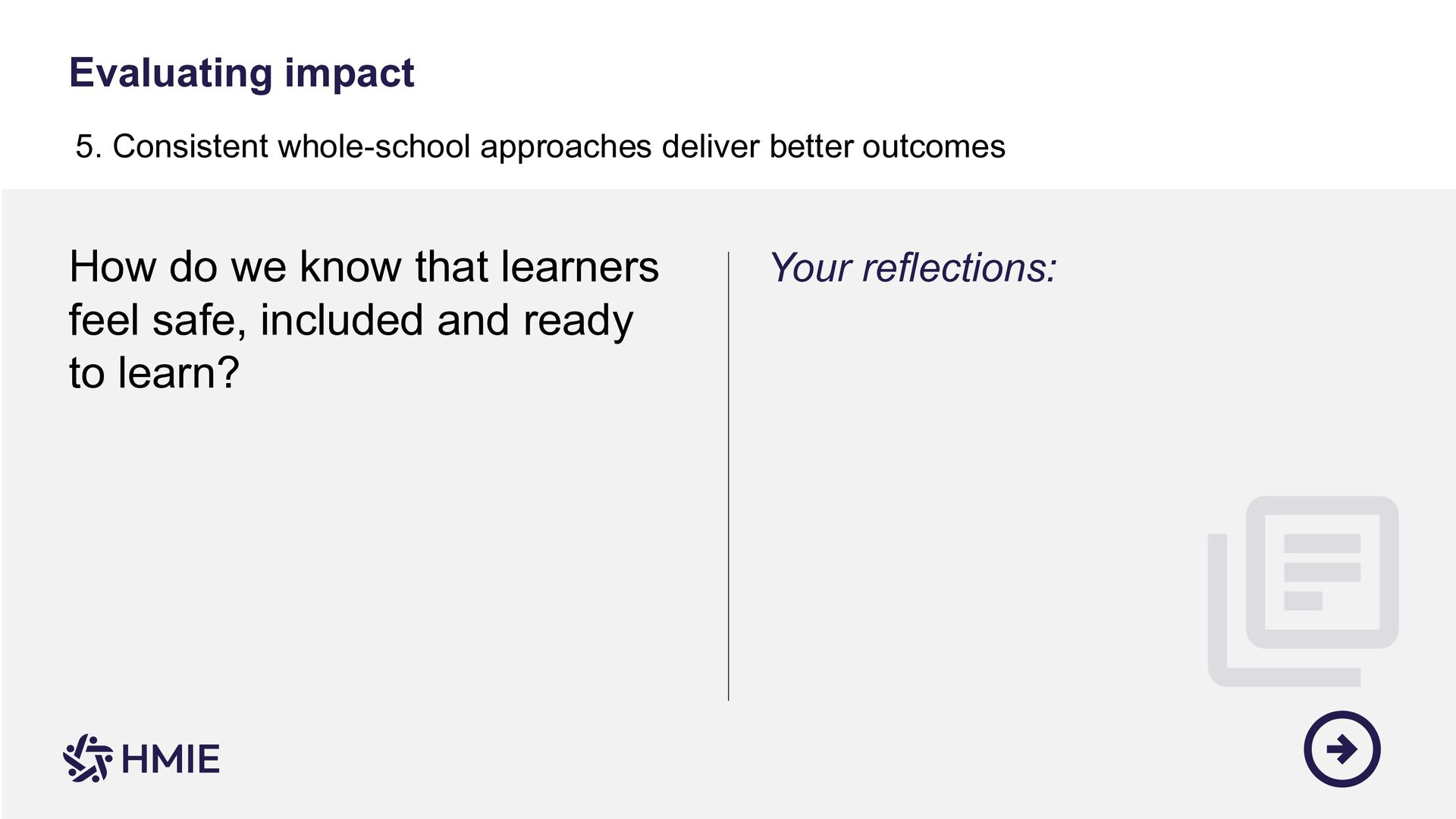
Evaluating impact 5. Consistent whole-school approaches deliver better outcomes How
do we know that learners feel safe, included and ready to learn? Your reflections: -
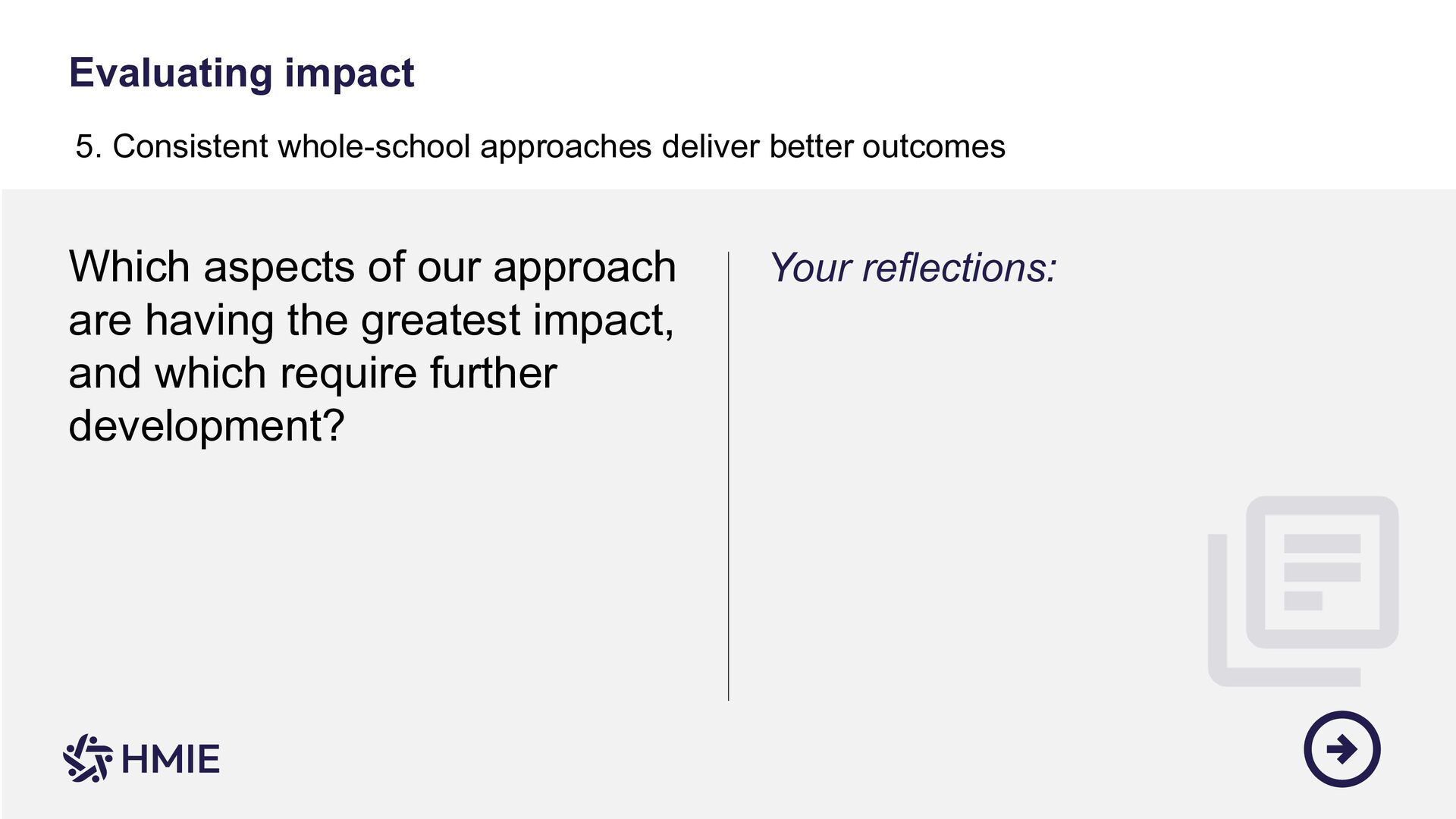
Evaluating impact 5. Consistent whole-school approaches deliver better outcomes Which
aspects of our approach are having the greatest impact, and which require further development? Your reflections: -
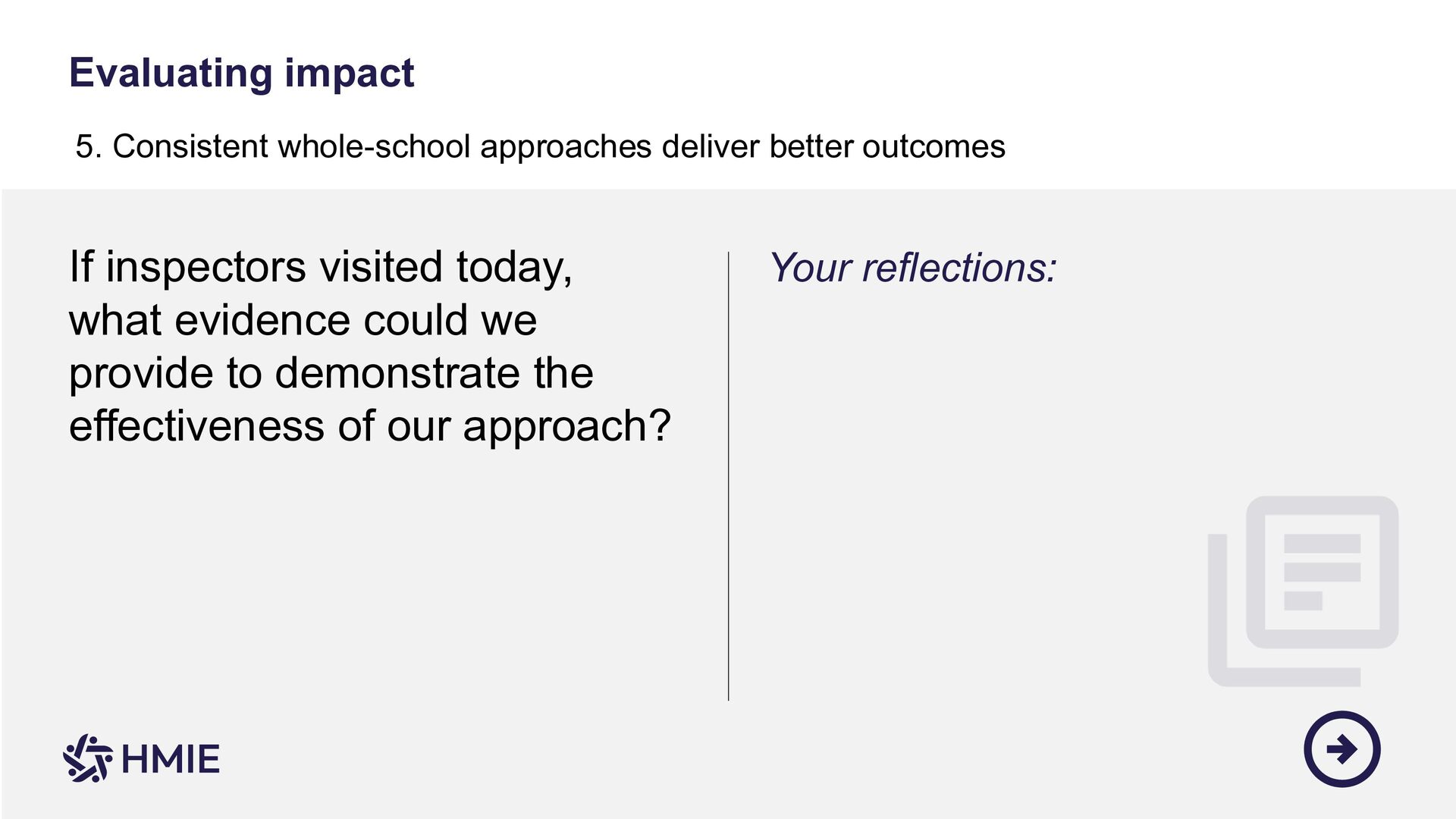
Evaluating impact 5. Consistent whole-school approaches deliver better outcomes If
inspectors visited today, what evidence could we provide to demonstrate the effectiveness of our approach? Your reflections: -
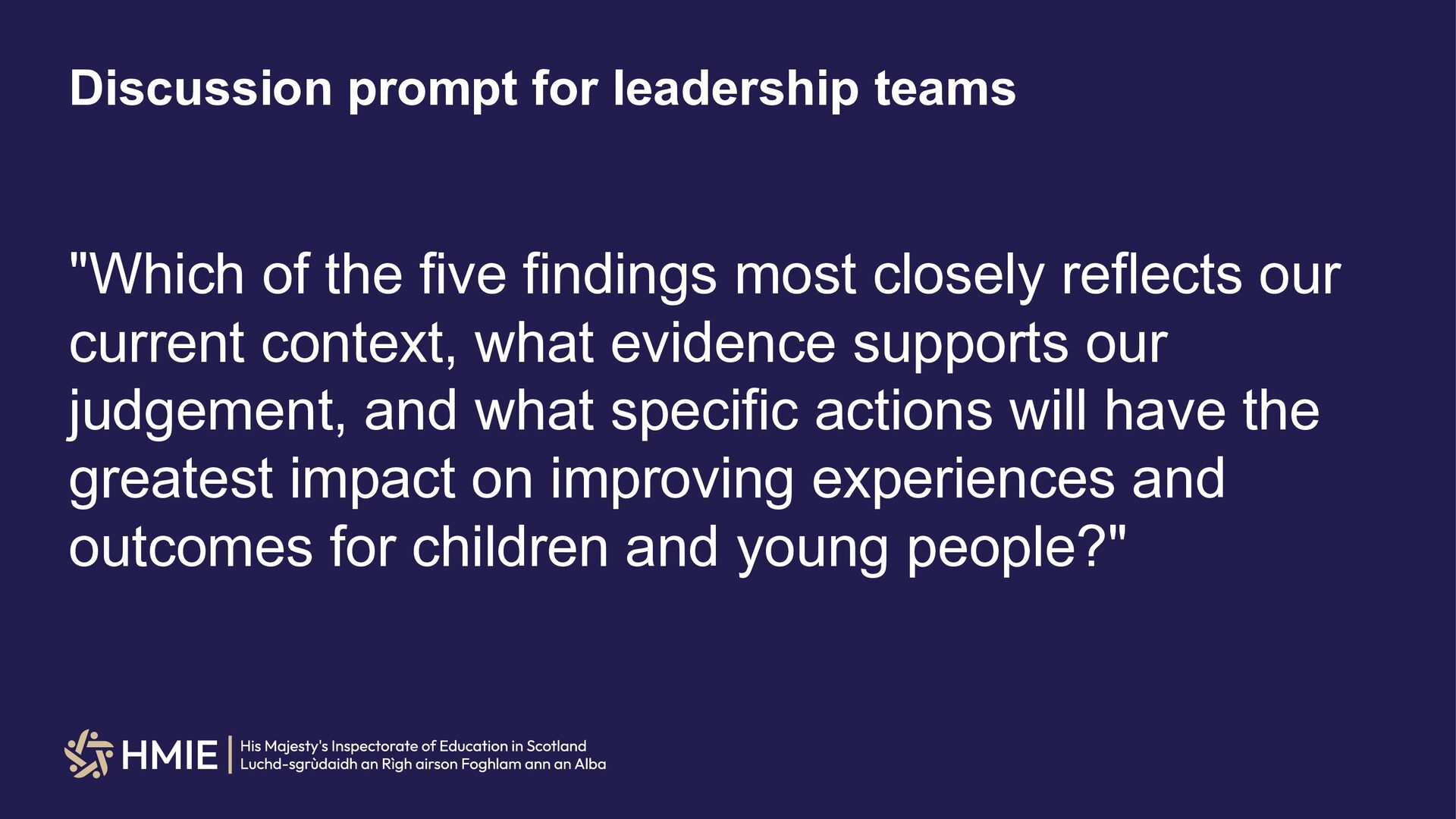
Discussion prompt for leadership teams "Which of the five findings
most closely reflects our current context, what evidence supports our judgement, and what specific actions will have the greatest impact on improving experiences and outcomes for children and young people?" -
Relationships and behaviours in Scotland’s schools | Report 2026 To
read the full report, visit our website