Upgrade to Pro — share decks privately, control downloads, hide ads and more …

Literacy and English in Scotland – What is work...

Literacy and English in Scotland – What is working well and what could be improved

This HM Inspectors of Education (HMIE) presentation highlights what is working well and what could be improved in literacy and English across Scotland's education settings.

Drawing on inspection evidence, it explores effective practice and areas for development across early learning and childcare, primary, secondary and special education.

Key themes include reading, writing, listening and talking, curriculum progression, inclusive approaches, digital learning and opportunities to develop literacy skills.

The presentation supports practitioners, school leaders and education professionals in reflecting on current practice and identifying opportunities for improvement.

Find out more about HMIE and our inspection findings at https://educationinspectorate.gov.scot/

HMIE Scotland

November 12, 2026

Transcript

15 slides
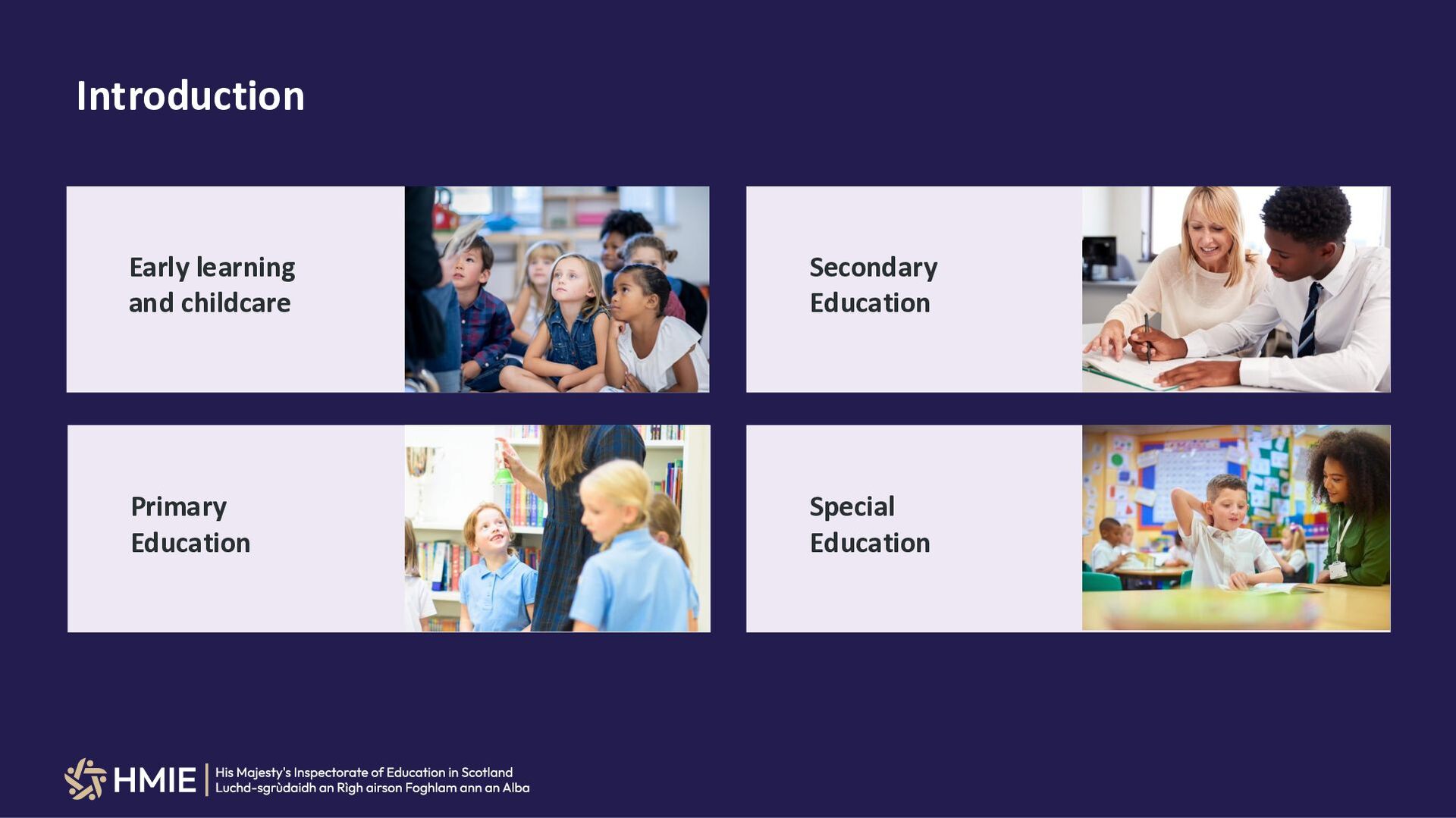
  1. Introduction Early learning and childcare Early learning and childcare Primary

    Education Primary Education Secondary Education Secondary Education Special Education Special Education
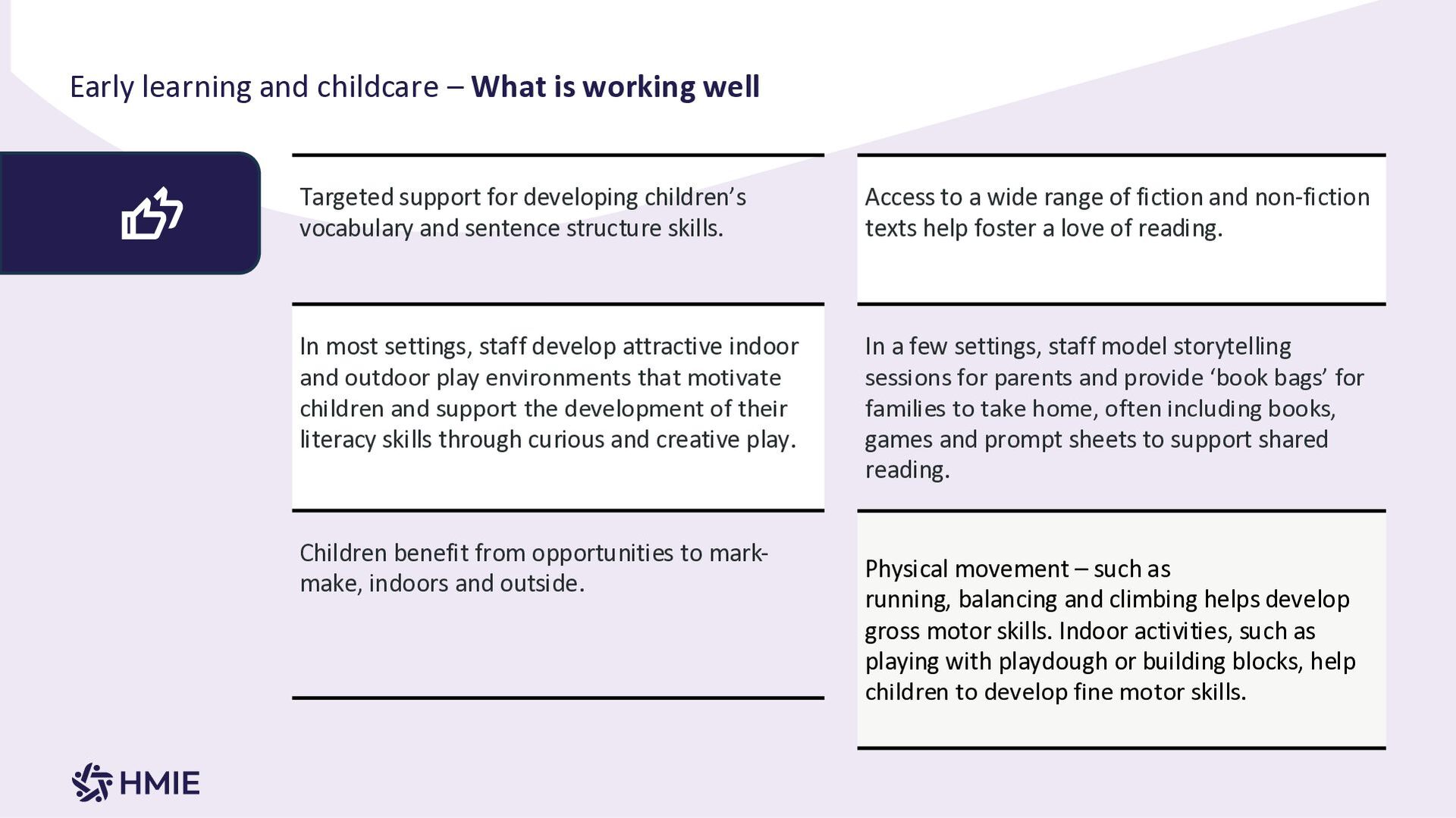
  2. Early learning and childcare – What is working well Targeted

    support for developing children’s vocabulary and sentence structure skills. Access to a wide range of fiction and non-fiction texts help foster a love of reading. In most settings, staff develop attractive indoor and outdoor play environments that motivate children and support the development of their literacy skills through curious and creative play. In a few settings, staff model storytelling sessions for parents and provide ‘book bags’ for families to take home, often including books, games and prompt sheets to support shared reading. Children benefit from opportunities to markmake, indoors and outside. Physical movement – such as running, balancing and climbing helps develop gross motor skills. Indoor activities, such as playing with playdough or building blocks, help children to develop fine motor skills.
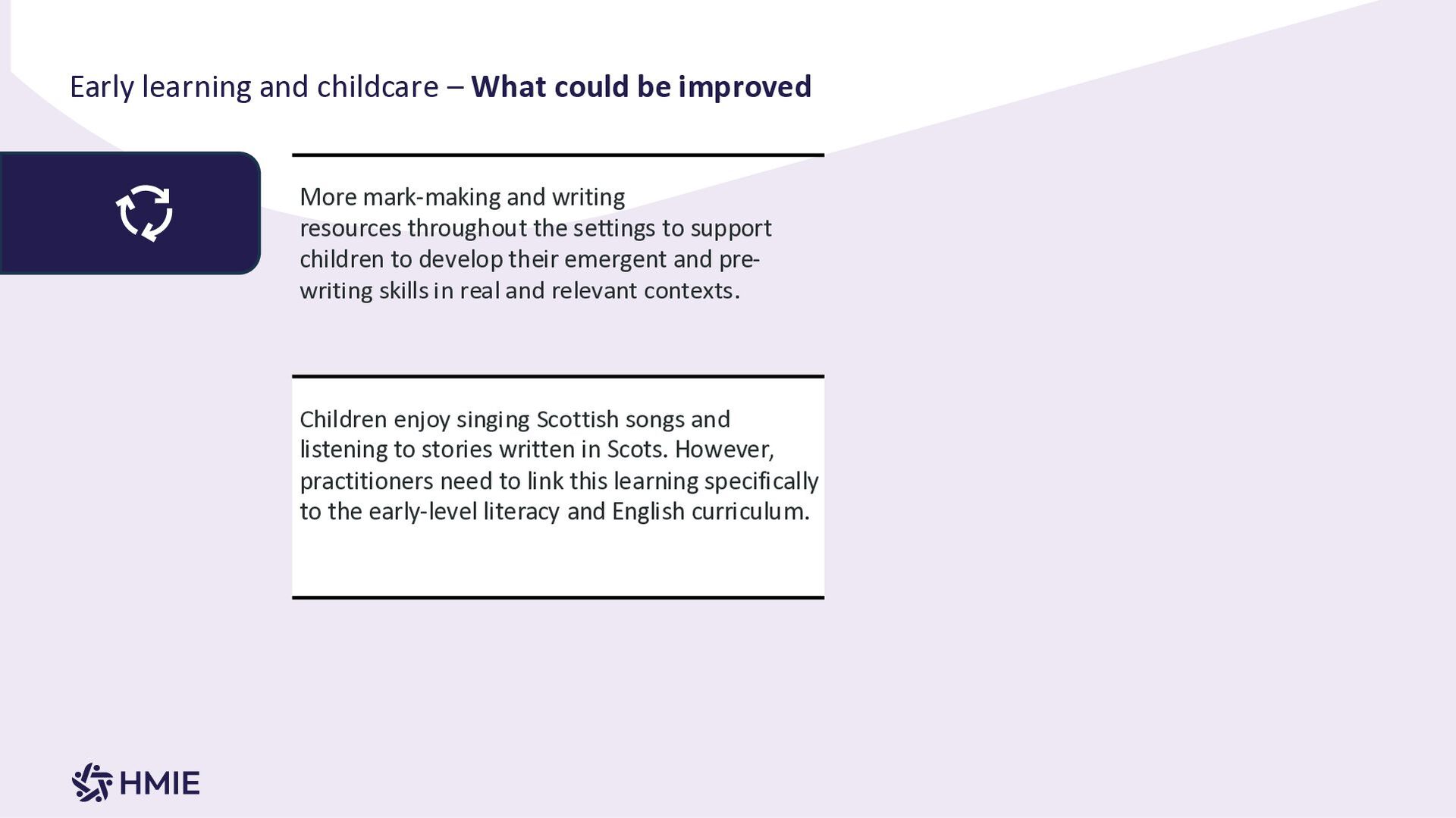
  3. Early learning and childcare – What could be improved More

    mark-making and writing resources throughout the settings to support children to develop their emergent and prewriting skills in real and relevant contexts. Children enjoy singing Scottish songs and listening to stories written in Scots. However, practitioners need to link this learning specifically to the early-level literacy and English curriculum.
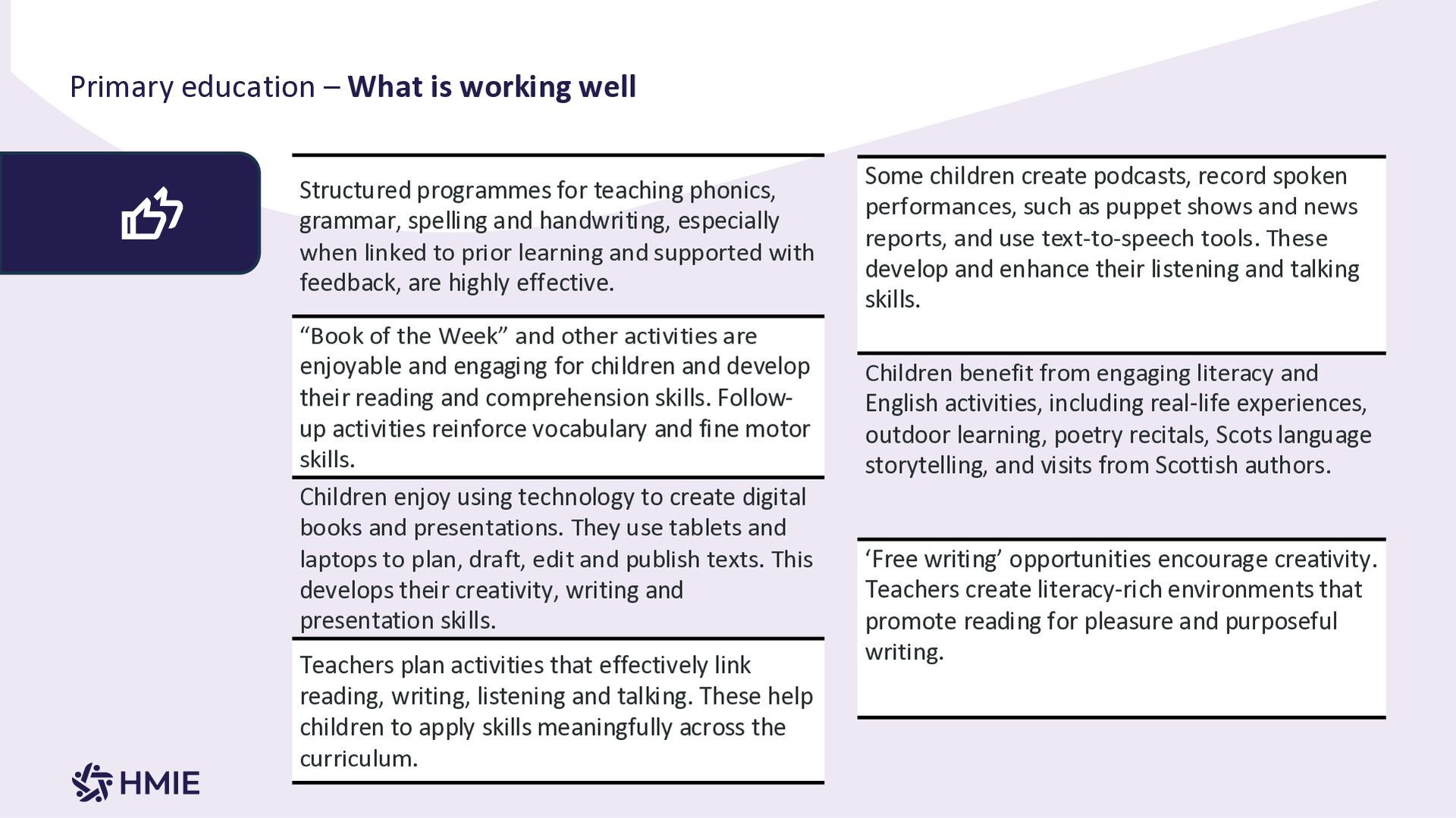
  4. Primary education – What is working well Structured programmes for

    teaching phonics, grammar, spelling and handwriting, especially when linked to prior learning and supported with feedback, are highly effective. “Book of the Week” and other activities are enjoyable and engaging for children and develop their reading and comprehension skills. Followup activities reinforce vocabulary and fine motor skills. Children enjoy using technology to create digital books and presentations. They use tablets and laptops to plan, draft, edit and publish texts. This develops their creativity, writing and presentation skills. Teachers plan activities that effectively link reading, writing, listening and talking. These help children to apply skills meaningfully across the curriculum. Some children create podcasts, record spoken performances, such as puppet shows and news reports, and use text-to-speech tools. These develop and enhance their listening and talking skills. Children benefit from engaging literacy and English activities, including real-life experiences, outdoor learning, poetry recitals, Scots language storytelling, and visits from Scottish authors. ‘Free writing’ opportunities encourage creativity. Teachers create literacy-rich environments that promote reading for pleasure and purposeful writing.
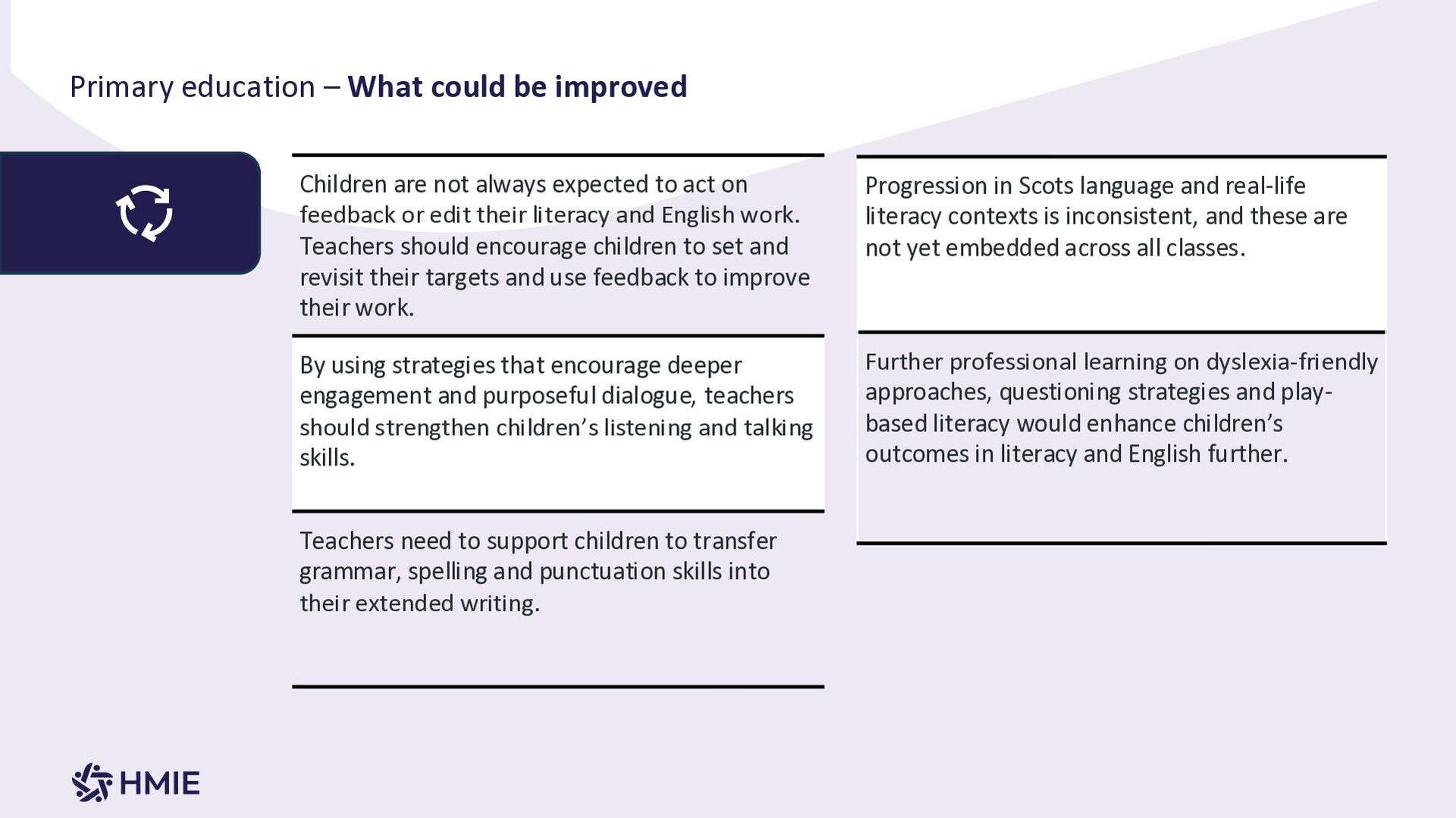
  5. Primary education – What could be improved Children are not

    always expected to act on feedback or edit their literacy and English work. Teachers should encourage children to set and revisit their targets and use feedback to improve their work. Progression in Scots language and real-life literacy contexts is inconsistent, and these are not yet embedded across all classes. By using strategies that encourage deeper engagement and purposeful dialogue, teachers should strengthen children’s listening and talking skills. Further professional learning on dyslexia-friendly approaches, questioning strategies and playbased literacy would enhance children’s outcomes in literacy and English further. Teachers need to support children to transfer grammar, spelling and punctuation skills into their extended writing.
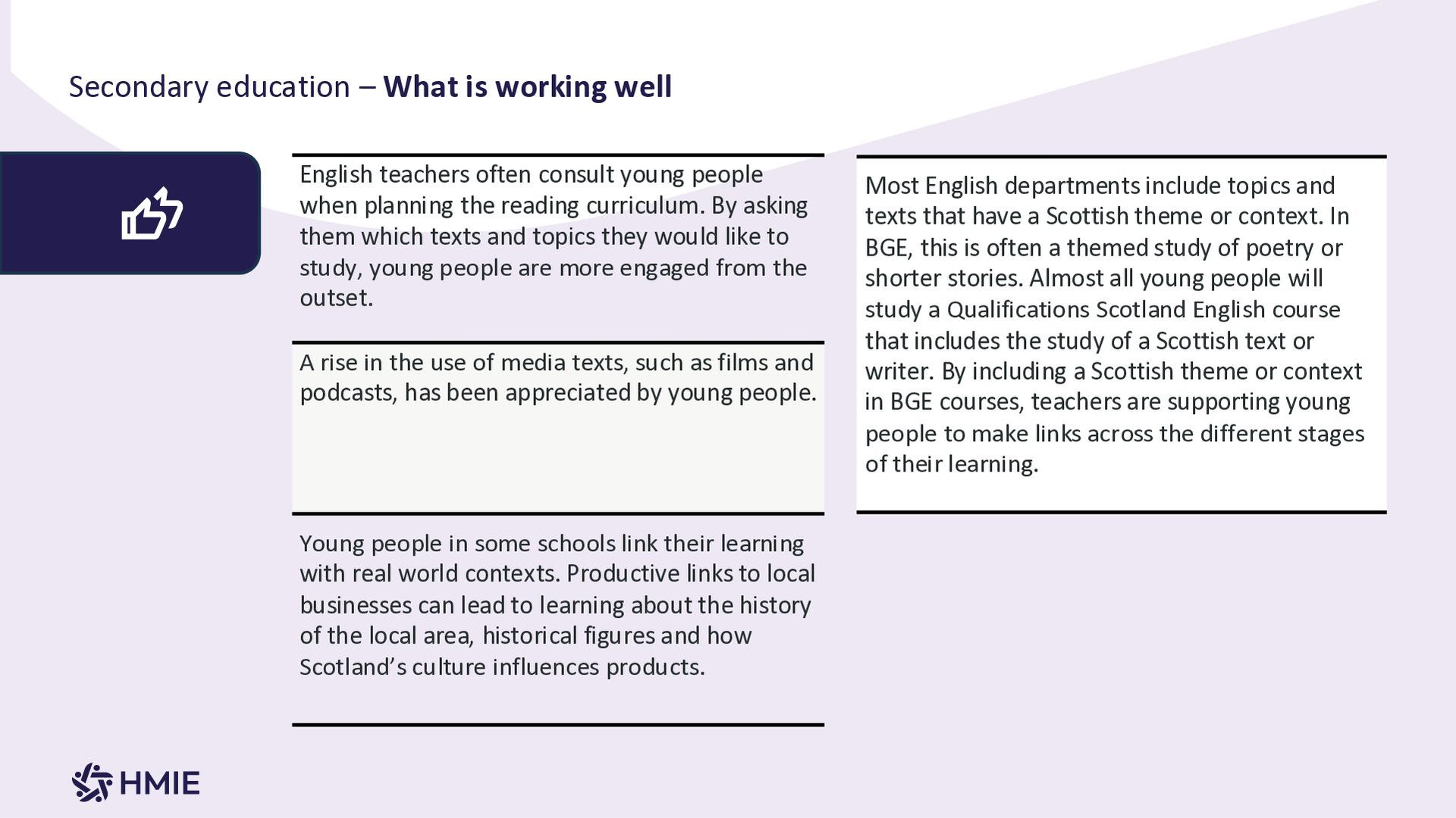
  6. Secondary education – What is working well English teachers often

    consult young people when planning the reading curriculum. By asking them which texts and topics they would like to study, young people are more engaged from the outset. A rise in the use of media texts, such as films and podcasts, has been appreciated by young people. Young people in some schools link their learning with real world contexts. Productive links to local businesses can lead to learning about the history of the local area, historical figures and how Scotland’s culture influences products. Most English departments include topics and texts that have a Scottish theme or context. In BGE, this is often a themed study of poetry or shorter stories. Almost all young people will study a Qualifications Scotland English course that includes the study of a Scottish text or writer. By including a Scottish theme or context in BGE courses, teachers are supporting young people to make links across the different stages of their learning.
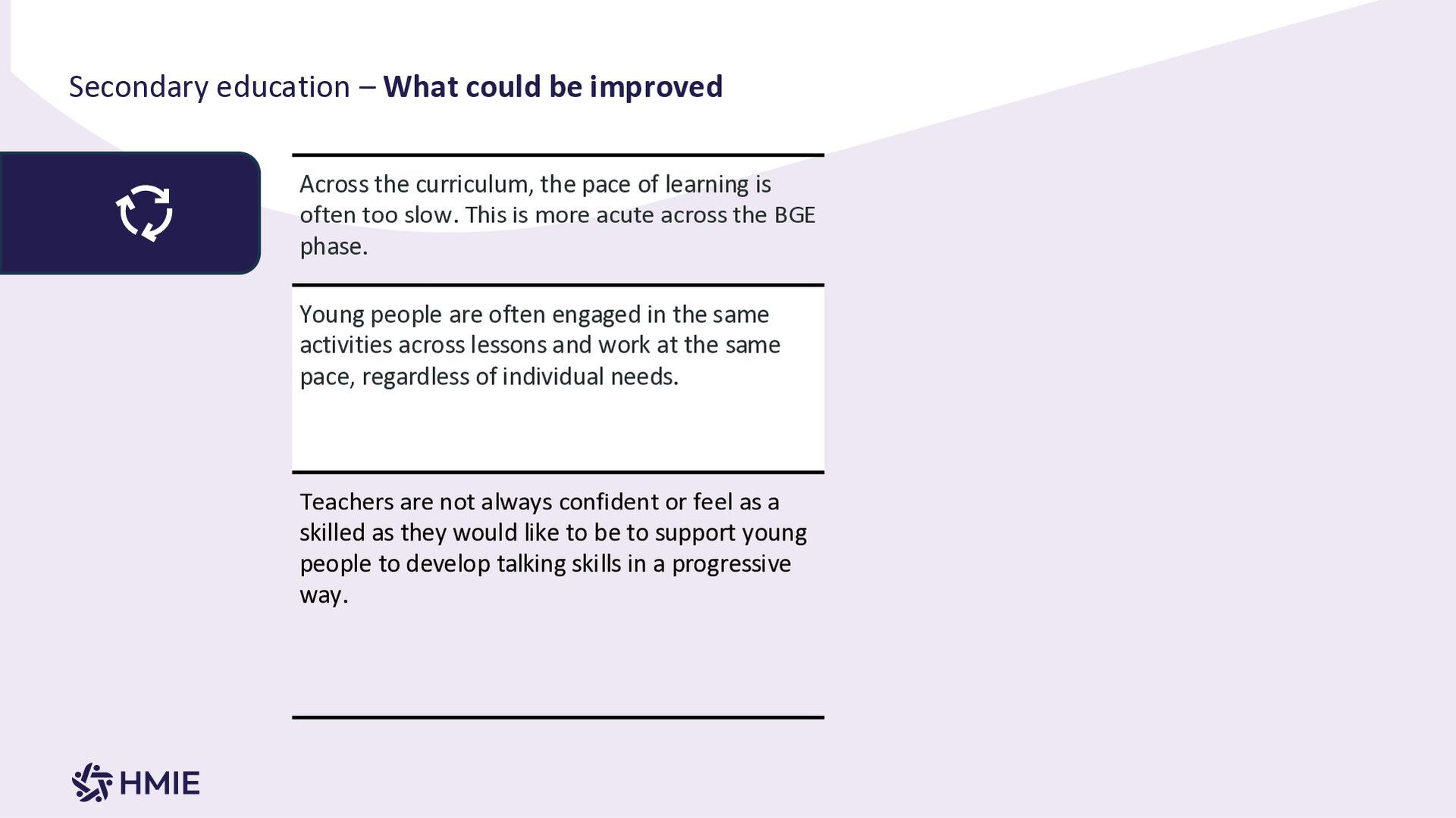
  7. Secondary education – What could be improved Across the curriculum,

    the pace of learning is often too slow. This is more acute across the BGE phase. Young people are often engaged in the same activities across lessons and work at the same pace, regardless of individual needs. Teachers are not always confident or feel as a skilled as they would like to be to support young people to develop talking skills in a progressive way.
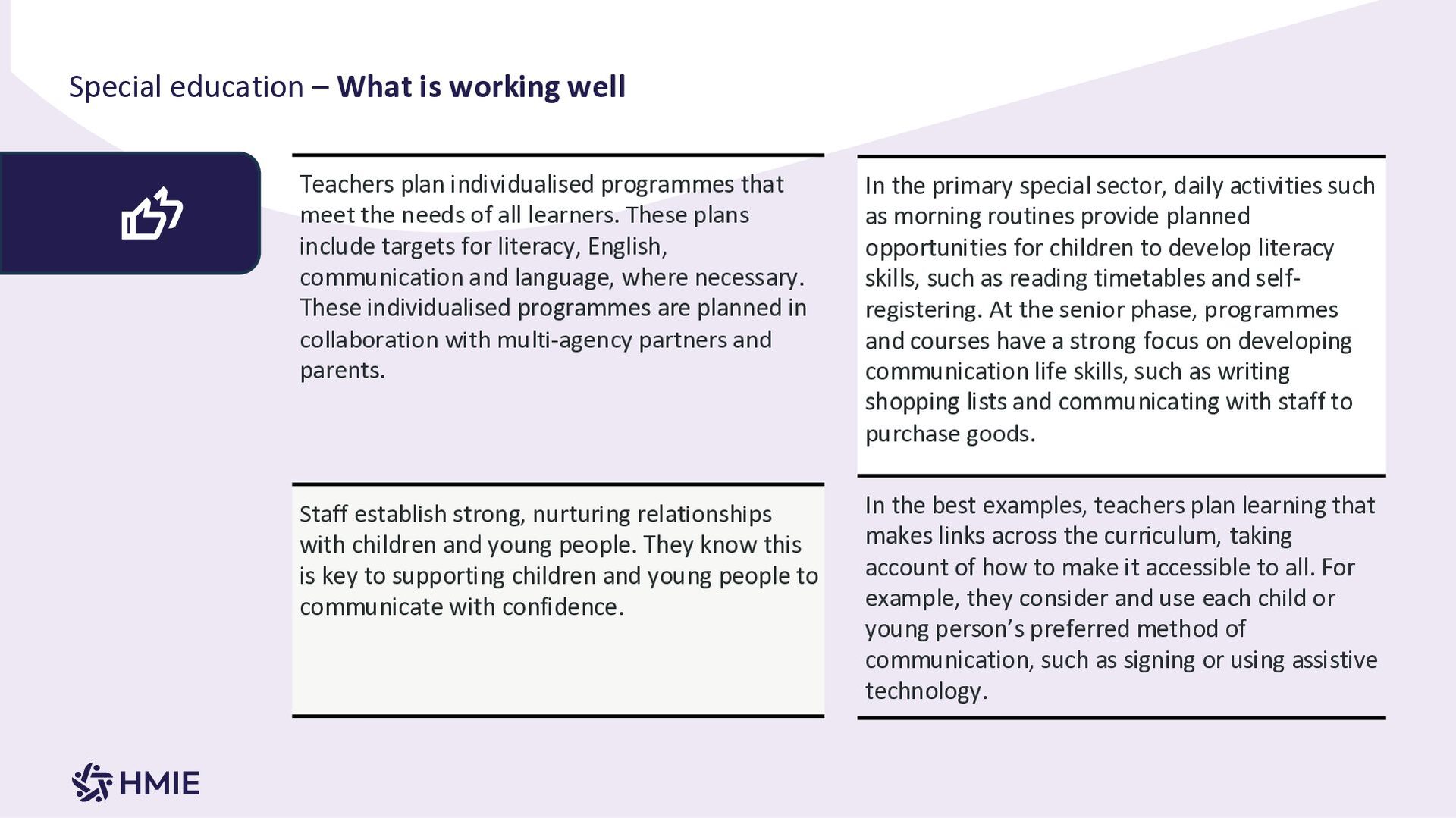
  8. Special education – What is working well Teachers plan individualised

    programmes that meet the needs of all learners. These plans include targets for literacy, English, communication and language, where necessary. These individualised programmes are planned in collaboration with multi-agency partners and parents. In the primary special sector, daily activities such as morning routines provide planned opportunities for children to develop literacy skills, such as reading timetables and selfregistering. At the senior phase, programmes and courses have a strong focus on developing communication life skills, such as writing shopping lists and communicating with staff to purchase goods. Staff establish strong, nurturing relationships with children and young people. They know this is key to supporting children and young people to communicate with confidence. In the best examples, teachers plan learning that makes links across the curriculum, taking account of how to make it accessible to all. For example, they consider and use each child or young person’s preferred method of communication, such as signing or using assistive technology.
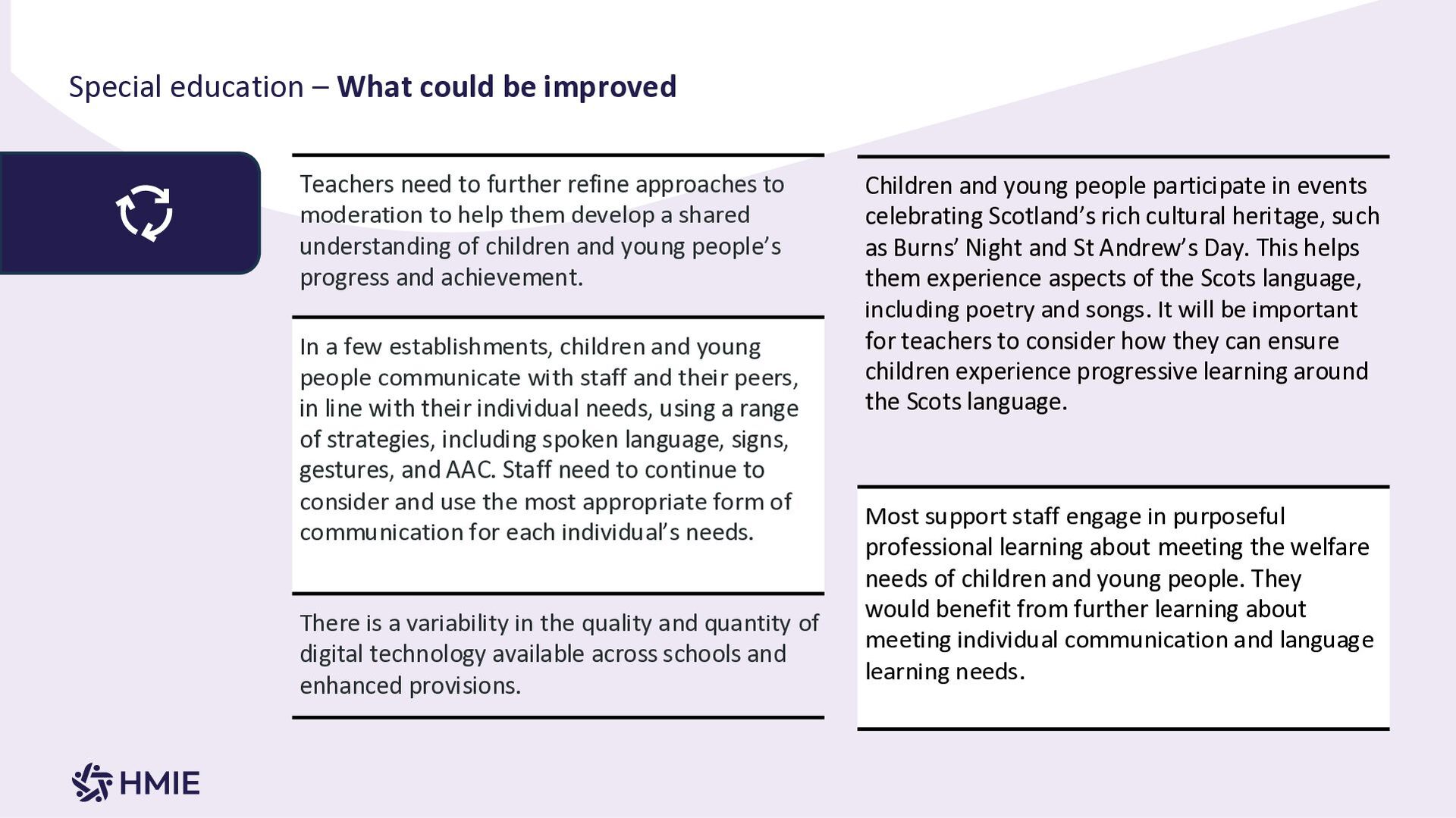
  9. Special education – What could be improved Teachers need to

    further refine approaches to moderation to help them develop a shared understanding of children and young people’s progress and achievement. In a few establishments, children and young people communicate with staff and their peers, in line with their individual needs, using a range of strategies, including spoken language, signs, gestures, and AAC. Staff need to continue to consider and use the most appropriate form of communication for each individual’s needs. There is a variability in the quality and quantity of digital technology available across schools and enhanced provisions. Children and young people participate in events celebrating Scotland’s rich cultural heritage, such as Burns’ Night and St Andrew’s Day. This helps them experience aspects of the Scots language, including poetry and songs. It will be important for teachers to consider how they can ensure children experience progressive learning around the Scots language. Most support staff engage in purposeful professional learning about meeting the welfare needs of children and young people. They would benefit from further learning about meeting individual communication and language learning needs.

More Decks by HMIE Scotland

Other Decks in Education