on specific regulation or code of practice due to the specificity of the project - No accessibility for firefighters - No Evacuation outside - … It follows instead principles that are generally accepted for comparable building, considering the specific occupancy, location, climate and accessibility. - ISO - EN - NFPA
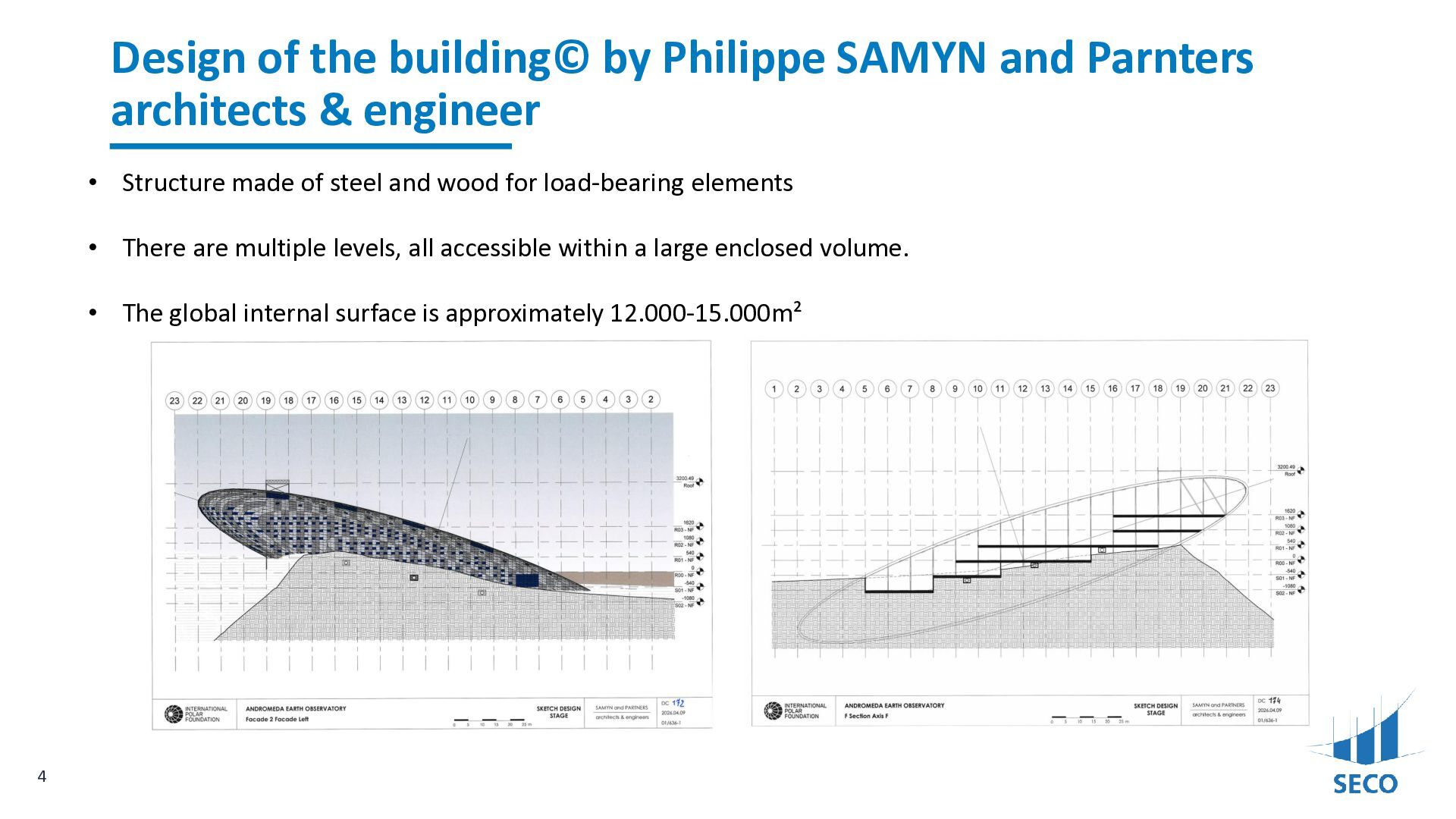
architects & engineer • Structure made of steel and wood for load-bearing elements • There are multiple levels, all accessible within a large enclosed volume. • The global internal surface is approximately 12.000-15.000m²
elements whose integrity may have an impact on compartmentalization will be protected to provide 1-hour fire resistance. • This can be achieved either by: • integrating these elements within the compartmentalizing walls • by specific protection of these elements. • By sizing these elements using a natural fire design approach
in 2 principals fire compartments (between the main technical spaces and the main functional spaces) that are assumed to resist during 1 hour to the time-temperature curve known as ISO 834 • In all fire-resistant partitions, the openings (doors, fire dampers, sealing of penetrations, windows, ...) will meet the same 1-hour fire resistance criterion. The following compartmentalization principles will be applied: • Each floor will meet a 1-hour fire resistance. • Specifics secondary compartments will be surrounded by 1-hour fire resistance internal partitions: • enclosed staircases (that connects several levels); • technical shafts; • technical rooms (or a set of technical rooms); • Rooms with a specific fire risk (storages, rooms with combustible materials…)
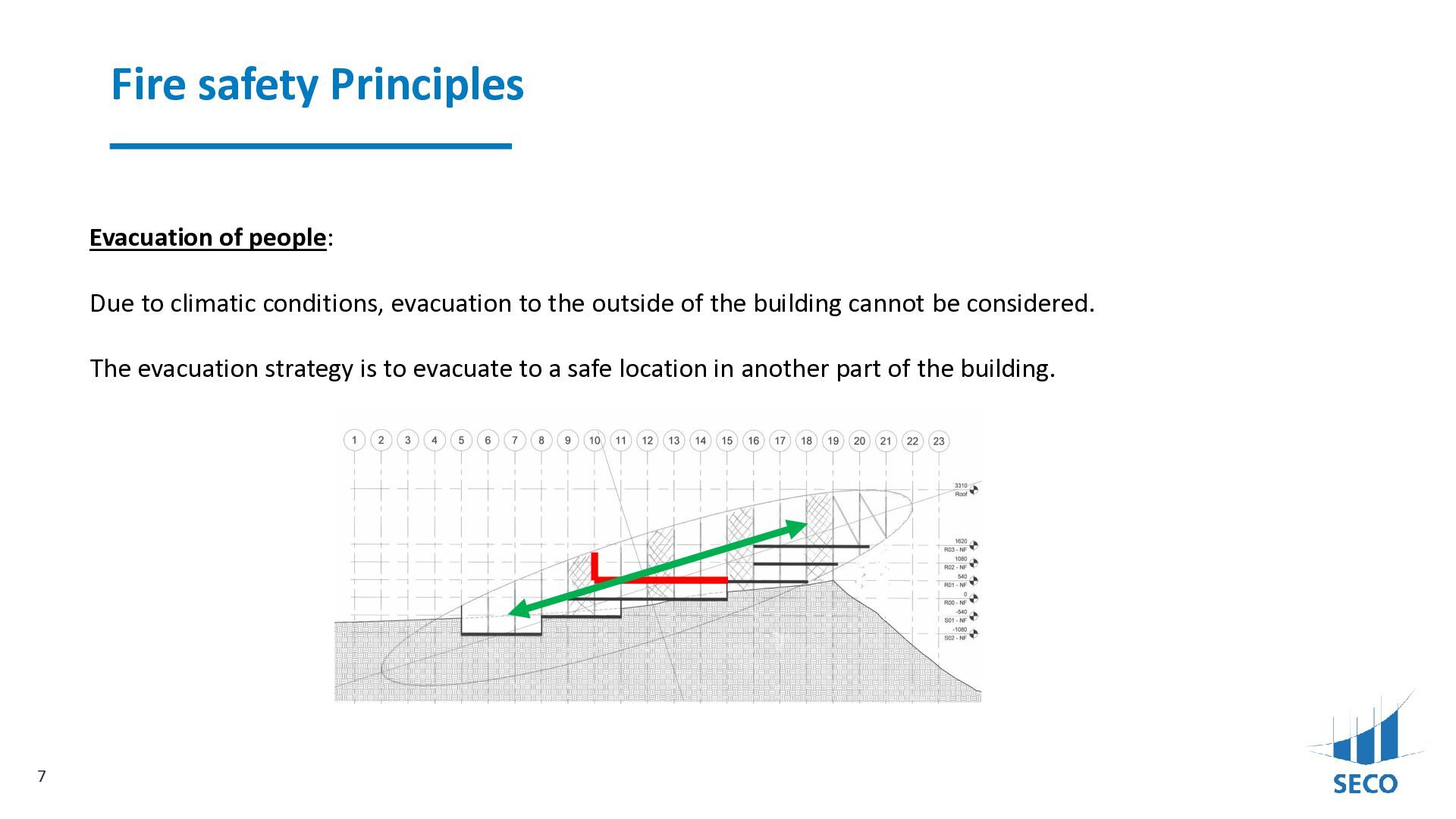
conditions, evacuation to the outside of the building cannot be considered. The evacuation strategy is to evacuate to a safe location in another part of the building.
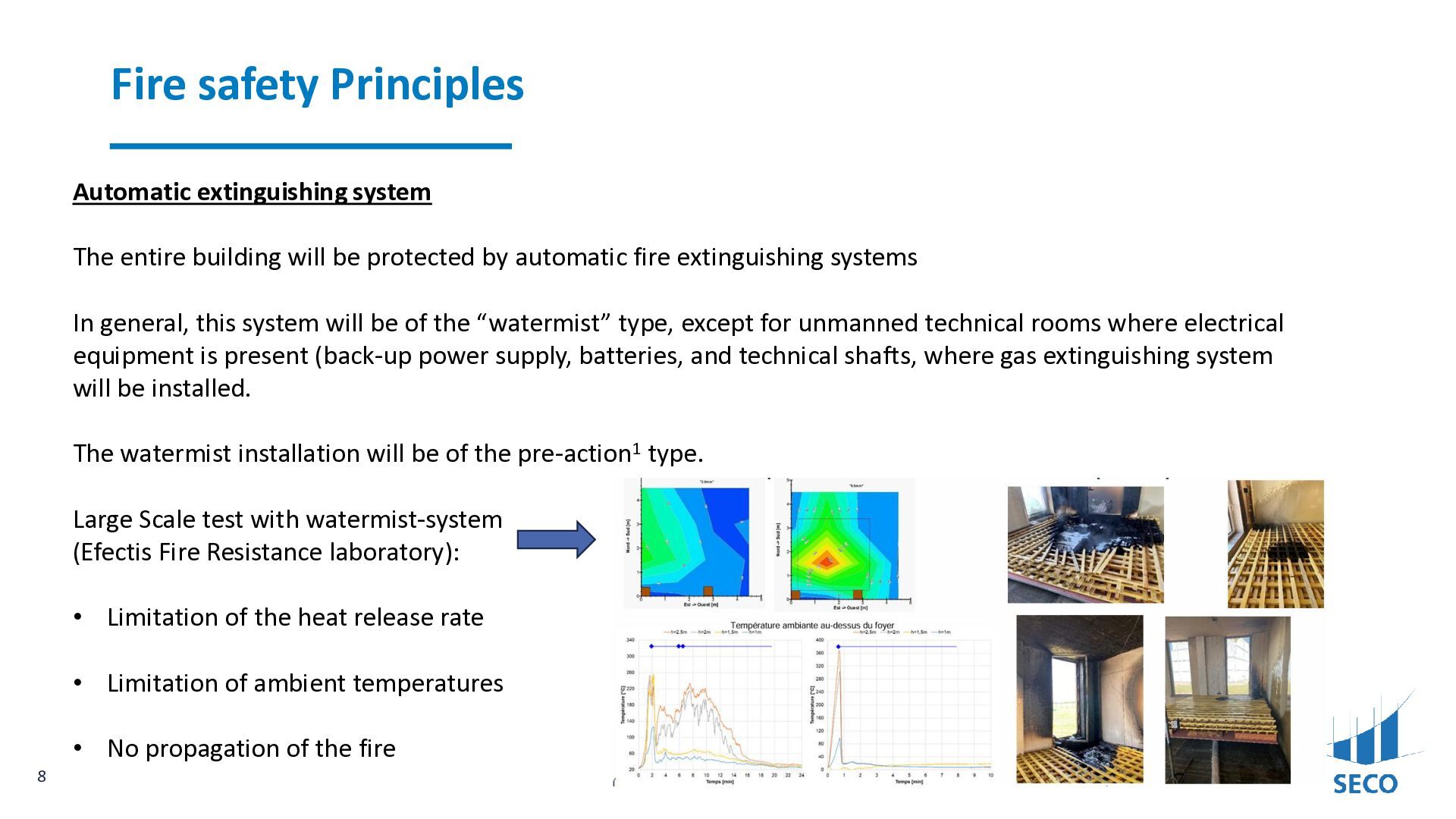
will be protected by automatic fire extinguishing systems In general, this system will be of the “watermist” type, except for unmanned technical rooms where electrical equipment is present (back-up power supply, batteries, and technical shafts, where gas extinguishing system will be installed. The watermist installation will be of the pre-action1 type. Large Scale test with watermist-system (Efectis Fire Resistance laboratory): • Limitation of the heat release rate • Limitation of ambient temperatures • No propagation of the fire
is remoted from any external fire-fighting resources, the following principles will be applied: • The whole building will be equipped with fire detection. • By default, this will be based on smoke detection to allow early fire detection (excepted rooms with activity that can generate water vapor such as the kitchen). • The fire detection will allow precise location of the fire. • At least 2 independent, autonomous fire detection control units will be located in separate compartments. • Fire extinguishers will be distributed throughout the building to enable first response by all staff. • A limited number of staff will be trained and equipped to carry out fire-fighting operations. Their equipment includes breathing apparatus, infrared cameras (to localize fire) and fire hoses.

 Your Podcast. Everywhere. Effortlessly.


 ipfevents
 hiranabe
 trycycle
 shucho0103
 hf149
hf149
 voginip
 naokimuroki
 jagupath
 masakiokuda
 akasan
%20square.jpg) baggiponte
baggiponte
 sshimizu2006
 chriscoyier
 reverentgeek
 moore
moore
 bethany
 jacobtomlinson
 malarkey
 speakerdeck
 skipperchong
 thekraken
 pauljervisheath
 jnunemaker
 codingconduct