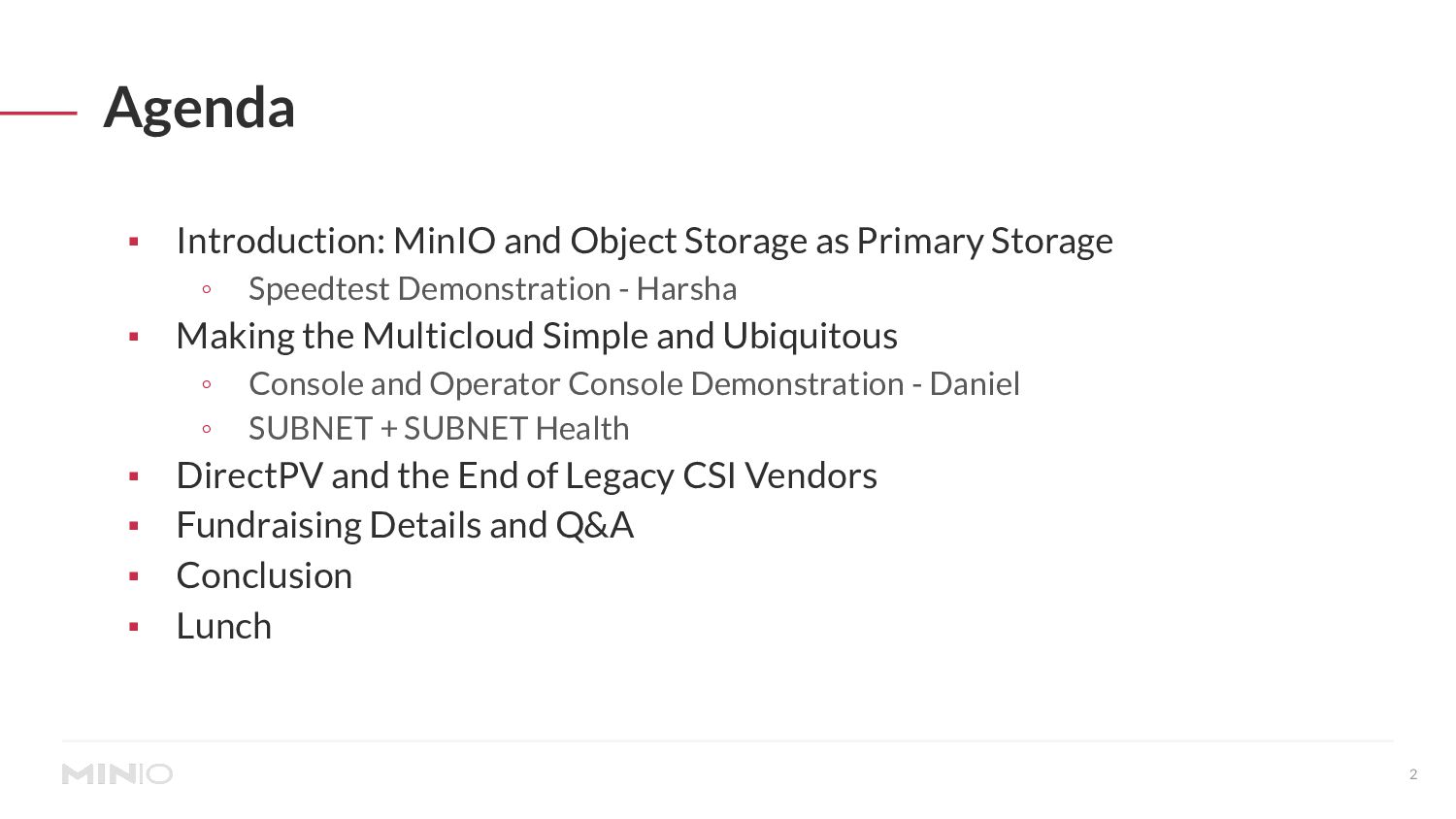
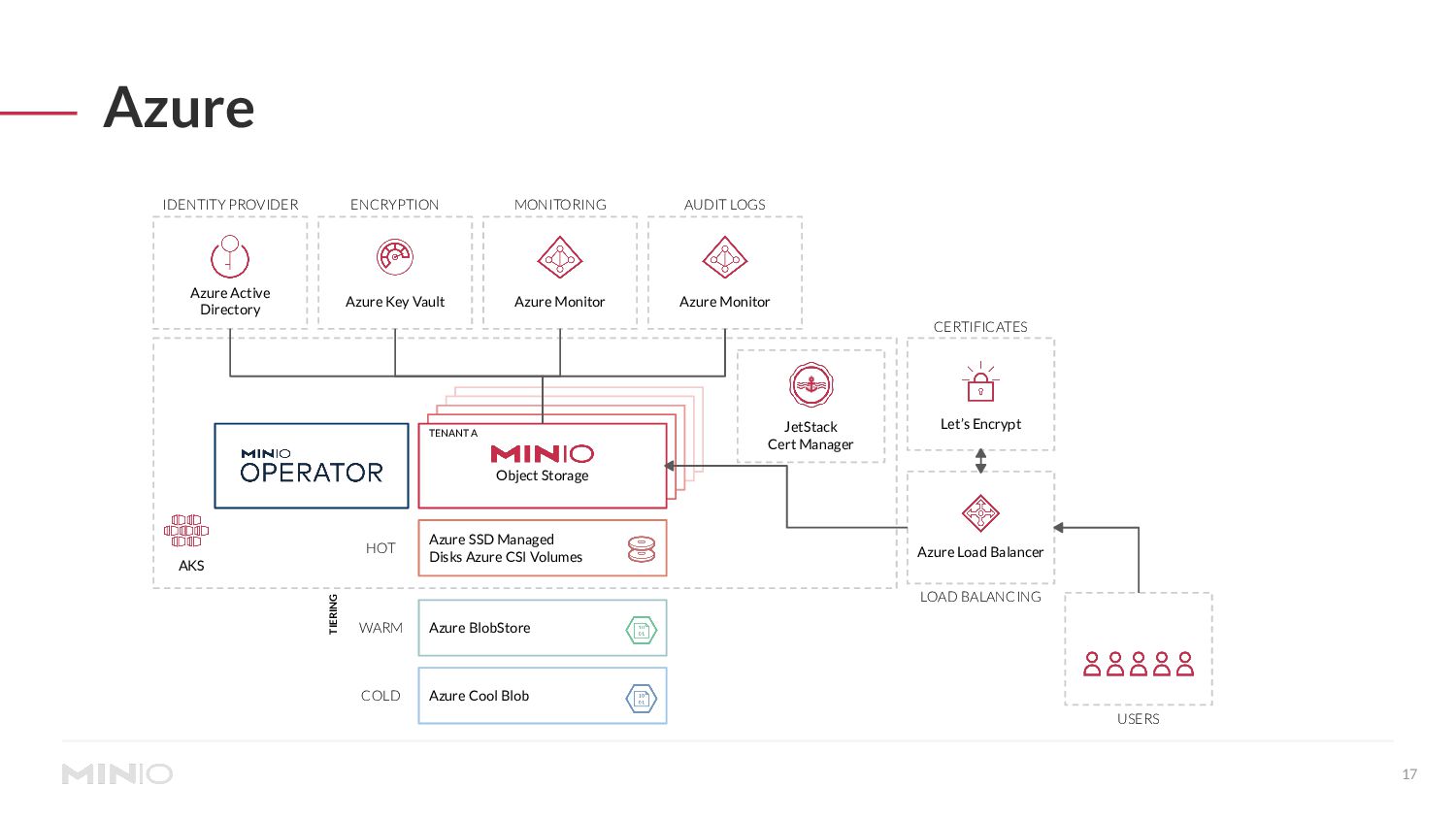
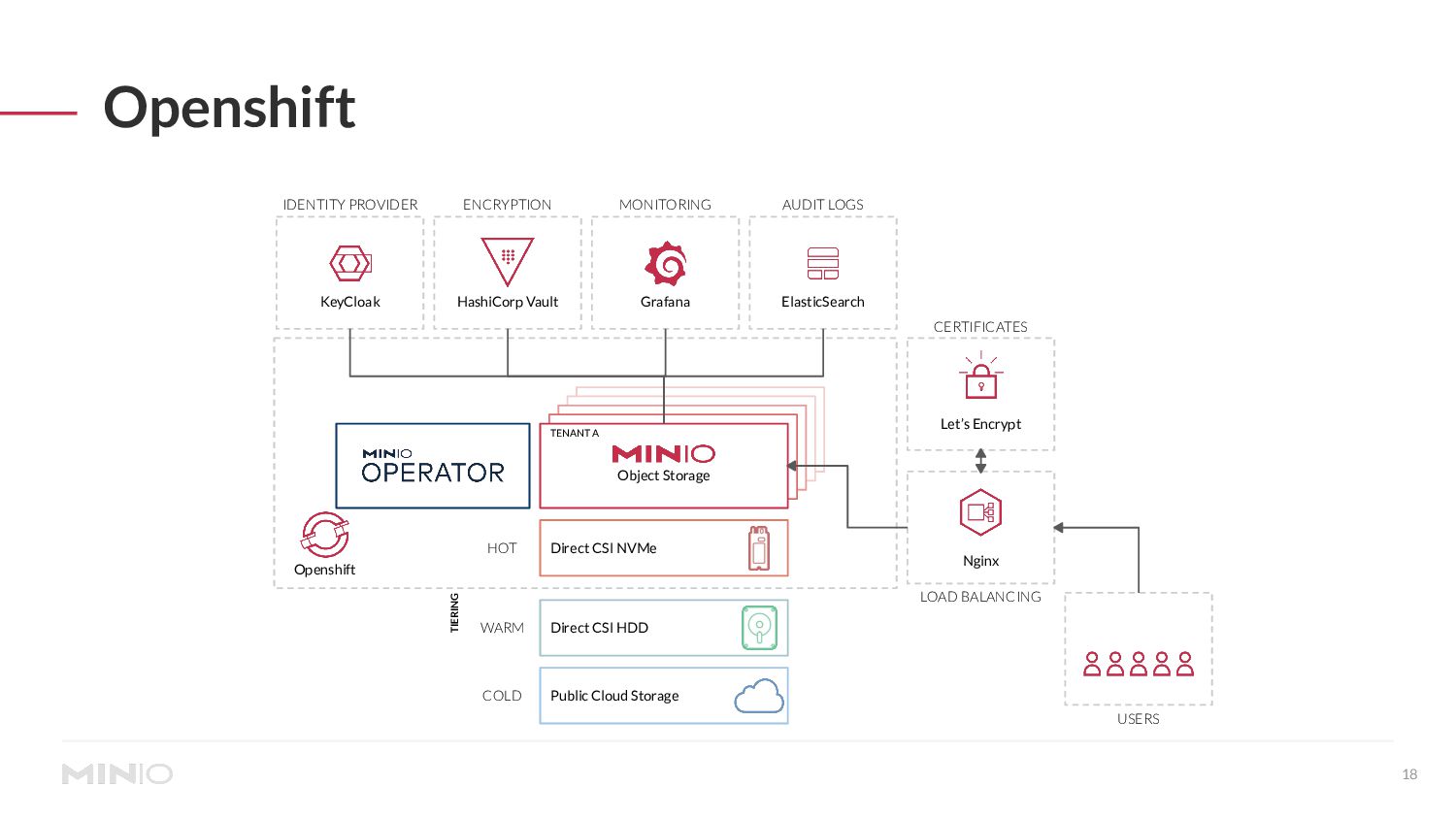
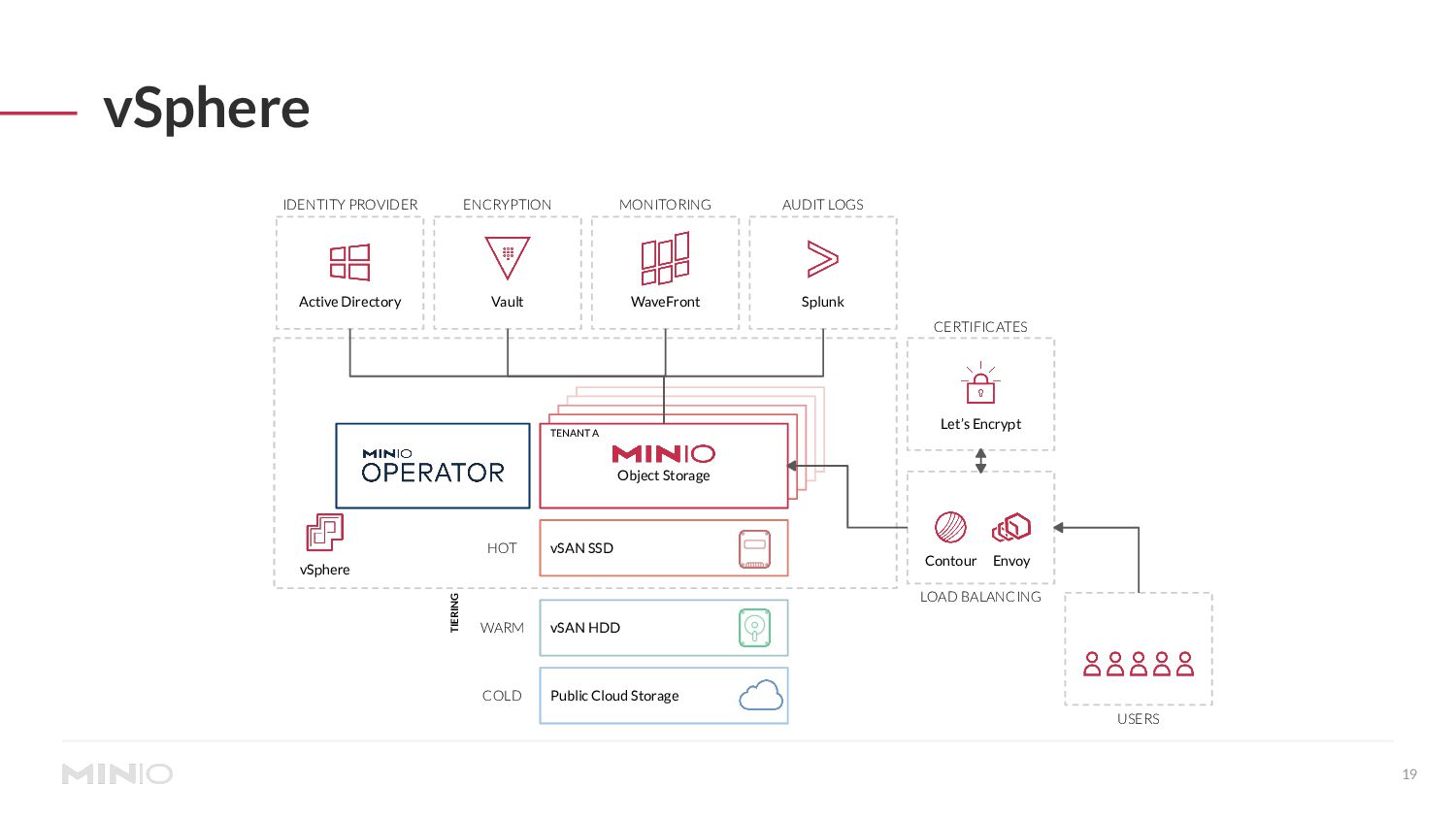
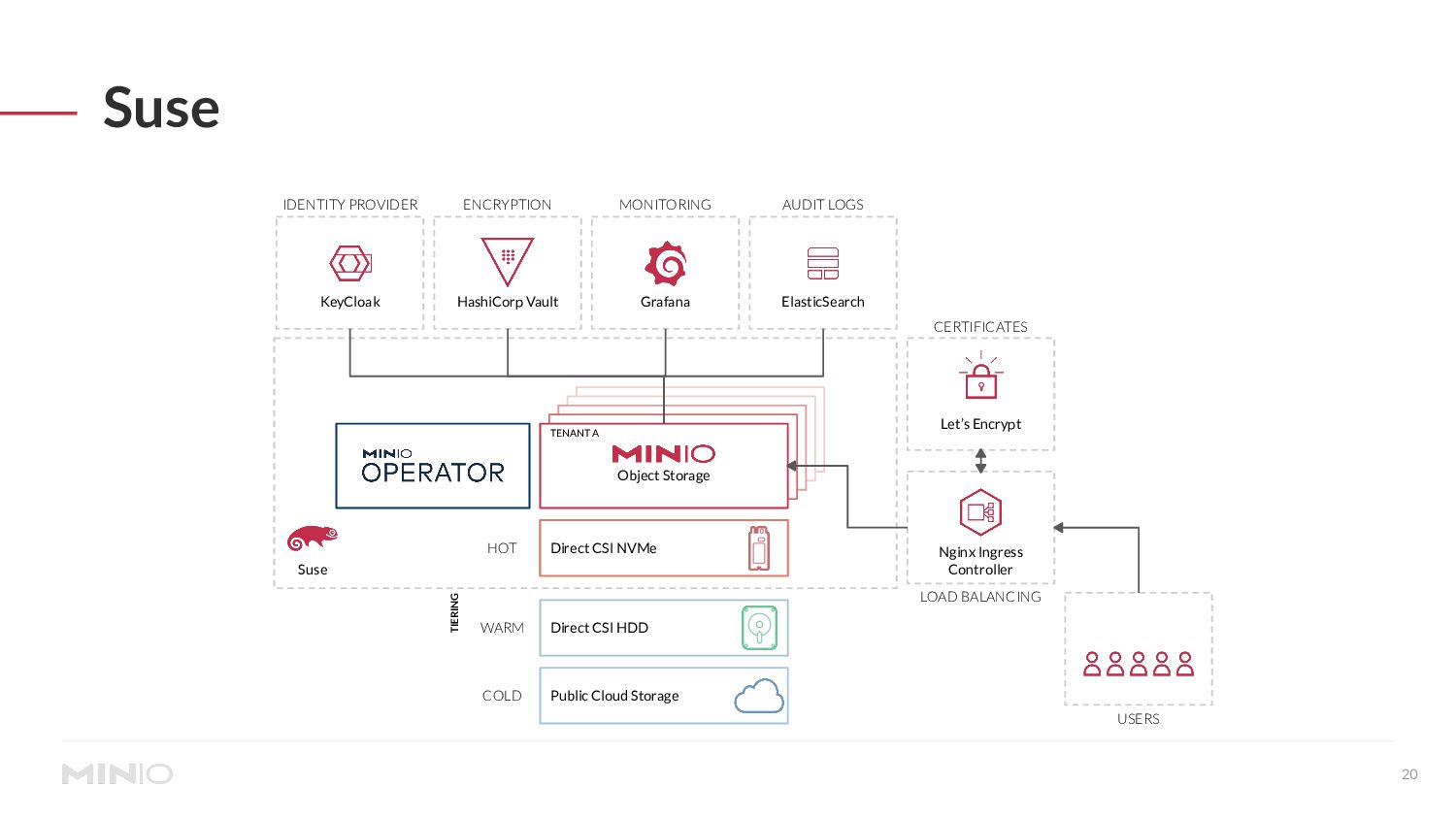
Speedtest Demonstration - Harsha ▪ Making the Multicloud Simple and Ubiquitous ◦ Console and Operator Console Demonstration - Daniel ◦ SUBNET + SUBNET Health ▪ DirectPV and the End of Legacy CSI Vendors ▪ Fundraising Details and Q&A ▪ Conclusion ▪ Lunch 2 Agenda
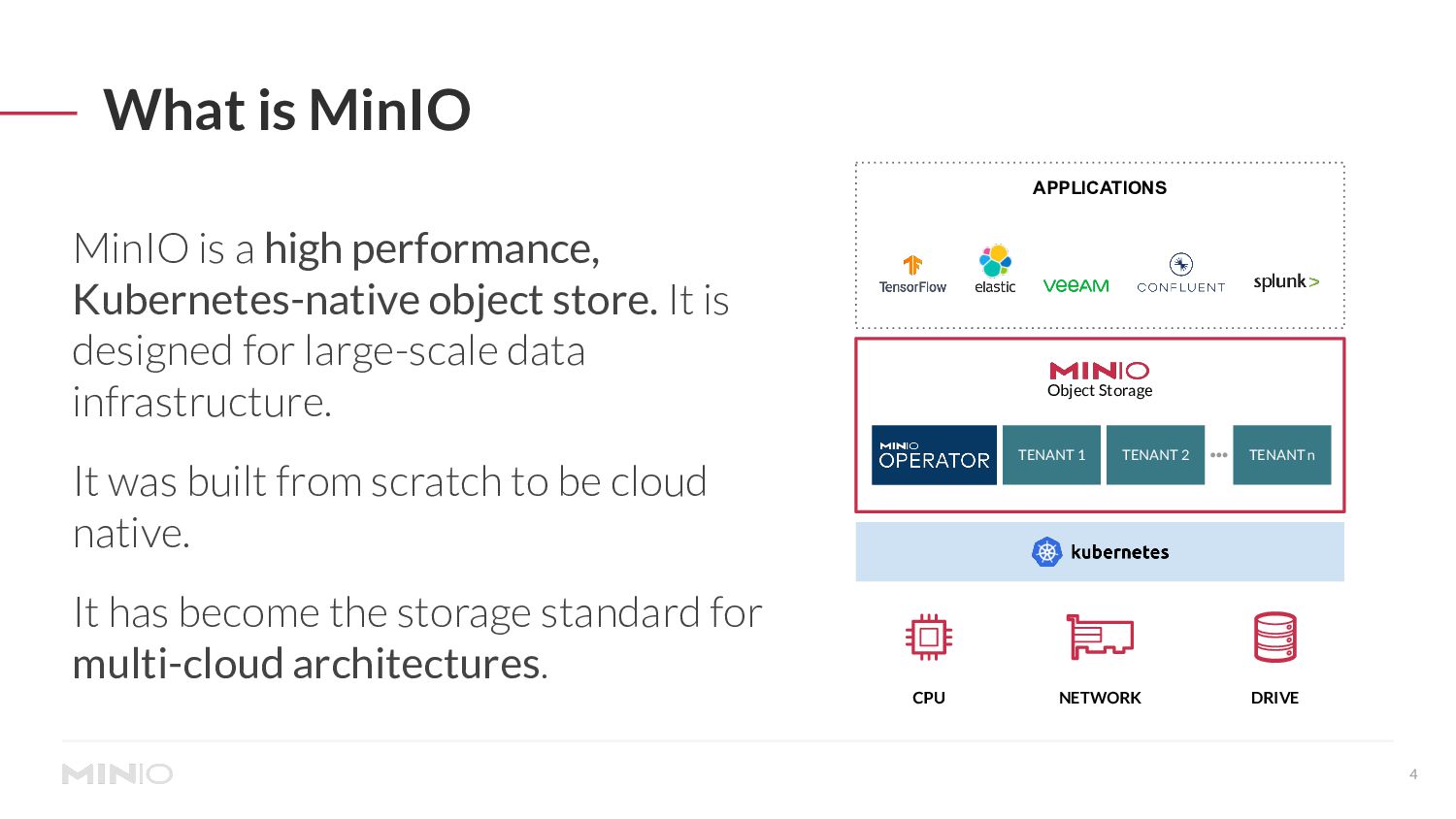
object store. It is designed for large-scale data infrastructure. It was built from scratch to be cloud native. It has become the storage standard for multi-cloud architectures. TENANT 1 TENANT 2 TENANT n Object Storage CPU NETWORK DRIVE APPLICATIONS
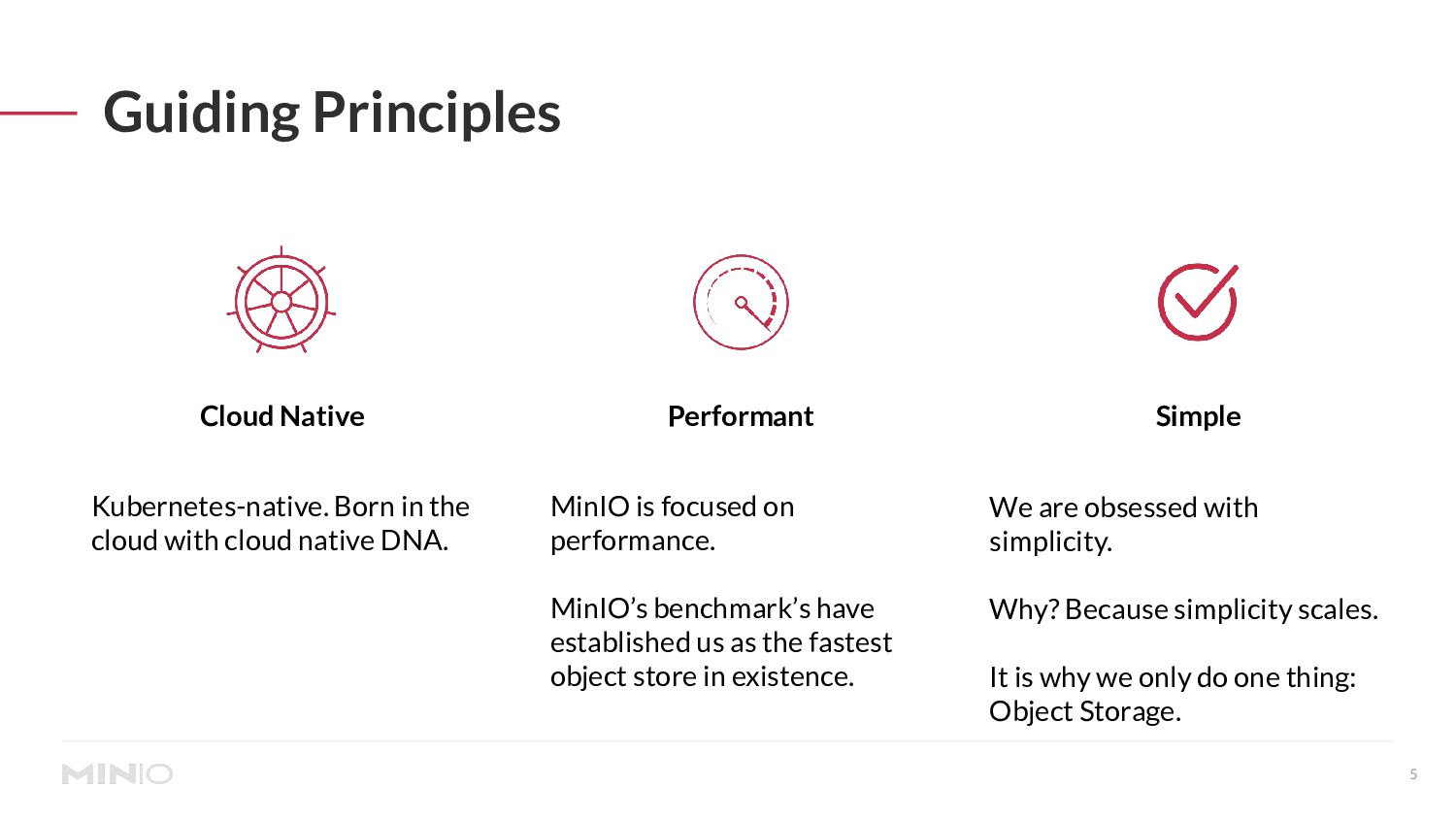
established us as the fastest object store in existence. Kubernetes-native. Born in the cloud with cloud native DNA. We are obsessed with simplicity. Why? Because simplicity scales. It is why we only do one thing: Object Storage. 5 Performant Cloud Native Simple
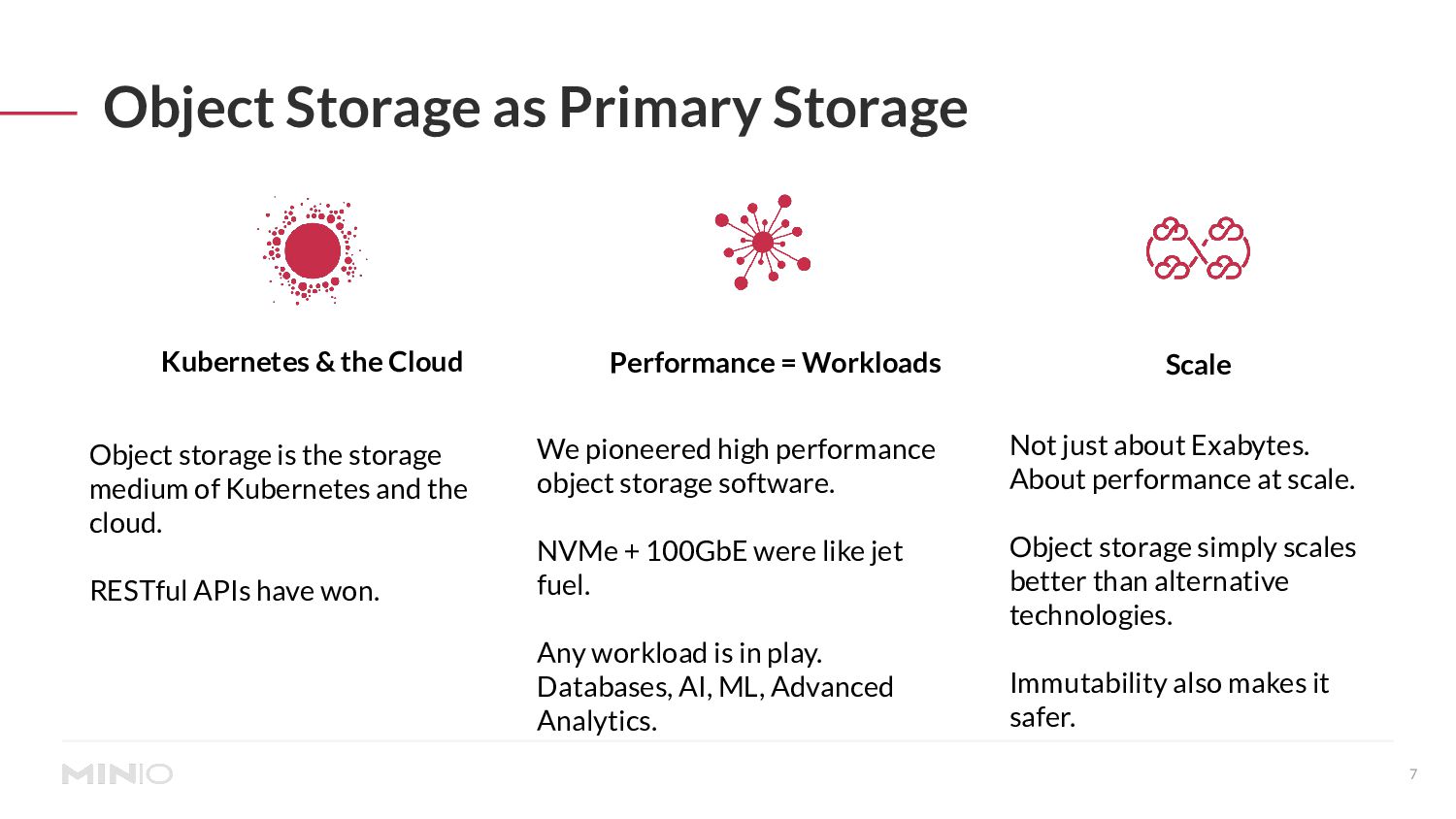
storage medium of Kubernetes and the cloud. RESTful APIs have won. We pioneered high performance object storage software. NVMe + 100GbE were like jet fuel. Any workload is in play. Databases, AI, ML, Advanced Analytics. Not just about Exabytes. About performance at scale. Object storage simply scales better than alternative technologies. Immutability also makes it safer. Kubernetes & the Cloud Performance = Workloads Scale
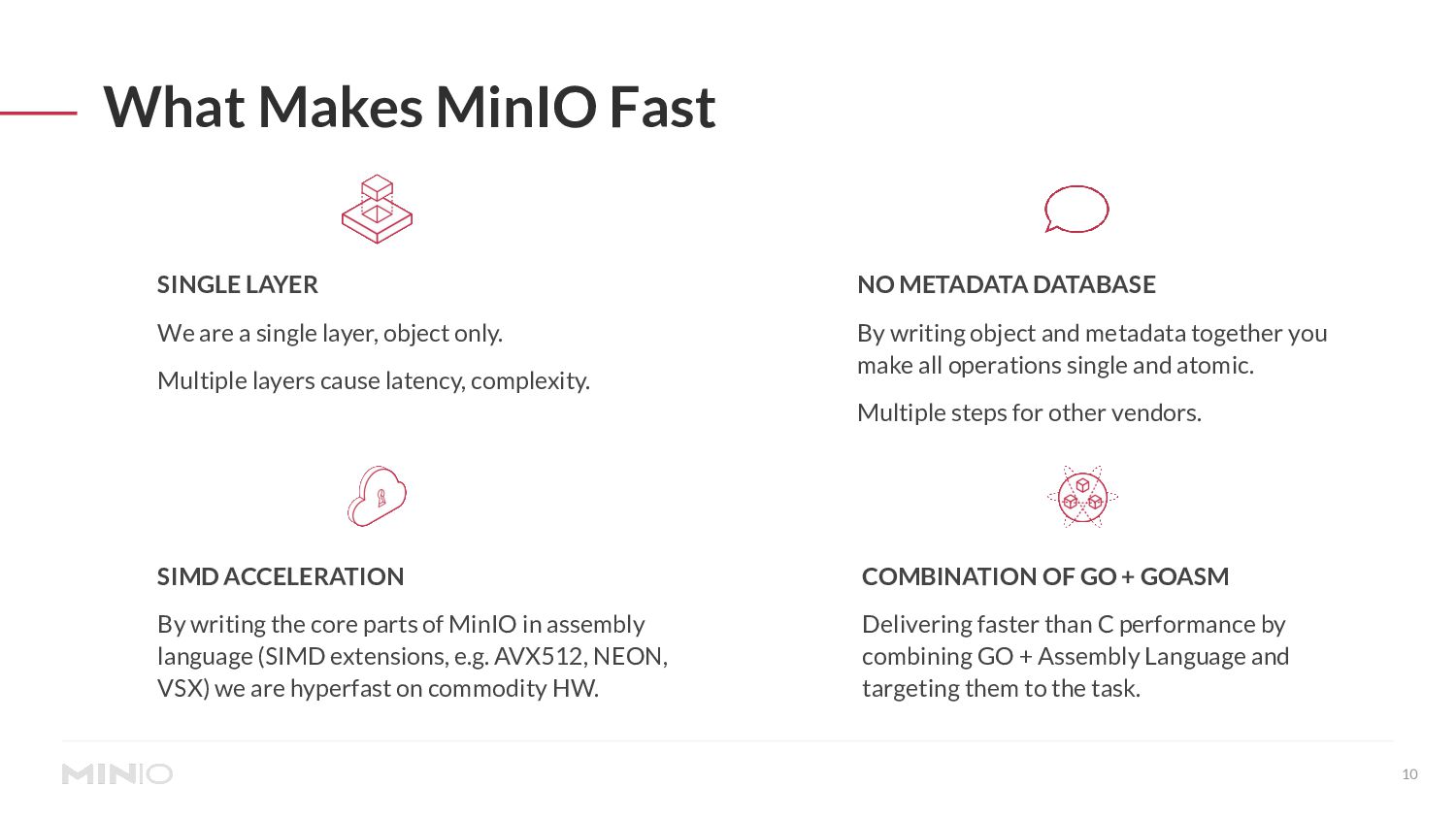
single layer, object only. Multiple layers cause latency, complexity. SIMD ACCELERATION By writing the core parts of MinIO in assembly language (SIMD extensions, e.g. AVX512, NEON, VSX) we are hyperfast on commodity HW. COMBINATION OF GO + GOASM Delivering faster than C performance by combining GO + Assembly Language and targeting them to the task. NO METADATA DATABASE By writing object and metadata together you make all operations single and atomic. Multiple steps for other vendors.
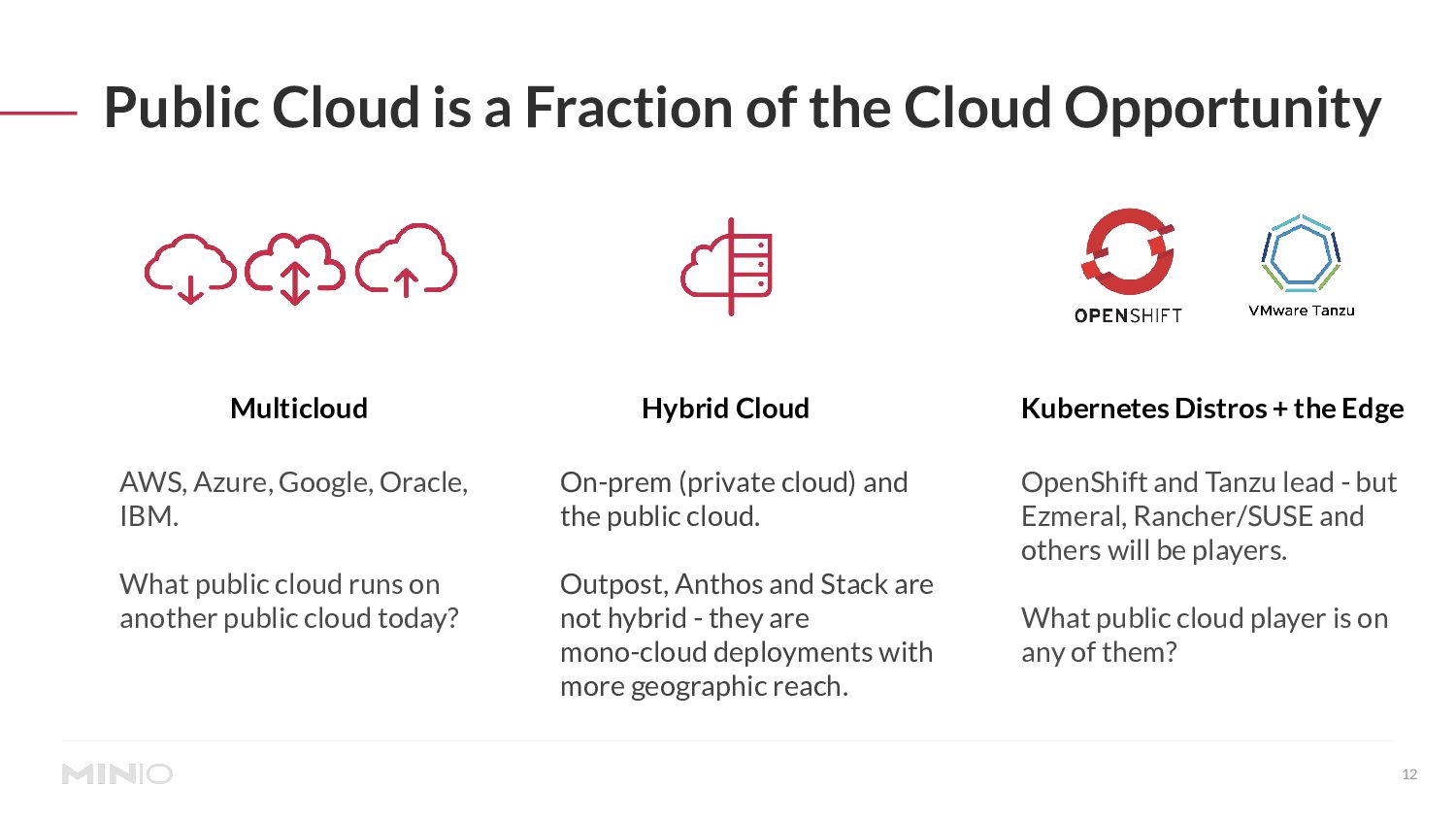
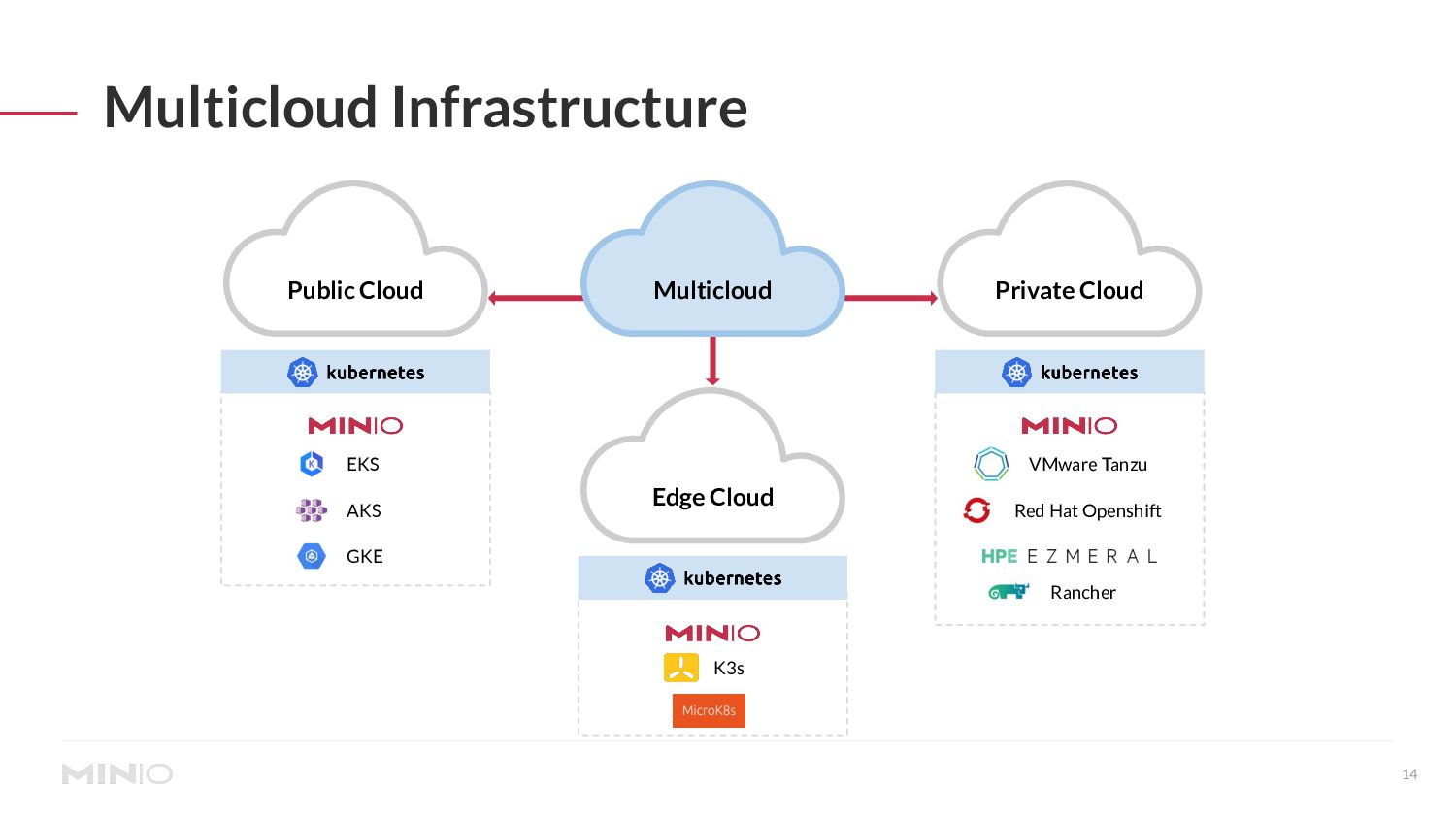
On-prem (private cloud) and the public cloud. Outpost, Anthos and Stack are not hybrid - they are mono-cloud deployments with more geographic reach. Multicloud AWS, Azure, Google, Oracle, IBM. What public cloud runs on another public cloud today? OpenShift and Tanzu lead - but Ezmeral, Rancher/SUSE and others will be players. What public cloud player is on any of them? Kubernetes Distros + the Edge Hybrid Cloud
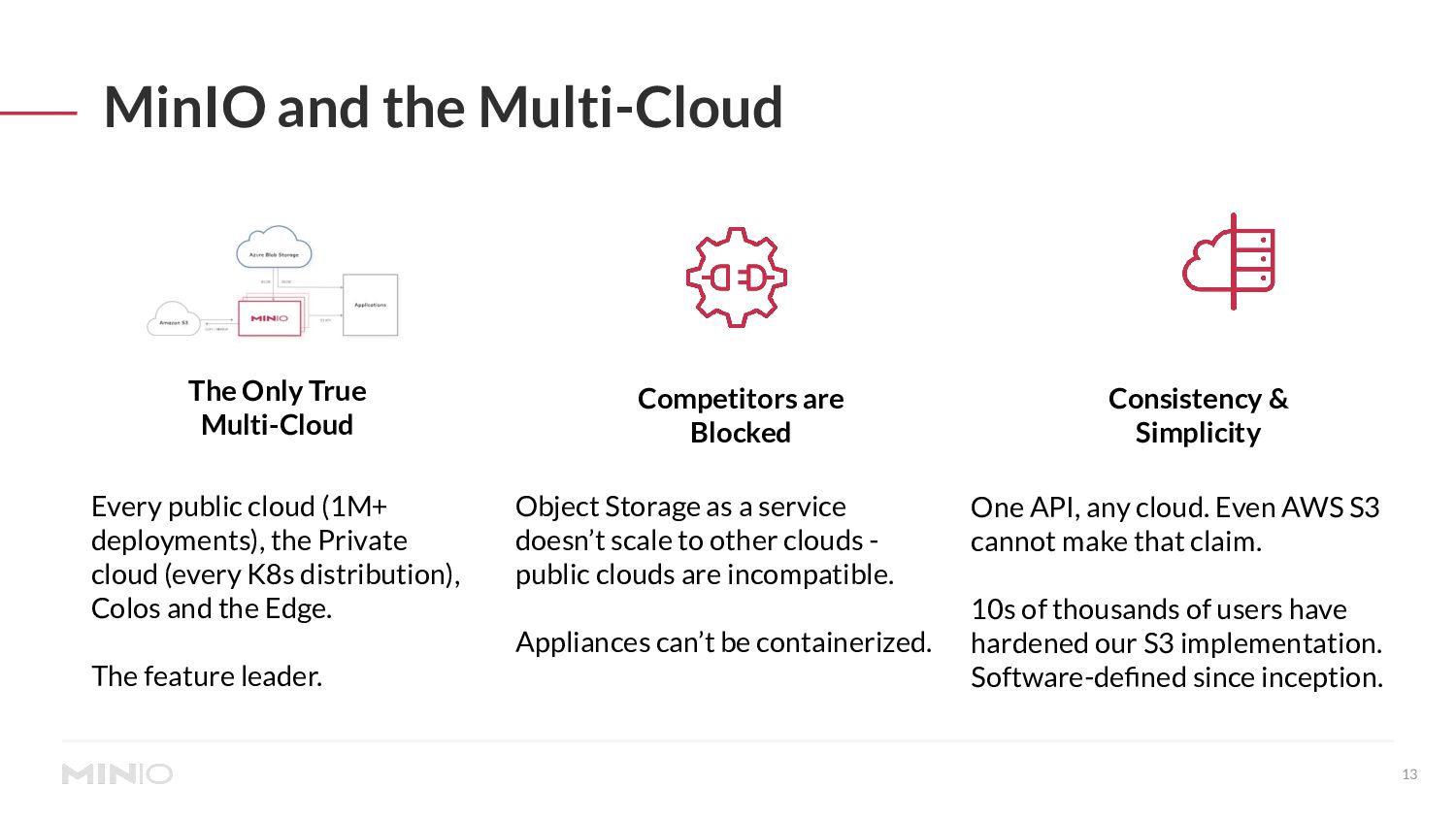
doesn’t scale to other clouds - public clouds are incompatible. Appliances can’t be containerized. Every public cloud (1M+ deployments), the Private cloud (every K8s distribution), Colos and the Edge. The feature leader. One API, any cloud. Even AWS S3 cannot make that claim. 10s of thousands of users have hardened our S3 implementation. Software-defined since inception. Competitors are Blocked The Only True Multi-Cloud Consistency & Simplicity
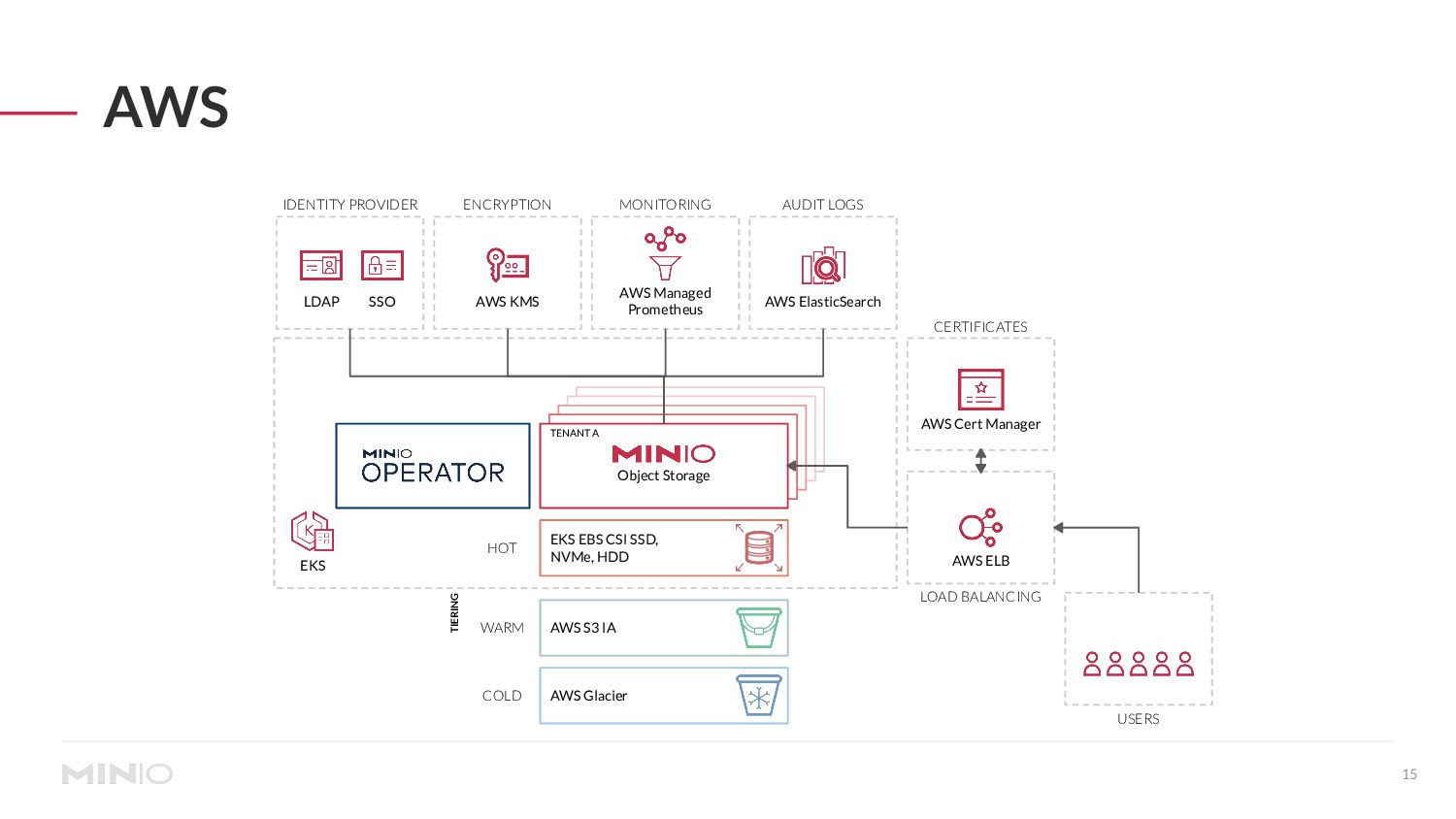
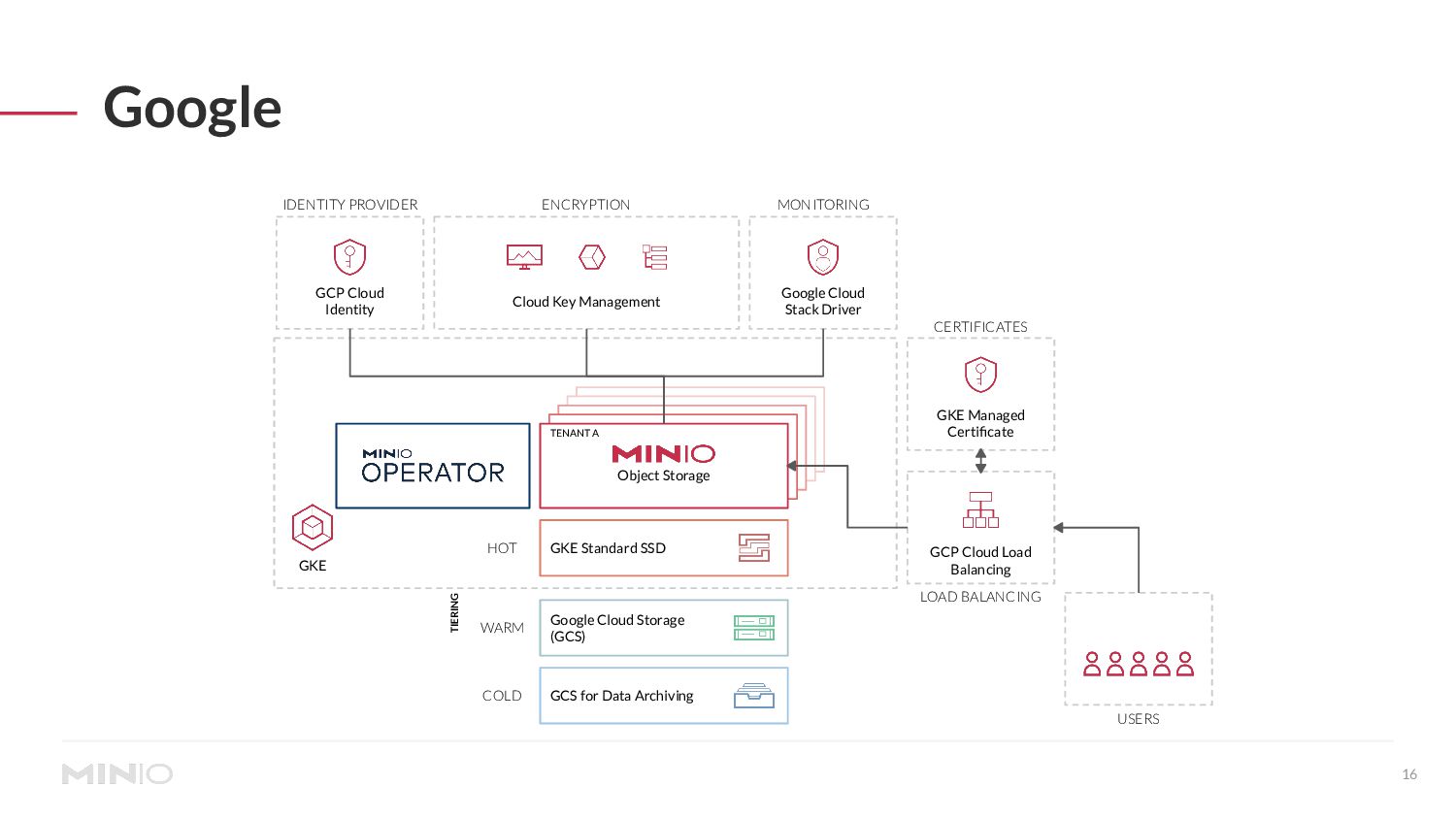
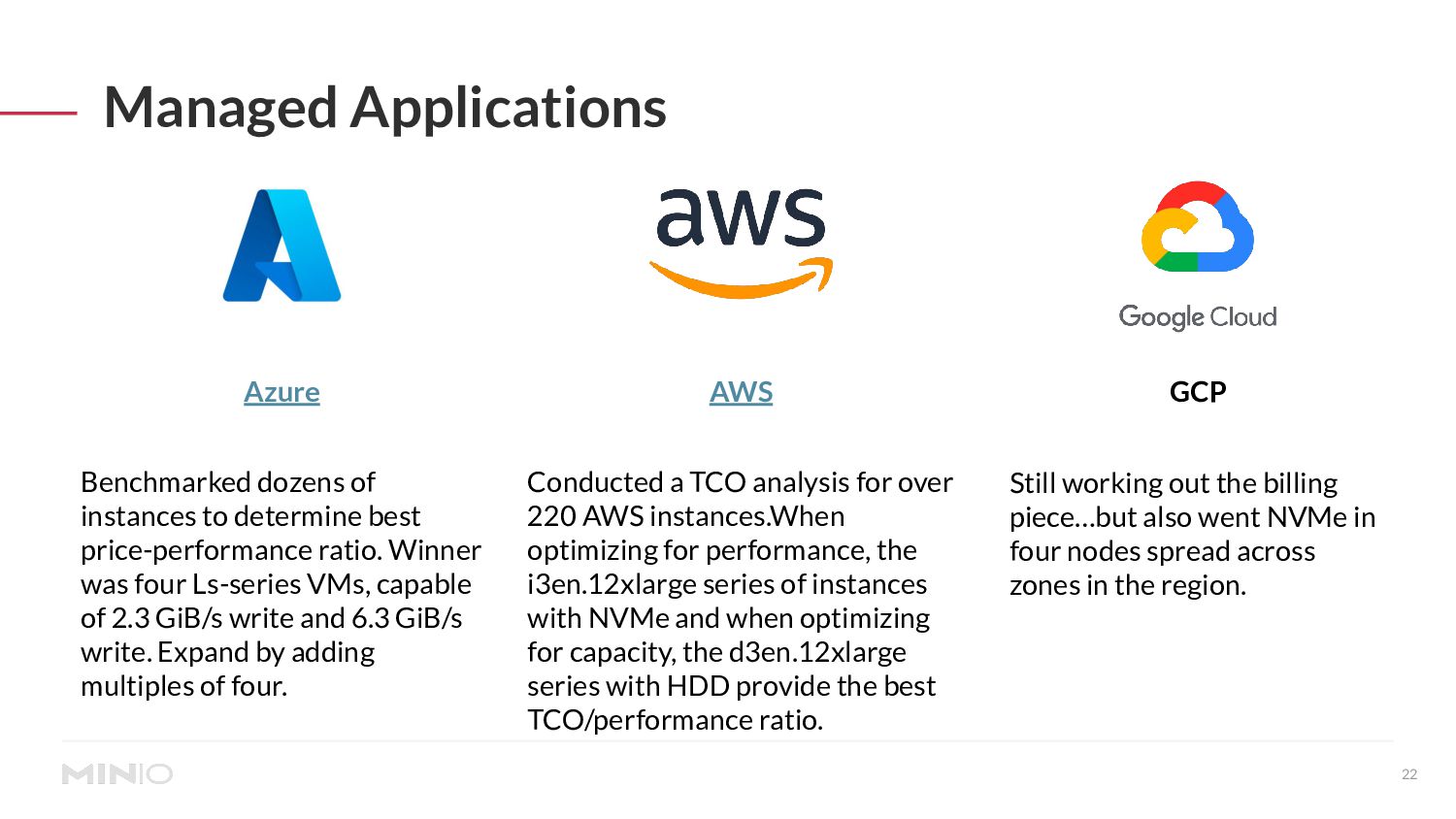
AWS instances.When optimizing for performance, the i3en.12xlarge series of instances with NVMe and when optimizing for capacity, the d3en.12xlarge series with HDD provide the best TCO/performance ratio. Benchmarked dozens of instances to determine best price-performance ratio. Winner was four Ls-series VMs, capable of 2.3 GiB/s write and 6.3 GiB/s write. Expand by adding multiples of four. Still working out the billing piece…but also went NVMe in four nodes spread across zones in the region. AWS Azure GCP
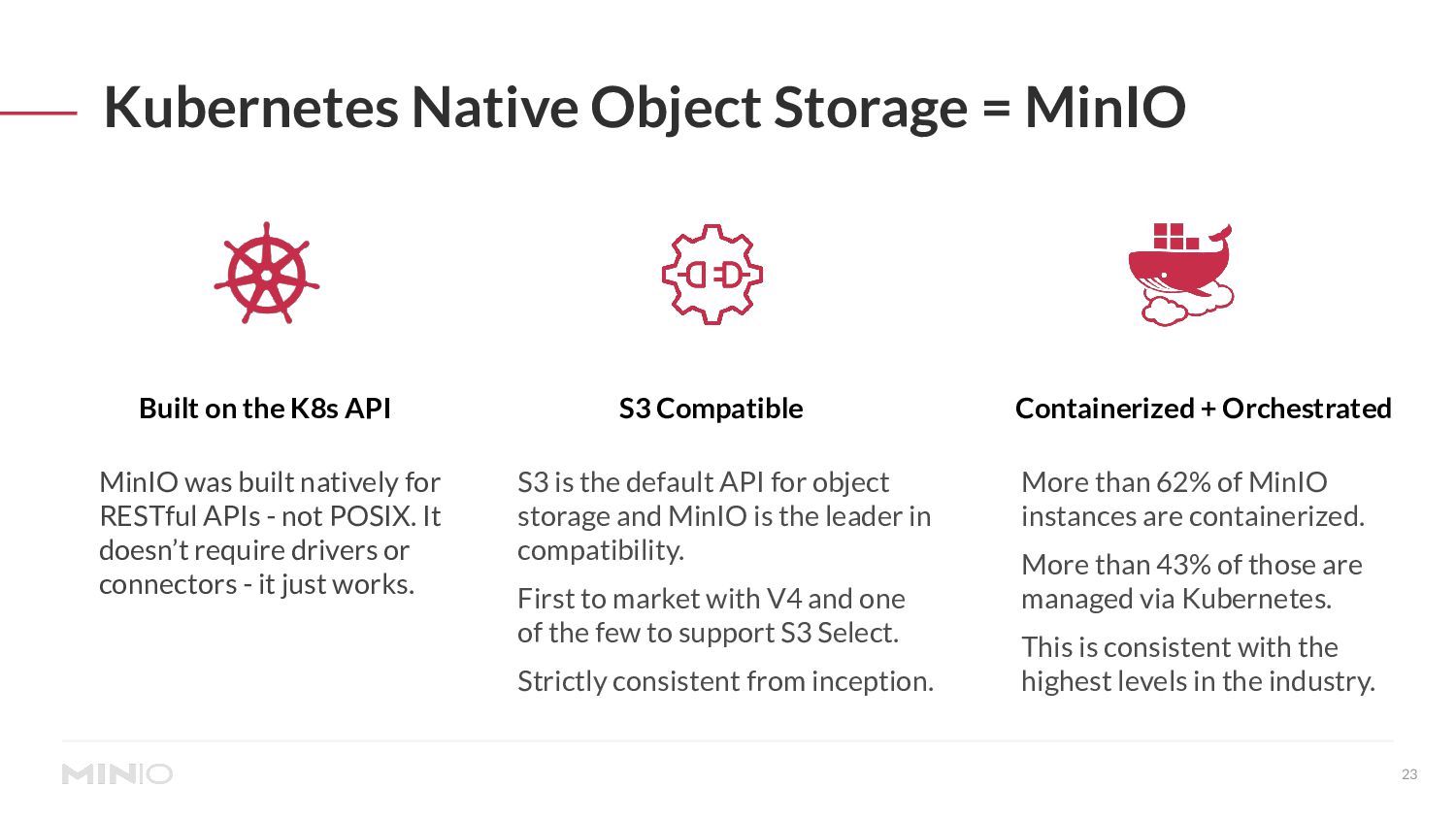
natively for RESTful APIs - not POSIX. It doesn’t require drivers or connectors - it just works. S3 Compatible S3 is the default API for object storage and MinIO is the leader in compatibility. First to market with V4 and one of the few to support S3 Select. Strictly consistent from inception. More than 62% of MinIO instances are containerized. More than 43% of those are managed via Kubernetes. This is consistent with the highest levels in the industry. Containerized + Orchestrated Built on the K8s API
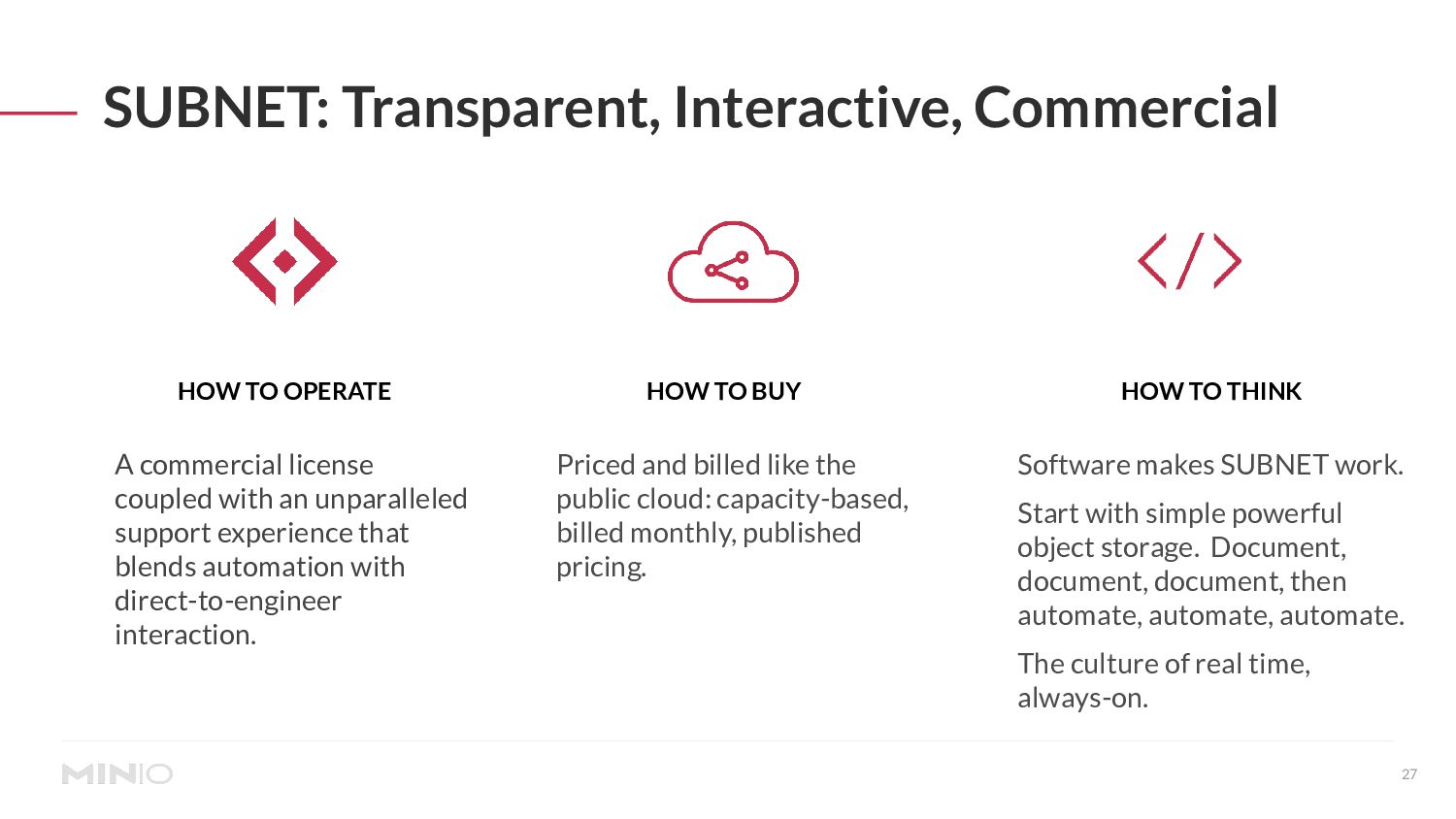
an unparalleled support experience that blends automation with direct-to-engineer interaction. Priced and billed like the public cloud: capacity-based, billed monthly, published pricing. Software makes SUBNET work. Start with simple powerful object storage. Document, document, document, then automate, automate, automate. The culture of real time, always-on. HOW TO BUY HOW TO THINK HOW TO OPERATE
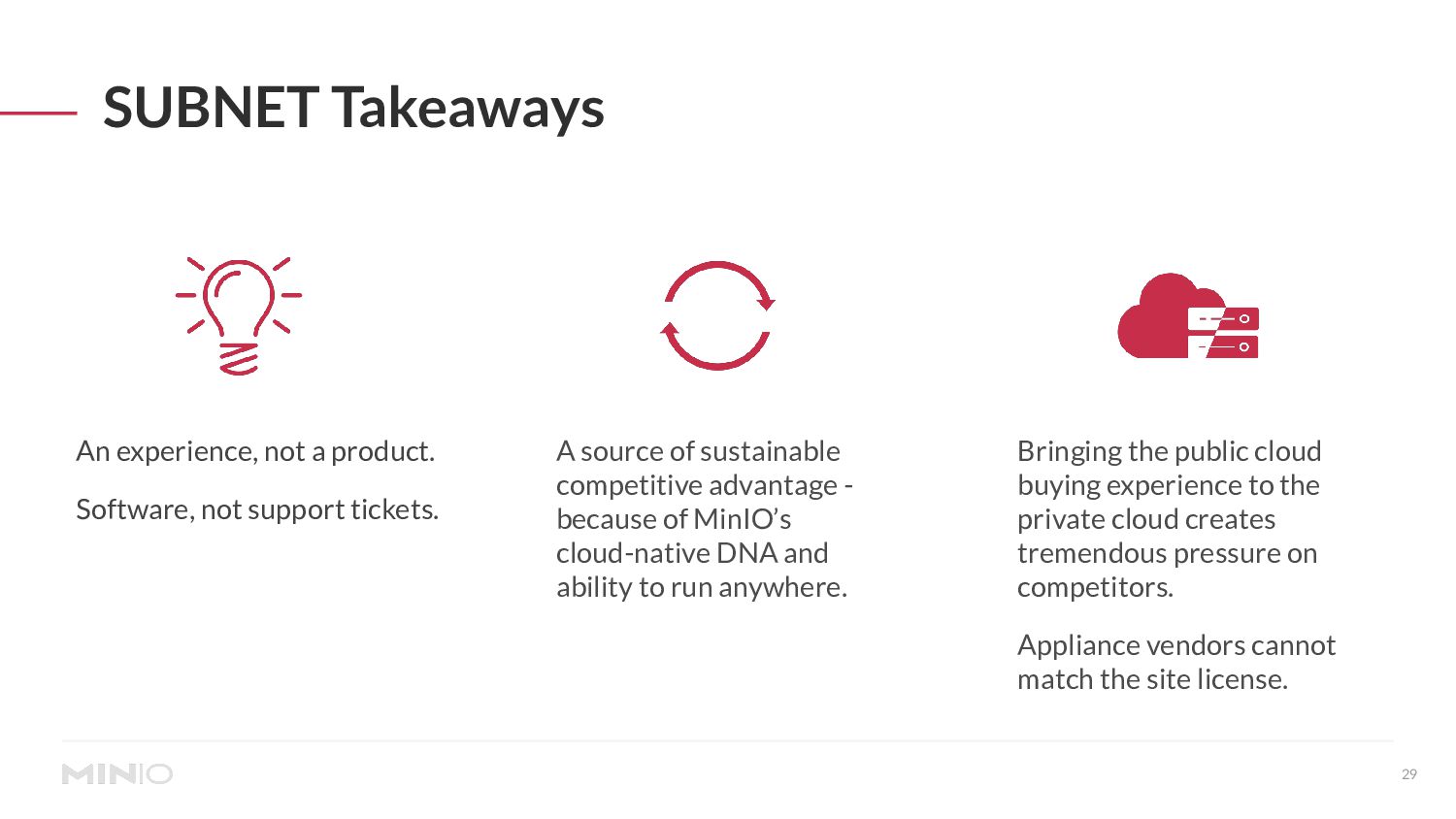
support tickets. A source of sustainable competitive advantage - because of MinIO’s cloud-native DNA and ability to run anywhere. Bringing the public cloud buying experience to the private cloud creates tremendous pressure on competitors. Appliance vendors cannot match the site license.
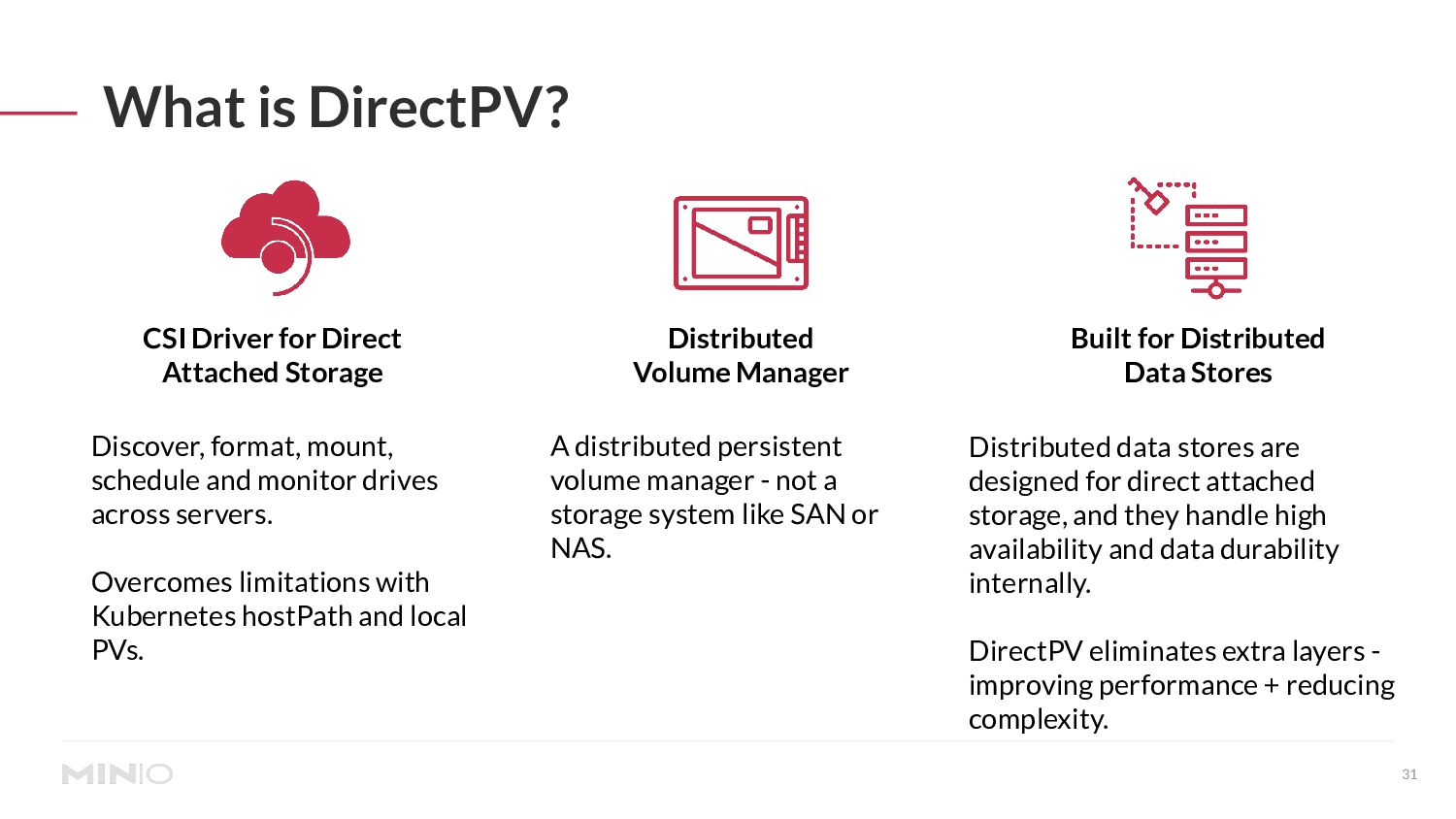
not a storage system like SAN or NAS. Discover, format, mount, schedule and monitor drives across servers. Overcomes limitations with Kubernetes hostPath and local PVs. Distributed data stores are designed for direct attached storage, and they handle high availability and data durability internally. DirectPV eliminates extra layers - improving performance + reducing complexity. Distributed Volume Manager CSI Driver for Direct Attached Storage Built for Distributed Data Stores
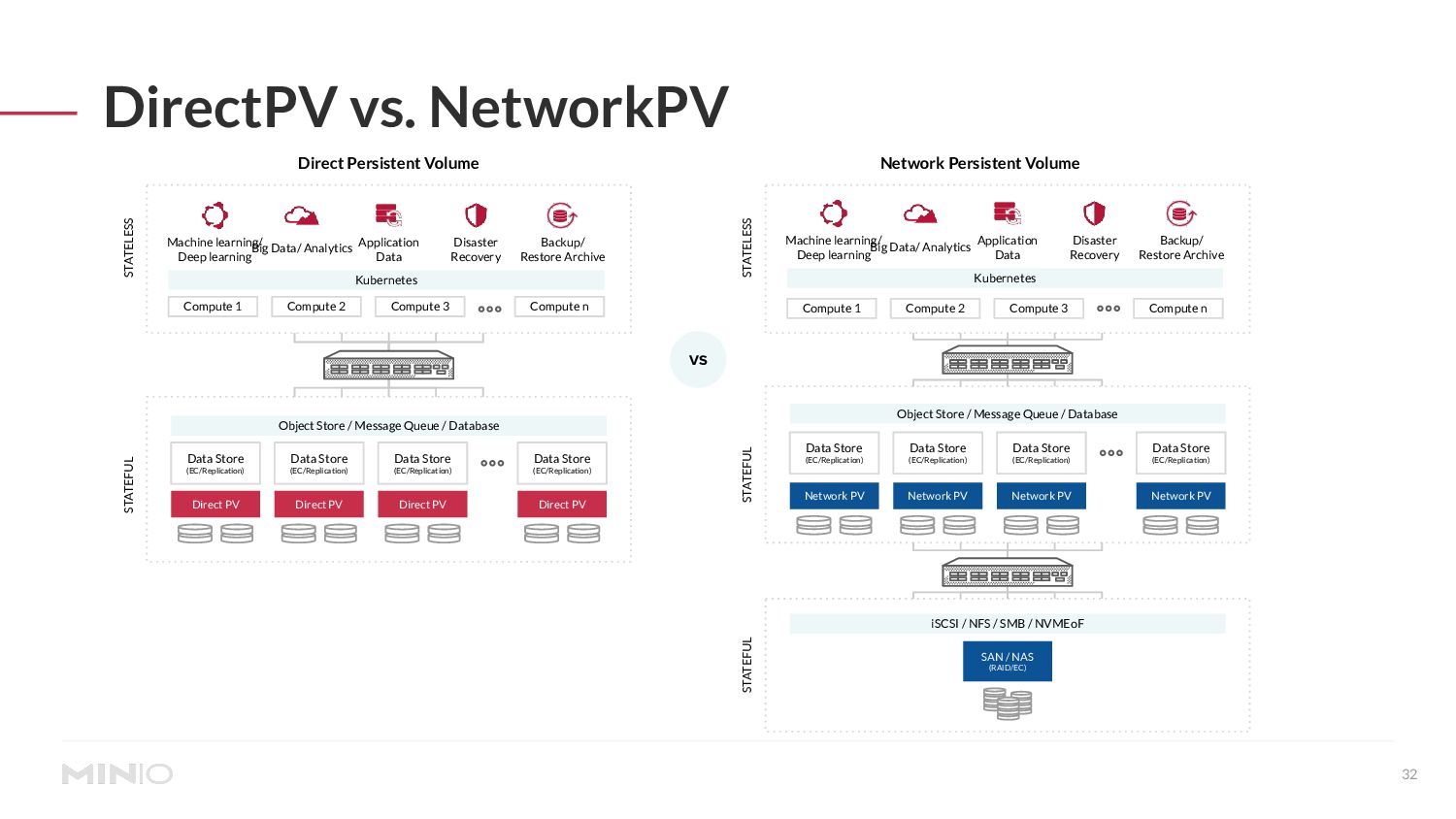
Recovery Backup/ Restore Archive Kubernetes Compute 1 Compute 2 Compute 3 Compute n DirectPV vs. NetworkPV 32 Network Persistent Volume Direct Persistent Volume STATELESS Object Store / Message Queue / Database Data Store (EC/Replication) Data Store (EC/Replication) Data Store (EC/Replication) Data Store (EC/Replication) Direct PV Direct PV Direct PV Direct PV STATEFUL STATELESS Machine learning/ Deep learning Big Data/ Analytics Application Data Disaster Recovery Backup/ Restore Archive Kubernetes Compute 1 Compute 2 Compute 3 Compute n Object Store / Message Queue / Database Data Store (EC/Replication) Data Store (EC/Replication) Data Store (EC/Replication) Data Store (EC/Replication) Network PV Network PV Network PV Network PV STATEFUL iSCSI / NFS / SMB / NVMEoF SAN / NAS (RAID/EC) STATEFUL VS
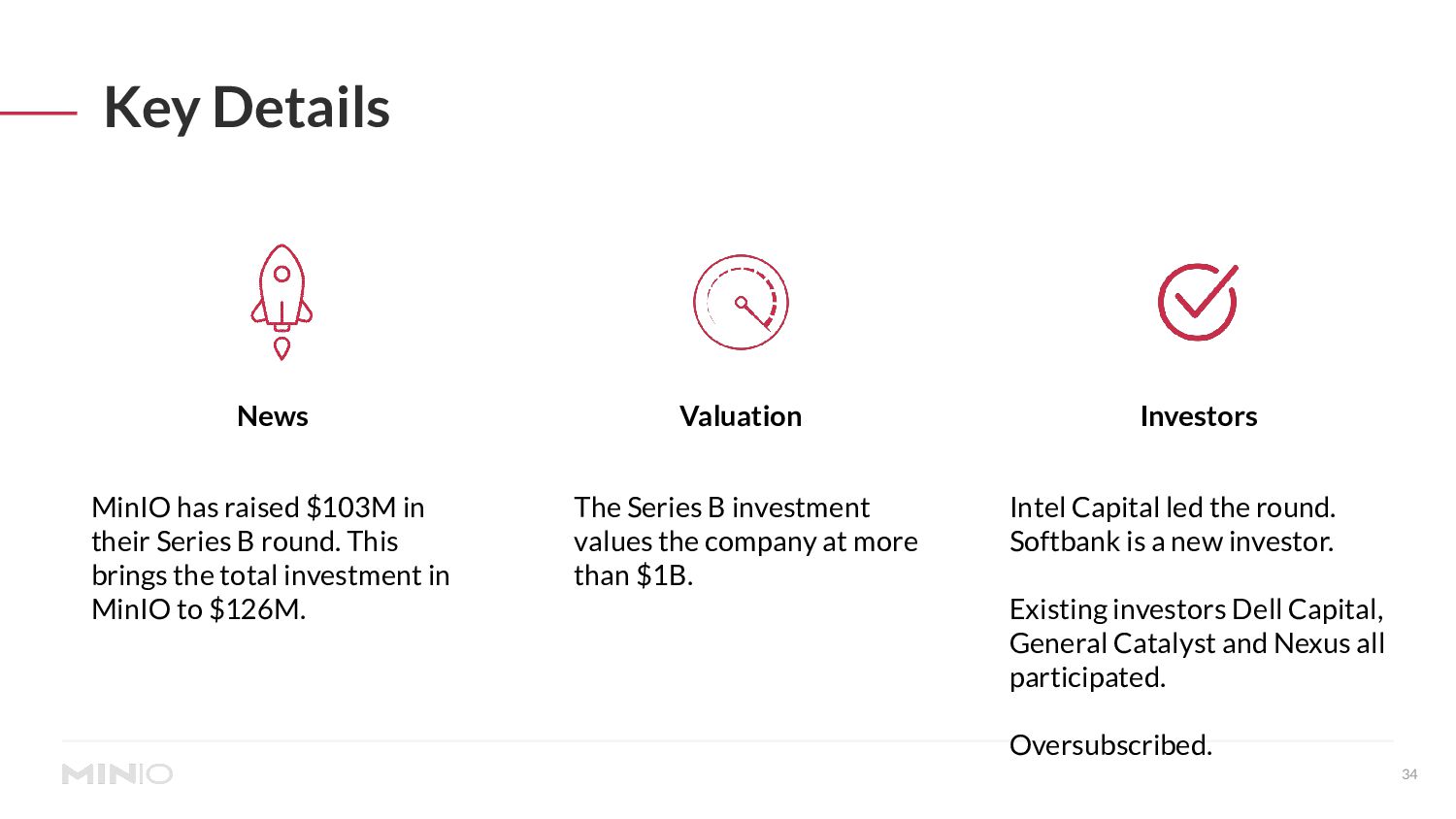
at more than $1B. MinIO has raised $103M in their Series B round. This brings the total investment in MinIO to $126M. Intel Capital led the round. Softbank is a new investor. Existing investors Dell Capital, General Catalyst and Nexus all participated. Oversubscribed. Valuation News Investors
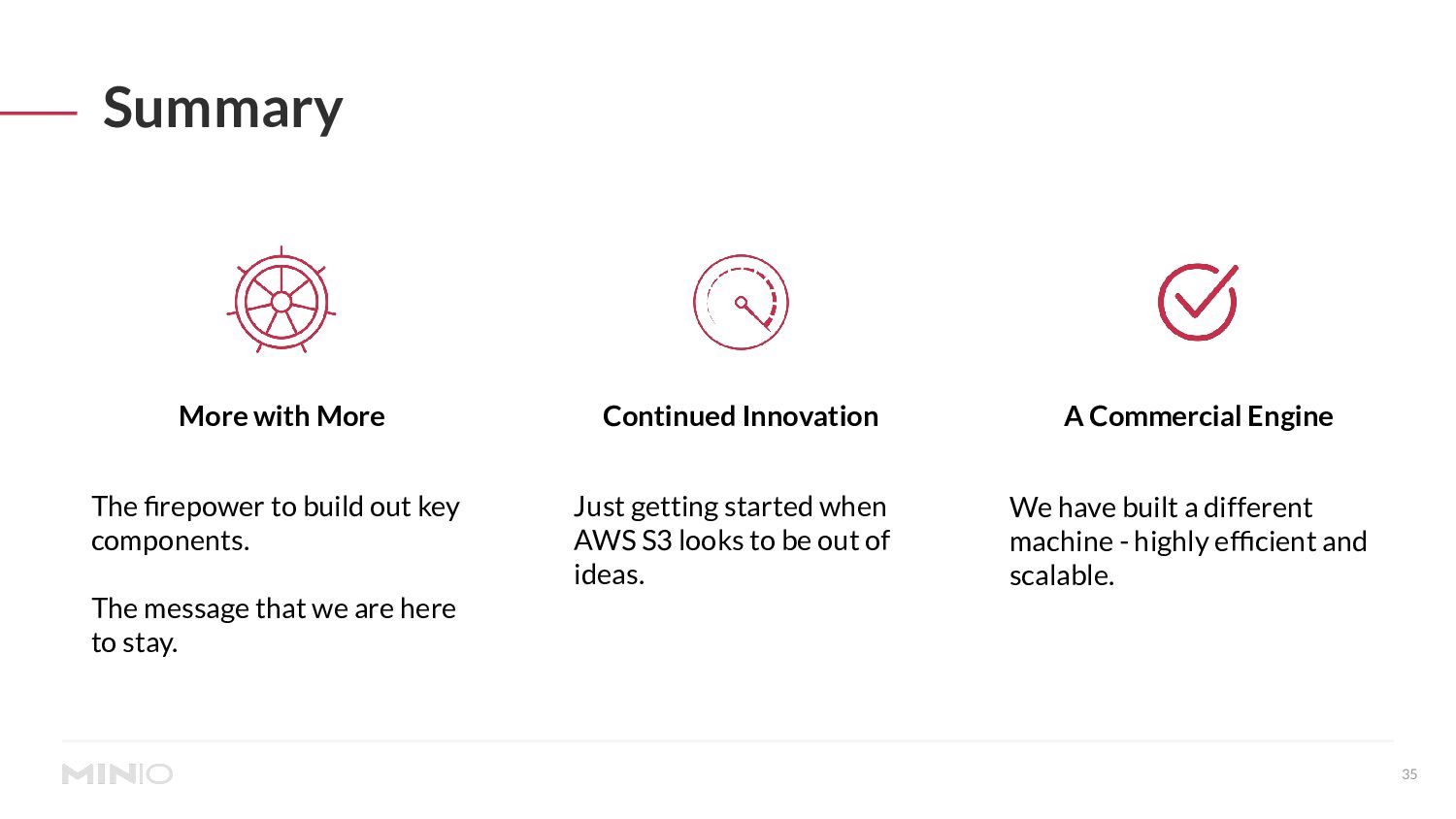
be out of ideas. The firepower to build out key components. The message that we are here to stay. We have built a different machine - highly efficient and scalable. Continued Innovation More with More A Commercial Engine
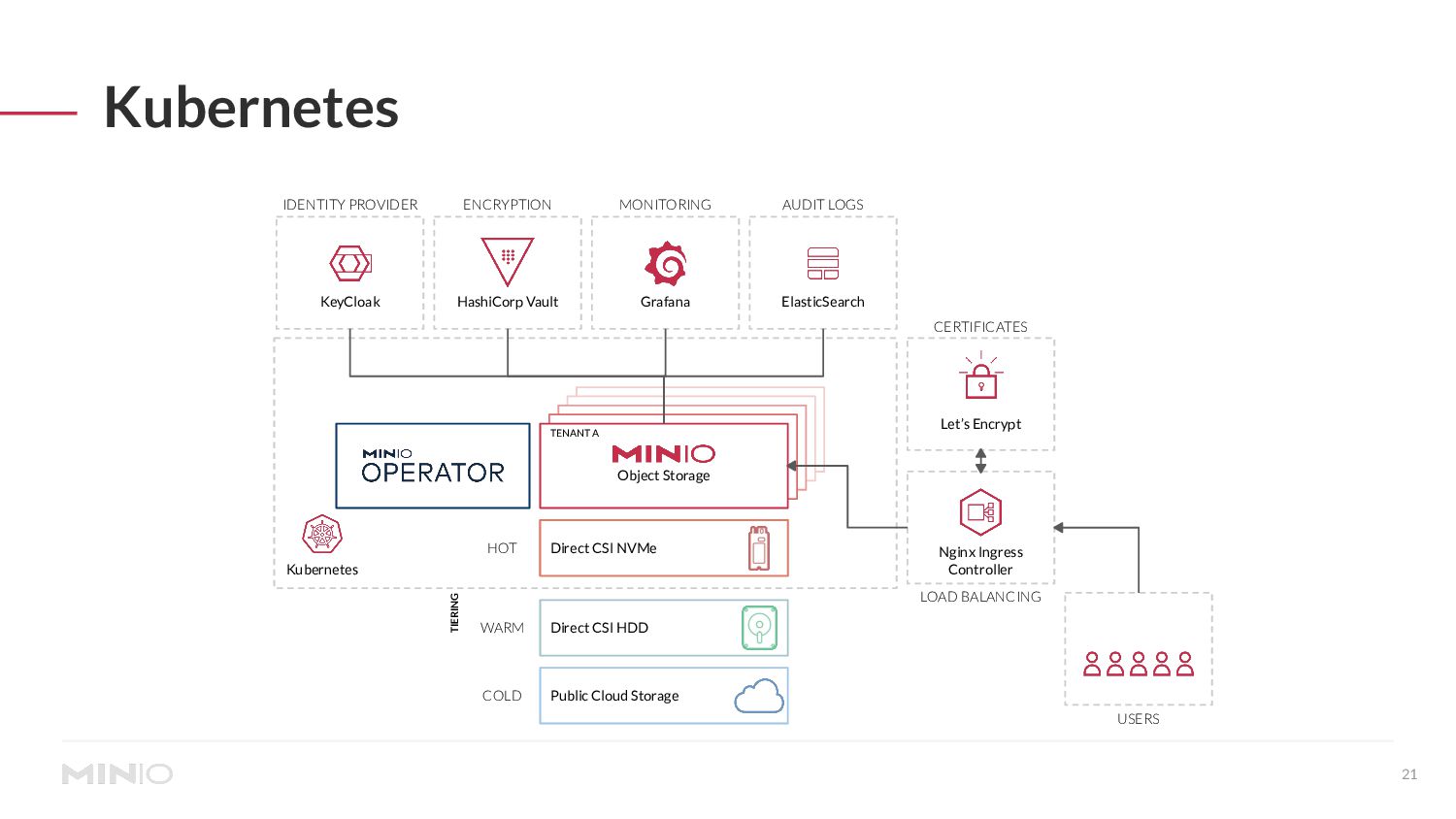
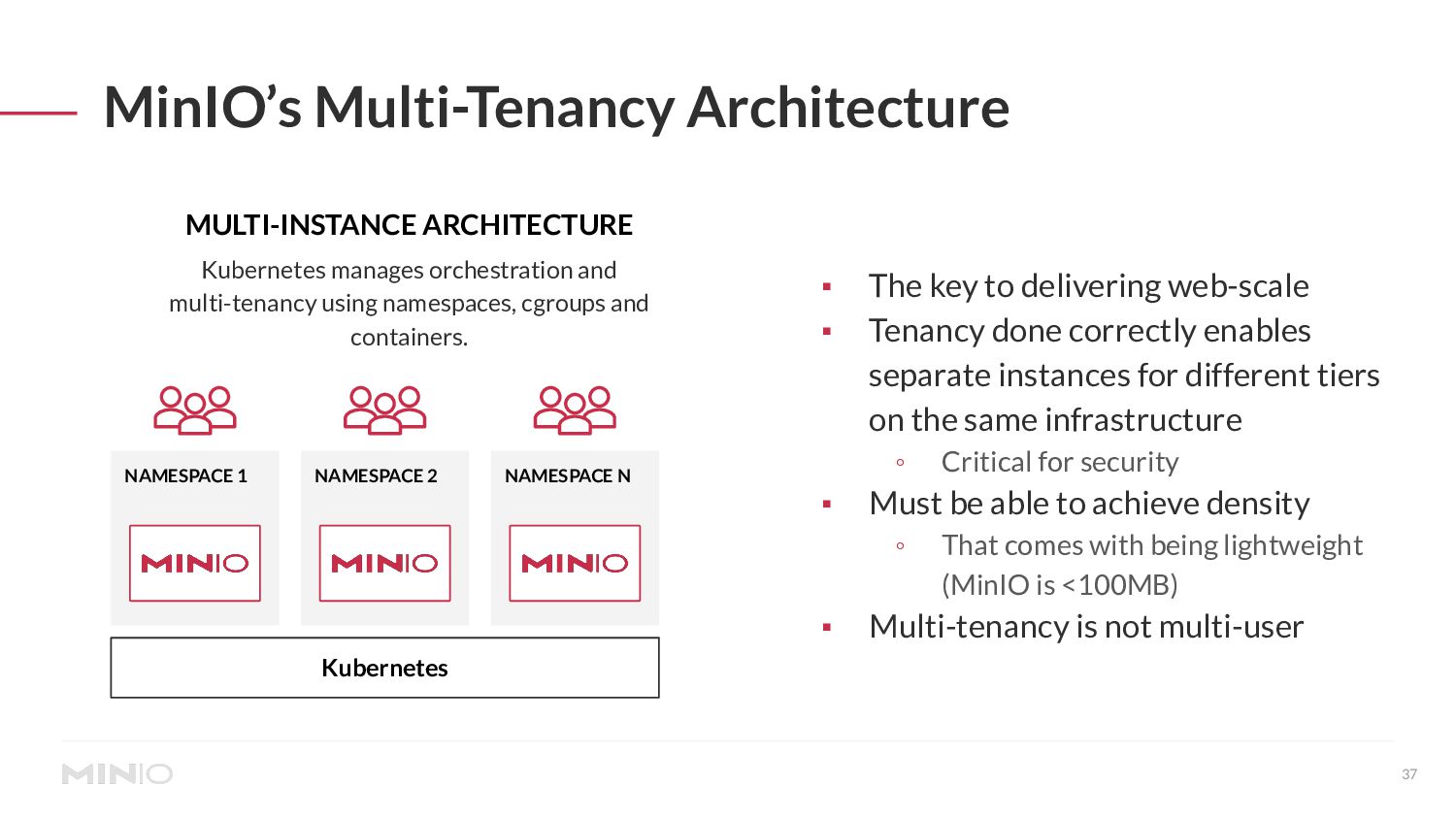
MULTI-INSTANCE ARCHITECTURE Kubernetes manages orchestration and multi-tenancy using namespaces, cgroups and containers. Kubernetes ▪ The key to delivering web-scale ▪ Tenancy done correctly enables separate instances for different tiers on the same infrastructure ◦ Critical for security ▪ Must be able to achieve density ◦ That comes with being lightweight (MinIO is <100MB) ▪ Multi-tenancy is not multi-user
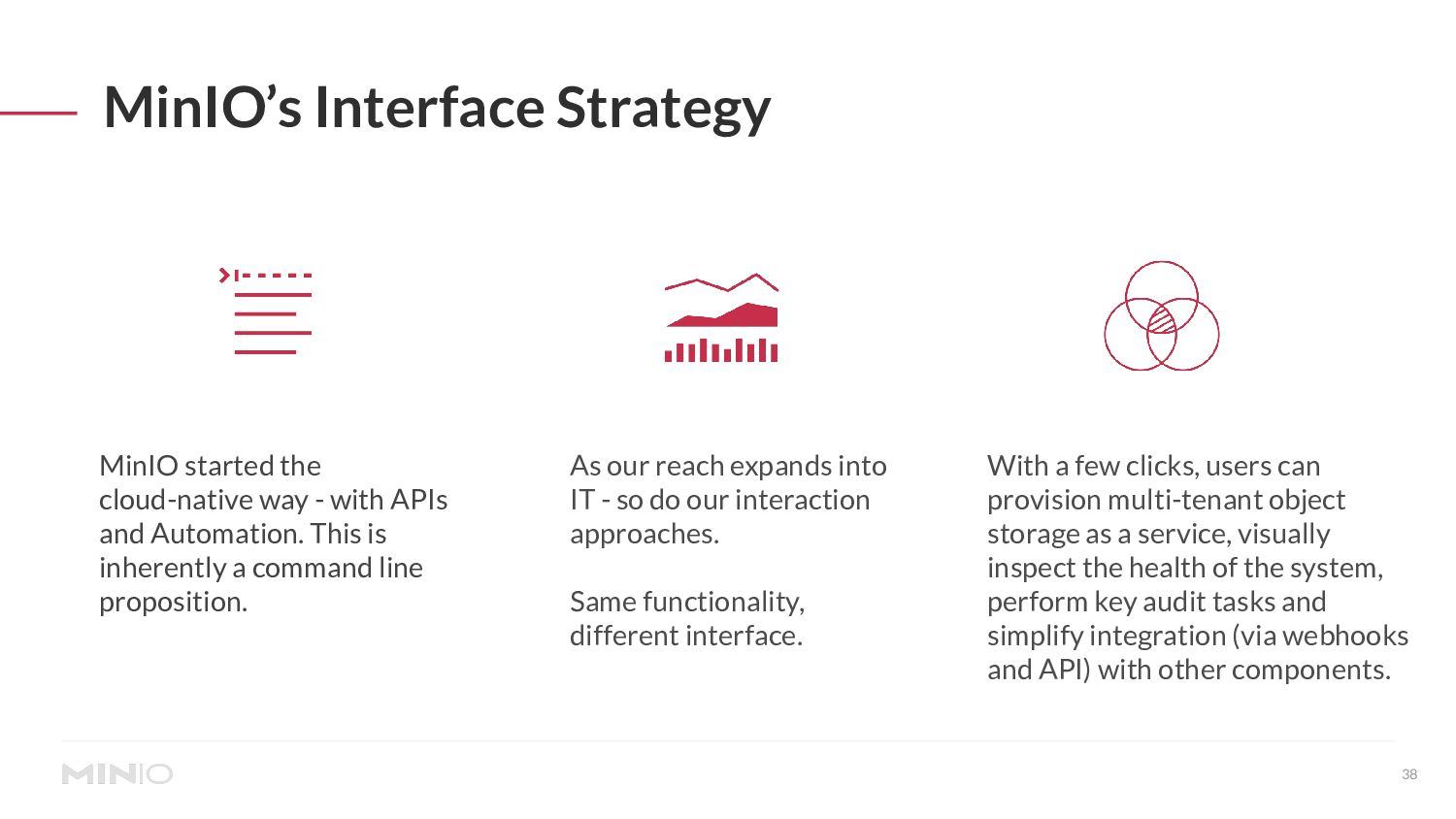
with APIs and Automation. This is inherently a command line proposition. As our reach expands into IT - so do our interaction approaches. Same functionality, different interface. With a few clicks, users can provision multi-tenant object storage as a service, visually inspect the health of the system, perform key audit tasks and simplify integration (via webhooks and API) with other components.
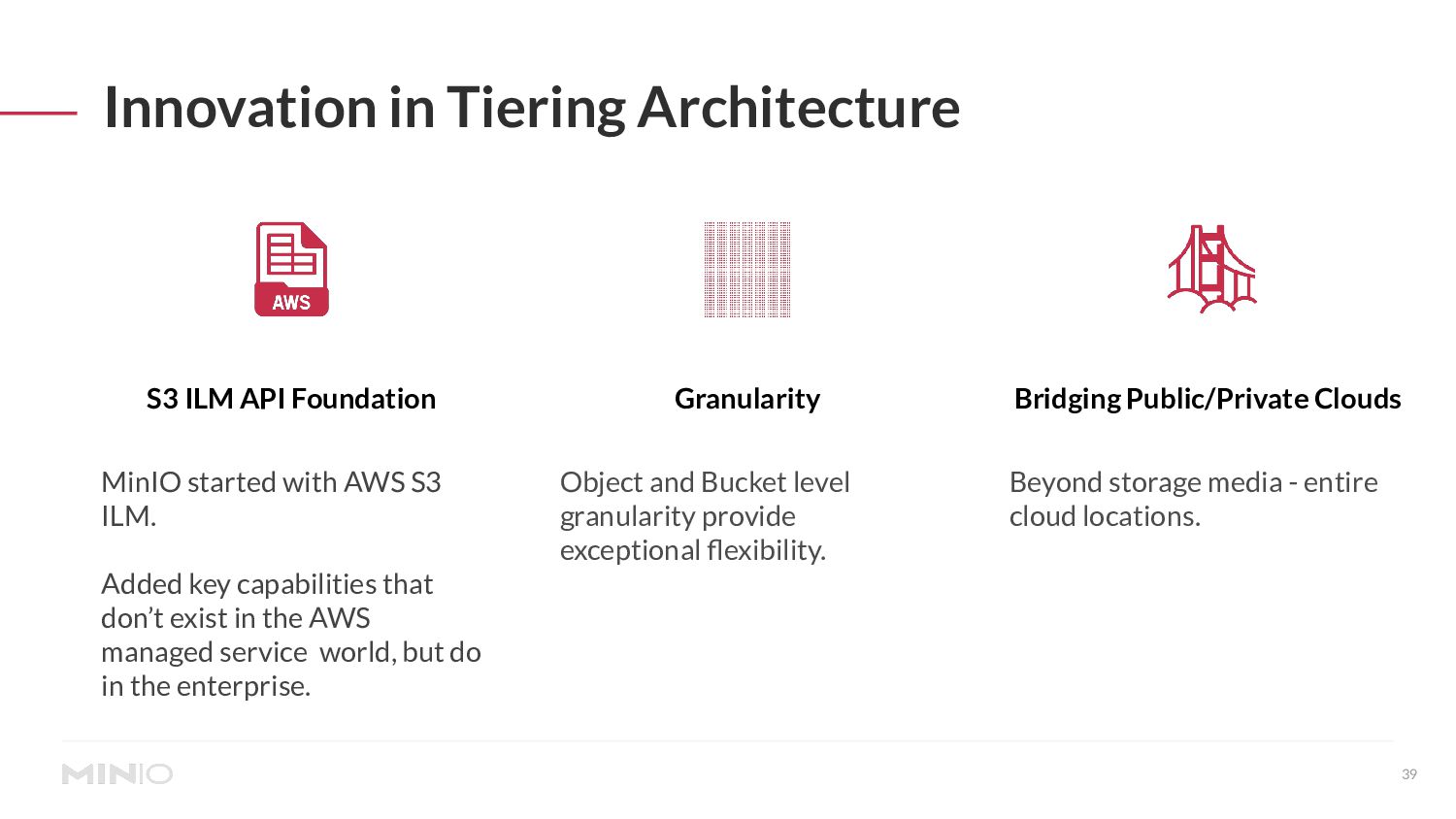
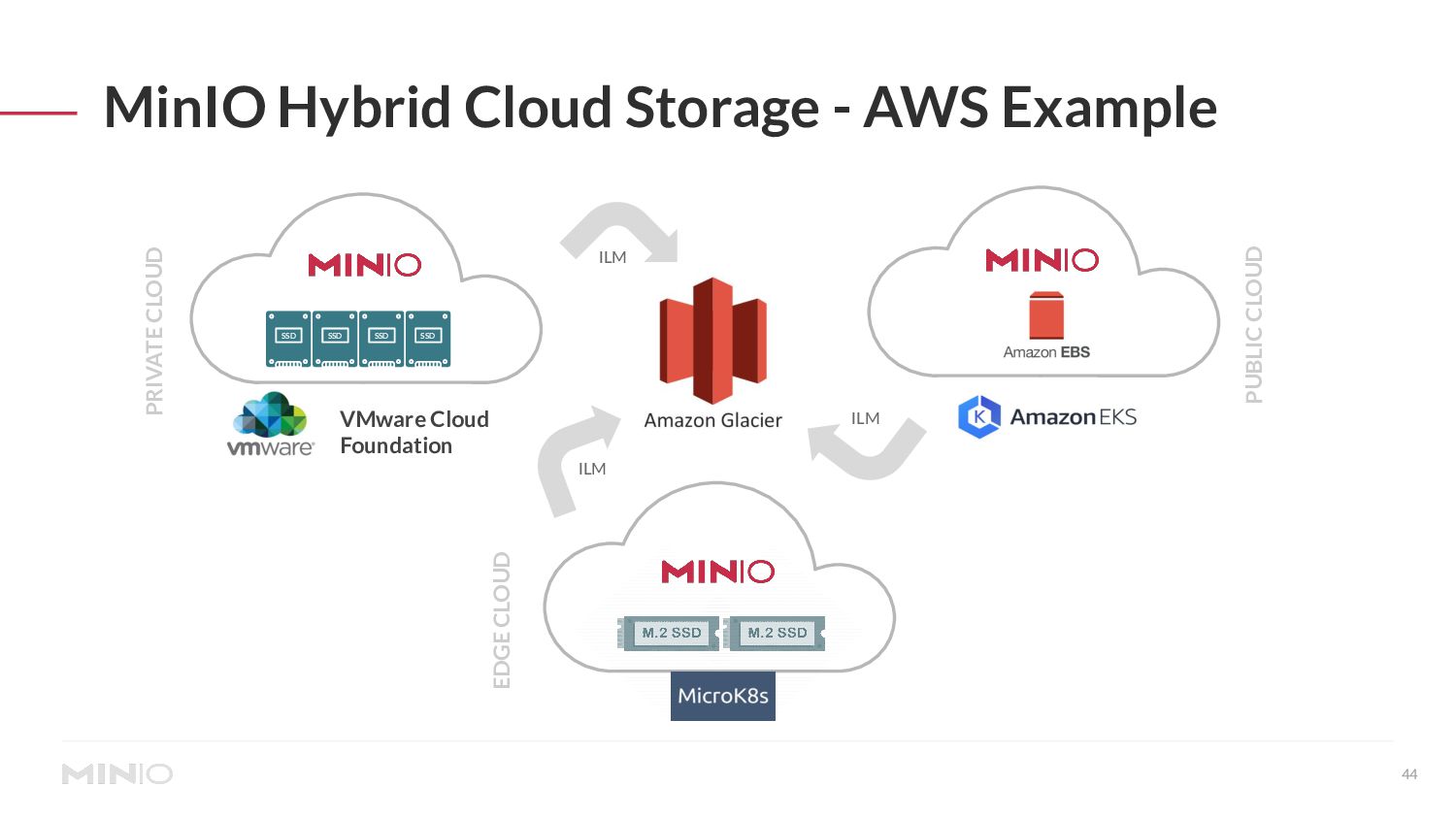
ILM. Added key capabilities that don’t exist in the AWS managed service world, but do in the enterprise. Granularity Object and Bucket level granularity provide exceptional flexibility. Beyond storage media - entire cloud locations. Bridging Public/Private Clouds S3 ILM API Foundation
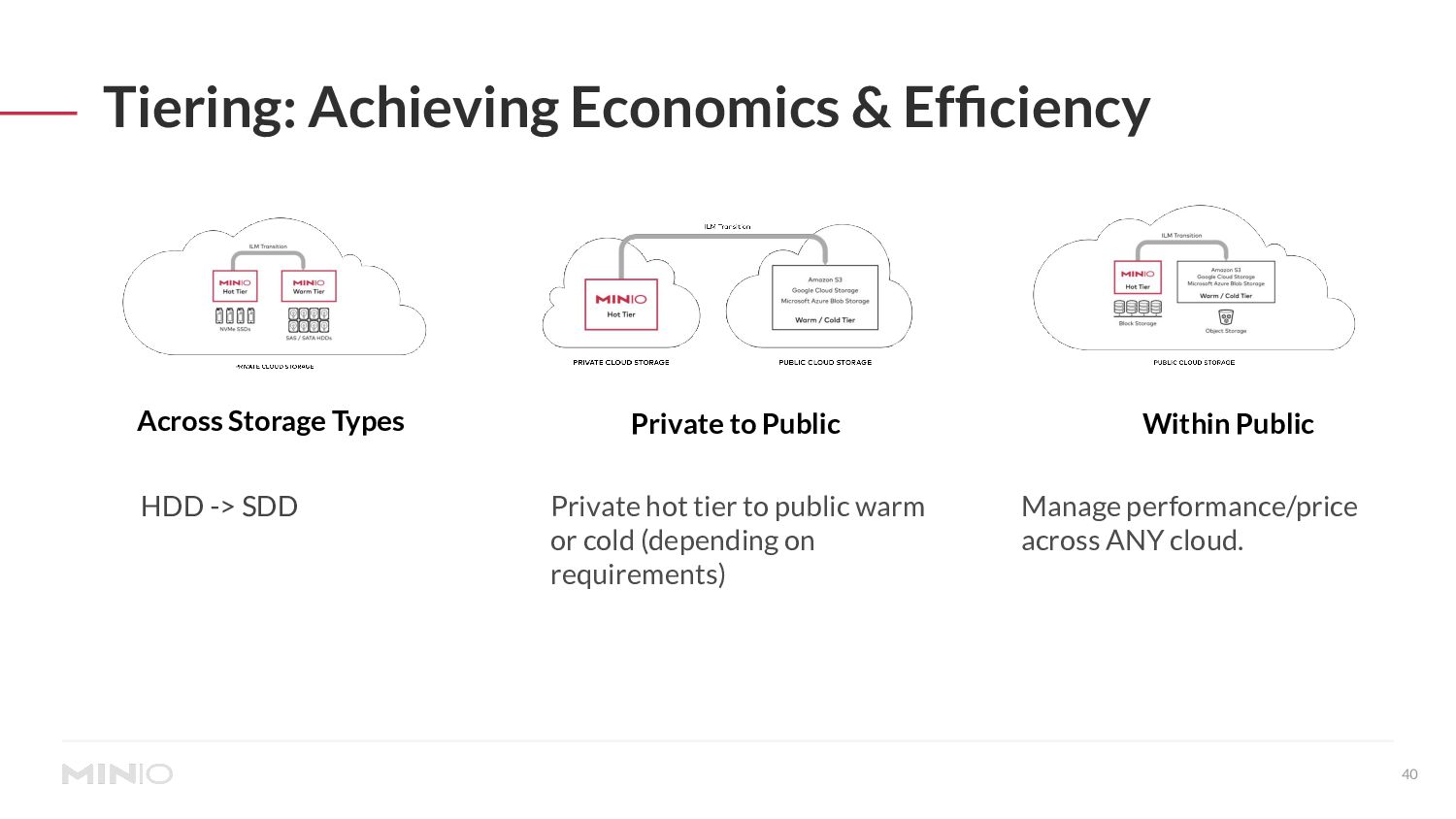
to Public Private hot tier to public warm or cold (depending on requirements) Manage performance/price across ANY cloud. Within Public Across Storage Types
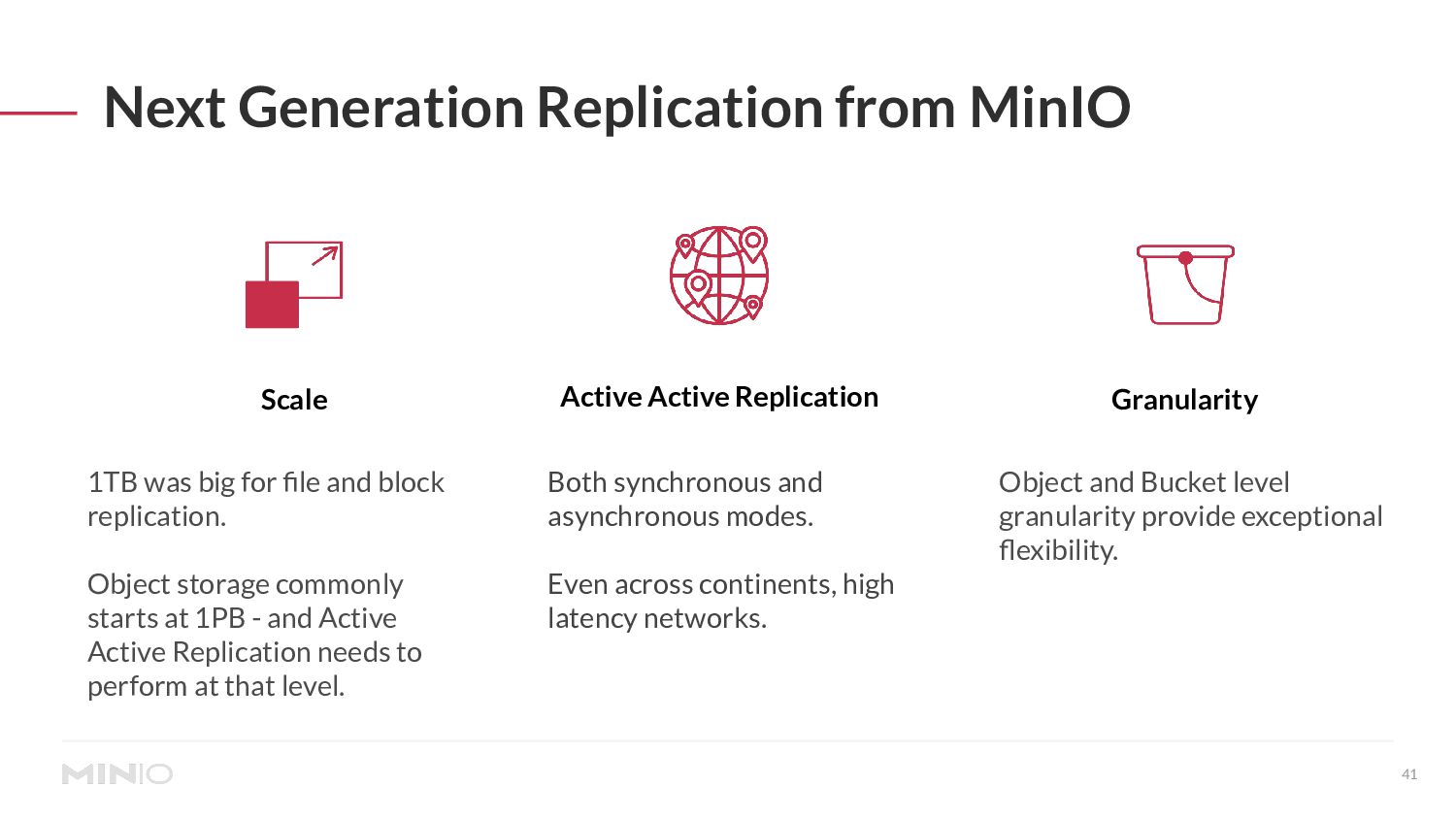
modes. Even across continents, high latency networks. Granularity Object and Bucket level granularity provide exceptional flexibility. 1TB was big for file and block replication. Object storage commonly starts at 1PB - and Active Active Replication needs to perform at that level. Scale Active Active Replication
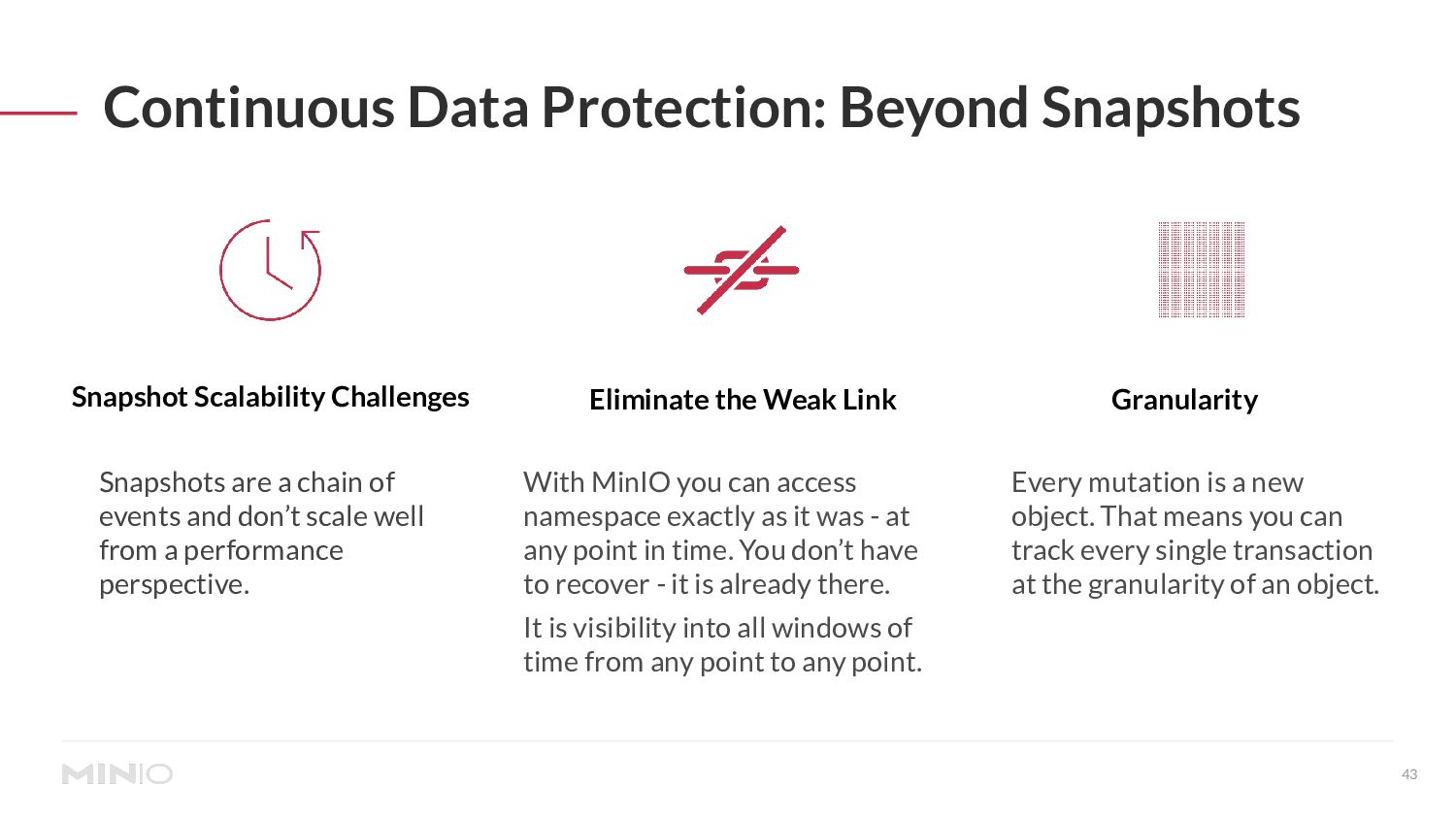
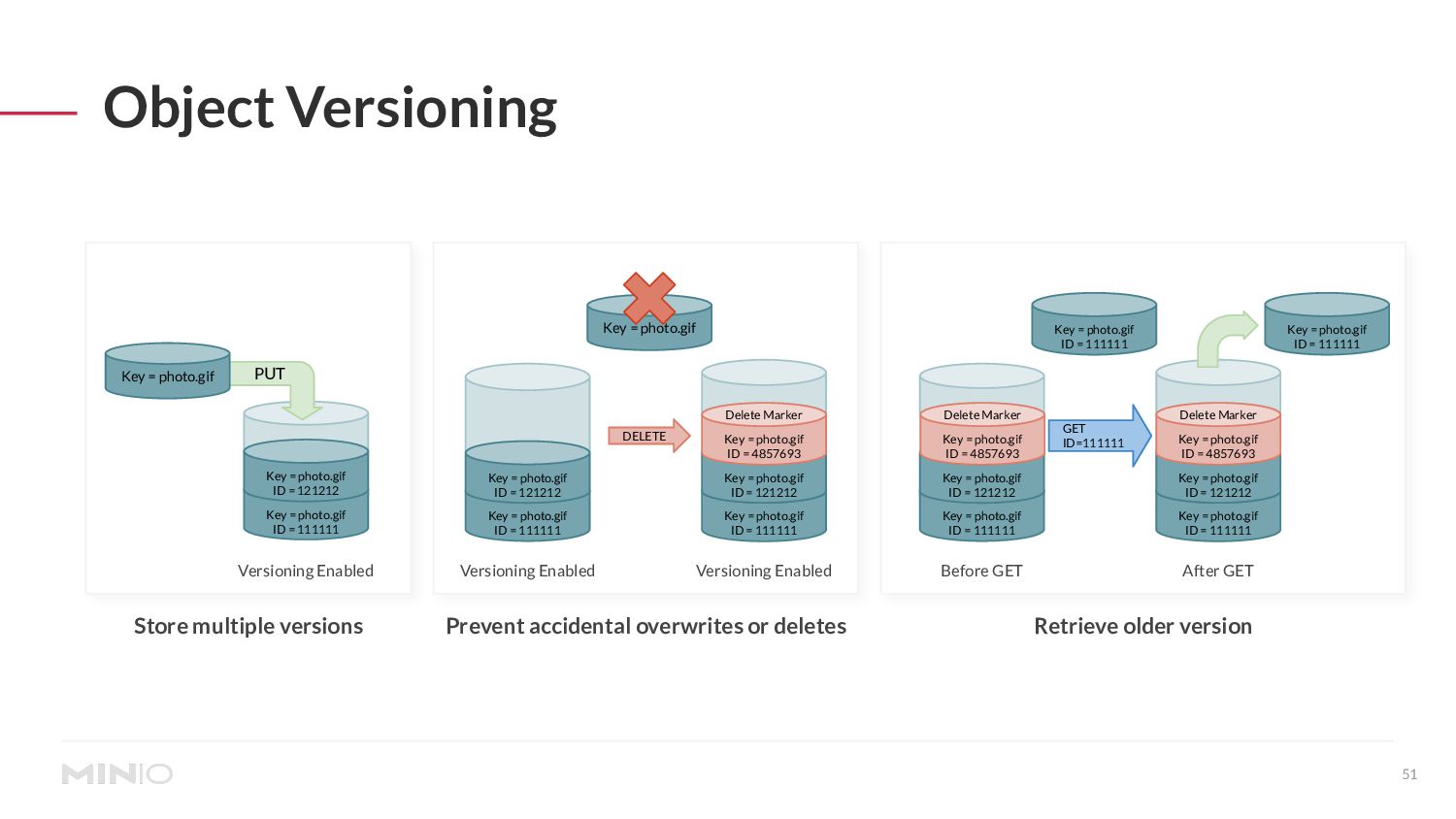
of events and don’t scale well from a performance perspective. Granularity Every mutation is a new object. That means you can track every single transaction at the granularity of an object. With MinIO you can access namespace exactly as it was - at any point in time. You don’t have to recover - it is already there. It is visibility into all windows of time from any point to any point. Eliminate the Weak Link Snapshot Scalability Challenges
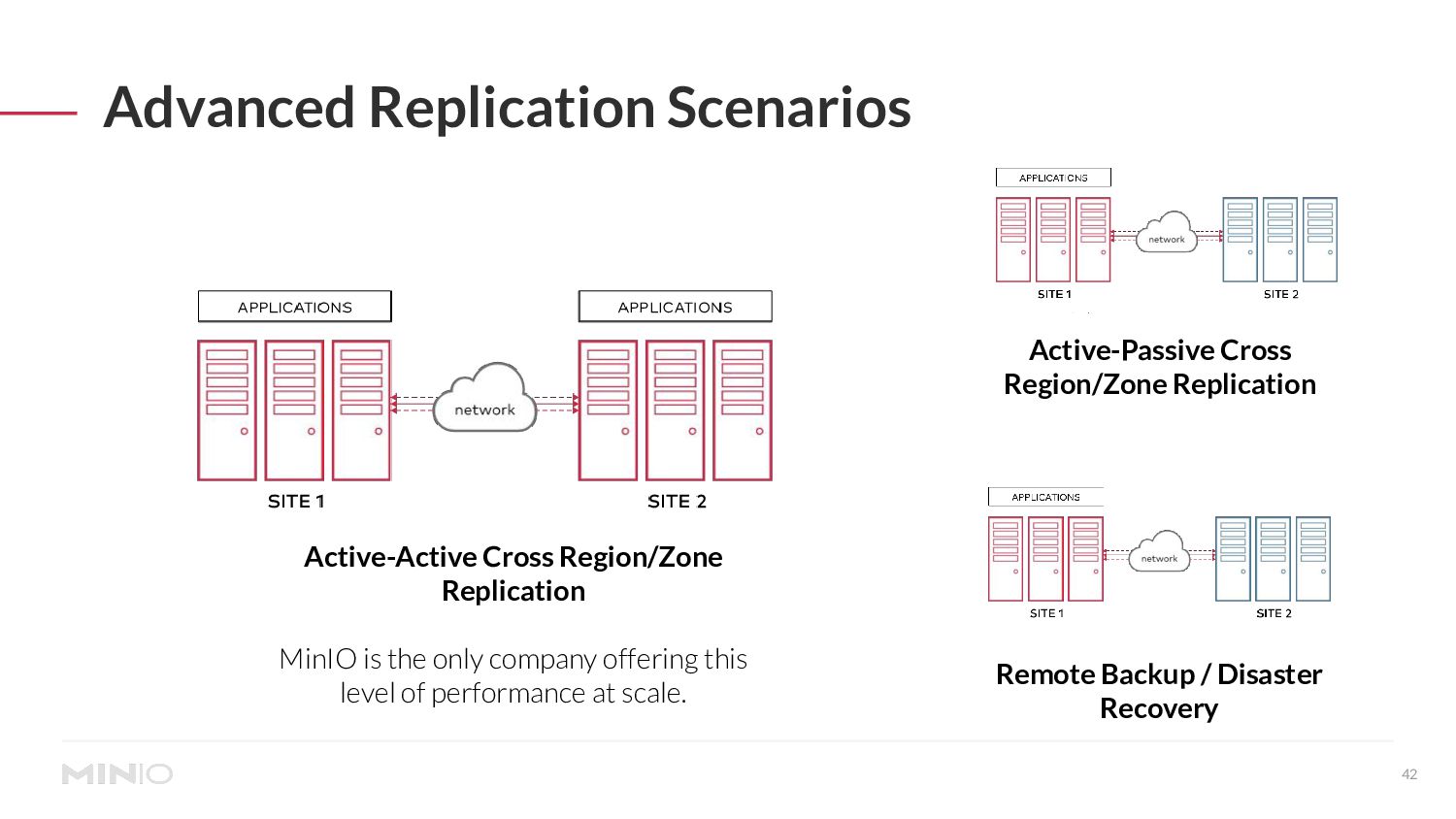
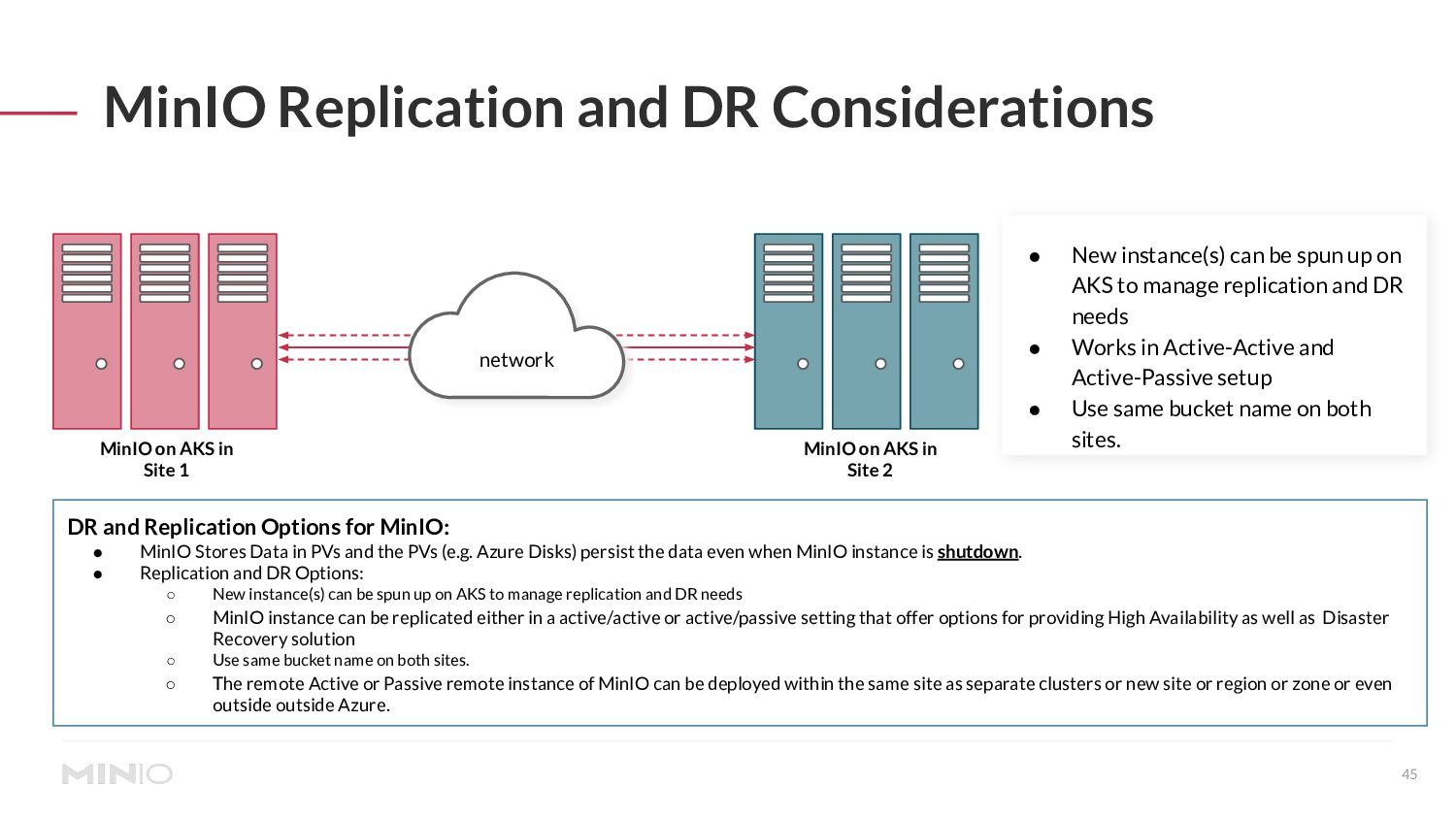
Site 1 network • New instance(s) can be spun up on AKS to manage replication and DR needs • Works in Active-Active and Active-Passive setup • Use same bucket name on both sites. MinIO on AKS in Site 2 DR and Replication Options for MinIO: • MinIO Stores Data in PVs and the PVs (e.g. Azure Disks) persist the data even when MinIO instance is shutdown. • Replication and DR Options: ◦ New instance(s) can be spun up on AKS to manage replication and DR needs ◦ MinIO instance can be replicated either in a active/active or active/passive setting that offer options for providing High Availability as well as Disaster Recovery solution ◦ Use same bucket name on both sites. ◦ The remote Active or Passive remote instance of MinIO can be deployed within the same site as separate clusters or new site or region or zone or even outside outside Azure.
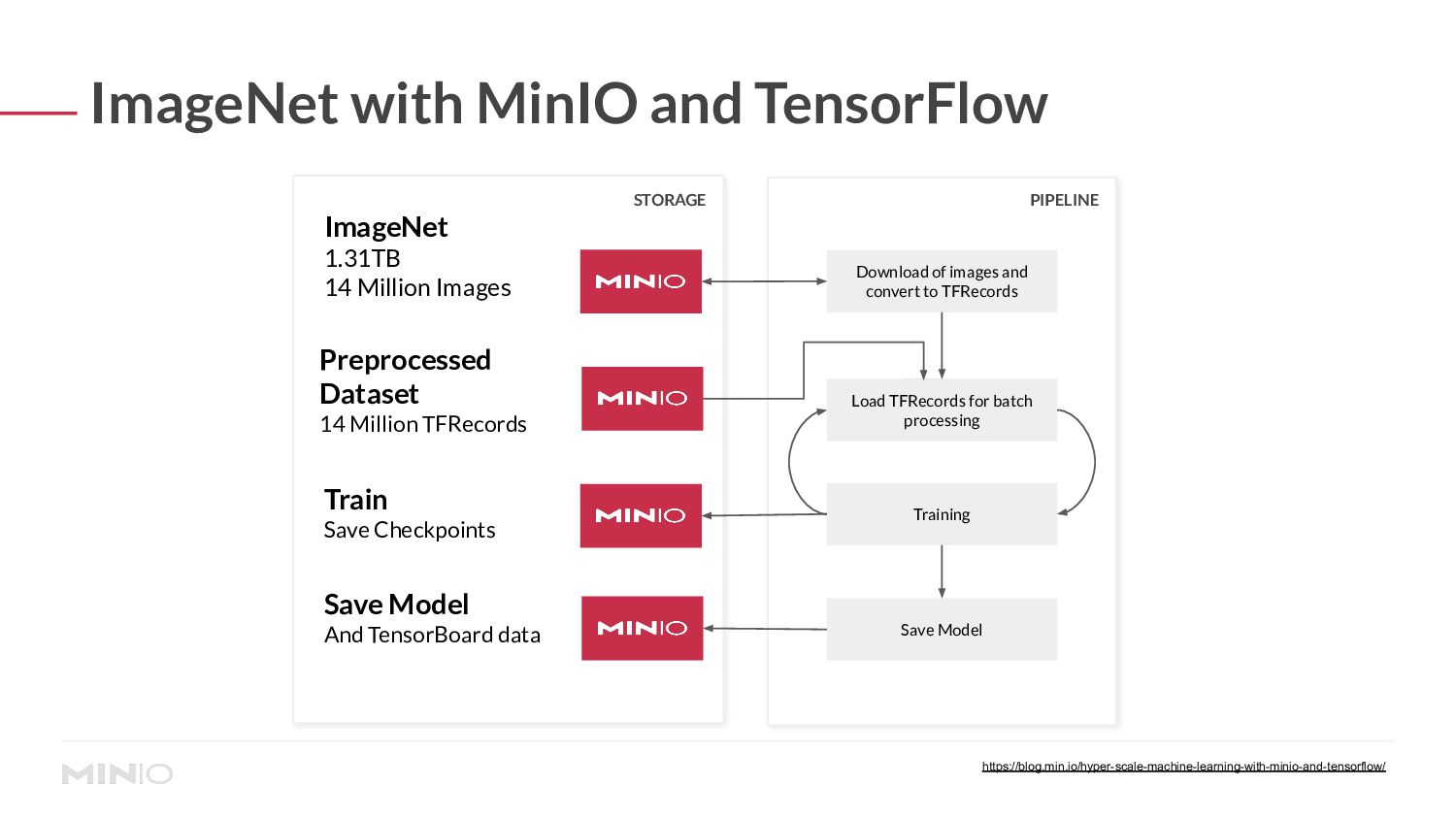
to TFRecords STORAGE ImageNet 1.31TB 14 Million Images PIPELINE Preprocessed Dataset 14 Million TFRecords Load TFRecords for batch processing Training Save Model Save Model And TensorBoard data Train Save Checkpoints https://blog.min.io/hyper-scale-machine-learning-with-minio-and-tensorflow/
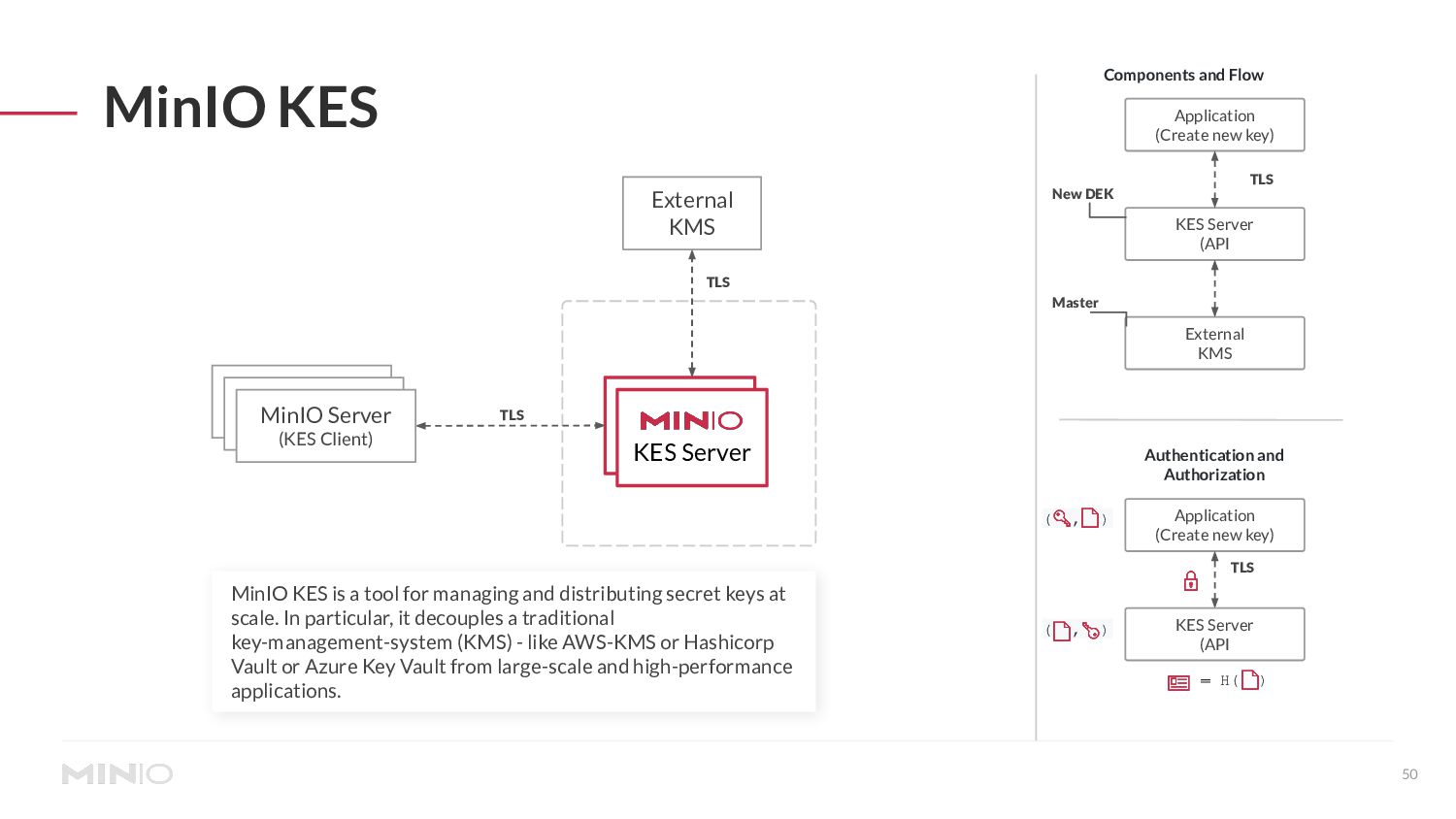
KES Server External KMS TLS Application (Create new key) KES Server (API TLS External KMS Master New DEK MinIO Server (KES Client) Application (Create new key) TLS KES Server (API Authentication and Authorization ( , ) ( , ) Components and Flow ═ H( ) KES Server MinIO KES is a tool for managing and distributing secret keys at scale. In particular, it decouples a traditional key-management-system (KMS) - like AWS-KMS or Hashicorp Vault or Azure Key Vault from large-scale and high-performance applications. TLS
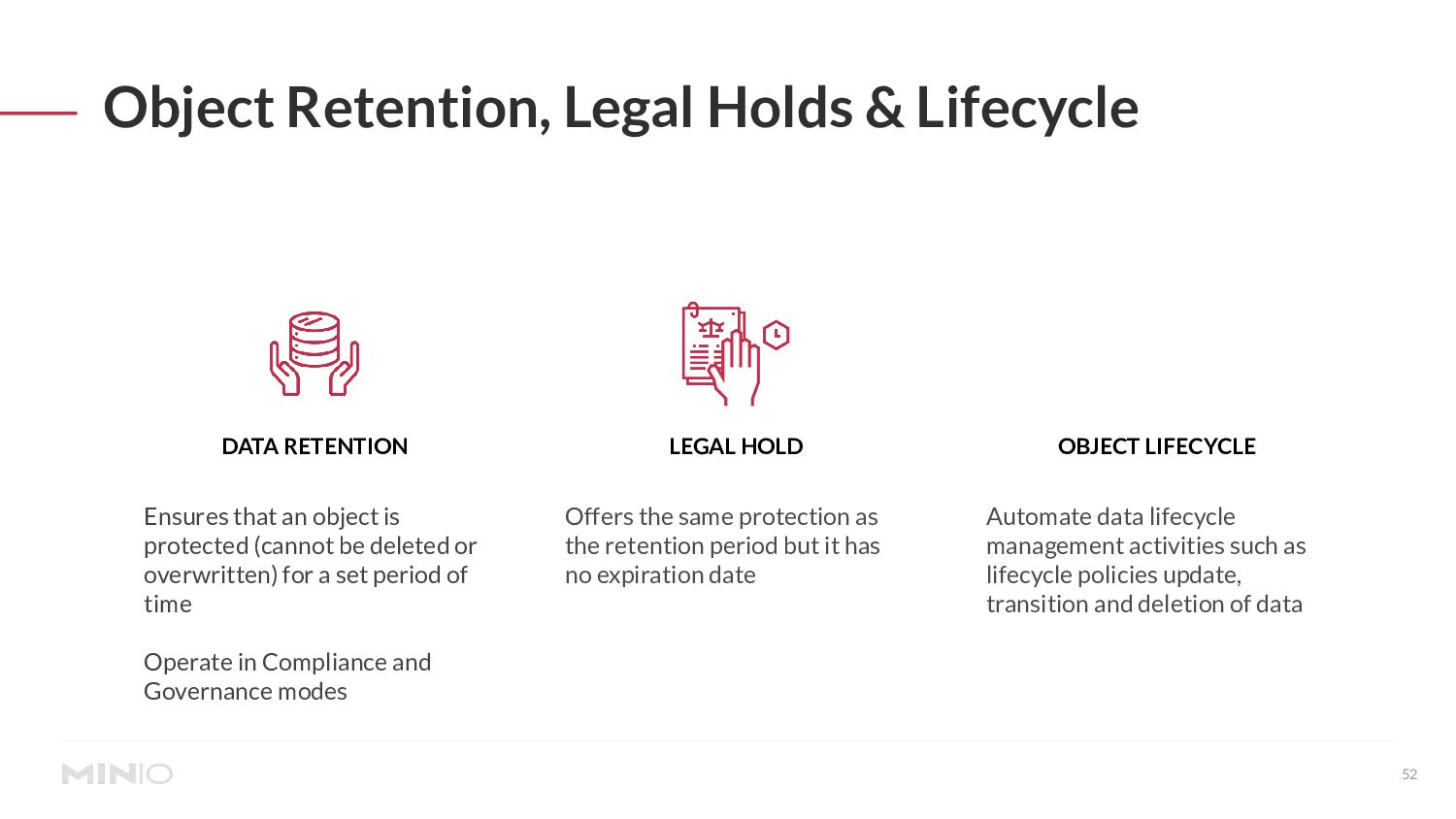
object is protected (cannot be deleted or overwritten) for a set period of time Operate in Compliance and Governance modes LEGAL HOLD Offers the same protection as the retention period but it has no expiration date Automate data lifecycle management activities such as lifecycle policies update, transition and deletion of data OBJECT LIFECYCLE DATA RETENTION
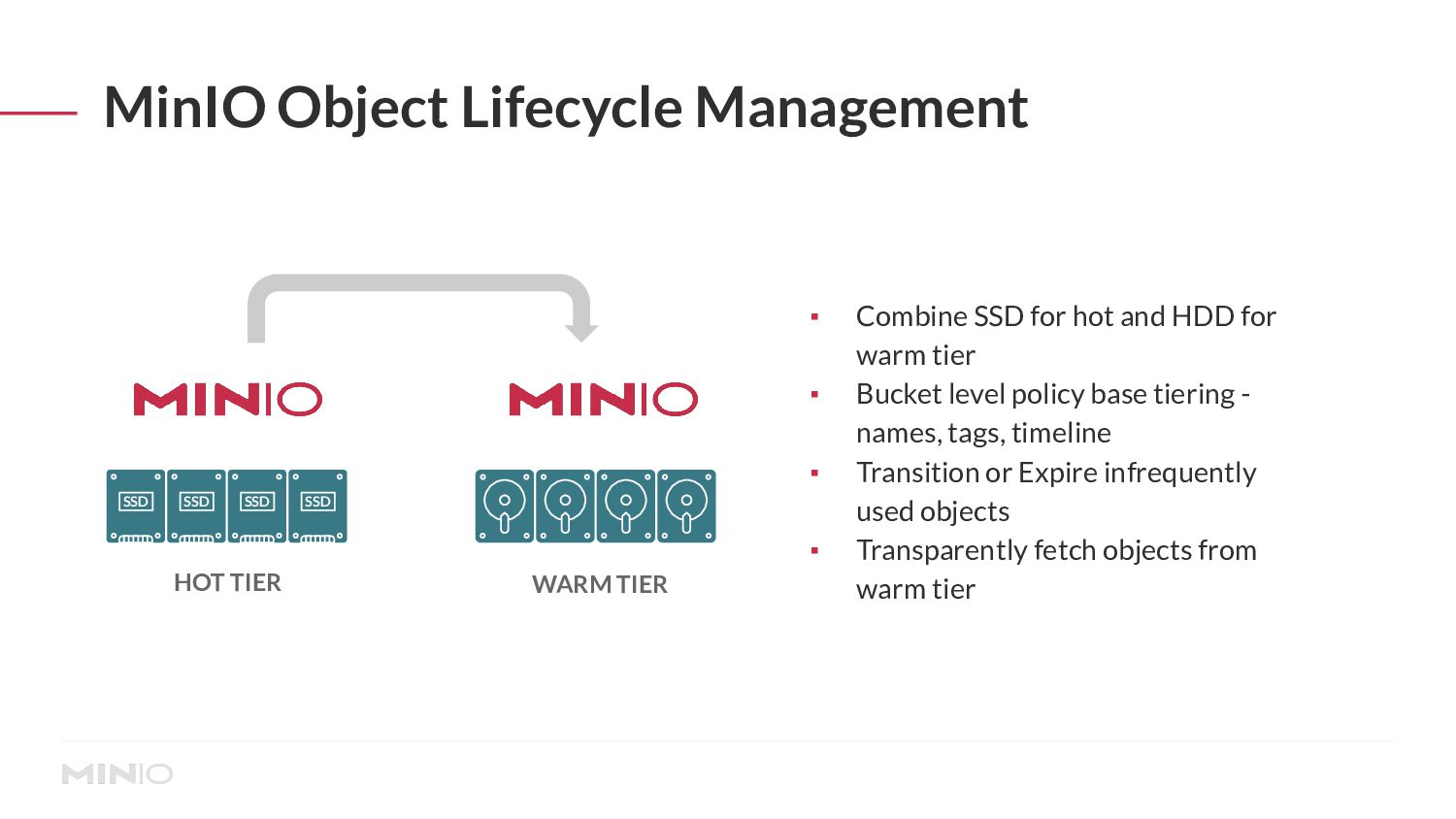
hot and HDD for warm tier ▪ Bucket level policy base tiering - names, tags, timeline ▪ Transition or Expire infrequently used objects ▪ Transparently fetch objects from warm tier HOT TIER SSD SSD SSD SSD
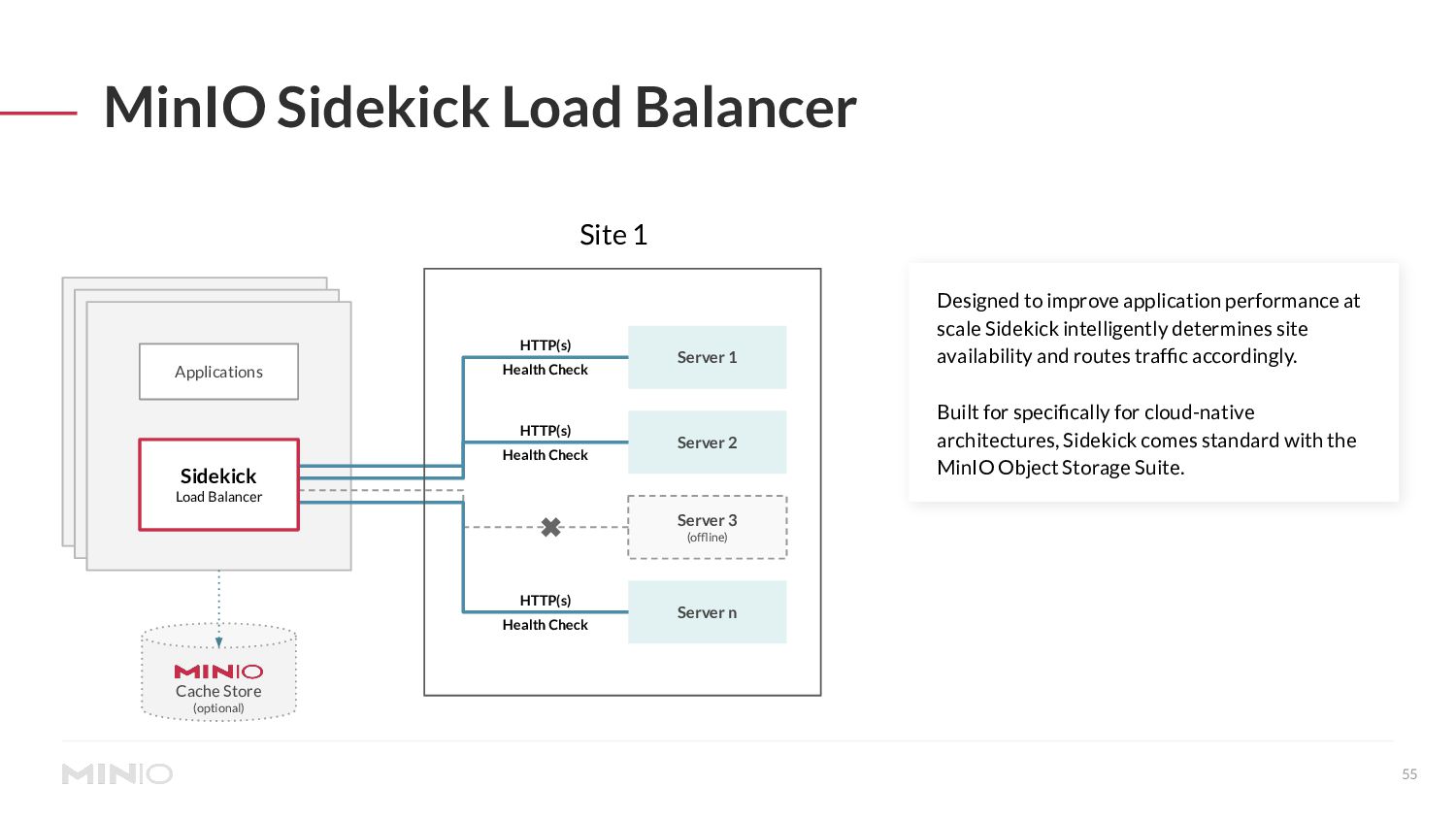
Applications Server 2 Server 3 (offline) Server n HTTP(s) Health Check HTTP(s) Health Check HTTP(s) Health Check Designed to improve application performance at scale Sidekick intelligently determines site availability and routes traffic accordingly. Built for specifically for cloud-native architectures, Sidekick comes standard with the MinIO Object Storage Suite. Sidekick Load Balancer Site 1
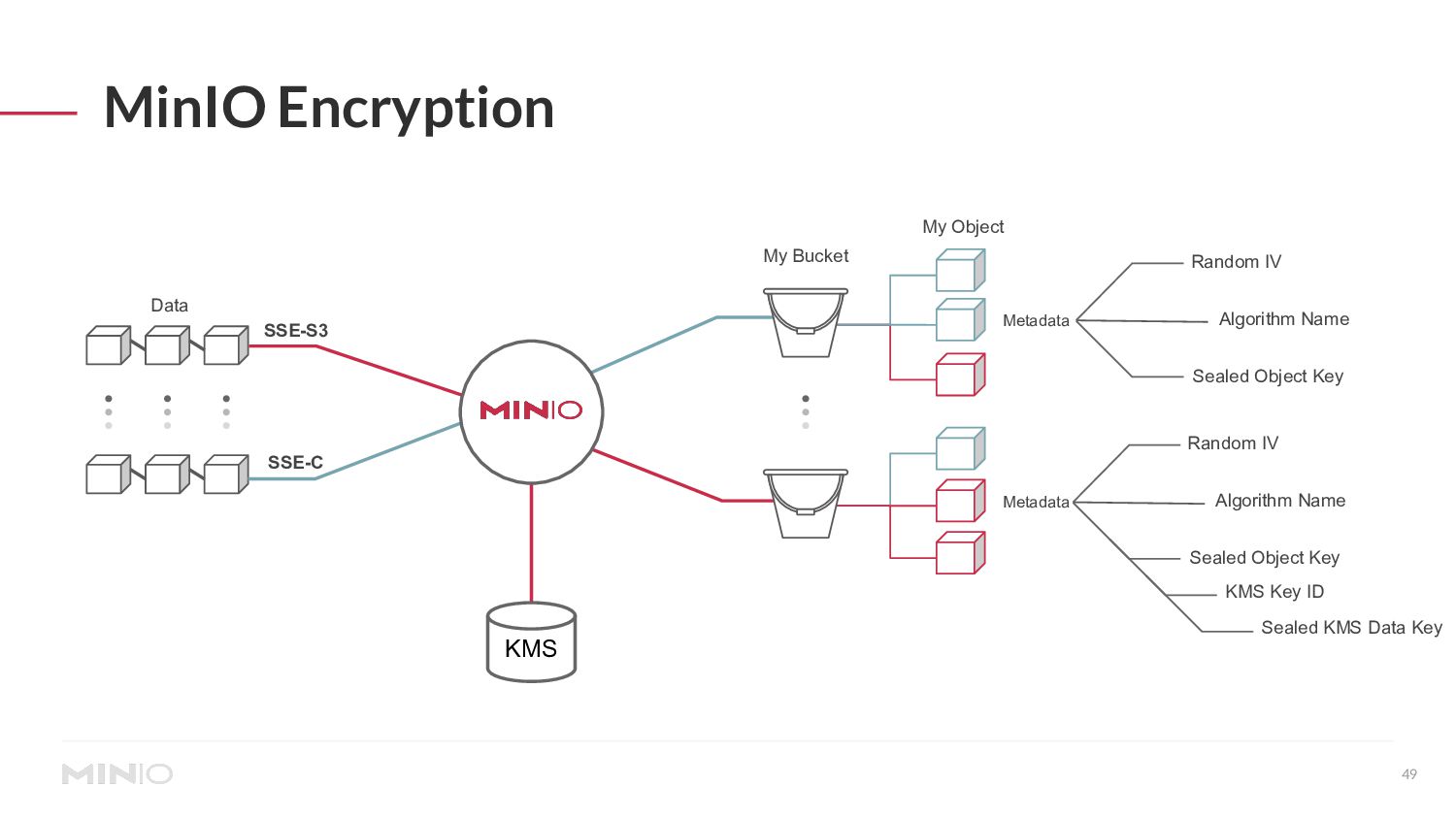
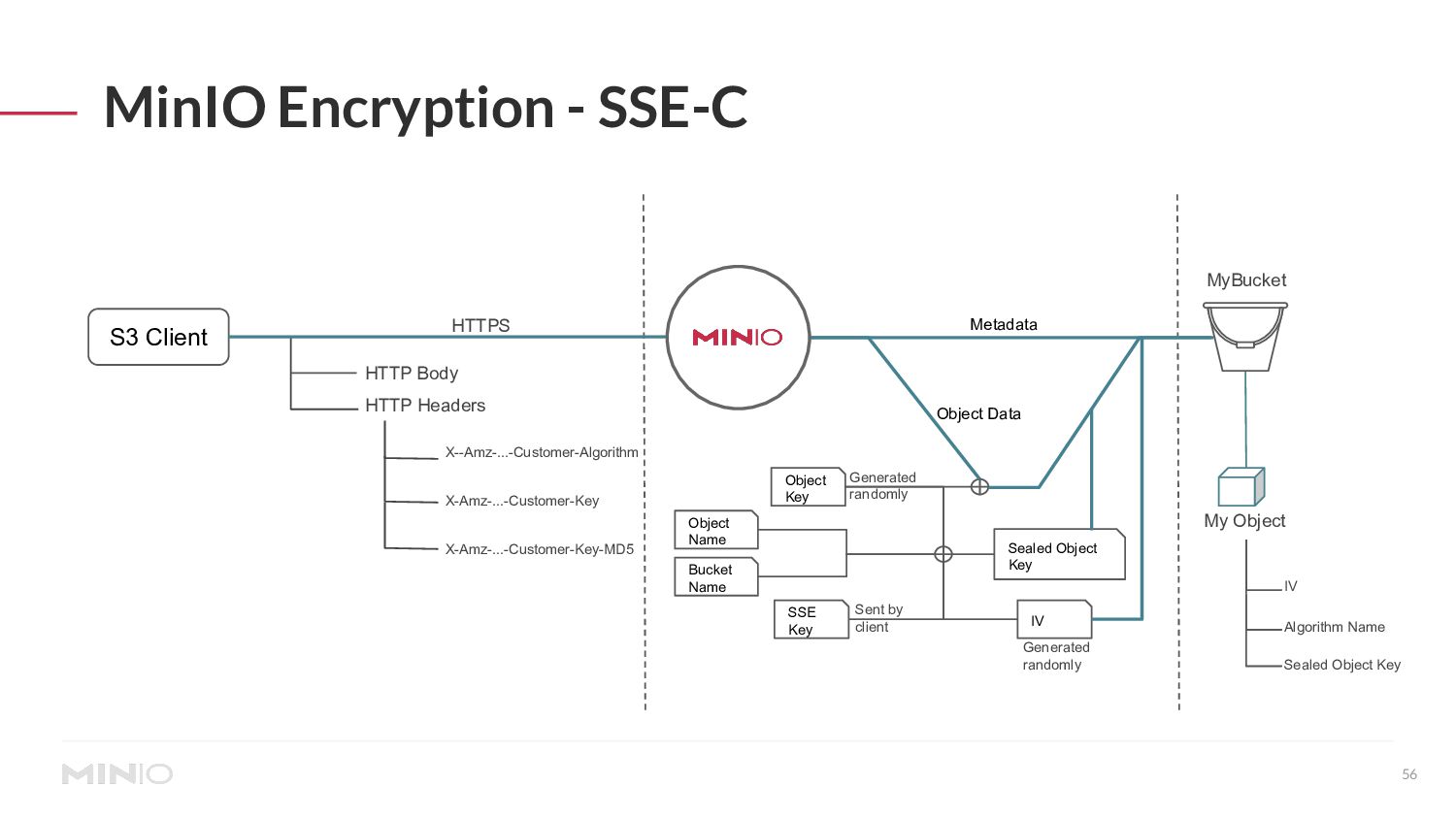
Body HTTP Headers X--Amz-...-Customer-Algorithm X-Amz-...-Customer-Key X-Amz-...-Customer-Key-MD5 My Object Generated randomly Object Key SSE Key Sent by client Generated randomly IV Sealed Object Key Object Name Bucket Name IV Algorithm Name Sealed Object Key Metadata Object Data
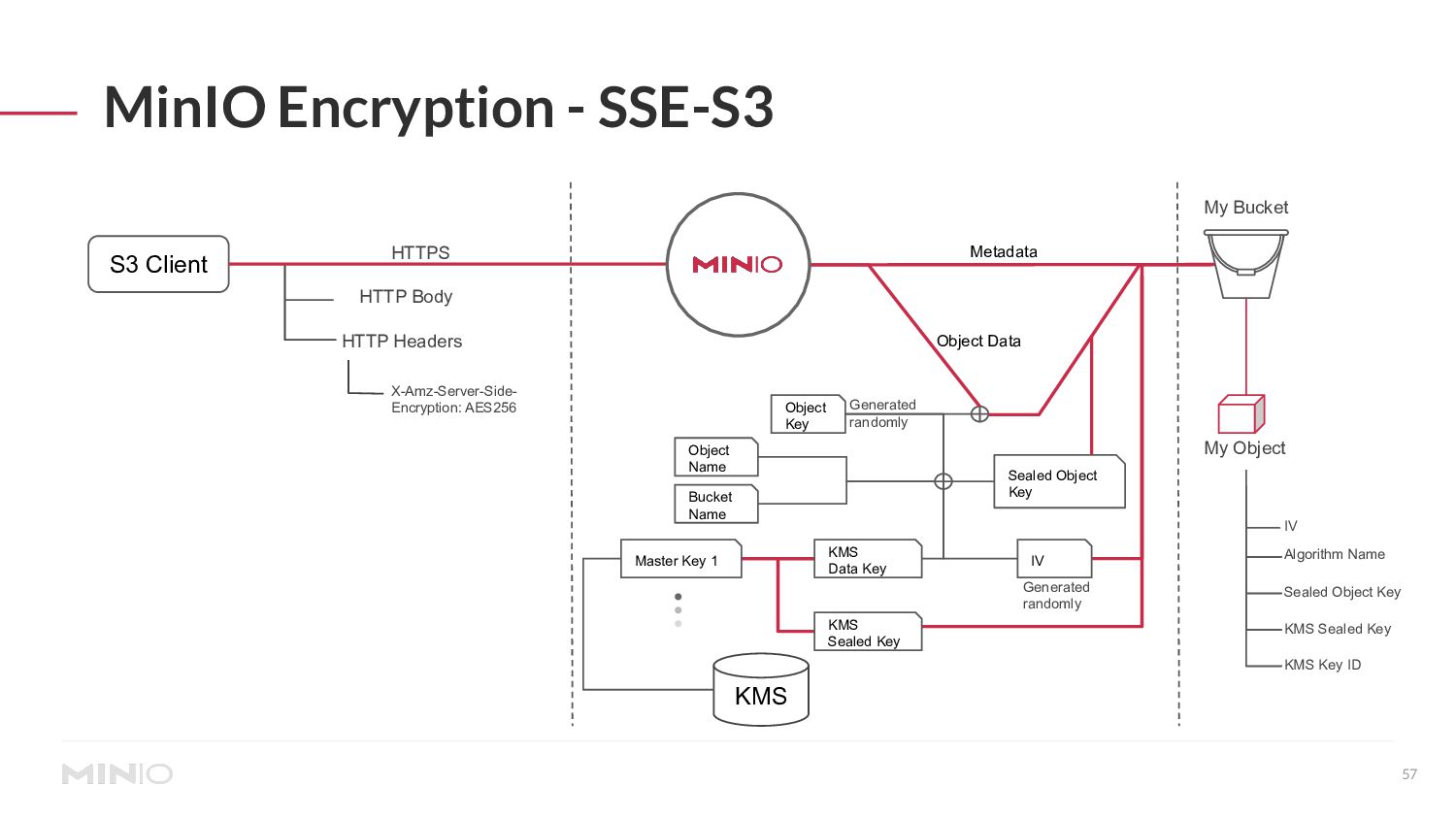
HTTP Body HTTP Headers X-Amz-Server-Side- Encryption: AES256 My Object Generated randomly Generated randomly IV Algorithm Name Sealed Object Key Metadata Object Data KMS KMS Sealed Key KMS Key ID Object Key KMS Data Key IV Sealed Object Key Object Name Bucket Name KMS Sealed Key Master Key 1


 itpresstour
 terurou
 soudai
 munakata
 mikanichinose
 cogakira
 mtpooh
 ymrl
ymrl
 y_sera15
 shumei_ito
 bgpat
bgpat
 sansantech
 mkdev10
 jmmastey
 nmsamuel
 mkilby
 gr2m
gr2m
 codingconduct
 marcelosomers
 reverentgeek
 portentint
 caitiem20
 palkan
 rkendrick25