Share
Embed
Meeting Users Halfway with Responsive Web Design
A presentation I gave at Social Media Week Glasgow 2011. In it I talked about social media, online content and recent client work my company did using responsive web design as a solution to optimise content for different devices.
Jamie Boyd
October 04, 2011
Transcript
87 slides
-
We know what makes your customers click. Meeting Users Halfway
with Responsive Web Design Jamie Boyd Social Media Week Glasgow, 2011 -
We know what makes your customers click. Jamie Boyd @jamboid
Senior Web Interface Developer at Equator @EquatorAgency #smwgla -
We know what makes your customers click. Part 1 We’re
not in Kansas anymore... -
We know what makes your customers click. Social Objects I’m
really interested in the concept of Social Objects The things we share online and that we form social interac;ons around... -
We know what makes your customers click. How do social
networking services treat Social Objects? I think it’s interes;ng to look at how social media services treat social objects. There’s a common aspect with the successful ones... -
We know what makes your customers click. The Web is
the universal medium for sharing Social Objects They make it incredibly easy to share these objects They use the web as a universal medium to do this by crea;ng a unique place for each object to live with its own permalink address... -
We know what makes your customers click. Instagram Instagram is
a recent example of this iPhone-‐only, a minimal web presence at first-‐glance... -
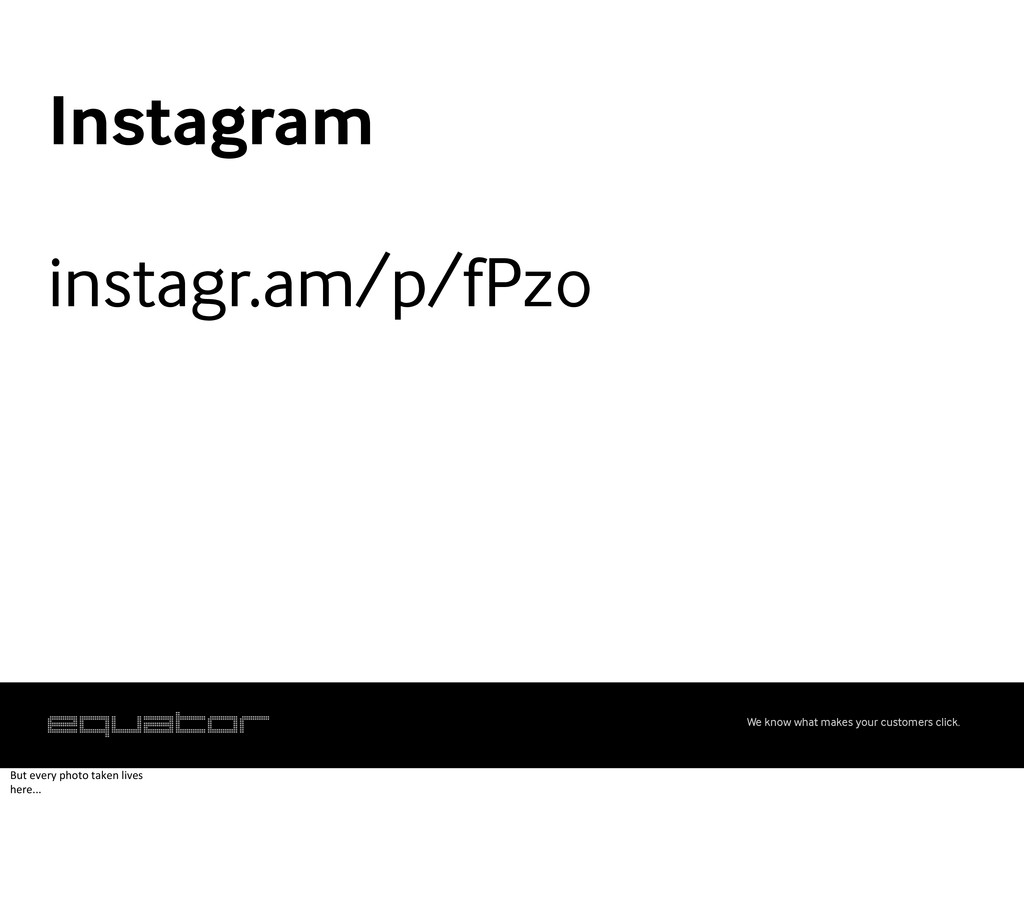
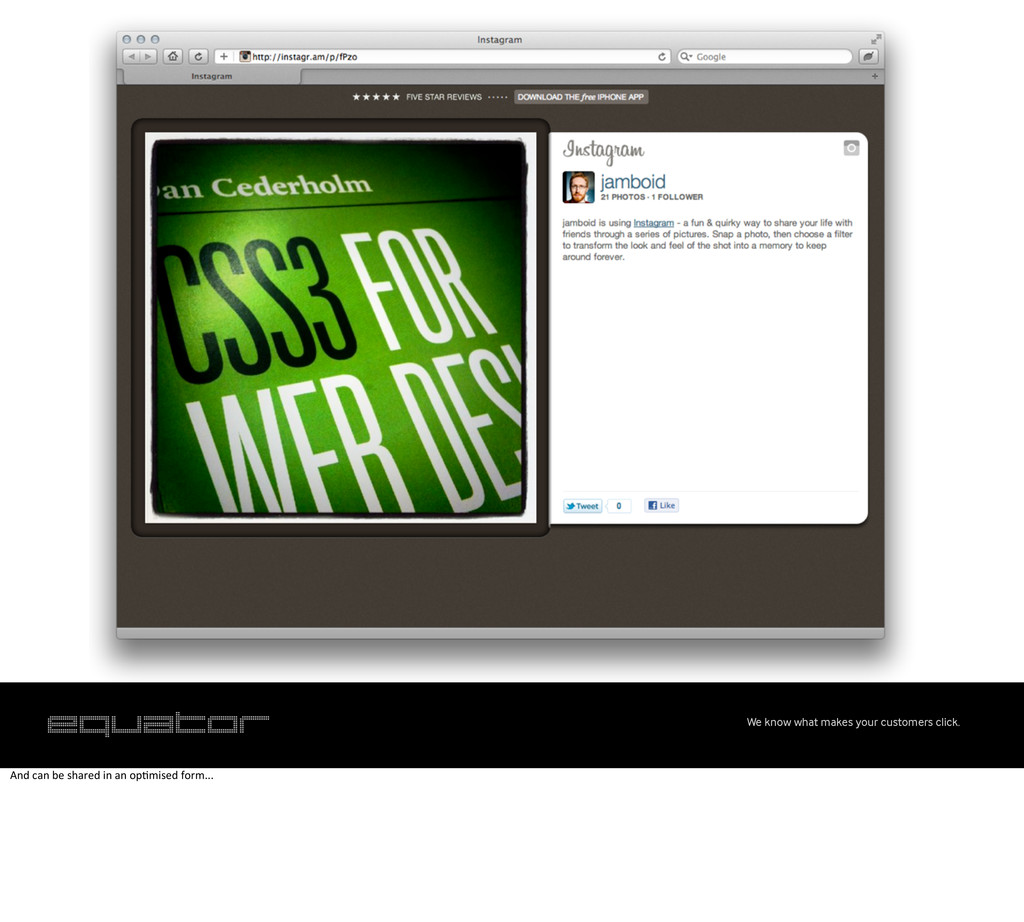
We know what makes your customers click. Instagram instagr.am/p/fPzo But
every photo taken lives here... -
We know what makes your customers click. And can be
shared in an op;mised form... -
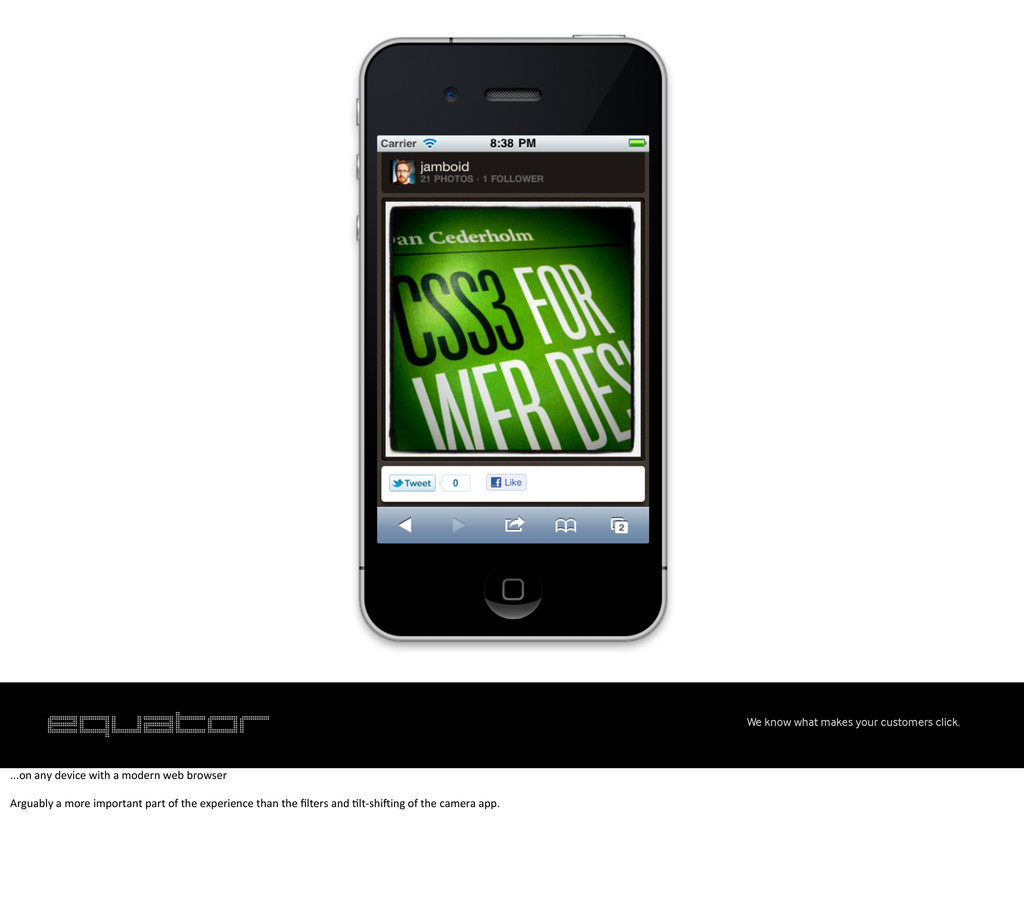
We know what makes your customers click. ...on any device
with a modern web browser Arguably a more important part of the experience than the filters and ;lt-‐shiHing of the camera app. -
We know what makes your customers click. Does your content
respond to the user's context? The same is true of places like Facebook and TwiJer, content anywhere, op;mised for any device This begs a ques;on: does your content behave in the same way?... -
We know what makes your customers click. New devices and
services optimised for them have created a powerful level of expectation in a very short time Because social media is seMng expecta;ons about social objects and how they behave online This has happened with frightening speed -
We know what makes your customers click. Websites and services
need to respond to this expectation The landscape has shiHed under everyones’ feet We are all living in an online ecosystem that has been shaped by social media and we need to adapt or die... -
We know what makes your customers click. “Oh, nevermind... This
site is desktop-optimised.” People aren’t thinking this... -
We know what makes your customers click. “Oh, nevermind... This
site is desktop-optimised.” “Oh, nevermind... This site is broken.” They’re thinking this... -
We know what makes your customers click. The idea that
there is a “mobile web” is not really true anymore Old ideas about the shape of the web are changing too Mobile is no longer an easily-‐ignored gheJo There is just the Web that works and the Web that doesn’t... -
We know what makes your customers click. New devices with
modern capabilities have erased comfortable stereotypes We also can’t ignore users by aJaching comfortable stereotypes to them People are using the web everywhere, for everything So where does that leave us creators of the web... -
We know what makes your customers click. A Complex World
In a much more complex world... We need to respond and luckily the Web itself gives us a way to do this... -
We know what makes your customers click. A Complex World
So Be Flexible We need to let go of control and learn to embrace the essen;al nature of the Web: flexibility -
We know what makes your customers click. We now have
the tools to create a single web that responds to the user's context and meets them halfway We need to meet users halfway With the whole web to chose from, they’ve chosen to spend their ;me and aJen;on on our content, so we owe them that at least -
We know what makes your customers click. Part 2 Using
Responsive Web Design to meet the user halfway So how do we start? -
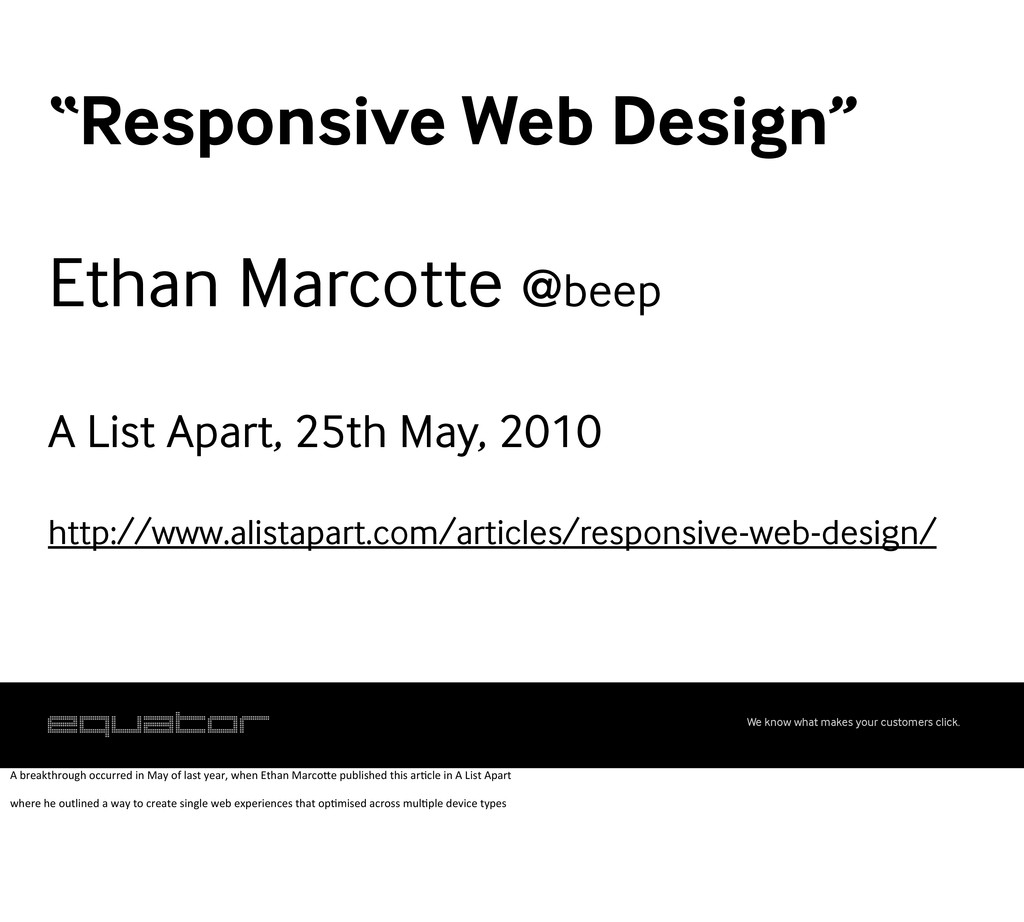
We know what makes your customers click. “Responsive Web Design”
Ethan Marcotte @beep A List Apart, 25th May, 2010 http://www.alistapart.com/articles/responsive-web-design/ A breakthrough occurred in May of last year, when Ethan MarcoJe published this ar;cle in A List Apart where he outlined a way to create single web experiences that op;mised across mul;ple device types -
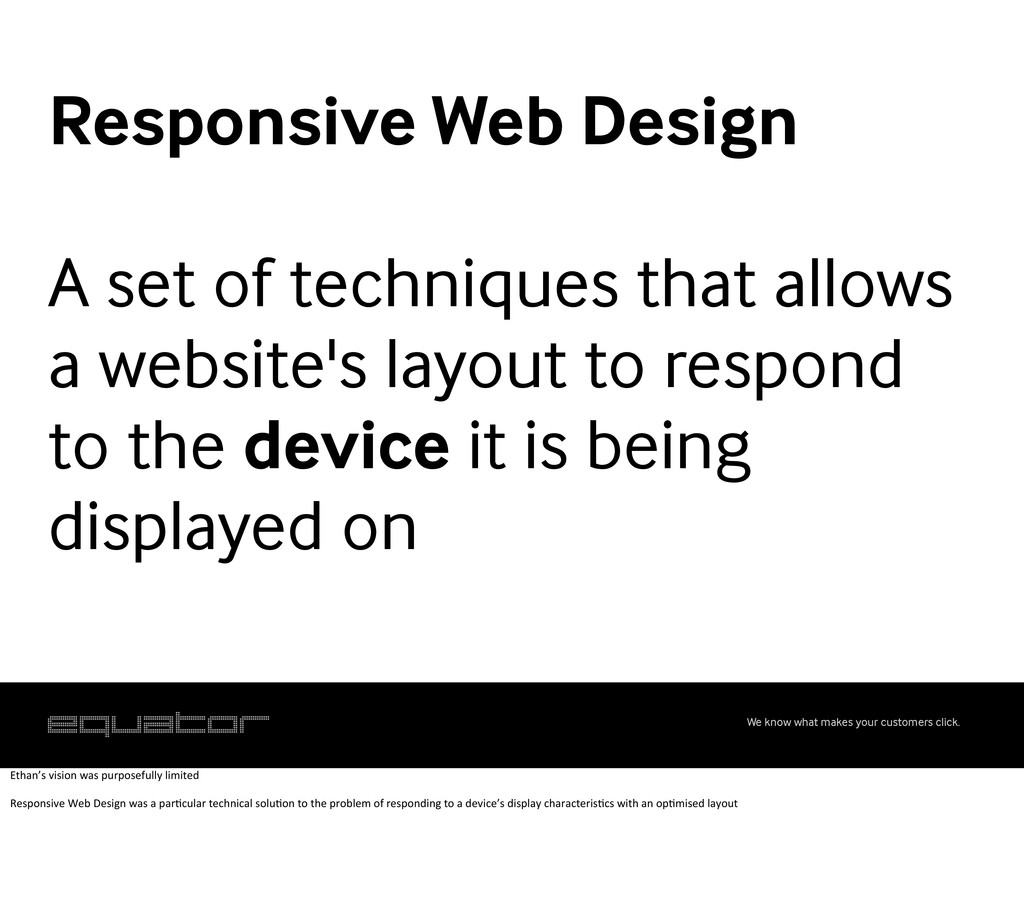
We know what makes your customers click. Responsive Web Design
A set of techniques that allows a website's layout to respond to the device it is being displayed on Ethan’s vision was purposefully limited Responsive Web Design was a par;cular technical solu;on to the problem of responding to a device’s display characteris;cs with an op;mised layout -
We know what makes your customers click. Responsive Web Design
is made up of 3 parts There are 3 parts to this... -
We know what makes your customers click. 1. Fluid Grids
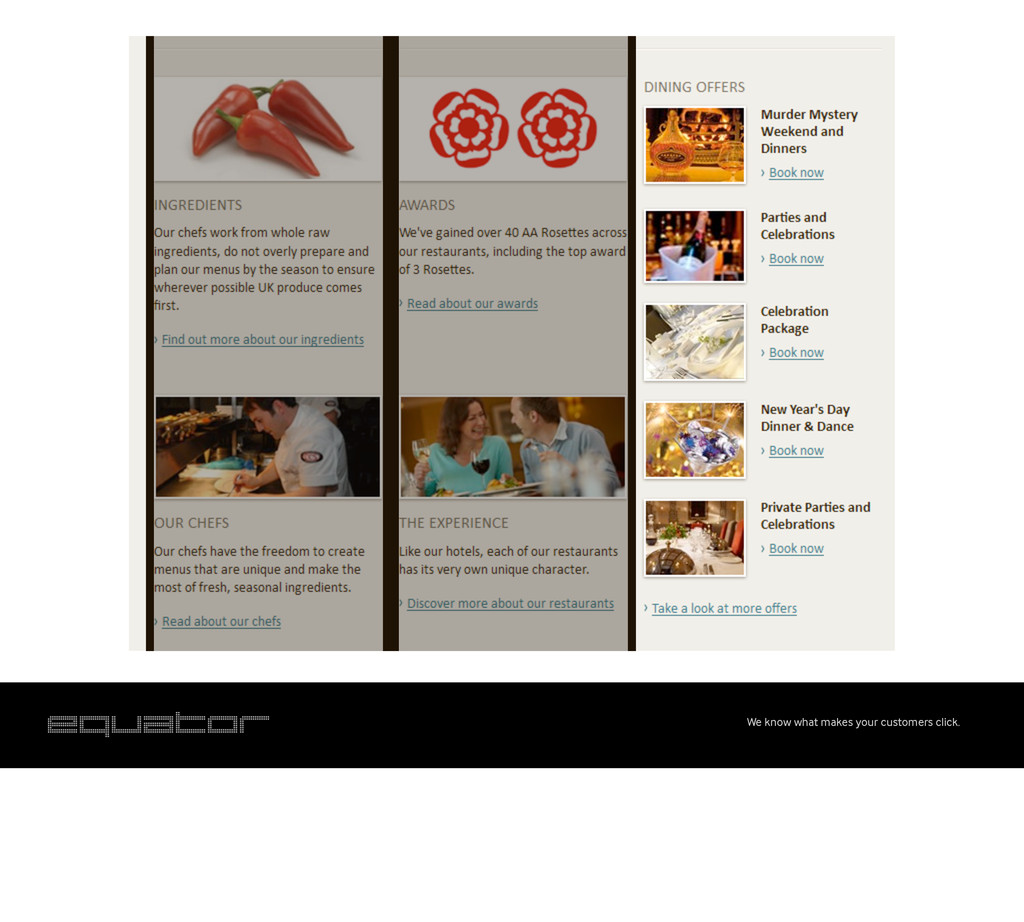
As the screen changes size, the page content changes to fit Fluid grids. A par;cular layout with grow wider and narrower as the display size increases and decreases. Not a new concept. Fluid sites have been around for as long as the web... -
We know what makes your customers click. 2. Flexible Images
Images on the page scale with the fluid grid Flexible images As the layout grows or contracts, the images on the page scale appropriately and don’t break the layout The ability to do this is a more recent development... -
We know what makes your customers click. 3. CSS Media
Queries As screen size changes, the page contents reconfigure to provide an optimum layout CSS Media Queries The secret sauce that mixes with the first 2 techniques and creates something special Media Queries allow a page to radically alter its layout based on the screen characteris;cs such as size and resolu;on -
We know what makes your customers click. For the past
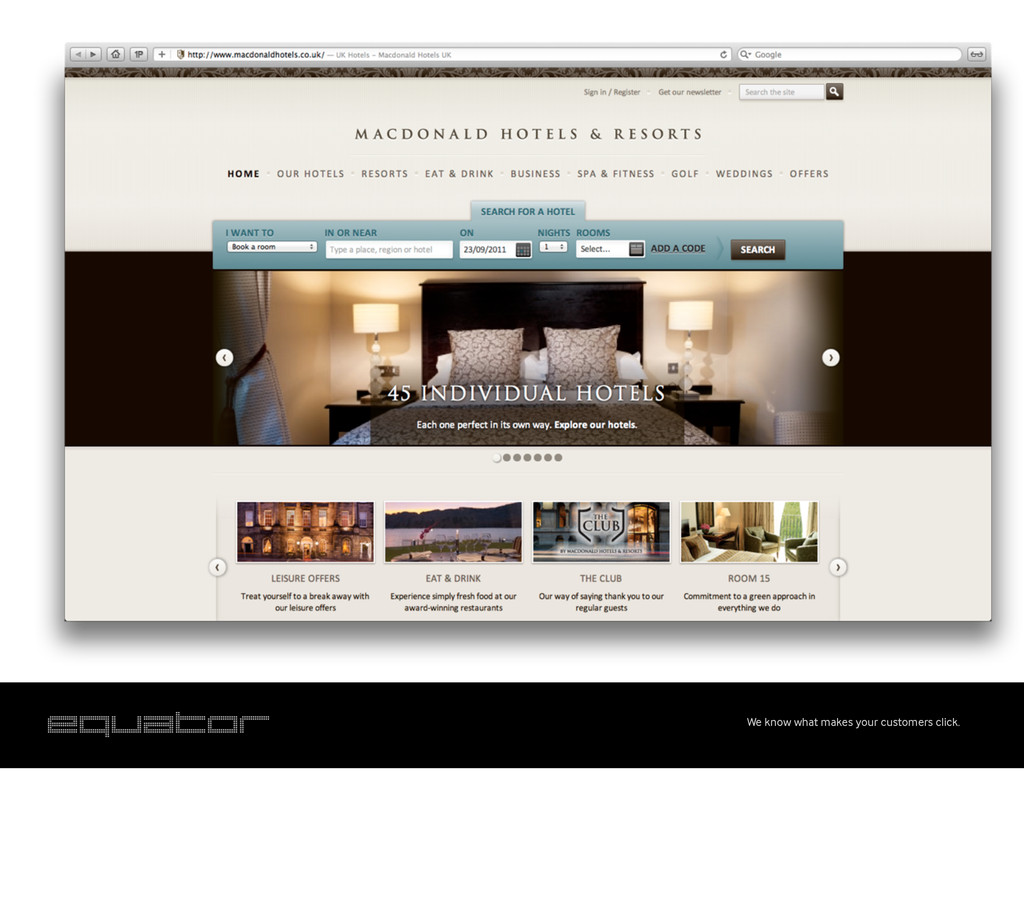
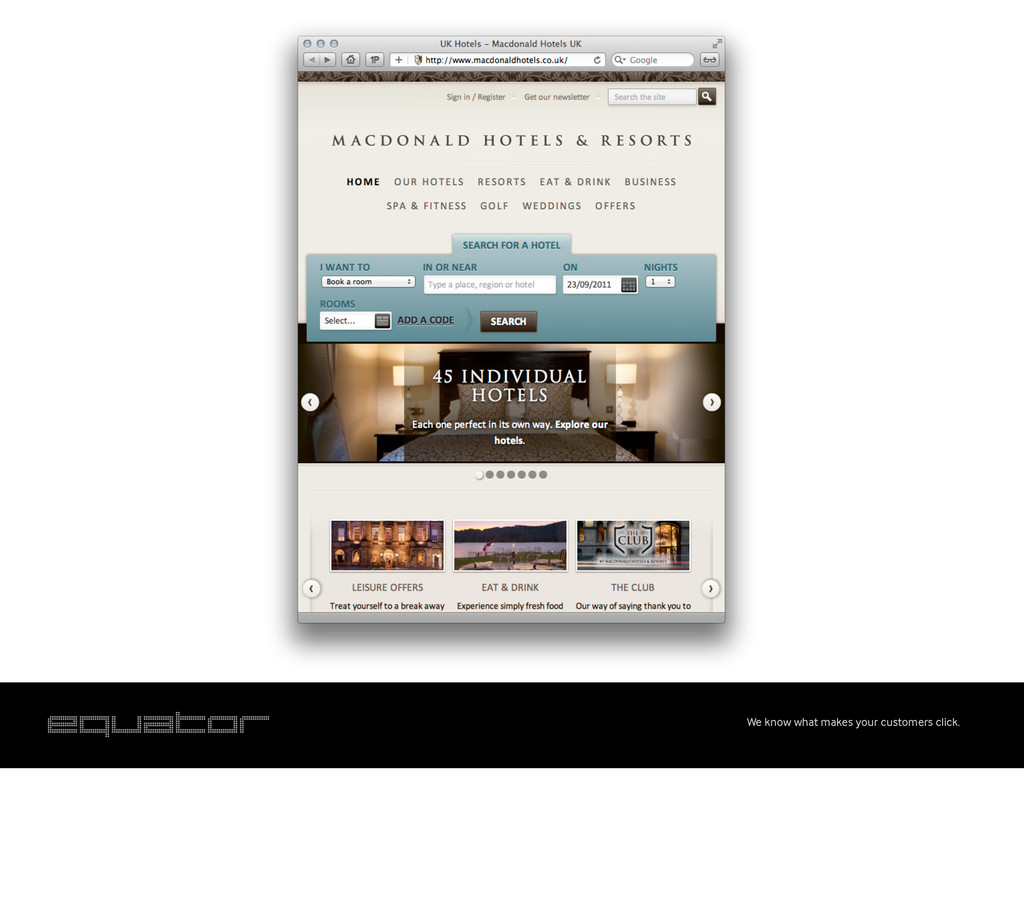
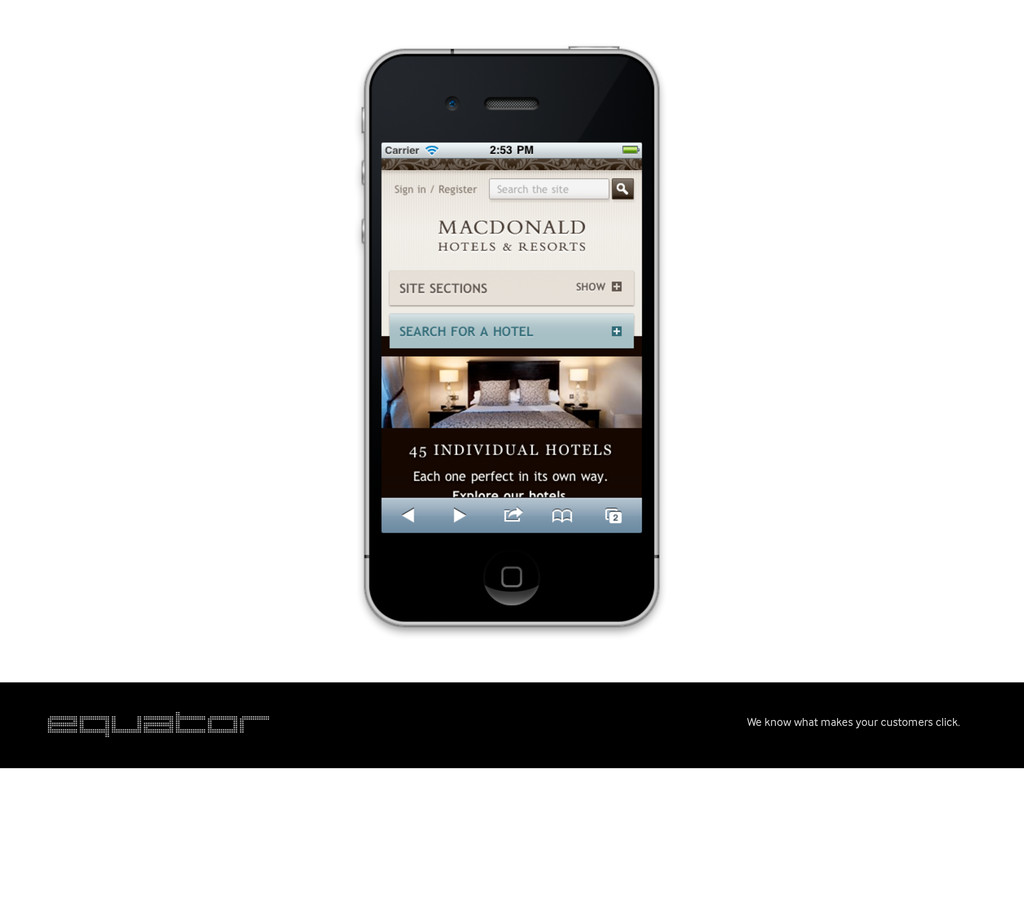
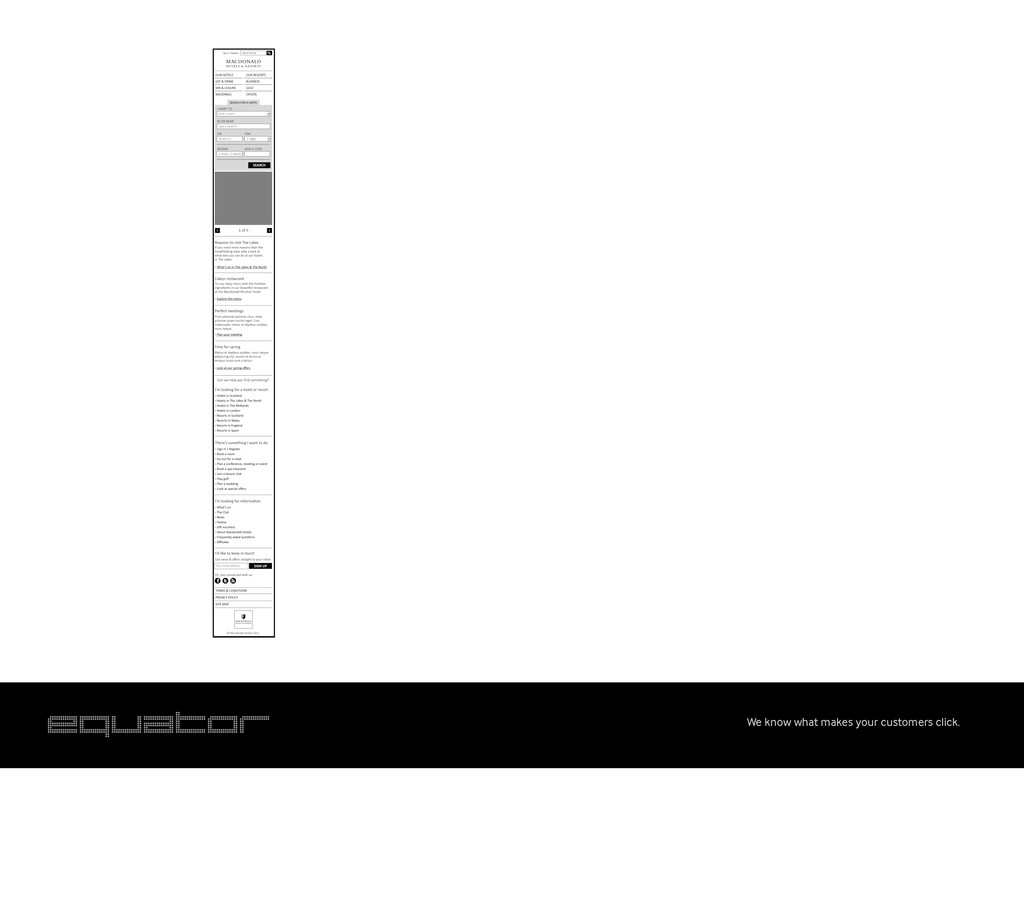
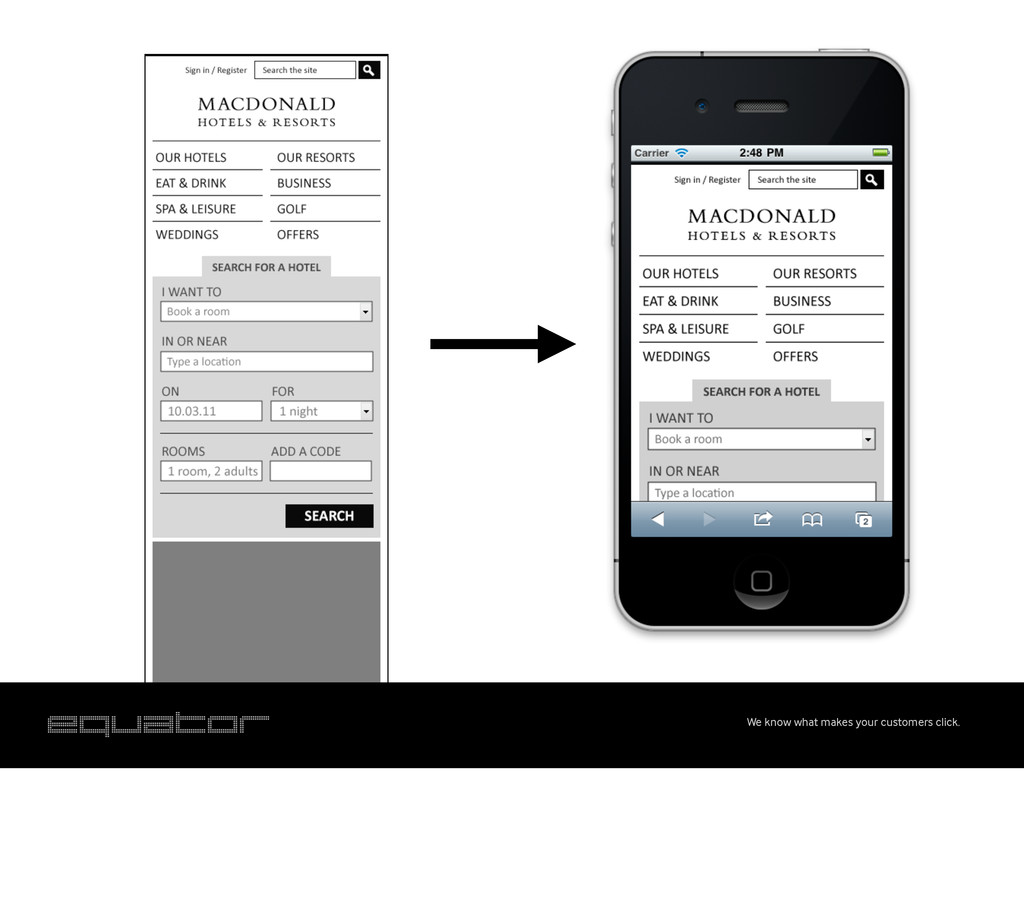
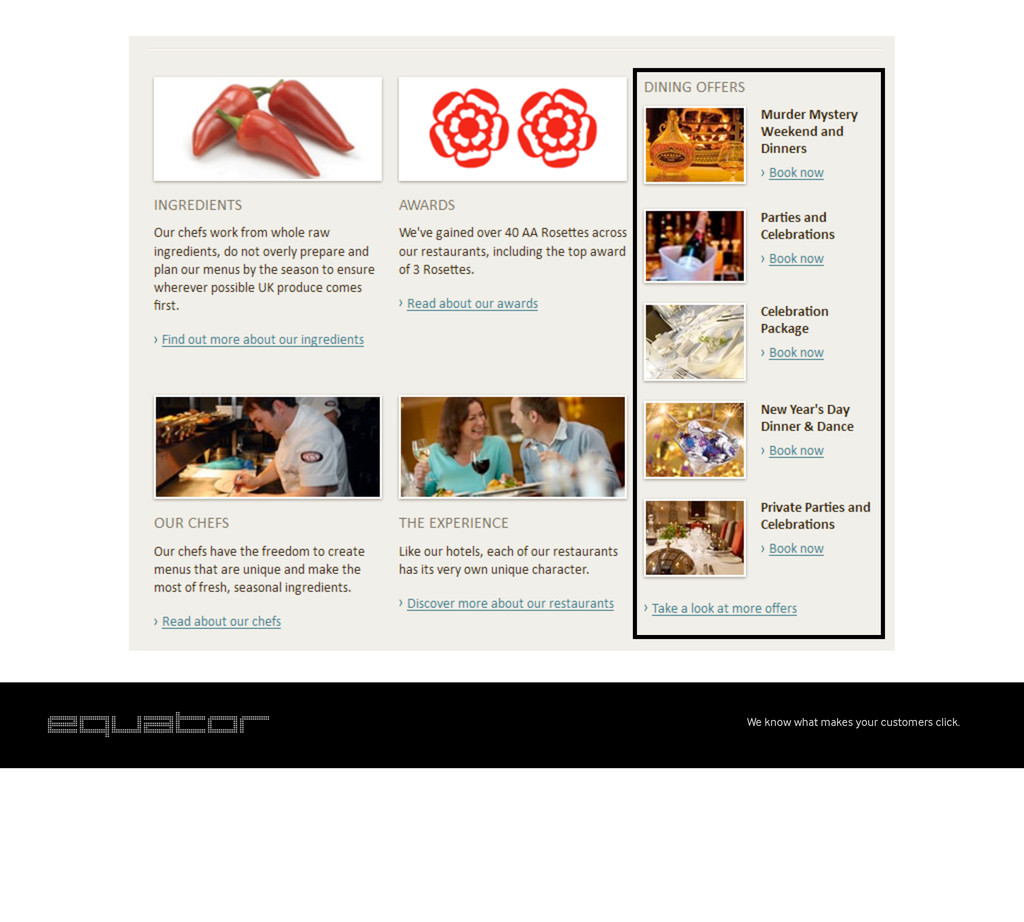
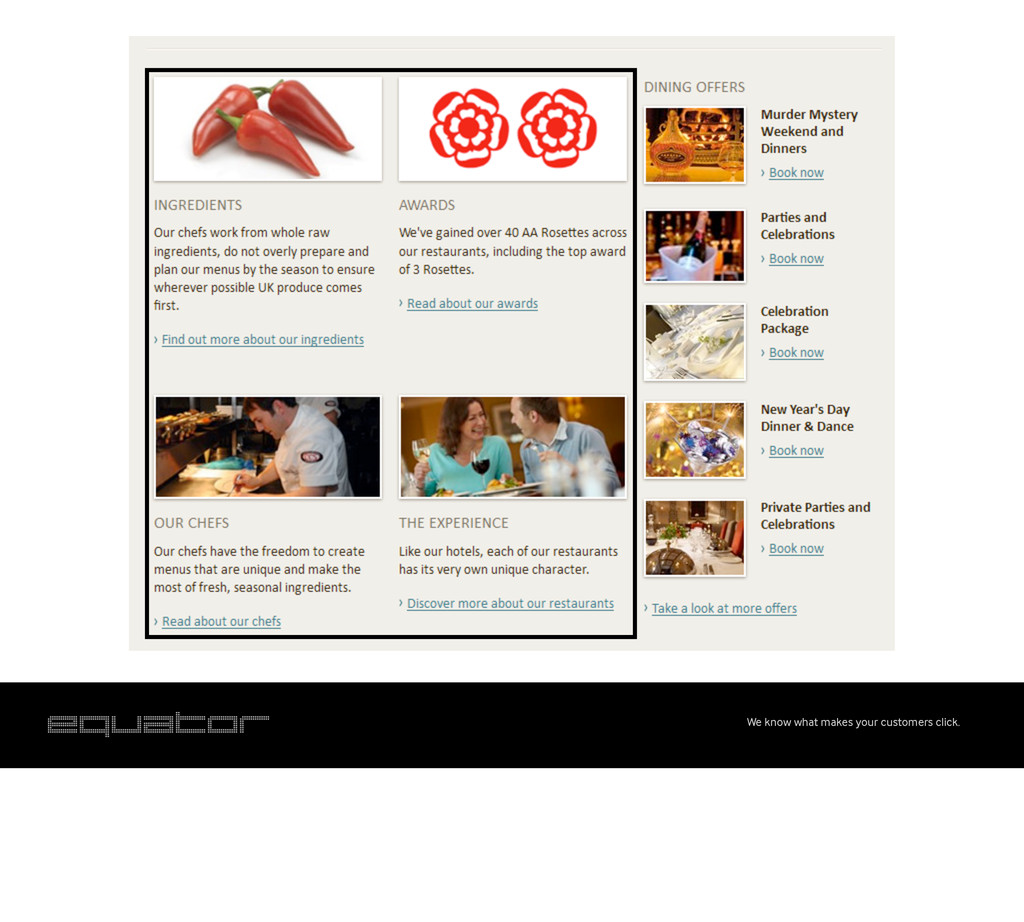
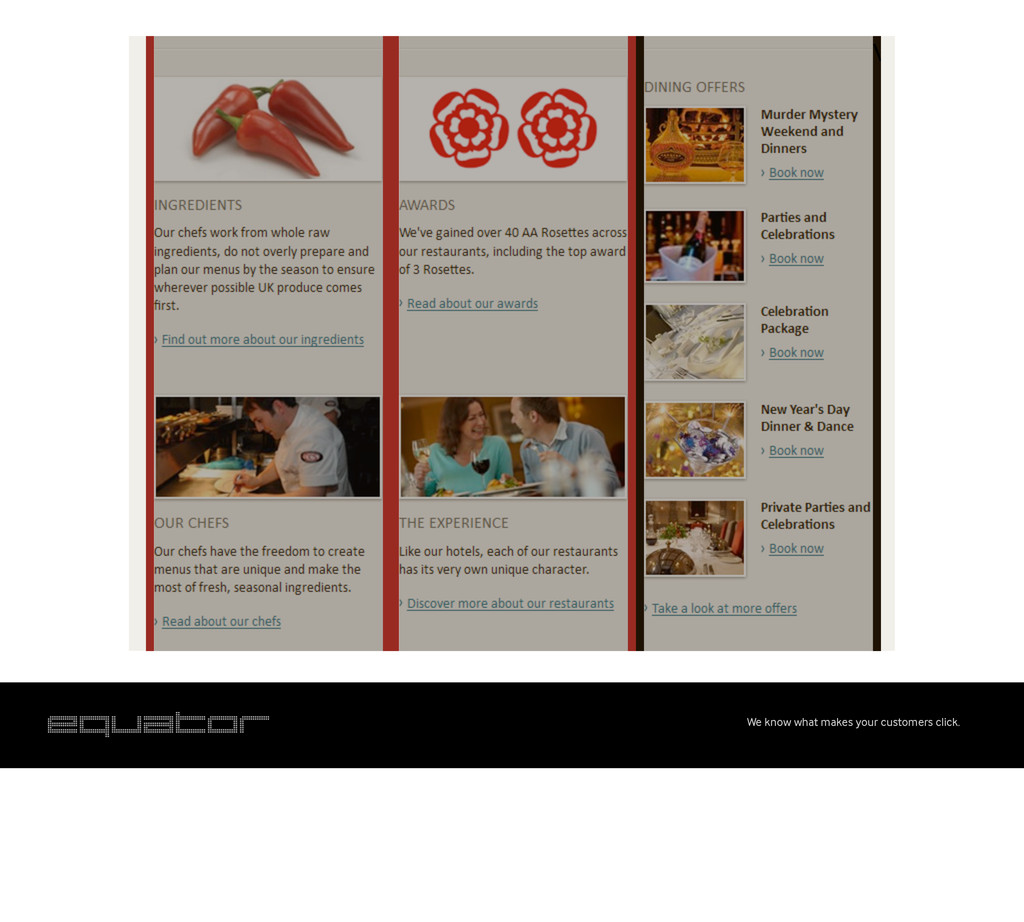
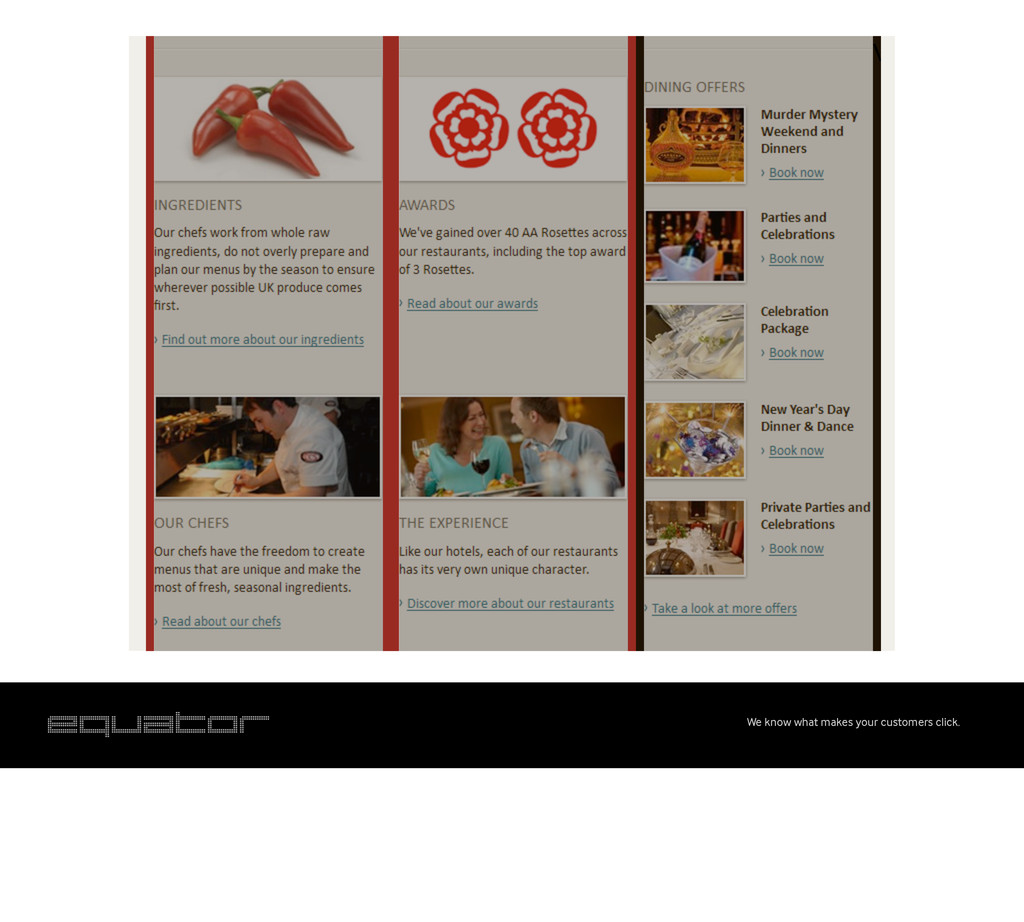
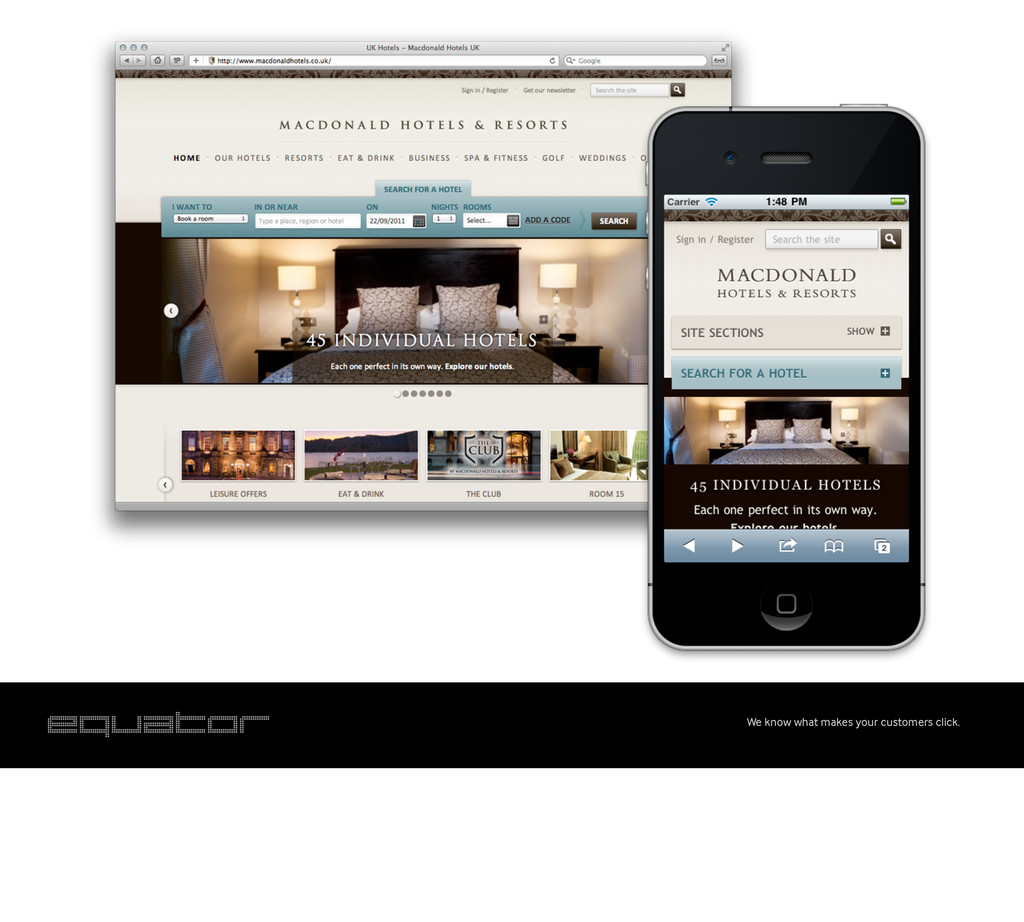
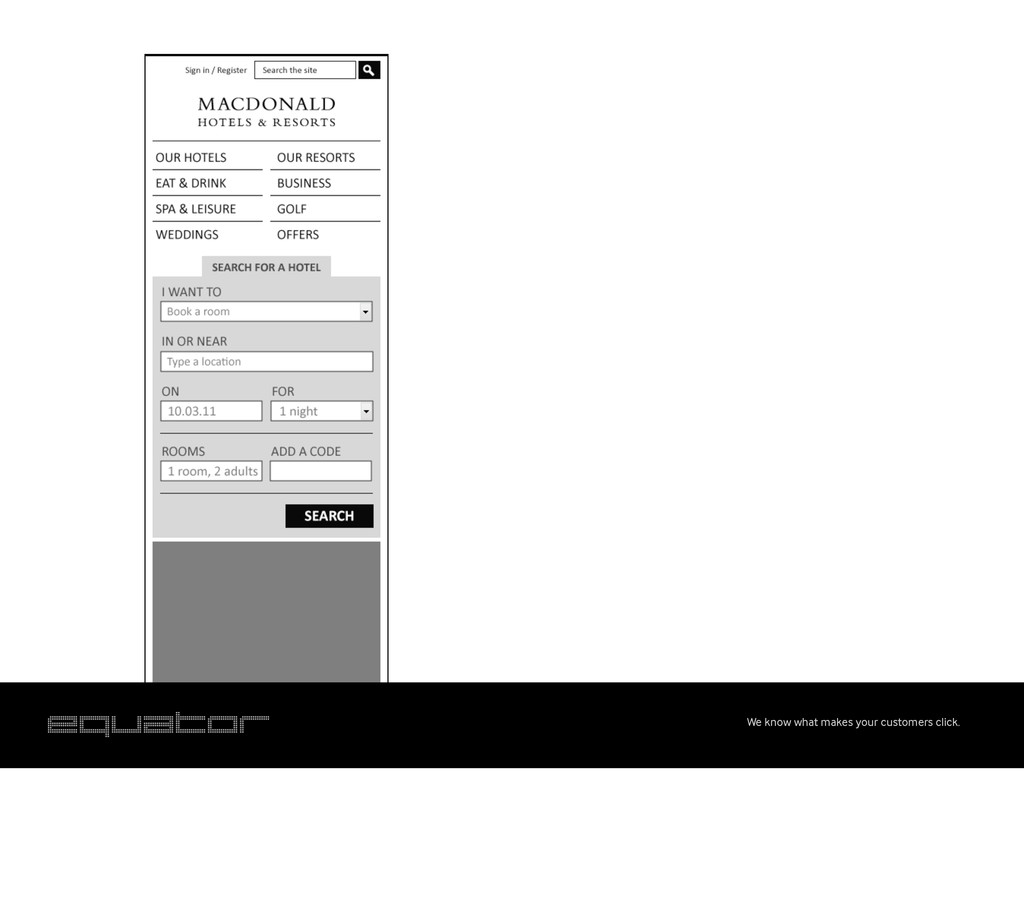
year Equator have been working with Macdonald Hotels www.macdonaldhotels.co.uk MH owns and manages 45 hotels throughout the UK They asked Equator to help them redevelop their website and the backend systems that support their online booking process Part of their brief was some form of support for Mobile users We decided that a using RWD was the way to deliver this SHOW SITE... So how did we do this... -
We know what makes your customers click. Start with a
solid foundation Started with a strong founda;on -
We know what makes your customers click. Web Standards +
Progressive Enhancement Web Standards -‐ Clean, seman;cs markup, best prac;ce accessibility Progressive Enhancement -‐ building baseline func;onality that could be enhanced in browsers that supported more advanced technologies like HTML5, CSS3 and JavaScript -
We know what makes your customers click. Web Standards +
Progressive Enhancement + Responsive Design RWD was a natural third step... -
We know what makes your customers click. 5 things we
learned I’d like to talk about 5 things we learned from the design and development process... -
We know what makes your customers click. 1. Test on
hardware as soon as possible -
We know what makes your customers click. Get wireframe and
prototypes onto phones and tablets immediately -
We know what makes your customers click. Screen resolution Content
and Control Sizes -
We know what makes your customers click. Screen resolution Content
and Control Sizes How it feels... -
We know what makes your customers click. We gained some
fundamental design insights very early by getting onto the hardware Things that we missed in a resized browser window became obvious on a phone or tablet -
We know what makes your customers click. 2. Keep the
user orientated -
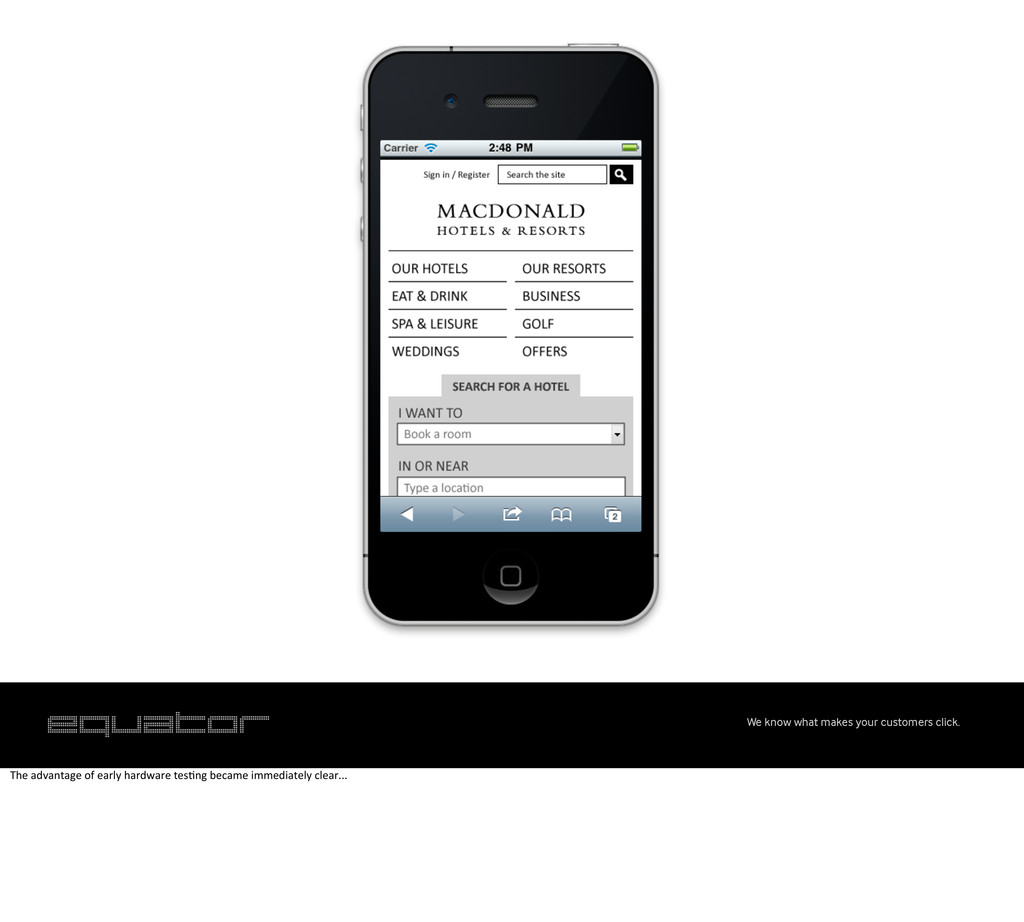
We know what makes your customers click. The user has
to know where they are, but a small screen size limits what affordances you can give as the page loads -
We know what makes your customers click. The advantage of
early hardware tes;ng became immediately clear... -
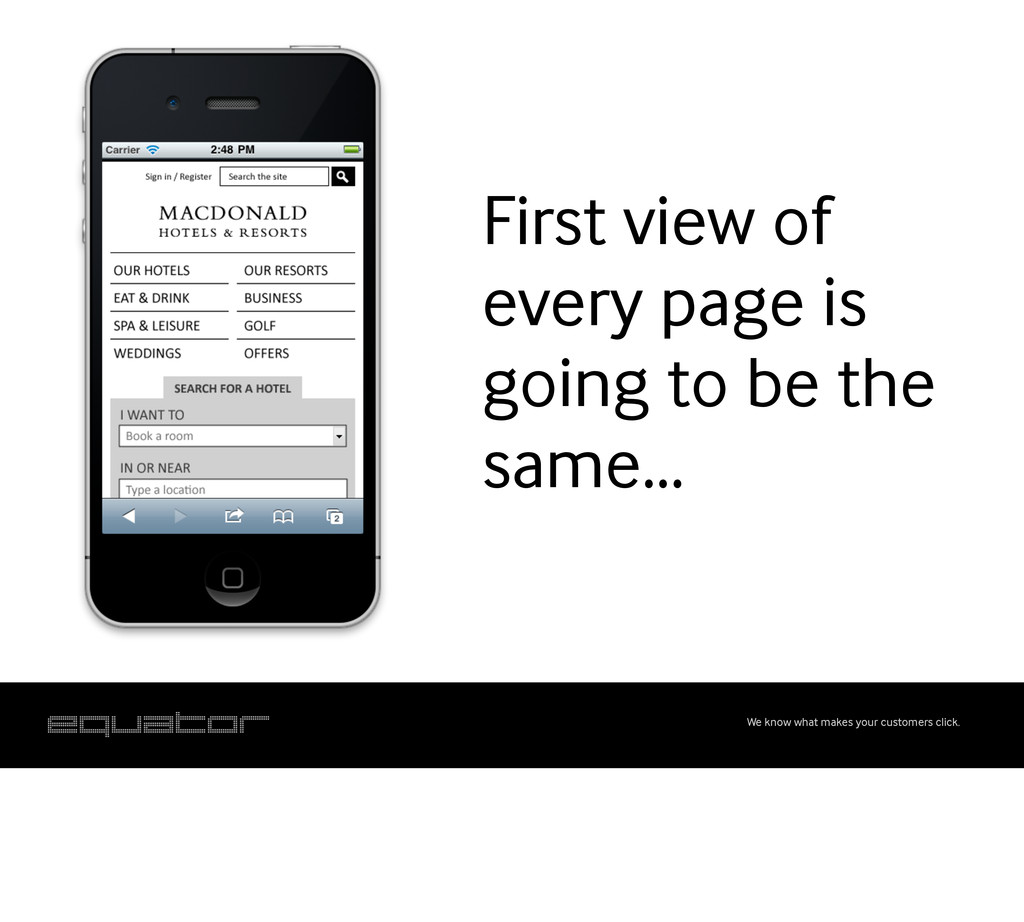
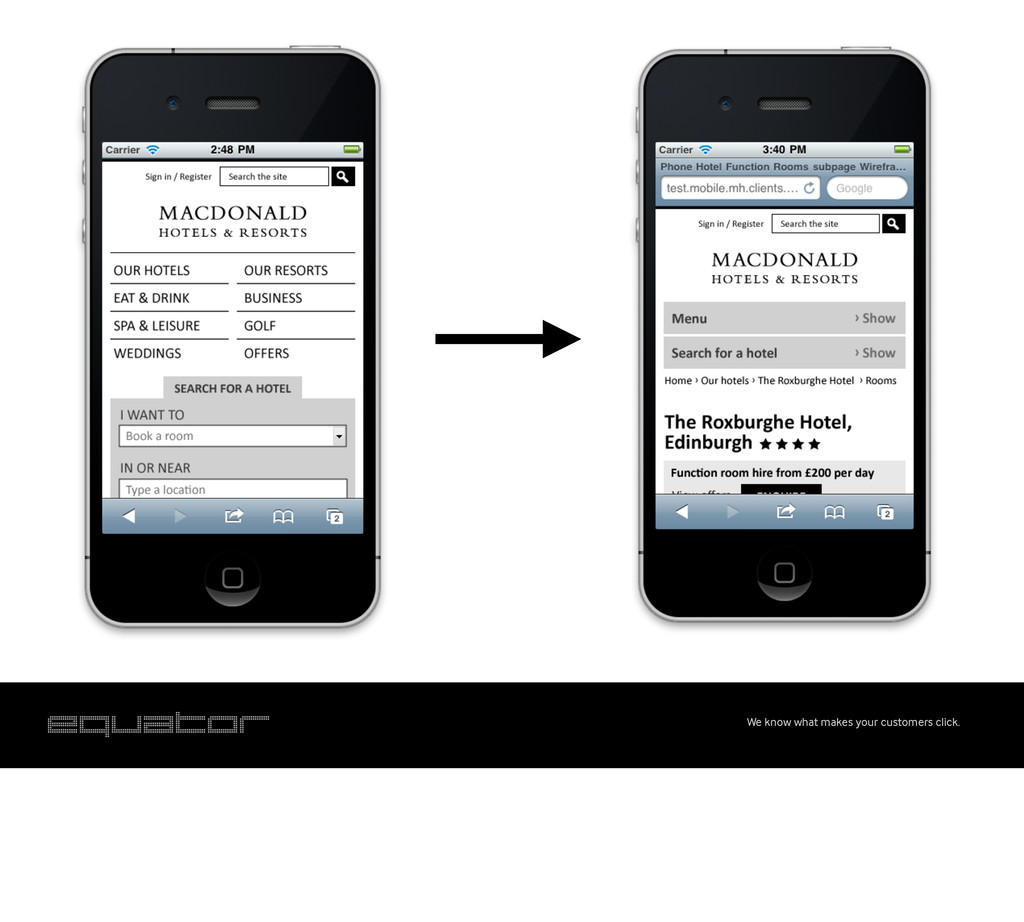
We know what makes your customers click. First view of
every page is going to be the same... -
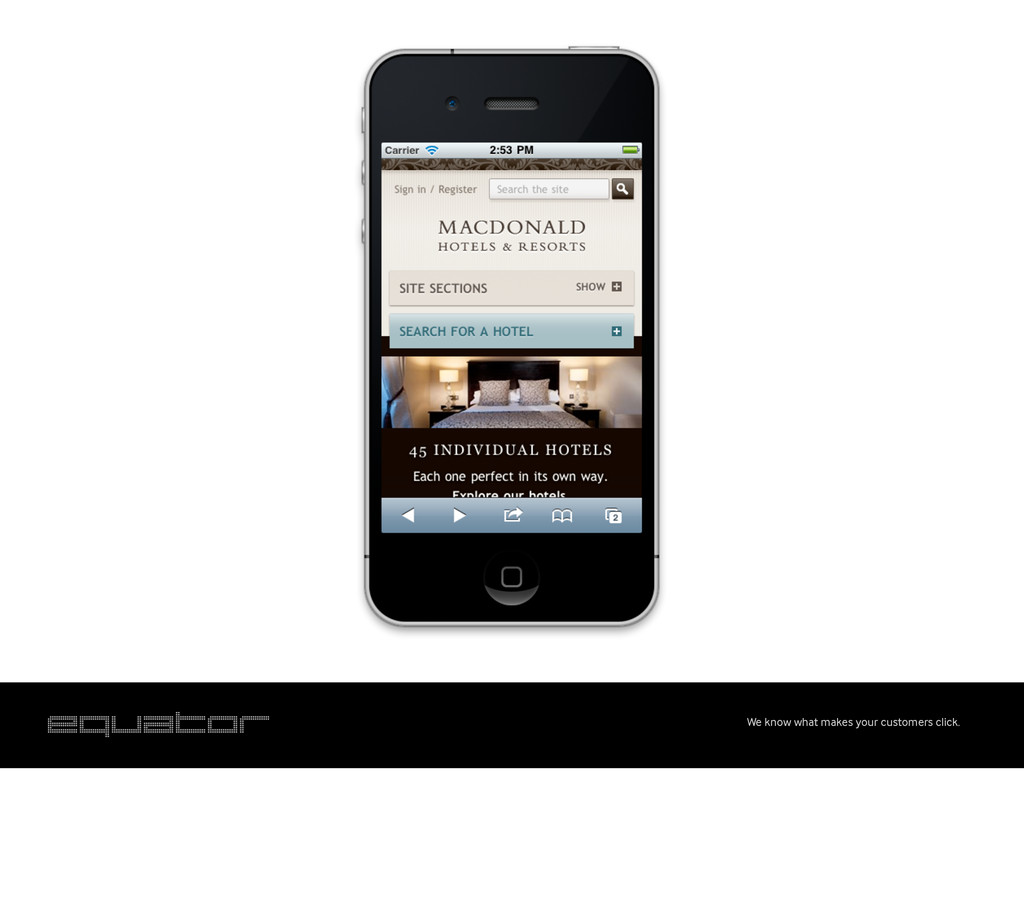
We know what makes your customers click. Reduce the header
to as small a size as possible and get page-identifying content on the screen when the page loads -
We know what makes your customers click. 3. Let the
grid system do the heavy lifting -
We know what makes your customers click. The complexity began
to increase rapidly, so we needed to simplify things... -
We know what makes your customers click. A well-defined set
of grids + Generic Layout CSS = A framework that’ll do the heavy lifting for you -
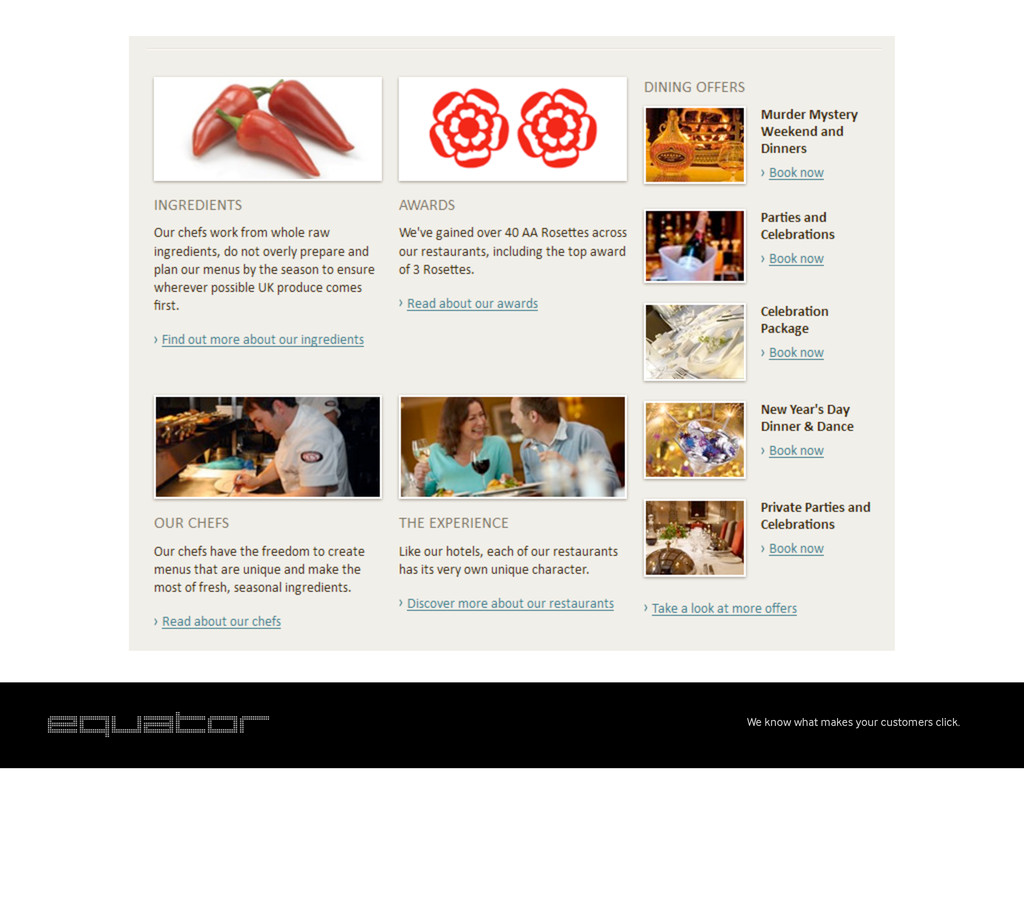
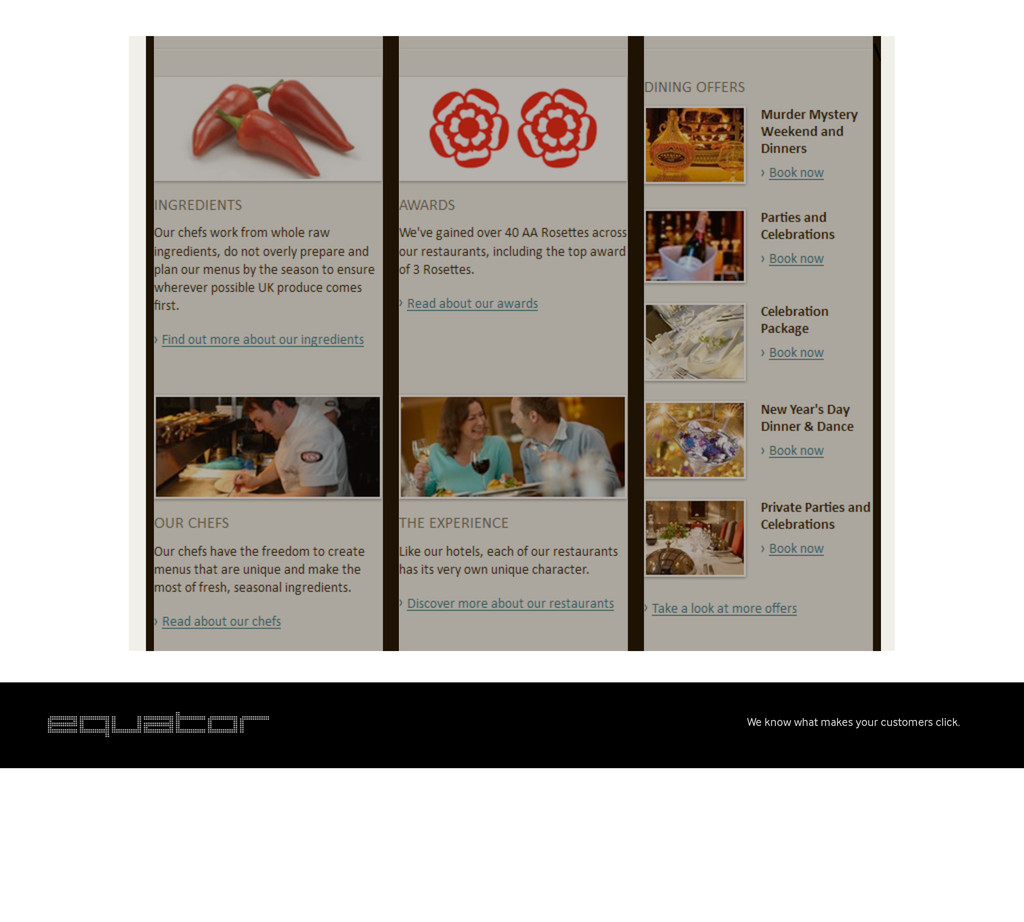
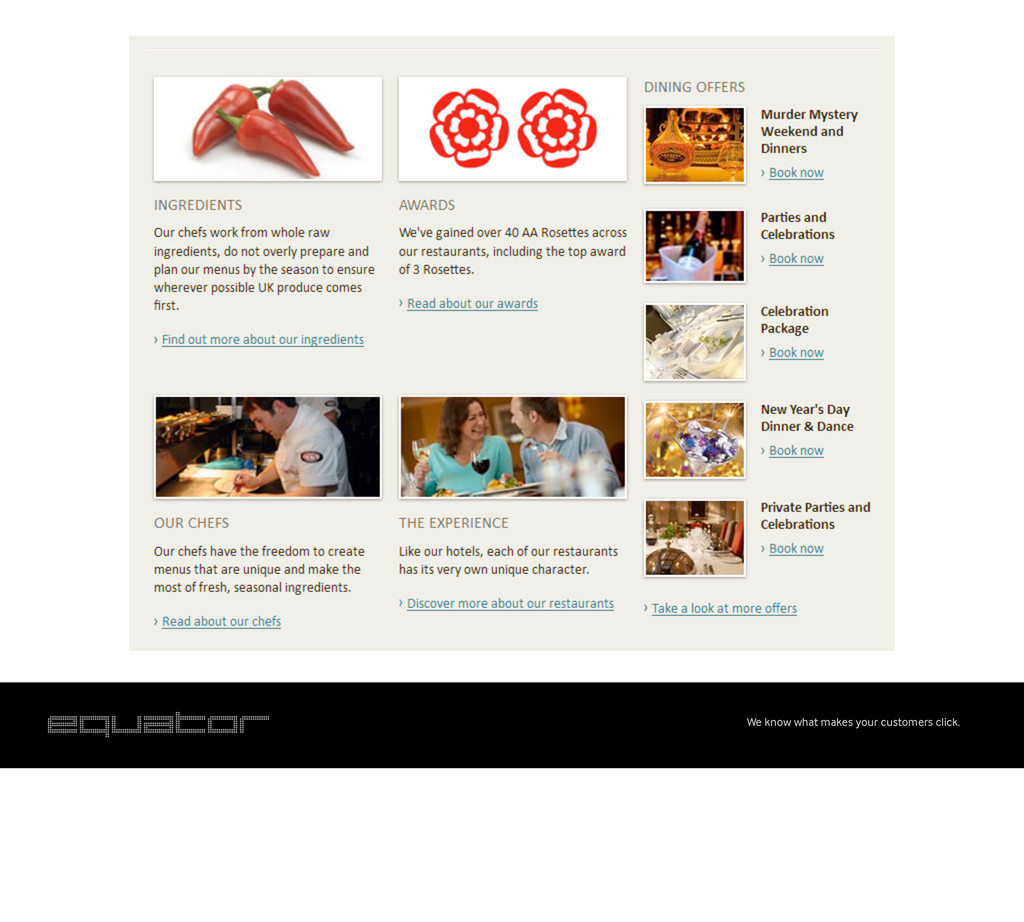
We know what makes your customers click. The framework deals
with aligning the component to the grid... We deal with laying out content within the components -
We know what makes your customers click. A simple bit
of maths to the rescue! -
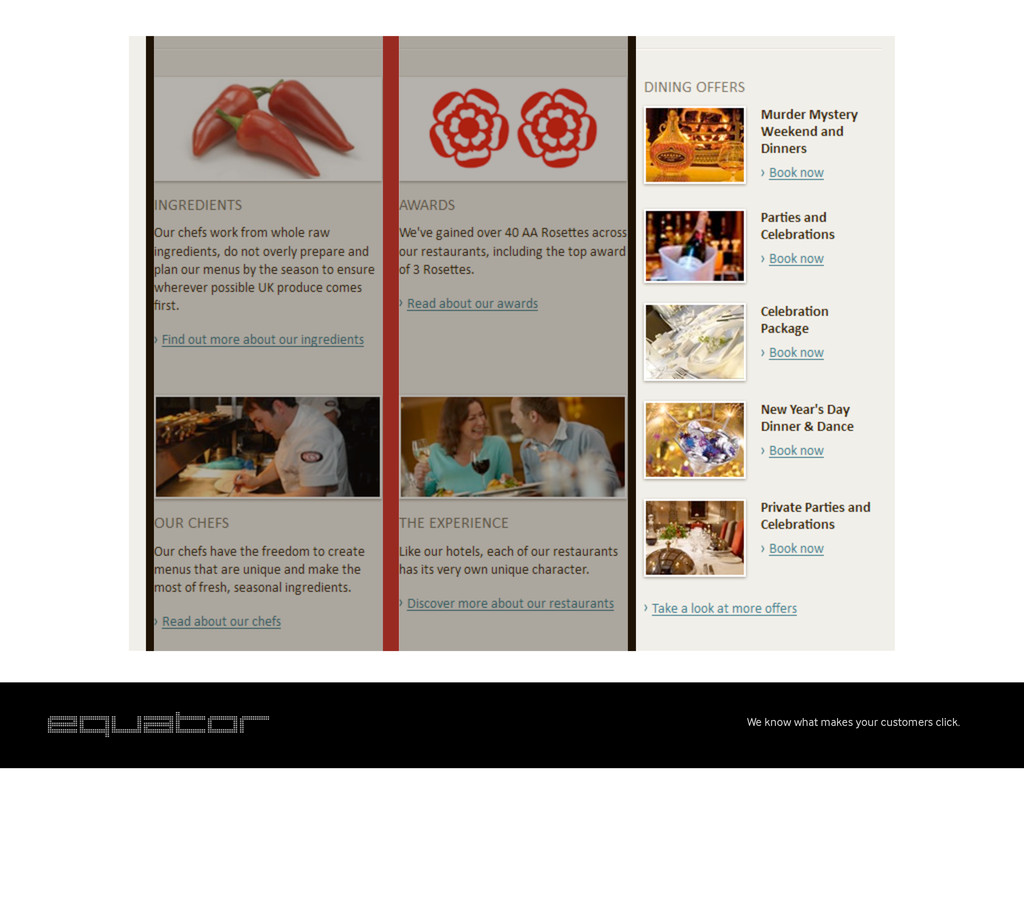
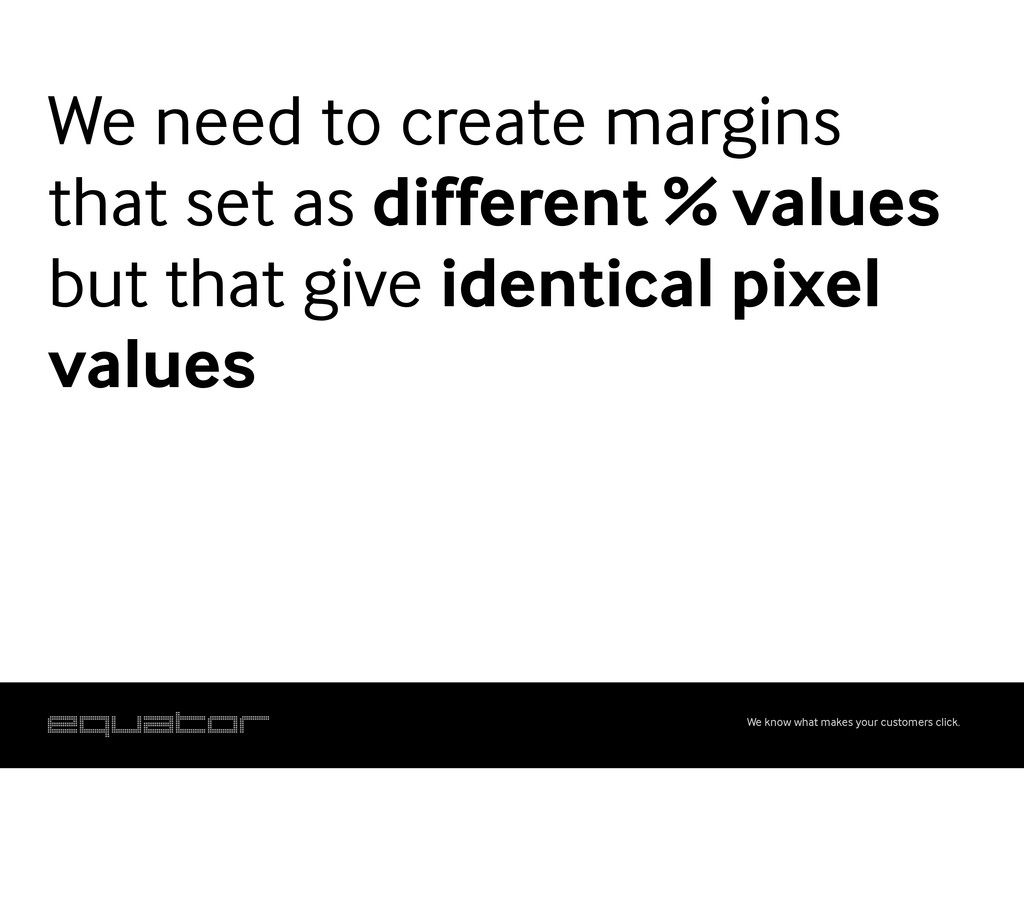
We know what makes your customers click. We need to
create margins that set as different % values but that give identical pixel values -
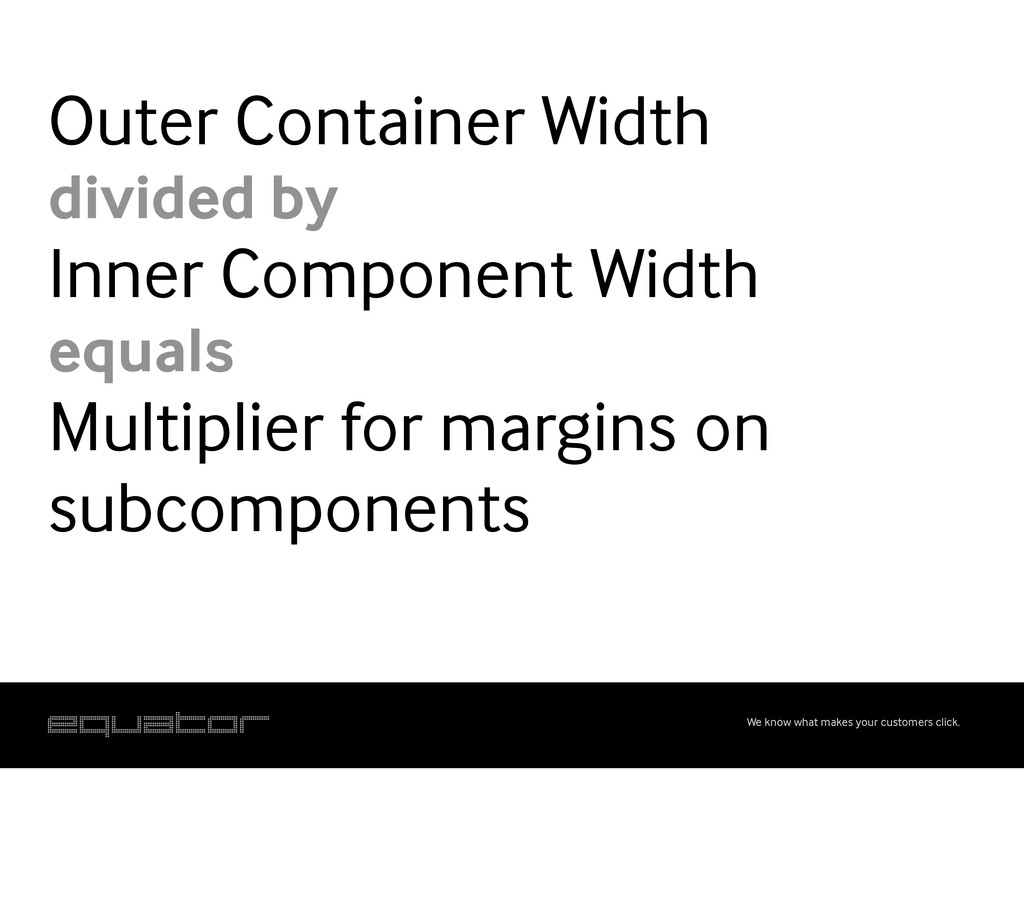
We know what makes your customers click. Outer Container Width
divided by Inner Component Width equals Multiplier for margins on subcomponents -
We know what makes your customers click. Keep component margins
symmetrical and proportional Set margins on the smallest indivisible units -
We know what makes your customers click. 4. Use JavaScript
to load optimised images -
We know what makes your customers click. Load low-resolution versions
to create correctly proportioned placeholders -
We know what makes your customers click. Detect component size
and load optimised images -
We know what makes your customers click. Pay particular attention
to layout transition breakpoints -
We know what makes your customers click. Pay particular attention
to breakpoints Layouts can be really stressed on the wrong side of these -
We know what makes your customers click. A breakpoint at
a width of 480px triggers the phone layout -
We know what makes your customers click. A breakpoint at
a width of 480px triggers the phone layout How does the layout behave at 481px? -
We know what makes your customers click. Create special cases
if the content demands it -
We know what makes your customers click. Create special cases
if the content demands it Add intermediate breakpoints for these special cases -
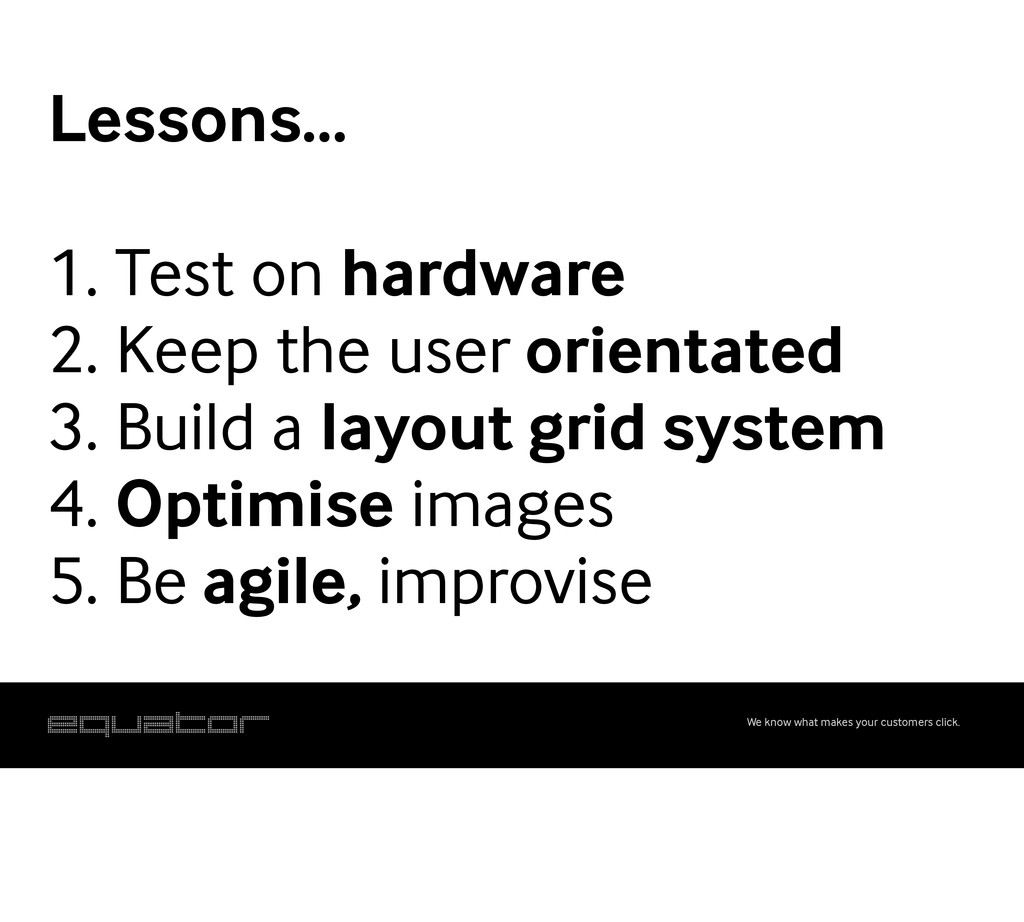
We know what makes your customers click. Lessons... 1. Test
on hardware 2. Keep the user orientated 3. Build a layout grid system 4. Optimise images 5. Be agile, improvise -
We know what makes your customers click. The basics can
take you a long way -
We know what makes your customers click. The impact on
back-end development is minimal We took a pragma;c approach mobile op;misa;on The complexity of the back-‐end development (data management, systems integra;on) meant that the mobile solu;on had to be low-‐risk from the back-‐end point of view RWD is also low-‐risk from a front-‐end point of view Progressive Enhancement, easy to remove -
We know what makes your customers click. Responsive Design is
not a silver bullet for a complete mobile strategy -
We know what makes your customers click. Be responsive, embrace
flexibility, build the web the way it was always meant to be -
We know what makes your customers click. Thank you for
your attention Any Questions?