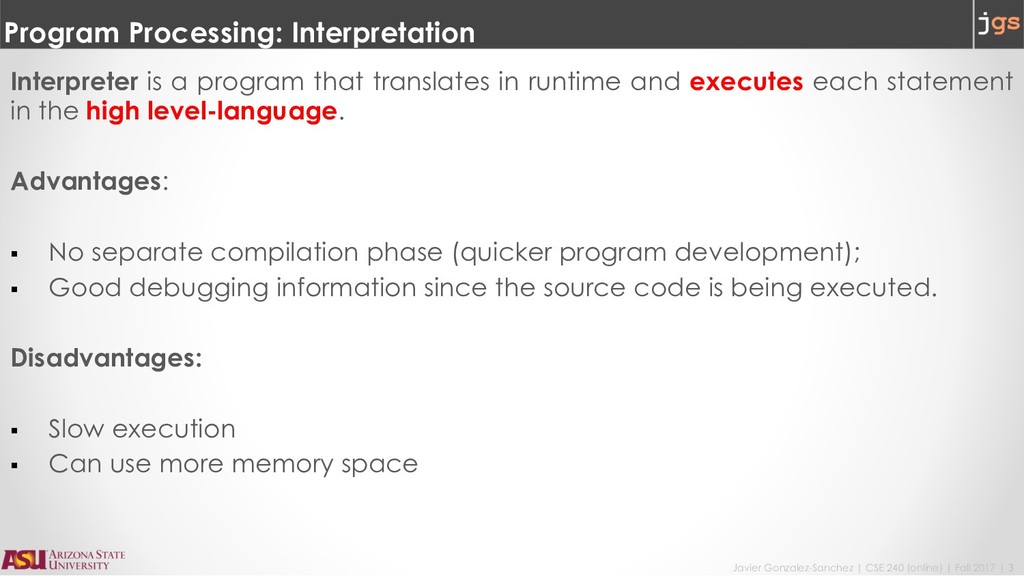
3 Program Processing: Interpretation Interpreter is a program that translates in runtime and executes each statement in the high level-language. Advantages: § No separate compilation phase (quicker program development); § Good debugging information since the source code is being executed. Disadvantages: § Slow execution § Can use more memory space
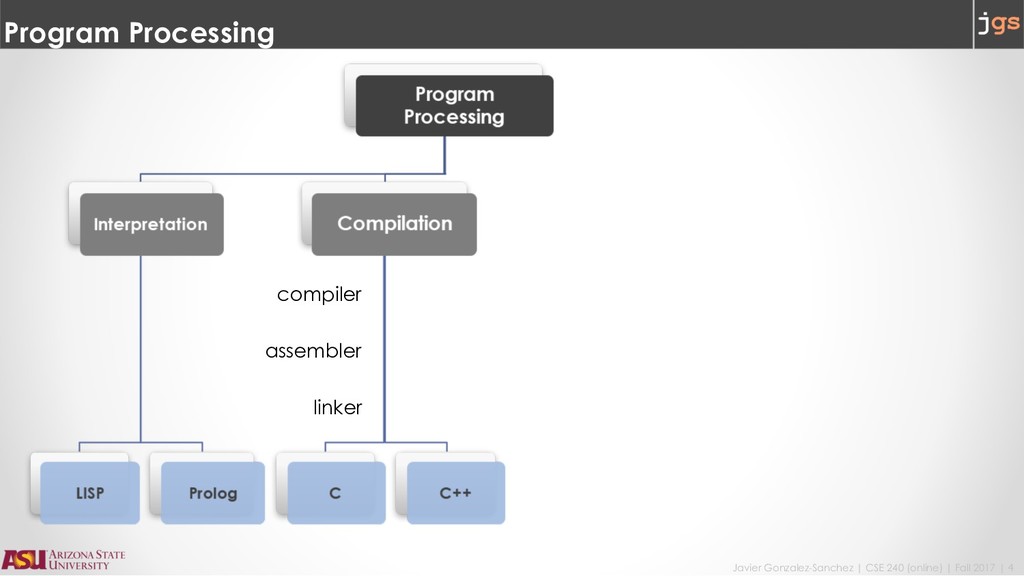
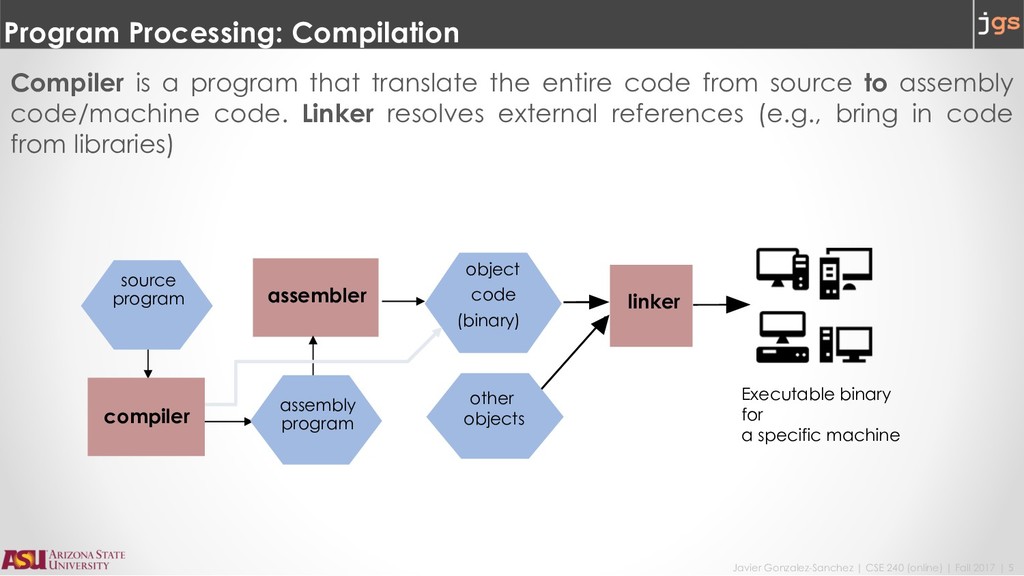
5 Program Processing: Compilation Compiler is a program that translate the entire code from source to assembly code/machine code. Linker resolves external references (e.g., bring in code from libraries) object code (binary) linker Executable binary for a specific machine other objects source program assembler assembly program compiler
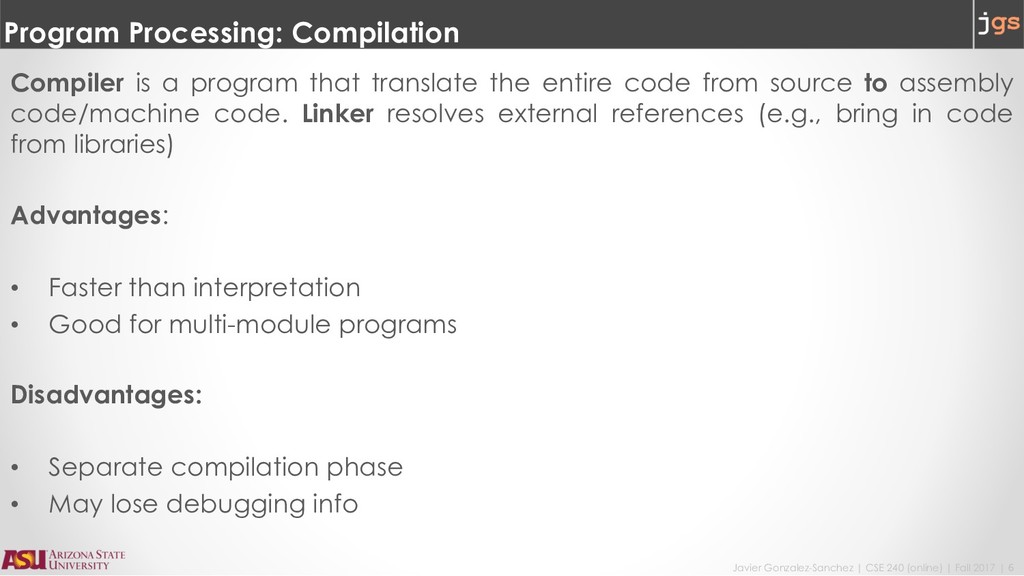
6 Program Processing: Compilation Compiler is a program that translate the entire code from source to assembly code/machine code. Linker resolves external references (e.g., bring in code from libraries) Advantages: • Faster than interpretation • Good for multi-module programs Disadvantages: • Separate compilation phase • May lose debugging info
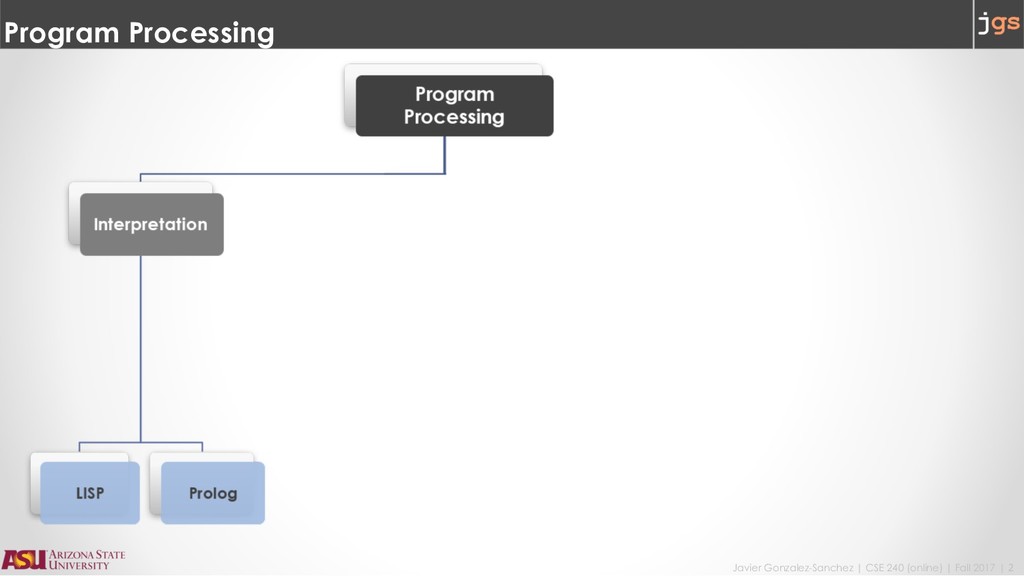
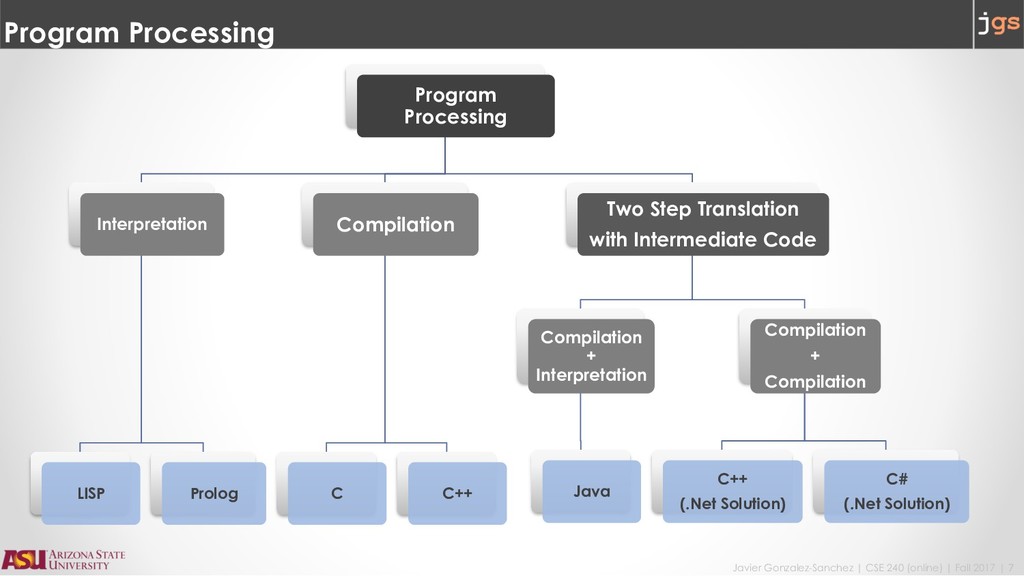
7 Program Processing Program Processing Interpretation LISP Prolog Compilation C C++ Two Step Translation with Intermediate Code Compilation + Interpretation Java Compilation + Compilation C++ (.Net Solution) C# (.Net Solution)
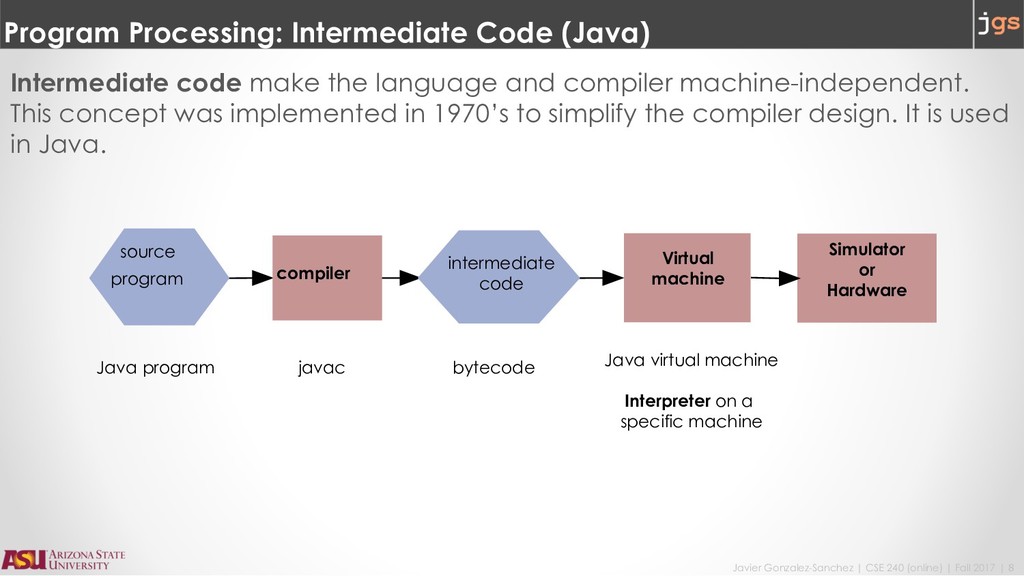
8 Program Processing: Intermediate Code (Java) Intermediate code make the language and compiler machine-independent. This concept was implemented in 1970’s to simplify the compiler design. It is used in Java. bytecode Java program javac Java virtual machine Interpreter on a specific machine Simulator or Hardware source program intermediate code Virtual machine compiler
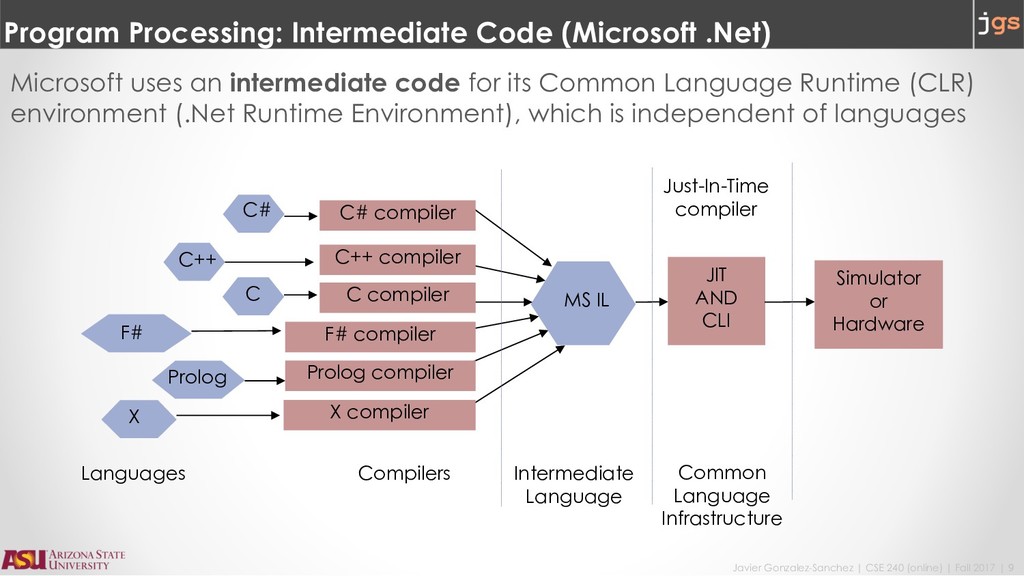
9 Program Processing: Intermediate Code (Microsoft .Net) Microsoft uses an intermediate code for its Common Language Runtime (CLR) environment (.Net Runtime Environment), which is independent of languages Prolog F# X F# compiler Prolog compiler X compiler JIT AND CLI C# Languages MS IL Just-In-Time compiler Intermediate Language Common Language Infrastructure Compilers C# compiler C++ C++ compiler C C compiler Simulator or Hardware
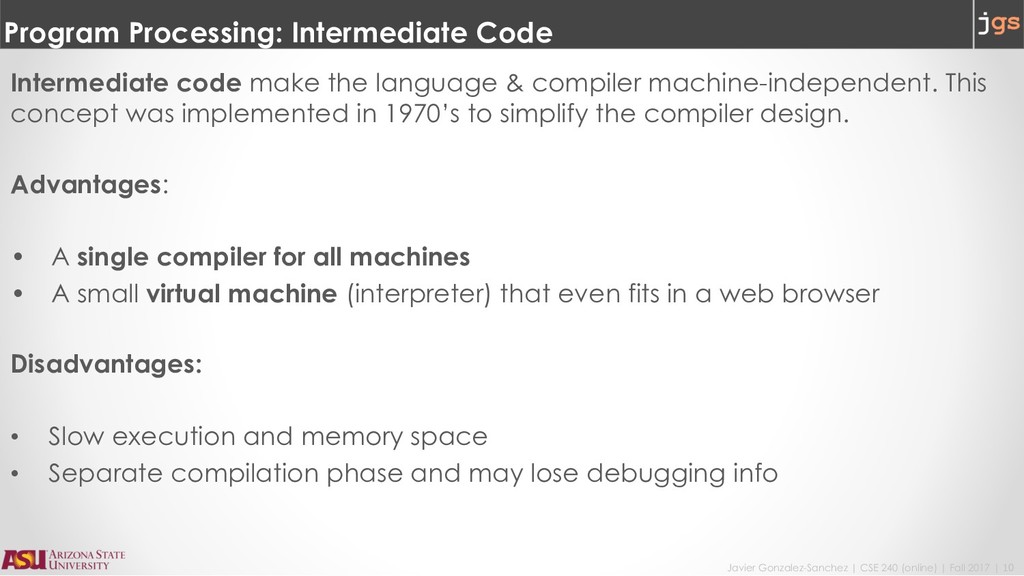
10 Program Processing: Intermediate Code Intermediate code make the language & compiler machine-independent. This concept was implemented in 1970’s to simplify the compiler design. Advantages: • A single compiler for all machines • A small virtual machine (interpreter) that even fits in a web browser Disadvantages: • Slow execution and memory space • Separate compilation phase and may lose debugging info
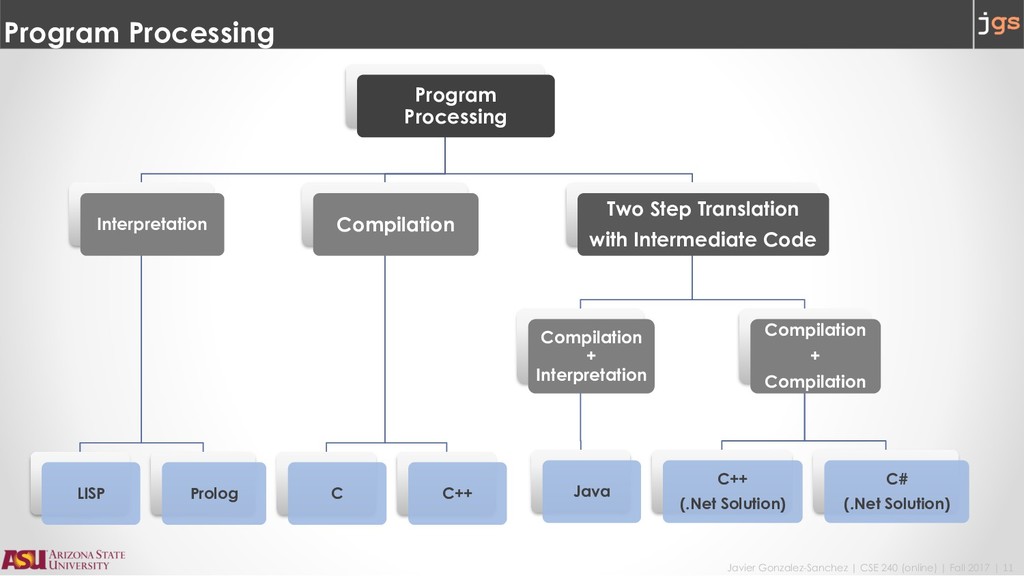
11 Program Processing Program Processing Interpretation LISP Prolog Compilation C C++ Two Step Translation with Intermediate Code Compilation + Interpretation Java Compilation + Compilation C++ (.Net Solution) C# (.Net Solution)
Fall 2017 Disclaimer. These slides can only be used as study material for the class CSE240 at ASU. They cannot be distributed or used for another purpose.


 javiergs
 kawashimo0
 o0h
o0h
 kenjiyoneyama
 oniak3ibm
 s_shimotori
 oku053
 tomokon
 rkaga
rkaga
 reimaru
 kinopeee
 y0hgi
y0hgi
 hatsu38
 sachag
 jonoalderson
 skipperchong
 bkeepers
 mlcsv
mlcsv
 3n
3n
 reverentgeek
 maltzj
 tomoyanonymous
 baasie
 eileencodes
 bluesmoon
![CSE240 – Introduction to Programming Languages (online) Javier Gonzalez-Sanchez [email protected]](https://files.speakerdeck.com/presentations/fb7b6469b38e445a99025986637ff8bb/slide_11.jpg)