Upgrade to Pro — share decks privately, control downloads, hide ads and more …

Gourmet Service Objects

Sponsored · Ship Features Fearlessly Turn features on and off without deploys. Used by thousands of Ruby developers.

Gourmet Service Objects

The Thinnest of Classes

Slides by @expede and @jenncoop

Avatar for Jenn Cooper

Jenn Cooper

October 02, 2014
Tweet

Other Decks in Programming

Transcript

  1. MODELS • Resources • A collection of attributes that models

    some data/state • Can touch the database — but doesn’t have to (ActiveModel rocks) • May include associations, scoping, and so on
  2. SERVICES • Never resources • Simple! • No attributes, no

    accessors, no internal state • Thus no need for instances! • “Method” object — do-ers • Can be universal — “pure functions”
  3. THE NATURE OF A SERVICE • Clean (ie: short) •

    Does one thing • Doesn’t depend on context • Call from anywhere • Few object dependencies (if any) • Dependency inject if there is one (more later) • Composable
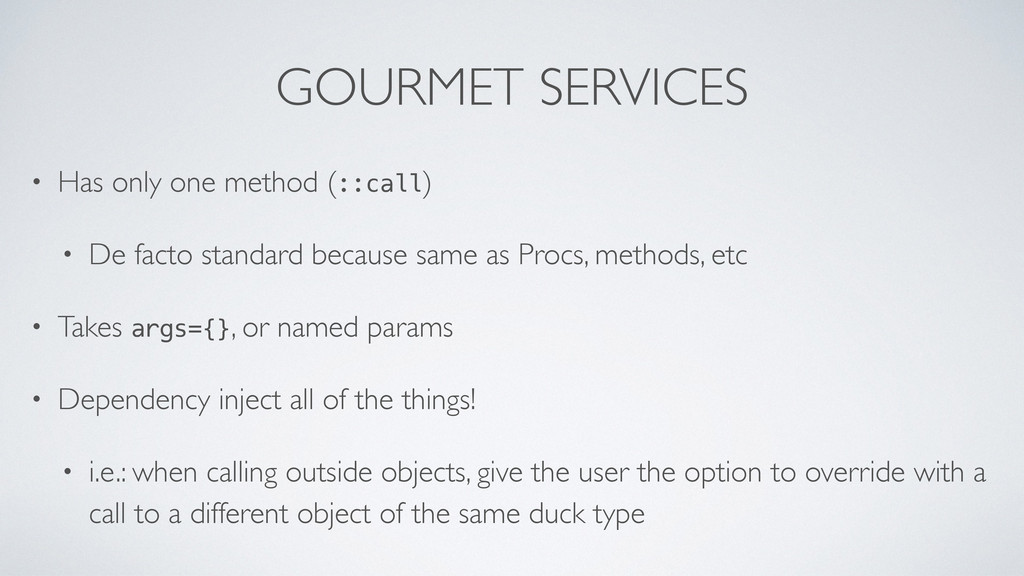
  4. GOURMET SERVICES • Has only one method (::call) • De

    facto standard because same as Procs, methods, etc • Takes args={}, or named params • Dependency inject all of the things! • i.e.: when calling outside objects, give the user the option to override with a call to a different object of the same duck type
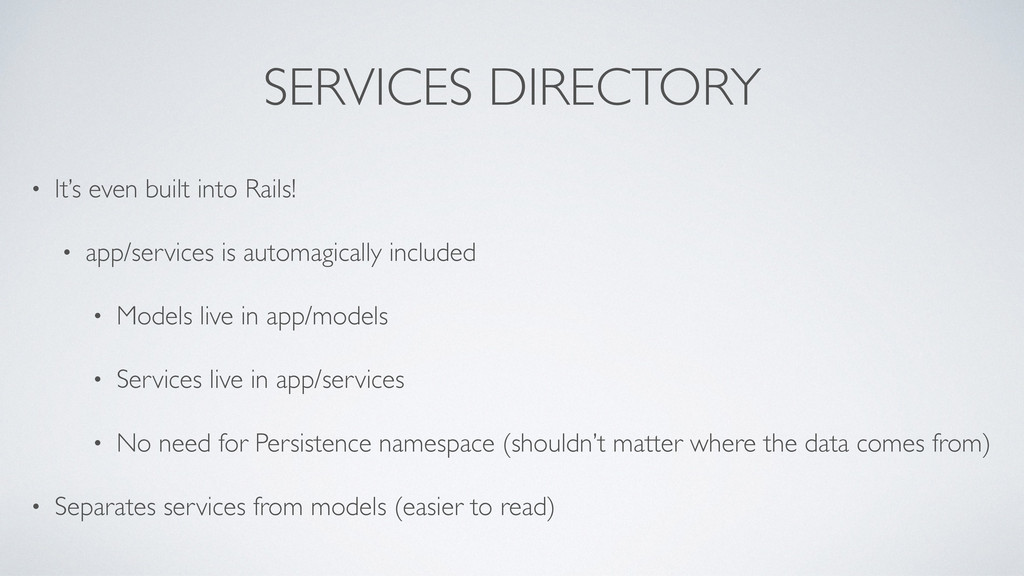
  5. SERVICES DIRECTORY • It’s even built into Rails! • app/services

    is automagically included • Models live in app/models • Services live in app/services • No need for Persistence namespace (shouldn’t matter where the data comes from) • Separates services from models (easier to read)
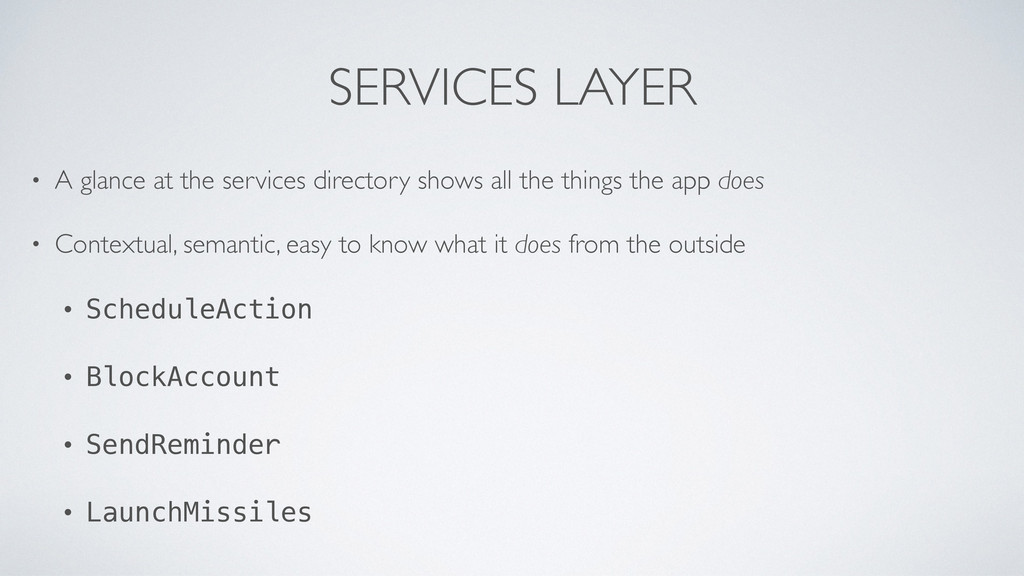
  6. SERVICES LAYER • A glance at the services directory shows

    all the things the app does • Contextual, semantic, easy to know what it does from the outside • ScheduleAction • BlockAccount • SendReminder • LaunchMissiles
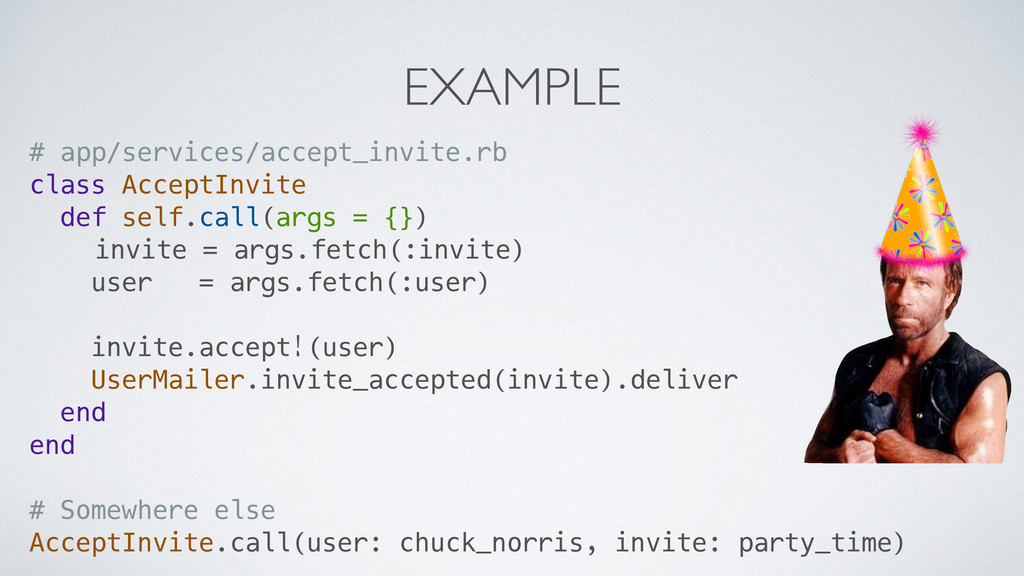
  7. EXAMPLE # app/services/accept_invite.rb class AcceptInvite def self.call(args = {}) invite

    = args.fetch(:invite) user = args.fetch(:user) invite.accept!(user) UserMailer.invite_accepted(invite).deliver end end ! # Somewhere else AcceptInvite.call(user: chuck_norris, invite: party_time)
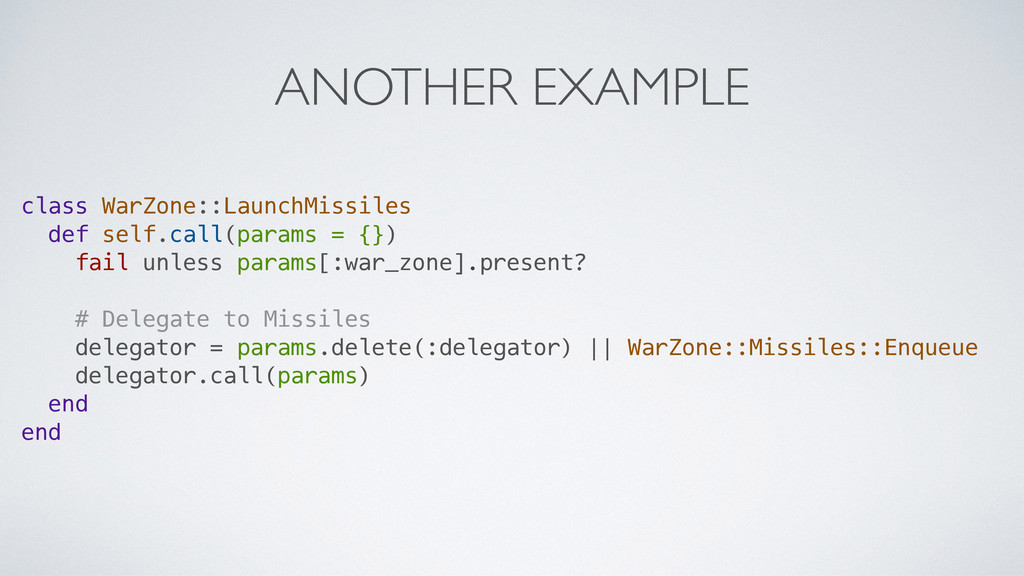
  8. ANOTHER EXAMPLE class WarZone::LaunchMissiles def self.call(params = {}) fail unless

    params[:war_zone].present? ! # Delegate to Missiles delegator = params.delete(:delegator) || WarZone::Missiles::Enqueue delegator.call(params) end end !
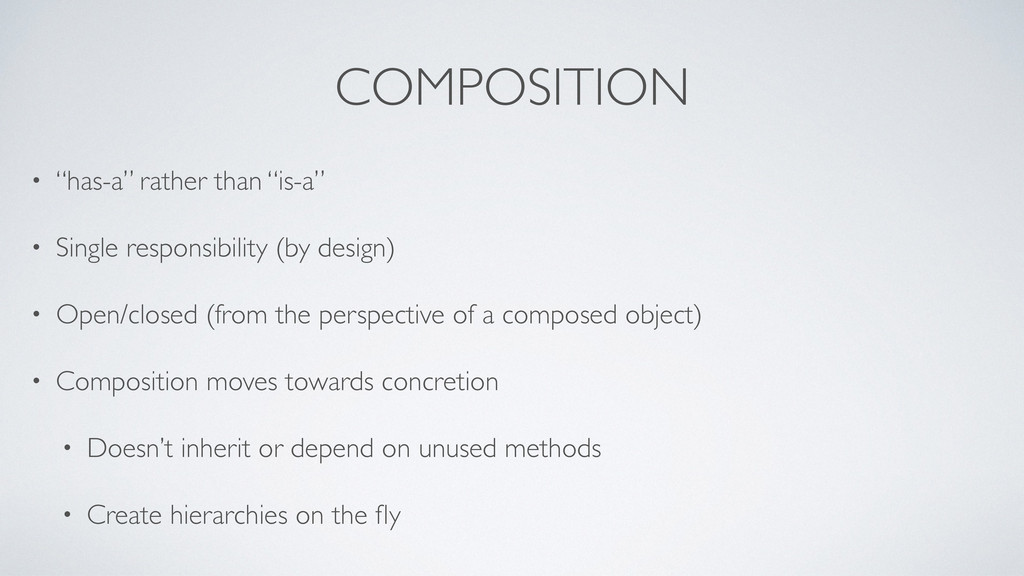
  9. COMPOSITION • “has-a” rather than “is-a” • Single responsibility (by

    design) • Open/closed (from the perspective of a composed object) • Composition moves towards concretion • Doesn’t inherit or depend on unused methods • Create hierarchies on the fly
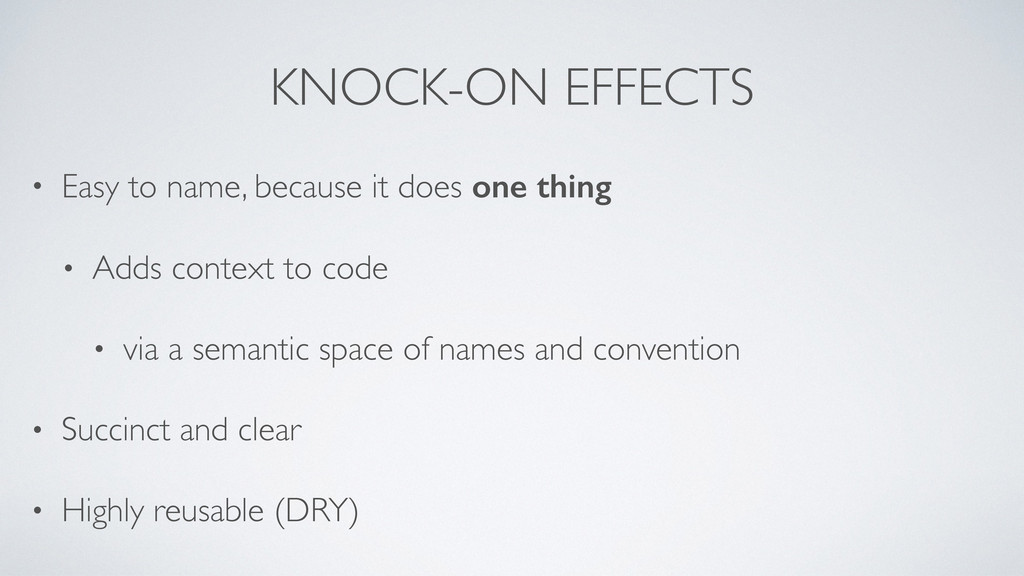
  10. KNOCK-ON EFFECTS • Easy to name, because it does one

    thing • Adds context to code • via a semantic space of names and convention • Succinct and clear • Highly reusable (DRY)
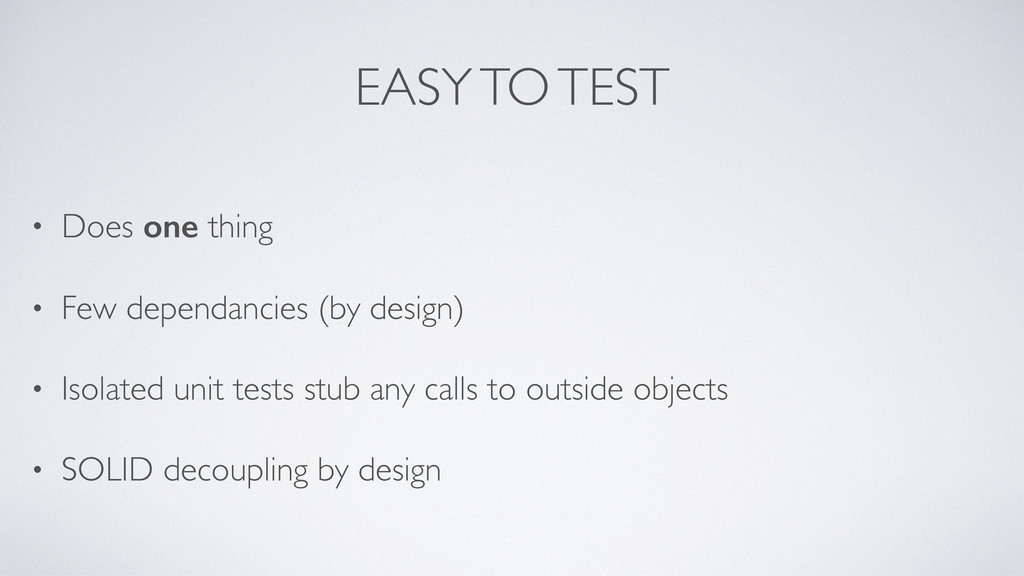
  11. EASY TO TEST • Does one thing • Few dependancies

    (by design) • Isolated unit tests stub any calls to outside objects • SOLID decoupling by design
  12. USES • Encapsulate asynchronicity • Workers • Superbolt queueing/fetching •

    Hold common regexes (can compose them too) • On the more radical end, can move all verbs into services to create a “behaviour layer” • And more!
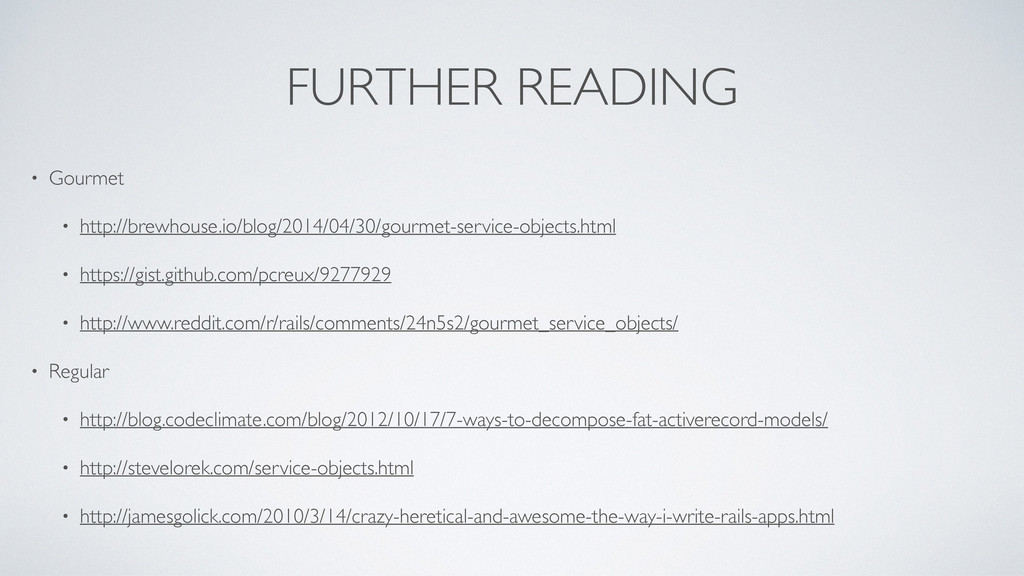
  13. FURTHER READING • Gourmet • http://brewhouse.io/blog/2014/04/30/gourmet-service-objects.html • https://gist.github.com/pcreux/9277929 • http://www.reddit.com/r/rails/comments/24n5s2/gourmet_service_objects/

    • Regular • http://blog.codeclimate.com/blog/2012/10/17/7-ways-to-decompose-fat-activerecord-models/ • http://stevelorek.com/service-objects.html • http://jamesgolick.com/2010/3/14/crazy-heretical-and-awesome-the-way-i-write-rails-apps.html