Upgrade to Pro — share decks privately, control downloads, hide ads and more …

Building Gophercises - GothamGo 2018

Building Gophercises - GothamGo 2018

We often feel the need to learn a plethora of tech in order to create things in Go. JSON APIs, JS frontends, Docker, k8s, microservices, etc.

In this talk Jon demonstrates how Go can be used to build smaller, simpler apps without getting bogged down by all the things you are supposed to do.

Avatar for Jon Calhoun

Jon Calhoun

April 27, 2018

Other Decks in Programming

Transcript

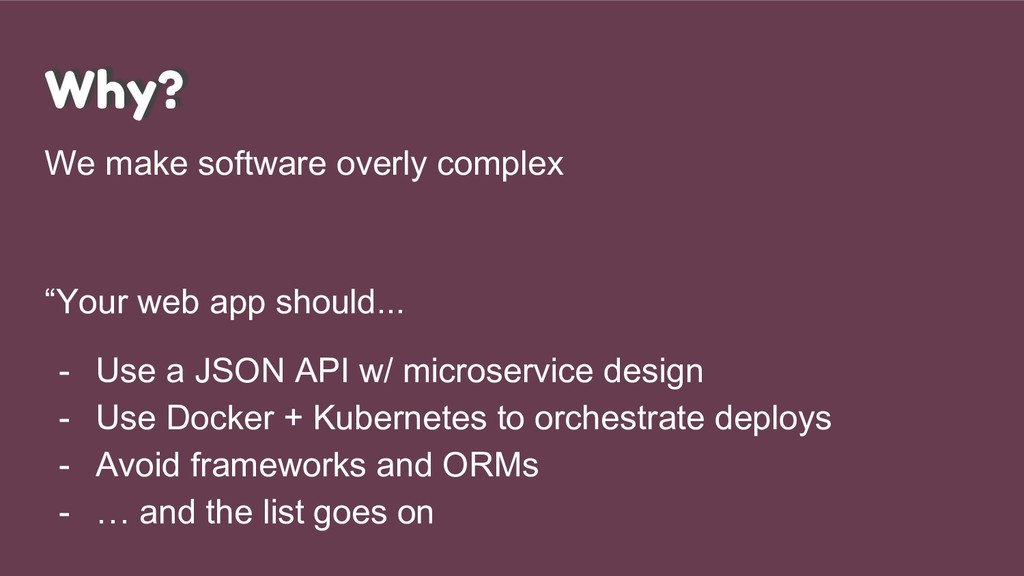
  1. Why? We make software overly complex “Your web app should...

    - Use a JSON API w/ microservice design - Use Docker + Kubernetes to orchestrate deploys - Avoid frameworks and ORMs - … and the list goes on
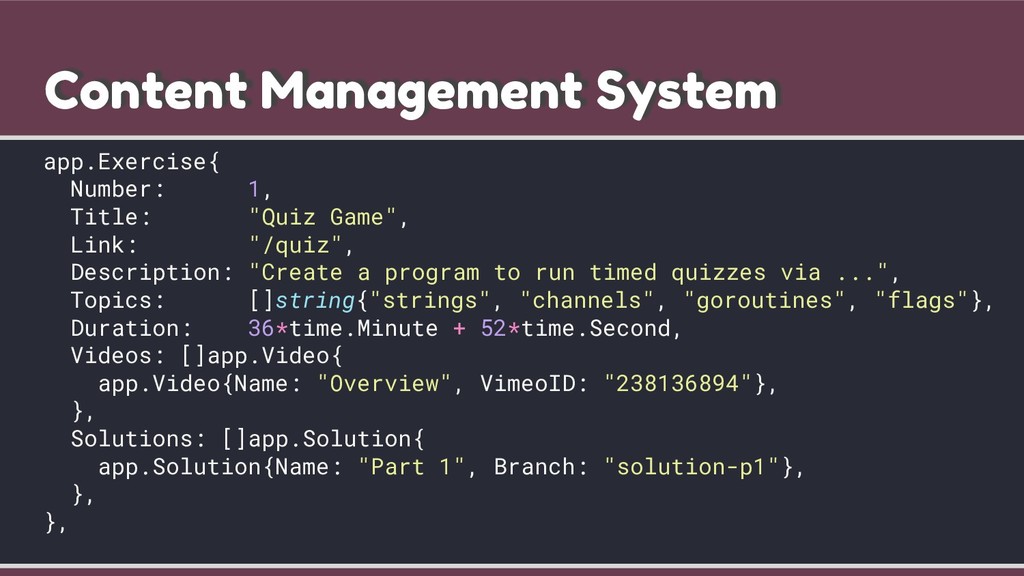
  2. Content Management System app.Exercise{ Number: 1, Title: "Quiz Game", Link:

    "/quiz", Description: "Create a program to run timed quizzes via ...", Topics: []string{"strings", "channels", "goroutines", "flags"}, Duration: 36*time.Minute + 52*time.Second, Videos: []app.Video{ app.Video{Name: "Overview", VimeoID: "238136894"}, }, Solutions: []app.Solution{ app.Solution{Name: "Part 1", Branch: "solution-p1"}, }, },
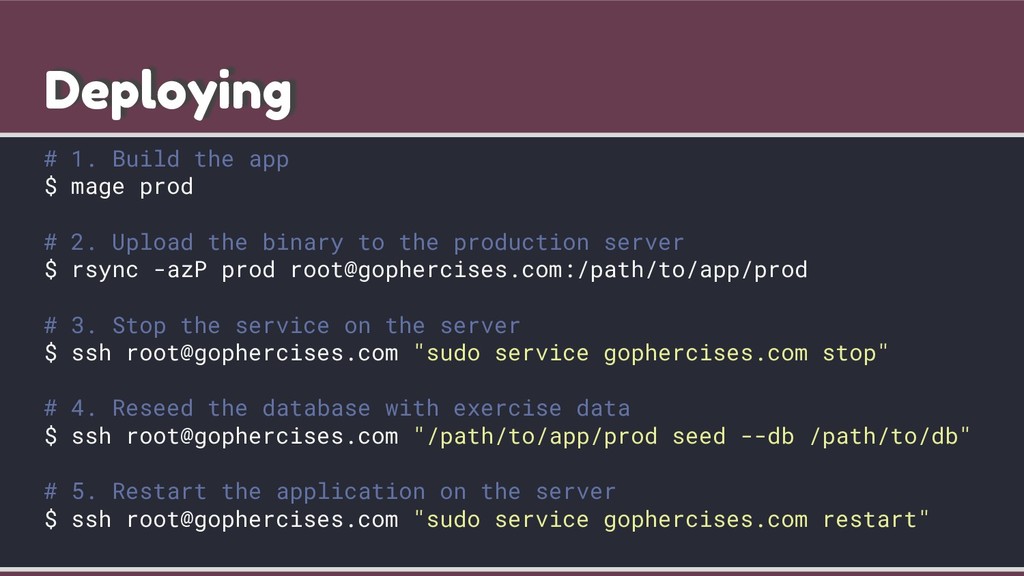
  3. Deploying # 1. Build the app $ mage prod #

    2. Upload the binary to the production server $ rsync -azP prod [email protected]:/path/to/app/prod # 3. Stop the service on the server $ ssh [email protected] "sudo service gophercises.com stop" # 4. Reseed the database with exercise data $ ssh [email protected] "/path/to/app/prod seed --db /path/to/db" # 5. Restart the application on the server $ ssh [email protected] "sudo service gophercises.com restart"
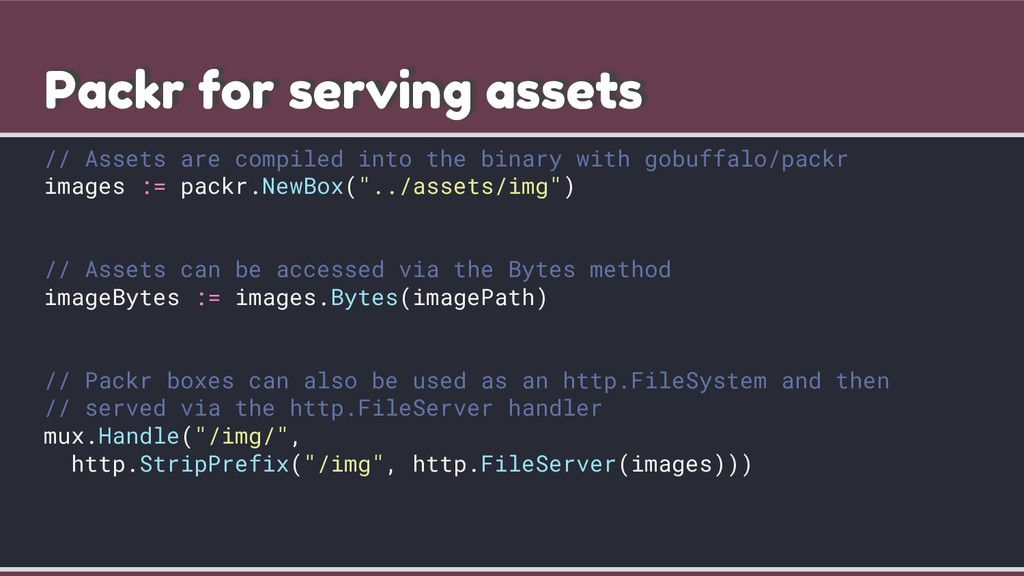
  4. Packr for serving assets // Assets are compiled into the

    binary with gobuffalo/packr images := packr.NewBox("../assets/img") // Assets can be accessed via the Bytes method imageBytes := images.Bytes(imagePath) // Packr boxes can also be used as an http.FileSystem and then // served via the http.FileServer handler mux.Handle("/img/", http.StripPrefix("/img", http.FileServer(images)))
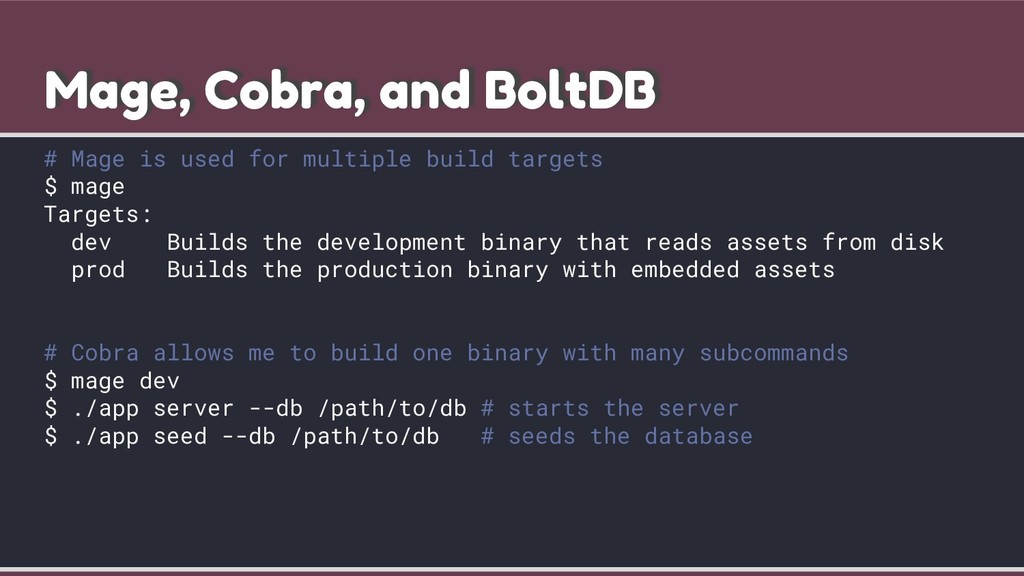
  5. Mage, Cobra, and BoltDB # Mage is used for multiple

    build targets $ mage Targets: dev Builds the development binary that reads assets from disk prod Builds the production binary with embedded assets # Cobra allows me to build one binary with many subcommands $ mage dev $ ./app server --db /path/to/db # starts the server $ ./app seed --db /path/to/db # seeds the database
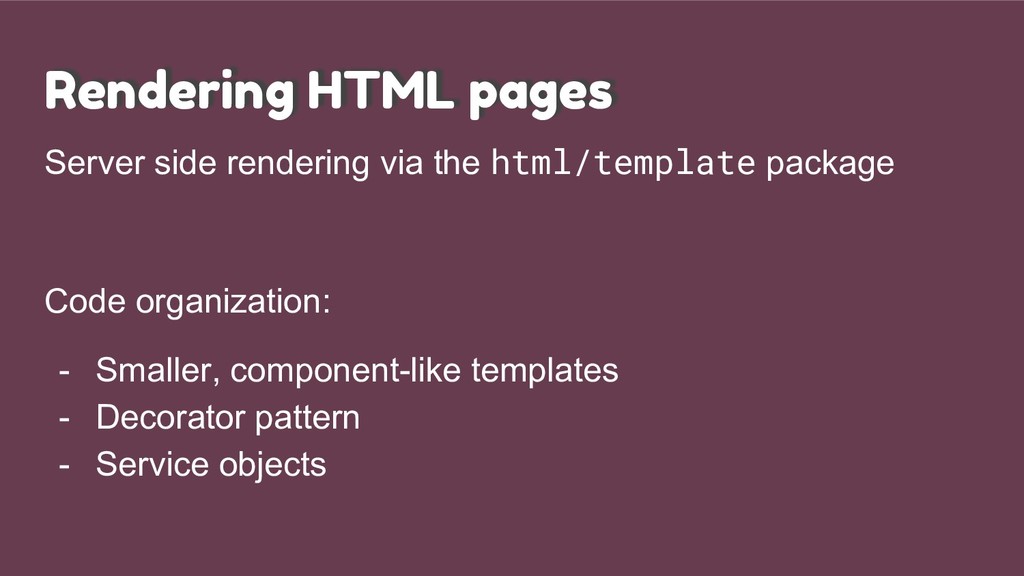
  6. Rendering HTML pages Server side rendering via the html/template package

    Code organization: - Smaller, component-like templates - Decorator pattern - Service objects
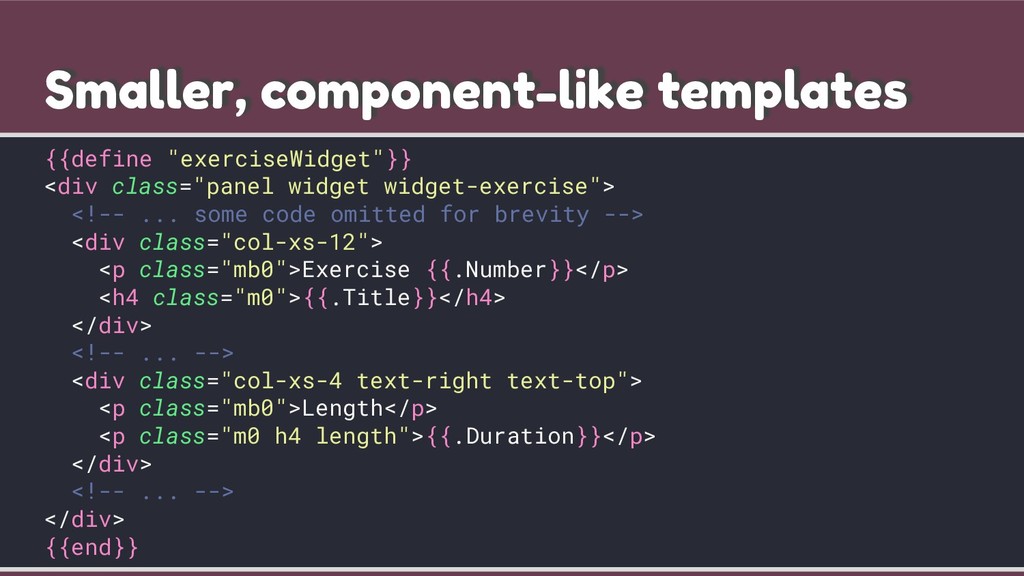
  7. Smaller, component-like templates {{define "exerciseWidget"}} <div class="panel widget widget-exercise"> <!--

    ... some code omitted for brevity --> <div class="col-xs-12"> <p class="mb0">Exercise {{.Number}}</p> <h4 class="m0">{{.Title}}</h4> </div> <!-- ... --> <div class="col-xs-4 text-right text-top"> <p class="mb0">Length</p> <p class="m0 h4 length">{{.Duration}}</p> </div> <!-- ... --> </div> {{end}}
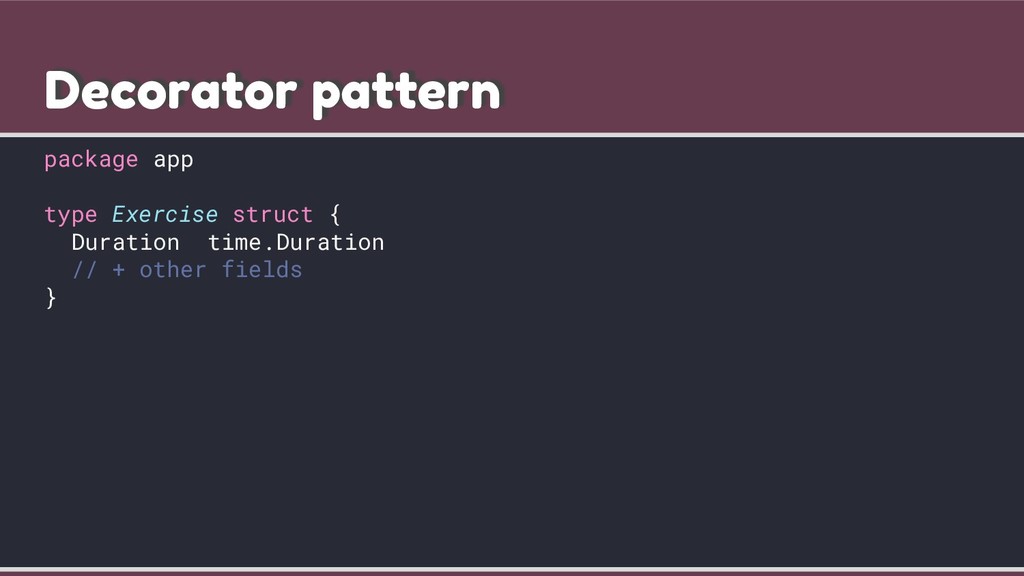
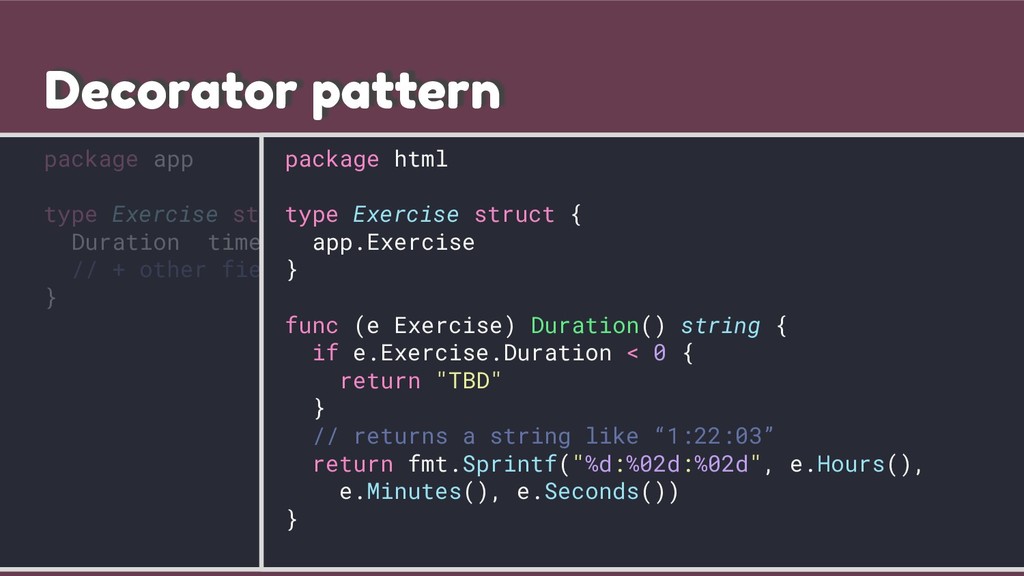
  8. Decorator pattern package app type Exercise struct { Duration time.Duration

    // + other fields } package app type Exercise struct { Duration time.Duration // + other fields } package html type Exercise struct { app.Exercise }
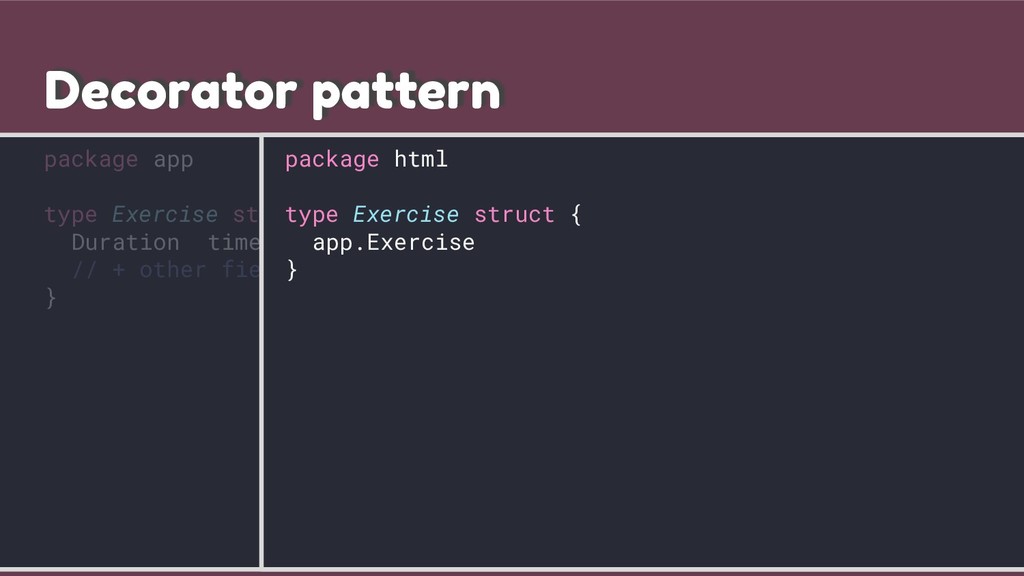
  9. Decorator pattern package app type Exercise struct { Duration time.Duration

    // + other fields } package app type Exercise struct { Duration time.Duration // + other fields } package html type Exercise struct { app.Exercise } func (e Exercise) Duration() string { if e.Exercise.Duration < 0 { return "TBD" } // returns a string like “1:22:03” return fmt.Sprintf("%d:%02d:%02d", e.Hours(), e.Minutes(), e.Seconds()) }
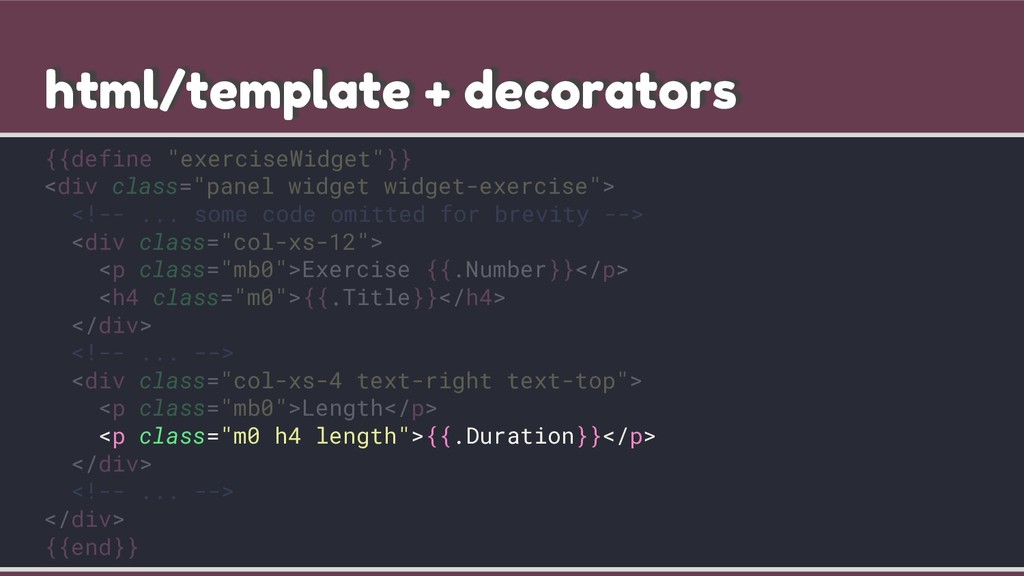
  10. html/template + decorators {{define "exerciseWidget"}} <div class="panel widget widget-exercise"> <!--

    ... some code omitted for brevity --> <div class="col-xs-12"> <p class="mb0">Exercise {{.Number}}</p> <h4 class="m0">{{.Title}}</h4> </div> <!-- ... --> <div class="col-xs-4 text-right text-top"> <p class="mb0">Length</p> <p class="m0 h4 length">{{.Duration}}</p> </div> <!-- ... --> </div> {{end}}
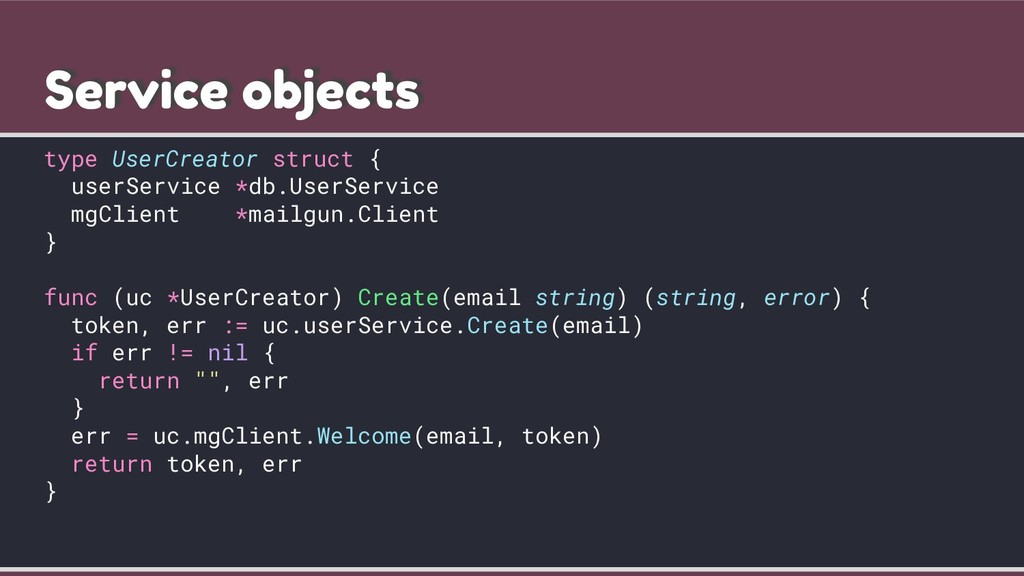
  11. Service objects type UserCreator struct { userService *db.UserService mgClient *mailgun.Client

    } func (uc *UserCreator) Create(email string) (string, error) { token, err := uc.userService.Create(email) if err != nil { return "", err } err = uc.mgClient.Welcome(email, token) return token, err }
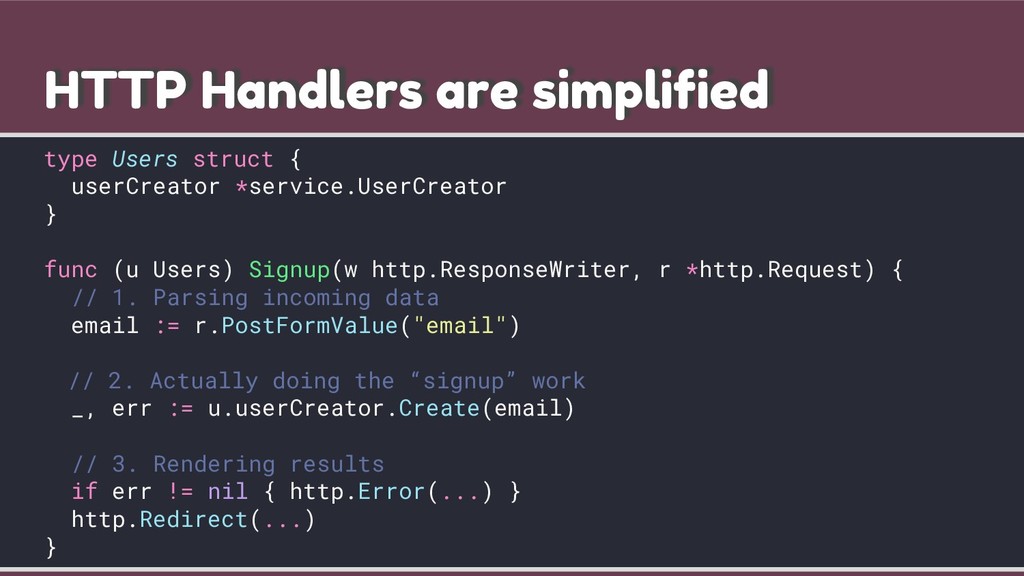
  12. HTTP Handlers are simplified type Users struct { userCreator *service.UserCreator

    } func (u Users) Signup(w http.ResponseWriter, r *http.Request) { // 1. Parsing incoming data email := r.PostFormValue("email") // 2. Actually doing the “signup” work _, err := u.userCreator.Create(email) // 3. Rendering results if err != nil { http.Error(...) } http.Redirect(...) }
  13. Gophercises has no tests I’m a big fan of tests

    - my next course is on testing in Go! Gophercises is simple and rarely changes I wanted to understand the problem better before writing tests
  14. Key takeaway You can build simpler software in Go without

    getting bogged down by the things you are “supposed” to do.
  15. The End Twitter: @joncalhoun Website: calhoun.io (I’ll publish the slides

    here) Course: gophercises.com (It’s FREE!!) Stickers: out front by registration?