Upgrade to Pro — share decks privately, control downloads, hide ads and more …

Platform Obesity, not Complexity, is killing ou...

Platform Obesity, not Complexity, is killing our platforms

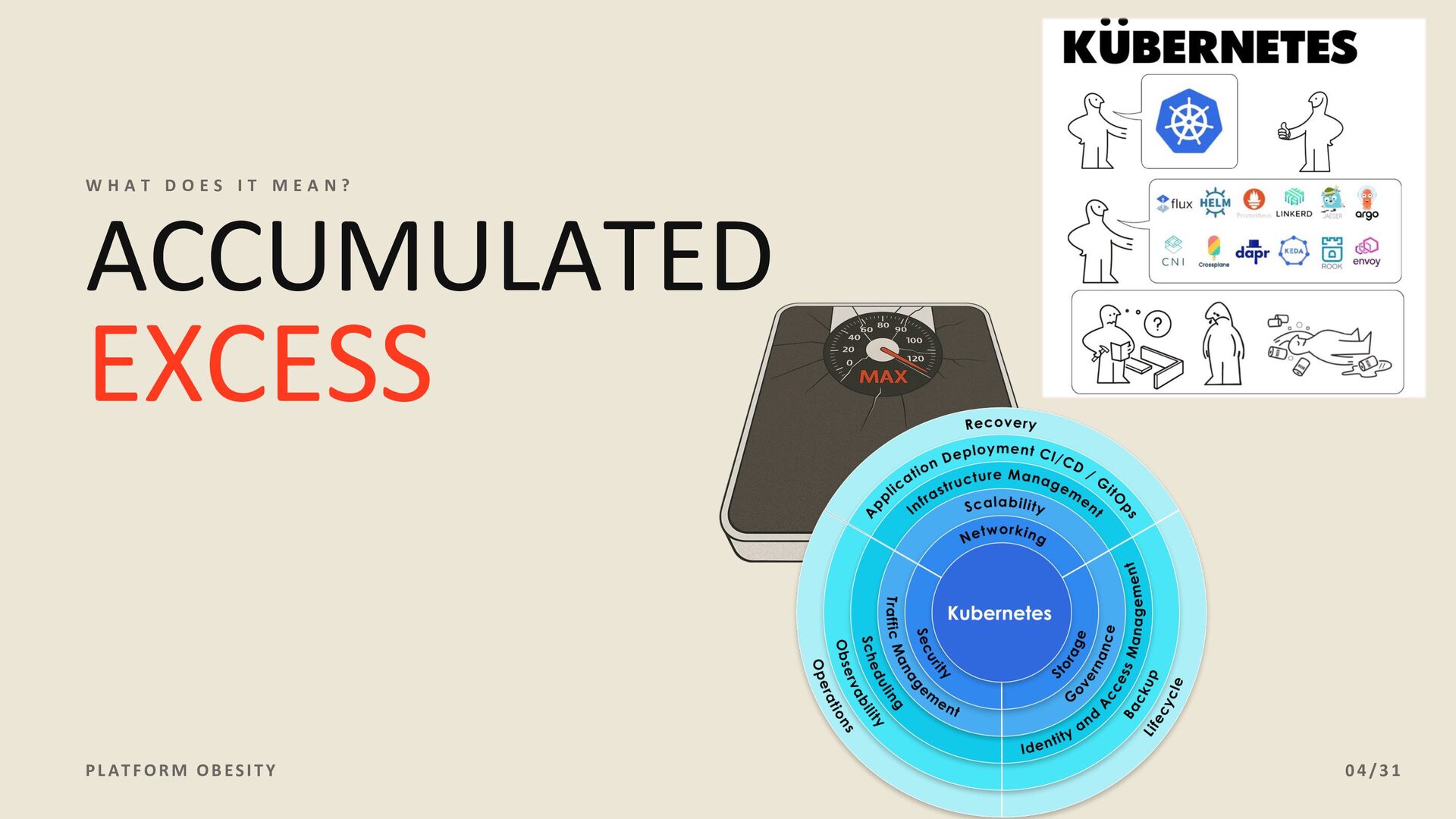
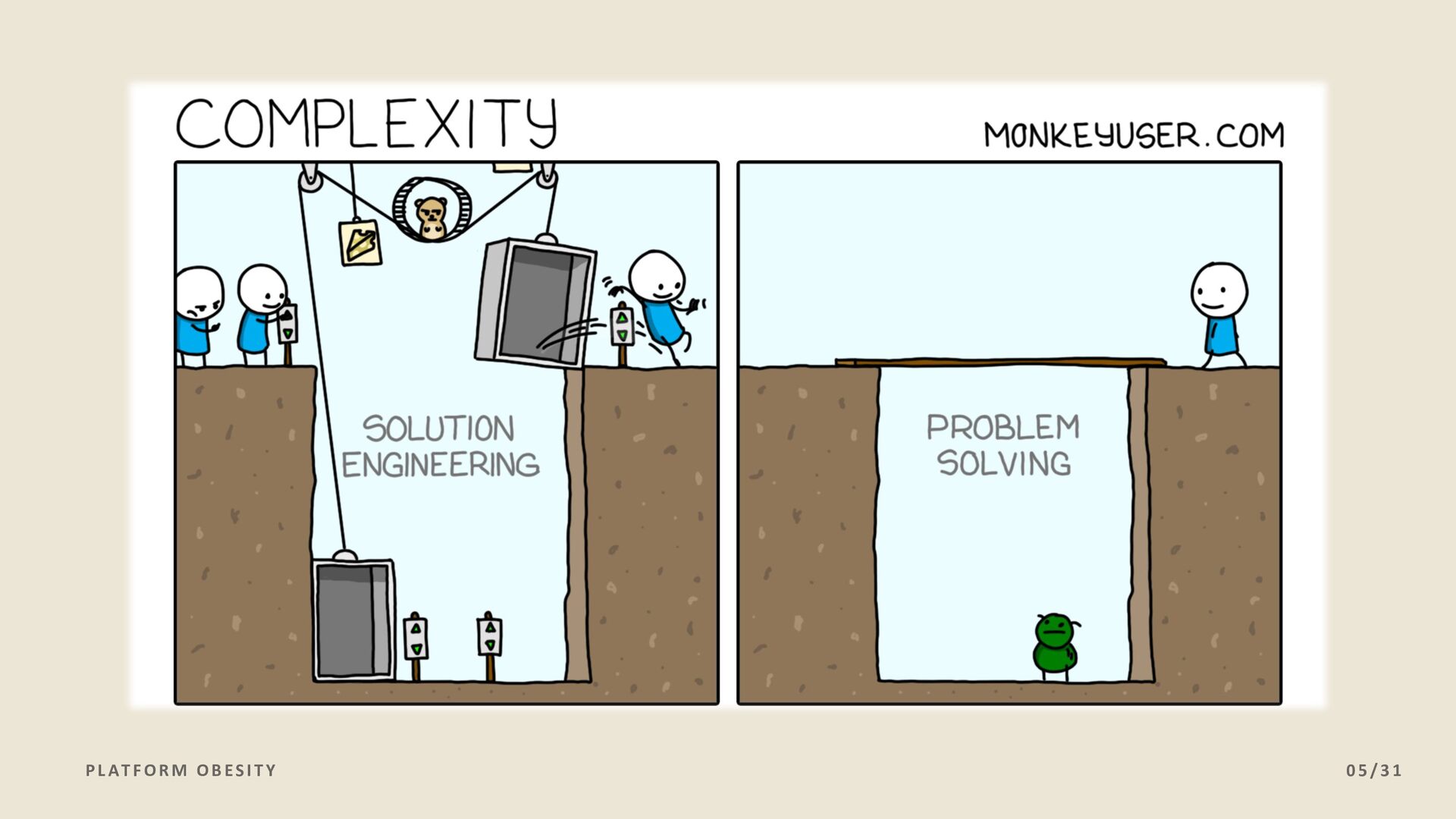
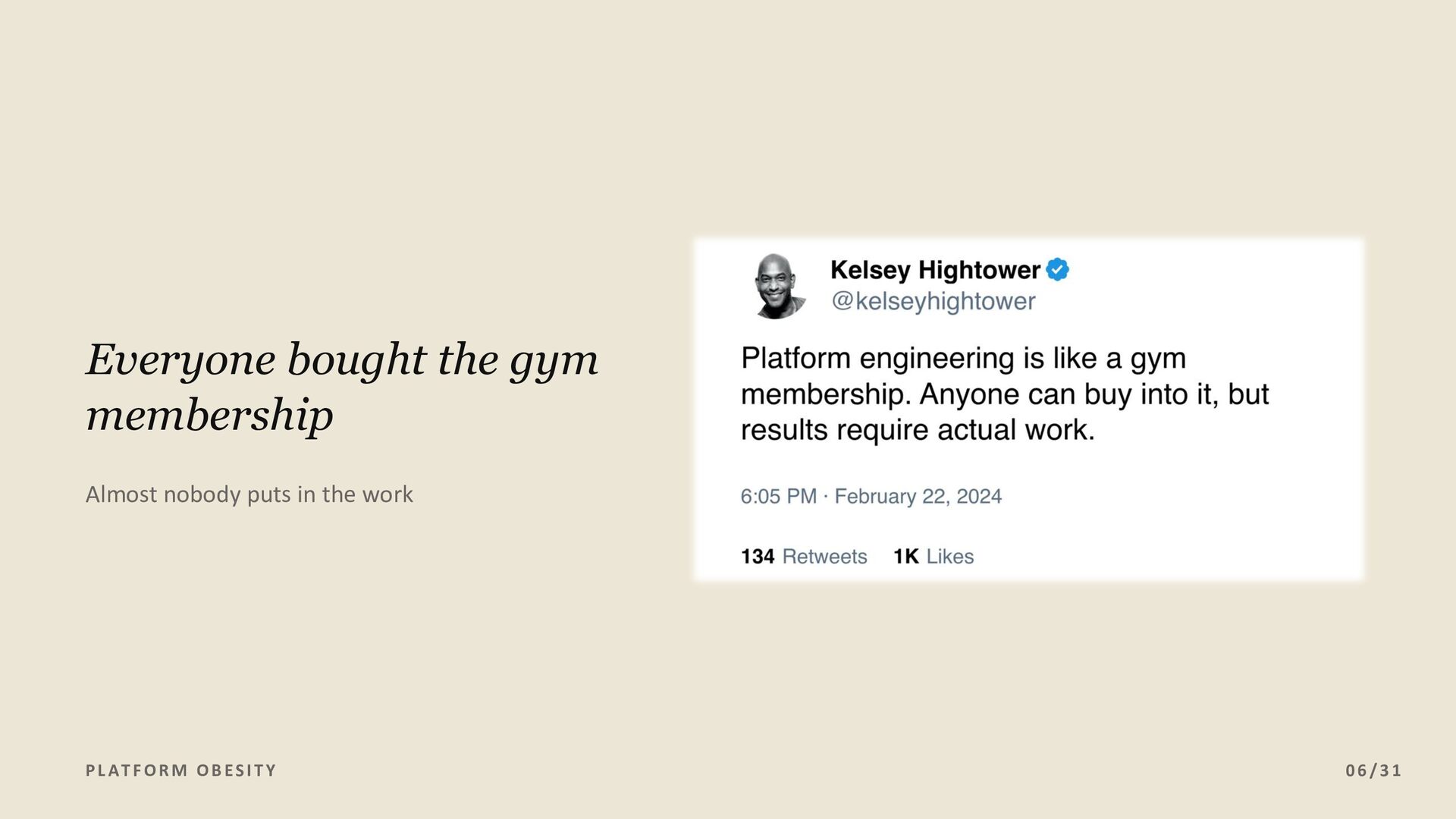
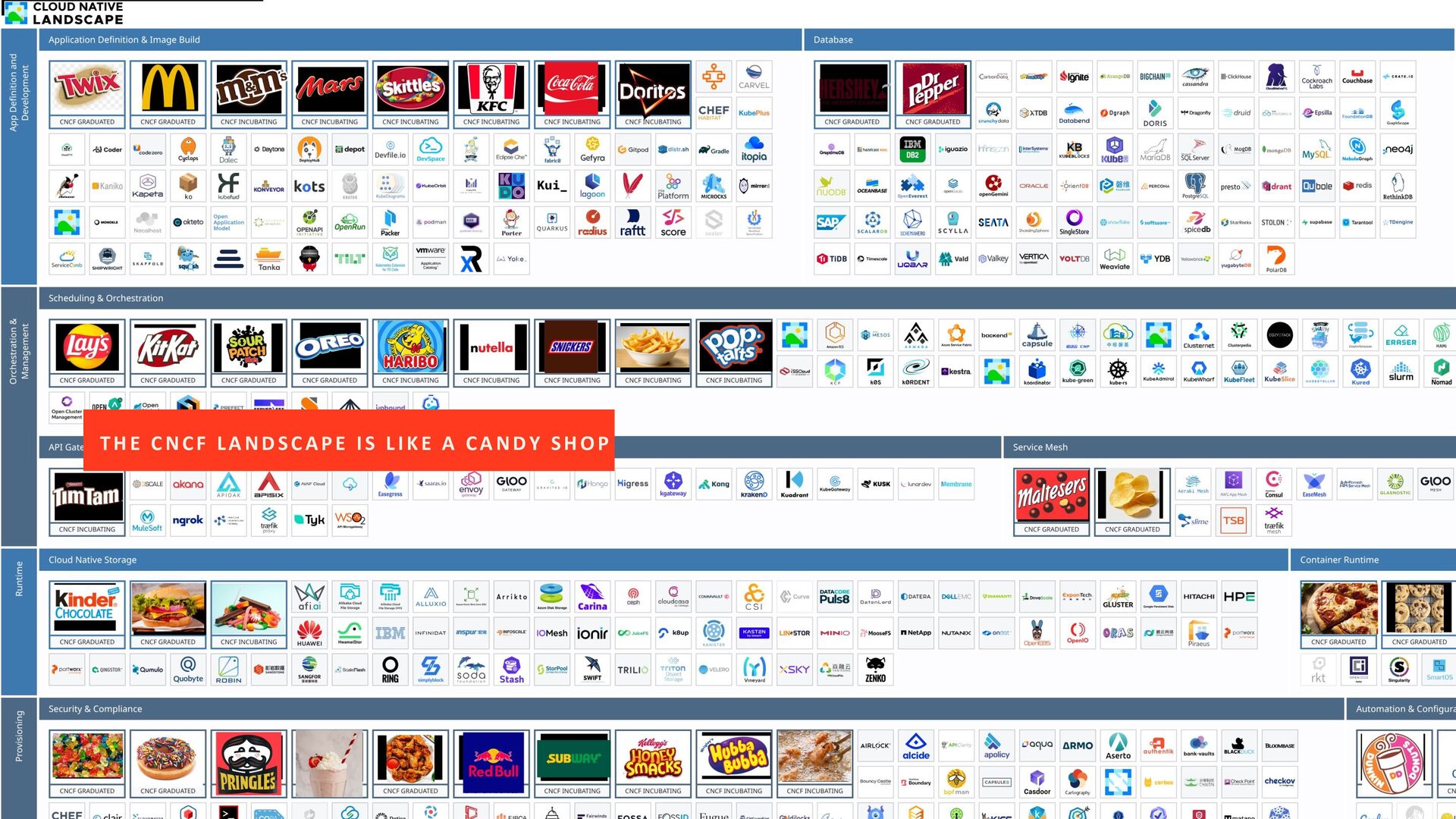
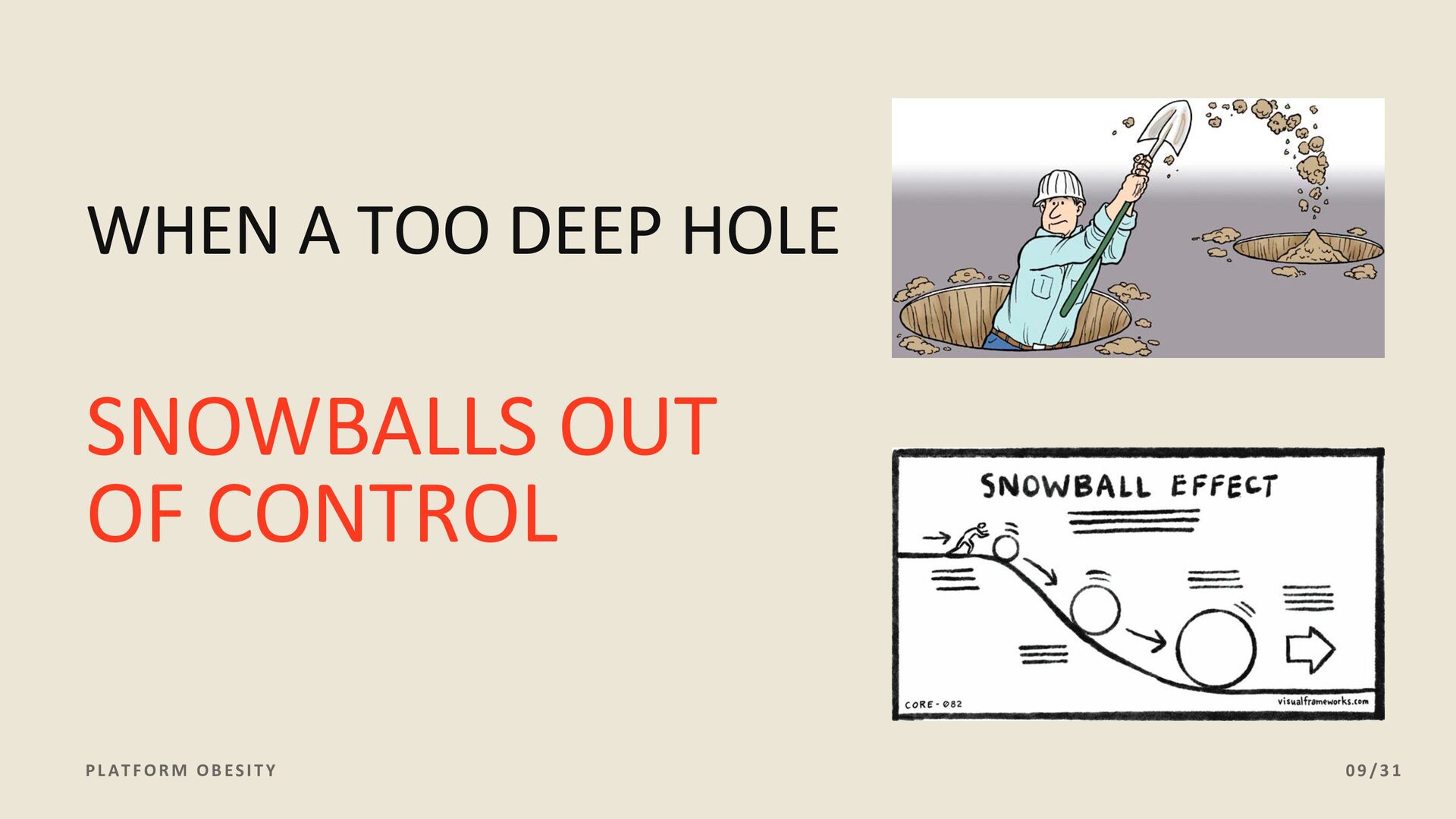
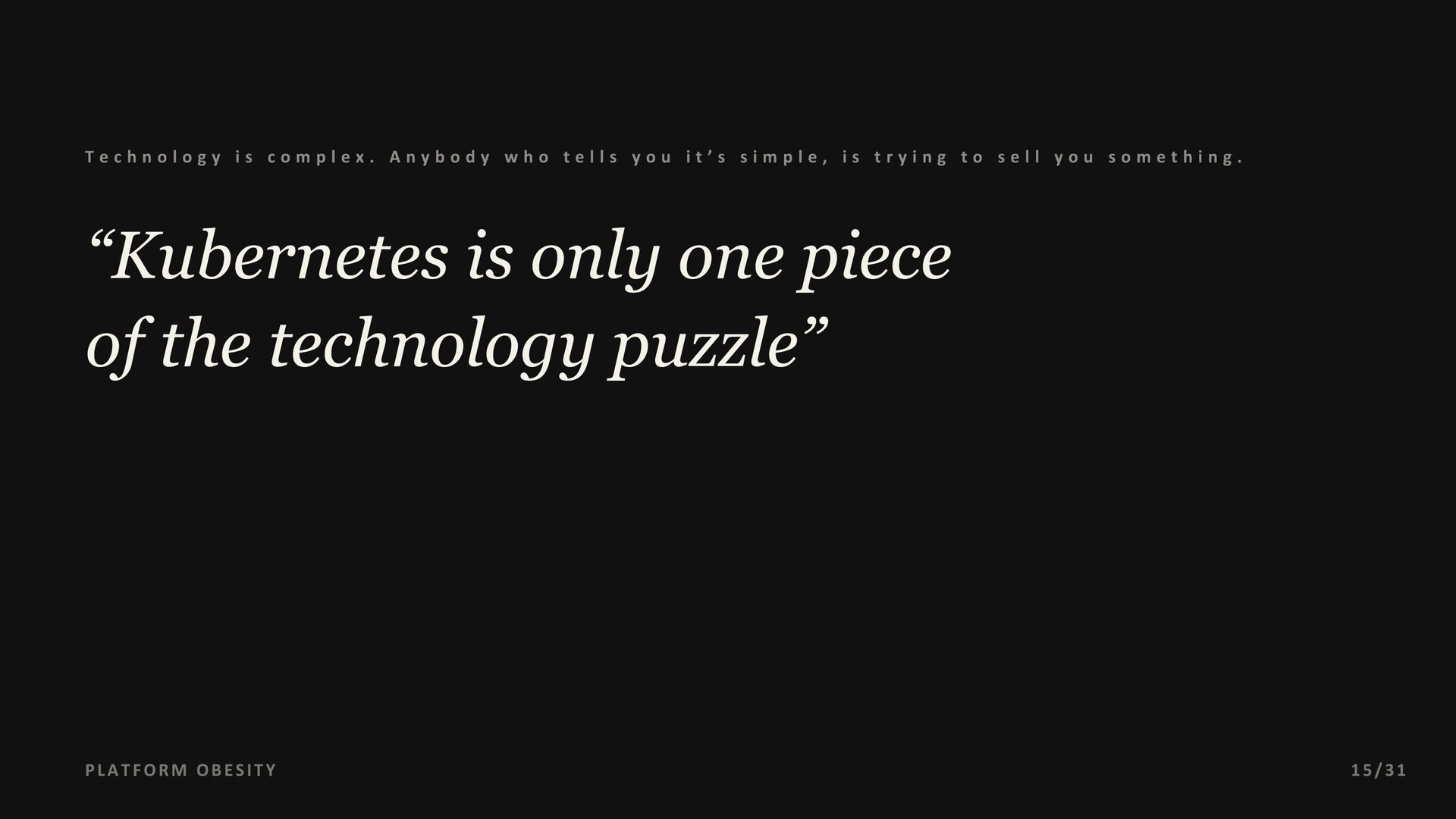
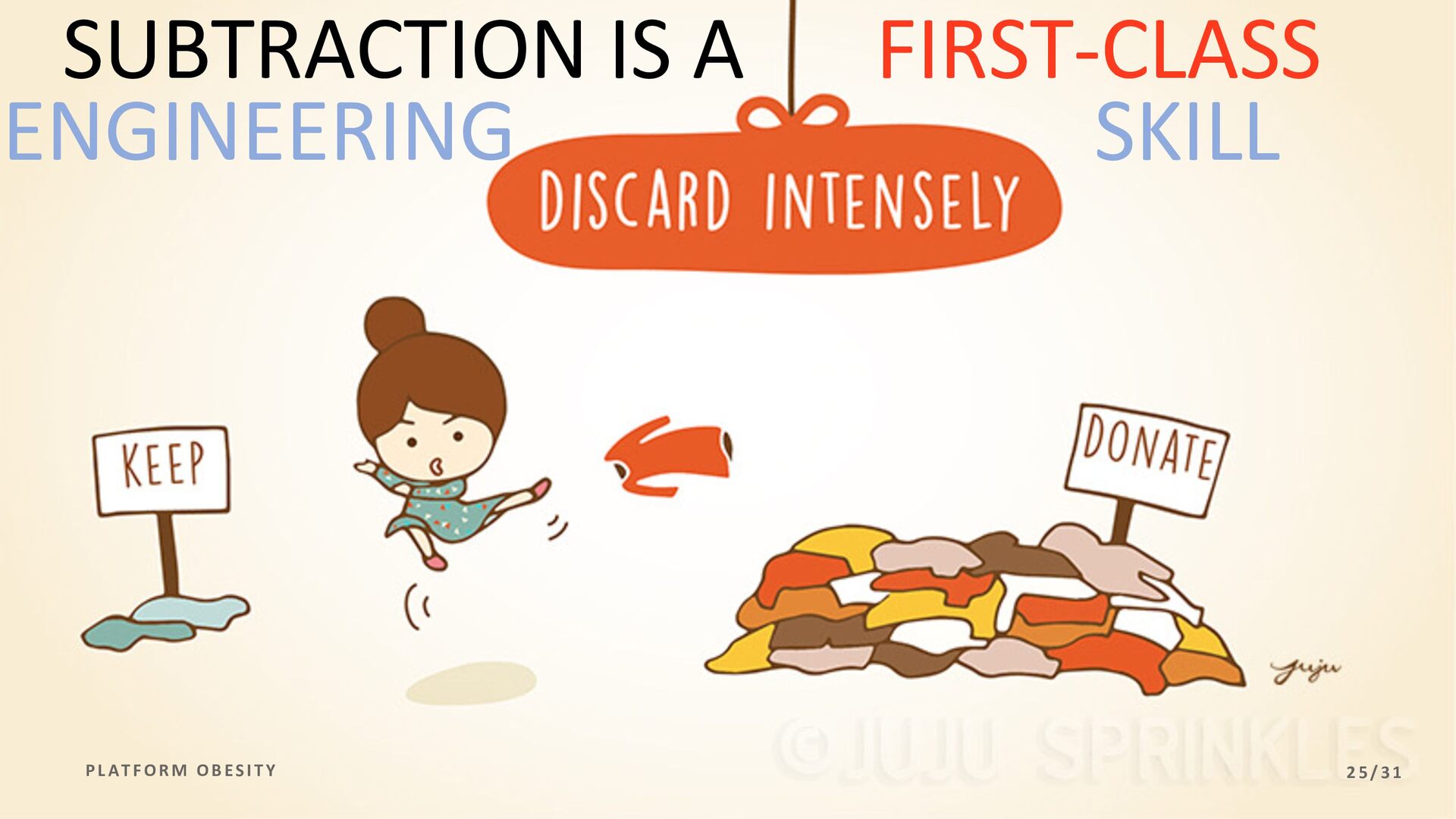
We like to say Kubernetes platforms fail because they’re “too complex”. But complexity isn’t the problem. Platforms fail because they’re obese. They’re bloated with an excess of features, tools, abstractions, and opinions that far exceed an organization’s operational capacity and cognitive load—especially in enterprises, regulated environments, and talent-constrained teams. The cloud-native ecosystem doesn’t help. It hands out sweets constantly: one more controller, one more abstraction, one more “best practice.” Each addition seems harmless in isolation. Saying yes is easy. Saying no is career-limiting: since no-one wants to admit their own reality doesn’t match the industry narrative. The Pluralistic Ignorance is real, yo. The ecosystem rewards addition, not subtraction. Often, “simplification” efforts often do the opposite—layering abstractions on top of abstractions until the platform is heavier, slower, and harder to operate and change than before. Eventually, the platform collides with reality: finite talent, finite attention, finite time. Cognitive load exceeds capacity. Operational friction grows. Engineering quality cracks. Business outcomes stall. ROI quietly evaporates. This isn’t a tooling failure. It’s a constraint failure. So how do you fix an obese platform? The same way you fix obesity: by creating a calorie deficit, rigorous exercise and discipline. In the platform world, that means recognizing constraints and designing for and staying within those limits, across technology, processes, organizational culture, budget, engineering skills, team cognitive load and more. Dare to play the hard ’less is more’ subtraction game, not the easy game of addition: treat dealing with constraints, subtraction, prioritization and trade-offs as first-class engineering skills—not as signs of lack of ambition.

Avatar for Joep Piscaer

Joep Piscaer

May 28, 2026

More Decks by Joep Piscaer

Other Decks in Technology

Transcript

  1. WHAT HAPPENS NEXT THE CASCADE PLATFORM OBESITY 1 2 3

    4 Cognitive load exceeds capacity. Nobody can hold the whole system in their head. Burnout lurks Operational friction grows. Every change needs a war room. Too risky to change. Engineering quality degrades. Users have a bad experience, become unhappy and go elsewhere. No longer fit for purpose Can’t serve the business or CIO 12/28
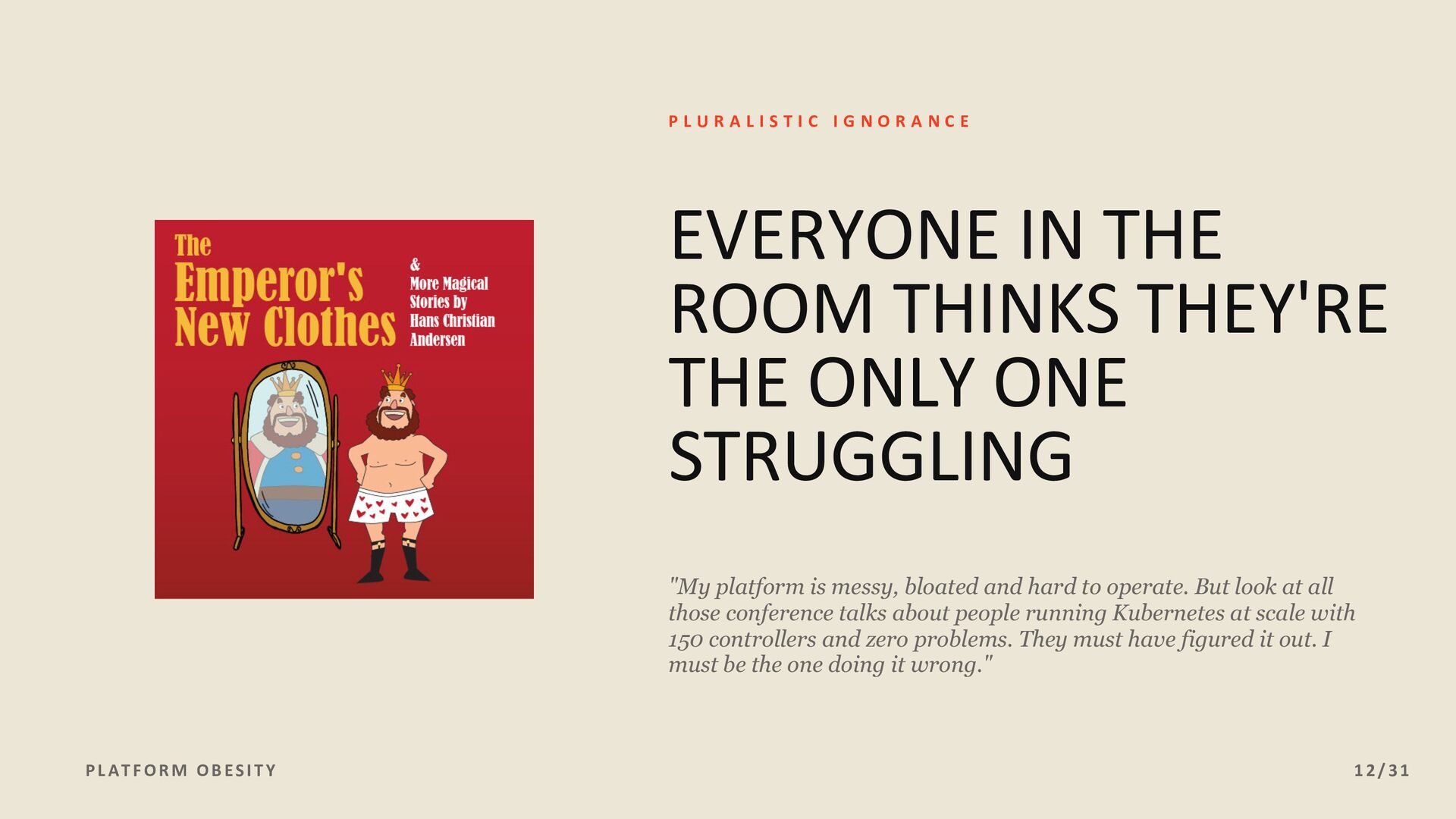
  2. PLURALISTIC IGNORANCE EVERYONE IN THE ROOM THINKS THEY'RE THE ONLY

    ONE STRUGGLING "My platform is messy, bloated and hard to operate. But look at all those conference talks about people running Kubernetes at scale with 150 controllers and zero problems. They must have figured it out. I must be the one doing it wrong." PLATFORM OBESITY 13/28
  3. Complexity is a constraint PLATFORMS ARE INHERENTLY COMPLEX Scale Governance

    Hundreds of applications, dozens of multi-cloud environments RBAC, Corporate identity, audit logs, SOC2, PCI, ISO, billing Functionality Security Self-service portals, templates, GitOps, observability, storage, networking, etc. Zero-trust, supply chain, runtime, IAM, secrets, BYO HSM, certificate management PLATFORM OBESITY 15/28
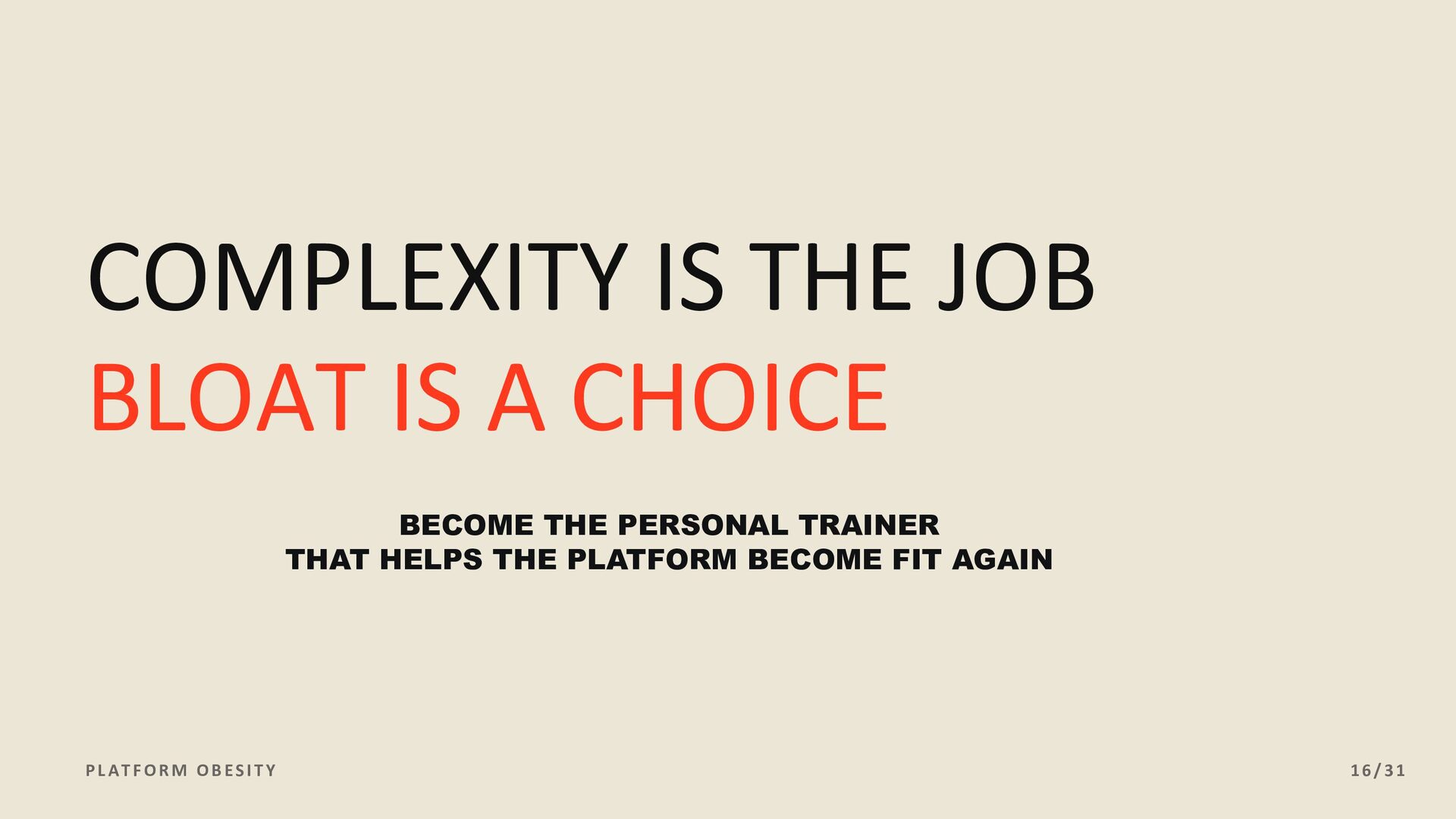
  4. COMPLEXITY IS THE JOB BLOAT IS A CHOICE BECOME THE

    PERSONAL TRAINER THAT HELPS THE PLATFORM BECOME FIT AGAIN PLATFORM OBESITY 18/28
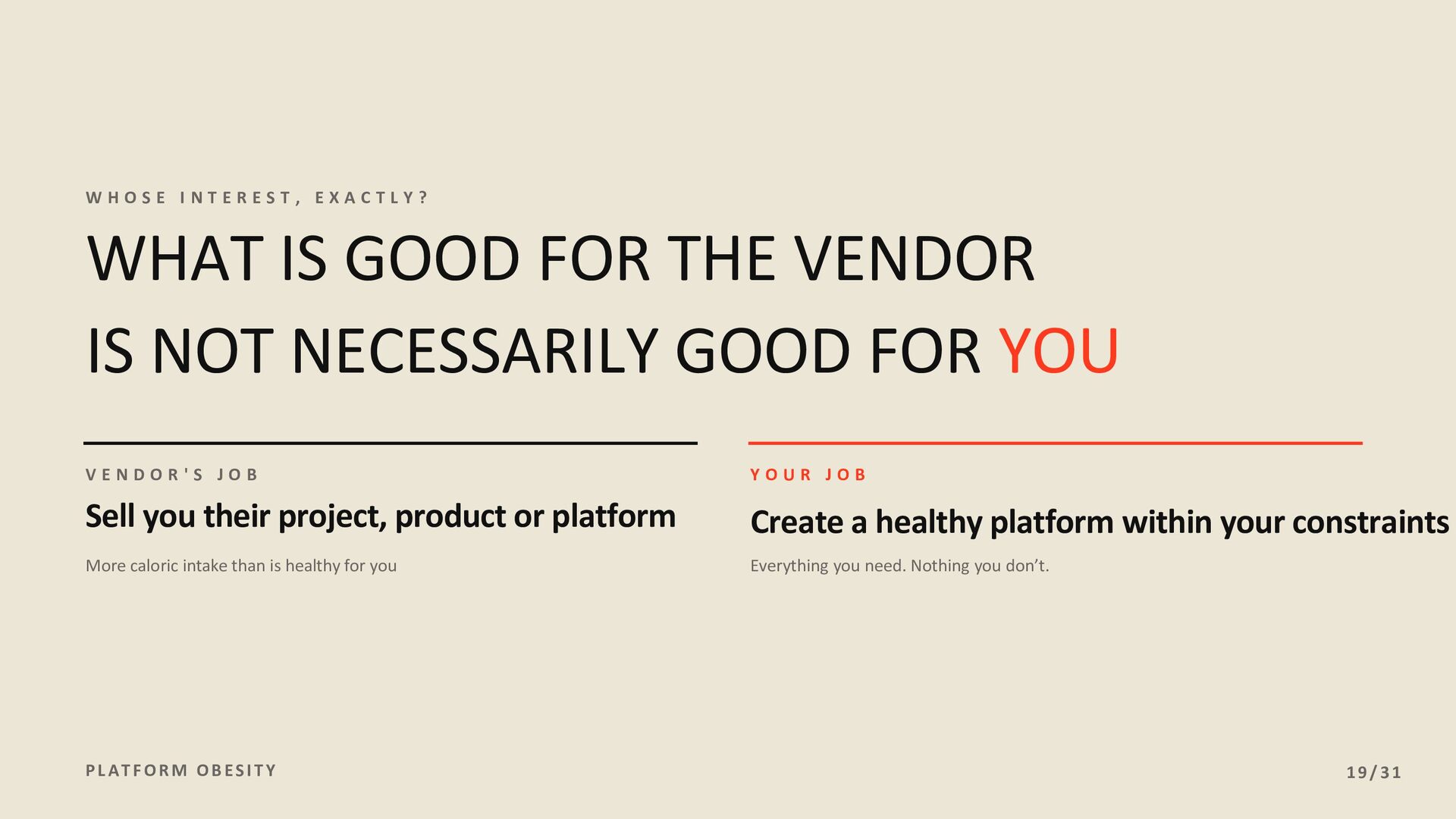
  5. WHOSE INTEREST, EXACTLY? WHAT IS GOOD FOR THE VENDOR IS

    NOT NECESSARILY GOOD FOR YOU VENDOR'S JOB YOUR JOB Sell you their project, product or platform Create a healthy platform within your constraints More caloric intake than is healthy for you Everything you need. Nothing you don’t. PLATFORM OBESITY 21/28
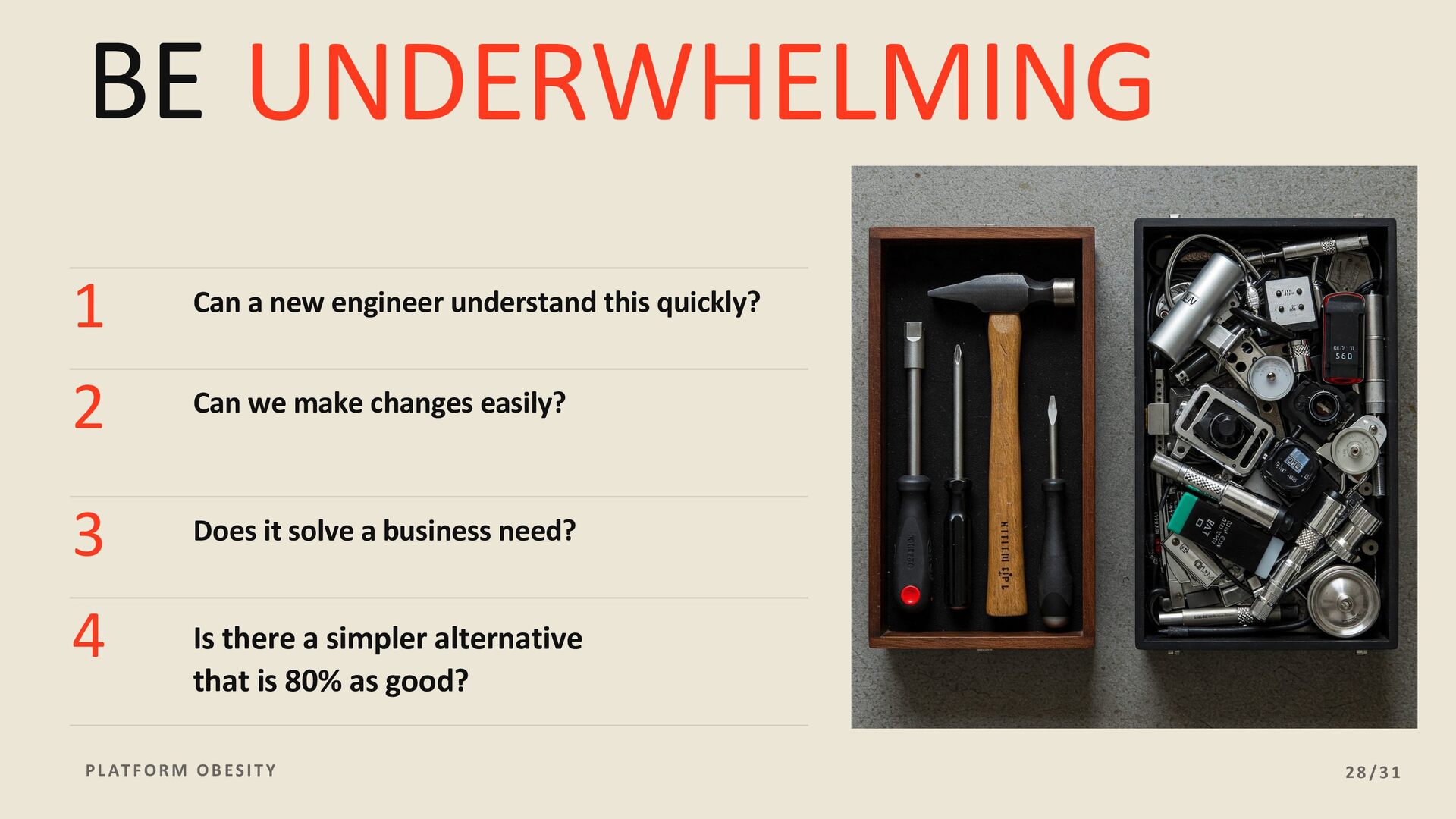
  6. BEING UNDERWHELMING EARNS TRUST 1 2 3 4 Can a

    new engineer understand this quickly? Can we make changes easily? Does it solve a business need? Is there a simpler alternative that is 80% as good? PLATFORM OBESITY 27/28
  7. 01 Resist the Candy Shop What is good for the

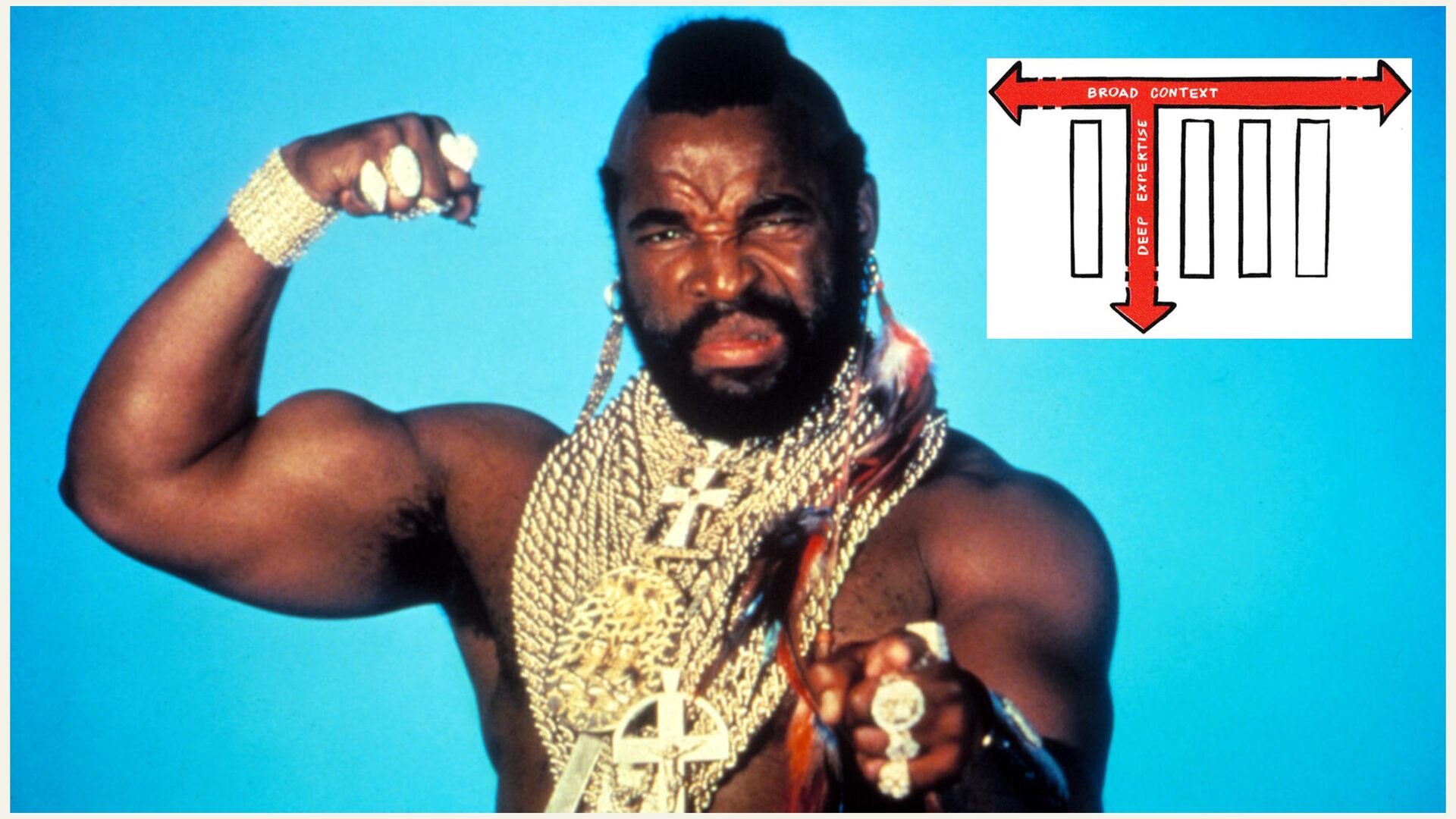
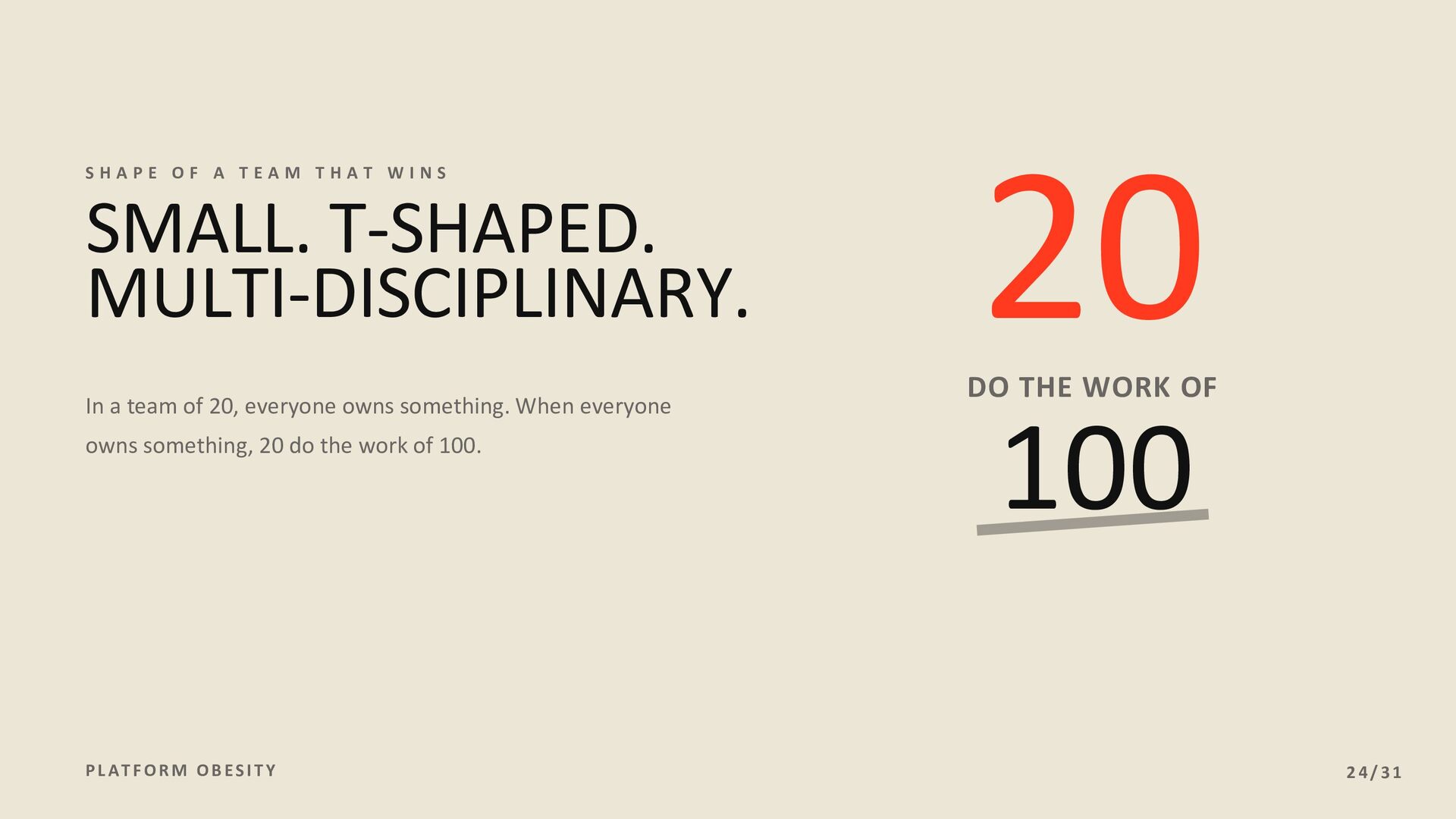
    vendor, often isn't good for you. Only do what’s good 02 for you, nothing else. Resist the public narrative, break the silence 03 Subtraction is a first-class engineering skill Subtract more than you add. Consolidate. 05 20 do the work of a 100 in small teams if you cut out all the bs. Everyone owns something. Be underwhelming. PLATFORM OBESITY Factor in your constraints in changes. Work towards fitting your platform to them 04 Say 'no' a lot. Reduce unneeded ceremony Think Small Name your constraints. Be like Mr. T Become a T-shaped expert. 80% is good enough. Promote, hire, and praise generalists. 06 Be a speedboat, not a container ship Don't cosplay as a service provider running its own kingdom. Same mission, same bank account as the business you serve. 28/28
  8. LEAN Your business doesn’t care about Kubernetes So why make

    it more complex than it needs to be? JP Joep Piscaer, [email protected] Slidedeck LinkedIN N