Share
Embed
Swift async tasks: a brief introduction of PromiseKit
A quick talk at Cocoaheads about PromiseKit: a simple solution to achieve asynchronous processes.
Julien Quéré
January 19, 2018
Transcript
41 slides
-
▸ Authentication (login + password, then: token) ▸ User profile
▸ Friends ▸ Conversations Introducing: Stranger Chat -
▸ Authentication (login + password, then: token) ▸ User profile
▸ Friends ▸ Conversations Introducing: Stranger Chat > Hello Dustin Henderson. > You have 3 conversations: - [Lucas Sinclair] Skate with Max ? - [Will Byers] From the Upside Down - [Mike Wheeler] Secret about Eleven -
Get conversations Authenticate login password Fetch profile token Fetch friends
list [Conversation] Fetch conversations User -
Get conversations Authenticate login password Fetch profile token Fetch friends
list [Conversation] Fetch conversations User [User] User [Conversation] -
Get conversations Authenticate You can choose your friends, but not
your Webservices. login password Fetch profile token Fetch friends list [Conversation] ! Fetch conversations User [User] User [Conversation] -
Fetch methods func fetchSomething(withAnInput input:String, completion:((ReturnType?, Error?)->Void)?) { do {
let data = try makeNetworkCall() let result = try parseServerResponse(data) completion?(result, nil) } catch { completion?(nil, error) } } -
AUTHENTICATE APIManager.shared.fetchToken(withLogin: "dh", password: "dd", completion: { (token, error) in
guard error == nil else { print("Error:\(error!)") return } guard let token = token else { print("Received empty token ¯\\_(ϑ)_/¯") return } // Here we have the token. Ready for next step } -
FETCH PROFILE APIManager.shared.fetchToken(withLogin: "dh", password: "dd", completion: { (token, error)
in guard error == nil else { print("Error:\(error!)") return } guard let token = token else { print("Received empty token ¯\\_(ϑ)_/¯") return } APIManager.shared.fetchUser(withToken: token, completion:{ (user, error) in guard error == nil else { print("Error:\(error!)") return } guard var user = user else { print("Received nil user ¯\\_(ϑ)_/¯") return } // Here we have the token. Ready for next step }) }) -
FETCH CONVERSATIONS APIManager.shared.fetchToken(withLogin: "dh", password: "dd", completion: { (token, error)
in guard error == nil else { print("Error:\(error!)") return } guard let token = token else { print("Received empty token ¯\\_(ϑ)_/¯") return } APIManager.shared.fetchUser(withToken: token, completion:{ (user, error) in guard error == nil else { print("Error:\(error!)") return } guard var user = user else { print("Received nil user ¯\\_(ϑ)_/¯") return } APIManager.shared.fetchConversations(forUserWithId: user.identifier, completion: { (conversations, error) in guard error == nil else { print("Error:\(error!)") return } guard let conversations = conversations else { print("Received nil conversations ¯\\_(ϑ)_/¯") return } // Here we have the conversations. Ready for next step }) }) }) -
FETCH FRIENDS LIST APIManager.shared.fetchToken(withLogin: "dh", password: "dd", completion: { (token,
error) in guard error == nil else { print("Error:\(error!)") return } guard let token = token else { print("Received empty token ¯\\_(ϑ)_/¯") return } APIManager.shared.fetchUser(withToken: token, completion:{ (user, error) in guard error == nil else { print("Error:\(error!)") return } guard var user = user else { print("Received nil user ¯\\_(ϑ)_/¯") return } APIManager.shared.fetchConversations(forUserWithId: user.identifier, completion: { (conversations, error) in guard error == nil else { print("Error:\(error!)") return } guard let conversations = conversations else { print("Received nil conversations ¯\\_(ϑ)_/¯") return } APIManager.shared.fetchFriends(forUserWithId: user.identifier, completion: { (friends, error) in guard error == nil else { print("Error:\(error!)") return } guard let friends = friends else { print("Received nil friend list ¯\\_(ϑ)_/¯") return } // Here we have all the friends, conversations and user. // It's OVER ! // PS: If you can read this, raise your hands :) }) }) }) }) -
▸ Well known in JS world ▸ An idea of
1976 … One solution: Promise Pattern A promise is an object that represents an asynchronous task. Pass that object around, and write clean, ordered code; a logical, simple, modular stream of progression from one asynchronous task to another. -
Make a promise func fetchSomething(withAnInput input:String, completion:((ReturnType?, Error?)->Void)?) { do
{ let data = try makeNetworkCall() let result = try parseServerResponse(data) completion?(result, nil) } catch { completion?(nil, error) } } -
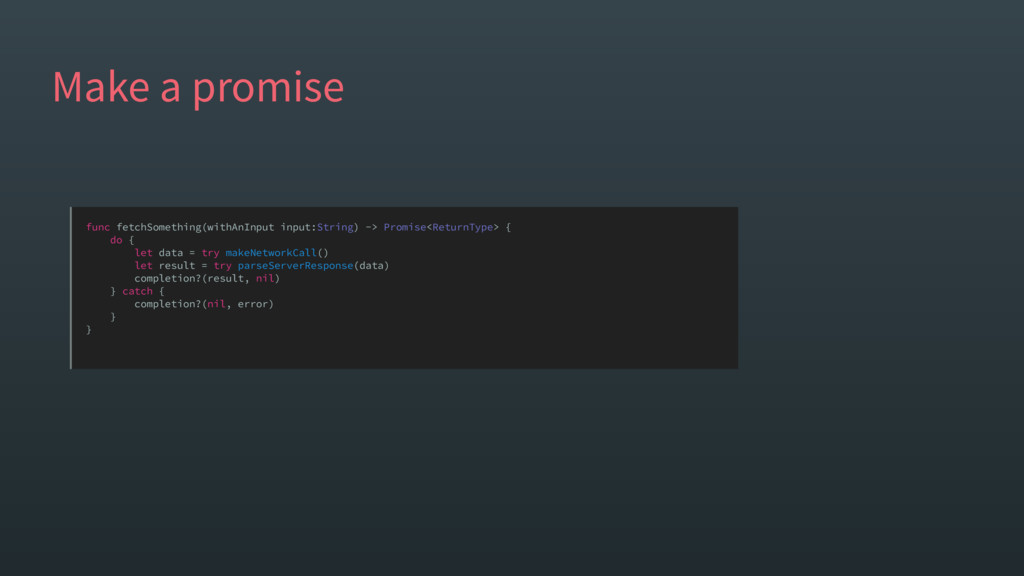
Make a promise func fetchSomething(withAnInput input:String) -> Promise<ReturnType> { do
{ let data = try makeNetworkCall() let result = try parseServerResponse(data) completion?(result, nil) } catch { completion?(nil, error) } } -
Make a promise func fetchSomething(withAnInput input:String) -> Promise<ReturnType> { return
Promise { fullfill, reject in do { let data = try makeNetworkCall() let result = try parseServerResponse(data) completion?(result, nil) } catch { completion?(nil, error) } } } -
Make a promise func fetchSomething(withAnInput input:String) -> Promise<ReturnType> { return
Promise { fullfill, reject in do { let data = try makeNetworkCall() let result = try parseServerResponse(data) completion?(result, nil) } catch { completion?(nil, error) } } } public init(resolvers: (_ fulfill: (T) -> Void, _ reject: (Error) -> Void) throws -> Void) -
Make a promise func fetchSomething(withAnInput input:String) -> Promise<ReturnType> { return
Promise { fullfill, reject in do { let data = try makeNetworkCall() let result = try parseServerResponse(data) fullfill(result) } catch { reject(error) } } } -
▸ then ▸ Call the next promise if the current
succeed. ▸ when ▸ when(resolved:) - Call the next promise when all the promises have been executed. ▸ when(fullfiled:) - Call the next promise if all the promises succeed. ▸ catch ▸ When any promise of the chain failed. Call it -
Call it firstly { APIManager.shared.fetchToken(withLogin: "dh", password: "dd") }.then {
token in print("Received Token: \(token)") } ▸ firstly ▸ Just a wrapper to make code cleaner -
Call it firstly { APIManager.shared.fetchToken(withLogin: "dh", password: "dd") }.then {
token in APIManager.shared.fetchUser(withToken: token) }.then { user in print("Hello \(user.fullname)") } -
Call it firstly { APIManager.shared.fetchToken(withLogin: "dh", password: "dd") }.then {
token in APIManager.shared.fetchUser(withToken: token) }.then { user -> Promise<([User], [Conversation])> in self.currentUser = user let friendsPromise = APIManager.shared.fetchFriends(forUserWithId: user.identifier) let conversationsPromise = APIManager.shared.fetchConversations(forUserWithId: user.identifier) return when(fulfilled: friendsPromise, conversationsPromise) } -
Call it firstly { APIManager.shared.fetchToken(withLogin: "dh", password: "dd") }.then {
token in APIManager.shared.fetchUser(withToken: token) }.then { user -> Promise<([User], [Conversation])> in self.currentUser = user let friendsPromise = APIManager.shared.fetchFriends(forUserWithId: user.identifier) let conversationsPromise = APIManager.shared.fetchConversations(forUserWithId: user.identifier) return when(fulfilled: friendsPromise, conversationsPromise) }.then { (friends, conversations) -> Void in print("Hello \(self.currentUser!.fullname).") print("You have \(conversations.count) conversations:") for conversation in conversations { let friend = friends.first(where: {$0.identifier == conversation.otherPeerId}) print("[\(friend?.fullname ?? "Unknow")] \(conversation.title)") } } -
Call it firstly { APIManager.shared.fetchToken(withLogin: "dh", password: "dd") }.then {
token in APIManager.shared.fetchUser(withToken: token) }.then { user -> Promise<([User], [Conversation])> in self.currentUser = user let friendsPromise = APIManager.shared.fetchFriends(forUserWithId: user.identifier) let conversationsPromise = APIManager.shared.fetchConversations(forUserWithId: user.identifier) return when(fulfilled: friendsPromise, conversationsPromise) }.then { (friends, conversations) -> Void in print("Hello \(self.currentUser!.fullname).") print("You have \(conversations.count) conversations:") for conversation in conversations { let friend = friends.first(where: {$0.identifier == conversation.otherPeerId}) print("[\(friend?.fullname ?? "Unknow")] \(conversation.title)") } }.catch { (error) in print("We have an error, another failed experiment :( \(error)") } -
A GENTLE REMINDER APIManager.shared.fetchToken(withLogin: "dh", password: "dd", completion: { (token,
error) in guard error == nil else { print("Error:\(error!)") return } guard let token = token else { print("Received empty token ¯\\_(ϑ)_/¯") return } APIManager.shared.fetchUser(withToken: token, completion:{ (user, error) in guard error == nil else { print("Error:\(error!)") return } guard var user = user else { print("Received nil user ¯\\_(ϑ)_/¯") return } APIManager.shared.fetchConversations(forUserWithId: user.identifier, completion: { (conversations, error) in guard error == nil else { print("Error:\(error!)") return } guard let conversations = conversations else { print("Received nil conversations ¯\\_(ϑ)_/¯") return } APIManager.shared.fetchFriends(forUserWithId: user.identifier, completion: { (friends, error) in guard error == nil else { print("Error:\(error!)") return } guard let friends = friends else { print("Received nil friend list ¯\\_(ϑ)_/¯") return } // Here we have all the friends, conversations and user. // It's OVER ! // PS: If you can read this, raise your hands :) }) }) }) }) -
Frameworks integration AddressBook CloudKit CoreBluetooth QuartzCore Social UIKit AssetsLibrary MessagesUI
AVFoundation EventKit Photos WatchConnectivity Accounts StoreKit Foundation EventKit SystemConfiguration CoreLocation Alamofire OMGHTTPURLRQ Bolts -
Frameworks integration AddressBook CloudKit CoreBluetooth QuartzCore Social UIKit AssetsLibrary MessagesUI
AVFoundation EventKit Photos WatchConnectivity Accounts StoreKit Foundation EventKit SystemConfiguration CoreLocation Alamofire OMGHTTPURLRQ Bolts -
CoreLocation firstly { CLLocationManager.promise() }.then { location in CLGeocoder().reverseGeocode(location:location) }.then
{ placemark in print("I know where you live ... \(placemark.locality)") }.catch { (error) in print("I did not find you due to this error: \(error)") } -
▸ Khanlou Promise - https://github.com/khanlou/Promise ▸ Then - https://github.com/freshOS/then ▸
Hydra - https://github.com/malcommac/Hydra ▸ BrightFutures - https://github.com/Thomvis/BrightFutures Alternatives