Upgrade to Pro — share decks privately, control downloads, hide ads and more …

How to Optimize Content for AI Answers

Sponsored · Your Podcast. Everywhere. Effortlessly. Share. Educate. Inspire. Entertain. You do you. We'll handle the rest.

How to Optimize Content for AI Answers

What we know about appearing in organic AI answers, and which you should focus on
The organic traffic arena has radically changed with the integration of LLMs and AI. Whether or not your nonprofit has pivoted to appear in these places or not, this session will cover what we know about what it takes to appear in organic search and social, and will give you direction about where you should focus when it comes to AI Answers in search and social media. This session will walk through how AI integration into the platforms works and conclude with key steps you can take to assess how well your brand appears and what you can do from technical, outreach, and writing standpoints to increase your visibility on these AI surfaces.

Avatar for Katherine Watier Ong
Katherine Watier Ong
June 17, 2026

More Decks by Katherine Watier Ong
Transcript

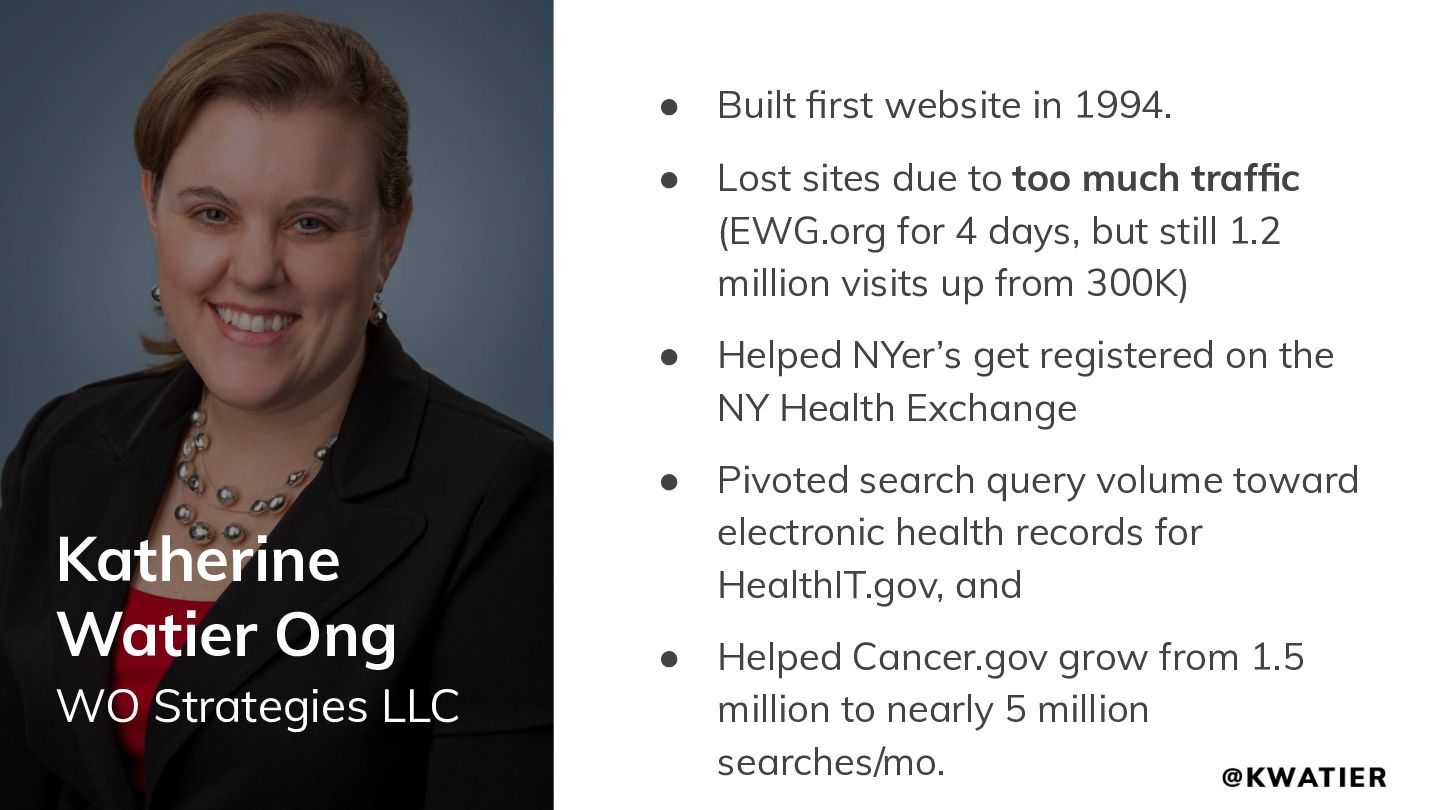
  1. Katherine Watier Ong WO Strategies LLC • Built first website
    in 1994. • Lost sites due to too much traffic (EWG.org for 4 days, but still 1.2 million visits up from 300K) • Helped NYer’s get registered on the NY Health Exchange • Pivoted search query volume toward electronic health records for HealthIT.gov, and • Helped Cancer.gov grow from 1.5 million to nearly 5 million searches/mo.
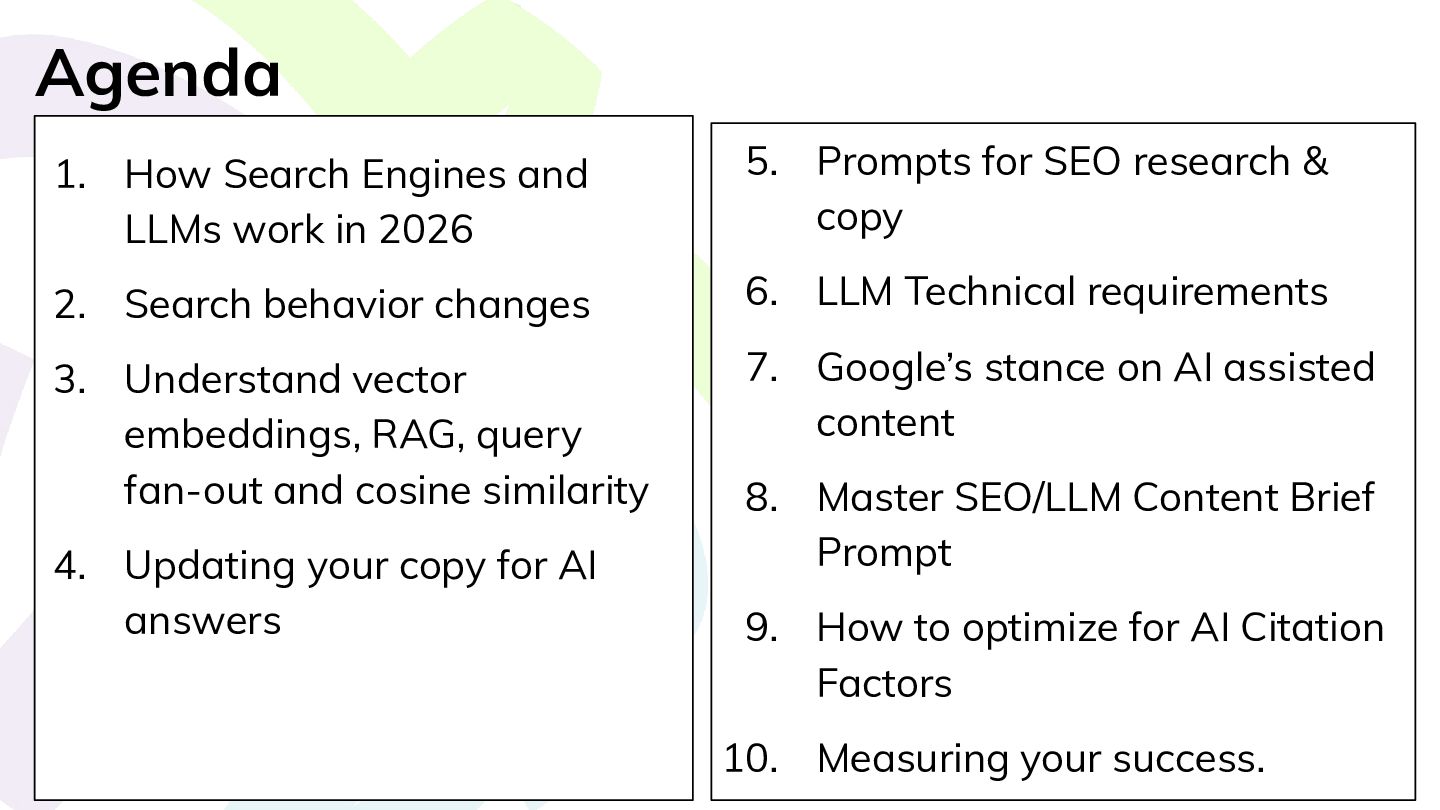
  2. Agenda 1. How Search Engines and LLMs work in 2026

    2. Search behavior changes 3. Understand vector embeddings, RAG, query fan-out and cosine similarity 4. Updating your copy for AI answers 5. Prompts for SEO research & copy 6. LLM Technical requirements 7. Google’s stance on AI assisted content 8. Master SEO/LLM Content Brief Prompt 9. How to optimize for AI Citation Factors 10. Measuring your success.
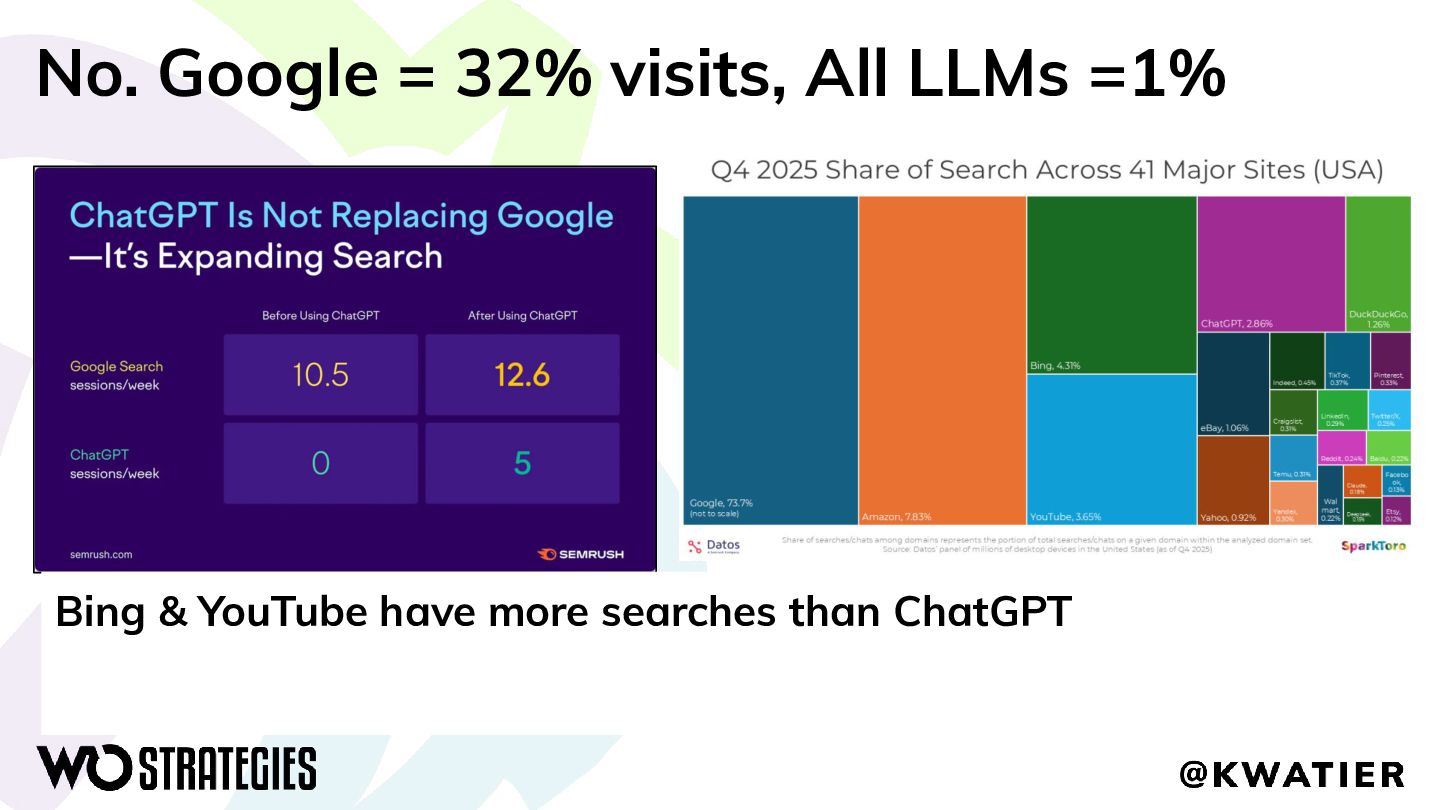
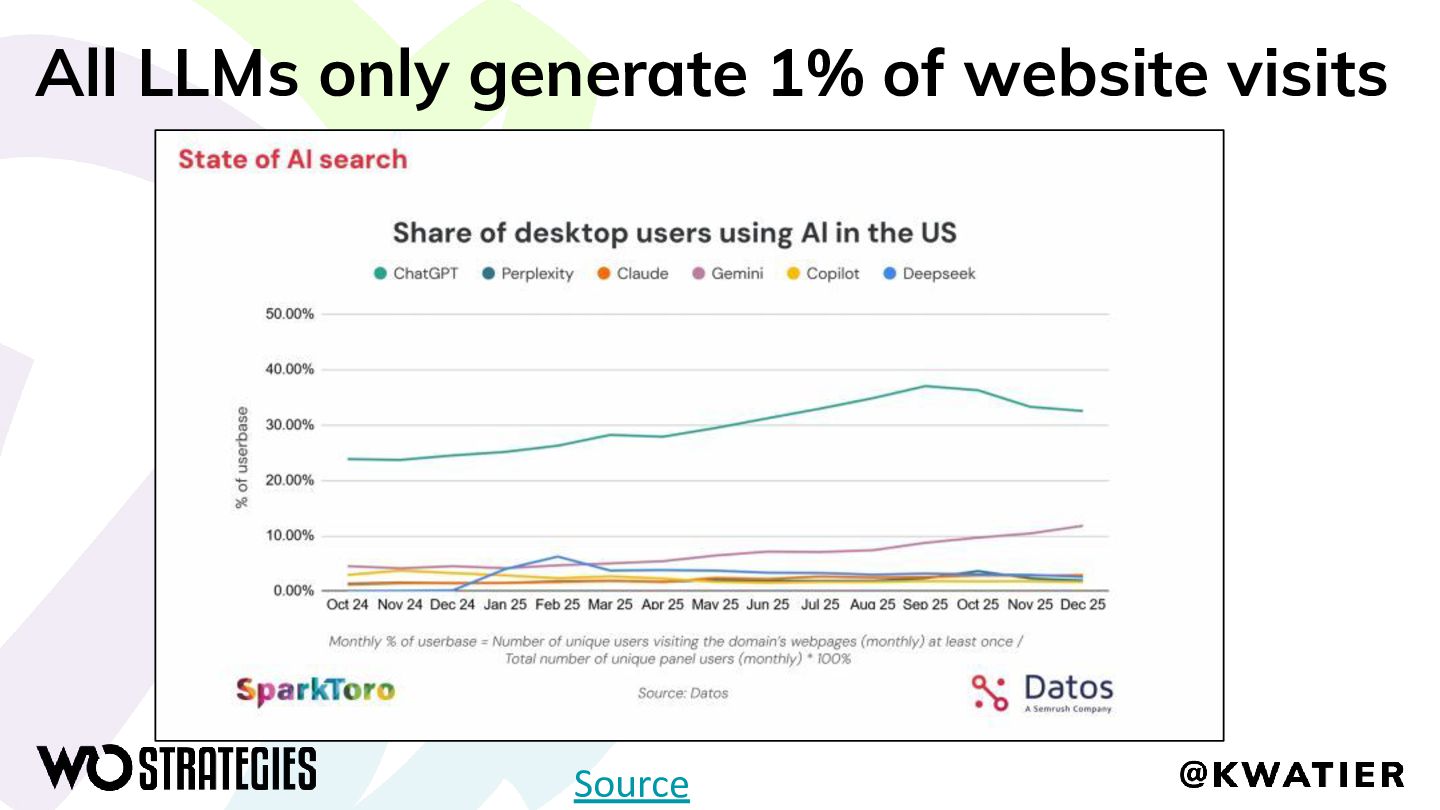
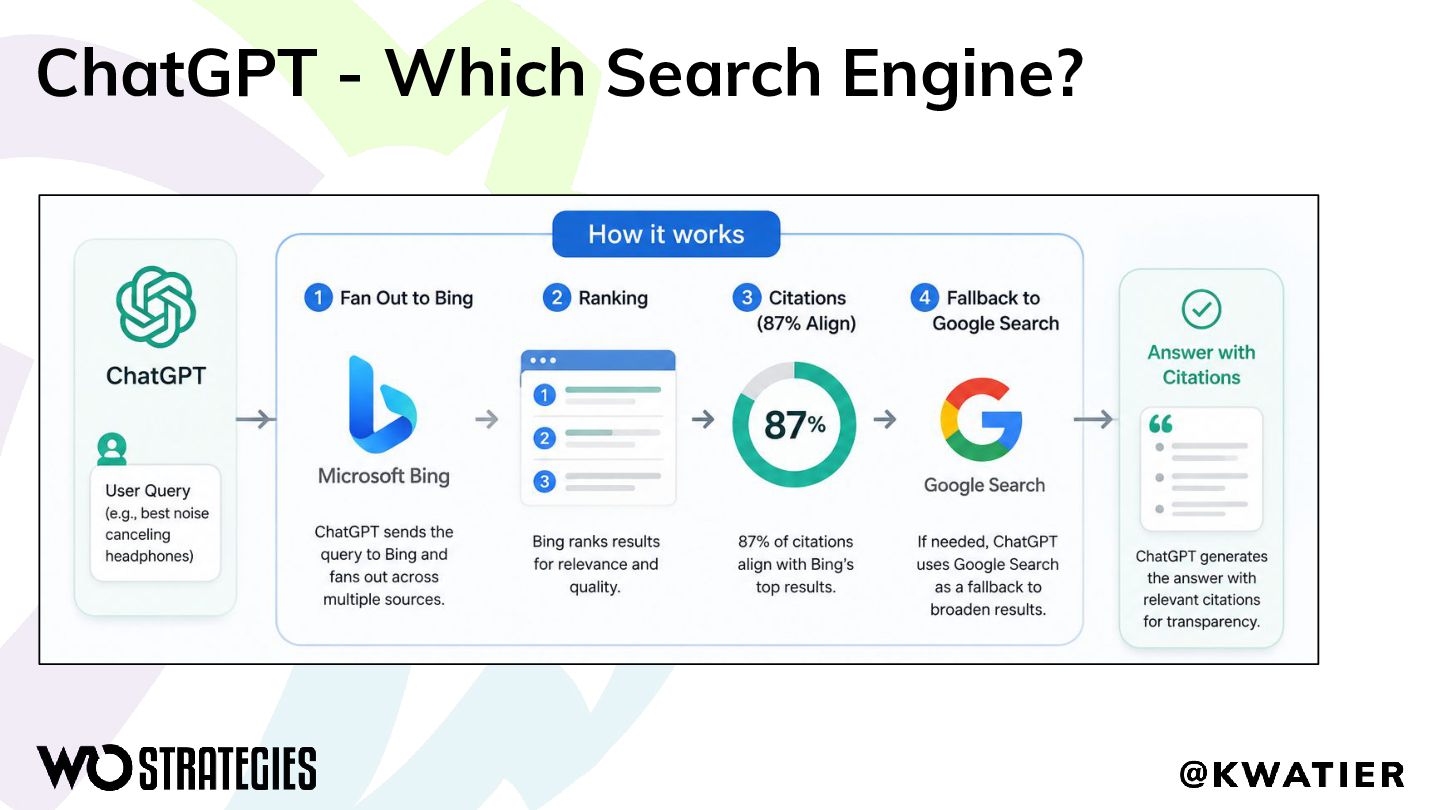
  3. No. Google = 32% visits, All LLMs =1% Bing &

    YouTube have more searches than ChatGPT
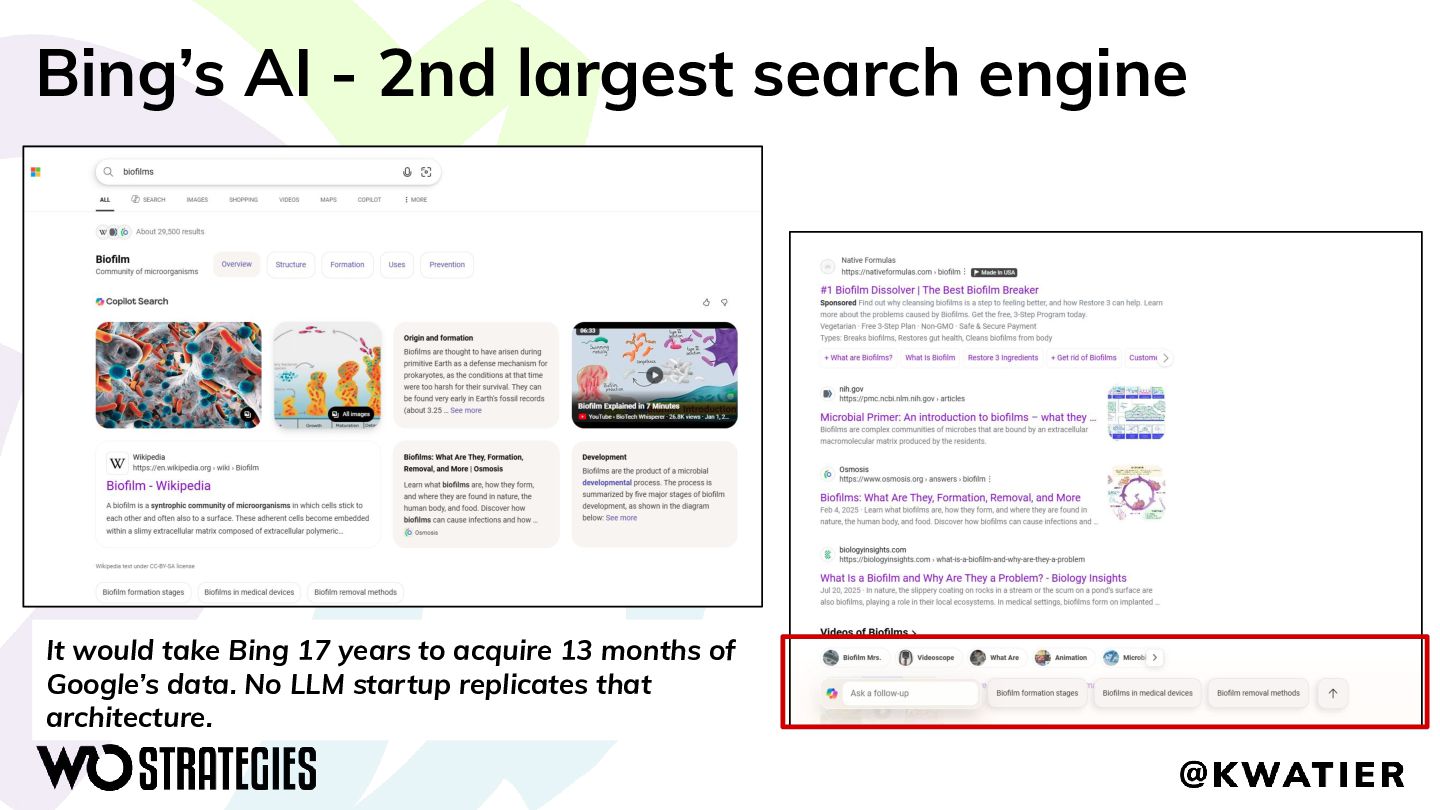
  4. Bing’s AI - 2nd largest search engine It would take

    Bing 17 years to acquire 13 months of Google’s data. No LLM startup replicates that architecture.
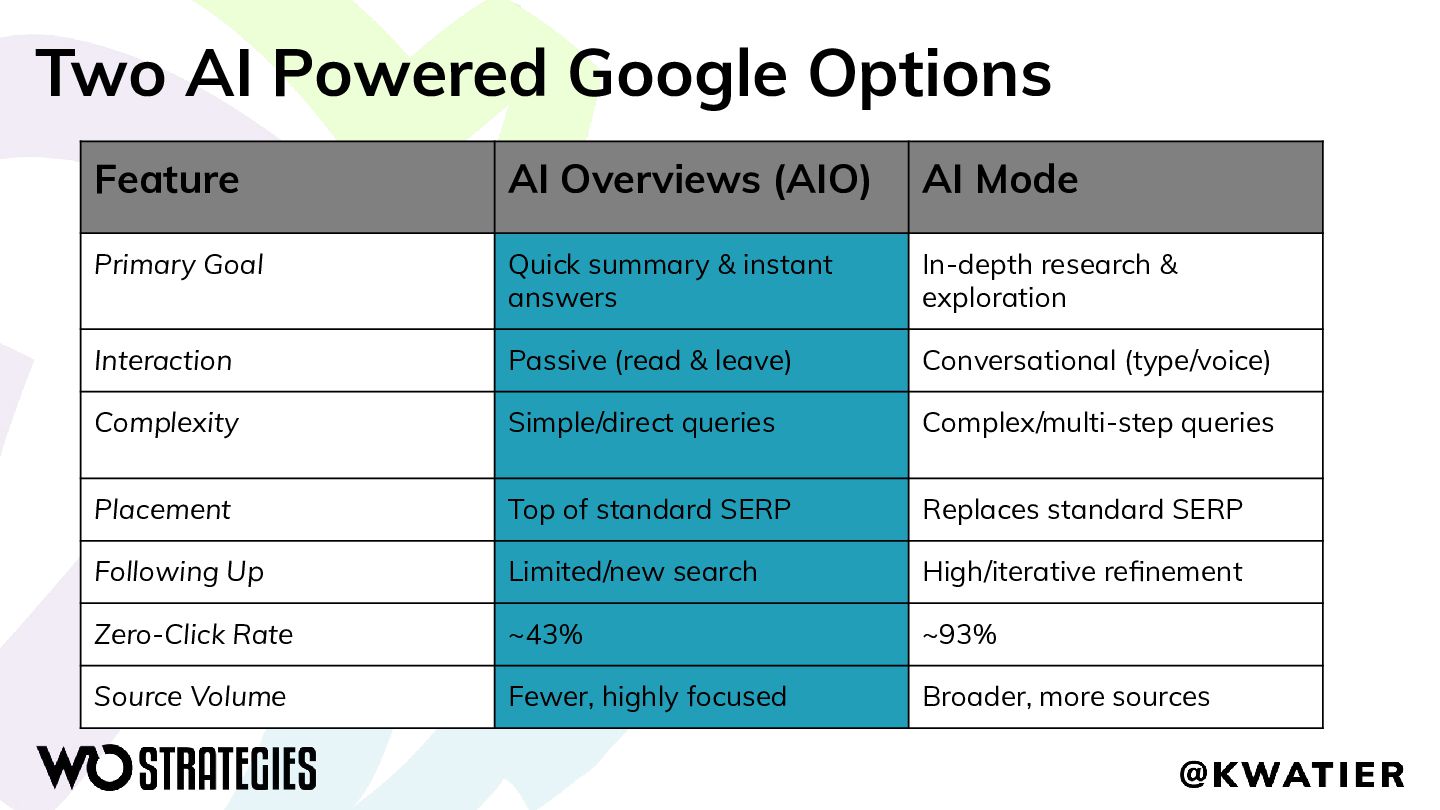
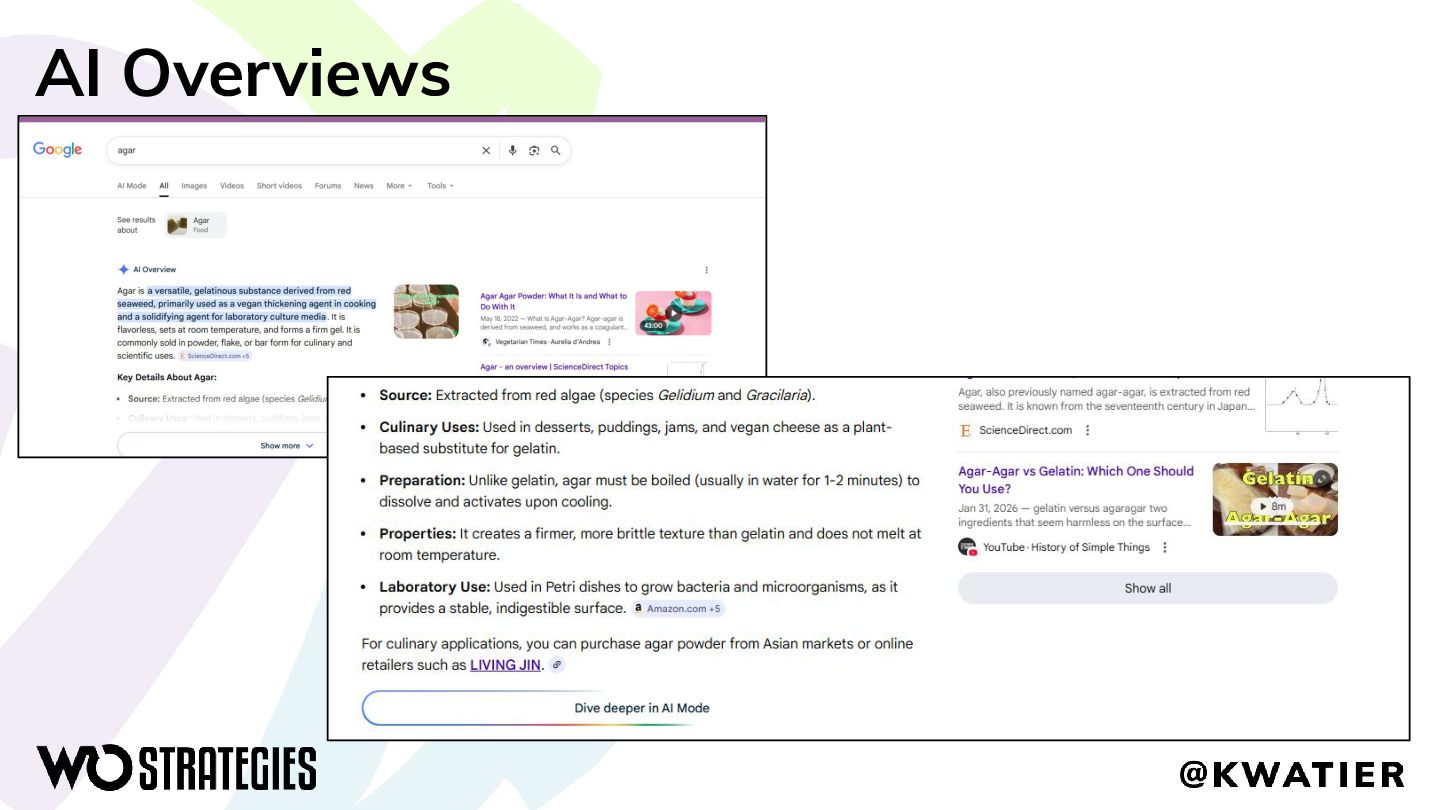
  5. Two AI Powered Google Options Feature AI Overviews (AIO) AI

    Mode Primary Goal Quick summary & instant answers In-depth research & exploration Interaction Passive (read & leave) Conversational (type/voice) Complexity Simple/direct queries Complex/multi-step queries Placement Top of standard SERP Replaces standard SERP Following Up Limited/new search High/iterative refinement Zero-Click Rate ~43% ~93% Source Volume Fewer, highly focused Broader, more sources
  6. Search, Talk and Listen with AI Mode Now 75M daily

    users, AI Mode queries doubled in Q3 2025. monthly users. Now in 200 countries & 100 languages
  7. A lot of digital marketing has changed… 1. We now

    know search & social are vector based, and social media posts are highly cited in AI answers 2. AI answers drive almost zero clicks to websites. 3. We have lost web analytics. Our metrics are fuzzy. LLM rankings are random. 4. In 2026, people don’t start with Google They start Googling once they have found a solution.
  8. AI/LLMs Create a Black Box CBS Reporter: "You don't fully

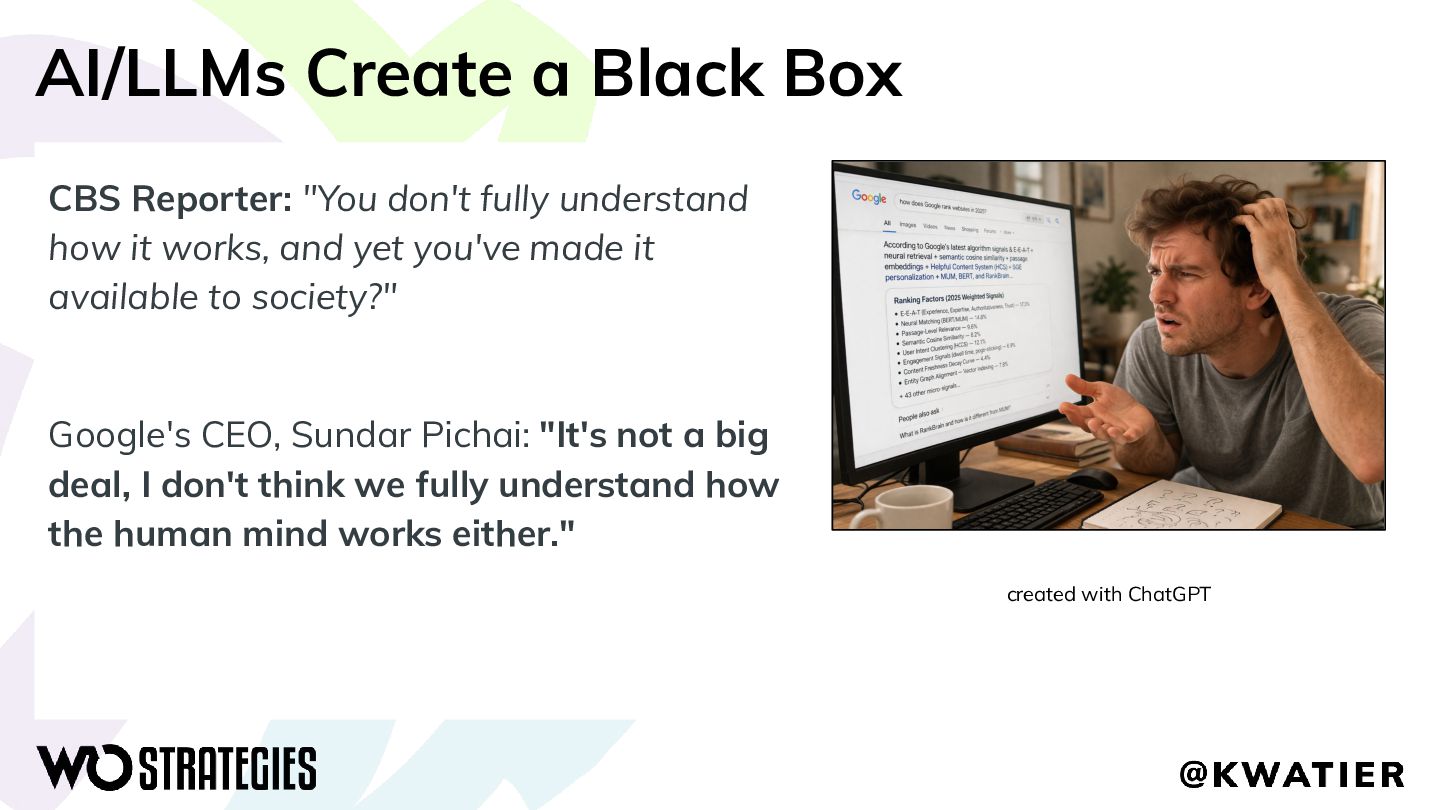
    understand how it works, and yet you've made it available to society?" Google's CEO, Sundar Pichai: "It's not a big deal, I don't think we fully understand how the human mind works either." created with ChatGPT
  9. Google's *now* is Agentic Search AI can help with dinner

    reservation with friends (party size, date, time, location and preferred cuisine) and AI Mode will streamline this process, do the research for you and link to the booking page. New Era for AI Search
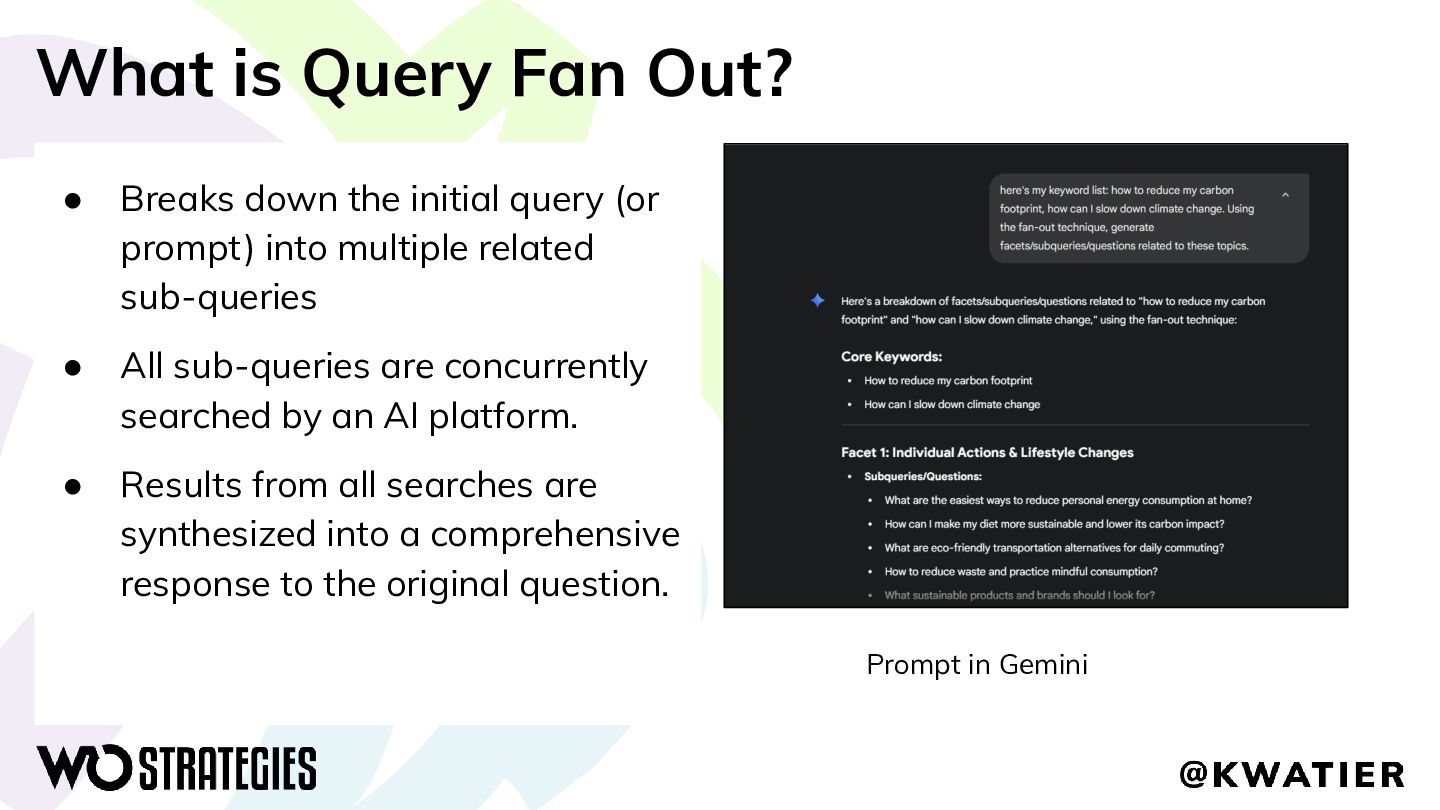
  10. What is Query Fan Out? • Breaks down the initial

    query (or prompt) into multiple related sub-queries • All sub-queries are concurrently searched by an AI platform. • Results from all searches are synthesized into a comprehensive response to the original question. Prompt in Gemini
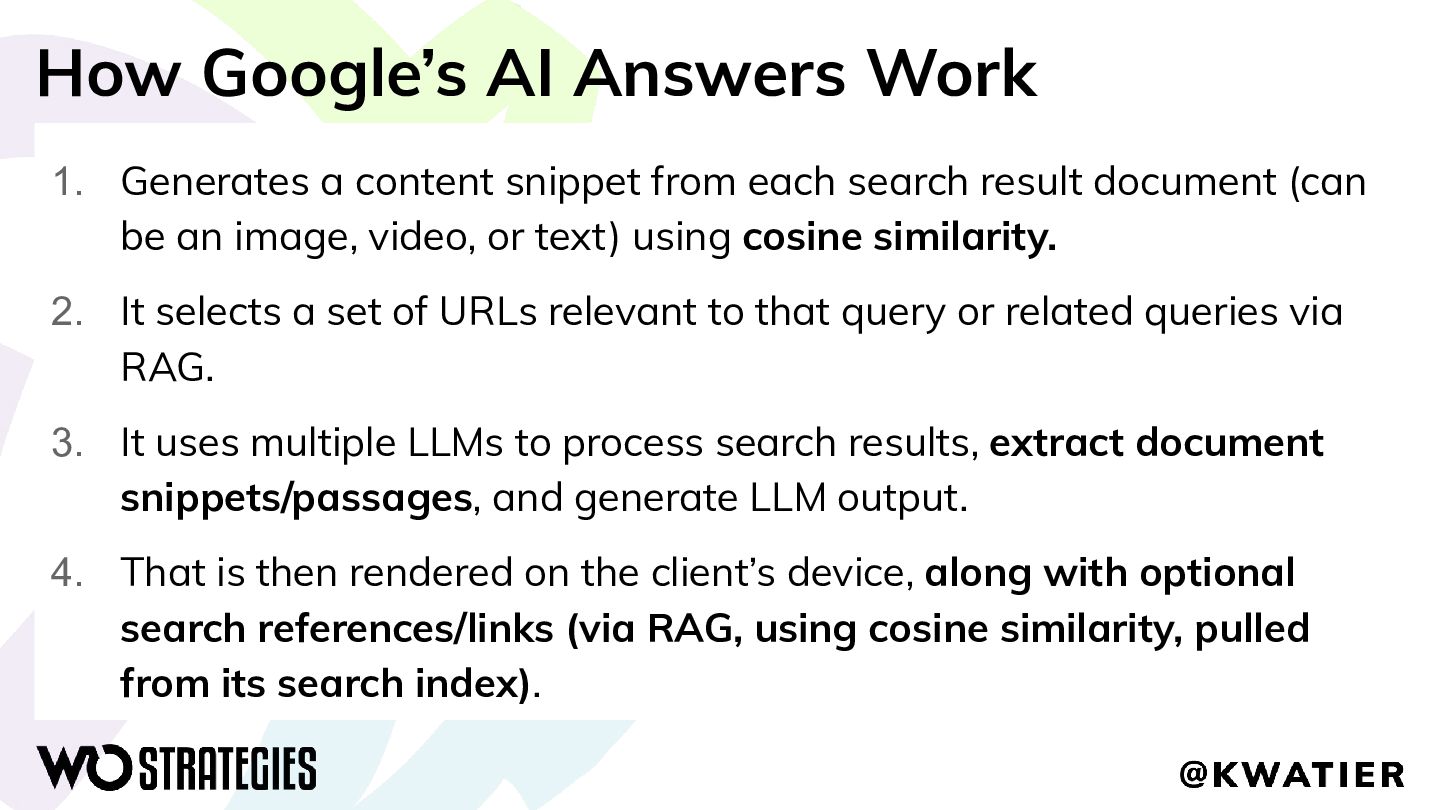
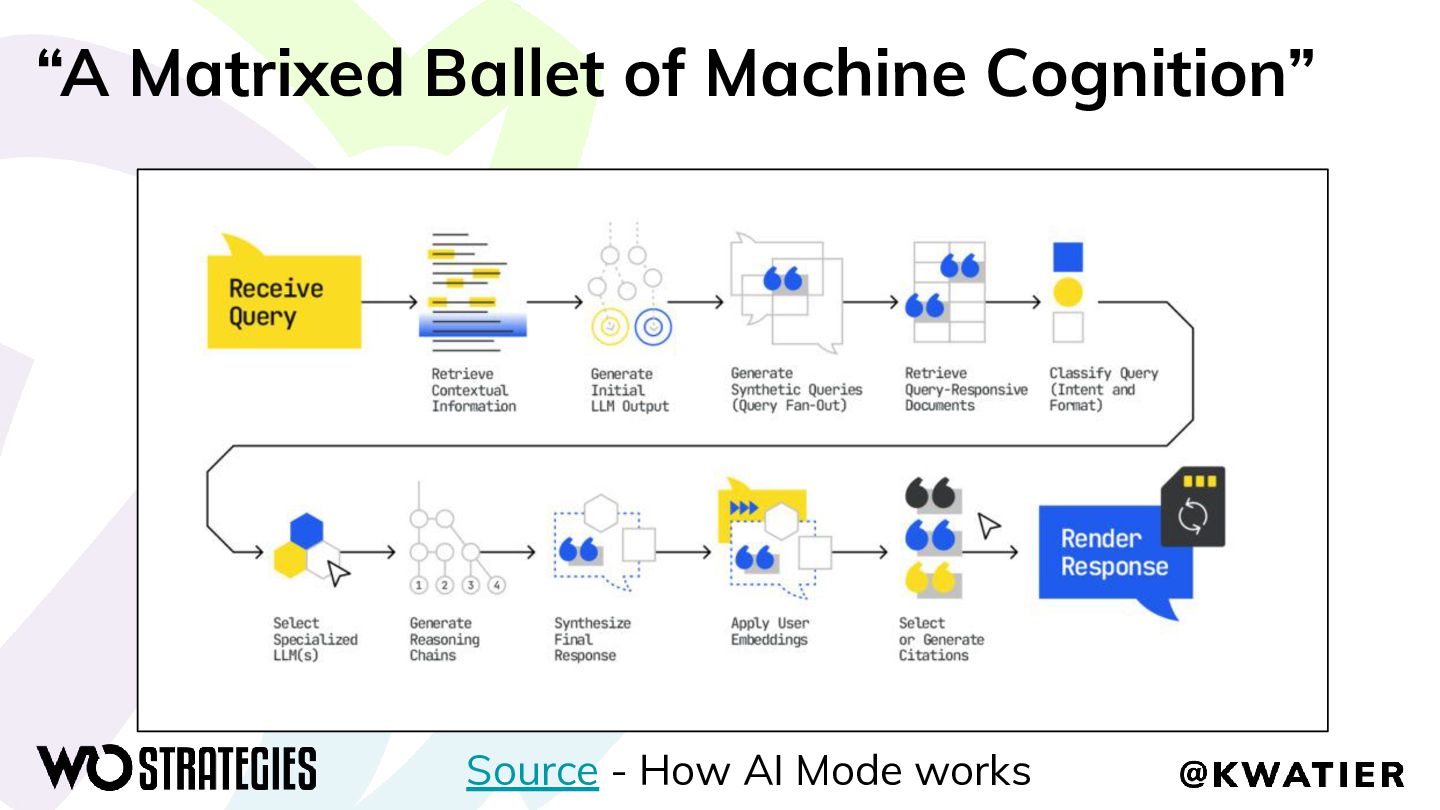
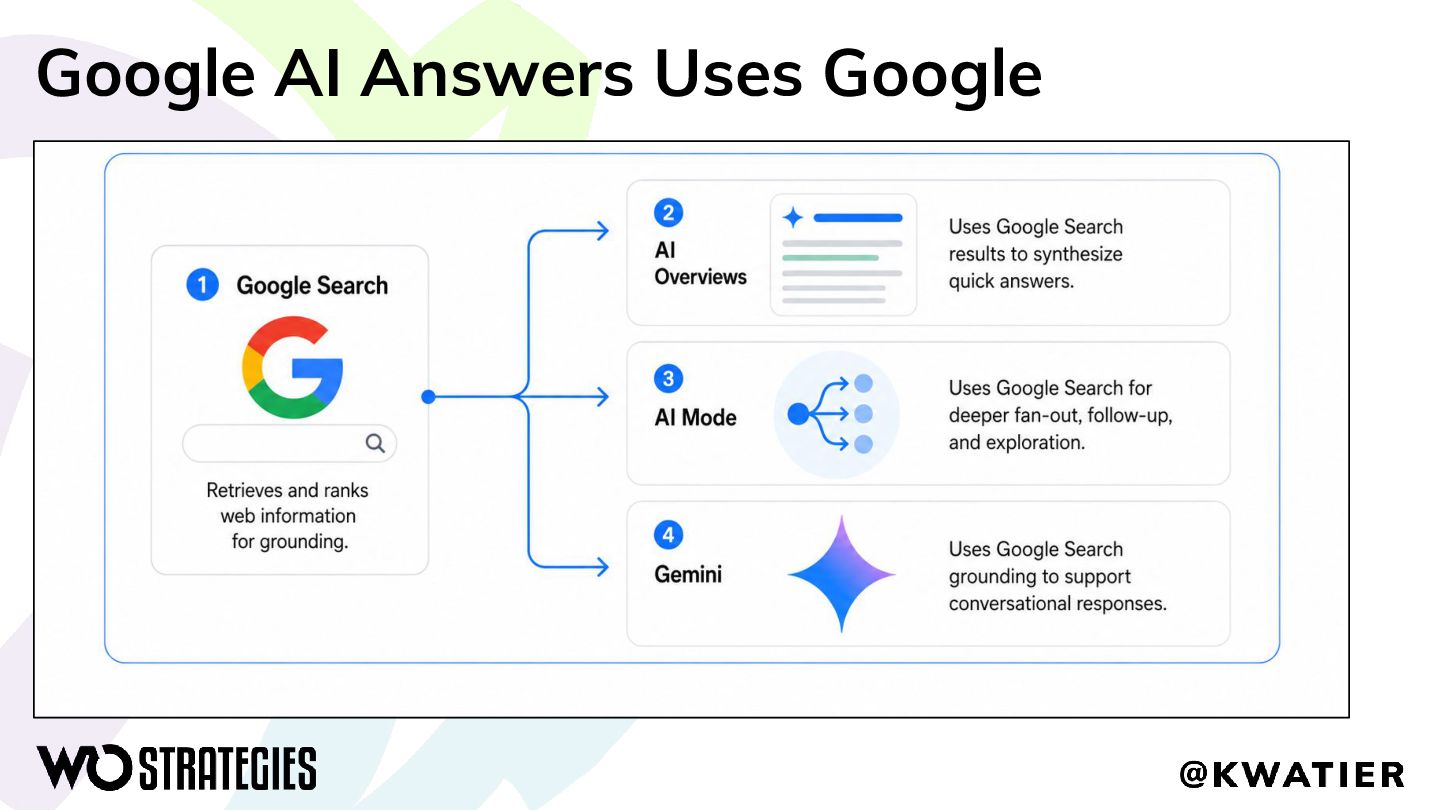
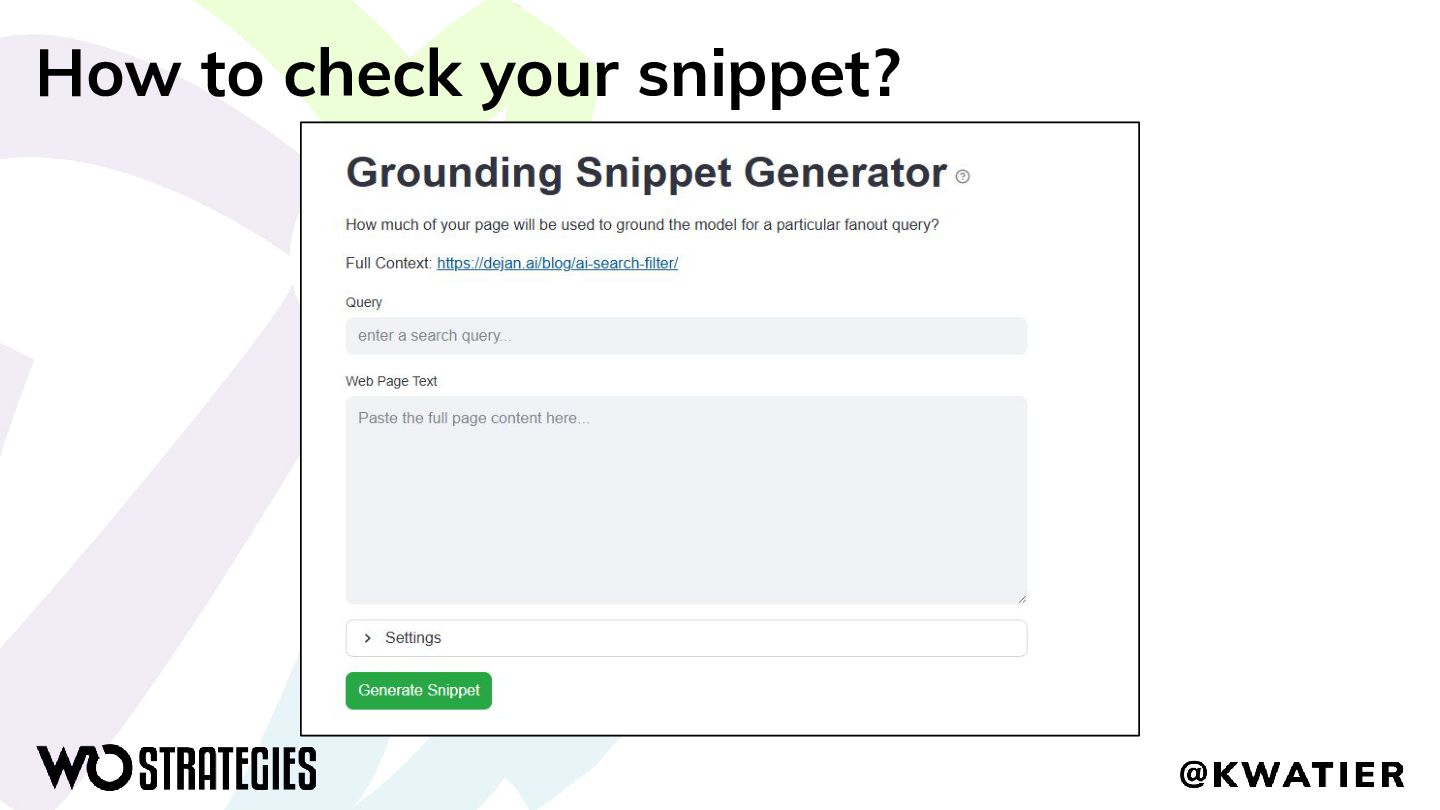
  11. How Google’s AI Answers Work 1. Generates a content snippet

    from each search result document (can be an image, video, or text) using cosine similarity. 2. It selects a set of URLs relevant to that query or related queries via RAG. 3. It uses multiple LLMs to process search results, extract document snippets/passages, and generate LLM output. 4. That is then rendered on the client’s device, along with optional search references/links (via RAG, using cosine similarity, pulled from its search index).
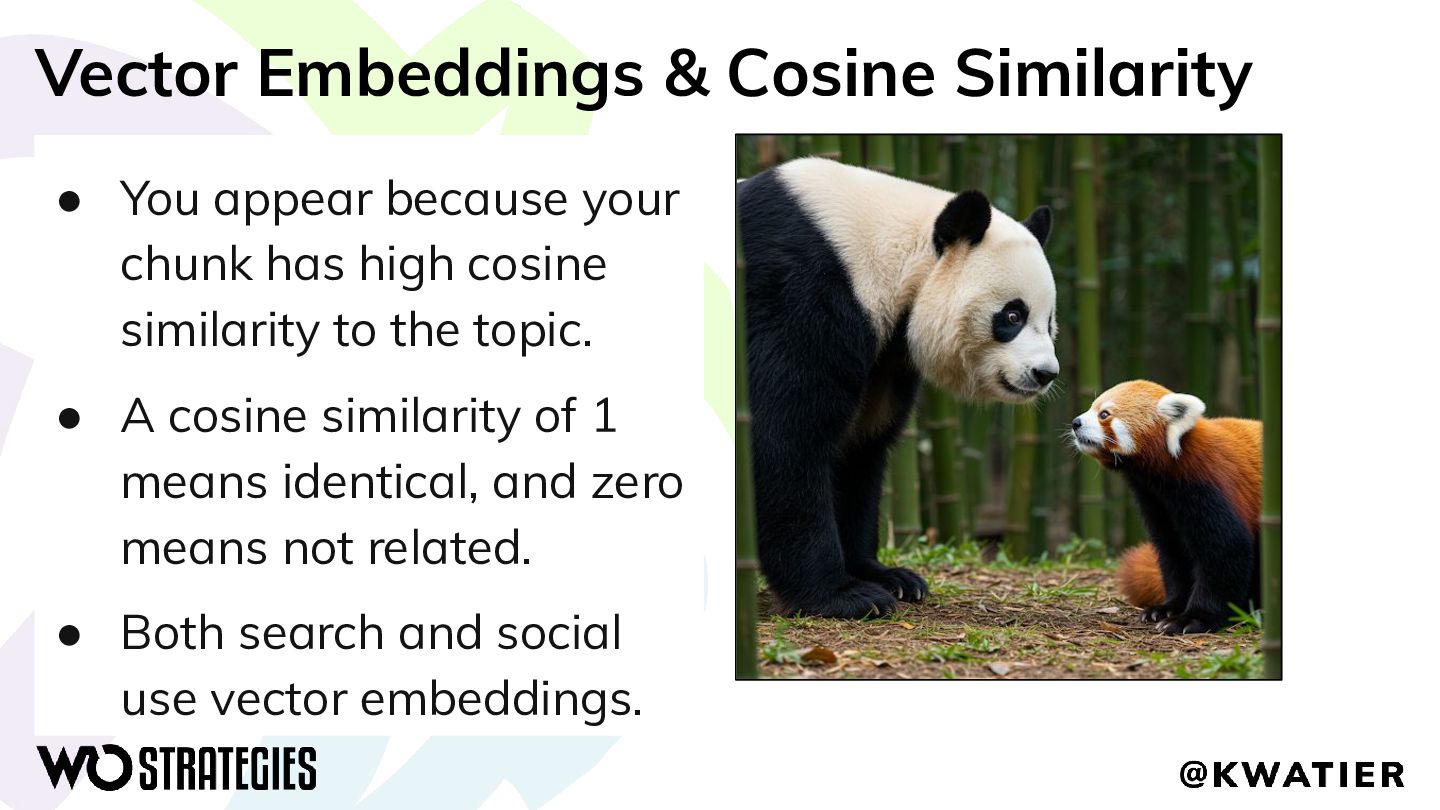
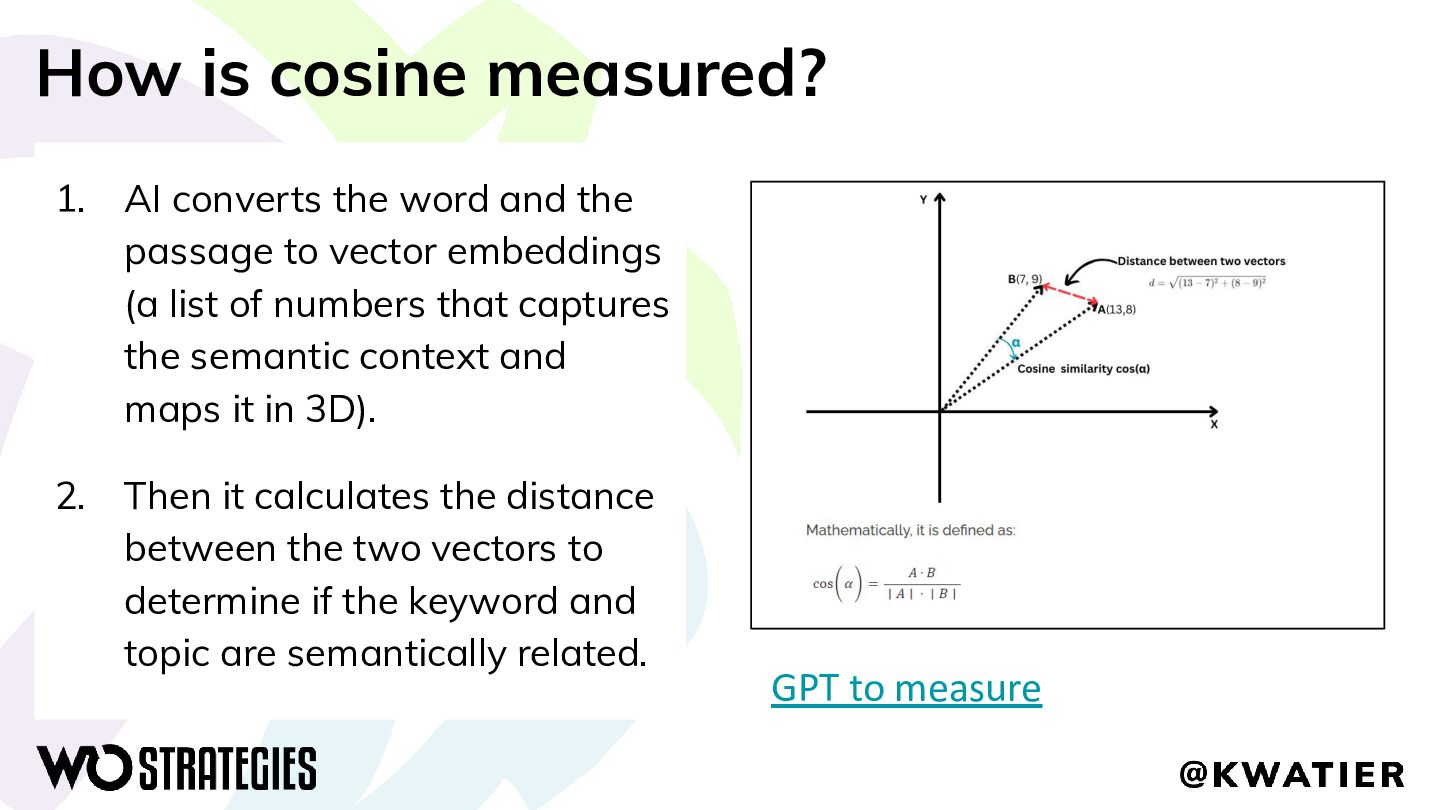
  12. Vector Embeddings & Cosine Similarity • You appear because your

    chunk has high cosine similarity to the topic. • A cosine similarity of 1 means identical, and zero means not related. • Both search and social use vector embeddings.
  13. How is cosine measured? 1. AI converts the word and

    the passage to vector embeddings (a list of numbers that captures the semantic context and maps it in 3D). 2. Then it calculates the distance between the two vectors to determine if the keyword and topic are semantically related. GPT to measure
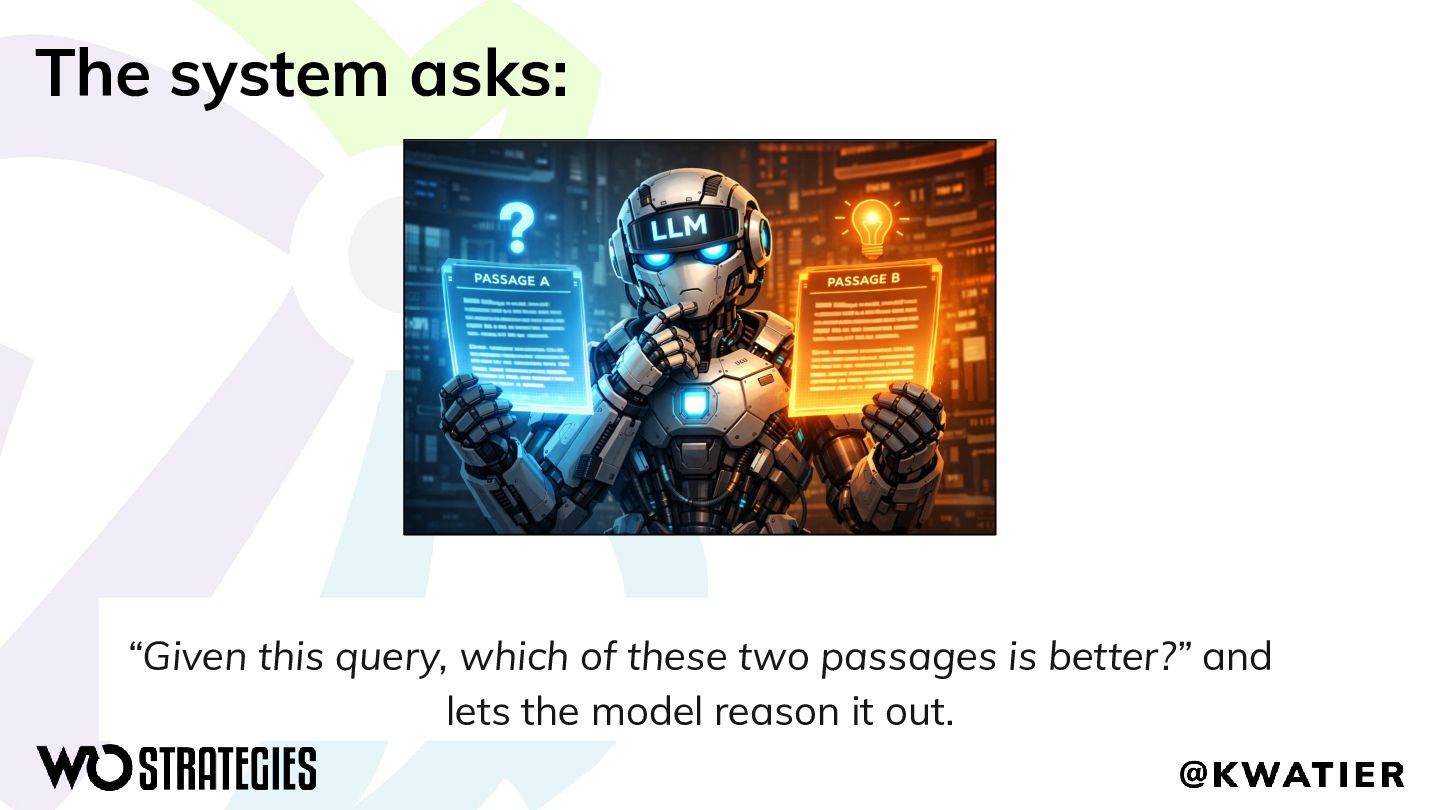
  14. The system asks: “Given this query, which of these two

    passages is better?” and lets the model reason it out.
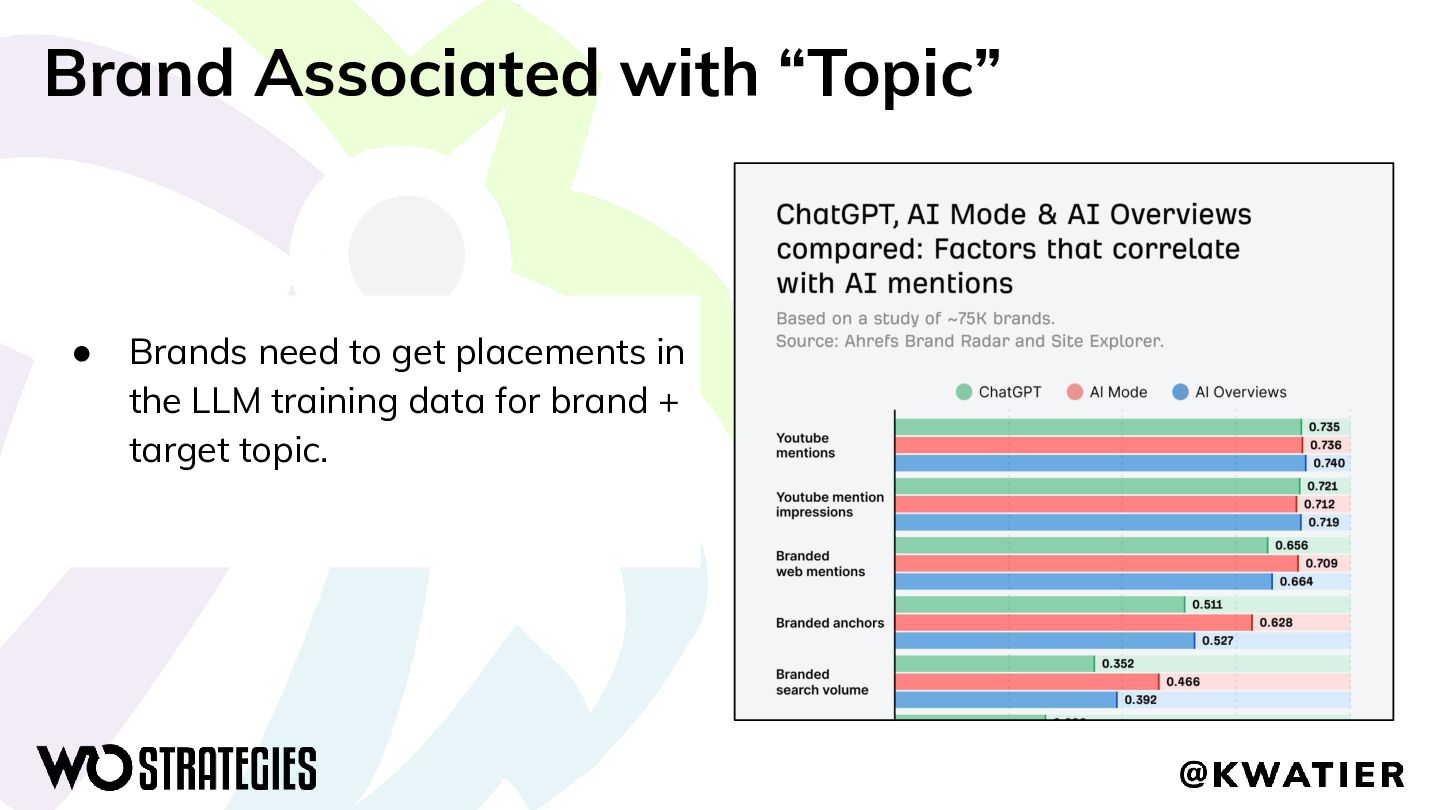
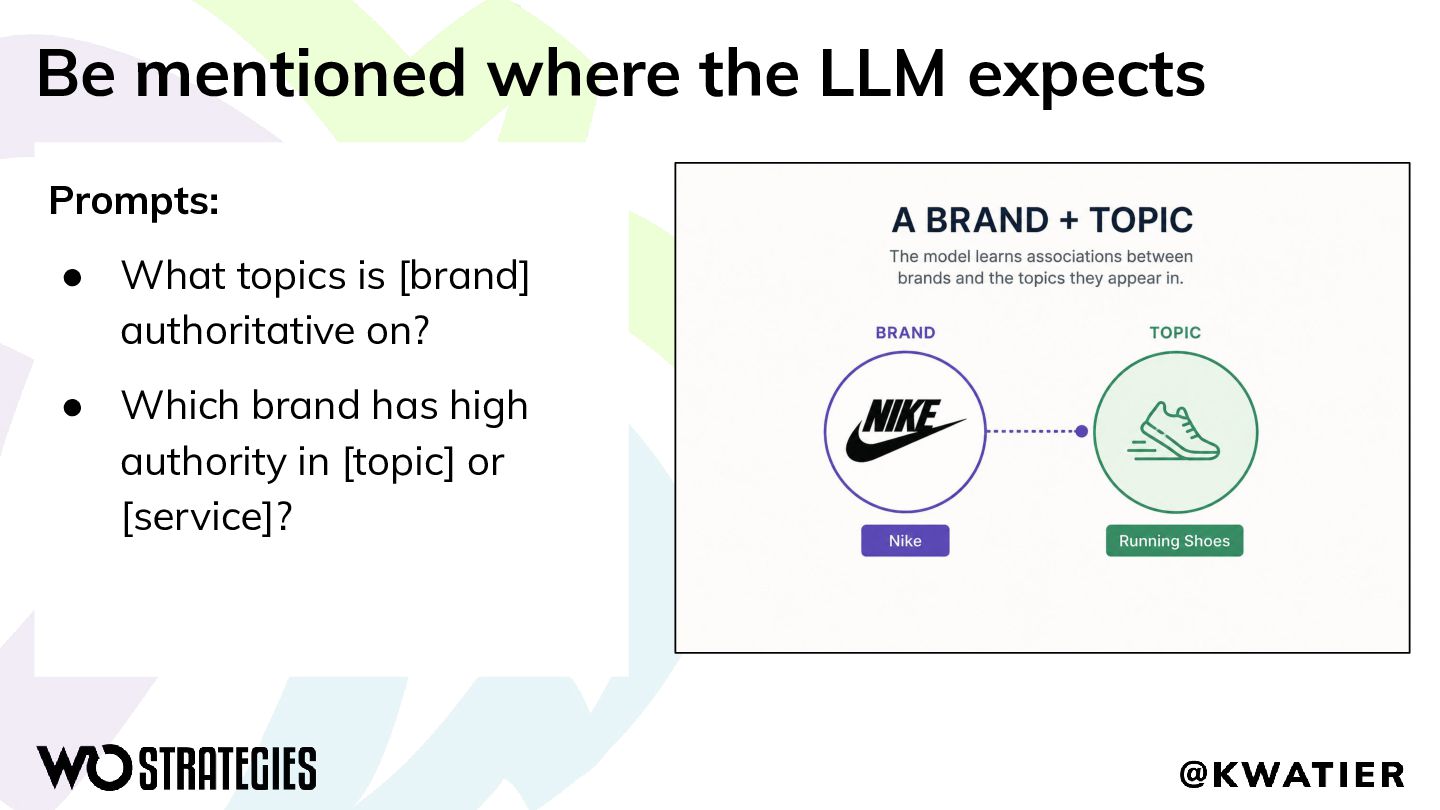
  15. Brand Associated with “Topic” • Brands need to get placements

    in the LLM training data for brand + target topic.
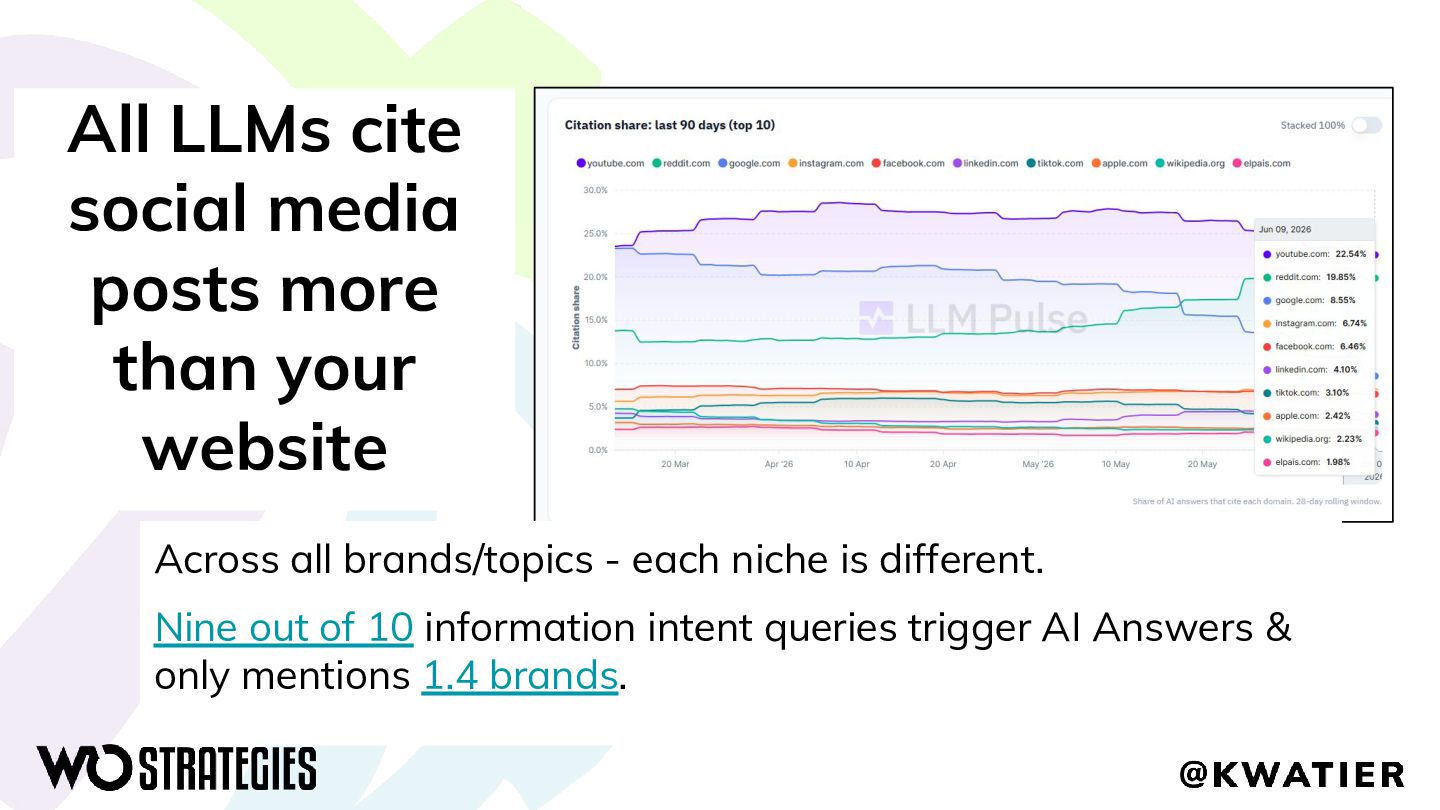
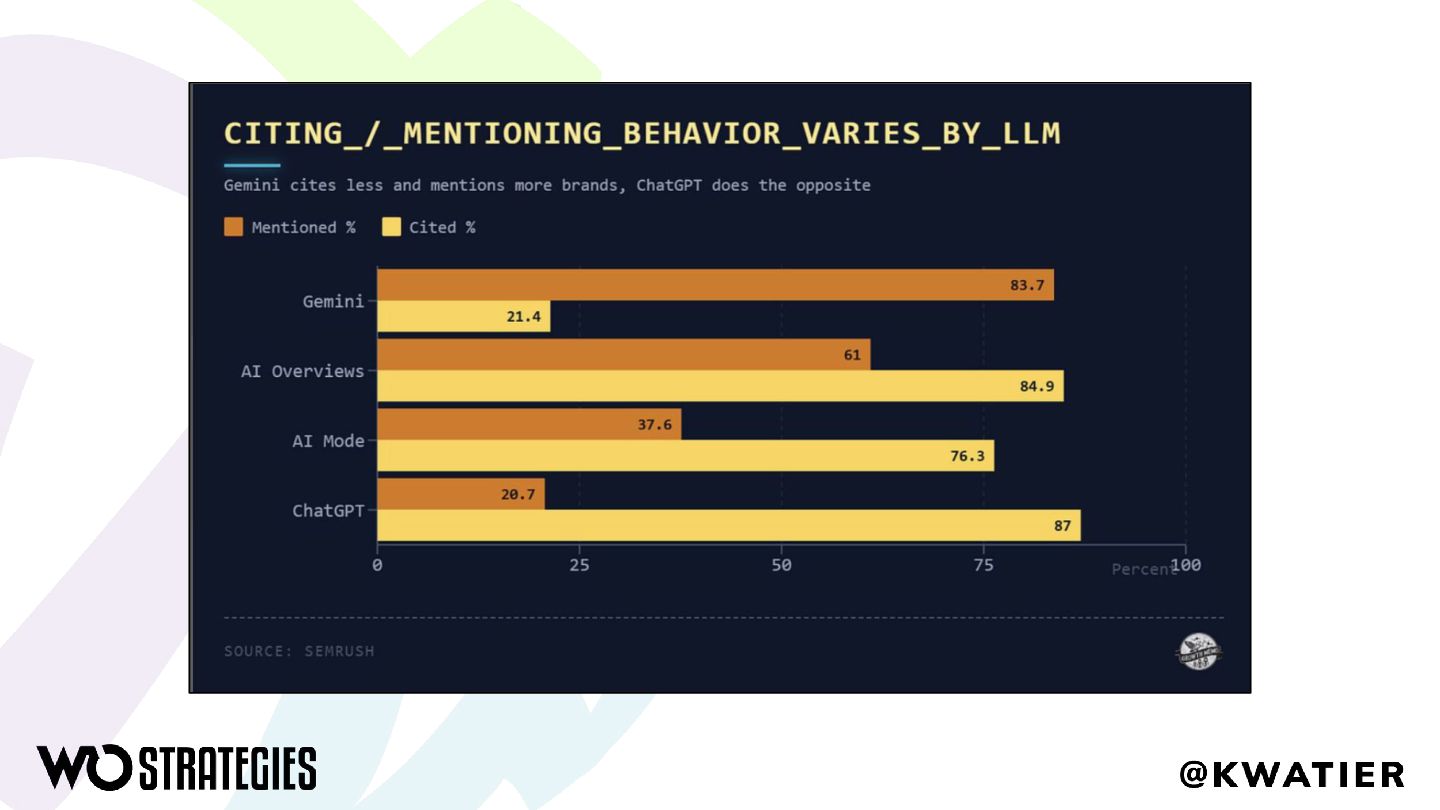
  16. All LLMs cite social media posts more than your website

    Across all brands/topics - each niche is different. Nine out of 10 information intent queries trigger AI Answers & only mentions 1.4 brands.
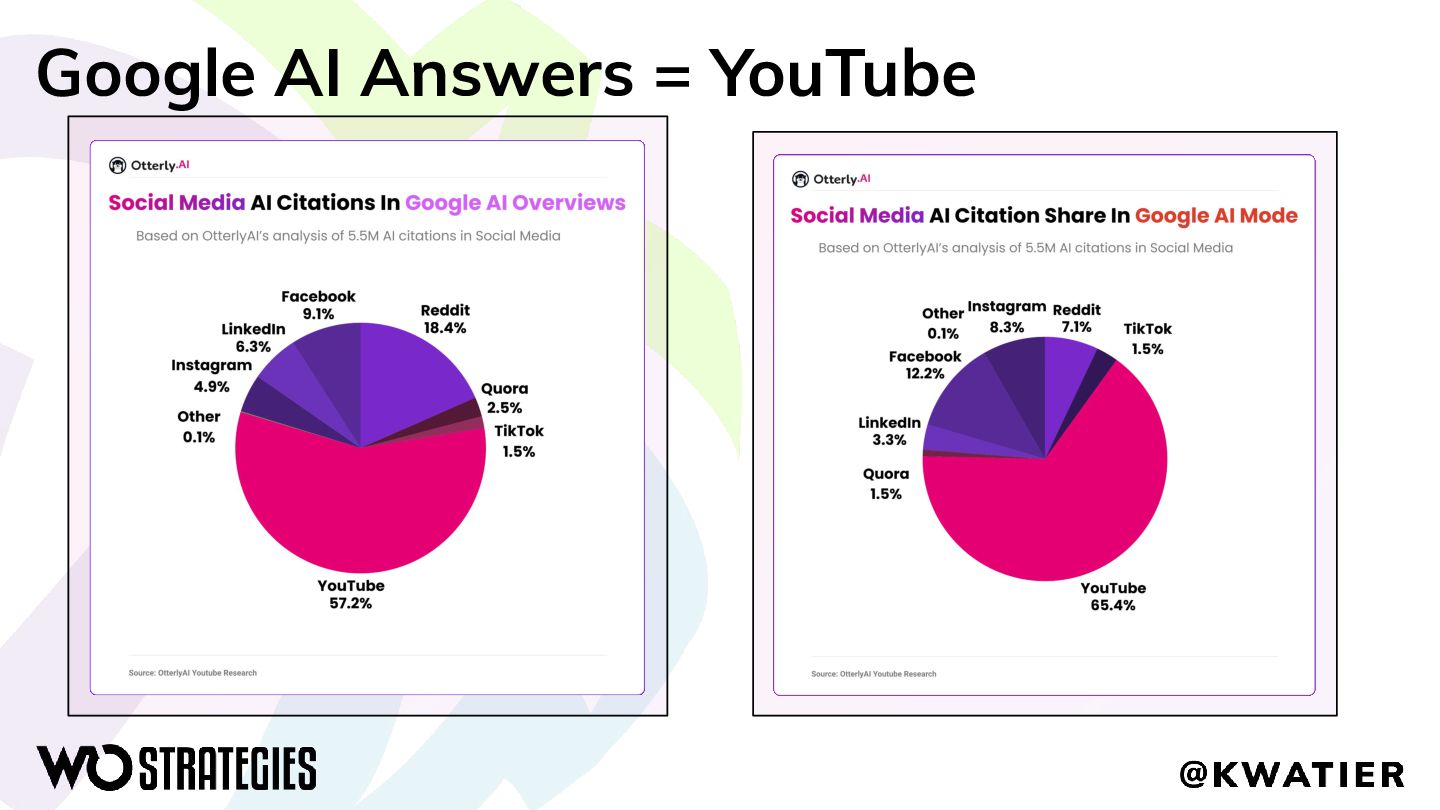
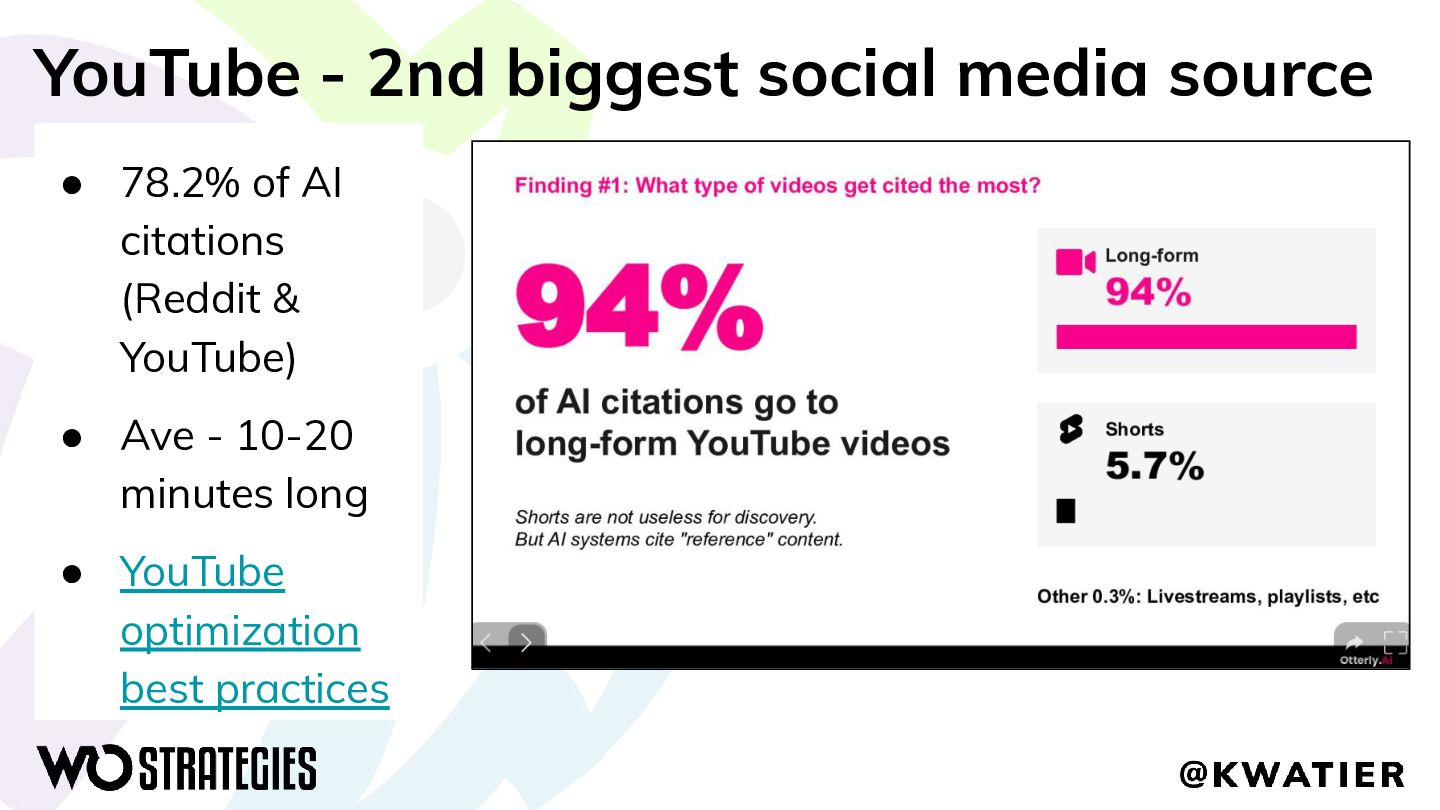
  17. YouTube - 2nd biggest social media source • 78.2% of

    AI citations (Reddit & YouTube) • Ave - 10-20 minutes long • YouTube optimization best practices
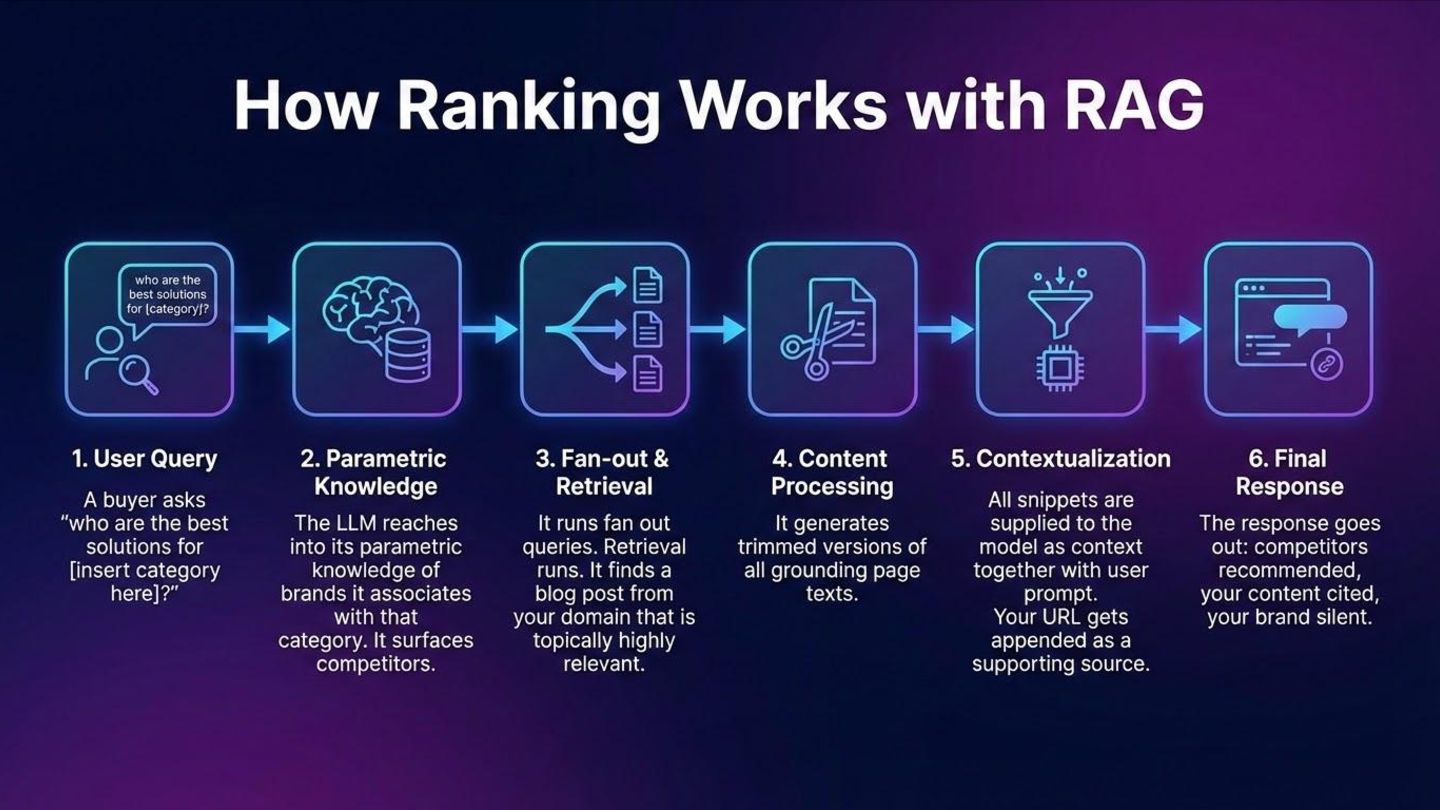
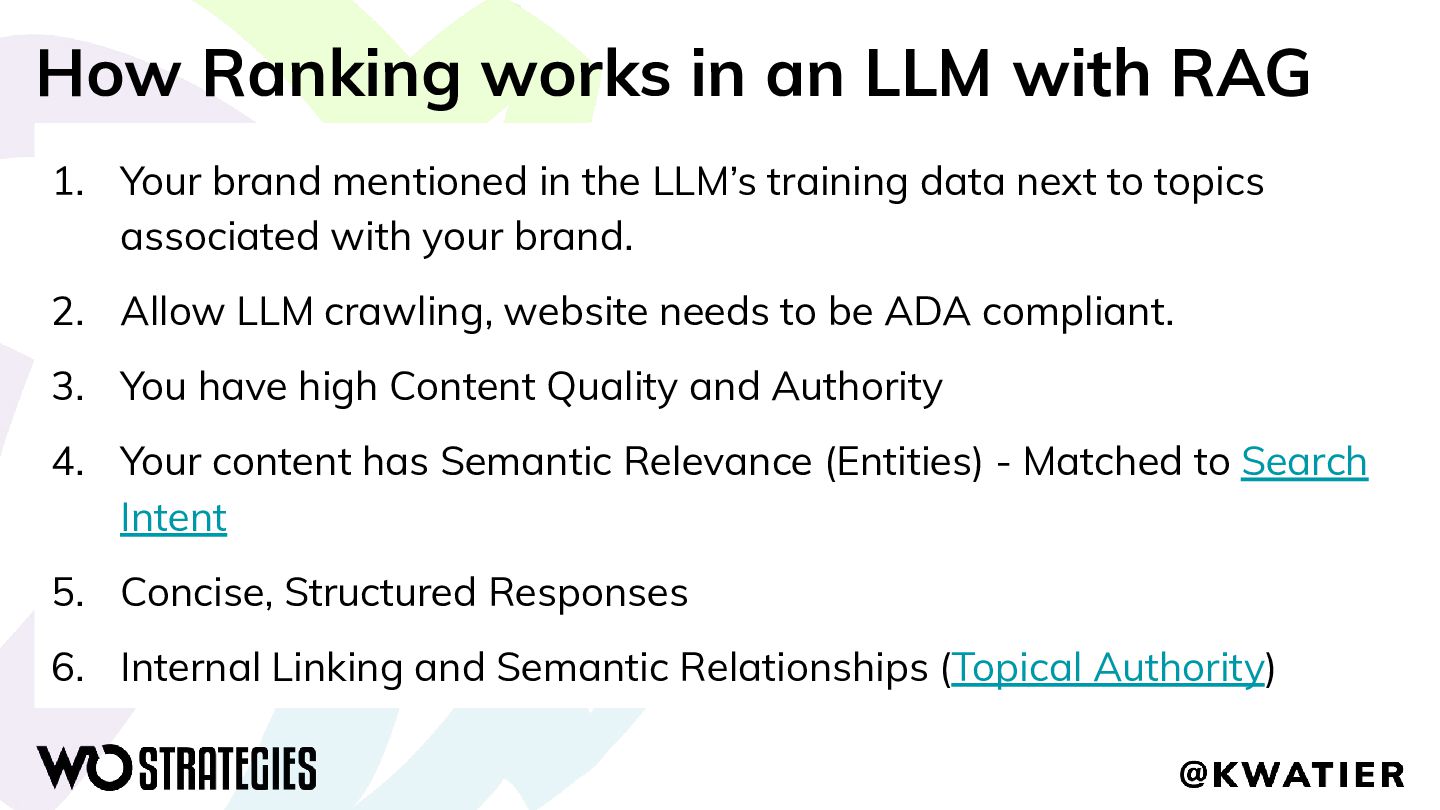
  18. How Ranking works in an LLM with RAG 1. Your

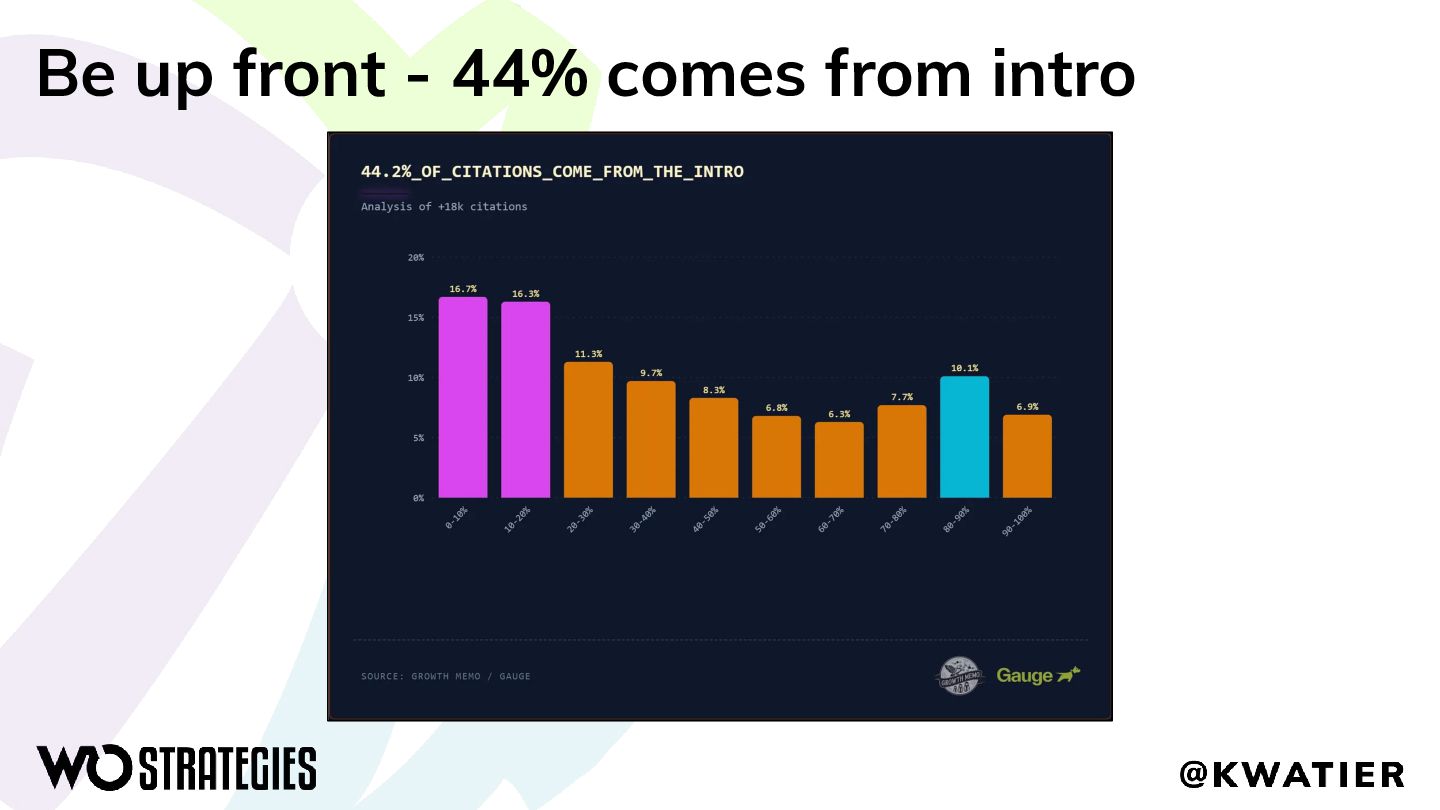
    brand mentioned in the LLM’s training data next to topics associated with your brand. 2. Allow LLM crawling, website needs to be ADA compliant. 3. You have high Content Quality and Authority 4. Your content has Semantic Relevance (Entities) - Matched to Search Intent 5. Concise, Structured Responses 6. Internal Linking and Semantic Relationships (Topical Authority)
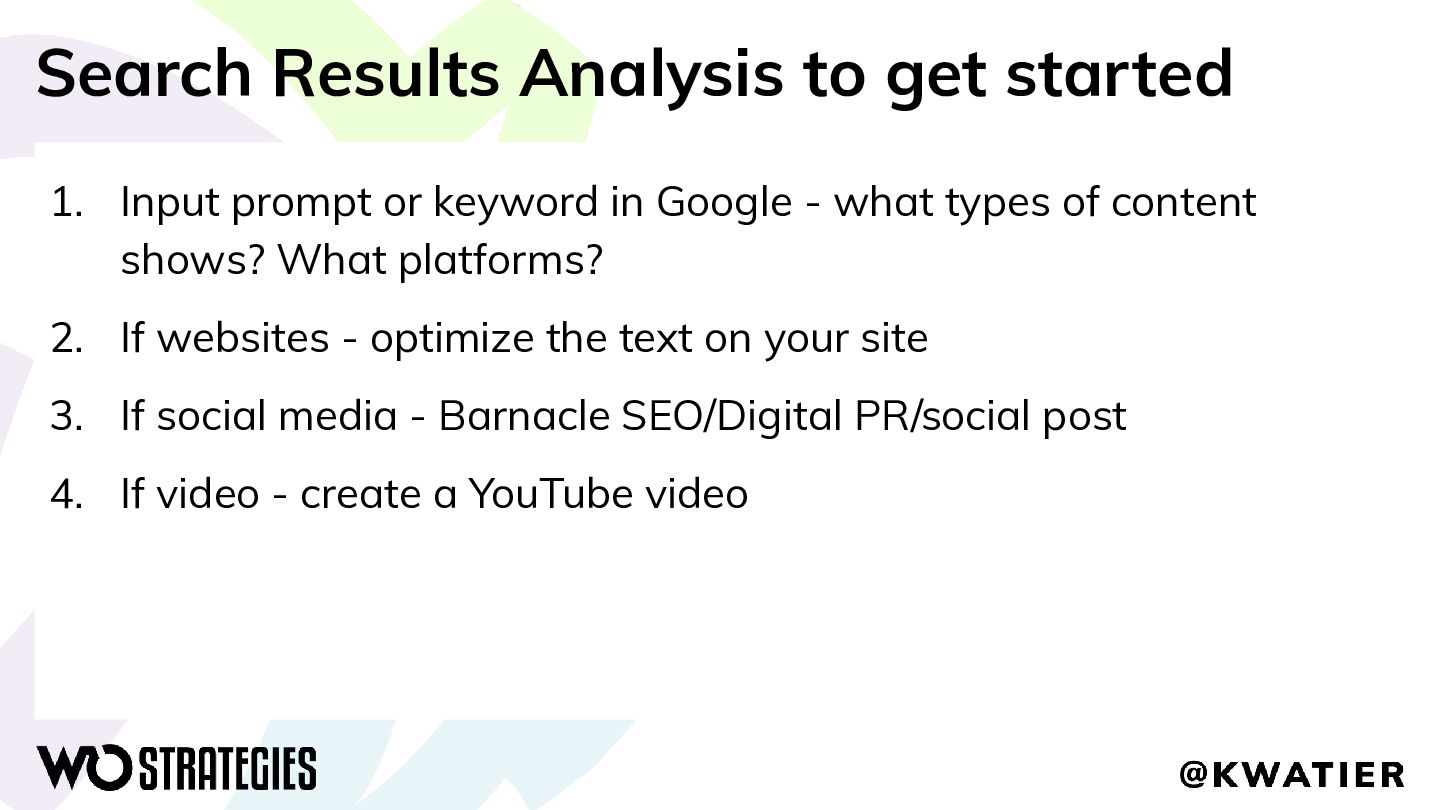
  19. Search Results Analysis to get started 1. Input prompt or

    keyword in Google - what types of content shows? What platforms? 2. If websites - optimize the text on your site 3. If social media - Barnacle SEO/Digital PR/social post 4. If video - create a YouTube video
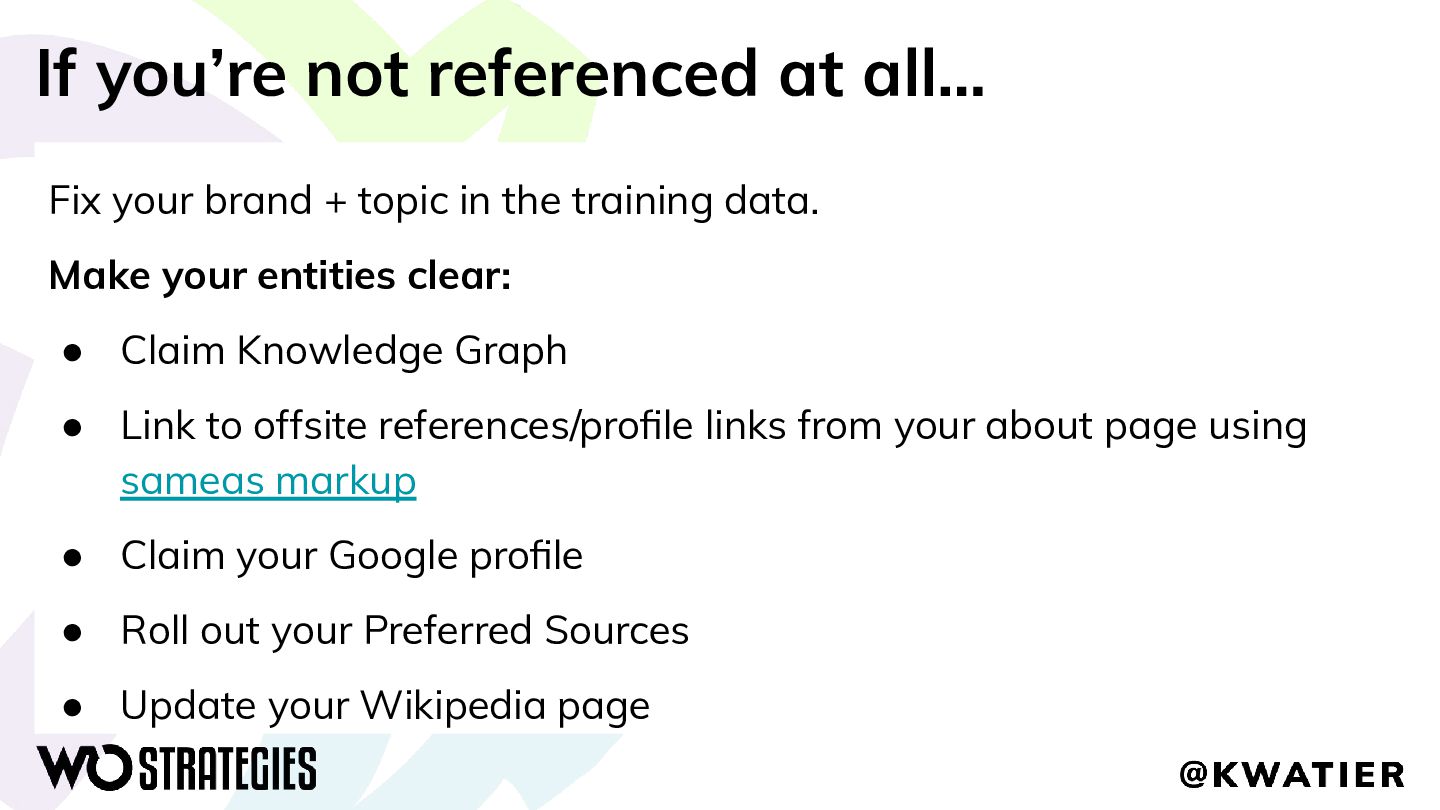
  20. If you’re not referenced at all… Fix your brand +

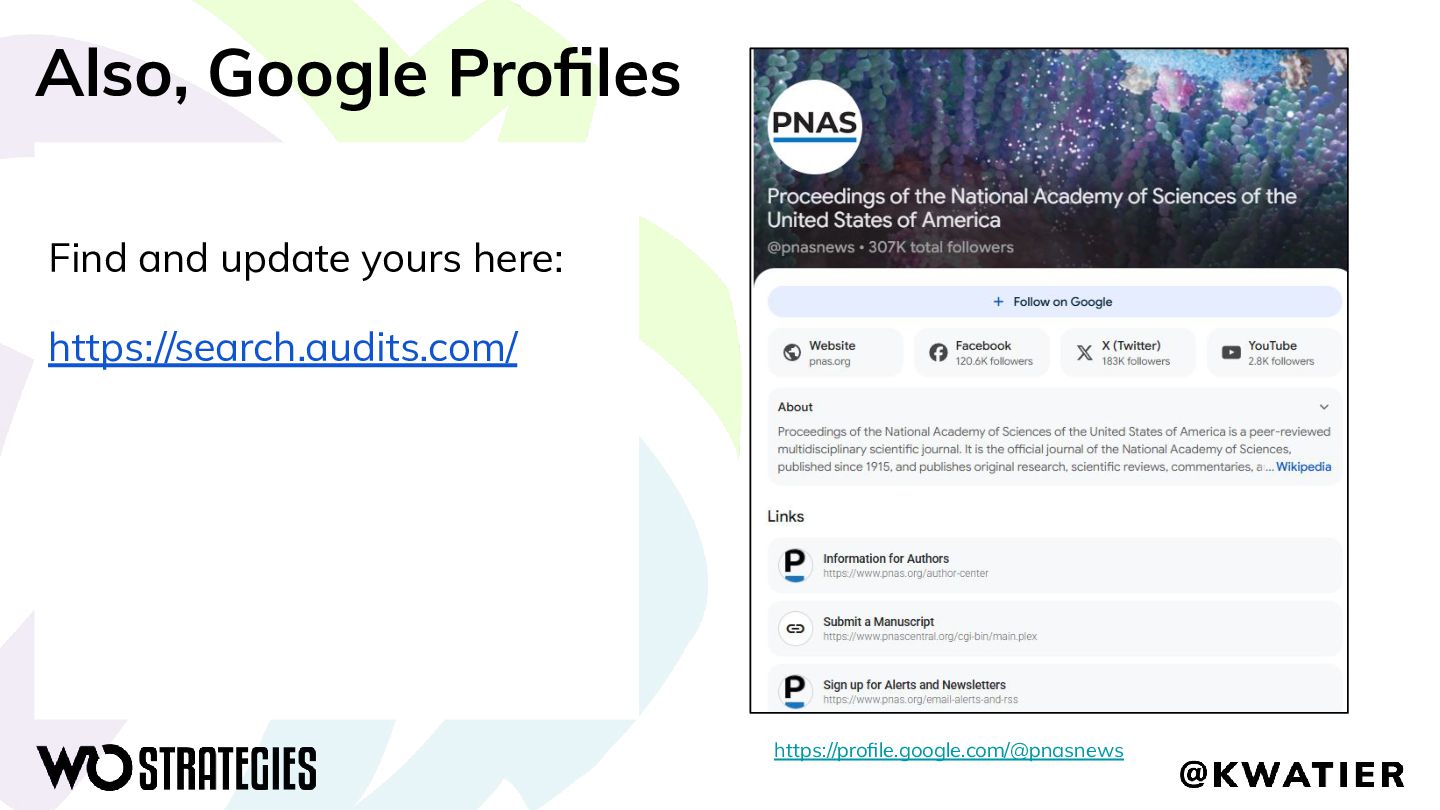
    topic in the training data. Make your entities clear: • Claim Knowledge Graph • Link to offsite references/profile links from your about page using sameas markup • Claim your Google profile • Roll out your Preferred Sources • Update your Wikipedia page
  21. Be mentioned where the LLM expects Prompts: • What topics

    is [brand] authoritative on? • Which brand has high authority in [topic] or [service]?
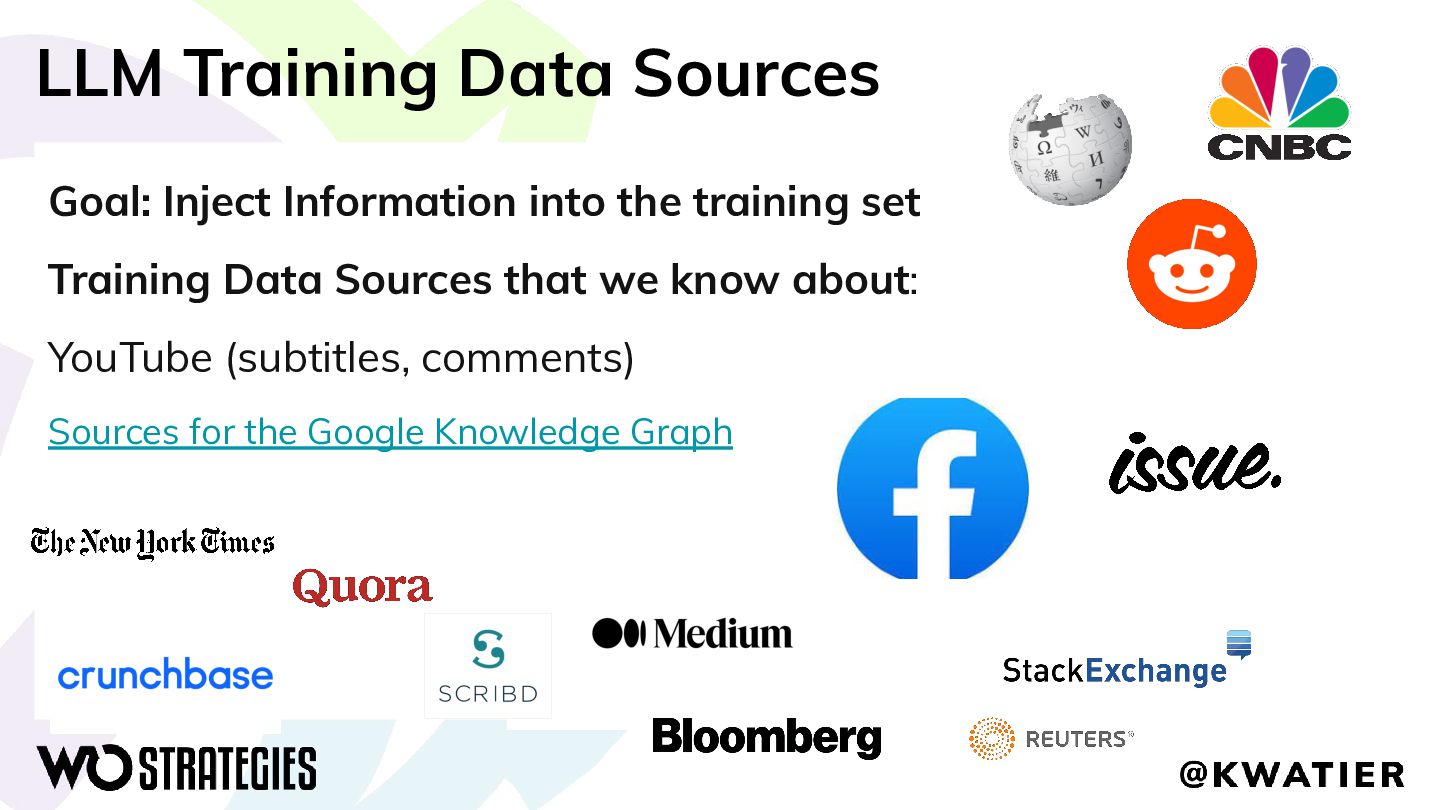
  22. LLM Training Data Sources Goal: Inject Information into the training

    set Training Data Sources that we know about: YouTube (subtitles, comments) Sources for the Google Knowledge Graph
  23. AI visibility is SEO + “Extra” • Training data inclusion

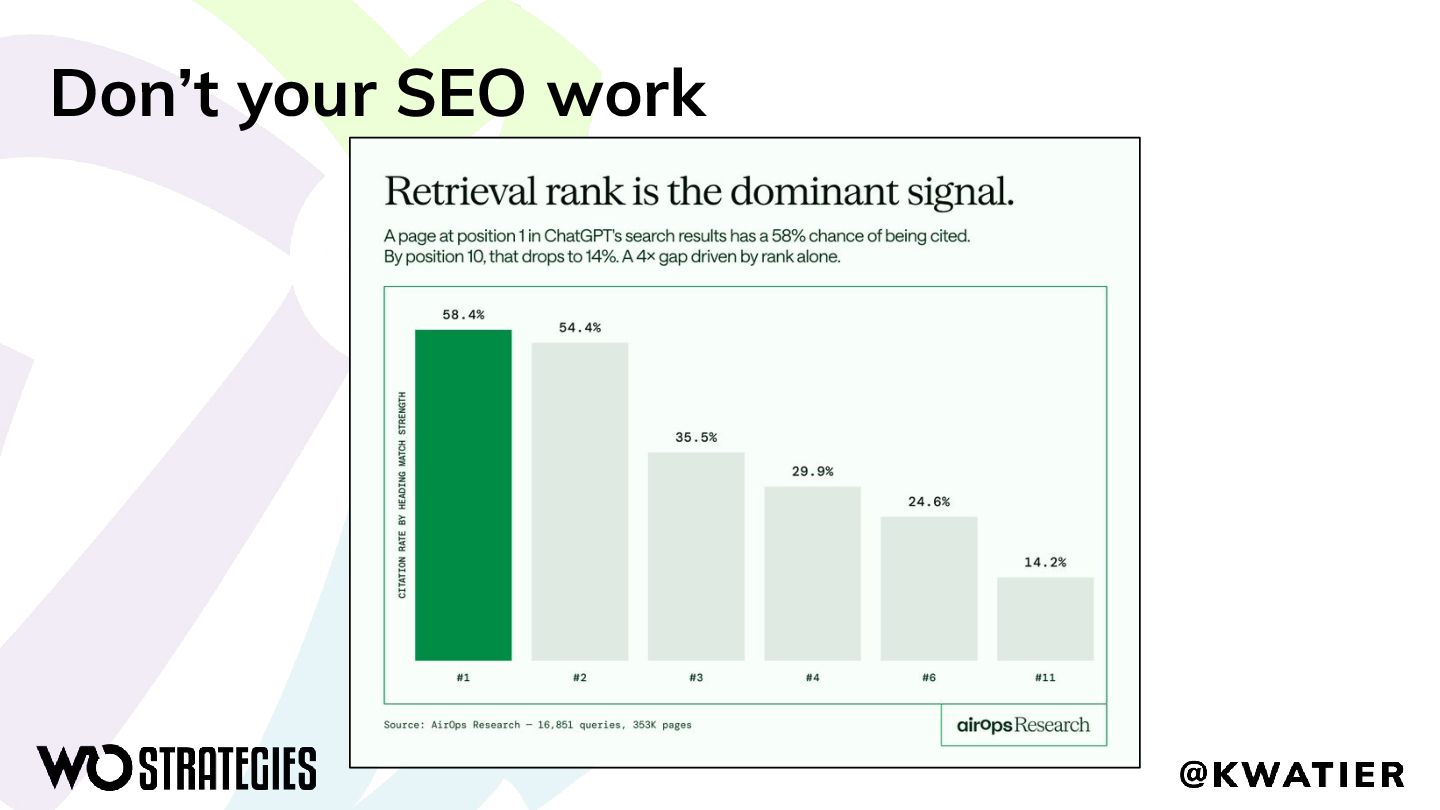
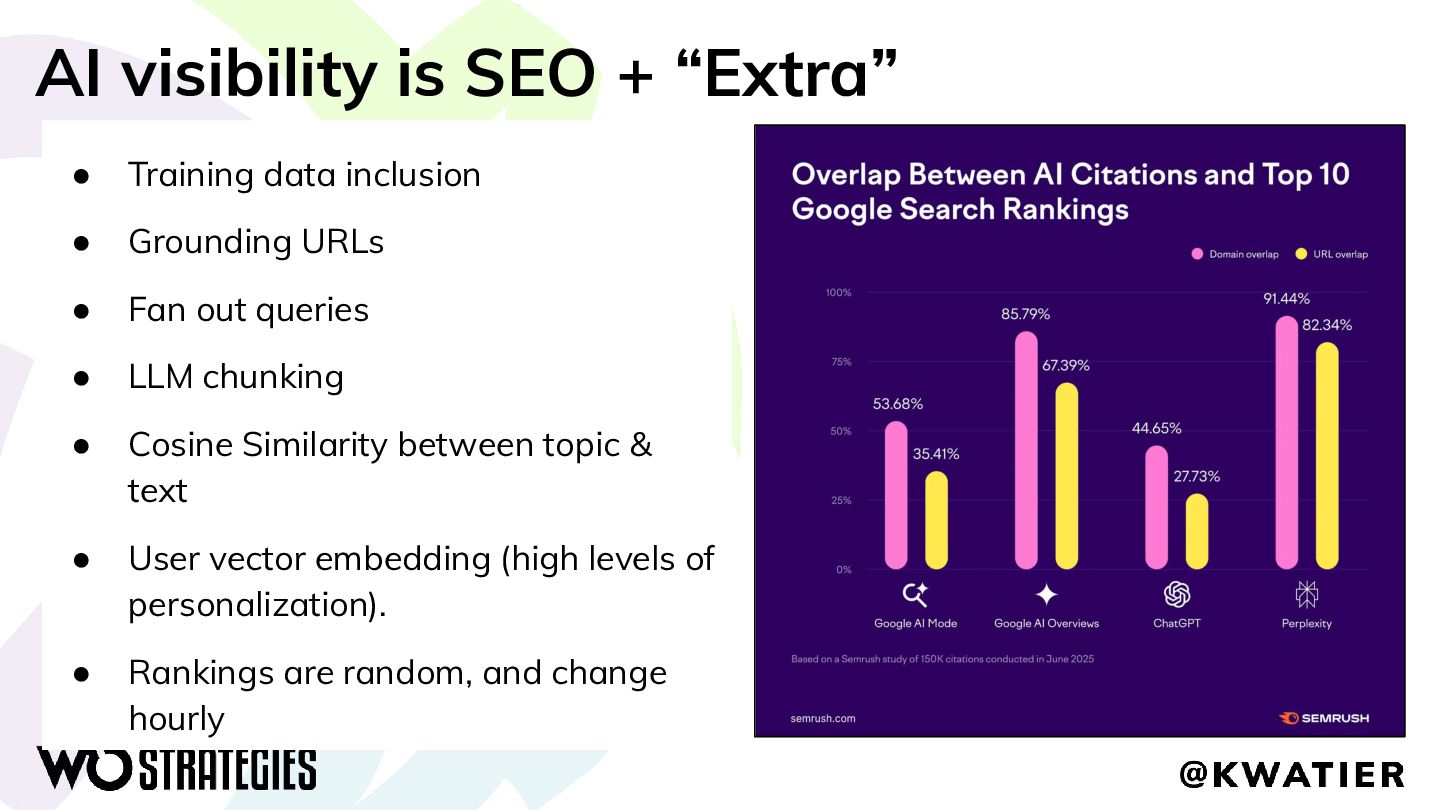
    • Grounding URLs • Fan out queries • LLM chunking • Cosine Similarity between topic & text • User vector embedding (high levels of personalization). • Rankings are random, and change hourly
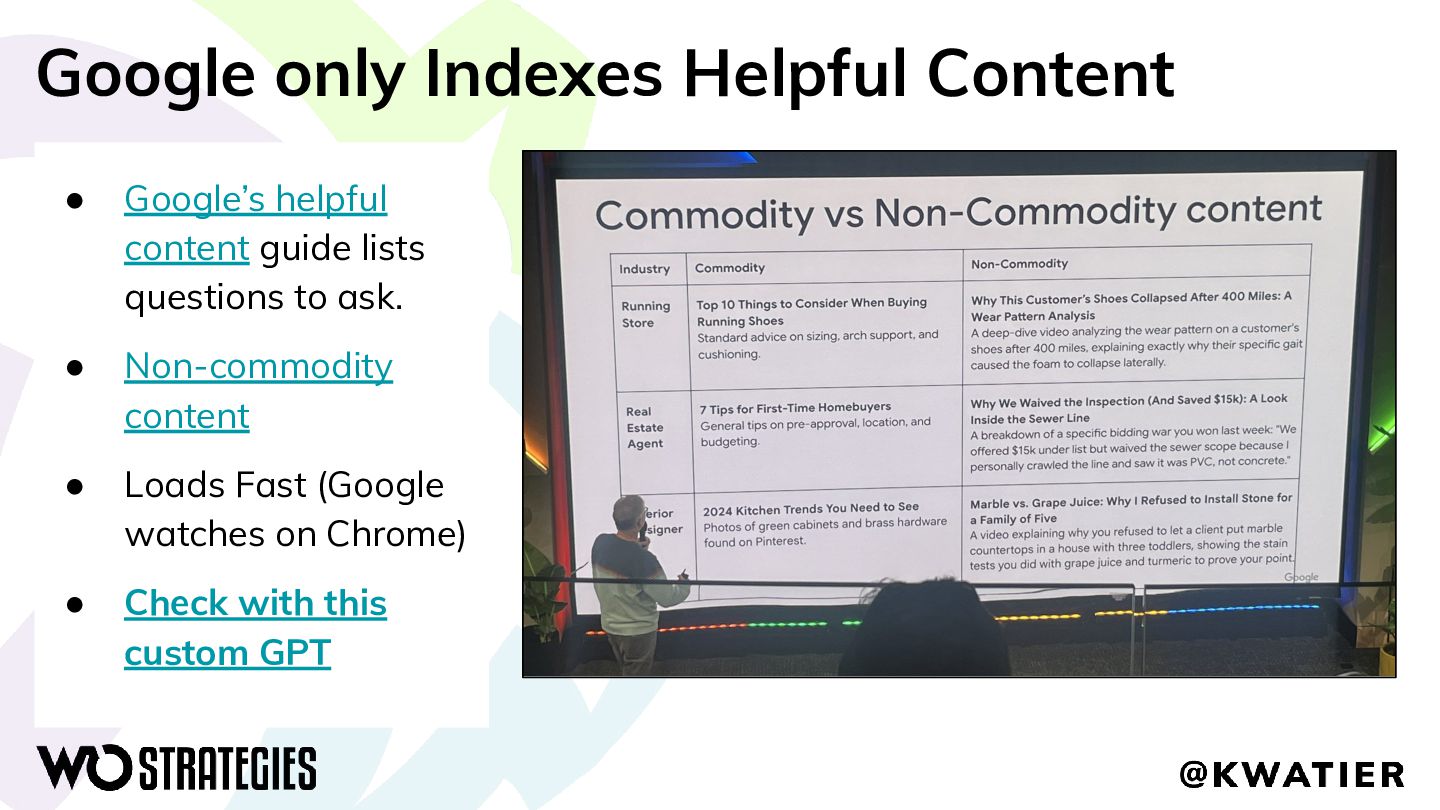
  24. Google only Indexes Helpful Content • Google’s helpful content guide

    lists questions to ask. • Non-commodity content • Loads Fast (Google watches on Chrome) • Check with this custom GPT
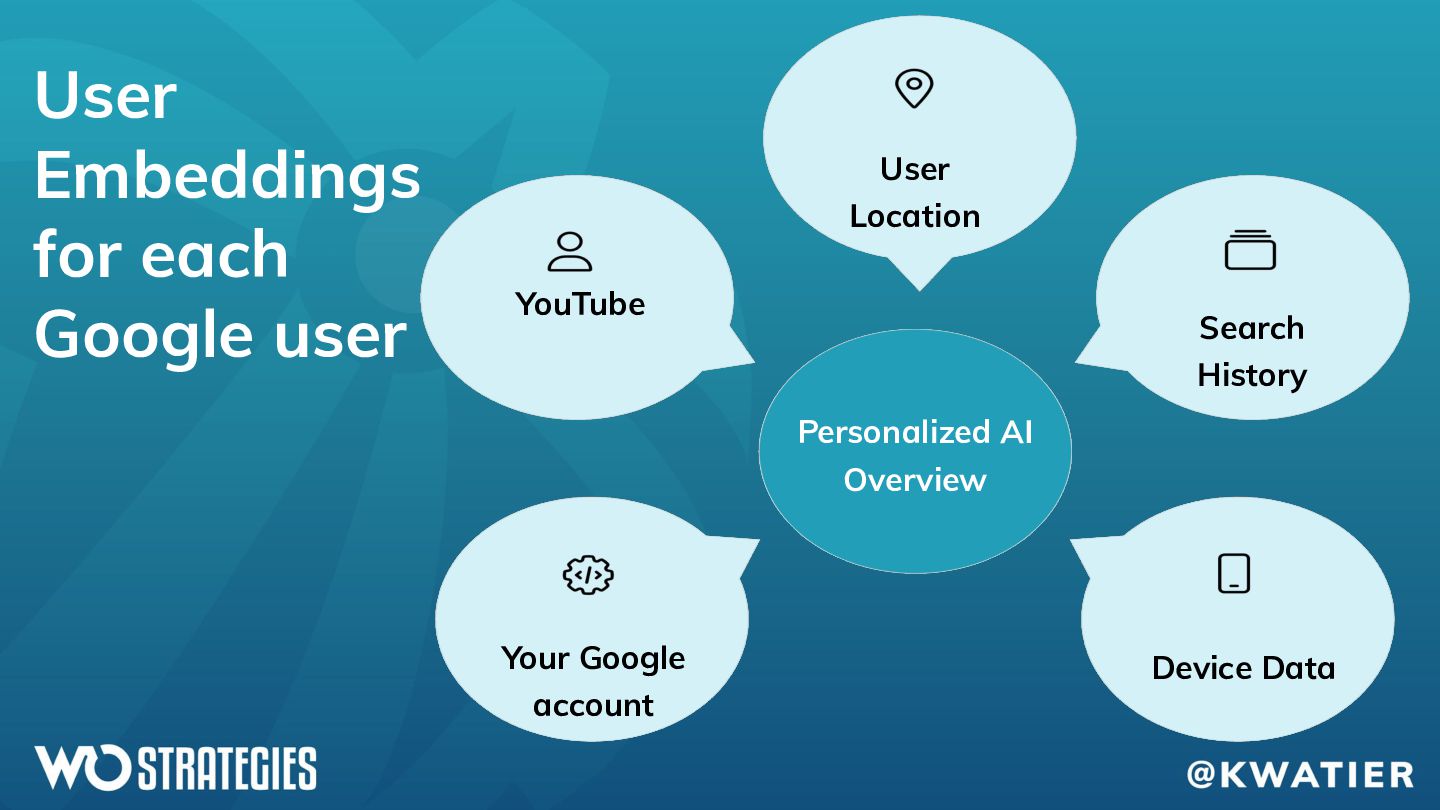
  25. Personalized AI Overview User Location Search History Device Data Your

    Google account YouTube User Embeddings for each Google user
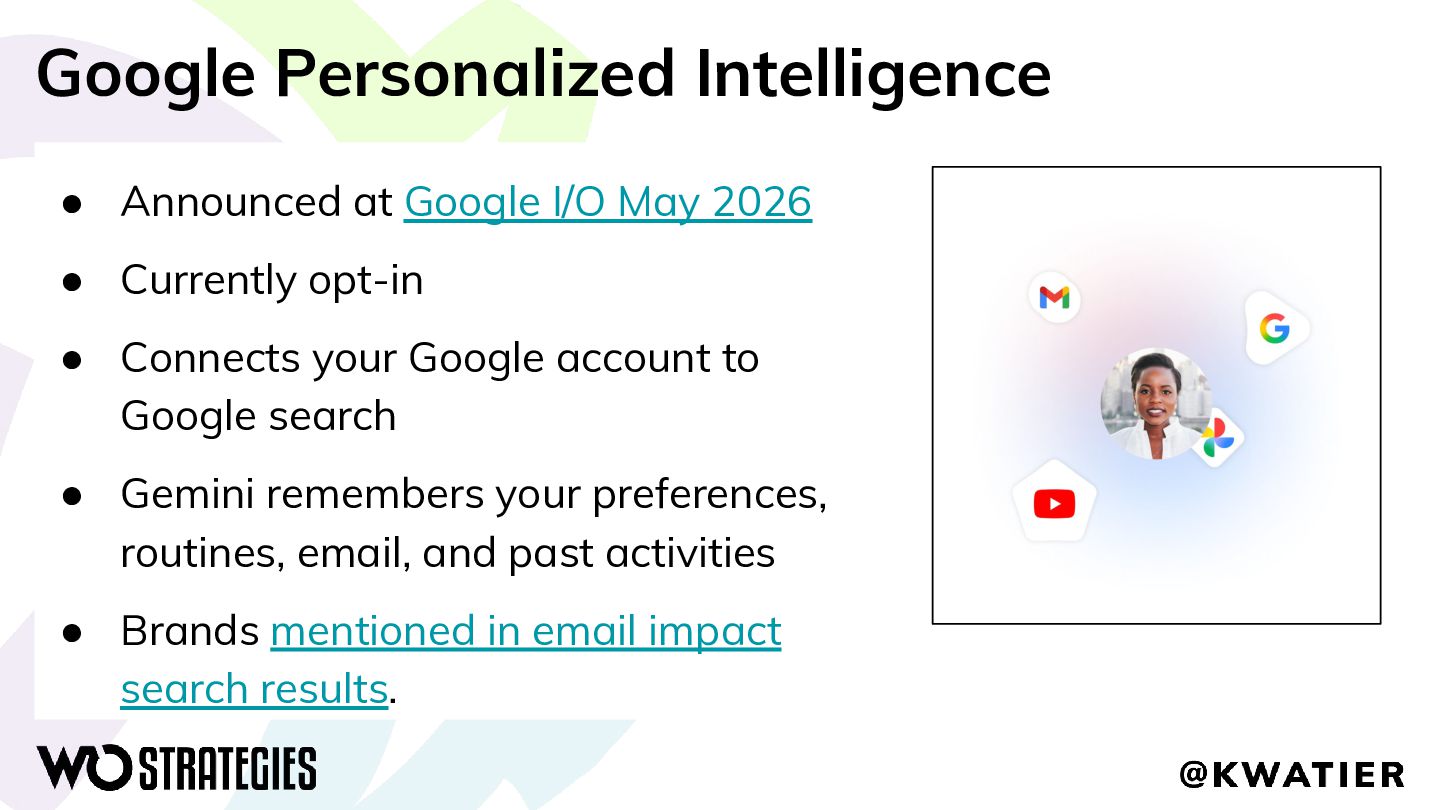
  26. Google Personalized Intelligence • Announced at Google I/O May 2026

    • Currently opt-in • Connects your Google account to Google search • Gemini remembers your preferences, routines, email, and past activities • Brands mentioned in email impact search results.
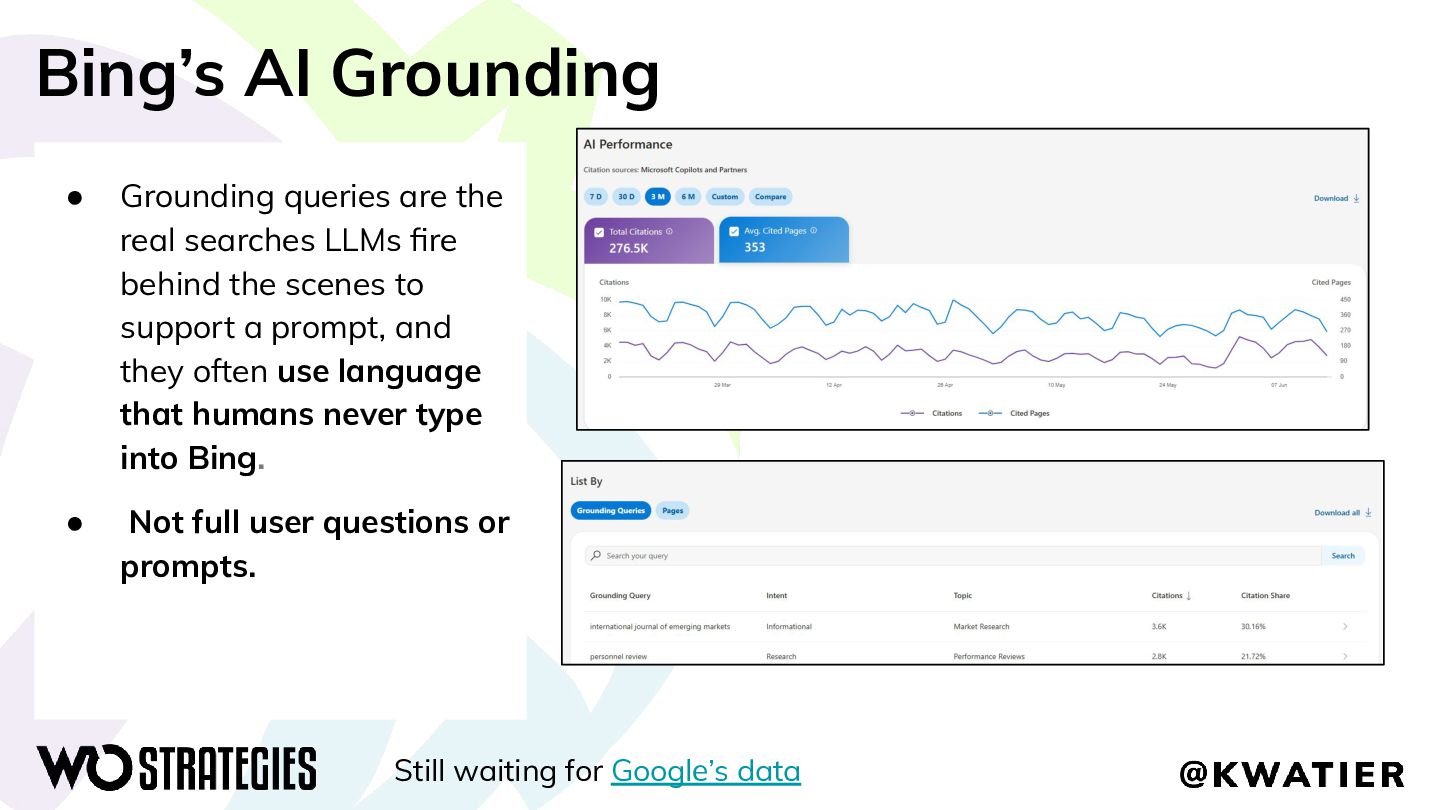
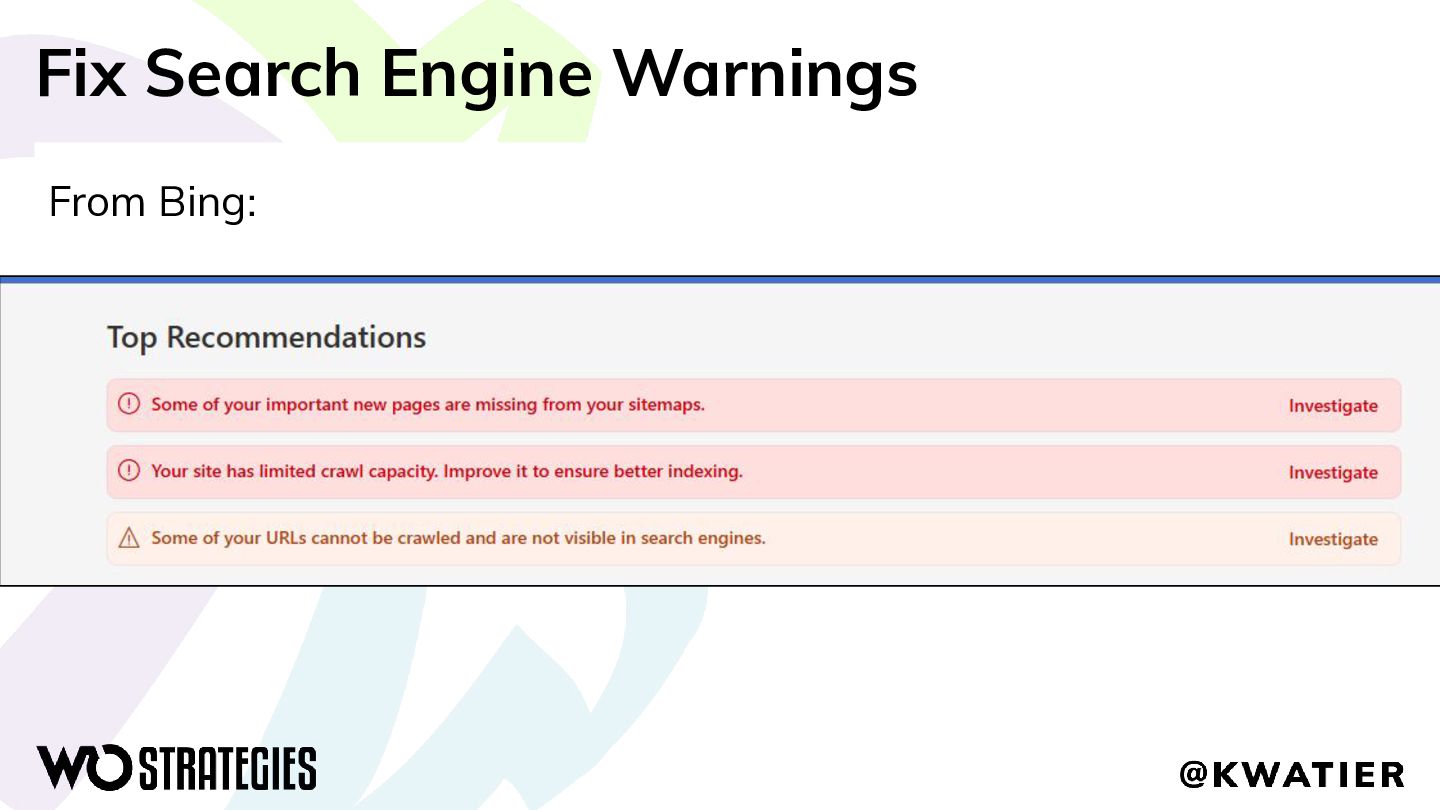
  27. Bing’s AI Grounding • Grounding queries are the real searches

    LLMs fire behind the scenes to support a prompt, and they often use language that humans never type into Bing. • Not full user questions or prompts. Still waiting for Google’s data
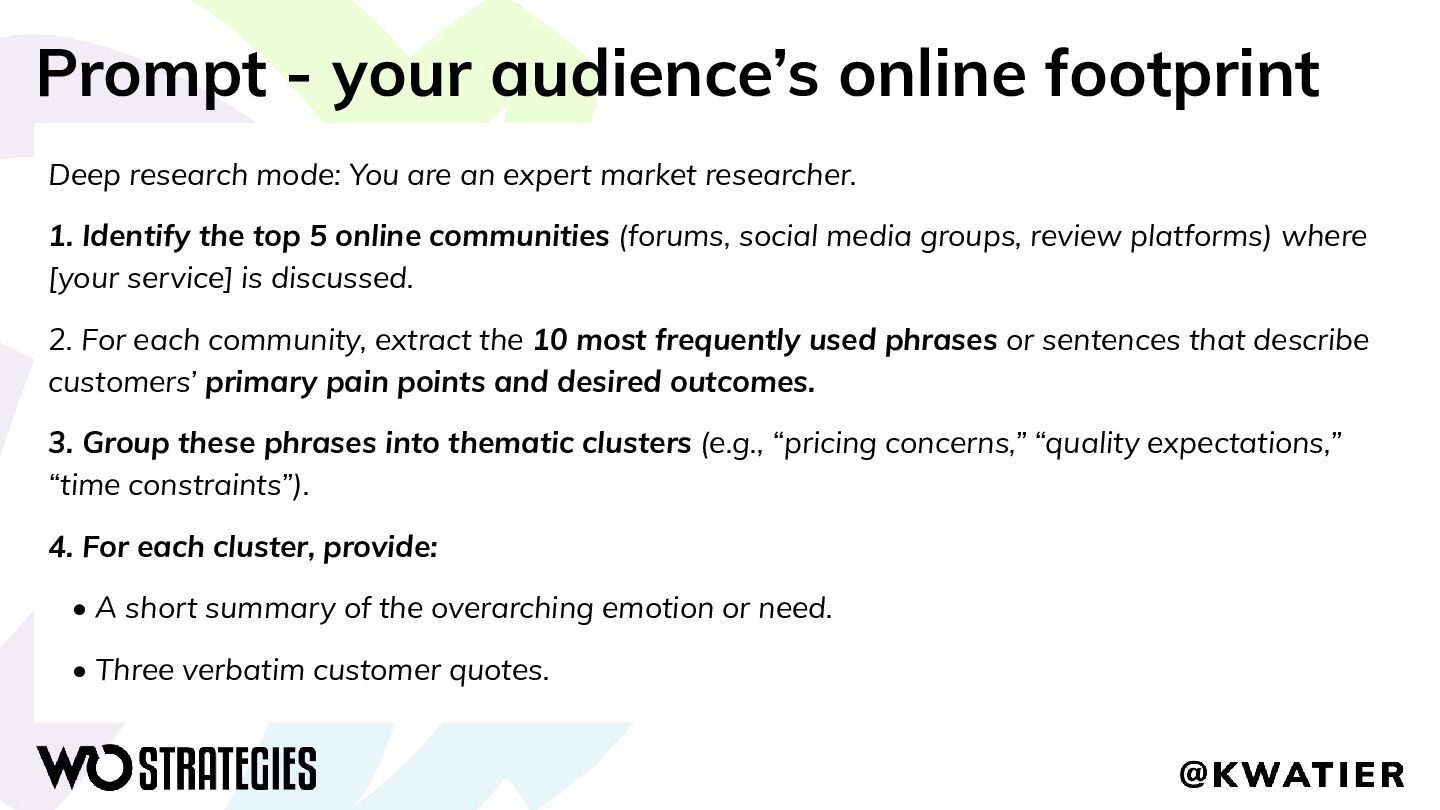
  28. Prompt - your audience’s online footprint Deep research mode: You

    are an expert market researcher. 1. Identify the top 5 online communities (forums, social media groups, review platforms) where [your service] is discussed. 2. For each community, extract the 10 most frequently used phrases or sentences that describe customers’ primary pain points and desired outcomes. 3. Group these phrases into thematic clusters (e.g., “pricing concerns,” “quality expectations,” “time constraints”). 4. For each cluster, provide: • A short summary of the overarching emotion or need. • Three verbatim customer quotes.
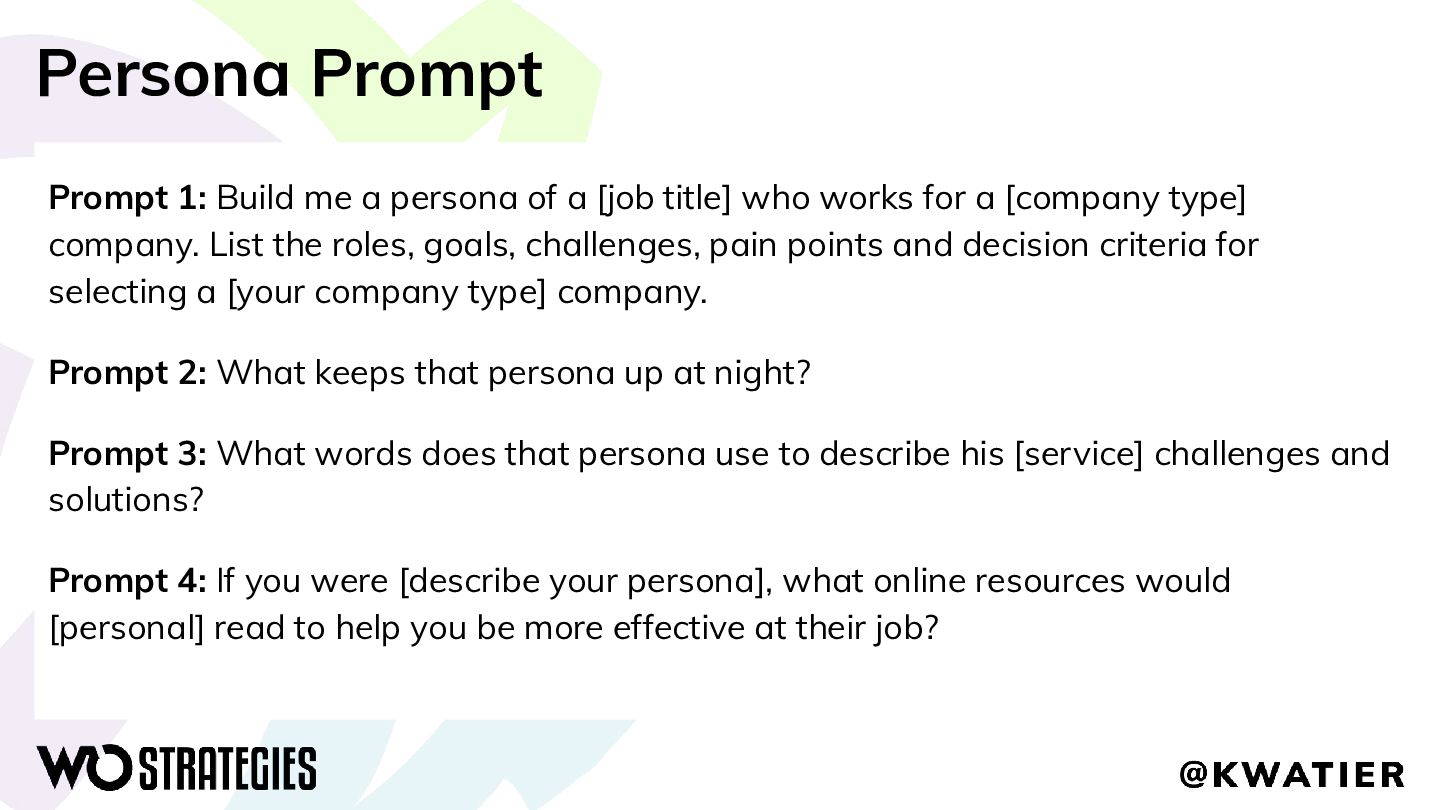
  29. Persona Prompt Prompt 1: Build me a persona of a

    [job title] who works for a [company type] company. List the roles, goals, challenges, pain points and decision criteria for selecting a [your company type] company. Prompt 2: What keeps that persona up at night? Prompt 3: What words does that persona use to describe his [service] challenges and solutions? Prompt 4: If you were [describe your persona], what online resources would [personal] read to help you be more effective at their job?
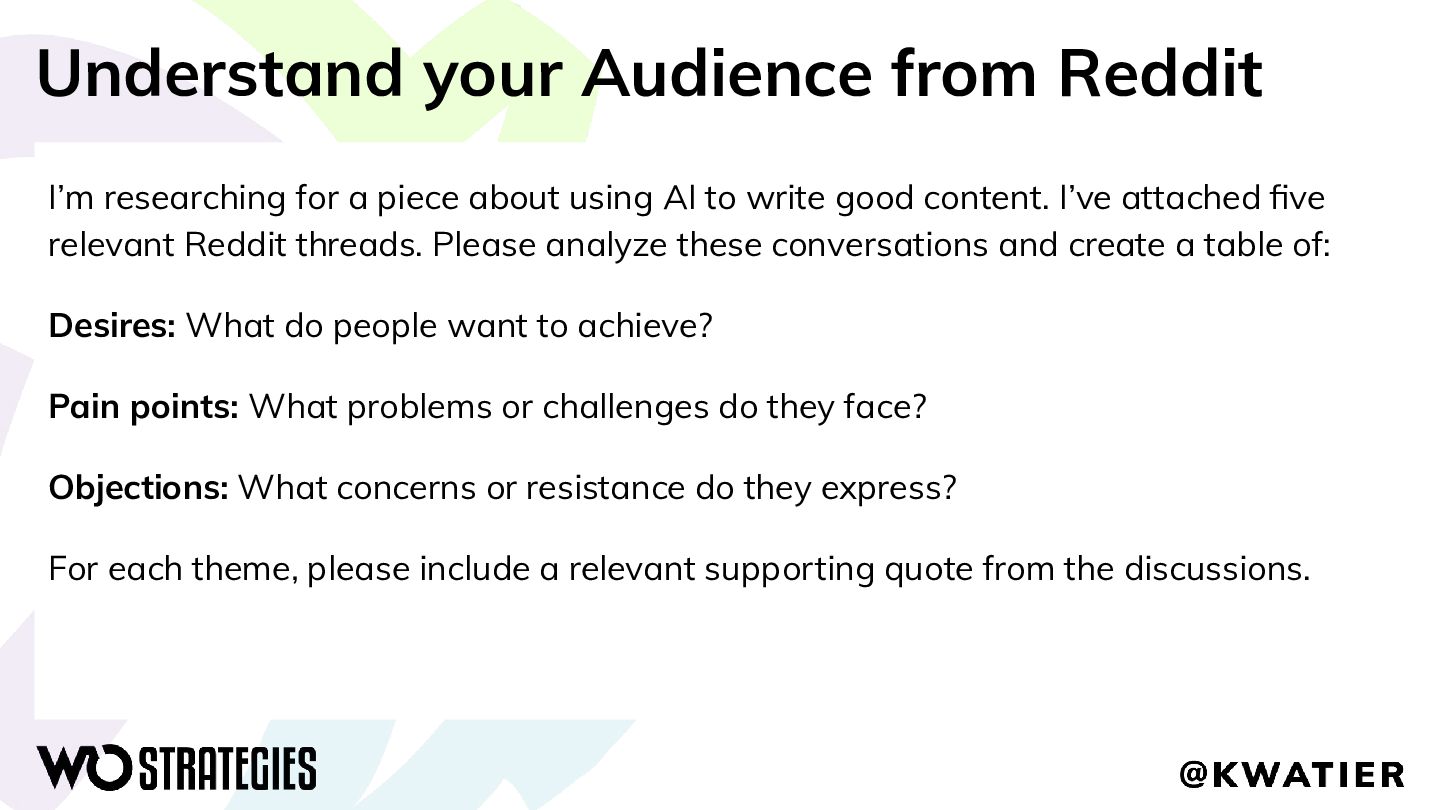
  30. Understand your Audience from Reddit I’m researching for a piece

    about using AI to write good content. I’ve attached five relevant Reddit threads. Please analyze these conversations and create a table of: Desires: What do people want to achieve? Pain points: What problems or challenges do they face? Objections: What concerns or resistance do they express? For each theme, please include a relevant supporting quote from the discussions.
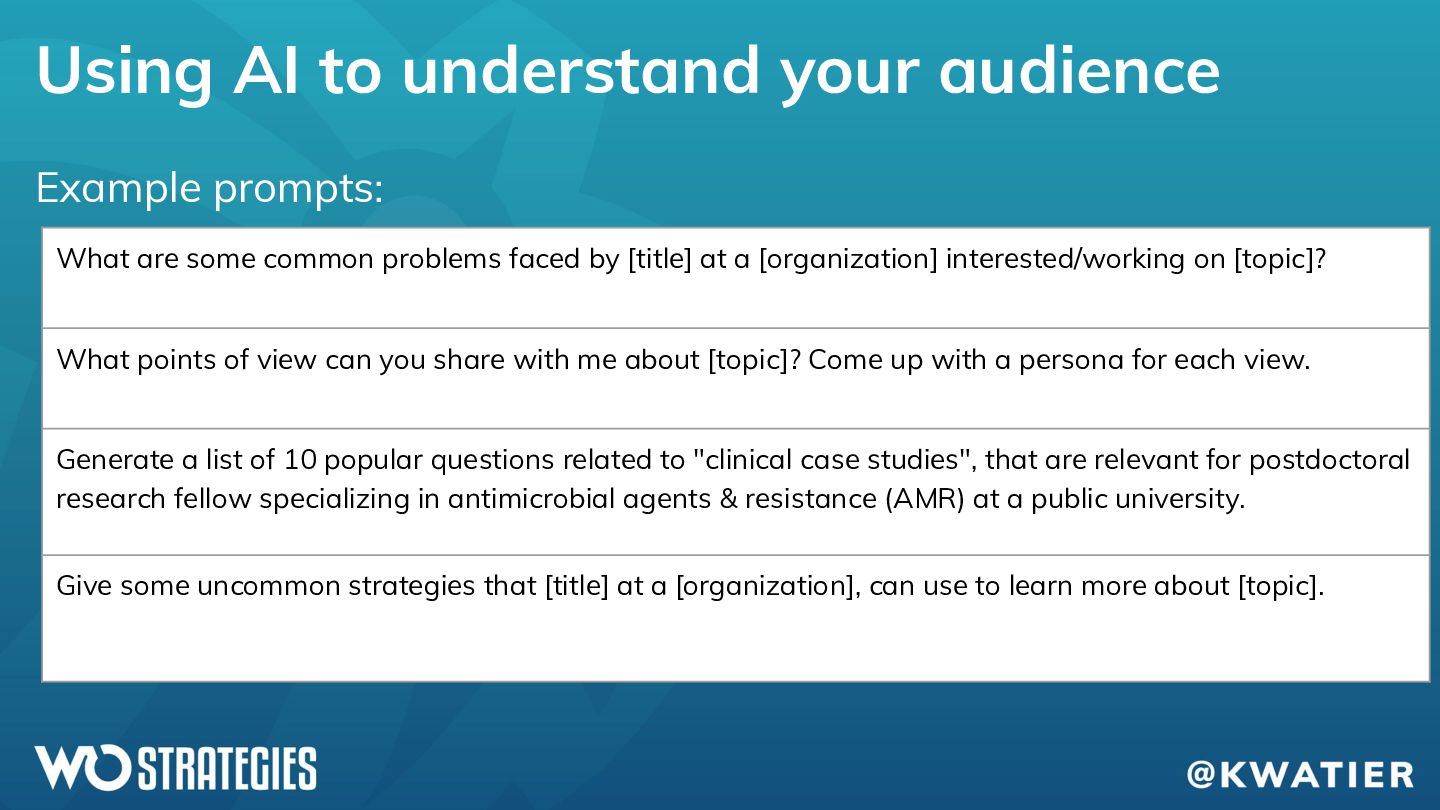
  31. Using AI to understand your audience Example prompts: What are

    some common problems faced by [title] at a [organization] interested/working on [topic]? What points of view can you share with me about [topic]? Come up with a persona for each view. Generate a list of 10 popular questions related to "clinical case studies", that are relevant for postdoctoral research fellow specializing in antimicrobial agents & resistance (AMR) at a public university. Give some uncommon strategies that [title] at a [organization], can use to learn more about [topic].
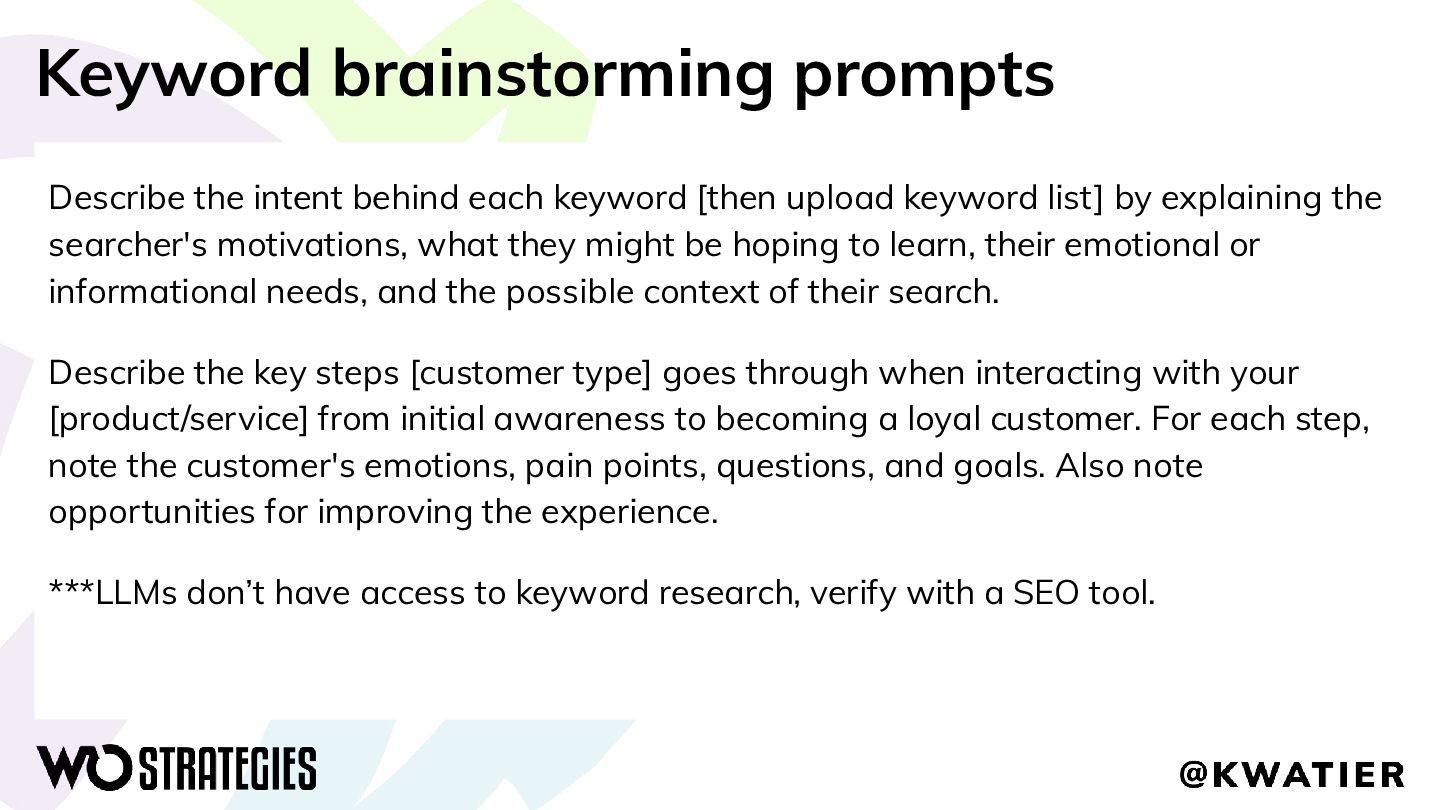
  32. Keyword brainstorming prompts Describe the intent behind each keyword [then

    upload keyword list] by explaining the searcher's motivations, what they might be hoping to learn, their emotional or informational needs, and the possible context of their search. Describe the key steps [customer type] goes through when interacting with your [product/service] from initial awareness to becoming a loyal customer. For each step, note the customer's emotions, pain points, questions, and goals. Also note opportunities for improving the experience. ***LLMs don’t have access to keyword research, verify with a SEO tool.
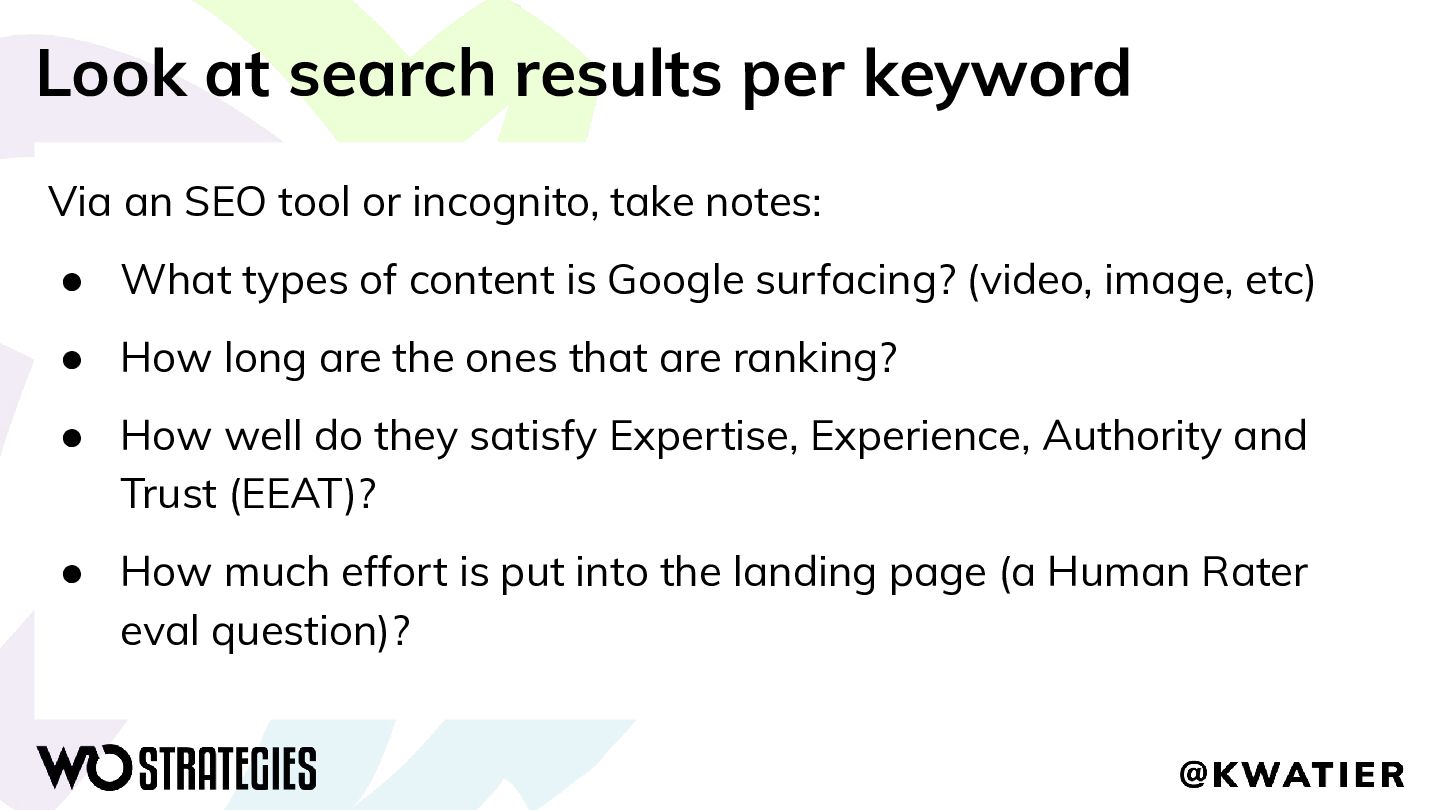
  33. Look at search results per keyword Via an SEO tool

    or incognito, take notes: • What types of content is Google surfacing? (video, image, etc) • How long are the ones that are ranking? • How well do they satisfy Expertise, Experience, Authority and Trust (EEAT)? • How much effort is put into the landing page (a Human Rater eval question)?
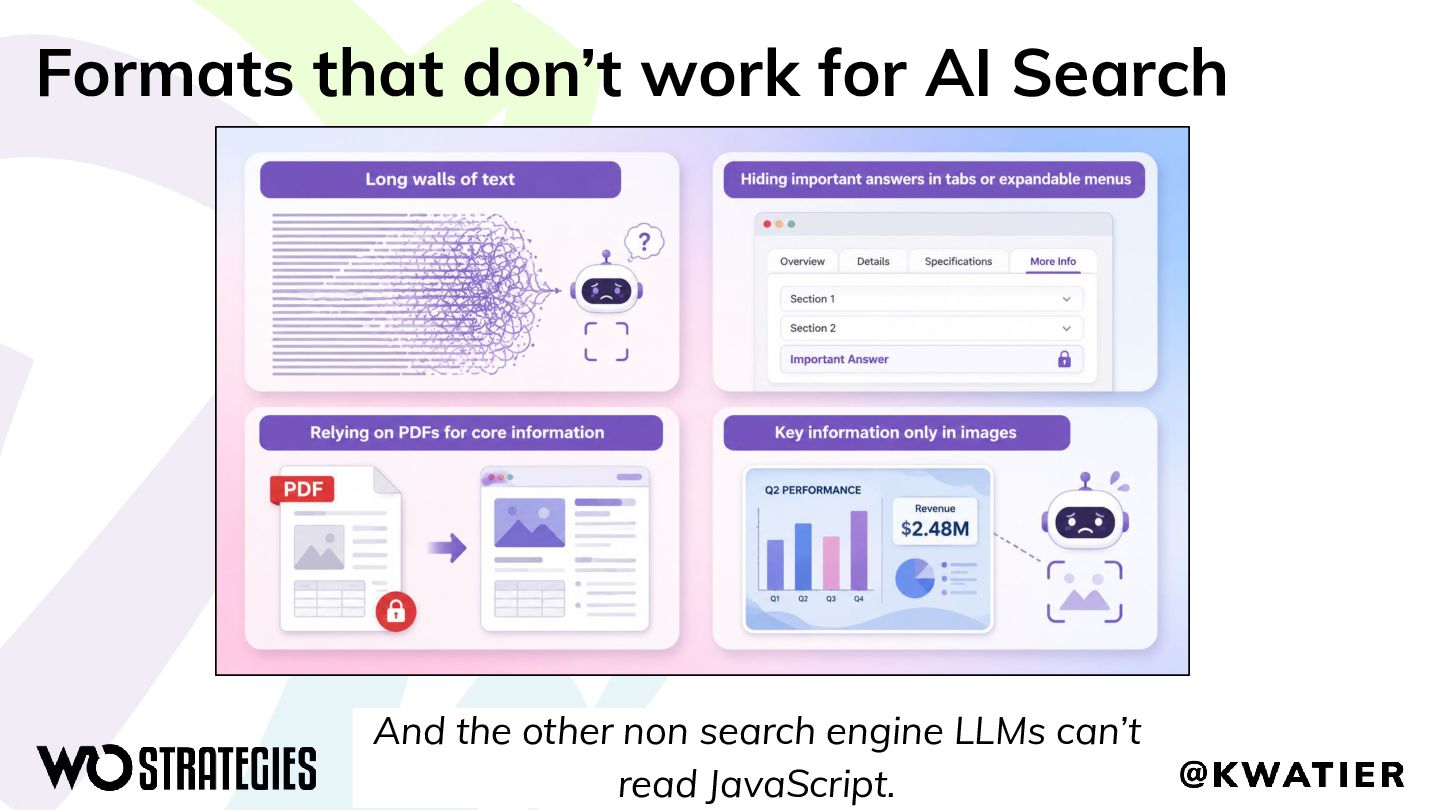
  34. Formats that don’t work for AI Search And the other

    non search engine LLMs can’t read JavaScript.
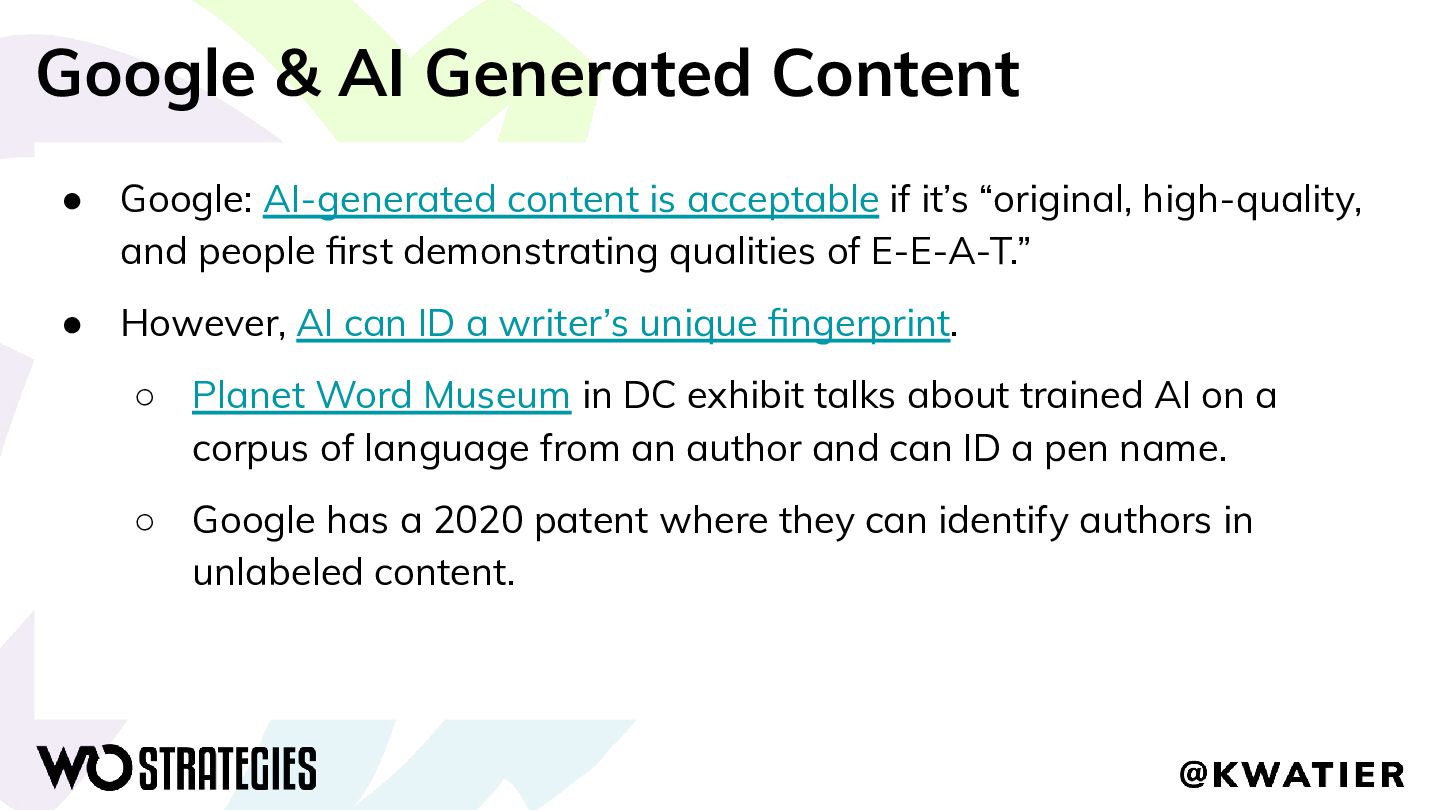
  35. Google & AI Generated Content • Google: AI-generated content is

    acceptable if it’s “original, high-quality, and people first demonstrating qualities of E-E-A-T.” • However, AI can ID a writer’s unique fingerprint. ◦ Planet Word Museum in DC exhibit talks about trained AI on a corpus of language from an author and can ID a pen name. ◦ Google has a 2020 patent where they can identify authors in unlabeled content.
  36. SEO Content Brief Prompt You are an SEO content optimization

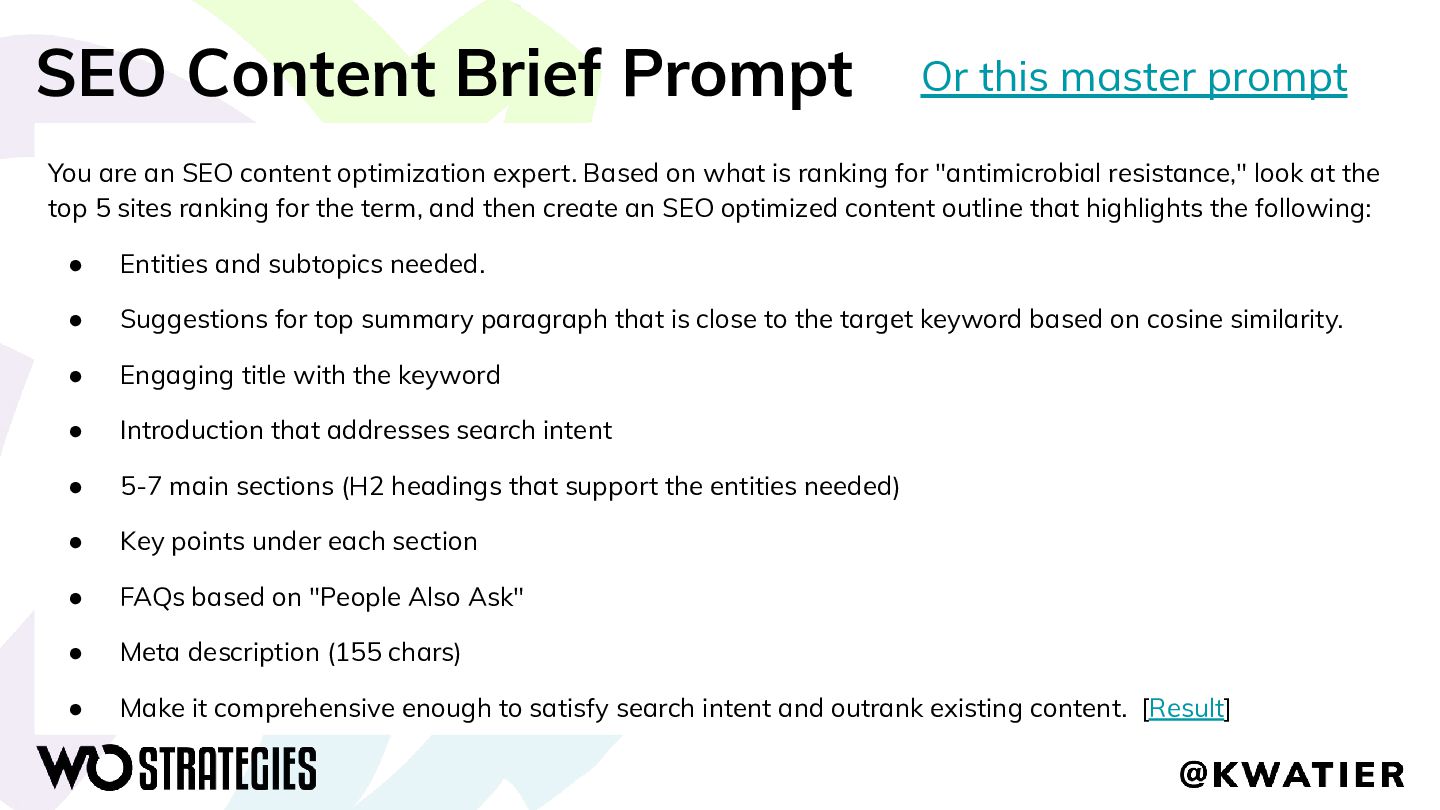
    expert. Based on what is ranking for "antimicrobial resistance," look at the top 5 sites ranking for the term, and then create an SEO optimized content outline that highlights the following: • Entities and subtopics needed. • Suggestions for top summary paragraph that is close to the target keyword based on cosine similarity. • Engaging title with the keyword • Introduction that addresses search intent • 5-7 main sections (H2 headings that support the entities needed) • Key points under each section • FAQs based on "People Also Ask" • Meta description (155 chars) • Make it comprehensive enough to satisfy search intent and outrank existing content. [Result] Or this master prompt
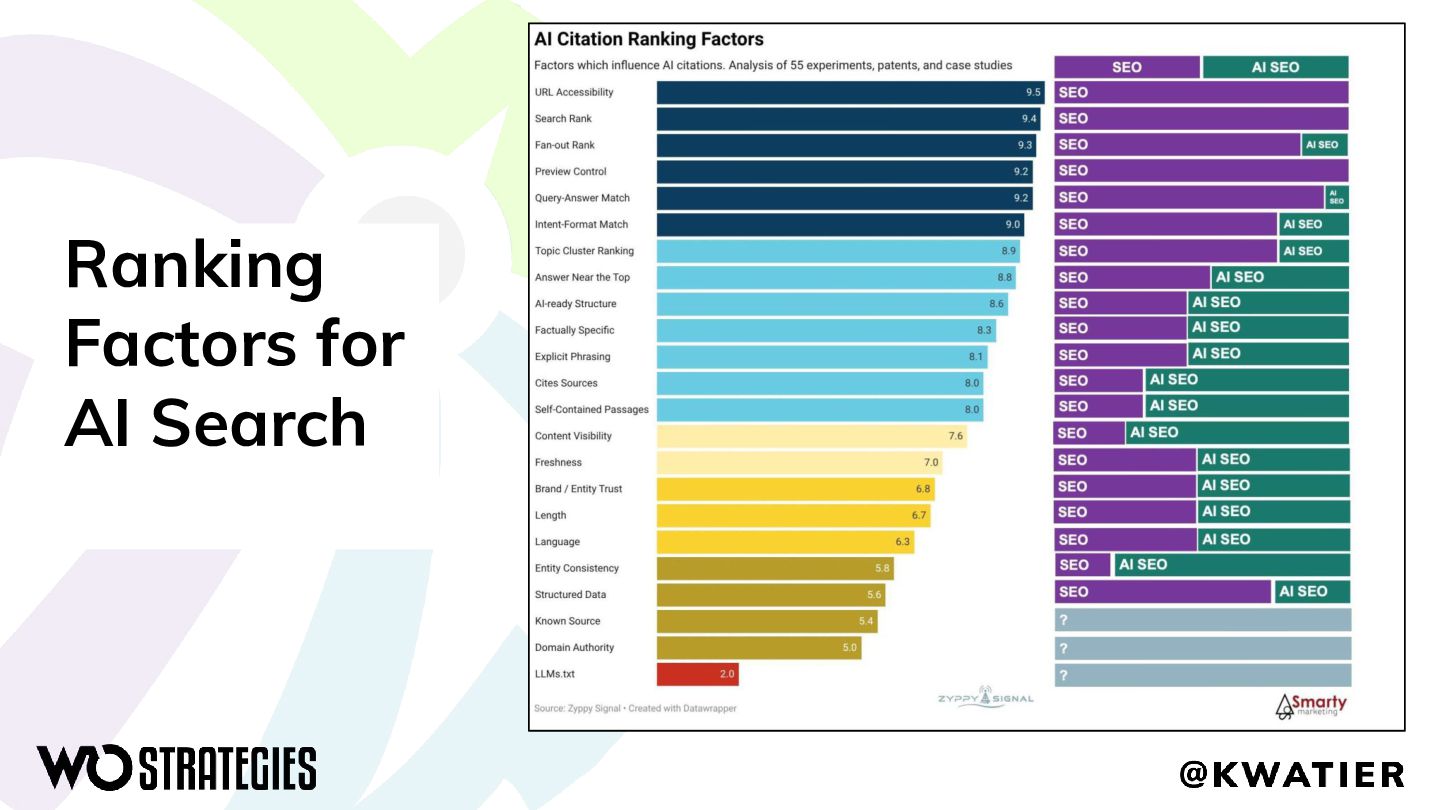
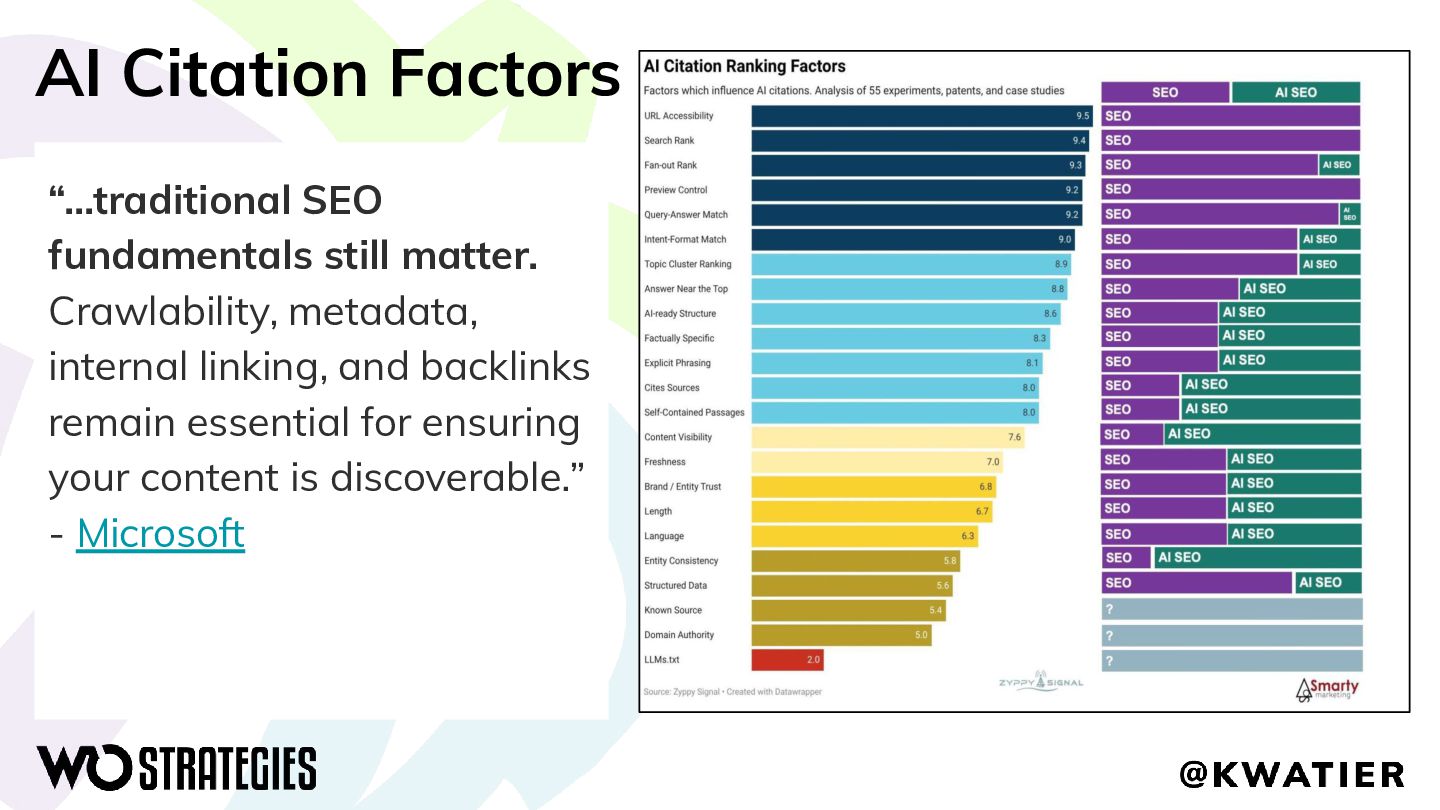
  37. AI Citation Factors “...traditional SEO fundamentals still matter. Crawlability, metadata,

    internal linking, and backlinks remain essential for ensuring your content is discoverable.” - Microsoft
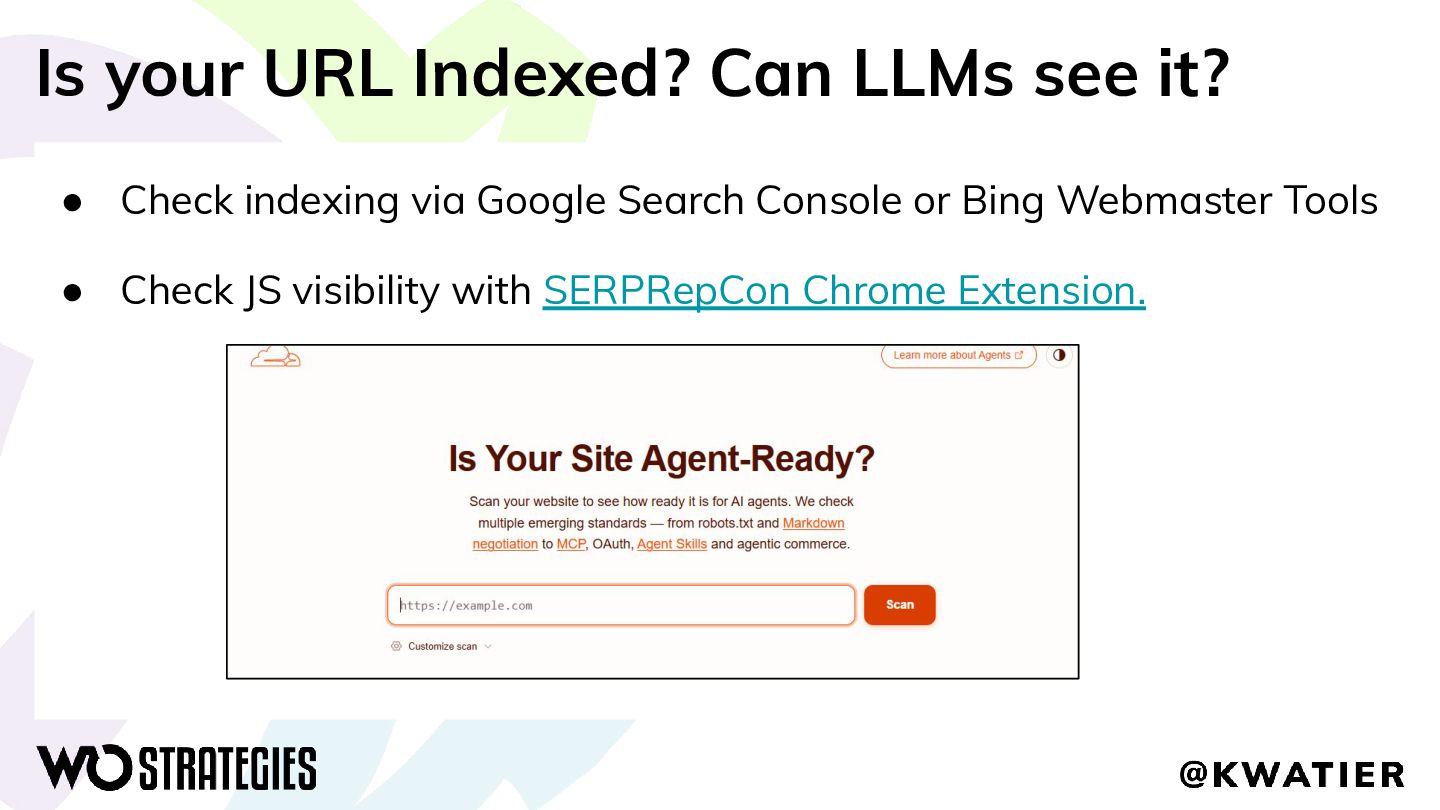
  38. Is your URL Indexed? Can LLMs see it? • Check

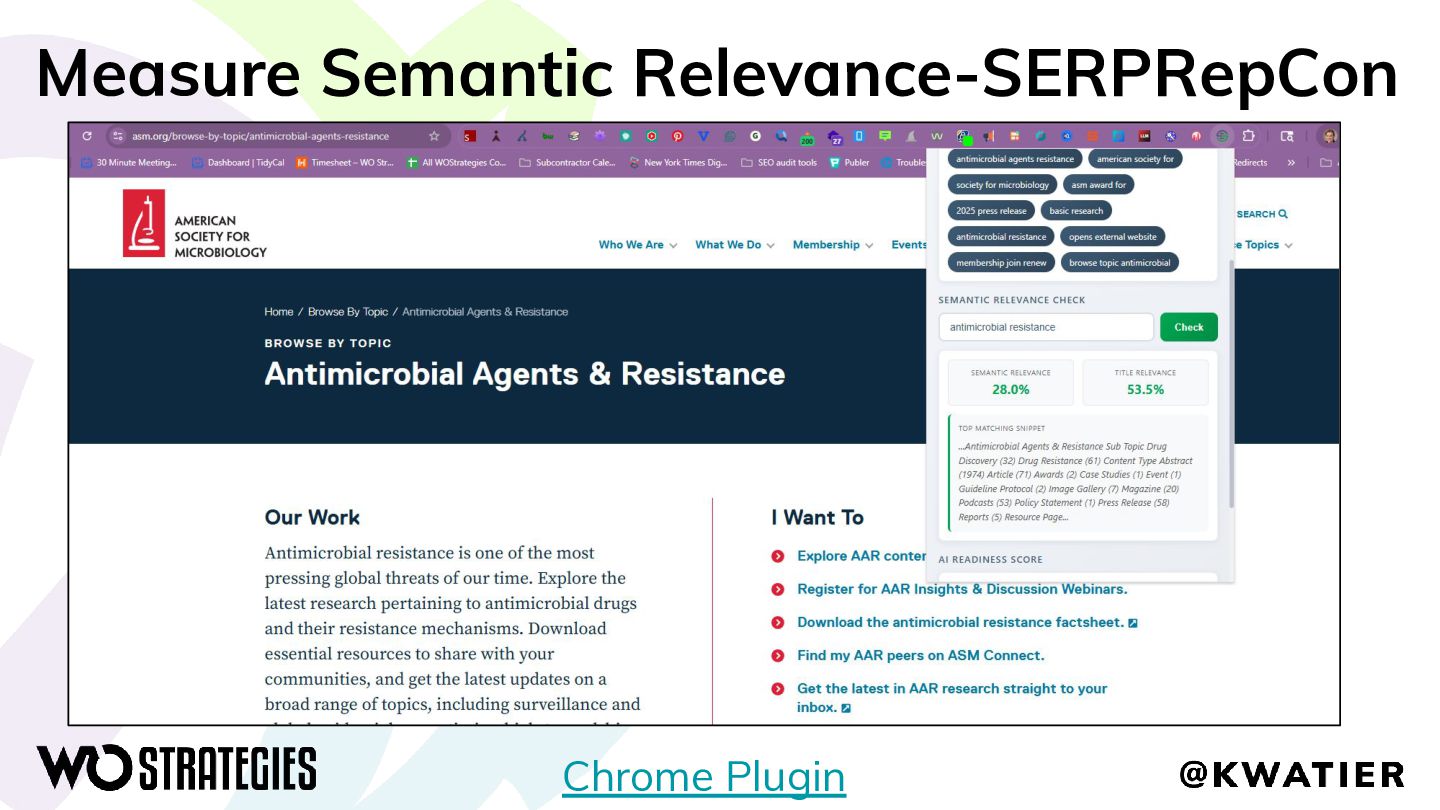
    indexing via Google Search Console or Bing Webmaster Tools • Check JS visibility with SERPRepCon Chrome Extension.
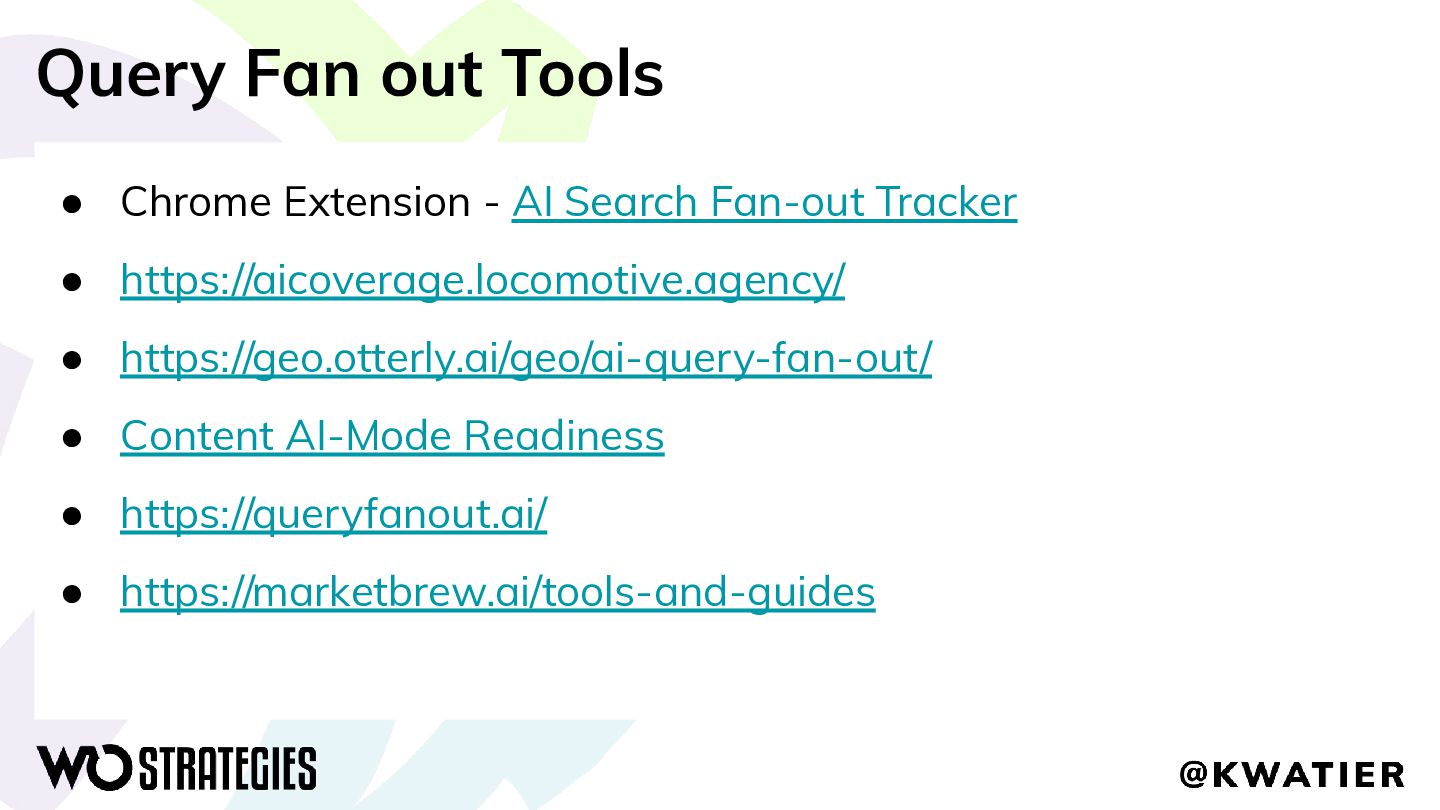
  39. Query Fan out Tools • Chrome Extension - AI Search

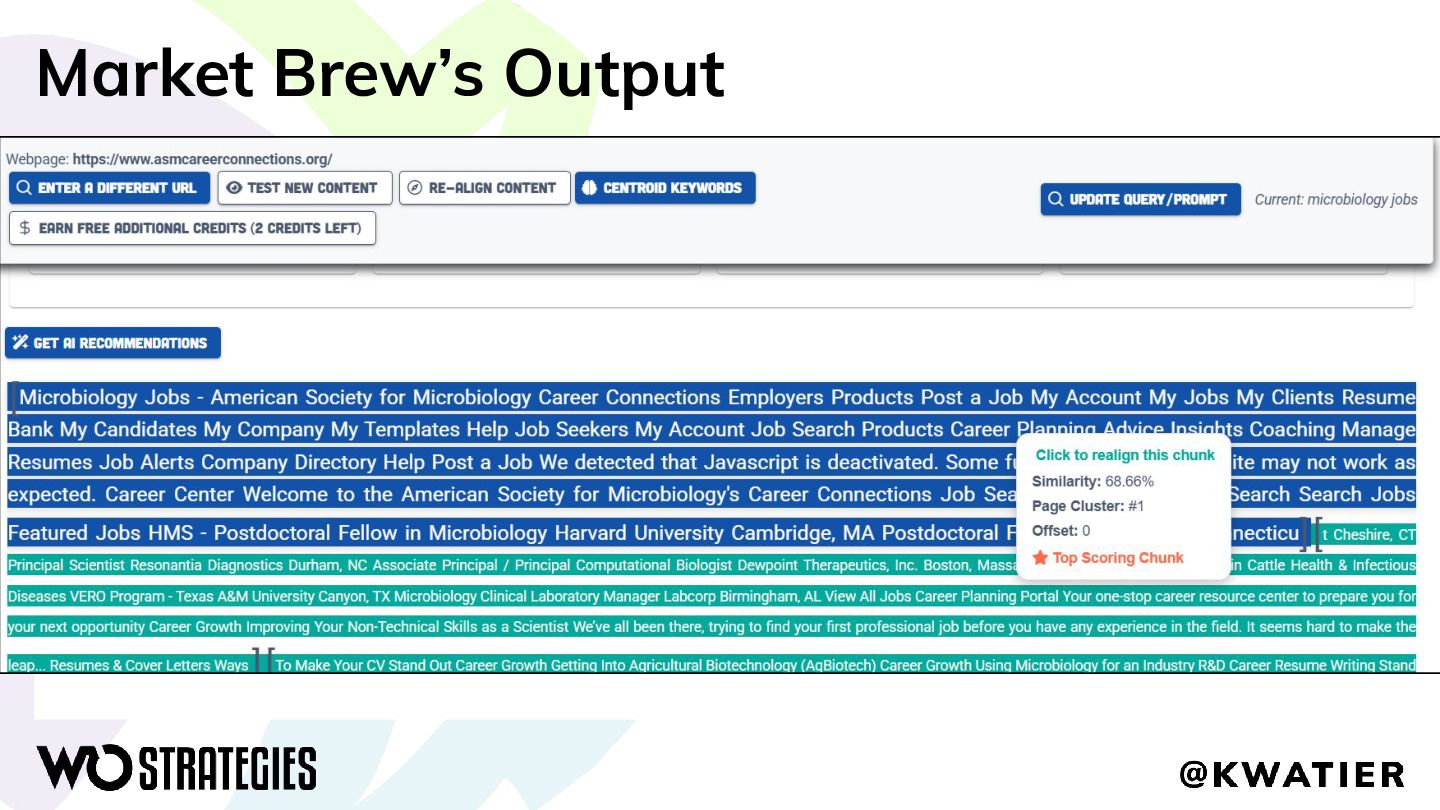
    Fan-out Tracker • https://aicoverage.locomotive.agency/ • https://geo.otterly.ai/geo/ai-query-fan-out/ • Content AI-Mode Readiness • https://queryfanout.ai/ • https://marketbrew.ai/tools-and-guides
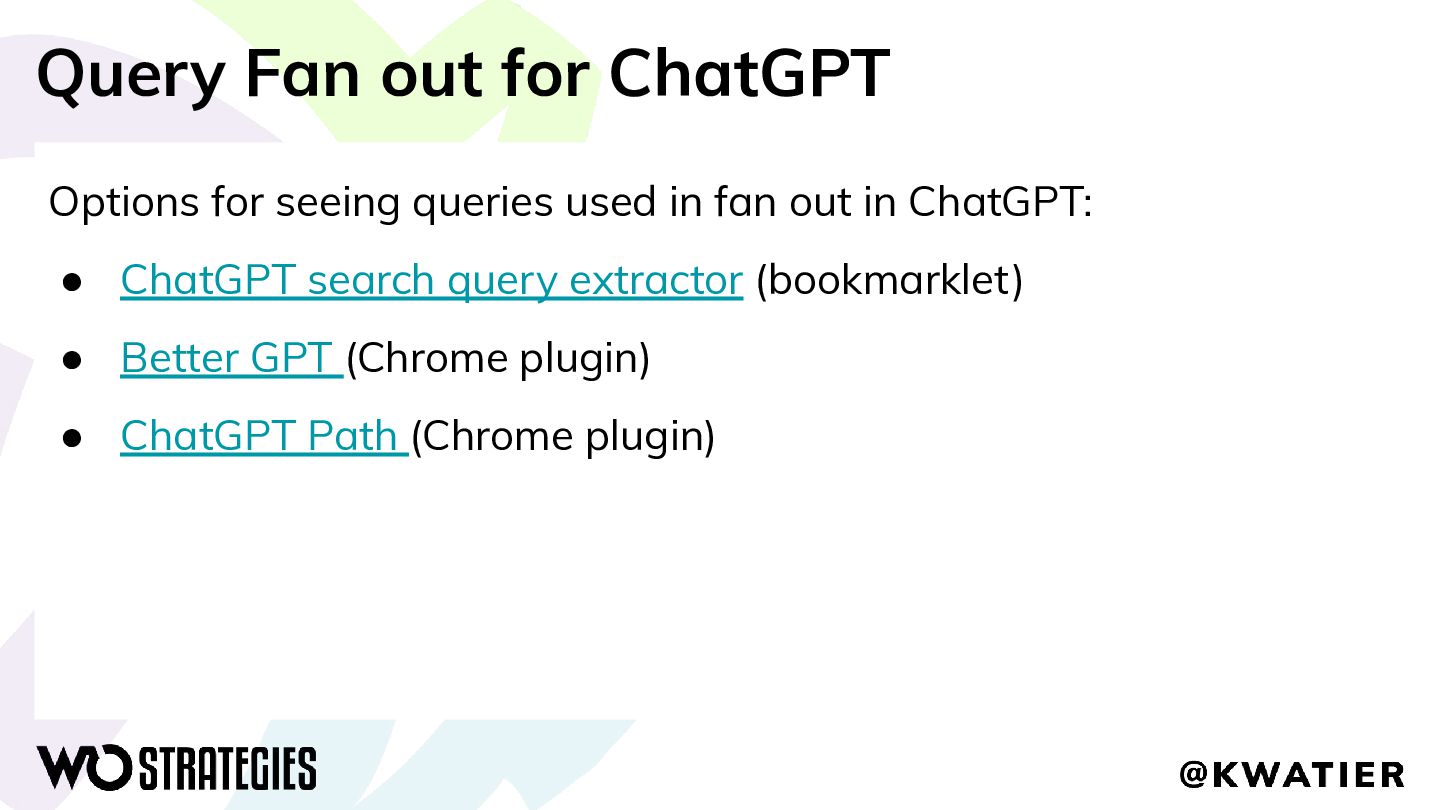
  40. Query Fan out for ChatGPT Options for seeing queries used

    in fan out in ChatGPT: • ChatGPT search query extractor (bookmarklet) • Better GPT (Chrome plugin) • ChatGPT Path (Chrome plugin)
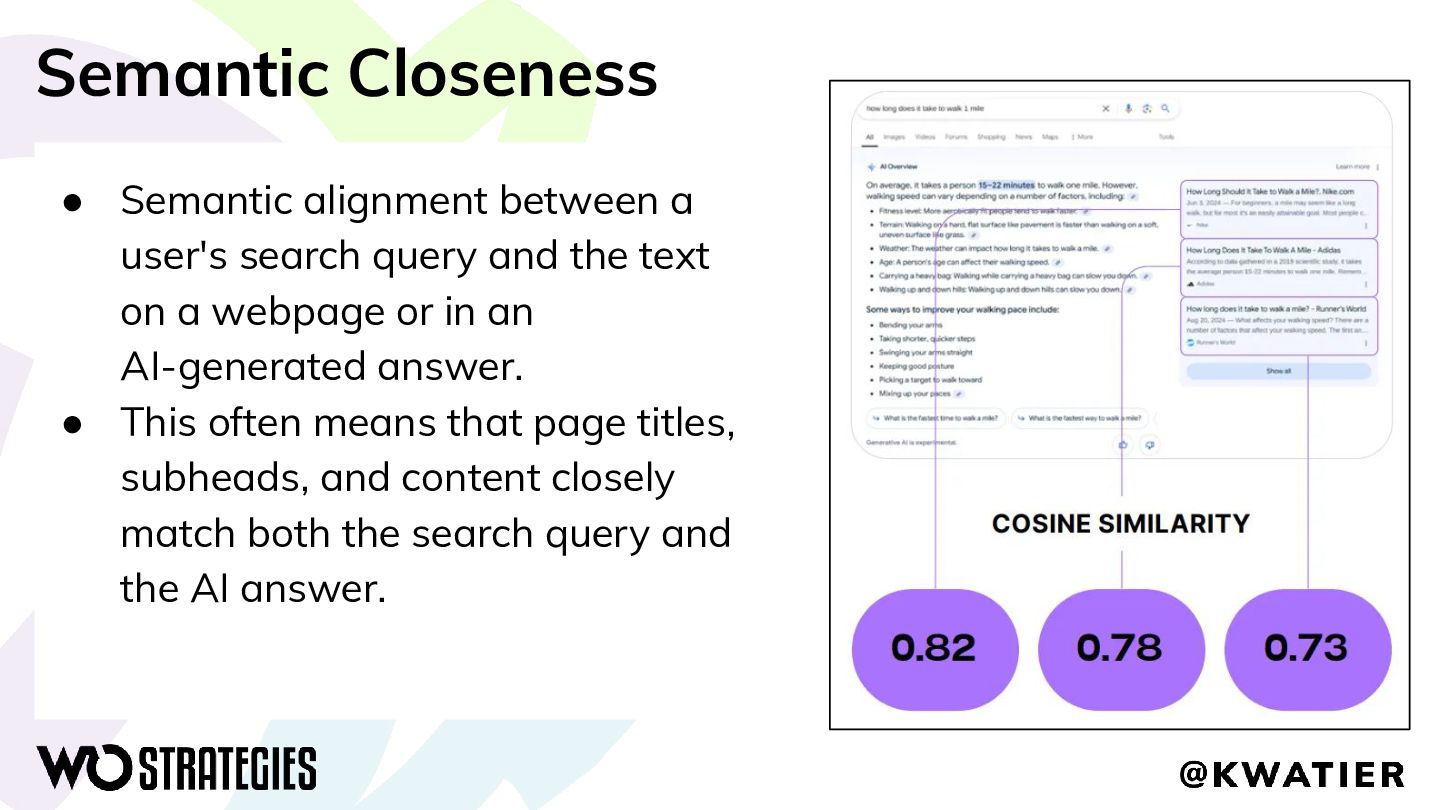
  41. Semantic Closeness • Semantic alignment between a user's search query

    and the text on a webpage or in an AI-generated answer. • This often means that page titles, subheads, and content closely match both the search query and the AI answer.
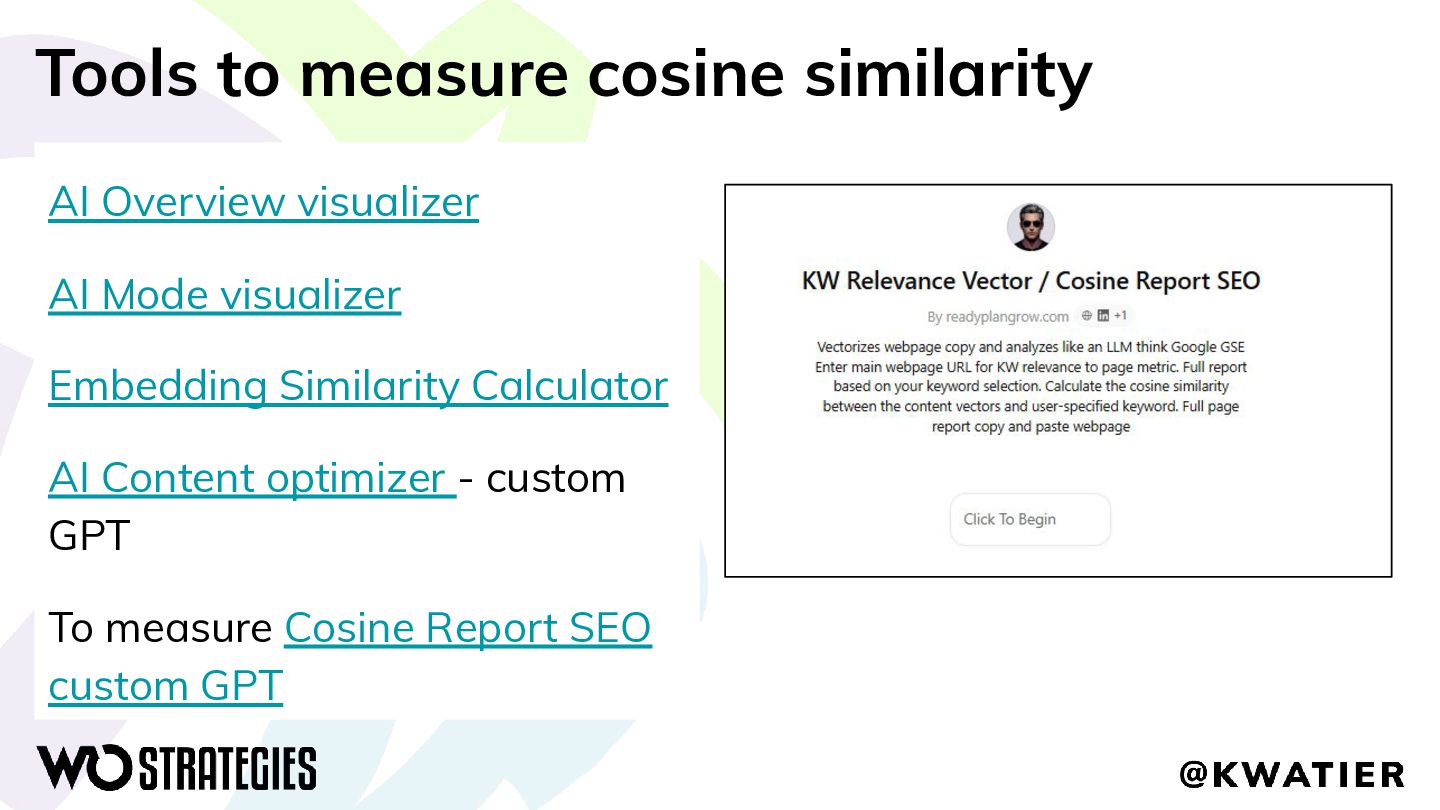
  42. Tools to measure cosine similarity AI Overview visualizer AI Mode

    visualizer Embedding Similarity Calculator AI Content optimizer - custom GPT To measure Cosine Report SEO custom GPT
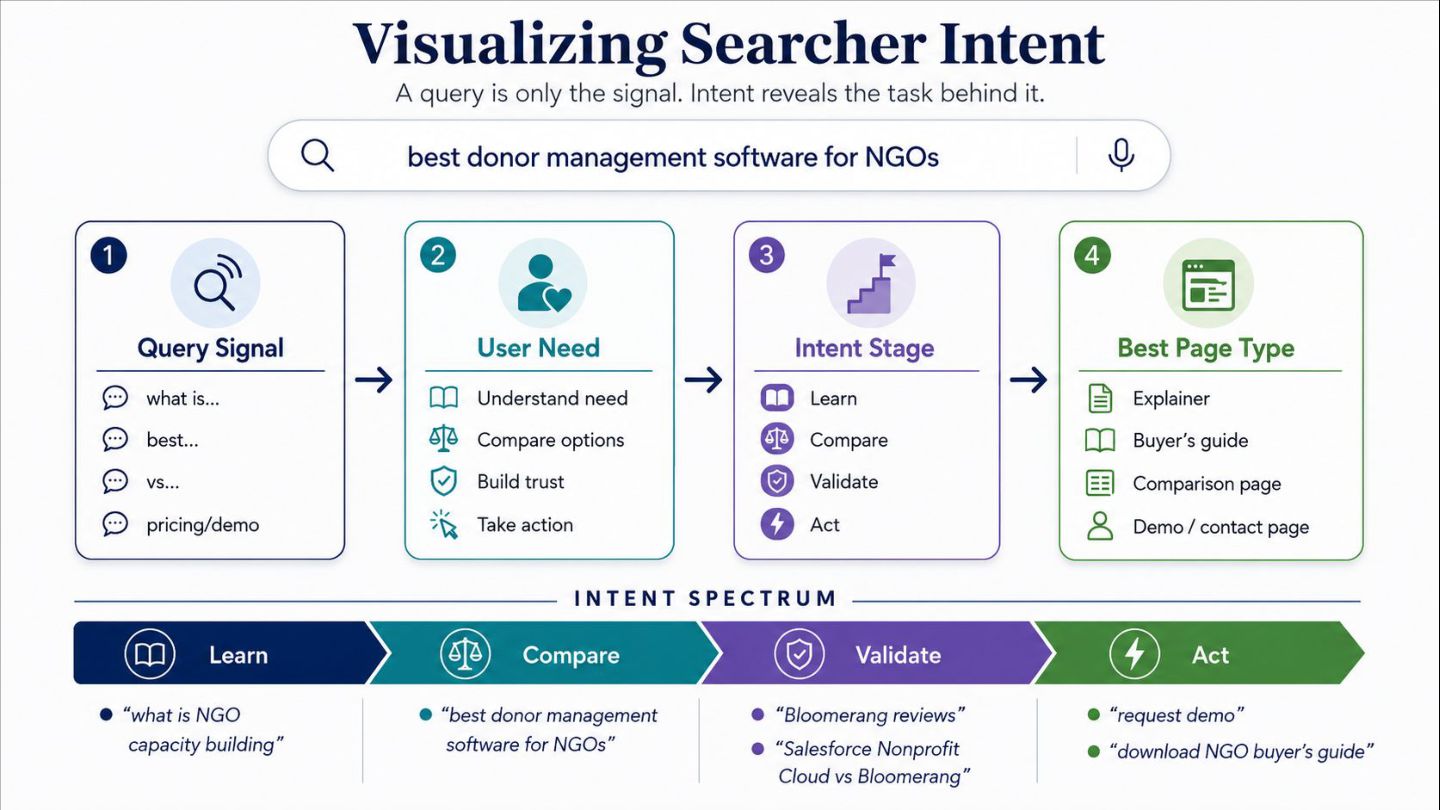
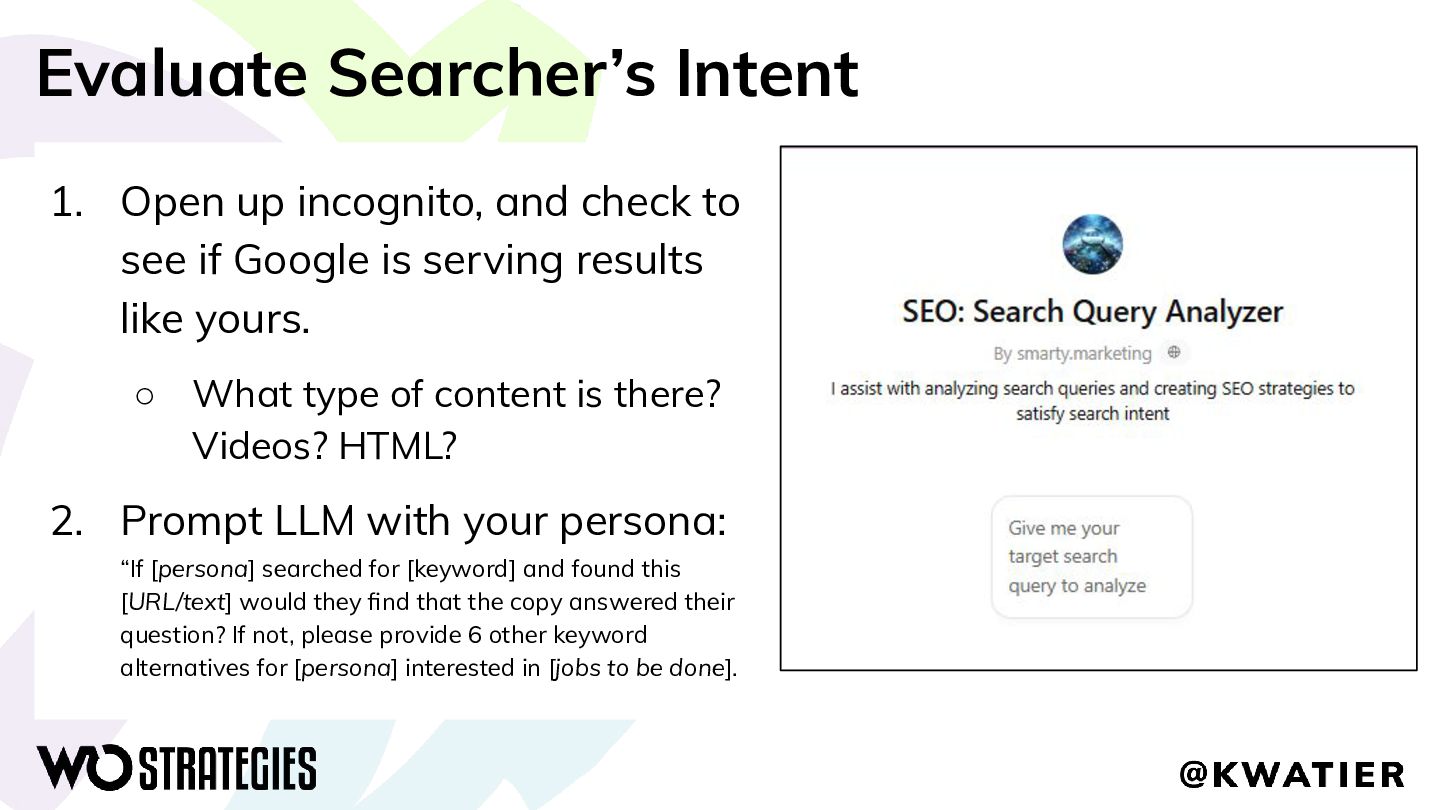
  43. Evaluate Searcher’s Intent 1. Open up incognito, and check to

    see if Google is serving results like yours. ◦ What type of content is there? Videos? HTML? 2. Prompt LLM with your persona: “If [persona] searched for [keyword] and found this [URL/text] would they find that the copy answered their question? If not, please provide 6 other keyword alternatives for [persona] interested in [jobs to be done].
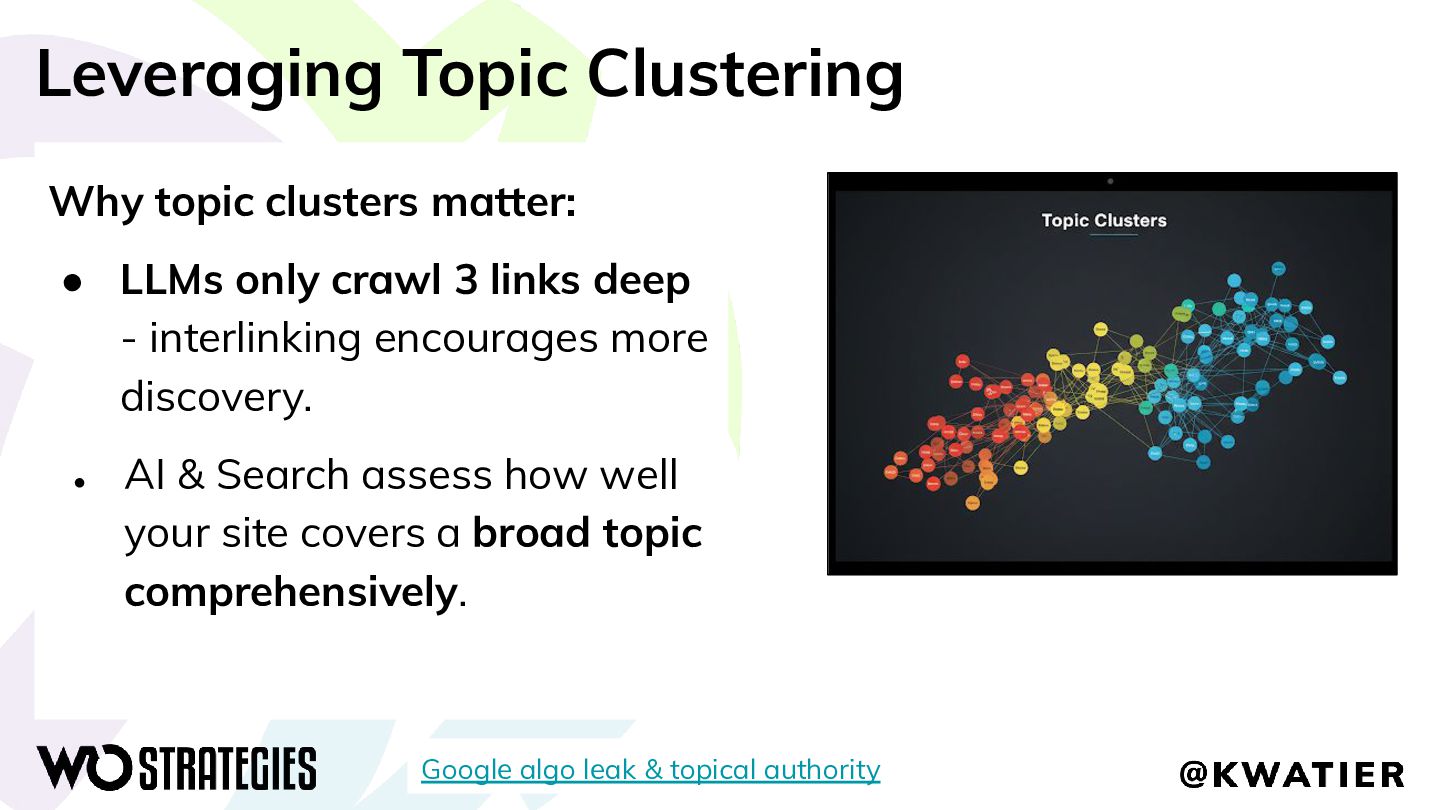
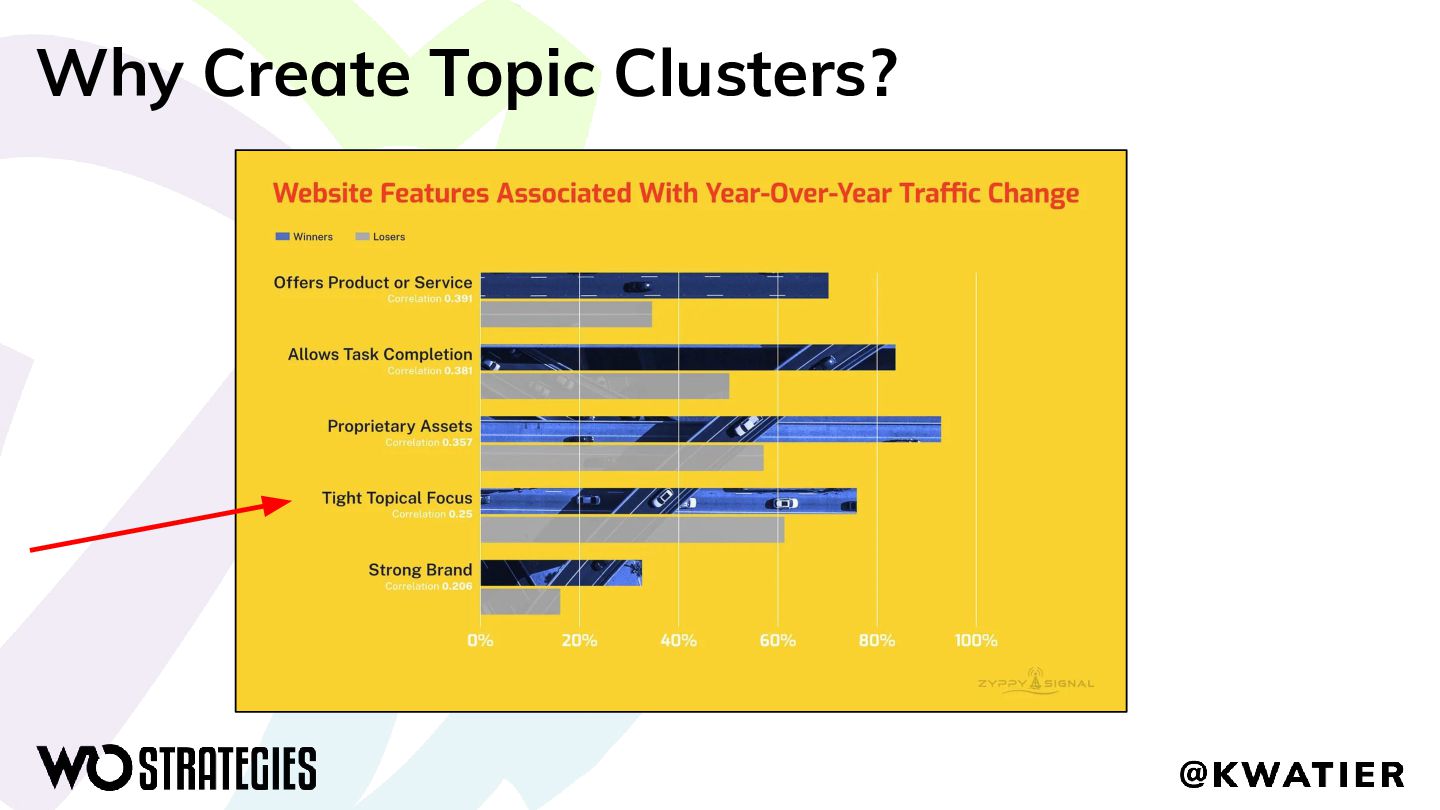
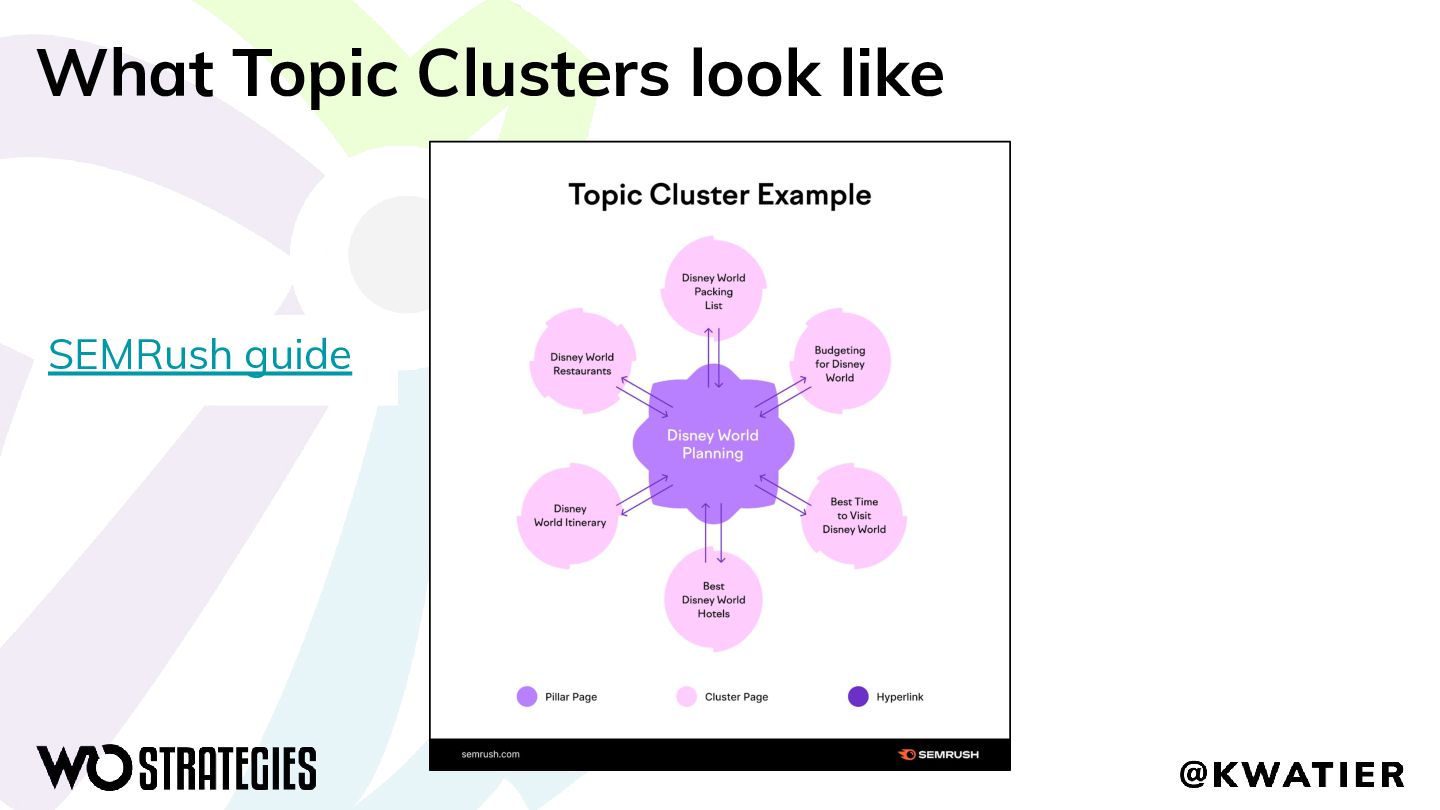
  44. Leveraging Topic Clustering Why topic clusters matter: • LLMs only

    crawl 3 links deep - interlinking encourages more discovery. • AI & Search assess how well your site covers a broad topic comprehensively. Google algo leak & topical authority
  45. Prompt to Generate Topic Cluster Prompt: “I have a list

    of prioritized seed keywords related to [Your Topic]. Can you help me cluster these keywords based on their semantic relationships and search intent? The aim is to create comprehensive content that enhances user experience and SERP dominance."
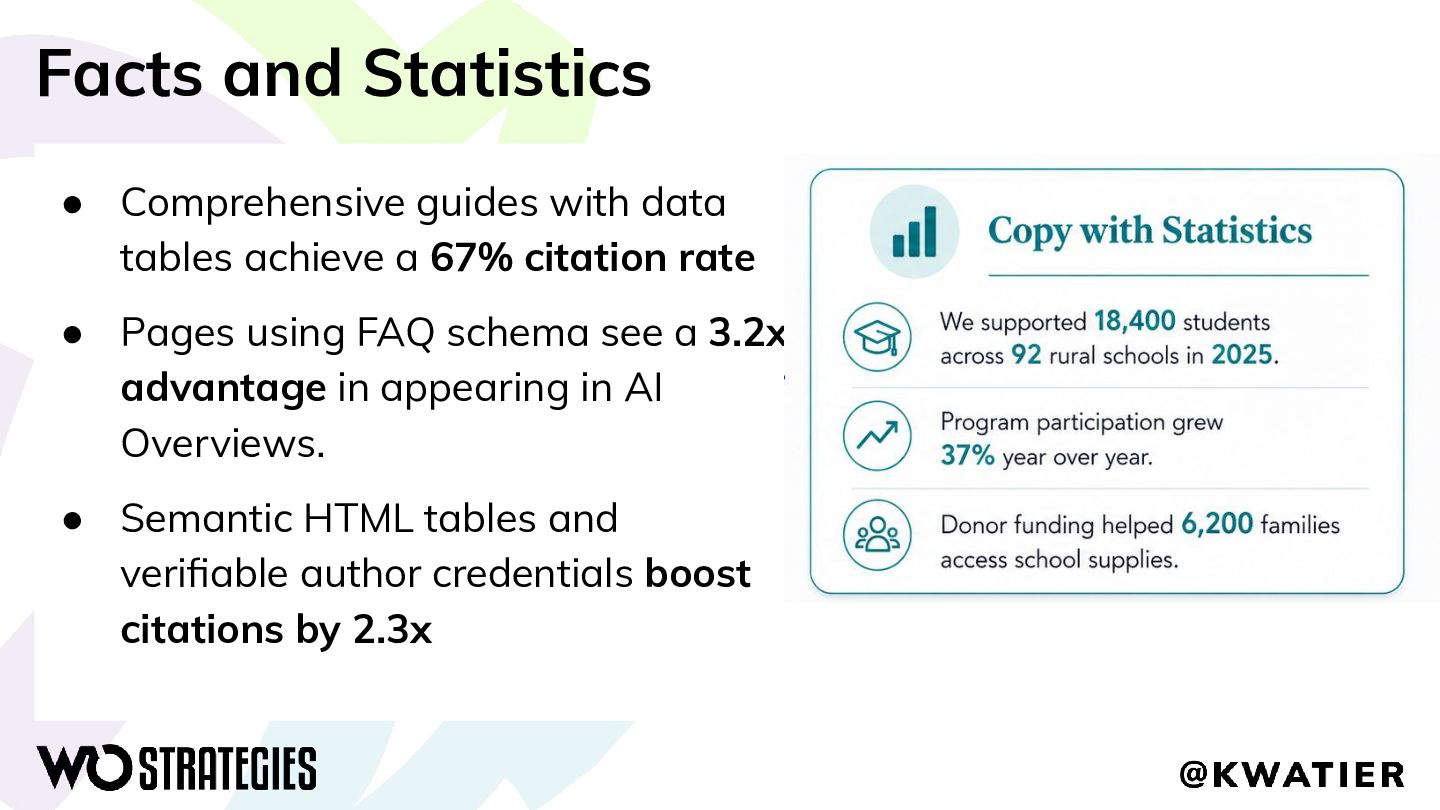
  46. Facts and Statistics • Comprehensive guides with data tables achieve

    a 67% citation rate • Pages using FAQ schema see a 3.2x advantage in appearing in AI Overviews. • Semantic HTML tables and verifiable author credentials boost citations by 2.3x
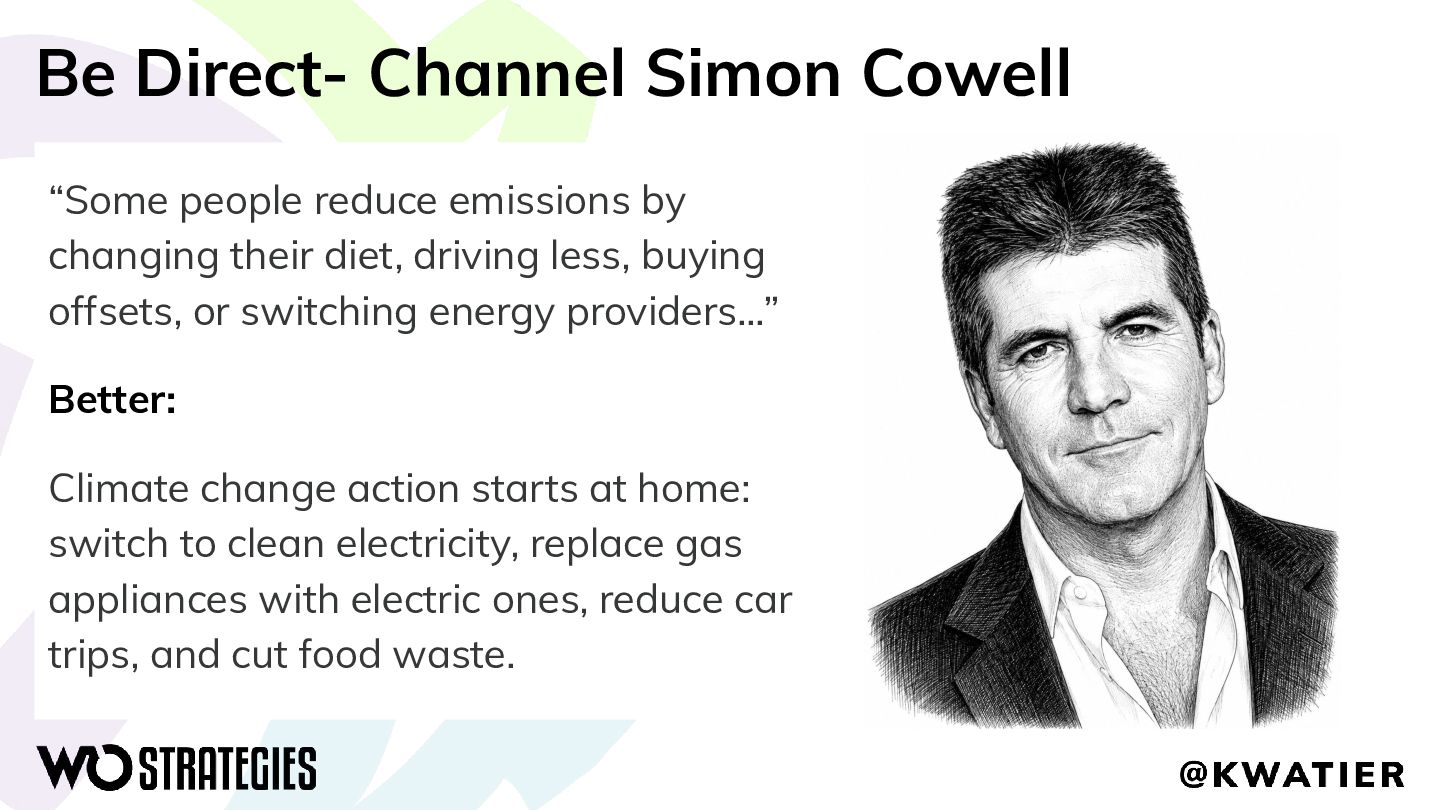
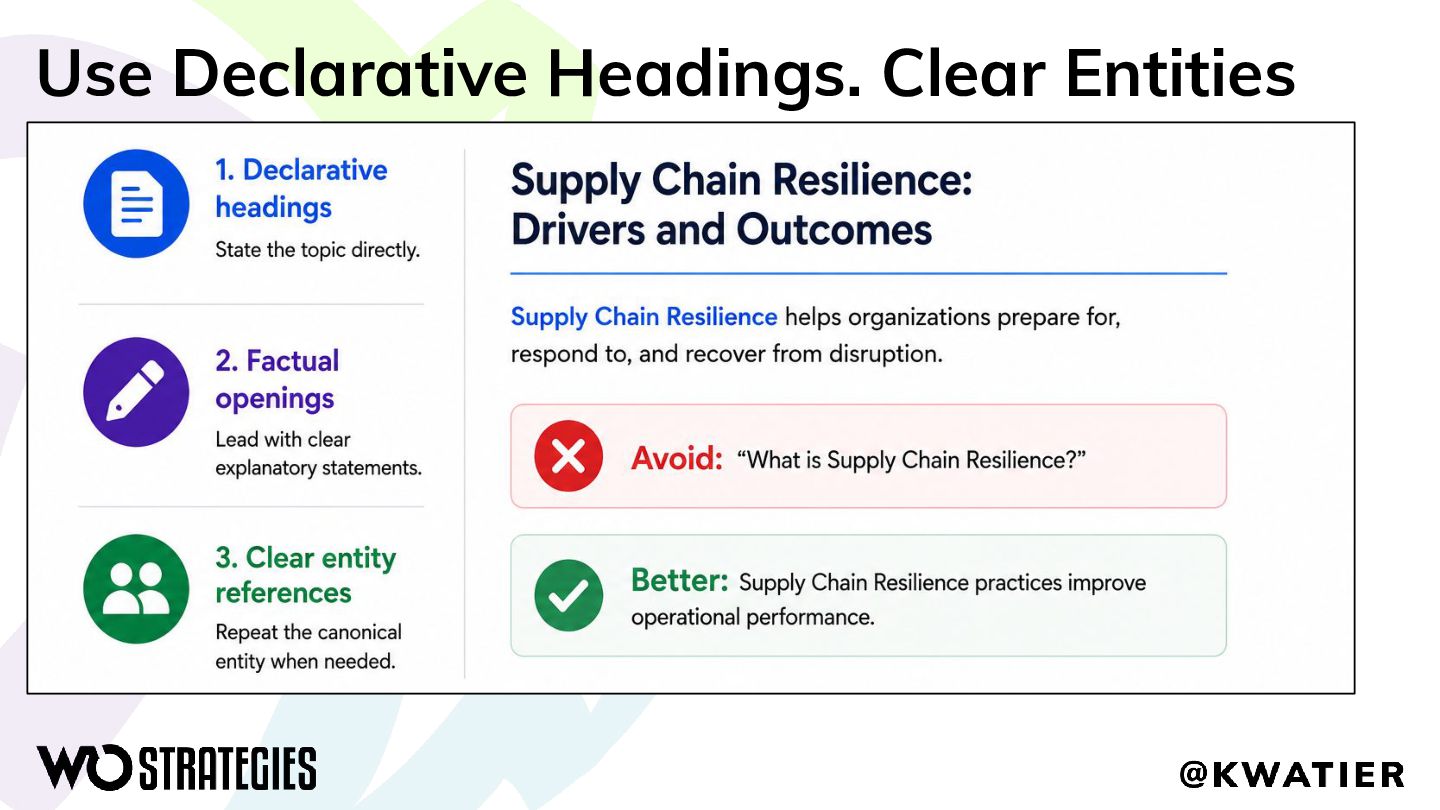
  47. Be Direct- Channel Simon Cowell “Some people reduce emissions by

    changing their diet, driving less, buying offsets, or switching energy providers...” Better: Climate change action starts at home: switch to clean electricity, replace gas appliances with electric ones, reduce car trips, and cut food waste.
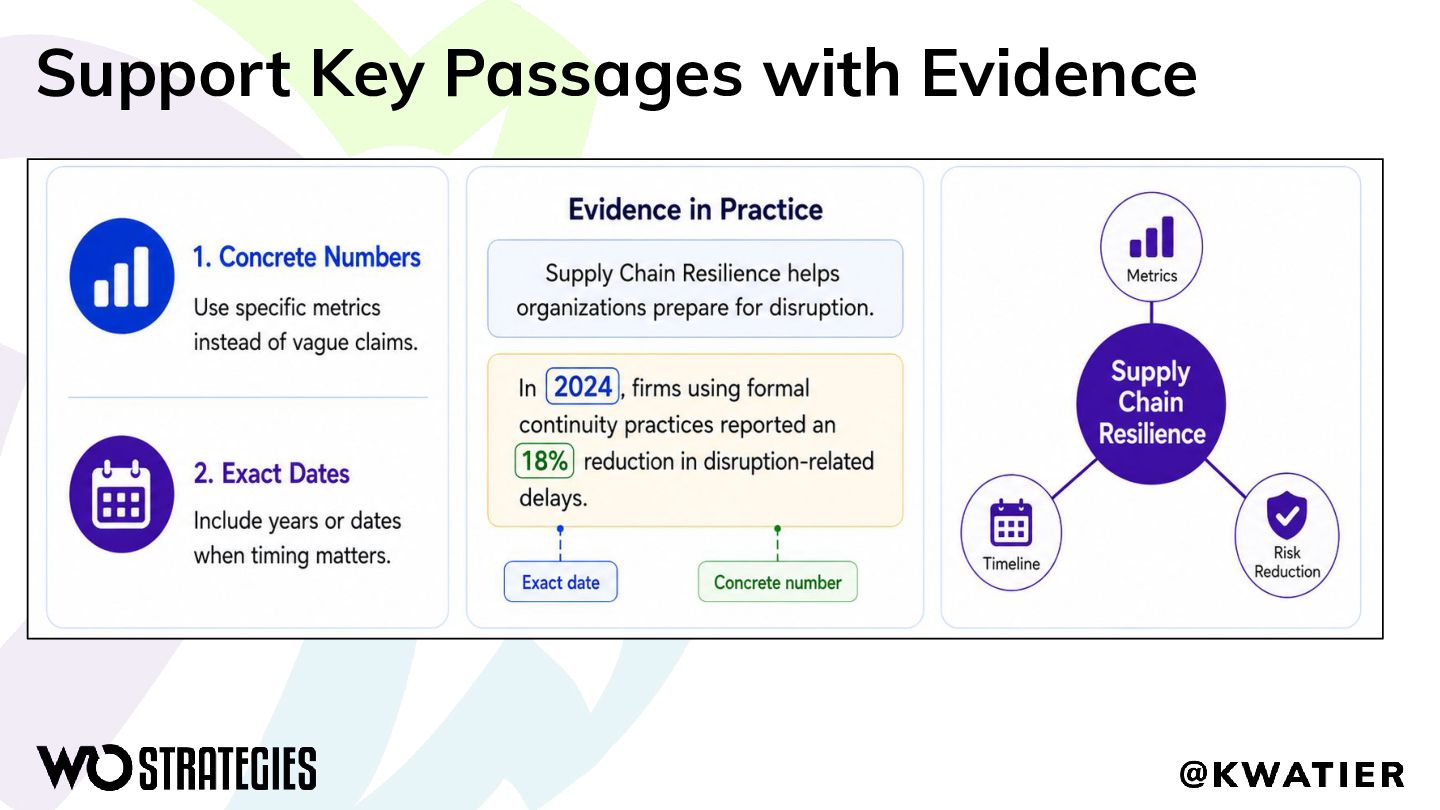
  48. Citations Link to authoritative external sources that support your claims

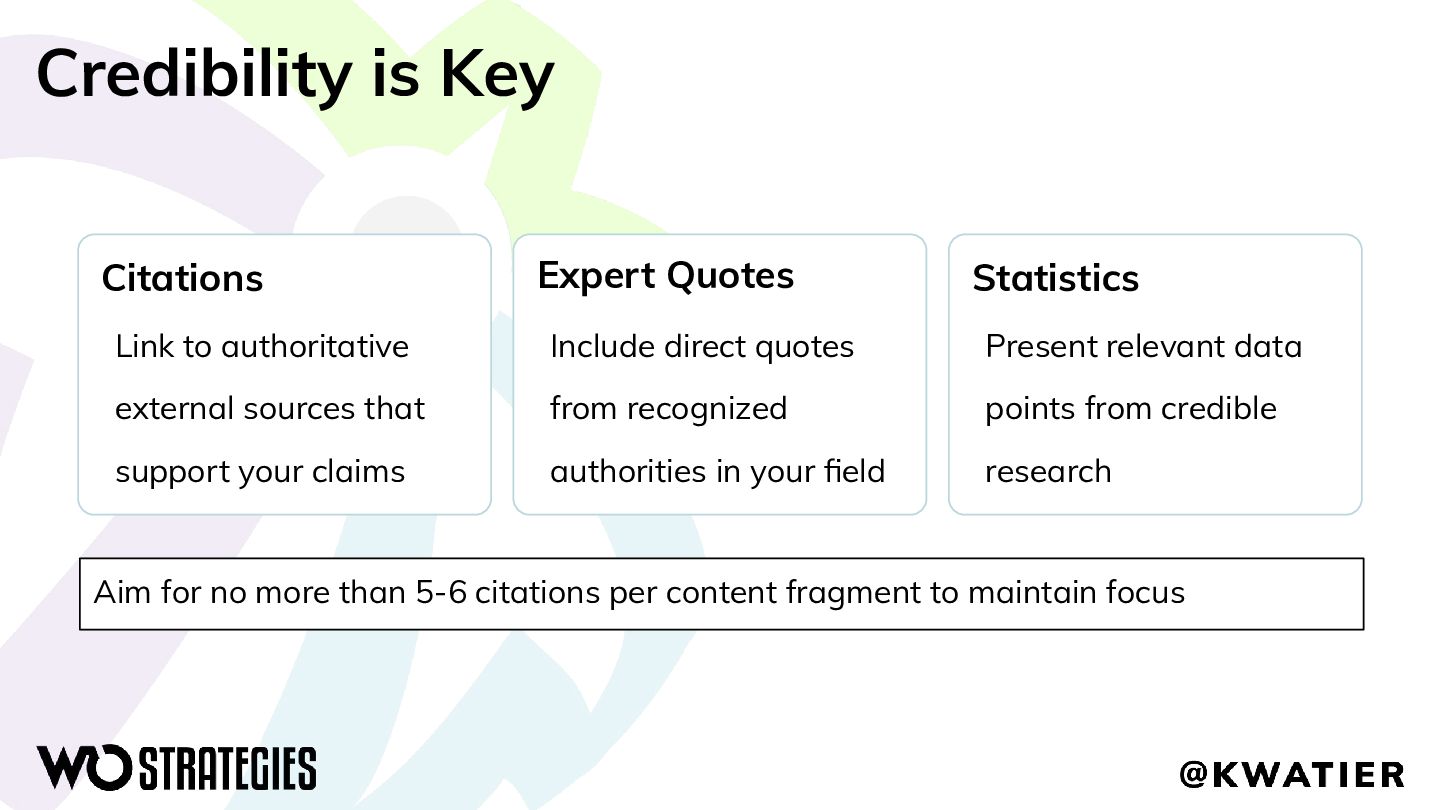
    Expert Quotes Include direct quotes from recognized authorities in your field Statistics Present relevant data points from credible research Aim for no more than 5-6 citations per content fragment to maintain focus Credibility is Key
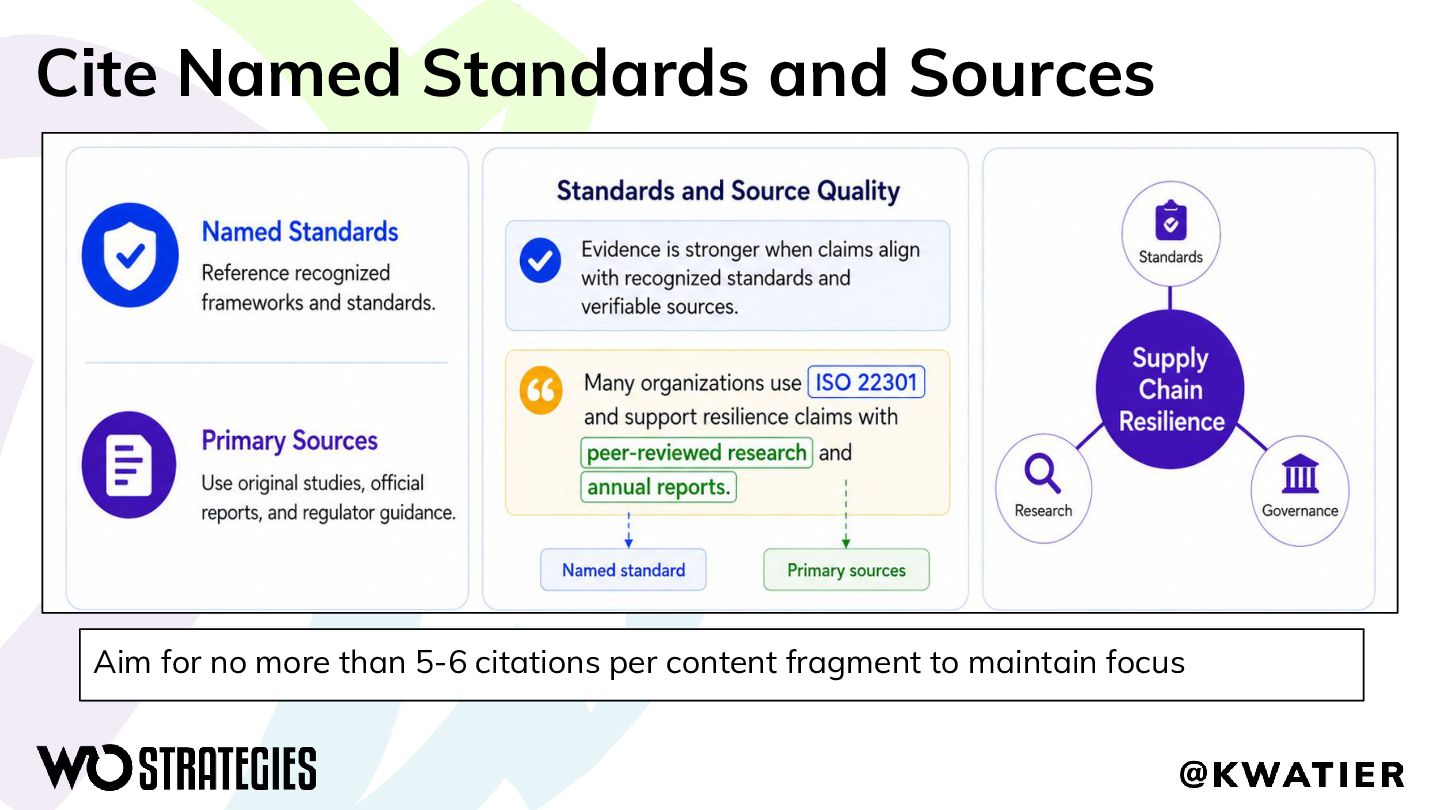
  49. Aim for no more than 5-6 citations per content fragment

    to maintain focus Cite Named Standards and Sources
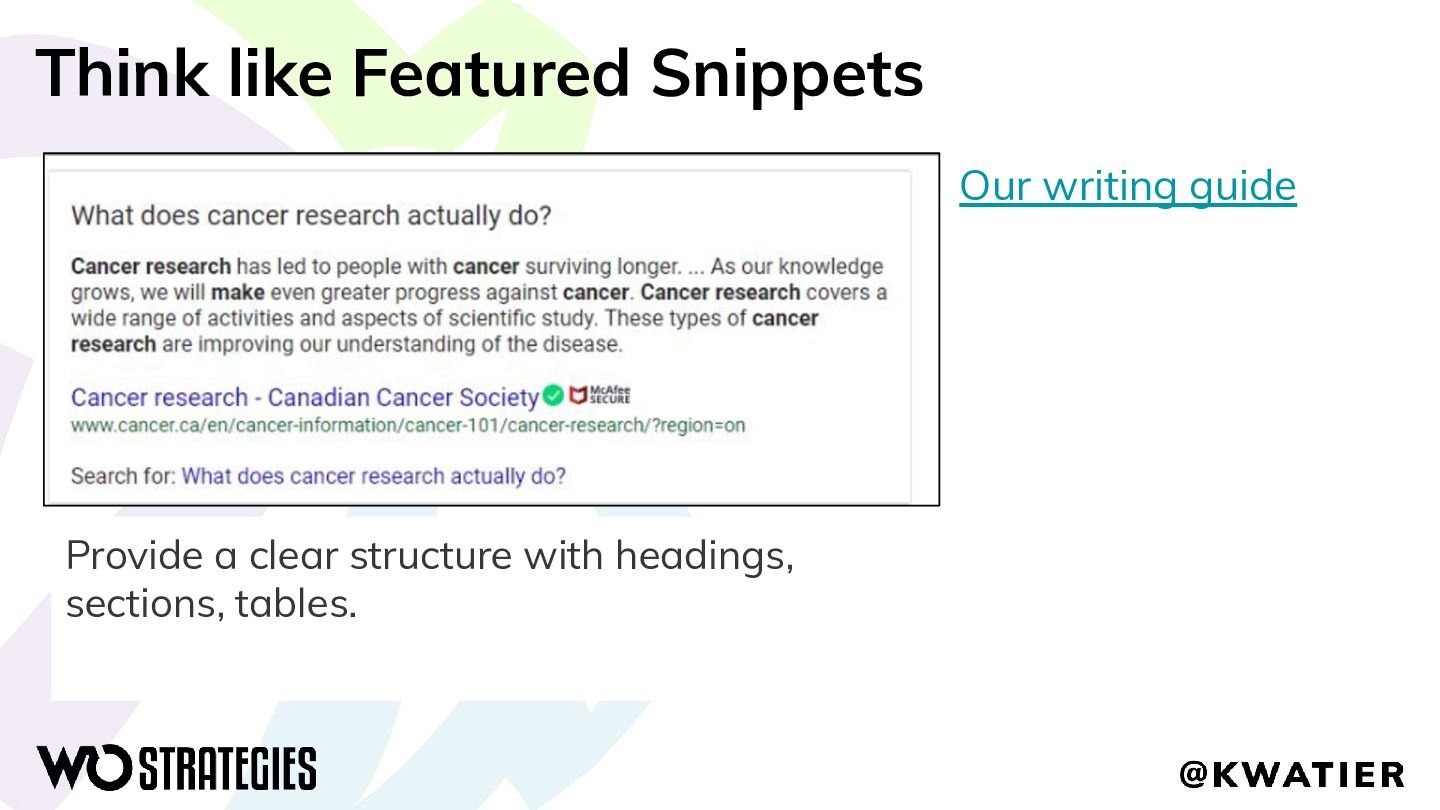
  50. Think like Featured Snippets Our writing guide Provide a clear

    structure with headings, sections, tables.
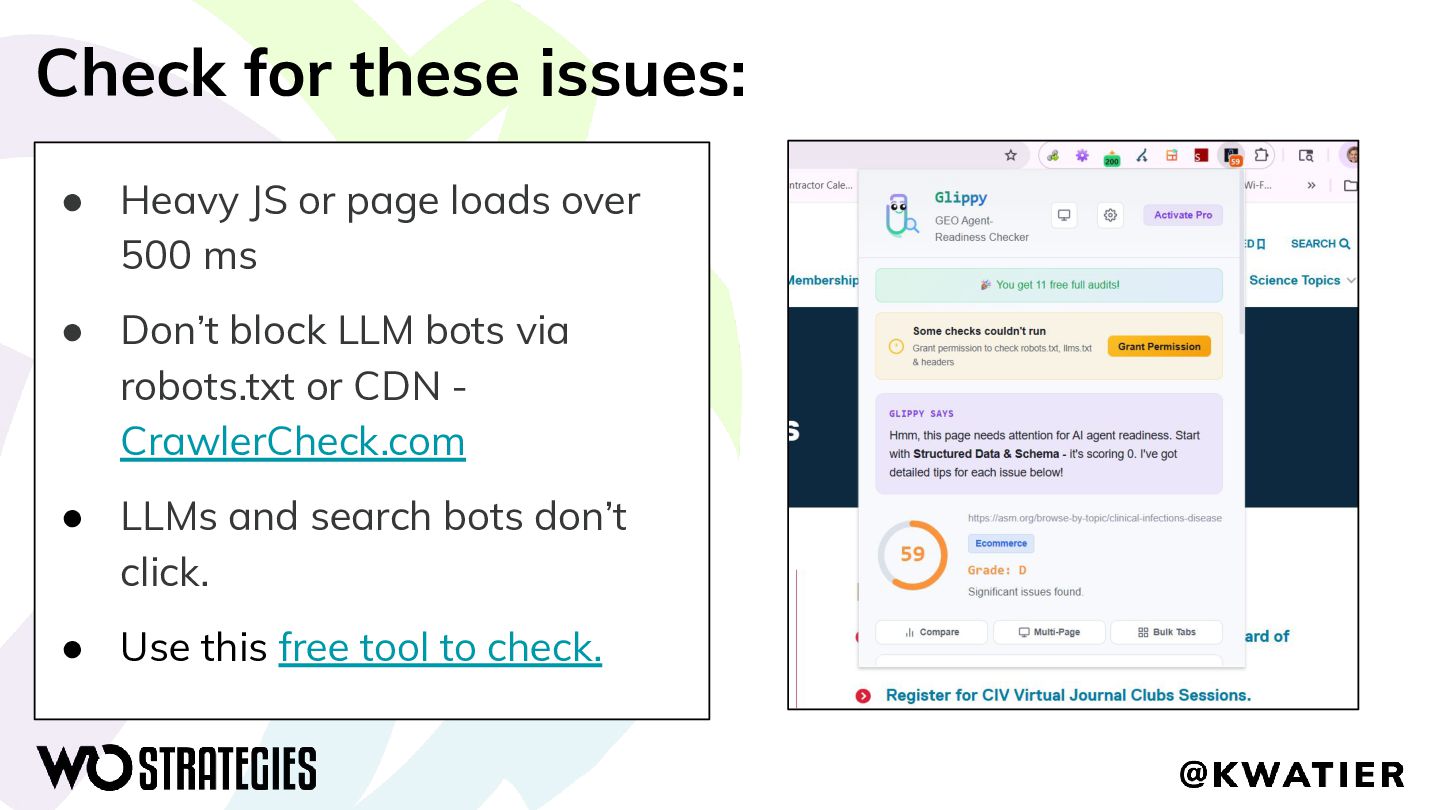
  51. Check for these issues: • Heavy JS or page loads

    over 500 ms • Don’t block LLM bots via robots.txt or CDN - CrawlerCheck.com • LLMs and search bots don’t click. • Use this free tool to check.
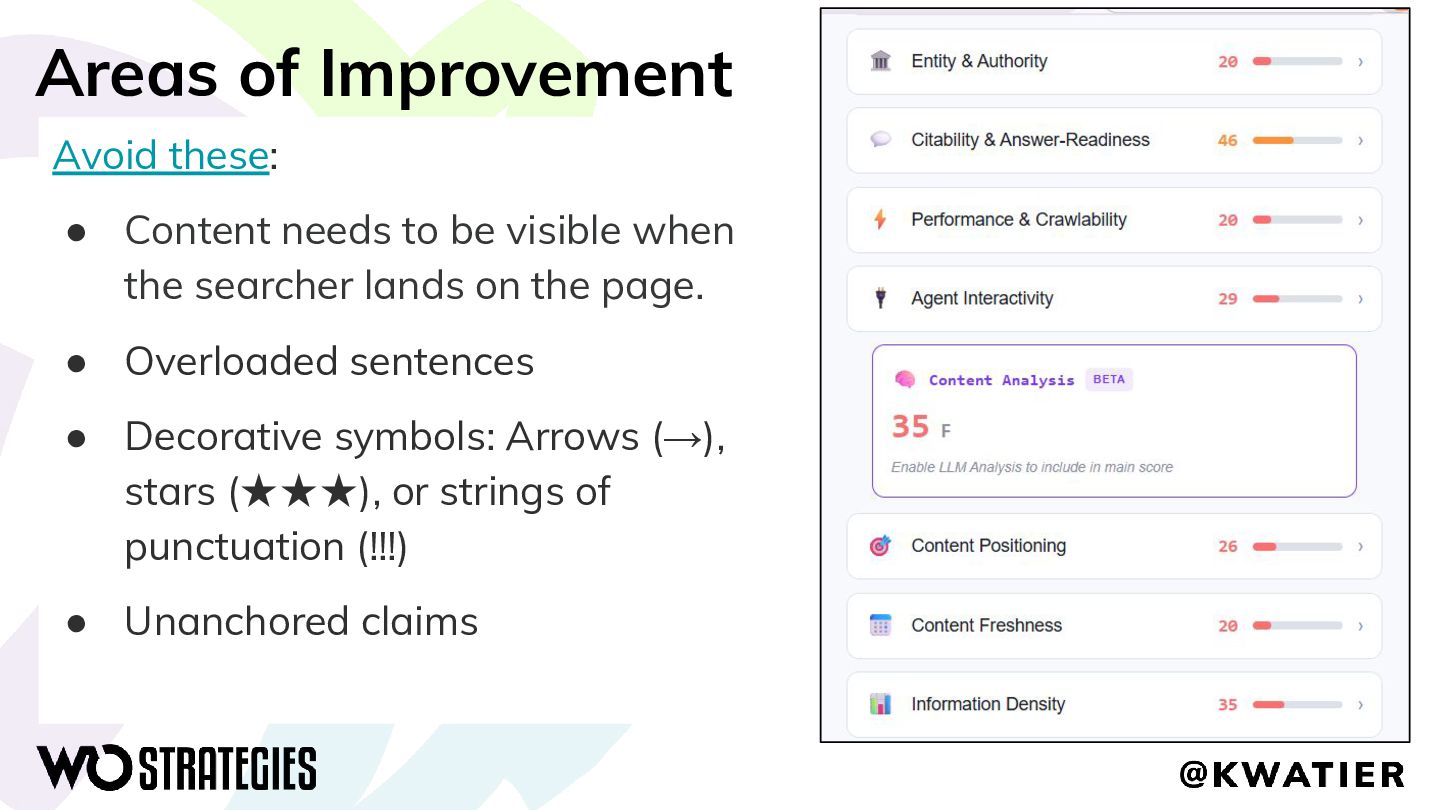
  52. Areas of Improvement Avoid these: • Content needs to be

    visible when the searcher lands on the page. • Overloaded sentences • Decorative symbols: Arrows (→), stars (★★★), or strings of punctuation (!!!) • Unanchored claims
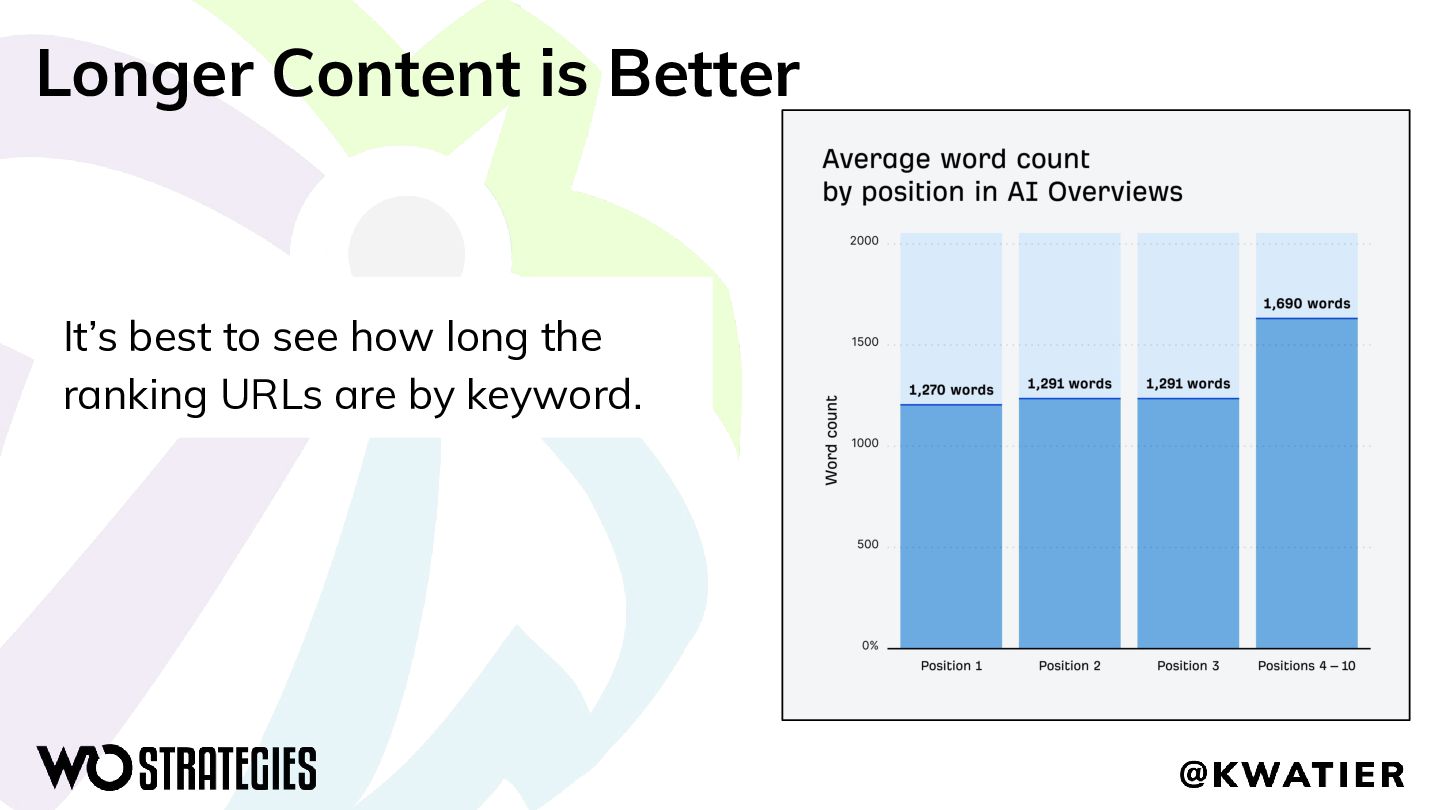
  53. Longer Content is Better It’s best to see how long

    the ranking URLs are by keyword.
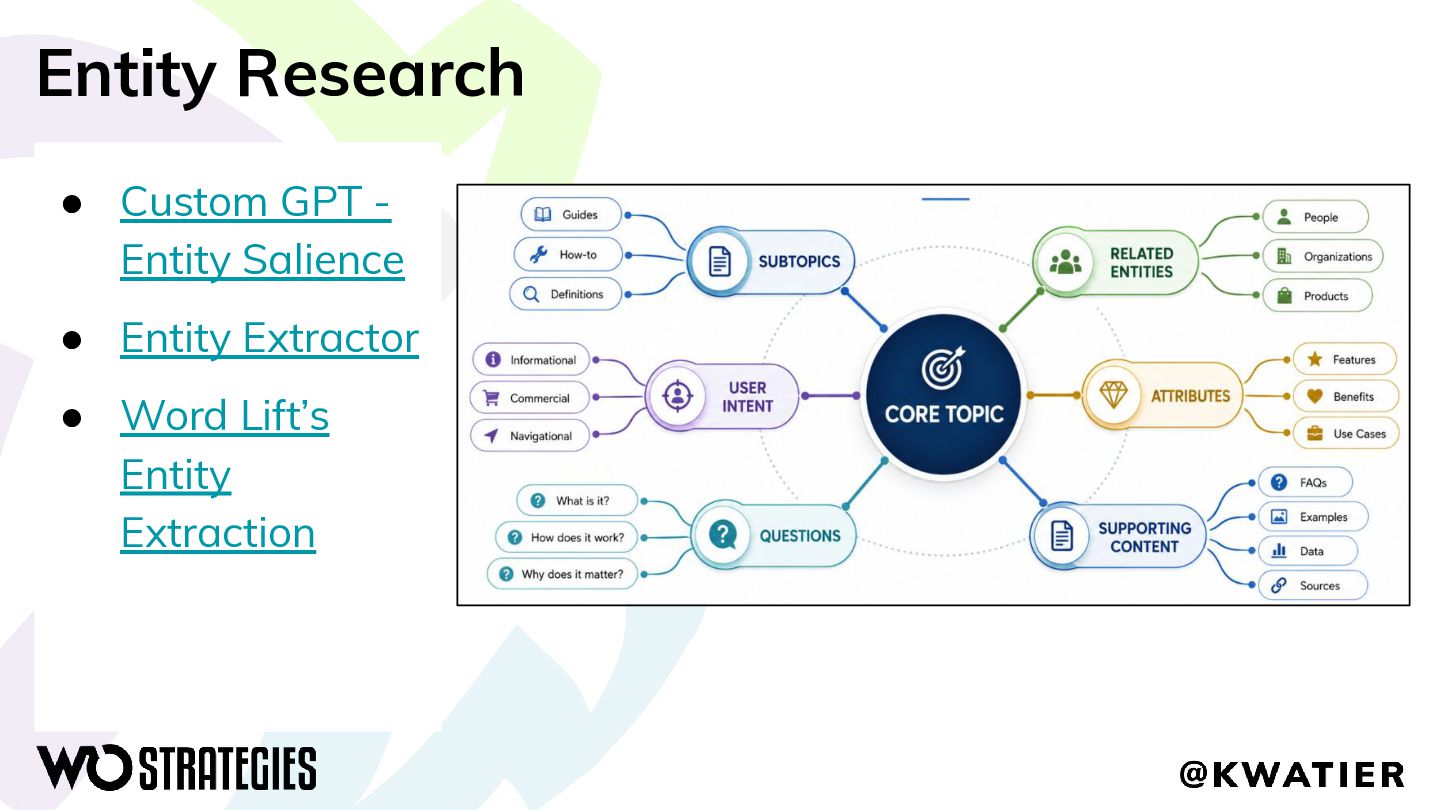
  54. Entity Research • Custom GPT - Entity Salience • Entity

    Extractor • Word Lift’s Entity Extraction
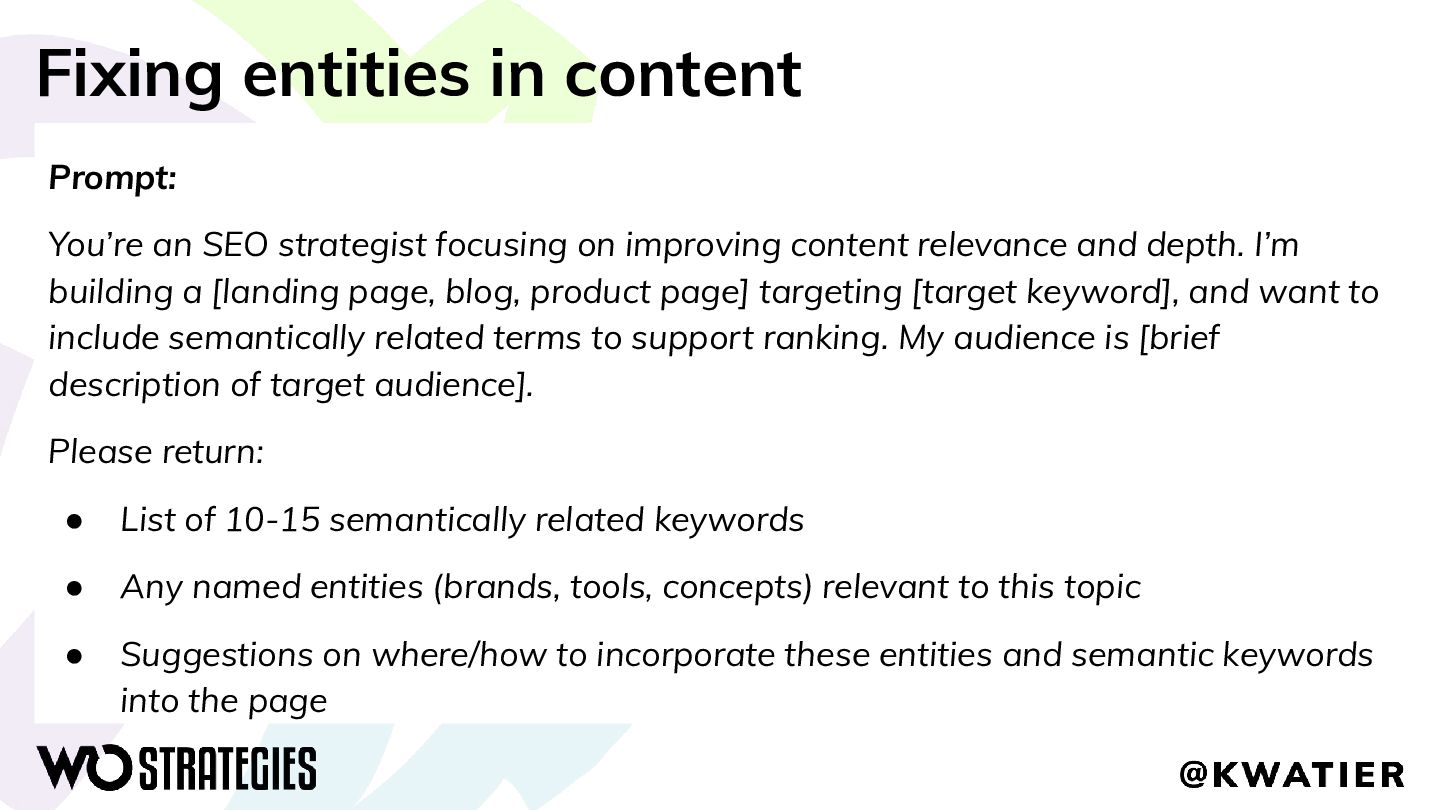
  55. Fixing entities in content Prompt: You’re an SEO strategist focusing

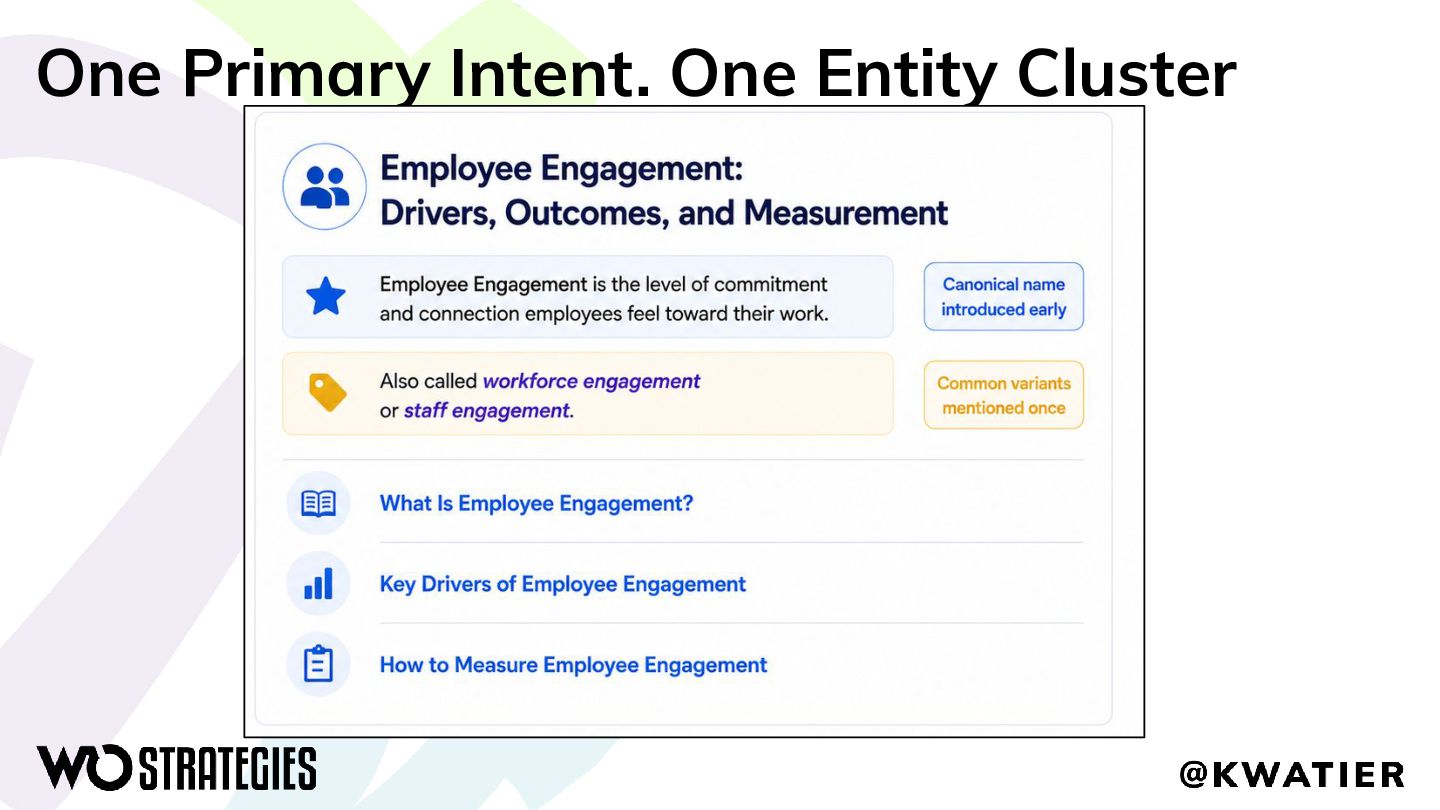
    on improving content relevance and depth. I’m building a [landing page, blog, product page] targeting [target keyword], and want to include semantically related terms to support ranking. My audience is [brief description of target audience]. Please return: • List of 10-15 semantically related keywords • Any named entities (brands, tools, concepts) relevant to this topic • Suggestions on where/how to incorporate these entities and semantic keywords into the page
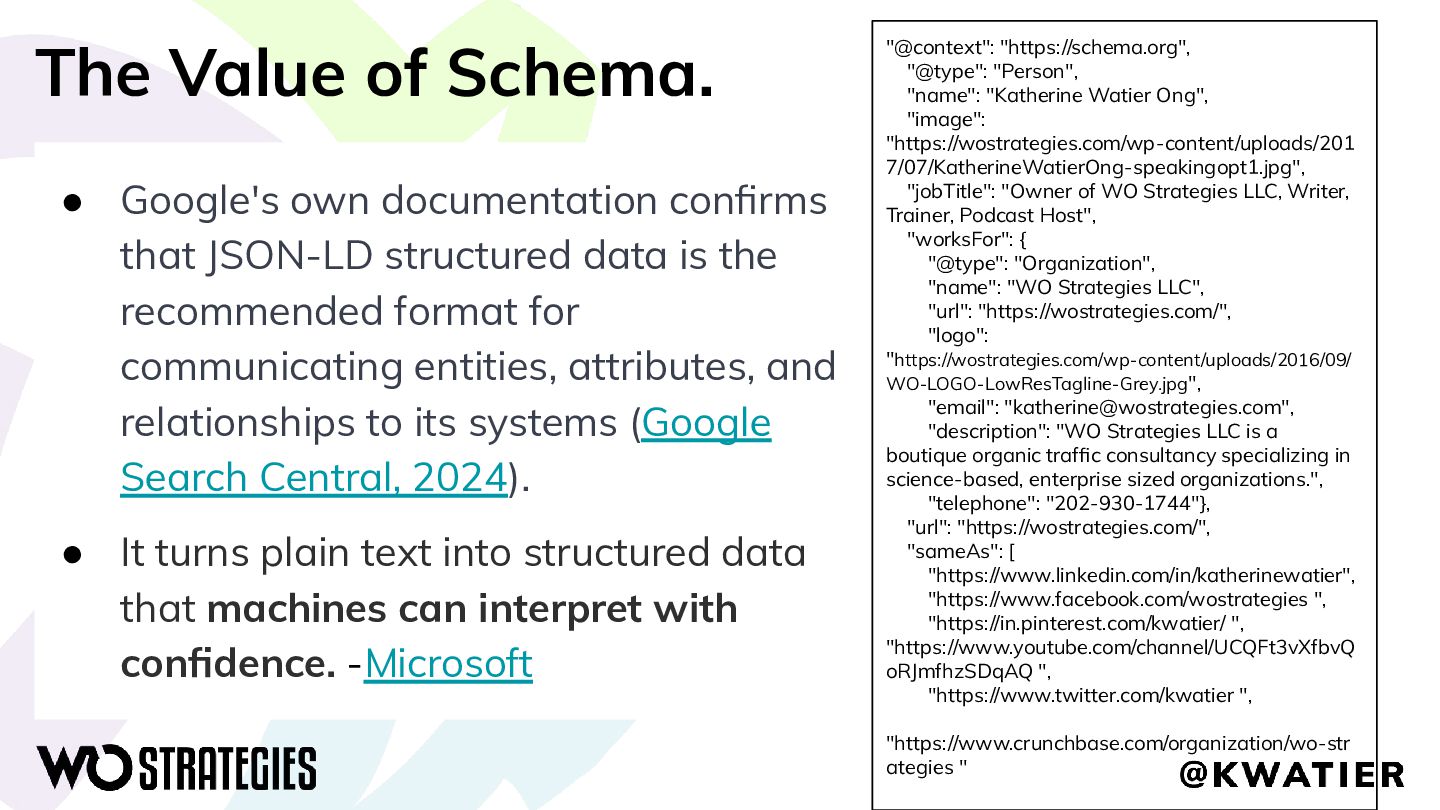
  56. The Value of Schema. • Google's own documentation confirms that

    JSON-LD structured data is the recommended format for communicating entities, attributes, and relationships to its systems (Google Search Central, 2024). • It turns plain text into structured data that machines can interpret with confidence. -Microsoft "@context": "https://schema.org", "@type": "Person", "name": "Katherine Watier Ong", "image": "https://wostrategies.com/wp-content/uploads/201 7/07/KatherineWatierOng-speakingopt1.jpg", "jobTitle": "Owner of WO Strategies LLC, Writer, Trainer, Podcast Host", "worksFor": { "@type": "Organization", "name": "WO Strategies LLC", "url": "https://wostrategies.com/", "logo": "https://wostrategies.com/wp-content/uploads/2016/09/ WO-LOGO-LowResTagline-Grey.jpg", "email": "[email protected]", "description": "WO Strategies LLC is a boutique organic traffic consultancy specializing in science-based, enterprise sized organizations.", "telephone": "202-930-1744"}, "url": "https://wostrategies.com/", "sameAs": [ "https://www.linkedin.com/in/katherinewatier", "https://www.facebook.com/wostrategies ", "https://in.pinterest.com/kwatier/ ", "https://www.youtube.com/channel/UCQFt3vXfbvQ oRJmfhzSDqAQ ", "https://www.twitter.com/kwatier ", "https://www.crunchbase.com/organization/wo-str ategies "
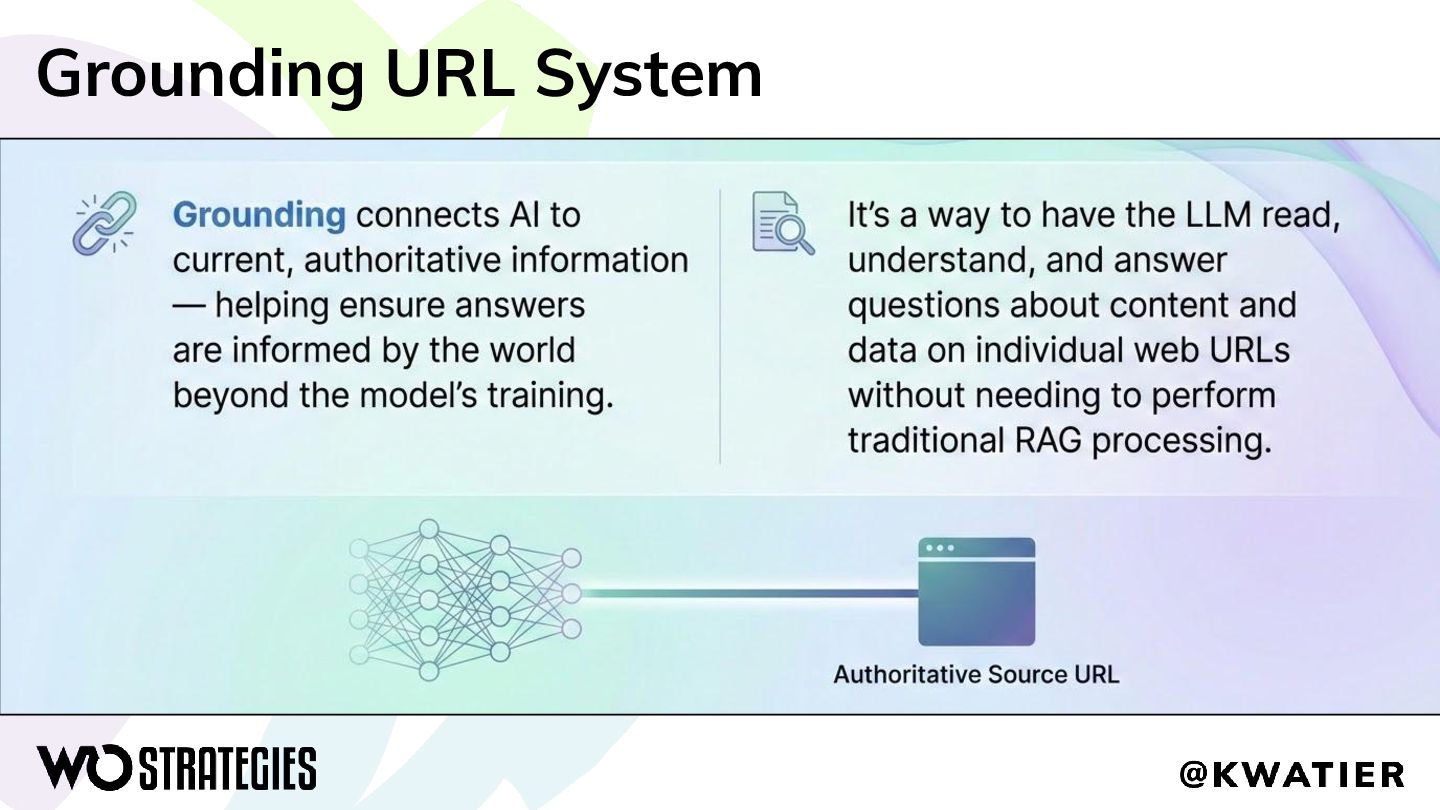
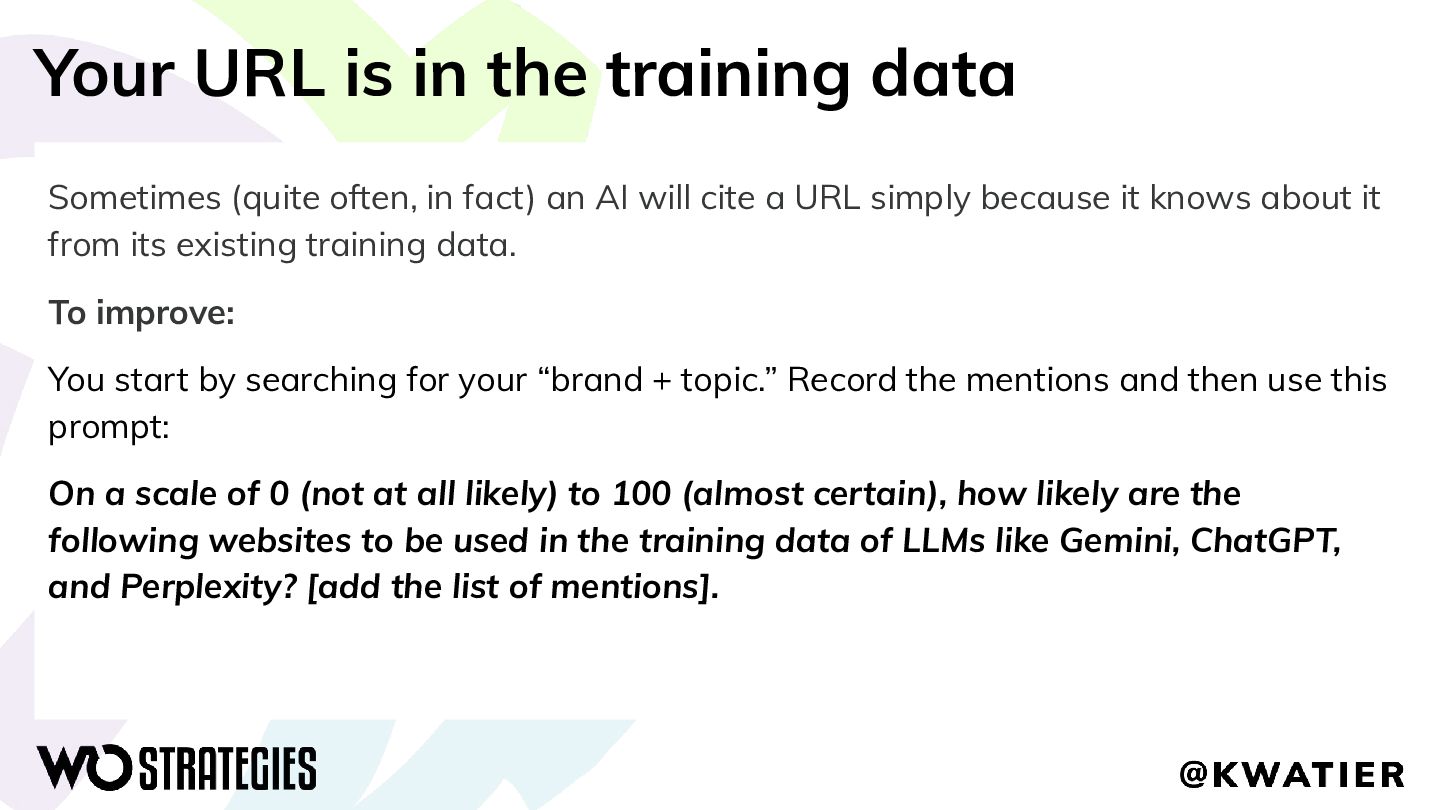
  57. Your URL is in the training data Sometimes (quite often,

    in fact) an AI will cite a URL simply because it knows about it from its existing training data. To improve: You start by searching for your “brand + topic.” Record the mentions and then use this prompt: On a scale of 0 (not at all likely) to 100 (almost certain), how likely are the following websites to be used in the training data of LLMs like Gemini, ChatGPT, and Perplexity? [add the list of mentions].
  58. Building a Testing Plan • AI Overviews checklist to track

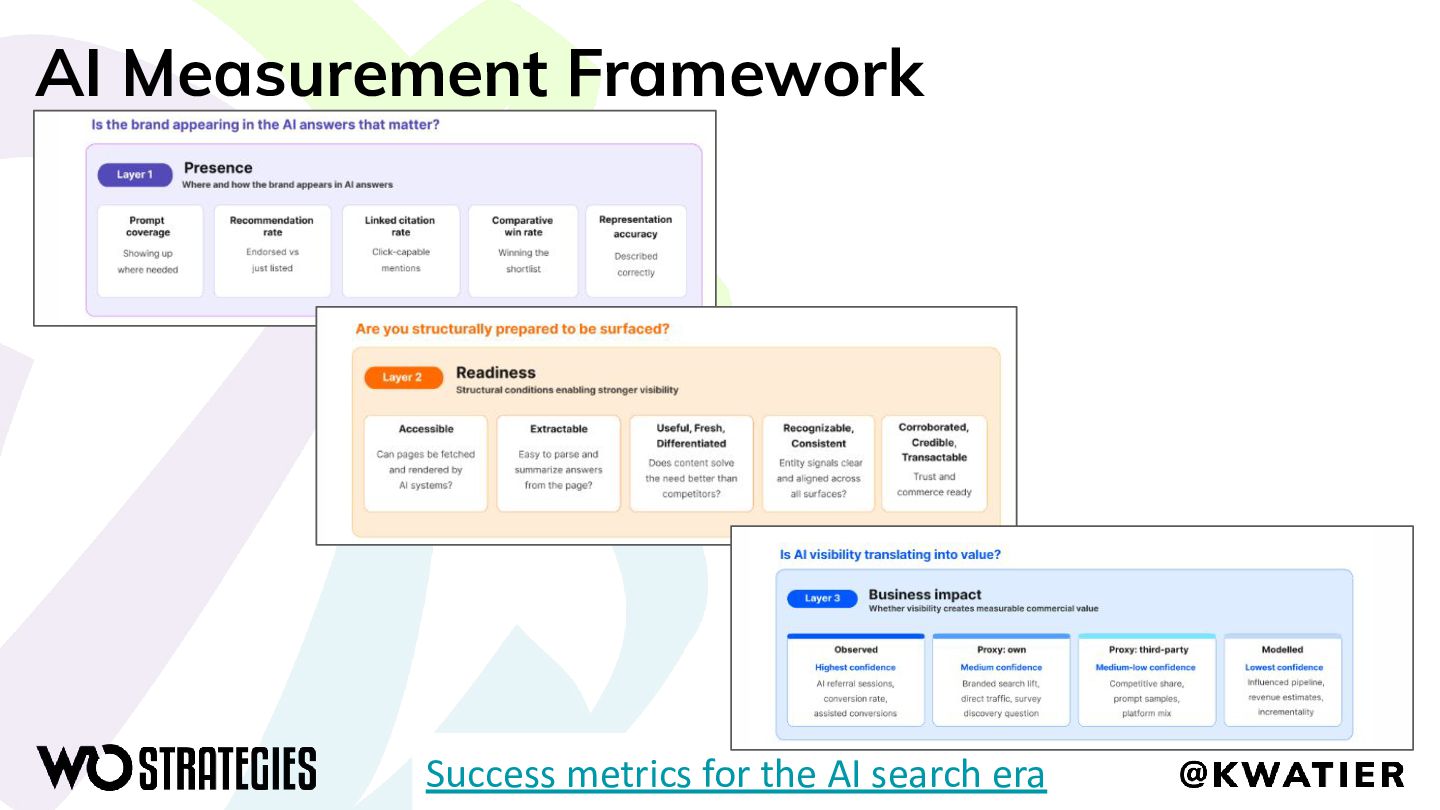
    your testing plan. • Measure impact on traffic (now and based on predictions) • A/B test your AI-optimized content • Measuring visibility on AI platforms
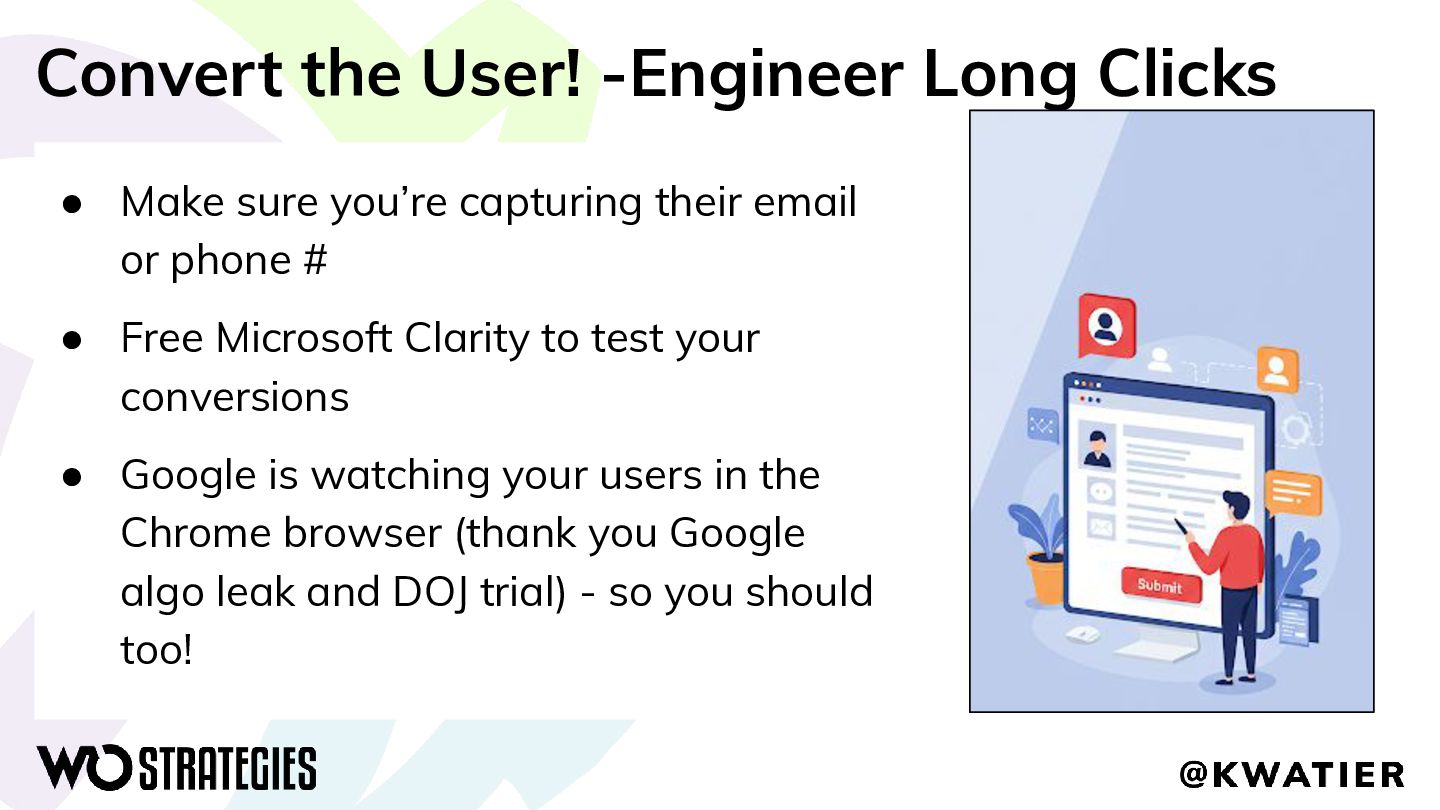
  59. Convert the User! -Engineer Long Clicks • Make sure you’re

    capturing their email or phone # • Free Microsoft Clarity to test your conversions • Google is watching your users in the Chrome browser (thank you Google algo leak and DOJ trial) - so you should too!
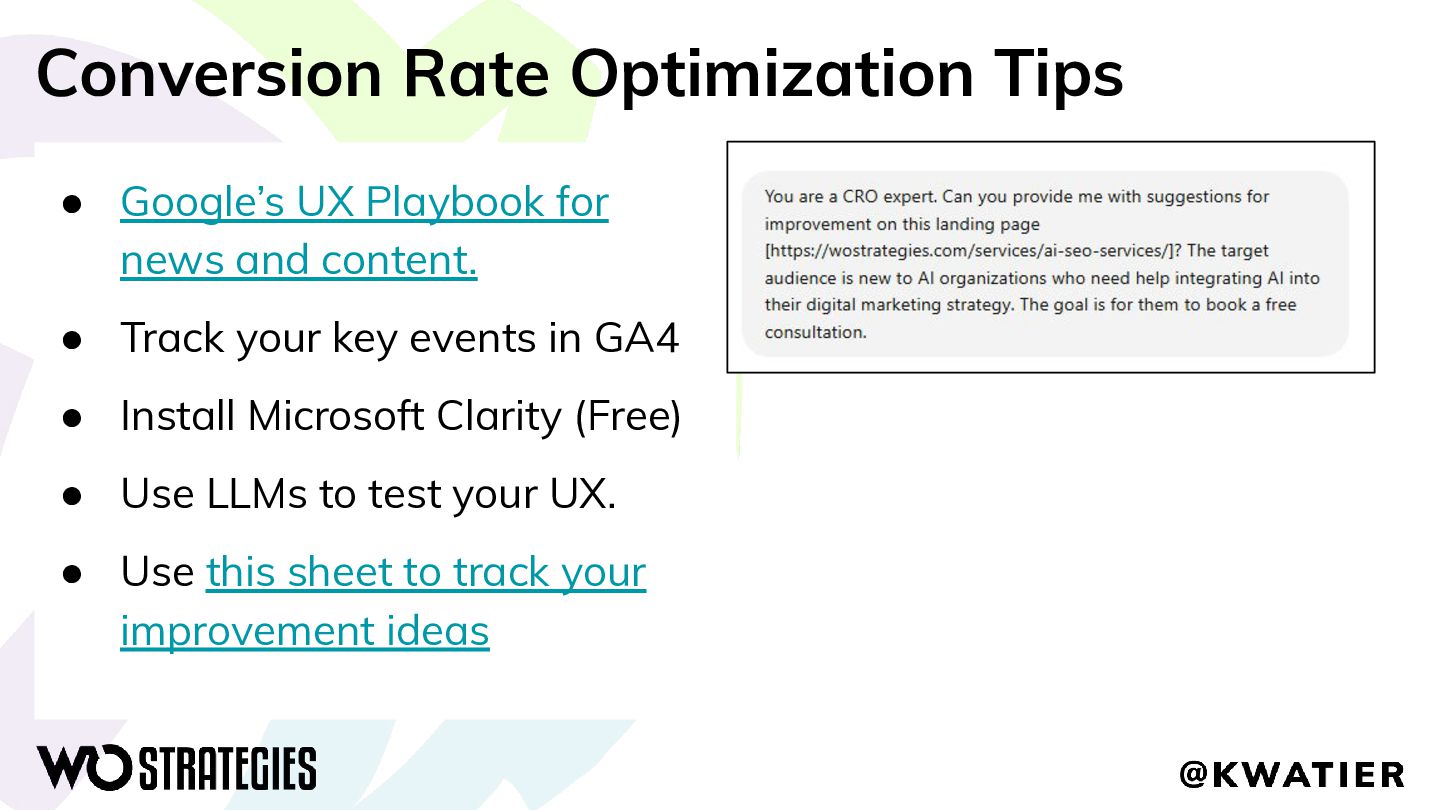
  60. Conversion Rate Optimization Tips • Google’s UX Playbook for news

    and content. • Track your key events in GA4 • Install Microsoft Clarity (Free) • Use LLMs to test your UX. • Use this sheet to track your improvement ideas
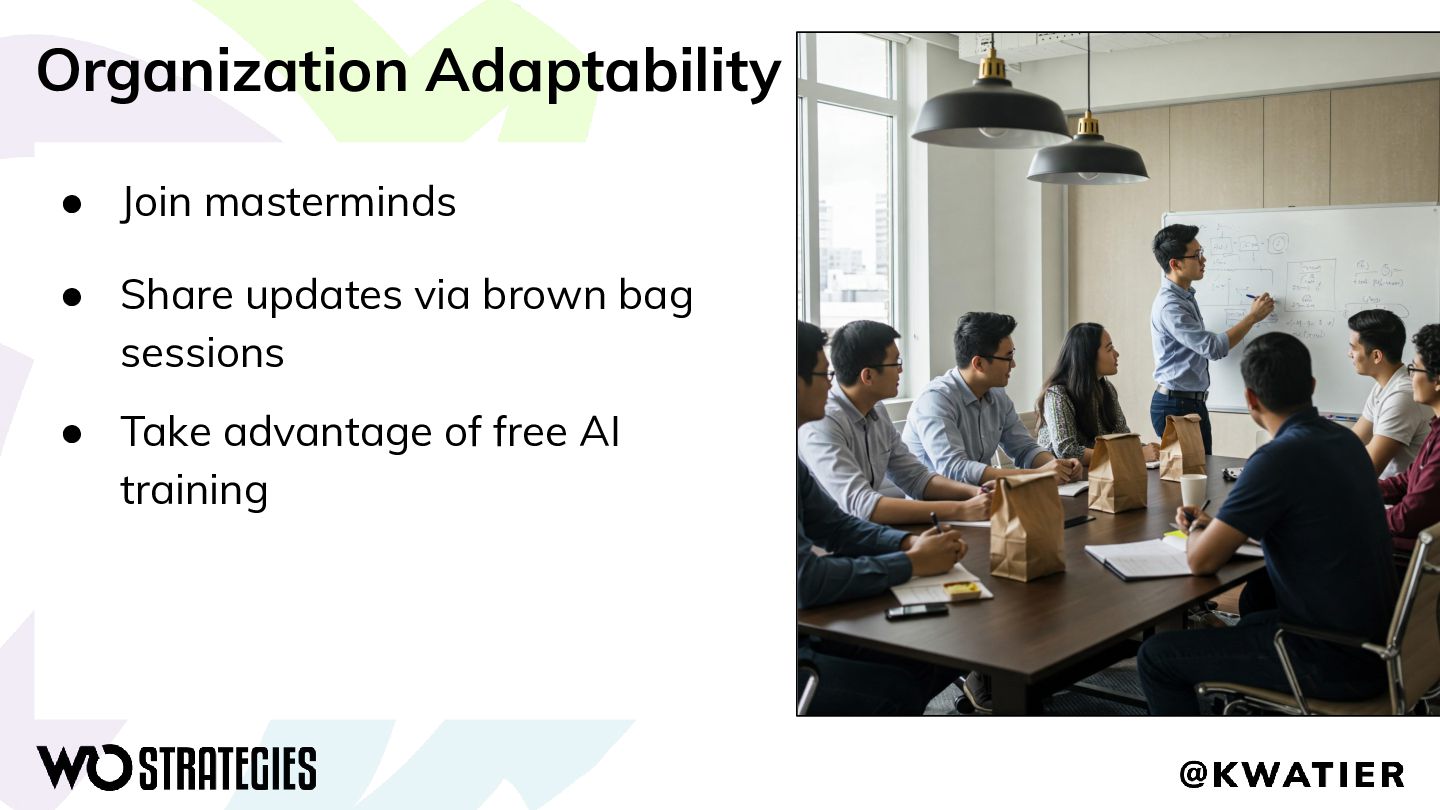
  61. Organization Adaptability • Join masterminds • Share updates via brown

    bag sessions • Take advantage of free AI training
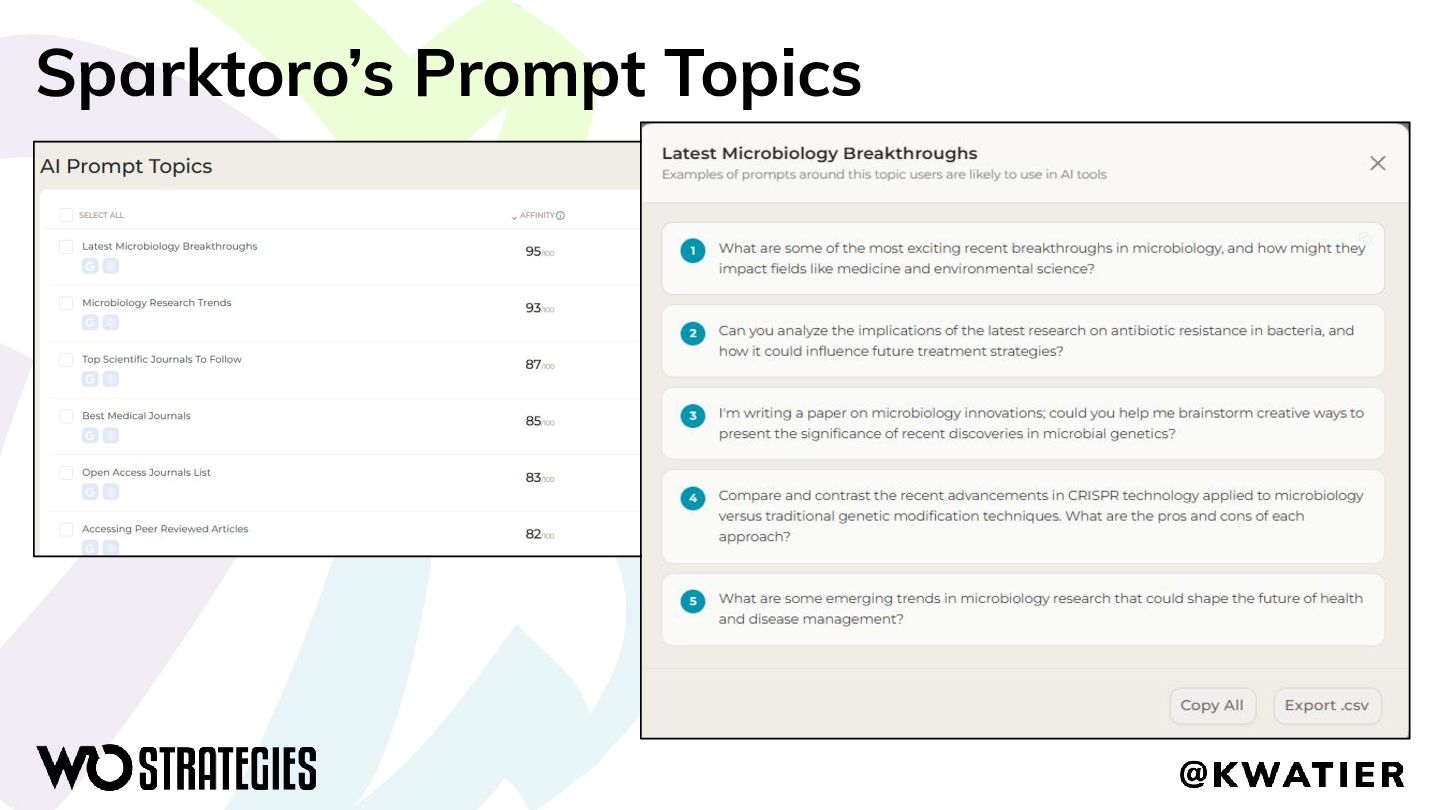
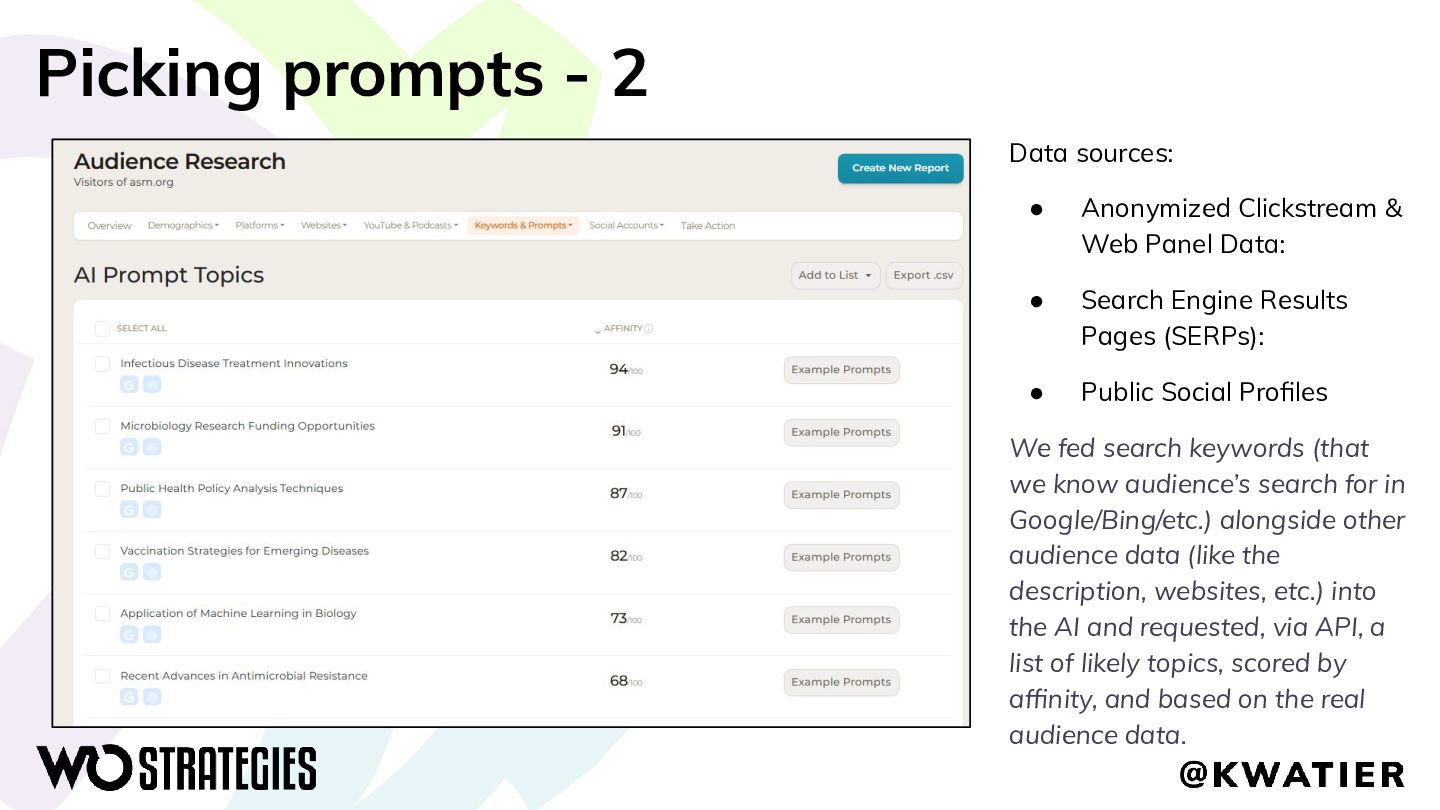
  62. Picking prompts - 2 Data sources: • Anonymized Clickstream &

    Web Panel Data: • Search Engine Results Pages (SERPs): • Public Social Profiles We fed search keywords (that we know audience’s search for in Google/Bing/etc.) alongside other audience data (like the description, websites, etc.) into the AI and requested, via API, a list of likely topics, scored by affinity, and based on the real audience data.
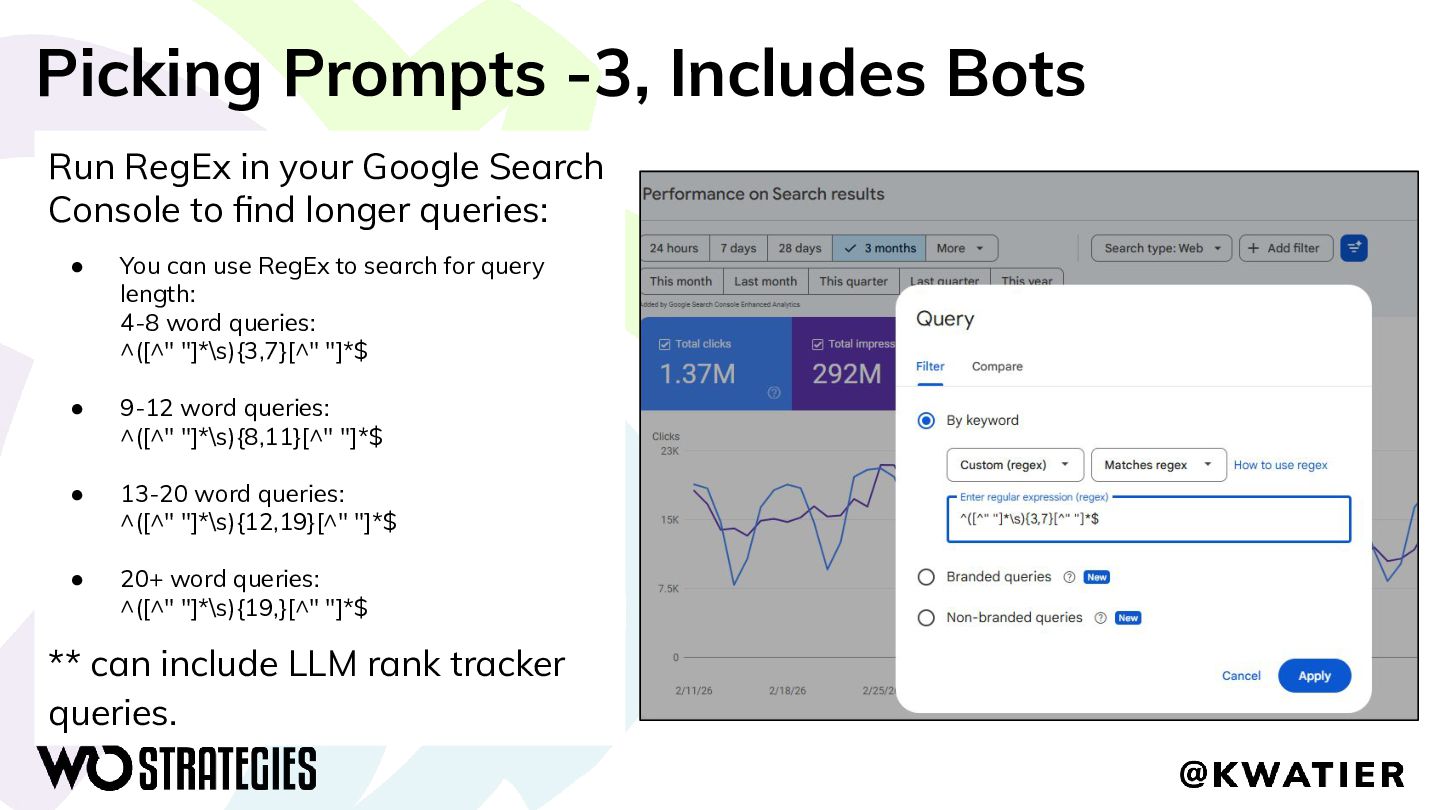
  63. Picking Prompts -3, Includes Bots Run RegEx in your Google

    Search Console to find longer queries: • You can use RegEx to search for query length: 4-8 word queries: ^([^" "]*\s){3,7}[^" "]*$ • 9-12 word queries: ^([^" "]*\s){8,11}[^" "]*$ • 13-20 word queries: ^([^" "]*\s){12,19}[^" "]*$ • 20+ word queries: ^([^" "]*\s){19,}[^" "]*$ ** can include LLM rank tracker queries.
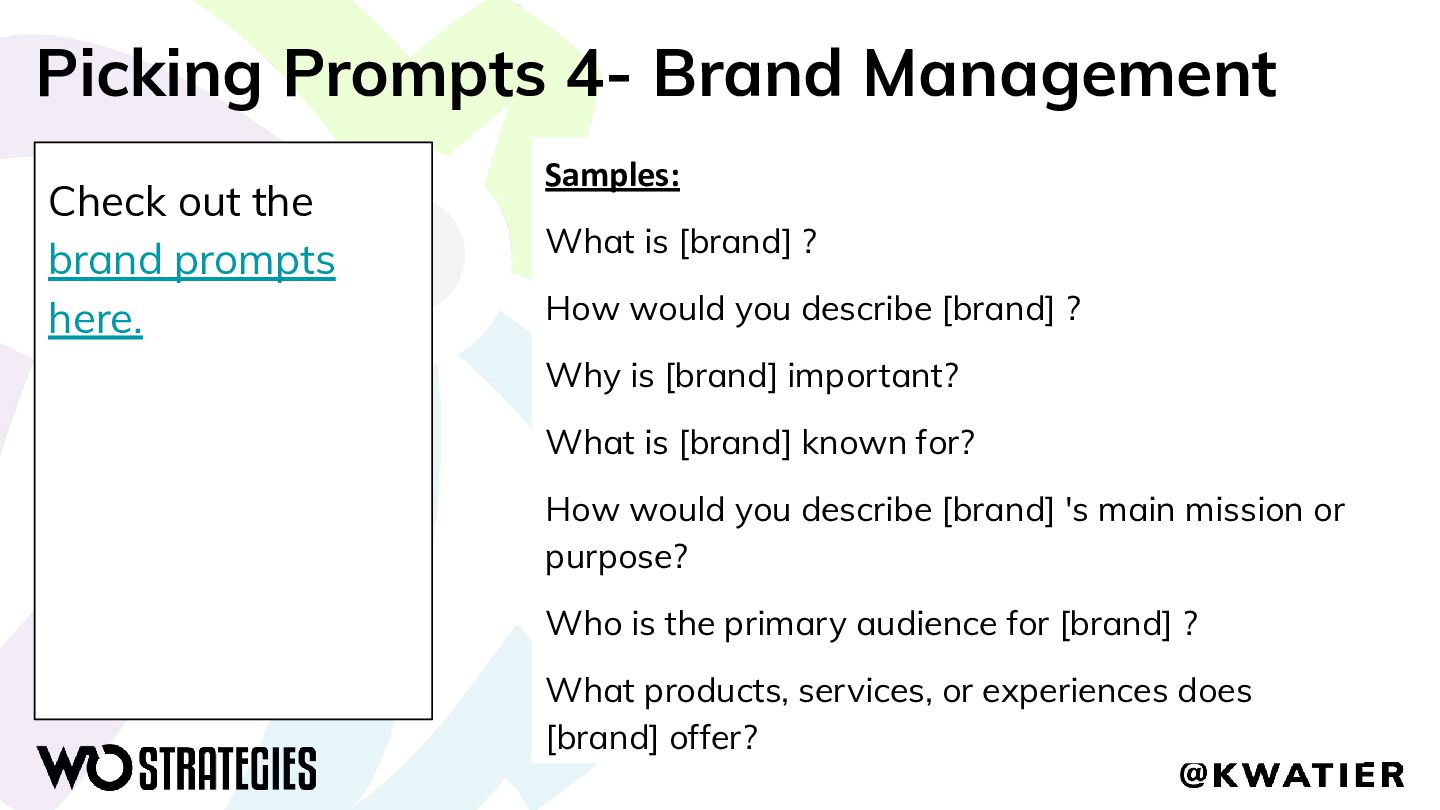
  64. Picking Prompts 4- Brand Management Check out the brand prompts

    here. Samples: What is [brand] ? How would you describe [brand] ? Why is [brand] important? What is [brand] known for? How would you describe [brand] 's main mission or purpose? Who is the primary audience for [brand] ? What products, services, or experiences does [brand] offer?
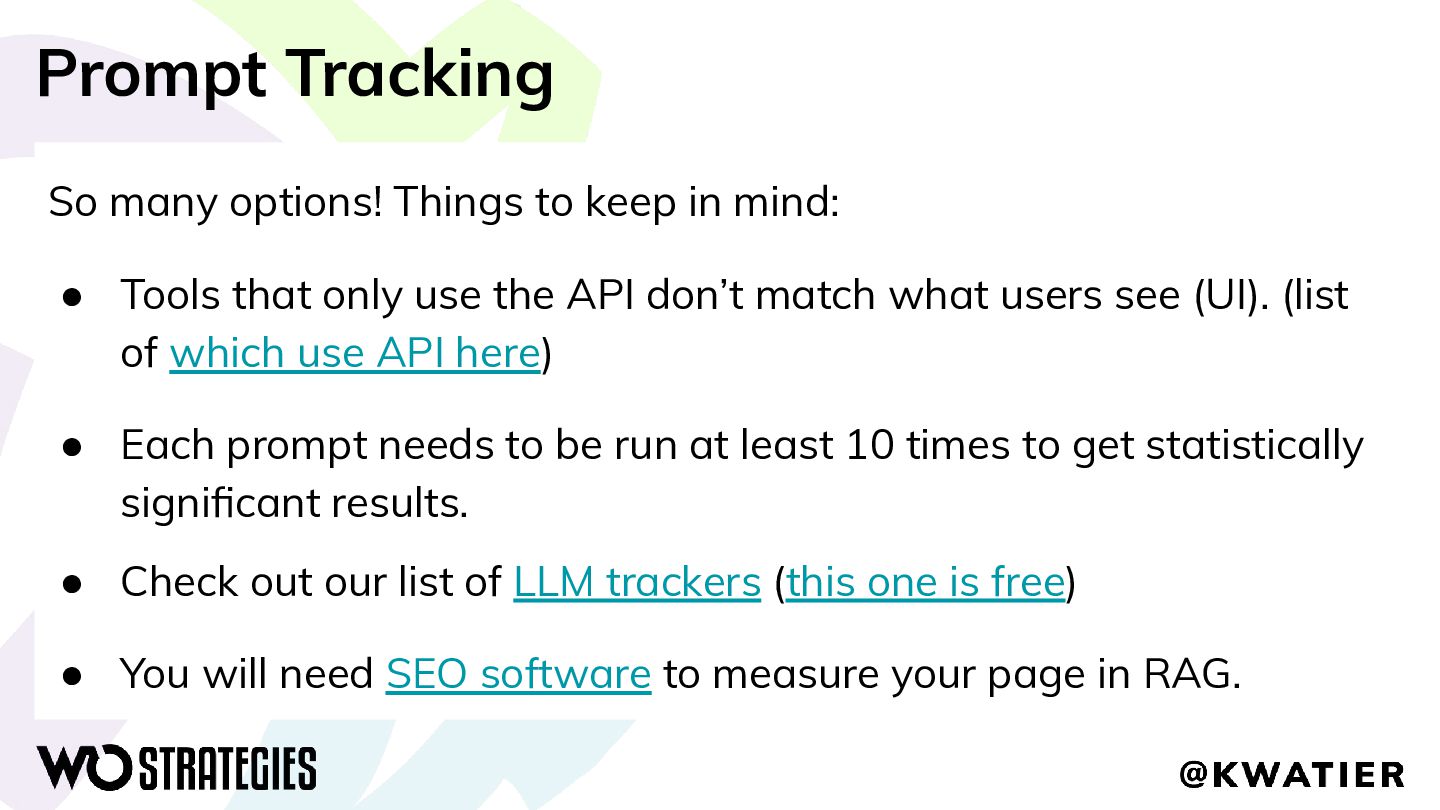
  65. Prompt Tracking So many options! Things to keep in mind:

    • Tools that only use the API don’t match what users see (UI). (list of which use API here) • Each prompt needs to be run at least 10 times to get statistically significant results. • Check out our list of LLM trackers (this one is free) • You will need SEO software to measure your page in RAG.
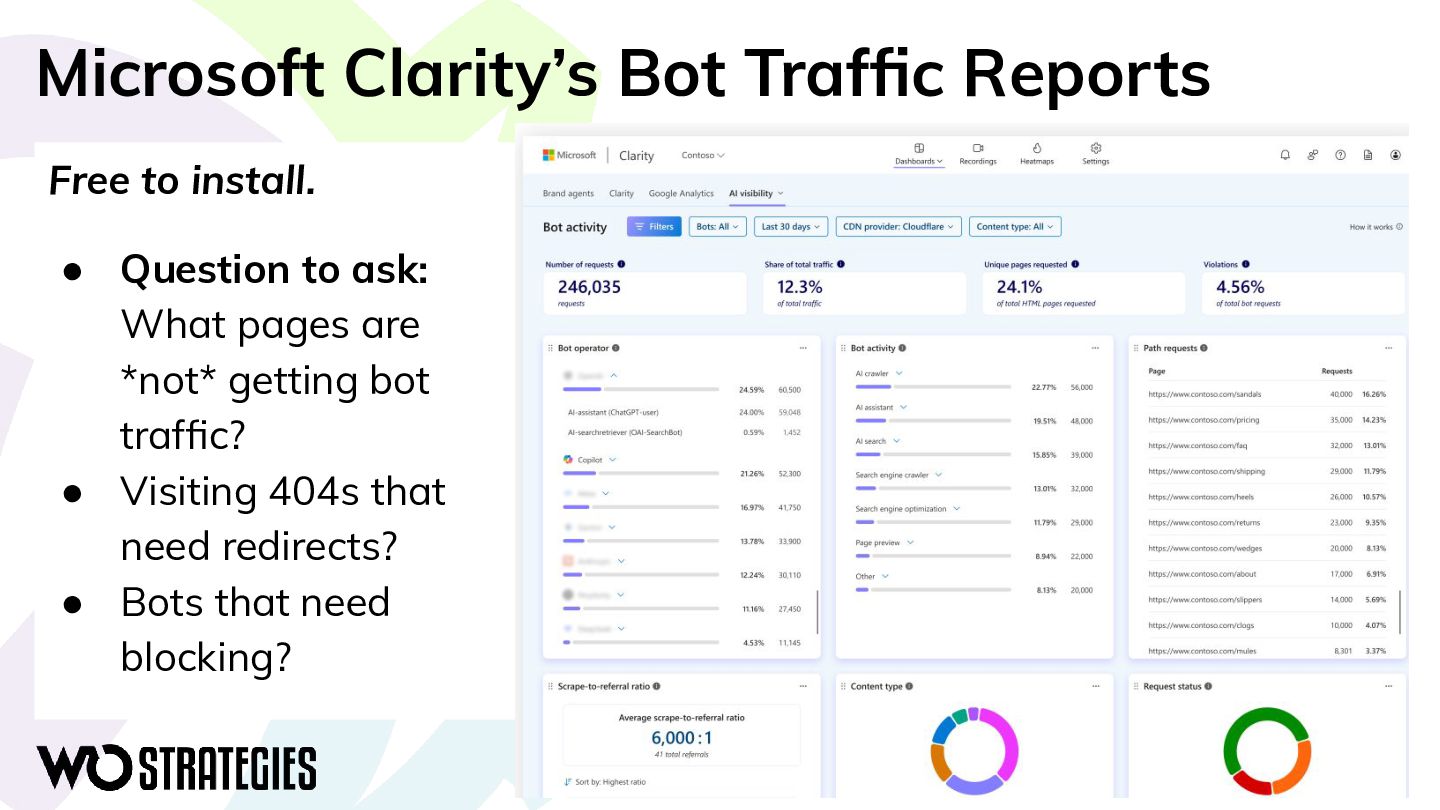
  66. Microsoft Clarity’s Bot Traffic Reports Free to install. • Question

    to ask: What pages are *not* getting bot traffic? • Visiting 404s that need redirects? • Bots that need blocking?
  67. Advanced Reading & Resources • Beyond Cosine similarity • LLM

    Security Issues • Dark SEO • Writing for & Ranking in AI Overviews, AI Mode and LLM Search • AI SEO writing checklist
  68. Bonus Items • Keyword Content Mapping Sheet • SEO Writing

    Guide/Content Brief per main topic • SEO Writing Checklist • Searcher’s Intent tutorial and checklist • Featured Snippets writing guide and checklist • Image Optimization Checklist • Fraggles Writing Checklist • Guide for improving CTR • Optimizing the SERP Snippet Generated with Gemini Advanced