Share
Embed
Performance analysis of mdx II: A next-generation cloud platform for cross- disciplinary data science research
Keichi Takahashi, Tomonori Hayami, Yu Mukaizono, Yuki Teramae, Susumu Date, "Performance analysis of mdx II: A next-generation cloud platform for cross-disciplinary data science research," 15th International Conference on Cloud Computing and Services Science (CLOSER 2025), Apr. 2025.
Keichi Takahashi
April 01, 2025
Transcript
24 slides
-
15th International Conference on Cloud Computing and Services Science (CLOSER
2025) Performance analysis of mdx II: A next-generation cloud platform for cross- disciplinary data science research Keichi Takahashi, Tomonori Hayami, Yu Mukaizono, Yuki Teramae, Susumu Date D3 Center, The University of Osaka, Japan -
Shortcomings of traditional HPC systems • Traditional high-performance computing systems
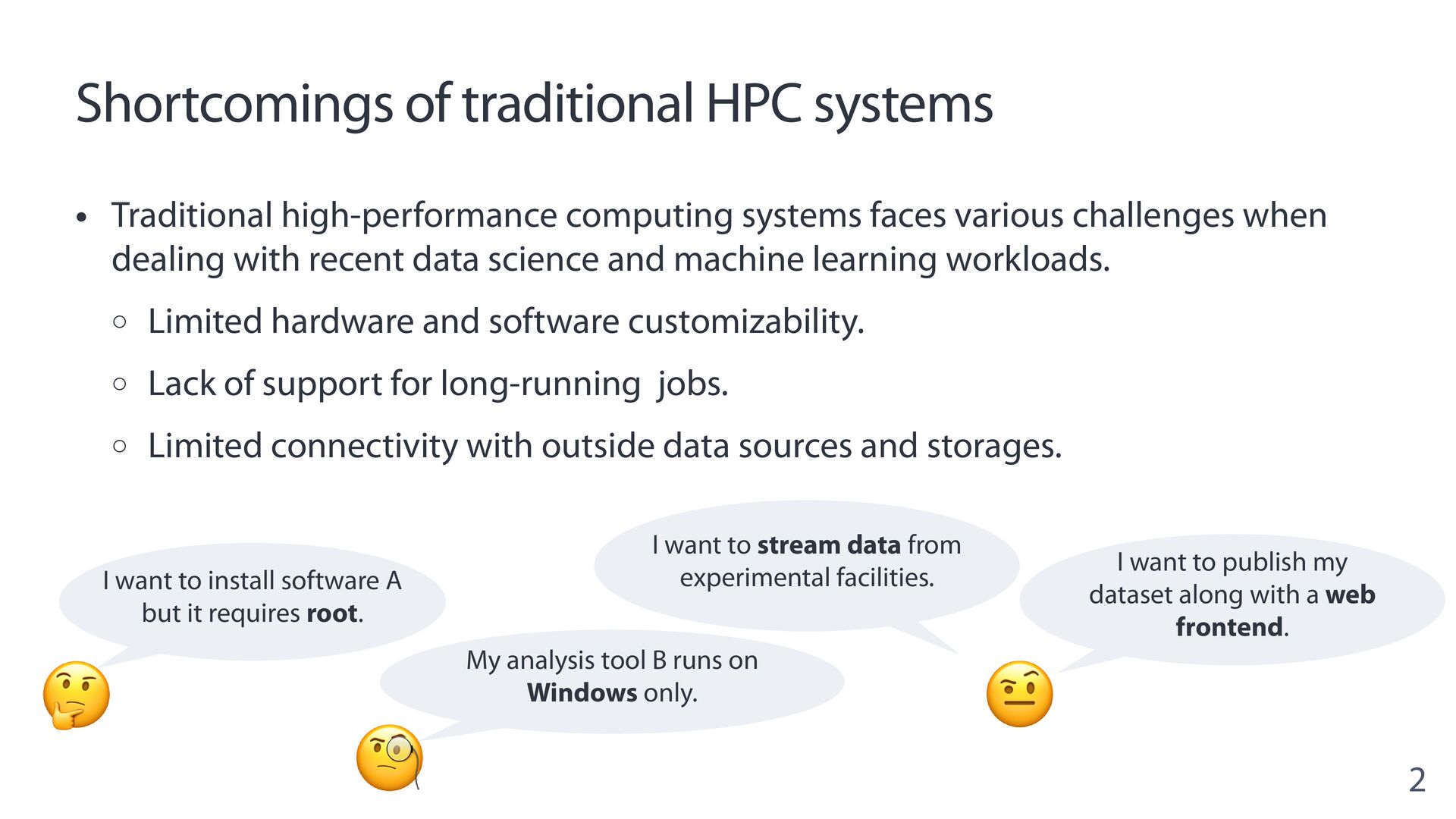
faces various challenges when dealing with recent data science and machine learning workloads. ◦ Limited hardware and software customizability. ◦ Lack of support for long-running jobs. ◦ Limited connectivity with outside data sources and storages. 2 🤔 I want to install software A but it requires root. My analysis tool B runs on Windows only. 🧐 I want to publish my dataset along with a web frontend. I want to stream data from experimental facilities. 🤨 -
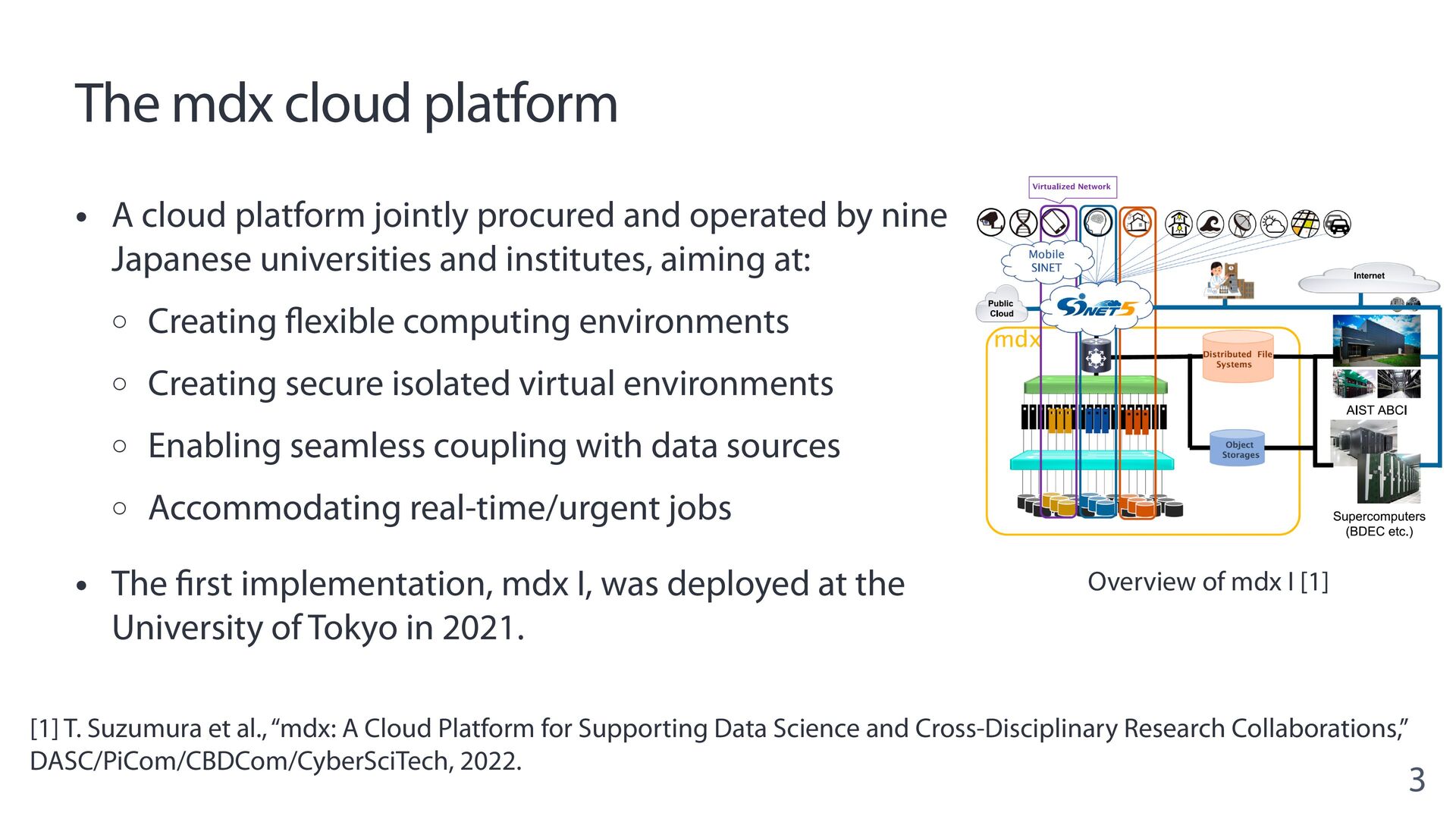
The mdx cloud platform • A cloud platform jointly procured
and operated by nine Japanese universities and institutes, aiming at: ◦ Creating fl exible computing environments ◦ Creating secure isolated virtual environments ◦ Enabling seamless coupling with data sources ◦ Accommodating real-time/urgent jobs • The fi rst implementation, mdx I, was deployed at the University of Tokyo in 2021. 3 Overview of mdx I [1] [1] T. Suzumura et al., “mdx: A Cloud Platform for Supporting Data Science and Cross-Disciplinary Research Collaborations,” DASC/PiCom/CBDCom/CyberSciTech, 2022. -
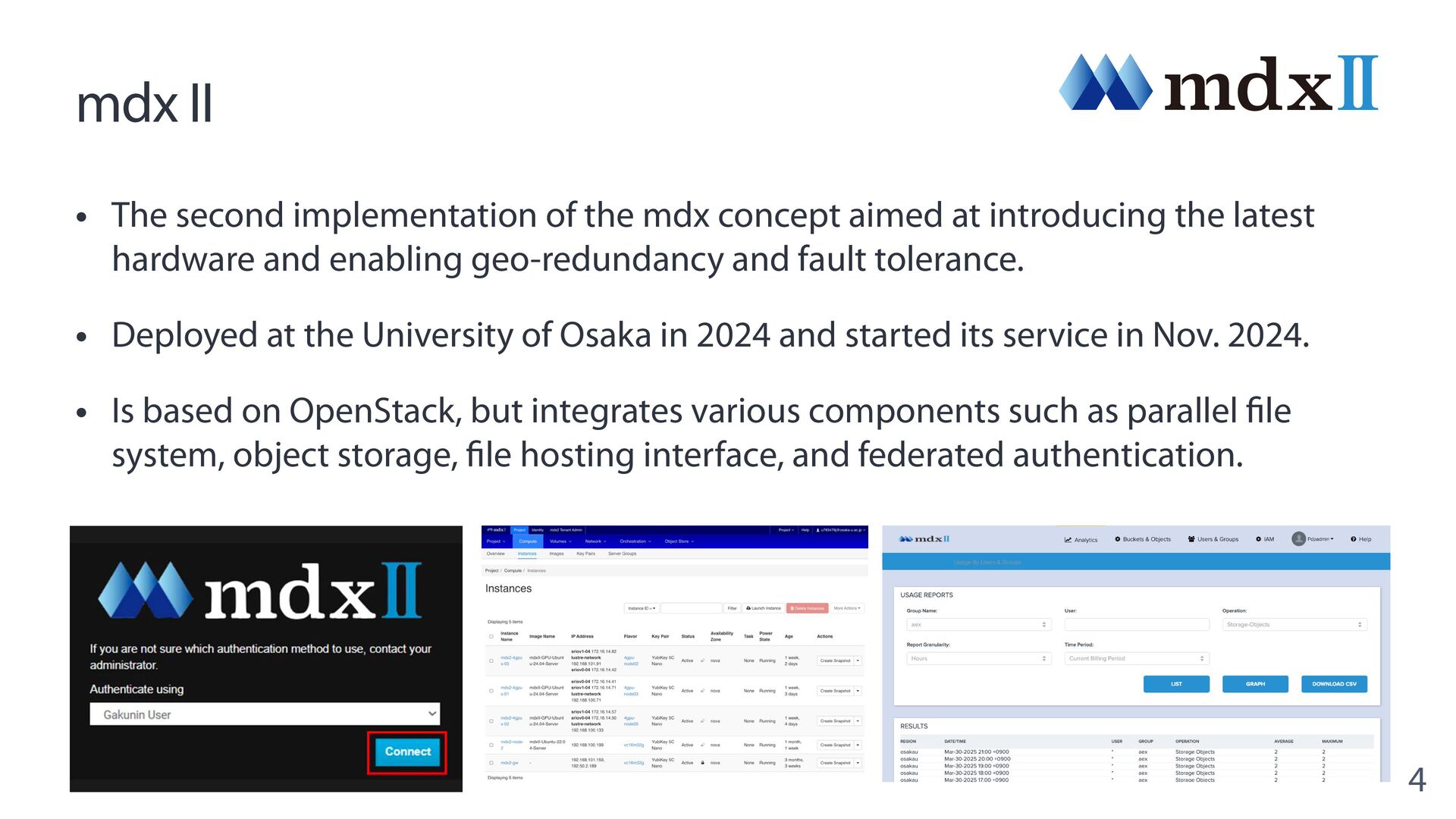
mdx II • The second implementation of the mdx concept
aimed at introducing the latest hardware and enabling geo-redundancy and fault tolerance. • Deployed at the University of Osaka in 2024 and started its service in Nov. 2024. • Is based on OpenStack, but integrates various components such as parallel fi le system, object storage, fi le hosting interface, and federated authentication. 4 -
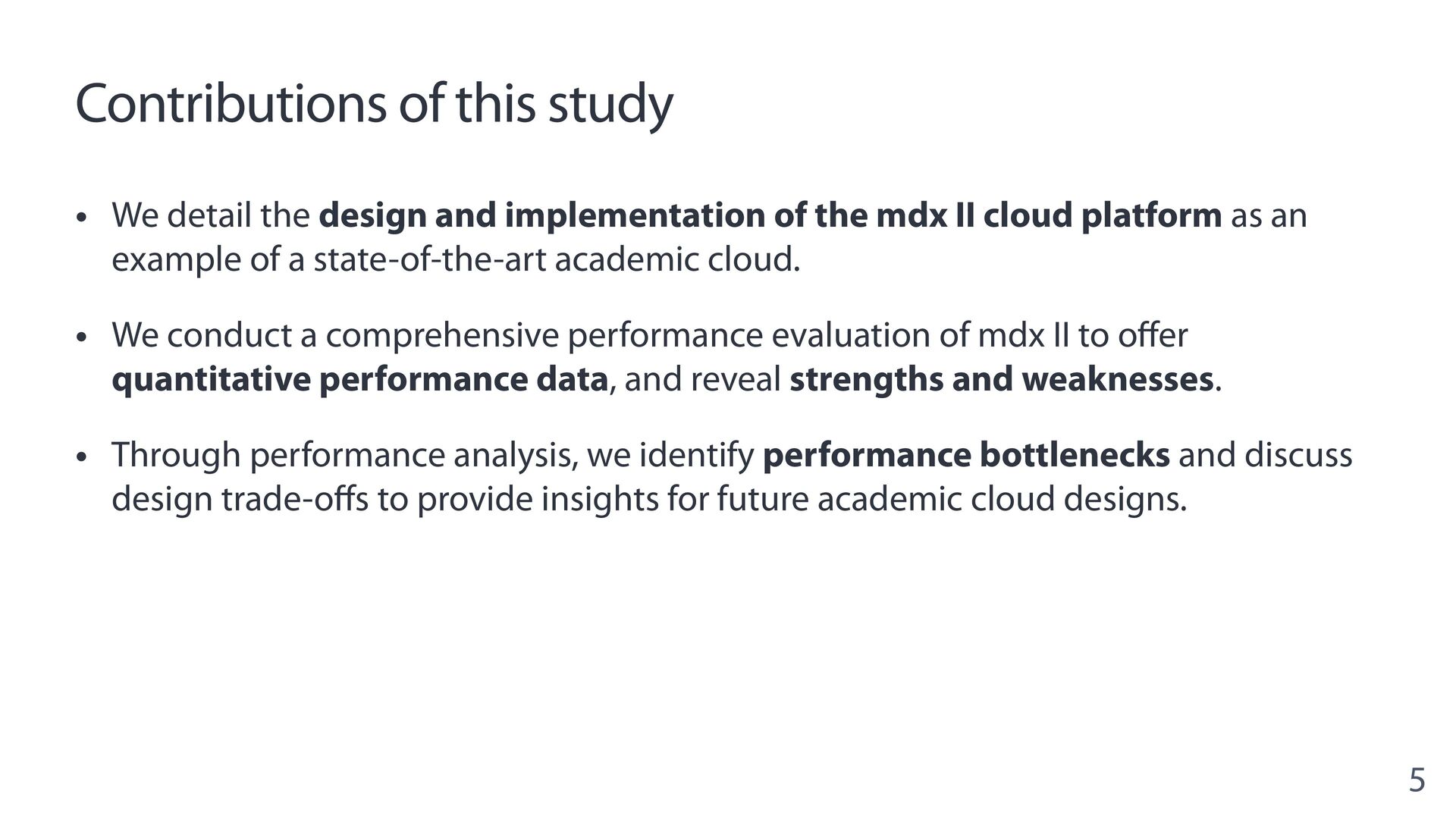
Contributions of this study • We detail the design and
implementation of the mdx II cloud platform as an example of a state-of-the-art academic cloud. • We conduct a comprehensive performance evaluation of mdx II to o ff er quantitative performance data, and reveal strengths and weaknesses. • Through performance analysis, we identify performance bottlenecks and discuss design trade-o ff s to provide insights for future academic cloud designs. 5 -
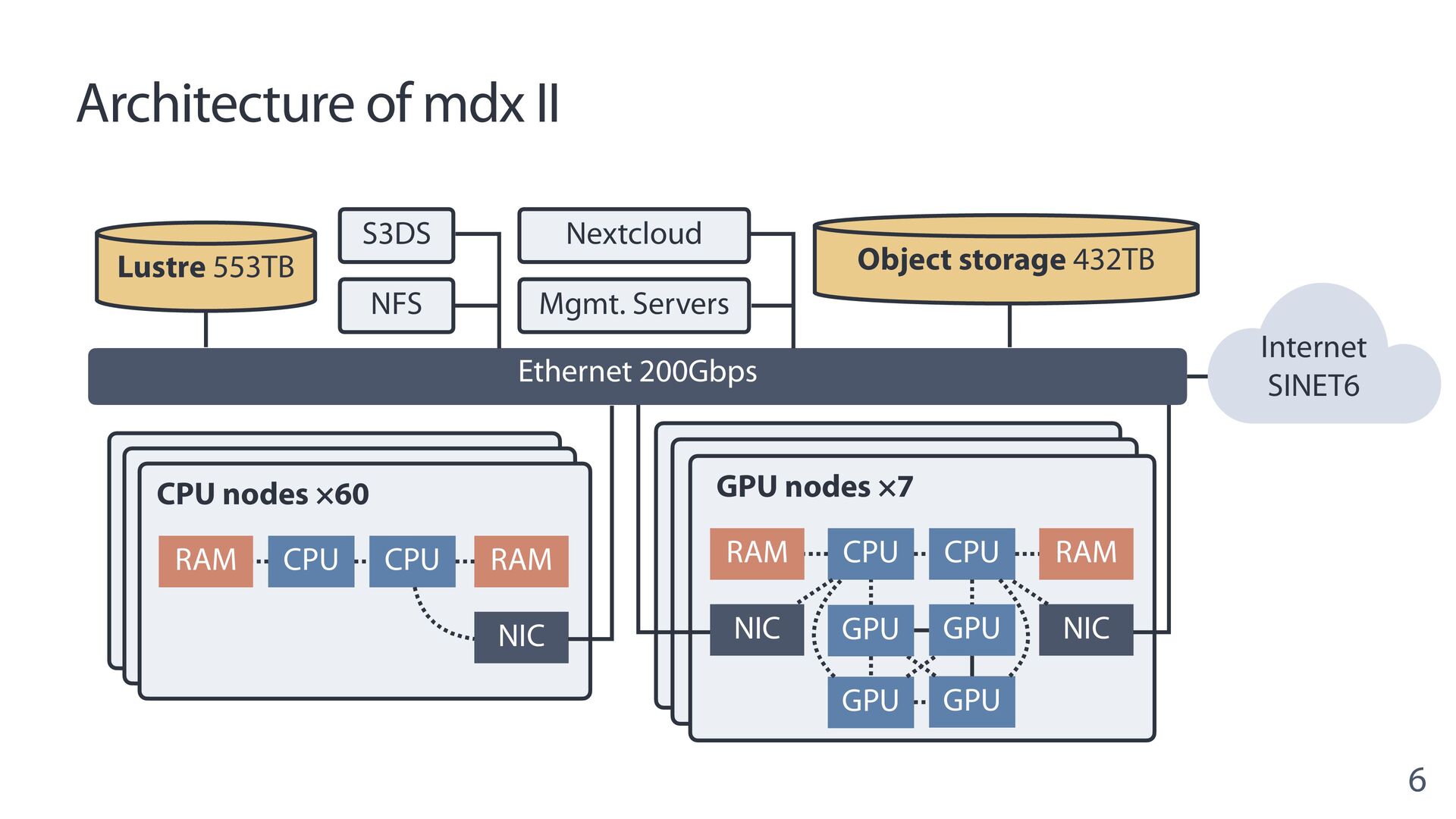
Architecture of mdx II 6 CPU nodes ×60 CPU CPU
NIC RAM RAM GPU nodes ×7 CPU CPU NIC RAM RAM GPU GPU NIC Ethernet 200Gbps GPU GPU NFS S3DS Nextcloud Object storage 432TB Lustre 553TB Mgmt. Servers Internet SINET6 -
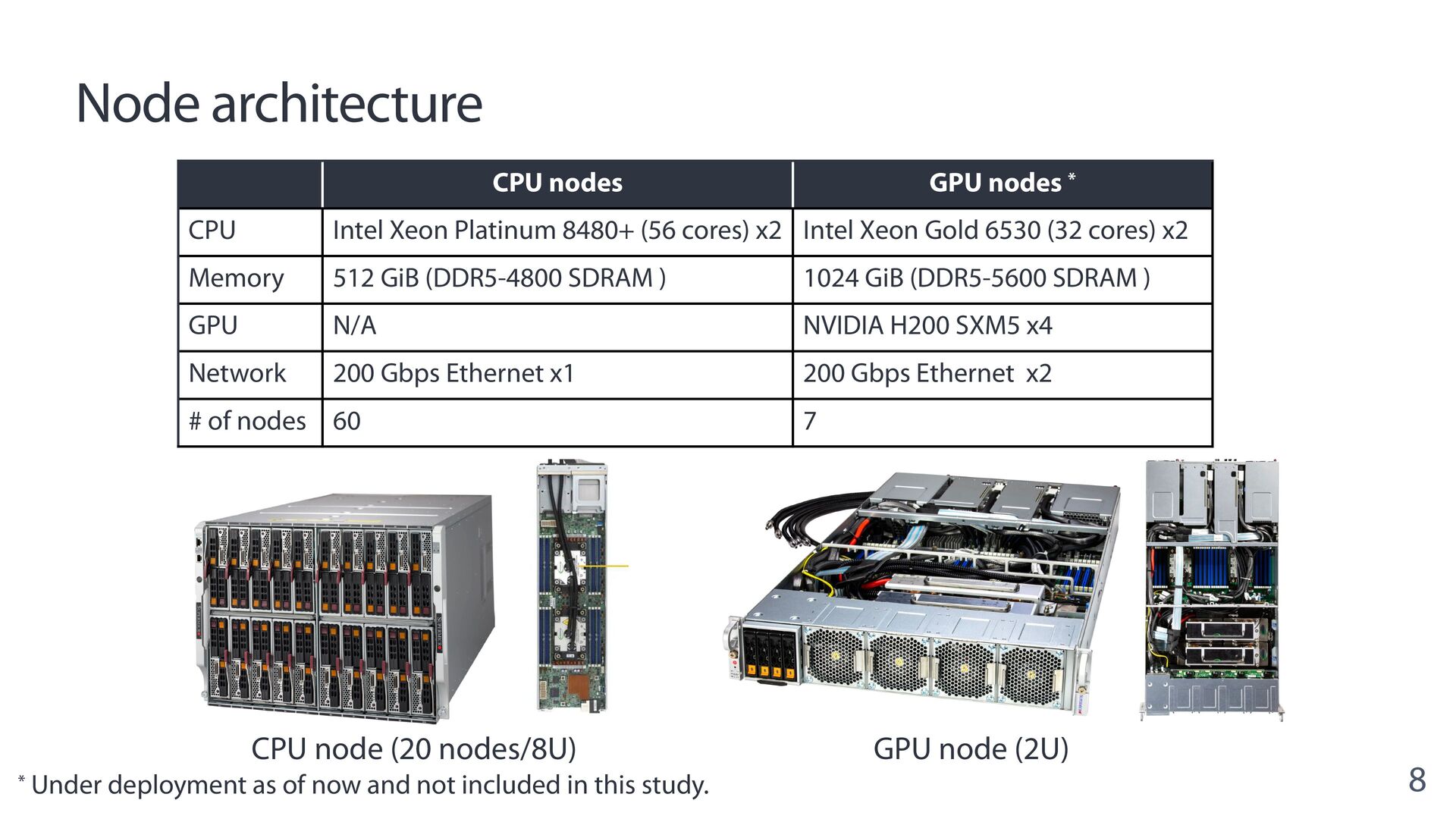
Node architecture 8 CPU nodes GPU nodes * CPU Intel
Xeon Platinum 8480+ (56 cores) x2 Intel Xeon Gold 6530 (32 cores) x2 Memory 512 GiB (DDR5-4800 SDRAM ) 1024 GiB (DDR5-5600 SDRAM ) GPU N/A NVIDIA H200 SXM5 x4 Network 200 Gbps Ethernet x1 200 Gbps Ethernet x2 # of nodes 60 7 CPU node (20 nodes/8U) GPU node (2U) * Under deployment as of now and not included in this study. -
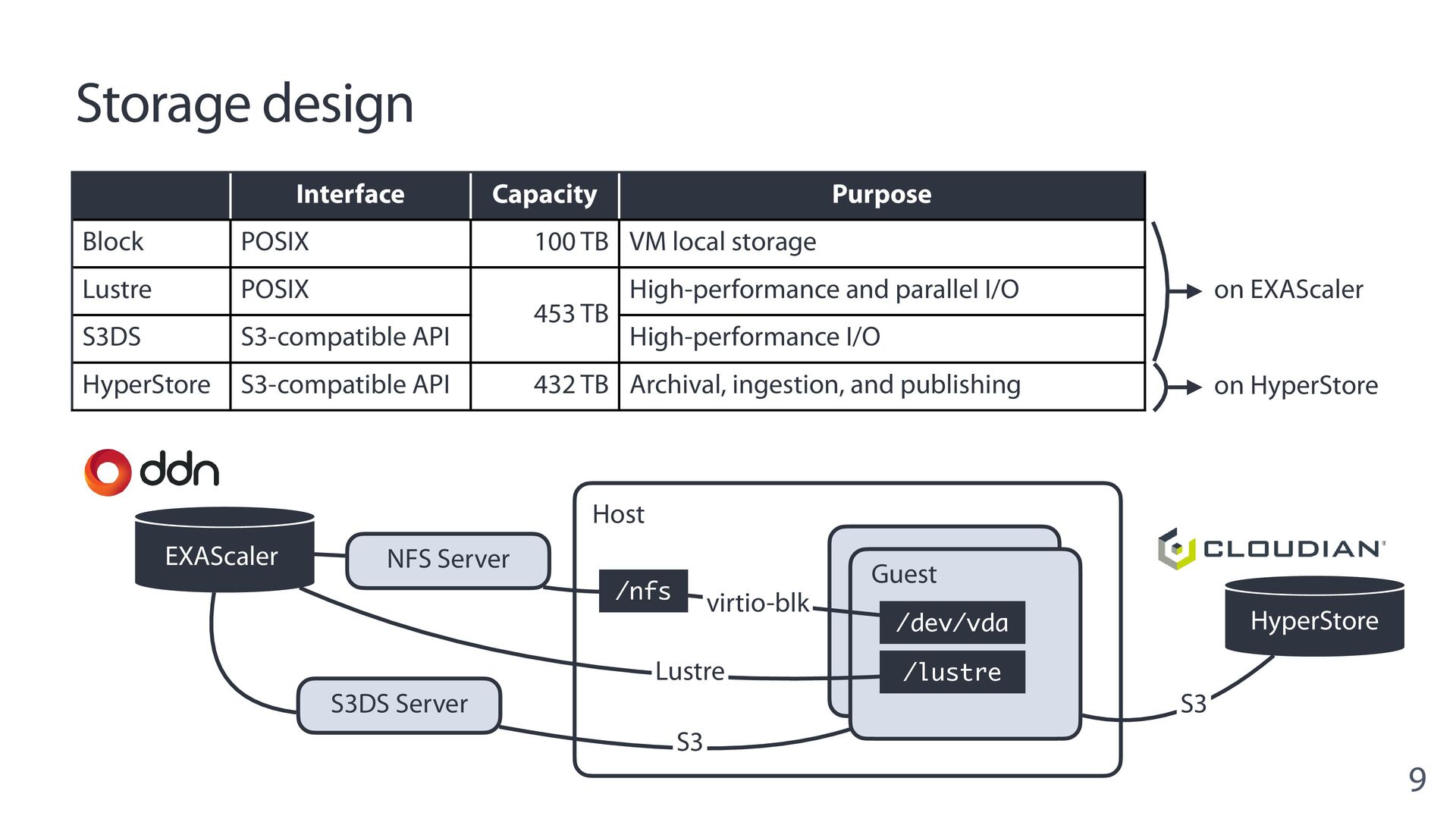
Storage design 9 Interface Capacity Purpose Block POSIX 100 TB
VM local storage Lustre POSIX 453 TB High-performance and parallel I/O S3DS S3-compatible API High-performance I/O HyperStore S3-compatible API 432 TB Archival, ingestion, and publishing /dev/vda /lustre /nfs virtio-blk Host Guest Lustre NFS Server S3DS Server EXAScaler HyperStore S3 S3 on EXAScaler on HyperStore -
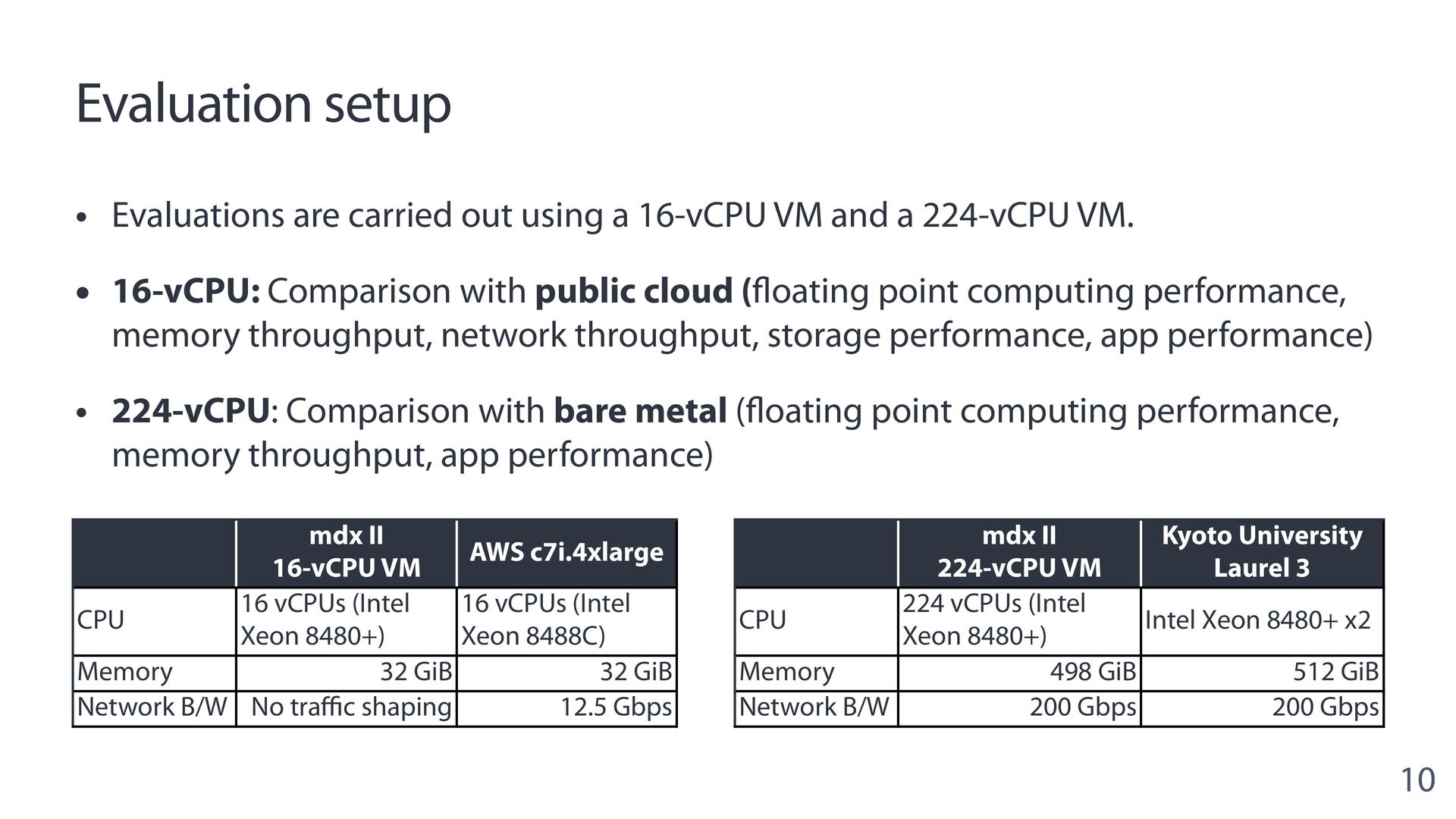
Evaluation setup • Evaluations are carried out using a 16-vCPU
VM and a 224-vCPU VM. • 16-vCPU: Comparison with public cloud ( fl oating point computing performance, memory throughput, network throughput, storage performance, app performance) • 224-vCPU: Comparison with bare metal ( fl oating point computing performance, memory throughput, app performance) 10 mdx II 16-vCPU VM AWS c7i.4xlarge CPU 16 vCPUs (Intel Xeon 8480+) 16 vCPUs (Intel Xeon 8488C) Memory 32 GiB 32 GiB Network B/W No tra ffi c shaping 12.5 Gbps mdx II 224-vCPU VM Kyoto University Laurel 3 CPU 224 vCPUs (Intel Xeon 8480+) Intel Xeon 8480+ x2 Memory 498 GiB 512 GiB Network B/W 200 Gbps 200 Gbps -
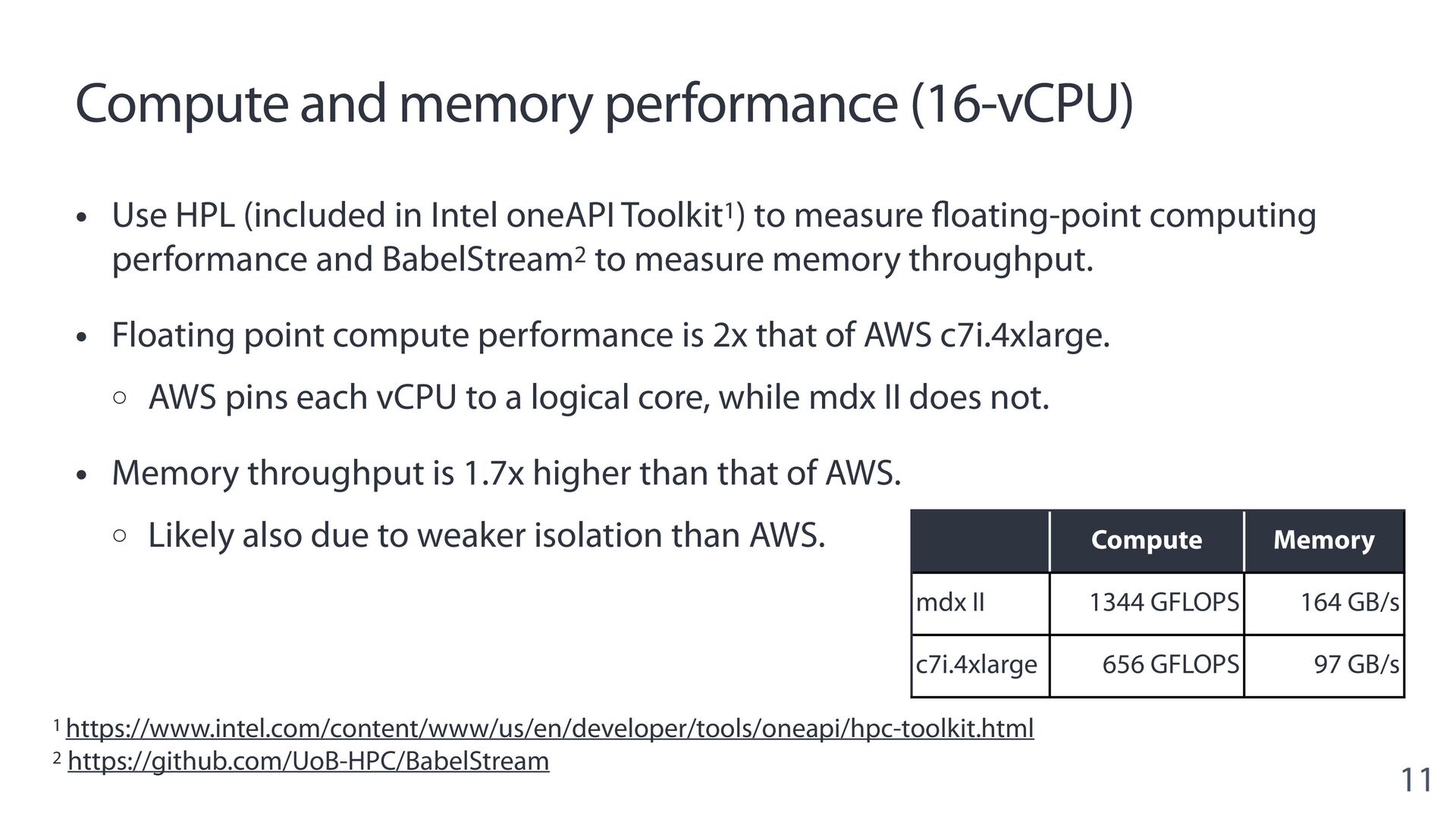
Compute and memory performance (16-vCPU) • Use HPL (included in
Intel oneAPI Toolkit1) to measure fl oating-point computing performance and BabelStream2 to measure memory throughput. • Floating point compute performance is 2x that of AWS c7i.4xlarge. ◦ AWS pins each vCPU to a logical core, while mdx II does not. • Memory throughput is 1.7x higher than that of AWS. ◦ Likely also due to weaker isolation than AWS. 11 1 https://www.intel.com/content/www/us/en/developer/tools/oneapi/hpc-toolkit.html 2 https://github.com/UoB-HPC/BabelStream Compute Memory mdx II 1344 GFLOPS 164 GB/s c7i.4xlarge 656 GFLOPS 97 GB/s -
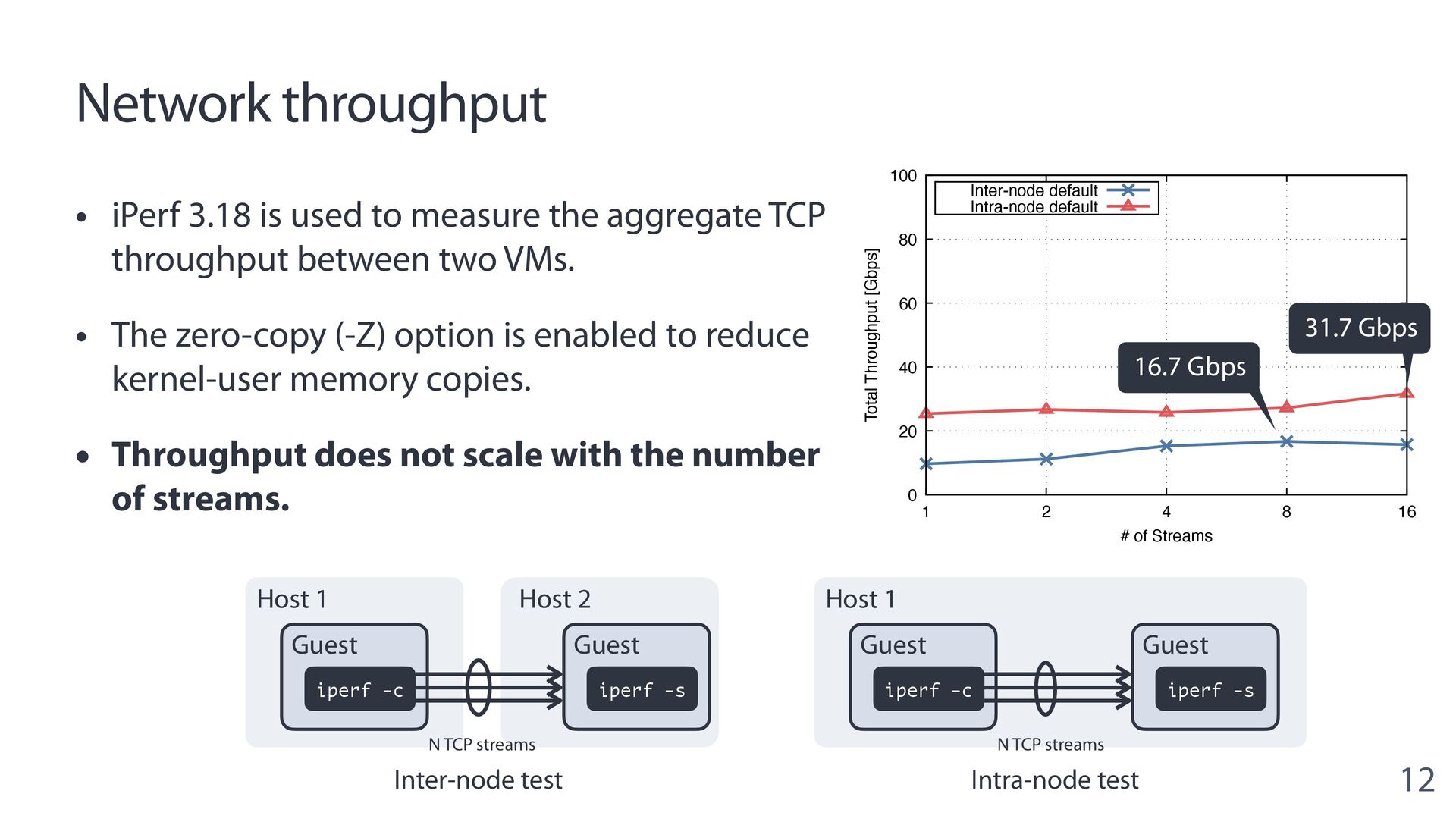
Network throughput • iPerf 3.18 is used to measure the
aggregate TCP throughput between two VMs. • The zero-copy (-Z) option is enabled to reduce kernel-user memory copies. • Throughput does not scale with the number of streams. 12 0 20 40 60 80 100 1 2 4 8 16 Inter-node default Intra-node default Total Throughput [Gbps] # of Streams Host 1 Host 2 Inter-node test Intra-node test N TCP streams 16.7 Gbps 31.7 Gbps Guest iperf -c Guest iperf -s Host 1 N TCP streams Guest iperf -c Guest iperf -s -
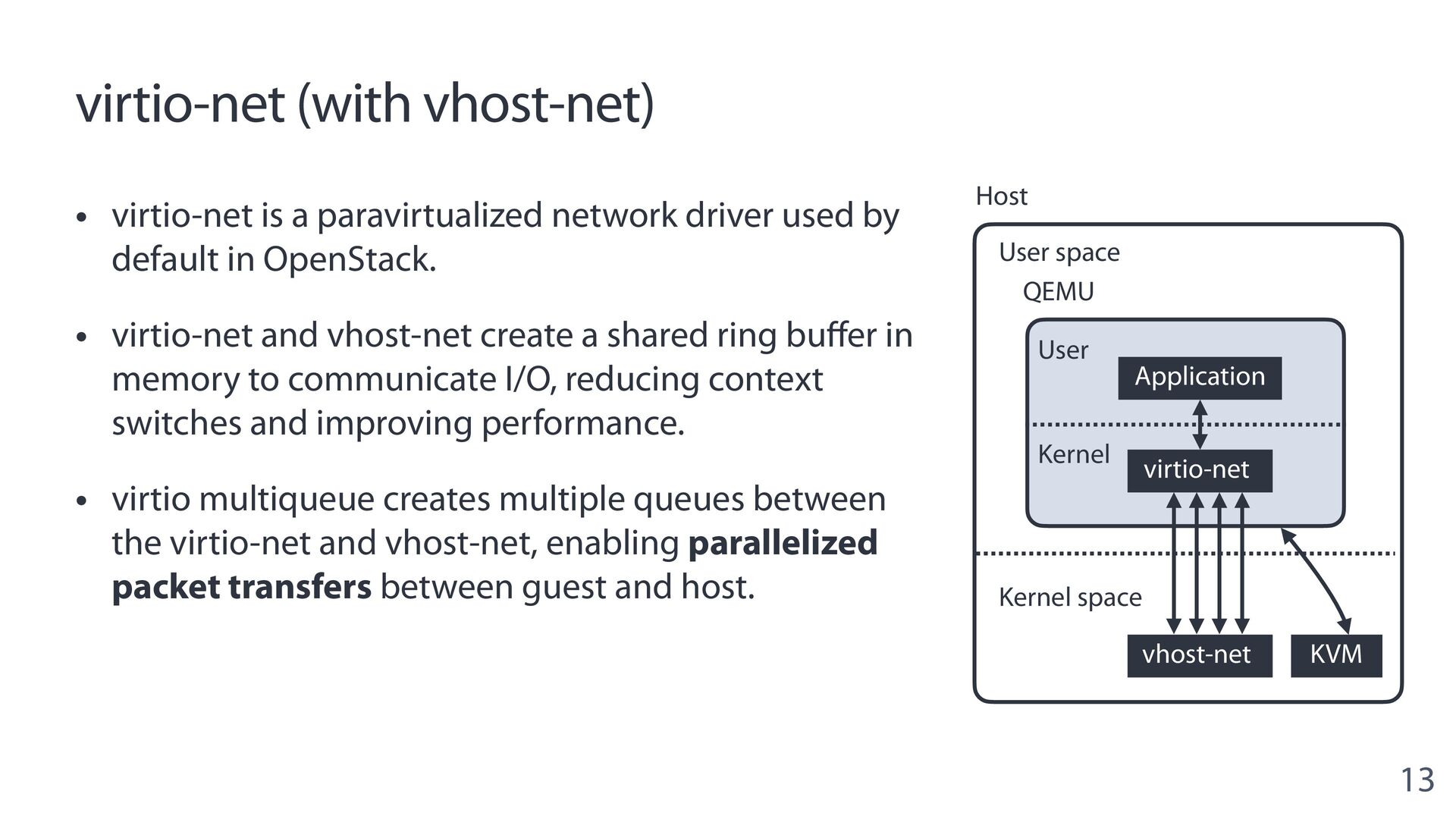
virtio-net (with vhost-net) • virtio-net is a paravirtualized network driver
used by default in OpenStack. • virtio-net and vhost-net create a shared ring bu ff er in memory to communicate I/O, reducing context switches and improving performance. • virtio multiqueue creates multiple queues between the virtio-net and vhost-net, enabling parallelized packet transfers between guest and host. 13 Host Kernel User KVM virtio-net Application QEMU User space Kernel space vhost-net -
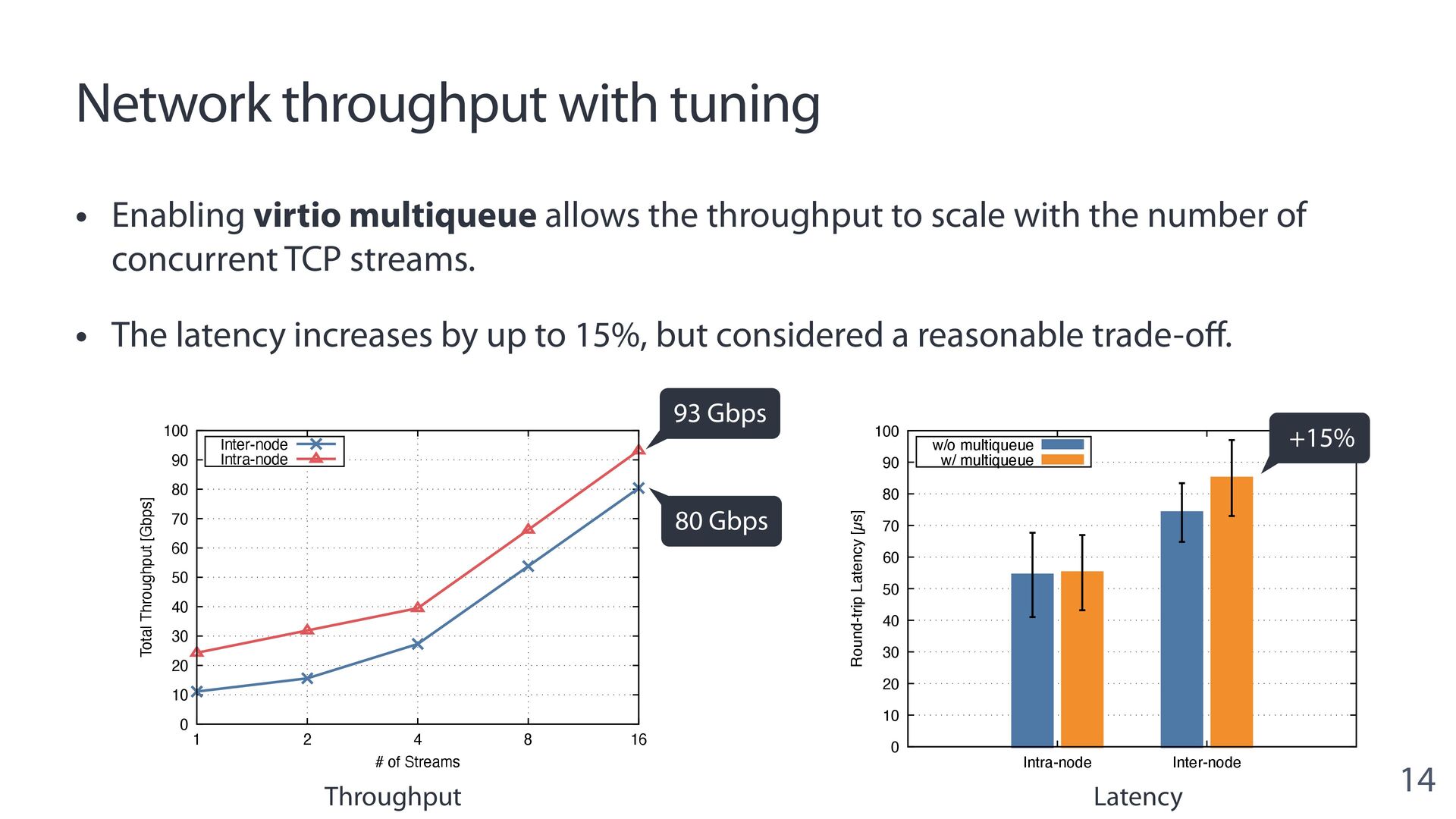
Network throughput with tuning • Enabling virtio multiqueue allows the
throughput to scale with the number of concurrent TCP streams. • The latency increases by up to 15%, but considered a reasonable trade-o ff . 14 0 10 20 30 40 50 60 70 80 90 100 Intra-node Inter-node w/o multiqueue w/ multiqueue Round-trip Latency [µs] 0 10 20 30 40 50 60 70 80 90 100 1 2 4 8 16 Inter-node Intra-node Total Throughput [Gbps] # of Streams Latency Throughput 93 Gbps 80 Gbps +15% -
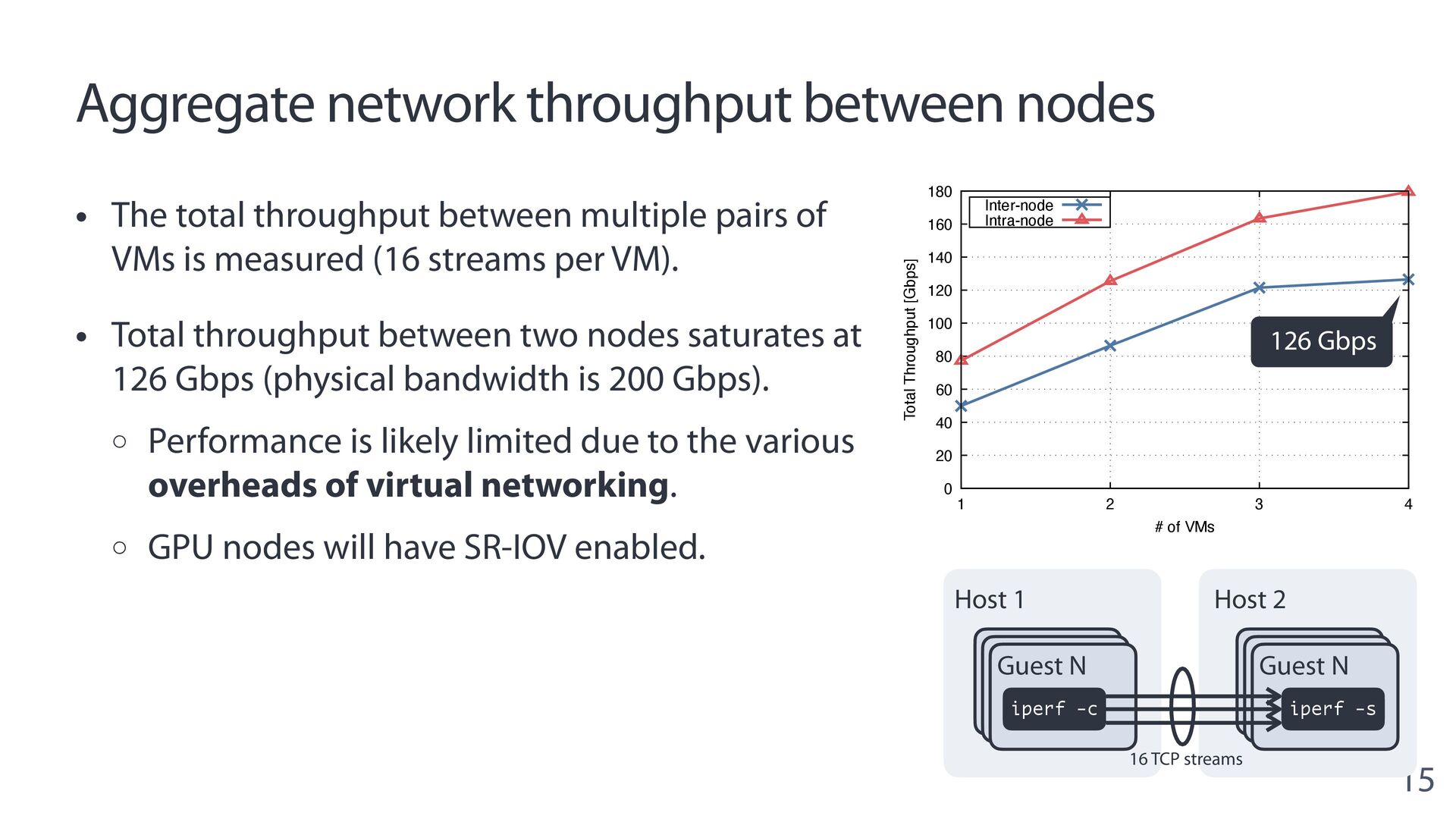
Aggregate network throughput between nodes • The total throughput between
multiple pairs of VMs is measured (16 streams per VM). • Total throughput between two nodes saturates at 126 Gbps (physical bandwidth is 200 Gbps). ◦ Performance is likely limited due to the various overheads of virtual networking. ◦ GPU nodes will have SR-IOV enabled. 15 0 20 40 60 80 100 120 140 160 180 1 2 3 4 Inter-node Intra-node Total Throughput [Gbps] # of VMs 126 Gbps Host 1 Host 2 Guest N Guest N 16 TCP streams iperf -c iperf -s -
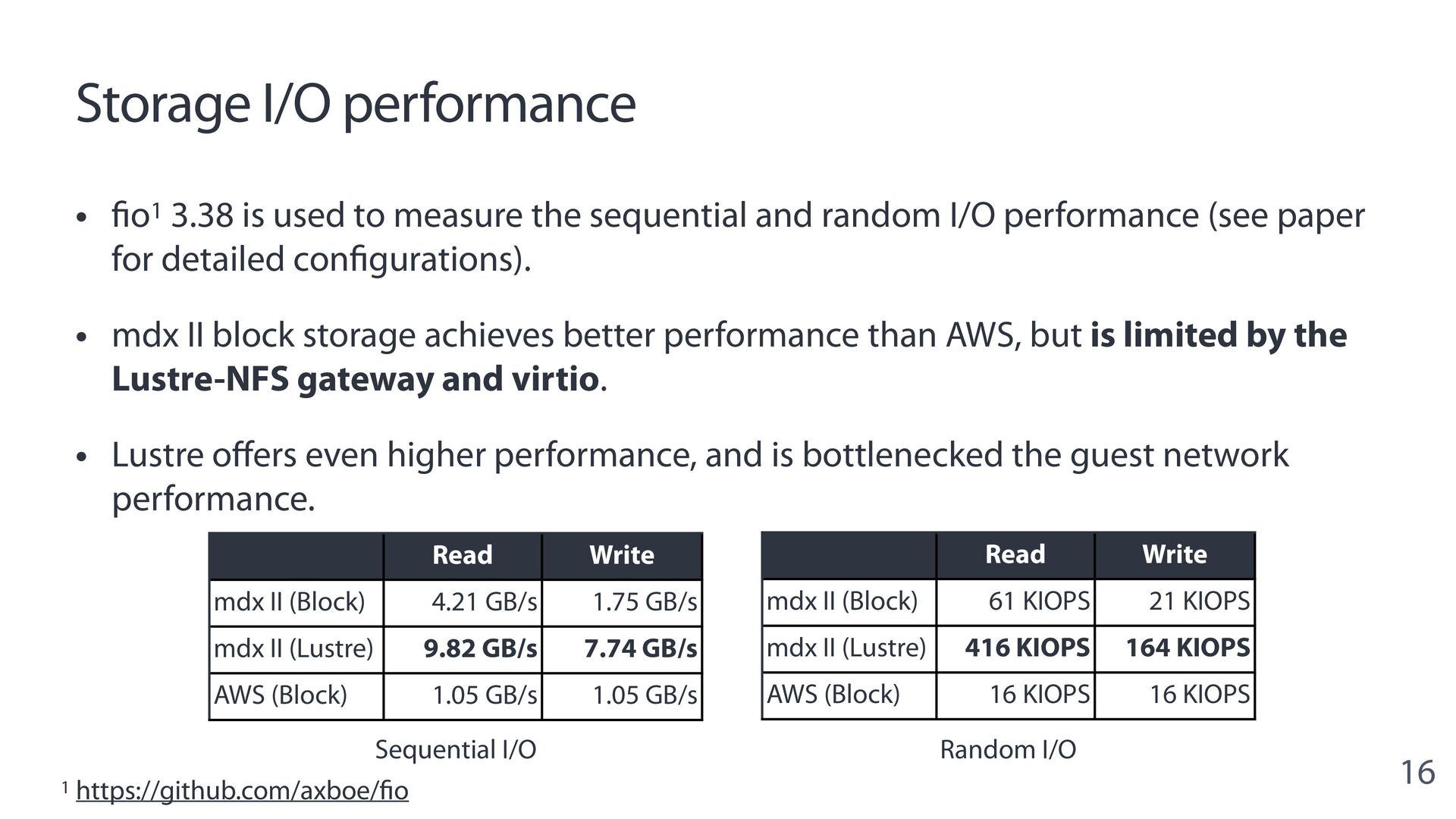
Storage I/O performance • fi o1 3.38 is used to
measure the sequential and random I/O performance (see paper for detailed con fi gurations). • mdx II block storage achieves better performance than AWS, but is limited by the Lustre-NFS gateway and virtio. • Lustre o ff ers even higher performance, and is bottlenecked the guest network performance. 16 Read Write mdx II (Block) 4.21 GB/s 1.75 GB/s mdx II (Lustre) 9.82 GB/s 7.74 GB/s AWS (Block) 1.05 GB/s 1.05 GB/s Read Write mdx II (Block) 61 KIOPS 21 KIOPS mdx II (Lustre) 416 KIOPS 164 KIOPS AWS (Block) 16 KIOPS 16 KIOPS Sequential I/O Random I/O 1 https://github.com/axboe/ fi o -
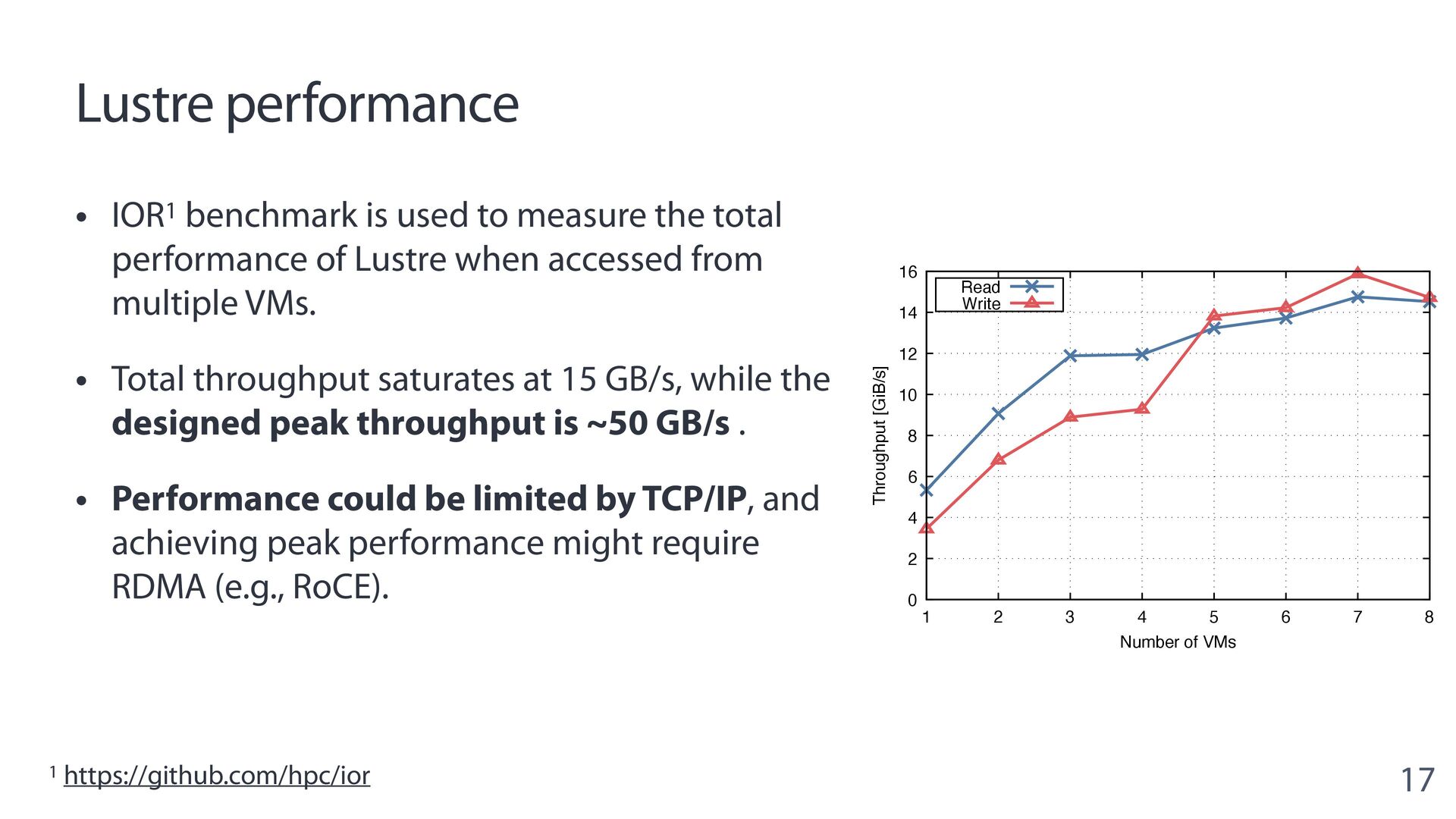
Lustre performance • IOR1 benchmark is used to measure the
total performance of Lustre when accessed from multiple VMs. • Total throughput saturates at 15 GB/s, while the designed peak throughput is ~50 GB/s . • Performance could be limited by TCP/IP, and achieving peak performance might require RDMA (e.g., RoCE). 17 0 2 4 6 8 10 12 14 16 1 2 3 4 5 6 7 8 Read Write Throughput [GiB/s] Number of VMs 1 https://github.com/hpc/ior -
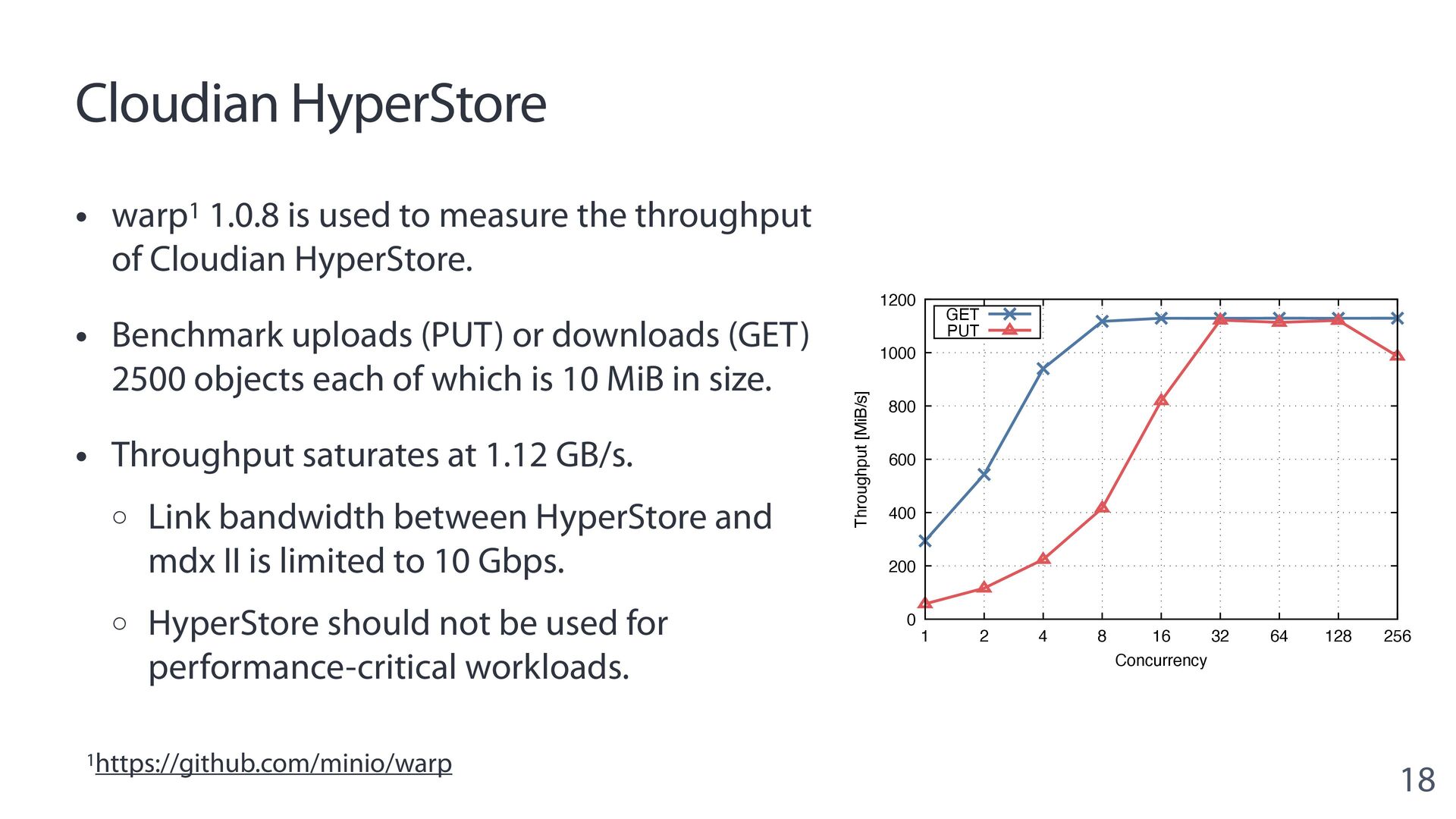
Cloudian HyperStore • warp1 1.0.8 is used to measure the
throughput of Cloudian HyperStore. • Benchmark uploads (PUT) or downloads (GET) 2500 objects each of which is 10 MiB in size. • Throughput saturates at 1.12 GB/s. ◦ Link bandwidth between HyperStore and mdx II is limited to 10 Gbps. ◦ HyperStore should not be used for performance-critical workloads. 18 0 200 400 600 800 1000 1200 1 2 4 8 16 32 64 128 256 GET PUT Throughput [MiB/s] Concurrency 1https://github.com/minio/warp -
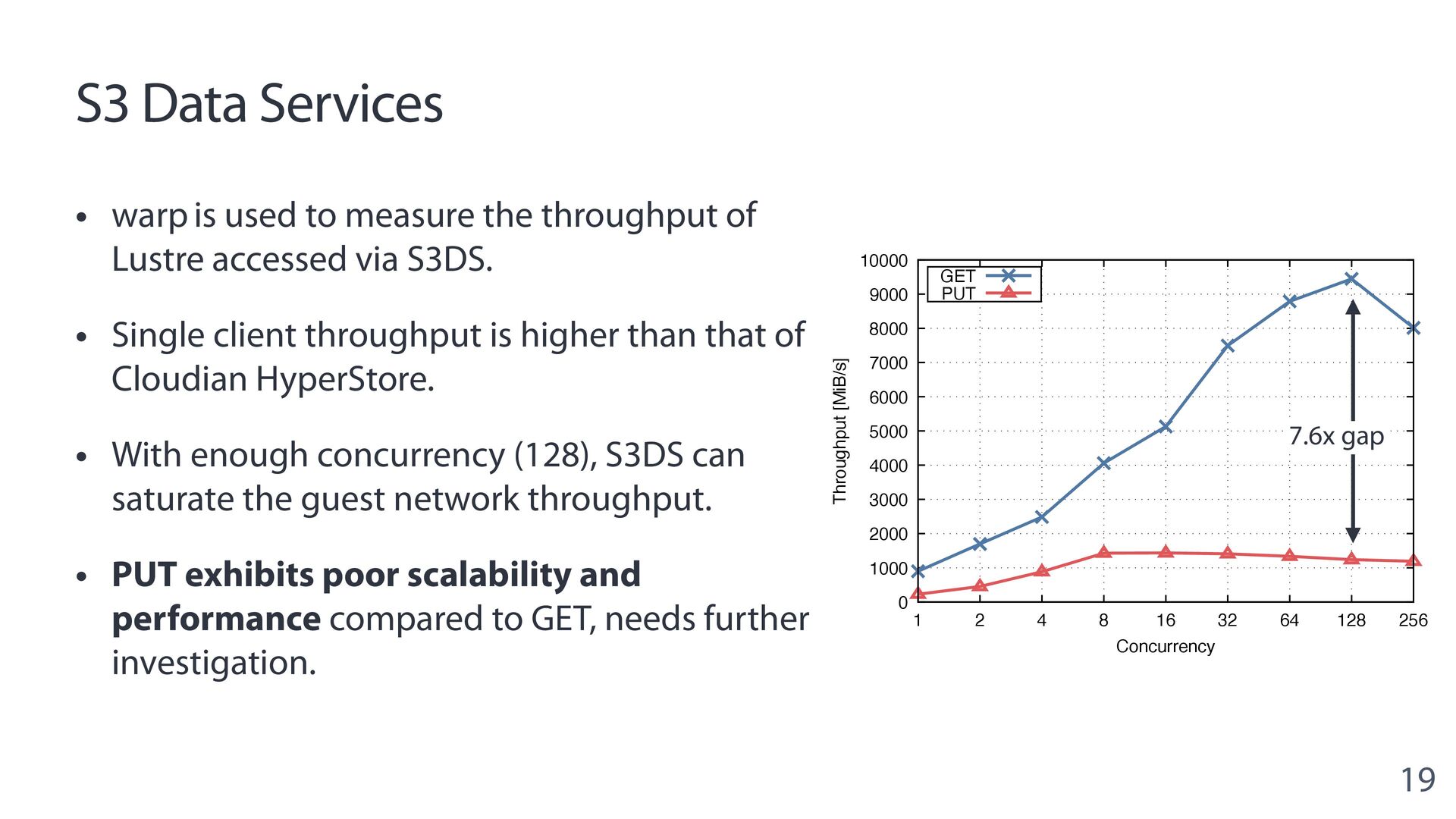
S3 Data Services • warp is used to measure the
throughput of Lustre accessed via S3DS. • Single client throughput is higher than that of Cloudian HyperStore. • With enough concurrency (128), S3DS can saturate the guest network throughput. • PUT exhibits poor scalability and performance compared to GET, needs further investigation. 19 0 1000 2000 3000 4000 5000 6000 7000 8000 9000 10000 1 2 4 8 16 32 64 128 256 GET PUT Throughput [MiB/s] Concurrency 7.6x gap -
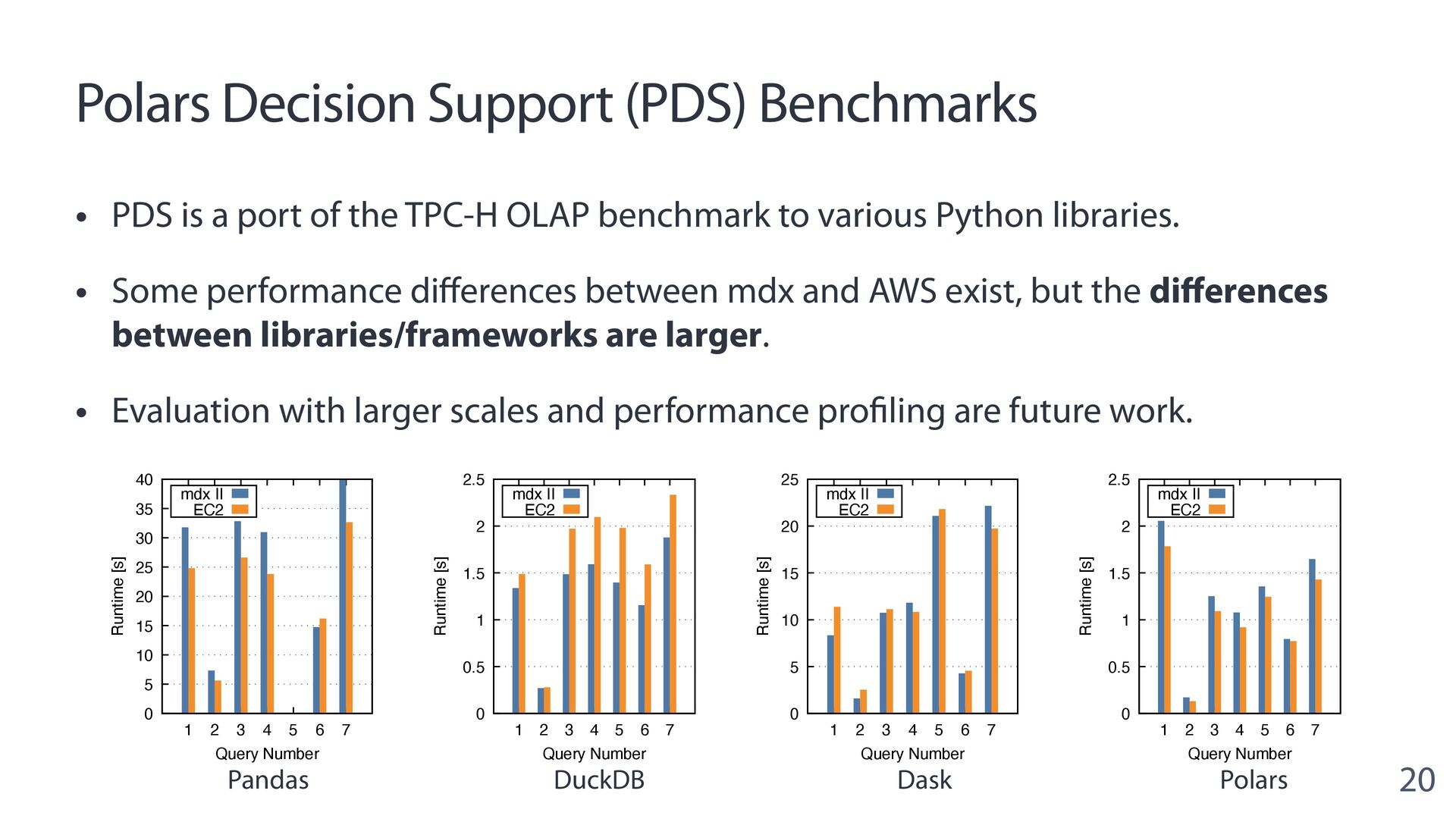
Polars Decision Support (PDS) Benchmarks • PDS is a port
of the TPC-H OLAP benchmark to various Python libraries. • Some performance di ff erences between mdx and AWS exist, but the di ff erences between libraries/frameworks are larger. • Evaluation with larger scales and performance pro fi ling are future work. 20 0 5 10 15 20 25 1 2 3 4 5 6 7 mdx II EC2 Runtime [s] Query Number 0 0.5 1 1.5 2 2.5 1 2 3 4 5 6 7 mdx II EC2 Runtime [s] Query Number 0 5 10 15 20 25 30 35 40 1 2 3 4 5 6 7 mdx II EC2 Runtime [s] Query Number 0 0.5 1 1.5 2 2.5 1 2 3 4 5 6 7 mdx II EC2 Runtime [s] Query Number Pandas Polars DuckDB Dask -
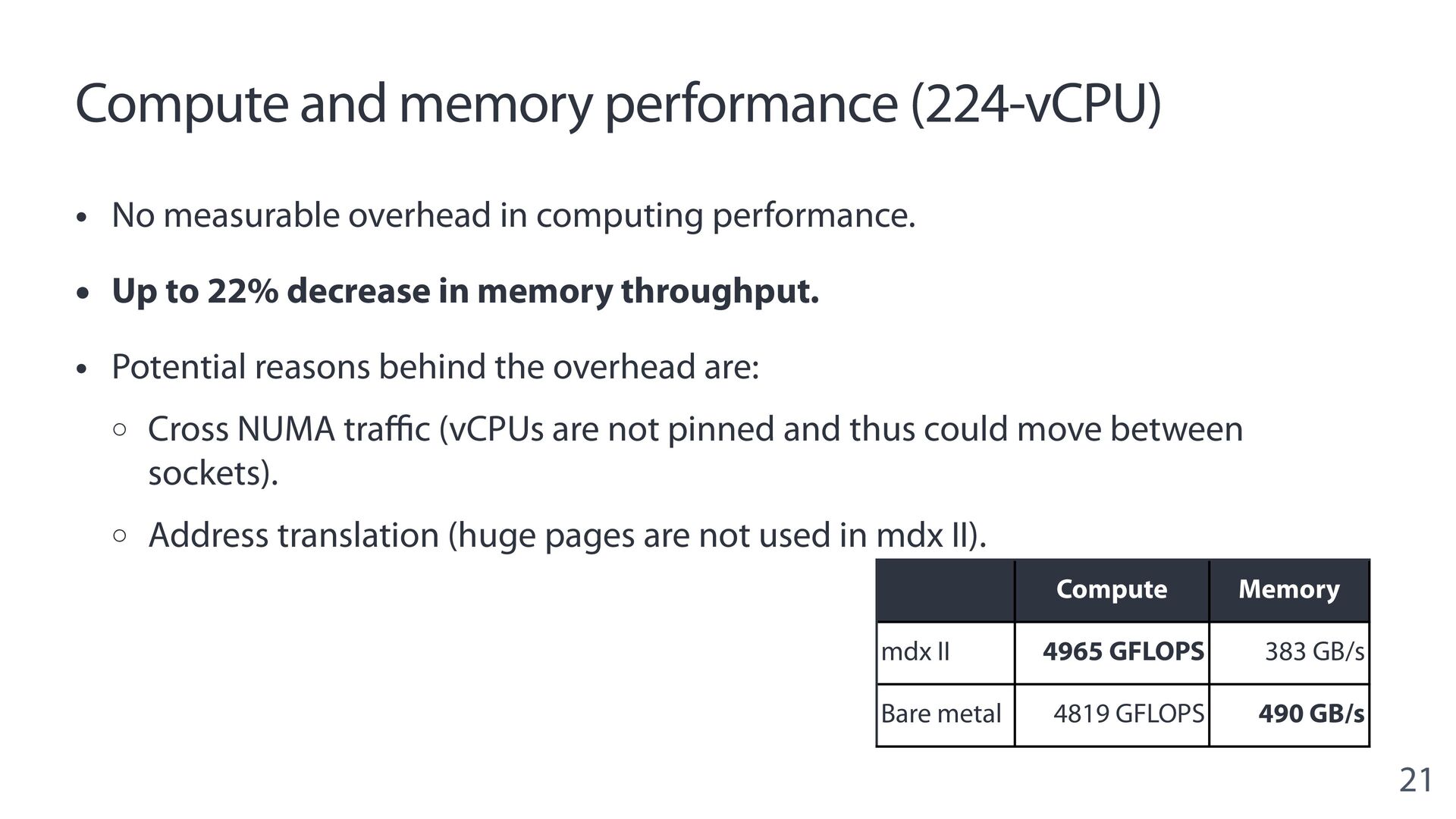
Compute and memory performance (224-vCPU) • No measurable overhead in
computing performance. • Up to 22% decrease in memory throughput. • Potential reasons behind the overhead are: ◦ Cross NUMA tra ff i c (vCPUs are not pinned and thus could move between sockets). ◦ Address translation (huge pages are not used in mdx II). 21 Compute Memory mdx II 4965 GFLOPS 383 GB/s Bare metal 4819 GFLOPS 490 GB/s -
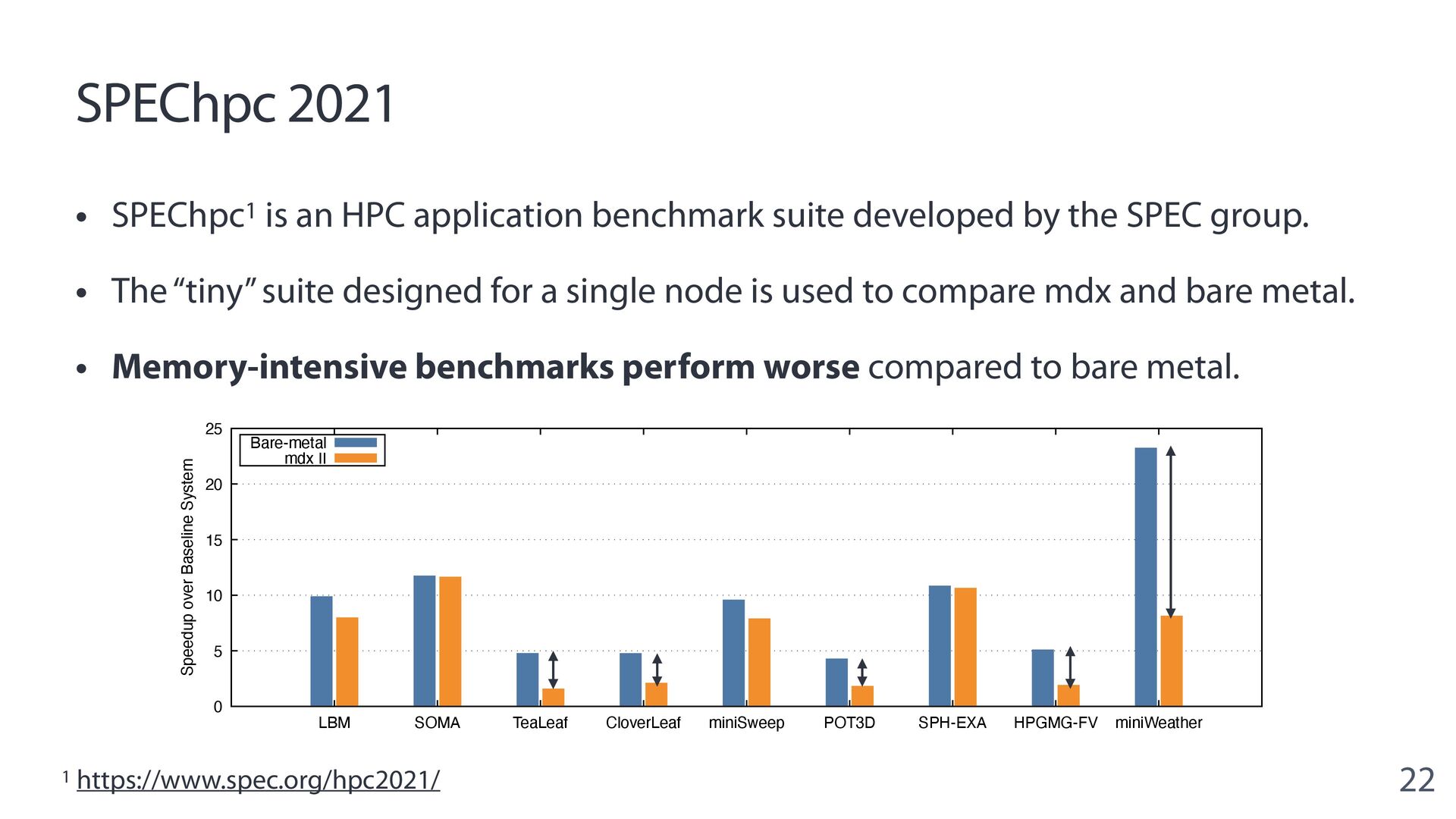
SPEChpc 2021 • SPEChpc1 is an HPC application benchmark suite
developed by the SPEC group. • The “tiny” suite designed for a single node is used to compare mdx and bare metal. • Memory-intensive benchmarks perform worse compared to bare metal. 22 0 5 10 15 20 25 LBM SOMA TeaLeaf CloverLeaf miniSweep POT3D SPH-EXA HPGMG-FV miniWeather Bare-metal mdx II Speedup over Baseline System 1 https://www.spec.org/hpc2021/ -
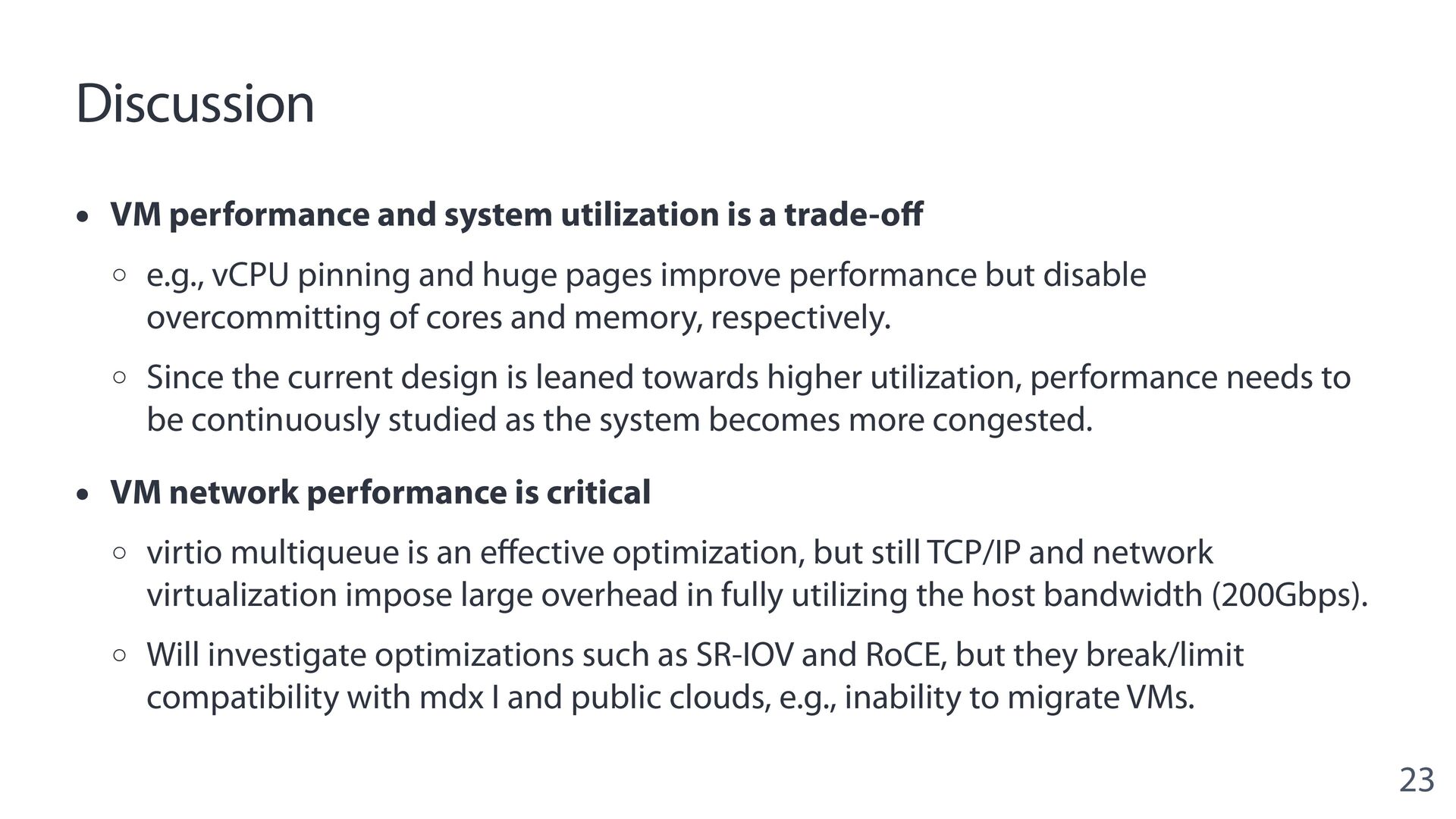
Discussion • VM performance and system utilization is a trade-o
ff ◦ e.g., vCPU pinning and huge pages improve performance but disable overcommitting of cores and memory, respectively. ◦ Since the current design is leaned towards higher utilization, performance needs to be continuously studied as the system becomes more congested. • VM network performance is critical ◦ virtio multiqueue is an e ff ective optimization, but still TCP/IP and network virtualization impose large overhead in fully utilizing the host bandwidth (200Gbps). ◦ Will investigate optimizations such as SR-IOV and RoCE, but they break/limit compatibility with mdx I and public clouds, e.g., inability to migrate VMs. 23 -
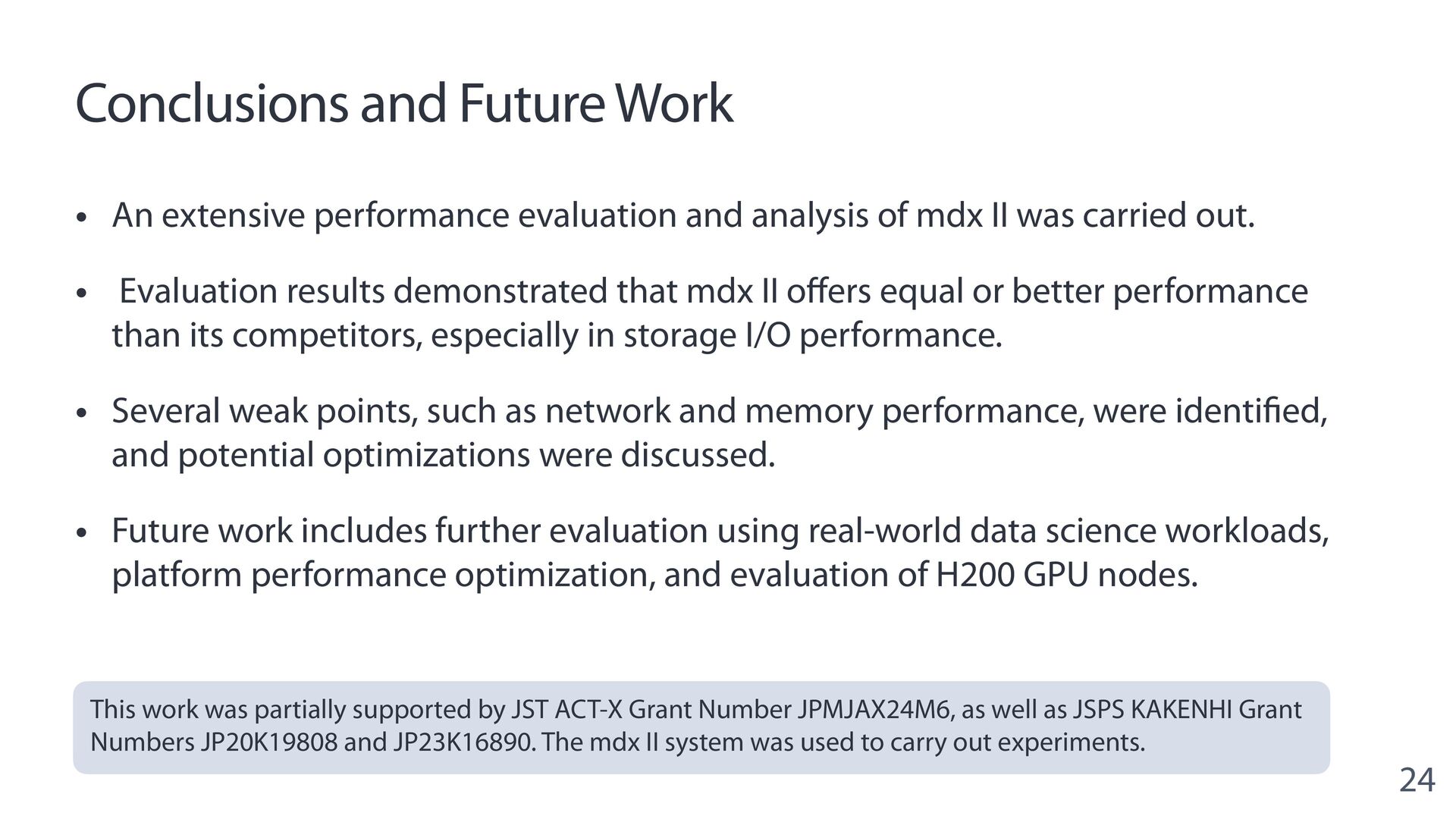
Conclusions and Future Work • An extensive performance evaluation and
analysis of mdx II was carried out. • Evaluation results demonstrated that mdx II o ff ers equal or better performance than its competitors, especially in storage I/O performance. • Several weak points, such as network and memory performance, were identi fi ed, and potential optimizations were discussed. • Future work includes further evaluation using real-world data science workloads, platform performance optimization, and evaluation of H200 GPU nodes. 24 This work was partially supported by JST ACT-X Grant Number JPMJAX24M6, as well as JSPS KAKENHI Grant Numbers JP20K19808 and JP23K16890. The mdx II system was used to carry out experiments.