a Verifier-Safe Layered DSL for Nested Encapsulation Packet Filtering on eBPF 1, 2 1 3 Takeru Hayasaka, Satoshi Uda, Ayako Hayasaka, Daisuke Kotani 1 3 4 2 japan Advanced Institute of Science and Technology, SAKURA Internet Inc, 4 Independent Researcher, Kyoto University Sep 29, 2026
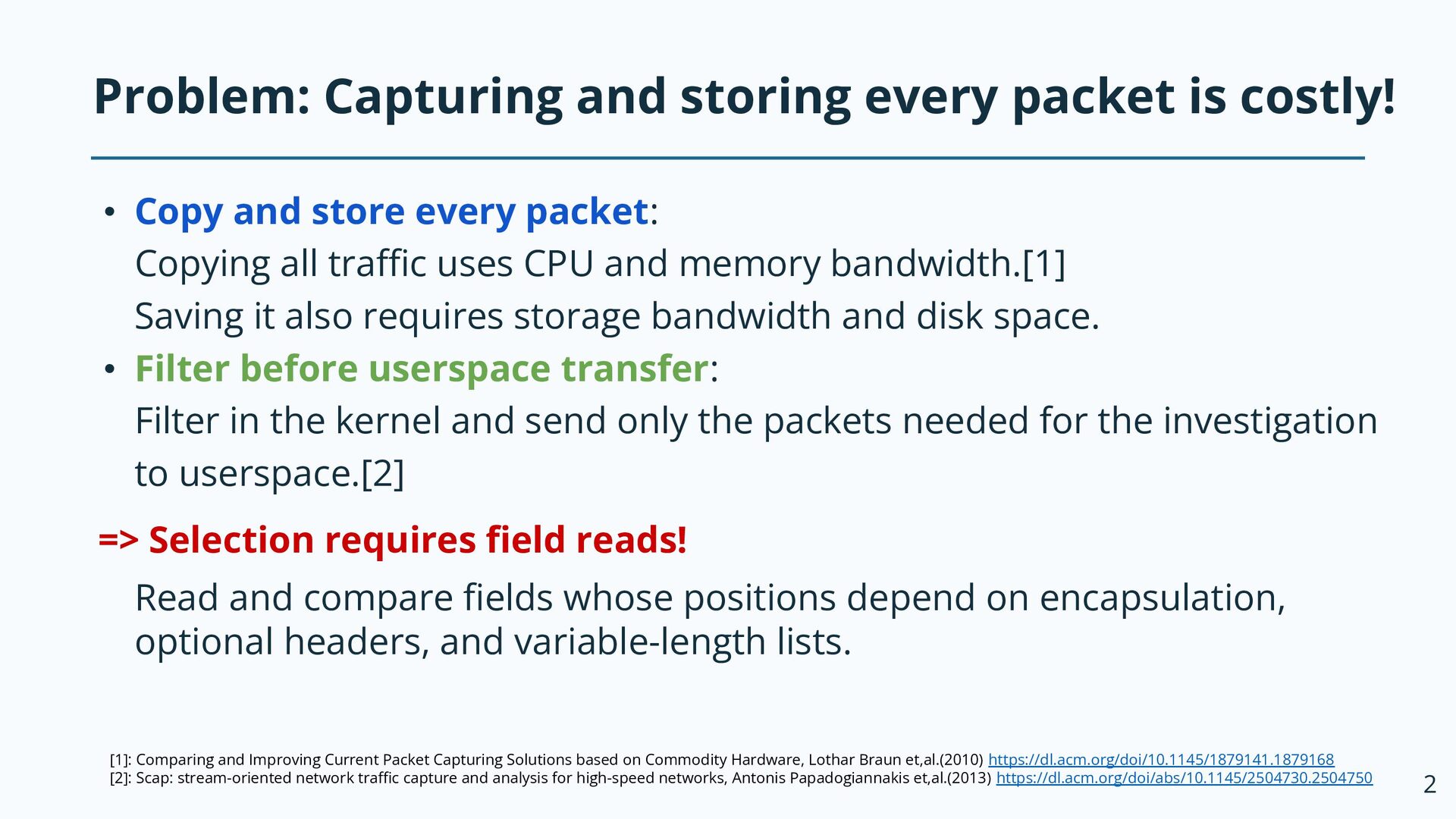
and store every packet: Copying all traffic uses CPU and memory bandwidth.[1] Saving it also requires storage bandwidth and disk space. • Filter before userspace transfer: Filter in the kernel and send only the packets needed for the investigation to userspace.[2] => Selection requires field reads! Read and compare fields whose positions depend on encapsulation, optional headers, and variable-length lists. [1]: Comparing and Improving Current Packet Capturing Solutions based on Commodity Hardware, Lothar Braun et,al.(2010) https://dl.acm.org/doi/10.1145/1879141.1879168 [2]: Scap: stream-oriented network traffic capture and analysis for high-speed networks, Antonis Papadogiannakis et,al.(2013) https://dl.acm.org/doi/abs/10.1145/2504730.2504750 2
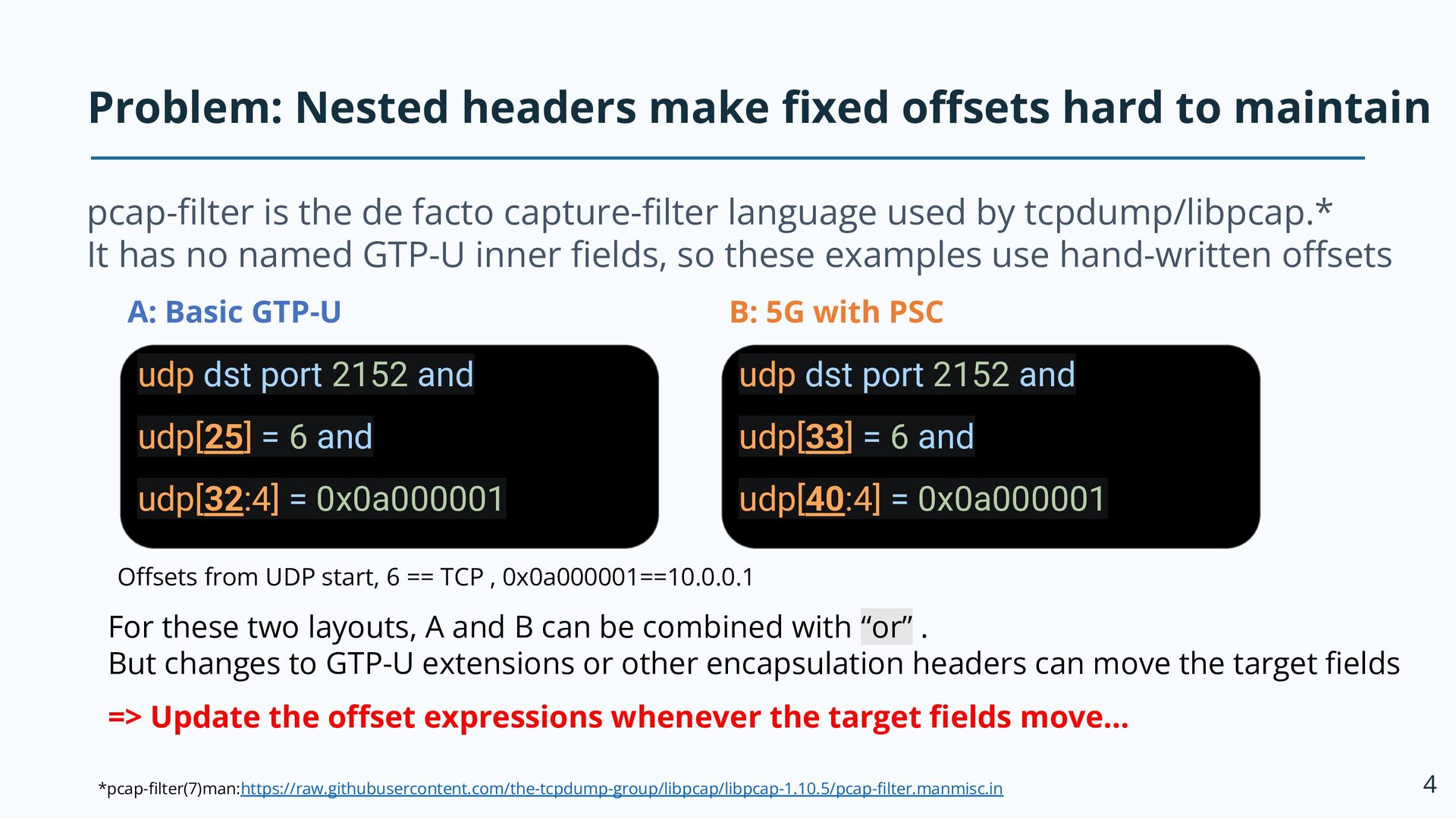
is the de facto capture-filter language used by tcpdump/libpcap.* It has no named GTP-U inner fields, so these examples use hand-written offsets A: Basic GTP-U B: 5G with PSC udp dst port 2152 and udp dst port 2152 and udp[25] = 6 and udp[33] = 6 and udp[32:4] = 0x0a000001 udp[40:4] = 0x0a000001 Offsets from UDP start, 6 == TCP , 0x0a000001==10.0.0.1 For these two layouts, A and B can be combined with “or” . But changes to GTP-U extensions or other encapsulation headers can move the target fields => Update the offset expressions whenever the target fields move… *pcap-filter(7)man:https://raw.githubusercontent.com/the-tcpdump-group/libpcap/libpcap-1.10.5/pcap-filter.manmisc.in 4
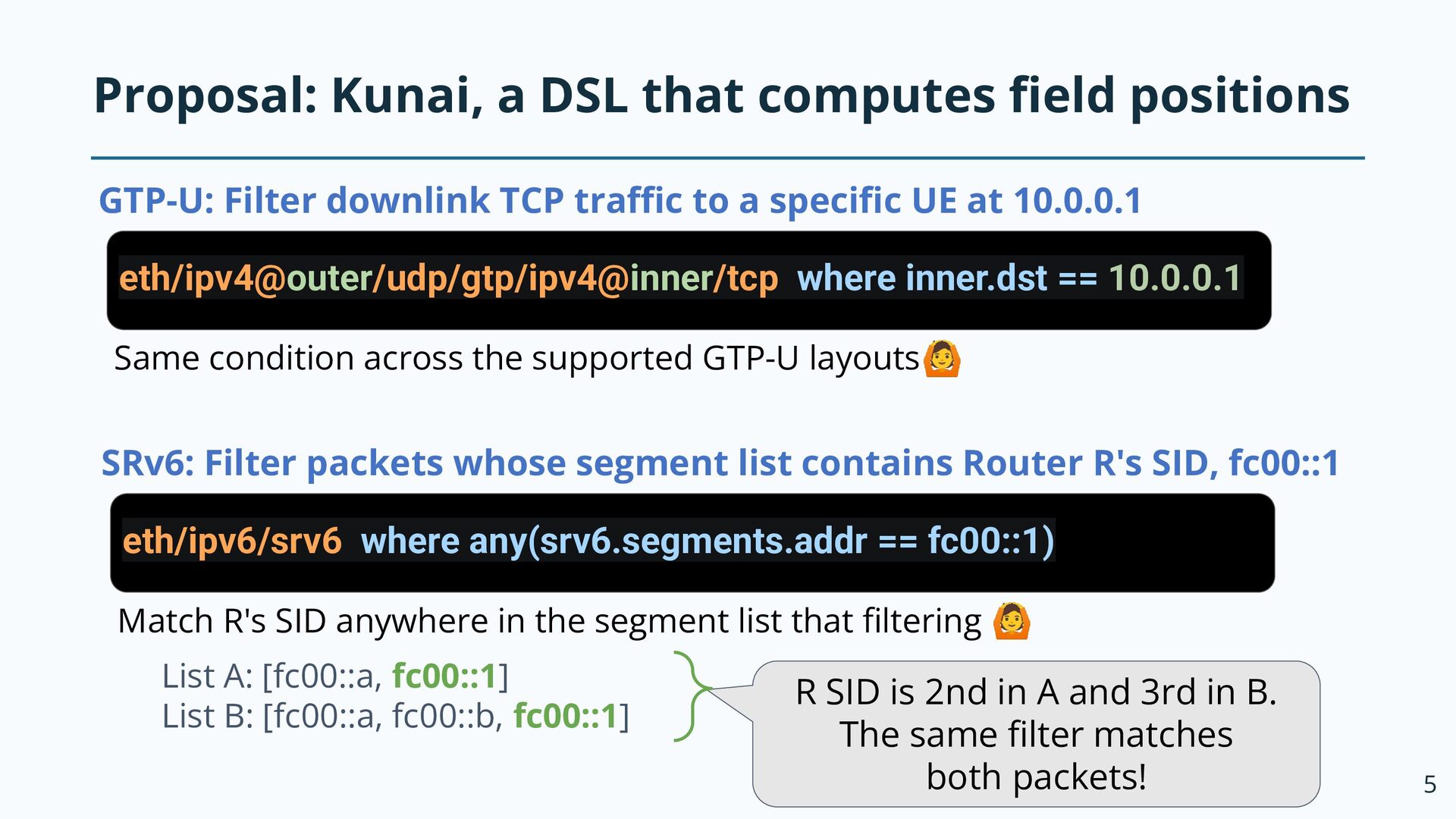
downlink TCP traffic to a specific UE at 10.0.0.1 eth/ipv4@outer/udp/gtp/ipv4@inner/tcp where inner.dst == 10.0.0.1 Same condition across the supported GTP-U layouts🙆 SRv6: Filter packets whose segment list contains Router R's SID, fc00::1 eth/ipv6/srv6 where any(srv6.segments.addr == fc00::1) Match R's SID anywhere in the segment list that filtering 🙆 List A: [fc00::a, fc00::1] List B: [fc00::a, fc00::b, fc00::1] R SID is 2nd in A and 3rd in B. The same filter matches both packets! 5
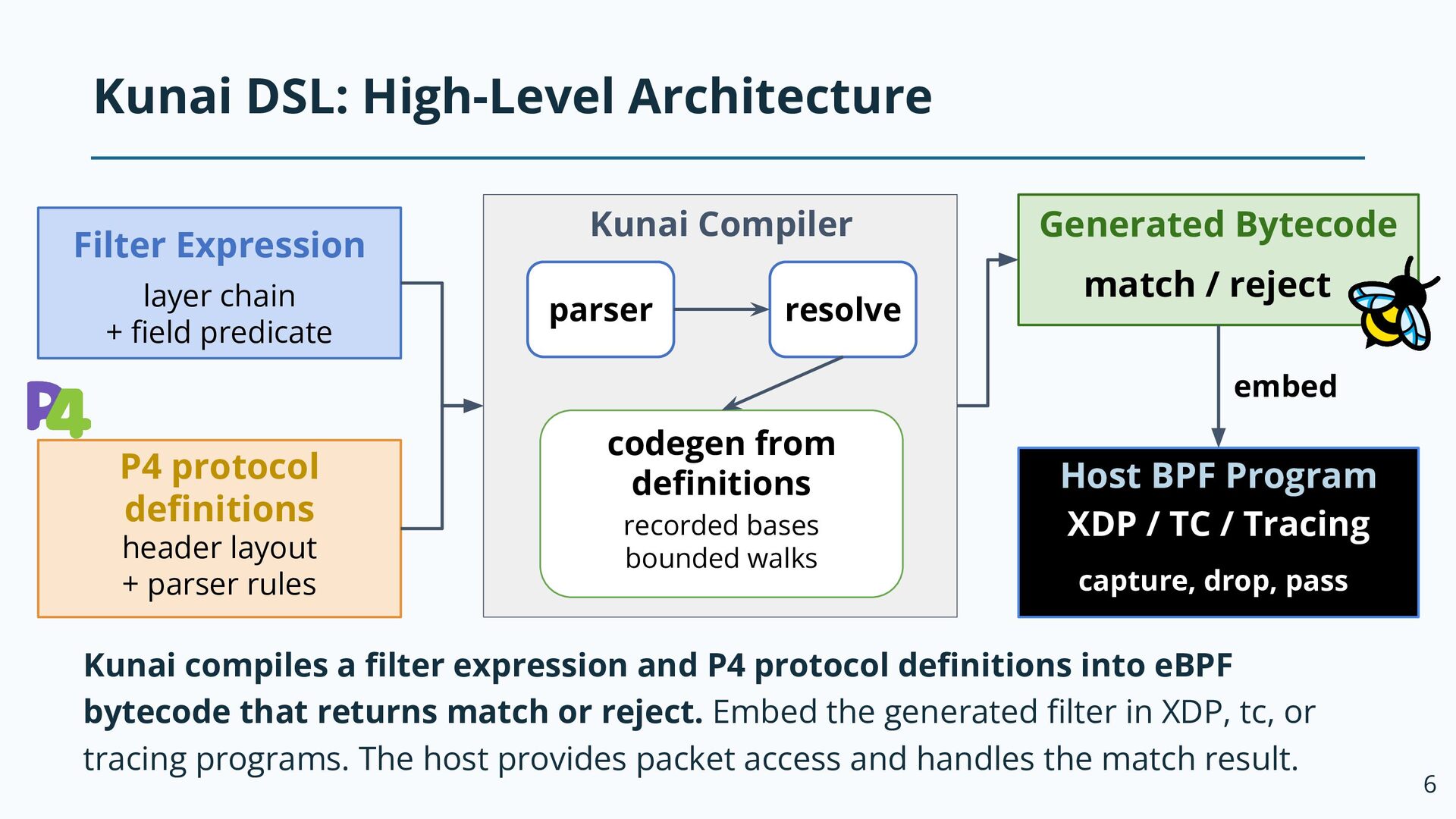
predicate Kunai Compiler parser resolve Generated Bytecode match / reject embed P4 protocol definitions header layout + parser rules codegen from definitions recorded bases bounded walks Host BPF Program XDP / TC / Tracing capture, drop, pass Kunai compiles a filter expression and P4 protocol definitions into eBPF bytecode that returns match or reject. Embed the generated filter in XDP, tc, or tracing programs. The host provides packet access and handles the match result. 6
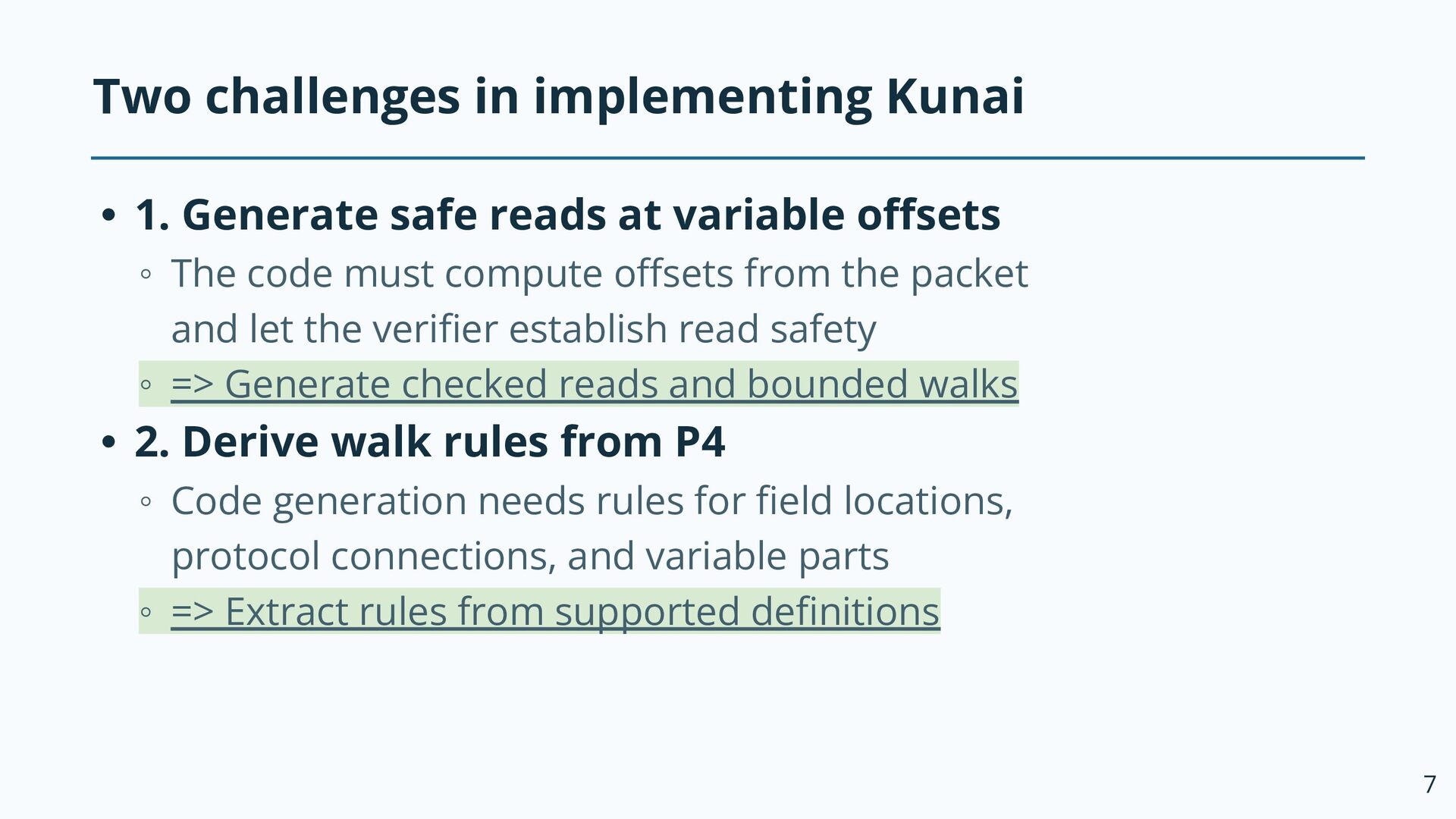
at variable offsets ◦ The code must compute offsets from the packet and let the verifier establish read safety ◦ => Generate checked reads and bounded walks • 2. Derive walk rules from P4 ◦ Code generation needs rules for field locations, protocol connections, and variable parts ◦ => Extract rules from supported definitions 7
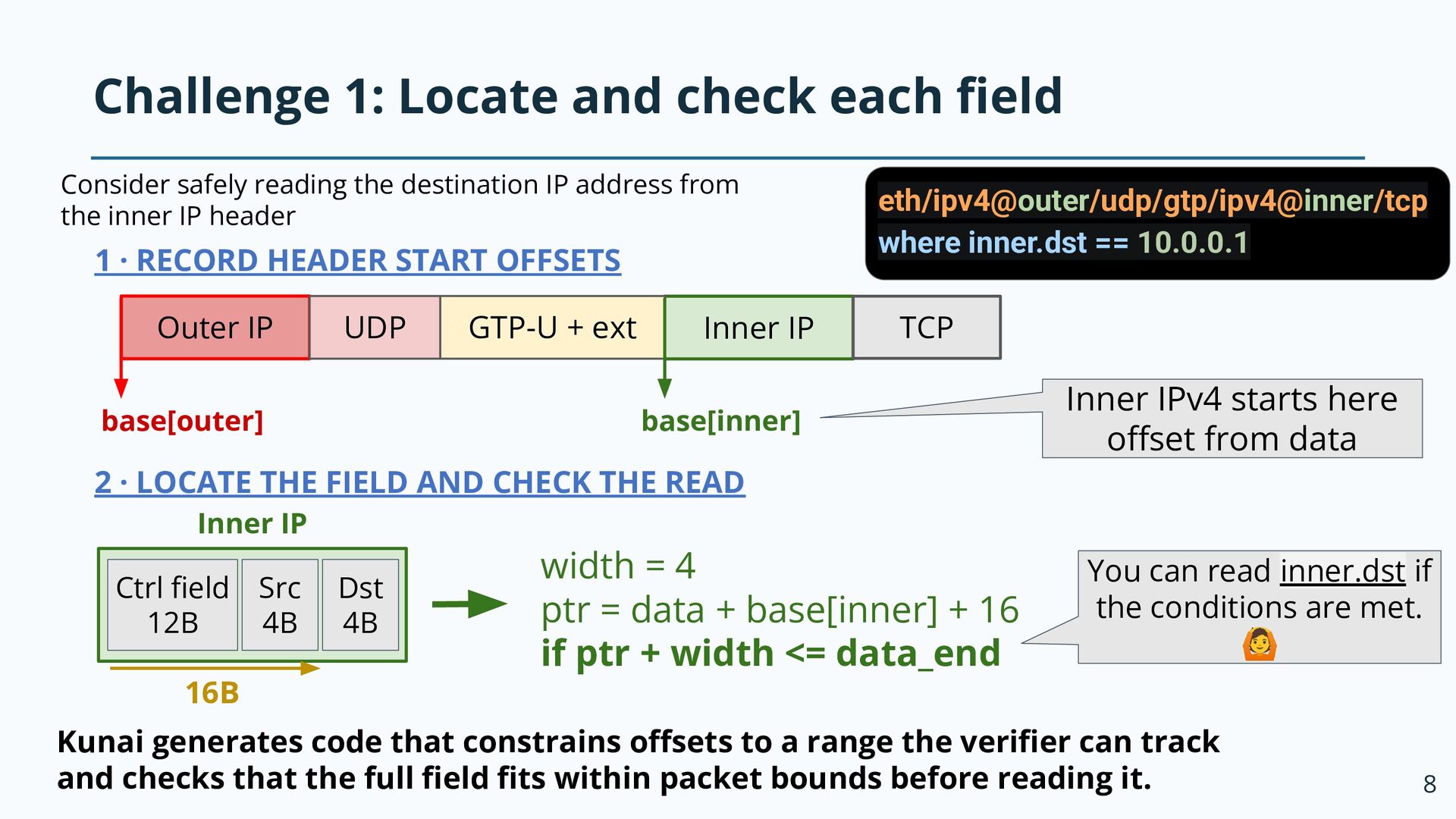
the destination IP address from the inner IP header 1 · RECORD HEADER START OFFSETS Outer IP UDP base[outer] GTP-U + ext Inner IP eth/ipv4@outer/udp/gtp/ipv4@inner/tcp where inner.dst == 10.0.0.1 TCP base[inner] Inner IPv4 starts here offset from data 2 · LOCATE THE FIELD AND CHECK THE READ Inner IP Ctrl field Src 12B 4B 16B Dst 4B width = 4 ptr = data + base[inner] + 16 if ptr + width <= data_end You can read inner.dst if the conditions are met. 🙆 Kunai generates code that constrains offsets to a range the verifier can track and checks that the full field fits within packet bounds before reading it. 8
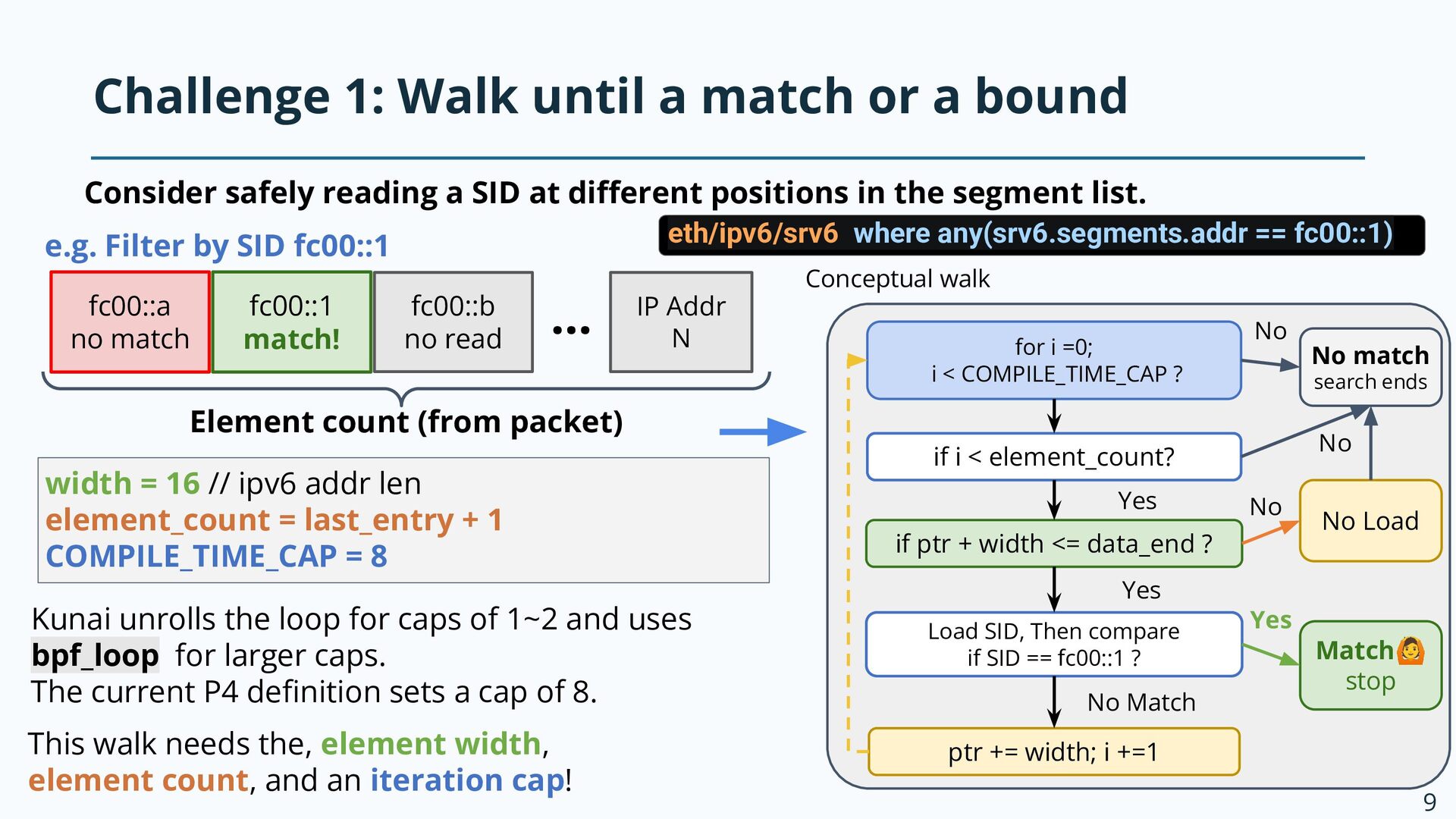
safely reading a SID at different positions in the segment list. eth/ipv6/srv6 where any(srv6.segments.addr == fc00::1) e.g. Filter by SID fc00::1 fc00::a no match fc00::1 match! fc00::b no read … IP Addr N Element count (from packet) width = 16 // ipv6 addr len element_count = last_entry + 1 COMPILE_TIME_CAP = 8 Kunai unrolls the loop for caps of 1~2 and uses bpf_loop for larger caps. The current P4 definition sets a cap of 8. This walk needs the, element width, element count, and an iteration cap! Conceptual walk for i =0; i < COMPILE_TIME_CAP ? No search ends No if i < element_count? Yes No if ptr + width <= data_end ? Yes Load SID, Then compare if SID == fc00::1 ? No Match No match Yes No Load Match🙆 stop ptr += width; i +=1 9
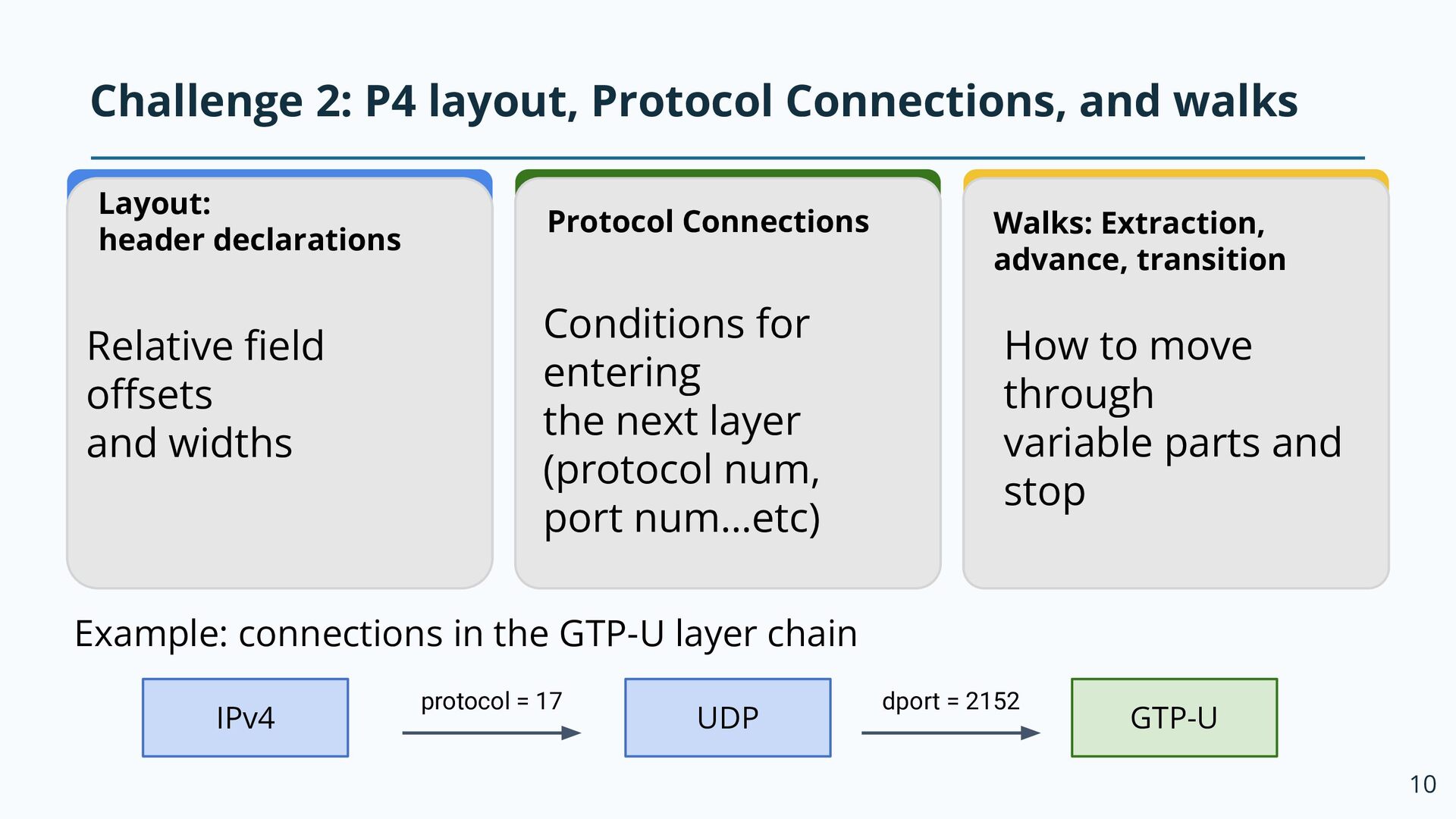
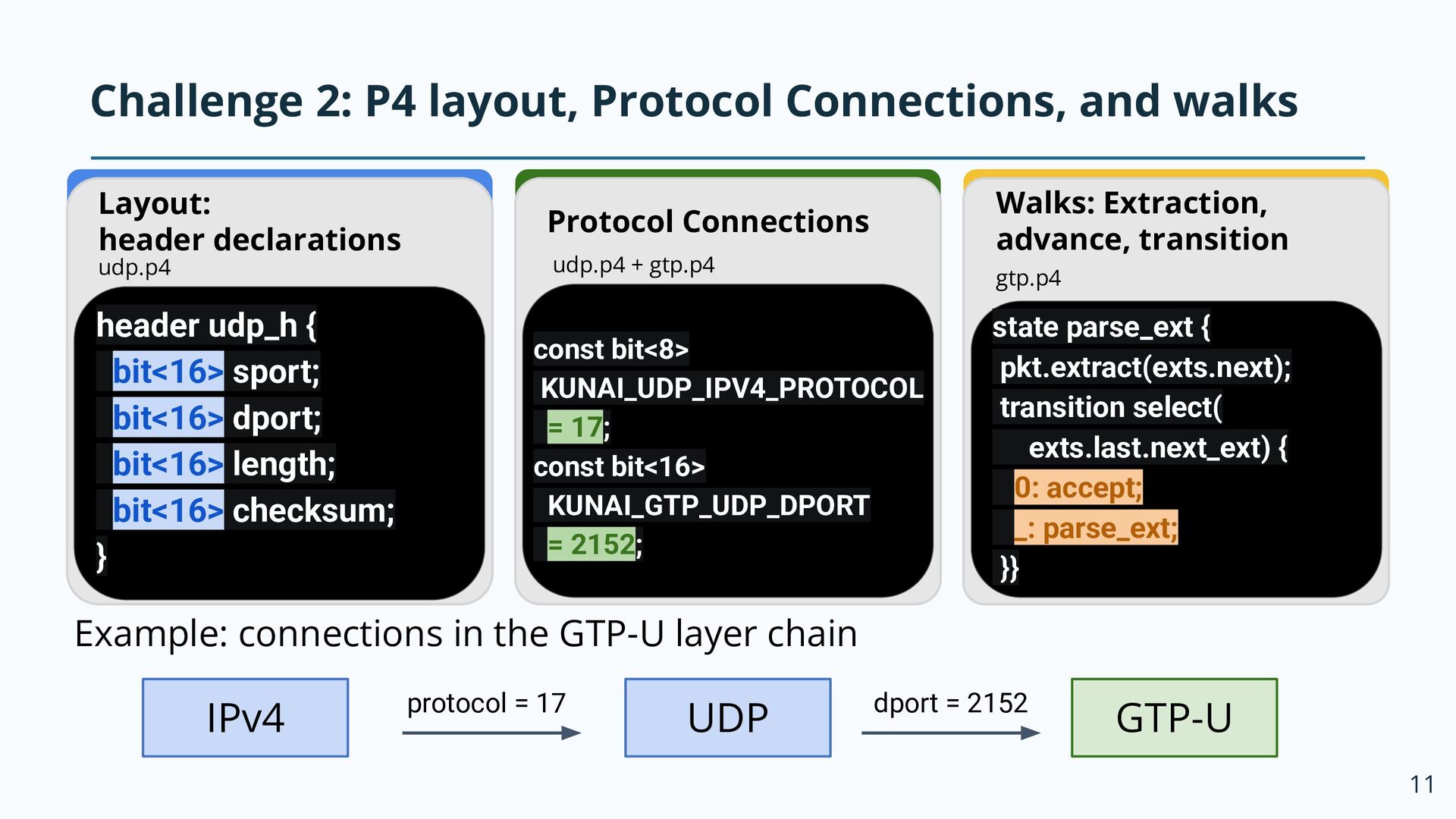
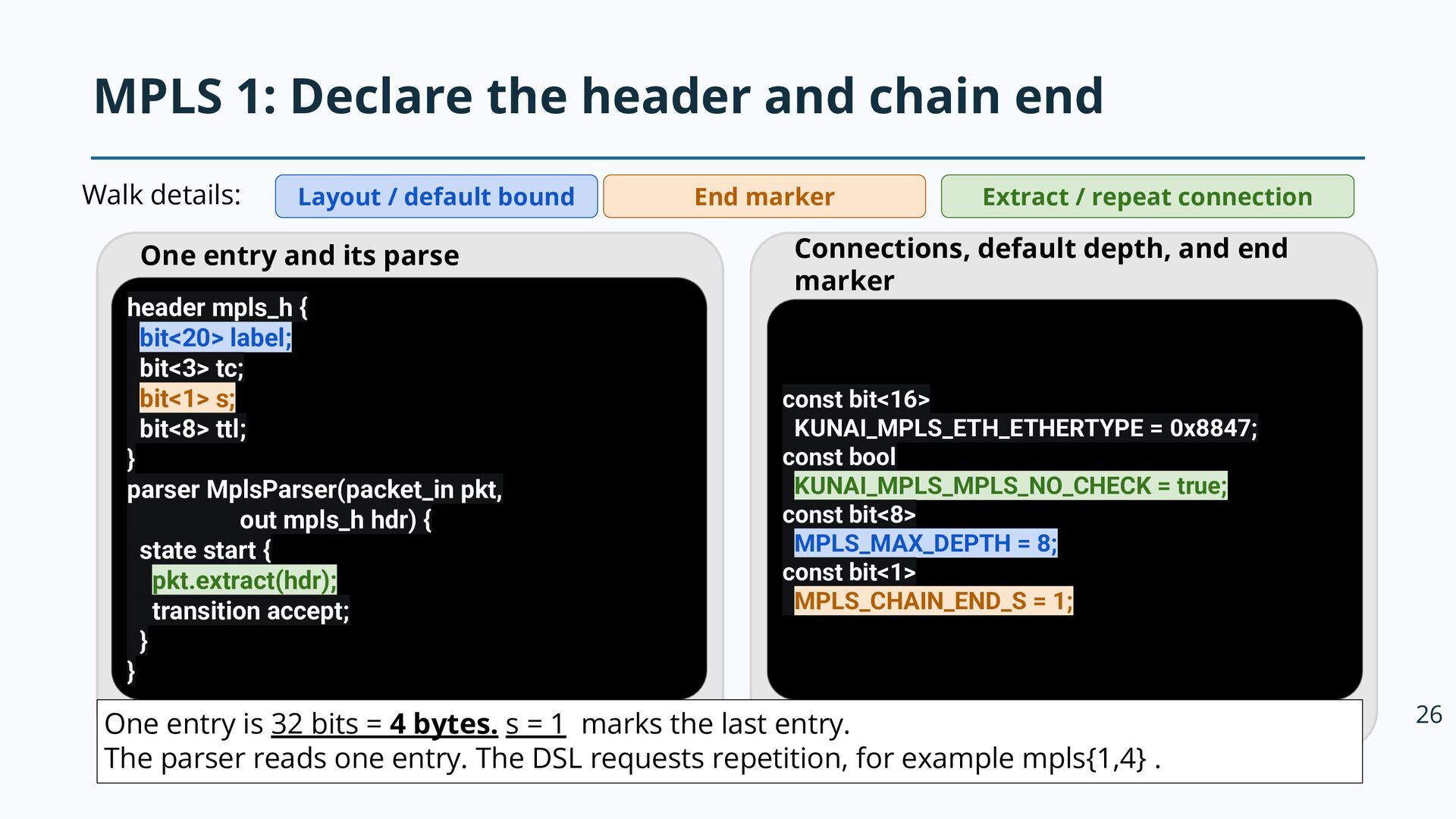
declarations Relative field offsets and widths Protocol Connections Conditions for entering the next layer (protocol num, port num…etc) Walks: Extraction, advance, transition How to move through variable parts and stop Example: connections in the GTP-U layer chain IPv4 protocol = 17 UDP dport = 2152 GTP-U 10
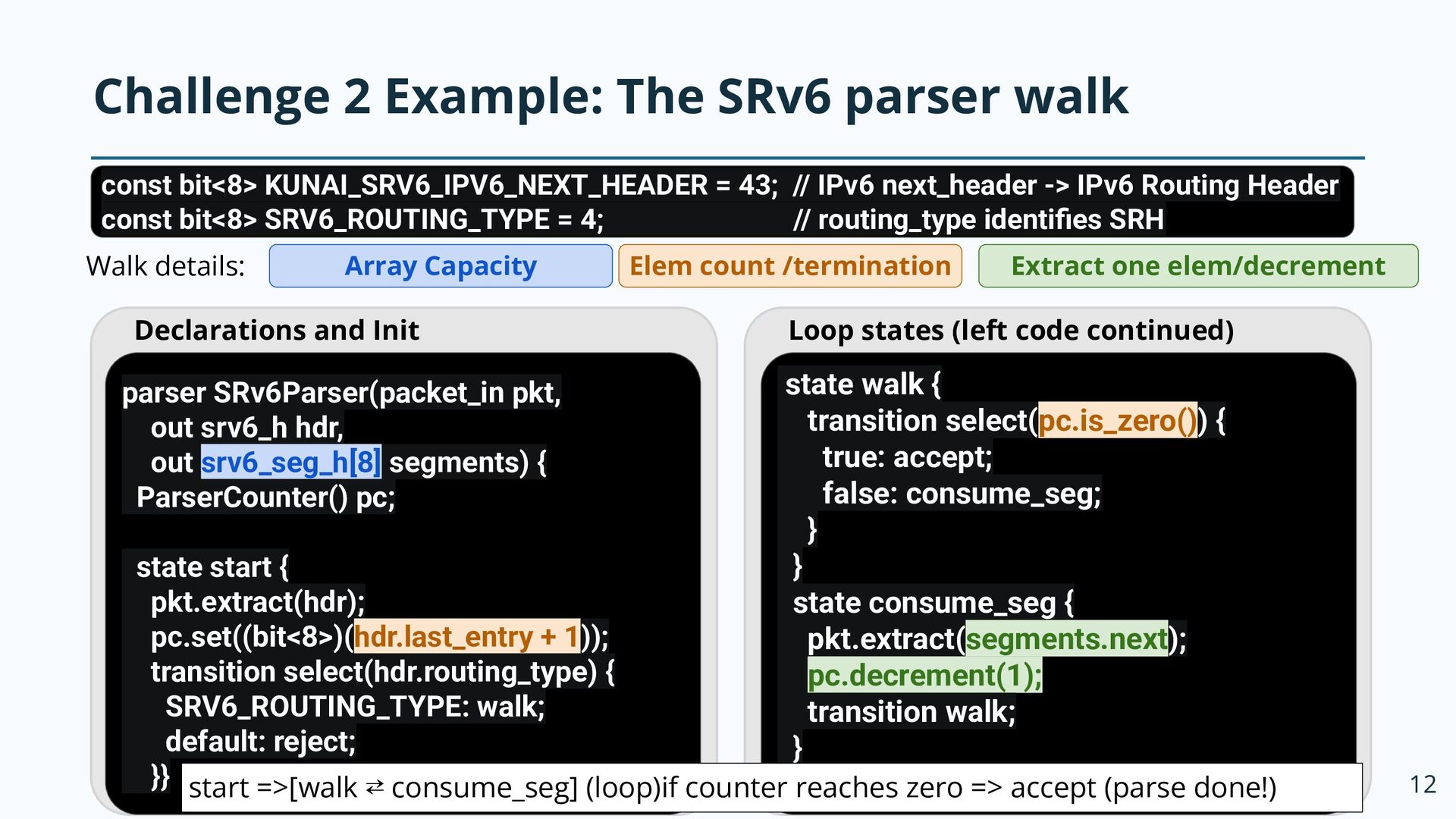
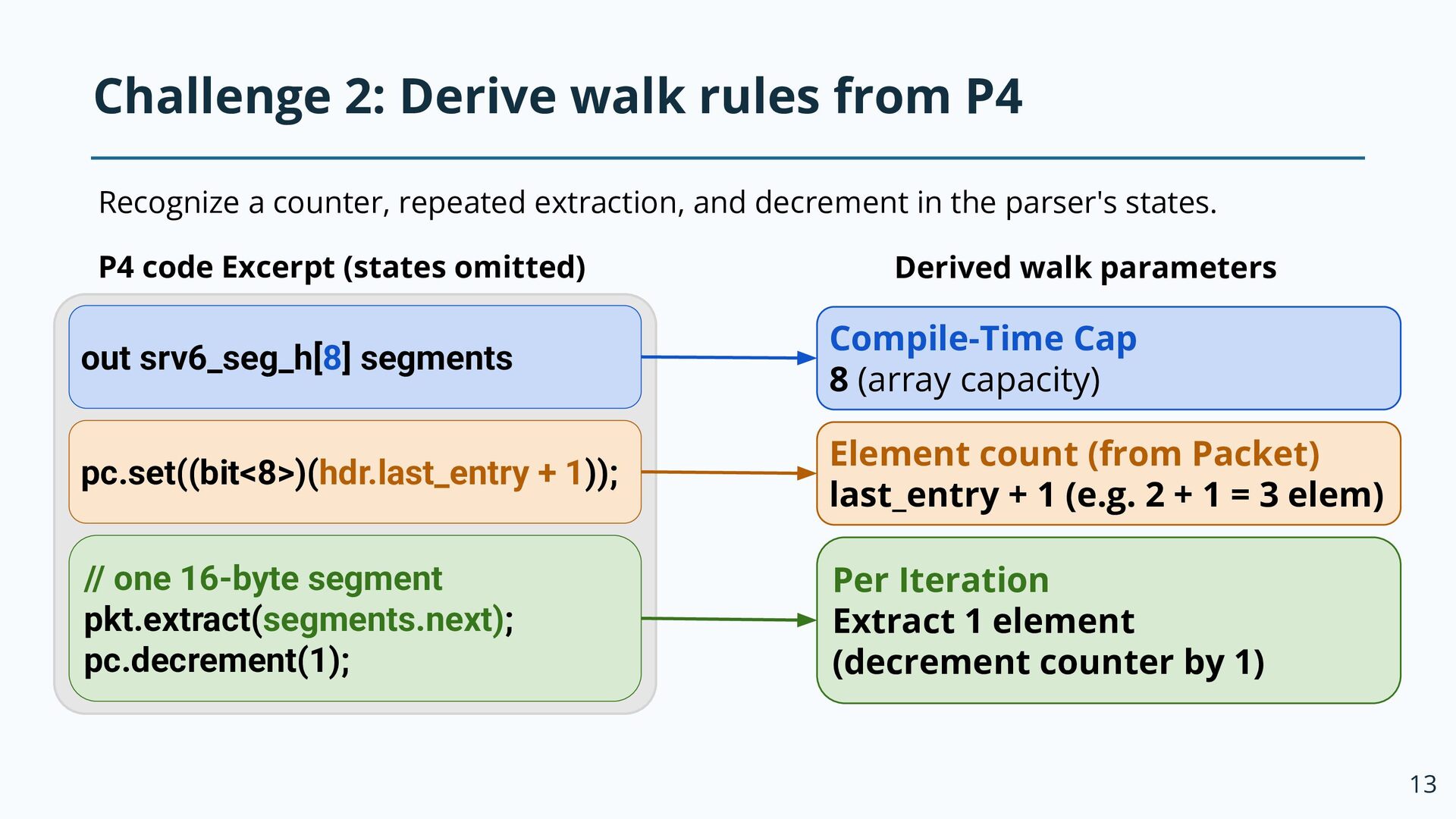
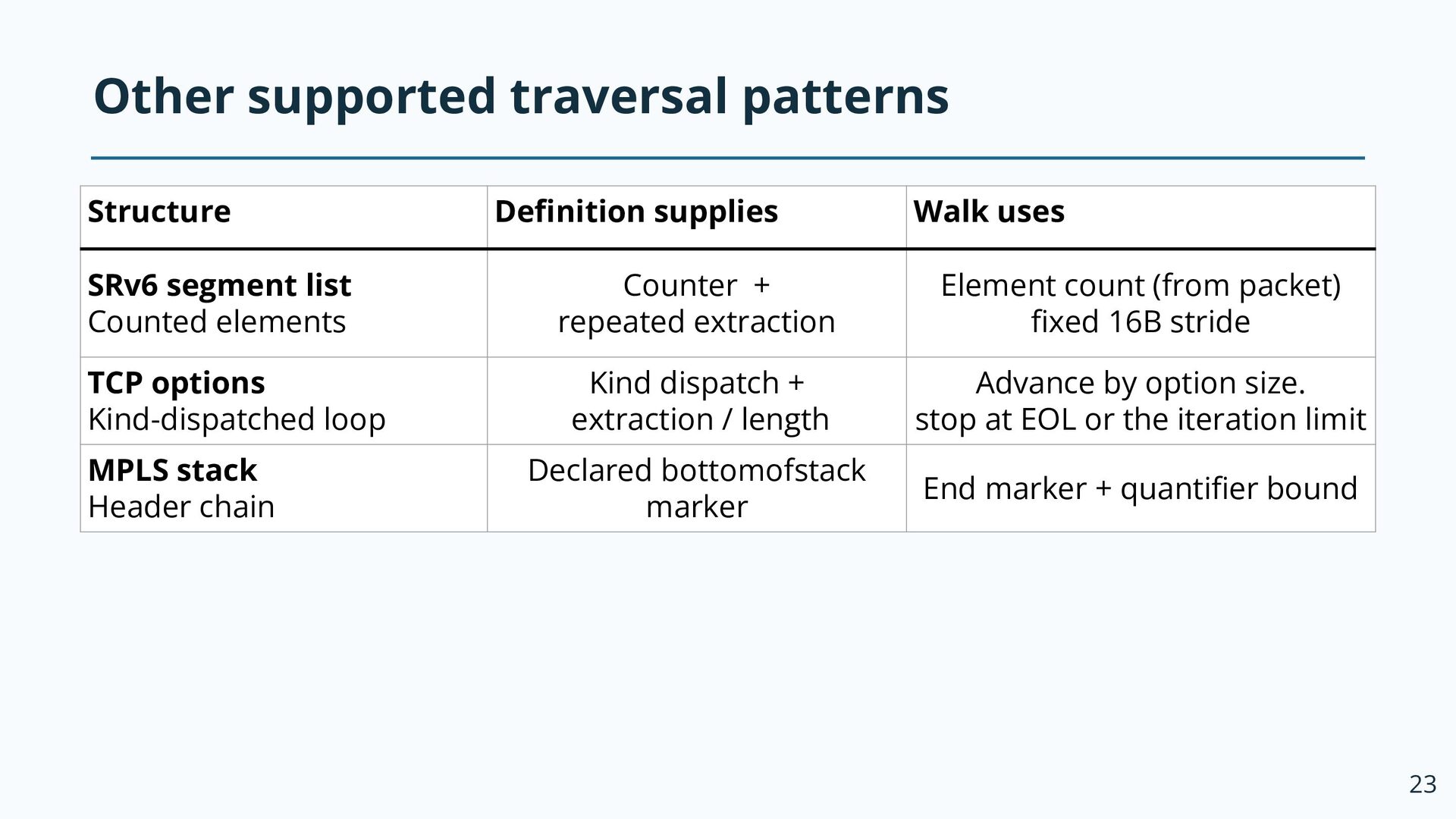
repeated extraction, and decrement in the parser's states. P4 code Excerpt (states omitted) Derived walk parameters out srv6_seg_h[8] segments Compile-Time Cap 8 (array capacity) pc.set((bit<8>)(hdr.last_entry + 1)); Element count (from Packet) last_entry + 1 (e.g. 2 + 1 = 3 elem) // one 16-byte segment pkt.extract(segments.next); pc.decrement(1); Per Iteration Extract 1 element (decrement counter by 1) 13
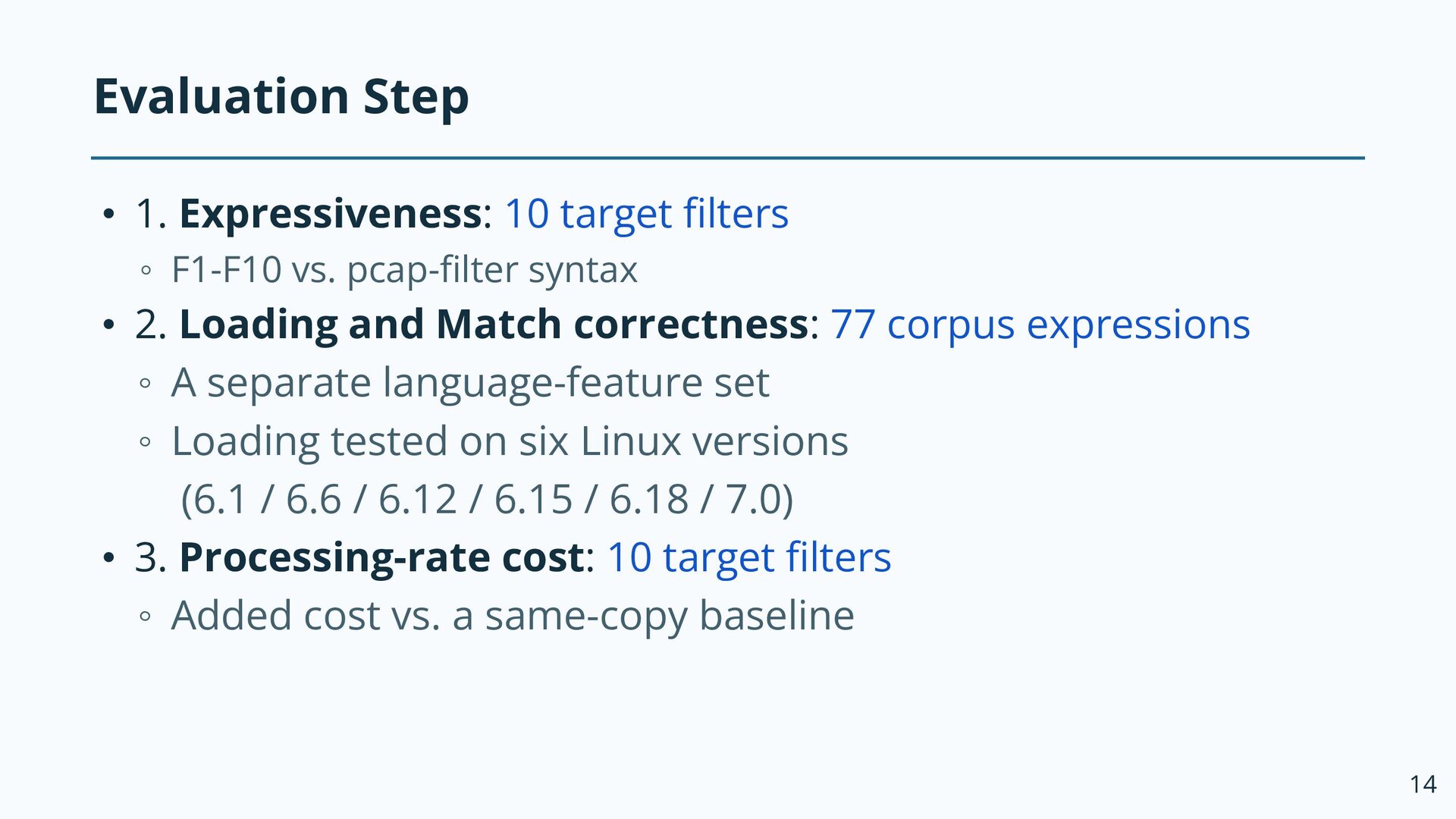
vs. pcap-filter syntax • 2. Loading and Match correctness: 77 corpus expressions ◦ A separate language-feature set ◦ Loading tested on six Linux versions (6.1 / 6.6 / 6.12 / 6.15 / 6.18 / 7.0) • 3. Processing-rate cost: 10 target filters ◦ Added cost vs. a same-copy baseline 14
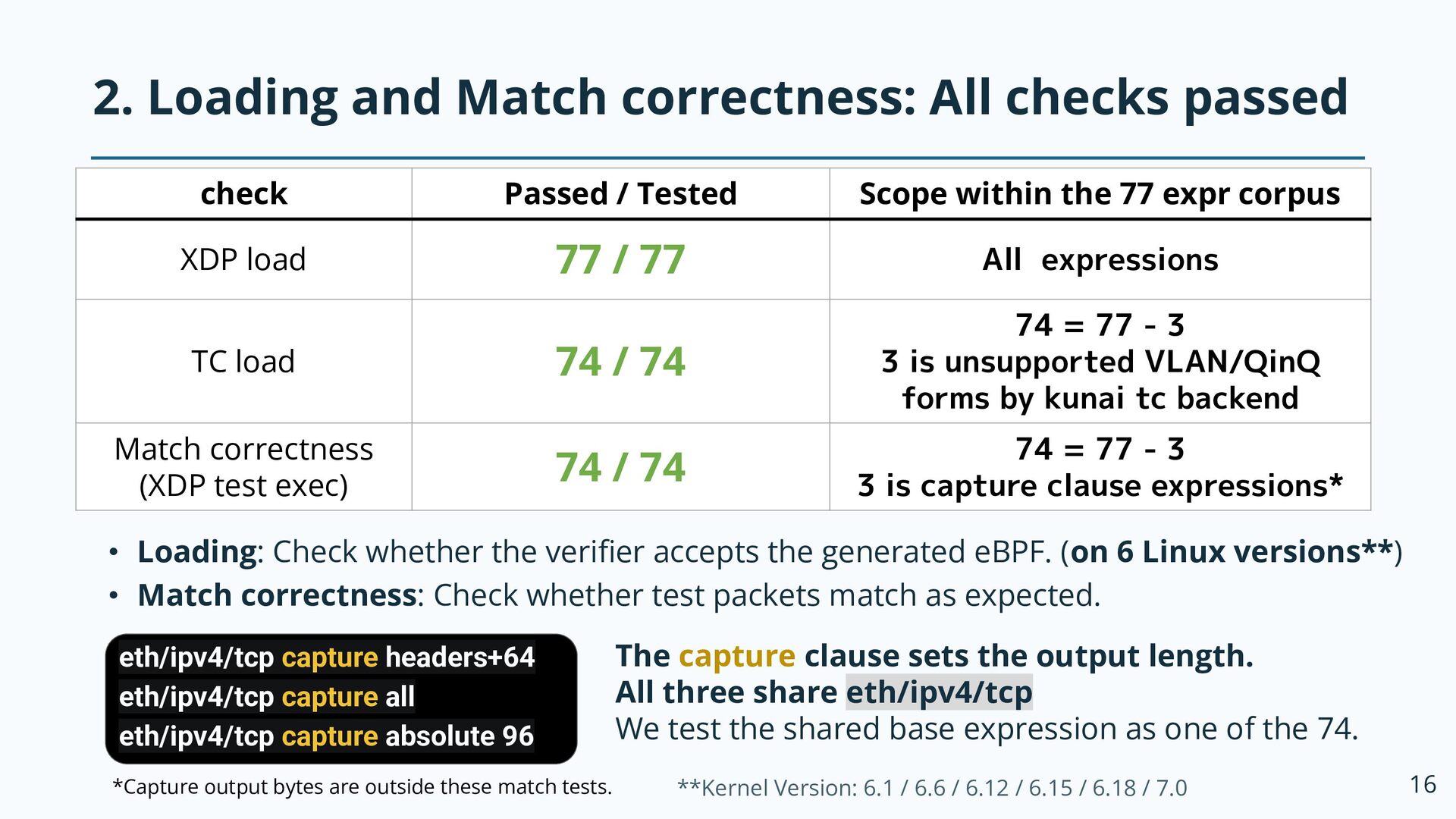
/ Tested Scope within the 77 expr corpus XDP load 77 / 77 All expressions 74 / 74 74 = 77 - 3 3 is unsupported VLAN/QinQ forms by kunai tc backend 74 / 74 74 = 77 - 3 3 is capture clause expressions* TC load Match correctness (XDP test exec) • Loading: Check whether the verifier accepts the generated eBPF. (on 6 Linux versions**) • Match correctness: Check whether test packets match as expected. eth/ipv4/tcp capture headers+64 eth/ipv4/tcp capture all eth/ipv4/tcp capture absolute 96 *Capture output bytes are outside these match tests. The capture clause sets the output length. All three share eth/ipv4/tcp We test the shared base expression as one of the 74. **Kernel Version: 6.1 / 6.6 / 6.12 / 6.15 / 6.18 / 7.0 16
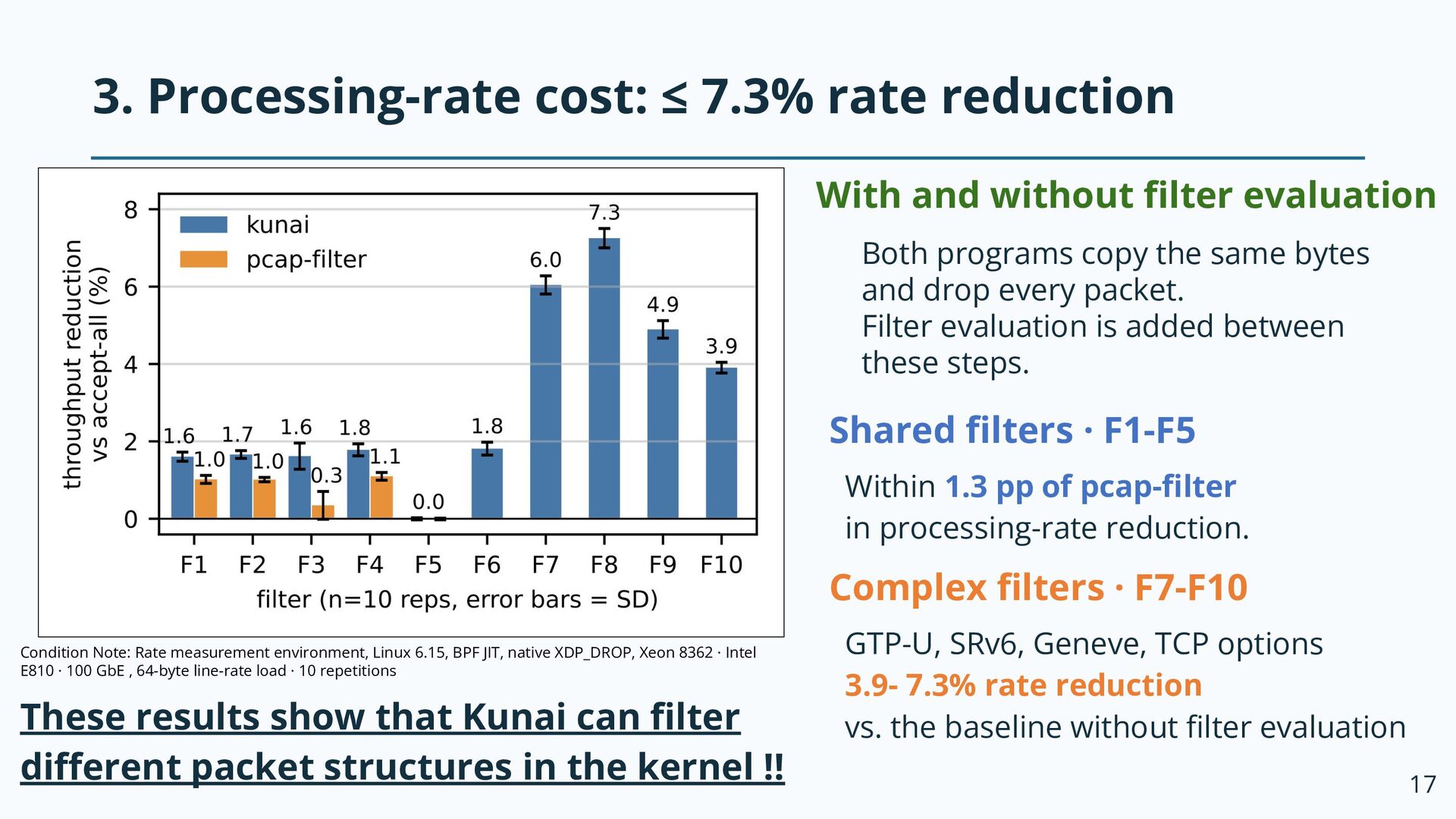
filter evaluation Both programs copy the same bytes and drop every packet. Filter evaluation is added between these steps. Shared filters · F1-F5 Within 1.3 pp of pcap-filter in processing-rate reduction. Complex filters · F7-F10 Condition Note: Rate measurement environment, Linux 6.15, BPF JIT, native XDP_DROP, Xeon 8362 · Intel E810 · 100 GbE , 64-byte line-rate load · 10 repetitions These results show that Kunai can filter different packet structures in the kernel !! GTP-U, SRv6, Geneve, TCP options 3.9- 7.3% rate reduction vs. the baseline without filter evaluation 17
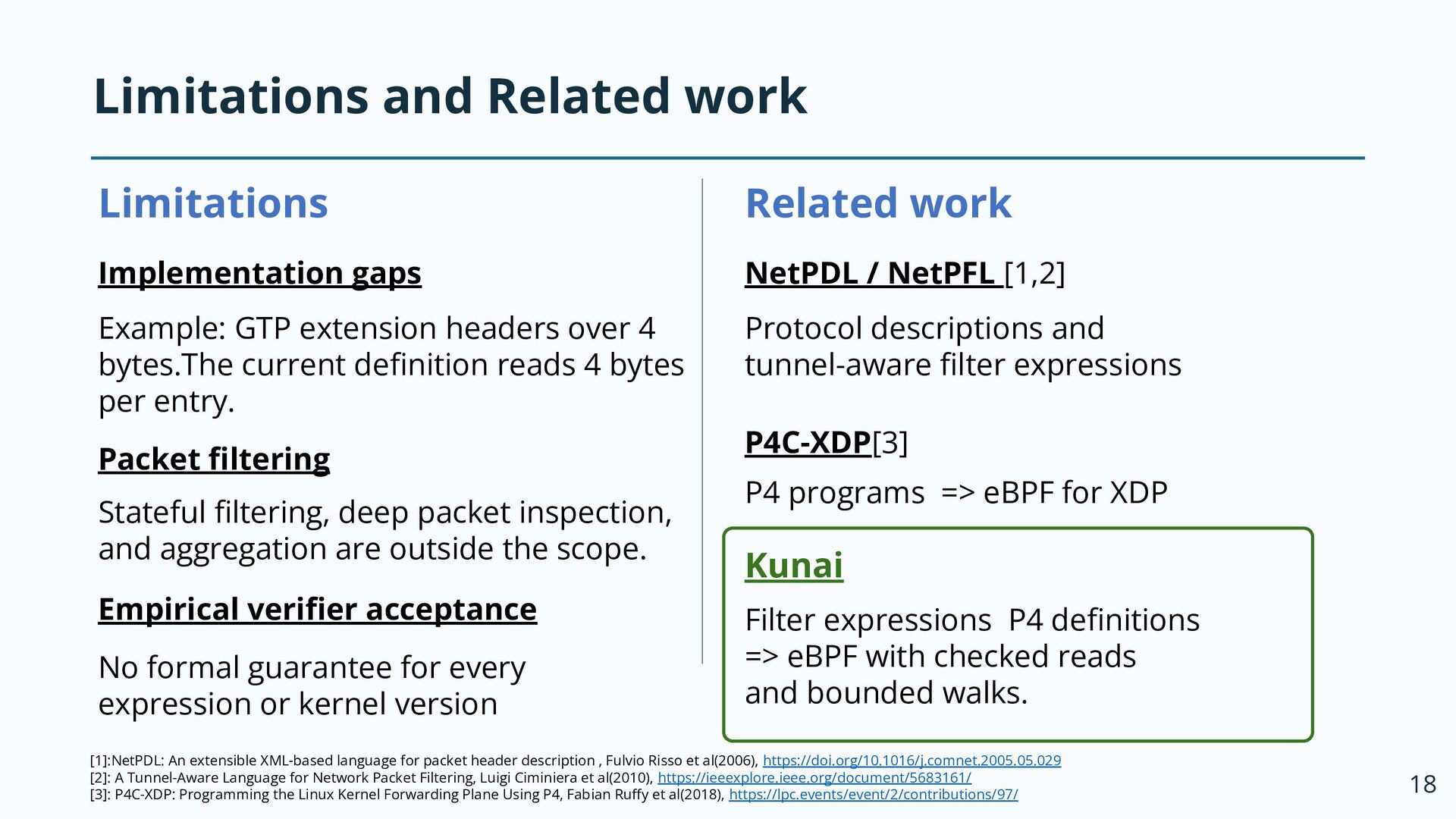
/ NetPFL [1,2] Example: GTP extension headers over 4 bytes.The current definition reads 4 bytes per entry. Protocol descriptions and tunnel-aware filter expressions Packet filtering Stateful filtering, deep packet inspection, and aggregation are outside the scope. Empirical verifier acceptance No formal guarantee for every expression or kernel version P4C-XDP[3] P4 programs => eBPF for XDP Kunai Filter expressions P4 definitions => eBPF with checked reads and bounded walks. [1]:NetPDL: An extensible XML-based language for packet header description , Fulvio Risso et al(2006), https://doi.org/10.1016/j.comnet.2005.05.029 [2]: A Tunnel-Aware Language for Network Packet Filtering, Luigi Ciminiera et al(2010), https://ieeexplore.ieee.org/document/5683161/ [3]: P4C-XDP: Programming the Linux Kernel Forwarding Plane Using P4, Fabian Ruffy et al(2018), https://lpc.events/event/2/contributions/97/ 18
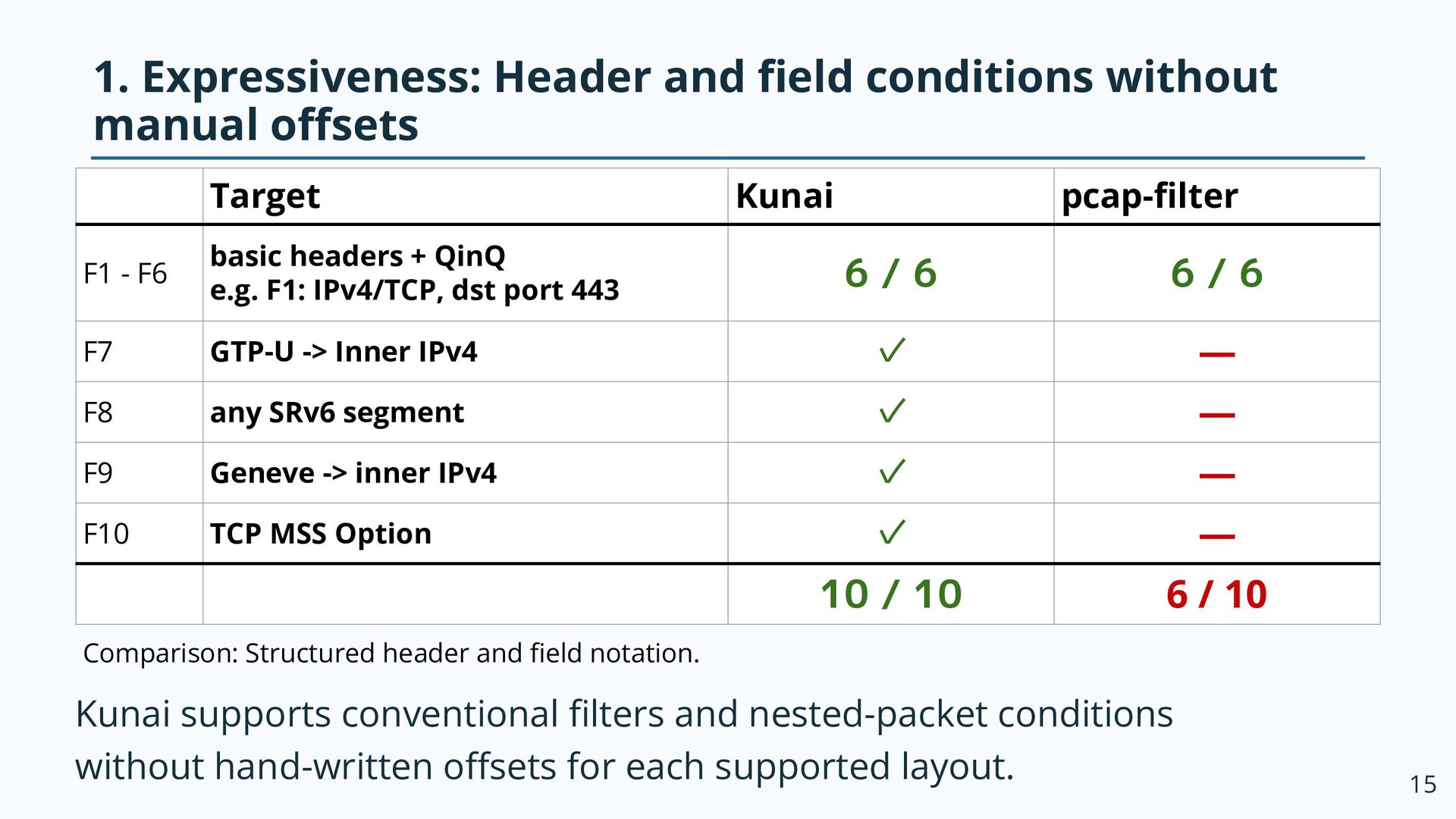
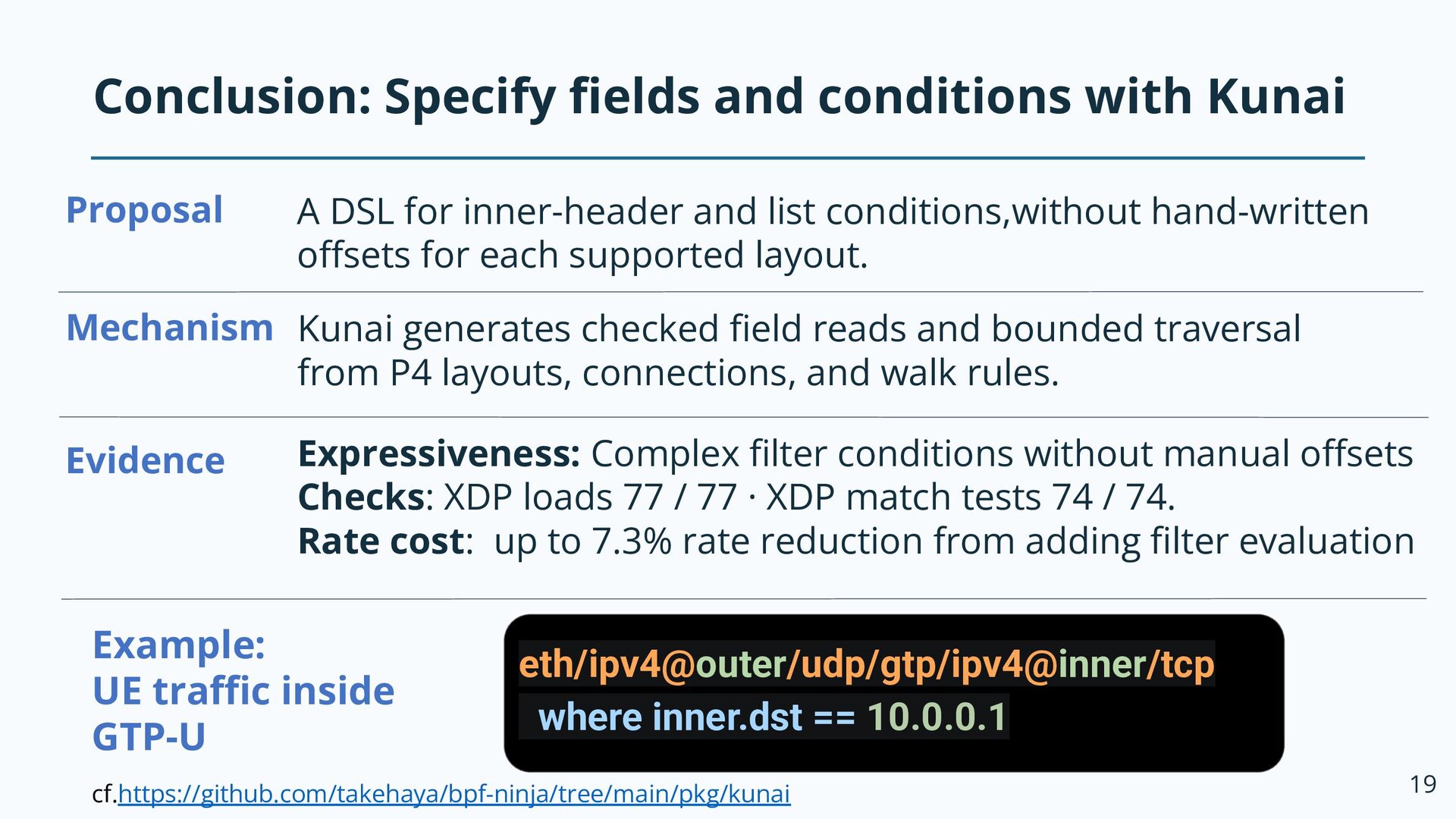
for inner-header and list conditions,without hand-written offsets for each supported layout. Mechanism Kunai generates checked field reads and bounded traversal from P4 layouts, connections, and walk rules. Evidence Expressiveness: Complex filter conditions without manual offsets Checks: XDP loads 77 / 77 · XDP match tests 74 / 74. Rate cost: up to 7.3% rate reduction from adding filter evaluation Example: UE traffic inside GTP-U eth/ipv4@outer/udp/gtp/ipv4@inner/tcp where inner.dst == 10.0.0.1 cf.https://github.com/takehaya/bpf-ninja/tree/main/pkg/kunai 19
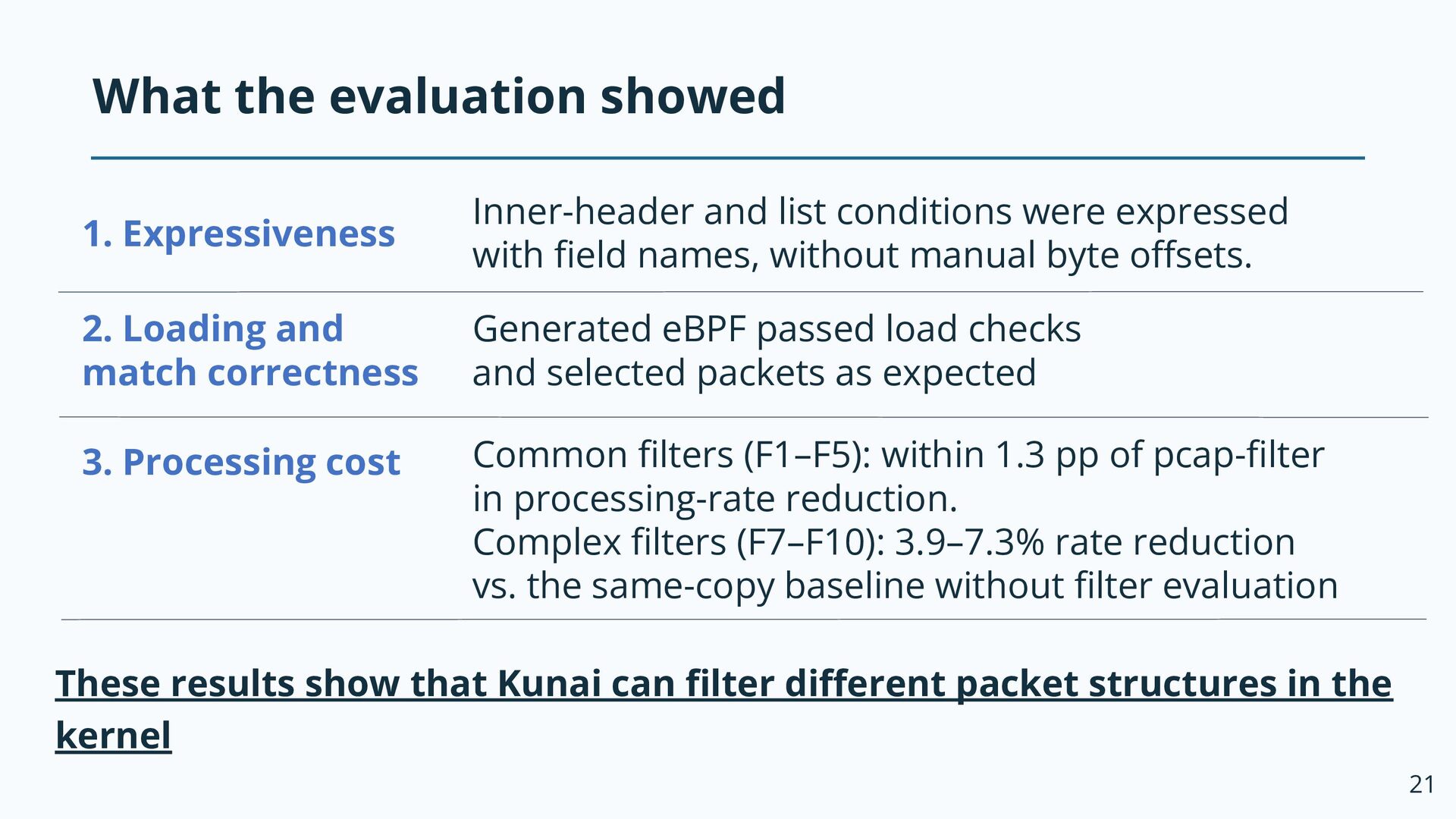
were expressed with field names, without manual byte offsets. 2. Loading and match correctness Generated eBPF passed load checks and selected packets as expected 3. Processing cost Common filters (F1–F5): within 1.3 pp of pcap-filter in processing-rate reduction. Complex filters (F7–F10): 3.9–7.3% rate reduction vs. the same-copy baseline without filter evaluation These results show that Kunai can filter different packet structures in the kernel 21
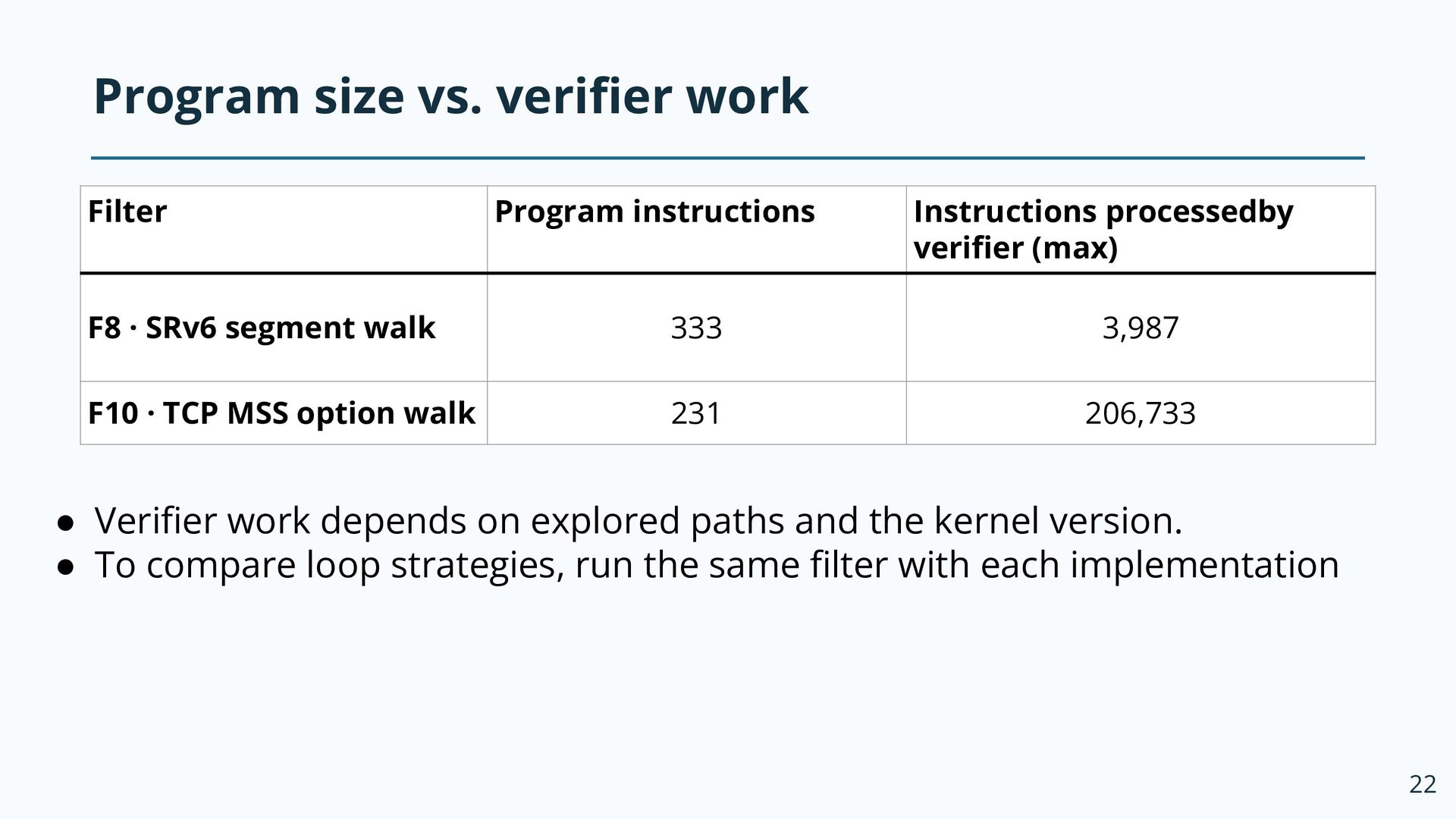
verifier (max) F8 · SRv6 segment walk 333 3,987 F10 · TCP MSS option walk 231 206,733 • Verifier work depends on explored paths and the kernel version. • To compare loop strategies, run the same filter with each implementation 22
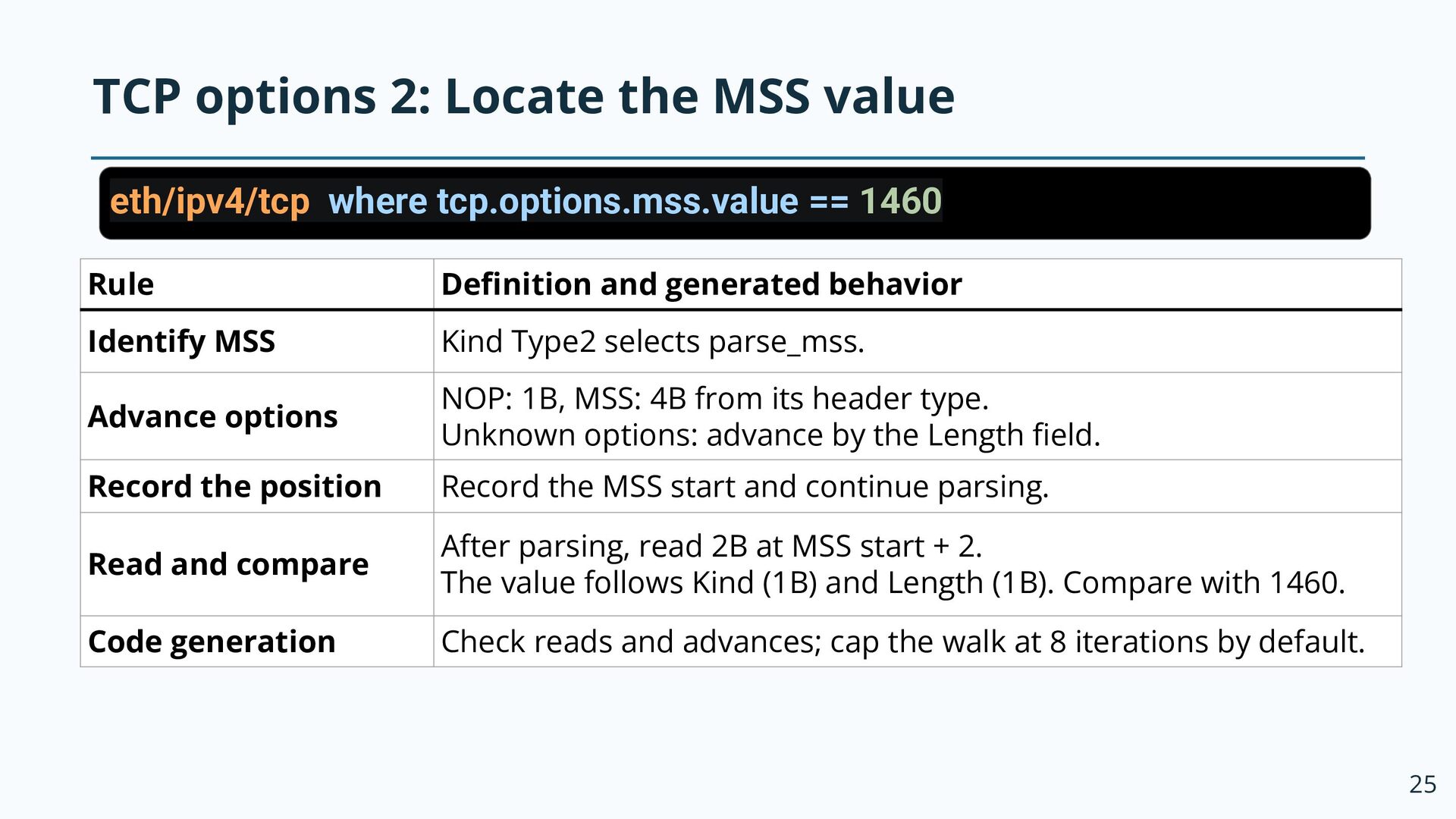
== 1460 Rule Definition and generated behavior Identify MSS Kind Type2 selects parse_mss. Advance options NOP: 1B, MSS: 4B from its header type. Unknown options: advance by the Length field. Record the position Record the MSS start and continue parsing. Read and compare After parsing, read 2B at MSS start + 2. The value follows Kind (1B) and Length (1B). Compare with 1460. Code generation Check reads and advances; cap the walk at 8 iterations by default. 25
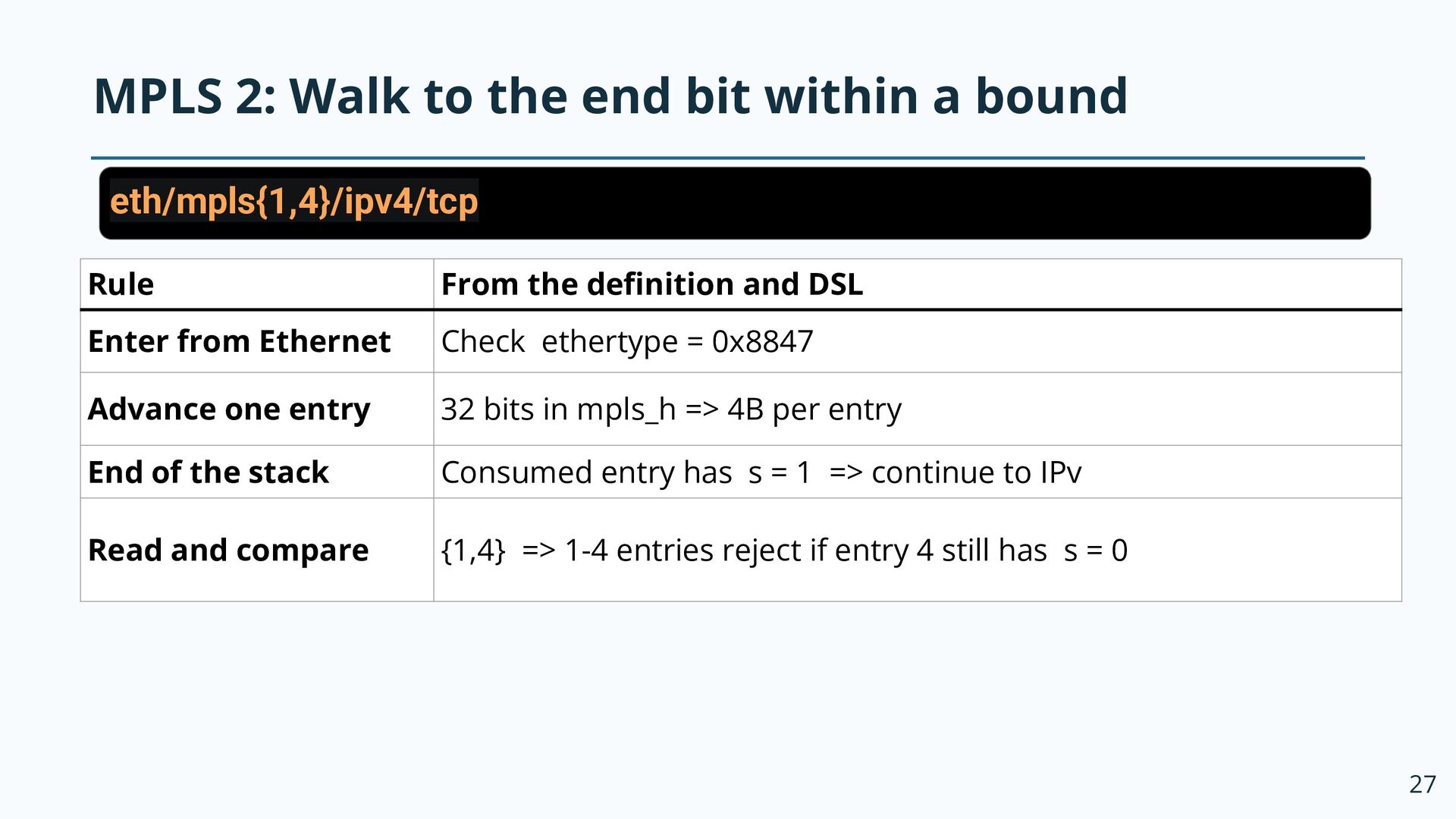
eth/mpls{1,4}/ipv4/tcp Rule From the definition and DSL Enter from Ethernet Check ethertype = 0x8847 Advance one entry 32 bits in mpls_h => 4B per entry End of the stack Consumed entry has s = 1 => continue to IPv Read and compare {1,4} => 1-4 entries reject if entry 4 still has s = 0 27


 takehaya
 institutdelelevage
 tattaka
 sishi
sishi
 reokashiwa
 youten622
 s_mizuki_nlp
 kentaitakura
 imai448
 sazimai
 pomcho555
 sokikatayama
 eumesy
 reverentgeek
 pedronauck
 baasie
 marcoroth
 palkan
 sachag
 sergeychernyshev
 signer
 notwaldorf
 jonoalderson
 jonrohan
 cassininazir