of Tampere Emerging hackerspaces – Peer-production generation Jarkko Moilanen PhD Candidate [email protected] University of Tampere School of Information Sciences
motivation • Personal history in hackerspaces and in hacker culture • Started as pure 'hackerspaces' study, expanded to cover other forms as well. • To provide missing accurate longitudinal statistical research data and results about commons-based peer production community such as: • Common characteristics of the community • Member motivation and • Community values • To put DIY communities on the larger context of hacker generations as 'Peer-production' generation
and surveys • Methods used • Empirical observation (helped in defining survey questions) – Tampere Hacklab • Annual surveys (main data collection method)
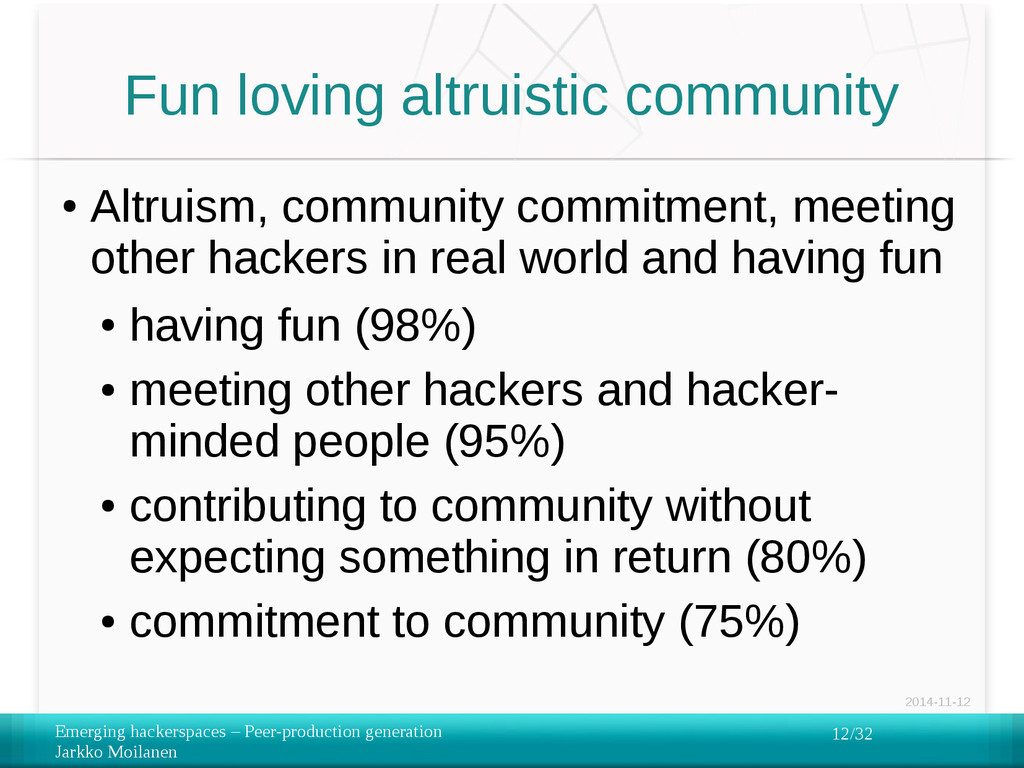
loving altruistic community • Altruism, community commitment, meeting other hackers in real world and having fun • having fun (98%) • meeting other hackers and hacker- minded people (95%) • contributing to community without expecting something in return (80%) • commitment to community (75%)
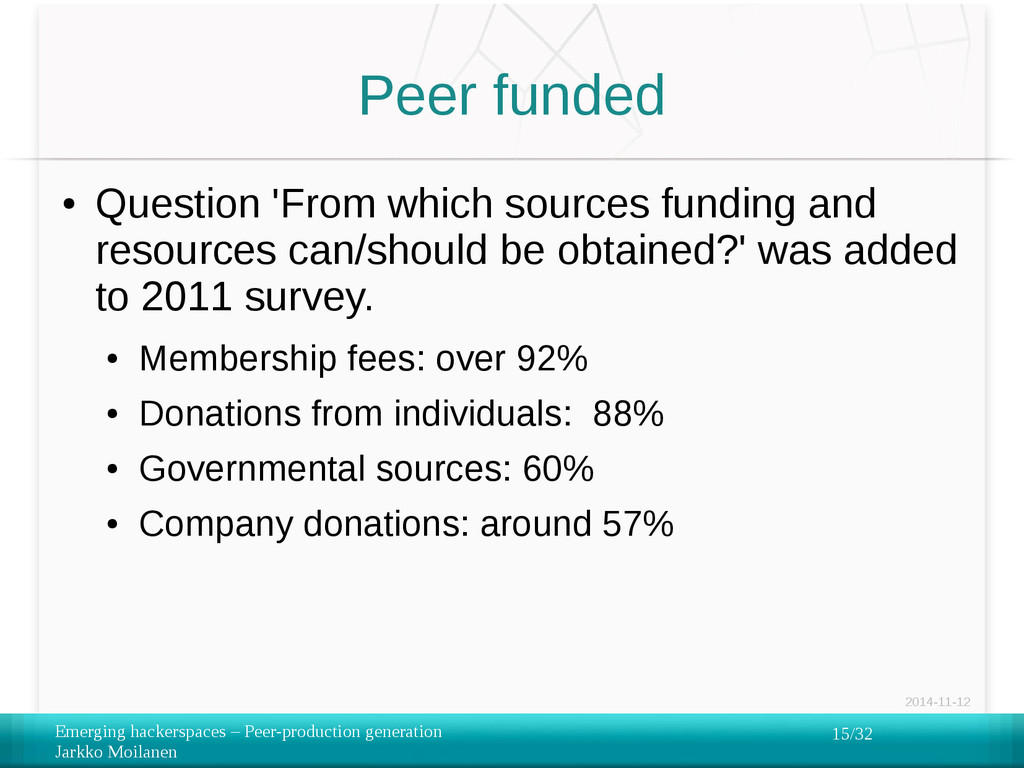
funded • Question 'From which sources funding and resources can/should be obtained?' was added to 2011 survey. • Membership fees: over 92% • Donations from individuals: 88% • Governmental sources: 60% • Company donations: around 57%
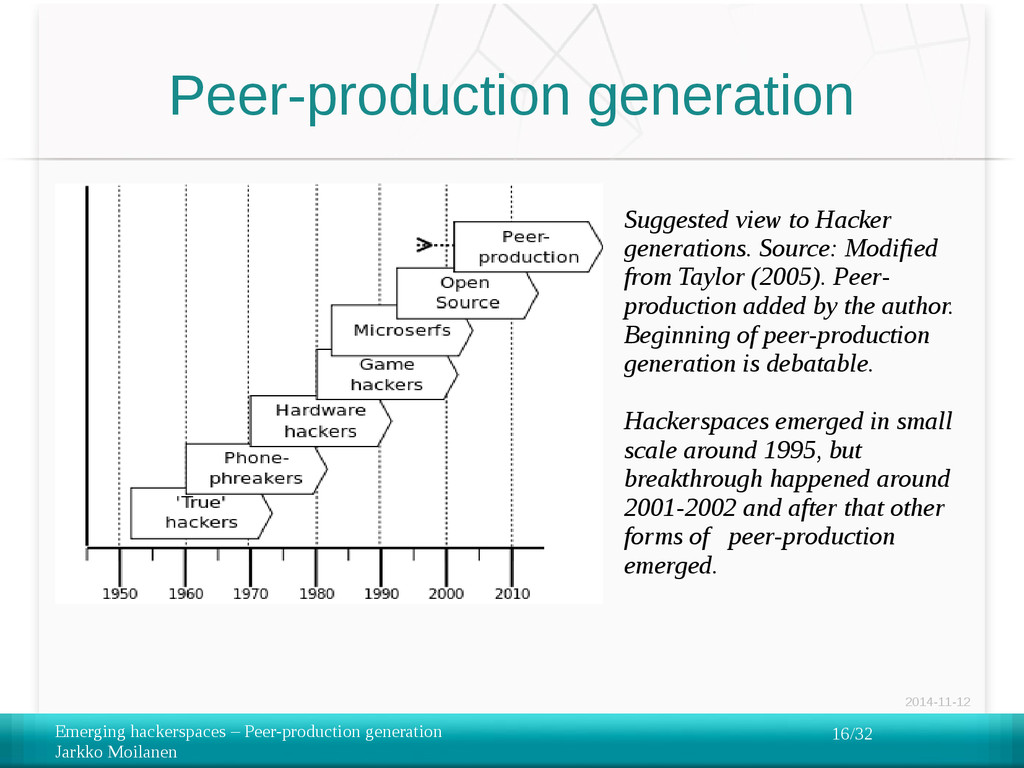
generation Suggested view to Hacker generations. Source: Modified from Taylor (2005). Peer- production added by the author. Beginning of peer-production generation is debatable. Hackerspaces emerged in small scale around 1995, but breakthrough happened around 2001-2002 and after that other forms of peer-production emerged.
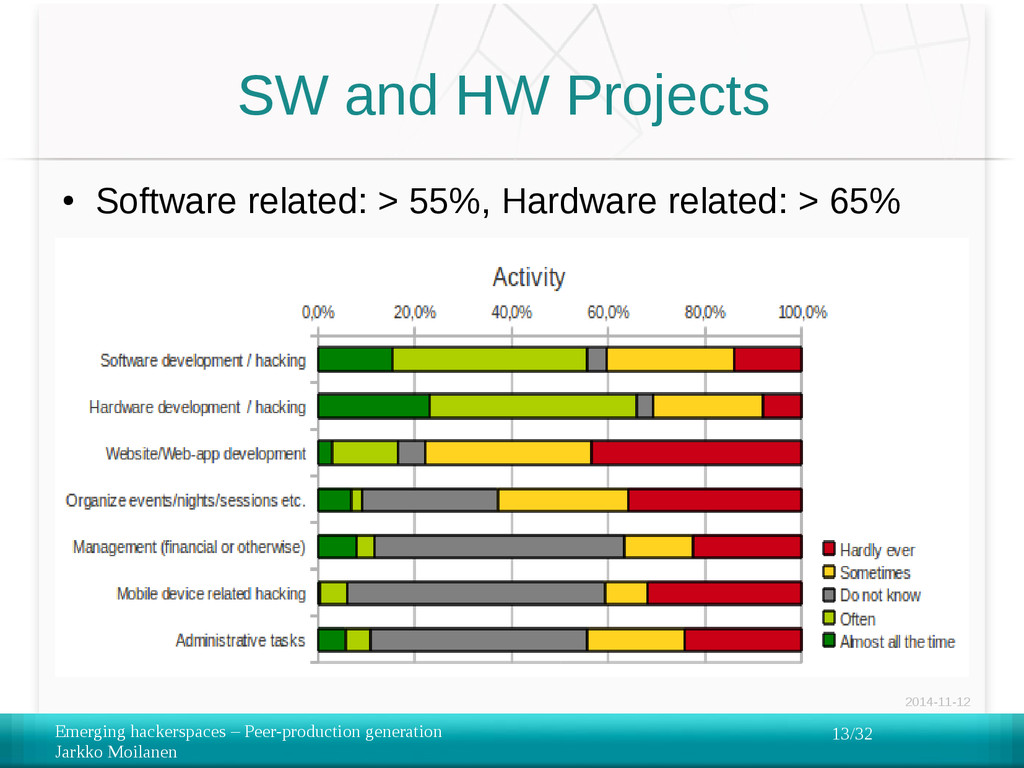
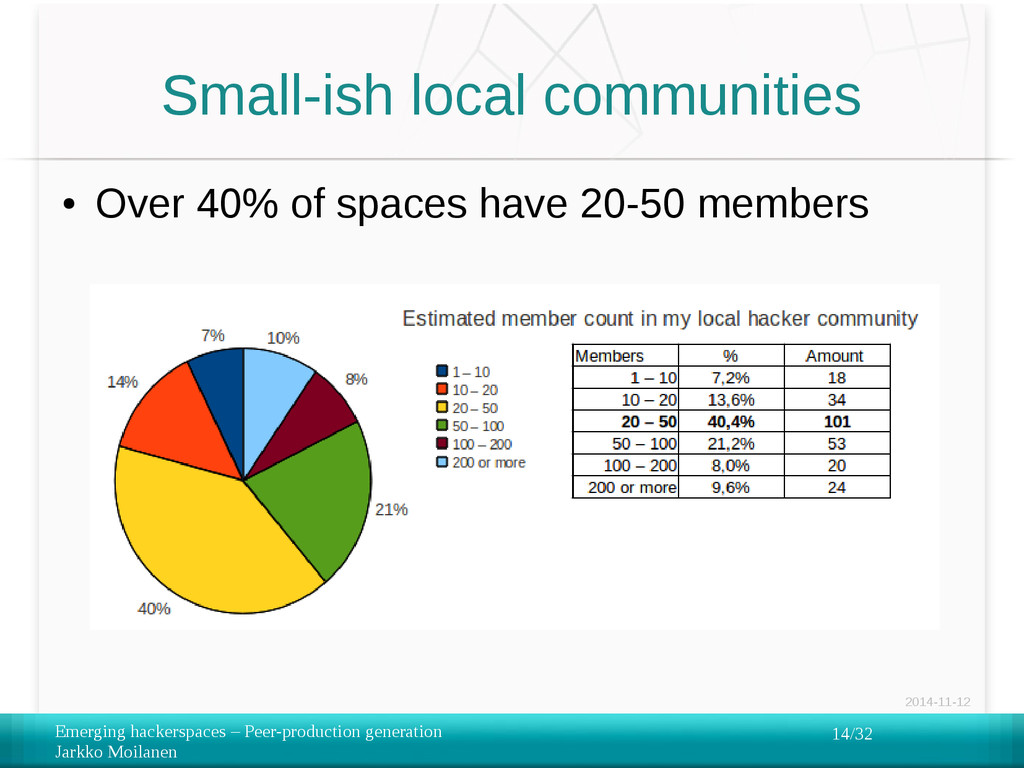
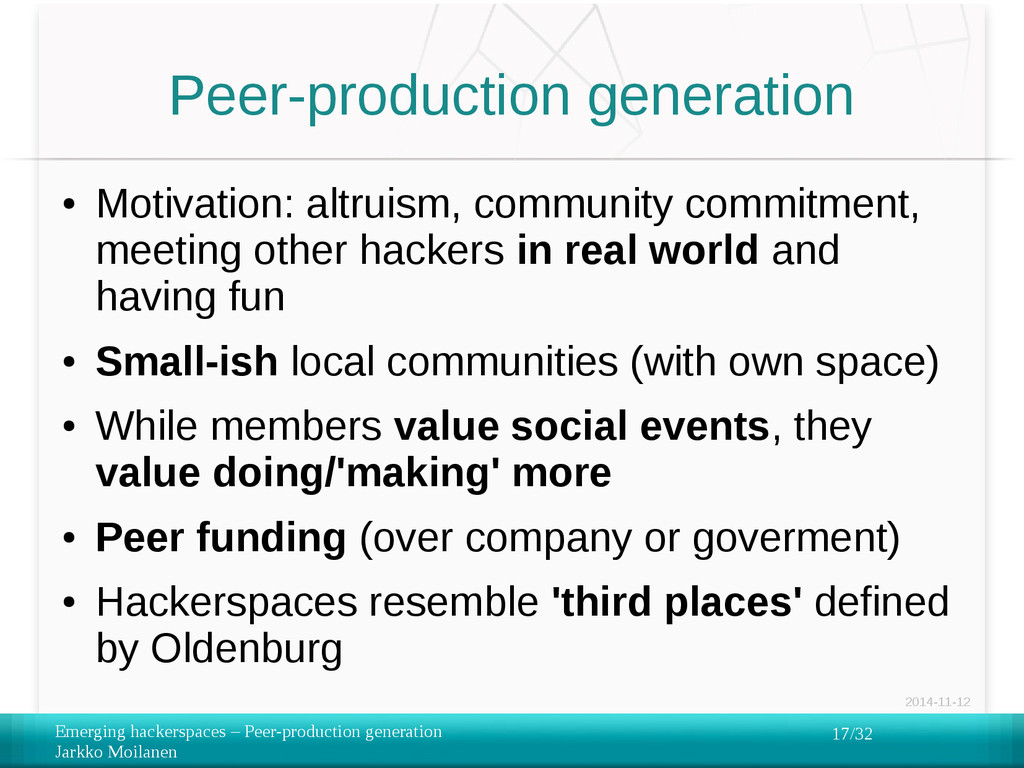
generation • Motivation: altruism, community commitment, meeting other hackers in real world and having fun • Small-ish local communities (with own space) • While members value social events, they value doing/'making' more • Peer funding (over company or goverment) • Hackerspaces resemble 'third places' defined by Oldenburg
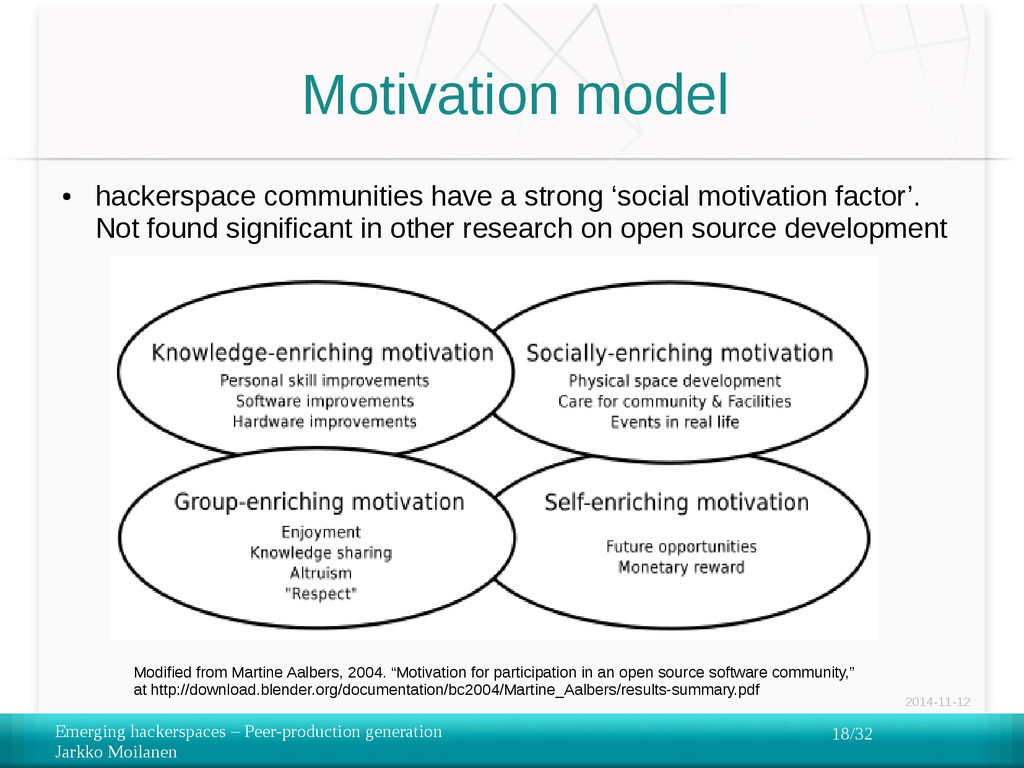
model • hackerspace communities have a strong ‘social motivation factor’. Not found significant in other research on open source development Modified from Martine Aalbers, 2004. “Motivation for participation in an open source software community,” at http://download.blender.org/documentation/bc2004/Martine_Aalbers/results-summary.pdf
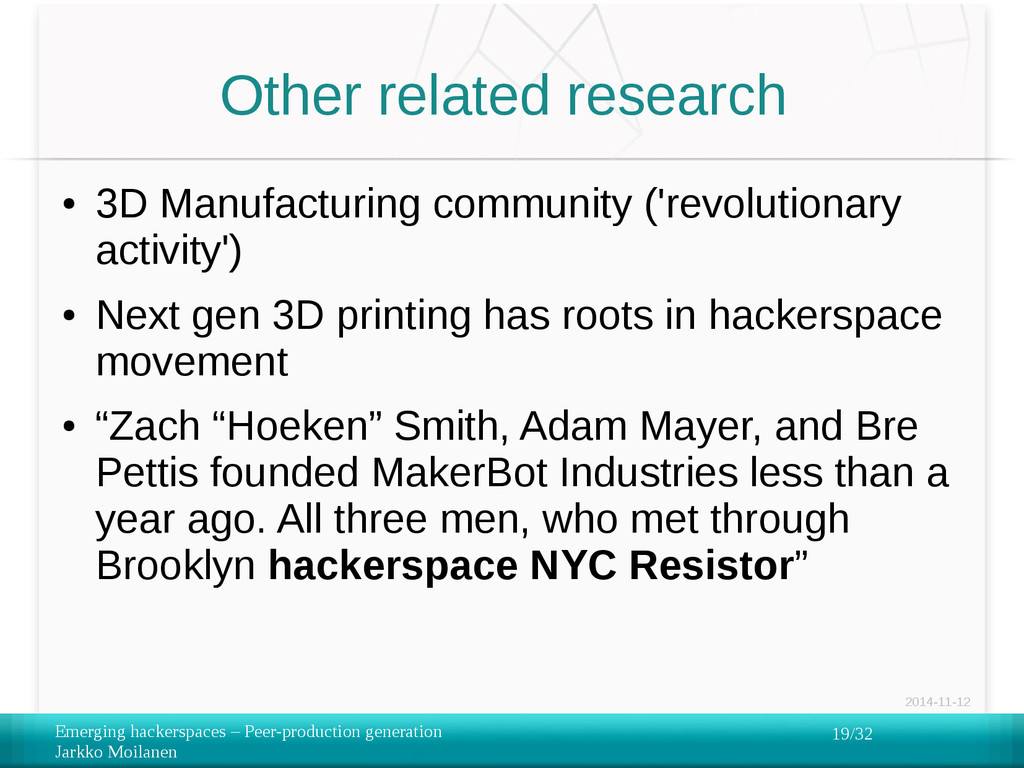
related research • 3D Manufacturing community ('revolutionary activity') • Next gen 3D printing has roots in hackerspace movement • “Zach “Hoeken” Smith, Adam Mayer, and Bre Pettis founded MakerBot Industries less than a year ago. All three men, who met through Brooklyn hackerspace NYC Resistor”
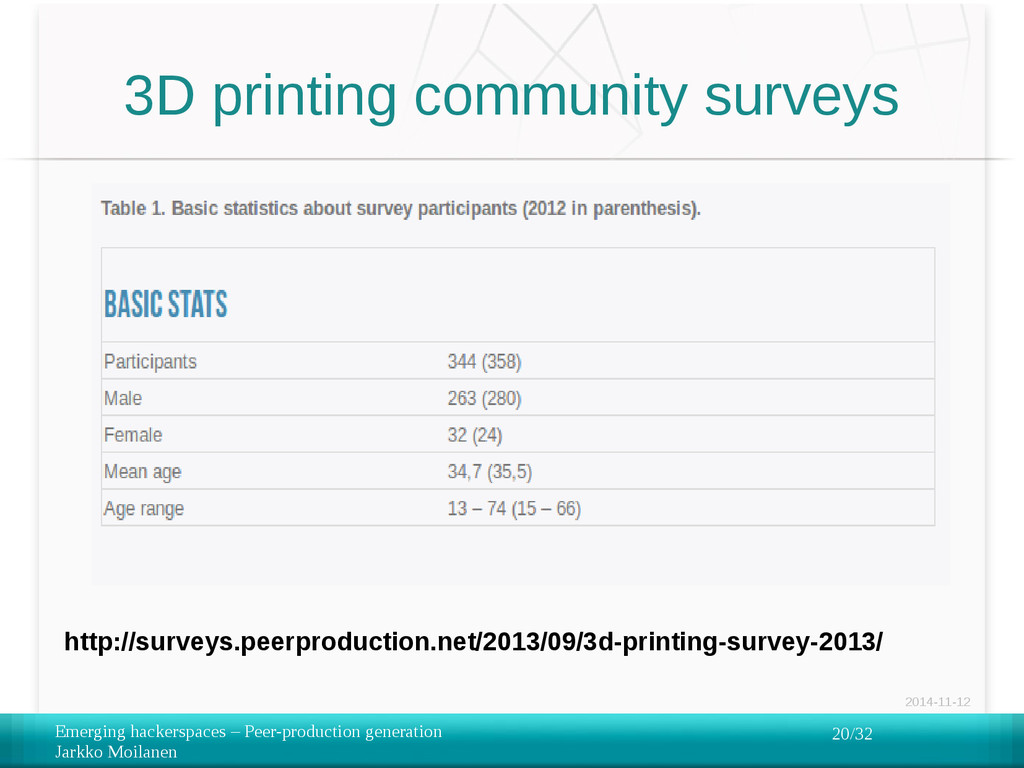
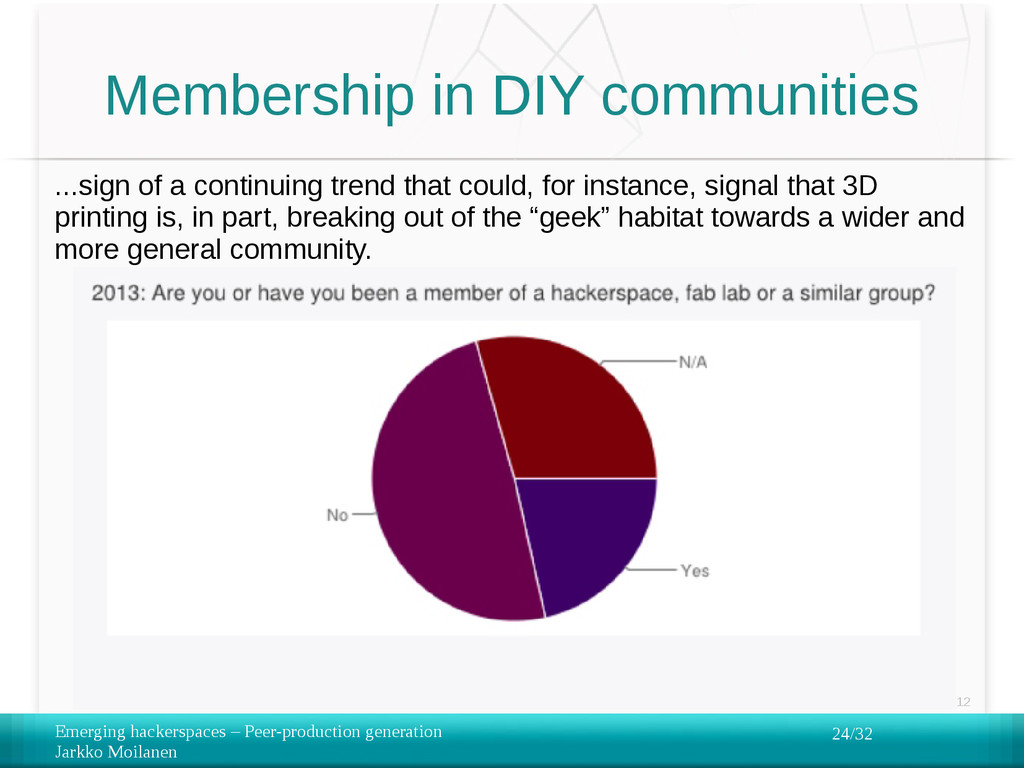
in DIY communities ...sign of a continuing trend that could, for instance, signal that 3D printing is, in part, breaking out of the “geek” habitat towards a wider and more general community.
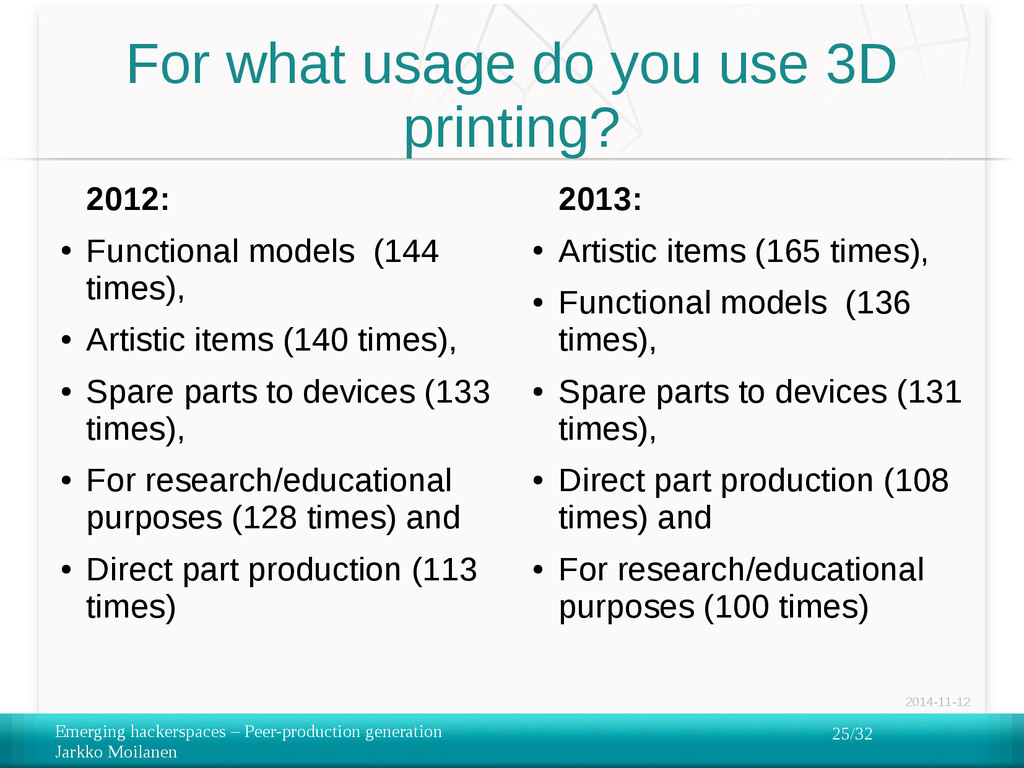
what usage do you use 3D printing? 2012: • Functional models (144 times), • Artistic items (140 times), • Spare parts to devices (133 times), • For research/educational purposes (128 times) and • Direct part production (113 times) 2013: • Artistic items (165 times), • Functional models (136 times), • Spare parts to devices (131 times), • Direct part production (108 times) and • For research/educational purposes (100 times)
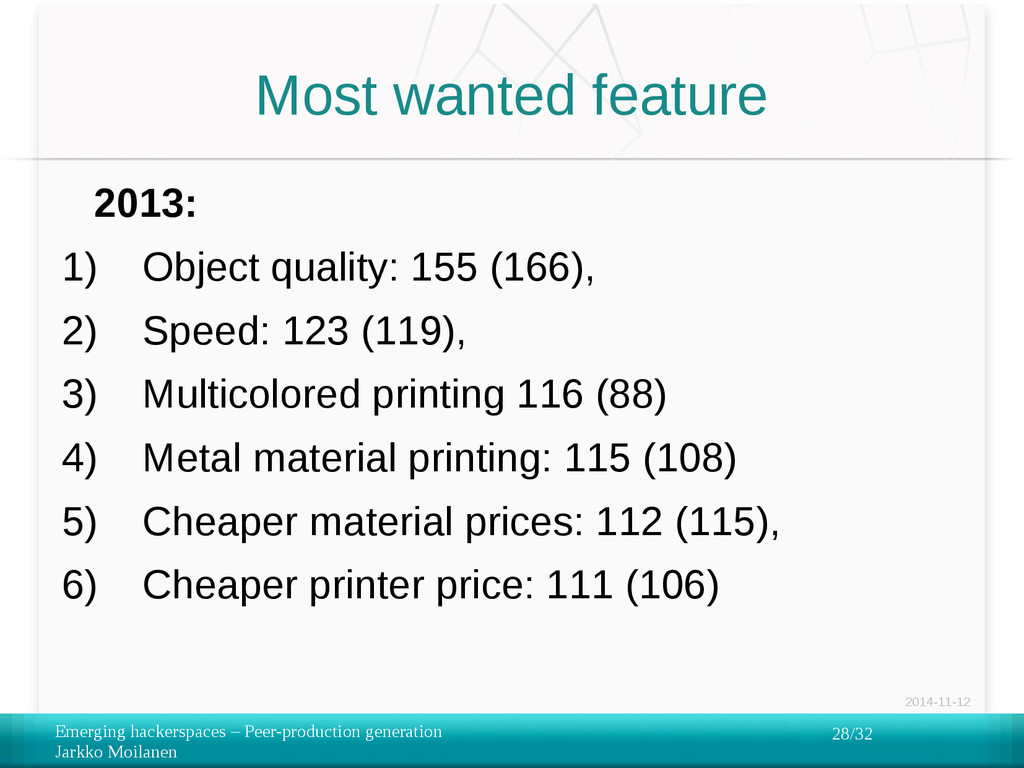
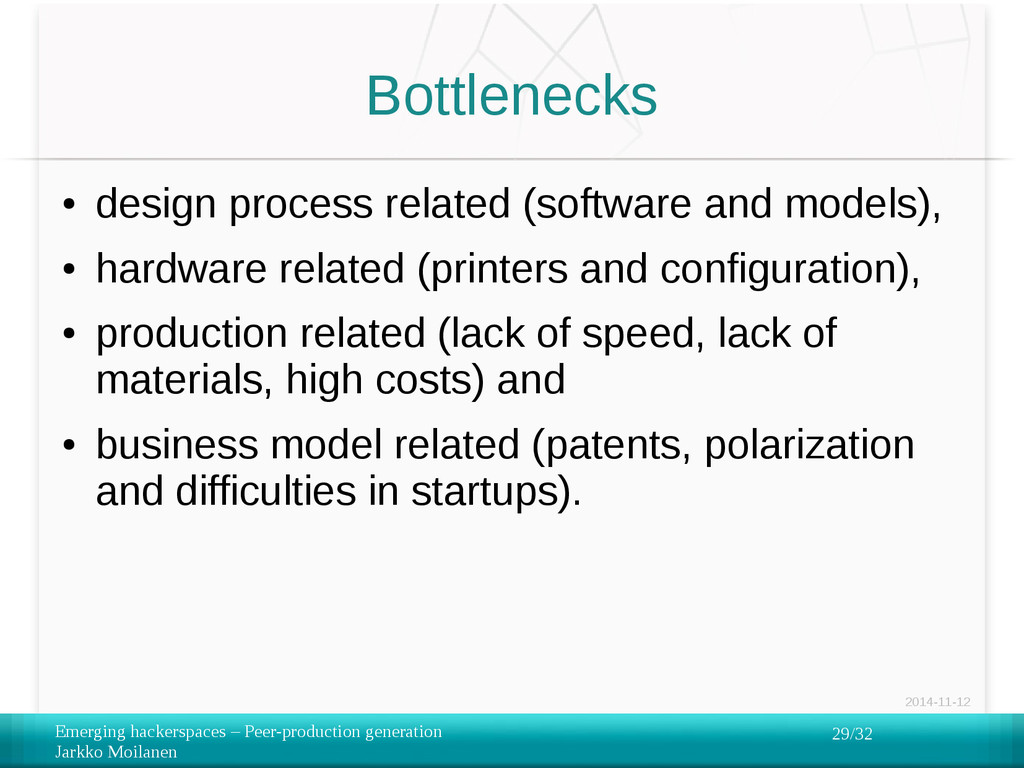
• design process related (software and models), • hardware related (printers and configuration), • production related (lack of speed, lack of materials, high costs) and • business model related (patents, polarization and difficulties in startups).
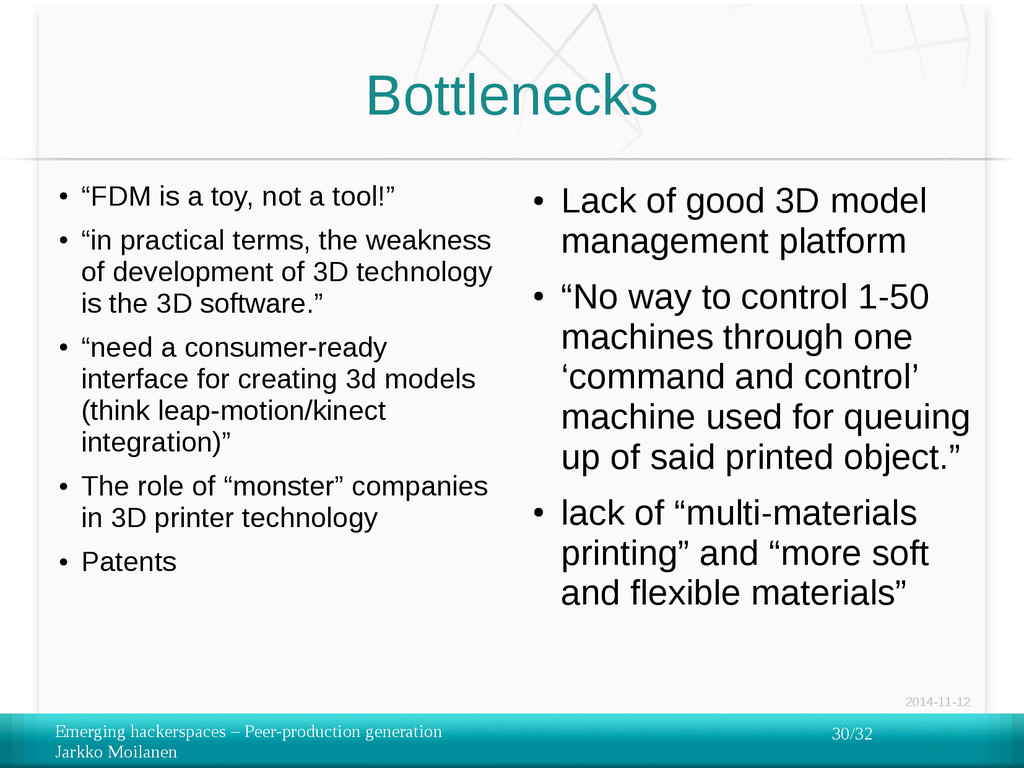
• “FDM is a toy, not a tool!” • “in practical terms, the weakness of development of 3D technology is the 3D software.” • “need a consumer-ready interface for creating 3d models (think leap-motion/kinect integration)” • The role of “monster” companies in 3D printer technology • Patents • Lack of good 3D model management platform • “No way to control 1-50 machines through one ‘command and control’ machine used for queuing up of said printed object.” • lack of “multi-materials printing” and “more soft and flexible materials”
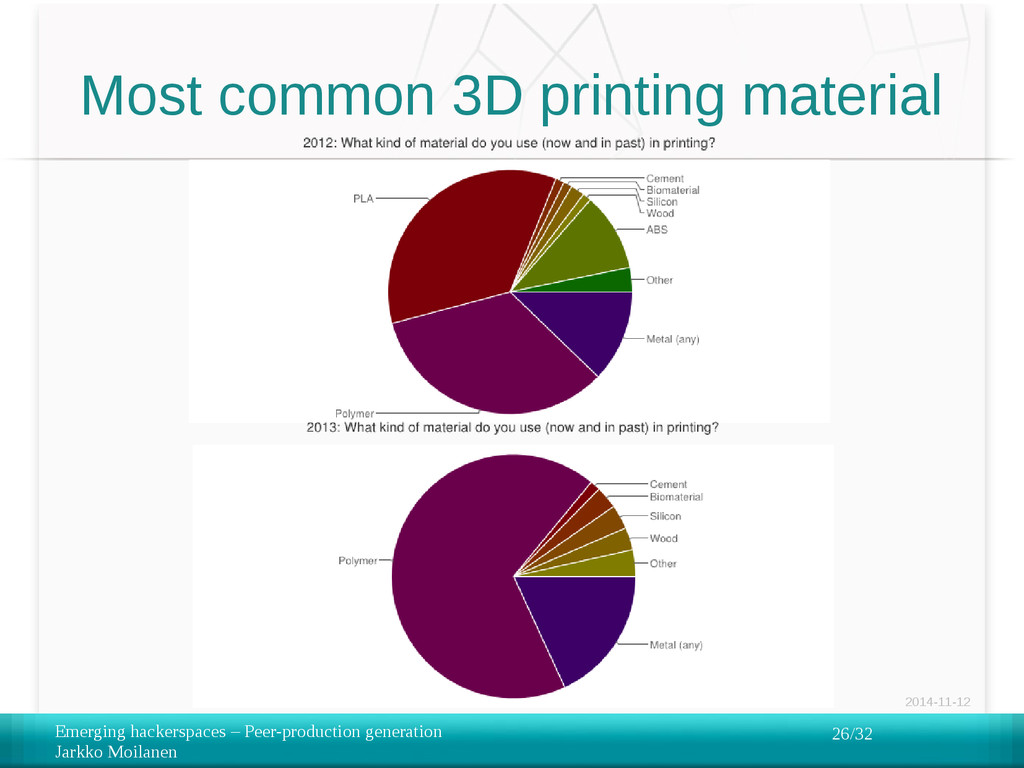
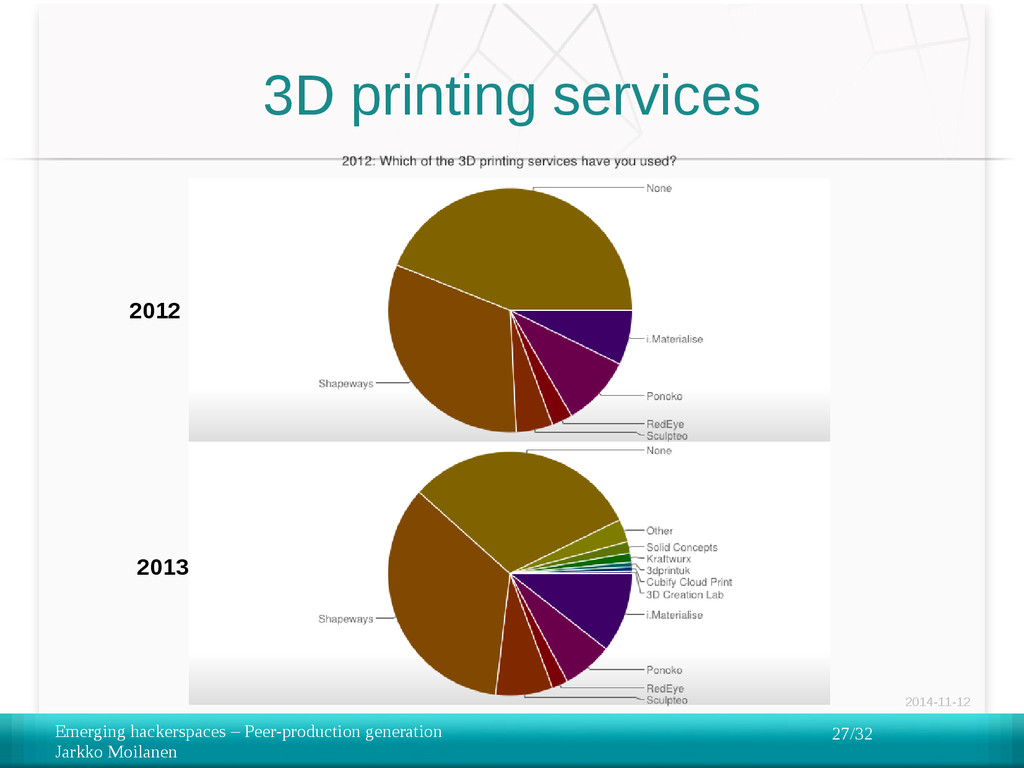
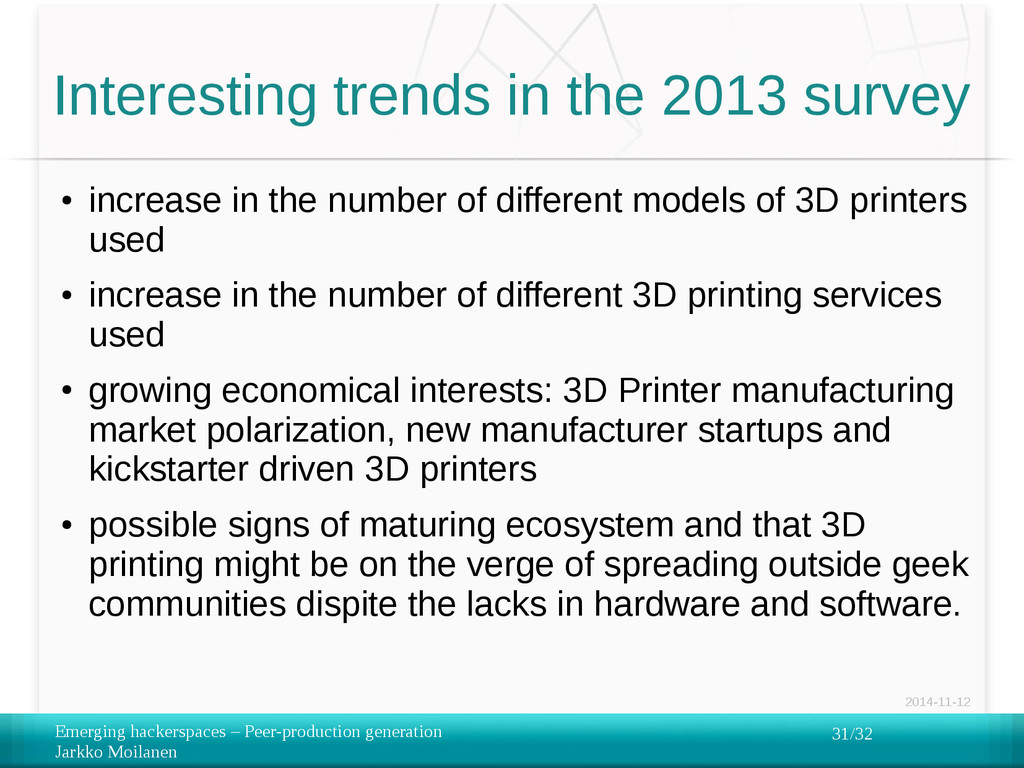
trends in the 2013 survey • increase in the number of different models of 3D printers used • increase in the number of different 3D printing services used • growing economical interests: 3D Printer manufacturing market polarization, new manufacturer startups and kickstarter driven 3D printers • possible signs of maturing ecosystem and that 3D printing might be on the verge of spreading outside geek communities dispite the lacks in hardware and software.


 kyyberi
 akiraasano
 hiola
hiola
 aokiplayer
 ainischool
 matleenalaakso
 bvr7352
 yatabe
 pawan_pharm
 ytapples613
 jdbedics
 juanmartin2026
 szymonslowik
 oripsolob
 aleyda
 frankvandijk
 dougneiner
 davidcarrasco
 baasie
 cassininazir
 reverentgeek
 codingconduct
 lfama
lfama
 marktimemedia