is the smallest meaningful unit in a language. Morphological typology: is the way of classifying world languages according to their common morphological structure.
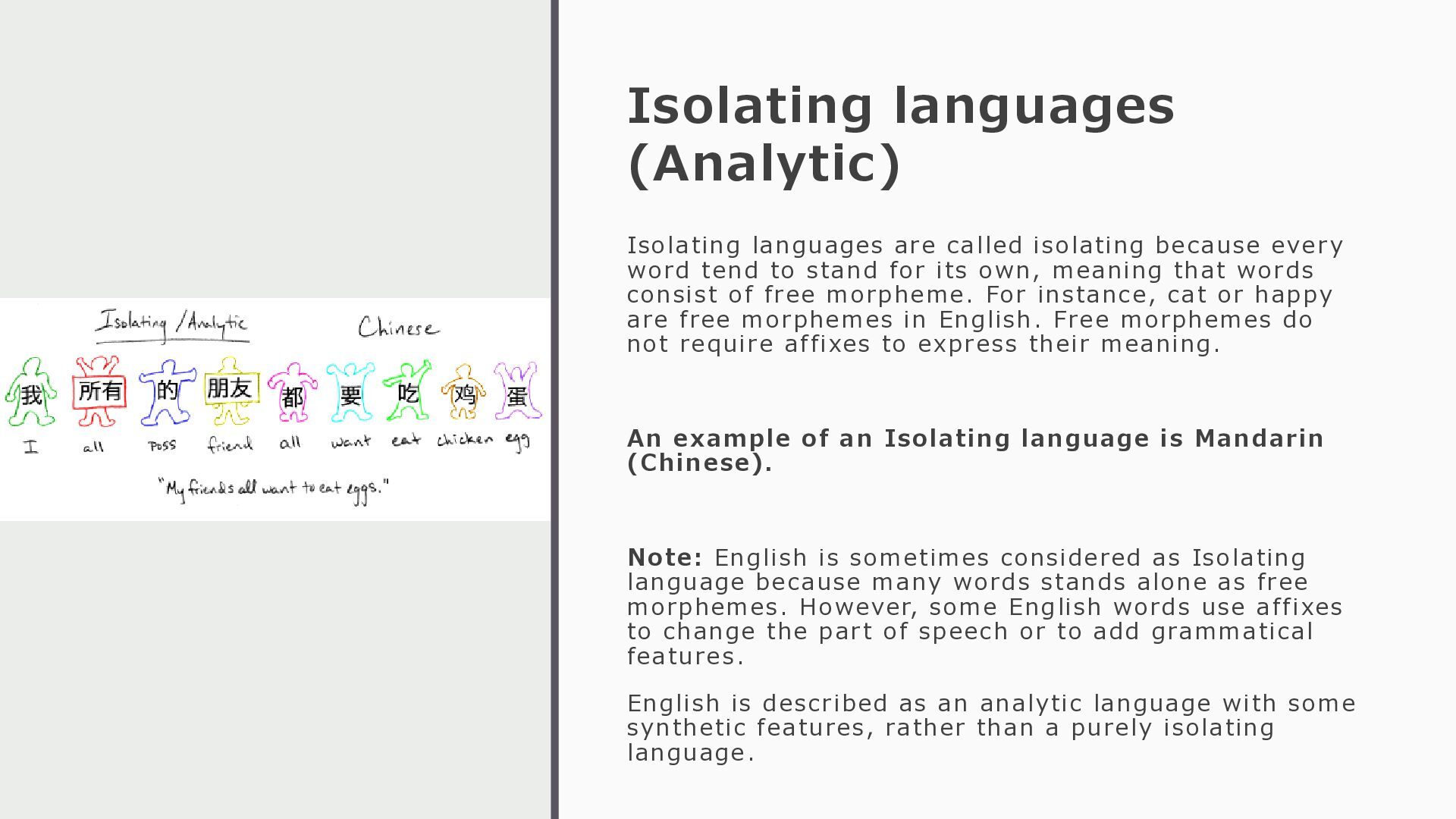
a ng uag es a r e ca l l ed i sol ating b e ca use e ve r y w o r d te n d to s ta n d f o r i ts o w n , m e a n in g th a t w o r d s co n s i s t o f f r e e m o r p h e me. Fo r i n s ta n ce, ca t o r h a p p y a r e f r e e m o r p h e me s i n E n g l is h. Fr e e m o r p h e me s d o n o t r e q u ir e a f f ixes to e xp r e s s th e i r m ea nin g. An e x a mp l e o f a n Is o l a ti n g l a n gu a ge i s Ma n da r i n ( C h i n e se). N o t e : E n g l is h is s o m e time s co n s i d e red a s Is o l a tin g l a n g u ag e b e ca u s e m a ny w o r d s s ta n d s a l o n e a s f r e e m o r p h e mes . H o w e ver, s o m e E n g l is h w o r d s u s e a f f ixes to ch a n g e th e p a r t o f s p e e ch o r to a d d g ra m m a tical f e a tu re s . E n g l is h i s d e s cr i b ed a s a n a n a l ytic l a n g u age w i th s o m e s y n th e tic f e a tu re s , ra th e r th a n a p u r e l y is ola tin g l a n g u ag e.
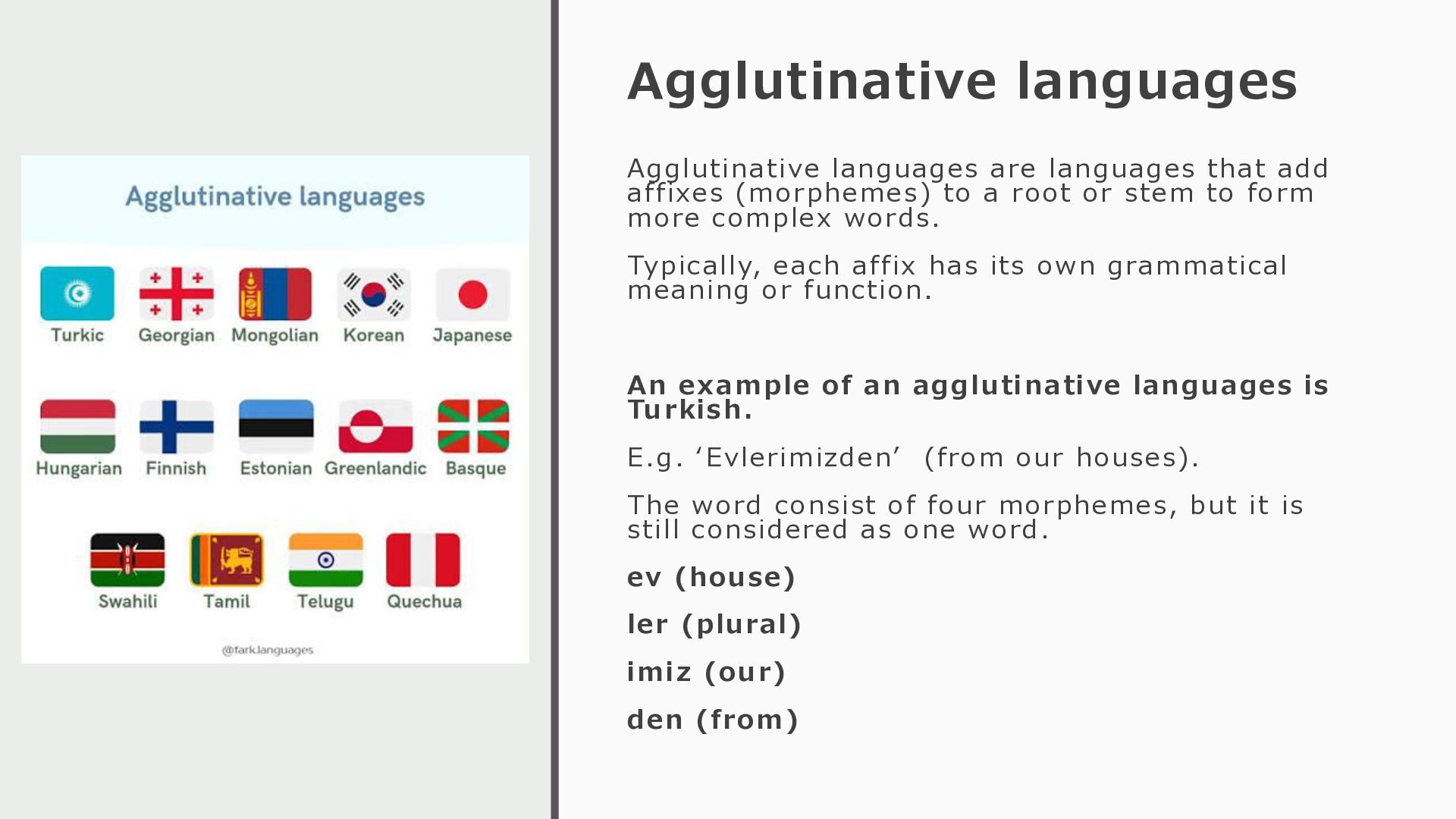
(morphemes) to a root or stem to form more complex words. Typically, each af f ix has its own grammatical meaning or function. An example of an agglutinative languages is Turkish. E.g. ‘Evlerimizden’ (from our houses). The word consist of four morphemes, but it is still considered as one word. ev (house) ler (plural) imiz (our) den (from)
the root or stem simultaneously expresses several grammatical Fusional meanings. languages An example of a fusional languages is Spanish E.g. habló The suffix -ó can express these grammatical features: mood, aspect, number, tense, and person.
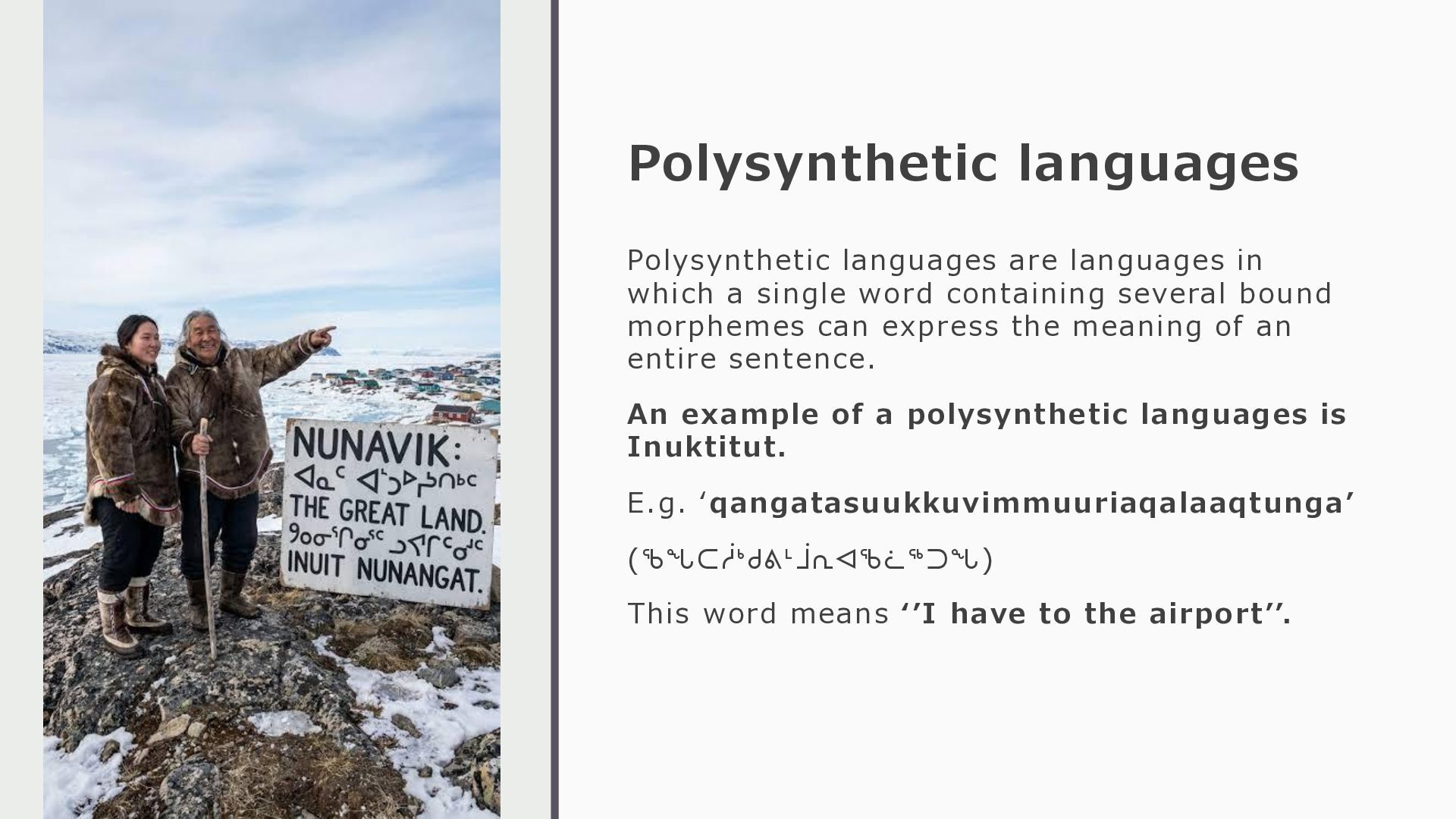
word containing several bound morphemes can express the meaning of an entire sentence. An example of a polysynthetic languages is Inuktitut. E.g. ‘qangatasuukkuvimmuuriaqalaaqtunga’ (ᖃᖓᑕᓲᒃᑯᕕᒻᒨᕆᐊᖃᓛᖅᑐᖓ) This word means ‘’I have to the airport’’.


 lavin_aziz
 pawan_pharm
 cbtlibrary
 auctria
 adeputra13
 masakiokuda
 arnoknobbe
 kekekenta
 bvr7352
 signer
 hiola
 reverentgeek
 moore
 oripsolob
 tammyeverts
 uxyall
 eitanlees
 inesmontani
 techseoconnect
 skipperchong
 jdejongh