Upgrade to Pro — share decks privately, control downloads, hide ads and more …

Before You Scale: Understand the Theory Behind ...

Sponsored · Your Podcast. Everywhere. Effortlessly. Share. Educate. Inspire. Entertain. You do you. We'll handle the rest. →

Before You Scale: Understand the Theory Behind the Simulation

Guest Lecture, Applied Natural Language Processing, Graduate School of IST, The University of Tokyo, 2026-10-27.
東京大学大学院情報理工学系研究科「自然言語処理応用」での2026/10/27特別講演

Avatar for Preferred Networks

Preferred Networks PRO

October 23, 2026

More Decks by Preferred Networks

Other Decks in Education

Transcript

  1. What AI for Science Has Taught Me Before You Scale:

    Understand the Theory Behind the Simulation Yuta Tsuboi (Preferred Networks, Inc.) Guest Lecture, Applied Natural Language Processing, Graduate School of IST, The University of Tokyo 2026-10-27 © 2026 Preferred Networks, Inc.
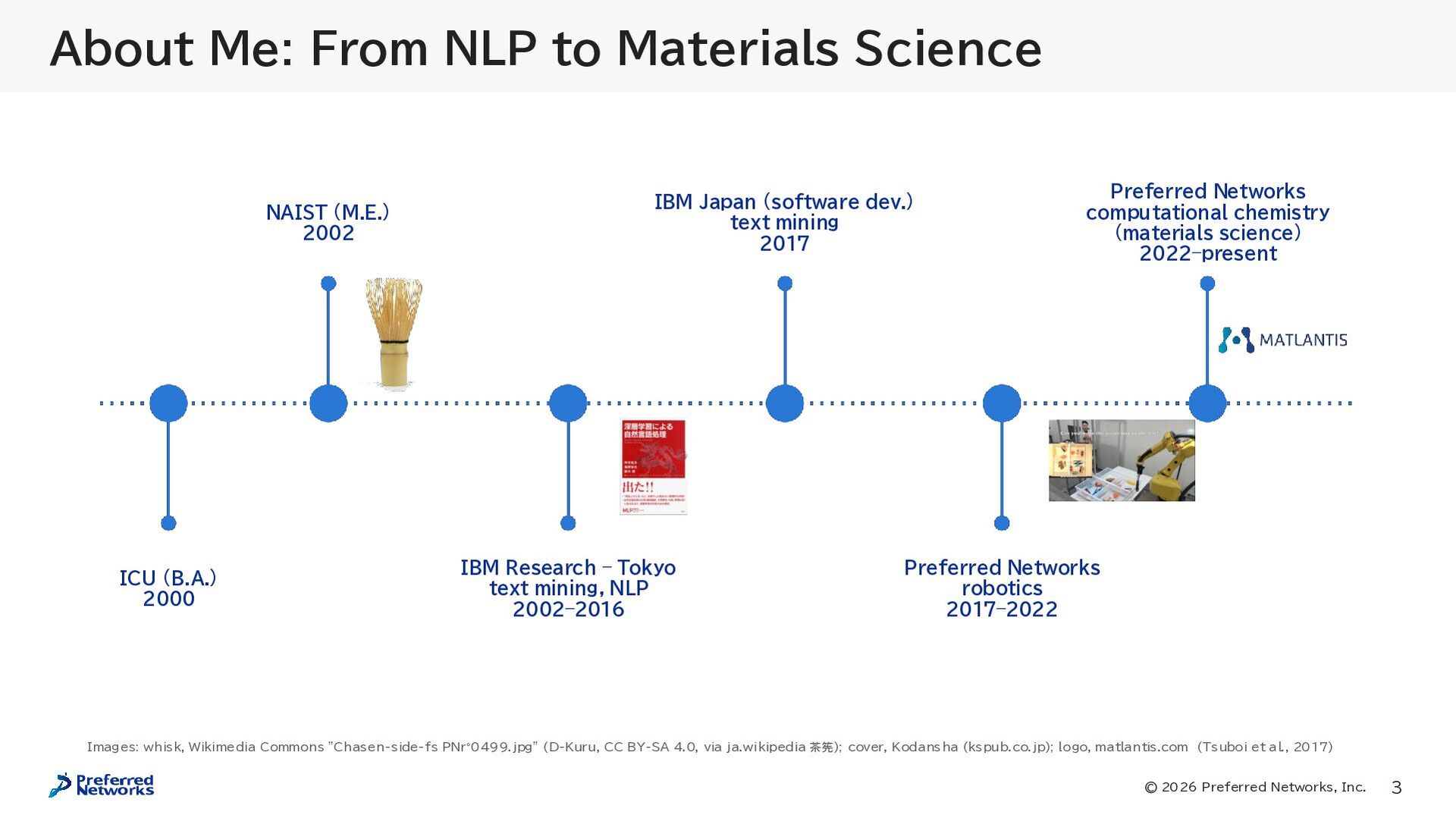
  2. About Me: From NLP to Materials Science NAIST (M.E.) 2002

    ICU (B.A.) 2000 IBM Japan (software dev.) text mining 2017 IBM Research – Tokyo text mining, NLP 2002–2016 Preferred Networks computational chemistry (materials science) 2022–present Preferred Networks robotics 2017–2022 Images: whisk, Wikimedia Commons "Chasen-side-fs PNr°0499.jpg" (D-Kuru, CC BY-SA 4.0, via ja.wikipedia 茶筅); cover, Kodansha (kspub.co.jp); logo, matlantis.com (Tsuboi et al., 2017) © 2026 Preferred Networks, Inc. 3
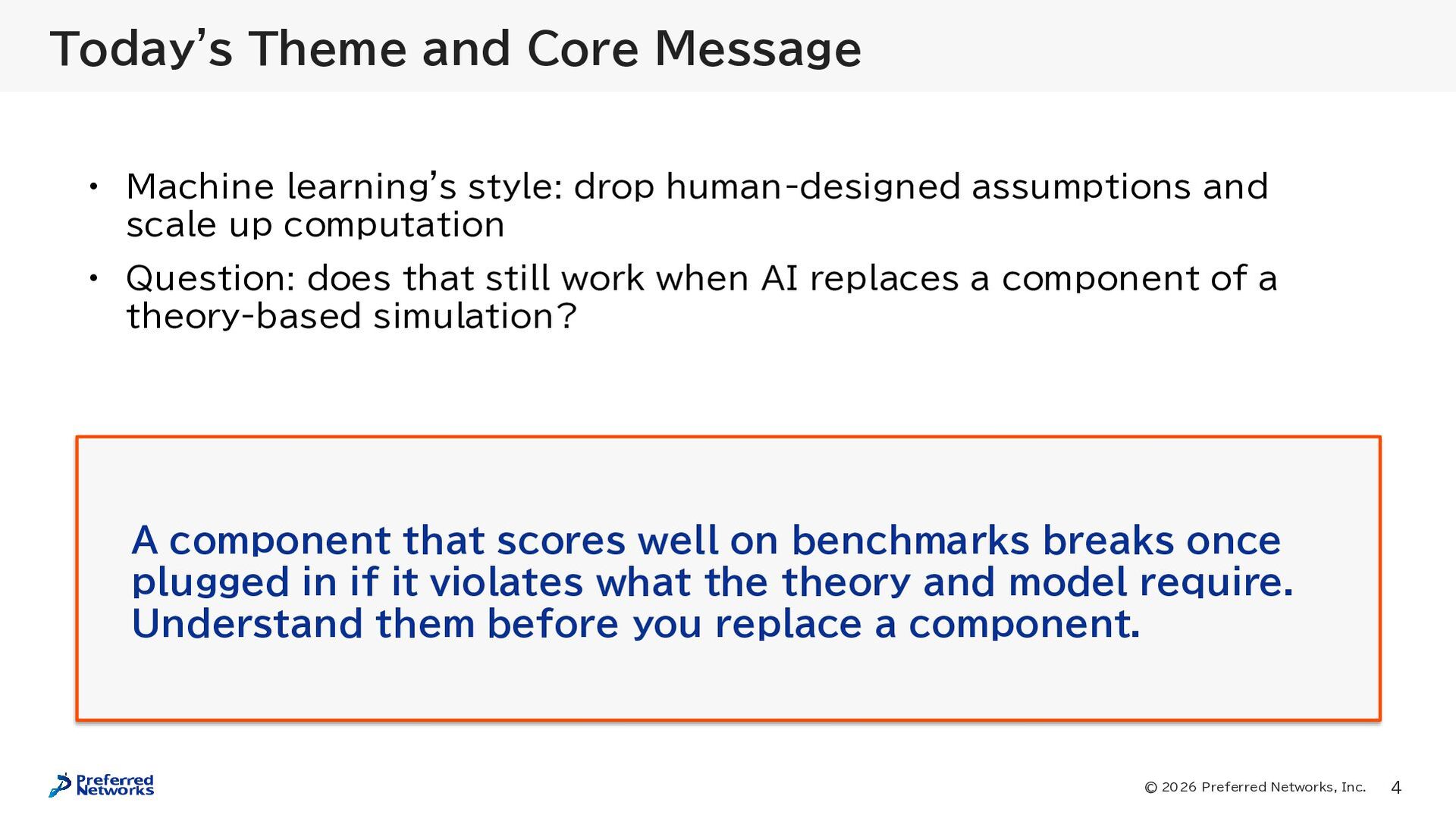
  3. Today's Theme and Core Message • Machine learning's style: drop

    human-designed assumptions and scale up computation • Question: does that still work when AI replaces a component of a theory-based simulation? A component that scores well on benchmarks breaks once plugged in if it violates what the theory and model require. Understand them before you replace a component. © 2026 Preferred Networks, Inc. 4
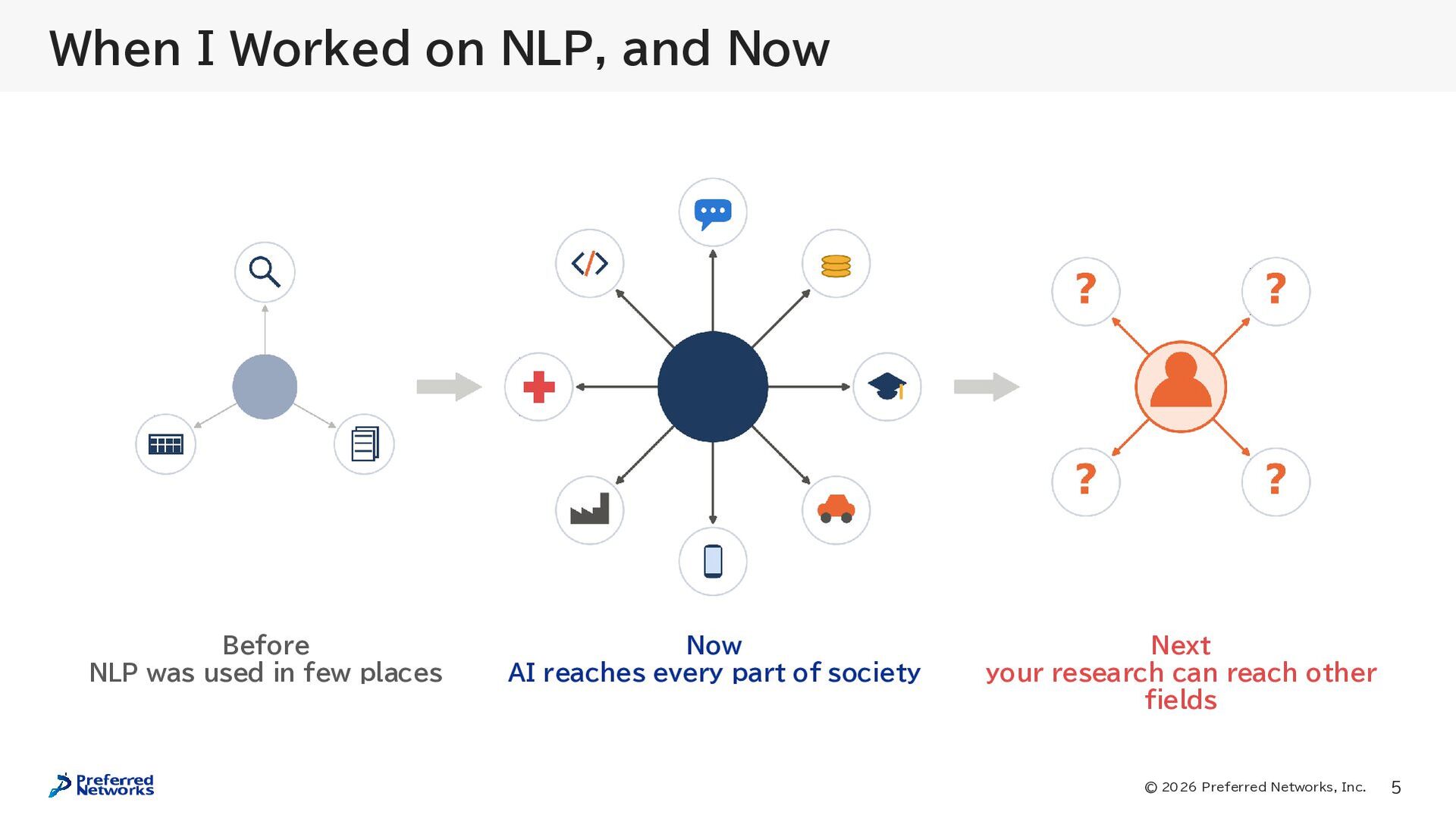
  4. When I Worked on NLP, and Now Before NLP was

    used in few places Now AI reaches every part of society Next your research can reach other fields © 2026 Preferred Networks, Inc. 5
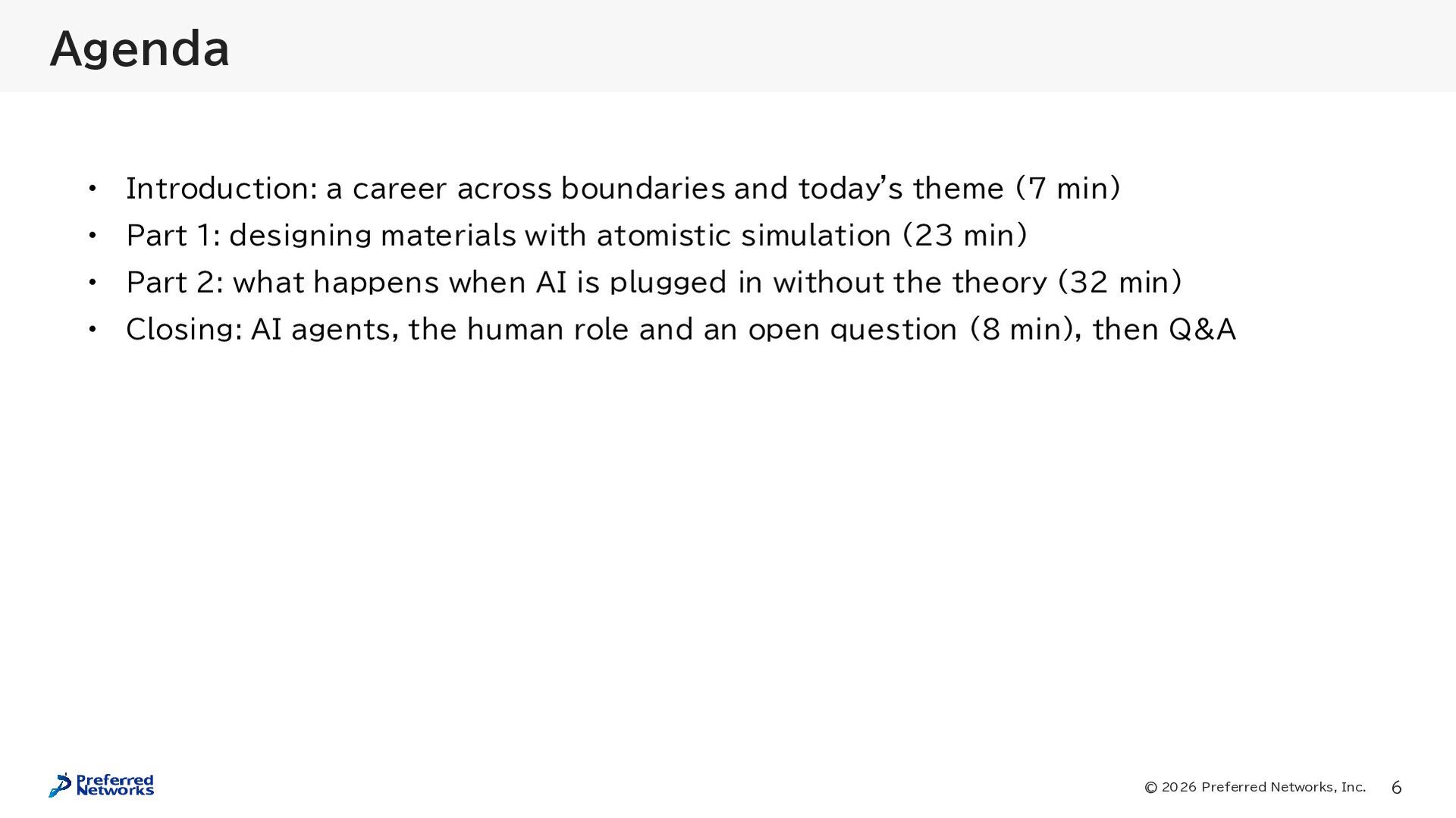
  5. Agenda • Introduction: a career across boundaries and today's theme

    (7 min) • Part 1: designing materials with atomistic simulation (23 min) • Part 2: what happens when AI is plugged in without the theory (32 min) • Closing: AI agents, the human role and an open question (8 min), then Q&A © 2026 Preferred Networks, Inc. 6
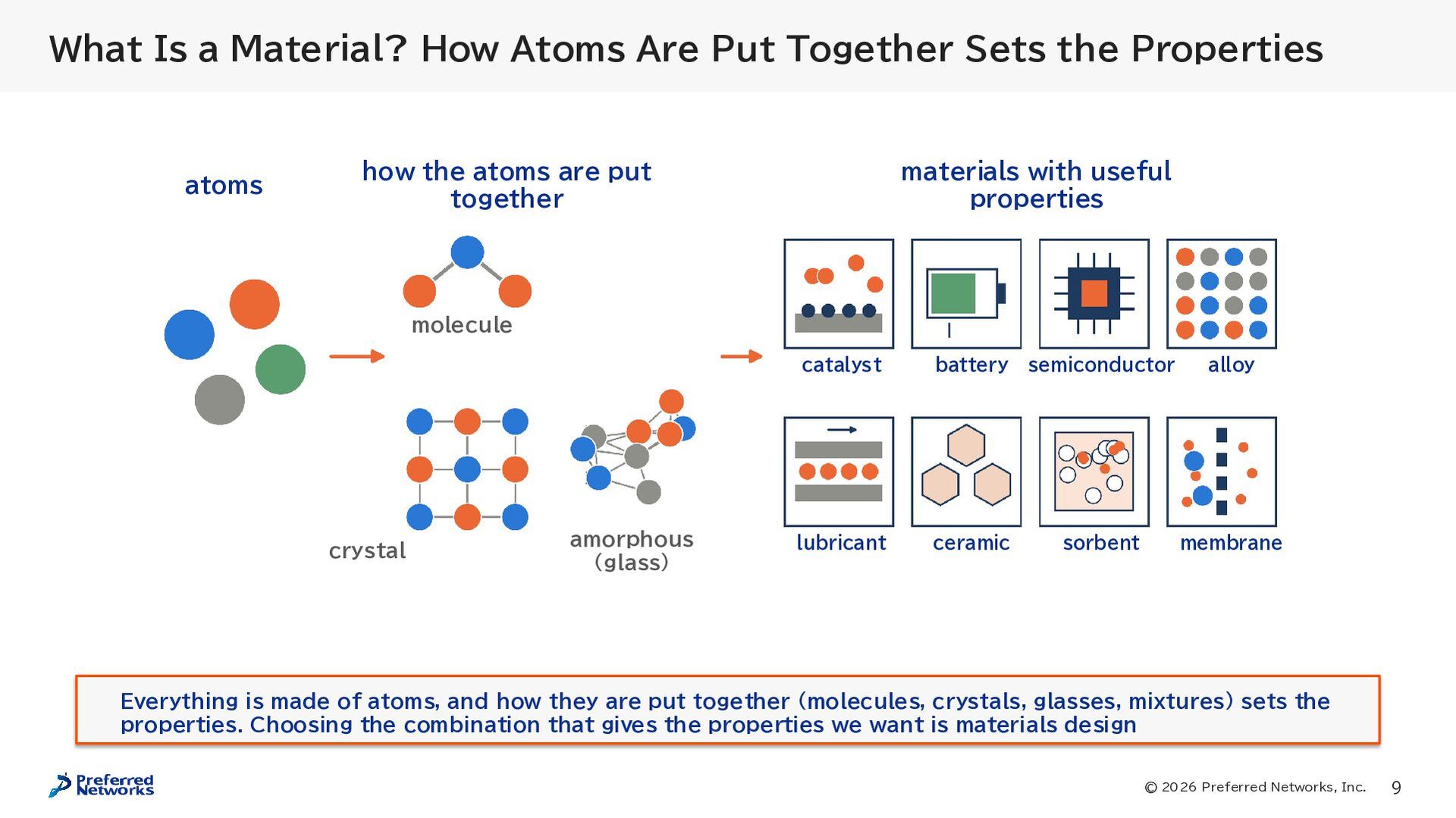
  6. What Is a Material? How Atoms Are Put Together Sets

    the Properties atoms how the atoms are put together materials with useful properties molecule crystal amorphous (glass) catalyst battery semiconductor alloy lubricant ceramic sorbent membrane Everything is made of atoms, and how they are put together (molecules, crystals, glasses, mixtures) sets the properties. Choosing the combination that gives the properties we want is materials design © 2026 Preferred Networks, Inc. 9
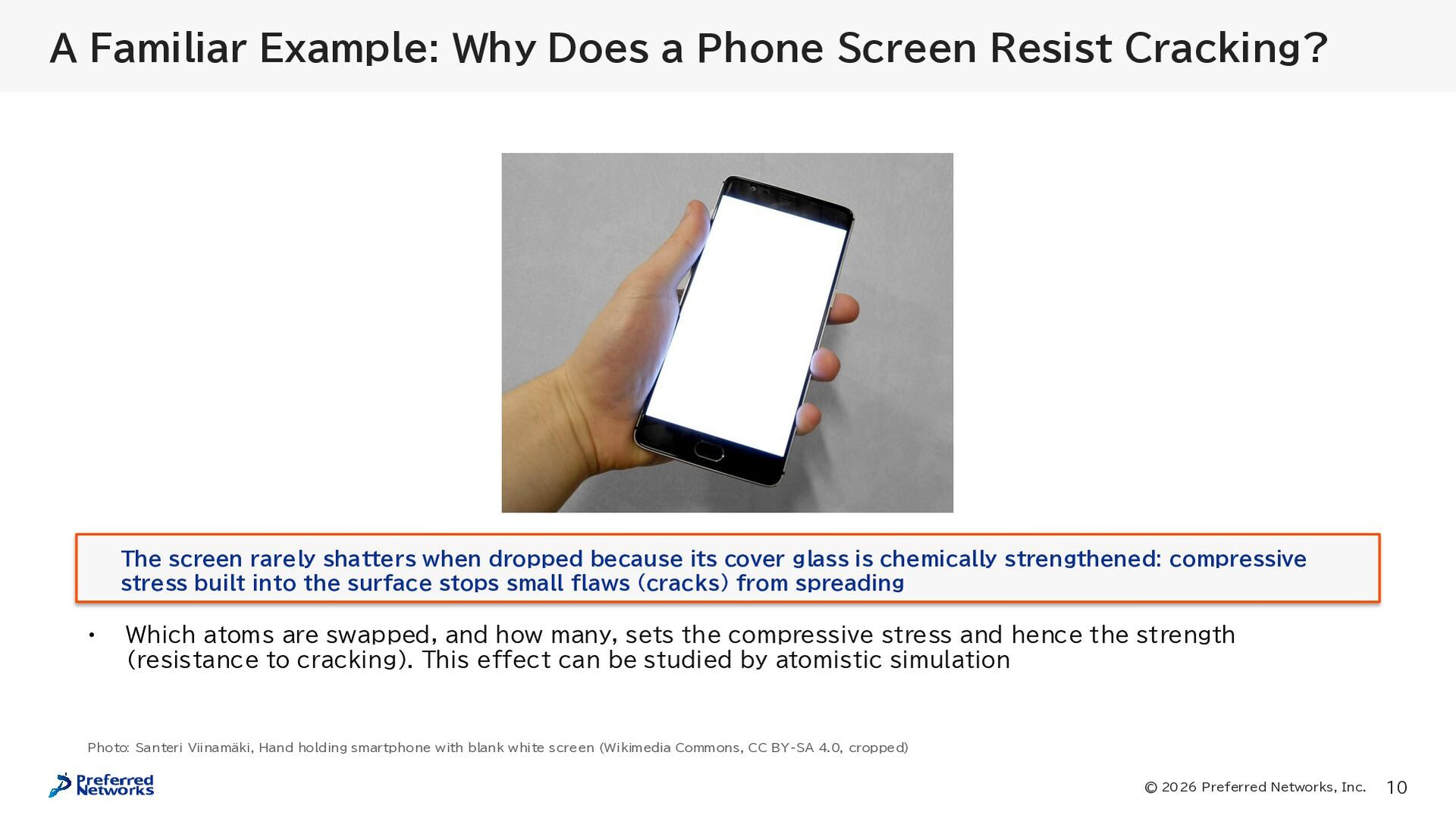
  7. A Familiar Example: Why Does a Phone Screen Resist Cracking?

    The screen rarely shatters when dropped because its cover glass is chemically strengthened: compressive stress built into the surface stops small flaws (cracks) from spreading • Which atoms are swapped, and how many, sets the compressive stress and hence the strength (resistance to cracking). This effect can be studied by atomistic simulation Photo: Santeri Viinamäki, Hand holding smartphone with blank white screen (Wikimedia Commons, CC BY-SA 4.0, cropped) © 2026 Preferred Networks, Inc. 10
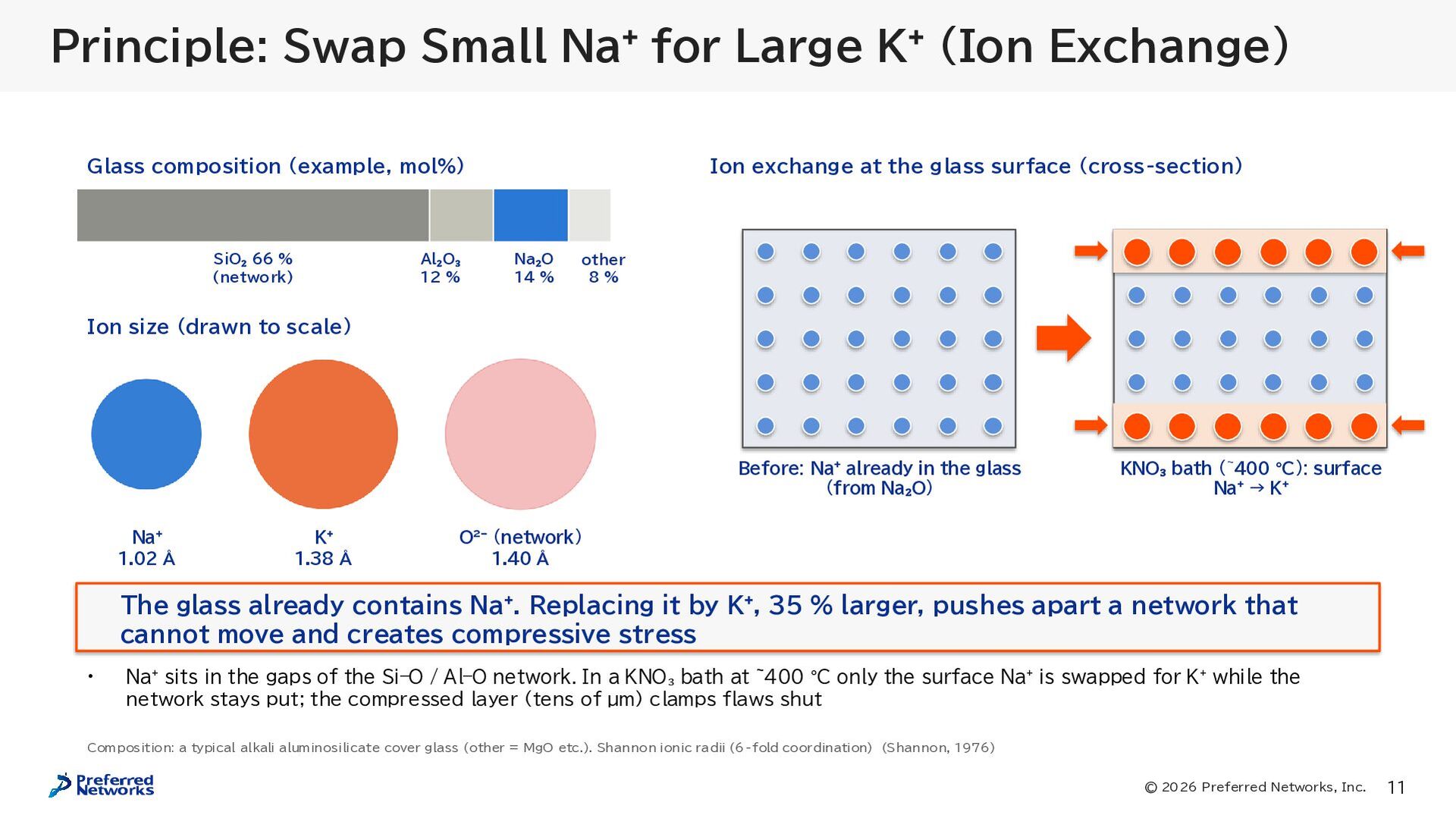
  8. Principle: Swap Small Na⁺ for Large K⁺ (Ion Exchange) Glass

    composition (example, mol%) SiO₂ 66 % (network) Al₂O₃ 12 % Ion exchange at the glass surface (cross-section) Na₂O 14 % other 8% Ion size (drawn to scale) Before: Na⁺ already in the glass (from Na₂O) Na⁺ 1.02 Å K⁺ 1.38 Å KNO₃ bath (~400 °C): surface Na⁺ → K⁺ O²⁻ (network) 1.40 Å The glass already contains Na⁺. Replacing it by K⁺, 35 % larger, pushes apart a network that cannot move and creates compressive stress • Na⁺ sits in the gaps of the Si–O / Al–O network. In a KNO₃ bath at ~400 °C only the surface Na⁺ is swapped for K⁺ while the network stays put; the compressed layer (tens of µm) clamps flaws shut Composition: a typical alkali aluminosilicate cover glass (other = MgO etc.). Shannon ionic radii (6 -fold coordination) (Shannon, 1976) © 2026 Preferred Networks, Inc. 11
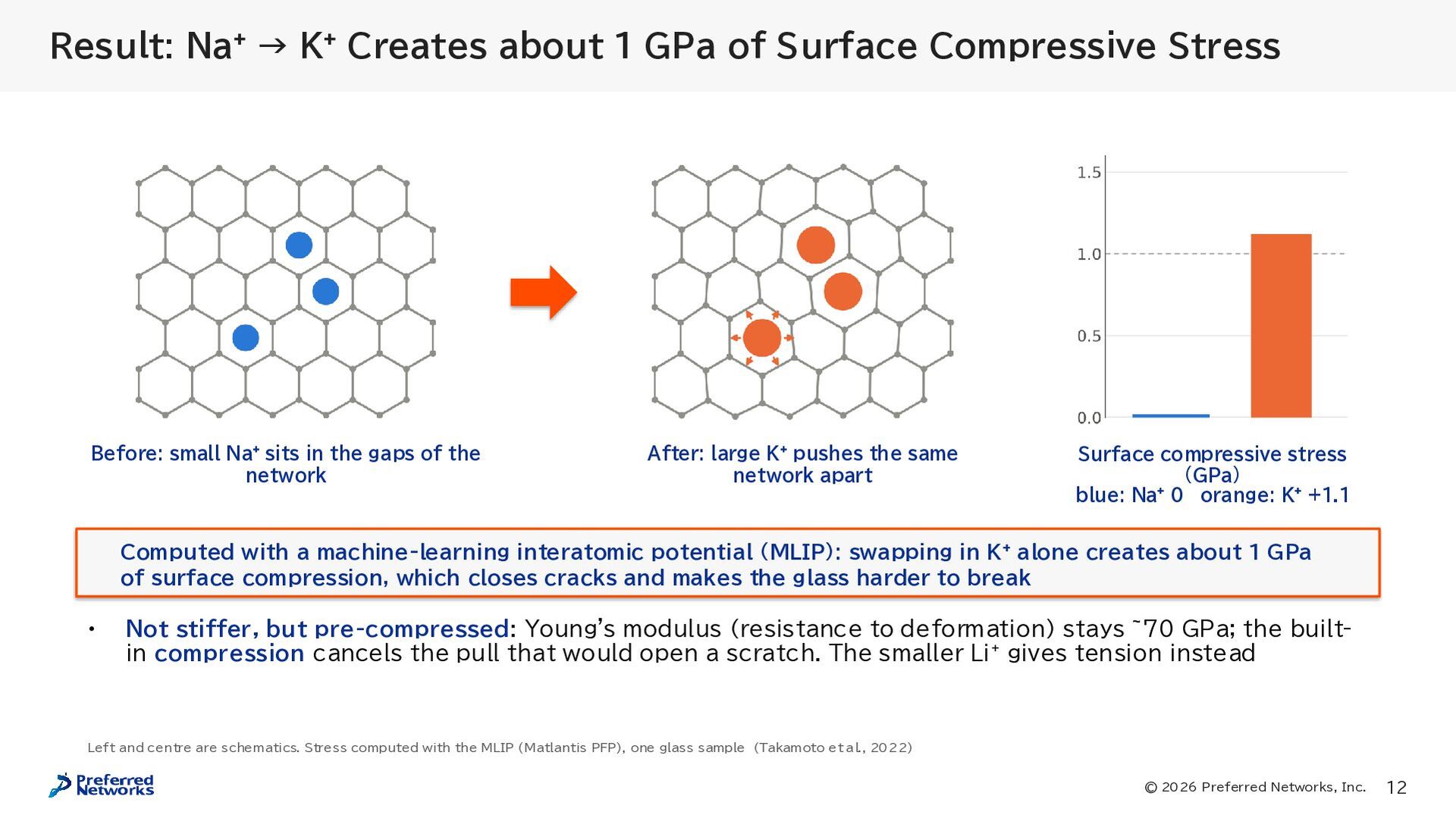
  9. Result: Na⁺ → K⁺ Creates about 1 GPa of Surface

    Compressive Stress Before: small Na⁺ sits in the gaps of the network After: large K⁺ pushes the same network apart Surface compressive stress (GPa) blue: Na⁺ 0 orange: K⁺ +1.1 Computed with a machine-learning interatomic potential (MLIP): swapping in K⁺ alone creates about 1 GPa of surface compression, which closes cracks and makes the glass harder to break • Not stiffer, but pre-compressed: Young's modulus (resistance to deformation) stays ~70 GPa; the builtin compression cancels the pull that would open a scratch. The smaller Li⁺ gives tension instead Left and centre are schematics. Stress computed with the MLIP (Matlantis PFP), one glass sample (Takamoto et al., 2022) © 2026 Preferred Networks, Inc. 12
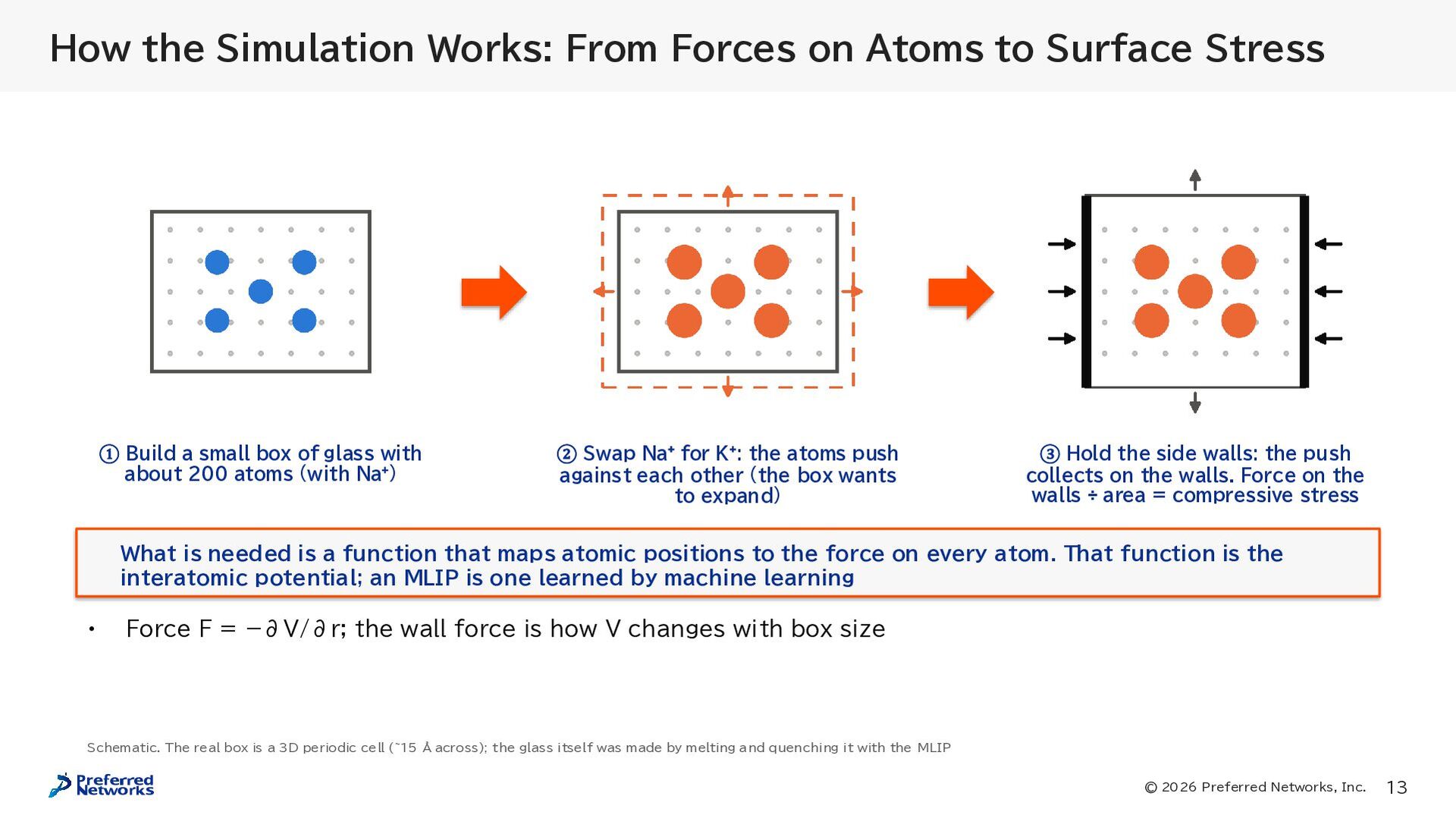
  10. How the Simulation Works: From Forces on Atoms to Surface

    Stress ① Build a small box of glass with about 200 atoms (with Na⁺) ② Swap Na⁺ for K⁺: the atoms push against each other (the box wants to expand) ③ Hold the side walls: the push collects on the walls. Force on the walls ÷ area = compressive stress What is needed is a function that maps atomic positions to the force on every atom. That function is the interatomic potential; an MLIP is one learned by machine learning • Force F = −∂V/∂r; the wall force is how V changes with box size Schematic. The real box is a 3D periodic cell (~15 Å across); the glass itself was made by melting and quenching it with the MLIP © 2026 Preferred Networks, Inc. 13
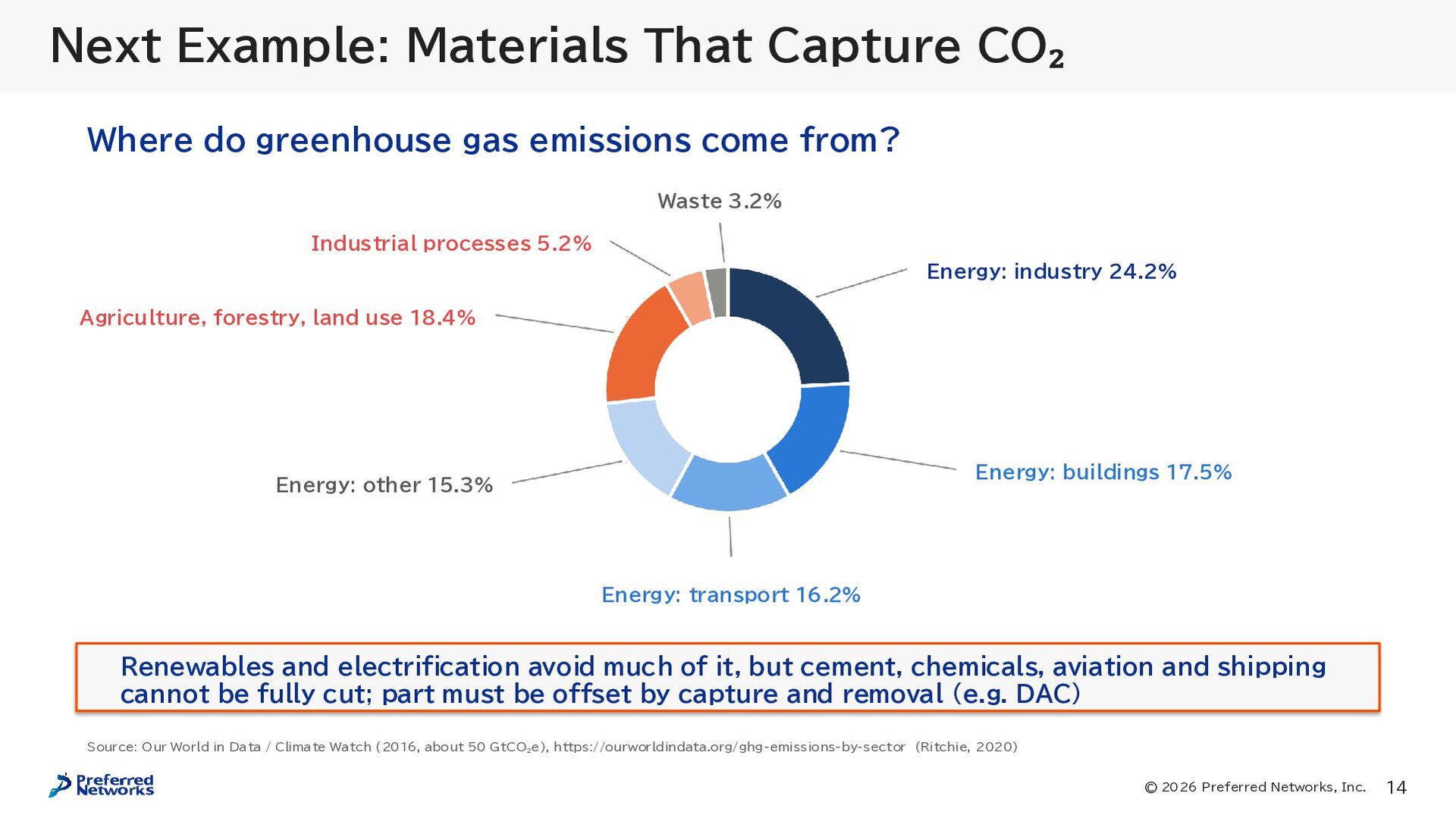
  11. Next Example: Materials That Capture CO₂ Where do greenhouse gas

    emissions come from? Waste 3.2% Industrial processes 5.2% Energy: industry 24.2% Agriculture, forestry, land use 18.4% Energy: buildings 17.5% Energy: other 15.3% Energy: transport 16.2% Renewables and electrification avoid much of it, but cement, chemicals, aviation and shipping cannot be fully cut; part must be offset by capture and removal (e.g. DAC) Source: Our World in Data / Climate Watch (2016, about 50 GtCO₂e), https://ourworldindata.org/ghg-emissions-by-sector (Ritchie, 2020) © 2026 Preferred Networks, Inc. 14
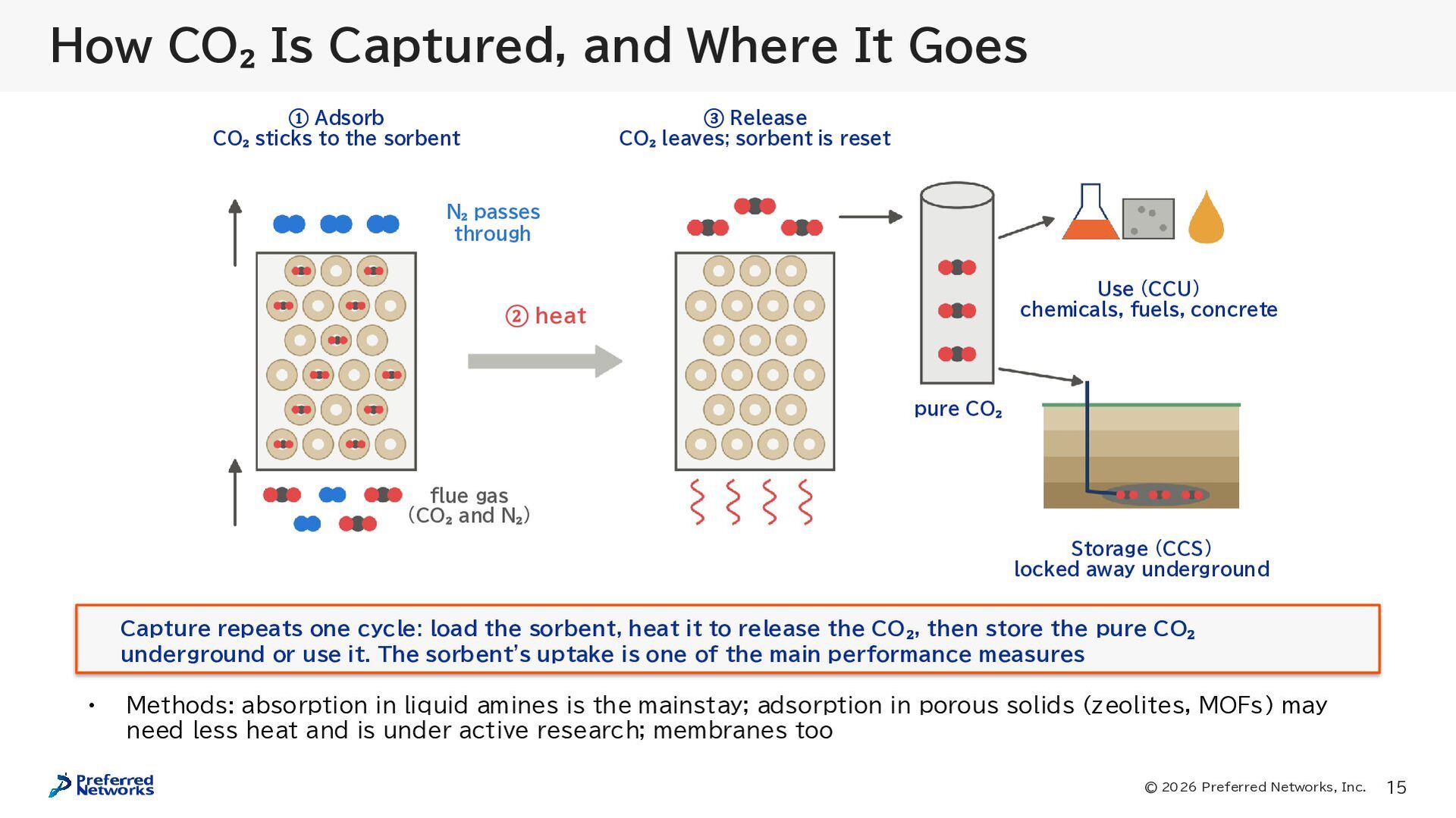
  12. How CO₂ Is Captured, and Where It Goes ① Adsorb

    CO₂ sticks to the sorbent ③ Release CO₂ leaves; sorbent is reset N₂ passes through Use (CCU) chemicals, fuels, concrete ② heat pure CO₂ flue gas (CO₂ and N₂) Storage (CCS) locked away underground Capture repeats one cycle: load the sorbent, heat it to release the CO₂, then store the pure CO₂ underground or use it. The sorbent's uptake is one of the main performance measures • Methods: absorption in liquid amines is the mainstay; adsorption in porous solids (zeolites, MOFs) may need less heat and is under active research; membranes too © 2026 Preferred Networks, Inc. 15
  13. MOFs (Metal-Organic Frameworks): One Gram Has the Surface of Half

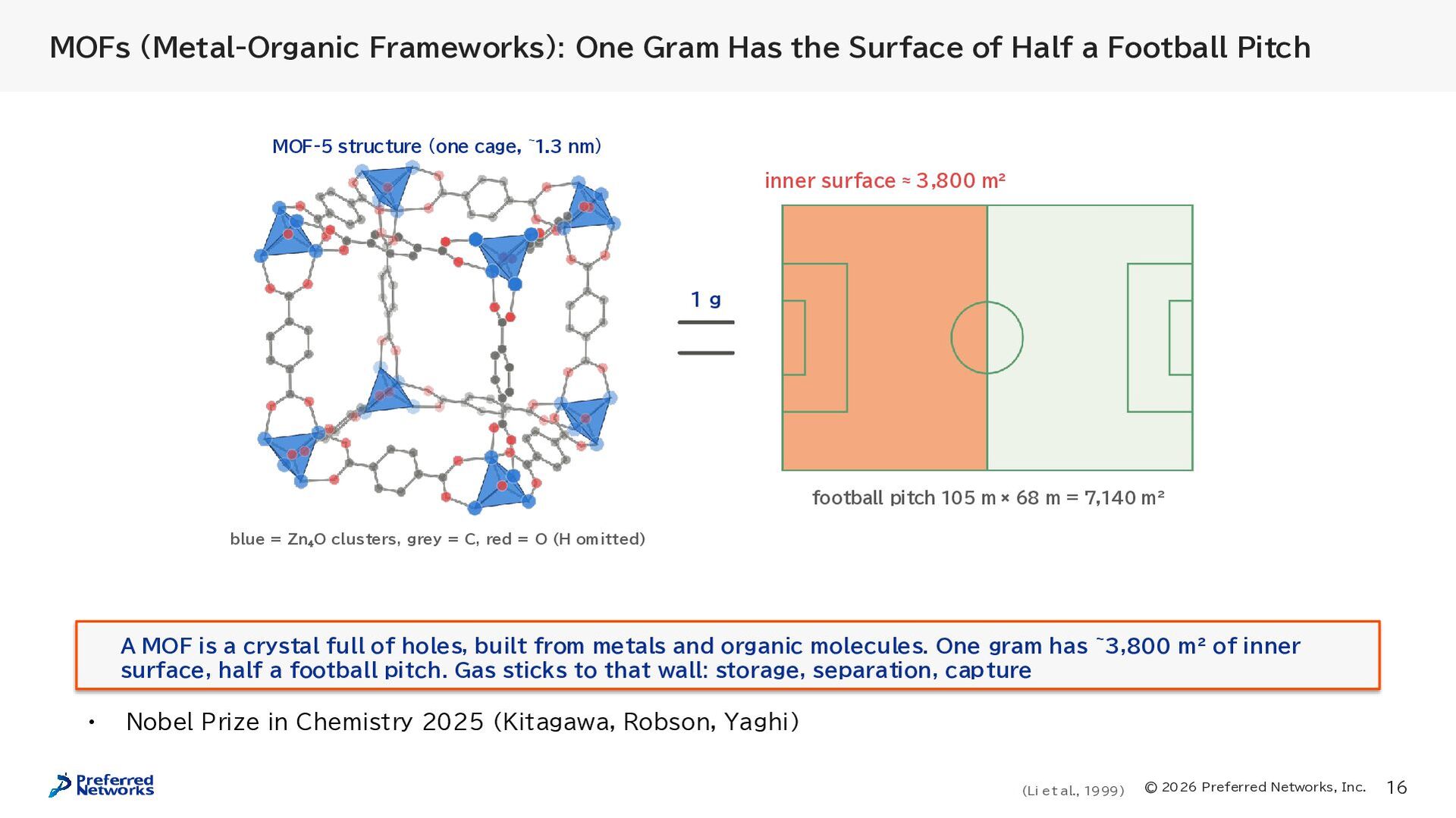
    a Football Pitch MOF-5 structure (one cage, ~1.3 nm) inner surface ≈ 3,800 m² 1g football pitch 105 m × 68 m = 7,140 m² blue = Zn₄O clusters, grey = C, red = O (H omitted) A MOF is a crystal full of holes, built from metals and organic molecules. One gram has ~3,800 m² of inner surface, half a football pitch. Gas sticks to that wall: storage, separation, capture • Nobel Prize in Chemistry 2025 (Kitagawa, Robson, Yaghi) (Li et al., 1999) © 2026 Preferred Networks, Inc. 16
  14. Applications in Which MOFs Are Expected to Be Useful CO₂

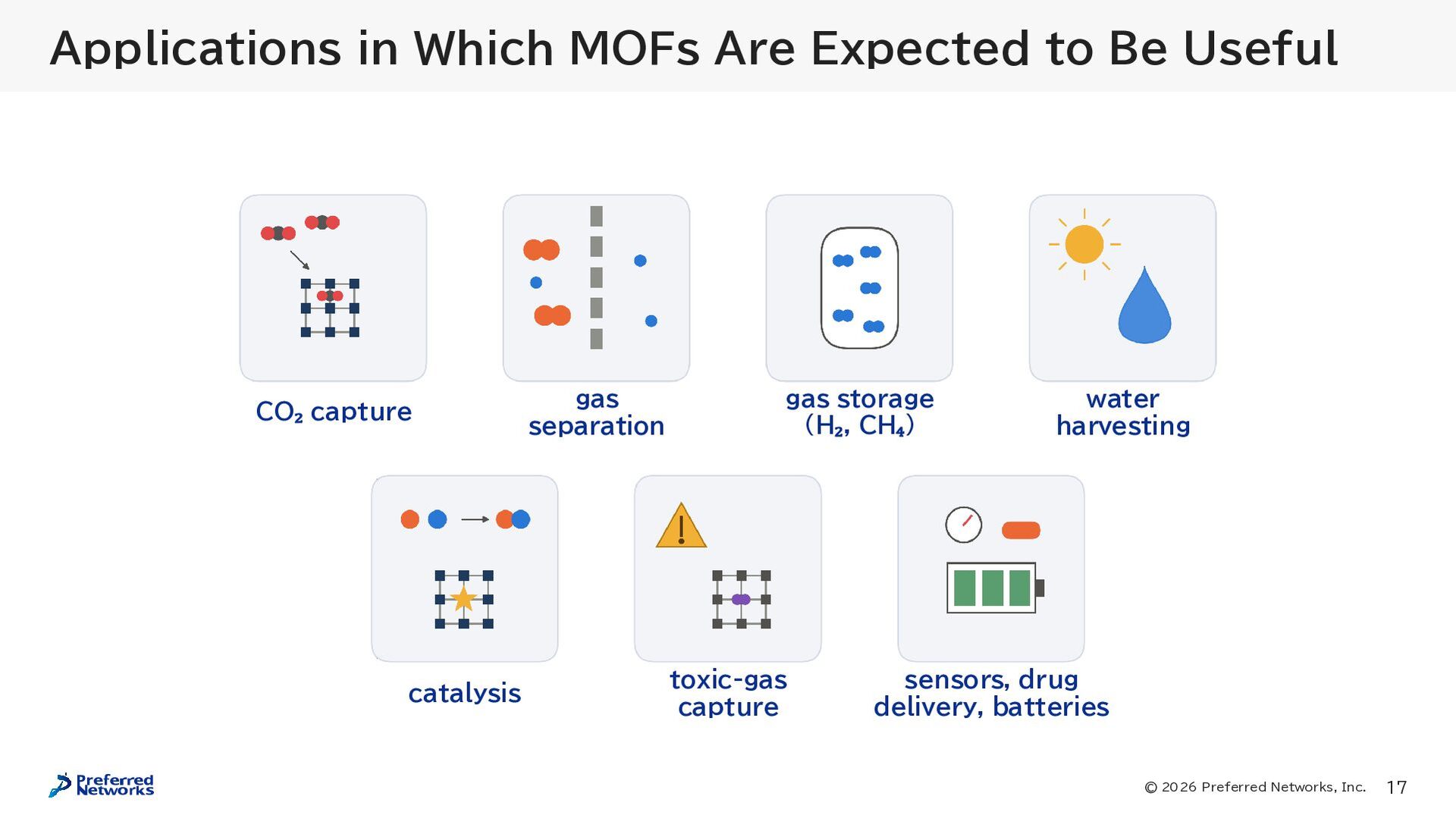
    capture catalysis gas separation gas storage (H₂, CH₄) toxic-gas capture water harvesting sensors, drug delivery, batteries © 2026 Preferred Networks, Inc. 17
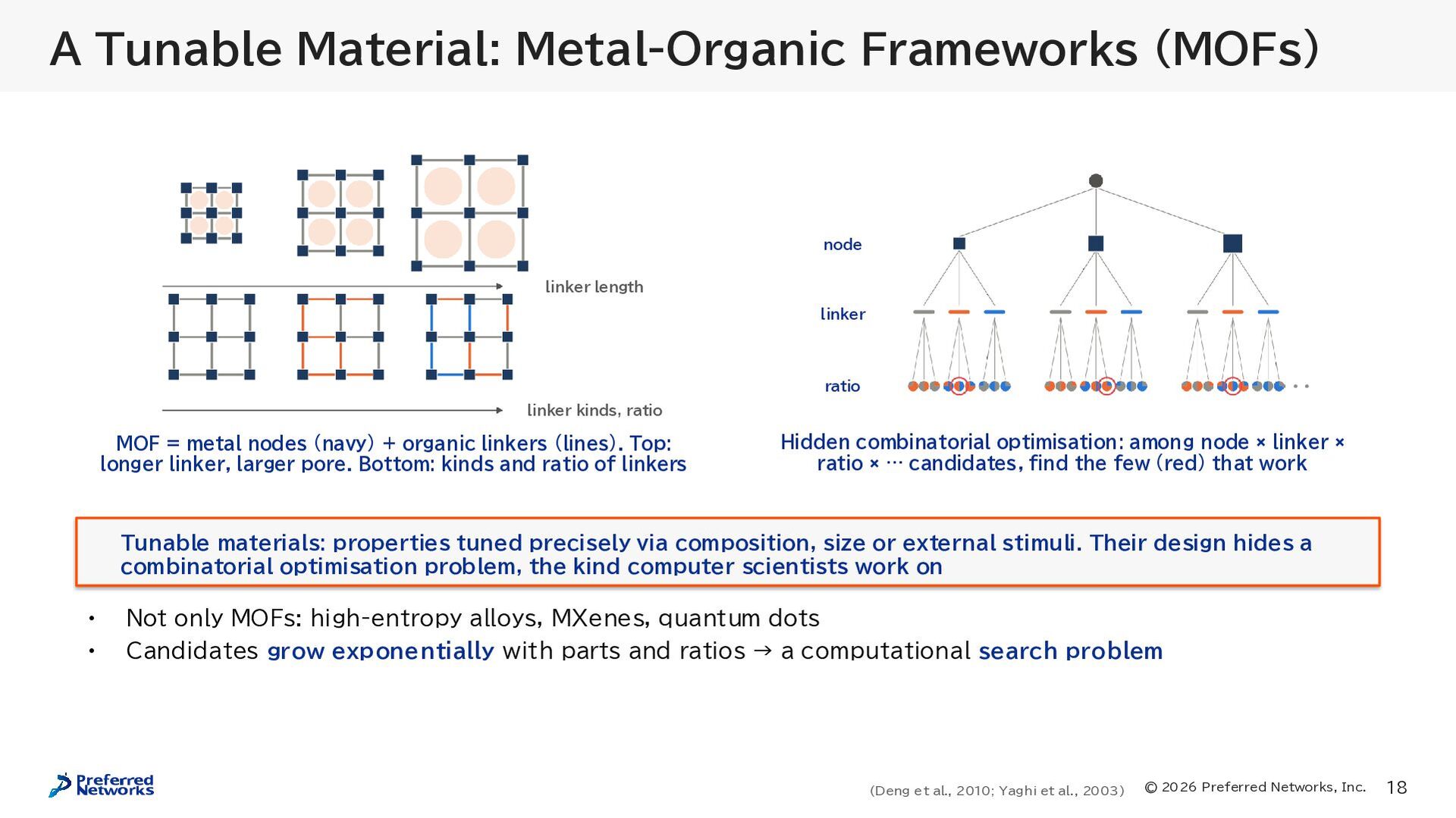
  15. A Tunable Material: Metal-Organic Frameworks (MOFs) node linker length linker

    ratio linker kinds, ratio MOF = metal nodes (navy) + organic linkers (lines). Top: longer linker, larger pore. Bottom: kinds and ratio of linkers Hidden combinatorial optimisation: among node × linker × ratio × … candidates, find the few (red) that work Tunable materials: properties tuned precisely via composition, size or external stimuli. Their design hides a combinatorial optimisation problem, the kind computer scientists work on • Not only MOFs: high-entropy alloys, MXenes, quantum dots • Candidates grow exponentially with parts and ratios → a computational search problem (Deng et al., 2010; Yaghi et al., 2003) © 2026 Preferred Networks, Inc. 18
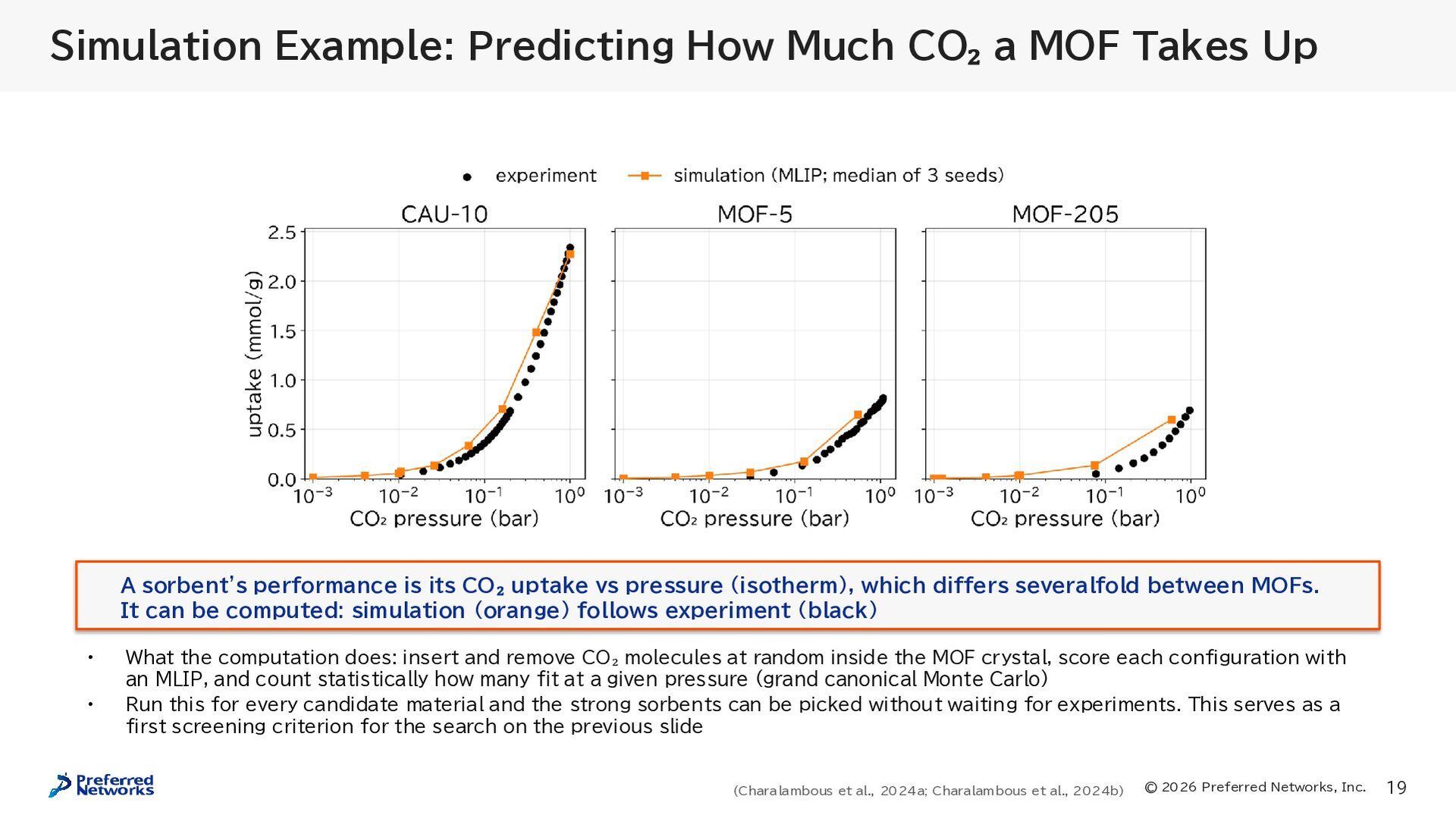
  16. Simulation Example: Predicting How Much CO₂ a MOF Takes Up

    A sorbent's performance is its CO₂ uptake vs pressure (isotherm), which differs severalfold between MOFs. It can be computed: simulation (orange) follows experiment (black) • • What the computation does: insert and remove CO₂ molecules at random inside the MOF crystal, score each configuration with an MLIP, and count statistically how many fit at a given pressure (grand canonical Monte Carlo) Run this for every candidate material and the strong sorbents can be picked without waiting for experiments. This serves as a first screening criterion for the search on the previous slide (Charalambous et al., 2024a; Charalambous et al., 2024b) © 2026 Preferred Networks, Inc. 19
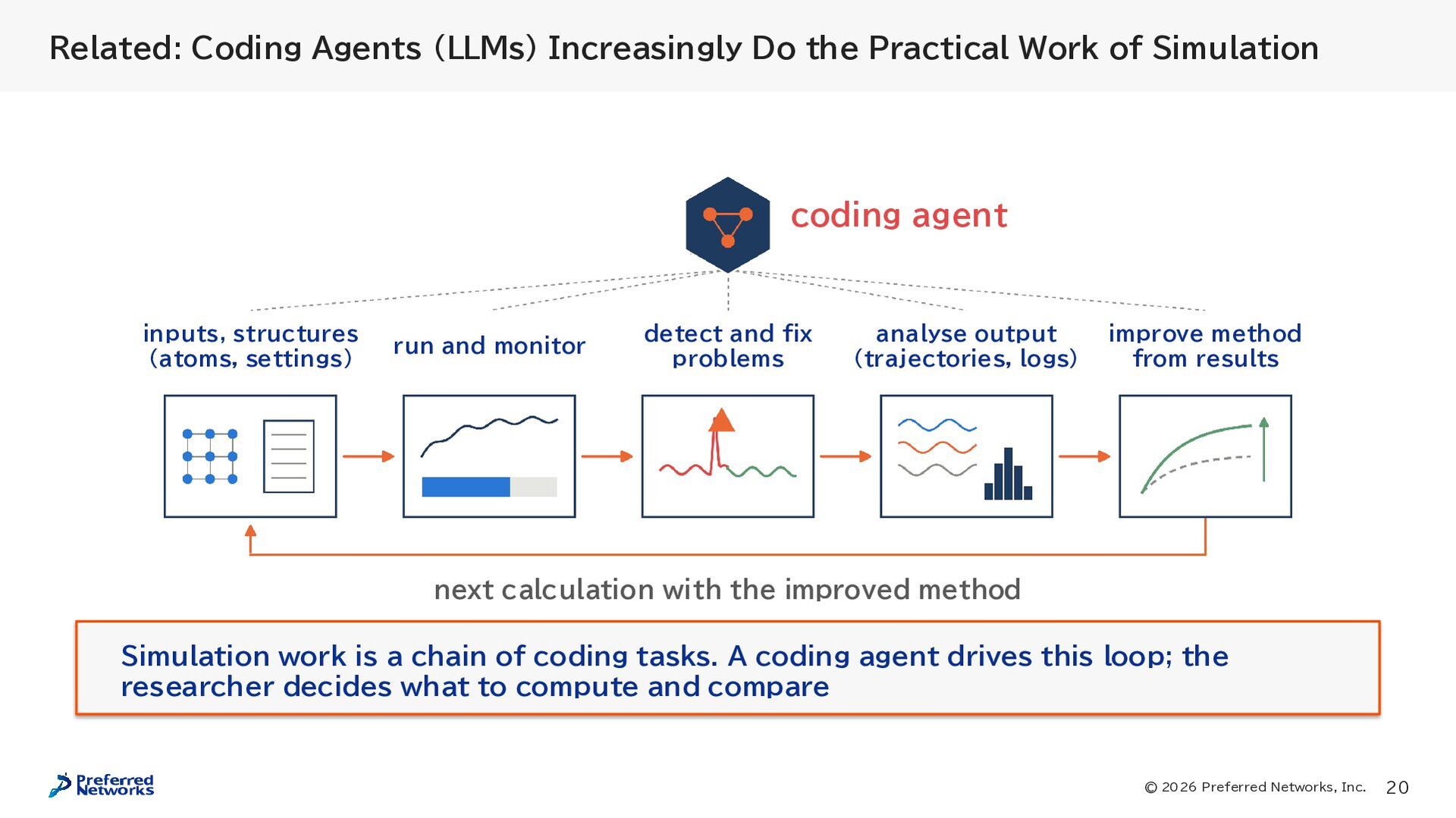
  17. Related: Coding Agents (LLMs) Increasingly Do the Practical Work of

    Simulation coding agent inputs, structures (atoms, settings) run and monitor detect and fix problems analyse output (trajectories, logs) improve method from results next calculation with the improved method Simulation work is a chain of coding tasks. A coding agent drives this loop; the researcher decides what to compute and compare © 2026 Preferred Networks, Inc. 20
  18. Part 2: What Happens When AI Is Plugged In without

    the Theory 32 min (main part) © 2026 Preferred Networks, Inc. 21
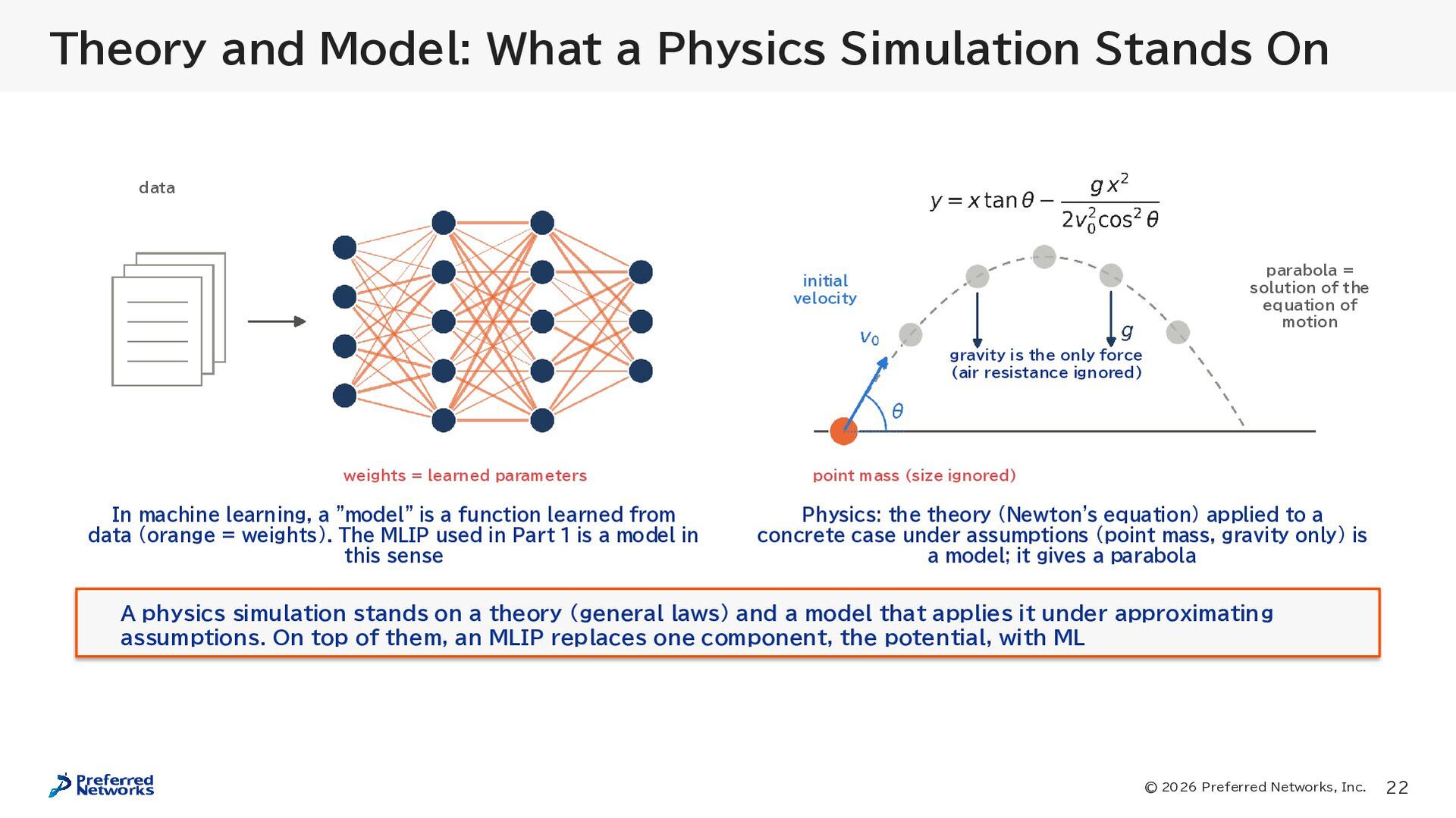
  19. Theory and Model: What a Physics Simulation Stands On data

    parabola = solution of the equation of motion initial velocity gravity is the only force (air resistance ignored) weights = learned parameters In machine learning, a "model" is a function learned from data (orange = weights). The MLIP used in Part 1 is a model in this sense point mass (size ignored) Physics: the theory (Newton's equation) applied to a concrete case under assumptions (point mass, gravity only) is a model; it gives a parabola A physics simulation stands on a theory (general laws) and a model that applies it under approximating assumptions. On top of them, an MLIP replaces one component, the potential, with ML © 2026 Preferred Networks, Inc. 22
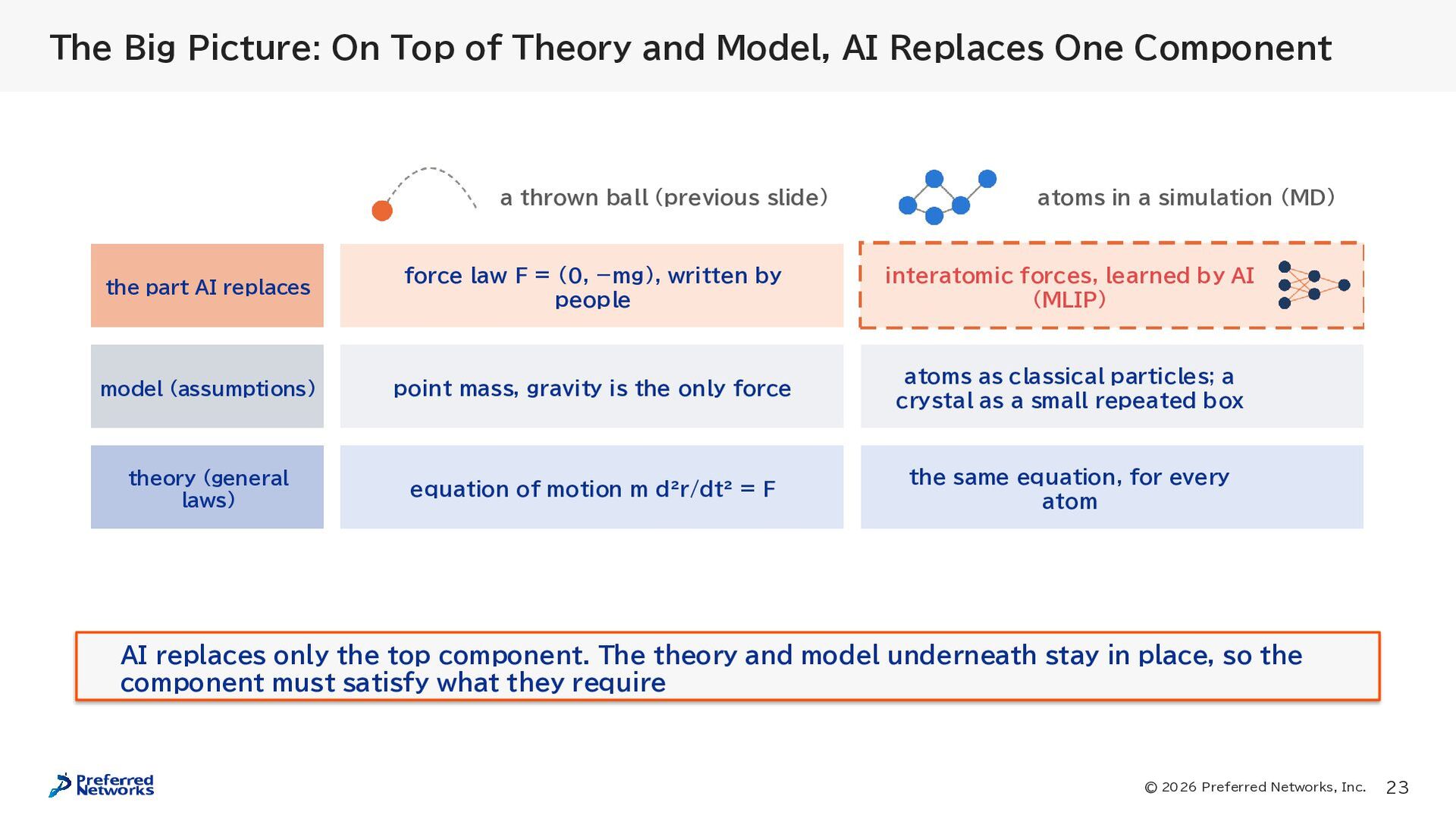
  20. The Big Picture: On Top of Theory and Model, AI

    Replaces One Component a thrown ball (previous slide) atoms in a simulation (MD) the part AI replaces force law F = (0, −mg), written by people interatomic forces, learned by AI (MLIP) model (assumptions) point mass, gravity is the only force atoms as classical particles; a crystal as a small repeated box theory (general laws) equation of motion m d²r/dt² = F the same equation, for every atom AI replaces only the top component. The theory and model underneath stay in place, so the component must satisfy what they require © 2026 Preferred Networks, Inc. 23
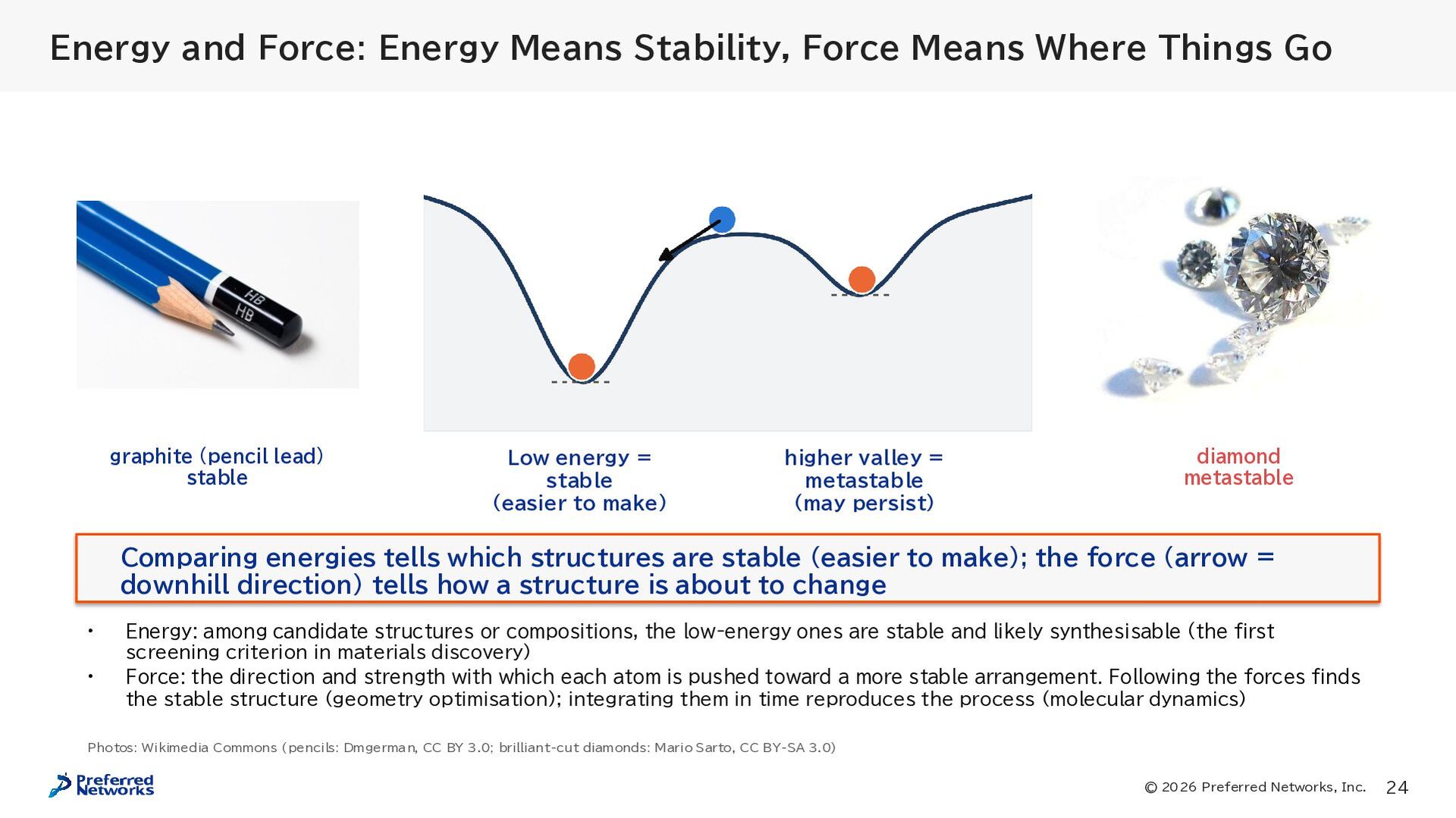
  21. Energy and Force: Energy Means Stability, Force Means Where Things

    Go graphite (pencil lead) stable Low energy = stable (easier to make) higher valley = metastable (may persist) diamond metastable Comparing energies tells which structures are stable (easier to make); the force (arrow = downhill direction) tells how a structure is about to change • • Energy: among candidate structures or compositions, the low-energy ones are stable and likely synthesisable (the first screening criterion in materials discovery) Force: the direction and strength with which each atom is pushed toward a more stable arrangement. Following the forces finds the stable structure (geometry optimisation); integrating them in time reproduces the process (molecular dynamics) Photos: Wikimedia Commons (pencils: Dmgerman, CC BY 3.0; brilliant-cut diamonds: Mario Sarto, CC BY-SA 3.0) © 2026 Preferred Networks, Inc. 24
  22. Using Forces (1): Geometry Optimisation, Moving Atoms along the Force

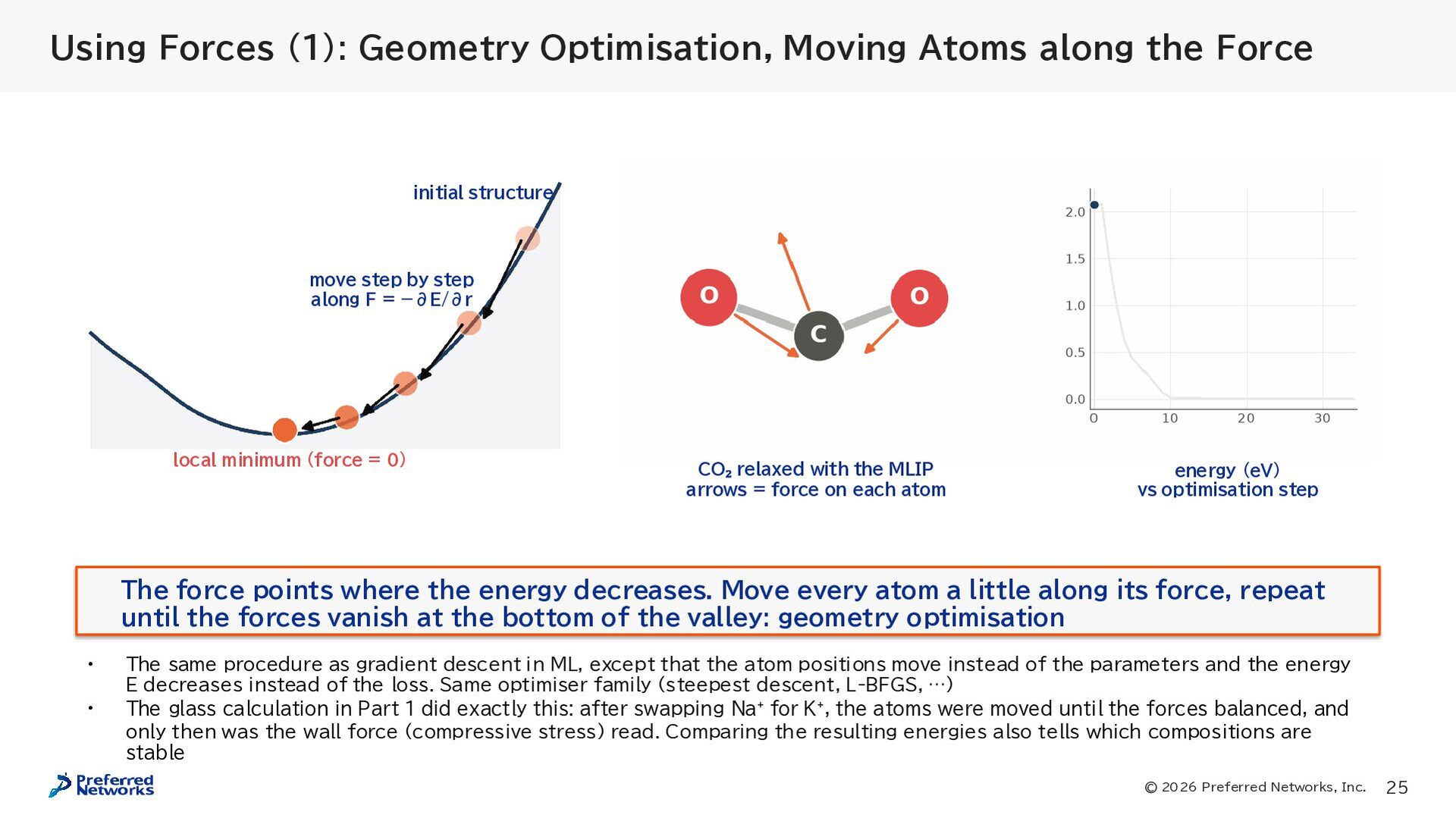
    initial structure move step by step along F = −∂E/∂r local minimum (force = 0) CO₂ relaxed with the MLIP arrows = force on each atom energy (eV) vs optimisation step The force points where the energy decreases. Move every atom a little along its force, repeat until the forces vanish at the bottom of the valley: geometry optimisation • • The same procedure as gradient descent in ML, except that the atom positions move instead of the parameters and the energy E decreases instead of the loss. Same optimiser family (steepest descent, L-BFGS, …) The glass calculation in Part 1 did exactly this: after swapping Na⁺ for K⁺, the atoms were moved until the forces balanced, and only then was the wall force (compressive stress) read. Comparing the resulting energies also tells which compositions are stable © 2026 Preferred Networks, Inc. 25
  23. Using Forces (2): Molecular Dynamics Inside a Solid-State Battery Electrolyte

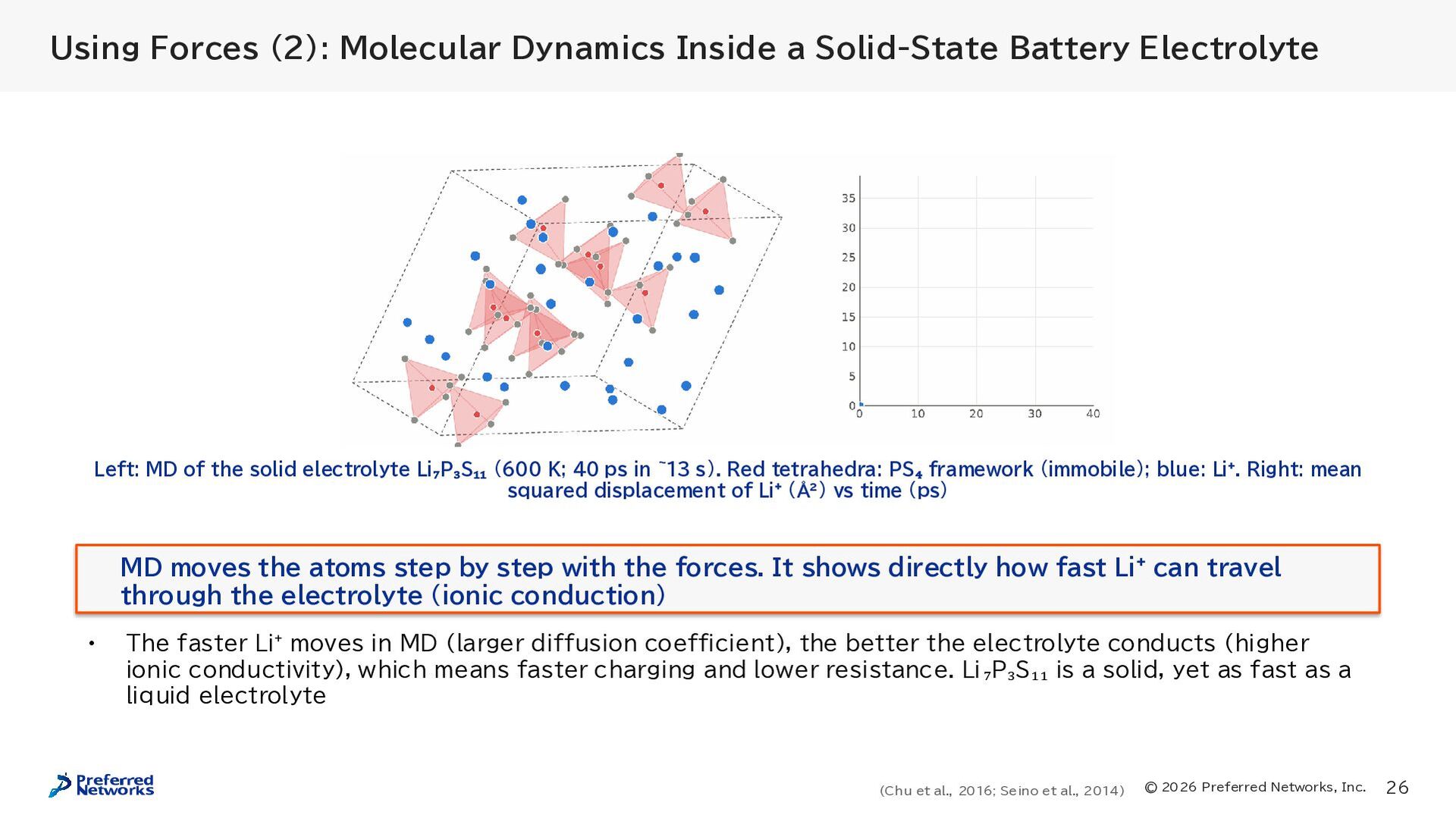
    Left: MD of the solid electrolyte Li₇P₃S₁₁ (600 K; 40 ps in ~13 s). Red tetrahedra: PS₄ framework (immobile); blue: Li⁺. Right: mean squared displacement of Li⁺ (Ų) vs time (ps) MD moves the atoms step by step with the forces. It shows directly how fast Li⁺ can travel through the electrolyte (ionic conduction) • The faster Li⁺ moves in MD (larger diffusion coefficient), the better the electrolyte conducts (higher ionic conductivity), which means faster charging and lower resistance. Li₇P₃S₁₁ is a solid, yet as fast as a liquid electrolyte (Chu et al., 2016; Seino et al., 2014) © 2026 Preferred Networks, Inc. 26
  24. The MLIP: Structure In, Energy Out; Forces by Differentiation Input:

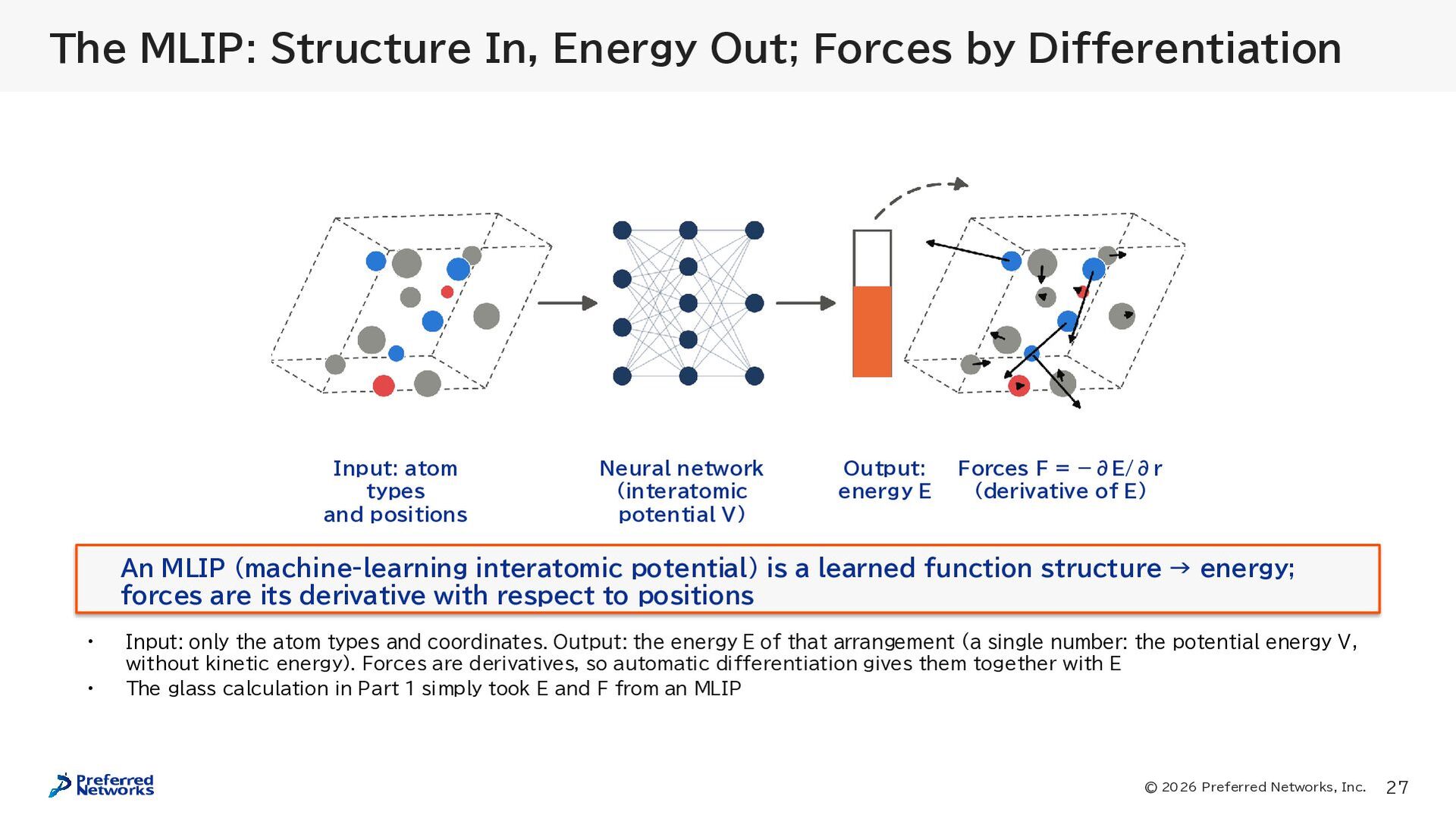
    atom types and positions Neural network (interatomic potential V) Output: energy E Forces F = −∂E/∂r (derivative of E) An MLIP (machine-learning interatomic potential) is a learned function structure → energy; forces are its derivative with respect to positions • • Input: only the atom types and coordinates. Output: the energy E of that arrangement (a single number: the potential energy V, without kinetic energy). Forces are derivatives, so automatic differentiation gives them together with E The glass calculation in Part 1 simply took E and F from an MLIP © 2026 Preferred Networks, Inc. 27
  25. How an MLIP Is Made: Learning from First-Principles (DFT) Data

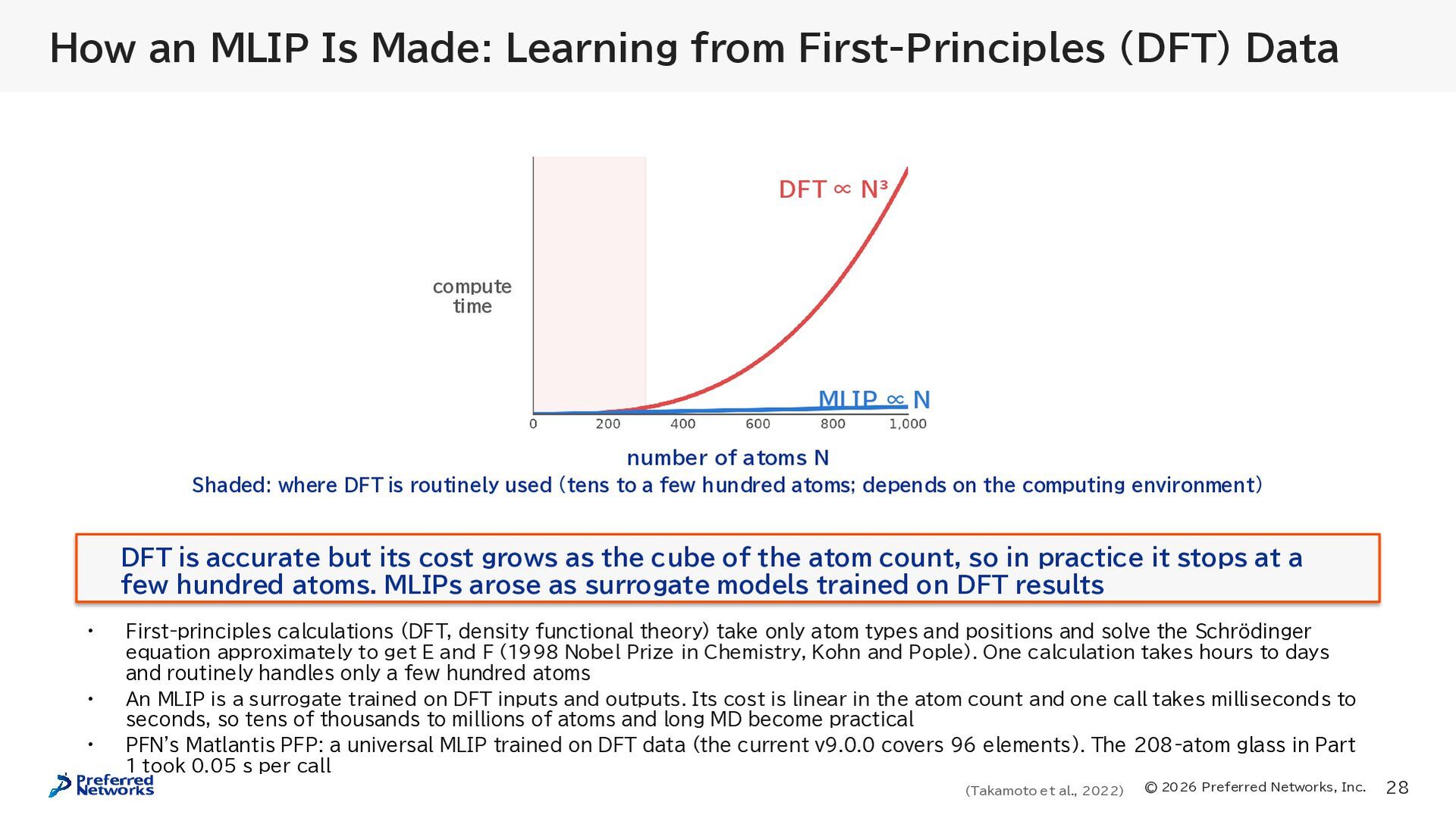
    DFT ∝ N³ compute time MLIP ∝ N number of atoms N Shaded: where DFT is routinely used (tens to a few hundred atoms; depends on the computing environment) DFT is accurate but its cost grows as the cube of the atom count, so in practice it stops at a few hundred atoms. MLIPs arose as surrogate models trained on DFT results • • • First-principles calculations (DFT, density functional theory) take only atom types and positions and solve the Schrödinger equation approximately to get E and F (1998 Nobel Prize in Chemistry, Kohn and Pople). One calculation takes hours to days and routinely handles only a few hundred atoms An MLIP is a surrogate trained on DFT inputs and outputs. Its cost is linear in the atom count and one call takes milliseconds to seconds, so tens of thousands to millions of atoms and long MD become practical PFN's Matlantis PFP: a universal MLIP trained on DFT data (the current v9.0.0 covers 96 elements). The 208-atom glass in Part 1 took 0.05 s per call (Takamoto et al., 2022) © 2026 Preferred Networks, Inc. 28
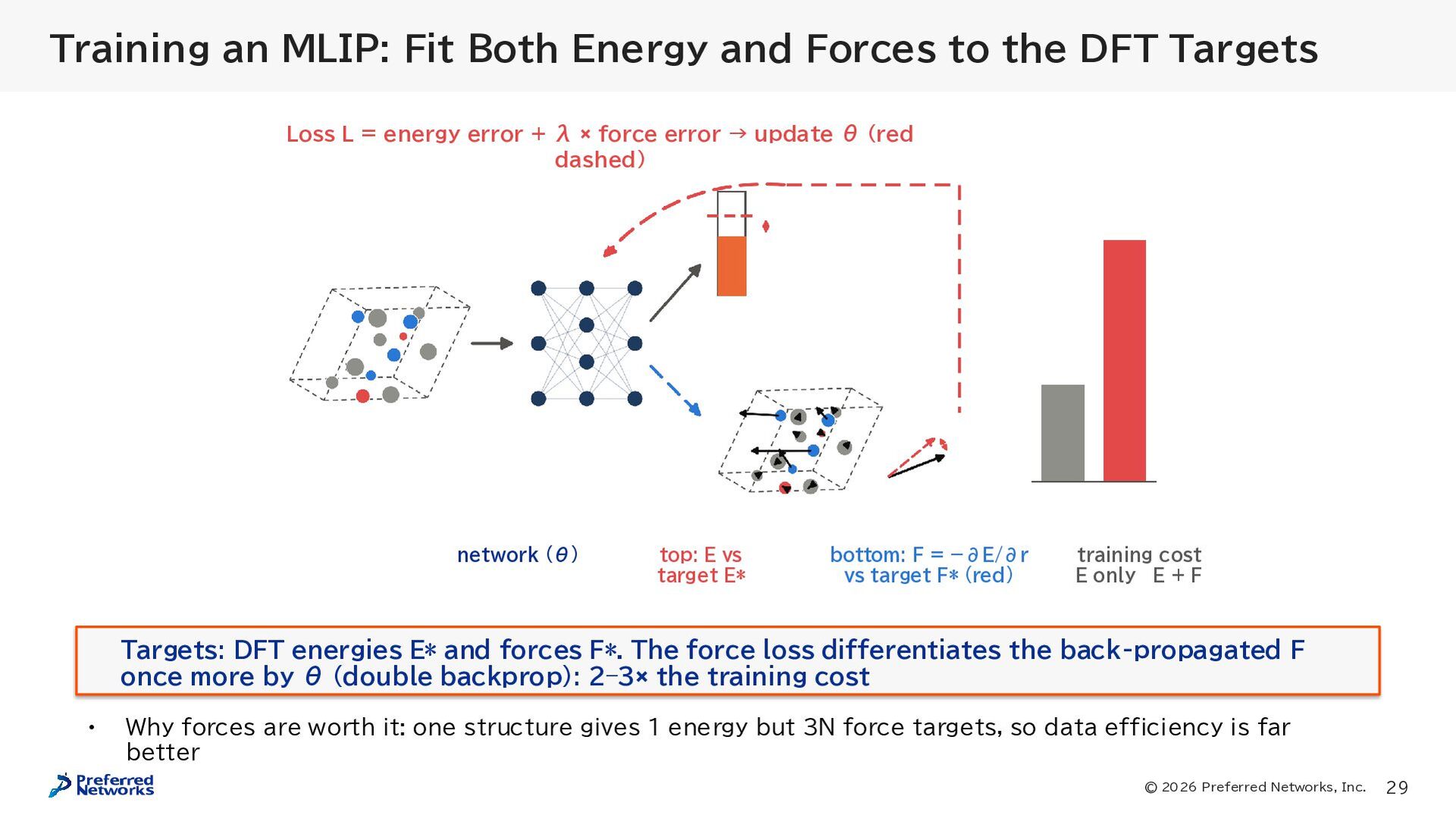
  26. Training an MLIP: Fit Both Energy and Forces to the

    DFT Targets Loss L = energy error + λ × force error → update θ (red dashed) network (θ) top: E vs target E* bottom: F = −∂E/∂r vs target F* (red) training cost E only E + F Targets: DFT energies E* and forces F*. The force loss differentiates the back-propagated F once more by θ (double backprop): 2–3× the training cost • Why forces are worth it: one structure gives 1 energy but 3N force targets, so data efficiency is far better © 2026 Preferred Networks, Inc. 29
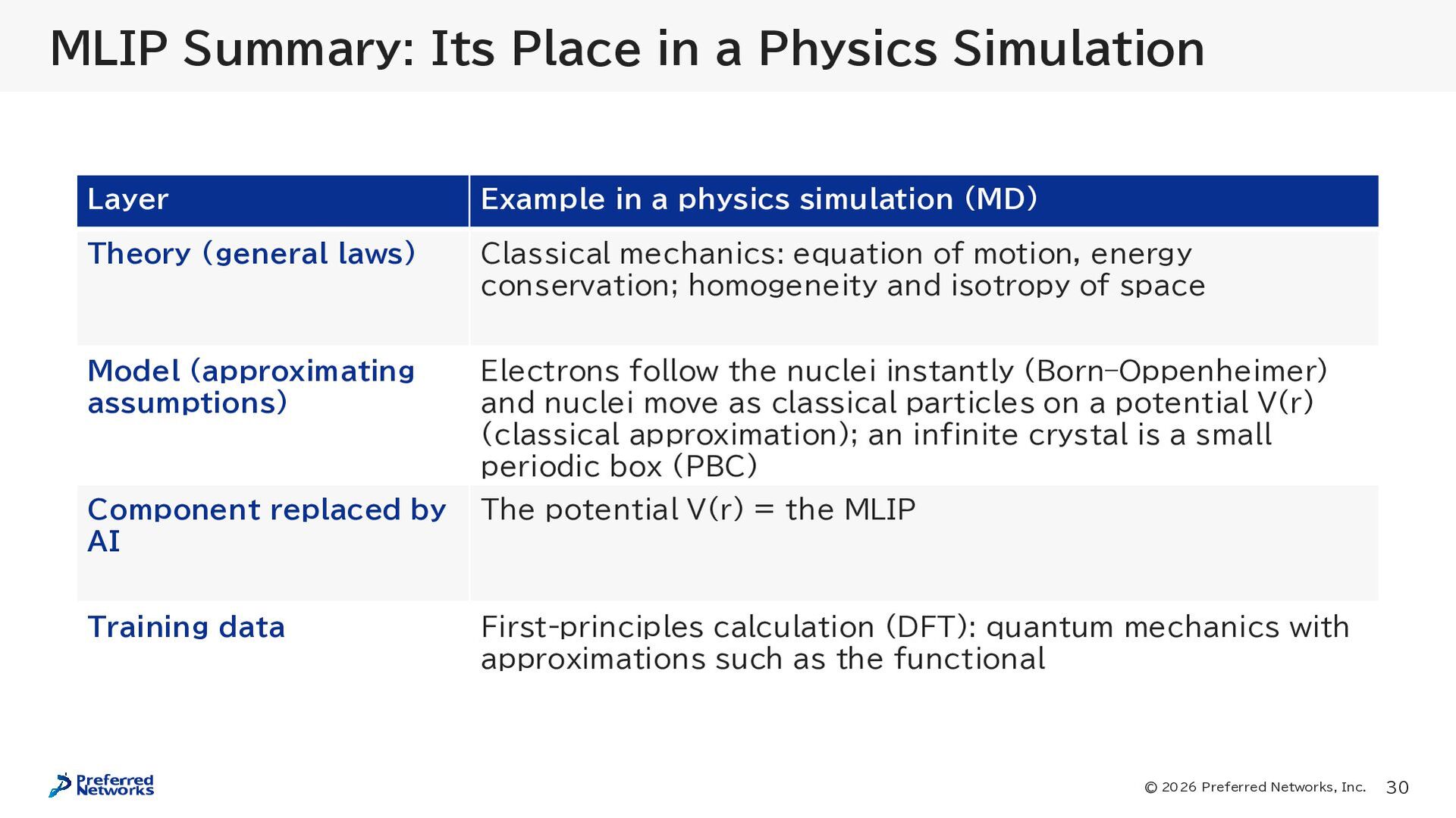
  27. MLIP Summary: Its Place in a Physics Simulation Layer Example

    in a physics simulation (MD) Theory (general laws) Classical mechanics: equation of motion, energy conservation; homogeneity and isotropy of space Model (approximating assumptions) Electrons follow the nuclei instantly (Born–Oppenheimer) and nuclei move as classical particles on a potential V(r) (classical approximation); an infinite crystal is a small periodic box (PBC) Component replaced by AI The potential V(r) = the MLIP Training data First-principles calculation (DFT): quantum mechanics with approximations such as the functional © 2026 Preferred Networks, Inc. 30
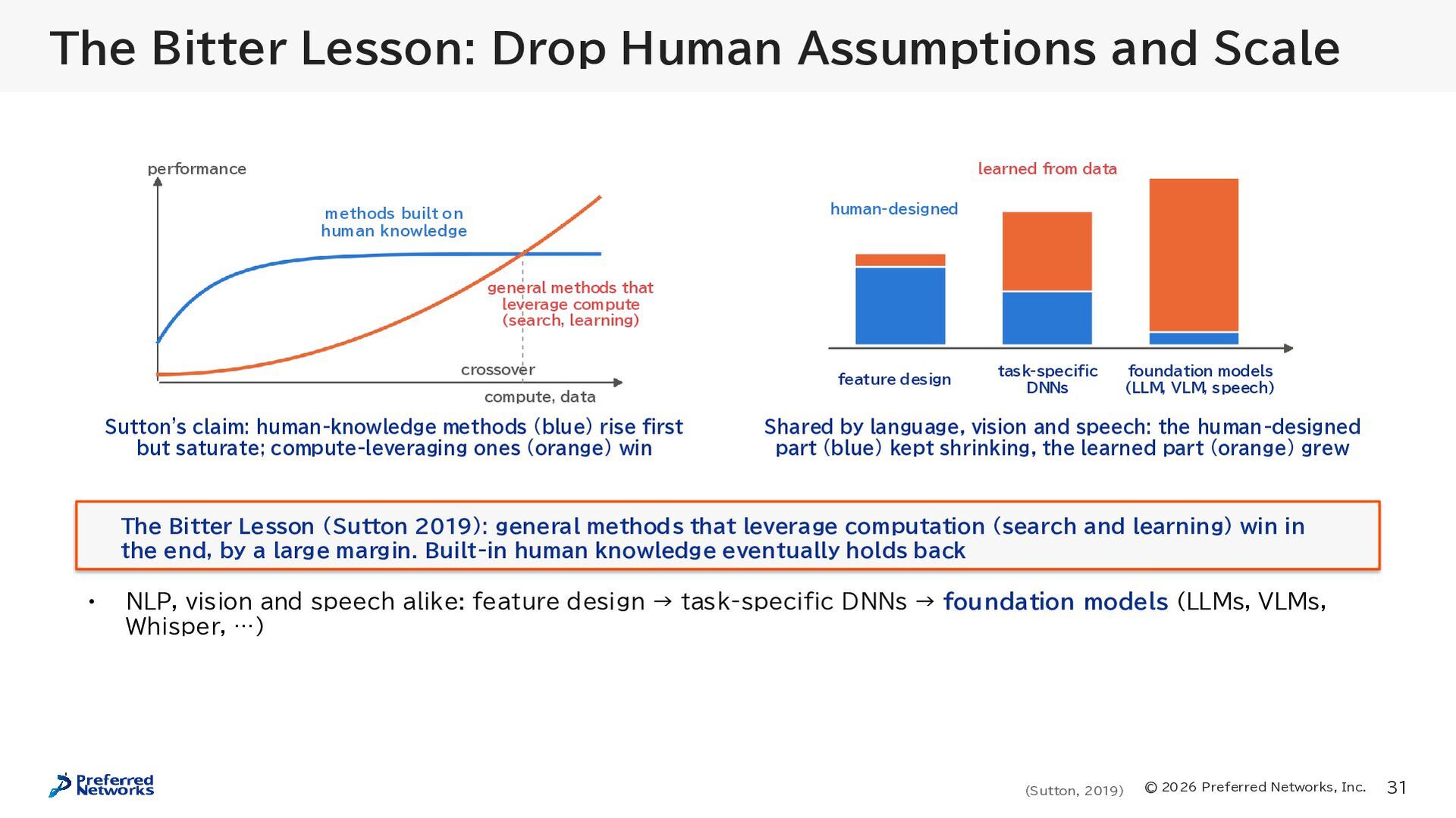
  28. The Bitter Lesson: Drop Human Assumptions and Scale performance learned

    from data human-designed methods built on human knowledge general methods that leverage compute (search, learning) crossover compute, data Sutton's claim: human-knowledge methods (blue) rise first but saturate; compute-leveraging ones (orange) win feature design task-specific DNNs foundation models (LLM, VLM, speech) Shared by language, vision and speech: the human-designed part (blue) kept shrinking, the learned part (orange) grew The Bitter Lesson (Sutton 2019): general methods that leverage computation (search and learning) win in the end, by a large margin. Built-in human knowledge eventually holds back • NLP, vision and speech alike: feature design → task-specific DNNs → foundation models (LLMs, VLMs, Whisper, …) (Sutton, 2019) © 2026 Preferred Networks, Inc. 31
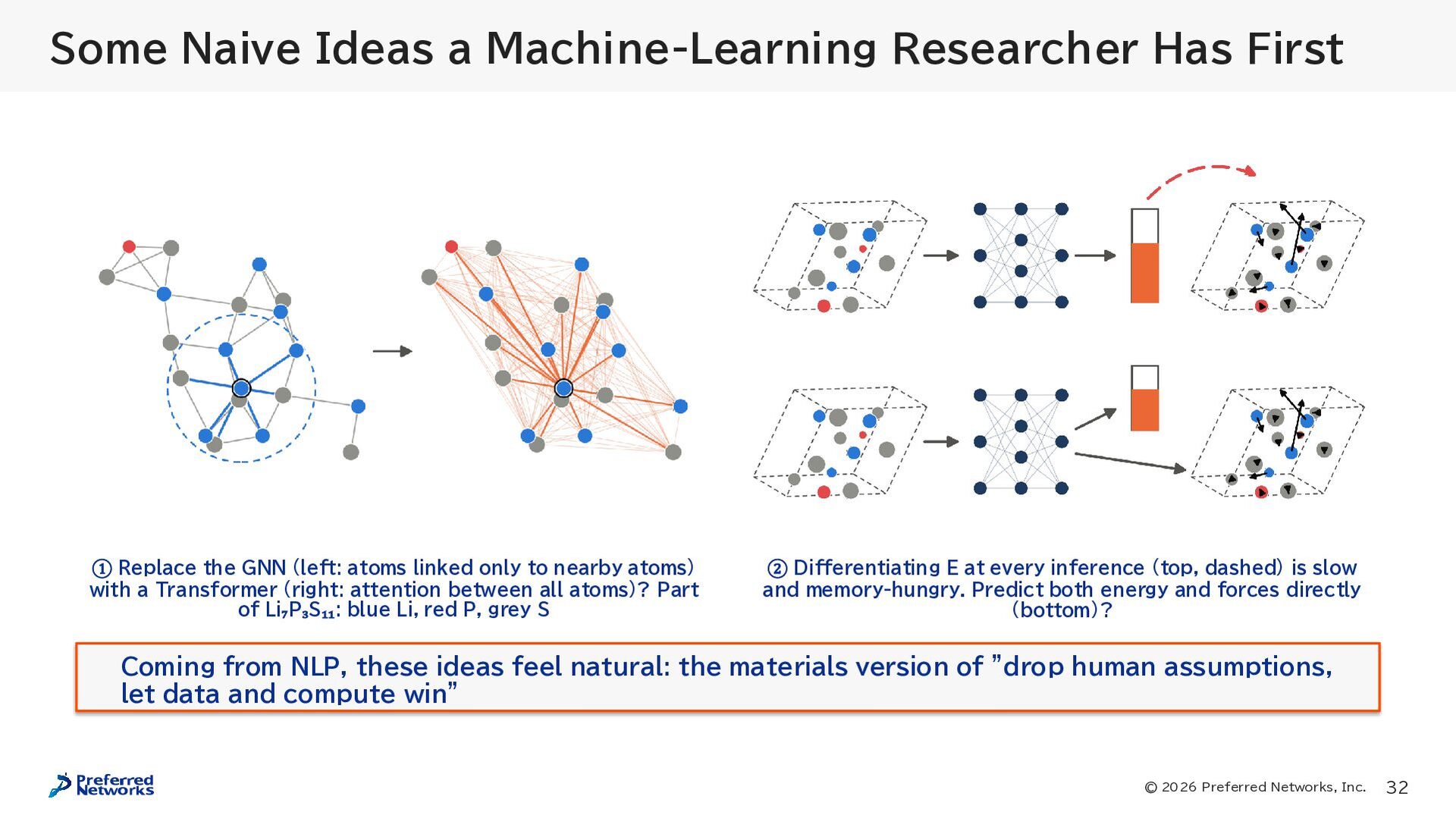
  29. Some Naive Ideas a Machine-Learning Researcher Has First ① Replace

    the GNN (left: atoms linked only to nearby atoms) with a Transformer (right: attention between all atoms)? Part of Li₇P₃S₁₁: blue Li, red P, grey S ② Differentiating E at every inference (top, dashed) is slow and memory-hungry. Predict both energy and forces directly (bottom)? Coming from NLP, these ideas feel natural: the materials version of "drop human assumptions, let data and compute win" © 2026 Preferred Networks, Inc. 32
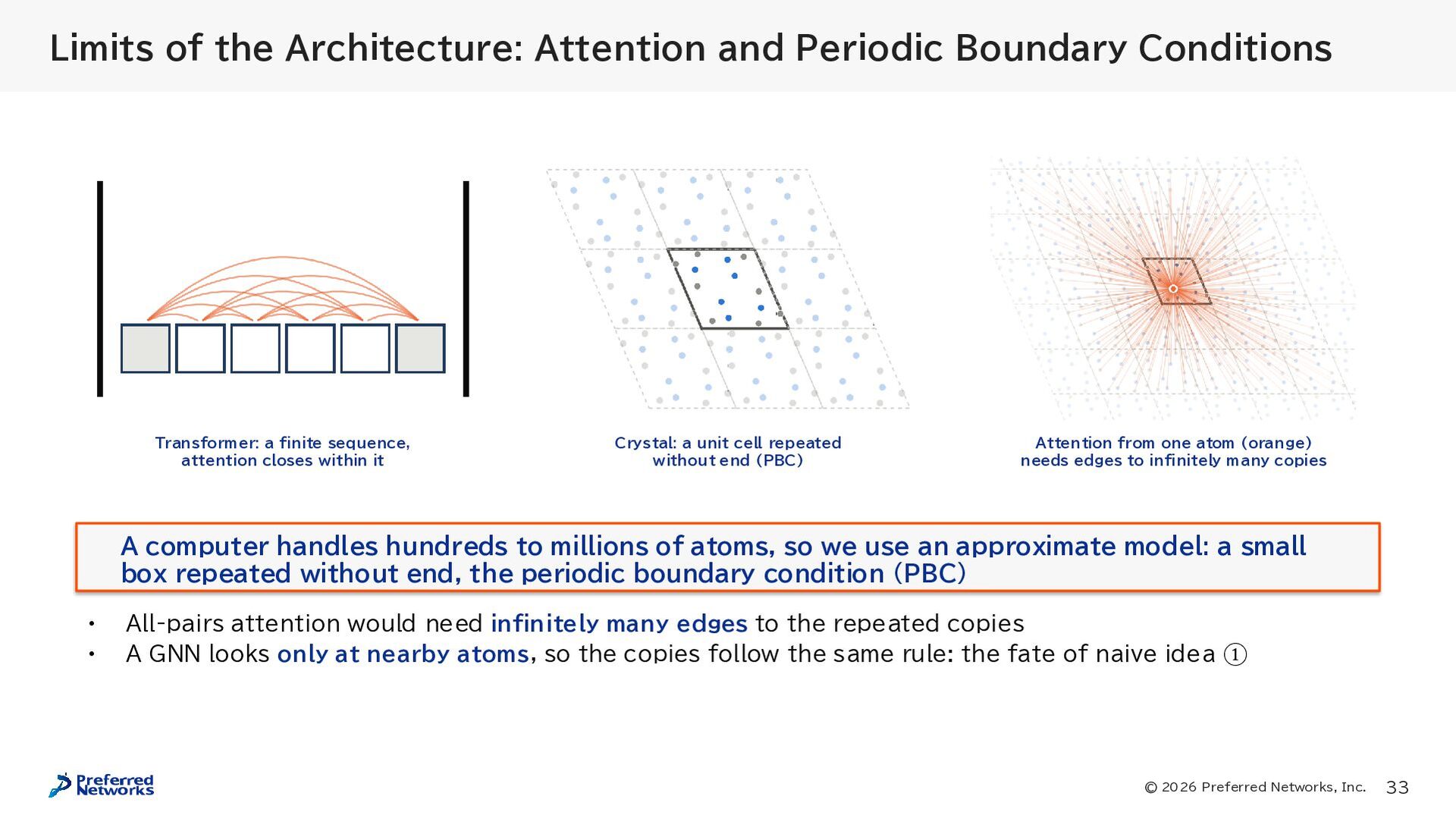
  30. Limits of the Architecture: Attention and Periodic Boundary Conditions Transformer:

    a finite sequence, attention closes within it Crystal: a unit cell repeated without end (PBC) Attention from one atom (orange) needs edges to infinitely many copies A computer handles hundreds to millions of atoms, so we use an approximate model: a small box repeated without end, the periodic boundary condition (PBC) • • All-pairs attention would need infinitely many edges to the repeated copies A GNN looks only at nearby atoms, so the copies follow the same rule: the fate of naive idea ① © 2026 Preferred Networks, Inc. 33
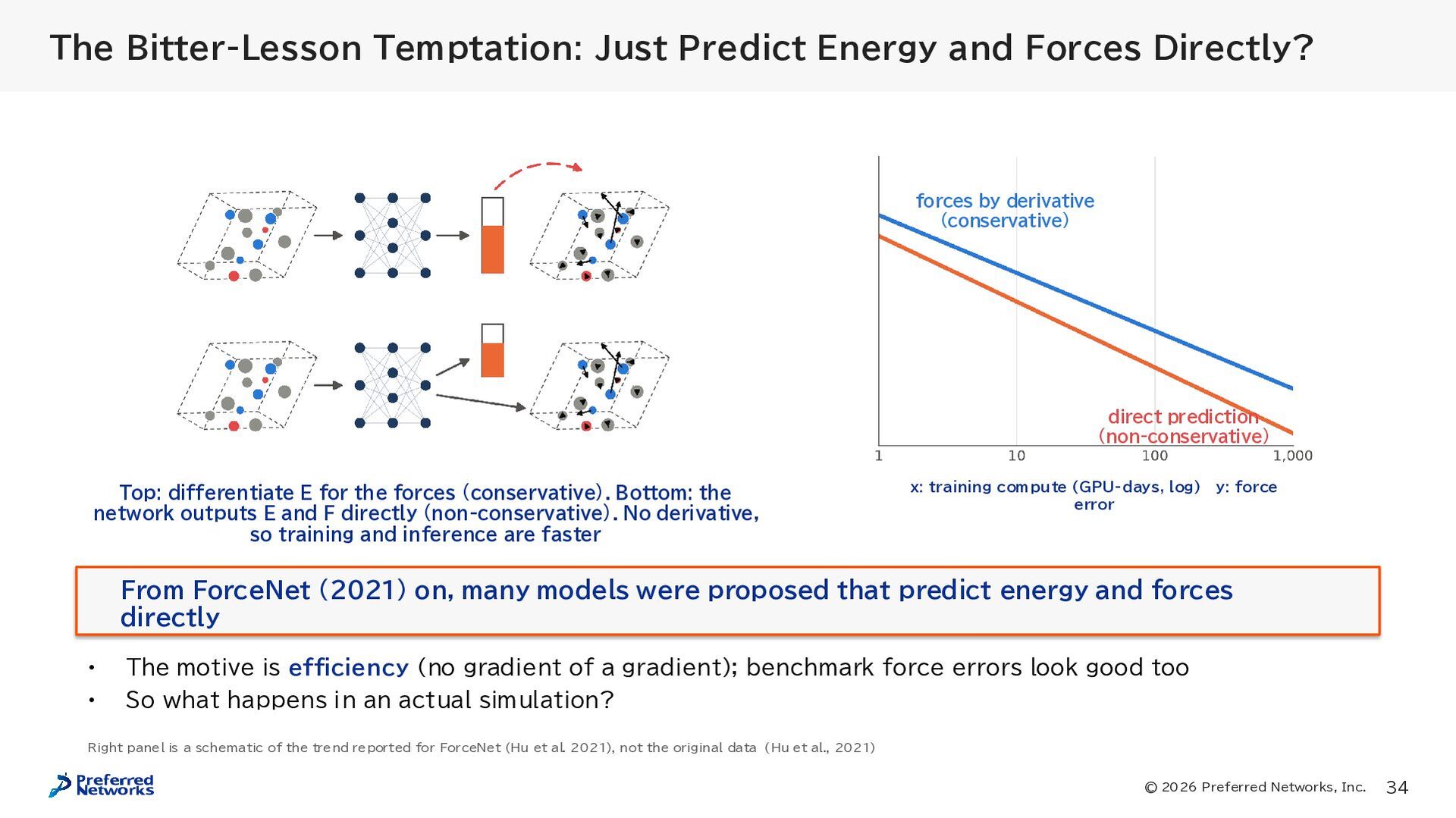
  31. The Bitter-Lesson Temptation: Just Predict Energy and Forces Directly? forces

    by derivative (conservative) direct prediction (non-conservative) Top: differentiate E for the forces (conservative). Bottom: the network outputs E and F directly (non-conservative). No derivative, so training and inference are faster x: training compute (GPU-days, log) error y: force From ForceNet (2021) on, many models were proposed that predict energy and forces directly • The motive is efficiency (no gradient of a gradient); benchmark force errors look good too • So what happens in an actual simulation? Right panel is a schematic of the trend reported for ForceNet (Hu et al. 2021), not the original data (Hu et al., 2021) © 2026 Preferred Networks, Inc. 34
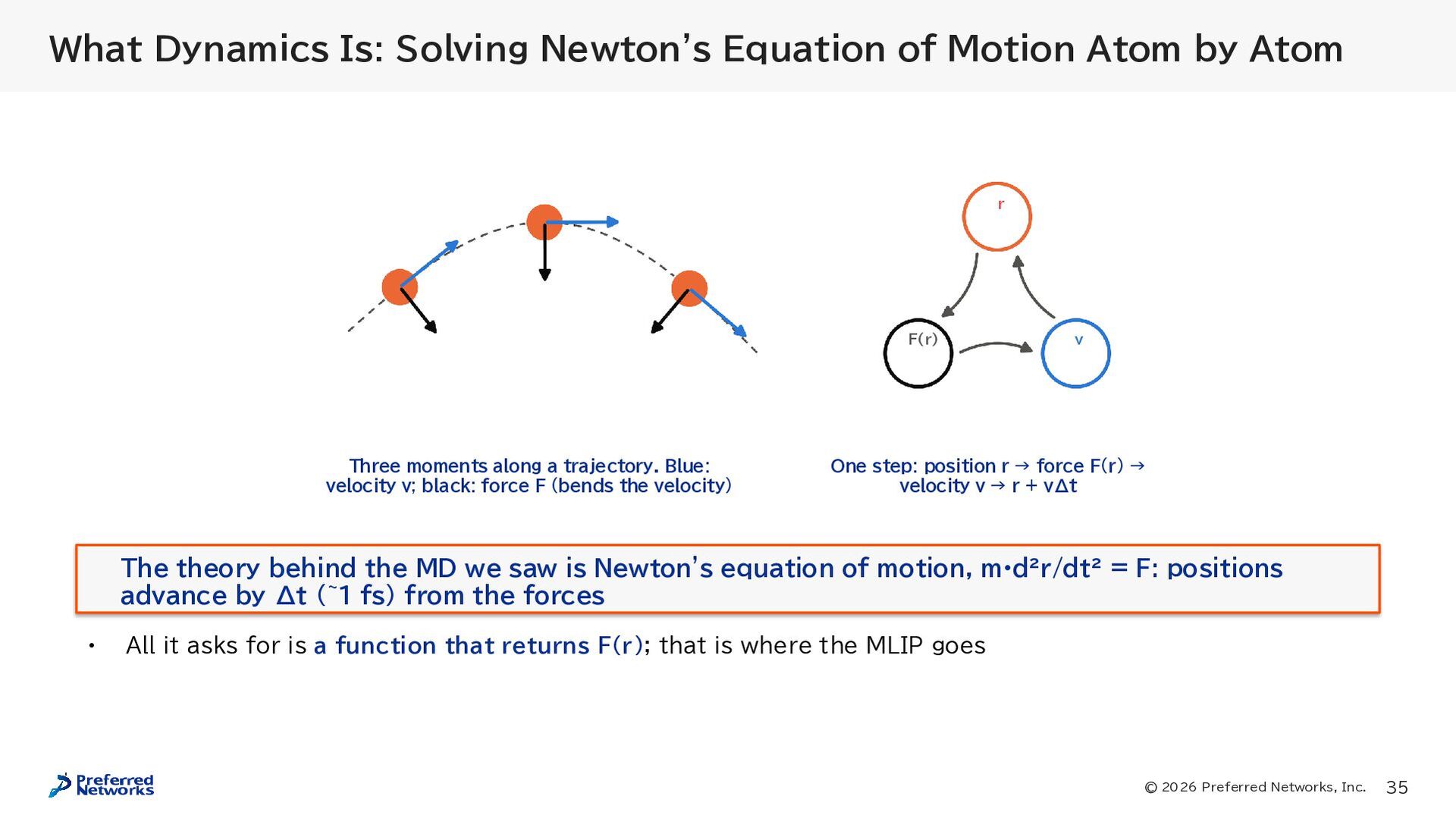
  32. What Dynamics Is: Solving Newton's Equation of Motion Atom by

    Atom r F(r) Three moments along a trajectory. Blue: velocity v; black: force F (bends the velocity) v One step: position r → force F(r) → velocity v → r + vΔt The theory behind the MD we saw is Newton's equation of motion, m·d²r/dt² = F: positions advance by Δt (~1 fs) from the forces • All it asks for is a function that returns F(r); that is where the MLIP goes © 2026 Preferred Networks, Inc. 35
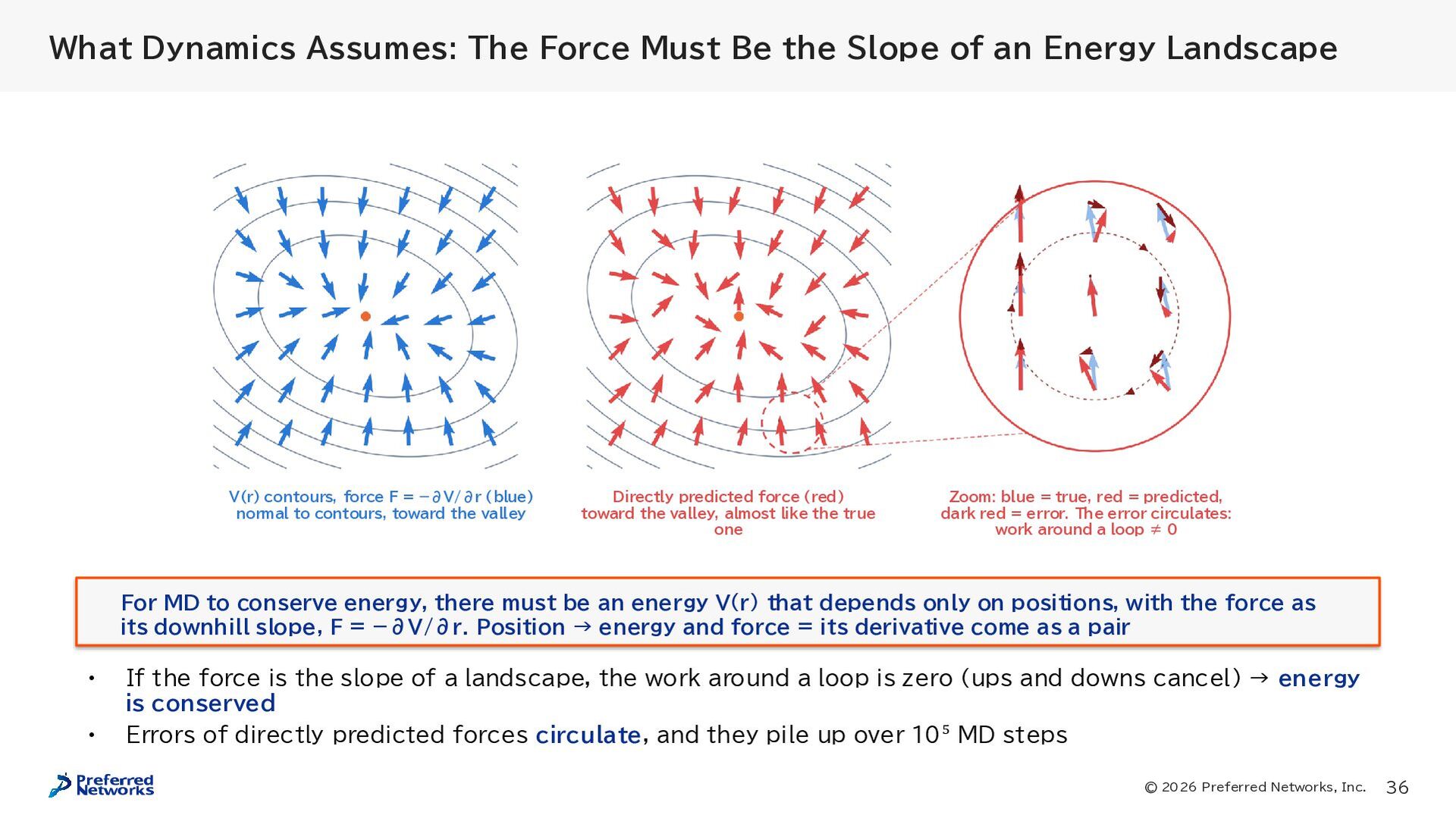
  33. What Dynamics Assumes: The Force Must Be the Slope of

    an Energy Landscape V(r) contours, force F = −∂V/∂r (blue) normal to contours, toward the valley Directly predicted force (red) toward the valley, almost like the true one Zoom: blue = true, red = predicted, dark red = error. The error circulates: work around a loop ≠ 0 For MD to conserve energy, there must be an energy V(r) that depends only on positions, with the force as its downhill slope, F = −∂V/∂r. Position → energy and force = its derivative come as a pair • If the force is the slope of a landscape, the work around a loop is zero (ups and downs cancel) → energy is conserved • Errors of directly predicted forces circulate, and they pile up over 10⁵ MD steps © 2026 Preferred Networks, Inc. 36
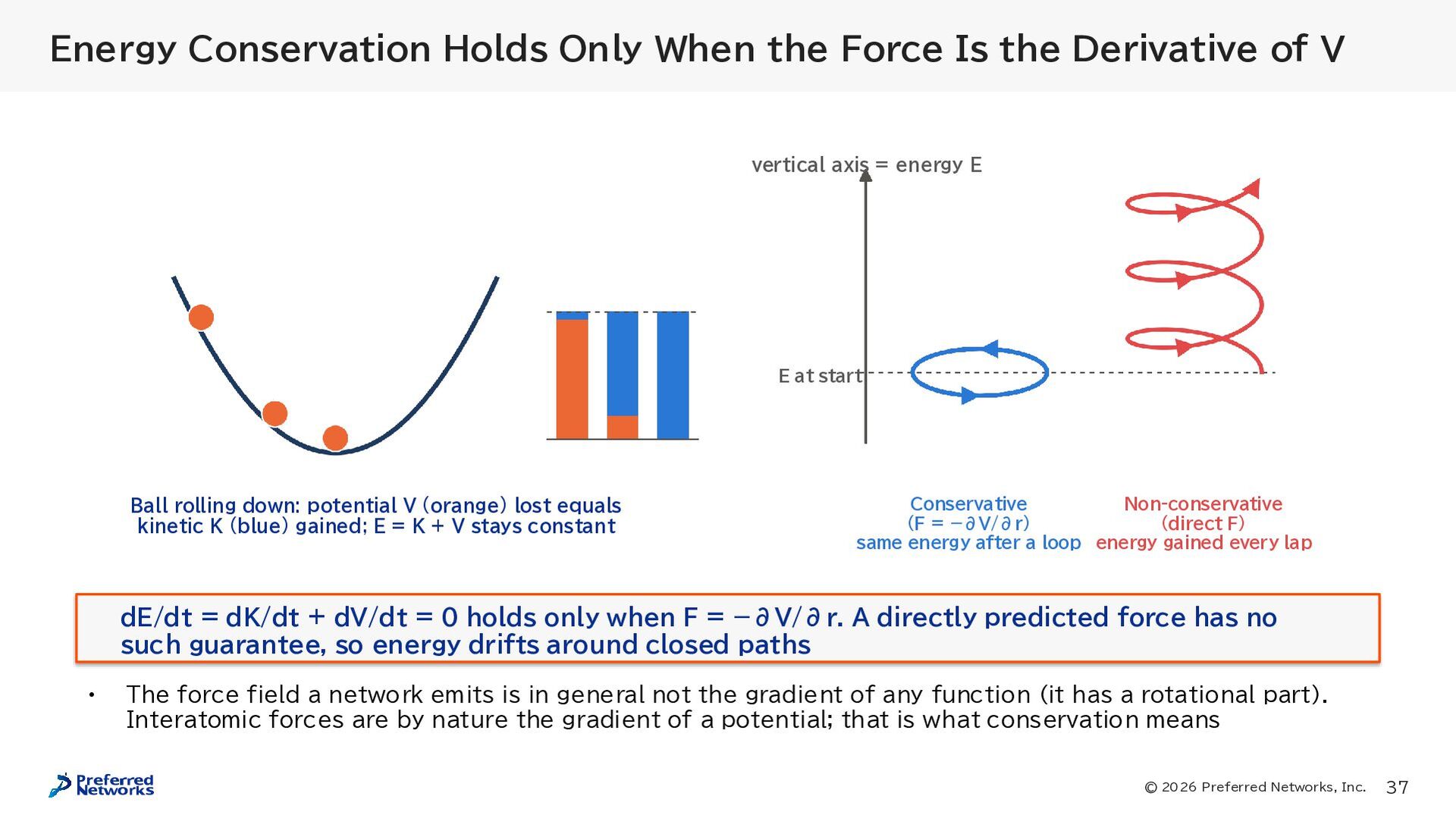
  34. Energy Conservation Holds Only When the Force Is the Derivative

    of V vertical axis = energy E E at start Ball rolling down: potential V (orange) lost equals kinetic K (blue) gained; E = K + V stays constant Conservative Non-conservative (F = −∂V/∂r) (direct F) same energy after a loop energy gained every lap dE/dt = dK/dt + dV/dt = 0 holds only when F = −∂V/∂r. A directly predicted force has no such guarantee, so energy drifts around closed paths • The force field a network emits is in general not the gradient of any function (it has a rotational part). Interatomic forces are by nature the gradient of a potential; that is what conservation means © 2026 Preferred Networks, Inc. 37
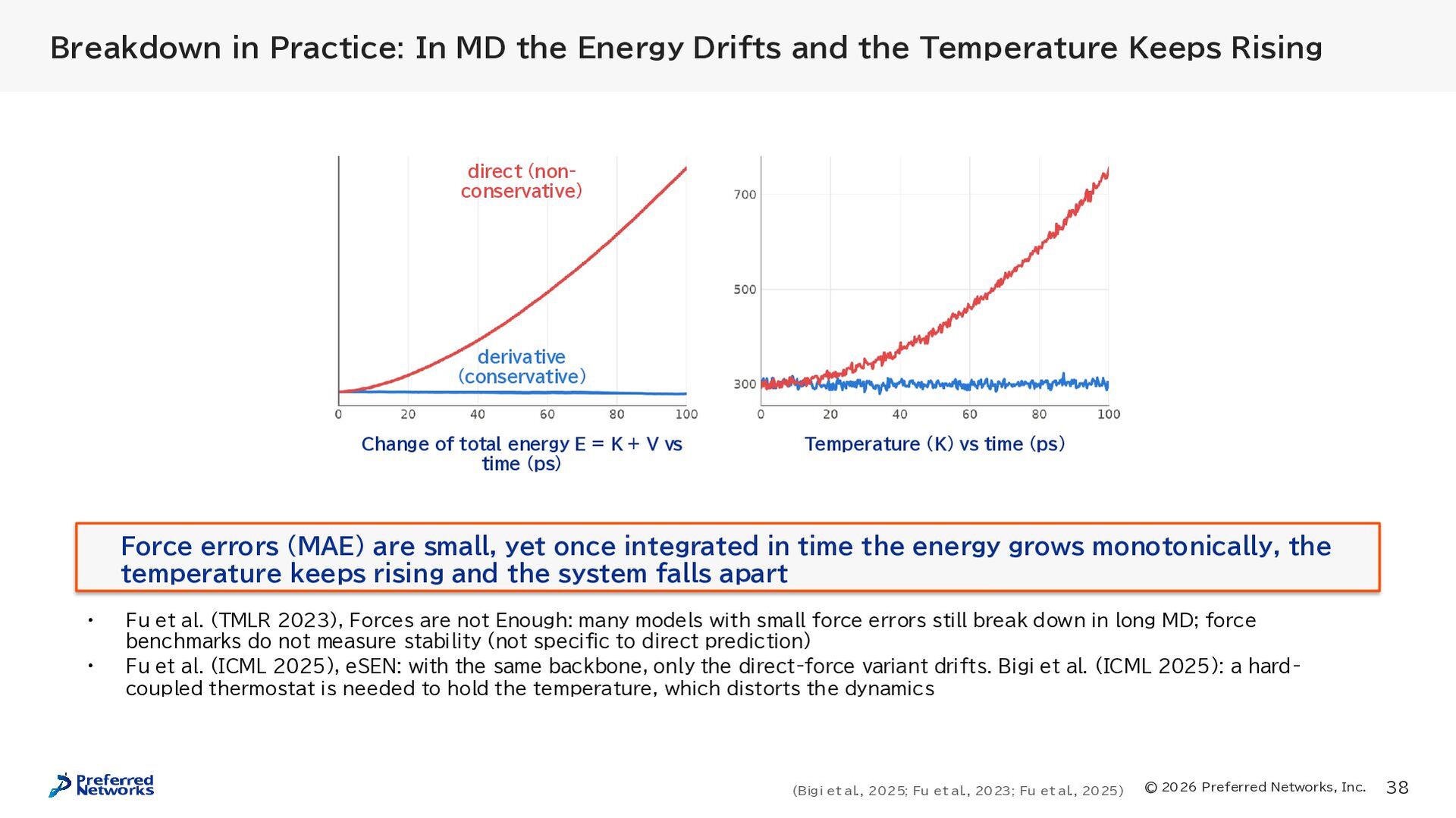
  35. Breakdown in Practice: In MD the Energy Drifts and the

    Temperature Keeps Rising direct (nonconservative) derivative (conservative) Change of total energy E = K + V vs time (ps) Temperature (K) vs time (ps) Force errors (MAE) are small, yet once integrated in time the energy grows monotonically, the temperature keeps rising and the system falls apart • • Fu et al. (TMLR 2023), Forces are not Enough: many models with small force errors still break down in long MD; force benchmarks do not measure stability (not specific to direct prediction) Fu et al. (ICML 2025), eSEN: with the same backbone, only the direct-force variant drifts. Bigi et al. (ICML 2025): a hardcoupled thermostat is needed to hold the temperature, which distorts the dynamics (Bigi et al., 2025; Fu et al., 2023; Fu et al., 2025) © 2026 Preferred Networks, Inc. 38
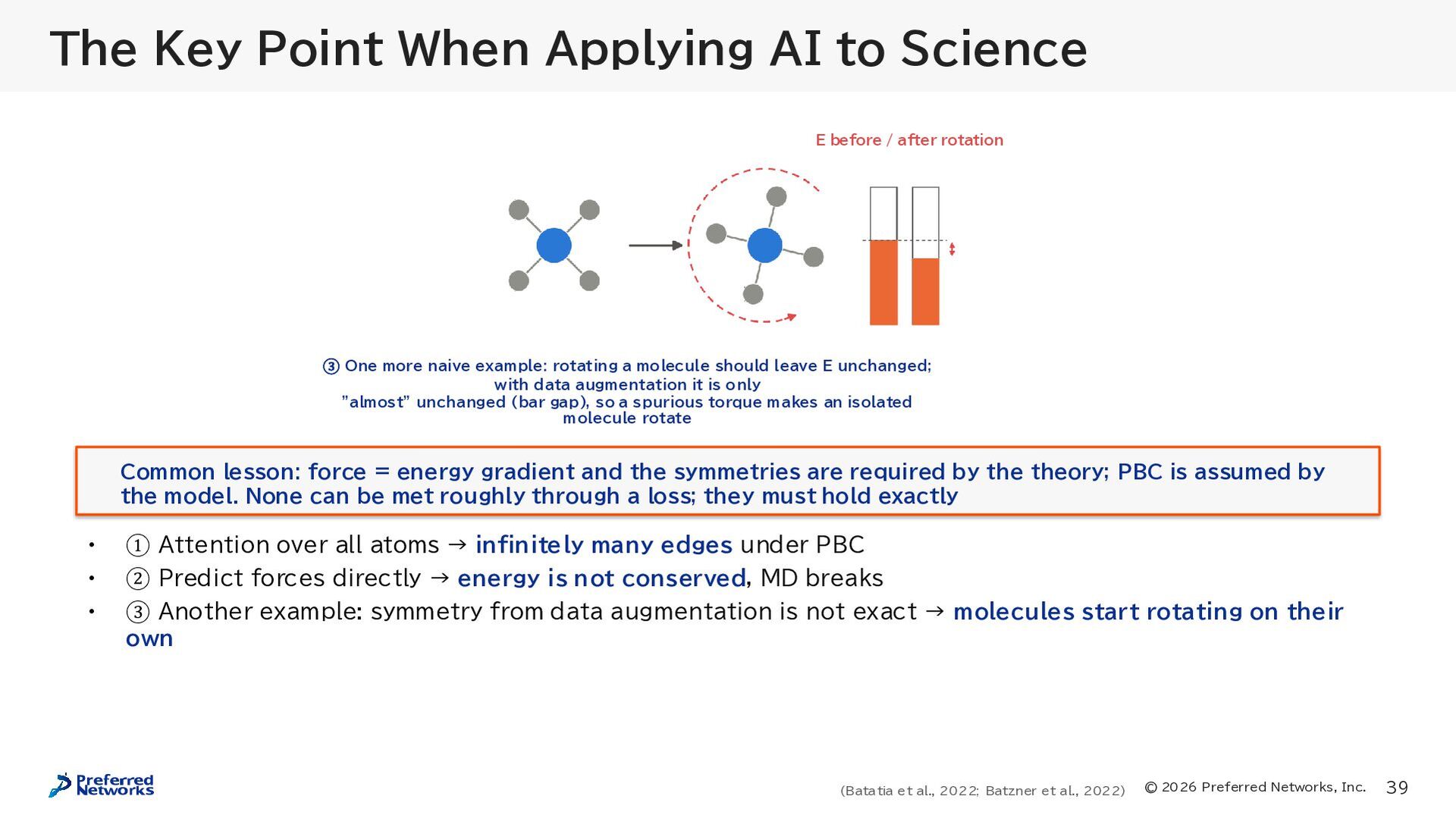
  36. The Key Point When Applying AI to Science E before

    / after rotation ③ One more naive example: rotating a molecule should leave E unchanged; with data augmentation it is only "almost" unchanged (bar gap), so a spurious torque makes an isolated molecule rotate Common lesson: force = energy gradient and the symmetries are required by the theory; PBC is assumed by the model. None can be met roughly through a loss; they must hold exactly • ① Attention over all atoms → infinitely many edges under PBC • ② Predict forces directly → energy is not conserved, MD breaks • ③ Another example: symmetry from data augmentation is not exact → molecules start rotating on their own (Batatia et al., 2022; Batzner et al., 2022) © 2026 Preferred Networks, Inc. 39
  37. An NLP Analogy: Dependency Parsing Rests on a Theory's Premise

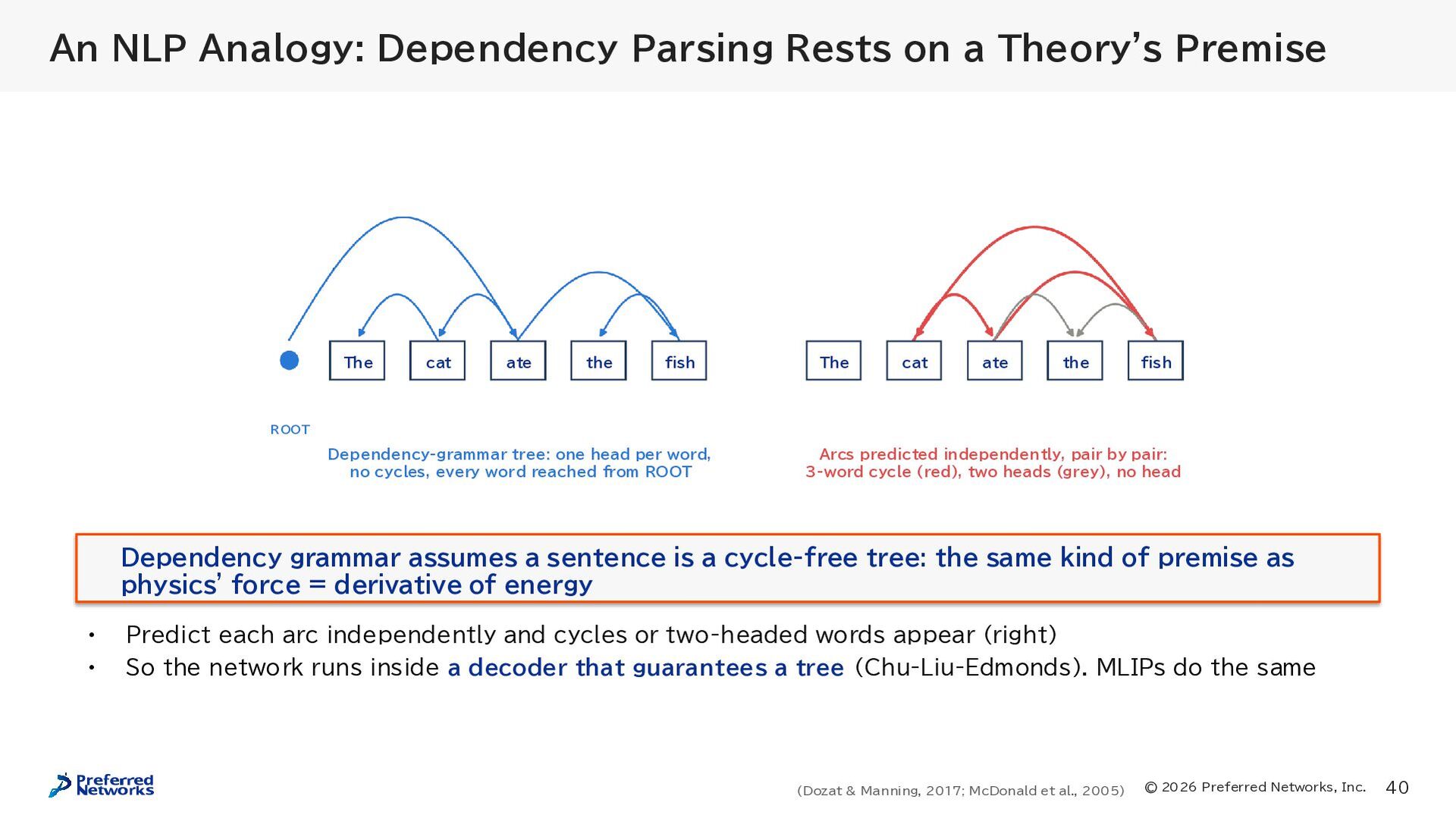
    The cat ate the fish The cat ate the fish ROOT Dependency-grammar tree: one head per word, no cycles, every word reached from ROOT Arcs predicted independently, pair by pair: 3-word cycle (red), two heads (grey), no head Dependency grammar assumes a sentence is a cycle-free tree: the same kind of premise as physics' force = derivative of energy • Predict each arc independently and cycles or two-headed words appear (right) • So the network runs inside a decoder that guarantees a tree (Chu-Liu-Edmonds). MLIPs do the same (Dozat & Manning, 2017; McDonald et al., 2005) © 2026 Preferred Networks, Inc. 40
  38. A Small Win for Compute Know-How: Recomputation Took Us from

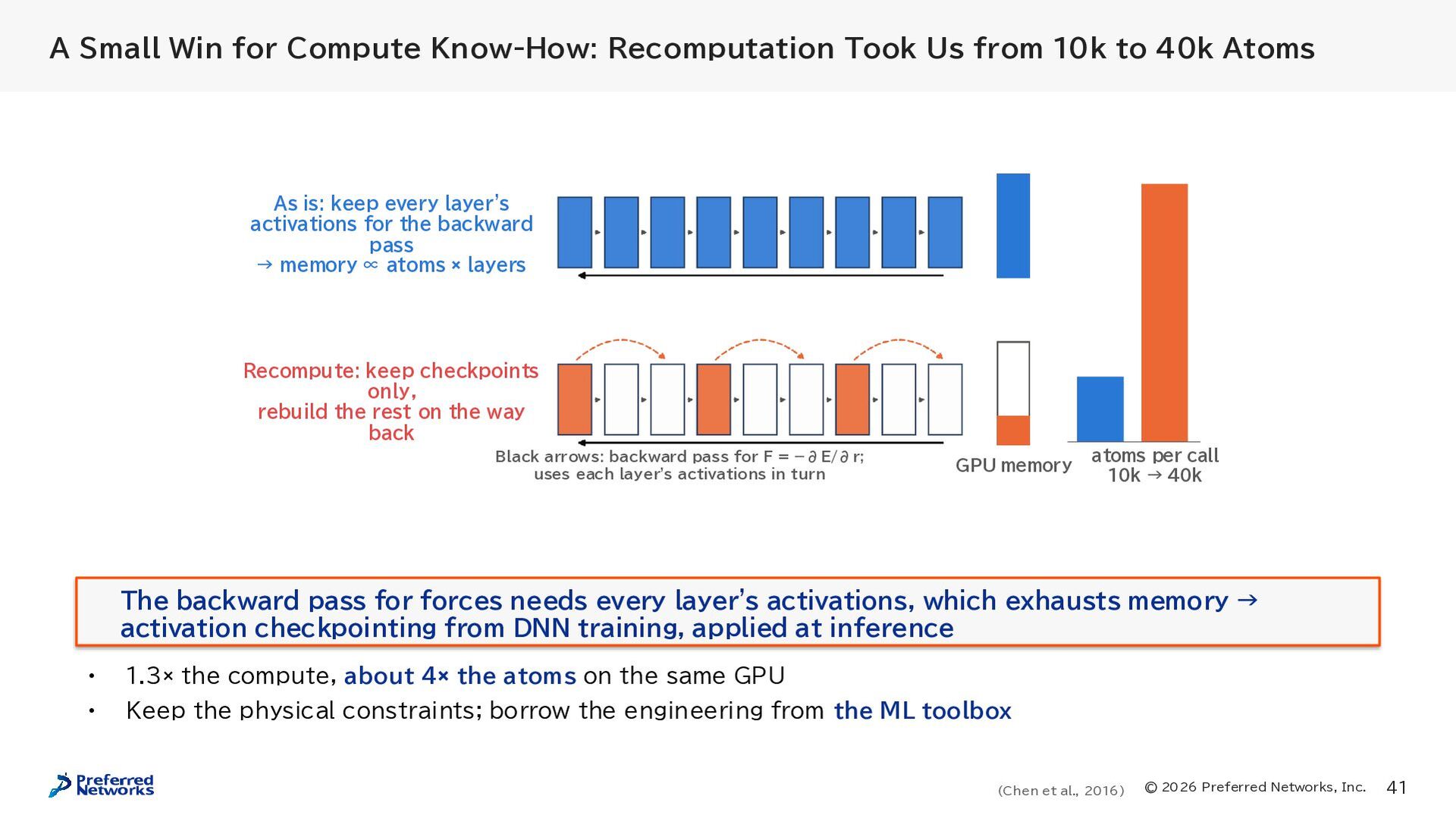
    10k to 40k Atoms As is: keep every layer's activations for the backward pass → memory ∝ atoms × layers Recompute: keep checkpoints only, rebuild the rest on the way back Black arrows: backward pass for F = −∂E/∂r; uses each layer's activations in turn GPU memory atoms per call 10k → 40k The backward pass for forces needs every layer's activations, which exhausts memory → activation checkpointing from DNN training, applied at inference • 1.3× the compute, about 4× the atoms on the same GPU • Keep the physical constraints; borrow the engineering from the ML toolbox (Chen et al., 2016) © 2026 Preferred Networks, Inc. 41
  39. Summary of Part 2 • A physics simulation rests on

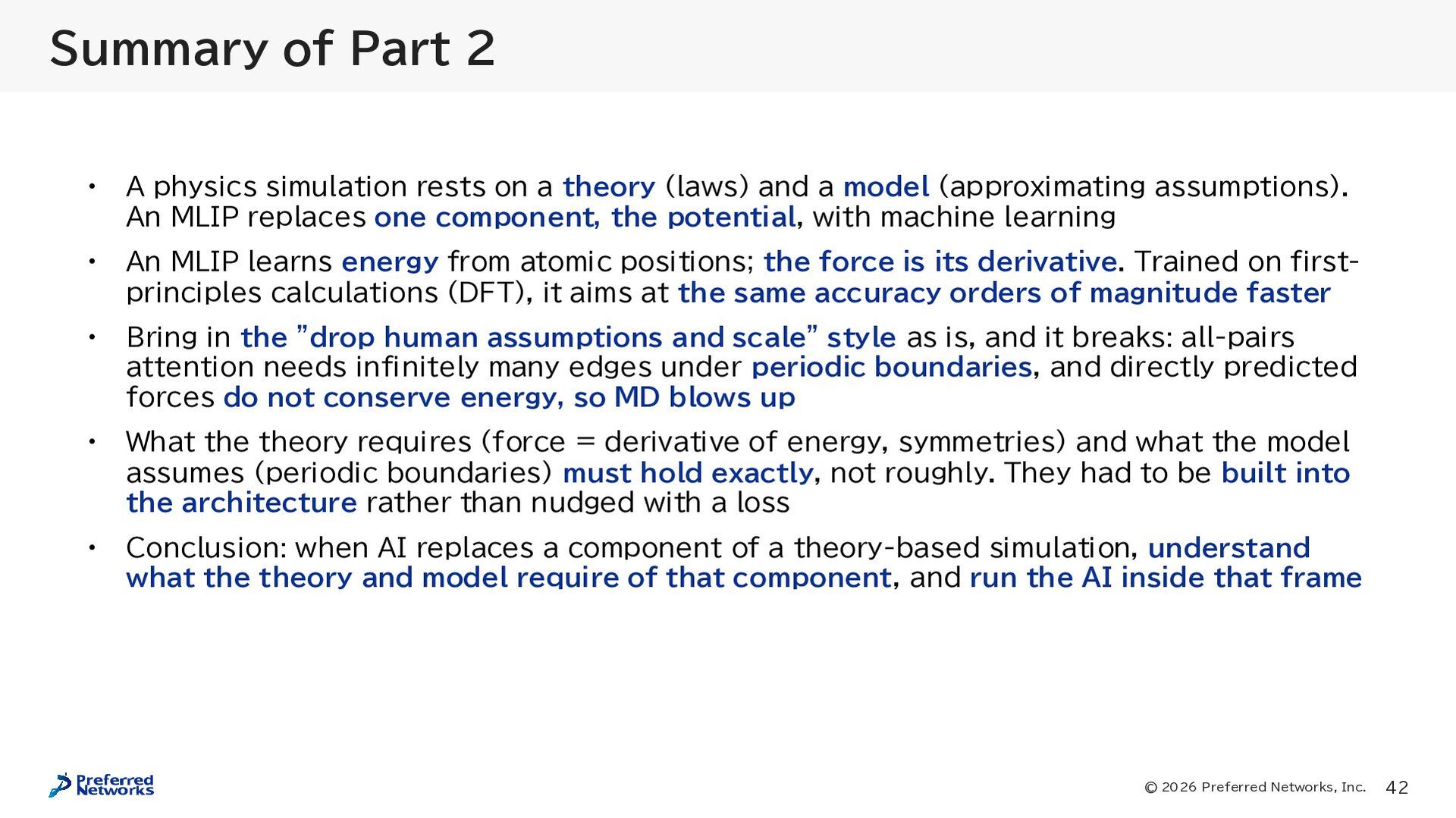
    a theory (laws) and a model (approximating assumptions). An MLIP replaces one component, the potential, with machine learning • An MLIP learns energy from atomic positions; the force is its derivative. Trained on firstprinciples calculations (DFT), it aims at the same accuracy orders of magnitude faster • Bring in the "drop human assumptions and scale" style as is, and it breaks: all-pairs attention needs infinitely many edges under periodic boundaries, and directly predicted forces do not conserve energy, so MD blows up • What the theory requires (force = derivative of energy, symmetries) and what the model assumes (periodic boundaries) must hold exactly, not roughly. They had to be built into the architecture rather than nudged with a loss • Conclusion: when AI replaces a component of a theory-based simulation, understand what the theory and model require of that component, and run the AI inside that frame © 2026 Preferred Networks, Inc. 42
  40. Closing: AI Agents, the Human Role and an Open Question

    8 min © 2026 Preferred Networks, Inc. 43
  41. Related Work: Agents That Run Simulations Autonomously (Examples from PFN)

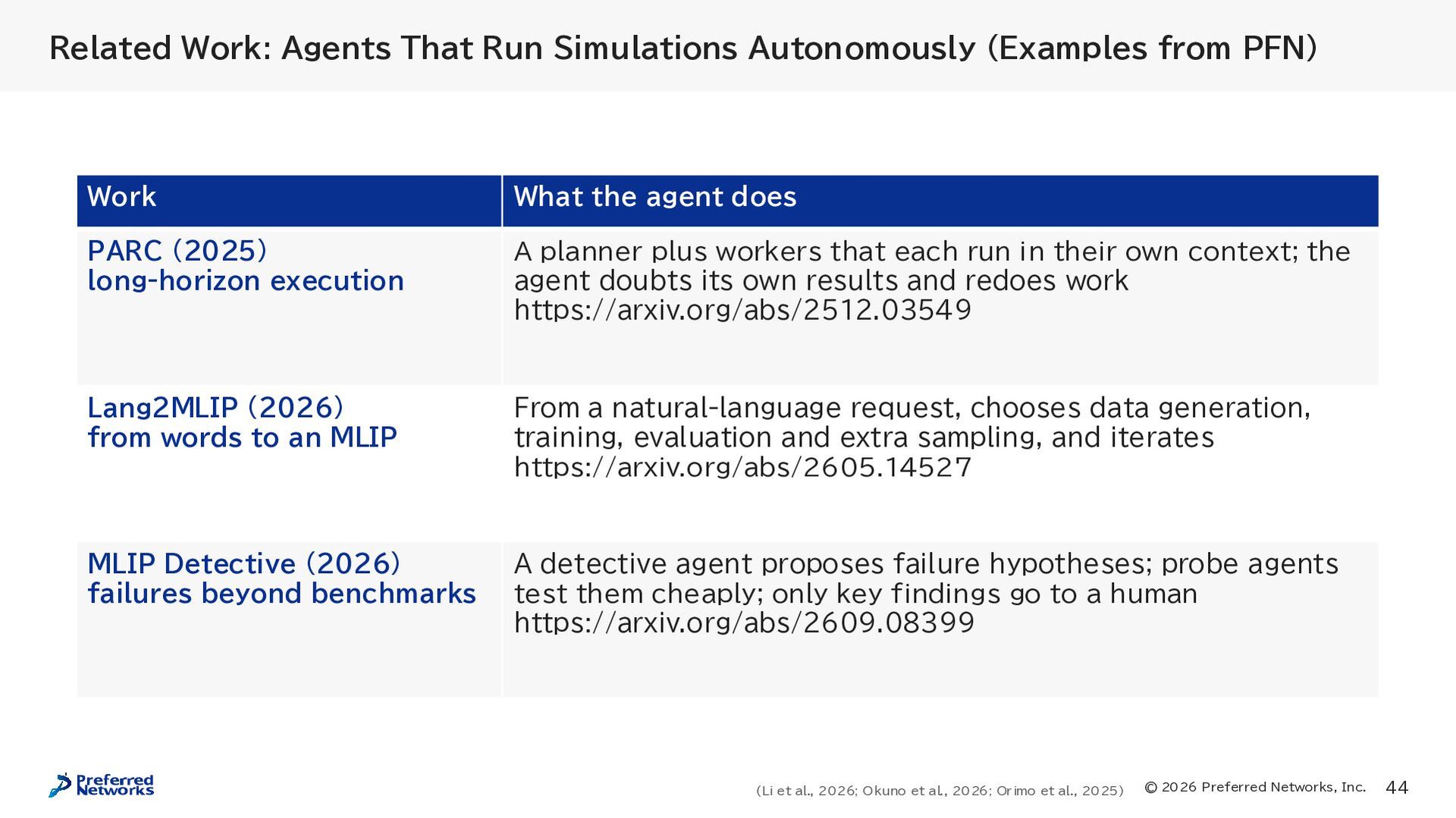
    Work What the agent does PARC (2025) long-horizon execution A planner plus workers that each run in their own context; the agent doubts its own results and redoes work https://arxiv.org/abs/2512.03549 Lang2MLIP (2026) from words to an MLIP From a natural-language request, chooses data generation, training, evaluation and extra sampling, and iterates https://arxiv.org/abs/2605.14527 MLIP Detective (2026) failures beyond benchmarks A detective agent proposes failure hypotheses; probe agents test them cheaply; only key findings go to a human https://arxiv.org/abs/2609.08399 (Li et al., 2026; Okuno et al., 2026; Orimo et al., 2025) © 2026 Preferred Networks, Inc. 44
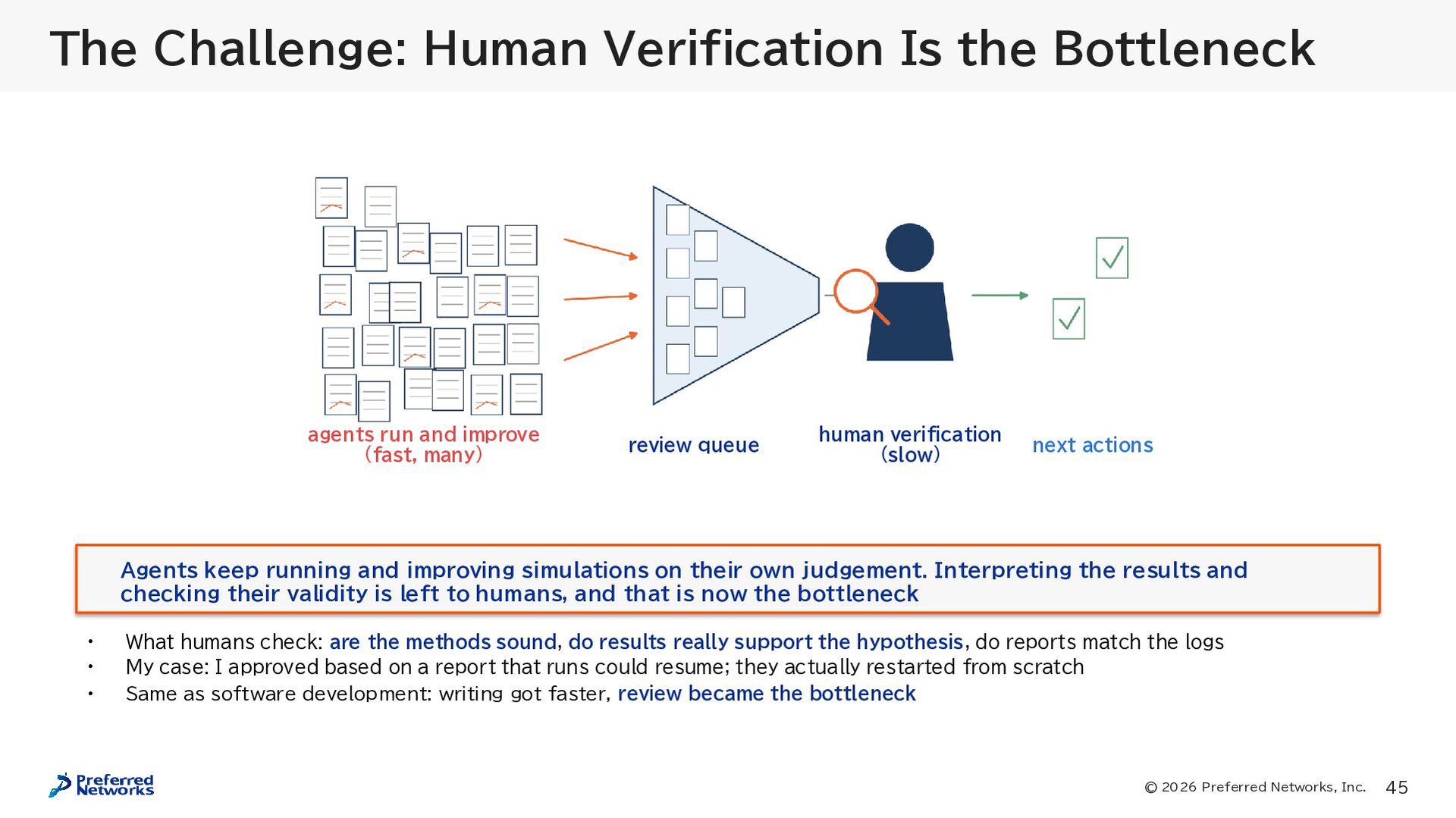
  42. The Challenge: Human Verification Is the Bottleneck agents run and

    improve (fast, many) review queue human verification (slow) next actions Agents keep running and improving simulations on their own judgement. Interpreting the results and checking their validity is left to humans, and that is now the bottleneck • • • What humans check: are the methods sound, do results really support the hypothesis, do reports match the logs My case: I approved based on a report that runs could resume; they actually restarted from scratch Same as software development: writing got faster, review became the bottleneck © 2026 Preferred Networks, Inc. 45
  43. An Open Question: Is Human Cognition the Bottleneck of Science?

    • Today's first-principles methods such as DFT are themselves imperfect. Extending classical mechanics, the intuitive human framework, could never have reached quantum mechanics or relativity • The ultimate promise of AI for Science: machine learning unbound by human cognition discovering unknown physical laws from massive data, possibly in forms humans cannot interpret • Chen et al. (2022): from videos of pendulums and other systems, AI discovered state variables that differ from the ones physicists know • Will the next paradigm shift come from human theory or from data-driven AI? Nobody yet knows (Chen et al., 2022) © 2026 Preferred Networks, Inc. 46
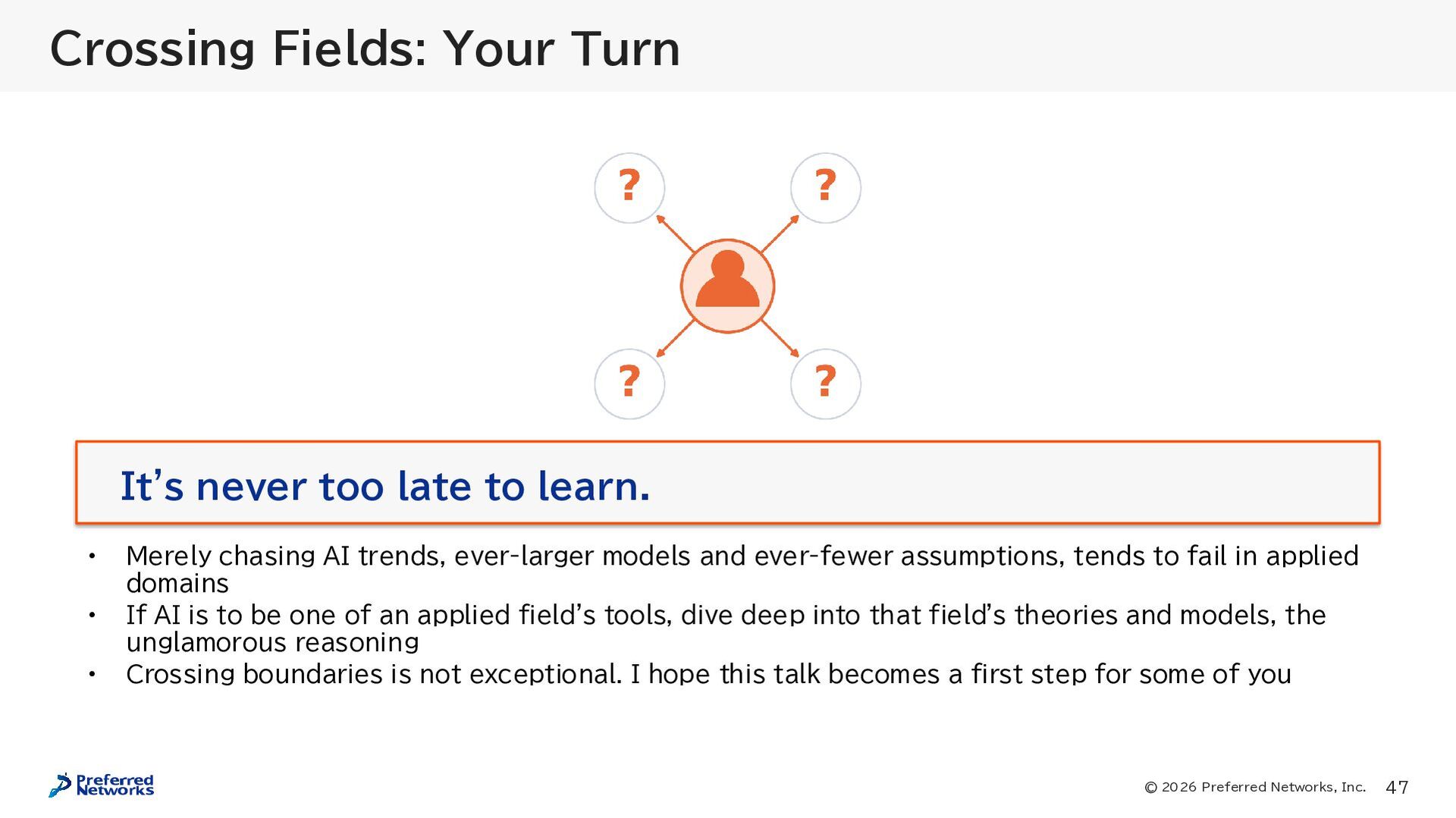
  44. Crossing Fields: Your Turn It's never too late to learn.

    • • • Merely chasing AI trends, ever-larger models and ever-fewer assumptions, tends to fail in applied domains If AI is to be one of an applied field's tools, dive deep into that field's theories and models, the unglamorous reasoning Crossing boundaries is not exceptional. I hope this talk becomes a first step for some of you © 2026 Preferred Networks, Inc. 47
  45. We are hiring! We’re looking for people who want to

    turn cutting-edge technology into real-world impact—and help shape the future of industry and society with us. New graduates (class of 2027) • Engineers and researchers • Materials discovery engineers and researchers Part-time and contract positions • Software engineer (Optuna); open-source developer (CuPy) • MN-Core software part-time engineer • Materials research (Matlantis case studies) • Education project engineer • Part-time researcher, finance project • AI weather forecasting: student and project researchers • Project researcher: LLMs for cybersecurity careers page new graduates internships Experienced hires are also welcome. Apply via the careers page on the right. © 2026 Preferred Networks, Inc. 48
  46. References (1/2) • Batatia, I. et al. (2022). MACE: Higher

    Order Equivariant Message Passing Neural Networks for Fast and Accurate Force Fields. NeurIPS 35. (cited on p. 39, p. 55) • Batzner, S. et al. (2022). E(3)-equivariant graph neural networks for data-efficient and accurate interatomic potentials (NequIP). Nature Communications, 13, 2453. (cited on p. 39, p. 55) • Bigi, F., Langer, M. & Ceriotti, M. (2025). The dark side of the forces: assessing non-conservative force models for atomistic machine learning. ICML. (cited on p. 38) • Charalambous, C. et al. (2024a). A Holistic Platform for Accelerating Sorbent -Based Carbon Capture [Data set] (PrISMa: CIFs and experimental isotherms). Zenodo, doi:10.5281/zenodo.12793408. (cited on p. 19) • Charalambous, C. et al. (2024b). A holistic platform for accelerating sorbent -based carbon capture. Nature, 632, 89–94. (PrISMa) (cited on p. 19, p. 54) • Chen, B. et al. (2022). Automated discovery of fundamental variables hidden in experimental data. Nature Computational Scienc e, 2, 433–442. (cited on p. 46) • Chen, T., Xu, B., Zhang, C. & Guestrin, C. (2016). Training Deep Nets with Sublinear Memory Cost. arXiv:1604.06174. (cited on p. 41) • Chu, I.-H. et al. (2016). Insights into the Performance Limits of the Li7P3S11 Superionic Conductor: A Combined First -Principles and Experimental Study. ACS Appl. Mater. Interfaces, 8, 7843–7853. (cited on p. 26, p. 58) • Deng, H. et al. (2010). Multiple Functional Groups of Varying Ratios in Metal-Organic Frameworks. Science, 327, 846–850. (MTV-MOF-5) (cited on p. 18) • Dozat, T. & Manning, C. D. (2017). Deep Biaffine Attention for Neural Dependency Parsing. ICLR 2017. arXiv:1611.01734. (cited on p. 40) • Fu, X. et al. (2023). Forces are not Enough: Benchmark and Critical Evaluation for Machine Learning Force Fields with Molecul ar Simulations. TMLR. (cited on p. 38) • Fu, X. et al. (2025). Learning Smooth and Expressive Interatomic Potentials for Physical Property Prediction (eSEN). ICML. (c ited on p. 38) • Hu, W. et al. (2021). ForceNet: A Graph Neural Network for Large-Scale Quantum Calculations. arXiv:2103.01436. (cited on p. 34 ) © 2026 Preferred Networks, Inc. 50
  47. References (2/2) • Li, H., Eddaoudi, M., O'Keeffe, M. &

    Yaghi, O. M. (1999). Design and synthesis of an exceptionally stable and highly porous m etal-organic framework. Nature, 402, 276–279. (MOF-5) (cited on p. 16) • Li, W., Orimo, Y. & Charoenphakdee, N. (2026). Lang2MLIP: End-to-End Language-to-Machine Learning Interatomic Potential Development with Autonomous Agentic Workflows. arXiv:2605.14527. (cited on p. 44) • McDonald, R., Pereira, F., Ribarov, K. & Hajič, J. (2005). Non-projective dependency parsing using spanning tree algorithms. Proc. HLT/EMNLP 2005, 523– 530. (cited on p. 40) • Okuno, R., Charoenphakdee, N., Hisama, K. & Tsuboi, Y. (2026). MLIP Detective: Active Failure Mode Discovery Beyond Benchmark Scores for MachineLearning Interatomic Potentials. arXiv:2609.08399. (cited on p. 44) • Orimo, Y. et al. (2025). PARC: An Autonomous Self-Reflective Coding Agent for Robust Execution of Long-Horizon Tasks. arXiv:2512.03549. (cited on p. 44) • Ritchie, H. (2020). Sector by sector: where do global greenhouse gas emissions come from? Our World in Data (Climate Watch da ta, 2016). https://ourworldindata.org/ghg-emissions-by-sector (cited on p. 14) • Seino, Y., Ota, T., Takada, K., Hayashi, A. & Tatsumisago, M. (2014). A sulphide lithium super ion conductor is superior to l iquid ion conductors for use in rechargeable batteries. Energy & Environmental Science, 7, 627–631. (cited on p. 26) • Shannon, R. D. (1976). Revised effective ionic radii and systematic studies of interatomic distances in halides and chalcogen ides. Acta Crystallographica A, 32, 751–767. (cited on p. 11) • Sutton, R. (2019). The Bitter Lesson. http://www.incompleteideas.net/IncIdeas/BitterLesson.html (cited on p. 31) • Takamoto, S. et al. (2022). Towards universal neural network potential for material discovery applicable to arbitrary combina tion of 45 elements. Nature Communications, 13, 2991. (PFP) (cited on p. 12, p. 28, p. 58) • Tsuboi, Y., Unno, Y. & Suzuki, J. (2017). Deep Learning for Natural Language Processing (in Japanese; Machine Learning Profes sional Series). Kodansha. (cited on p. 3) • Yaghi, O. M. et al. (2003). Reticular synthesis and the design of new materials. Nature, 423, 705 –714. (cited on p. 18) © 2026 Preferred Networks, Inc. 51