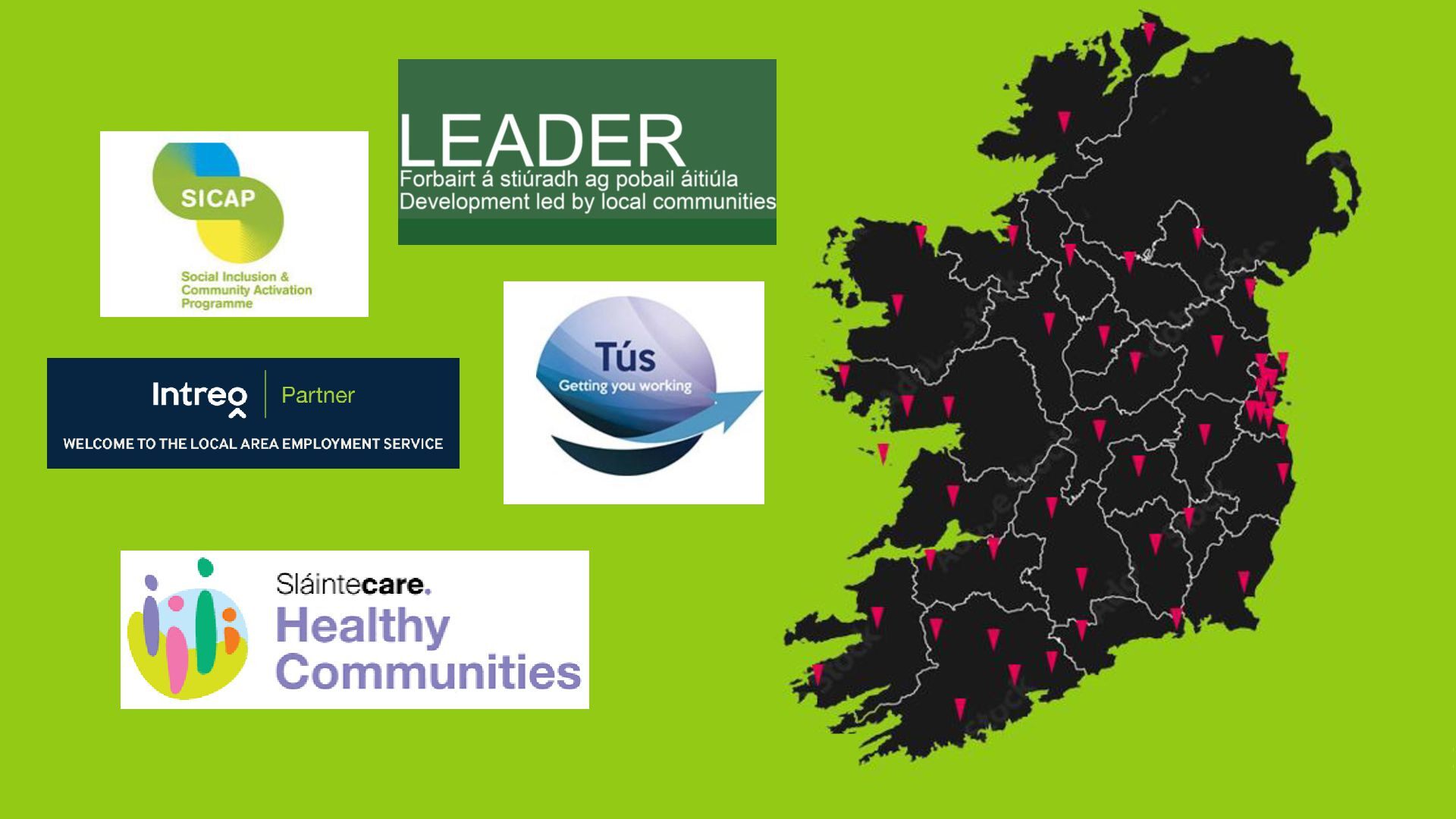
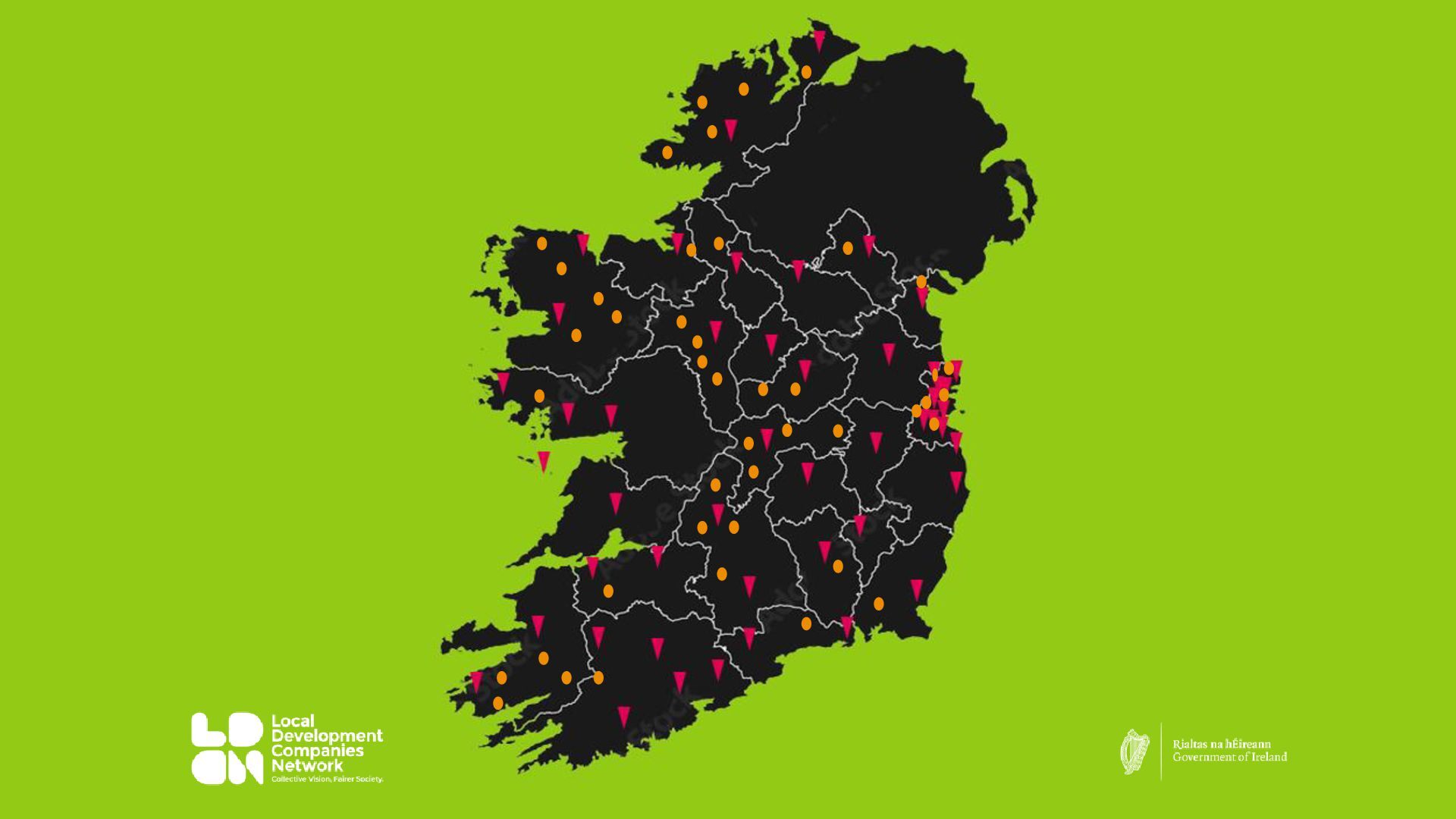
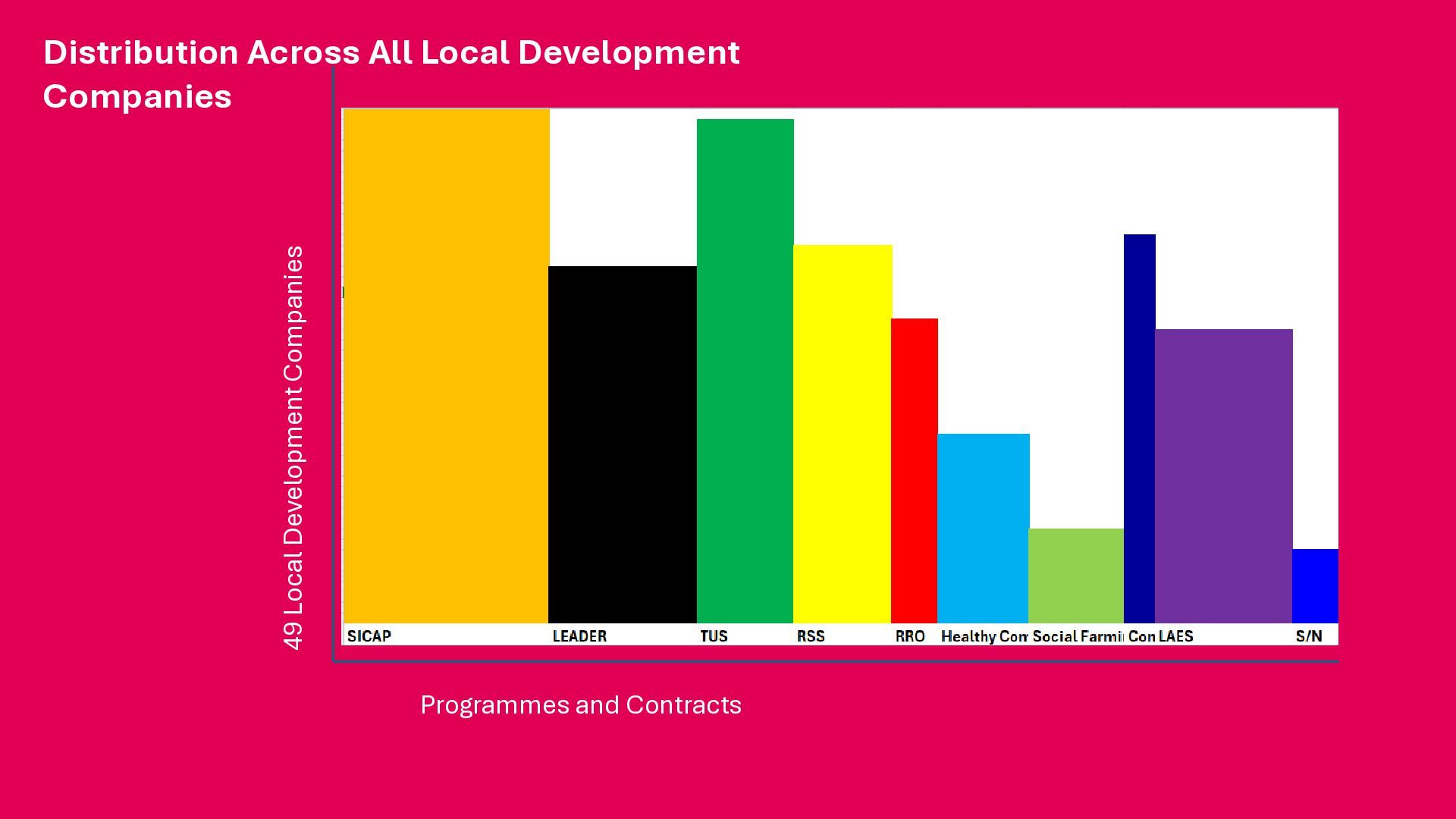
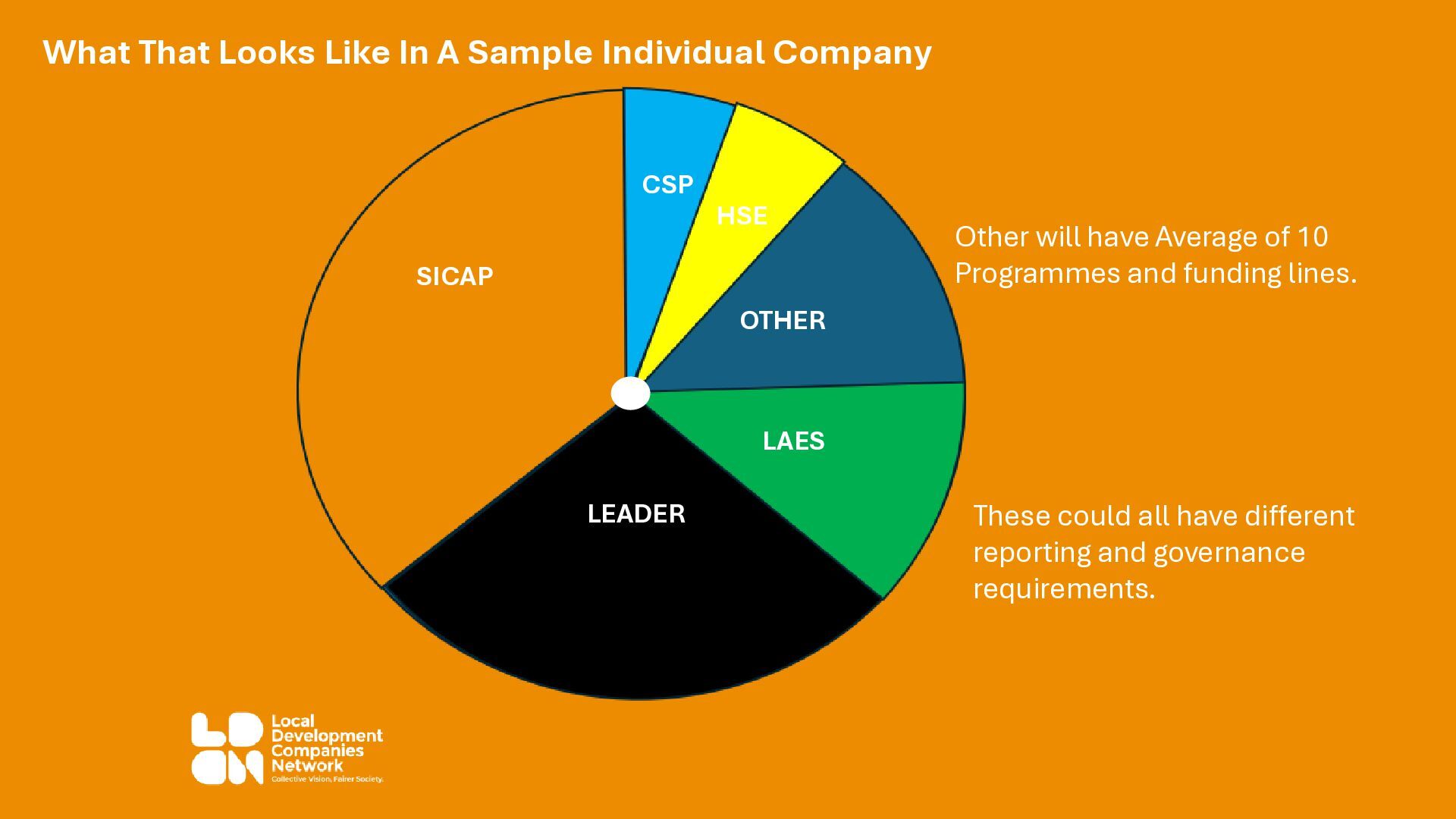
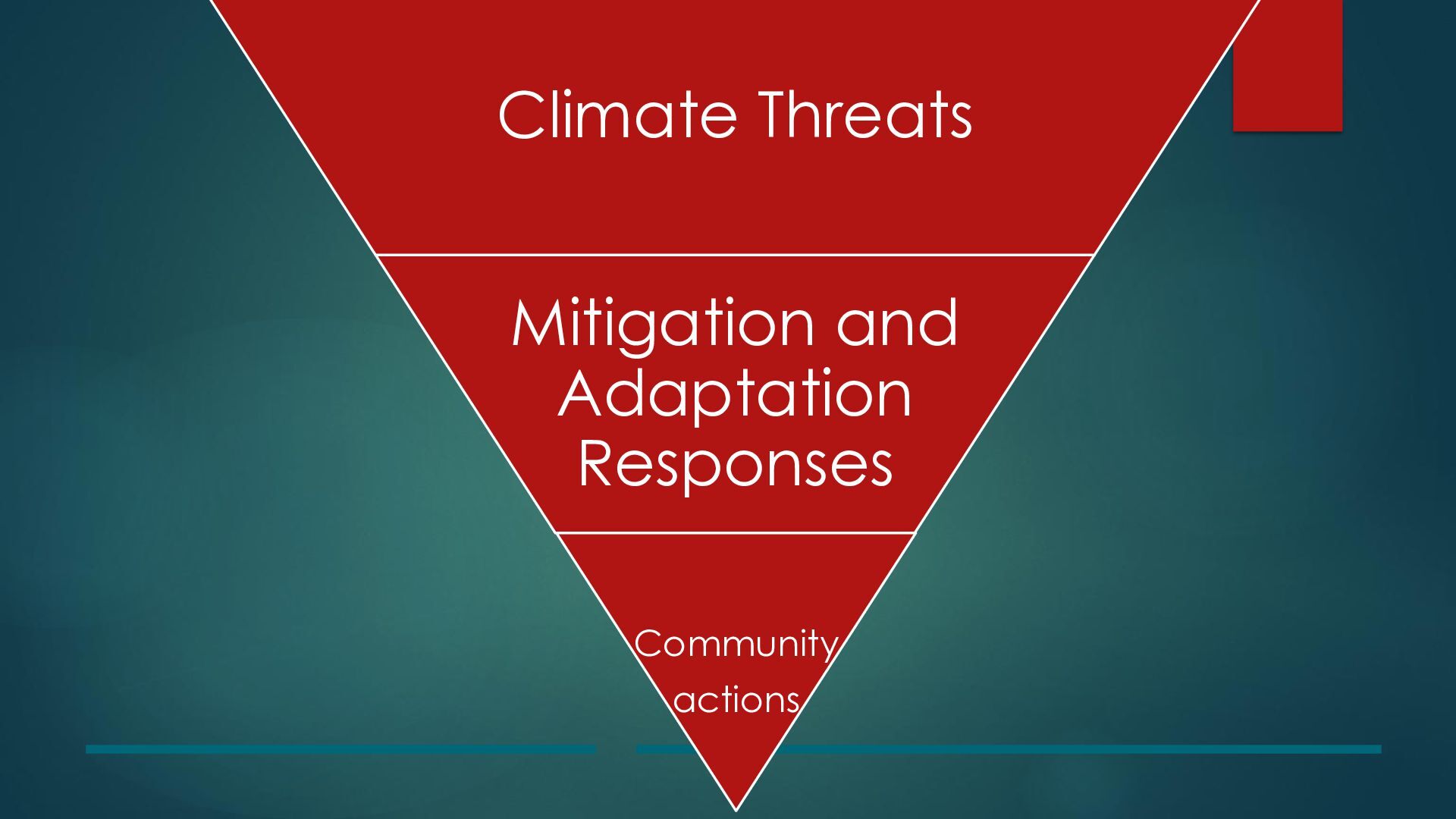
HSE SICAP Other will have Average of 10 Programmes and funding lines. OTHER LAES LEADER These could all have different reporting and governance requirements.
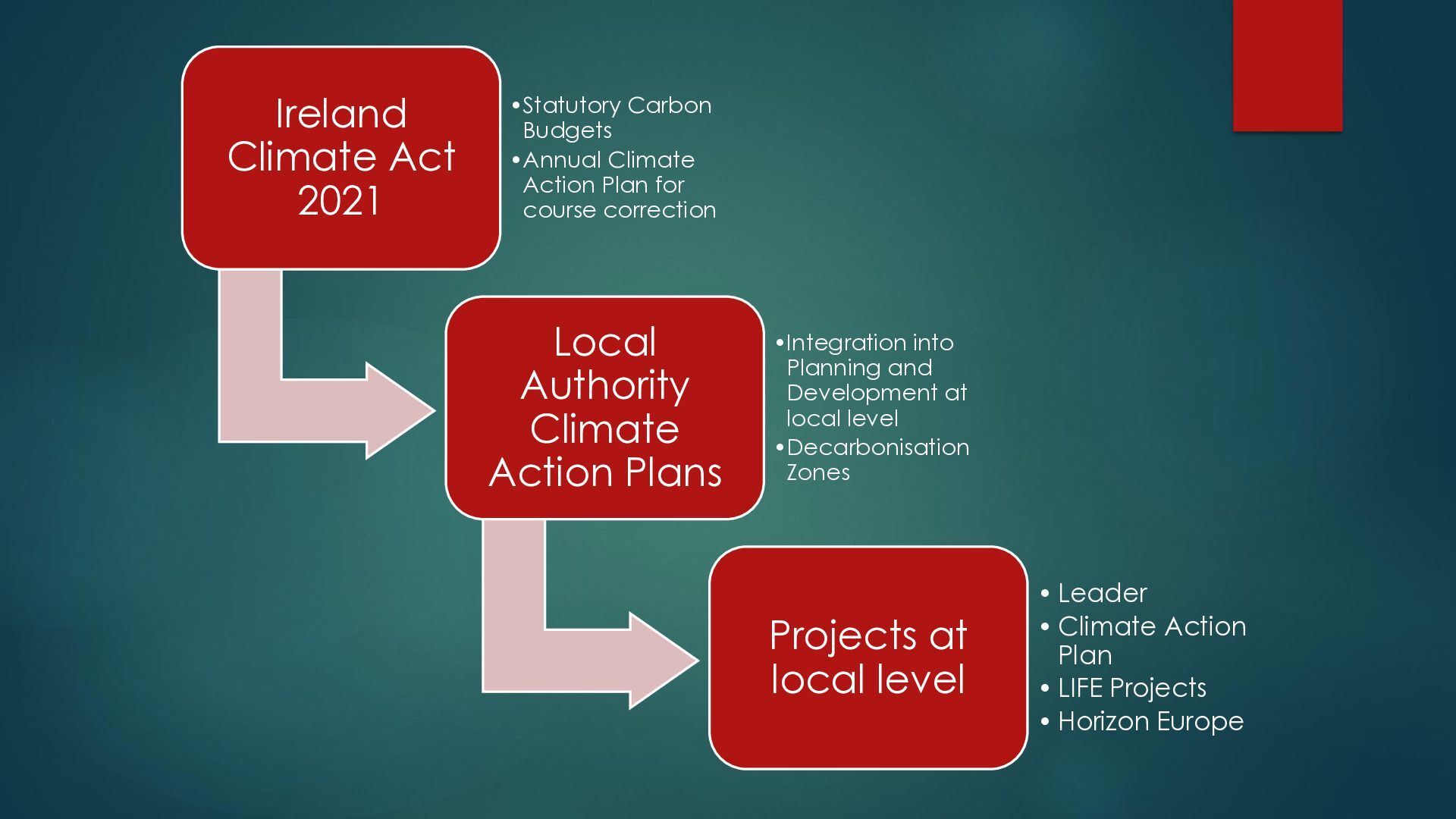
Plan for course correction Local Authority Climate Action Plans •Integration into Planning and Development at local level •Decarbonisation Zones Projects at local level • Leader • Climate Action Plan • LIFE Projects • Horizon Europe
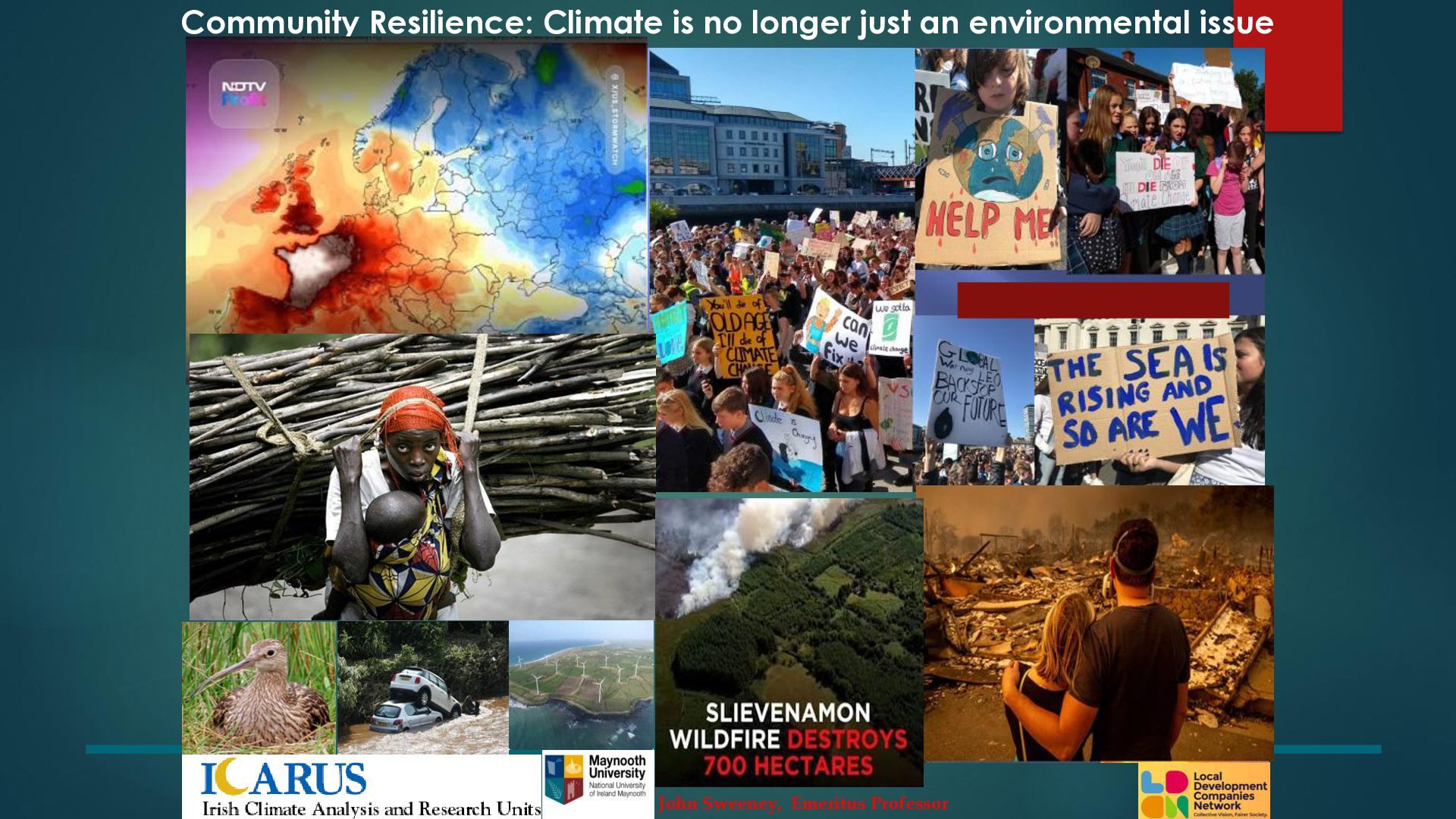
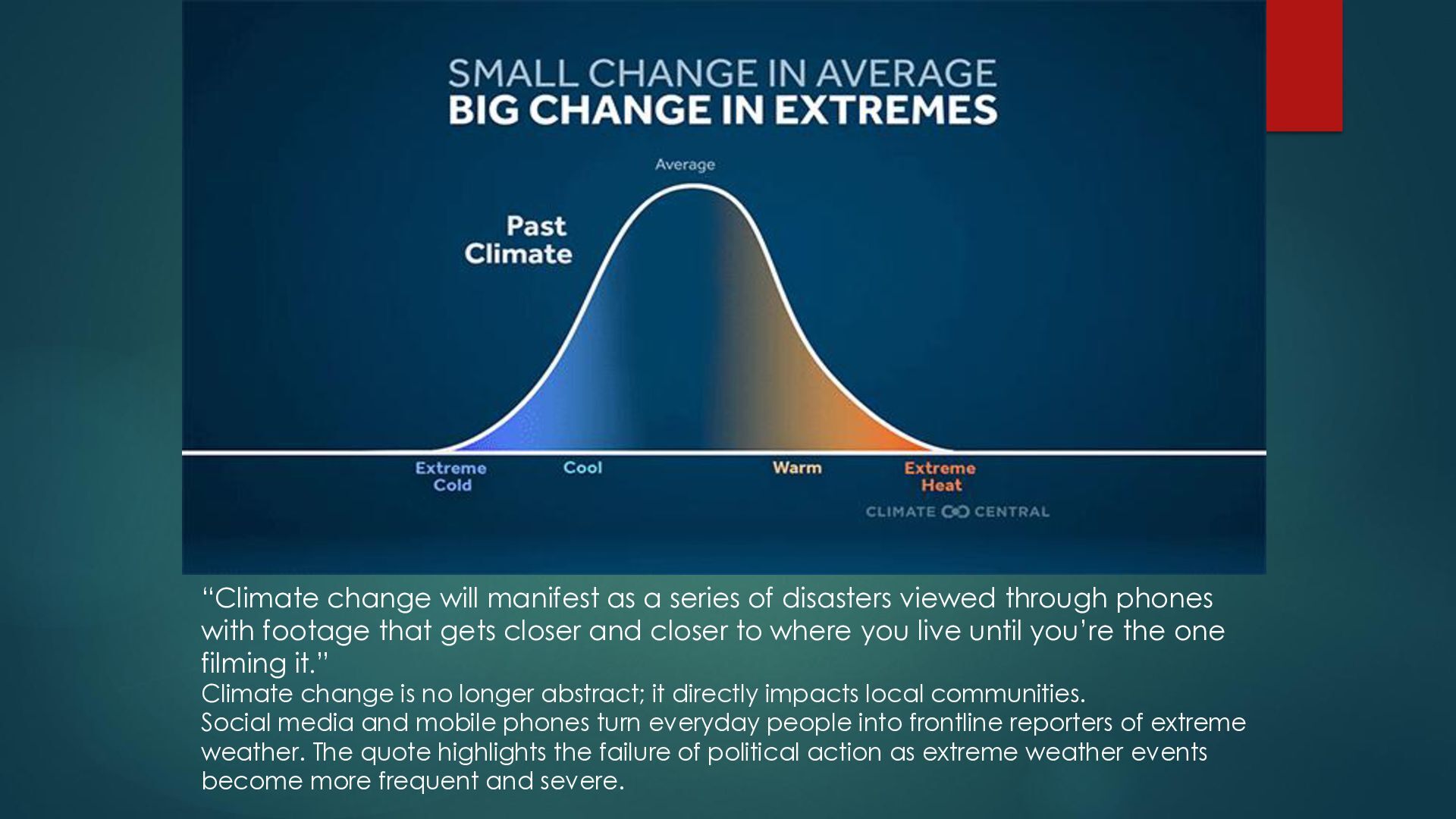
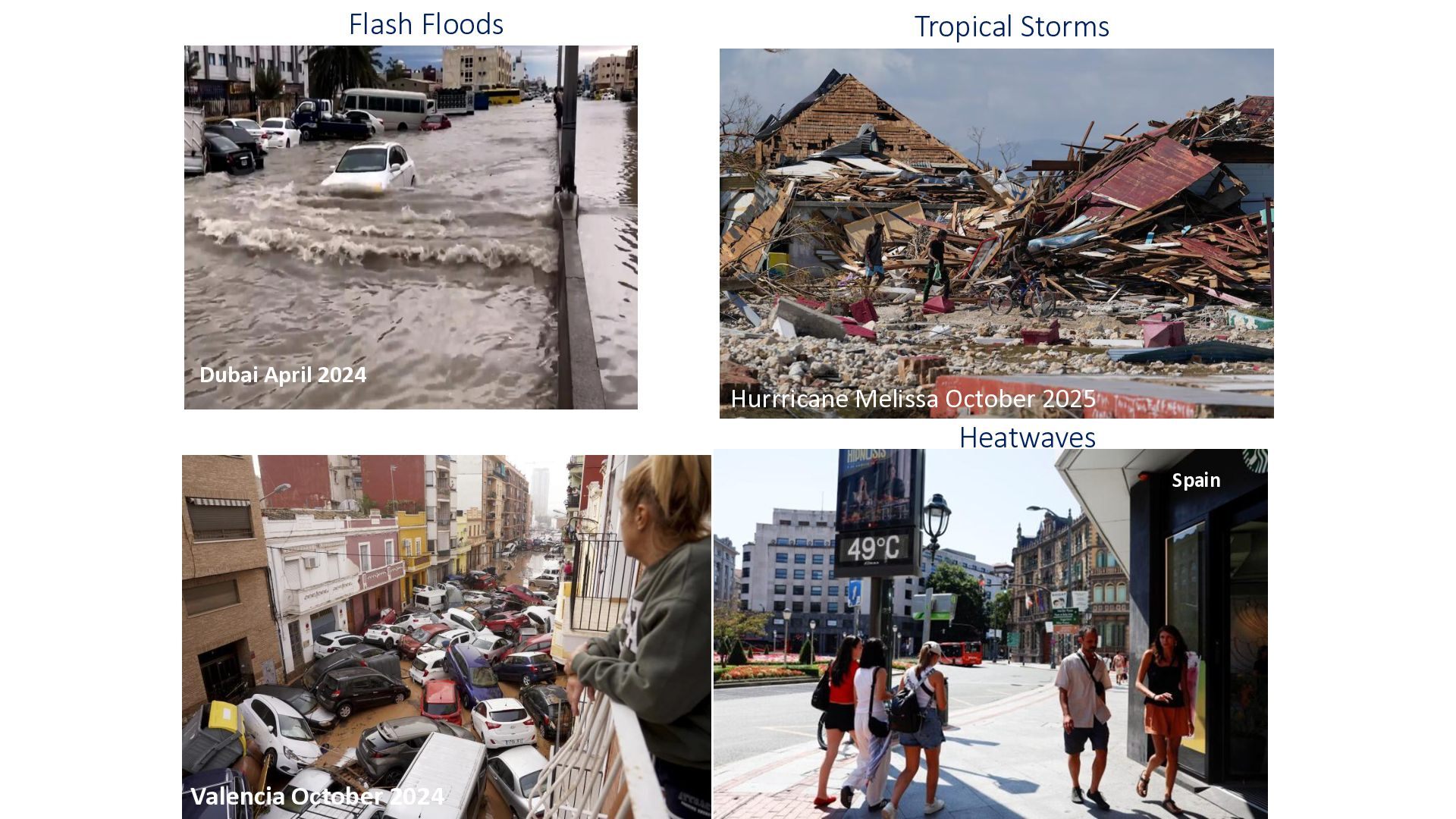
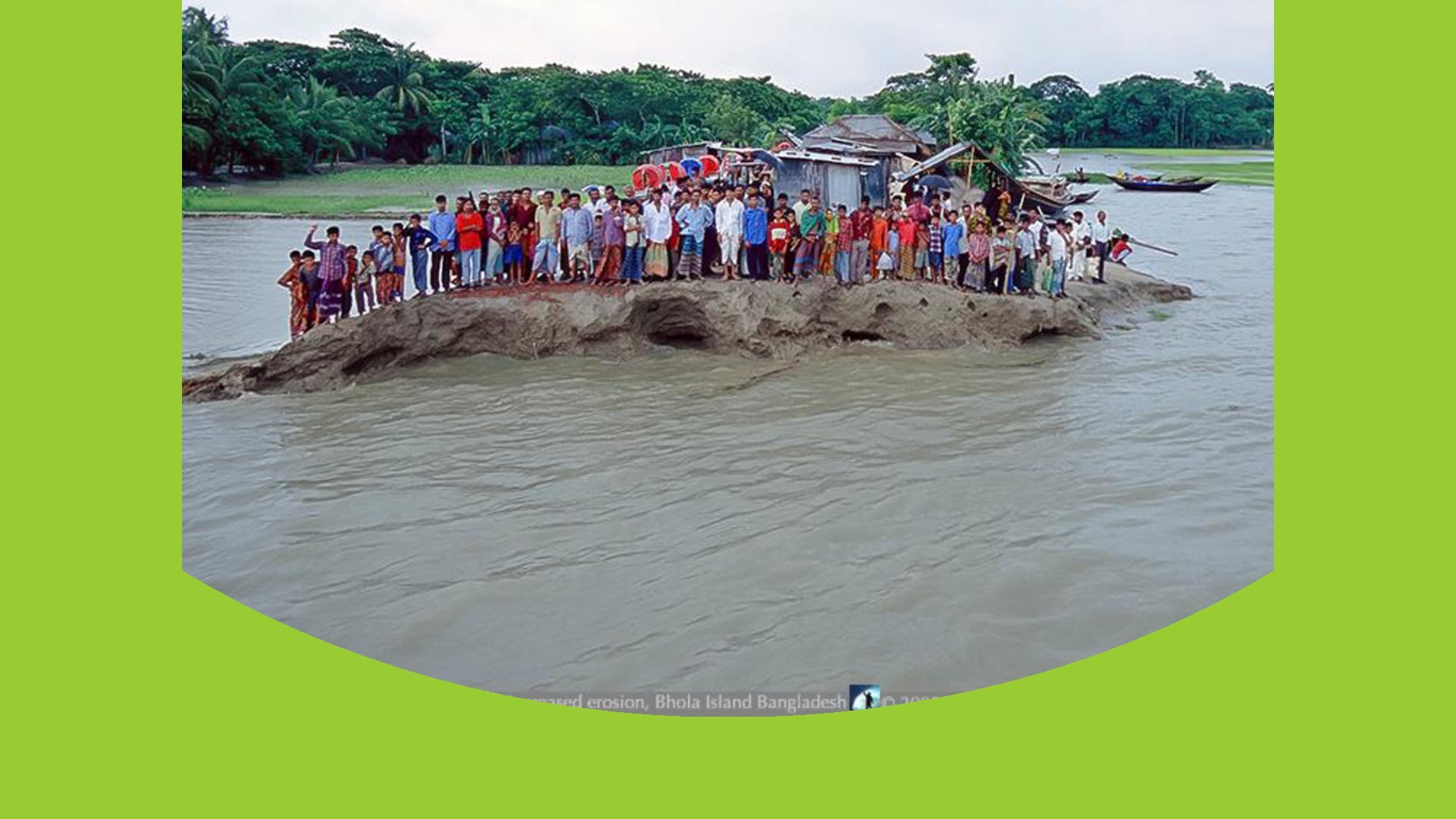
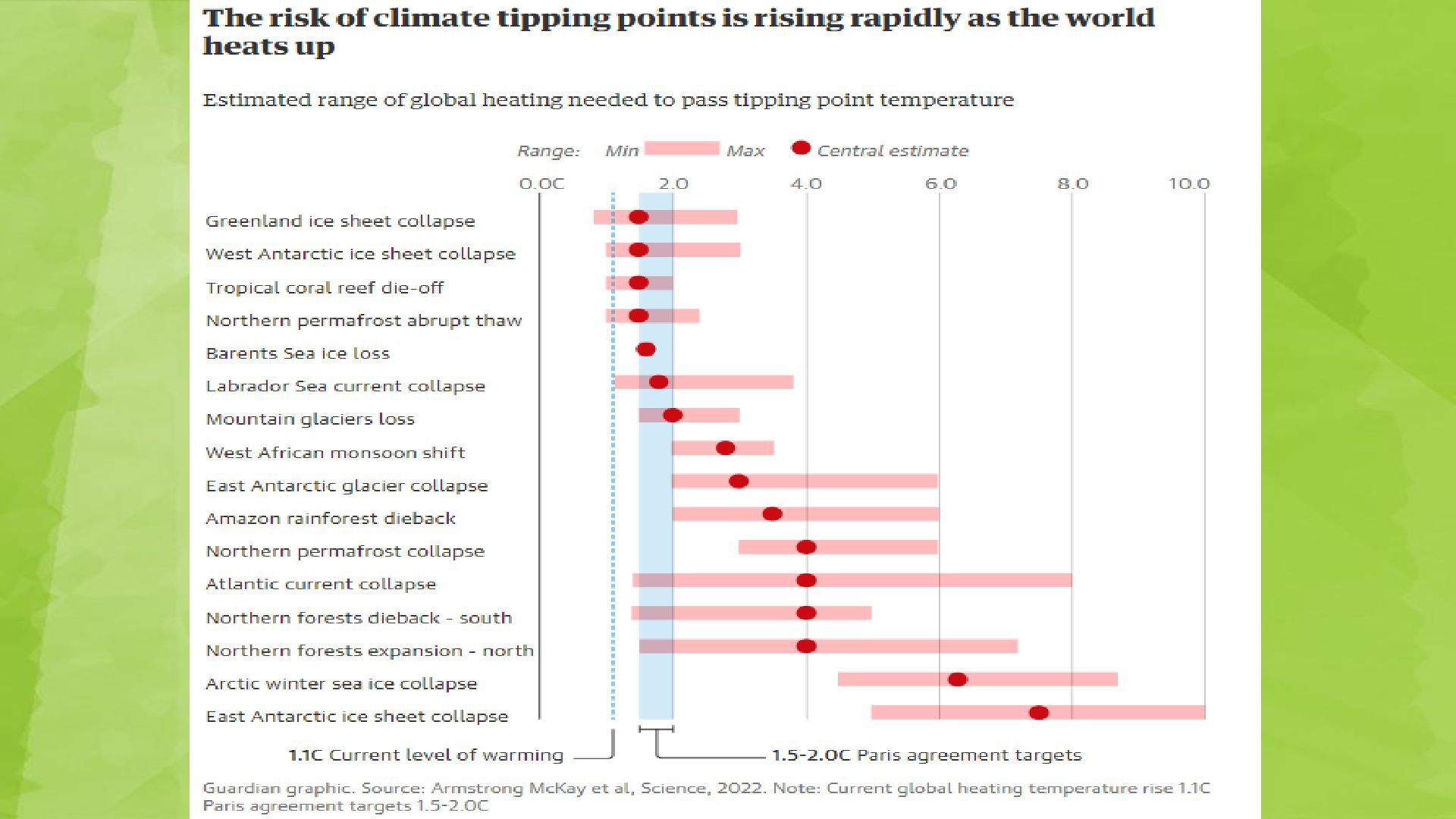
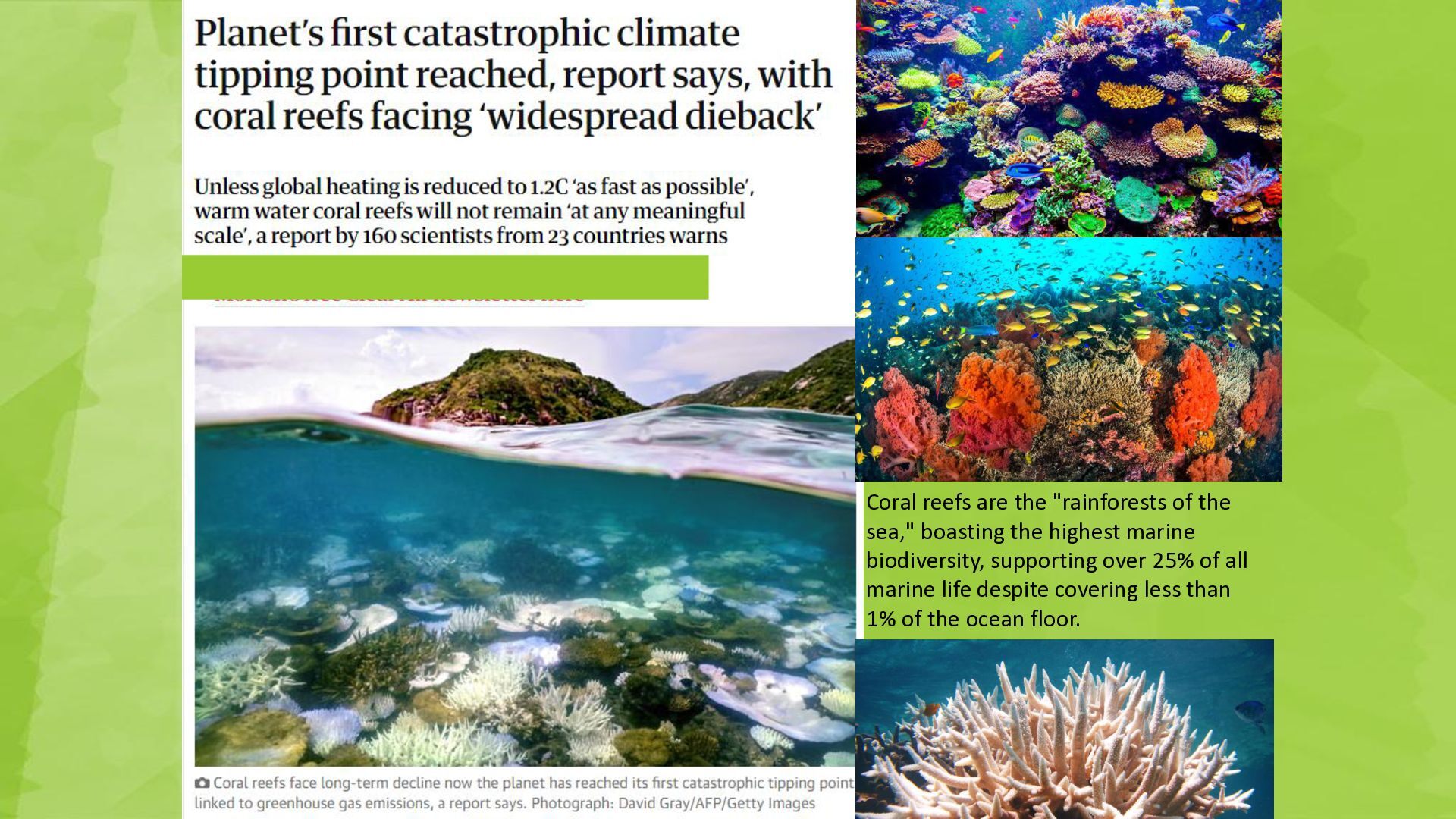
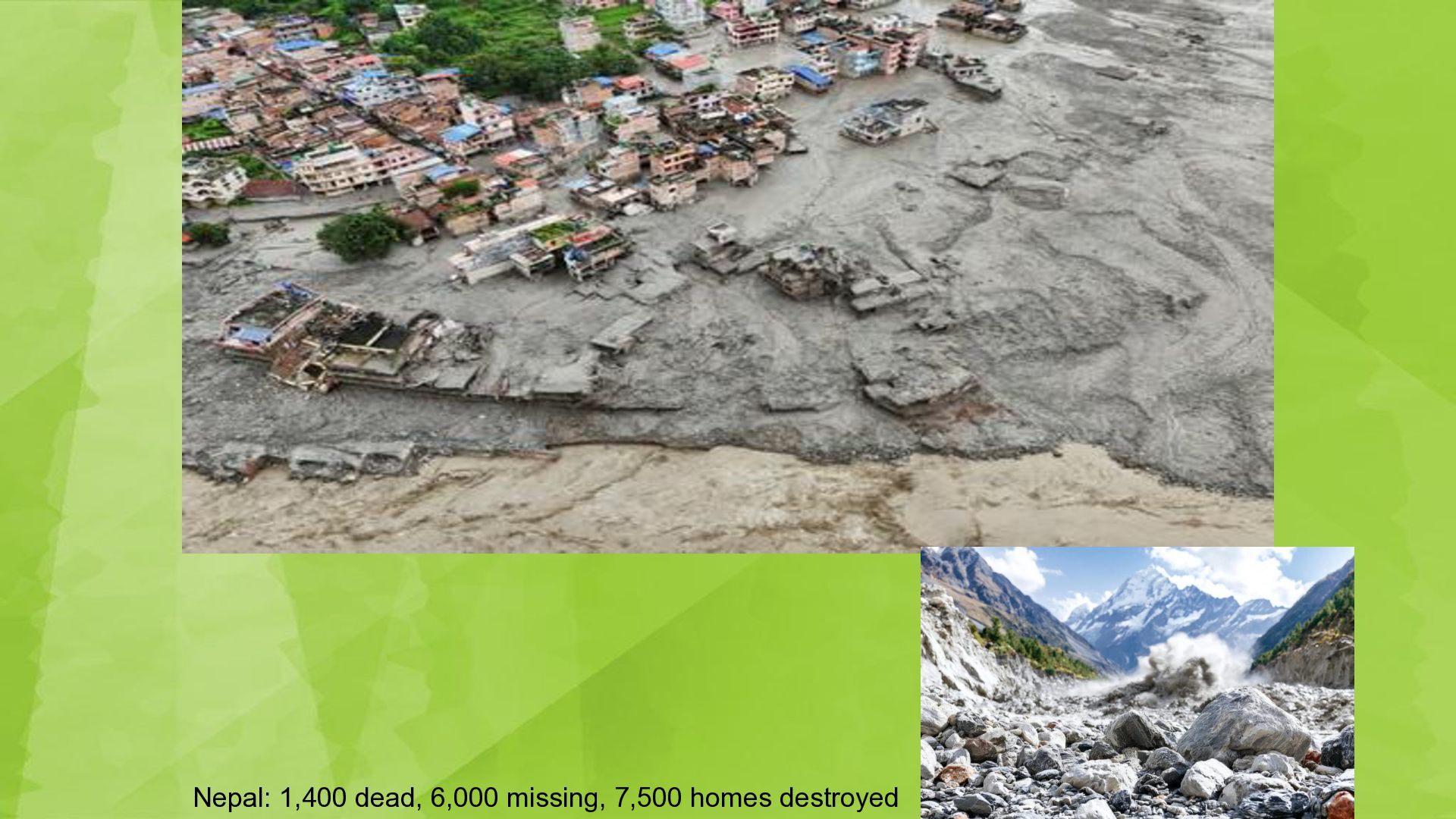
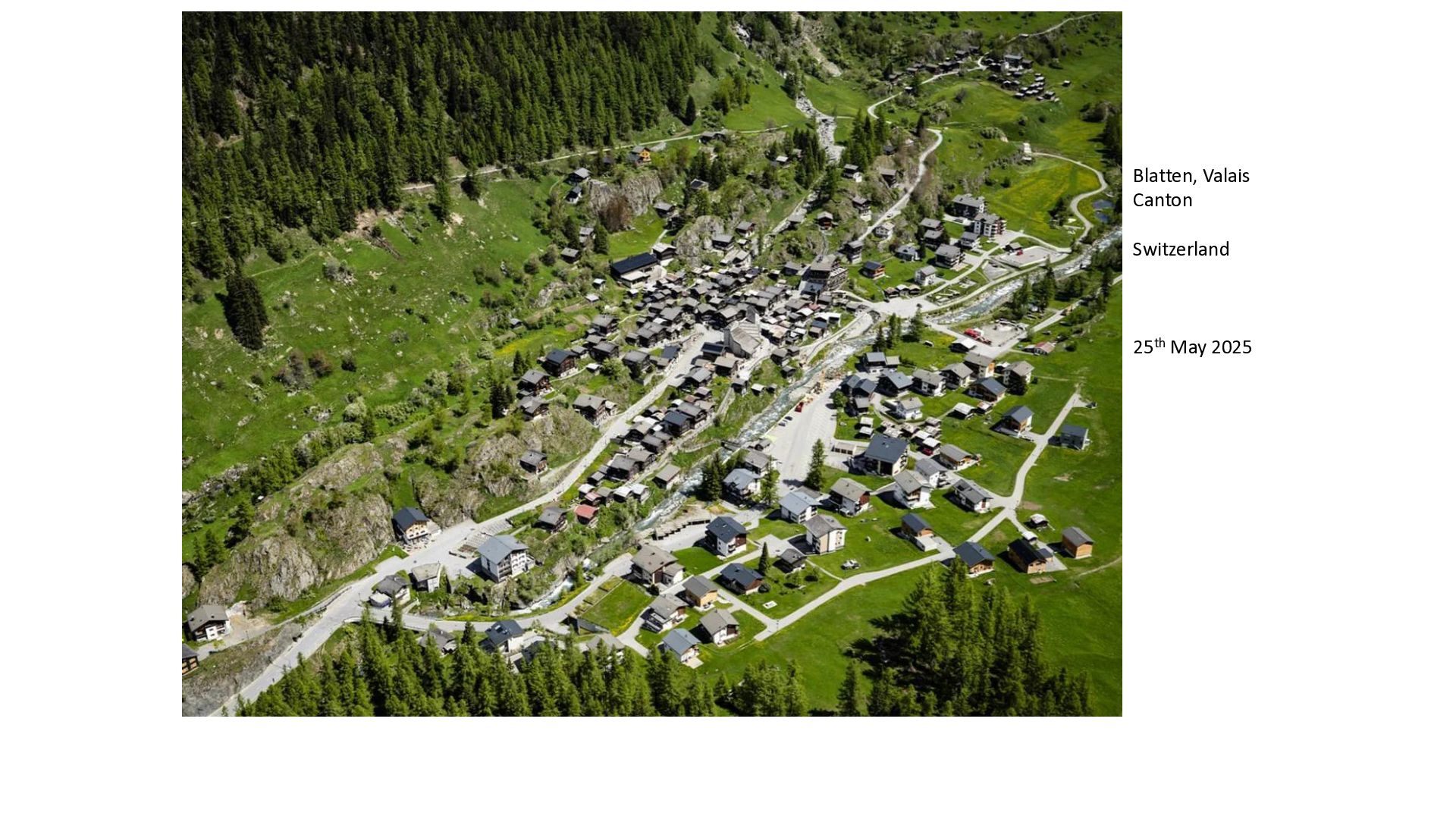
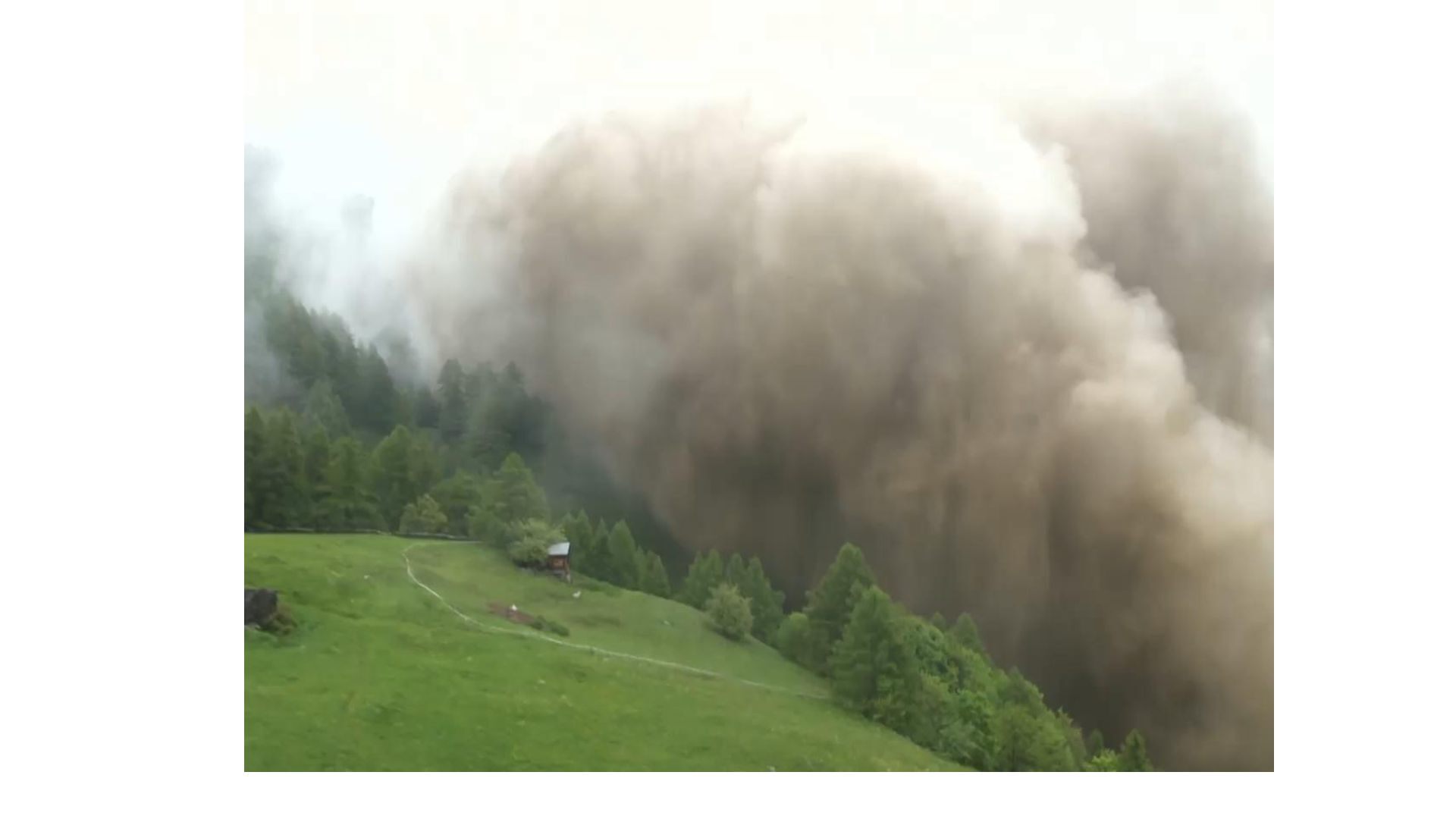
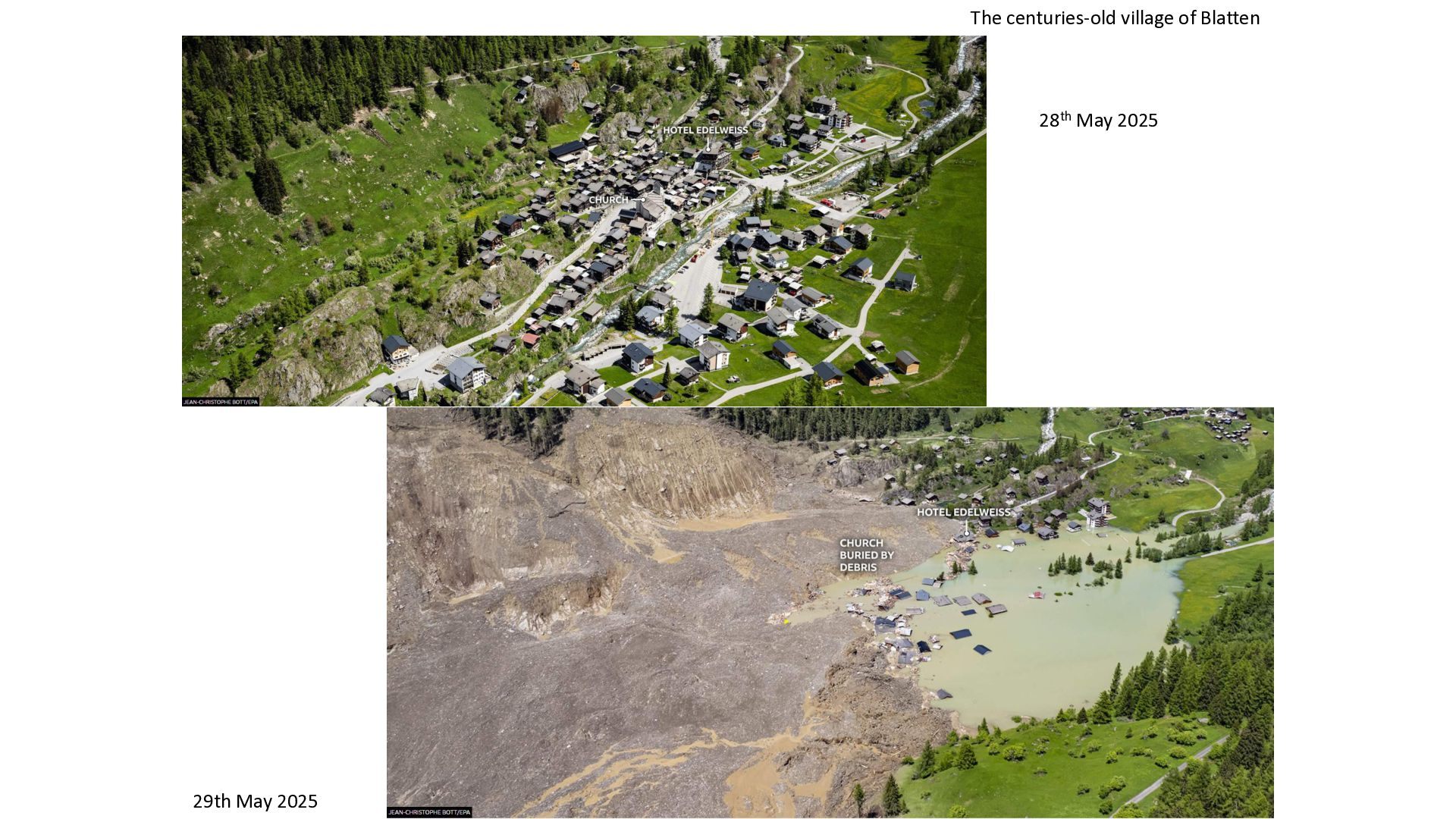
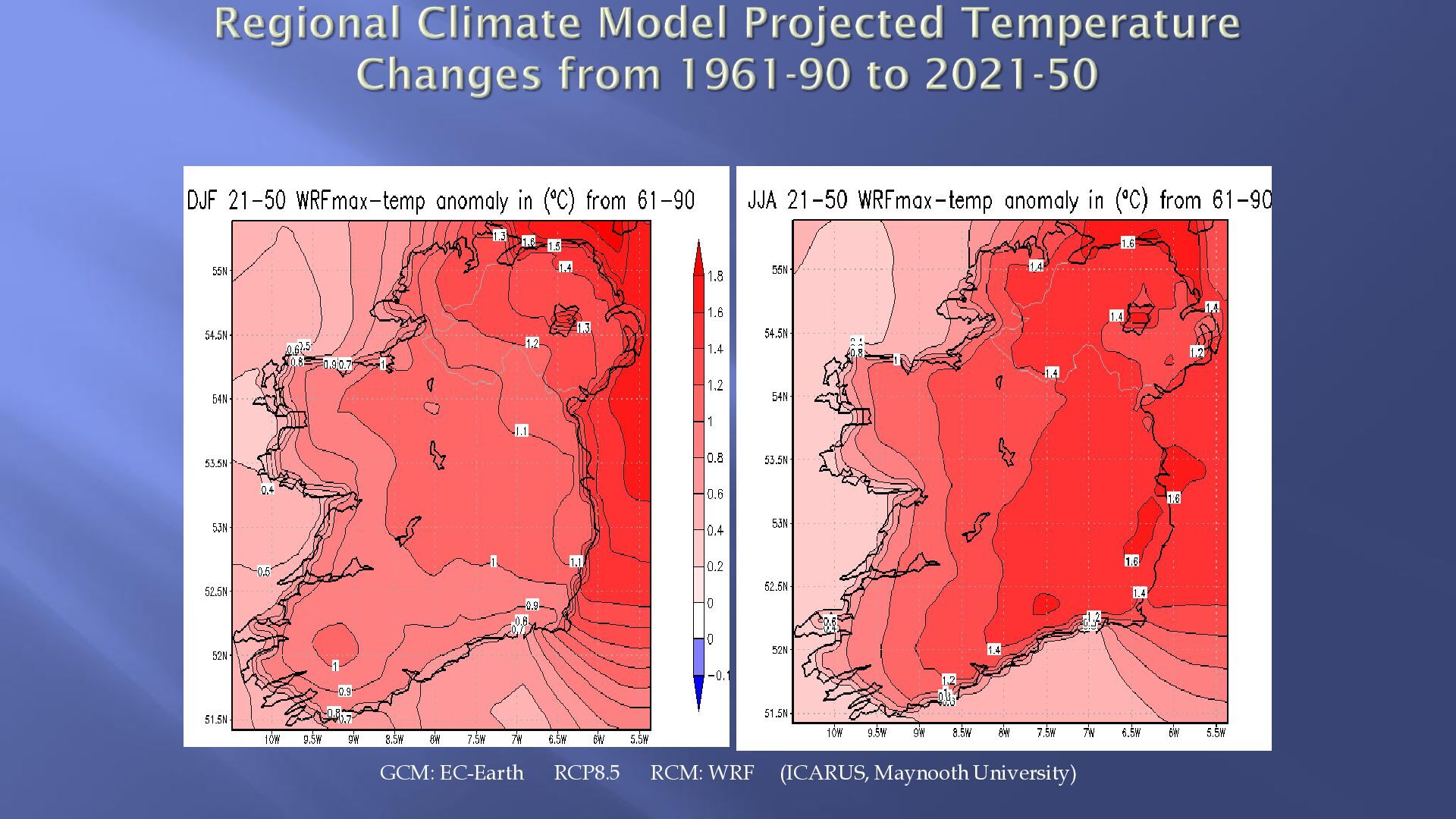
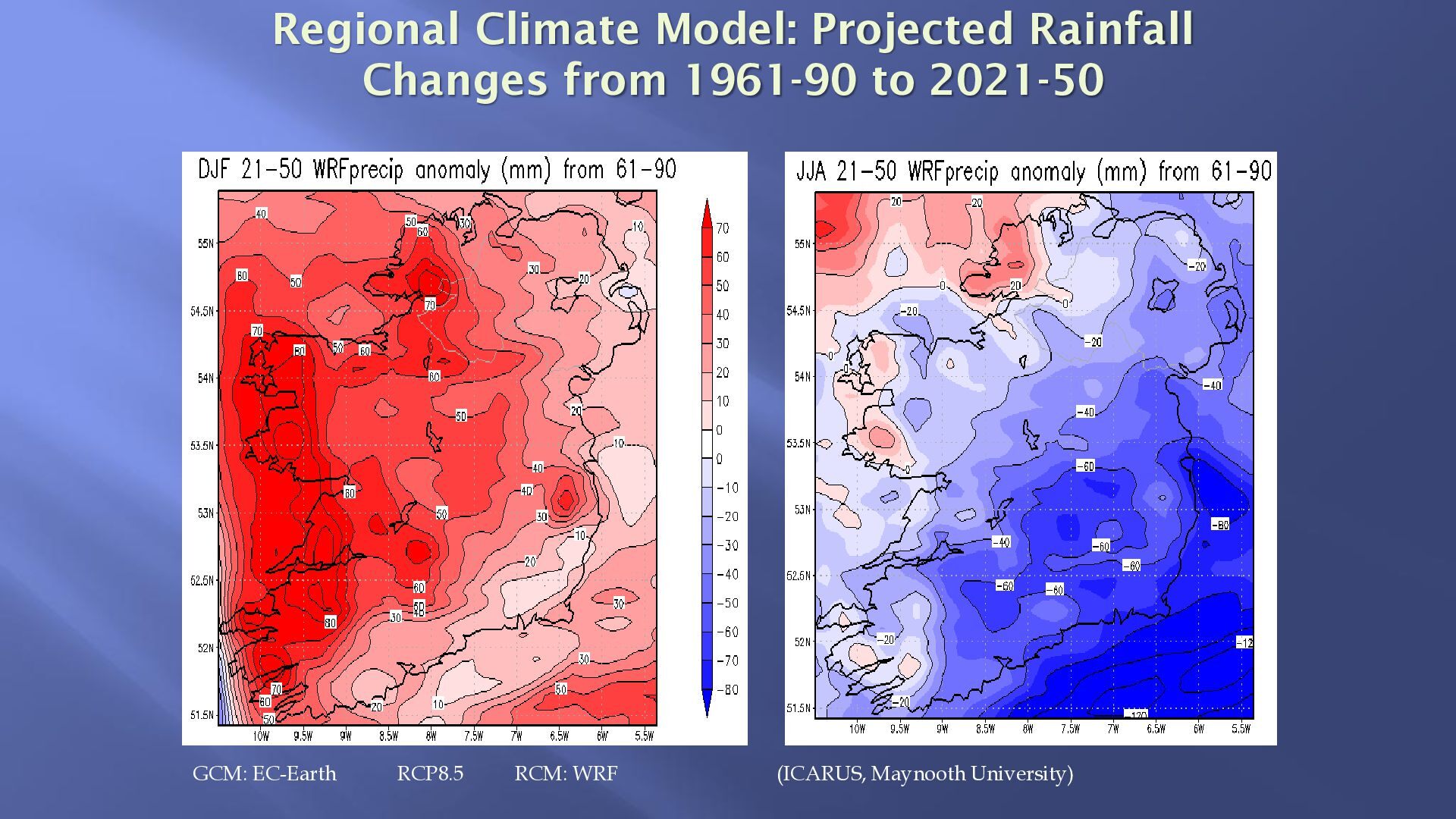
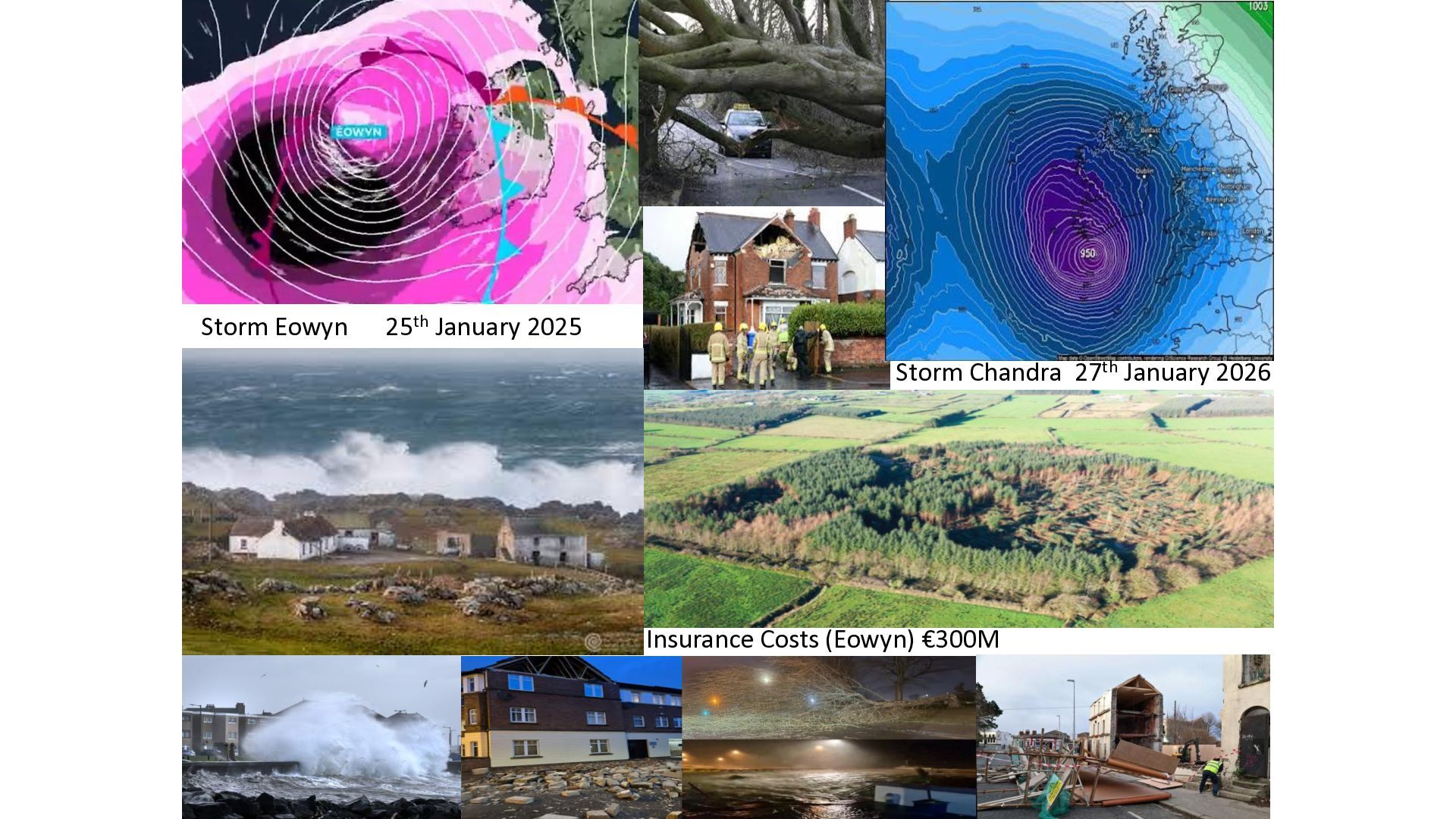
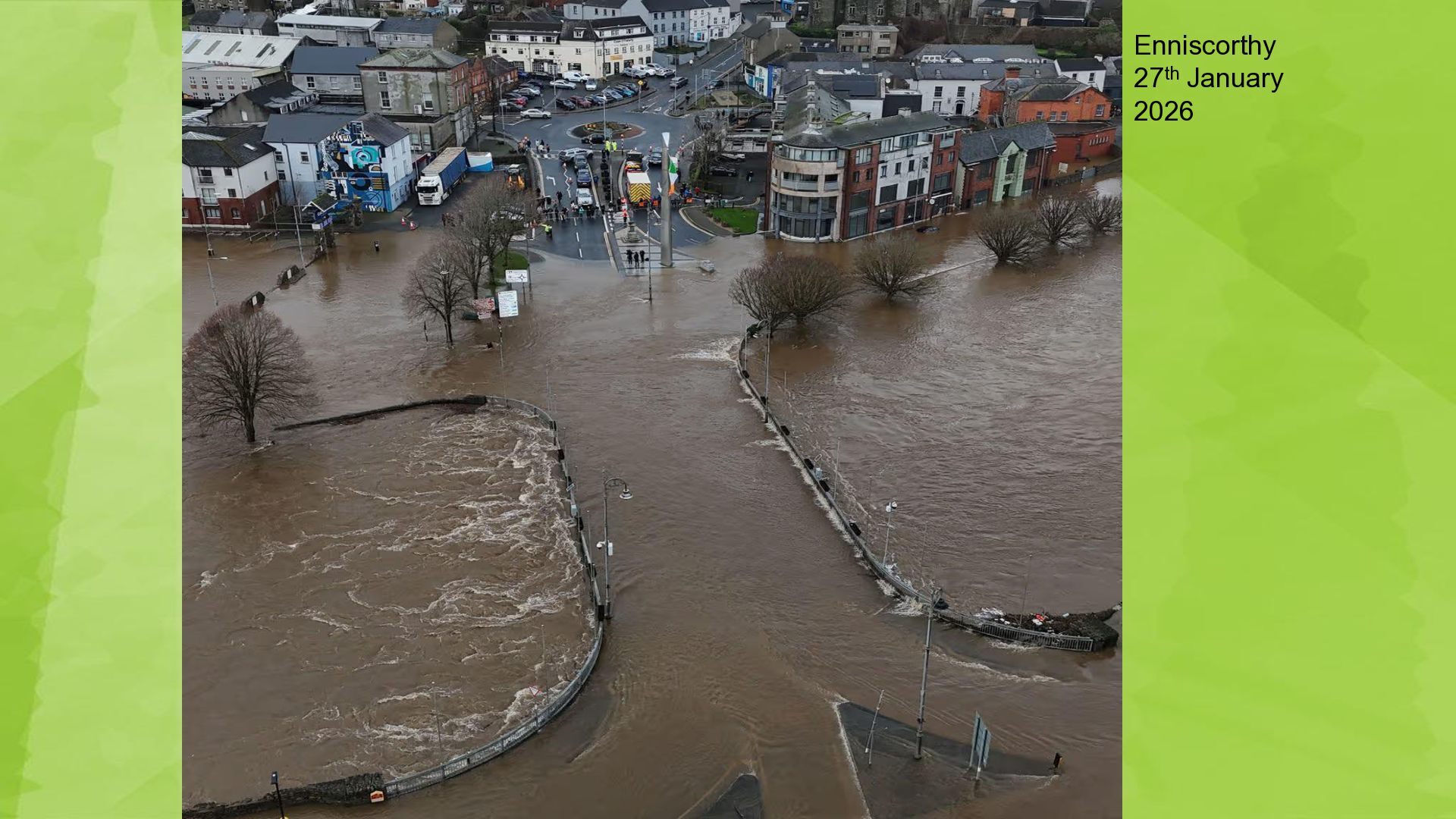
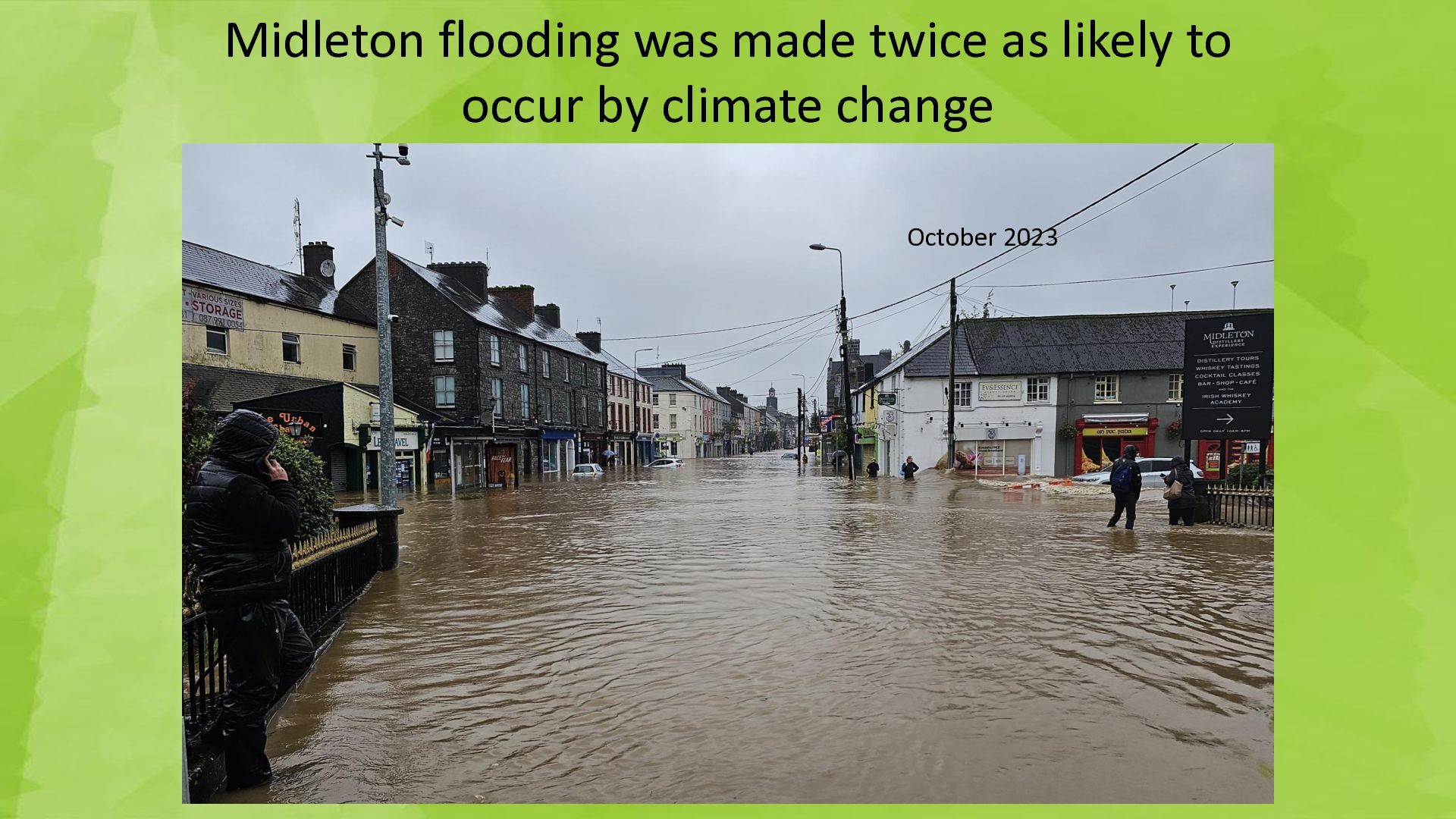
through phones with footage that gets closer and closer to where you live until you’re the one filming it.” Climate change is no longer abstract; it directly impacts local communities. Social media and mobile phones turn everyday people into frontline reporters of extreme weather. The quote highlights the failure of political action as extreme weather events become more frequent and severe.
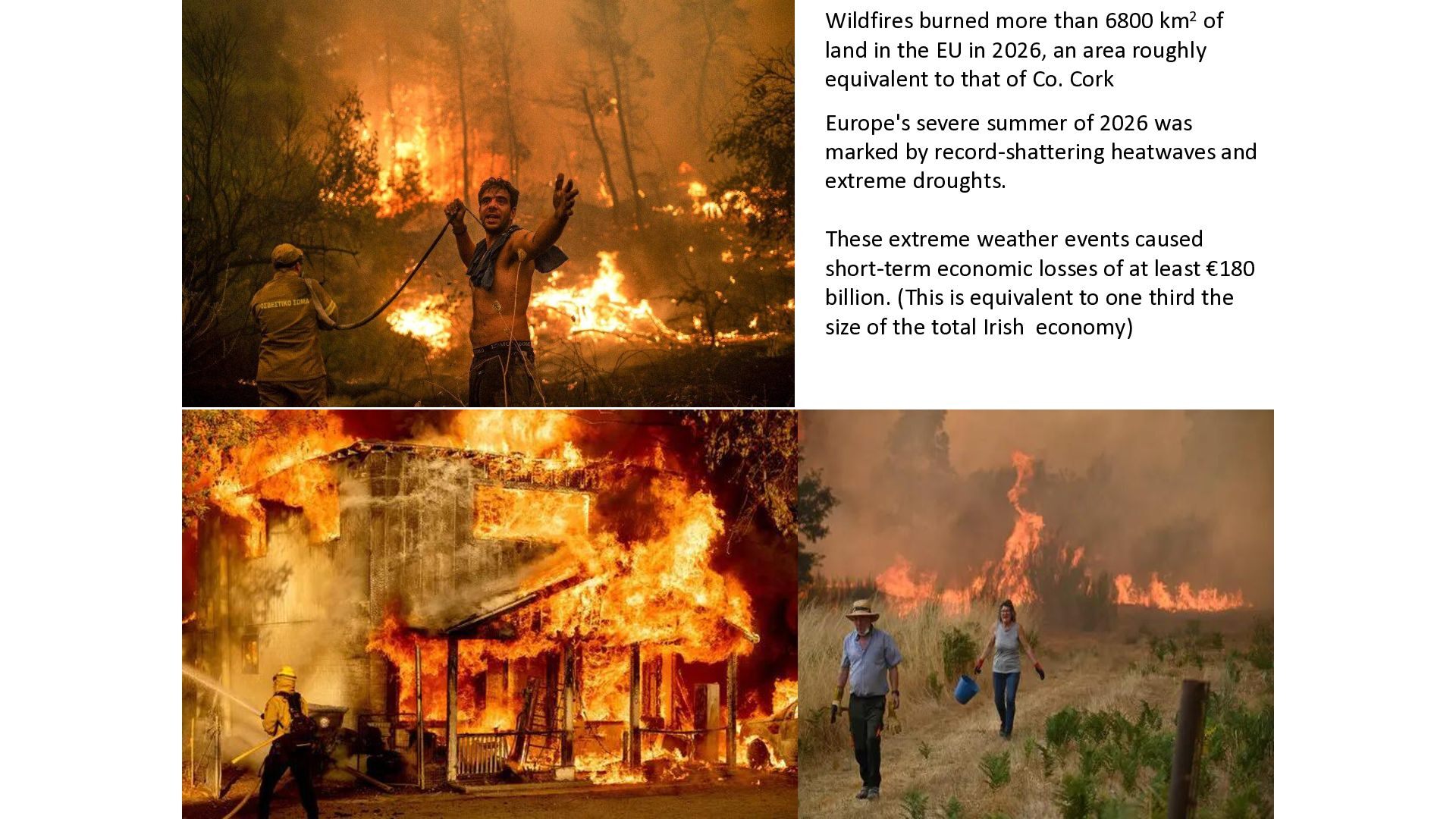
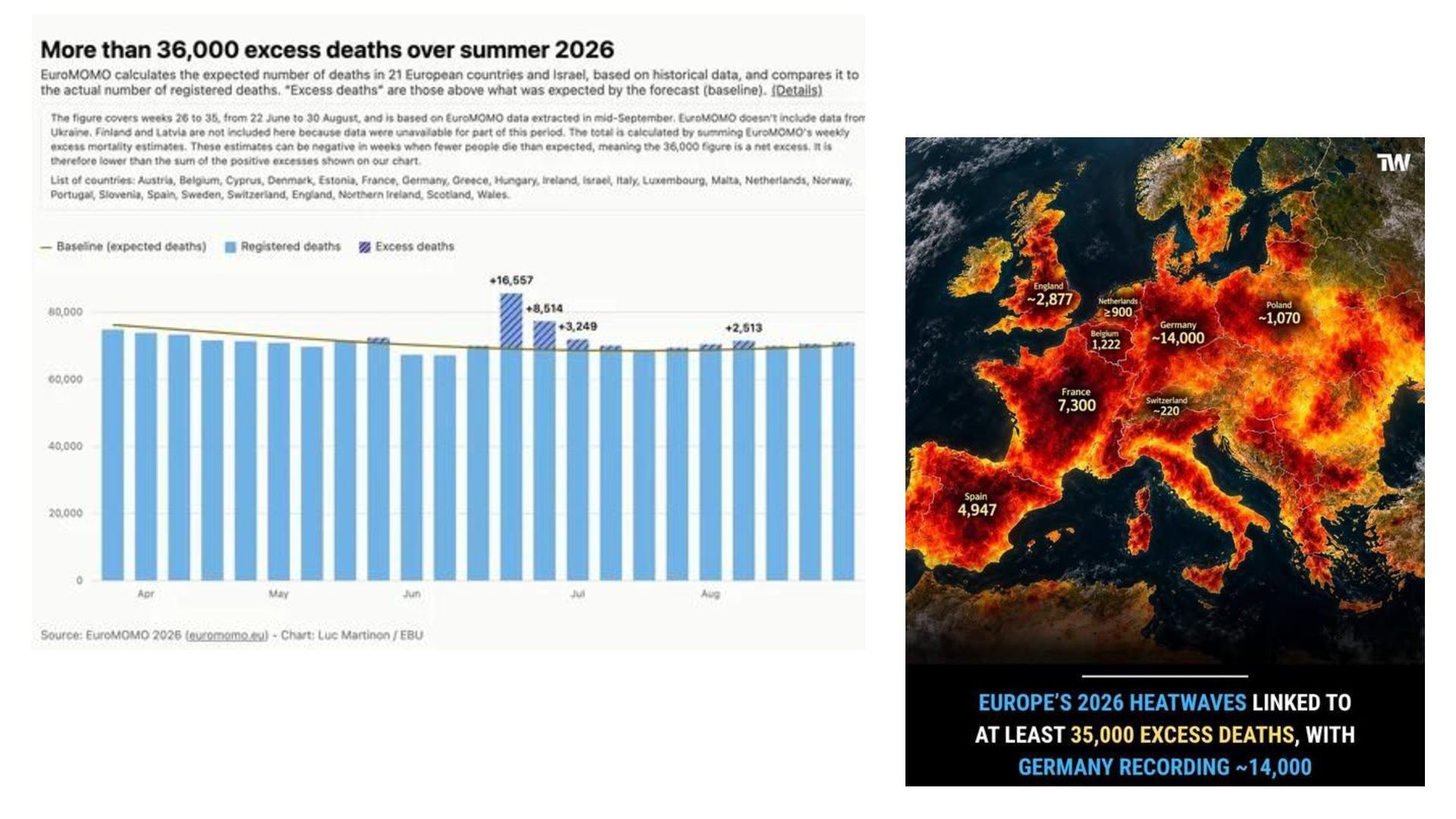
EU in 2026, an area roughly equivalent to that of Co. Cork Europe's severe summer of 2026 was marked by record-shattering heatwaves and extreme droughts. These extreme weather events caused short-term economic losses of at least €180 billion. (This is equivalent to one third the size of the total Irish economy)
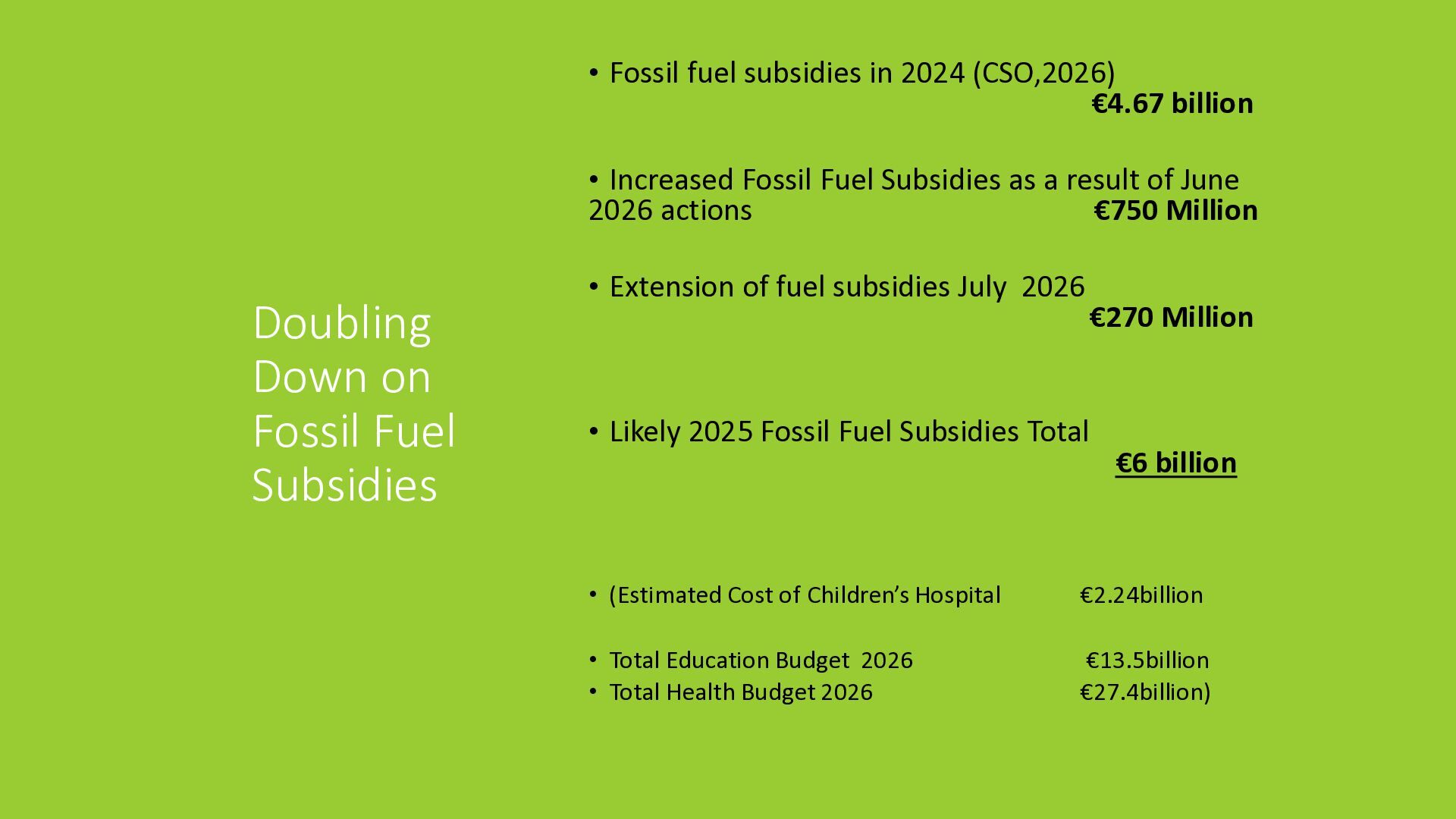
Increased Fossil Fuel Subsidies as a result of June 2026 actions €750 Million Doubling Down on Fossil Fuel Subsidies • Extension of fuel subsidies July 2026 €270 Million • Likely 2025 Fossil Fuel Subsidies Total €6 billion • (Estimated Cost of Children’s Hospital €2.24billion • Total Education Budget 2026 • Total Health Budget 2026 €13.5billion €27.4billion)
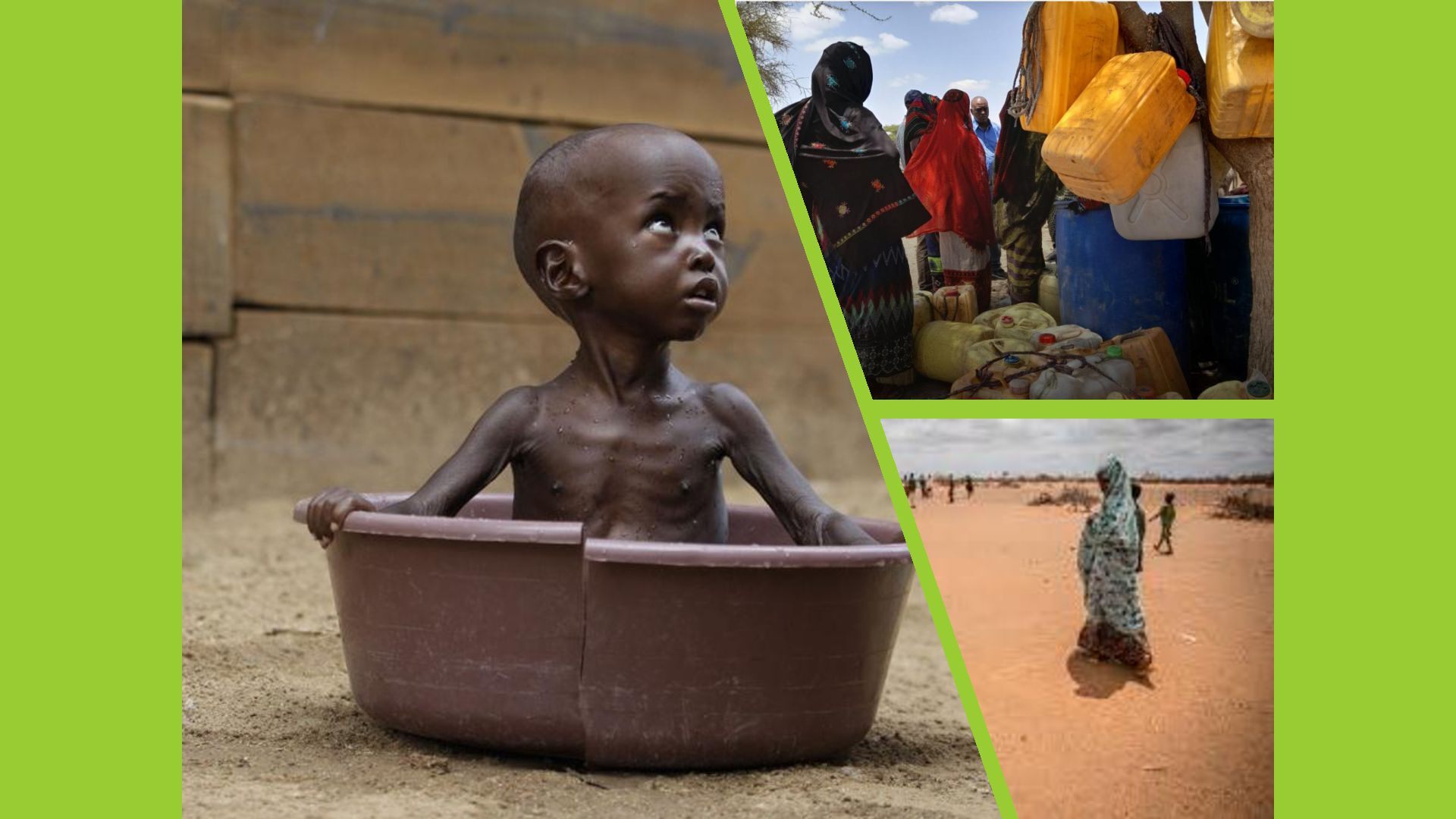
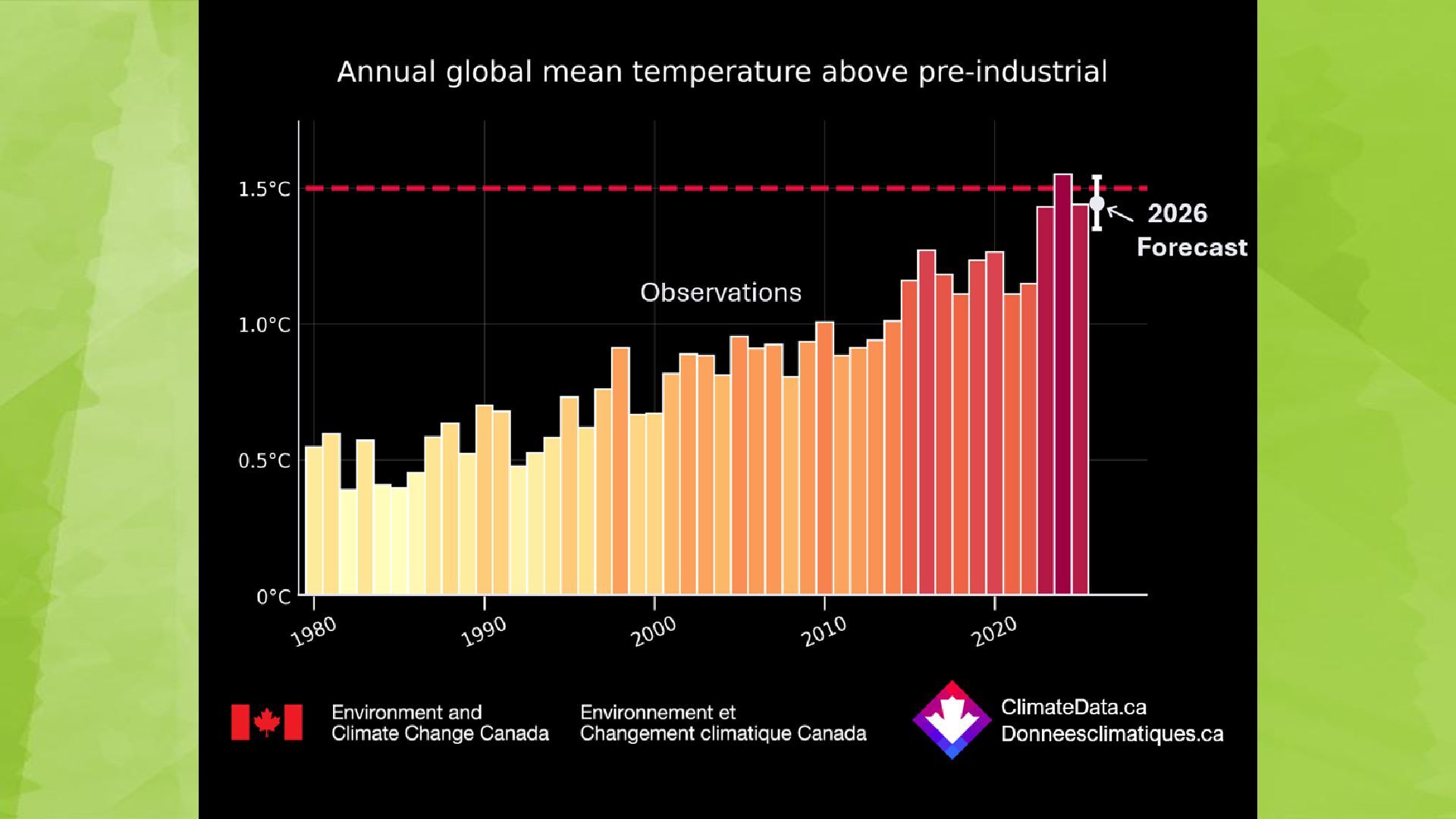
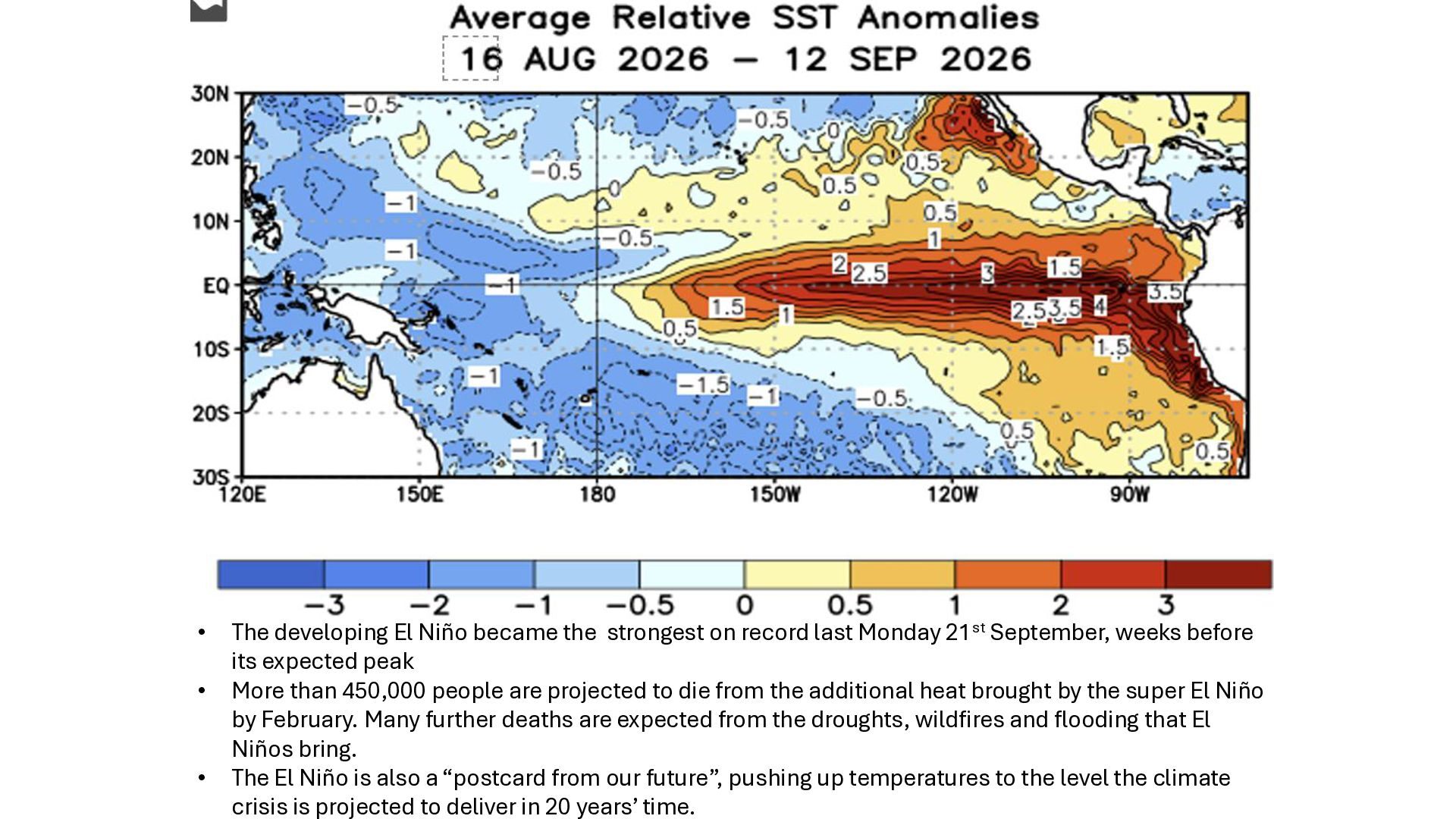
on record last Monday 21st September, weeks before its expected peak More than 450,000 people are projected to die from the additional heat brought by the super El Niño by February. Many further deaths are expected from the droughts, wildfires and flooding that El Niños bring. The El Niño is also a “postcard from our future”, pushing up temperatures to the level the climate crisis is projected to deliver in 20 years’ time.
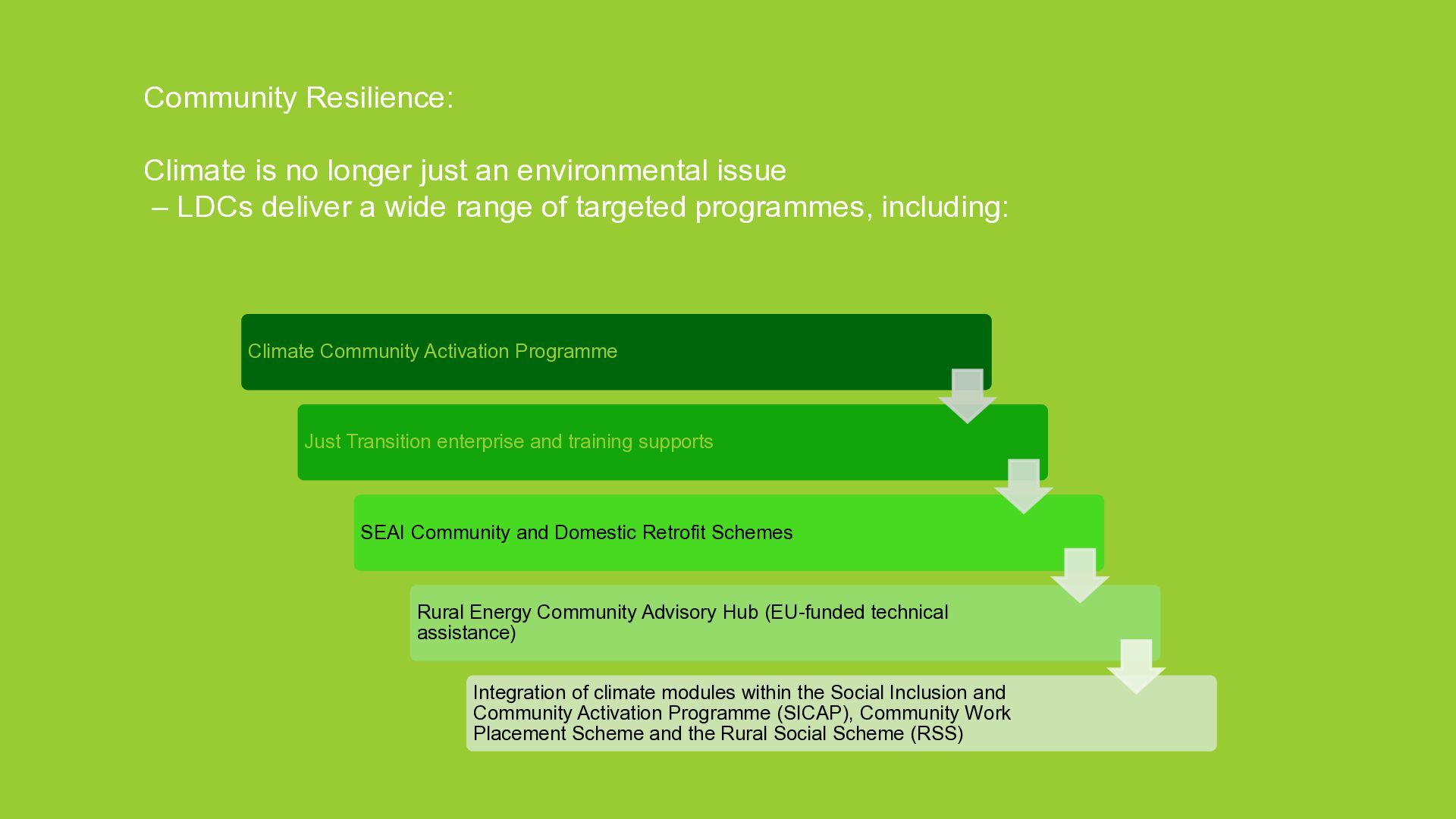
– LDCs deliver a wide range of targeted programmes, including: Climate Community Activation Programme Just Transition enterprise and training supports SEAI Community and Domestic Retrofit Schemes Rural Energy Community Advisory Hub (EU-funded technical assistance) Integration of climate modules within the Social Inclusion and Community Activation Programme (SICAP), Community Work Placement Scheme and the Rural Social Scheme (RSS)
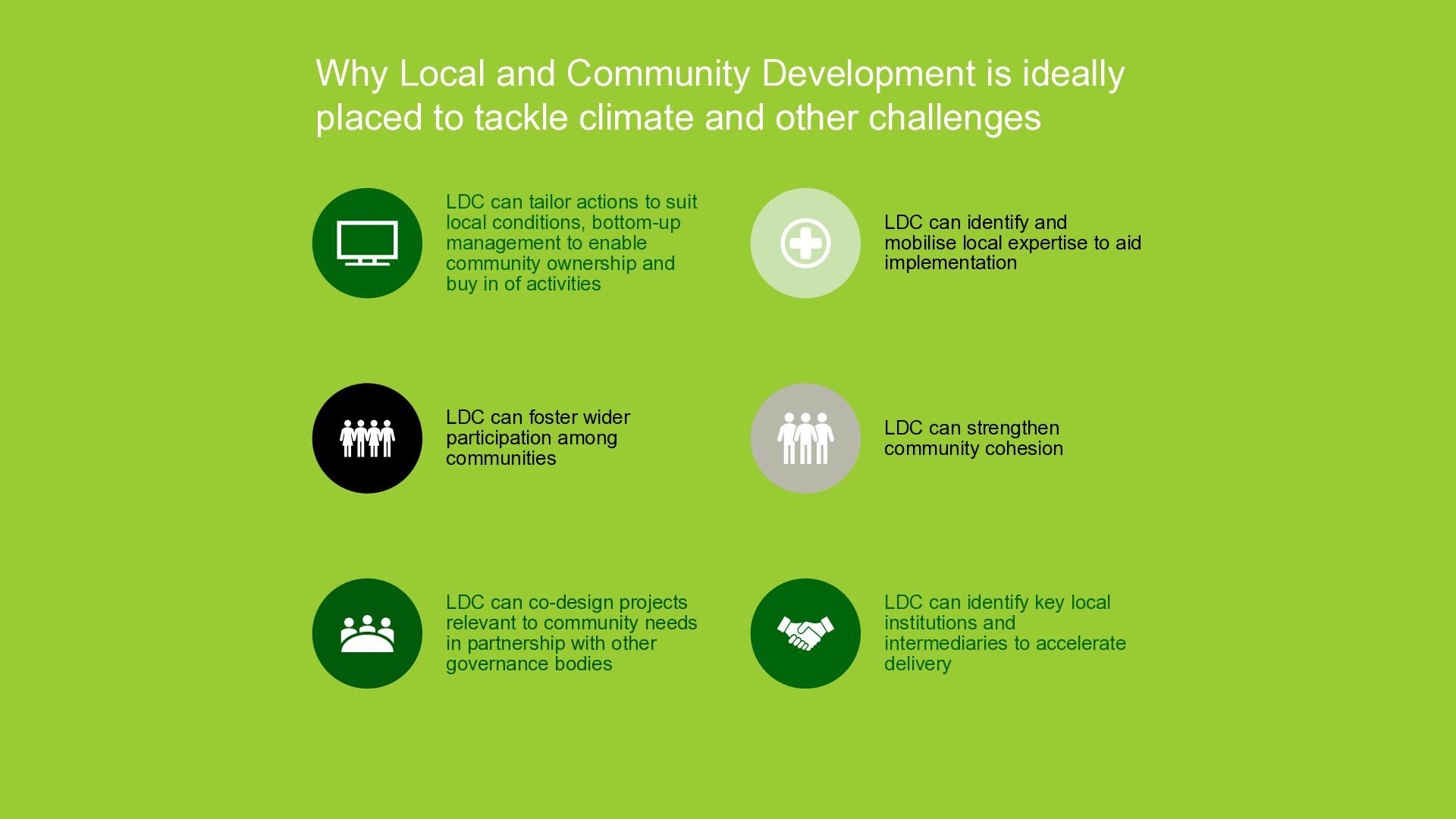
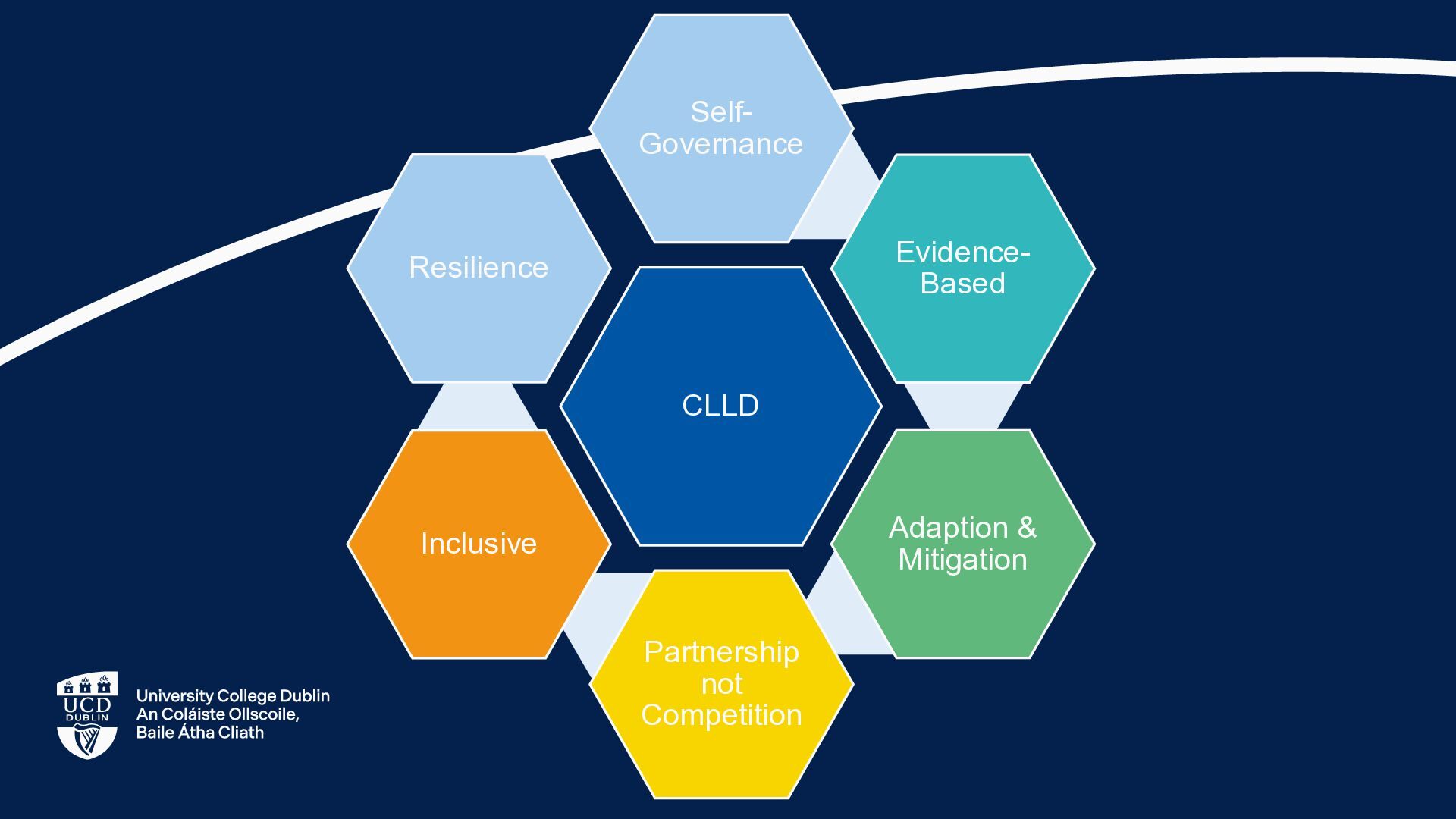
climate and other challenges LDC can tailor actions to suit local conditions, bottom-up management to enable community ownership and buy in of activities LDC can identify and mobilise local expertise to aid implementation LDC can foster wider participation among communities LDC can strengthen community cohesion LDC can co-design projects relevant to community needs in partnership with other governance bodies LDC can identify key local institutions and intermediaries to accelerate delivery
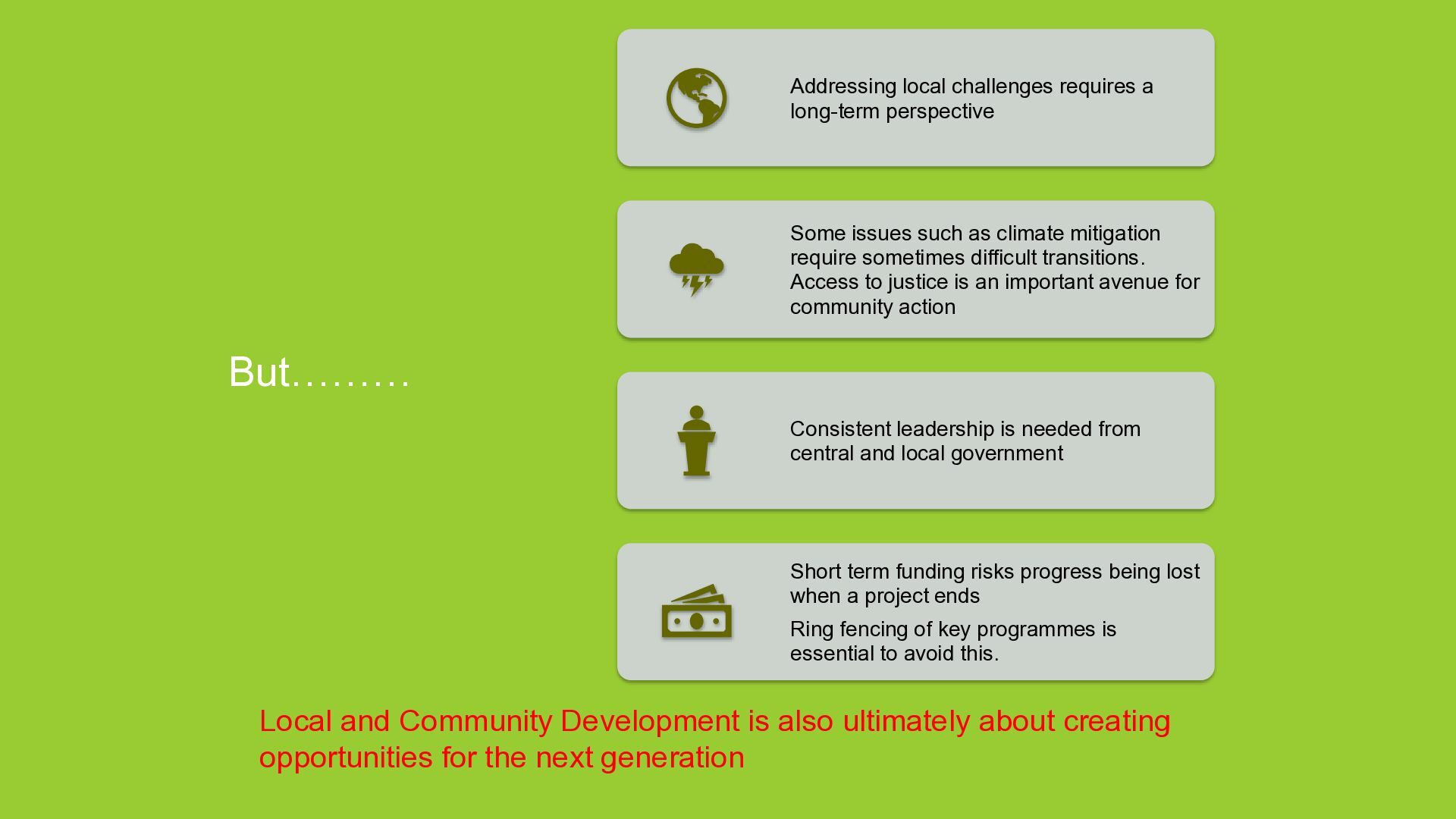
as climate mitigation require sometimes difficult transitions. Access to justice is an important avenue for community action But……… Consistent leadership is needed from central and local government Short term funding risks progress being lost when a project ends Ring fencing of key programmes is essential to avoid this. Local and Community Development is also ultimately about creating opportunities for the next generation
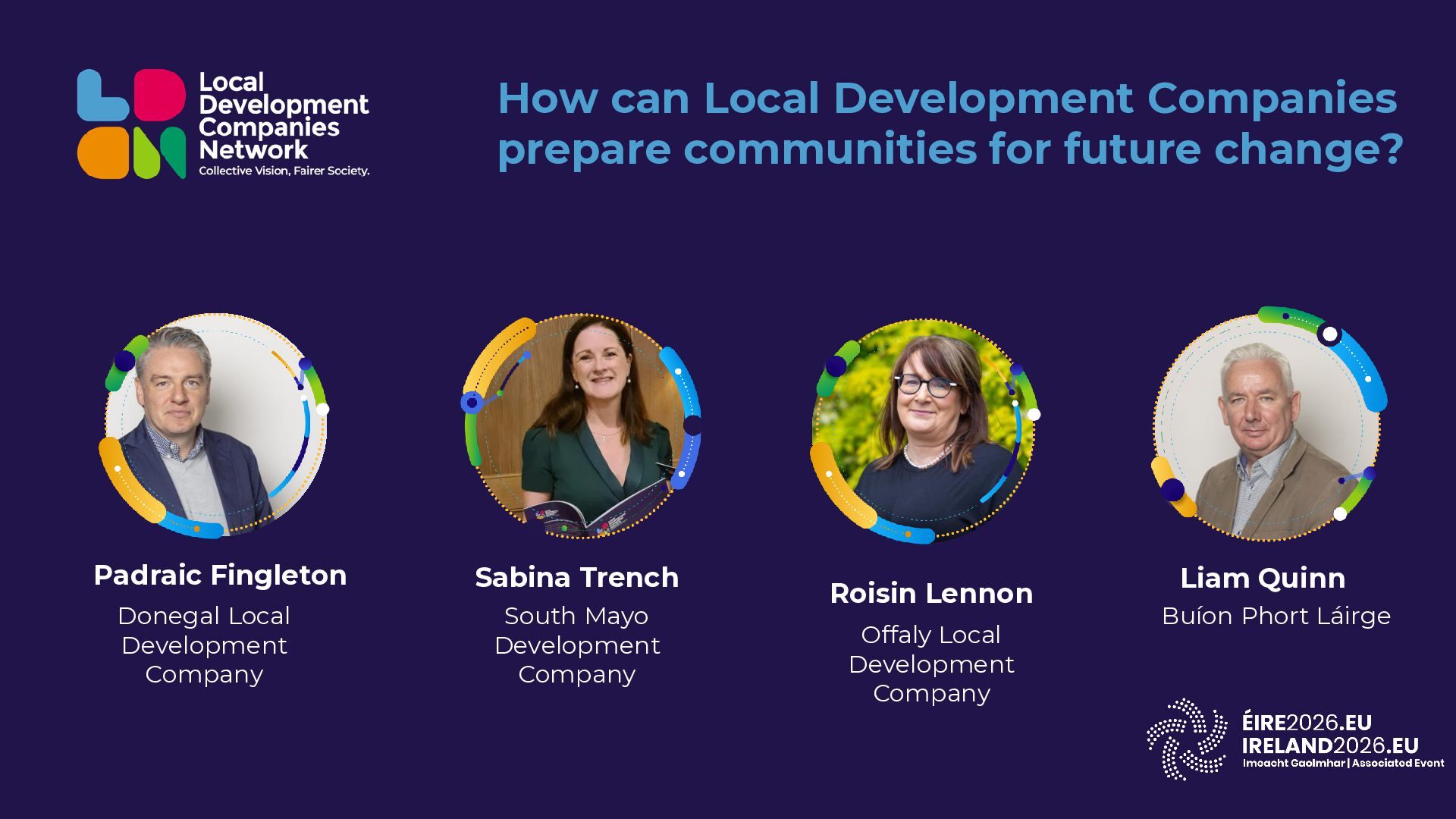
Padraic Fingleton Sabina Trench Donegal Local Development Company South Mayo Development Company Roisin Lennon Offaly Local Development Company Liam Quinn Buíon Phort Láirge
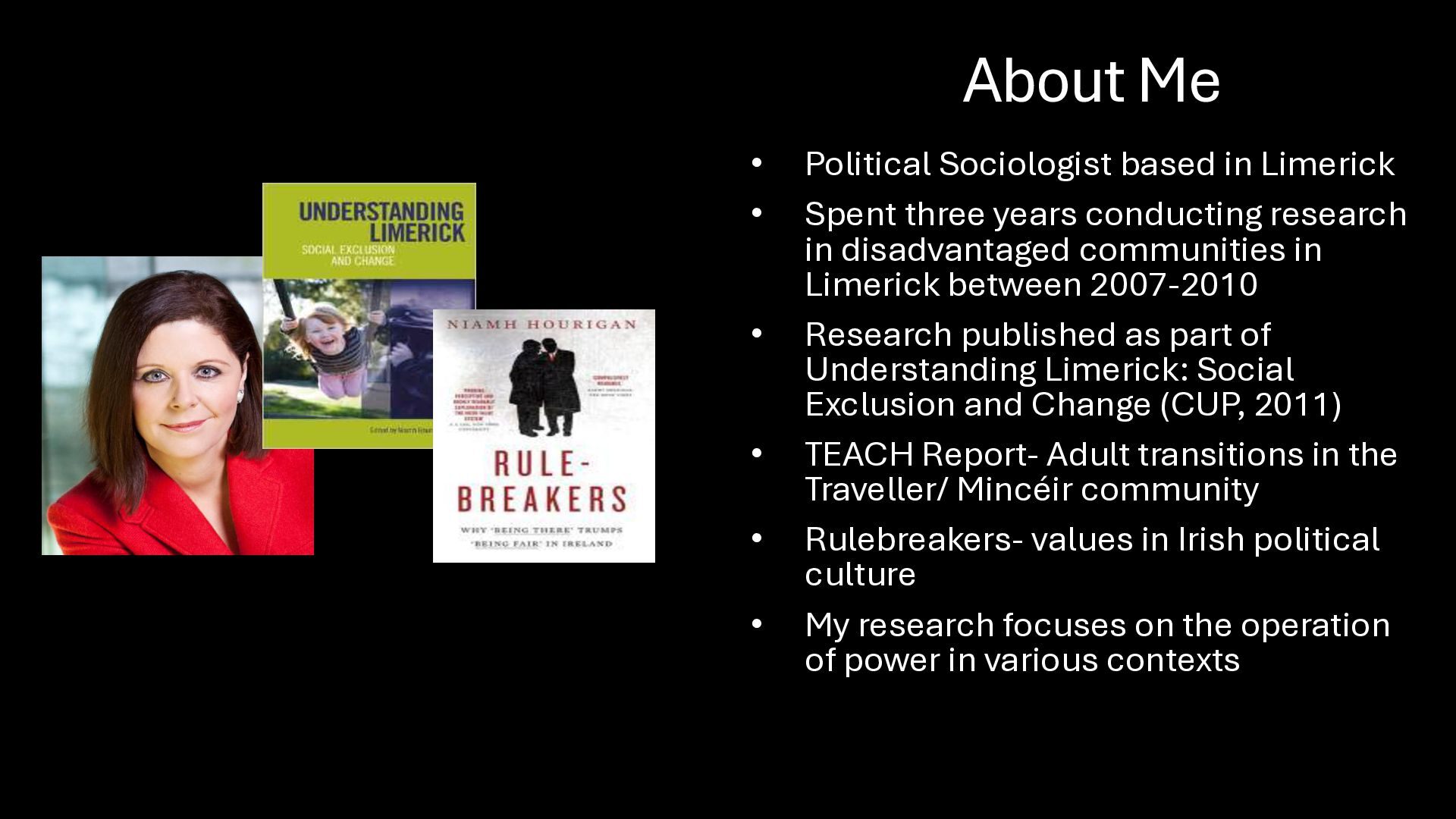
based in Limerick Spent three years conducting research in disadvantaged communities in Limerick between 2007-2010 Research published as part of Understanding Limerick: Social Exclusion and Change (CUP, 2011) TEACH Report- Adult transitions in the Traveller/ Mincéir community Rulebreakers- values in Irish political culture My research focuses on the operation of power in various contexts
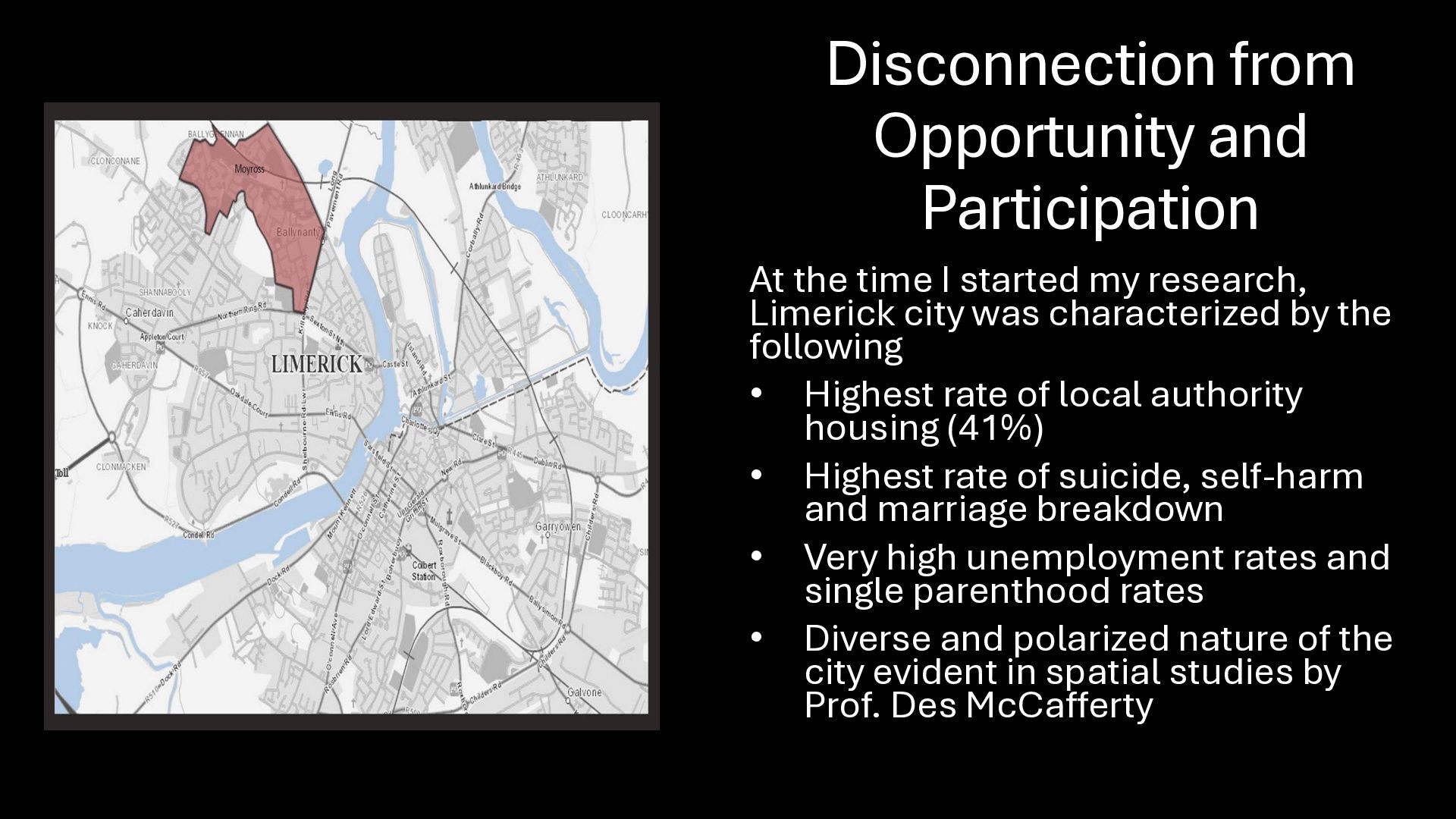
my research, Limerick city was characterized by the following • Highest rate of local authority housing (41%) • Highest rate of suicide, self-harm and marriage breakdown • Very high unemployment rates and single parenthood rates • Diverse and polarized nature of the city evident in spatial studies by Prof. Des McCafferty
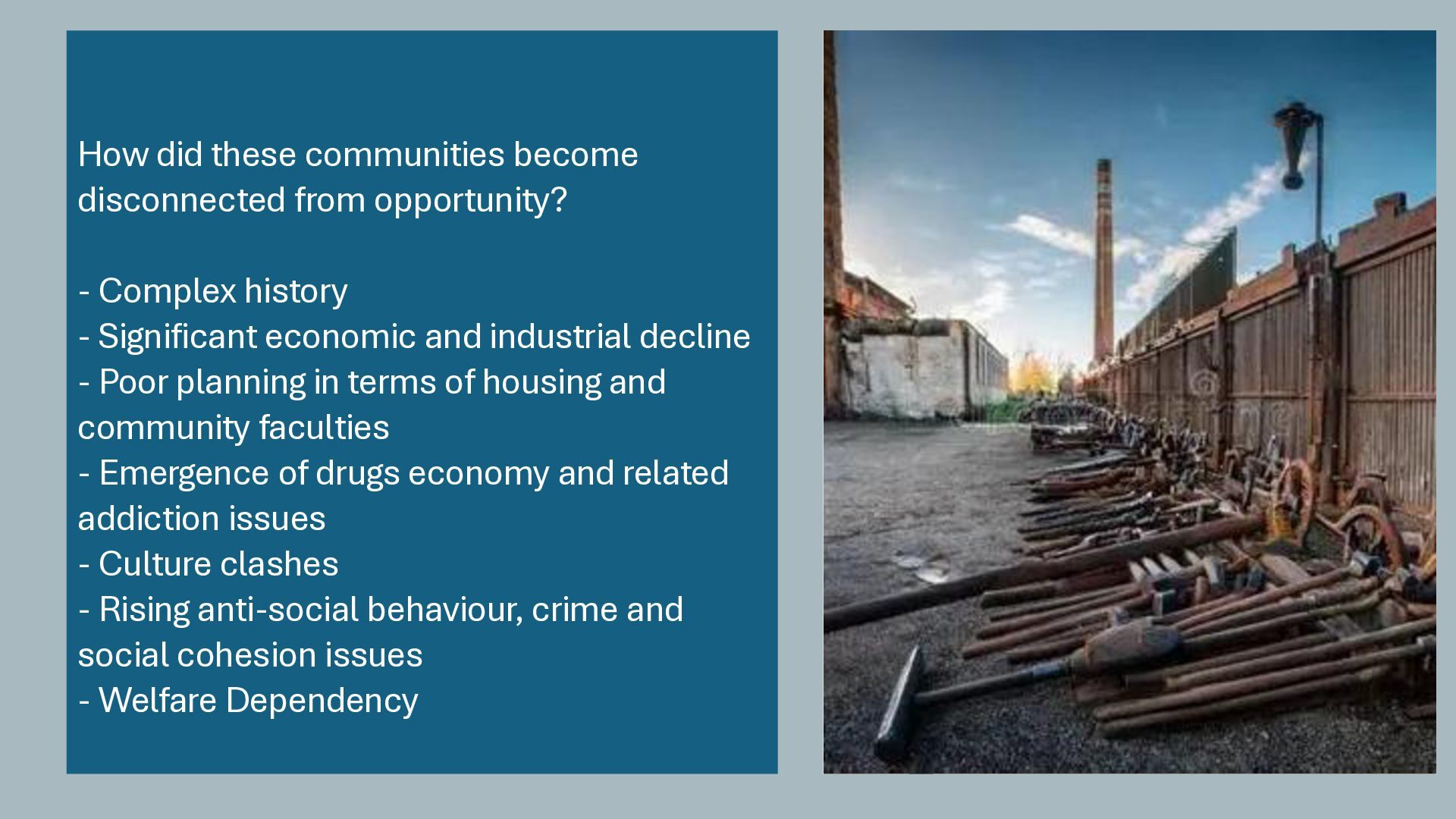
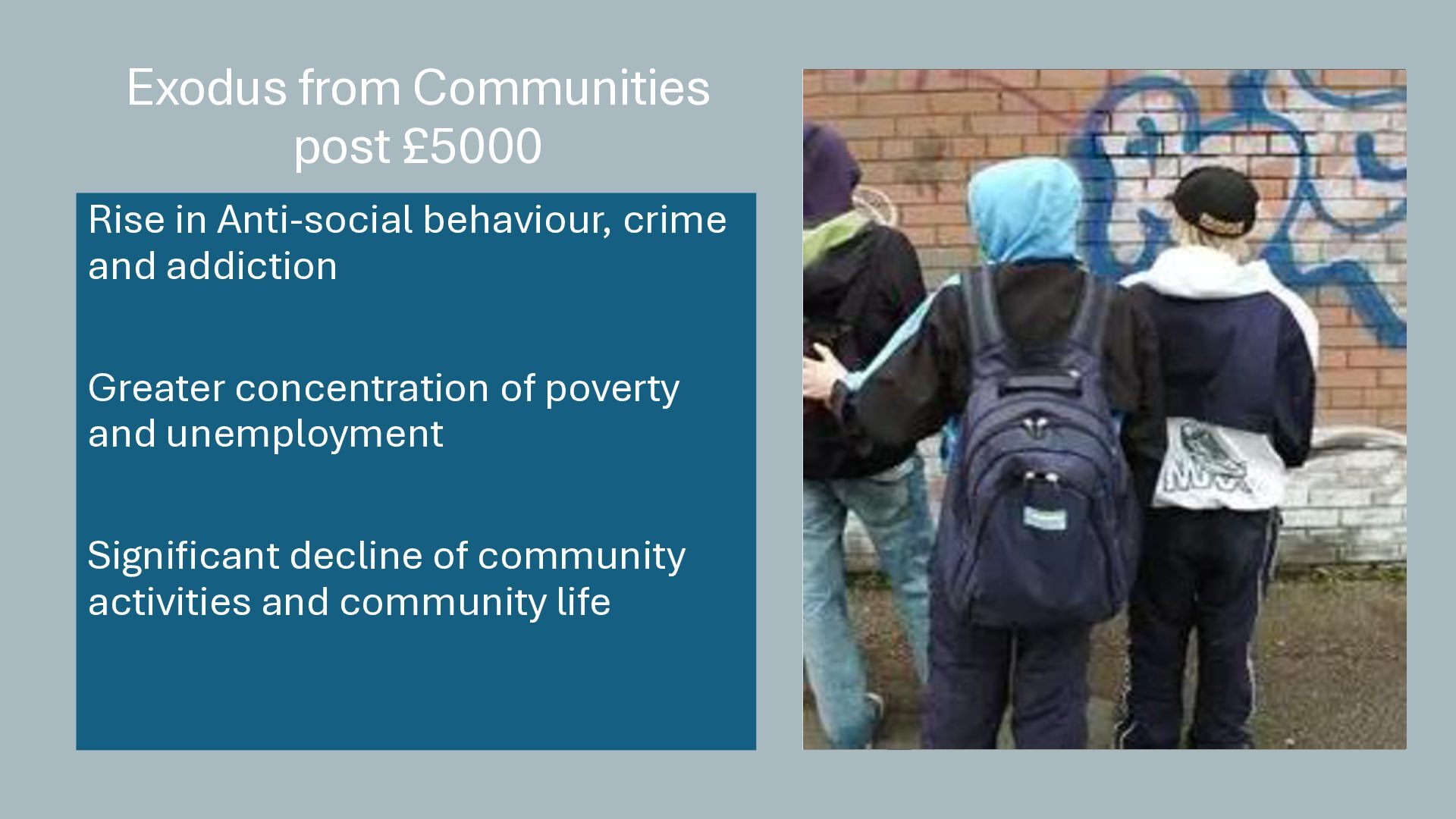
history - Significant economic and industrial decline - Poor planning in terms of housing and community faculties - Emergence of drugs economy and related addiction issues - Culture clashes - Rising anti-social behaviour, crime and social cohesion issues - Welfare Dependency
has become less visible Some markers of concerns such as unemployment rates have become less significant Other such as housing and homelessness figures have become more important Significant investment and FDI in Limerick and Mid-West after financial crisis Impact of Regeneration
to families from high poverty housing projects to move to lower poverty neighbourhoods • MTO evaluated impact on children’s long-term outcomes • Move for young children increased college attendance, earnings and reduced single parenthood rates • Move had a negative impact on adolescents because of disruption • Gains decline as children get older
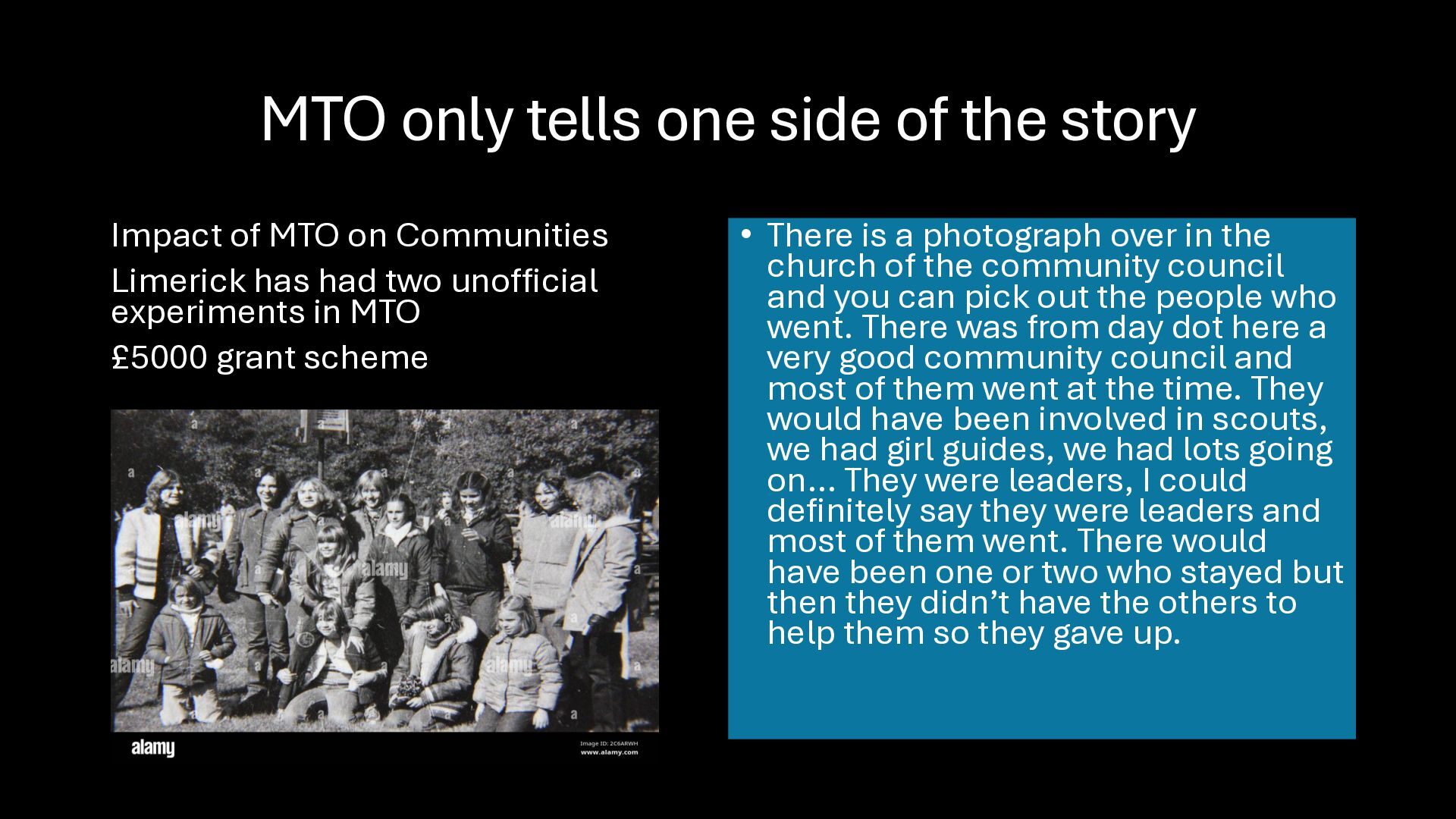
MTO on Communities Limerick has had two unofficial experiments in MTO £5000 grant scheme • There is a photograph over in the church of the community council and you can pick out the people who went. There was from day dot here a very good community council and most of them went at the time. They would have been involved in scouts, we had girl guides, we had lots going on… They were leaders, I could definitely say they were leaders and most of them went. There would have been one or two who stayed but then they didn’t have the others to help them so they gave up.
Ballymun involved significant re-building of houses and community facilities • Groundwork for Regeneration in Limerick began in 2006-2007 • Real work began in 2008 • Banking crisis meant that building through public private partnership was not an option • Spending on soft youth justice and youth work strategies (Summer camps, youth clubs, early years schemes) • Significant number of families were moved out of Regeneration areas to other low poverty areas
that the initiatives benefit not only the individuals but also the communities Two challenges Culture obstacles to upward mobility which are not as prevalent in lower poverty communities Deprivation has become less spatialmovement of migrants and movement of those in homeless accommodation
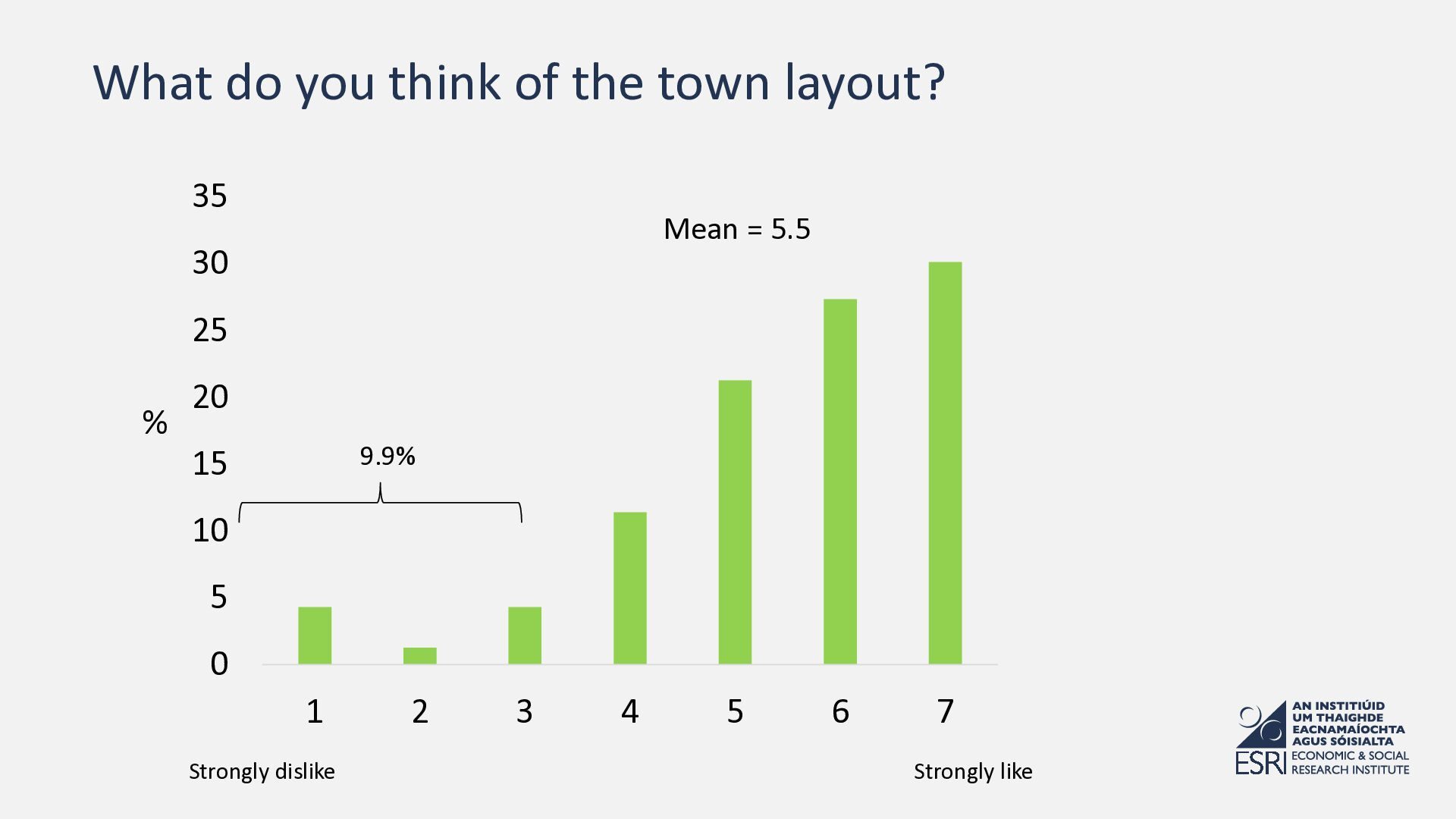
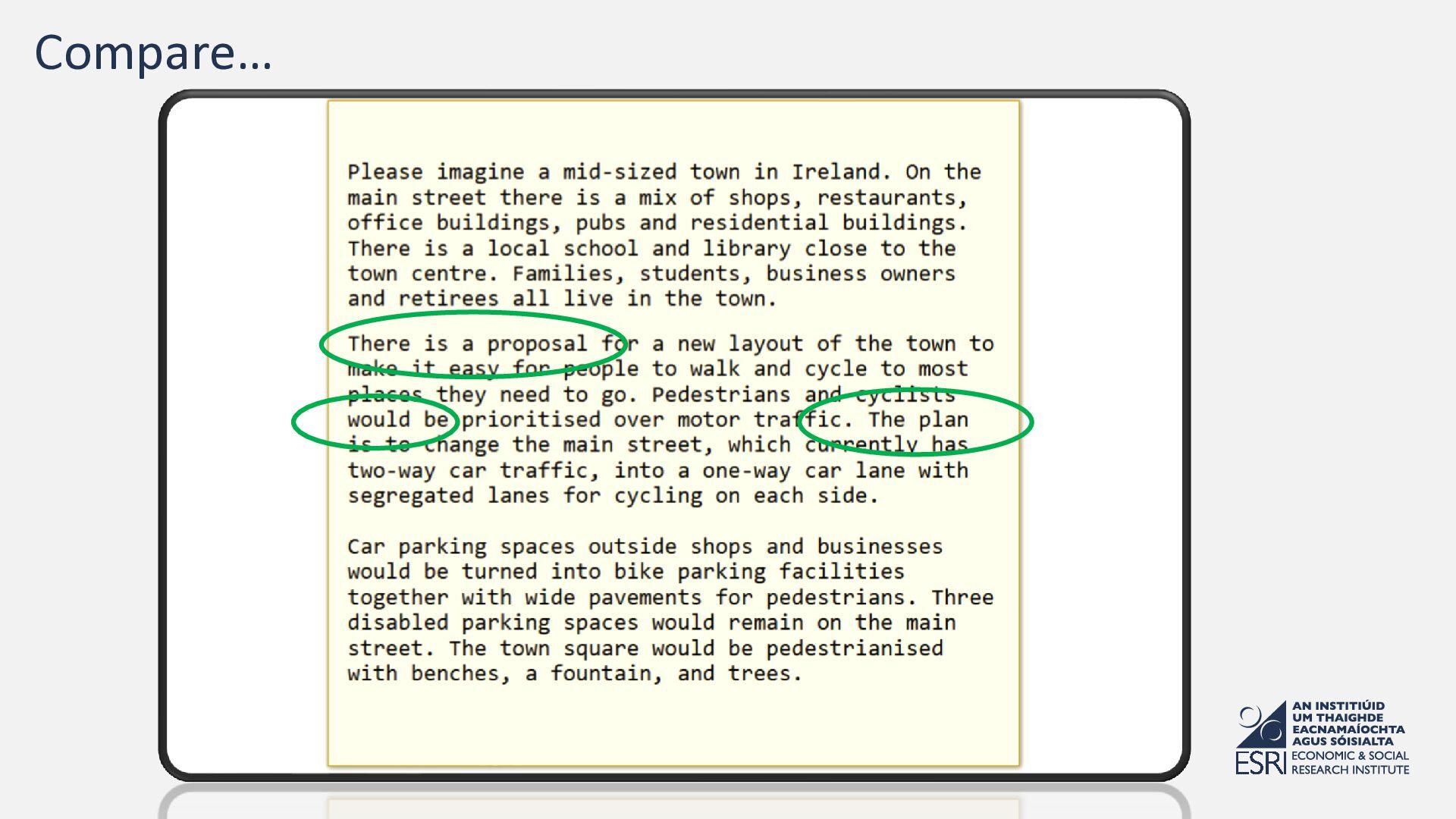
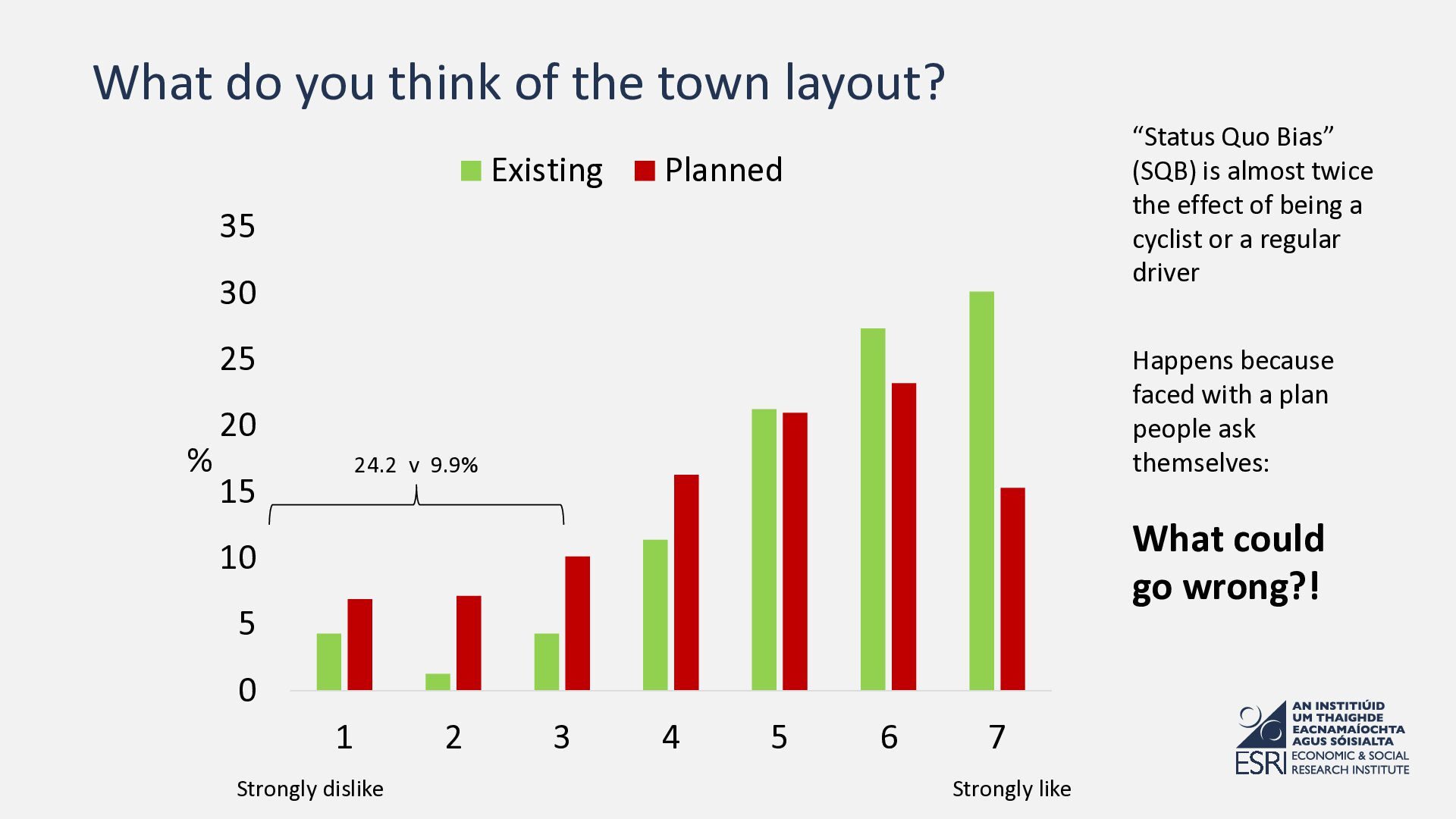
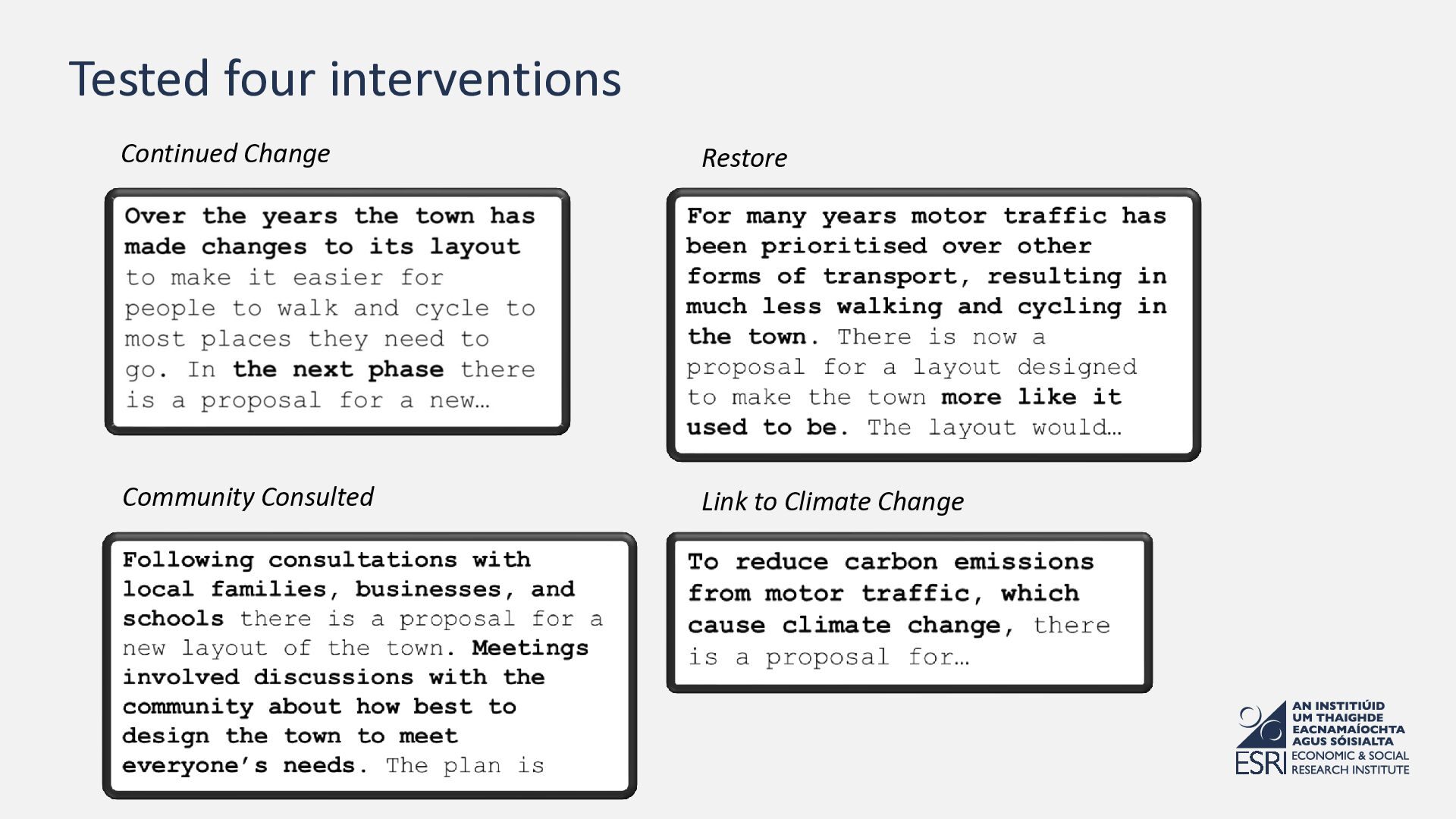
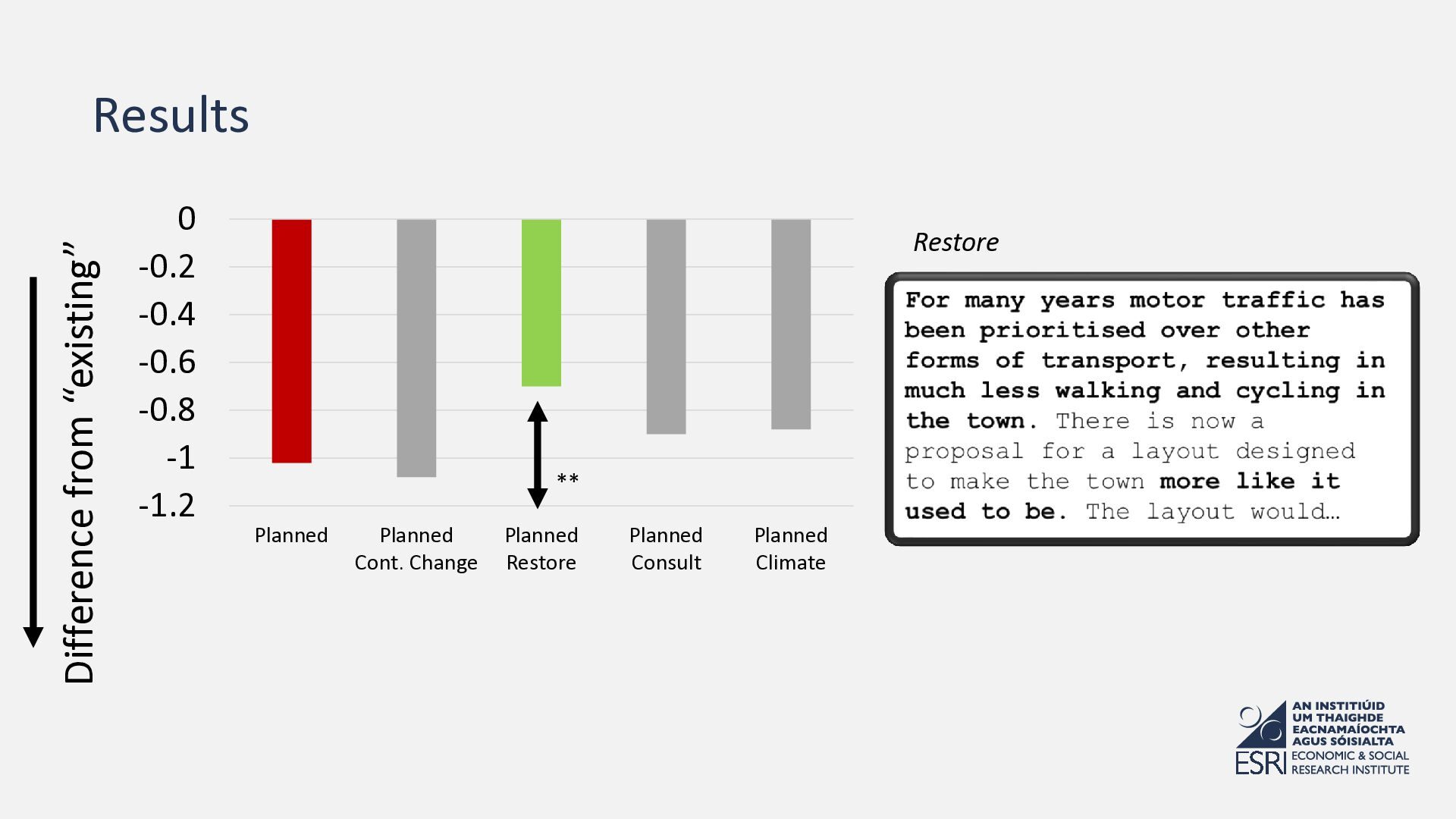
Quo Bias” (SQB) is almost twice the effect of being a cyclist or a regular driver Planned 35 30 25 % Happens because faced with a plan people ask themselves: 20 24.2 v 9.9% 15 What could go wrong?! 10 5 0 1 Strongly dislike 2 3 4 5 6 7 Strongly like
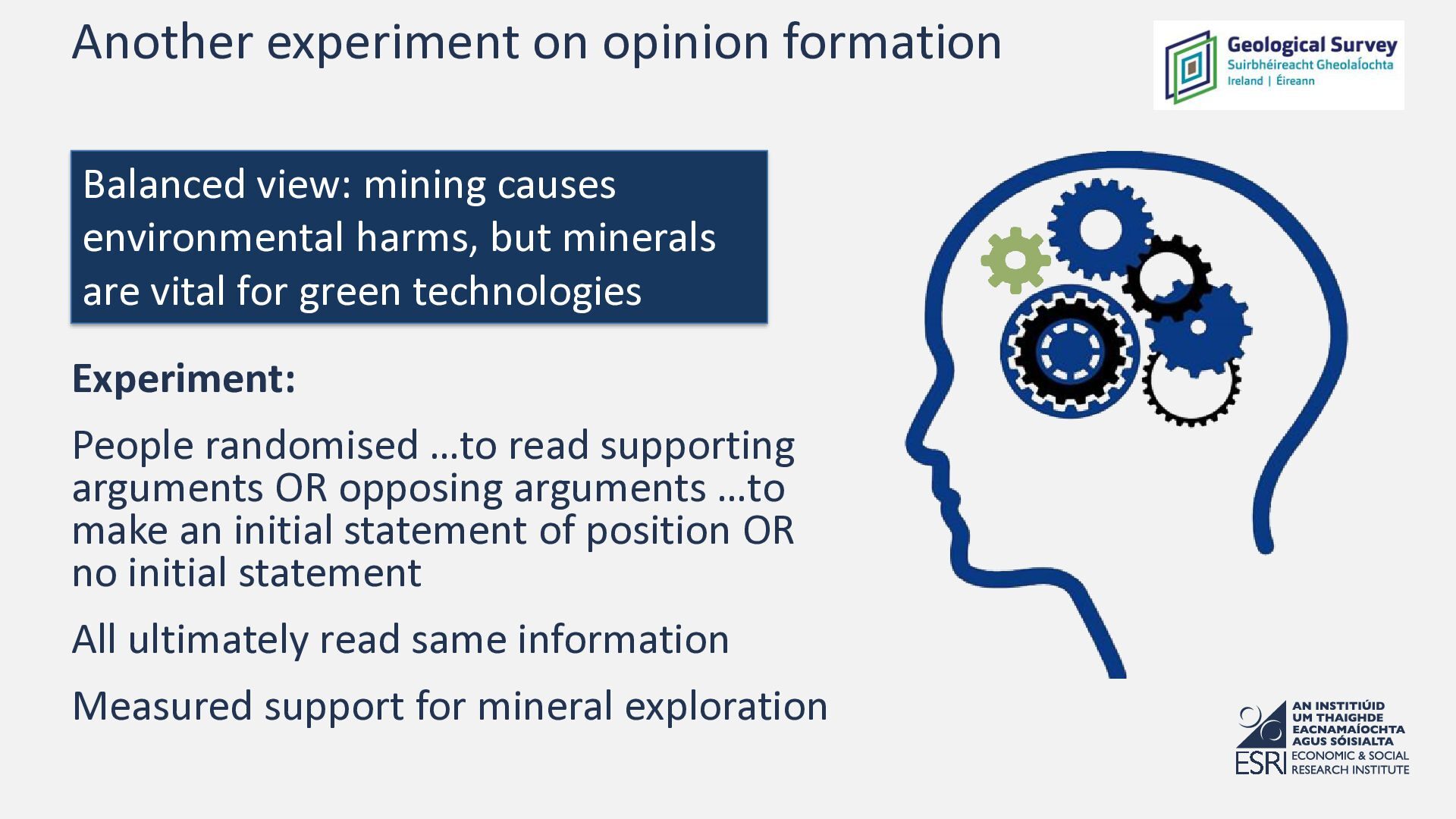
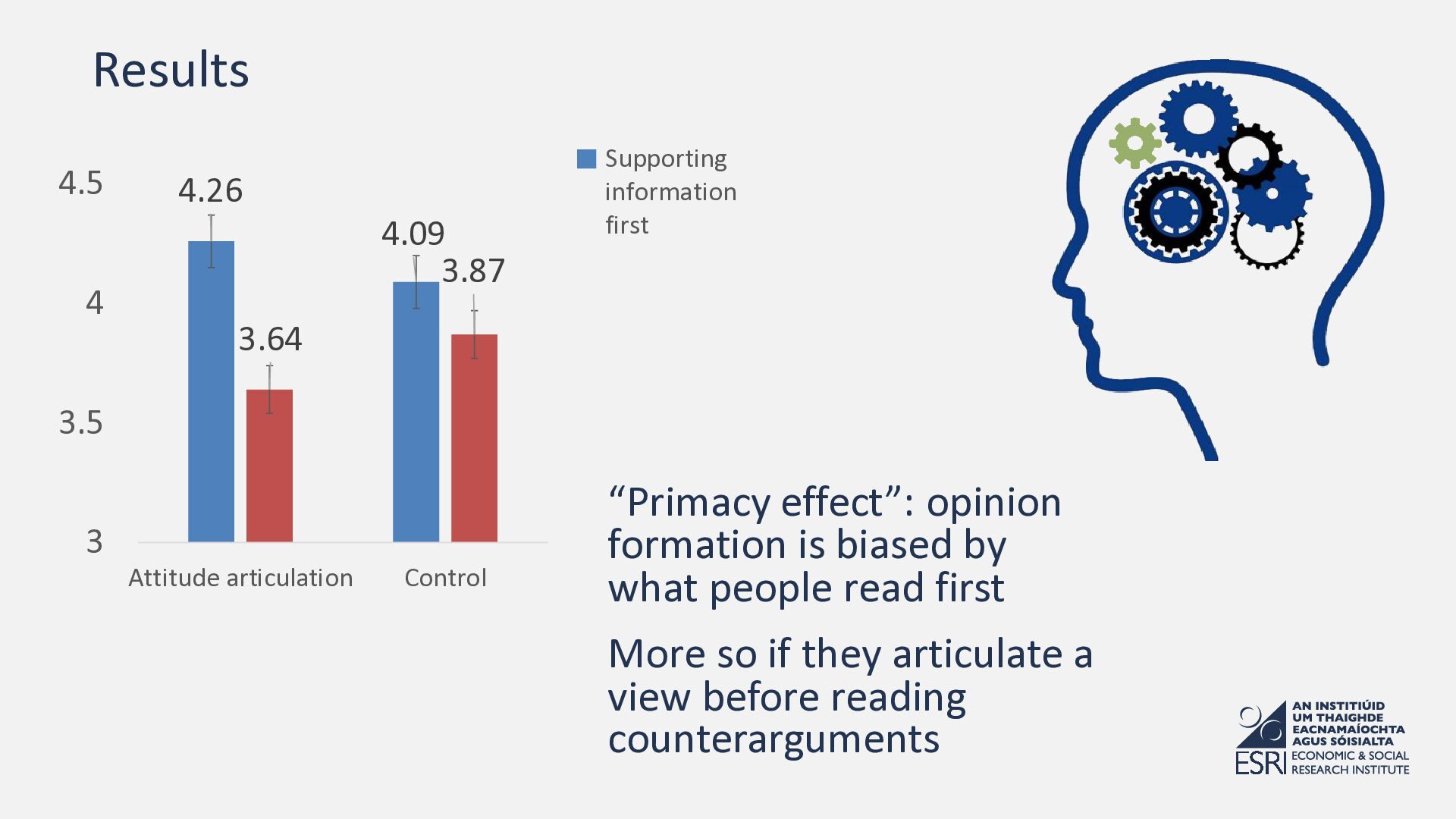
harms, but minerals are vital for green technologies Experiment: People randomised …to read supporting arguments OR opposing arguments …to make an initial statement of position OR no initial statement All ultimately read same information Measured support for mineral exploration
3.5 3 Attitude articulation Control “Primacy effect”: opinion formation is biased by what people read first More so if they articulate a view before reading counterarguments
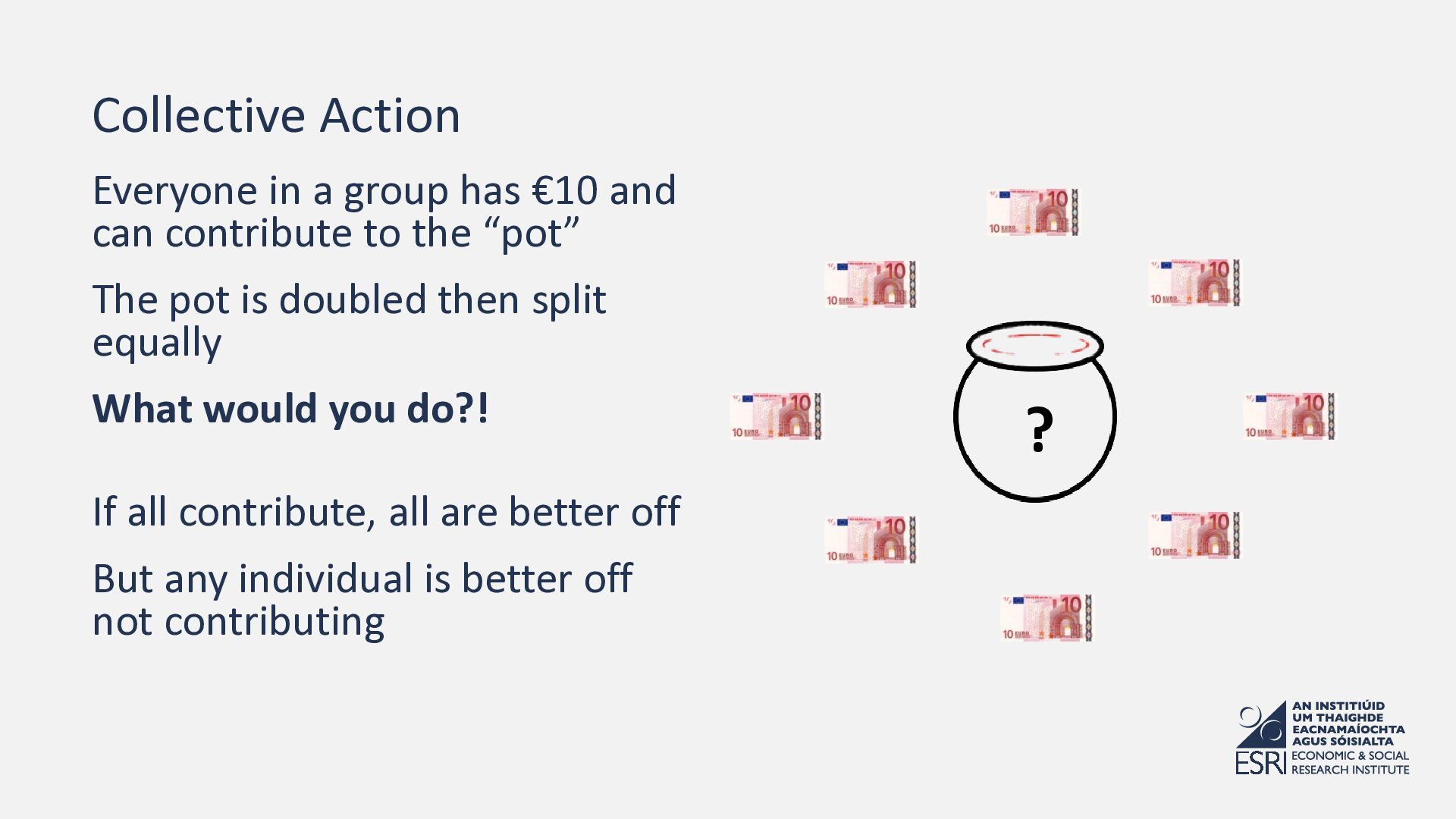
contribute to the “pot” The pot is doubled then split equally What would you do?! If all contribute, all are better off But any individual is better off not contributing ?
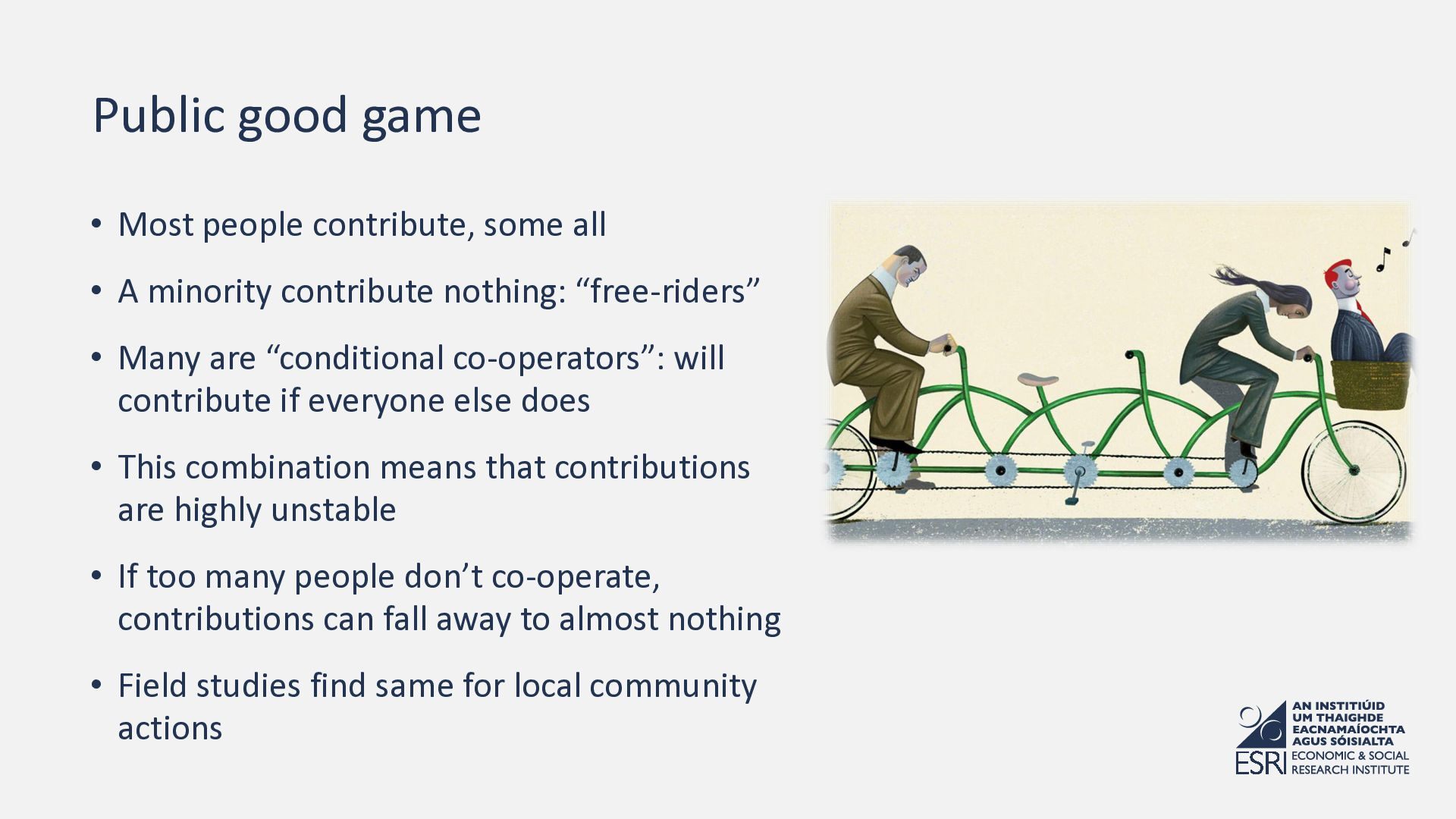
A minority contribute nothing: “free-riders” • Many are “conditional co-operators”: will contribute if everyone else does • This combination means that contributions are highly unstable • If too many people don’t co-operate, contributions can fall away to almost nothing • Field studies find same for local community actions
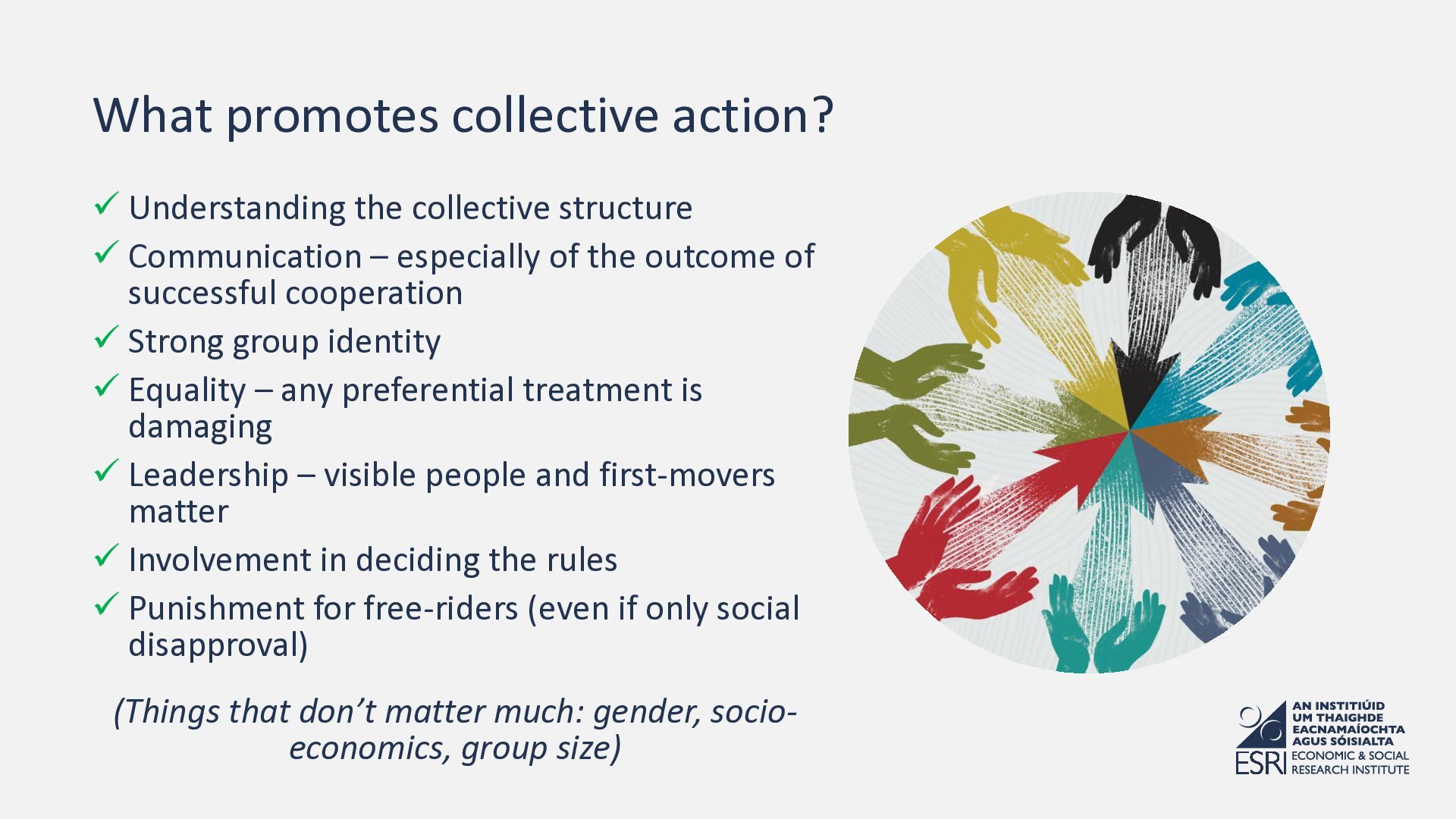
Communication – especially of the outcome of successful cooperation ✓ Strong group identity ✓ Equality – any preferential treatment is damaging ✓ Leadership – visible people and first-movers matter ✓ Involvement in deciding the rules ✓ Punishment for free-riders (even if only social disapproval) (Things that don’t matter much: gender, socioeconomics, group size)
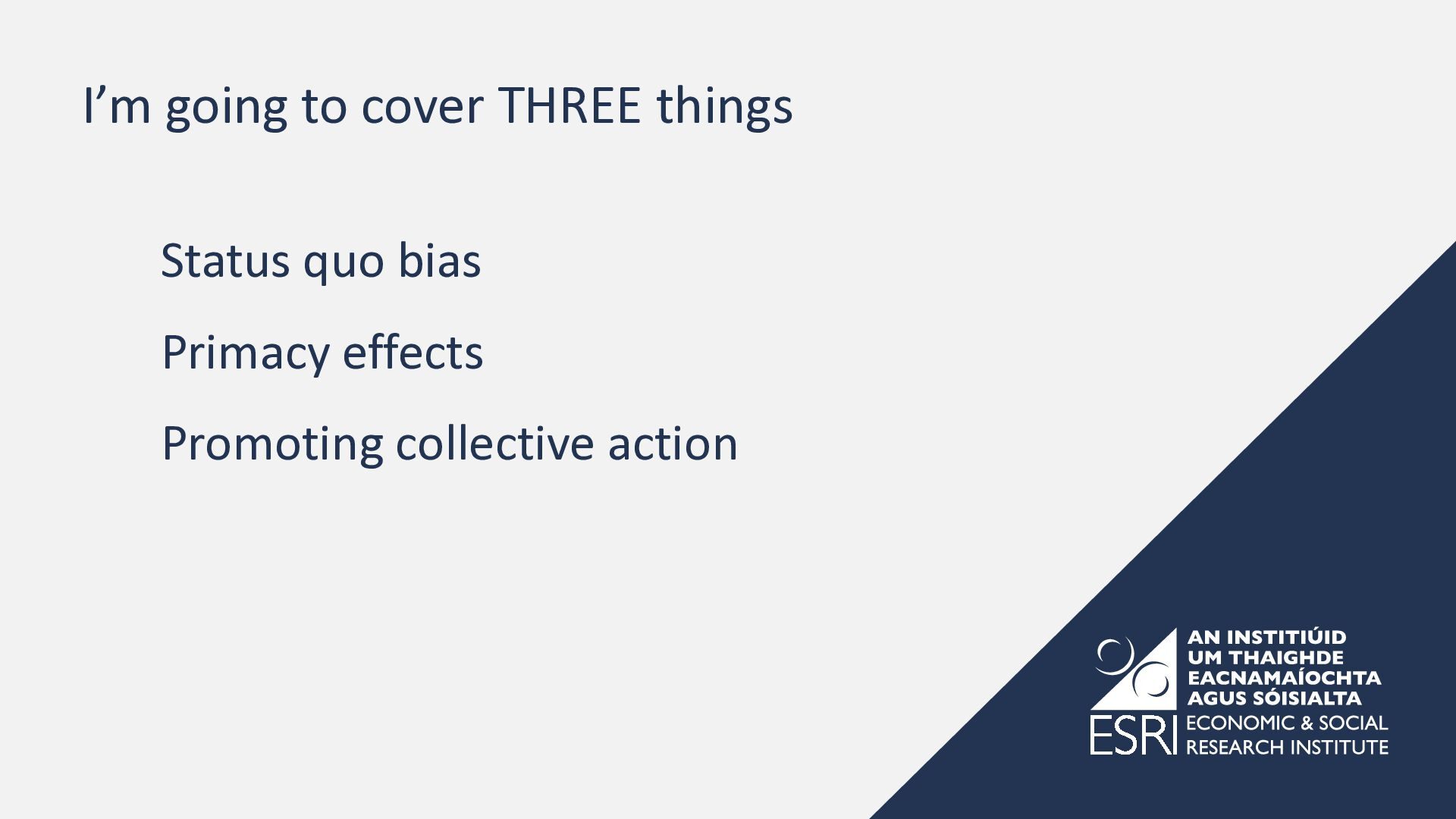
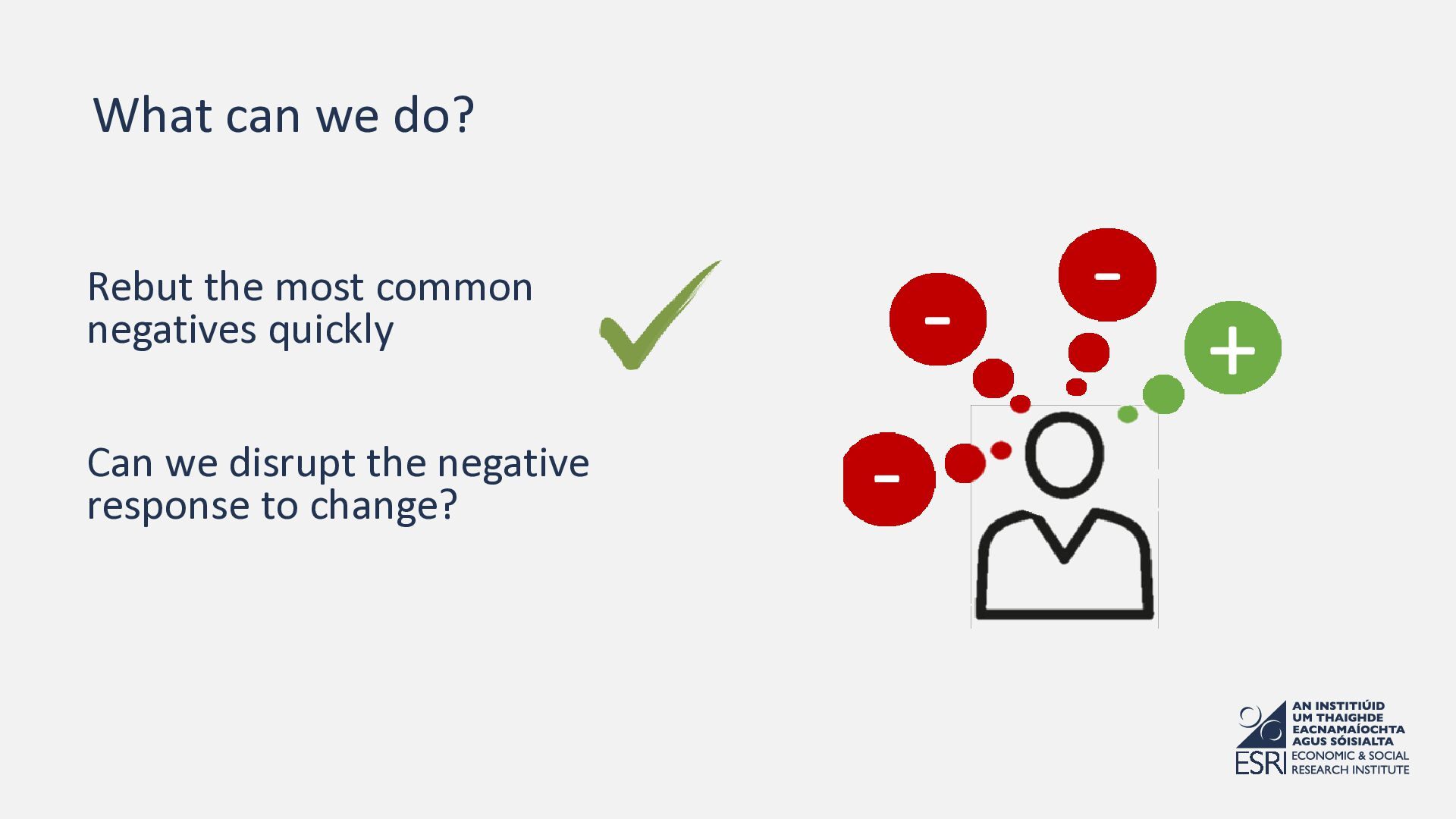
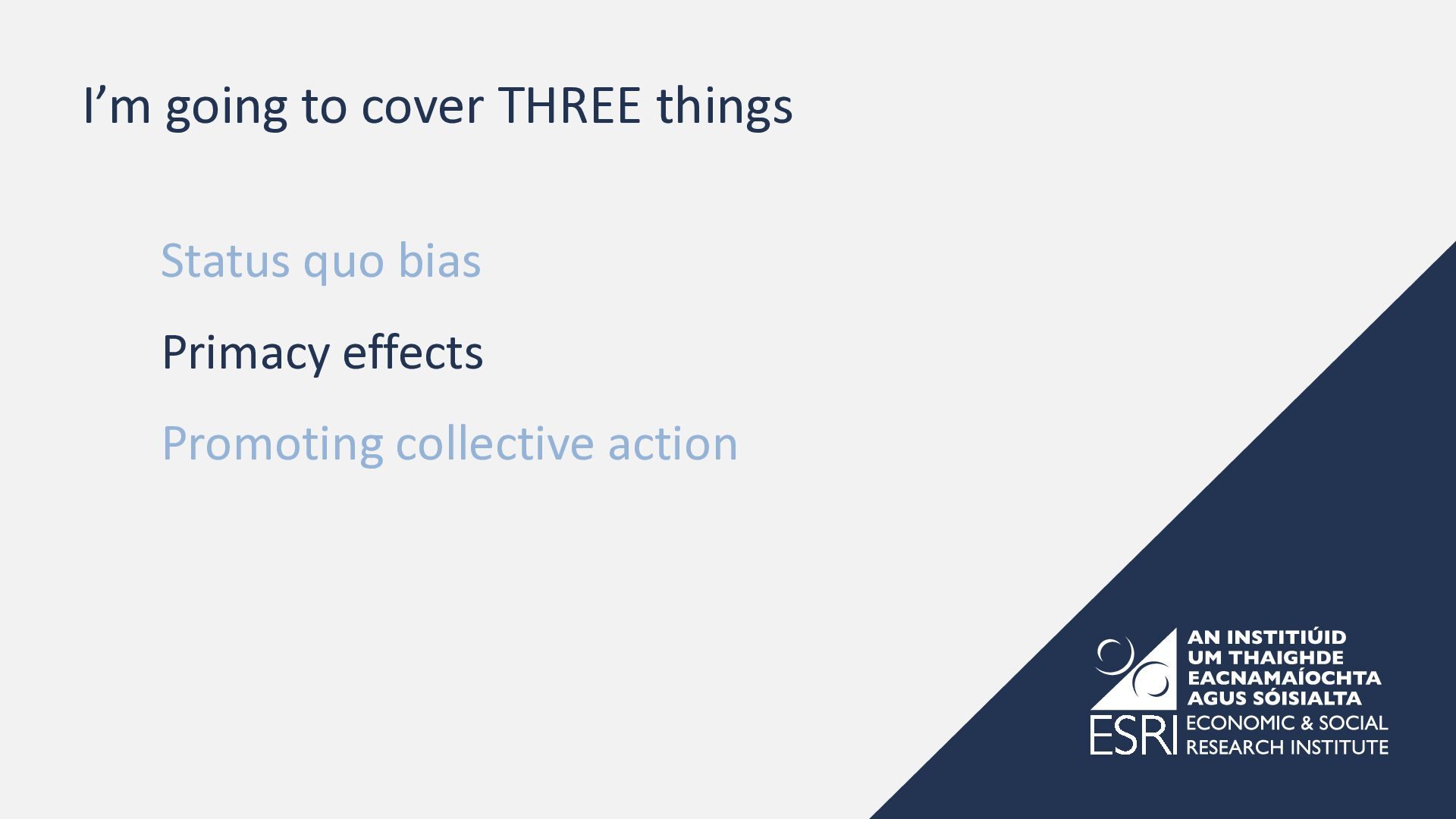
rebut negatives ✓ Where possible, stress restoration of positives • Primacy effects ✓ Be first with reasoning • Promoting collective action ✓ SEVEN things help! www.esri.ie/bru
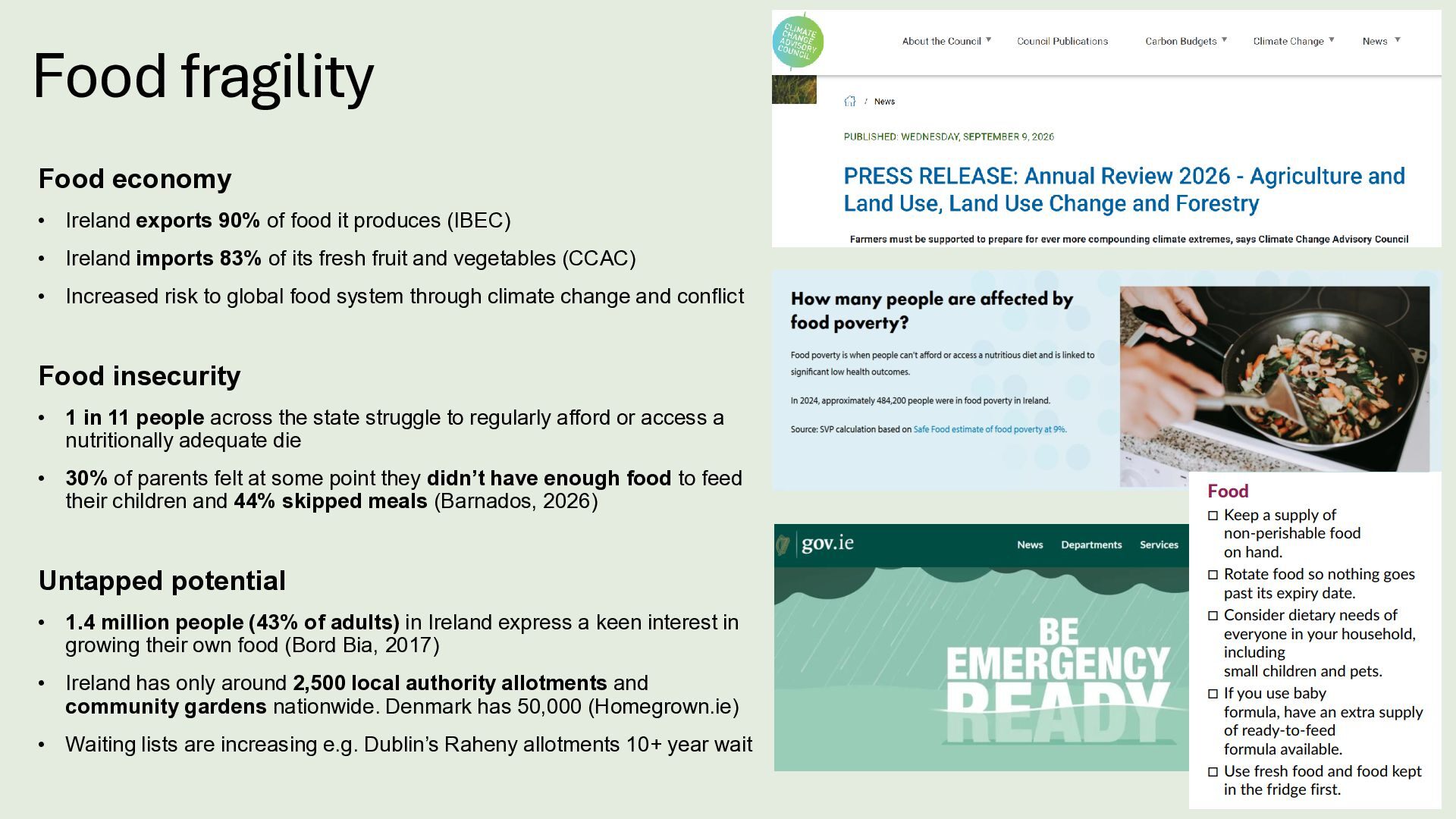
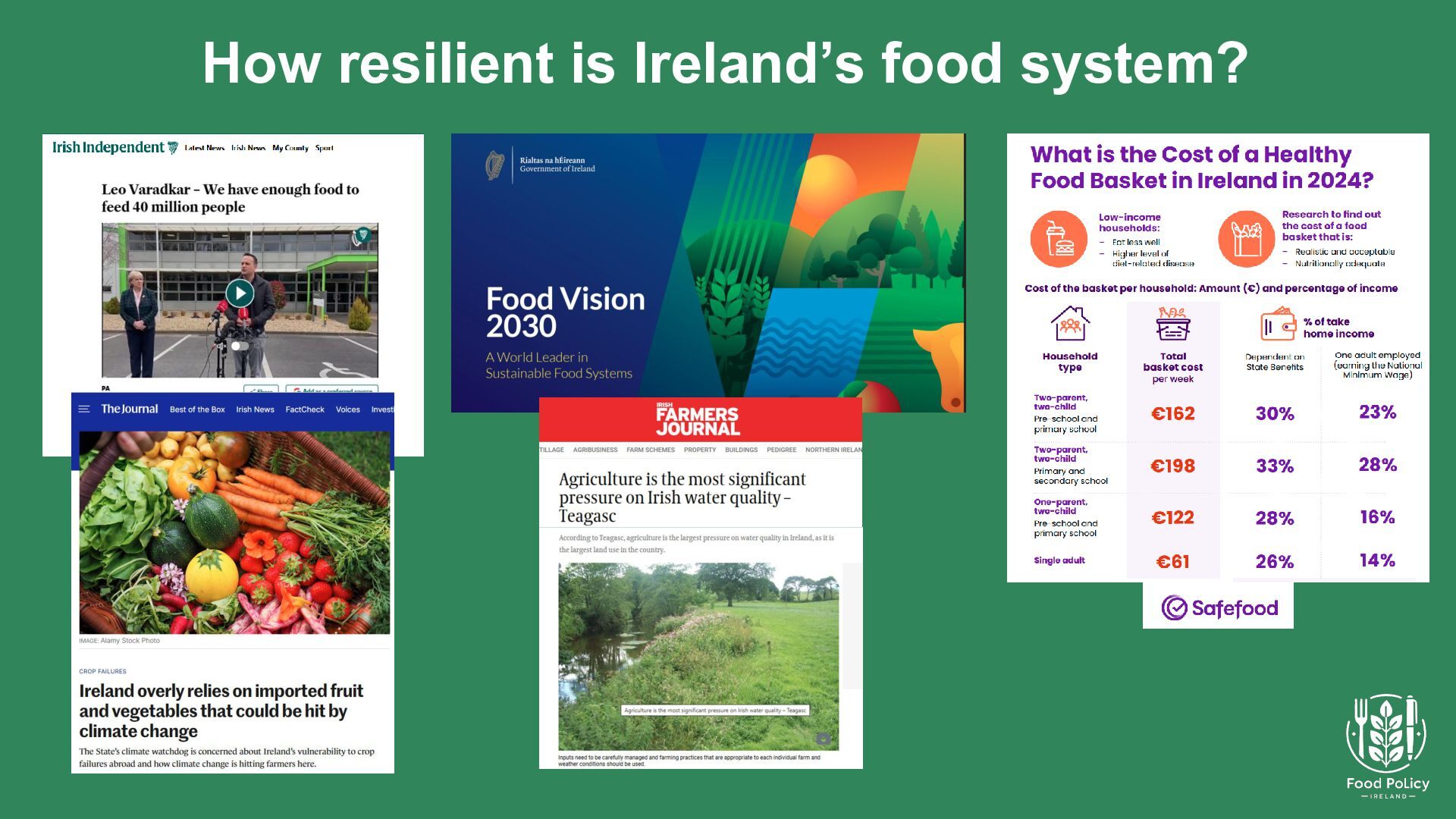
it produces (IBEC) • Ireland imports 83% of its fresh fruit and vegetables (CCAC) • Increased risk to global food system through climate change and conflict Food insecurity • 1 in 11 people across the state struggle to regularly afford or access a nutritionally adequate die • 30% of parents felt at some point they didn’t have enough food to feed their children and 44% skipped meals (Barnados, 2026) Untapped potential • 1.4 million people (43% of adults) in Ireland express a keen interest in growing their own food (Bord Bia, 2017) • Ireland has only around 2,500 local authority allotments and community gardens nationwide. Denmark has 50,000 (Homegrown.ie) • Waiting lists are increasing e.g. Dublin’s Raheny allotments 10+ year wait
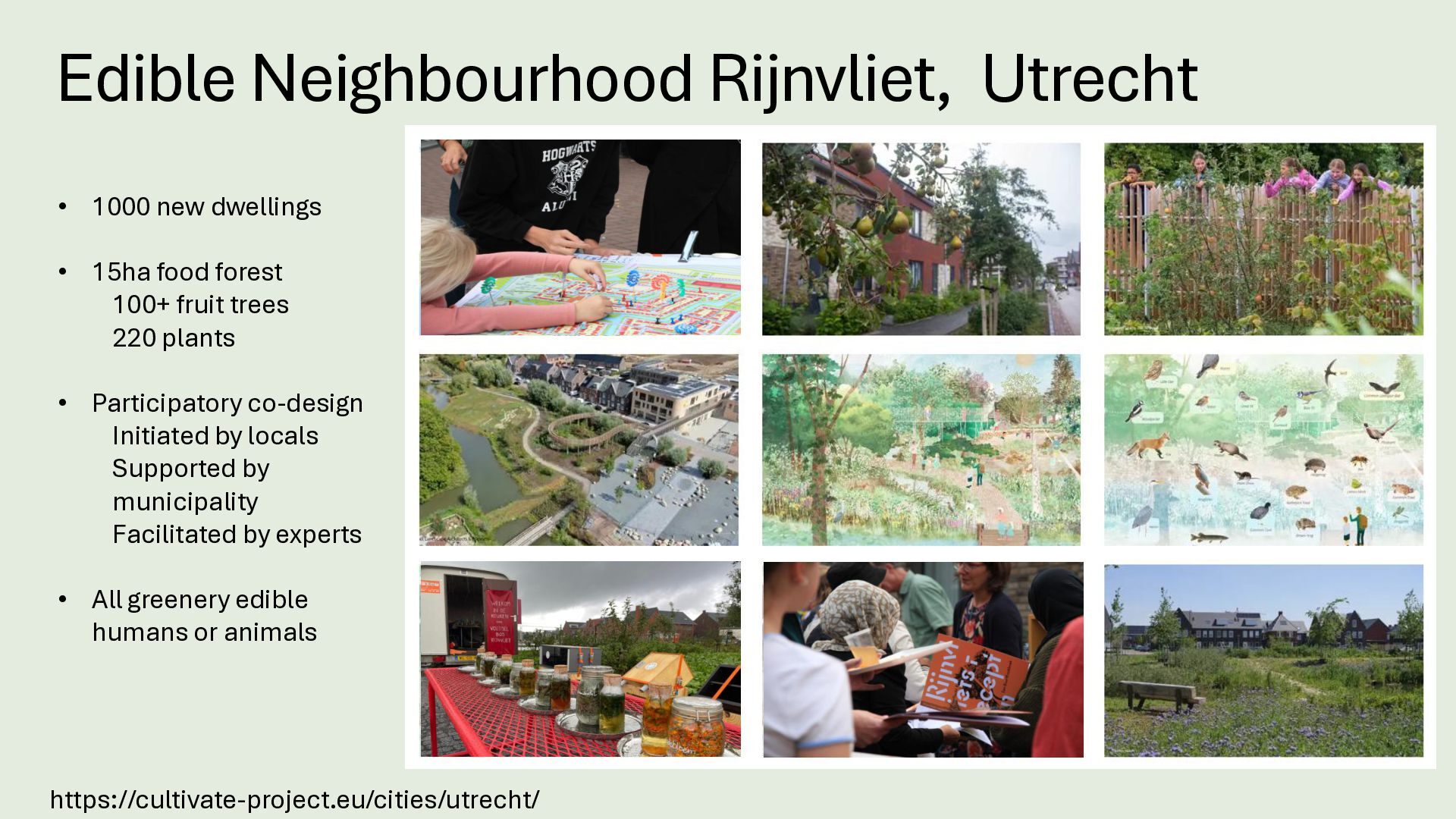
food forest 100+ fruit trees 220 plants • Participatory co-design Initiated by locals Supported by municipality Facilitated by experts • All greenery edible humans or animals https://cultivate-project.eu/cities/utrecht/
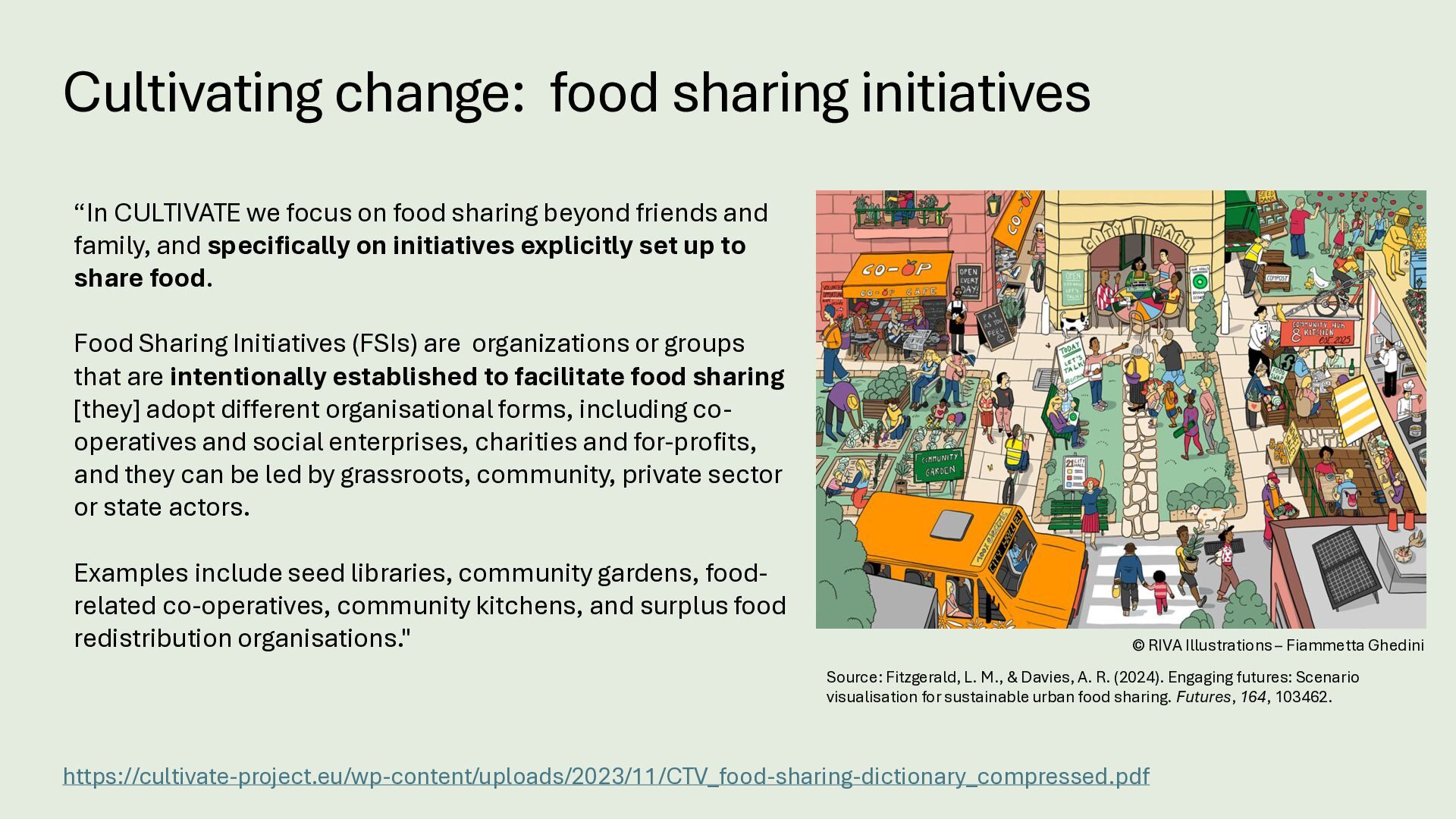
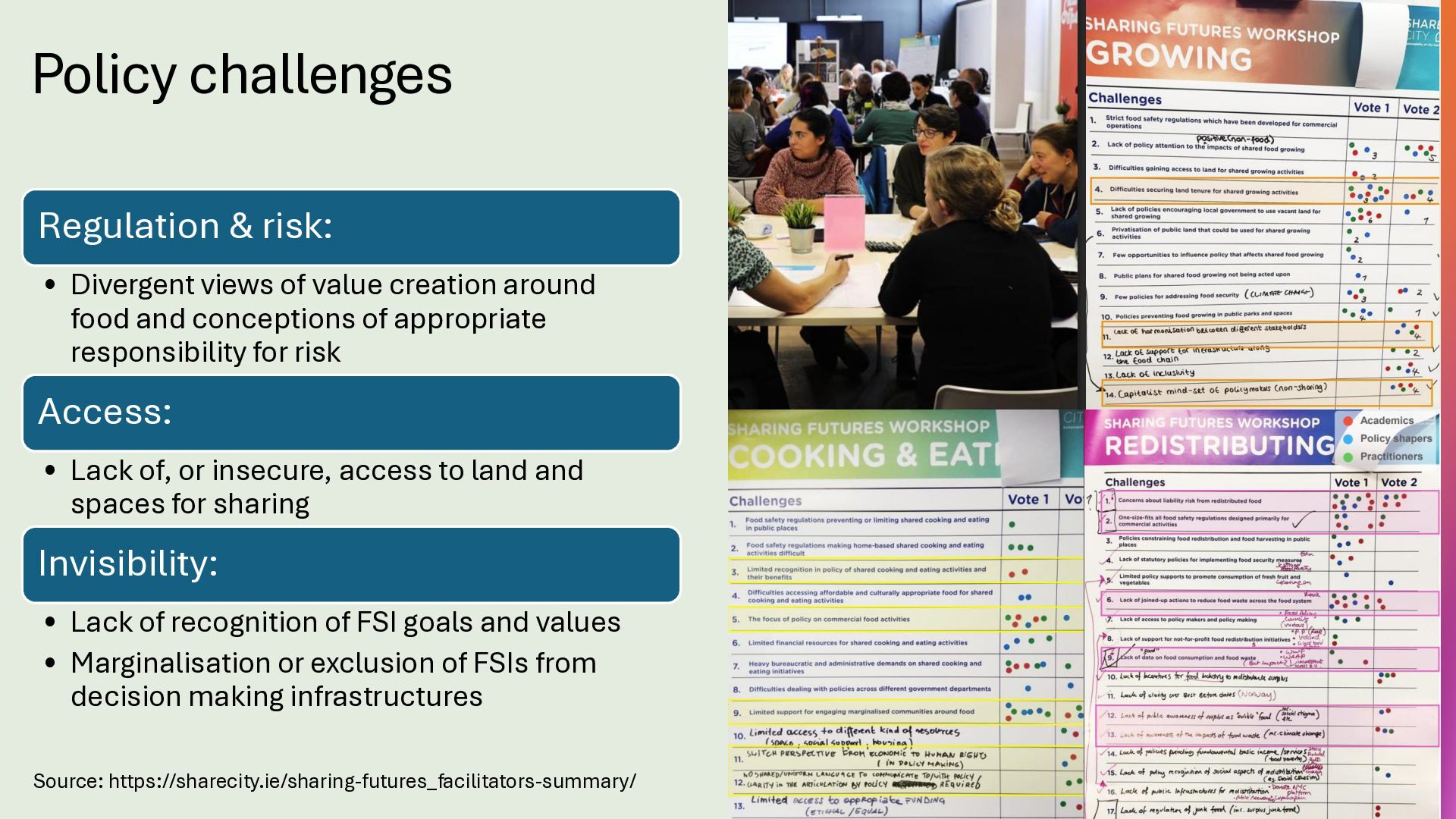
creation around food and conceptions of appropriate responsibility for risk Access: • Lack of, or insecure, access to land and spaces for sharing Invisibility: • Lack of recognition of FSI goals and values • Marginalisation or exclusion of FSIs from decision making infrastructures Source: https://sharecity.ie/sharing-futures_facilitators-summary/
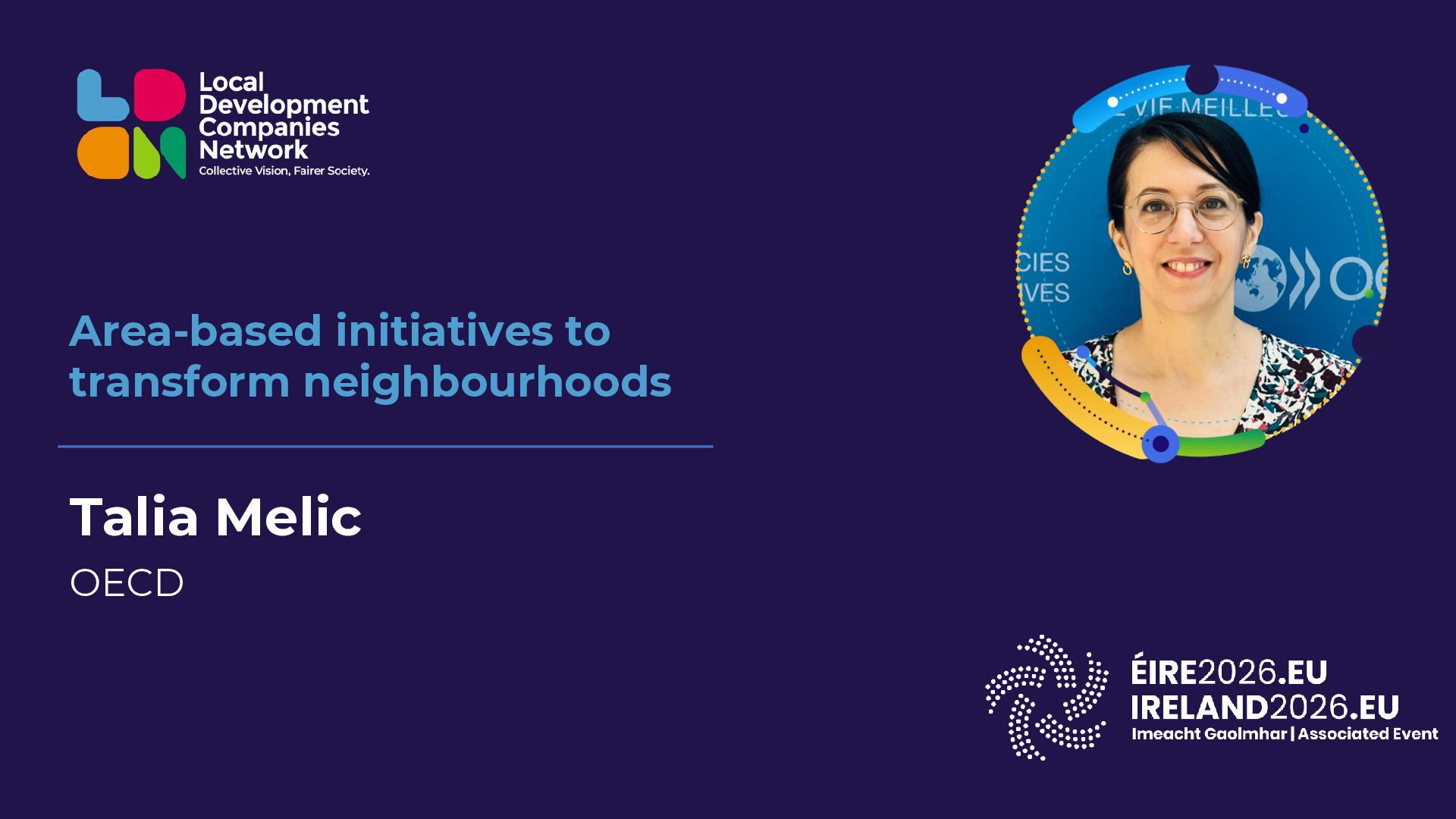
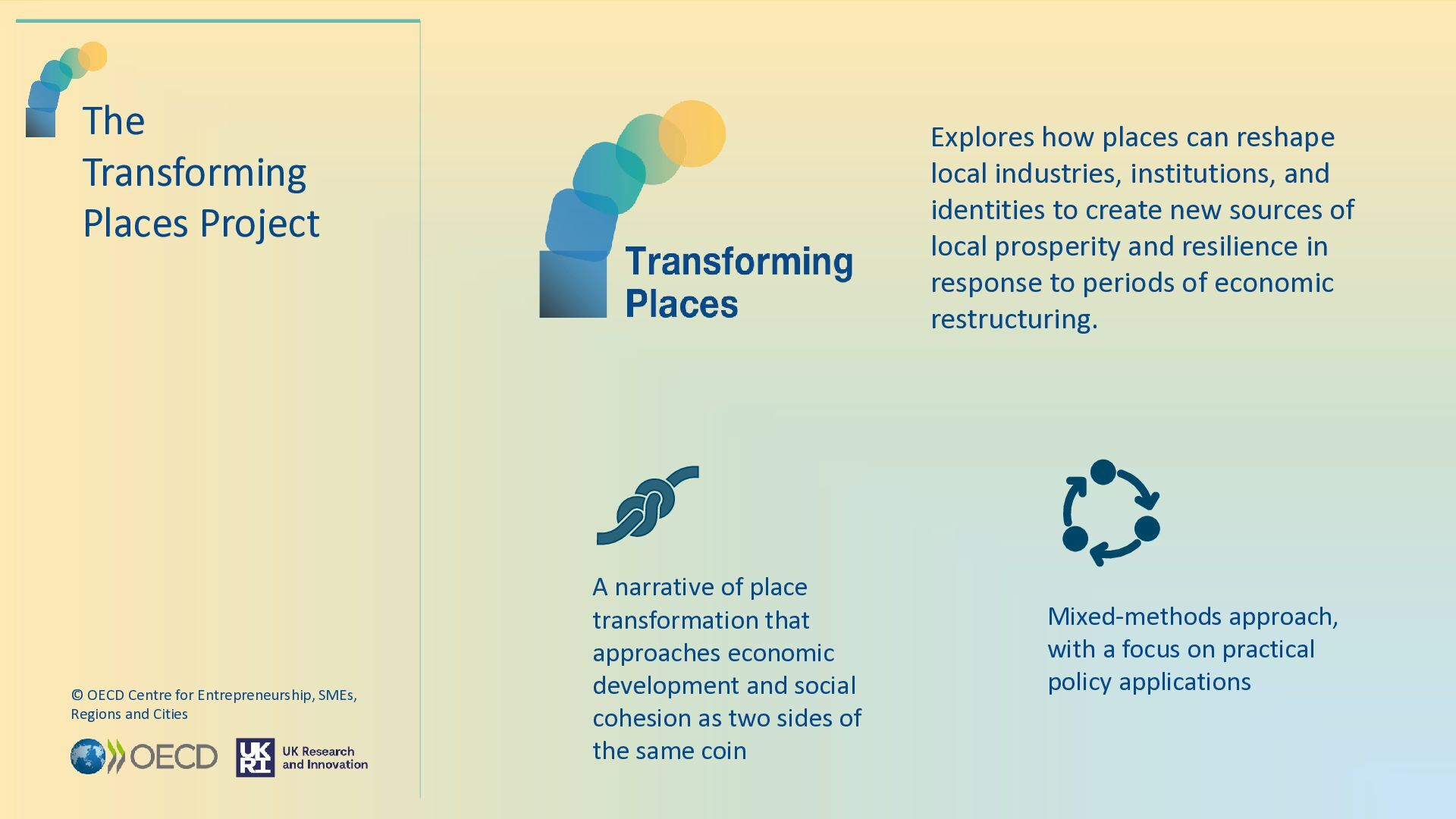
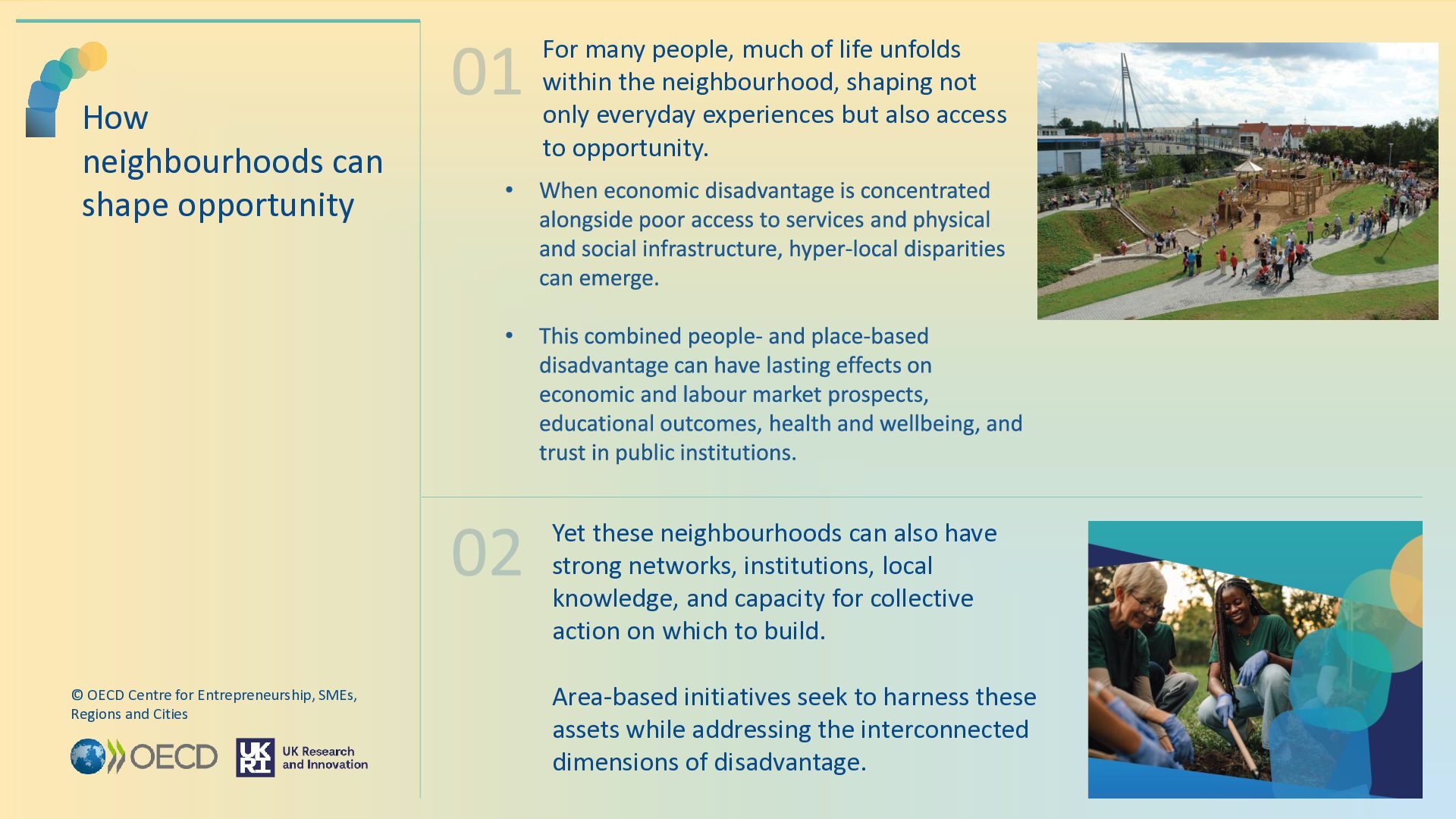
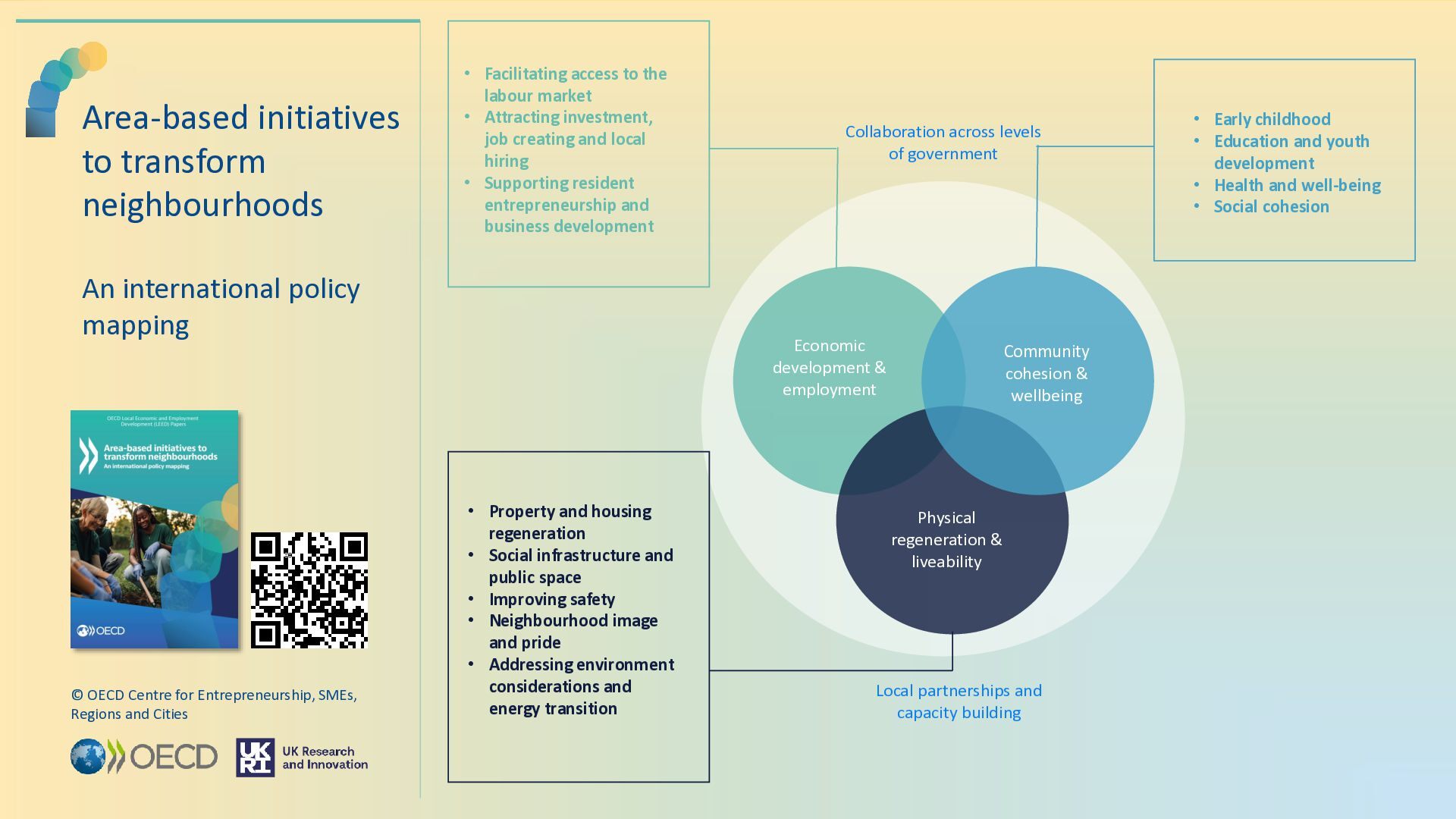
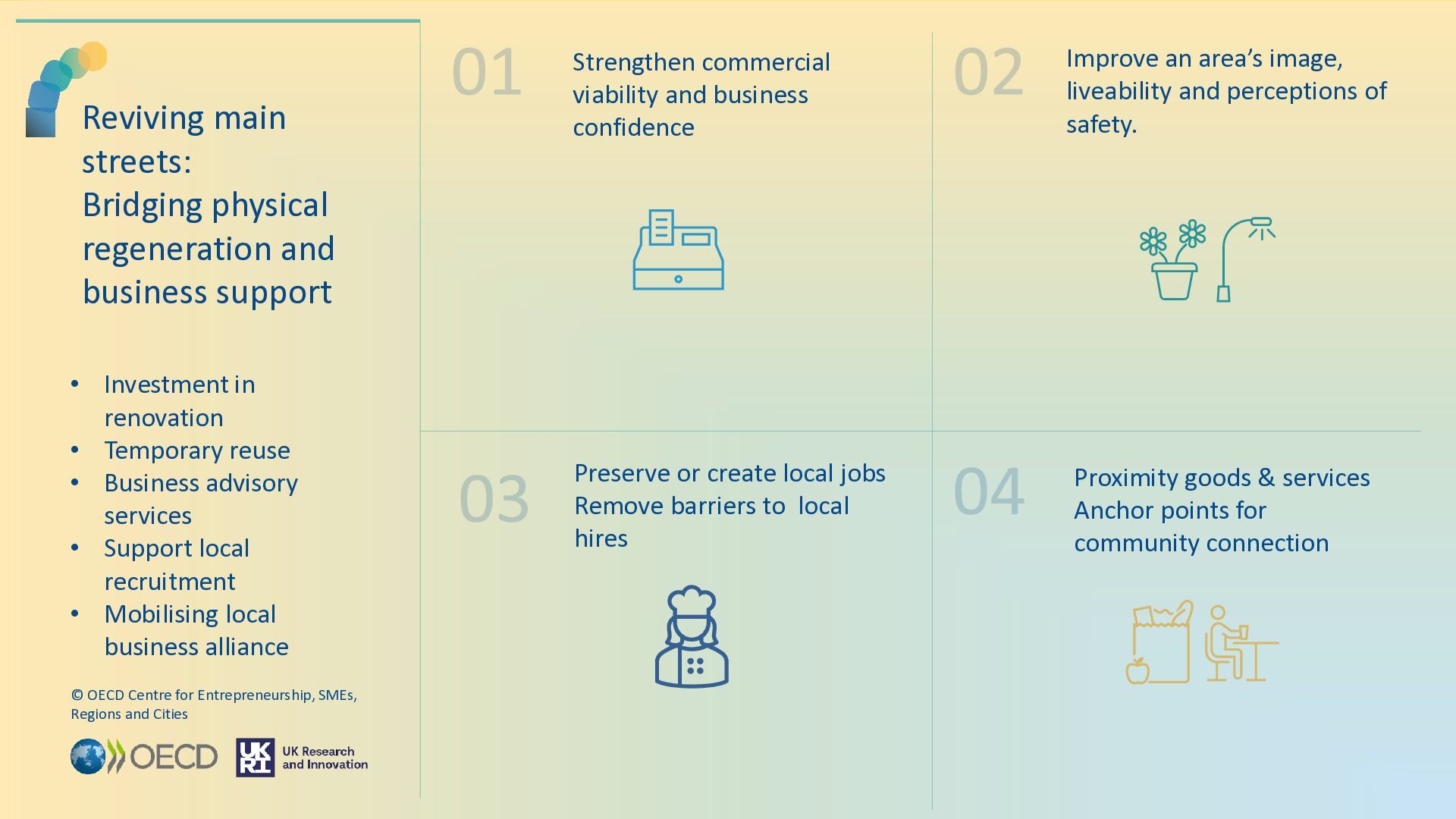
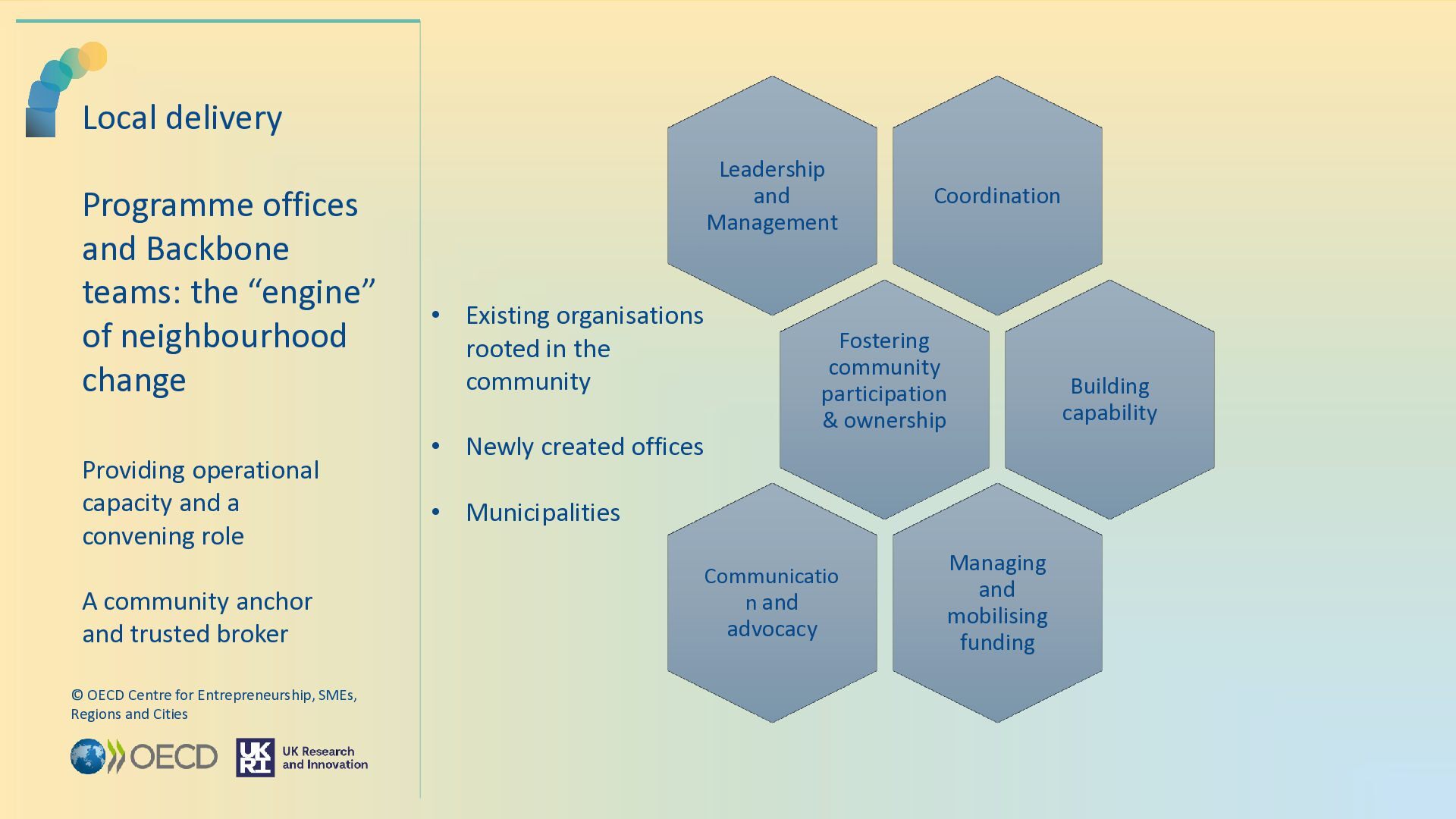
Regions and Cities Explores how places can reshape local industries, institutions, and identities to create new sources of local prosperity and resilience in response to periods of economic restructuring. A narrative of place transformation that approaches economic development and social cohesion as two sides of the same coin Mixed-methods approach, with a focus on practical policy applications
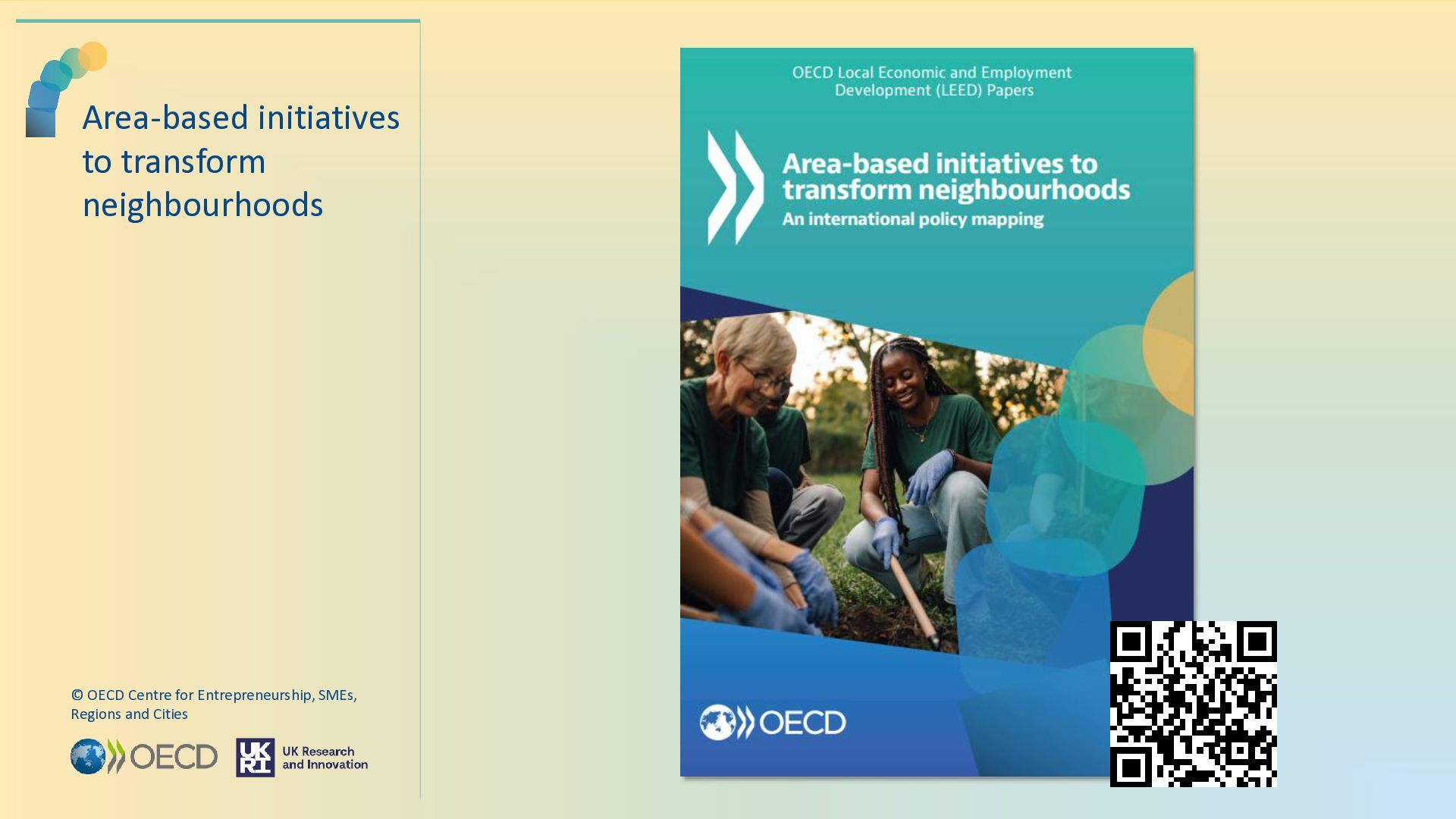
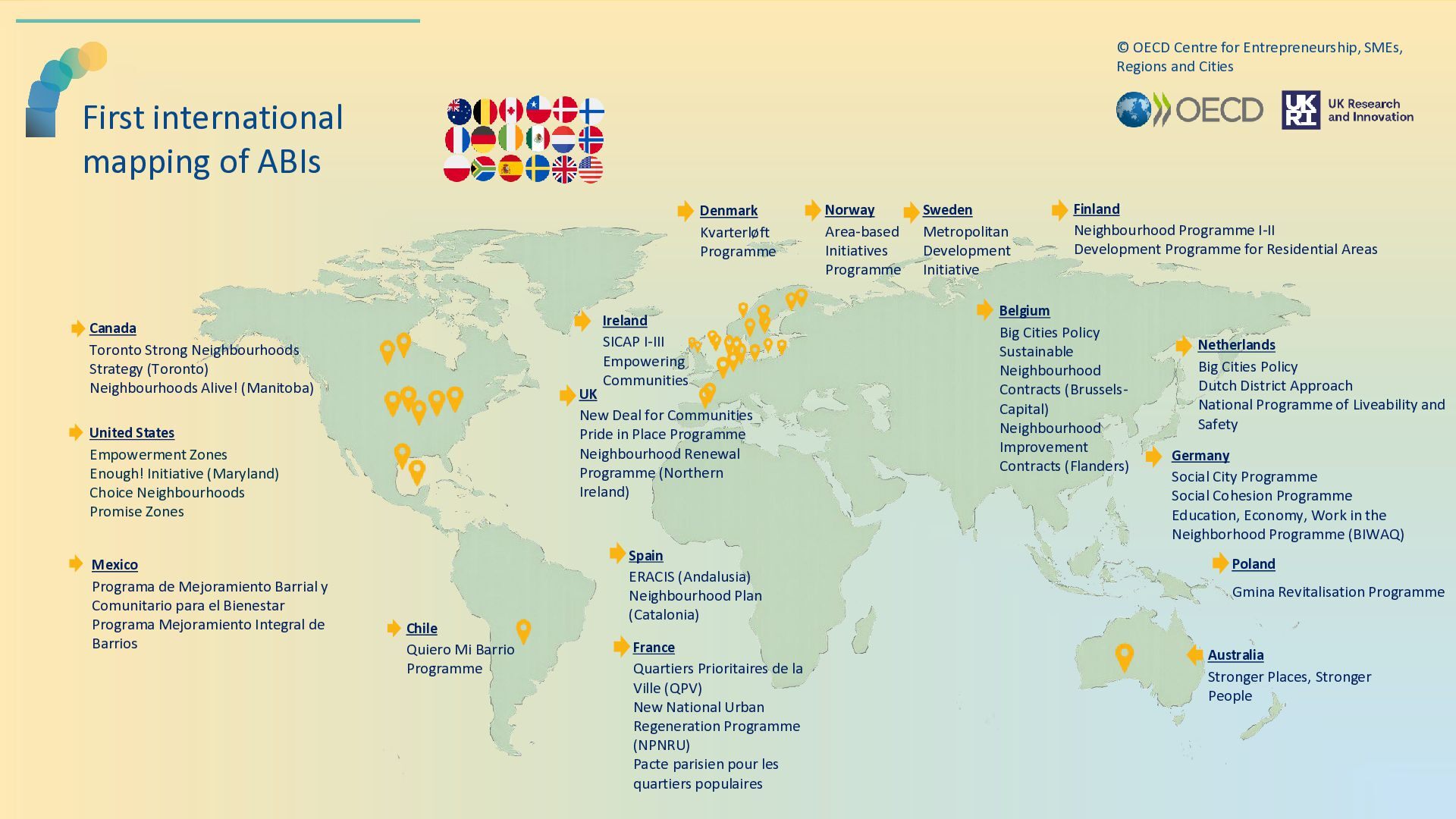
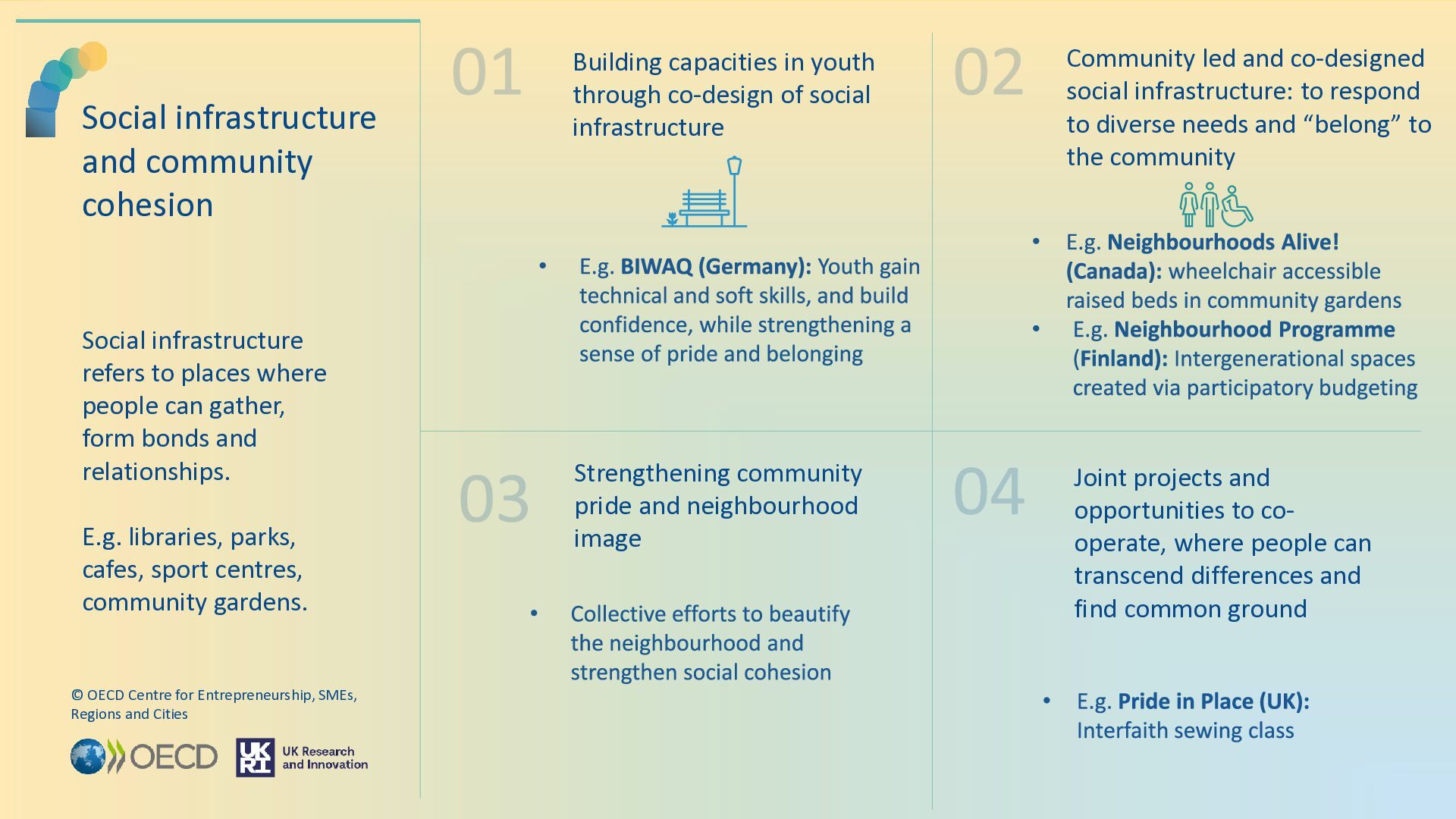
international mapping of ABIs Norway Sweden Finland Kvarterløft Programme Area-based Initiatives Programme Metropolitan Development Initiative Neighbourhood Programme I-II Development Programme for Residential Areas Ireland Canada Toronto Strong Neighbourhoods Strategy (Toronto) Neighbourhoods Alive! (Manitoba) UK SICAP I-III Empowering Communities New Deal for Communities Pride in Place Programme Neighbourhood Renewal Programme (Northern Ireland) United States Empowerment Zones Enough! Initiative (Maryland) Choice Neighbourhoods Promise Zones Spain Mexico Programa de Mejoramiento Barrial y Comunitario para el Bienestar Programa Mejoramiento Integral de Barrios Denmark Chile Quiero Mi Barrio Programme ERACIS (Andalusia) Neighbourhood Plan (Catalonia) France Quartiers Prioritaires de la Ville (QPV) New National Urban Regeneration Programme (NPNRU) Pacte parisien pour les quartiers populaires Belgium Big Cities Policy Sustainable Neighbourhood Contracts (BrusselsCapital) Neighbourhood Improvement Contracts (Flanders) Netherlands Big Cities Policy Dutch District Approach National Programme of Liveability and Safety Germany Social City Programme Social Cohesion Programme Education, Economy, Work in the Neighborhood Programme (BIWAQ) Poland Gmina Revitalisation Programme Australia Stronger Places, Stronger People
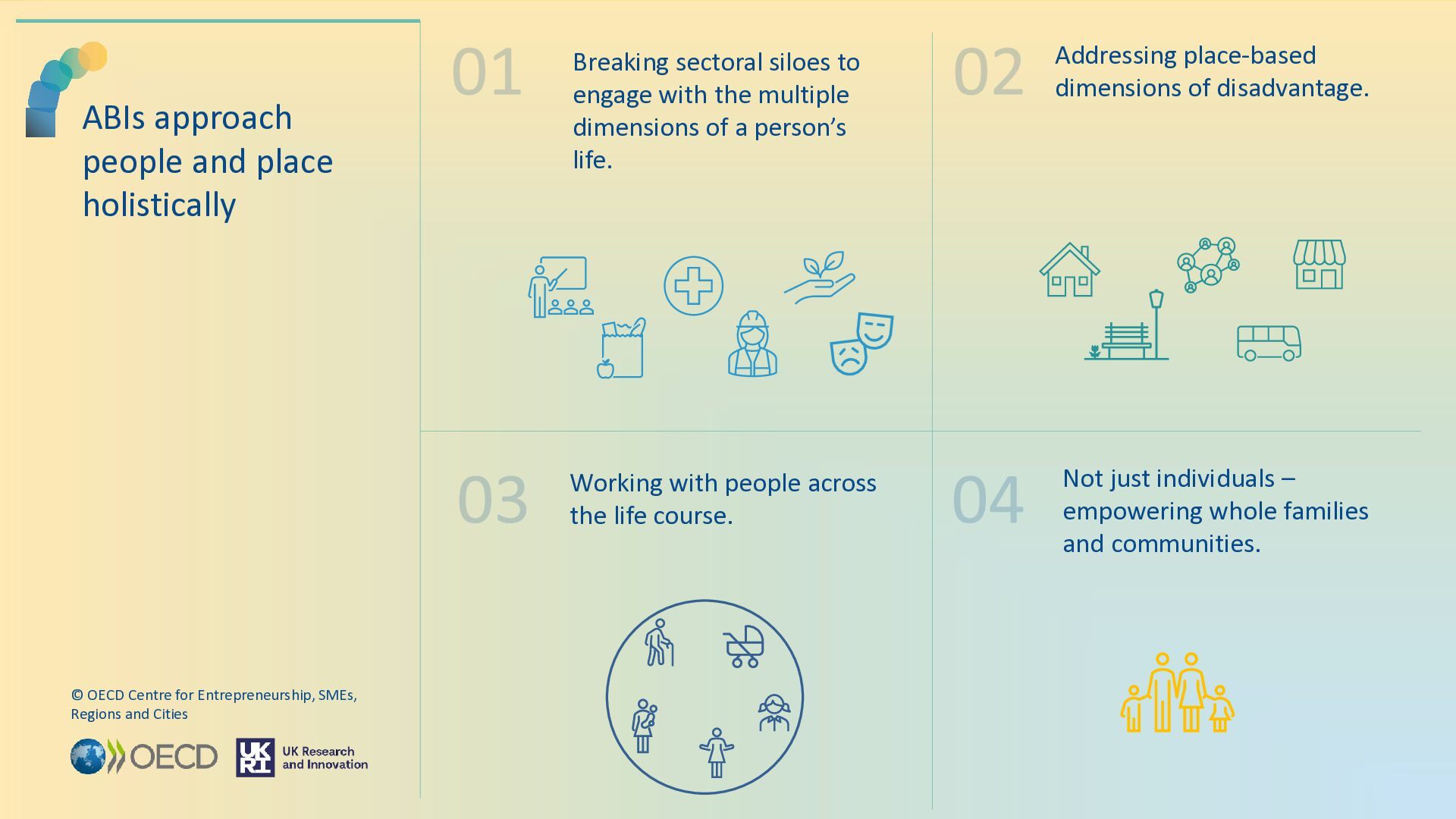
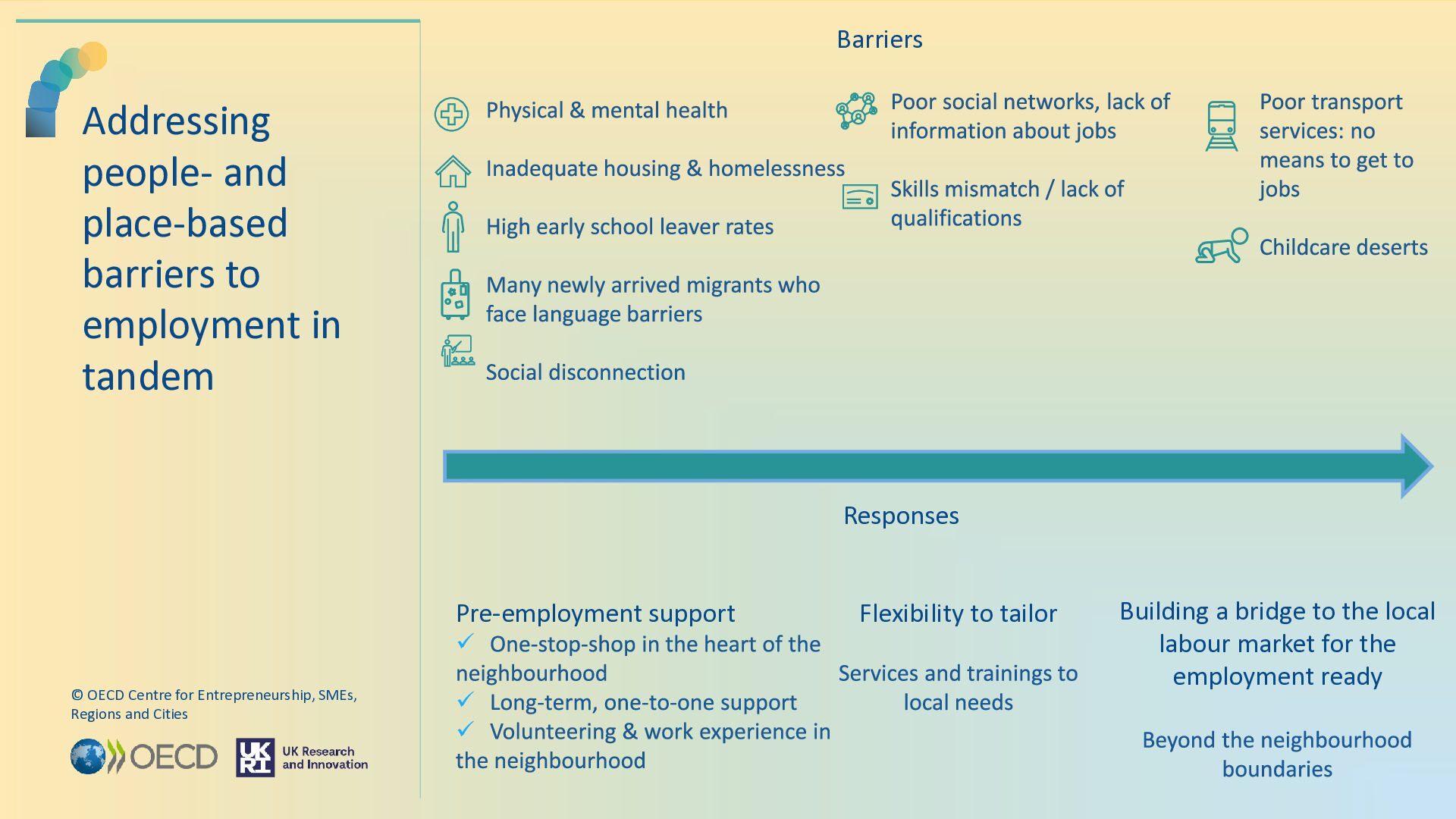
Entrepreneurship, SMEs, Regions and Cities Breaking sectoral siloes to engage with the multiple dimensions of a person’s life. Addressing place-based dimensions of disadvantage. Working with people across the life course. Not just individuals – empowering whole families and communities.
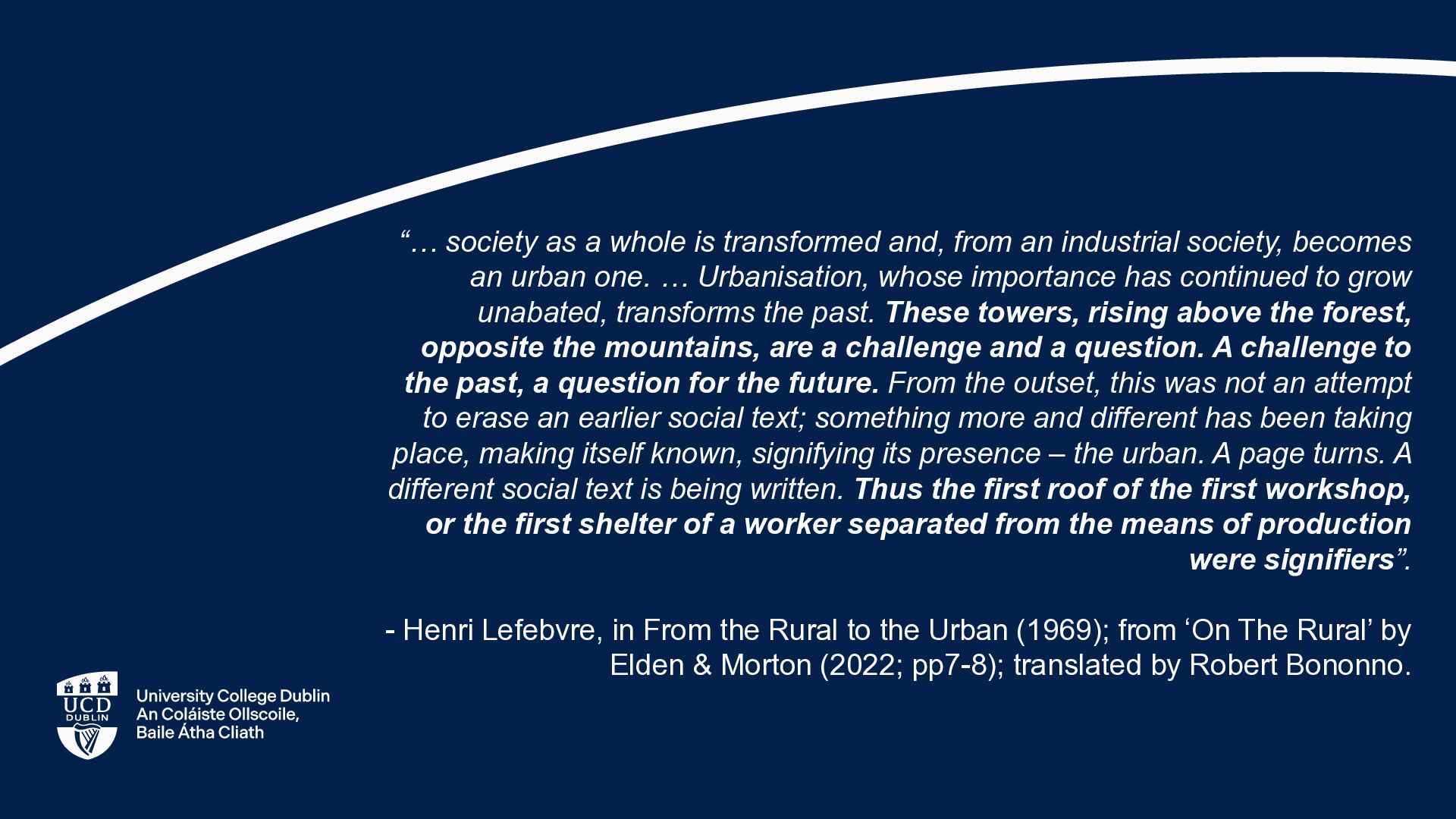
industrial society, becomes an urban one. … Urbanisation, whose importance has continued to grow unabated, transforms the past. These towers, rising above the forest, opposite the mountains, are a challenge and a question. A challenge to the past, a question for the future. From the outset, this was not an attempt to erase an earlier social text; something more and different has been taking place, making itself known, signifying its presence – the urban. A page turns. A different social text is being written. Thus the first roof of the first workshop, or the first shelter of a worker separated from the means of production were signifiers”. - Henri Lefebvre, in From the Rural to the Urban (1969); from ‘On The Rural’ by Elden & Morton (2022; pp7-8); translated by Robert Bononno.
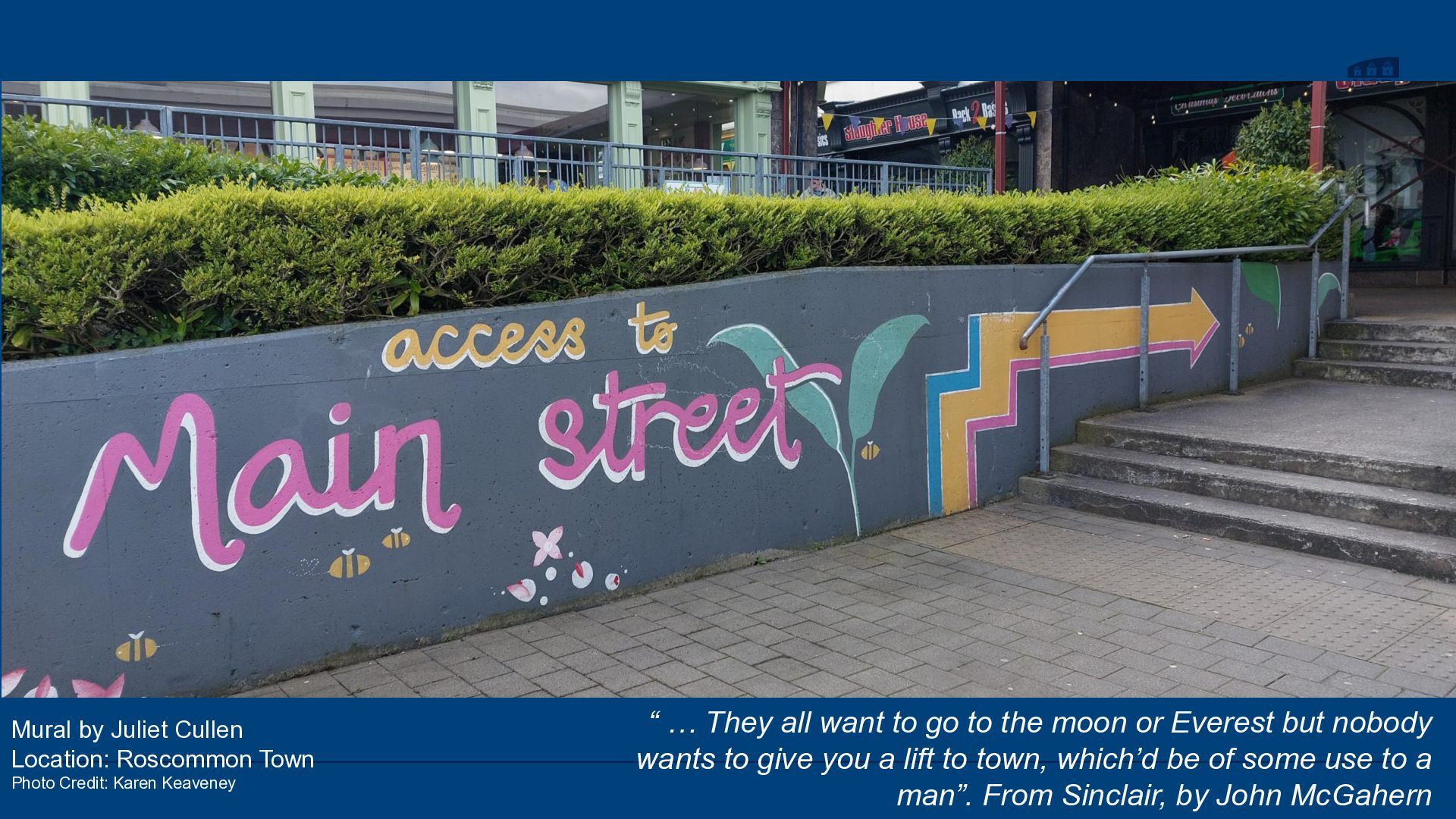
Keaveney “ … They all want to go to the moon or Everest but nobody wants to give you a lift to town, which’d be of some use to a man”. From Sinclair, by John McGahern
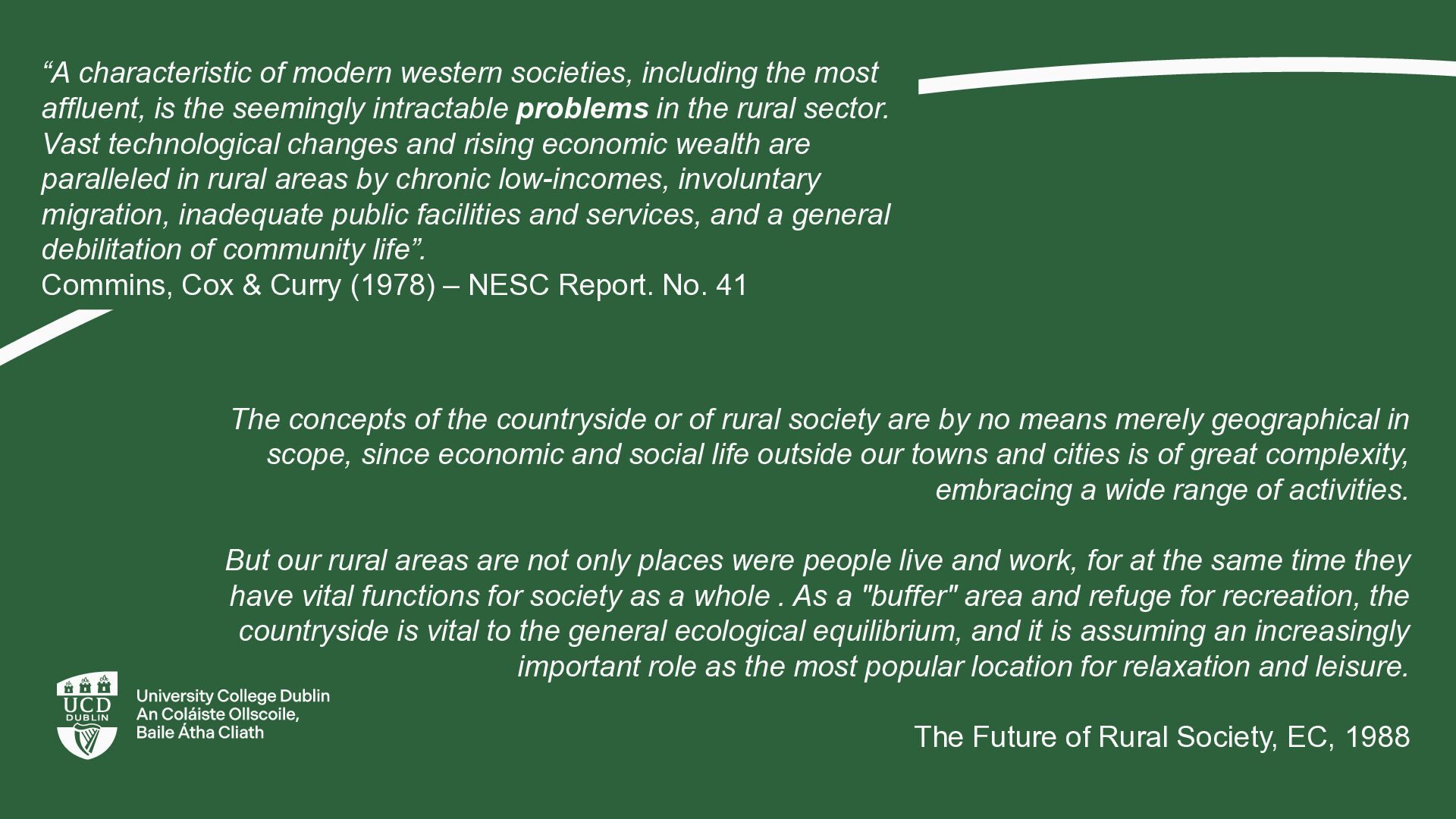
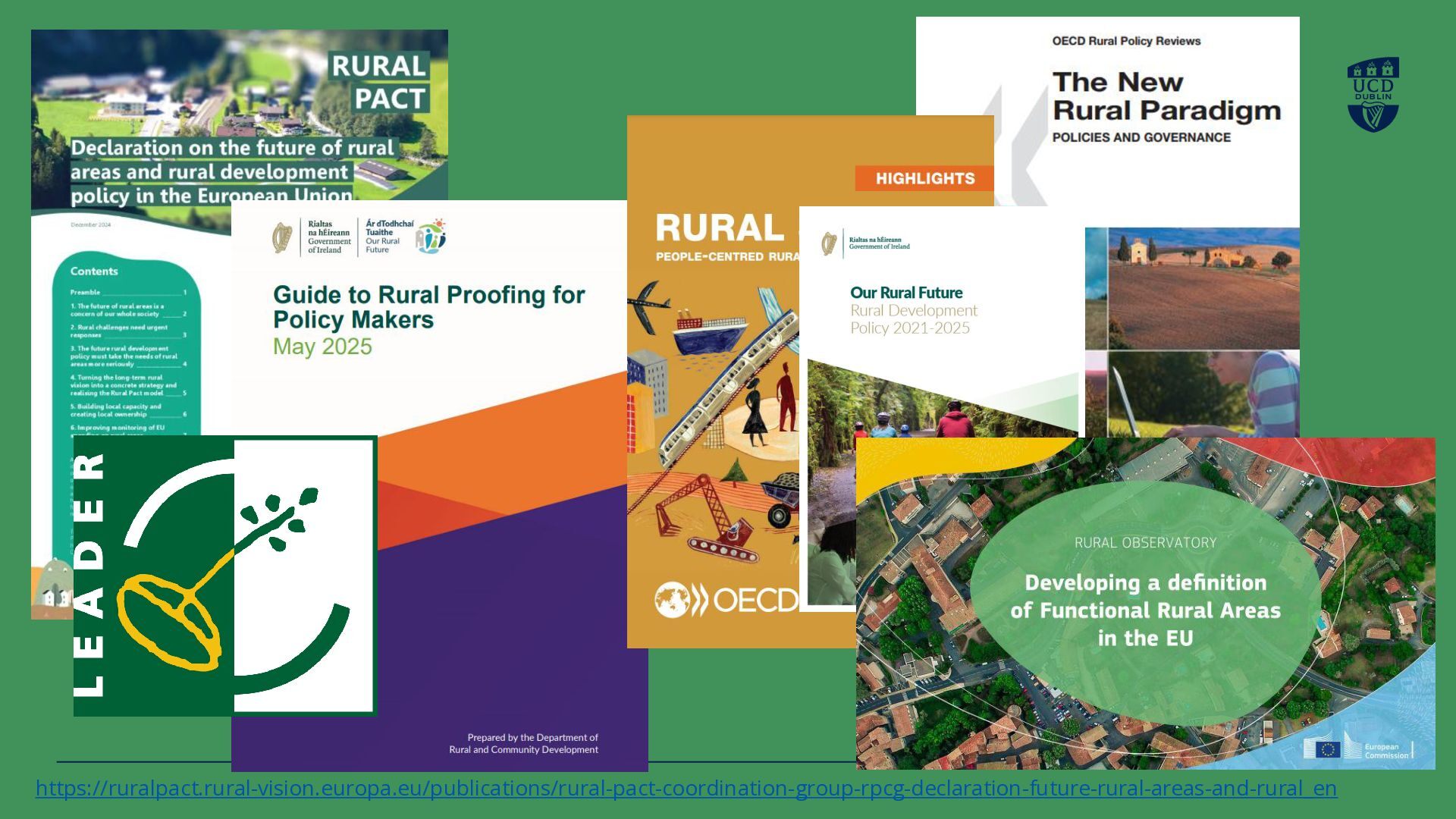
is the seemingly intractable problems in the rural sector. Vast technological changes and rising economic wealth are paralleled in rural areas by chronic low-incomes, involuntary migration, inadequate public facilities and services, and a general debilitation of community life”. Commins, Cox & Curry (1978) – NESC Report. No. 41 The concepts of the countryside or of rural society are by no means merely geographical in scope, since economic and social life outside our towns and cities is of great complexity, embracing a wide range of activities. But our rural areas are not only places were people live and work, for at the same time they have vital functions for society as a whole . As a "buffer" area and refuge for recreation, the countryside is vital to the general ecological equilibrium, and it is assuming an increasingly important role as the most popular location for relaxation and leisure. The Future of Rural Society, EC, 1988
making processes affecting them in an inclusive society based on the principles of equity, particularly in relation to gender balance and social justice” Delivering For The Future: A Strategy For Rural Development In Ireland White Paper on Rural Development 1999
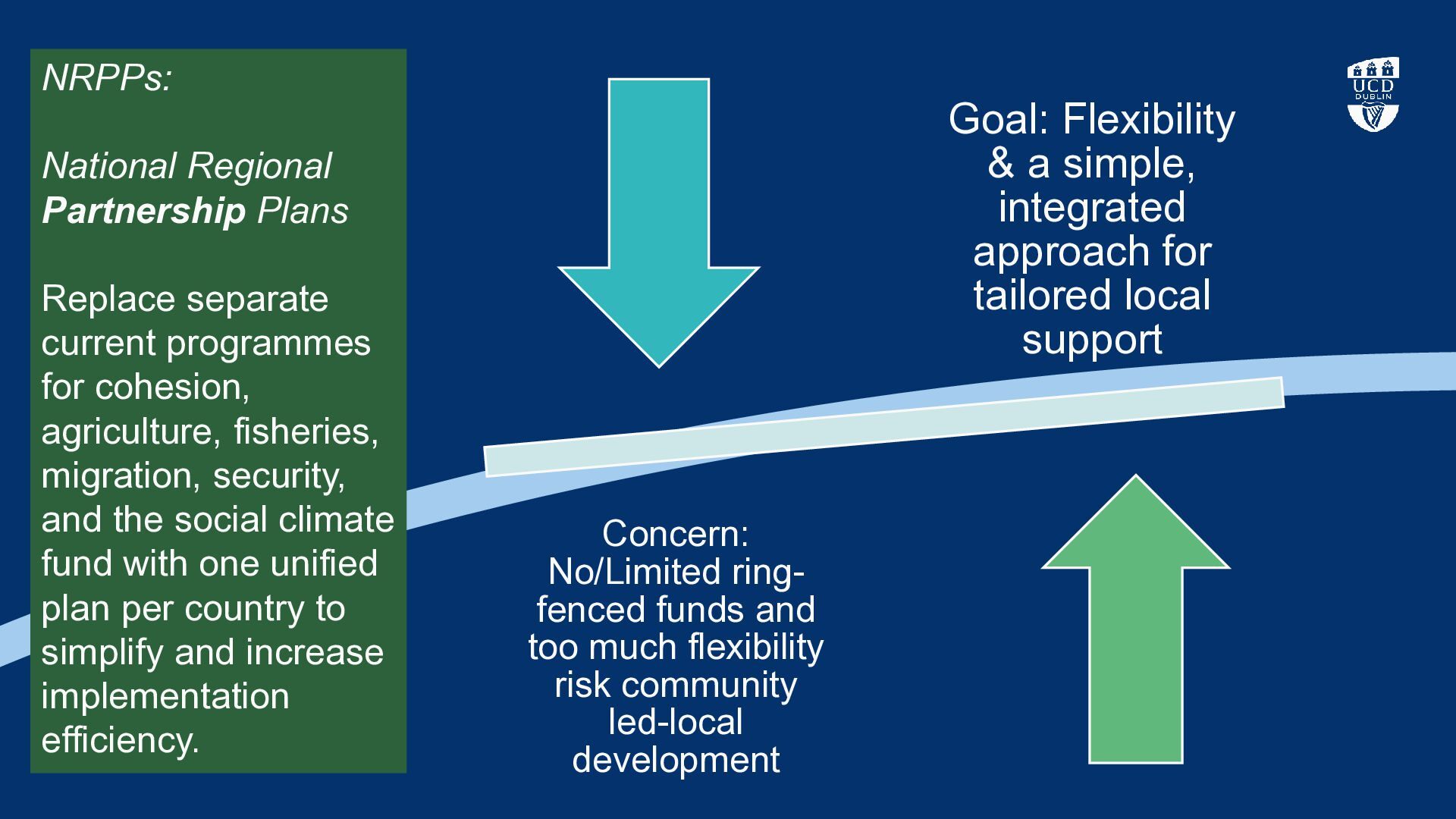
local support National Regional Partnership Plans Replace separate current programmes for cohesion, agriculture, fisheries, migration, security, and the social climate fund with one unified plan per country to simplify and increase implementation efficiency. Concern: No/Limited ringfenced funds and too much flexibility risk community led-local development
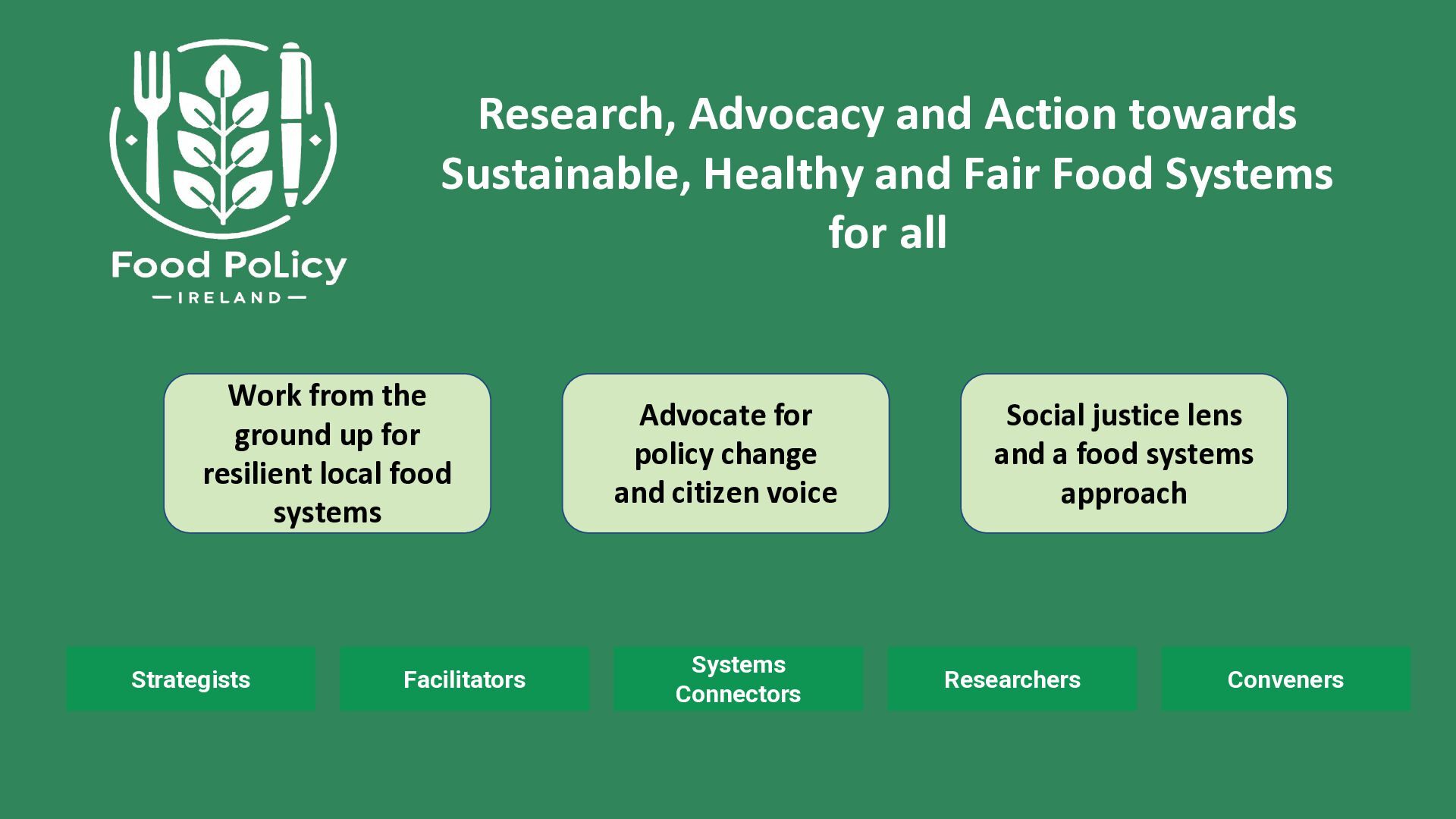
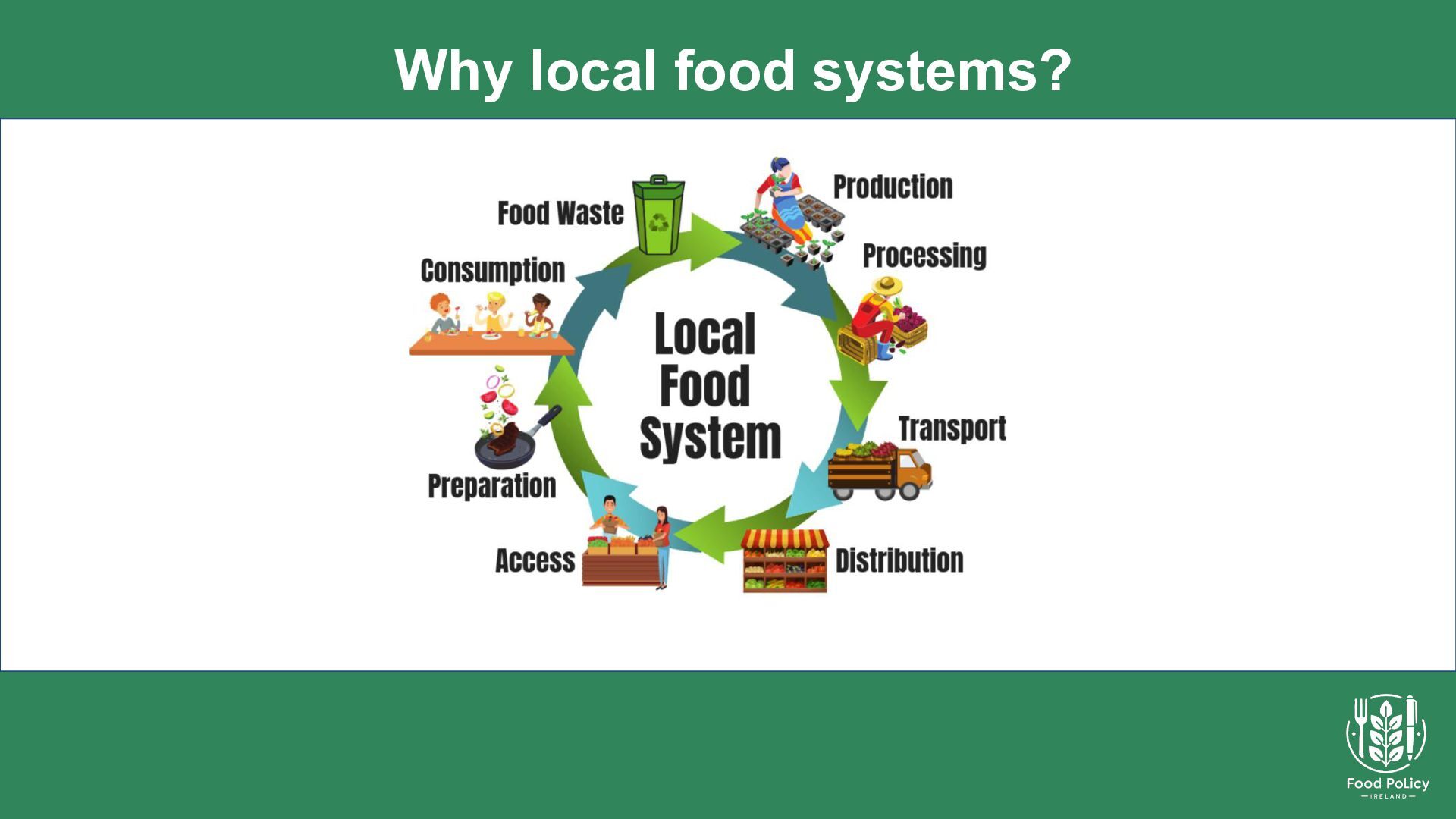
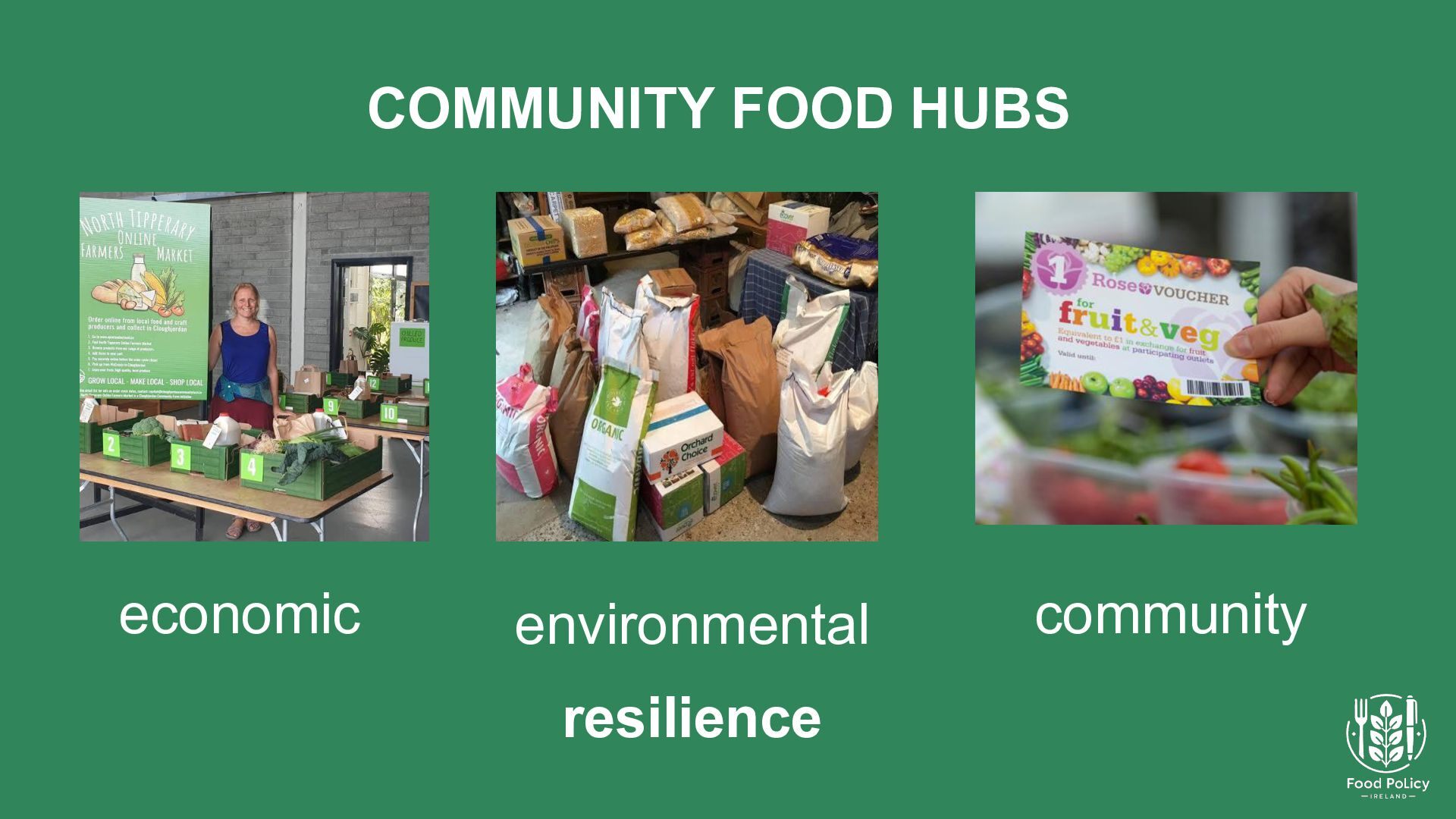
Systems for all Work from the ground up for resilient local food systems Strategists Facilitators Advocate for policy change and citizen voice Systems Connectors Social justice lens and a food systems approach Researchers Conveners
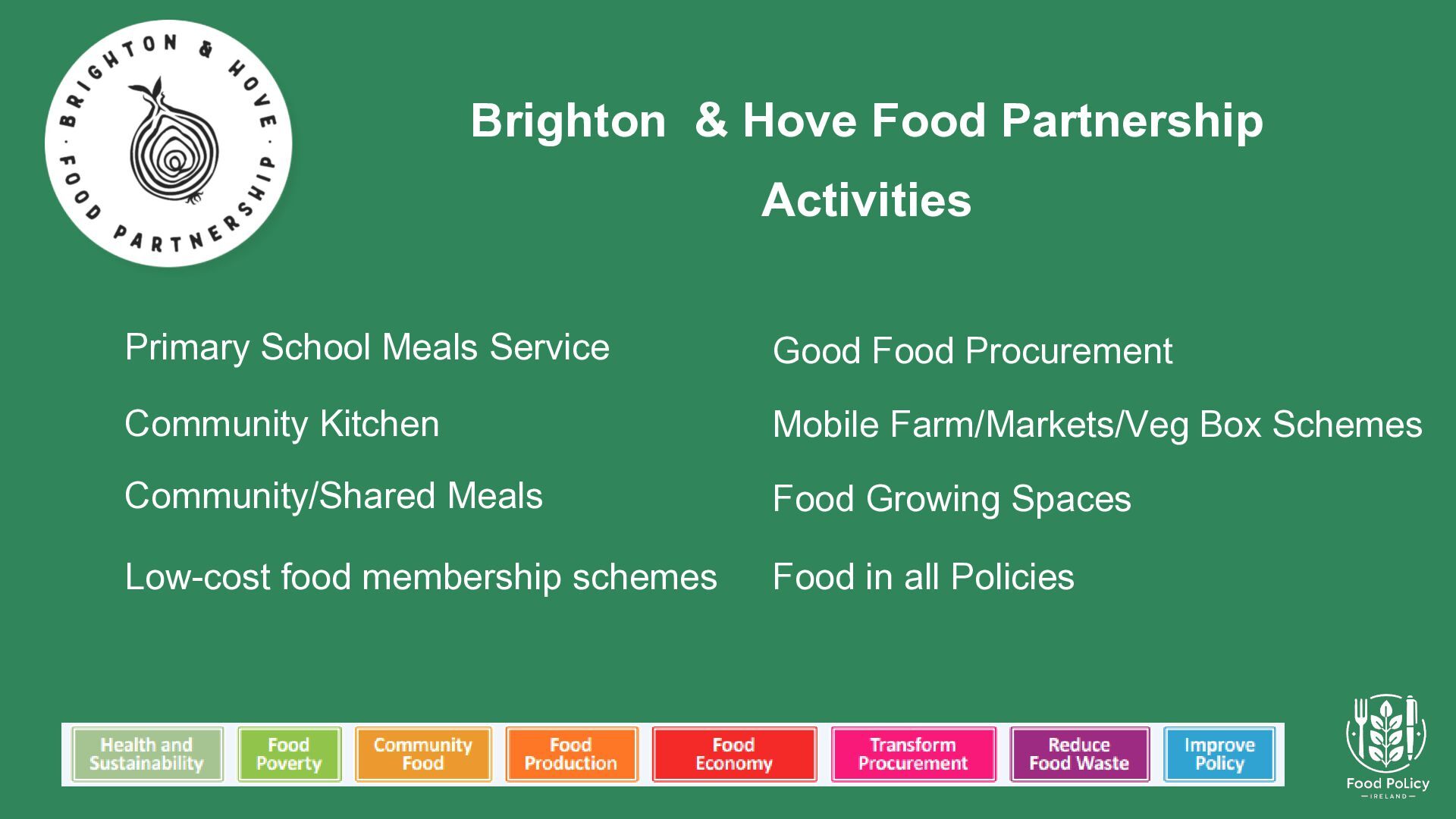
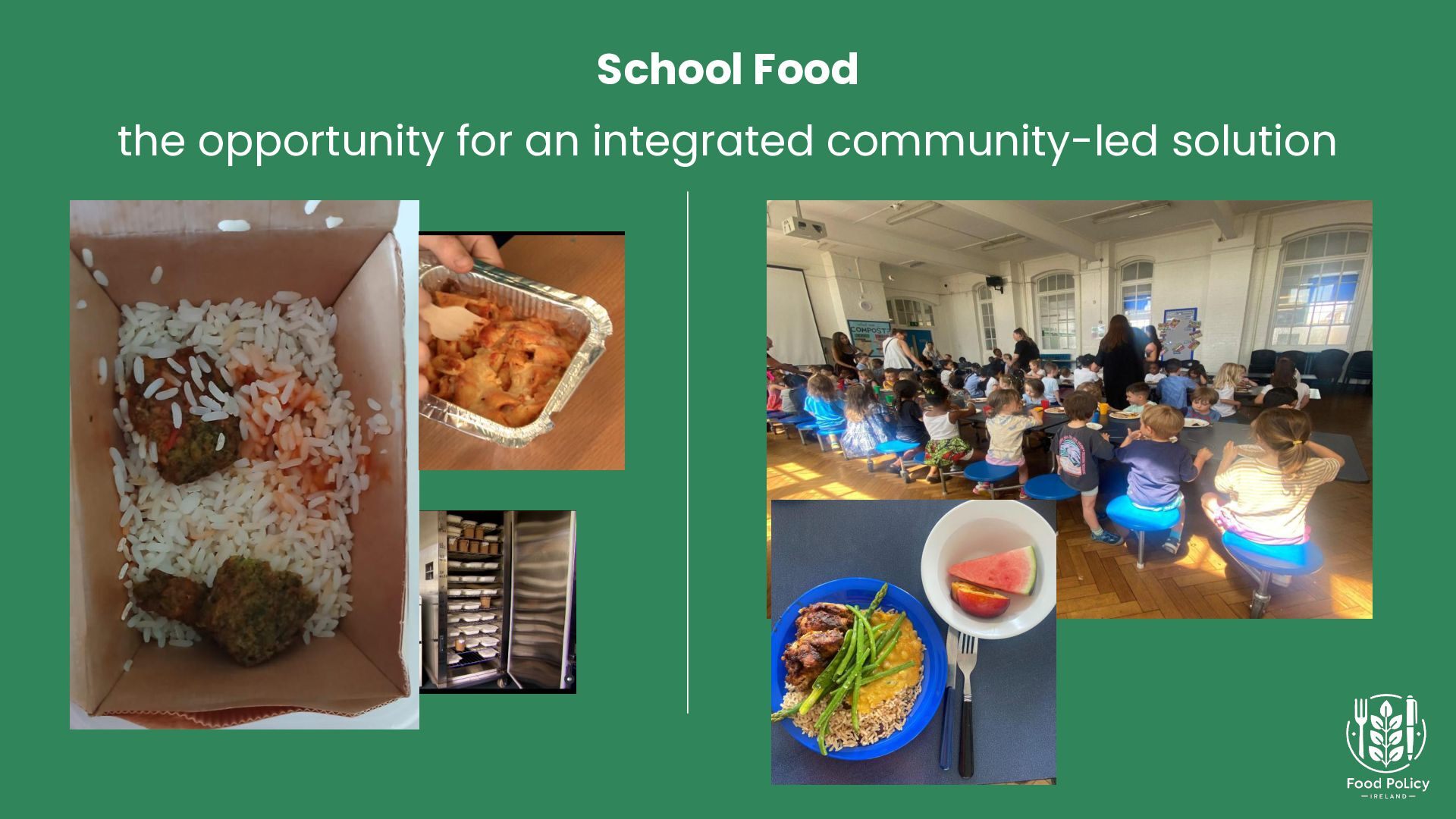
Good Food Procurement Community Kitchen Mobile Farm/Markets/Veg Box Schemes Community/Shared Meals Food Growing Spaces Low-cost food membership schemes Food in all Policies
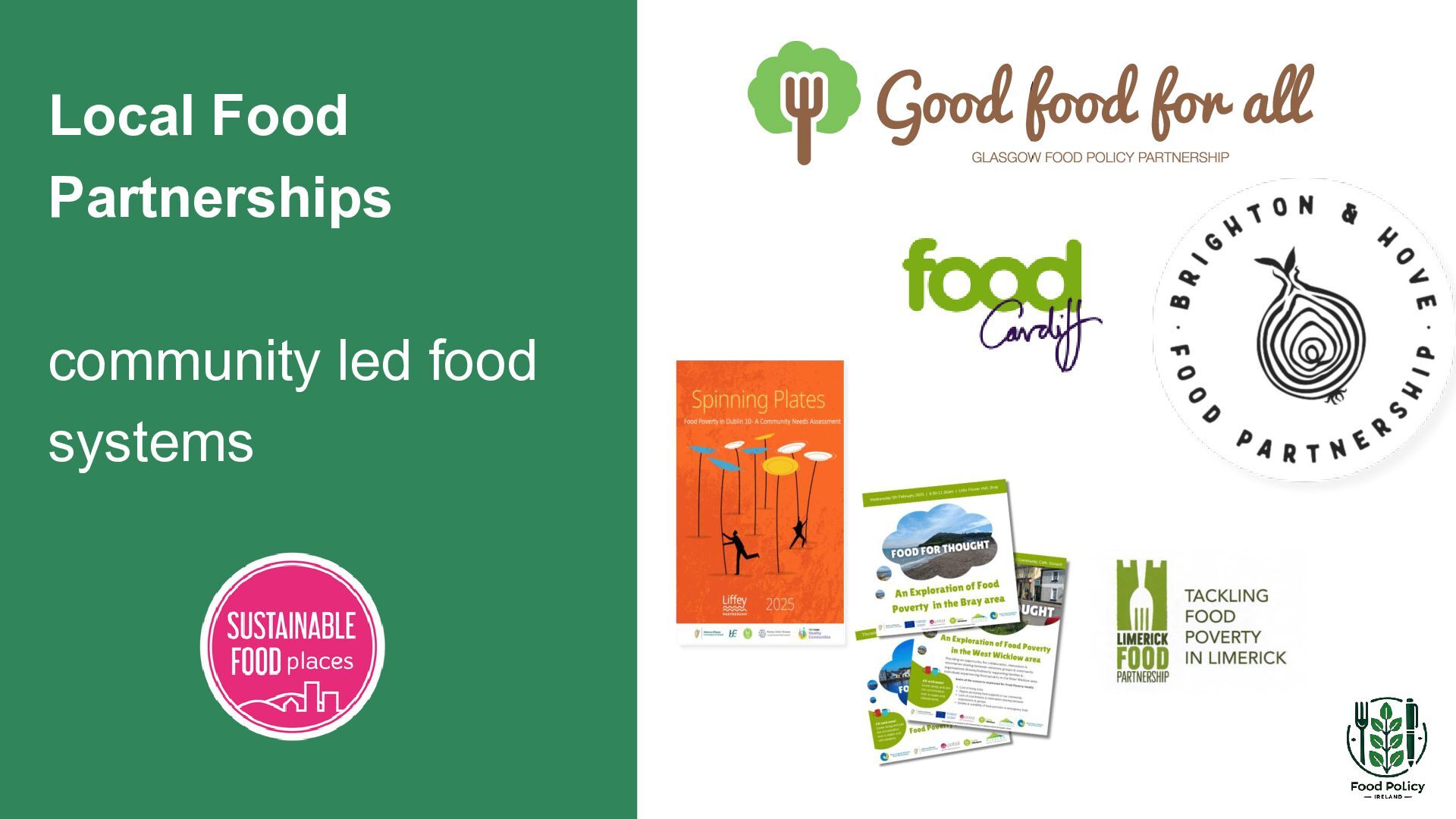
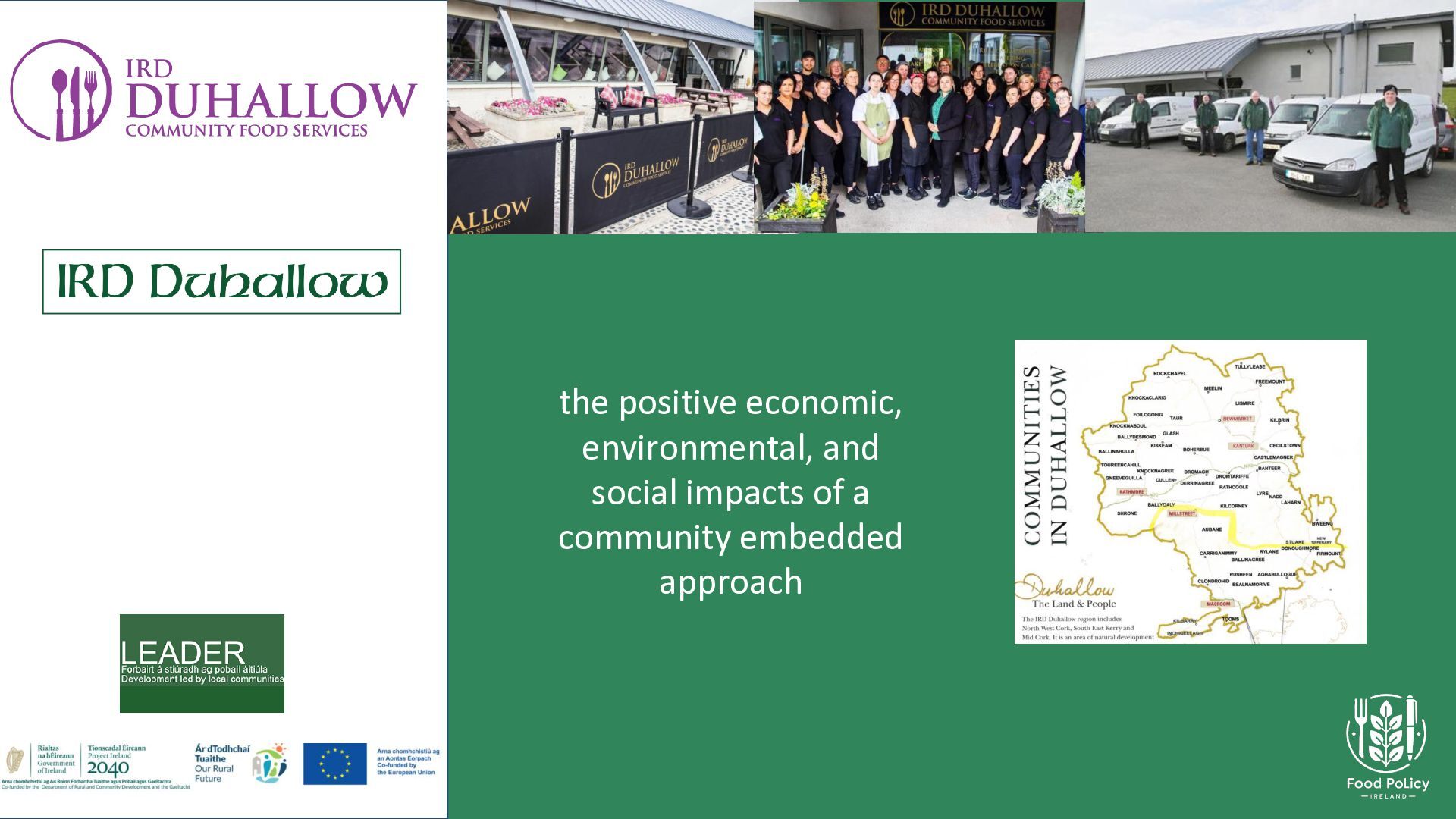
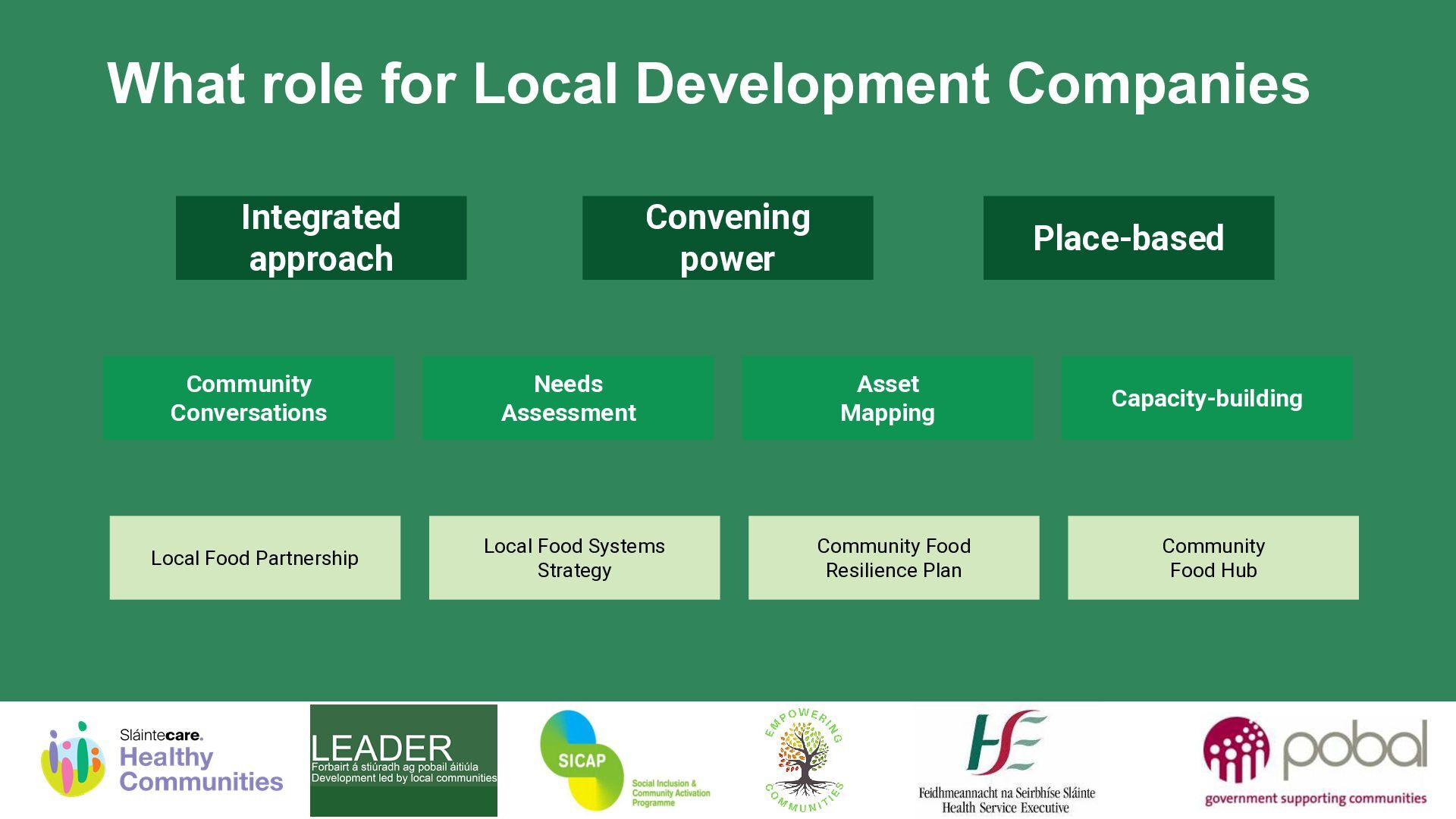
Place-based Community Conversations Needs Assessment Asset Mapping Capacity-building Local Food Partnership Local Food Systems Strategy Community Food Resilience Plan Community Food Hub
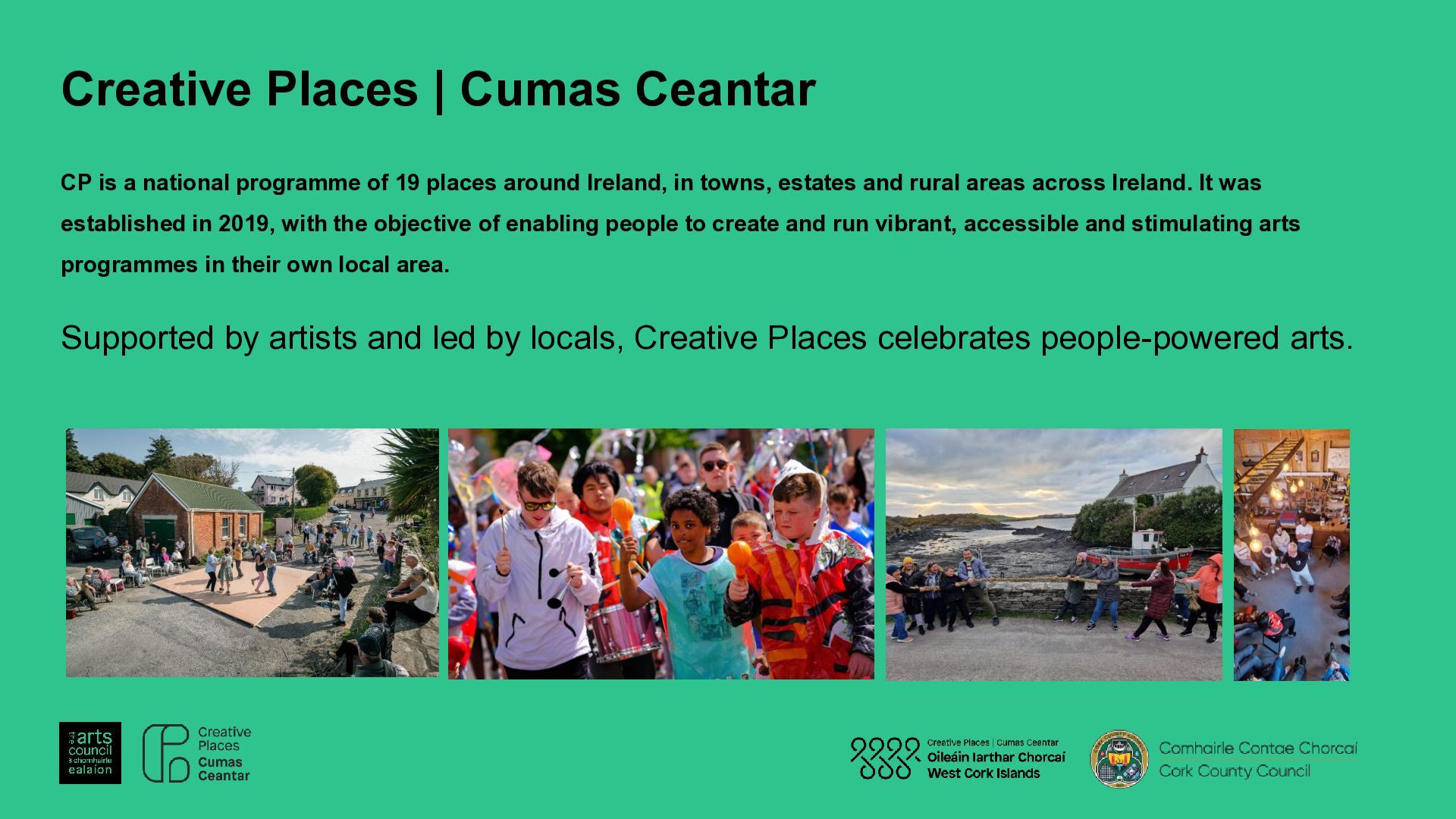
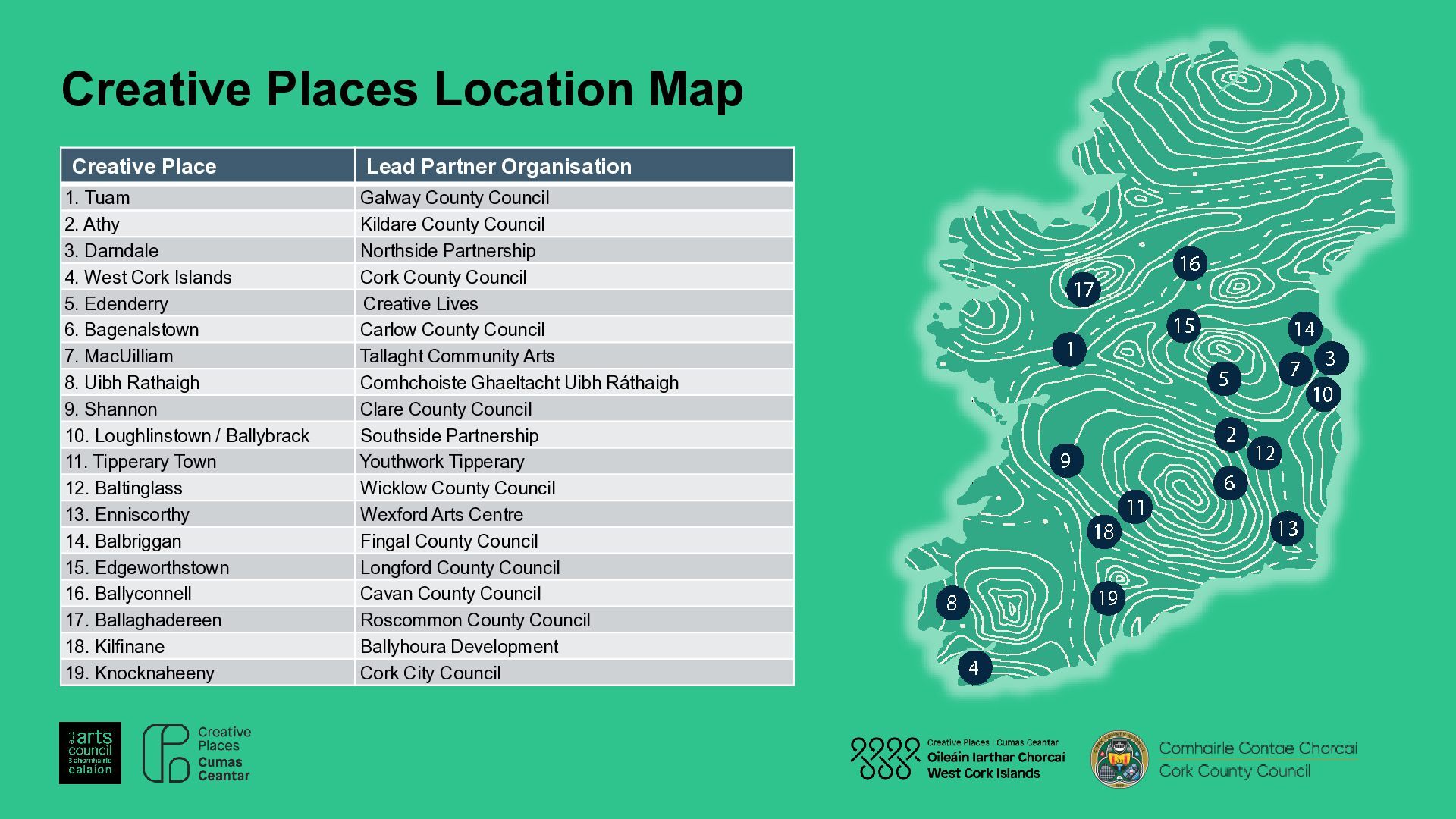
of 19 places around Ireland, in towns, estates and rural areas across Ireland. It was established in 2019, with the objective of enabling people to create and run vibrant, accessible and stimulating arts programmes in their own local area. Supported by artists and led by locals, Creative Places celebrates people-powered arts.
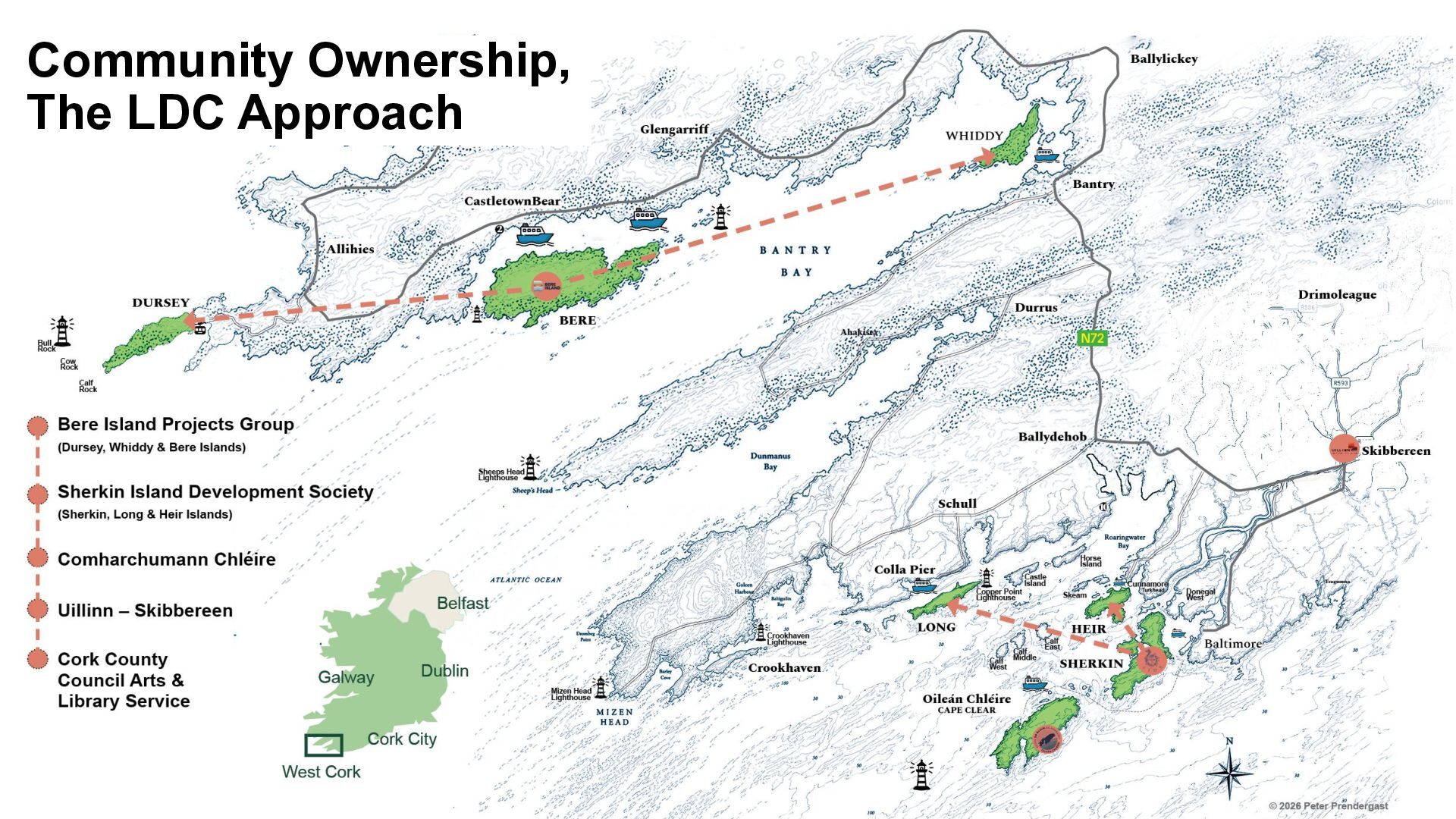
1. Tuam 2. Athy 3. Darndale 4. West Cork Islands 5. Edenderry 6. Bagenalstown 7. MacUilliam 8. Uibh Rathaigh 9. Shannon 10. Loughlinstown / Ballybrack 11. Tipperary Town 12. Baltinglass 13. Enniscorthy 14. Balbriggan 15. Edgeworthstown 16. Ballyconnell 17. Ballaghadereen 18. Kilfinane 19. Knocknaheeny Galway County Council Kildare County Council Northside Partnership Cork County Council Creative Lives Carlow County Council Tallaght Community Arts Comhchoiste Ghaeltacht Uibh Ráthaigh Clare County Council Southside Partnership Youthwork Tipperary Wicklow County Council Wexford Arts Centre Fingal County Council Longford County Council Cavan County Council Roscommon County Council Ballyhoura Development Cork City Council
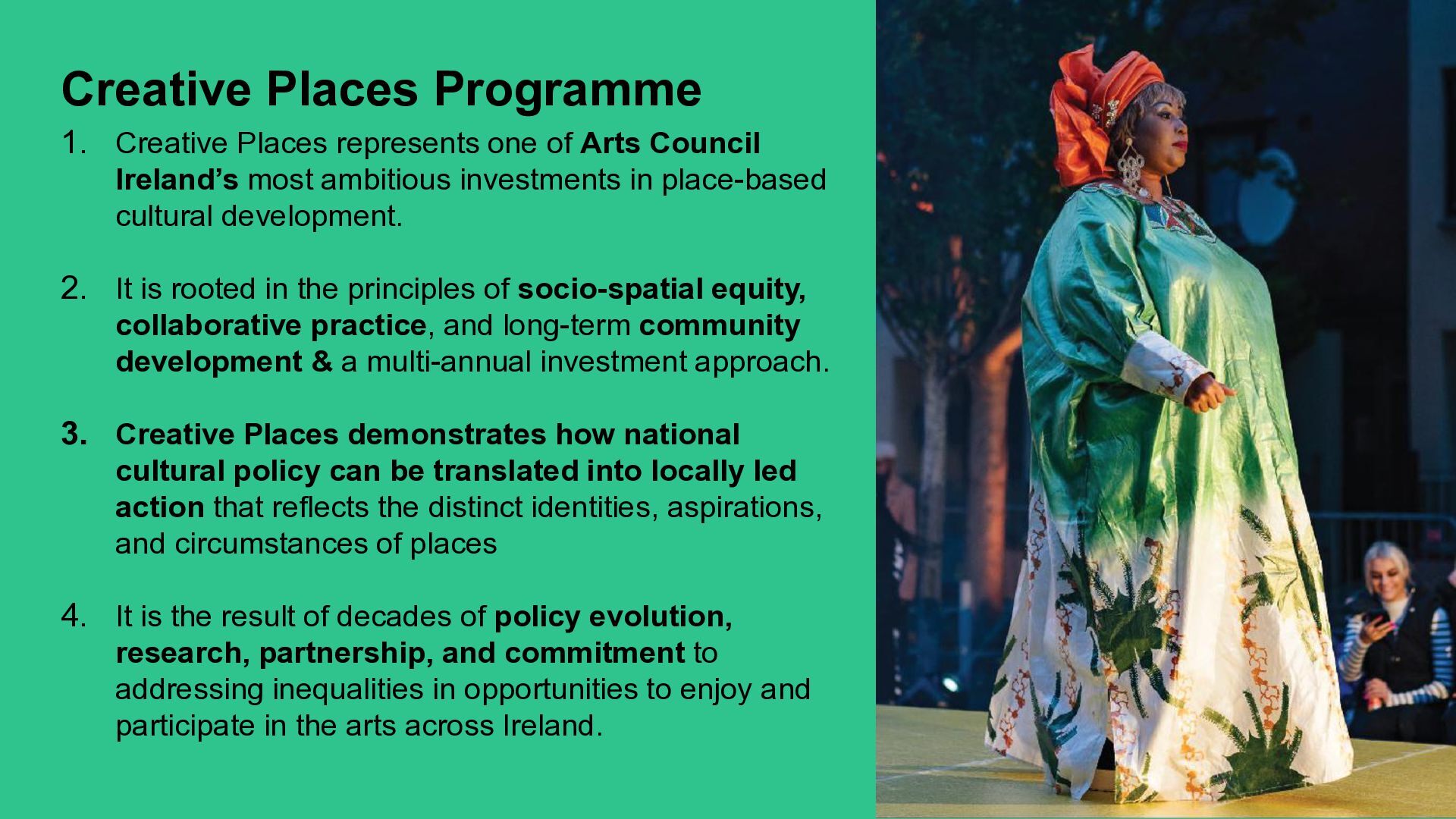
Council Ireland’s most ambitious investments in place-based cultural development. 2. It is rooted in the principles of socio-spatial equity, collaborative practice, and long-term community development & a multi-annual investment approach. 3. Creative Places demonstrates how national cultural policy can be translated into locally led action that reflects the distinct identities, aspirations, and circumstances of places 4. It is the result of decades of policy evolution, research, partnership, and commitment to addressing inequalities in opportunities to enjoy and participate in the arts across Ireland.
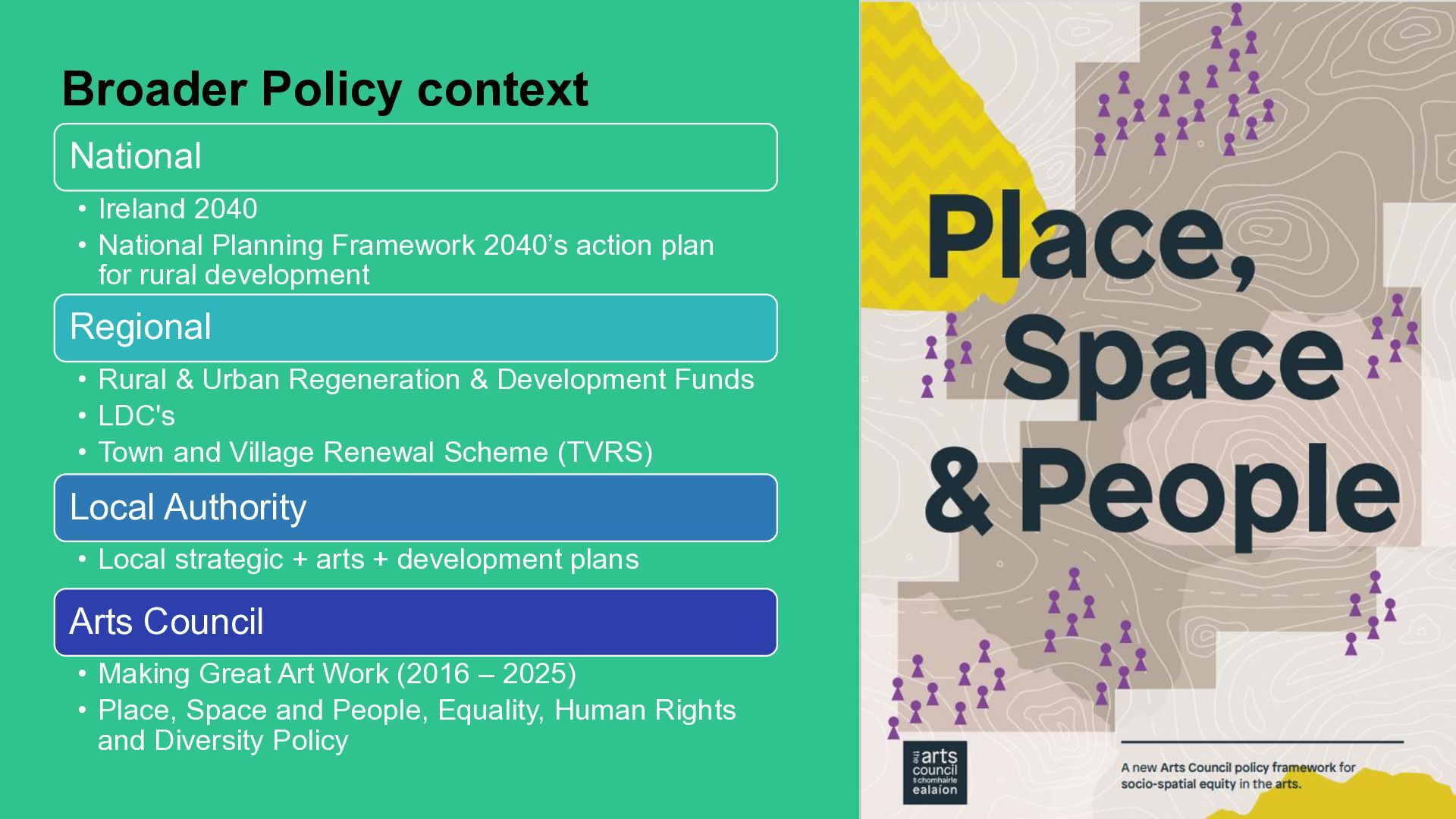
Framework 2040’s action plan for rural development Regional • Rural & Urban Regeneration & Development Funds • LDC's • Town and Village Renewal Scheme (TVRS) Local Authority • Local strategic + arts + development plans Arts Council • Making Great Art Work (2016 – 2025) • Place, Space and People, Equality, Human Rights and Diversity Policy
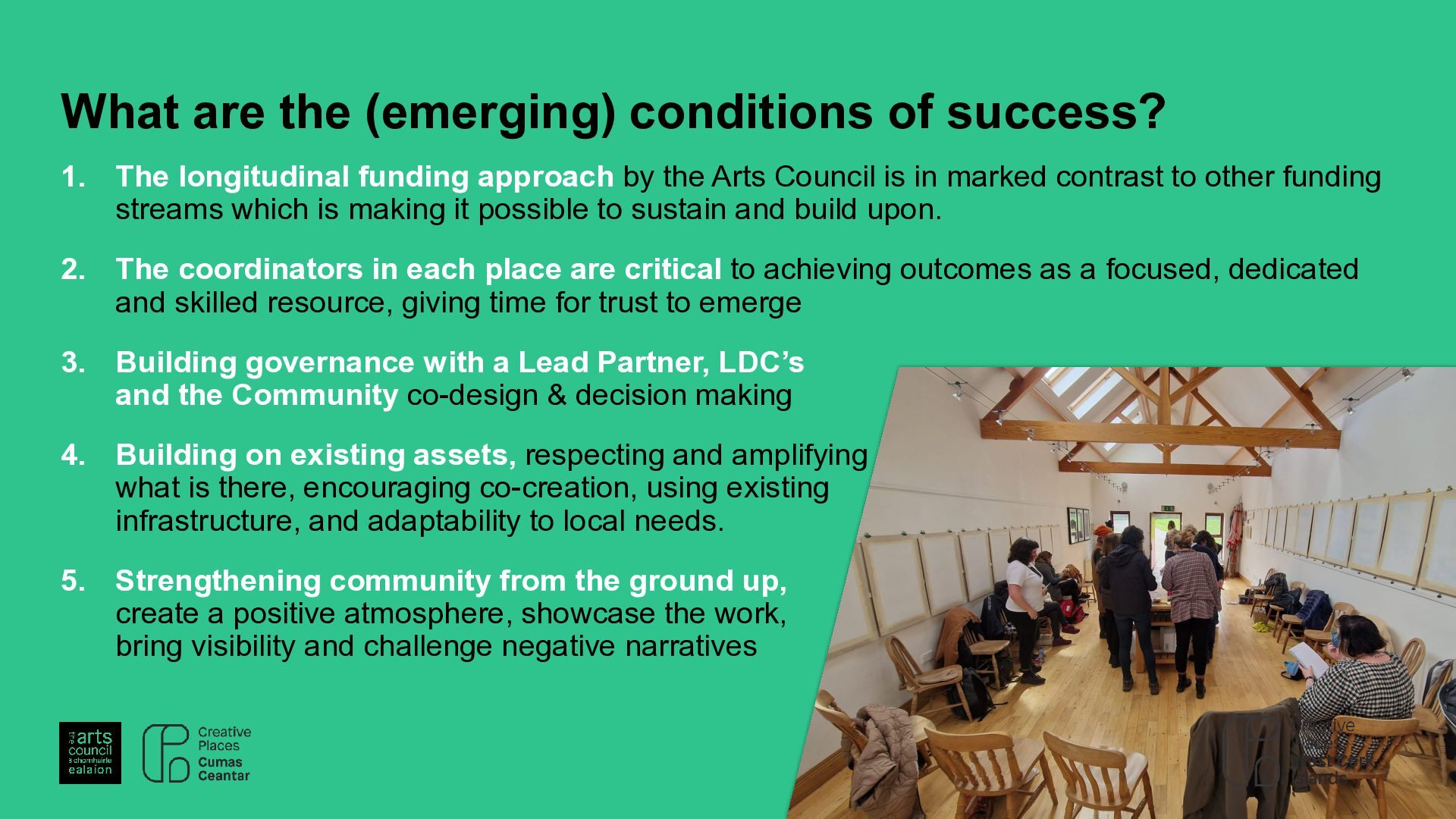
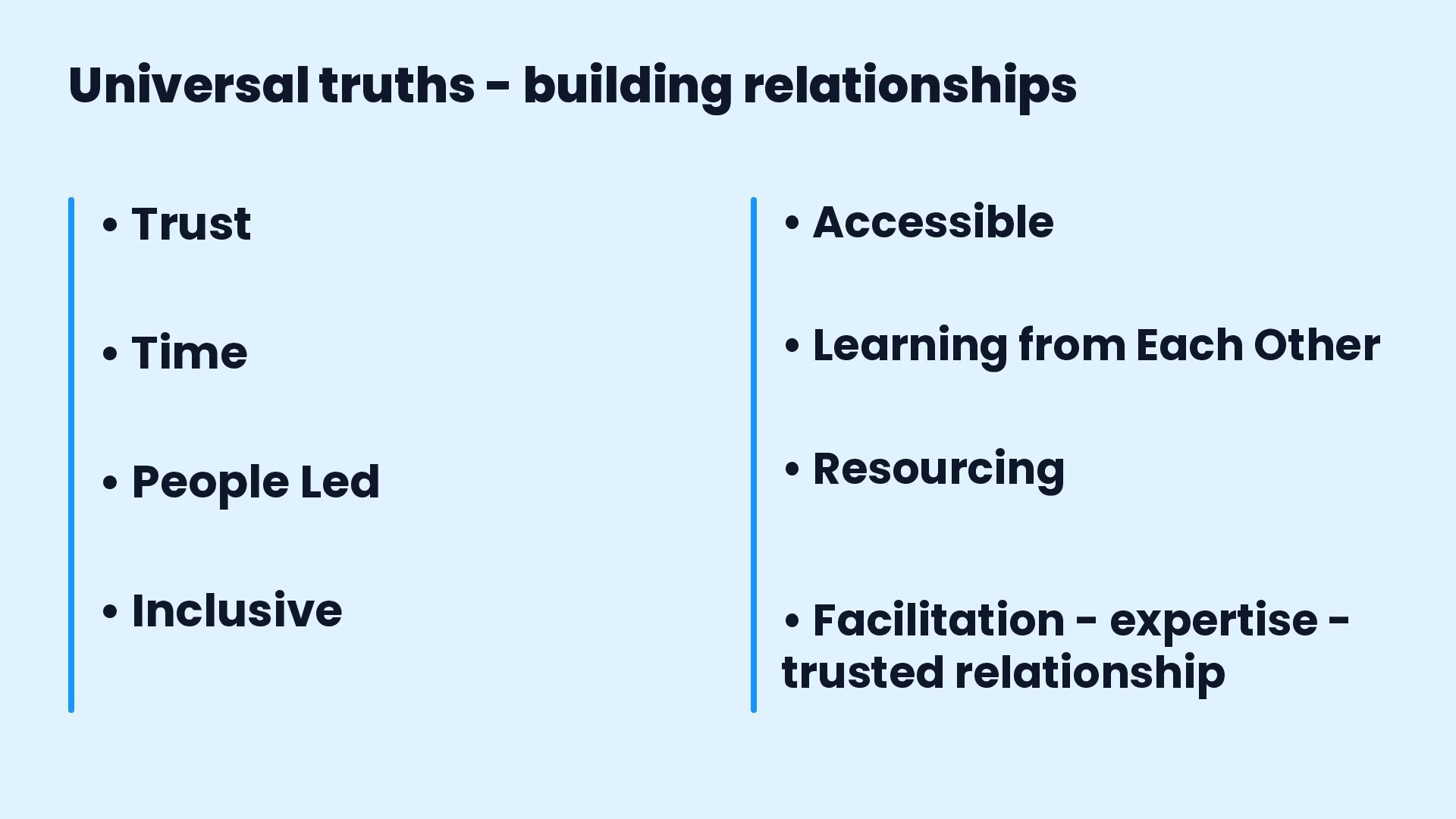
funding approach by the Arts Council is in marked contrast to other funding streams which is making it possible to sustain and build upon. 2. The coordinators in each place are critical to achieving outcomes as a focused, dedicated and skilled resource, giving time for trust to emerge 3. Building governance with a Lead Partner, LDC’s and the Community co-design & decision making 4. Building on existing assets, respecting and amplifying what is there, encouraging co-creation, using existing infrastructure, and adaptability to local needs. 5. Strengthening community from the ground up, create a positive atmosphere, showcase the work, bring visibility and challenge negative narratives
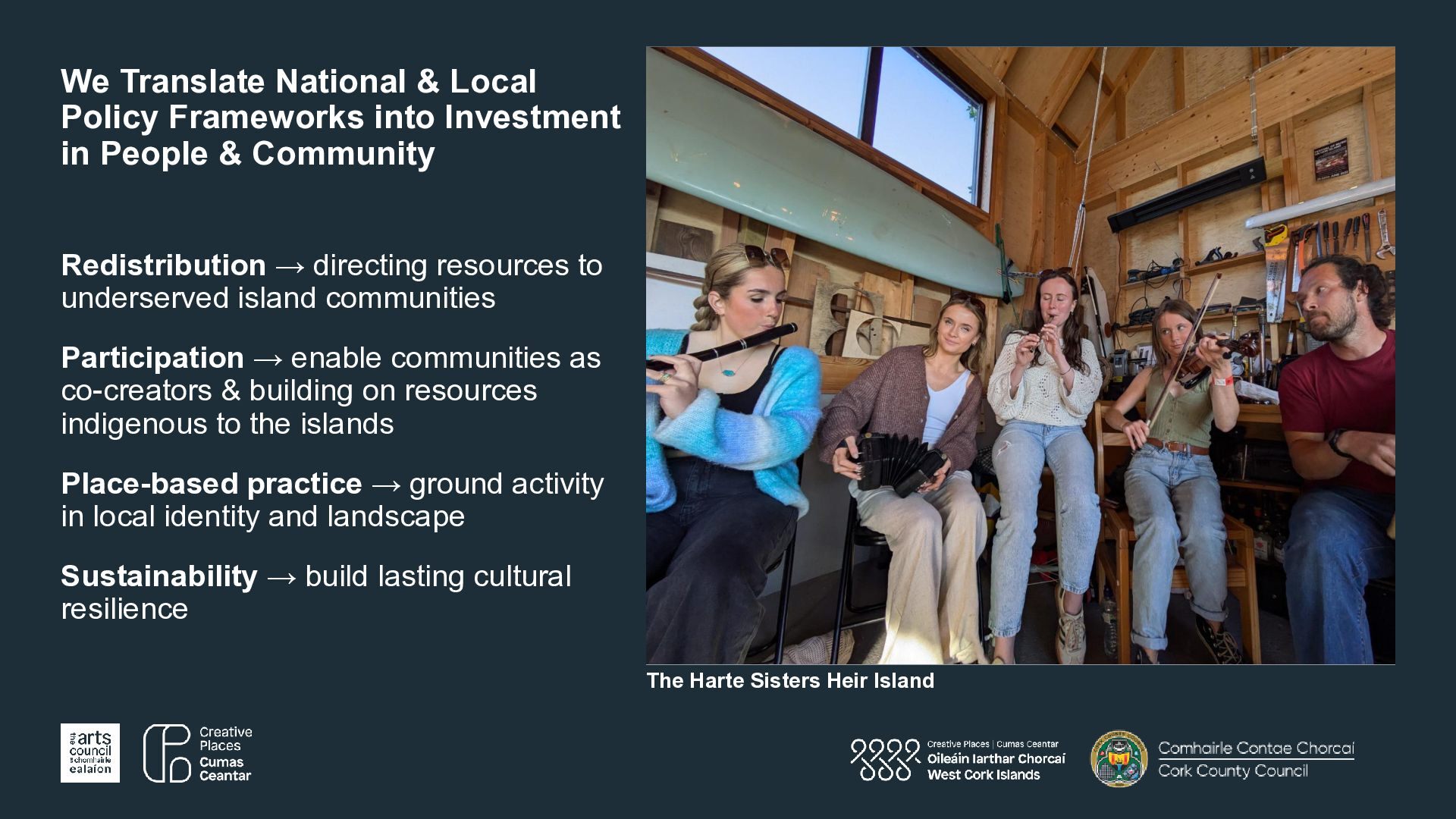
People & Community Redistribution → directing resources to underserved island communities Participation → enable communities as co-creators & building on resources indigenous to the islands Place-based practice → ground activity in local identity and landscape Sustainability → build lasting cultural resilience The Harte Sisters Heir Island
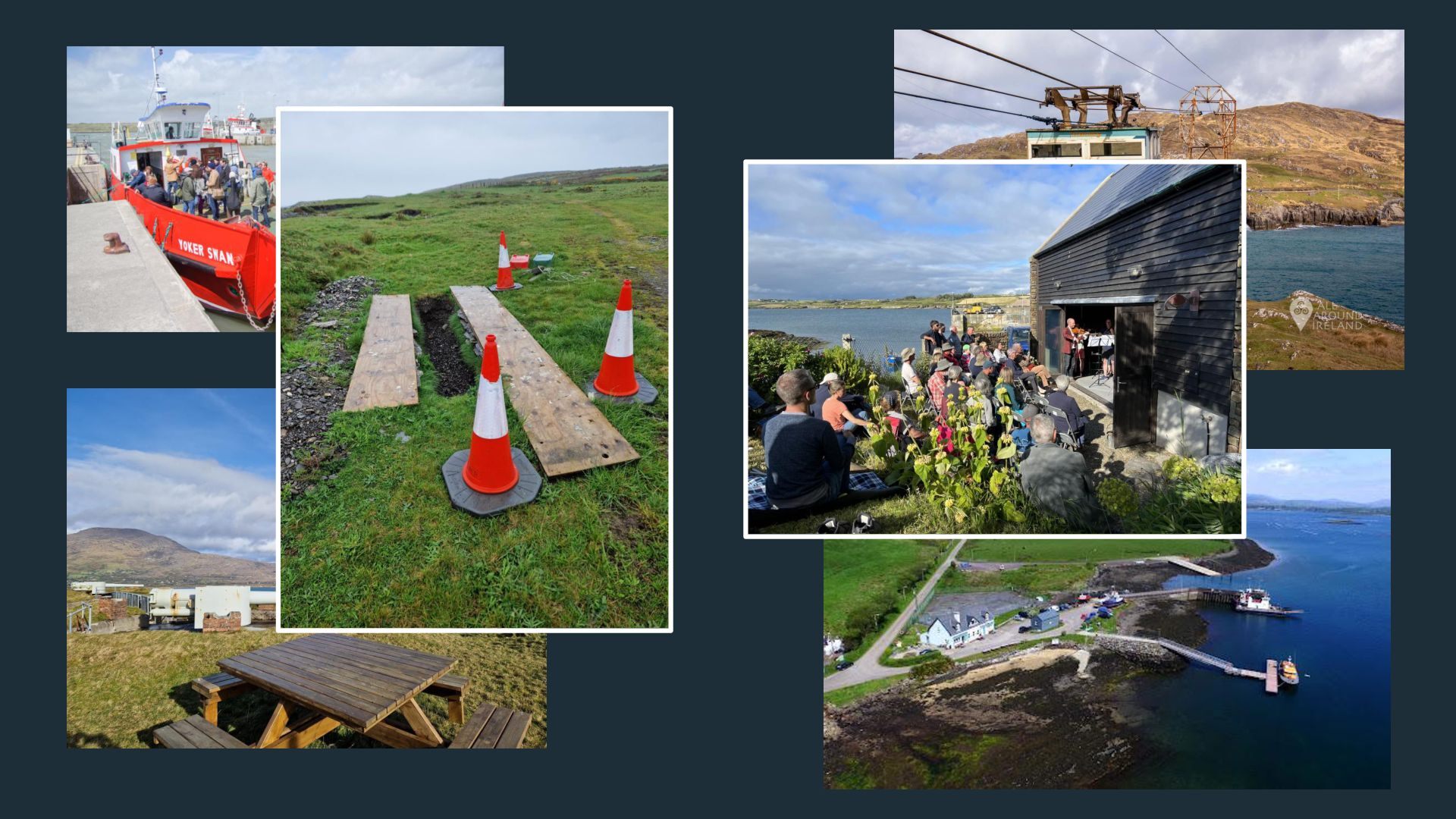
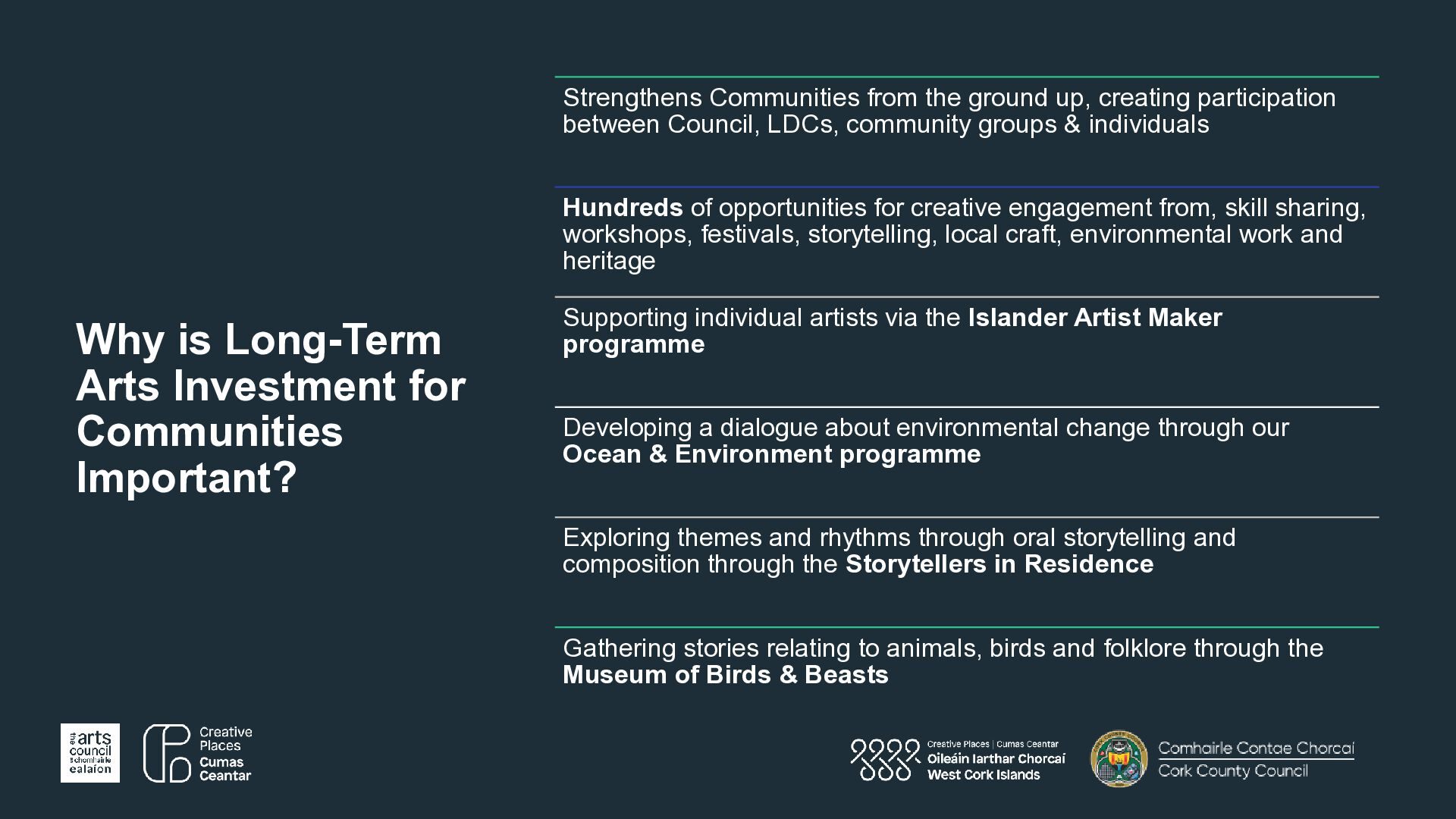
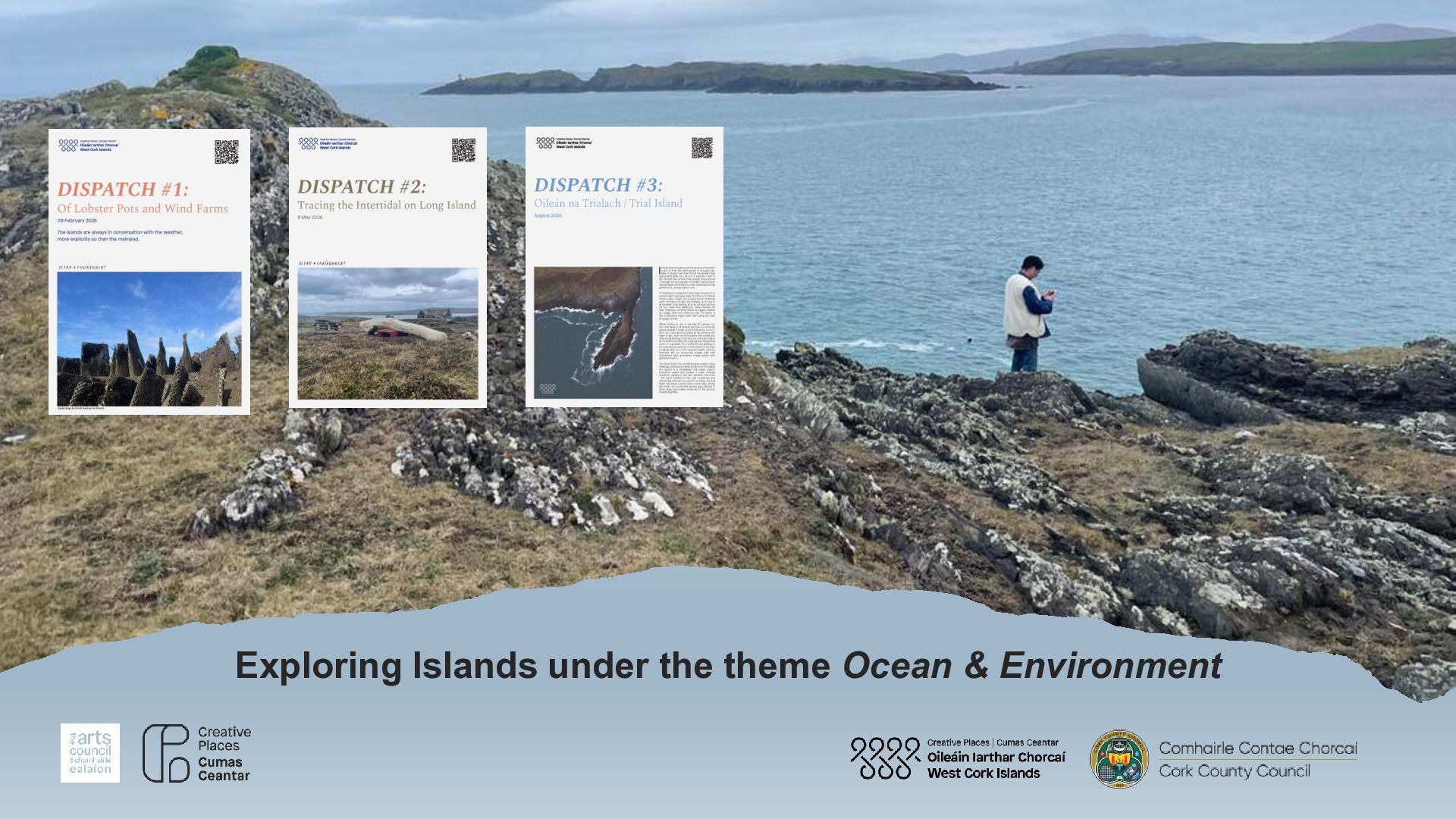
LDCs, community groups & individuals Hundreds of opportunities for creative engagement from, skill sharing, workshops, festivals, storytelling, local craft, environmental work and heritage Why is Long-Term Arts Investment for Communities Important? Supporting individual artists via the Islander Artist Maker programme Developing a dialogue about environmental change through our Ocean & Environment programme Exploring themes and rhythms through oral storytelling and composition through the Storytellers in Residence Gathering stories relating to animals, birds and folklore through the Museum of Birds & Beasts
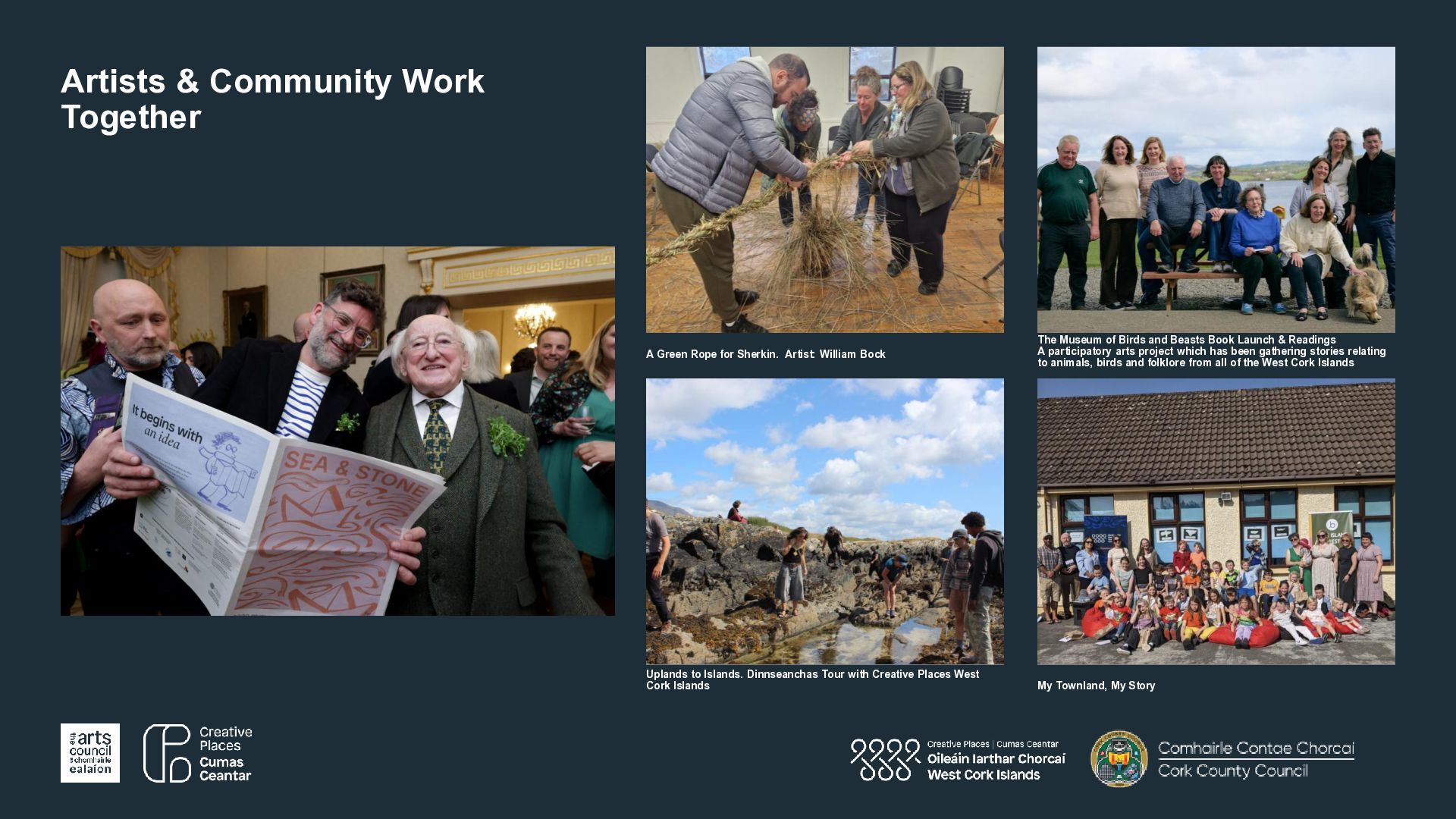
Artist: William Bock The Museum of Birds and Beasts Book Launch & Readings A participatory arts project which has been gathering stories relating to animals, birds and folklore from all of the West Cork Islands A 7 Islands Newspaper for & About the West Cork Islands Uplands to Islands. Dinnseanchas Tour with Creative Places West Cork Islands My Townland, My Story
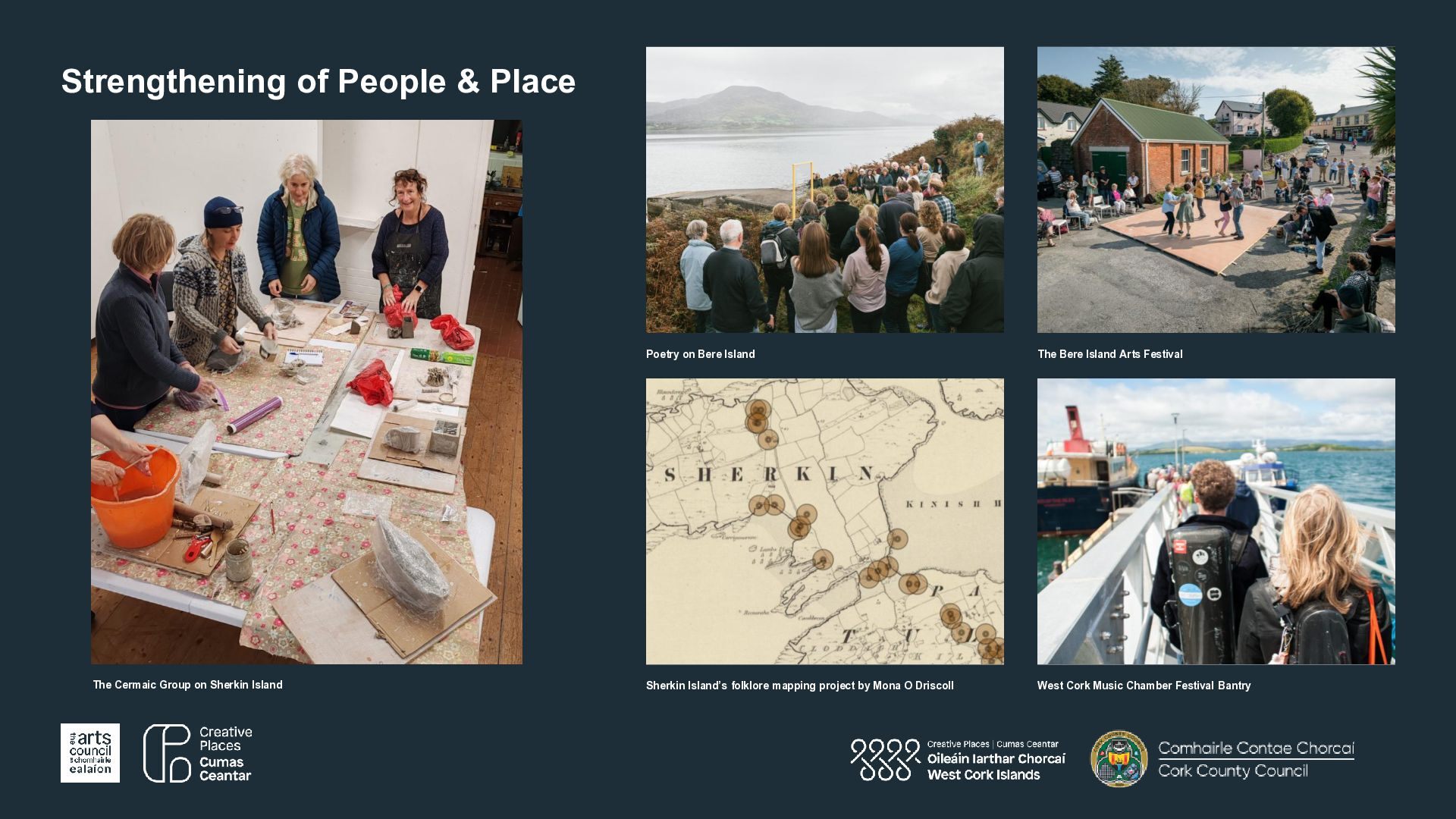
Island Poetry on Bere Island The Bere Island Arts Festival Sherkin Island’s folklore mapping project by Mona O Driscoll West Cork Music Chamber Festival Bantry
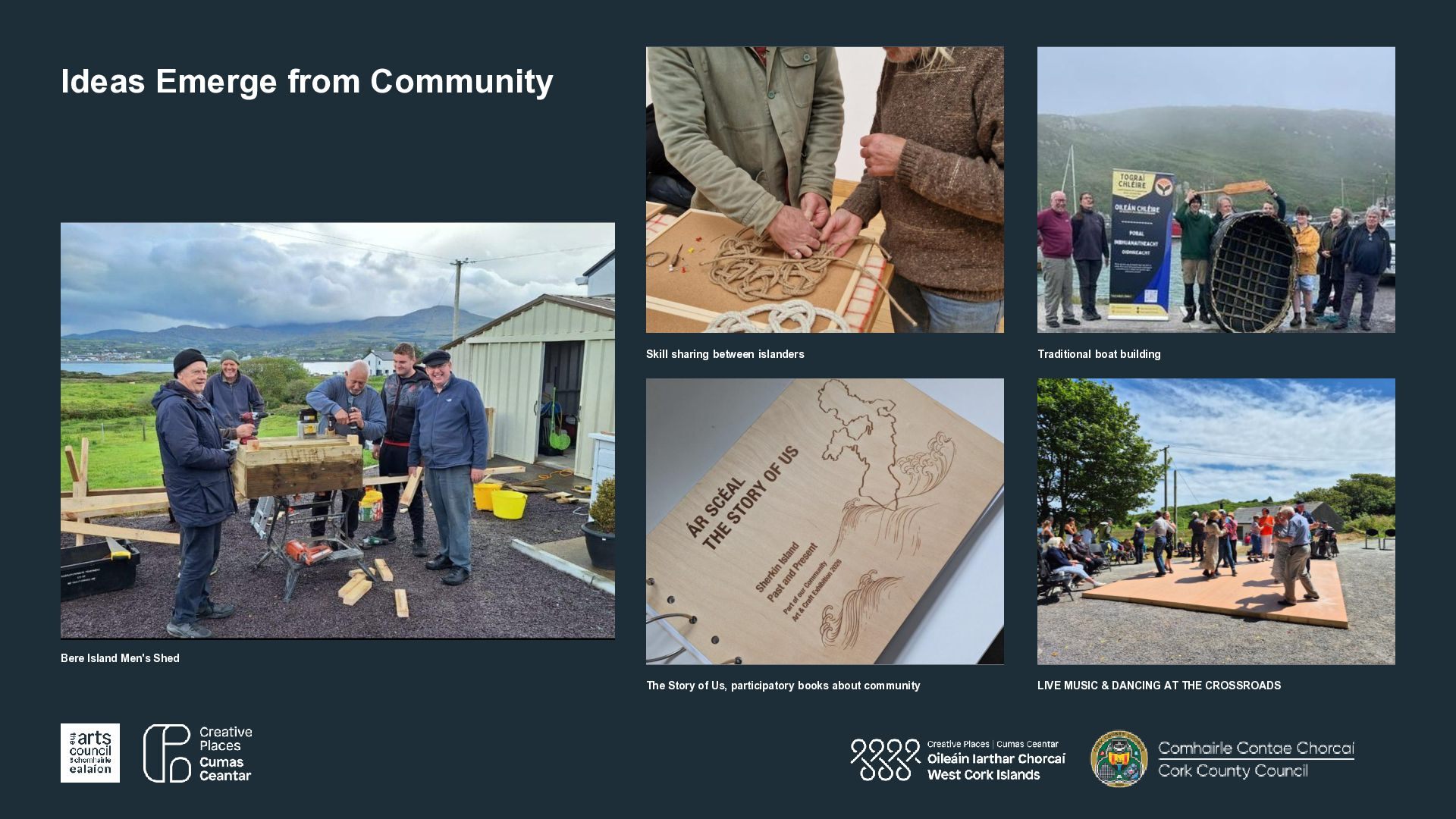
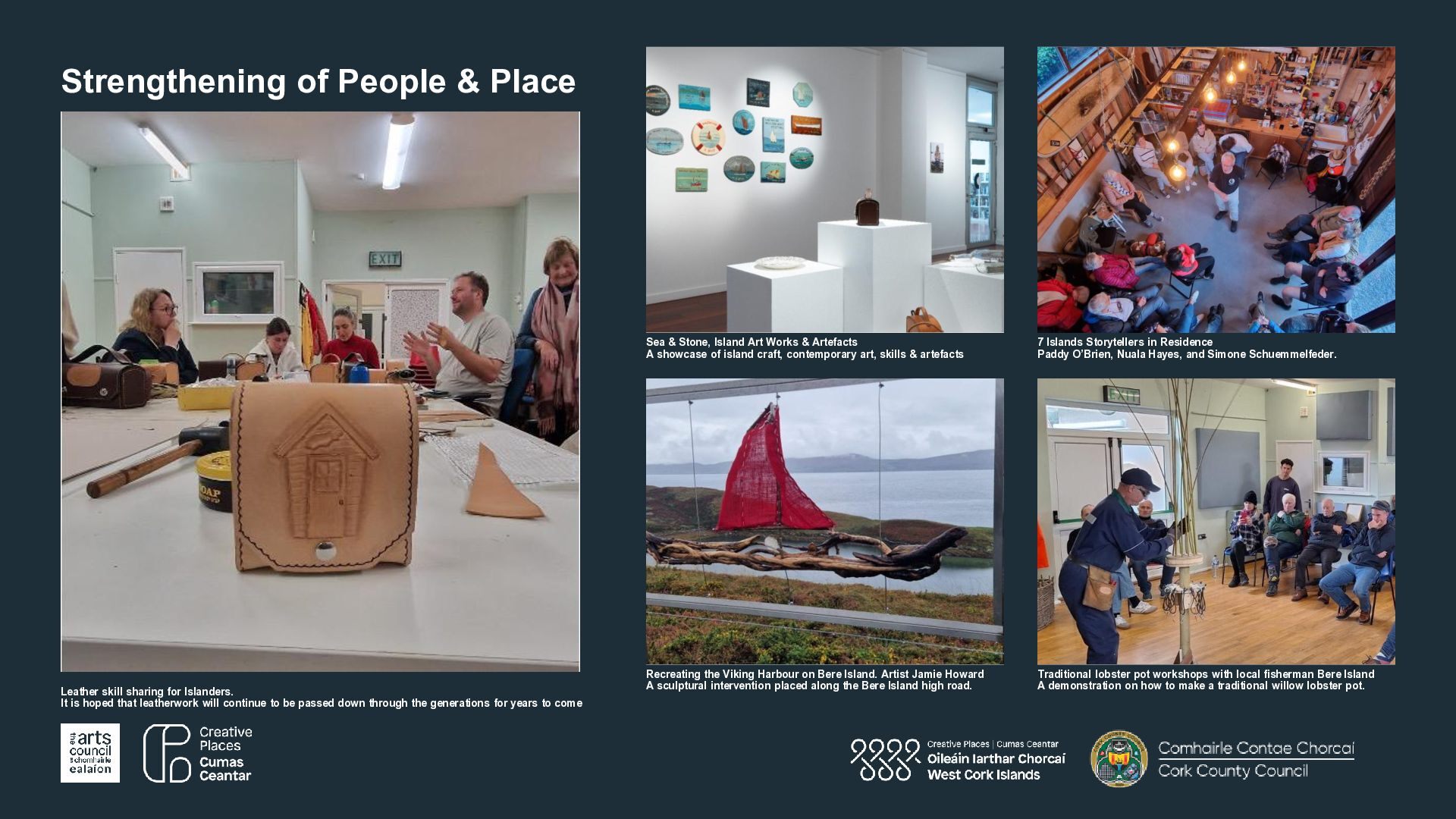
It is hoped that leatherwork will continue to be passed down through the generations for years to come Sea & Stone, Island Art Works & Artefacts A showcase of island craft, contemporary art, skills & artefacts 7 Islands Storytellers in Residence Paddy O’Brien, Nuala Hayes, and Simone Schuemmelfeder. Recreating the Viking Harbour on Bere Island. Artist Jamie Howard A sculptural intervention placed along the Bere Island high road. Traditional lobster pot workshops with local fisherman Bere Island A demonstration on how to make a traditional willow lobster pot.
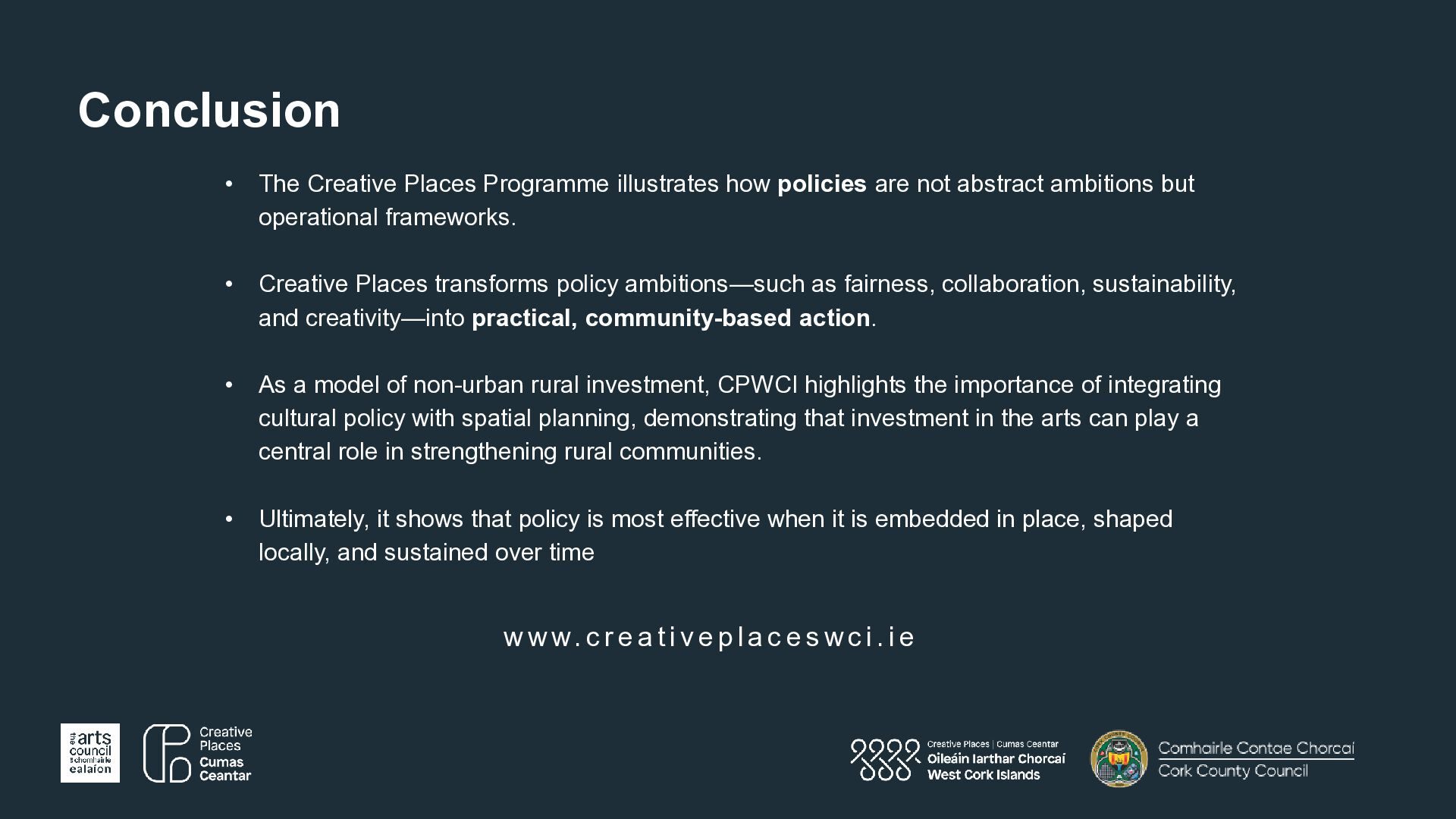
not abstract ambitions but operational frameworks. • Creative Places transforms policy ambitions—such as fairness, collaboration, sustainability, and creativity—into practical, community-based action. • As a model of non-urban rural investment, CPWCI highlights the importance of integrating cultural policy with spatial planning, demonstrating that investment in the arts can play a central role in strengthening rural communities. • Ultimately, it shows that policy is most effective when it is embedded in place, shaped locally, and sustained over time w w w. c r e a t i v e p l a c e s w c i . i e
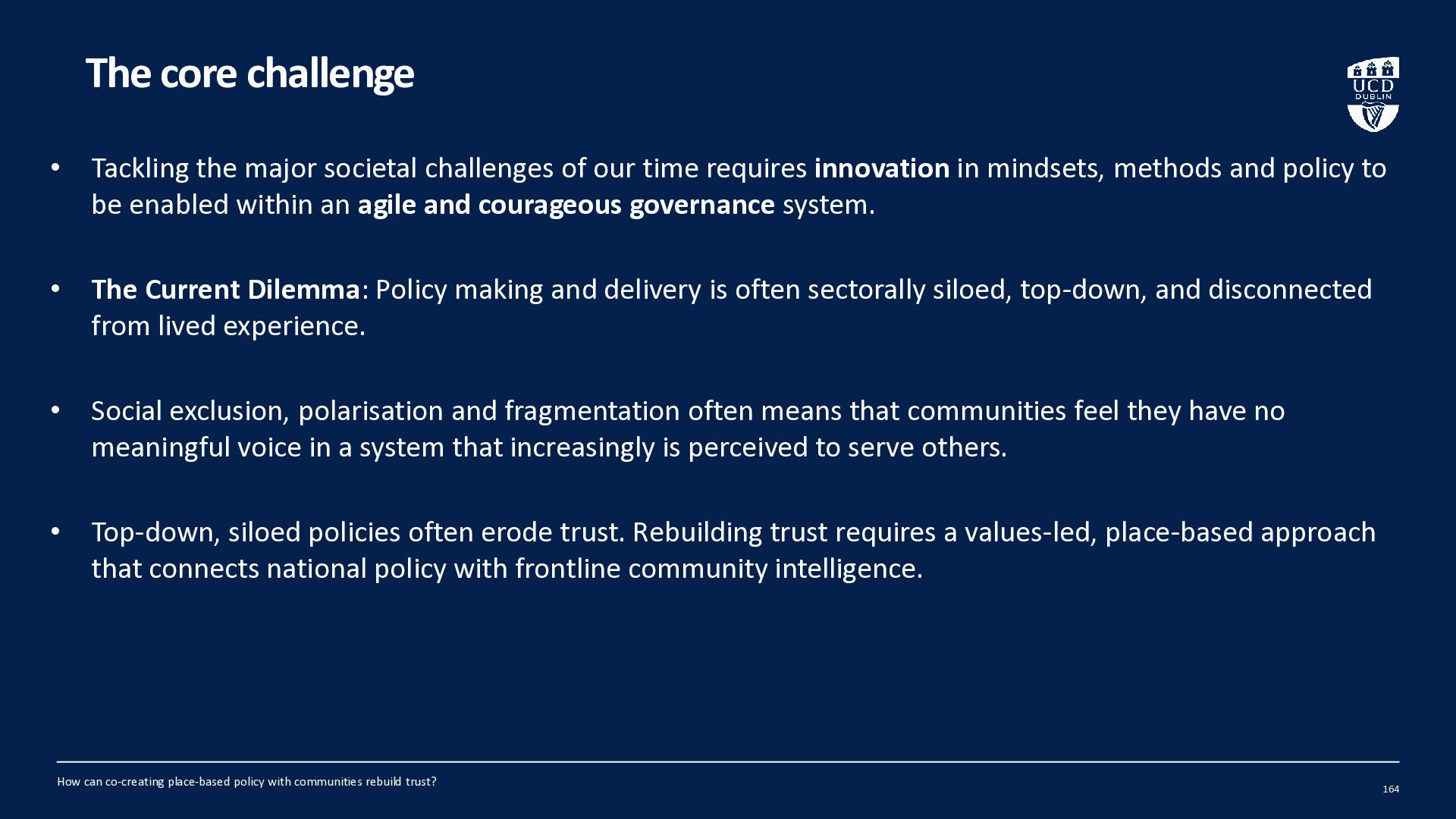
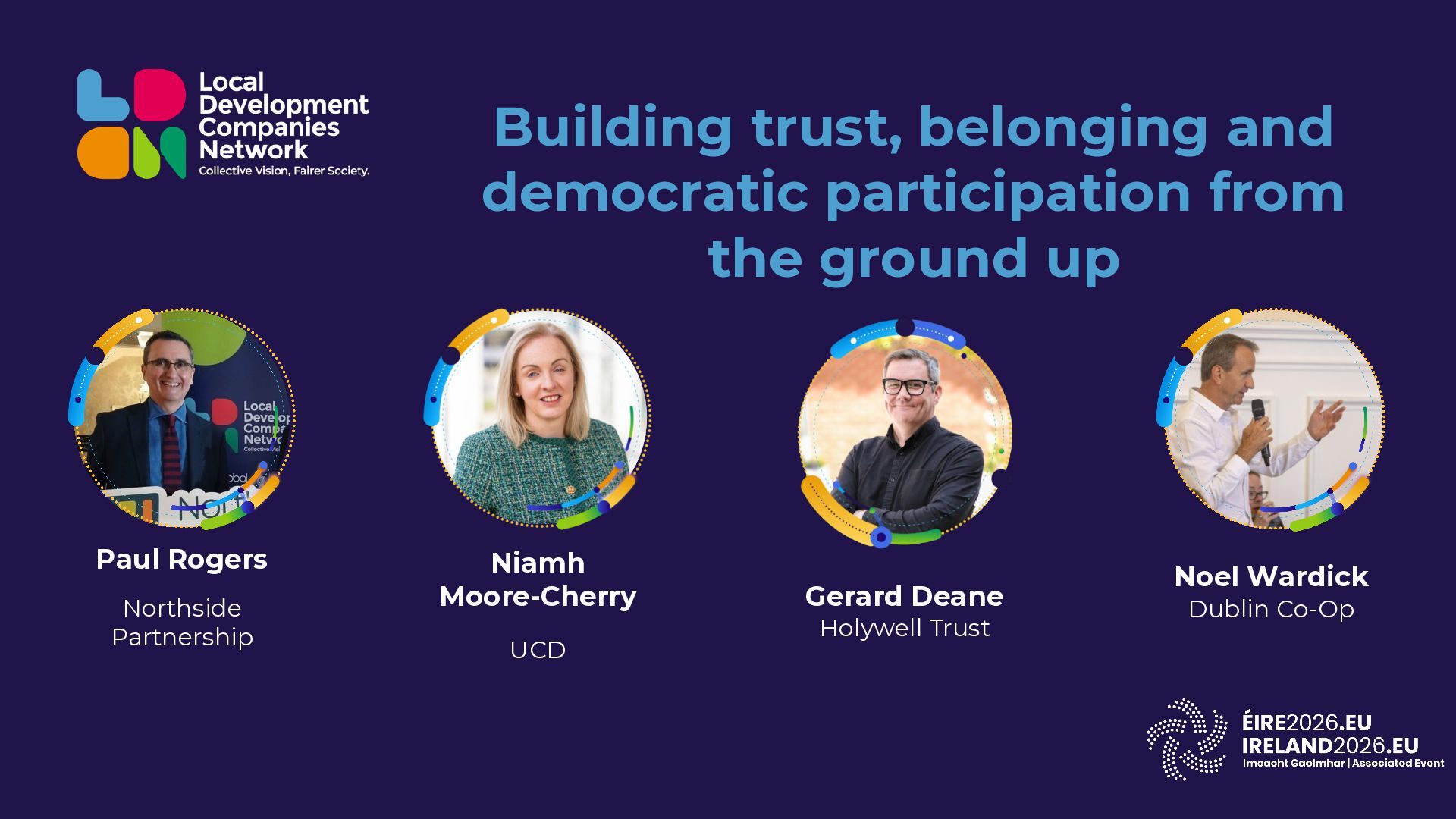
our time requires innovation in mindsets, methods and policy to be enabled within an agile and courageous governance system. • The Current Dilemma: Policy making and delivery is often sectorally siloed, top-down, and disconnected from lived experience. • Social exclusion, polarisation and fragmentation often means that communities feel they have no meaningful voice in a system that increasingly is perceived to serve others. • Top-down, siloed policies often erode trust. Rebuilding trust requires a values-led, place-based approach that connects national policy with frontline community intelligence. How can co-creating place-based policy with communities rebuild trust? 164
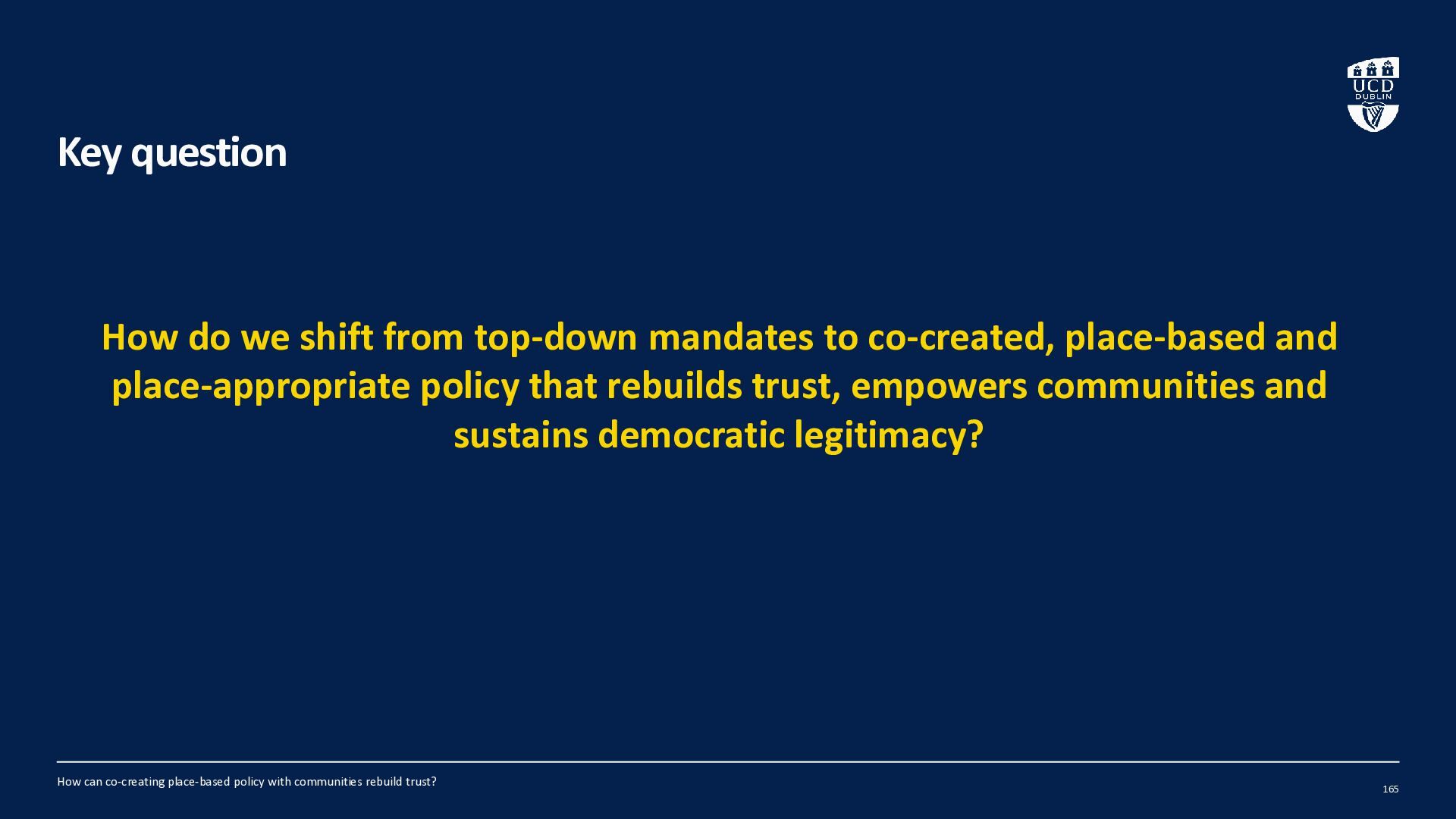
co-created, place-based and place-appropriate policy that rebuilds trust, empowers communities and sustains democratic legitimacy? How can co-creating place-based policy with communities rebuild trust? 165
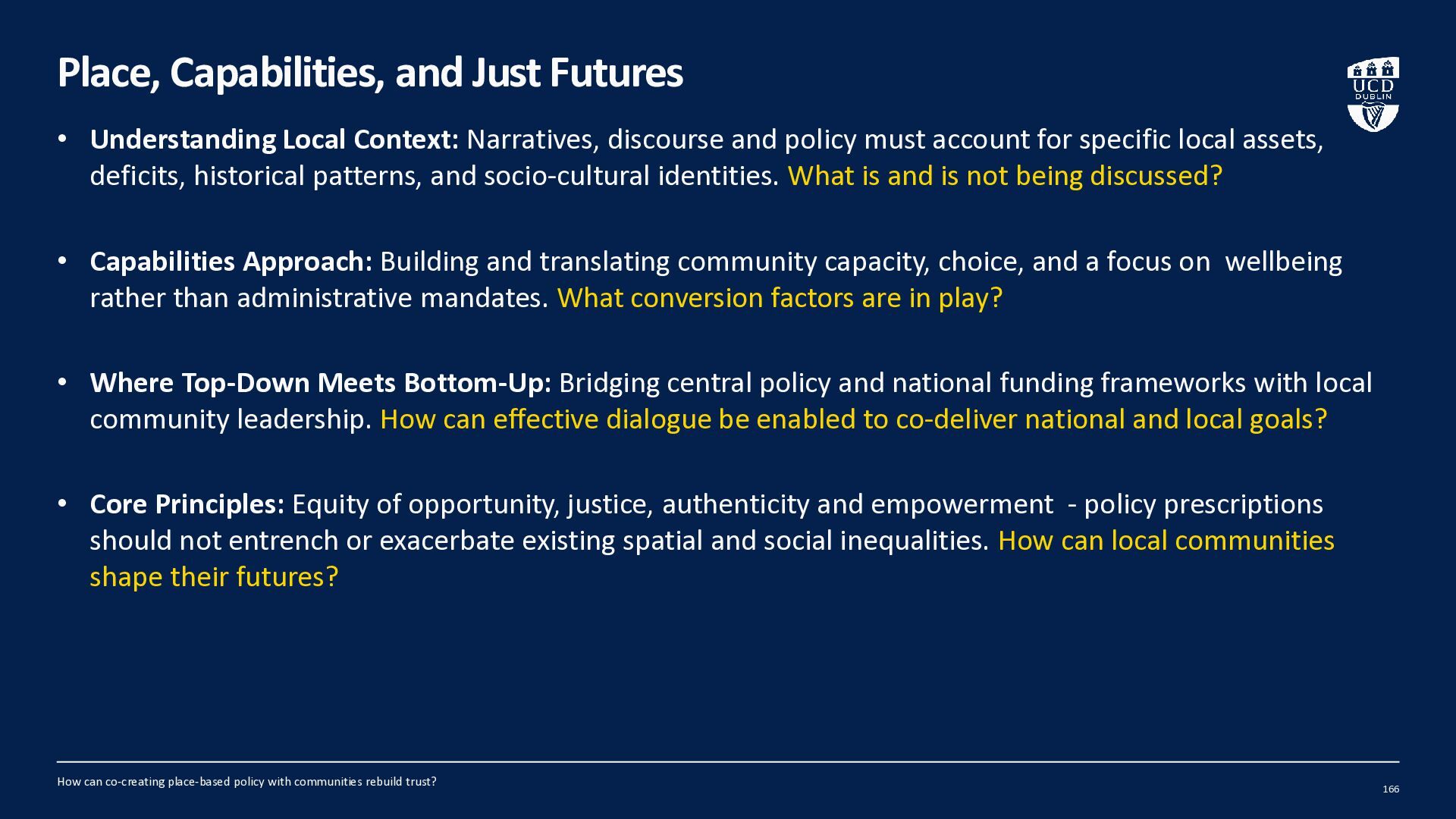
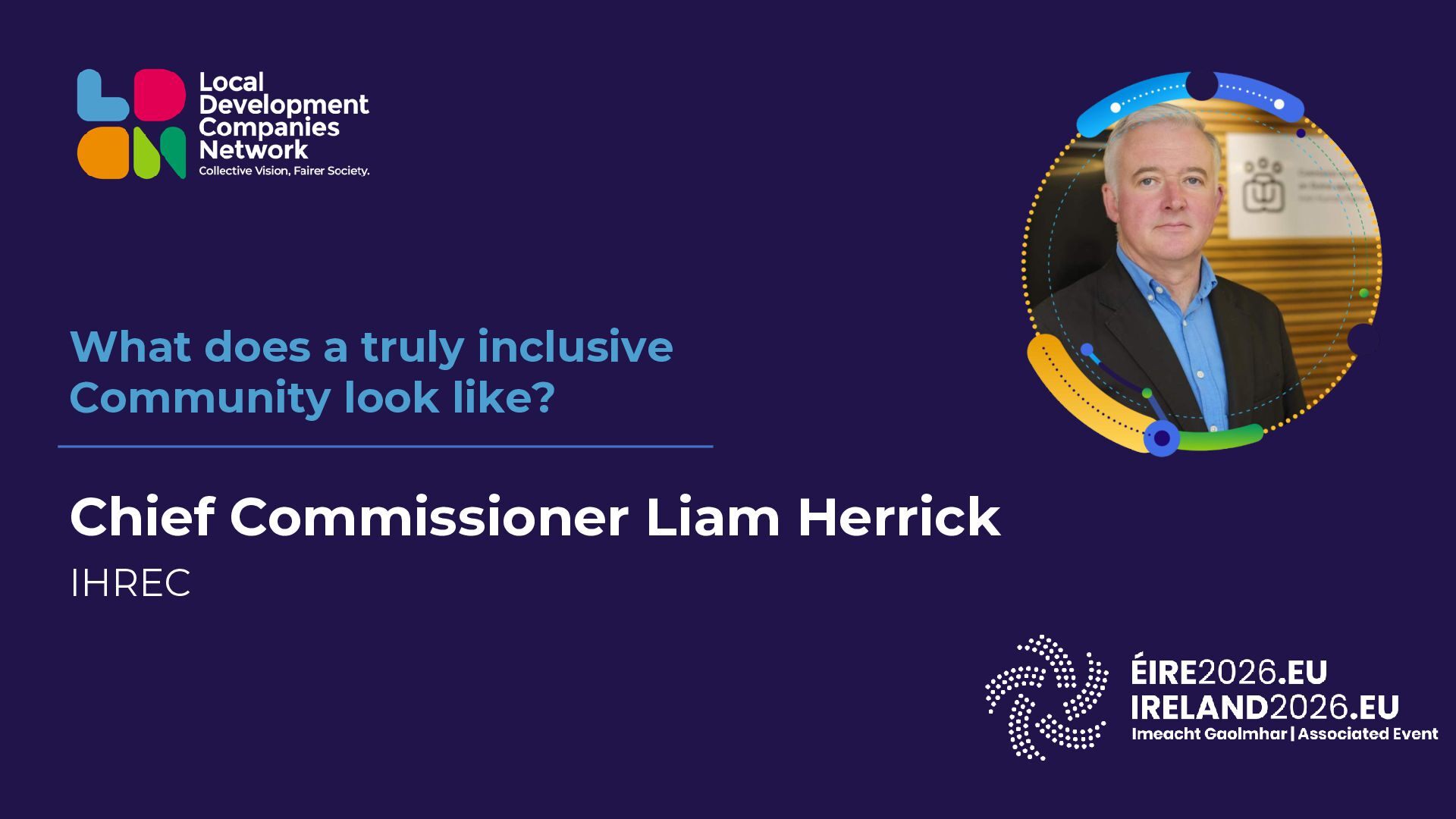
discourse and policy must account for specific local assets, deficits, historical patterns, and socio-cultural identities. What is and is not being discussed? • Capabilities Approach: Building and translating community capacity, choice, and a focus on wellbeing rather than administrative mandates. What conversion factors are in play? • Where Top-Down Meets Bottom-Up: Bridging central policy and national funding frameworks with local community leadership. How can effective dialogue be enabled to co-deliver national and local goals? • Core Principles: Equity of opportunity, justice, authenticity and empowerment - policy prescriptions should not entrench or exacerbate existing spatial and social inequalities. How can local communities shape their futures? How can co-creating place-based policy with communities rebuild trust? 166
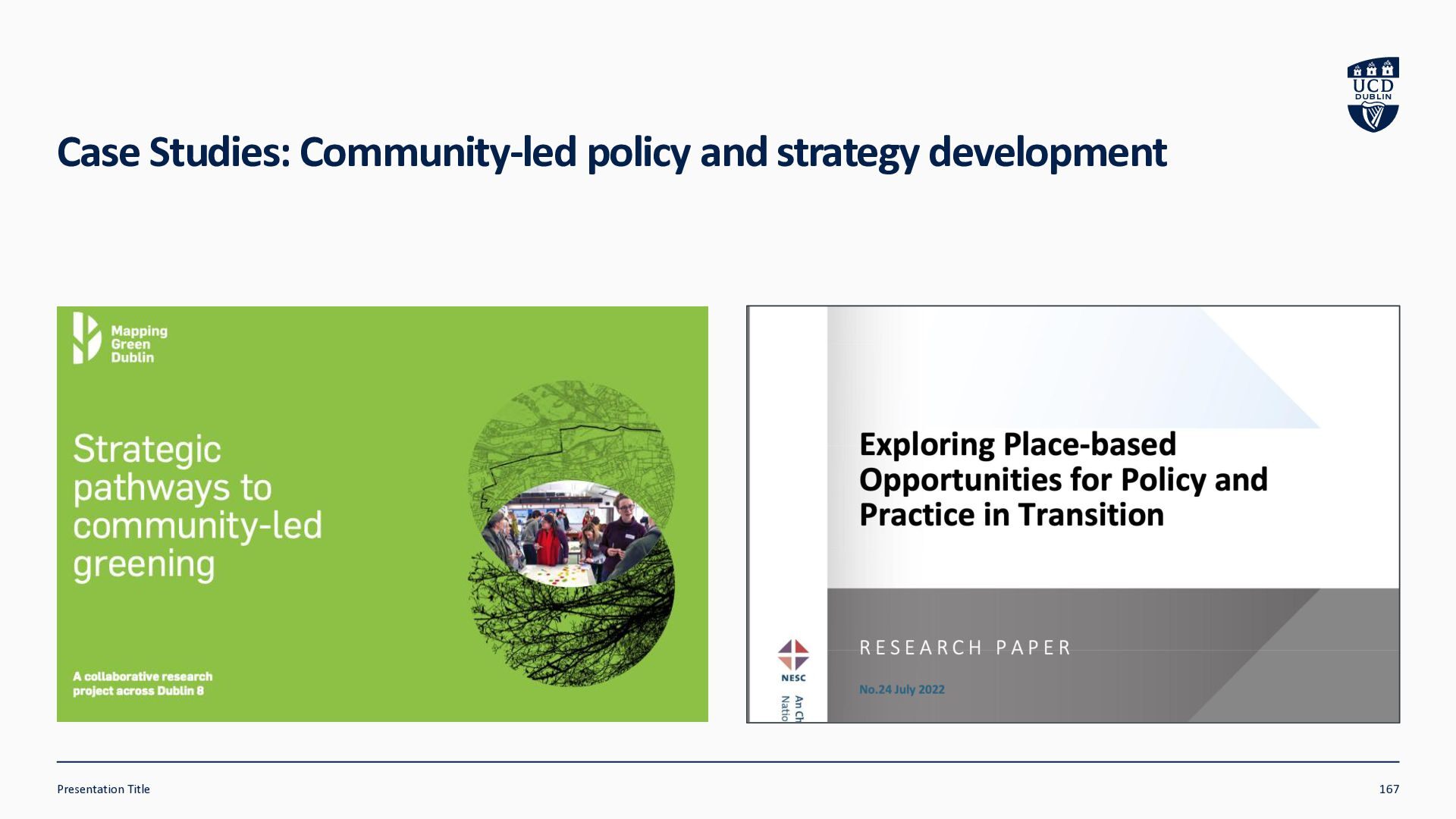
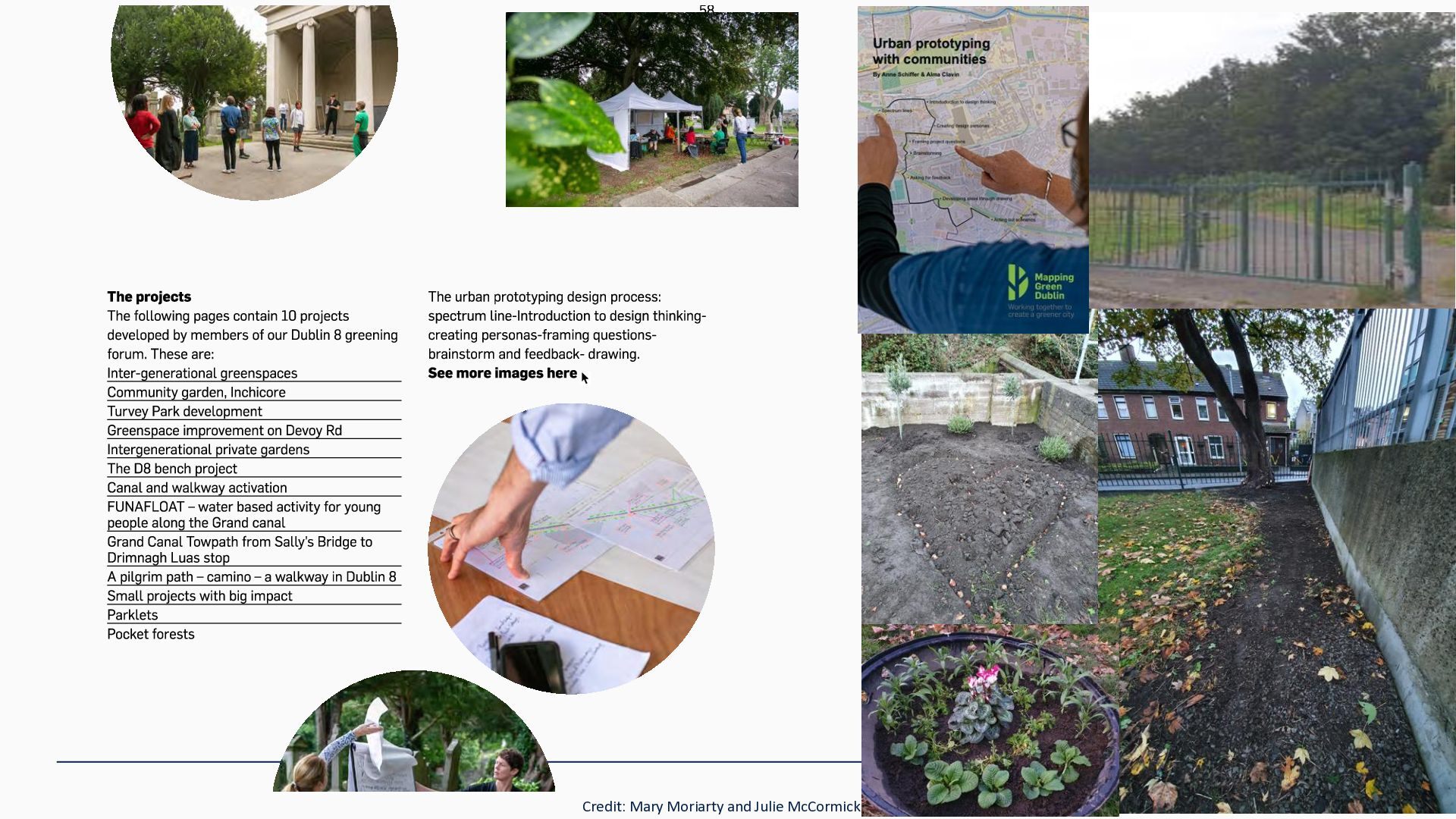
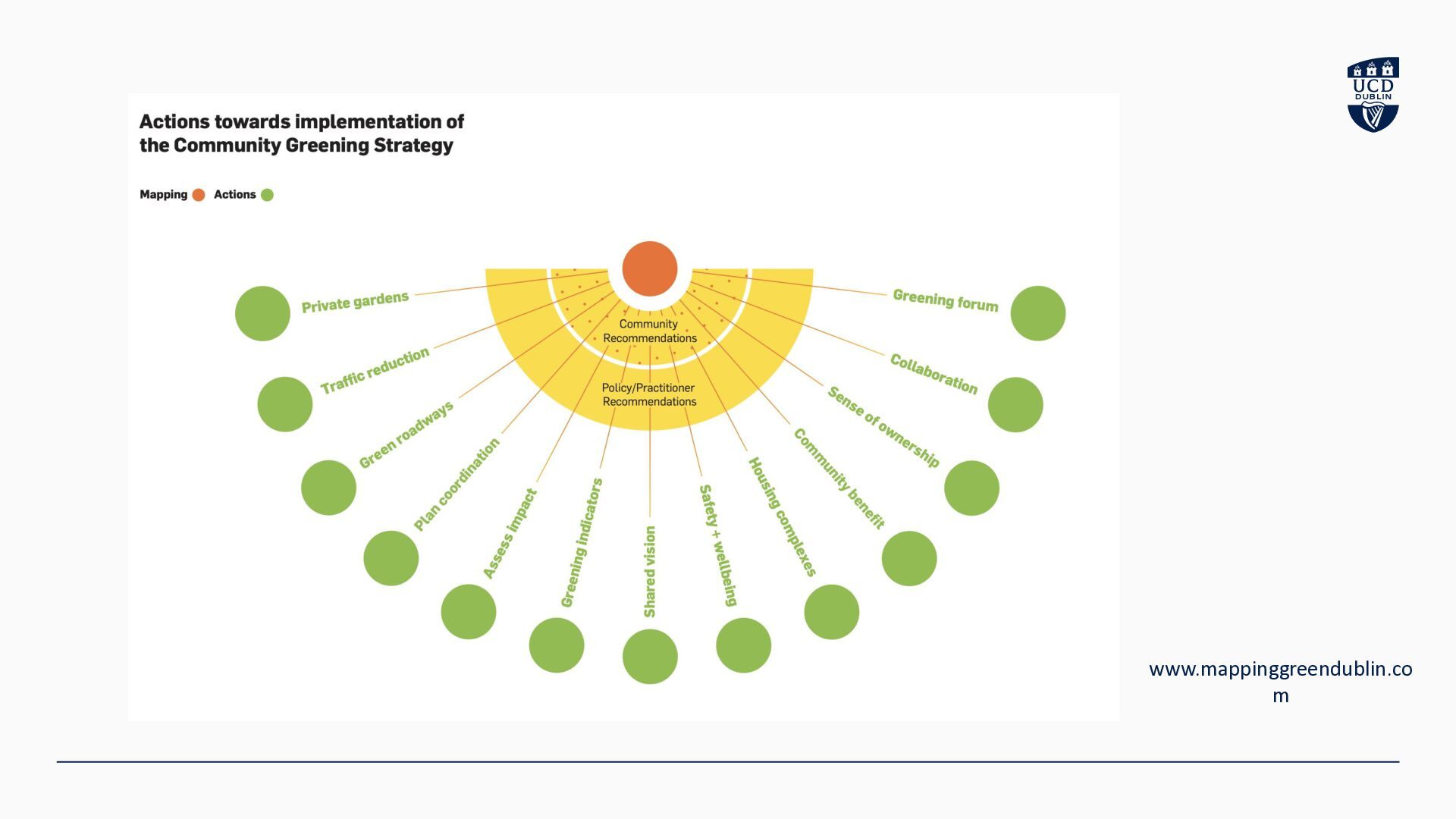
communities in Dublin, Kilbeggan, Inishowen and North Leitrim – working with not on communities. • Combining community data mapping with workshops to harness local intelligence, build on local assets and foster local ownership. Figure 1: The co-creation phases • Empower with data; broker new relationships through agonism; generate actionable ideas How can co-creating place-based policy with communities rebuild trust? 168
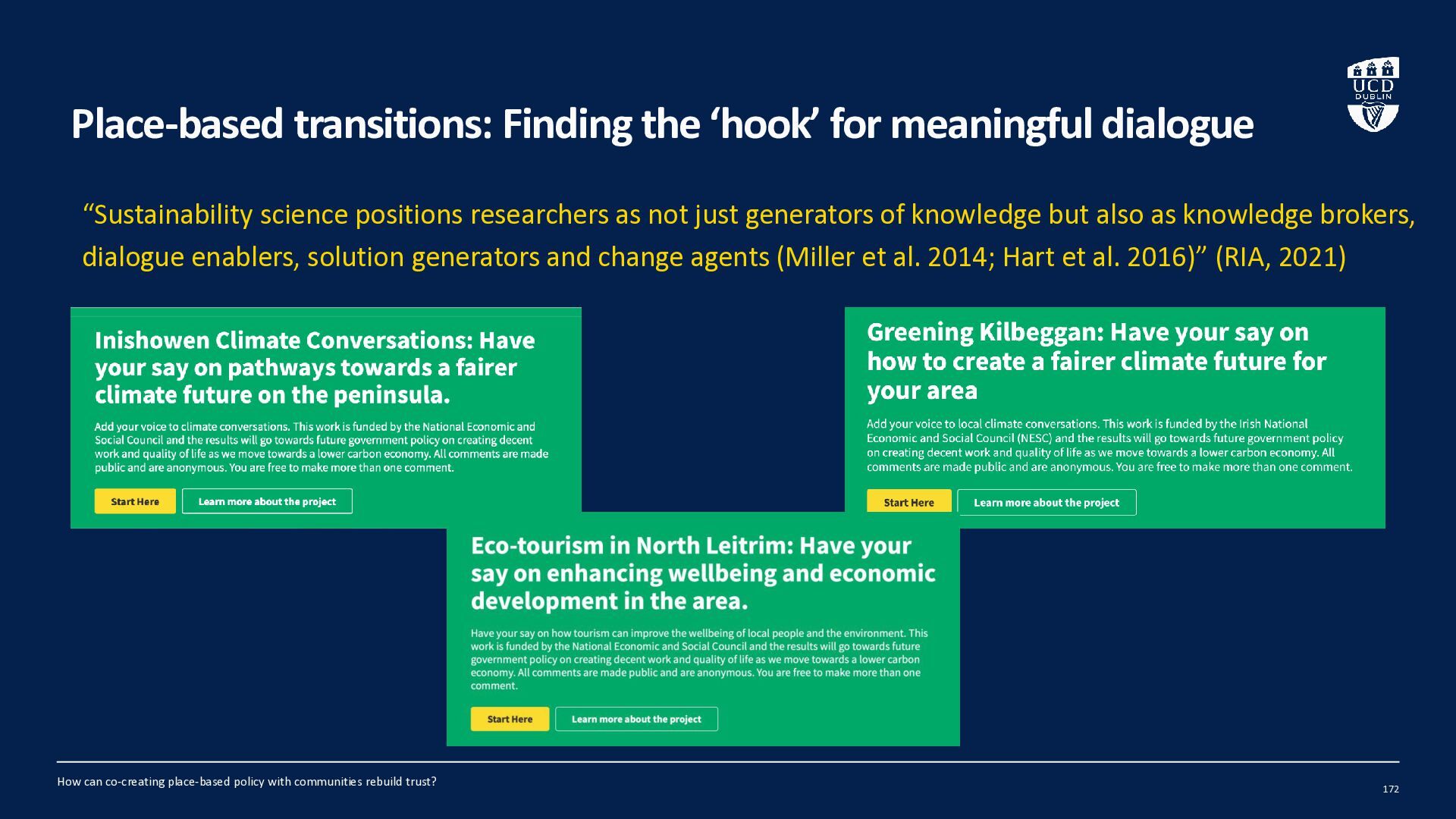
positions researchers as not just generators of knowledge but also as knowledge brokers, dialogue enablers, solution generators and change agents (Miller et al. 2014; Hart et al. 2016)” (RIA, 2021) How can co-creating place-based policy with communities rebuild trust? 172
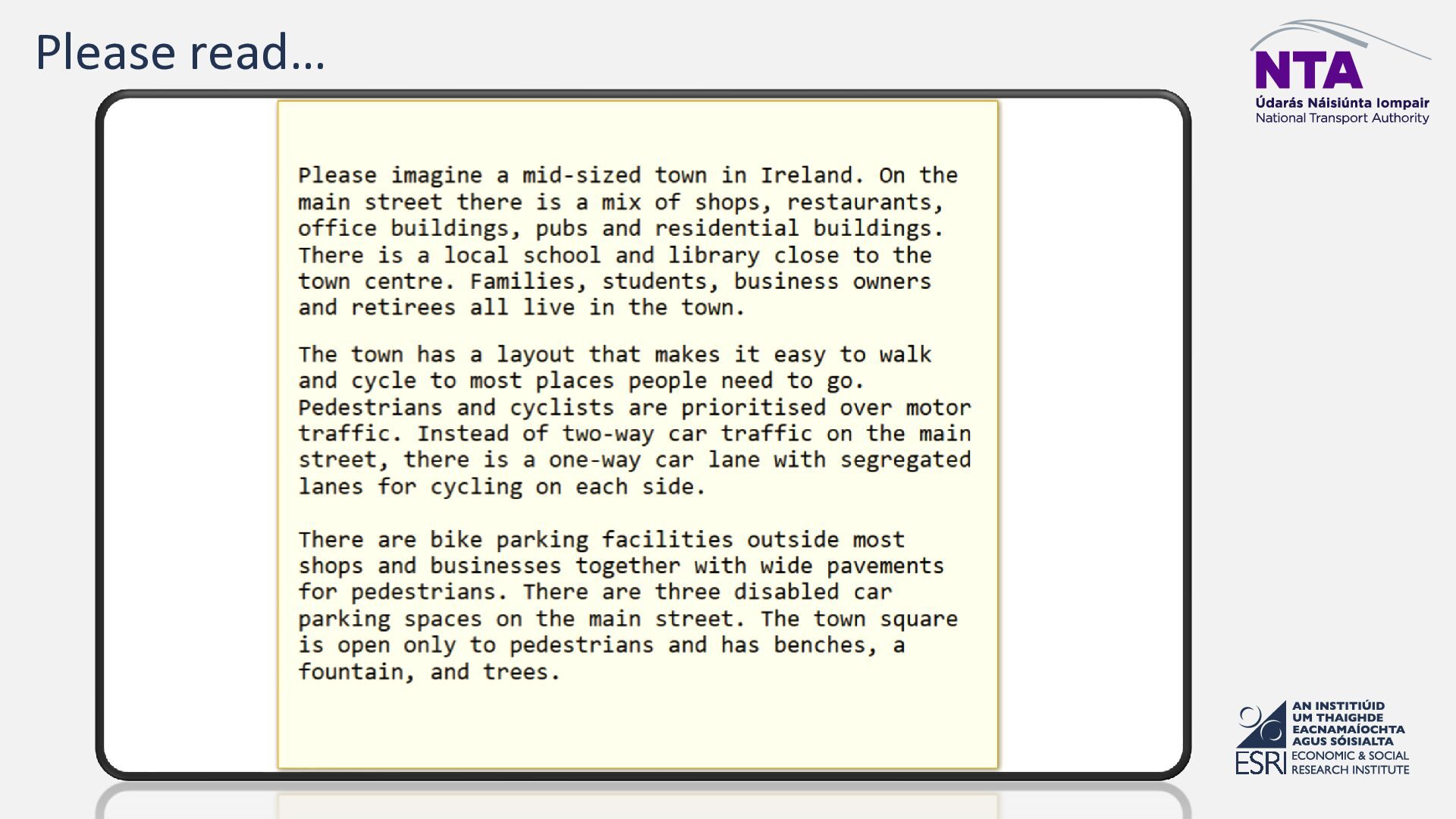
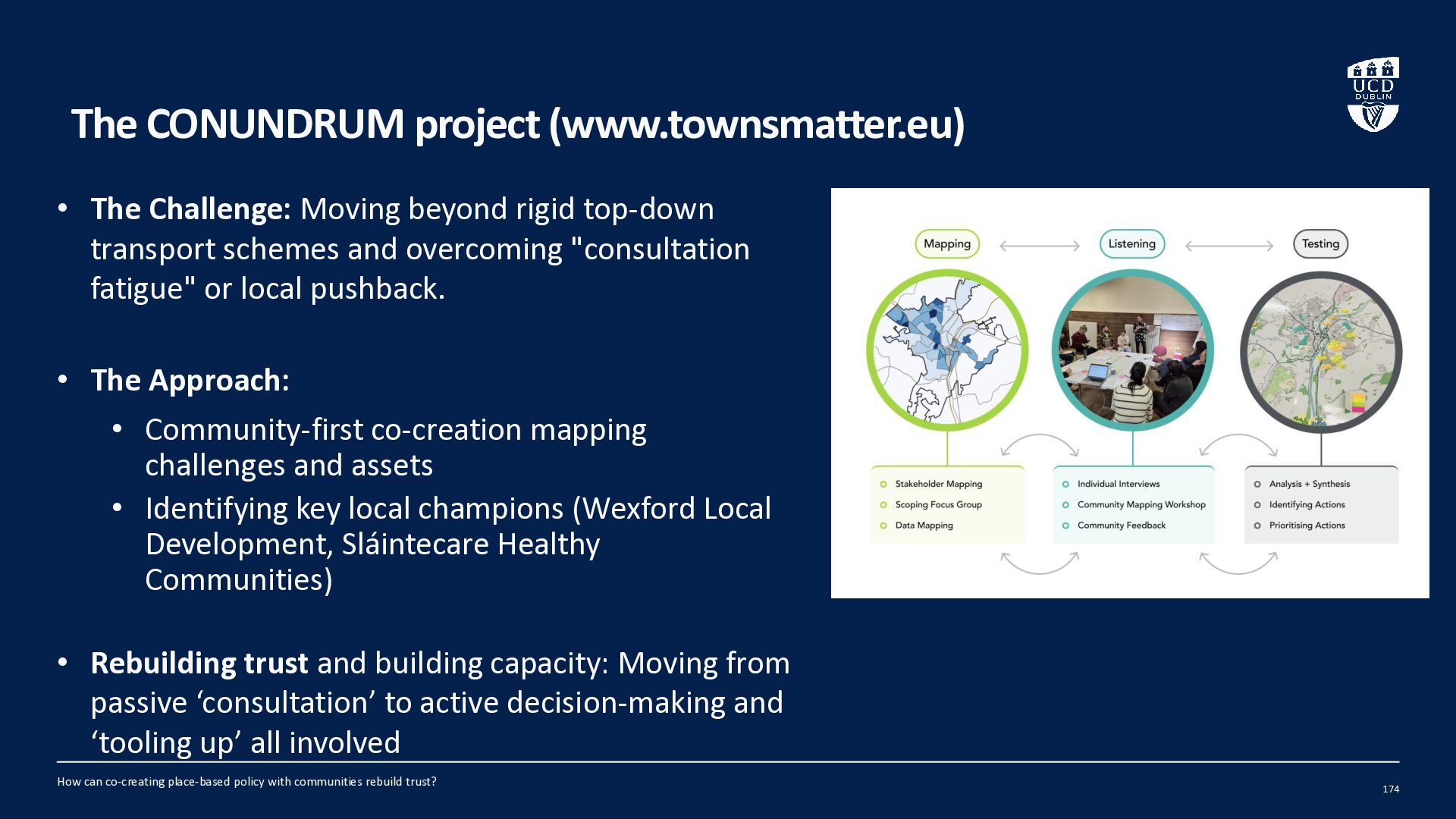
top-down transport schemes and overcoming "consultation fatigue" or local pushback. • The Approach: • Community-first co-creation mapping challenges and assets • Identifying key local champions (Wexford Local Development, Sláintecare Healthy Communities) • Rebuilding trust and building capacity: Moving from passive ‘consultation’ to active decision-making and ‘tooling up’ all involved How can co-creating place-based policy with communities rebuild trust? 174
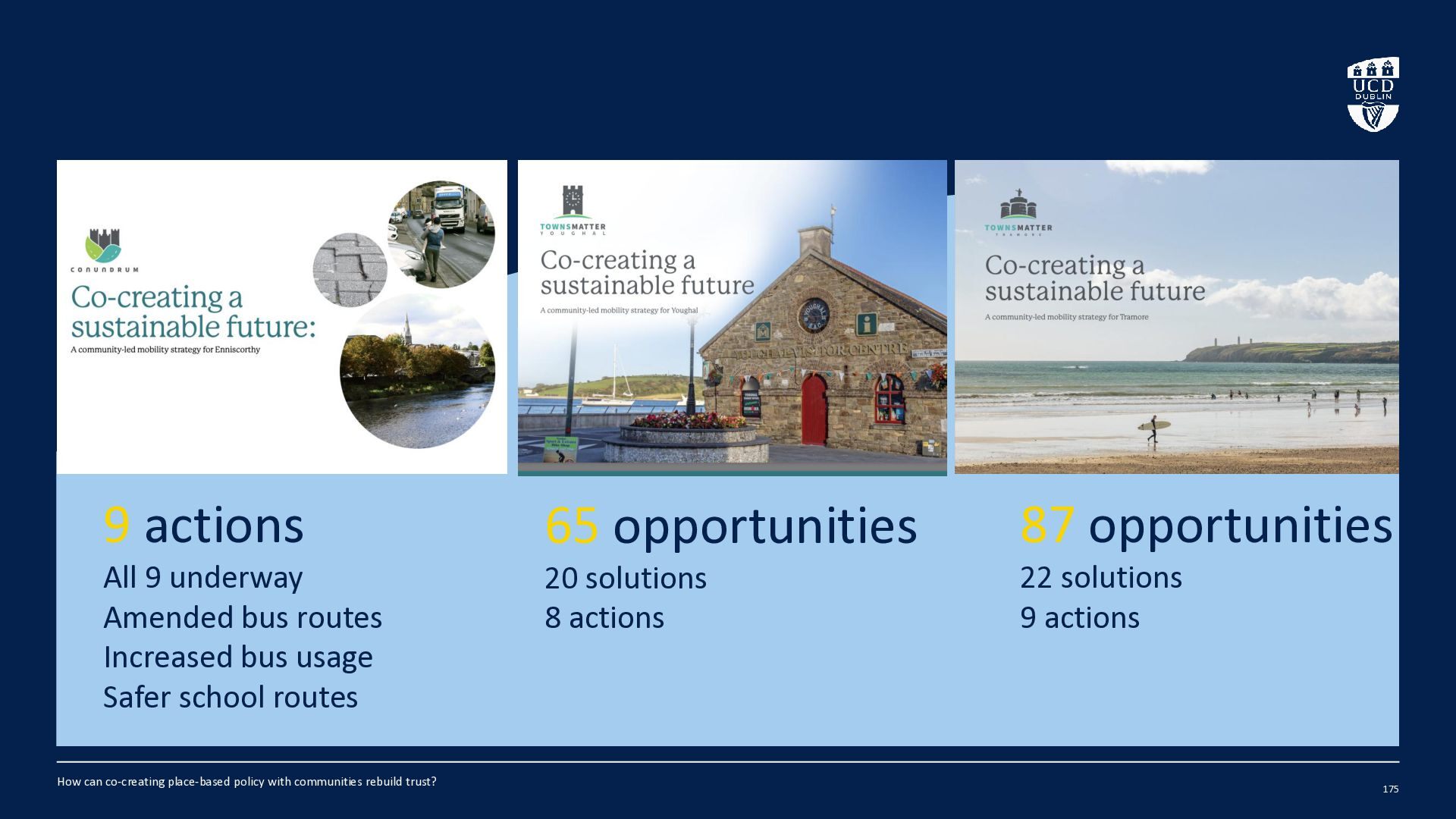
bus routes Increased bus usage Safer school routes 20 solutions 8 actions 22 solutions 9 actions How can co-creating place-based policy with communities rebuild trust? 175
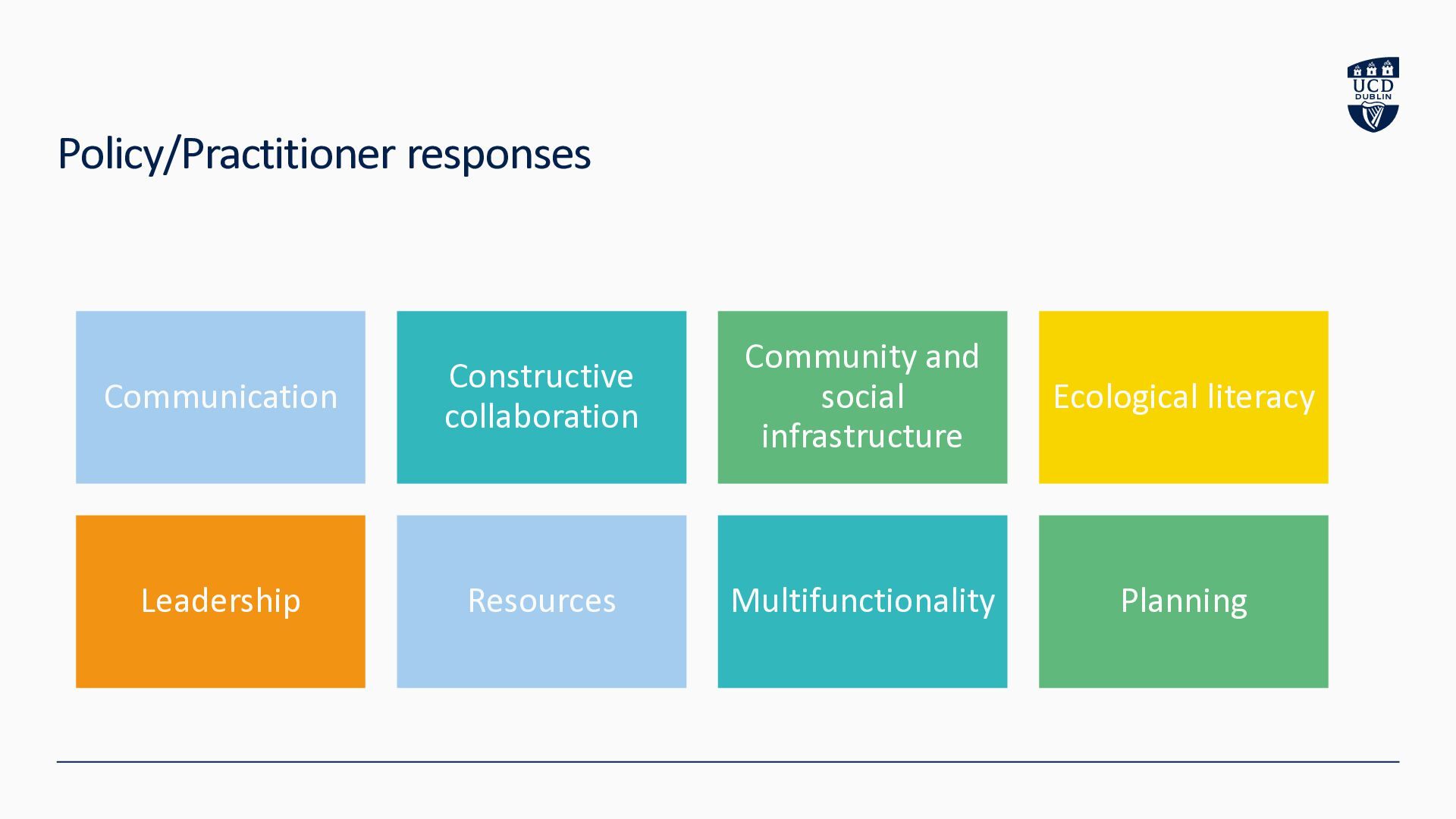
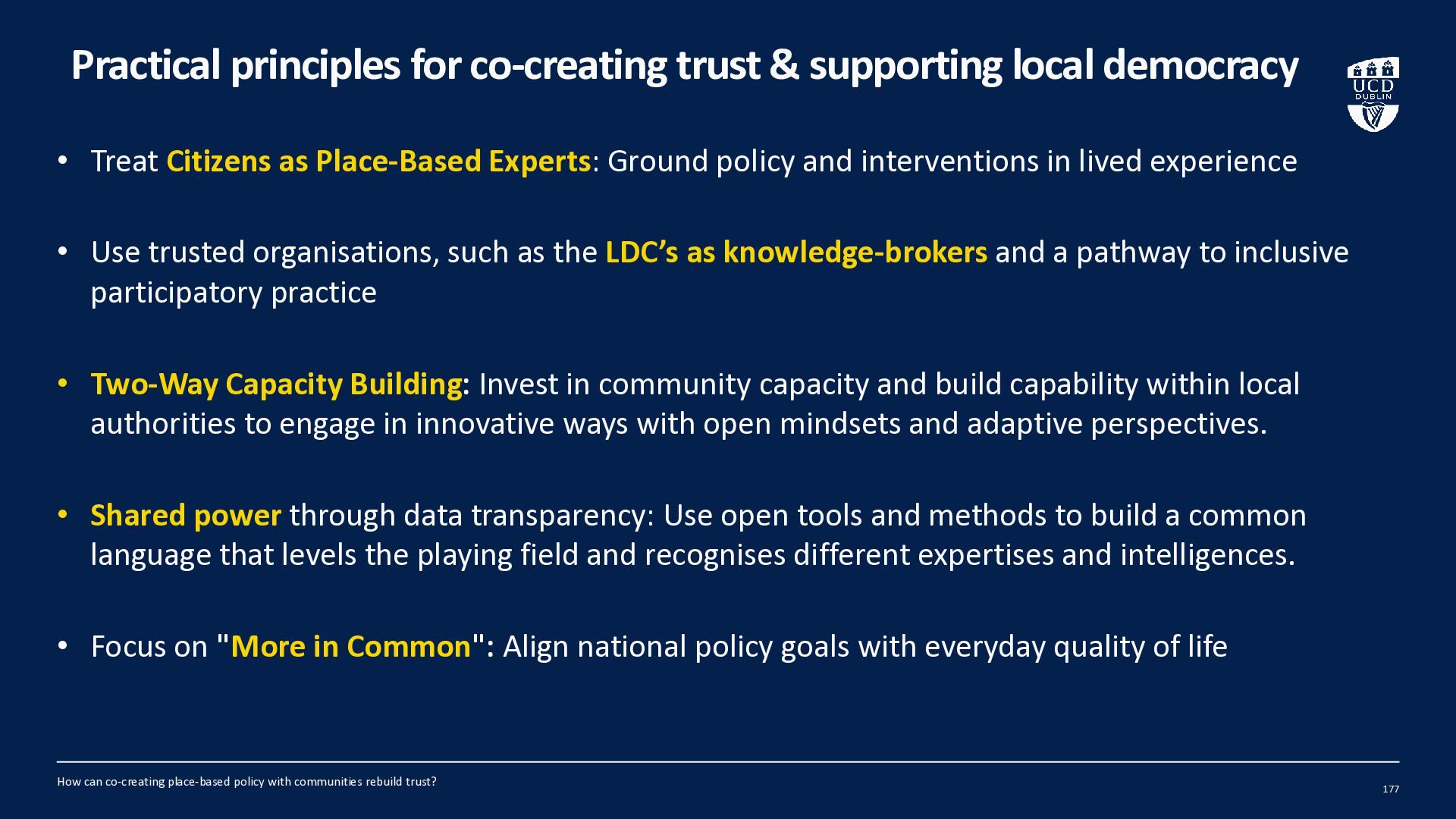
Treat Citizens as Place-Based Experts: Ground policy and interventions in lived experience • Use trusted organisations, such as the LDC’s as knowledge-brokers and a pathway to inclusive participatory practice • Two-Way Capacity Building: Invest in community capacity and build capability within local authorities to engage in innovative ways with open mindsets and adaptive perspectives. • Shared power through data transparency: Use open tools and methods to build a common language that levels the playing field and recognises different expertises and intelligences. • Focus on "More in Common": Align national policy goals with everyday quality of life How can co-creating place-based policy with communities rebuild trust? 177
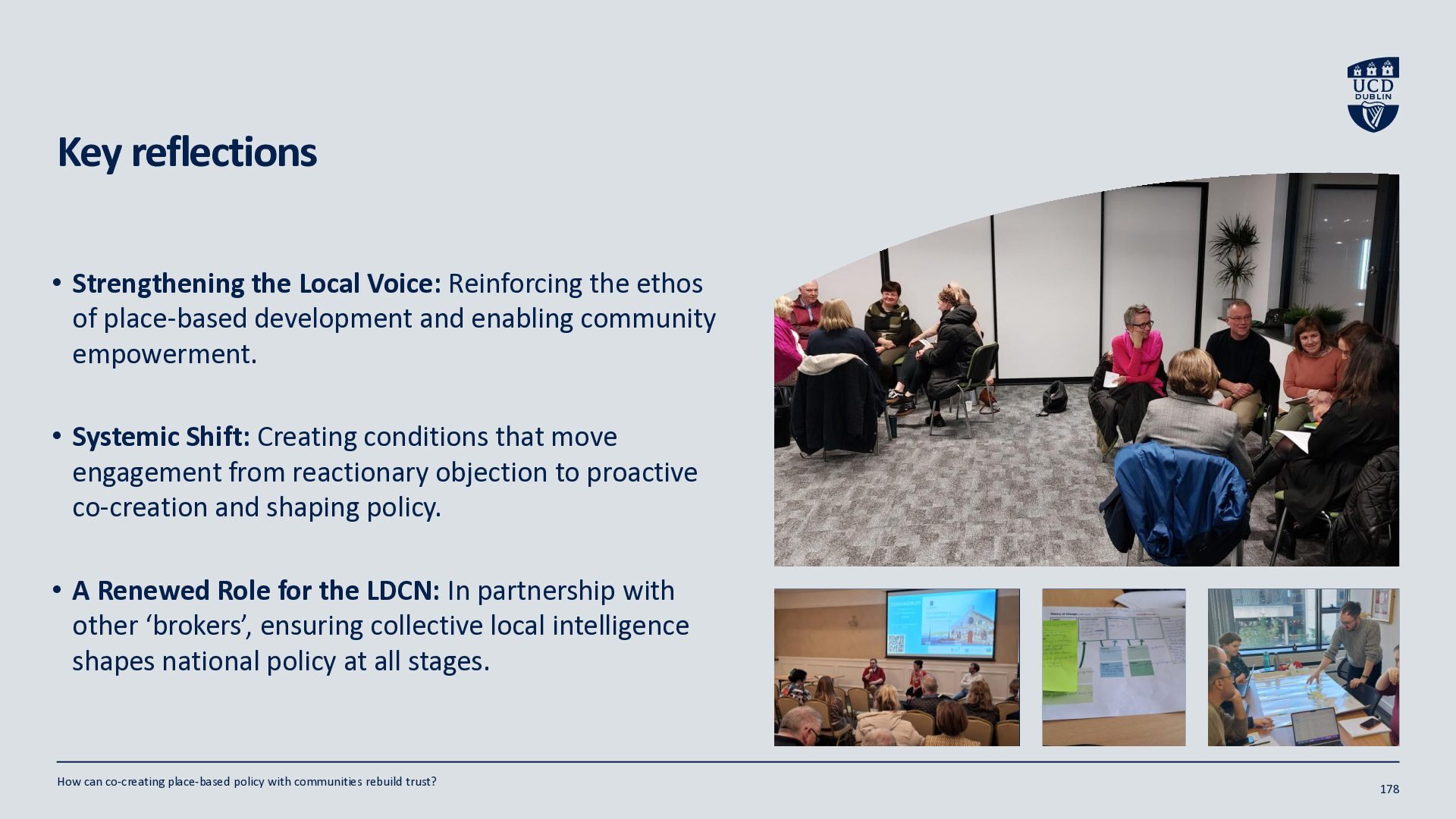
of place-based development and enabling community empowerment. • Systemic Shift: Creating conditions that move engagement from reactionary objection to proactive co-creation and shaping policy. • A Renewed Role for the LDCN: In partnership with other ‘brokers’, ensuring collective local intelligence shapes national policy at all stages. How can co-creating place-based policy with communities rebuild trust? 178
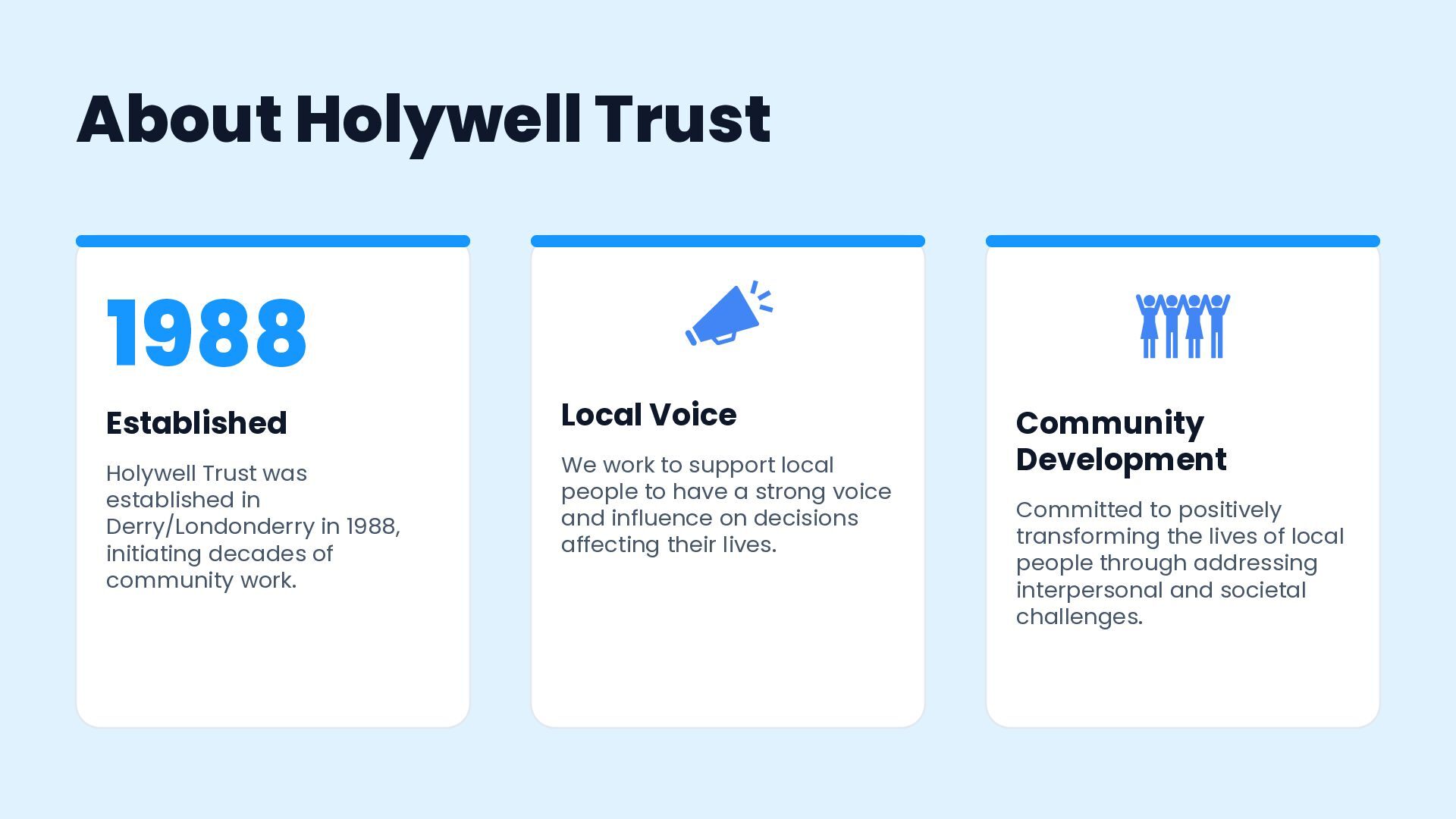
established in Derry/Londonderry in 1988, initiating decades of community work. We work to support local people to have a strong voice and influence on decisions affecting their lives. Community Development Committed to positively transforming the lives of local people through addressing interpersonal and societal challenges.
of the community relations and peacebuilding conversation. Positive, solution focused conversations. Taking our lead from the community. Conflict Prevention Working to actively avoid the possibility of future political violence.
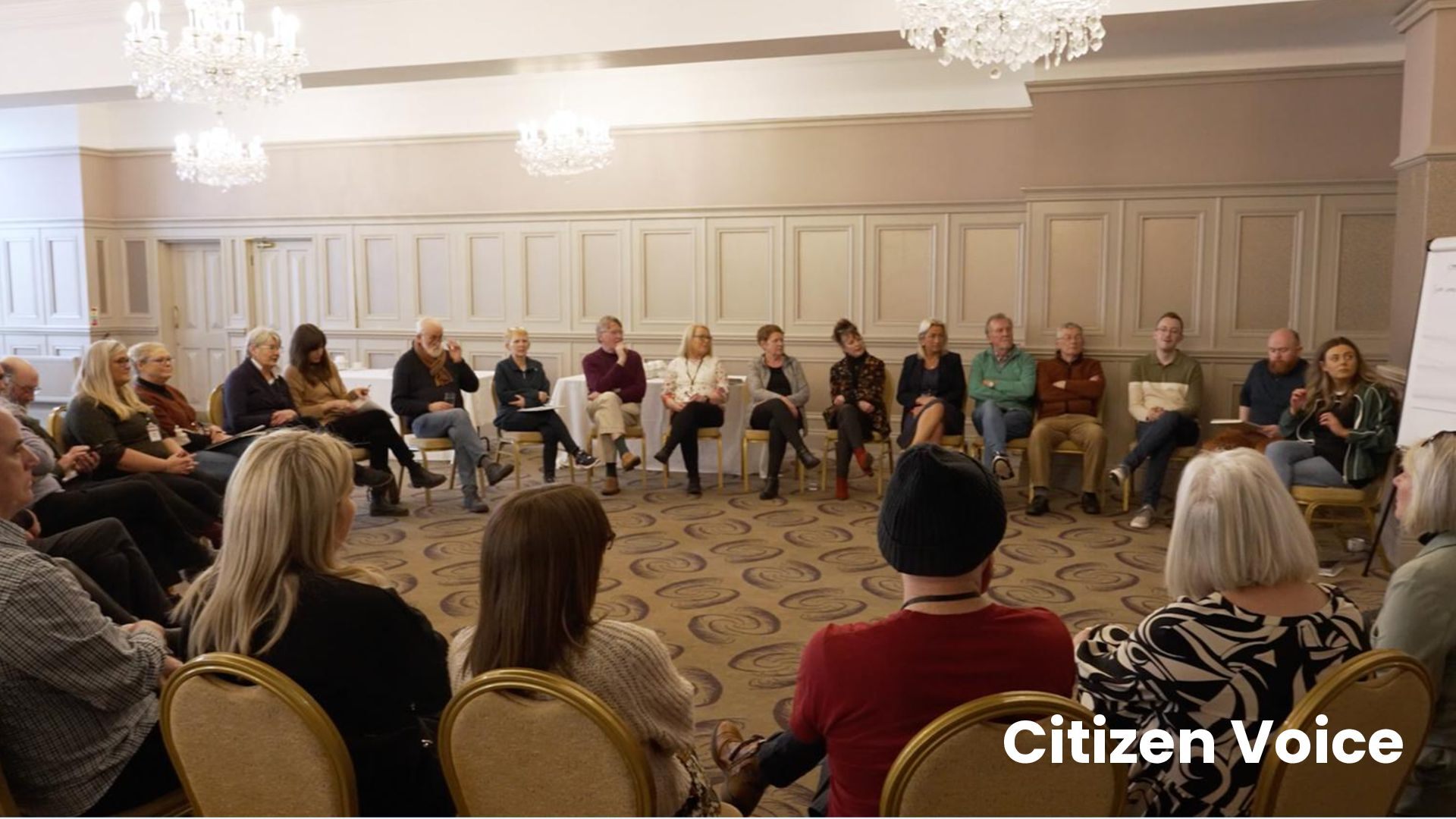
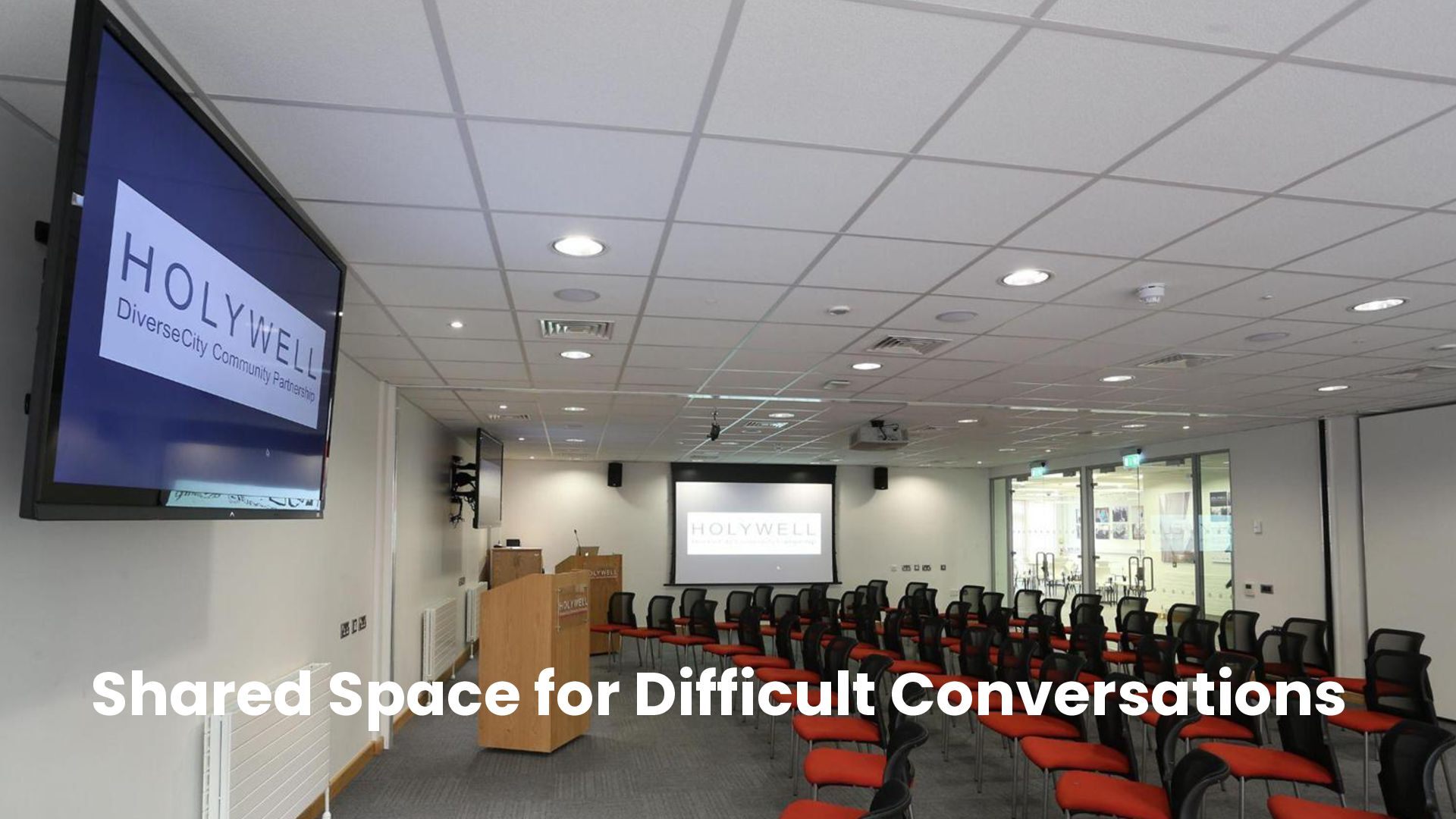
of the community relations and peacebuilding conversation. Addressing gaps in leadership capacity. Citizen Voice Shared Space Amplifying voice of the community on issues that matter. Creating shared space for difficult conversations.
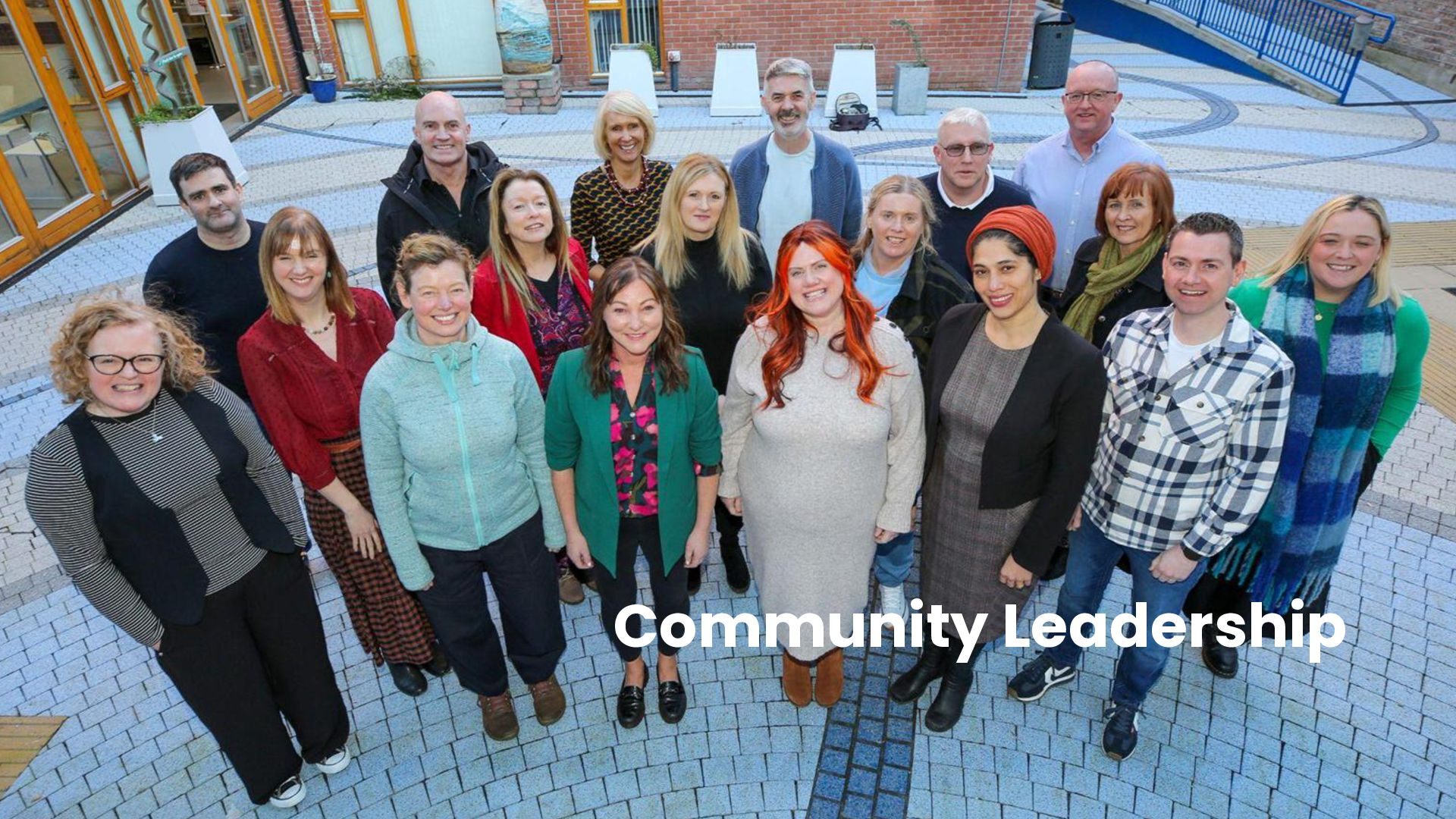
of the Investing in Community Leadership in the West programme with Fermanagh Trust and Rural Community Network. Cross-sectoral leadership programme - creating a new cohort of leaders committed to working together to tackle some of the wicked problems facing society. With Inishowen Development Partnership - new crossborder leadership programme, increasing capacity in the North West.
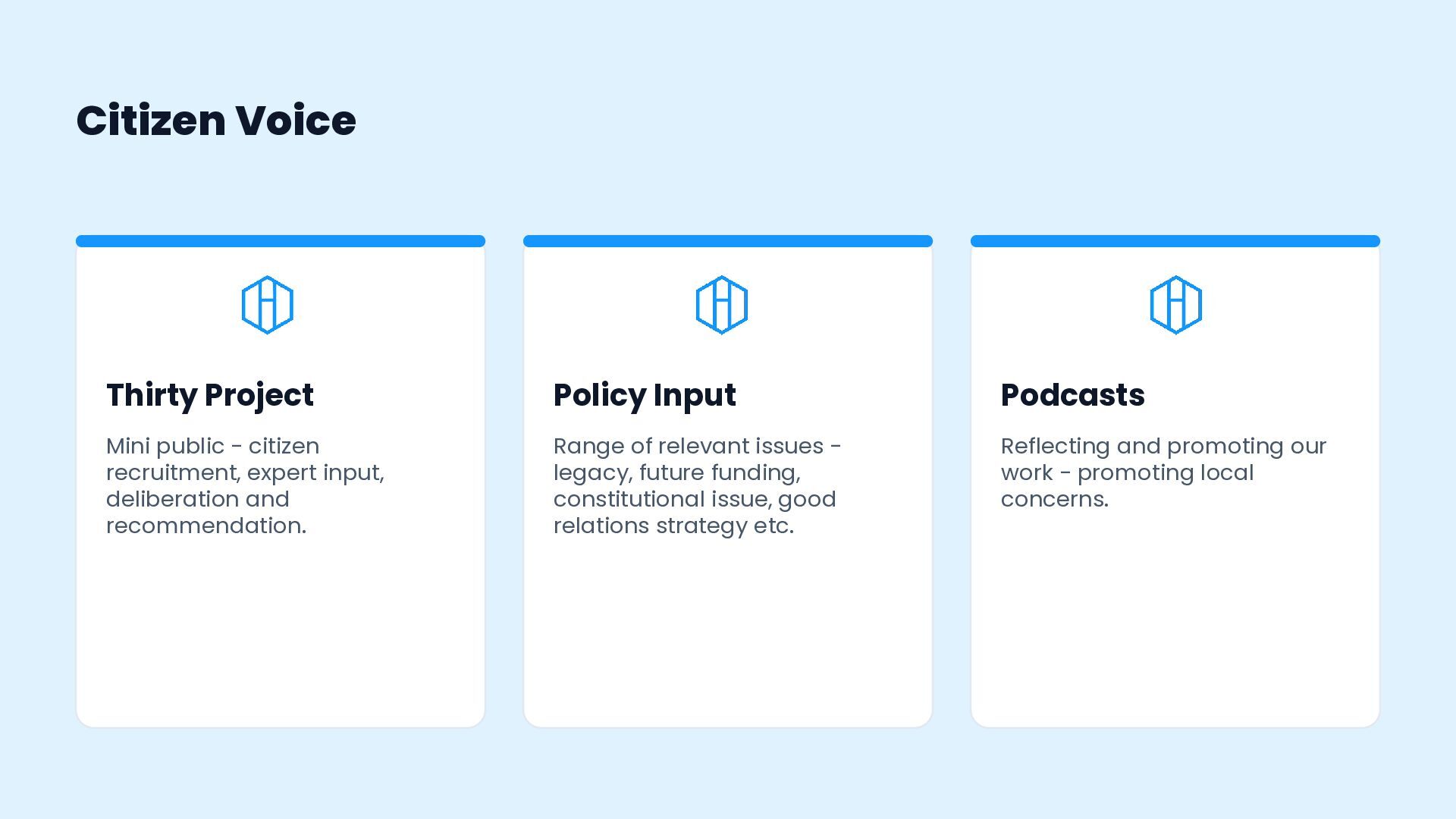
citizen recruitment, expert input, deliberation and recommendation. Range of relevant issues legacy, future funding, constitutional issue, good relations strategy etc. Reflecting and promoting our work - promoting local concerns.
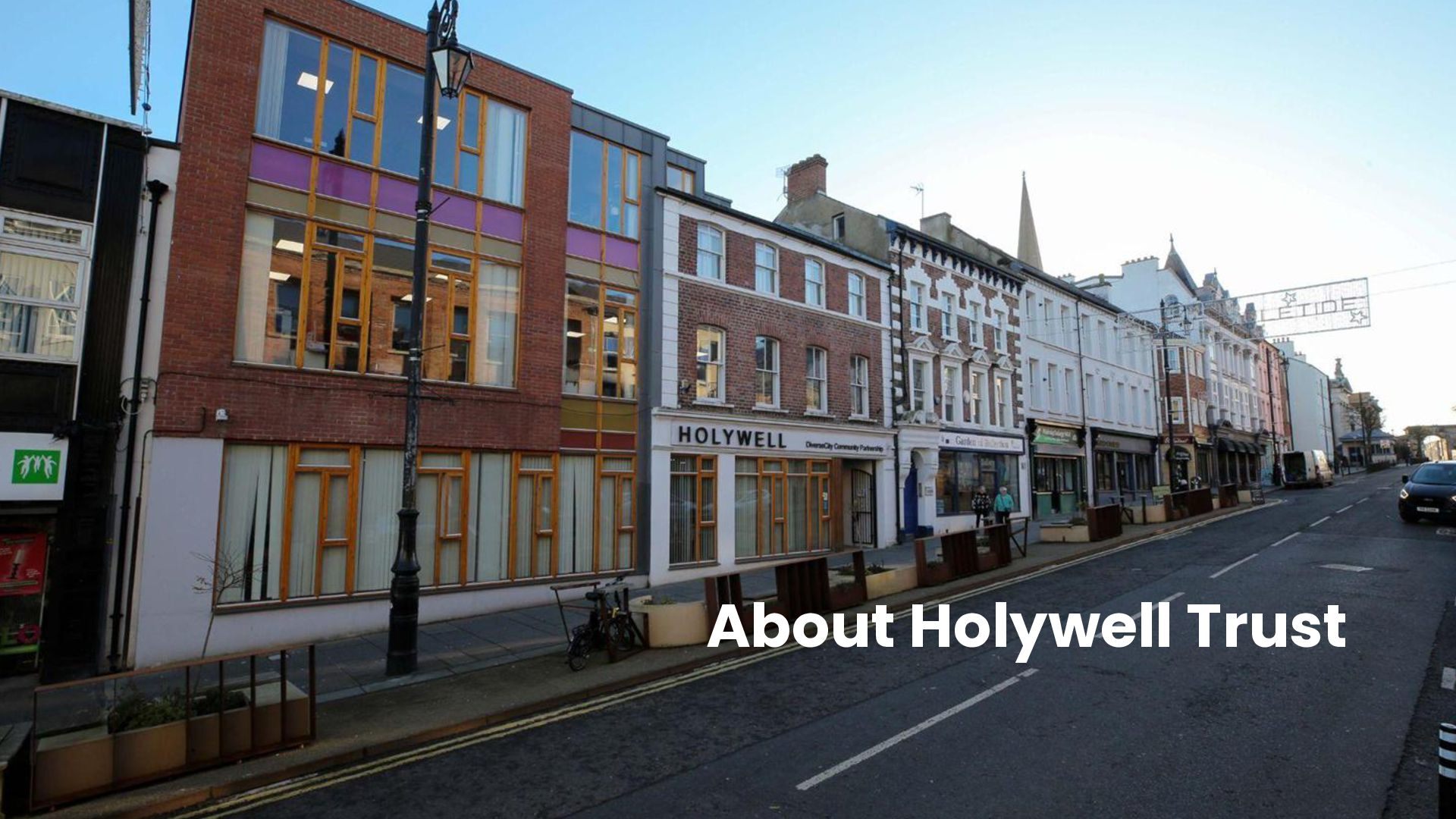
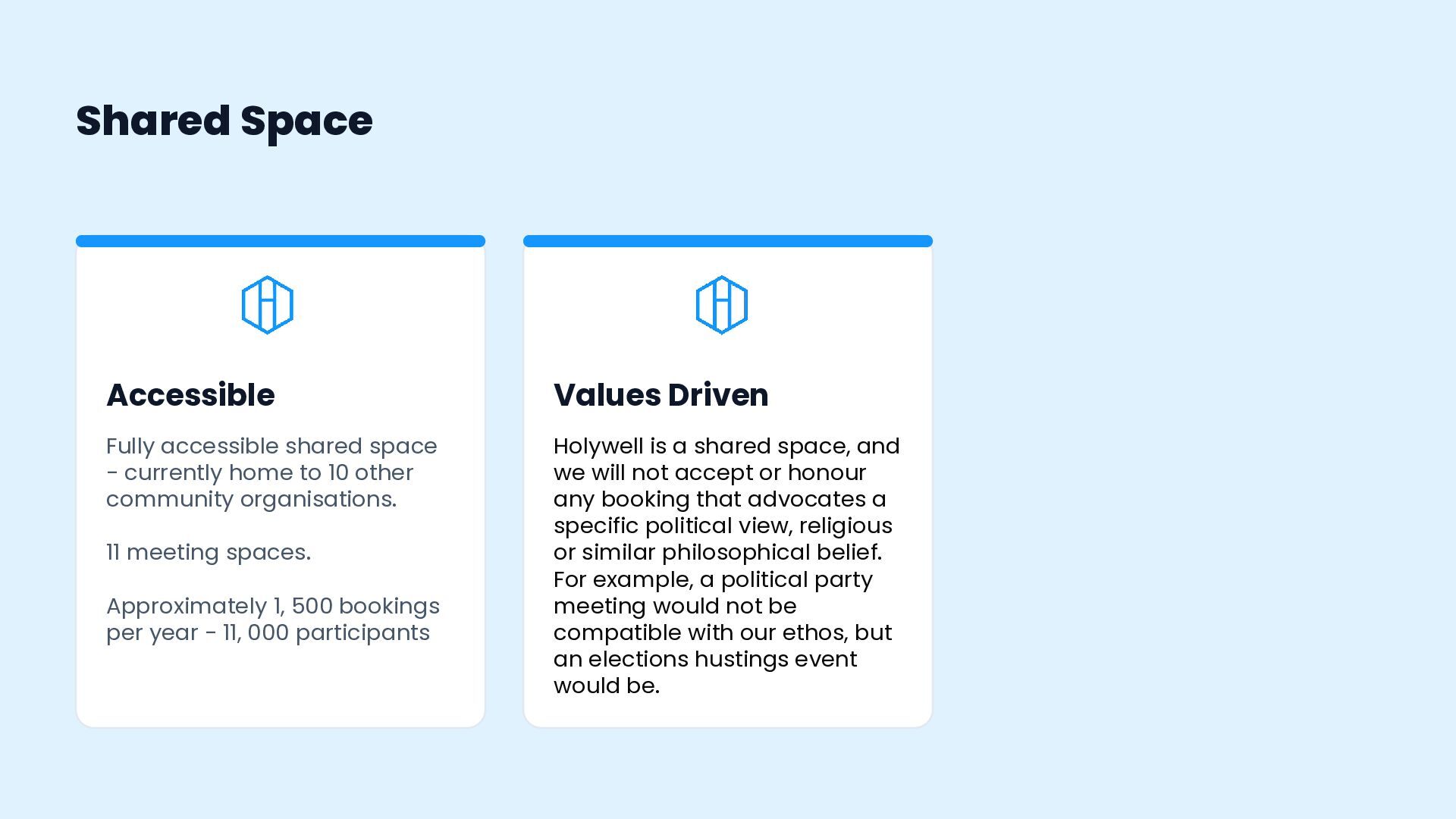
currently home to 10 other community organisations. Holywell is a shared space, and we will not accept or honour any booking that advocates a specific political view, religious or similar philosophical belief. For example, a political party meeting would not be compatible with our ethos, but an elections hustings event would be. 11 meeting spaces. Approximately 1, 500 bookings per year - 11, 000 participants
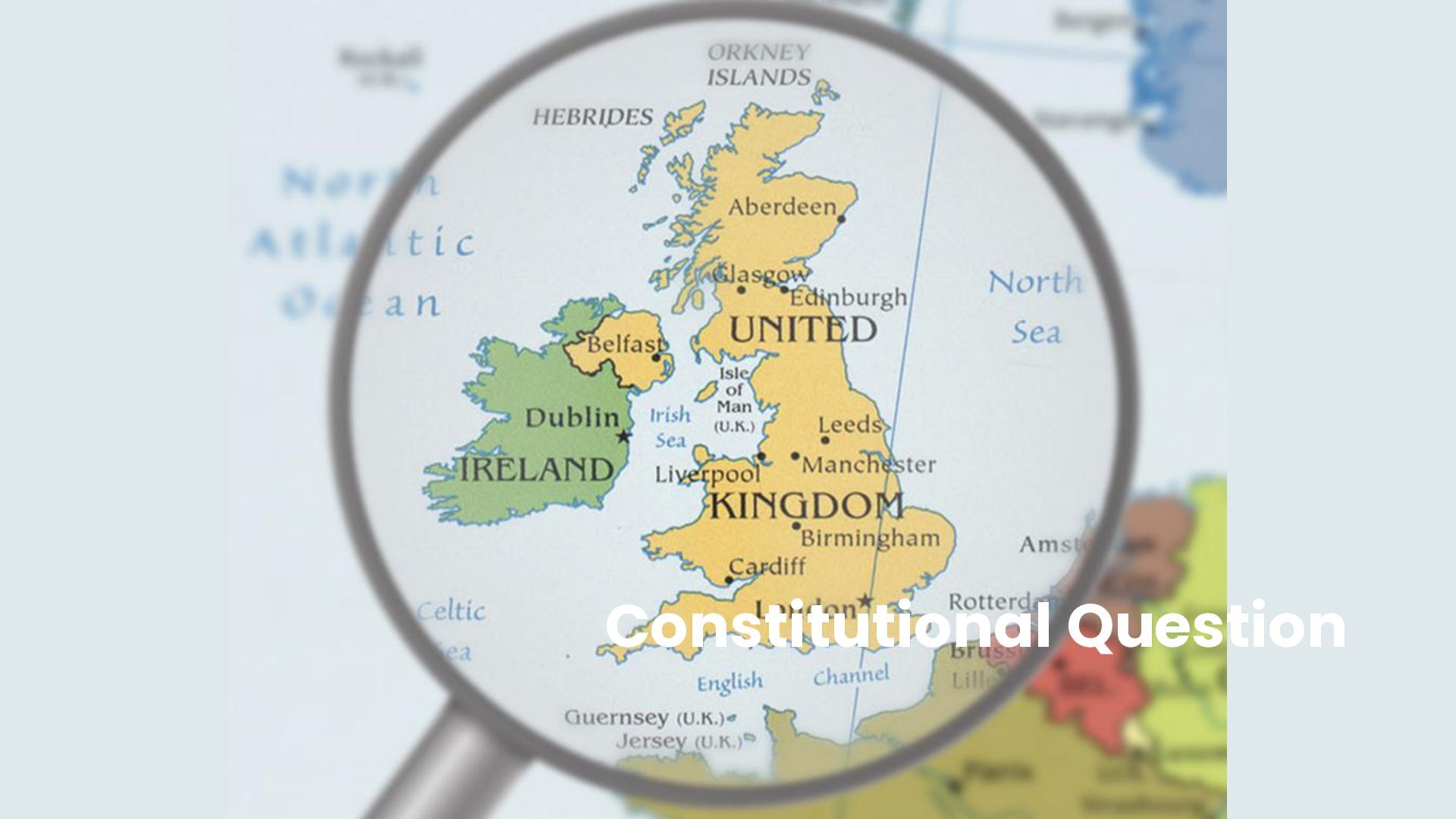
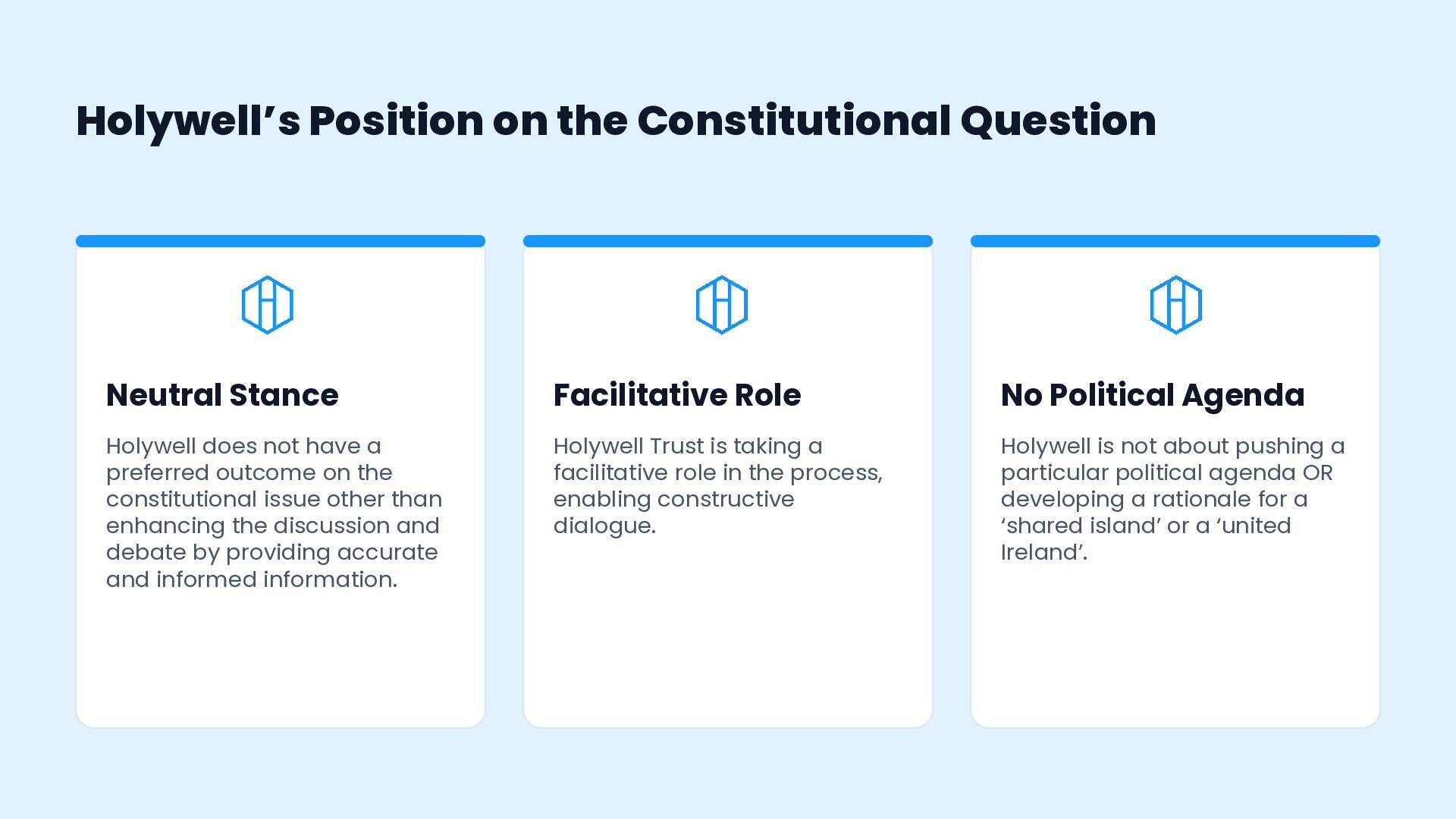
No Political Agenda Holywell does not have a preferred outcome on the constitutional issue other than enhancing the discussion and debate by providing accurate and informed information. Holywell Trust is taking a facilitative role in the process, enabling constructive dialogue. Holywell is not about pushing a particular political agenda OR developing a rationale for a ‘shared island’ or a ‘united Ireland’.
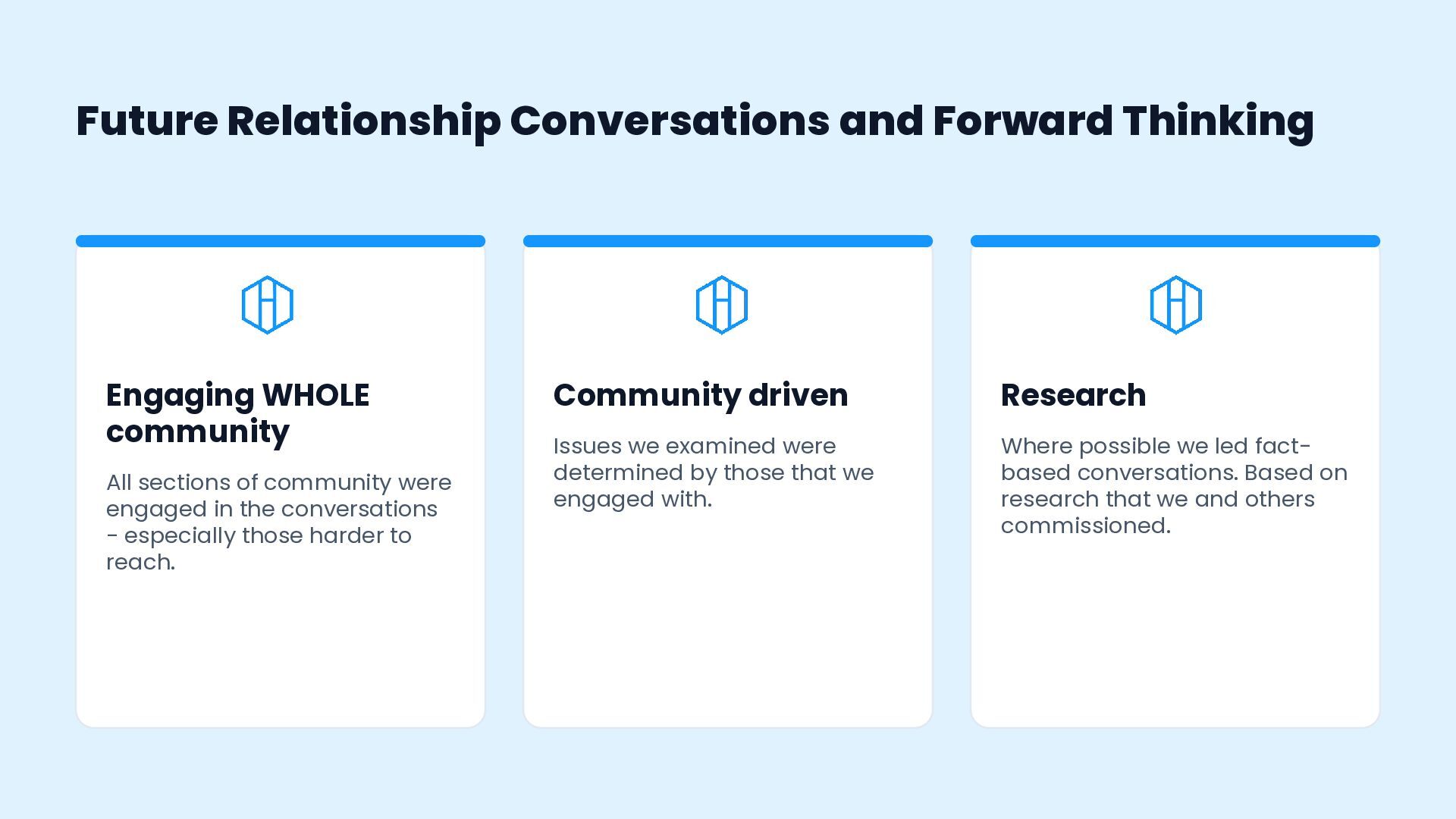
sections of community were engaged in the conversations - especially those harder to reach. Community driven Research Issues we examined were determined by those that we engaged with. Where possible we led factbased conversations. Based on research that we and others commissioned.
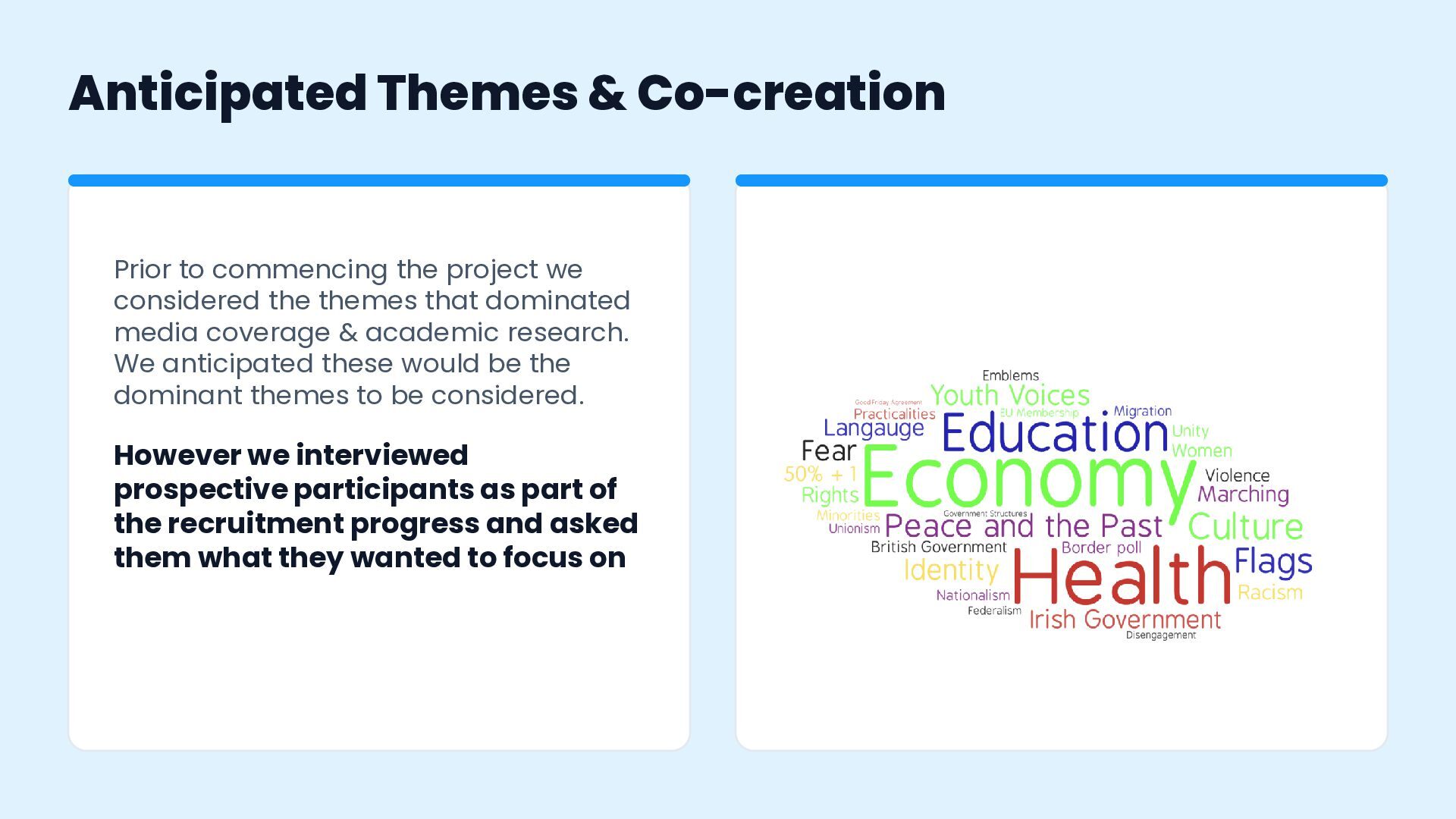
considered the themes that dominated media coverage & academic research. We anticipated these would be the dominant themes to be considered. However we interviewed prospective participants as part of the recruitment progress and asked them what they wanted to focus on
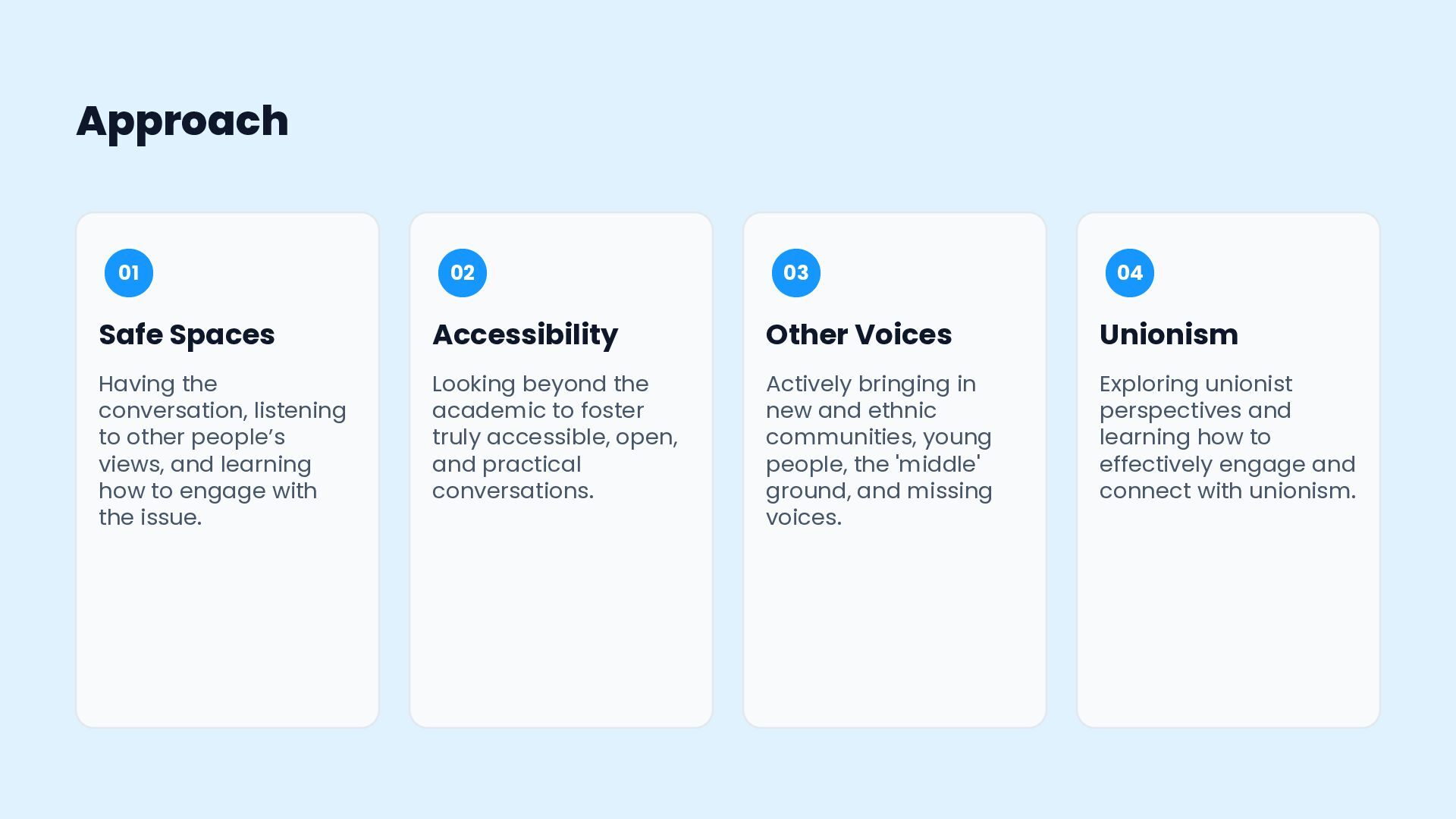
Unionism Having the conversation, listening to other people’s views, and learning how to engage with the issue. Looking beyond the academic to foster truly accessible, open, and practical conversations. Actively bringing in new and ethnic communities, young people, the 'middle' ground, and missing voices. Exploring unionist perspectives and learning how to effectively engage and connect with unionism.
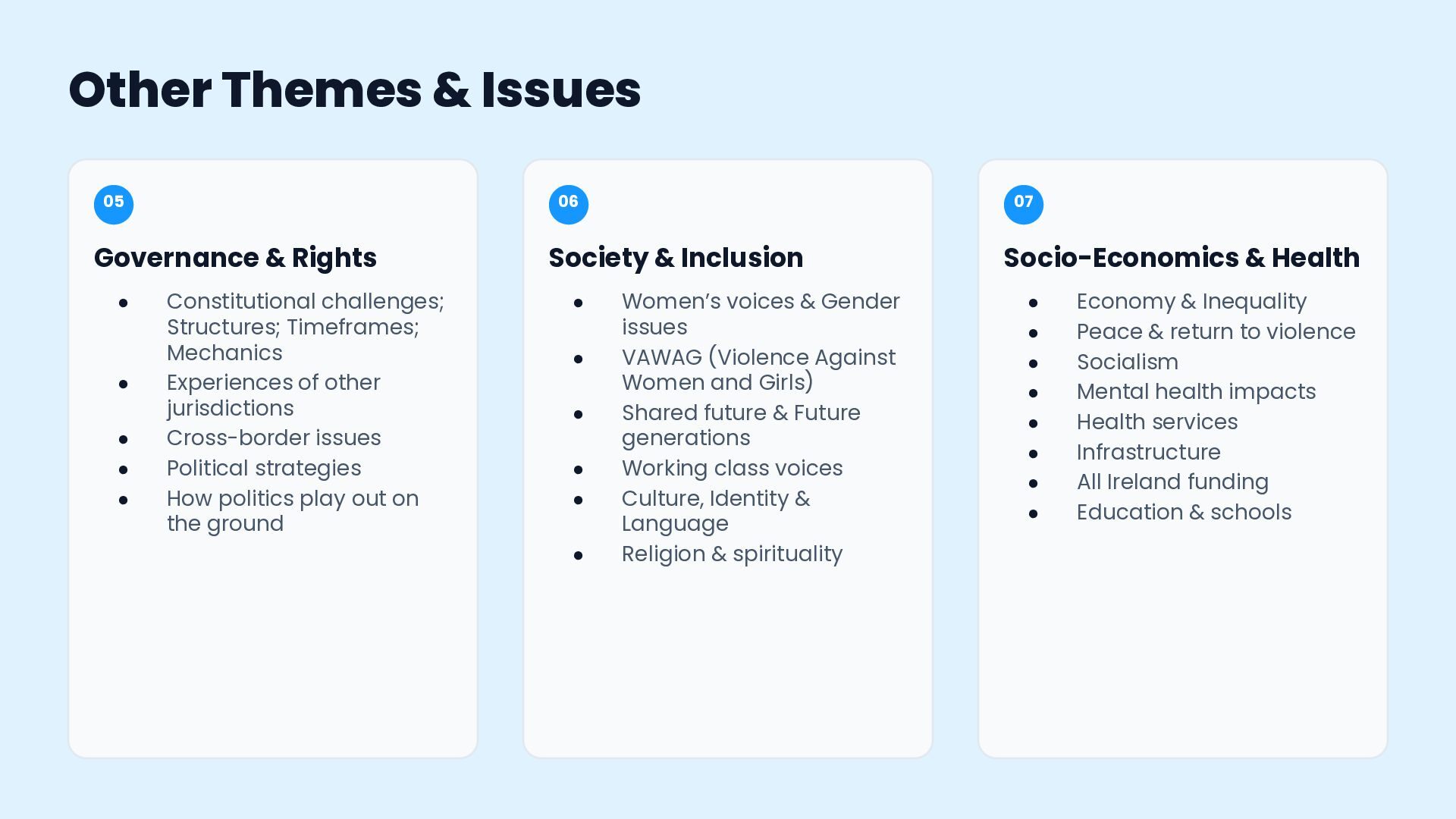
Society & Inclusion Socio-Economics & Health • • • • • Constitutional challenges; Structures; Timeframes; Mechanics Experiences of other jurisdictions Cross-border issues Political strategies How politics play out on the ground • • • • • • Women’s voices & Gender issues VAWAG (Violence Against Women and Girls) Shared future & Future generations Working class voices Culture, Identity & Language Religion & spirituality • • • • • • • • Economy & Inequality Peace & return to violence Socialism Mental health impacts Health services Infrastructure All Ireland funding Education & schools
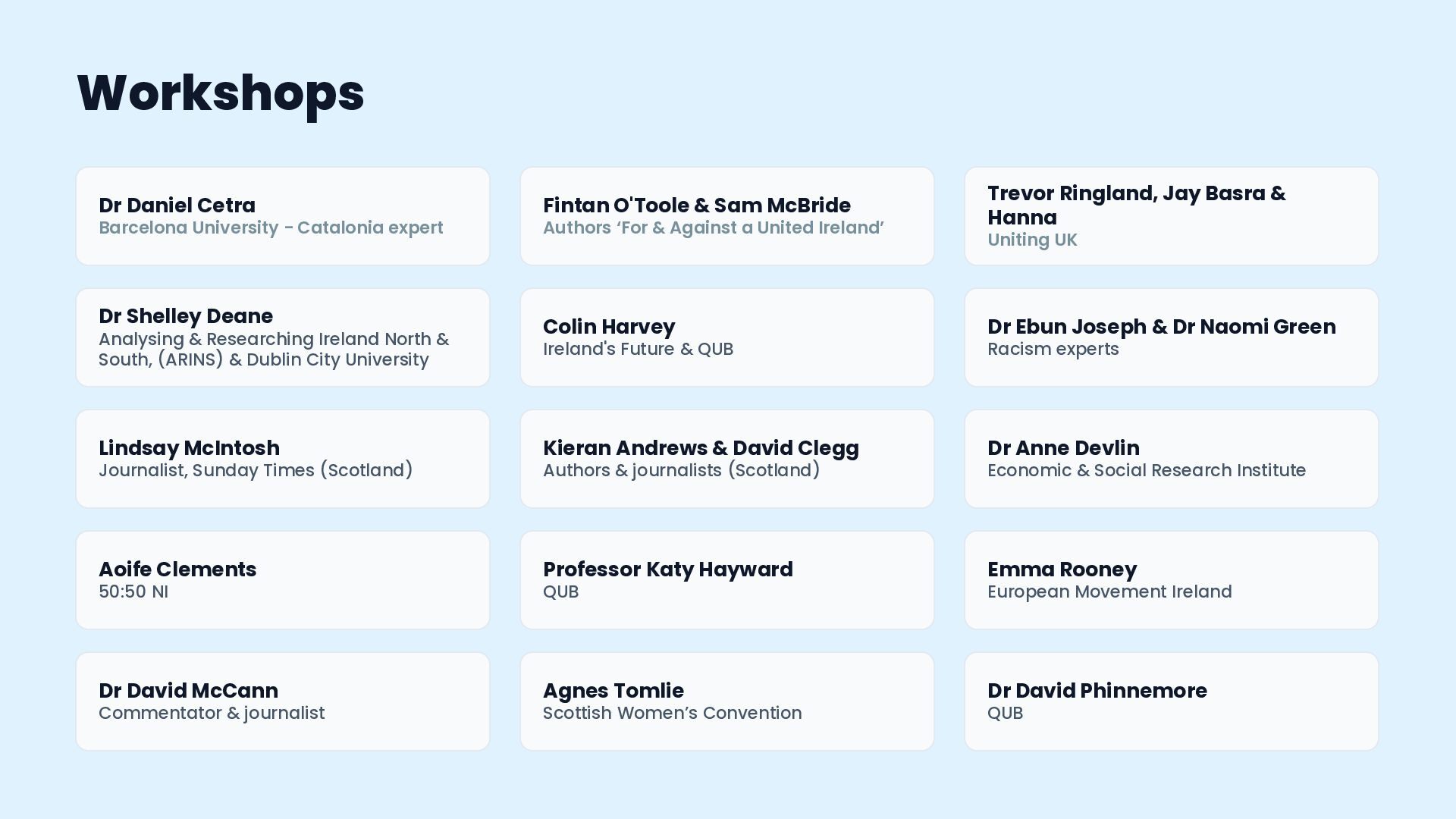
Jay Basra & Hanna Colin Harvey Dr Ebun Joseph & Dr Naomi Green Lindsay McIntosh Kieran Andrews & David Clegg Dr Anne Devlin Aoife Clements Professor Katy Hayward Emma Rooney Dr David McCann Agnes Tomlie Dr David Phinnemore Dr Daniel Cetra Barcelona University - Catalonia expert Dr Shelley Deane Analysing & Researching Ireland North & South, (ARINS) & Dublin City University Journalist, Sunday Times (Scotland) 50:50 NI Commentator & journalist Fintan O'Toole & Sam McBride Ireland's Future & QUB Authors & journalists (Scotland) QUB Scottish Women’s Convention Uniting UK Racism experts Economic & Social Research Institute European Movement Ireland QUB
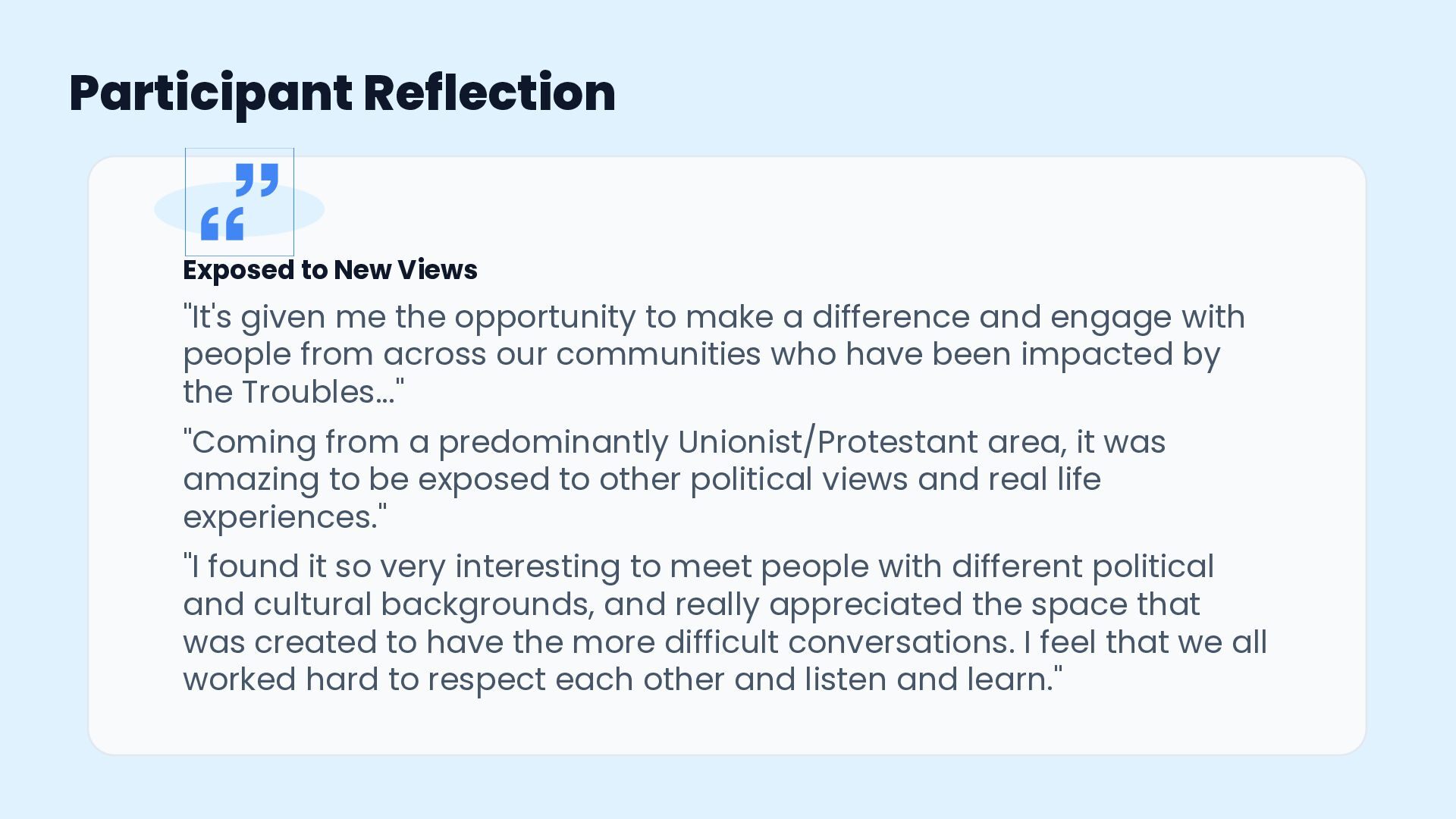
opportunity to make a difference and engage with people from across our communities who have been impacted by the Troubles..." "Coming from a predominantly Unionist/Protestant area, it was amazing to be exposed to other political views and real life experiences." "I found it so very interesting to meet people with different political and cultural backgrounds, and really appreciated the space that was created to have the more difficult conversations. I feel that we all worked hard to respect each other and listen and learn."
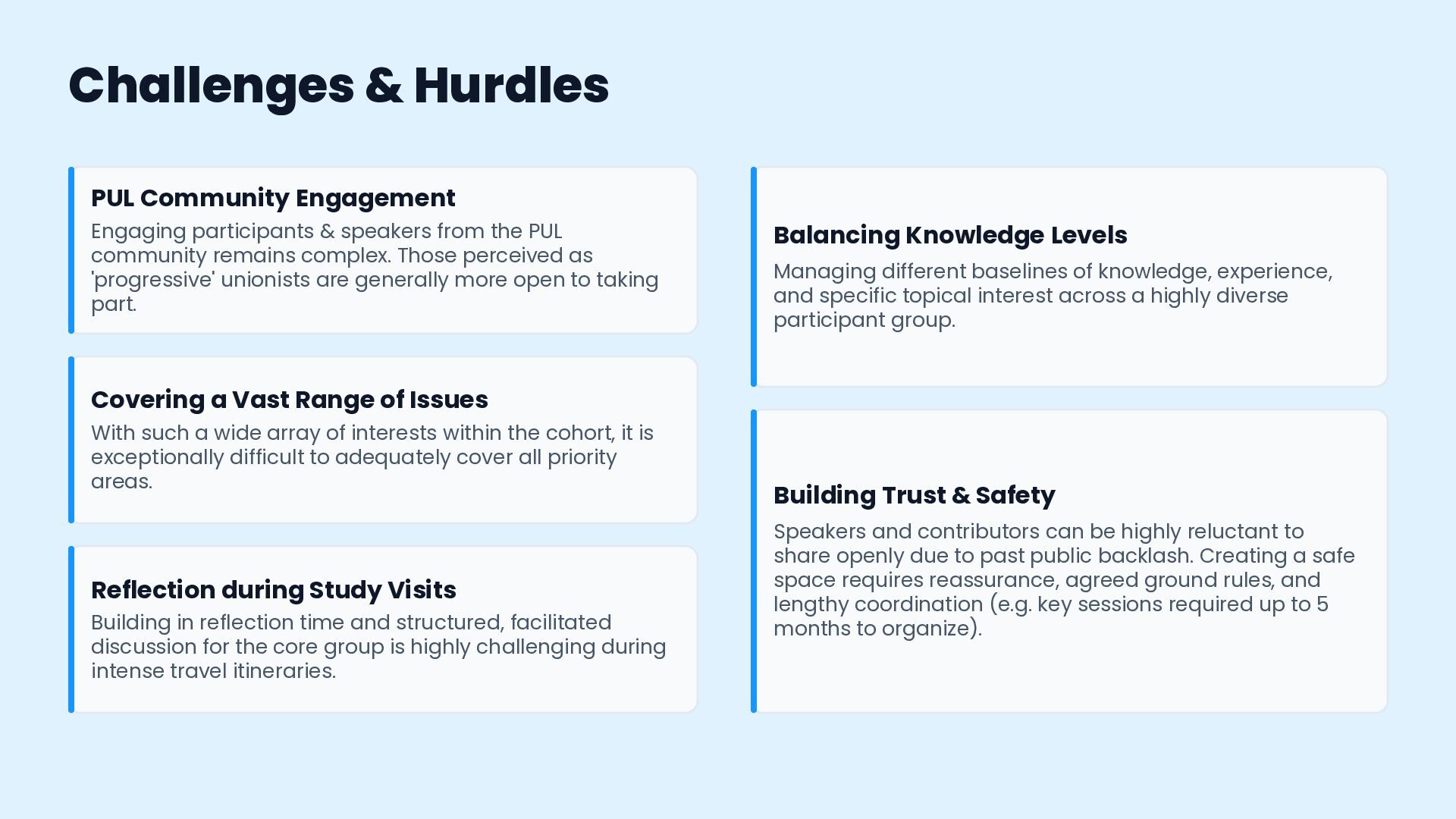
from the PUL community remains complex. Those perceived as 'progressive' unionists are generally more open to taking part. Balancing Knowledge Levels Managing different baselines of knowledge, experience, and specific topical interest across a highly diverse participant group. Covering a Vast Range of Issues With such a wide array of interests within the cohort, it is exceptionally difficult to adequately cover all priority areas. Reflection during Study Visits Building in reflection time and structured, facilitated discussion for the core group is highly challenging during intense travel itineraries. Building Trust & Safety Speakers and contributors can be highly reluctant to share openly due to past public backlash. Creating a safe space requires reassurance, agreed ground rules, and lengthy coordination (e.g. key sessions required up to 5 months to organize).
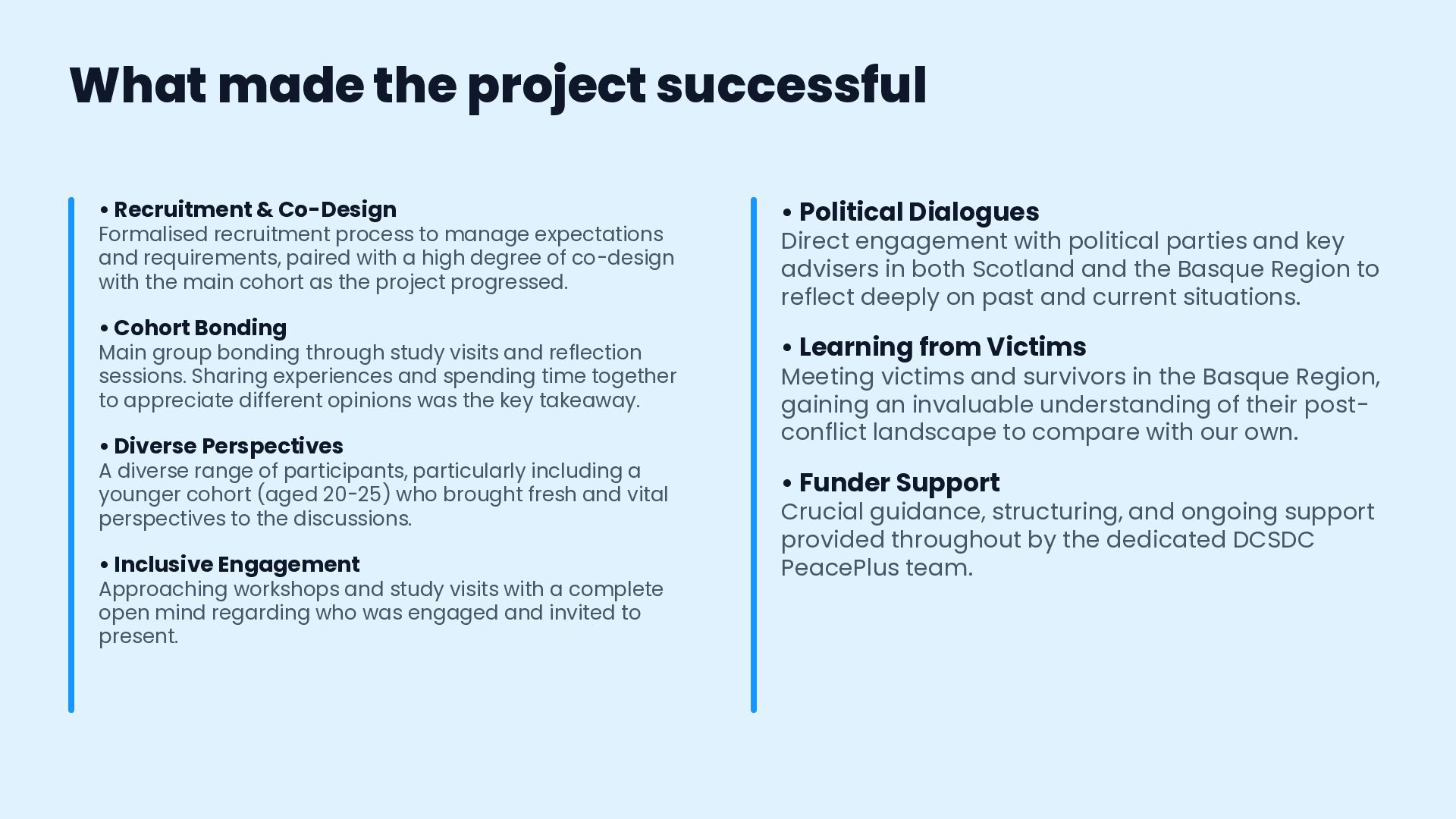
recruitment process to manage expectations and requirements, paired with a high degree of co-design with the main cohort as the project progressed. • Cohort Bonding Main group bonding through study visits and reflection sessions. Sharing experiences and spending time together to appreciate different opinions was the key takeaway. • Diverse Perspectives A diverse range of participants, particularly including a younger cohort (aged 20-25) who brought fresh and vital perspectives to the discussions. • Inclusive Engagement Approaching workshops and study visits with a complete open mind regarding who was engaged and invited to present. • Political Dialogues Direct engagement with political parties and key advisers in both Scotland and the Basque Region to reflect deeply on past and current situations. • Learning from Victims Meeting victims and survivors in the Basque Region, gaining an invaluable understanding of their postconflict landscape to compare with our own. • Funder Support Crucial guidance, structuring, and ongoing support provided throughout by the dedicated DCSDC PeacePlus team.
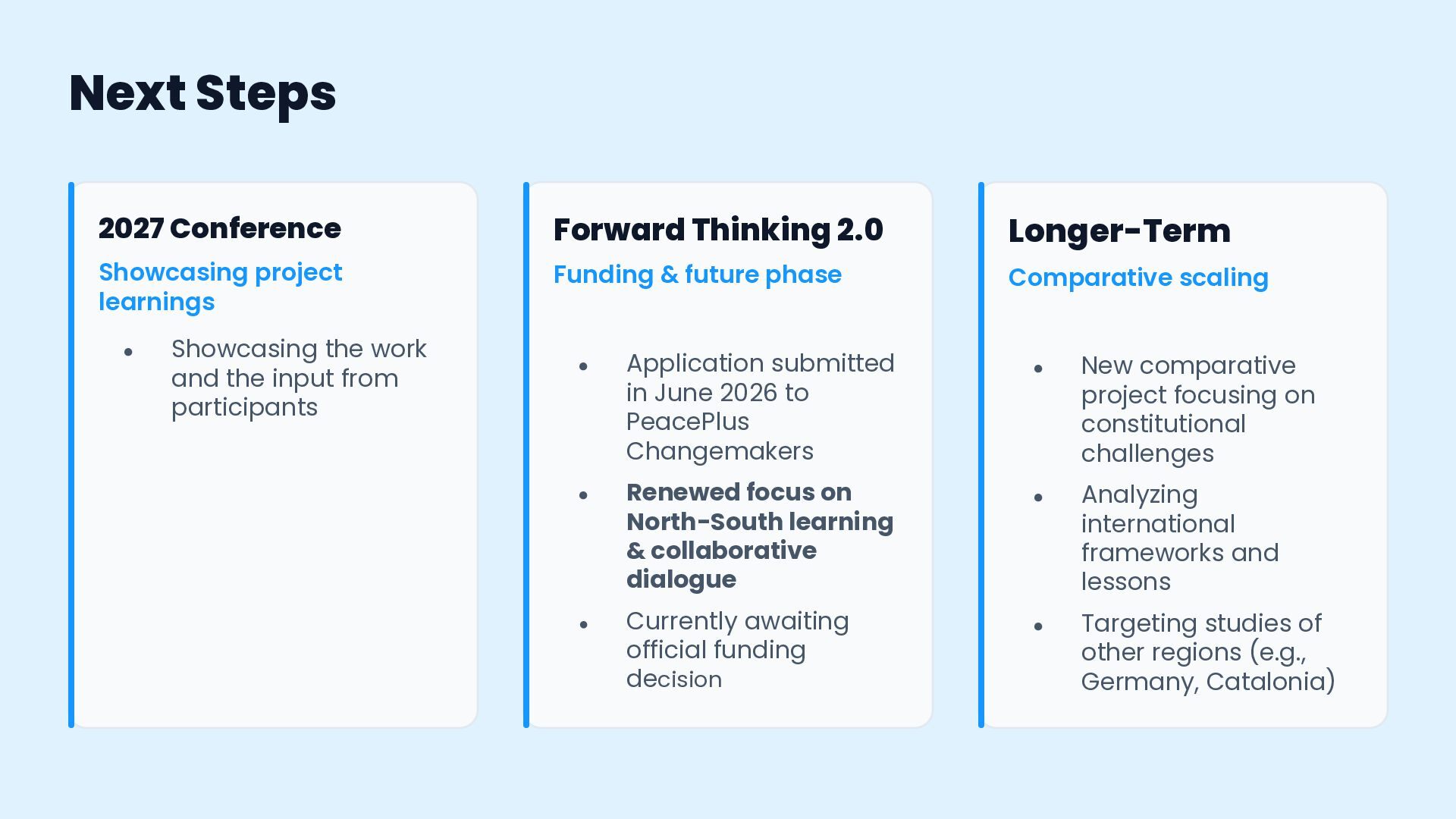
learnings Funding & future phase Comparative scaling • Showcasing the work and the input from participants • • • Application submitted in June 2026 to PeacePlus Changemakers Renewed focus on North-South learning & collaborative dialogue Currently awaiting official funding decision • • • New comparative project focusing on constitutional challenges Analyzing international frameworks and lessons Targeting studies of other regions (e.g., Germany, Catalonia)
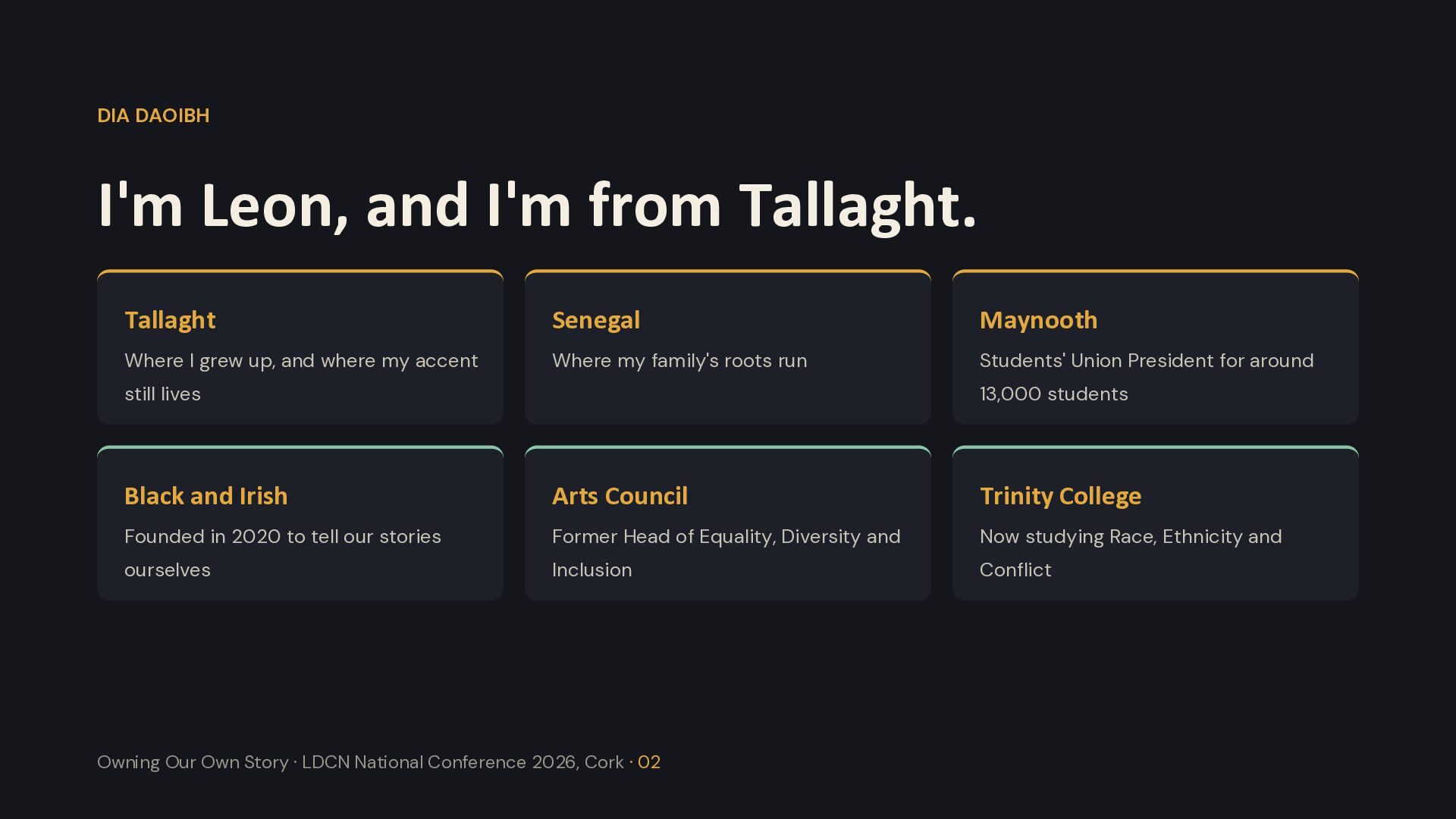
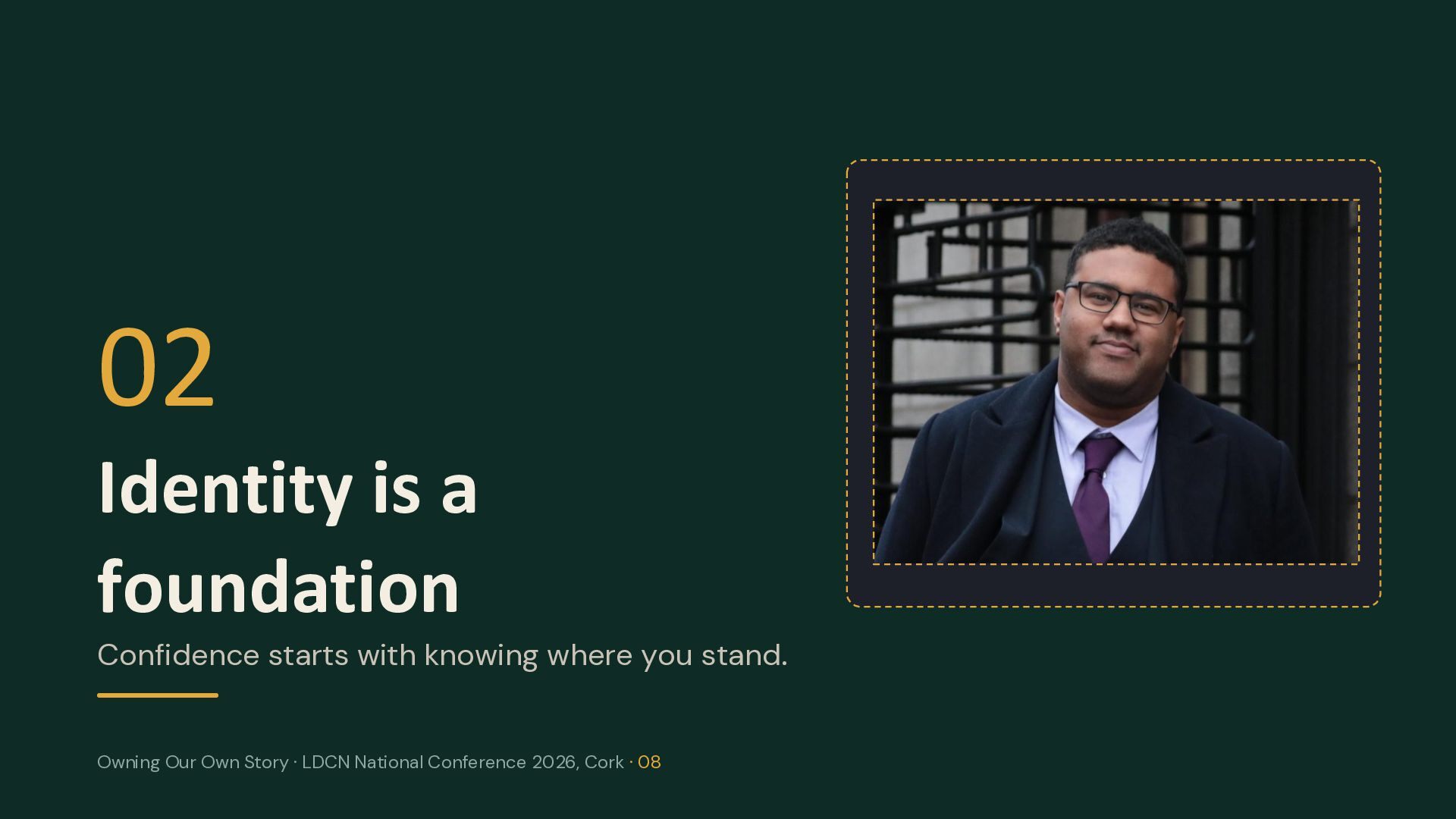
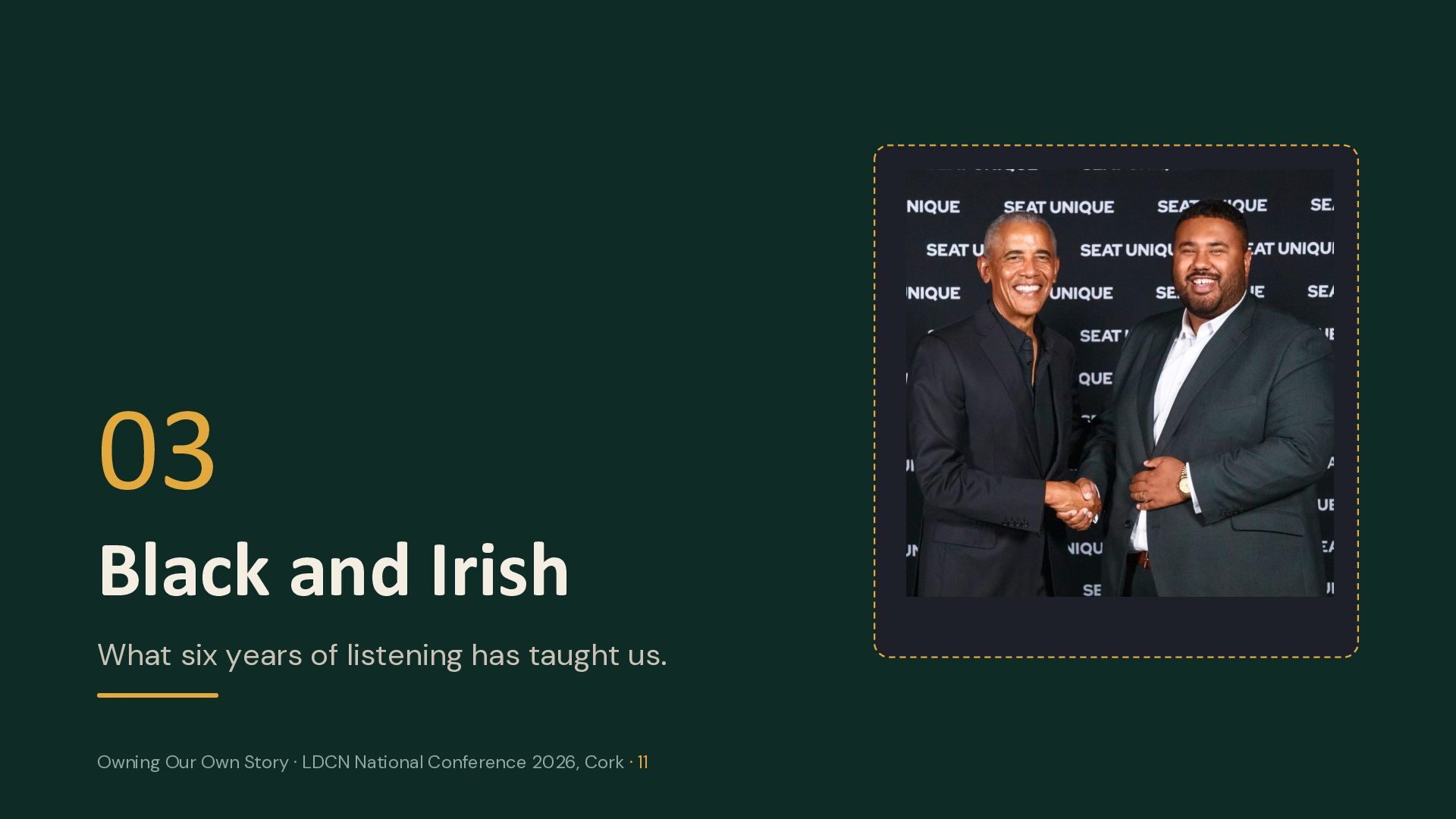
Maynooth Where I grew up, and where my accent Where my family's roots run Students' Union President for around still lives 13,000 students Black and Irish Arts Council Trinity College Founded in 2020 to tell our stories Former Head of Equality, Diversity and Now studying Race, Ethnicity and ourselves Inclusion Conflict Owning Our Own Story · LDCN National Conference 2026, Cork · 02
me The story I was living “Where are you really from?” A Tallaght kid through and through “You don't look Irish.” Irish in every way that counts, with roots in Different. Other. A question to be answered. Senegal Curious, loud, loved, stubborn child Owning Our Own Story · LDCN National Conference 2026, Cork · 05
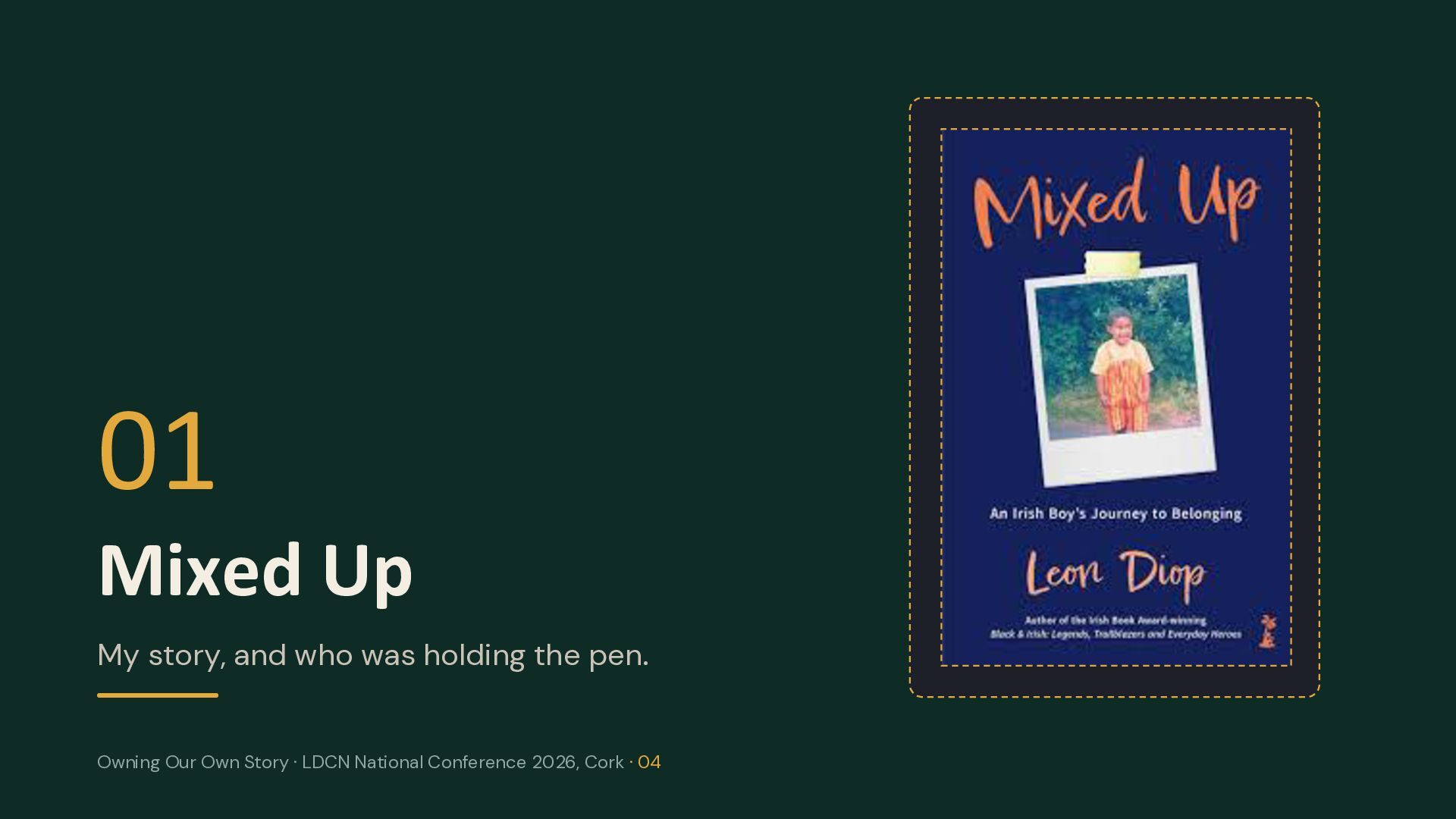
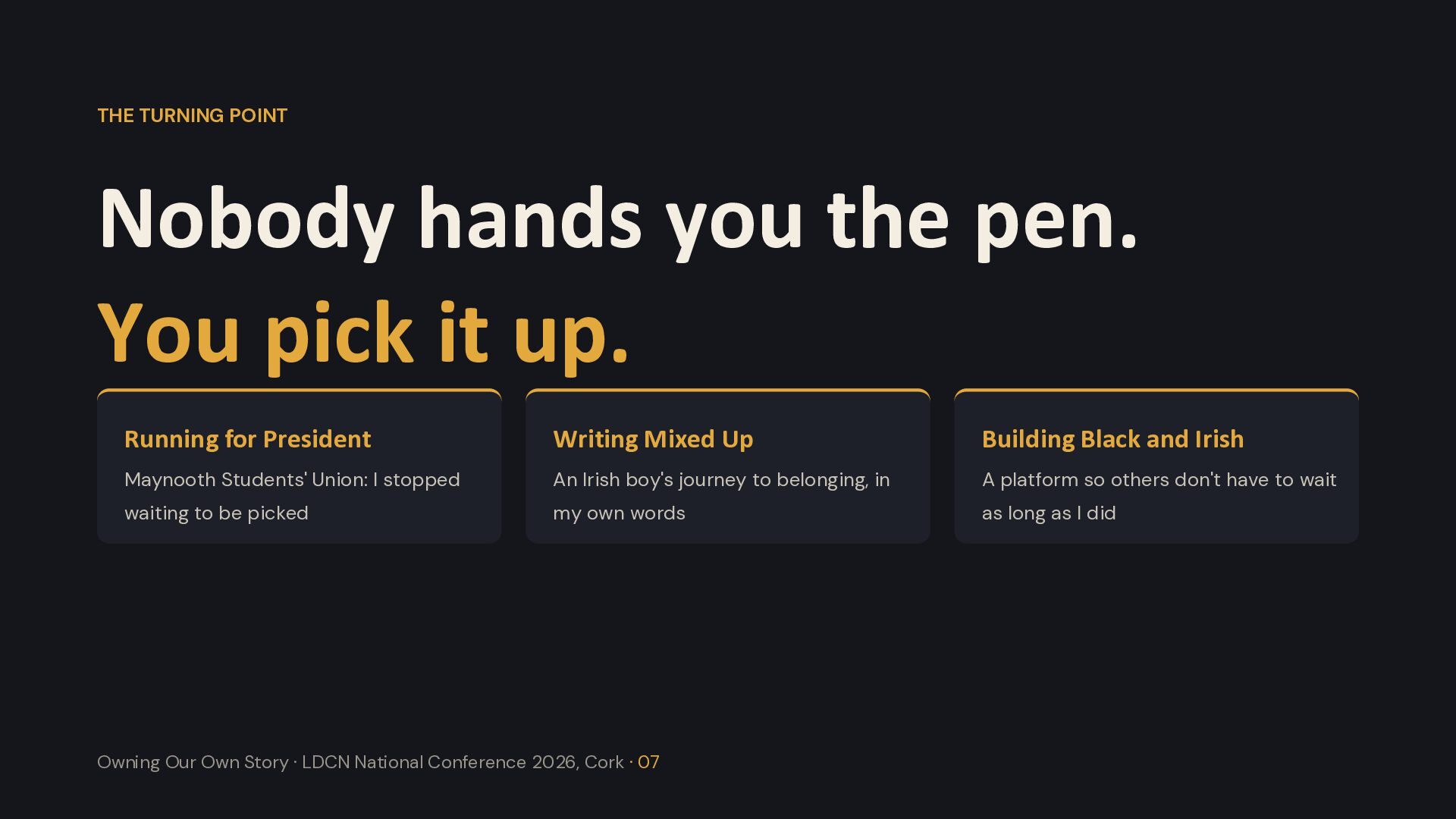
it up. Running for President Writing Mixed Up Building Black and Irish Maynooth Students' Union: I stopped An Irish boy's journey to belonging, in A platform so others don't have to wait waiting to be picked my own words as long as I did Owning Our Own Story · LDCN National Conference 2026, Cork · 07
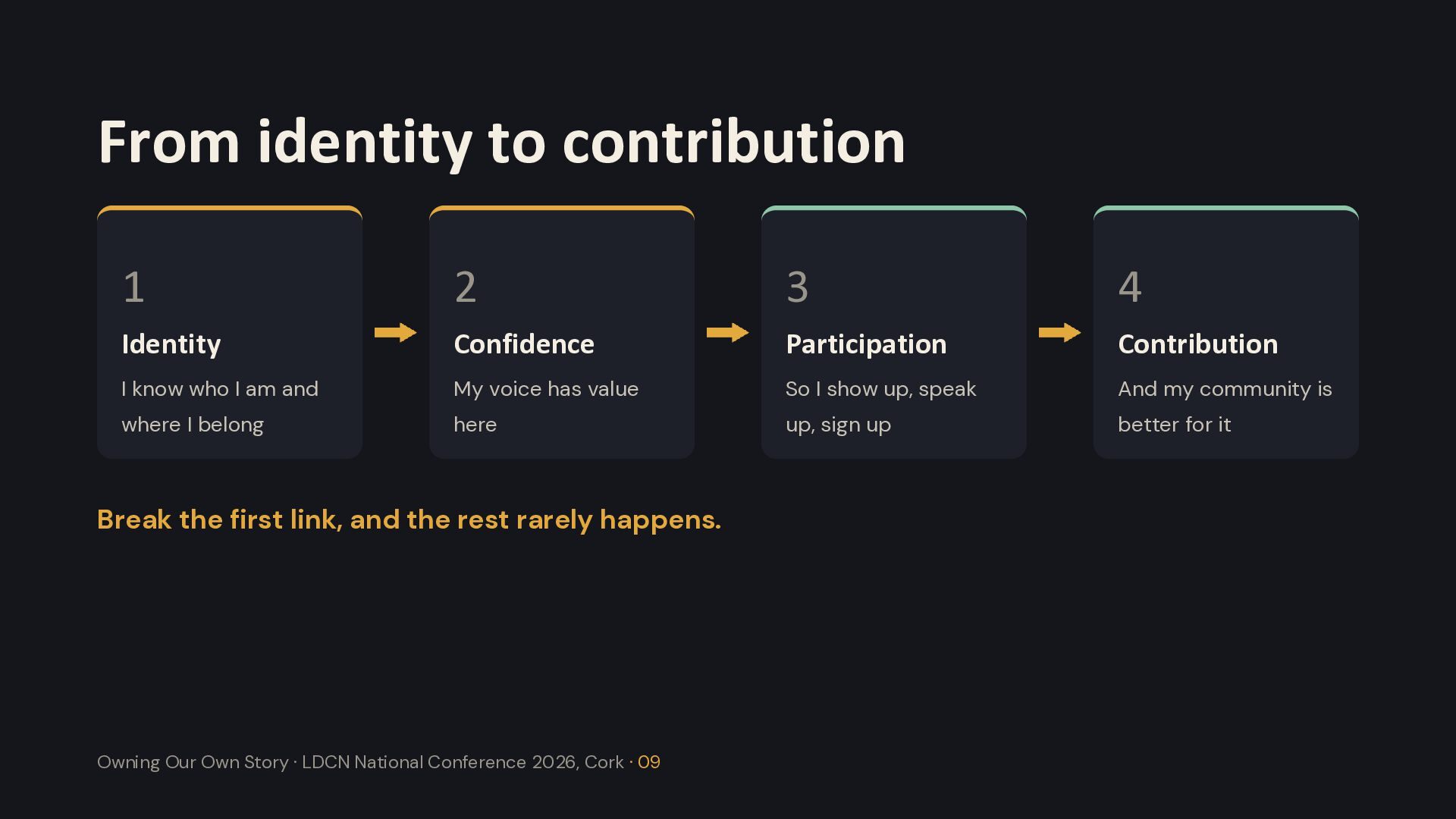
Participation Contribution I know who I am and My voice has value So I show up, speak And my community is where I belong here up, sign up better for it Break the first link, and the rest rarely happens. Owning Our Own Story · LDCN National Conference 2026, Cork · 09
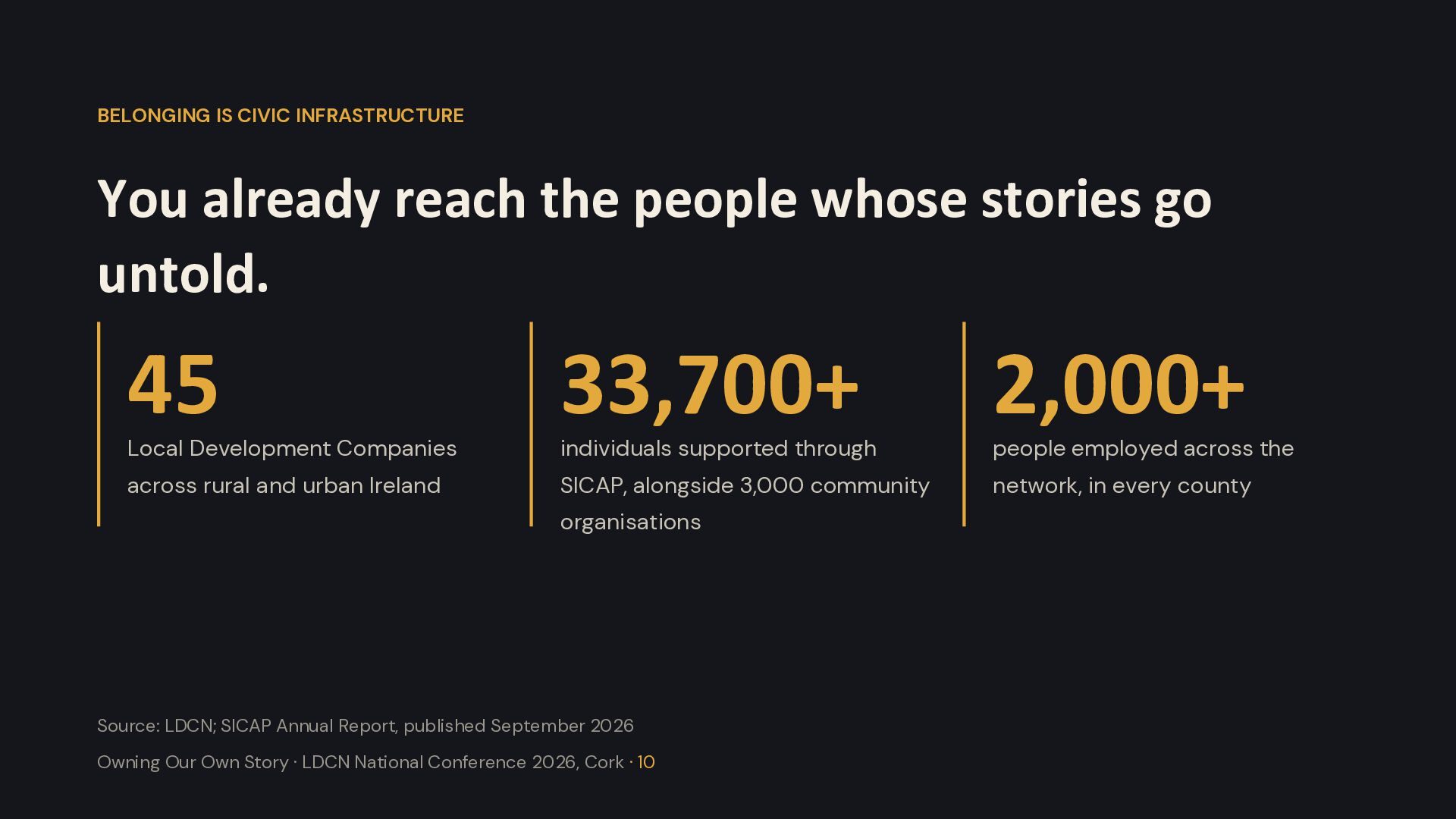
stories go untold. 45 33,700+ 2,000+ across rural and urban Ireland SICAP, alongside 3,000 community network, in every county Local Development Companies individuals supported through organisations Source: LDCN; SICAP Annual Report, published September 2026 Owning Our Own Story · LDCN National Conference 2026, Cork · 10 people employed across the
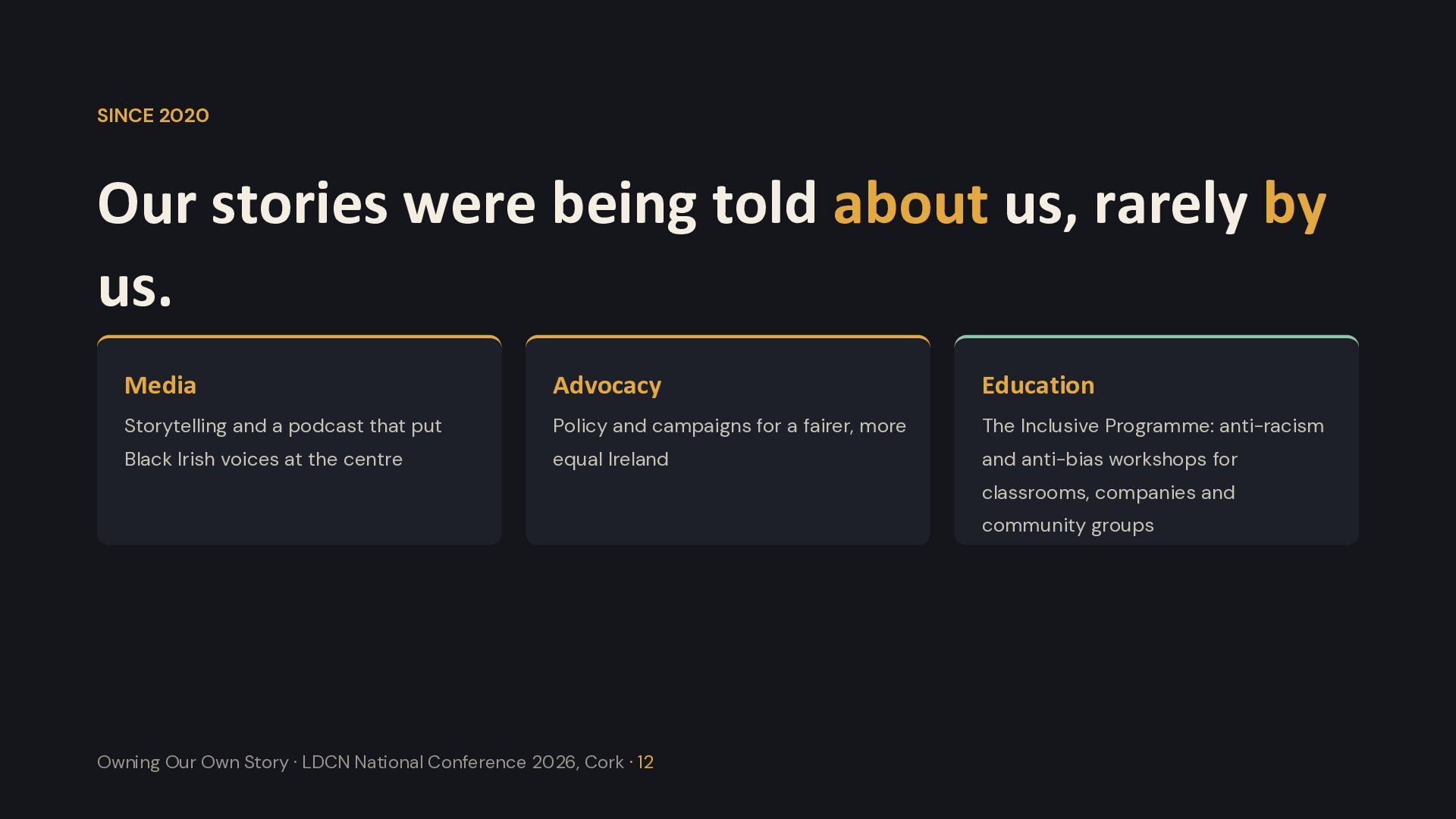
by us. Media Advocacy Education Storytelling and a podcast that put Policy and campaigns for a fairer, more The Inclusive Programme: anti-racism Black Irish voices at the centre equal Ireland and anti-bias workshops for classrooms, companies and community groups Owning Our Own Story · LDCN National Conference 2026, Cork · 12
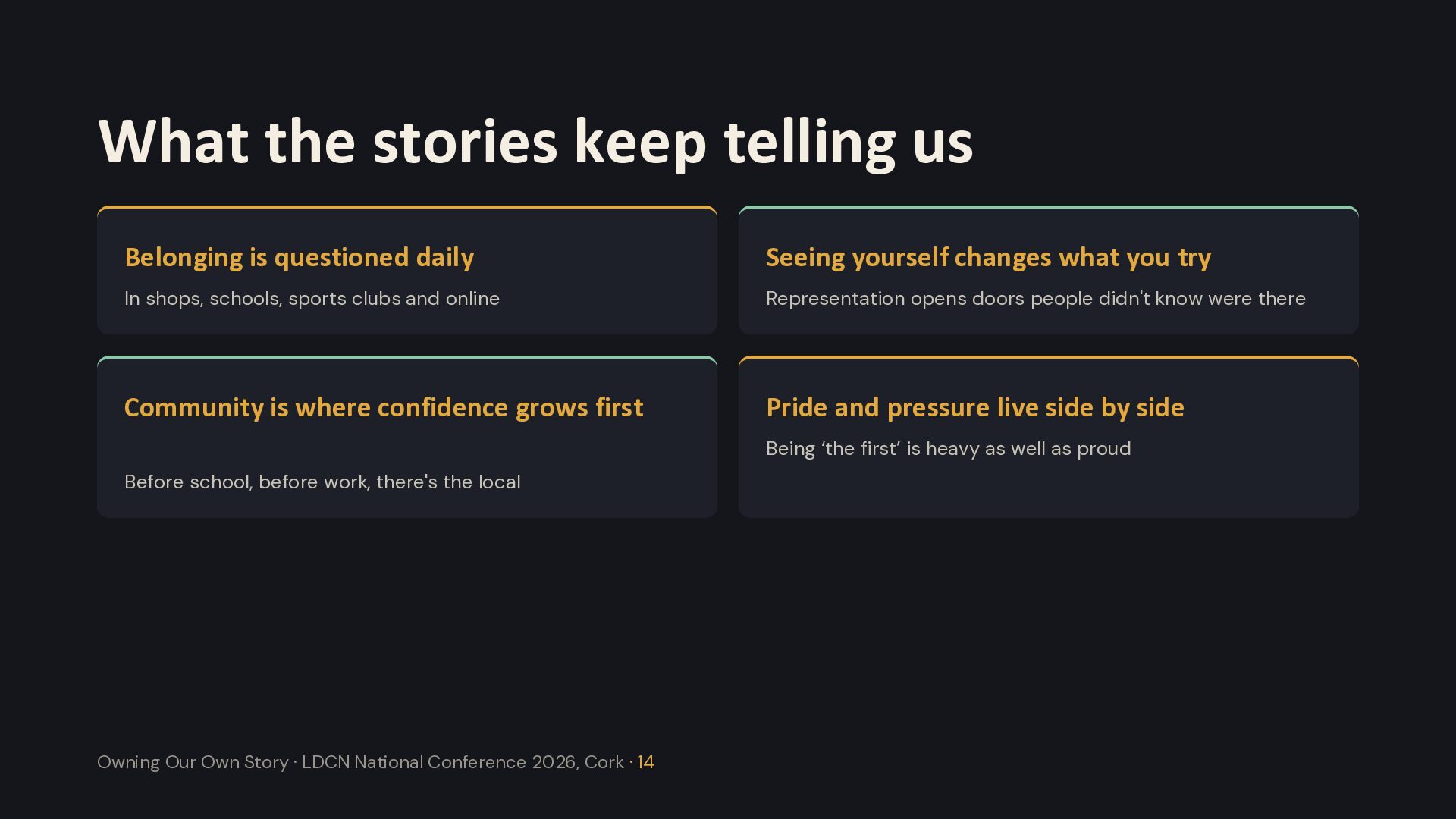
Seeing yourself changes what you try In shops, schools, sports clubs and online Representation opens doors people didn't know were there Community is where confidence grows first Pride and pressure live side by side Being ‘the first’ is heavy as well as proud Before school, before work, there's the local Owning Our Own Story · LDCN National Conference 2026, Cork · 14
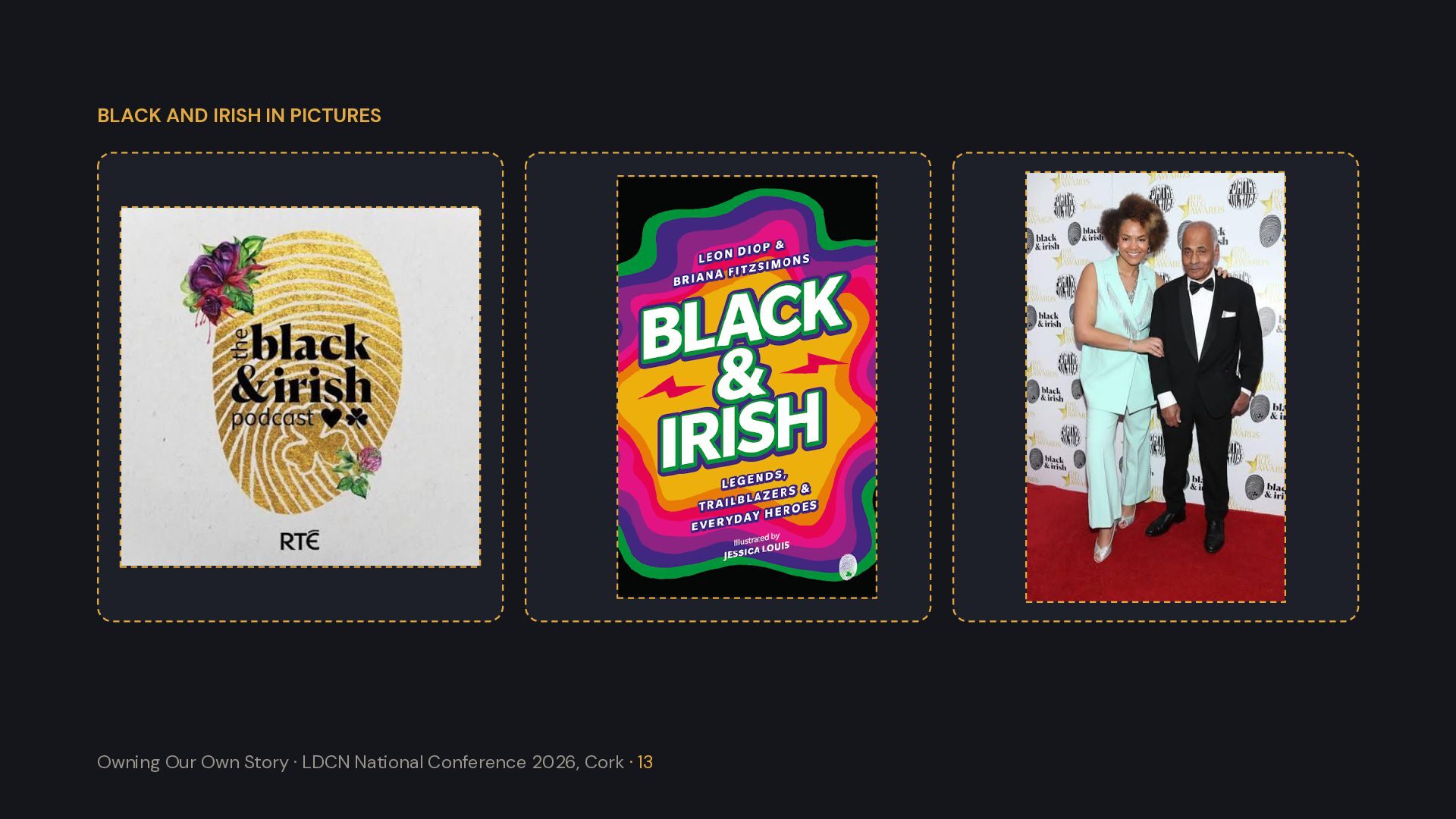
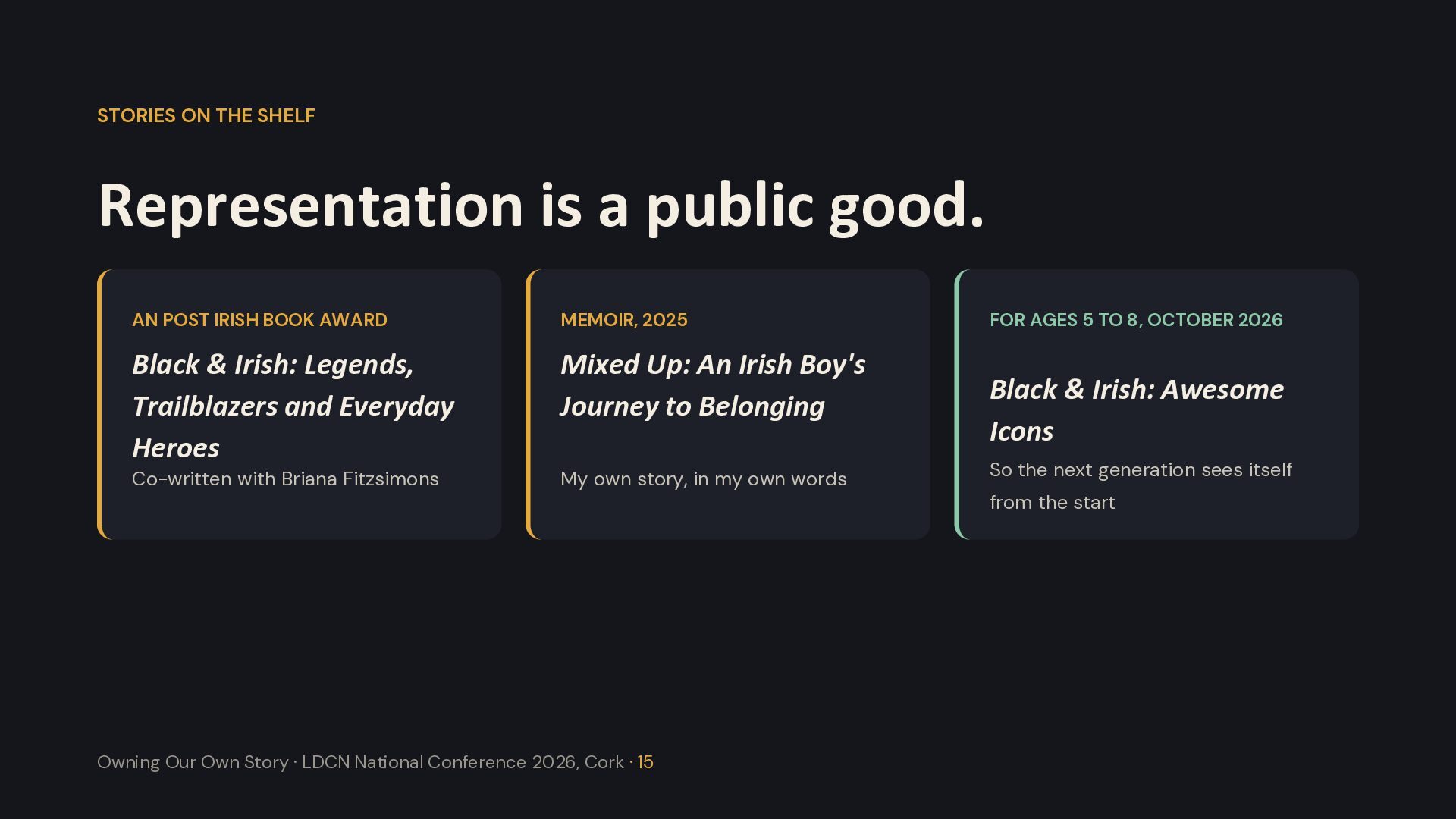
POST IRISH BOOK AWARD MEMOIR, 2025 Black & Irish: Legends, Trailblazers and Everyday Heroes Mixed Up: An Irish Boy's Journey to Belonging Co-written with Briana Fitzsimons My own story, in my own words Owning Our Own Story · LDCN National Conference 2026, Cork · 15 FOR AGES 5 TO 8, OCTOBER 2026 Black & Irish: Awesome Icons So the next generation sees itself from the start
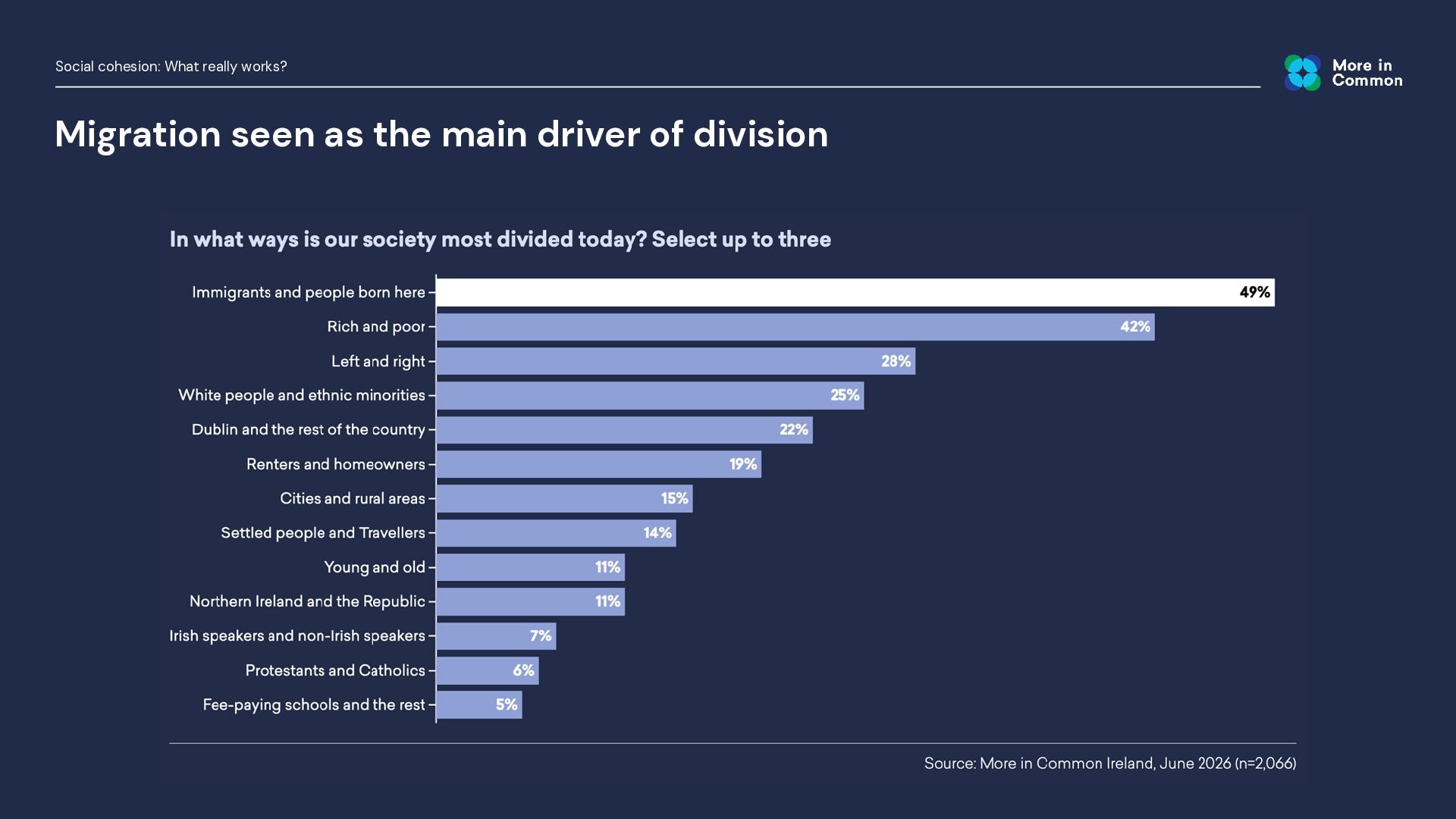
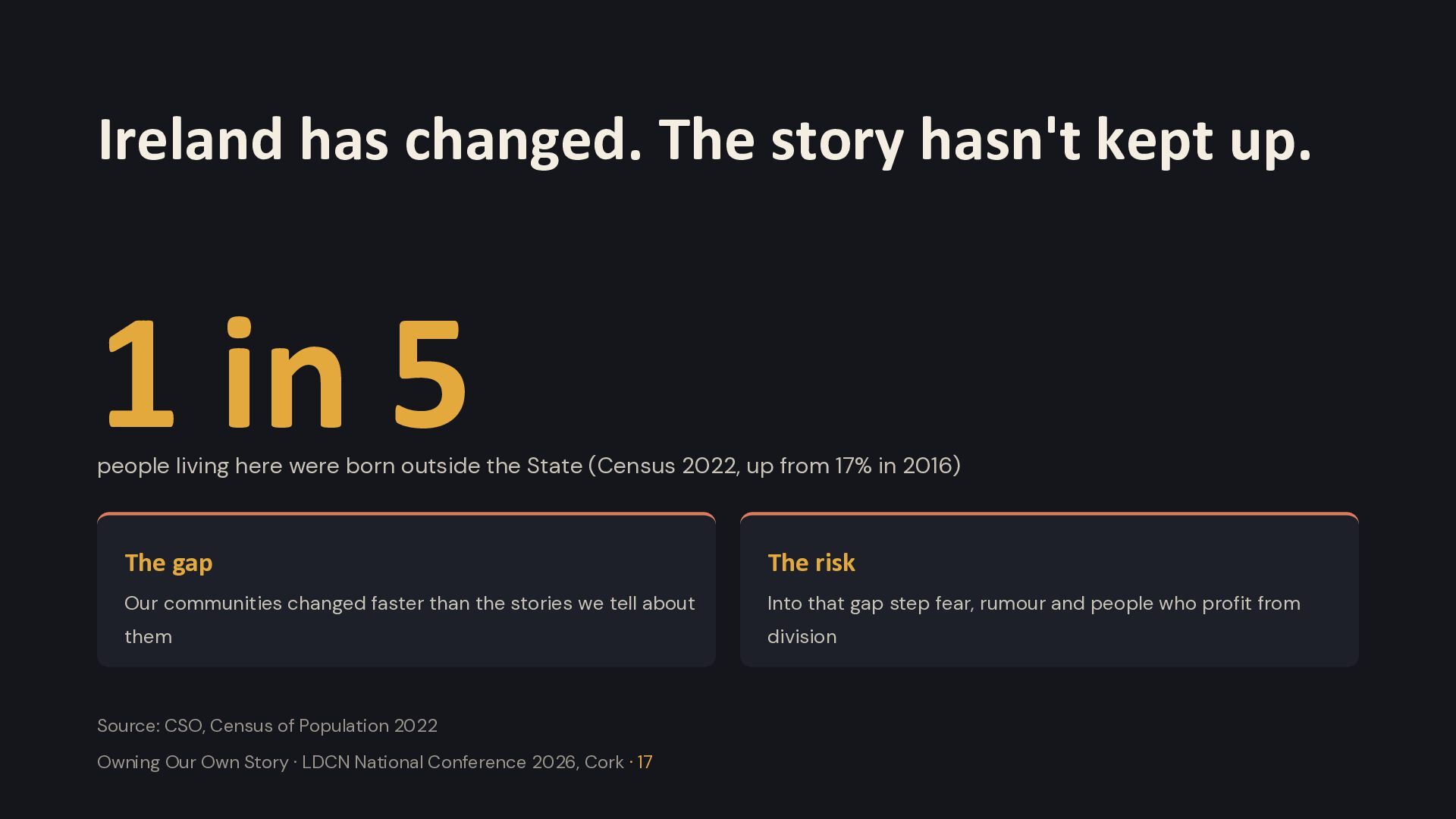
5 people living here were born outside the State (Census 2022, up from 17% in 2016) The gap The risk Our communities changed faster than the stories we tell about Into that gap step fear, rumour and people who profit from them division Source: CSO, Census of Population 2022 Owning Our Own Story · LDCN National Conference 2026, Cork · 17
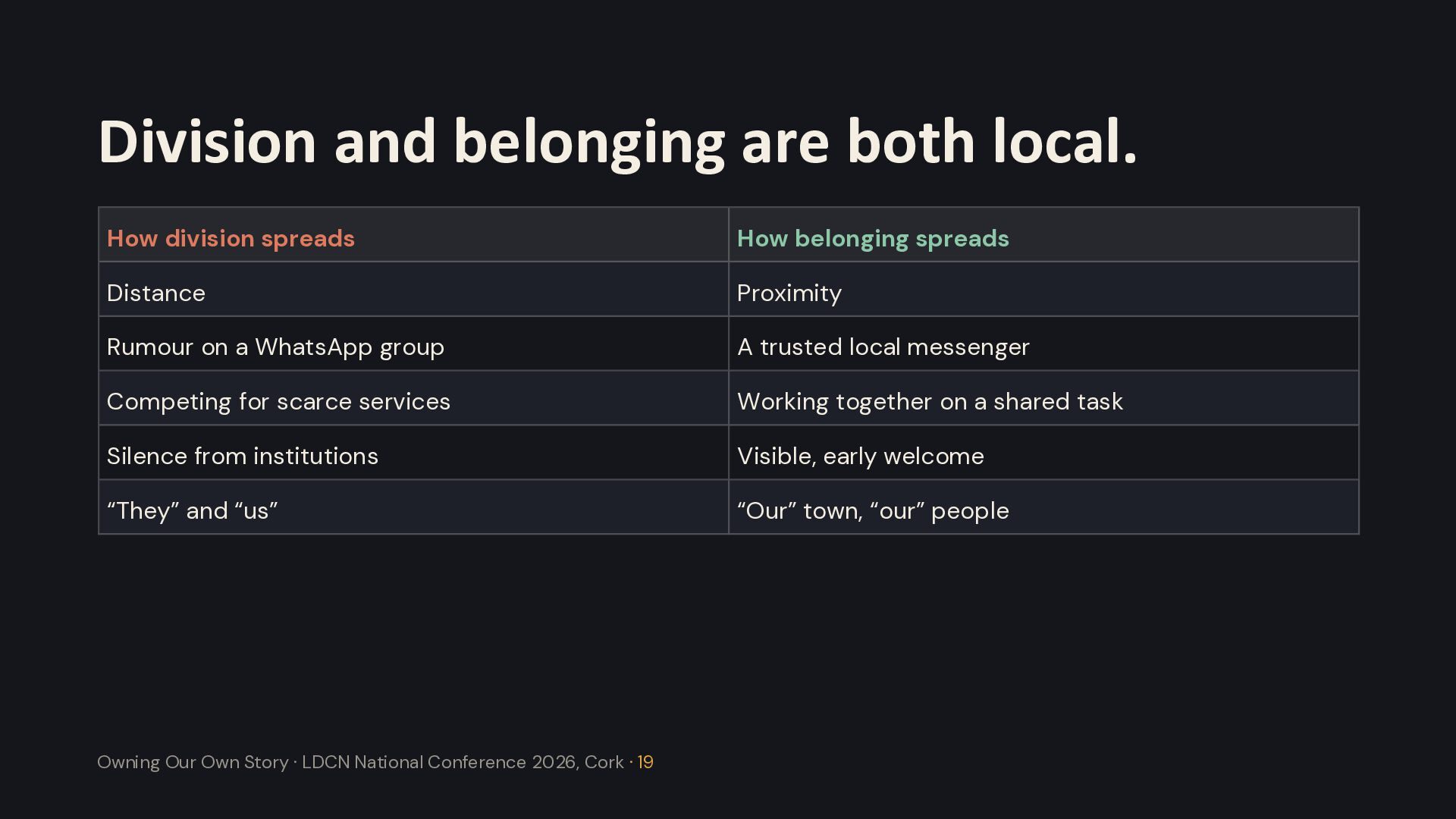
belonging spreads Distance Proximity Rumour on a WhatsApp group A trusted local messenger Competing for scarce services Working together on a shared task Silence from institutions Visible, early welcome “They” and “us” “Our” town, “our” people Owning Our Own Story · LDCN National Conference 2026, Cork · 19
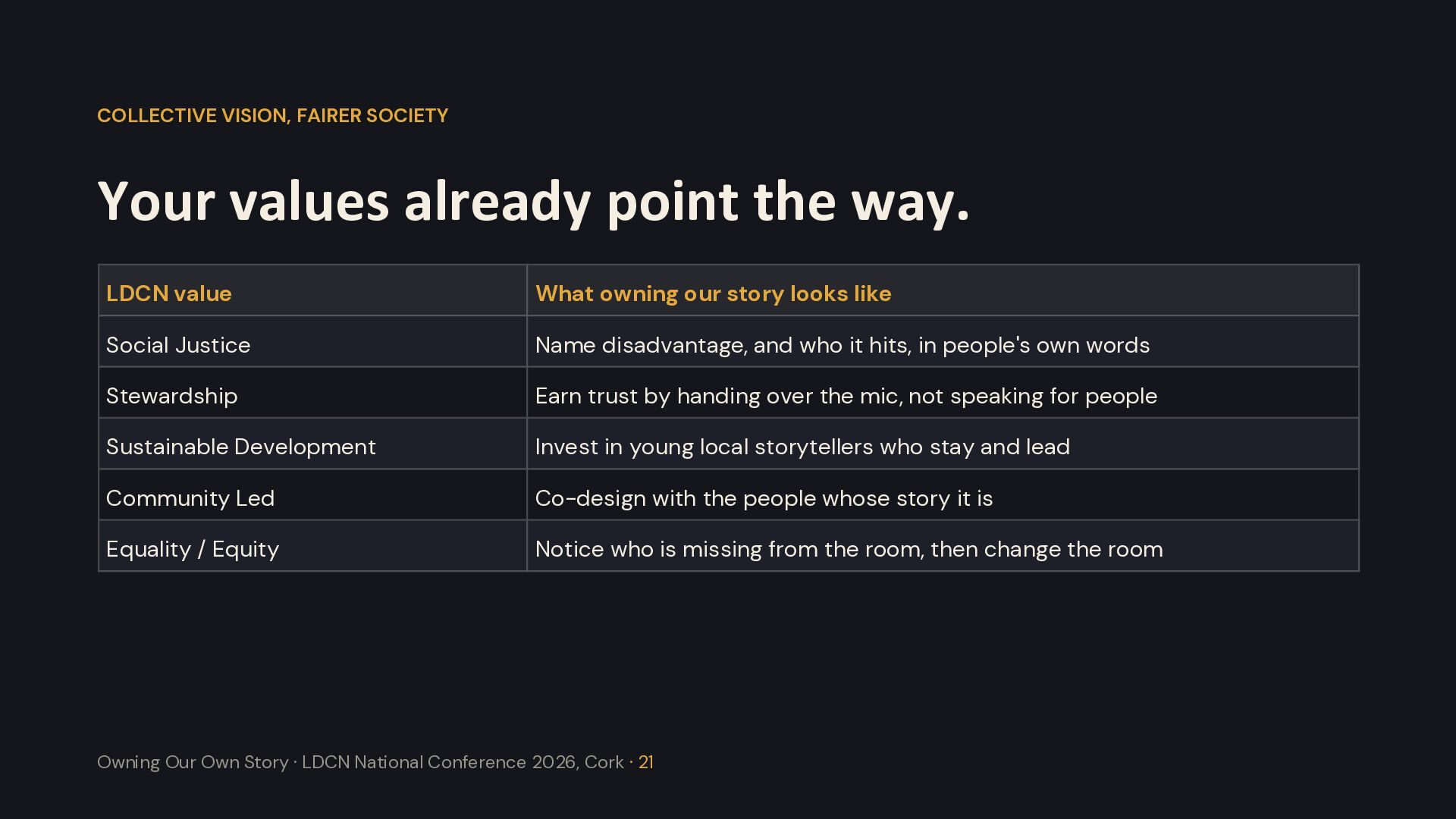
LDCN value What owning our story looks like Social Justice Name disadvantage, and who it hits, in people's own words Stewardship Earn trust by handing over the mic, not speaking for people Sustainable Development Invest in young local storytellers who stay and lead Community Led Co-design with the people whose story it is Equality / Equity Notice who is missing from the room, then change the room Owning Our Own Story · LDCN National Conference 2026, Cork · 21
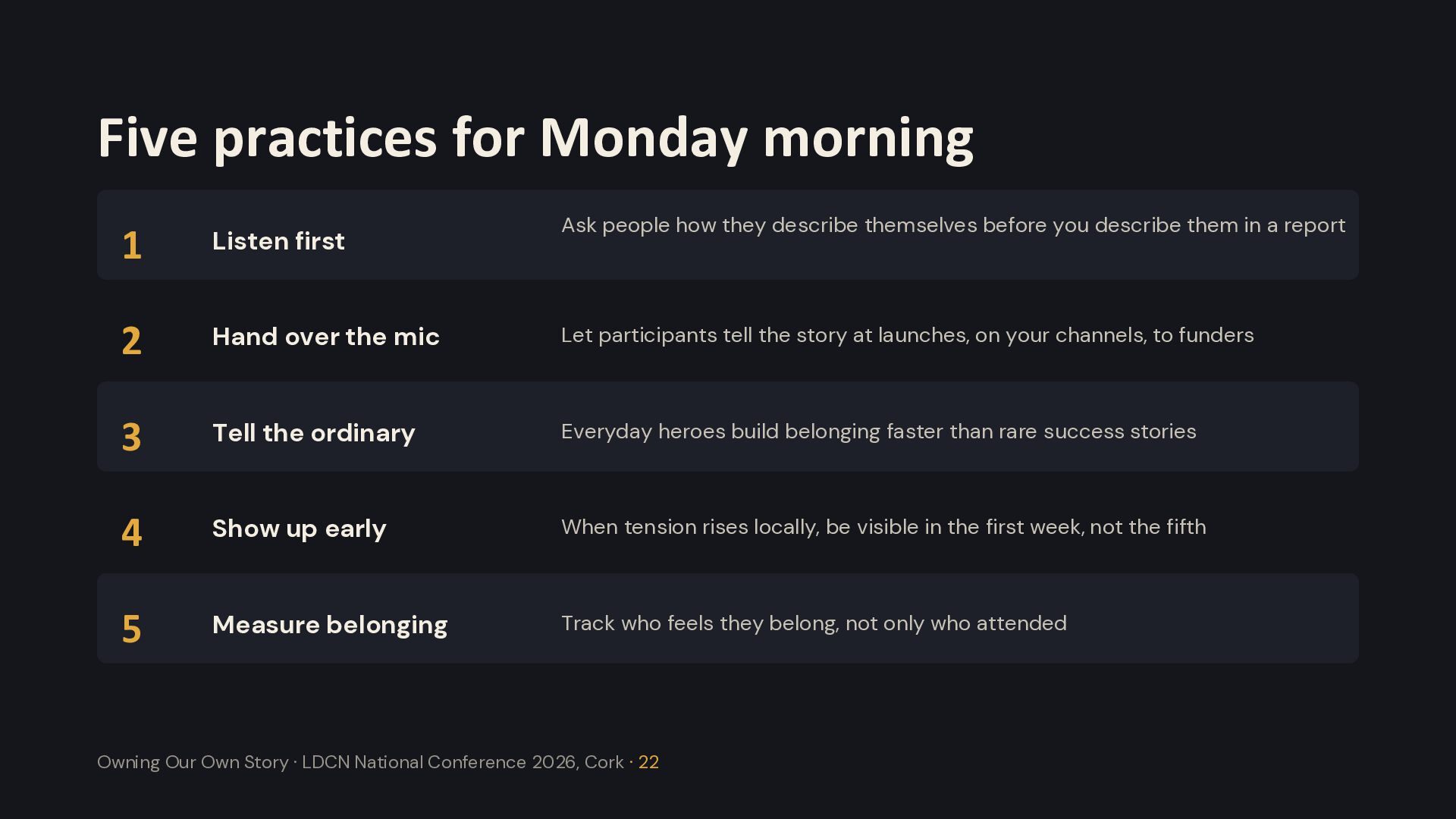
themselves before you describe them in a report 1 Listen first 2 Hand over the mic Let participants tell the story at launches, on your channels, to funders 3 Tell the ordinary Everyday heroes build belonging faster than rare success stories 4 Show up early When tension rises locally, be visible in the first week, not the fifth 5 Measure belonging Track who feels they belong, not only who attended Owning Our Own Story · LDCN National Conference 2026, Cork · 22
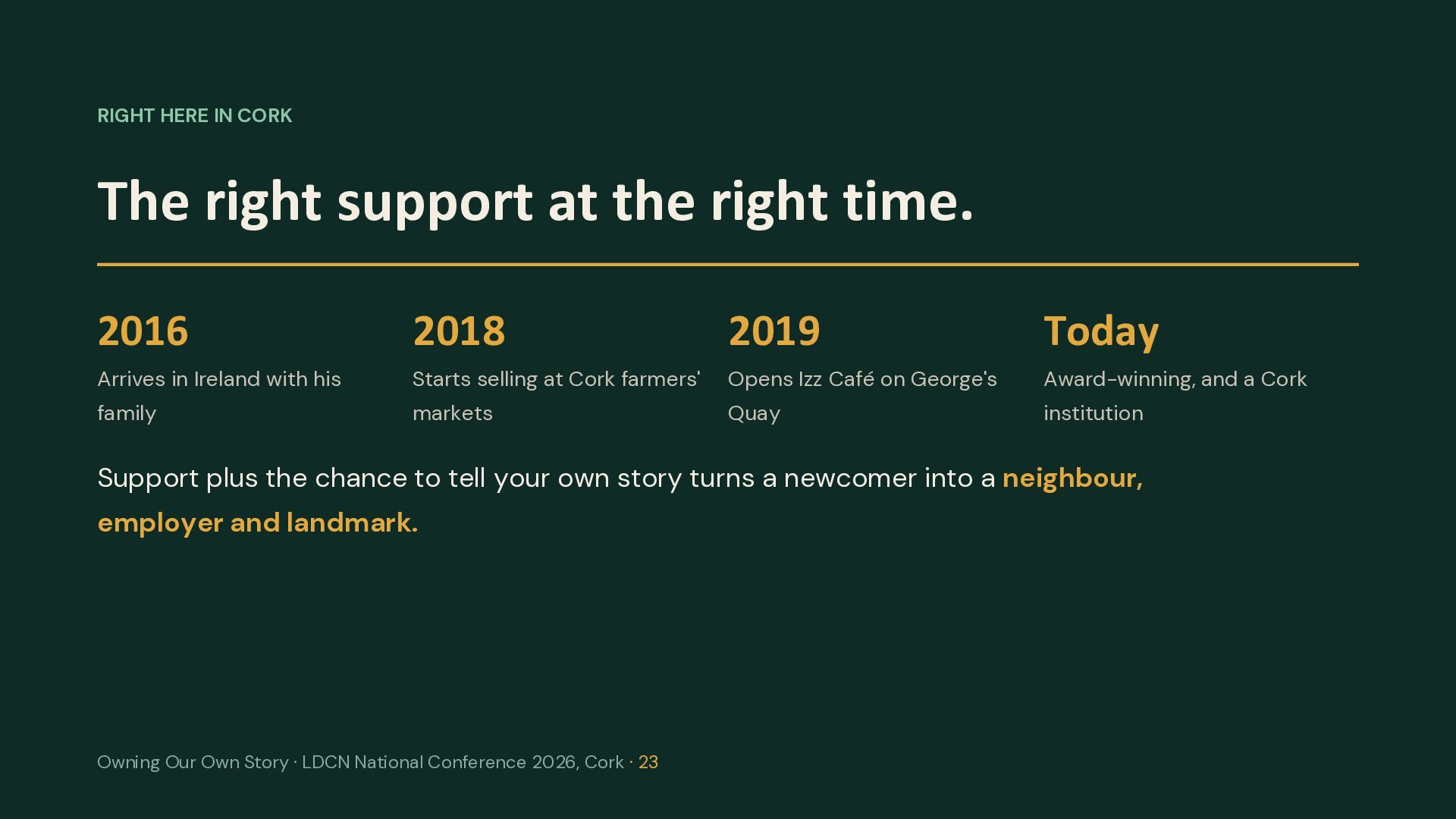
time. 2016 2018 2019 Today Arrives in Ireland with his Starts selling at Cork farmers' Opens Izz Café on George's Award-winning, and a Cork family markets Quay institution Support plus the chance to tell your own story turns a newcomer into a neighbour, employer and landmark. Owning Our Own Story · LDCN National Conference 2026, Cork · 23
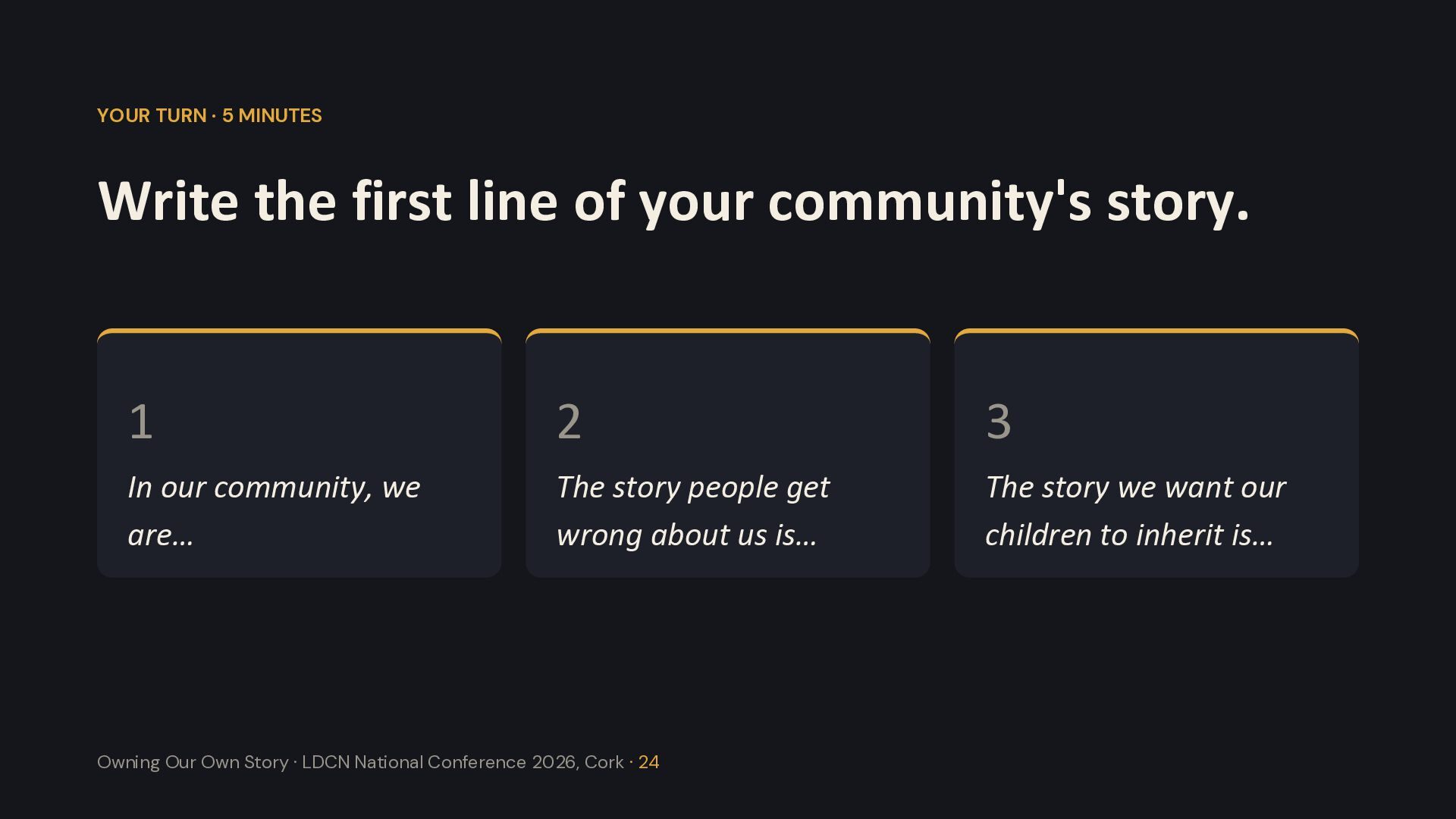
your community's story. 1 2 3 In our community, we are… The story people get wrong about us is… The story we want our children to inherit is… Owning Our Own Story · LDCN National Conference 2026, Cork · 24


 takehaya
 xspa2012
 sazimai
 polipoli
 kzmssk
 mickey_0226
 rikkabotan7
 hellosct1
 institutdelelevage
 sishi
 hotchpotch
 pomcho555
 garrettdimon
 cassininazir
 lauravandoore
 twada
 rabernat
 konakalab
 marktimemedia
 ipullrank
 afnizarnur
 aleyda
 reverentgeek