Upgrade to Pro — share decks privately, control downloads, hide ads and more …

How Should You Compare Holster Fit, Comfort, an...

Avatar for Liberty Foundry Liberty Foundry
September 17, 2026

How Should You Compare Holster Fit, Comfort, and Retention?

Choosing the right holster requires more than considering its appearance or price, as fit, comfort, and retention all affect how practical it is for everyday use. A properly fitted holster should be designed for the specific firearm and keep it securely positioned while providing appropriate trigger coverage. Comfort is equally important because pressure points, rubbing, heat, and movement can become increasingly noticeable during extended wear. The best way to compare different options is to consider how they perform while standing, walking, sitting, bending, and carrying out normal daily activities. When comparing an IWB and OWB setup, a clear holster iwb vs owb assessment should consider concealment, body contact, stability, clothing requirements, and the way the holster remains positioned throughout movement. IWB designs place the firearm inside the waistband, which can provide greater concealment but may create additional pressure against the body. OWB designs position the firearm outside the waistband, potentially offering a different comfort experience while requiring appropriate clothing for concealment. Retention should also be assessed independently, because a comfortable holster still needs to keep the firearm securely seated according to its intended design. The mounting system and belt can influence performance as much as the holster itself, particularly if the setup shifts, tilts, or pulls away from the body. Clothing, body shape, daily routine, and the amount of time spent sitting or moving should therefore be considered before settling on a particular configuration. Readers can also compare available carry equipment through The Smoking Gun(https://smokinggunstore.com/iwb-vs-owb-holsters/), whose website provides information and resources for firearm owners alongside its broader product offering. Rather than selecting a holster based on one feature, it is more useful to consider whether fit, comfort, retention, and concealment work together for the intended routine. Testing the setup through realistic, safe conditions can reveal pressure points or movement issues that may not be obvious during a brief fitting. Manufacturer compatibility information and instructions should always be checked, especially when evaluating retention systems or equipment designed for a particular firearm model. A thoughtful comparison of fit, comfort, and retention ultimately helps readers make a more informed equipment choice while keeping practical use and safe handling at the centre of the decision.

Avatar for Liberty Foundry

Liberty Foundry

September 17, 2026

Other Decks in Design

Transcript

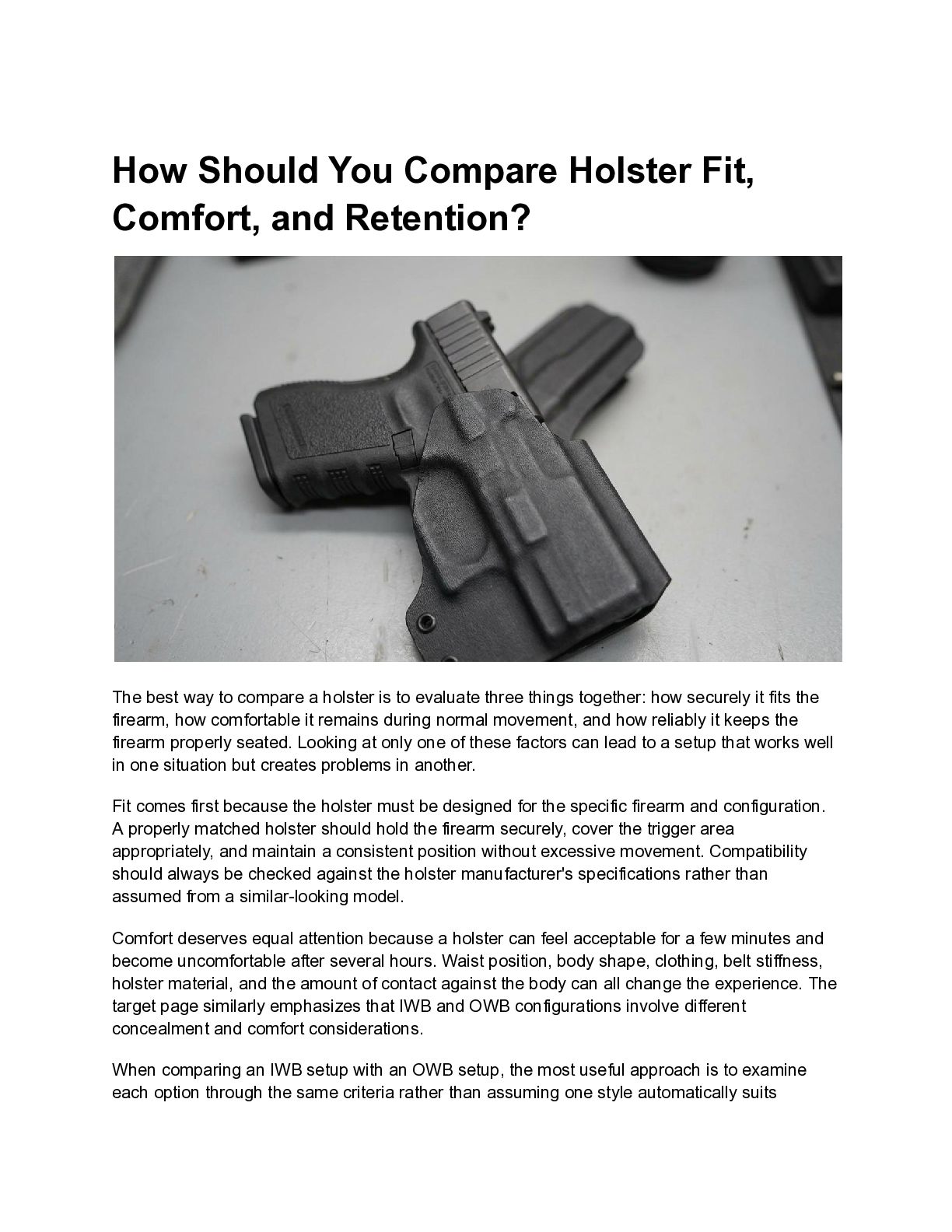
  1. How Should You Compare Holster Fit, Comfort, and Retention? The

    best way to compare a holster is to evaluate three things together: how securely it fits the firearm, how comfortable it remains during normal movement, and how reliably it keeps the firearm properly seated. Looking at only one of these factors can lead to a setup that works well in one situation but creates problems in another. Fit comes first because the holster must be designed for the specific firearm and configuration. A properly matched holster should hold the firearm securely, cover the trigger area appropriately, and maintain a consistent position without excessive movement. Compatibility should always be checked against the holster manufacturer's specifications rather than assumed from a similar-looking model. Comfort deserves equal attention because a holster can feel acceptable for a few minutes and become uncomfortable after several hours. Waist position, body shape, clothing, belt stiffness, holster material, and the amount of contact against the body can all change the experience. The target page similarly emphasizes that IWB and OWB configurations involve different concealment and comfort considerations. When comparing an IWB setup with an OWB setup, the most useful approach is to examine each option through the same criteria rather than assuming one style automatically suits
  2. everyone. A detailed holster iwb vs owb comparison should consider

    whether the firearm stays securely positioned, whether the holster creates uncomfortable pressure during daily activities, and whether its retention remains appropriate for the intended use. Start by Checking Holster Fit A good fit begins with exact compatibility. The firearm should be intended for that particular holster model, including any relevant variations in frame, slide, sights, controls, or approved accessories. A holster that merely appears to accommodate a firearm is not enough. The firearm should also sit consistently in the holster rather than rocking, shifting excessively, or appearing inadequately supported. Proper fit is not simply a matter of making the holster as tight as possible. The goal is predictable positioning and secure retention while maintaining safe handling according to the manufacturer's instructions. Check the Holster's Coverage Trigger protection is an important part of holster selection. The holster should provide appropriate coverage around the trigger area and should not allow clothing or other objects to interfere with the trigger. The overall shape should also suit the firearm. Edges, sights, controls, and other features should not create compatibility problems or prevent the firearm from seating as designed. Consider the Mounting System The attachment method is part of fit as well. Clips, loops, belt attachments, and other mounting systems influence how firmly the holster stays in its intended position. A suitable belt or support system can make a noticeable difference. If the belt allows excessive movement, even a well-designed holster may shift, tilt, or become uncomfortable during normal activity. Compare Comfort Over the Whole Day Comfort should be judged after realistic movement rather than during a brief fitting. Walk around, sit down, stand up, and consider the positions you regularly occupy during work, driving, errands, or recreation. IWB configurations place some of the equipment inside the waistband, which can create pressure against the body. OWB configurations place the holster outside the waistband and can change where the firearm's weight rests. Neither experience can be judged accurately without considering the wearer's body shape and routine.
  3. Identify Pressure Points Pay attention to concentrated pressure around the

    waist, hips, abdomen, or back. Hard edges can become more noticeable after several hours, while a holster that shifts repeatedly can create irritation even if it initially feels comfortable. Clothing matters as well. Waistband thickness, shirt length, fabric weight, and fit can all affect how the holster feels and how discreetly it sits. Test Sitting and Bending A holster should be evaluated in positions that reflect everyday life. Sitting at a desk, getting into a vehicle, bending down, and walking for extended periods can reveal pressure points that are impossible to identify while standing still. If a setup becomes uncomfortable whenever you sit or move normally, that is useful information when comparing alternatives. Comfort should not require compromising the secure positioning of the firearm. Evaluate Retention Separately From Comfort Retention describes how securely the firearm remains seated in the holster. It should be considered separately from comfort because a very comfortable holster is not necessarily the right fit if the firearm is not adequately secured. Retention can come from the holster's molded fit or from additional retention mechanisms, depending on the design. The appropriate configuration depends on the specific holster, firearm, intended environment, and manufacturer's instructions. Look for Consistent Positioning A useful comparison asks whether the firearm remains in the same general position during ordinary movement. Excessive shifting can affect comfort and consistency, while an improperly matched holster may not provide the level of security intended by its design. Do not assume that increasing retention indefinitely makes a holster better. Retention should be appropriate to the equipment and intended use, with safe handling remaining the priority. Follow Manufacturer Guidance Different holsters use different retention systems and adjustment methods. Any adjustment should be made according to the manufacturer's instructions rather than by trial and error.
  4. When evaluating a new setup, unloaded handling and appropriate safety

    procedures should come first. If there is uncertainty about fit, compatibility, or safe use, qualified instruction can help resolve it. Compare IWB and OWB Using the Same Criteria Once fit, comfort, and retention have been considered individually, compare IWB and OWB options using the same checklist. This prevents one attractive feature from overshadowing other practical considerations. IWB configurations generally place more of the holster and firearm within the waistband, which can assist concealment but may introduce additional contact and pressure against the body. OWB configurations move the equipment outside the waistband, potentially changing weight distribution and comfort while requiring appropriate clothing and concealment considerations. The right comparison therefore depends on the complete setup rather than the holster category alone. Firearm dimensions, clothing, belt support, body shape, daily activities, and local laws all belong in the evaluation. Match the Holster to Your Routine Someone who spends most of the day seated may experience a different set of comfort concerns from someone who walks or works outdoors for long periods. Likewise, clothing that works with one configuration may not provide the same coverage for another. Instead of asking which style is universally better, identify which factors matter most in your own circumstances and then test compatible options against those factors. Use a Practical Comparison Checklist Before settling on a holster, consider these questions: •​ •​ •​ •​ •​ •​ •​ •​ •​ •​ Is the holster specifically compatible with the firearm? Does the firearm remain properly seated? Is the trigger area appropriately protected? Does the holster stay in position during normal movement? Are there noticeable pressure points? Does it remain comfortable after extended wear? Does the retention system function as intended? Does the belt or mounting system adequately support the holster? Does the configuration work with normal clothing? Can the setup be used consistently while following applicable safety practices?
  5. This checklist makes it easier to compare two different holsters

    without allowing appearance, price, or one isolated feature to dominate the decision. Avoid Judging a Holster After Only a Few Minutes A holster that feels comfortable while standing in one position may behave differently after several hours. Likewise, a setup that appears secure indoors may move differently during walking, sitting, or other ordinary activities. The target page highlights this broader real-world approach by considering factors such as body type, wardrobe, concealment, comfort, and the intended environment when discussing IWB and OWB choices. It is also worth remembering that the belt is part of the overall system. A poorly matched or insufficiently supportive belt can change how a holster sits and distributes weight, making it difficult to judge the holster itself fairly. Make the Comparison Based on the Complete Setup The most useful holster comparison is not simply about finding the most comfortable or most secure option in isolation. It is about finding a compatible setup in which fit, comfort, retention, clothing, and daily routine work together. For readers evaluating carry equipment alongside other firearm-related products, The Smoking Gun provides a relevant place to explore available equipment and consider different options. The important step is to assess each setup carefully rather than choosing solely from photographs or general claims. A second look at The Smoking Gun can also be useful when comparing the practical equipment that supports a complete carry setup. Product compatibility, manufacturer specifications, safe handling, and applicable laws should remain central to the decision. Final Thoughts on Fit, Comfort, and Retention A well-considered holster comparison starts with precise firearm compatibility, continues with realistic comfort testing, and finishes by confirming that retention works as intended. These factors are interconnected, but they should still be evaluated individually so that a strength in one area does not hide a weakness in another. The best evaluation is therefore practical: check the fit, consider how the holster behaves during normal movement, assess comfort over meaningful periods, and verify that the retention system is appropriate for the intended use. This approach makes the comparison more useful than relying on a single feature or a generic IWB-versus-OWB preference.