Upgrade to Pro — share decks privately, control downloads, hide ads and more …

Radical Imagining - LIFT 2025-2027 Policy Agenda

Sponsored · Your Podcast. Everywhere. Effortlessly. Share. Educate. Inspire. Entertain. You do you. We'll handle the rest.
Avatar for LIFT LIFT
March 27, 2026

Radical Imagining - LIFT 2025-2027 Policy Agenda

Radical Imagining: A Family-Driven Vision for Economic Justice is LIFT’s bold call to reimagine power—placing families at the center of designing the policies that shape their lives and communities. Grounded in the voices and lived experiences of hundreds of parents across the country, this vision charts a path toward what’s not only possible, but necessary.

Avatar for LIFT

LIFT

March 27, 2026

More Decks by LIFT

Other Decks in Programming

Transcript

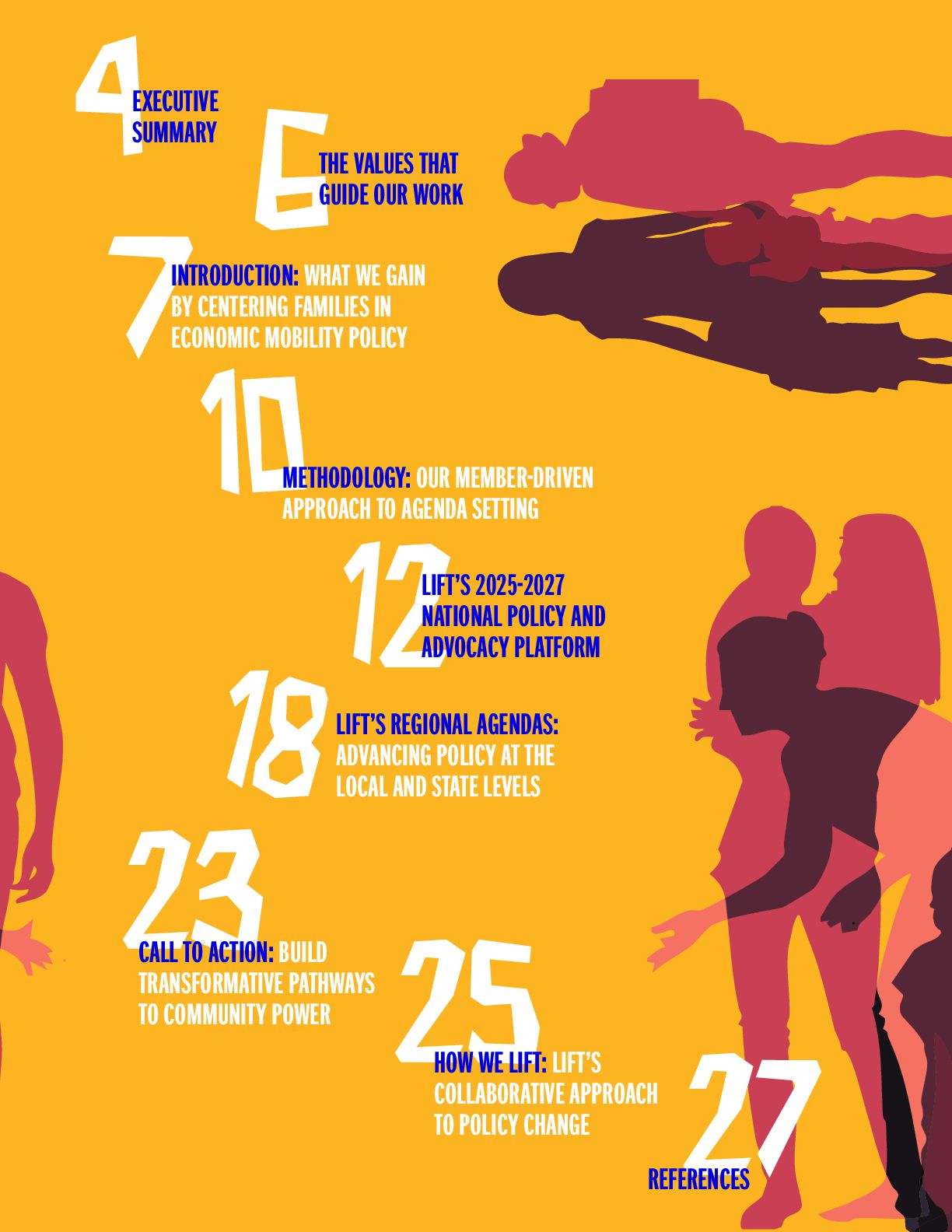
  1. EXECUTIVE SUMMARY THE VALUES THAT GUIDE OUR WORK INTRODUCTION: WHAT

    WE GAIN BY CENTERING FAMILIES IN ECONOMIC MOBILITY POLICY METHODOLOGY: OUR MEMBER-DRIVEN APPROACH TO AGENDA SETTING LIFT’S 2025-2027 NATIONAL POLICY AND ADVOCACY PLATFORM LIFT’S REGIONAL AGENDAS: ADVANCING POLICY AT THE LOCAL AND STATE LEVELS CALL TO ACTION: BUILD TRANSFORMATIVE PATHWAYS TO COMMUNITY POWER HOW WE LIFT: LIFT’S COLLABORATIVE APPROACH TO POLICY CHANGE REFERENCES
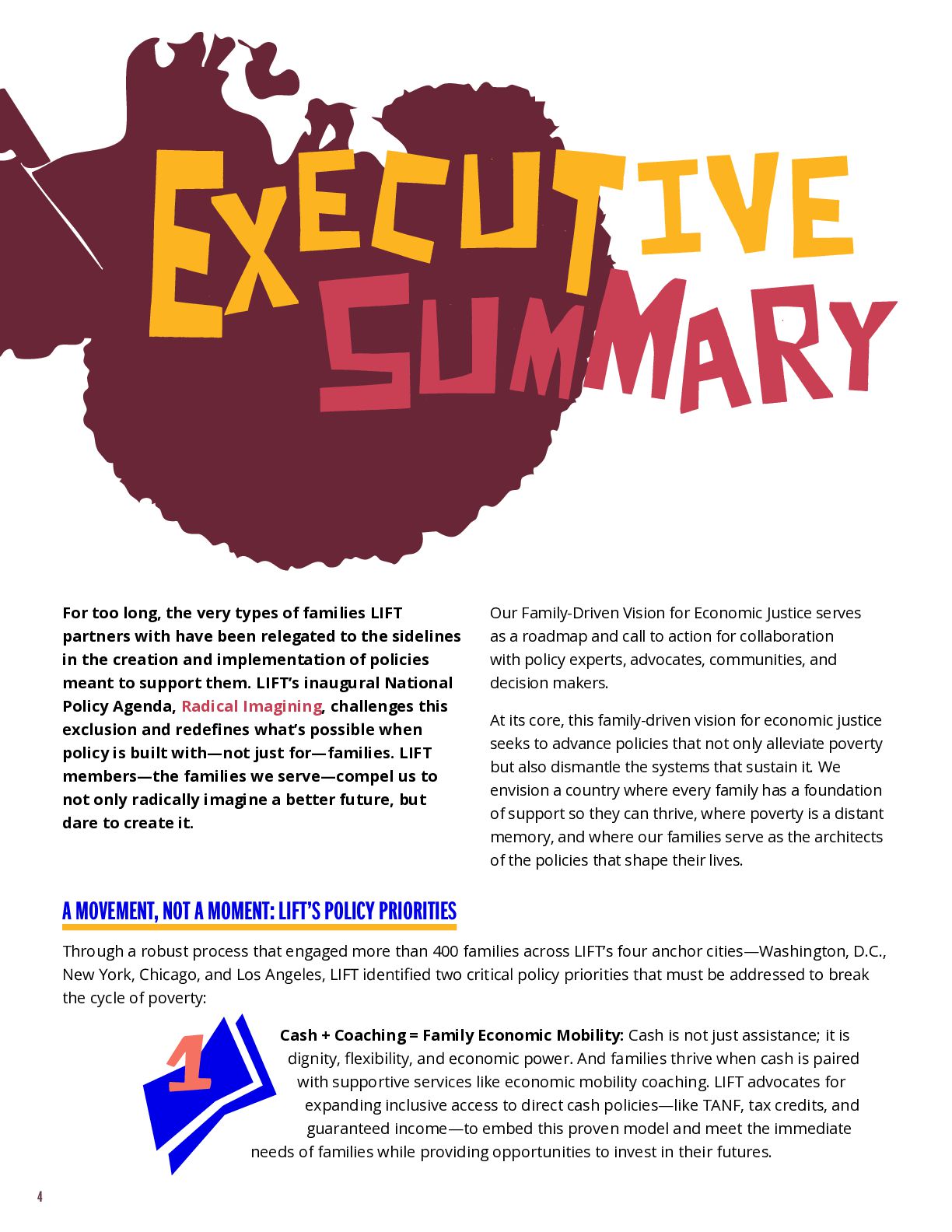
  2. For too long, the very types of families LIFT partners

    with have been relegated to the sidelines in the creation and implementation of policies meant to support them. LIFT’s inaugural National Policy Agenda, Radical Imagining, challenges this exclusion and redefines what’s possible when policy is built with—not just for—families. LIFT members—the families we serve—compel us to not only radically imagine a better future, but dare to create it. Our Family-Driven Vision for Economic Justice serves as a roadmap and call to action for collaboration with policy experts, advocates, communities, and decision makers. At its core, this family-driven vision for economic justice seeks to advance policies that not only alleviate poverty but also dismantle the systems that sustain it. We envision a country where every family has a foundation of support so they can thrive, where poverty is a distant memory, and where our families serve as the architects of the policies that shape their lives. A MOVEMENT, NOT A MOMENT: LIFT’S POLICY PRIORITIES Through a robust process that engaged more than 400 families across LIFT’s four anchor cities—Washington, D.C., New York, Chicago, and Los Angeles, LIFT identified two critical policy priorities that must be addressed to break the cycle of poverty: Cash + Coaching = Family Economic Mobility: Cash is not just assistance; it is dignity, flexibility, and economic power. And families thrive when cash is paired with supportive services like economic mobility coaching. LIFT advocates for expanding inclusive access to direct cash policies—like TANF, tax credits, and guaranteed income—to embed this proven model and meet the immediate needs of families while providing opportunities to invest in their futures. 4
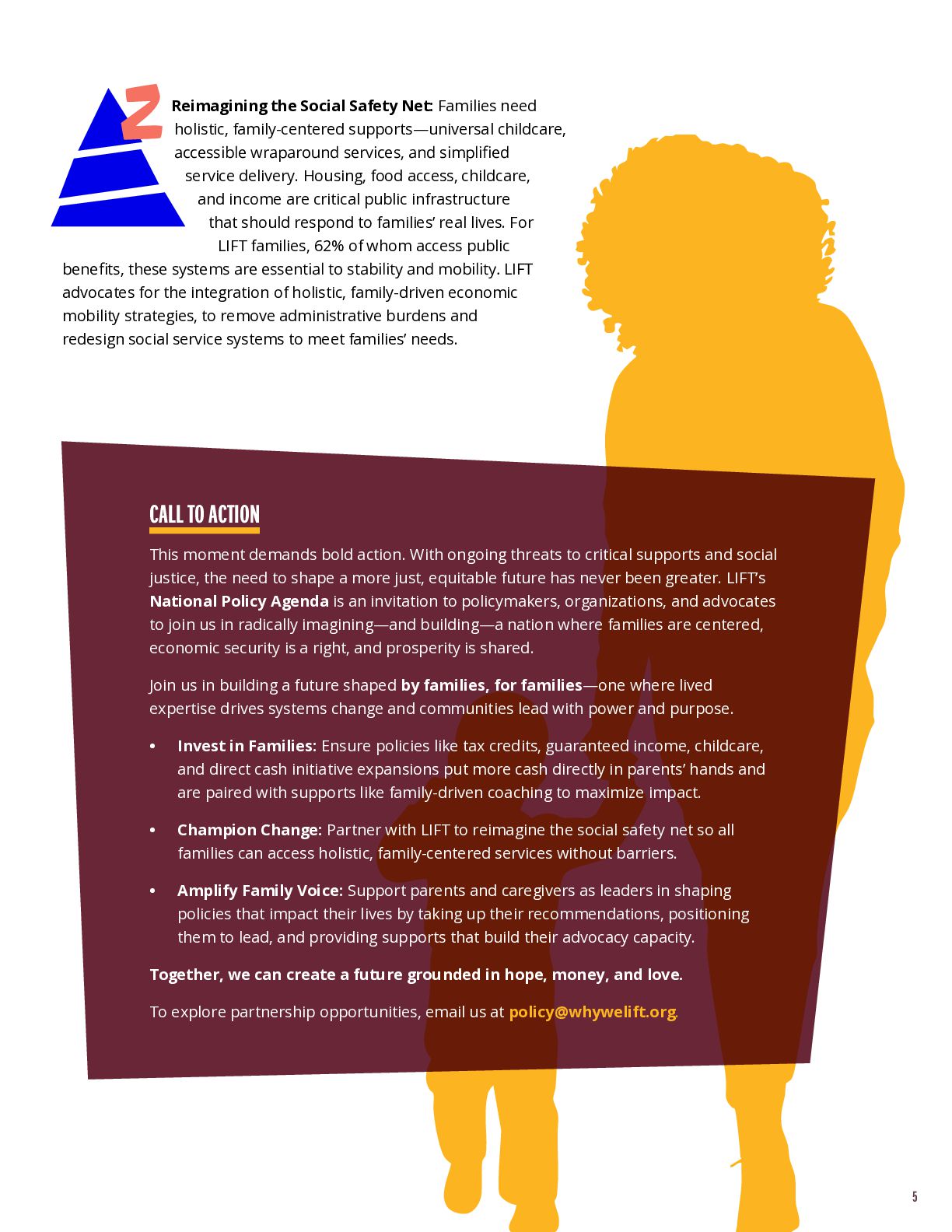
  3. Reimagining the Social Safety Net: Families need holistic, family-centered supports—universal

    childcare, accessible wraparound services, and simplified service delivery. Housing, food access, childcare, and income are critical public infrastructure that should respond to families’ real lives. For LIFT families, 62% of whom access public benefits, these systems are essential to stability and mobility. LIFT advocates for the integration of holistic, family-driven economic mobility strategies, to remove administrative burdens and redesign social service systems to meet families’ needs. CALL TO ACTION This moment demands bold action. With ongoing threats to critical supports and social justice, the need to shape a more just, equitable future has never been greater. LIFT’s National Policy Agenda is an invitation to policymakers, organizations, and advocates to join us in radically imagining—and building—a nation where families are centered, economic security is a right, and prosperity is shared. Join us in building a future shaped by families, for families—one where lived expertise drives systems change and communities lead with power and purpose. • Invest in Families: Ensure policies like tax credits, guaranteed income, childcare, and direct cash initiative expansions put more cash directly in parents’ hands and are paired with supports like family-driven coaching to maximize impact. • Champion Change: Partner with LIFT to reimagine the social safety net so all families can access holistic, family-centered services without barriers. • Amplify Family Voice: Support parents and caregivers as leaders in shaping policies that impact their lives by taking up their recommendations, positioning them to lead, and providing supports that build their advocacy capacity. Together, we can create a future grounded in hope, money, and love. To explore partnership opportunities, email us at [email protected]. 5
  4. In times of uncertainty, LIFT remains steadfast in what we

    know to be true: equity, dignity, and justice must be non-negotiable—especially in the face of systemic oppression. These values are the foundation for and underpinning of how we crafted and plan to implement our policy agenda. In our Policy and Advocacy work, LIFT values and remains committed to: • Centering lived experience. We commit to listening, learning, and co-creating solutions with the families and communities we partner with, working together toward true transformation. • Building collective power. We invest in coalitions, partnerships, and solidarity as tools for systems change. • Taking a stand. We stand for racial and economic justice— unapologetically, always. • Protecting and uplifting brilliance. We create spaces where our members, our team, and our communities can bring their full, authentic selves and lead with their strengths. • Manifesting a future system rooted in equity. We hold fast to our vision of a world where every family has what they need to thrive, not by chance, but by design. Together, we are building a beloved community—one where justice, healing, and liberation are not aspirations but realities. 6
  5. For over 25 years, LIFT has been on a mission

    to break the cycle of poverty. Our evidence- based direct service model pairs one-on- one coaching with direct cash infusions, investing in families to achieve goals like earning a degree, securing living wages, and building financial stability. Through our two- generation (2-gen) approach, we not only address the immediate needs of parents, but also lay the groundwork for their children’s long-term success.1 Through our work, we have seen that individual families can achieve their economic dreams while pushing through systemic barriers. At the same time, we know those very barriers block the pathway towards true economic justice. Emergency relief programs, such as expanded child tax credits and direct cash payments,2 brought child poverty to a record low of 5.2%,3 effectively cutting it in half. Yet, when these programs ended, families were once again left behind,4 underscoring a harsh reality: poverty persists because our systems are structured to prioritize short-term fixes over transformative, lasting solutions that center families. 1 Mosle, A., Sims, M., & Murrell, K. (n.d.). The two-generation (2Gen) approach. Ascend at the Aspen Institute. 2 Parrott, S. (2022, February 24). Robust COVID relief achieved historic gains against poverty and hardship. Center on Budget and Policy Priorities. 3 Trisi, D. (2023). Government’s pandemic response turned a would‑be poverty surge into a historic low. Center on Budget and Policy Priorities. 4 Trisi, D. (2024, June 10). Expiration of pandemic relief led to record increases in poverty. Center on Budget and Policy Priorities. What We Gain by Centering Families in Economic Mobility Policy “I am thrilled about the future of policy and “I am thrilled about the future of policy and advocacy at LIFT because I am convinced that advocacy at LIFT because I am convinced that together, we will revolutionize the way we together, we will revolutionize the way we tackle social justice issues. LIFT’s unwavering tackle social justice issues. LIFT’s unwavering commitment to intersectionality, community-led commitment to intersectionality, community-led initiatives, and inclusive policy development will initiatives, and inclusive policy development will be a game-changer.” be a game-changer.” (NY Member) 7
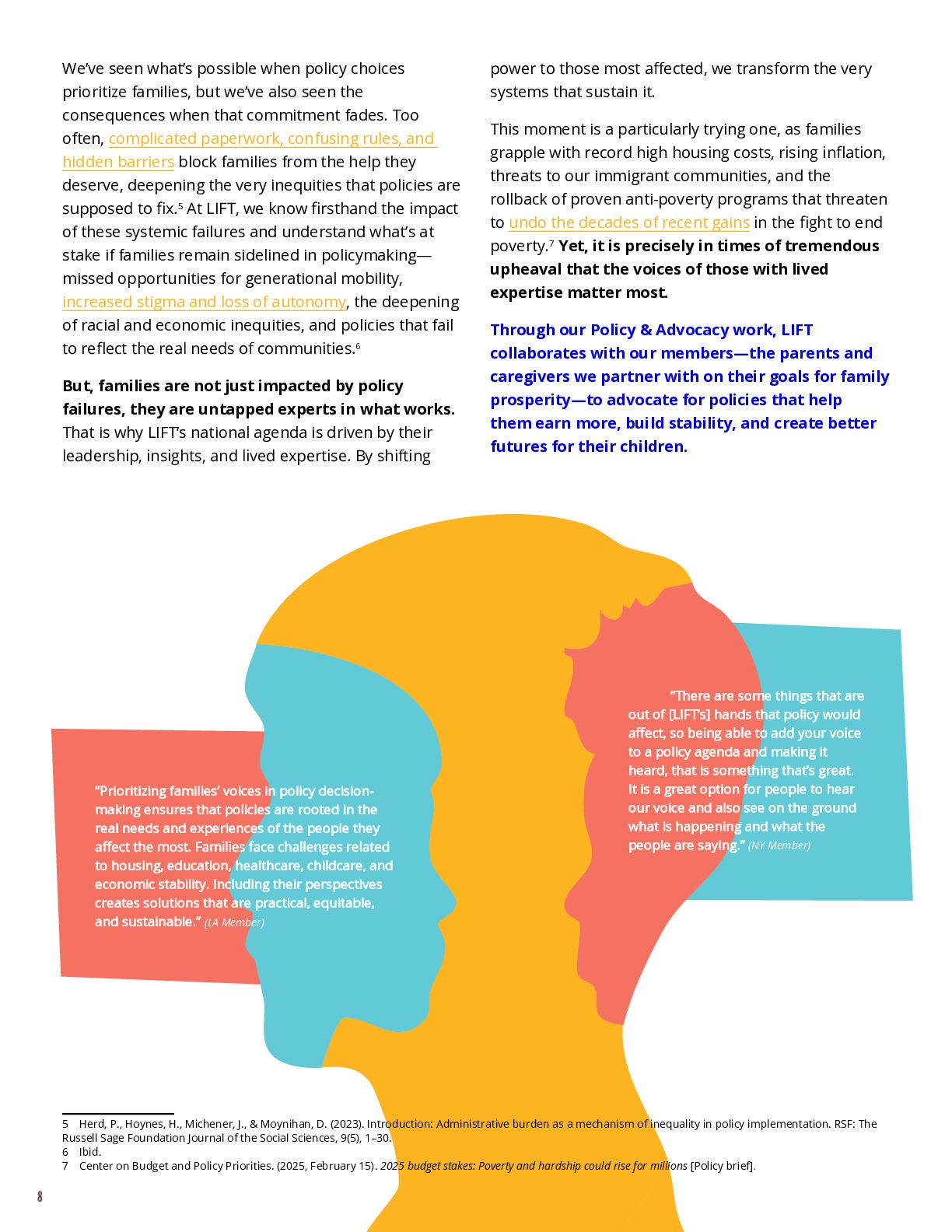
  6. “Prioritizing families’ voices in policy decision- “Prioritizing families’ voices in

    policy decision- making ensures that policies are rooted in the making ensures that policies are rooted in the real needs and experiences of the people they real needs and experiences of the people they affect the most. Families face challenges related affect the most. Families face challenges related to housing, education, healthcare, childcare, and to housing, education, healthcare, childcare, and economic stability. Including their perspectives economic stability. Including their perspectives creates solutions that are practical, equitable, creates solutions that are practical, equitable, and sustainable.” and sustainable.” (LA Member) “There are some things that are “There are some things that are out of [LIFT’s] hands that policy would out of [LIFT’s] hands that policy would affect, so being able to add your voice affect, so being able to add your voice to a policy agenda and making it to a policy agenda and making it heard, that is something that’s great. heard, that is something that’s great. It is a great option for people to hear It is a great option for people to hear our voice and also see on the ground our voice and also see on the ground what is happening and what the what is happening and what the people are saying.” people are saying.” (NY Member) We’ve seen what’s possible when policy choices prioritize families, but we’ve also seen the consequences when that commitment fades. Too often, complicated paperwork, confusing rules, and hidden barriers block families from the help they deserve, deepening the very inequities that policies are supposed to fix.5 At LIFT, we know firsthand the impact of these systemic failures and understand what’s at stake if families remain sidelined in policymaking— missed opportunities for generational mobility, increased stigma and loss of autonomy, the deepening of racial and economic inequities, and policies that fail to reflect the real needs of communities.6 But, families are not just impacted by policy failures, they are untapped experts in what works. That is why LIFT’s national agenda is driven by their leadership, insights, and lived expertise. By shifting 5 Herd, P., Hoynes, H., Michener, J., & Moynihan, D. (2023). Introduction: Administrative burden as a mechanism of inequality in policy implementation. RSF: The Russell Sage Foundation Journal of the Social Sciences, 9(5), 1–30. 6 Ibid. 7 Center on Budget and Policy Priorities. (2025, February 15). 2025 budget stakes: Poverty and hardship could rise for millions [Policy brief]. power to those most affected, we transform the very systems that sustain it. This moment is a particularly trying one, as families grapple with record high housing costs, rising inflation, threats to our immigrant communities, and the rollback of proven anti-poverty programs that threaten to undo the decades of recent gains in the fight to end poverty.7 Yet, it is precisely in times of tremendous upheaval that the voices of those with lived expertise matter most. Through our Policy & Advocacy work, LIFT collaborates with our members—the parents and caregivers we partner with on their goals for family prosperity—to advocate for policies that help them earn more, build stability, and create better futures for their children. 8
  7. As a Family-Serving Organization (FSO), LIFT is part of a

    broader movement to position direct service organizations and the community members they serve at the center of policy and advocacy work.8 We Aim To: • Address Root Causes: Move beyond treating symptoms to tackling systemic barriers such as structural racism, income inequality, inadequate childcare, and insufficient access to basic needs. • Reimagine Policymaking: Create the conditions for policy processes that center families as key decision-makers, ensuring their voices shape solutions from the outset. • Foster Innovation: Ignite breakthrough policy solutions grounded in our coaching model, technical assistance, and direct cash programs to reshape how systems support families. 8 Family-serving organizations doing systems and policy change work. (n.d.). Innovation Network. LIFT is launching a 2025-27 National Policy Agenda to advance family-centered policies supporting economic mobility in its direct service, or anchor sites: Washington, D.C., Los Angeles, Chicago, and New York. 9
  8. For over two decades, LIFT has served families through trust-based

    relationships that honor and value their lived expertise1. These same principles ground our Policy and Advocacy work, where lived expertise is embedded into our strategy to carry forward a legacy of community-led solutions. Our approach creates “plausible paths” for our members— the parents and caregivers we serve—to step into their natural roles as advocates and leaders in the fight for equity2. Through civic awareness trainings, dialogue with decision-makers, and the development of social capital with peers and policymakers, members strengthen both their own changemaking capacity and the systems around them3. 1 Ibid 2 Daminger, A., Hayes, J., Barrows, A., & Wright, J. (2015). Poverty interrupted: Applying behavioral science to the context of chronic scarcity. ideas42. 3 Tassigne, R.L., Goble, M. (2023, July 21) The power of social capital in advancing family economic mobility. American Public Human Services Association. AT LIFT, PARENTS AND CAREGIVERS ARE NOT JUST INCLUDED IN OUR POLICY WORK, THEY DRIVE IT . Building on LIFT’s long-standing practice of integrating member feedback, in the spring of 2023 we launched our Policy and Advocacy organizational strategy with a series of member focus groups asking: • “What are the biggest barriers you face right now that need a policy solution?” • “Where do you believe we should focus our attention?” In the summer of 2024, our biannual Member Feedback Survey further refined the 2023 Listening Tour findings into seven key issue areas. More than 400 members participated, identifying their top priorities: basic needs, cash policies, childcare, and employment. Our Member-Driven Approach to Agenda Setting 10
  9. Together, these insights—grounded in the voices and experiences of our

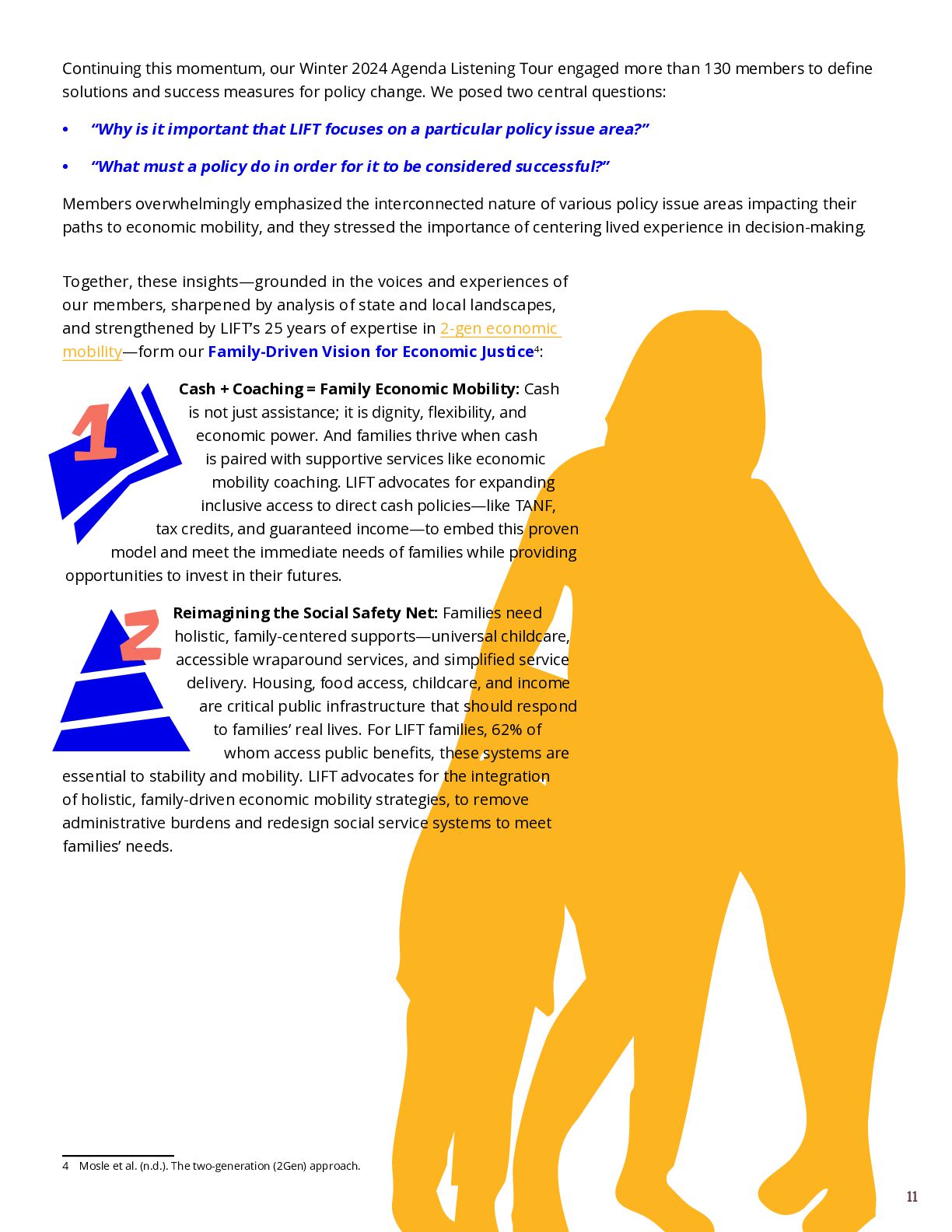
    members, sharpened by analysis of state and local landscapes, and strengthened by LIFT’s 25 years of expertise in 2-gen economic mobility—form our Family-Driven Vision for Economic Justice4: Cash + Coaching = Family Economic Mobility: Cash is not just assistance; it is dignity, flexibility, and economic power. And families thrive when cash is paired with supportive services like economic mobility coaching. LIFT advocates for expanding inclusive access to direct cash policies—like TANF, tax credits, and guaranteed income—to embed this proven model and meet the immediate needs of families while providing opportunities to invest in their futures. Reimagining the Social Safety Net: Families need holistic, family-centered supports—universal childcare, accessible wraparound services, and simplified service delivery. Housing, food access, childcare, and income are critical public infrastructure that should respond to families’ real lives. For LIFT families, 62% of whom access public benefits, these systems are essential to stability and mobility. LIFT advocates for the integration of holistic, family-driven economic mobility strategies, to remove administrative burdens and redesign social service systems to meet families’ needs. 4 Mosle et al. (n.d.). The two-generation (2Gen) approach. Continuing this momentum, our Winter 2024 Agenda Listening Tour engaged more than 130 members to define solutions and success measures for policy change. We posed two central questions: • “Why is it important that LIFT focuses on a particular policy issue area?” • “What must a policy do in order for it to be considered successful?” Members overwhelmingly emphasized the interconnected nature of various policy issue areas impacting their paths to economic mobility, and they stressed the importance of centering lived experience in decision-making. 11
  10. “Hearing from real families that are most “Hearing from real

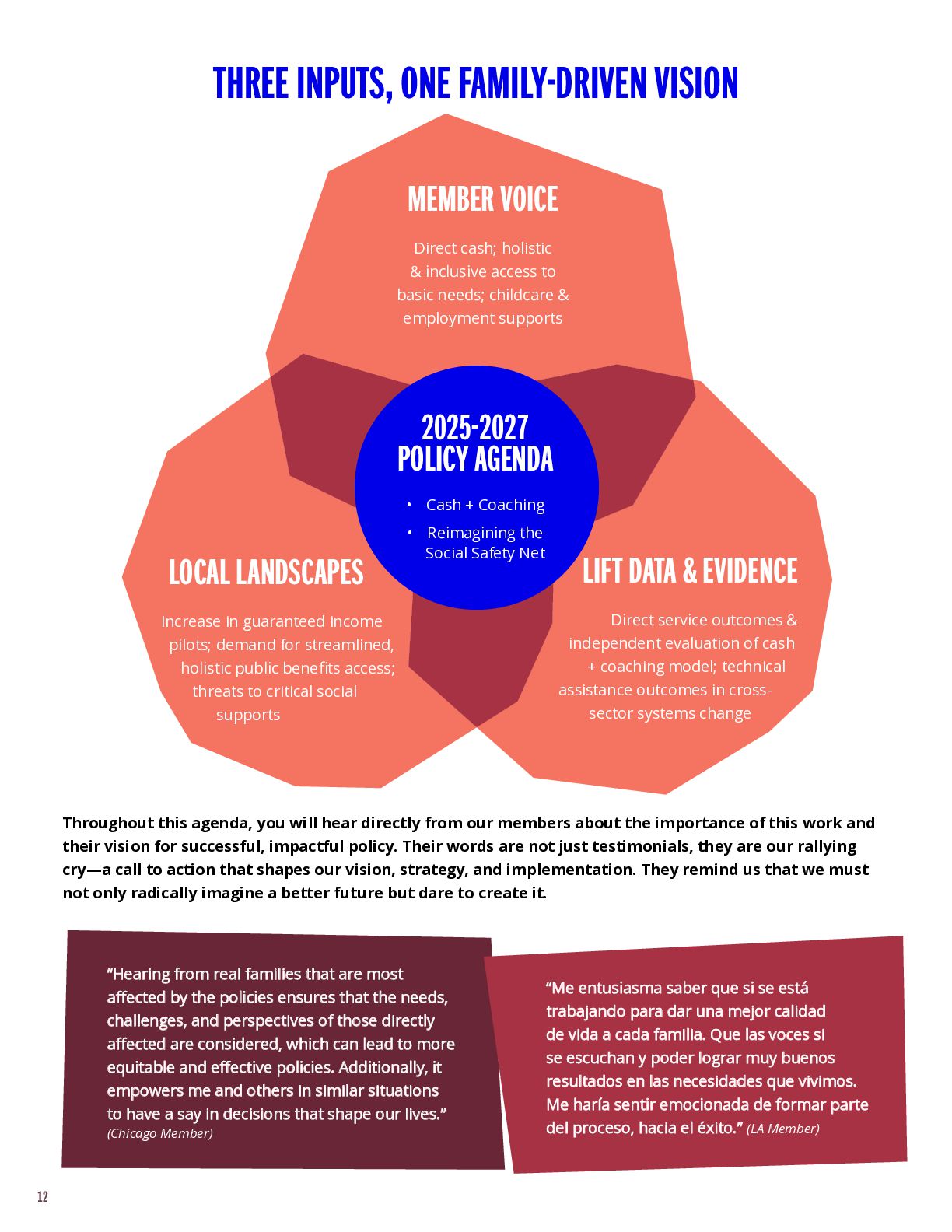
    families that are most affected by the policies ensures that the needs, affected by the policies ensures that the needs, challenges, and perspectives of those directly challenges, and perspectives of those directly affected are considered, which can lead to more affected are considered, which can lead to more equitable and effective policies. Additionally, it equitable and effective policies. Additionally, it empowers me and others in similar situations empowers me and others in similar situations to have a say in decisions that shape our lives.” to have a say in decisions that shape our lives.” (Chicago Member) “Me entusiasma saber que si se está “Me entusiasma saber que si se está trabajando para dar una mejor calidad trabajando para dar una mejor calidad de vida a cada familia. Que las voces si de vida a cada familia. Que las voces si se escuchan y poder lograr muy buenos se escuchan y poder lograr muy buenos resultados en las necesidades que vivimos. resultados en las necesidades que vivimos. Me haría sentir emocionada de formar parte Me haría sentir emocionada de formar parte del proceso, hacia el éxito.” del proceso, hacia el éxito.” (LA Member) Throughout this agenda, you will hear directly from our members about the importance of this work and their vision for successful, impactful policy. Their words are not just testimonials, they are our rallying cry—a call to action that shapes our vision, strategy, and implementation. They remind us that we must not only radically imagine a better future but dare to create it. 2025-2027 POLICY AGENDA • Cash + Coaching • Reimagining the Social Safety Net THREE INPUTS, ONE FAMILY-DRIVEN VISION MEMBER VOICE Direct cash; holistic & inclusive access to basic needs; childcare & employment supports LIFT DATA & EVIDENCE Direct service outcomes & independent evaluation of cash + coaching model; technical assistance outcomes in cross- sector systems change LOCAL LANDSCAPES Increase in guaranteed income pilots; demand for streamlined, holistic public benefits access; threats to critical social supports 12
  11. LIFT’s 2025-2027 LIFT’s policy and advocacy platform lays the foundation

    for a bold, Family-Driven Vision for Economic Justice. Our Regional Agendas—for Washington, D.C., Chicago, New York City, and Los Angeles—carry this vision into action, using the platform as a blueprint for transforming systems from the ground up and driving tangible impact at the local and state levels. CASH + COACHING = FAMILY ECONOMIC MOBILITY Economic mobility starts with cash. LIFT is advocating for policies that recognize the wisdom of families, ensure financial flexibility, and affirm every person’s right to stability and choice. Direct cash and guaranteed income policies have proven to be lifelines and launchpads for families striving to achieve stability, opportunity, and success. These policies are more than economic interventions— they’re investments in dignity, agency, and racial and economic justice. 1 Hughes, C., Zwede, N., Hamilton, D. (2023). Direct cash payments in the next recession. Institute on Race, Power, and Political Economy. 2 Ibid. 3 Markoff, S., Radcliffe, D., & Hamilton, D. (2024). A brighter future with baby bonds: How states and cities should invest in our kids. Institute on Race, Power, and Take the expanded Child Tax Credit of 2021, for example. During the COVID-19 pandemic, this federal initiative, alongside direct stimulus payments, lifted nearly six million children out of poverty, slashing poverty rates among Black children by 17.1% and Hispanic children by 20.7%.1 These payments didn’t just provide relief, they transformed lives, reducing food insecurity for Black and Hispanic families by 30% and offered breathing room for families long burdened by systemic inequities.2 Policies like baby bonds extend this vision beyond immediate relief by creating tools to build generational wealth. Baby bonds provide publicly funded trust accounts for children to access at adulthood and demonstrate how cash-based solutions can serve as tools of racial equity, directly addressing the racial wealth gap and its intergenerational impacts. Enacted or proposed in states like Connecticut, the District of Columbia, Massachusetts, and Washington, these accounts promote long-term asset building and ensure young adults—particularly from low-wealth backgrounds—have the capital to purchase a home, start a business, or pursue higher education.3 By advancing equity and generational wealth building, 13
  12. baby bonds are just one example of how cash policy

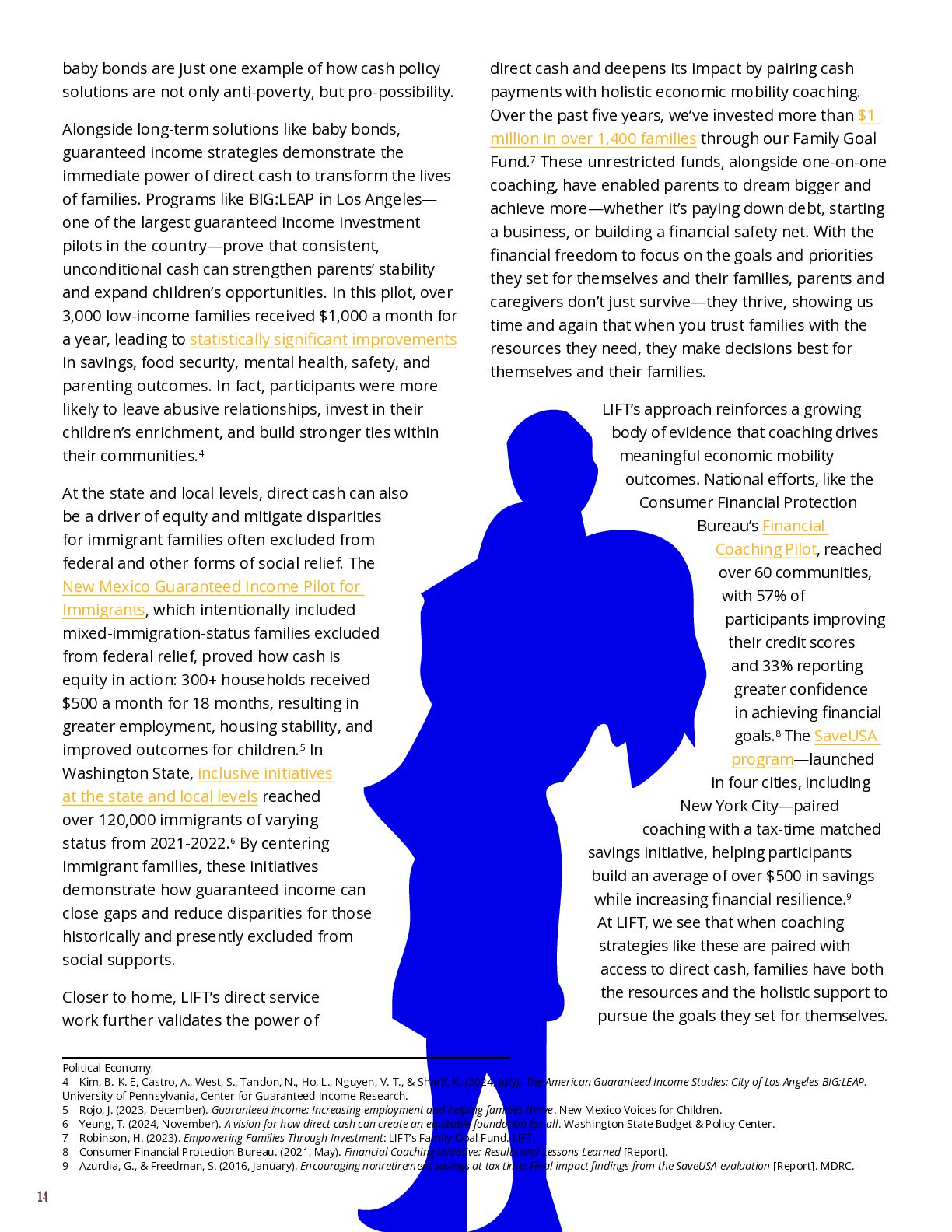
    solutions are not only anti-poverty, but pro-possibility. Alongside long-term solutions like baby bonds, guaranteed income strategies demonstrate the immediate power of direct cash to transform the lives of families. Programs like BIG:LEAP in Los Angeles— one of the largest guaranteed income investment pilots in the country—prove that consistent, unconditional cash can strengthen parents’ stability and expand children’s opportunities. In this pilot, over 3,000 low-income families received $1,000 a month for a year, leading to statistically significant improvements in savings, food security, mental health, safety, and parenting outcomes. In fact, participants were more likely to leave abusive relationships, invest in their children’s enrichment, and build stronger ties within their communities.4 At the state and local levels, direct cash can also be a driver of equity and mitigate disparities for immigrant families often excluded from federal and other forms of social relief. The New Mexico Guaranteed Income Pilot for Immigrants, which intentionally included mixed-immigration-status families excluded from federal relief, proved how cash is equity in action: 300+ households received $500 a month for 18 months, resulting in greater employment, housing stability, and improved outcomes for children.5 In Washington State, inclusive initiatives at the state and local levels reached over 120,000 immigrants of varying status from 2021-2022.6 By centering immigrant families, these initiatives demonstrate how guaranteed income can close gaps and reduce disparities for those historically and presently excluded from social supports. Closer to home, LIFT’s direct service work further validates the power of Political Economy. 4 Kim, B.-K. E, Castro, A., West, S., Tandon, N., Ho, L., Nguyen, V. T., & Sharif, K. (2024, July). The American Guaranteed Income Studies: City of Los Angeles BIG:LEAP. University of Pennsylvania, Center for Guaranteed Income Research. 5 Rojo, J. (2023, December). Guaranteed income: Increasing employment and helping families thrive. New Mexico Voices for Children. 6 Yeung, T. (2024, November). A vision for how direct cash can create an equitable foundation for all. Washington State Budget & Policy Center. 7 Robinson, H. (2023). Empowering Families Through Investment: LIFT’s Family Goal Fund. LIFT. 8 Consumer Financial Protection Bureau. (2021, May). Financial Coaching Initiative: Results and Lessons Learned [Report]. 9 Azurdia, G., & Freedman, S. (2016, January). Encouraging nonretirement savings at tax time: Final impact findings from the SaveUSA evaluation [Report]. MDRC. direct cash and deepens its impact by pairing cash payments with holistic economic mobility coaching. Over the past five years, we’ve invested more than $1 million in over 1,400 families through our Family Goal Fund.7 These unrestricted funds, alongside one-on-one coaching, have enabled parents to dream bigger and achieve more—whether it’s paying down debt, starting a business, or building a financial safety net. With the financial freedom to focus on the goals and priorities they set for themselves and their families, parents and caregivers don’t just survive—they thrive, showing us time and again that when you trust families with the resources they need, they make decisions best for themselves and their families. LIFT’s approach reinforces a growing body of evidence that coaching drives meaningful economic mobility outcomes. National efforts, like the Consumer Financial Protection Bureau’s Financial Coaching Pilot, reached over 60 communities, with 57% of participants improving their credit scores and 33% reporting greater confidence in achieving financial goals.8 The SaveUSA program—launched in four cities, including New York City—paired coaching with a tax-time matched savings initiative, helping participants build an average of over $500 in savings while increasing financial resilience.9 At LIFT, we see that when coaching strategies like these are paired with access to direct cash, families have both the resources and the holistic support to pursue the goals they set for themselves. 14
  13. The evidence is clear: when we prioritize investing in families,

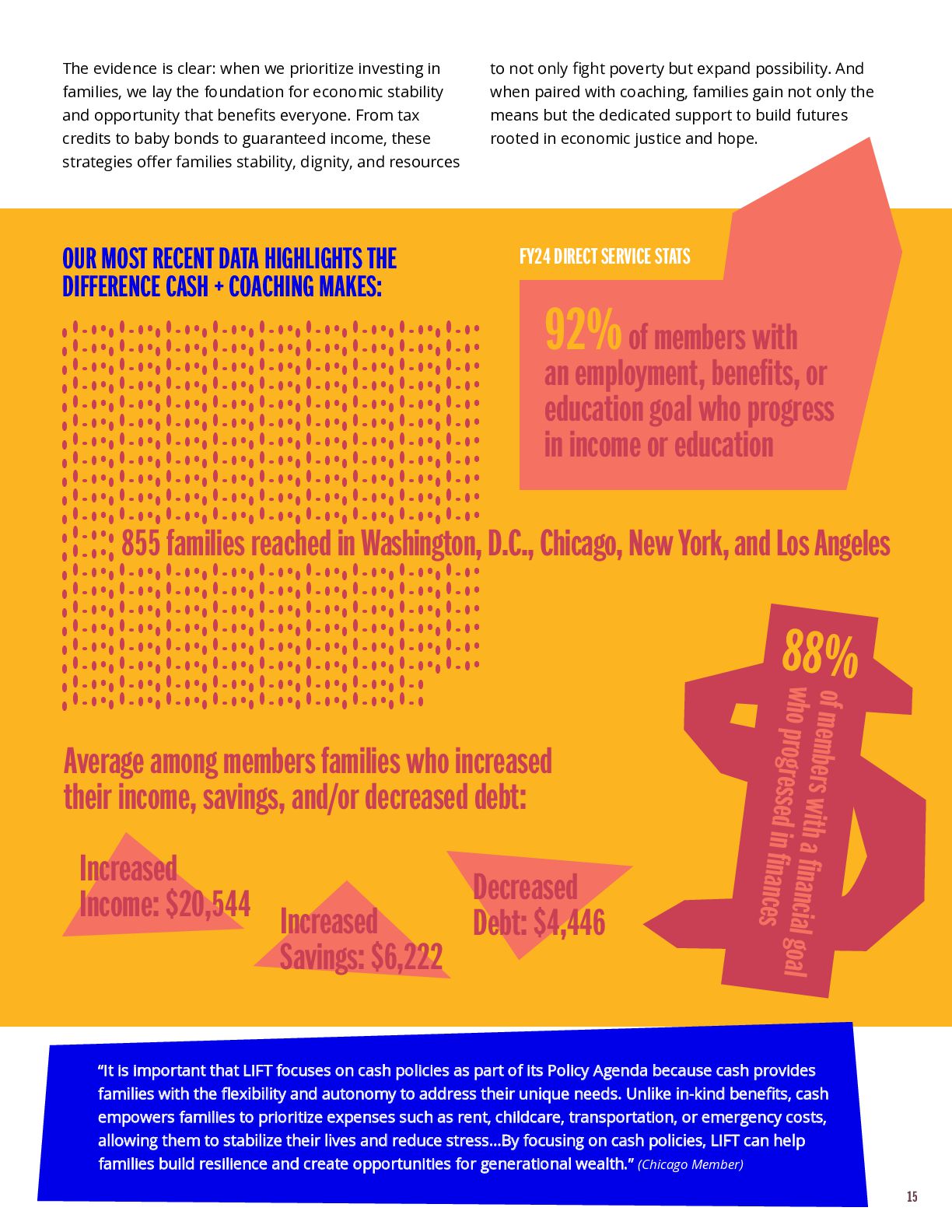
    we lay the foundation for economic stability and opportunity that benefits everyone. From tax credits to baby bonds to guaranteed income, these strategies offer families stability, dignity, and resources to not only fight poverty but expand possibility. And when paired with coaching, families gain not only the means but the dedicated support to build futures rooted in economic justice and hope. OUR MOST RECENT DATA HIGHLIGHTS THE DIFFERENCE CASH + COACHING MAKES: 855 families reached in Washington, D.C., Chicago, New York, and Los Angeles 92% of members with an employment, benefits, or education goal who progress in income or education of members with a financial goal who progressed in finances 88% Average among members families who increased their income, savings, and/or decreased debt: Increased Income: $20,544 Increased Savings: $6,222 Decreased Debt: $4,446 “It is important that LIFT focuses on cash policies as part of its Policy Agenda because cash provides “It is important that LIFT focuses on cash policies as part of its Policy Agenda because cash provides families with the flexibility and autonomy to address their unique needs. Unlike in-kind benefits, cash families with the flexibility and autonomy to address their unique needs. Unlike in-kind benefits, cash empowers families to prioritize expenses such as rent, childcare, transportation, or emergency costs, empowers families to prioritize expenses such as rent, childcare, transportation, or emergency costs, allowing them to stabilize their lives and reduce stress…By focusing on cash policies, LIFT can help allowing them to stabilize their lives and reduce stress…By focusing on cash policies, LIFT can help families build resilience and create opportunities for generational wealth.” families build resilience and create opportunities for generational wealth.” (Chicago Member) FY24 DIRECT SERVICE STATS 15
  14. REIMAGINING THE SOCIAL SAFETY NET Imagine a United States where

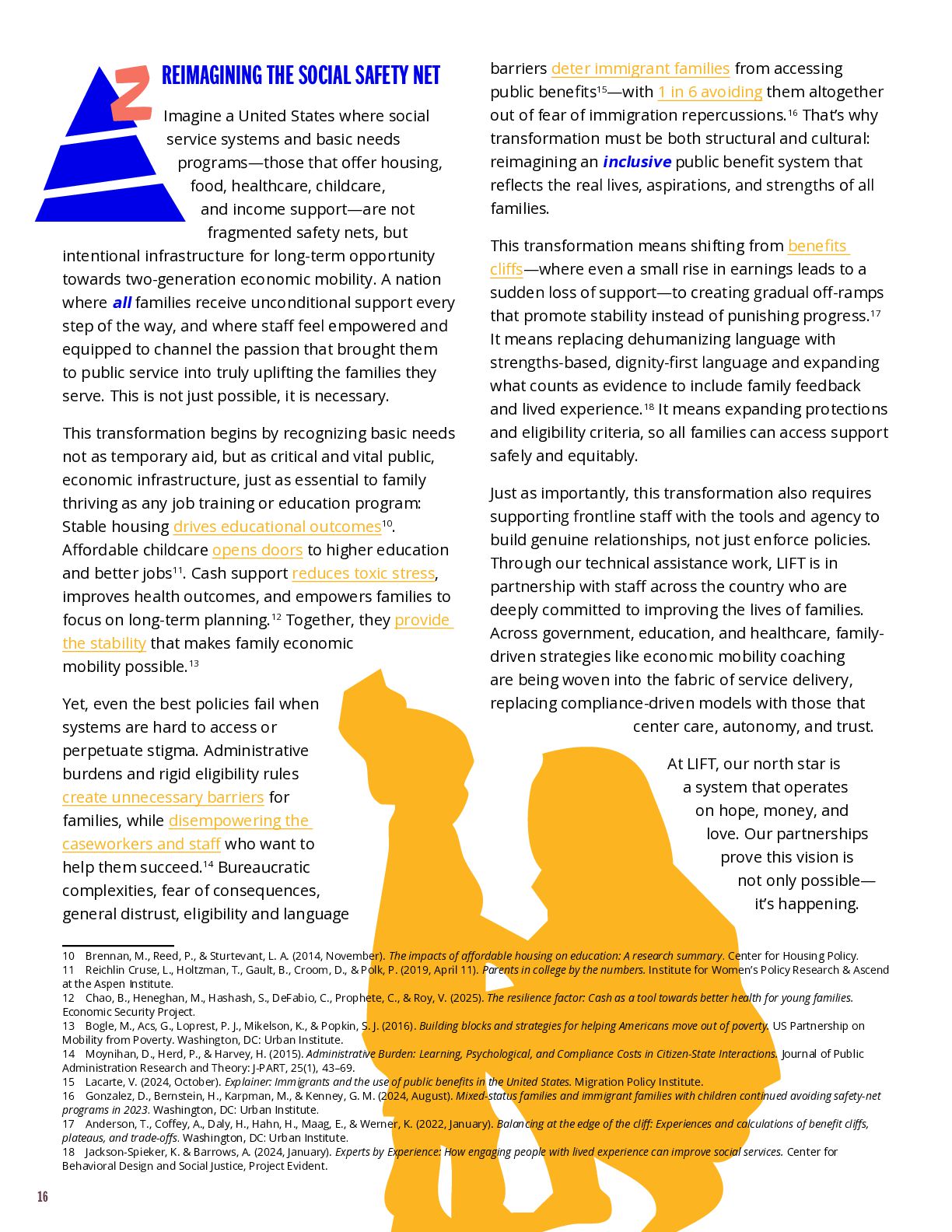
    social service systems and basic needs programs—those that offer housing, food, healthcare, childcare, and income support—are not fragmented safety nets, but intentional infrastructure for long-term opportunity towards two-generation economic mobility. A nation where all families receive unconditional support every step of the way, and where staff feel empowered and equipped to channel the passion that brought them to public service into truly uplifting the families they serve. This is not just possible, it is necessary. This transformation begins by recognizing basic needs not as temporary aid, but as critical and vital public, economic infrastructure, just as essential to family thriving as any job training or education program: Stable housing drives educational outcomes10. Affordable childcare opens doors to higher education and better jobs11. Cash support reduces toxic stress, improves health outcomes, and empowers families to focus on long-term planning.12 Together, they provide the stability that makes family economic mobility possible.13 Yet, even the best policies fail when systems are hard to access or perpetuate stigma. Administrative burdens and rigid eligibility rules create unnecessary barriers for families, while disempowering the caseworkers and staff who want to help them succeed.14 Bureaucratic complexities, fear of consequences, general distrust, eligibility and language 10 Brennan, M., Reed, P., & Sturtevant, L. A. (2014, November). The impacts of affordable housing on education: A research summary. Center for Housing Policy. 11 Reichlin Cruse, L., Holtzman, T., Gault, B., Croom, D., & Polk, P. (2019, April 11). Parents in college by the numbers. Institute for Women’s Policy Research & Ascend at the Aspen Institute. 12 Chao, B., Heneghan, M., Hashash, S., DeFabio, C., Prophete, C., & Roy, V. (2025). The resilience factor: Cash as a tool towards better health for young families. Economic Security Project. 13 Bogle, M., Acs, G., Loprest, P. J., Mikelson, K., & Popkin, S. J. (2016). Building blocks and strategies for helping Americans move out of poverty. US Partnership on Mobility from Poverty. Washington, DC: Urban Institute. 14 Moynihan, D., Herd, P., & Harvey, H. (2015). Administrative Burden: Learning, Psychological, and Compliance Costs in Citizen-State Interactions. Journal of Public Administration Research and Theory: J-PART, 25(1), 43–69. 15 Lacarte, V. (2024, October). Explainer: Immigrants and the use of public benefits in the United States. Migration Policy Institute. 16 Gonzalez, D., Bernstein, H., Karpman, M., & Kenney, G. M. (2024, August). Mixed-status families and immigrant families with children continued avoiding safety-net programs in 2023. Washington, DC: Urban Institute. 17 Anderson, T., Coffey, A., Daly, H., Hahn, H., Maag, E., & Werner, K. (2022, January). Balancing at the edge of the cliff: Experiences and calculations of benefit cliffs, plateaus, and trade-offs. Washington, DC: Urban Institute. 18 Jackson-Spieker, K. & Barrows, A. (2024, January). Experts by Experience: How engaging people with lived experience can improve social services. Center for Behavioral Design and Social Justice, Project Evident. barriers deter immigrant families from accessing public benefits15—with 1 in 6 avoiding them altogether out of fear of immigration repercussions.16 That’s why transformation must be both structural and cultural: reimagining an inclusive public benefit system that reflects the real lives, aspirations, and strengths of all families. This transformation means shifting from benefits cliffs—where even a small rise in earnings leads to a sudden loss of support—to creating gradual off-ramps that promote stability instead of punishing progress.17 It means replacing dehumanizing language with strengths-based, dignity-first language and expanding what counts as evidence to include family feedback and lived experience.18 It means expanding protections and eligibility criteria, so all families can access support safely and equitably. Just as importantly, this transformation also requires supporting frontline staff with the tools and agency to build genuine relationships, not just enforce policies. Through our technical assistance work, LIFT is in partnership with staff across the country who are deeply committed to improving the lives of families. Across government, education, and healthcare, family- driven strategies like economic mobility coaching are being woven into the fabric of service delivery, replacing compliance-driven models with those that center care, autonomy, and trust. At LIFT, our north star is a system that operates on hope, money, and love. Our partnerships prove this vision is not only possible— it’s happening. 16
  15. Our work with the DC Department of Human Services helped

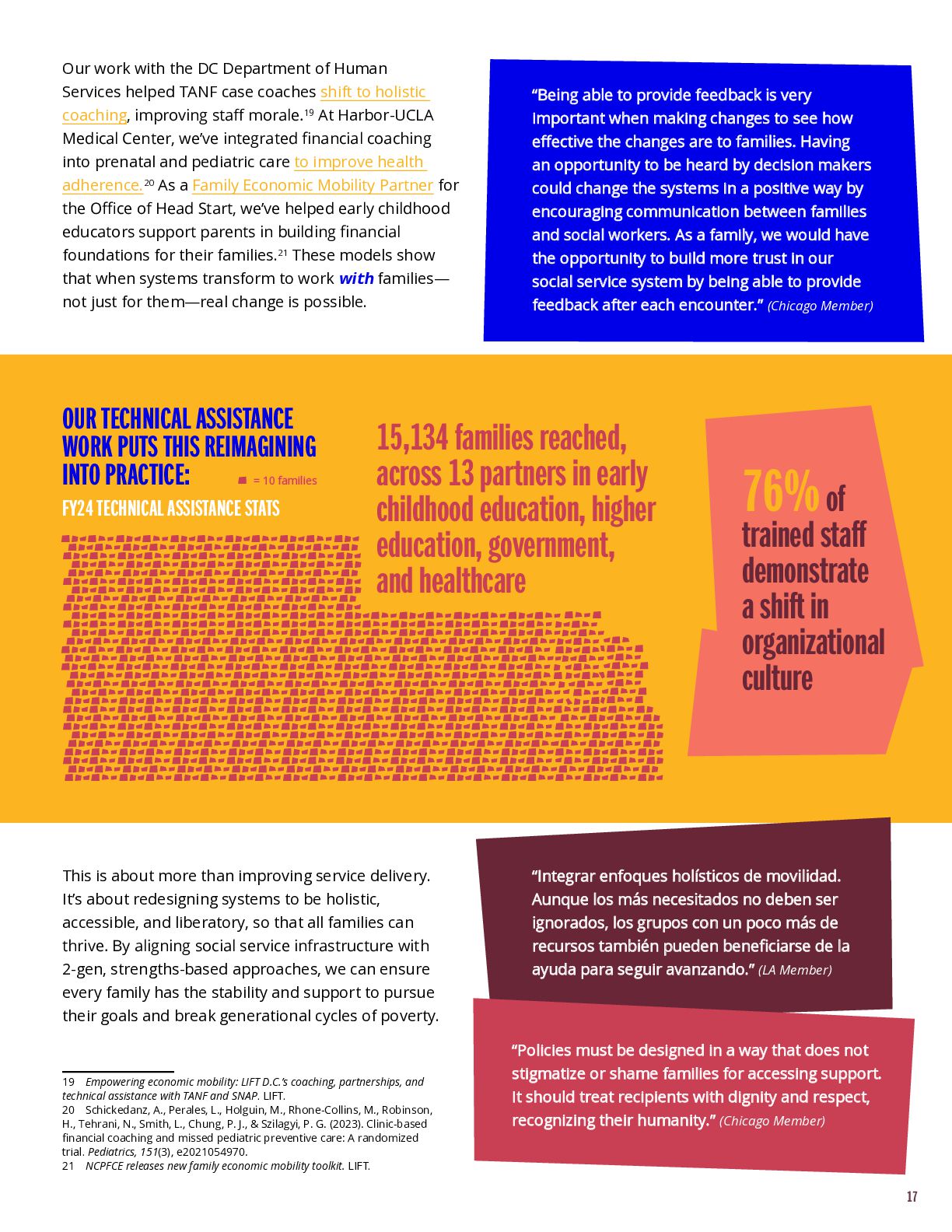
    TANF case coaches shift to holistic coaching, improving staff morale.19 At Harbor-UCLA Medical Center, we’ve integrated financial coaching into prenatal and pediatric care to improve health adherence.20 As a Family Economic Mobility Partner for the Office of Head Start, we’ve helped early childhood educators support parents in building financial foundations for their families.21 These models show that when systems transform to work with families— not just for them—real change is possible. This is about more than improving service delivery. It’s about redesigning systems to be holistic, accessible, and liberatory, so that all families can thrive. By aligning social service infrastructure with 2-gen, strengths-based approaches, we can ensure every family has the stability and support to pursue their goals and break generational cycles of poverty. 19 Empowering economic mobility: LIFT D.C.’s coaching, partnerships, and technical assistance with TANF and SNAP. LIFT. 20 Schickedanz, A., Perales, L., Holguin, M., Rhone-Collins, M., Robinson, H., Tehrani, N., Smith, L., Chung, P. J., & Szilagyi, P. G. (2023). Clinic-based financial coaching and missed pediatric preventive care: A randomized trial. Pediatrics, 151(3), e2021054970. 21 NCPFCE releases new family economic mobility toolkit. LIFT. OUR TECHNICAL ASSISTANCE WORK PUTS THIS REIMAGINING INTO PRACTICE: 15,134 families reached, across 13 partners in early childhood education, higher education, government, and healthcare = 10 families = 10 families 76% of trained staff demonstrate a shift in organizational culture FY24 TECHNICAL ASSISTANCE STATS “Being able to provide feedback is very “Being able to provide feedback is very important when making changes to see how important when making changes to see how effective the changes are to families. Having effective the changes are to families. Having an opportunity to be heard by decision makers an opportunity to be heard by decision makers could change the systems in a positive way by could change the systems in a positive way by encouraging communication between families encouraging communication between families and social workers. As a family, we would have and social workers. As a family, we would have the opportunity to build more trust in our the opportunity to build more trust in our social service system by being able to provide social service system by being able to provide feedback after each encounter.” feedback after each encounter.” (Chicago Member) “Integrar enfoques holísticos de movilidad. “Integrar enfoques holísticos de movilidad. Aunque los más necesitados no deben ser Aunque los más necesitados no deben ser ignorados, los grupos con un poco más de ignorados, los grupos con un poco más de recursos también pueden beneficiarse de la recursos también pueden beneficiarse de la ayuda para seguir avanzando.” ayuda para seguir avanzando.” (LA Member) “Policies must be designed in a way that does not “Policies must be designed in a way that does not stigmatize or shame families for accessing support. stigmatize or shame families for accessing support. It should treat recipients with dignity and respect, It should treat recipients with dignity and respect, recognizing their humanity.” recognizing their humanity.” (Chicago Member) 17
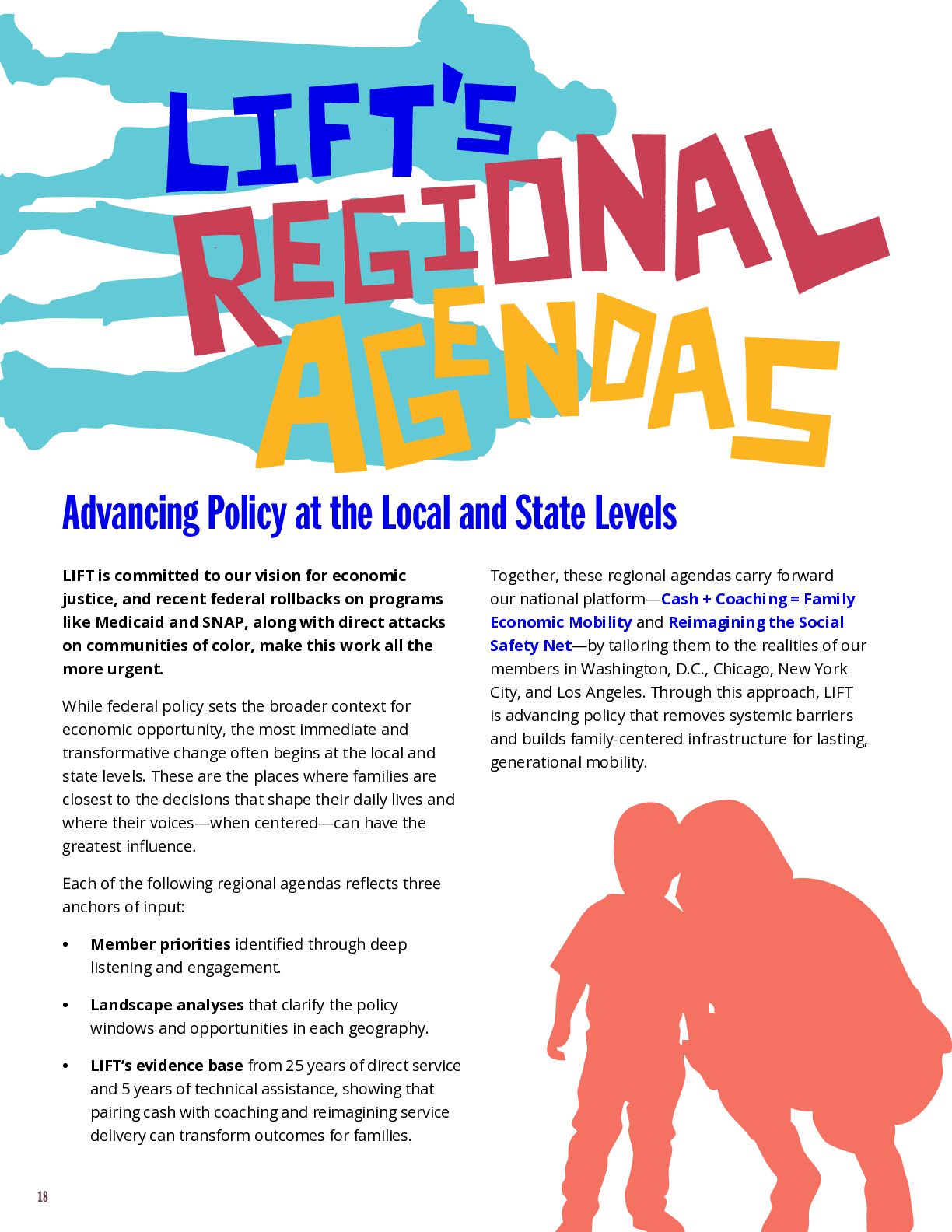
  16. Advancing Policy at the Local and State Levels LIFT is

    committed to our vision for economic justice, and recent federal rollbacks on programs like Medicaid and SNAP, along with direct attacks on communities of color, make this work all the more urgent. While federal policy sets the broader context for economic opportunity, the most immediate and transformative change often begins at the local and state levels. These are the places where families are closest to the decisions that shape their daily lives and where their voices—when centered—can have the greatest influence. Each of the following regional agendas reflects three anchors of input: • Member priorities identified through deep listening and engagement. • Landscape analyses that clarify the policy windows and opportunities in each geography. • LIFT’s evidence base from 25 years of direct service and 5 years of technical assistance, showing that pairing cash with coaching and reimagining service delivery can transform outcomes for families. Together, these regional agendas carry forward our national platform—Cash + Coaching = Family Economic Mobility and Reimagining the Social Safety Net—by tailoring them to the realities of our members in Washington, D.C., Chicago, New York City, and Los Angeles. Through this approach, LIFT is advancing policy that removes systemic barriers and builds family-centered infrastructure for lasting, generational mobility. 18
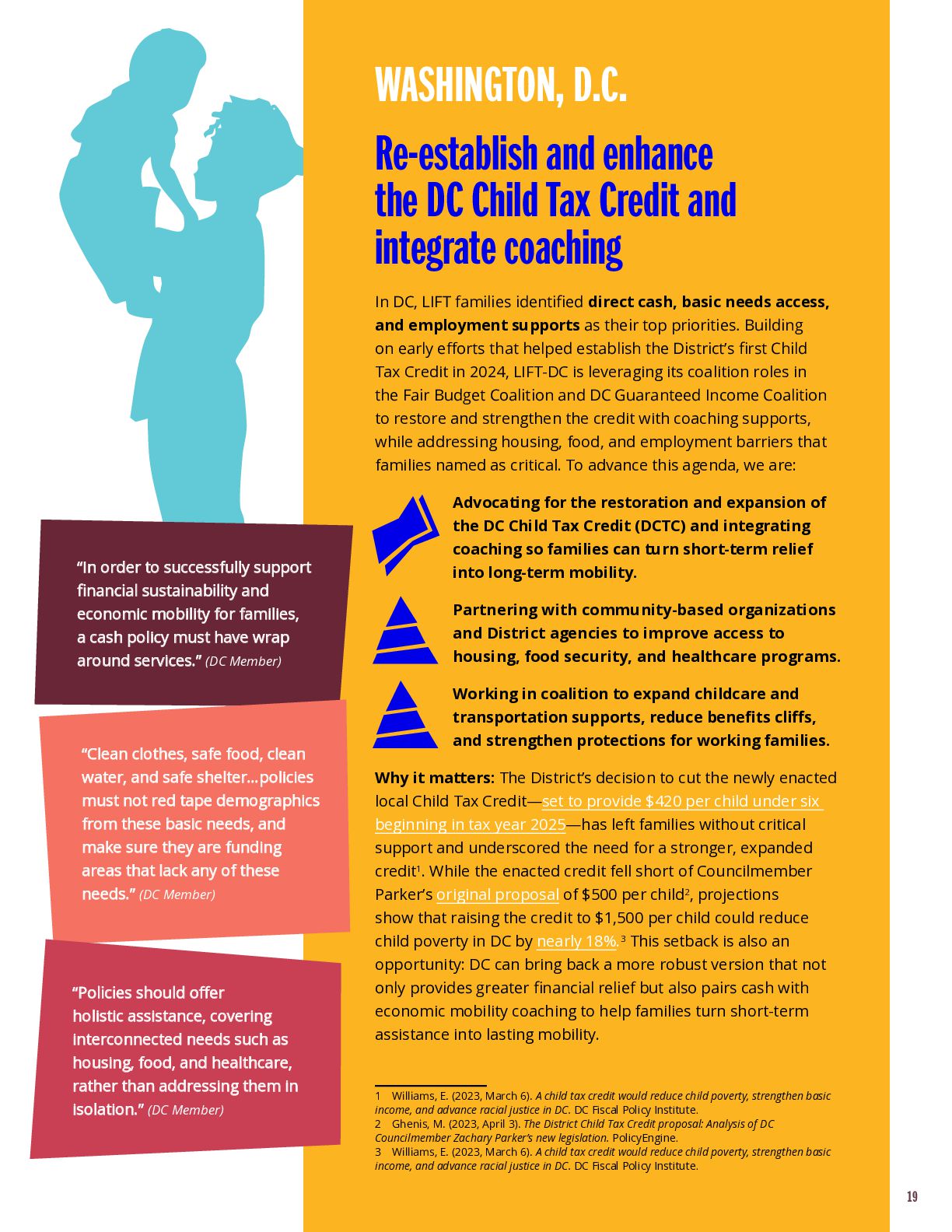
  17. WASHINGTON, D.C. Re-establish and enhance the DC Child Tax Credit

    and integrate coaching In DC, LIFT families identified direct cash, basic needs access, and employment supports as their top priorities. Building on early efforts that helped establish the District’s first Child Tax Credit in 2024, LIFT-DC is leveraging its coalition roles in the Fair Budget Coalition and DC Guaranteed Income Coalition to restore and strengthen the credit with coaching supports, while addressing housing, food, and employment barriers that families named as critical. To advance this agenda, we are: Advocating for the restoration and expansion of the DC Child Tax Credit (DCTC) and integrating coaching so families can turn short-term relief into long-term mobility. Partnering with community-based organizations and District agencies to improve access to housing, food security, and healthcare programs. Working in coalition to expand childcare and transportation supports, reduce benefits cliffs, and strengthen protections for working families. Why it matters: The District’s decision to cut the newly enacted local Child Tax Credit—set to provide $420 per child under six beginning in tax year 2025—has left families without critical support and underscored the need for a stronger, expanded credit1. While the enacted credit fell short of Councilmember Parker’s original proposal of $500 per child2, projections show that raising the credit to $1,500 per child could reduce child poverty in DC by nearly 18%.3 This setback is also an opportunity: DC can bring back a more robust version that not only provides greater financial relief but also pairs cash with economic mobility coaching to help families turn short-term assistance into lasting mobility. 1 Williams, E. (2023, March 6). A child tax credit would reduce child poverty, strengthen basic income, and advance racial justice in DC. DC Fiscal Policy Institute. 2 Ghenis, M. (2023, April 3). The District Child Tax Credit proposal: Analysis of DC Councilmember Zachary Parker’s new legislation. PolicyEngine. 3 Williams, E. (2023, March 6). A child tax credit would reduce child poverty, strengthen basic income, and advance racial justice in DC. DC Fiscal Policy Institute. “In order to successfully support “In order to successfully support financial sustainability and financial sustainability and economic mobility for families, economic mobility for families, a cash policy must have wrap a cash policy must have wrap around services.” around services.” (DC Member) “Clean clothes, safe food, clean “Clean clothes, safe food, clean water, and safe shelter…policies water, and safe shelter…policies must not red tape demographics must not red tape demographics from these basic needs, and from these basic needs, and make sure they are funding make sure they are funding areas that lack any of these areas that lack any of these needs.” needs.” (DC Member) “Policies should offer “Policies should offer holistic assistance, covering holistic assistance, covering interconnected needs such as interconnected needs such as housing, food, and healthcare, housing, food, and healthcare, rather than addressing them in rather than addressing them in isolation.” isolation.” (DC Member) 19
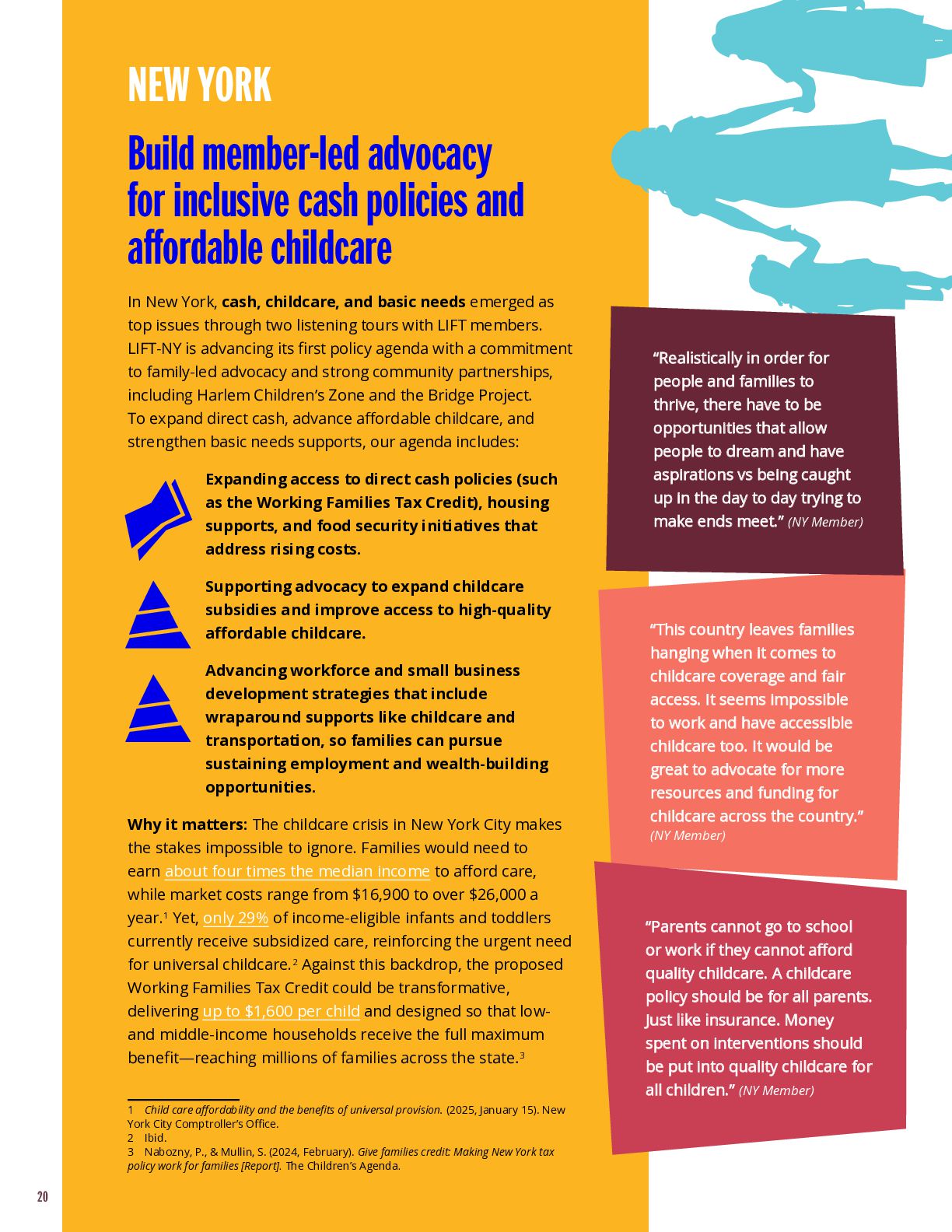
  18. NEW YORK Build member-led advocacy for inclusive cash policies and

    affordable childcare In New York, cash, childcare, and basic needs emerged as top issues through two listening tours with LIFT members. LIFT-NY is advancing its first policy agenda with a commitment to family-led advocacy and strong community partnerships, including Harlem Children’s Zone and the Bridge Project. To expand direct cash, advance affordable childcare, and strengthen basic needs supports, our agenda includes: Expanding access to direct cash policies (such as the Working Families Tax Credit), housing supports, and food security initiatives that address rising costs. Supporting advocacy to expand childcare subsidies and improve access to high-quality affordable childcare. Advancing workforce and small business development strategies that include wraparound supports like childcare and transportation, so families can pursue sustaining employment and wealth-building opportunities. Why it matters: The childcare crisis in New York City makes the stakes impossible to ignore. Families would need to earn about four times the median income to afford care, while market costs range from $16,900 to over $26,000 a year.1 Yet, only 29% of income-eligible infants and toddlers currently receive subsidized care, reinforcing the urgent need for universal childcare.2 Against this backdrop, the proposed Working Families Tax Credit could be transformative, delivering up to $1,600 per child and designed so that low- and middle-income households receive the full maximum benefit—reaching millions of families across the state.3 1 Child care affordability and the benefits of universal provision. (2025, January 15). New York City Comptroller’s Office. 2 Ibid. 3 Nabozny, P., & Mullin, S. (2024, February). Give families credit: Making New York tax policy work for families [Report]. The Children’s Agenda. “This country leaves families “This country leaves families hanging when it comes to hanging when it comes to childcare coverage and fair childcare coverage and fair access. It seems impossible access. It seems impossible to work and have accessible to work and have accessible childcare too. It would be childcare too. It would be great to advocate for more great to advocate for more resources and funding for resources and funding for childcare across the country.” childcare across the country.” (NY Member) “Parents cannot go to school “Parents cannot go to school or work if they cannot afford or work if they cannot afford quality childcare. A childcare quality childcare. A childcare policy should be for all parents. policy should be for all parents. Just like insurance. Money Just like insurance. Money spent on interventions should spent on interventions should be put into quality childcare for be put into quality childcare for all children.” all children.” (NY Member) “Realistically in order for “Realistically in order for people and families to people and families to thrive, there have to be thrive, there have to be opportunities that allow opportunities that allow people to dream and have people to dream and have aspirations vs being caught aspirations vs being caught up in the day to day trying to up in the day to day trying to make ends meet.” make ends meet.” (NY Member) 20
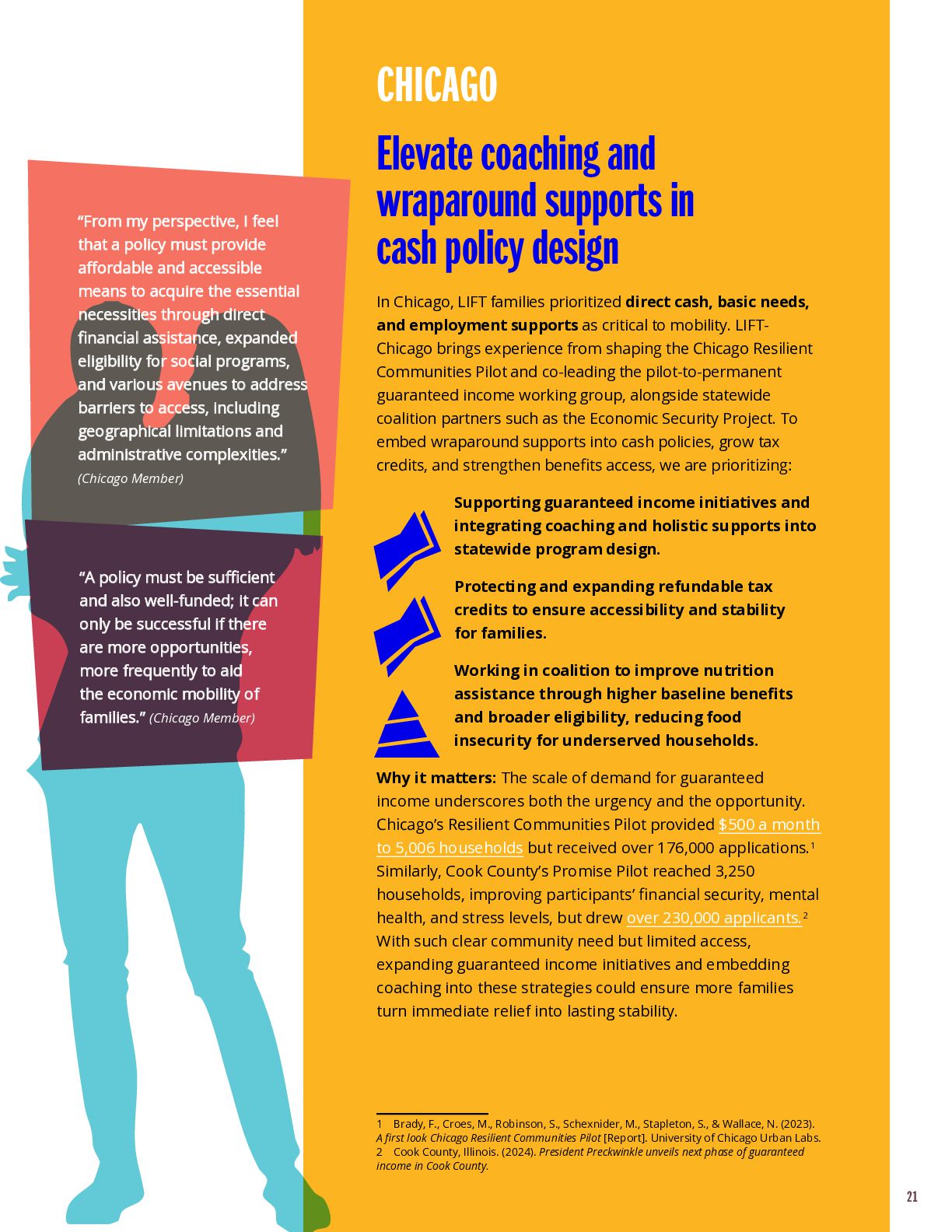
  19. CHICAGO Elevate coaching and wraparound supports in cash policy design

    In Chicago, LIFT families prioritized direct cash, basic needs, and employment supports as critical to mobility. LIFT- Chicago brings experience from shaping the Chicago Resilient Communities Pilot and co-leading the pilot-to-permanent guaranteed income working group, alongside statewide coalition partners such as the Economic Security Project. To embed wraparound supports into cash policies, grow tax credits, and strengthen benefits access, we are prioritizing: Supporting guaranteed income initiatives and integrating coaching and holistic supports into statewide program design. Protecting and expanding refundable tax credits to ensure accessibility and stability for families. Working in coalition to improve nutrition assistance through higher baseline benefits and broader eligibility, reducing food insecurity for underserved households. Why it matters: The scale of demand for guaranteed income underscores both the urgency and the opportunity. Chicago’s Resilient Communities Pilot provided $500 a month to 5,006 households but received over 176,000 applications.1 Similarly, Cook County’s Promise Pilot reached 3,250 households, improving participants’ financial security, mental health, and stress levels, but drew over 230,000 applicants.2 With such clear community need but limited access, expanding guaranteed income initiatives and embedding coaching into these strategies could ensure more families turn immediate relief into lasting stability. 1 Brady, F., Croes, M., Robinson, S., Schexnider, M., Stapleton, S., & Wallace, N. (2023). A first look Chicago Resilient Communities Pilot [Report]. University of Chicago Urban Labs. 2 Cook County, Illinois. (2024). President Preckwinkle unveils next phase of guaranteed income in Cook County. “From my perspective, I feel “From my perspective, I feel that a policy must provide that a policy must provide affordable and accessible affordable and accessible means to acquire the essential means to acquire the essential necessities through direct necessities through direct financial assistance, expanded financial assistance, expanded eligibility for social programs, eligibility for social programs, and various avenues to address and various avenues to address barriers to access, including barriers to access, including geographical limitations and geographical limitations and administrative complexities.” administrative complexities.” (Chicago Member) “A policy must be sufficient “A policy must be sufficient and also well-funded; it can and also well-funded; it can only be successful if there only be successful if there are more opportunities, are more opportunities, more frequently to aid more frequently to aid the economic mobility of the economic mobility of families.” families.” (Chicago Member) 21
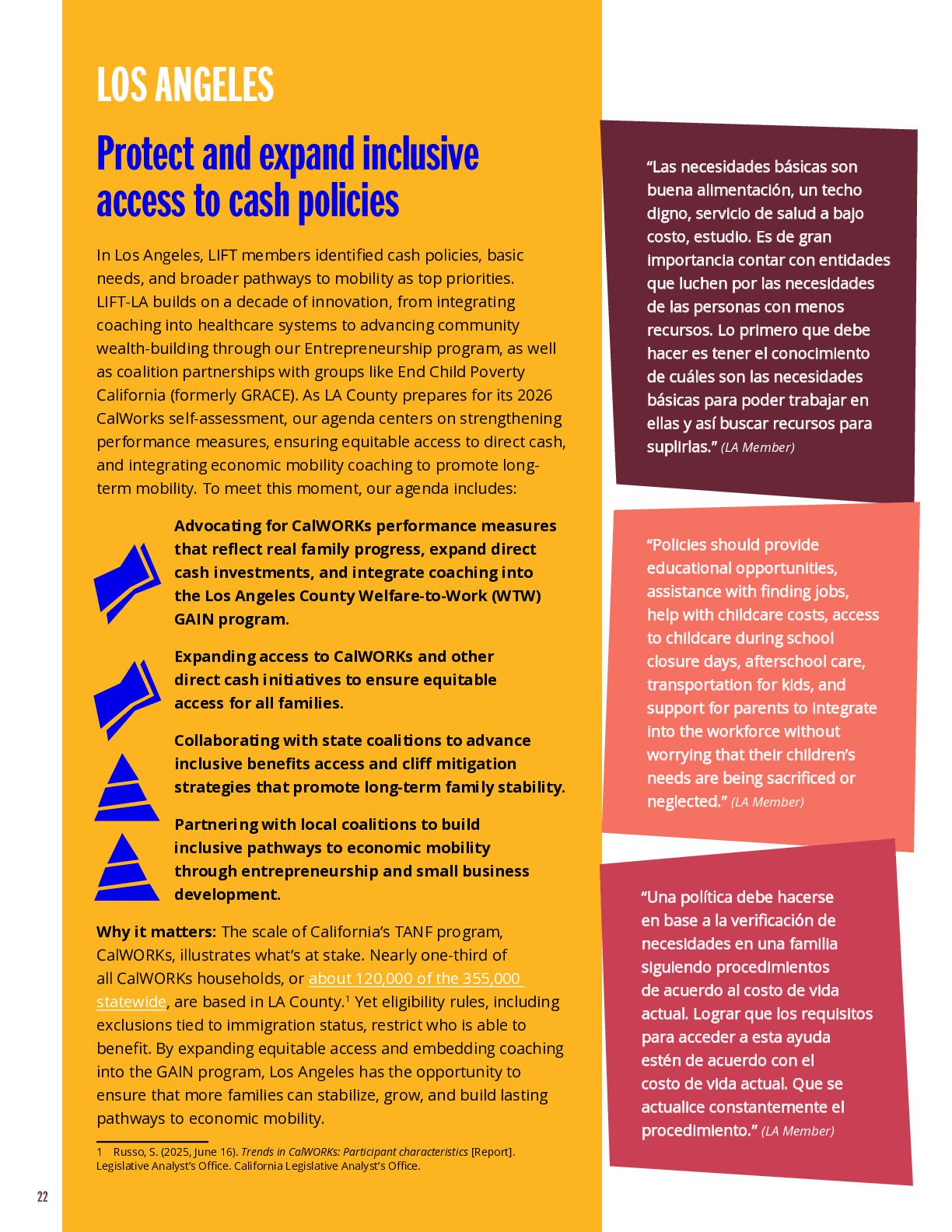
  20. “Las necesidades básicas son “Las necesidades básicas son buena alimentación,

    un techo buena alimentación, un techo digno, servicio de salud a bajo digno, servicio de salud a bajo costo, estudio. Es de gran costo, estudio. Es de gran importancia contar con entidades importancia contar con entidades que luchen por las necesidades que luchen por las necesidades de las personas con menos de las personas con menos recursos. Lo primero que debe recursos. Lo primero que debe hacer es tener el conocimiento hacer es tener el conocimiento de cuáles son las necesidades de cuáles son las necesidades básicas para poder trabajar en básicas para poder trabajar en ellas y así buscar recursos para ellas y así buscar recursos para suplirlas.” suplirlas.” (LA Member) “Policies should provide “Policies should provide educational opportunities, educational opportunities, assistance with finding jobs, assistance with finding jobs, help with childcare costs, access help with childcare costs, access to childcare during school to childcare during school closure days, afterschool care, closure days, afterschool care, transportation for kids, and transportation for kids, and support for parents to integrate support for parents to integrate into the workforce without into the workforce without worrying that their children’s worrying that their children’s needs are being sacrificed or needs are being sacrificed or neglected.” neglected.” (LA Member) “Una política debe hacerse “Una política debe hacerse en base a la verificación de en base a la verificación de necesidades en una familia necesidades en una familia siguiendo procedimientos siguiendo procedimientos de acuerdo al costo de vida de acuerdo al costo de vida actual. Lograr que los requisitos actual. Lograr que los requisitos para acceder a esta ayuda para acceder a esta ayuda estén de acuerdo con el estén de acuerdo con el costo de vida actual. Que se costo de vida actual. Que se actualice constantemente el actualice constantemente el procedimiento.” procedimiento.” (LA Member) LOS ANGELES Protect and expand inclusive access to cash policies In Los Angeles, LIFT members identified cash policies, basic needs, and broader pathways to mobility as top priorities. LIFT-LA builds on a decade of innovation, from integrating coaching into healthcare systems to advancing community wealth-building through our Entrepreneurship program, as well as coalition partnerships with groups like End Child Poverty California (formerly GRACE). As LA County prepares for its 2026 CalWorks self-assessment, our agenda centers on strengthening performance measures, ensuring equitable access to direct cash, and integrating economic mobility coaching to promote long- term mobility. To meet this moment, our agenda includes: Advocating for CalWORKs performance measures that reflect real family progress, expand direct cash investments, and integrate coaching into the Los Angeles County Welfare-to-Work (WTW) GAIN program. Expanding access to CalWORKs and other direct cash initiatives to ensure equitable access for all families. Collaborating with state coalitions to advance inclusive benefits access and cliff mitigation strategies that promote long-term family stability. Partnering with local coalitions to build inclusive pathways to economic mobility through entrepreneurship and small business development. Why it matters: The scale of California’s TANF program, CalWORKs, illustrates what’s at stake. Nearly one-third of all CalWORKs households, or about 120,000 of the 355,000 statewide, are based in LA County.1 Yet eligibility rules, including exclusions tied to immigration status, restrict who is able to benefit. By expanding equitable access and embedding coaching into the GAIN program, Los Angeles has the opportunity to ensure that more families can stabilize, grow, and build lasting pathways to economic mobility. 1 Russo, S. (2025, June 16). Trends in CalWORKs: Participant characteristics [Report]. Legislative Analyst’s Office. California Legislative Analyst’s Office. 22
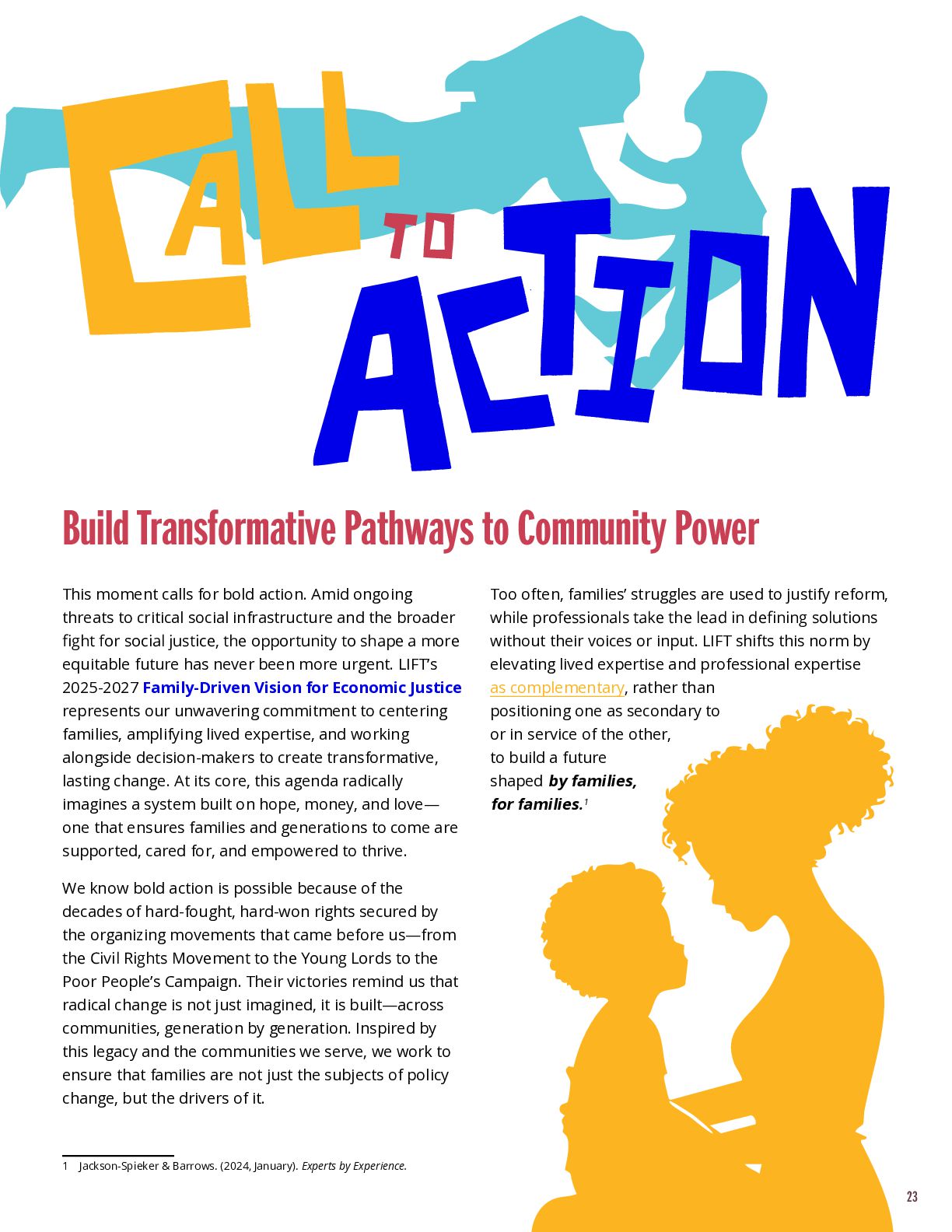
  21. Build Transformative Pathways to Community Power This moment calls for

    bold action. Amid ongoing threats to critical social infrastructure and the broader fight for social justice, the opportunity to shape a more equitable future has never been more urgent. LIFT’s 2025-2027 Family-Driven Vision for Economic Justice represents our unwavering commitment to centering families, amplifying lived expertise, and working alongside decision-makers to create transformative, lasting change. At its core, this agenda radically imagines a system built on hope, money, and love— one that ensures families and generations to come are supported, cared for, and empowered to thrive. We know bold action is possible because of the decades of hard-fought, hard-won rights secured by the organizing movements that came before us—from the Civil Rights Movement to the Young Lords to the Poor People’s Campaign. Their victories remind us that radical change is not just imagined, it is built—across communities, generation by generation. Inspired by this legacy and the communities we serve, we work to ensure that families are not just the subjects of policy change, but the drivers of it. 1 Jackson-Spieker & Barrows. (2024, January). Experts by Experience. Too often, families’ struggles are used to justify reform, while professionals take the lead in defining solutions without their voices or input. LIFT shifts this norm by elevating lived expertise and professional expertise as complementary, rather than positioning one as secondary to or in service of the other, to build a future shaped by families, for families.1 23
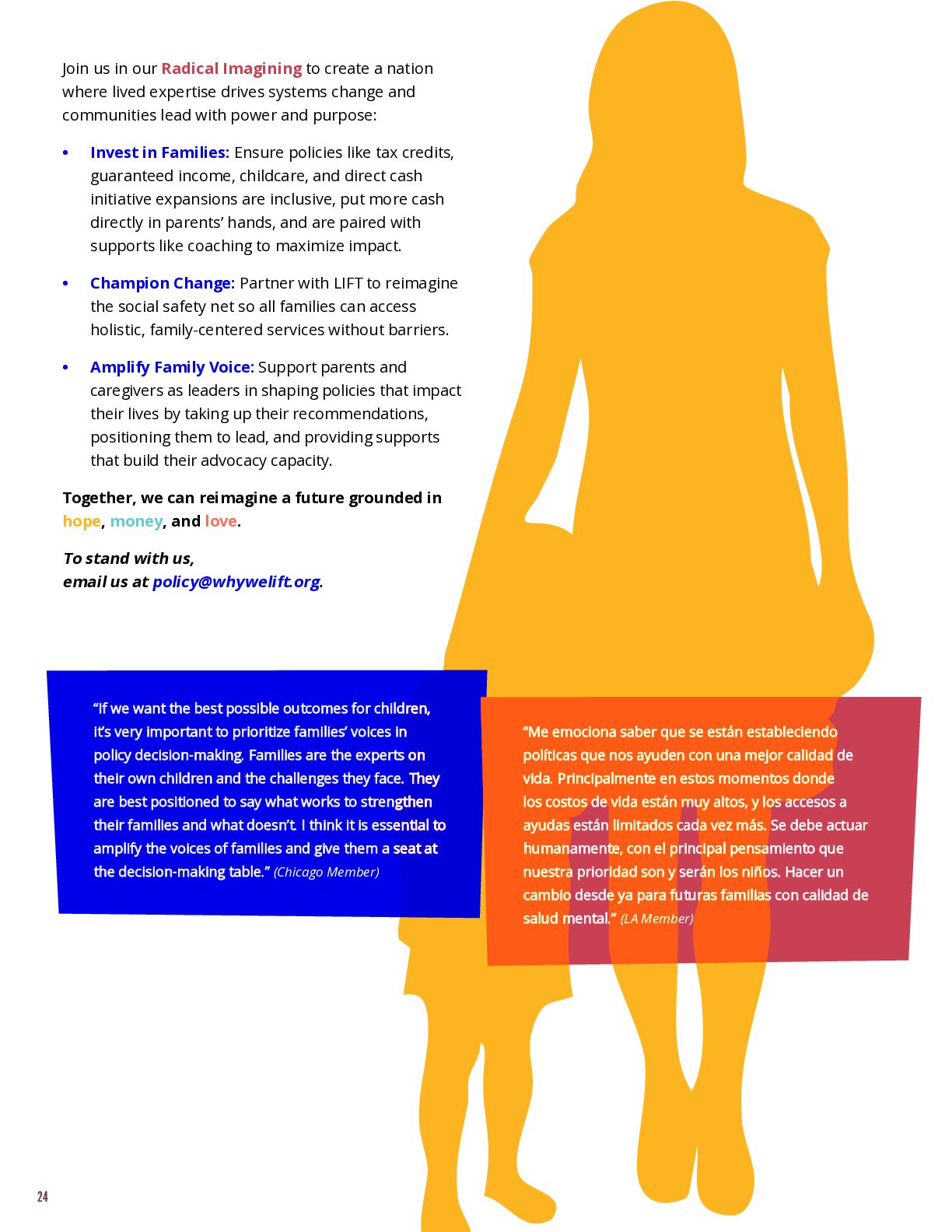
  22. Join us in our Radical Imagining to create a nation

    where lived expertise drives systems change and communities lead with power and purpose: • Invest in Families: Ensure policies like tax credits, guaranteed income, childcare, and direct cash initiative expansions are inclusive, put more cash directly in parents’ hands, and are paired with supports like coaching to maximize impact. • Champion Change: Partner with LIFT to reimagine the social safety net so all families can access holistic, family-centered services without barriers. • Amplify Family Voice: Support parents and caregivers as leaders in shaping policies that impact their lives by taking up their recommendations, positioning them to lead, and providing supports that build their advocacy capacity. Together, we can reimagine a future grounded in hope, money, and love. To stand with us, email us at [email protected]. “If we want the best possible outcomes for children, “If we want the best possible outcomes for children, it’s very important to prioritize families’ voices in it’s very important to prioritize families’ voices in policy decision-making. Families are the experts on policy decision-making. Families are the experts on their own children and the challenges they face. They their own children and the challenges they face. They are best positioned to say what works to strengthen are best positioned to say what works to strengthen their families and what doesn’t. I think it is essential to their families and what doesn’t. I think it is essential to amplify the voices of families and give them a seat at amplify the voices of families and give them a seat at the decision-making table.” the decision-making table.” (Chicago Member) “Me emociona saber que se están estableciendo “Me emociona saber que se están estableciendo políticas que nos ayuden con una mejor calidad de políticas que nos ayuden con una mejor calidad de vida. Principalmente en estos momentos donde vida. Principalmente en estos momentos donde los costos de vida están muy altos, y los accesos a los costos de vida están muy altos, y los accesos a ayudas están limitados cada vez más. Se debe actuar ayudas están limitados cada vez más. Se debe actuar humanamente, con el principal pensamiento que humanamente, con el principal pensamiento que nuestra prioridad son y serán los niños. Hacer un nuestra prioridad son y serán los niños. Hacer un cambio desde ya para futuras familias con calidad de cambio desde ya para futuras familias con calidad de salud mental.” salud mental.” (LA Member) 24
  23. LIFT’s Collaborative Approach to Policy Change LIFT Policy & Advocacy

    does not stand alone in the fight to end family poverty. We are part of a broad, interconnected ecosystem—a collective force of organizations, advocates, and policymakers working together to drive holistic, systemic change. Each of us brings unique strengths, insights, and capacities to this work, and true impact comes from strategically aligning those strengths for maximum effect. Recognizing this, we will be intentional about the role we play, leveraging our expertise to complement the work of our partners, both longstanding and newly emerging. LIFT’s contributions will take three key forms: • Amplify: LIFT is committed to ensuring that the voices of our members and broader communities are not just heard, but centered in policy decision- making. We will use our platform to elevate the lived expertise of families navigating economic mobility, ensuring that their insights and solutions shape the policies that impact them. • Aggregate: Drawing from our research, evaluation, and direct engagement with communities, LIFT will support and strengthen the efforts of partners by sharing insights, fostering strategic collaboration, and advancing narrative change. • Collaborate: LIFT will mobilize alongside partners—through coalition-building and collective action—to advocate for policies that directly impact the families we serve. Guided by the priorities our members have entrusted us to elevate, we will leverage the insights of our partners to drive meaningful change on the issues that matter most to our communities. 25
  24. Our strong belief in collaboration is why we are so

    grateful to the 30+ individuals and organizations who provided in-depth feedback on our agenda. This includes policy experts, community organizations, and funders, driven by the insights of our members. We would like to thank the following individuals and organizations for their role in strengthening our agenda. Jessica Sager, All Our Kin Chase Sackett and Daniel Lopez, America Forward Ida Rademacher and Johanna Smith-Ramani, Aspen Institute Sheida Elmi, Financial Security Program, Aspen Institute Lee Foley, Capitol Hill Partners Jesse Fairbanks, Center for Law and Social Policy Deborah Stein, Coalition on Human Needs Mona Masri and Shafeka Hashash, Economic Security Project Shamica Gaskins and Andrew Cheyne, End Child Poverty in California Greg Kaufmann, End Poverty In California (EPIC) Michaela Taylor, Expecting Justice Niciah Mujahid and Katharine Landfield, Fair Budget Coalition Regina Harmon, Food Recovery Network Marisol Bello, Housing Narrative Lab Cory Georgopoulos and Rebecca Perlmutter, Innovation Network Chastity Lord, Jeremiah Program Keith Barnes, Martha O’Bryan Center Donna Pavetti, MEF Associates Melody Webb, Mother’s Outreach Network Marjorie Gilberg, National Council of Jewish Women Los Angeles Michael E. Collins, Jr., National Urban League David Radcliffe, The New School’s Institute on Race Power and Political Economy Robert Wood Johnson Foundation Daniel López-Cevallos, PhD, MPH and Lisa Aponte-Soto, PhD, MHA, Tanoma Consulting Deborah Martin and Erika Roberson, The Institute for College Access and Success Heather Hahn, The Urban Institute Lynn Appelbaum, United Neighborhood Houses Ed Lazere, United Planning Organization Danielle Bautista, United Ways of California Belema Idoniboye, UpTogether 26
  25. Anderson, T., Coffey, A., Daly, H., Hahn, H., Maag, E.,

    & Werner, K. (2022, January). Balancing at the edge of the cliff: Experiences and calculations of benefit cliffs, plateaus, and trade-offs. Washington, DC: Urban Institute. https://www.urban.org/research/publication/balancing-edge-cliff Azurdia, G., & Freedman, S. (2016, January). Encouraging nonretirement savings at tax time: Final impact findings from the SaveUSA evaluation [Report]. MDRC. https://www.mdrc.org/sites/default/files/SaveUSA_FinalReport%202015.pdf Bogle, M., Acs, G., Loprest, P. J., Mikelson, K., & Popkin, S. J. (2016). Building blocks and strategies for helping Americans move out of poverty. US Partnership on Mobility from Poverty. Washington, DC: Urban Institute. https://www.urban.org/sites/default/files/publication/83641/2000905- Building-Blocks-and-Strategies-for-Helping-Americans-Move-Out-of-Poverty.pdf Brady, F., Croes, M., Robinson, S., Schexnider, M., Stapleton, S., & Wallace, N. (2023). A first look Chicago Resilient Communities Pilot [Report]. University of Chicago Urban Labs. https://urbanlabs.uchicago.edu/attachments/5c577639c291dbf0e037e3ebc5627cd73985b2d9/store/ ecdddd230d6b35dba45fd6c61ff1d0edb15e4491326aa9afefe6894cc955/CRCP+First+Look+Report+Winter+2023.pdf Brennan, M., Reed, P., & Sturtevant, L. A. (2014, November). The impacts of affordable housing on education: A research summary. Center for Housing Policy. https://nhc.org/wp-content/uploads/2017/03/The-Impacts-of-Affordable-Housing-on-Education-1.pdf Center on Budget and Policy Priorities. (2025, February 15). 2025 budget stakes: Poverty and hardship could rise for millions [Policy brief]. https:// www.cbpp.org/research/poverty-and-inequality/2025-budget-stakes-poverty-and-hardship-could-rise-for-millions Chao, B., Heneghan, M., Hashash, S., DeFabio, C., Prophete, C., & Roy, V. (2025). The resilience factor: Cash as a tool towards better health for young families. Economic Security Project. https://economicsecurityproject.org/resource/resilience-report/ Child care affordability and the benefits of universal provision. (2025, January 15). New York City Comptroller’s Office. https://comptroller.nyc.gov/ reports/child-care-affordability-and-the-benefits-of-universal-provision/ Consumer Financial Protection Bureau. (2021, May). Financial Coaching Initiative: Results and Lessons Learned [Report]. https://files. consumerfinance.gov/f/documents/cfpb_financial-coaching-initiative-lessons-learned_report_2021-05.pdf Cook County, Illinois. (2024). President Preckwinkle unveils next phase of guaranteed income in Cook County. https://www.cookcountyil.gov/news/ president-preckwinkle-unveils-next-phase-guaranteed-income-cook-county Daminger, A., Hayes, J., Barrows, A., & Wright, J. (2015). Poverty interrupted: Applying behavioral science to the context of chronic scarcity. ideas42. https://www.ideas42.org/wp-content/uploads/2015/05/I42_PovertyWhitePaper_Digital_FINAL-1.pdf Empowering economic mobility: LIFT D.C.’s coaching, partnerships, and technical assistance with TANF and SNAP. LIFT. https://www.whywelift.org/ empowering-economic-mobility-lift-dcs-coaching-partnerships-and-technical-assistance-with-tanf-and-snap/ Family-serving organizations doing systems and policy change work. (n.d.). Innovation Network. Retrieved September 30, 2025. https://projects. innonet.org/family-serving-organizations-doing-systems-and-policy-change-work Ghenis, M. (2023, April 3). The District Child Tax Credit proposal: Analysis of DC Councilmember Zachary Parker’s new legislation. PolicyEngine. https://blog.policyengine.org/the-district-child-tax-credit-proposal-5c70e72a4001 Gonzalez, D., Bernstein, H., Karpman, M., & Kenney, G. M. (2024, August). Mixed-status families and immigrant families with children continued avoiding safety-net programs in 2023. Washington, DC: Urban Institute. https://www.urban.org/sites/default/files/2024-08/Mixed-Status-Families- and-Immigrant-Families-with-Children-Continued-Avoiding-Safety-Net-Programs-in-2023.pdf Herd, P., Hoynes, H., Michener, J., & Moynihan, D. (2023). Introduction: Administrative burden as a mechanism of inequality in policy implementation. RSF: The Russell Sage Foundation Journal of the Social Sciences, 9(5), 1–30. https://www.rsfjournal.org/content/9/5/1.full.pdf Hughes, C., Zwede, N., Hamilton, D. (2023). Direct cash payments in the next recession. Institute on Race, Power, and Political Economy. https:// economicsecurityproject.org/wp-content/uploads/Direct-Cash-Payments-in-the-Next-Recession.pdf Jackson-Spieker, K. & Barrows, A. (2024, January). Experts by Experience: How engaging people with lived experience can improve social services. Center for Behavioral Design and Social Justice, Project Evident. https://projectevident.org/wp-content/uploads/2023/12/CBDSJ-Experts-by- Experience-Jan2024.pdf 27
  26. Kim, B.-K. E, Castro, A., West, S., Tandon, N., Ho,

    L., Nguyen, V. T., & Sharif, K. (2024, July). The American Guaranteed Income Studies: City of Los Angeles BIG:LEAP. University of Pennsylvania, Center for Guaranteed Income Research. https://static1.squarespace.com/ static/64f8b31cbb263222a1487bd6/t/66a2b39f7f926d1eeb0ae146/1721938864270/CGIR+LA+BIGLEAP+Final+Report.pdf Lacarte, V. (2024, October). Explainer: Immigrants and the use of public benefits in the United States. Migration Policy Institute. https://www. migrationpolicy.org/sites/default/files/publications/mpi-immigrants-benefits-explainer-2024-final.pdf Maag, E. (2025, June). The District of Columbia child tax credit would provide important support for families in the district with low incomes. Washington, DC: Urban Institute. https://www.urban.org/research/publication/district-columbia-child-tax-credit-would-provide-important- support-families Markoff, S., Radcliffe, D., & Hamilton, D. (2024). A brighter future with baby bonds: How states and cities should invest in our kids. Institute on Race, Power, and Political Economy. https://racepowerpolicy.org/a-brighter-future-with-baby-bonds/ Moynihan, D., Herd, P., & Harvey, H. (2015). Administrative Burden: Learning, Psychological, and Compliance Costs in Citizen-State Interactions. Journal of Public Administration Research and Theory: J-PART, 25(1), 43–69. http://www.jstor.org/stable/24484941 Mosle, A., Sims, M., & Murrell, K. (n.d.). The two-generation (2Gen) approach. Ascend at the Aspen Institute. https://ascend.aspeninstitute. org/2gen-approach/ Nabozny, P., & Mullin, S. (2024, February). Give families credit: Making New York tax policy work for families [Report]. The Children’s Agenda. https://thechildrensagenda.org/wp-content/uploads/2024/02/Working-Families-Tax-Credit-Report.pdf NCPFCE releases new family economic mobility toolkit. LIFT. https://www.whywelift.org/ncpfce-releases-new-family-economic-mobility-toolkit/ Parrott, S. (2022, February 24). Robust COVID relief achieved historic gains against poverty and hardship. Center on Budget and Policy Priorities. https://www.cbpp.org/research/poverty-and-inequality/robust-covid-relief-achieved-historic-gains-against-poverty-and-0 Reichlin Cruse, L., Holtzman, T., Gault, B., Croom, D., & Polk, P. (2019, April 11). Parents in college by the numbers. Institute for Women’s Policy Research & Ascend at the Aspen Institute. https://iwpr.org/parents-in-college-by-the-numbers/ Robinson, H. (2023). Empowering Families Through Investment: LIFT’s Family Goal Fund. LIFT. https://www.whywelift.org/wp-content/ uploads/2023/12/GoalFund_2023_v4-005.pdf Rojo, J. (2023, December). Guaranteed income: Increasing employment and helping families thrive. New Mexico Voices for Children. https://www. nmvoices.org/wp-content/uploads/2023/12/2023_GI-Pilot-Report_web.pdf Russo, S. (2025, June 16). Trends in CalWORKs: Participant characteristics [Report]. Legislative Analyst’s Office. California Legislative Analyst’s Office. https://lao.ca.gov/Publications/Report/5057 Schickedanz, A., Perales, L., Holguin, M., Rhone-Collins, M., Robinson, H., Tehrani, N., Smith, L., Chung, P. J., & Szilagyi, P. G. (2023). Clinic-based financial coaching and missed pediatric preventive care: A randomized trial. Pediatrics, 151(3), e2021054970. https://doi.org/10.1542/peds.2021- 054970 Tassigne, R.L., Goble, M. (2023, July 21) The power of social capital in advancing family economic mobility. American Public Human Services Association. https://aphsa.org/resources/the-power-of-social-capital-in-advancing-family-economic-mob/ Trisi, D. (2023). Government’s pandemic response turned a would‑be poverty surge into a historic low. Center on Budget and Policy Priorities. https://www.cbpp.org/sites/default/files/8-29-23pov.pdf Trisi, D. (2024, June 10). Expiration of pandemic relief led to record increases in poverty. Center on Budget and Policy Priorities. https://www.cbpp. org/sites/default/files/6-10-24pov.pdf Williams, E. (2023, March 6). A child tax credit would reduce child poverty, strengthen basic income, and advance racial justice in DC. DC Fiscal Policy Institute. https://www.dcfpi.org/all/a-child-tax-credit-would-reduce-child-poverty-strengthen-basic-income-and-advance-racial-justice-in-dc/ Yeung, T. (2024, November). A vision for how direct cash can create an equitable foundation for all. Washington State Budget & Policy Center. https://budgetandpolicy.org/resources-tools/2024/11/Direct-Cash-Brief-2024-1.pdf 28