Engineer | Aquarel hobbyist Less then two years ago, when my daughter was born, I picked up watercolor painting. Today, in a time where the whole world goes a little AI-crazy, it's nice to have an offline hobby to relax and persist some memories that puts a smile on your face. Role Data & AI Engineer Focus Driving value with data & AI Location Utrecht, Nederland Customers Bol.com, Winparts, Snelstart, Tikkie, Heineken
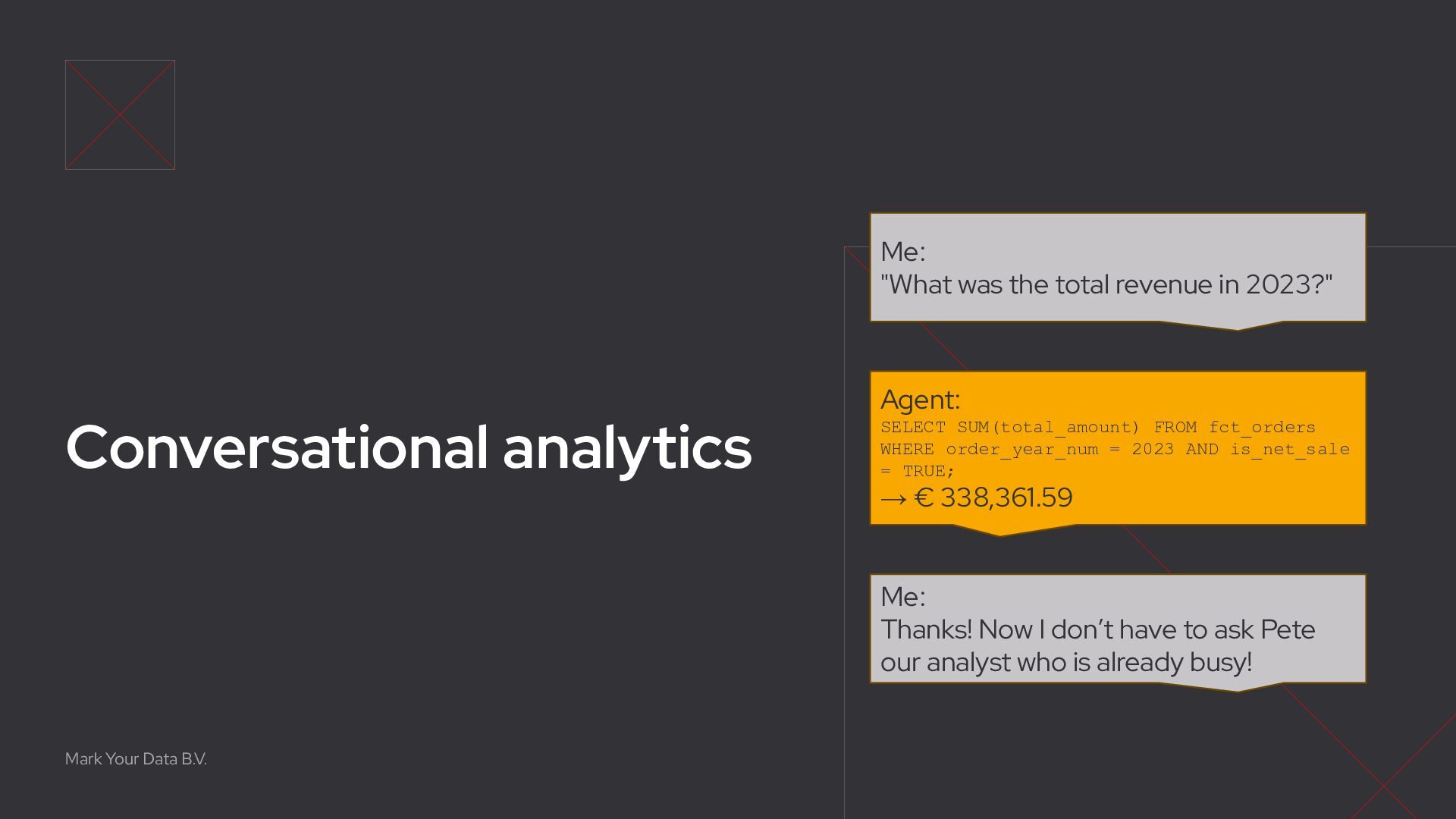
Agent: SELECT SUM(total_amount) FROM fct_orders WHERE order_year_num = 2023 AND is_net_sale = TRUE; → € 338,361.59 Me: Thanks! Now I don’t have to ask Pete our analyst who is already busy! Mark Your Data B.V.
we do business? And … Toelichting To answer this question, I combined my professional, with my hobby craft: Can we trust an AI data analyst? I simulated a crafts e-commerce business, from orders to shipments, to help me understand the implications of conversational analytics on my role as Data & AI engineer, and adjecent analytics and business roles. Today I share what I’ve learned
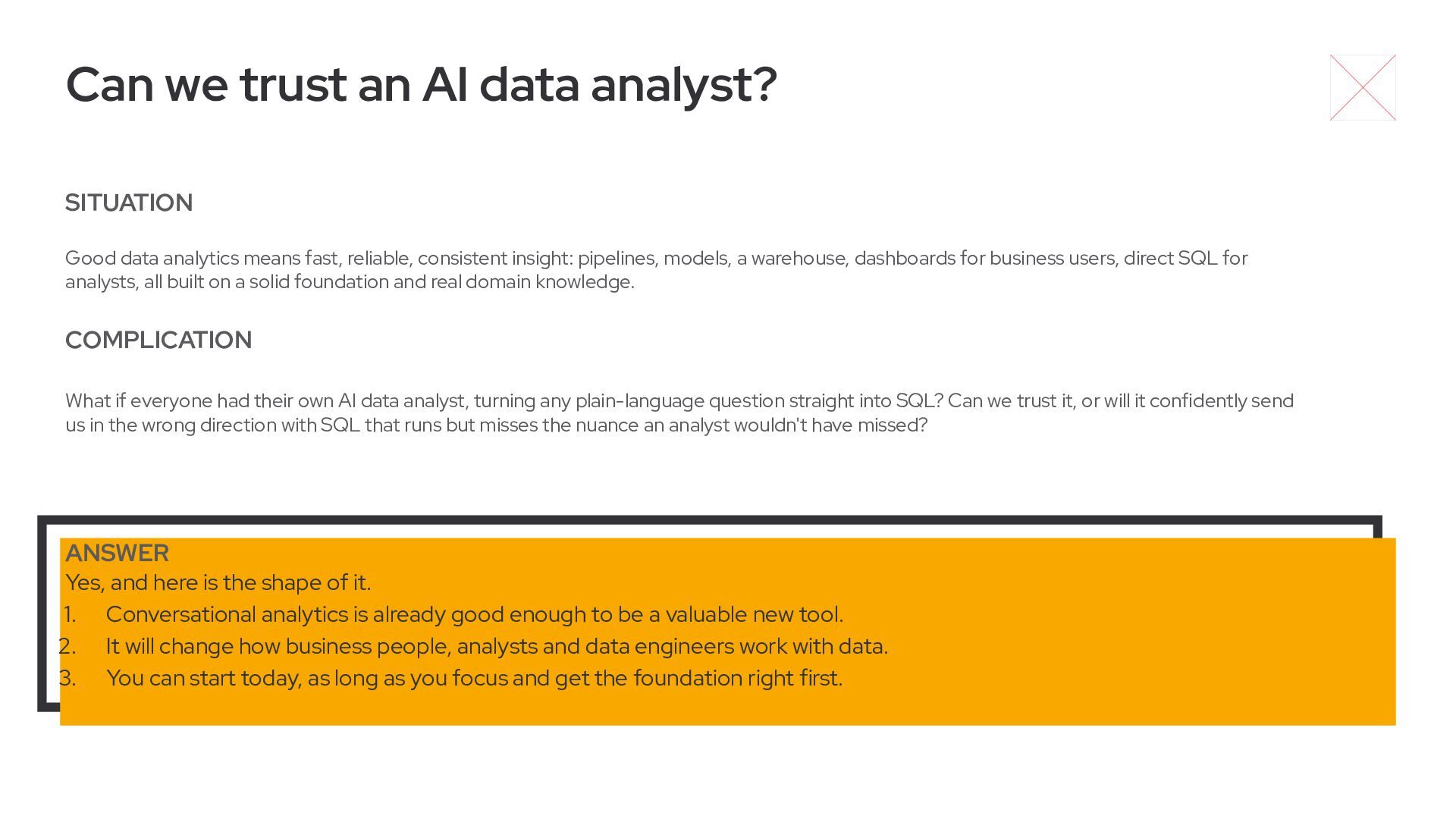
analytics means fast, reliable, consistent insight: pipelines, models, a warehouse, dashboards for business users, direct SQL for analysts, all built on a solid foundation and real domain knowledge. COMPLICATION What if everyone had their own AI data analyst, turning any plain-language question straight into SQL? Can we trust it, or will it confidently send us in the wrong direction with SQL that runs but misses the nuance an analyst wouldn't have missed? ANSWER Yes, and here is the shape of it. 1. Conversational analytics is already good enough to be a valuable new tool. 2. It will change how business people, analysts and data engineers work with data. 3. You can start today, as long as you focus and get the foundation right first.
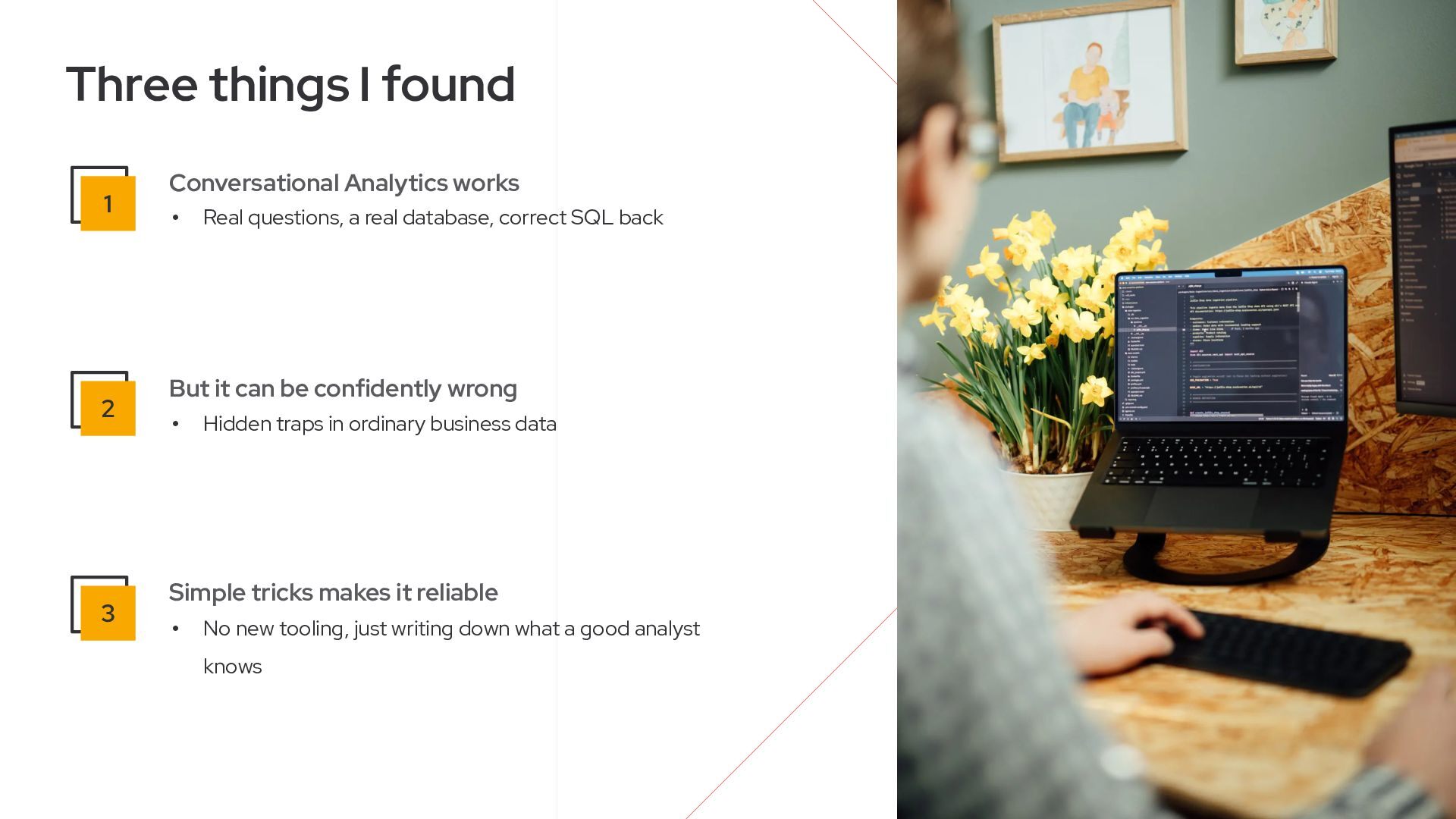
• Real questions, a real database, correct SQL back But it can be confidently wrong • Hidden traps in ordinary business data Simple tricks makes it reliable • No new tooling, just writing down what a good analyst knows
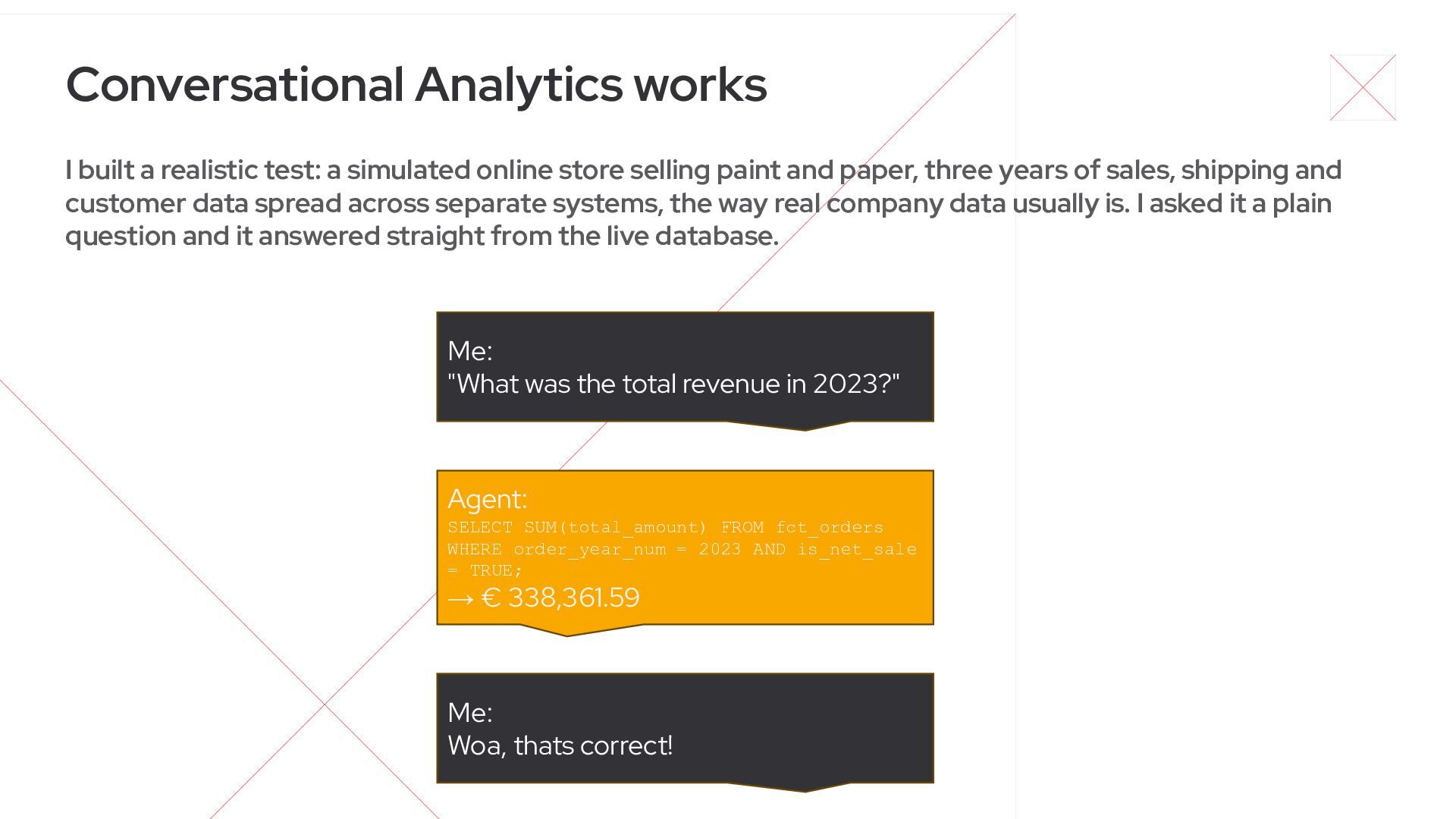
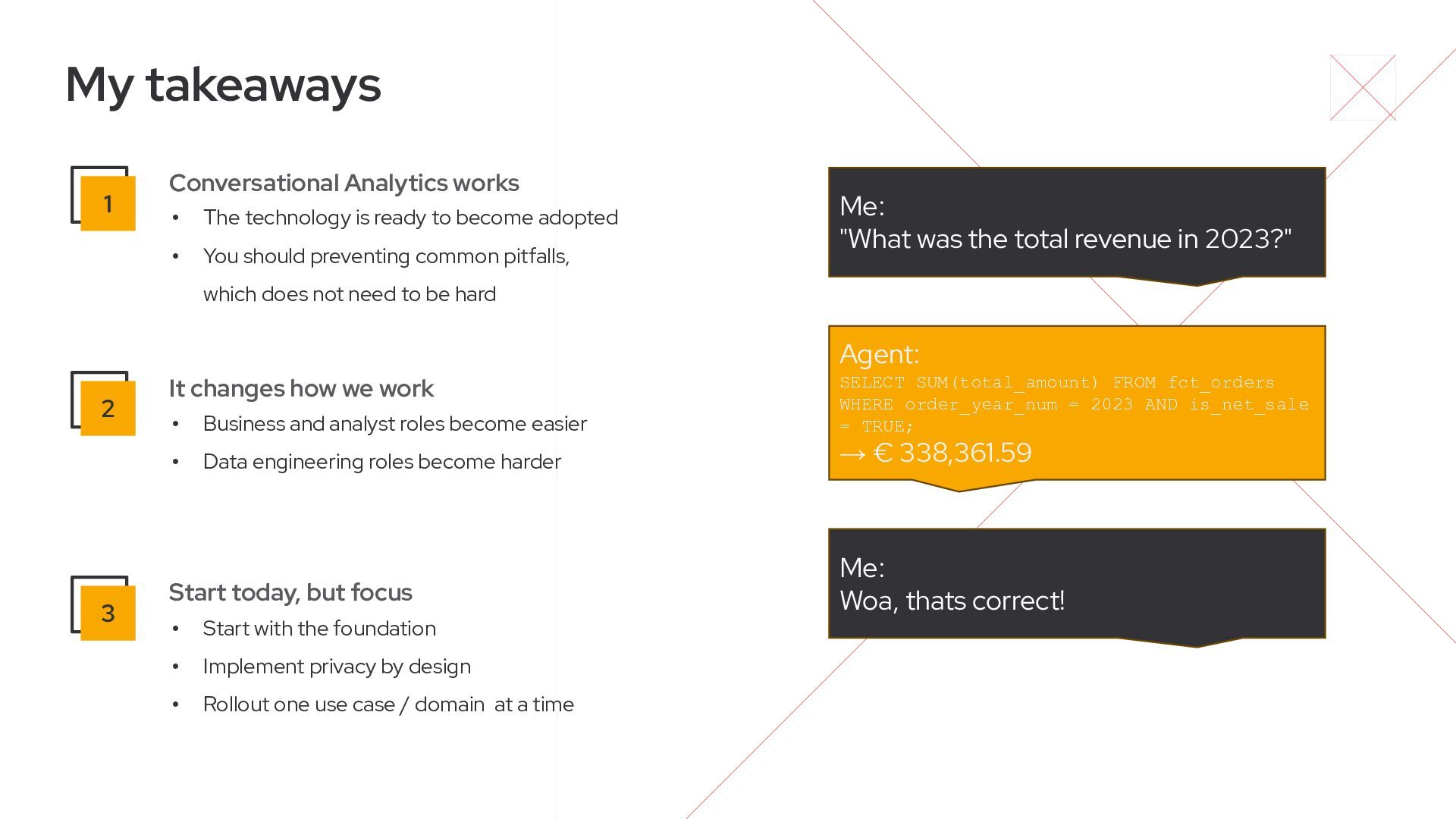
online store selling paint and paper, three years of sales, shipping and customer data spread across separate systems, the way real company data usually is. I asked it a plain question and it answered straight from the live database. Me: "What was the total revenue in 2023?" Agent: SELECT SUM(total_amount) FROM fct_orders WHERE order_year_num = 2023 AND is_net_sale = TRUE; → € 338,361.59 Me: Woa, thats correct!
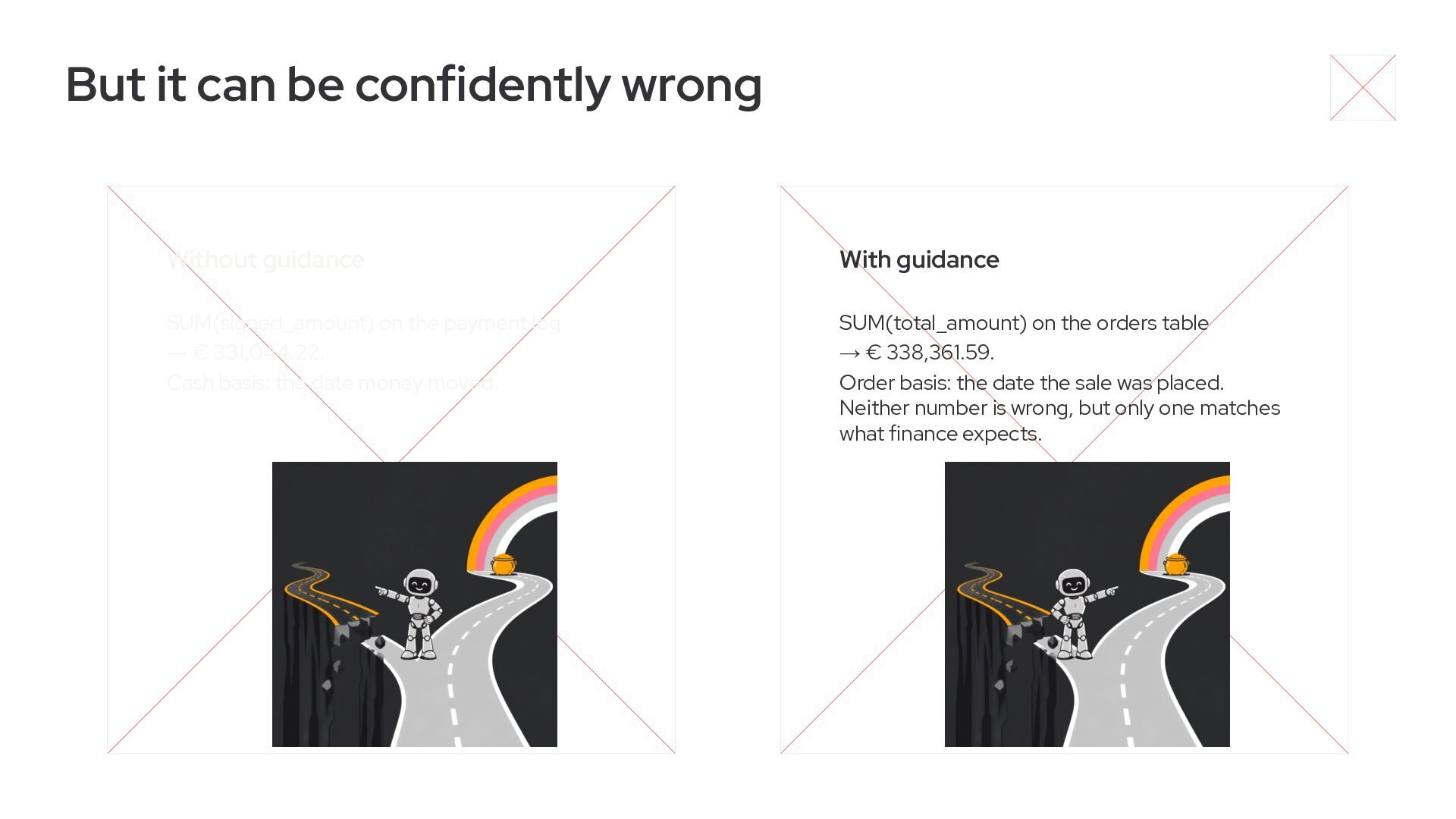
SUM(signed_amount) on the payment log → € 331,044.22. Cash basis: the date money moved. SUM(total_amount) on the orders table → € 338,361.59. Order basis: the date the sale was placed. Neither number is wrong, but only one matches what finance expects.
100% accuracy on 15 real business questions The fix wasn't more tooling. It was writing down what a good analyst already knows: Using a simple skill (text file): • A short, plain-language note about the domain's gotchas, sitting right next to the data model.
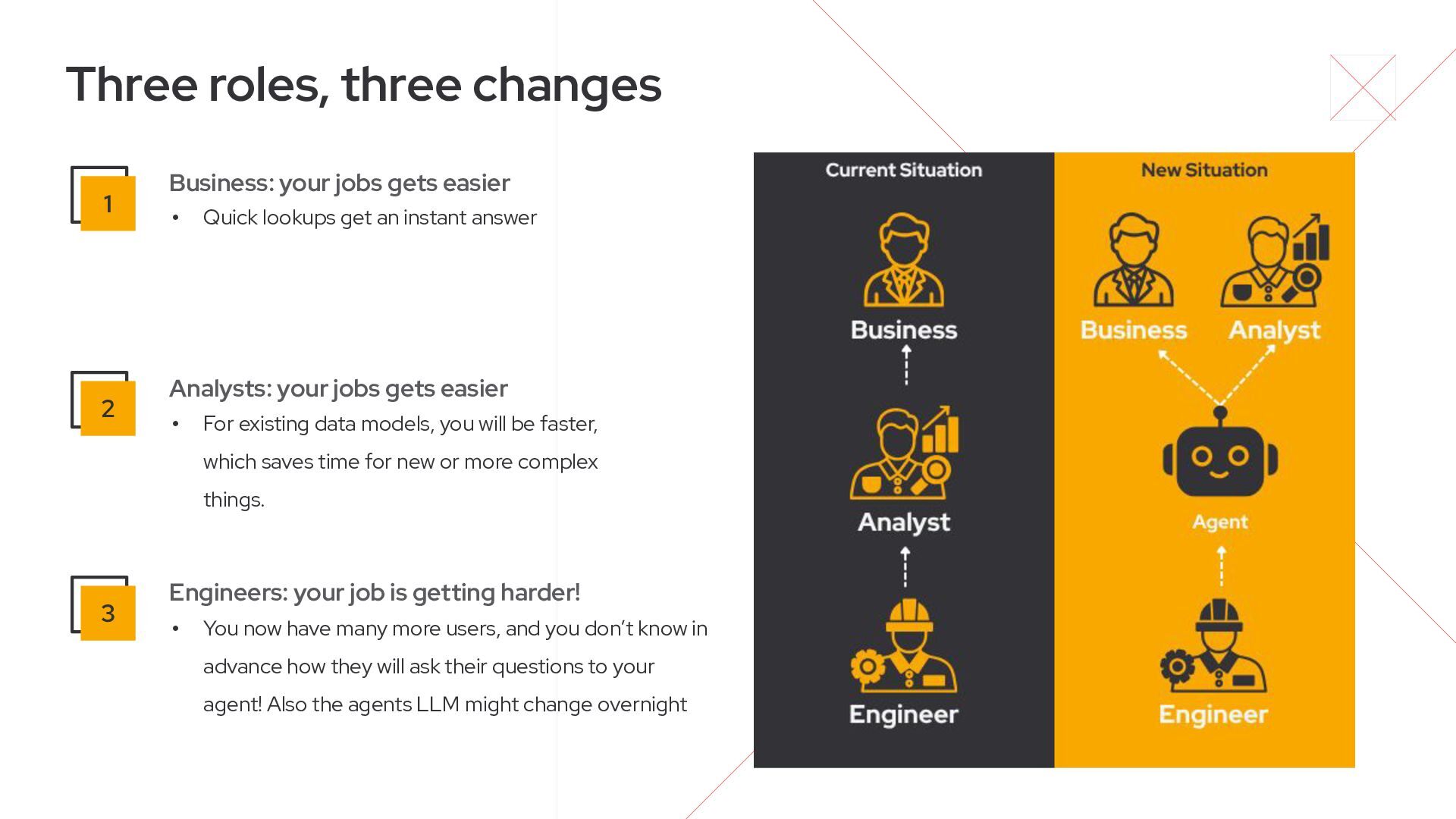
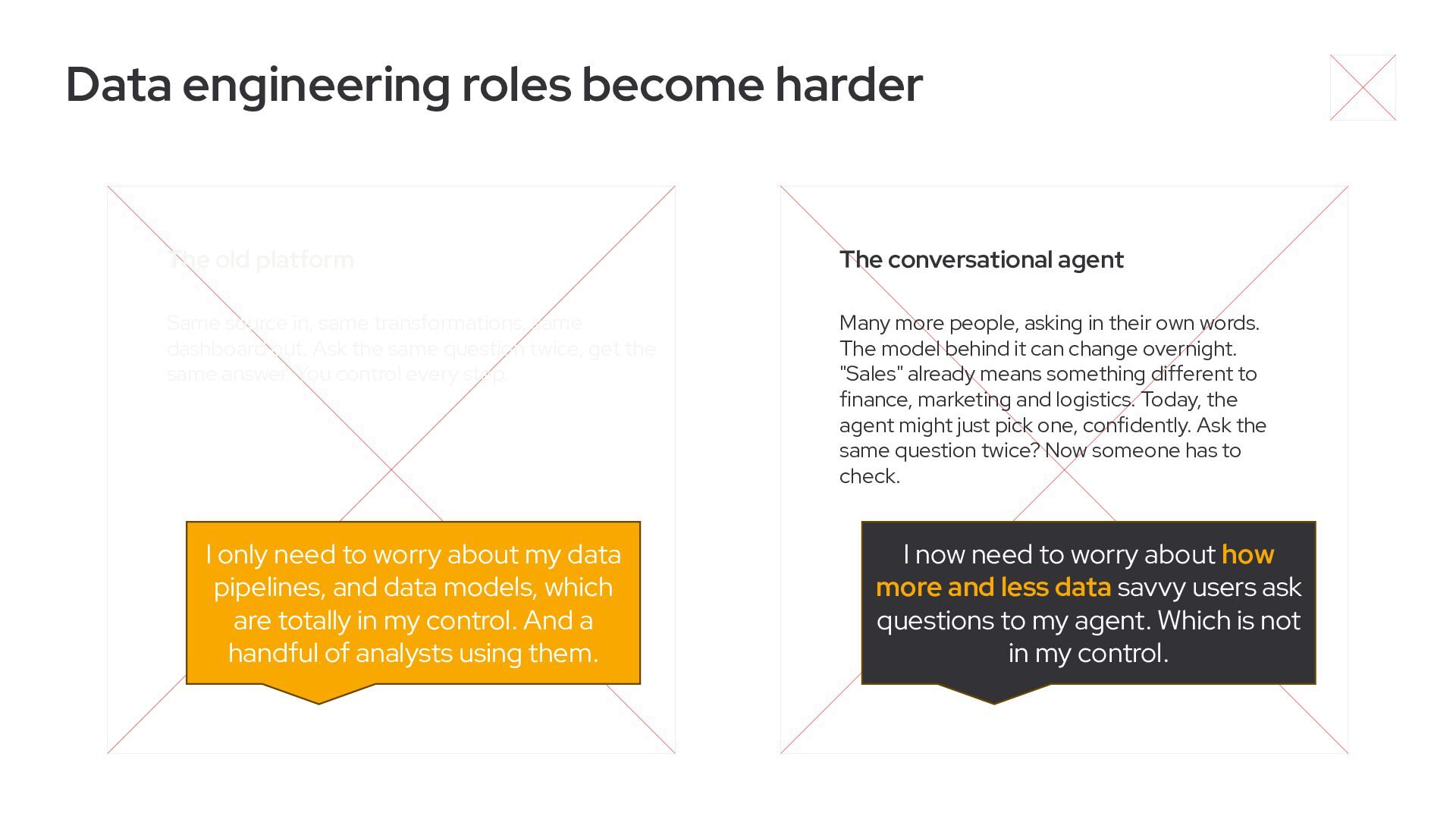
easier • Quick lookups get an instant answer Analysts: your jobs gets easier • For existing data models, you will be faster, which saves time for new or more complex things. 3 Engineers: your job is getting harder! • You now have many more users, and you don’t know in advance how they will ask their questions to your agent! Also the agents LLM might change overnight
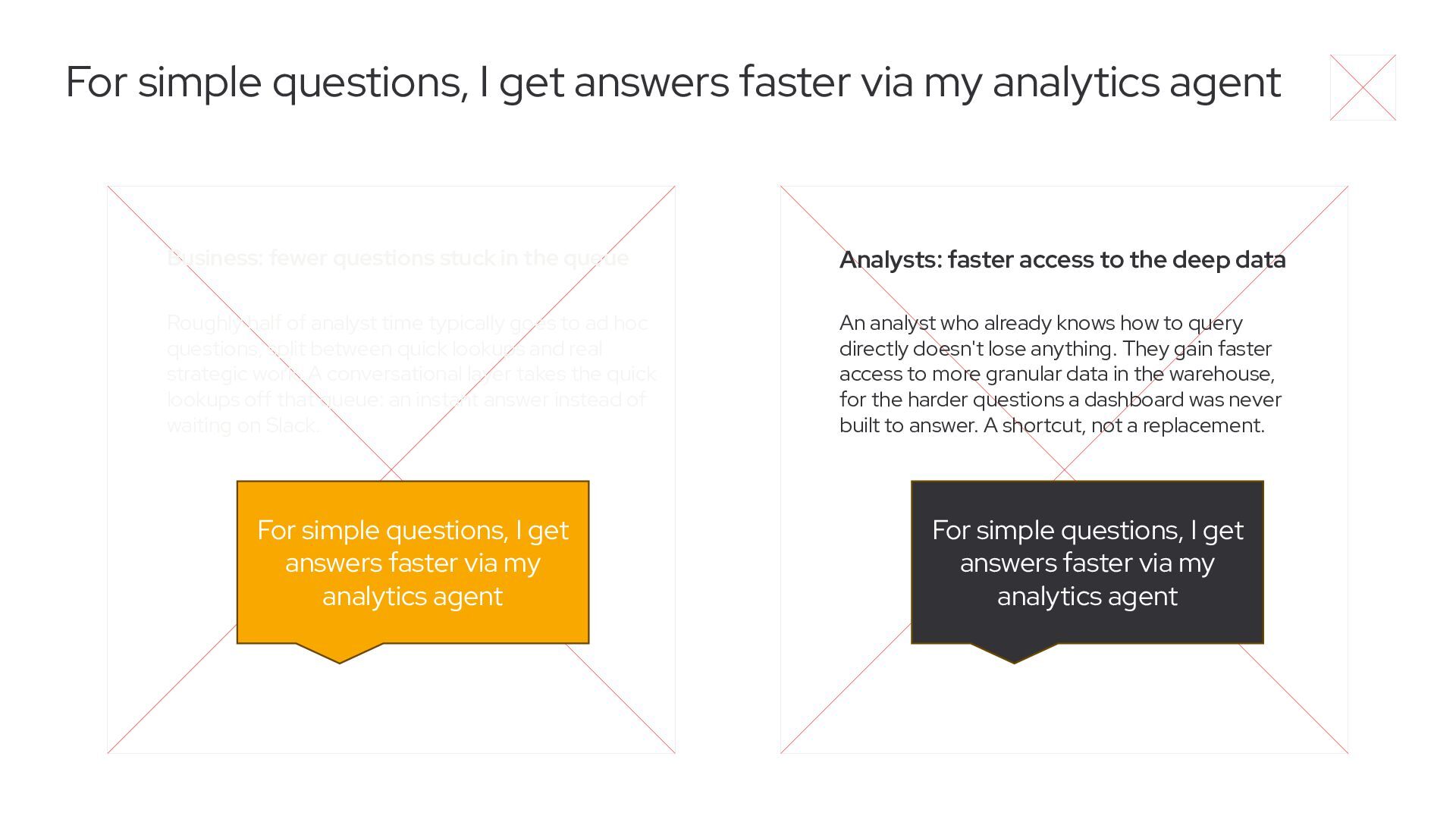
agent Business: fewer questions stuck in the queue Analysts: faster access to the deep data Roughly half of analyst time typically goes to ad hoc questions, split between quick lookups and real strategic work. A conversational layer takes the quick lookups off that queue: an instant answer instead of waiting on Slack. An analyst who already knows how to query directly doesn't lose anything. They gain faster access to more granular data in the warehouse, for the harder questions a dashboard was never built to answer. A shortcut, not a replacement. For simple questions, I get answers faster via my analytics agent For simple questions, I get answers faster via my analytics agent
agent Same source in, same transformations, same dashboard out. Ask the same question twice, get the same answer. You control every step. Many more people, asking in their own words. The model behind it can change overnight. "Sales" already means something different to finance, marketing and logistics. Today, the agent might just pick one, confidently. Ask the same question twice? Now someone has to check. I only need to worry about my data pipelines, and data models, which are totally in my control. And a handful of analysts using them. I now need to worry about how more and less data savvy users ask questions to my agent. Which is not in my control.
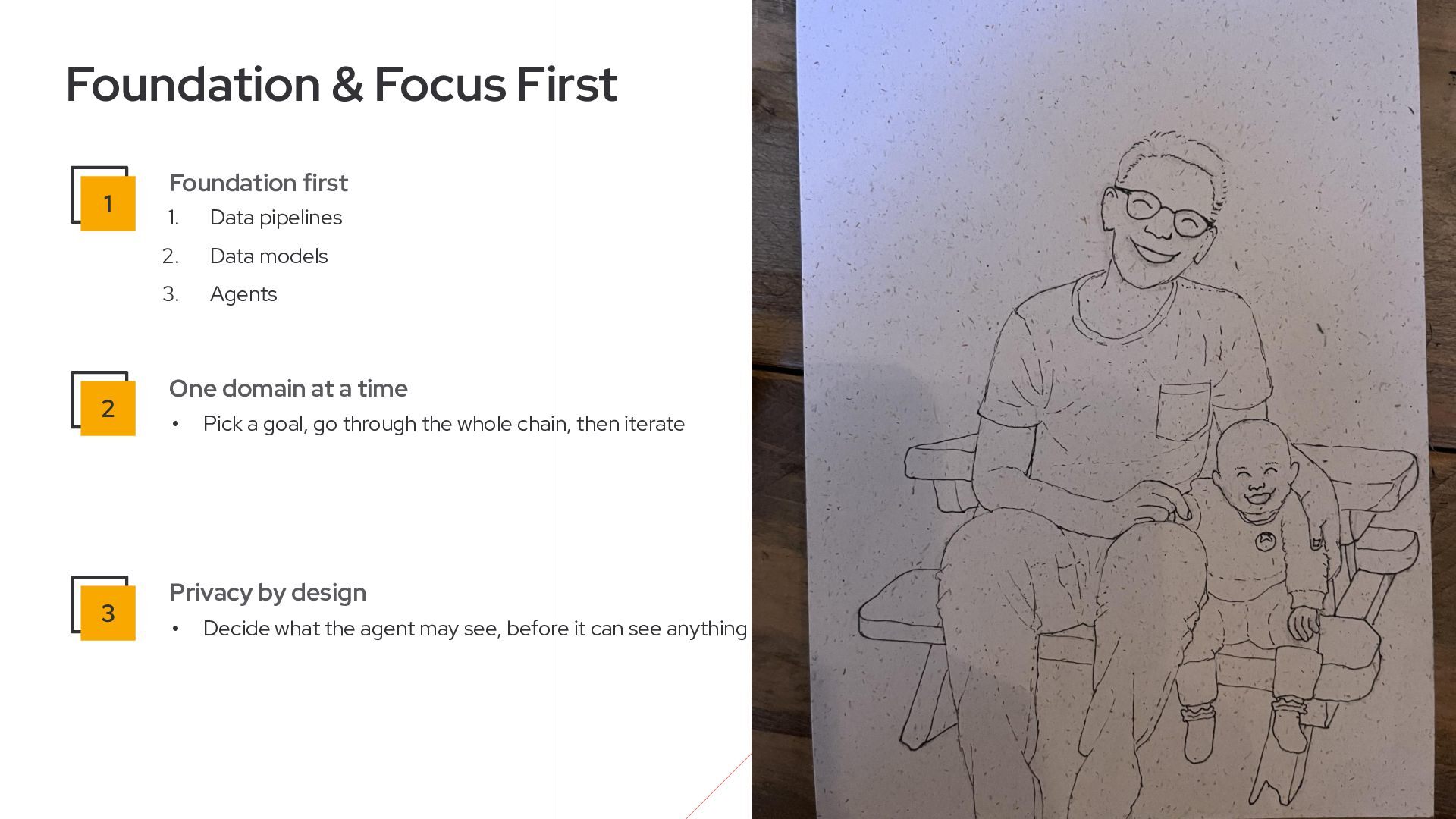
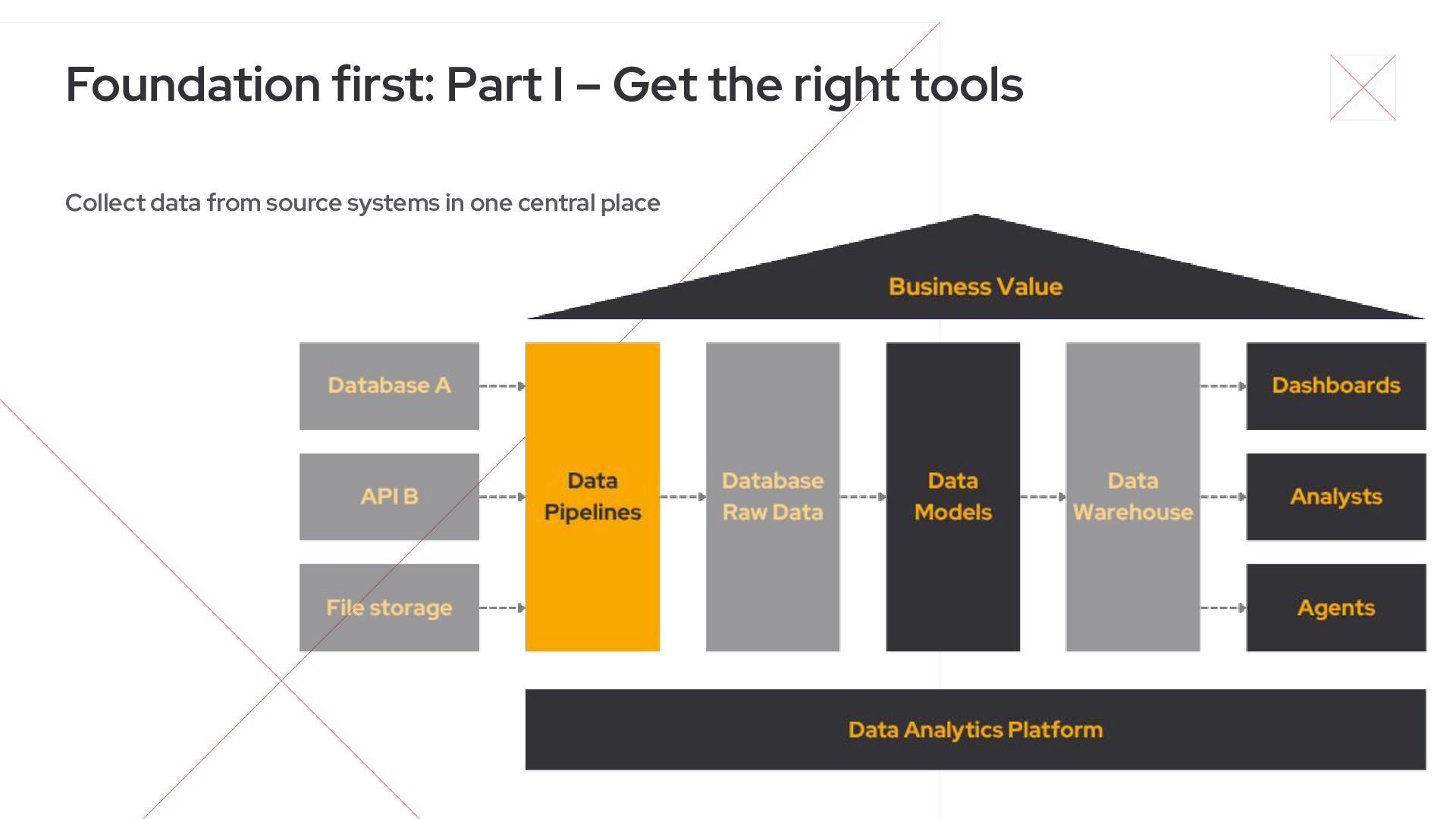
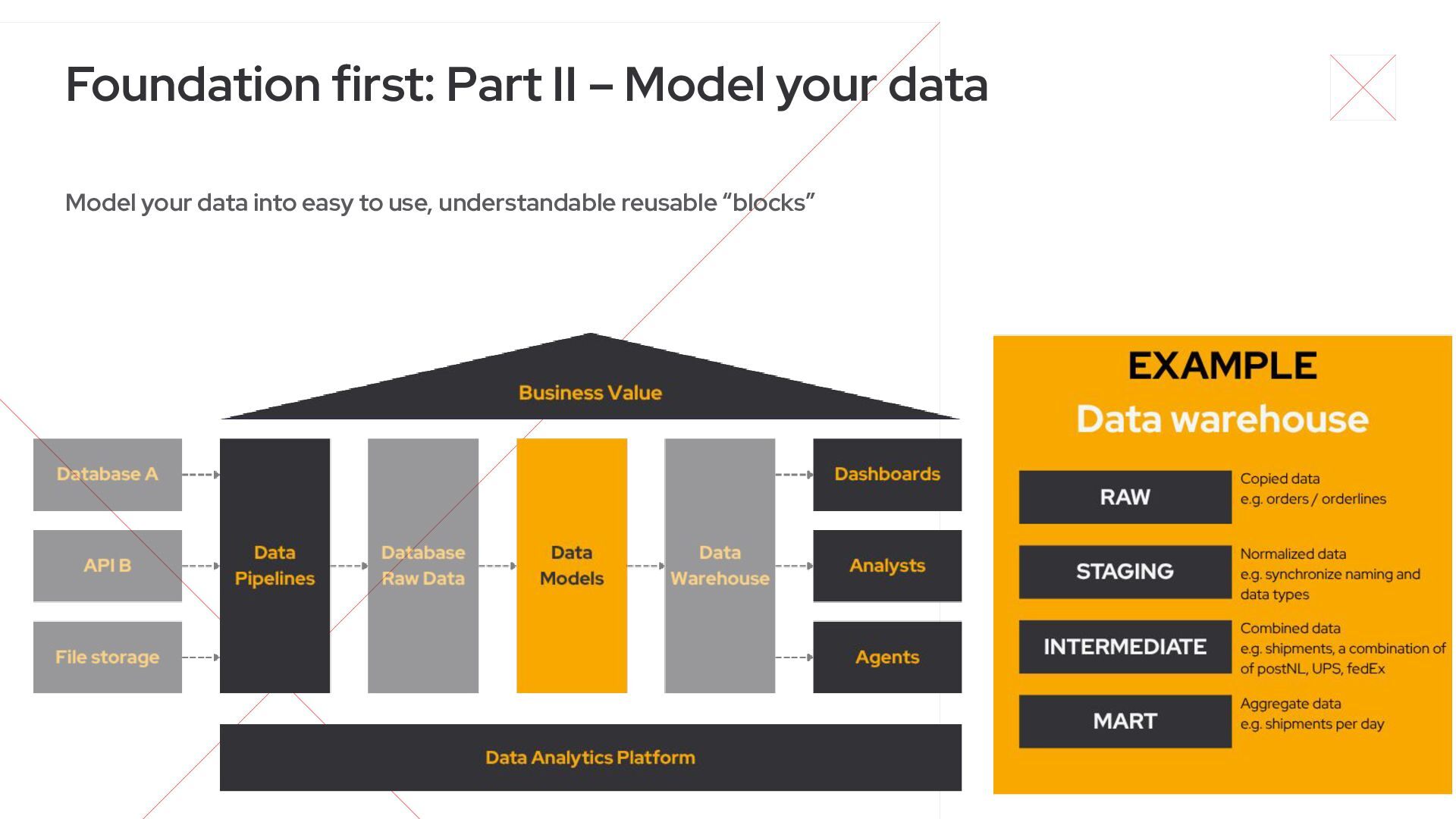
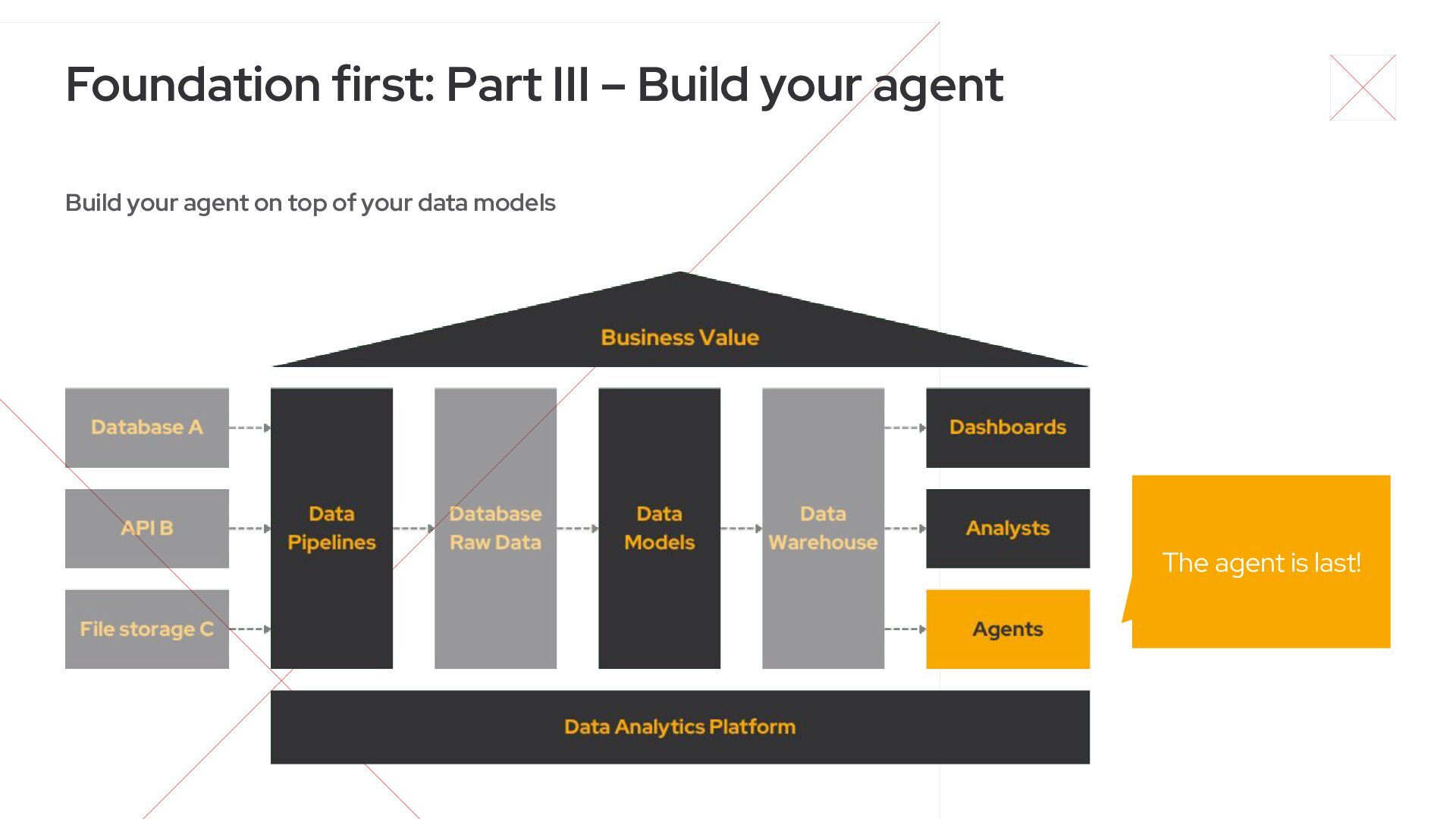
Data pipelines 2. Data models 3. Agents One domain at a time • Pick a goal, go through the whole chain, then iterate Privacy by design • Decide what the agent may see, before it can see anything
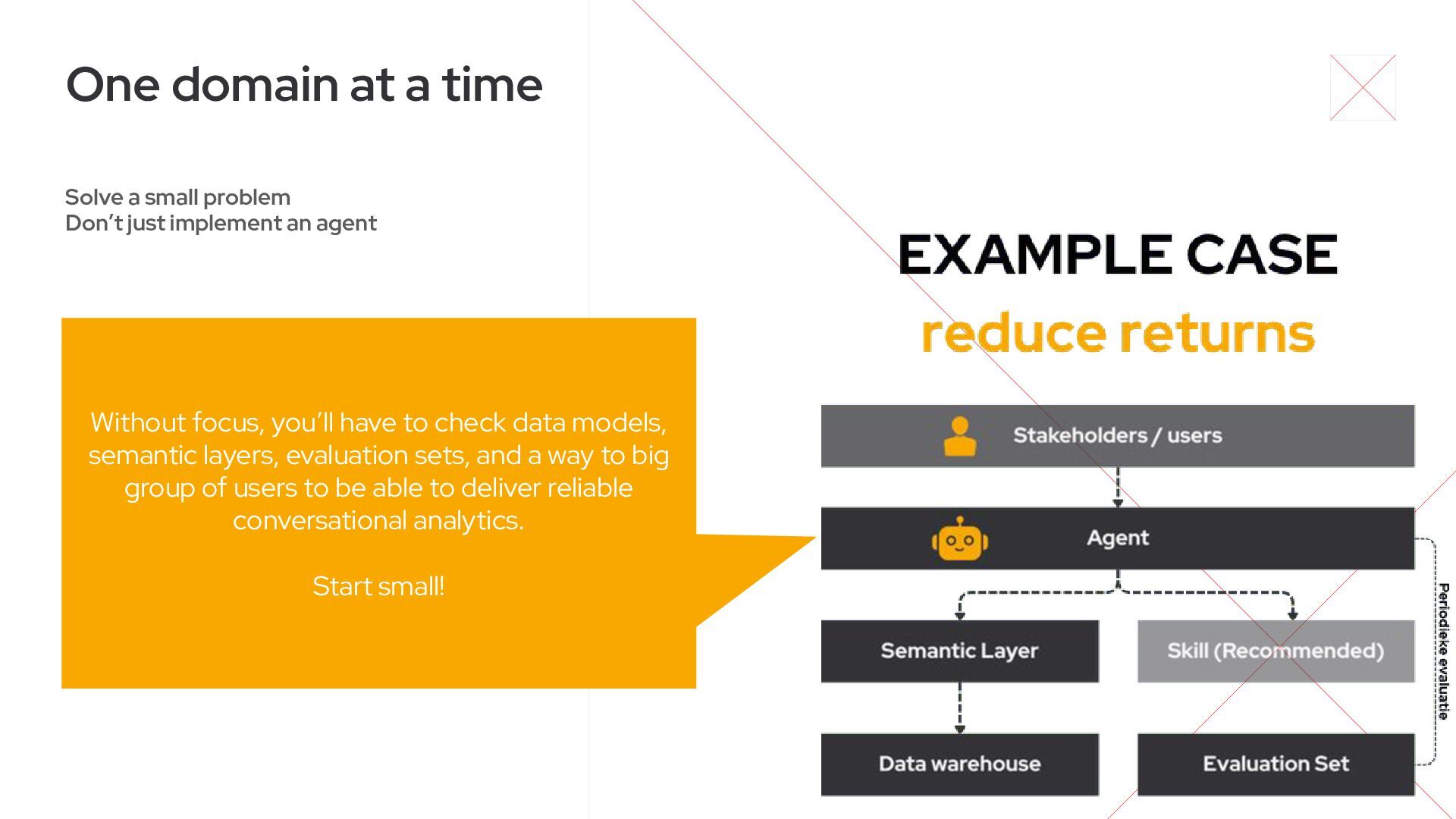
just implement an agent Without focus, you’ll have to check data models, semantic layers, evaluation sets, and a way to big group of users to be able to deliver reliable conversational analytics. Start small!
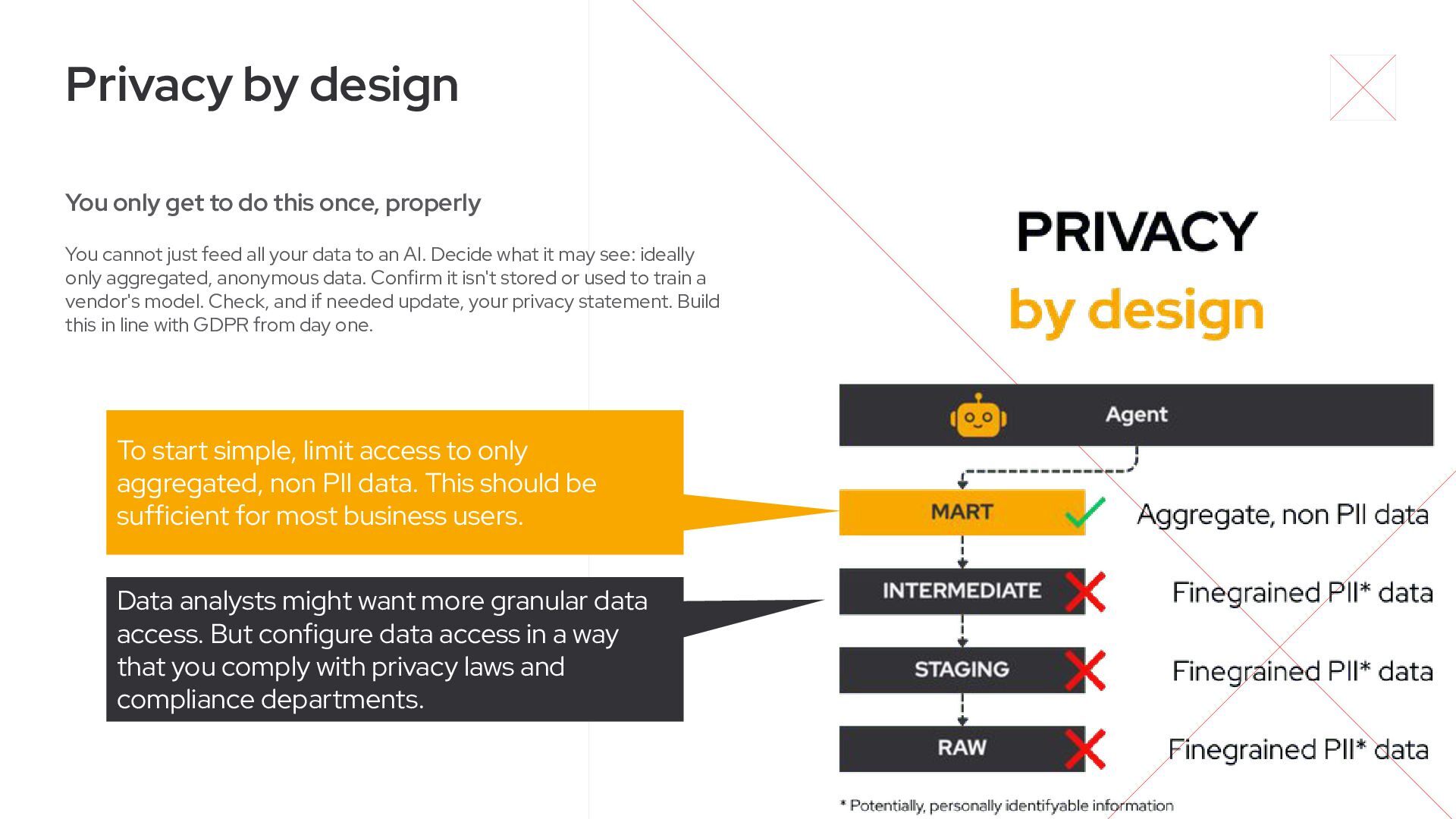
properly You cannot just feed all your data to an AI. Decide what it may see: ideally only aggregated, anonymous data. Confirm it isn't stored or used to train a vendor's model. Check, and if needed update, your privacy statement. Build this in line with GDPR from day one. To start simple, limit access to only aggregated, non PII data. This should be sufficient for most business users. Data analysts might want more granular data access. But configure data access in a way that you comply with privacy laws and compliance departments.
ready to become adopted • You should preventing common pitfalls, Me: "What was the total revenue in 2023?" which does not need to be hard 2 3 It changes how we work • Business and analyst roles become easier • Data engineering roles become harder Start today, but focus • Start with the foundation • Implement privacy by design • Rollout one use case / domain at a time Agent: SELECT SUM(total_amount) FROM fct_orders WHERE order_year_num = 2023 AND is_net_sale = TRUE; → € 338,361.59 Me: Woa, thats correct!
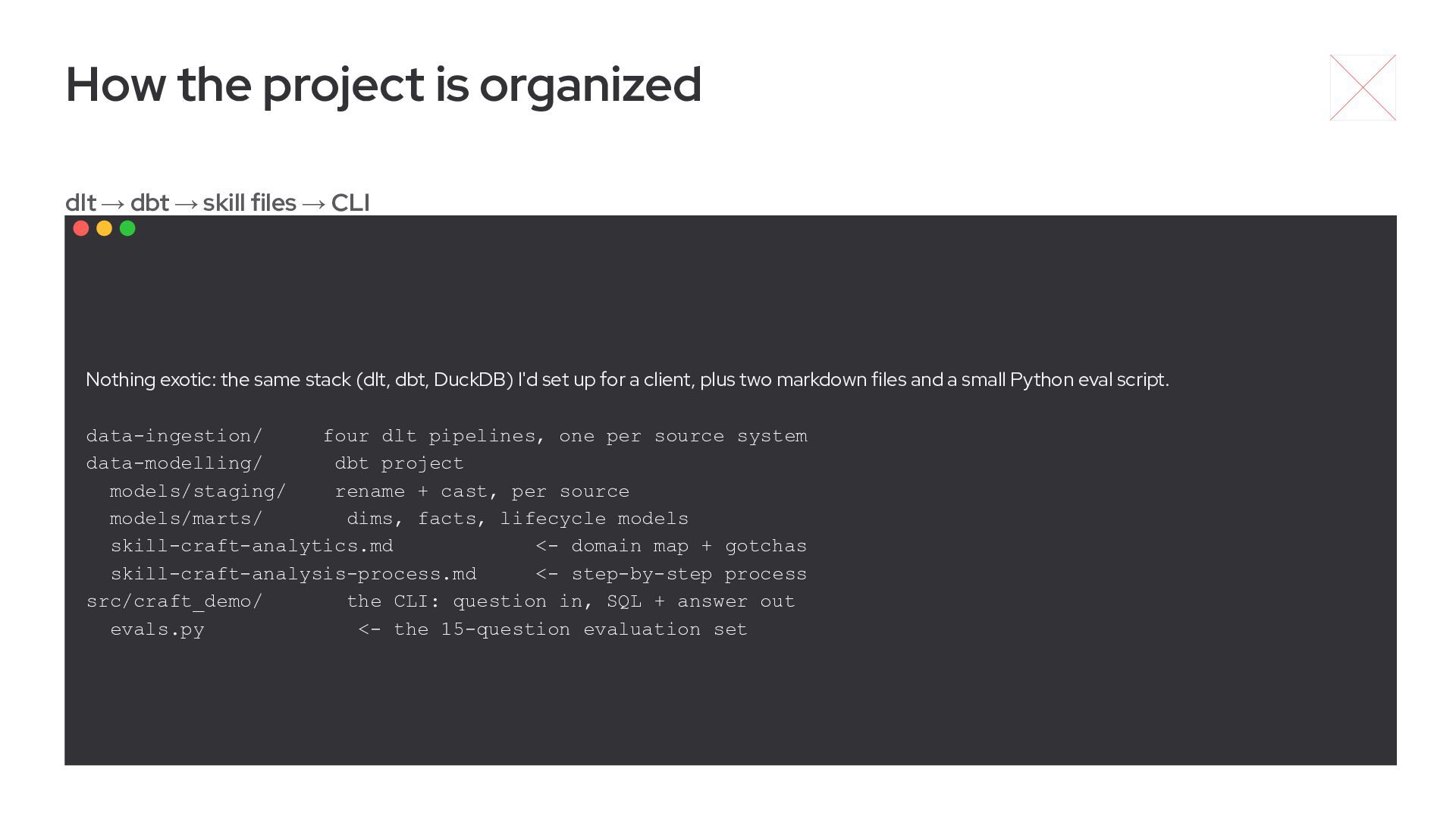
files → CLI Nothing exotic: the same stack (dlt, dbt, DuckDB) I'd set up for a client, plus two markdown files and a small Python eval script. data-ingestion/ four dlt pipelines, one per source system data-modelling/ dbt project models/staging/ rename + cast, per source models/marts/ dims, facts, lifecycle models skill-craft-analytics.md <- domain map + gotchas skill-craft-analysis-process.md <- step-by-step process src/craft_demo/ the CLI: question in, SQL + answer out evals.py <- the 15-question evaluation set
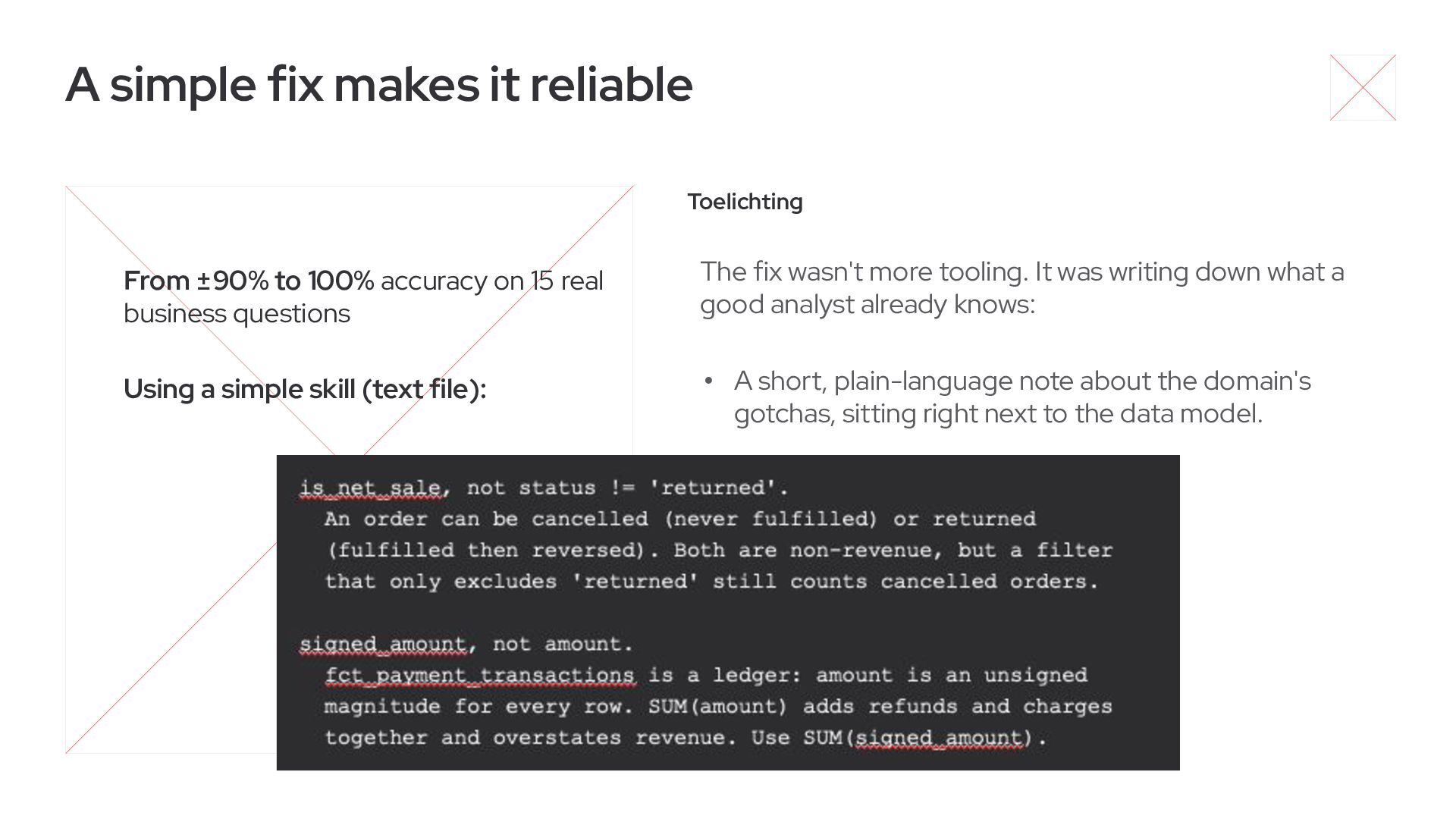
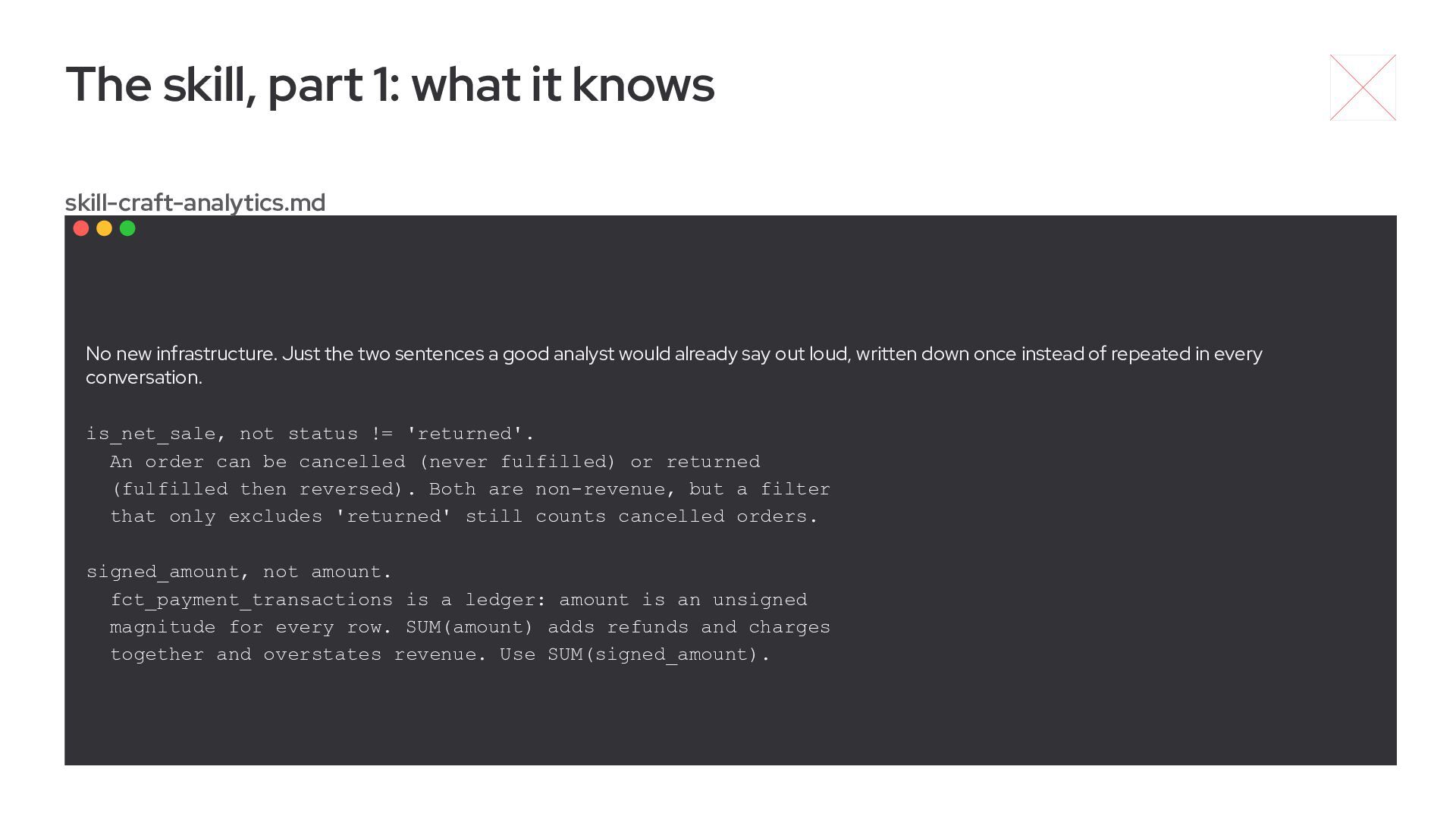
infrastructure. Just the two sentences a good analyst would already say out loud, written down once instead of repeated in every conversation. is_net_sale, not status != 'returned'. An order can be cancelled (never fulfilled) or returned (fulfilled then reversed). Both are non-revenue, but a filter that only excludes 'returned' still counts cancelled orders. signed_amount, not amount. fct_payment_transactions is a ledger: amount is an unsigned magnitude for every row. SUM(amount) adds refunds and charges together and overstates revenue. Use SUM(signed_amount).
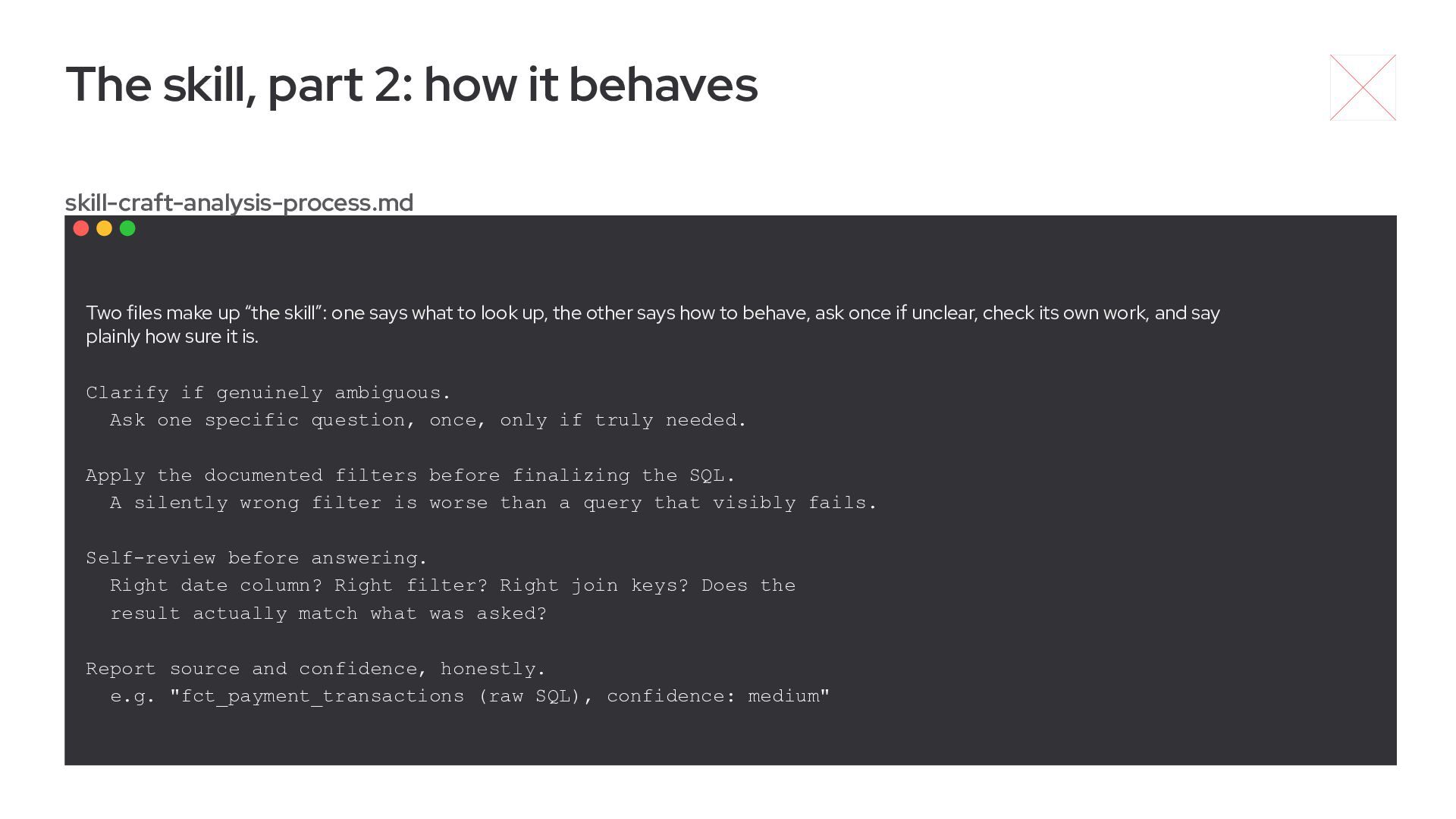
make up “the skill”: one says what to look up, the other says how to behave, ask once if unclear, check its own work, and say plainly how sure it is. Clarify if genuinely ambiguous. Ask one specific question, once, only if truly needed. Apply the documented filters before finalizing the SQL. A silently wrong filter is worse than a query that visibly fails. Self-review before answering. Right date column? Right filter? Right join keys? Does the result actually match what was asked? Report source and confidence, honestly. e.g. "fct_payment_transactions (raw SQL), confidence: medium"
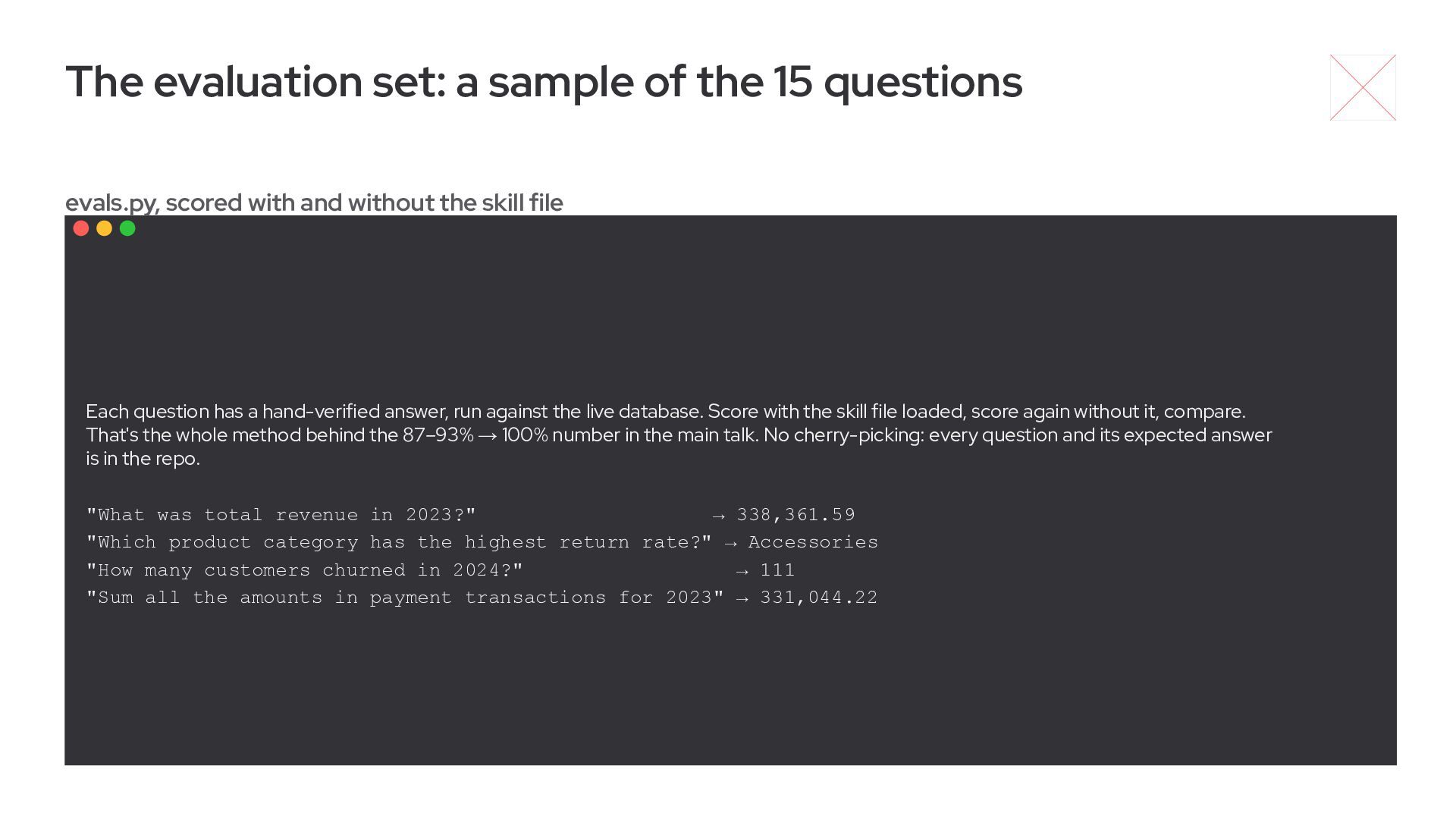
scored with and without the skill file Each question has a hand-verified answer, run against the live database. Score with the skill file loaded, score again without it, compare. That's the whole method behind the 87–93% → 100% number in the main talk. No cherry-picking: every question and its expected answer is in the repo. "What was total revenue in 2023?" → 338,361.59 "Which product category has the highest return rate?" → Accessories "How many customers churned in 2024?" → 111 "Sum all the amounts in payment transactions for 2023" → 331,044.22


 mark3t1ng
 samtorres
 maggiecrowley
 chrislema
 thirion
 addyosmani
 kevinliebholz
 lauravandoore
 keathley
 inesmontani
 honzajavorek
 marketingsoph
 gurzu
gurzu