Upgrade to Pro — share decks privately, control downloads, hide ads and more …

Getting Started With Scala

Getting Started With Scala

Meant for developers who wanted to get started on Scala. Sole objective is to get people started by creating a project in Scala, write some code using collections and test it using ScalaTest.

Avatar for Meetu Maltiar

Meetu Maltiar

April 26, 2014
Tweet

Other Decks in Programming

Transcript

  1. Getting Started With Scala Meetu Maltiar Cisco twitter: @meetumaltiar blog:

    meetumaltiar.com 1 26th April 2014 Bangalore, INDIA
  2. SBT Build tool for Scala projects Scala based frameworks like

    Akka uses it SBT build definition uses Scala based DSL Incremental compilation Works with mixed scala and java projects
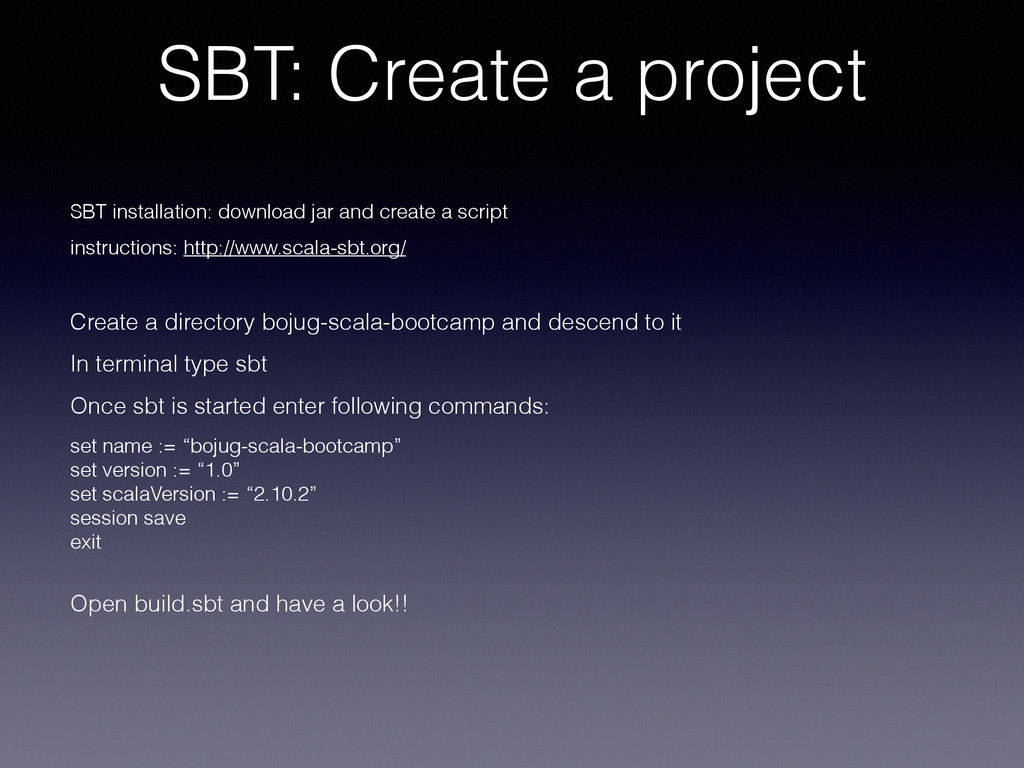
  3. SBT: Create a project SBT installation: download jar and create

    a script instructions: http://www.scala-sbt.org/ Create a directory bojug-scala-bootcamp and descend to it In terminal type sbt Once sbt is started enter following commands: set name := “bojug-scala-bootcamp” set version := “1.0” set scalaVersion := “2.10.2” session save exit ! Open build.sbt and have a look!!
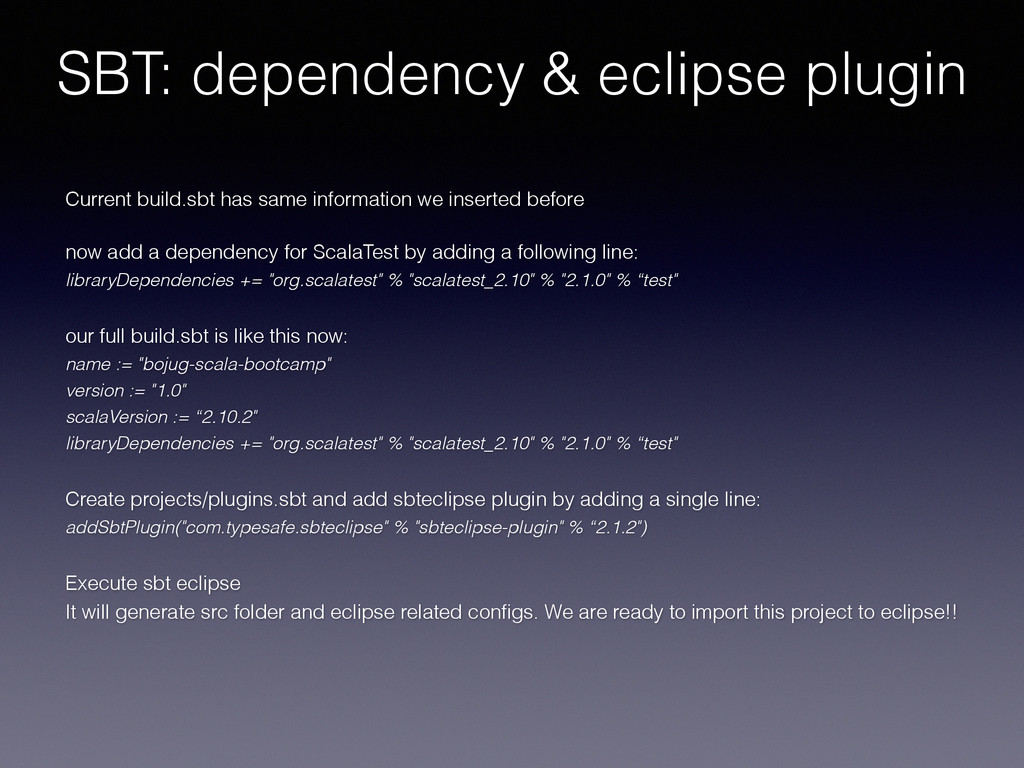
  4. SBT: dependency & eclipse plugin Current build.sbt has same information

    we inserted before ! now add a dependency for ScalaTest by adding a following line: libraryDependencies += "org.scalatest" % "scalatest_2.10" % "2.1.0" % “test" ! our full build.sbt is like this now: name := "bojug-scala-bootcamp" version := "1.0" scalaVersion := “2.10.2" libraryDependencies += "org.scalatest" % "scalatest_2.10" % "2.1.0" % “test" ! Create projects/plugins.sbt and add sbteclipse plugin by adding a single line: addSbtPlugin("com.typesafe.sbteclipse" % "sbteclipse-plugin" % “2.1.2") ! Execute sbt eclipse It will generate src folder and eclipse related configs. We are ready to import this project to eclipse!!
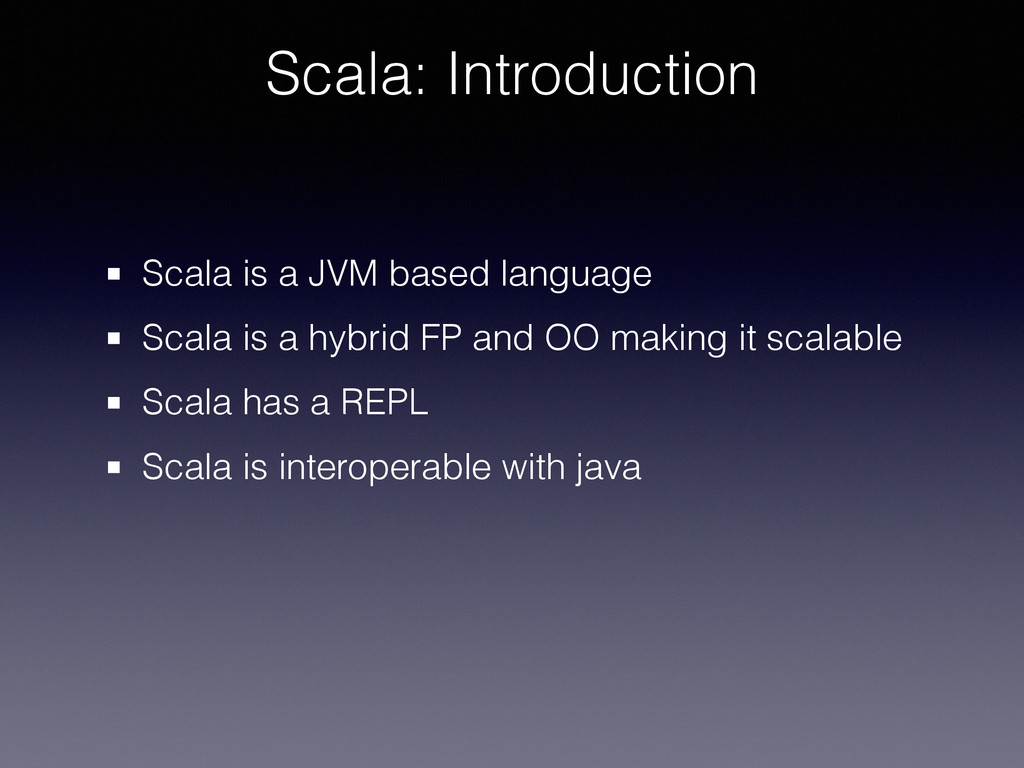
  5. Scala: Introduction Scala is a JVM based language Scala is

    a hybrid FP and OO making it scalable Scala has a REPL Scala is interoperable with java
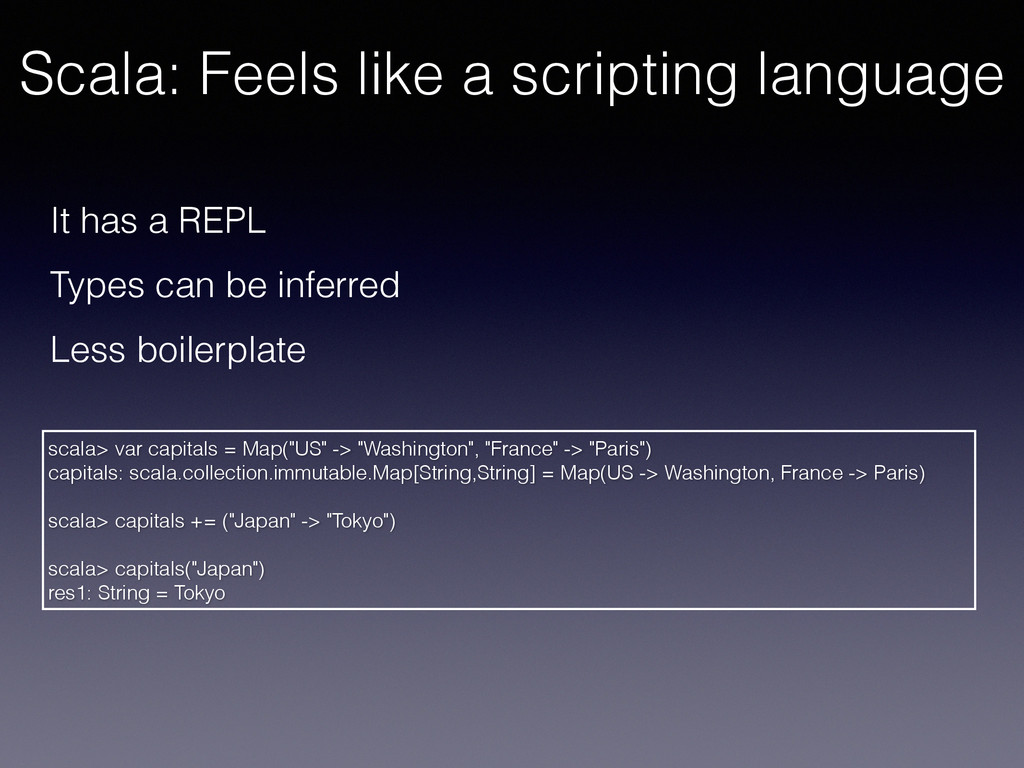
  6. Scala: Feels like a scripting language It has a REPL

    Types can be inferred Less boilerplate scala> var capitals = Map("US" -> "Washington", "France" -> "Paris") capitals: scala.collection.immutable.Map[String,String] = Map(US -> Washington, France -> Paris) ! scala> capitals += ("Japan" -> "Tokyo") ! scala> capitals("Japan") res1: String = Tokyo
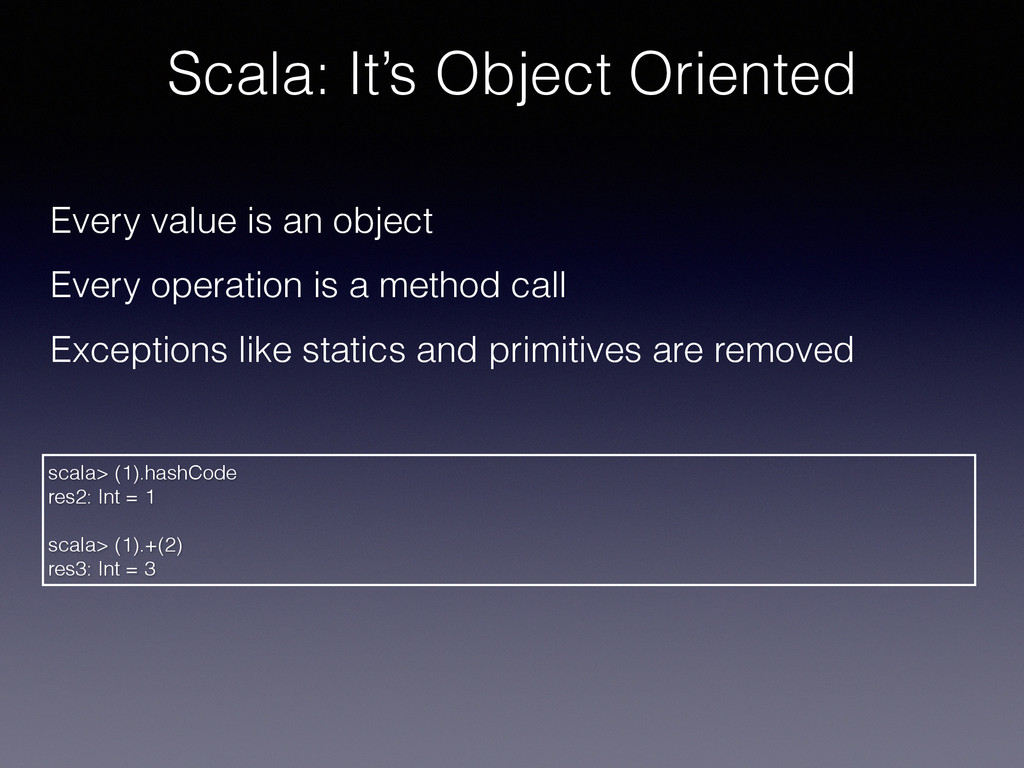
  7. Scala: It’s Object Oriented Every value is an object Every

    operation is a method call Exceptions like statics and primitives are removed scala> (1).hashCode res2: Int = 1 ! scala> (1).+(2) res3: Int = 3
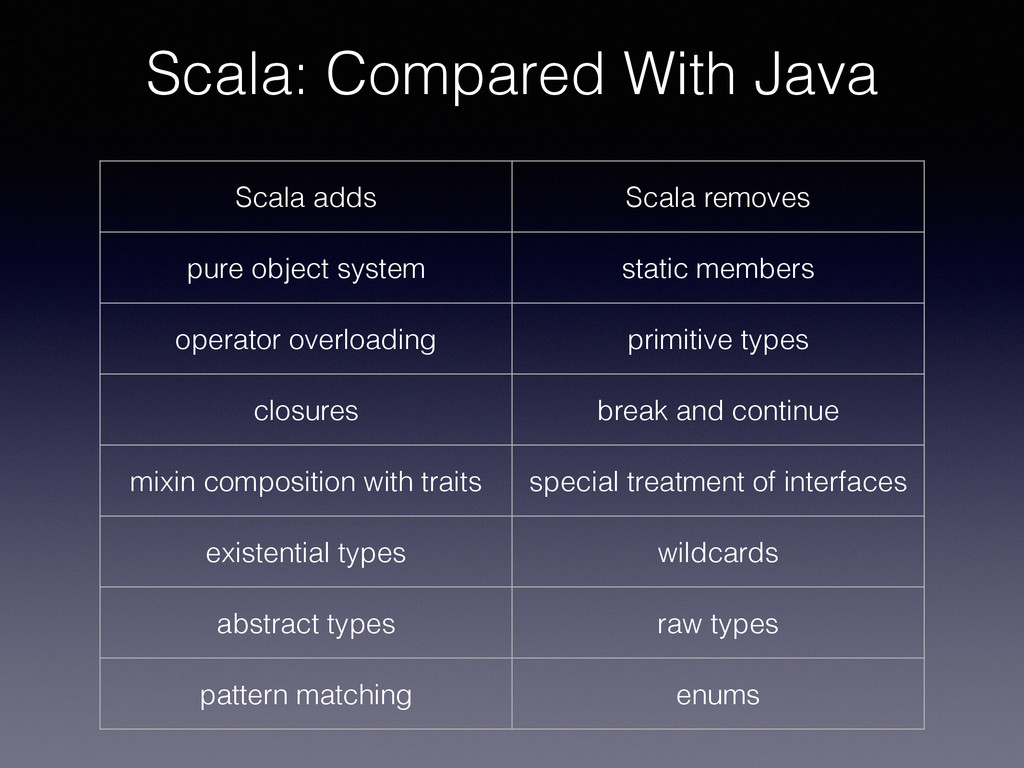
  8. Scala: Compared With Java Scala adds Scala removes pure object

    system static members operator overloading primitive types closures break and continue mixin composition with traits special treatment of interfaces existential types wildcards abstract types raw types pattern matching enums
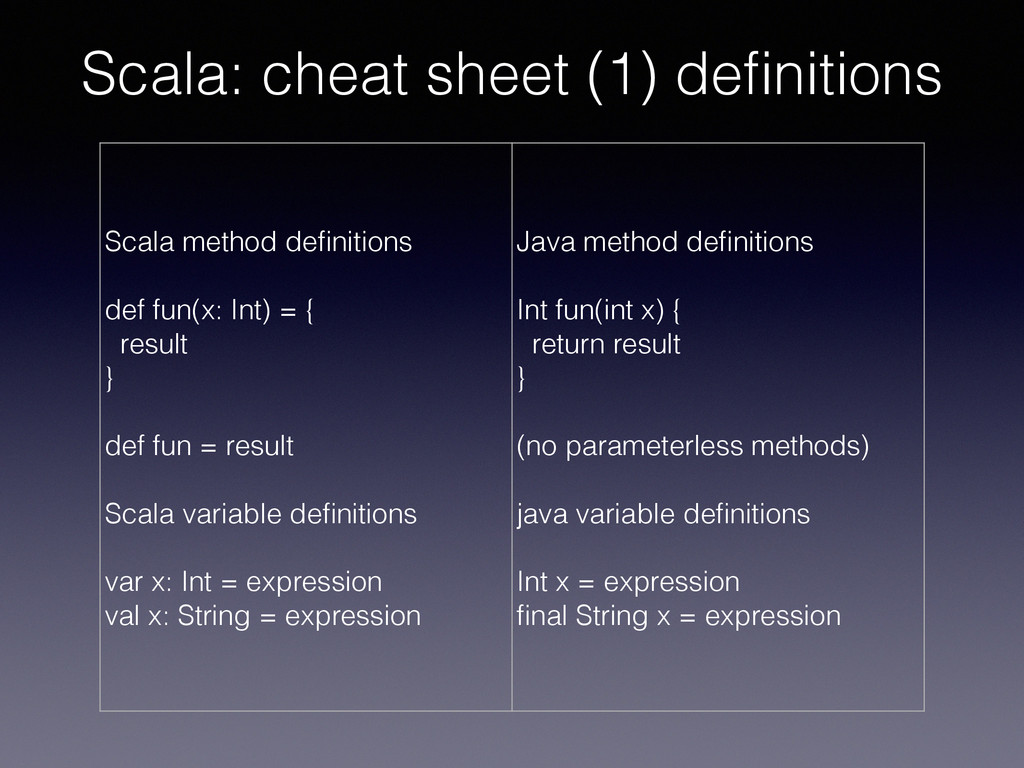
  9. Scala: cheat sheet (1) definitions Scala method definitions ! def

    fun(x: Int) = { result } ! def fun = result ! Scala variable definitions ! var x: Int = expression val x: String = expression Java method definitions ! Int fun(int x) { return result } ! (no parameterless methods) ! java variable definitions ! Int x = expression final String x = expression
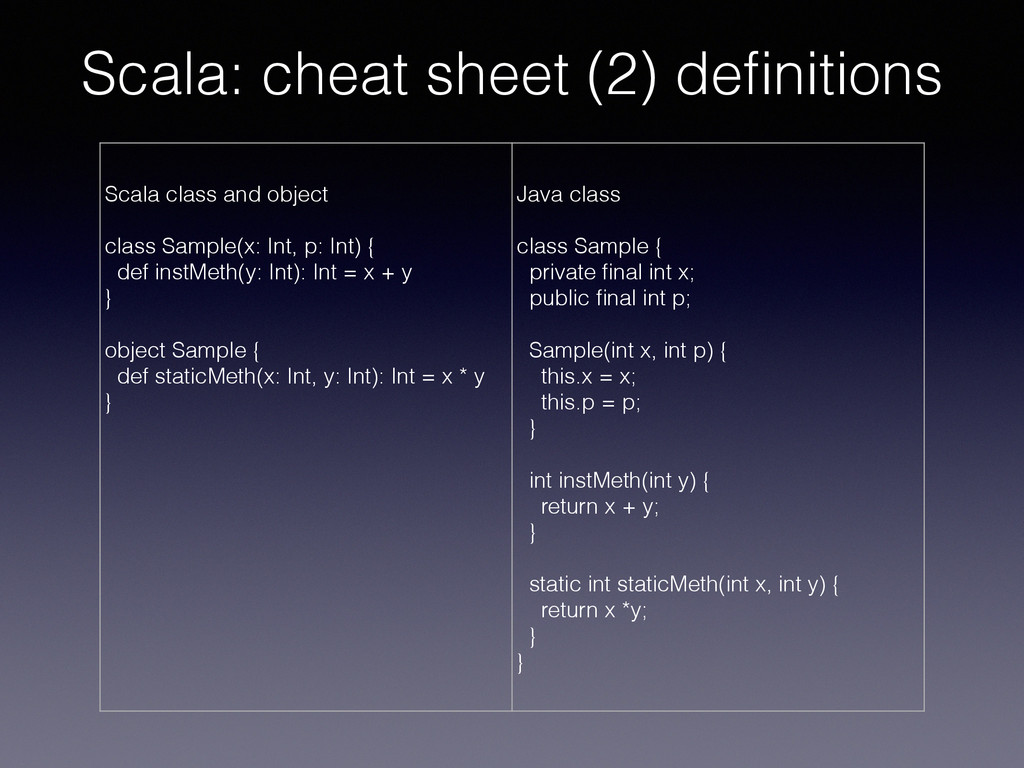
  10. Scala: cheat sheet (2) definitions Scala class and object !

    class Sample(x: Int, p: Int) { def instMeth(y: Int): Int = x + y } ! object Sample { def staticMeth(x: Int, y: Int): Int = x * y } ! ! ! ! ! ! ! ! ! Java class ! class Sample { private final int x; public final int p; ! Sample(int x, int p) { this.x = x; this.p = p; } ! int instMeth(int y) { return x + y; } ! static int staticMeth(int x, int y) { return x *y; } }
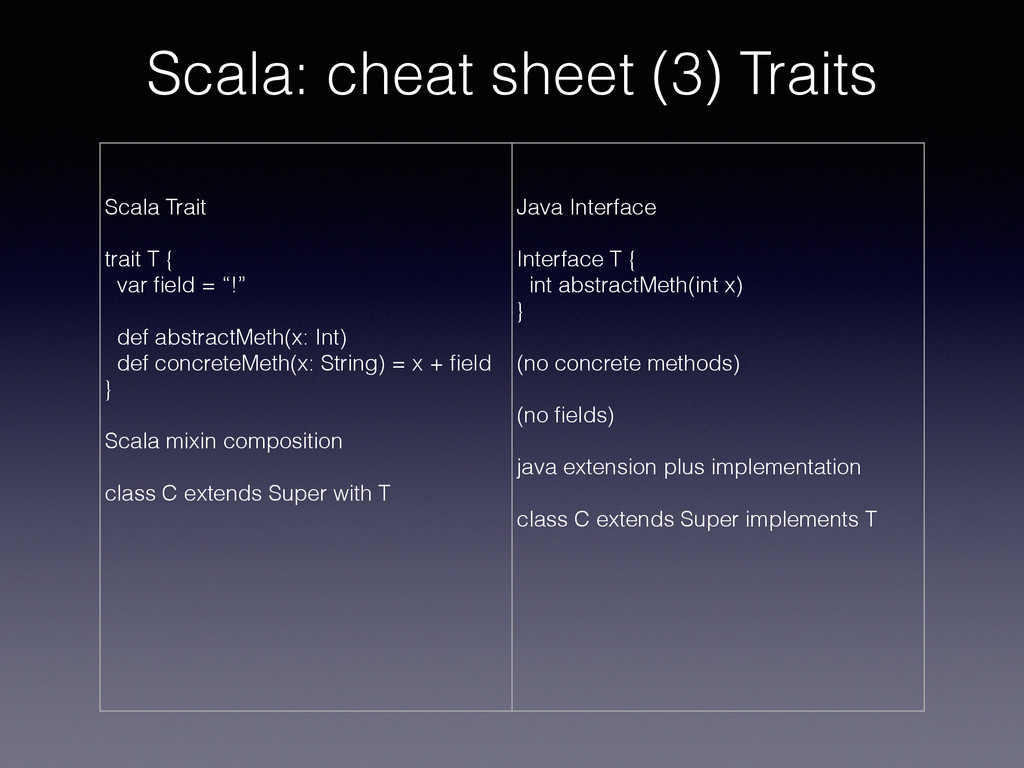
  11. Scala: cheat sheet (3) Traits Scala Trait ! trait T

    { var field = “!” ! def abstractMeth(x: Int) def concreteMeth(x: String) = x + field } ! Scala mixin composition ! class C extends Super with T ! ! ! ! ! Java Interface ! Interface T { int abstractMeth(int x) } ! (no concrete methods) ! (no fields) ! java extension plus implementation ! class C extends Super implements T ! ! ! !
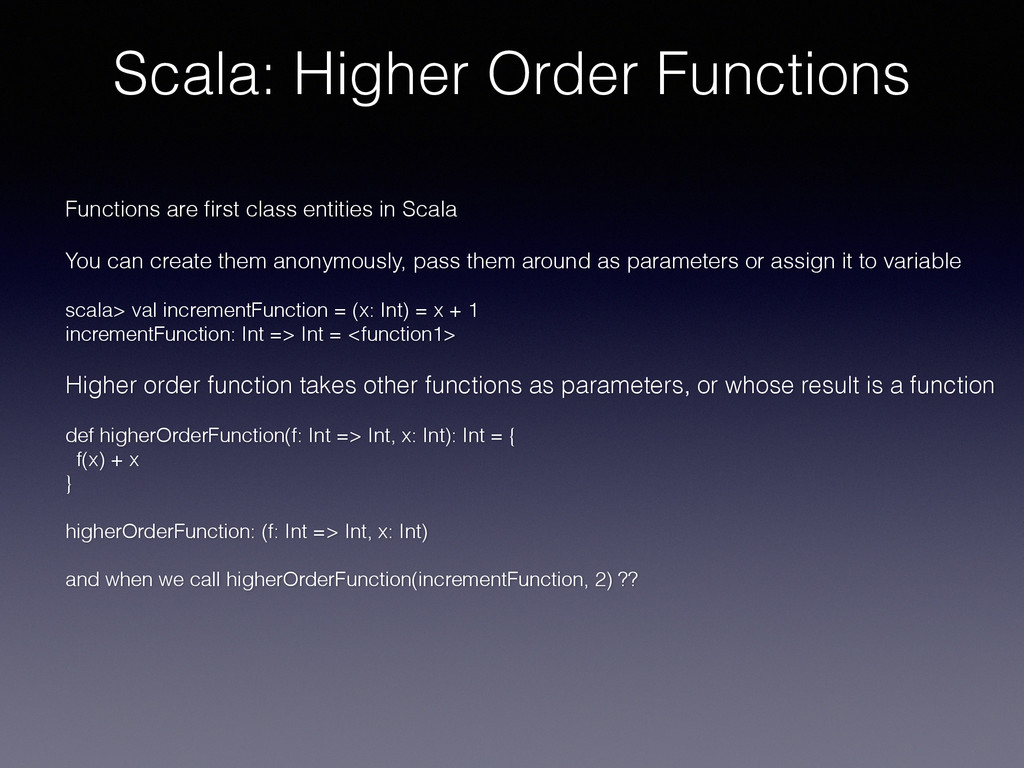
  12. Scala: Higher Order Functions Functions are first class entities in

    Scala ! You can create them anonymously, pass them around as parameters or assign it to variable ! scala> val incrementFunction = (x: Int) = x + 1 incrementFunction: Int => Int = <function1> ! Higher order function takes other functions as parameters, or whose result is a function ! def higherOrderFunction(f: Int => Int, x: Int): Int = { f(x) + x } ! higherOrderFunction: (f: Int => Int, x: Int) ! and when we call higherOrderFunction(incrementFunction, 2) ??
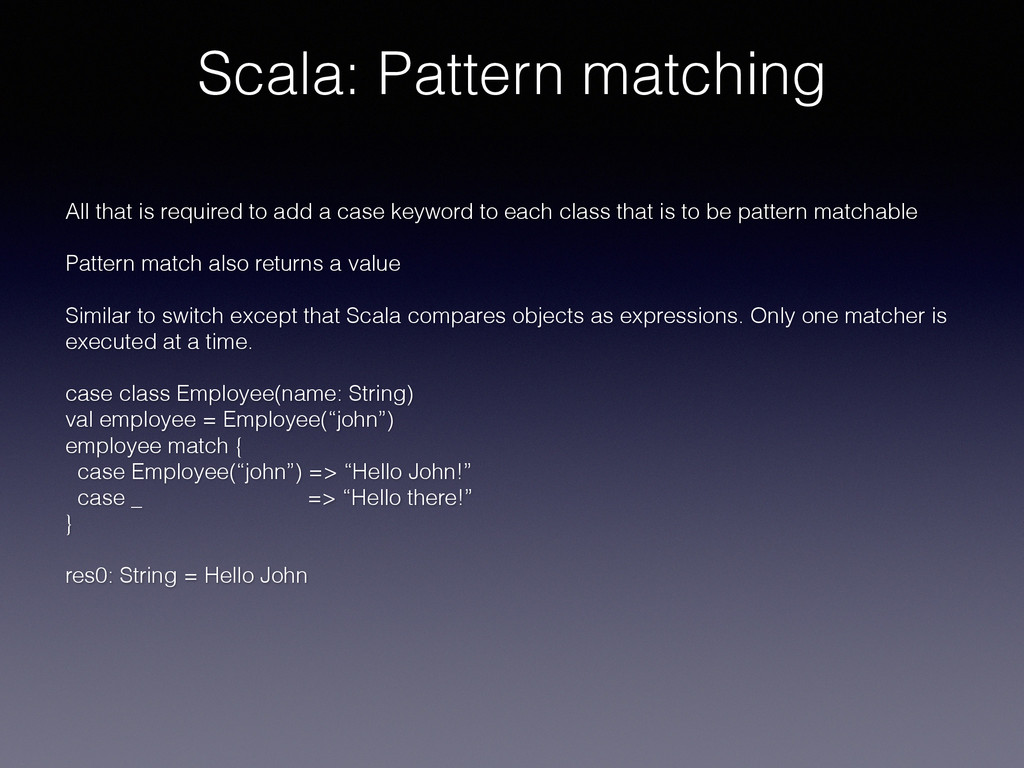
  13. Scala: Pattern matching All that is required to add a

    case keyword to each class that is to be pattern matchable ! Pattern match also returns a value ! Similar to switch except that Scala compares objects as expressions. Only one matcher is executed at a time. ! case class Employee(name: String) val employee = Employee(“john”) employee match { case Employee(“john”) => “Hello John!” case _ => “Hello there!” } ! res0: String = Hello John
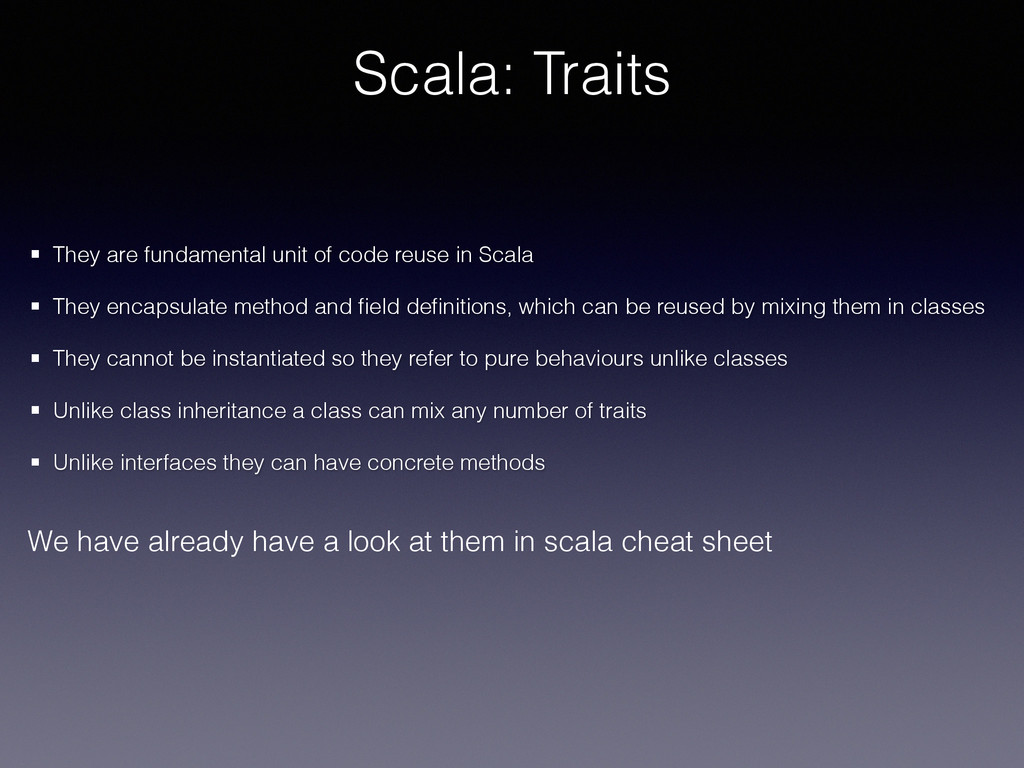
  14. Scala: Traits They are fundamental unit of code reuse in

    Scala ! They encapsulate method and field definitions, which can be reused by mixing them in classes ! They cannot be instantiated so they refer to pure behaviours unlike classes ! Unlike class inheritance a class can mix any number of traits ! Unlike interfaces they can have concrete methods We have already have a look at them in scala cheat sheet
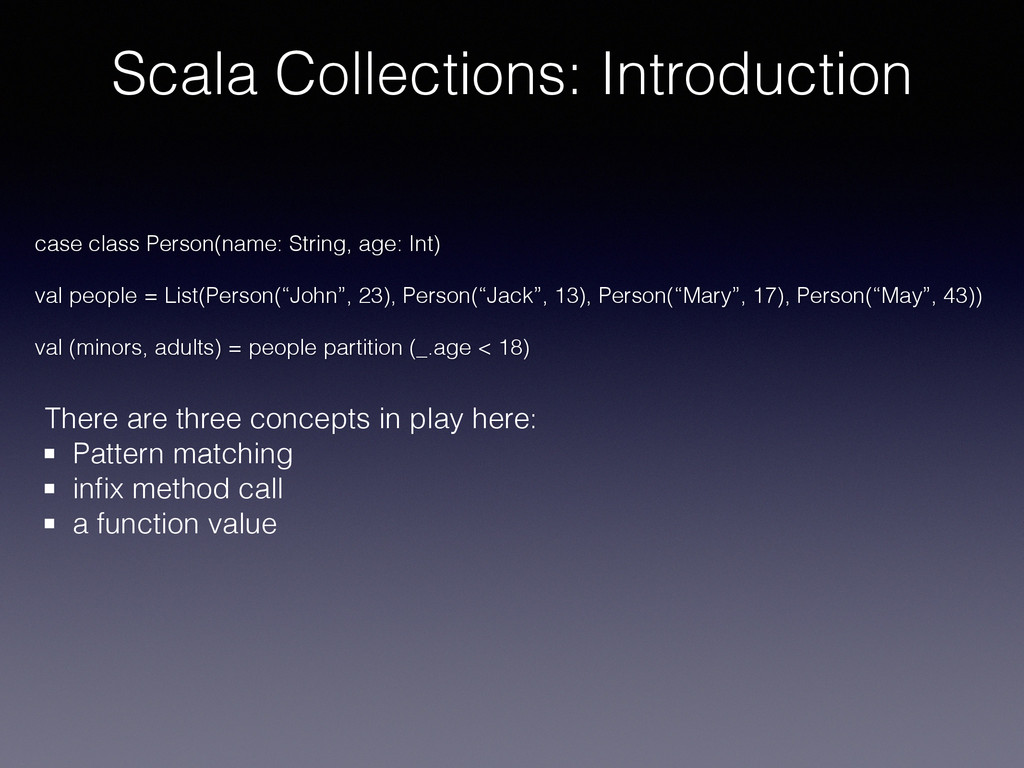
  15. Scala Collections: Introduction case class Person(name: String, age: Int) !

    val people = List(Person(“John”, 23), Person(“Jack”, 13), Person(“Mary”, 17), Person(“May”, 43)) ! val (minors, adults) = people partition (_.age < 18) There are three concepts in play here: Pattern matching infix method call a function value
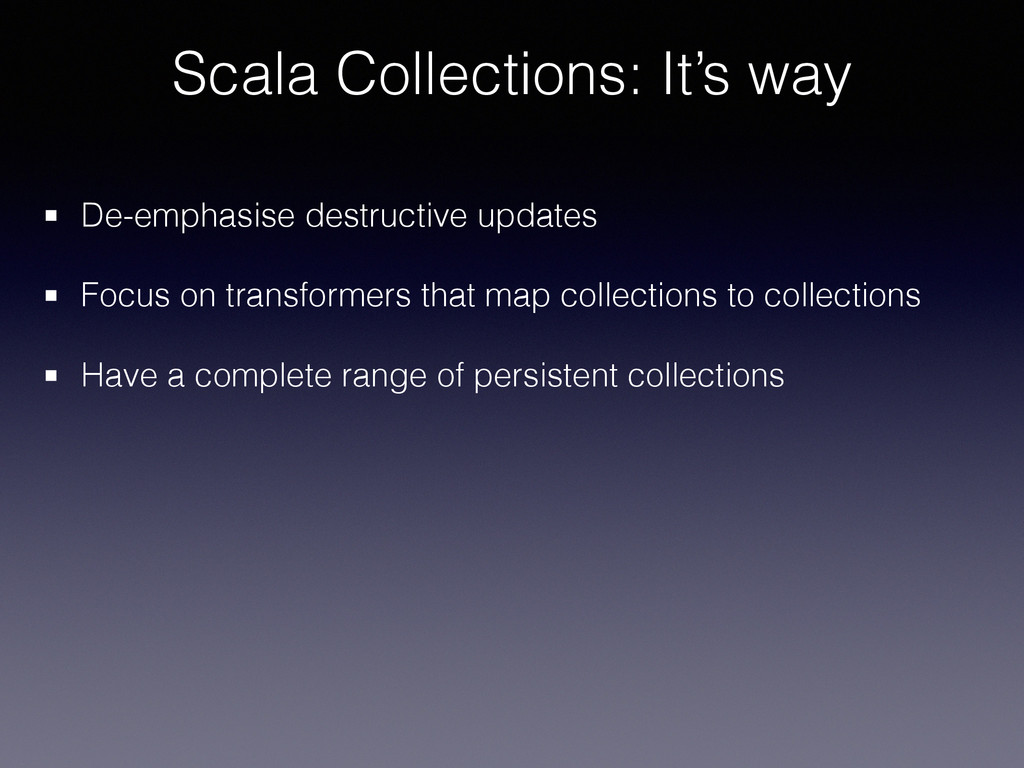
  16. Scala Collections: It’s way De-emphasise destructive updates Focus on transformers

    that map collections to collections Have a complete range of persistent collections
  17. Scala Collections: Properties Object-oriented ! Generic: List[T], Map[K, V] !

    Optionally persistent: scala.collections.immutable ! Higher order: methods like foreach, map, filter ! Uniform return type principle: operations return same type as their left operand
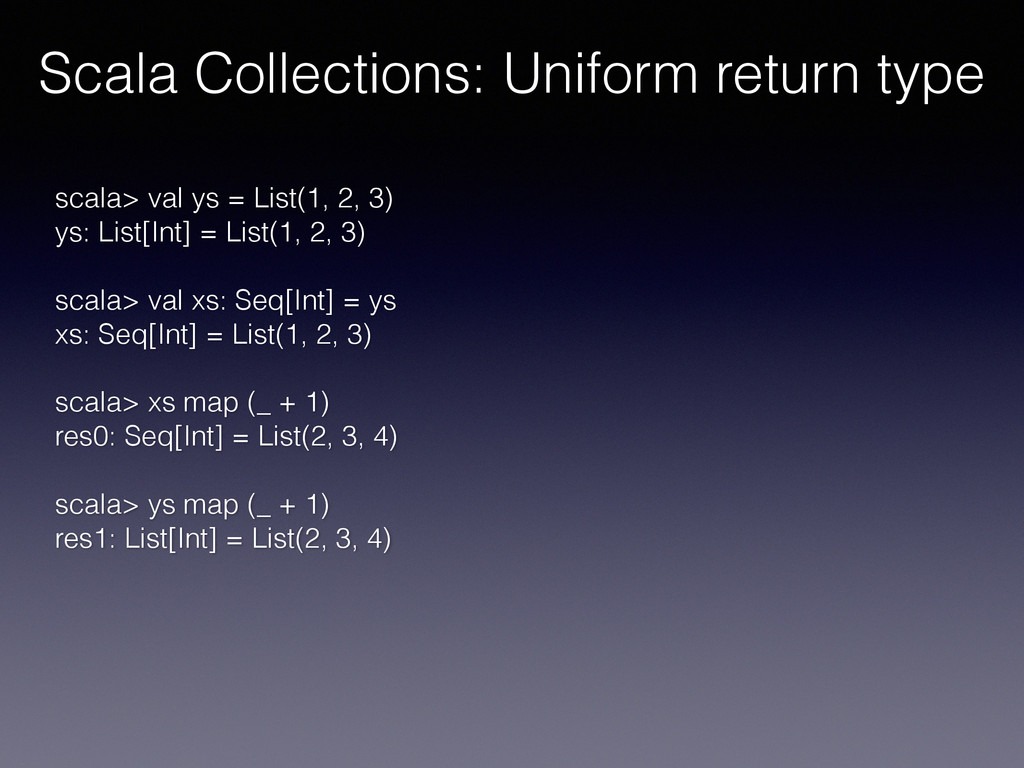
  18. Scala Collections: Uniform return type scala> val ys = List(1,

    2, 3) ys: List[Int] = List(1, 2, 3) ! scala> val xs: Seq[Int] = ys xs: Seq[Int] = List(1, 2, 3) ! scala> xs map (_ + 1) res0: Seq[Int] = List(2, 3, 4) ! scala> ys map (_ + 1) res1: List[Int] = List(2, 3, 4)
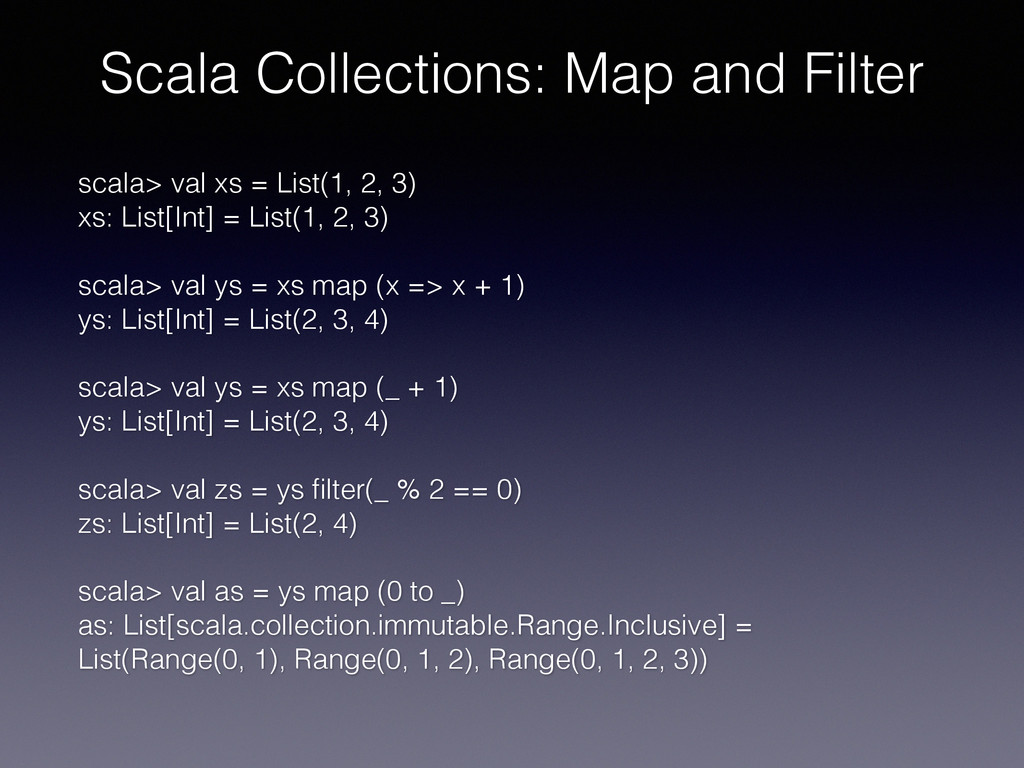
  19. Scala Collections: Map and Filter scala> val xs = List(1,

    2, 3) xs: List[Int] = List(1, 2, 3) ! scala> val ys = xs map (x => x + 1) ys: List[Int] = List(2, 3, 4) ! scala> val ys = xs map (_ + 1) ys: List[Int] = List(2, 3, 4) ! scala> val zs = ys filter(_ % 2 == 0) zs: List[Int] = List(2, 4) ! scala> val as = ys map (0 to _) as: List[scala.collection.immutable.Range.Inclusive] = List(Range(0, 1), Range(0, 1, 2), Range(0, 1, 2, 3))
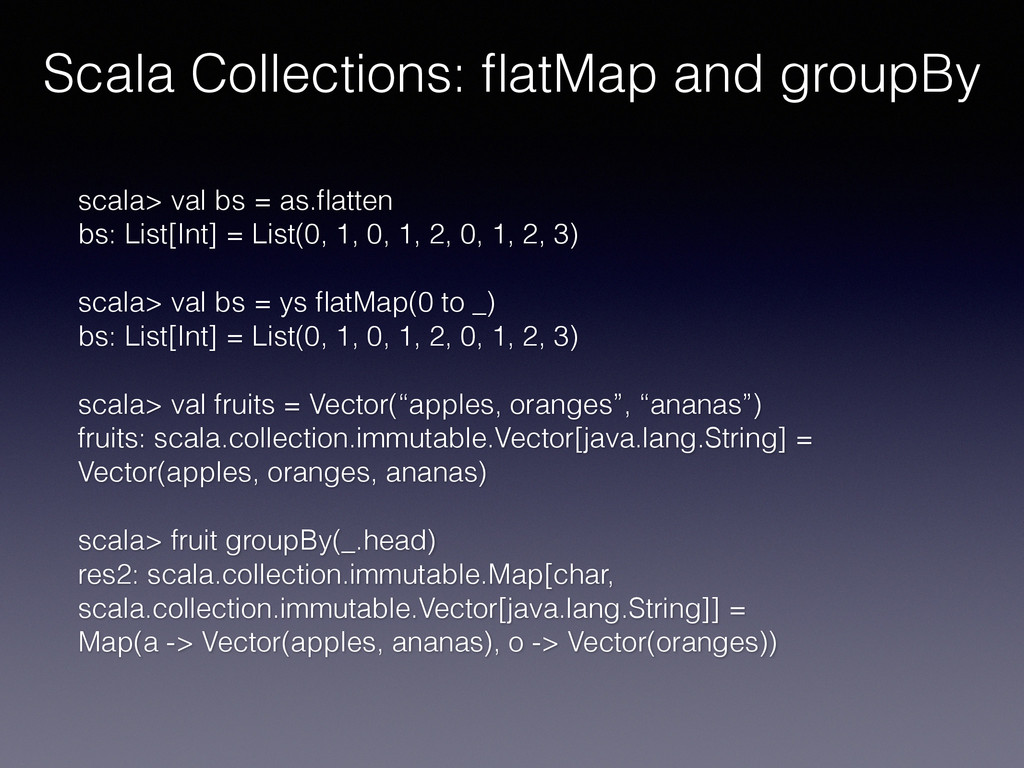
  20. Scala Collections: flatMap and groupBy scala> val bs = as.flatten

    bs: List[Int] = List(0, 1, 0, 1, 2, 0, 1, 2, 3) ! scala> val bs = ys flatMap(0 to _) bs: List[Int] = List(0, 1, 0, 1, 2, 0, 1, 2, 3) ! scala> val fruits = Vector(“apples, oranges”, “ananas”) fruits: scala.collection.immutable.Vector[java.lang.String] = Vector(apples, oranges, ananas) ! scala> fruit groupBy(_.head) res2: scala.collection.immutable.Map[char, scala.collection.immutable.Vector[java.lang.String]] = Map(a -> Vector(apples, ananas), o -> Vector(oranges))
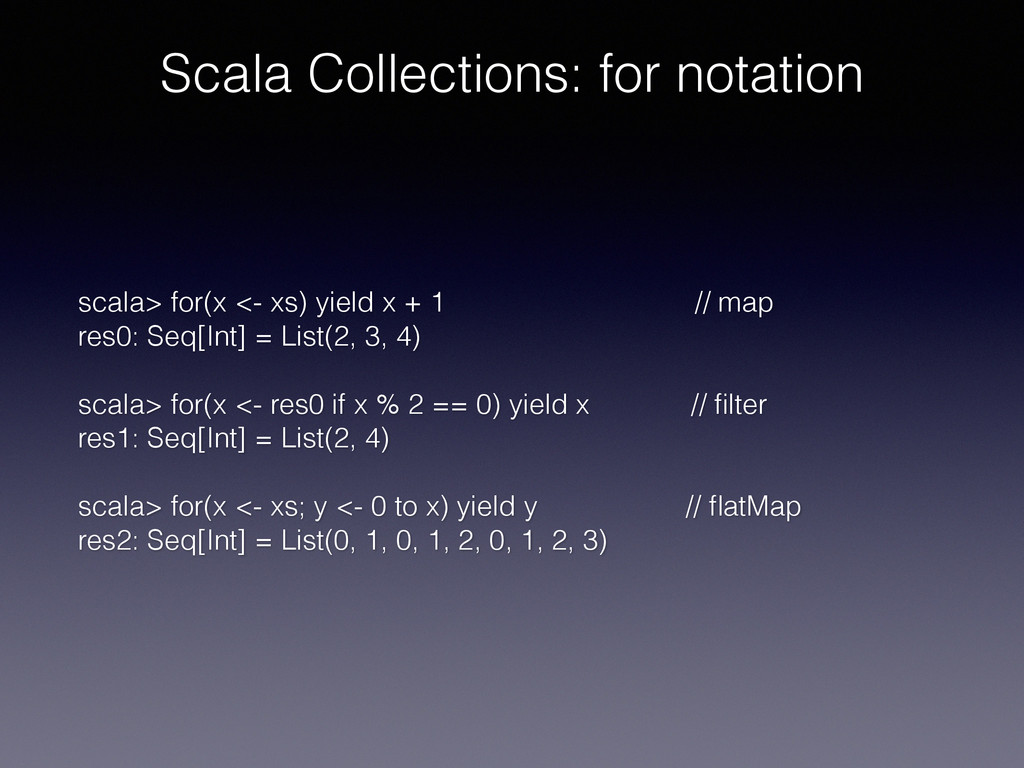
  21. Scala Collections: for notation scala> for(x <- xs) yield x

    + 1 // map res0: Seq[Int] = List(2, 3, 4) ! scala> for(x <- res0 if x % 2 == 0) yield x // filter res1: Seq[Int] = List(2, 4) ! scala> for(x <- xs; y <- 0 to x) yield y // flatMap res2: Seq[Int] = List(0, 1, 0, 1, 2, 0, 1, 2, 3)
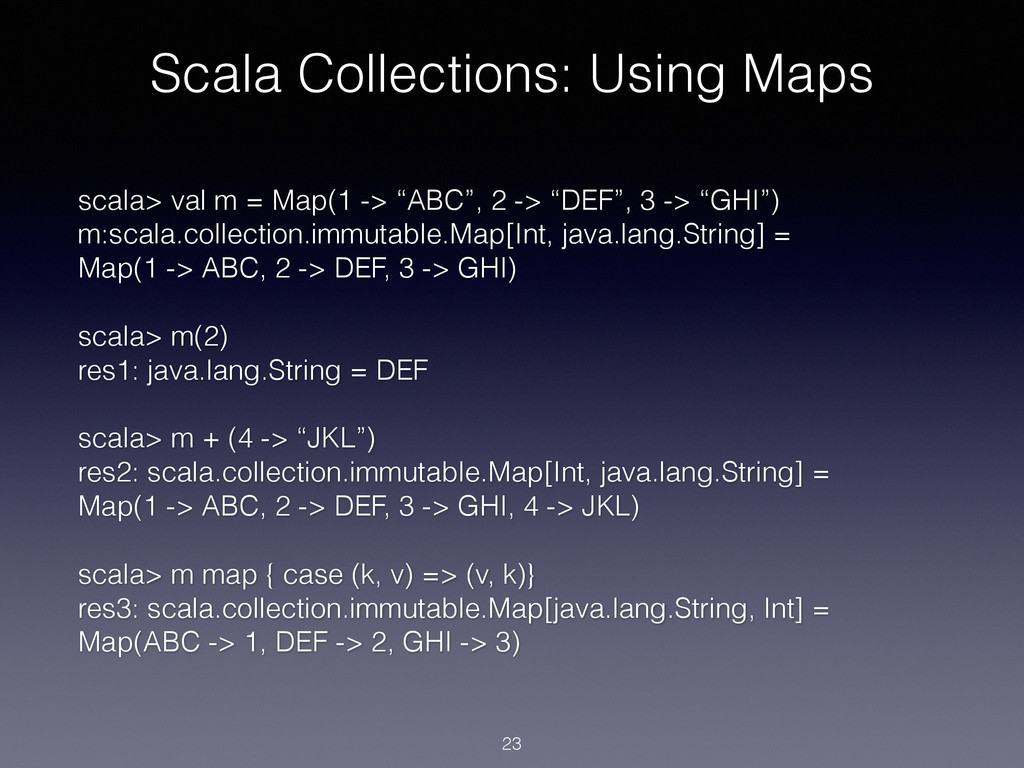
  22. Scala Collections: Using Maps scala> val m = Map(1 ->

    “ABC”, 2 -> “DEF”, 3 -> “GHI”) m:scala.collection.immutable.Map[Int, java.lang.String] = Map(1 -> ABC, 2 -> DEF, 3 -> GHI) ! scala> m(2) res1: java.lang.String = DEF ! scala> m + (4 -> “JKL”) res2: scala.collection.immutable.Map[Int, java.lang.String] = Map(1 -> ABC, 2 -> DEF, 3 -> GHI, 4 -> JKL) ! scala> m map { case (k, v) => (v, k)} res3: scala.collection.immutable.Map[java.lang.String, Int] = Map(ABC -> 1, DEF -> 2, GHI -> 3) 23
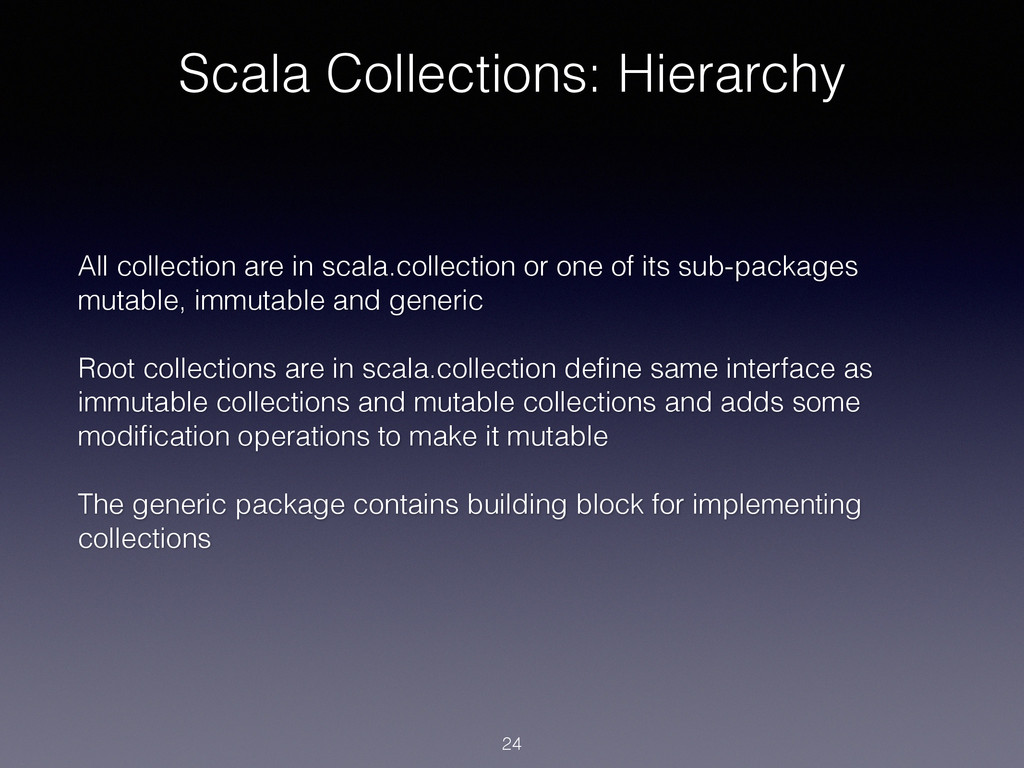
  23. Scala Collections: Hierarchy All collection are in scala.collection or one

    of its sub-packages mutable, immutable and generic ! Root collections are in scala.collection define same interface as immutable collections and mutable collections and adds some modification operations to make it mutable ! The generic package contains building block for implementing collections 24
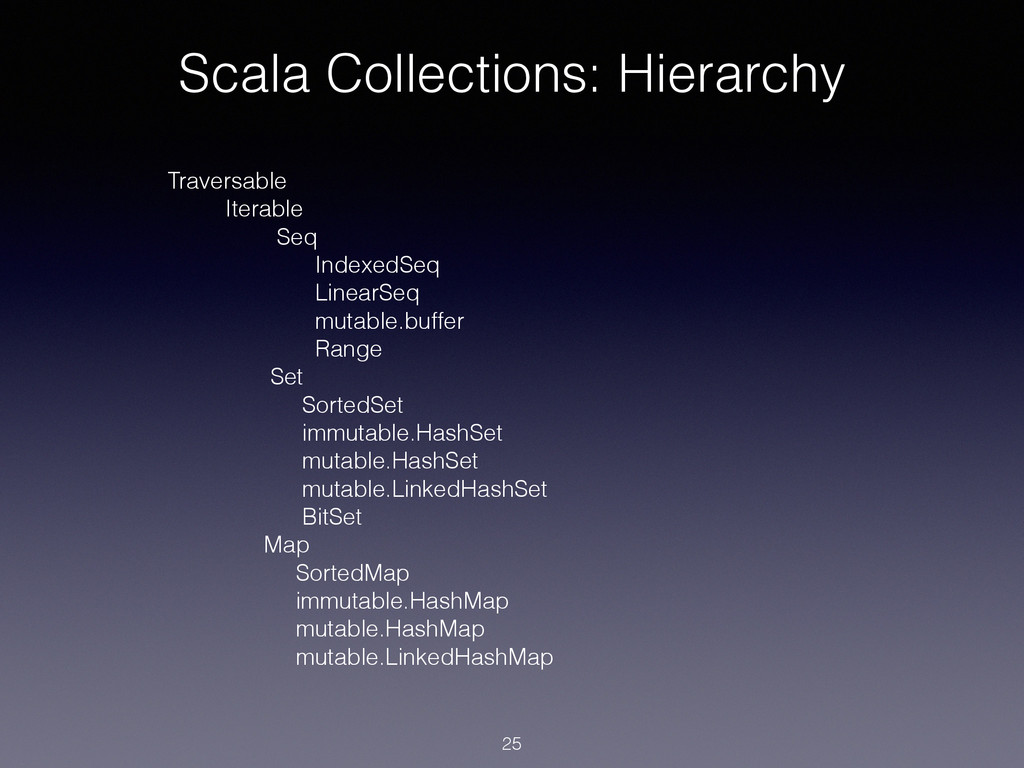
  24. Scala Collections: Hierarchy 25 Traversable Iterable Seq IndexedSeq LinearSeq mutable.buffer

    Range Set SortedSet immutable.HashSet mutable.HashSet mutable.LinkedHashSet BitSet Map SortedMap immutable.HashMap mutable.HashMap mutable.LinkedHashMap
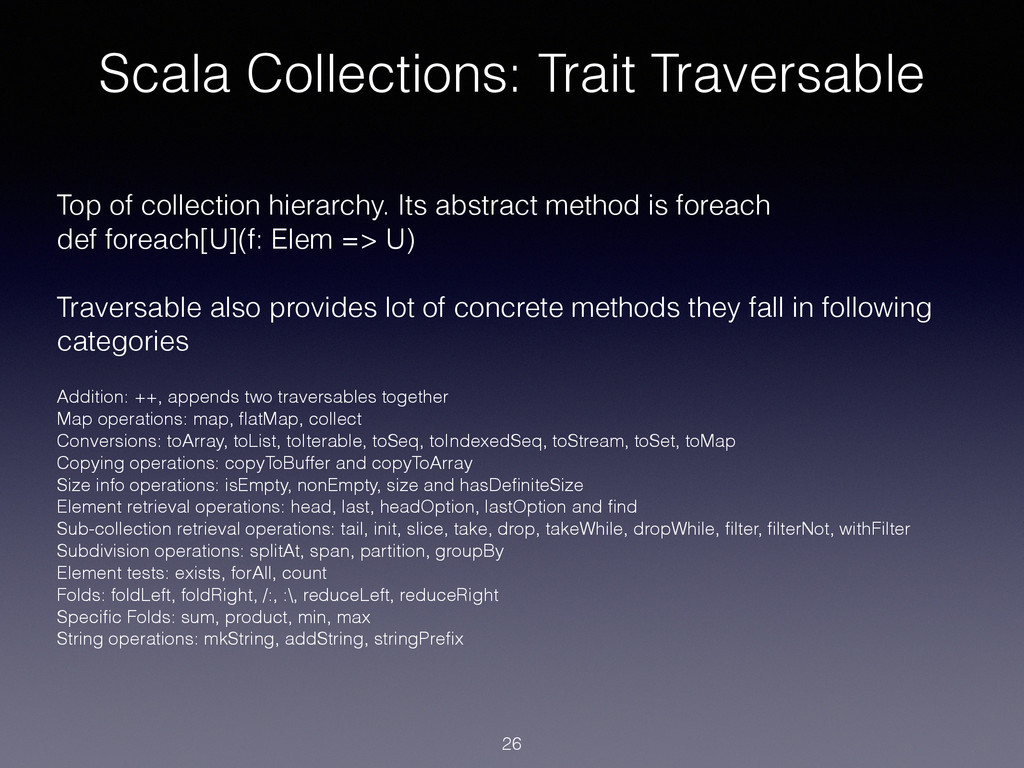
  25. Scala Collections: Trait Traversable 26 Top of collection hierarchy. Its

    abstract method is foreach def foreach[U](f: Elem => U) ! Traversable also provides lot of concrete methods they fall in following categories ! Addition: ++, appends two traversables together Map operations: map, flatMap, collect Conversions: toArray, toList, toIterable, toSeq, toIndexedSeq, toStream, toSet, toMap Copying operations: copyToBuffer and copyToArray Size info operations: isEmpty, nonEmpty, size and hasDefiniteSize Element retrieval operations: head, last, headOption, lastOption and find Sub-collection retrieval operations: tail, init, slice, take, drop, takeWhile, dropWhile, filter, filterNot, withFilter Subdivision operations: splitAt, span, partition, groupBy Element tests: exists, forAll, count Folds: foldLeft, foldRight, /:, :\, reduceLeft, reduceRight Specific Folds: sum, product, min, max String operations: mkString, addString, stringPrefix
  26. Scala Collections: Everything is a library 27 Collections feel that

    they are like language constructs ! Language does not contain any collection related constructs - no collection types - no collection literals - no collection operators ! Everything is a library ! They are extensible
  27. Scala Test: Introduction 28 ScalaTest is an open source framework

    for java platform ! With ScalaTest we can test either Scala or Java code ! Integrates with popular tools like jUnit, TestNG, Ant, Maven and SBT ! Designed to do different styles of testing like Behaviour Driven Design for example
  28. Scala Test: Concepts 29 Three concepts: ! Suite: A collection

    of tests. A test is anything which has a name and can succeed or fail ! Runner: ScalaTest provides a runner application and can run a suite of tests ! Reporter: As the tests are run, events are fired to the reporter, it takes care of presenting results back to user
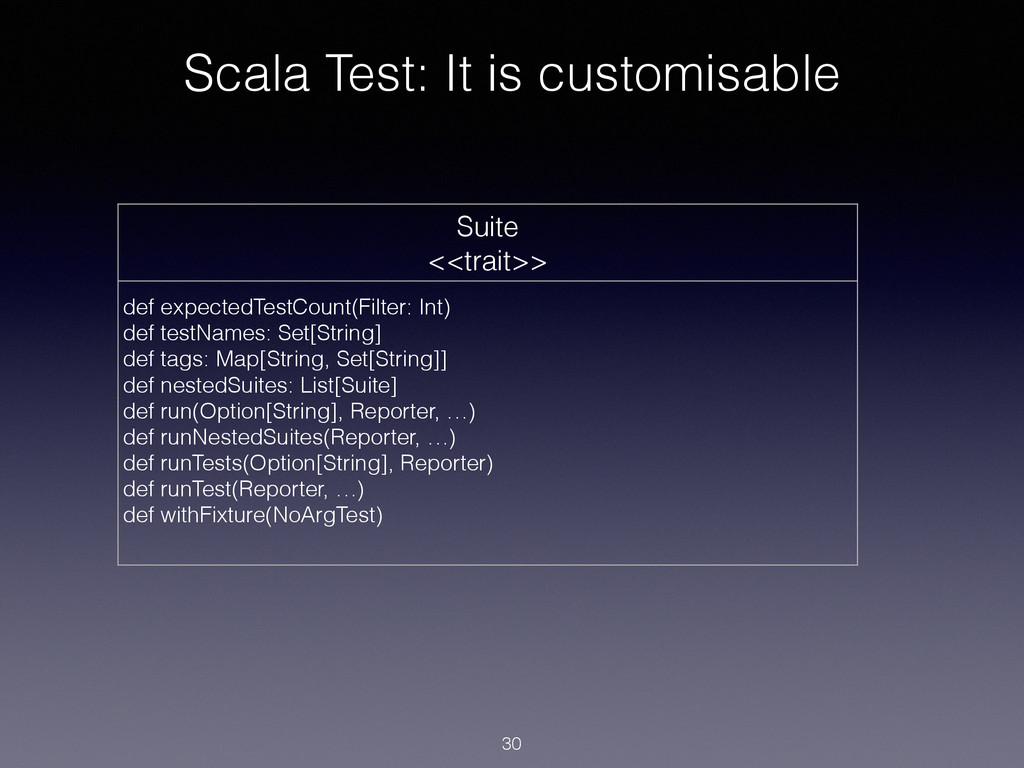
  29. Scala Test: It is customisable 30 Suite <<trait>> def expectedTestCount(Filter:

    Int) def testNames: Set[String] def tags: Map[String, Set[String]] def nestedSuites: List[Suite] def run(Option[String], Reporter, …) def runNestedSuites(Reporter, …) def runTests(Option[String], Reporter) def runTest(Reporter, …) def withFixture(NoArgTest)
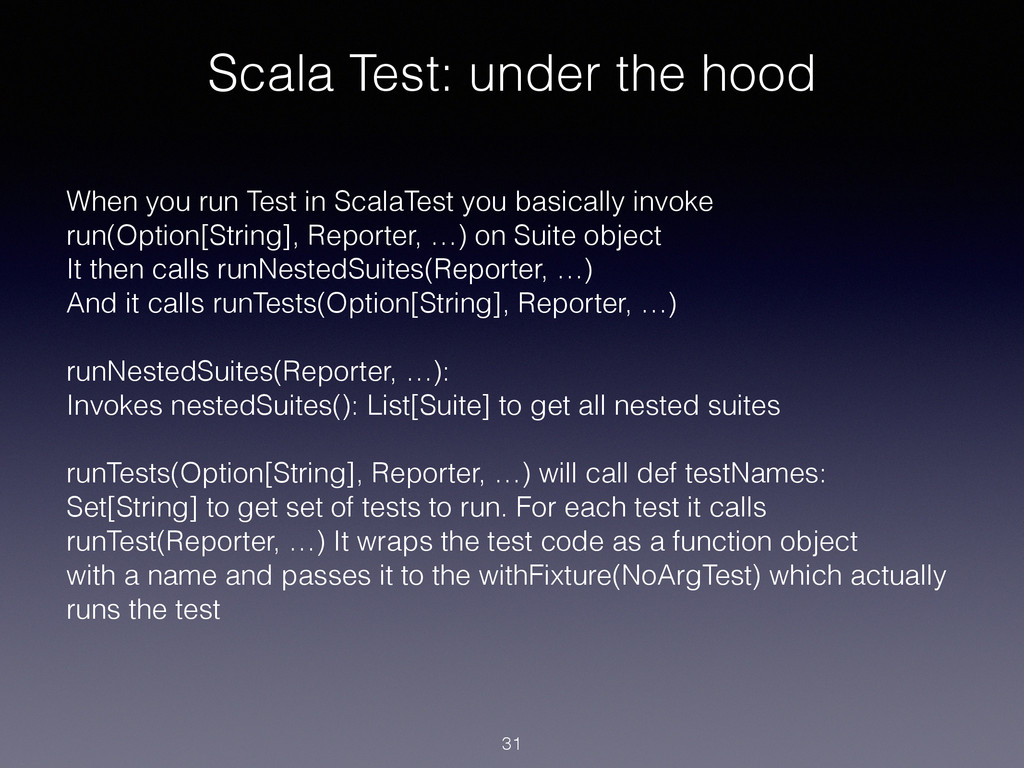
  30. Scala Test: under the hood 31 When you run Test

    in ScalaTest you basically invoke run(Option[String], Reporter, …) on Suite object It then calls runNestedSuites(Reporter, …) And it calls runTests(Option[String], Reporter, …) ! runNestedSuites(Reporter, …): Invokes nestedSuites(): List[Suite] to get all nested suites ! runTests(Option[String], Reporter, …) will call def testNames: Set[String] to get set of tests to run. For each test it calls runTest(Reporter, …) It wraps the test code as a function object with a name and passes it to the withFixture(NoArgTest) which actually runs the test
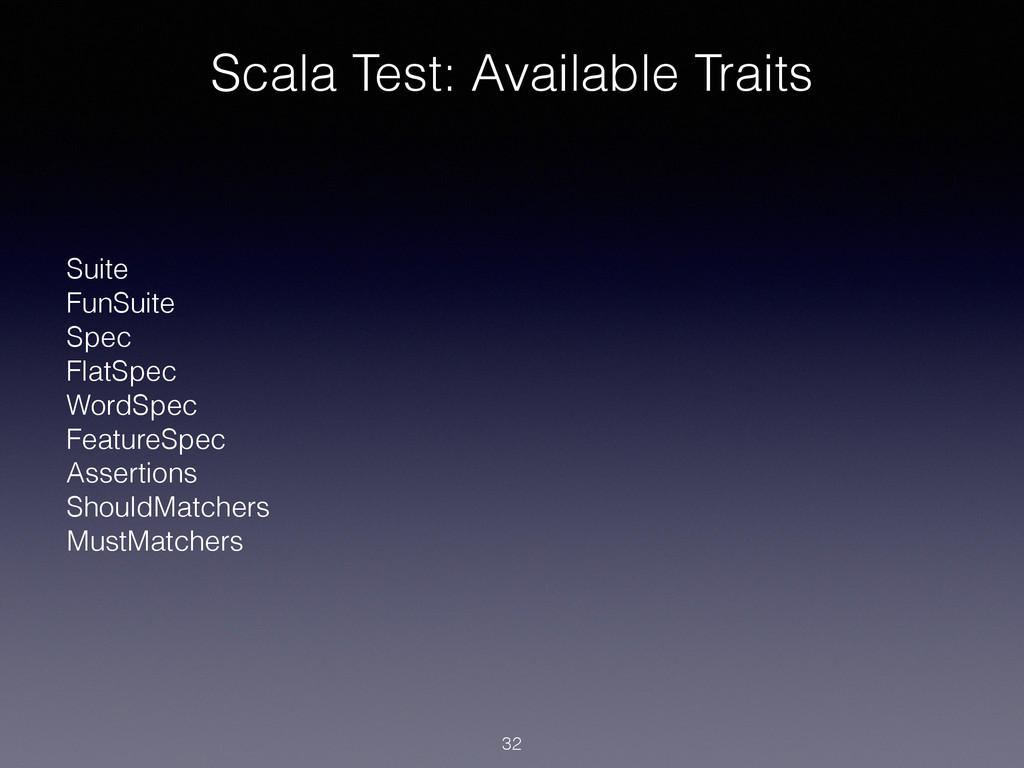
  31. Scala Test: Available Traits 32 Suite FunSuite Spec FlatSpec WordSpec

    FeatureSpec Assertions ShouldMatchers MustMatchers
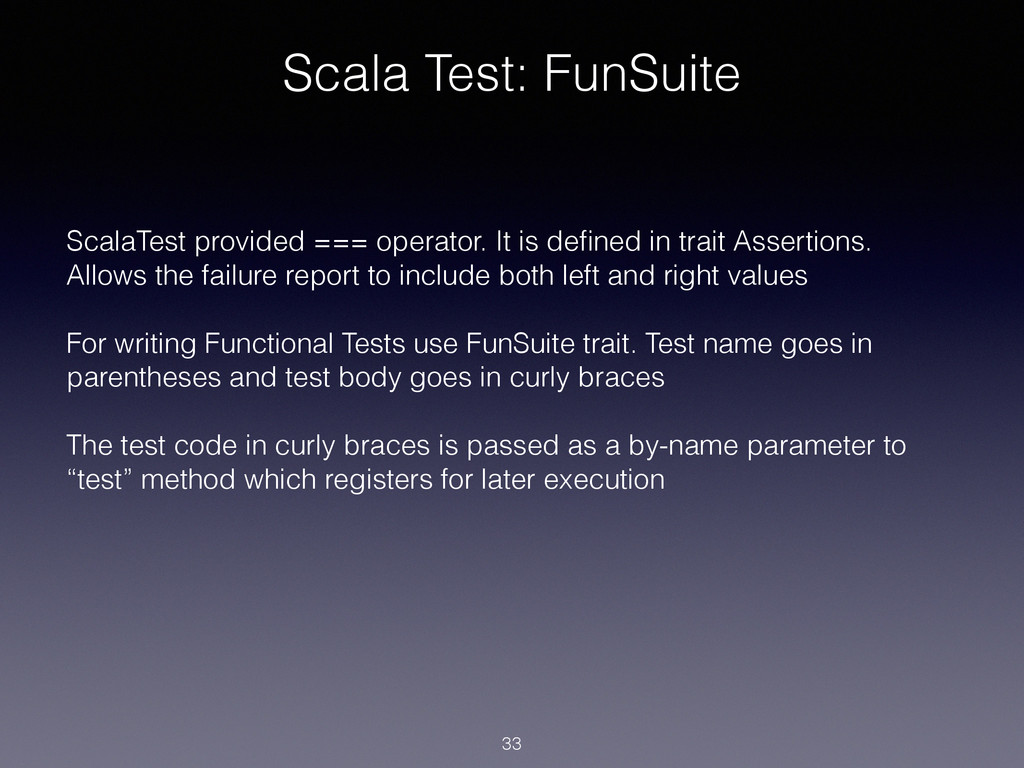
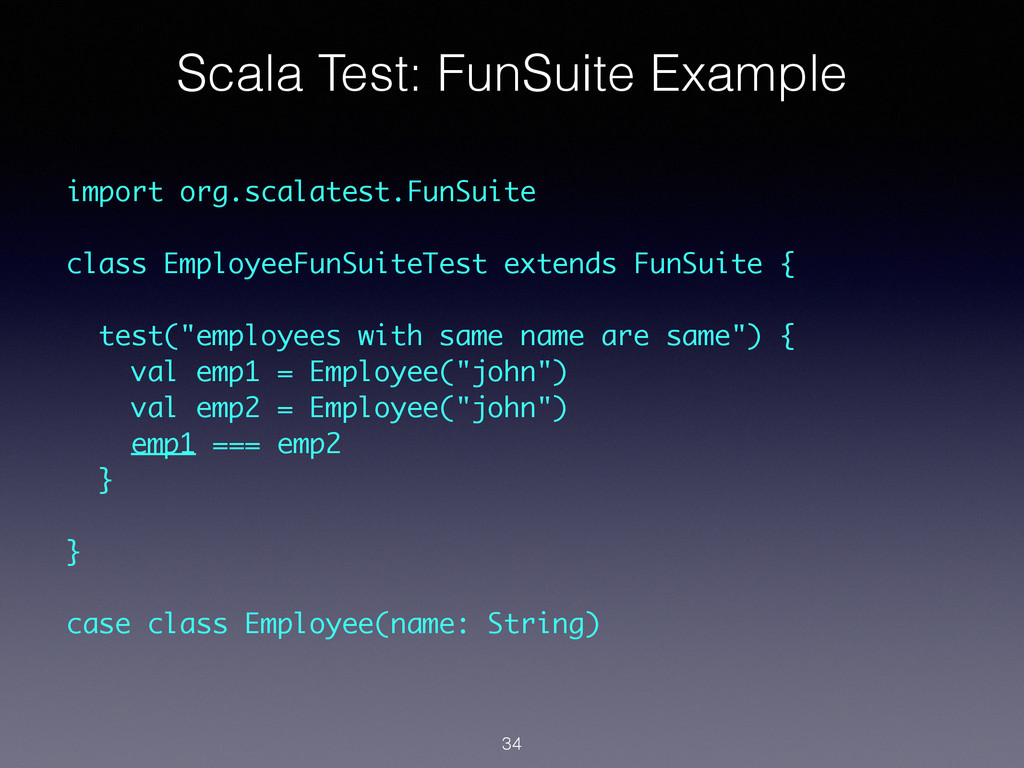
  32. Scala Test: FunSuite 33 ScalaTest provided === operator. It is

    defined in trait Assertions. Allows the failure report to include both left and right values ! For writing Functional Tests use FunSuite trait. Test name goes in parentheses and test body goes in curly braces ! The test code in curly braces is passed as a by-name parameter to “test” method which registers for later execution
  33. Scala Test: FunSuite Example 34 import org.scalatest.FunSuite ! class EmployeeFunSuiteTest

    extends FunSuite { ! test("employees with same name are same") { val emp1 = Employee("john") val emp2 = Employee("john") emp1 === emp2 } ! } ! case class Employee(name: String)
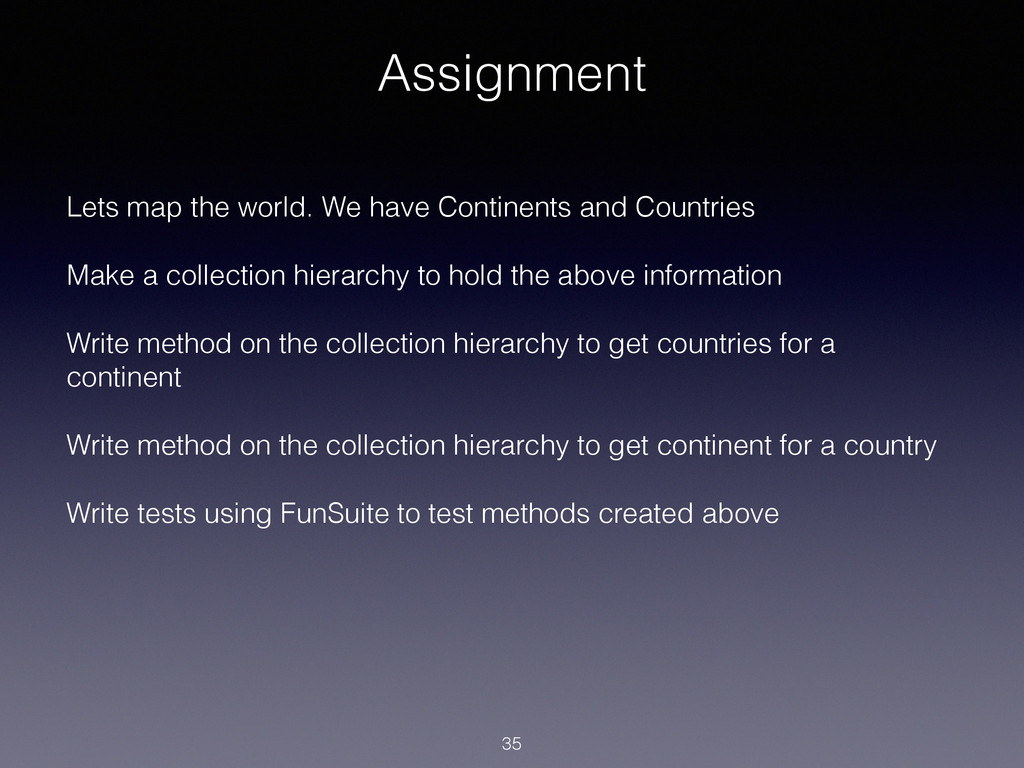
  34. Assignment 35 Lets map the world. We have Continents and

    Countries ! Make a collection hierarchy to hold the above information ! Write method on the collection hierarchy to get countries for a continent ! Write method on the collection hierarchy to get continent for a country ! Write tests using FunSuite to test methods created above