Share
Embed
Transcript
99 slides
-
RubyGems.org Sustained Open Source Baltic Ruby June 2025 Marty Haught
Director of Open Source Ruby Central -
RubyGems.org We’ve come a long way ▪ Ruby is over
30 years old ▪ RubyGems is over 20 years old ▪ Ruby on Rails is over 20 years old -
RubyGems.org What’s changed ▪ The ecosystem has matured ▪ Scale
is at another level ▪ Massive growth in packages and dependencies ▪ Rise of modern supply chain attacks -
RubyGems.org Reliability ▪ What’s the right level of reliability for
RubyGems.org? ▪ Should we strive to be enterprise grade? ▪ Should we settle for a cost-efficient best effort? -
RubyGems.org Security ▪ Are we ready for the growing threats
to supply chain security? ▪ How will increased compliance requirements impact us? -
RubyGems.org Sustainability ▪ How do we keep maintainers and projects
healthy? ▪ How do we prepare our future oss contributors? ▪ What are realistic funding models to pursue? -
RubyGems.org Marty Haught Director of Open Source @mghaught.bsky.social Ruby Central
• Rubyist since 2005 • Conference organizer, 15+ years • Engineering Director, Fastly, Hashicorp alum -
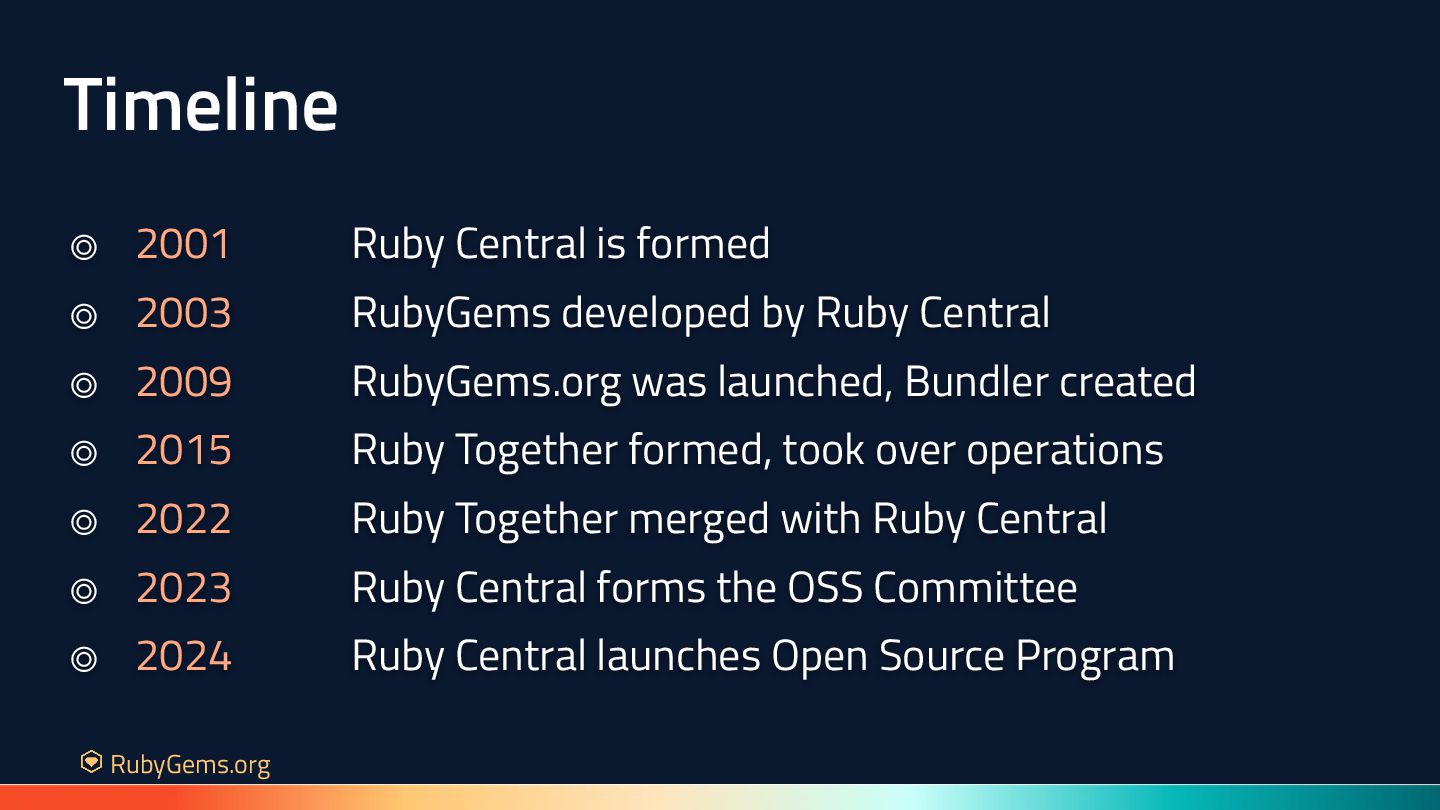
RubyGems.org Timeline ◎ 2001 Ruby Central is formed ◎ 2003
RubyGems developed by Ruby Central ◎ 2009 RubyGems.org was launched, Bundler created ◎ 2015 Ruby Together formed, took over operations ◎ 2022 Ruby Together merged with Ruby Central ◎ 2023 Ruby Central forms the OSS Committee ◎ 2024 Ruby Central launches Open Source Program -
RubyGems.org Open Source Program Maintaining and improving critical infrastructure and
tools for the Ruby ecosystem. Read more on RubyCentral.org -
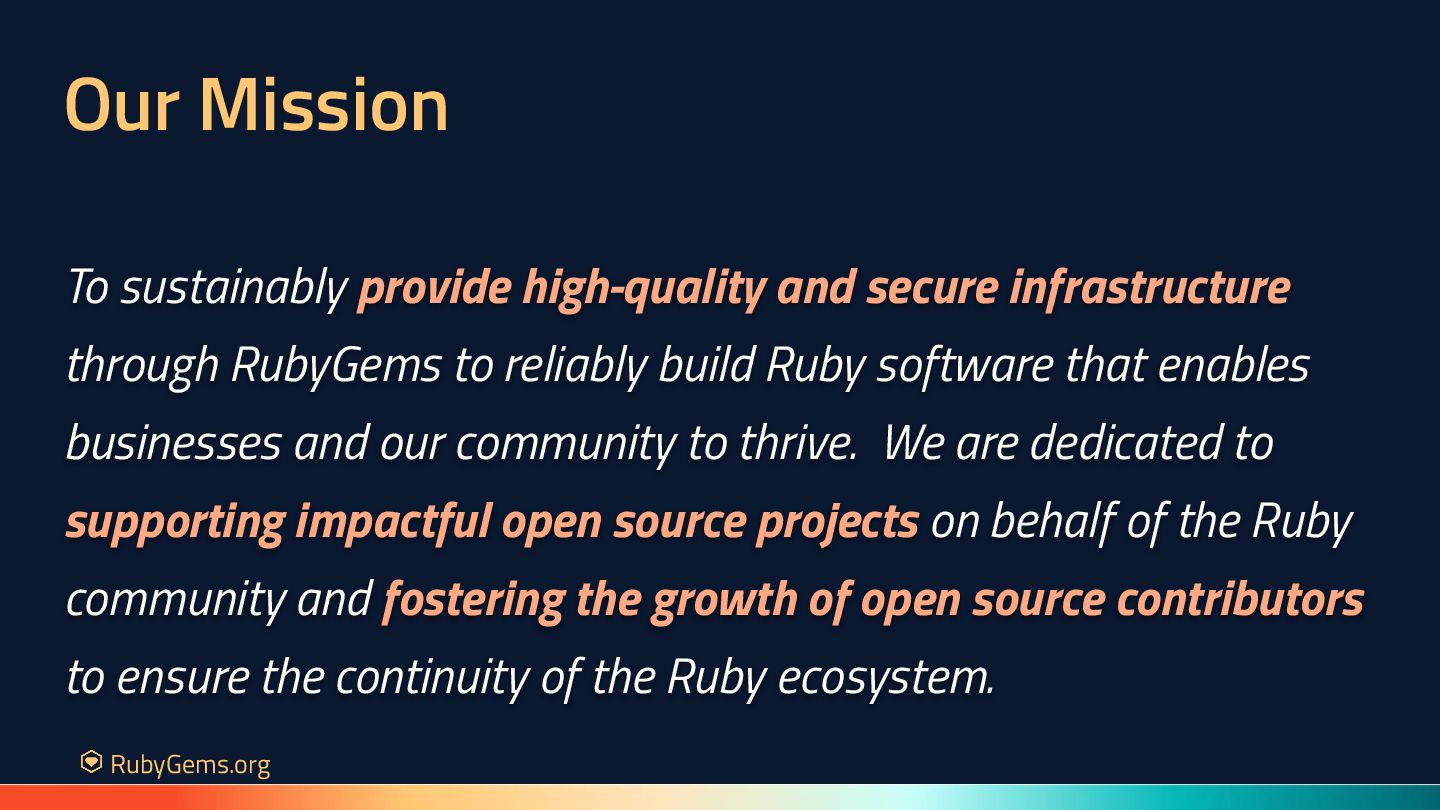
RubyGems.org Our Mission To sustainably provide high-quality and secure infrastructure
through RubyGems to reliably build Ruby software that enables businesses and our community to thrive. We are dedicated to supporting impactful open source projects on behalf of the Ruby community and fostering the growth of open source contributors to ensure the continuity of the Ruby ecosystem. -
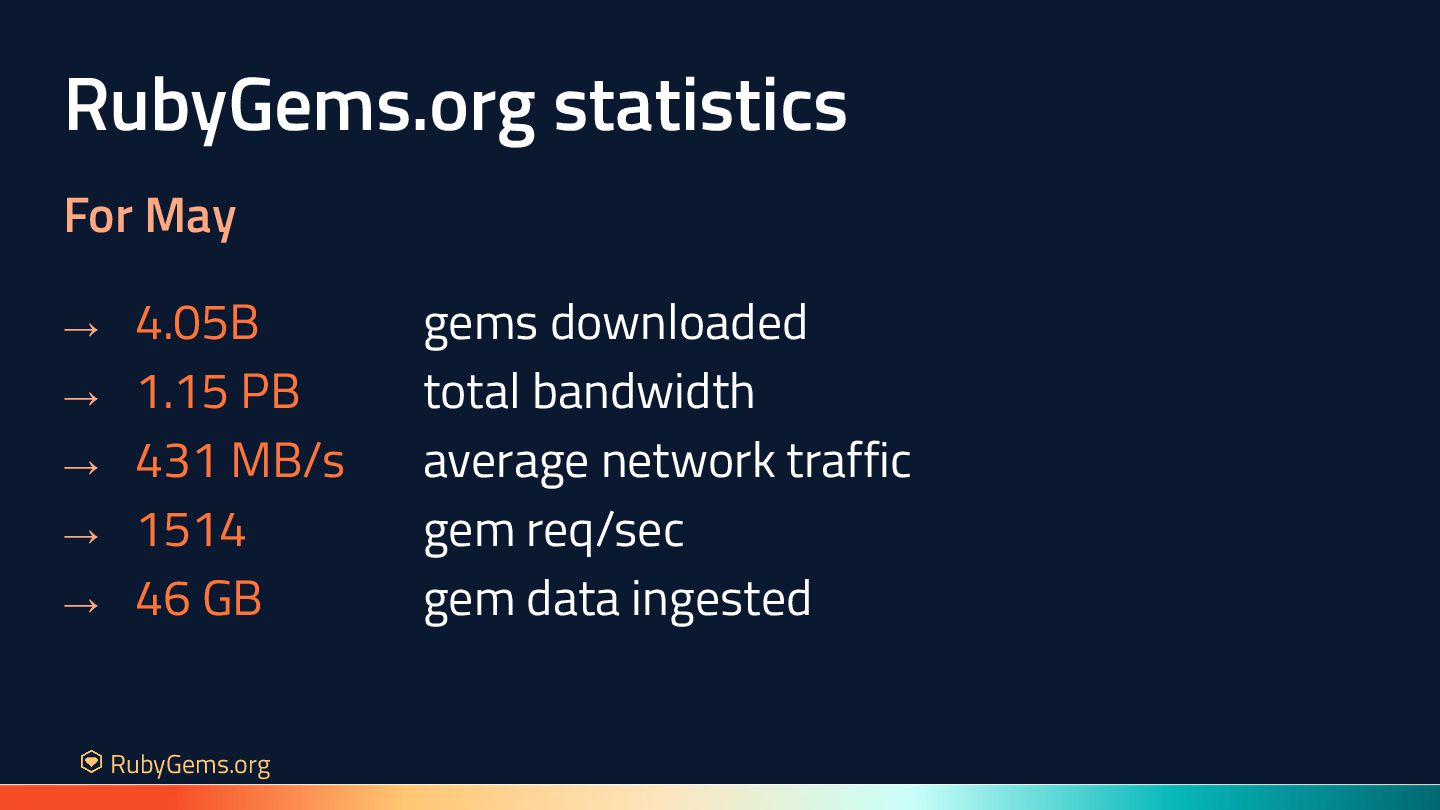
RubyGems.org RubyGems.org statistics → 4.05B gems downloaded → 1.15 PB
total bandwidth → 431 MB/s average network traffic → 1514 gem req/sec → 46 GB gem data ingested For May -
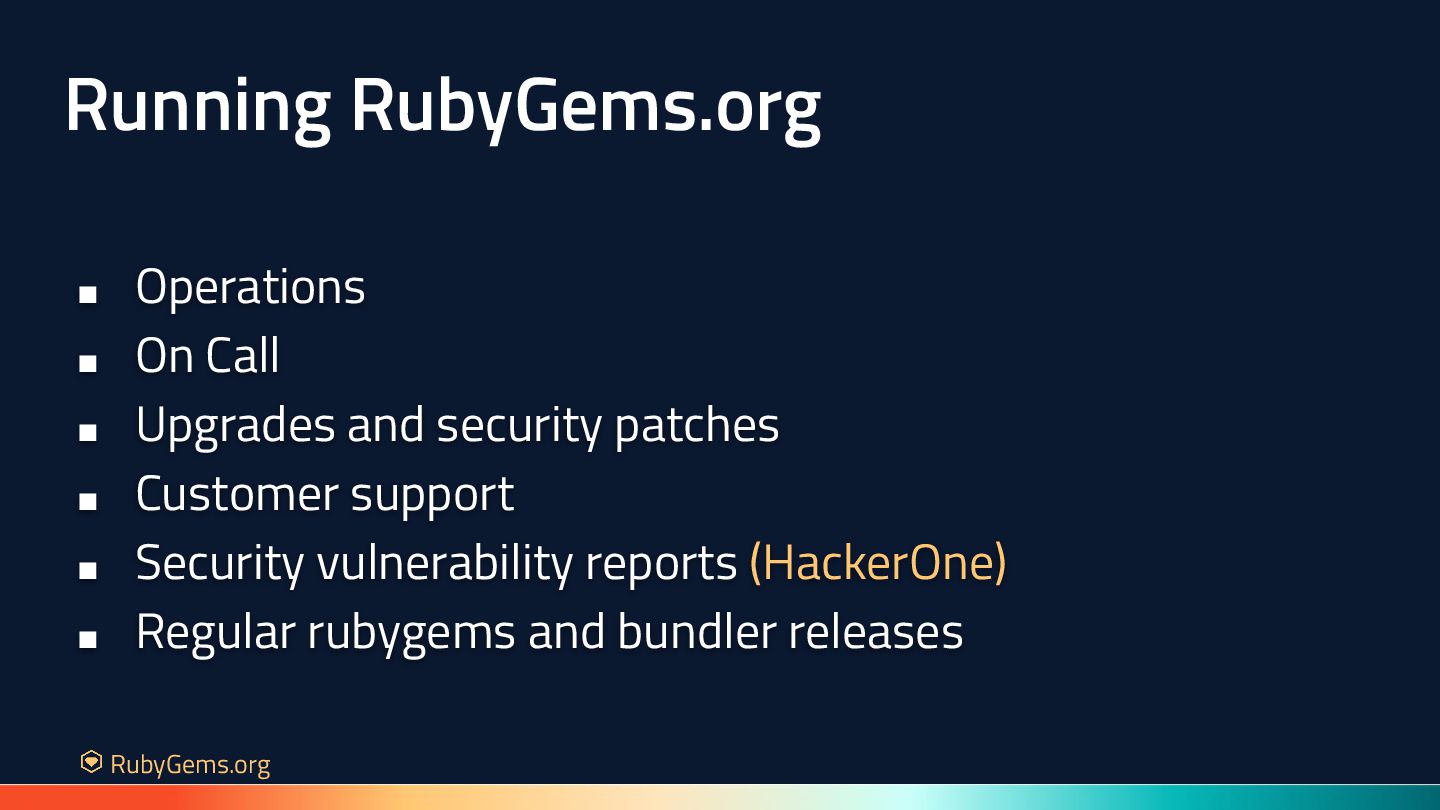
RubyGems.org Running RubyGems.org ▪ Operations ▪ On Call ▪ Upgrades
and security patches ▪ Customer support ▪ Security vulnerability reports (HackerOne) ▪ Regular rubygems and bundler releases -
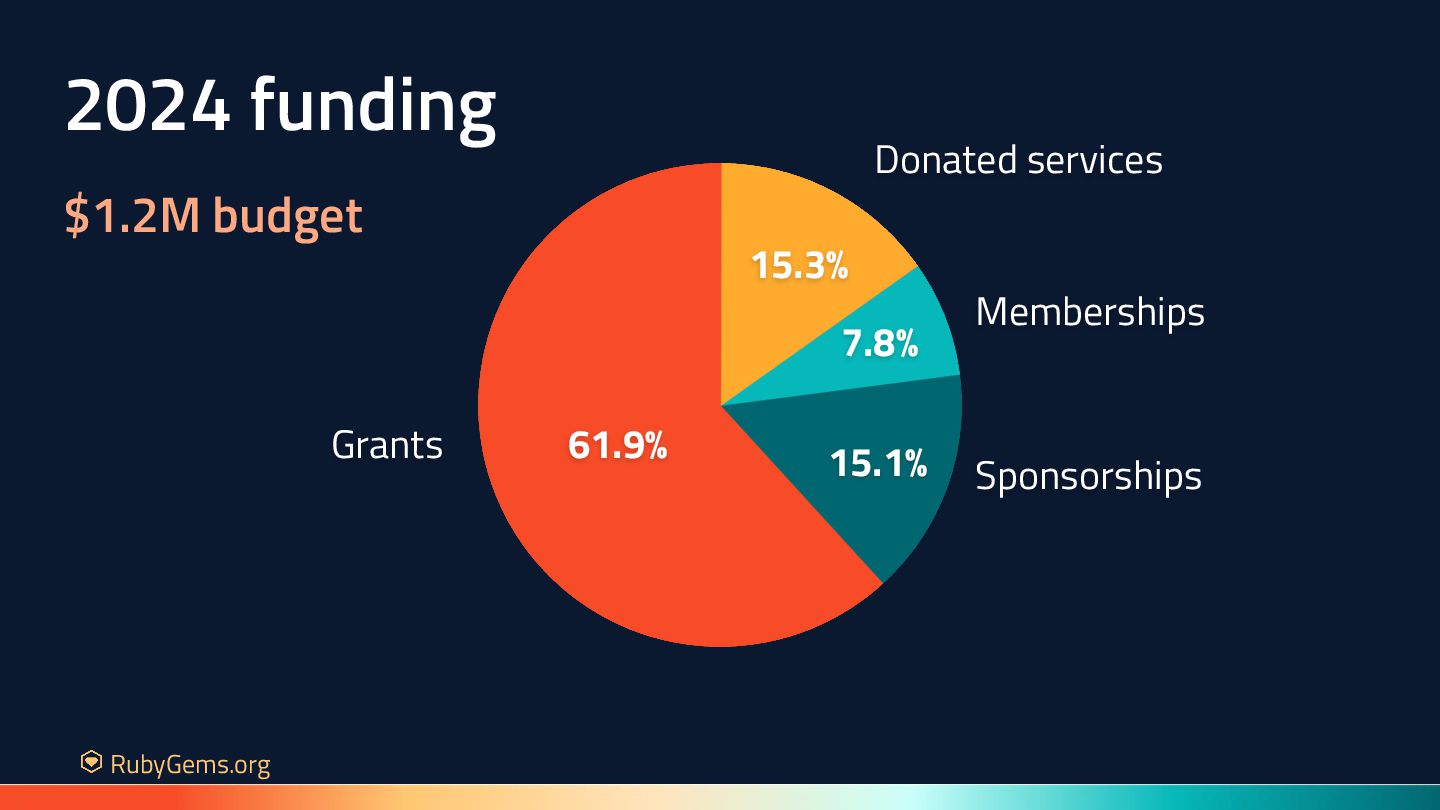
RubyGems.org 2024 funding 15.3% 7.8% 15.1% 61.9% Grants Donated services
Memberships Sponsorships $1.2M budget -
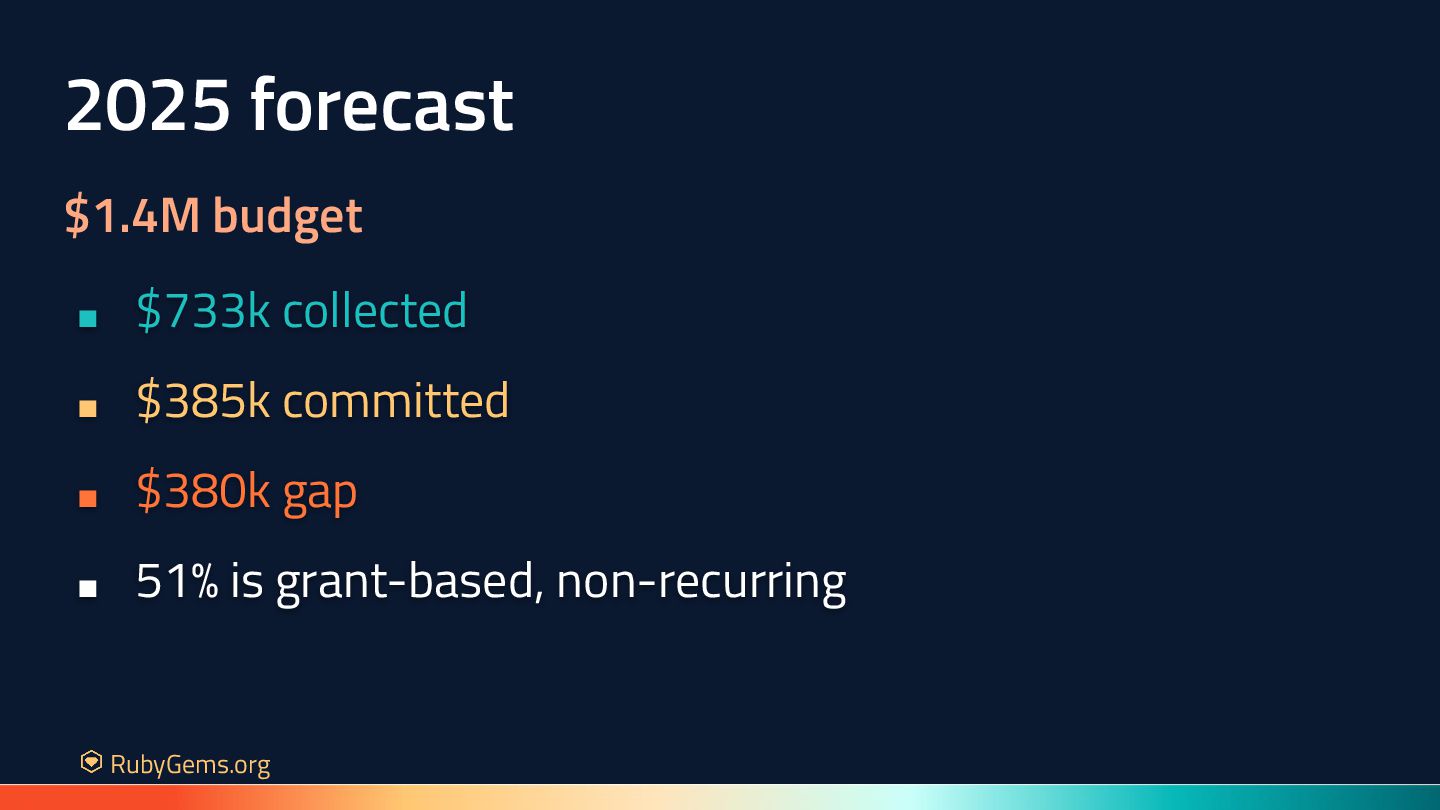
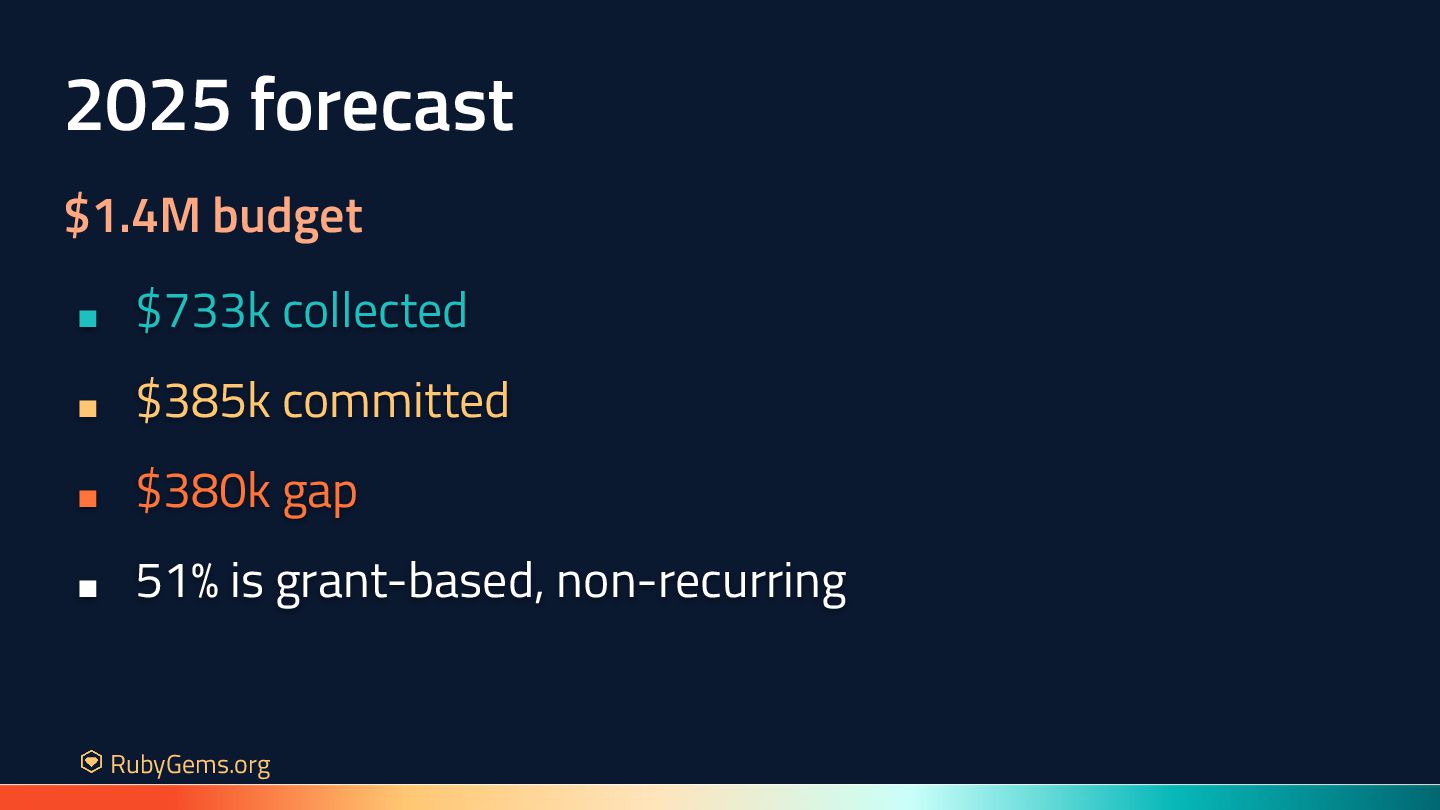
RubyGems.org 2025 forecast $1.4M budget ▪ $733k collected ▪ $385k
committed ▪ $380k gap ▪ 51% is grant-based, non-recurring -
RubyGems.org For 4 hours ▪ You might not notice ▪
You’d check status, ETA ▪ Wait for it to come back up What would you do? -
RubyGems.org For 4 days ▪ Curse that you didn’t vendor
your gems ▪ Find a workaround What would you do? -
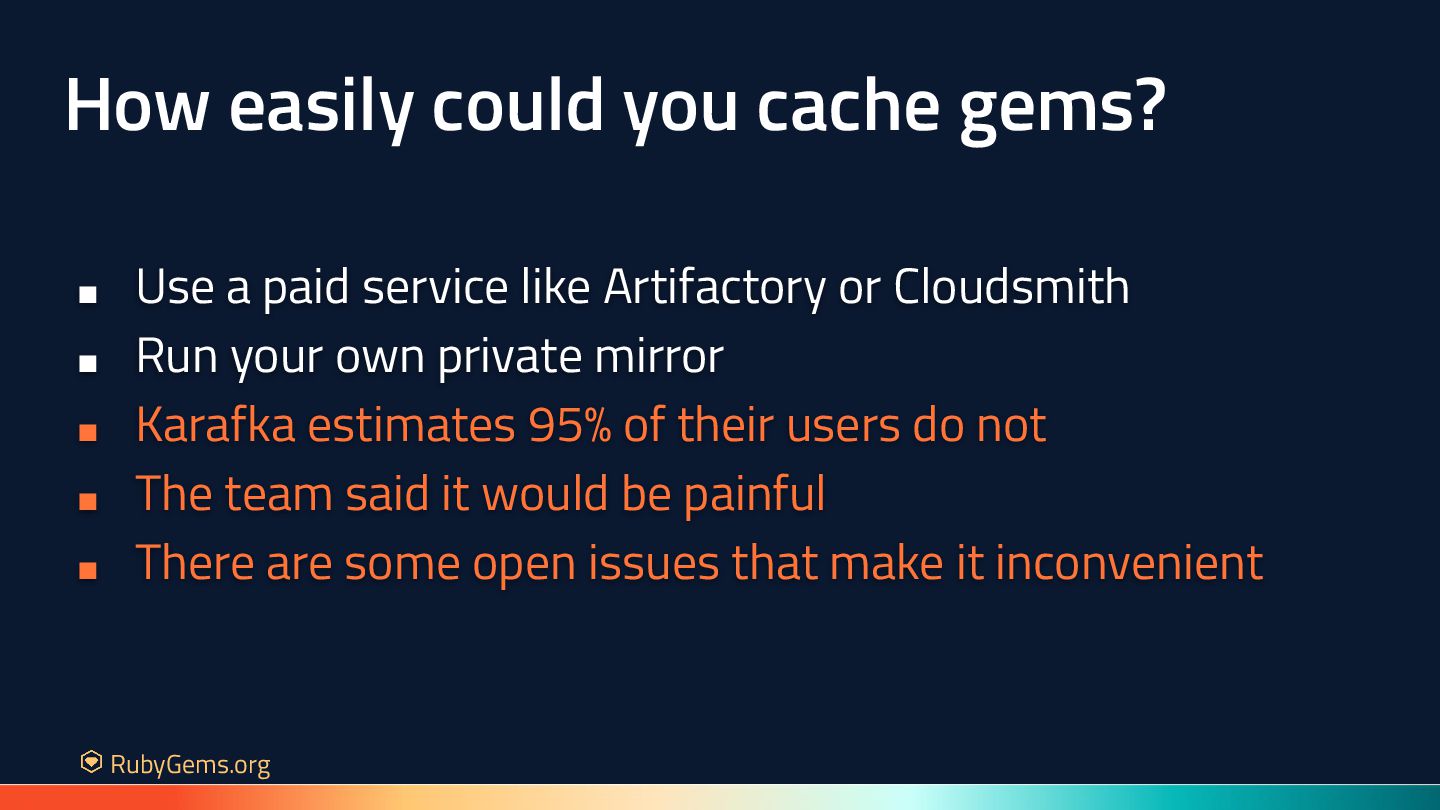
RubyGems.org How easily could you cache gems? ▪ Use a
paid service like Artifactory or Cloudsmith ▪ Run your own private mirror ▪ Karafka estimates 95% of their users do not ▪ The team said it would be painful ▪ There are some open issues that make it inconvenient -
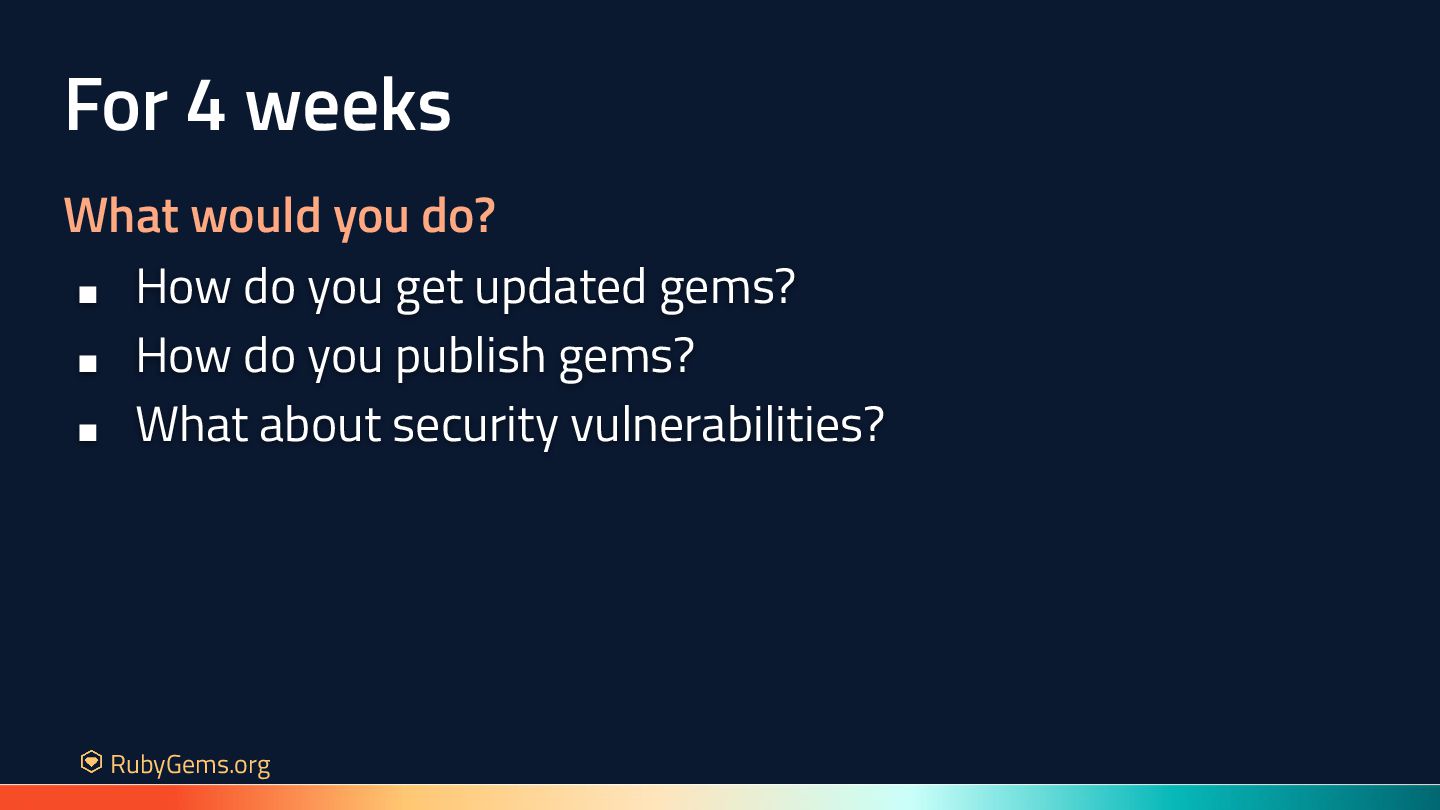
RubyGems.org For 4 weeks ▪ How do you get updated
gems? ▪ How do you publish gems? ▪ What about security vulnerabilities? What would you do? -
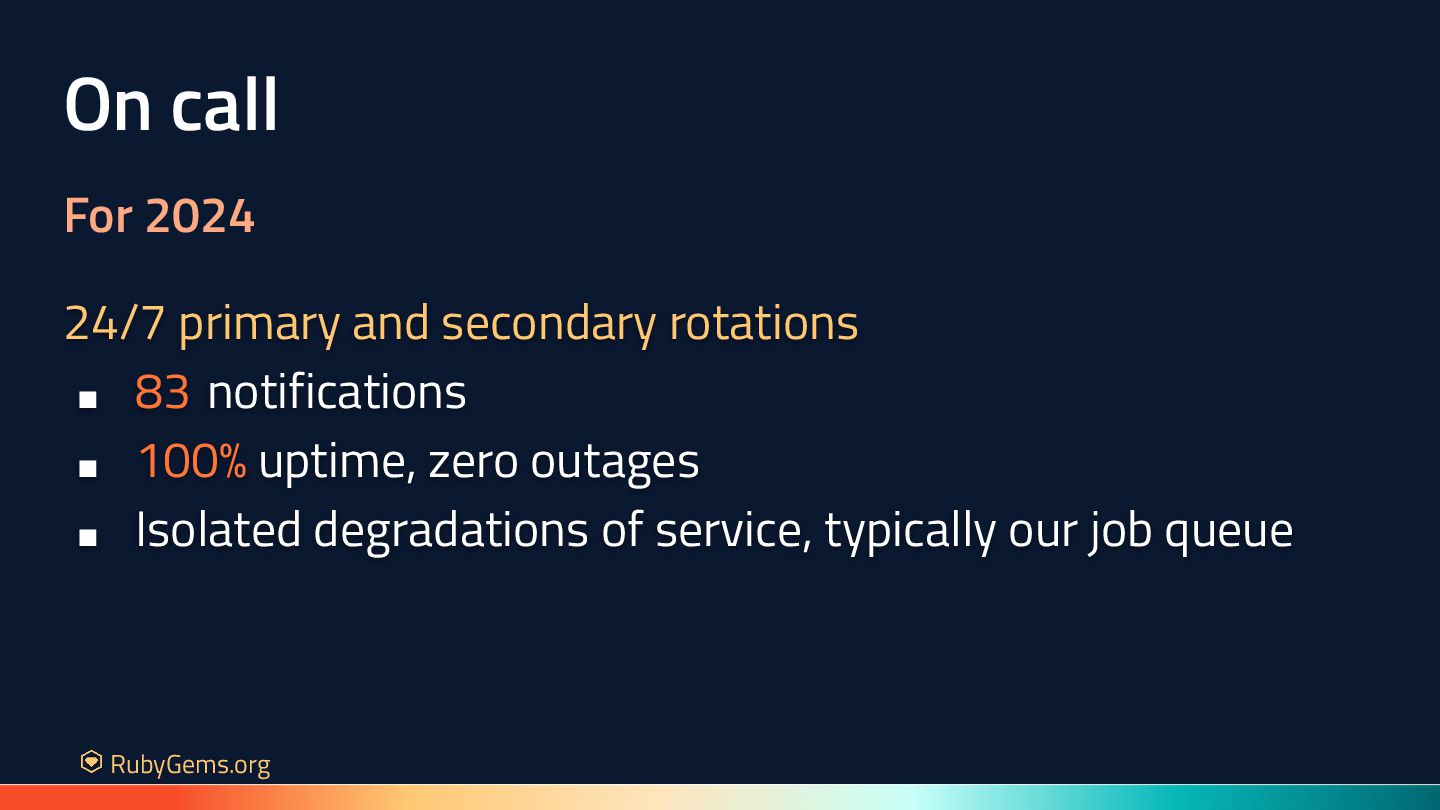
RubyGems.org On call 24/7 primary and secondary rotations ▪ 83
notifications ▪ 100% uptime, zero outages ▪ Isolated degradations of service, typically our job queue For 2024 -
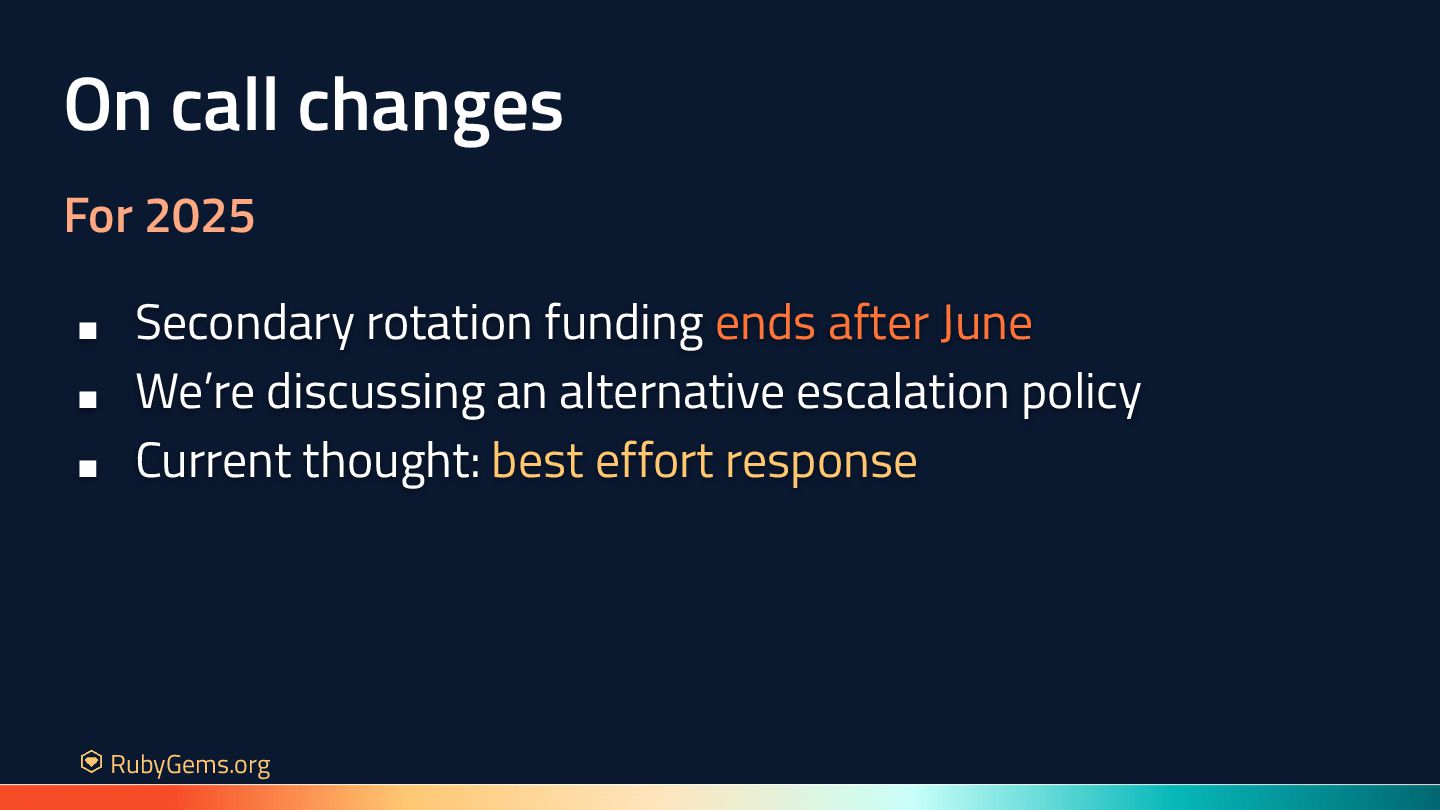
RubyGems.org On call changes ▪ Secondary rotation funding ends after
June ▪ We’re discussing an alternative escalation policy ▪ Current thought: best effort response For 2025 -
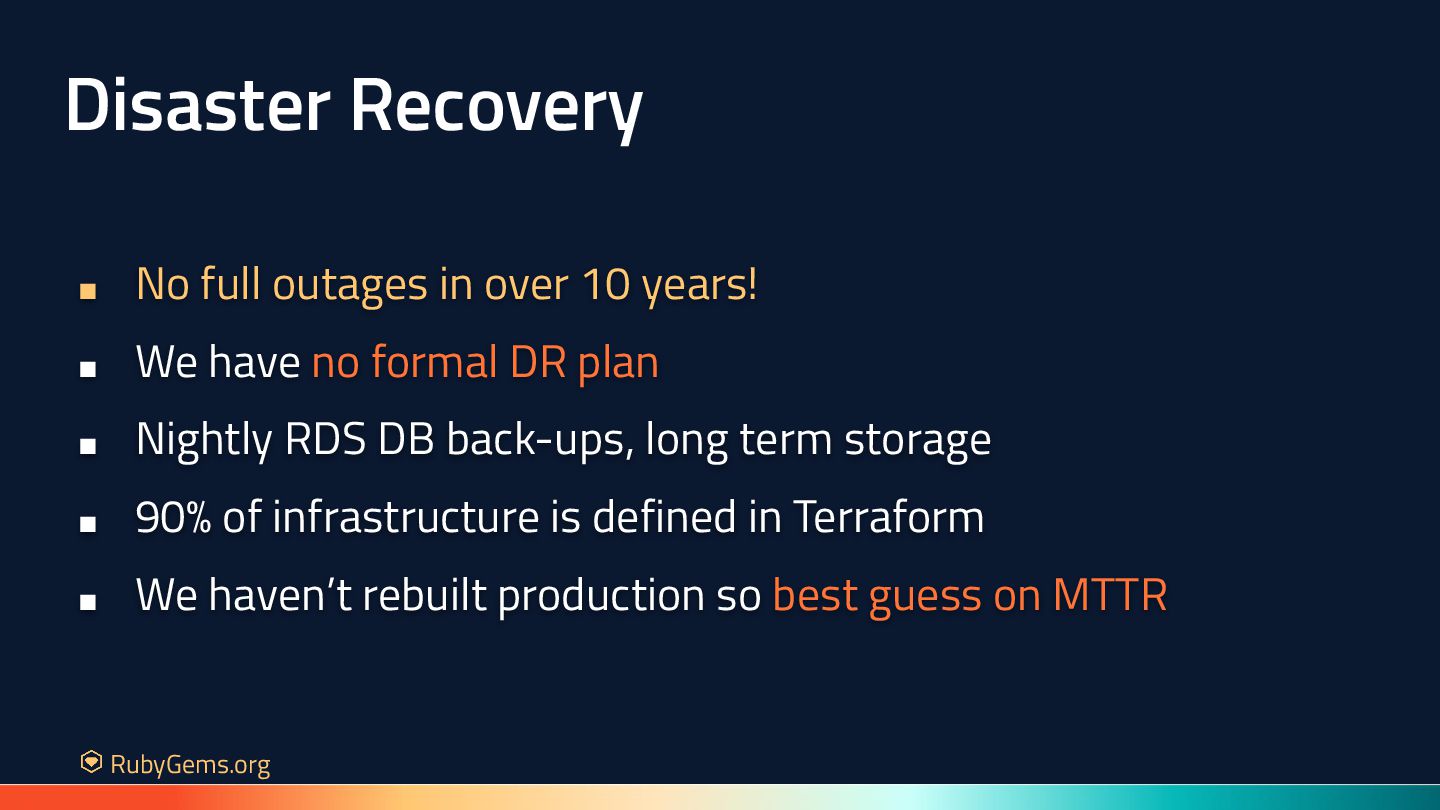
RubyGems.org Disaster Recovery ▪ No full outages in over 10
years! ▪ We have no formal DR plan ▪ Nightly RDS DB back-ups, long term storage ▪ 90% of infrastructure is defined in Terraform ▪ We haven’t rebuilt production so best guess on MTTR -
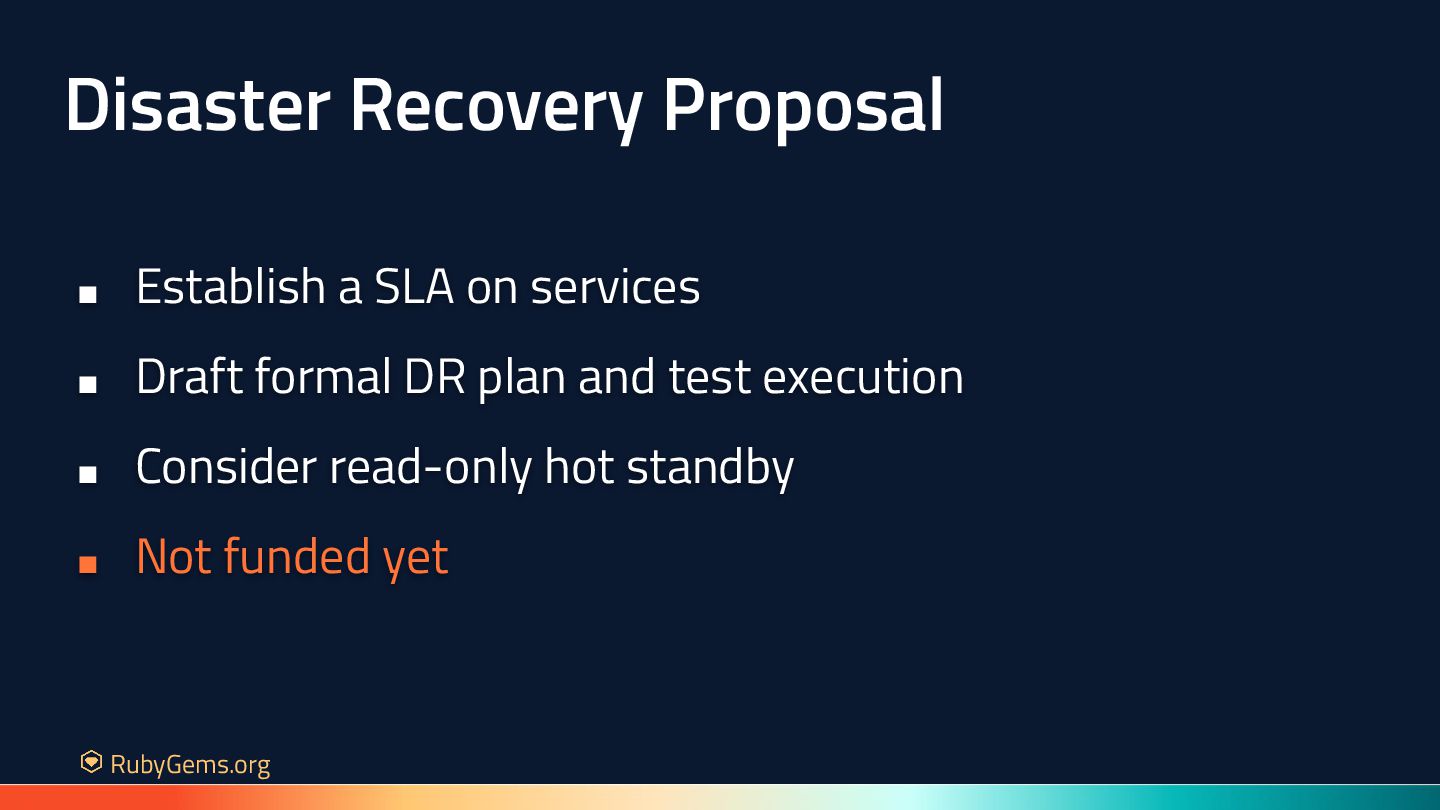
RubyGems.org Disaster Recovery Proposal ▪ Establish a SLA on services
▪ Draft formal DR plan and test execution ▪ Consider read-only hot standby ▪ Not funded yet -
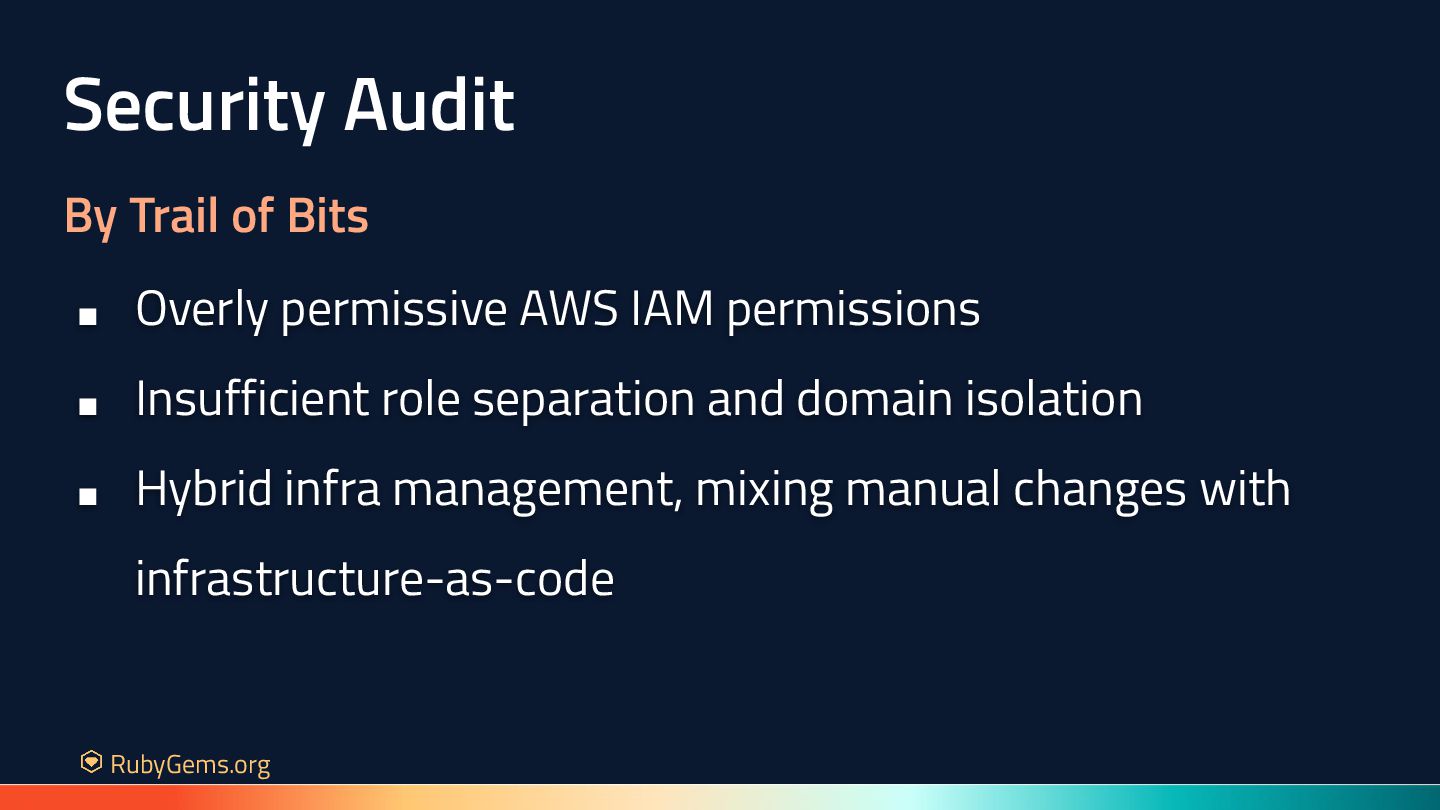
RubyGems.org Security Audit ▪ Overly permissive AWS IAM permissions ▪
Insufficient role separation and domain isolation ▪ Hybrid infra management, mixing manual changes with infrastructure-as-code By Trail of Bits -
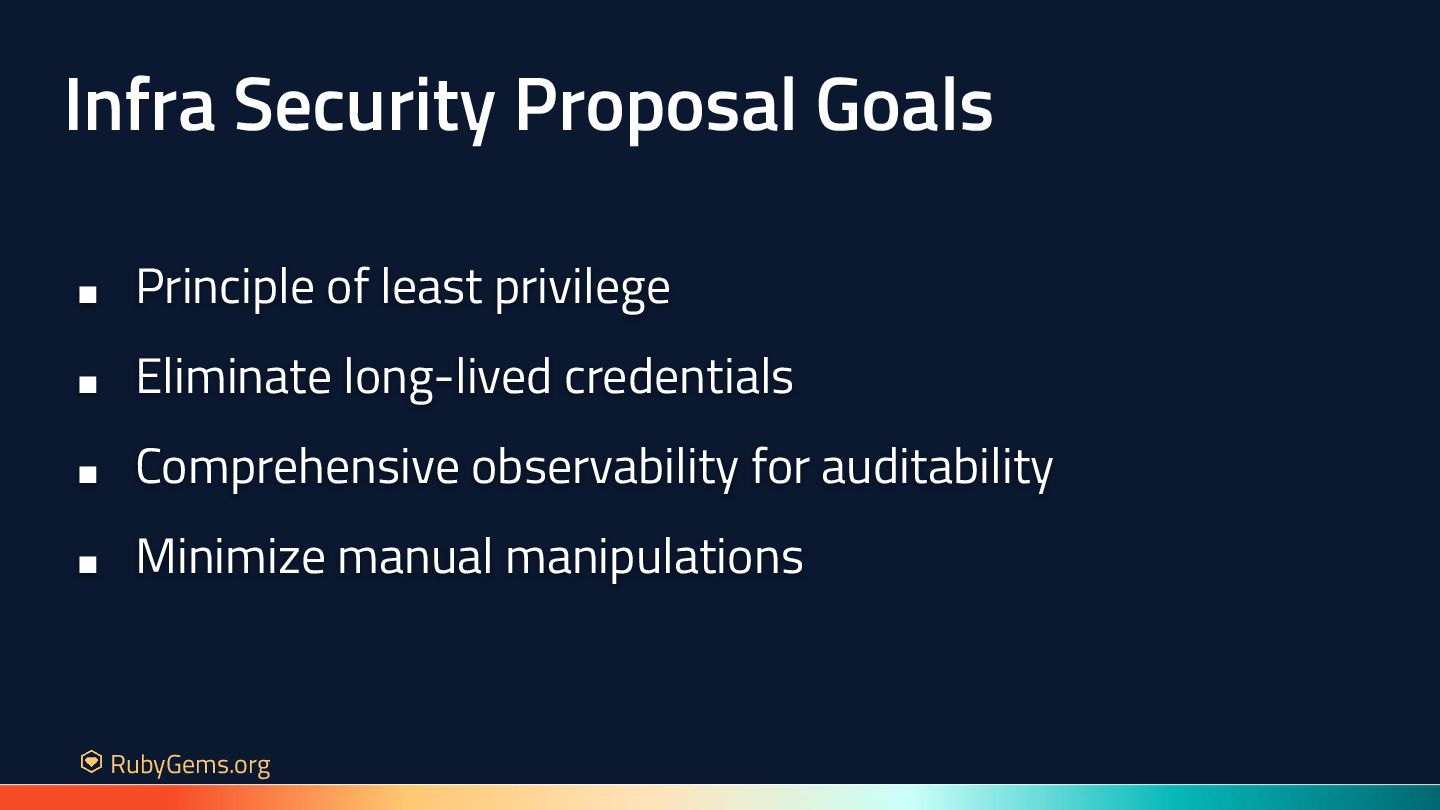
RubyGems.org Infra Security Proposal Goals ▪ Principle of least privilege
▪ Eliminate long-lived credentials ▪ Comprehensive observability for auditability ▪ Minimize manual manipulations -
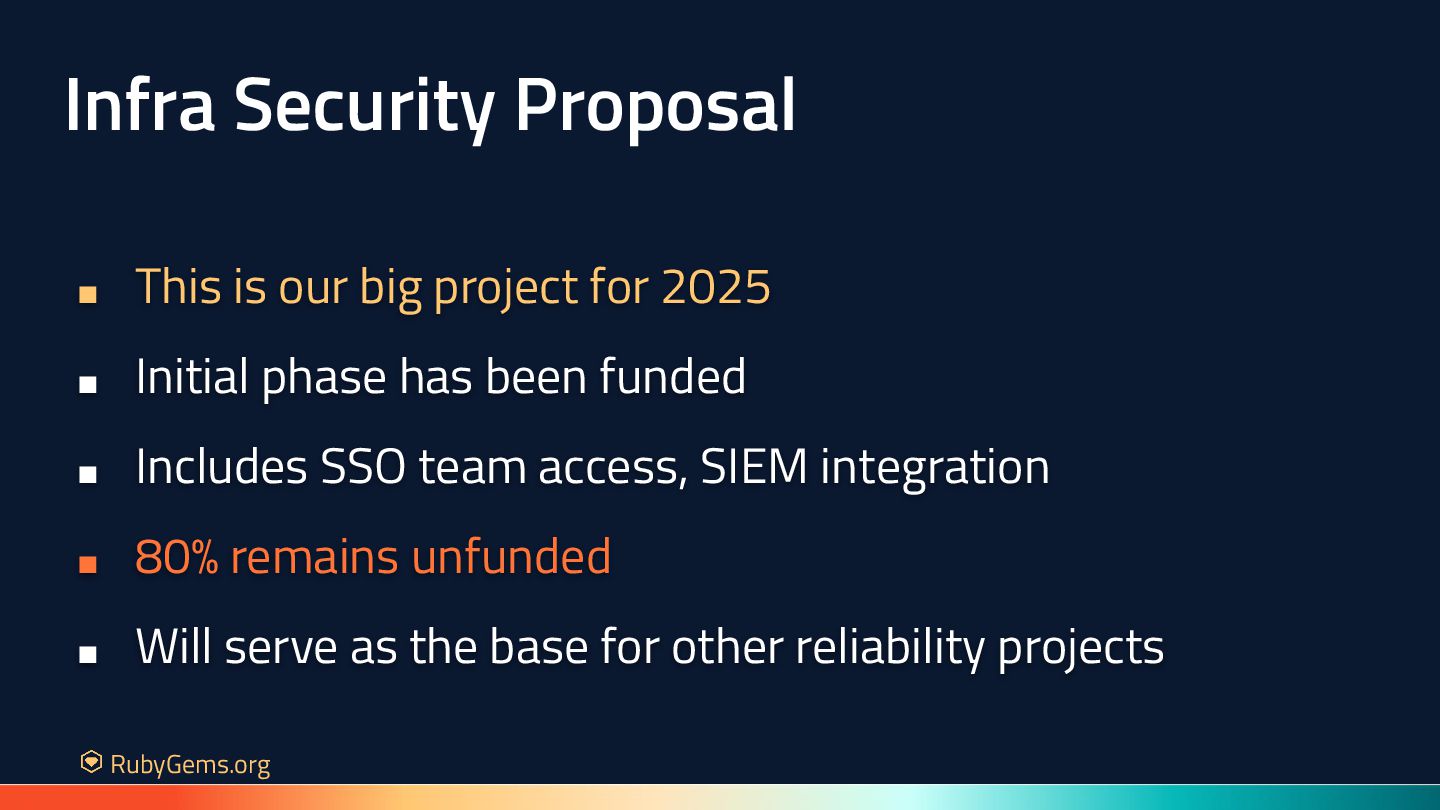
RubyGems.org ▪ This is our big project for 2025 ▪
Initial phase has been funded ▪ Includes SSO team access, SIEM integration ▪ 80% remains unfunded ▪ Will serve as the base for other reliability projects Infra Security Proposal -
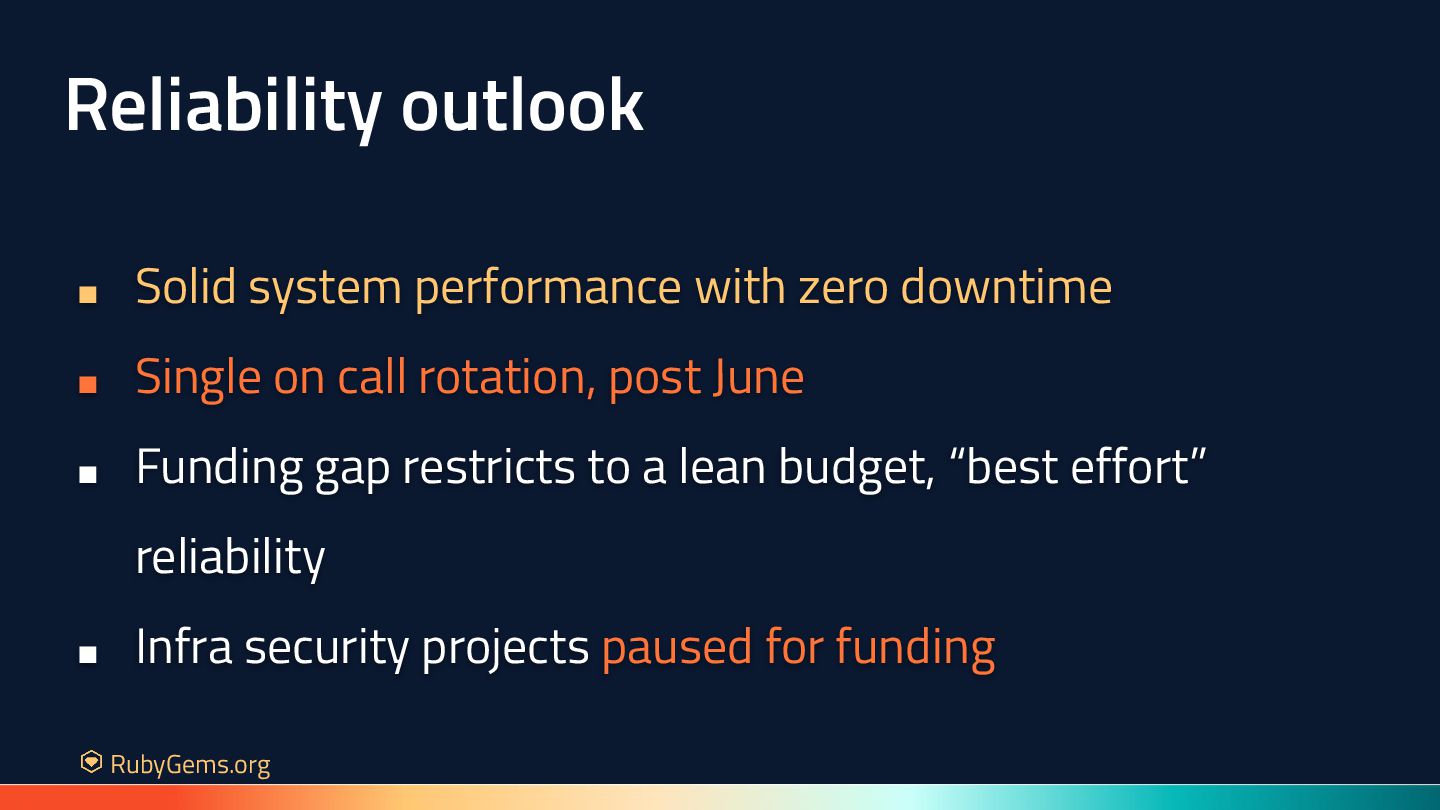
RubyGems.org ▪ Solid system performance with zero downtime ▪ Single
on call rotation, post June ▪ Funding gap restricts to a lean budget, “best effort” reliability ▪ Infra security projects paused for funding Reliability outlook -
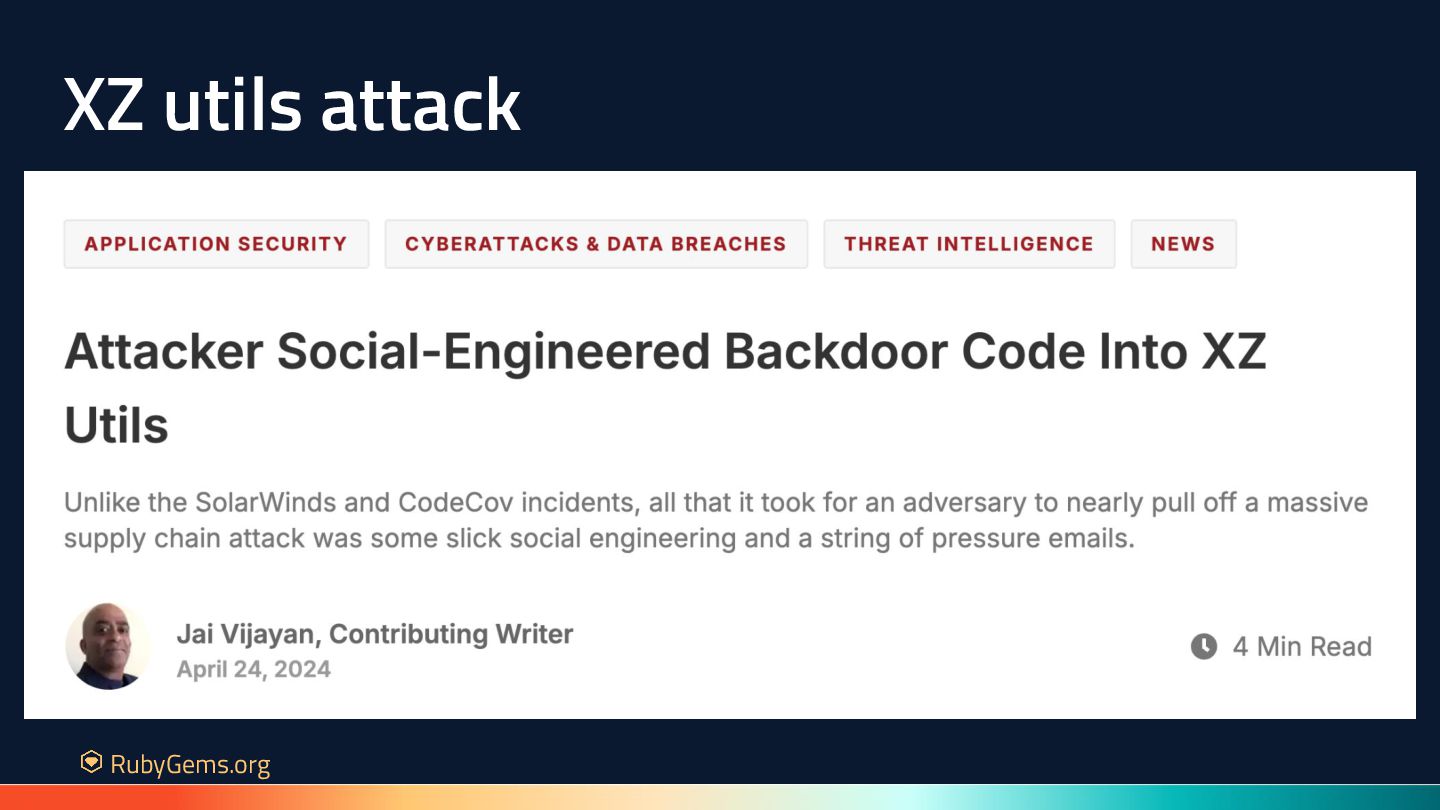
RubyGems.org What would happen if malicious code was injected into
one of your gem dependencies? -
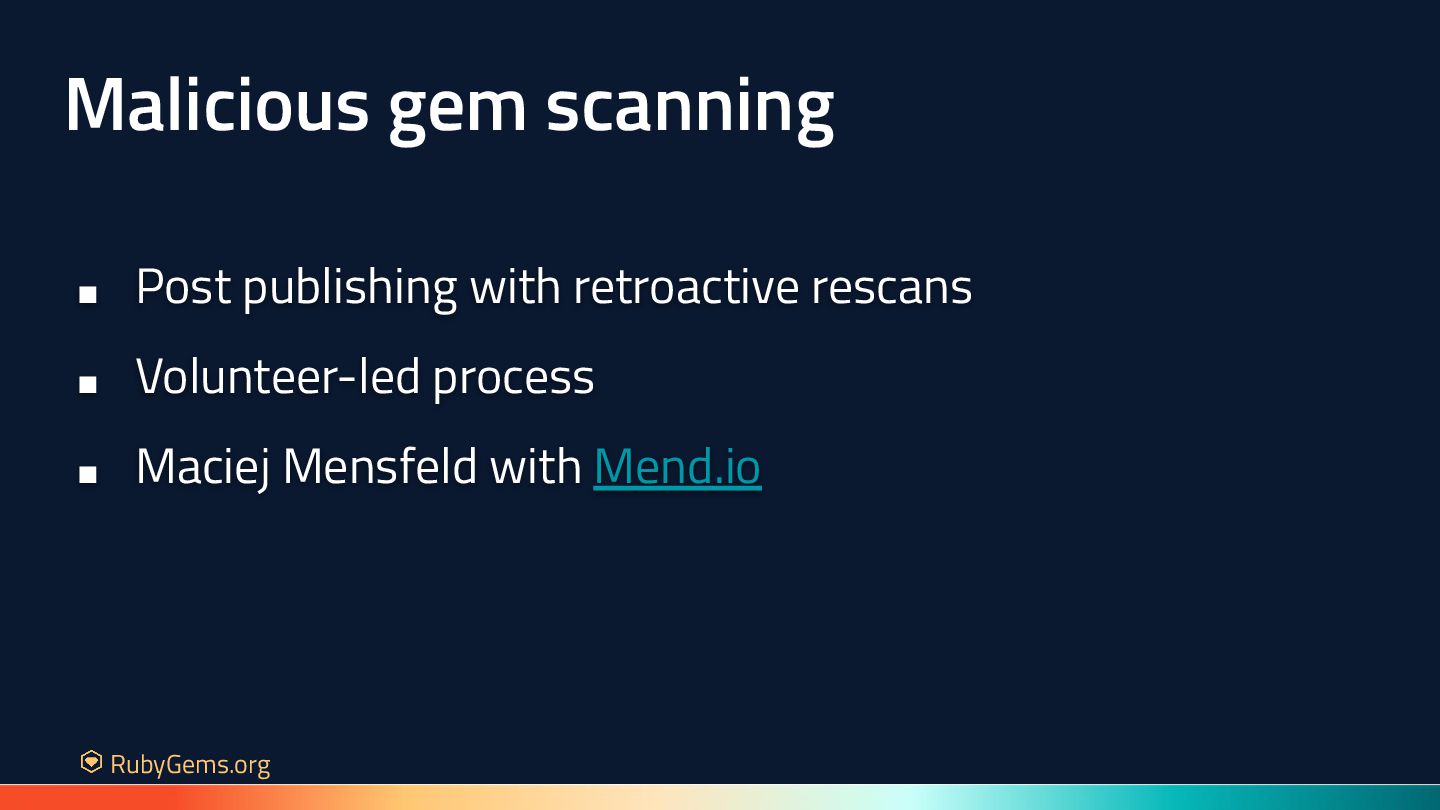
RubyGems.org Malicious gem scanning ▪ Post publishing with retroactive rescans
▪ Volunteer-led process ▪ Maciej Mensfeld with Mend.io -
RubyGems.org Are we ready for the growing threats to supply
chain security? -
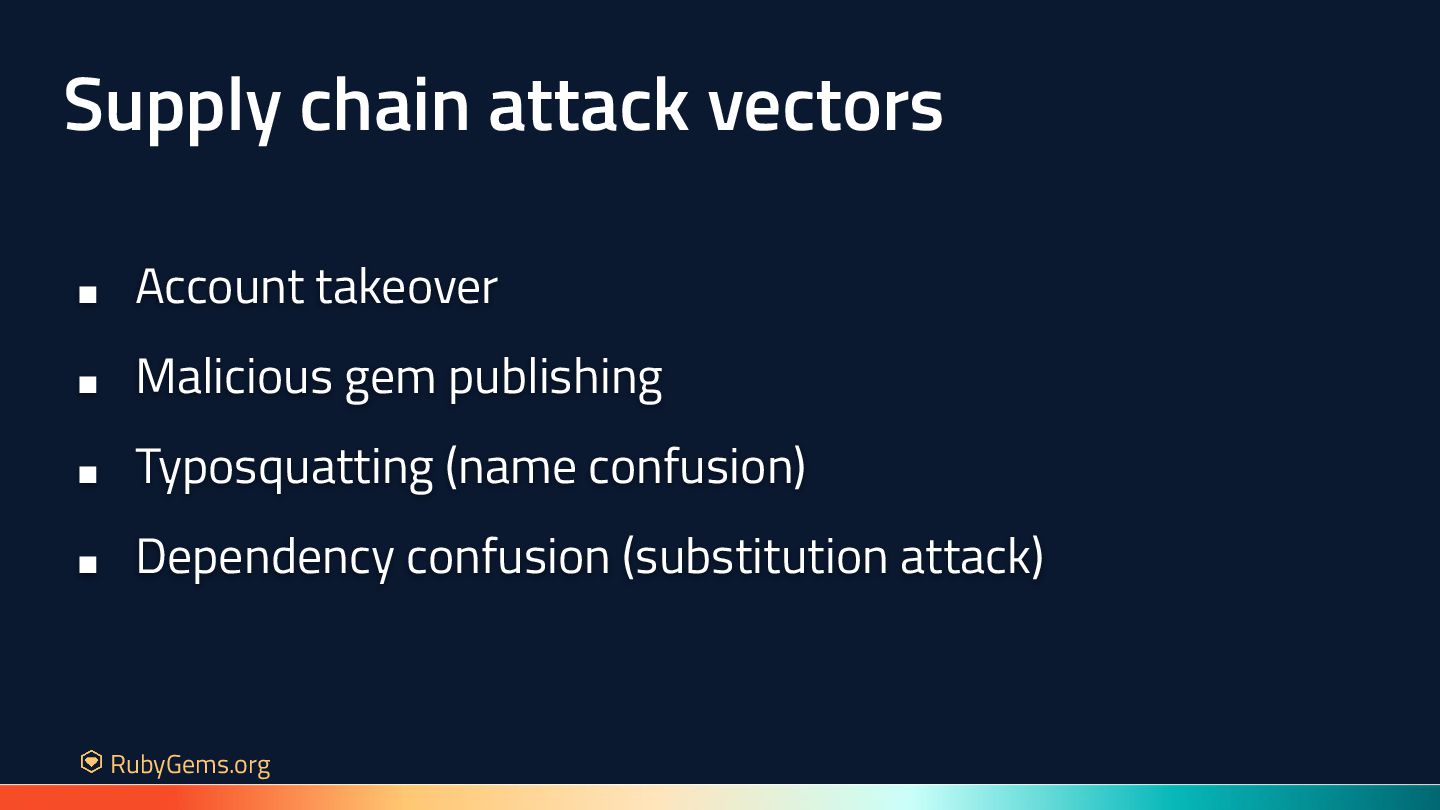
RubyGems.org ▪ Account takeover ▪ Malicious gem publishing ▪ Typosquatting
(name confusion) ▪ Dependency confusion (substitution attack) Supply chain attack vectors -
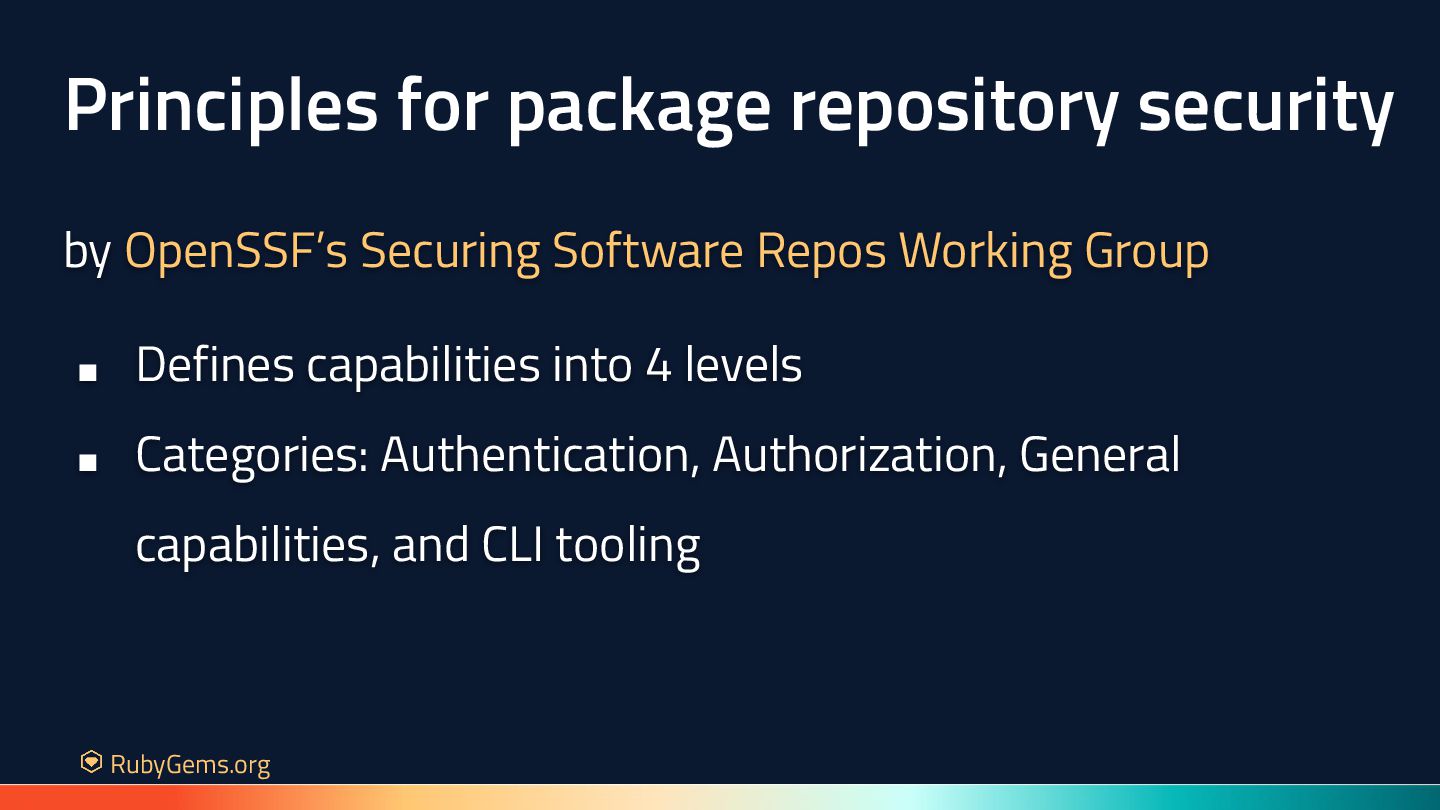
RubyGems.org Principles for package repository security by OpenSSF’s Securing Software
Repos Working Group ▪ Defines capabilities into 4 levels ▪ Categories: Authentication, Authorization, General capabilities, and CLI tooling -
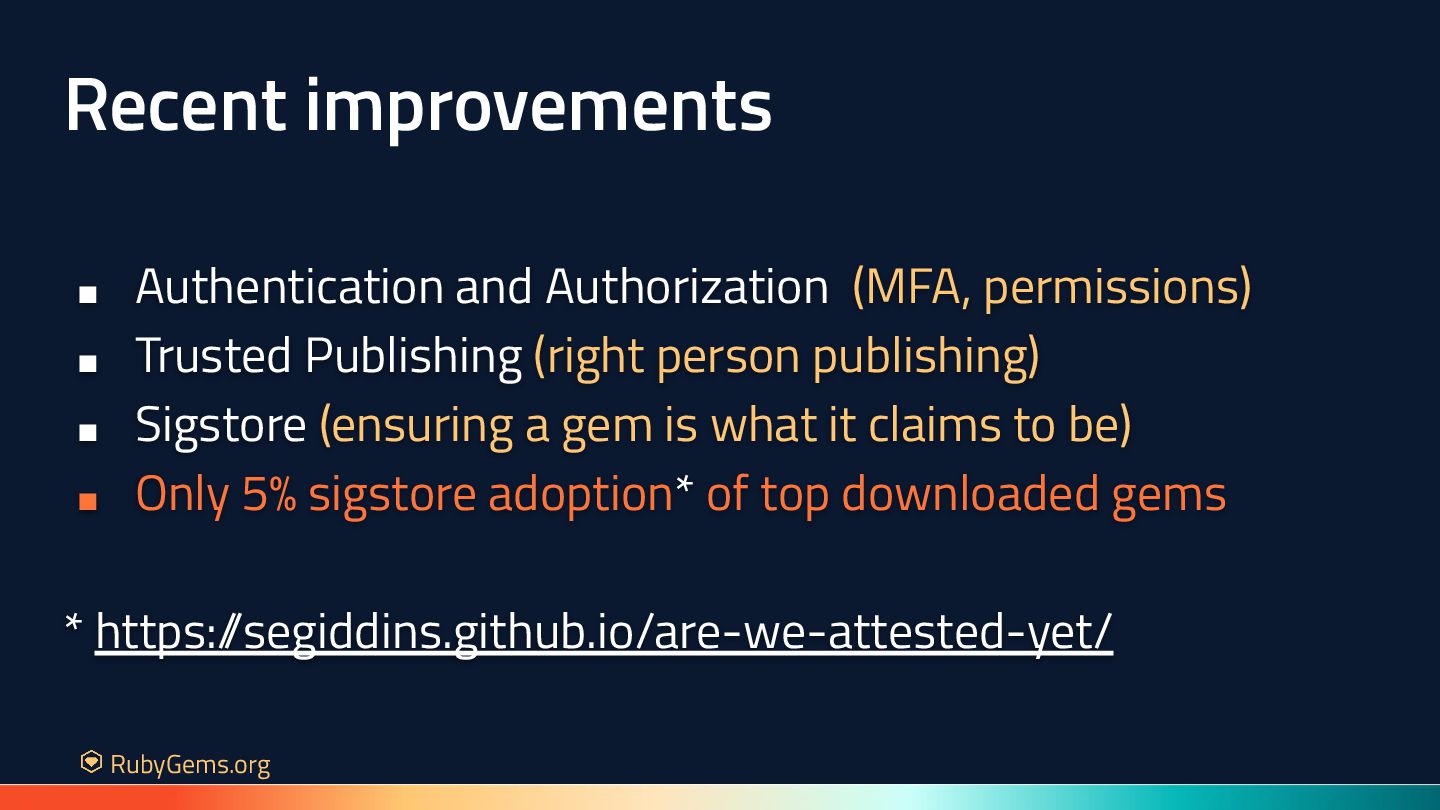
RubyGems.org ▪ Authentication and Authorization (MFA, permissions) ▪ Trusted Publishing
(right person publishing) ▪ Sigstore (ensuring a gem is what it claims to be) ▪ Only 5% sigstore adoption* of top downloaded gems * https:/ /segiddins.github.io/are-we-attested-yet/ Recent improvements -
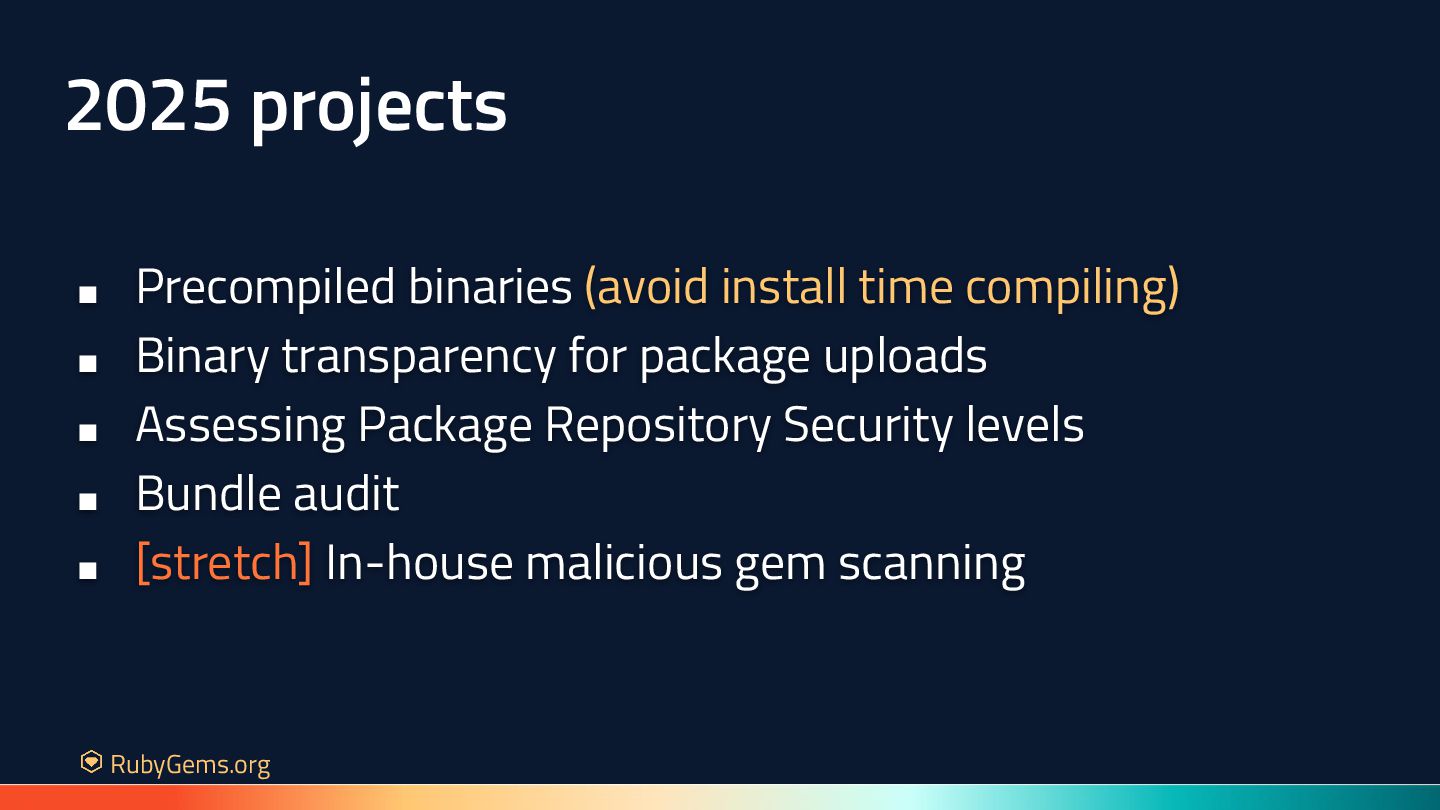
RubyGems.org 2025 projects ▪ Precompiled binaries (avoid install time compiling)
▪ Binary transparency for package uploads ▪ Assessing Package Repository Security levels ▪ Bundle audit ▪ [stretch] In-house malicious gem scanning -
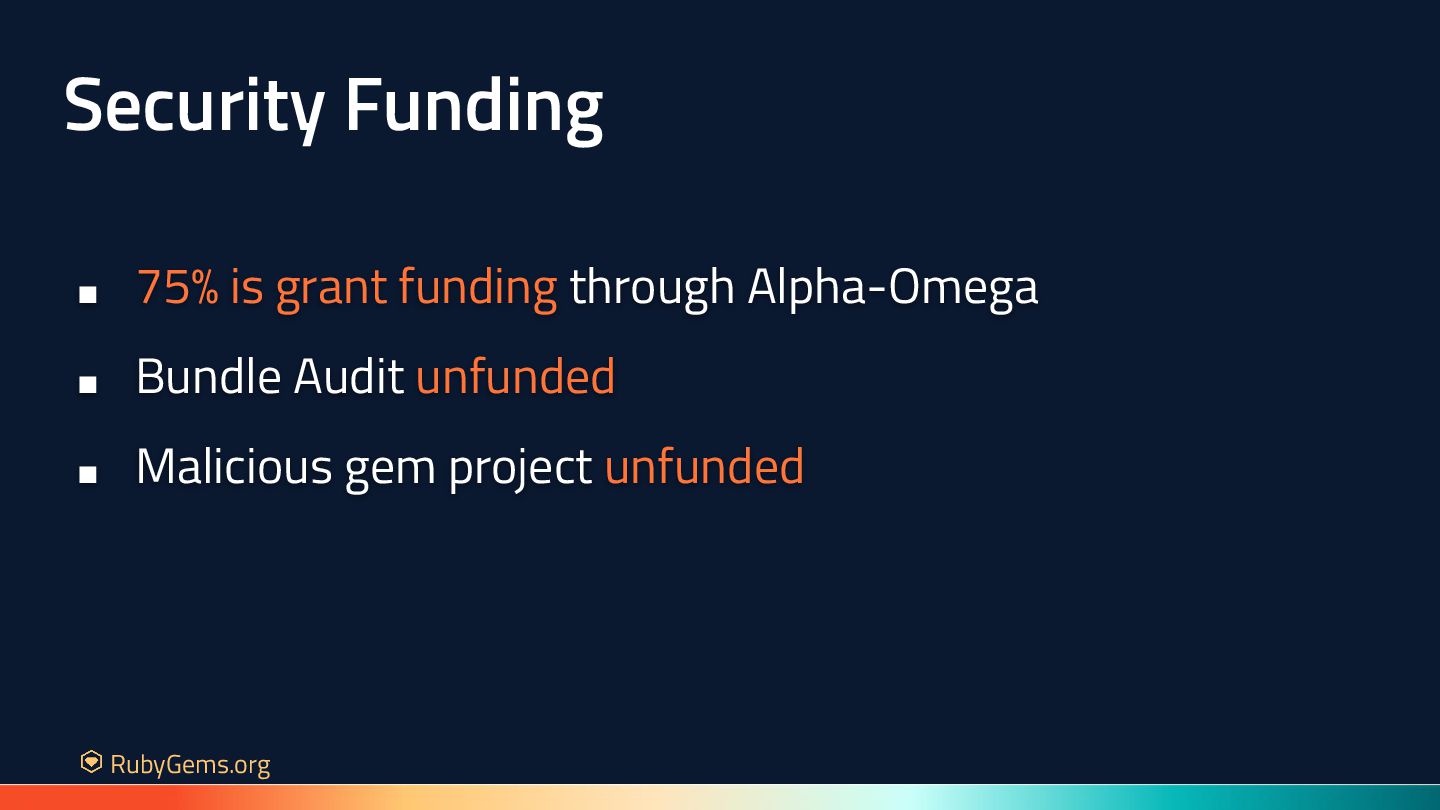
RubyGems.org Security Funding ▪ 75% is grant funding through Alpha-Omega
▪ Bundle Audit unfunded ▪ Malicious gem project unfunded -
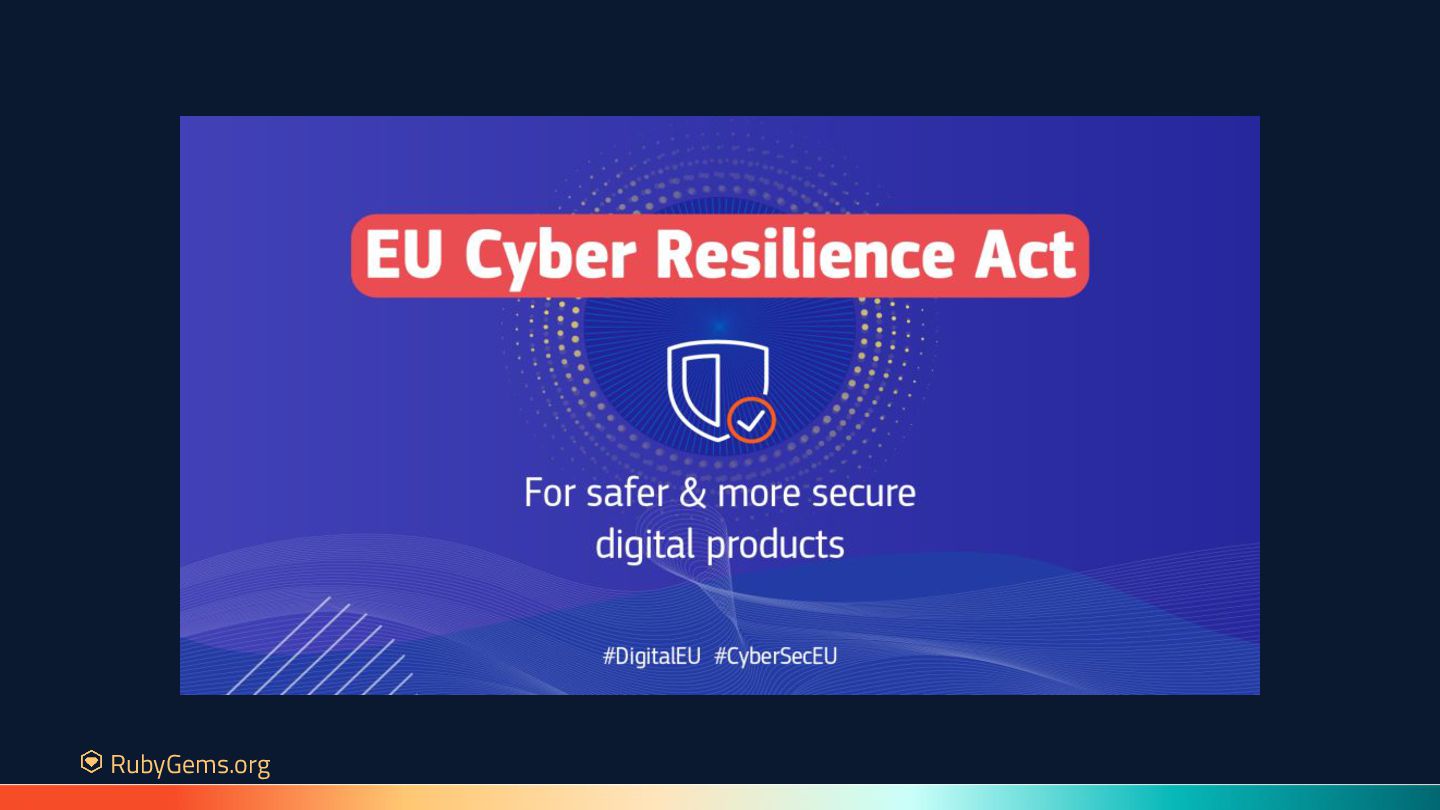
RubyGems.org Cyber Resilience Act ▪ New EU law that set
cybersecurity requirements for digital products ▪ Commercial products in the EU market ▪ Includes all dependencies (yes, open source too) GDPR for cybersecurity -
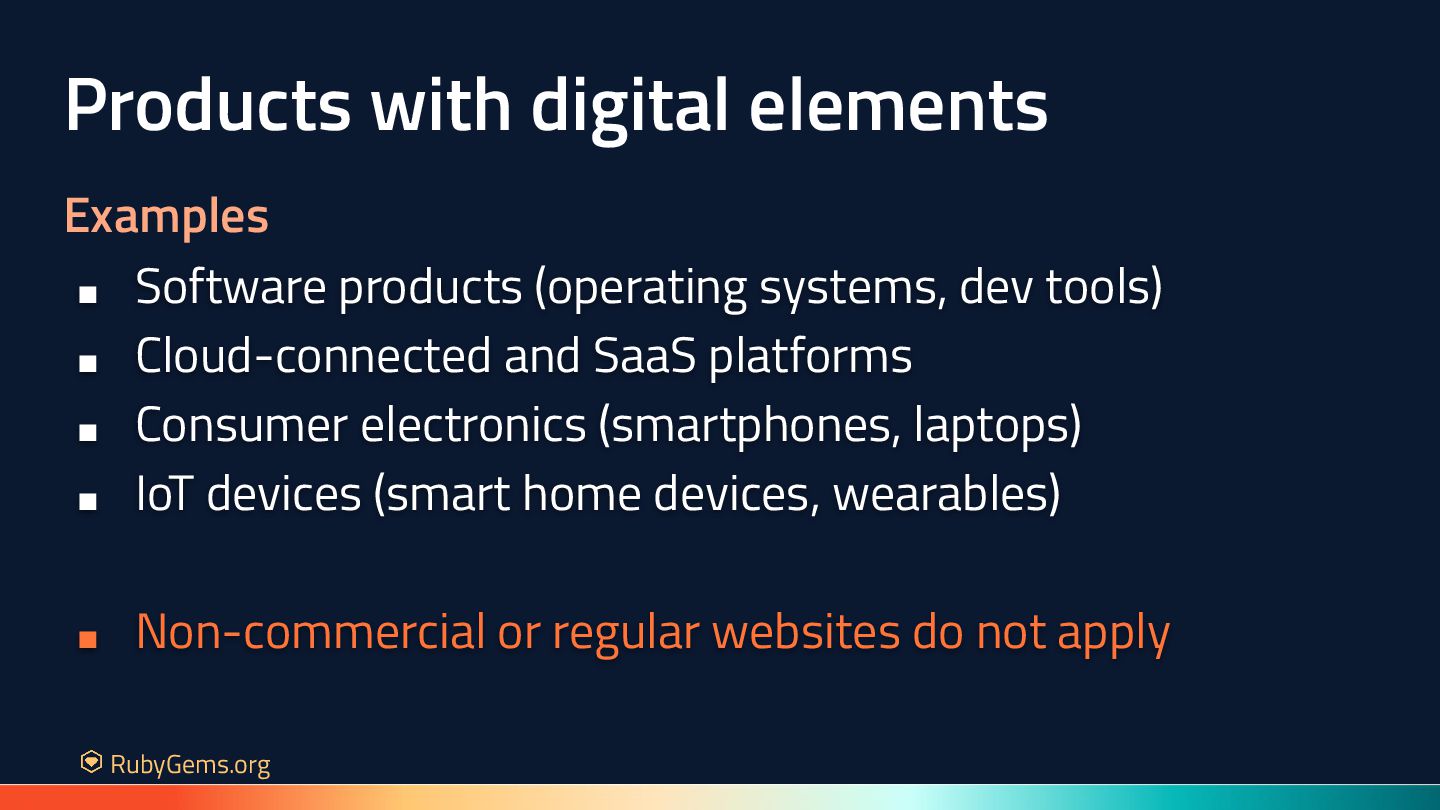
RubyGems.org Products with digital elements ▪ Software products (operating systems,
dev tools) ▪ Cloud-connected and SaaS platforms ▪ Consumer electronics (smartphones, laptops) ▪ IoT devices (smart home devices, wearables) ▪ Non-commercial or regular websites do not apply Examples -
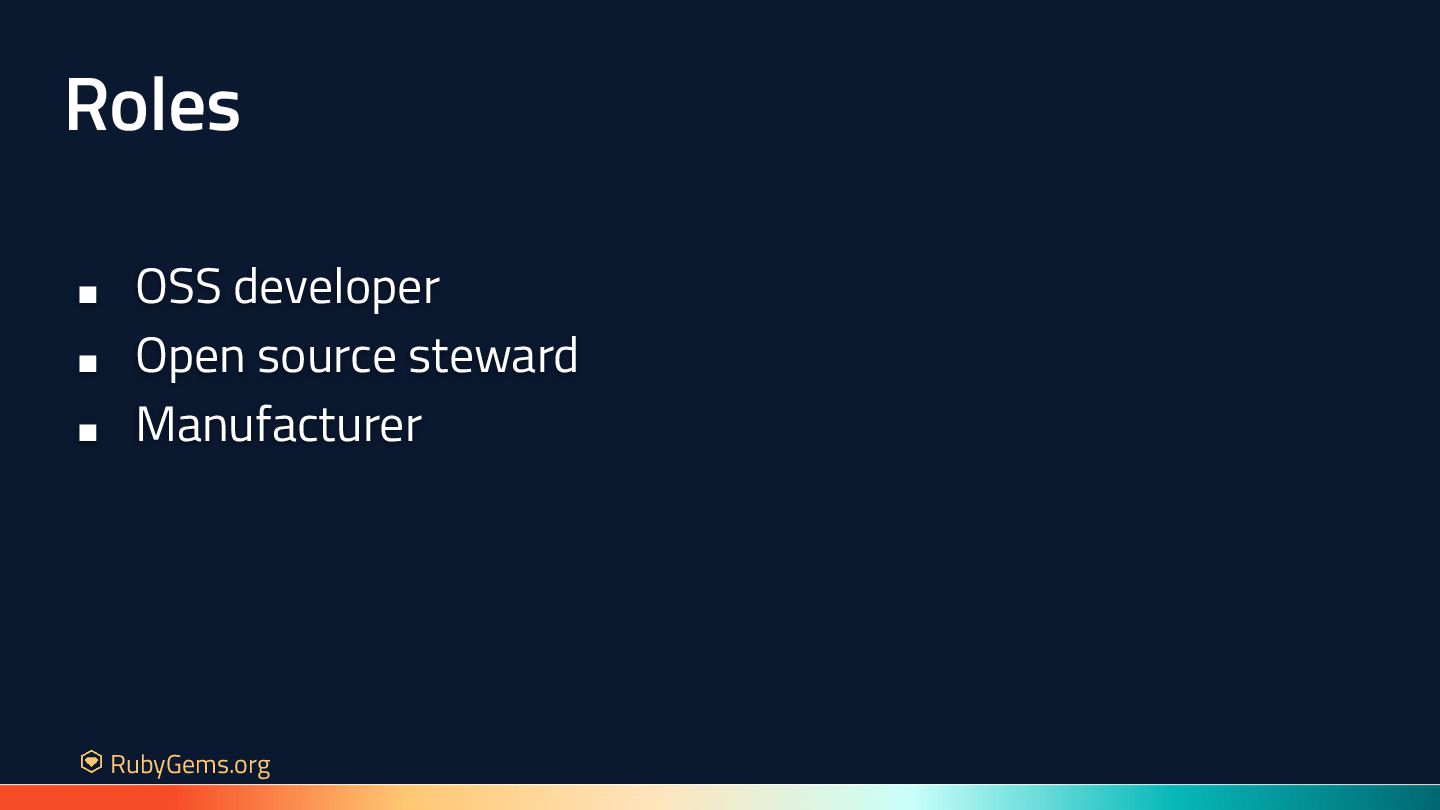
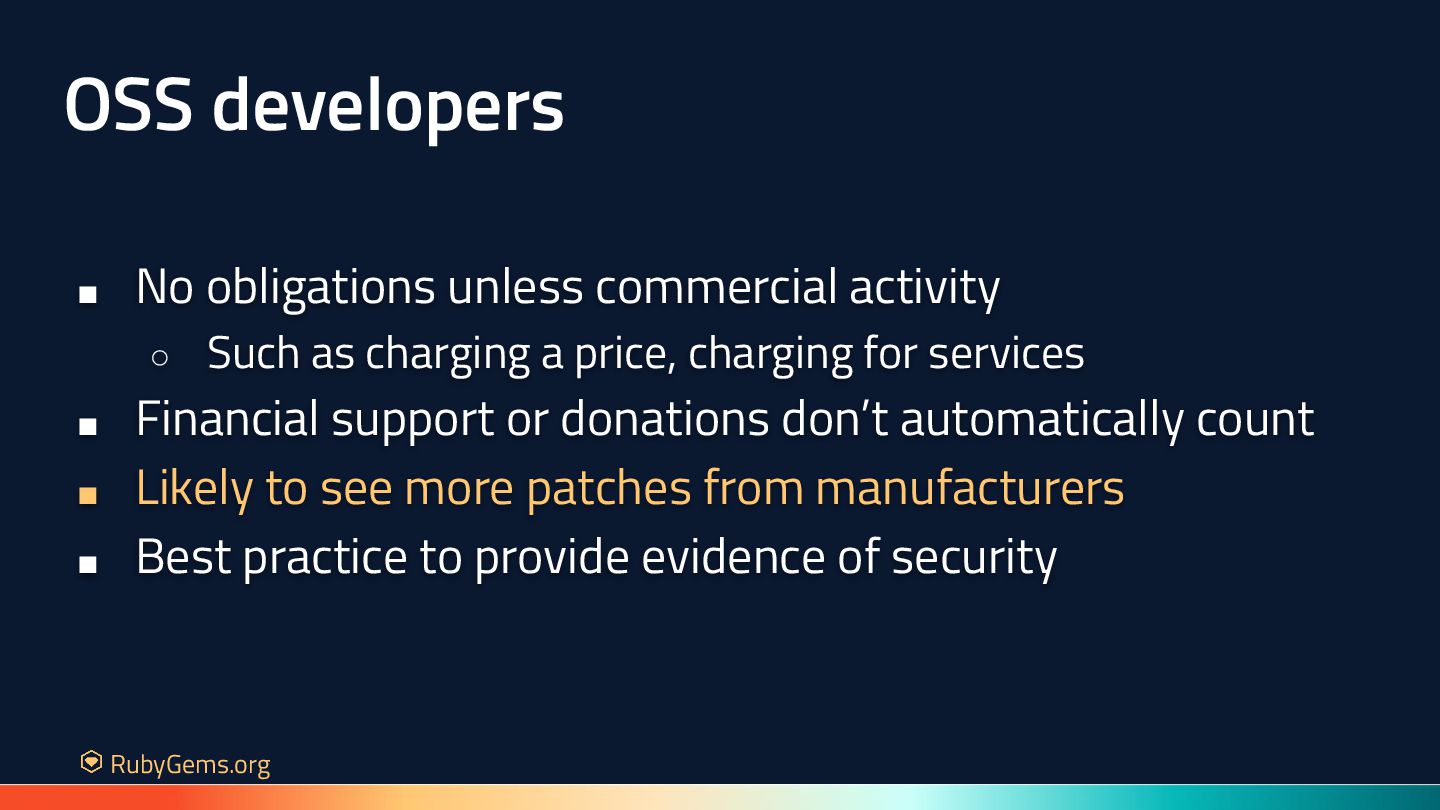
RubyGems.org OSS developers ▪ No obligations unless commercial activity ◦
Such as charging a price, charging for services ▪ Financial support or donations don’t automatically count ▪ Likely to see more patches from manufacturers ▪ Best practice to provide evidence of security -
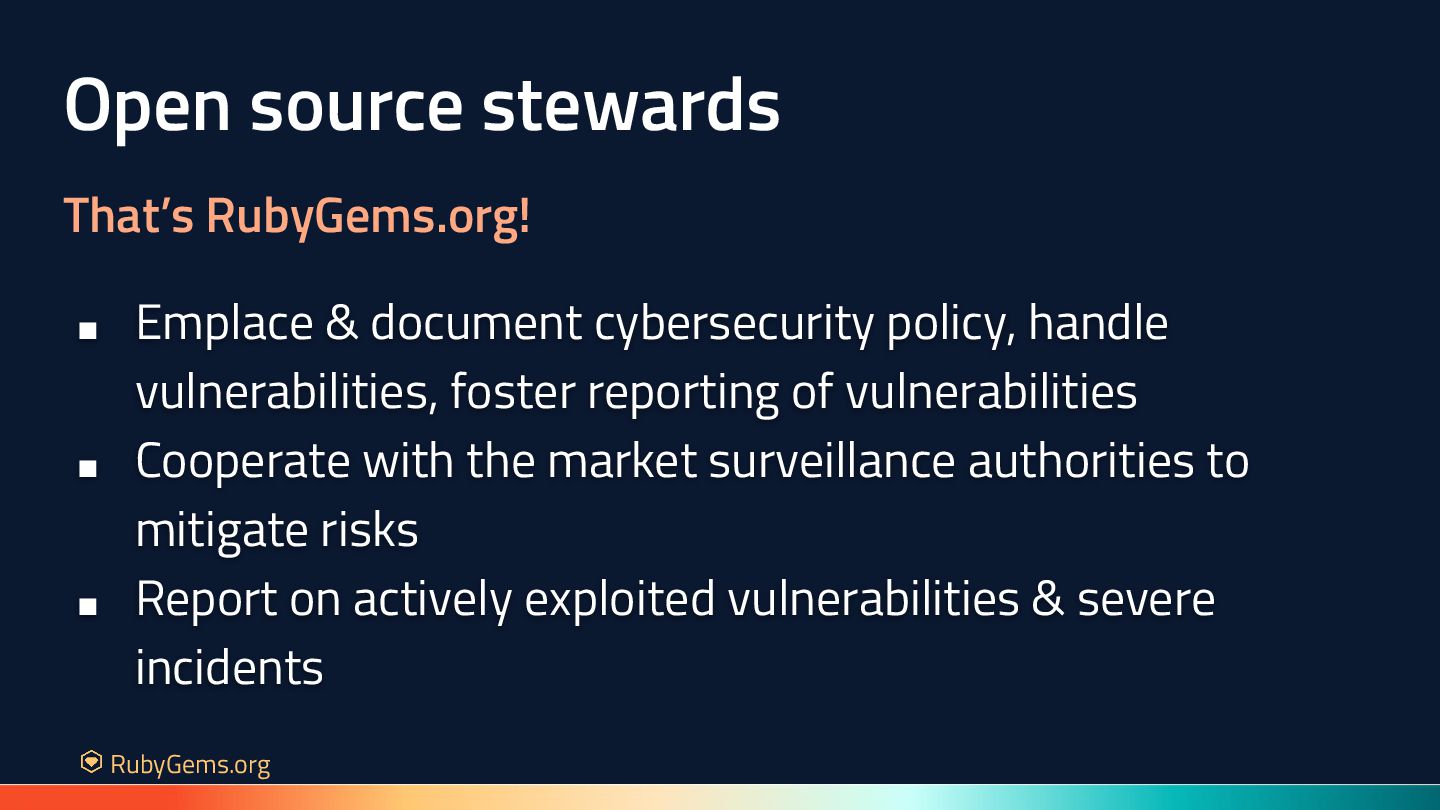
RubyGems.org Open source stewards ▪ Emplace & document cybersecurity policy,
handle vulnerabilities, foster reporting of vulnerabilities ▪ Cooperate with the market surveillance authorities to mitigate risks ▪ Report on actively exploited vulnerabilities & severe incidents That’s RubyGems.org! -
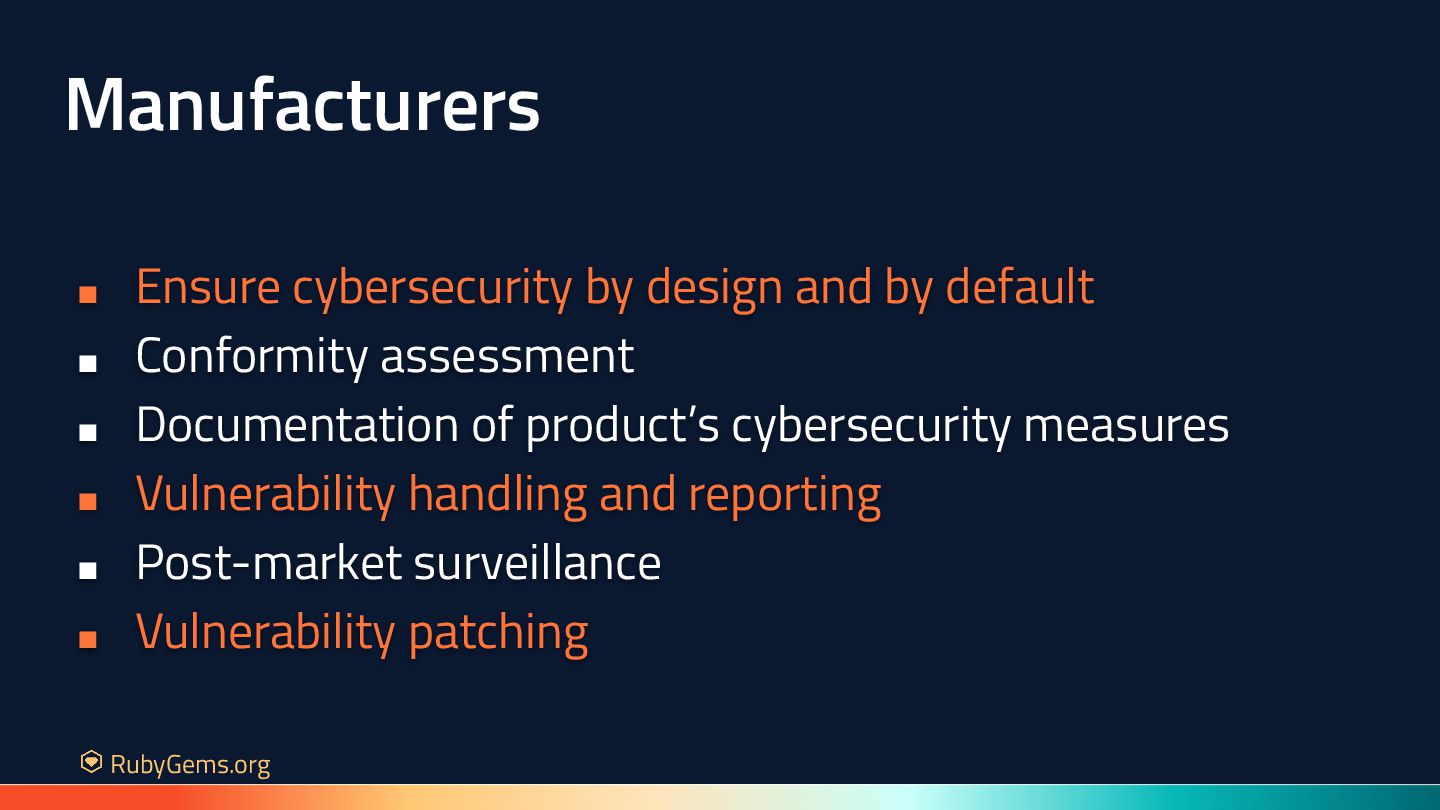
RubyGems.org Manufacturers ▪ Ensure cybersecurity by design and by default
▪ Conformity assessment ▪ Documentation of product’s cybersecurity measures ▪ Vulnerability handling and reporting ▪ Post-market surveillance ▪ Vulnerability patching -
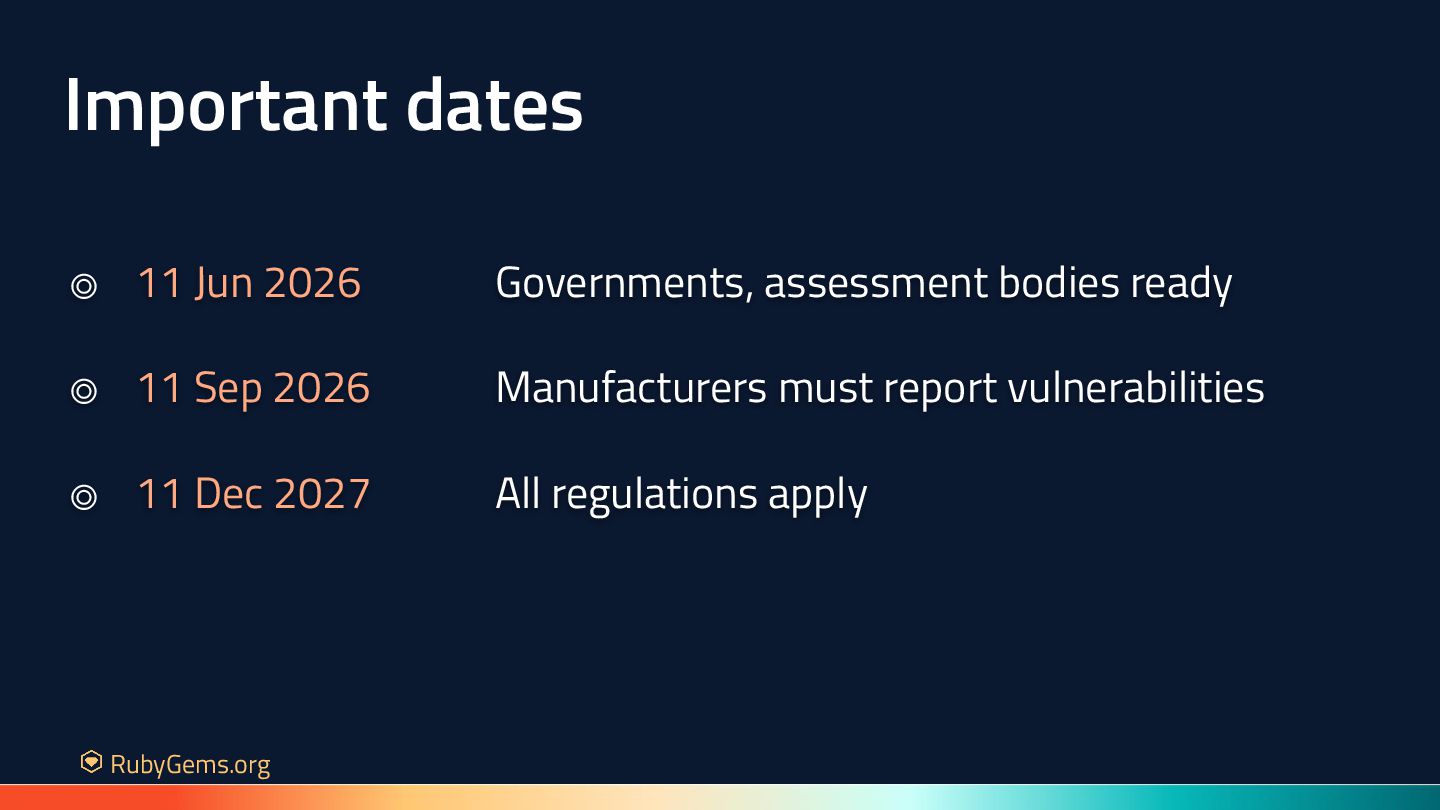
RubyGems.org Important dates ◎ 11 Jun 2026 Governments, assessment bodies
ready ◎ 11 Sep 2026 Manufacturers must report vulnerabilities ◎ 11 Dec 2027 All regulations apply -
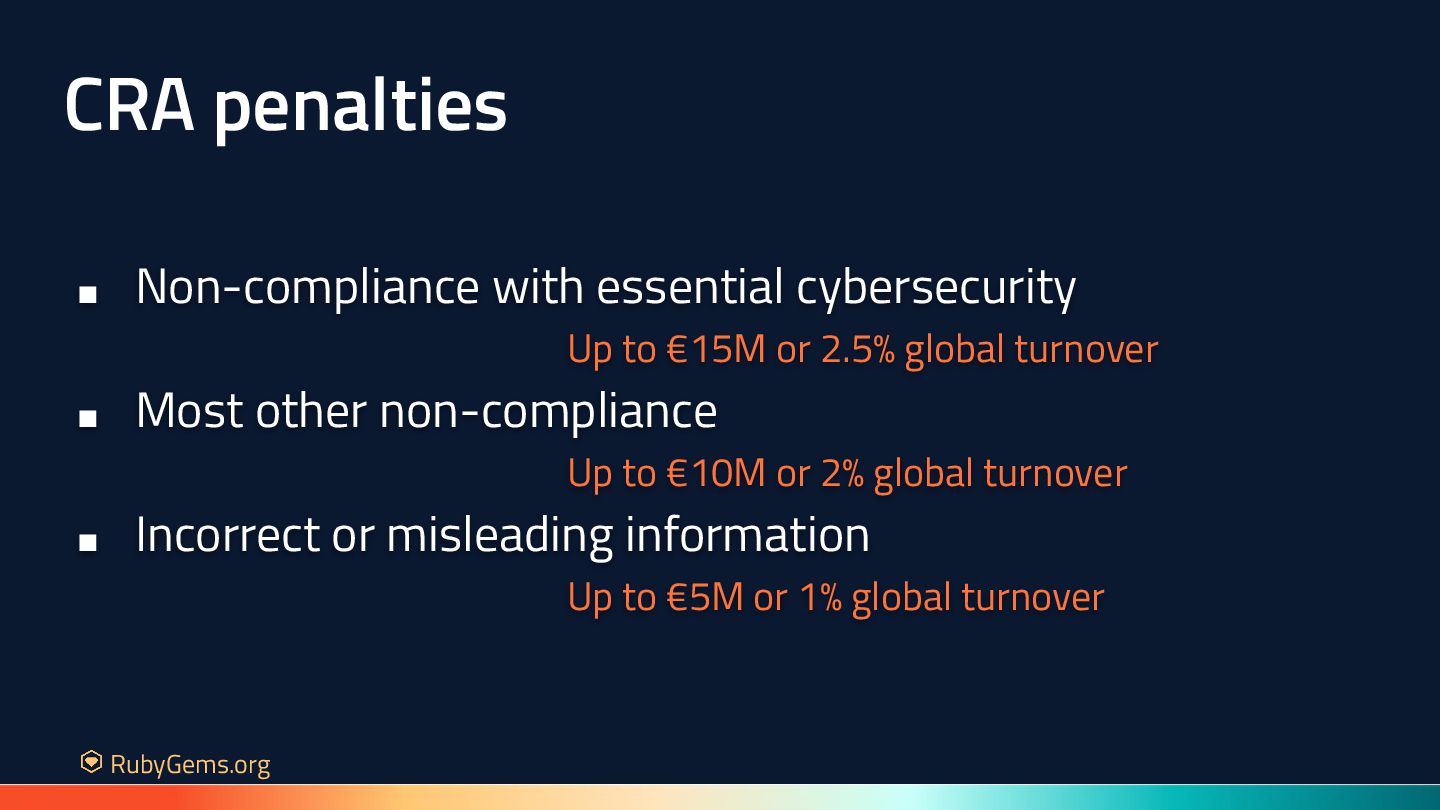
RubyGems.org CRA penalties ▪ Non-compliance with essential cybersecurity Up to
€15M or 2.5% global turnover ▪ Most other non-compliance Up to €10M or 2% global turnover ▪ Incorrect or misleading information Up to €5M or 1% global turnover -
RubyGems.org CRA resources ▪ Visit OpenSSF’s CRA page ◦ Search
‘openssf cra’ ▪ https:/ /openssf.org/public-policy/eu-cyber-resilience-act/ ▪ They have a free online course to learn more -
RubyGems.org CRA plans ▪ Educate and spread awareness ▪ Provide
guidance for maintainers and manufacturers ▪ Improve tooling around compliance -
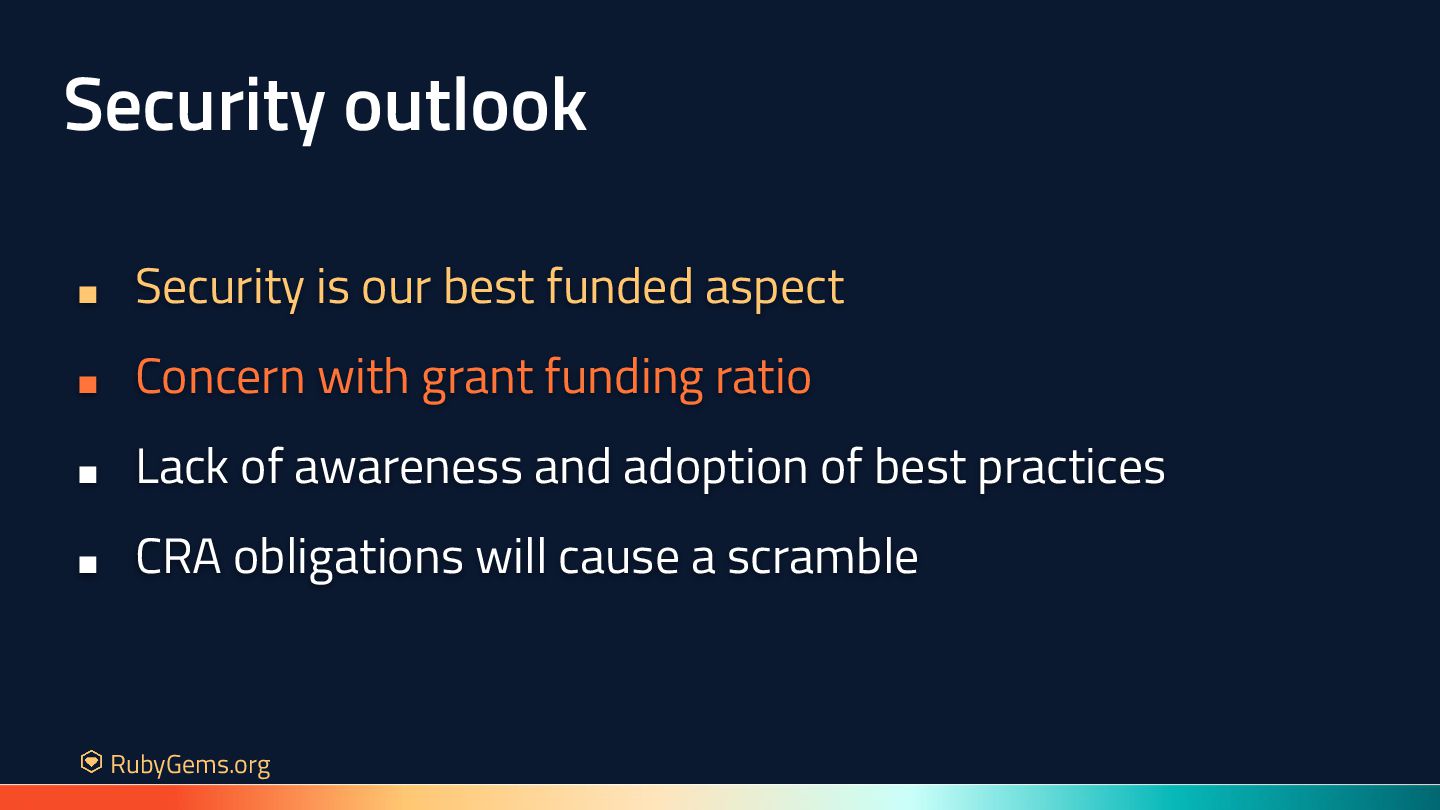
RubyGems.org ▪ Security is our best funded aspect ▪ Concern
with grant funding ratio ▪ Lack of awareness and adoption of best practices ▪ CRA obligations will cause a scramble Security outlook -
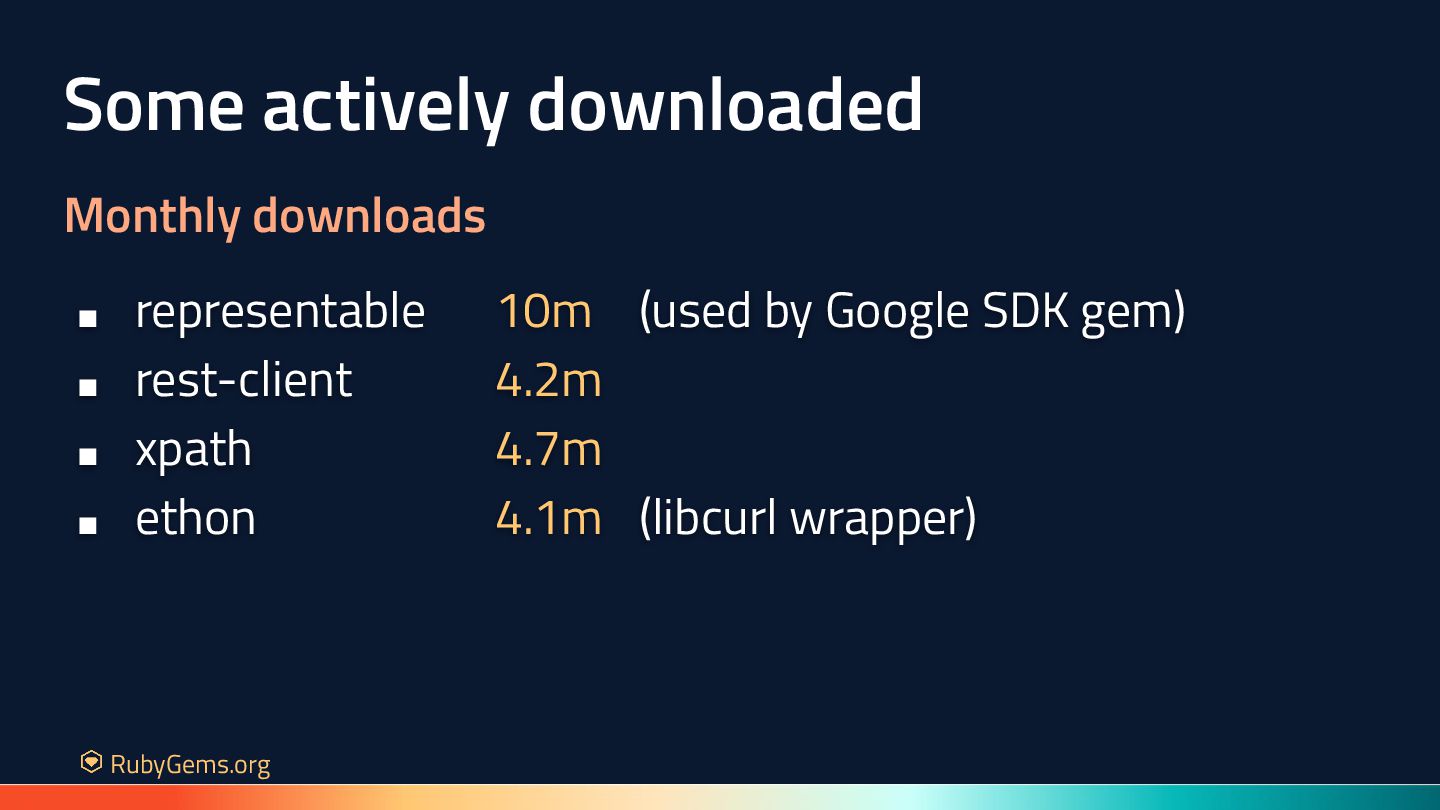
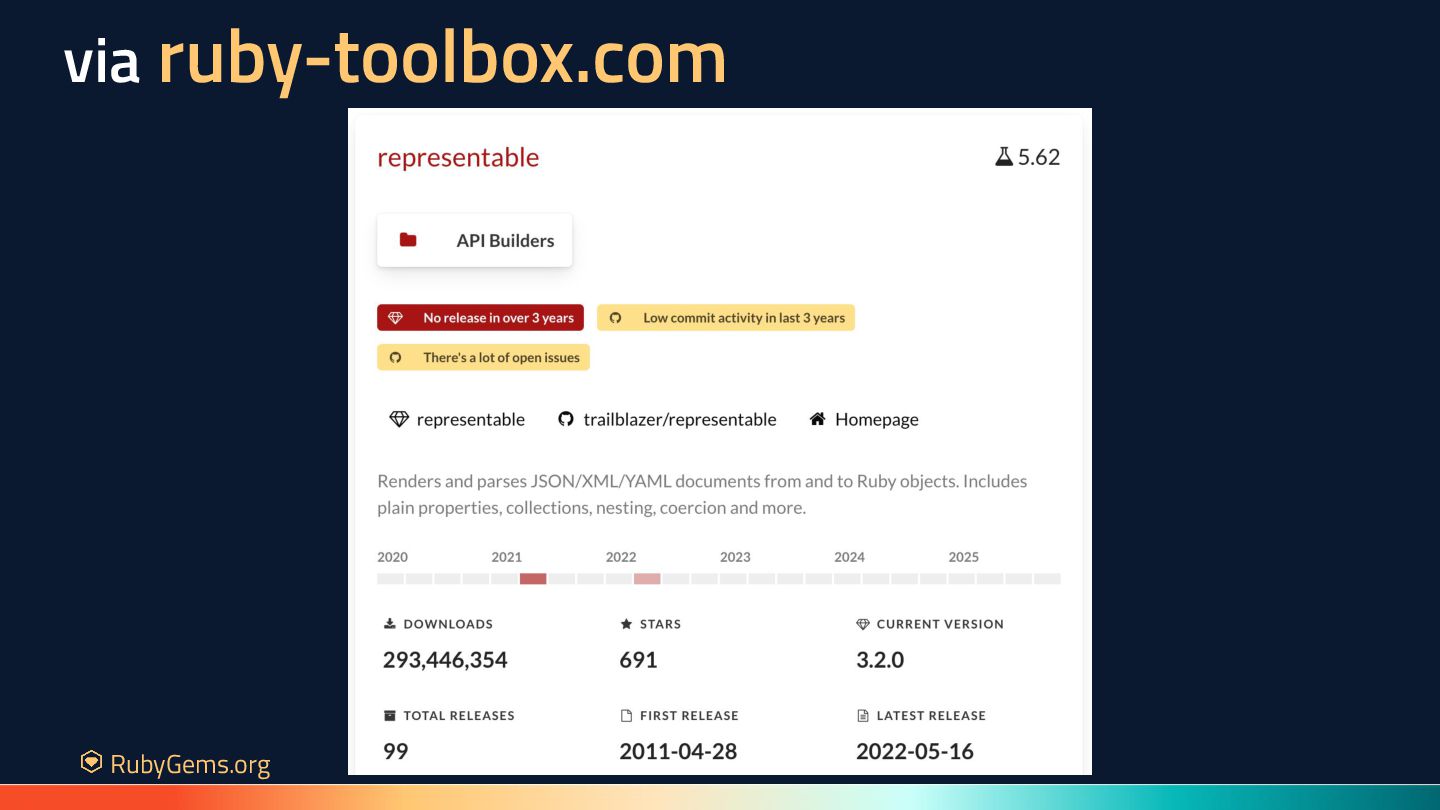
RubyGems.org Some actively downloaded ▪ representable 10m (used by Google
SDK gem) ▪ rest-client 4.2m ▪ xpath 4.7m ▪ ethon 4.1m (libcurl wrapper) Monthly downloads -
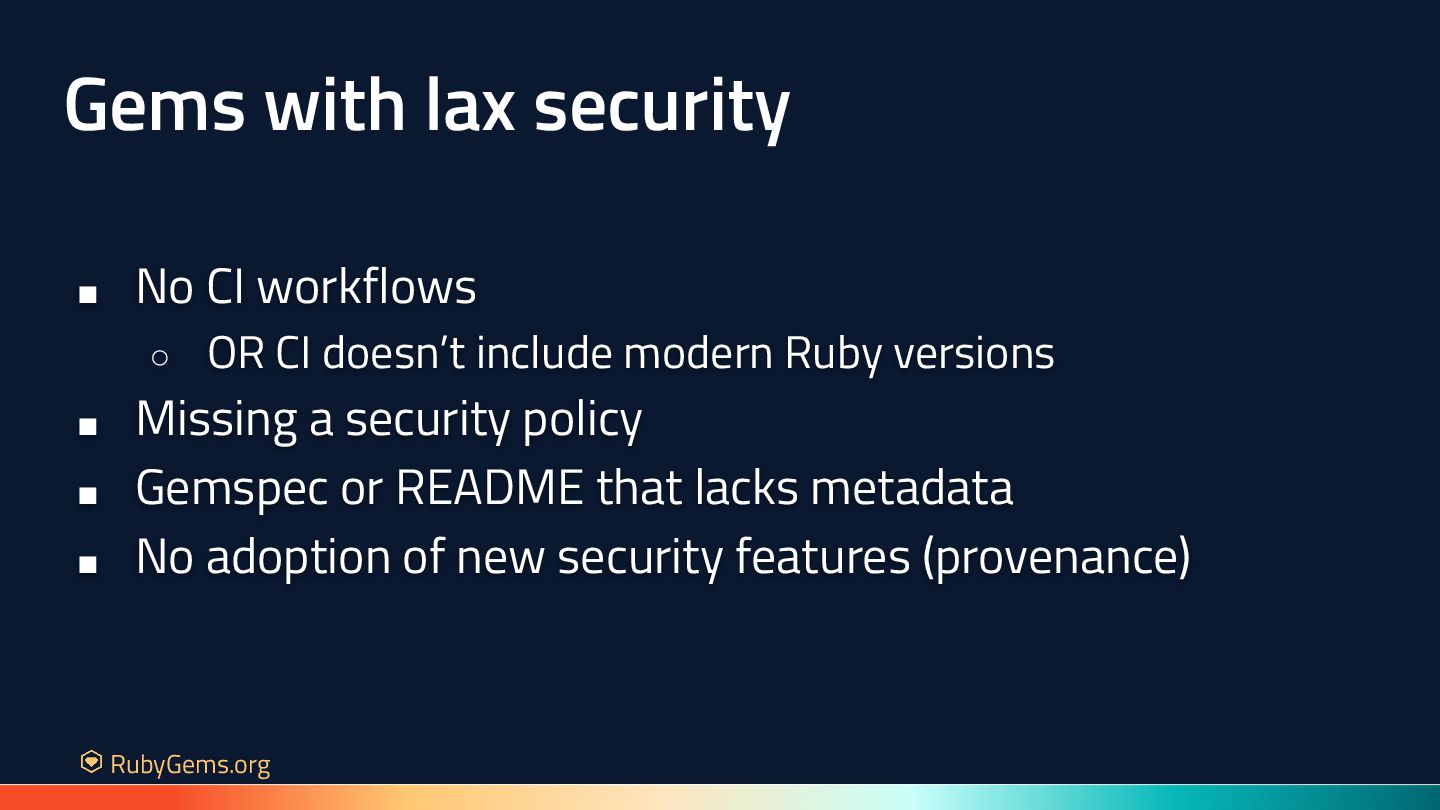
RubyGems.org Gems with lax security ▪ No CI workflows ◦
OR CI doesn’t include modern Ruby versions ▪ Missing a security policy ▪ Gemspec or README that lacks metadata ▪ No adoption of new security features (provenance) -
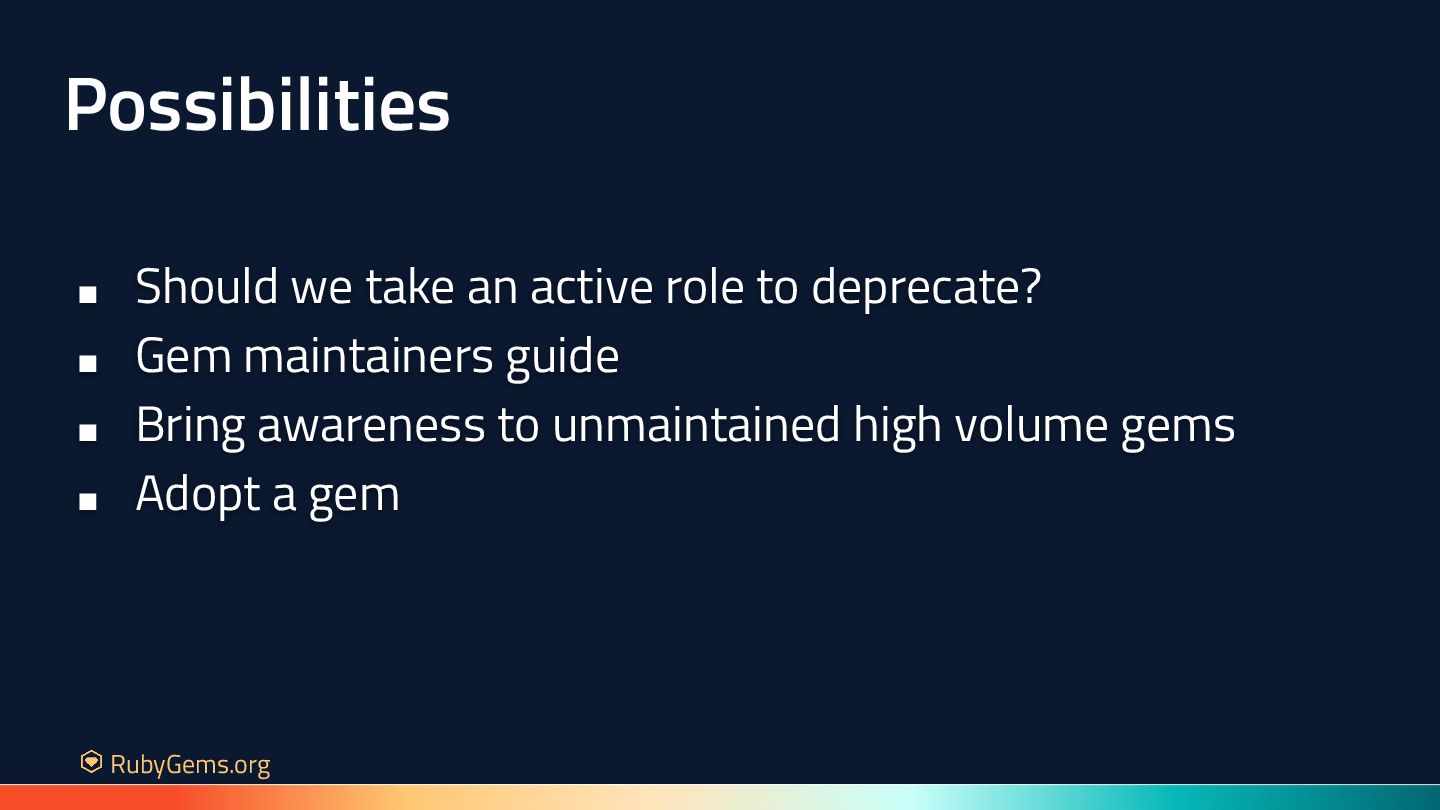
RubyGems.org Possibilities ▪ Should we take an active role to
deprecate? ▪ Gem maintainers guide ▪ Bring awareness to unmaintained high volume gems ▪ Adopt a gem -
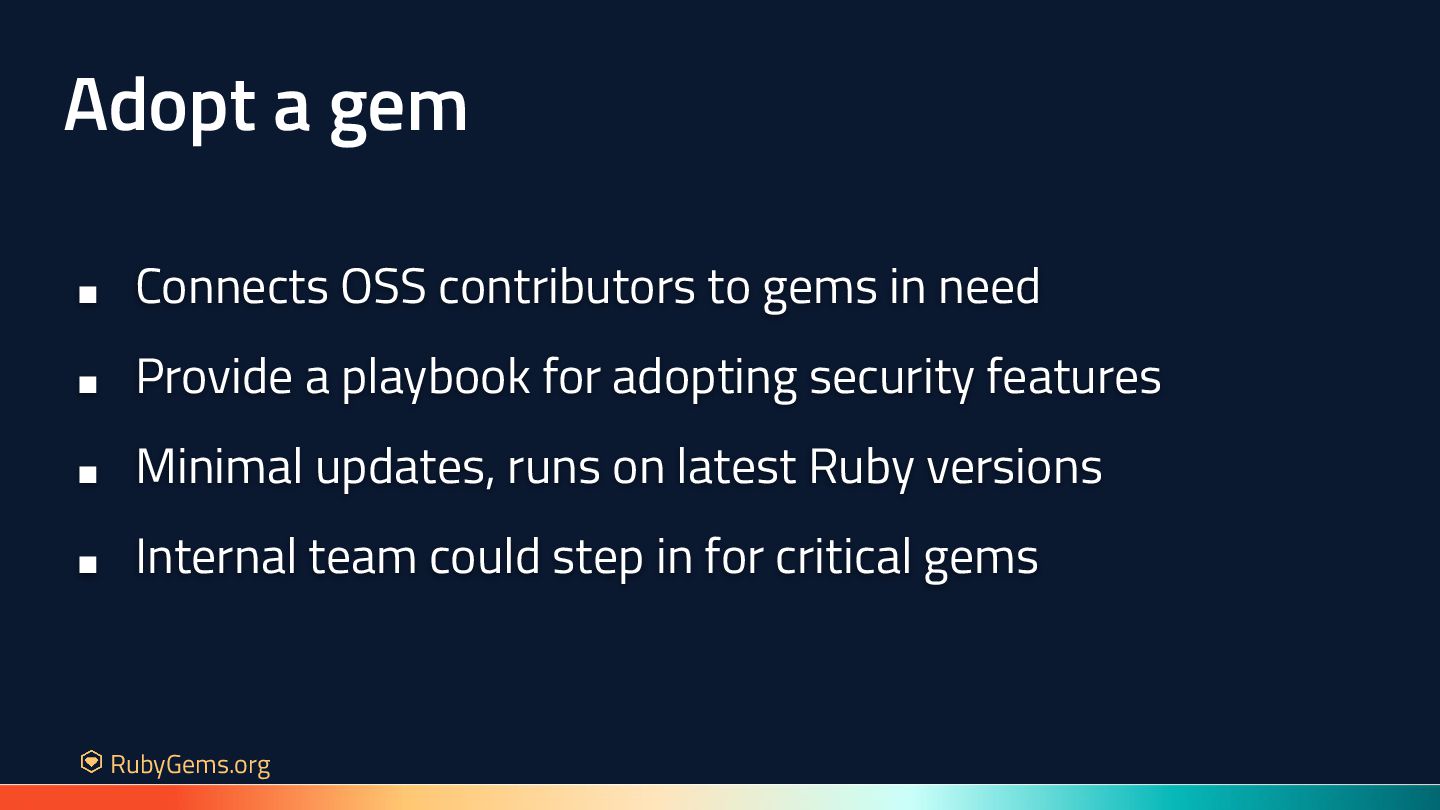
RubyGems.org Adopt a gem ▪ Connects OSS contributors to gems
in need ▪ Provide a playbook for adopting security features ▪ Minimal updates, runs on latest Ruby versions ▪ Internal team could step in for critical gems -
RubyGems.org Fiscal sponsorship ▪ A way for open source projects
to receive donations, hold funds, and manage finances without forming a legal entity ▪ Notable examples: Software Freedom Conservancy, Open Collective -
RubyGems.org Ruby Central Program ▪ Hanami is our first recipient
▪ Simplifies fundraising for projects ▪ Higher percentage of funds go to the project ▪ What other projects might be interested? -
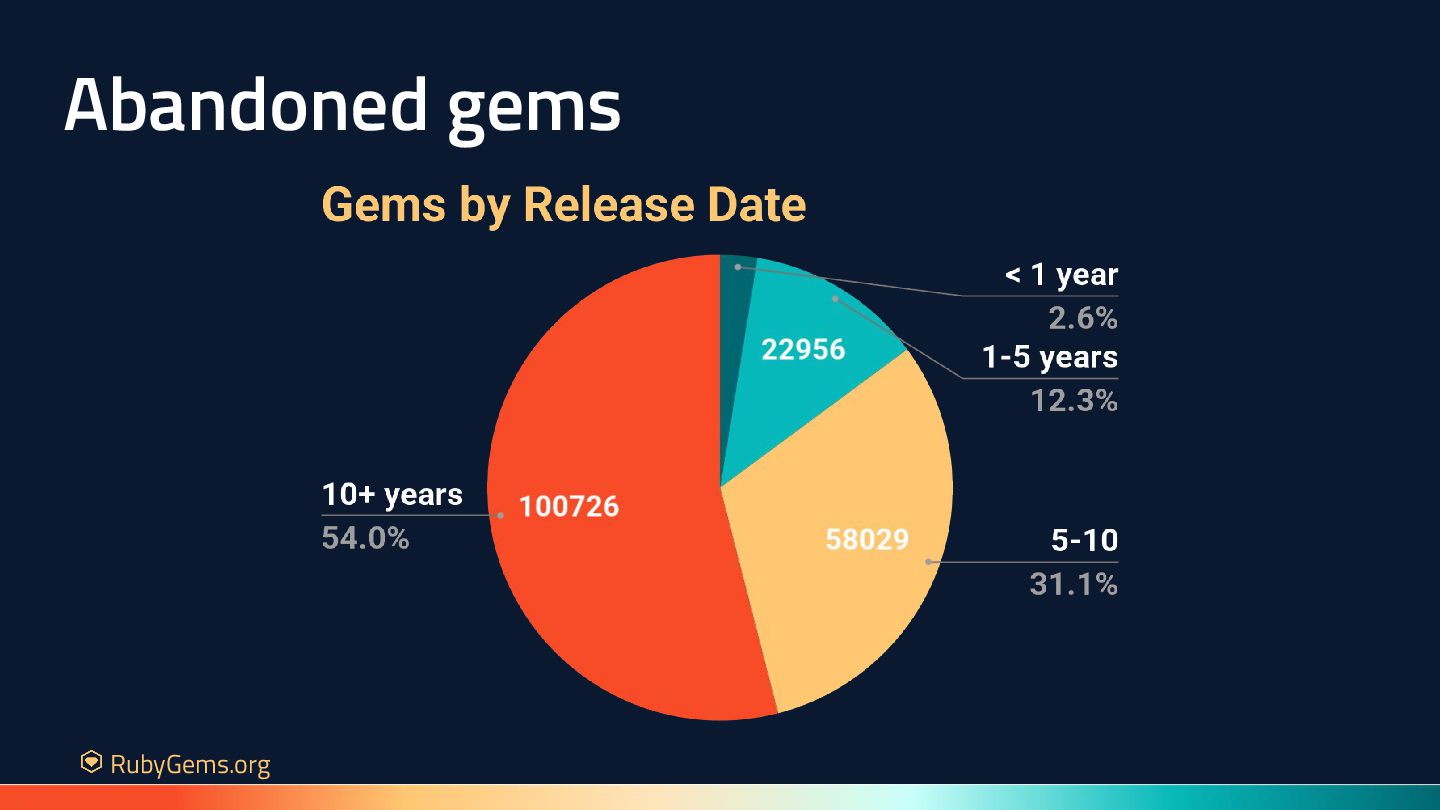
RubyGems.org Status quo ▪ Organic, happenstance ▪ Maintainer attrition ▪
Leads to abandoned projects -
RubyGems.org Possibilities ▪ Make it easier for new members to
contribute ▪ Develop onboarding and training ▪ Intentionally recruit ▪ Funding will be an important piece -
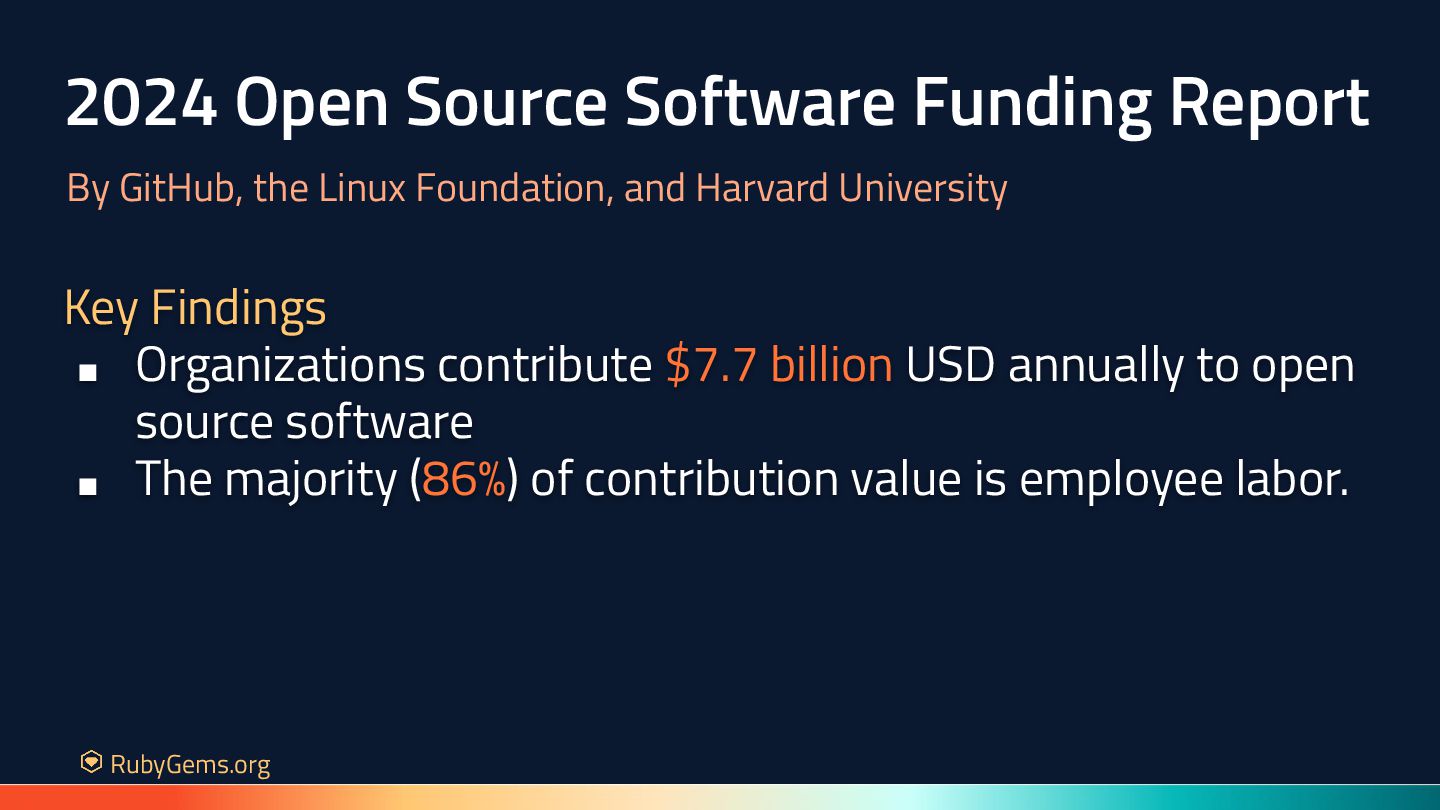
RubyGems.org 2024 Open Source Software Funding Report Key Findings ▪
Organizations contribute $7.7 billion USD annually to open source software ▪ The majority (86%) of contribution value is employee labor. By GitHub, the Linux Foundation, and Harvard University -
RubyGems.org Employee staffing ▪ Natural fit for augmentation, boosting a
project ▪ Not ideal for a service ▪ Increased overhead ▪ What happens when business interests change? -
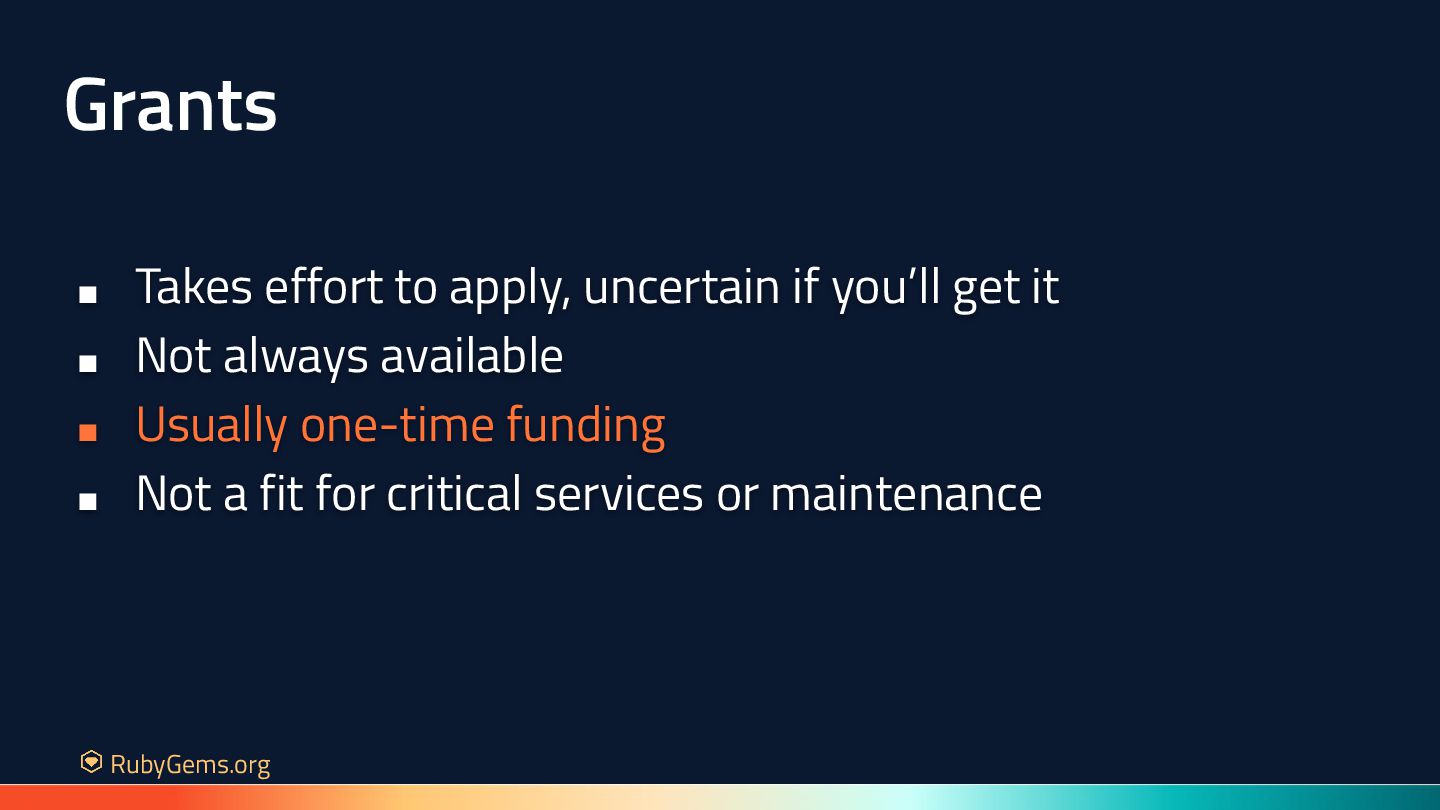
RubyGems.org Grants ▪ Takes effort to apply, uncertain if you’ll
get it ▪ Not always available ▪ Usually one-time funding ▪ Not a fit for critical services or maintenance -
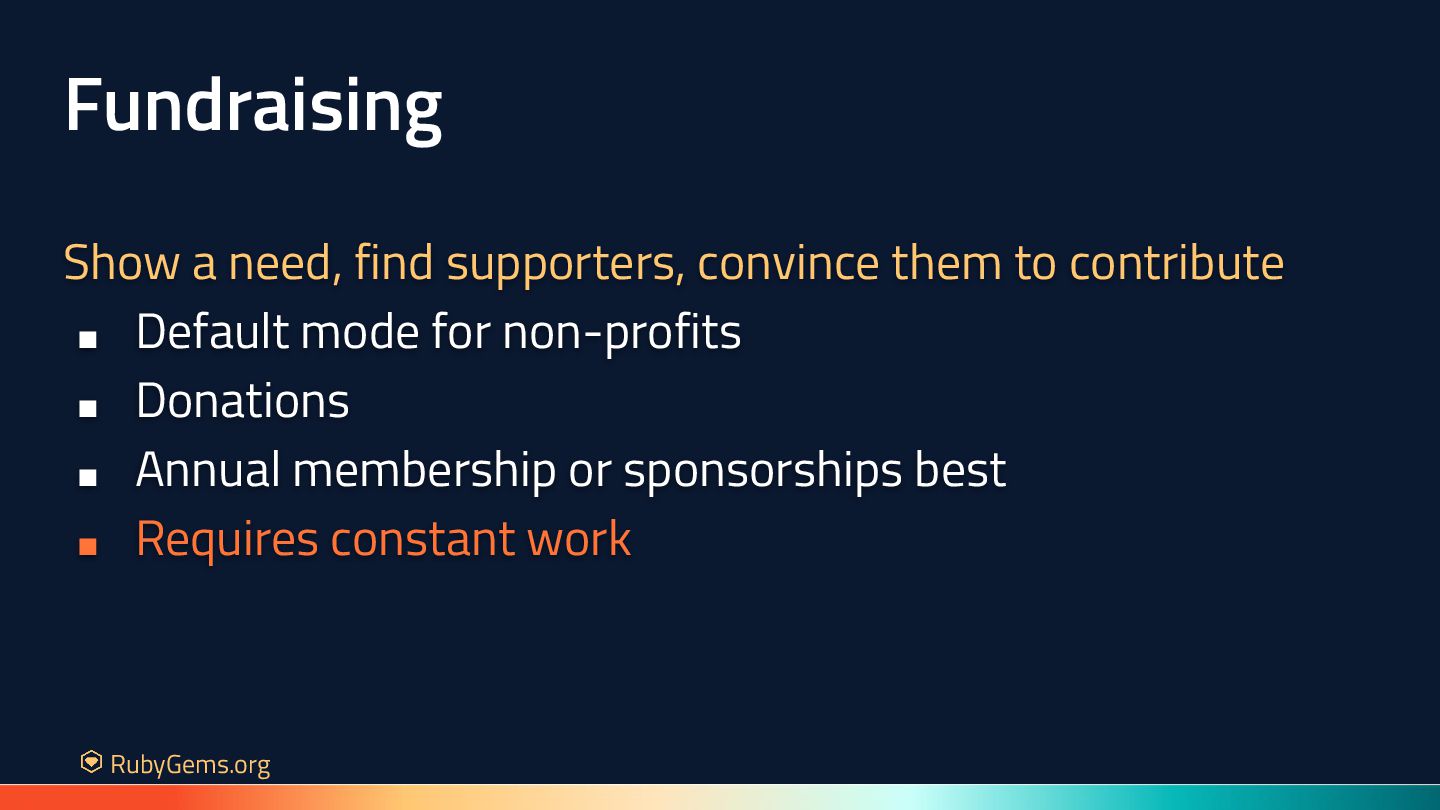
RubyGems.org Fundraising Show a need, find supporters, convince them to
contribute ▪ Default mode for non-profits ▪ Donations ▪ Annual membership or sponsorships best ▪ Requires constant work -
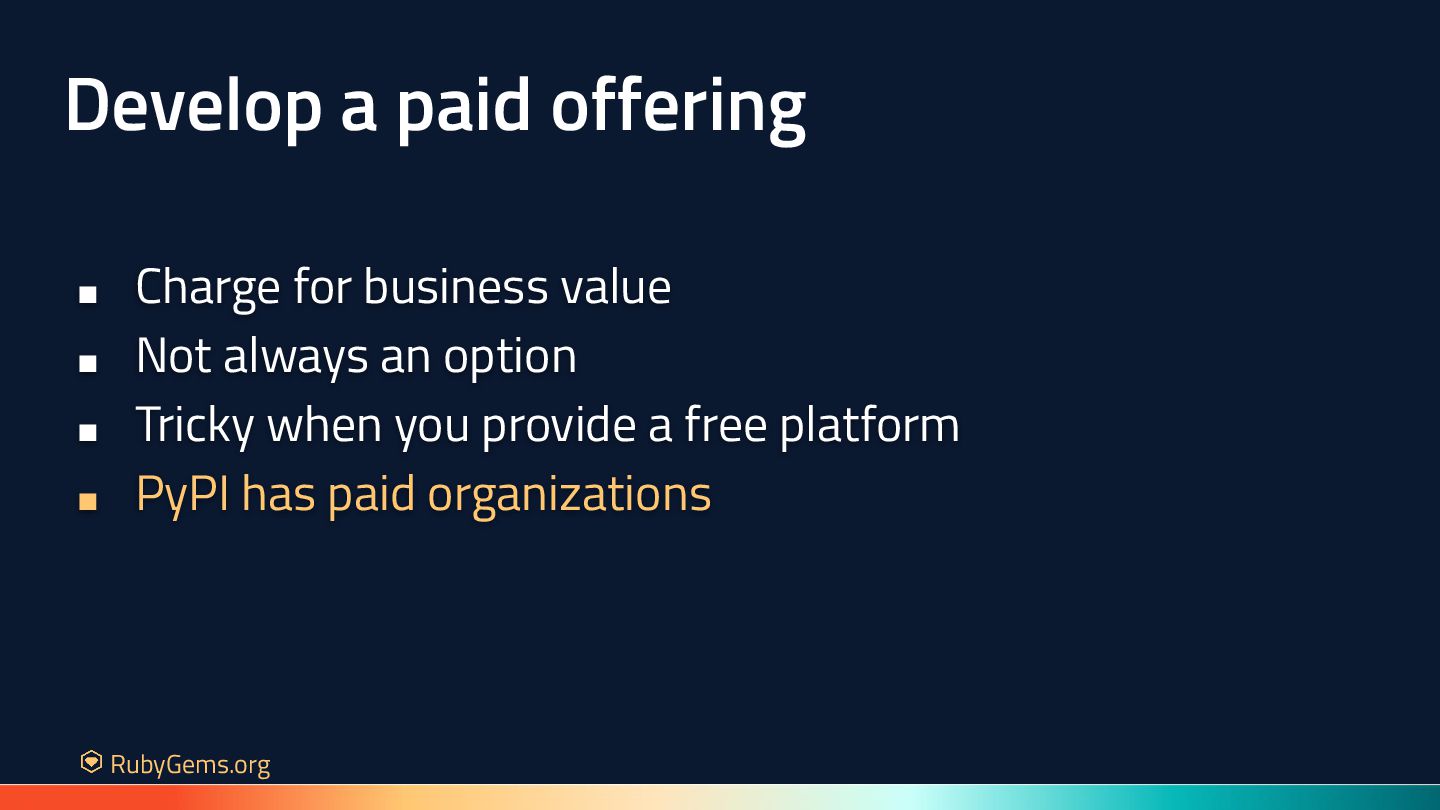
RubyGems.org Develop a paid offering ▪ Charge for business value
▪ Not always an option ▪ Tricky when you provide a free platform ▪ PyPI has paid organizations -
RubyGems.org 2025 forecast $1.4M budget ▪ $733k collected ▪ $385k
committed ▪ $380k gap ▪ 51% is grant-based, non-recurring -
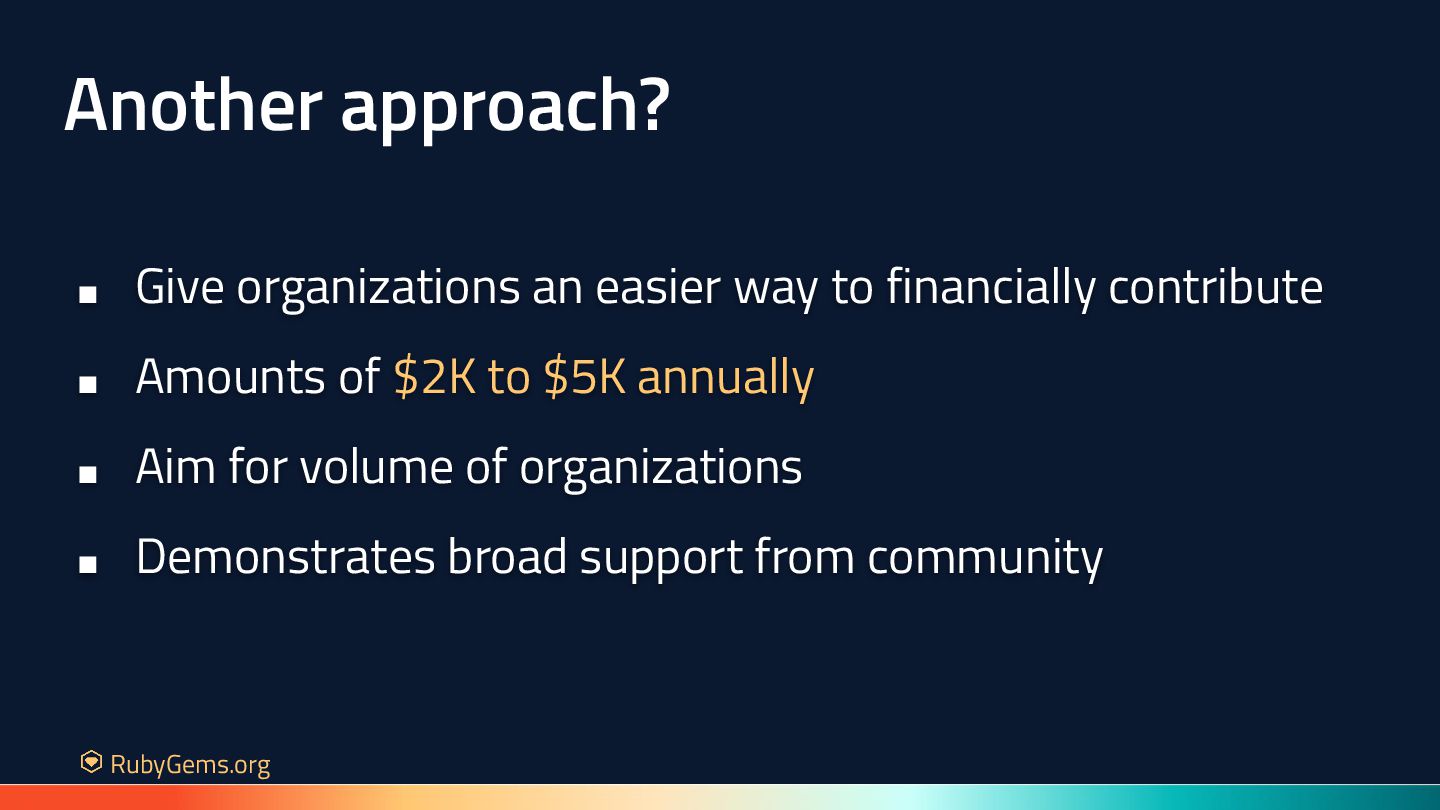
RubyGems.org Another approach? ▪ Give organizations an easier way to
financially contribute ▪ Amounts of $2K to $5K annually ▪ Aim for volume of organizations ▪ Demonstrates broad support from community -
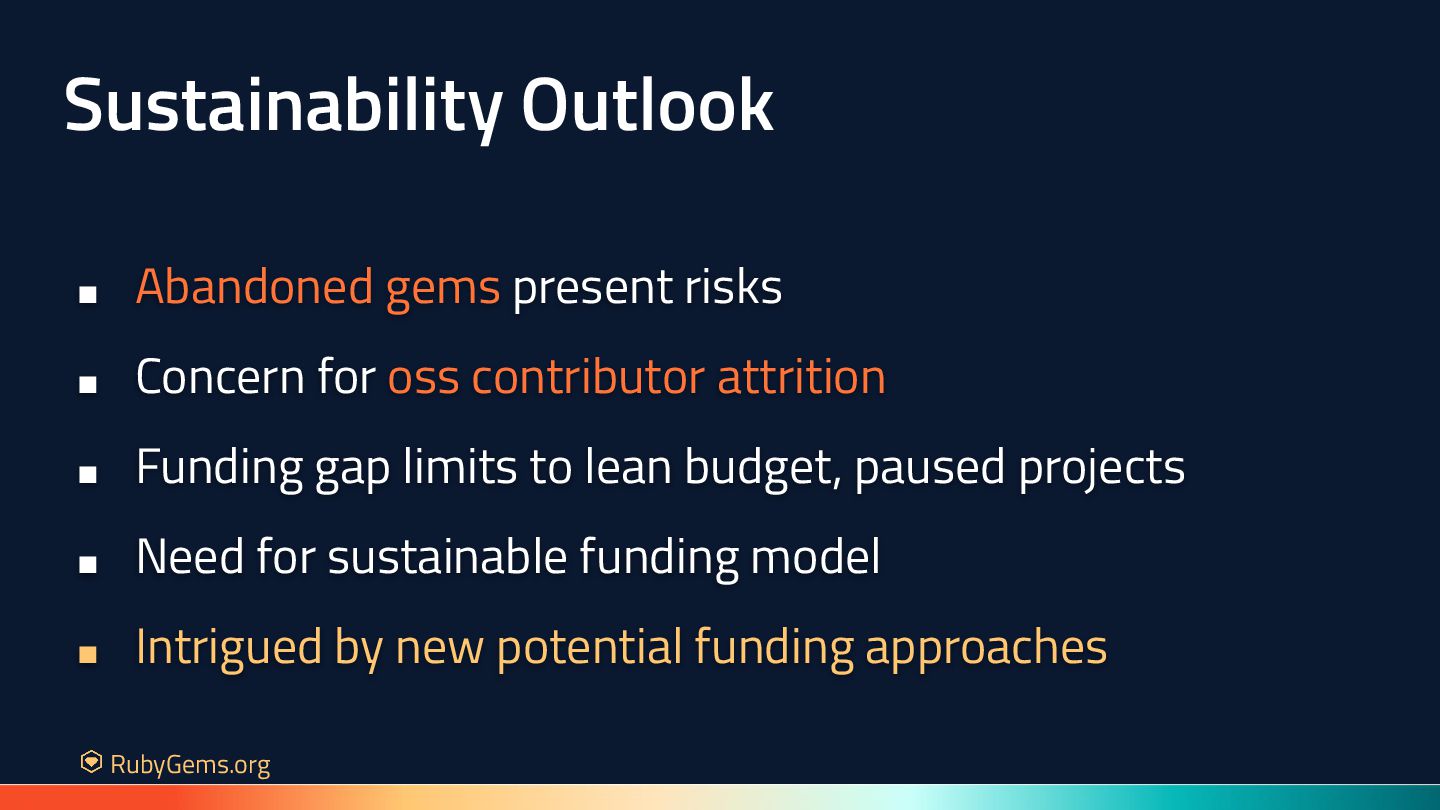
RubyGems.org Sustainability Outlook ▪ Abandoned gems present risks ▪ Concern
for oss contributor attrition ▪ Funding gap limits to lean budget, paused projects ▪ Need for sustainable funding model ▪ Intrigued by new potential funding approaches -
RubyGems.org Which way should we go? ▪ Should we stay
lean, do ‘just enough’? ▪ Or play a larger role and invest beyond RubyGems? -
RubyGems.org How you can help ▪ Share what problems are
you seeing ▪ What part of my message resonated with you? ▪ Spread awareness, make introductions ▪ I’d love to hear your ideas