Upgrade to Pro — share decks privately, control downloads, hide ads and more …

The Future of Statistics Education: A Computati...

Sponsored · Your Podcast. Everywhere. Effortlessly. Share. Educate. Inspire. Entertain. You do you. We'll handle the rest.

The Future of Statistics Education: A Computational Perspective

Statistics education stands at a critical juncture as we navigate the intersection of traditional statistical theory, modern computational approaches, and emerging AI technologies. This talk examines how statisticians can reimagine curricula by embracing computation as a foundational element rather than an afterthought. While traditional statistics education has prioritized theoretical frameworks and applications, computation has emerged as the backbone of contemporary data analysis—from data acquisition and wrangling to visualization, modeling, and communication. Now, AI tools are further transforming this landscape, creating both opportunities and challenges for statistics and data science educators. The presentation will outline a forward-looking curriculum model for introductory courses that balances statistical thinking, data science methods, and explicit computational instruction.

Avatar for Mine Cetinkaya-Rundel

Mine Cetinkaya-Rundel

July 21, 2026

More Decks by Mine Cetinkaya-Rundel

Other Decks in Education

Transcript

  1. The Future of Statistics Education A Computational Perspective Mine Çetinkaya-rundel

    Duke university @university of Sydney for Statistical Society of Australia (NSW Branch) duke.is/future-stat-ed-ssa-nsw july 22, 2026
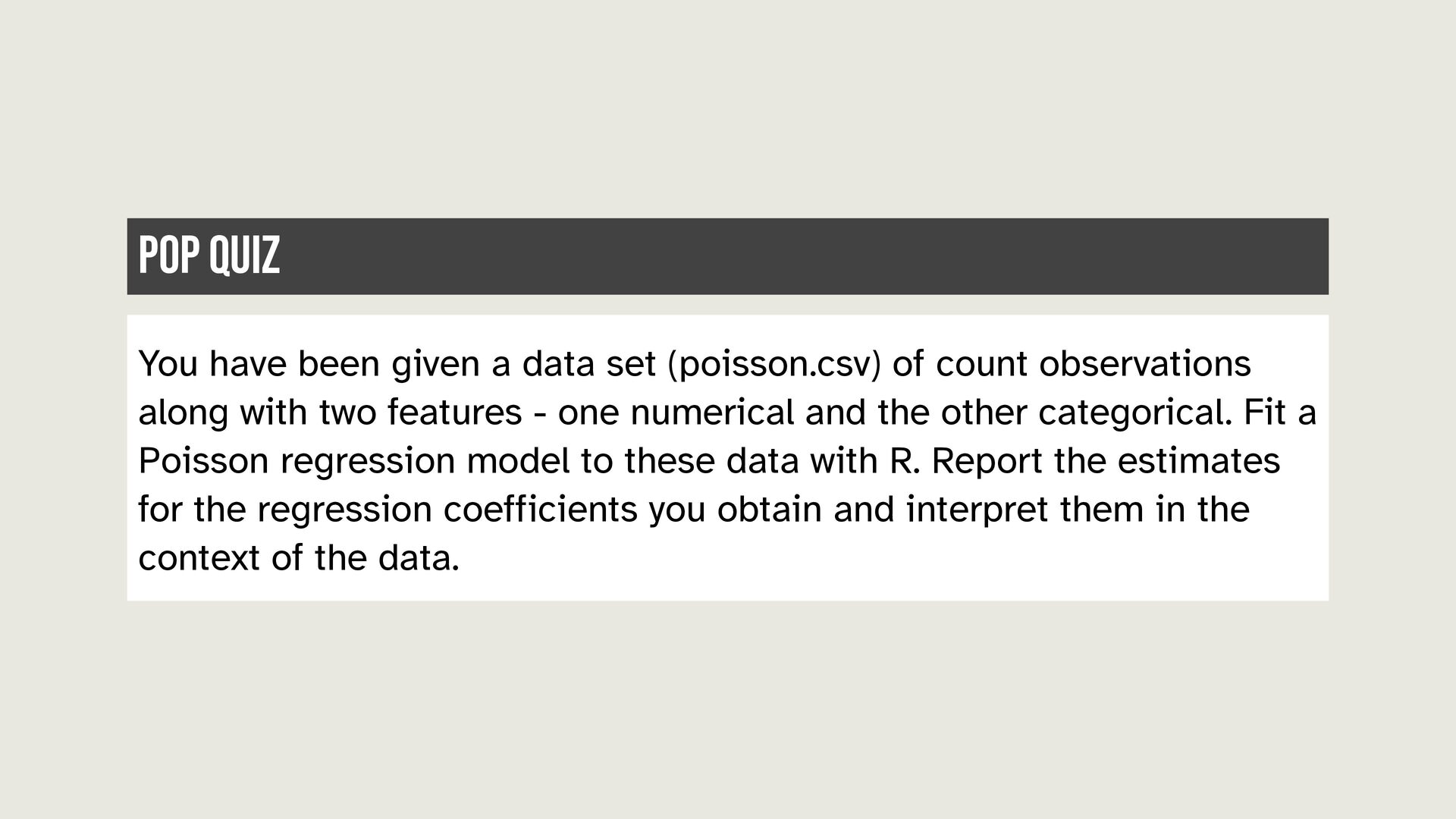
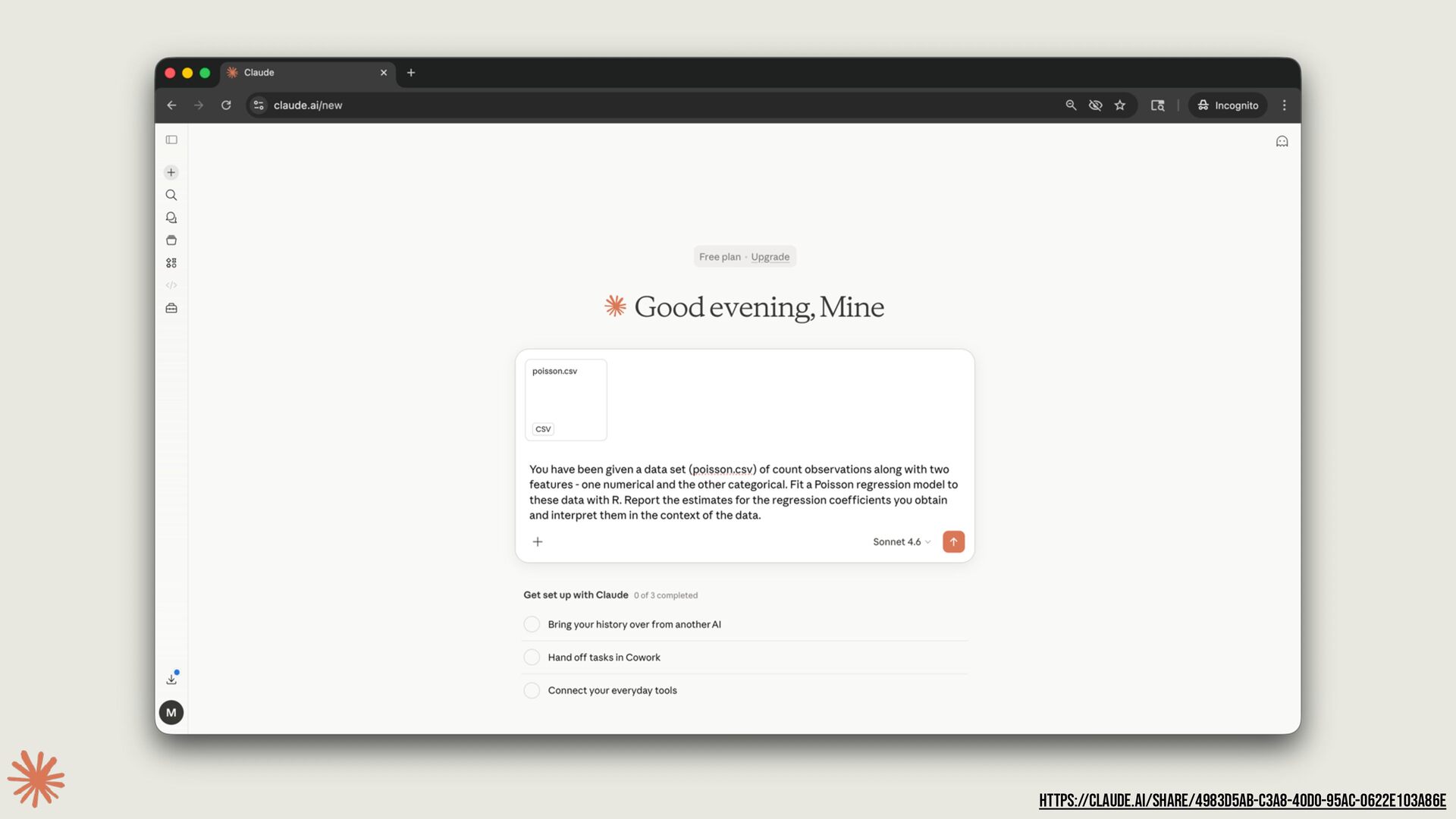
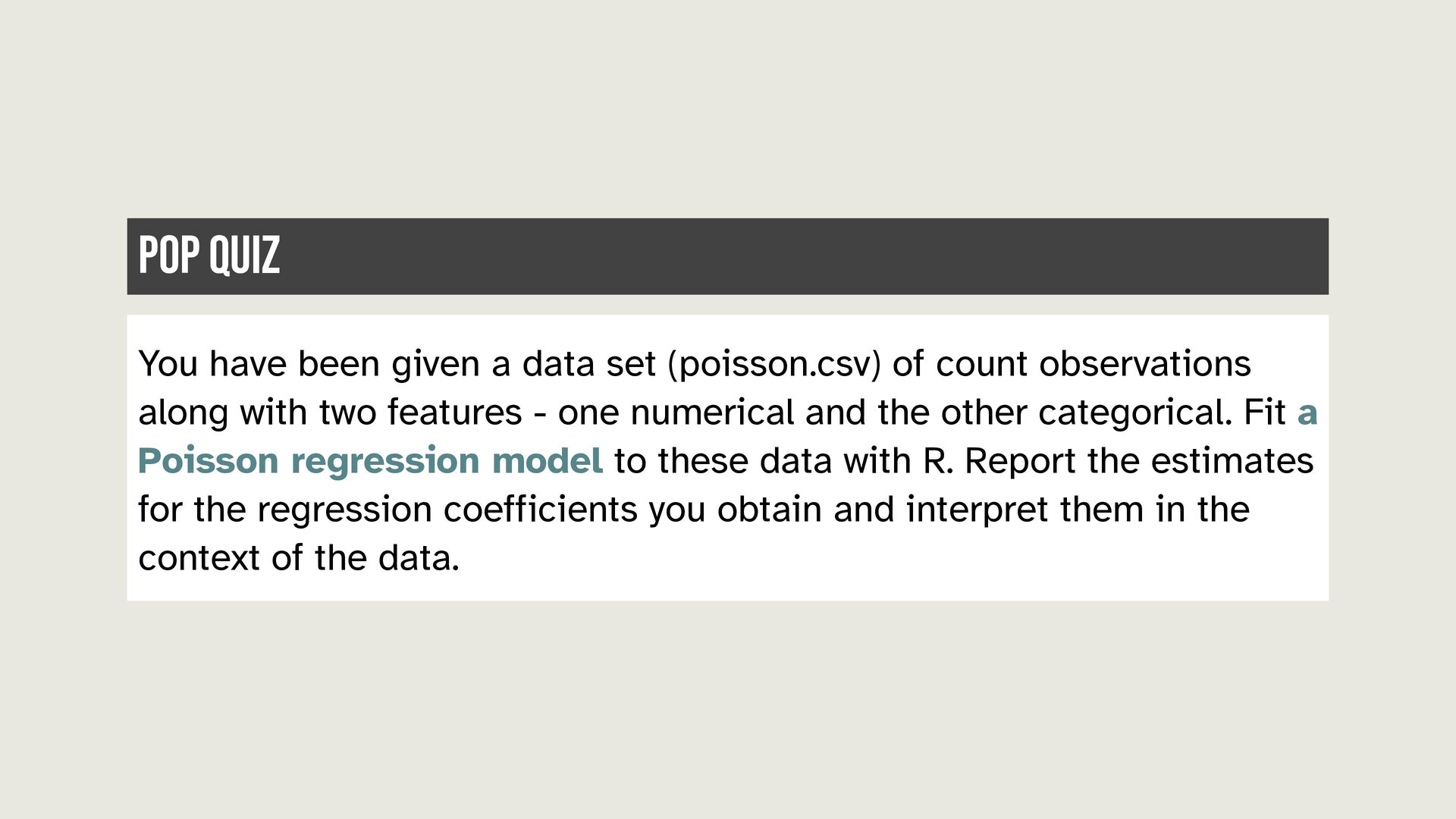
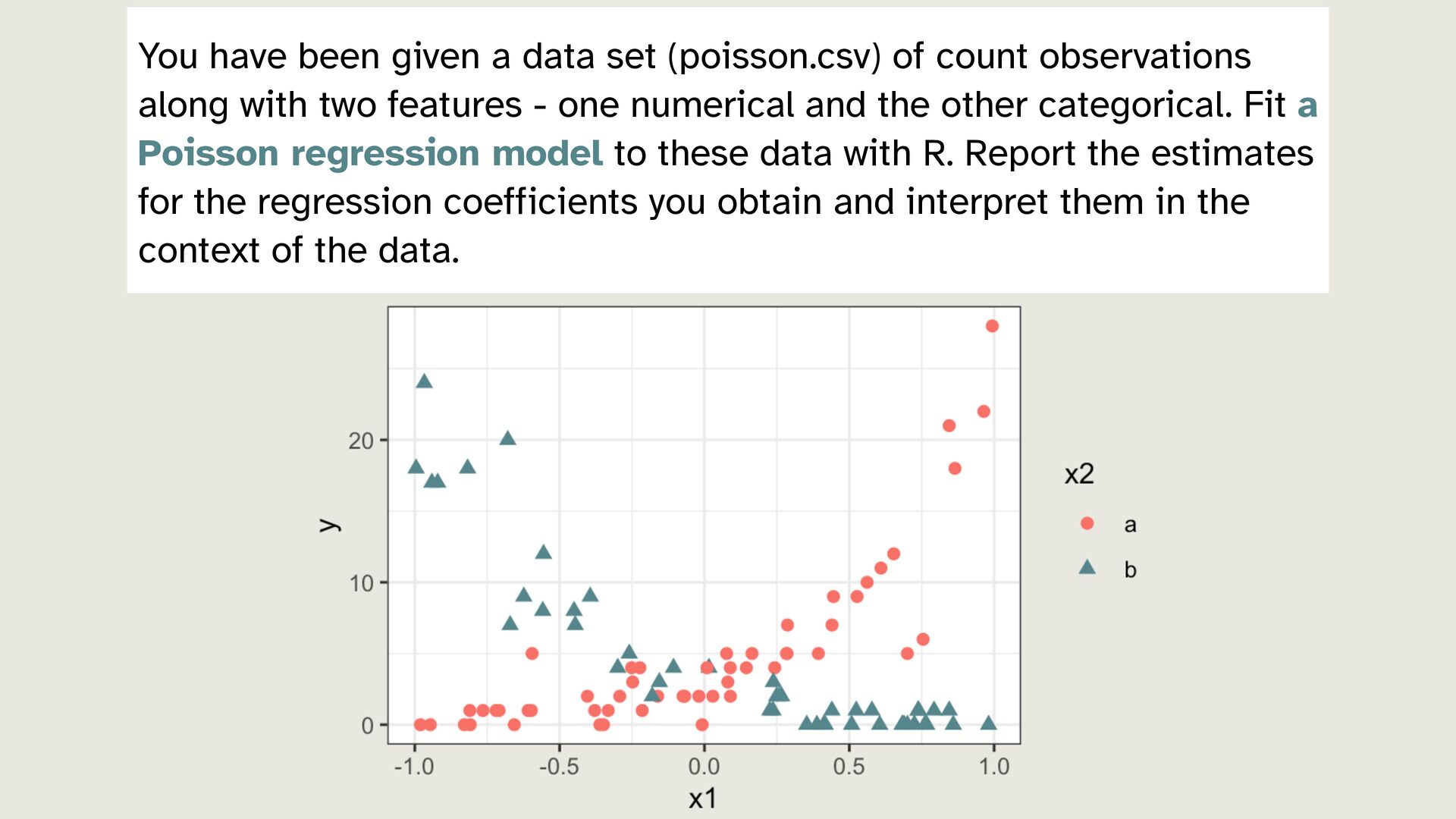
  2. Pop Quiz You have been given a data set (poisson.csv)

    of count observations along with two features - one numerical and the other categorical. Fit a Poisson regression model to these data with R. Report the estimates for the regression coefficients you obtain and interpret them in the context of the data.
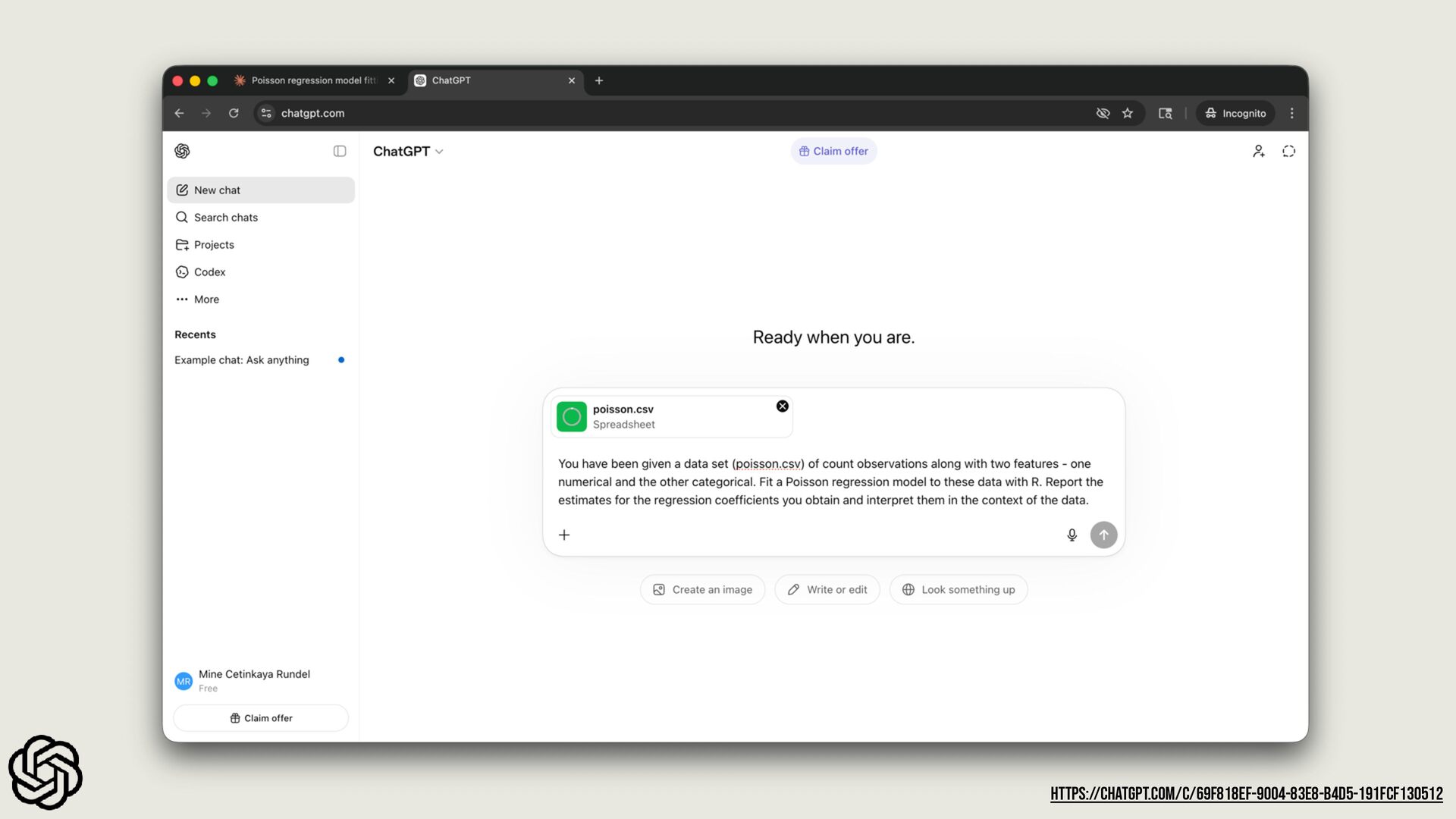
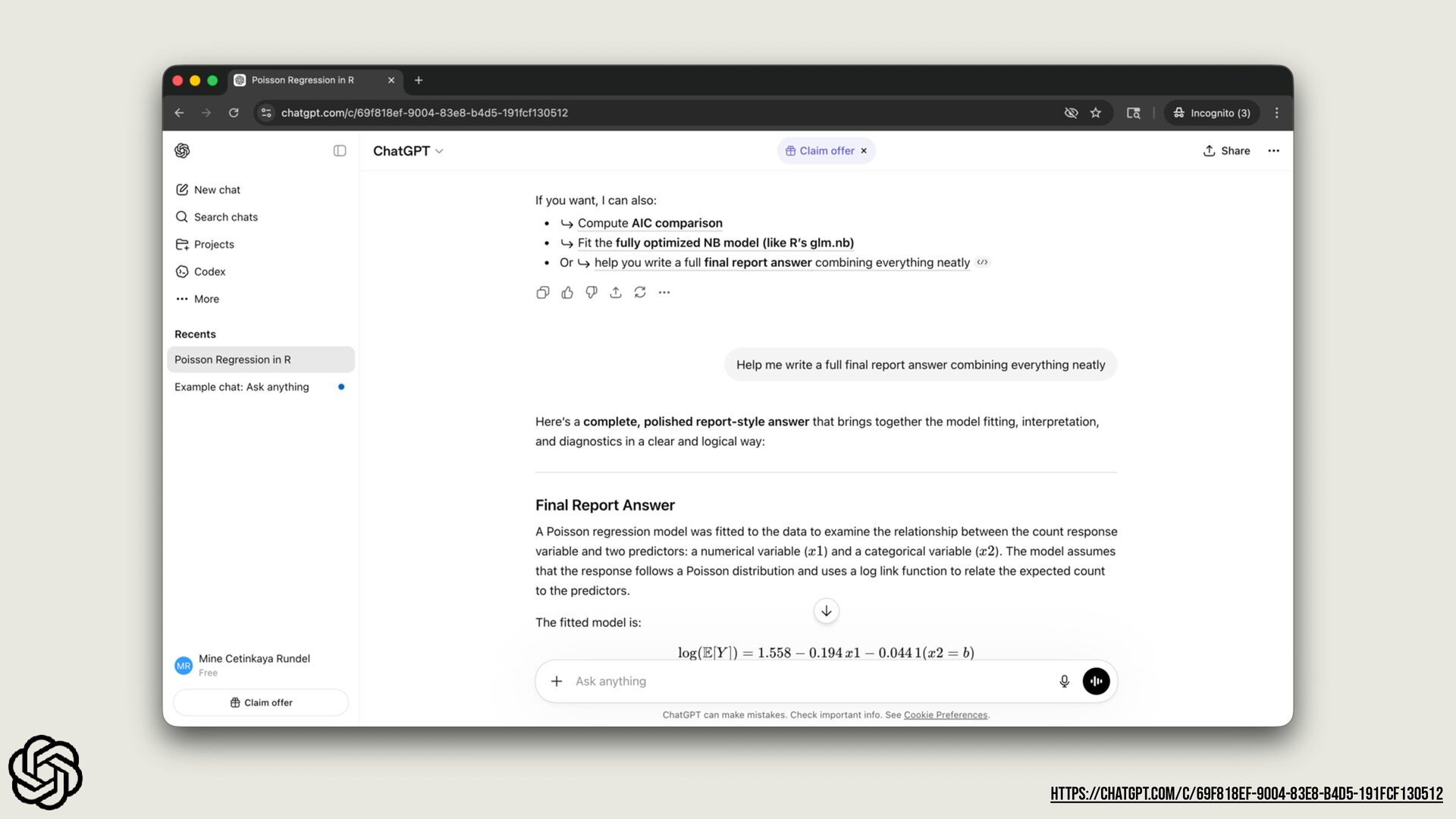
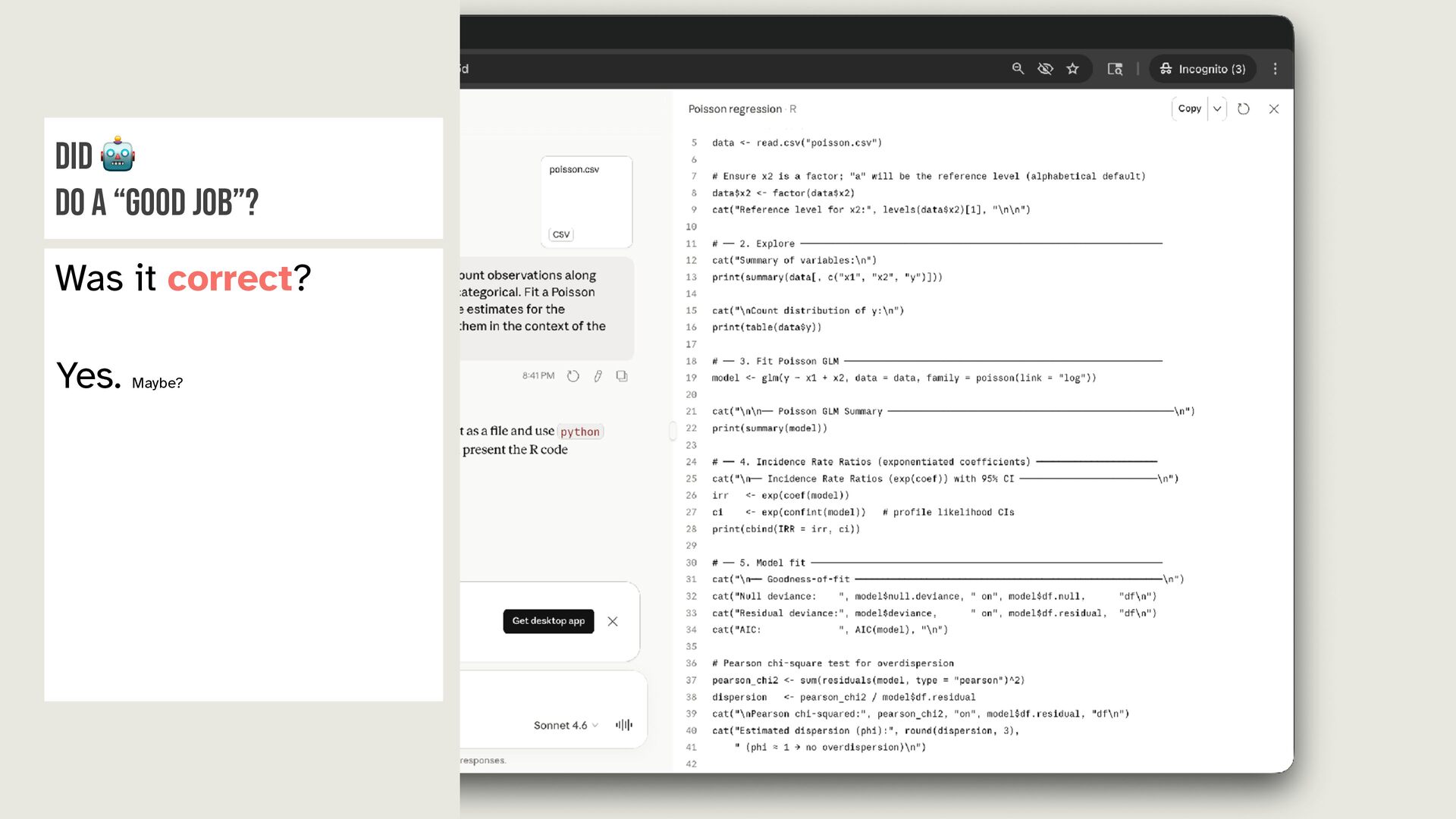
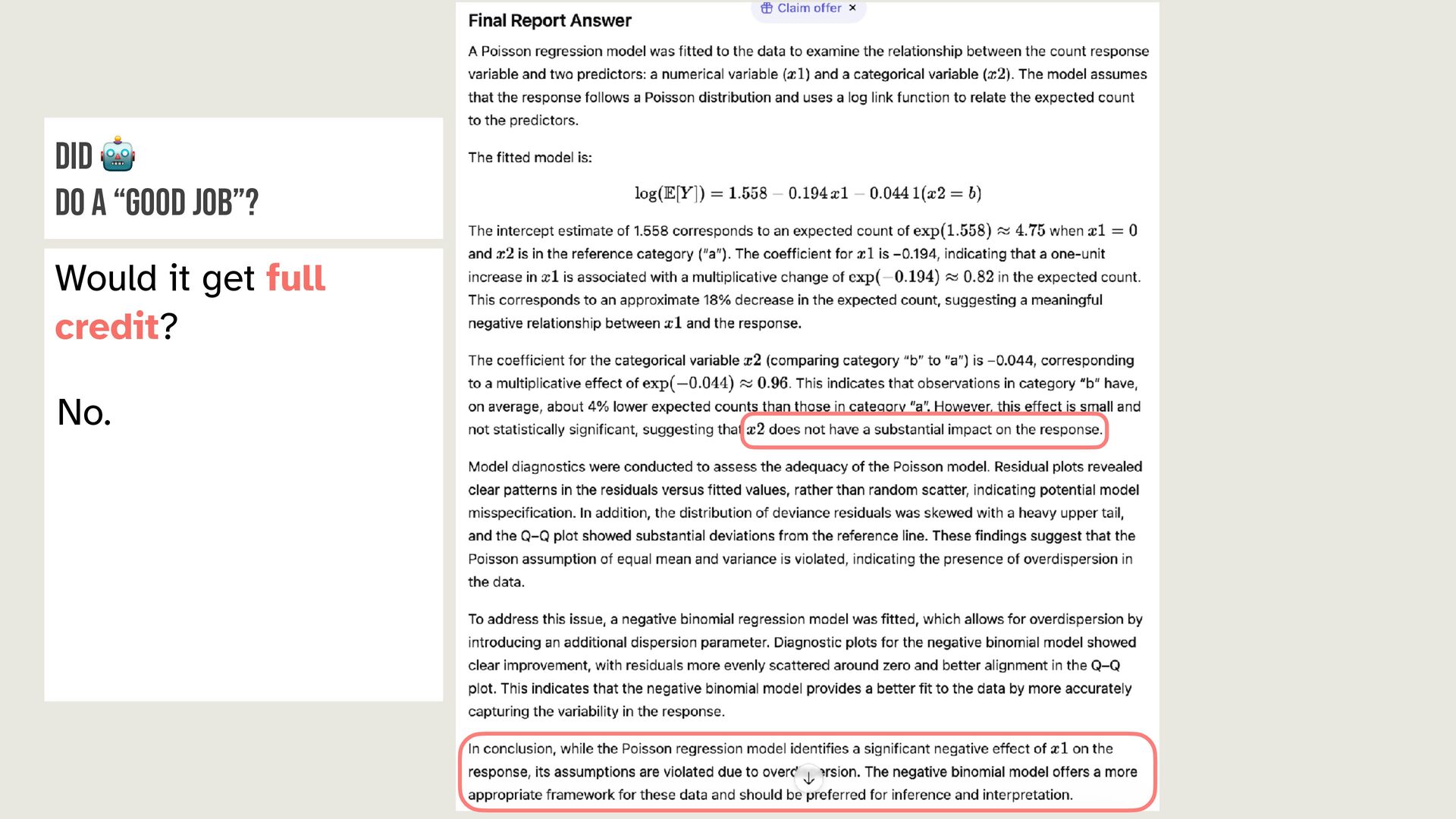
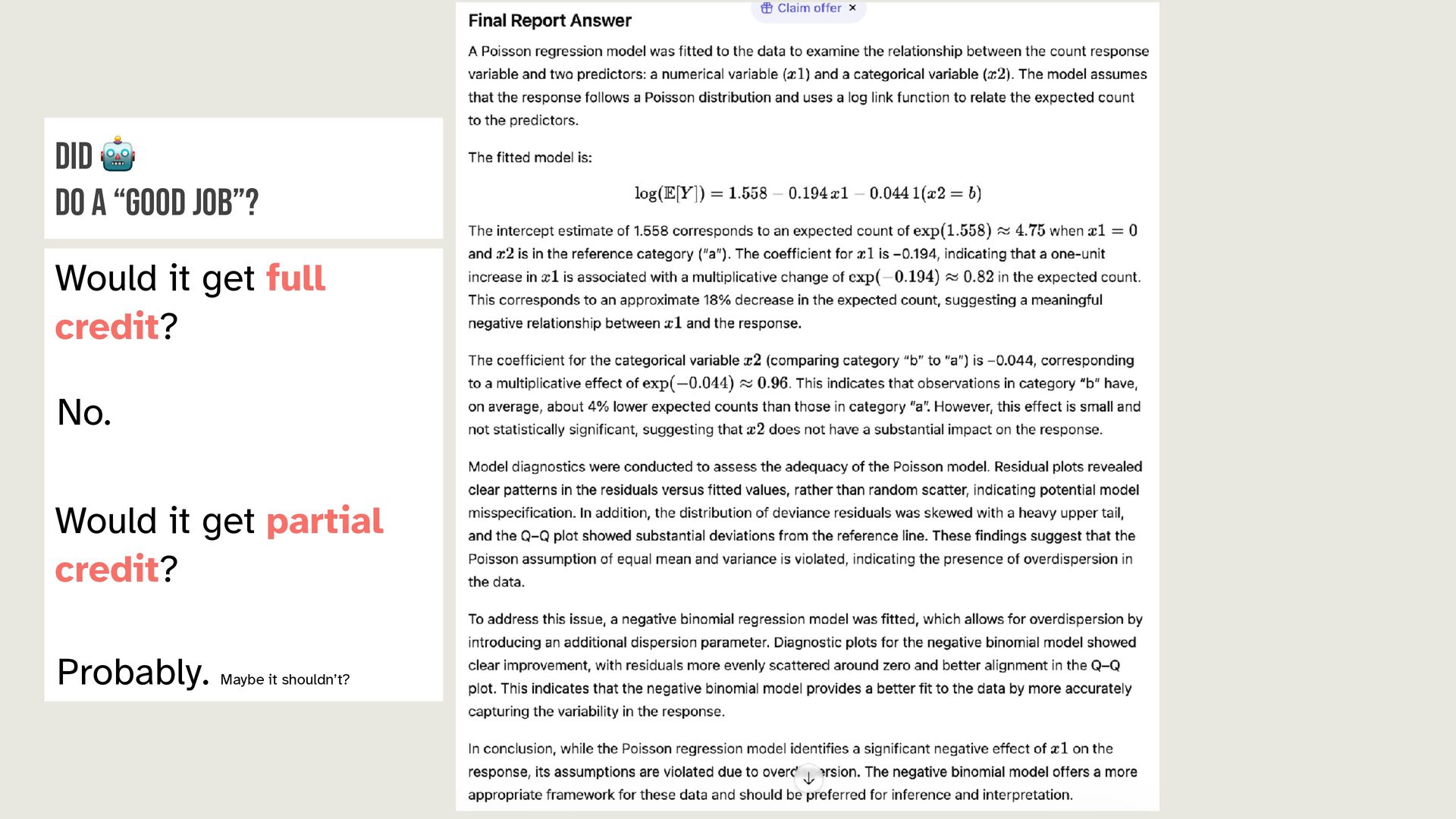
  3. Did 🤖 do a “good job”? Would it get full

    credit? No. Would it get partial credit? Probably. Maybe it shouldn’t?
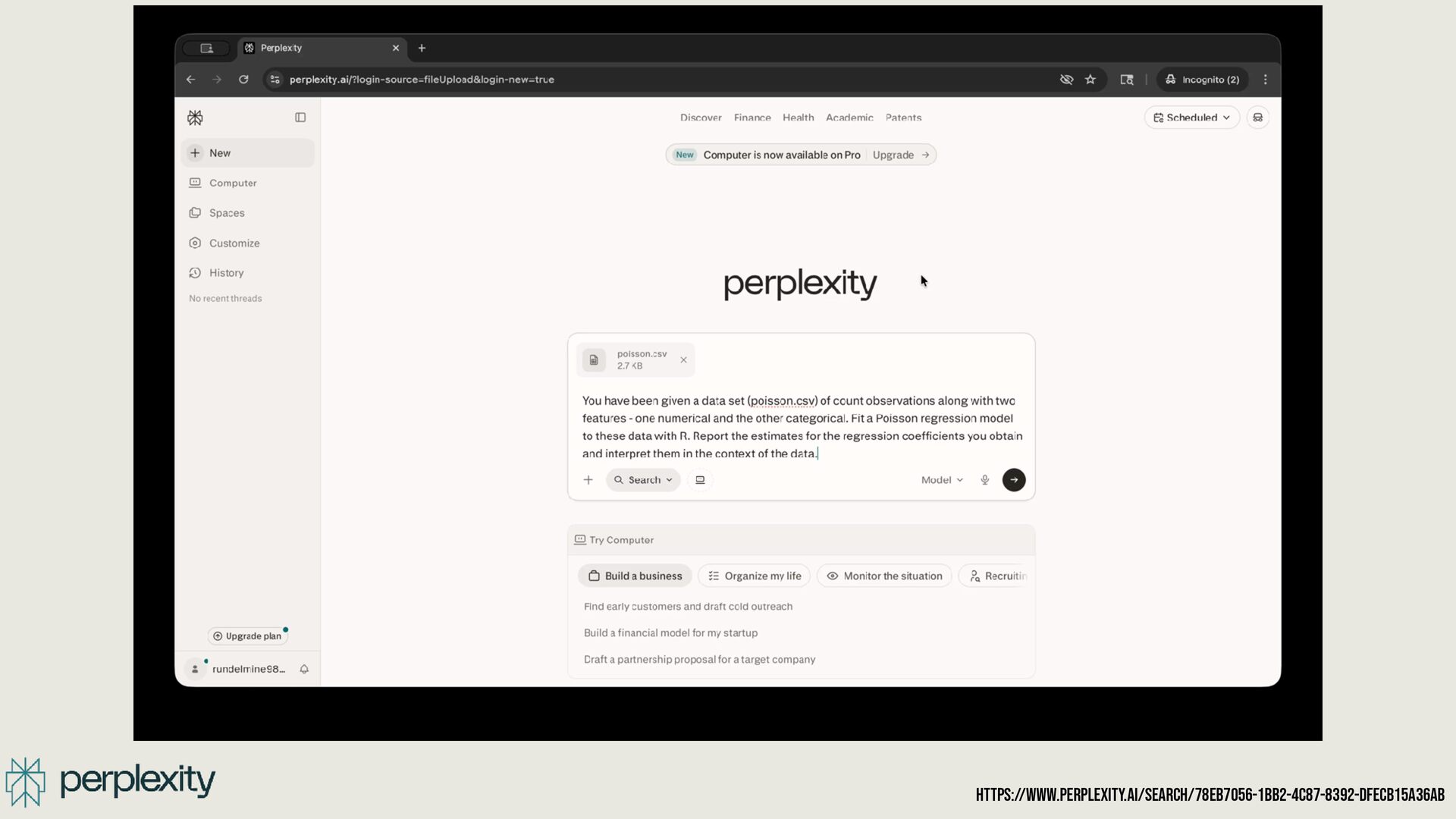
  4. Pop Quiz You have been given a data set (poisson.csv)

    of count observations along with two features - one numerical and the other categorical. Fit a Poisson regression model to these data with R. Report the estimates for the regression coefficients you obtain and interpret them in the context of the data.
  5. You have been given a data set (poisson.csv) of count

    observations along with two features - one numerical and the other categorical. Fit a Poisson regression model to these data with R. Report the estimates for the regression coefficients you obtain and interpret them in the context of the data.
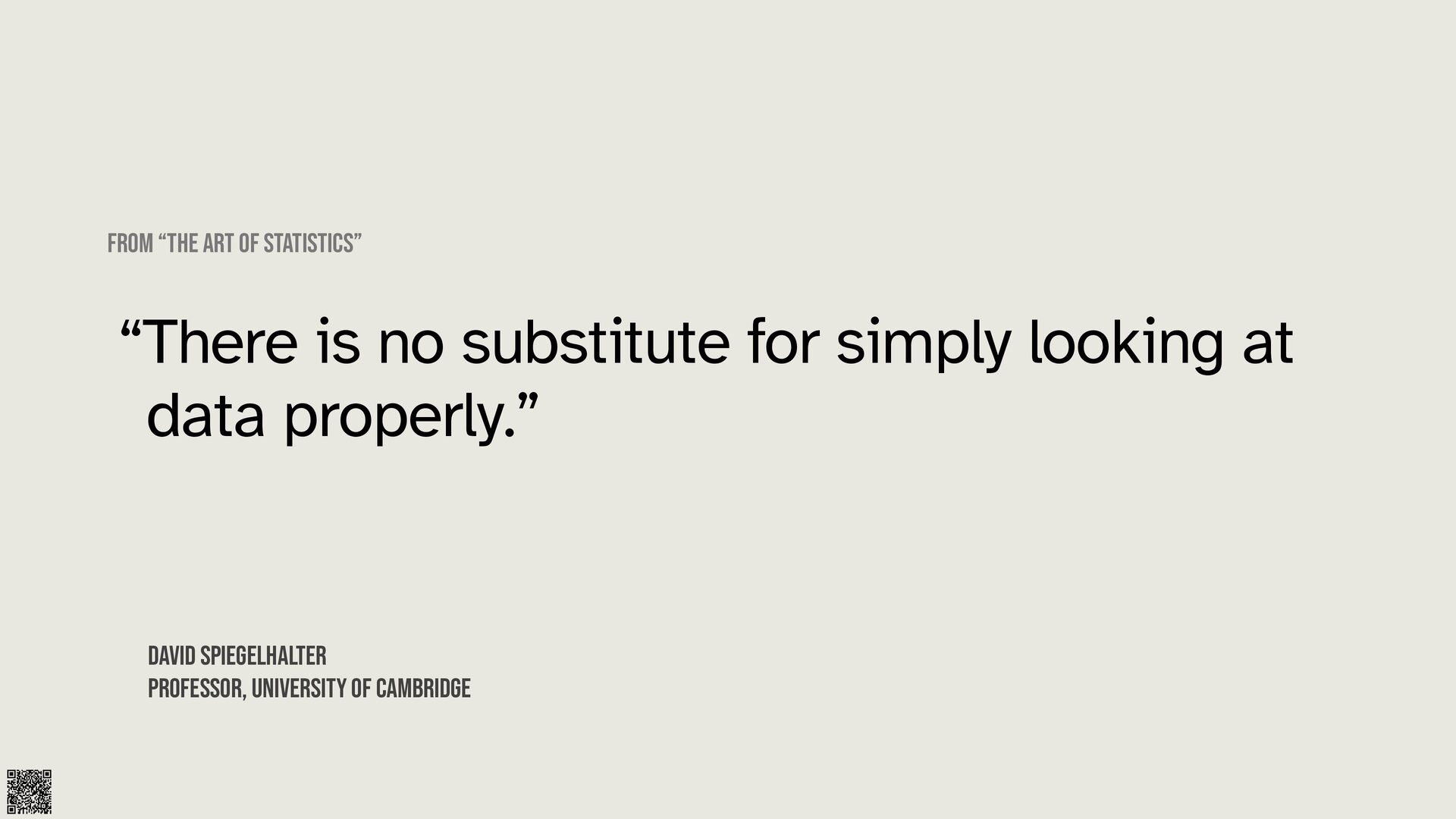
  6. from “The Art of Statistics” “There is no substitute for

    simply looking at data properly.” David Spiegelhalter Professor, University of Cambridge
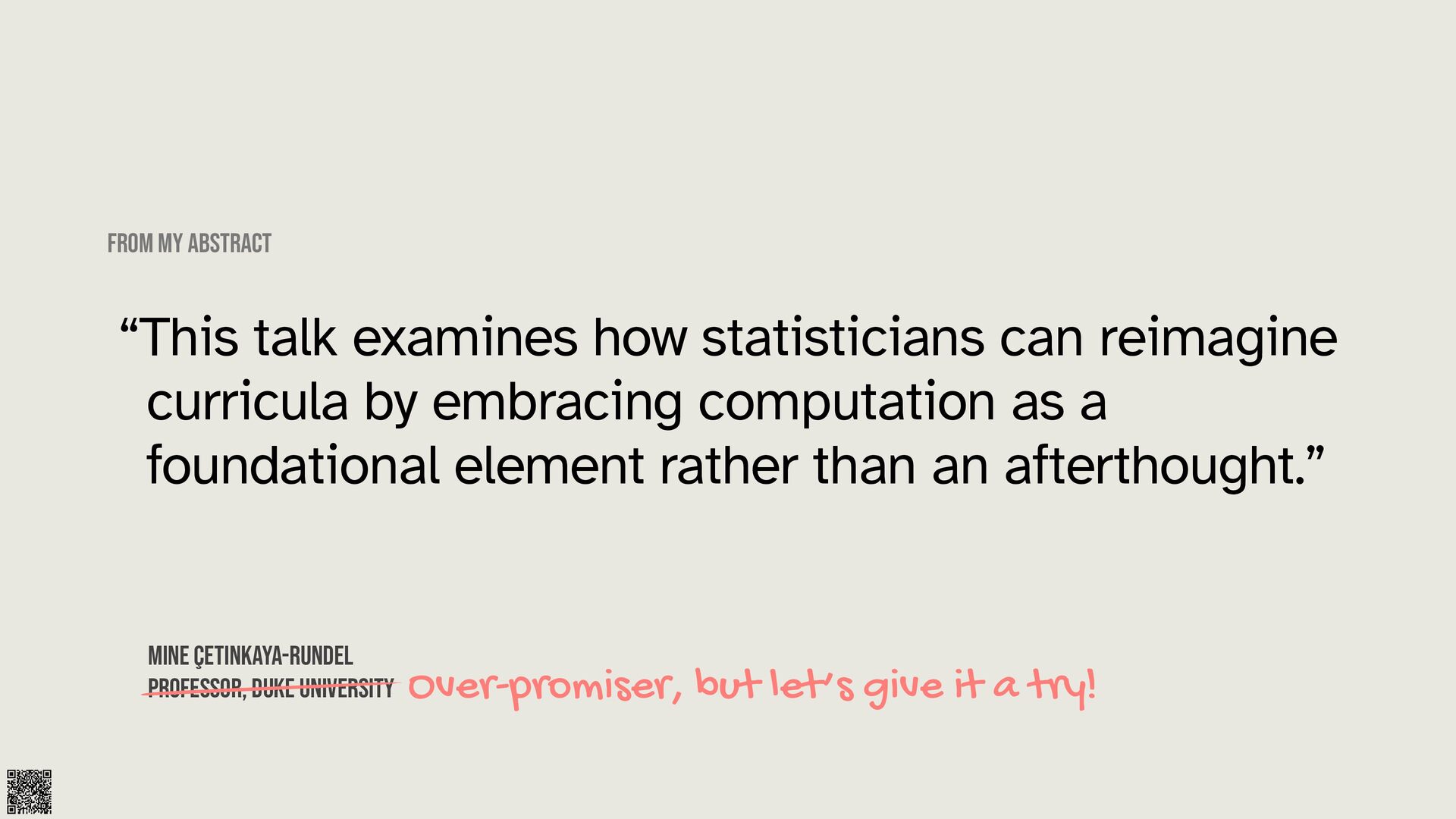
  7. from My abstract “This talk examines how statisticians can reimagine
    curricula by embracing computation as a foundational element rather than an afterthought.” Mine Çetinkaya-rundel Professor, Duke university Over-promiser, but let’s give it a try!
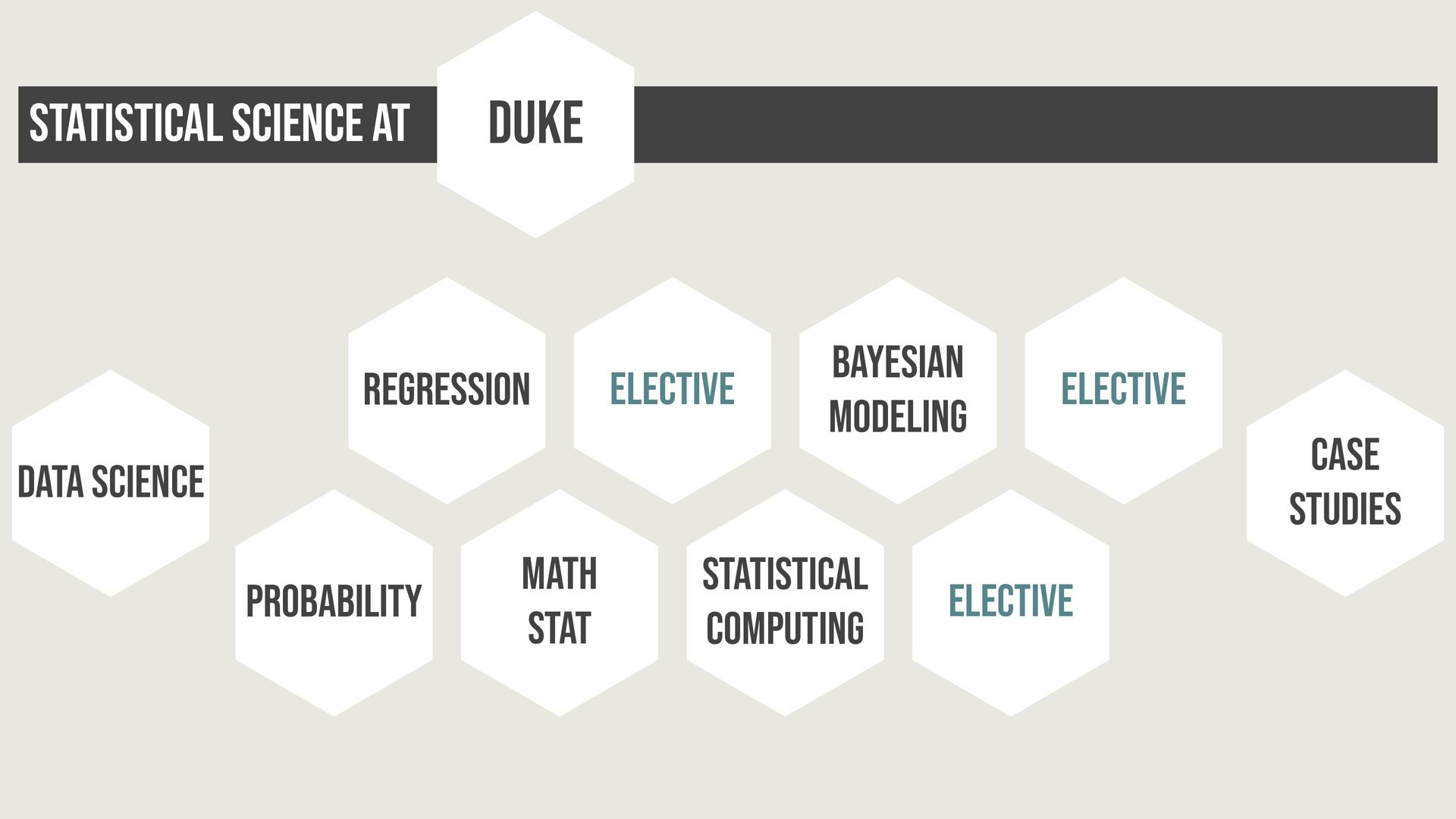
  8. Statistical science at Duke Regression Elective Bayesian modeling Elective Data

    science probability Math stat Statistical computing Elective Case studies
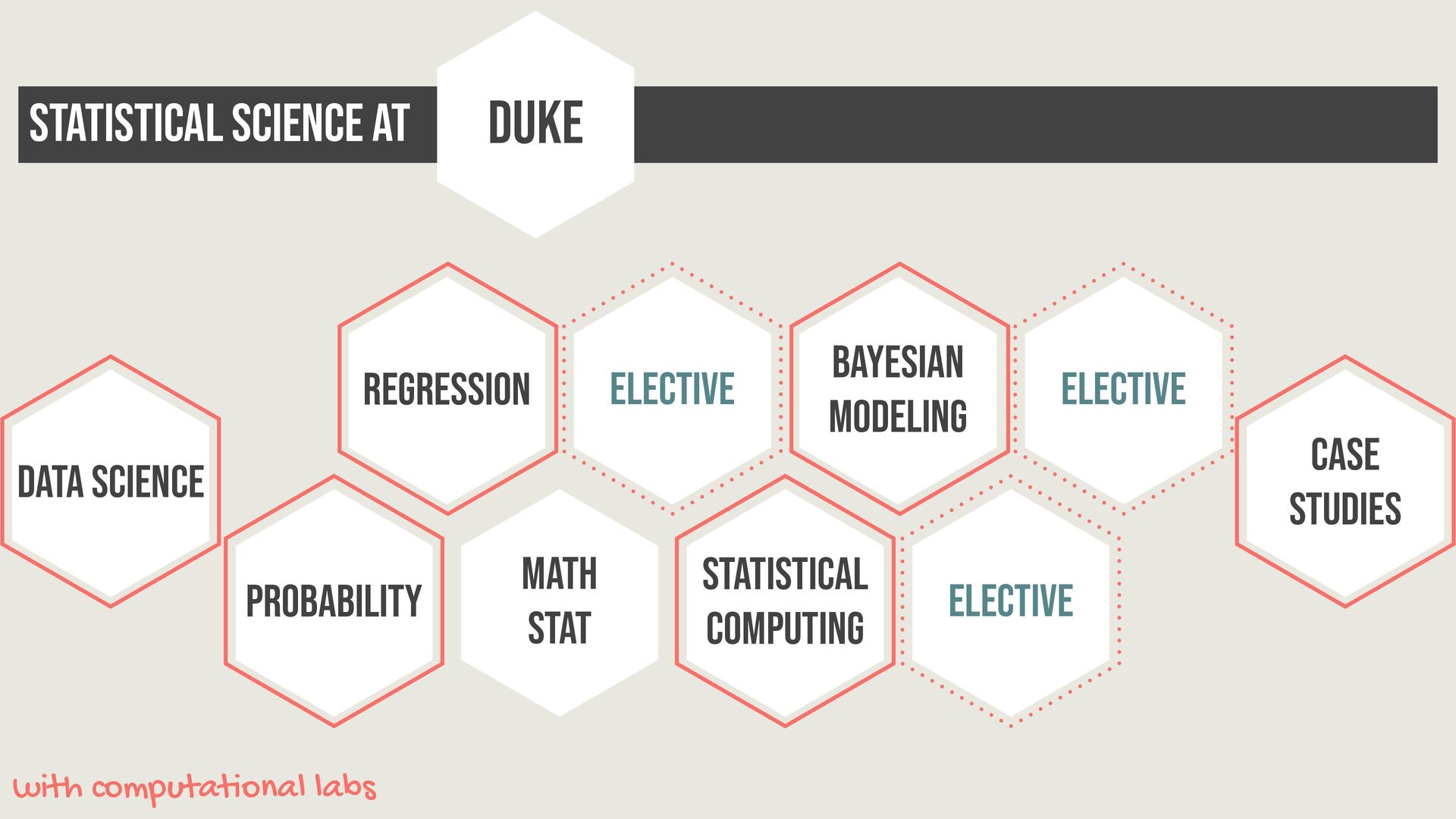
  9. Statistical science at Duke Regression Elective Bayesian modeling Elective Data

    science probability with computational labs Math stat Statistical computing Elective Case studies
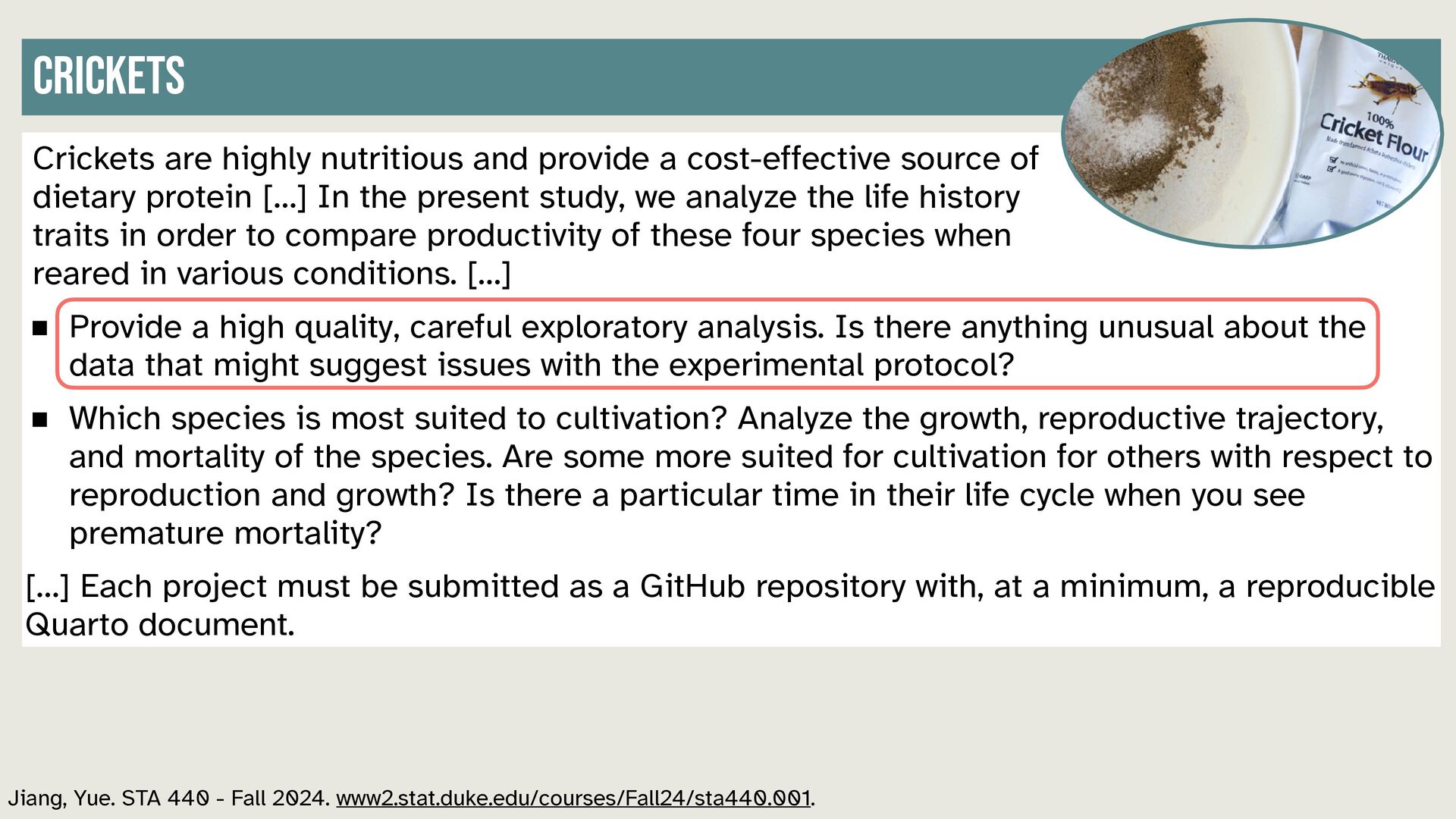
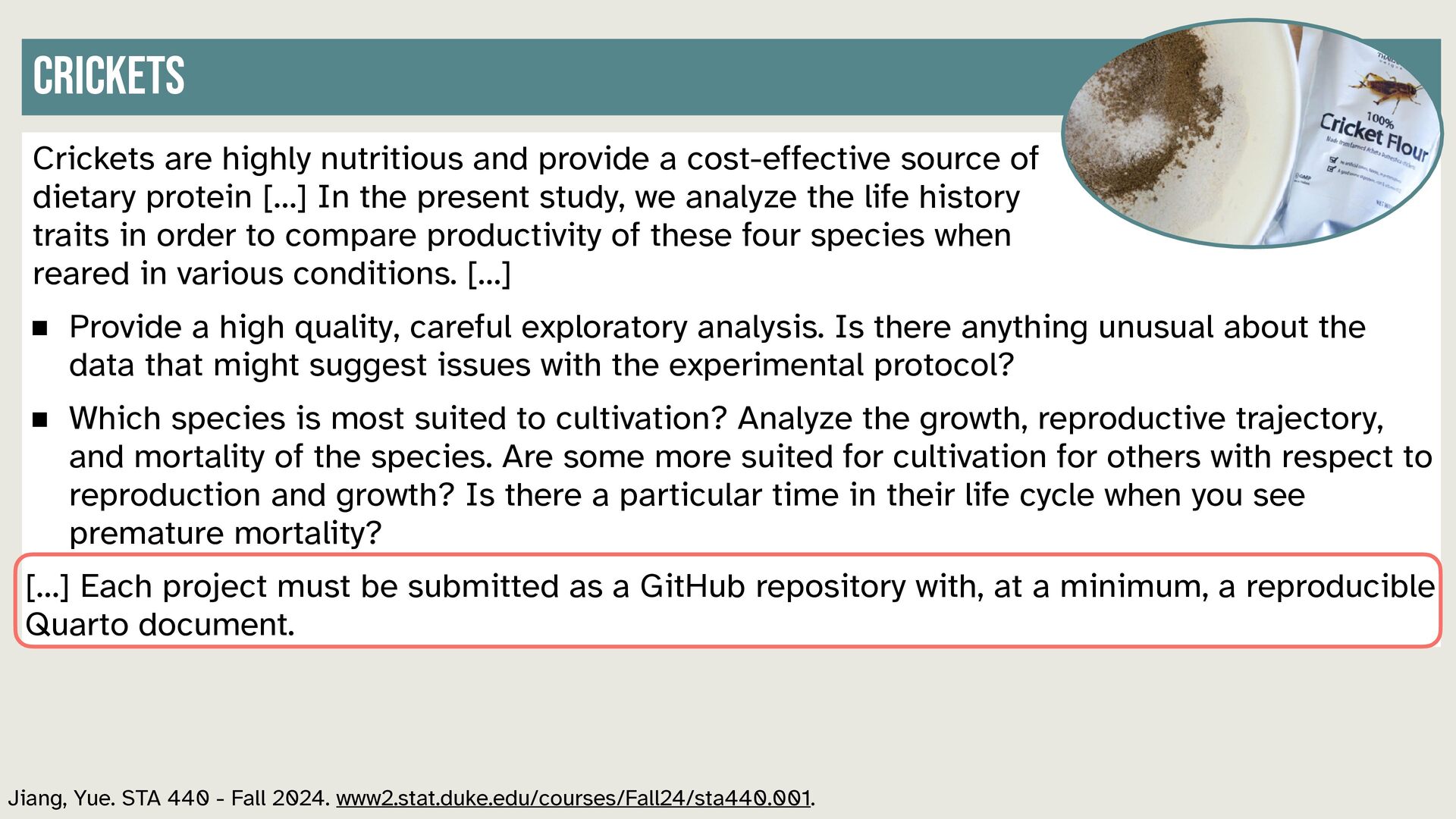
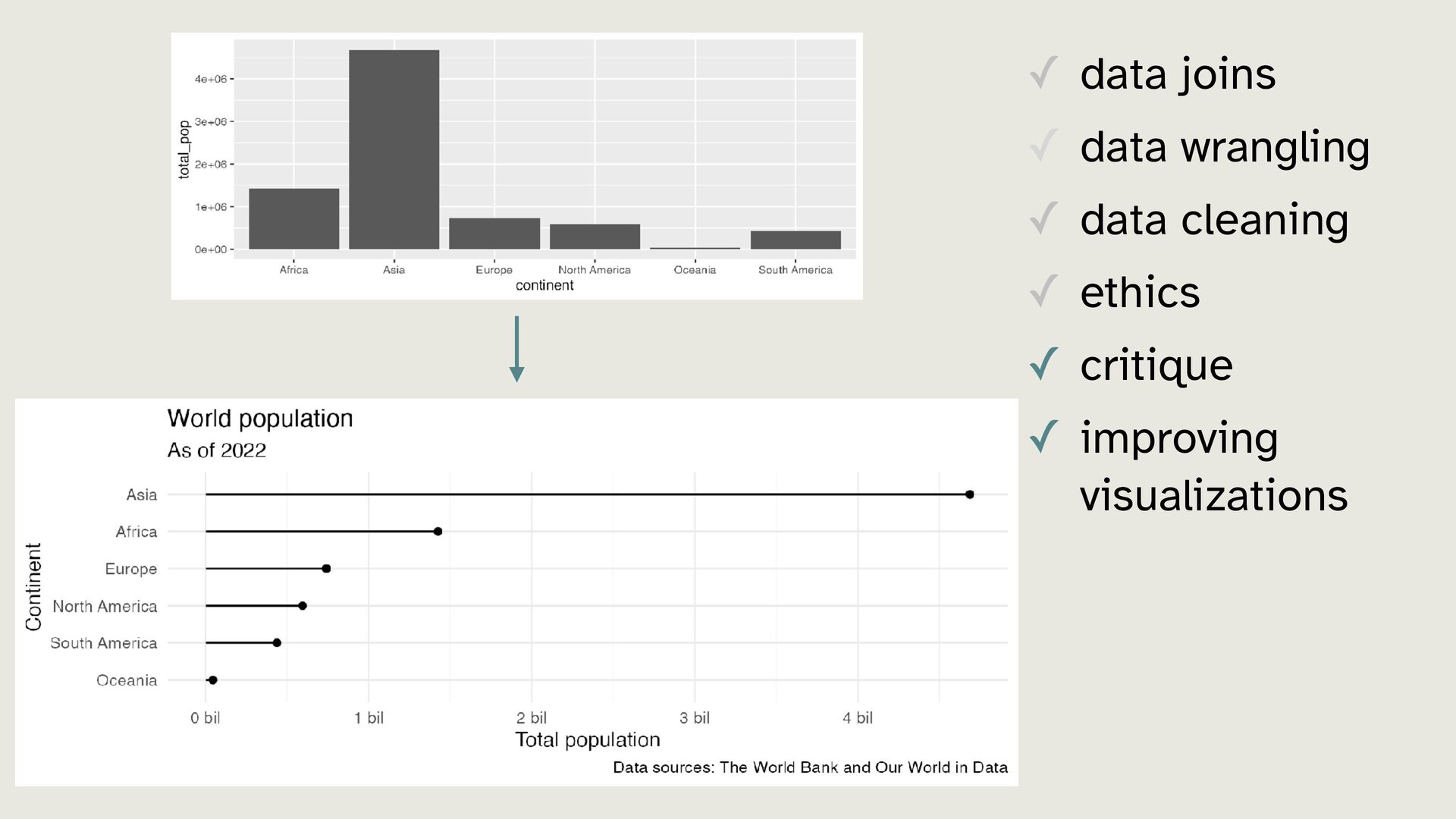
  10. Crickets Crickets are highly nutritious and provide a cost-effective source

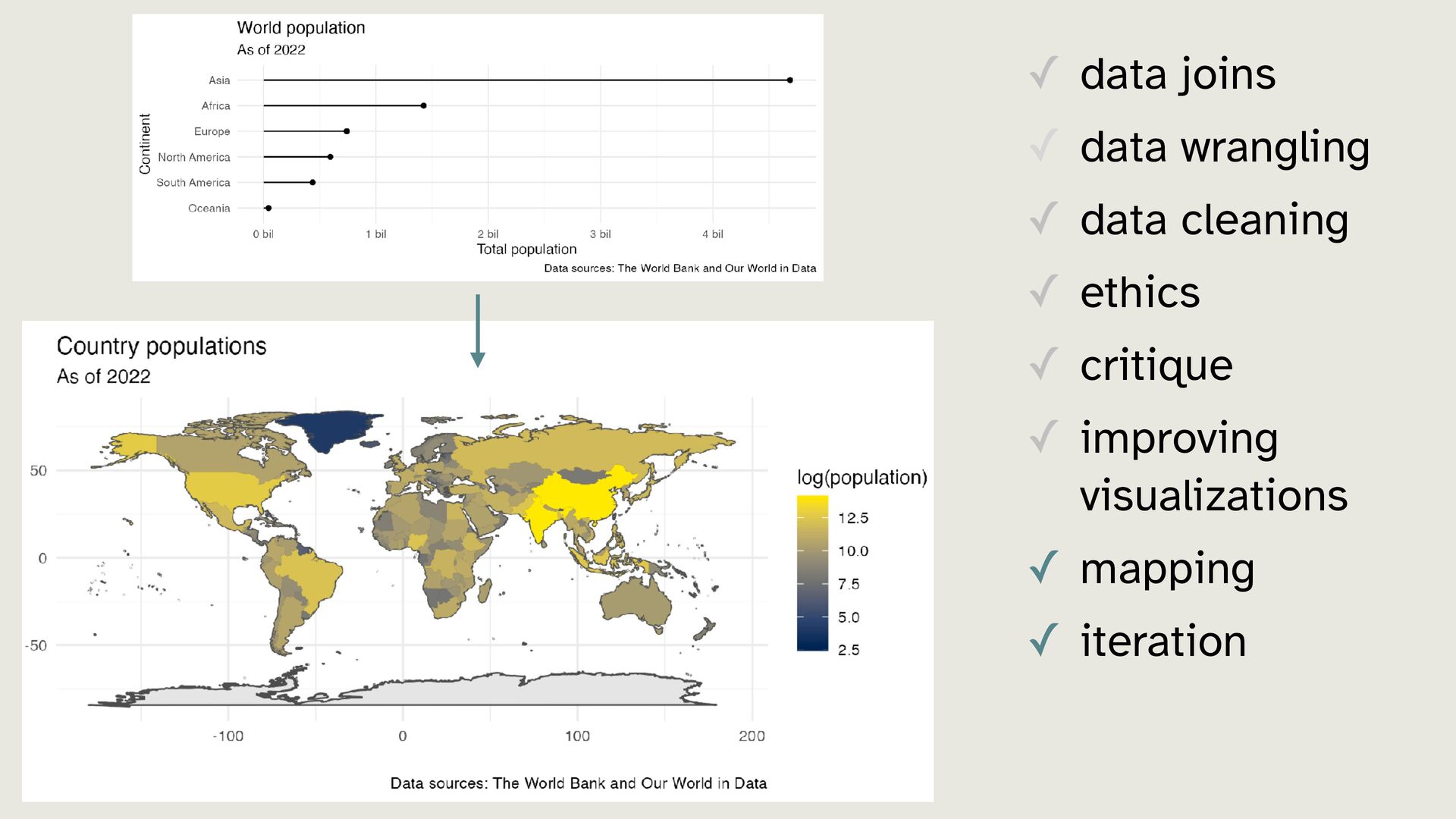
    of dietary protein […] In the present study, we analyze the life history traits in order to compare productivity of these four species when reared in various conditions. […] Provide a high quality, careful exploratory analysis. Is there anything unusual about the data that might suggest issues with the experimental protocol? Which species is most suited to cultivation? Analyze the growth, reproductive trajectory, and mortality of the species. Are some more suited for cultivation for others with respect to reproduction and growth? Is there a particular time in their life cycle when you see premature mortality? […] Each project must be submitted as a GitHub repository with, at a minimum, a reproducible Quarto document. Jiang, Yue. STA 440 - Fall 2024. www2.stat.duke.edu/courses/Fall24/sta440.001.
  11. Crickets Crickets are highly nutritious and provide a cost-effective source

    of dietary protein […] In the present study, we analyze the life history traits in order to compare productivity of these four species when reared in various conditions. […] Provide a high quality, careful exploratory analysis. Is there anything unusual about the data that might suggest issues with the experimental protocol? Which species is most suited to cultivation? Analyze the growth, reproductive trajectory, and mortality of the species. Are some more suited for cultivation for others with respect to reproduction and growth? Is there a particular time in their life cycle when you see premature mortality? […] Each project must be submitted as a GitHub repository with, at a minimum, a reproducible Quarto document. Jiang, Yue. STA 440 - Fall 2024. www2.stat.duke.edu/courses/Fall24/sta440.001.
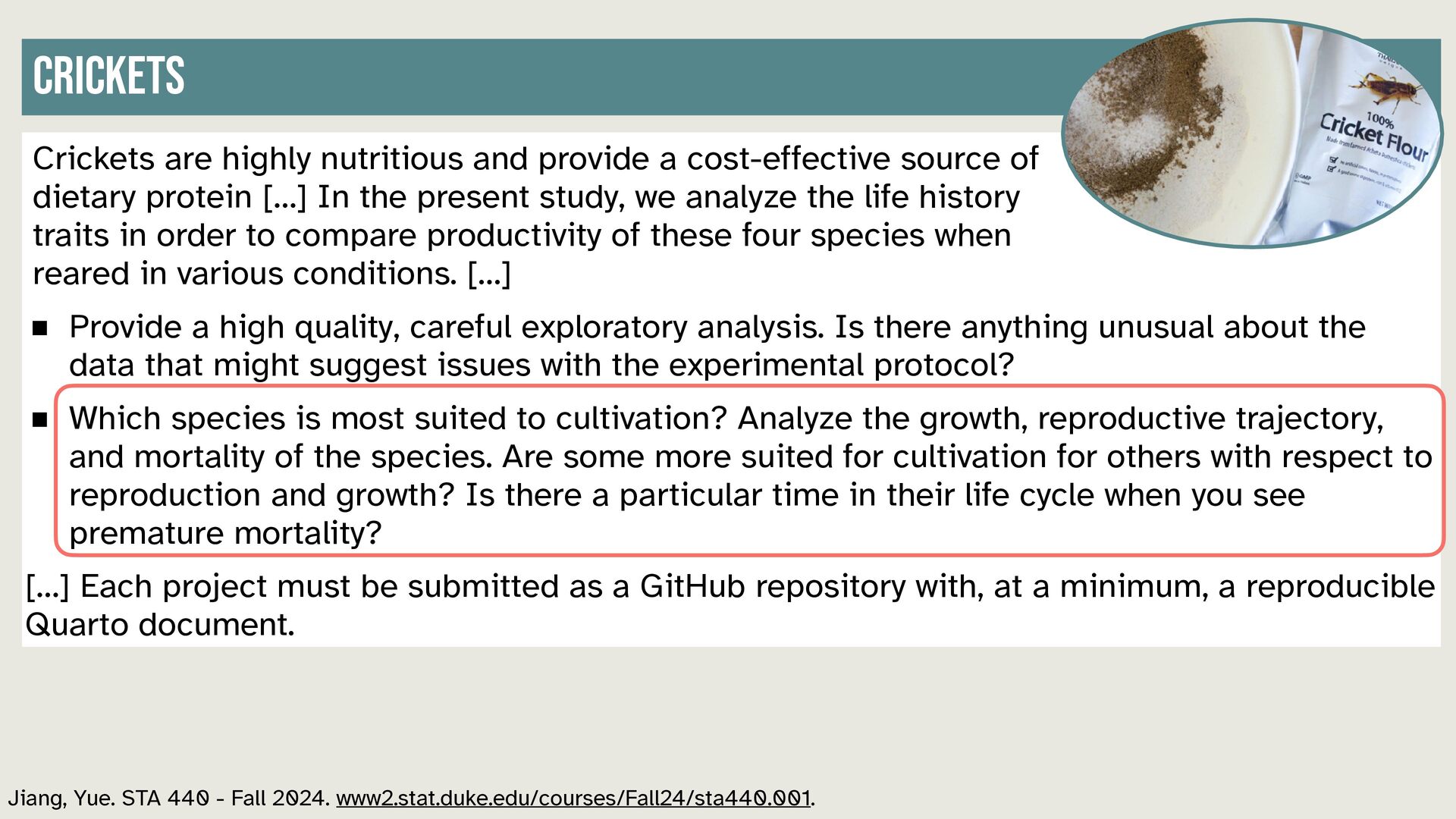
  12. Crickets Crickets are highly nutritious and provide a cost-effective source

    of dietary protein […] In the present study, we analyze the life history traits in order to compare productivity of these four species when reared in various conditions. […] Provide a high quality, careful exploratory analysis. Is there anything unusual about the data that might suggest issues with the experimental protocol? Which species is most suited to cultivation? Analyze the growth, reproductive trajectory, and mortality of the species. Are some more suited for cultivation for others with respect to reproduction and growth? Is there a particular time in their life cycle when you see premature mortality? […] Each project must be submitted as a GitHub repository with, at a minimum, a reproducible Quarto document. Jiang, Yue. STA 440 - Fall 2024. www2.stat.duke.edu/courses/Fall24/sta440.001.
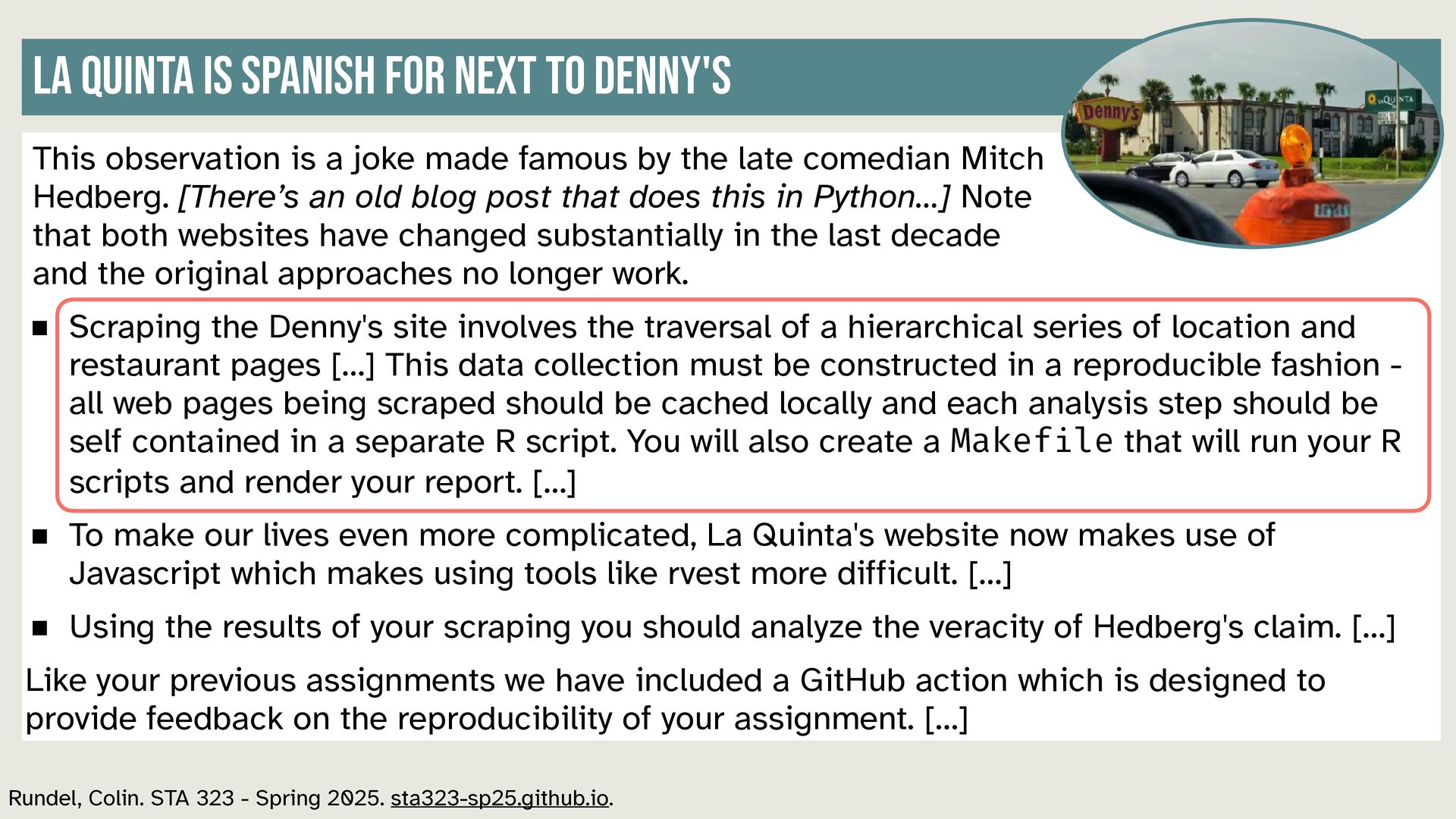
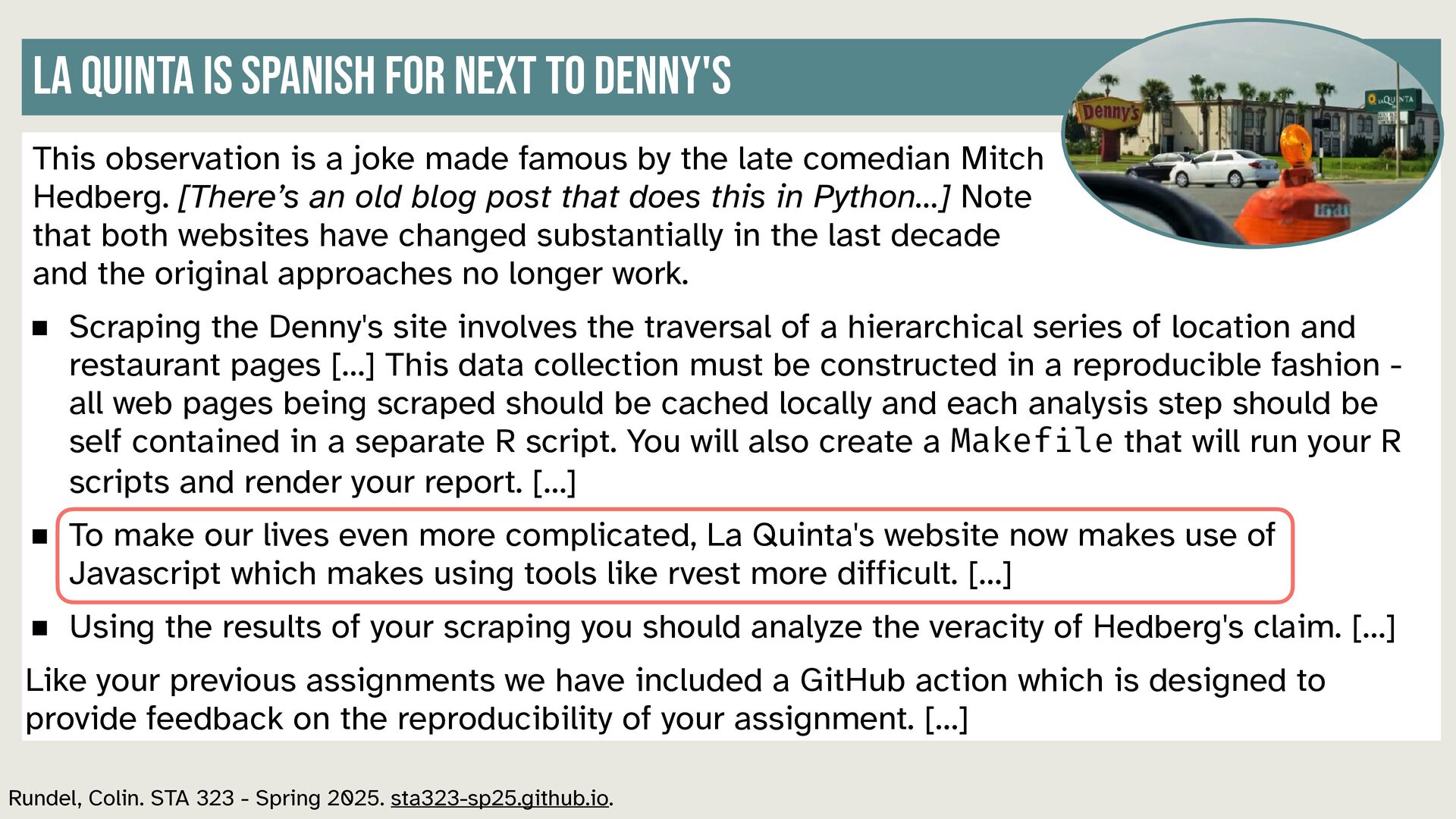
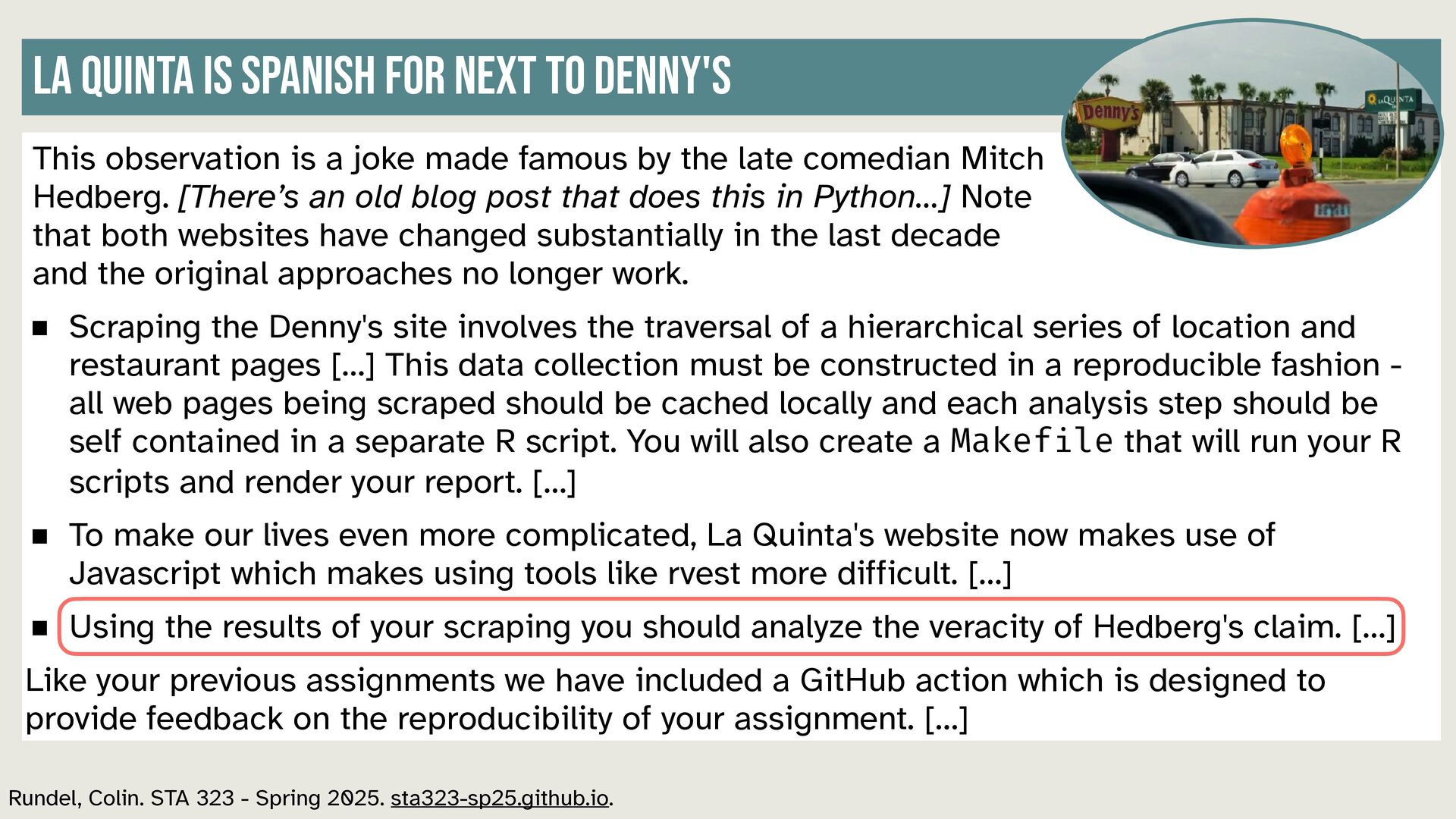
  13. La Quinta is Spanish for next to Denny's This observation

    is a joke made famous by the late comedian Mitch Hedberg. [There’s an old blog post that does this in Python…] Note that both websites have changed substantially in the last decade and the original approaches no longer work. Scraping the Denny's site involves the traversal of a hierarchical series of location and restaurant pages […] This data collection must be constructed in a reproducible fashion all web pages being scraped should be cached locally and each analysis step should be self contained in a separate R script. You will also create a Makef le that will run your R scripts and render your report. […] To make our lives even more complicated, La Quinta's website now makes use of Javascript which makes using tools like rvest more difficult. […] Using the results of your scraping you should analyze the veracity of Hedberg's claim. […] Like your previous assignments we have included a GitHub action which is designed to provide feedback on the reproducibility of your assignment. […] i Rundel, Colin. STA 323 - Spring 2025. sta323-sp25.github.io.
  14. La Quinta is Spanish for next to Denny's This observation

    is a joke made famous by the late comedian Mitch Hedberg. [There’s an old blog post that does this in Python…] Note that both websites have changed substantially in the last decade and the original approaches no longer work. Scraping the Denny's site involves the traversal of a hierarchical series of location and restaurant pages […] This data collection must be constructed in a reproducible fashion all web pages being scraped should be cached locally and each analysis step should be self contained in a separate R script. You will also create a Makef le that will run your R scripts and render your report. […] To make our lives even more complicated, La Quinta's website now makes use of Javascript which makes using tools like rvest more difficult. […] Using the results of your scraping you should analyze the veracity of Hedberg's claim. […] Like your previous assignments we have included a GitHub action which is designed to provide feedback on the reproducibility of your assignment. […] i Rundel, Colin. STA 323 - Spring 2025. sta323-sp25.github.io.
  15. La Quinta is Spanish for next to Denny's This observation

    is a joke made famous by the late comedian Mitch Hedberg. [There’s an old blog post that does this in Python…] Note that both websites have changed substantially in the last decade and the original approaches no longer work. Scraping the Denny's site involves the traversal of a hierarchical series of location and restaurant pages […] This data collection must be constructed in a reproducible fashion all web pages being scraped should be cached locally and each analysis step should be self contained in a separate R script. You will also create a Makef le that will run your R scripts and render your report. […] To make our lives even more complicated, La Quinta's website now makes use of Javascript which makes using tools like rvest more difficult. […] Using the results of your scraping you should analyze the veracity of Hedberg's claim. […] Like your previous assignments we have included a GitHub action which is designed to provide feedback on the reproducibility of your assignment. […] i Rundel, Colin. STA 323 - Spring 2025. sta323-sp25.github.io.
  16. La Quinta is Spanish for next to Denny's This observation

    is a joke made famous by the late comedian Mitch Hedberg. [There’s an old blog post that does this in Python…] Note that both websites have changed substantially in the last decade and the original approaches no longer work. Scraping the Denny's site involves the traversal of a hierarchical series of location and restaurant pages […] This data collection must be constructed in a reproducible fashion all web pages being scraped should be cached locally and each analysis step should be self contained in a separate R script. You will also create a Makef le that will run your R scripts and render your report. […] To make our lives even more complicated, La Quinta's website now makes use of Javascript which makes using tools like rvest more difficult. […] Using the results of your scraping you should analyze the veracity of Hedberg's claim. […] Like your previous assignments we have included a GitHub action which is designed to provide feedback on the reproducibility of your assignment. […] i Rundel, Colin. STA 323 - Spring 2025. sta323-sp25.github.io.
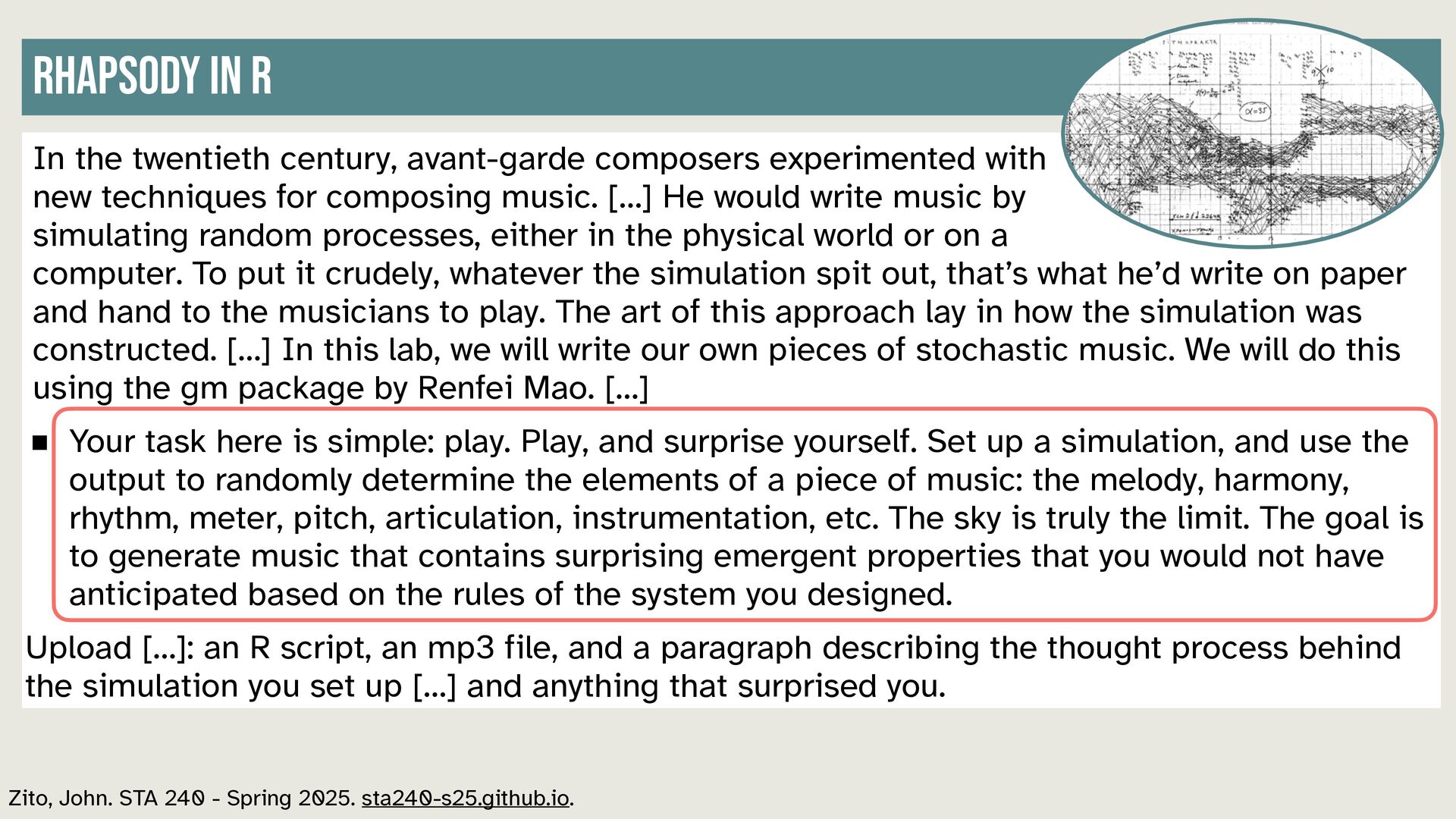
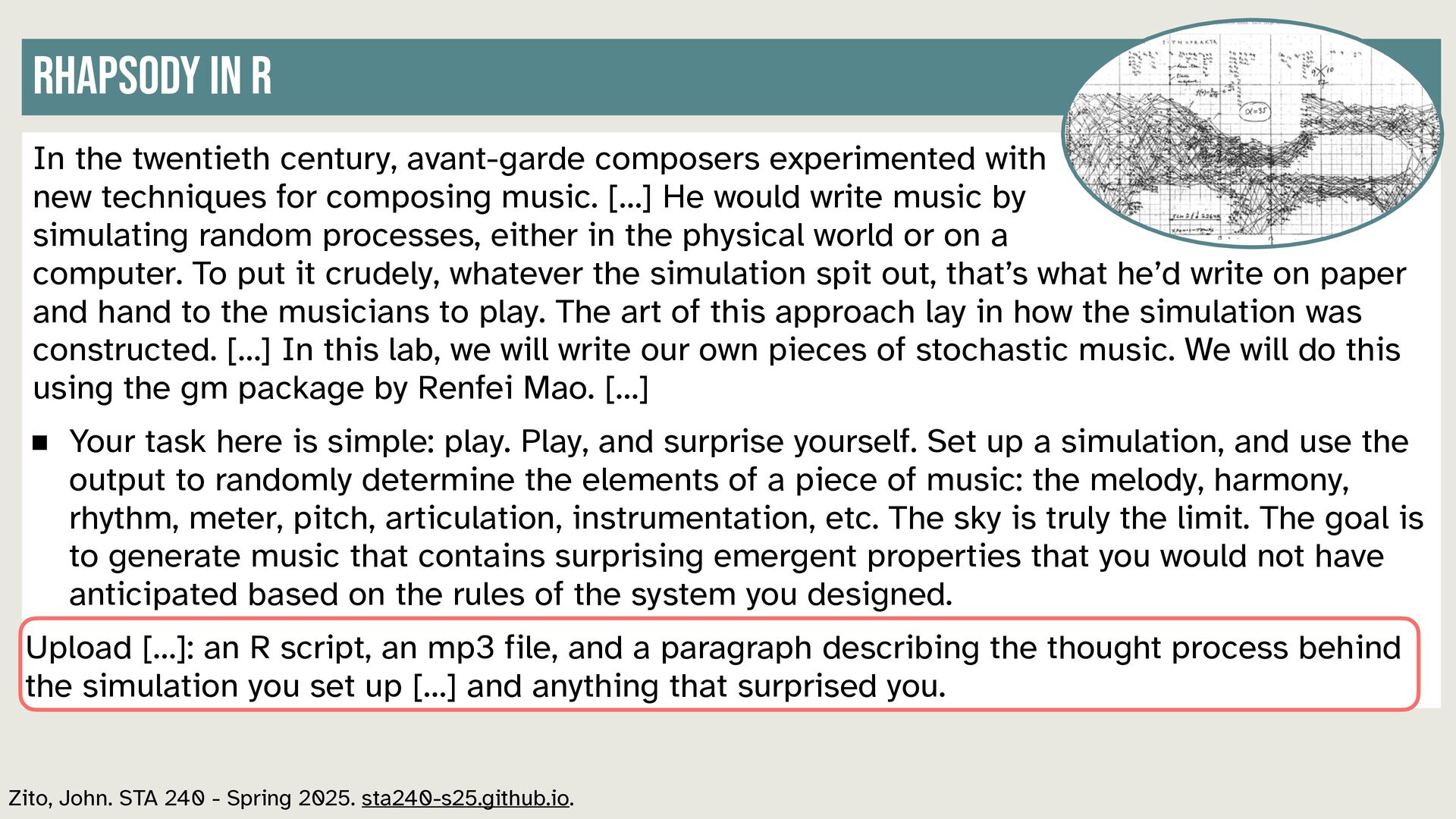
  17. Rhapsody in R In the twentieth century, avant-garde composers experimented

    with new techniques for composing music. […] He would write music by simulating random processes, either in the physical world or on a computer. To put it crudely, whatever the simulation spit out, that’s what he’d write on paper and hand to the musicians to play. The art of this approach lay in how the simulation was constructed. […] In this lab, we will write our own pieces of stochastic music. We will do this using the gm package by Renfei Mao. […] Your task here is simple: play. Play, and surprise yourself. Set up a simulation, and use the output to randomly determine the elements of a piece of music: the melody, harmony, rhythm, meter, pitch, articulation, instrumentation, etc. The sky is truly the limit. The goal is to generate music that contains surprising emergent properties that you would not have anticipated based on the rules of the system you designed. Upload […]: an R script, an mp3 file, and a paragraph describing the thought process behind the simulation you set up […] and anything that surprised you. Zito, John. STA 240 - Spring 2025. sta240-s25.github.io.
  18. Rhapsody in R In the twentieth century, avant-garde composers experimented

    with new techniques for composing music. […] He would write music by simulating random processes, either in the physical world or on a computer. To put it crudely, whatever the simulation spit out, that’s what he’d write on paper and hand to the musicians to play. The art of this approach lay in how the simulation was constructed. […] In this lab, we will write our own pieces of stochastic music. We will do this using the gm package by Renfei Mao. […] Your task here is simple: play. Play, and surprise yourself. Set up a simulation, and use the output to randomly determine the elements of a piece of music: the melody, harmony, rhythm, meter, pitch, articulation, instrumentation, etc. The sky is truly the limit. The goal is to generate music that contains surprising emergent properties that you would not have anticipated based on the rules of the system you designed. Upload […]: an R script, an mp3 file, and a paragraph describing the thought process behind the simulation you set up […] and anything that surprised you. Zito, John. STA 240 - Spring 2025. sta240-s25.github.io.
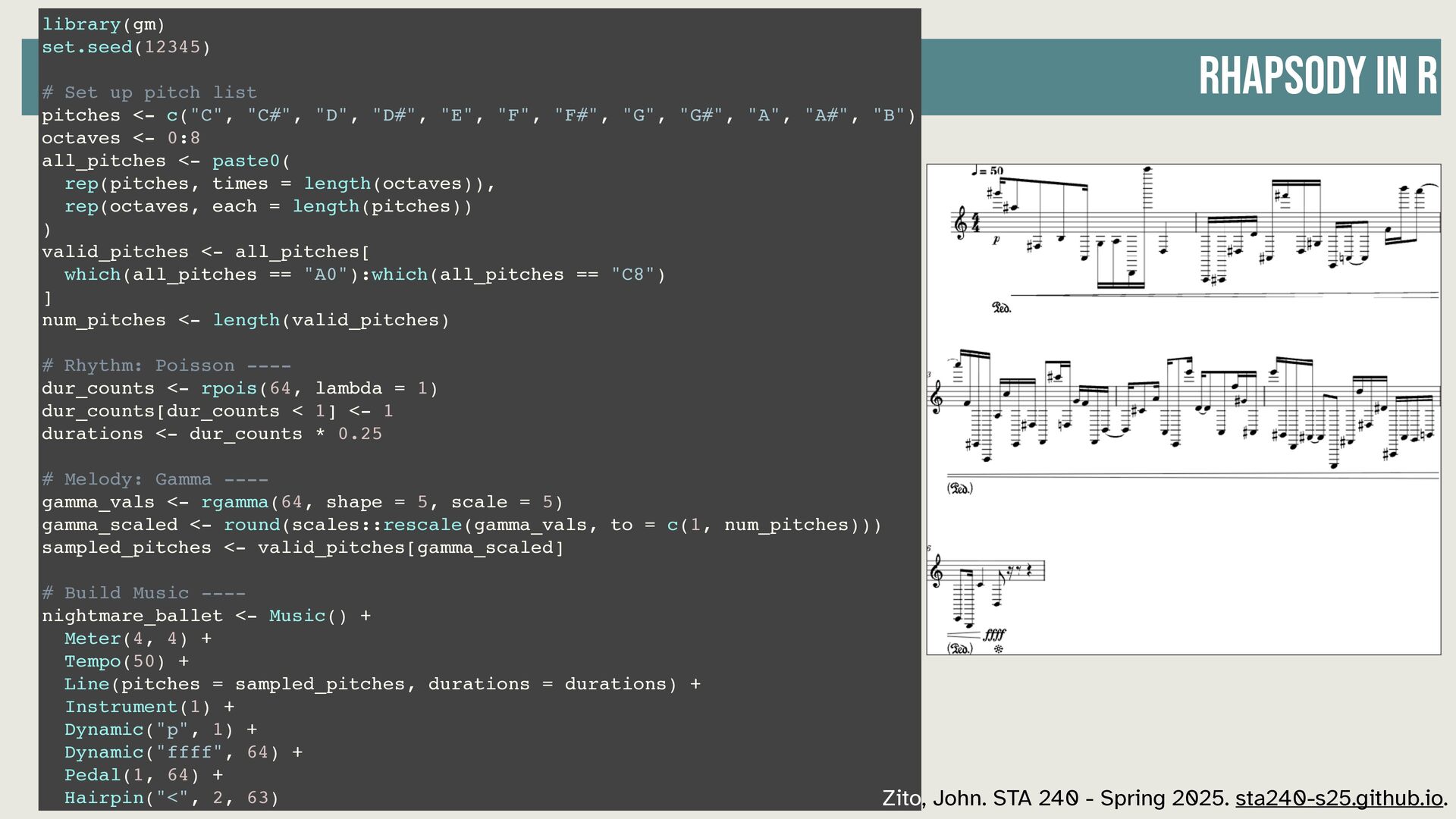
  19. library(gm) set.seed(12345) # Set up pitch list pitches <- c("C",

    "C#", "D", "D#", "E", "F", "F#", "G", "G#", "A", "A#", "B") octaves <- 0:8 all_pitches <- paste0( rep(pitches, times = length(octaves)), rep(octaves, each = length(pitches)) ) valid_pitches <- all_pitches[ which(all_pitches == "A0"):which(all_pitches == "C8") ] num_pitches <- length(valid_pitches) Rhapsody in R # Rhythm: Poisson ---dur_counts <- rpois(64, lambda = 1) dur_counts[dur_counts < 1] <- 1 durations <- dur_counts * 0.25 # Melody: Gamma ---gamma_vals <- rgamma(64, shape = 5, scale = 5) gamma_scaled <- round(scales::rescale(gamma_vals, to = c(1, num_pitches))) sampled_pitches <- valid_pitches[gamma_scaled] # Build Music ---nightmare_ballet <- Music() + Meter(4, 4) + Tempo(50) + Line(pitches = sampled_pitches, durations = durations) + Instrument(1) + Dynamic("p", 1) + Dynamic("ffff", 64) + Pedal(1, 64) + Hairpin("<", 2, 63) Zito, John. STA 240 - Spring 2025. sta240-s25.github.io.
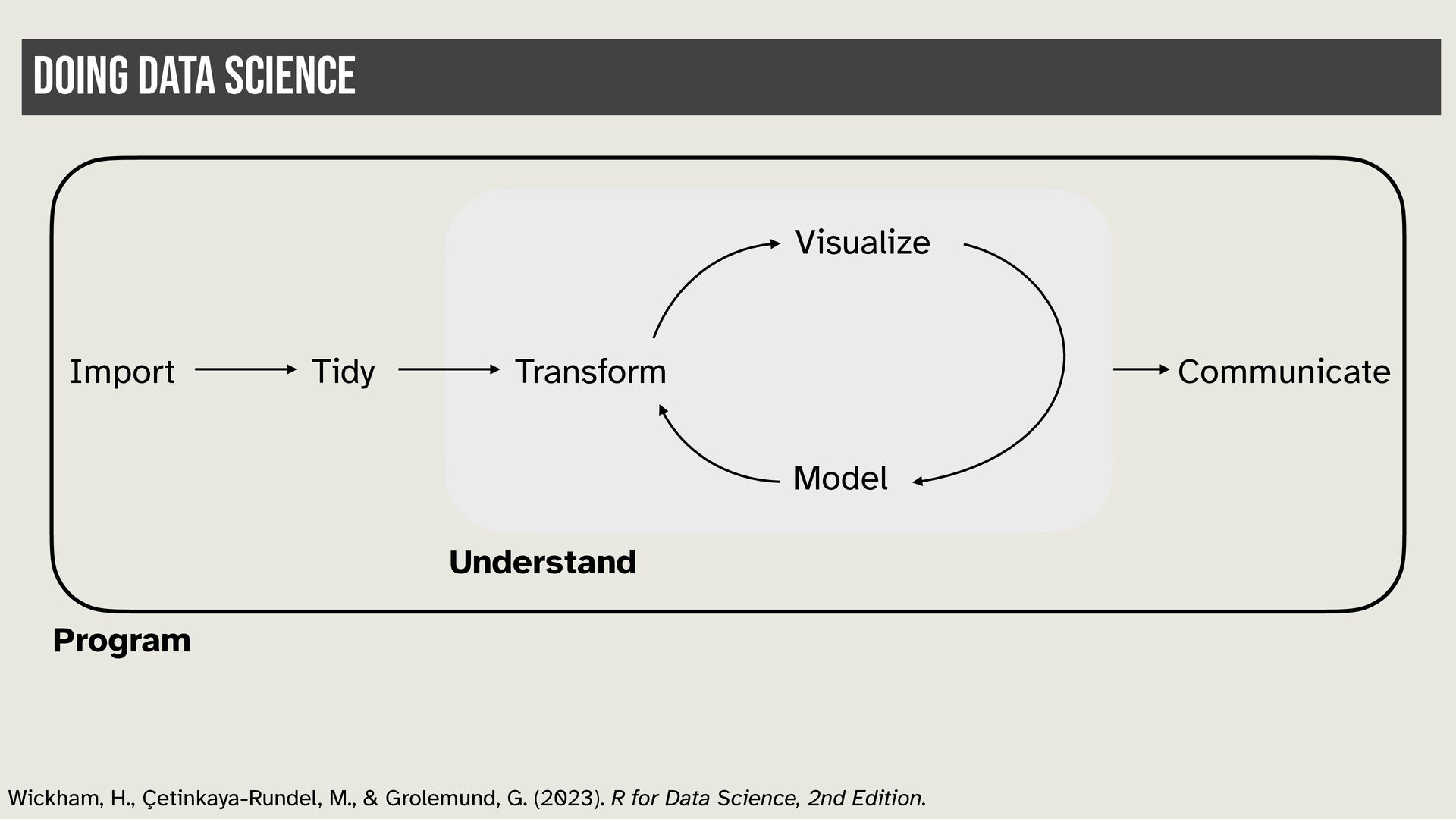
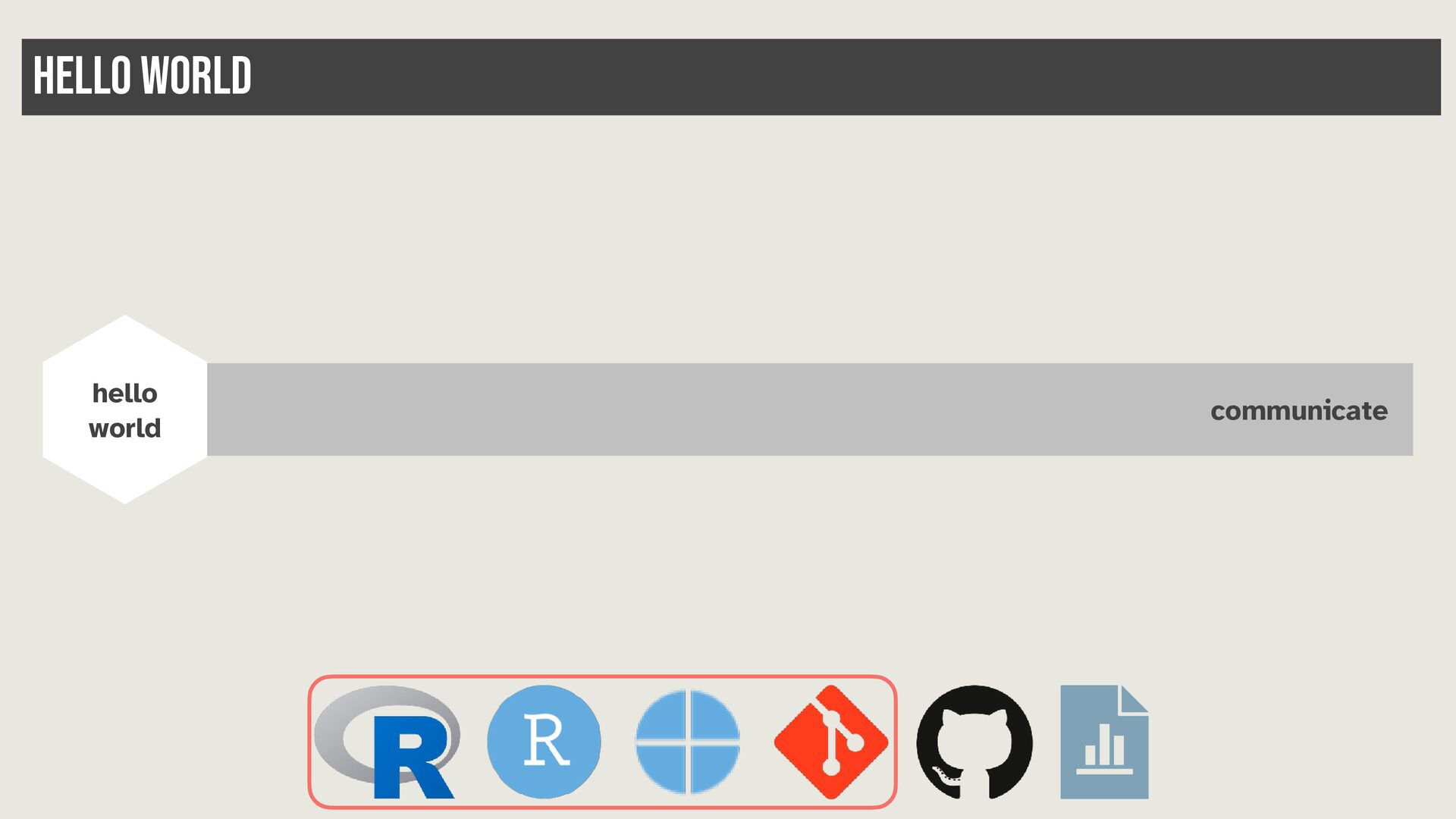
  20. DOING DATA SCIENCE Visualize Import Tidy Transform Communicate Model Understand

    Program Wickham, H., Çetinkaya-Rundel, M., & Grolemund, G. (2023). R for Data Science, 2nd Edition.
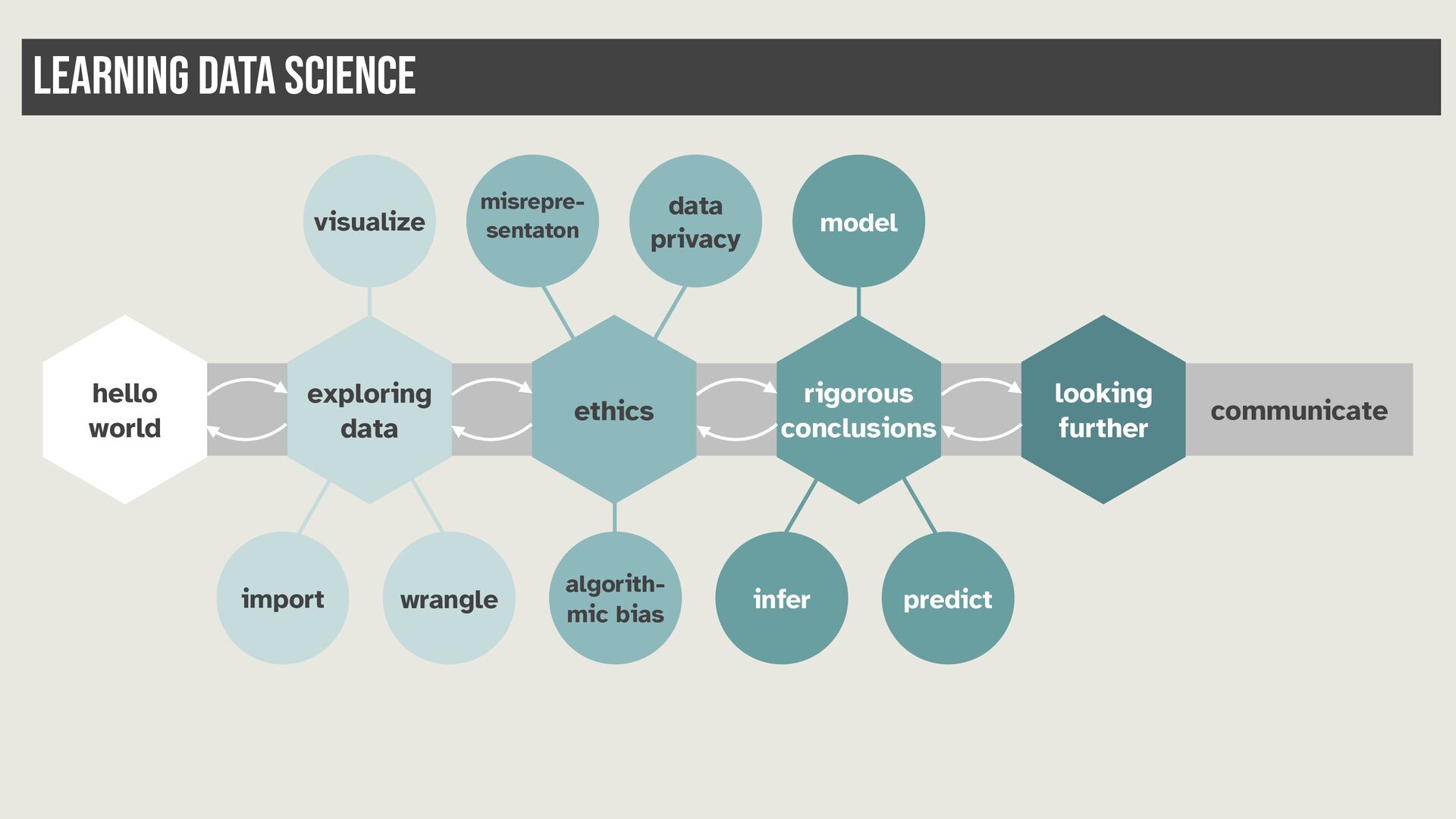
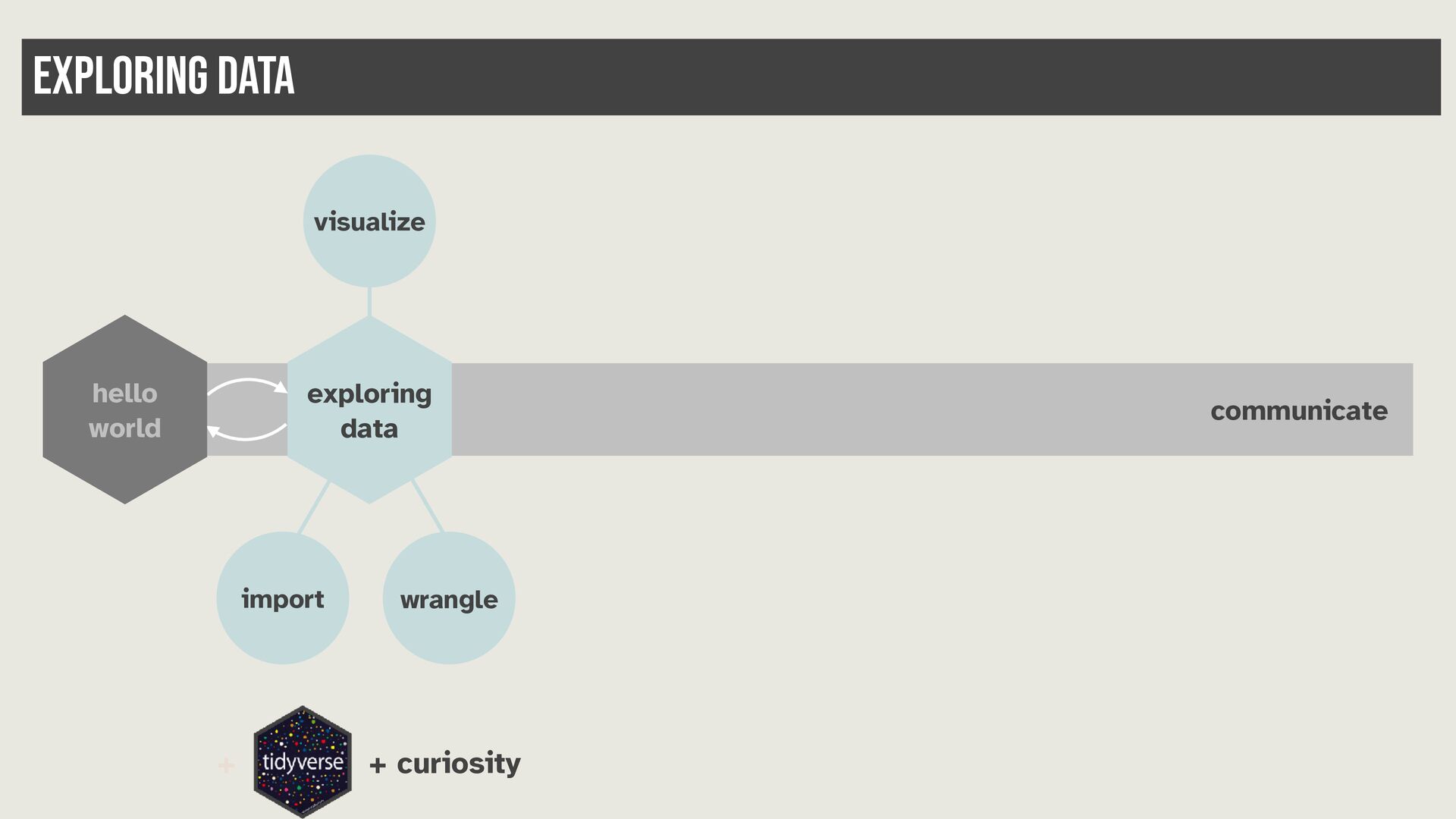
  21. LEARNING DATA SCIENCE visualize hello world misrepresentaton exploring data import

    wrangle data privacy ethics algorithmic bias model rigorous conclusions infer predict looking further communicate
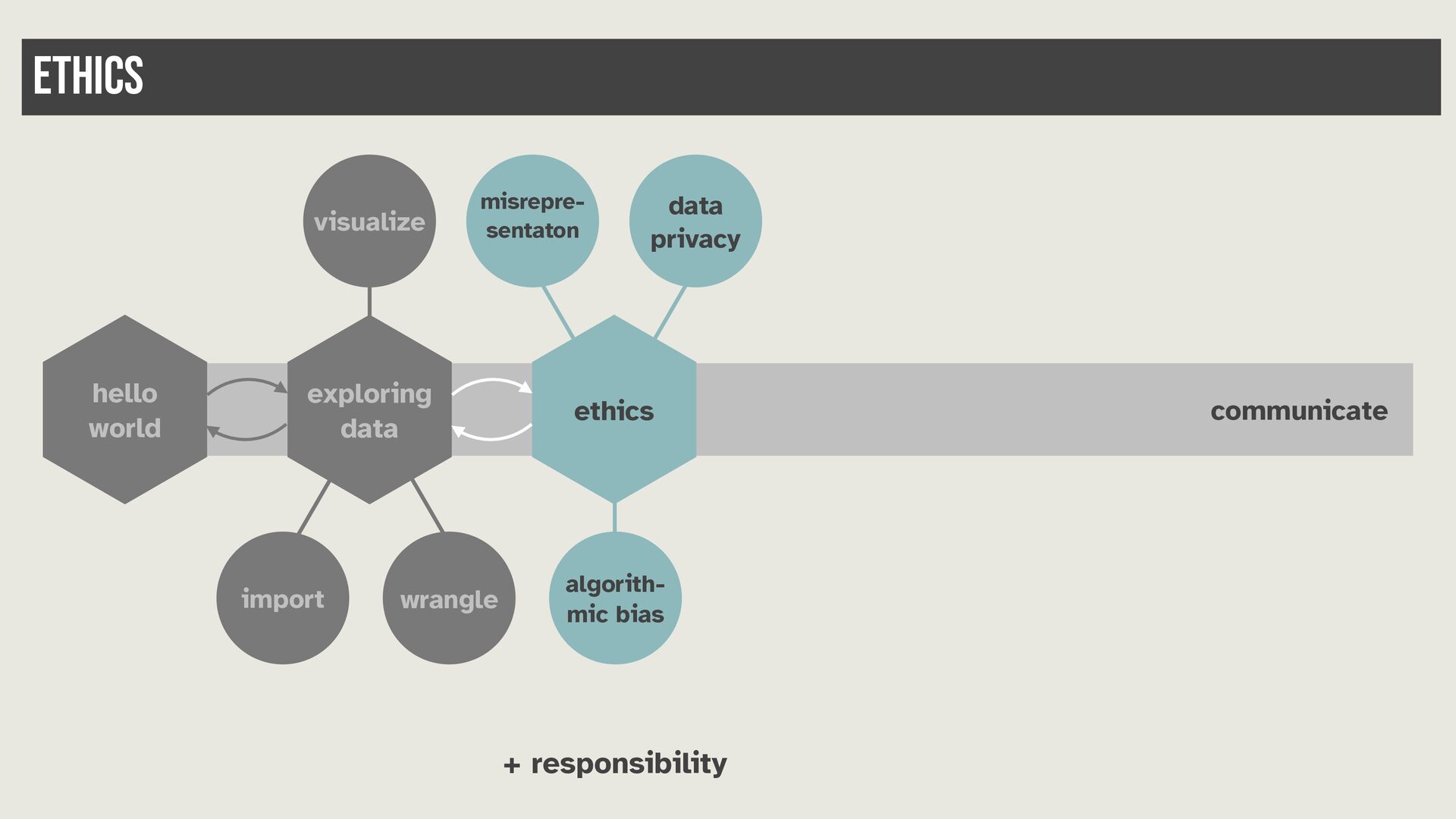
  22. Ethics visualize hello world misrepresentaton exploring data import wrangle data

    privacy ethics algorithmic bias + responsibility communicate
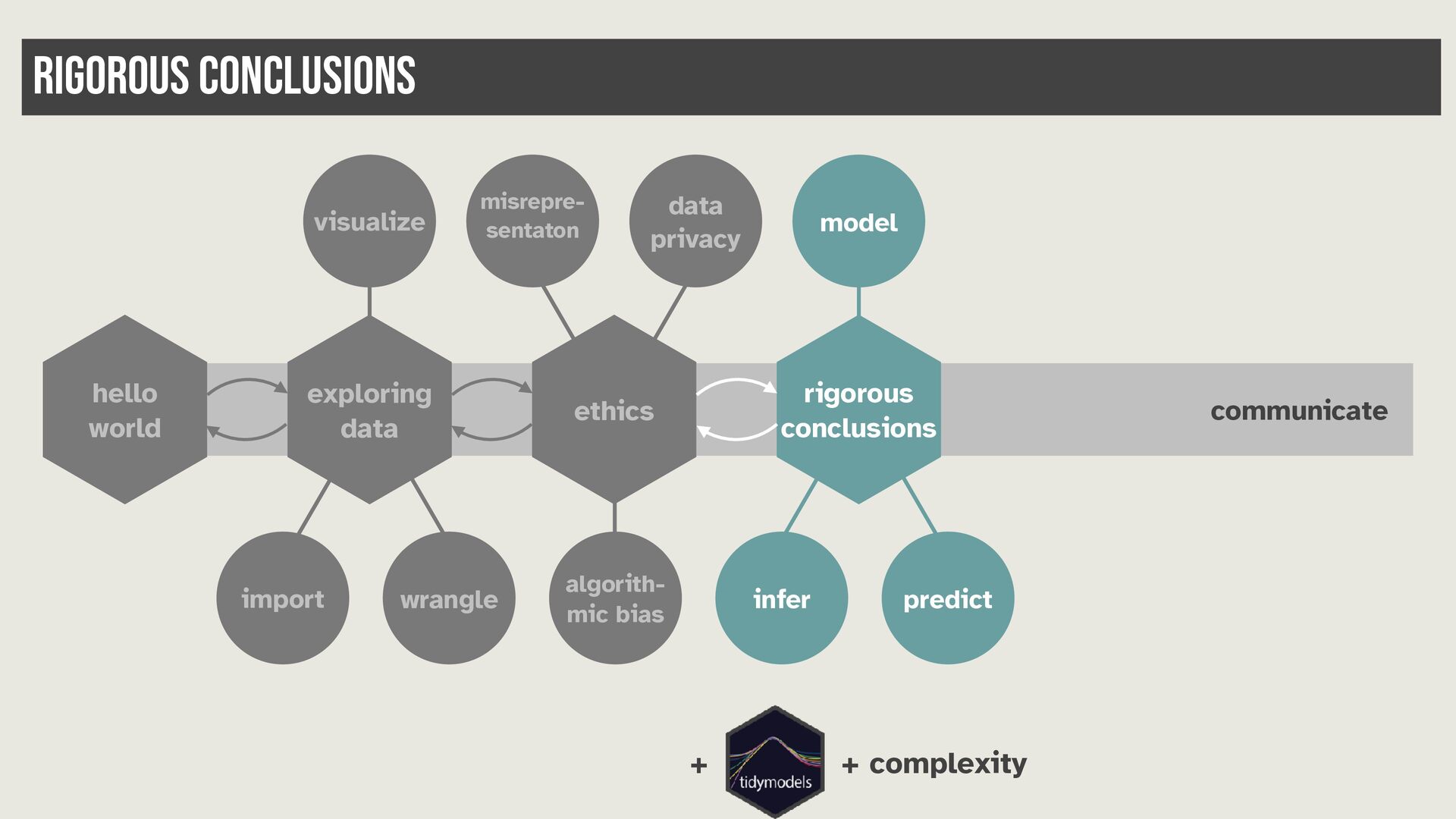
  23. Rigorous conclusions visualize hello world misrepresentaton exploring data import wrangle

    data privacy model rigorous conclusions ethics algorithmic bias infer + predict + complexity communicate
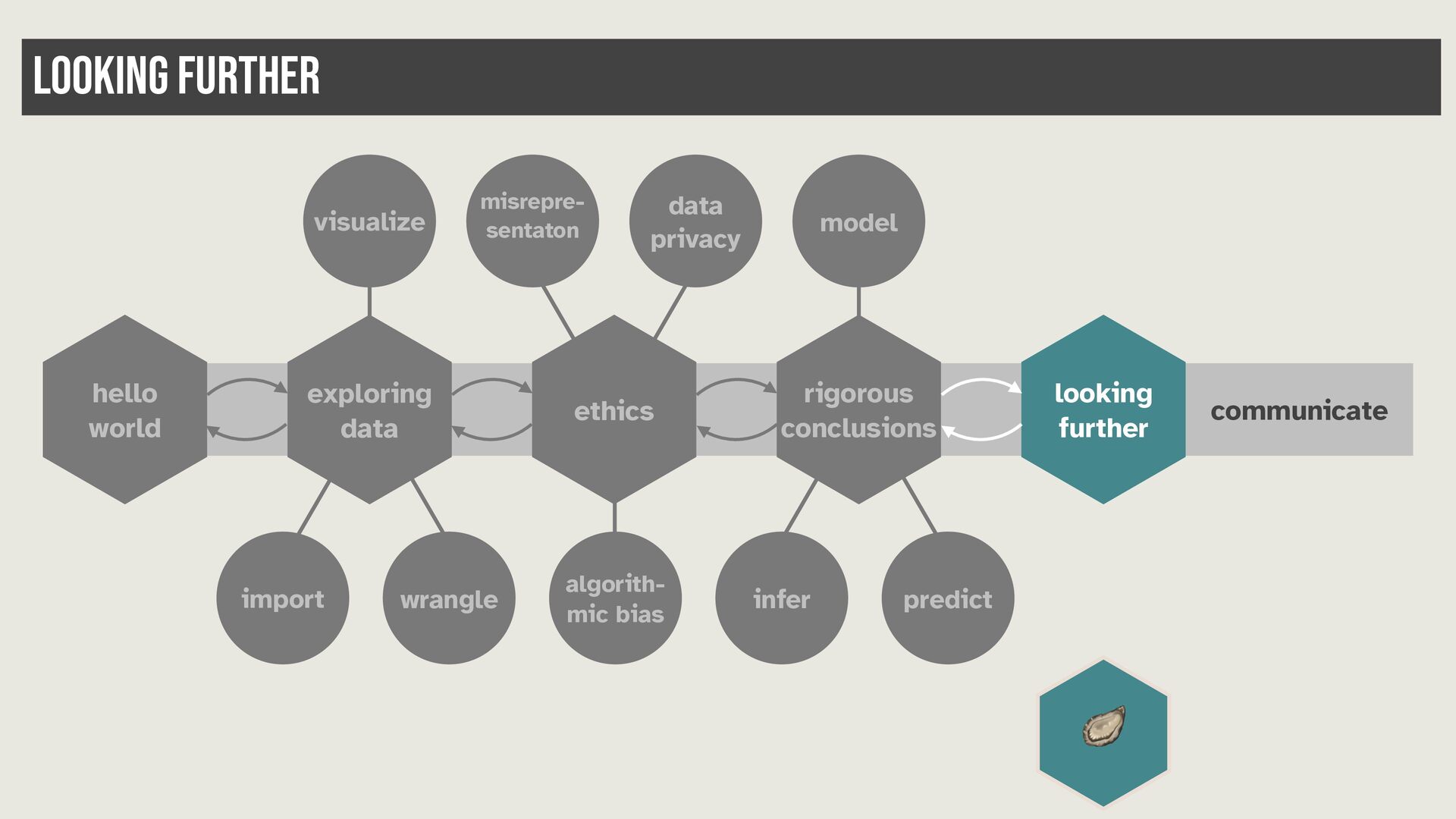
  24. Looking further visualize hello world misrepresentaton exploring data import wrangle

    data privacy ethics algorithmic bias model rigorous conclusions infer looking further predict 🦪 communicate
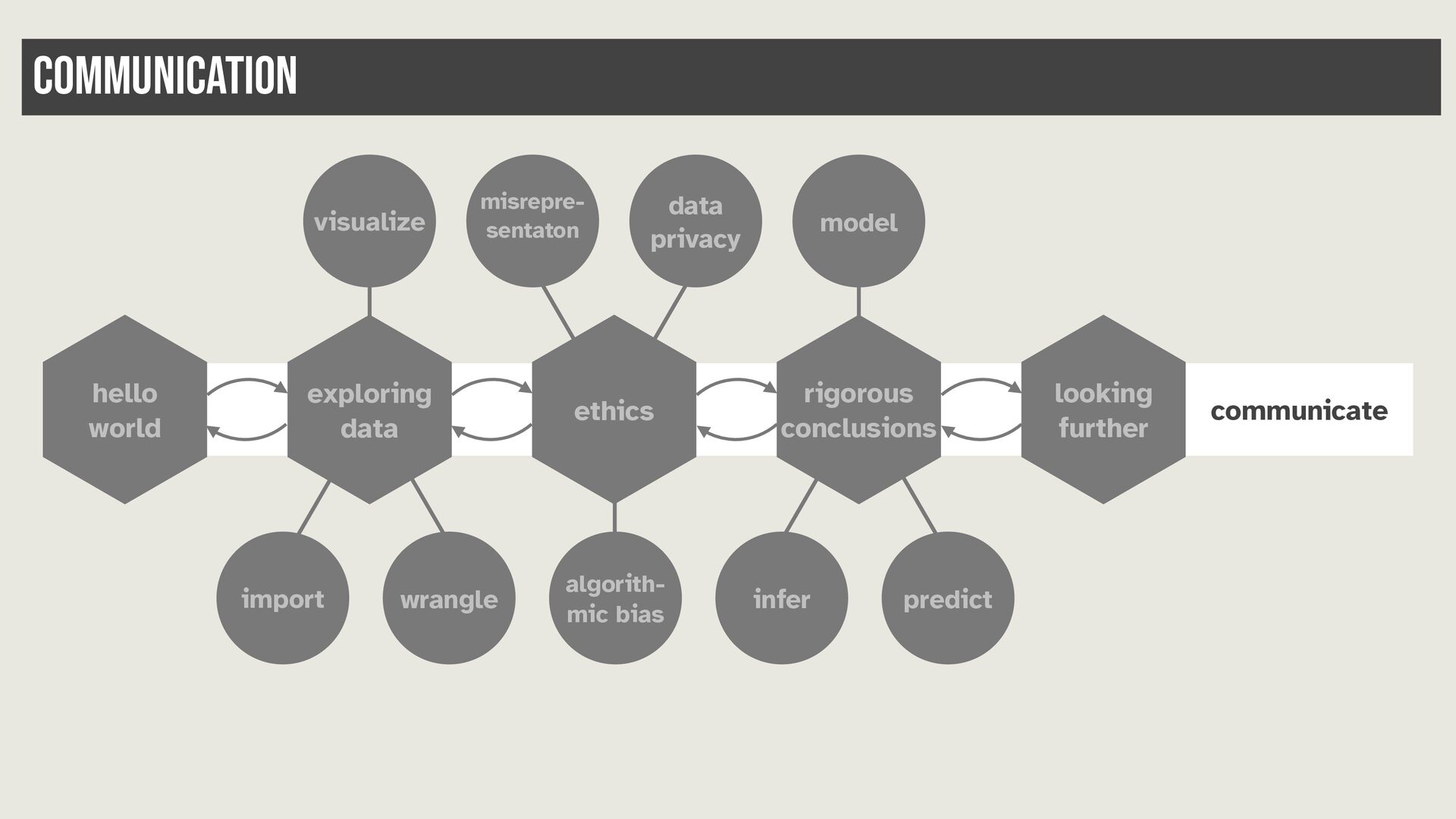
  25. Communication visualize hello world misrepresentaton exploring data import wrangle data

    privacy ethics algorithmic bias model rigorous conclusions infer predict looking further communicate
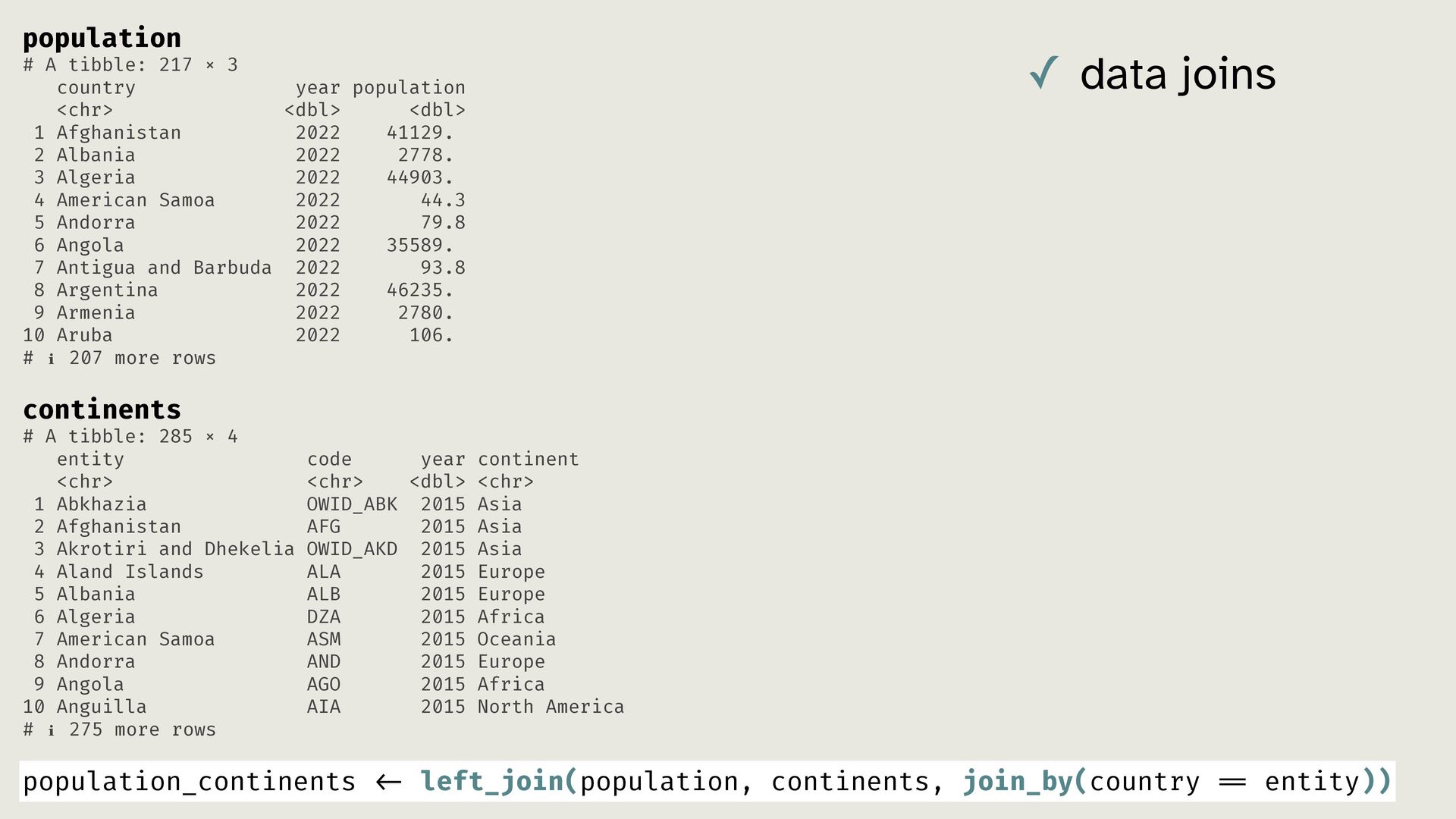
  26. population # A tibble: 217 × 3 country year population

    <chr> <dbl> <dbl> 1 Afghanistan 2022 41129. 2 Albania 2022 2778. 3 Algeria 2022 44903. 4 American Samoa 2022 44.3 5 Andorra 2022 79.8 6 Angola 2022 35589. 7 Antigua and Barbuda 2022 93.8 8 Argentina 2022 46235. 9 Armenia 2022 2780. 10 Aruba 2022 106. # ℹ 207 more rows ✓ data joins continents # A tibble: 285 × 4 entity code year continent <chr> <chr> <dbl> <chr> 1 Abkhazia OWID_ABK 2015 Asia 2 Afghanistan AFG 2015 Asia 3 Akrotiri and Dhekelia OWID_AKD 2015 Asia 4 Aland Islands ALA 2015 Europe 5 Albania ALB 2015 Europe 6 Algeria DZA 2015 Africa 7 American Samoa ASM 2015 Oceania 8 Andorra AND 2015 Europe 9 Angola AGO 2015 Africa 10 Anguilla AIA 2015 North America # ℹ 275 more rows entity)) = = left_join(population, continents, join_by(country - < population_continents
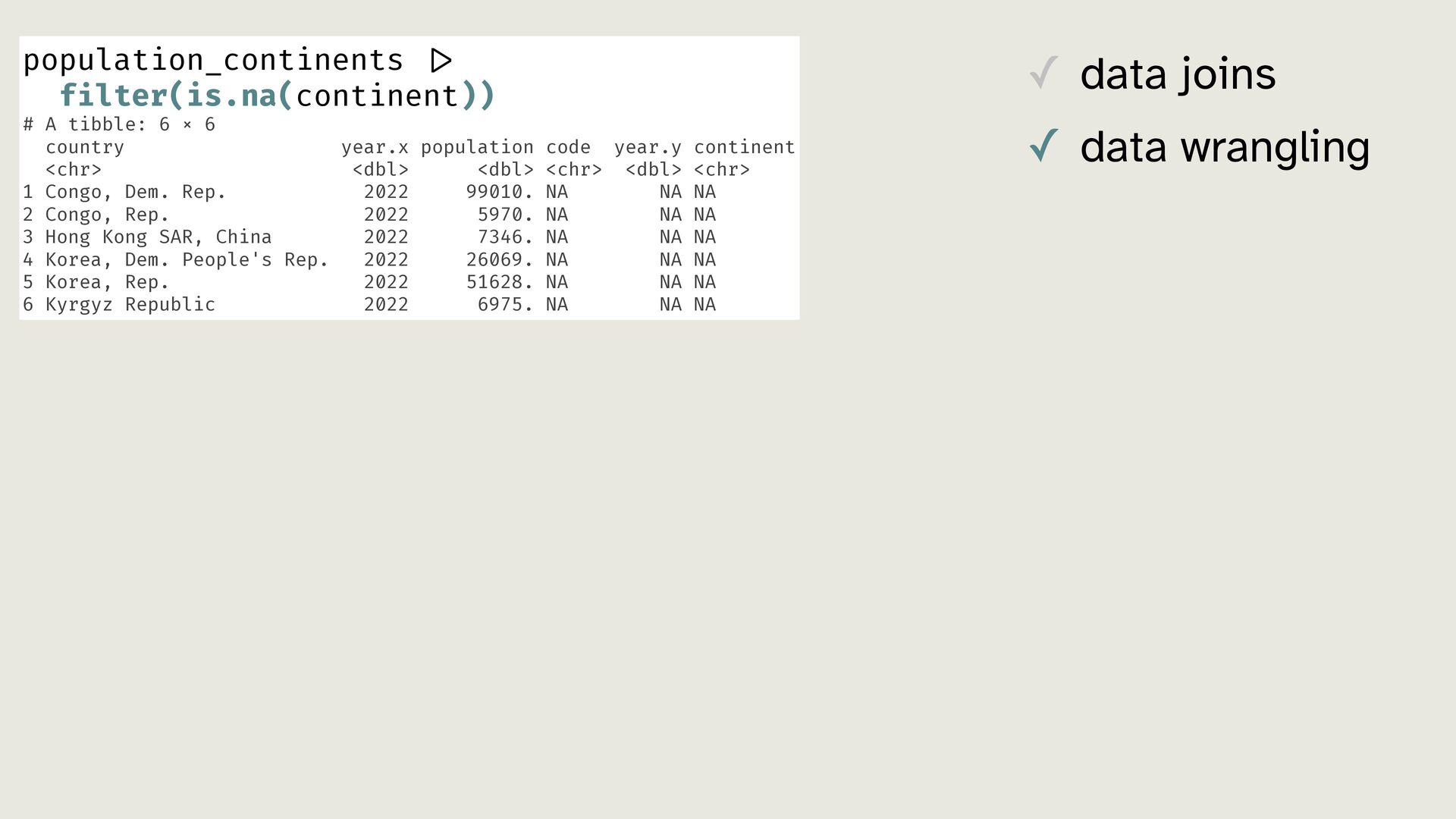
  27. population_continents f lter(is.na(continent)) > | i # A tibble: 6

    × 6 country year.x population code year.y continent <chr> <dbl> <dbl> <chr> <dbl> <chr> 1 Congo, Dem. Rep. 2022 99010. NA NA NA 2 Congo, Rep. 2022 5970. NA NA NA 3 Hong Kong SAR, China 2022 7346. NA NA NA 4 Korea, Dem. People's Rep. 2022 26069. NA NA NA 5 Korea, Rep. 2022 51628. NA NA NA 6 Kyrgyz Republic 2022 6975. NA NA NA ✓ data joins ✓ data wrangling
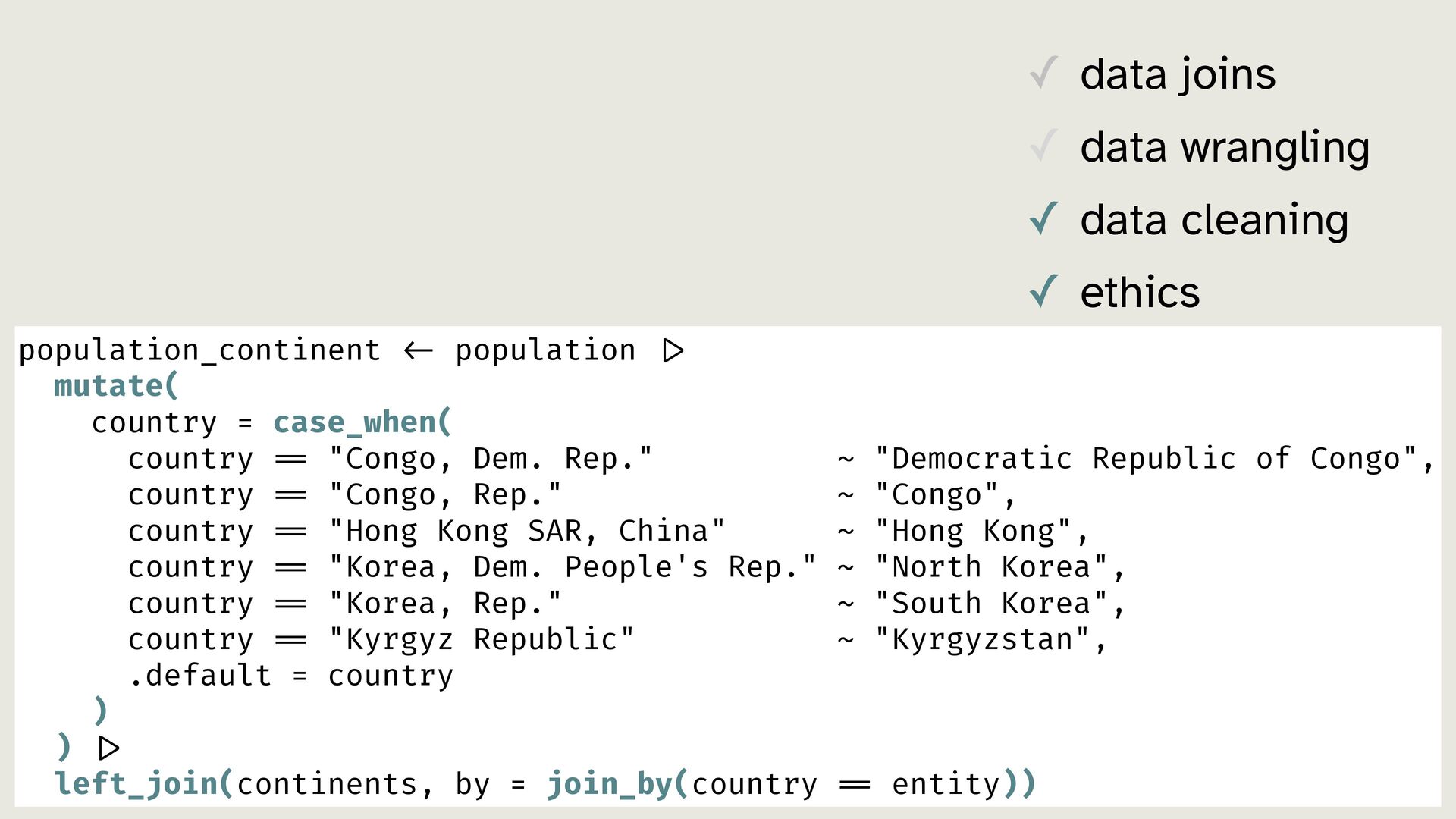
  28. ✓ data joins ✓ data wrangling ✓ data cleaning ✓

    ethics = = > | - < = = = = = = = = = = = = > | population_continent population mutate( country = case_when( country "Congo, Dem. Rep." ~ "Democratic Republic of Congo", country "Congo, Rep." ~ "Congo", country "Hong Kong SAR, China" ~ "Hong Kong", country "Korea, Dem. People's Rep." ~ "North Korea", country "Korea, Rep." ~ "South Korea", country "Kyrgyz Republic" ~ "Kyrgyzstan", .default = country ) ) left_join(continents, by = join_by(country entity))
  29. ✓ data joins ✓ data wrangling ✓ data cleaning ✓

    ethics ✓ critique ✓ improving visualizations
  30. ✓ data joins ✓ data wrangling ✓ data cleaning ✓

    ethics ✓ critique ✓ improving visualizations ✓ mapping ✓ iteration
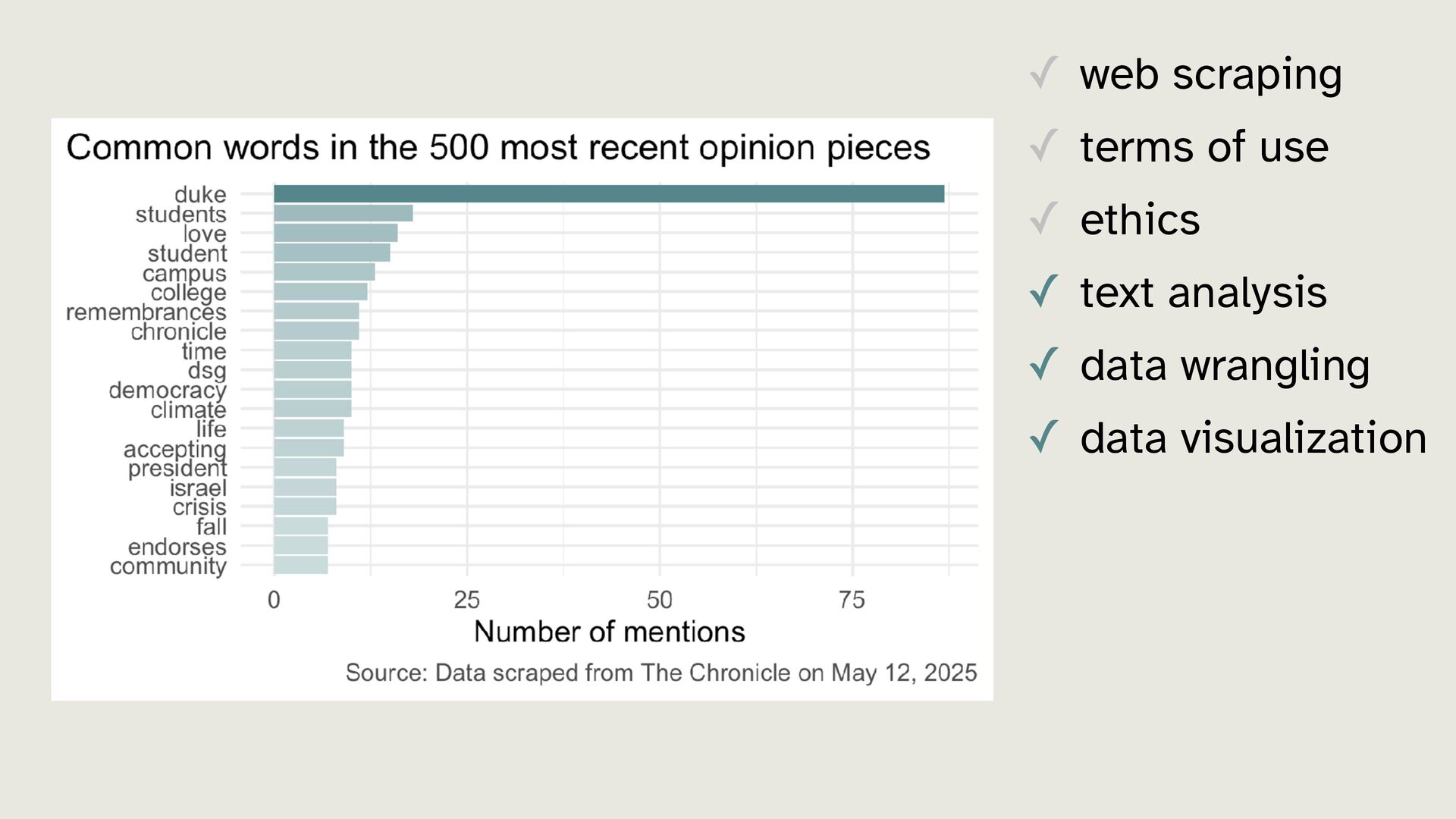
  31. ✓ web scraping . . . # A tibble: 500

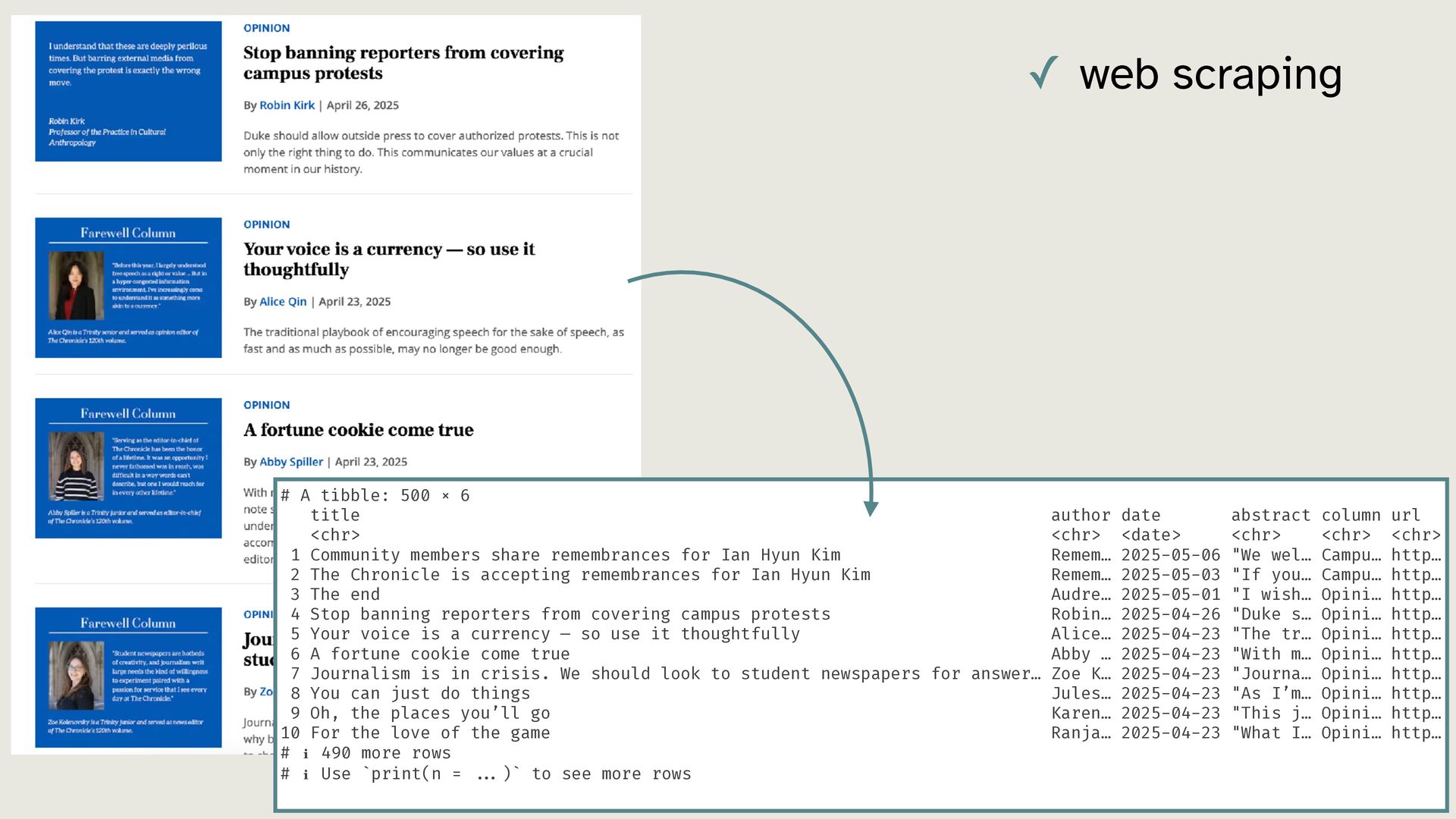
    × 6 title author date abstract column url <chr> <chr> <date> <chr> <chr> <chr> 1 Community members share remembrances for Ian Hyun Kim Remem… 2025-05-06 "We wel… Campu… http… 2 The Chronicle is accepting remembrances for Ian Hyun Kim Remem… 2025-05-03 "If you… Campu… http… 3 The end Audre… 2025-05-01 "I wish… Opini… http… 4 Stop banning reporters from covering campus protests Robin… 2025-04-26 "Duke s… Opini… http… 5 Your voice is a currency — so use it thoughtfully Alice… 2025-04-23 "The tr… Opini… http… 6 A fortune cookie come true Abby … 2025-04-23 "With m… Opini… http… 7 Journalism is in crisis. We should look to student newspapers for answer… Zoe K… 2025-04-23 "Journa… Opini… http… 8 You can just do things Jules… 2025-04-23 "As I’m… Opini… http… 9 Oh, the places you’ll go Karen… 2025-04-23 "This j… Opini… http… 10 For the love of the game Ranja… 2025-04-23 "What I… Opini… http… # ℹ 490 more rows # ℹ Use `print(n = )` to see more rows
  32. ✓ web scraping ✓ terms of use ✓ ethics -

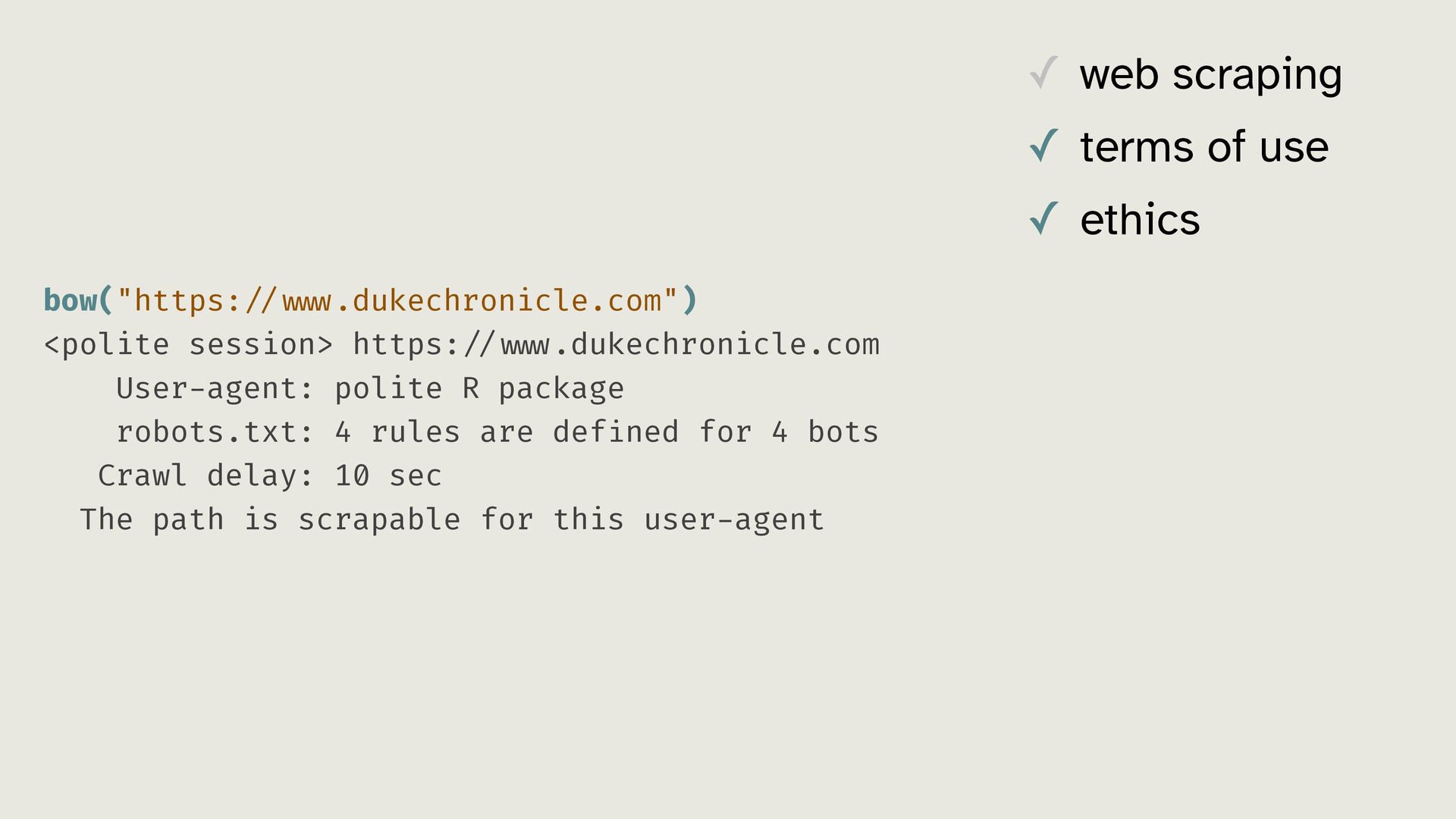
    i w w w / / w w w / / - bow("https: .dukechronicle.com") <polite session> https: .dukechronicle.com User agent: polite R package robots.txt: 4 rules are def ned for 4 bots Crawl delay: 10 sec The path is scrapable for this user agent
  33. ✓ web scraping ✓ terms of use ✓ ethics ✓

    text analysis ✓ data wrangling ✓ data visualization
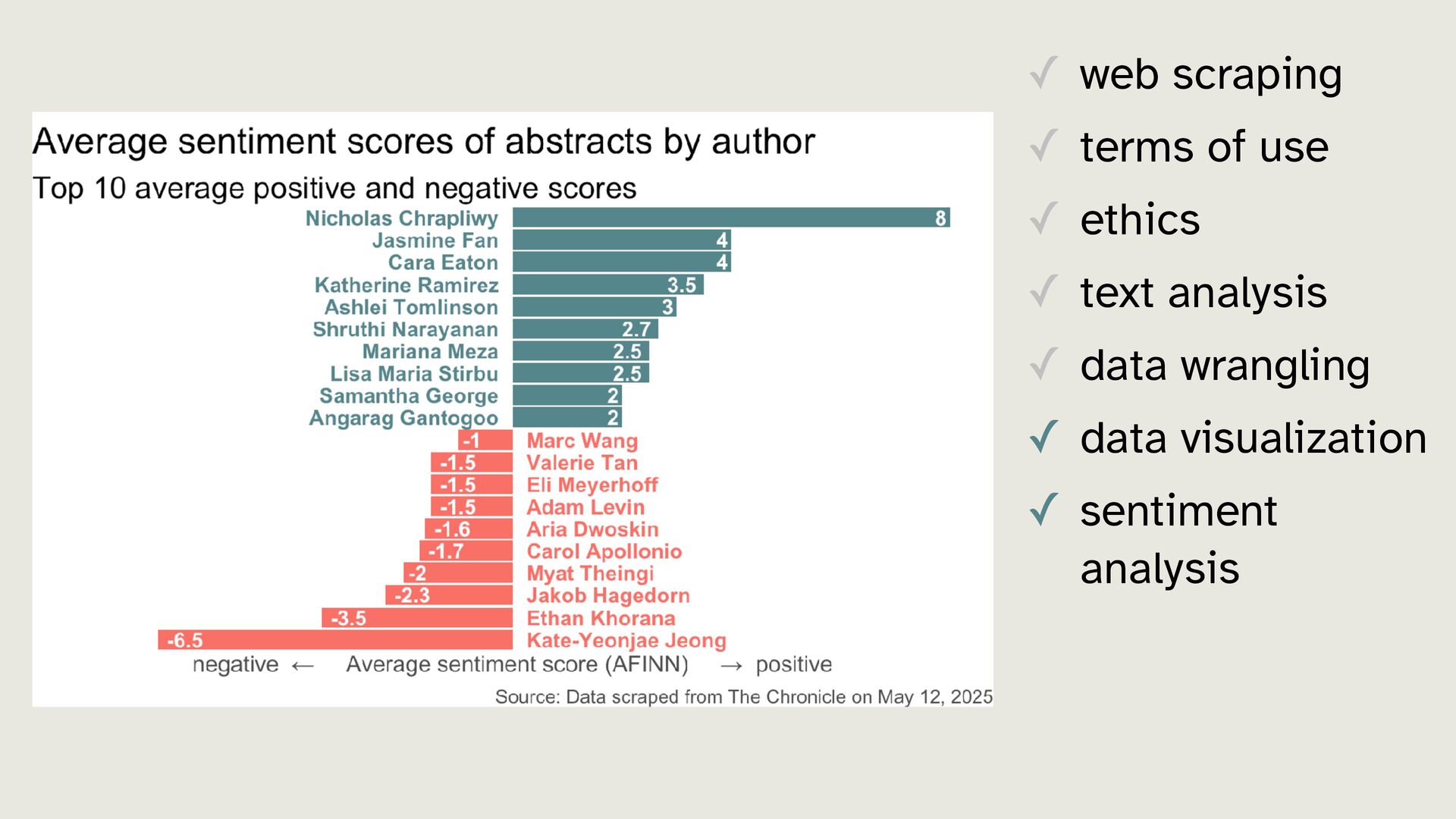
  34. ✓ web scraping ✓ terms of use ✓ ethics ✓

    text analysis ✓ data wrangling ✓ data visualization ✓ sentiment analysis
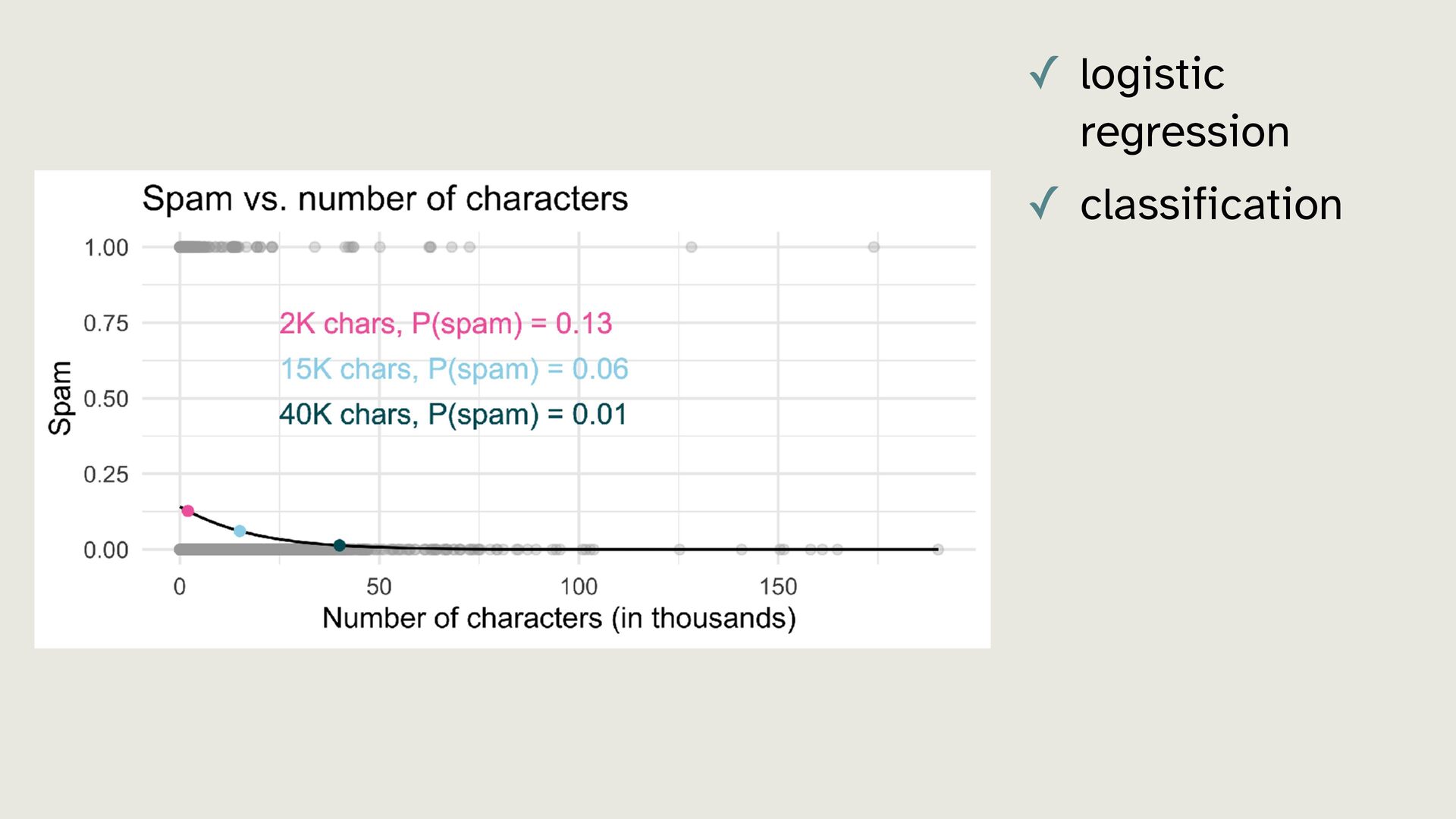
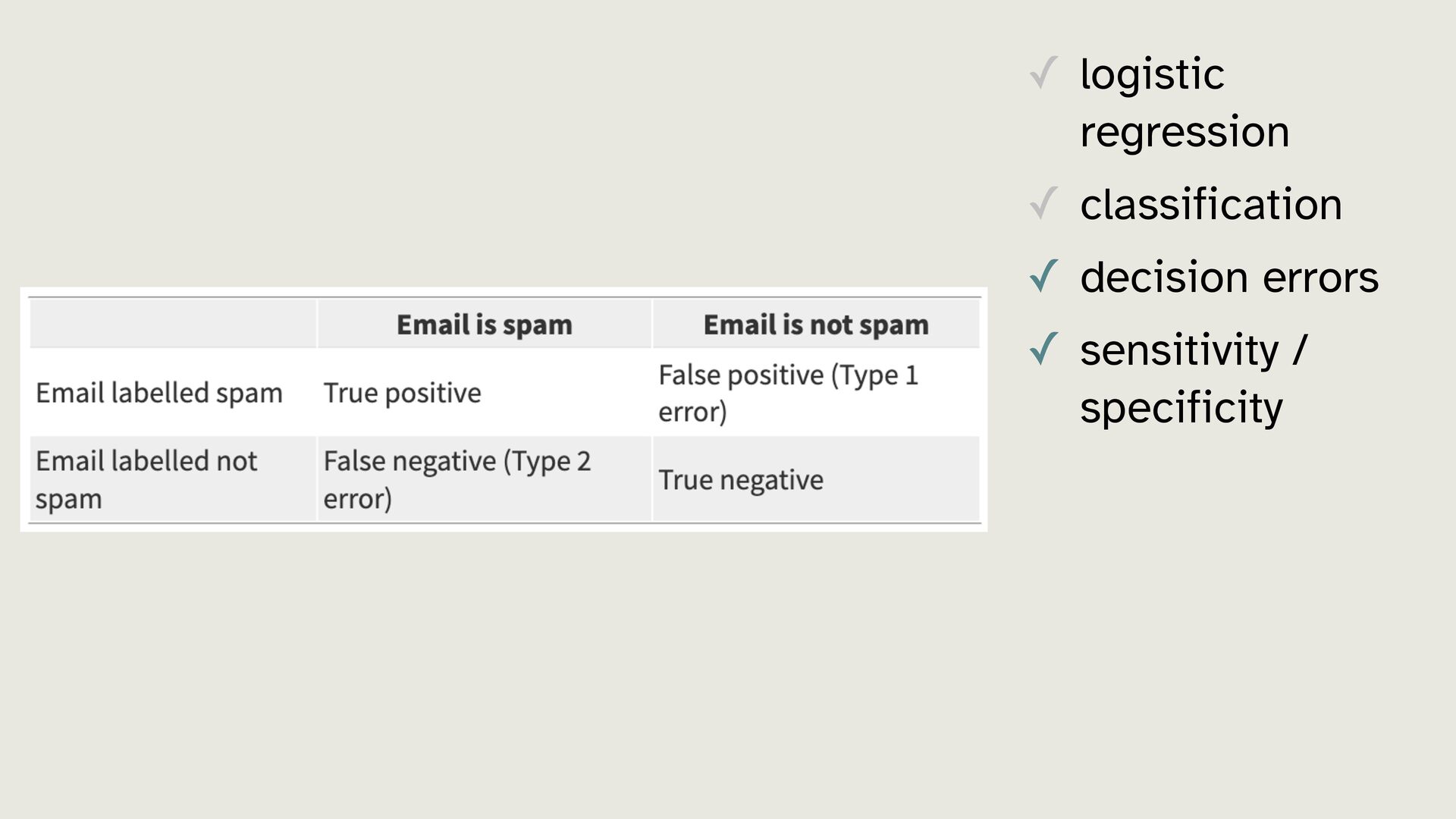
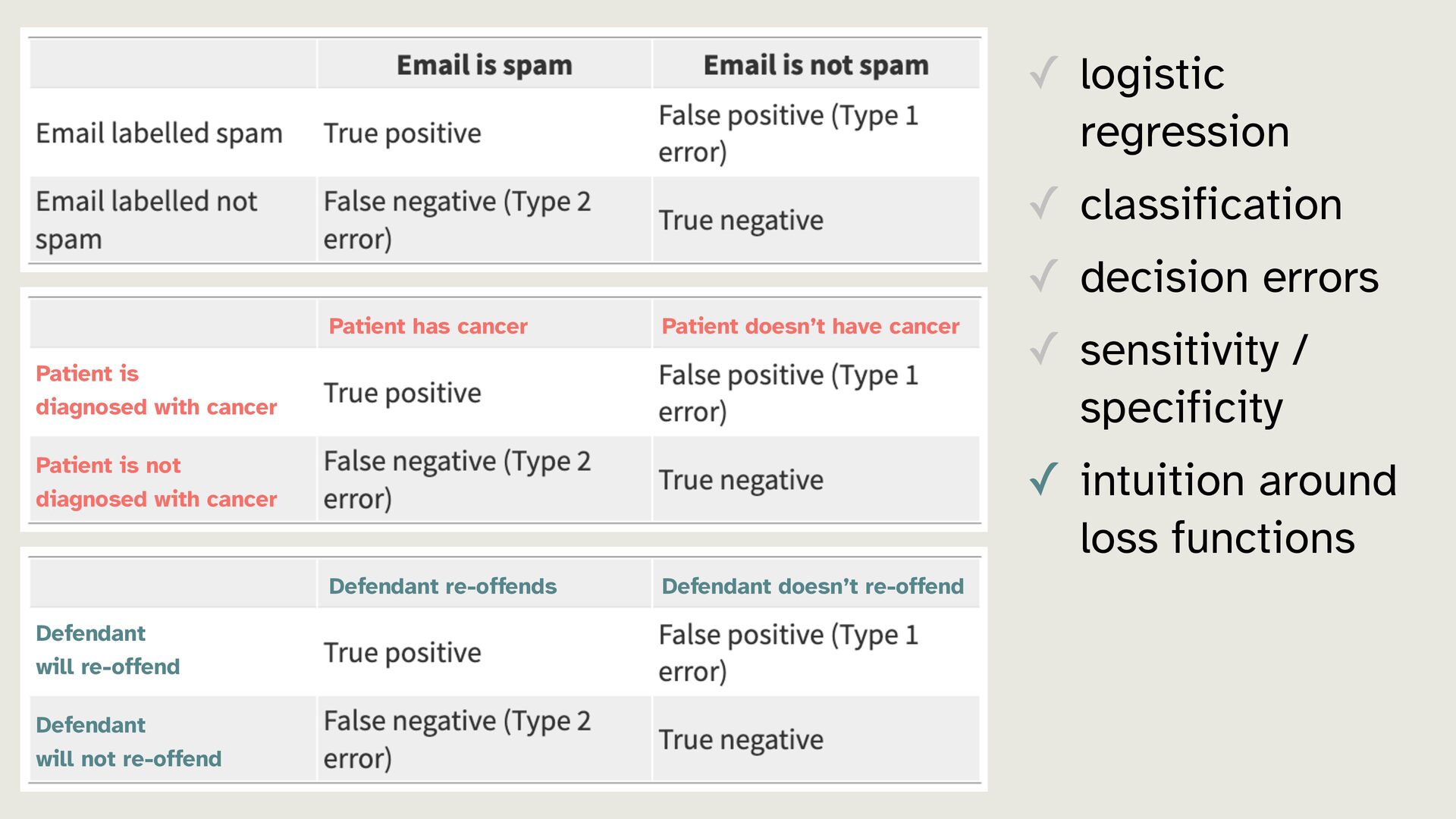
  35. ✓ logistic regression ✓ classification ✓ decision errors Patient has

    cancer Patient doesn’t have cancer Patient is diagnosed with cancer ✓ intuition around loss functions Patient is not diagnosed with cancer Defendant re-offends Defendant will re-offend Defendant will not re-offend ✓ sensitivity / specificity Defendant doesn’t re-offend
  36. and we could keep going on with examples… but let’s

    talk a bit about pedagogy, assessment, and challenges (in light of AI)
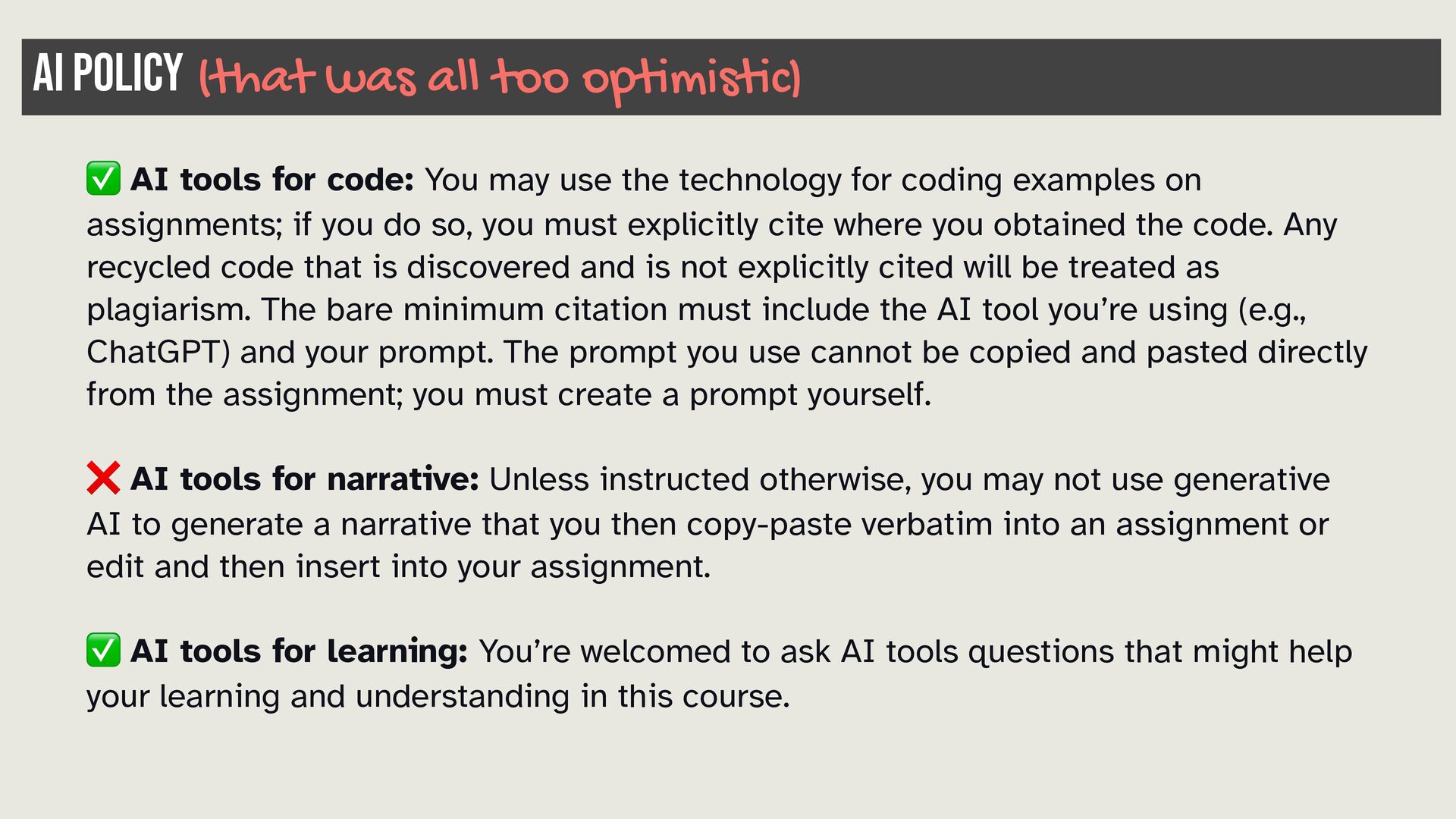
  37. AI policy (that was all too optimistic) ✅ AI tools

    for code: You may use the technology for coding examples on assignments; if you do so, you must explicitly cite where you obtained the code. Any recycled code that is discovered and is not explicitly cited will be treated as plagiarism. The bare minimum citation must include the AI tool you’re using (e.g., ChatGPT) and your prompt. The prompt you use cannot be copied and pasted directly from the assignment; you must create a prompt yourself. ❌ AI tools for narrative: Unless instructed otherwise, you may not use generative AI to generate a narrative that you then copy-paste verbatim into an assignment or edit and then insert into your assignment. ✅ AI tools for learning: You’re welcomed to ask AI tools questions that might help your learning and understanding in this course.
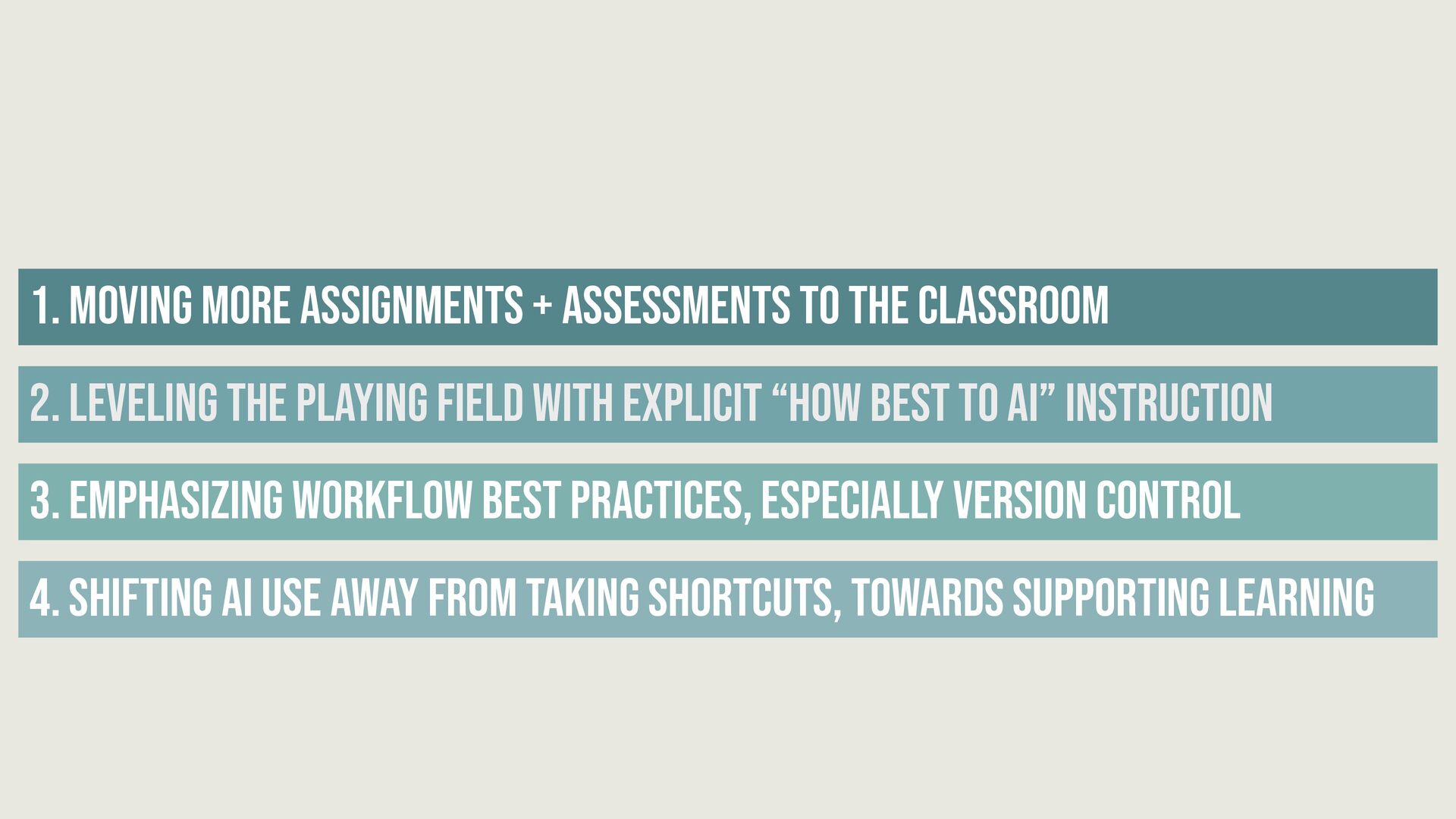
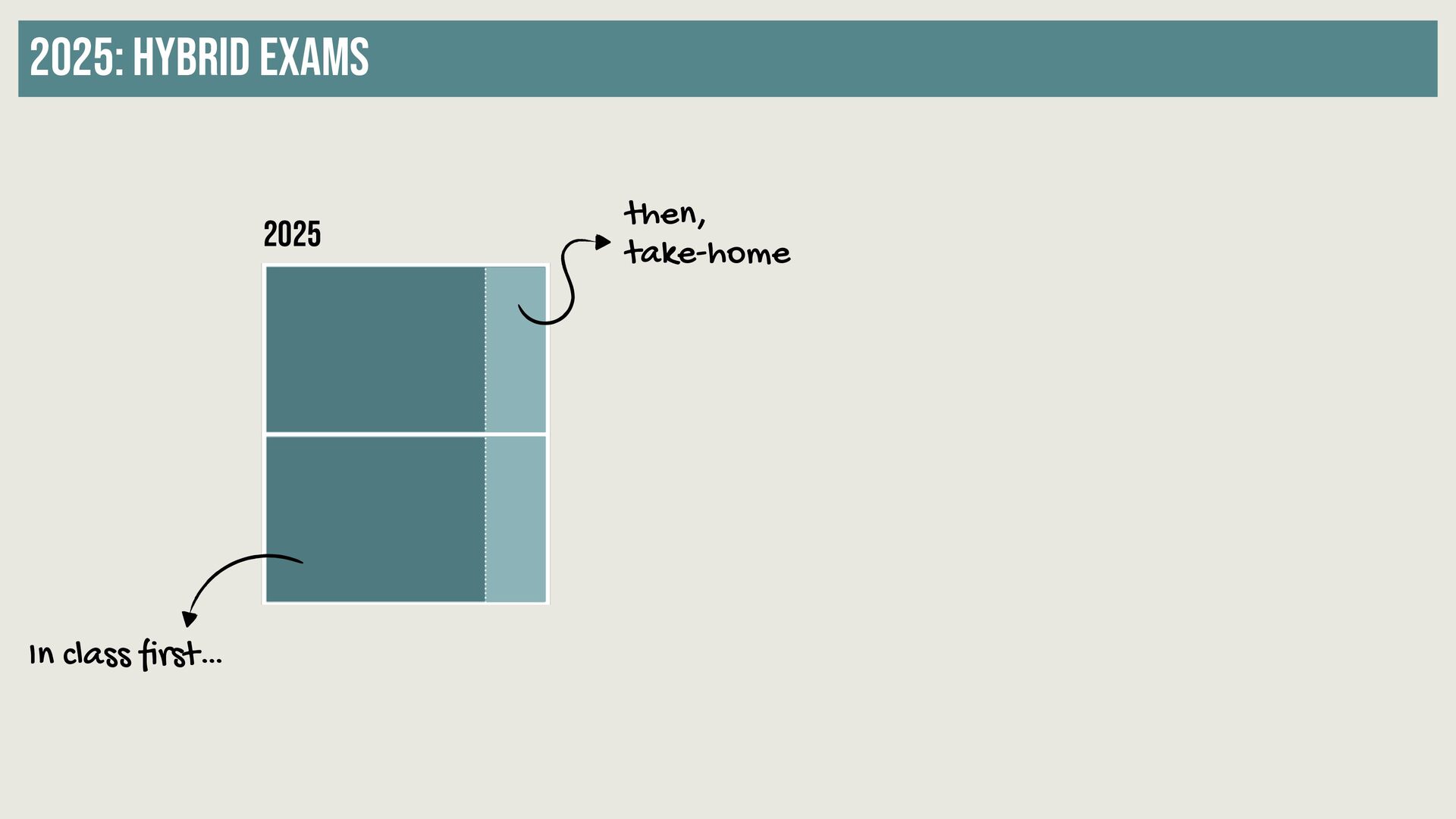
  38. 1. Moving more assignments + assessments to the classroom 2.

    Leveling the playing field with explicit “how best to ai” instruction 3. Emphasizing workflow best practices, especially version control 4. Shifting ai use away from taking shortcuts, towards supporting learning
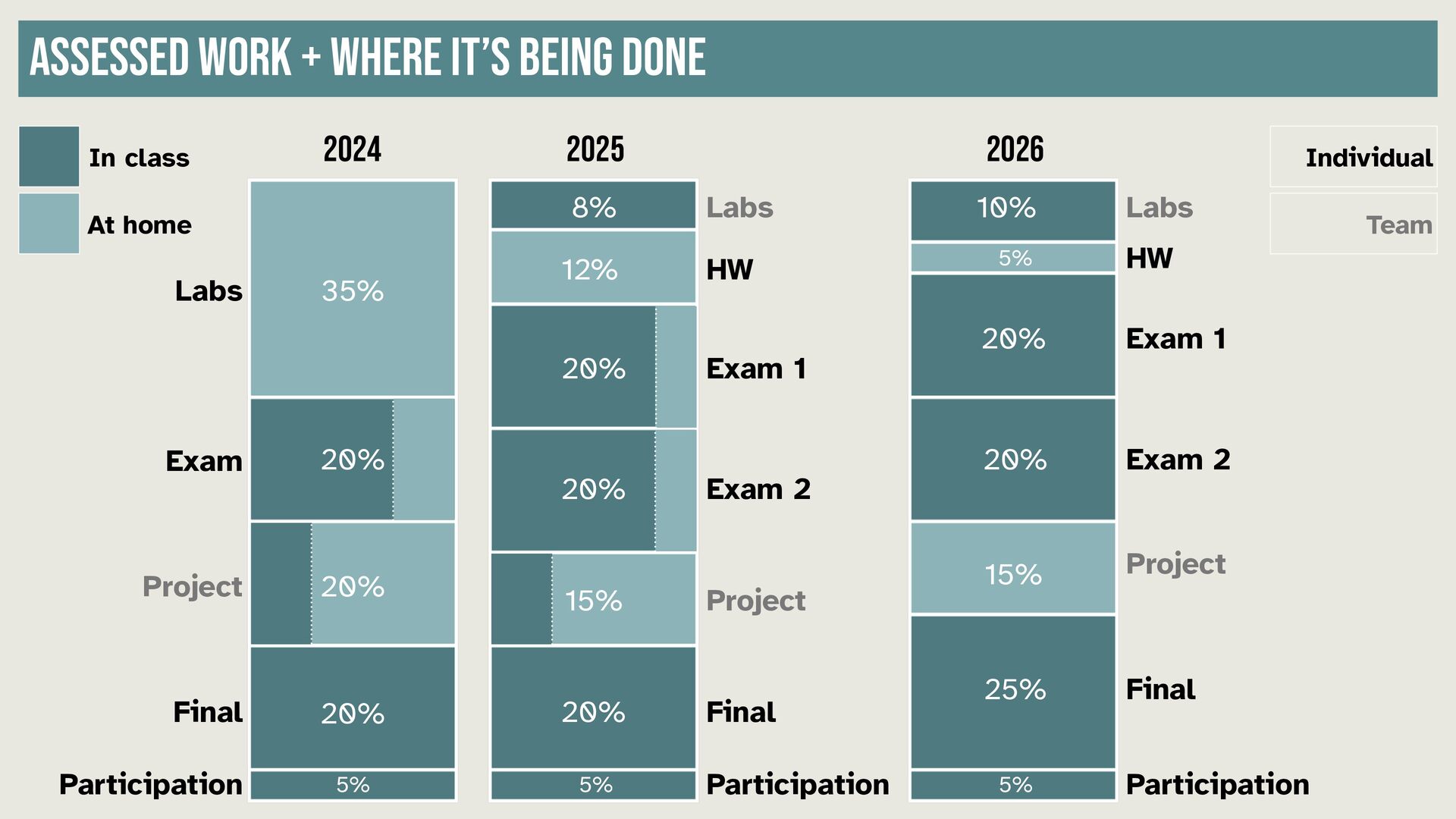
  39. Assessed work + where it’s being done In class 2024

    8% At home Labs 2025 35% 12% 20% Exam Project 20% 20% 20% 15% Final 20% 20% Participation 5% 5% 2026 Individual Labs 10% Labs HW 5% HW Exam 1 Exam 2 Project Final Participation 20% Exam 1 20% Exam 2 15% Project 25% Final 5% Participation Team
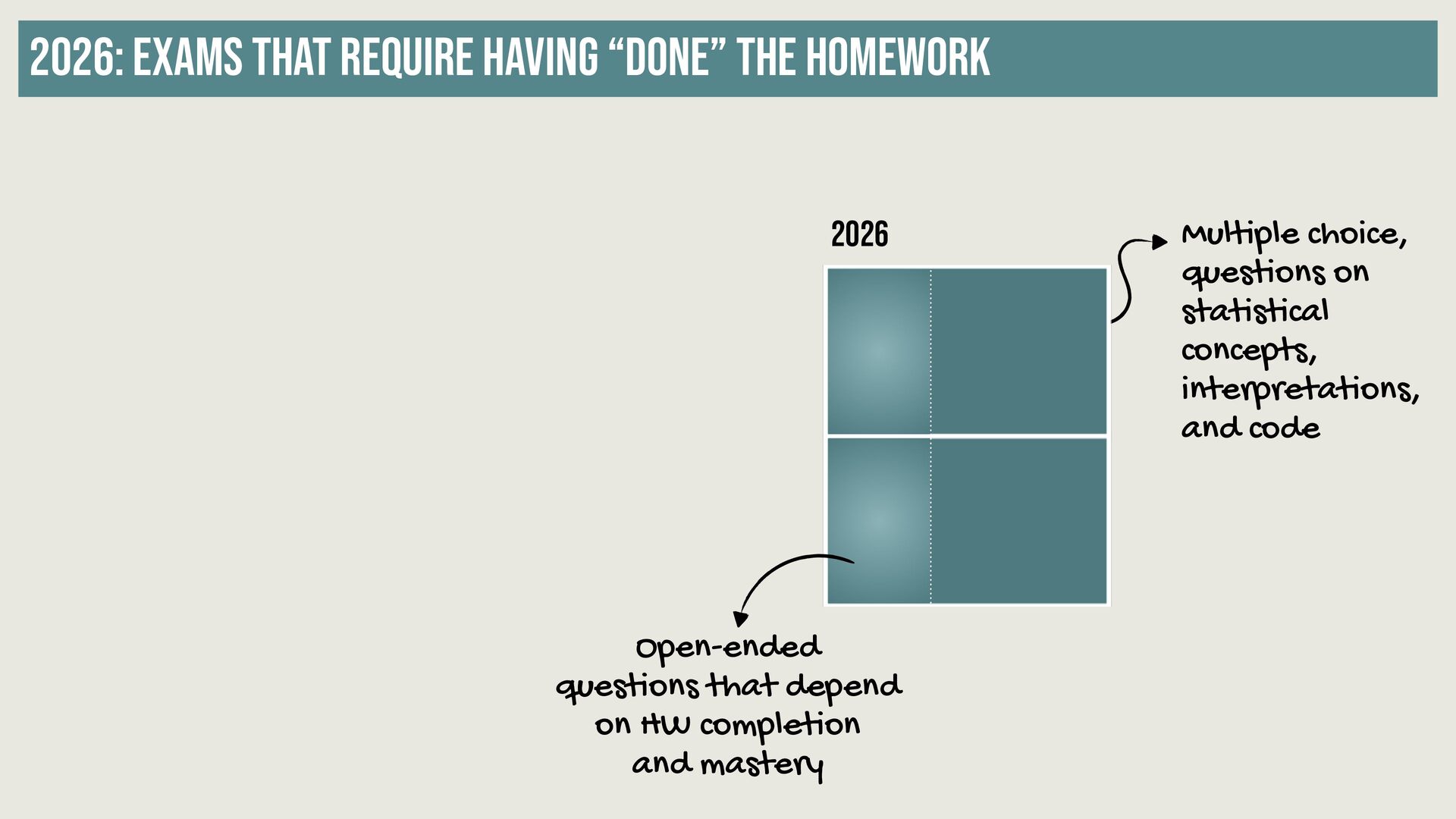
  40. 2026: exams that require having “done” the homework 2026 Open-ended

    questions that depend on HW completion and mastery Multiple choice, questions on statistical concepts, interpretations, and code
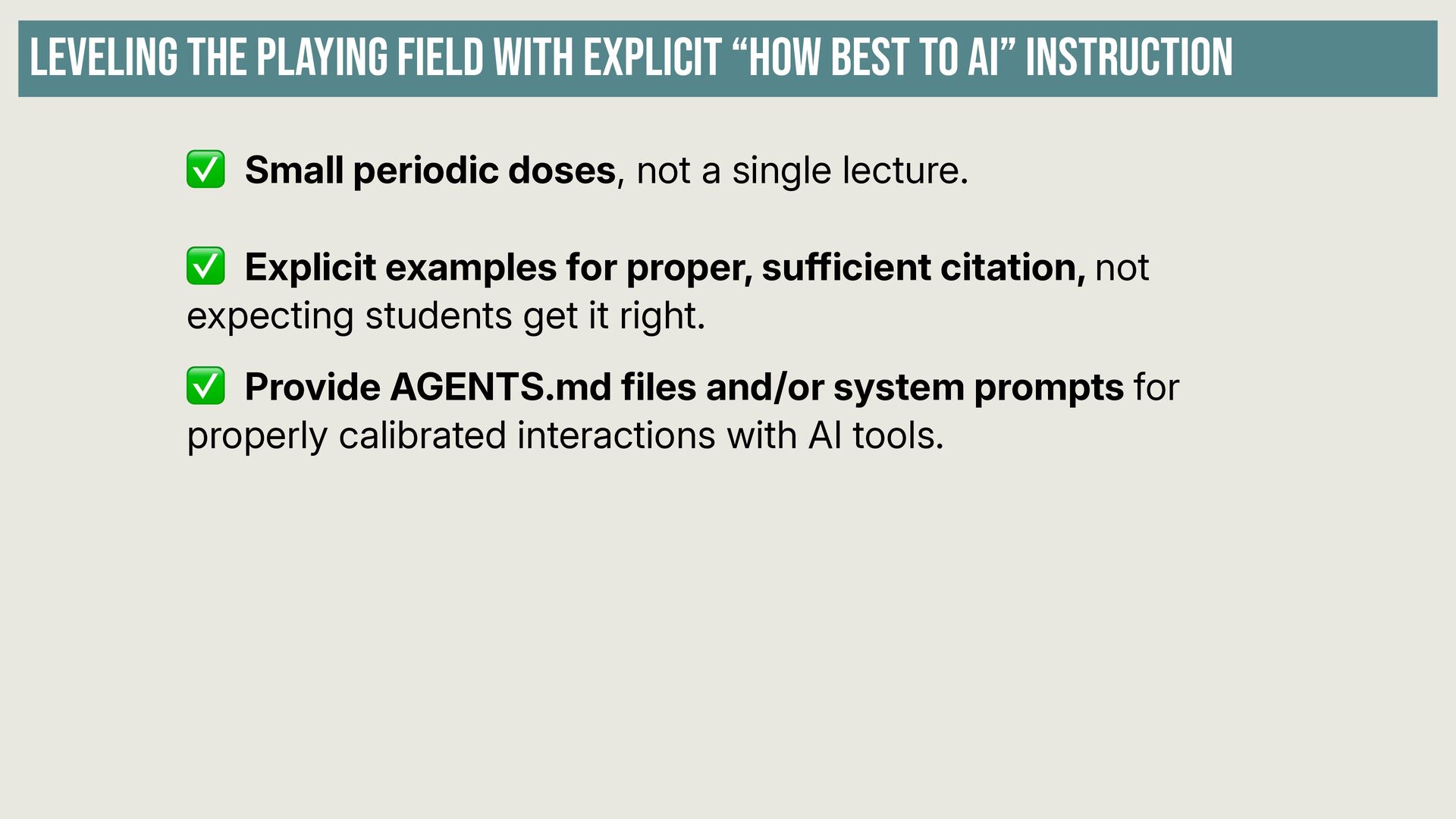
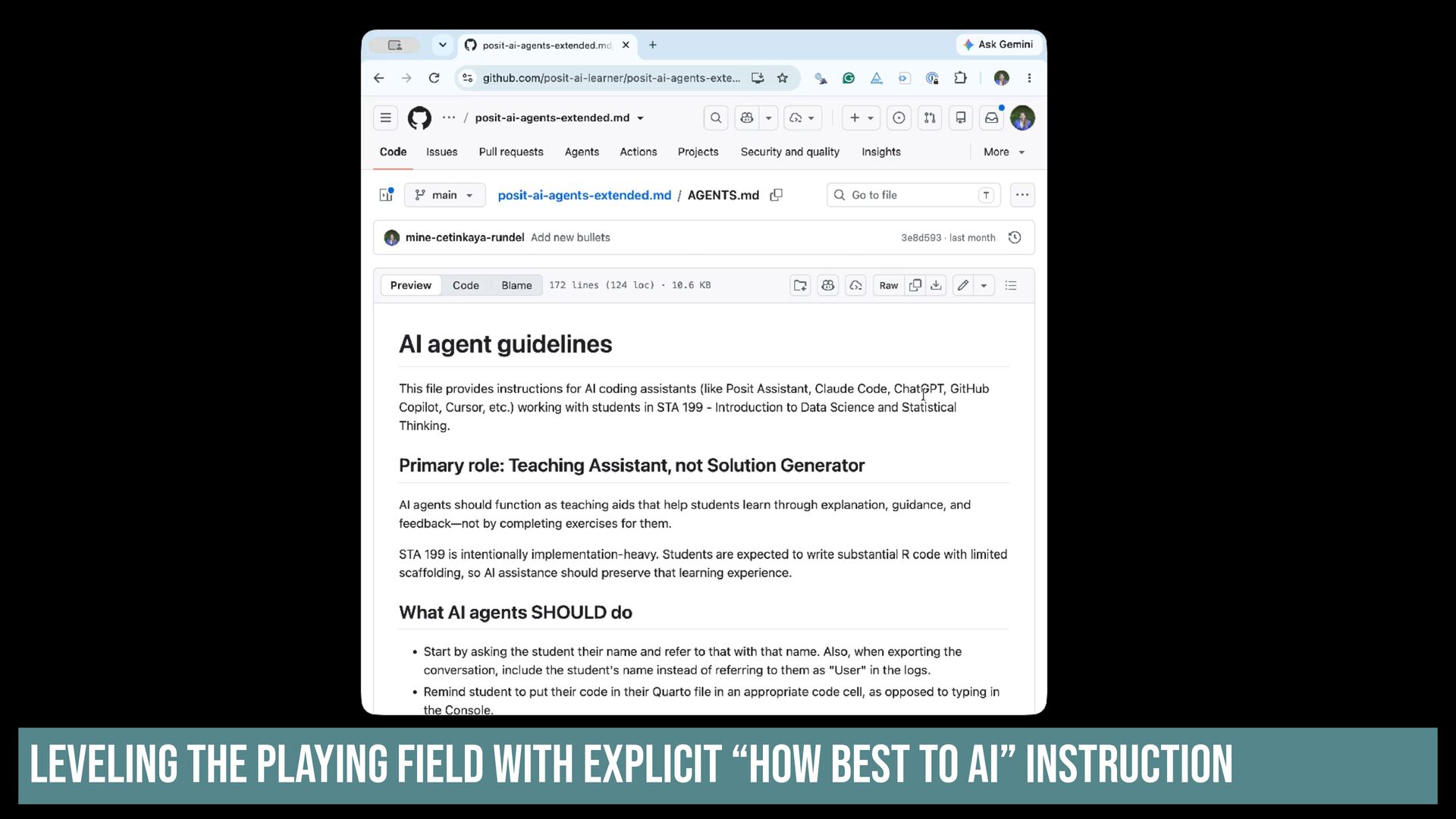
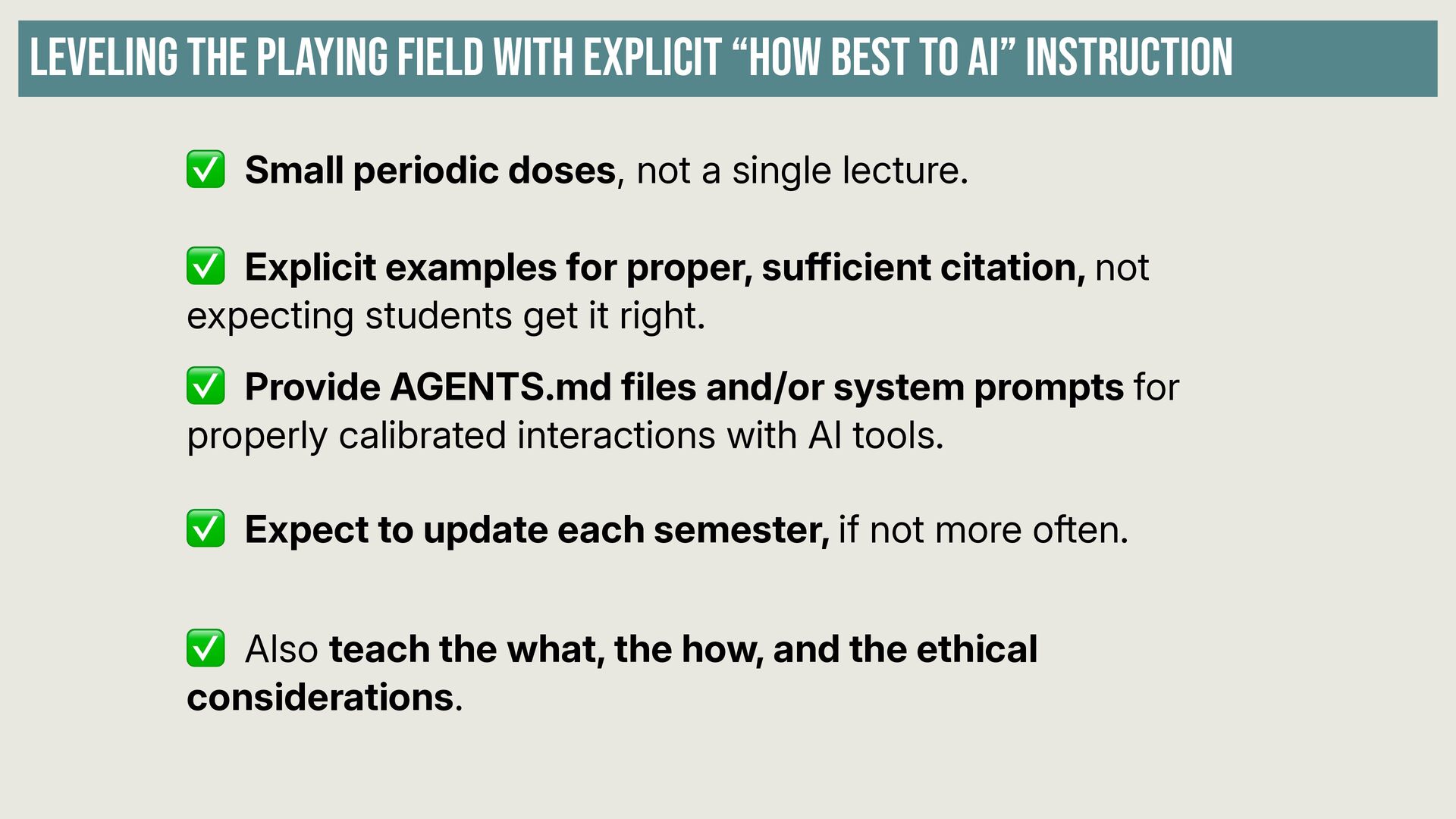
  41. Leveling the playing field with explicit “how best to ai”

    instruction ✅ Small periodic doses, not a single lecture. ✅ Explicit examples for proper, sufficient citation, not expecting students get it right. ✅ Provide AGENTS.md files and/or system prompts for properly calibrated interactions with AI tools.
  42. Leveling the playing field with explicit “how best to ai”

    instruction ✅ Small periodic doses, not a single lecture. ✅ Explicit examples for proper, sufficient citation, not expecting students get it right. ✅ Provide AGENTS.md files and/or system prompts for properly calibrated interactions with AI tools. ✅ Expect to update each semester, if not more often. ✅ Also teach the what, the how, and the ethical considerations.
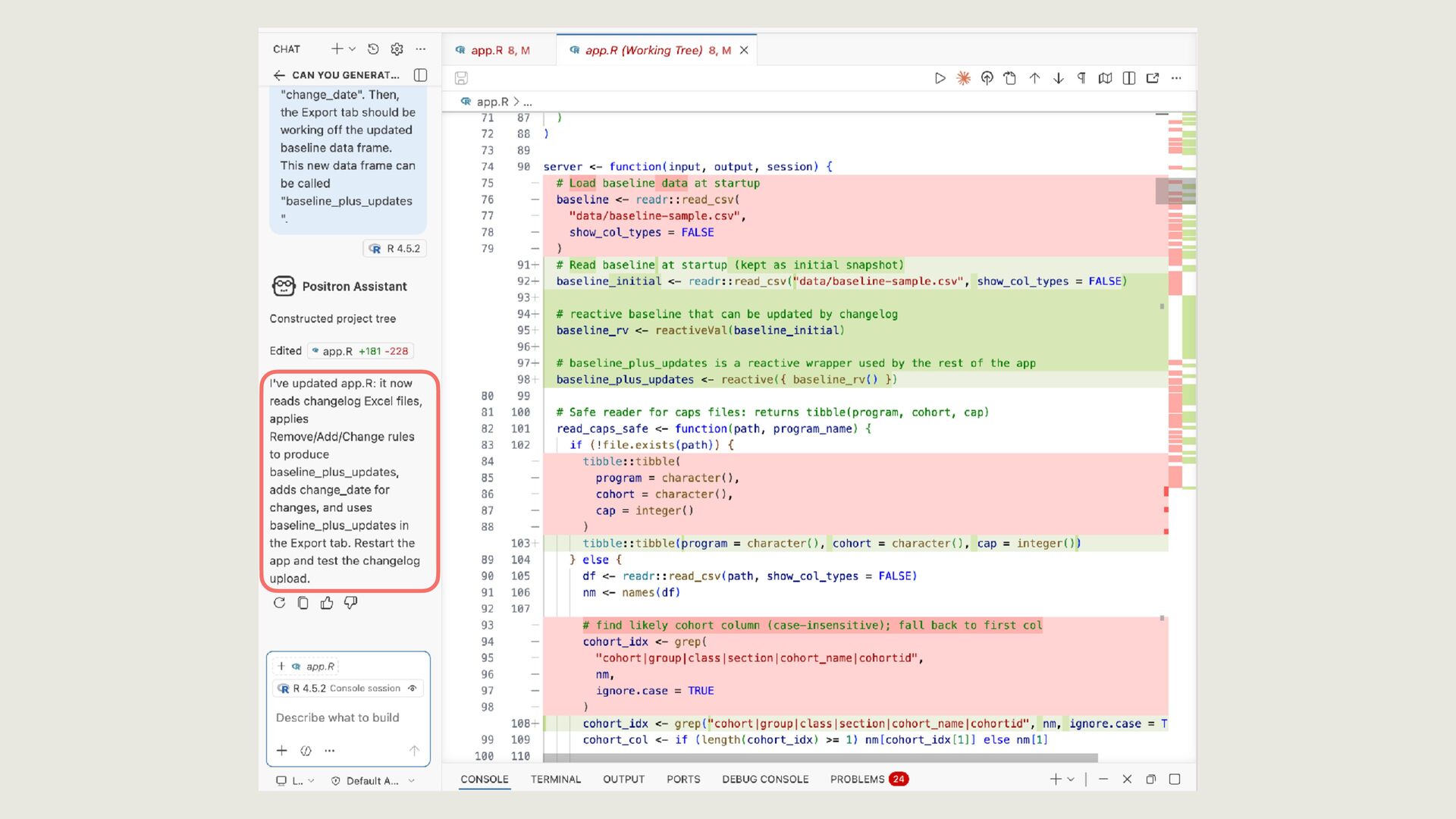
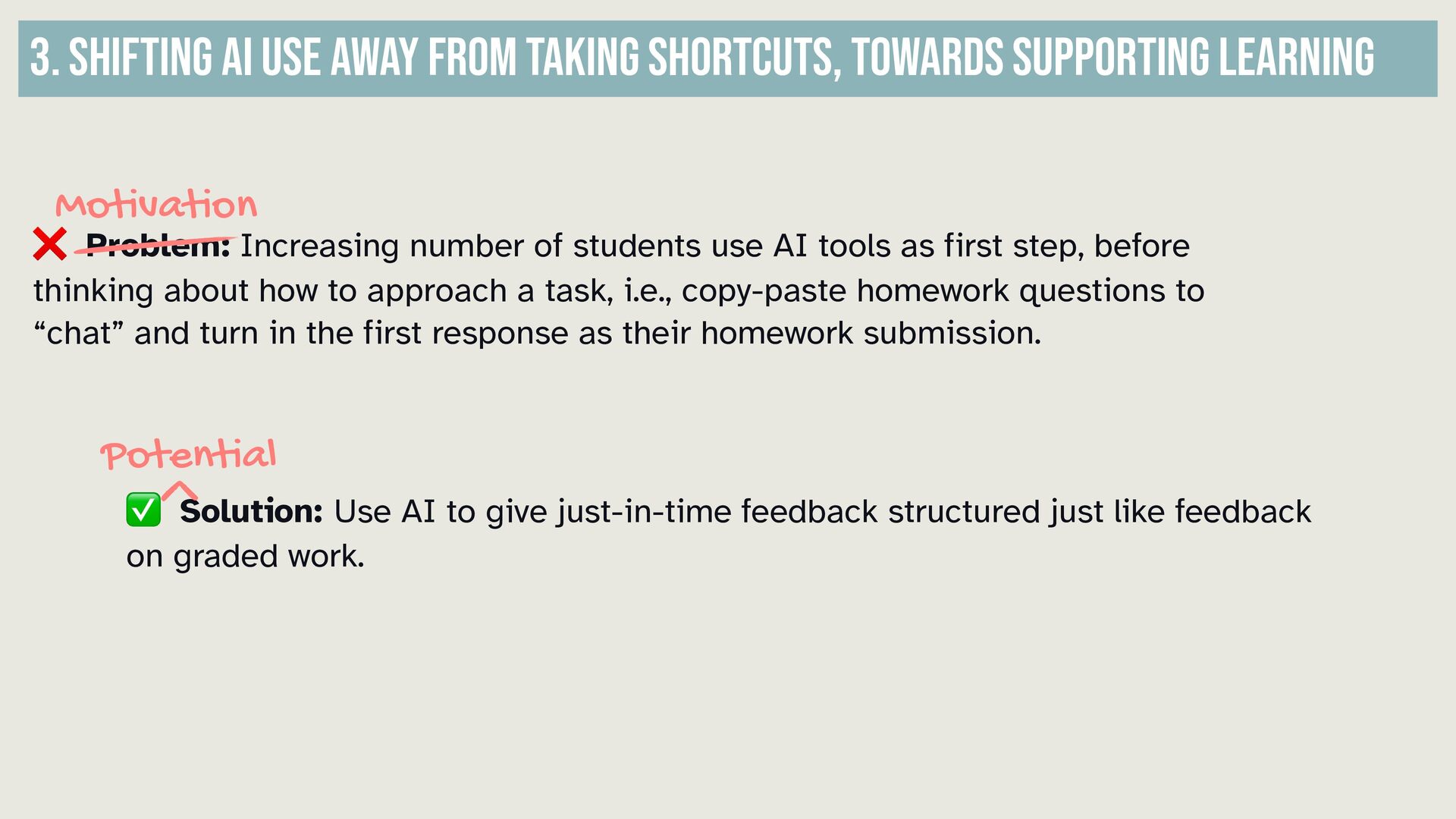
  43. 3. Shifting ai use away from taking shortcuts, towards supporting

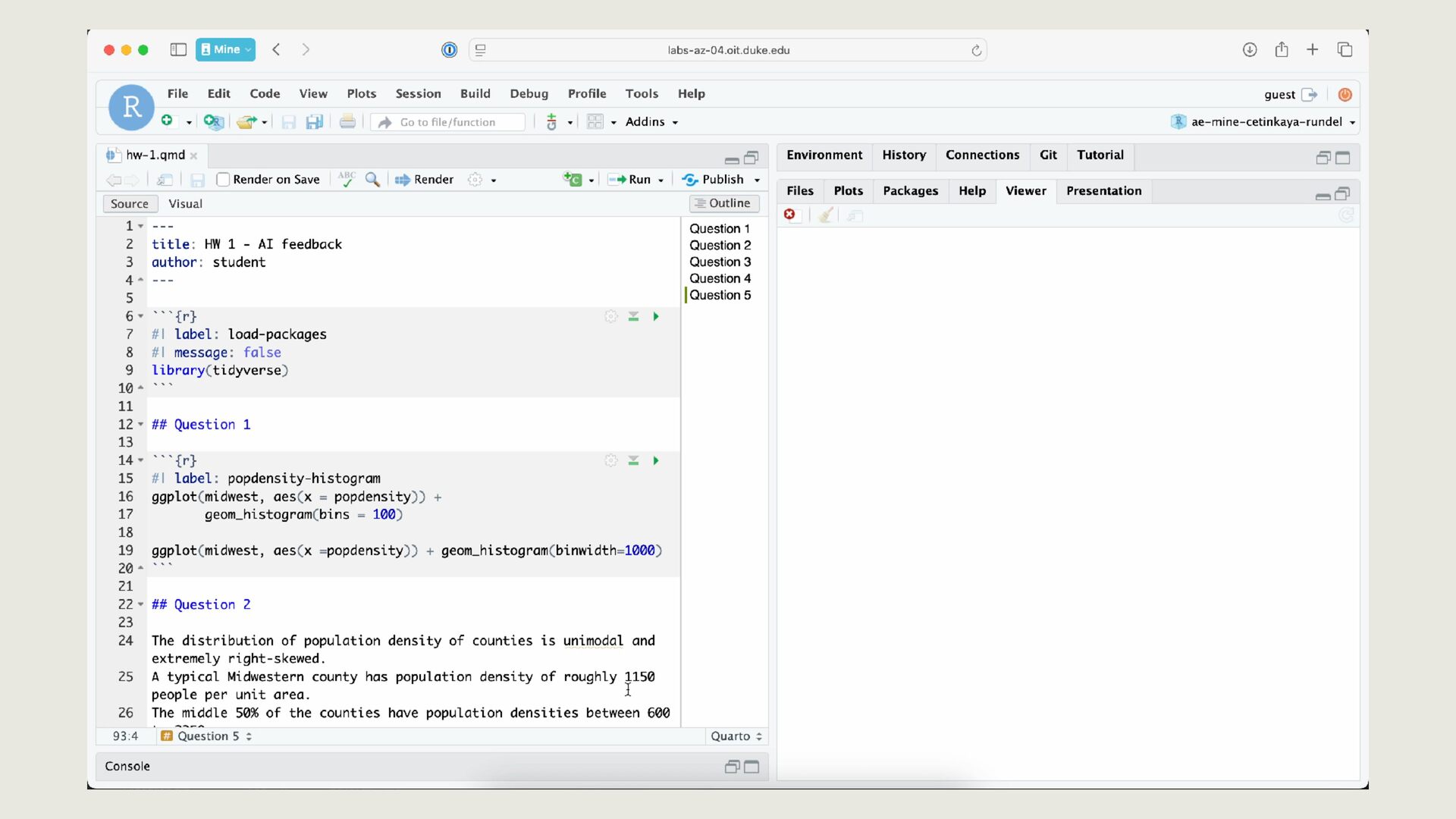
    learning Motivation ❌ Problem: Increasing number of students use AI tools as first step, before thinking about how to approach a task, i.e., copy-paste homework questions to “chat” and turn in the first response as their homework submission. Potential ✅ Solution: Use AI to give just-in-time feedback structured just like feedback on graded work.
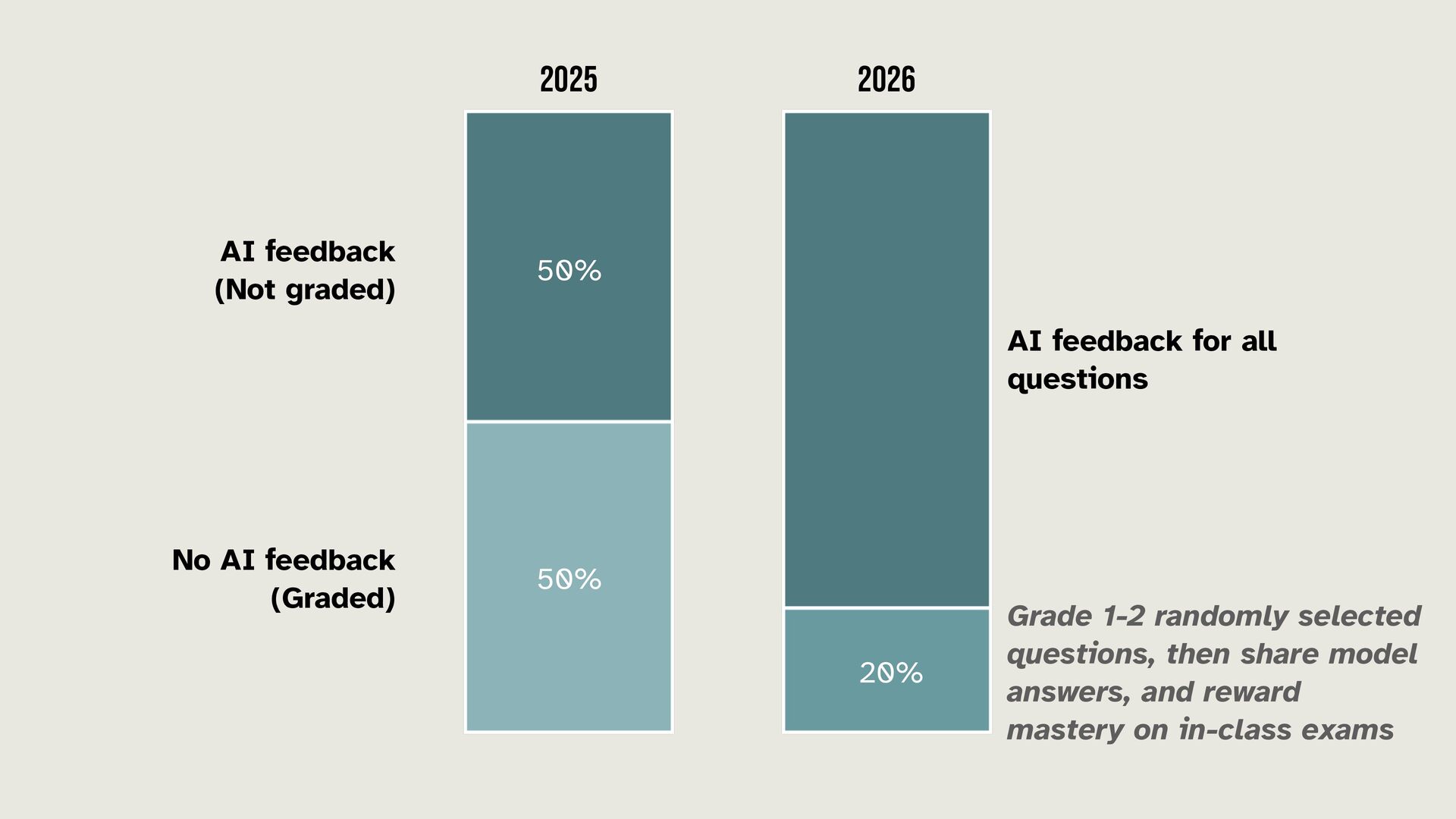
  44. 2025 AI feedback (Not graded) 2026 50% AI feedback for

    all questions No AI feedback (Graded) 50% 20% Grade 1-2 randomly selected questions, then share model answers, and reward mastery on in-class exams