Share
Embed
Evolving IGN's New APIs on Scala
Slides from my talk at JavaOne 2012 on how we evolved IGN's new APIs on Scala and Frameworks related to Scala.
Manish Pandit
October 04, 2012
Transcript
33 slides
-
Evolving IGN’s new APIs with Scala Manish Pandit
Oct 4th, 2012 -
About me Manish Pandit Director of
Engineering, IGN @lobster1234 linkedin.com/in/mpandit -
About IGN We are a leading online media and
services company obsessed with gaming and entertainment. 56MM Monthly Unique Views 737MM Monthly Page Views 20MM Monthly Video Views -
My ObjecTve Is: To get you excited about
building APIs in Scala Isn't: To incite a funcTonal vs. imperaTve, or Scala vs. ____ debate -
Agenda • APIs at IGN • API EvoluTon
• Why Scala • API Development with Scala • Monitoring, Maintaining, Evolving • Performance Management -
APIs at IGN • Offer SOA advantages •
Isolate the back end systems from the FE • IGN is going where the audience is, fast – Mobile Devices, Consoles, TVs, Aggregators • APIs are a specialized skillset • Expand the development to outside developers -
APIs at IGN : Numbers • ~5 Billion requests
a month • Average Response Tme of under 20ms on cache misses • 17 APIs between Social, OAuth, and Content • Hardest hit APIs doing about 25K RPM at peak -
The API EvoluTon : V1 [2006] • The CMS
and the desktop site calling Java Services, which wrapped Oracle DB calls behind Hibernate. • Caching with Memcache – Near-‐far Cache Architecture to address hot spots • Not all content types were supported • Schema was sTll too complex -
The API EvoluTon : V2 [2009] • Rails based
Content API, Java based Social API – Standards around request/response – Automated TesTng – MongoDB NoSQL storage to simplify the schema – Solr • Video and Blogs served by V2 API • Games and ArTcles sTll used V1 • Mixed-‐infrastructure with Rails and Java echosystem • Performance sucked royally -
The API EvoluTon : V3 [2012] • A fresh
look at the APIs and IGN’s direcTon • First ajempt to – Integrate all content types – Open up the APIs to external consumers – Evolve the CMS, tradiTonally a monolithic system – ElasTcSearch – Varnish Response Caching • A learning opportunity for tradiTonal Java stack engineers -
API Development • MVC Model for APIs – View,
which marshals/unmarshals request and response data – Controller, which picks the right model to serve the request – Model, which has the necessary logic to talk to the database, or other APIs to fetch data -
Why Scala • Performance Ted to cores than processor
speed, i.e. concurrency • Ideal for API development – (relaTvely) simple to handle concurrency and immutability • JVM based = Performance • Re-‐use Java toolkits and libraries • Concise, expressive code (1:2.5 with Java) • Actor model makes the difficult parts easy -
Why Scala • Richer CollecTons API • Traits
enabling Mix-‐Ins and behavior re-‐use • StaTcally Typed w/Type inference • FuncTonal • Growing developer community • REPL • Culture – learning, hacking and achieving -
The Biggest Reason • Just makes sense – Pajern
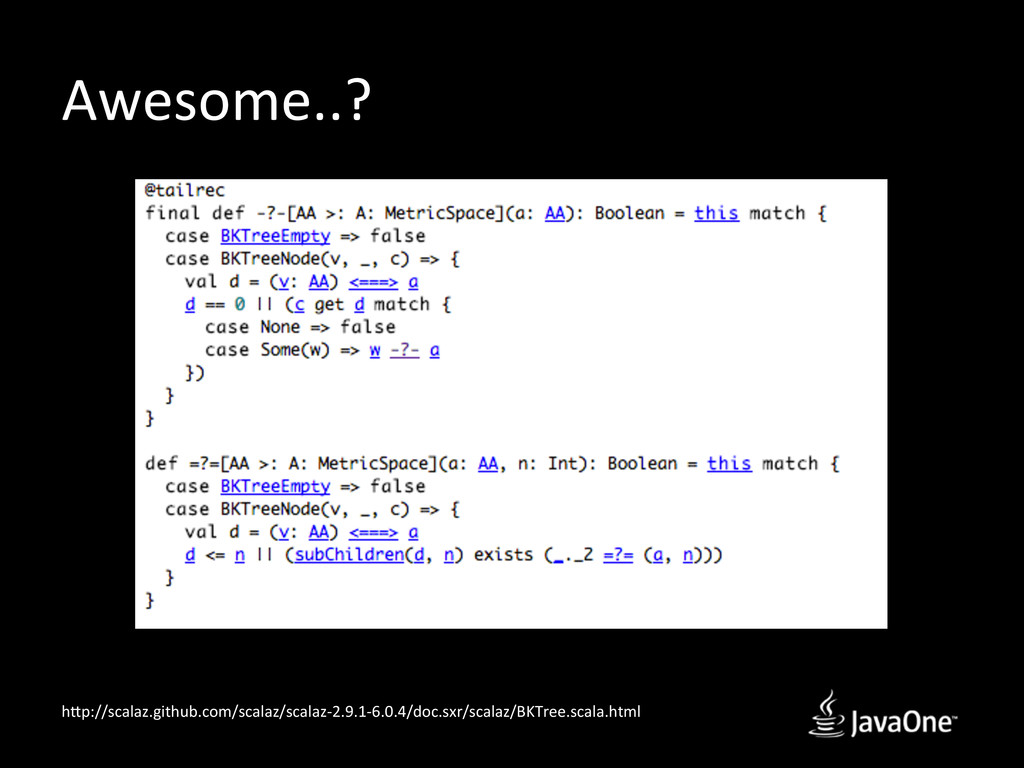
matching – Implicit conversions – Control abstracTons for collecTon mapping, filtering, iteraTng – Guaranteed Singletons at the classloader level – Almost non-‐existent boilerplate ….ProducTve, and fun! -
Picking up Scala : Week 1 • Scala for
Java Developers fast-‐tracked the learning • Syntax Familiarity • Java without semicolons? def total(nums: List[Int]) :Int = {! var sum:Int=0! for(num<-nums) {! sum+=num! }! sum! }! -
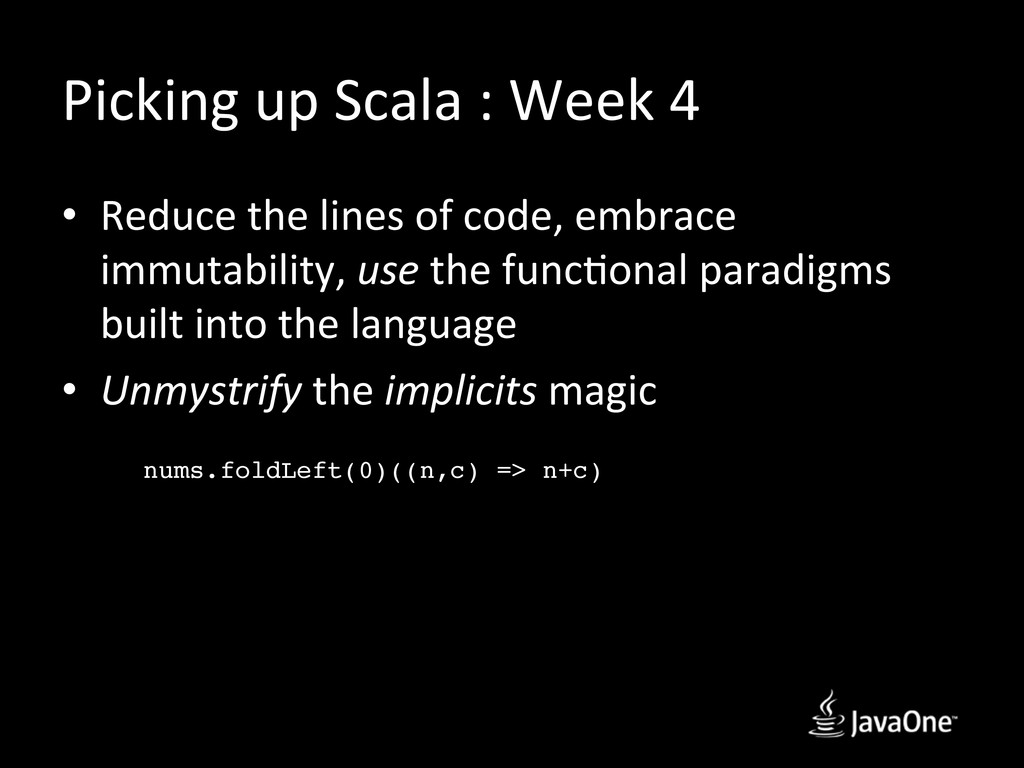
Picking up Scala : Week 4 • Reduce the
lines of code, embrace immutability, use the funcTonal paradigms built into the language • Unmystrify the implicits magic nums.foldLeft(0)((n,c) => n+c)! -
Picking up Scala : Today • Focus on immutability
• Think funcTonal – with the knowledge gained from using the funcTonal aspects of the language, build control abstracTons • Keep learning and applying -
API Components • Scalatra (View, Controller) • Lit-‐MongoRecord
for MongoDB (Model) • Casbah for MongoDB • Play! Anorm for MySQL • Actors for tasks like syndicaTon • Maven for Builds • MongoDB for persistance -
Other API Components • Varnish Cache •
ElasTcsearch • Yammer Metrics (ping, healthcheck) • Swagger (self-‐documenTng RESTful APIs) • 3Scale for Partner APIs • IntelliJ IDEA and Eclipse with ScalaIDE -
Challenges with Scala • Learning Curve depends on the
culture • TPS Cover Sheets, vs. Hack Nights • Scala is what you make of it -
Challenges with Scala • Scala is what you make
of it – Middle ground – simple is beauTful • Tooling not as rich as Java – Changing with Typesafe invesTng in ScalaIDE -
Challenges with Scala • Slow compilaTon based on the
source – How well the code matches up to the JVM constructs • No (binary) compaTbility of dependencies for the major releases (2.8, 2.9, 2.10(?)) • Monitoring – No naTve instrumentaTon agents as they exist for Java -
API Development : Deploying • ConTnuous Deployment •
Jenkins hooks to github • Pushes arTfact(s) to Nexus • Fabric to push code to producTon (to be automated) -
API Performance Management • As far as Scala goes,
the Tps are not much different than Java – GC Tuning – Avoid shared state – Parallel collecTons -
API Performance Management • For the overall APIs, the
performance tuning has many knobs to work around with – Stateless services – Async calls with Akka Agents – Response level cache • Keep an eye on the database and network – Control the payload size – Use reasonable defaults – Allow field filtering – Paginate your response -
Monitoring and Maintenance • Newrelic – JVM stats, SQL
trace – Supports Scala via annotaTons, but not as rich as Java • Typesafe Console for Akka -
Future of APIs at IGN • Opening up the
APIs • Tests, tests, tests.. • Move towards simplifying the stack – sbt vs. maven – Typesafe stack -
Resources • Do NOT use scaladoc as your 1st
reference, at least iniTally • StackOverflow • Twijer’s Scala School • Online blogs and tutorials • Book: Scala for the ImpaTent • Scala Meetup Groups in your area • Coursera course on FP by MarTn Odersky