Upgrade to Pro — share decks privately, control downloads, hide ads and more …

Continuous Valuation Challenges and Practical A...

Sponsored · Ship Features Fearlessly Turn features on and off without deploys. Used by thousands of Ruby developers.
Avatar for Bob Killen Bob Killen
February 25, 2026

Continuous Valuation Challenges and Practical Approaches to Measuring Contribution Investment and ROI

Organizations often struggle to quantify the value and ROI derived from consuming and contributing to open source. In this talk, we present Continuous Valuation, a holistic and repeatable framework for demystifying the open source investment process, enabling organizations of all types to measure the incredible value they derive from open source engagement. This methodology effectively combines software engineering and open source domain expertise with economic theory to convert diverse contribution engagements – from code commits to community building to financial support – into measurable monetary equivalents as well as estimate the total return to contribution. We will detail actionable strategies for placing this framework "into production," providing organizations with novel, credible, and tailor-made insight into their open source contribution ROI.

Avatar for Bob Killen

Bob Killen

February 25, 2026
Tweet

More Decks by Bob Killen

Other Decks in Technology

Transcript

  1. Continuous Valuation Challenges and Practical Approaches to Measuring Contribution Investment

    and ROI LF Member Summit Napa Wednesday February 25, 2026 1:40pm - 2:10pm PST (Vinter’s Court)
  2. 2 Efficient and accurate OSS ROI Value is one of

    many open source metrics A metric for contribution ROI bolsters rationale for increased OSS engagement Before even getting to “R” of ROI, we need “I” This talk: • Outline of challenges and progress on solutions • Discussion of practical strategies for measurement of OSS investment • End with an open discussion
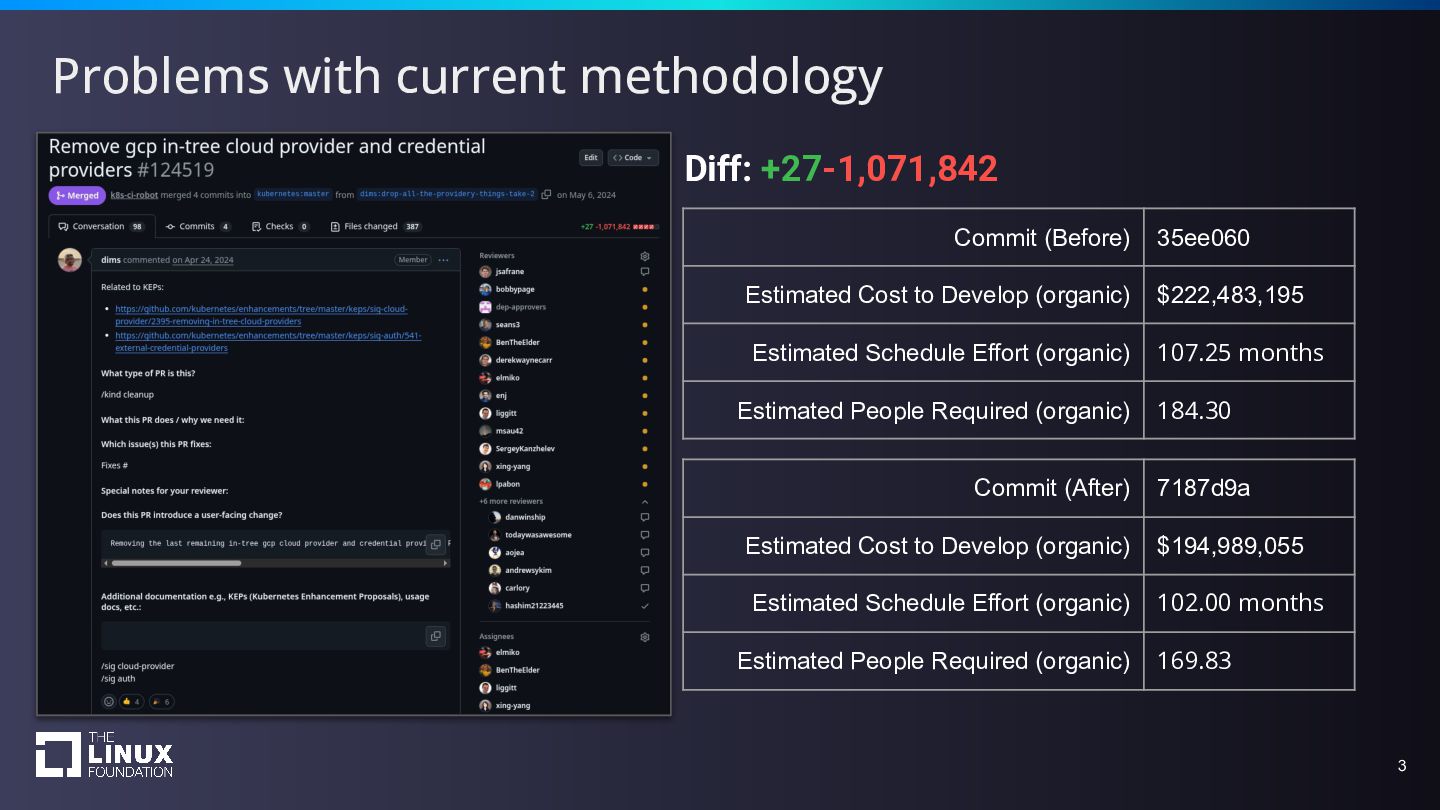
  3. 3 Problems with current methodology Diff: +27-1,071,842 Commit (Before) 35ee060

    Estimated Cost to Develop (organic) $222,483,195 Estimated Schedule Effort (organic) 107.25 months Estimated People Required (organic) 184.30 Commit (After) 7187d9a Estimated Cost to Develop (organic) $194,989,055 Estimated Schedule Effort (organic) 102.00 months Estimated People Required (organic) 169.83
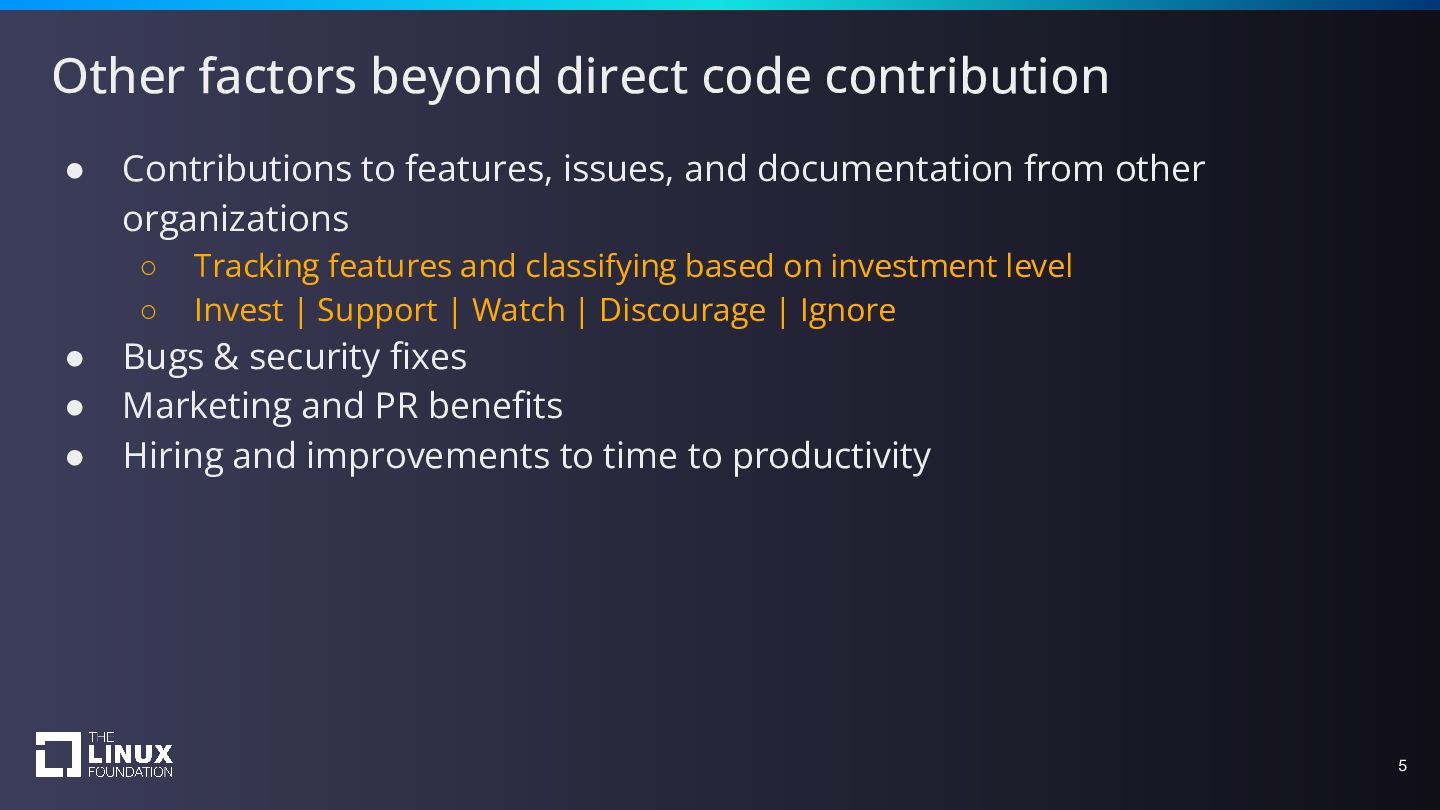
  4. 4 Other factors beyond direct code contribution • Contributions to

    features, issues, and documentation from other organizations • Bugs & security fixes • Marketing and PR benefits • Hiring and improvements to time to productivity
  5. 5 Other factors beyond direct code contribution • Contributions to

    features, issues, and documentation from other organizations ◦ Tracking features and classifying based on investment level ◦ Invest | Support | Watch | Discourage | Ignore • Bugs & security fixes • Marketing and PR benefits • Hiring and improvements to time to productivity
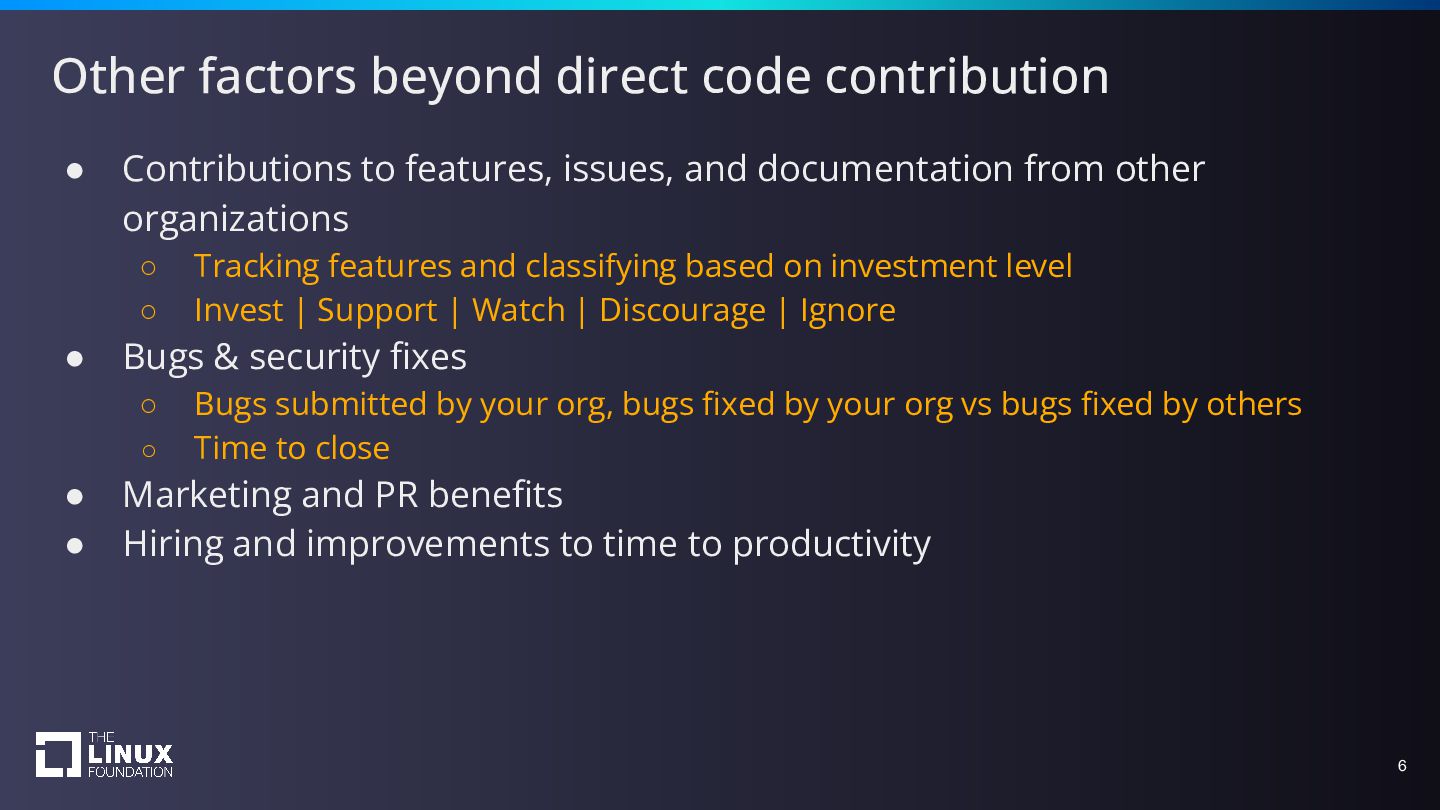
  6. 6 Other factors beyond direct code contribution • Contributions to

    features, issues, and documentation from other organizations ◦ Tracking features and classifying based on investment level ◦ Invest | Support | Watch | Discourage | Ignore • Bugs & security fixes ◦ Bugs submitted by your org, bugs fixed by your org vs bugs fixed by others ◦ Time to close • Marketing and PR benefits • Hiring and improvements to time to productivity
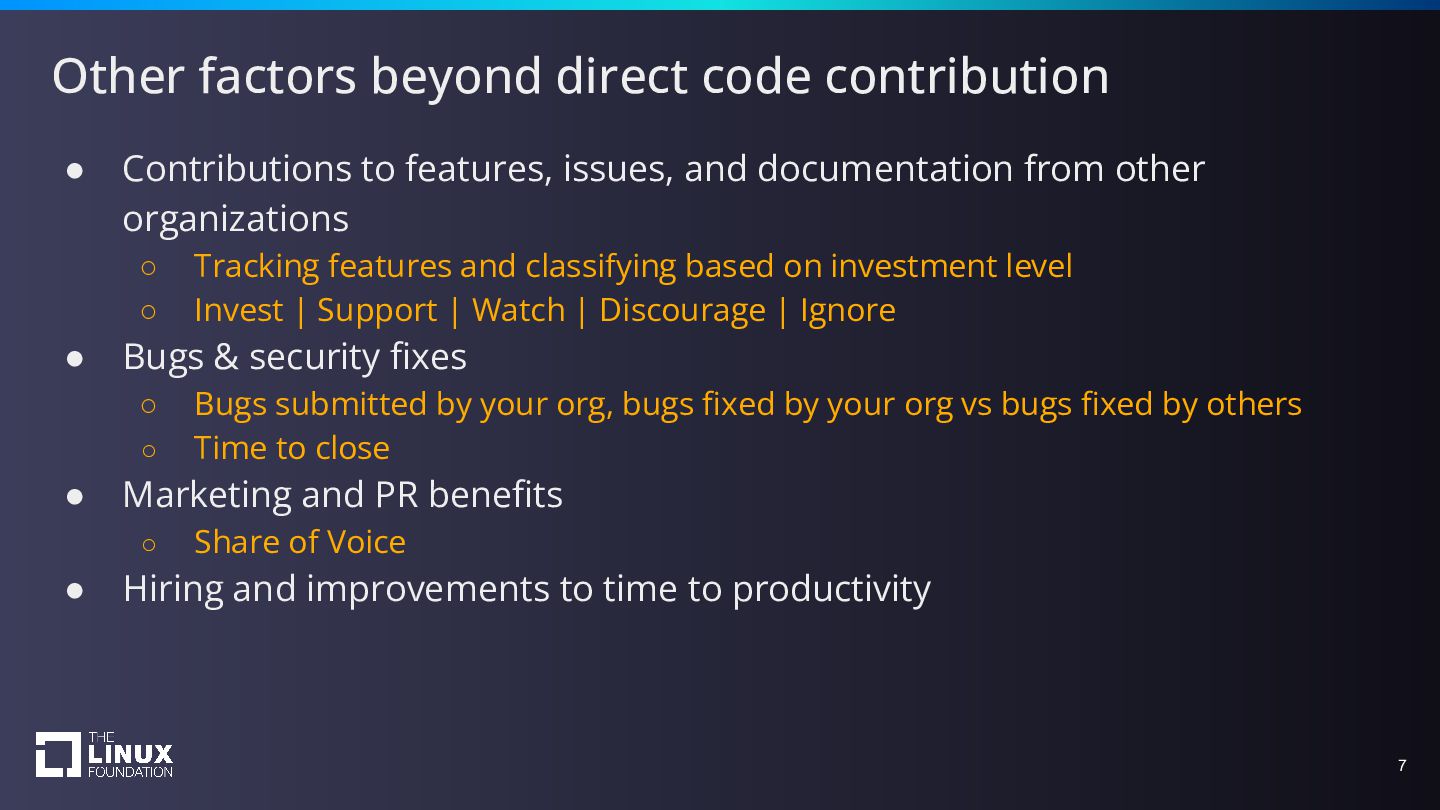
  7. 7 Other factors beyond direct code contribution • Contributions to

    features, issues, and documentation from other organizations ◦ Tracking features and classifying based on investment level ◦ Invest | Support | Watch | Discourage | Ignore • Bugs & security fixes ◦ Bugs submitted by your org, bugs fixed by your org vs bugs fixed by others ◦ Time to close • Marketing and PR benefits ◦ Share of Voice • Hiring and improvements to time to productivity
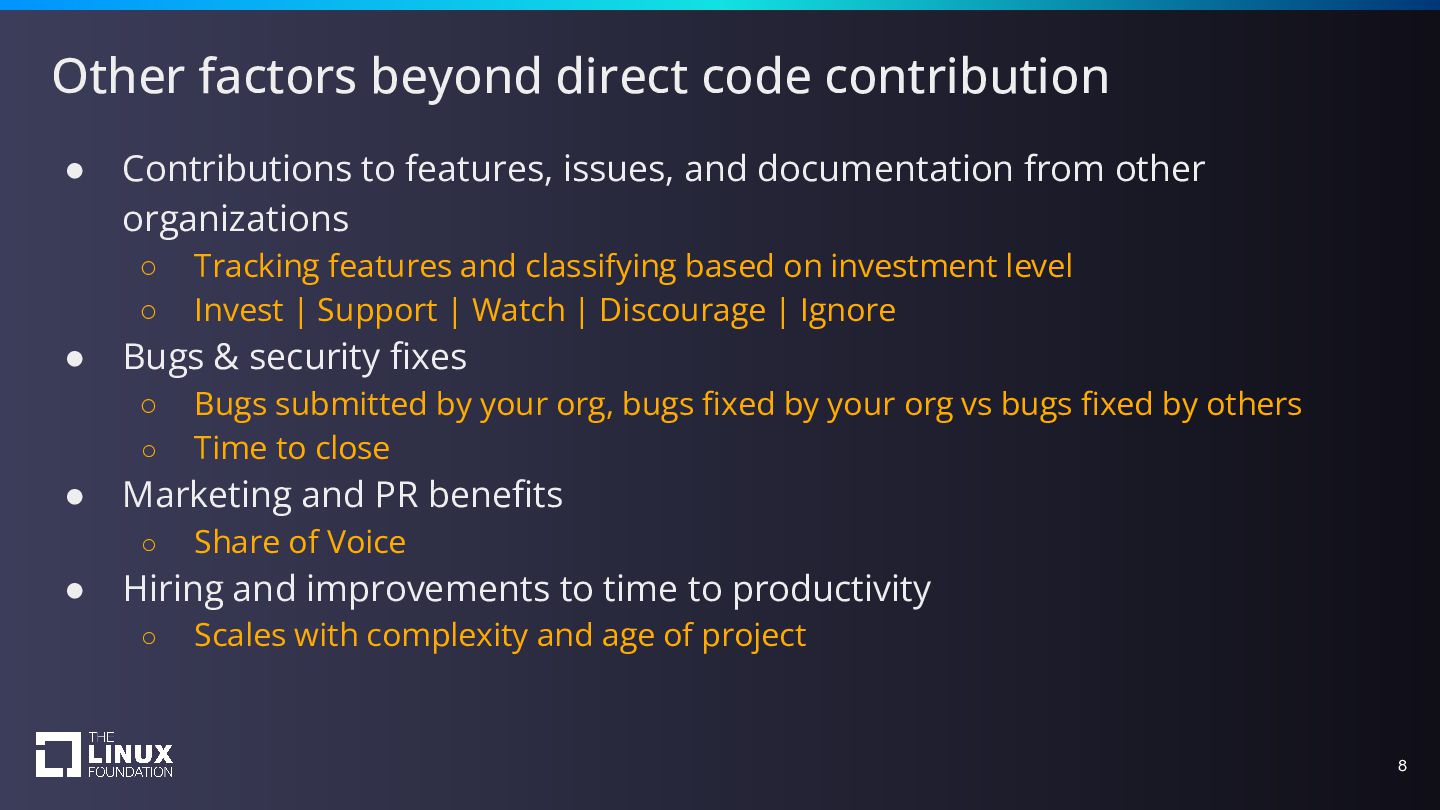
  8. 8 Other factors beyond direct code contribution • Contributions to

    features, issues, and documentation from other organizations ◦ Tracking features and classifying based on investment level ◦ Invest | Support | Watch | Discourage | Ignore • Bugs & security fixes ◦ Bugs submitted by your org, bugs fixed by your org vs bugs fixed by others ◦ Time to close • Marketing and PR benefits ◦ Share of Voice • Hiring and improvements to time to productivity ◦ Scales with complexity and age of project
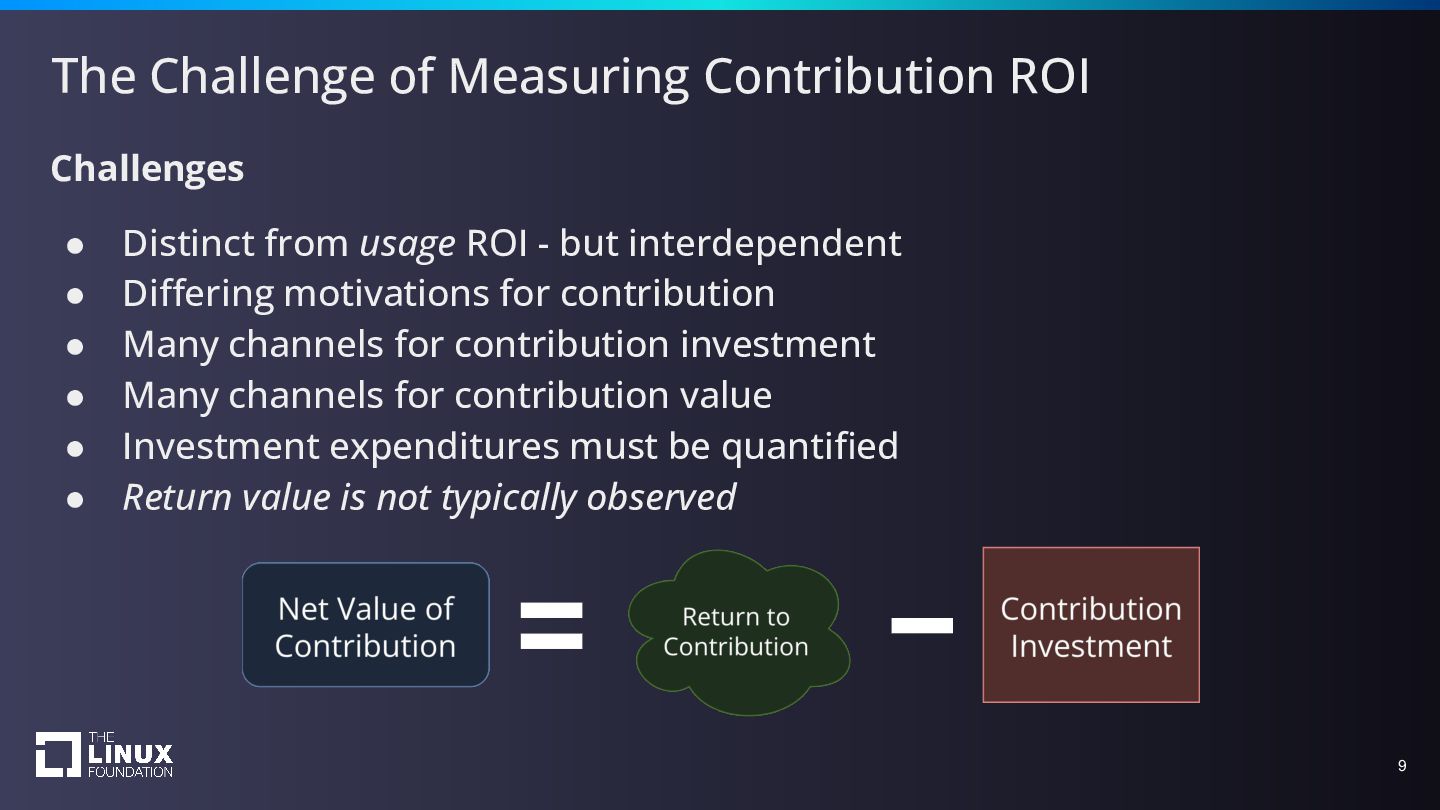
  9. 9 The Challenge of Measuring Contribution ROI Challenges • Distinct

    from usage ROI - but interdependent • Differing motivations for contribution • Many channels for contribution investment • Many channels for contribution value • Investment expenditures must be quantified • Return value is not typically observed
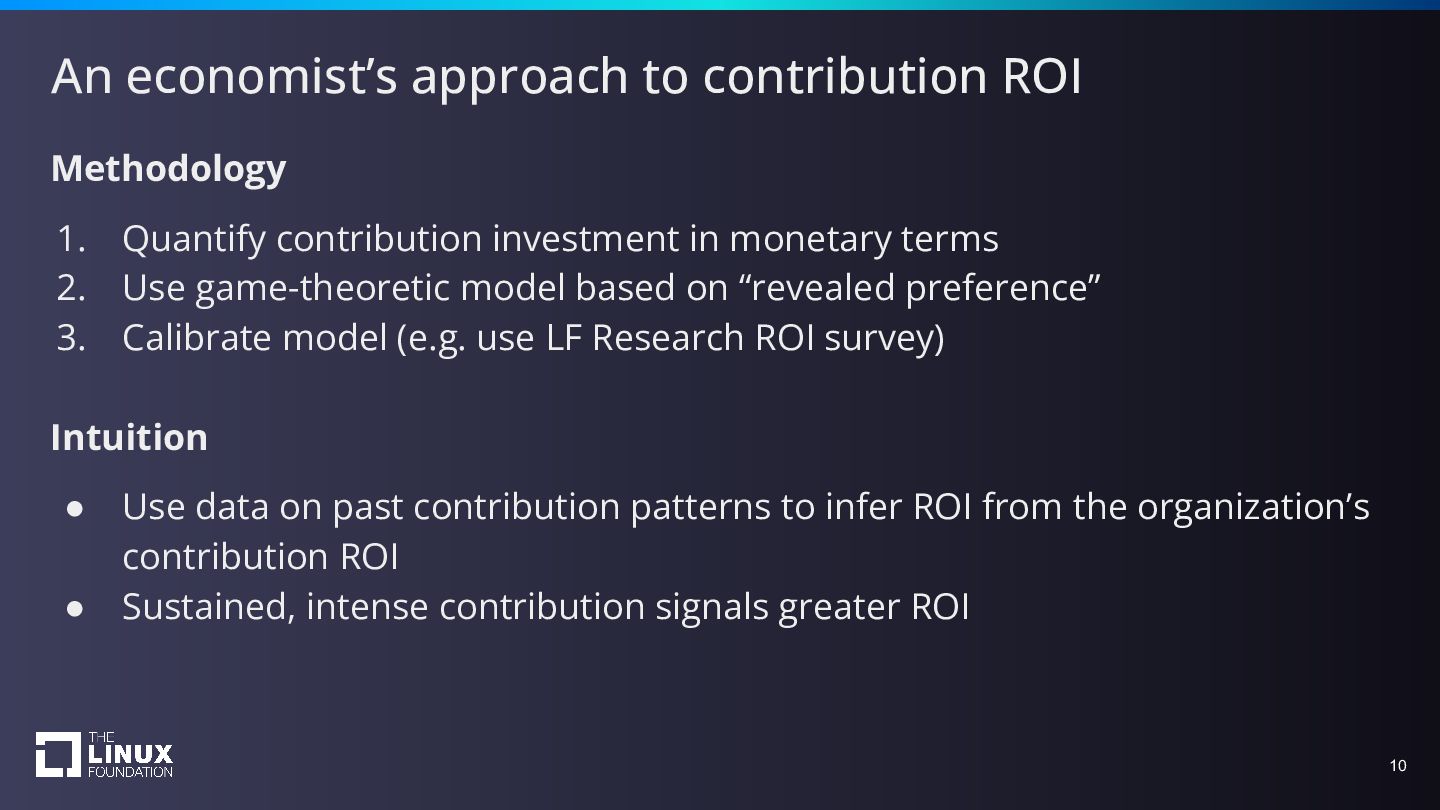
  10. 10 An economist’s approach to contribution ROI Methodology 1. Quantify

    contribution investment in monetary terms 2. Use game-theoretic model based on “revealed preference” 3. Calibrate model (e.g. use LF Research ROI survey) Intuition • Use data on past contribution patterns to infer ROI from the organization’s contribution ROI • Sustained, intense contribution signals greater ROI
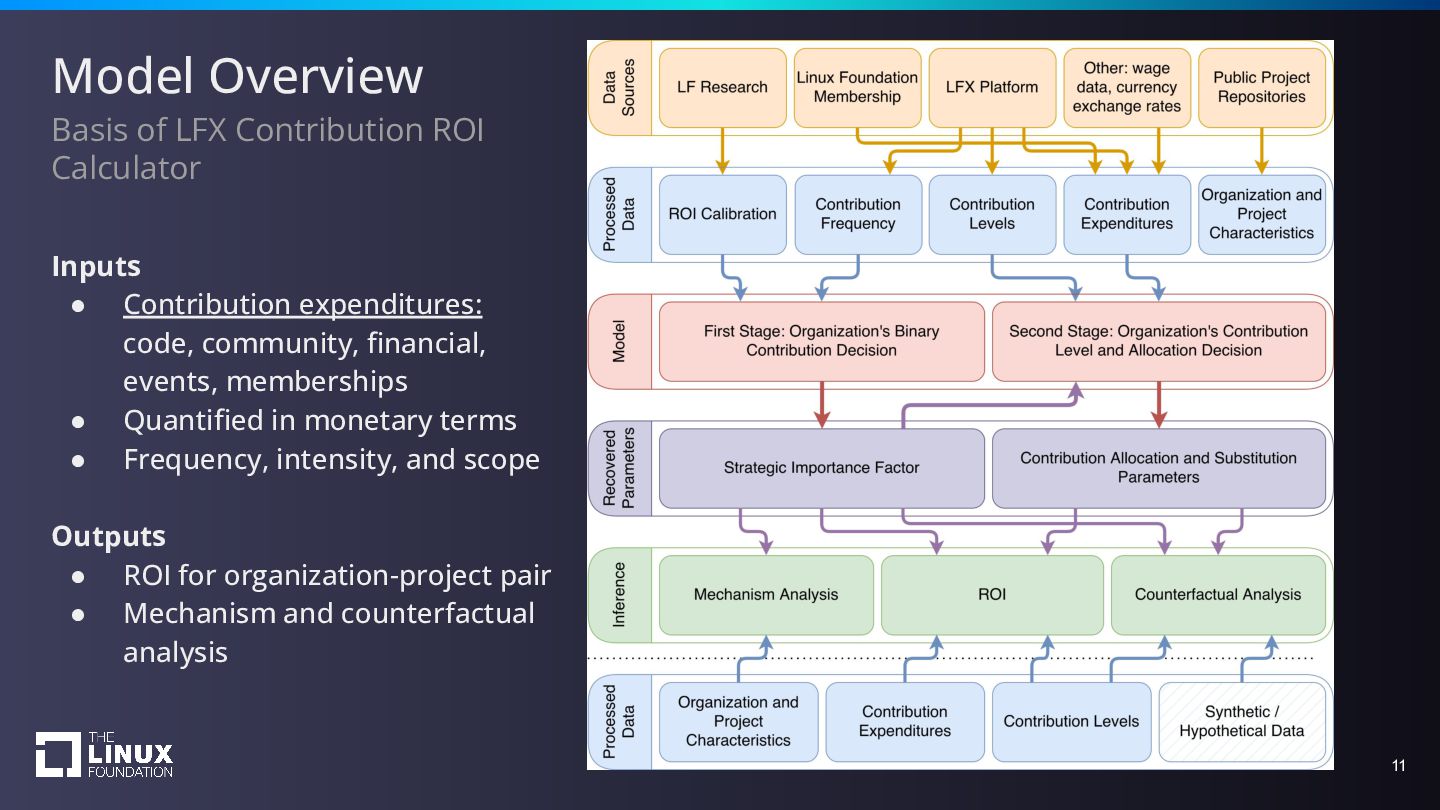
  11. 11 Model Overview Inputs • Contribution expenditures: code, community, financial,

    events, memberships • Quantified in monetary terms • Frequency, intensity, and scope Outputs • ROI for organization-project pair • Mechanism and counterfactual analysis Basis of LFX Contribution ROI Calculator
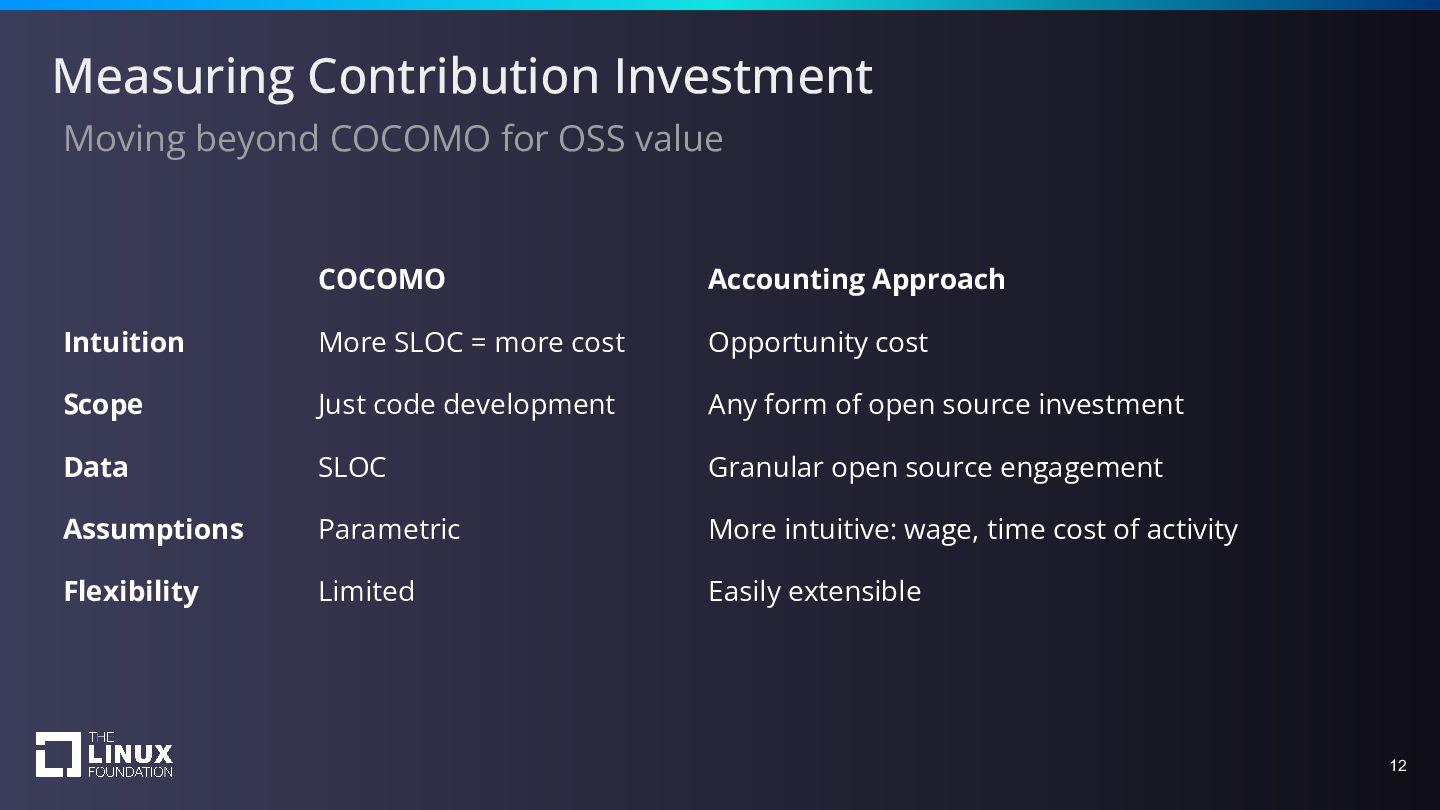
  12. 12 Measuring Contribution Investment COCOMO Accounting Approach Intuition More SLOC

    = more cost Opportunity cost Scope Just code development Any form of open source investment Data SLOC Granular open source engagement Assumptions Parametric More intuitive: wage, time cost of activity Flexibility Limited Easily extensible Moving beyond COCOMO for OSS value
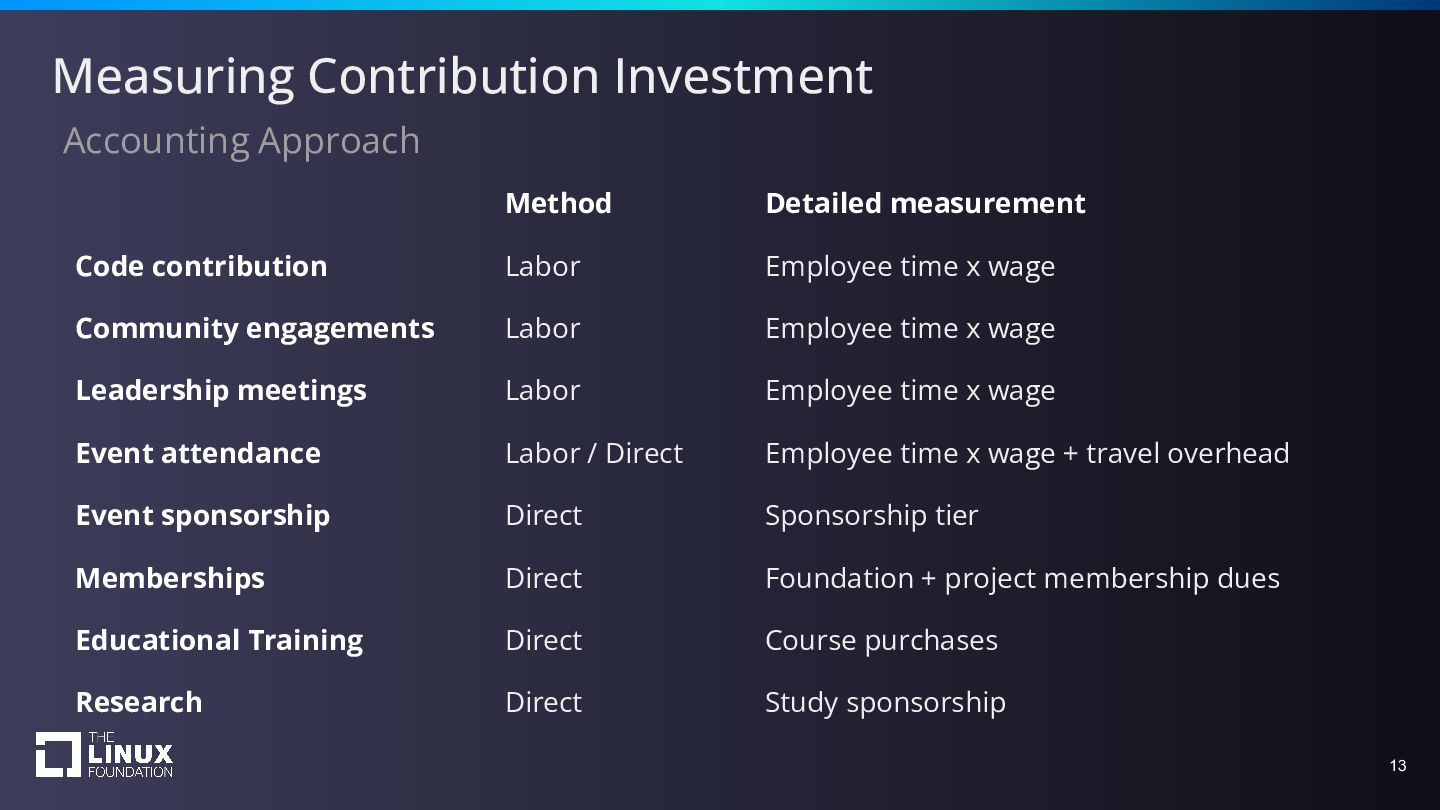
  13. 13 Measuring Contribution Investment Method Detailed measurement Code contribution Labor

    Employee time x wage Community engagements Labor Employee time x wage Leadership meetings Labor Employee time x wage Event attendance Labor / Direct Employee time x wage + travel overhead Event sponsorship Direct Sponsorship tier Memberships Direct Foundation + project membership dues Educational Training Direct Course purchases Research Direct Study sponsorship Accounting Approach
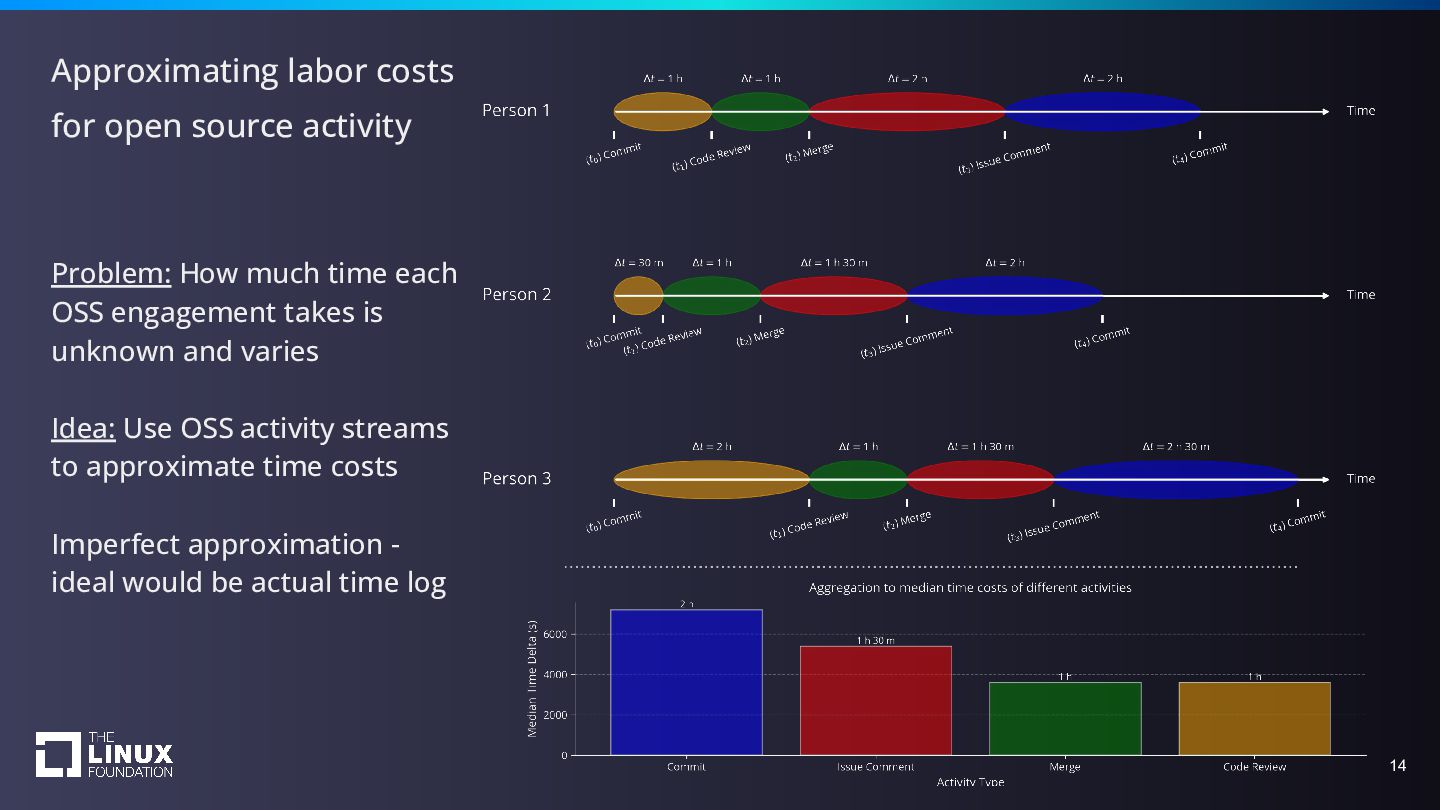
  14. 14 Approximating labor costs for open source activity Problem: How

    much time each OSS engagement takes is unknown and varies Idea: Use OSS activity streams to approximate time costs Imperfect approximation - ideal would be actual time log
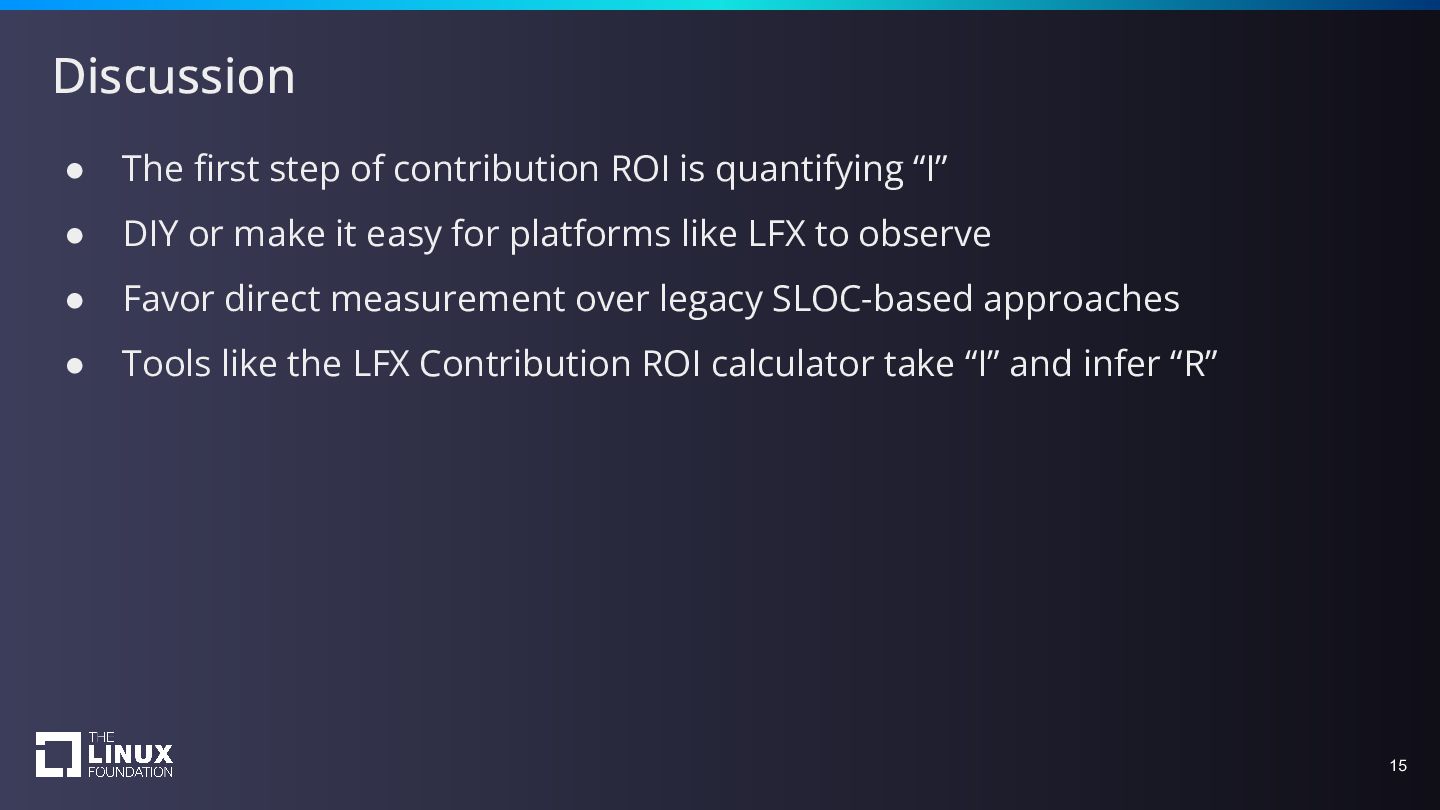
  15. 15 Discussion • The first step of contribution ROI is

    quantifying “I” • DIY or make it easy for platforms like LFX to observe • Favor direct measurement over legacy SLOC-based approaches • Tools like the LFX Contribution ROI calculator take “I” and infer “R”