Share
Embed
Justin Bayer - Python and ZeroMQ scale to real time robot control
Python and ZeroMQ scale to real time robot control
Munich DataGeeks
August 20, 2013
Transcript
29 slides
-
Python and ZeroMQ scale to real time robot control Justin
Bayer [email protected] github.com/bayerj/ 1 -
Python and ZeroMQ scale to real time really fast robot
control Justin Bayer [email protected] github.com/bayerj/ 2 -
Hey ML guy, please find f so that X t
(positiont f (emgt)) 2 is minimal! 4 -
“We want the robot to move similar to how the
human moves.” 6 -
Data Challenges - What is similar? What is human like?
- How far into the past/future do we have to look? - Noisy data. - Online Prediction. 7 -
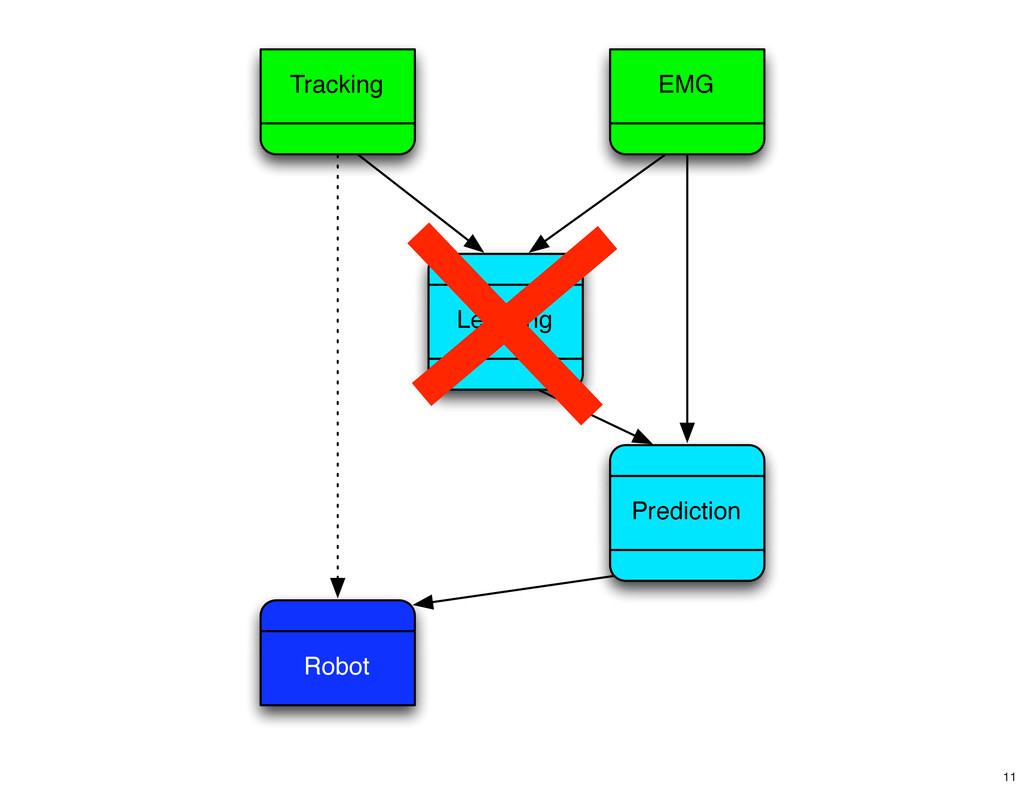
System Challenges - Many different heterogenous components in soft- and
hardware. - Notorious failure of single ones. (Crash, need for code changes, human failure.) 8 -
Requirements - Fast. - Low latency. - Maximally isolated units.
- Short deployment cycle. 9 -
On slowness wrt prediction BLAS BLAS BLAS Lots of good
programmers have already implemented all those numerical algorithms such as matrix multiplications, inverses etc. 15 -
- Send/receive messages at 100Hz. - Decode messages into machine
learning compatible representation. On slowness wrt I/O 16 -
- Alternative to sockets. - Cross platform and cross language.
(40+ programming languages supported.) - Really fast. (Designed for high frequency trading) - Minor code adaptions for messages via intra process, inter process, TCP. - Some neat abstractions for network traffic. ZeroMQ 17 -
- Publisher puts out a stream of messages. - A
subscriber can subscribe to a publisher and will receive messages. - One publisher can have many subscribers. Publisher Subscriber Subscriber Subscriber Publisher/Subscriber 18 -
- Publisher puts out a stream of messages. - A
subscriber can subscribe to a publisher and will receive messages. - One publisher can have many subscribers. Publisher Subscriber Subscriber Subscriber Subscriber/ Publisher Subscriber/ Publisher Subscriber/ Publisher Publisher/Subscriber 19 -
orakle (http://github.com/bayerj/orakle) - Send/receive numerical data via zeromq pub/sub. -
162 lines of python (including docs). - Each type of array (e.g. prediction, tracking, emg) has an associated class for overhead/bookeeping. - Uses “coroutines” to establish a “just in time” pipeline. 20 -
@coroutine def subscribe_to_arrays(socket, msg_class): """Yield arrays encoded by `msg_class` from
`socket`.""" (yield) while True: data = socket.recv() msg = msg_class.fromstring(data) if msg.status != 0: yield None continue yield msg.data 22 -
@coroutine def publish_arrays(socket, msg_class): """Publish arrays encoded by `msg_class` to
`socket`.""" while True: arr = (yield) if arr.size == 0: msg = msg_class(1, arr) else: msg = msg_class(0, arr) socket.send(msg.tostring()) 23 -
def sync_sockets(sockets, msg_classes): """Receive messages given by `msg_classes` published at
`sockets` until all sources are somewhat in sync.""" assert len(sockets) == len(msg_classes) # Wait until all sockets are sending. for socket in sockets: socket.recv() # Loop through all sockets until no socket has a message pending. while True: received_sth = False for socket in sockets: try: socket.recv(zmq.NOBLOCK) except zmq.ZMQError: continue received_sth = True if not received_sth: break 24 -
def sync_receive(sockets, msg_classes): """Receive from sockets in synchronization.""" rcvrs =
[subscribe_to_arrays(i, j) for i, j in zip(sockets, msg_classes)] for msgs in itertools.izip(*rcvrs): if not None in msgs: yield msgs 25 -
def collect_data_set(emg_socket, track_socket, n_msgs): orakle.sync_sockets(sockets, msg_classes) pairwise_msgs = orakle.sync_receive( [emg_socket,
track_socket], [message.EmgMessage, message.TrackMessage]) emg_msgs = [] track_msgs = [] for i, (emg_msg, track_msg) in enumerate(pairwise_msgs): emg_msgs.append(emg_msg) track_msgs.append(track_msg) if i >= n_msgs - 1: break return emg_msgs, track_msgs 26 -
def fit_on_sub(model, emg_socket, track_socket, n_msgs): emg, track = collect_data_set( emg_socket,
track_socket, n_msgs) model.fit(X, Z) 27 -
def predict_and_pub(model, emg_socket, predict_socket): message.EmgMessage.emptysocket(emg_socket) sub = orakle.subscribe_to_arrays(emg_socket, message.EmgMessage) pub
= orakle.publish_arrays( predict_socket, message.PredictMessage) for arr in sub: y = model.predict(arr) pub.send(y) 28