J. Murali Krishnan Department of Civil Engineering, IIT Madras, India Asphaltica, Verona, Italy 22-25 FEBRUARY 2017 Murali (IITM) Asphaltica, 2017 1 / 78
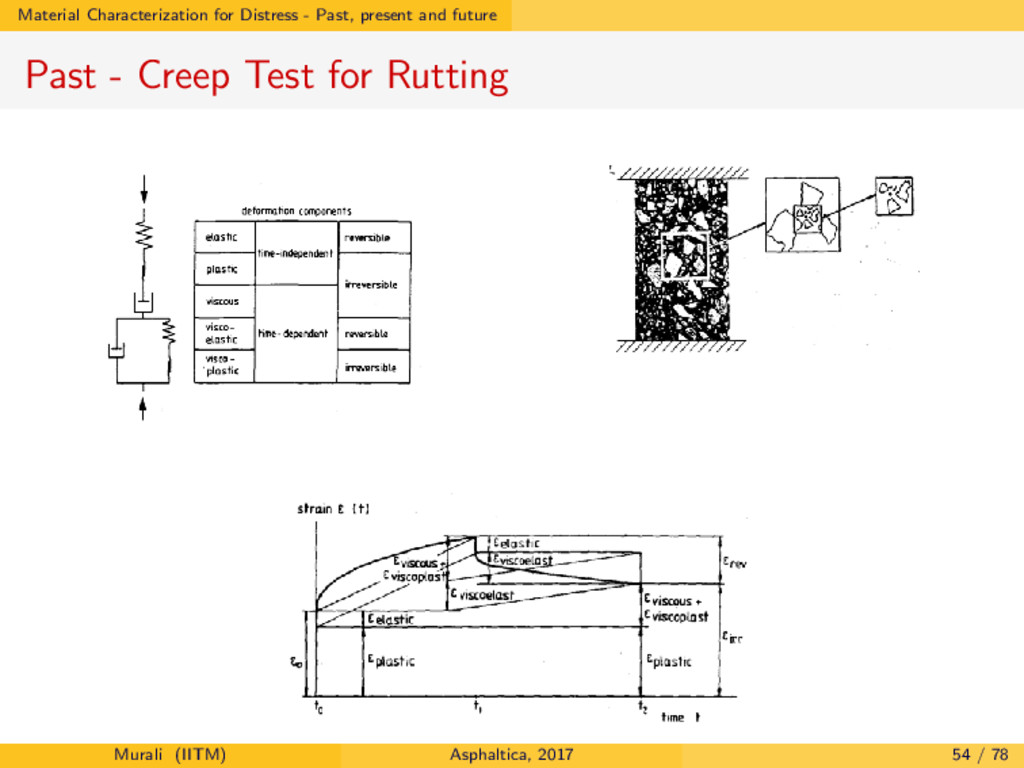
3 Material Characterization for Design - Past, present and future 4 Material Characterization for Distress - Past, present and future Murali (IITM) Asphaltica, 2017 2 / 78
3 Material Characterization for Design - Past, present and future 4 Material Characterization for Distress - Past, present and future Murali (IITM) Asphaltica, 2017 2 / 78
3 Material Characterization for Design - Past, present and future 4 Material Characterization for Distress - Past, present and future Murali (IITM) Asphaltica, 2017 2 / 78
3 Material Characterization for Design - Past, present and future 4 Material Characterization for Distress - Past, present and future Murali (IITM) Asphaltica, 2017 2 / 78
3 Material Characterization for Design - Past, present and future 4 Material Characterization for Distress - Past, present and future Murali (IITM) Asphaltica, 2017 3 / 78
- Past, present and future 3 Material Characterization for Design - Past, present and future 4 Material Characterization for Distress - Past, present and future Murali (IITM) Asphaltica, 2017 9 / 78
Recipe Approach A recipe based mix design - the early days Barber wearing surface: Asphalt cement 12 to 15%; Sand 70 to 83%; Pulverized carbonite of lime 5 to 15% Cushion coat and surface coat Clifford Richardson (1905): surfacing mixtures and asphaltic concrete Richardson mix: VMA and air voids introduced Hubbard and Field (1920’s) - sand asphalt and asphalt concrete Sand asphalt - hand rammer Hubbard compaction - 6-inch diameter specimens compacted first with 30 ‘heavy blows’ using 2-inch rammer followed by 30 blows with a 5.75-inch rammer followed by static compaction with a 10,000-pound load Murali (IITM) Asphaltica, 2017 10 / 78
Hveem and Marshall Hveem Stabilometer and Kneading Compactor A tamping foot – 4 inch diameter mold –retract and rotate through 60◦ Stability and cohesion Hveem pavements had lower asphalt contents and more tendencies for fatigue cracking Marshall Stability and Impact Compactor Outgrowth of Hubbard and Field - Impact hammer More binder content - Rutting is a problem No VMA initially only VFA but included VMA during 1962 Murali (IITM) Asphaltica, 2017 11 / 78
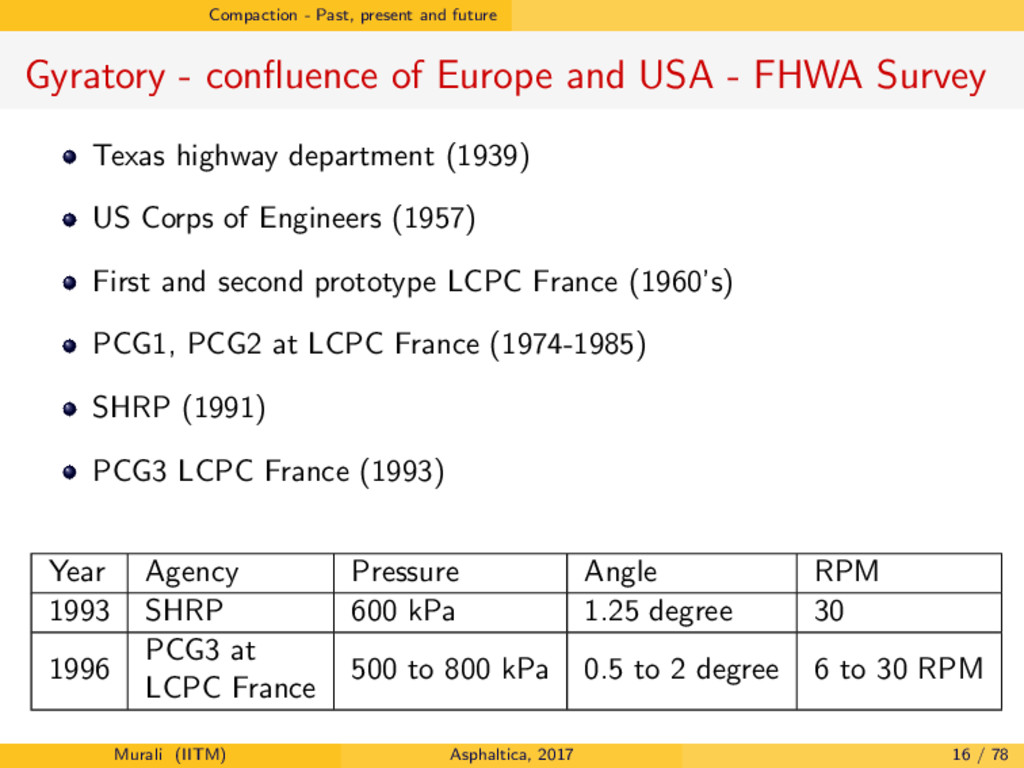
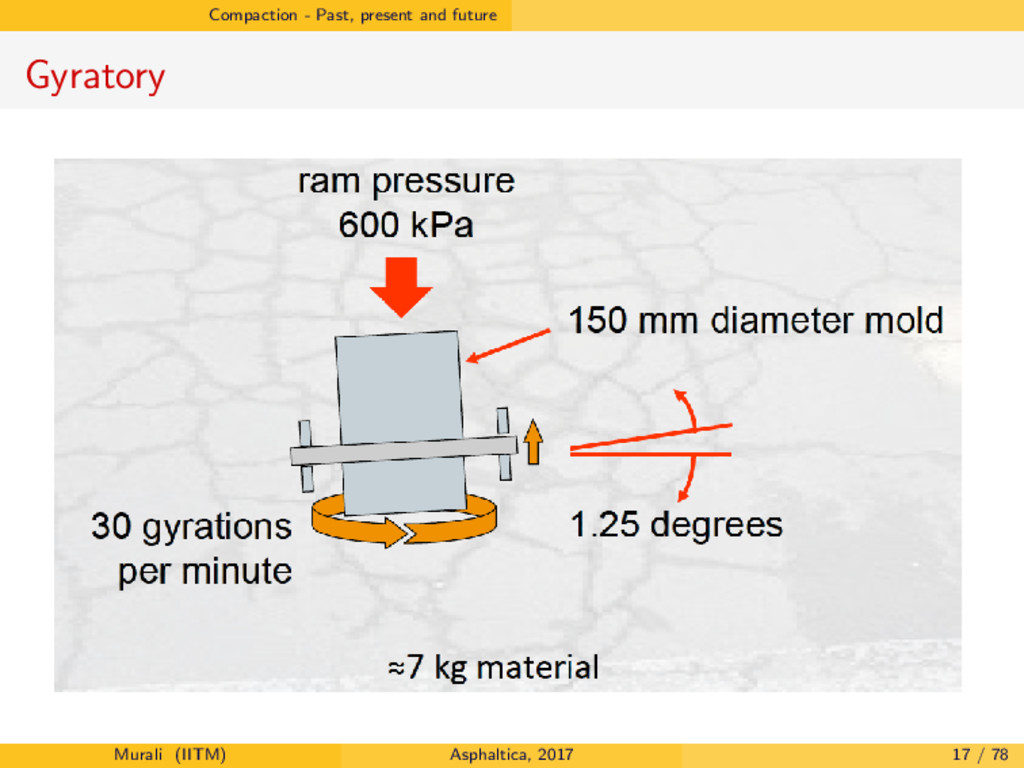
Europe and USA - FHWA Survey Texas highway department (1939) US Corps of Engineers (1957) First and second prototype LCPC France (1960’s) PCG1, PCG2 at LCPC France (1974-1985) SHRP (1991) PCG3 LCPC France (1993) Year Agency Pressure Angle RPM 1993 SHRP 600 kPa 1.25 degree 30 1996 PCG3 at LCPC France 500 to 800 kPa 0.5 to 2 degree 6 to 30 RPM Murali (IITM) Asphaltica, 2017 16 / 78
Background 2 Compaction - Past, present and future 3 Material Characterization for Design - Past, present and future 4 Material Characterization for Distress - Past, present and future Murali (IITM) Asphaltica, 2017 30 / 78
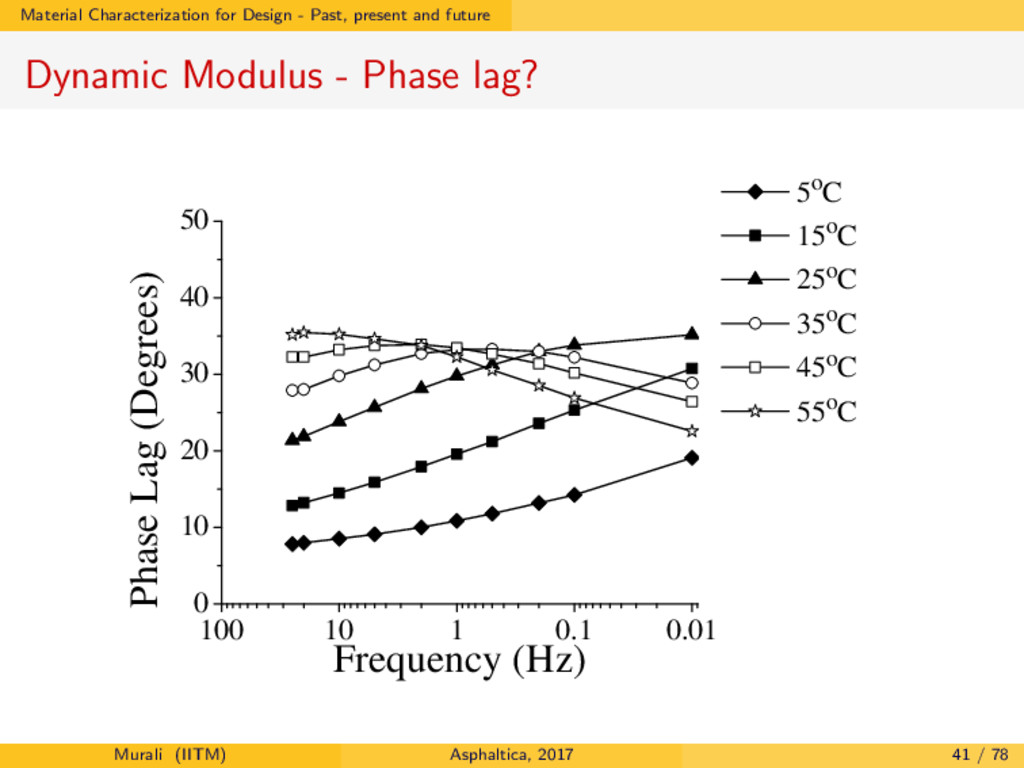
Modulus - Phase lag? 1 0 0 1 0 1 0 . 1 0 . 0 1 0 1 0 2 0 3 0 4 0 5 0 P h a s e L a g ( D e g r e e s ) F r e q u e n c y ( H z ) 5 o C 1 5 o C 2 5 o C 3 5 o C 4 5 o C 5 5 o C Murali (IITM) Asphaltica, 2017 41 / 78
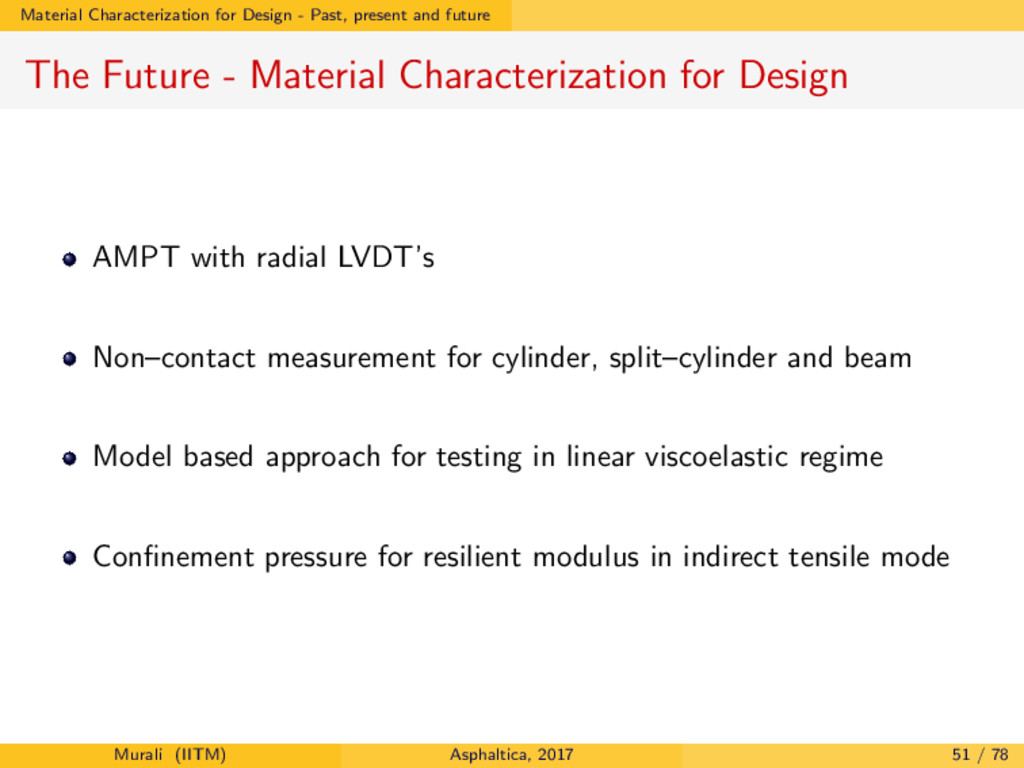
Future - Material Characterization for Design AMPT with radial LVDT’s Non–contact measurement for cylinder, split–cylinder and beam Model based approach for testing in linear viscoelastic regime Confinement pressure for resilient modulus in indirect tensile mode Murali (IITM) Asphaltica, 2017 51 / 78
Background 2 Compaction - Past, present and future 3 Material Characterization for Design - Past, present and future 4 Material Characterization for Distress - Past, present and future Murali (IITM) Asphaltica, 2017 52 / 78
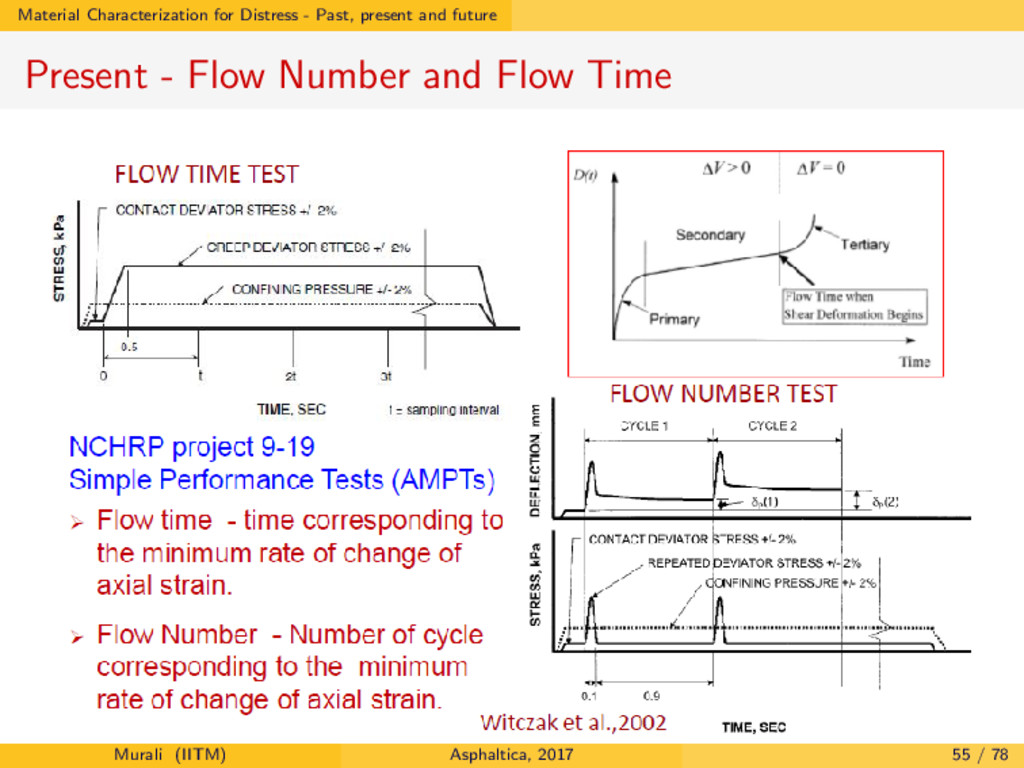
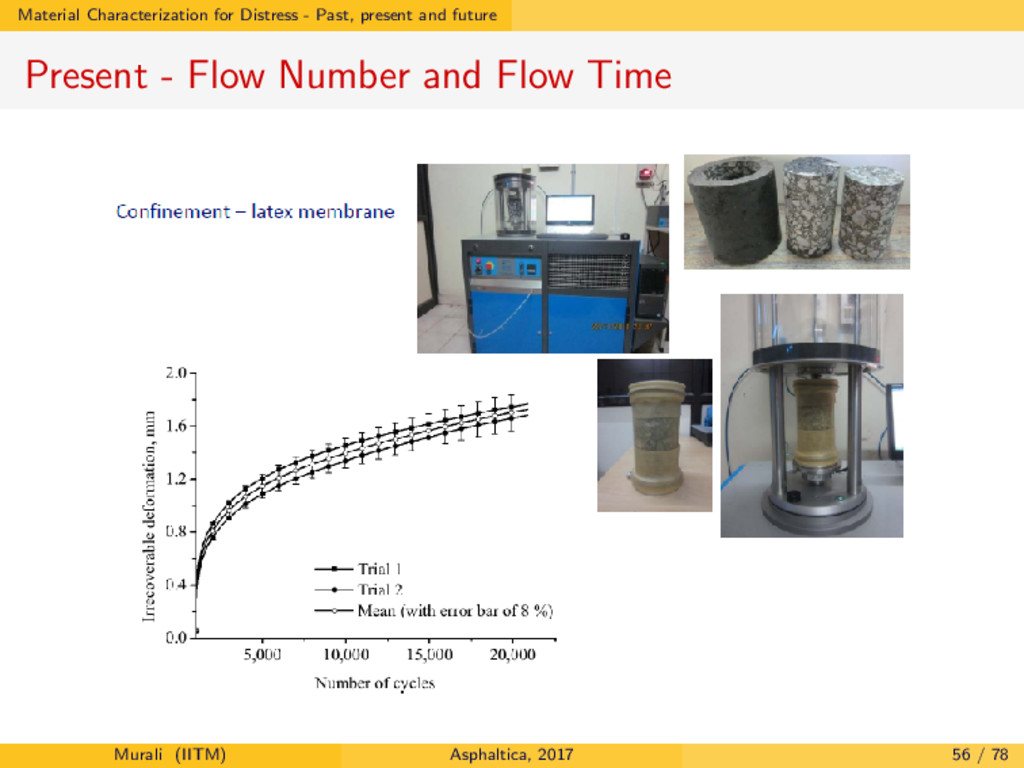
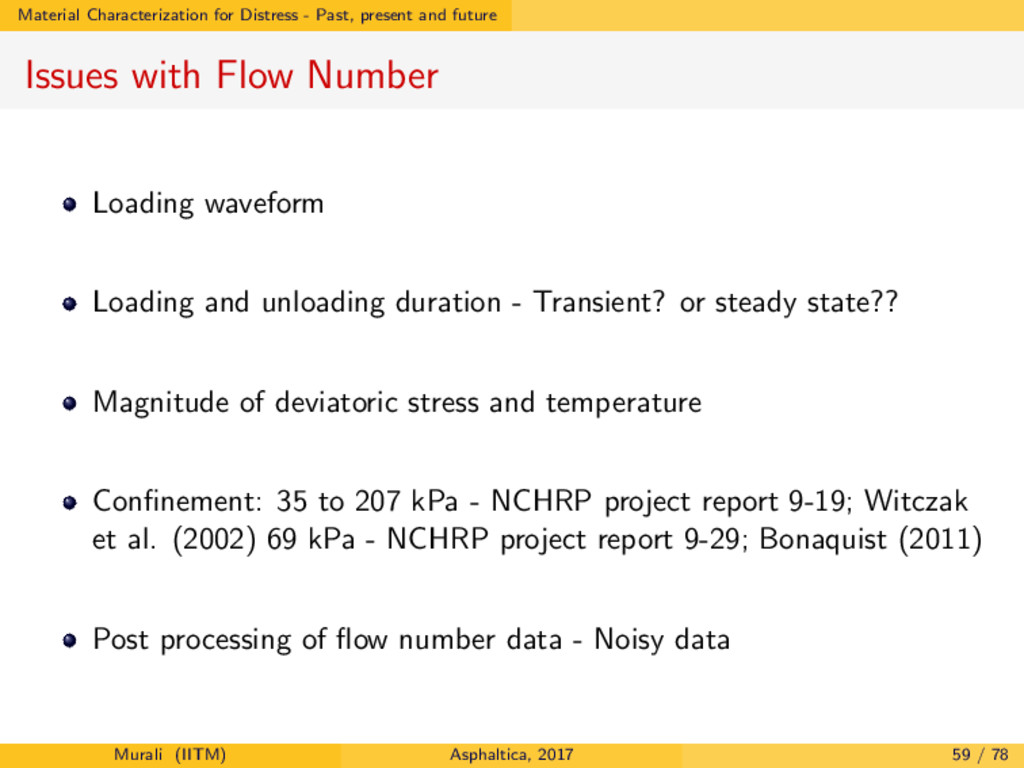
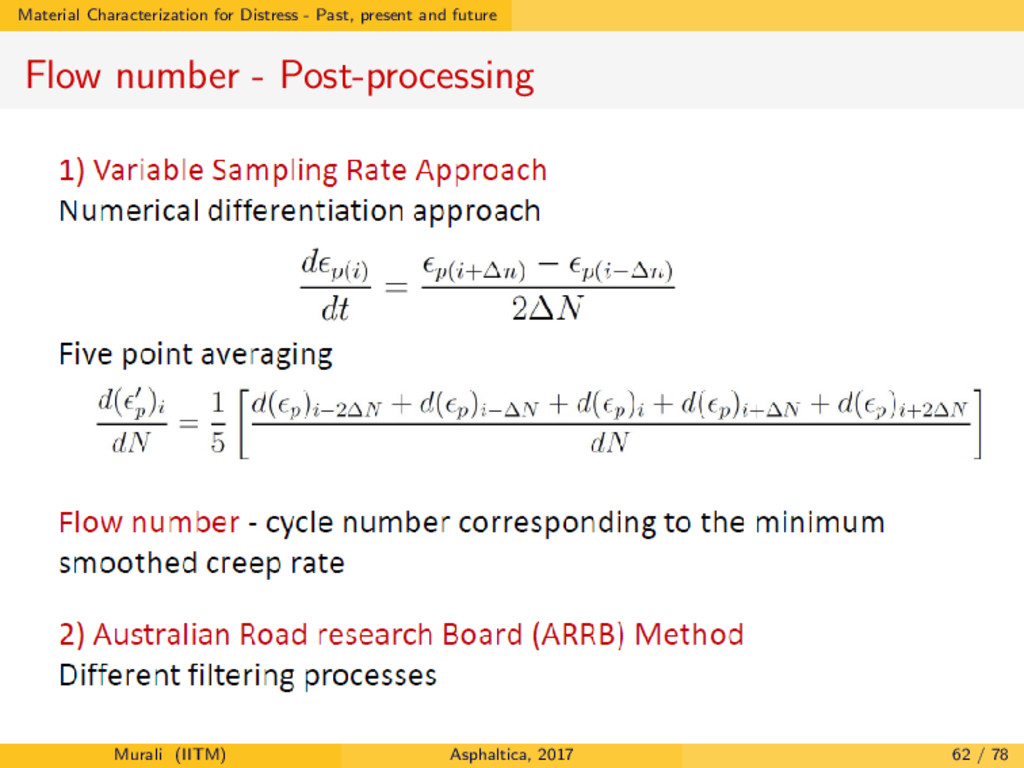
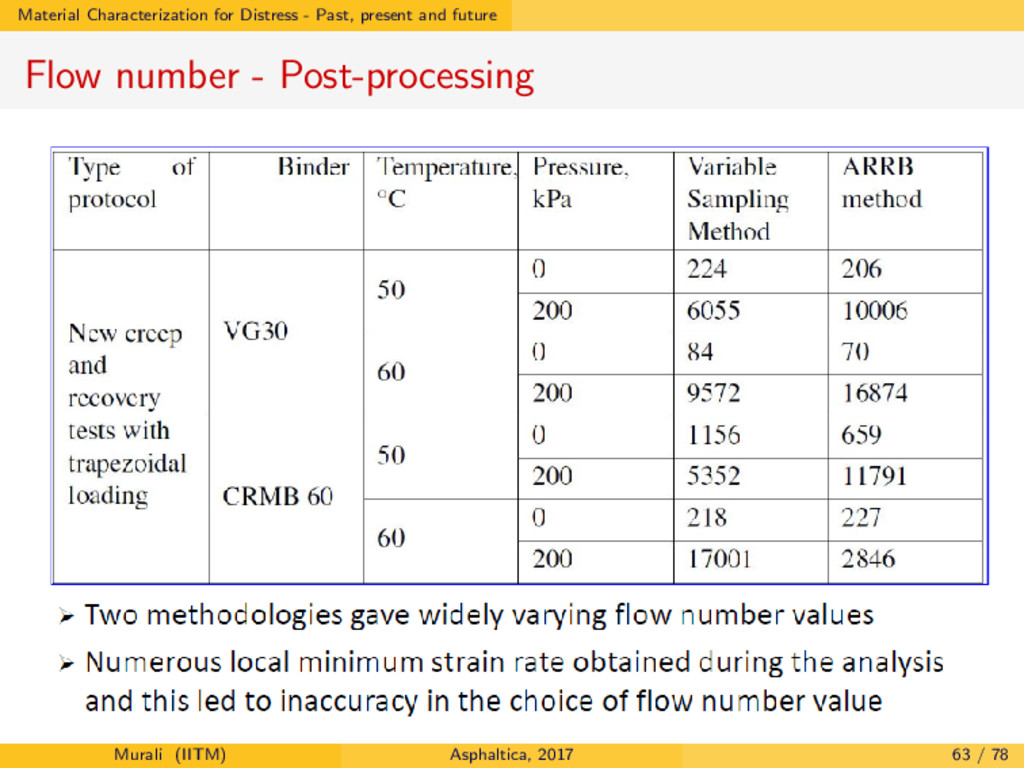
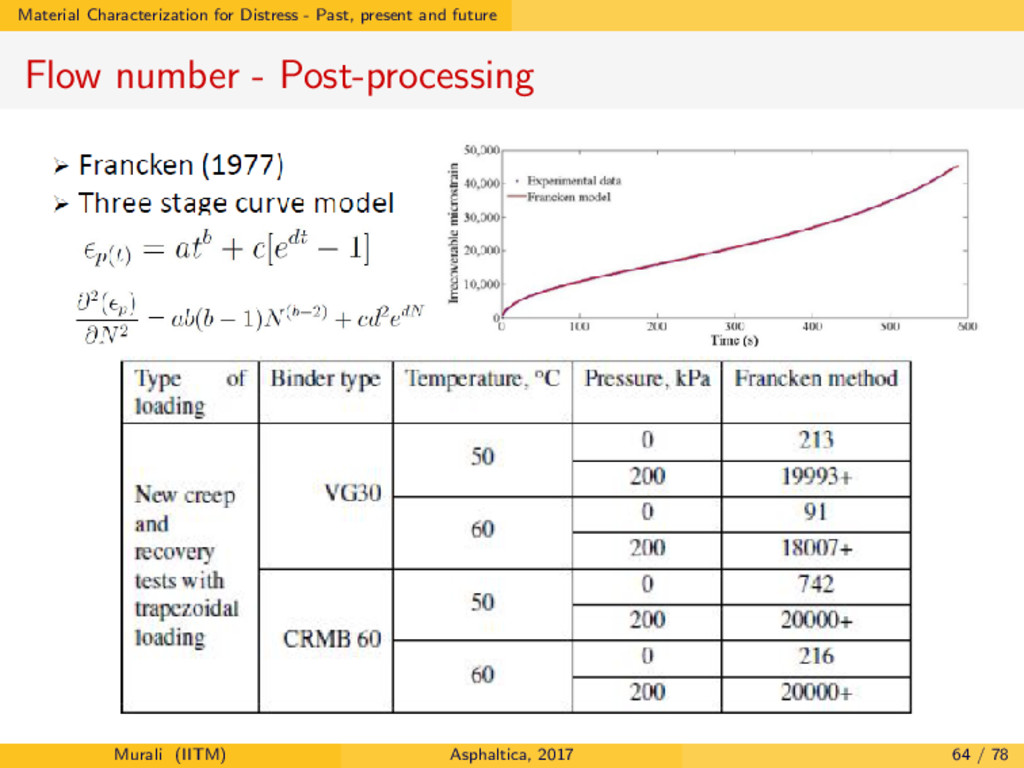
with Flow Number Loading waveform Loading and unloading duration - Transient? or steady state?? Magnitude of deviatoric stress and temperature Confinement: 35 to 207 kPa - NCHRP project report 9-19; Witczak et al. (2002) 69 kPa - NCHRP project report 9-29; Bonaquist (2011) Post processing of flow number data - Noisy data Murali (IITM) Asphaltica, 2017 59 / 78
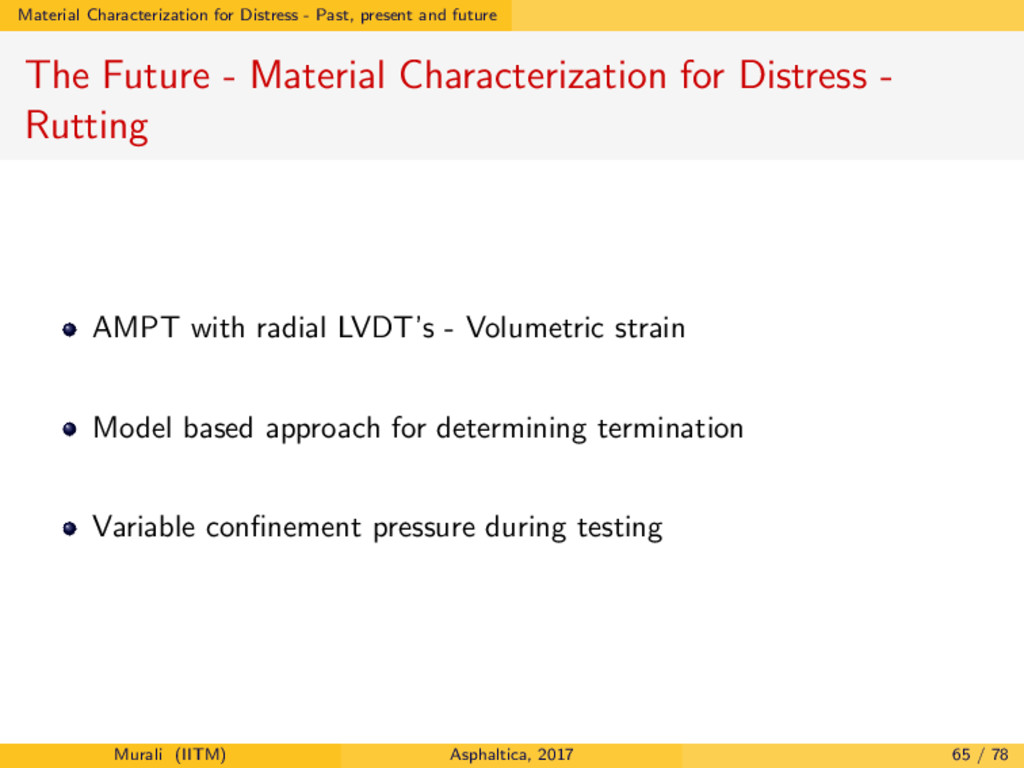
Future - Material Characterization for Distress - Rutting AMPT with radial LVDT’s - Volumetric strain Model based approach for determining termination Variable confinement pressure during testing Murali (IITM) Asphaltica, 2017 65 / 78
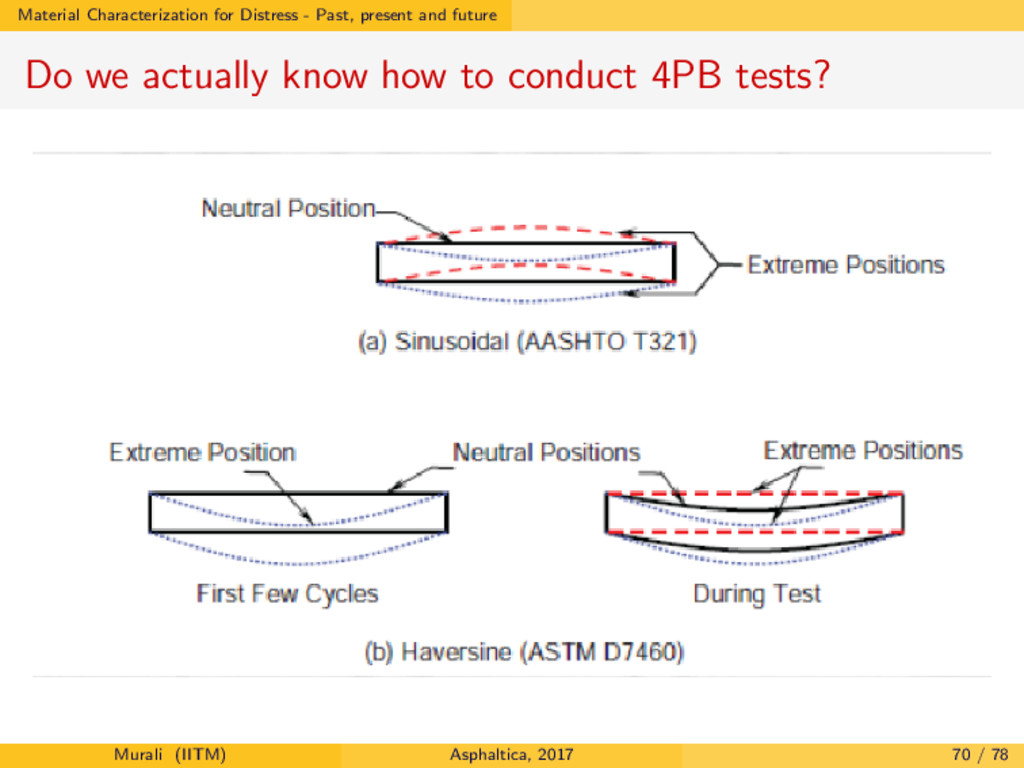
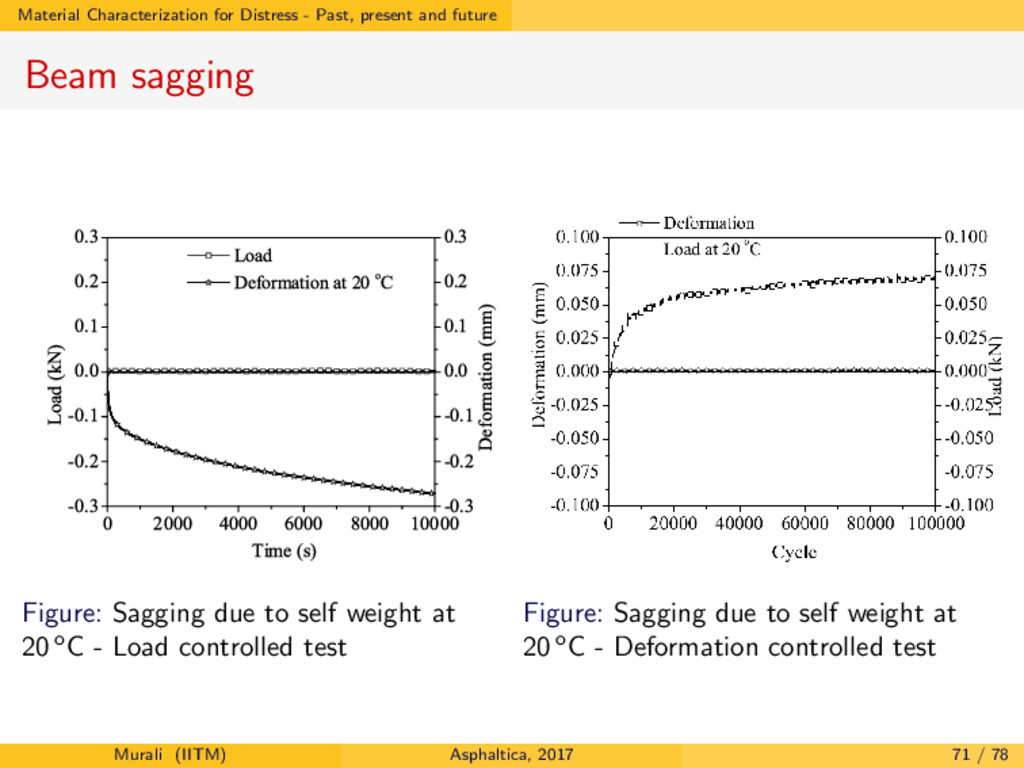
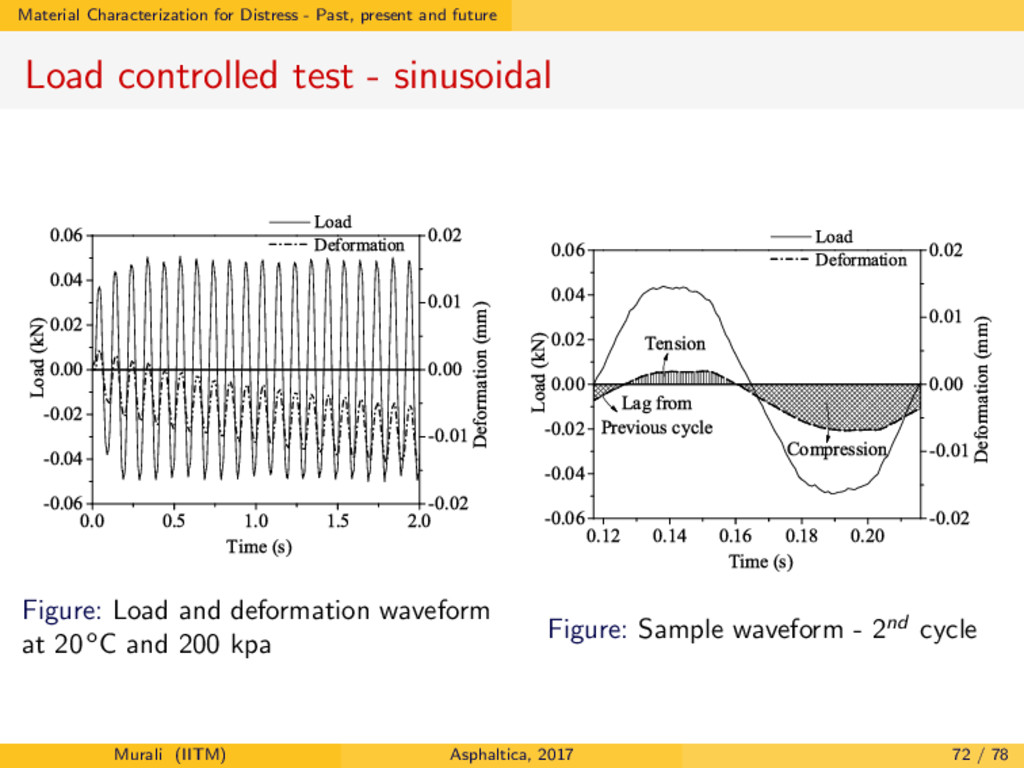
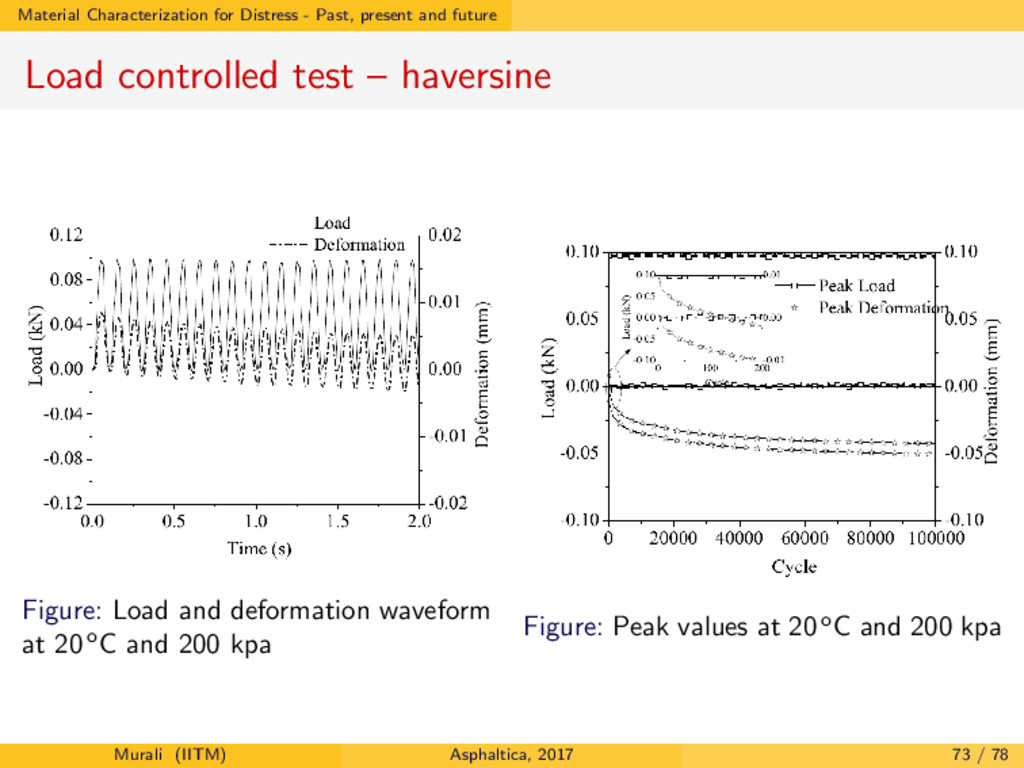
Future - Material Characterization for Distress - Fatigue Complete state of strain - sensors Let us understand beam sagging!!! Mixed mode testing!!! (Monismith did in 1960’s) Murali (IITM) Asphaltica, 2017 74 / 78
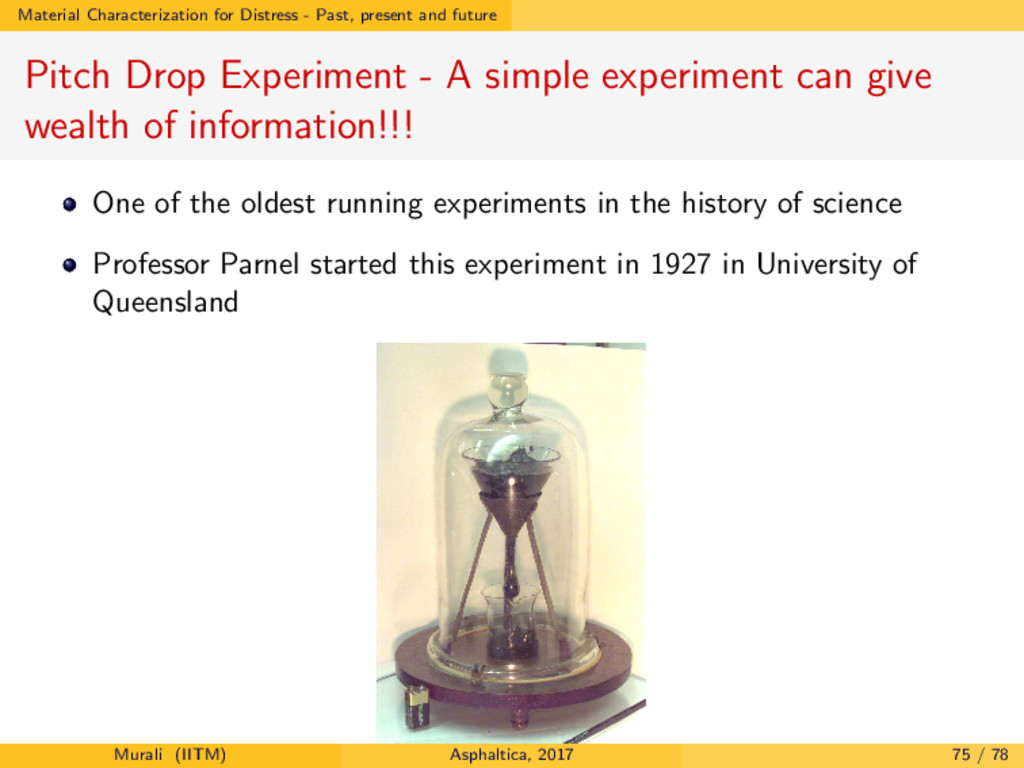
Drop Experiment - A simple experiment can give wealth of information!!! One of the oldest running experiments in the history of science Professor Parnel started this experiment in 1927 in University of Queensland Murali (IITM) Asphaltica, 2017 75 / 78
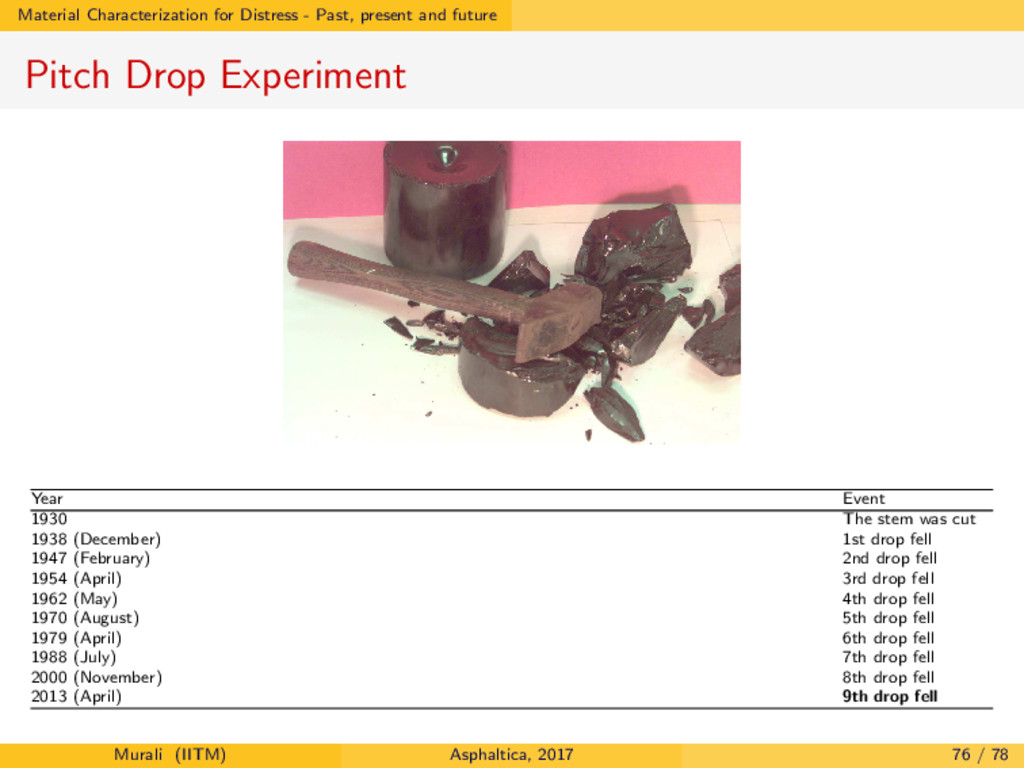
Drop Experiment Year Event 1930 The stem was cut 1938 (December) 1st drop fell 1947 (February) 2nd drop fell 1954 (April) 3rd drop fell 1962 (May) 4th drop fell 1970 (August) 5th drop fell 1979 (April) 6th drop fell 1988 (July) 7th drop fell 2000 (November) 8th drop fell 2013 (April) 9th drop fell Murali (IITM) Asphaltica, 2017 76 / 78
M/s IPC Global, Australia - Special mention to Jesse Bedra and Steve King for technical support and Kieran McGrane for leadership M/s Controls, Italy - for invite and local hospitality IIT Madras, my university for the wonderful ambiance Padma, Neethu, Gayathri, Remya, Pugal, Rajan, Nivitha - my students MHRD, DST, BIS, Total Bitumen, Reliance, CPCL, BPCL, HPCL, Ingevity - funding agencies Thank you for your patience!!! My coordinates: [email protected], +91-944-440-6896 (Mobile) Murali (IITM) Asphaltica, 2017 78 / 78

 SiteGround - Reliable hosting with speed, security, and support you can count on.


 muraliiitm
 sh_fk2
 takanorip
 greenmidori
 nttcom
 masakiokuda
 satomasahiro2005
 takahashim
 ueponx
 bitkey
 shogo4131
 pfn
 yamad
 techseoconnect
 rasmusluckow
 bkeepers
 rmw
 akosma
 geshan
 bluesmoon
 mclloyd
 katiecoart
 cassininazir
 lauravandoore