Jos´ e Castro / Miguel Vidal [email protected] / [email protected] GSyC/Libresoft – URJC October 27-30, 2009 Jos´ e Castro / Miguel Vidal OpenSolaris High Availability Cluster
Some rights reserved. This work is licensed under a Creative Commons Attribution-Share Alike 3.0 License, available at http://creativecommons.org/licenses/by-sa/3.0/ Jos´ e Castro / Miguel Vidal OpenSolaris High Availability Cluster
technical conference for developers and enthusiasts of OpenSolaris. The most important OSOL meeting outside of USA. Third Edition: Berlin (2007), Prague (2008) and Dresden (2009). Organized by Czech OpenSolaris User Group and the German Unix User Group (GUUG). Jos´ e Castro / Miguel Vidal OpenSolaris High Availability Cluster
hours) OpenSolaris Kernel Debugging (4 hours) Open Solaris HA Cluster (8 hours) Presentations (2 days) 19 talks Fast deployment on hundreds machines, Network virtualisation using Crossbow technology, ZFS internal structures... OSUG Leaders Meeting (1 day) Jos´ e Castro / Miguel Vidal OpenSolaris High Availability Cluster
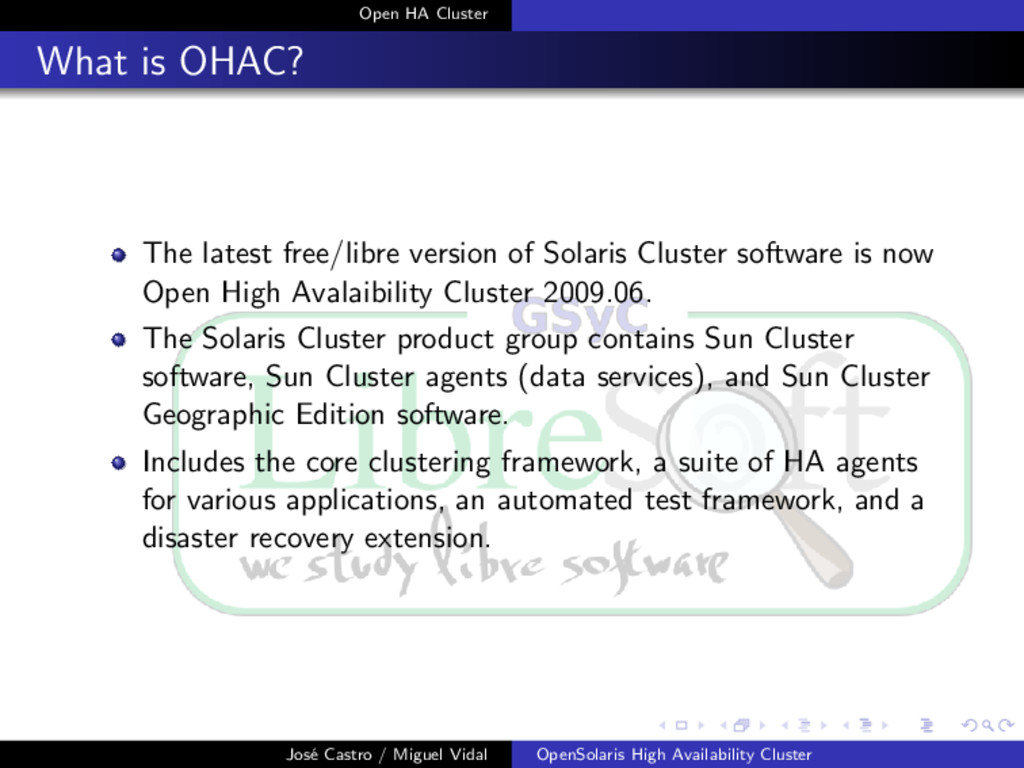
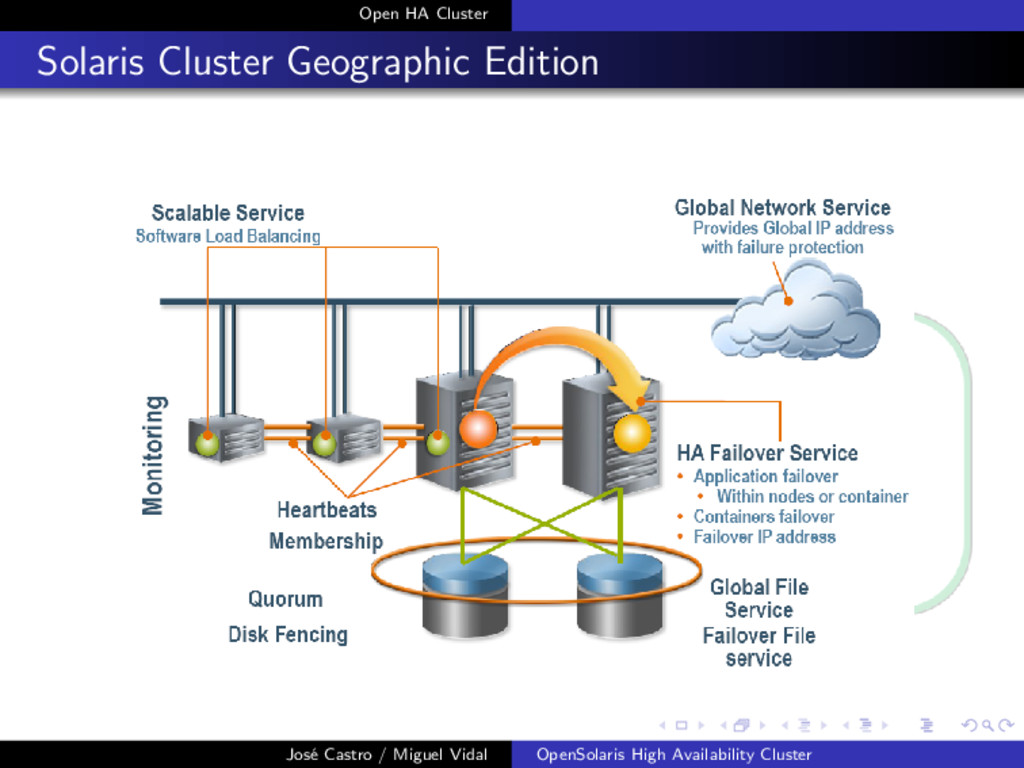
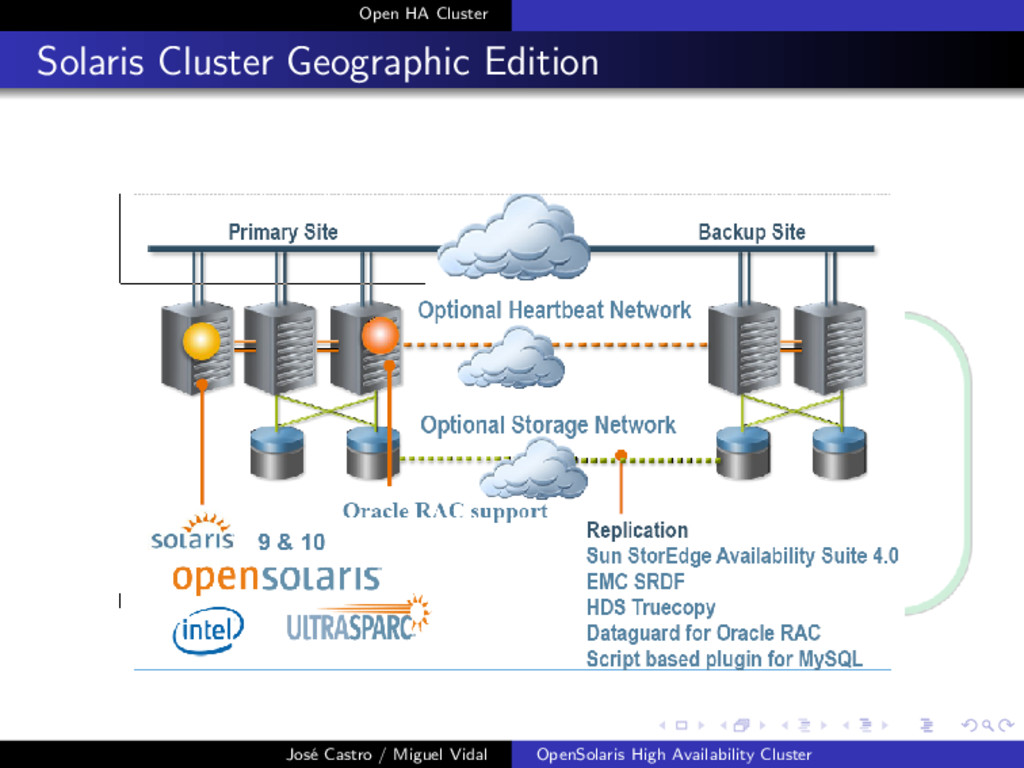
of Solaris Cluster software is now Open High Avalaibility Cluster 2009.06. The Solaris Cluster product group contains Sun Cluster software, Sun Cluster agents (data services), and Sun Cluster Geographic Edition software. Includes the core clustering framework, a suite of HA agents for various applications, an automated test framework, and a disaster recovery extension. Jos´ e Castro / Miguel Vidal OpenSolaris High Availability Cluster
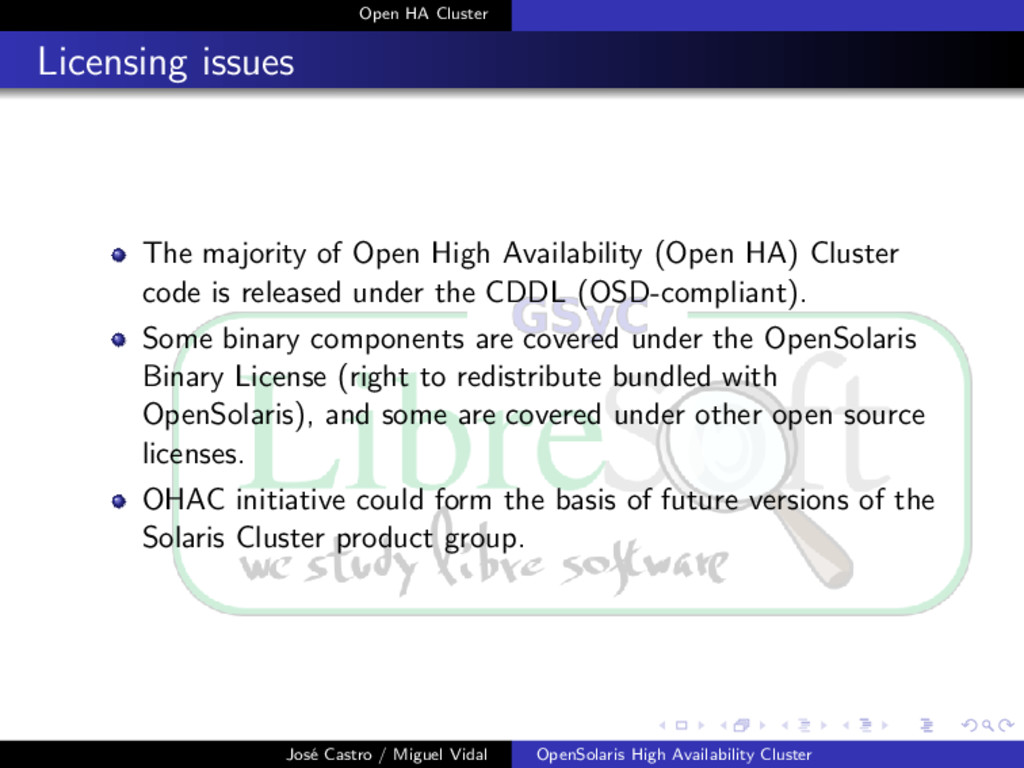
Availability (Open HA) Cluster code is released under the CDDL (OSD-compliant). Some binary components are covered under the OpenSolaris Binary License (right to redistribute bundled with OpenSolaris), and some are covered under other open source licenses. OHAC initiative could form the basis of future versions of the Solaris Cluster product group. Jos´ e Castro / Miguel Vidal OpenSolaris High Availability Cluster
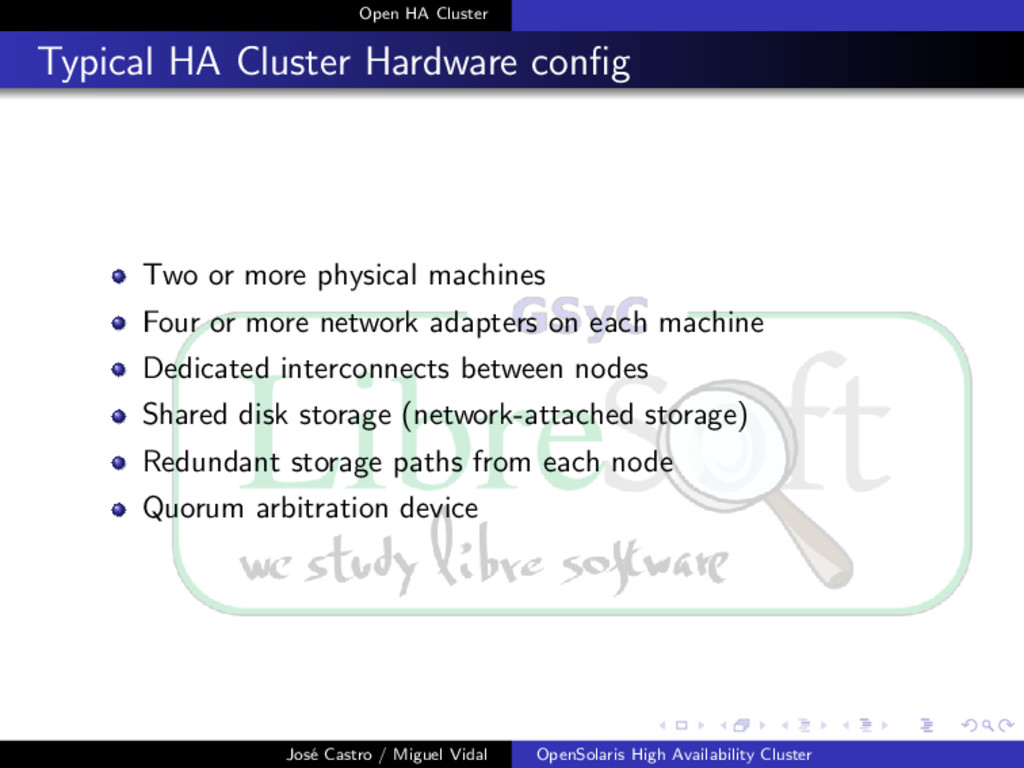
more physical machines Four or more network adapters on each machine Dedicated interconnects between nodes Shared disk storage (network-attached storage) Redundant storage paths from each node Quorum arbitration device Jos´ e Castro / Miguel Vidal OpenSolaris High Availability Cluster
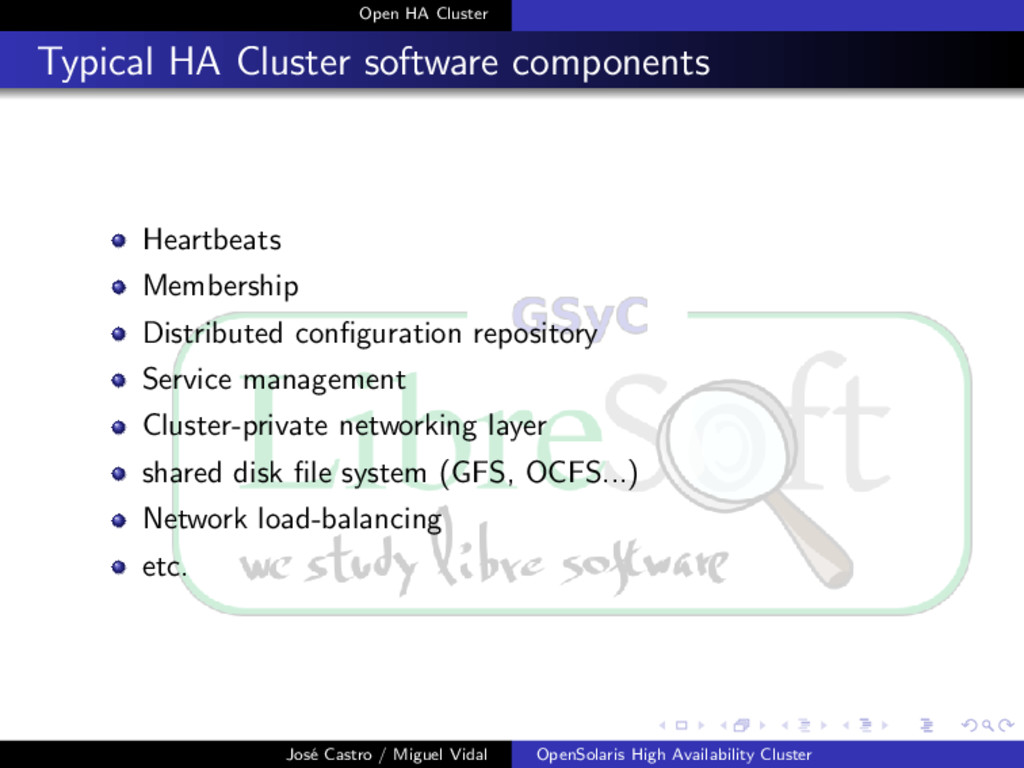
Distributed configuration repository Service management Cluster-private networking layer shared disk file system (GFS, OCFS...) Network load-balancing etc. Jos´ e Castro / Miguel Vidal OpenSolaris High Availability Cluster
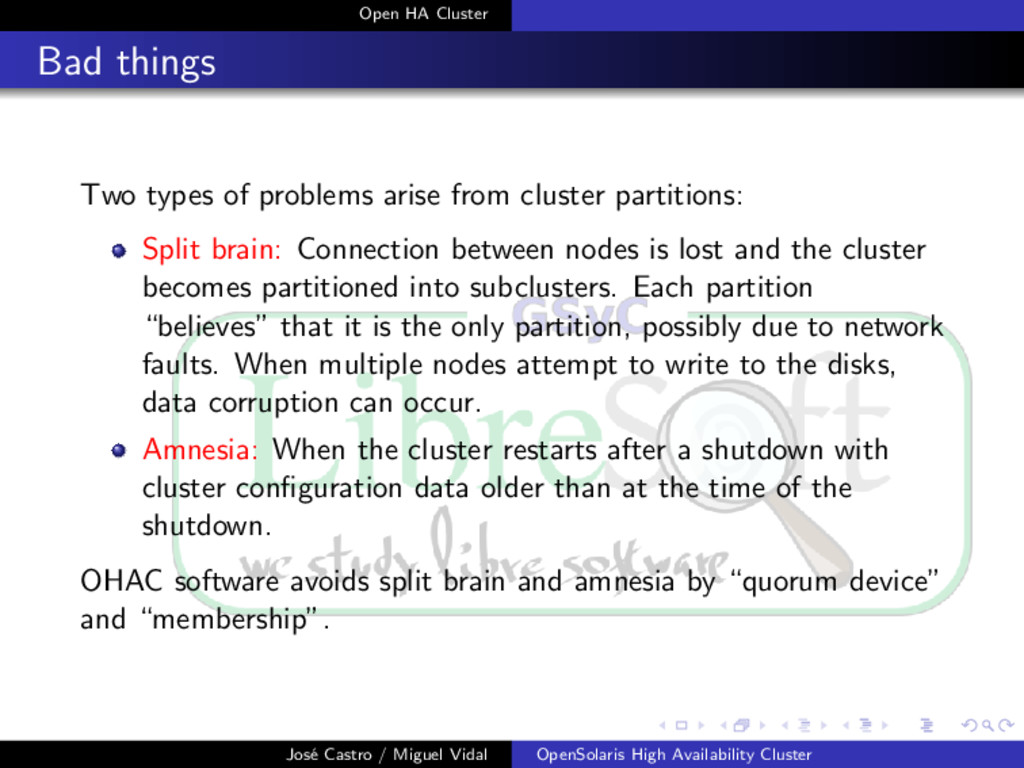
from cluster partitions: Split brain: Connection between nodes is lost and the cluster becomes partitioned into subclusters. Each partition “believes” that it is the only partition, possibly due to network faults. When multiple nodes attempt to write to the disks, data corruption can occur. Amnesia: When the cluster restarts after a shutdown with cluster configuration data older than at the time of the shutdown. OHAC software avoids split brain and amnesia by “quorum device” and “membership”. Jos´ e Castro / Miguel Vidal OpenSolaris High Availability Cluster
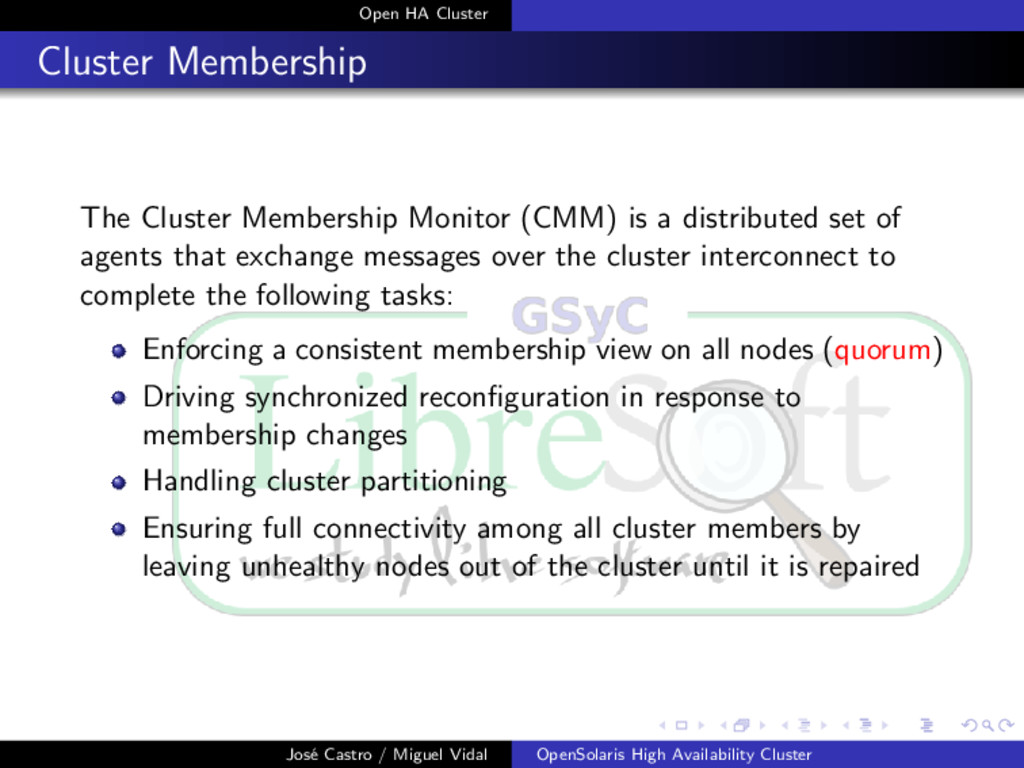
is a distributed set of agents that exchange messages over the cluster interconnect to complete the following tasks: Enforcing a consistent membership view on all nodes (quorum) Driving synchronized reconfiguration in response to membership changes Handling cluster partitioning Ensuring full connectivity among all cluster members by leaving unhealthy nodes out of the cluster until it is repaired Jos´ e Castro / Miguel Vidal OpenSolaris High Availability Cluster
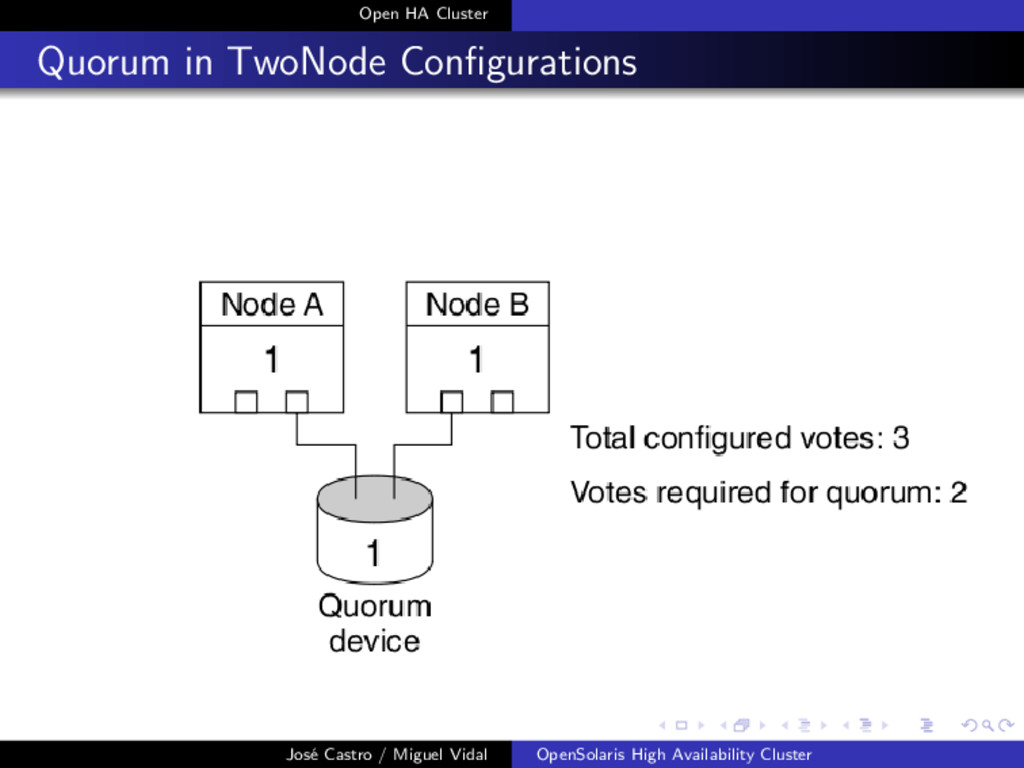
partition with the majority of votes gains quorum and is allowed to operate. More than two nodes in a cluster is required. If a two-node cluster becomes partitioned, an external vote is needed for either partition to gain quorum. This external vote is provided by a Quorum Device (QD). Quorum devices can contain user data. Jos´ e Castro / Miguel Vidal OpenSolaris High Availability Cluster
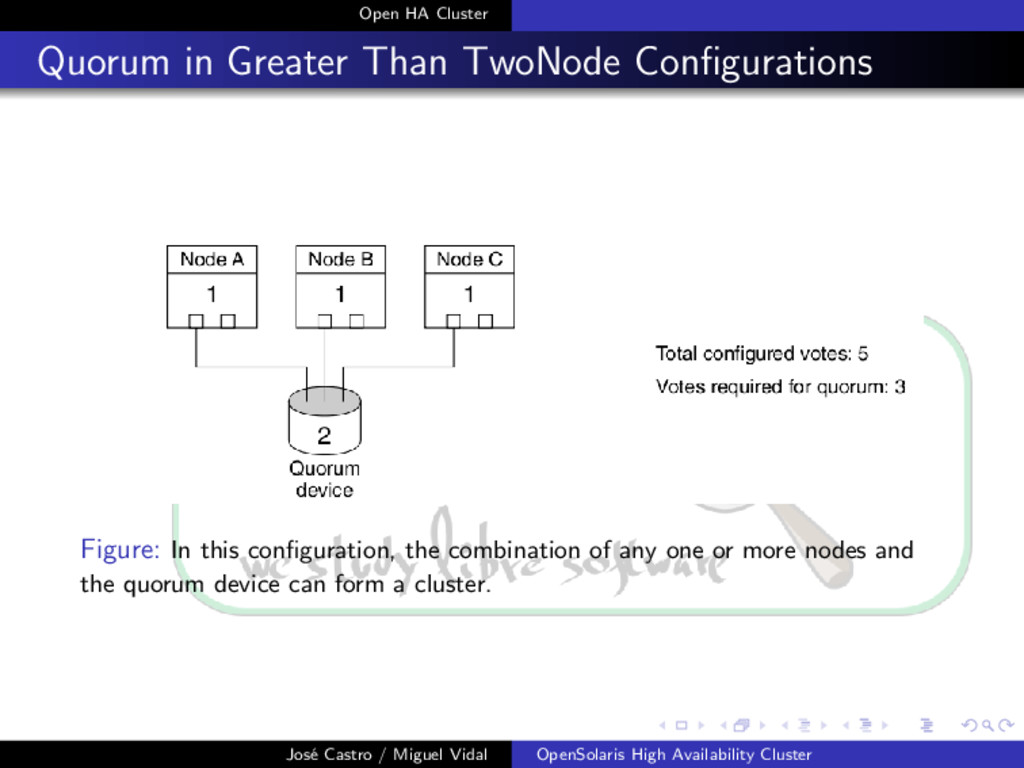
In this configuration, the combination of any one or more nodes and the quorum device can form a cluster. Jos´ e Castro / Miguel Vidal OpenSolaris High Availability Cluster
disk reservations to implement failure fencing. Using SCSI reservations, failed nodes are “fenced” away from the multihost devices, preventing them from accessing those disks. When a cluster member detects that another node is no longer communicating over the cluster interconnect, it initiates a failure fencing procedure to prevent the other node from accessing shared disks. Jos´ e Castro / Miguel Vidal OpenSolaris High Availability Cluster
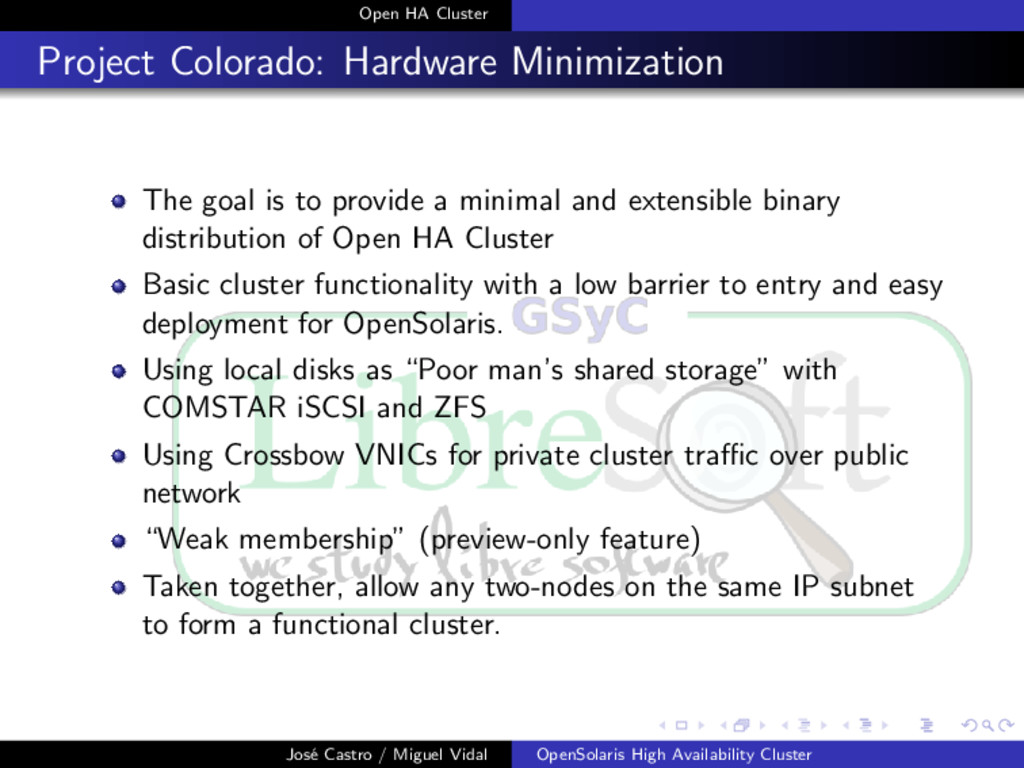
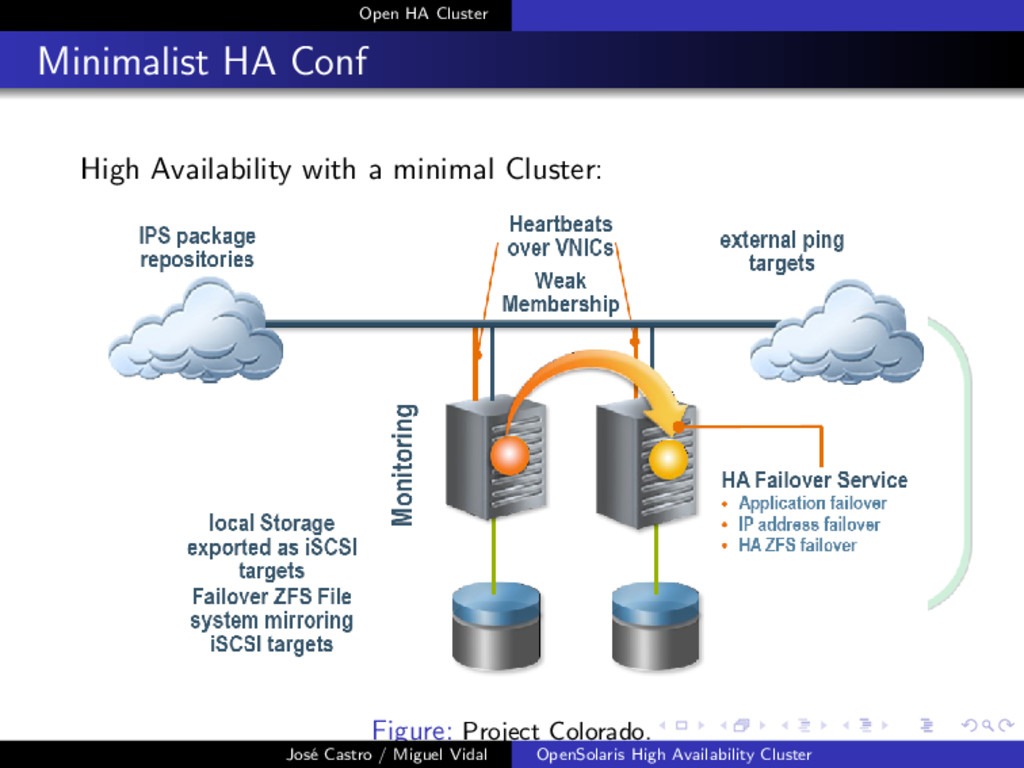
to provide a minimal and extensible binary distribution of Open HA Cluster Basic cluster functionality with a low barrier to entry and easy deployment for OpenSolaris. Using local disks as “Poor man’s shared storage” with COMSTAR iSCSI and ZFS Using Crossbow VNICs for private cluster traffic over public network “Weak membership” (preview-only feature) Taken together, allow any two-nodes on the same IP subnet to form a functional cluster. Jos´ e Castro / Miguel Vidal OpenSolaris High Availability Cluster


 mvidal
 tanakaseiya
 soudai
 ymiya55
 ktkrhr
 yama3133
 oracle4engineer
 k_adachi_01
 yutakaosada
 ennael
 ks91
ks91
 cassius7
 sanghyuk
 bkeepers
 lauravandoore
 tammyeverts
 katarinadahlin
 greggifford
 akademiya2063
 inesmontani
 ryanjones
 quramy
 palkan
 axbom
axbom