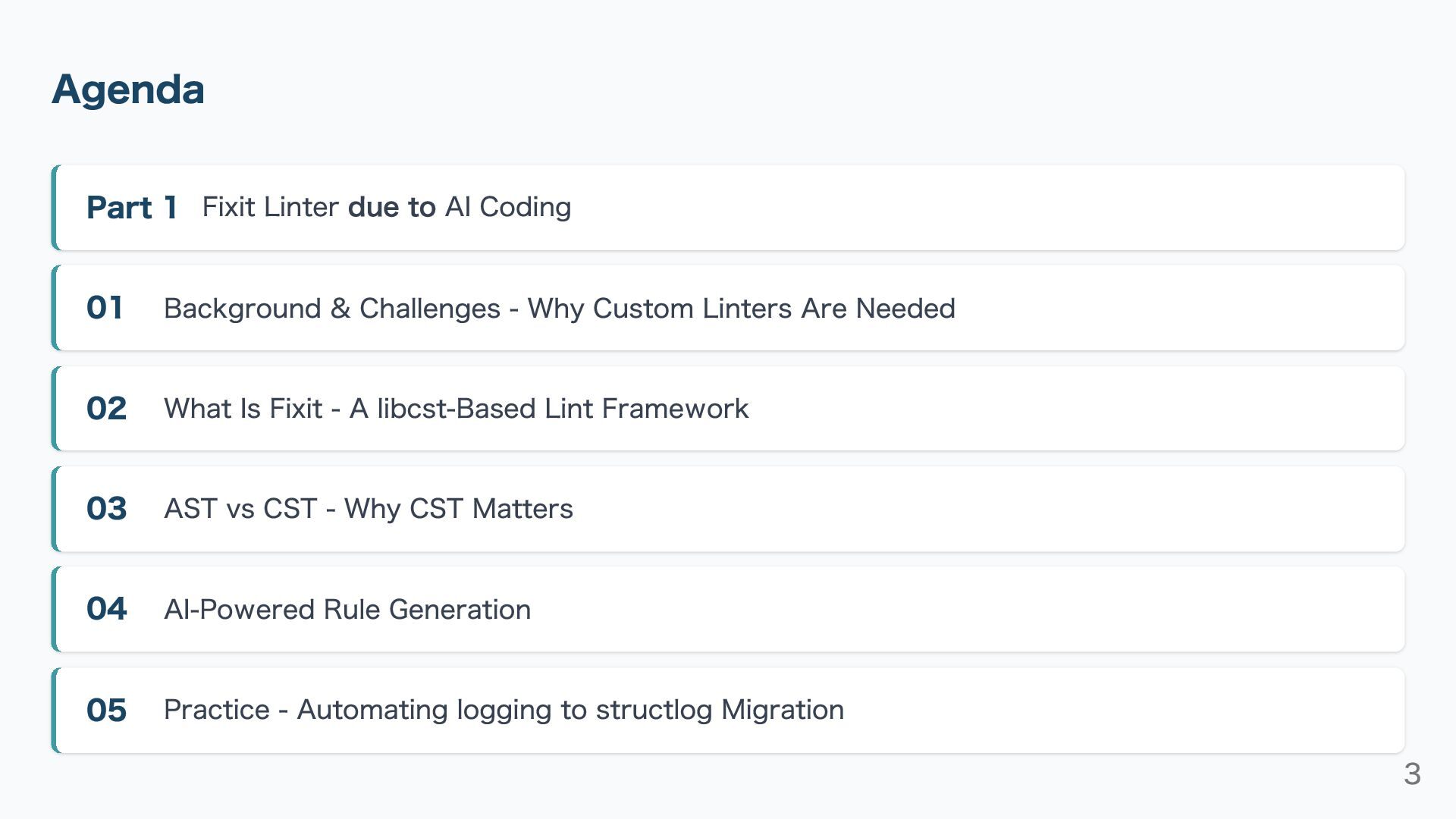
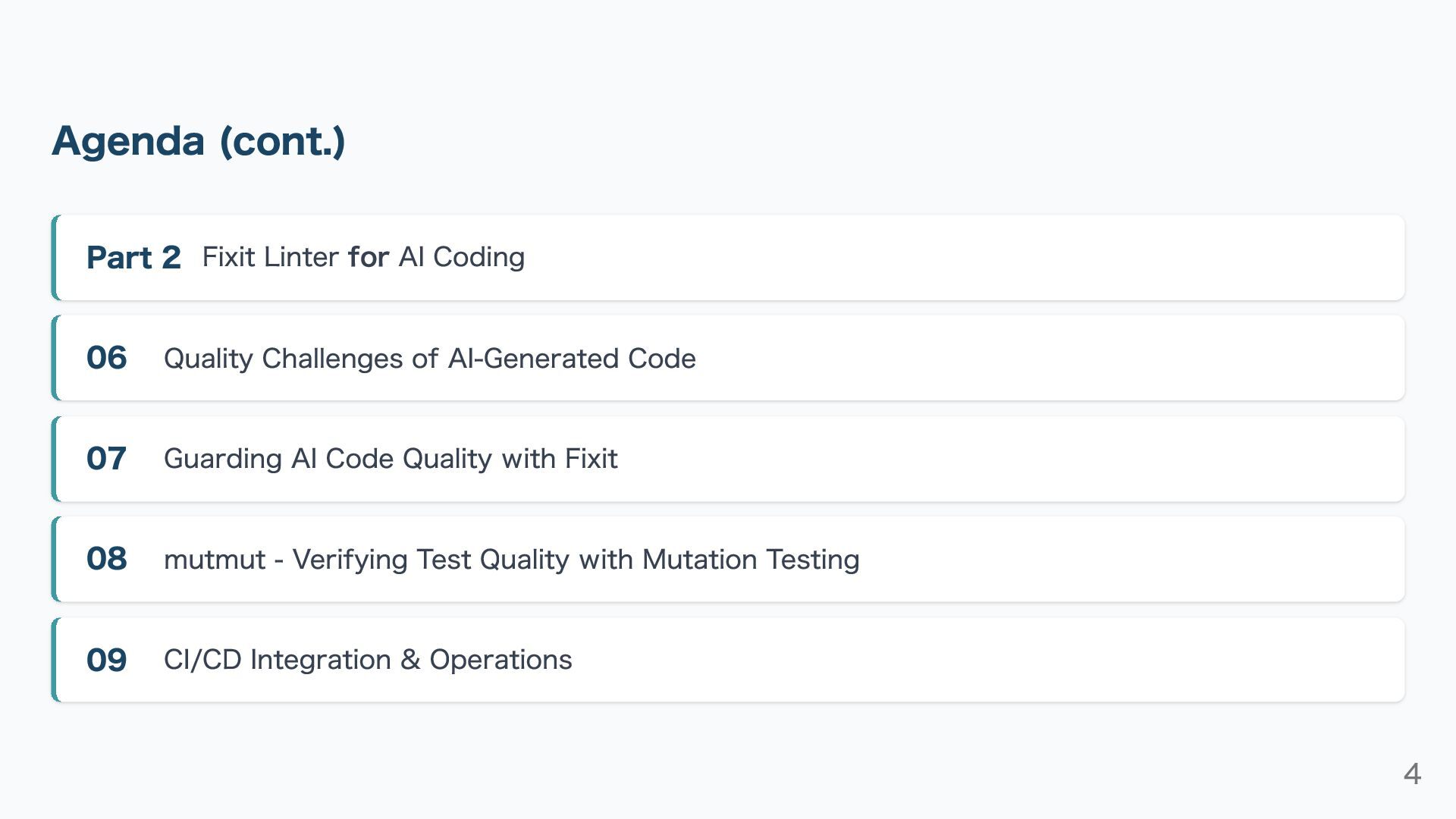
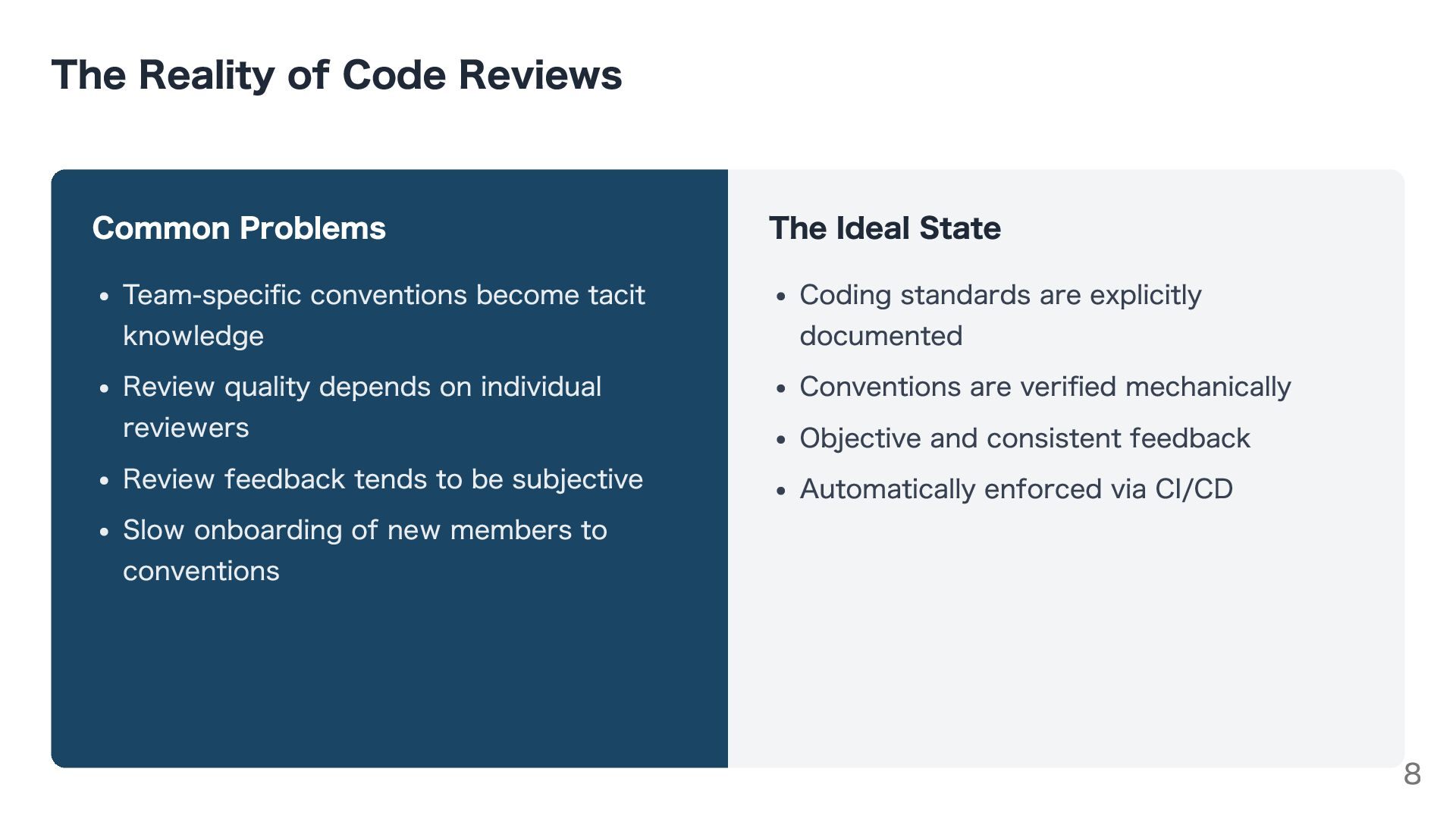
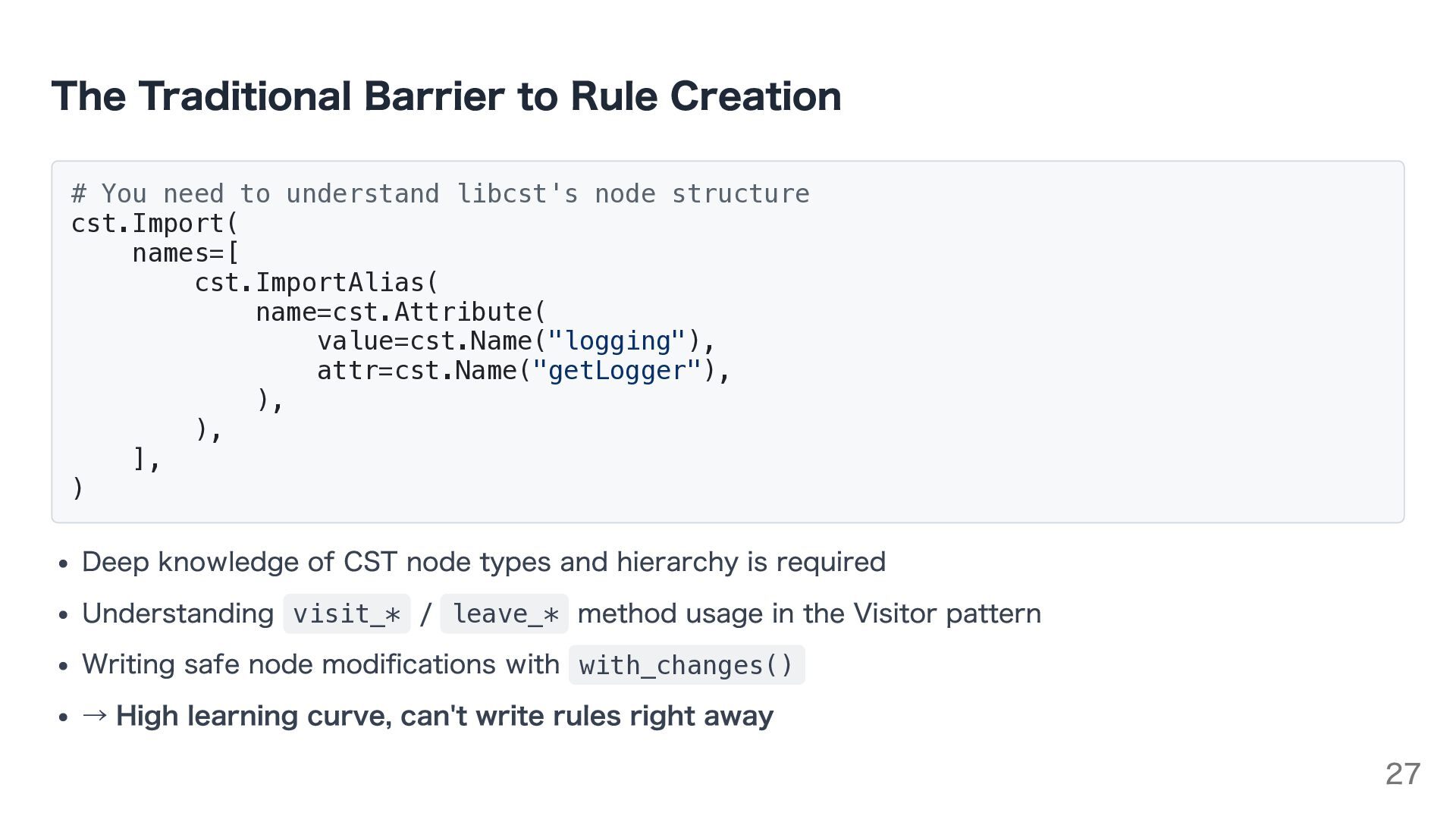
tacit knowledge Review quality depends on individual reviewers Review feedback tends to be subjective Slow onboarding of new members to conventions The Ideal State Coding standards are explicitly documented Conventions are verified mechanically Objective and consistent feedback Automatically enforced via CI/CD 8
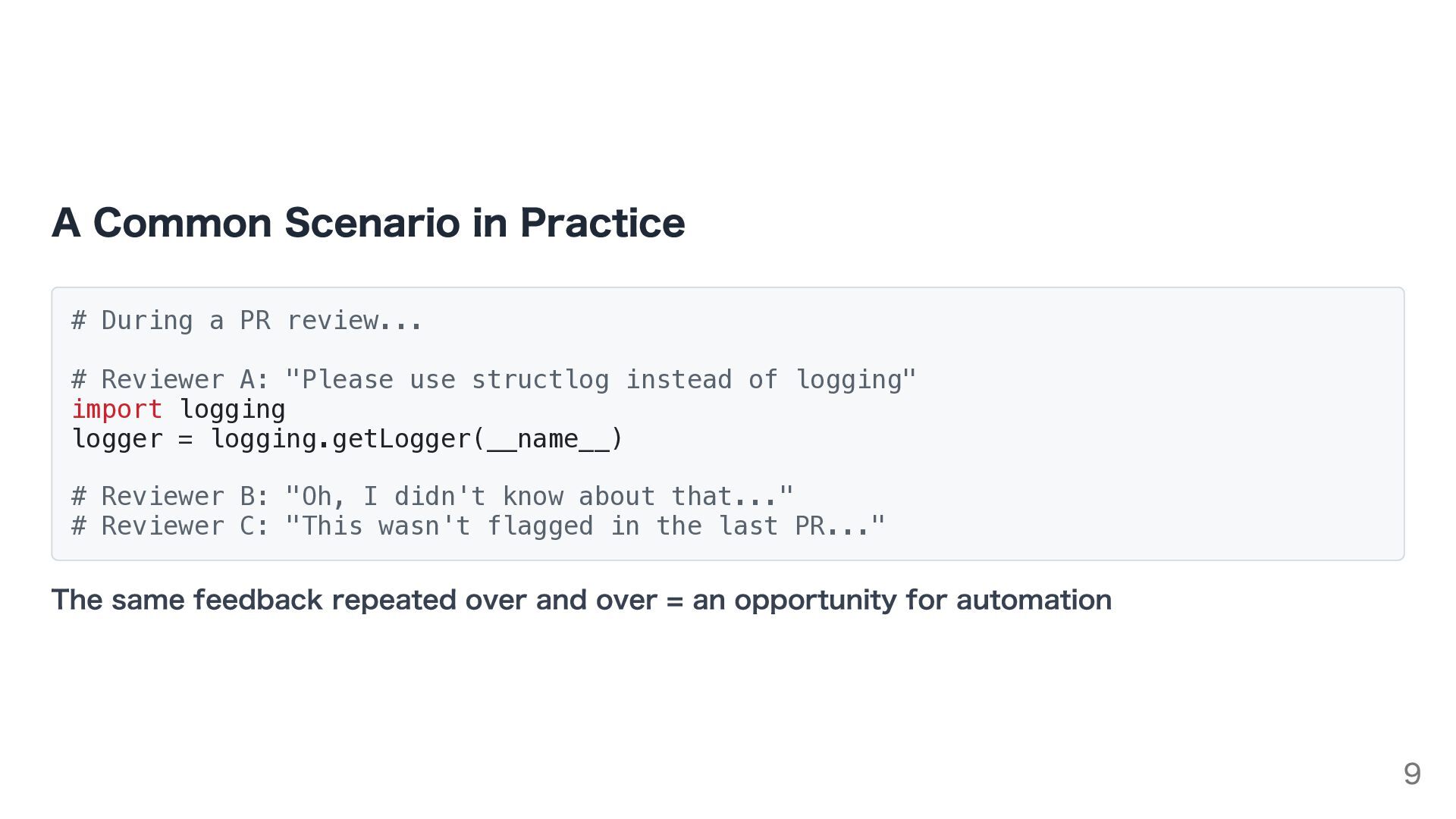
# Reviewer A: "Please use structlog instead of logging" import logging logger = logging.getLogger(__name__) # Reviewer B: "Oh, I didn't know about that..." # Reviewer C: "This wasn't flagged in the last PR..." The same feedback repeated over and over = an opportunity for automation 9
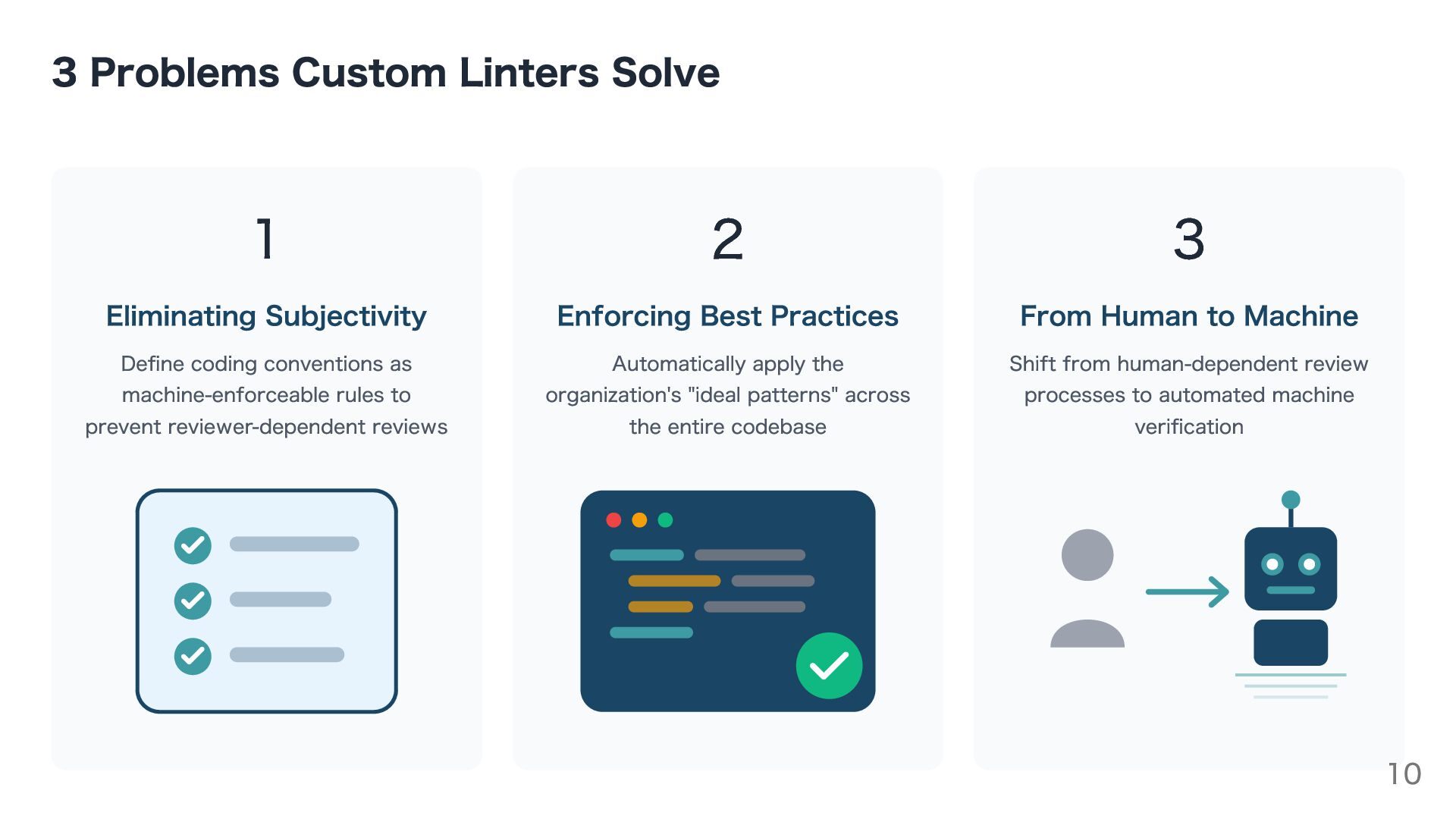
conventions as machine-enforceable rules to prevent reviewer-dependent reviews 2 Enforcing Best Practices Automatically apply the organization's "ideal patterns" across the entire codebase 3 From Human to Machine Shift from human-dependent review processes to automated machine verification 10
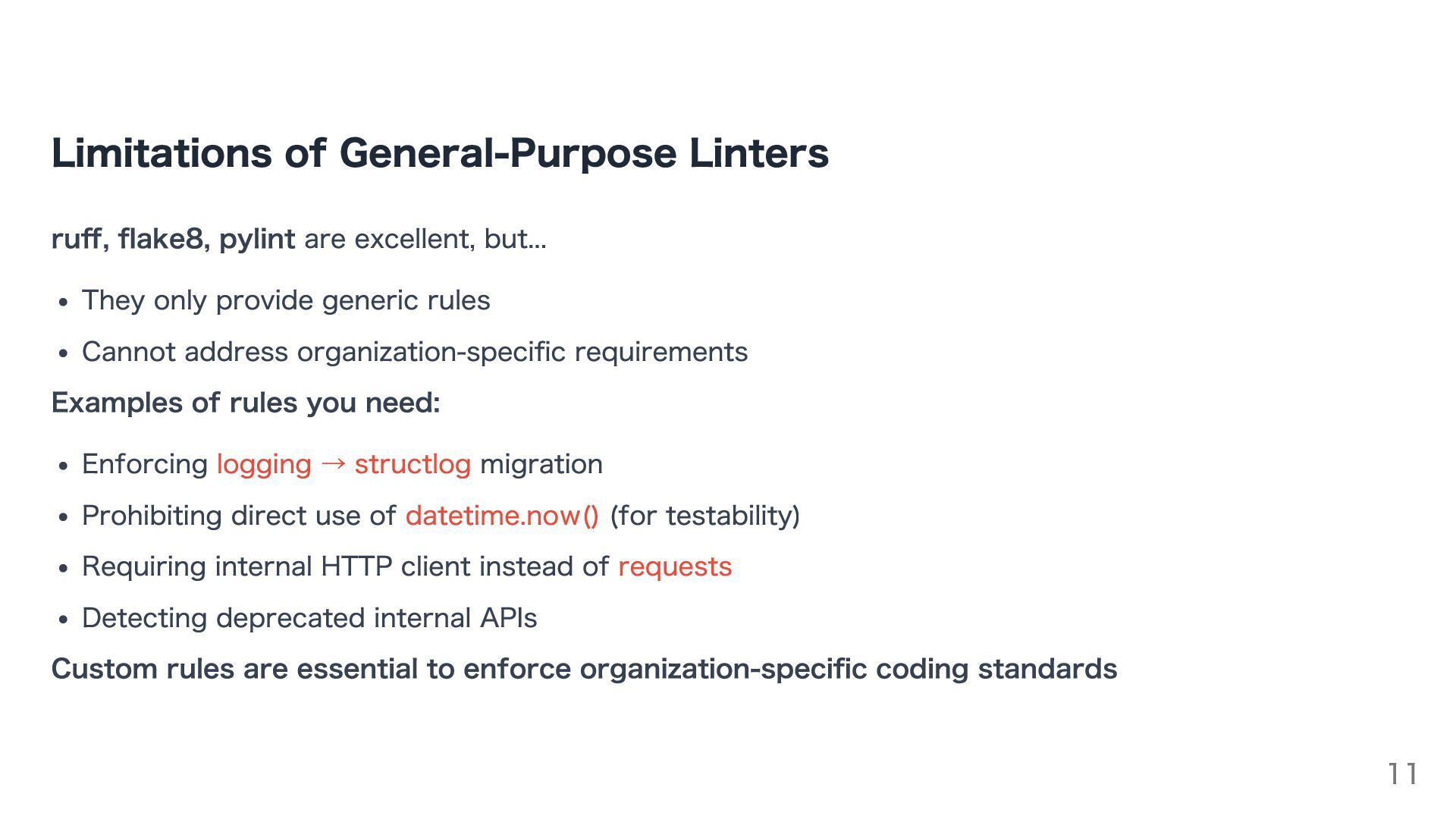
They only provide generic rules Cannot address organization-specific requirements Examples of rules you need: Enforcing logging → structlog migration Prohibiting direct use of datetime.now() (for testability) Requiring internal HTTP client instead of requests Detecting deprecated internal APIs Custom rules are essential to enforce organization-specific coding standards 11
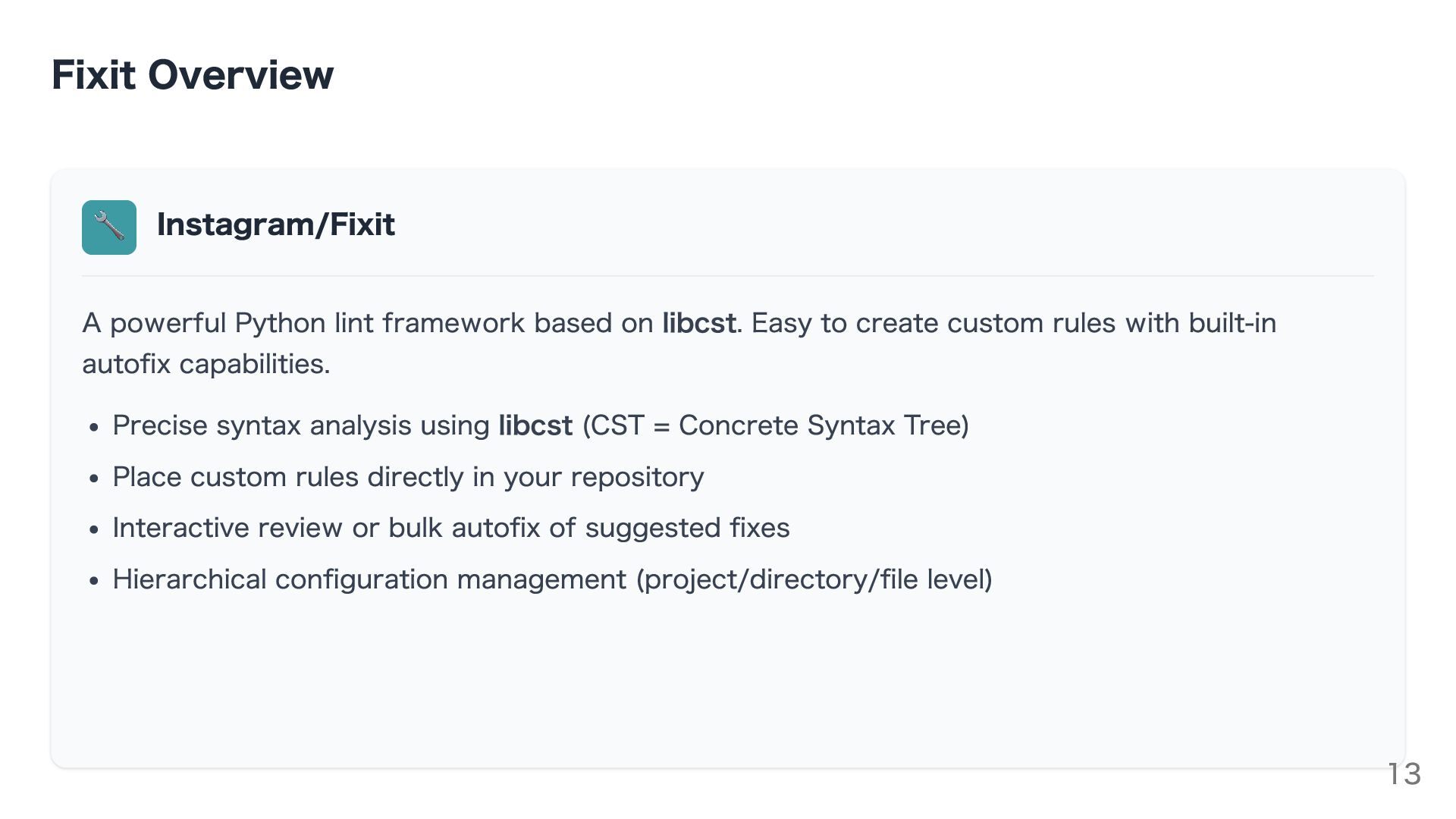
on libcst. Easy to create custom rules with built-in autofix capabilities. Precise syntax analysis using libcst (CST = Concrete Syntax Tree) Place custom rules directly in your repository Interactive review or bulk autofix of suggested fixes Hierarchical configuration management (project/directory/file level) 13
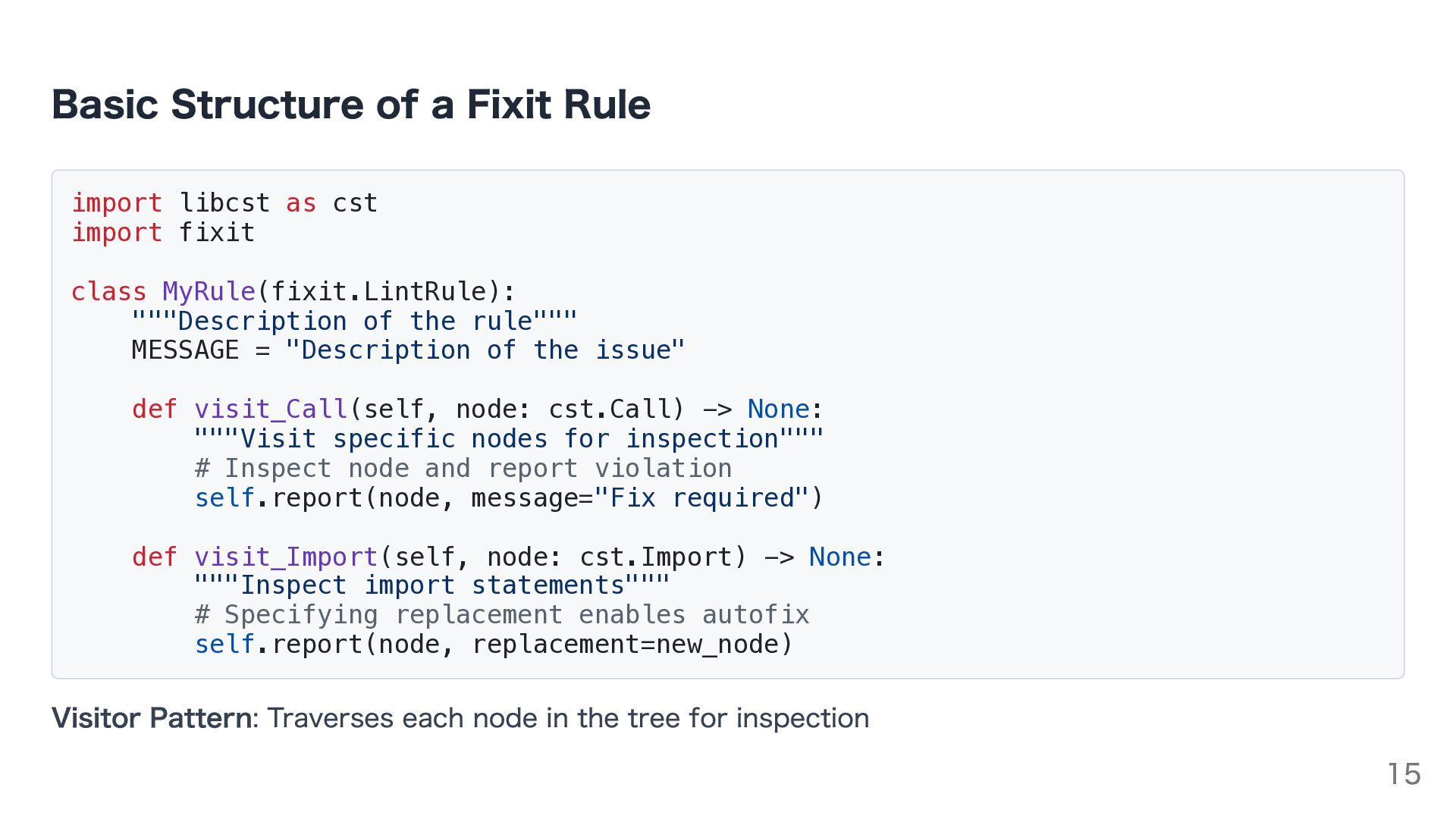
import fixit class MyRule(fixit.LintRule): """Description of the rule""" MESSAGE = "Description of the issue" def visit_Call(self, node: cst.Call) -> None: """Visit specific nodes for inspection""" # Inspect node and report violation self.report(node, message="Fix required") def visit_Import(self, node: cst.Import) -> None: """Inspect import statements""" # Specifying replacement enables autofix self.report(node, replacement=new_node) Visitor Pattern: Traverses each node in the tree for inspection 15
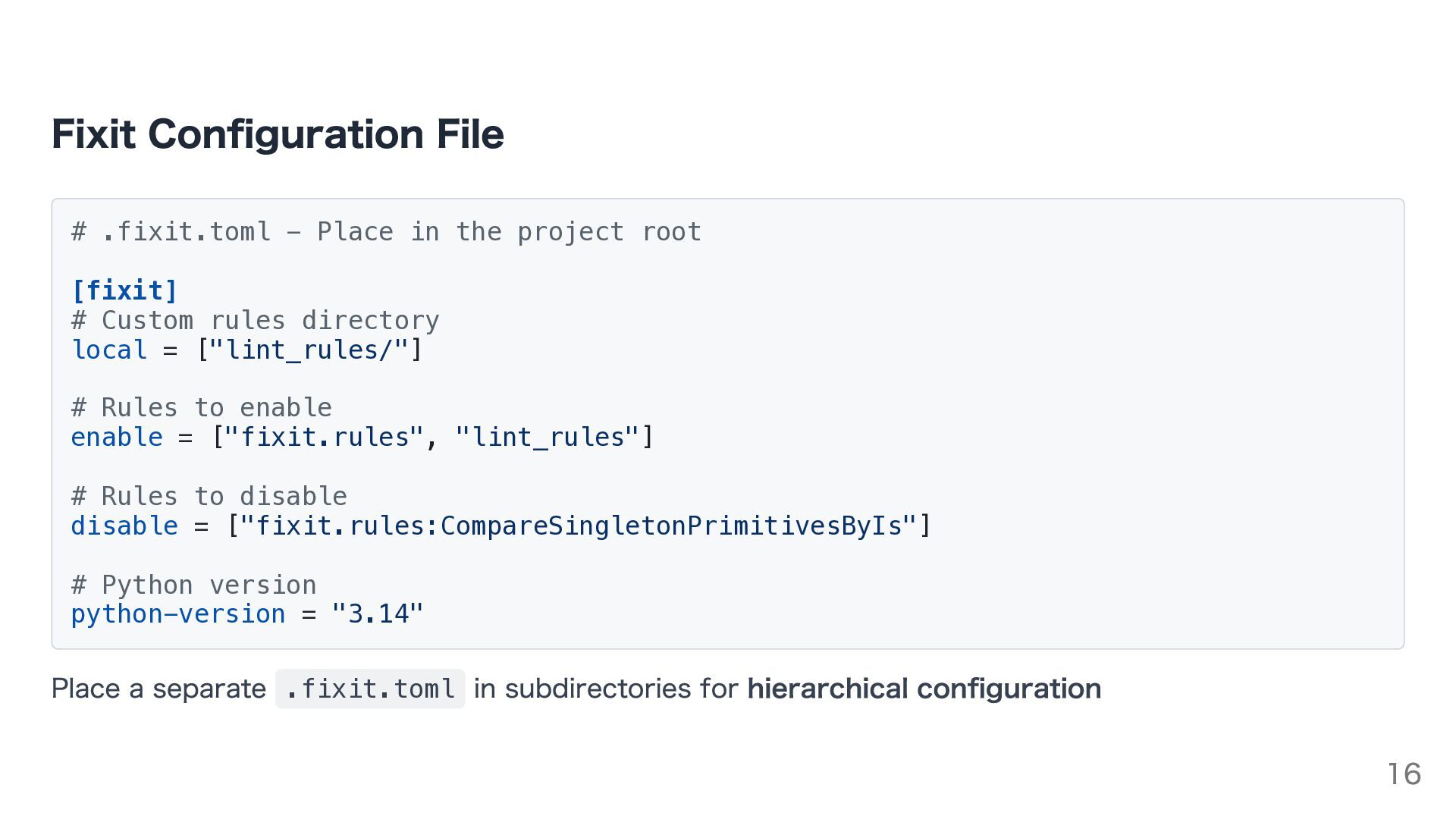
root [fixit] # Custom rules directory local = ["lint_rules/"] # Rules to enable enable = ["fixit.rules", "lint_rules"] # Rules to disable disable = ["fixit.rules:CompareSingletonPrimitivesByIs"] # Python version python-version = "3.14" Place a separate .fixit.toml in subdirectories for hierarchical configuration 16
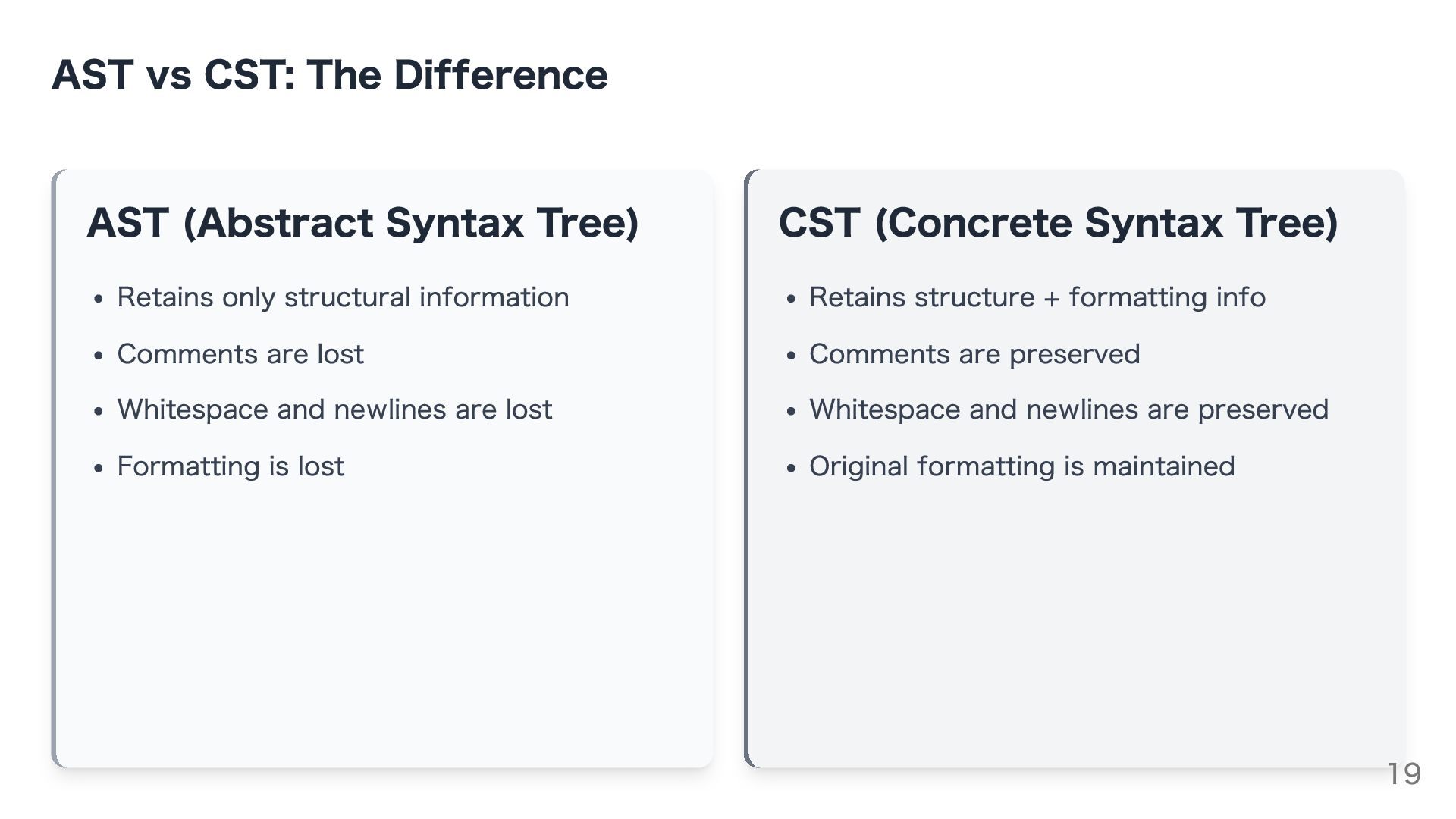
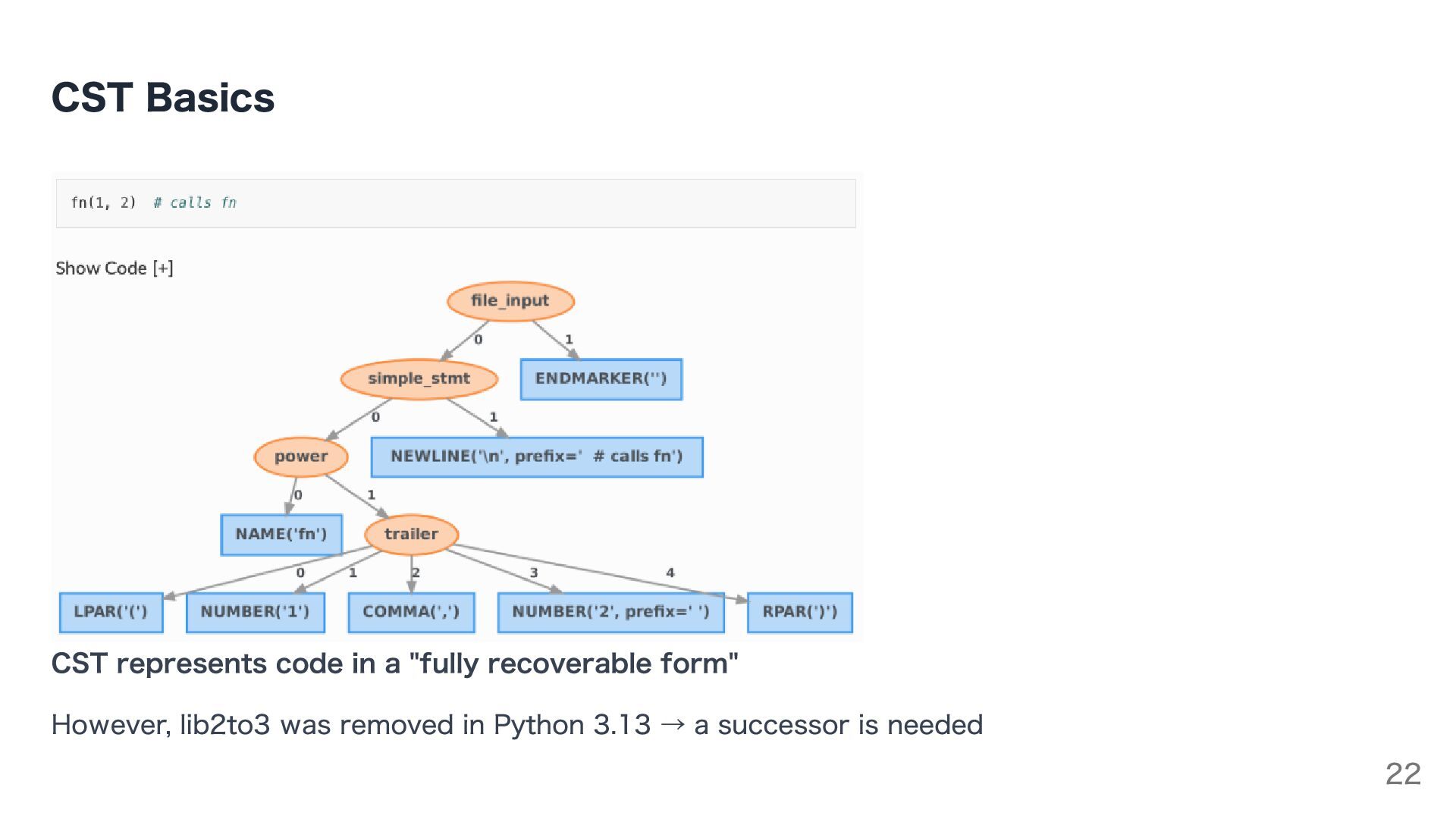
only structural information Comments are lost Whitespace and newlines are lost Formatting is lost CST (Concrete Syntax Tree) Retains structure + formatting info Comments are preserved Whitespace and newlines are preserved Original formatting is maintained 19
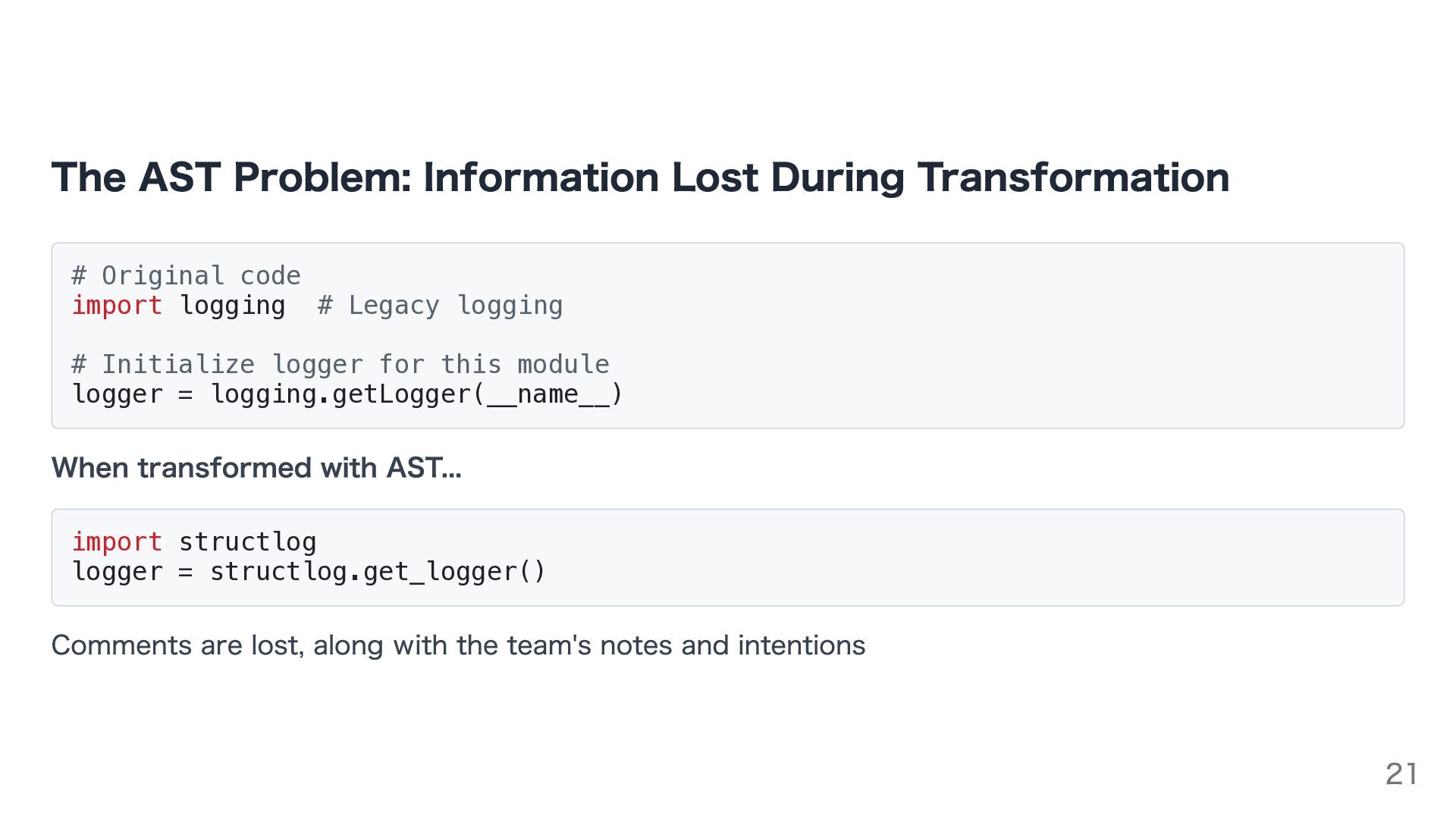
import logging # Legacy logging # Initialize logger for this module logger = logging.getLogger(__name__) When transformed with AST... import structlog logger = structlog.get_logger() Comments are lost, along with the team's notes and intentions 21
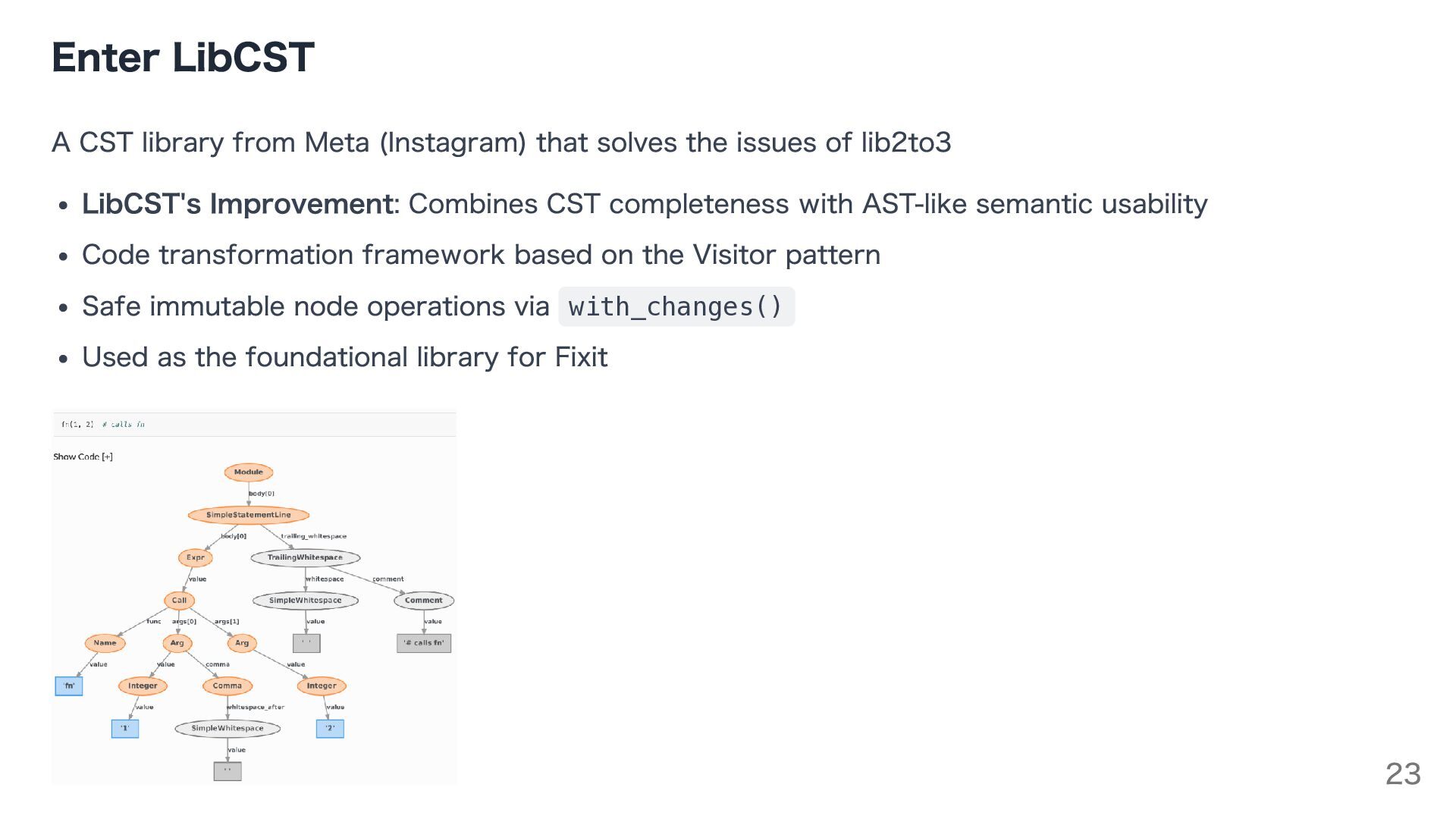
the issues of lib2to3 LibCST's Improvement: Combines CST completeness with AST-like semantic usability Code transformation framework based on the Visitor pattern Safe immutable node operations via with_changes() Used as the foundational library for Fixit 23
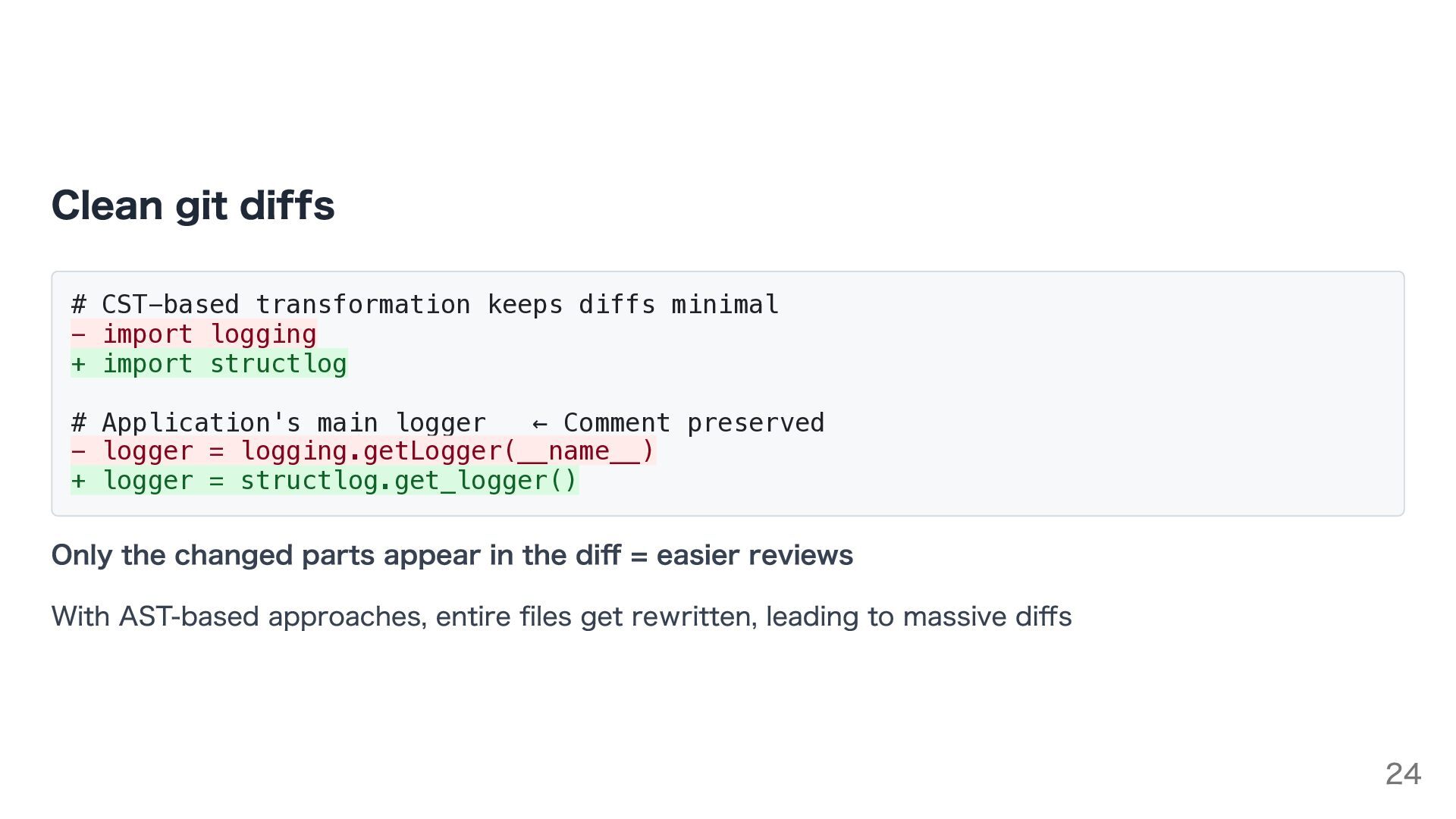
import logging + import structlog # Application's main logger ← Comment preserved - logger = logging.getLogger(__name__) + logger = structlog.get_logger() Only the changed parts appear in the diff = easier reviews With AST-based approaches, entire files get rewritten, leading to massive diffs 24
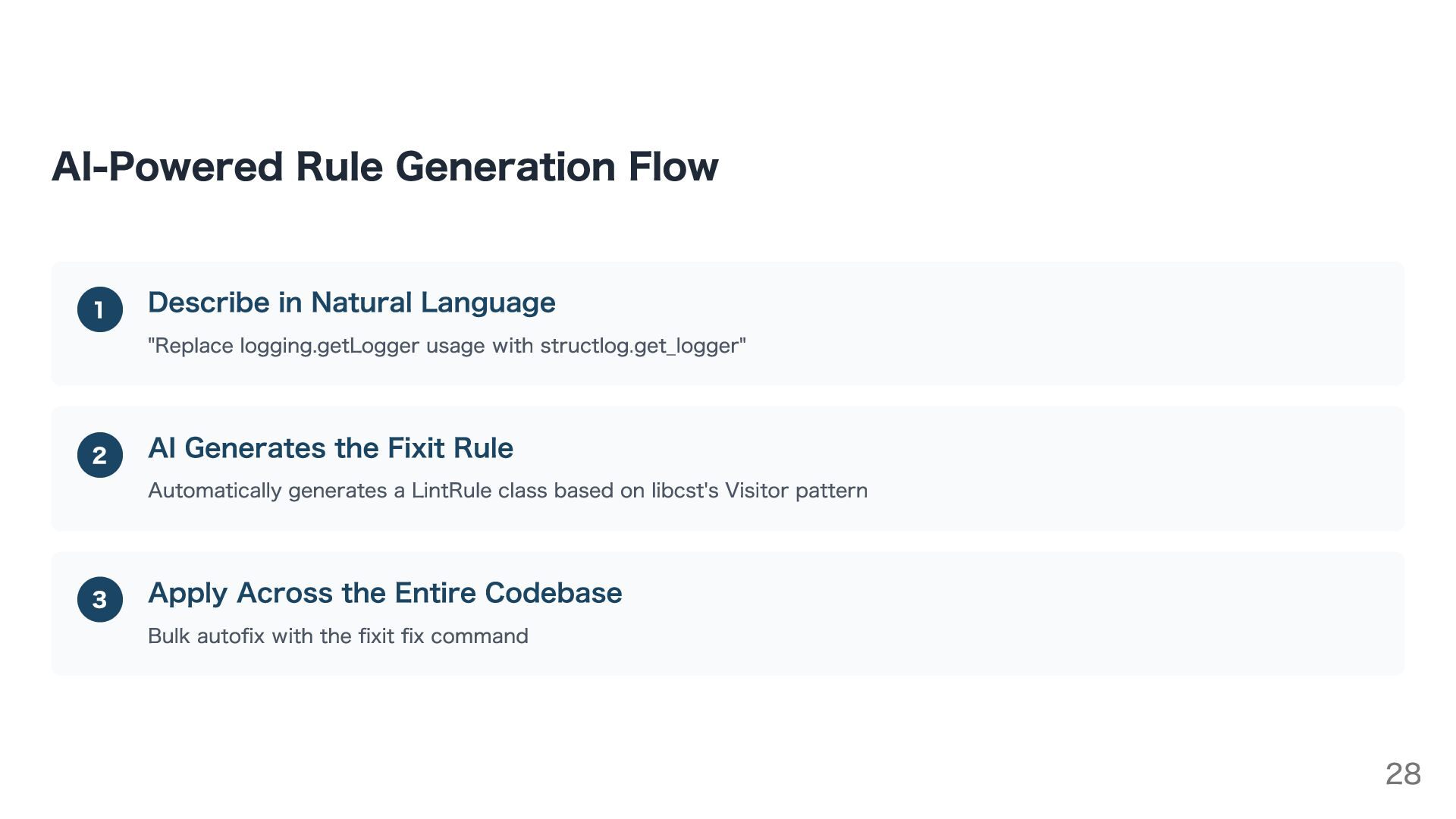
logging.getLogger usage with structlog.get_logger" 2 AI Generates the Fixit Rule Automatically generates a LintRule class based on libcst's Visitor pattern 3 Apply Across the Entire Codebase Bulk autofix with the fixit fix command 28
custom linters Even without deep knowledge of libcst, simply describing what you want in natural language automatically generates Fixit rules. This enables the entire team to participate in defining and enforcing coding standards. 29
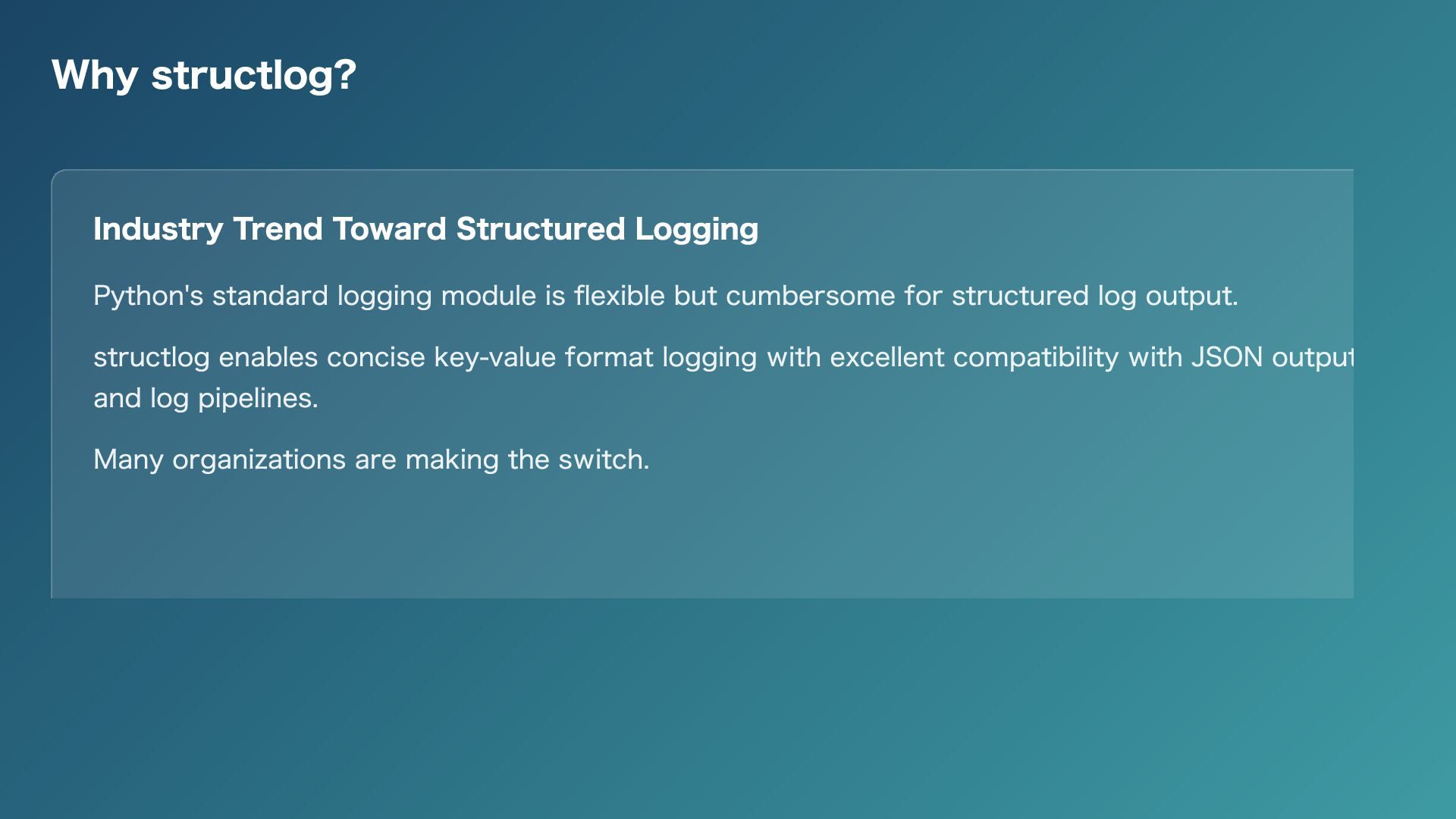
module is flexible but cumbersome for structured log output. structlog enables concise key-value format logging with excellent compatibility with JSON output and log pipelines. Many organizations are making the switch.
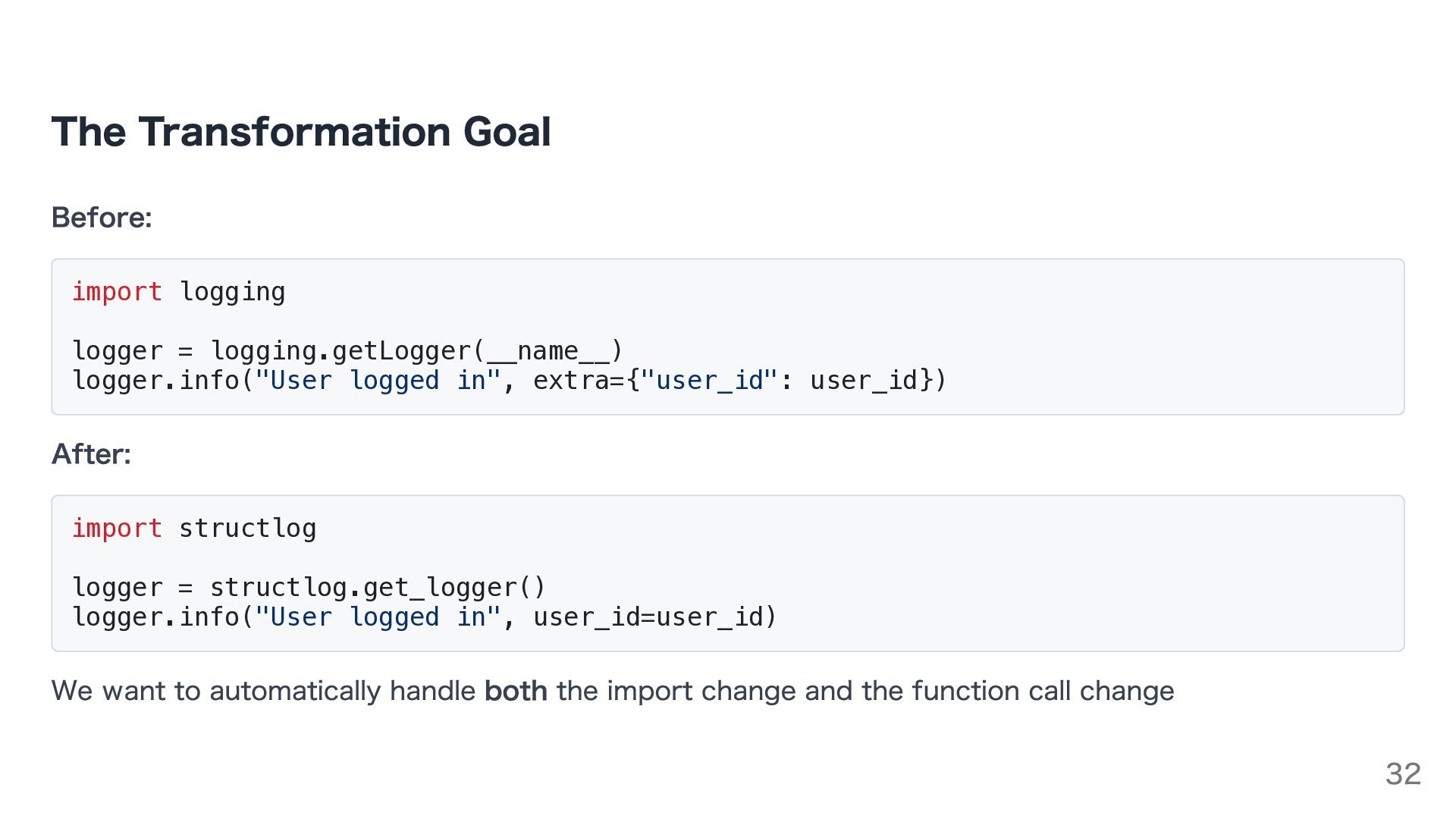
logged in", extra={"user_id": user_id}) After: import structlog logger = structlog.get_logger() logger.info("User logged in", user_id=user_id) We want to automatically handle both the import change and the function call change 32
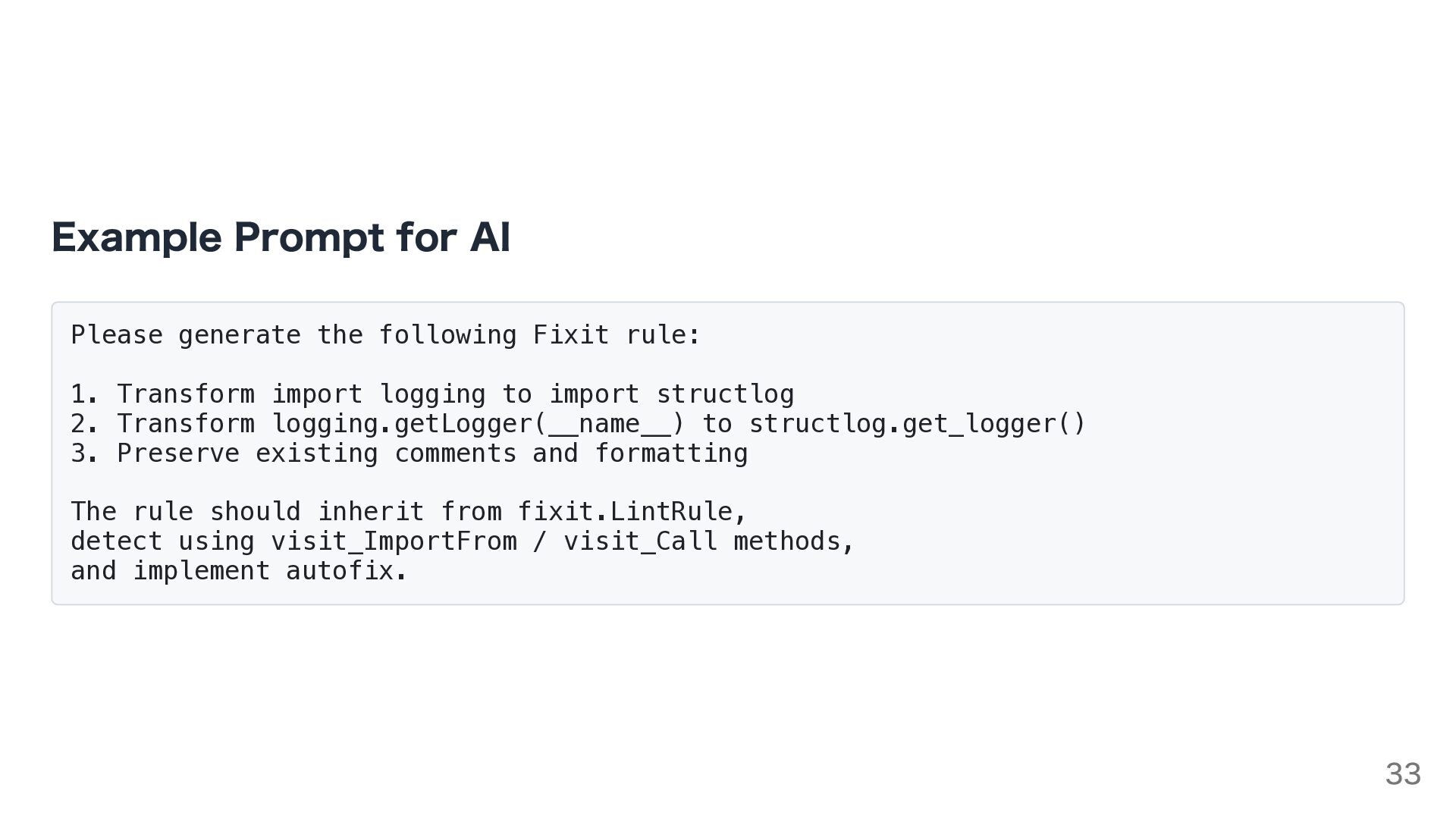
1. Transform import logging to import structlog 2. Transform logging.getLogger(__name__) to structlog.get_logger() 3. Preserve existing comments and formatting The rule should inherit from fixit.LintRule, detect using visit_ImportFrom / visit_Call methods, and implement autofix. 33
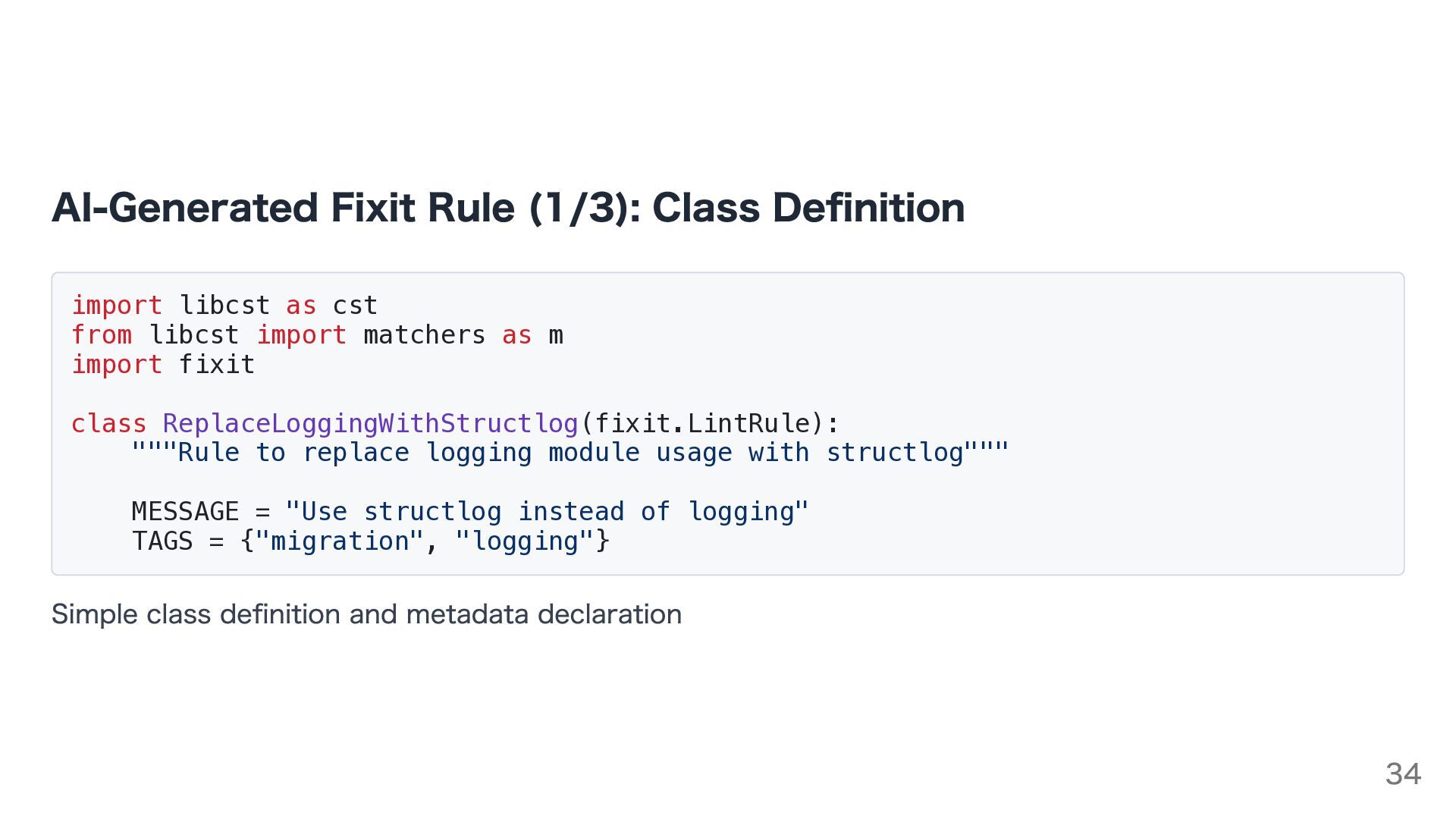
from libcst import matchers as m import fixit class ReplaceLoggingWithStructlog(fixit.LintRule): """Rule to replace logging module usage with structlog""" MESSAGE = "Use structlog instead of logging" TAGS = {"migration", "logging"} Simple class definition and metadata declaration 34
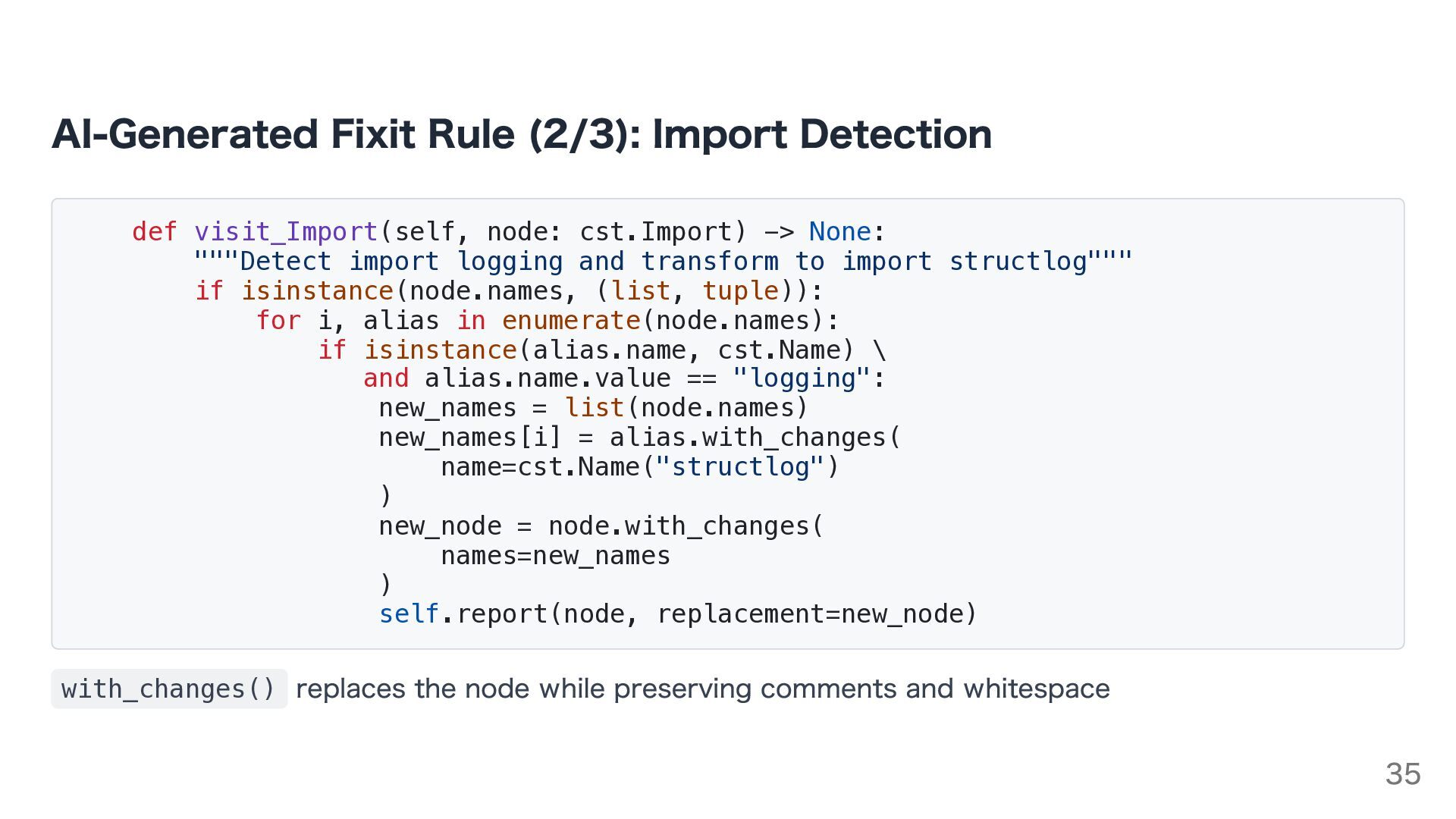
-> None: """Detect import logging and transform to import structlog""" if isinstance(node.names, (list, tuple)): for i, alias in enumerate(node.names): if isinstance(alias.name, cst.Name) \ and alias.name.value == "logging": new_names = list(node.names) new_names[i] = alias.with_changes( name=cst.Name("structlog") ) new_node = node.with_changes( names=new_names ) self.report(node, replacement=new_node) with_changes() replaces the node while preserving comments and whitespace 35
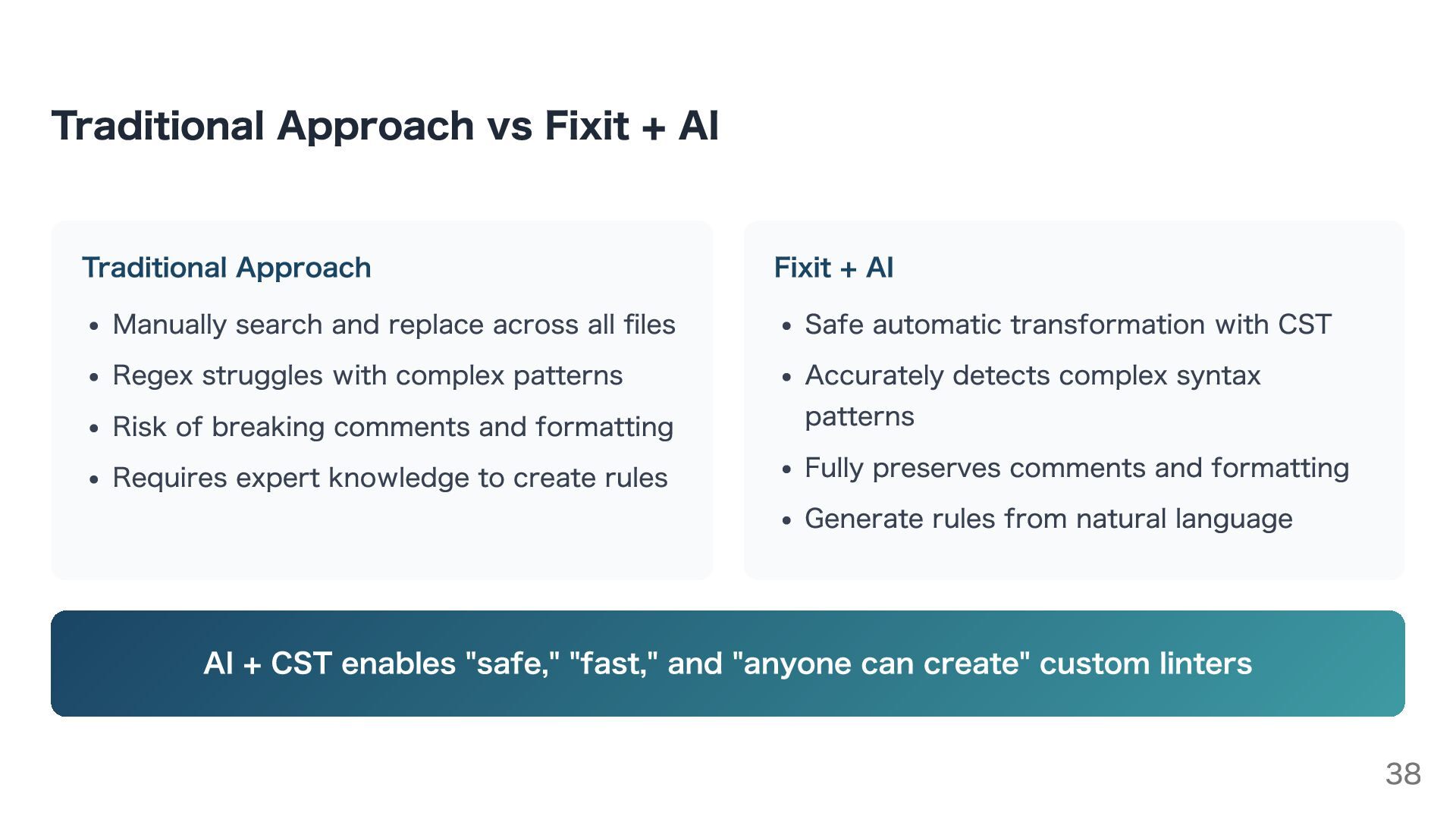
and replace across all files Regex struggles with complex patterns Risk of breaking comments and formatting Requires expert knowledge to create rules Fixit + AI Safe automatic transformation with CST Accurately detects complex syntax patterns Fully preserves comments and formatting Generate rules from natural language AI + CST enables "safe," "fast," and "anyone can create" custom linters 38
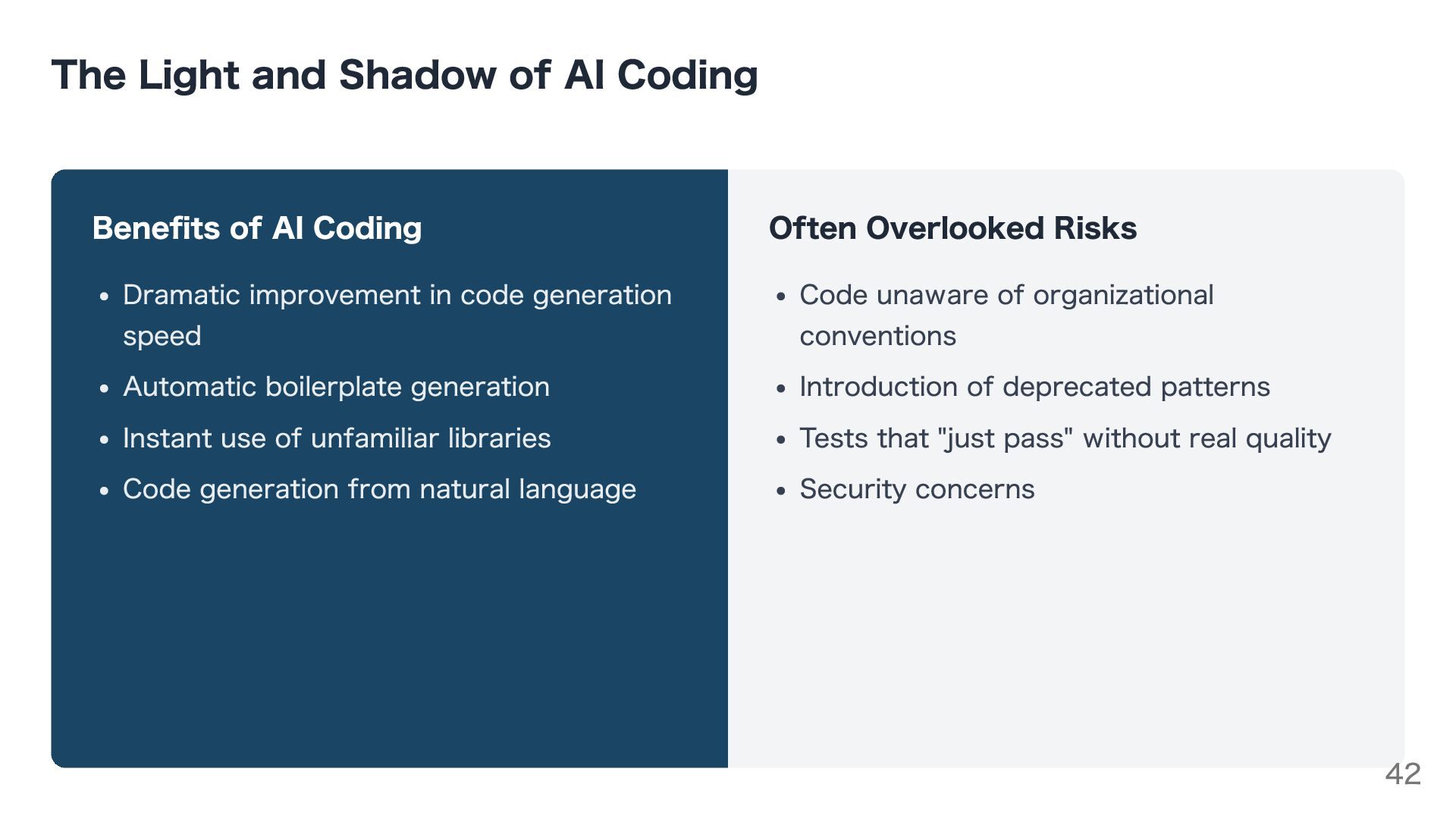
Coding Dramatic improvement in code generation speed Automatic boilerplate generation Instant use of unfamiliar libraries Code generation from natural language Often Overlooked Risks Code unaware of organizational conventions Introduction of deprecated patterns Tests that "just pass" without real quality Security concerns 42
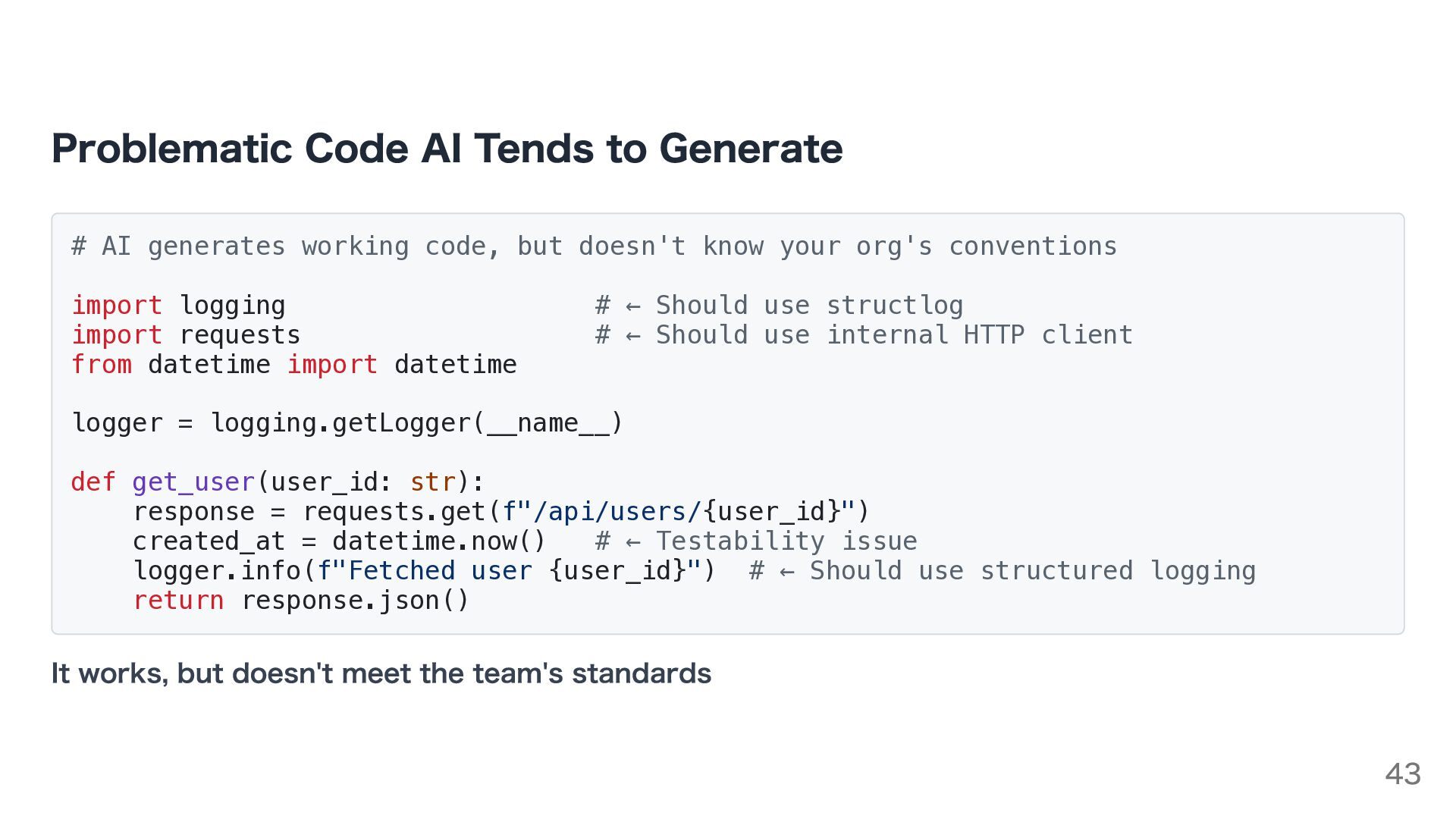
code, but doesn't know your org's conventions import logging # ← Should use structlog import requests # ← Should use internal HTTP client from datetime import datetime logger = logging.getLogger(__name__) def get_user(user_id: str): response = requests.get(f"/api/users/{user_id}") created_at = datetime.now() # ← Testability issue logger.info(f"Fetched user {user_id}") # ← Should use structured logging return response.json() It works, but doesn't meet the team's standards 43
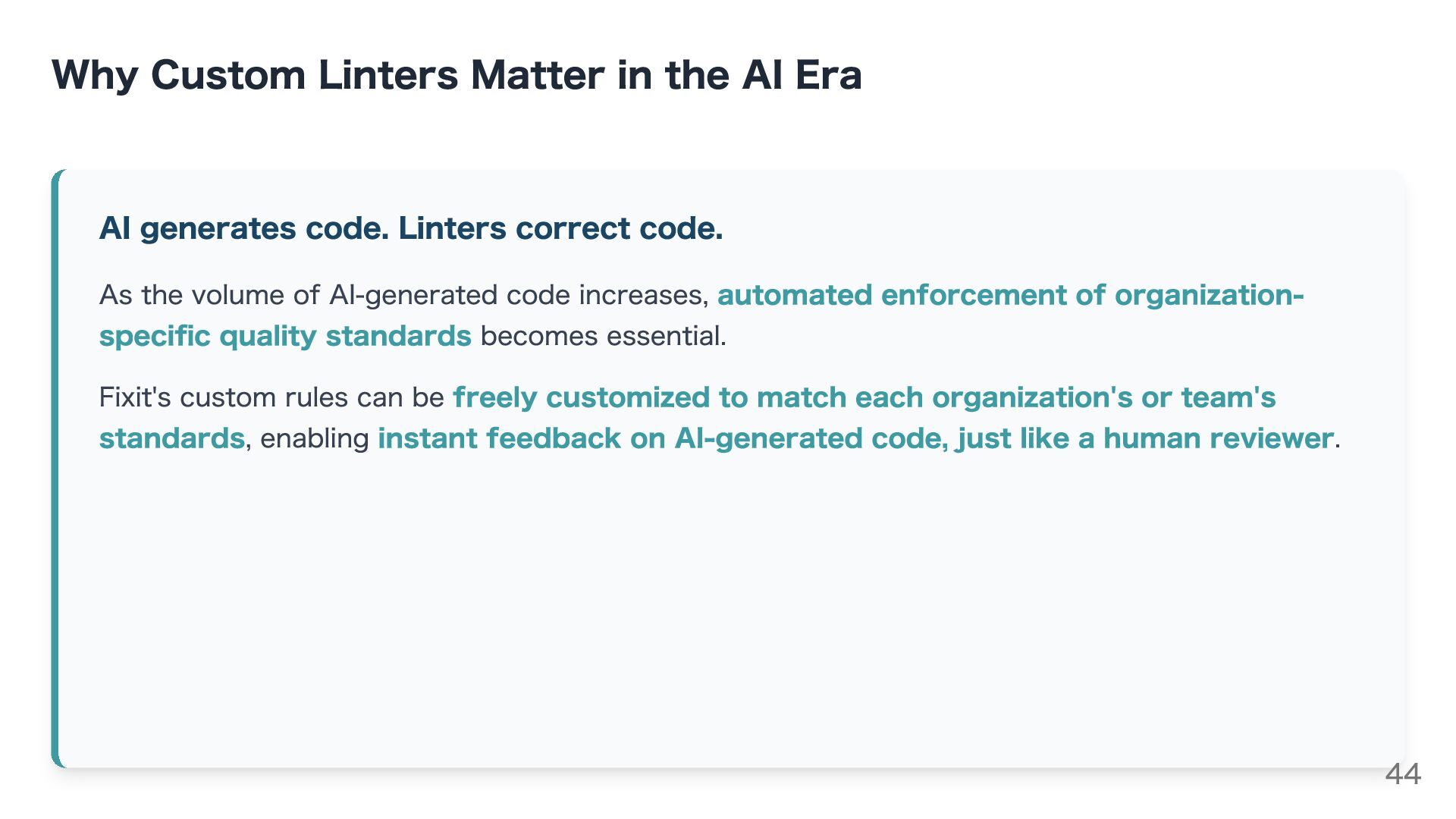
code. Linters correct code. As the volume of AI-generated code increases, automated enforcement of organization- specific quality standards becomes essential. Fixit's custom rules can be freely customized to match each organization's or team's standards, enabling instant feedback on AI-generated code, just like a human reviewer. 44
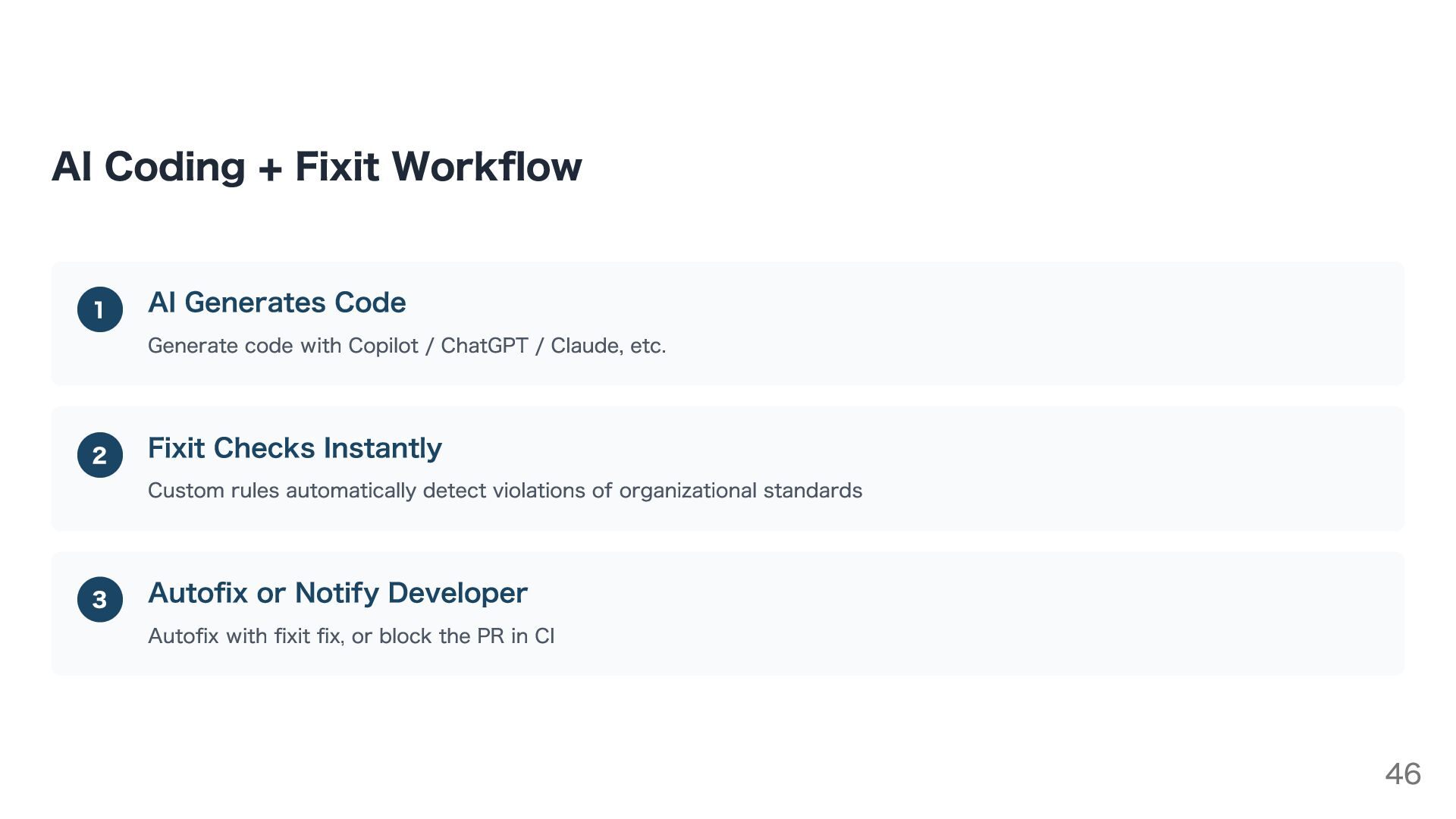
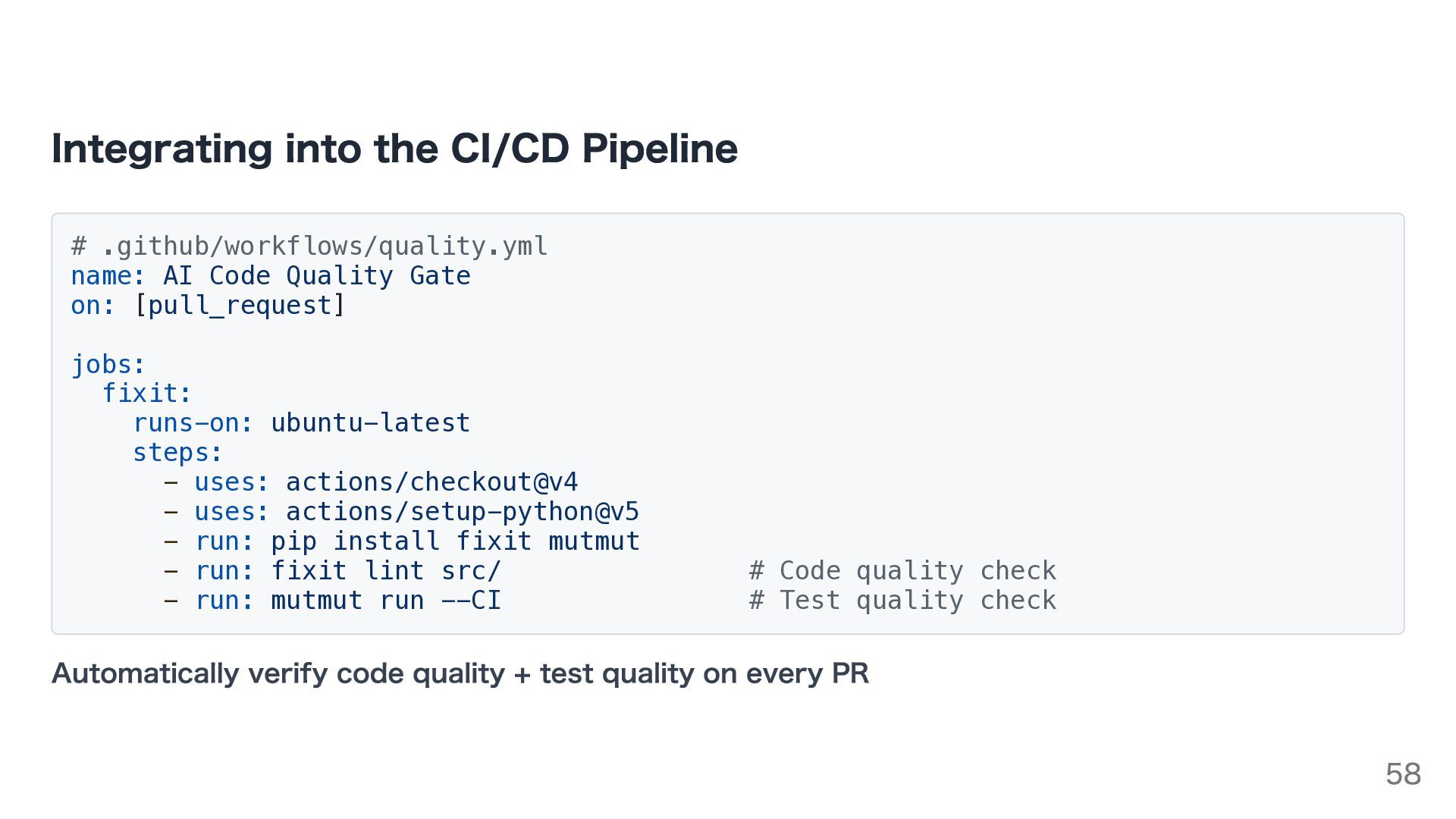
code with Copilot / ChatGPT / Claude, etc. 2 Fixit Checks Instantly Custom rules automatically detect violations of organizational standards 3 Autofix or Notify Developer Autofix with fixit fix, or block the PR in CI 46
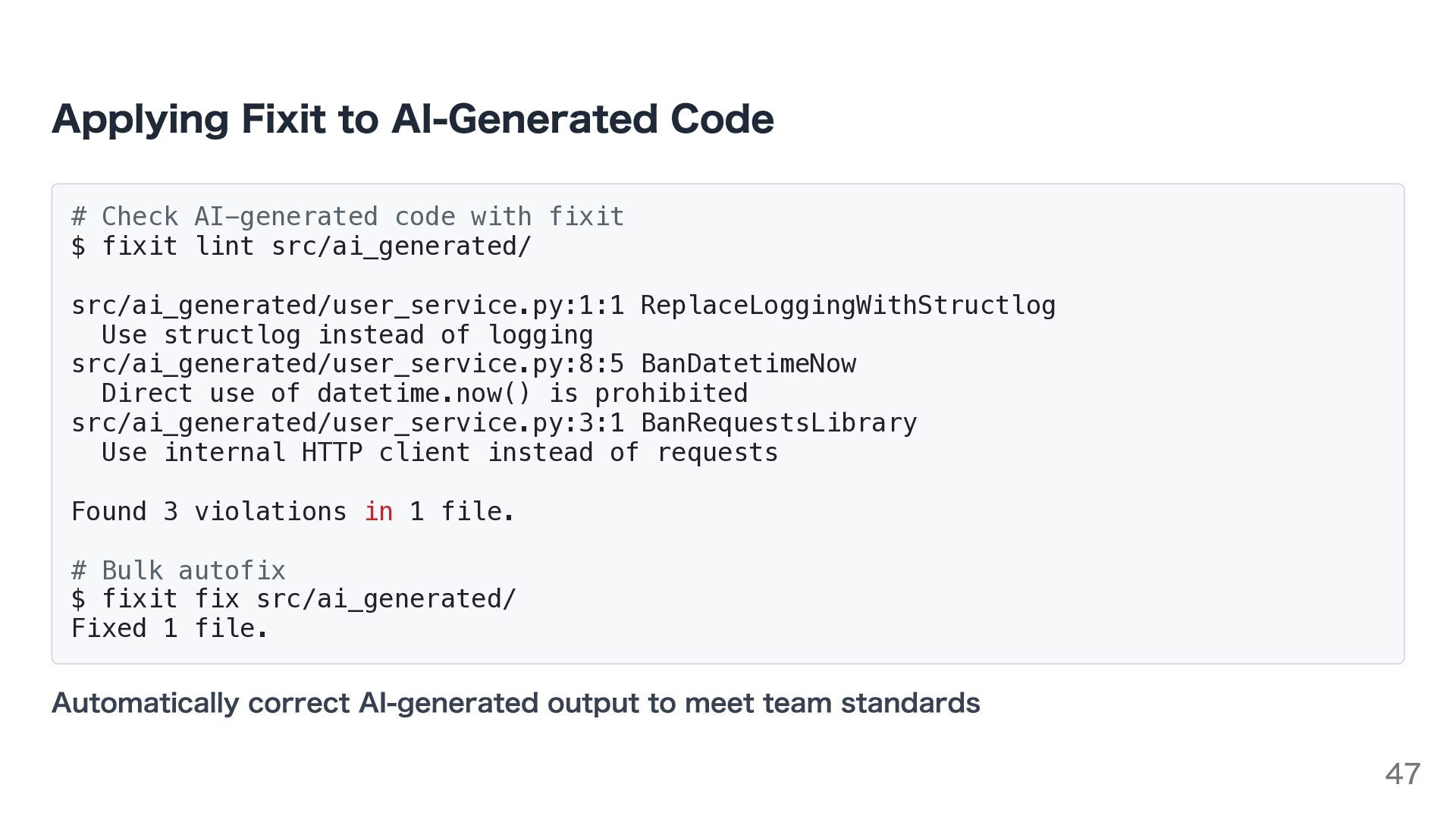
fixit $ fixit lint src/ai_generated/ src/ai_generated/user_service.py:1:1 ReplaceLoggingWithStructlog Use structlog instead of logging src/ai_generated/user_service.py:8:5 BanDatetimeNow Direct use of datetime.now() is prohibited src/ai_generated/user_service.py:3:1 BanRequestsLibrary Use internal HTTP client instead of requests Found 3 violations in 1 file. # Bulk autofix $ fixit fix src/ai_generated/ Fixed 1 file. Automatically correct AI-generated output to meet team standards 47
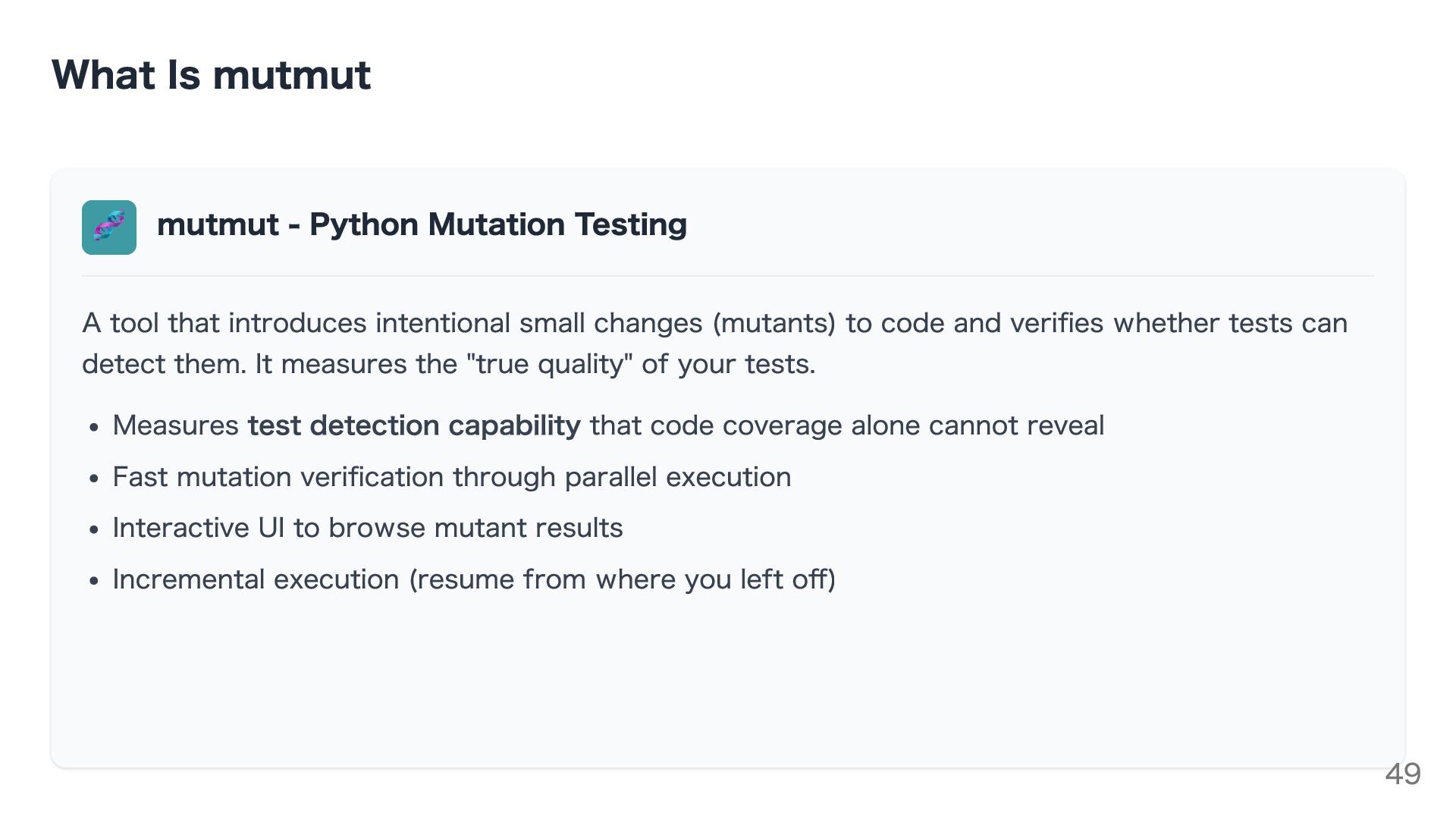
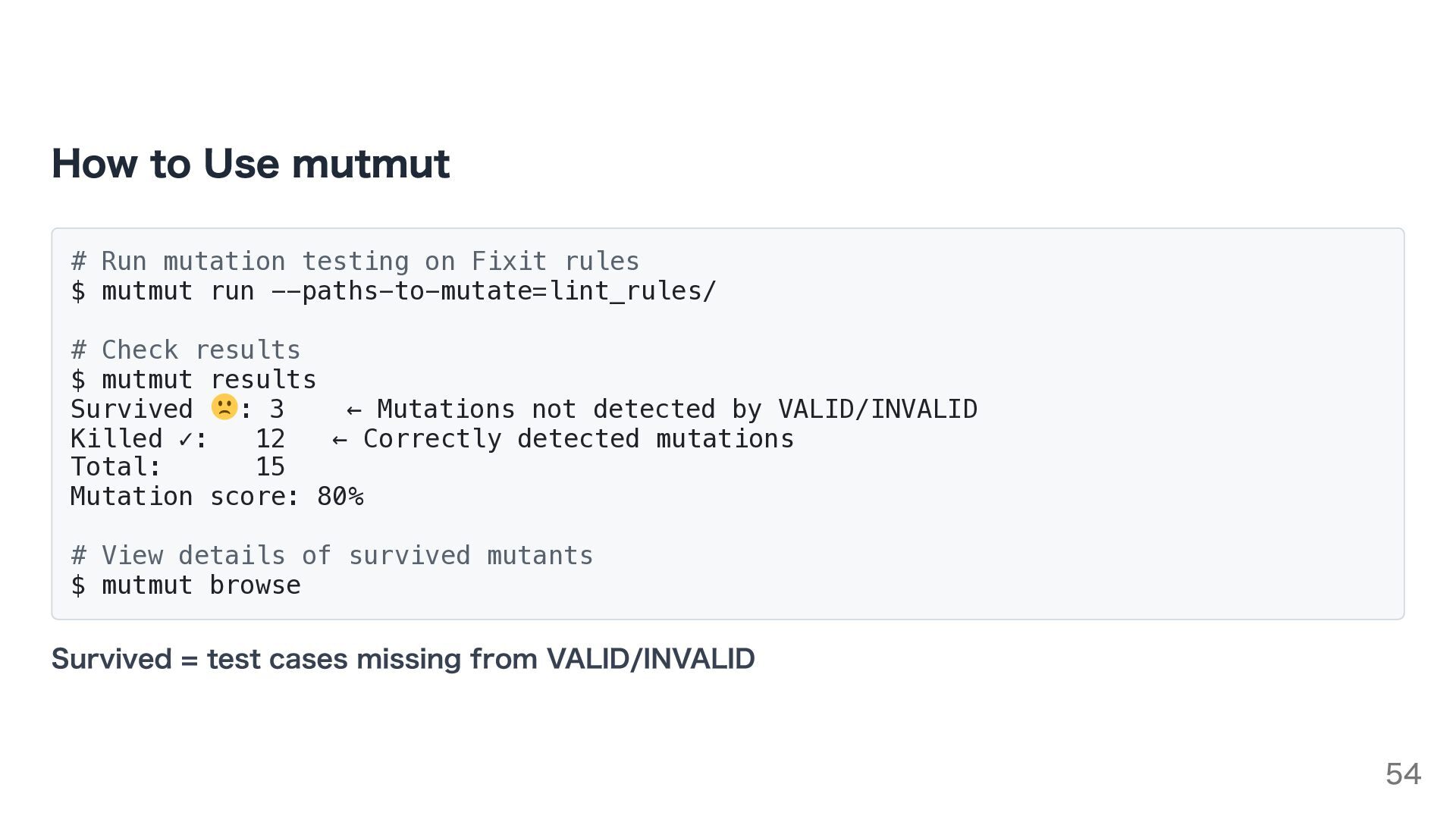
tool that introduces intentional small changes (mutants) to code and verifies whether tests can detect them. It measures the "true quality" of your tests. Measures test detection capability that code coverage alone cannot reveal Fast mutation verification through parallel execution Interactive UI to browse mutant results Incremental execution (resume from where you left off) 49
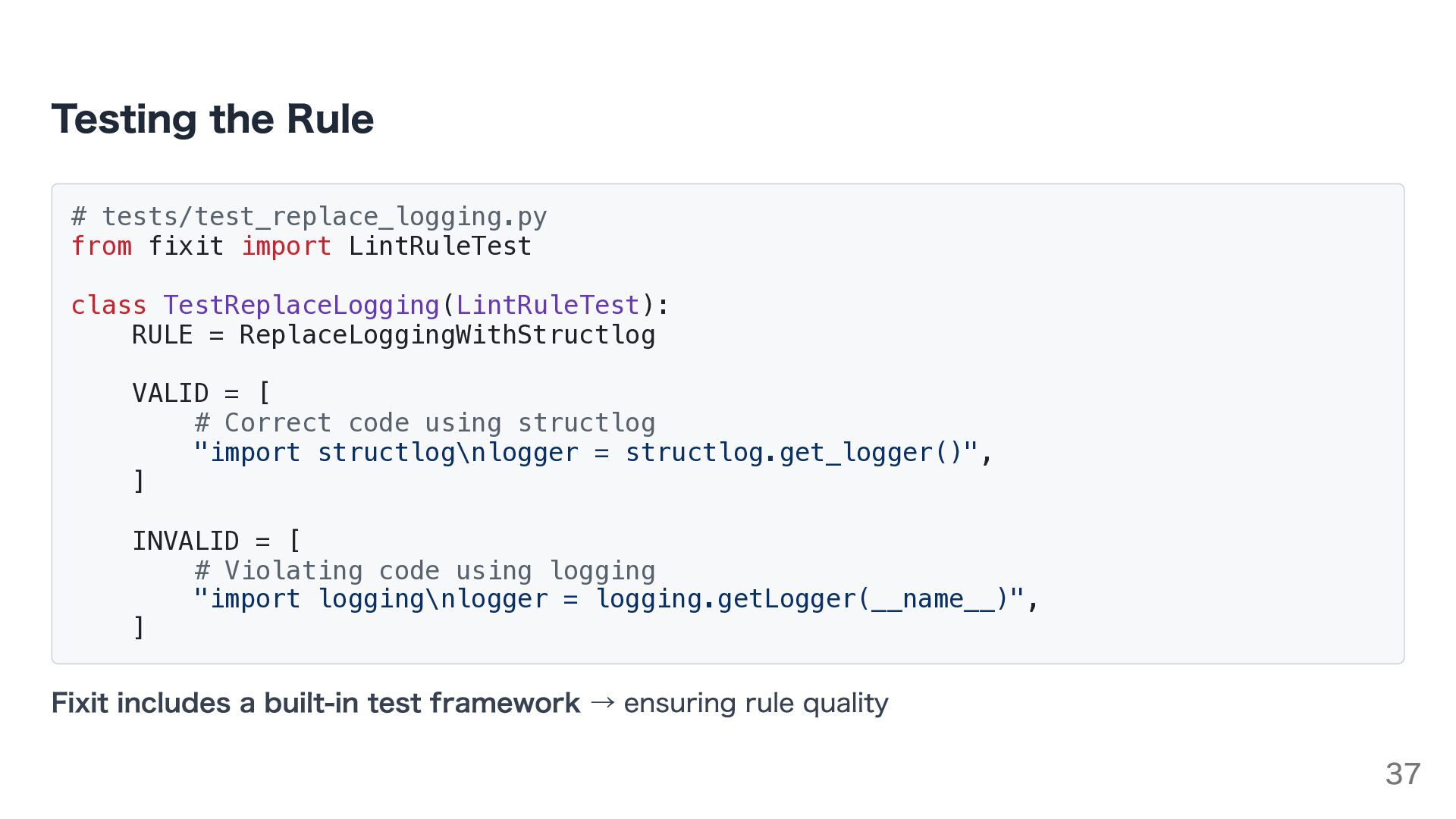
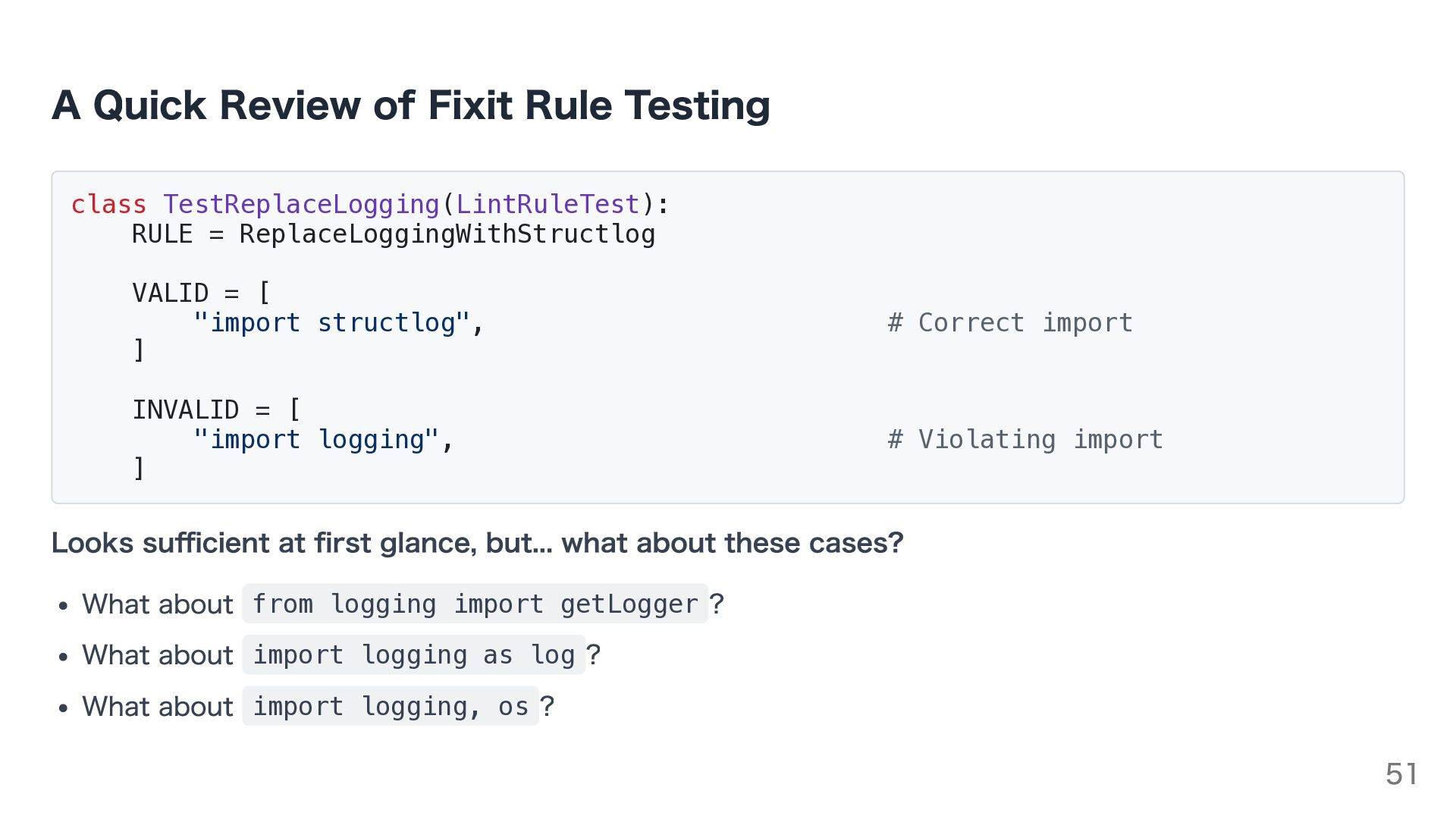
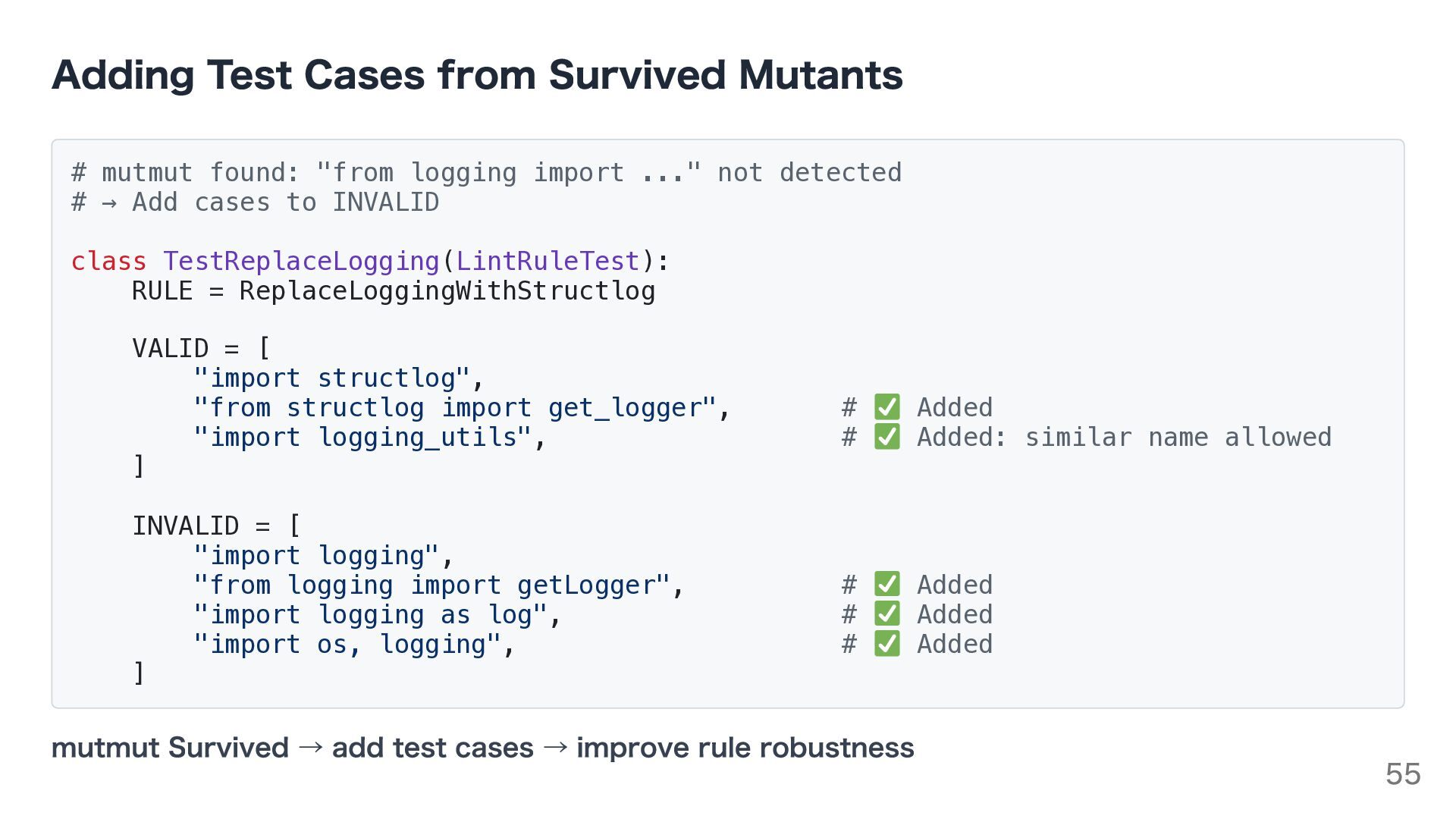
= ReplaceLoggingWithStructlog VALID = [ "import structlog", # Correct import ] INVALID = [ "import logging", # Violating import ] Looks sufficient at first glance, but... what about these cases? What about from logging import getLogger ? What about import logging as log ? What about import logging, os ? 51
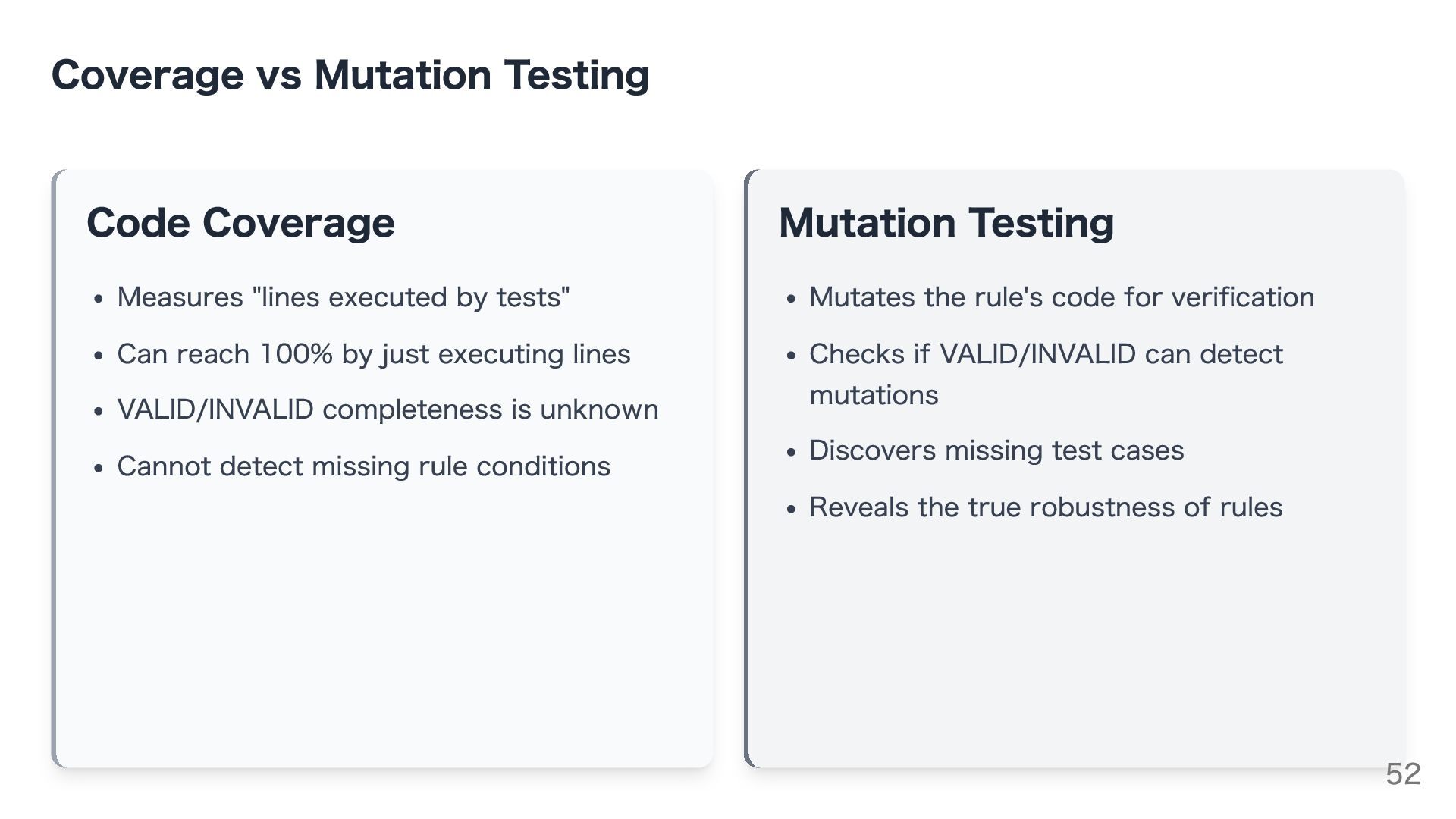
tests" Can reach 100% by just executing lines VALID/INVALID completeness is unknown Cannot detect missing rule conditions Mutation Testing Mutates the rule's code for verification Checks if VALID/INVALID can detect mutations Discovers missing test cases Reveals the true robustness of rules 52
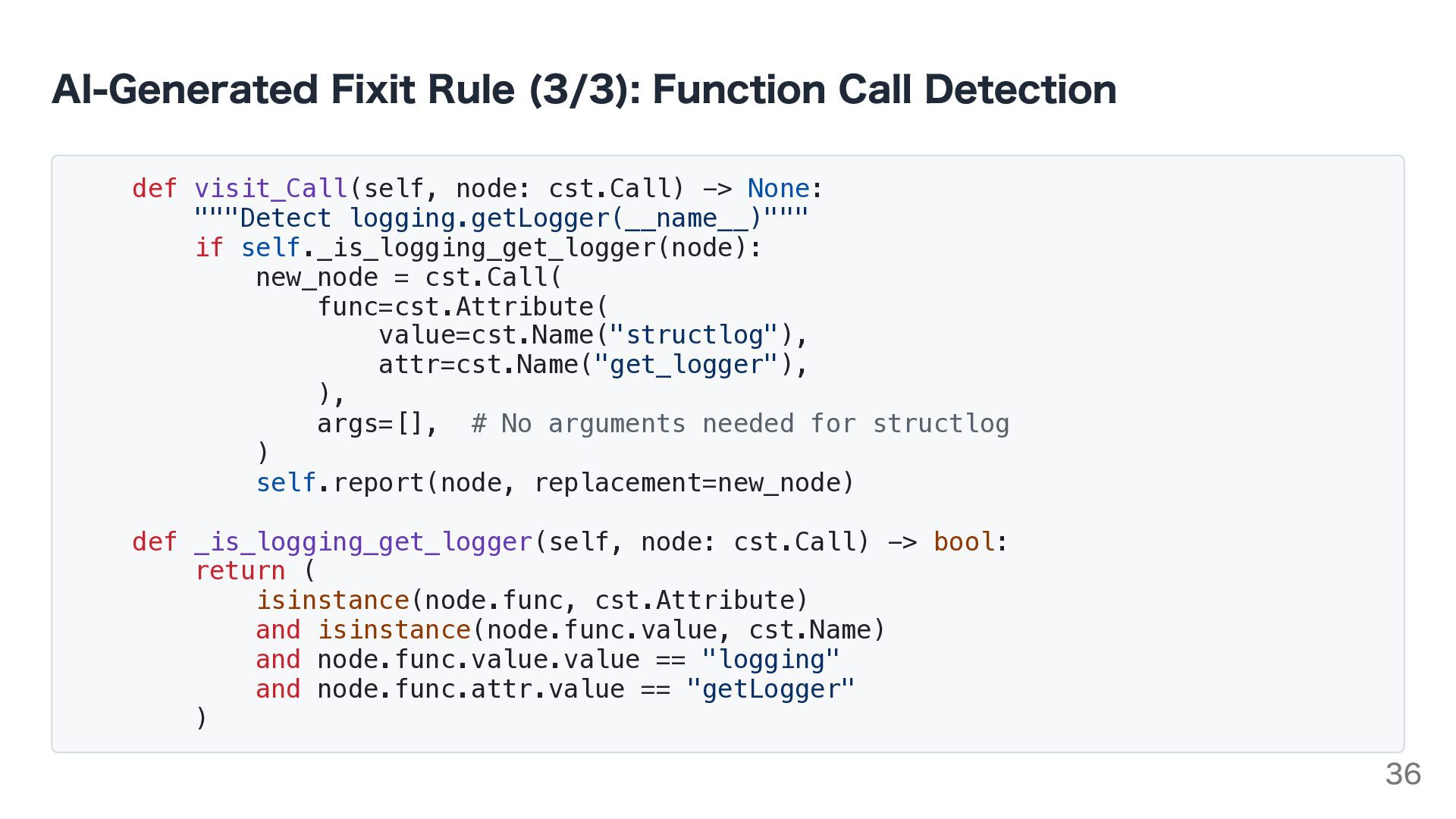
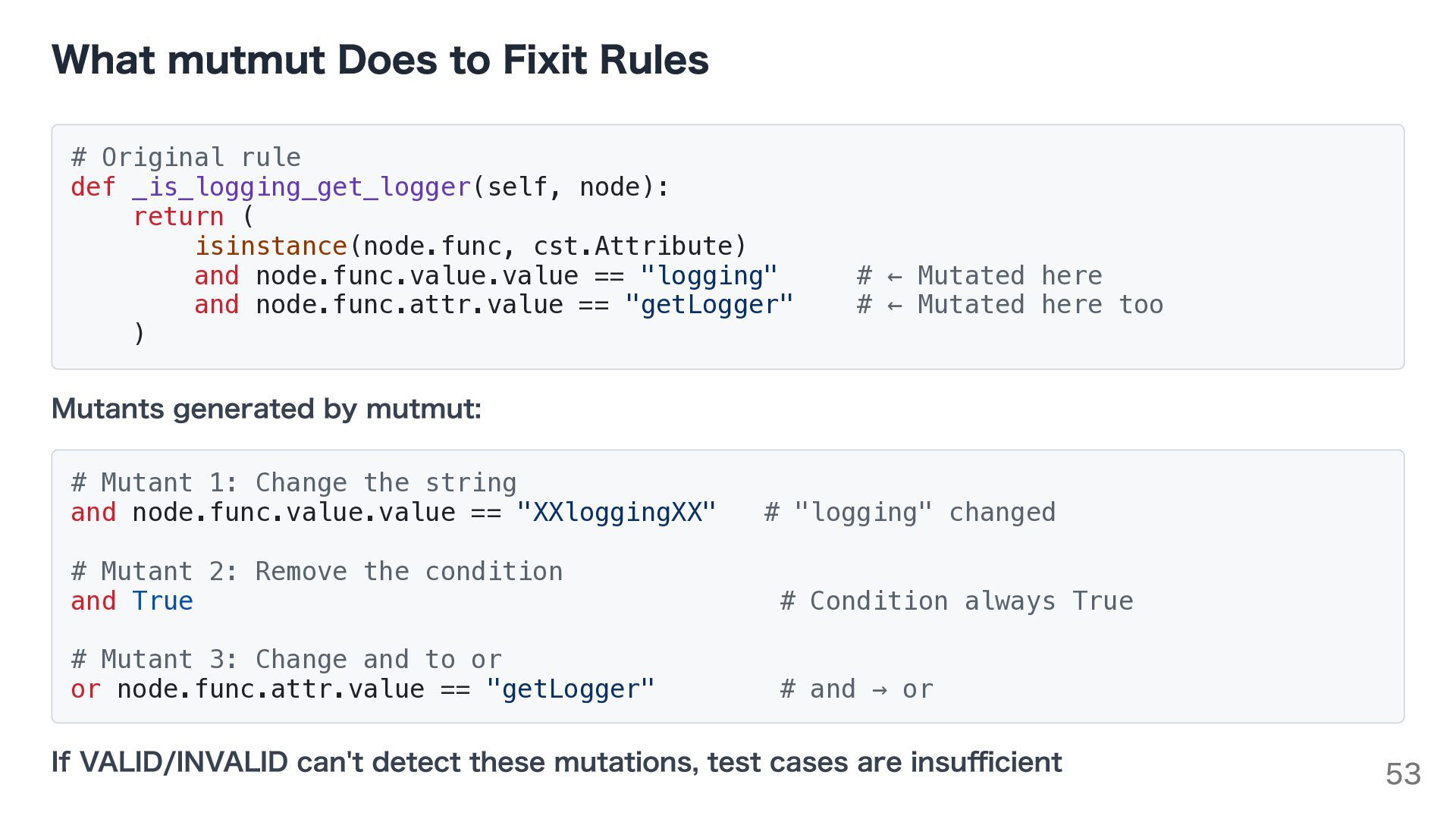
_is_logging_get_logger(self, node): return ( isinstance(node.func, cst.Attribute) and node.func.value.value == "logging" # ← Mutated here and node.func.attr.value == "getLogger" # ← Mutated here too ) Mutants generated by mutmut: # Mutant 1: Change the string and node.func.value.value == "XXloggingXX" # "logging" changed # Mutant 2: Remove the condition and True # Condition always True # Mutant 3: Change and to or or node.func.attr.value == "getLogger" # and → or If VALID/INVALID can't detect these mutations, test cases are insufficient 53
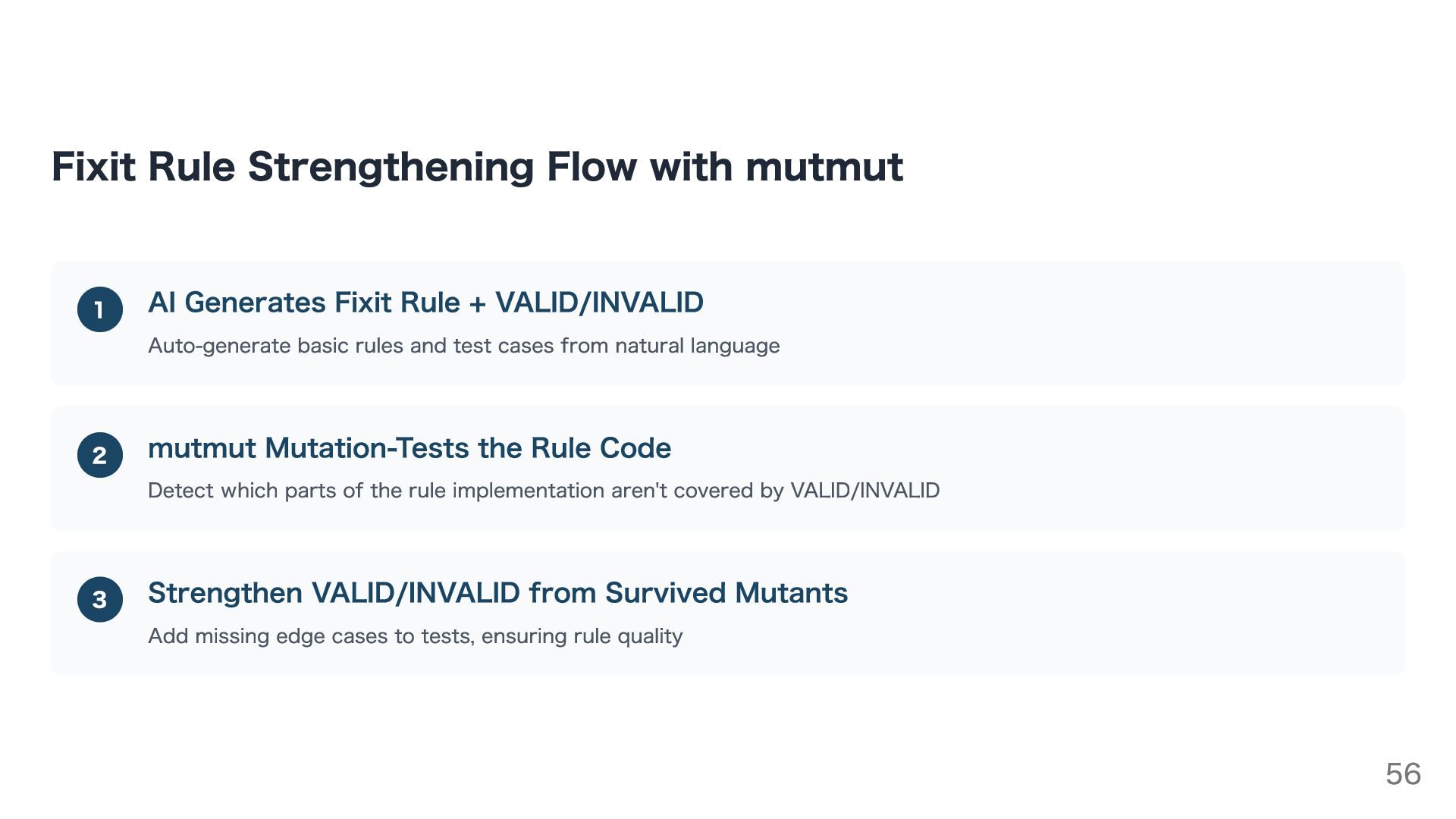
Rule + VALID/INVALID Auto-generate basic rules and test cases from natural language 2 mutmut Mutation-Tests the Rule Code Detect which parts of the rule implementation aren't covered by VALID/INVALID 3 Strengthen VALID/INVALID from Survived Mutants Add missing edge cases to tests, ensuring rule quality 56


 naohide
 syumai
 irinanazarova
 teyamagu
 steliosf
 y0hgi
 uyuki234
 clockmaker
 akihisaikeda
 prota
 yuta_onishi_97
 guaca
 jame2408
 techseoconnect
 marktimemedia
 skipperchong
 davidcarrasco
 axbom
 eileencodes
 lynnandtonic
 baasie
 3n
 bkeepers
 rmw