$30 off During Our Annual Pro Sale. View Details »

How to Design a Successful (Intern) Project wit...

Avatar for note35 note35
October 07, 2025

How to Design a Successful (Intern) Project with Apache Beam?

Discover how Apache Beam simplifies large-scale data processing and is ideal for intern projects. This talk covers project planning, setting expectations, and delivering business impact.

Avatar for note35

note35

October 07, 2025
Tweet

More Decks by note35

Other Decks in Education

Transcript

  1. 5

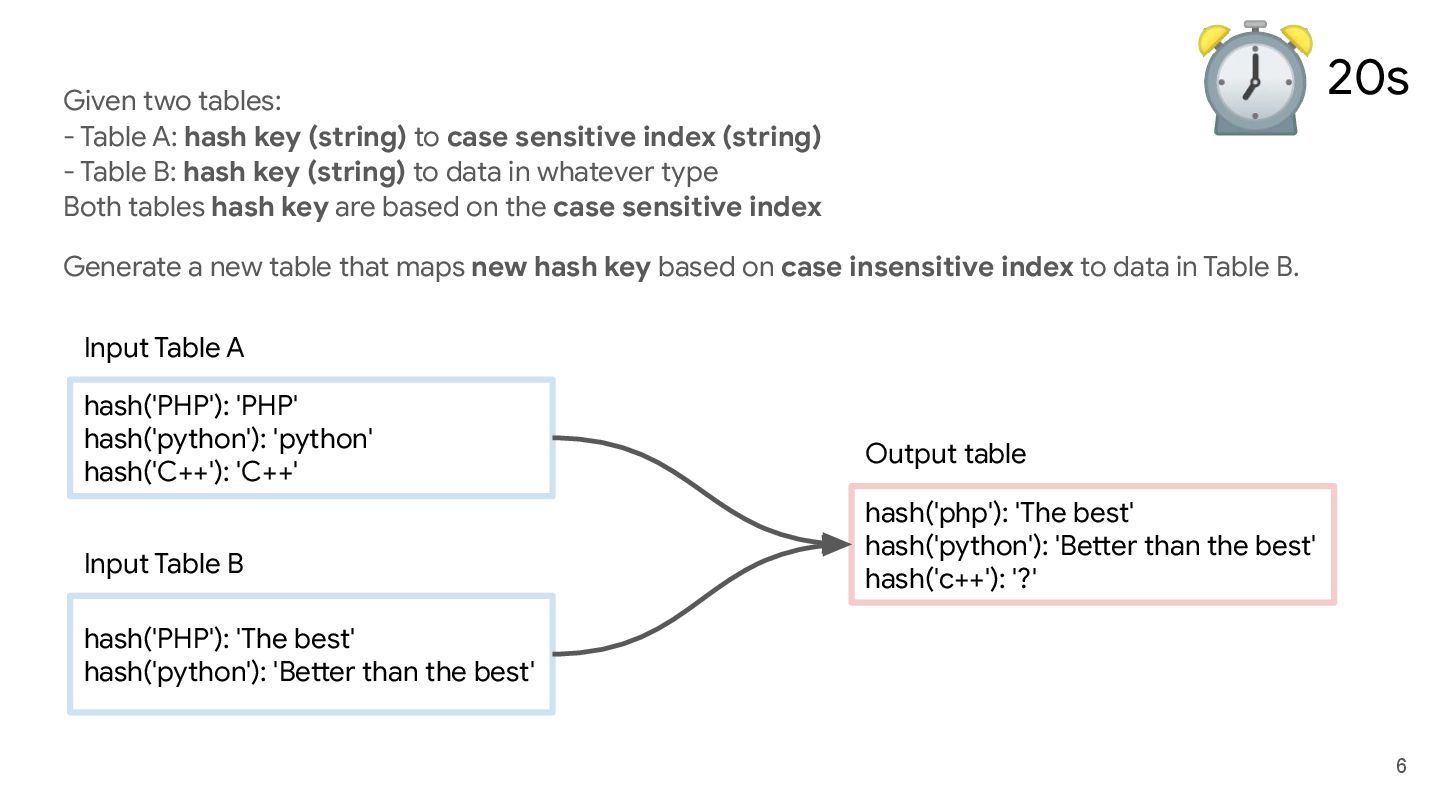
  2. 6 Given two tables: - Table A: hash key (string)

    to case sensitive index (string) - Table B: hash key (string) to data in whatever type Both tables hash key are based on the case sensitive index Generate a new table that maps new hash key based on case insensitive index to data in Table B. hash('PHP'): 'PHP' hash('python'): 'python' hash('C++'): 'C++' Input Table A hash('PHP'): 'The best' hash('python'): 'Better than the best' Input Table B hash('php'): 'The best' hash('python'): 'Better than the best' hash('c++'): '?' Output table 20s ⏰
  3. def generate_case_insensitive_index_to_content( hash_to_case_sensitive_index: dict[int, str], hash_to_content: dict[int, str] ) ->

    dict[int, str]: case_insensitive_index_to_content: dict[int, str] = {} for existing_hash, index in hash_to_case_sensitive_index.items(): case_insensitive_index: str = index.lower() new_hash: int = magic_hash(case_insensitive_index) if existing_hash in hash_to_content: case_insensitive_index_to_content[new_hash] =\ hash_to_content[existing_hash] else: case_insensitive_index_to_content[new_hash] =\ NEW_CONTENT_PREFIX.format(case_insensitive_index) return case_insensitive_index_to_content 7 I speak in
  4. 8 def generate_case_insensitive_index_to_content( hash_to_case_sensitive_index: dict[int, str], hash_to_content: dict[int, str] )

    -> dict[int, str]: case_insensitive_index_to_content: dict[int, str] = {} for existing_hash, index in hash_to_case_sensitive_index.items(): case_insensitive_index: str = index.lower() new_hash: int = magic_hash(case_insensitive_index) if existing_hash in hash_to_content: case_insensitive_index_to_content[new_hash] =\ hash_to_content[existing_hash] else: case_insensitive_index_to_content[new_hash] =\ NEW_CONTENT_PREFIX.format(case_insensitive_index) return case_insensitive_index_to_content hash('PHP'): 'PHP' hash('python'): 'python' hash('C++'): 'C++' ∅
  5. 9 def generate_case_insensitive_index_to_content( hash_to_case_sensitive_index: dict[int, str], hash_to_content: dict[int, str] )

    -> dict[int, str]: case_insensitive_index_to_content: dict[int, str] = {} for existing_hash, index in hash_to_case_sensitive_index.items(): case_insensitive_index: str = index.lower() new_hash: int = magic_hash(case_insensitive_index) if existing_hash in hash_to_content: case_insensitive_index_to_content[new_hash] =\ hash_to_content[existing_hash] else: case_insensitive_index_to_content[new_hash] =\ NEW_CONTENT_PREFIX.format(case_insensitive_index) return case_insensitive_index_to_content hash('PHP'): 'PHP' 'PHP' => 'php' => hash('php') ∅ hash('PHP'): 'PHP' hash('python'): 'python' hash('C++'): 'C++'
  6. 10 def generate_case_insensitive_index_to_content( hash_to_case_sensitive_index: dict[int, str], hash_to_content: dict[int, str] )

    -> dict[int, str]: case_insensitive_index_to_content: dict[int, str] = {} for existing_hash, index in hash_to_case_sensitive_index.items(): case_insensitive_index: str = index.lower() new_hash: int = magic_hash(case_insensitive_index) if existing_hash in hash_to_content: case_insensitive_index_to_content[new_hash] =\ hash_to_content[existing_hash] else: case_insensitive_index_to_content[new_hash] =\ NEW_CONTENT_PREFIX.format(case_insensitive_index) return case_insensitive_index_to_content hash('PHP'): 'The best' 'PHP' => 'php' => hash('php') ∅
  7. 11 def generate_case_insensitive_index_to_content( hash_to_case_sensitive_index: dict[int, str], hash_to_content: dict[int, str] )

    -> dict[int, str]: case_insensitive_index_to_content: dict[int, str] = {} for existing_hash, index in hash_to_case_sensitive_index.items(): case_insensitive_index: str = index.lower() new_hash: int = magic_hash(case_insensitive_index) if existing_hash in hash_to_content: case_insensitive_index_to_content[new_hash] =\ hash_to_content[existing_hash] else: case_insensitive_index_to_content[new_hash] =\ NEW_CONTENT_PREFIX.format(case_insensitive_index) return case_insensitive_index_to_content hash('python'): 'python' 'python' => 'python' => hash('python') hash('php'): 'The best' hash('PHP'): 'PHP' hash('python'): 'python' hash('C++'): 'C++'
  8. 12 def generate_case_insensitive_index_to_content( hash_to_case_sensitive_index: dict[int, str], hash_to_content: dict[int, str] )

    -> dict[int, str]: case_insensitive_index_to_content: dict[int, str] = {} for existing_hash, index in hash_to_case_sensitive_index.items(): case_insensitive_index: str = index.lower() new_hash: int = magic_hash(case_insensitive_index) if existing_hash in hash_to_content: case_insensitive_index_to_content[new_hash] =\ hash_to_content[existing_hash] else: case_insensitive_index_to_content[new_hash] =\ NEW_CONTENT_PREFIX.format(case_insensitive_index) return case_insensitive_index_to_content hash('python'): 'Better than the best' hash('php'): 'The best' hash('python'): 'python'
  9. 13 def generate_case_insensitive_index_to_content( hash_to_case_sensitive_index: dict[int, str], hash_to_content: dict[int, str] )

    -> dict[int, str]: case_insensitive_index_to_content: dict[int, str] = {} for existing_hash, index in hash_to_case_sensitive_index.items(): case_insensitive_index: str = index.lower() new_hash: int = magic_hash(case_insensitive_index) if existing_hash in hash_to_content: case_insensitive_index_to_content[new_hash] =\ hash_to_content[existing_hash] else: case_insensitive_index_to_content[new_hash] =\ NEW_CONTENT_PREFIX.format(case_insensitive_index) return case_insensitive_index_to_content hash('C++'): 'C++' 'C++' => 'c++' => hash('c++') hash('php'): 'The best' hash('python'): 'Better than the best' hash('PHP'): 'PHP' hash('python'): 'python' hash('C++'): 'C++'
  10. 14 def generate_case_insensitive_index_to_content( hash_to_case_sensitive_index: dict[int, str], hash_to_content: dict[int, str] )

    -> dict[int, str]: case_insensitive_index_to_content: dict[int, str] = {} for existing_hash, index in hash_to_case_sensitive_index.items(): case_insensitive_index: str = index.lower() new_hash: int = magic_hash(case_insensitive_index) if existing_hash in hash_to_content: case_insensitive_index_to_content[new_hash] =\ hash_to_content[existing_hash] else: case_insensitive_index_to_content[new_hash] =\ NEW_CONTENT_PREFIX.format(case_insensitive_index) return case_insensitive_index_to_content hash('c++'): '?' hash('php'): 'The best' hash('python'): 'Better than the best' 'C++' => 'c++' => hash('c++')
  11. 15 def generate_case_insensitive_index_to_content( hash_to_case_sensitive_index: dict[int, str], hash_to_content: dict[int, str] )

    -> dict[int, str]: case_insensitive_index_to_content: dict[int, str] = {} for existing_hash, index in hash_to_case_sensitive_index.items(): case_insensitive_index: str = index.lower() new_hash: int = magic_hash(case_insensitive_index) if existing_hash in hash_to_content: case_insensitive_index_to_content[new_hash] =\ hash_to_content[existing_hash] else: case_insensitive_index_to_content[new_hash] =\ NEW_CONTENT_PREFIX.format(case_insensitive_index) return case_insensitive_index_to_content hash('php'): 'The best' hash('python'): 'Better than the best' hash('c++'): '?'
  12. def generate_case_insensitive_index_to_content( hash_to_case_sensitive_index: dict[int, str], hash_to_content: dict[int, str] ) ->

    dict[int, str]: case_insensitive_index_to_content: dict[int, str] = {} for existing_hash, index in hash_to_case_sensitive_index.items(): case_insensitive_index: str = index.lower() new_hash: int = magic_hash(case_insensitive_index) if existing_hash in hash_to_content: case_insensitive_index_to_content[new_hash] =\ hash_to_content[existing_hash] else: case_insensitive_index_to_content[new_hash] =\ NEW_CONTENT_PREFIX.format(case_insensitive_index) return case_insensitive_index_to_content 17
  13. def generate_case_insensitive_index_to_content( hash_to_case_sensitive_index: dict[int, str], hash_to_content: dict[int, str] ) ->

    dict[int, str]: case_insensitive_index_to_content: dict[int, str] = {} for existing_hash, index in hash_to_case_sensitive_index.items(): case_insensitive_index: str = index.lower() new_hash: int = magic_hash(case_insensitive_index) if existing_hash in hash_to_content: case_insensitive_index_to_content[new_hash] =\ hash_to_content[existing_hash] else: case_insensitive_index_to_content[new_hash] =\ NEW_CONTENT_PREFIX.format(case_insensitive_index) return case_insensitive_index_to_content 18
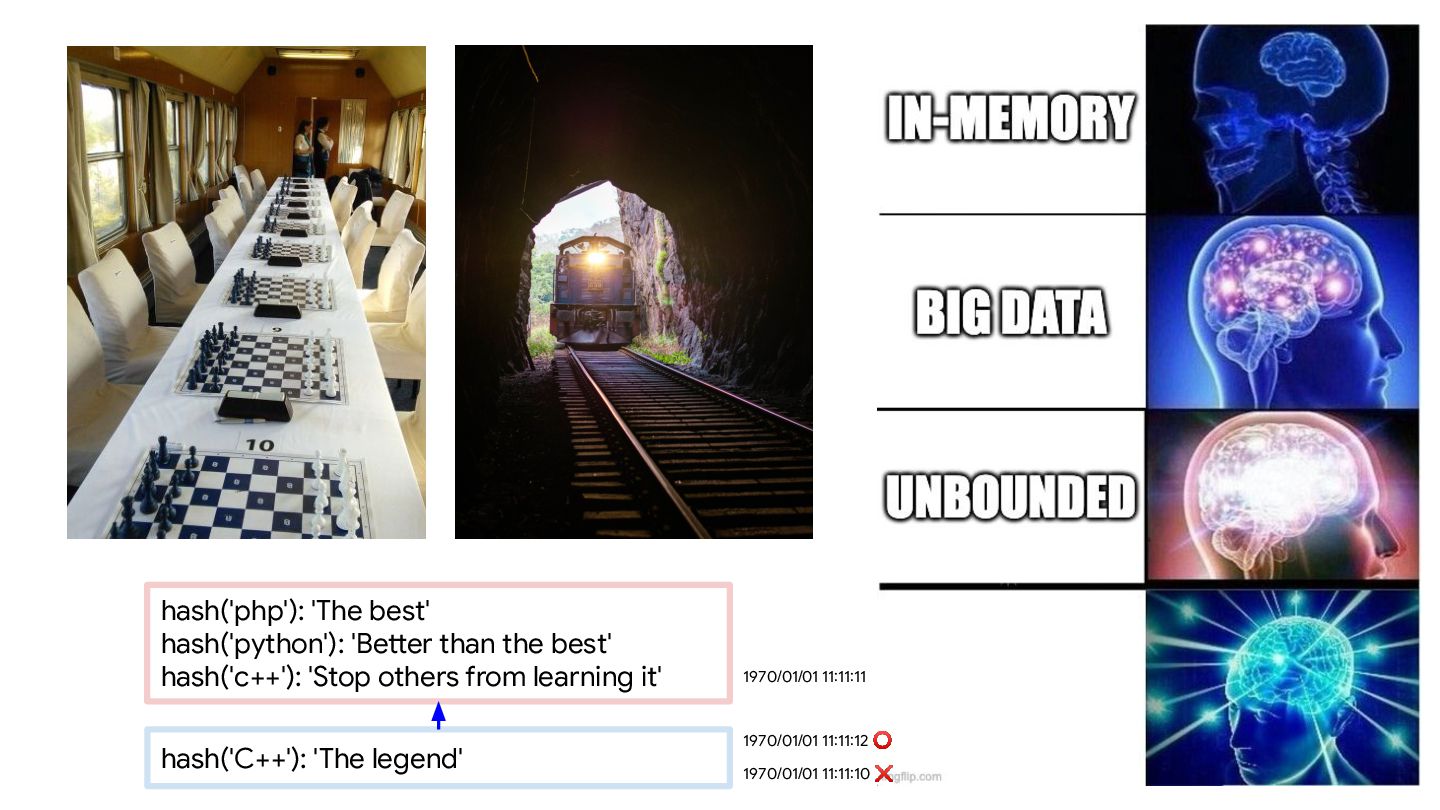
  14. 19 hash('php'): 'The best' hash('python'): 'Better than the best' hash('c++'):

    '?' hash('C++'): 'Stop others from learning it' 1970/01/01 11:11:11
  15. 20 hash('php'): 'The best' hash('python'): 'Better than the best' hash('c++'):

    'Stop others from learning it' hash('C++'): 'The legend' 1970/01/01 11:11:12 ⭕ 1970/01/01 11:11:10 ❌ 1970/01/01 11:11:11
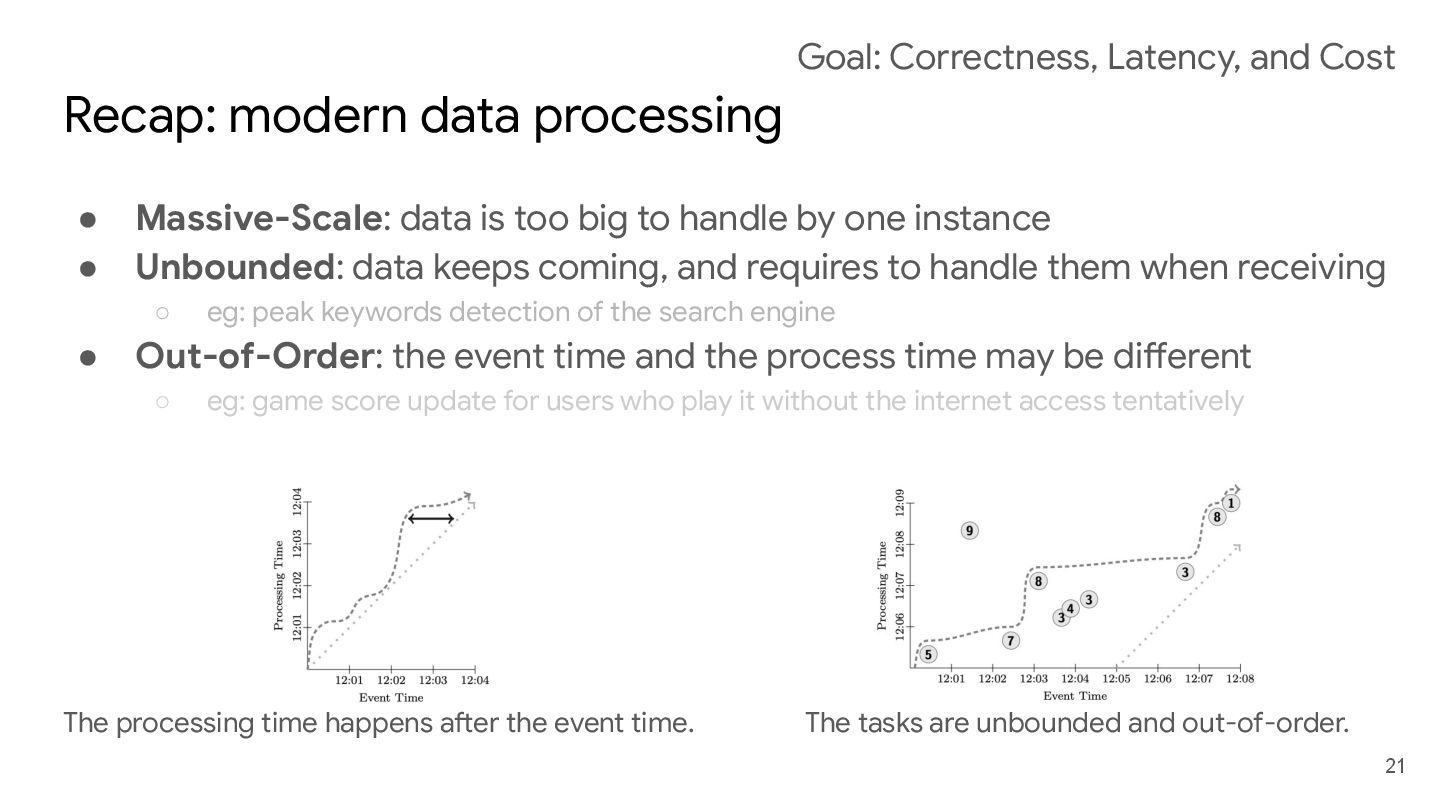
  16. Recap: modern data processing • Massive-Scale: data is too big

    to handle by one instance • Unbounded: data keeps coming, and requires to handle them when receiving ◦ eg: peak keywords detection of the search engine • Out-of-Order: the event time and the process time may be different ◦ eg: game score update for users who play it without the internet access tentatively The processing time happens after the event time. The tasks are unbounded and out-of-order. 21 Goal: Correctness, Latency, and Cost
  17. 22

  18. 23

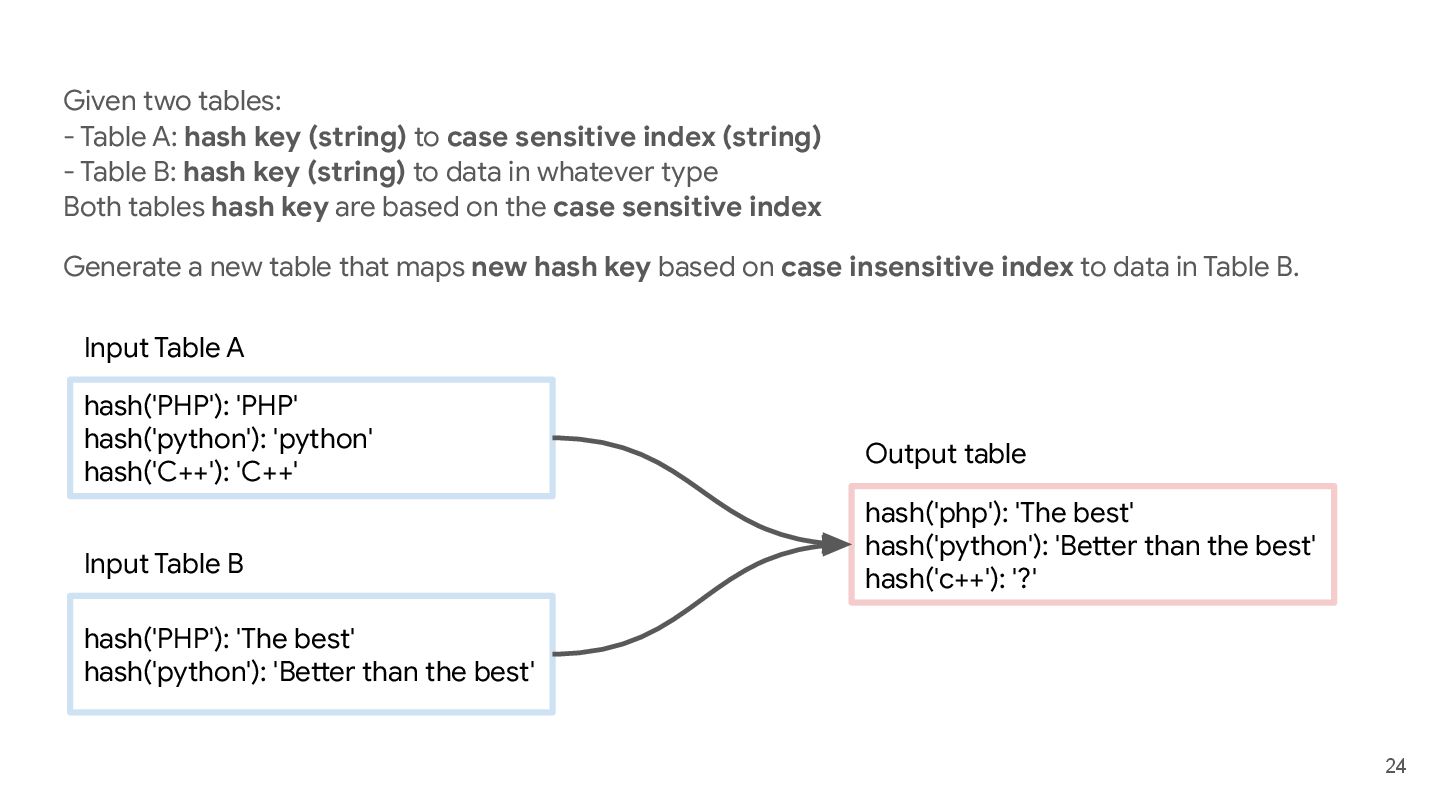
  19. 24 Given two tables: - Table A: hash key (string)

    to case sensitive index (string) - Table B: hash key (string) to data in whatever type Both tables hash key are based on the case sensitive index Generate a new table that maps new hash key based on case insensitive index to data in Table B. hash('PHP'): 'PHP' hash('python'): 'python' hash('C++'): 'C++' Input Table A hash('PHP'): 'The best' hash('python'): 'Better than the best' Input Table B hash('php'): 'The best' hash('python'): 'Better than the best' hash('c++'): '?' Output table
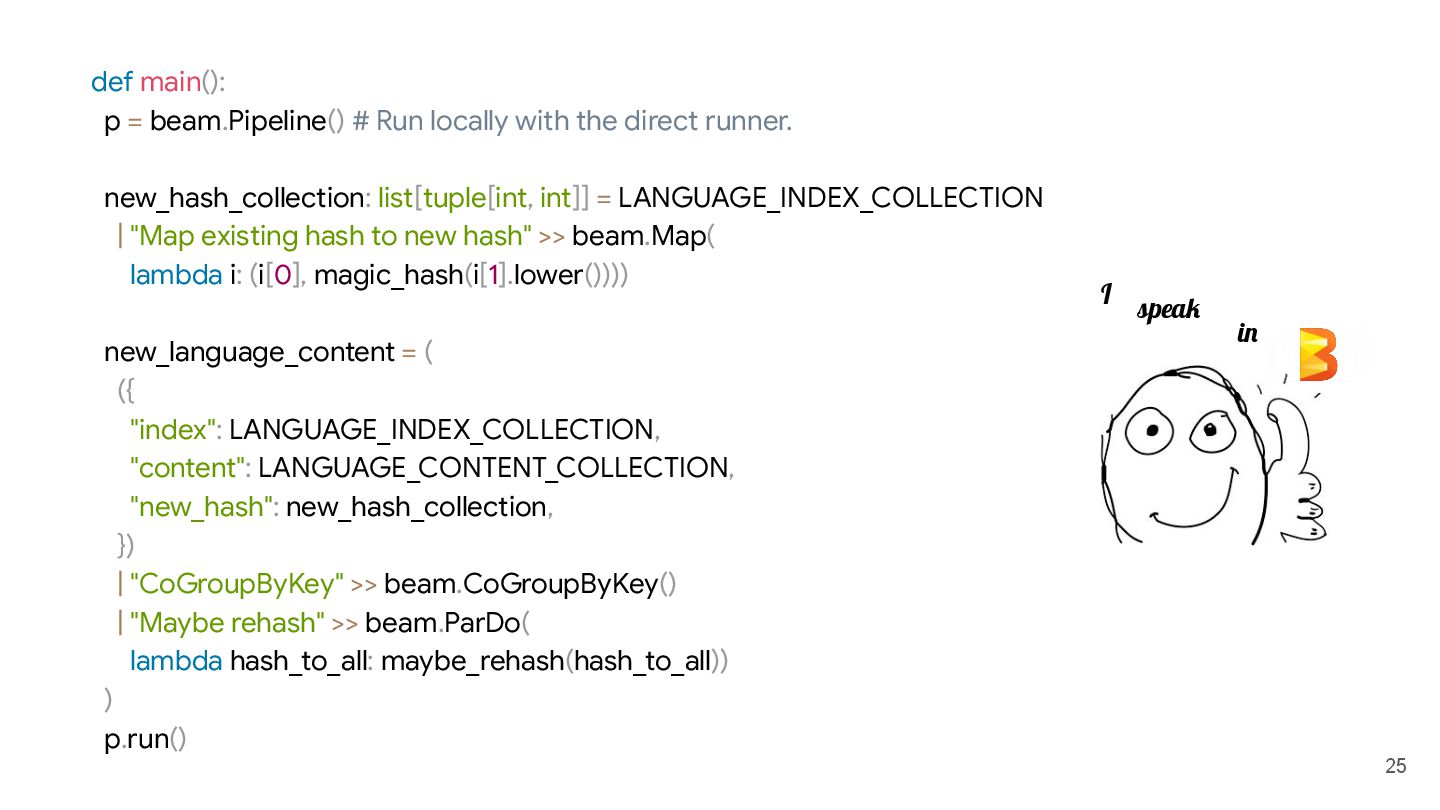
  20. 25 I speak in def main(): p = beam.Pipeline() #

    Run locally with the direct runner. new_hash_collection: list[tuple[int, int]] = LANGUAGE_INDEX_COLLECTION | "Map existing hash to new hash" >> beam.Map( lambda i: (i[0], magic_hash(i[1].lower()))) new_language_content = ( ({ "index": LANGUAGE_INDEX_COLLECTION, "content": LANGUAGE_CONTENT_COLLECTION, "new_hash": new_hash_collection, }) | "CoGroupByKey" >> beam.CoGroupByKey() | "Maybe rehash" >> beam.ParDo( lambda hash_to_all: maybe_rehash(hash_to_all)) ) p.run()
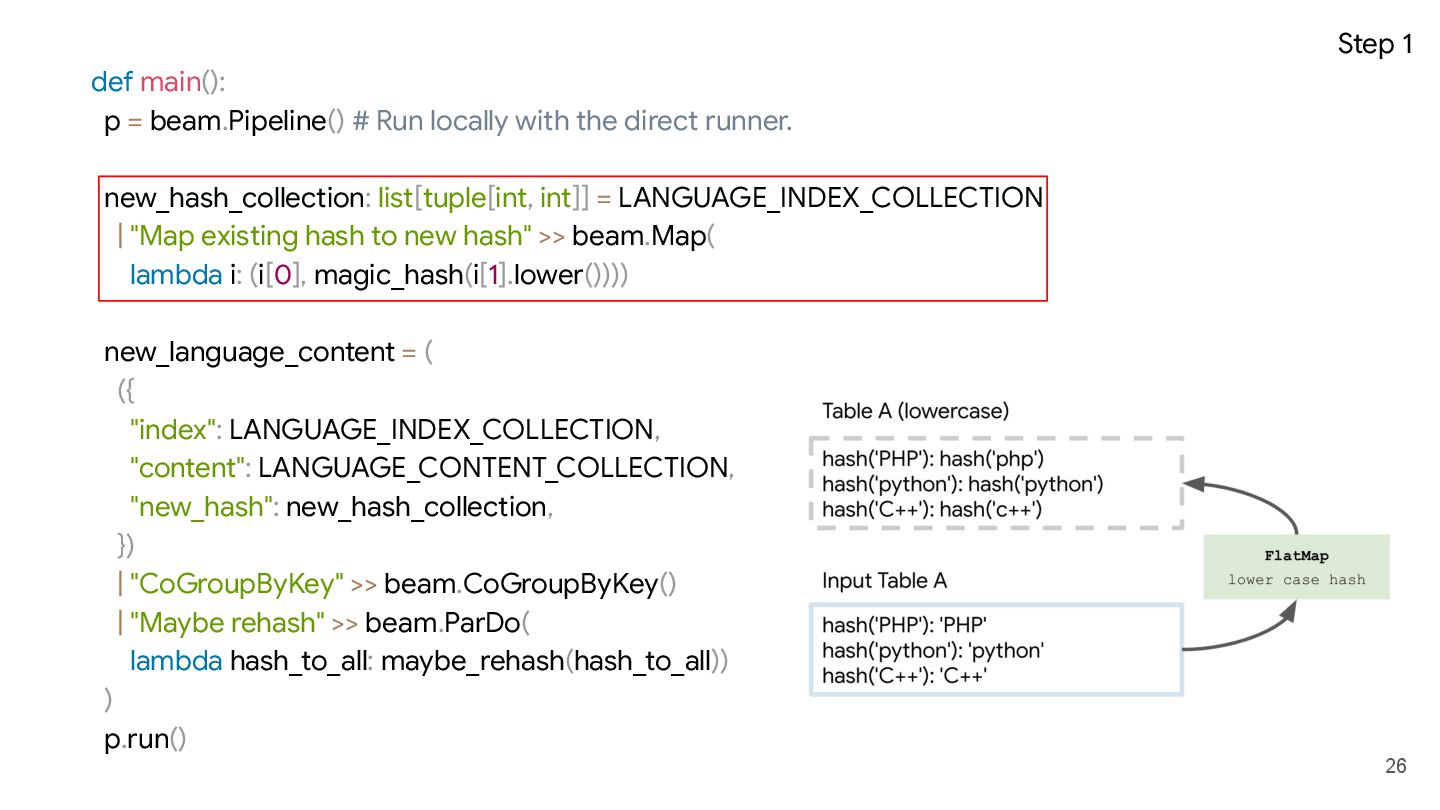
  21. 26 def main(): p = beam.Pipeline() # Run locally with

    the direct runner. new_hash_collection: list[tuple[int, int]] = LANGUAGE_INDEX_COLLECTION | "Map existing hash to new hash" >> beam.Map( lambda i: (i[0], magic_hash(i[1].lower()))) new_language_content = ( ({ "index": LANGUAGE_INDEX_COLLECTION, "content": LANGUAGE_CONTENT_COLLECTION, "new_hash": new_hash_collection, }) | "CoGroupByKey" >> beam.CoGroupByKey() | "Maybe rehash" >> beam.ParDo( lambda hash_to_all: maybe_rehash(hash_to_all)) ) p.run() Step 1
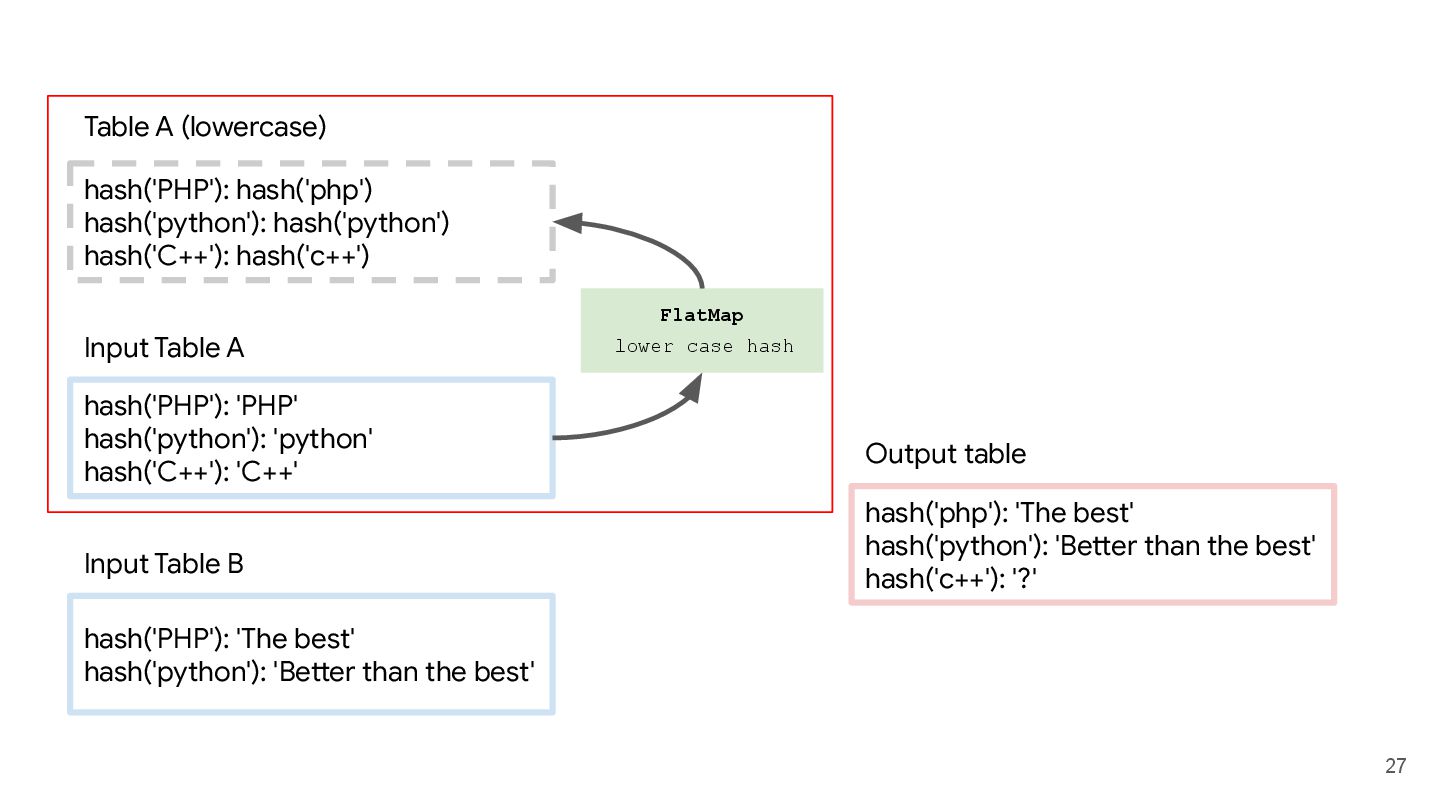
  22. 27 FlatMap lower case hash hash('PHP'): hash('php') hash('python'): hash('python') hash('C++'):

    hash('c++') Table A (lowercase) hash('PHP'): 'PHP' hash('python'): 'python' hash('C++'): 'C++' Input Table A hash('PHP'): 'The best' hash('python'): 'Better than the best' Input Table B hash('php'): 'The best' hash('python'): 'Better than the best' hash('c++'): '?' Output table
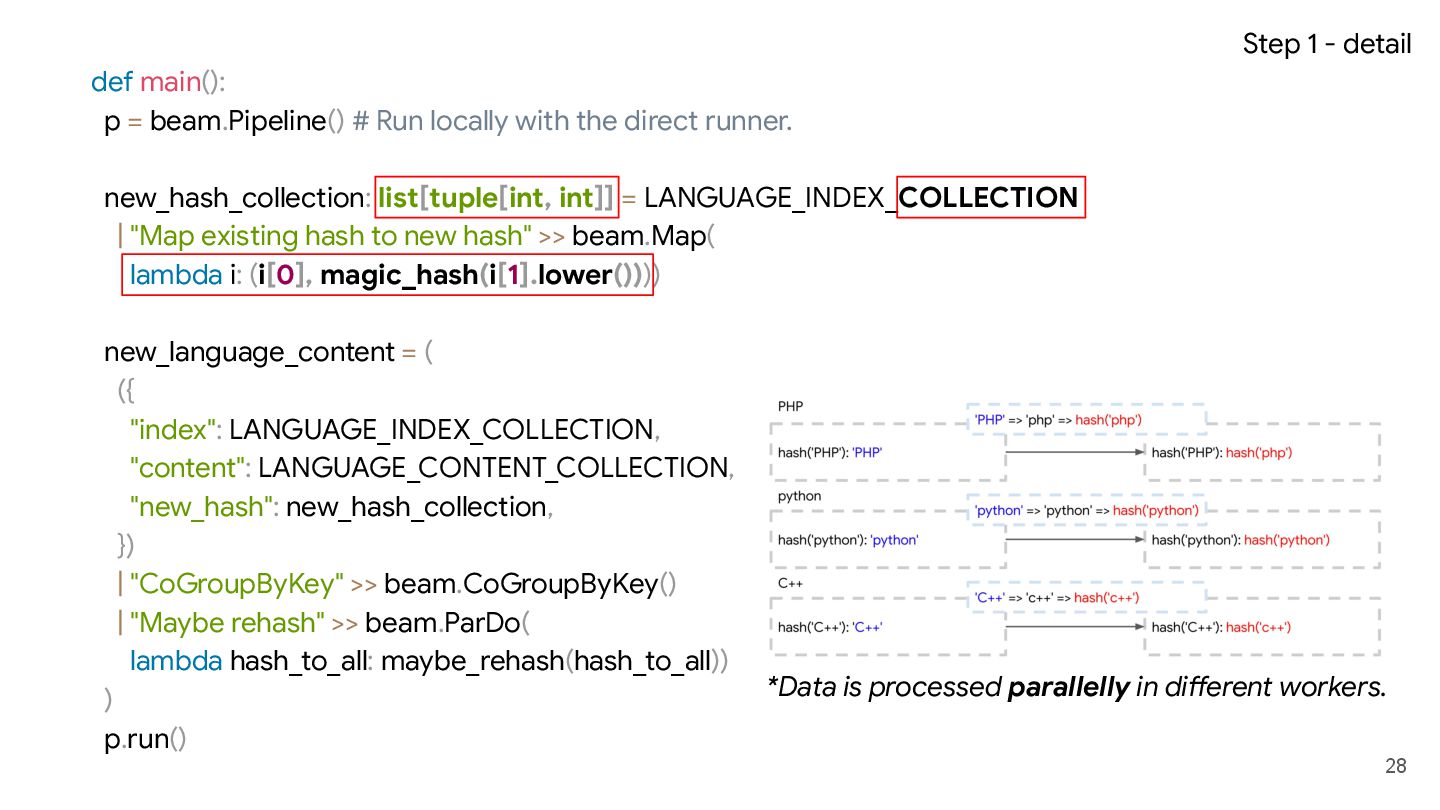
  23. 28 def main(): p = beam.Pipeline() # Run locally with

    the direct runner. new_hash_collection: list[tuple[int, int]] = LANGUAGE_INDEX_COLLECTION | "Map existing hash to new hash" >> beam.Map( lambda i: (i[0], magic_hash(i[1].lower()))) new_language_content = ( ({ "index": LANGUAGE_INDEX_COLLECTION, "content": LANGUAGE_CONTENT_COLLECTION, "new_hash": new_hash_collection, }) | "CoGroupByKey" >> beam.CoGroupByKey() | "Maybe rehash" >> beam.ParDo( lambda hash_to_all: maybe_rehash(hash_to_all)) ) p.run() *Data is processed parallelly in different workers. Step 1 - detail
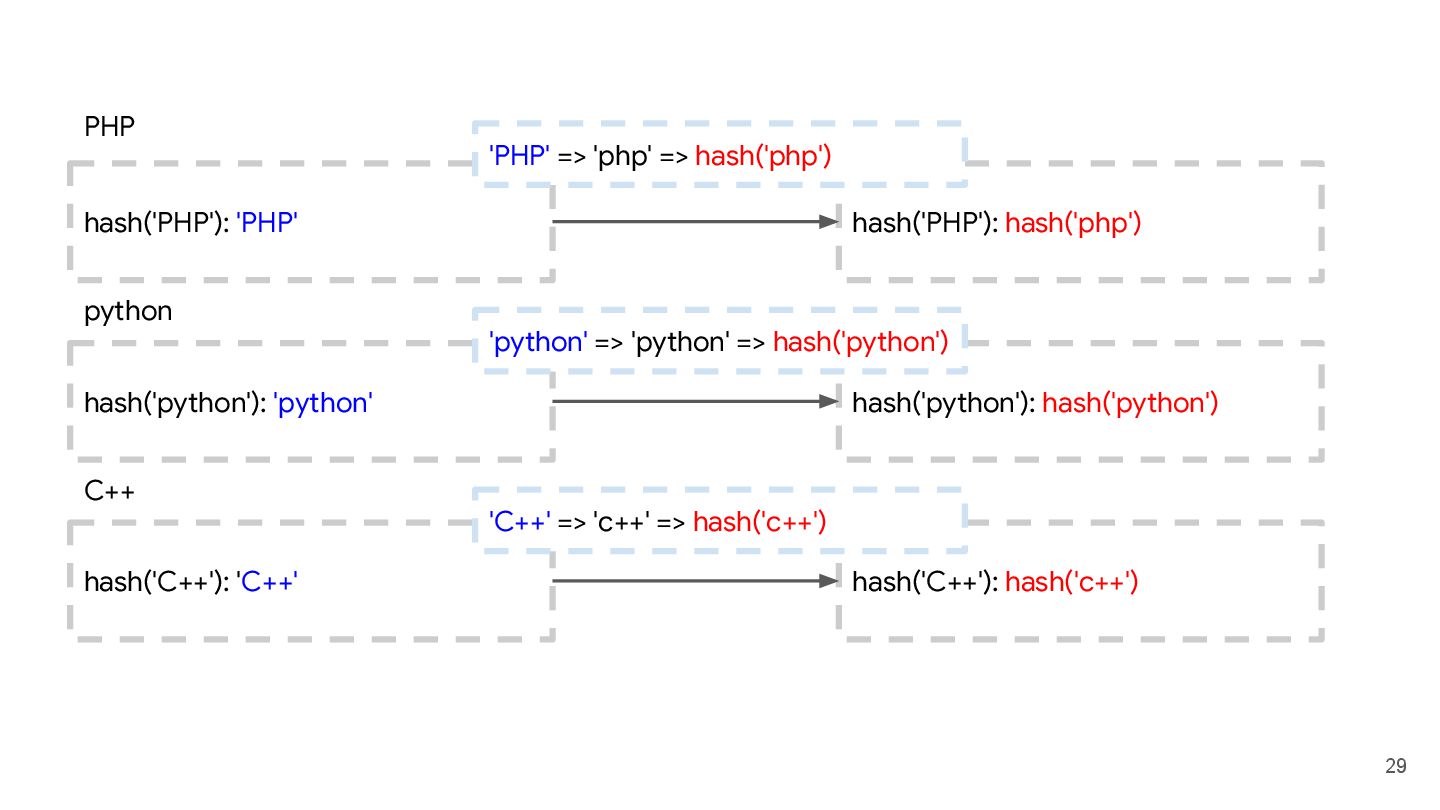
  24. 29 hash('PHP'): 'PHP' PHP hash('python'): 'python' python hash('C++'): 'C++' C++

    hash('PHP'): hash('php') hash('python'): hash('python') hash('C++'): hash('c++') 'C++' => 'c++' => hash('c++') 'PHP' => 'php' => hash('php') 'python' => 'python' => hash('python')
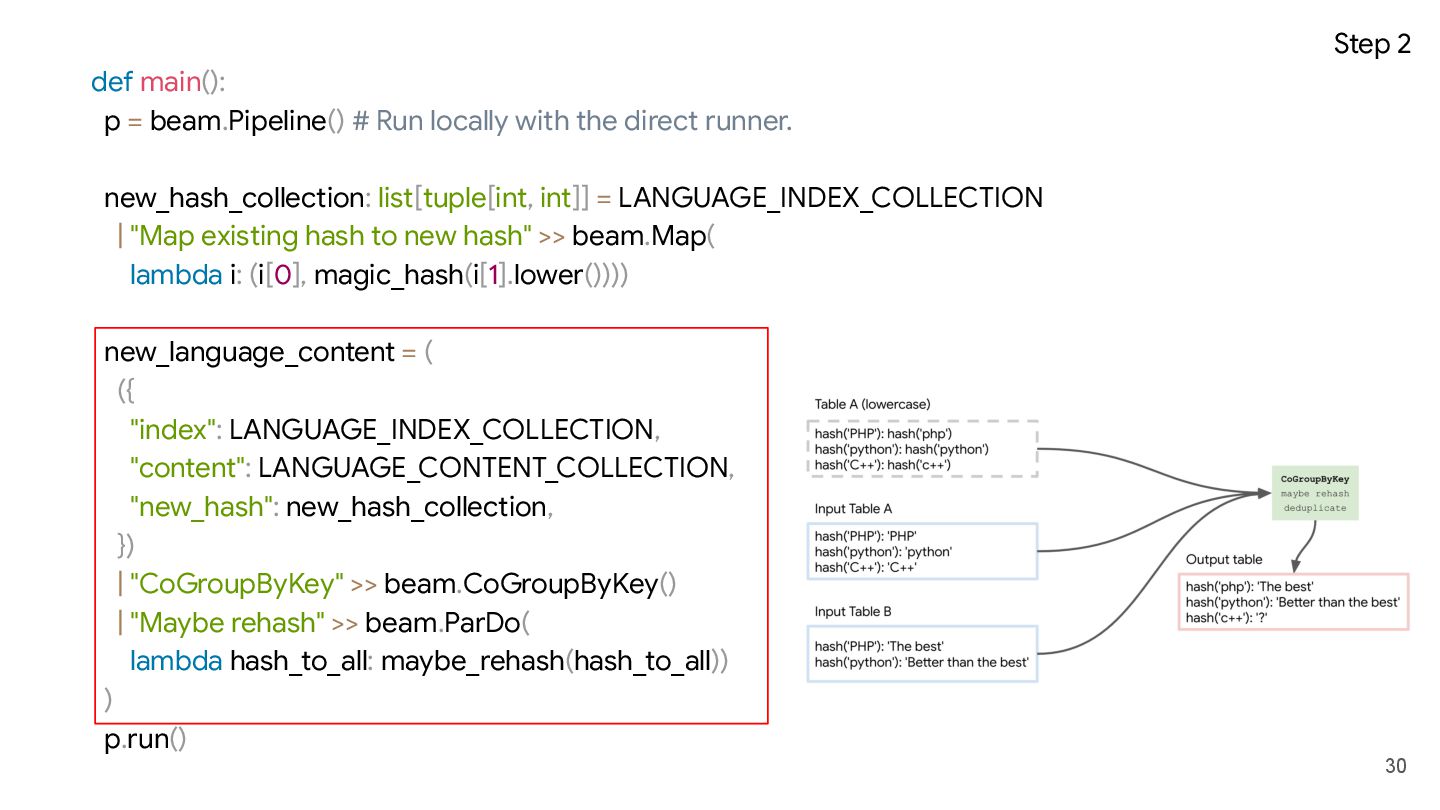
  25. 30 def main(): p = beam.Pipeline() # Run locally with

    the direct runner. new_hash_collection: list[tuple[int, int]] = LANGUAGE_INDEX_COLLECTION | "Map existing hash to new hash" >> beam.Map( lambda i: (i[0], magic_hash(i[1].lower()))) new_language_content = ( ({ "index": LANGUAGE_INDEX_COLLECTION, "content": LANGUAGE_CONTENT_COLLECTION, "new_hash": new_hash_collection, }) | "CoGroupByKey" >> beam.CoGroupByKey() | "Maybe rehash" >> beam.ParDo( lambda hash_to_all: maybe_rehash(hash_to_all)) ) p.run() Step 2
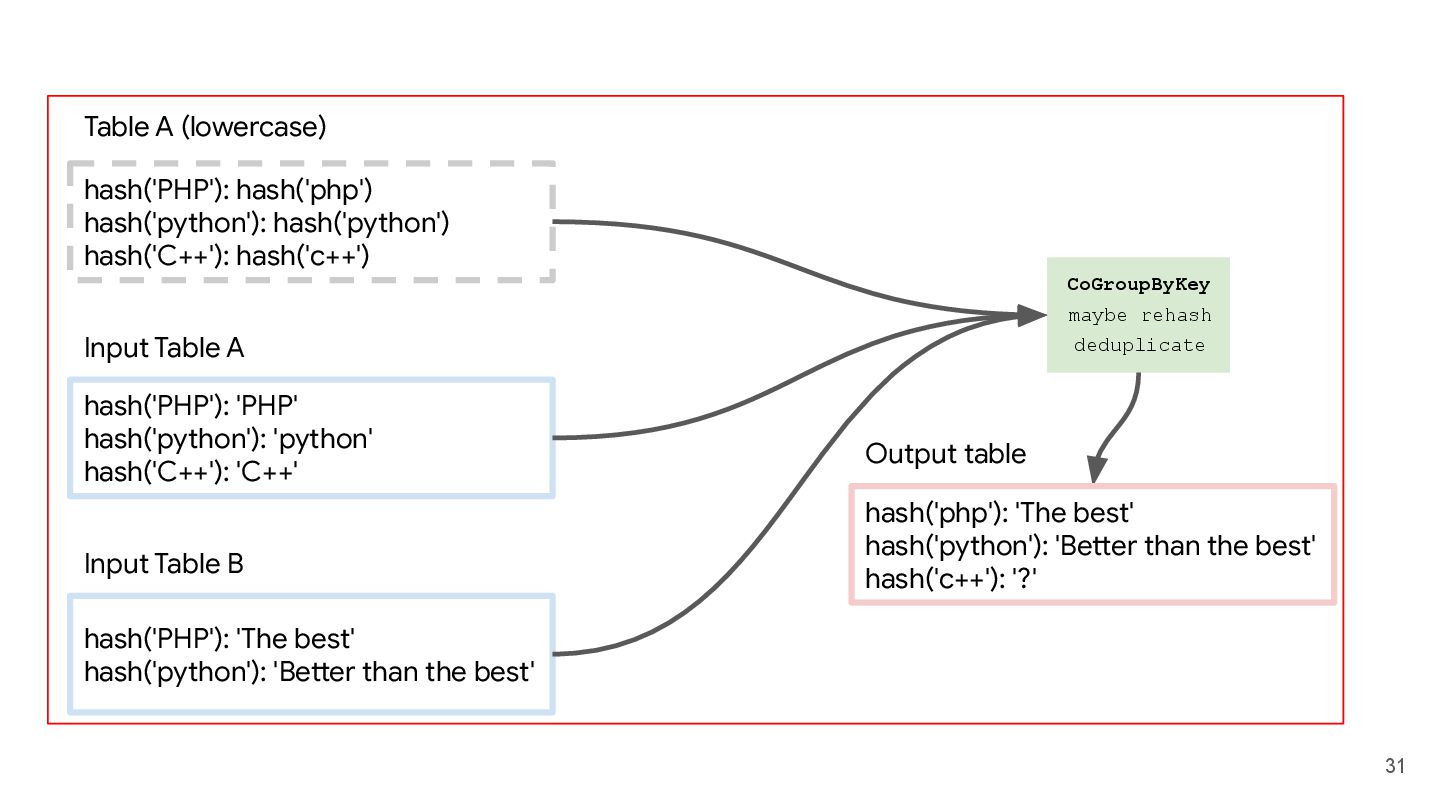
  26. 31 CoGroupByKey maybe rehash deduplicate hash('PHP'): hash('php') hash('python'): hash('python') hash('C++'):

    hash('c++') Table A (lowercase) hash('PHP'): 'PHP' hash('python'): 'python' hash('C++'): 'C++' Input Table A hash('PHP'): 'The best' hash('python'): 'Better than the best' Input Table B hash('php'): 'The best' hash('python'): 'Better than the best' hash('c++'): '?' Output table
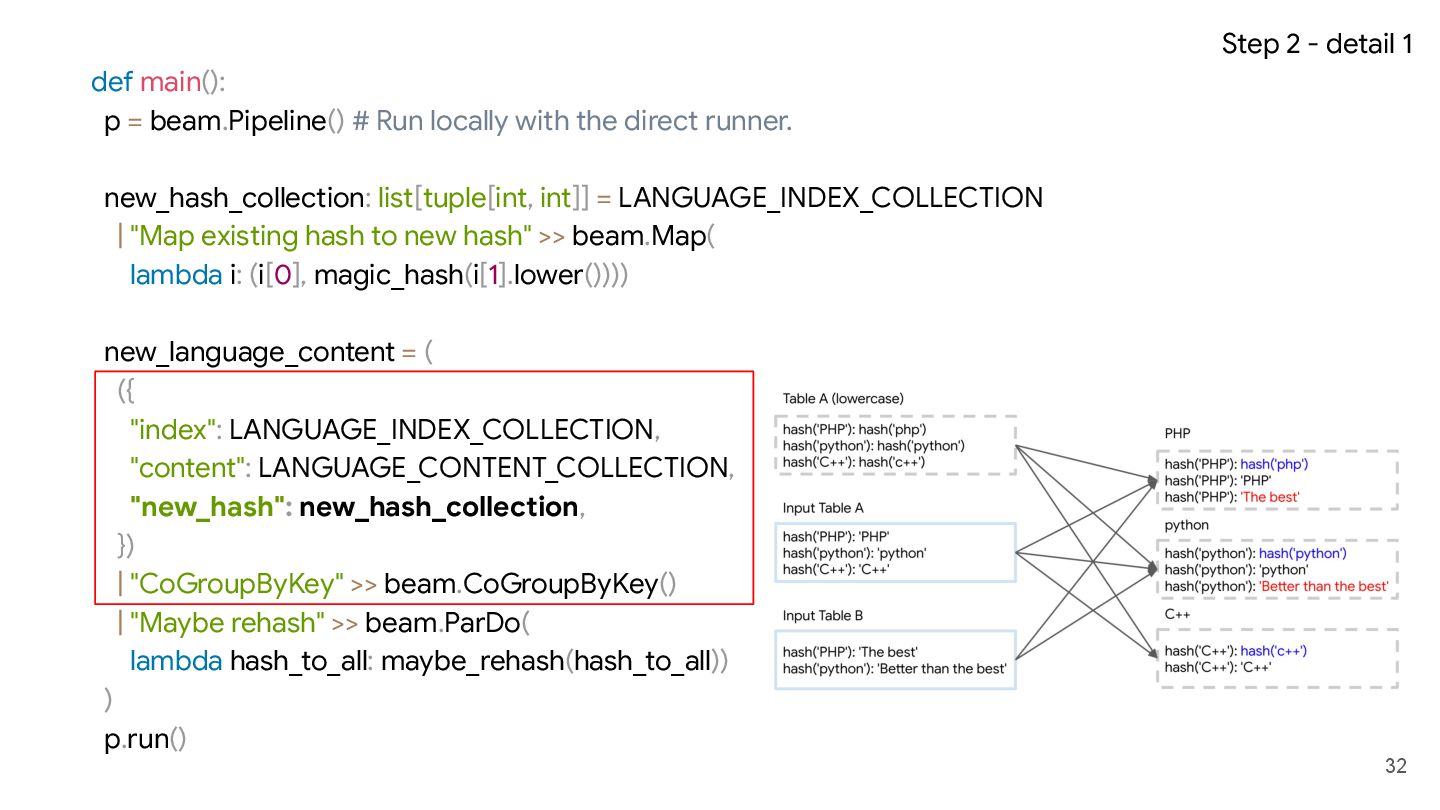
  27. 32 def main(): p = beam.Pipeline() # Run locally with

    the direct runner. new_hash_collection: list[tuple[int, int]] = LANGUAGE_INDEX_COLLECTION | "Map existing hash to new hash" >> beam.Map( lambda i: (i[0], magic_hash(i[1].lower()))) new_language_content = ( ({ "index": LANGUAGE_INDEX_COLLECTION, "content": LANGUAGE_CONTENT_COLLECTION, "new_hash": new_hash_collection, }) | "CoGroupByKey" >> beam.CoGroupByKey() | "Maybe rehash" >> beam.ParDo( lambda hash_to_all: maybe_rehash(hash_to_all)) ) p.run() Step 2 - detail 1
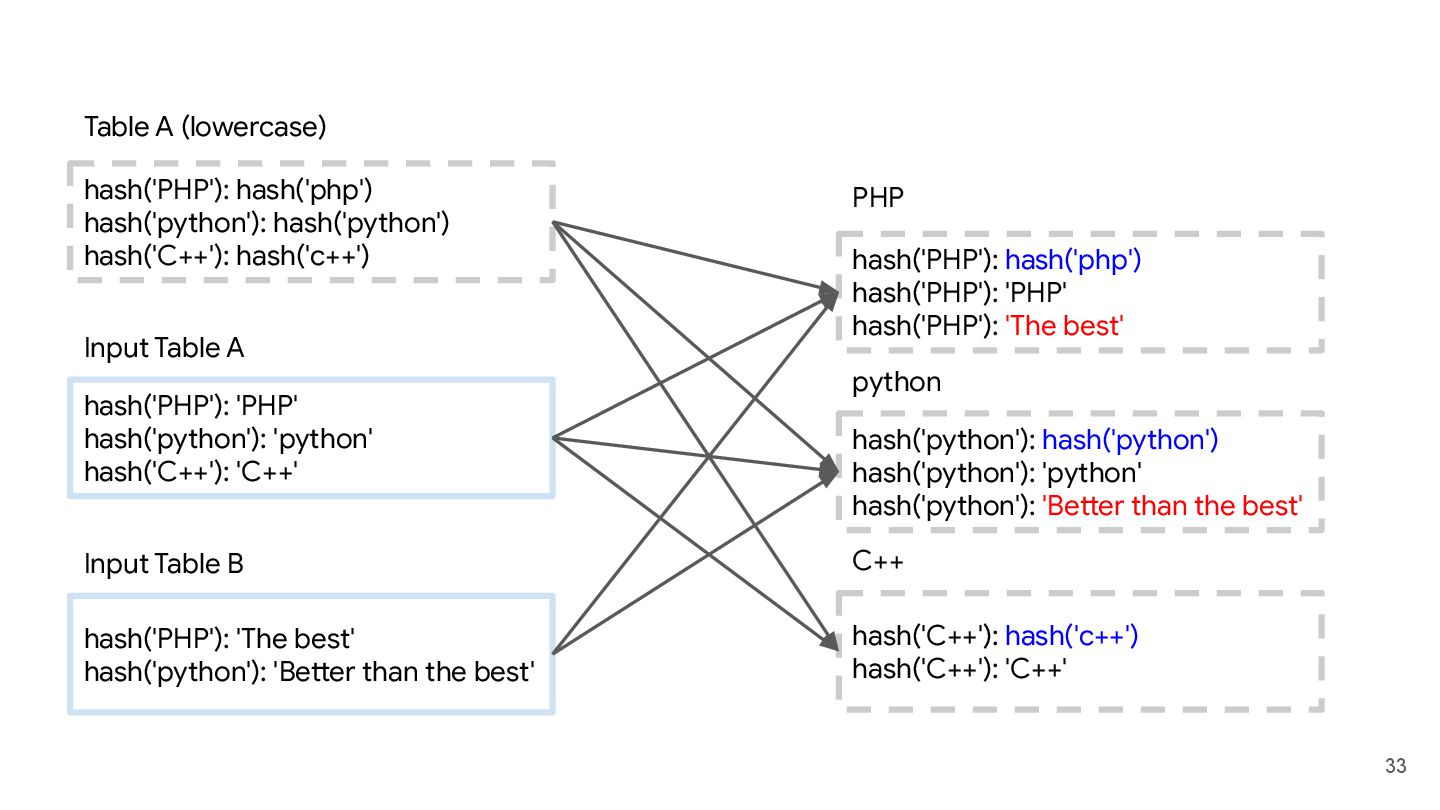
  28. 33 hash('PHP'): hash('php') hash('PHP'): 'PHP' hash('PHP'): 'The best' hash('python'): hash('python')

    hash('python'): 'python' hash('python'): 'Better than the best' hash('C++'): hash('c++') hash('C++'): 'C++' hash('PHP'): hash('php') hash('python'): hash('python') hash('C++'): hash('c++') Table A (lowercase) hash('PHP'): 'PHP' hash('python'): 'python' hash('C++'): 'C++' Input Table A hash('PHP'): 'The best' hash('python'): 'Better than the best' Input Table B PHP python C++
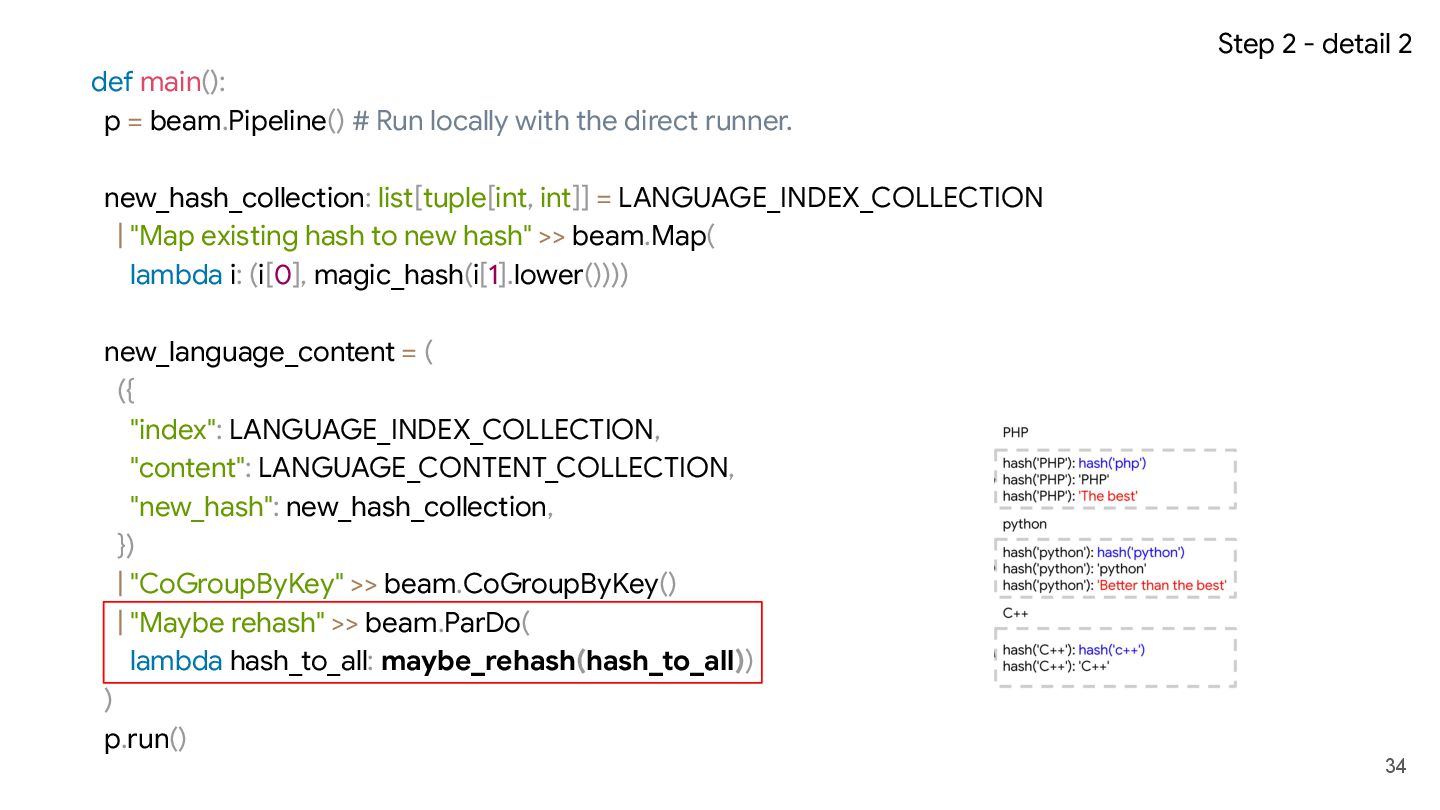
  29. 34 def main(): p = beam.Pipeline() # Run locally with

    the direct runner. new_hash_collection: list[tuple[int, int]] = LANGUAGE_INDEX_COLLECTION | "Map existing hash to new hash" >> beam.Map( lambda i: (i[0], magic_hash(i[1].lower()))) new_language_content = ( ({ "index": LANGUAGE_INDEX_COLLECTION, "content": LANGUAGE_CONTENT_COLLECTION, "new_hash": new_hash_collection, }) | "CoGroupByKey" >> beam.CoGroupByKey() | "Maybe rehash" >> beam.ParDo( lambda hash_to_all: maybe_rehash(hash_to_all)) ) p.run() Step 2 - detail 2
  30. def maybe_rehash(hash_to_all): for k in hash_to_all[1]["new_hash"]: if hash_to_all[1]["content"]: // dedup

    yield (k, hash_to_all[1]["content"][0]) else: // dedup + create yield (k, NEW_CONTENT_PREFIX.format(hash_to_all[1]['index'][0].lower())) 35 *Data is processed parallelly in different workers. Step 2 - detail 2
  31. 36 hash('PHP'): hash('php') hash('PHP'): 'PHP' hash('PHP'): 'The best' PHP hash('python'):

    hash('python') hash('python'): 'python' hash('python'): 'Better than the best' python hash('C++'): hash('c++') hash('C++'): 'C++' C++ hash('php'): 'The best' hash('python'): 'Better than the best' hash('c++'): '?'
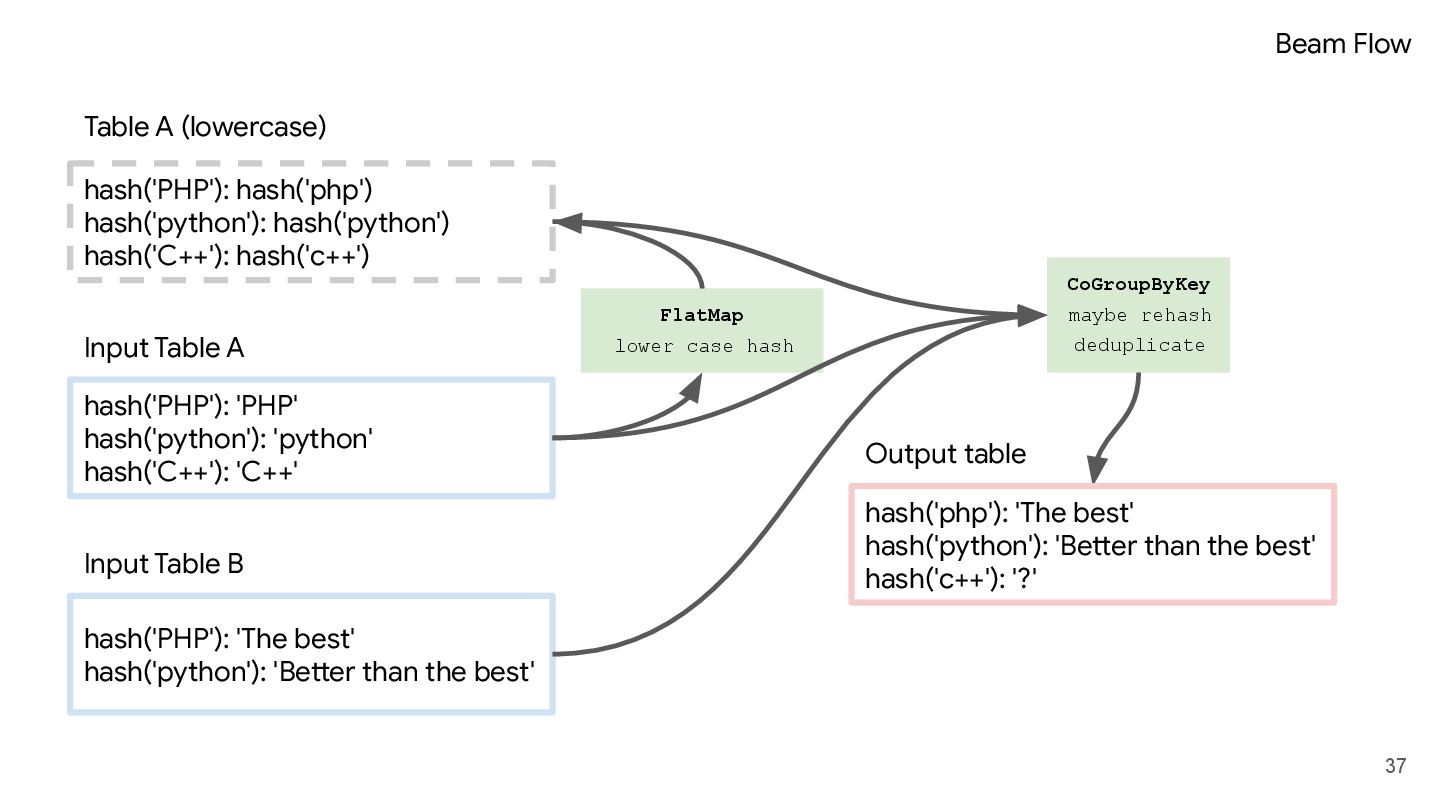
  32. 37 FlatMap lower case hash hash('PHP'): hash('php') hash('python'): hash('python') hash('C++'):

    hash('c++') Table A (lowercase) hash('PHP'): 'PHP' hash('python'): 'python' hash('C++'): 'C++' Input Table A hash('PHP'): 'The best' hash('python'): 'Better than the best' Input Table B CoGroupByKey maybe rehash deduplicate hash('php'): 'The best' hash('python'): 'Better than the best' hash('c++'): '?' Output table Beam Flow
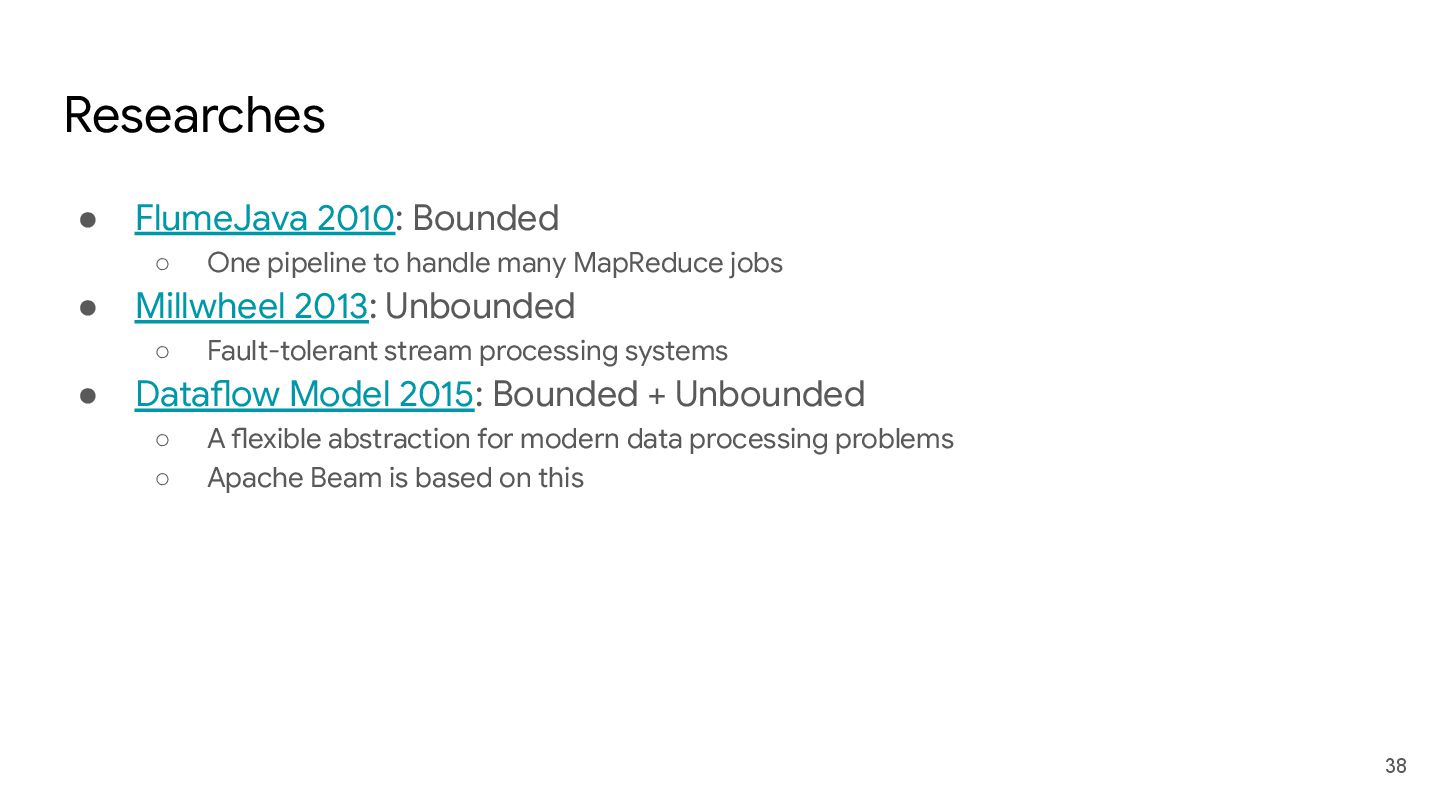
  33. Researches • FlumeJava 2010: Bounded ◦ One pipeline to handle

    many MapReduce jobs • Millwheel 2013: Unbounded ◦ Fault-tolerant stream processing systems • Dataflow Model 2015: Bounded + Unbounded ◦ A flexible abstraction for modern data processing problems ◦ Apache Beam is based on this 38
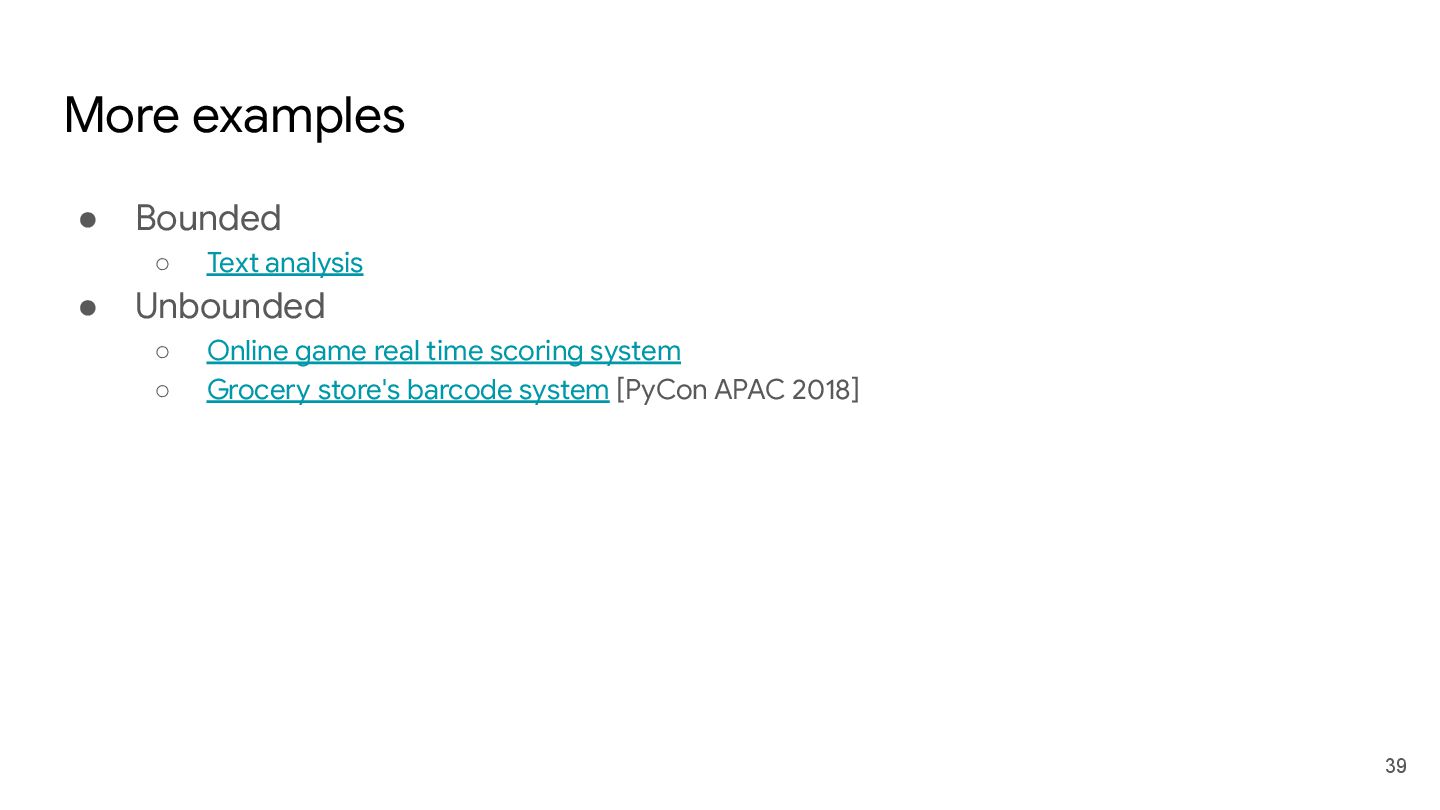
  34. More examples • Bounded ◦ Text analysis • Unbounded ◦

    Online game real time scoring system ◦ Grocery store's barcode system [PyCon APAC 2018] 39
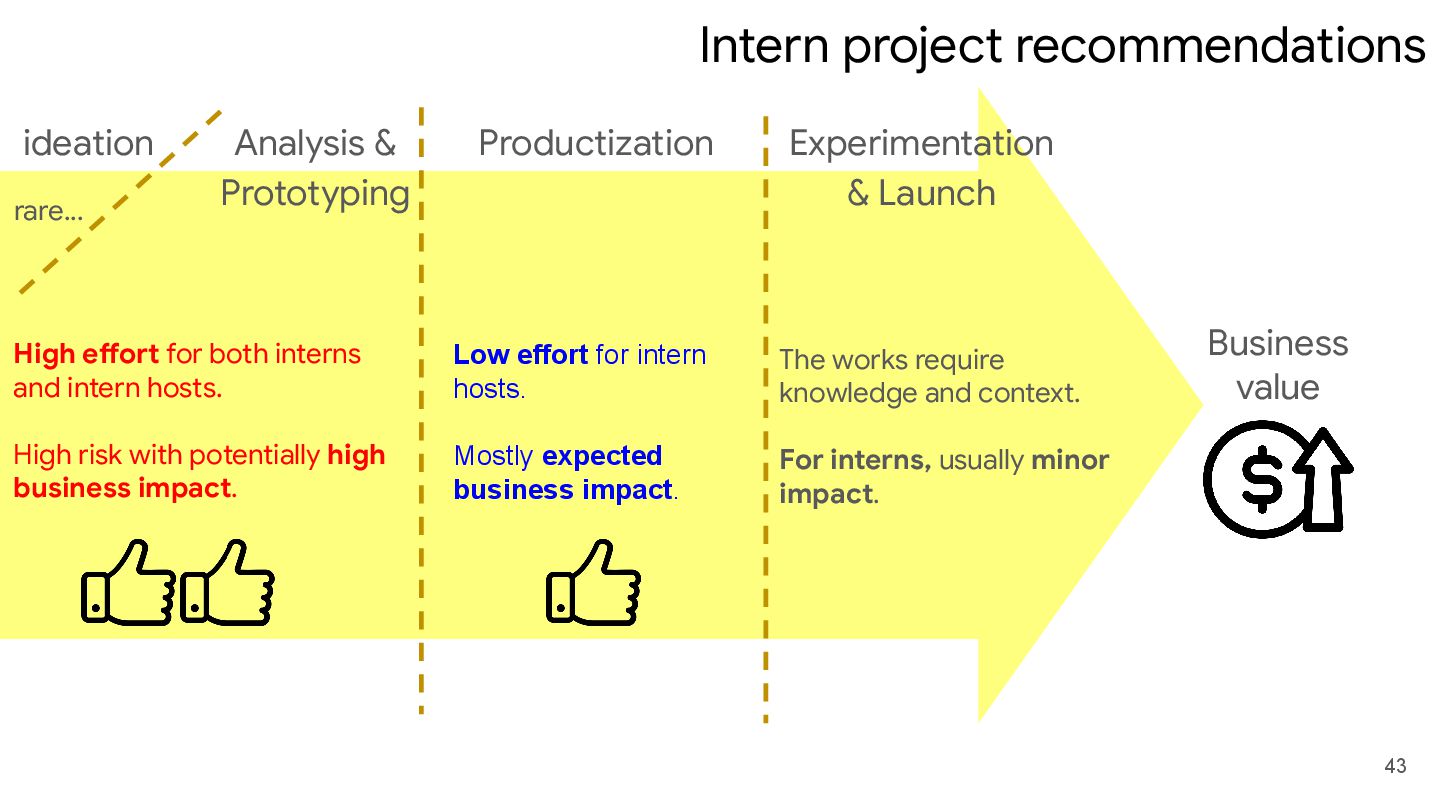
  35. 43 Intern project recommendations Productization Business value The works require

    knowledge and context. For interns, usually minor impact. High effort for both interns and intern hosts. High risk with potentially high business impact. Low effort for intern hosts. Mostly expected business impact. ideation Analysis & Prototyping Experimentation & Launch rare…
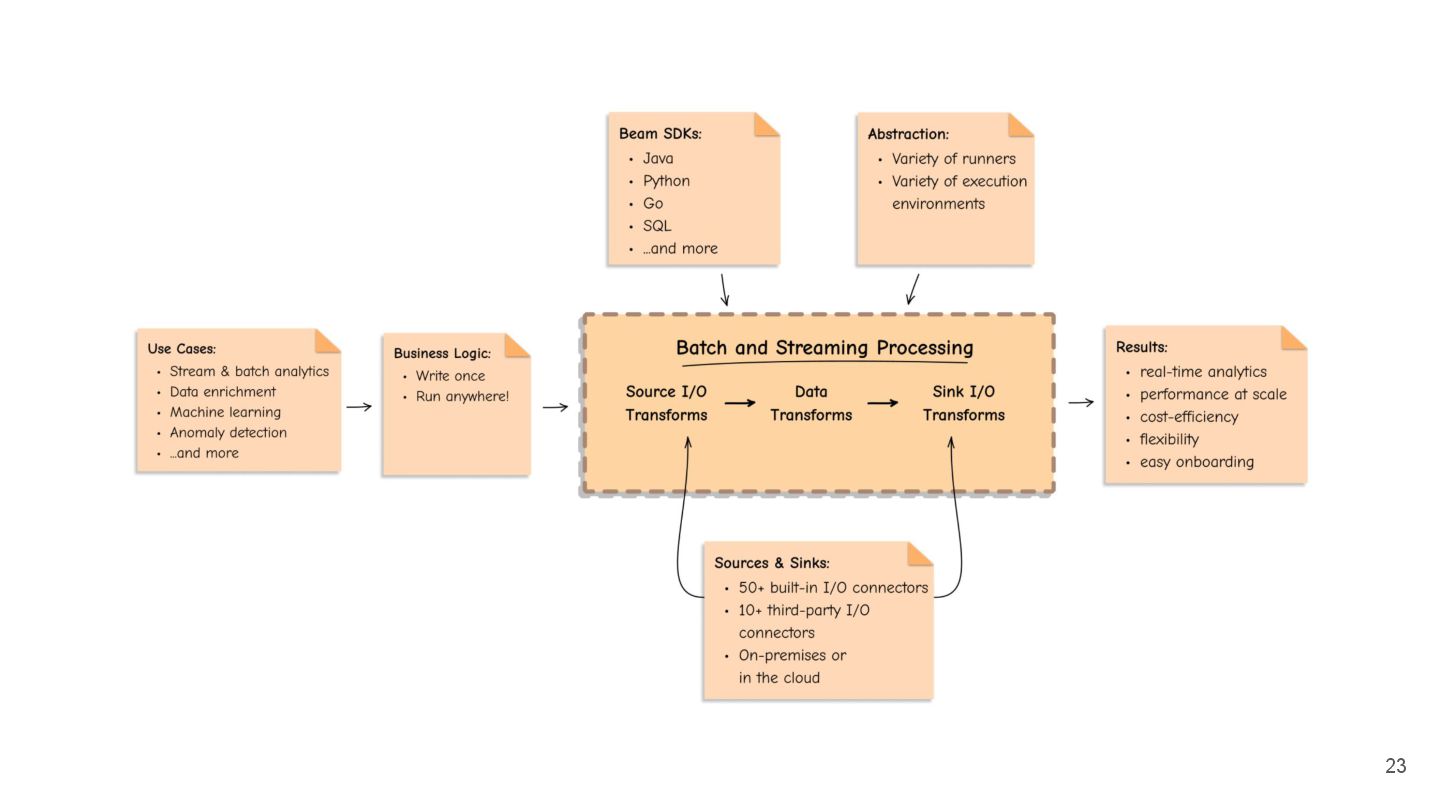
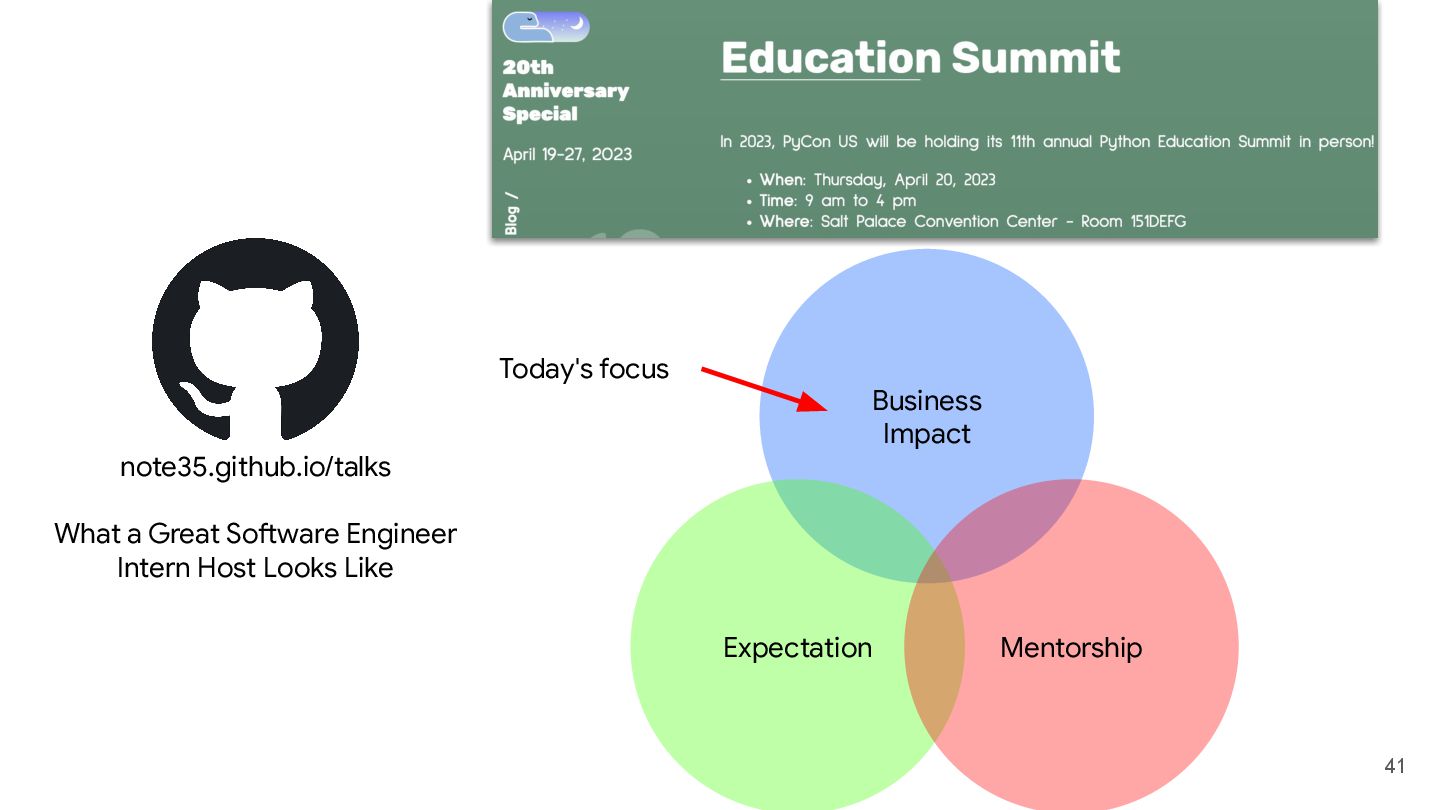
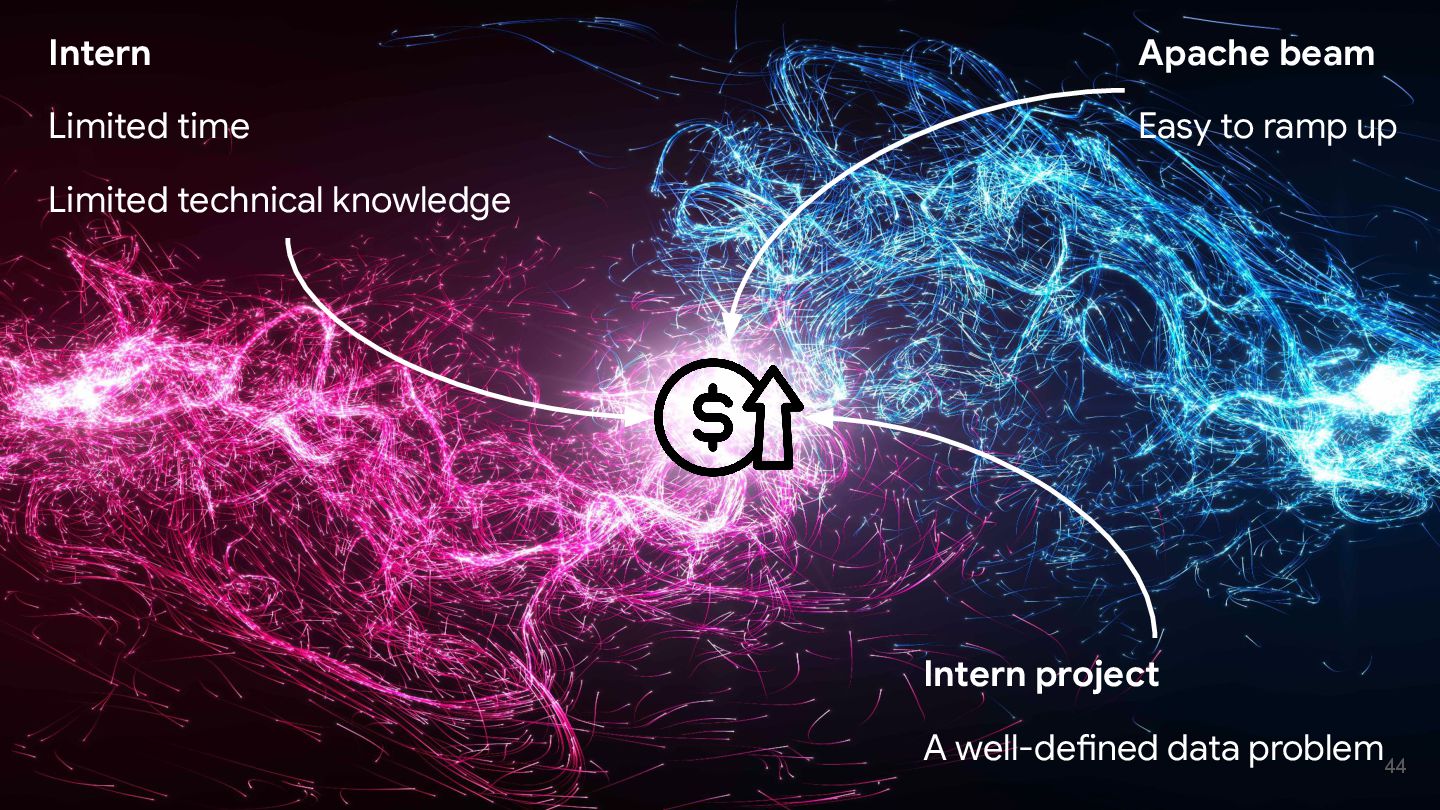
  36. 44 Intern Limited time Limited technical knowledge Apache beam Easy

    to ramp up Intern project A well-defined data problem
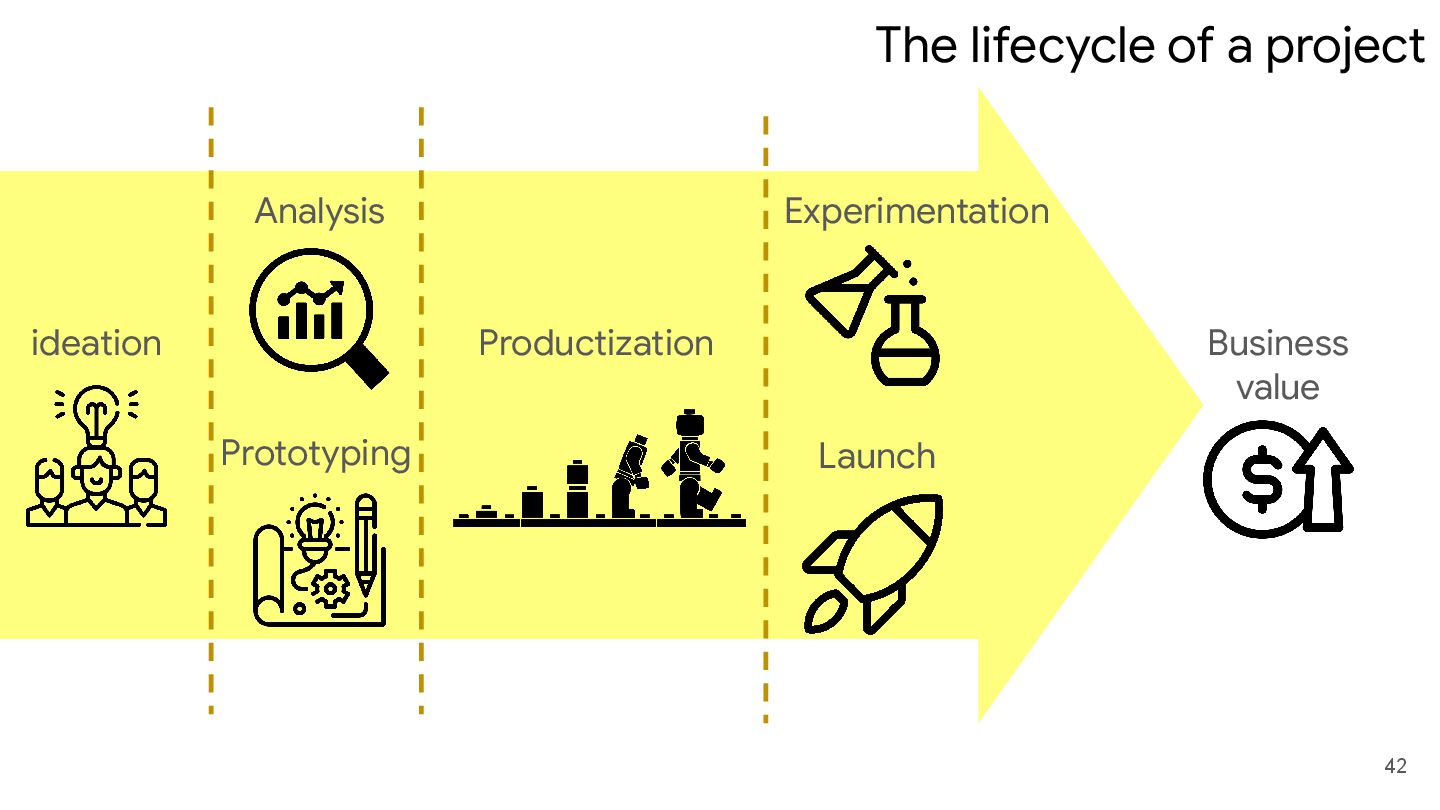
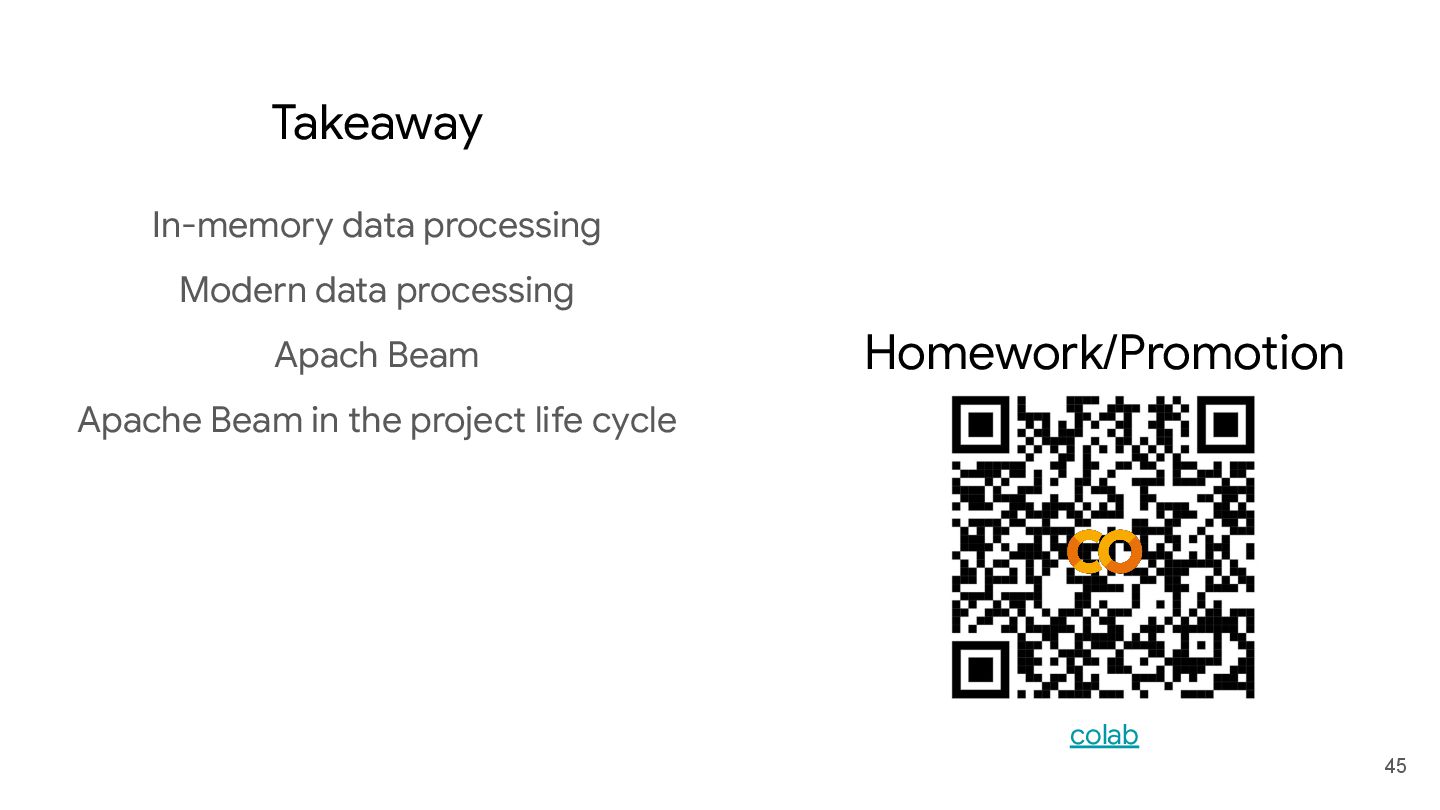
  37. Takeaway In-memory data processing Modern data processing Apach Beam Apache

    Beam in the project life cycle 45 Homework/Promotion colab