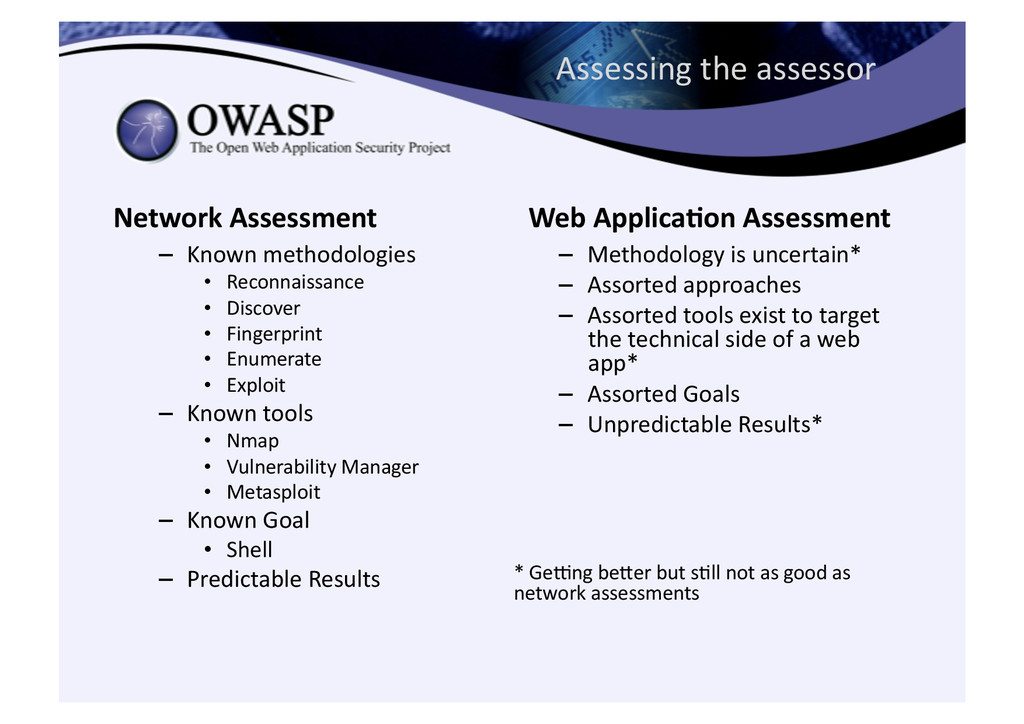
• Reconnaissance • Discover • Fingerprint • Enumerate • Exploit – Known tools • Nmap • Vulnerability Manager • Metasploit – Known Goal • Shell – Predictable Results Web Applica4on Assessment – Methodology is uncertain* – Assorted approaches – Assorted tools exist to target the technical side of a web app* – Assorted Goals – Unpredictable Results* * GeSng beTer but s3ll not as good as network assessments
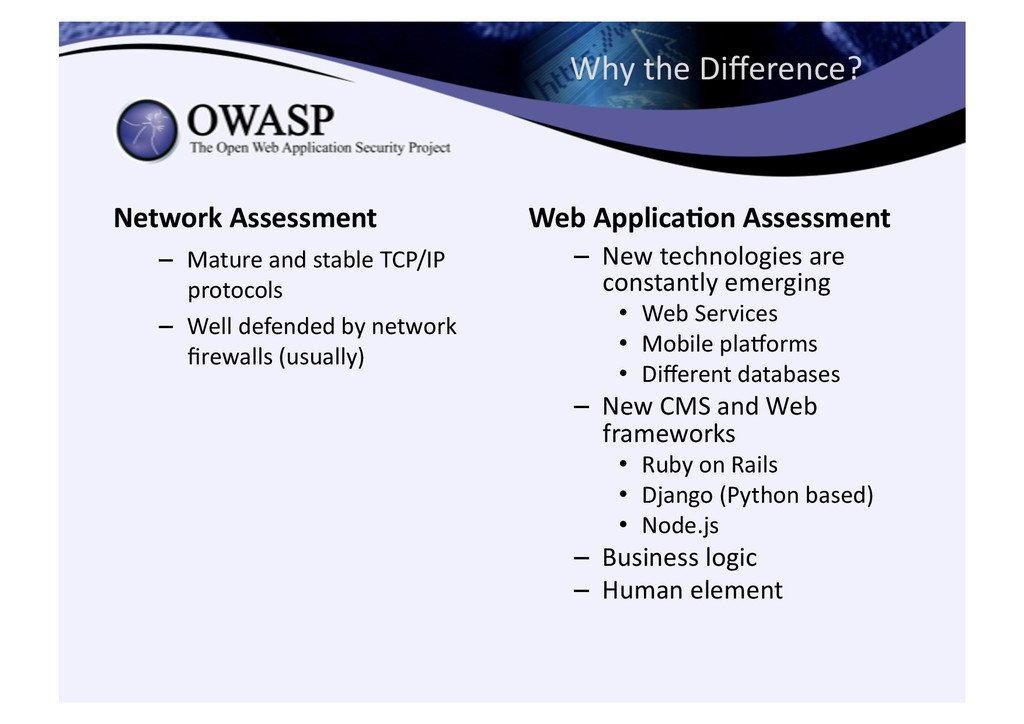
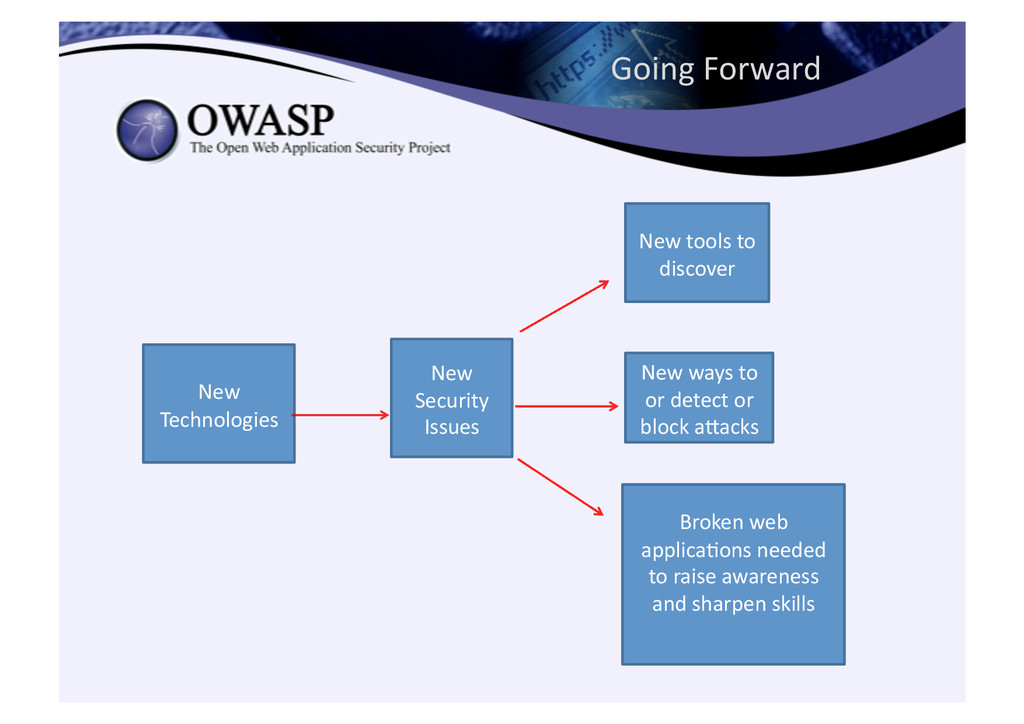
stable TCP/IP protocols – Well defended by network firewalls (usually) Web Applica4on Assessment – New technologies are constantly emerging • Web Services • Mobile plaZorms • Different databases – New CMS and Web frameworks • Ruby on Rails • Django (Python based) • Node.js – Business logic – Human element
☺ • Inten3onally broken web applica3ons exist as well – Different frameworks, languages, databases – Some available live, others to be downloaded and installed • Several vendor provided apps exist – Test their product • Training apps such as the OWASP WebGoat project – WebGoat originally wriTen in J2EE now available on other plaZorms – An interac3ve teaching environment for web applica3on security
Applica3ons are needed to know evil – Introduce people to the topic – Test web applica3on scanner people – Test web applica3on scanner products – Test source code analysis tools – Test web applica3on firewalls – Collect evidence le_ by aTackers – Develop business logic perspec3ves – Develop human element perspec3ves
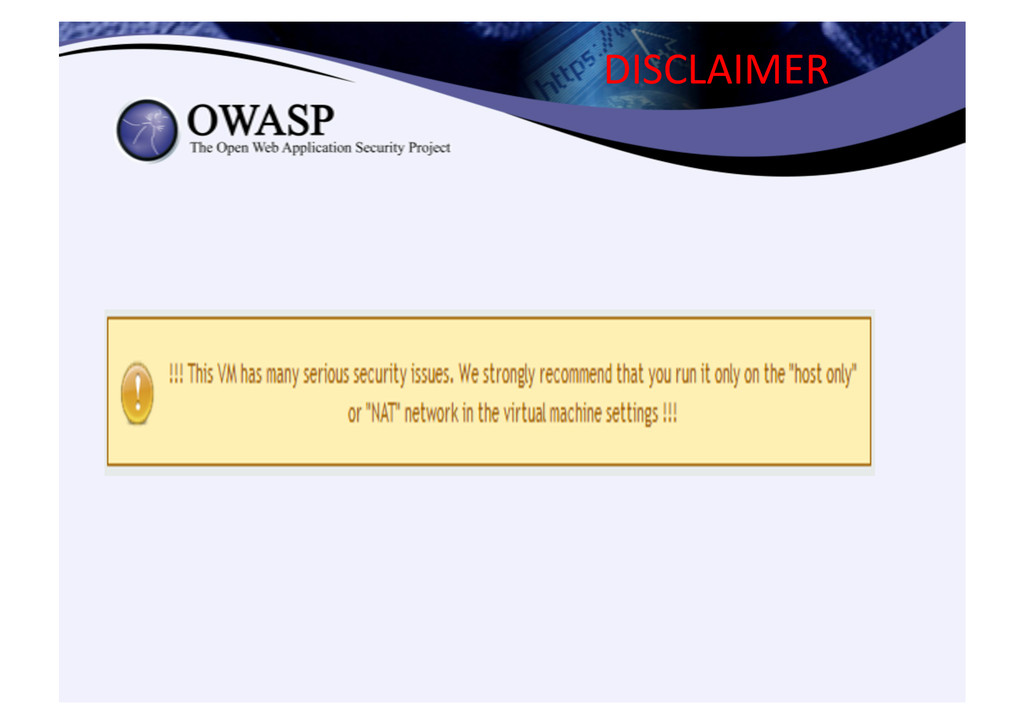
built on proprietary systems • Back end databases may need licensing • Mul3ple bad web apps on one system can conflict with one another • Can be difficult to install • Should be set up in a secured and isolated environment
is a collec3on of broken web applica3ons – Version 1.1.1 released in September 2013 – Available in ova and vmware formats – Ubuntu Linux Server 10.04 LTS
(mul3ple plaZorms) – Damn Vulnerable Web Applica3on • “Real applica3ons” – OWASP Vicnum project – Cyclone Transfers • Older (broken) versions of real applica3ons/frameworks such as WordPress and Joomla
auditor’s honing their web applica3on security skills • And anyone else needed a web security primer • Used as a hacker challenge for several security events including hTp://2013.appsecusa.org/ • PERL/PHP apps available on Sourceforge – Guess the number (Guessnum) – Guess the word (JoTo) – Union Challenge • Ruby on Rails apps available on Github – Cyclone Transfers – hTps://github.com/fridaygoldsmith/bwa_cyclone_transfers • Usually available live at hTp://vicnum.ciphertechs.com/
Jo=o -‐ The computer will think of a five leTer word with unique leTers. A_er you aTempt to guess the word, the computer will tell you whether you guessed the word successfully, or how many of the leTers in your guess match the computer's word. Keep on submiSng five leTer words un3l you have guessed the computer's word. Where do we start? What methodology? What tools? What are we a_er?
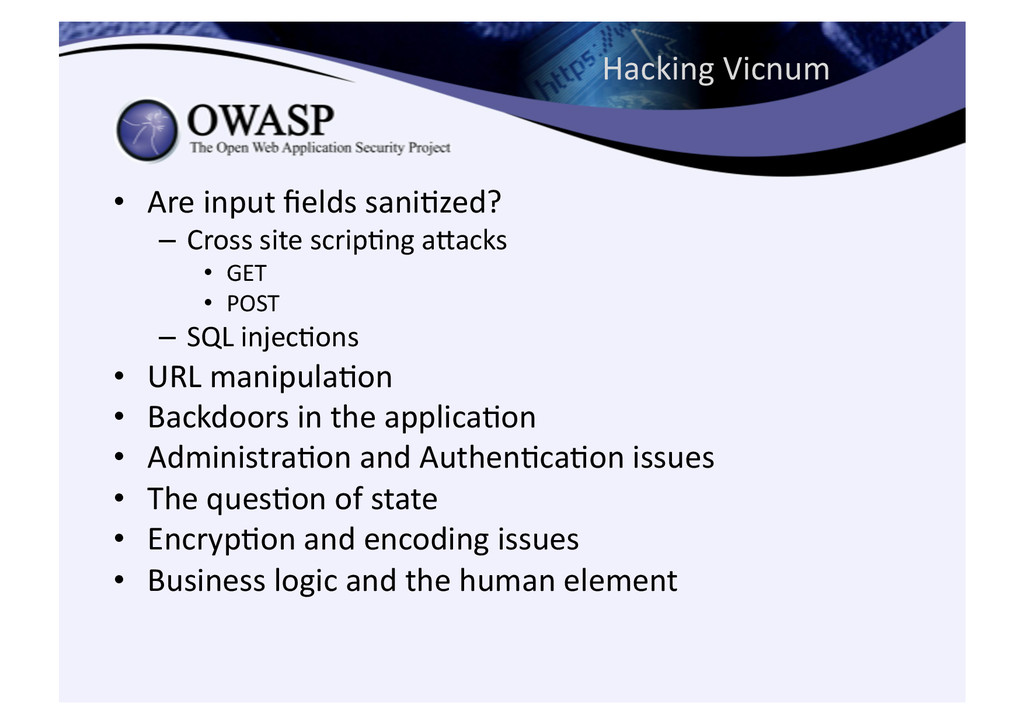
– Cross site scrip3ng aTacks • GET • POST – SQL injec3ons • URL manipula3on • Backdoors in the applica3on • Administra3on and Authen3ca3on issues • The ques3on of state • Encryp3on and encoding issues • Business logic and the human element
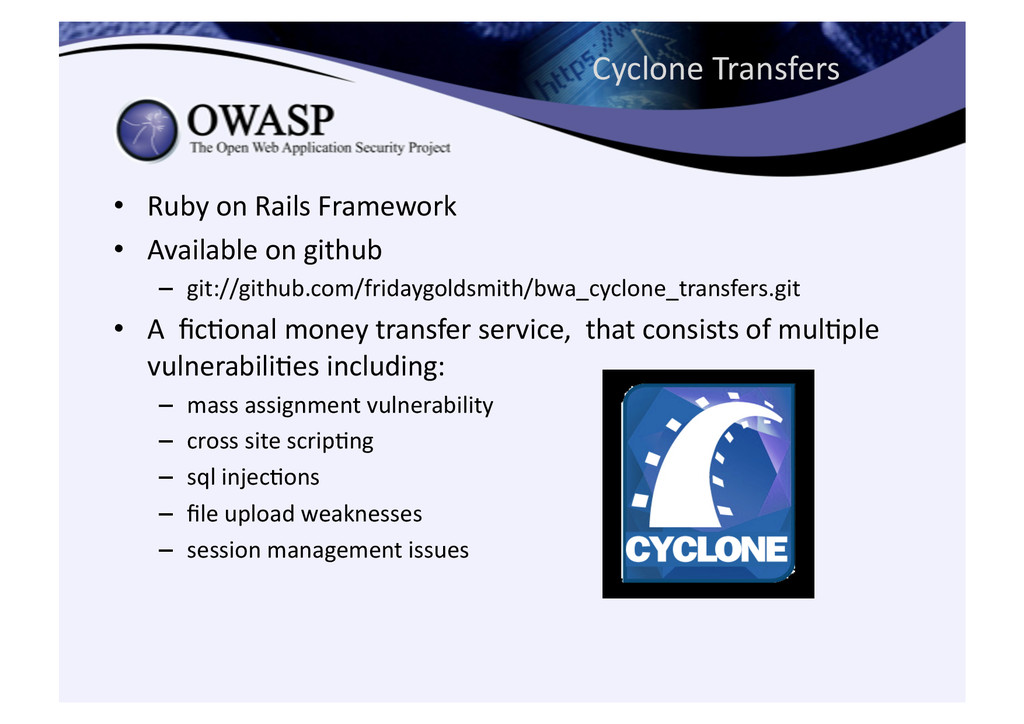
Available on github – git://github.com/fridaygoldsmith/bwa_cyclone_transfers.git • A fic3onal money transfer service, that consists of mul3ple vulnerabili3es including: – mass assignment vulnerability – cross site scrip3ng – sql injec3ons – file upload weaknesses – session management issues
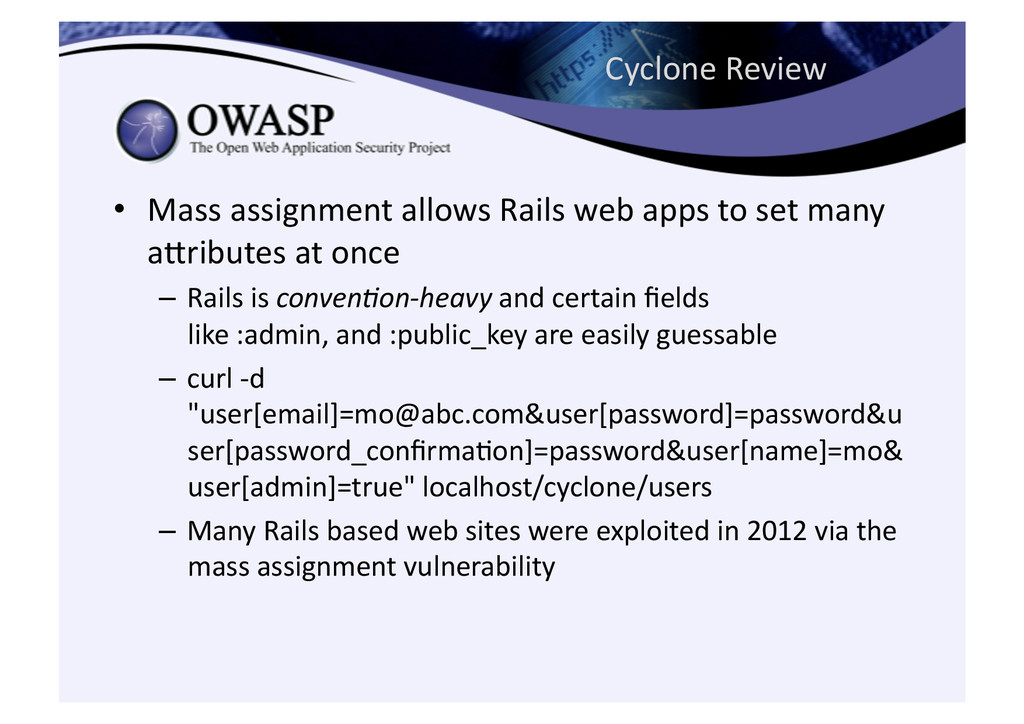
to set many aTributes at once – Rails is conven&on-‐heavy and certain fields like :admin, and :public_key are easily guessable – curl -‐d "user[email][email protected]&user[password]=password&u ser[password_confirma3on]=password&user[name]=mo& user[admin]=true" localhost/cyclone/users – Many Rails based web sites were exploited in 2012 via the mass assignment vulnerability
network is different than hacking a web app • Similari3es do exist in certain areas – Cryptography checking – Creden3al aTacks – Tools exist for scanning, fuzzing …. • But major technical challenges exist – A request/response protocol where state is always an issue – Code to be evaluated on both server and browser!
web pages are set up by applica3on programmers mee3ng a business requirement • Data works its way into web sites that might be difficult for a tool or a security analyst to evaluate – Comments might contain inappropriate data – URL fields can be manipulated and might show unintended web pages – URL parameters can also be guessed and may leak informa3on – Hidden fields in form fields can be viewed and manipulated • And then there are those business logic issues! • How can we prepare assessors for the non technical piece of an assessment?
can use some work – Catalog of vulnerabili3es can be expanded • Longer Term – Will get increasingly difficult to support older applica3ons due to library and other dependency issues – May move to mul3ple VMs – Would like to improve set of applica3ons
– ASP.NET – Python – Node.js • More modern UIs – Rich JavaScript – HTML5 – Mobile op3mized sites • More database back ends – PostgreSQL – No SQL • More web services


 owaspjapan
 destraynor
 inesmontani
 uxyall
 reverentgeek
 akihiro_kokubo
 axbom
axbom
 aleyda
 lindahogenes
 kastner
 427marketing
 codingconduct
 pauljervisheath