Upgrade to Pro — share decks privately, control downloads, hide ads and more …

Closure and Canonical cover of Functional Depen...

Closure and Canonical cover of Functional Dependency

This PPT explains the concepts of Closure of Functional Dependencies and Canonical Cover in relational database design. It covers the calculation of attribute closure, closure of a set of functional dependencies, and the importance of closure in determining candidate keys and database decomposition. The presentation also explains the concept and steps for finding the canonical (minimal) cover of a set of functional dependencies, with suitable examples for easy understanding.

Avatar for Pallavi Patil

Pallavi Patil

September 02, 2026

Other Decks in Education

Transcript

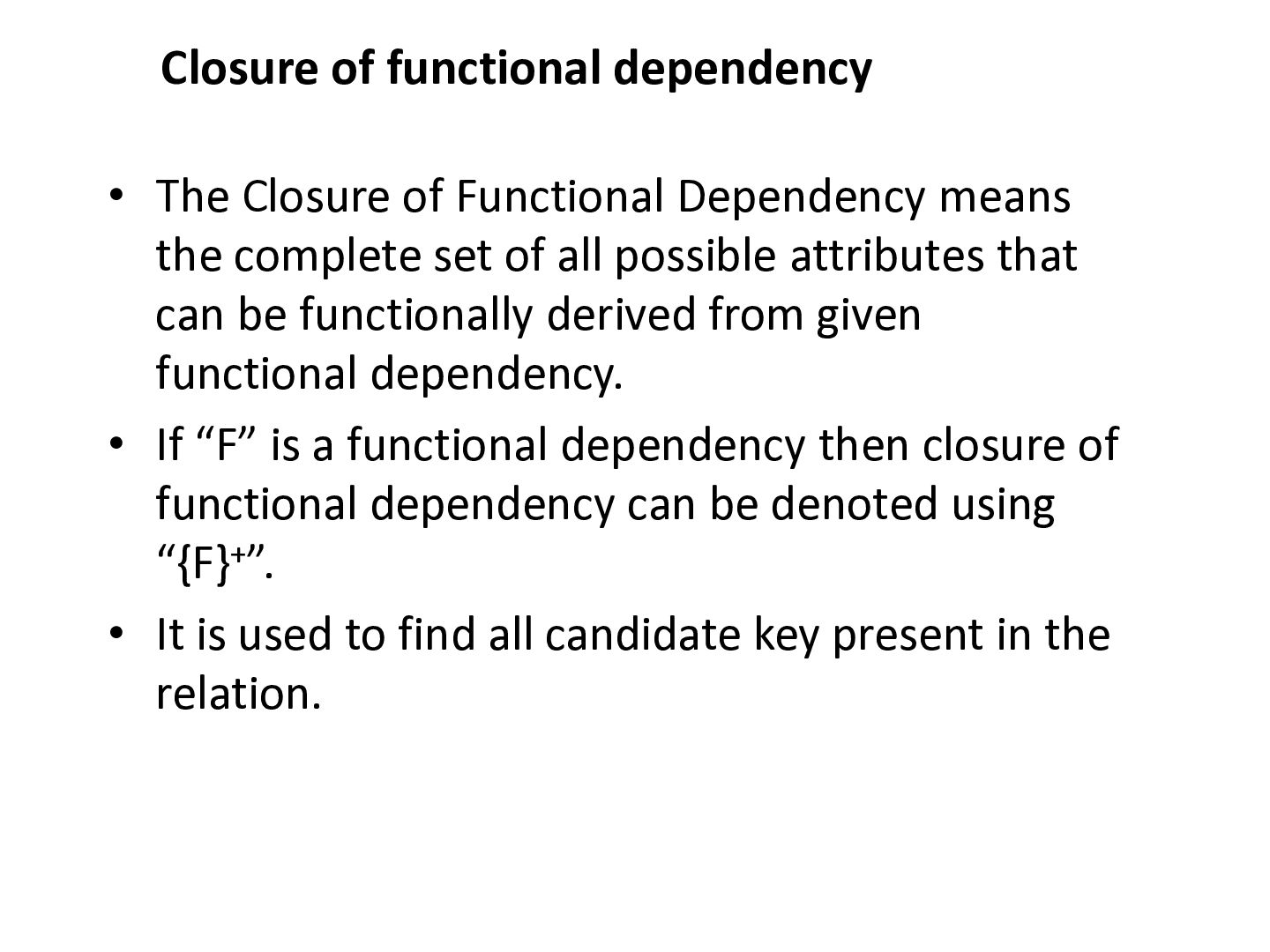
  1. Closure of functional dependency • The Closure of Functional Dependency

    means the complete set of all possible attributes that can be functionally derived from given functional dependency. • If “F” is a functional dependency then closure of functional dependency can be denoted using “{F}+”. • It is used to find all candidate key present in the relation.
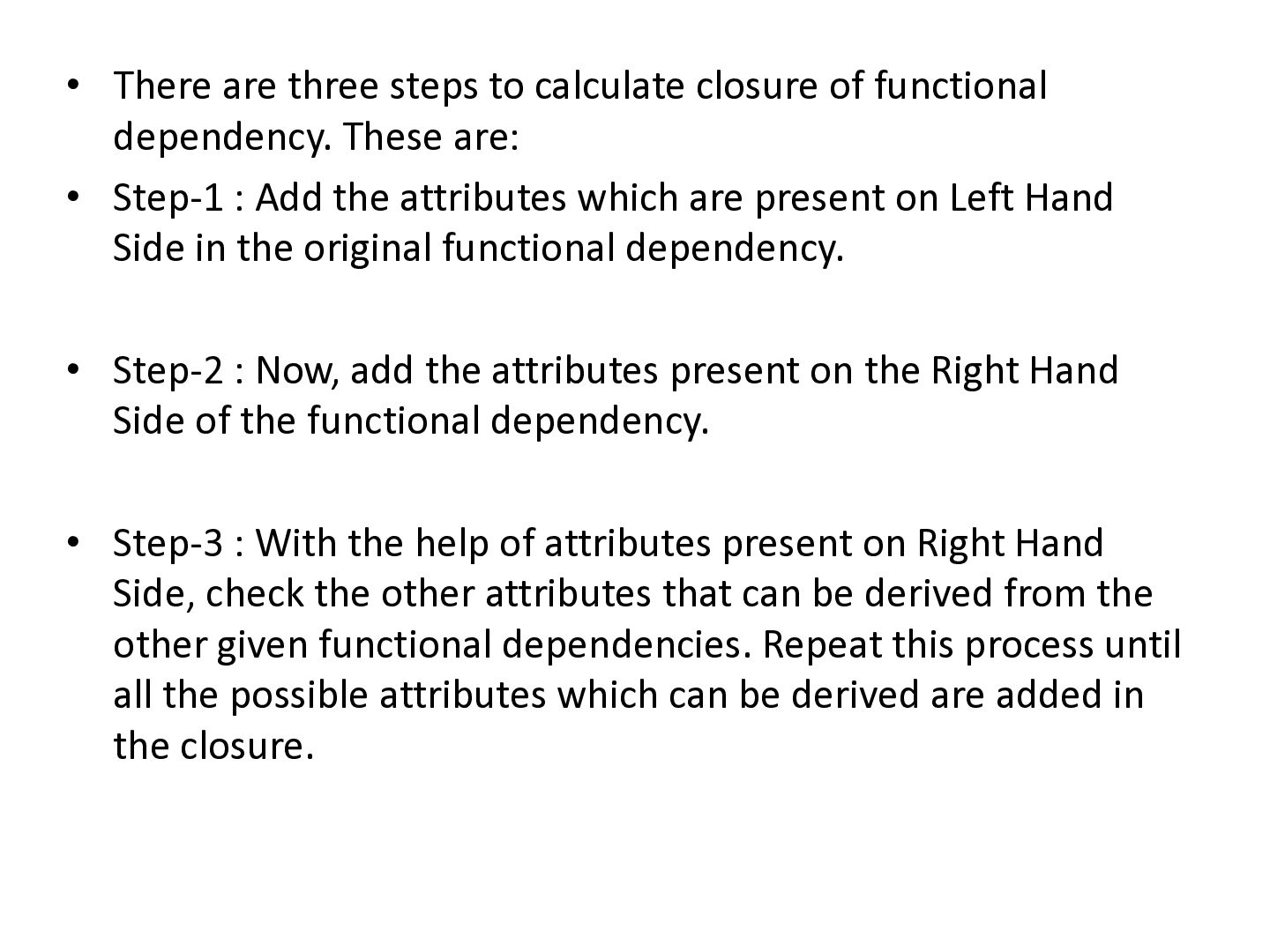
  2. • There are three steps to calculate closure of functional

    dependency. These are: • Step-1 : Add the attributes which are present on Left Hand Side in the original functional dependency. • Step-2 : Now, add the attributes present on the Right Hand Side of the functional dependency. • Step-3 : With the help of attributes present on Right Hand Side, check the other attributes that can be derived from the other given functional dependencies. Repeat this process until all the possible attributes which can be derived are added in the closure.
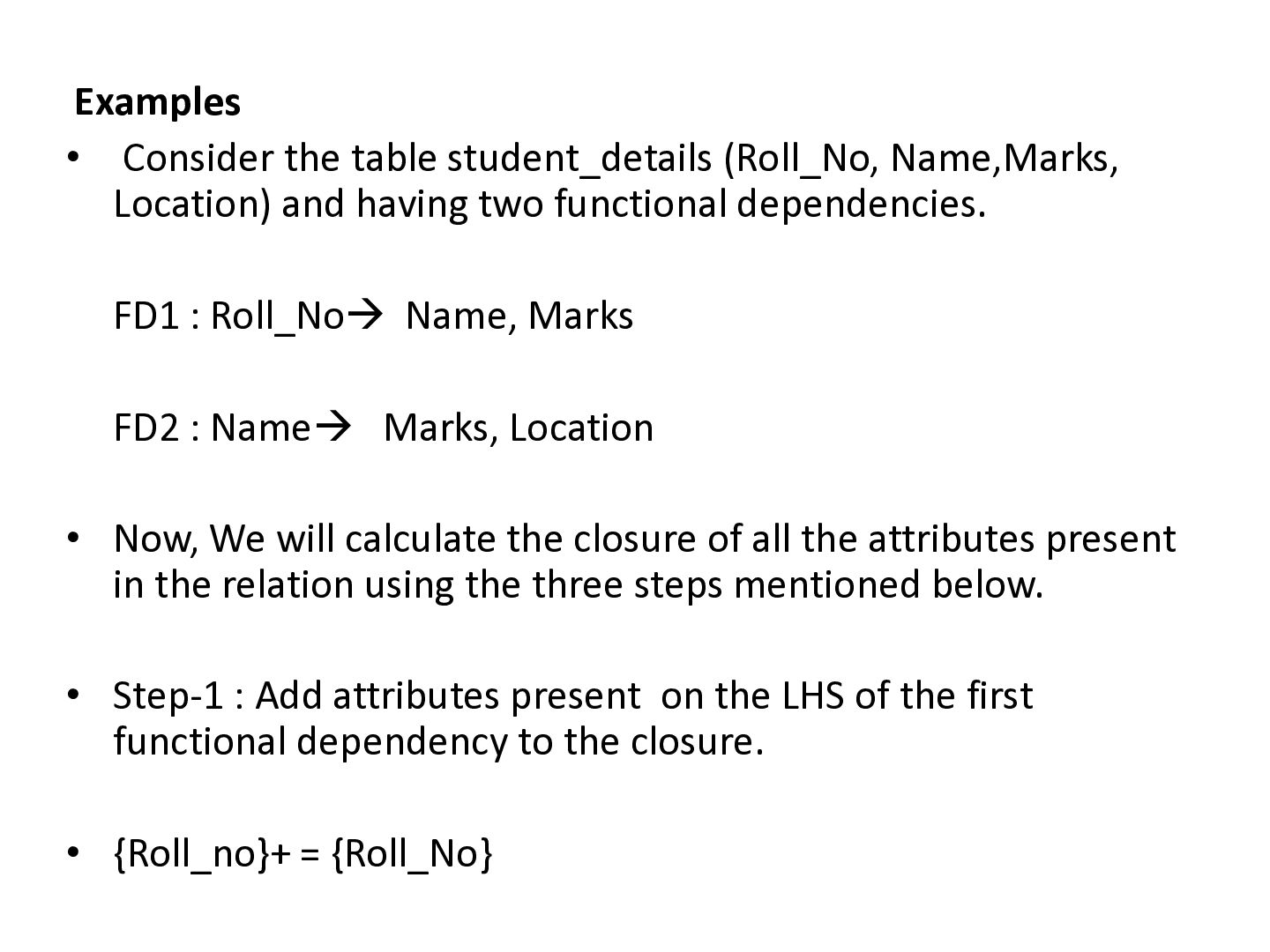
  3. Examples • Consider the table student_details (Roll_No, Name,Marks, Location) and

    having two functional dependencies. FD1 : Roll_No→ Name, Marks FD2 : Name→ Marks, Location • Now, We will calculate the closure of all the attributes present in the relation using the three steps mentioned below. • Step-1 : Add attributes present on the LHS of the first functional dependency to the closure. • {Roll_no}+ = {Roll_No}
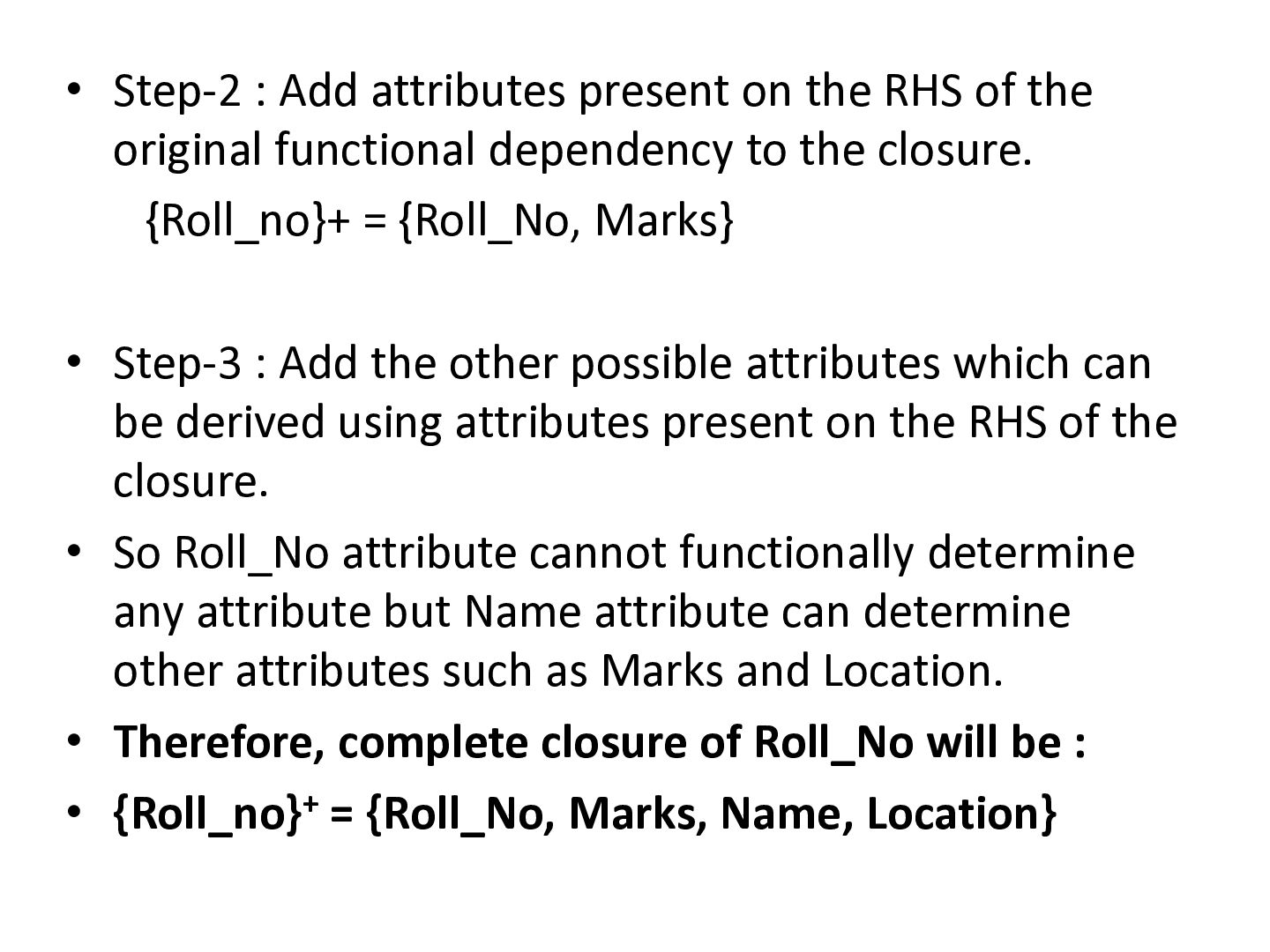
  4. • Step-2 : Add attributes present on the RHS of

    the original functional dependency to the closure. {Roll_no}+ = {Roll_No, Marks} • Step-3 : Add the other possible attributes which can be derived using attributes present on the RHS of the closure. • So Roll_No attribute cannot functionally determine any attribute but Name attribute can determine other attributes such as Marks and Location. • Therefore, complete closure of Roll_No will be : • {Roll_no}+ = {Roll_No, Marks, Name, Location}
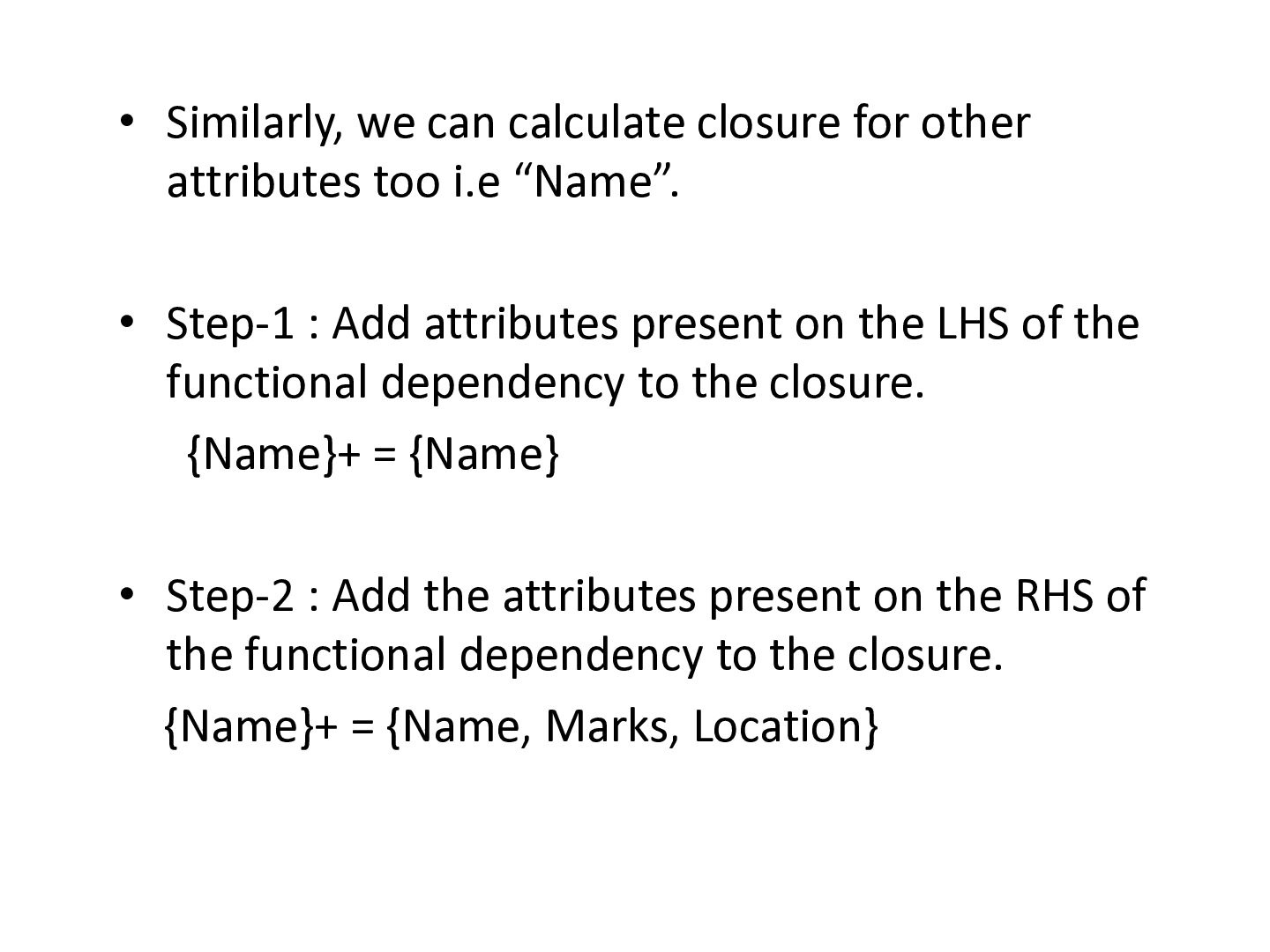
  5. • Similarly, we can calculate closure for other attributes too

    i.e “Name”. • Step-1 : Add attributes present on the LHS of the functional dependency to the closure. {Name}+ = {Name} • Step-2 : Add the attributes present on the RHS of the functional dependency to the closure. {Name}+ = {Name, Marks, Location}
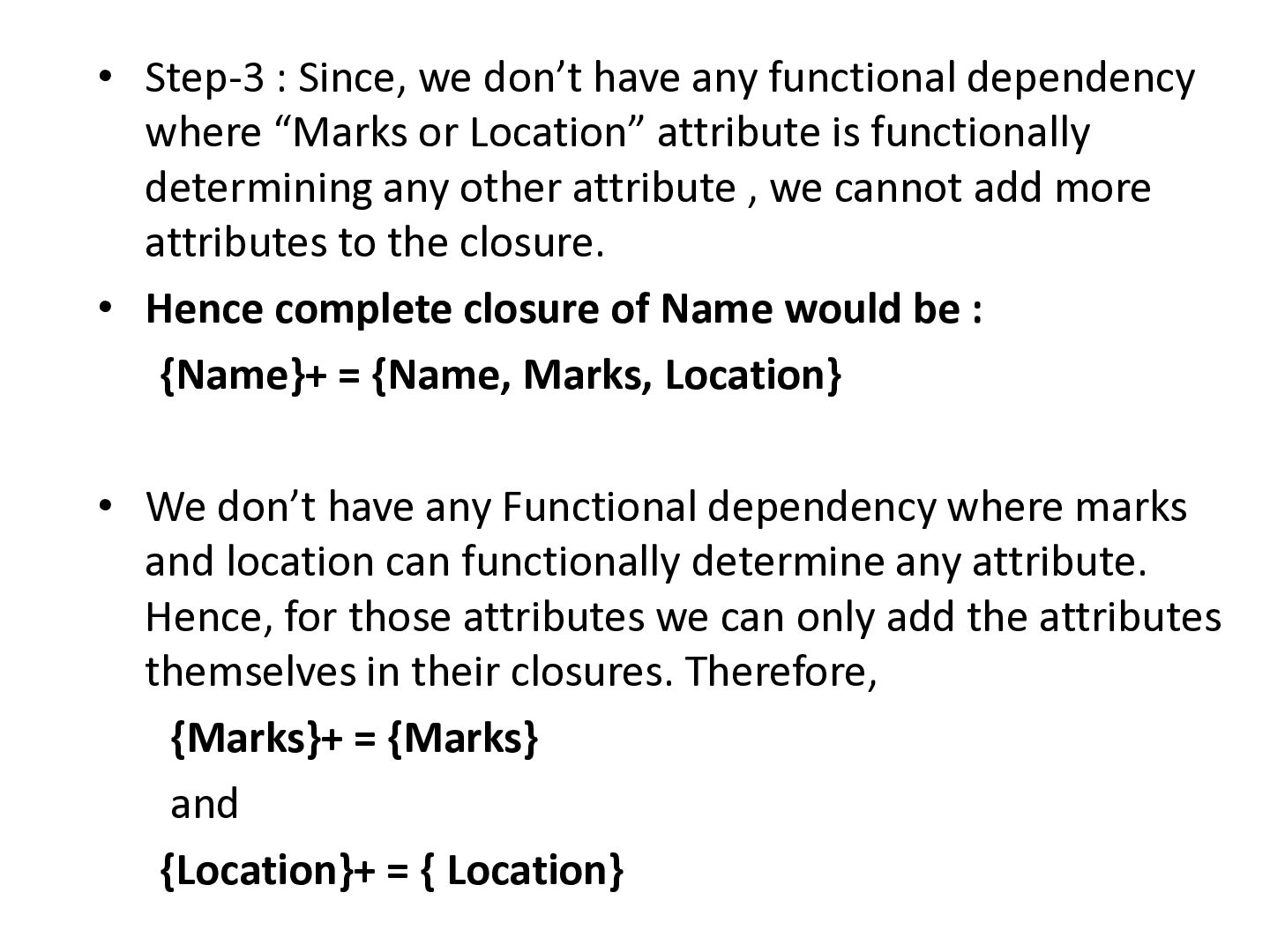
  6. • Step-3 : Since, we don’t have any functional dependency

    where “Marks or Location” attribute is functionally determining any other attribute , we cannot add more attributes to the closure. • Hence complete closure of Name would be : {Name}+ = {Name, Marks, Location} • We don’t have any Functional dependency where marks and location can functionally determine any attribute. Hence, for those attributes we can only add the attributes themselves in their closures. Therefore, {Marks}+ = {Marks} and {Location}+ = { Location}
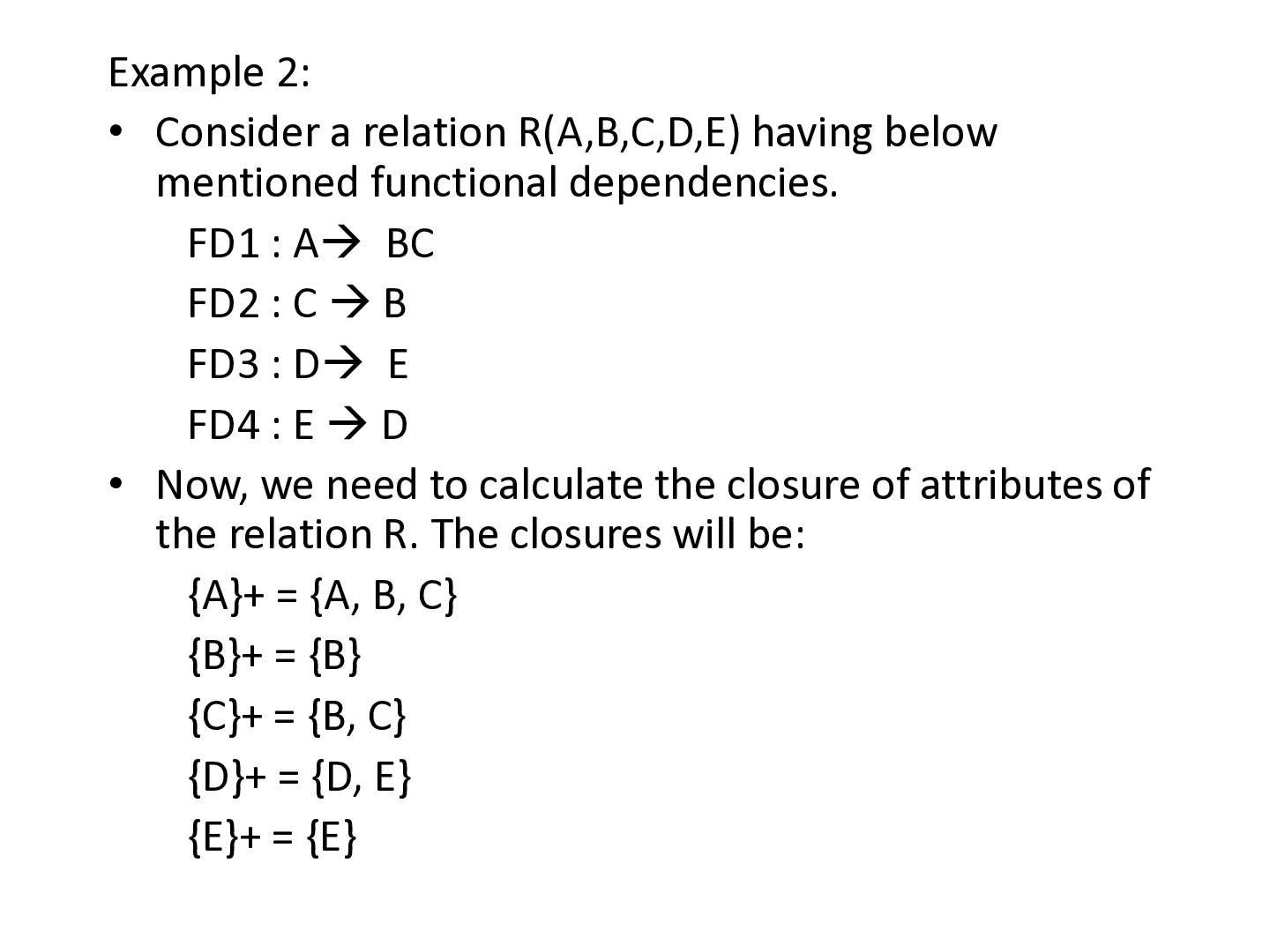
  7. Example 2: • Consider a relation R(A,B,C,D,E) having below mentioned

    functional dependencies. FD1 : A→ BC FD2 : C → B FD3 : D→ E FD4 : E → D • Now, we need to calculate the closure of attributes of the relation R. The closures will be: {A}+ = {A, B, C} {B}+ = {B} {C}+ = {B, C} {D}+ = {D, E} {E}+ = {E}
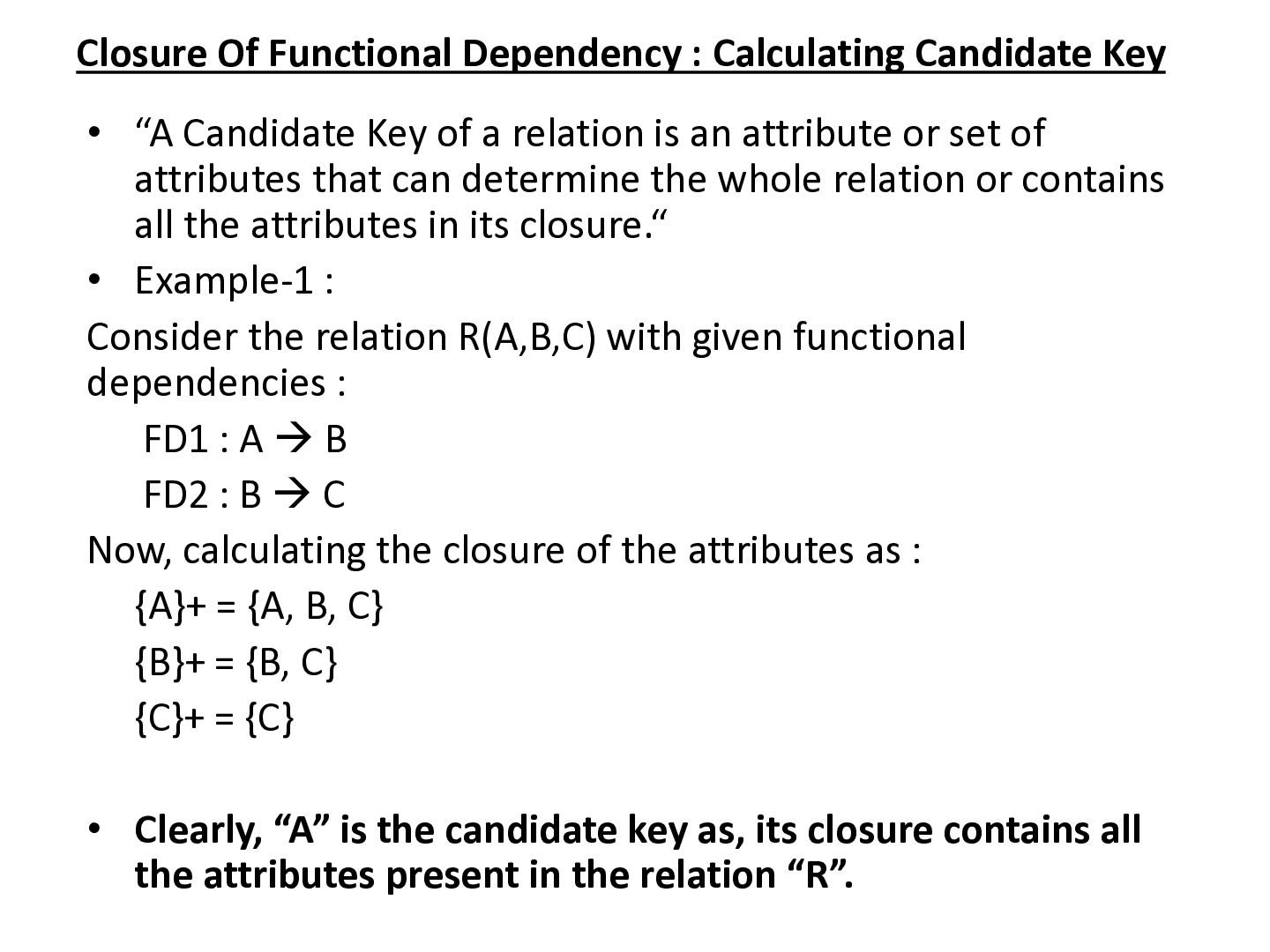
  8. Closure Of Functional Dependency : Calculating Candidate Key • “A

    Candidate Key of a relation is an attribute or set of attributes that can determine the whole relation or contains all the attributes in its closure.“ • Example-1 : Consider the relation R(A,B,C) with given functional dependencies : FD1 : A → B FD2 : B → C Now, calculating the closure of the attributes as : {A}+ = {A, B, C} {B}+ = {B, C} {C}+ = {C} • Clearly, “A” is the candidate key as, its closure contains all the attributes present in the relation “R”.
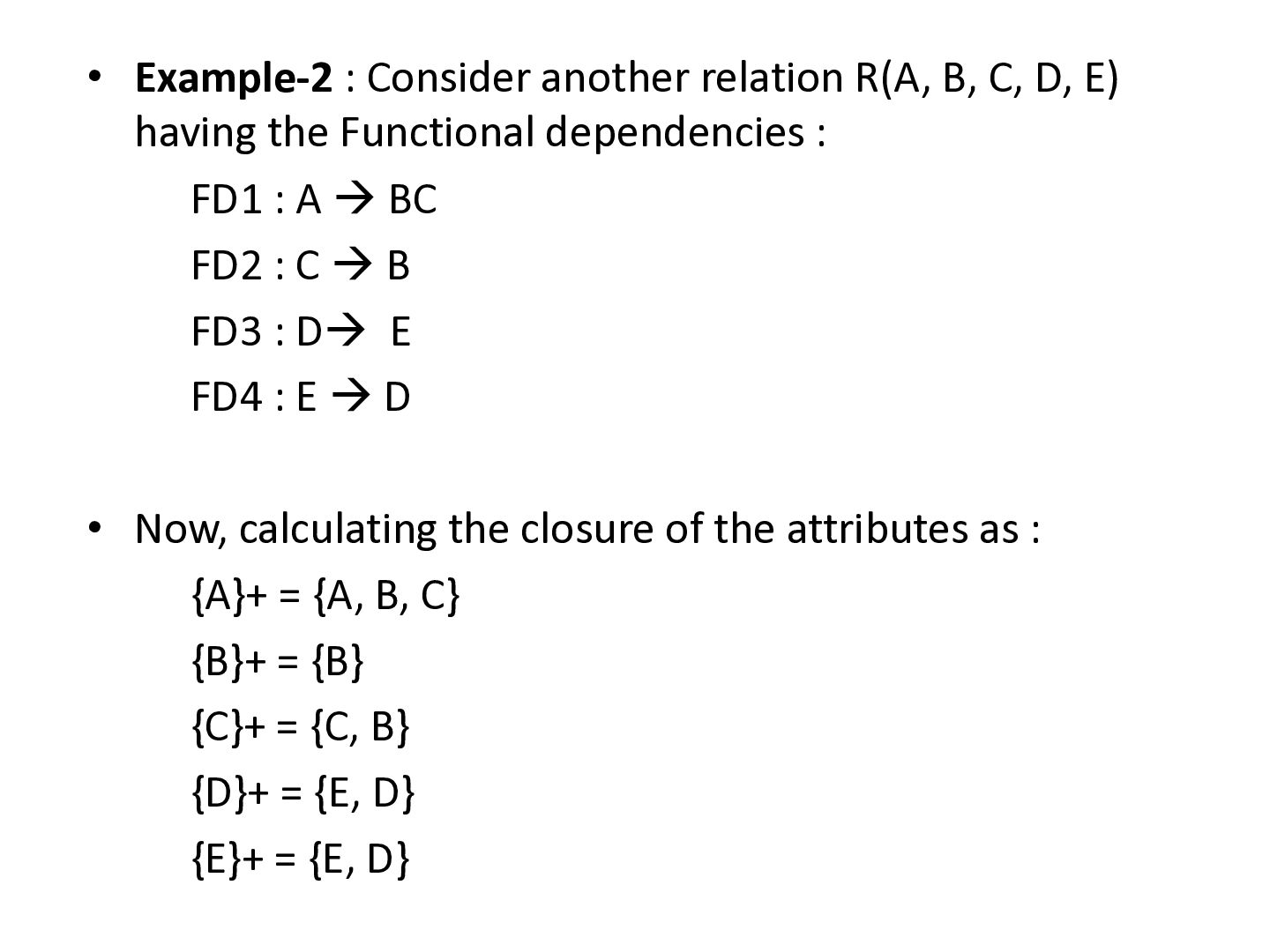
  9. • Example-2 : Consider another relation R(A, B, C, D,

    E) having the Functional dependencies : FD1 : A → BC FD2 : C → B FD3 : D→ E FD4 : E → D • Now, calculating the closure of the attributes as : {A}+ = {A, B, C} {B}+ = {B} {C}+ = {C, B} {D}+ = {E, D} {E}+ = {E, D}
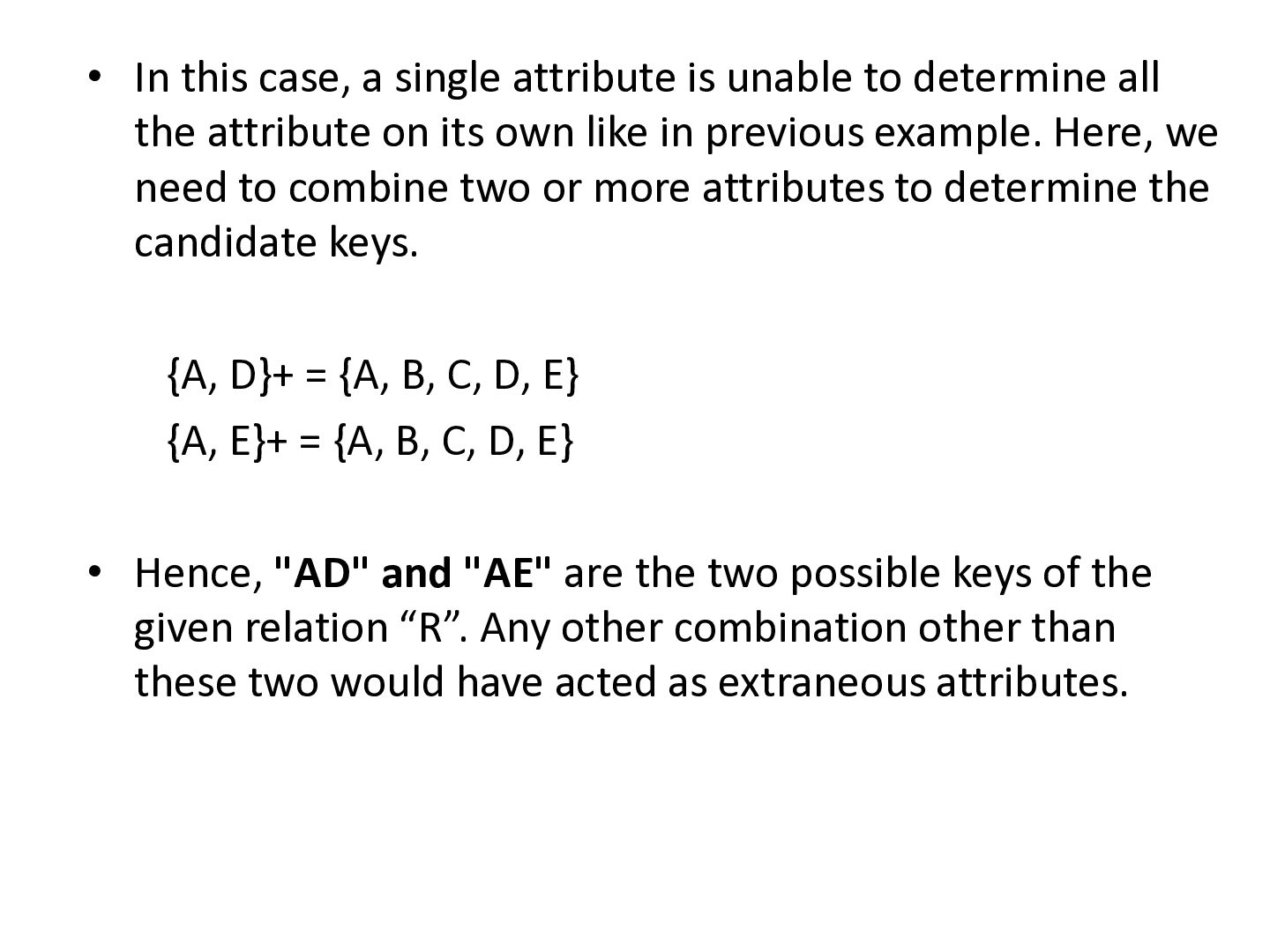
  10. • In this case, a single attribute is unable to

    determine all the attribute on its own like in previous example. Here, we need to combine two or more attributes to determine the candidate keys. {A, D}+ = {A, B, C, D, E} {A, E}+ = {A, B, C, D, E} • Hence, "AD" and "AE" are the two possible keys of the given relation “R”. Any other combination other than these two would have acted as extraneous attributes.
  11. Closure Of Functional Dependency : Key Definitions • Prime Attributes

    : Attributes which are indispensable part of candidate keys. For example : “A, D, E” attributes are prime attributes in above example-2. • Non-Prime Attributes : Attributes other than prime attributes which does not take part in formation of candidate keys. • Extraneous Attributes : Attributes which does not make any effect on removal from candidate key.
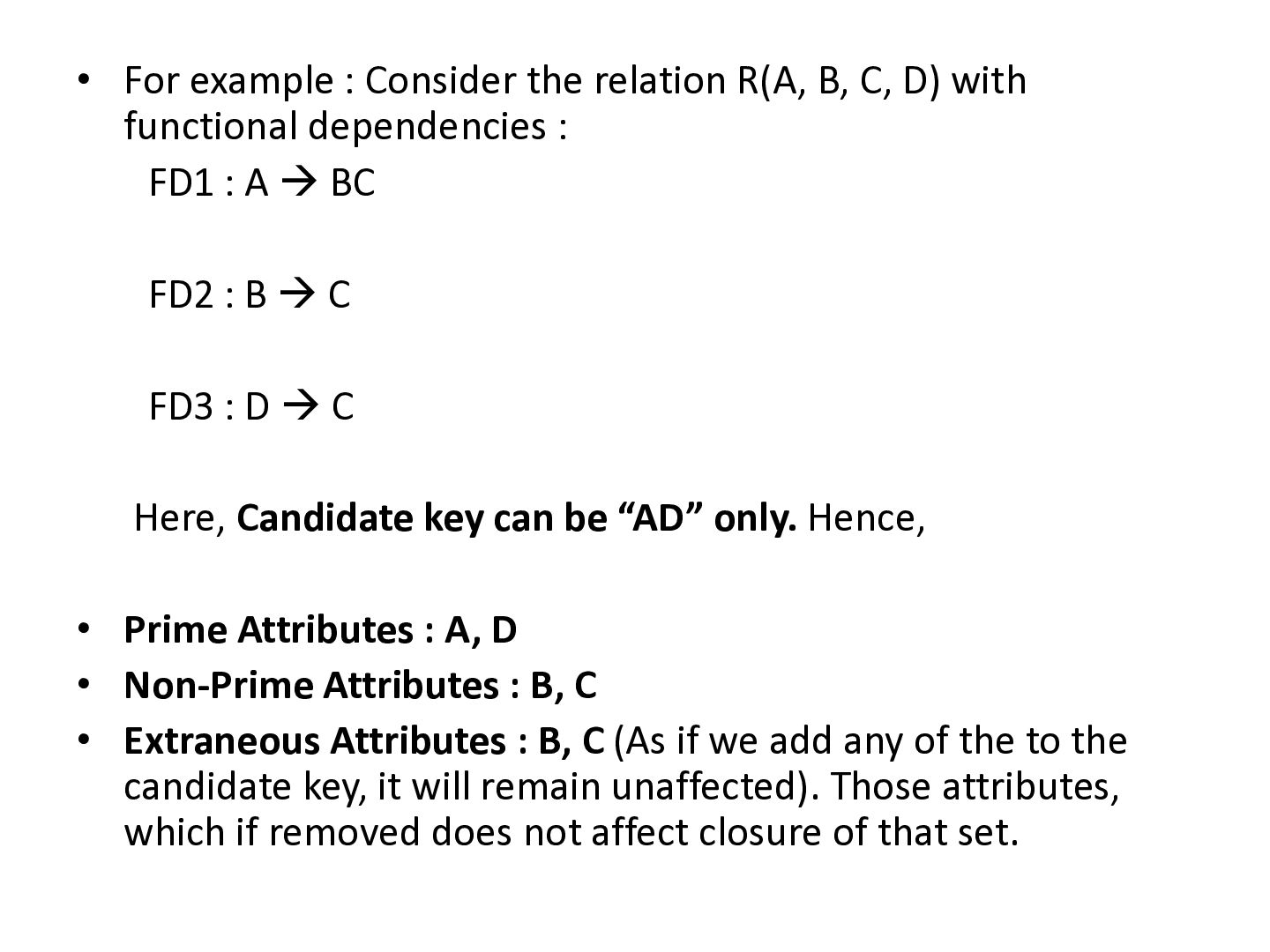
  12. • For example : Consider the relation R(A, B, C,

    D) with functional dependencies : FD1 : A → BC FD2 : B → C FD3 : D → C Here, Candidate key can be “AD” only. Hence, • Prime Attributes : A, D • Non-Prime Attributes : B, C • Extraneous Attributes : B, C (As if we add any of the to the candidate key, it will remain unaffected). Those attributes, which if removed does not affect closure of that set.
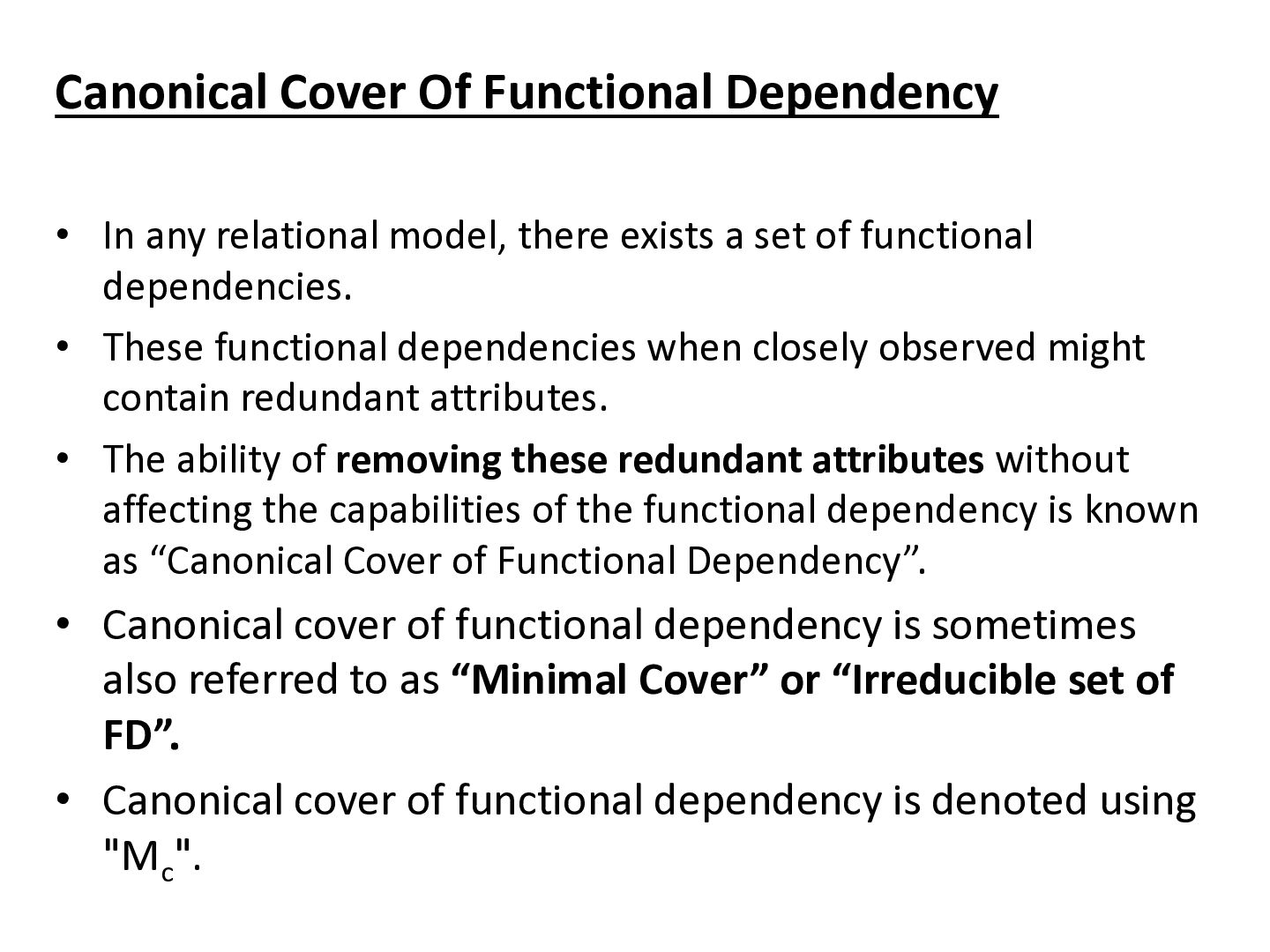
  13. Canonical Cover Of Functional Dependency • In any relational model,

    there exists a set of functional dependencies. • These functional dependencies when closely observed might contain redundant attributes. • The ability of removing these redundant attributes without affecting the capabilities of the functional dependency is known as “Canonical Cover of Functional Dependency”. • Canonical cover of functional dependency is sometimes also referred to as “Minimal Cover” or “Irreducible set of FD”. • Canonical cover of functional dependency is denoted using "Mc".
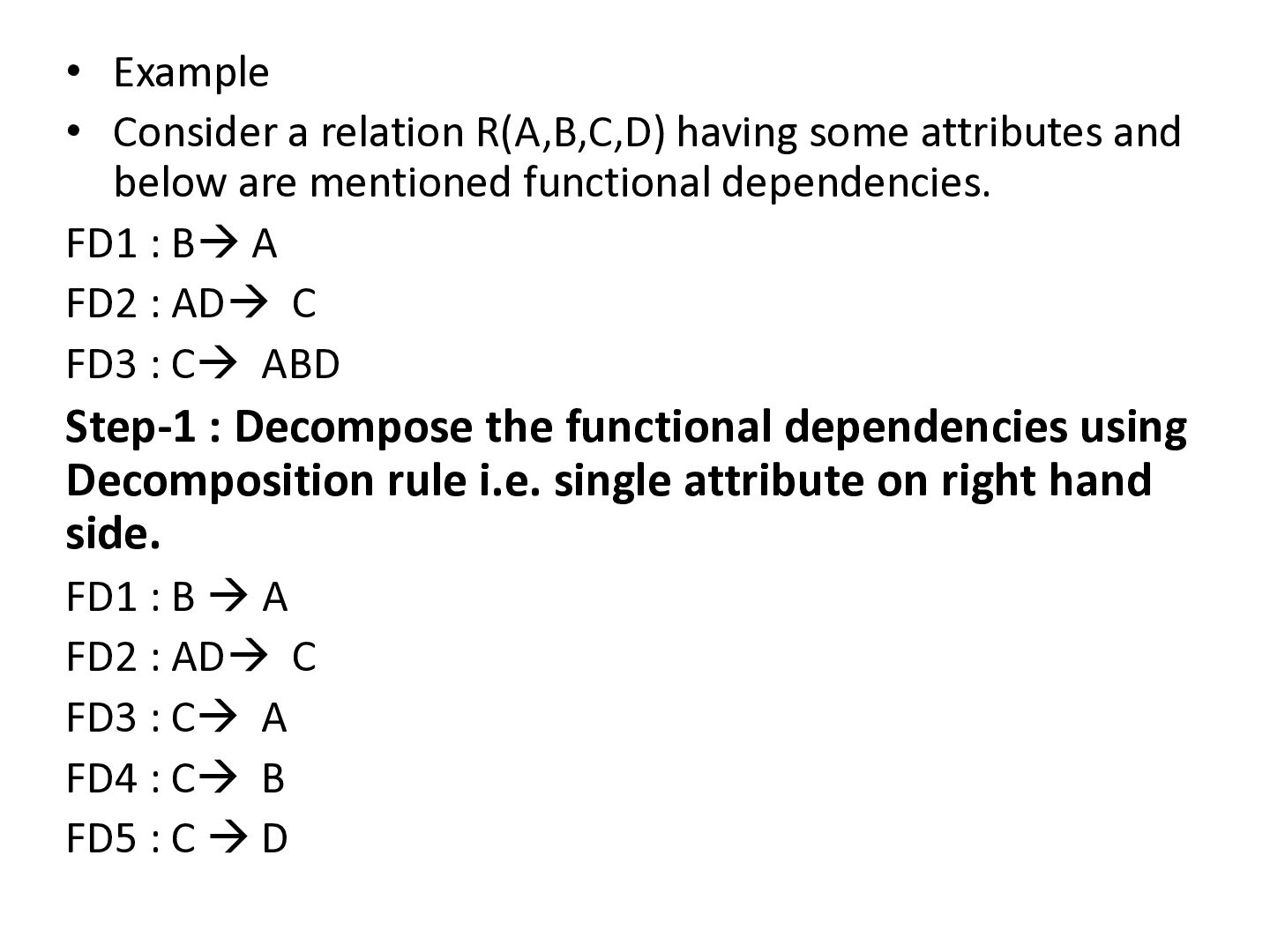
  14. • Example • Consider a relation R(A,B,C,D) having some attributes

    and below are mentioned functional dependencies. FD1 : B→ A FD2 : AD→ C FD3 : C→ ABD Step-1 : Decompose the functional dependencies using Decomposition rule i.e. single attribute on right hand side. FD1 : B → A FD2 : AD→ C FD3 : C→ A FD4 : C→ B FD5 : C → D
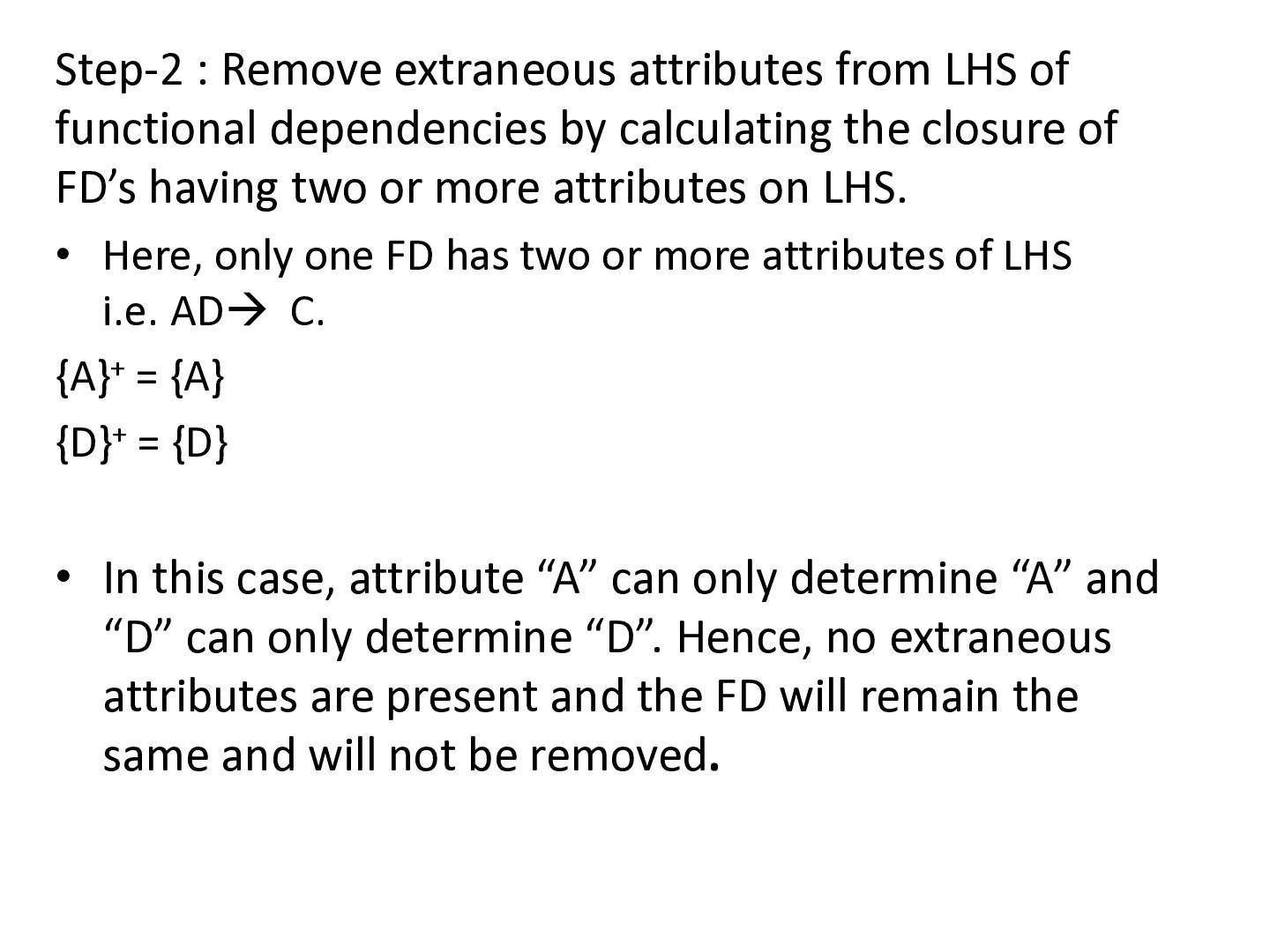
  15. Step-2 : Remove extraneous attributes from LHS of functional dependencies

    by calculating the closure of FD’s having two or more attributes on LHS. • Here, only one FD has two or more attributes of LHS i.e. AD→ C. {A}+ = {A} {D}+ = {D} • In this case, attribute “A” can only determine “A” and “D” can only determine “D”. Hence, no extraneous attributes are present and the FD will remain the same and will not be removed.
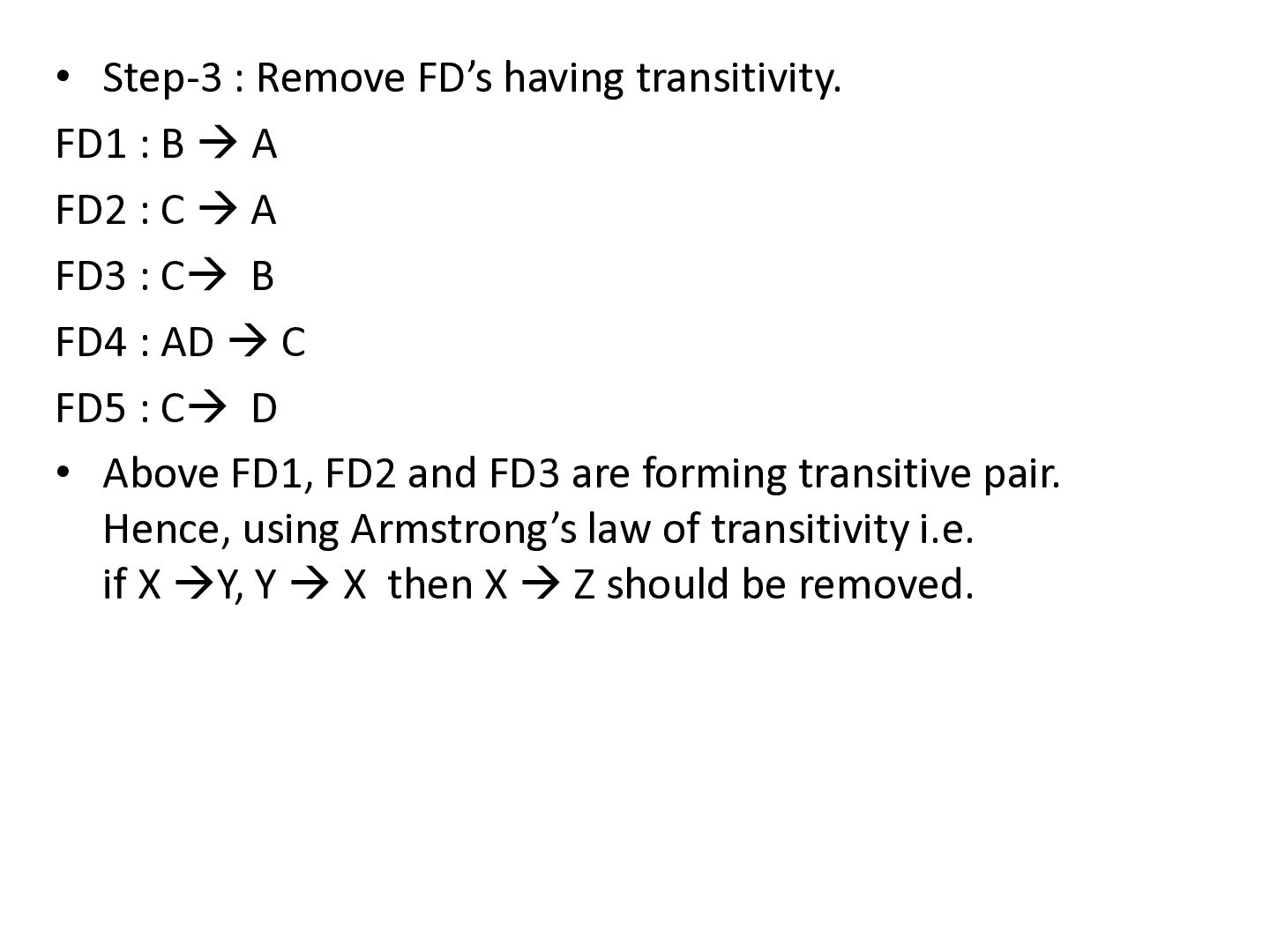
  16. • Step-3 : Remove FD’s having transitivity. FD1 : B

    → A FD2 : C → A FD3 : C→ B FD4 : AD → C FD5 : C→ D • Above FD1, FD2 and FD3 are forming transitive pair. Hence, using Armstrong’s law of transitivity i.e. if X →Y, Y → X then X → Z should be removed.
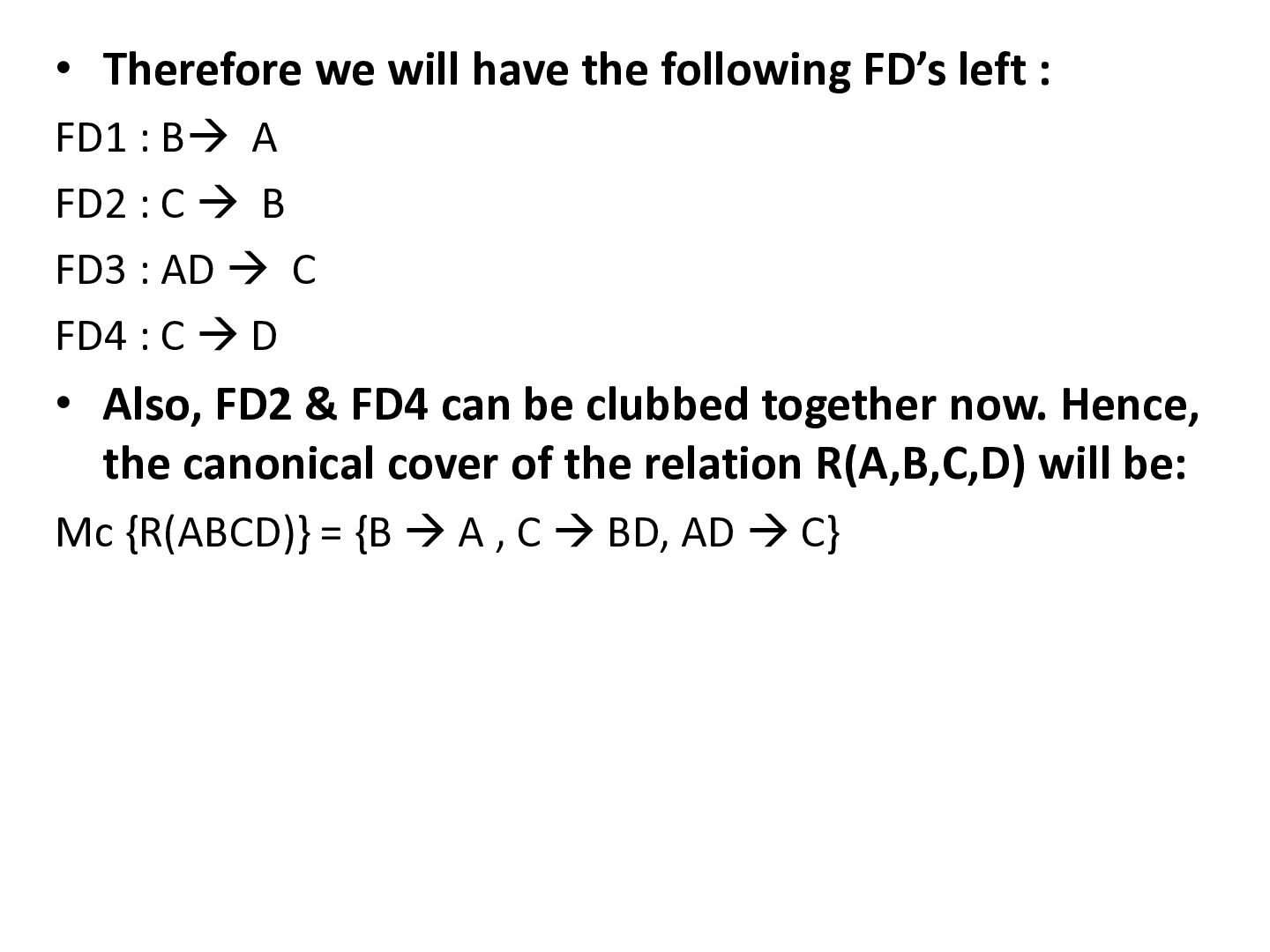
  17. • Therefore we will have the following FD’s left :

    FD1 : B→ A FD2 : C → B FD3 : AD → C FD4 : C → D • Also, FD2 & FD4 can be clubbed together now. Hence, the canonical cover of the relation R(A,B,C,D) will be: Mc {R(ABCD)} = {B → A , C → BD, AD → C}