Upgrade to Pro — share decks privately, control downloads, hide ads and more …

Update on Index Prefetching

Update on Index Prefetching

https://2026.pgconf.dev/session/659
Video: https://youtu.be/7hbxw0W_9gQ?si=dRZ_G9HAHo3P-Amq

Postgres supports AIO since version 18, and a most of the basic executor nodes were already modified to leverage this capability. In many cases this results in significant performance improvements, particularly on storage that requires prefetching.

Index scans are one of the remaining pieces that still don't leverage AIO, despite the obvious benefits of prefetching with random I/O.

In this talk we will discuss the work we've done on using AIO for index scans - the current state of the work, what were (are) the main challenges and difficulties of this multi-year project. We'll explain the basic concepts introduced by the patches (batching, additions to index AM interface, ...) and how it all works together. We'll also share some numbers on performance.

Avatar for Peter Geoghegan

Peter Geoghegan

September 05, 2026

More Decks by Peter Geoghegan

Other Decks in Programming

Transcript

  1. Background and talk goals • This project was (and is)

    difficult and complicated ◦ Several architectural issues make index prefetching during “plain” index scans (and index-only scans that require heap fetches) much harder than other projects that added asynchronous IO to other subsystems ◦ Yak shaving: many of the issues we ran into were quite far removed from the core idea of prefetching using a read stream. We didn’t anticipate most of these problems. • Patches implementing index prefetching almost made it into Postgres 19 • Main focus: the architectural challenges that led to the current design • This talk won’t spend very much time on the benefits for users
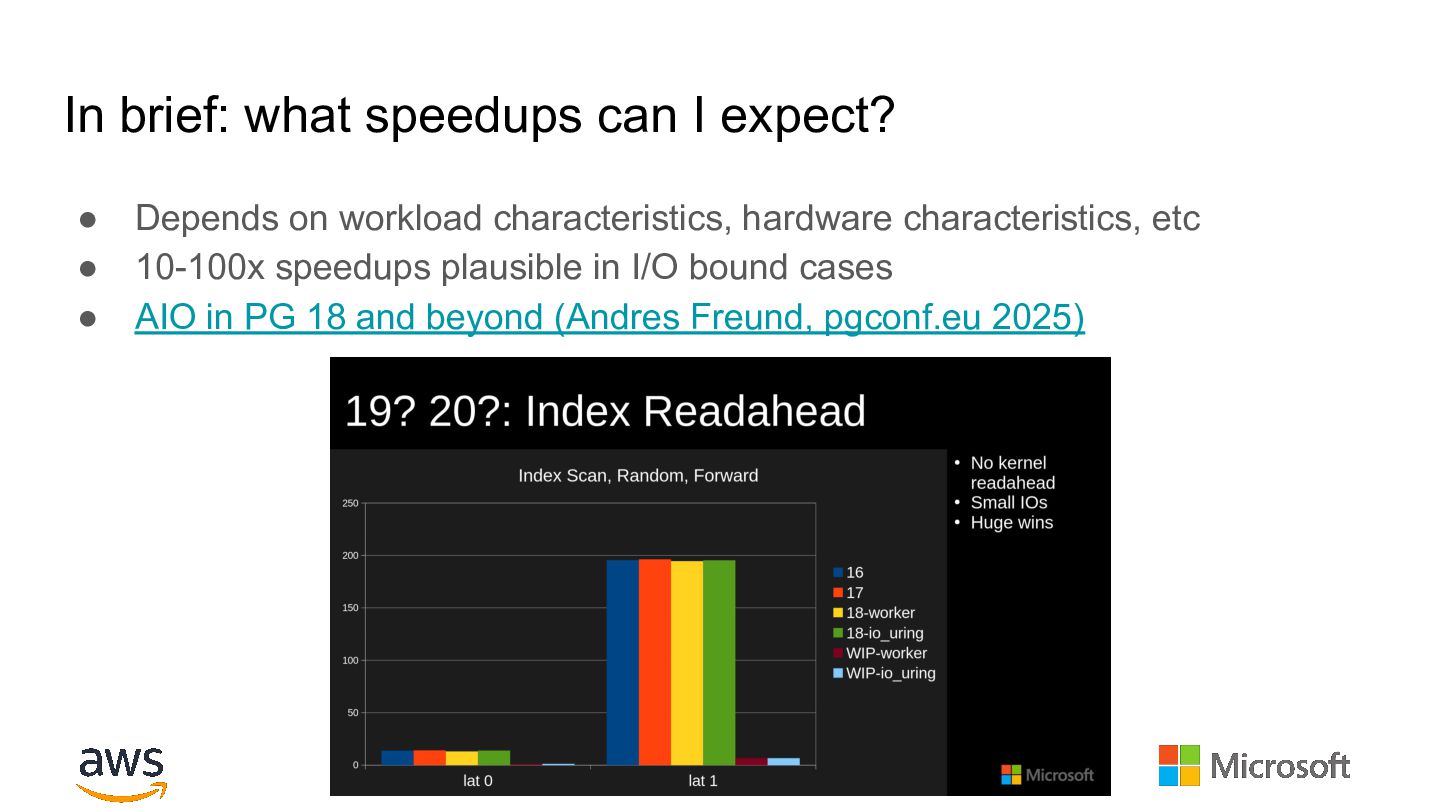
  2. In brief: what speedups can I expect? • • •

    Depends on workload characteristics, hardware characteristics, etc 10-100x speedups plausible in I/O bound cases AIO in PG 18 and beyond (Andres Freund, pgconf.eu 2025)
  3. Agenda • History of this project ◦ • High-level design

    of latest/third approach ◦ • Applying the lessons from the first two failed attempts Regressions (and other risks) ◦ • First two approaches to adding index prefetching How we avoided performance regressions, and managed other risks Future outlook ◦ Follow-on work enabled by the design
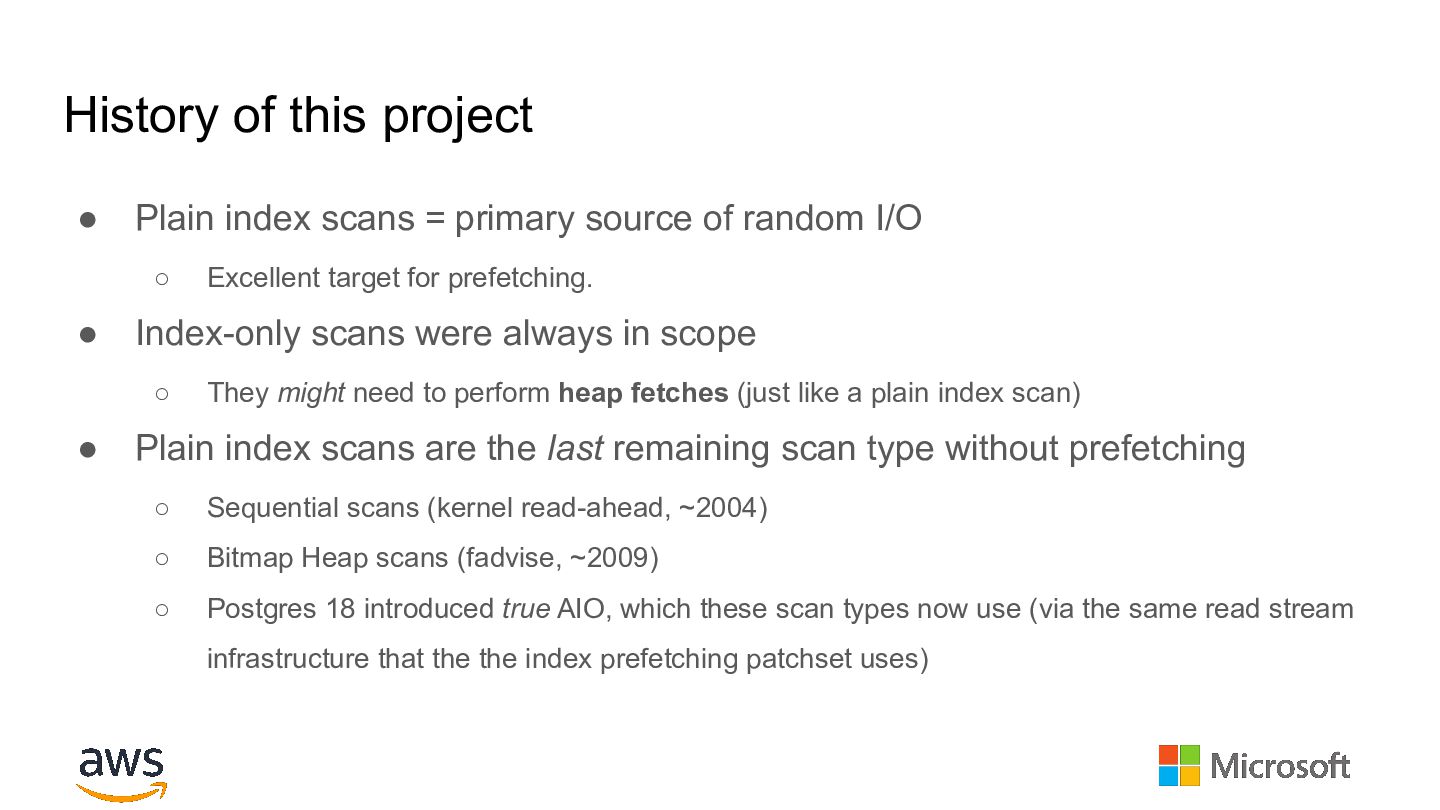
  4. History of this project • Plain index scans = primary

    source of random I/O ◦ • Index-only scans were always in scope ◦ • Excellent target for prefetching. They might need to perform heap fetches (just like a plain index scan) Plain index scans are the last remaining scan type without prefetching ◦ Sequential scans (kernel read-ahead, ~2004) ◦ Bitmap Heap scans (fadvise, ~2009) ◦ Postgres 18 introduced true AIO, which these scan types now use (via the same read stream infrastructure that the the index prefetching patchset uses)
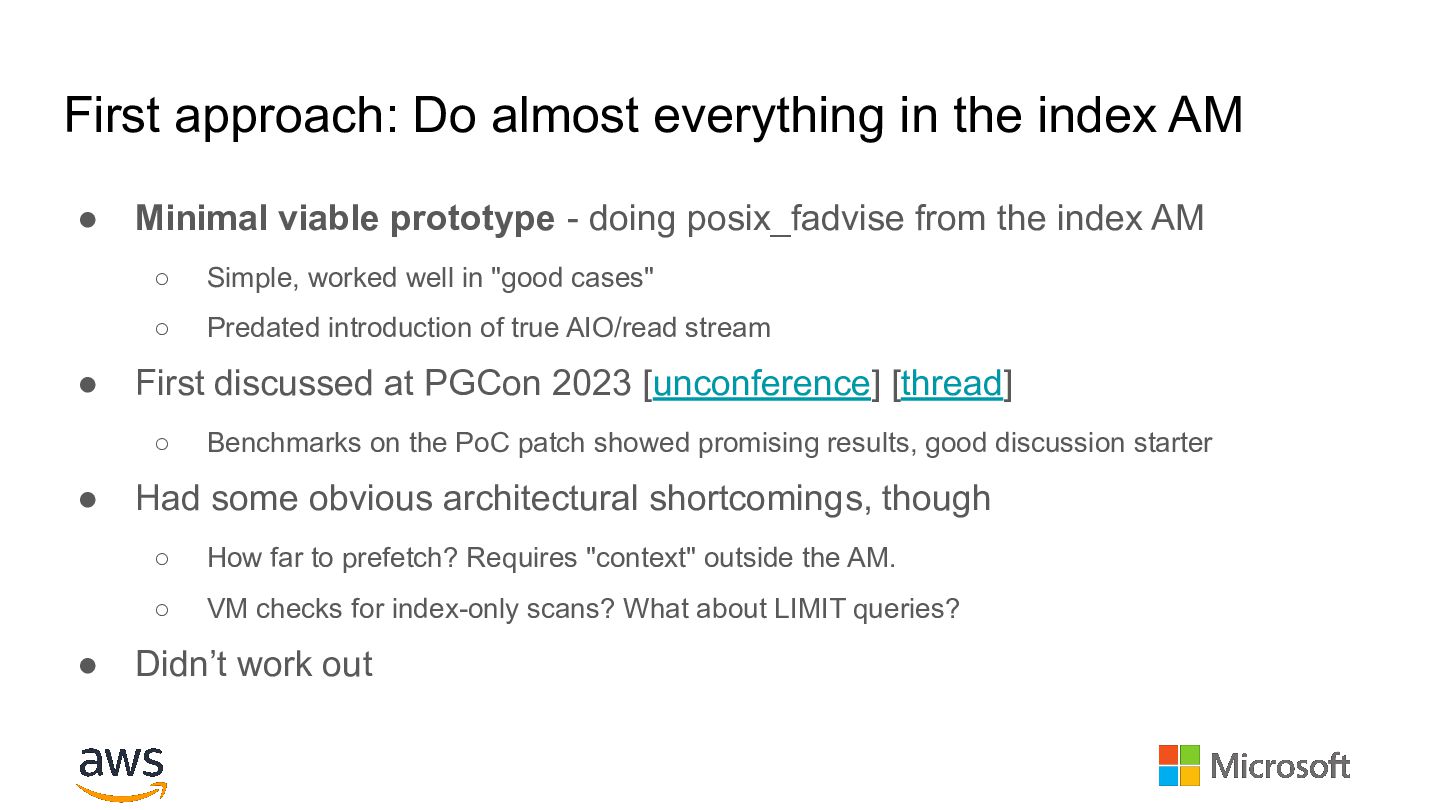
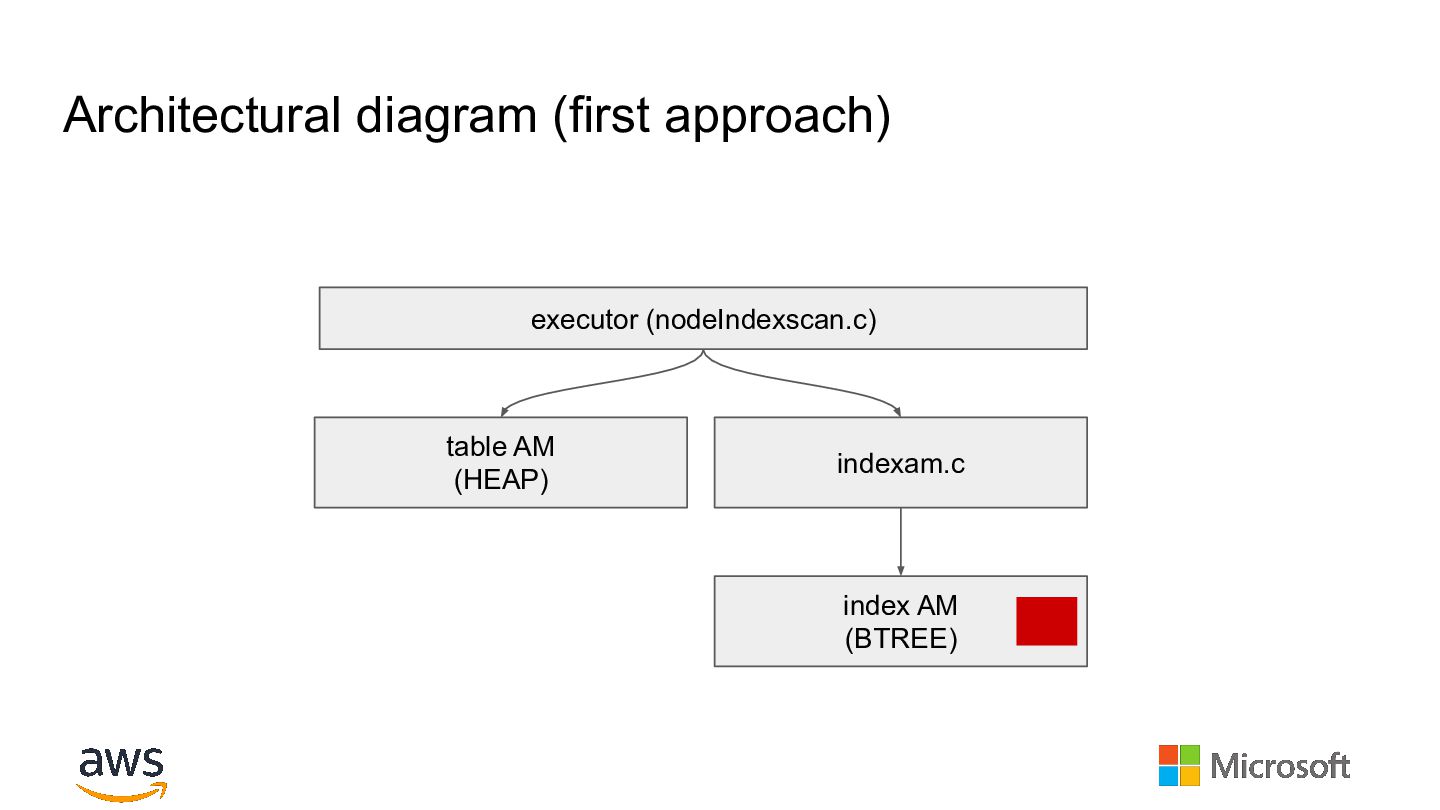
  5. First approach: Do almost everything in the index AM •

    • Minimal viable prototype - doing posix_fadvise from the index AM ◦ Simple, worked well in "good cases" ◦ Predated introduction of true AIO/read stream First discussed at PGCon 2023 [unconference] [thread] ◦ • • Benchmarks on the PoC patch showed promising results, good discussion starter Had some obvious architectural shortcomings, though ◦ How far to prefetch? Requires "context" outside the AM. ◦ VM checks for index-only scans? What about LIMIT queries? Didn’t work out
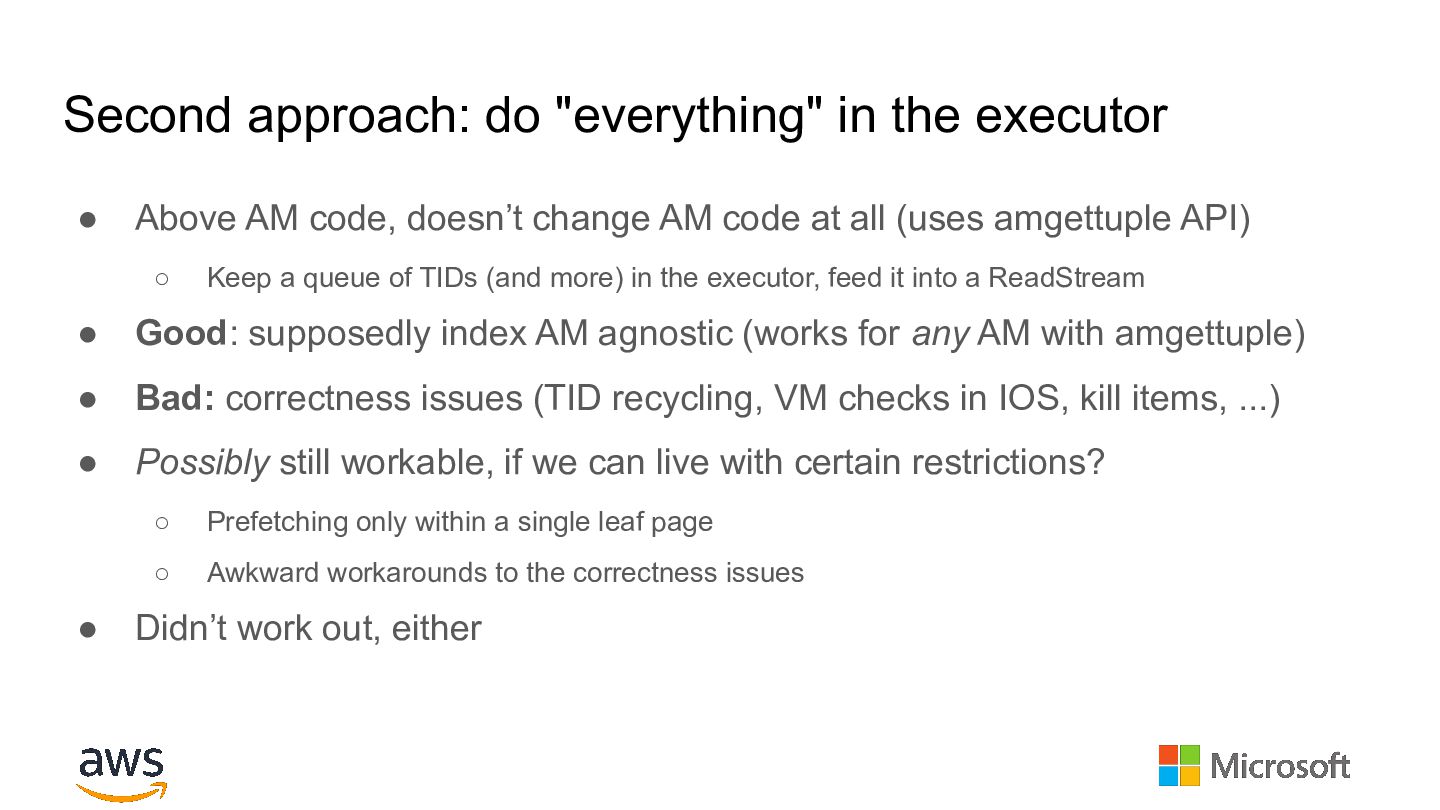
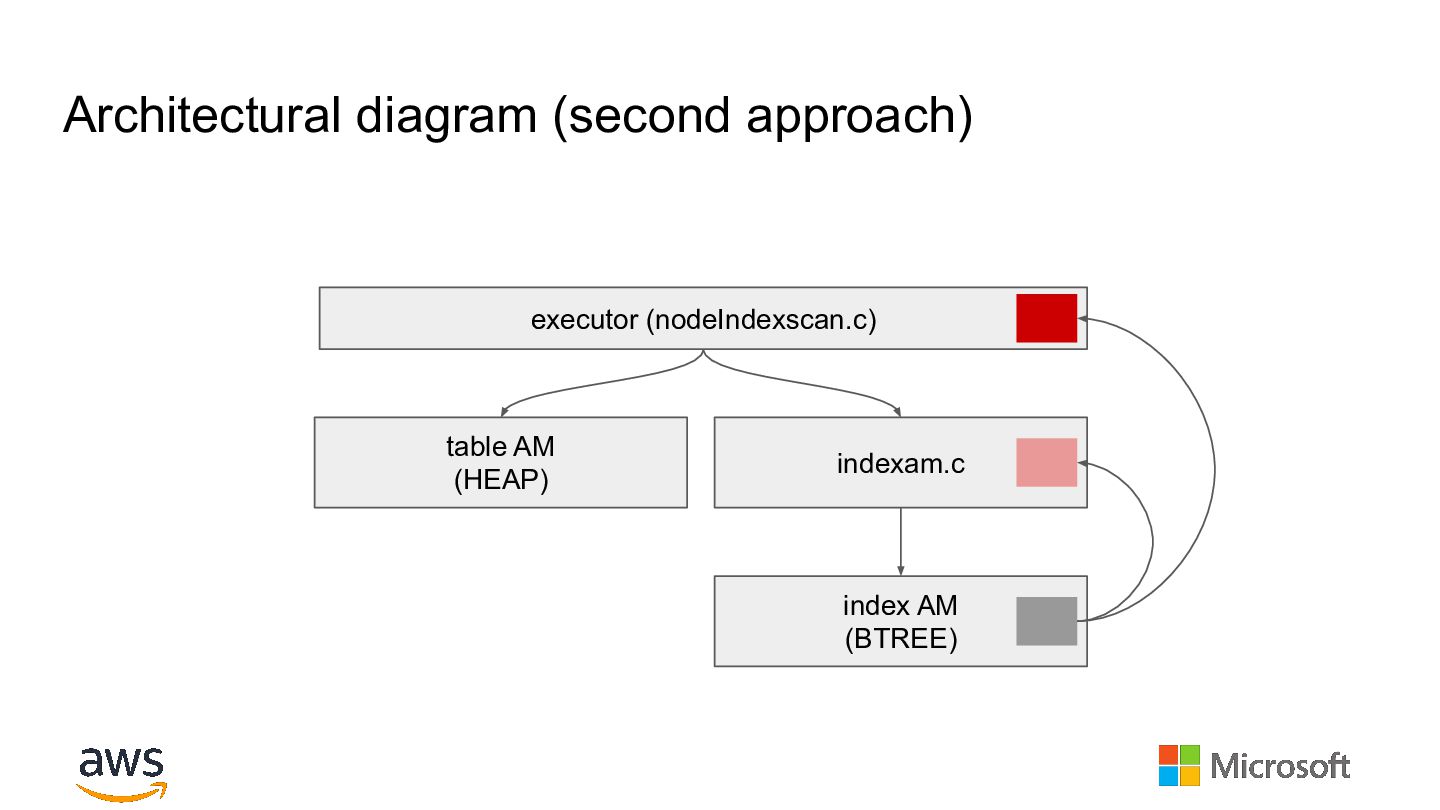
  6. Second approach: do "everything" in the executor • Above AM

    code, doesn’t change AM code at all (uses amgettuple API) ◦ Keep a queue of TIDs (and more) in the executor, feed it into a ReadStream • Good: supposedly index AM agnostic (works for any AM with amgettuple) • Bad: correctness issues (TID recycling, VM checks in IOS, kill items, ...) • Possibly still workable, if we can live with certain restrictions? • ◦ Prefetching only within a single leaf page ◦ Awkward workarounds to the correctness issues Didn’t work out, either
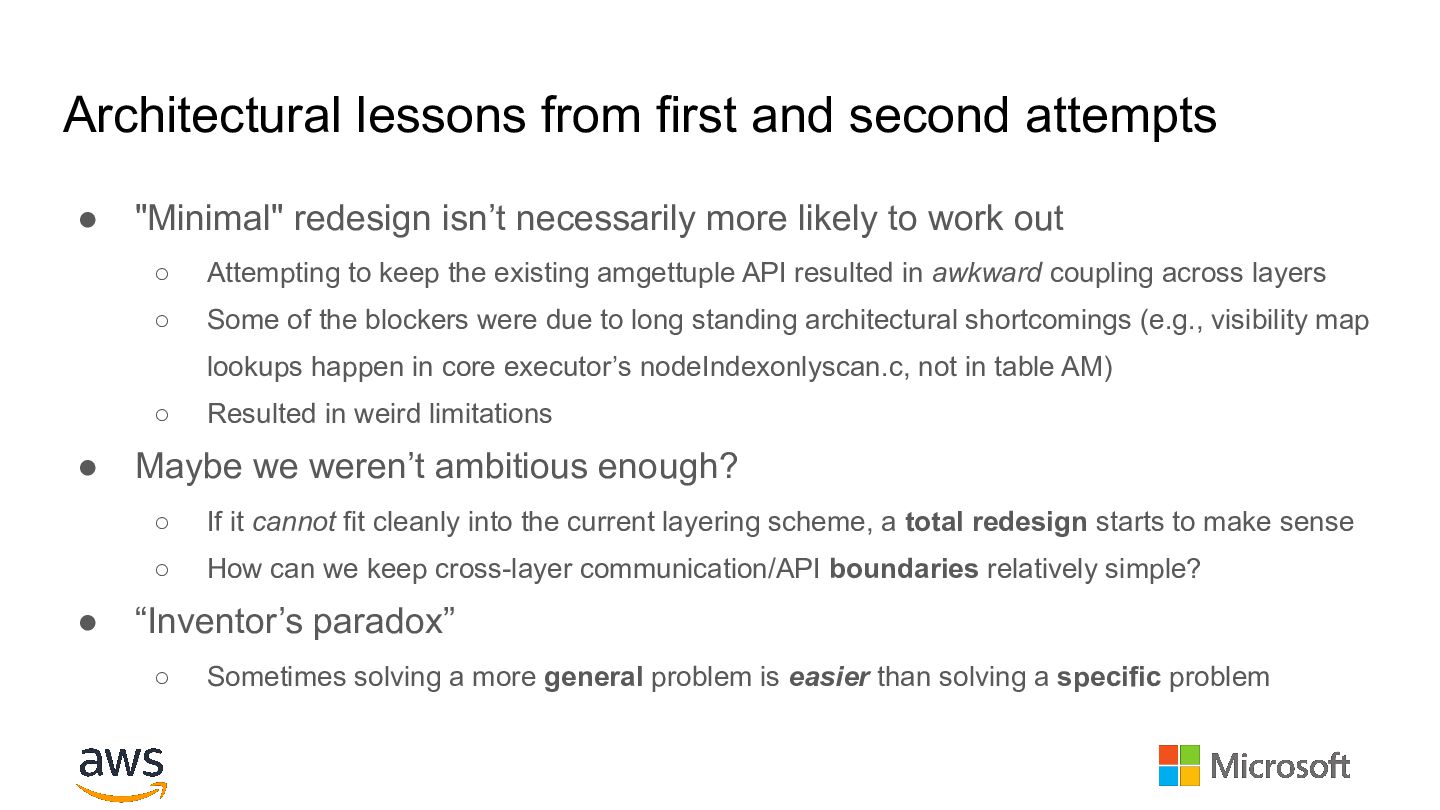
  7. Architectural lessons from first and second attempts • "Minimal" redesign

    isn’t necessarily more likely to work out ◦ Attempting to keep the existing amgettuple API resulted in awkward coupling across layers ◦ Some of the blockers were due to long standing architectural shortcomings (e.g., visibility map lookups happen in core executor’s nodeIndexonlyscan.c, not in table AM) ◦ • • Resulted in weird limitations Maybe we weren’t ambitious enough? ◦ If it cannot fit cleanly into the current layering scheme, a total redesign starts to make sense ◦ How can we keep cross-layer communication/API boundaries relatively simple? “Inventor’s paradox” ◦ Sometimes solving a more general problem is easier than solving a specific problem
  8. Agenda • History of this project ◦ • High-level design

    of latest/third approach ◦ • Applying the lessons from the first two failed attempts Regressions (and other risks) ◦ • First two approaches to adding index prefetching How we avoided performance regressions, and managed other risks Future outlook ◦ Follow-on work enabled by the design
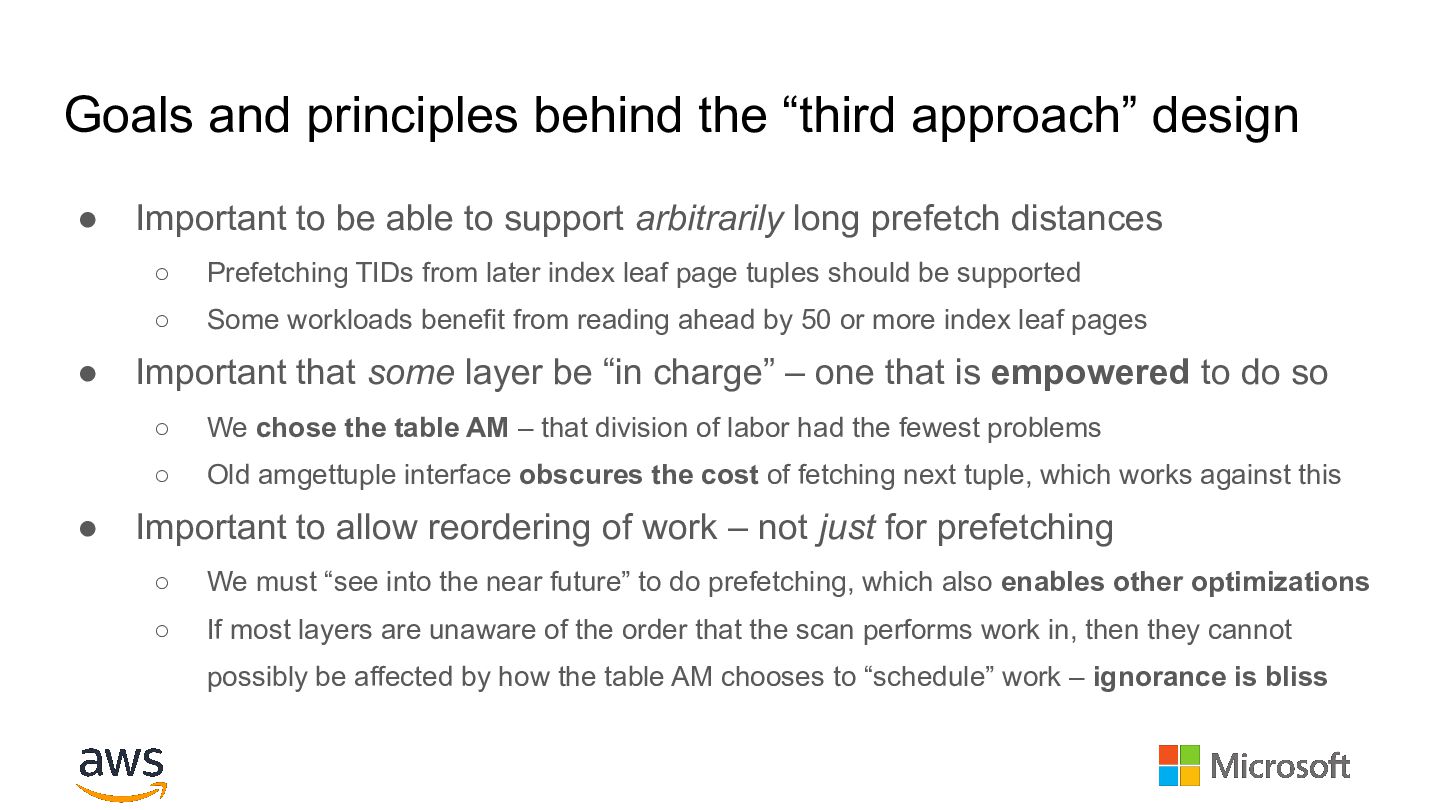
  9. Goals and principles behind the “third approach” design • •

    • Important to be able to support arbitrarily long prefetch distances ◦ Prefetching TIDs from later index leaf page tuples should be supported ◦ Some workloads benefit from reading ahead by 50 or more index leaf pages Important that some layer be “in charge” – one that is empowered to do so ◦ We chose the table AM – that division of labor had the fewest problems ◦ Old amgettuple interface obscures the cost of fetching next tuple, which works against this Important to allow reordering of work – not just for prefetching ◦ We must “see into the near future” to do prefetching, which also enables other optimizations ◦ If most layers are unaware of the order that the scan performs work in, then they cannot possibly be affected by how the table AM chooses to “schedule” work – ignorance is bliss
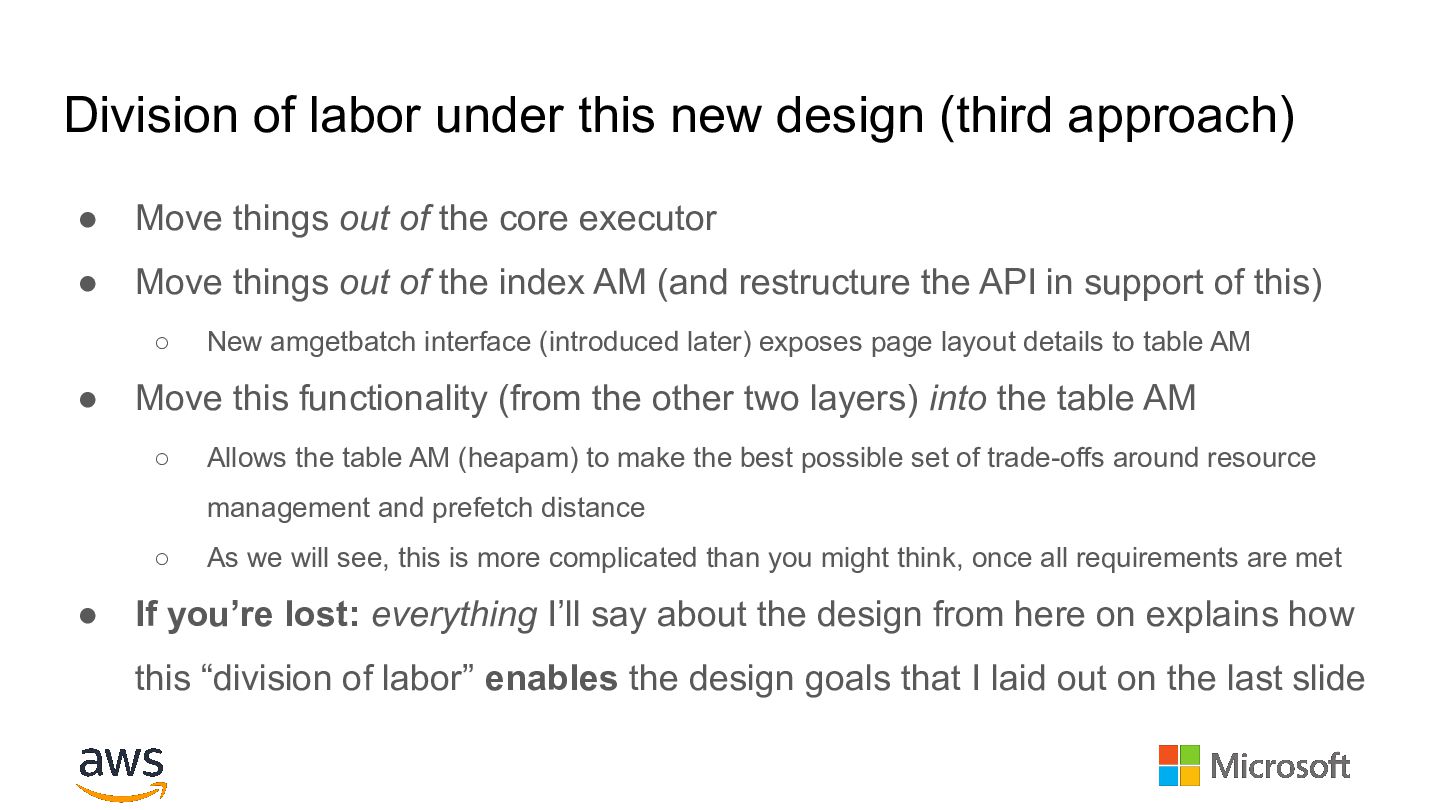
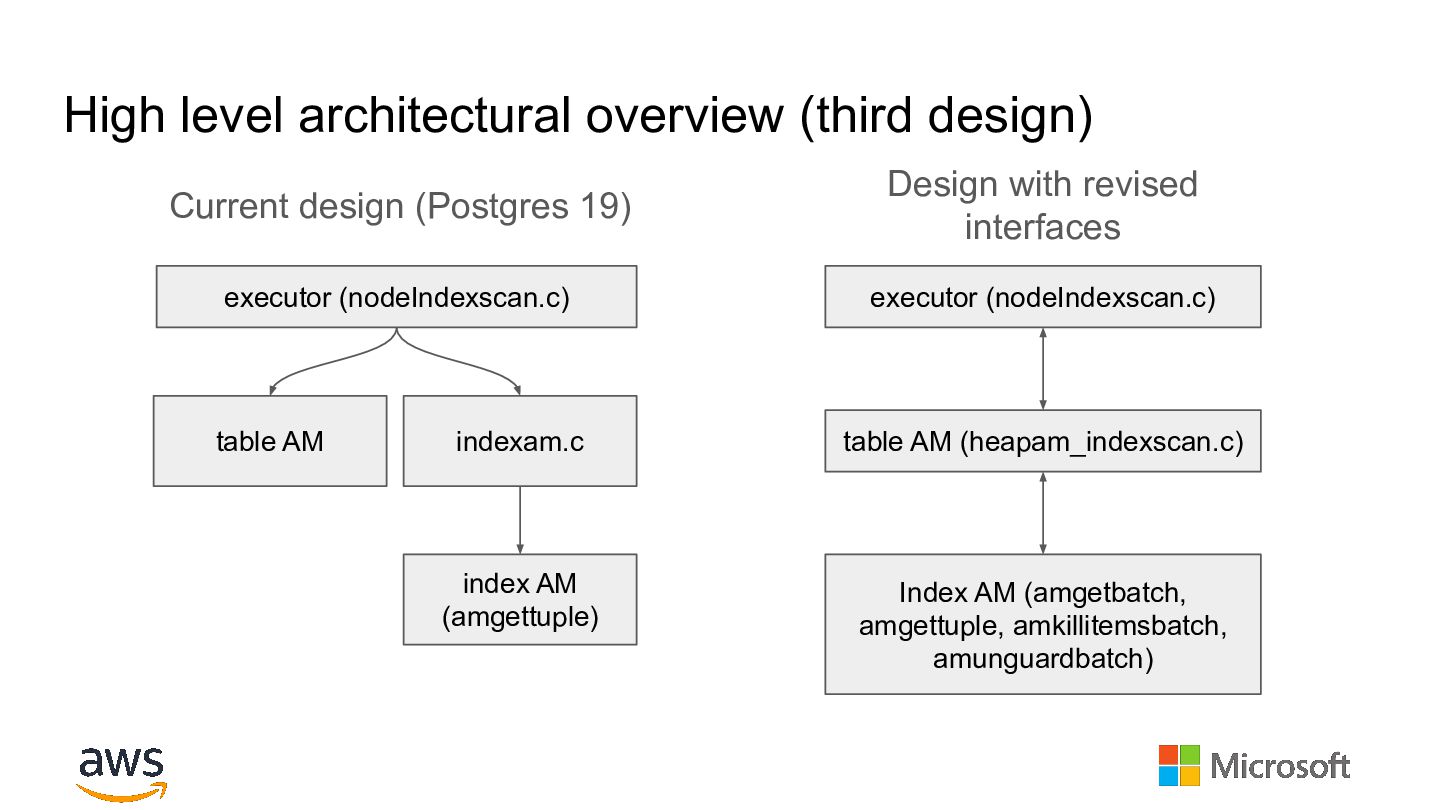
  10. Division of labor under this new design (third approach) •

    Move things out of the core executor • Move things out of the index AM (and restructure the API in support of this) ◦ • New amgetbatch interface (introduced later) exposes page layout details to table AM Move this functionality (from the other two layers) into the table AM ◦ Allows the table AM (heapam) to make the best possible set of trade-offs around resource management and prefetch distance ◦ • As we will see, this is more complicated than you might think, once all requirements are met If you’re lost: everything I’ll say about the design from here on explains how this “division of labor” enables the design goals that I laid out on the last slide
  11. High level architectural overview (third design) Current design (Postgres 19)

    Design with revised interfaces executor (nodeIndexscan.c) executor (nodeIndexscan.c) table AM indexam.c table AM (heapam_indexscan.c) index AM (amgettuple) Index AM (amgetbatch, amgettuple, amkillitemsbatch, amunguardbatch)
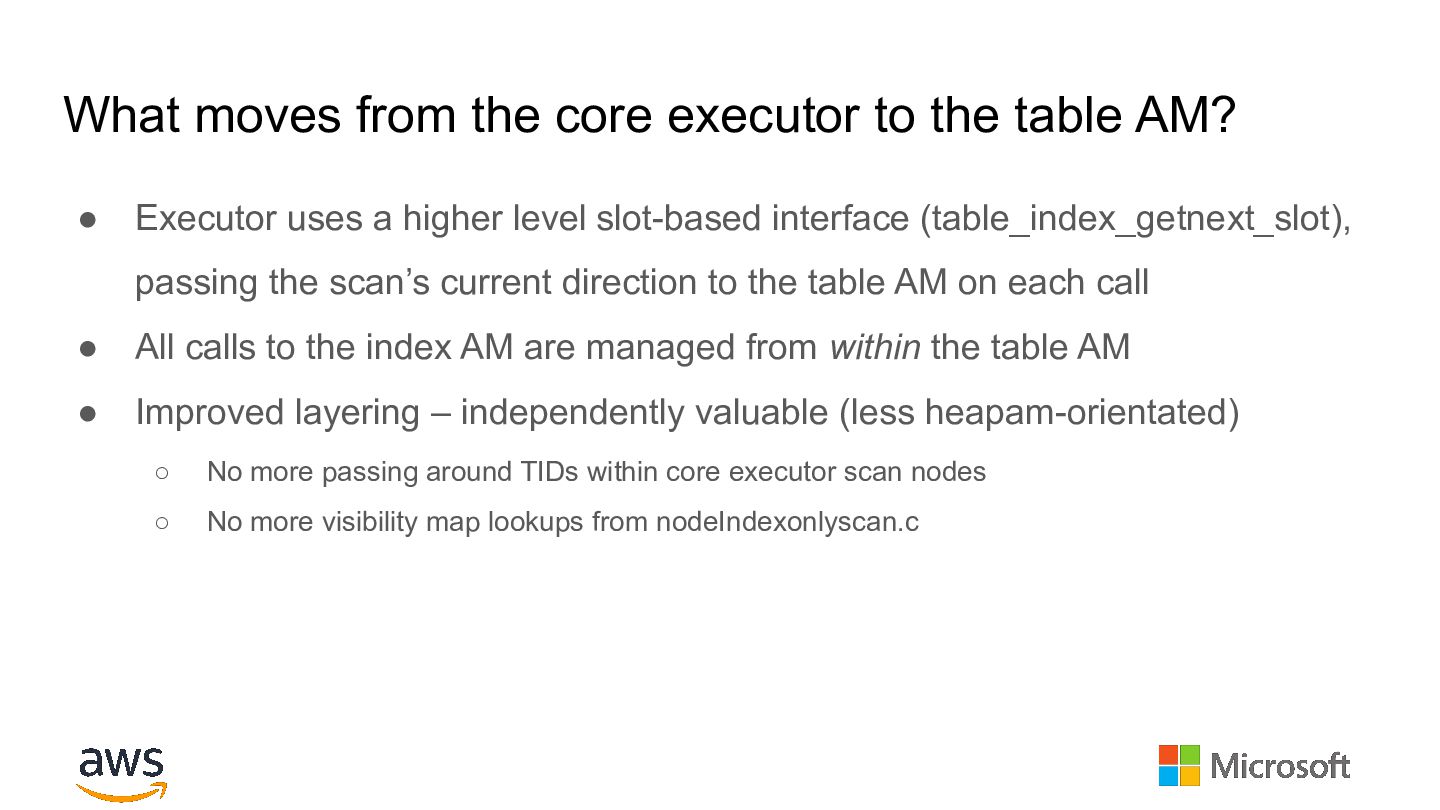
  12. What moves from the core executor to the table AM?

    • Executor uses a higher level slot-based interface (table_index_getnext_slot), passing the scan’s current direction to the table AM on each call • All calls to the index AM are managed from within the table AM • Improved layering – independently valuable (less heapam-orientated) ◦ No more passing around TIDs within core executor scan nodes ◦ No more visibility map lookups from nodeIndexonlyscan.c
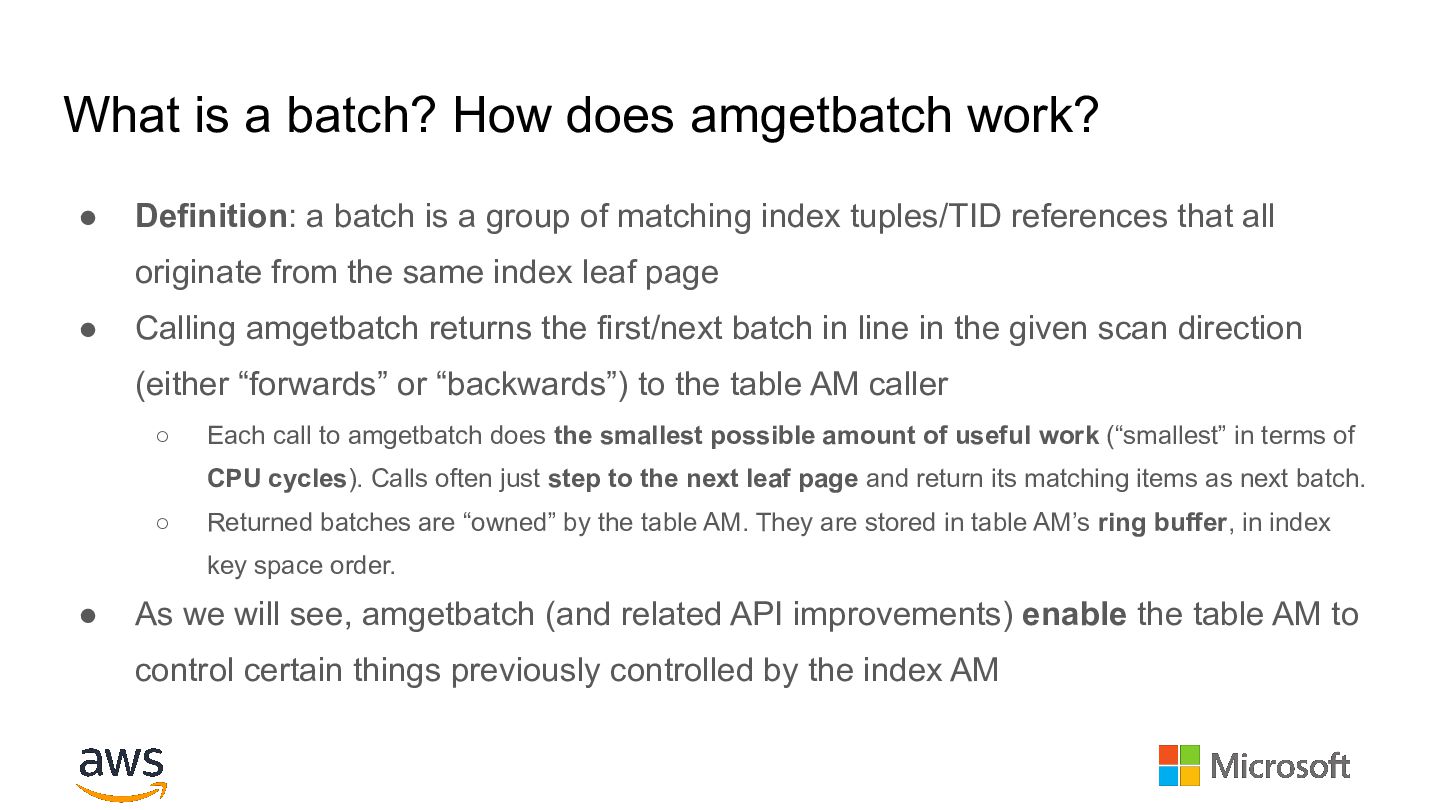
  13. What is a batch? How does amgetbatch work? • Definition:

    a batch is a group of matching index tuples/TID references that all originate from the same index leaf page • Calling amgetbatch returns the first/next batch in line in the given scan direction (either “forwards” or “backwards”) to the table AM caller ◦ Each call to amgetbatch does the smallest possible amount of useful work (“smallest” in terms of CPU cycles). Calls often just step to the next leaf page and return its matching items as next batch. ◦ Returned batches are “owned” by the table AM. They are stored in table AM’s ring buffer, in index key space order. • As we will see, amgetbatch (and related API improvements) enable the table AM to control certain things previously controlled by the index AM
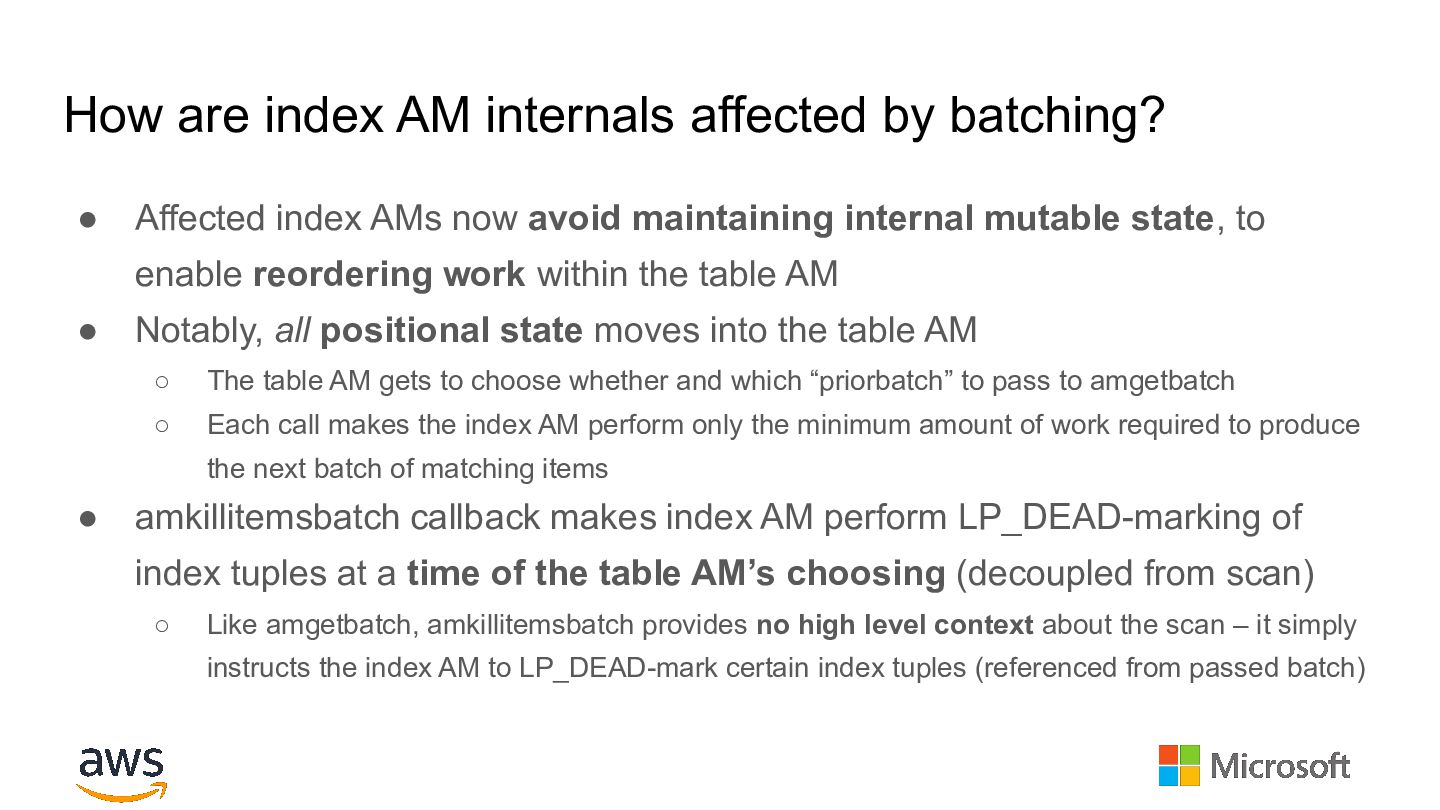
  14. How are index AM internals affected by batching? • Affected

    index AMs now avoid maintaining internal mutable state, to enable reordering work within the table AM • Notably, all positional state moves into the table AM ◦ The table AM gets to choose whether and which “priorbatch” to pass to amgetbatch ◦ Each call makes the index AM perform only the minimum amount of work required to produce the next batch of matching items • amkillitemsbatch callback makes index AM perform LP_DEAD-marking of index tuples at a time of the table AM’s choosing (decoupled from scan) ◦ Like amgetbatch, amkillitemsbatch provides no high level context about the scan – it simply instructs the index AM to LP_DEAD-mark certain index tuples (referenced from passed batch)
  15. How are index AM internals affected by batching? (Cont.) •

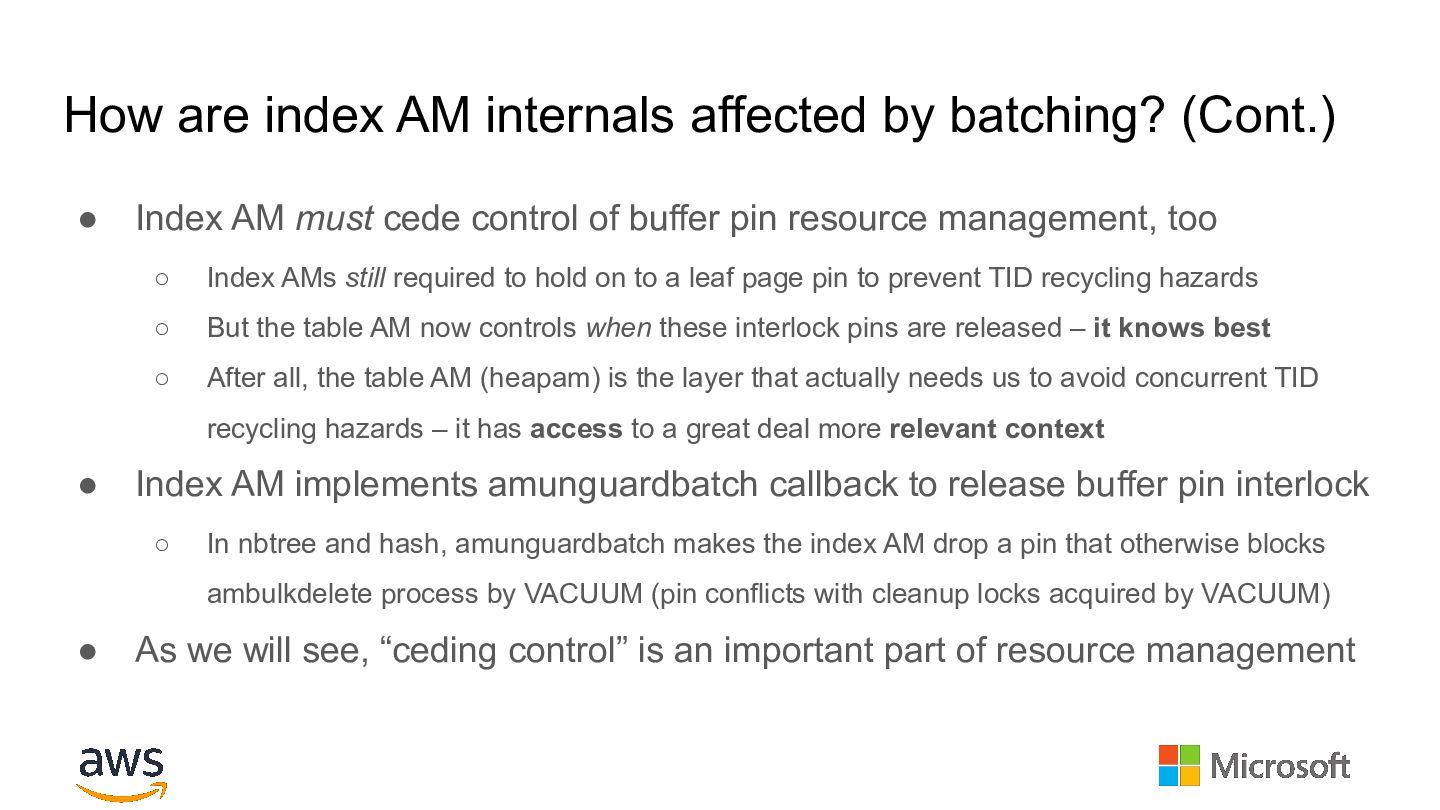
    Index AM must cede control of buffer pin resource management, too ◦ Index AMs still required to hold on to a leaf page pin to prevent TID recycling hazards ◦ But the table AM now controls when these interlock pins are released – it knows best ◦ After all, the table AM (heapam) is the layer that actually needs us to avoid concurrent TID recycling hazards – it has access to a great deal more relevant context • Index AM implements amunguardbatch callback to release buffer pin interlock ◦ In nbtree and hash, amunguardbatch makes the index AM drop a pin that otherwise blocks ambulkdelete process by VACUUM (pin conflicts with cleanup locks acquired by VACUUM) • As we will see, “ceding control” is an important part of resource management
  16. Maintaining heapam read stream when prefetching • heapam uses read

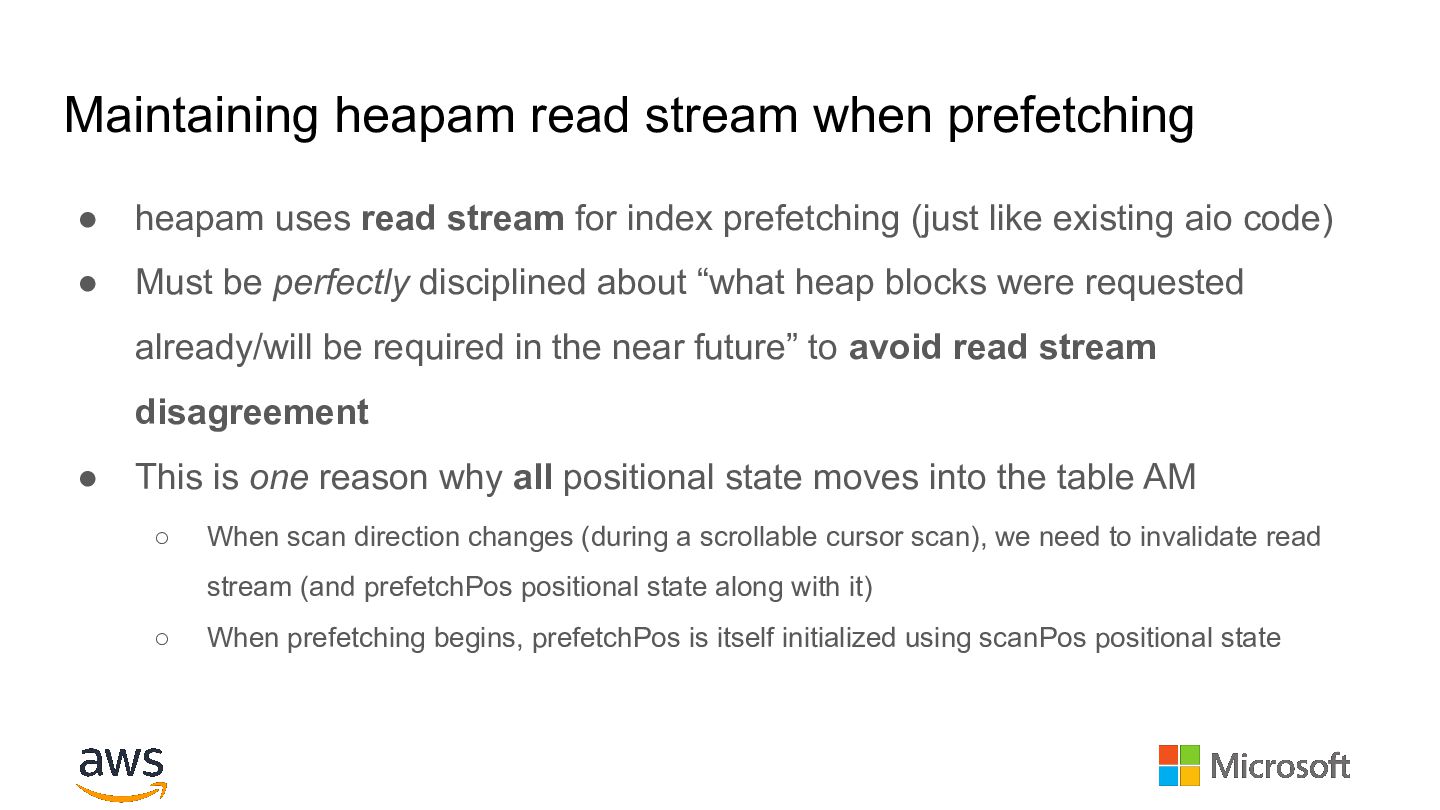
    stream for index prefetching (just like existing aio code) • Must be perfectly disciplined about “what heap blocks were requested already/will be required in the near future” to avoid read stream disagreement • This is one reason why all positional state moves into the table AM ◦ When scan direction changes (during a scrollable cursor scan), we need to invalidate read stream (and prefetchPos positional state along with it) ◦ When prefetching begins, prefetchPos is itself initialized using scanPos positional state
  17. heapam’s batch ring buffer and “work scheduling” scanPos requests next

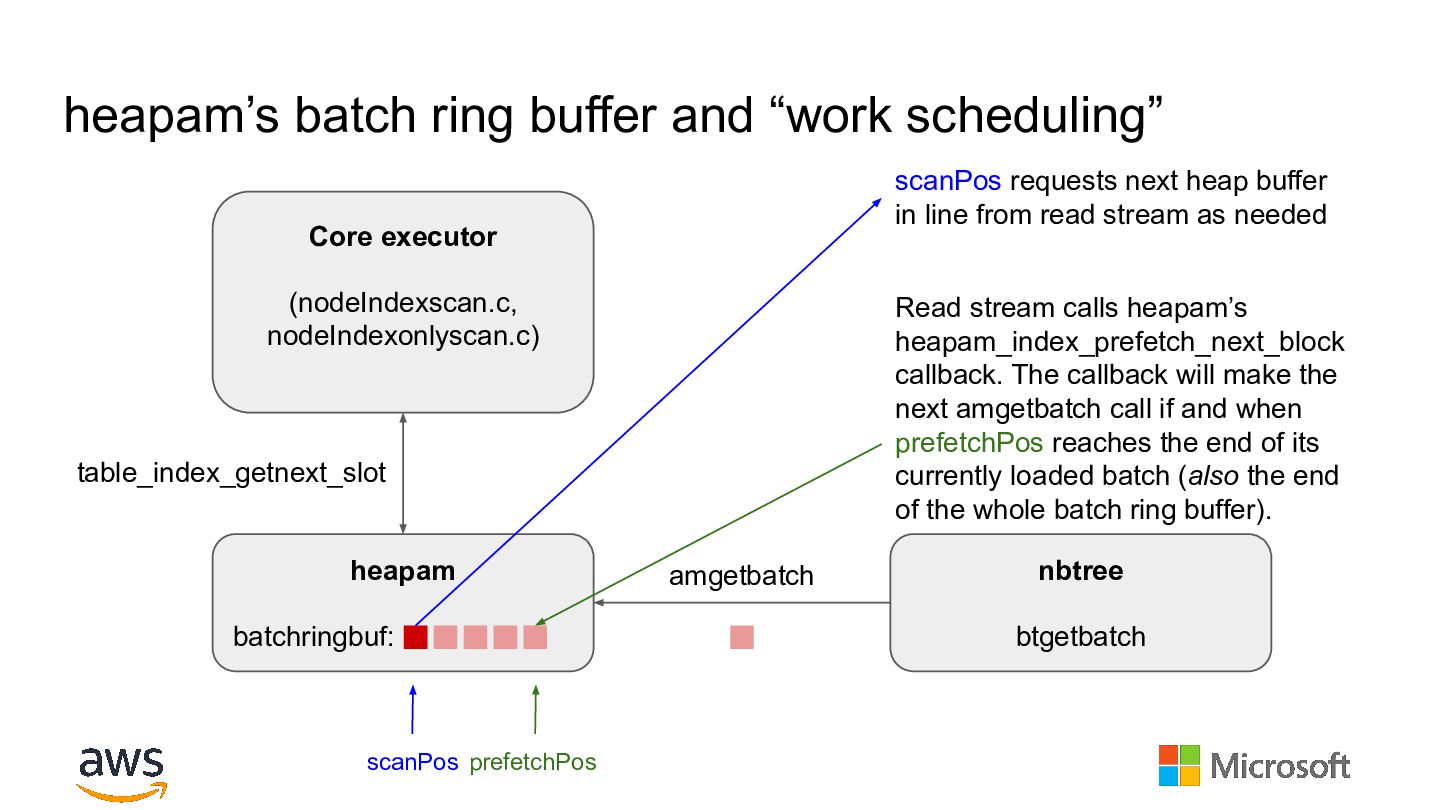
    heap buffer in line from read stream as needed Core executor (nodeIndexscan.c, nodeIndexonlyscan.c) Read stream calls heapam’s heapam_index_prefetch_next_block callback. The callback will make the next amgetbatch call if and when prefetchPos reaches the end of its currently loaded batch (also the end of the whole batch ring buffer). table_index_getnext_slot heapam batchringbuf: scanPos prefetchPos amgetbatch nbtree btgetbatch
  18. The visibility map cache’s “keep read stream consistent with VM”

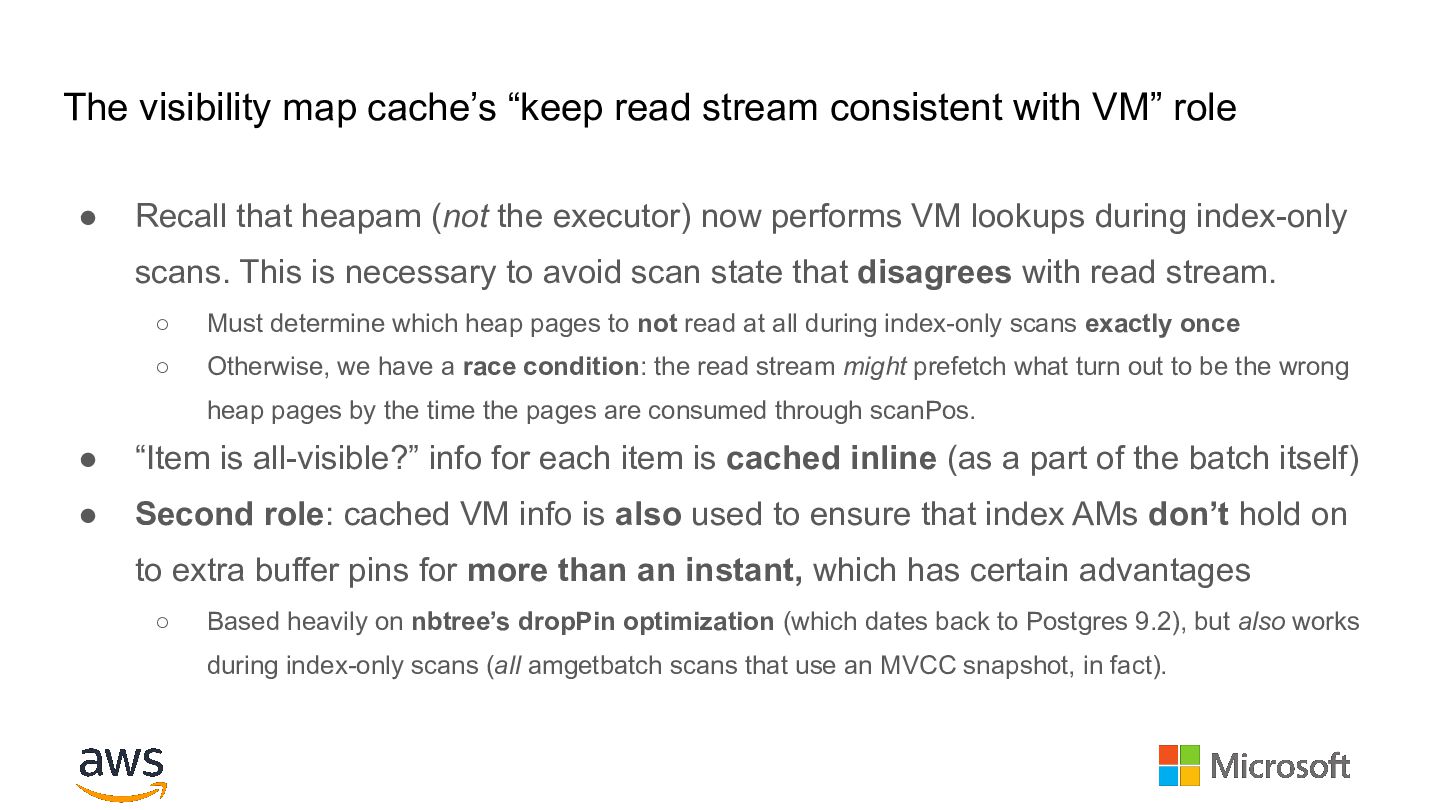
    role • Recall that heapam (not the executor) now performs VM lookups during index-only scans. This is necessary to avoid scan state that disagrees with read stream. ◦ Must determine which heap pages to not read at all during index-only scans exactly once ◦ Otherwise, we have a race condition: the read stream might prefetch what turn out to be the wrong heap pages by the time the pages are consumed through scanPos. • “Item is all-visible?” info for each item is cached inline (as a part of the batch itself) • Second role: cached VM info is also used to ensure that index AMs don’t hold on to extra buffer pins for more than an instant, which has certain advantages ◦ Based heavily on nbtree’s dropPin optimization (which dates back to Postgres 9.2), but also works during index-only scans (all amgetbatch scans that use an MVCC snapshot, in fact).
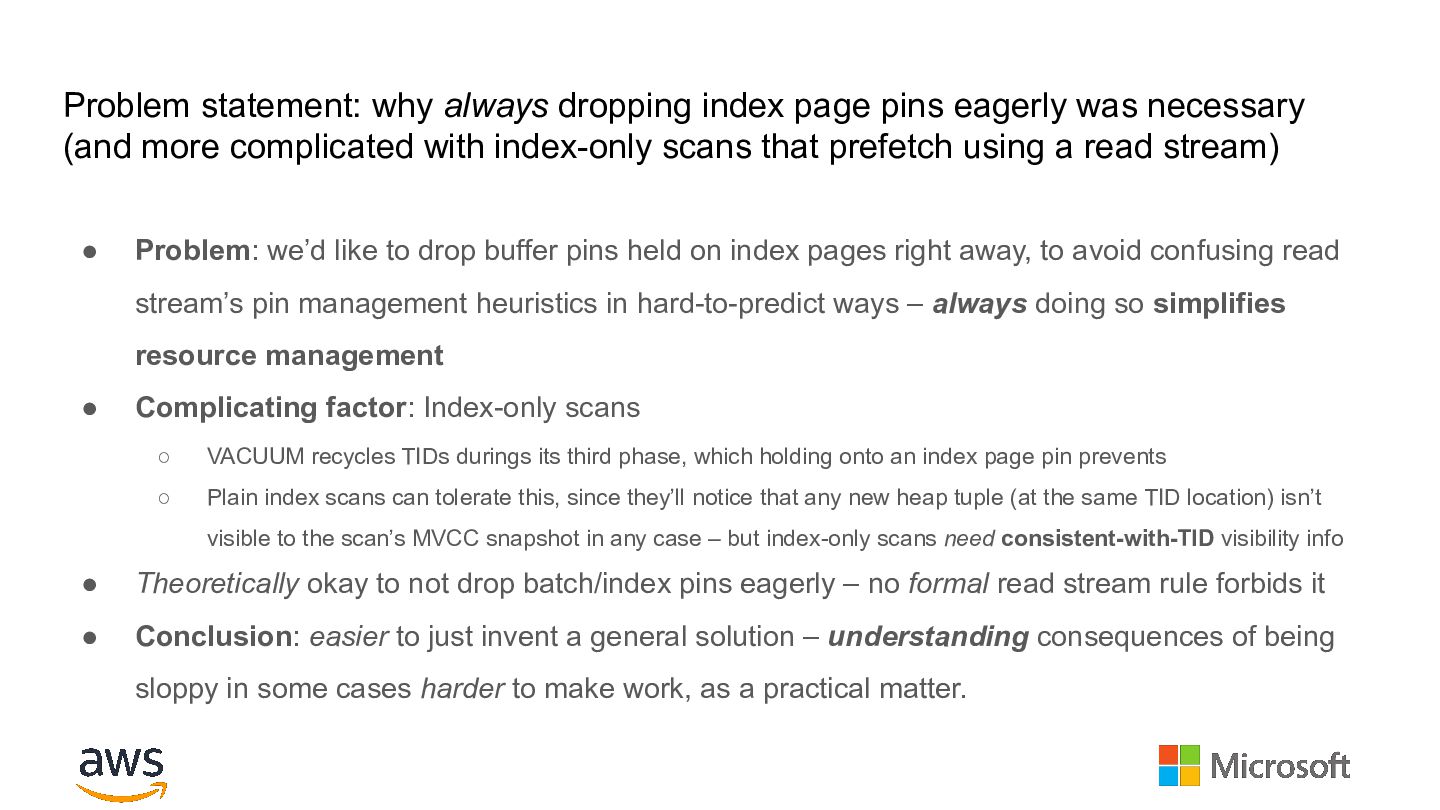
  19. Problem statement: why always dropping index page pins eagerly was

    necessary (and more complicated with index-only scans that prefetch using a read stream) • Problem: we’d like to drop buffer pins held on index pages right away, to avoid confusing read stream’s pin management heuristics in hard-to-predict ways – always doing so simplifies resource management • Complicating factor: Index-only scans ◦ VACUUM recycles TIDs durings its third phase, which holding onto an index page pin prevents ◦ Plain index scans can tolerate this, since they’ll notice that any new heap tuple (at the same TID location) isn’t visible to the scan’s MVCC snapshot in any case – but index-only scans need consistent-with-TID visibility info • Theoretically okay to not drop batch/index pins eagerly – no formal read stream rule forbids it • Conclusion: easier to just invent a general solution – understanding consequences of being sloppy in some cases harder to make work, as a practical matter.
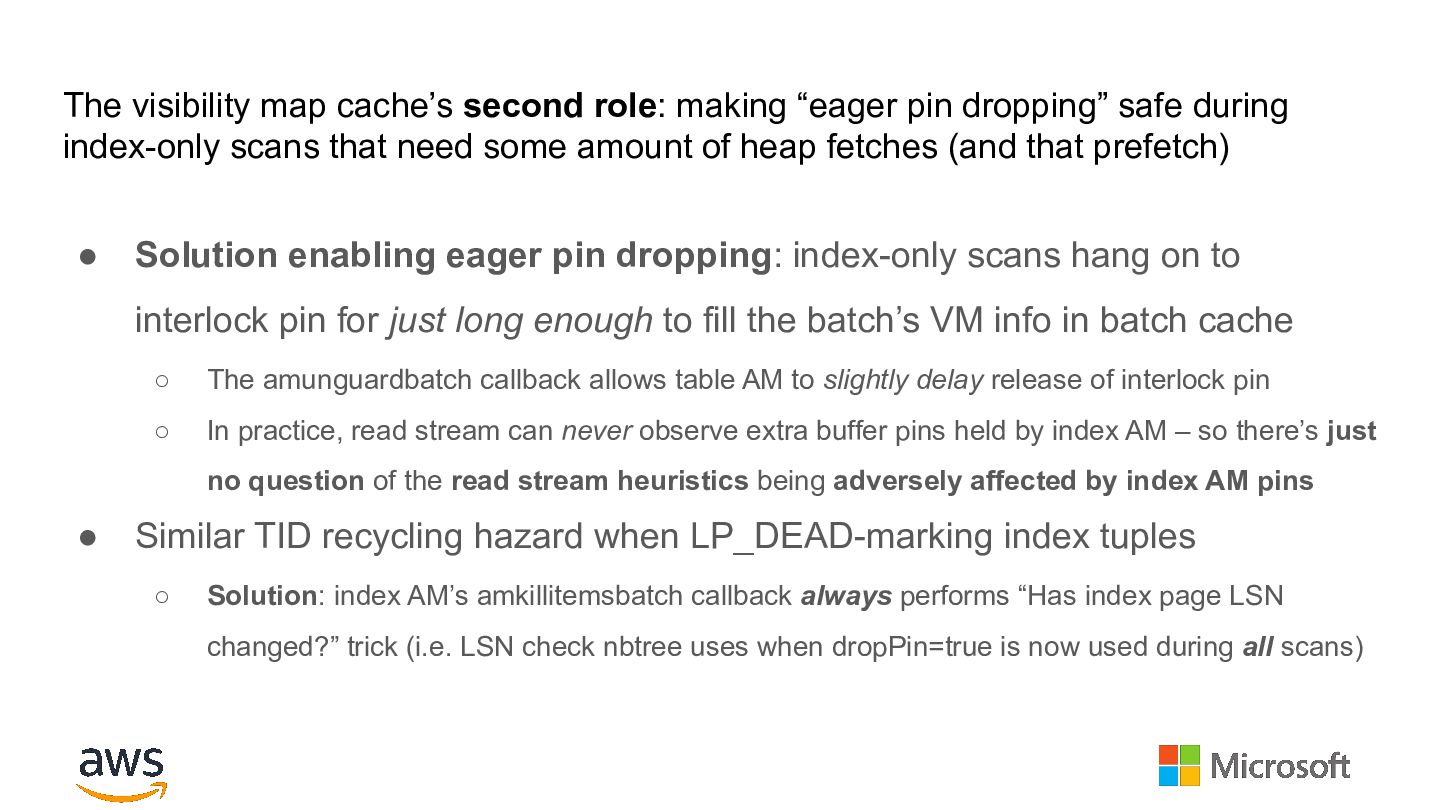
  20. The visibility map cache’s second role: making “eager pin dropping”

    safe during index-only scans that need some amount of heap fetches (and that prefetch) • Solution enabling eager pin dropping: index-only scans hang on to interlock pin for just long enough to fill the batch’s VM info in batch cache ◦ The amunguardbatch callback allows table AM to slightly delay release of interlock pin ◦ In practice, read stream can never observe extra buffer pins held by index AM – so there’s just no question of the read stream heuristics being adversely affected by index AM pins • Similar TID recycling hazard when LP_DEAD-marking index tuples ◦ Solution: index AM’s amkillitemsbatch callback always performs “Has index page LSN changed?” trick (i.e. LSN check nbtree uses when dropPin=true is now used during all scans)
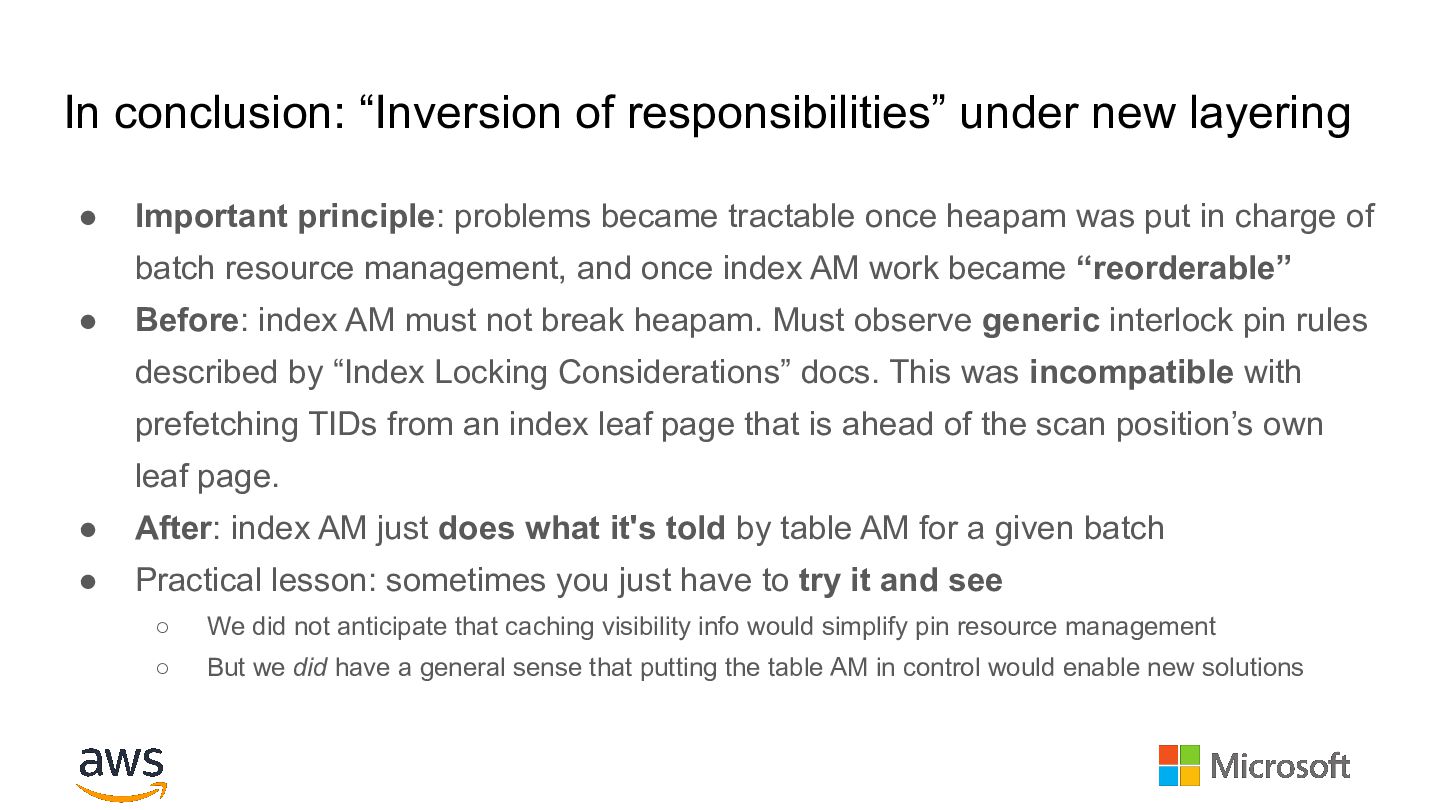
  21. In conclusion: “Inversion of responsibilities” under new layering • Important

    principle: problems became tractable once heapam was put in charge of batch resource management, and once index AM work became “reorderable” • Before: index AM must not break heapam. Must observe generic interlock pin rules described by “Index Locking Considerations” docs. This was incompatible with prefetching TIDs from an index leaf page that is ahead of the scan position’s own leaf page. • After: index AM just does what it's told by table AM for a given batch • Practical lesson: sometimes you just have to try it and see ◦ We did not anticipate that caching visibility info would simplify pin resource management ◦ But we did have a general sense that putting the table AM in control would enable new solutions
  22. Agenda • History of this project ◦ • High-level design

    of latest/third approach ◦ • Applying the lessons from the first two failed attempts Regressions (and other risks) ◦ • First two approaches to adding index prefetching How we avoided performance regressions, and managed other risks Future outlook ◦ Follow-on work enabled by the design
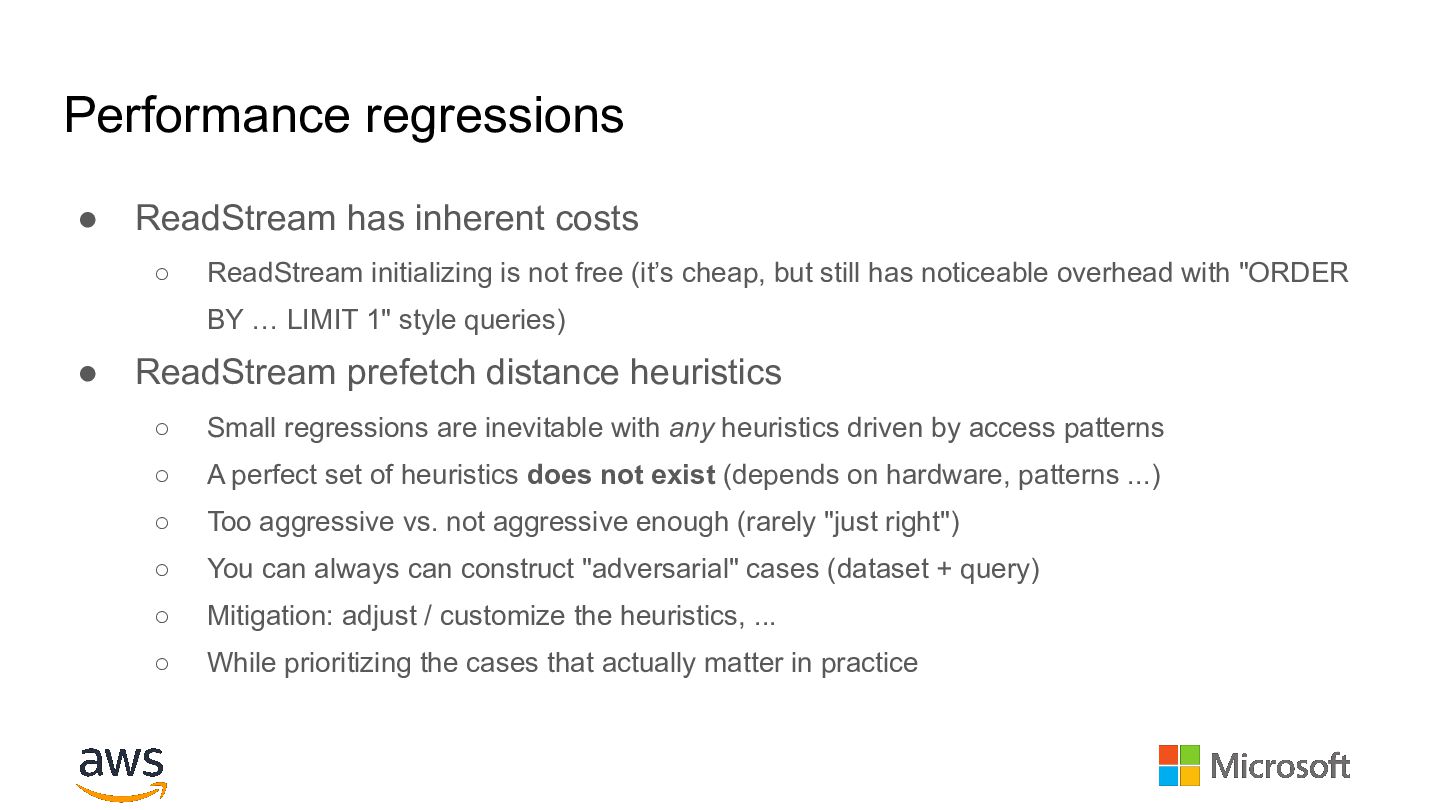
  23. Performance regressions • ReadStream has inherent costs ◦ ReadStream initializing

    is not free (it’s cheap, but still has noticeable overhead with "ORDER BY … LIMIT 1" style queries) • ReadStream prefetch distance heuristics ◦ Small regressions are inevitable with any heuristics driven by access patterns ◦ A perfect set of heuristics does not exist (depends on hardware, patterns ...) ◦ Too aggressive vs. not aggressive enough (rarely "just right") ◦ You can always can construct "adversarial" cases (dataset + query) ◦ Mitigation: adjust / customize the heuristics, ... ◦ While prioritizing the cases that actually matter in practice
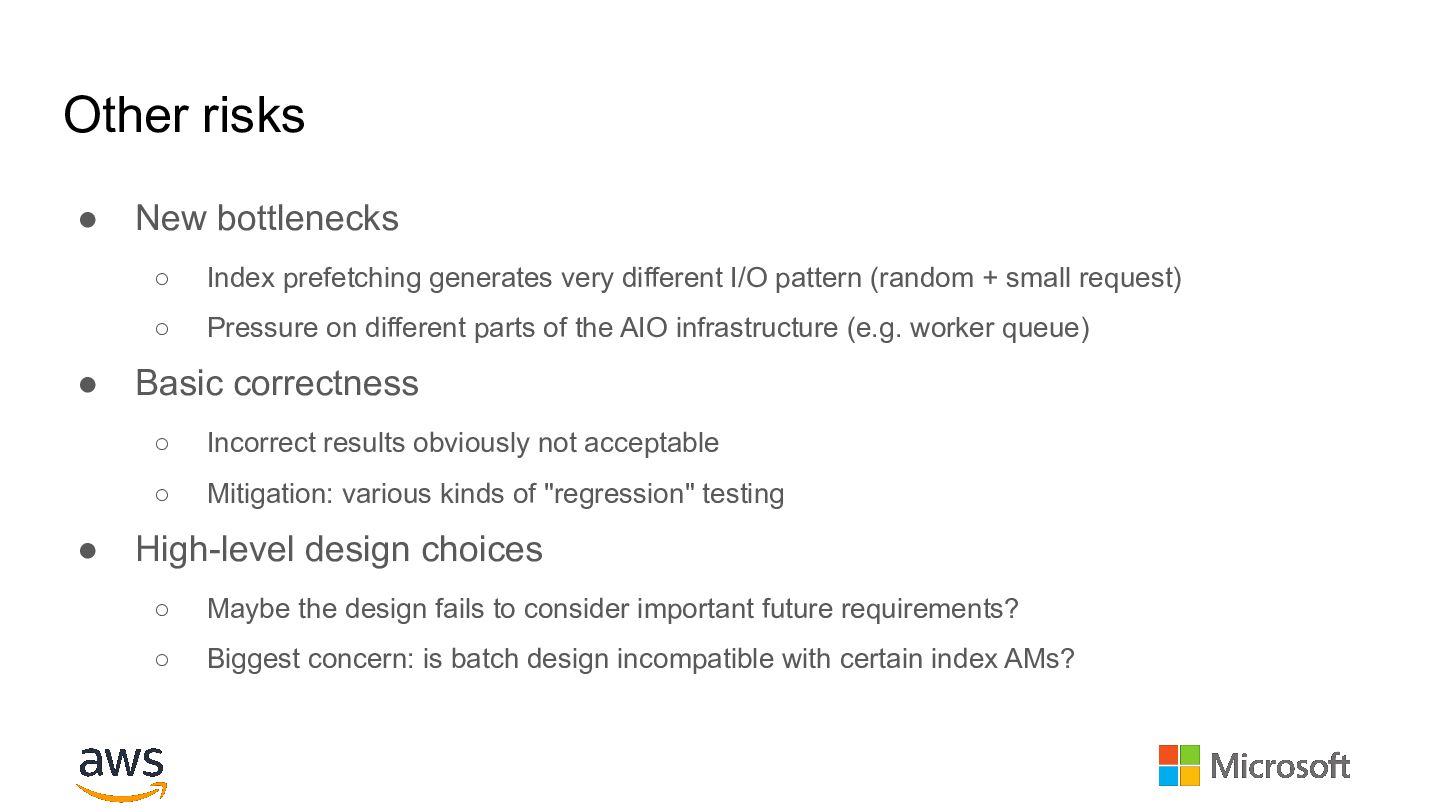
  24. Other risks • • • New bottlenecks ◦ Index prefetching

    generates very different I/O pattern (random + small request) ◦ Pressure on different parts of the AIO infrastructure (e.g. worker queue) Basic correctness ◦ Incorrect results obviously not acceptable ◦ Mitigation: various kinds of "regression" testing High-level design choices ◦ Maybe the design fails to consider important future requirements? ◦ Biggest concern: is batch design incompatible with certain index AMs?
  25. Agenda • History of this project ◦ • High-level design

    of latest/third approach ◦ • Applying the lessons from the first two failed attempts Regressions (and other risks) ◦ • First two approaches to adding index prefetching How we avoided performance regressions, and managed other risks Future outlook ◦ Follow-on work enabled by the design
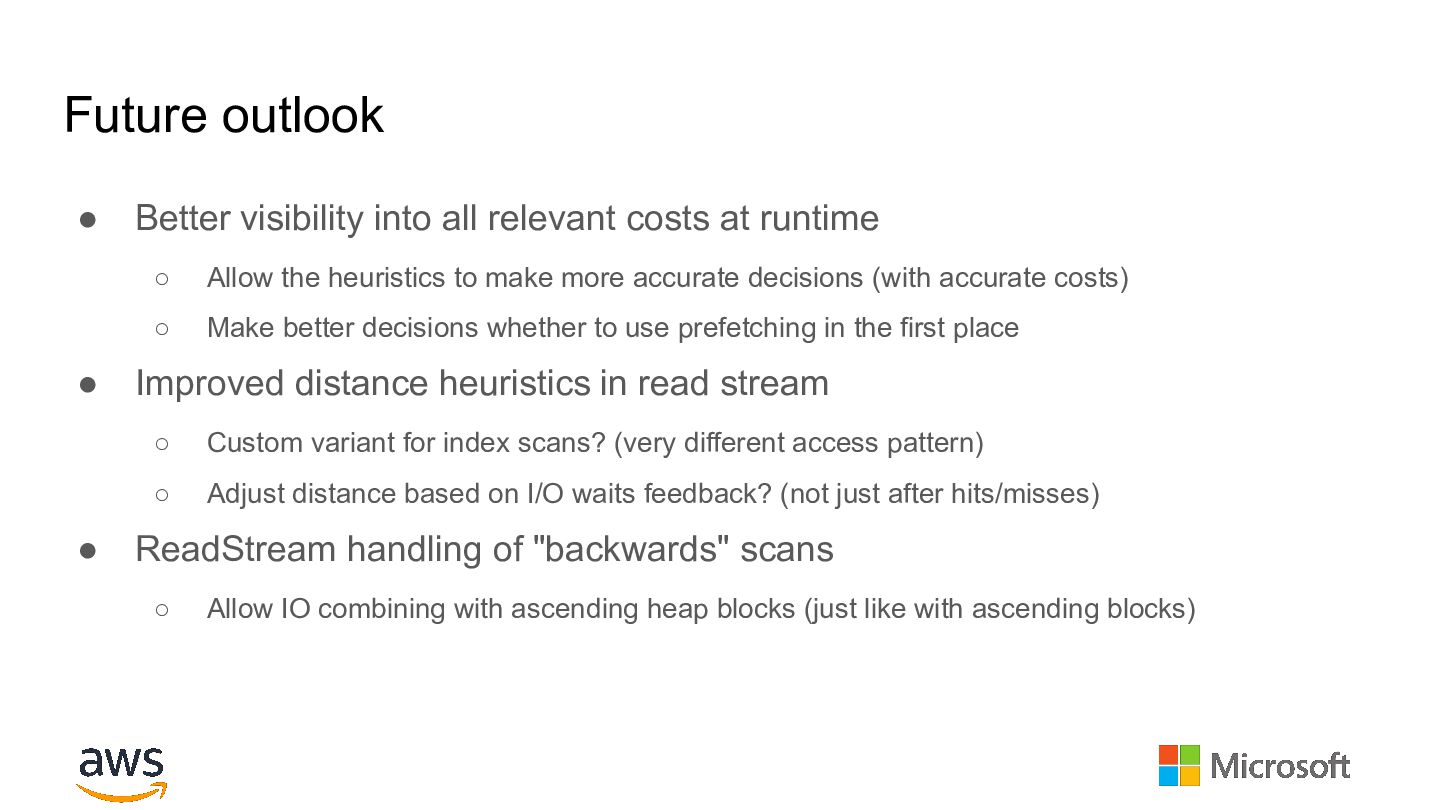
  26. Future outlook • • • Better visibility into all relevant

    costs at runtime ◦ Allow the heuristics to make more accurate decisions (with accurate costs) ◦ Make better decisions whether to use prefetching in the first place Improved distance heuristics in read stream ◦ Custom variant for index scans? (very different access pattern) ◦ Adjust distance based on I/O waits feedback? (not just after hits/misses) ReadStream handling of "backwards" scans ◦ Allow IO combining with ascending heap blocks (just like with ascending blocks)
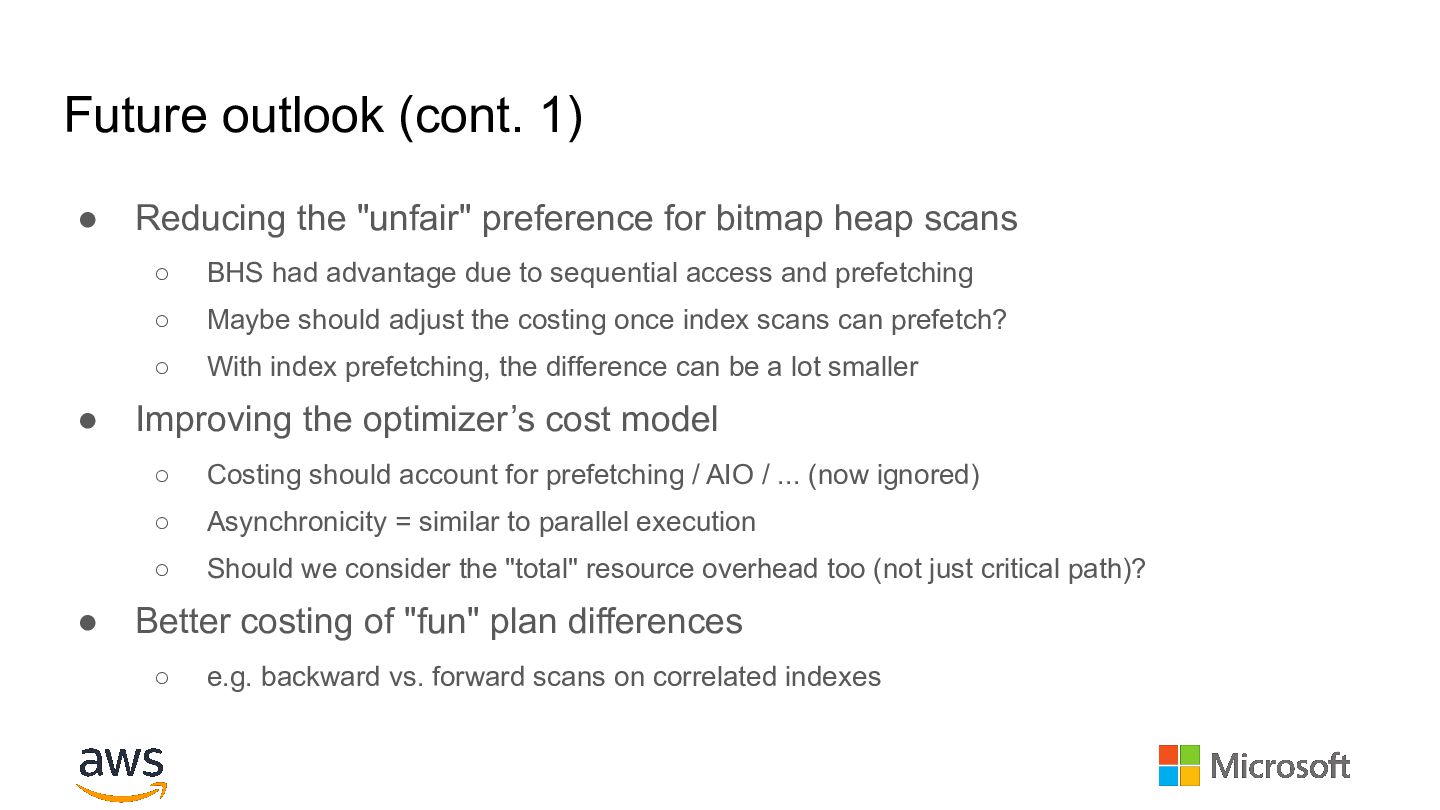
  27. Future outlook (cont. 1) • • • Reducing the "unfair"

    preference for bitmap heap scans ◦ BHS had advantage due to sequential access and prefetching ◦ Maybe should adjust the costing once index scans can prefetch? ◦ With index prefetching, the difference can be a lot smaller Improving the optimizer’s cost model ◦ Costing should account for prefetching / AIO / ... (now ignored) ◦ Asynchronicity = similar to parallel execution ◦ Should we consider the "total" resource overhead too (not just critical path)? Better costing of "fun" plan differences ◦ e.g. backward vs. forward scans on correlated indexes
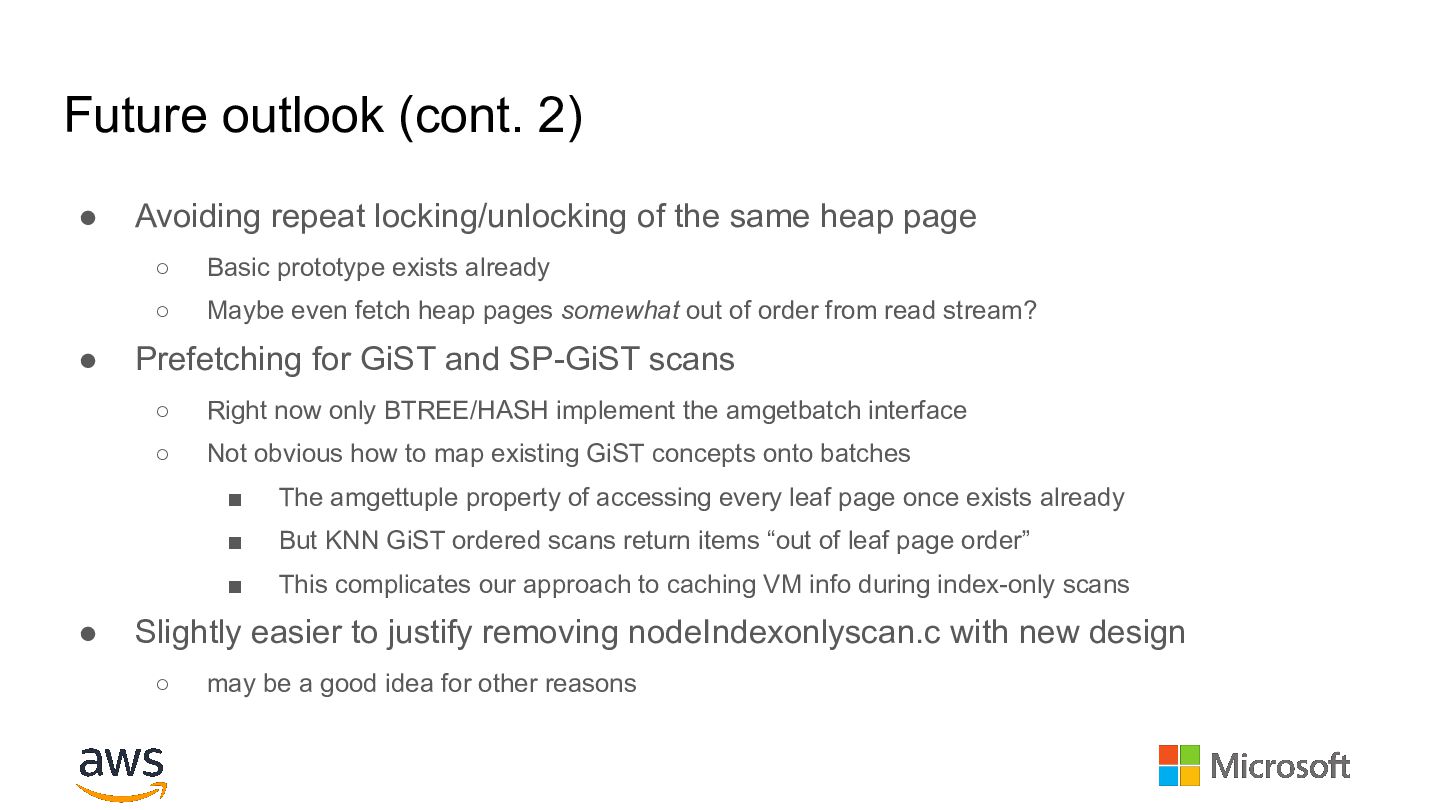
  28. Future outlook (cont. 2) • • • Avoiding repeat locking/unlocking

    of the same heap page ◦ Basic prototype exists already ◦ Maybe even fetch heap pages somewhat out of order from read stream? Prefetching for GiST and SP-GiST scans ◦ Right now only BTREE/HASH implement the amgetbatch interface ◦ Not obvious how to map existing GiST concepts onto batches ▪ The amgettuple property of accessing every leaf page once exists already ▪ But KNN GiST ordered scans return items “out of leaf page order” ▪ This complicates our approach to caching VM info during index-only scans Slightly easier to justify removing nodeIndexonlyscan.c with new design ◦ may be a good idea for other reasons