Upgrade to Pro — share decks privately, control downloads, hide ads and more …

The Bowling Game - From Imperative to Functiona...

Avatar for Philip Schwarz Philip Schwarz PRO
October 11, 2026
12

The Bowling Game - From Imperative to Functional Programming - Part 3

In this third deck in the series we first refactor the Scala and Haskell translations of Stuart Halloway's Clojure program, and then the latter itself.

Keywords: "bowling game code kata", "bowling game", "bowling", "programming", "Functional Programming", "testing", "Ron Jeffries", "Stuart Halloway", "Scala", "Haskell", "Clojure", "Monoid", "Functor", "Foldable", "Nested", "Compose", "map", "fmap", "fold", "foldMap", "reduce", "Numeric", "Num", "sumAll", "sum"

Avatar for Philip Schwarz

Philip Schwarz PRO

October 11, 2026

More Decks by Philip Schwarz

Transcript

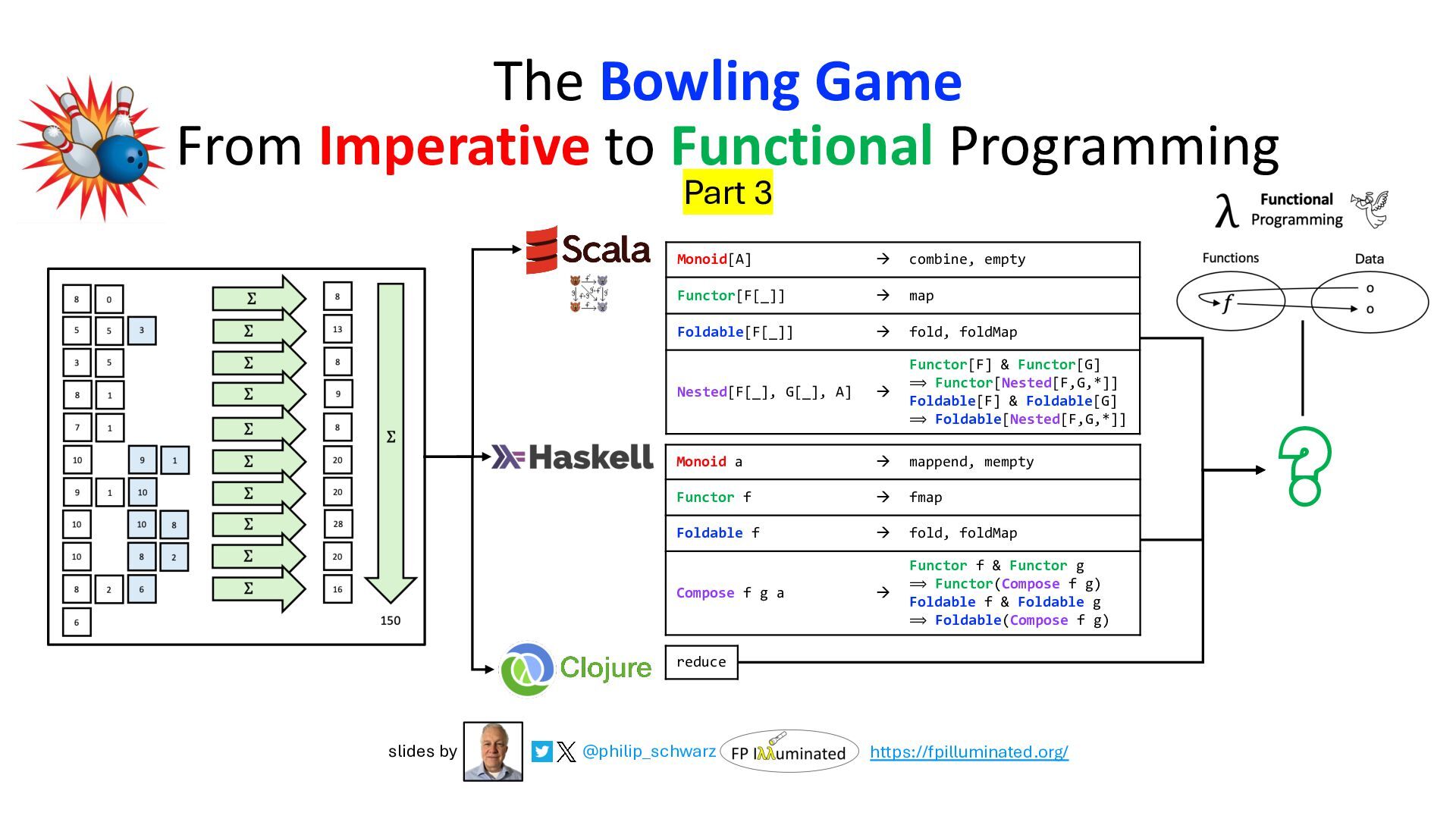
  1. The Bowling Game From Imperative to Functional Programming Part 3

    Monoid[A] à combine, empty Functor[F[_]] à map Foldable[F[_]] à fold, foldMap Nested[F[_], G[_], A] à Functor[F] & Functor[G] ⟹ Functor[Nested[F,G,*]] Foldable[F] & Foldable[G] ⟹ Foldable[Nested[F,G,*]] Monoid a à mappend, mempty Functor f à fmap Foldable f à fold, foldMap à Functor f & Functor g ⟹ Functor(Compose f g) Foldable f & Foldable g ⟹ Foldable(Compose f g) Compose f g a reduce slides by @philip_schwarz https://fpilluminated.org/ ?
  2. (ns bowling-game (:use clojure.contrib.seq-utils)) (defn strike? [rolls] (= 10 (first

    rolls))) (defn spare? [rolls] (= 10 (apply + (take 2 rolls)))) Here is the last bowling program that we saw in part 2. I think its following traits make it a great version of the program: • domain rich • simple functions • good naming • useful comments Stuart Halloway (defn balls-to-score "How many balls contribute to this frame's score?" [rolls] (cond (strike? rolls) 3 (spare? rolls) 3 :else 2)) (defn frame-advance "How many rolls should be consumed to advance to the next frame?" [rolls] (if (strike? rolls) 1 2)) (defn frames "Converts a sequence of rolls to a sequence of frames" [rolls] (when-let [rolls (seq rolls)] (lazy-seq (cons (take (balls-to-score rolls) rolls) (frames (drop (frame-advance rolls) rolls)))))) @philip_schwarz (defn score-frame [frame] (reduce + frame)) (defn score-game "Score a bowling game, passed as a sequence of rolls." [rolls] (reduce + (map score-frame (take 10 (frames rolls))))) Version 8 - Clojure – domain-rich – Stuart Halloway
  3. (ns bowling-game (:use clojure.contrib.seq-utils)) (defn strike? [rolls] (= 10 (first

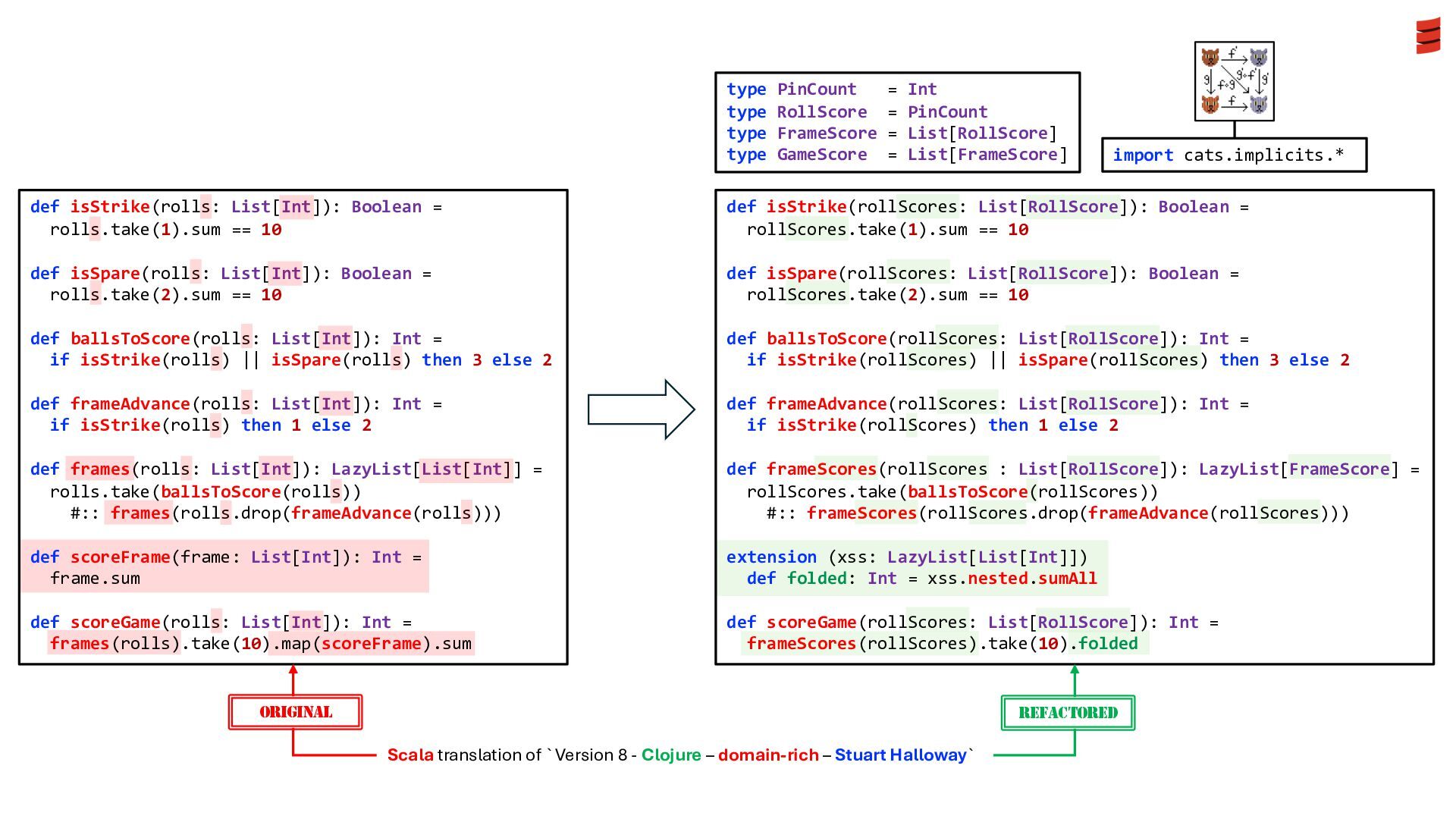
    rolls))) (defn spare? [rolls] (= 10 (apply + (take 2 rolls)))) Stuart Halloway (defn balls-to-score "How many balls contribute to this frame's score?" [rolls] (cond (strike? rolls) 3 (spare? rolls) 3 :else 2)) (defn frame-advance "How many rolls should be consumed to advance to the next frame?" [rolls] (if (strike? rolls) 1 2)) (defn frames "Converts a sequence of rolls to a sequence of frames" [rolls] (when-let [rolls (seq rolls)] (lazy-seq (cons (take (balls-to-score rolls) rolls) (frames (drop (frame-advance rolls) rolls)))))) (defn score-frame [frame] (reduce + frame)) (defn score-game "Score a bowling game, passed as a sequence of rolls." [rolls] (reduce + (map score-frame (take 10 (frames rolls))))) Version 8 - Clojure – domain-rich – Stuart Halloway Here is the same Clojure program again, and next to it, its Scala translation, which we also saw in part two. To ease comparison, the Scala program has here been enhanced with the same comments as the Clojure one. def isStrike(rolls: List[Int]): Boolean = rolls.take(1).sum == 10 def isSpare(rolls: List[Int]): Boolean = rolls.take(2).sum == 10 // How many balls contribute to this frame's score? def ballsToScore(rolls: List[Int]): Int = if isStrike(rolls) || isSpare(rolls) then 3 else 2 // How many rolls should be consumed to advance to the next frame? def frameAdvance(rolls: List[Int]): Int = if isStrike(rolls) then 1 else 2 // Converts a sequence of rolls to a sequence of frames def frames(rolls: List[Int]): LazyList[List[Int]] = rolls.take(ballsToScore(rolls)) #:: frames(rolls.drop(frameAdvance(rolls))) def scoreFrame(frame: List[Int]): Int = frame.sum // Score a bowling game, passed as a sequence of rolls. def scoreGame(rolls: List[Int]): Int = frames(rolls).take(10).map(scoreFrame).sum Scala translation of `Version 8 - Clojure – domain-rich – Stuart Halloway`
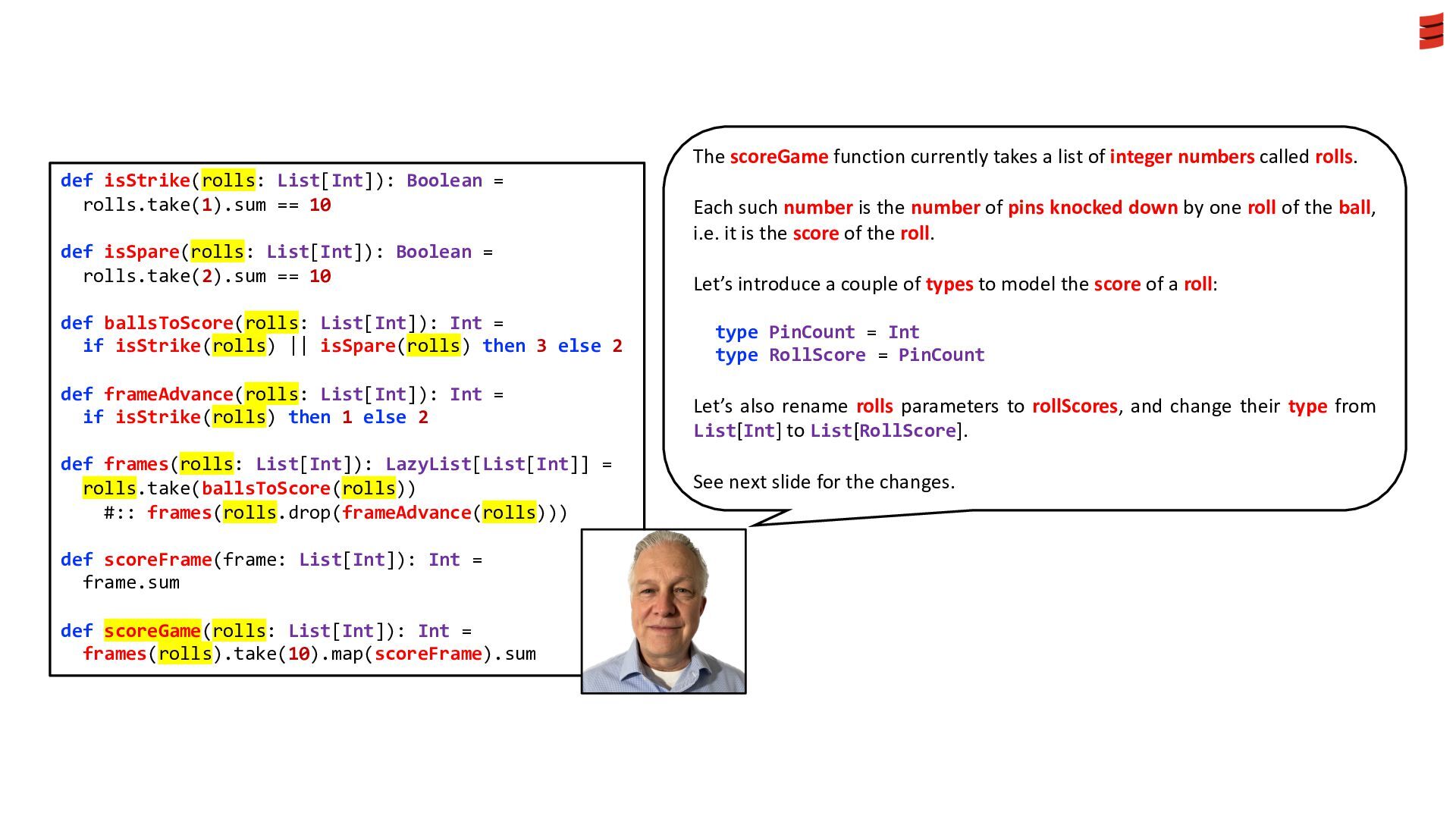
  4. The scoreGame function currently takes a list of integer numbers

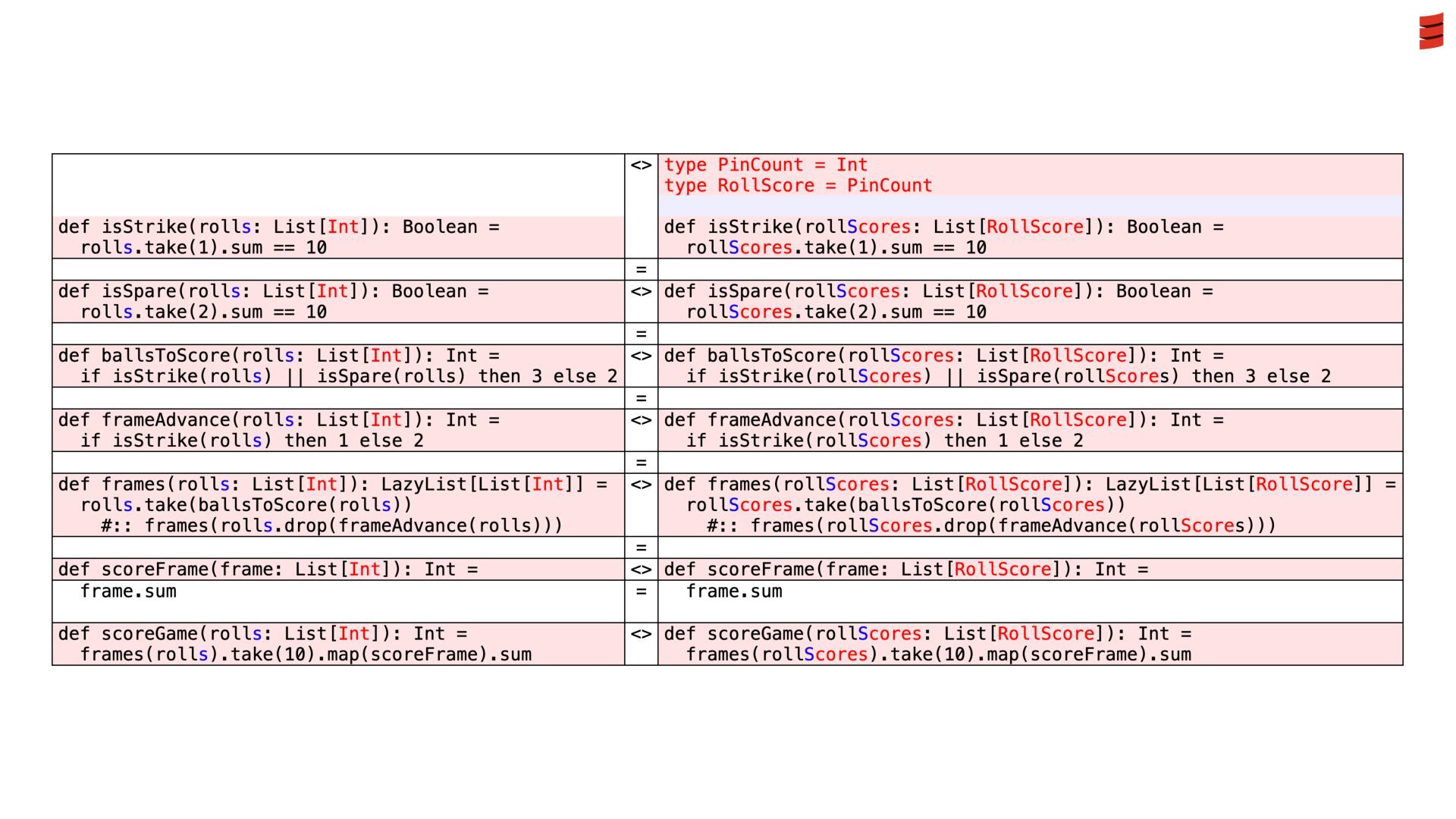
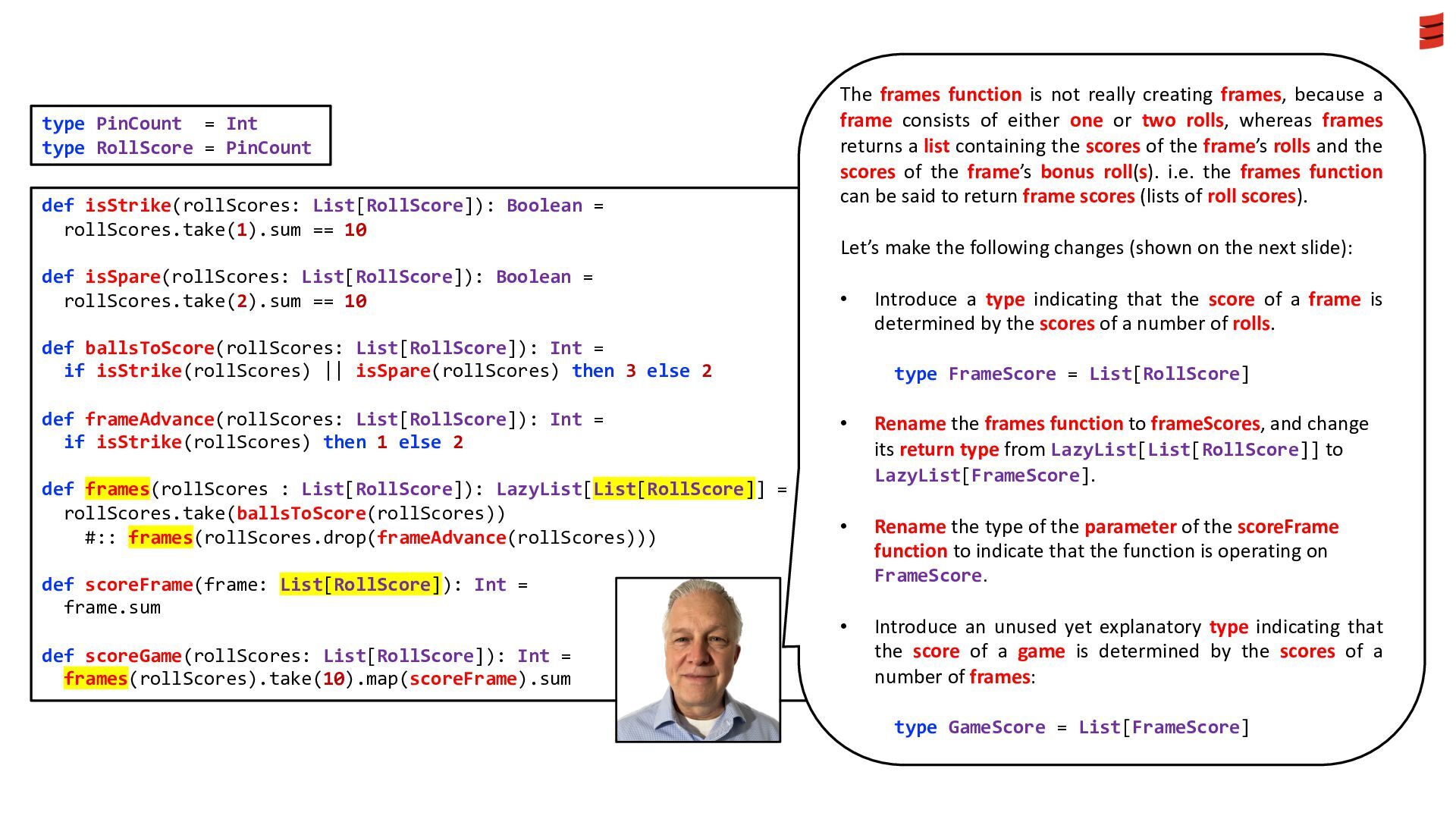
    called rolls. def isStrike(rolls: List[Int]): Boolean = rolls.take(1).sum == 10 def isSpare(rolls: List[Int]): Boolean = rolls.take(2).sum == 10 def ballsToScore(rolls: List[Int]): Int = if isStrike(rolls) || isSpare(rolls) then 3 else 2 def frameAdvance(rolls: List[Int]): Int = if isStrike(rolls) then 1 else 2 def frames(rolls: List[Int]): LazyList[List[Int]] = rolls.take(ballsToScore(rolls)) #:: frames(rolls.drop(frameAdvance(rolls))) def scoreFrame(frame: List[Int]): Int = frame.sum def scoreGame(rolls: List[Int]): Int = frames(rolls).take(10).map(scoreFrame).sum Each such number is the number of pins knocked down by one roll of the ball, i.e. it is the score of the roll. Let’s introduce a couple of types to model the score of a roll: type PinCount = Int type RollScore = PinCount Let’s also rename rolls parameters to rollScores, and change their type from List[Int] to List[RollScore]. See next slide for the changes.
  5. type PinCount = Int type RollScore = PinCount def isStrike(rollScores:

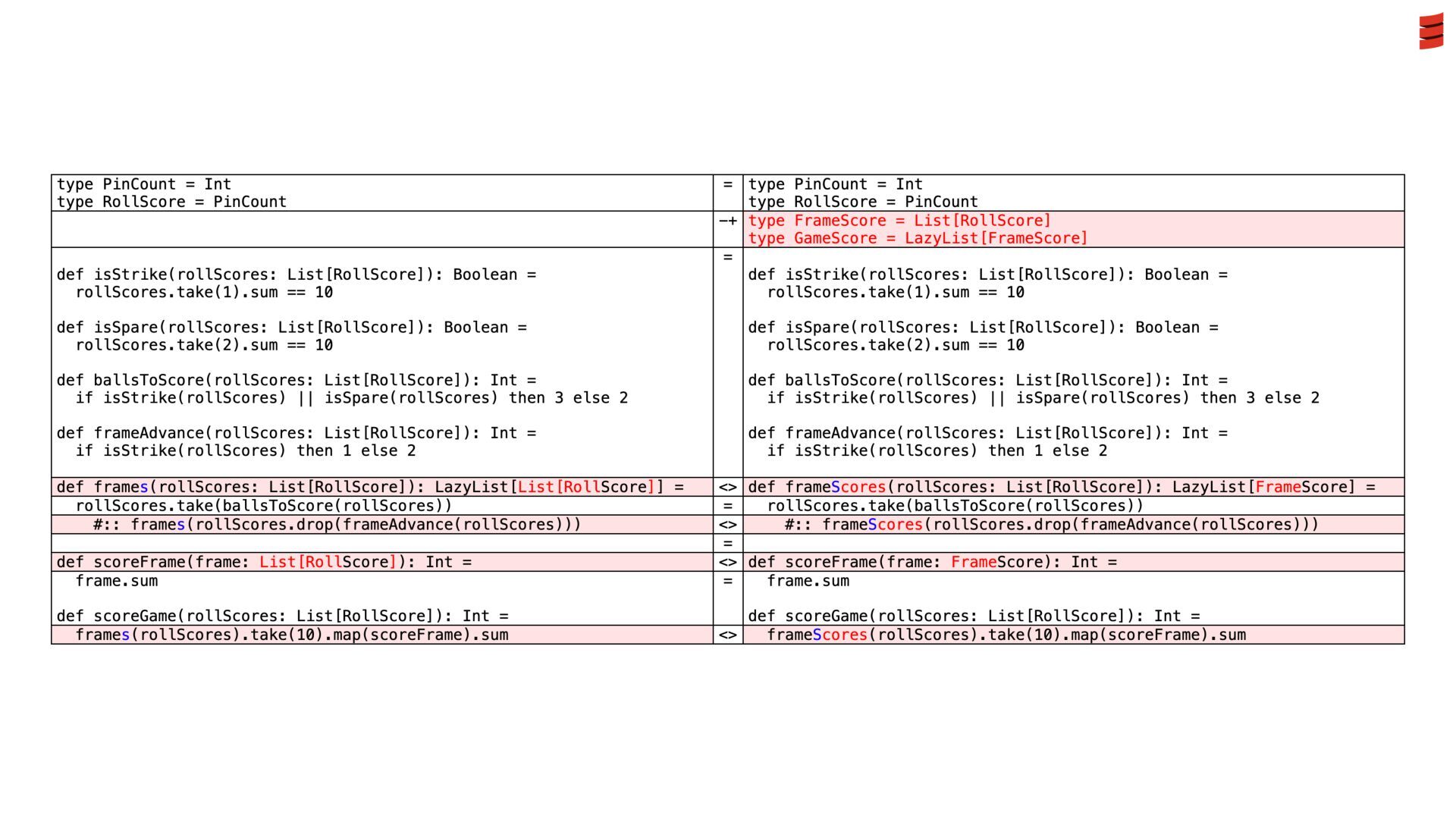
    List[RollScore]): Boolean = rollScores.take(1).sum == 10 def isSpare(rollScores: List[RollScore]): Boolean = rollScores.take(2).sum == 10 The frames function is not really creating frames, because a frame consists of either one or two rolls, whereas frames returns a list containing the scores of the frame’s rolls and the scores of the frame’s bonus roll(s). i.e. the frames function can be said to return frame scores (lists of roll scores). Let’s make the following changes (shown on the next slide): • def ballsToScore(rollScores: List[RollScore]): Int = if isStrike(rollScores) || isSpare(rollScores) then 3 else 2 def frameAdvance(rollScores: List[RollScore]): Int = if isStrike(rollScores) then 1 else 2 def frames(rollScores : List[RollScore]): LazyList[List[RollScore]] = rollScores.take(ballsToScore(rollScores)) #:: frames(rollScores.drop(frameAdvance(rollScores))) def scoreFrame(frame: List[RollScore]): Int = frame.sum def scoreGame(rollScores: List[RollScore]): Int = frames(rollScores).take(10).map(scoreFrame).sum Introduce a type indicating that the score of a frame is determined by the scores of a number of rolls. type FrameScore = List[RollScore] • Rename the frames function to frameScores, and change its return type from LazyList[List[RollScore]] to LazyList[FrameScore]. • Rename the type of the parameter of the scoreFrame function to indicate that the function is operating on FrameScore. • Introduce an unused yet explanatory type indicating that the score of a game is determined by the scores of a number of frames: type GameScore = List[FrameScore]
  6. type PinCount = Int type RollScore = PinCount type FrameScore

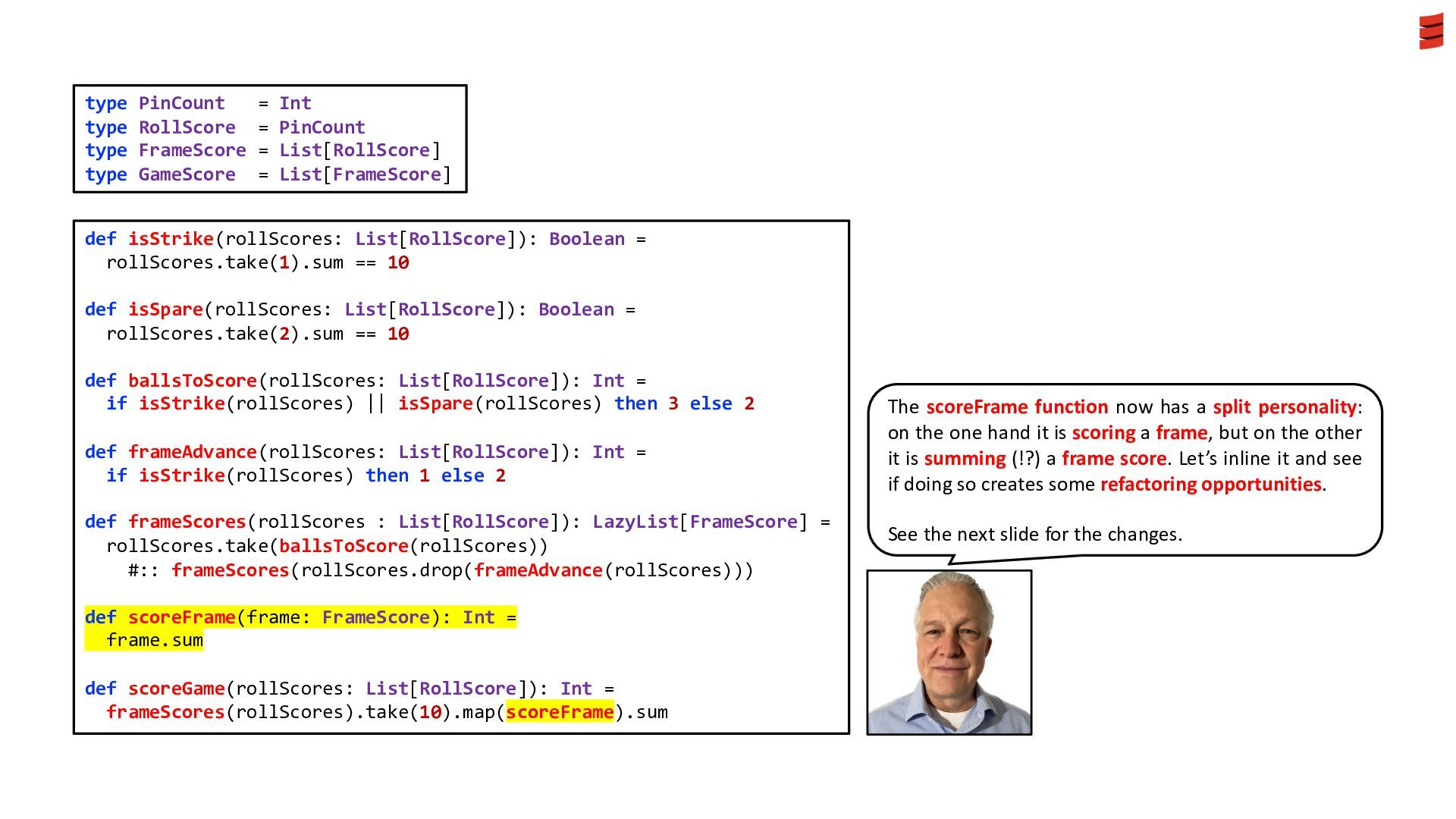
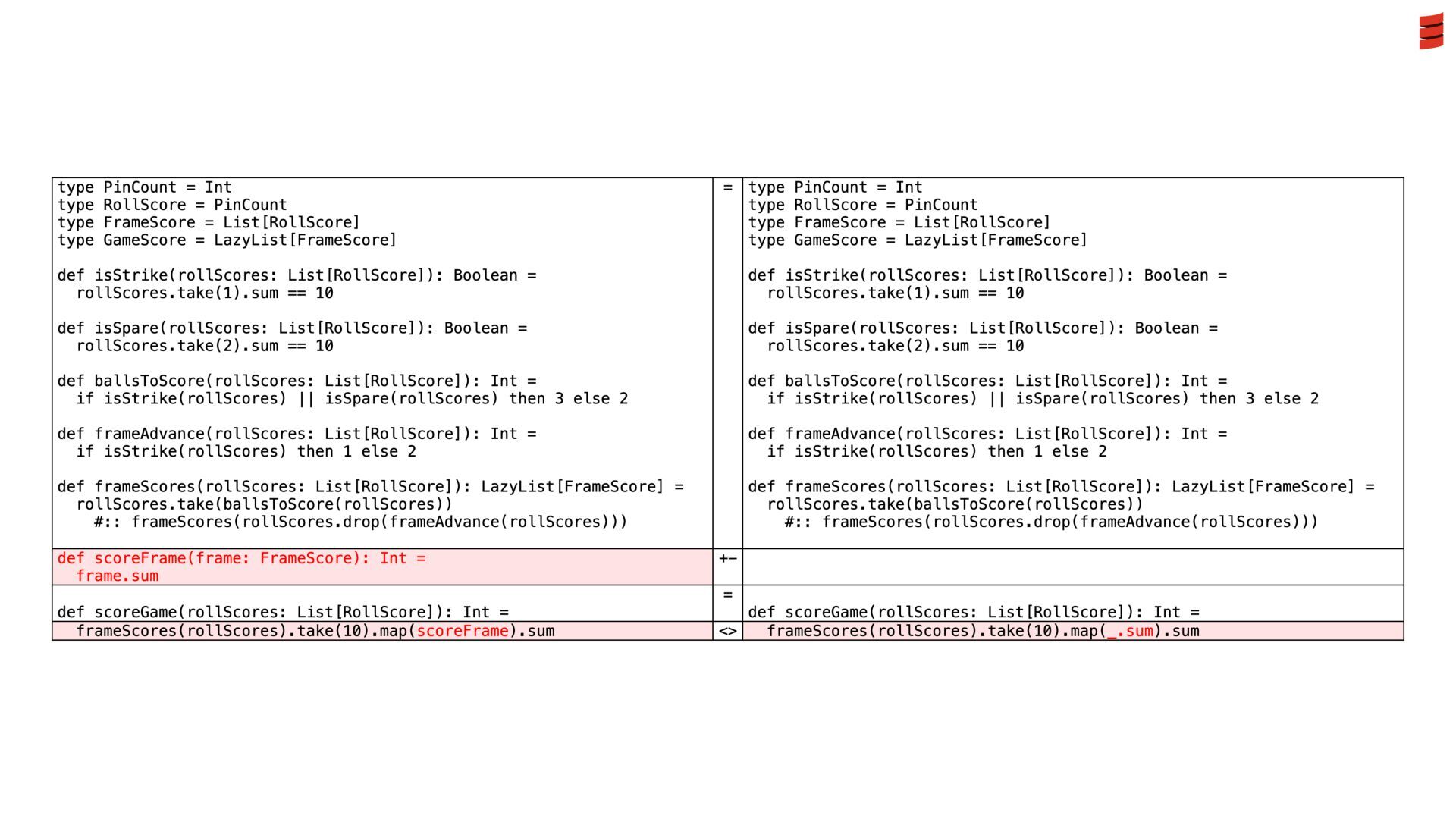
    = List[RollScore] type GameScore = List[FrameScore] def isStrike(rollScores: List[RollScore]): Boolean = rollScores.take(1).sum == 10 def isSpare(rollScores: List[RollScore]): Boolean = rollScores.take(2).sum == 10 def ballsToScore(rollScores: List[RollScore]): Int = if isStrike(rollScores) || isSpare(rollScores) then 3 else 2 def frameAdvance(rollScores: List[RollScore]): Int = if isStrike(rollScores) then 1 else 2 def frameScores(rollScores : List[RollScore]): LazyList[FrameScore] = rollScores.take(ballsToScore(rollScores)) #:: frameScores(rollScores.drop(frameAdvance(rollScores))) def scoreFrame(frame: FrameScore): Int = frame.sum def scoreGame(rollScores: List[RollScore]): Int = frameScores(rollScores).take(10).map(scoreFrame).sum The scoreFrame function now has a split personality: on the one hand it is scoring a frame, but on the other it is summing (!?) a frame score. Let’s inline it and see if doing so creates some refactoring opportunities. See the next slide for the changes.
  7. type PinCount = Int type RollScore = PinCount type FrameScore

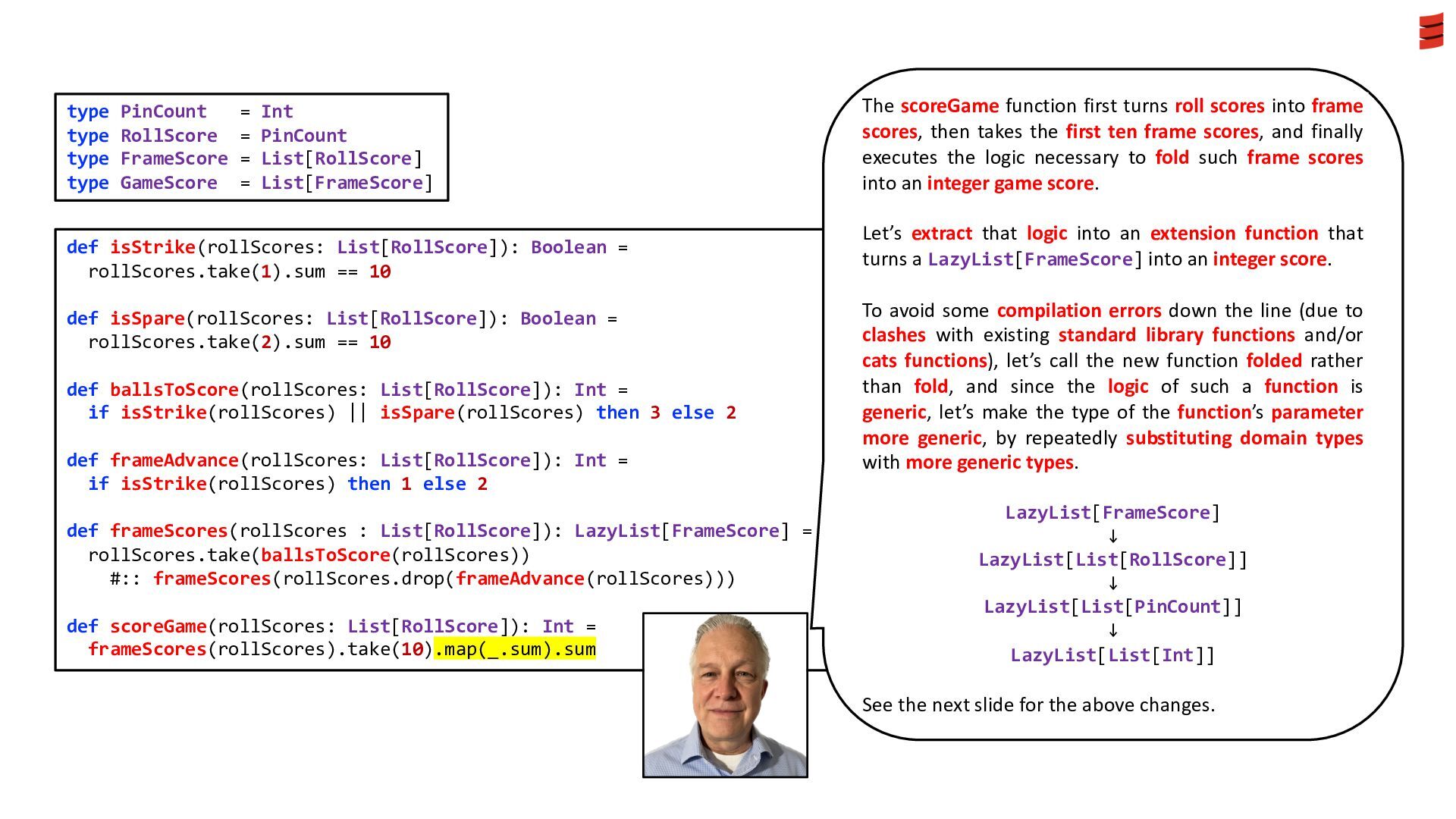
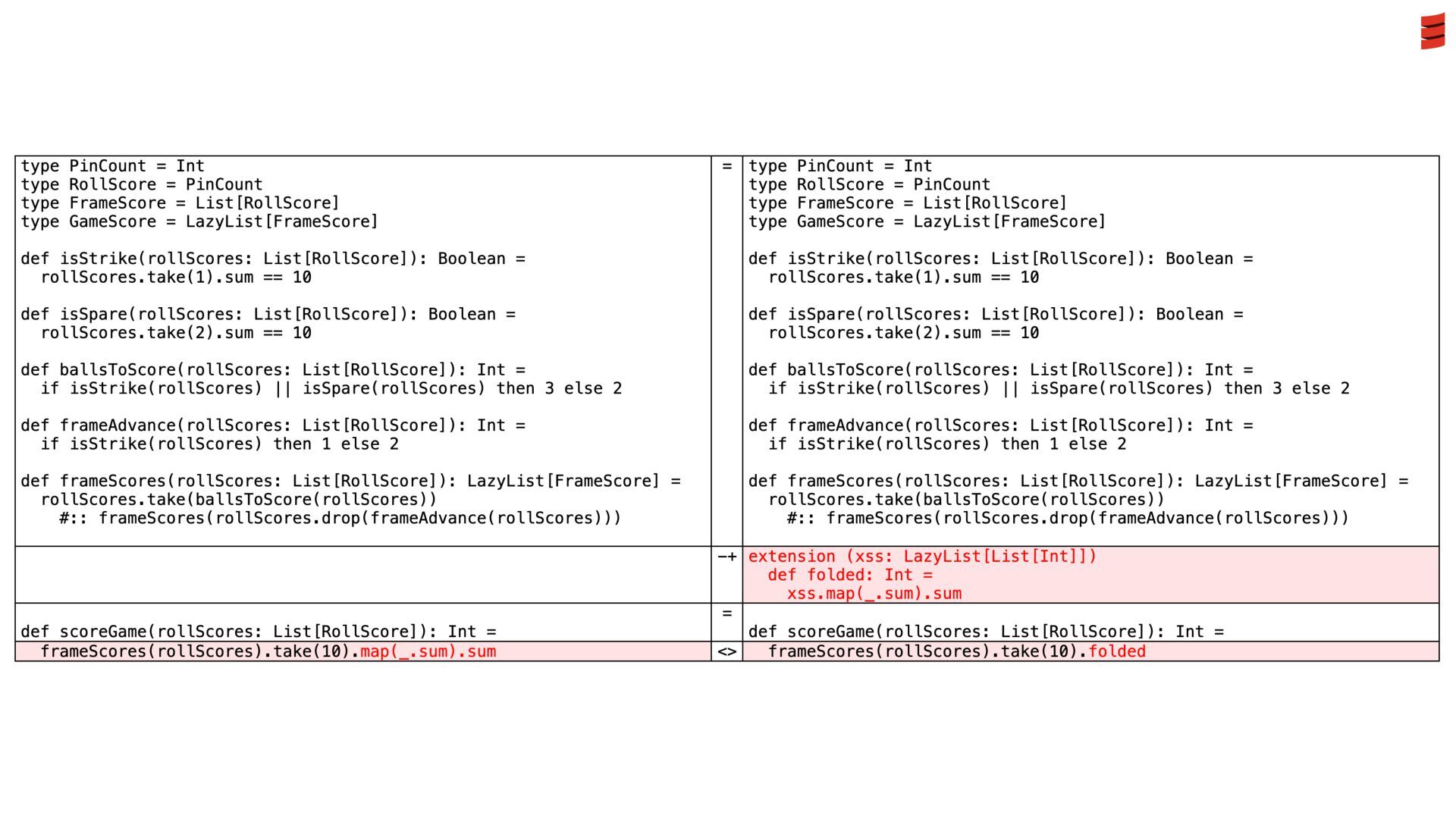
    = List[RollScore] type GameScore = List[FrameScore] def isStrike(rollScores: List[RollScore]): Boolean = rollScores.take(1).sum == 10 def isSpare(rollScores: List[RollScore]): Boolean = rollScores.take(2).sum == 10 def ballsToScore(rollScores: List[RollScore]): Int = if isStrike(rollScores) || isSpare(rollScores) then 3 else 2 def frameAdvance(rollScores: List[RollScore]): Int = if isStrike(rollScores) then 1 else 2 def frameScores(rollScores : List[RollScore]): LazyList[FrameScore] = rollScores.take(ballsToScore(rollScores)) #:: frameScores(rollScores.drop(frameAdvance(rollScores))) def scoreGame(rollScores: List[RollScore]): Int = frameScores(rollScores).take(10).map(_.sum).sum The scoreGame function first turns roll scores into frame scores, then takes the first ten frame scores, and finally executes the logic necessary to fold such frame scores into an integer game score. Let’s extract that logic into an extension function that turns a LazyList[FrameScore] into an integer score. To avoid some compilation errors down the line (due to clashes with existing standard library functions and/or cats functions), let’s call the new function folded rather than fold, and since the logic of such a function is generic, let’s make the type of the function’s parameter more generic, by repeatedly substituting domain types with more generic types. LazyList[FrameScore] ↓ LazyList[List[RollScore]] ↓ LazyList[List[PinCount]] ↓ LazyList[List[Int]] See the next slide for the above changes.
  8. type PinCount = Int type RollScore = PinCount type FrameScore

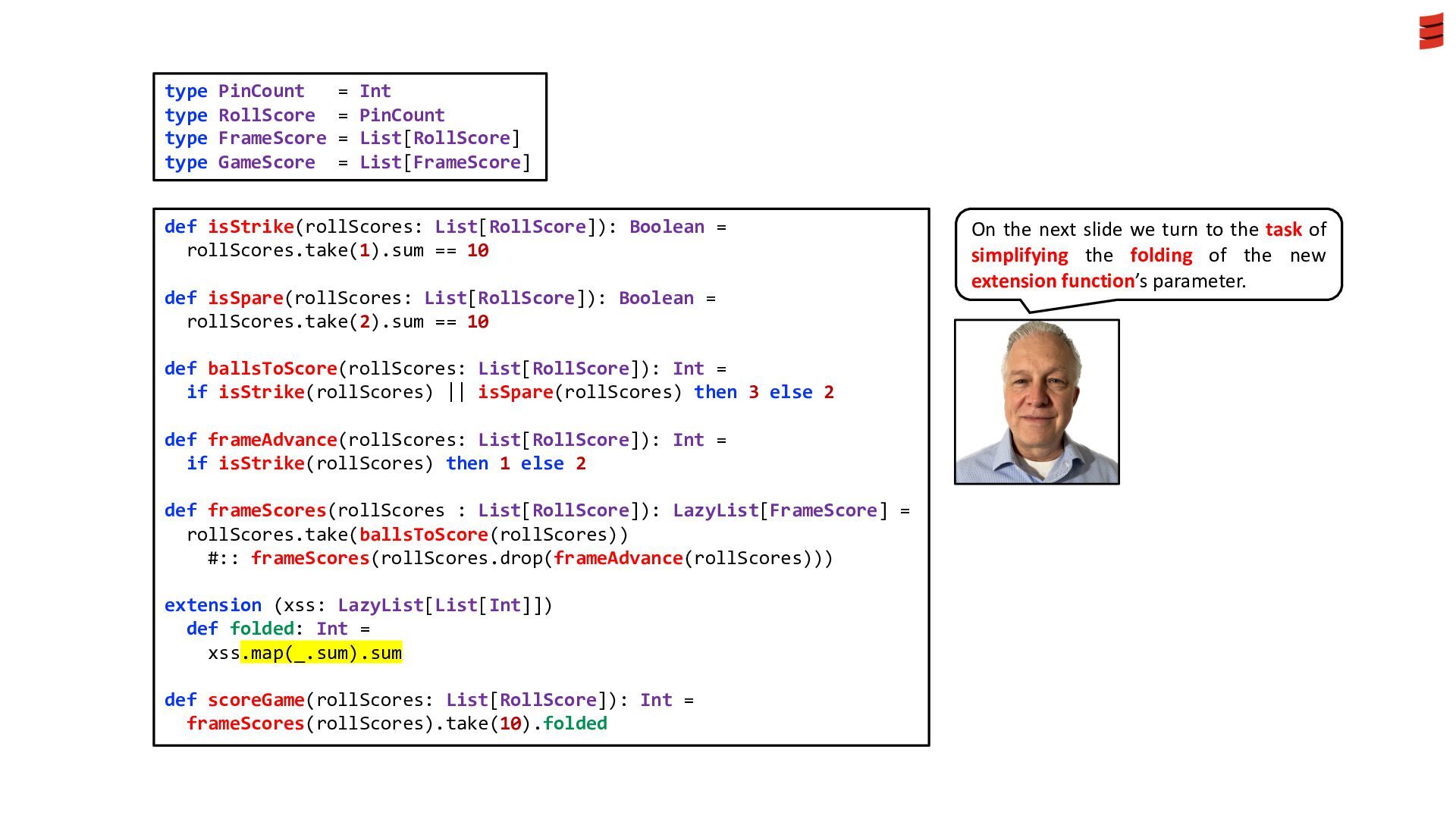
    = List[RollScore] type GameScore = List[FrameScore] def isStrike(rollScores: List[RollScore]): Boolean = rollScores.take(1).sum == 10 def isSpare(rollScores: List[RollScore]): Boolean = rollScores.take(2).sum == 10 def ballsToScore(rollScores: List[RollScore]): Int = if isStrike(rollScores) || isSpare(rollScores) then 3 else 2 def frameAdvance(rollScores: List[RollScore]): Int = if isStrike(rollScores) then 1 else 2 def frameScores(rollScores : List[RollScore]): LazyList[FrameScore] = rollScores.take(ballsToScore(rollScores)) #:: frameScores(rollScores.drop(frameAdvance(rollScores))) extension (xss: LazyList[List[Int]]) def folded: Int = xss.map(_.sum).sum def scoreGame(rollScores: List[RollScore]): Int = frameScores(rollScores).take(10).folded On the next slide we turn to the task of simplifying the folding of the new extension function’s parameter.
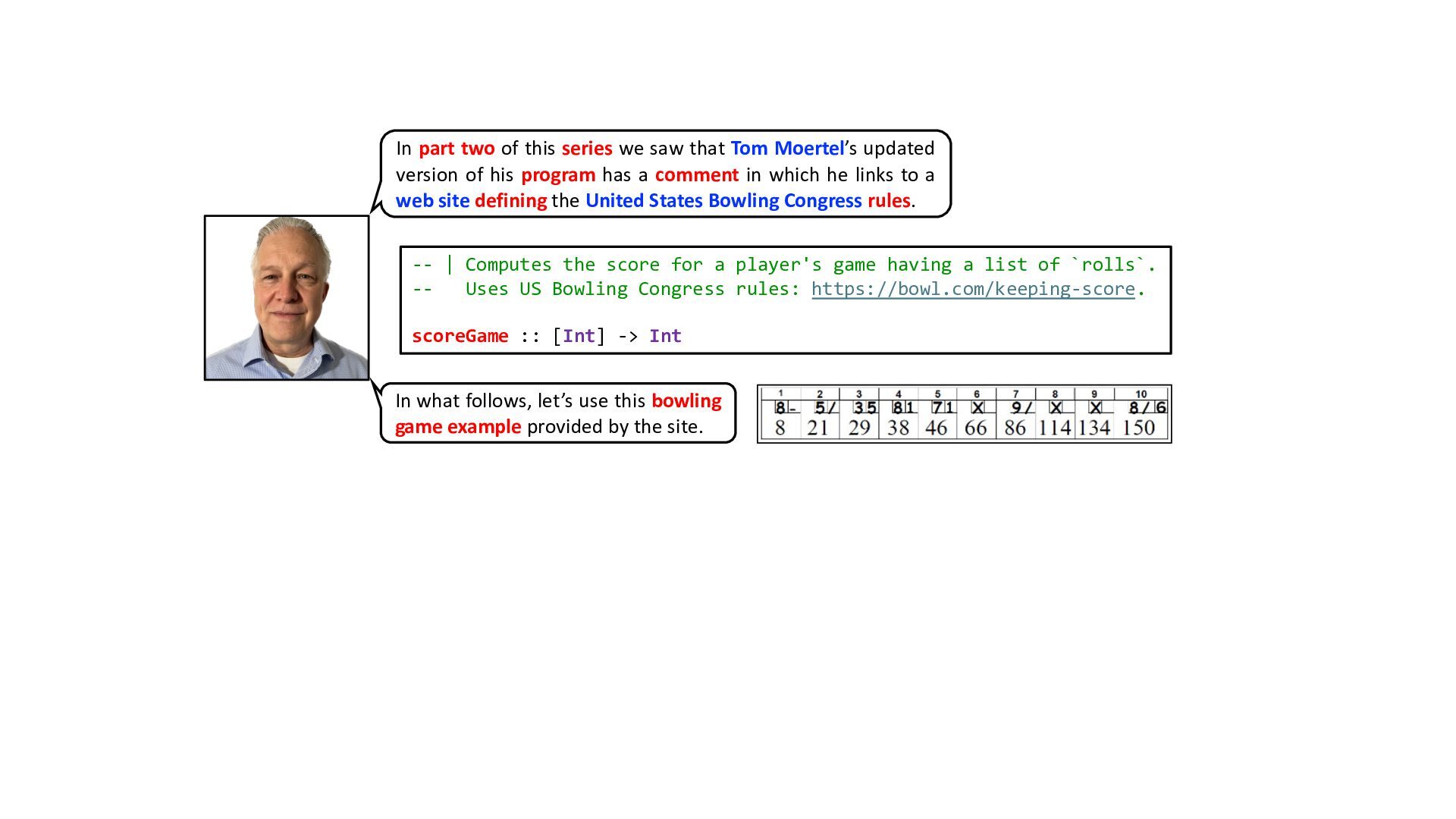
  9. In part two of this series we saw that Tom

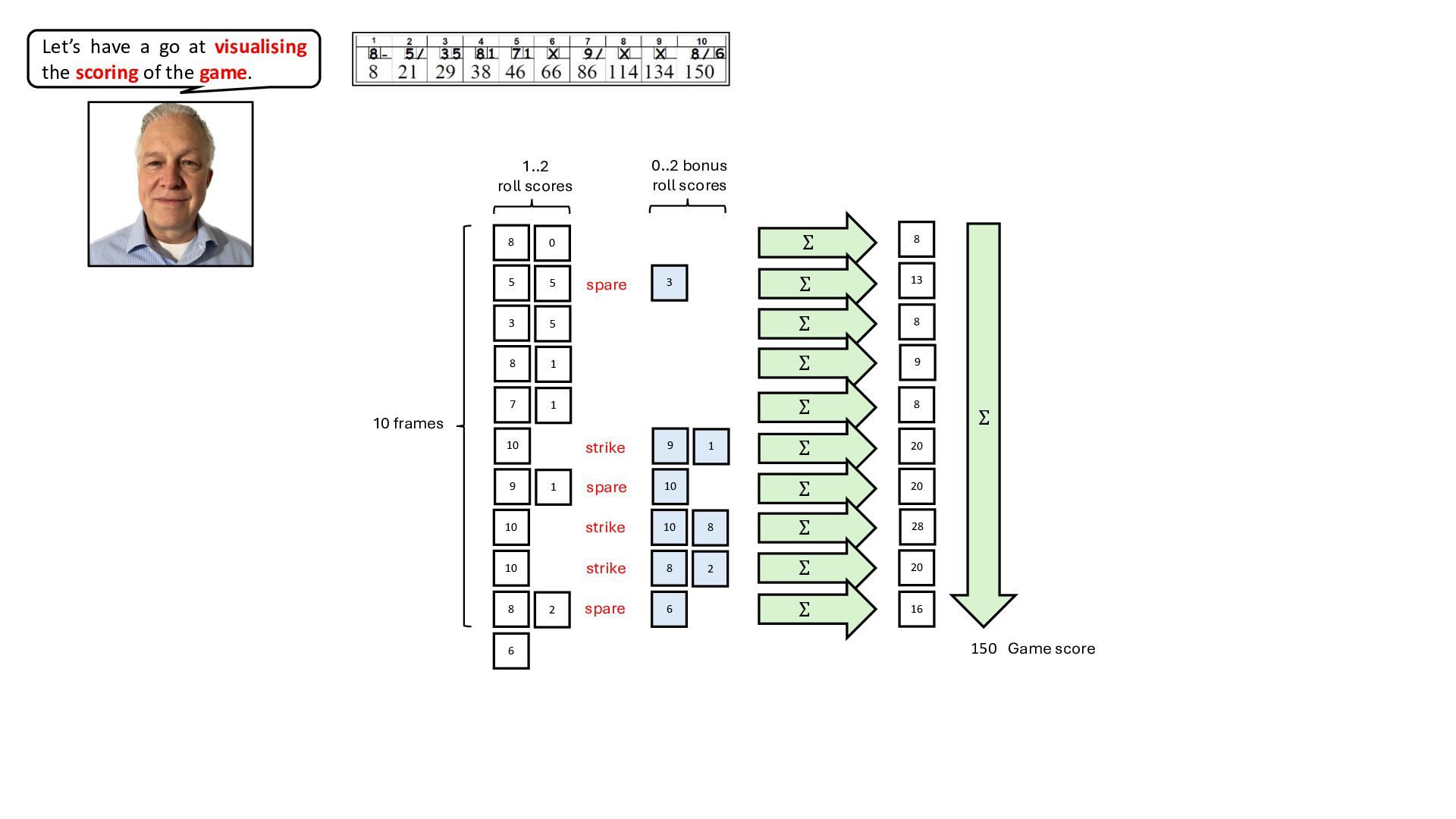
    Moertel’s updated version of his program has a comment in which he links to a web site defining the United States Bowling Congress rules. -- | Computes the score for a player's game having a list of `rolls`. -Uses US Bowling Congress rules: https://bowl.com/keeping-score. scoreGame :: [Int] -> Int In what follows, let’s use this bowling game example provided by the site.
  10. Let’s have a go at visualising the scoring of the

    game. 0..2 bonus roll scores 1..2 roll scores Σ 8 Σ 13 5 Σ 8 8 1 Σ 9 7 1 Σ 8 Σ 20 Σ 20 8 0 5 5 3 spare 3 10 frames strike 9 spare 10 10 strike 10 8 Σ 28 10 strike 8 2 Σ 20 spare 6 Σ 16 10 9 8 6 1 2 1 Σ 150 Game score
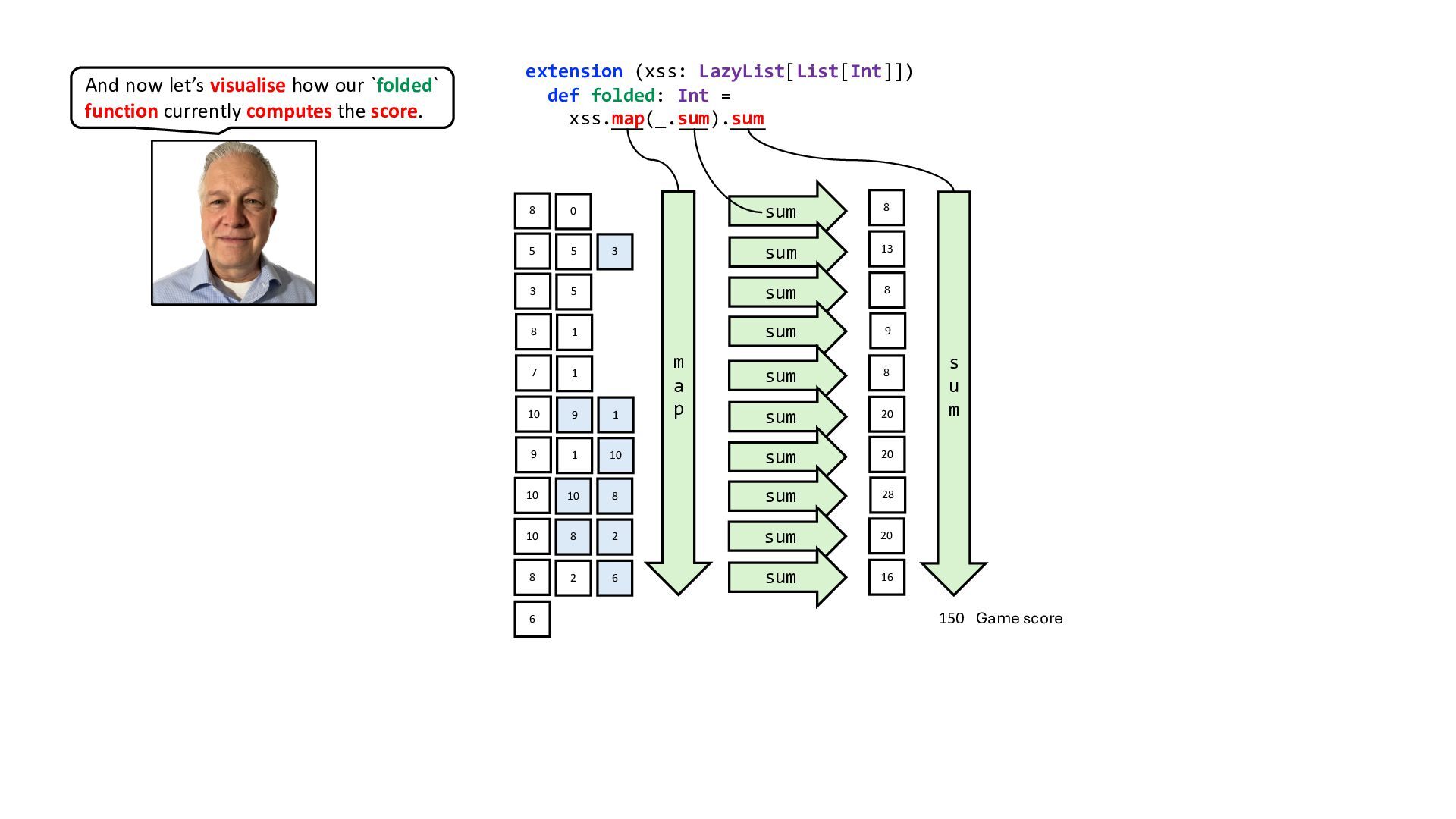
  11. And now let’s visualise how our `folded` function currently computes

    the score. extension (xss: LazyList[List[Int]]) def folded: Int = xss.map(_.sum).sum sum 8 sum 13 5 sum 8 8 1 sum 9 7 1 sum 8 10 9 1 sum 20 9 1 10 sum 20 10 10 8 sum 28 10 8 2 sum 20 8 2 6 sum 16 8 0 5 5 3 6 3 m a p s u m 150 Game score 150
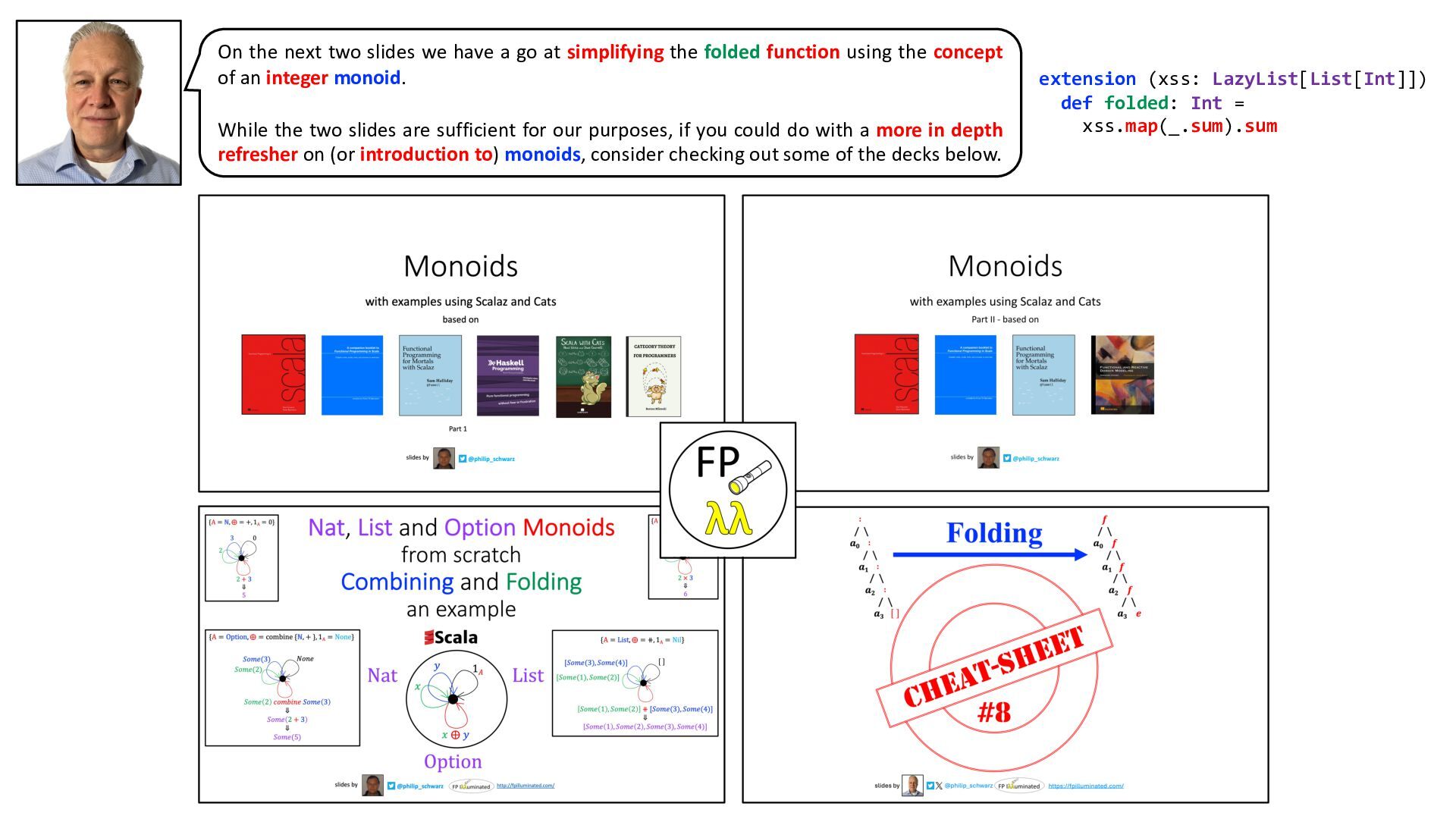
  12. On the next two slides we have a go at

    simplifying the folded function using the concept of an integer monoid. While the two slides are sufficient for our purposes, if you could do with a more in depth refresher on (or introduction to) monoids, consider checking out some of the decks below. extension (xss: LazyList[List[Int]]) def folded: Int = xss.map(_.sum).sum
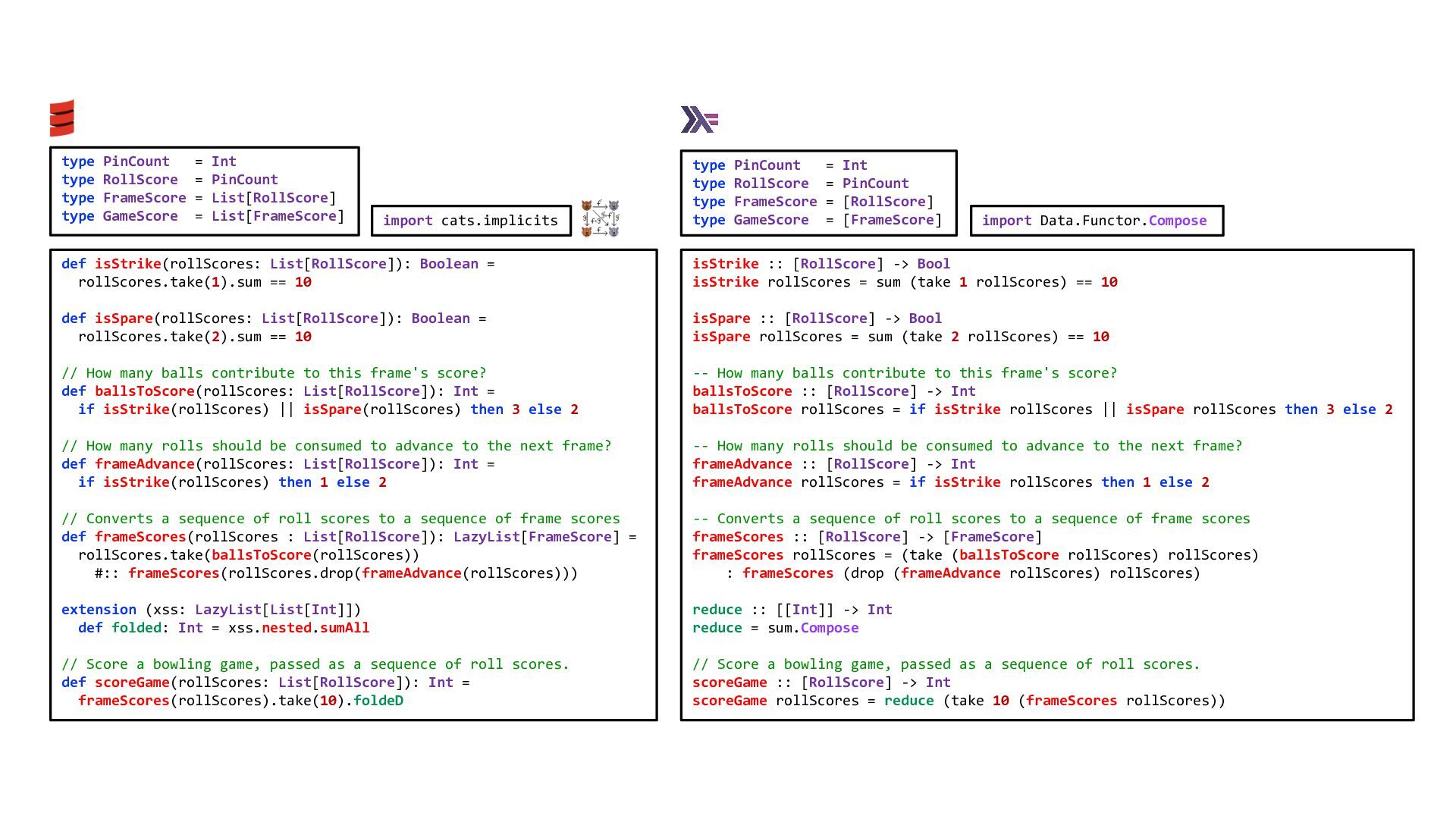
  13. import cats.implicits.* import cats.Foldable import cats.Monoid val m = Monoid[Int]

    assert(m.combine(2,3) == 5) assert(m.empty == 0) val ints = List(1,2,3,4,5) Cats Cats provides a `given` Monoid typeclass instance for Int. Here we bind it to val m and then show the following: • the monoid’s combine function can be used to sum two integers • the monoid’s empty value is zero 1 Cats provides a Foldable typeclass instance for List. Here we show the following: • The Foldable provides a fold function that can explicitly use the monoid to fold a list of integers into the integers’ sum • The fold function can also use the monoid implicitly assert(Foldable[List].fold[Int](Nil)(using m) == 0) assert(Foldable[List].fold(ints)(using m) == 15) To make usages of Foldable’s fold function less verbose, we could define an extension function called folded 2 assert(Foldable[List].fold[Int](Nil) == 0) assert(Foldable[List].fold(ints) == 15) assert(Nil.combineAll(using m) == 0) assert(ints.combineAll(using m) == 15) extension [A](as: Seq[A])(using Monoid[A]) def folded: A = Foldable[Seq].fold[A](as) But we don’t need to do that, because Cats 3 already provides combineAll syntactic sugar assert(List.empty[Int].combineAll == 0) for invoking Foldable’s fold function. assert(List.empty[Int].folded == 0) assert(ints.folded == 15) assert(ints.combineAll == 15) The Foldable typeclass instance for a collection also provides a foldMap function such that 4 foldMapping a function f over a collection amounts to first mapping f over the collection and val intLists = List(List(1,2),List(3,4,5)) then folding the resulting collection using Foldable’s fold function. We can combine the use of foldMap and combineAll to sum the integers in a collection of collections of integers. assert(ints.foldMap(_ * 10) == 150) assert(intLists.foldMap(_.combineAll) == 15) def fold[A](using Monoid[A]) = Foldable[Seq].fold[A] assert(intLists.foldMap(fold) == 15) To emphasize that we are doing nested folds, and to maximise conciseness, we can define a fold 5 function that delegates to Foldable’s fold function. On the next slide we use foldMap and fold to simplify the bowling program’s folded function.
  14. extension (xss: LazyList[List[Int]]) def folded: Int = xss.map(_.sum).sum simplify extension

    (xss: LazyList[List[Int]]) def folded: Int = xss.foldMap(fold) fold 8 fold 13 5 fold 8 1 fold 9 fold 8 fold 20 8 0 5 5 3 8 3 m a p 7 1 10 9 1 9 1 10 fold 20 10 10 8 fold 28 10 8 2 fold 20 8 2 6 fold 16 6 def fold[A](using Monoid[A]) = Foldable[List].fold[A] f o l d 150 Game score 150
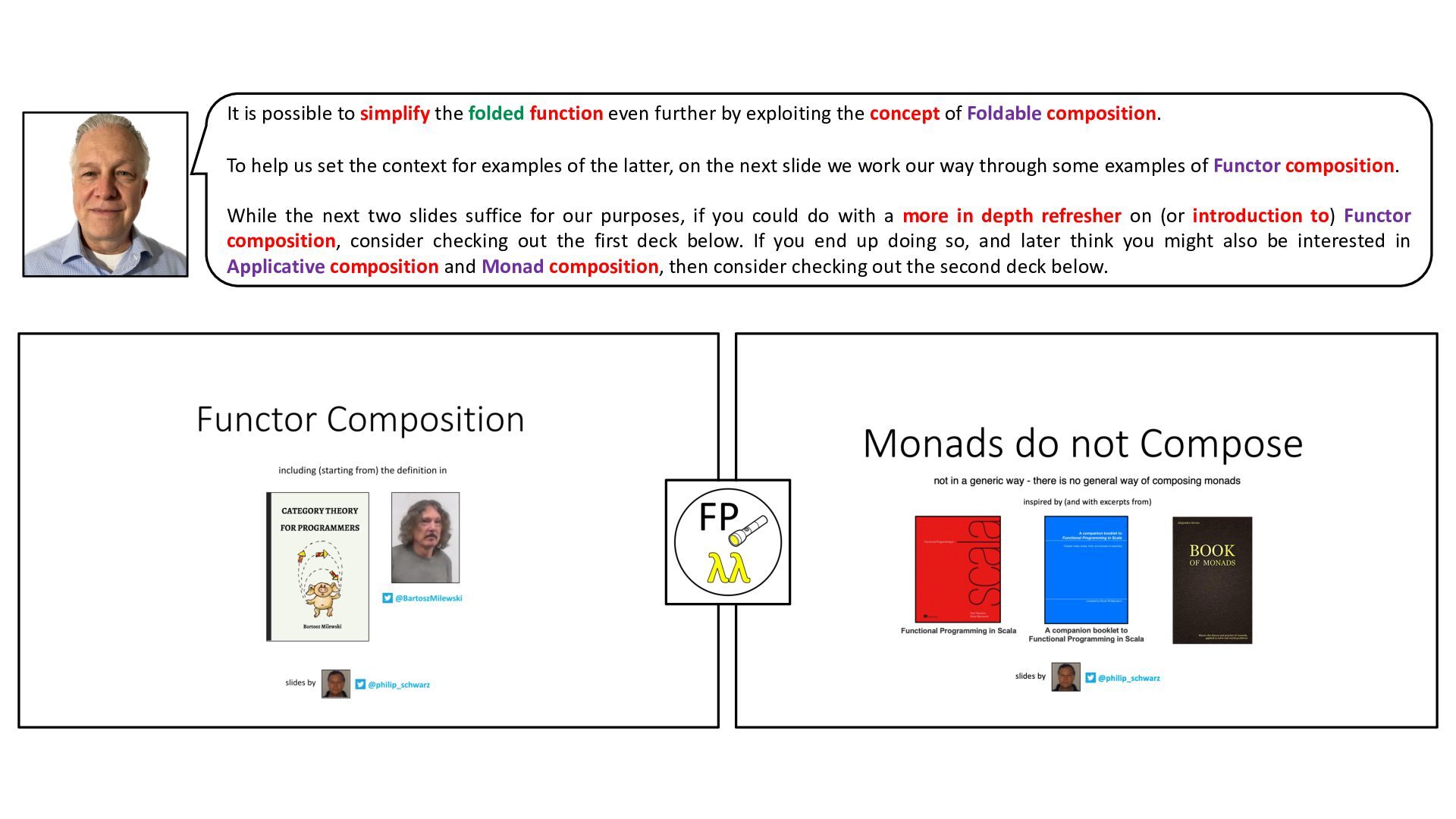
  15. It is possible to simplify the folded function even further

    by exploiting the concept of Foldable composition. To help us set the context for examples of the latter, on the next slide we work our way through some examples of Functor composition. While the next two slides suffice for our purposes, if you could do with a more in depth refresher on (or introduction to) Functor composition, consider checking out the first deck below. If you end up doing so, and later think you might also be interested in Applicative composition and Monad composition, then consider checking out the second deck below.
  16. import cats.* import cats.data.Nested import cats.implicits.* Cats assert(List(2,3,4) == Functor[List].map(List(1,2,3))(_

    + 1)) Cats provides a Functor for List. Here we use it to map an increment function over a list of integers. assert(List(2,3,4) == List(1,2,3).map(_ + 1)) Of course there is no need to use the functor when we can simply invoke map on the list of integers. What if we want to map a desired function, not simply over a flat data structure, e.g. List[Int], for which there is a functor, e.g. Functor[List], but over two nested data structures, e.g. List[Option[Int]] or Option[List[Int]], for both of which there is a functor, e.g. Functor[List] and Functor[Option] ? The obvious way to do that is to use one functor to map, over the outer data structure, a function that in turn uses the other functor to map the desired function over each inner data structure. assert(List(2.some,3.some,4.some) == Functor[List].map(List(1.some,2.some,3.some))(Functor[Option].map(_)(_ + 1))) assert(Some(List(2,3,4)) == Functor[Option].map(Some(List(1,2,3)))(Functor[List].map(_)(_ + 1))) assert(List(List(2,3),List(4,5,6)) == Functor[List].map(List(List(1,2),List(3,4,5)))(Functor[List].map(_)(_ + 1))) Of course there is no need to use the functors when we can simply invoke map on the data structures. assert(List(2.some, 3.some, 4.some) == List(1.some, 2.some, 3.some).map(_.map(_ + 1))) assert(Some(List(2,3,4)) == Some(List(1,2,3)).map(_.map(_ + 1))) assert(List(List(2,3),List(4,5,6)) == List(List(1,2),List(3,4,5)).map(_.map(_ + 1)))
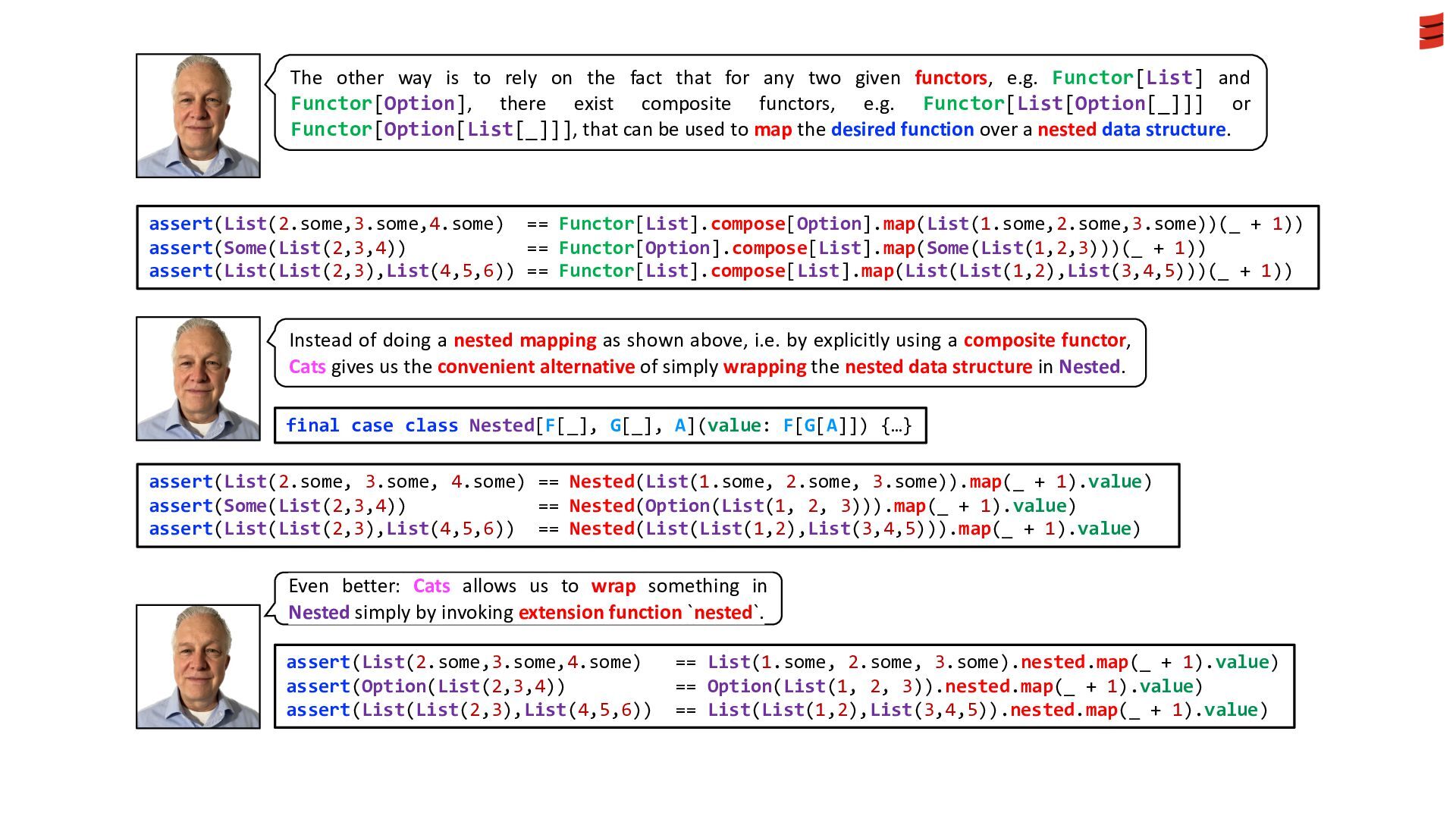
  17. The other way is to rely on the fact that

    for any two given functors, e.g. Functor[List] and Functor[Option], there exist composite functors, e.g. Functor[List[Option[_]]] or Functor[Option[List[_]]], that can be used to map the desired function over a nested data structure. assert(List(2.some,3.some,4.some) == Functor[List].compose[Option].map(List(1.some,2.some,3.some))(_ + 1)) assert(Some(List(2,3,4)) == Functor[Option].compose[List].map(Some(List(1,2,3)))(_ + 1)) assert(List(List(2,3),List(4,5,6)) == Functor[List].compose[List].map(List(List(1,2),List(3,4,5)))(_ + 1)) Instead of doing a nested mapping as shown above, i.e. by explicitly using a composite functor, Cats gives us the convenient alternative of simply wrapping the nested data structure in Nested. final case class Nested[F[_], G[_], A](value: F[G[A]]) {…} assert(List(2.some, 3.some, 4.some) == Nested(List(1.some, 2.some, 3.some)).map(_ + 1).value) assert(Some(List(2,3,4)) == Nested(Option(List(1, 2, 3))).map(_ + 1).value) assert(List(List(2,3),List(4,5,6)) == Nested(List(List(1,2),List(3,4,5))).map(_ + 1).value) Even better: Cats allows us to wrap something in Nested simply by invoking extension function `nested`. assert(List(2.some,3.some,4.some) assert(Option(List(2,3,4)) assert(List(List(2,3),List(4,5,6)) == List(1.some, 2.some, 3.some).nested.map(_ + 1).value) == Option(List(1, 2, 3)).nested.map(_ + 1).value) == List(List(1,2),List(3,4,5)).nested.map(_ + 1).value)
  18. In the next three slides we are going to look

    at the Foldable equivalent of what we have just seen for Functor.
  19. assert(List(2.some,3.some,4.some) == Functor[List].compose[Option].map(List(1.some,2.some,3.some))(_ + 1)) assert(Some(List(2,3,4)) == Functor[Option].compose[List].map(Some(List(1,2,3)))(_ + 1))

    assert(List(List(2,3),List(4,5,6)) == Functor[List].compose[List].map(List(List(1,2),List(3,4,5)))(_ + 1)) Just like functors, foldables are composable. Just like it is possible to map a function over nested data structures using a composite functor, it is possible to fold nested data structures (for whose leaf values there is a monoid) using a composite foldable. val m = Monoid[Int] assert(15 == Foldable[List].compose[Option].fold(List(1.some,2.some,3.some,4.some,5.some))(using m)) assert(15 == Foldable[Option].compose[List].fold(Some(List(1,2,3,4,5)))(using m)) assert(15 == Foldable[List].compose[List].fold(List(List(1,2),List(3,4,5)))(using m)) assert(15 == Foldable[List].compose[Option].fold(List(1.some,2.some,3.some,4.some,5.some))) assert(15 == Foldable[Option].compose[List].fold(Some(List(1,2,3,4,5)))) assert(15 == Foldable[List].compose[List].fold(List(List(1,2),List(3,4,5)))) Monoid[Int] passed in explicitly Monoid[Int] passed in implicitly
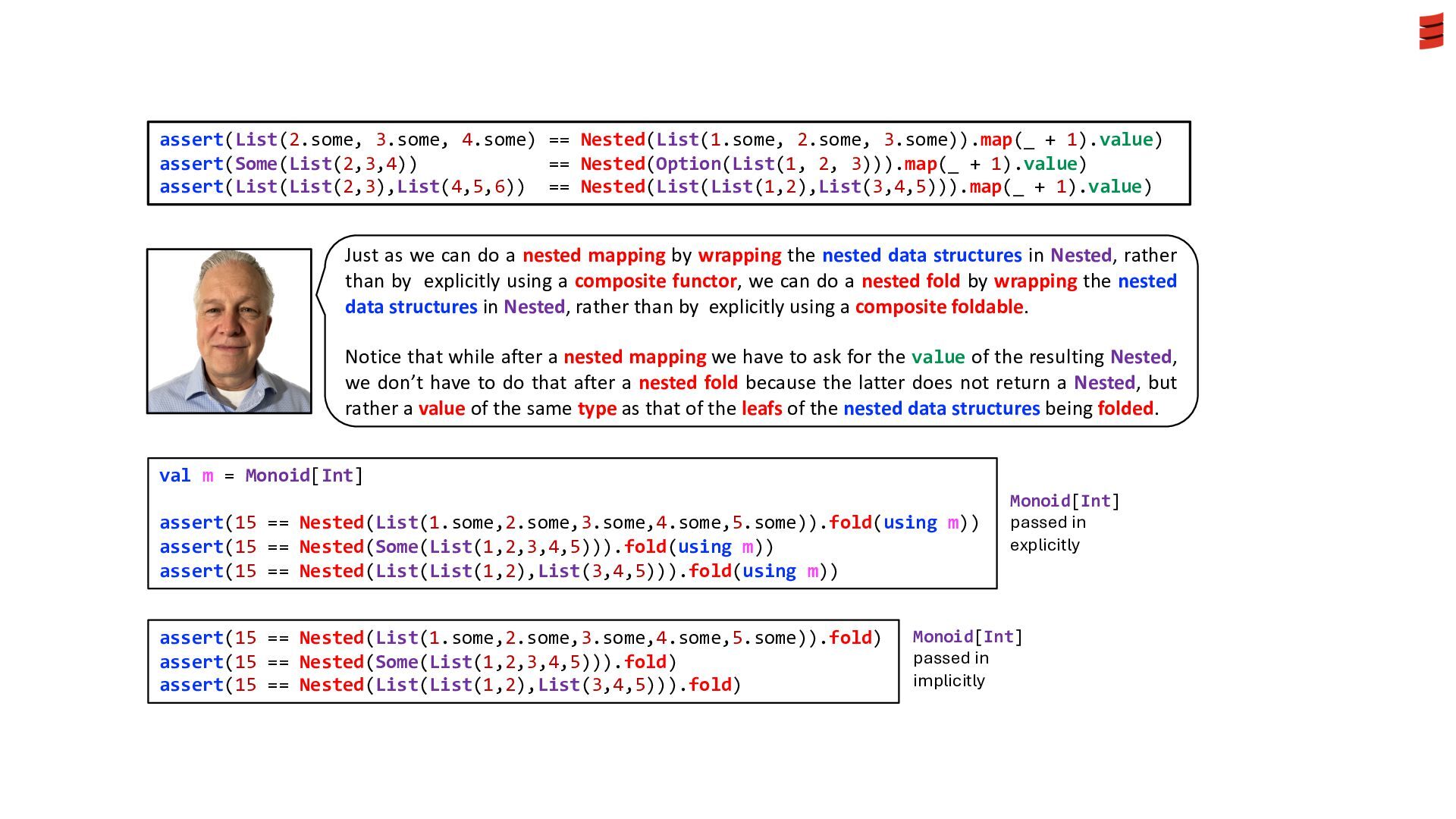
  20. assert(List(2.some, 3.some, 4.some) == Nested(List(1.some, 2.some, 3.some)).map(_ + 1).value) assert(Some(List(2,3,4))

    == Nested(Option(List(1, 2, 3))).map(_ + 1).value) assert(List(List(2,3),List(4,5,6)) == Nested(List(List(1,2),List(3,4,5))).map(_ + 1).value) Just as we can do a nested mapping by wrapping the nested data structures in Nested, rather than by explicitly using a composite functor, we can do a nested fold by wrapping the nested data structures in Nested, rather than by explicitly using a composite foldable. Notice that while after a nested mapping we have to ask for the value of the resulting Nested, we don’t have to do that after a nested fold because the latter does not return a Nested, but rather a value of the same type as that of the leafs of the nested data structures being folded. val m = Monoid[Int] assert(15 == Nested(List(1.some,2.some,3.some,4.some,5.some)).fold(using m)) assert(15 == Nested(Some(List(1,2,3,4,5))).fold(using m)) assert(15 == Nested(List(List(1,2),List(3,4,5))).fold(using m)) assert(15 == Nested(List(1.some,2.some,3.some,4.some,5.some)).fold) assert(15 == Nested(Some(List(1,2,3,4,5))).fold) assert(15 == Nested(List(List(1,2),List(3,4,5))).fold) Monoid[Int] passed in explicitly Monoid[Int] passed in implicitly
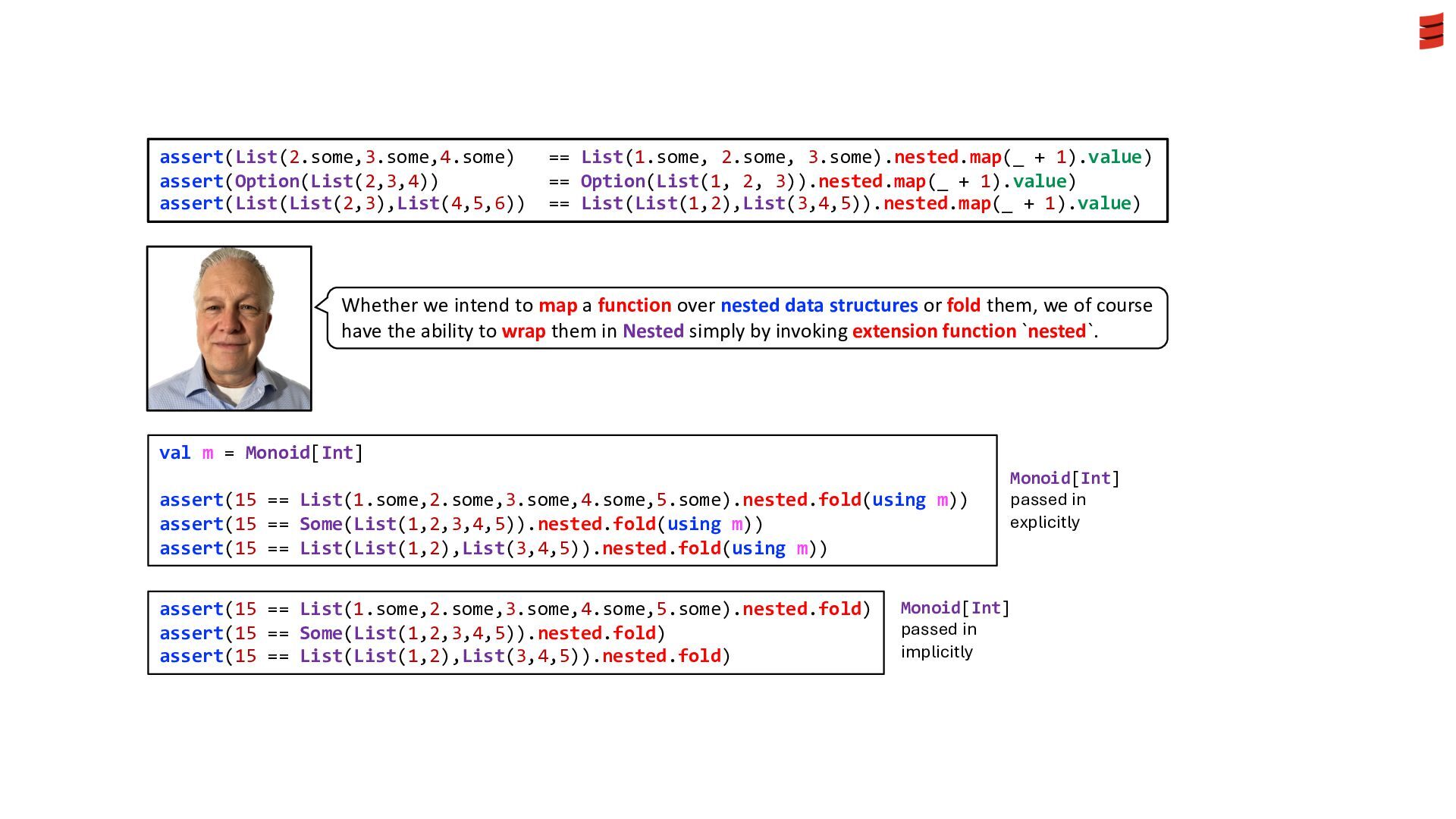
  21. assert(List(2.some,3.some,4.some) assert(Option(List(2,3,4)) assert(List(List(2,3),List(4,5,6)) == List(1.some, 2.some, 3.some).nested.map(_ + 1).value) ==

    Option(List(1, 2, 3)).nested.map(_ + 1).value) == List(List(1,2),List(3,4,5)).nested.map(_ + 1).value) Whether we intend to map a function over nested data structures or fold them, we of course have the ability to wrap them in Nested simply by invoking extension function `nested`. val m = Monoid[Int] assert(15 == List(1.some,2.some,3.some,4.some,5.some).nested.fold(using m)) assert(15 == Some(List(1,2,3,4,5)).nested.fold(using m)) assert(15 == List(List(1,2),List(3,4,5)).nested.fold(using m)) assert(15 == List(1.some,2.some,3.some,4.some,5.some).nested.fold) assert(15 == Some(List(1,2,3,4,5)).nested.fold) assert(15 == List(List(1,2),List(3,4,5)).nested.fold) Monoid[Int] passed in explicitly Monoid[Int] passed in implicitly
  22. On the next slide we simplify the folded function of

    our bowling game program by using what we have just learnt about folding nested data structures.
  23. extension (xss: LazyList[List[Int]]) def folded: Int = xss.foldMap(fold) def fold[A](using

    Monoid[A]) = Foldable[List].fold[A] simplify extension (xss: LazyList[List[Int]]) def folded: Int = xss.nested.fold fold 8 fold 13 5 fold 8 1 fold 9 fold 8 8 0 5 5 3 8 3 7 1 10 9 1 fold 20 9 1 10 fold 20 10 10 8 fold 28 10 8 2 fold 20 8 2 6 fold 16 6 f o l d 150 Game score 150
  24. In the next three slides we simplify the folded function

    of our bowling game program even further in that we can do nested folds by relying on the Numeric typeclass rather than on the Monoid typeclass.
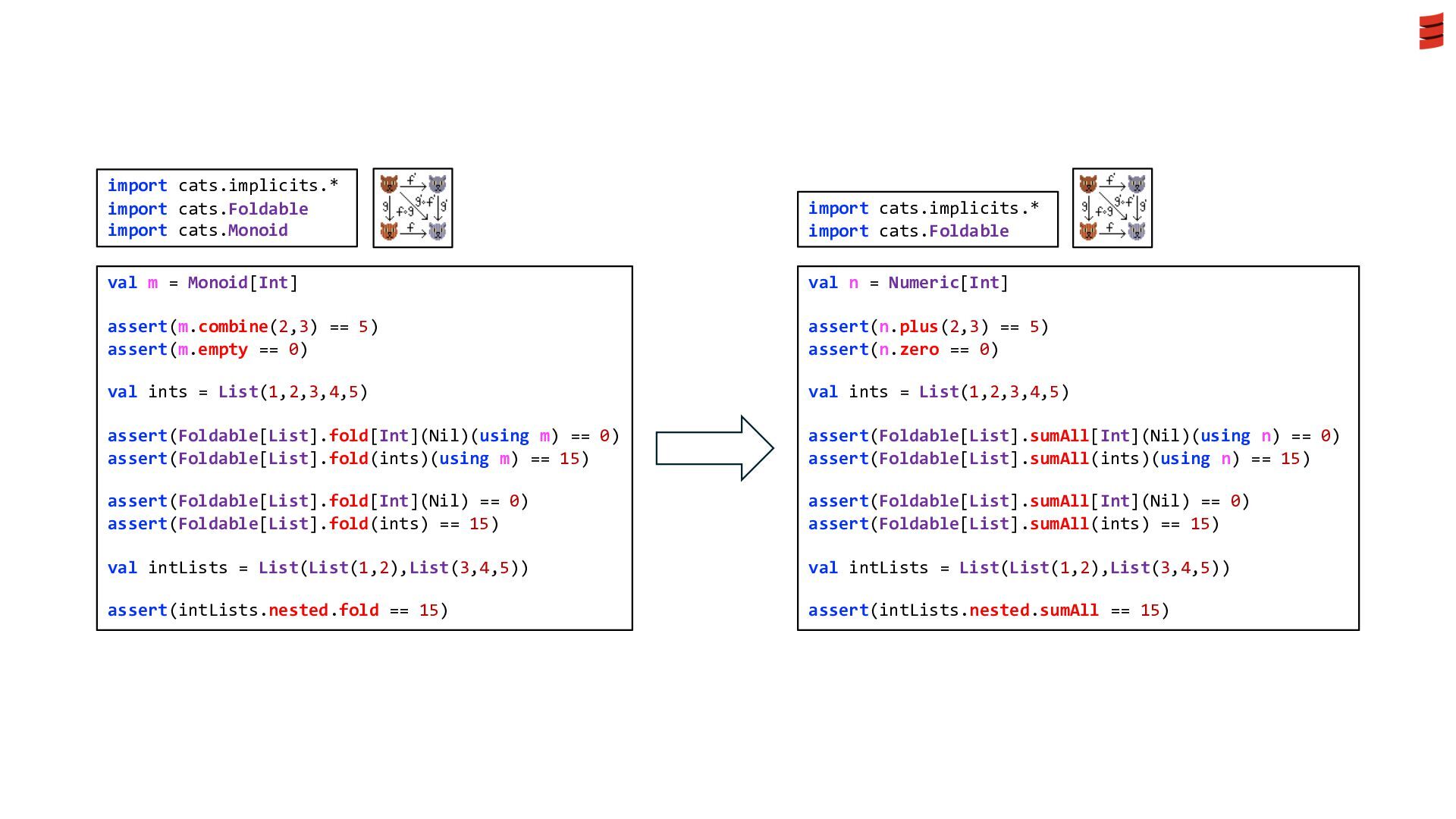
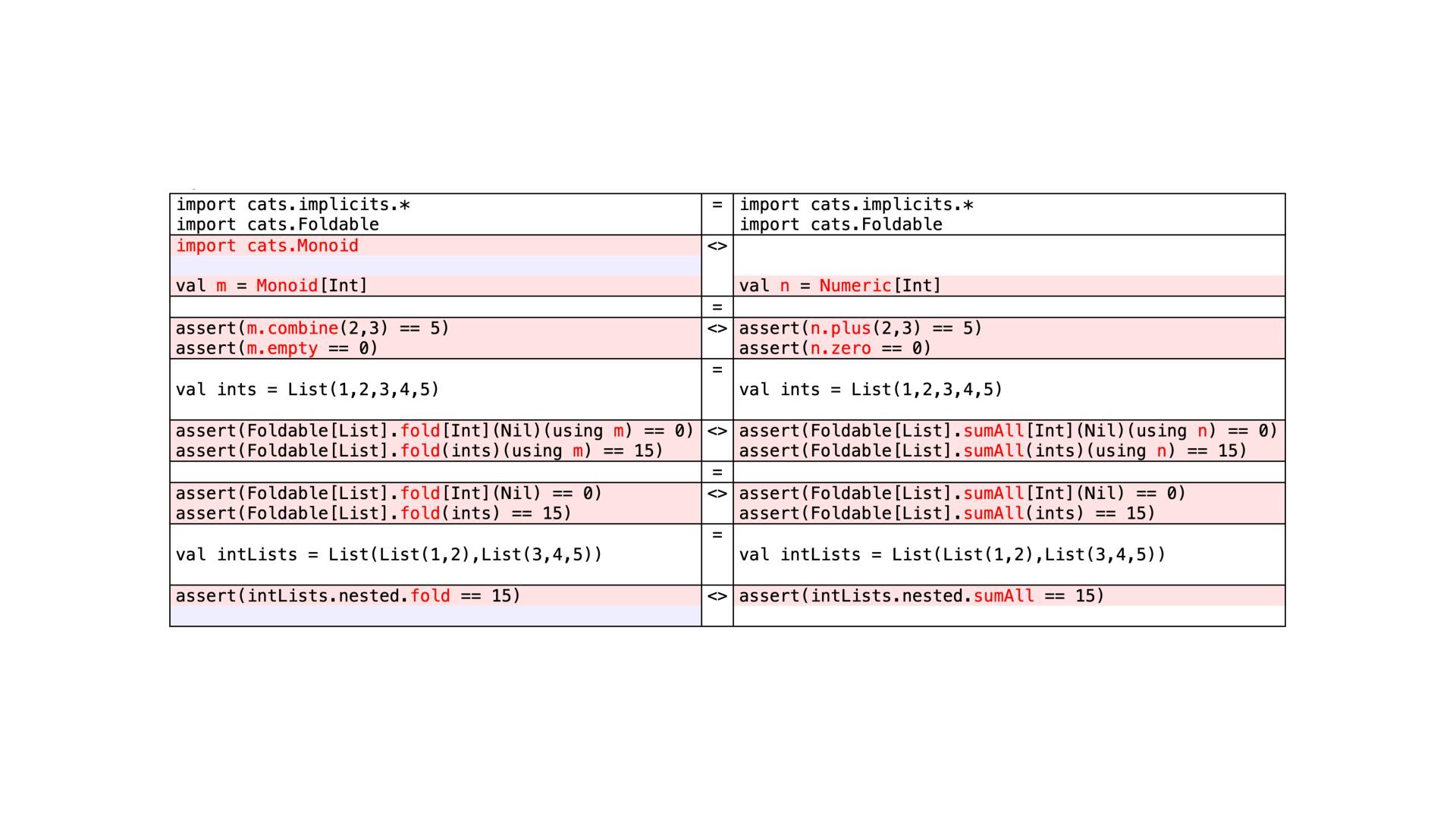
  25. import cats.implicits.* import cats.Foldable import cats.Monoid import cats.implicits.* import cats.Foldable

    val m = Monoid[Int] val n = Numeric[Int] assert(m.combine(2,3) == 5) assert(m.empty == 0) assert(n.plus(2,3) == 5) assert(n.zero == 0) val ints = List(1,2,3,4,5) val ints = List(1,2,3,4,5) assert(Foldable[List].fold[Int](Nil)(using m) == 0) assert(Foldable[List].fold(ints)(using m) == 15) assert(Foldable[List].sumAll[Int](Nil)(using n) == 0) assert(Foldable[List].sumAll(ints)(using n) == 15) assert(Foldable[List].fold[Int](Nil) == 0) assert(Foldable[List].fold(ints) == 15) assert(Foldable[List].sumAll[Int](Nil) == 0) assert(Foldable[List].sumAll(ints) == 15) val intLists = List(List(1,2),List(3,4,5)) val intLists = List(List(1,2),List(3,4,5)) assert(intLists.nested.fold == 15) assert(intLists.nested.sumAll == 15)
  26. extension (xss: LazyList[List[Int]]) def folded: Int = xss.nested.fold simplify extension

    (xss: LazyList[List[Int]]) def folded: Int = xss.nested.sumAll sumAll 8 sumAll 13 5 sumAll 8 8 1 sumAll 9 7 1 sumAll 8 10 9 1 sumAll 20 9 1 10 sumAll 20 10 10 8 sumAll 28 10 8 2 sumAll 20 8 2 6 sumAll 16 8 0 5 5 3 6 3 s u m A l l 150 Game score 150
  27. type PinCount = Int type RollScore = PinCount type FrameScore

    = List[RollScore] type GameScore = List[FrameScore] import cats.implicits.* def isStrike(rolls: List[Int]): Boolean = rolls.take(1).sum == 10 def isStrike(rollScores: List[RollScore]): Boolean = rollScores.take(1).sum == 10 def isSpare(rolls: List[Int]): Boolean = rolls.take(2).sum == 10 def isSpare(rollScores: List[RollScore]): Boolean = rollScores.take(2).sum == 10 def ballsToScore(rolls: List[Int]): Int = if isStrike(rolls) || isSpare(rolls) then 3 else 2 def ballsToScore(rollScores: List[RollScore]): Int = if isStrike(rollScores) || isSpare(rollScores) then 3 else 2 def frameAdvance(rolls: List[Int]): Int = if isStrike(rolls) then 1 else 2 def frameAdvance(rollScores: List[RollScore]): Int = if isStrike(rollScores) then 1 else 2 def frames(rolls: List[Int]): LazyList[List[Int]] = rolls.take(ballsToScore(rolls)) #:: frames(rolls.drop(frameAdvance(rolls))) def frameScores(rollScores : List[RollScore]): LazyList[FrameScore] = rollScores.take(ballsToScore(rollScores)) #:: frameScores(rollScores.drop(frameAdvance(rollScores))) def scoreFrame(frame: List[Int]): Int = frame.sum extension (xss: LazyList[List[Int]]) def folded: Int = xss.nested.sumAll def scoreGame(rolls: List[Int]): Int = frames(rolls).take(10).map(scoreFrame).sum def scoreGame(rollScores: List[RollScore]): Int = frameScores(rollScores).take(10).folded ORIGINAL REFACTORED Scala translation of `Version 8 - Clojure – domain-rich – Stuart Halloway`
  28. What about the Clojure program: can we refactor it in

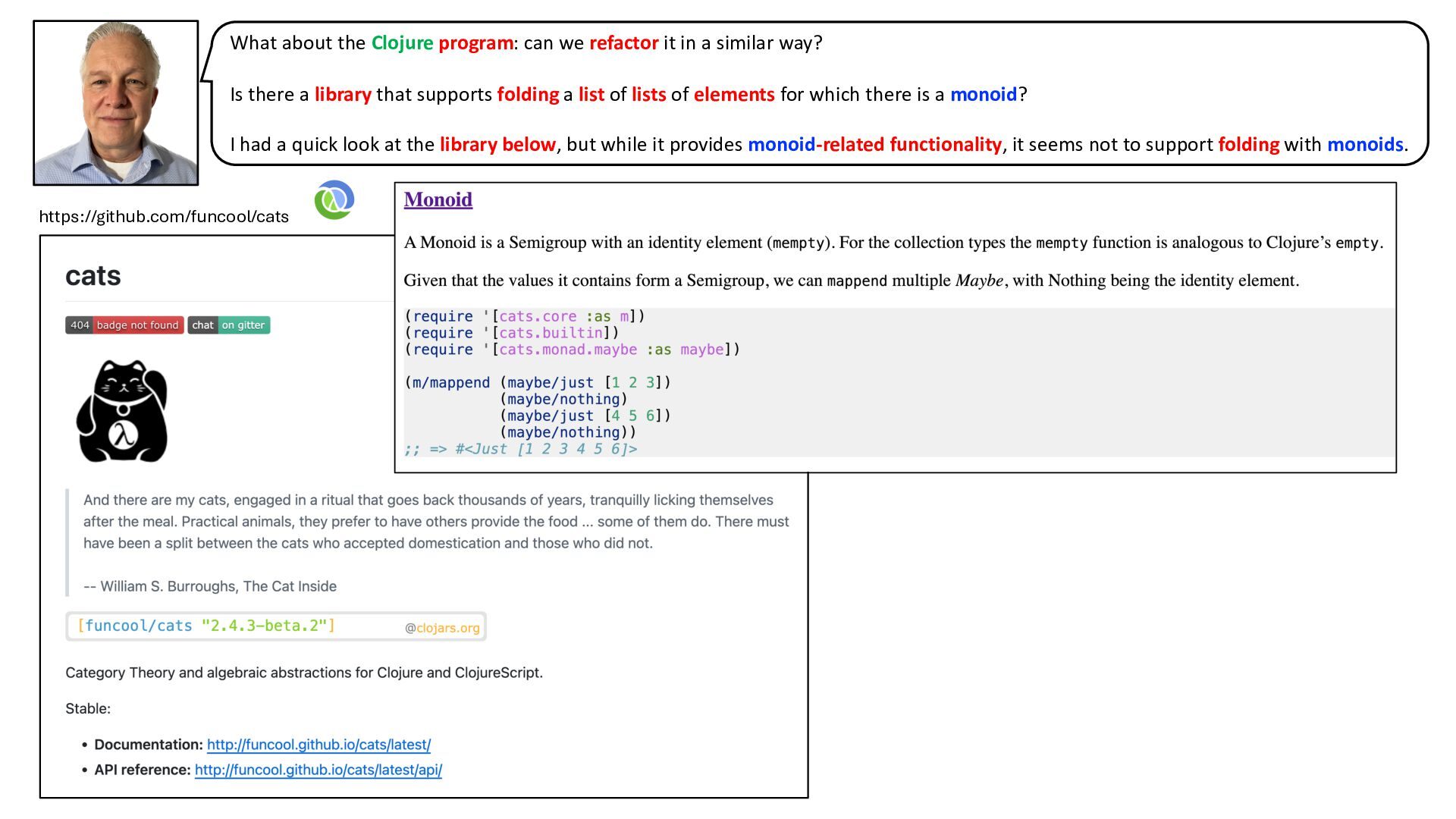
    a similar way? Is there a library that supports folding a list of lists of elements for which there is a monoid? I had a quick look at the library below, but while it provides monoid-related functionality, it seems not to support folding with monoids. https://github.com/funcool/cats
  29. But then I realised that in Clojure, if we reduce

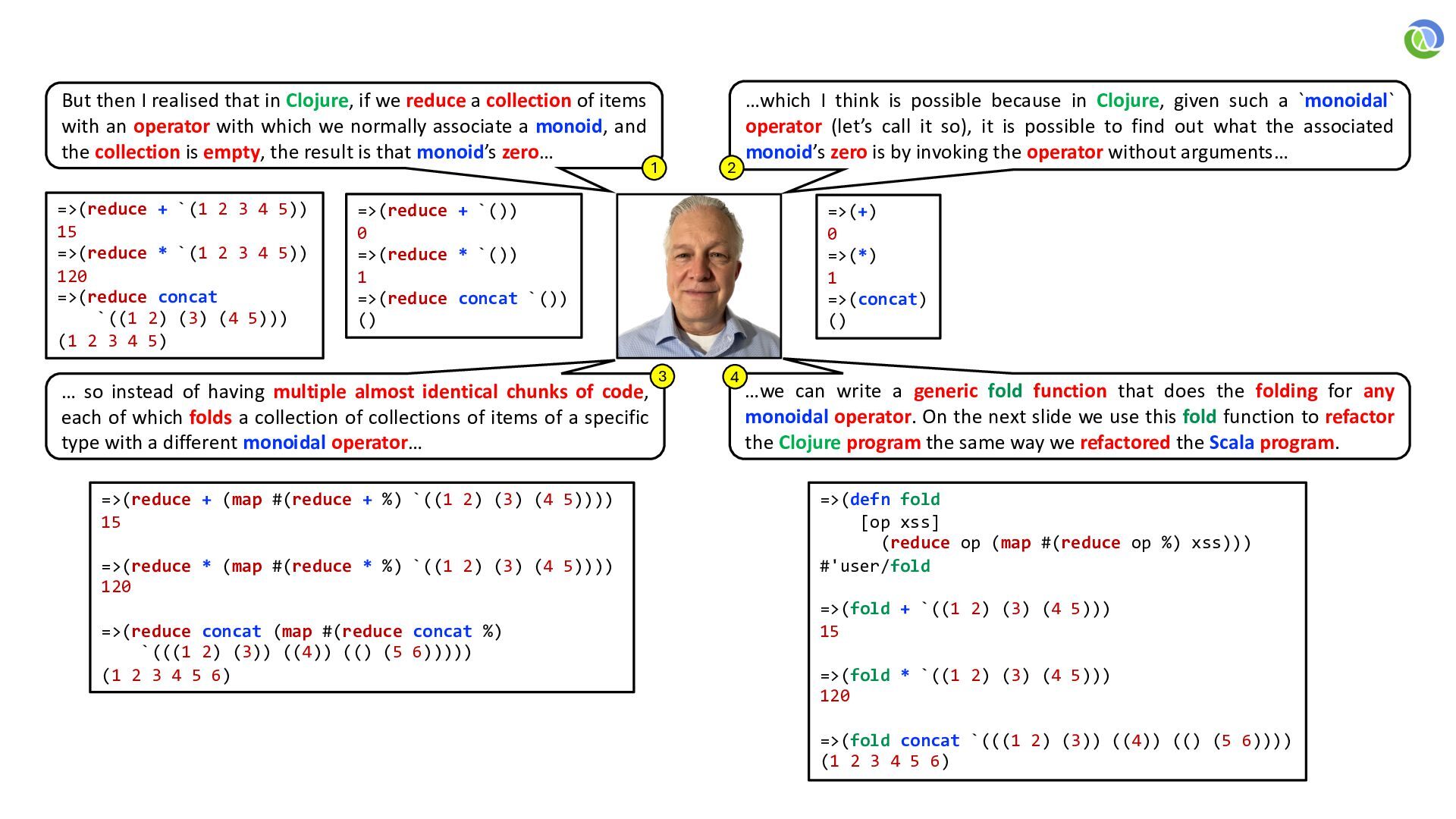
    a collection of items with an operator with which we normally associate a monoid, and the collection is empty, the result is that monoid’s zero… =>(reduce + `(1 2 3 4 5)) 15 =>(reduce * `(1 2 3 4 5)) 120 =>(reduce concat `((1 2) (3) (4 5))) (1 2 3 4 5) 1 2 =>(reduce + `()) 0 =>(reduce * `()) 1 =>(reduce concat `()) () … so instead of having multiple almost identical chunks of code, each of which folds a collection of collections of items of a specific type with a different monoidal operator… =>(reduce + (map #(reduce + %) `((1 2) (3) (4 5)))) 15 =>(reduce * (map #(reduce * %) `((1 2) (3) (4 5)))) 120 =>(reduce concat (map #(reduce concat %) `(((1 2) (3)) ((4)) (() (5 6))))) (1 2 3 4 5 6) …which I think is possible because in Clojure, given such a `monoidal` operator (let’s call it so), it is possible to find out what the associated monoid’s zero is by invoking the operator without arguments… =>(+) 0 =>(*) 1 =>(concat) () 3 4 …we can write a generic fold function that does the folding for any monoidal operator. On the next slide we use this fold function to refactor the Clojure program the same way we refactored the Scala program. =>(defn fold [op xss] (reduce op (map #(reduce op %) xss))) #'user/fold =>(fold + `((1 2) (3) (4 5))) 15 =>(fold * `((1 2) (3) (4 5))) 120 =>(fold concat `(((1 2) (3)) ((4)) (() (5 6)))) (1 2 3 4 5 6)
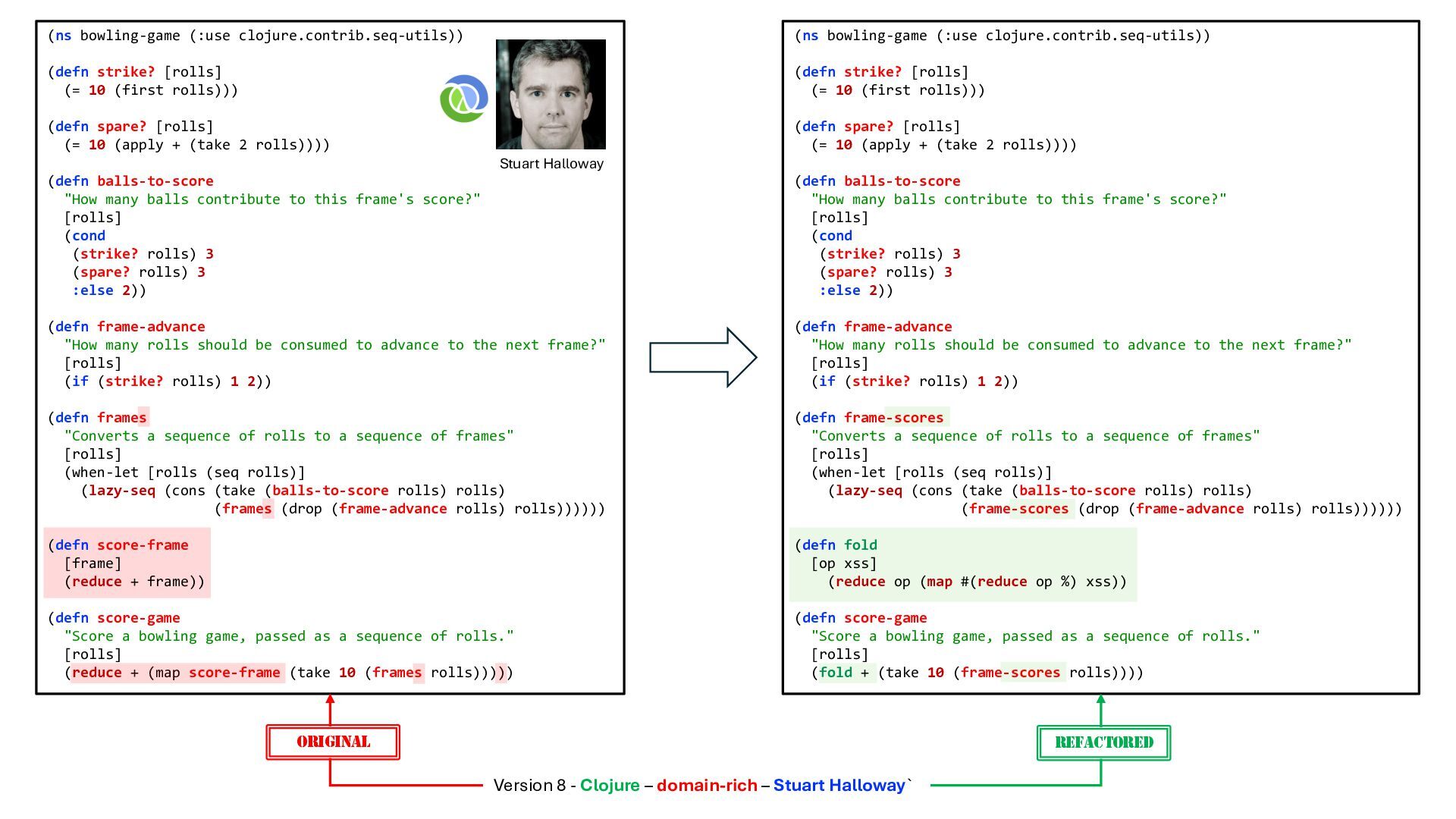
  30. (ns bowling-game (:use clojure.contrib.seq-utils)) (ns bowling-game (:use clojure.contrib.seq-utils)) (defn strike?

    [rolls] (= 10 (first rolls))) (defn strike? [rolls] (= 10 (first rolls))) (defn spare? [rolls] (= 10 (apply + (take 2 rolls)))) (defn spare? [rolls] (= 10 (apply + (take 2 rolls)))) Stuart Halloway (defn balls-to-score "How many balls contribute to this frame's score?" [rolls] (cond (strike? rolls) 3 (spare? rolls) 3 :else 2)) (defn balls-to-score "How many balls contribute to this frame's score?" [rolls] (cond (strike? rolls) 3 (spare? rolls) 3 :else 2)) (defn frame-advance "How many rolls should be consumed to advance to the next frame?" [rolls] (if (strike? rolls) 1 2)) (defn frame-advance "How many rolls should be consumed to advance to the next frame?" [rolls] (if (strike? rolls) 1 2)) (defn frames "Converts a sequence of rolls to a sequence of frames" [rolls] (when-let [rolls (seq rolls)] (lazy-seq (cons (take (balls-to-score rolls) rolls) (frames (drop (frame-advance rolls) rolls)))))) (defn frame-scores "Converts a sequence of rolls to a sequence of frames" [rolls] (when-let [rolls (seq rolls)] (lazy-seq (cons (take (balls-to-score rolls) rolls) (frame-scores (drop (frame-advance rolls) rolls)))))) (defn score-frame [frame] (reduce + frame)) (defn fold [op xss] (reduce op (map #(reduce op %) xss)) (defn score-game "Score a bowling game, passed as a sequence of rolls." [rolls] (reduce + (map score-frame (take 10 (frames rolls))))) (defn score-game "Score a bowling game, passed as a sequence of rolls." [rolls] (fold + (take 10 (frame-scores rolls)))) ORIGINAL REFACTORED Version 8 - Clojure – domain-rich – Stuart Halloway`
  31. (defn fold [op xss] (reduce op (map #(reduce op %)

    xss)) reduce 8 reduce 13 5 reduce 8 8 1 reduce 9 7 1 reduce 8 10 9 1 reduce 20 9 1 10 reduce 20 10 10 8 reduce 28 10 8 2 reduce 20 8 2 6 reduce 16 8 0 5 5 3 6 3 m a p † r e d u c e 150 Game score † 150 † this illustration shows the behaviour of the function when op is bound to + and so reduction is summation
  32. So far in this deck we have refactored the following:

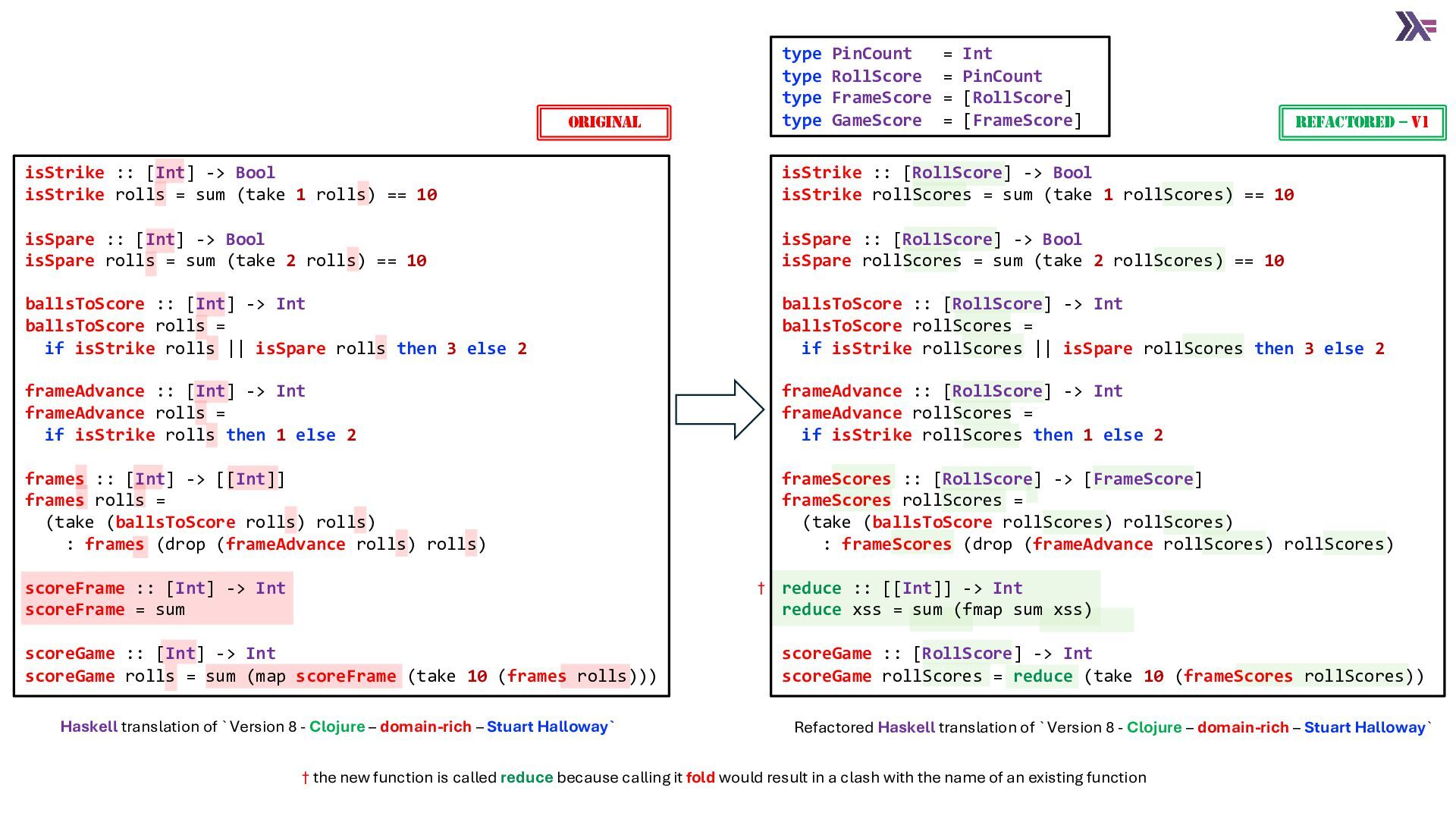
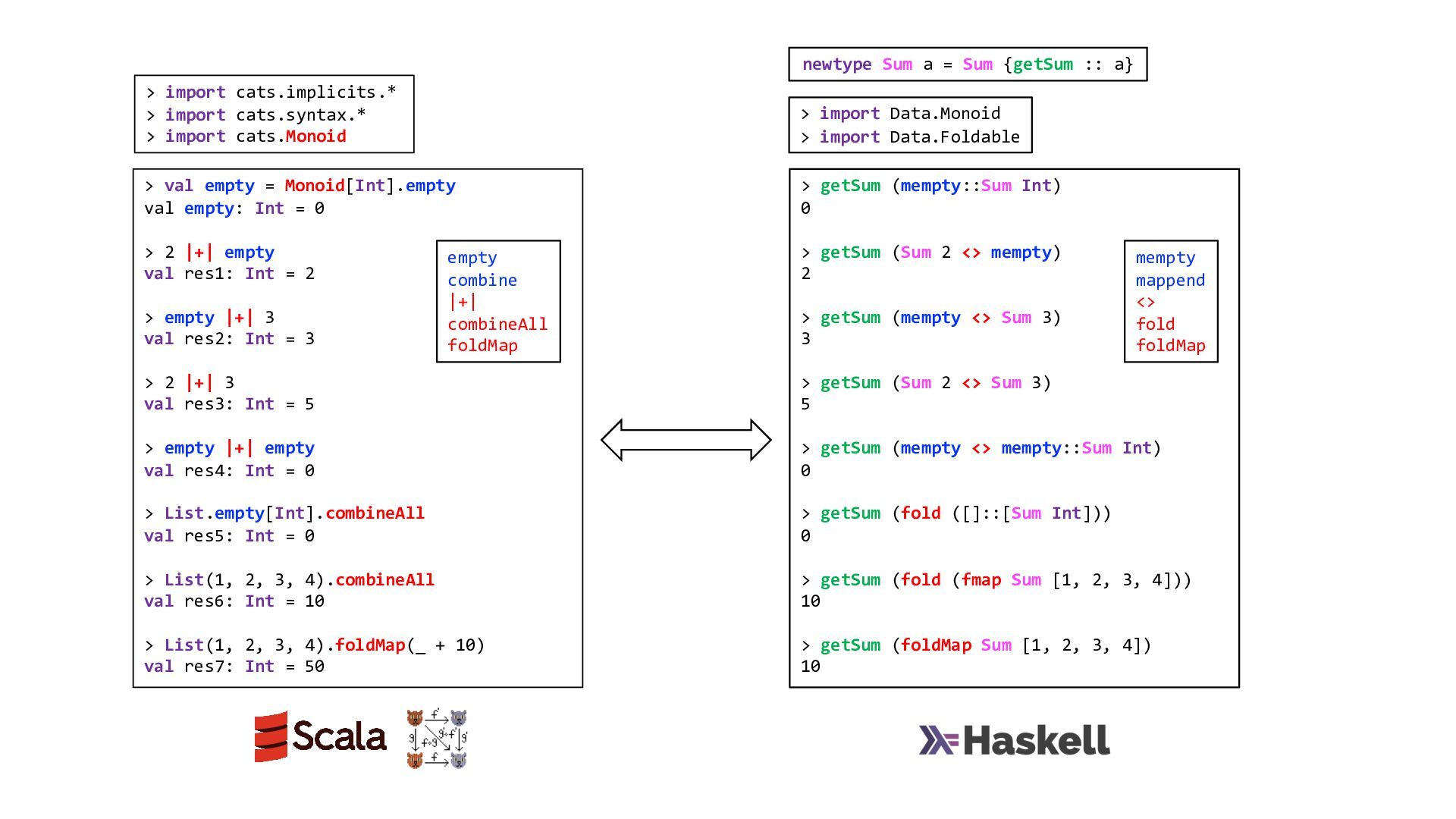
    • The Scala translation of Stuart Halloway’s Clojure program • Stuart Halloway’s Clojure program Let’s now turn to refactoring the Haskell translation of the Clojure program, in the same way that we refactored the Scala translation. The next slide shows the bulk of the refactoring in a single step. The subsequent two slides show the Haskell equivalent of the Monoid basics that we used when refactoring the Scala program.
  33. type PinCount = Int type RollScore = PinCount type FrameScore

    = [RollScore] type GameScore = [FrameScore] ORIGINAL REFACTORED – V1 isStrike :: [Int] -> Bool isStrike rolls = sum (take 1 rolls) == 10 isStrike :: [RollScore] -> Bool isStrike rollScores = sum (take 1 rollScores) == 10 isSpare :: [Int] -> Bool isSpare rolls = sum (take 2 rolls) == 10 isSpare :: [RollScore] -> Bool isSpare rollScores = sum (take 2 rollScores) == 10 ballsToScore :: [Int] -> Int ballsToScore rolls = if isStrike rolls || isSpare rolls then 3 else 2 ballsToScore :: [RollScore] -> Int ballsToScore rollScores = if isStrike rollScores || isSpare rollScores then 3 else 2 frameAdvance :: [Int] -> Int frameAdvance rolls = if isStrike rolls then 1 else 2 frameAdvance :: [RollScore] -> Int frameAdvance rollScores = if isStrike rollScores then 1 else 2 frames :: [Int] -> [[Int]] frames rolls = (take (ballsToScore rolls) rolls) : frames (drop (frameAdvance rolls) rolls) frameScores :: [RollScore] -> [FrameScore] frameScores rollScores = (take (ballsToScore rollScores) rollScores) : frameScores (drop (frameAdvance rollScores) rollScores) † scoreFrame :: [Int] -> Int scoreFrame = sum reduce :: [[Int]] -> Int reduce xss = sum (fmap sum xss) scoreGame :: [Int] -> Int scoreGame rolls = sum (map scoreFrame (take 10 (frames rolls))) scoreGame :: [RollScore] -> Int scoreGame rollScores = reduce (take 10 (frameScores rollScores)) Haskell translation of `Version 8 - Clojure – domain-rich – Stuart Halloway` Refactored Haskell translation of `Version 8 - Clojure – domain-rich – Stuart Halloway` † the new function is called reduce because calling it fold would result in a clash with the name of an existing function
  34. newtype Sum a = Sum {getSum :: a} > import

    cats.implicits.* > import cats.syntax.* > import cats.Monoid > import Data.Monoid > import Data.Foldable > val empty = Monoid[Int].empty val empty: Int = 0 > getSum (mempty::Sum Int) 0 > 2 |+| empty val res1: Int = 2 > getSum (Sum 2 <> mempty) 2 > empty |+| 3 val res2: Int = 3 empty combine |+| combineAll foldMap > getSum (mempty <> Sum 3) 3 mempty mappend <> fold foldMap > 2 |+| 3 val res3: Int = 5 > getSum (Sum 2 <> Sum 3) 5 > empty |+| empty val res4: Int = 0 > getSum (mempty <> mempty::Sum Int) 0 > List.empty[Int].combineAll val res5: Int = 0 > getSum (fold ([]::[Sum Int])) 0 > List(1, 2, 3, 4).combineAll val res6: Int = 10 > getSum (fold (fmap Sum [1, 2, 3, 4])) 10 > List(1, 2, 3, 4).foldMap(_ + 10) val res7: Int = 50 > getSum (foldMap Sum [1, 2, 3, 4]) 10
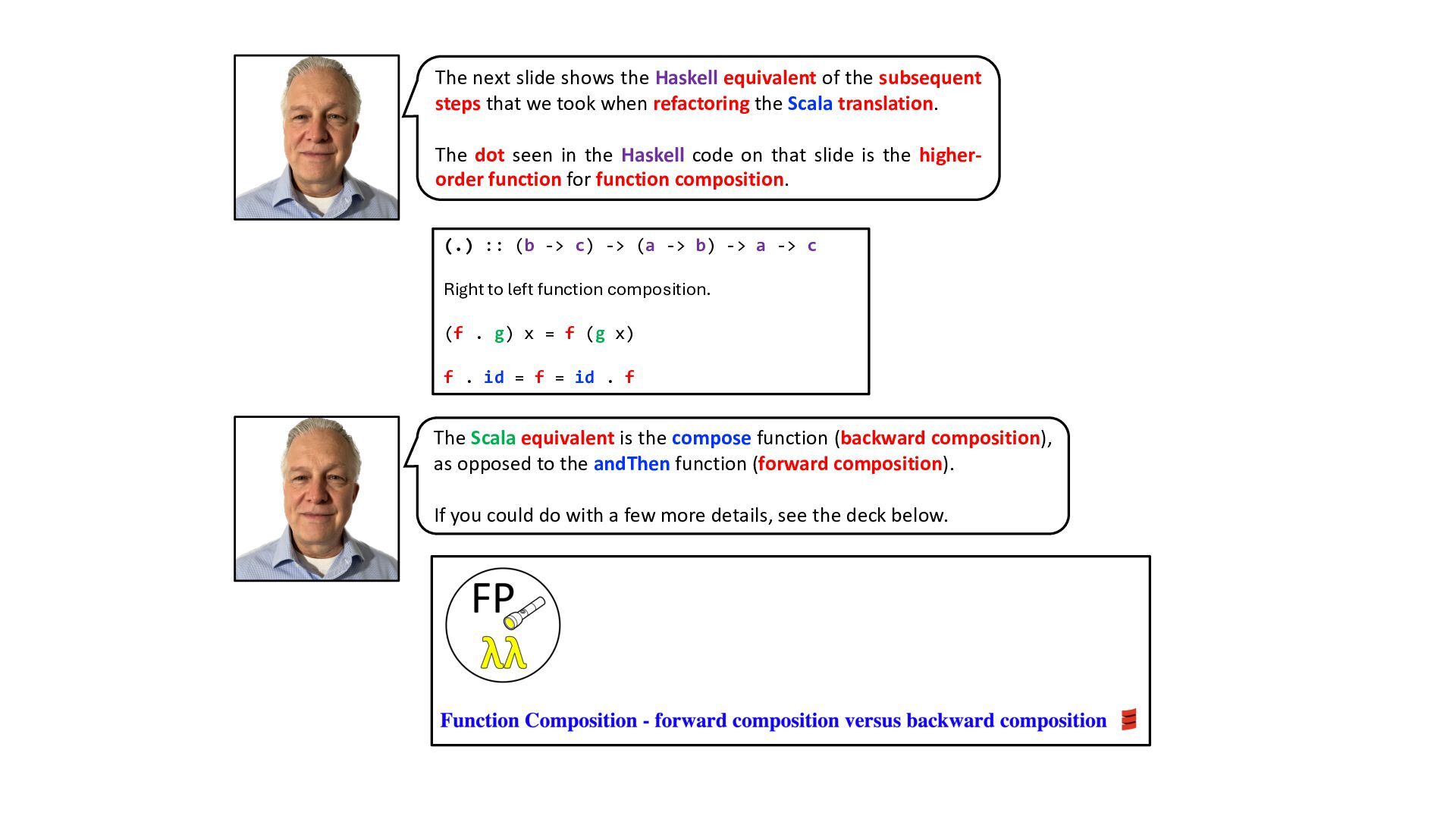
  35. The next slide shows the Haskell equivalent of the subsequent

    steps that we took when refactoring the Scala translation. The dot seen in the Haskell code on that slide is the higherorder function for function composition. (.) :: (b -> c) -> (a -> b) -> a -> c Right to left function composition. (f . g) x = f (g x) f . id = f = id . f The Scala equivalent is the compose function (backward composition), as opposed to the andThen function (forward composition). If you could do with a few more details, see the deck below.
  36. extension (xss: LazyList[List[Int]]) def folded: Int = xss.map(_.sum).sum reduce ::

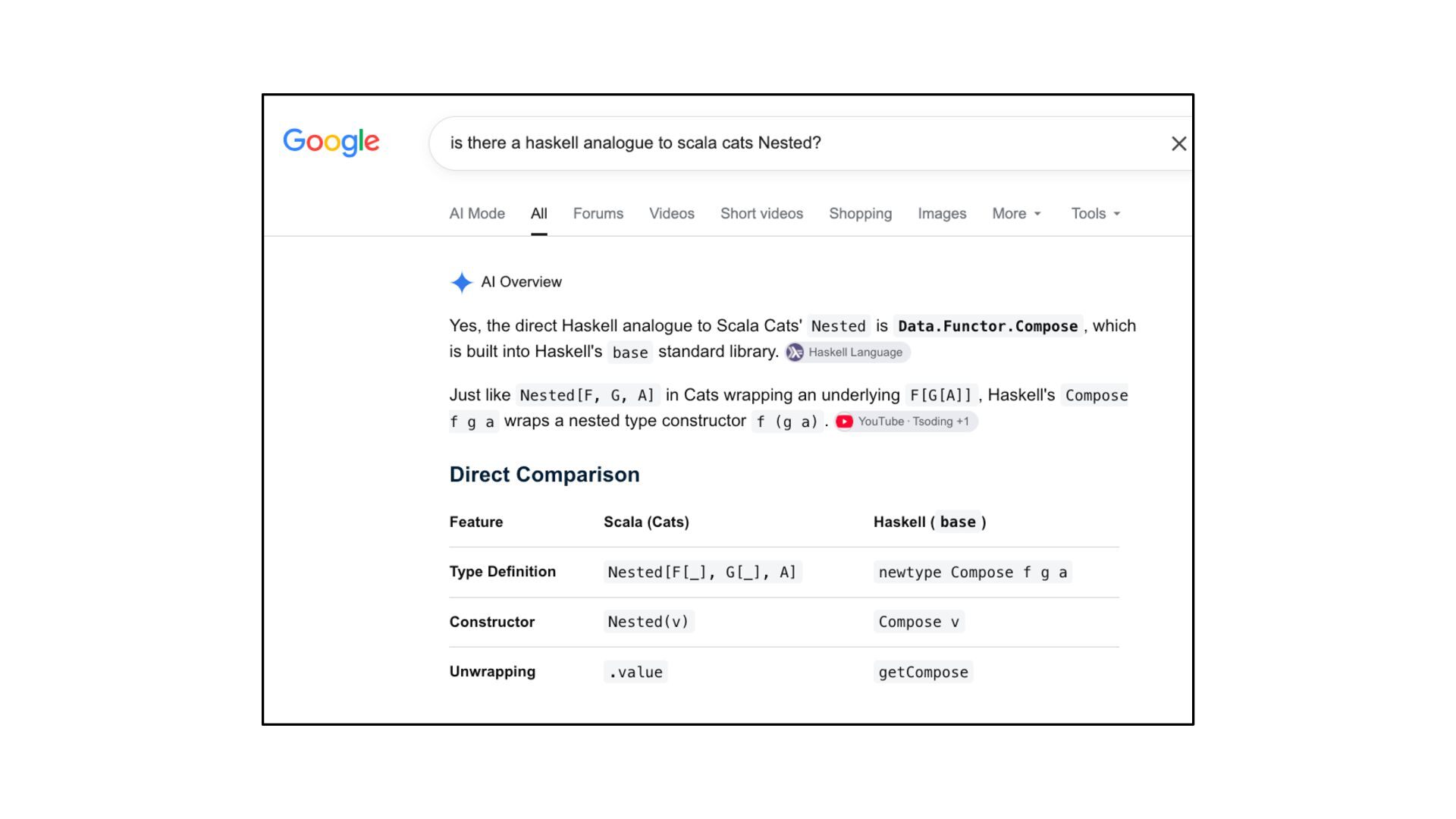
    [[Int]] -> Int reduce = sum (fmap sum) extension (xss: LazyList[List[Int]]) def folded: Int = xss.foldMap(fold) reduce :: [[Int]] -> Int reduce = getSum.(foldMap (foldMap Sum)) def fold[A](using Monoid[A]) = Foldable[List].fold[A] extension (xss: LazyList[List[Int]]) def folded: Int = xss.nested.fold reduce :: [[Int]] -> Int reduce = getSum.(foldMap Sum).Compose † extension (xss: LazyList[List[Int]]) def folded: Int = xss.nested.sumAll reduce :: [[Int]] -> Int reduce = sum.Compose †† † foldMap f (Compose t) = foldMap (foldMap f) t †† sum :: (Foldable t, Num a) => t a -> a sum (Compose t) = getSum (foldMap' (Sum . sum) t) foldMap' f = foldl' (\ acc a -> acc <> f a) mempty
  37. The next slide shows the Haskell program at the end

    of the refactoring. The subsequent slide shows the refactored Scala program next to the refactored Haskell program. The slide after that shows the refactored Scala program next to the refactored Clojure program.
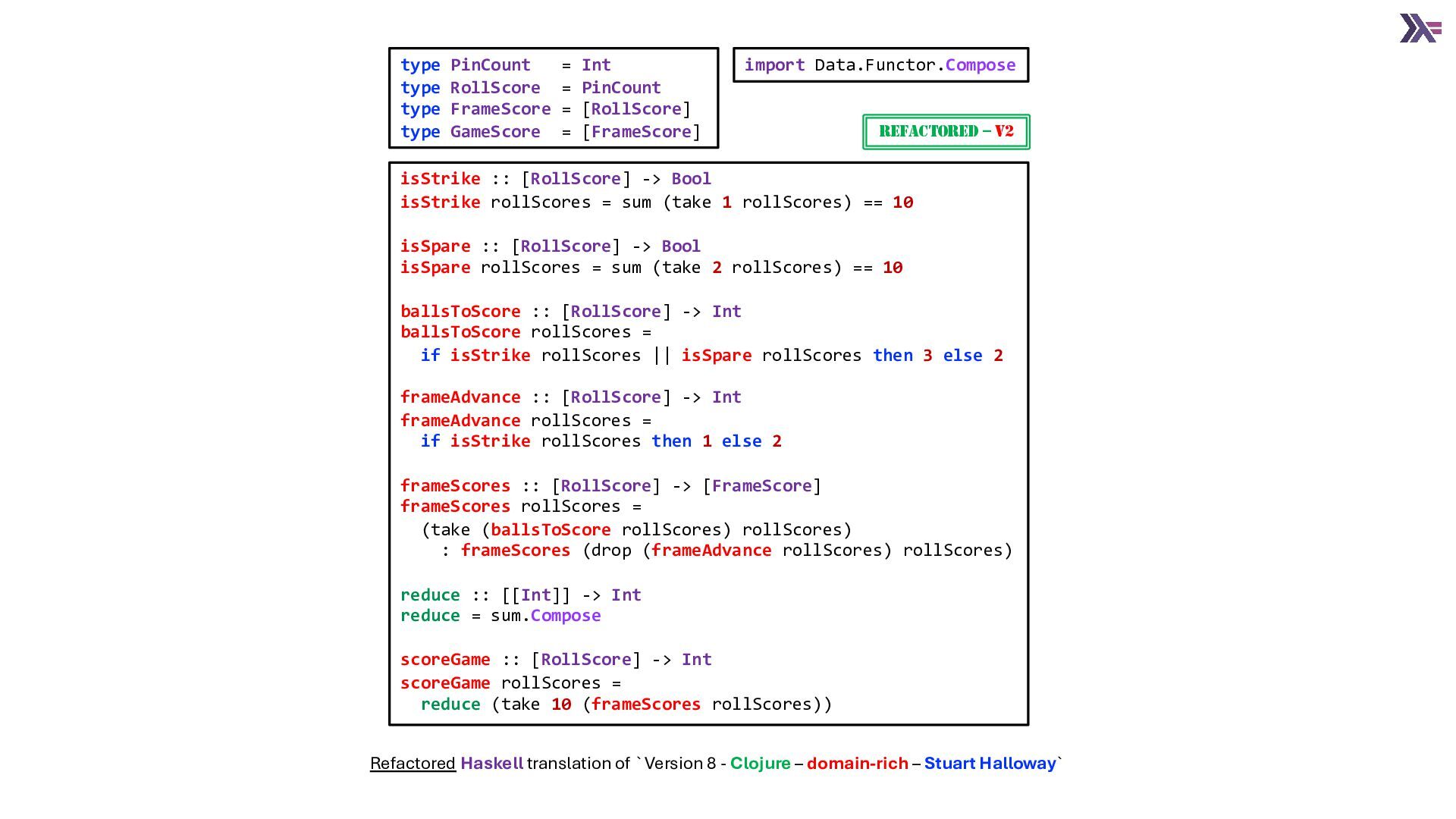
  38. type PinCount = Int type RollScore = PinCount type FrameScore

    = [RollScore] type GameScore = [FrameScore] import Data.Functor.Compose REFACTORED – V2 isStrike :: [RollScore] -> Bool isStrike rollScores = sum (take 1 rollScores) == 10 isSpare :: [RollScore] -> Bool isSpare rollScores = sum (take 2 rollScores) == 10 ballsToScore :: [RollScore] -> Int ballsToScore rollScores = if isStrike rollScores || isSpare rollScores then 3 else 2 frameAdvance :: [RollScore] -> Int frameAdvance rollScores = if isStrike rollScores then 1 else 2 frameScores :: [RollScore] -> [FrameScore] frameScores rollScores = (take (ballsToScore rollScores) rollScores) : frameScores (drop (frameAdvance rollScores) rollScores) reduce :: [[Int]] -> Int reduce = sum.Compose scoreGame :: [RollScore] -> Int scoreGame rollScores = reduce (take 10 (frameScores rollScores)) Refactored Haskell translation of `Version 8 - Clojure – domain-rich – Stuart Halloway`
  39. type PinCount = Int type RollScore = PinCount type FrameScore

    = List[RollScore] type GameScore = List[FrameScore] import cats.implicits type PinCount = Int type RollScore = PinCount type FrameScore = [RollScore] type GameScore = [FrameScore] import Data.Functor.Compose def isStrike(rollScores: List[RollScore]): Boolean = rollScores.take(1).sum == 10 isStrike :: [RollScore] -> Bool isStrike rollScores = sum (take 1 rollScores) == 10 def isSpare(rollScores: List[RollScore]): Boolean = rollScores.take(2).sum == 10 isSpare :: [RollScore] -> Bool isSpare rollScores = sum (take 2 rollScores) == 10 // How many balls contribute to this frame's score? def ballsToScore(rollScores: List[RollScore]): Int = if isStrike(rollScores) || isSpare(rollScores) then 3 else 2 -- How many balls contribute to this frame's score? ballsToScore :: [RollScore] -> Int ballsToScore rollScores = if isStrike rollScores || isSpare rollScores then 3 else 2 // How many rolls should be consumed to advance to the next frame? def frameAdvance(rollScores: List[RollScore]): Int = if isStrike(rollScores) then 1 else 2 -- How many rolls should be consumed to advance to the next frame? frameAdvance :: [RollScore] -> Int frameAdvance rollScores = if isStrike rollScores then 1 else 2 // Converts a sequence of roll scores to a sequence of frame scores def frameScores(rollScores : List[RollScore]): LazyList[FrameScore] = rollScores.take(ballsToScore(rollScores)) #:: frameScores(rollScores.drop(frameAdvance(rollScores))) -- Converts a sequence of roll scores to a sequence of frame scores frameScores :: [RollScore] -> [FrameScore] frameScores rollScores = (take (ballsToScore rollScores) rollScores) : frameScores (drop (frameAdvance rollScores) rollScores) extension (xss: LazyList[List[Int]]) def folded: Int = xss.nested.sumAll reduce :: [[Int]] -> Int reduce = sum.Compose // Score a bowling game, passed as a sequence of roll scores. def scoreGame(rollScores: List[RollScore]): Int = frameScores(rollScores).take(10).foldeD // Score a bowling game, passed as a sequence of roll scores. scoreGame :: [RollScore] -> Int scoreGame rollScores = reduce (take 10 (frameScores rollScores))
  40. (ns bowling-game (:use clojure.contrib.seq-utils)) (defn strike? [rolls] (= 10 (first

    rolls))) type PinCount = Int type RollScore = PinCount type FrameScore = List[RollScore] type GameScore = List[FrameScore] (defn spare? [rolls] (= 10 (apply + (take 2 rolls)))) import cats.implicits def isStrike(rollScores: List[RollScore]): Boolean = rollScores.take(1).sum == 10 def isSpare(rollScores: List[RollScore]): Boolean = rollScores.take(2).sum == 10 // How many balls contribute to this frame's score? def ballsToScore(rollScores: List[RollScore]): Int = if isStrike(rollScores) || isSpare(rollScores) then 3 else 2 // How many rolls should be consumed to advance to the next frame? def frameAdvance(rollScores: List[RollScore]): Int = if isStrike(rollScores) then 1 else 2 // Converts a sequence of roll scores to a sequence of frame scores def frameScores(rollScores : List[RollScore]): LazyList[FrameScore] = rollScores.take(ballsToScore(rollScores)) #:: frameScores(rollScores.drop(frameAdvance(rollScores))) extension (xss: LazyList[List[Int]]) def folded: Int = xss.nested.sumAll // Score a bowling game, passed as a sequence of roll scores. def scoreGame(rollScores: List[RollScore]): Int = frameScores(rollScores).take(10).foldeD (defn balls-to-score "How many balls contribute to this frame's score?" [rolls] (cond (strike? rolls) 3 (spare? rolls) 3 :else 2)) (defn frame-advance "How many rolls should be consumed to advance to the next frame?" [rolls] (if (strike? rolls) 1 2)) (defn frame-scores "Converts a sequence of rolls to a sequence of frames" [rolls] (when-let [rolls (seq rolls)] (lazy-seq (cons (take (balls-to-score rolls) rolls) (frame-scores (drop (frame-advance rolls) rolls)))))) (defn fold [op xss] (reduce op (map #(reduce op %) xss)) (defn score-game "Score a bowling game, passed as a sequence of rolls." [rolls] (fold + (take 10 (frame-scores rolls))))