The Bowling Game - From Imperative to Functiona...

Share
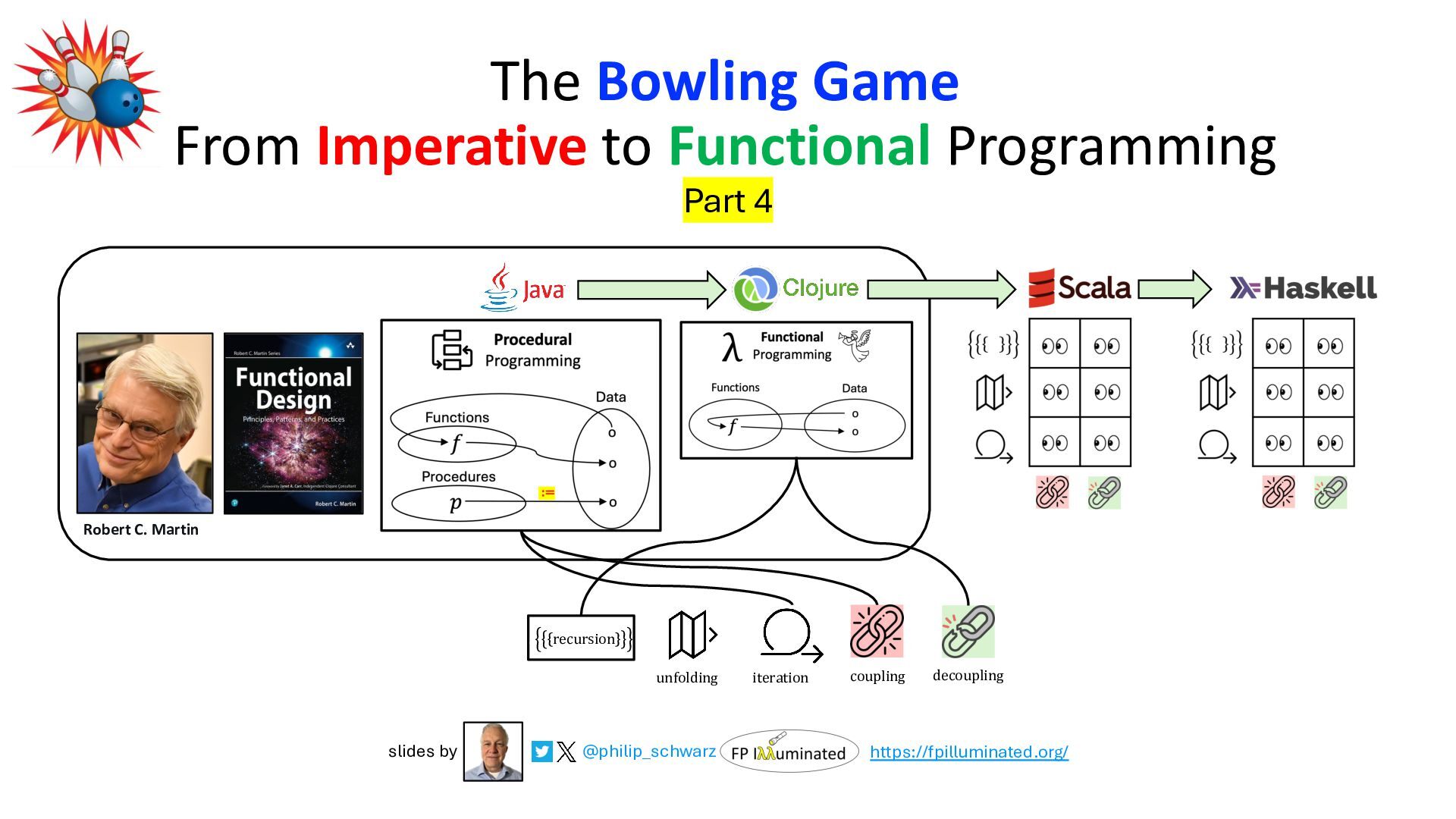
The Bowling Game - From Imperative to Functional Programming - Part 4
In this fourth deck in the series we do the following:
* Look at how Robert Martin wrote his recursive Clojure version of the bowling program
* Translate his program into Scala, refactor the latter, and then translate it into Haskell.
* Modify the Scala program so that it uses the iterate function rather than recursion.
* Modify the Scala program so that it uses the unfold function rather than recursion.
* Translate the modified Scala programs into Haskell.
* Explore a regression in the Scala programs, from the uncoupling of two concerns to their coupling.
* Translate the resulting Scala programs into Haskell.
* Look at Robert Martin's alternative recursive Clojure program in which the two concerns are coupled.
* Translate the program into Scala and Haskell
* Look at a very succinct Clojure program by Alex Vear
* Compare the latter with Martin's program and its Scala and Haskell translation

Philip Schwarz PRO
Transcript
43 slides
-
The Bowling Game From Imperative to Functional Programming Part 4
Robert C. Martin s recursion unfolding slides by @philip_schwarz iteration coupling decoupling https://fpilluminated.org/ -
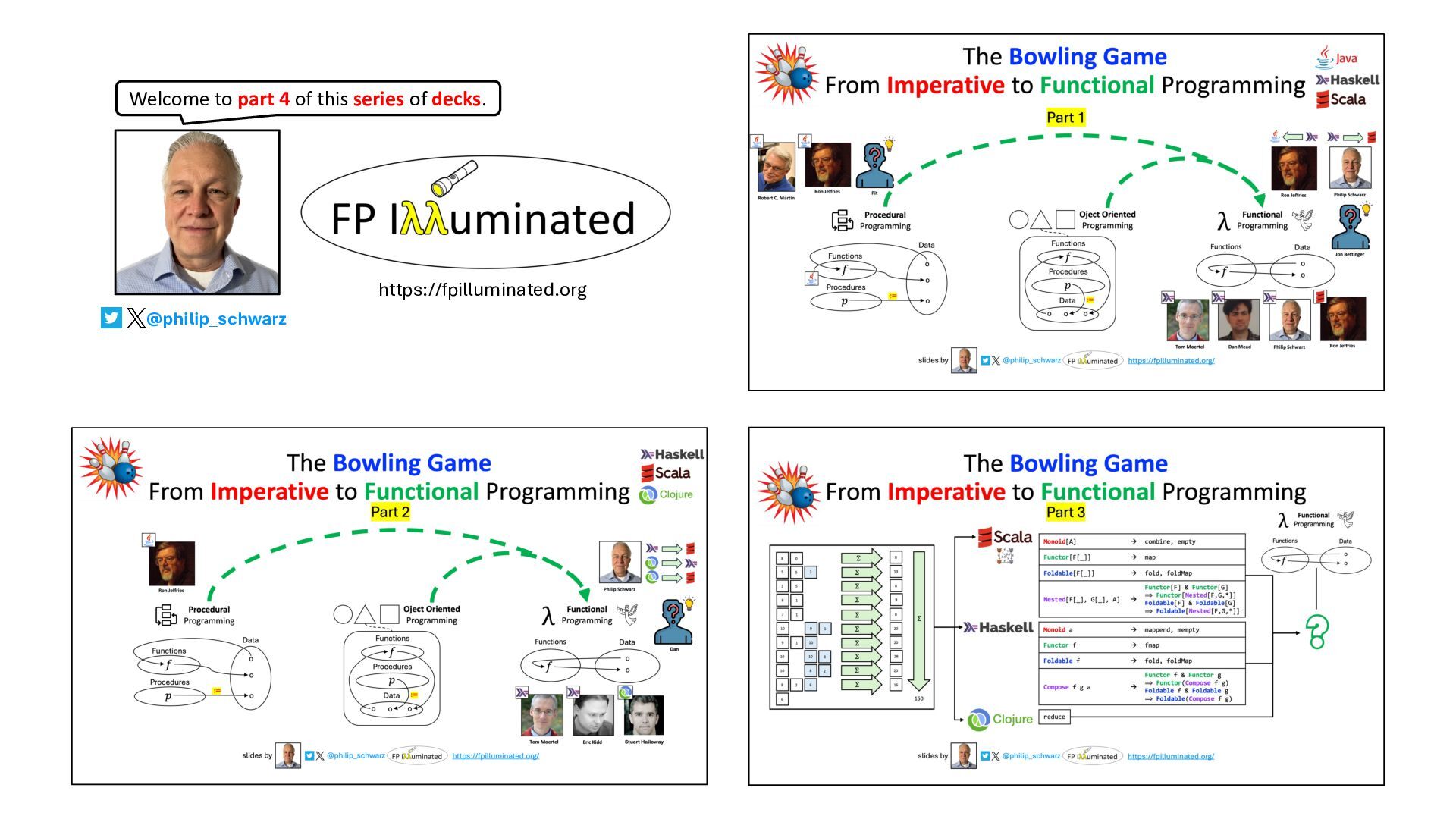
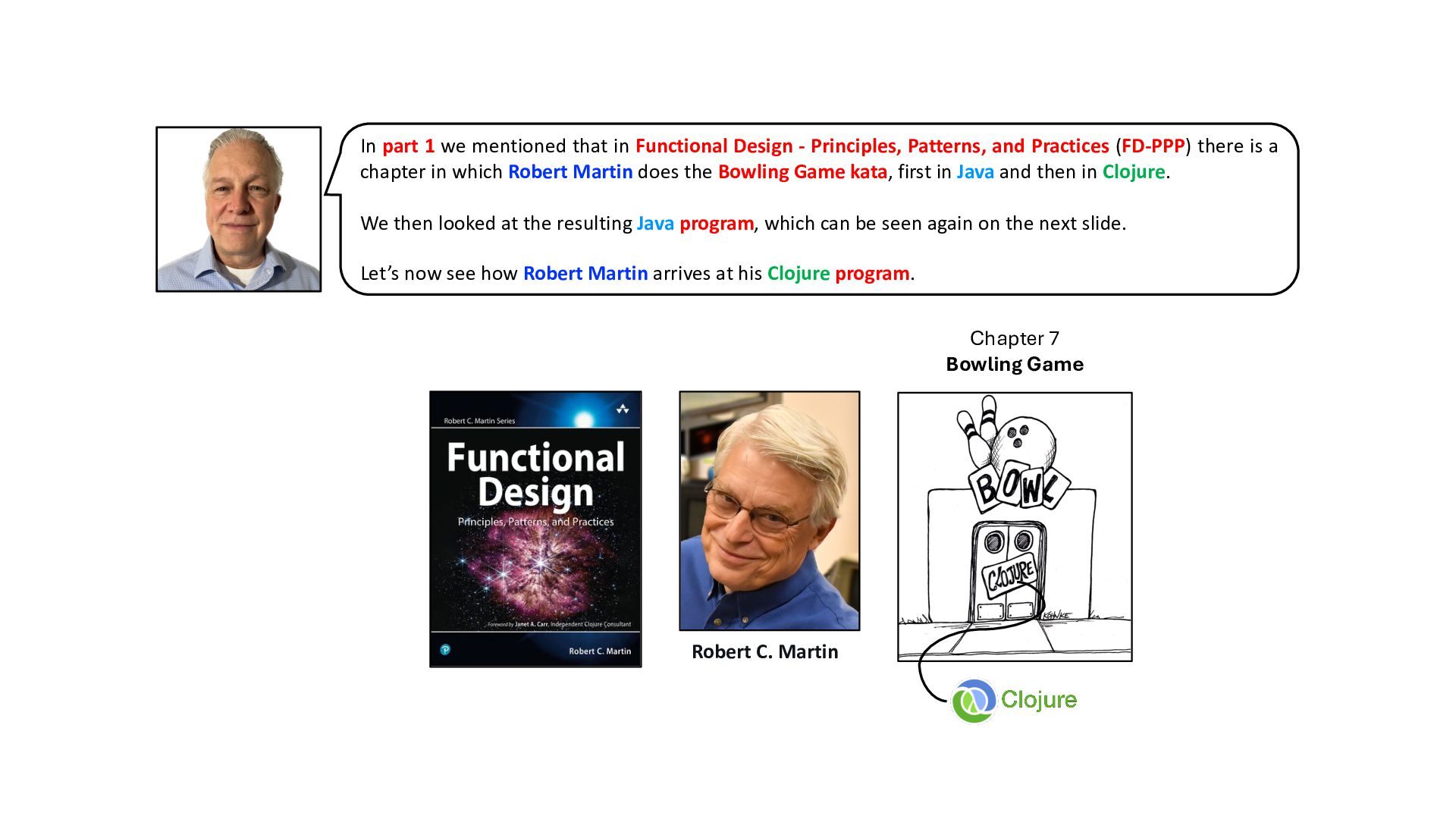
In part 1 we mentioned that in Functional Design -
Principles, Patterns, and Practices (FD-PPP) there is a chapter in which Robert Martin does the Bowling Game kata, first in Java and then in Clojure. We then looked at the resulting Java program, which can be seen again on the next slide. Let’s now see how Robert Martin arrives at his Clojure program. Chapter 7 Bowling Game Robert C. Martin -
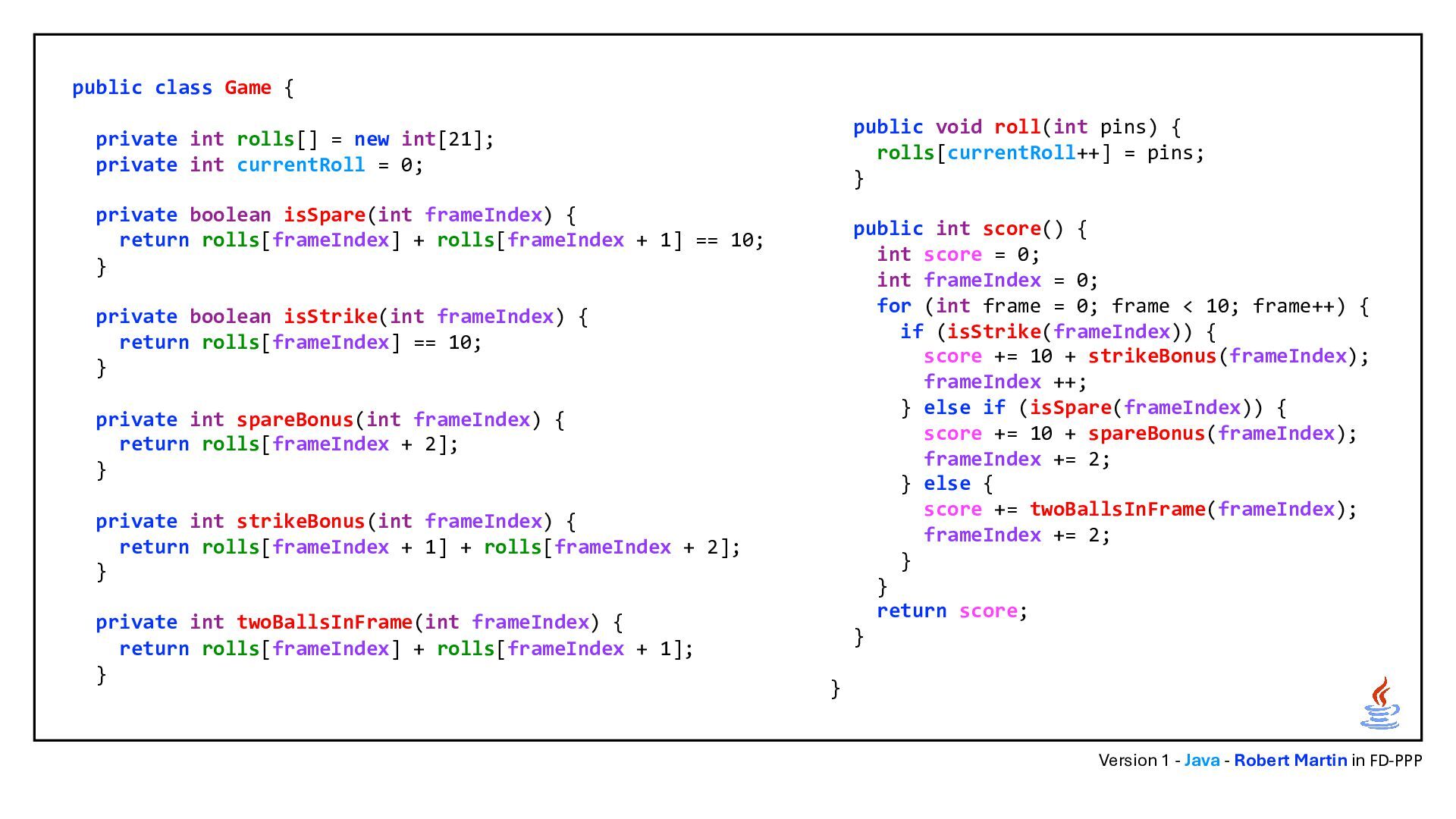
public class Game { public void roll(int pins) { rolls[currentRoll++]
= pins; } private int rolls[] = new int[21]; private int currentRoll = 0; private boolean isSpare(int frameIndex) { return rolls[frameIndex] + rolls[frameIndex + 1] == 10; } public int score() { int score = 0; int frameIndex = 0; for (int frame = 0; frame < 10; frame++) { if (isStrike(frameIndex)) { score += 10 + strikeBonus(frameIndex); frameIndex ++; } else if (isSpare(frameIndex)) { score += 10 + spareBonus(frameIndex); frameIndex += 2; } else { score += twoBallsInFrame(frameIndex); frameIndex += 2; } } return score; } private boolean isStrike(int frameIndex) { return rolls[frameIndex] == 10; } private int spareBonus(int frameIndex) { return rolls[frameIndex + 2]; } private int strikeBonus(int frameIndex) { return rolls[frameIndex + 1] + rolls[frameIndex + 2]; } private int twoBallsInFrame(int frameIndex) { return rolls[frameIndex] + rolls[frameIndex + 1]; } } Version 1 - Java - Robert Martin in FD-PPP -
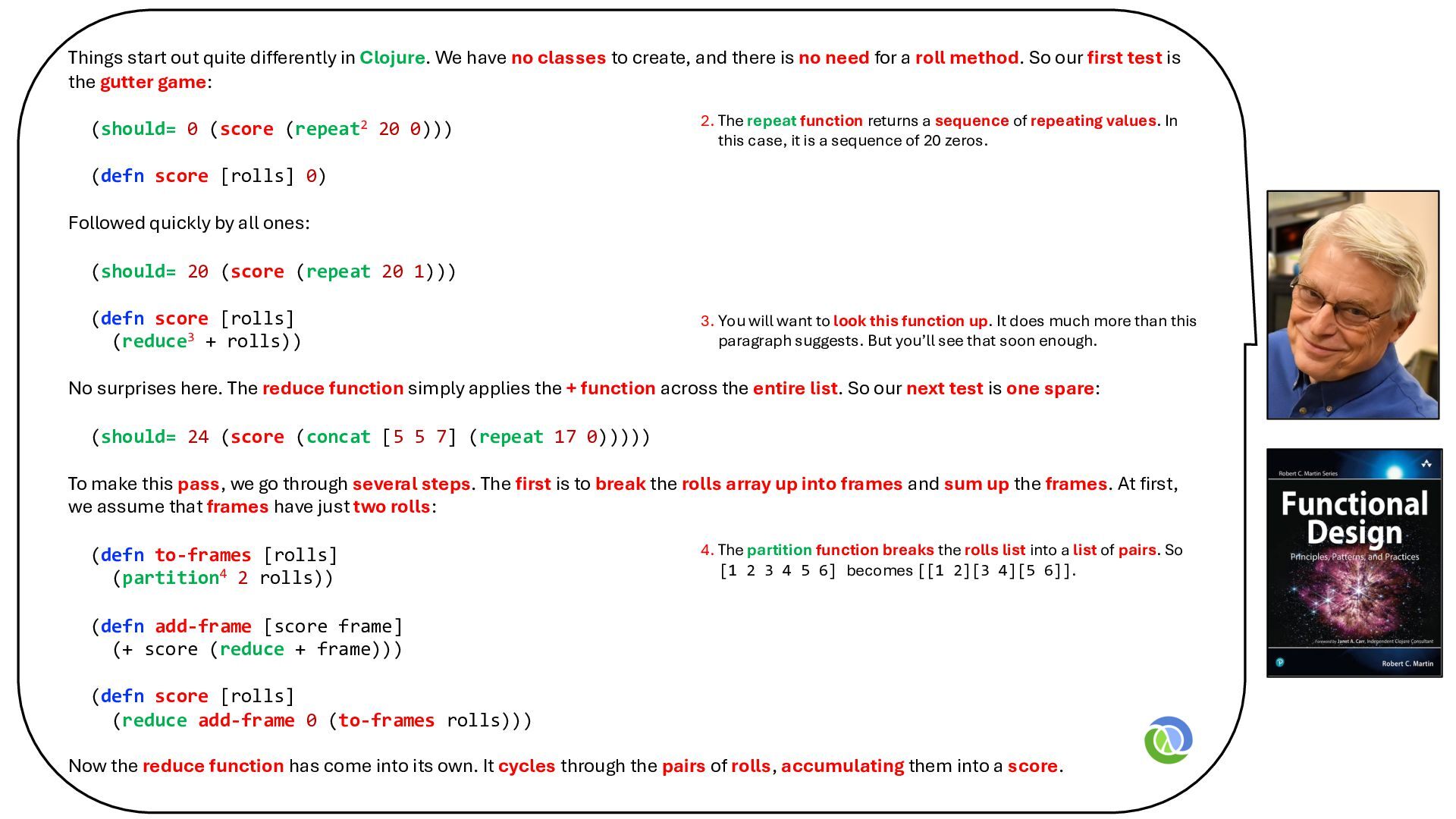
Things start out quite differently in Clojure. We have no
classes to create, and there is no need for a roll method. So our first test is the gutter game: (should= 0 (score (repeat2 20 0))) 2. The repeat function returns a sequence of repeating values. In this case, it is a sequence of 20 zeros. (defn score [rolls] 0) Followed quickly by all ones: (should= 20 (score (repeat 20 1))) (defn score [rolls] (reduce3 + rolls)) 3. You will want to look this function up. It does much more than this paragraph suggests. But you’ll see that soon enough. No surprises here. The reduce function simply applies the + function across the entire list. So our next test is one spare: (should= 24 (score (concat [5 5 7] (repeat 17 0))))) To make this pass, we go through several steps. The first is to break the rolls array up into frames and sum up the frames. At first, we assume that frames have just two rolls: (defn to-frames [rolls] (partition4 2 rolls)) 4. The partition function breaks the rolls list into a list of pairs. So [1 2 3 4 5 6] becomes [[1 2][3 4][5 6]]. (defn add-frame [score frame] (+ score (reduce + frame))) (defn score [rolls] (reduce add-frame 0 (to-frames rolls))) Now the reduce function has come into its own. It cycles through the pairs of rolls, accumulating them into a score. -
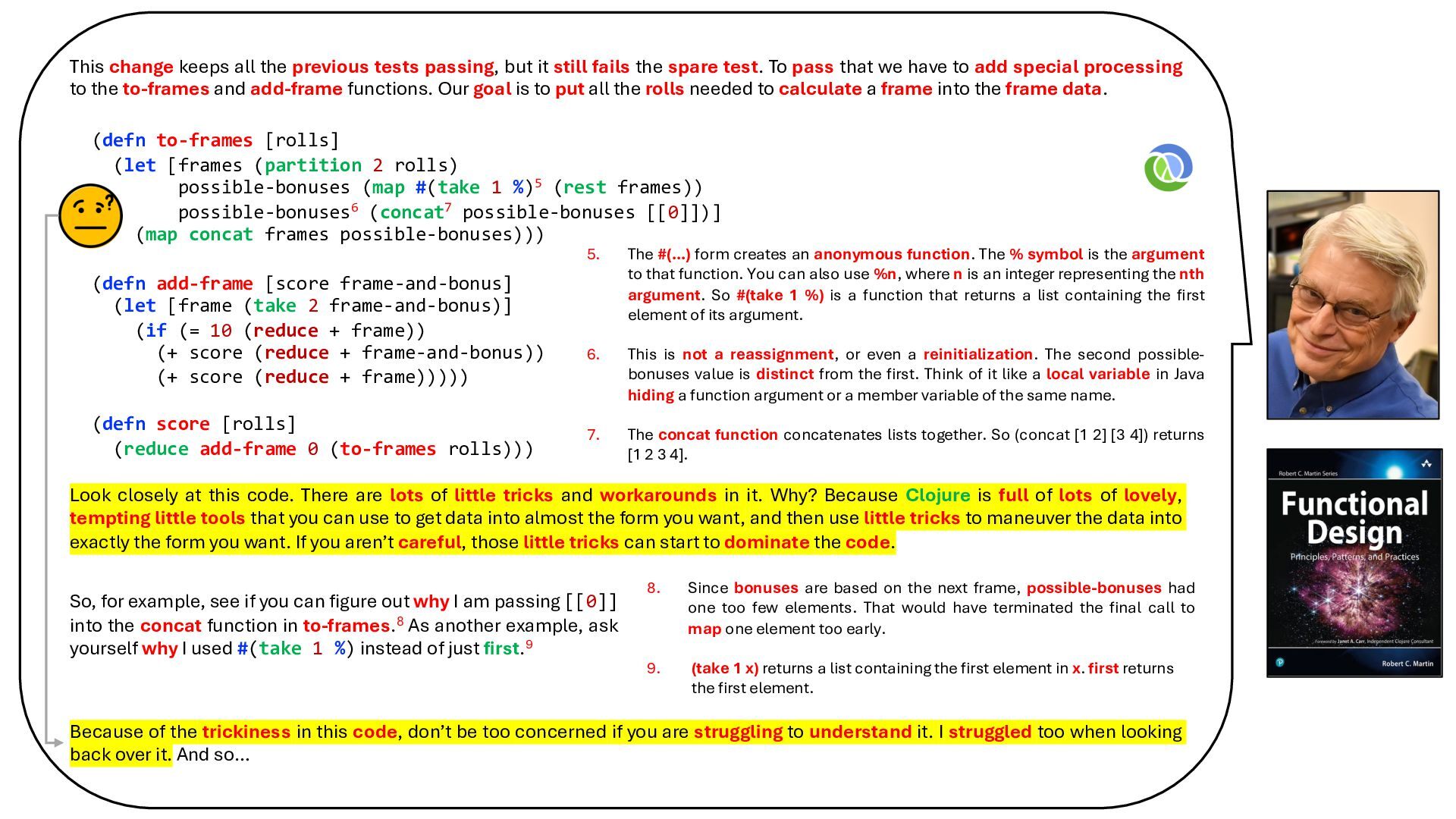
This change keeps all the previous tests passing, but it
still fails the spare test. To pass that we have to add special processing to the to-frames and add-frame functions. Our goal is to put all the rolls needed to calculate a frame into the frame data. (defn to-frames [rolls] (let [frames (partition 2 rolls) possible-bonuses (map #(take 1 %)5 (rest frames)) possible-bonuses6 (concat7 possible-bonuses [[0]])] (map concat frames possible-bonuses))) (defn add-frame [score frame-and-bonus] (let [frame (take 2 frame-and-bonus)] (if (= 10 (reduce + frame)) (+ score (reduce + frame-and-bonus)) (+ score (reduce + frame))))) (defn score [rolls] (reduce add-frame 0 (to-frames rolls))) 5. The #(…) form creates an anonymous function. The % symbol is the argument to that function. You can also use %n, where n is an integer representing the nth argument. So #(take 1 %) is a function that returns a list containing the first element of its argument. 6. This is not a reassignment, or even a reinitialization. The second possiblebonuses value is distinct from the first. Think of it like a local variable in Java hiding a function argument or a member variable of the same name. 7. The concat function concatenates lists together. So (concat [1 2] [3 4]) returns [1 2 3 4]. Look closely at this code. There are lots of little tricks and workarounds in it. Why? Because Clojure is full of lots of lovely, tempting little tools that you can use to get data into almost the form you want, and then use little tricks to maneuver the data into exactly the form you want. If you aren’t careful, those little tricks can start to dominate the code. So, for example, see if you can figure out why I am passing [[0]] into the concat function in to-frames.8 As another example, ask yourself why I used #(take 1 %) instead of just first.9 8. Since bonuses are based on the next frame, possible-bonuses had one too few elements. That would have terminated the final call to map one element too early. 9. (take 1 x) returns a list containing the first element in x. first returns the first element. Because of the trickiness in this code, don’t be too concerned if you are struggling to understand it. I struggled too when looking back over it. And so… -
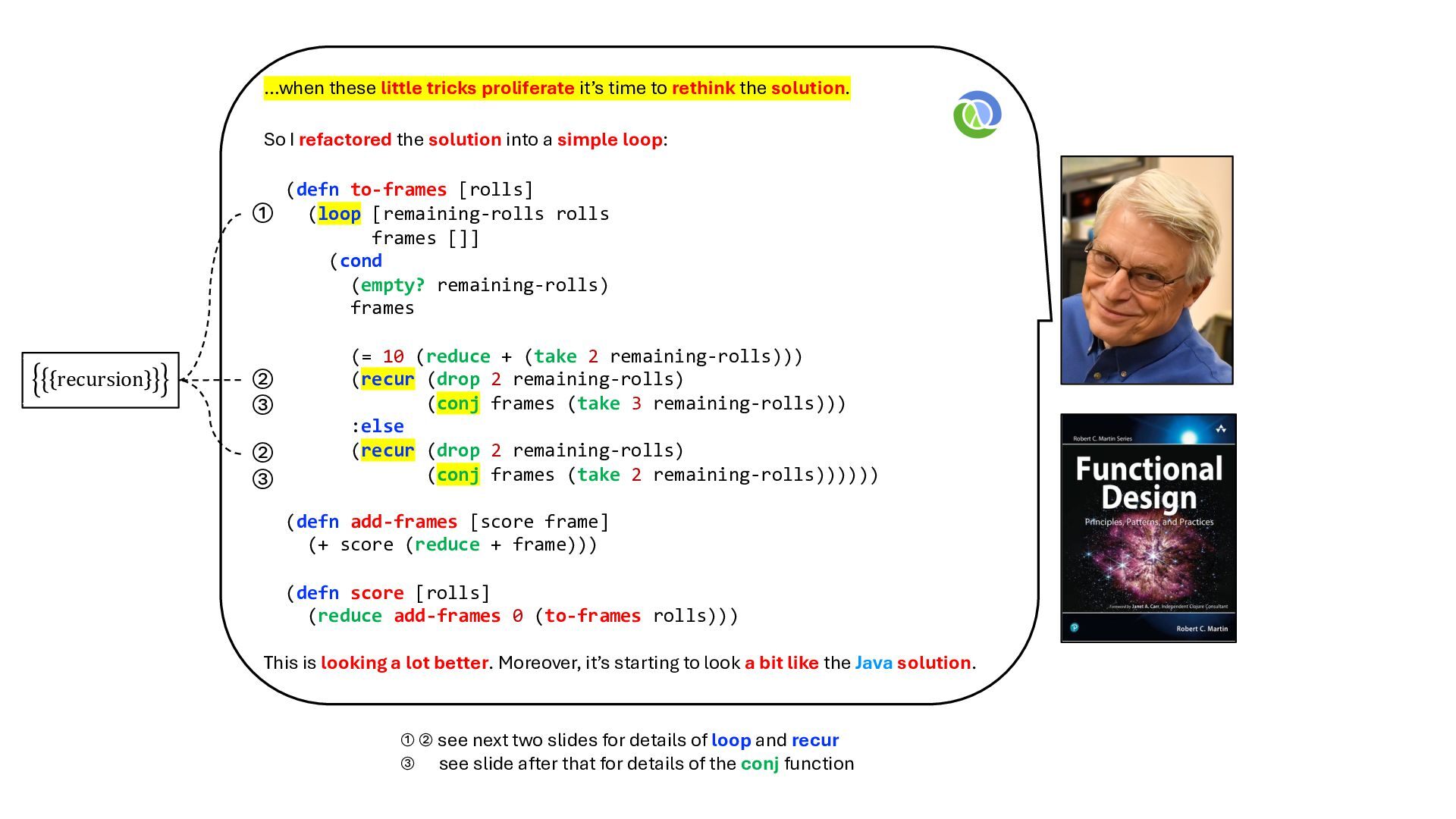
…when these little tricks proliferate it’s time to rethink the
solution. So I refactored the solution into a simple loop: (defn to-frames [rolls] ① (loop [remaining-rolls rolls frames []] (cond (empty? remaining-rolls) frames s recursion s ② ③ ② ③ (= 10 (reduce + (take 2 remaining-rolls))) (recur (drop 2 remaining-rolls) (conj frames (take 3 remaining-rolls))) :else (recur (drop 2 remaining-rolls) (conj frames (take 2 remaining-rolls)))))) (defn add-frames [score frame] (+ score (reduce + frame))) (defn score [rolls] (reduce add-frames 0 (to-frames rolls))) This is looking a lot better. Moreover, it’s starting to look a bit like the Java solution. ① ② see next two slides for details of loop and recur ③ see slide after that for details of the conj function -
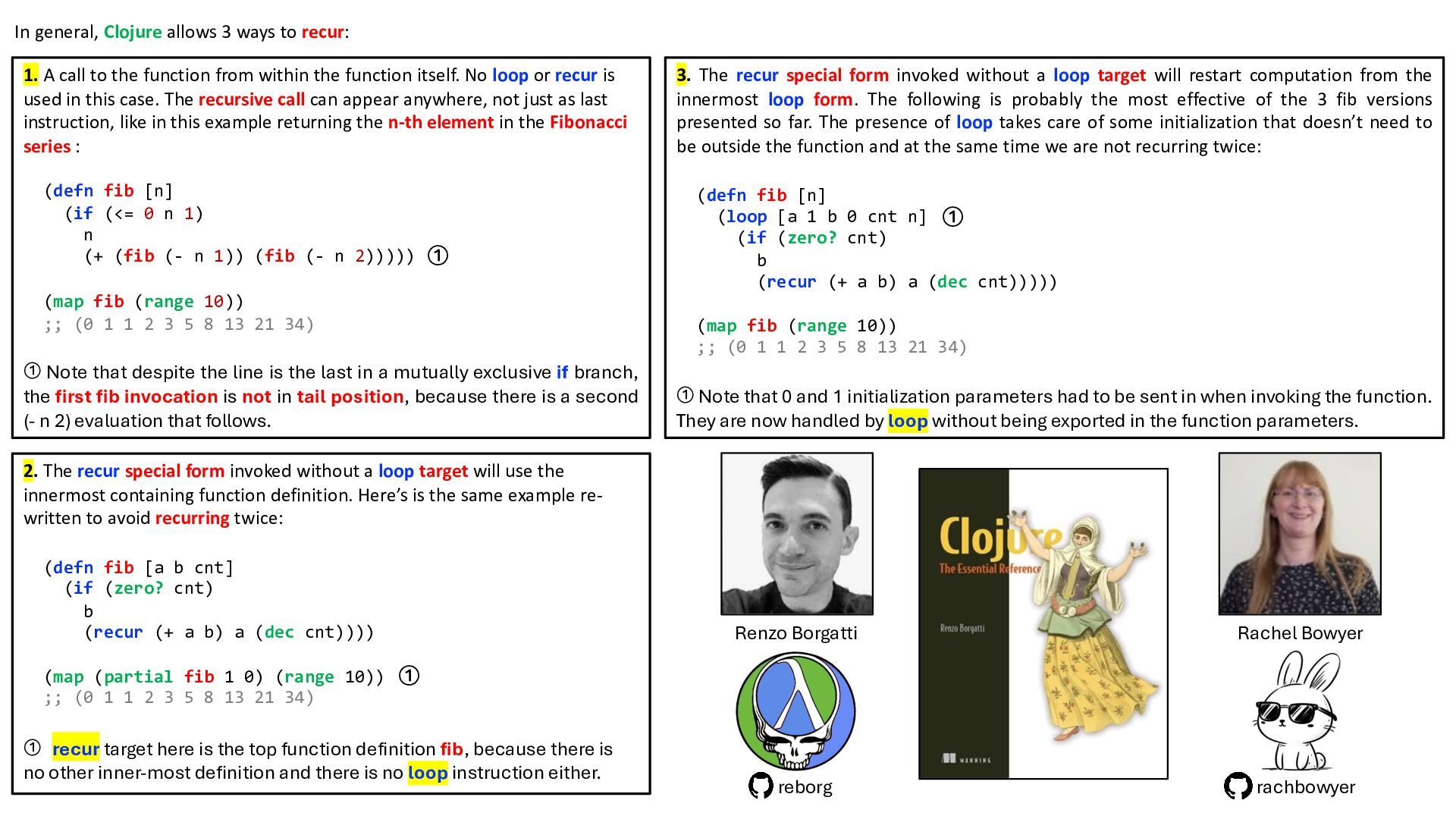
In general, Clojure allows 3 ways to recur: 1. A
call to the function from within the function itself. No loop or recur is used in this case. The recursive call can appear anywhere, not just as last instruction, like in this example returning the n-th element in the Fibonacci series : (defn fib [n] (if (<= 0 n 1) n (+ (fib (- n 1)) (fib (- n 2))))) 3. The recur special form invoked without a loop target will restart computation from the innermost loop form. The following is probably the most effective of the 3 fib versions presented so far. The presence of loop takes care of some initialization that doesn’t need to be outside the function and at the same time we are not recurring twice: (defn fib [n] (loop [a 1 b 0 cnt n] (if (zero? cnt) b (recur (+ a b) a (dec cnt))))) ① ① (map fib (range 10)) ;; (0 1 1 2 3 5 8 13 21 34) ① Note that despite the line is the last in a mutually exclusive if branch, the first fib invocation is not in tail position, because there is a second (- n 2) evaluation that follows. (map fib (range 10)) ;; (0 1 1 2 3 5 8 13 21 34) ① Note that 0 and 1 initialization parameters had to be sent in when invoking the function. They are now handled by loop without being exported in the function parameters. 2. The recur special form invoked without a loop target will use the innermost containing function definition. Here’s is the same example rewritten to avoid recurring twice: (defn fib [a b cnt] (if (zero? cnt) b (recur (+ a b) a (dec cnt)))) (map (partial fib 1 0) (range 10)) ;; (0 1 1 2 3 5 8 13 21 34) Renzo Borgatti Rachel Bowyer reborg rachbowyer ① ① recur target here is the top function definition fib, because there is no other inner-most definition and there is no loop instruction either. -
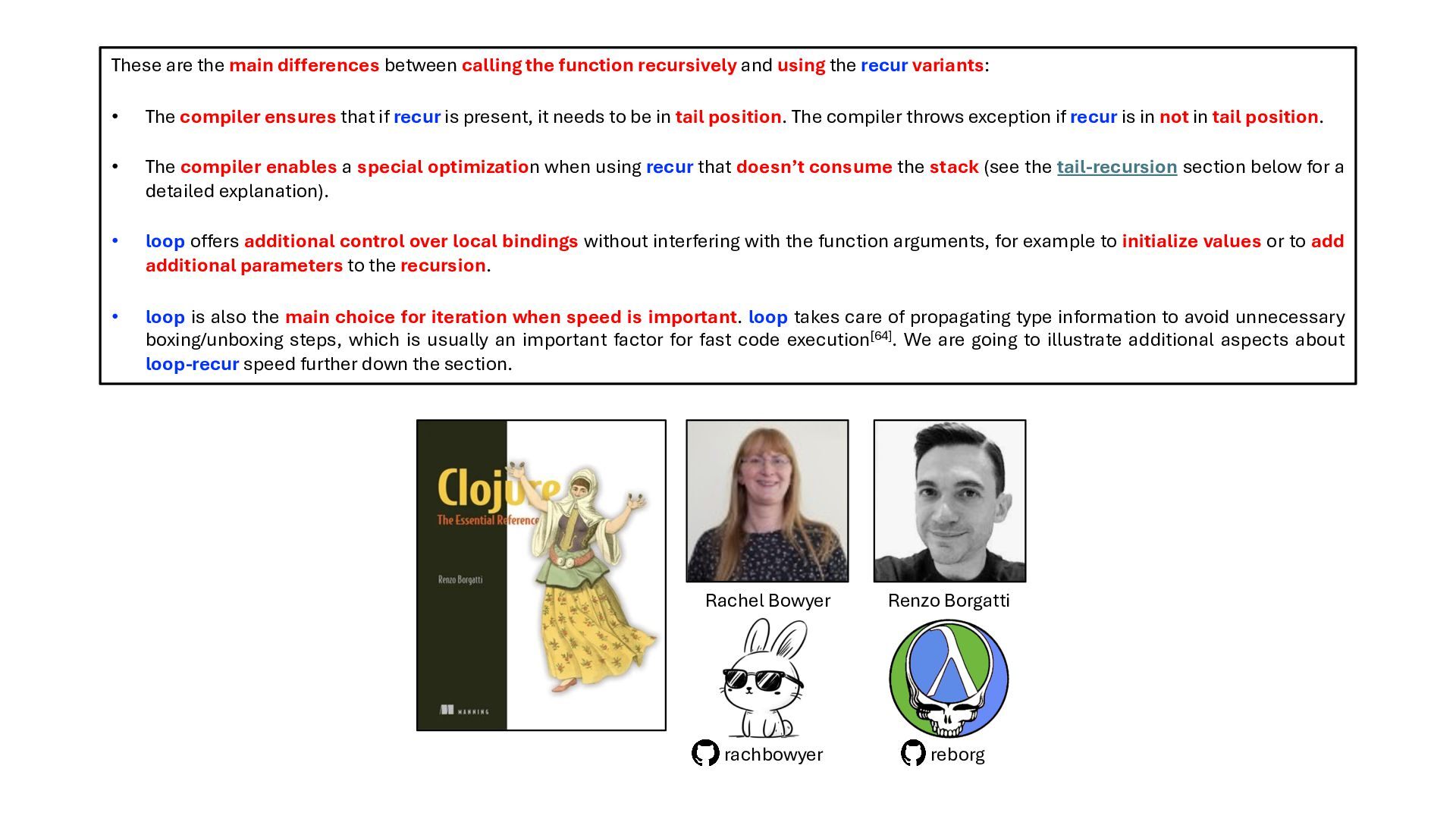
These are the main differences between calling the function recursively
and using the recur variants: • The compiler ensures that if recur is present, it needs to be in tail position. The compiler throws exception if recur is in not in tail position. • The compiler enables a special optimization when using recur that doesn’t consume the stack (see the tail-recursion section below for a detailed explanation). • loop offers additional control over local bindings without interfering with the function arguments, for example to initialize values or to add additional parameters to the recursion. • loop is also the main choice for iteration when speed is important. loop takes care of propagating type information to avoid unnecessary boxing/unboxing steps, which is usually an important factor for fast code execution[64]. We are going to illustrate additional aspects about loop-recur speed further down the section. Rachel Bowyer Renzo Borgatti rachbowyer reborg -
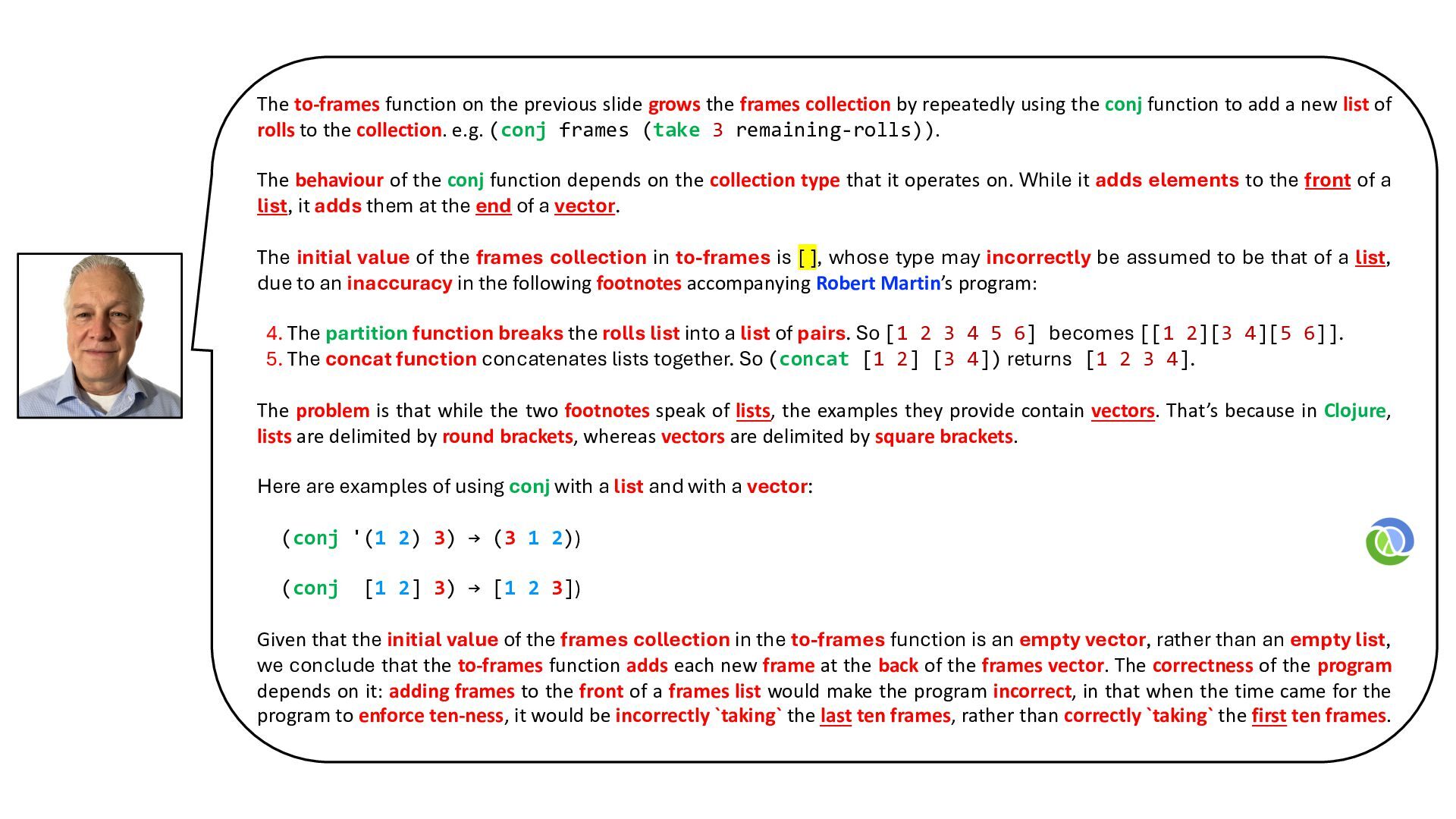
The to-frames function on the previous slide grows the frames
collection by repeatedly using the conj function to add a new list of rolls to the collection. e.g. (conj frames (take 3 remaining-rolls)). The behaviour of the conj function depends on the collection type that it operates on. While it adds elements to the front of a list, it adds them at the end of a vector. The initial value of the frames collection in to-frames is [ ], whose type may incorrectly be assumed to be that of a list, due to an inaccuracy in the following footnotes accompanying Robert Martin’s program: 4. The partition function breaks the rolls list into a list of pairs. So [1 2 3 4 5 6] becomes [[1 2][3 4][5 6]]. 5. The concat function concatenates lists together. So (concat [1 2] [3 4]) returns [1 2 3 4]. The problem is that while the two footnotes speak of lists, the examples they provide contain vectors. That’s because in Clojure, lists are delimited by round brackets, whereas vectors are delimited by square brackets. Here are examples of using conj with a list and with a vector: (conj '(1 2) 3) → (3 1 2)) (conj [1 2] 3) → [1 2 3]) Given that the initial value of the frames collection in the to-frames function is an empty vector, rather than an empty list, we conclude that the to-frames function adds each new frame at the back of the frames vector. The correctness of the program depends on it: adding frames to the front of a frames list would make the program incorrect, in that when the time came for the program to enforce ten-ness, it would be incorrectly `taking` the last ten frames, rather than correctly `taking` the first ten frames. -
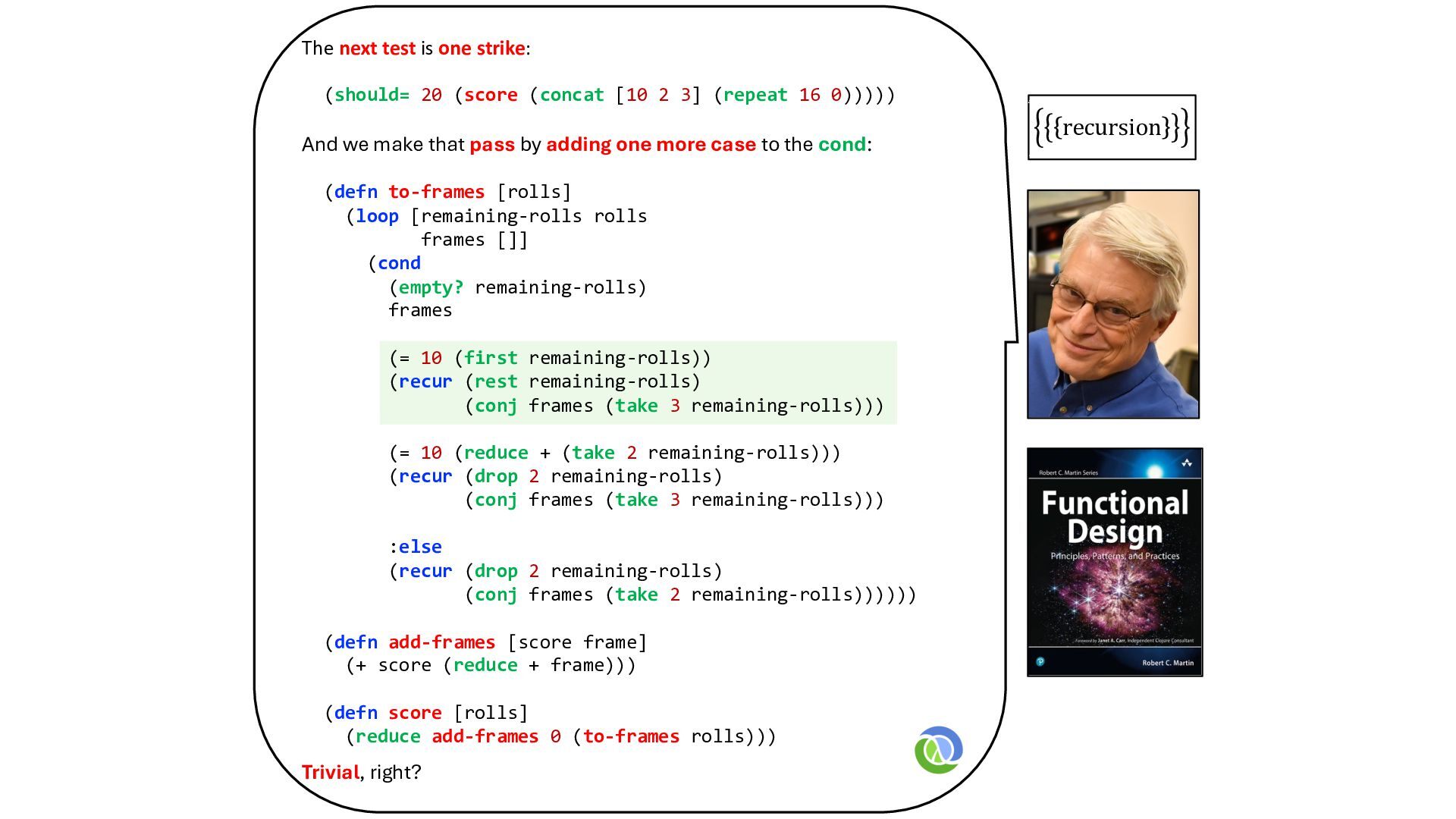
The next test is one strike: (should= 20 (score (concat
[10 2 3] (repeat 16 0))))) And we make that pass by adding one more case to the cond: (defn to-frames [rolls] (loop [remaining-rolls rolls frames []] (cond (empty? remaining-rolls) frames (= 10 (first remaining-rolls)) (recur (rest remaining-rolls) (conj frames (take 3 remaining-rolls))) (= 10 (reduce + (take 2 remaining-rolls))) (recur (drop 2 remaining-rolls) (conj frames (take 3 remaining-rolls))) :else (recur (drop 2 remaining-rolls) (conj frames (take 2 remaining-rolls)))))) (defn add-frames [score frame] (+ score (reduce + frame))) (defn score [rolls] (reduce add-frames 0 (to-frames rolls))) Trivial, right? s recursion s -
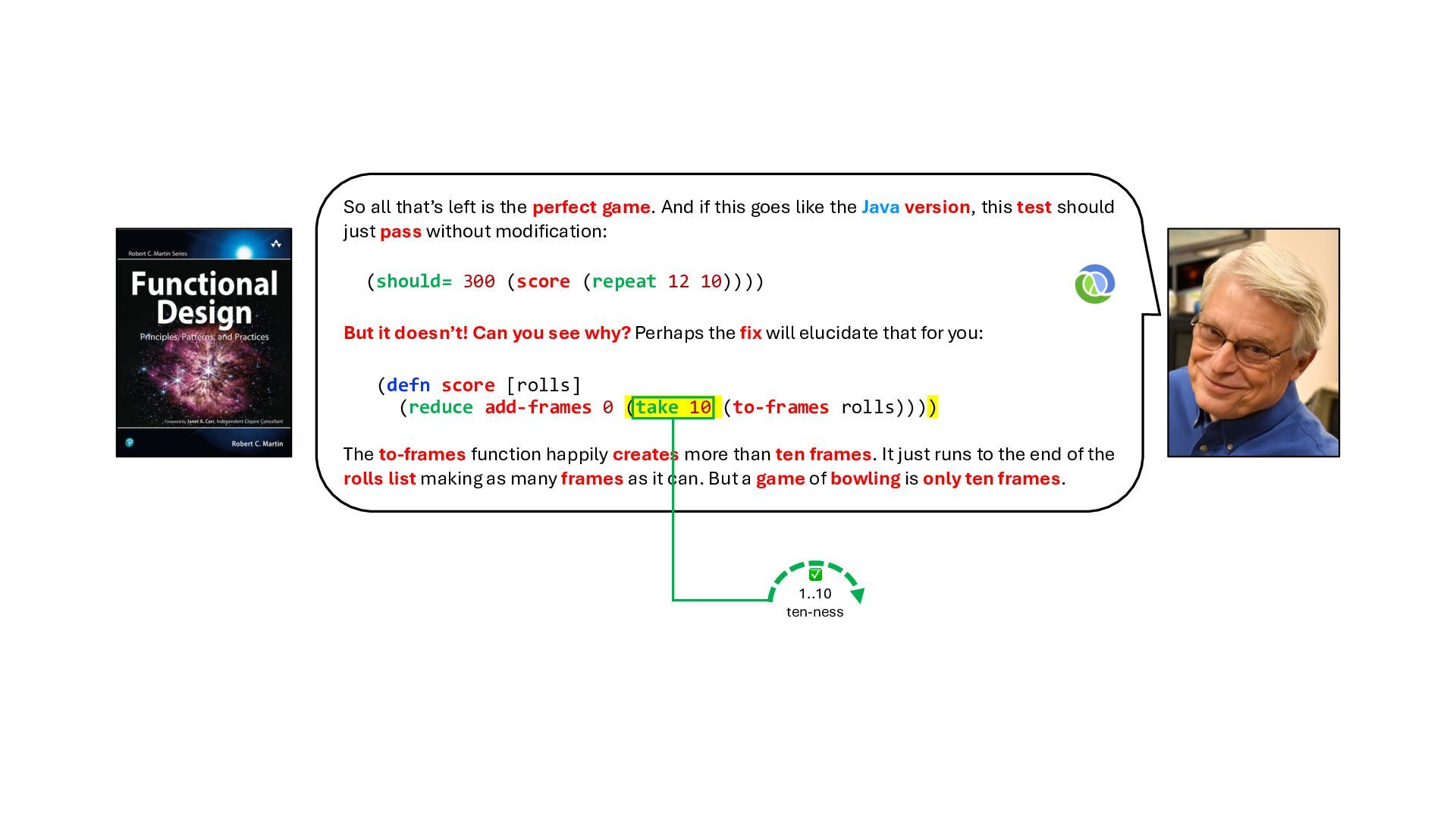
So all that’s left is the perfect game. And if
this goes like the Java version, this test should just pass without modification: (should= 300 (score (repeat 12 10)))) But it doesn’t! Can you see why? Perhaps the fix will elucidate that for you: (defn score [rolls] (reduce add-frames 0 (take 10 (to-frames rolls)))) The to-frames function happily creates more than ten frames. It just runs to the end of the rolls list making as many frames as it can. But a game of bowling is only ten frames. ✅ 1..10 ten-ness -
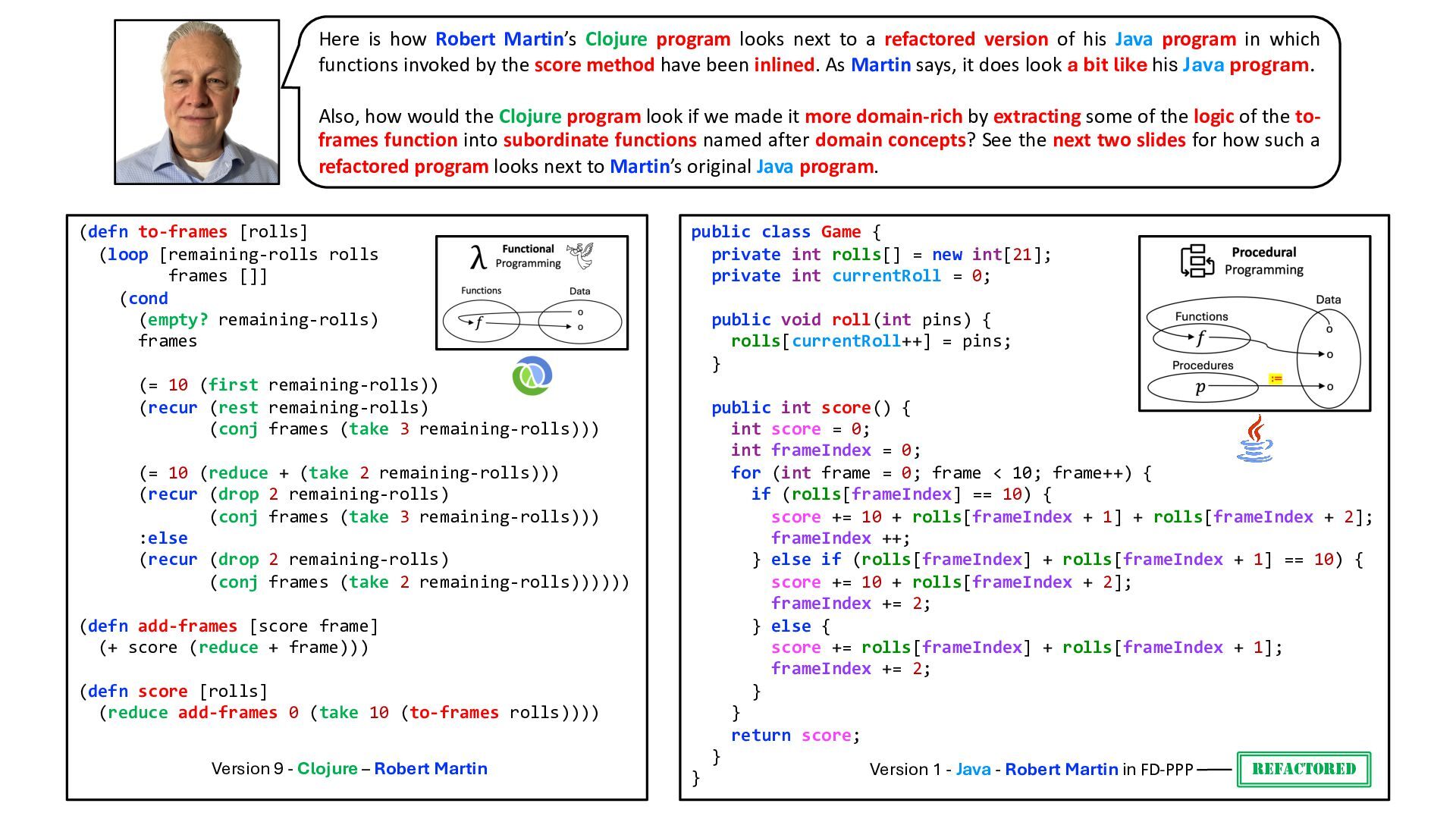
Here is how Robert Martin’s Clojure program looks next to
a refactored version of his Java program in which functions invoked by the score method have been inlined. As Martin says, it does look a bit like his Java program. Also, how would the Clojure program look if we made it more domain-rich by extracting some of the logic of the toframes function into subordinate functions named after domain concepts? See the next two slides for how such a refactored program looks next to Martin’s original Java program. (defn to-frames [rolls] (loop [remaining-rolls rolls frames []] (cond (empty? remaining-rolls) frames (= 10 (first remaining-rolls)) (recur (rest remaining-rolls) (conj frames (take 3 remaining-rolls))) (= 10 (reduce + (take 2 remaining-rolls))) (recur (drop 2 remaining-rolls) (conj frames (take 3 remaining-rolls))) :else (recur (drop 2 remaining-rolls) (conj frames (take 2 remaining-rolls)))))) (defn add-frames [score frame] (+ score (reduce + frame))) (defn score [rolls] (reduce add-frames 0 (take 10 (to-frames rolls)))) Version 9 - Clojure – Robert Martin public class Game { private int rolls[] = new int[21]; private int currentRoll = 0; public void roll(int pins) { rolls[currentRoll++] = pins; } public int score() { int score = 0; int frameIndex = 0; for (int frame = 0; frame < 10; frame++) { if (rolls[frameIndex] == 10) { score += 10 + rolls[frameIndex + 1] + rolls[frameIndex + 2]; frameIndex ++; } else if (rolls[frameIndex] + rolls[frameIndex + 1] == 10) { score += 10 + rolls[frameIndex + 2]; frameIndex += 2; } else { score += rolls[frameIndex] + rolls[frameIndex + 1]; frameIndex += 2; } } return score; } REFACTORED Version 1 - Java - Robert Martin in FD-PPP } -
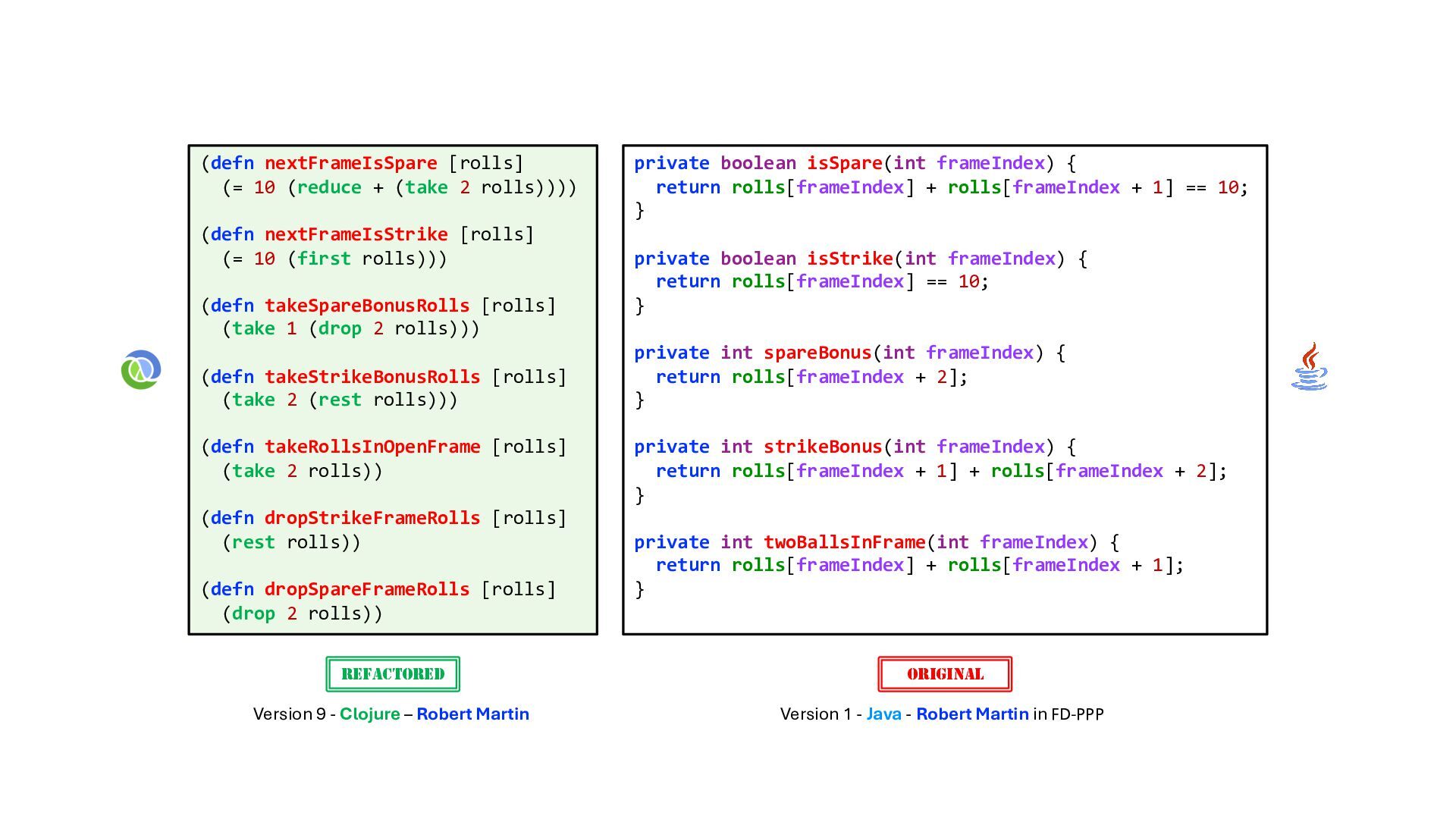
(defn nextFrameIsSpare [rolls] (= 10 (reduce + (take 2 rolls))))
(defn nextFrameIsStrike [rolls] (= 10 (first rolls))) (defn takeSpareBonusRolls [rolls] (take 1 (drop 2 rolls))) (defn takeStrikeBonusRolls [rolls] (take 2 (rest rolls))) (defn takeRollsInOpenFrame [rolls] (take 2 rolls)) (defn dropStrikeFrameRolls [rolls] (rest rolls)) (defn dropSpareFrameRolls [rolls] (drop 2 rolls)) private boolean isSpare(int frameIndex) { return rolls[frameIndex] + rolls[frameIndex + 1] == 10; } private boolean isStrike(int frameIndex) { return rolls[frameIndex] == 10; } private int spareBonus(int frameIndex) { return rolls[frameIndex + 2]; } private int strikeBonus(int frameIndex) { return rolls[frameIndex + 1] + rolls[frameIndex + 2]; } private int twoBallsInFrame(int frameIndex) { return rolls[frameIndex] + rolls[frameIndex + 1]; } REFACTORED ORIGINAL Version 9 - Clojure – Robert Martin Version 1 - Java - Robert Martin in FD-PPP -
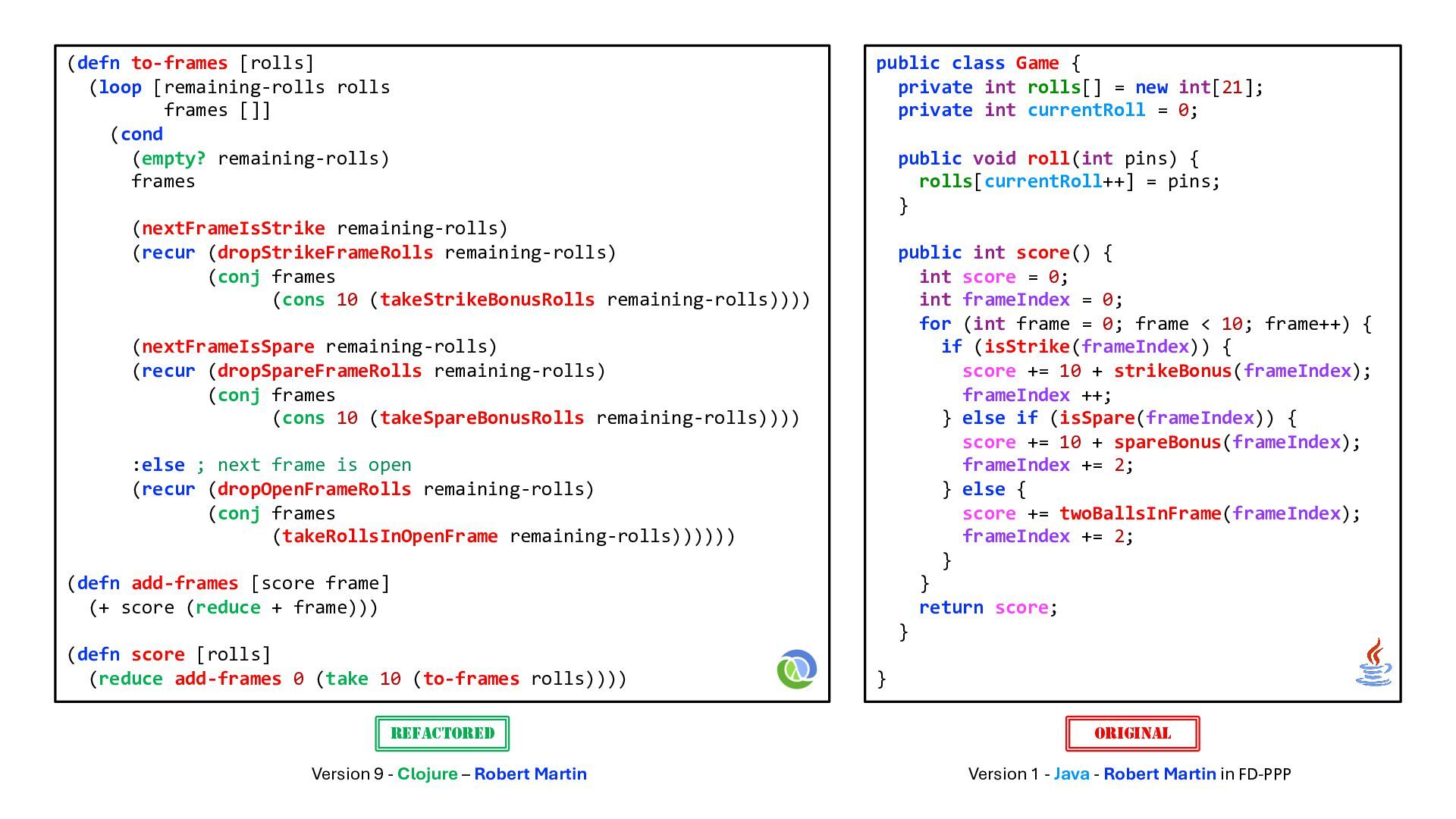
(defn to-frames [rolls] (loop [remaining-rolls rolls frames []] (cond (empty?
remaining-rolls) frames public class Game { private int rolls[] = new int[21]; private int currentRoll = 0; public void roll(int pins) { rolls[currentRoll++] = pins; } (nextFrameIsStrike remaining-rolls) (recur (dropStrikeFrameRolls remaining-rolls) (conj frames (cons 10 (takeStrikeBonusRolls remaining-rolls)))) public int score() { int score = 0; int frameIndex = 0; for (int frame = 0; frame < 10; frame++) { if (isStrike(frameIndex)) { score += 10 + strikeBonus(frameIndex); frameIndex ++; } else if (isSpare(frameIndex)) { score += 10 + spareBonus(frameIndex); frameIndex += 2; } else { score += twoBallsInFrame(frameIndex); frameIndex += 2; } } return score; } (nextFrameIsSpare remaining-rolls) (recur (dropSpareFrameRolls remaining-rolls) (conj frames (cons 10 (takeSpareBonusRolls remaining-rolls)))) :else ; next frame is open (recur (dropOpenFrameRolls remaining-rolls) (conj frames (takeRollsInOpenFrame remaining-rolls)))))) (defn add-frames [score frame] (+ score (reduce + frame))) (defn score [rolls] (reduce add-frames 0 (take 10 (to-frames rolls)))) } REFACTORED ORIGINAL Version 9 - Clojure – Robert Martin Version 1 - Java - Robert Martin in FD-PPP -
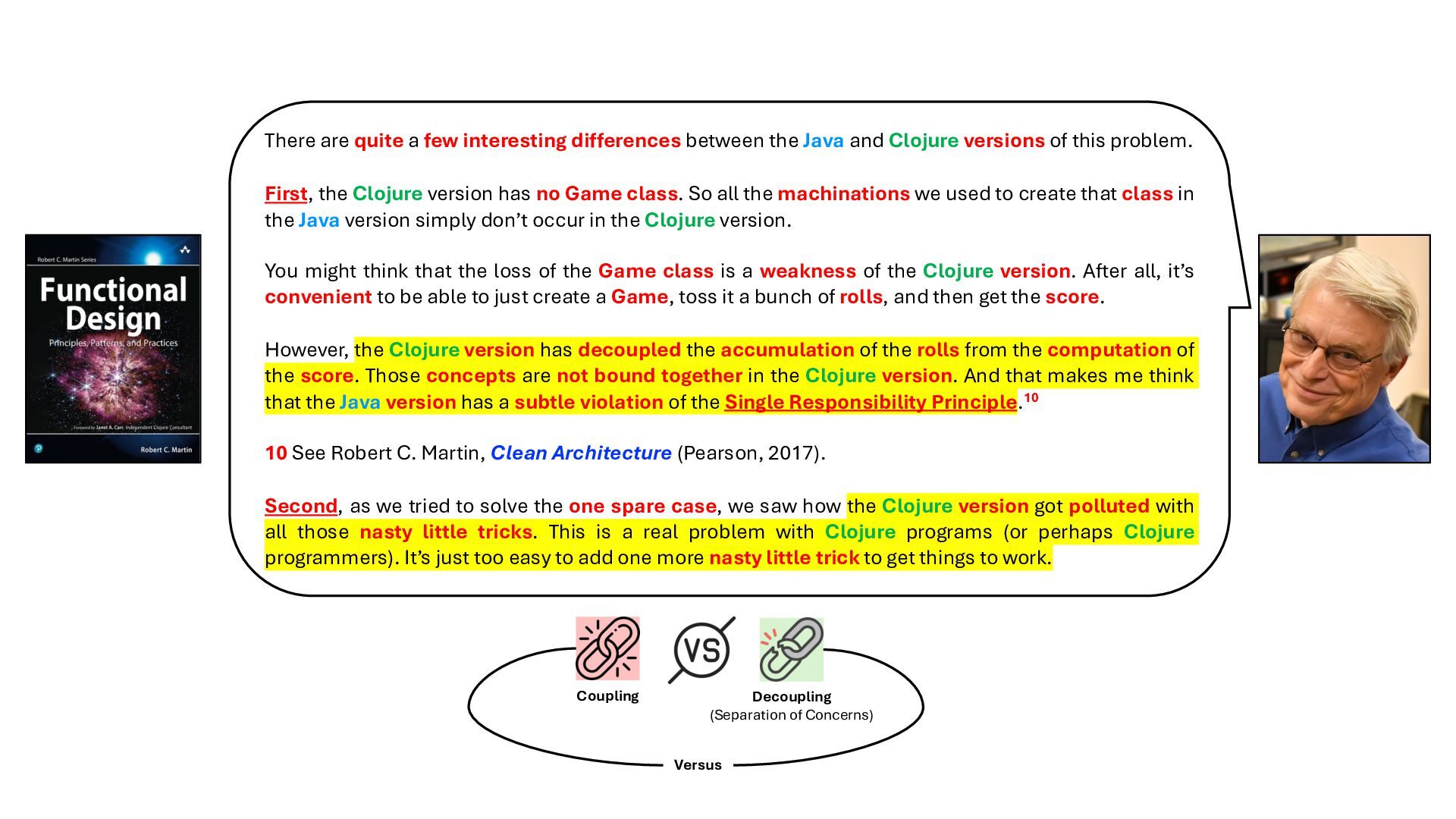
There are quite a few interesting differences between the Java
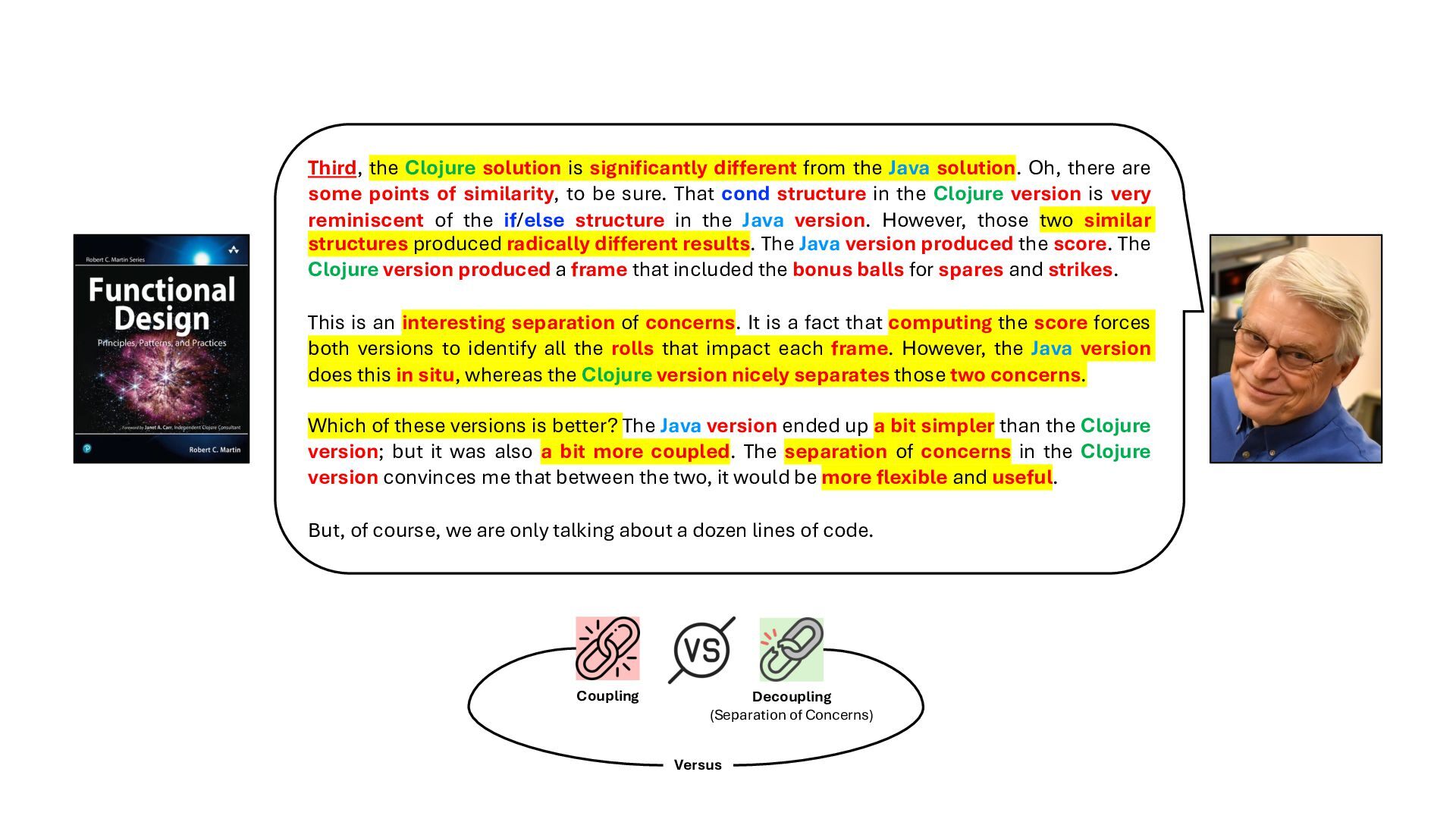
and Clojure versions of this problem. First, the Clojure version has no Game class. So all the machinations we used to create that class in the Java version simply don’t occur in the Clojure version. You might think that the loss of the Game class is a weakness of the Clojure version. After all, it’s convenient to be able to just create a Game, toss it a bunch of rolls, and then get the score. However, the Clojure version has decoupled the accumulation of the rolls from the computation of the score. Those concepts are not bound together in the Clojure version. And that makes me think that the Java version has a subtle violation of the Single Responsibility Principle.10 10 See Robert C. Martin, Clean Architecture (Pearson, 2017). Second, as we tried to solve the one spare case, we saw how the Clojure version got polluted with all those nasty little tricks. This is a real problem with Clojure programs (or perhaps Clojure programmers). It’s just too easy to add one more nasty little trick to get things to work. Coupling Decoupling (Separation of Concerns) Versus -
Third, the Clojure solution is significantly different from the Java
solution. Oh, there are some points of similarity, to be sure. That cond structure in the Clojure version is very reminiscent of the if/else structure in the Java version. However, those two similar structures produced radically different results. The Java version produced the score. The Clojure version produced a frame that included the bonus balls for spares and strikes. This is an interesting separation of concerns. It is a fact that computing the score forces both versions to identify all the rolls that impact each frame. However, the Java version does this in situ, whereas the Clojure version nicely separates those two concerns. Which of these versions is better? The Java version ended up a bit simpler than the Clojure version; but it was also a bit more coupled. The separation of concerns in the Clojure version convinces me that between the two, it would be more flexible and useful. But, of course, we are only talking about a dozen lines of code. Coupling Decoupling (Separation of Concerns) Versus -
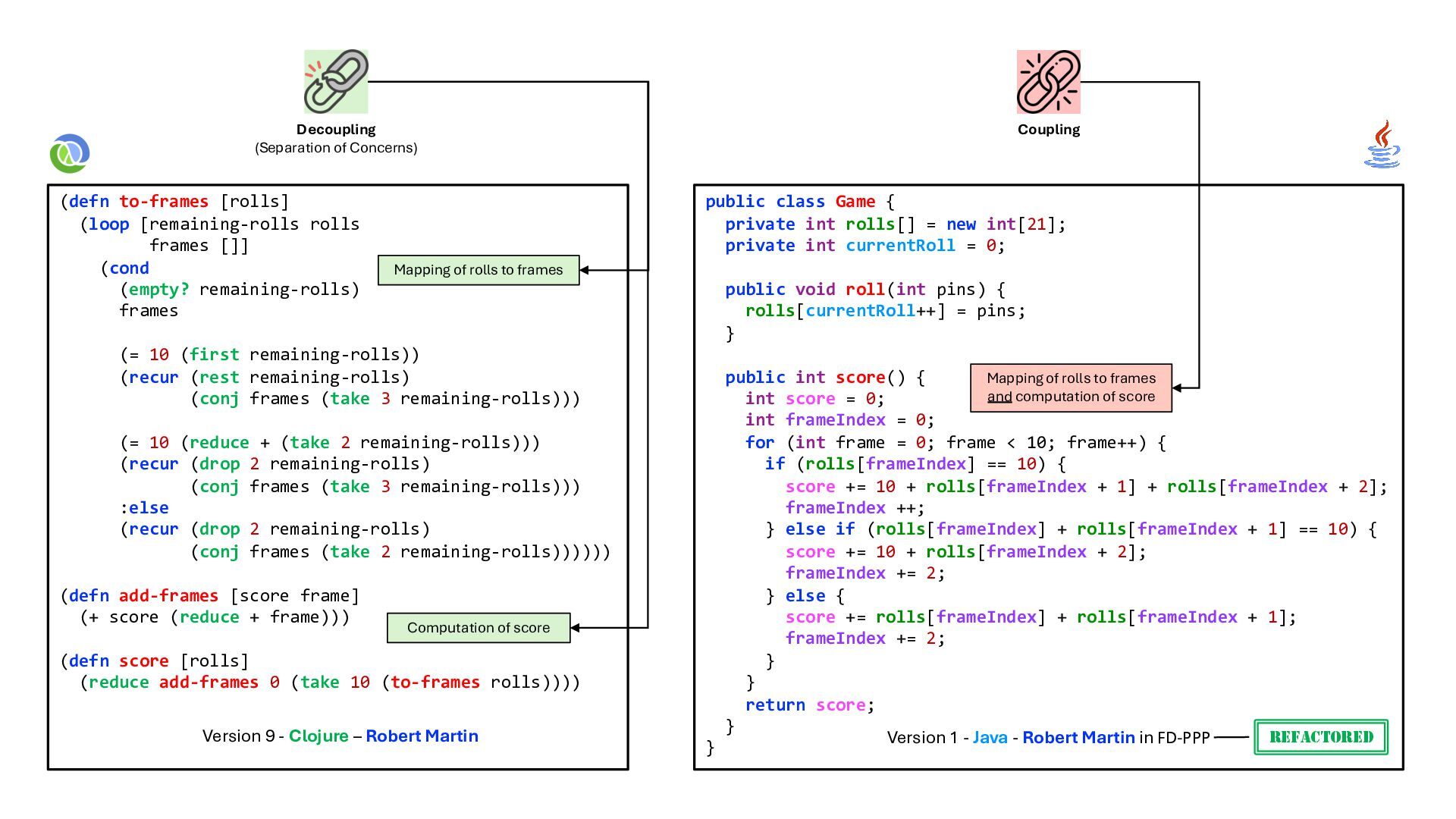
Decoupling (Separation of Concerns) (defn to-frames [rolls] (loop [remaining-rolls rolls
frames []] (cond (empty? remaining-rolls) frames Coupling public class Game { private int rolls[] = new int[21]; private int currentRoll = 0; Mapping of rolls to frames public void roll(int pins) { rolls[currentRoll++] = pins; } (= 10 (first remaining-rolls)) (recur (rest remaining-rolls) (conj frames (take 3 remaining-rolls))) (= 10 (reduce + (take 2 remaining-rolls))) (recur (drop 2 remaining-rolls) (conj frames (take 3 remaining-rolls))) :else (recur (drop 2 remaining-rolls) (conj frames (take 2 remaining-rolls)))))) (defn add-frames [score frame] (+ score (reduce + frame))) Computation of score (defn score [rolls] (reduce add-frames 0 (take 10 (to-frames rolls)))) Version 9 - Clojure – Robert Martin } public int score() { Mapping of rolls to frames and computation of score int score = 0; int frameIndex = 0; for (int frame = 0; frame < 10; frame++) { if (rolls[frameIndex] == 10) { score += 10 + rolls[frameIndex + 1] + rolls[frameIndex + 2]; frameIndex ++; } else if (rolls[frameIndex] + rolls[frameIndex + 1] == 10) { score += 10 + rolls[frameIndex + 2]; frameIndex += 2; } else { score += rolls[frameIndex] + rolls[frameIndex + 1]; frameIndex += 2; } } return score; } REFACTORED Version 1 - Java - Robert Martin in FD-PPP -
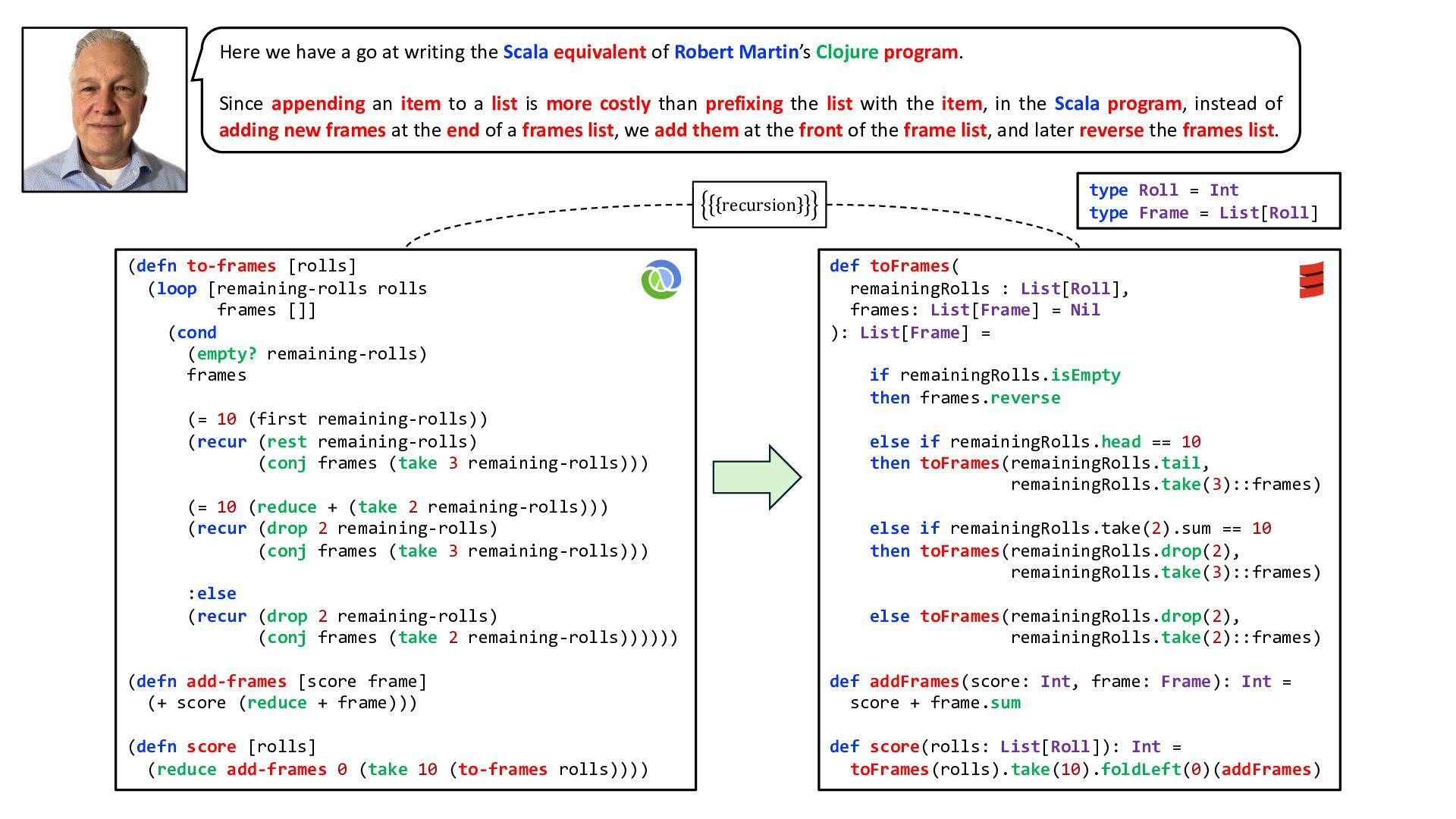
Here we have a go at writing the Scala equivalent
of Robert Martin’s Clojure program. Since appending an item to a list is more costly than prefixing the list with the item, in the Scala program, instead of adding new frames at the end of a frames list, we add them at the front of the frame list, and later reverse the frames list. s recursion s (defn to-frames [rolls] (loop [remaining-rolls rolls frames []] (cond (empty? remaining-rolls) frames (= 10 (first remaining-rolls)) (recur (rest remaining-rolls) (conj frames (take 3 remaining-rolls))) (= 10 (reduce + (take 2 remaining-rolls))) (recur (drop 2 remaining-rolls) (conj frames (take 3 remaining-rolls))) :else (recur (drop 2 remaining-rolls) (conj frames (take 2 remaining-rolls)))))) type Roll = Int type Frame = List[Roll] def toFrames( remainingRolls : List[Roll], frames: List[Frame] = Nil ): List[Frame] = if remainingRolls.isEmpty then frames.reverse else if remainingRolls.head == 10 then toFrames(remainingRolls.tail, remainingRolls.take(3)::frames) else if remainingRolls.take(2).sum == 10 then toFrames(remainingRolls.drop(2), remainingRolls.take(3)::frames) else toFrames(remainingRolls.drop(2), remainingRolls.take(2)::frames) (defn add-frames [score frame] (+ score (reduce + frame))) def addFrames(score: Int, frame: Frame): Int = score + frame.sum (defn score [rolls] (reduce add-frames 0 (take 10 (to-frames rolls)))) def score(rolls: List[Roll]): Int = toFrames(rolls).take(10).foldLeft(0)(addFrames) -
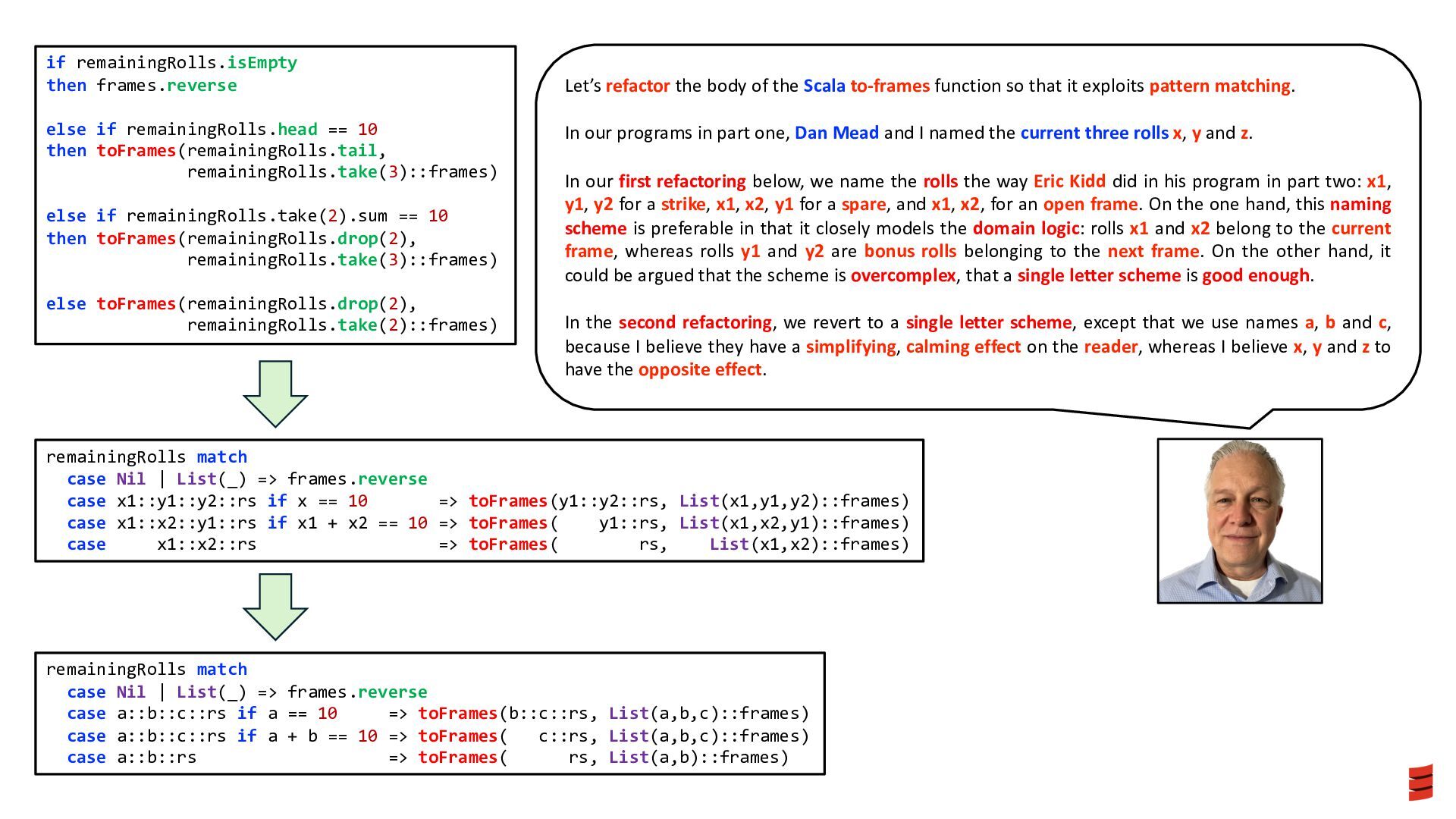
if remainingRolls.isEmpty then frames.reverse else if remainingRolls.head == 10 then
toFrames(remainingRolls.tail, remainingRolls.take(3)::frames) else if remainingRolls.take(2).sum == 10 then toFrames(remainingRolls.drop(2), remainingRolls.take(3)::frames) else toFrames(remainingRolls.drop(2), remainingRolls.take(2)::frames) Let’s refactor the body of the Scala to-frames function so that it exploits pattern matching. In our programs in part one, Dan Mead and I named the current three rolls x, y and z. In our first refactoring below, we name the rolls the way Eric Kidd did in his program in part two: x1, y1, y2 for a strike, x1, x2, y1 for a spare, and x1, x2, for an open frame. On the one hand, this naming scheme is preferable in that it closely models the domain logic: rolls x1 and x2 belong to the current frame, whereas rolls y1 and y2 are bonus rolls belonging to the next frame. On the other hand, it could be argued that the scheme is overcomplex, that a single letter scheme is good enough. In the second refactoring, we revert to a single letter scheme, except that we use names a, b and c, because I believe they have a simplifying, calming effect on the reader, whereas I believe x, y and z to have the opposite effect. remainingRolls match case Nil | List(_) => frames.reverse case x1::y1::y2::rs if x == 10 => toFrames(y1::y2::rs, List(x1,y1,y2)::frames) case x1::x2::y1::rs if x1 + x2 == 10 => toFrames( y1::rs, List(x1,x2,y1)::frames) case x1::x2::rs => toFrames( rs, List(x1,x2)::frames) remainingRolls match case Nil | List(_) => frames.reverse case a::b::c::rs if a == 10 => toFrames(b::c::rs, List(a,b,c)::frames) case a::b::c::rs if a + b == 10 => toFrames( c::rs, List(a,b,c)::frames) case a::b::rs => toFrames( rs, List(a,b)::frames) -
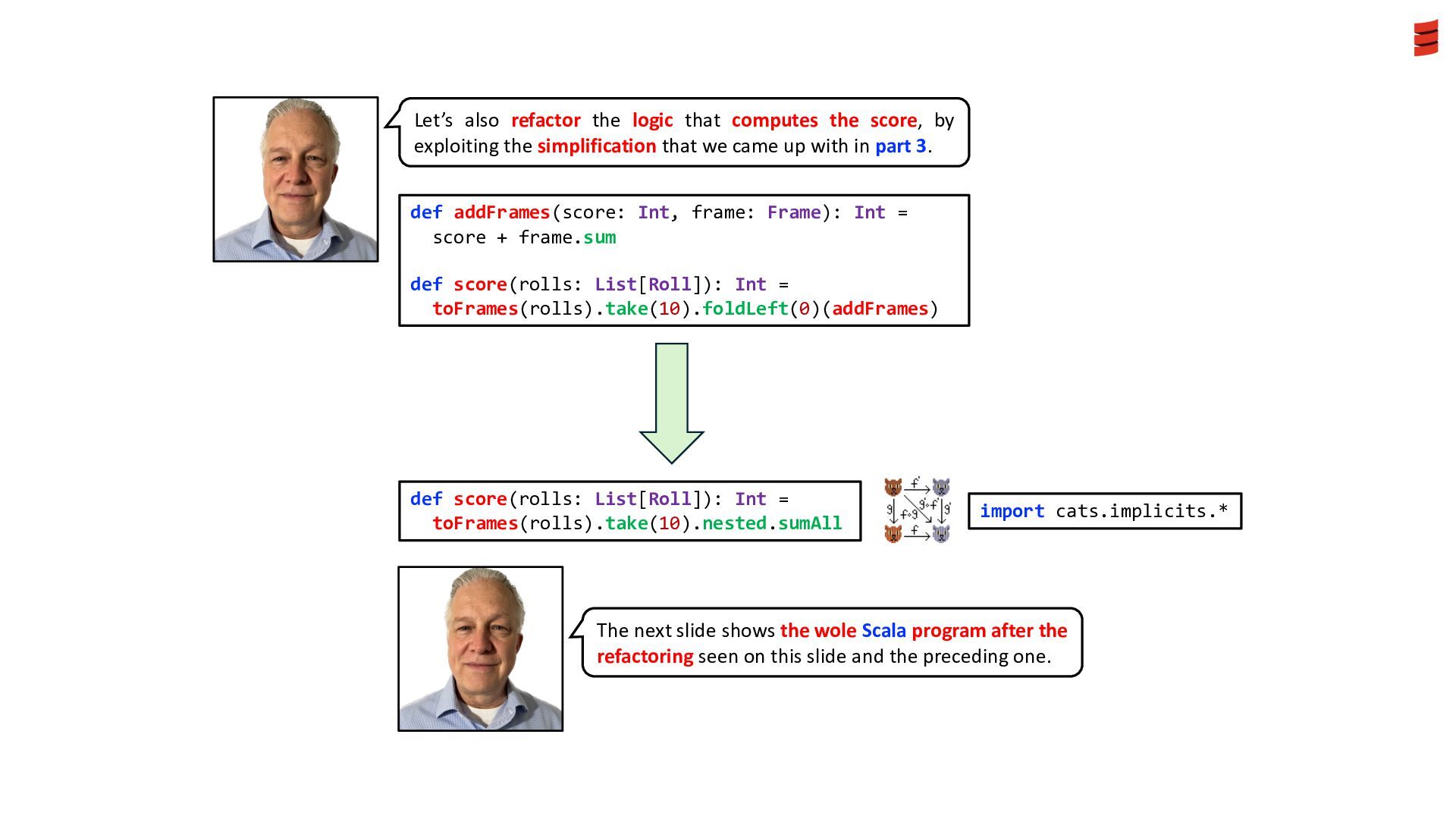
Let’s also refactor the logic that computes the score, by
exploiting the simplification that we came up with in part 3. def addFrames(score: Int, frame: Frame): Int = score + frame.sum def score(rolls: List[Roll]): Int = toFrames(rolls).take(10).foldLeft(0)(addFrames) def score(rolls: List[Roll]): Int = toFrames(rolls).take(10).nested.sumAll import cats.implicits.* The next slide shows the wole Scala program after the refactoring seen on this slide and the preceding one. -
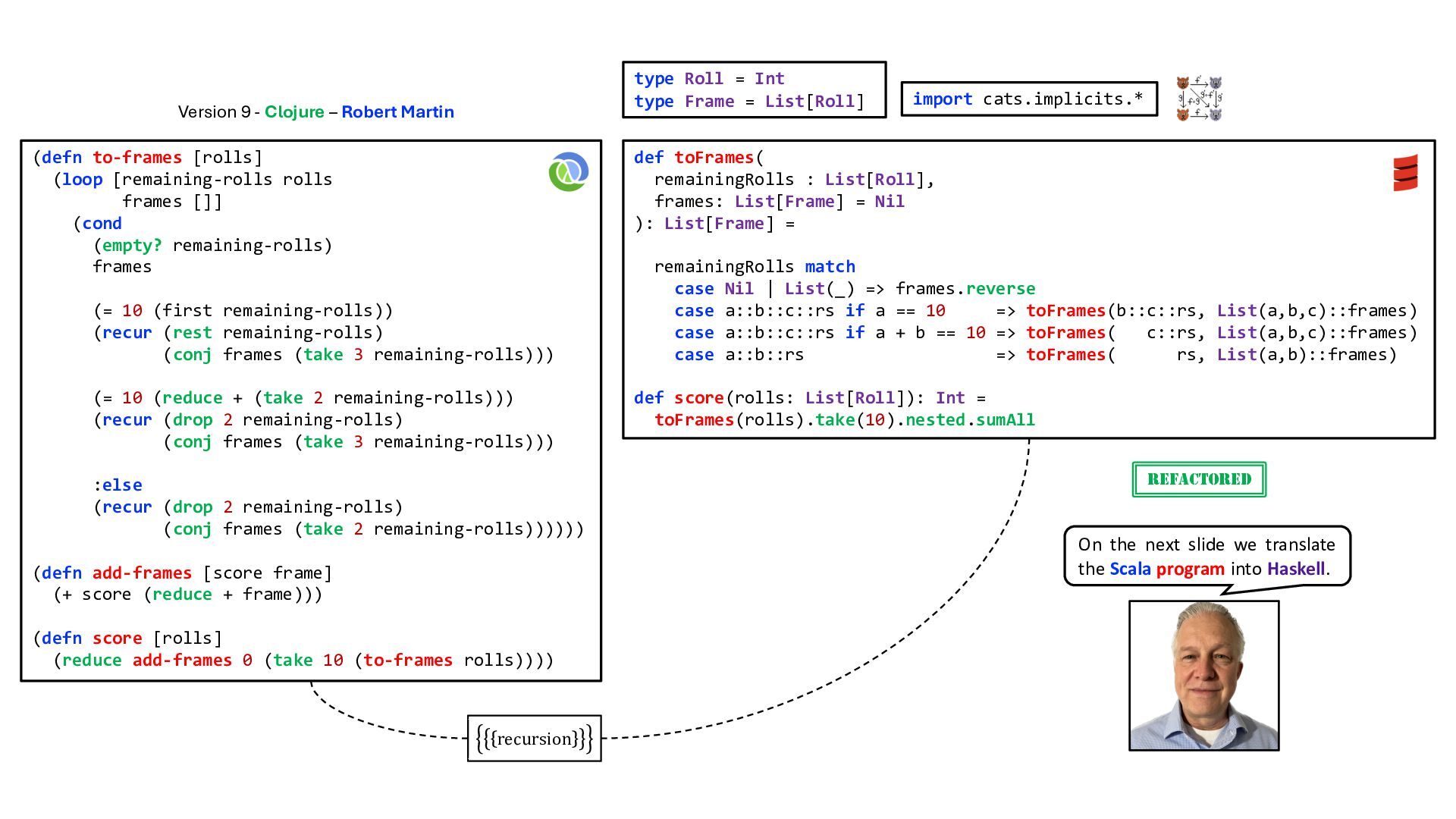
type Roll = Int type Frame = List[Roll] Version 9
- Clojure – Robert Martin (defn to-frames [rolls] (loop [remaining-rolls rolls frames []] (cond (empty? remaining-rolls) frames import cats.implicits.* def toFrames( remainingRolls : List[Roll], frames: List[Frame] = Nil ): List[Frame] = (= 10 (first remaining-rolls)) (recur (rest remaining-rolls) (conj frames (take 3 remaining-rolls))) (= 10 (reduce + (take 2 remaining-rolls))) (recur (drop 2 remaining-rolls) (conj frames (take 3 remaining-rolls))) :else (recur (drop 2 remaining-rolls) (conj frames (take 2 remaining-rolls)))))) (defn add-frames [score frame] (+ score (reduce + frame))) (defn score [rolls] (reduce add-frames 0 (take 10 (to-frames rolls)))) s recursion s remainingRolls match case Nil | List(_) => frames.reverse case a::b::c::rs if a == 10 => toFrames(b::c::rs, List(a,b,c)::frames) case a::b::c::rs if a + b == 10 => toFrames( c::rs, List(a,b,c)::frames) case a::b::rs => toFrames( rs, List(a,b)::frames) def score(rolls: List[Roll]): Int = toFrames(rolls).take(10).nested.sumAll REFACTORED On the next slide we translate the Scala program into Haskell. -
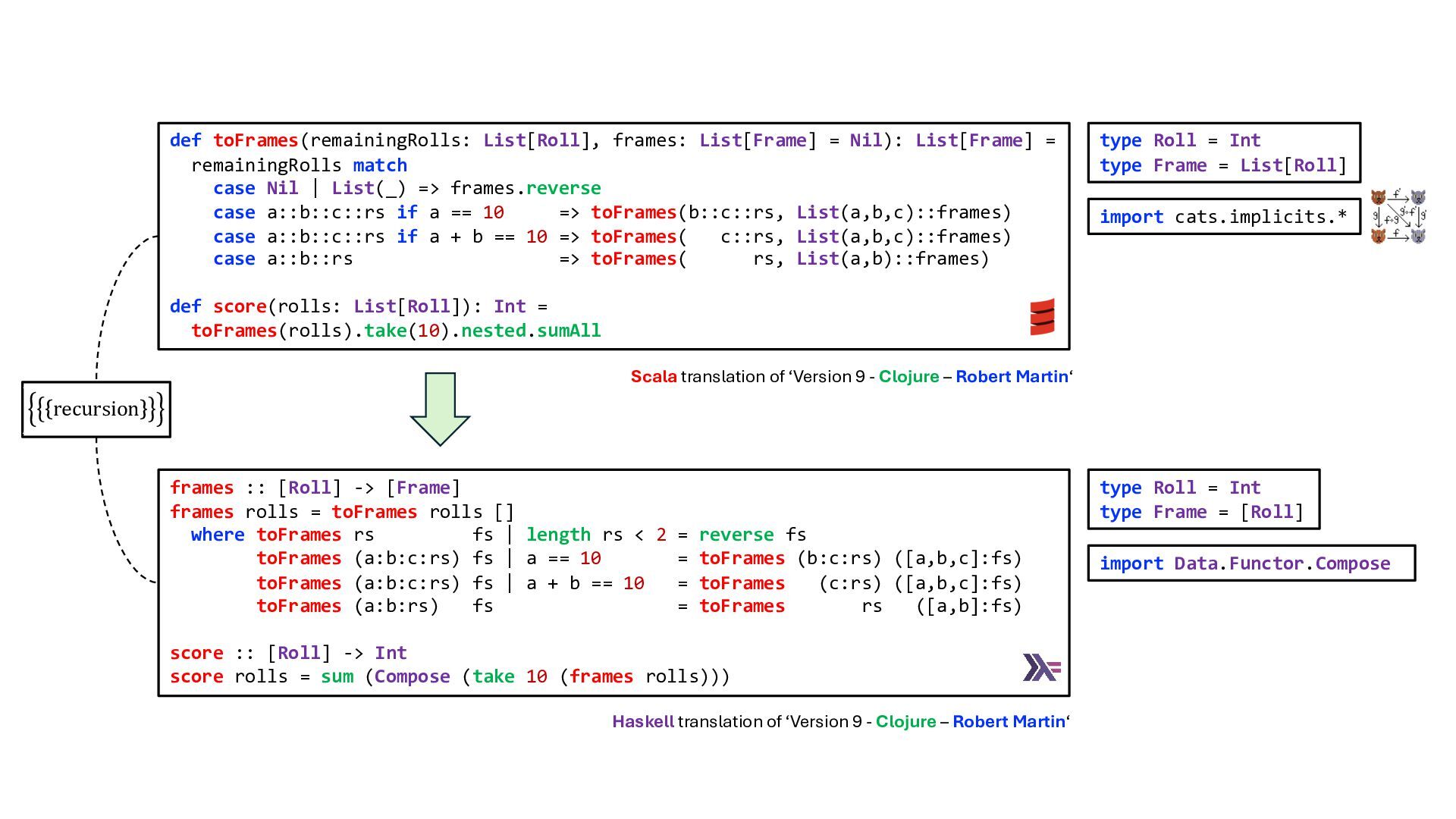
def toFrames(remainingRolls: List[Roll], frames: List[Frame] = Nil): List[Frame] = remainingRolls
match case Nil | List(_) => frames.reverse case a::b::c::rs if a == 10 => toFrames(b::c::rs, List(a,b,c)::frames) case a::b::c::rs if a + b == 10 => toFrames( c::rs, List(a,b,c)::frames) case a::b::rs => toFrames( rs, List(a,b)::frames) type Roll = Int type Frame = List[Roll] import cats.implicits.* def score(rolls: List[Roll]): Int = toFrames(rolls).take(10).nested.sumAll Scala translation of ‘Version 9 - Clojure – Robert Martin‘ s recursion s frames :: [Roll] -> [Frame] frames rolls = toFrames rolls [] where toFrames rs fs | length rs < 2 = reverse fs toFrames (a:b:c:rs) fs | a == 10 = toFrames (b:c:rs) ([a,b,c]:fs) toFrames (a:b:c:rs) fs | a + b == 10 = toFrames (c:rs) ([a,b,c]:fs) toFrames (a:b:rs) fs = toFrames rs ([a,b]:fs) score :: [Roll] -> Int score rolls = sum (Compose (take 10 (frames rolls))) Haskell translation of ‘Version 9 - Clojure – Robert Martin‘ type Roll = Int type Frame = [Roll] import Data.Functor.Compose -
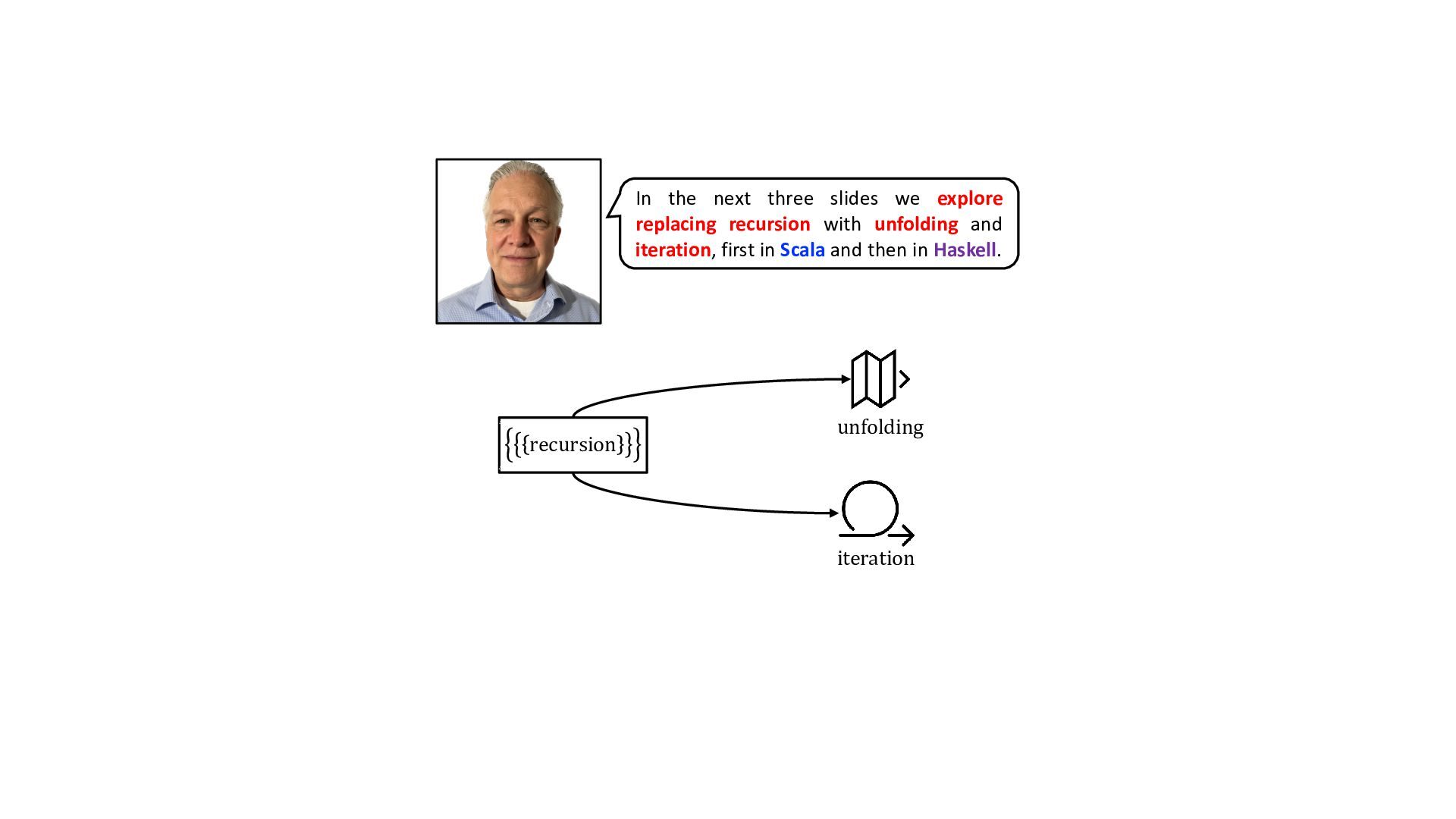
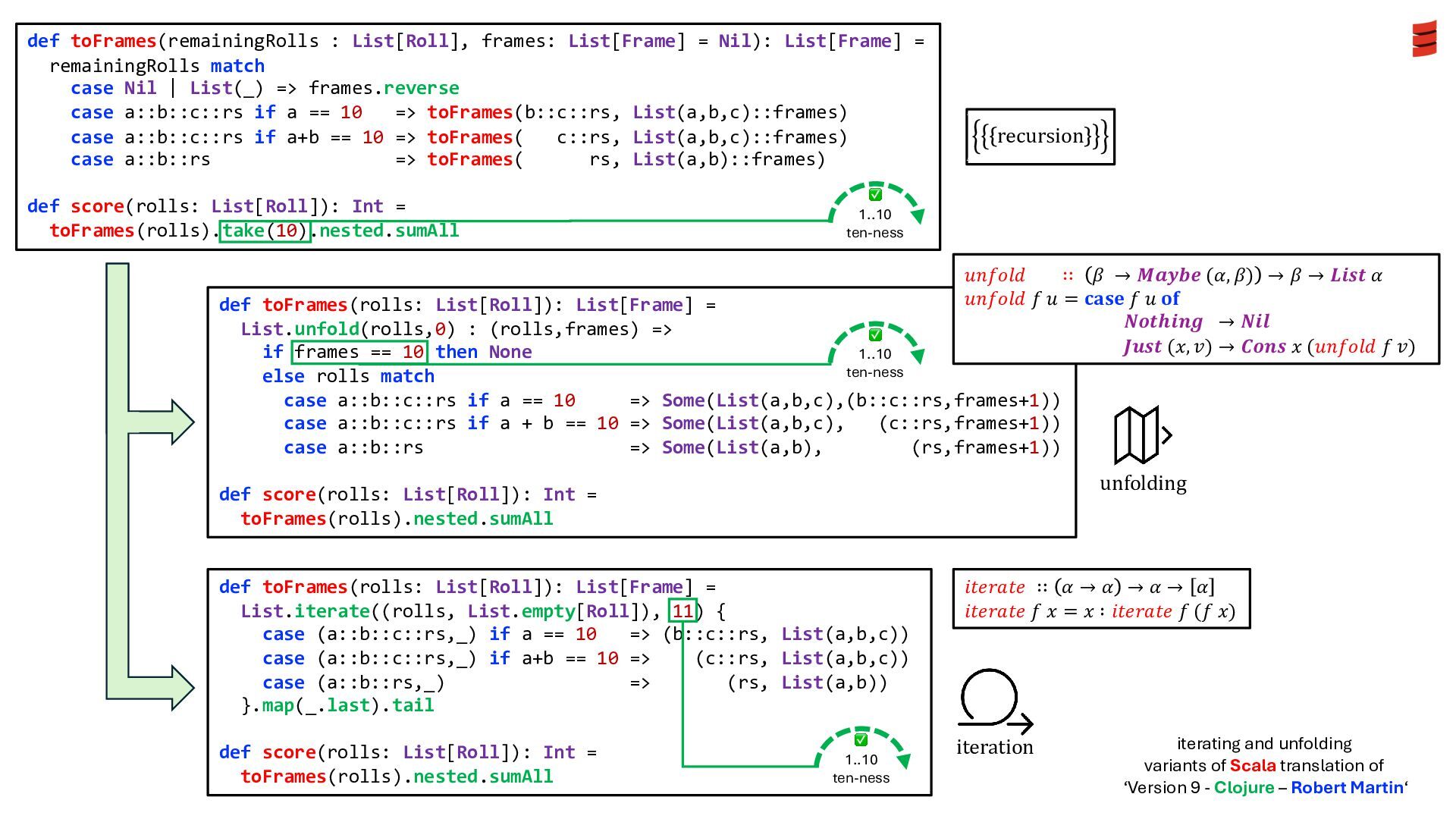
In the next three slides we explore replacing recursion with
unfolding and iteration, first in Scala and then in Haskell. s recursion unfolding s iteration -
def toFrames(remainingRolls : List[Roll], frames: List[Frame] = Nil): List[Frame] =
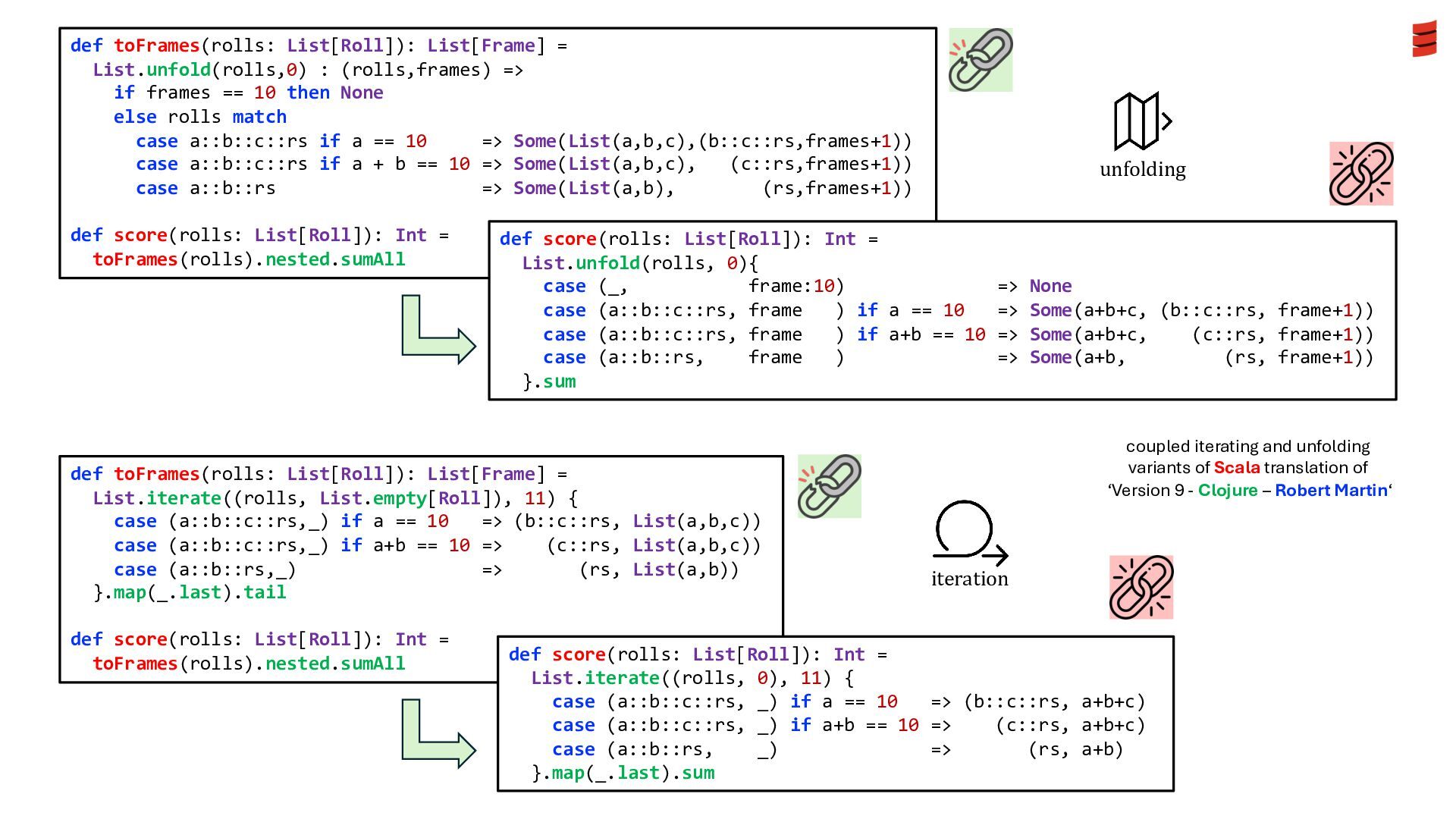
remainingRolls match case Nil | List(_) => frames.reverse case a::b::c::rs if a == 10 => toFrames(b::c::rs, List(a,b,c)::frames) case a::b::c::rs if a+b == 10 => toFrames( c::rs, List(a,b,c)::frames) case a::b::rs => toFrames( rs, List(a,b)::frames) def score(rolls: List[Roll]): Int = toFrames(rolls).take(10).nested.sumAll s recursion s ✅ 1..10 ten-ness 𝑢𝑛𝑓𝑜𝑙𝑑 ∷ 𝛽 → 𝑴𝒂𝒚𝒃𝒆 (𝛼, 𝛽) → 𝛽 → 𝑳𝒊𝒔𝒕 𝛼 𝑢𝑛𝑓𝑜𝑙𝑑 𝑓 𝑢 = 𝐜𝐚𝐬𝐞 𝑓 𝑢 𝐨𝐟 𝑵𝒐𝒕𝒉𝒊𝒏𝒈 → 𝑵𝒊𝒍 𝑱𝒖𝒔𝒕 (𝑥, 𝑣) → 𝑪𝒐𝒏𝒔 𝑥 (𝑢𝑛𝑓𝑜𝑙𝑑 𝑓 𝑣) def toFrames(rolls: List[Roll]): List[Frame] = List.unfold(rolls,0) : (rolls,frames) => ✅ if frames == 10 then None 1..10 ten-ness else rolls match case a::b::c::rs if a == 10 => Some(List(a,b,c),(b::c::rs,frames+1)) case a::b::c::rs if a + b == 10 => Some(List(a,b,c), (c::rs,frames+1)) case a::b::rs => Some(List(a,b), (rs,frames+1)) unfolding def score(rolls: List[Roll]): Int = toFrames(rolls).nested.sumAll def toFrames(rolls: List[Roll]): List[Frame] = List.iterate((rolls, List.empty[Roll]), 11) { case (a::b::c::rs,_) if a == 10 => (b::c::rs, List(a,b,c)) case (a::b::c::rs,_) if a+b == 10 => (c::rs, List(a,b,c)) case (a::b::rs,_) => (rs, List(a,b)) }.map(_.last).tail def score(rolls: List[Roll]): Int = toFrames(rolls).nested.sumAll ✅ 1..10 ten-ness 𝑖𝑡𝑒𝑟𝑎𝑡𝑒 ∷ 𝛼 → 𝛼 → 𝛼 → 𝛼 𝑖𝑡𝑒𝑟𝑎𝑡𝑒 𝑓 𝑥 = 𝑥 ∶ 𝑖𝑡𝑒𝑟𝑎𝑡𝑒 𝑓 (𝑓 𝑥) iteration iterating and unfolding variants of Scala translation of ‘Version 9 - Clojure – Robert Martin‘ -
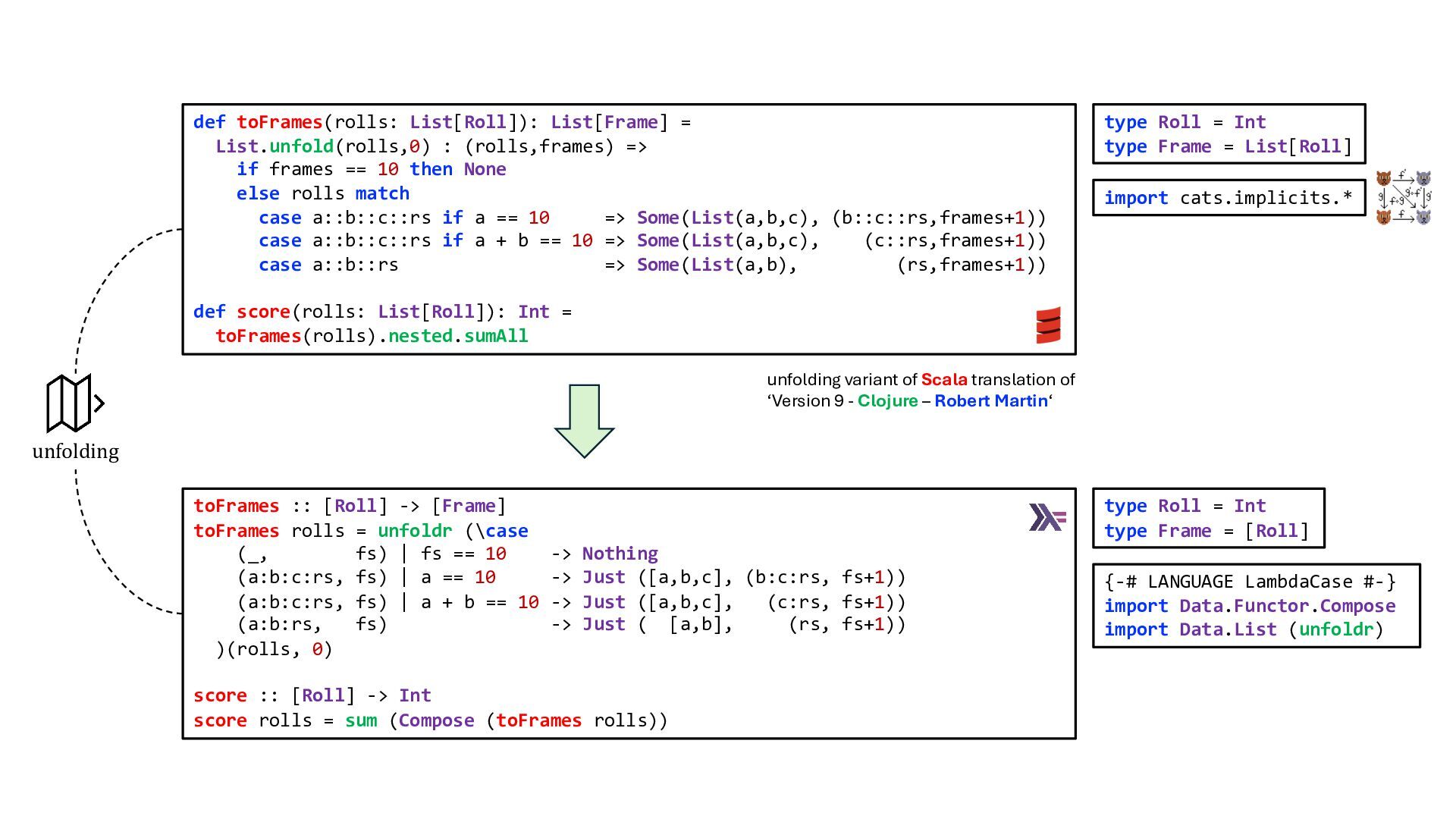
def toFrames(rolls: List[Roll]): List[Frame] = List.unfold(rolls,0) : (rolls,frames) => if
frames == 10 then None else rolls match case a::b::c::rs if a == 10 => Some(List(a,b,c), (b::c::rs,frames+1)) case a::b::c::rs if a + b == 10 => Some(List(a,b,c), (c::rs,frames+1)) case a::b::rs => Some(List(a,b), (rs,frames+1)) type Roll = Int type Frame = List[Roll] import cats.implicits.* def score(rolls: List[Roll]): Int = toFrames(rolls).nested.sumAll unfolding variant of Scala translation of ‘Version 9 - Clojure – Robert Martin‘ unfolding toFrames :: [Roll] -> [Frame] toFrames rolls = unfoldr (\case (_, fs) | fs == 10 -> Nothing (a:b:c:rs, fs) | a == 10 -> Just ([a,b,c], (b:c:rs, fs+1)) (a:b:c:rs, fs) | a + b == 10 -> Just ([a,b,c], (c:rs, fs+1)) (a:b:rs, fs) -> Just ( [a,b], (rs, fs+1)) )(rolls, 0) score :: [Roll] -> Int score rolls = sum (Compose (toFrames rolls)) type Roll = Int type Frame = [Roll] {-# LANGUAGE LambdaCase #-} import Data.Functor.Compose import Data.List (unfoldr) -
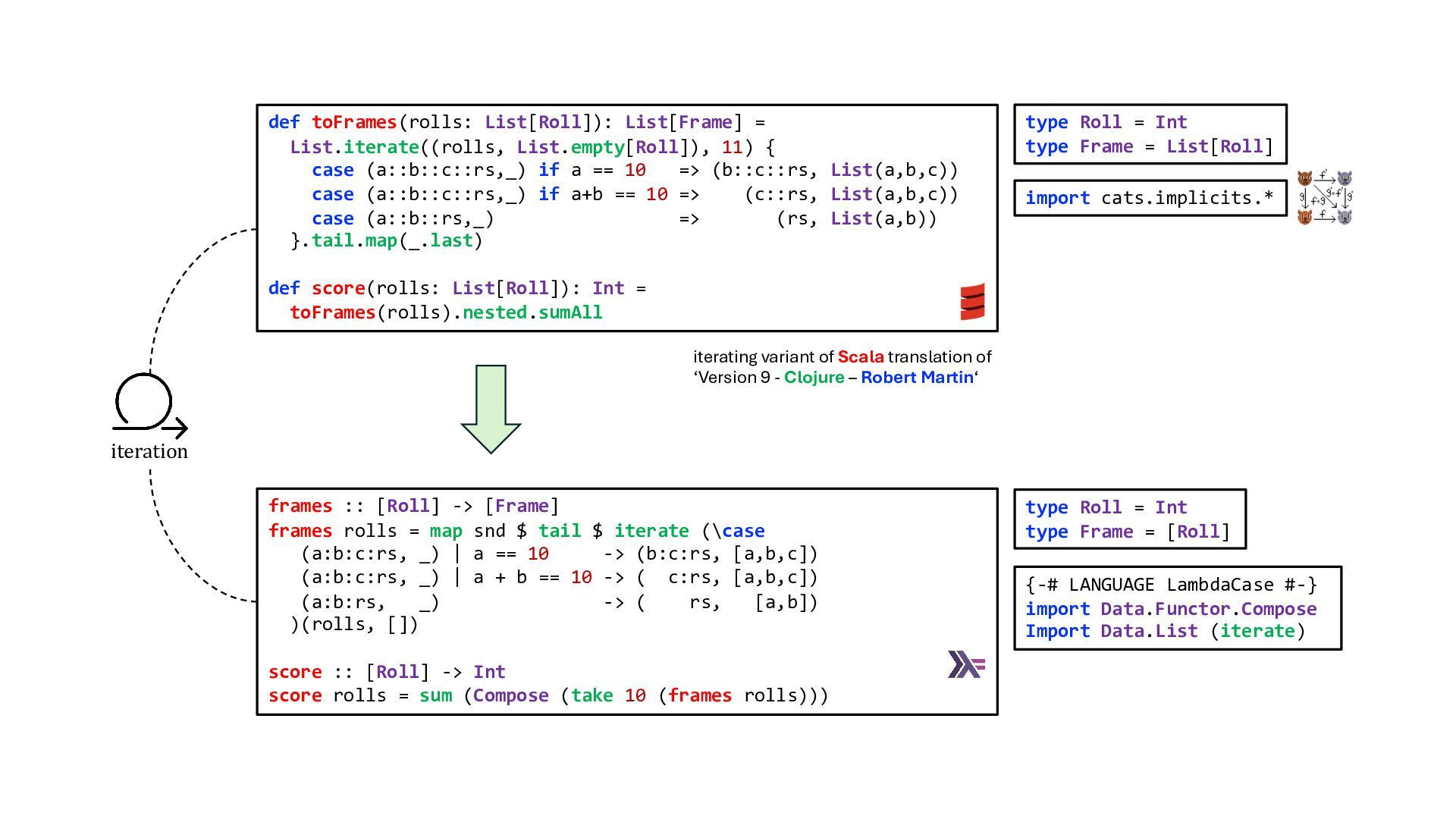
def toFrames(rolls: List[Roll]): List[Frame] = List.iterate((rolls, List.empty[Roll]), 11) { case
(a::b::c::rs,_) if a == 10 => (b::c::rs, List(a,b,c)) case (a::b::c::rs,_) if a+b == 10 => (c::rs, List(a,b,c)) case (a::b::rs,_) => (rs, List(a,b)) }.tail.map(_.last) type Roll = Int type Frame = List[Roll] import cats.implicits.* def score(rolls: List[Roll]): Int = toFrames(rolls).nested.sumAll iterating variant of Scala translation of ‘Version 9 - Clojure – Robert Martin‘ iteration frames :: [Roll] -> [Frame] frames rolls = map snd $ tail $ iterate (\case (a:b:c:rs, _) | a == 10 -> (b:c:rs, [a,b,c]) (a:b:c:rs, _) | a + b == 10 -> ( c:rs, [a,b,c]) (a:b:rs, _) -> ( rs, [a,b]) )(rolls, []) score :: [Roll] -> Int score rolls = sum (Compose (take 10 (frames rolls))) type Roll = Int type Frame = [Roll] {-# LANGUAGE LambdaCase #-} import Data.Functor.Compose Import Data.List (iterate) -
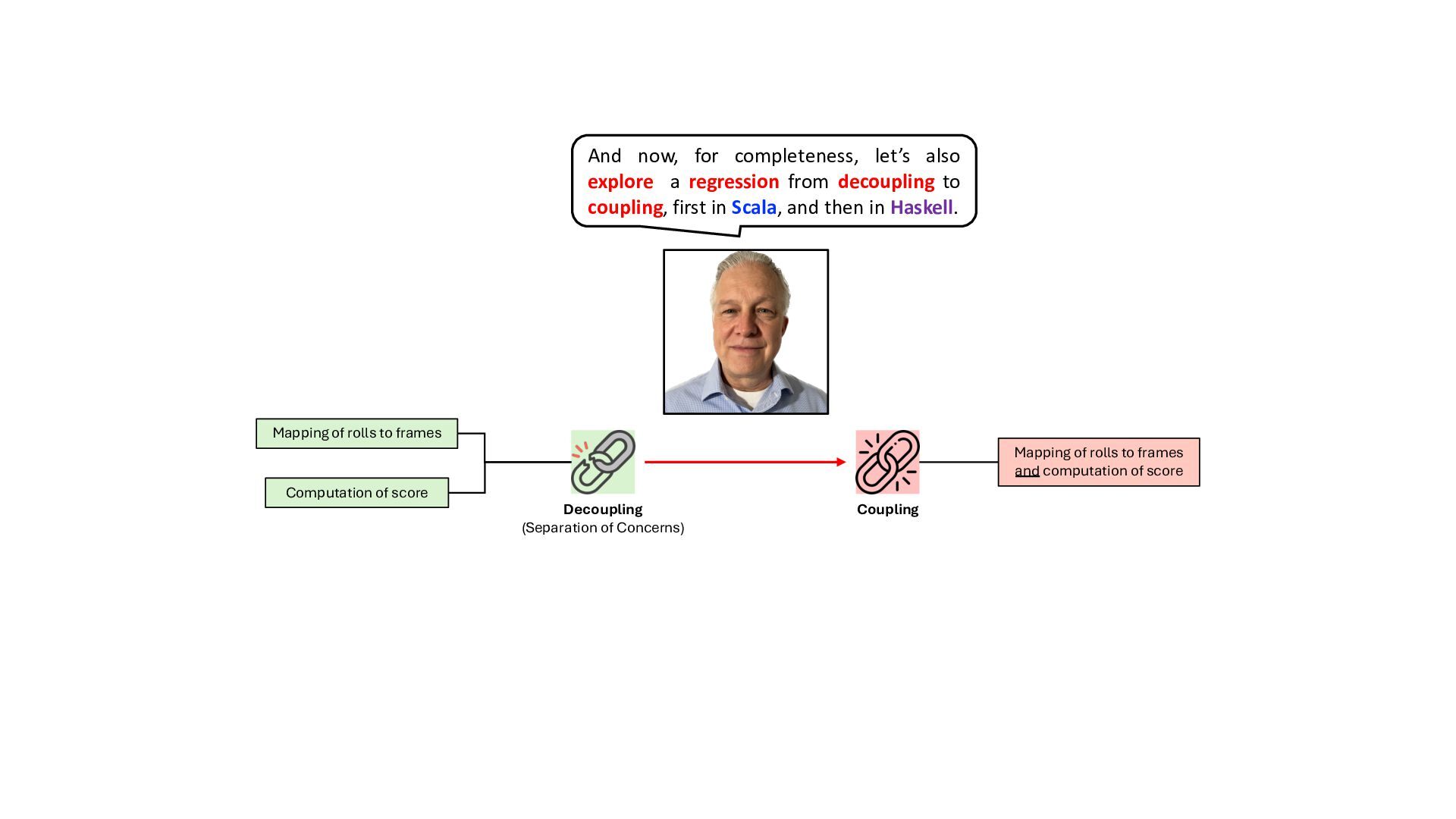
And now, for completeness, let’s also explore a regression from
decoupling to coupling, first in Scala, and then in Haskell. Mapping of rolls to frames Mapping of rolls to frames and computation of score Computation of score Decoupling (Separation of Concerns) Coupling -
def toFrames(rolls: List[Roll]): List[Frame] = List.unfold(rolls,0) : (rolls,frames) => if
frames == 10 then None else rolls match case a::b::c::rs if a == 10 => Some(List(a,b,c),(b::c::rs,frames+1)) case a::b::c::rs if a + b == 10 => Some(List(a,b,c), (c::rs,frames+1)) case a::b::rs => Some(List(a,b), (rs,frames+1)) def score(rolls: List[Roll]): Int = toFrames(rolls).nested.sumAll def score(rolls: List[Roll]): Int = List.unfold(rolls, 0){ case (_, frame:10) => None case (a::b::c::rs, frame ) if a == 10 => Some(a+b+c, (b::c::rs, frame+1)) case (a::b::c::rs, frame ) if a+b == 10 => Some(a+b+c, (c::rs, frame+1)) case (a::b::rs, frame ) => Some(a+b, (rs, frame+1)) }.sum def toFrames(rolls: List[Roll]): List[Frame] = List.iterate((rolls, List.empty[Roll]), 11) { case (a::b::c::rs,_) if a == 10 => (b::c::rs, List(a,b,c)) case (a::b::c::rs,_) if a+b == 10 => (c::rs, List(a,b,c)) case (a::b::rs,_) => (rs, List(a,b)) }.map(_.last).tail def score(rolls: List[Roll]): Int = toFrames(rolls).nested.sumAll unfolding coupled iterating and unfolding variants of Scala translation of ‘Version 9 - Clojure – Robert Martin‘ iteration def score(rolls: List[Roll]): Int = List.iterate((rolls, 0), 11) { case (a::b::c::rs, _) if a == 10 => (b::c::rs, a+b+c) case (a::b::c::rs, _) if a+b == 10 => (c::rs, a+b+c) case (a::b::rs, _) => (rs, a+b) }.map(_.last).sum -
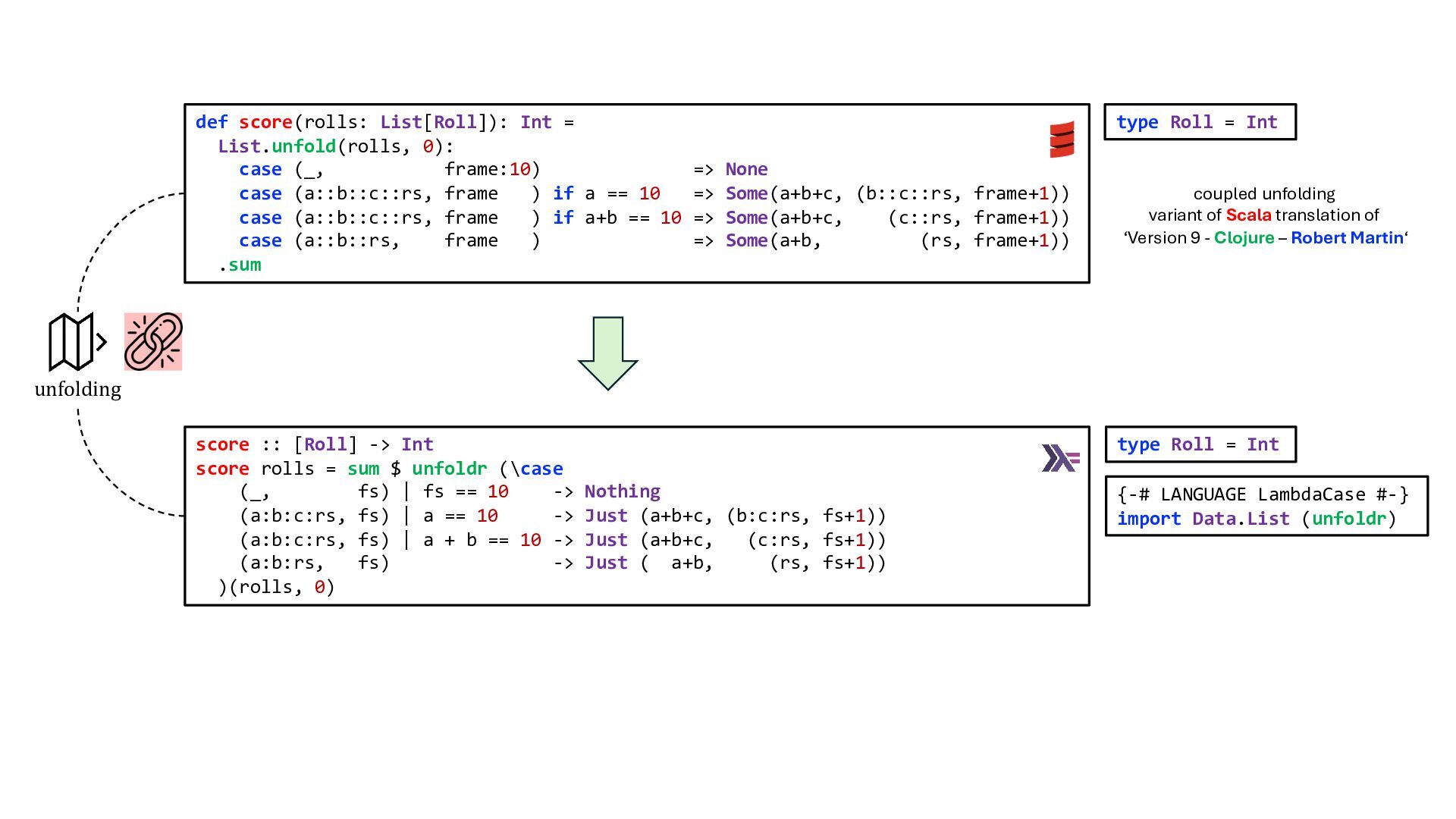
def score(rolls: List[Roll]): Int = List.unfold(rolls, 0): case (_, frame:10)
=> None case (a::b::c::rs, frame ) if a == 10 => Some(a+b+c, (b::c::rs, frame+1)) case (a::b::c::rs, frame ) if a+b == 10 => Some(a+b+c, (c::rs, frame+1)) case (a::b::rs, frame ) => Some(a+b, (rs, frame+1)) .sum type Roll = Int score :: [Roll] -> Int score rolls = sum $ unfoldr (\case (_, fs) | fs == 10 -> Nothing (a:b:c:rs, fs) | a == 10 -> Just (a+b+c, (b:c:rs, fs+1)) (a:b:c:rs, fs) | a + b == 10 -> Just (a+b+c, (c:rs, fs+1)) (a:b:rs, fs) -> Just ( a+b, (rs, fs+1)) )(rolls, 0) type Roll = Int coupled unfolding variant of Scala translation of ‘Version 9 - Clojure – Robert Martin‘ unfolding {-# LANGUAGE LambdaCase #-} import Data.List (unfoldr) -
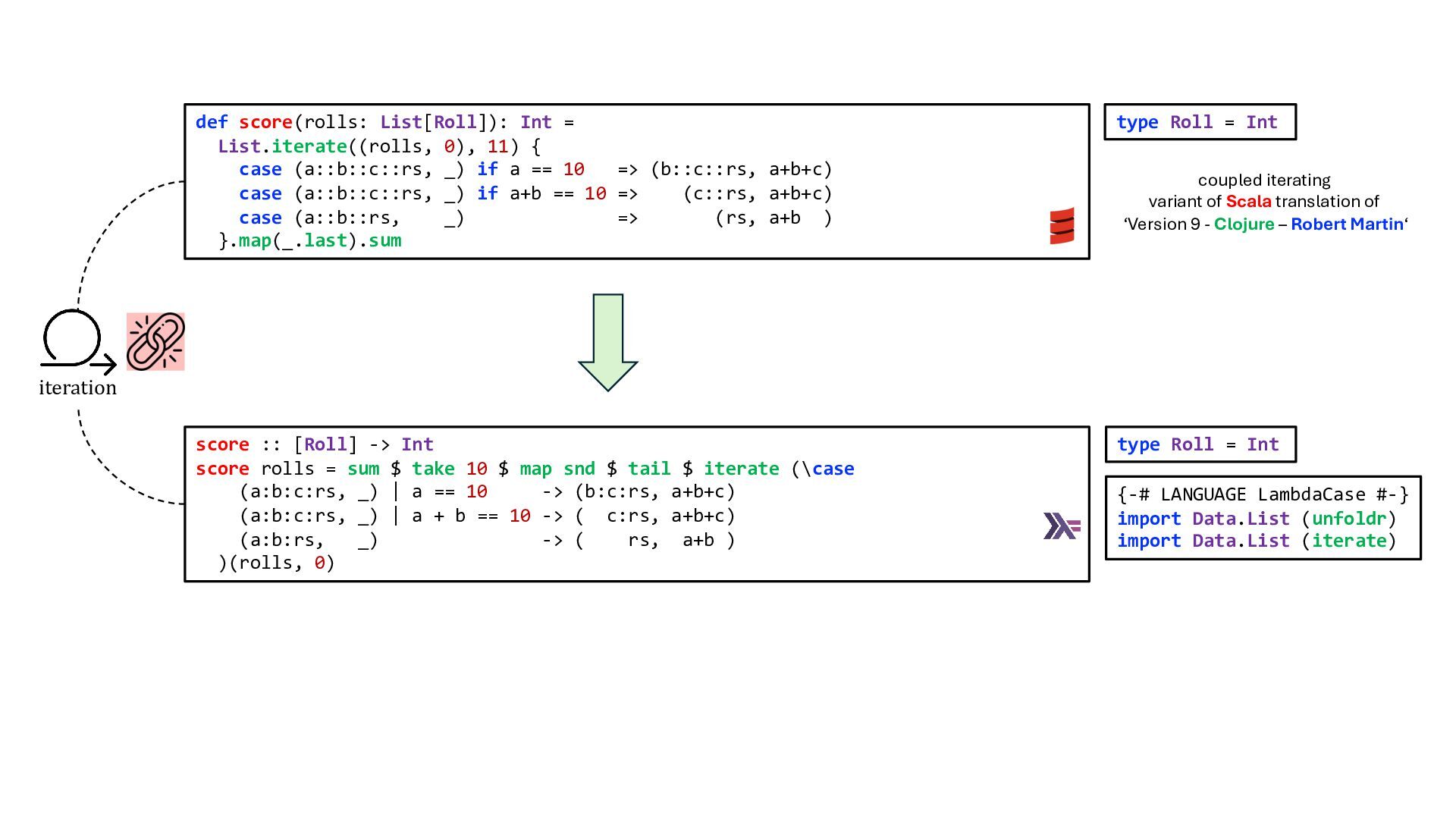
def score(rolls: List[Roll]): Int = List.iterate((rolls, 0), 11) { case
(a::b::c::rs, _) if a == 10 => (b::c::rs, a+b+c) case (a::b::c::rs, _) if a+b == 10 => (c::rs, a+b+c) case (a::b::rs, _) => (rs, a+b ) }.map(_.last).sum type Roll = Int score :: [Roll] -> Int score rolls = sum $ take 10 $ map snd $ tail $ iterate (\case (a:b:c:rs, _) | a == 10 -> (b:c:rs, a+b+c) (a:b:c:rs, _) | a + b == 10 -> ( c:rs, a+b+c) (a:b:rs, _) -> ( rs, a+b ) )(rolls, 0) type Roll = Int coupled iterating variant of Scala translation of ‘Version 9 - Clojure – Robert Martin‘ iteration {-# LANGUAGE LambdaCase #-} import Data.List (unfoldr) import Data.List (iterate) -
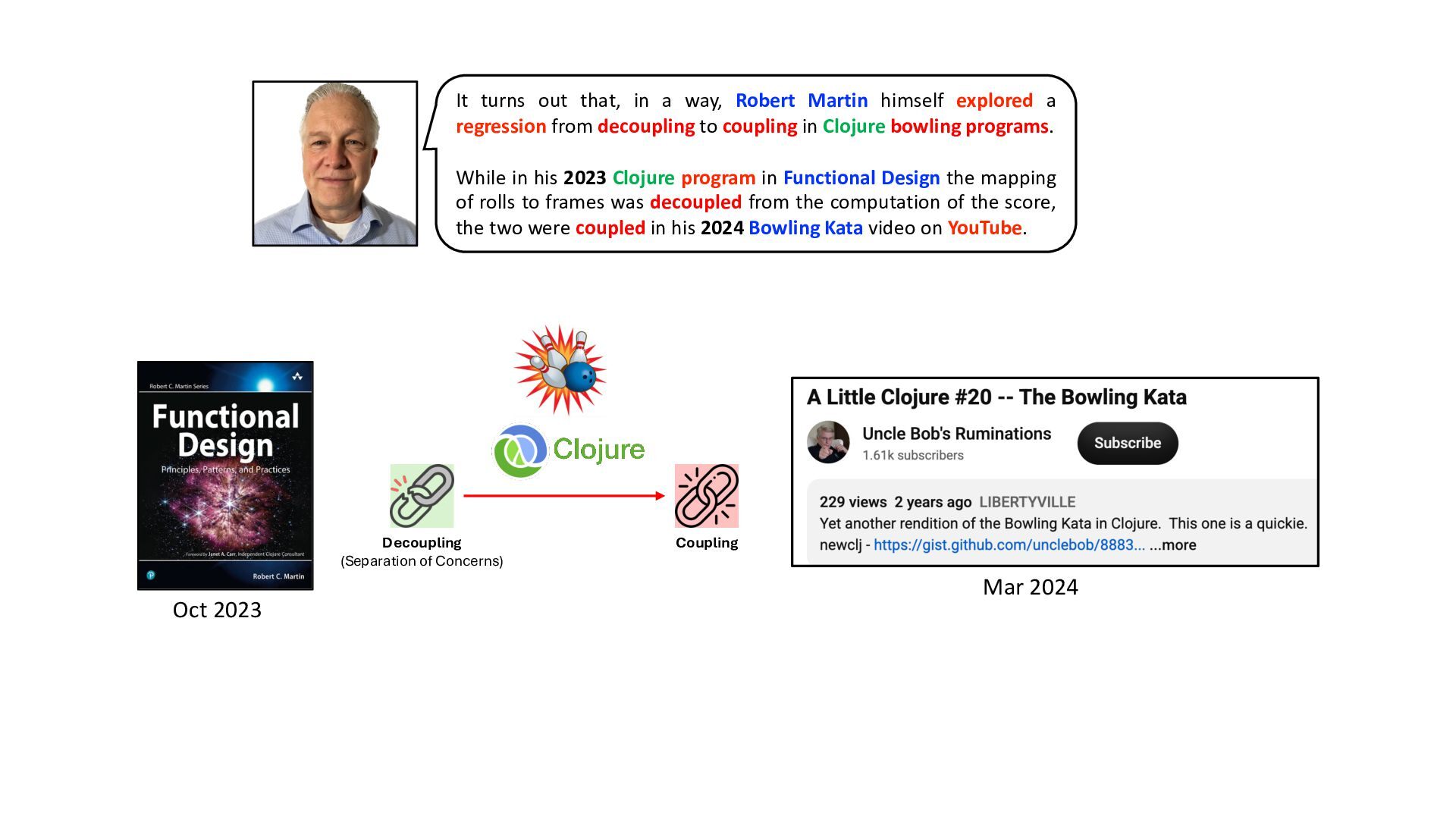
It turns out that, in a way, Robert Martin himself
explored a regression from decoupling to coupling in Clojure bowling programs. While in his 2023 Clojure program in Functional Design the mapping of rolls to frames was decoupled from the computation of the score, the two were coupled in his 2024 Bowling Kata video on YouTube. Decoupling (Separation of Concerns) Oct 2023 Coupling Mar 2024 -
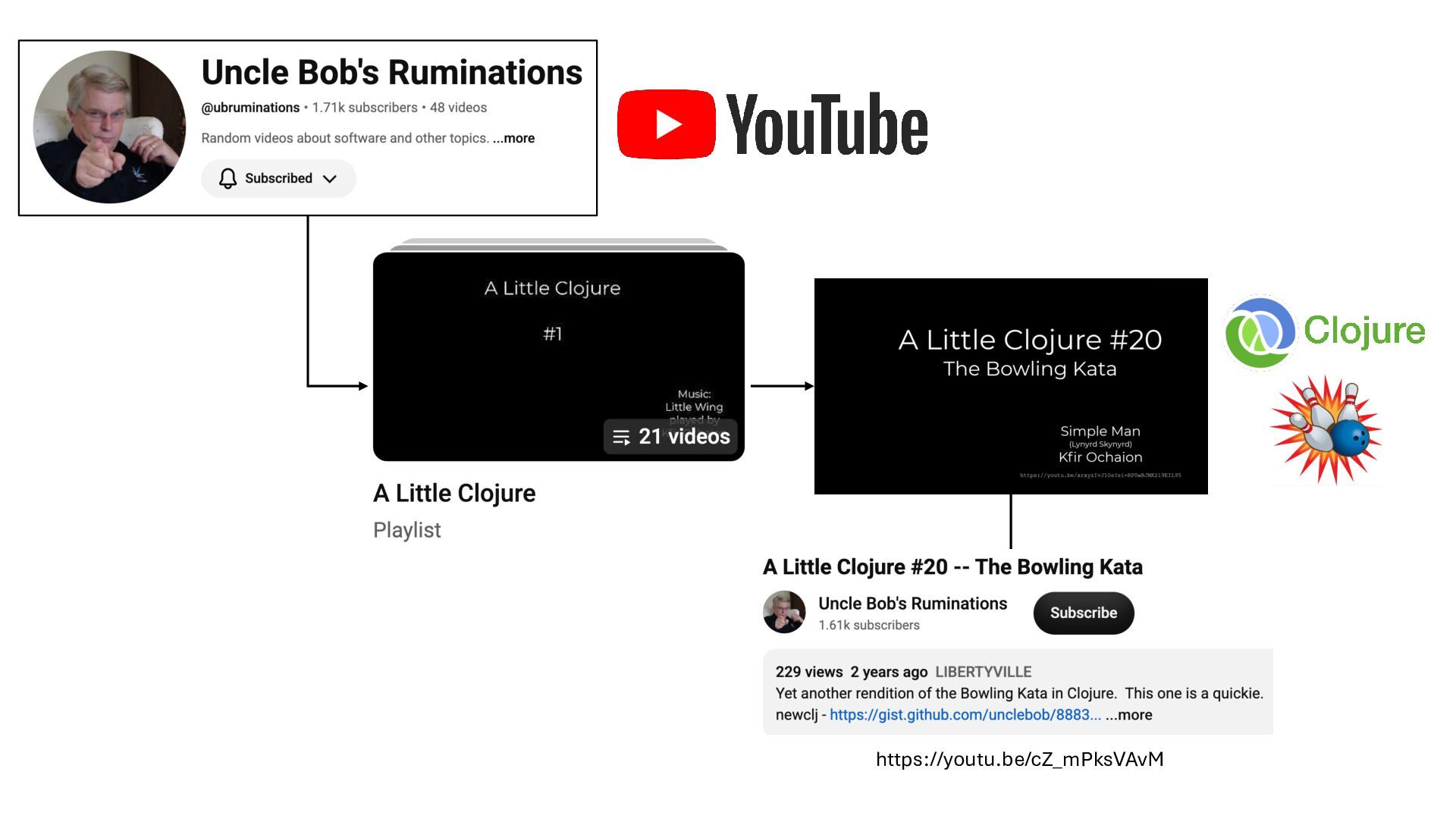
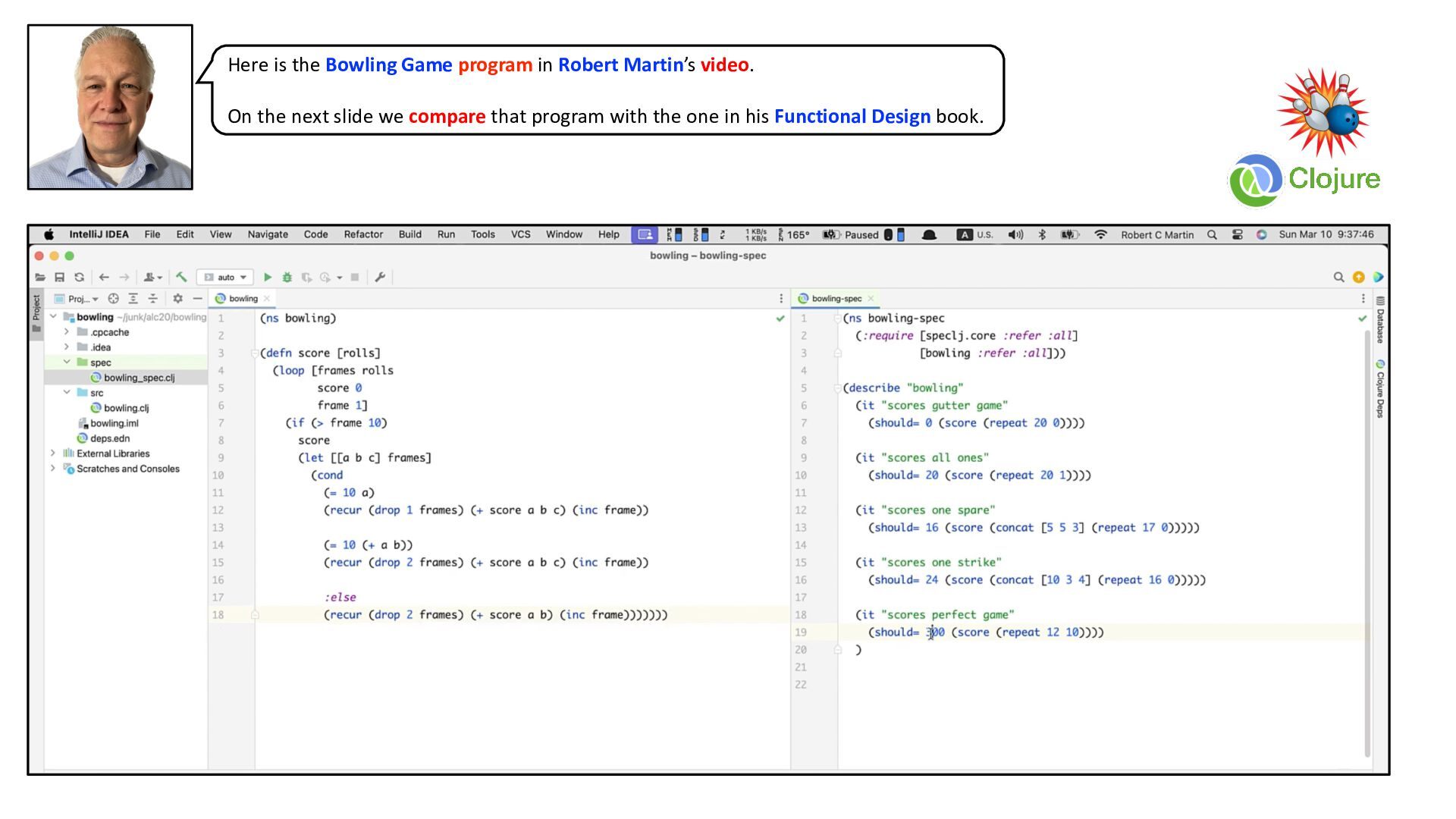
Here is the Bowling Game program in Robert Martin’s video.
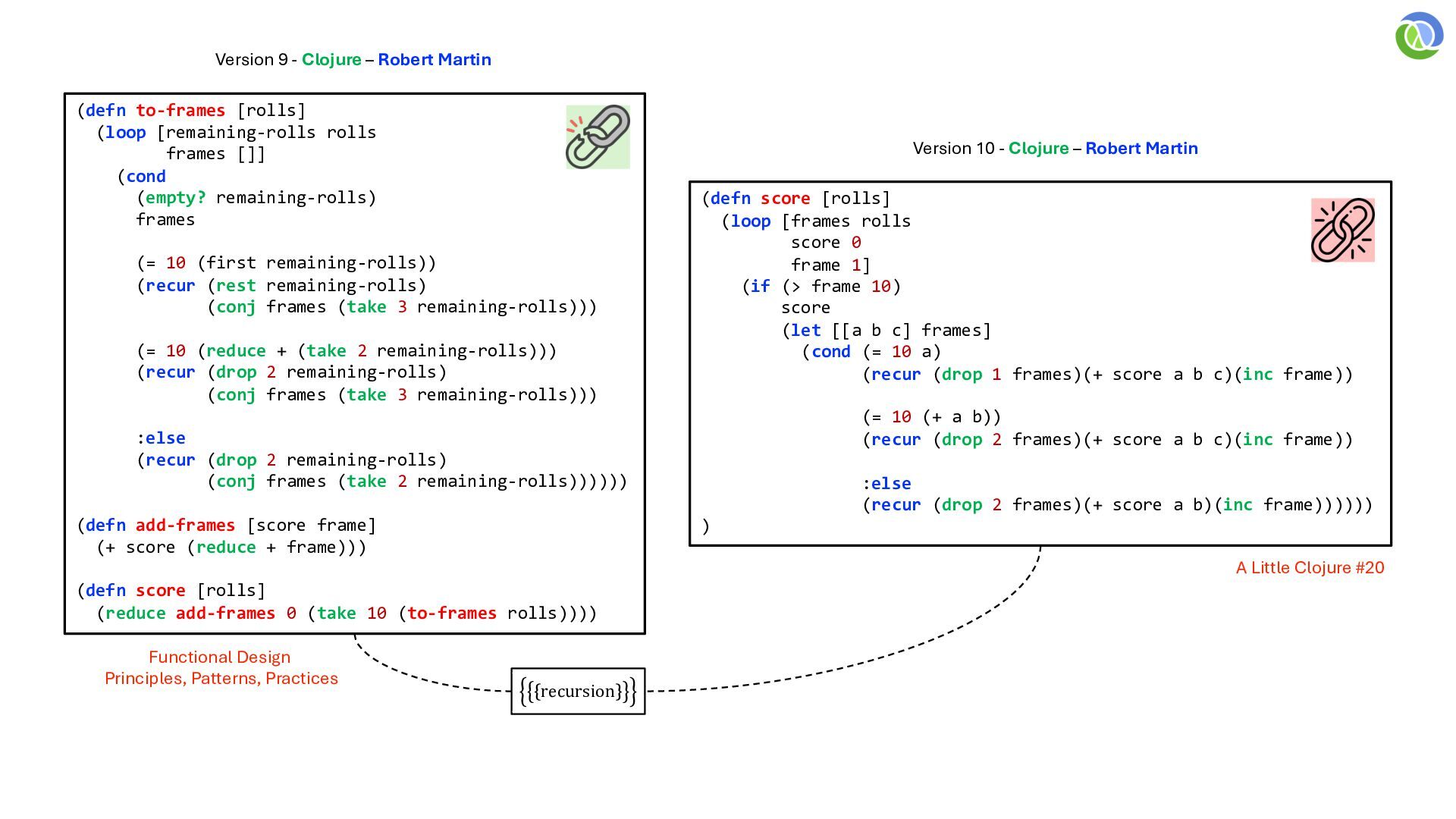
On the next slide we compare that program with the one in his Functional Design book. -
Version 9 - Clojure – Robert Martin (defn to-frames [rolls]
(loop [remaining-rolls rolls frames []] (cond (empty? remaining-rolls) frames Version 10 - Clojure – Robert Martin (= 10 (first remaining-rolls)) (recur (rest remaining-rolls) (conj frames (take 3 remaining-rolls))) (= 10 (reduce + (take 2 remaining-rolls))) (recur (drop 2 remaining-rolls) (conj frames (take 3 remaining-rolls))) (defn score [rolls] (loop [frames rolls score 0 frame 1] (if (> frame 10) score (let [[a b c] frames] (cond (= 10 a) (recur (drop 1 frames)(+ score a b c)(inc frame)) (= 10 (+ a b)) (recur (drop 2 frames)(+ score a b c)(inc frame)) :else (recur (drop 2 remaining-rolls) (conj frames (take 2 remaining-rolls)))))) (defn add-frames [score frame] (+ score (reduce + frame))) ) A Little Clojure #20 (defn score [rolls] (reduce add-frames 0 (take 10 (to-frames rolls)))) Functional Design Principles, Patterns, Practices :else (recur (drop 2 frames)(+ score a b)(inc frame)))))) s recursion s -
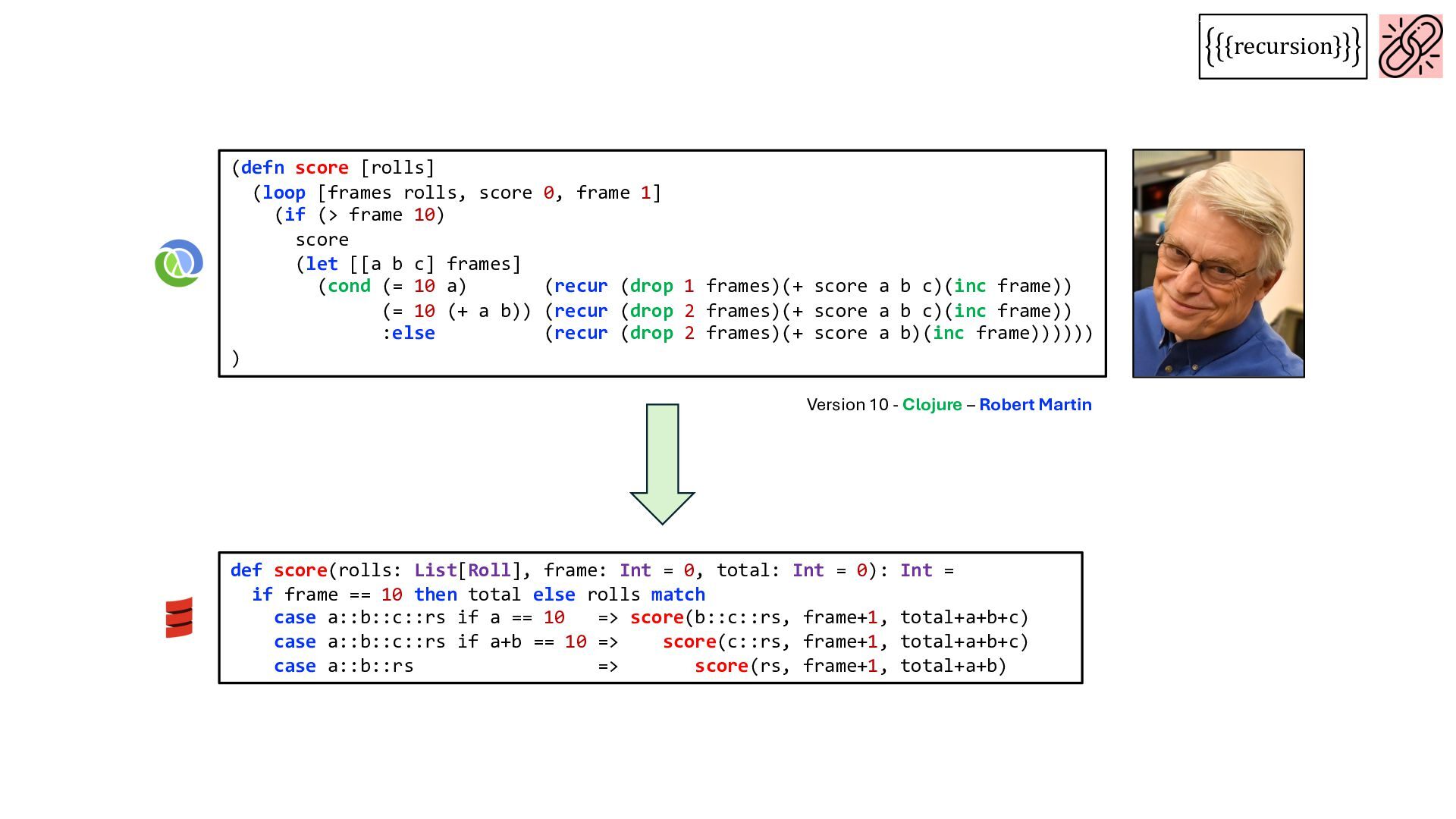
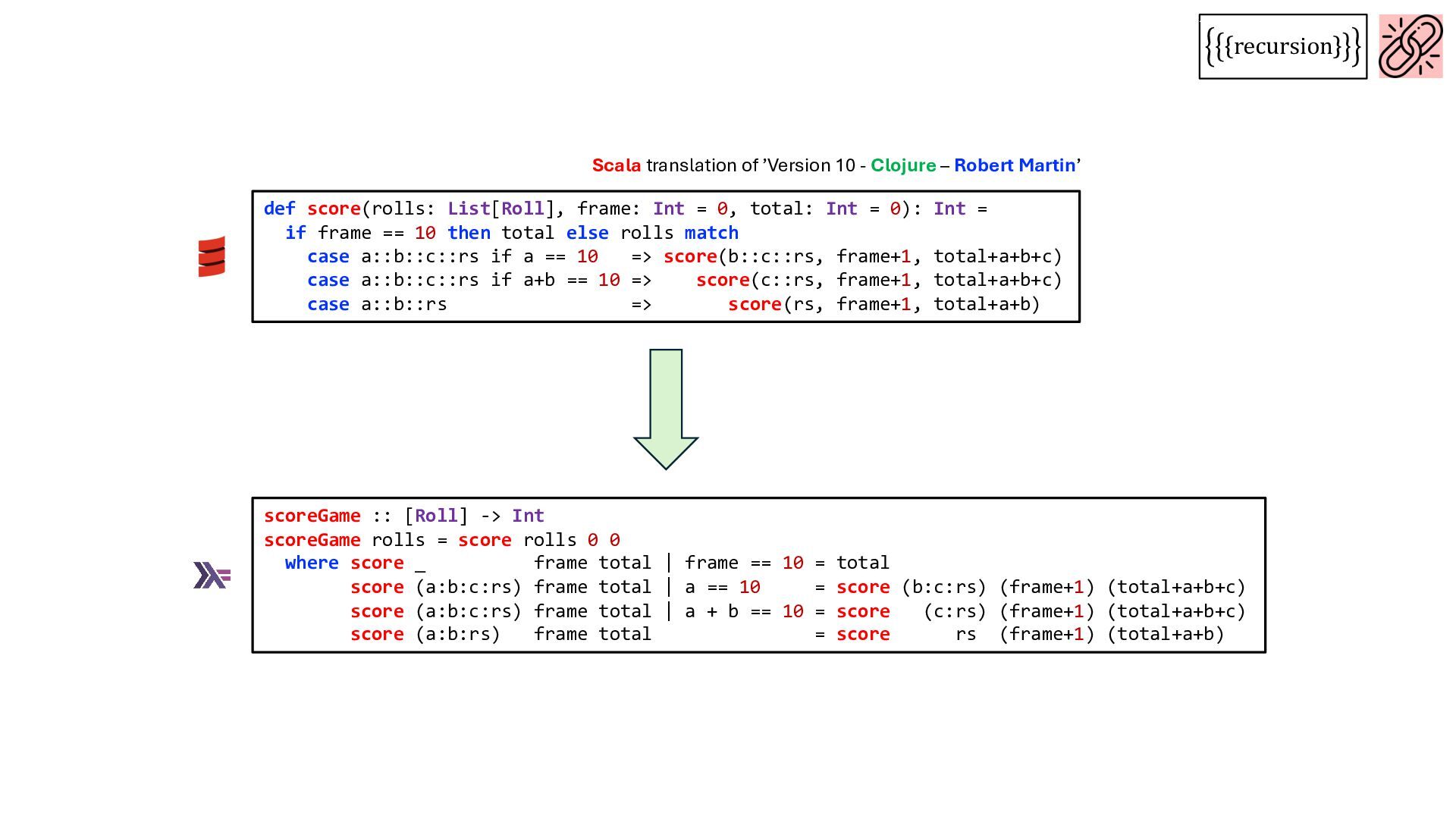
The next slide shows the Scala translation of that last
version of Robert Martin’s Clojure program. The subsequent slide shows the Haskell translation. -
s recursion s (defn score [rolls] (loop [frames rolls, score
0, frame 1] (if (> frame 10) score (let [[a b c] frames] (cond (= 10 a) (recur (drop 1 frames)(+ score a b c)(inc frame)) (= 10 (+ a b)) (recur (drop 2 frames)(+ score a b c)(inc frame)) :else (recur (drop 2 frames)(+ score a b)(inc frame)))))) ) Version 10 - Clojure – Robert Martin def score(rolls: List[Roll], frame: Int = 0, total: Int = 0): Int = if frame == 10 then total else rolls match case a::b::c::rs if a == 10 => score(b::c::rs, frame+1, total+a+b+c) case a::b::c::rs if a+b == 10 => score(c::rs, frame+1, total+a+b+c) case a::b::rs => score(rs, frame+1, total+a+b) -
s recursion s Scala translation of ’Version 10 - Clojure
– Robert Martin’ def score(rolls: List[Roll], frame: Int = 0, total: Int = 0): Int = if frame == 10 then total else rolls match case a::b::c::rs if a == 10 => score(b::c::rs, frame+1, total+a+b+c) case a::b::c::rs if a+b == 10 => score(c::rs, frame+1, total+a+b+c) case a::b::rs => score(rs, frame+1, total+a+b) scoreGame :: [Roll] -> Int scoreGame rolls = score rolls 0 0 where score _ frame total | frame == 10 = total score (a:b:c:rs) frame total | a == 10 = score (b:c:rs) (frame+1) (total+a+b+c) score (a:b:c:rs) frame total | a + b == 10 = score (c:rs) (frame+1) (total+a+b+c) score (a:b:rs) frame total = score rs (frame+1) (total+a+b) -
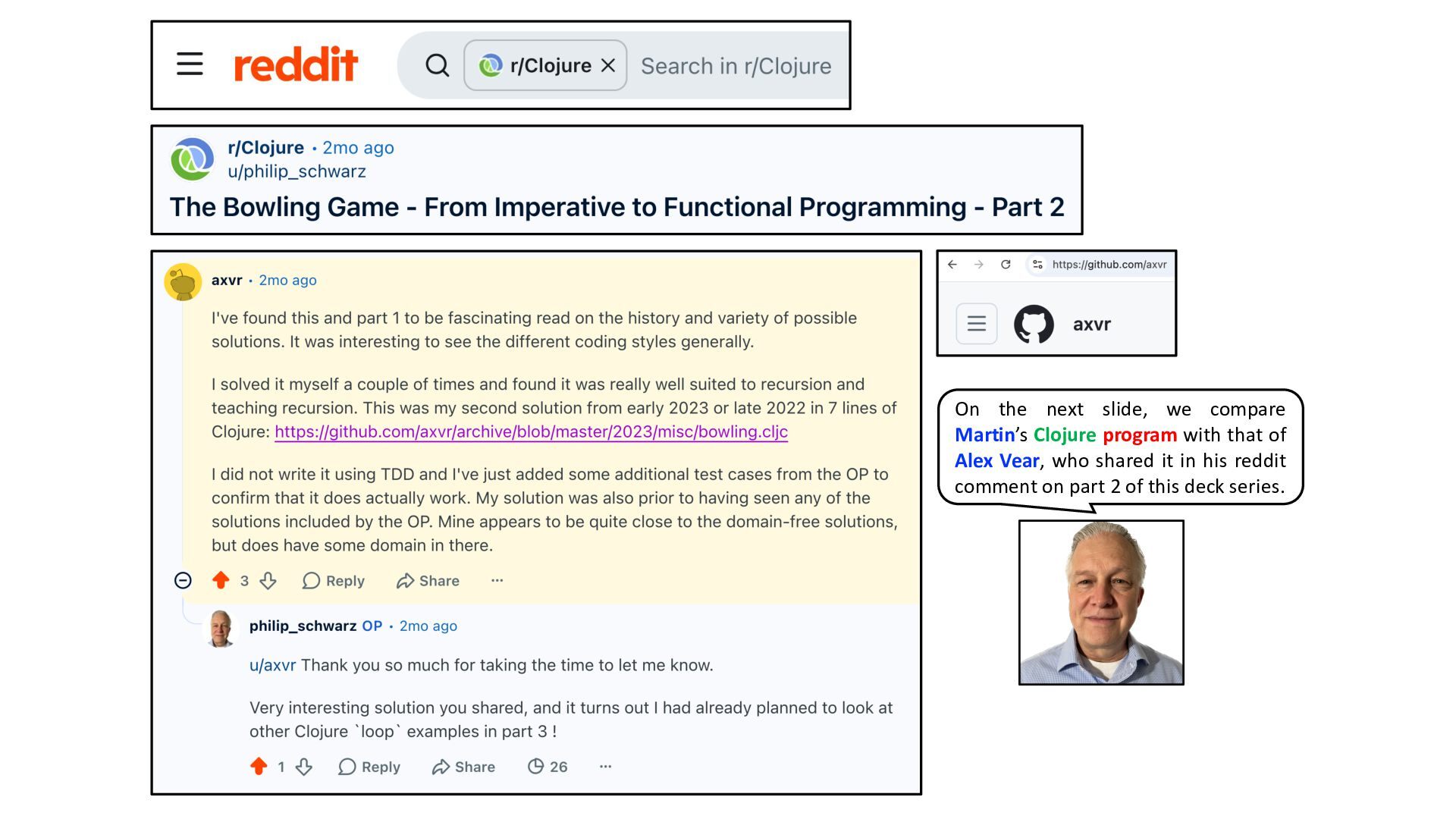
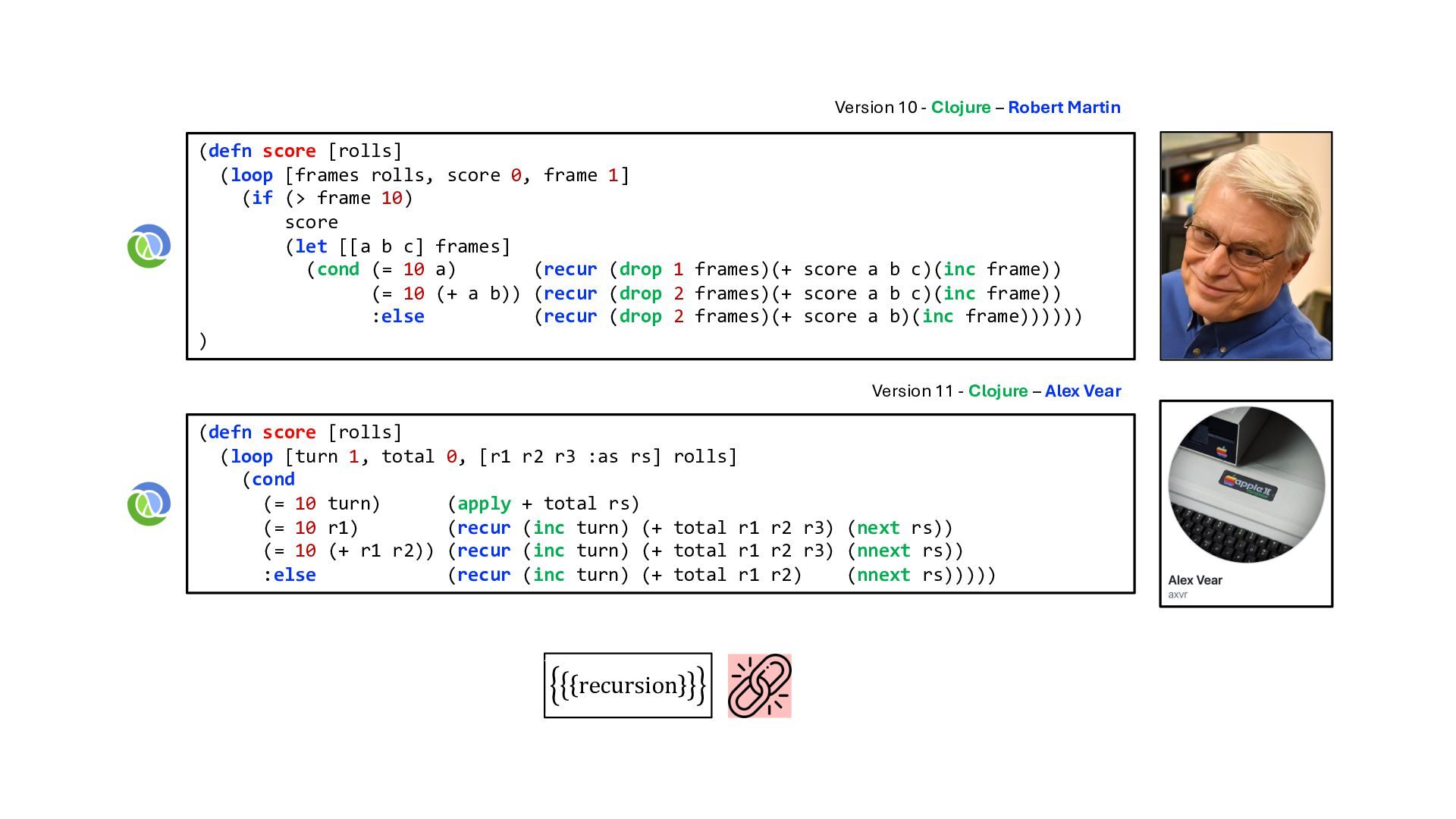
On the next slide, we compare Martin’s Clojure program with
that of Alex Vear, who shared it in his reddit comment on part 2 of this deck series. -
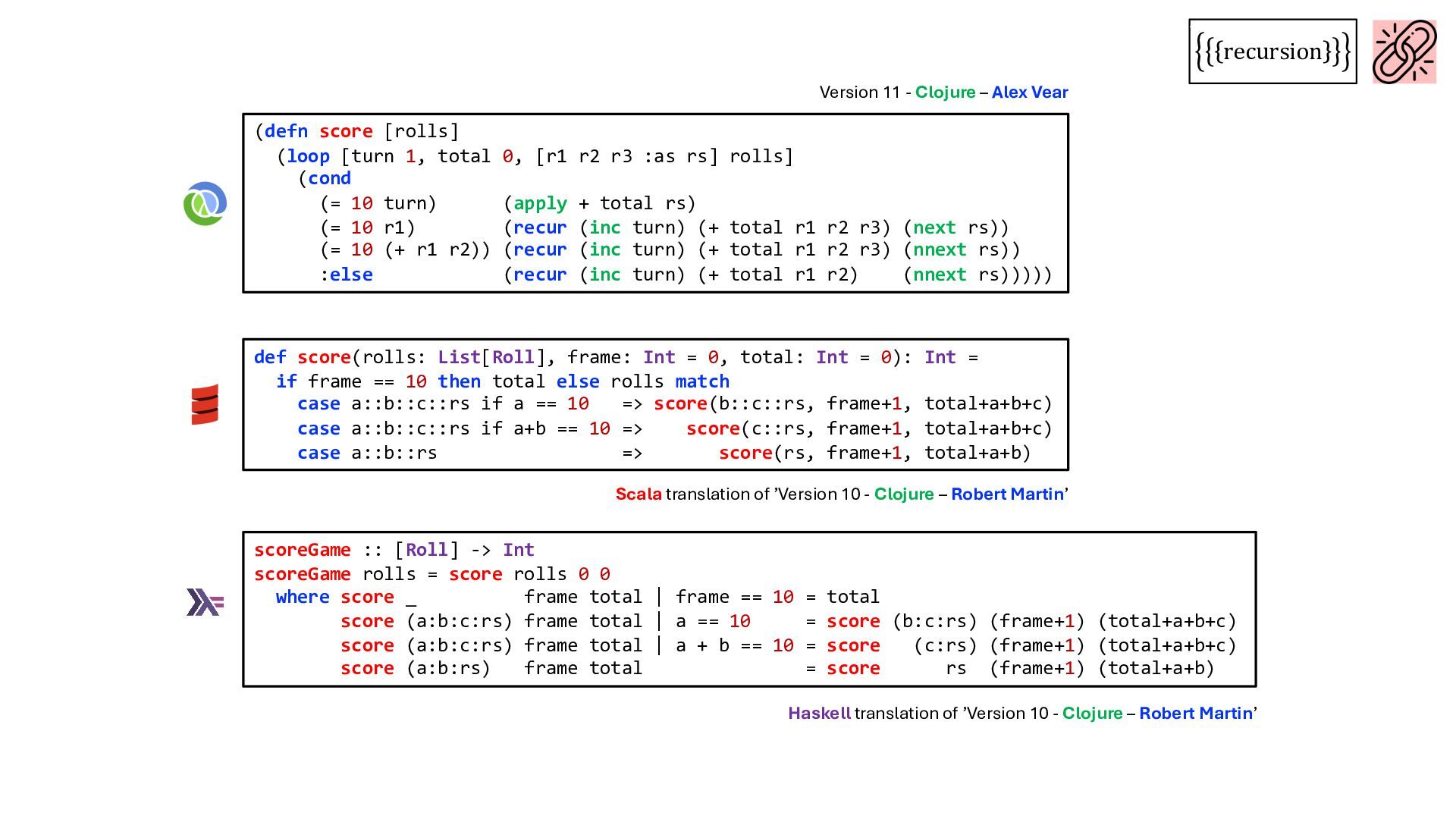
Version 10 - Clojure – Robert Martin (defn score [rolls]
(loop [frames rolls, score 0, frame 1] (if (> frame 10) score (let [[a b c] frames] (cond (= 10 a) (recur (drop 1 frames)(+ score a b c)(inc frame)) (= 10 (+ a b)) (recur (drop 2 frames)(+ score a b c)(inc frame)) :else (recur (drop 2 frames)(+ score a b)(inc frame)))))) ) Version 11 - Clojure – Alex Vear (defn score [rolls] (loop [turn 1, total 0, [r1 r2 r3 :as rs] rolls] (cond (= 10 turn) (apply + total rs) (= 10 r1) (recur (inc turn) (+ total r1 r2 r3) (next rs)) (= 10 (+ r1 r2)) (recur (inc turn) (+ total r1 r2 r3) (nnext rs)) :else (recur (inc turn) (+ total r1 r2) (nnext rs))))) s recursion s -
On the next and final slide we compare Alex Vear’s
very succinct Clojure program with the equally succinct Scala and Haskell translations of Martin’s Clojure program shown on the previous slide. -
s recursion Version 11 - Clojure – Alex Vear s
(defn score [rolls] (loop [turn 1, total 0, [r1 r2 r3 :as rs] rolls] (cond (= 10 turn) (apply + total rs) (= 10 r1) (recur (inc turn) (+ total r1 r2 r3) (next rs)) (= 10 (+ r1 r2)) (recur (inc turn) (+ total r1 r2 r3) (nnext rs)) :else (recur (inc turn) (+ total r1 r2) (nnext rs))))) def score(rolls: List[Roll], frame: Int = 0, total: Int = 0): Int = if frame == 10 then total else rolls match case a::b::c::rs if a == 10 => score(b::c::rs, frame+1, total+a+b+c) case a::b::c::rs if a+b == 10 => score(c::rs, frame+1, total+a+b+c) case a::b::rs => score(rs, frame+1, total+a+b) Scala translation of ’Version 10 - Clojure – Robert Martin’ scoreGame :: [Roll] -> Int scoreGame rolls = score rolls 0 0 where score _ frame total | frame == 10 = total score (a:b:c:rs) frame total | a == 10 = score (b:c:rs) (frame+1) (total+a+b+c) score (a:b:c:rs) frame total | a + b == 10 = score (c:rs) (frame+1) (total+a+b+c) score (a:b:rs) frame total = score rs (frame+1) (total+a+b) Haskell translation of ’Version 10 - Clojure – Robert Martin’ -
That’s all for part four. I hope you liked it.
See you in part five.
 philipschwarz
 kasacchiful
 ryunen344
 umigishiaoi
 omatty198
 ostk0069
 kishida
 kumaiu
 steliosf
 bicstone
 nearme_tech
 dalinaum
 shibuiwilliam
 geoffreycrofte
 danielanewman
 tmiket
 lindahogenes
 tammyeverts
 addyosmani
 aemeredith
 katiecoart
 jcasabona
 gurzu
 soysaucechin