Upgrade to Pro — share decks privately, control downloads, hide ads and more …

The Bowling Game - From Imperative to Functiona...

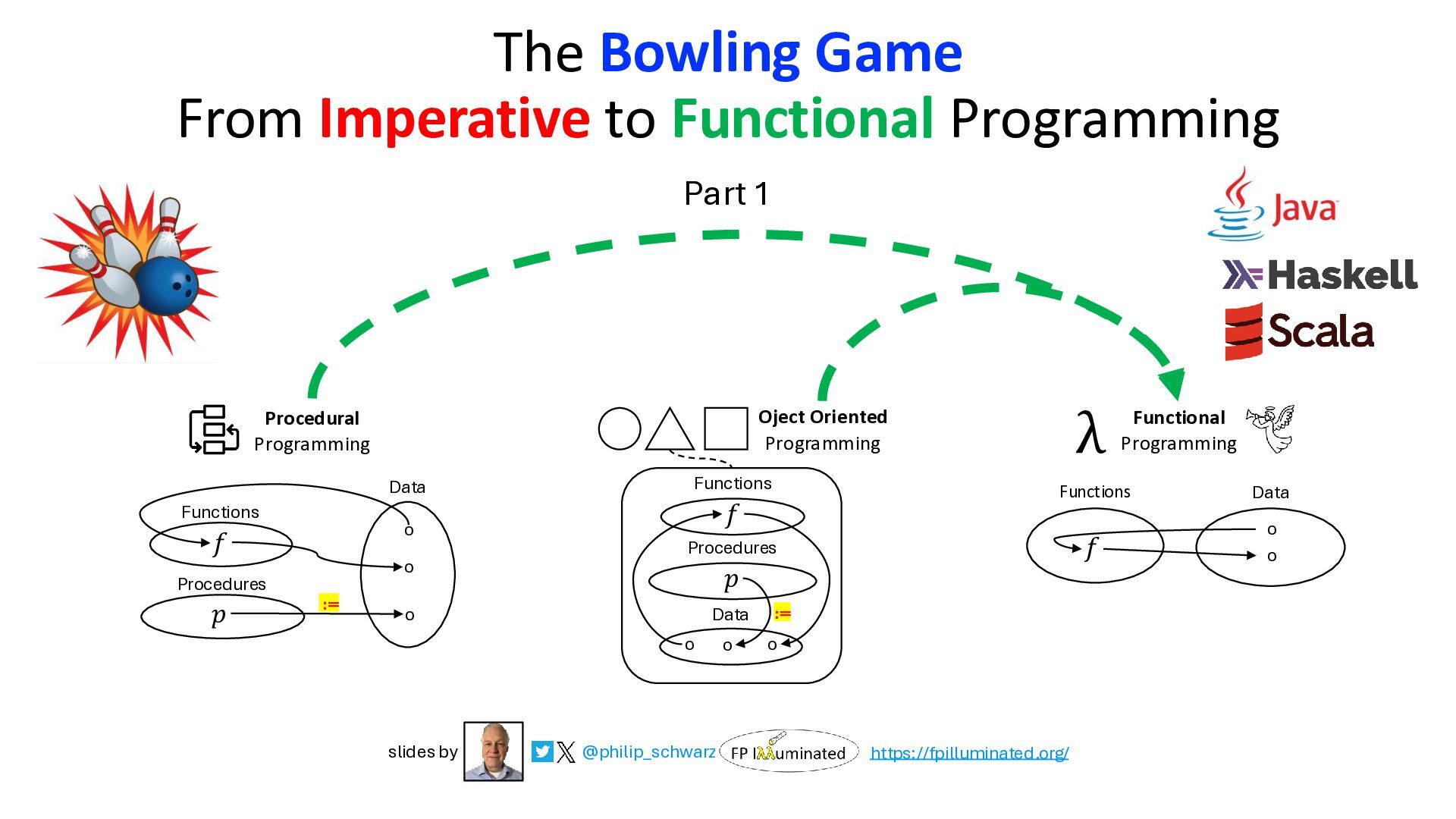
The Bowling Game - From Imperative to Functional Programming - Part 1

The Bowling Game - From Imperative to Functional Programming - Part 1

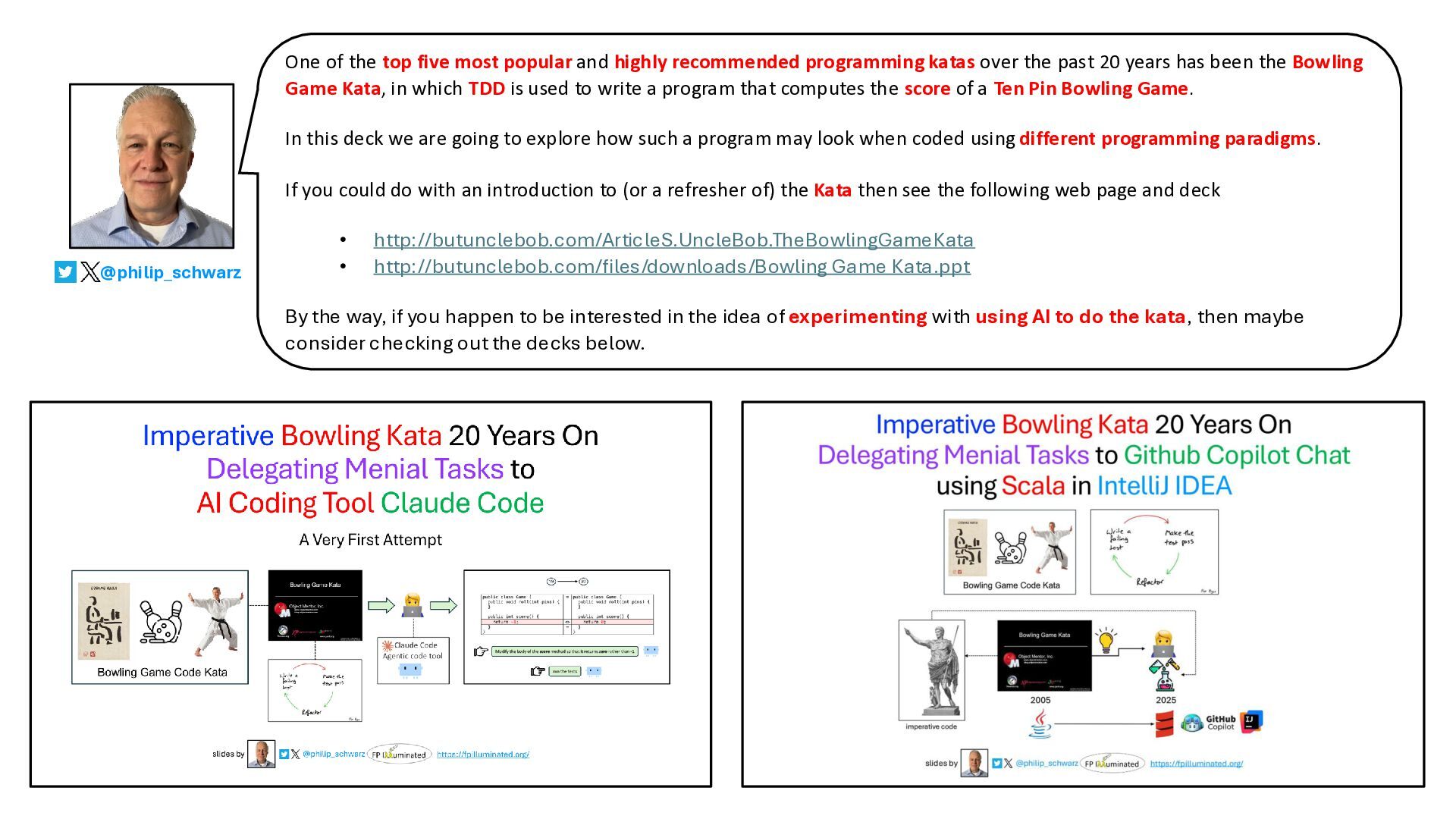
One of the top five most popular and highly recommended programming katas over the past 20 years has been the Bowling Game Kata, in which TDD is used to write a program that computes the score of a Ten Pin Bowling Game.

In this deck we are going to explore how such a program may look when coded using different programming paradigms.

Avatar for Philip Schwarz

Philip Schwarz PRO

July 06, 2026

More Decks by Philip Schwarz

Other Decks in Programming

Transcript

  1. The Bowling Game From Imperative to Functional Programming Part 1

    Ron Jeffries Pit Robert C. Martin Ron Jeffries Data Functions o 𝑓 Procedures 𝑝 o := λ Oject Oriented Programming Procedural Programming Functions 𝑓 Data 𝑓 o o 𝑝 o Data := o o o Tom Moertel slides by @philip_schwarz Functional Programming Functions Procedures https://fpilluminated.org/ Philip Schwarz Dan Mead Philip Schwarz Jon Bettinger Ron Jeffries
  2. One of the top five most popular and highly recommended

    programming katas over the past 20 years has been the Bowling Game Kata, in which TDD is used to write a program that computes the score of a Ten Pin Bowling Game. In this deck we are going to explore how such a program may look when coded using different programming paradigms. If you could do with an introduction to (or a refresher of) the Kata then see the following web page and deck @philip_schwarz • • http://butunclebob.com/ArticleS.UncleBob.TheBowlingGameKata http://butunclebob.com/files/downloads/Bowling Game Kata.ppt By the way, if you happen to be interested in the idea of experimenting with using AI to do the kata, then maybe consider checking out the decks below.
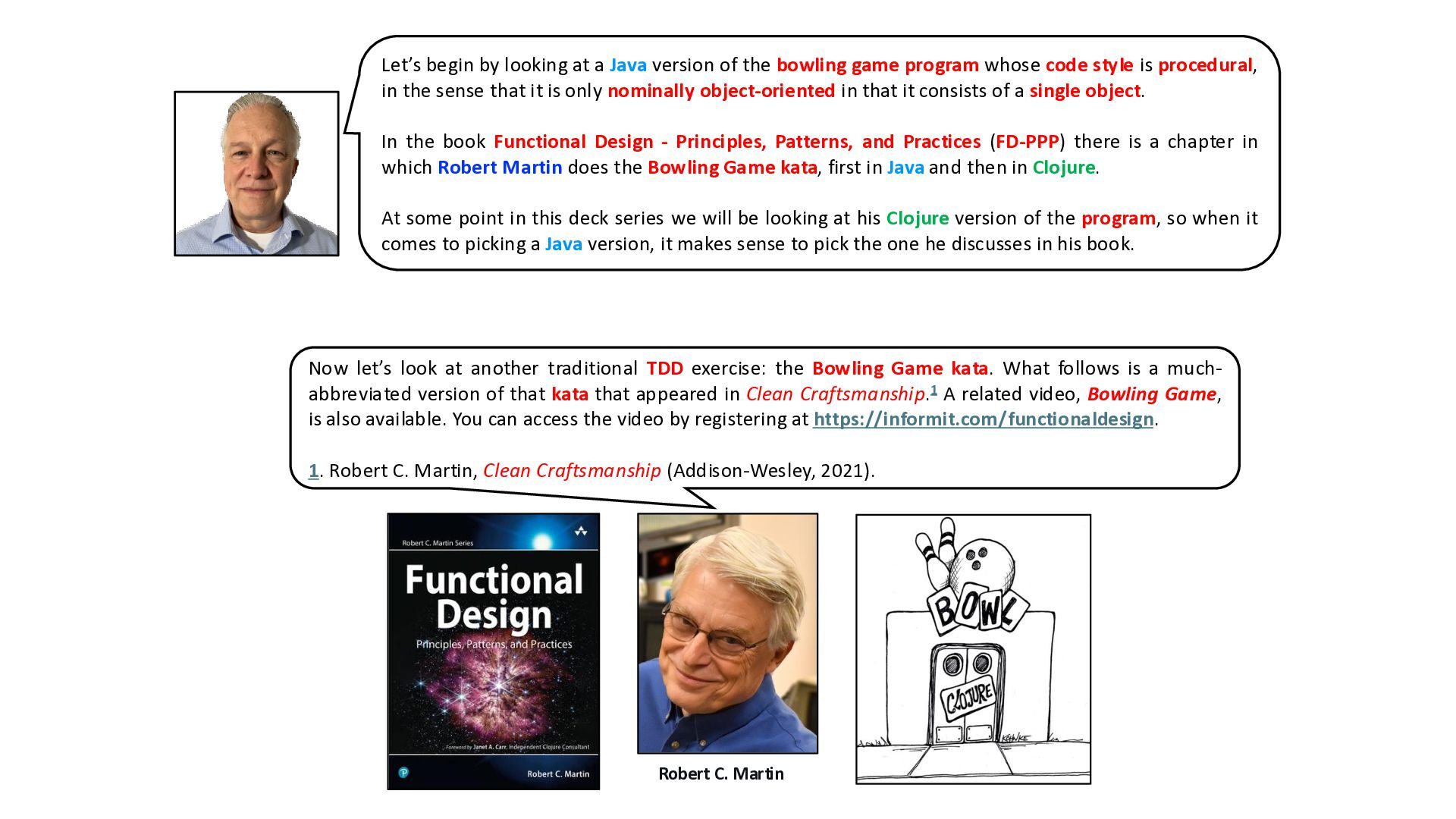
  3. Let’s begin by looking at a Java version of the

    bowling game program whose code style is procedural, in the sense that it is only nominally object-oriented in that it consists of a single object. In the book Functional Design - Principles, Patterns, and Practices (FD-PPP) there is a chapter in which Robert Martin does the Bowling Game kata, first in Java and then in Clojure. At some point in this deck series we will be looking at his Clojure version of the program, so when it comes to picking a Java version, it makes sense to pick the one he discusses in his book. Now let’s look at another traditional TDD exercise: the Bowling Game kata. What follows is a muchabbreviated version of that kata that appeared in Clean Craftsmanship.1 A related video, Bowling Game, is also available. You can access the video by registering at https://informit.com/functionaldesign. 1. Robert C. Martin, Clean Craftsmanship (Addison-Wesley, 2021). Robert C. Martin
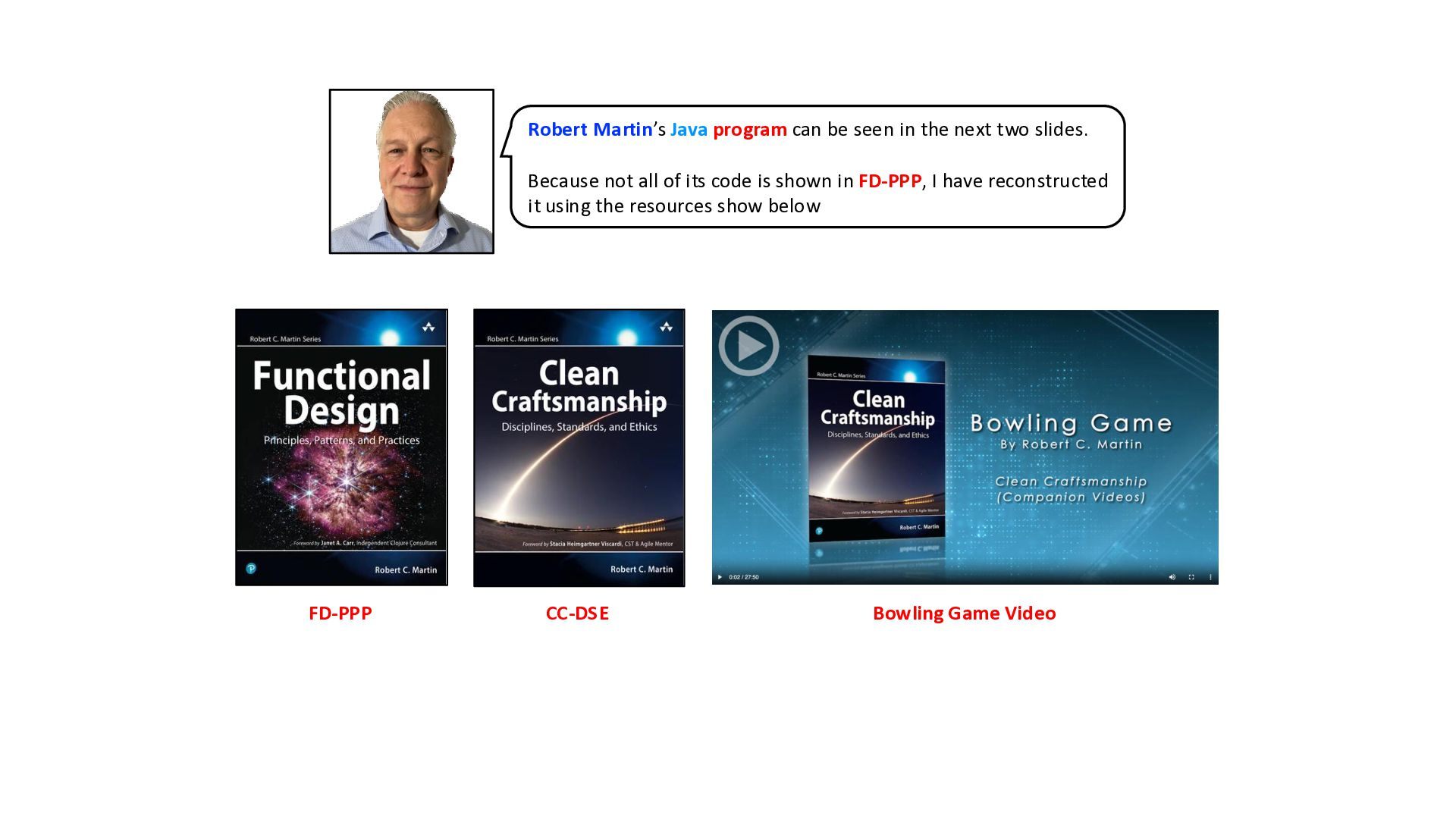
  4. Robert Martin’s Java program can be seen in the next

    two slides. Because not all of its code is shown in FD-PPP, I have reconstructed it using the resources show below FD-PPP CC-DSE Bowling Game Video
  5. public class Game { public void roll(int pins) { rolls[currentRoll++]

    = pins; } private int rolls[] = new int[21]; private int currentRoll = 0; private boolean isSpare(int frameIndex) { return rolls[frameIndex] + rolls[frameIndex + 1] == 10; } public int score() { int score = 0; int frameIndex = 0; for (int frame = 0; frame < 10; frame++) { if (isStrike(frameIndex)) { score += 10 + strikeBonus(frameIndex); frameIndex ++; } else if (isSpare(frameIndex)) { score += 10 + spareBonus(frameIndex); frameIndex += 2; } else { score += twoBallsInFrame(frameIndex); frameIndex += 2; } } return score; } private boolean isStrike(int frameIndex) { return rolls[frameIndex] == 10; } private int spareBonus(int frameIndex) { return rolls[frameIndex + 2]; } private int strikeBonus(int frameIndex) { return rolls[frameIndex + 1] + rolls[frameIndex + 2]; } private int twoBallsInFrame(int frameIndex) { return rolls[frameIndex] + rolls[frameIndex + 1]; } } Version 1 - Java - Robert Martin in FD-PPP
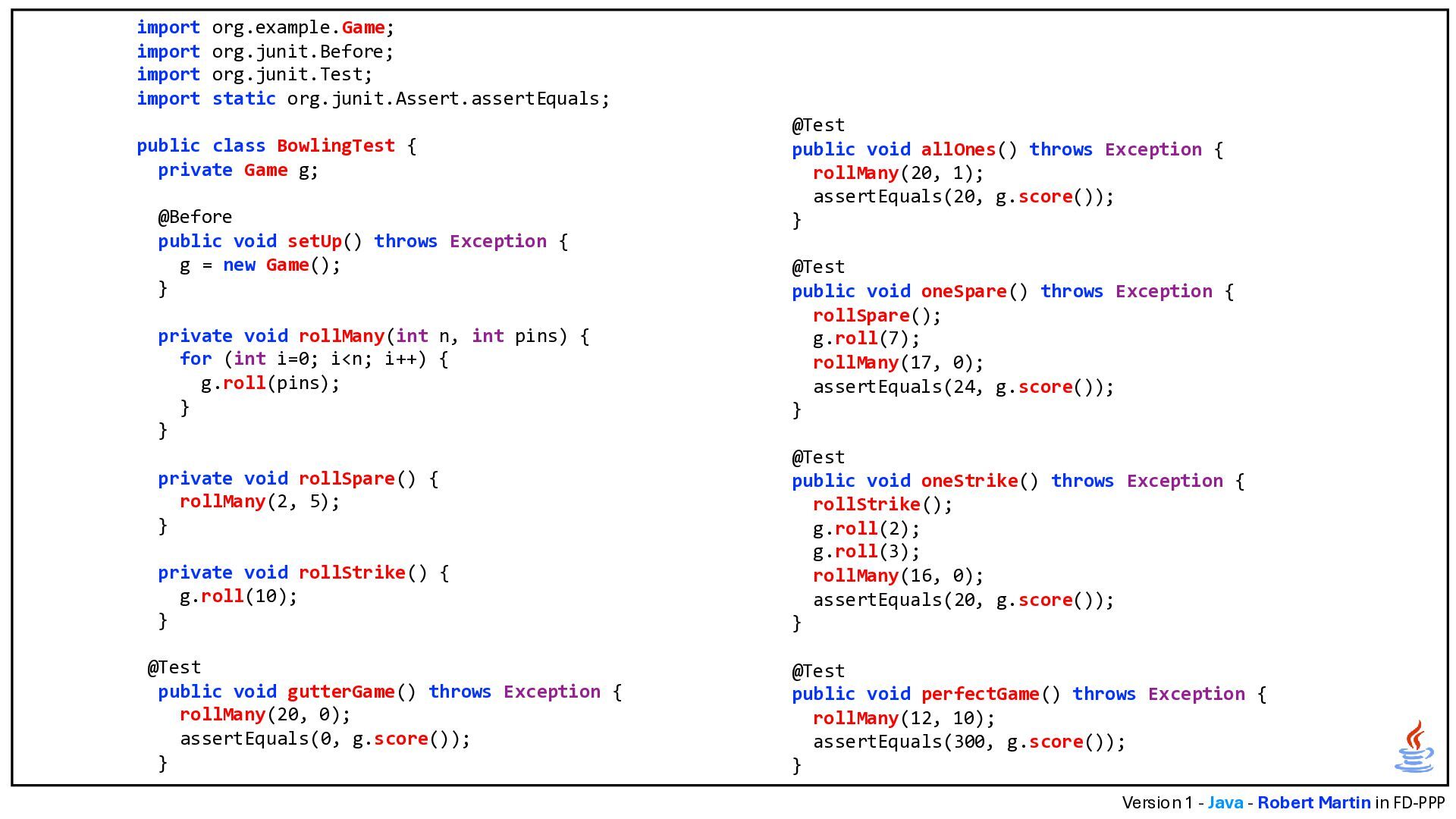
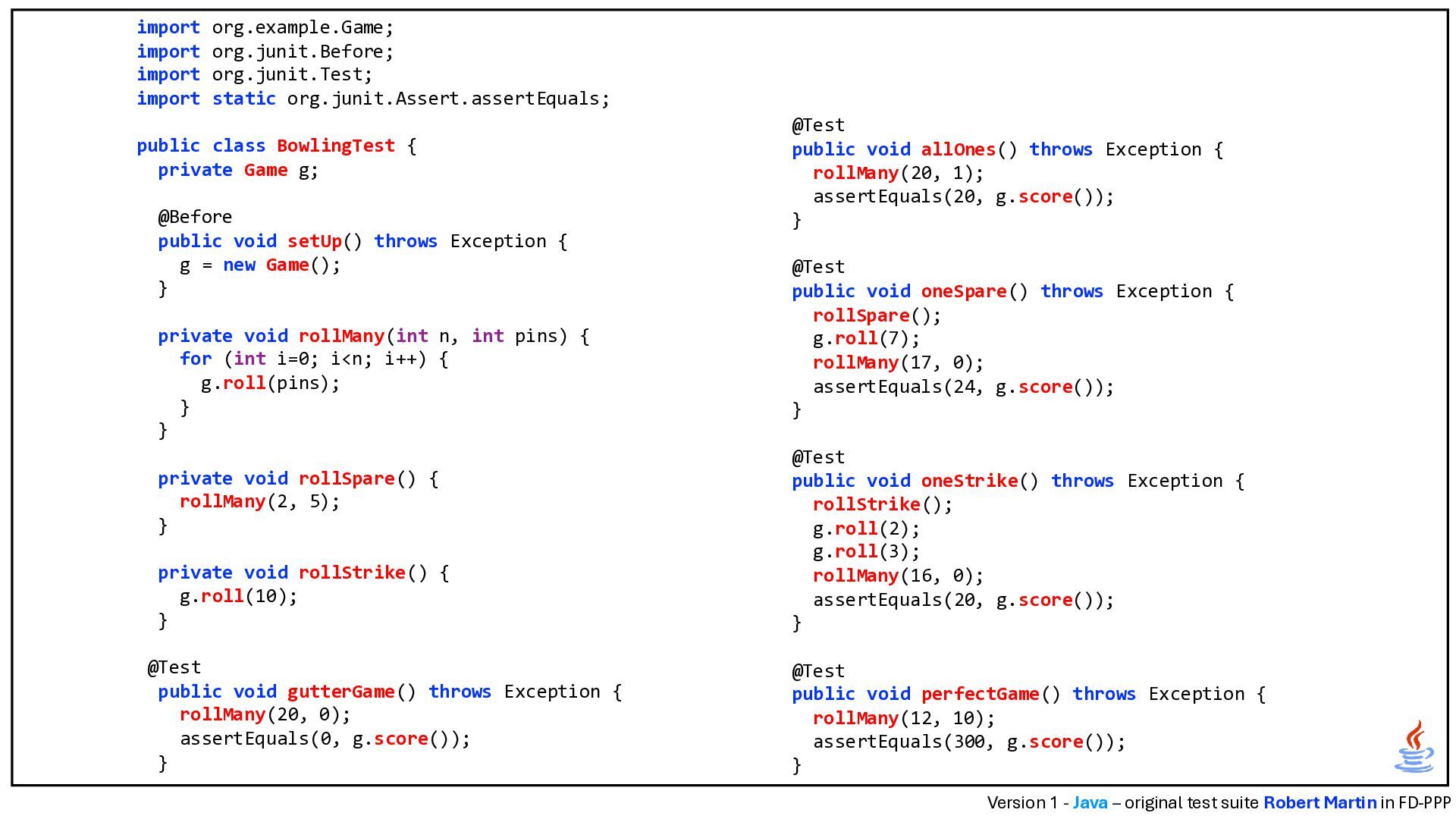
  6. import org.example.Game; import org.junit.Before; import org.junit.Test; import static org.junit.Assert.assertEquals; public

    class BowlingTest { private Game g; @Before public void setUp() throws Exception { g = new Game(); } private void rollMany(int n, int pins) { for (int i=0; i<n; i++) { g.roll(pins); } } @Test public void allOnes() throws Exception { rollMany(20, 1); assertEquals(20, g.score()); } @Test public void oneSpare() throws Exception { rollSpare(); g.roll(7); rollMany(17, 0); assertEquals(24, g.score()); } private void rollStrike() { g.roll(10); } @Test public void oneStrike() throws Exception { rollStrike(); g.roll(2); g.roll(3); rollMany(16, 0); assertEquals(20, g.score()); } @Test public void gutterGame() throws Exception { rollMany(20, 0); assertEquals(0, g.score()); } @Test public void perfectGame() throws Exception { rollMany(12, 10); assertEquals(300, g.score()); } private void rollSpare() { rollMany(2, 5); } Version 1 - Java - Robert Martin in FD-PPP
  7. The next slide shows the same Game class that we

    have just seen, but with all function calls inlined.
  8. public class Game { private int rolls[] = new int[21];

    private int currentRoll = 0; public void roll(int pins) { rolls[currentRoll++] = pins; } public int score() { int score = 0; int frameIndex = 0; for (int frame = 0; frame < 10; frame++) { if (rolls[frameIndex] == 10) { score += 10 + rolls[frameIndex + 1] + rolls[frameIndex + 2]; frameIndex ++; } else if (rolls[frameIndex] + rolls[frameIndex + 1] == 10) { score += 10 + rolls[frameIndex + 2]; frameIndex += 2; } else { score += rolls[frameIndex] + rolls[frameIndex + 1]; frameIndex += 2; } } return score; } } Version 1b - Java - Inlined variant of `Version1 - Java - Robert Martin in FD-PPP`
  9. Back in 2009, I wanted to get some practice using

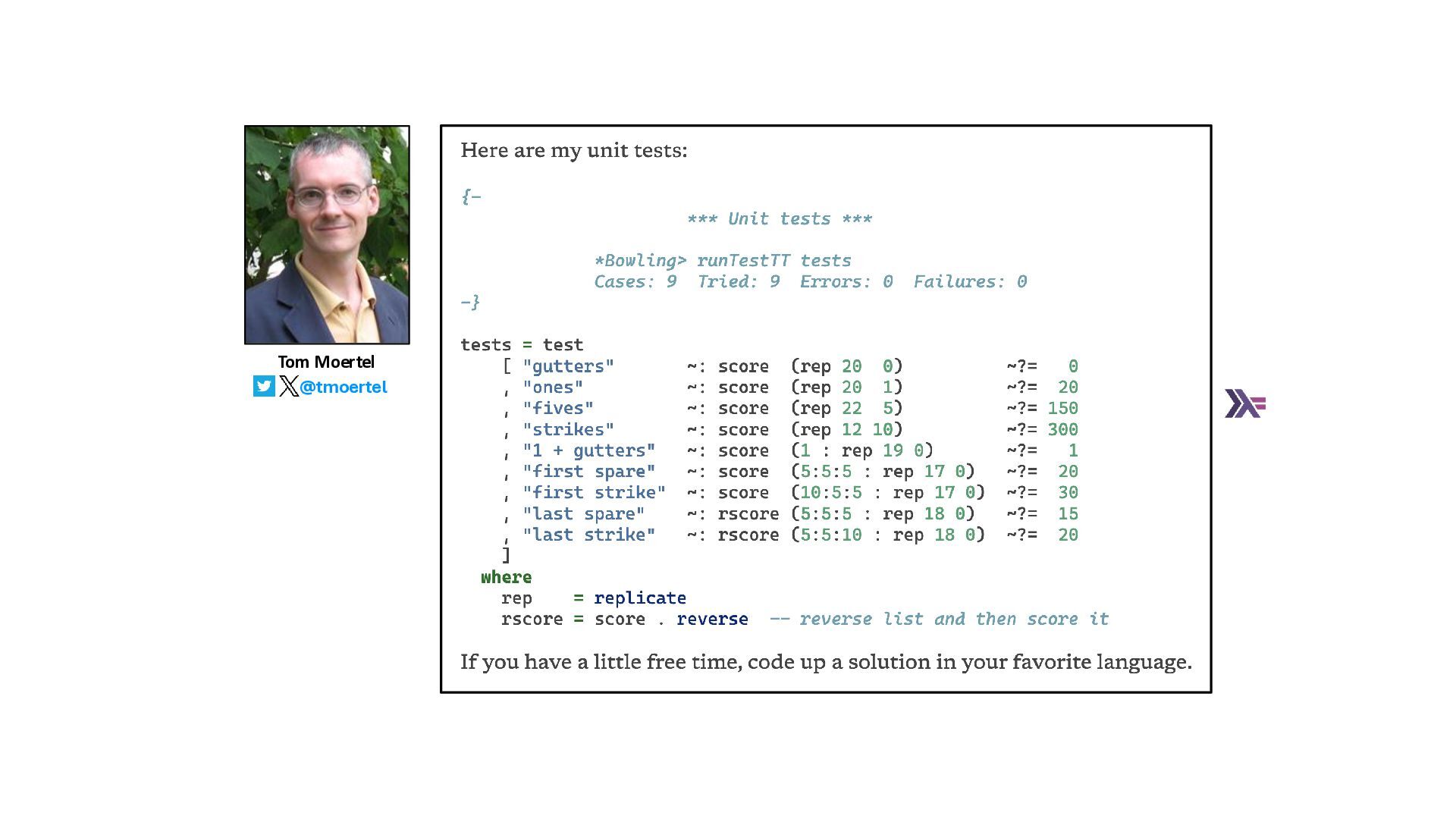
    Haskell. I had recently been doing Robert Martin’s Bowling Game Code Kata in Java, so I said to myself: why not have a go at coding the game in Haskell? To do that, I needed to find the Haskell equivalent of the XUnit framework, and learn how to use it. I decided to take a shortcut by Googling for the `Bowling Game Kata in Haskell`, in the hope of finding a blog post whose tests I could reuse. Luckily I found a great 2006 blog post by Tom Moertel (see next slide).
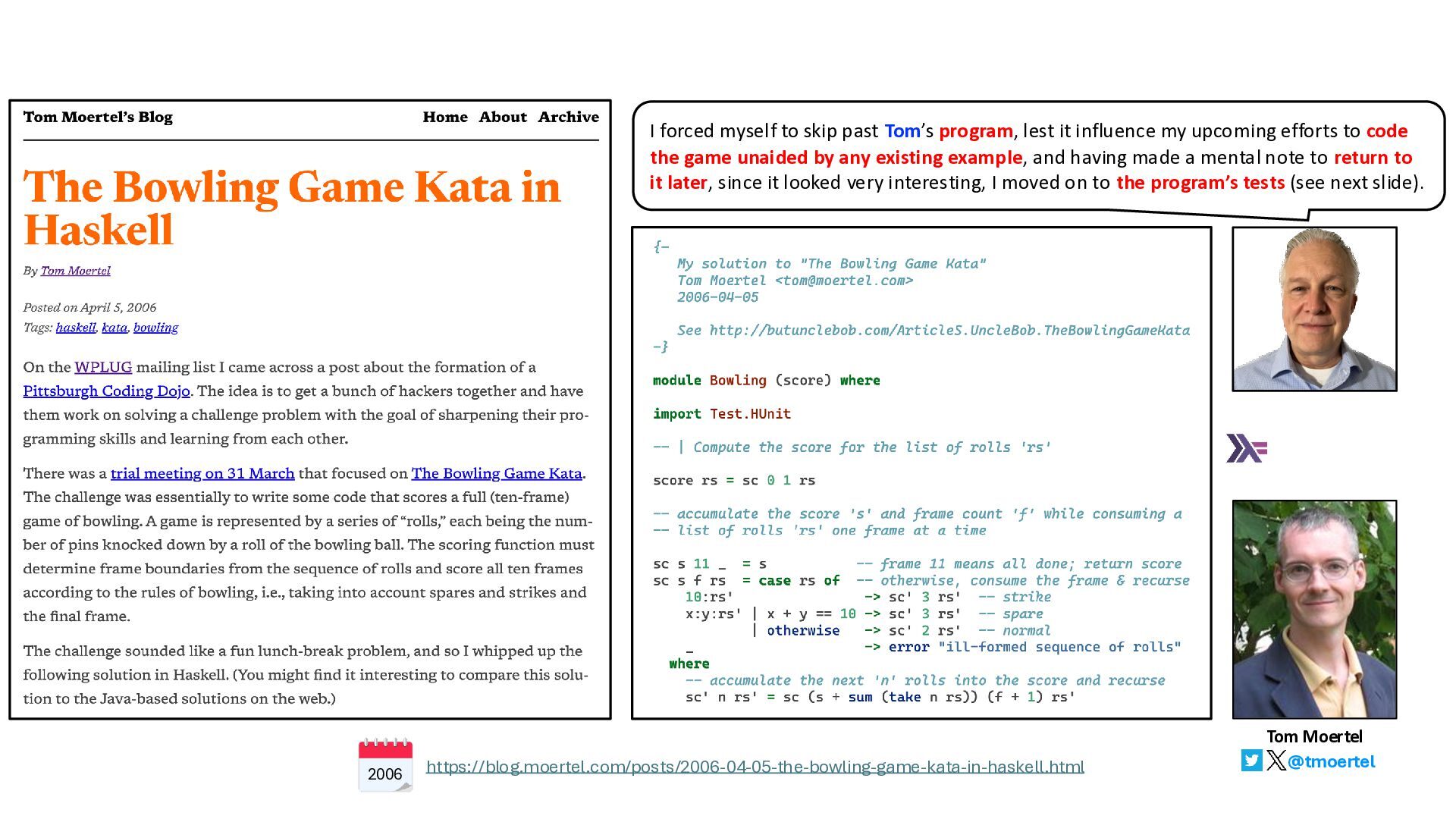
  10. I forced myself to skip past Tom’s program, lest it

    influence my upcoming efforts to code the game unaided by any existing example, and having made a mental note to return to it later, since it looked very interesting, I moved on to the program’s tests (see next slide). 2006 https://blog.moertel.com/posts/2006-04-05-the-bowling-game-kata-in-haskell.html Tom Moertel @tmoertel
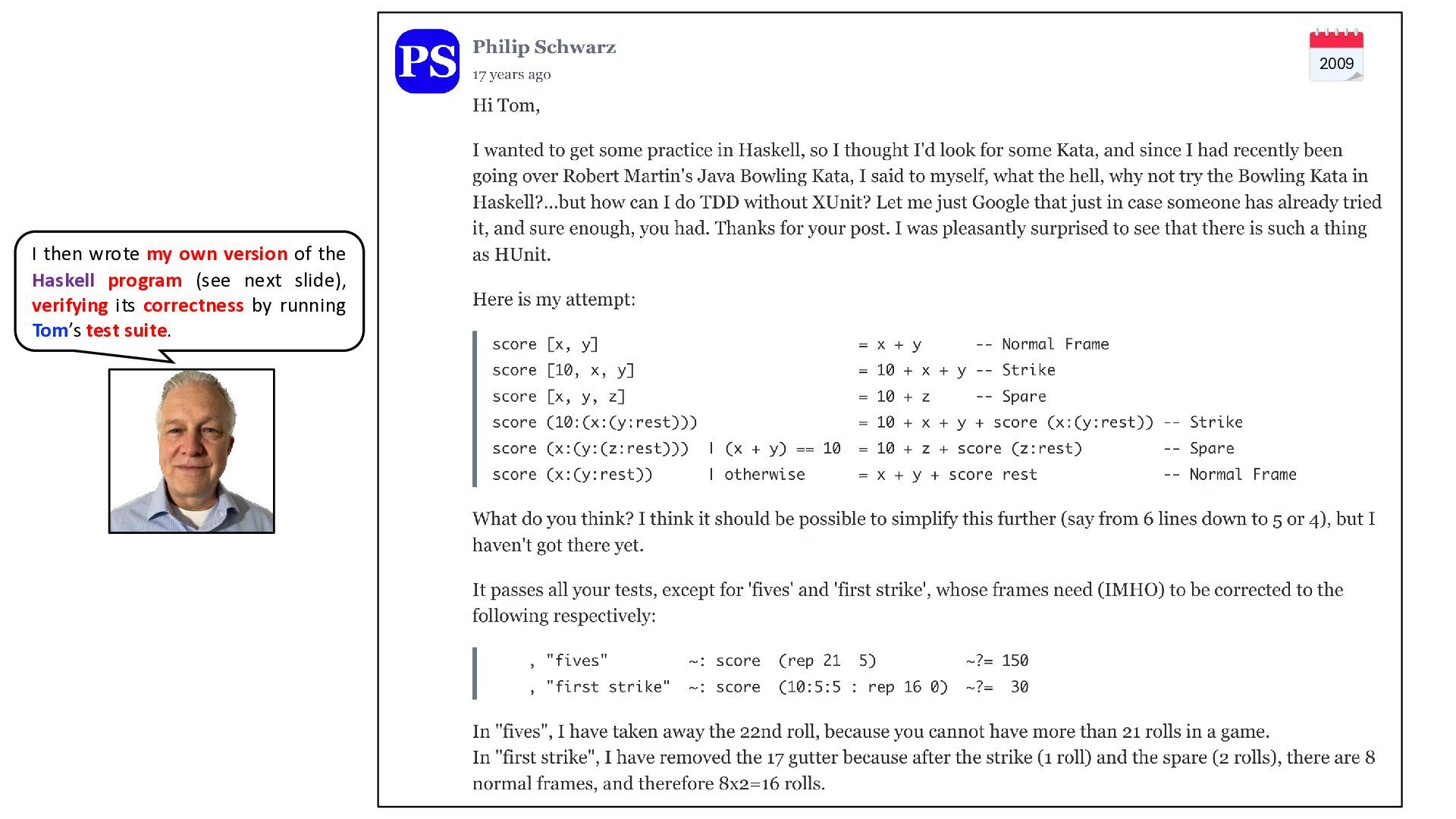
  11. 2009 I then wrote my own version of the Haskell

    program (see next slide), verifying its correctness by running Tom’s test suite.
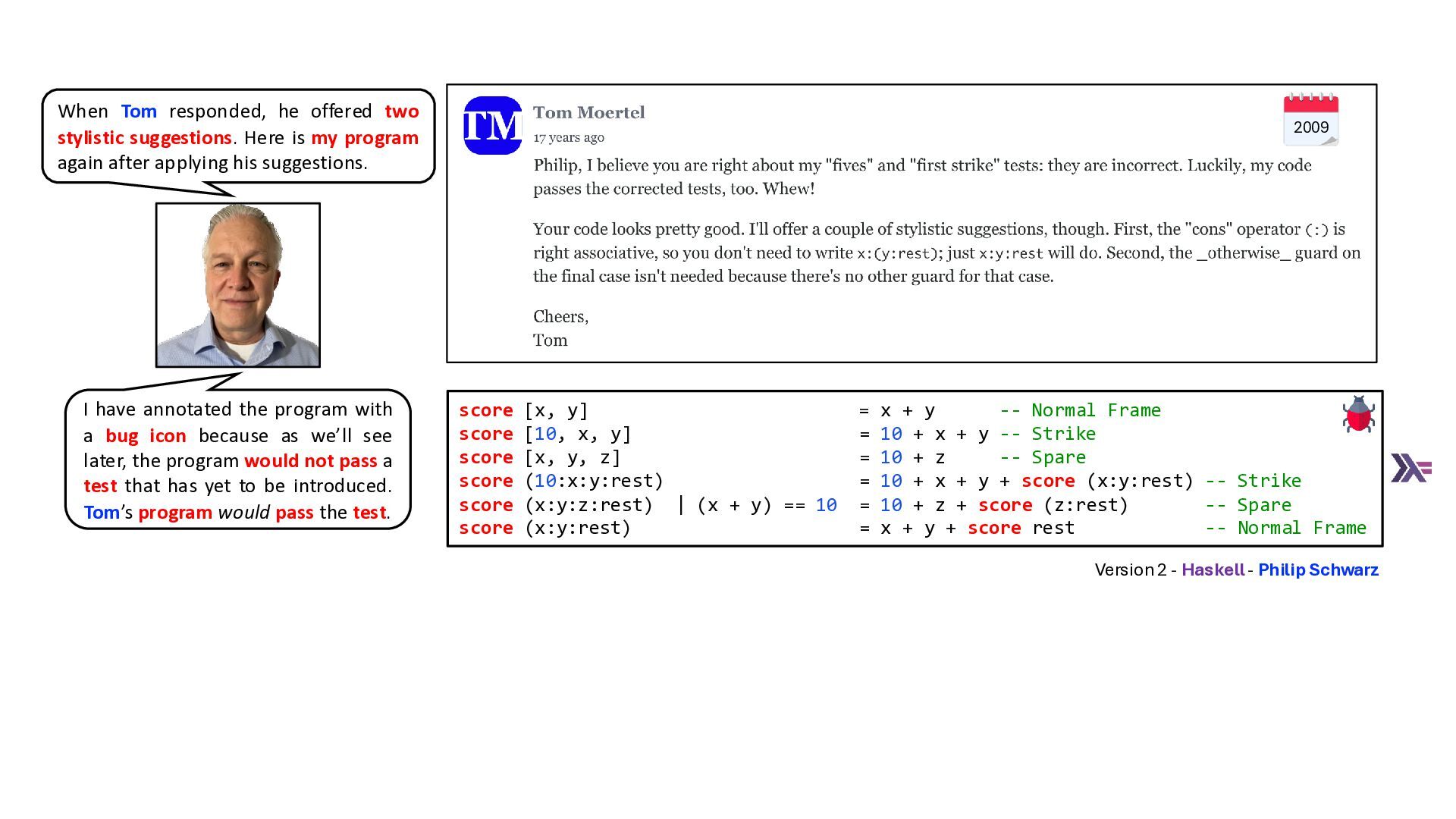
  12. When Tom responded, he offered two stylistic suggestions. Here is

    my program again after applying his suggestions. I have annotated the program with a bug icon because as we’ll see later, the program would not pass a test that has yet to be introduced. Tom’s program would pass the test. 2009 score [x, y] score [10, x, y] score [x, y, z] score (10:x:y:rest) score (x:y:z:rest) | (x + y) == 10 score (x:y:rest) = x + y -- Normal Frame = 10 + x + y -- Strike = 10 + z -- Spare = 10 + x + y + score (x:y:rest) -- Strike = 10 + z + score (z:rest) -- Spare = x + y + score rest -- Normal Frame Version 2 - Haskell - Philip Schwarz
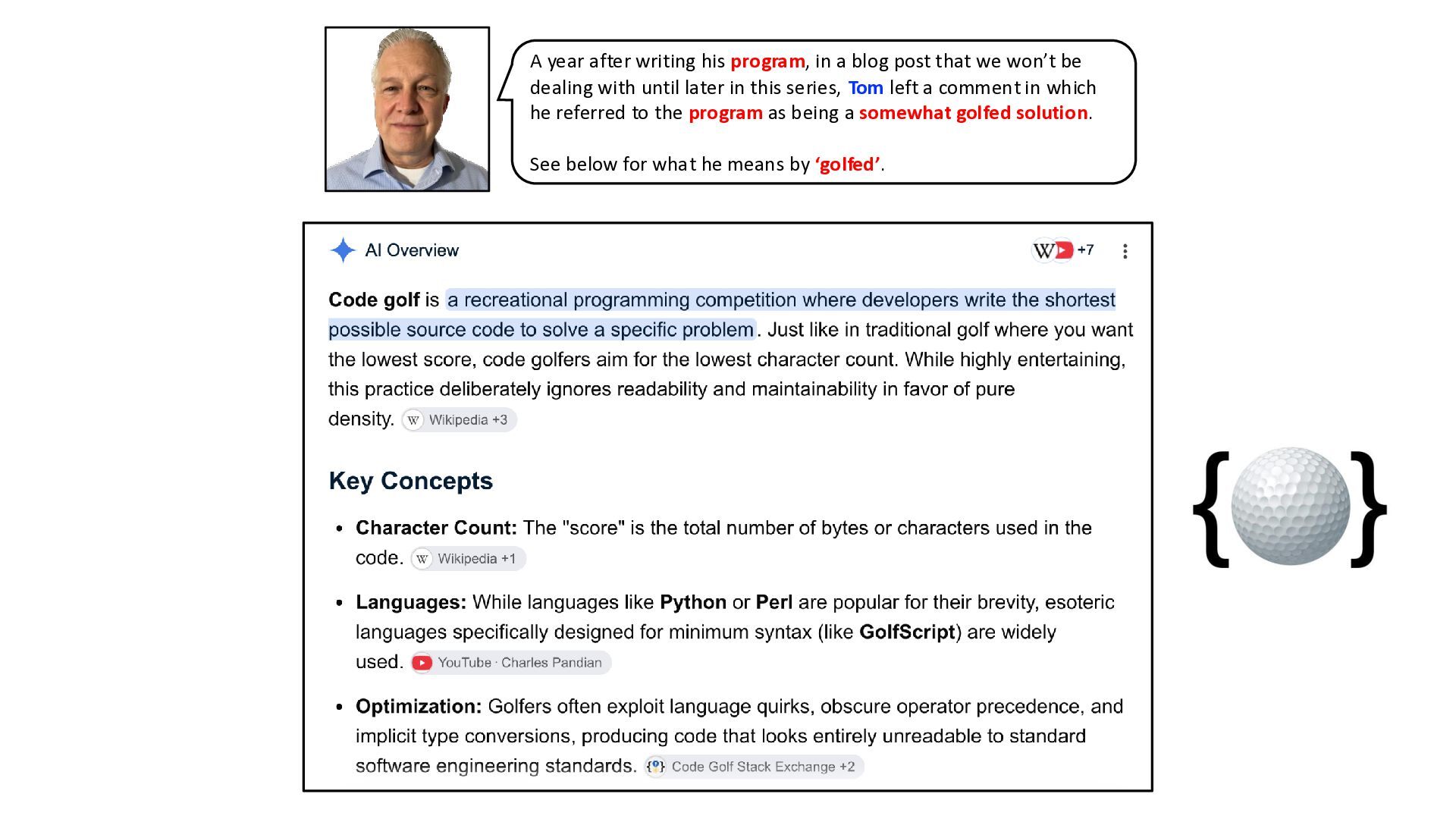
  13. A year after writing his program, in a blog post

    that we won’t be dealing with until later in this series, Tom left a comment in which he referred to the program as being a somewhat golfed solution. See below for what he means by ‘golfed’.
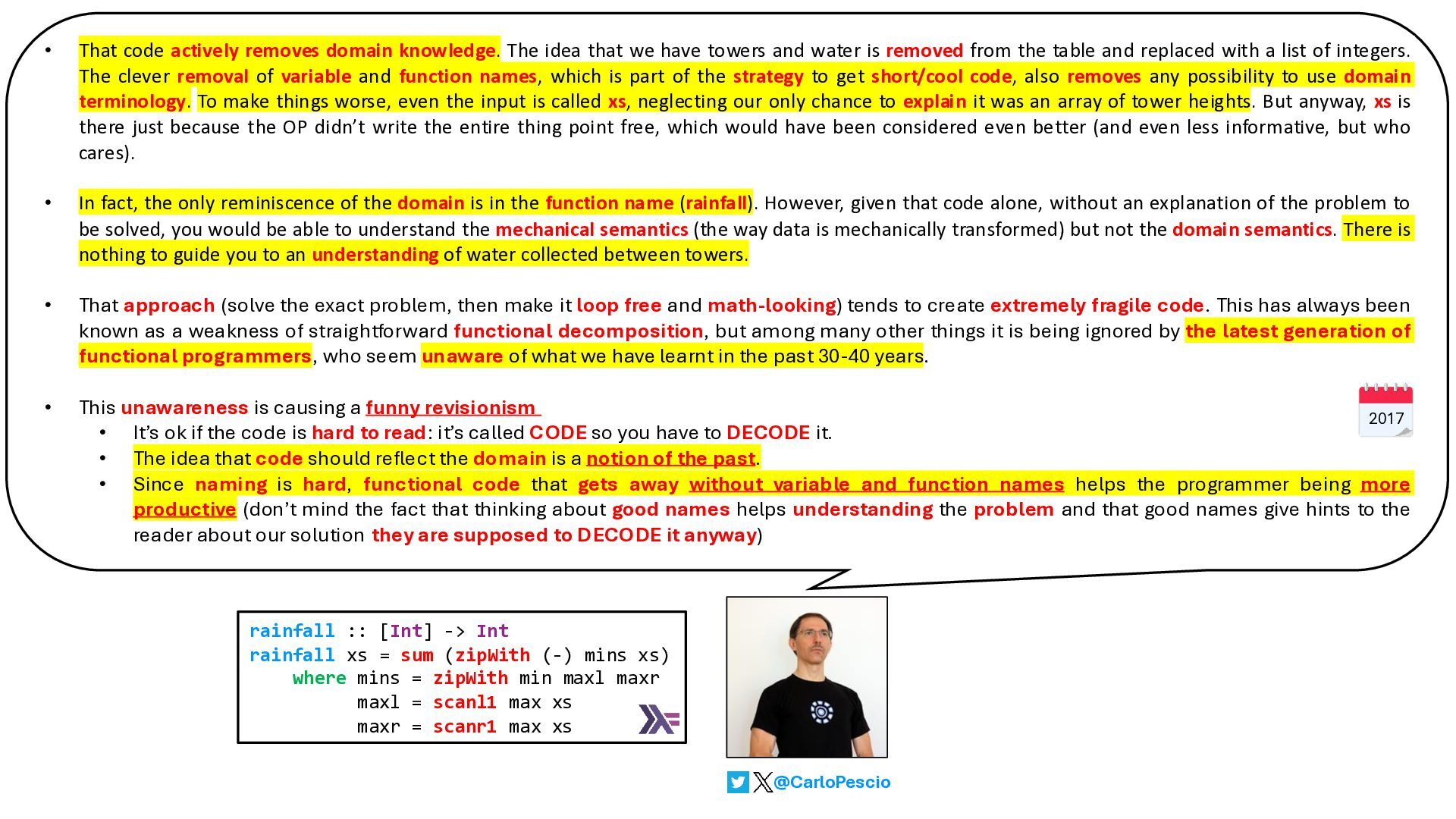
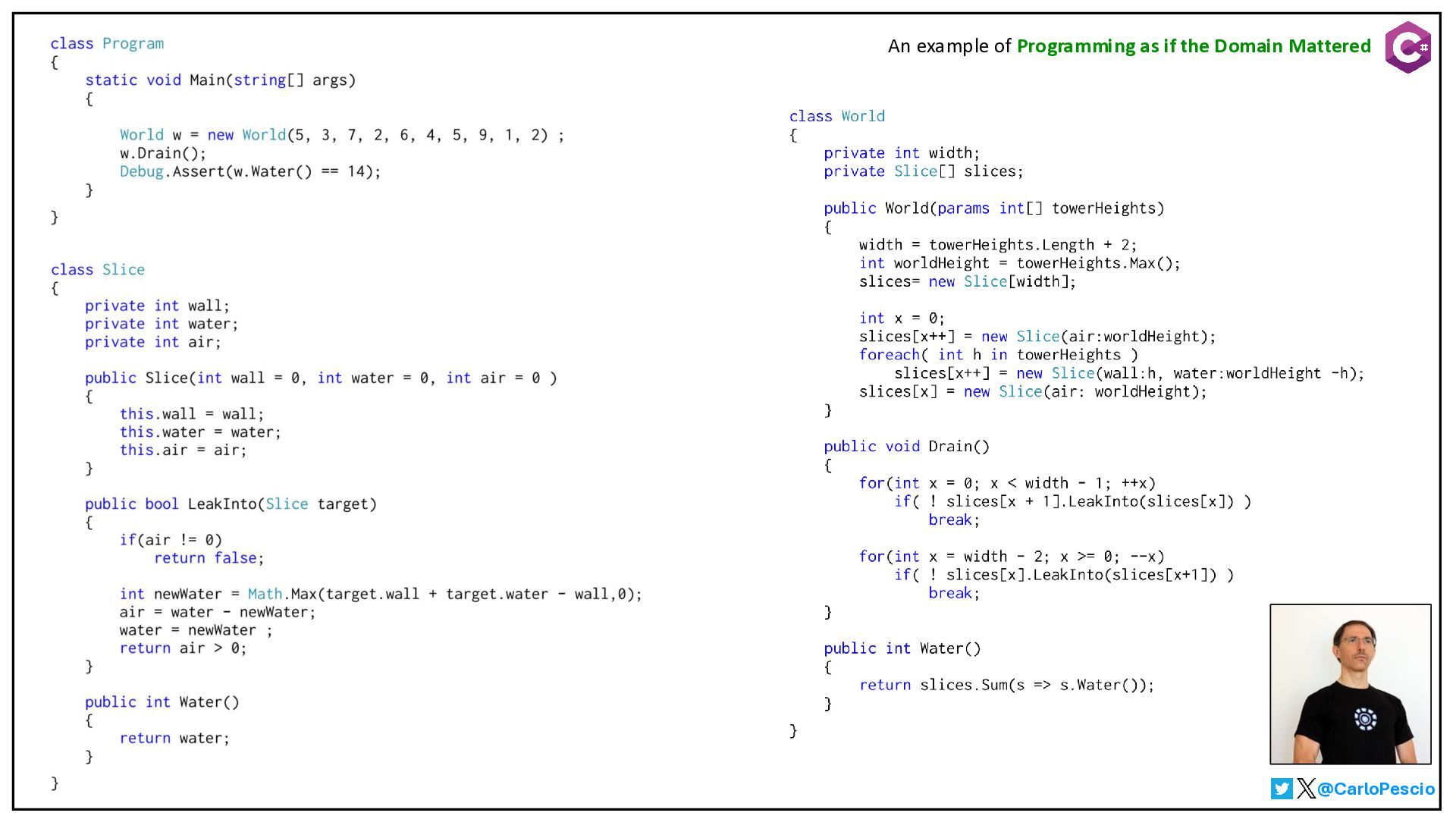
  14. In the paper Programming as if the Domain (and Performance)

    Mattered †, Carlo Pescio discusses the use of two opposing code styles to solve the Water Between Towers problem: “You are given an input array whose each element represents the height of a line of towers. The width of every tower is 1. It starts raining. How much water is collected between the towers?” Here is the solution written in the first style, which the paper refers to as hipster code: rainfall :: [Int] -> Int rainfall xs = sum (zipWith (-) mins xs) where mins = zipWith min maxl maxr maxl = scanl1 max xs maxr = scanr1 max xs See next slide for some of Pescio’s many observations regarding the code. See the slide after next for a definition of hipster. 2017 † https://drive.google.com/file/d/0B59Tysg-nEQZSXRqVjJmQjZyVXc
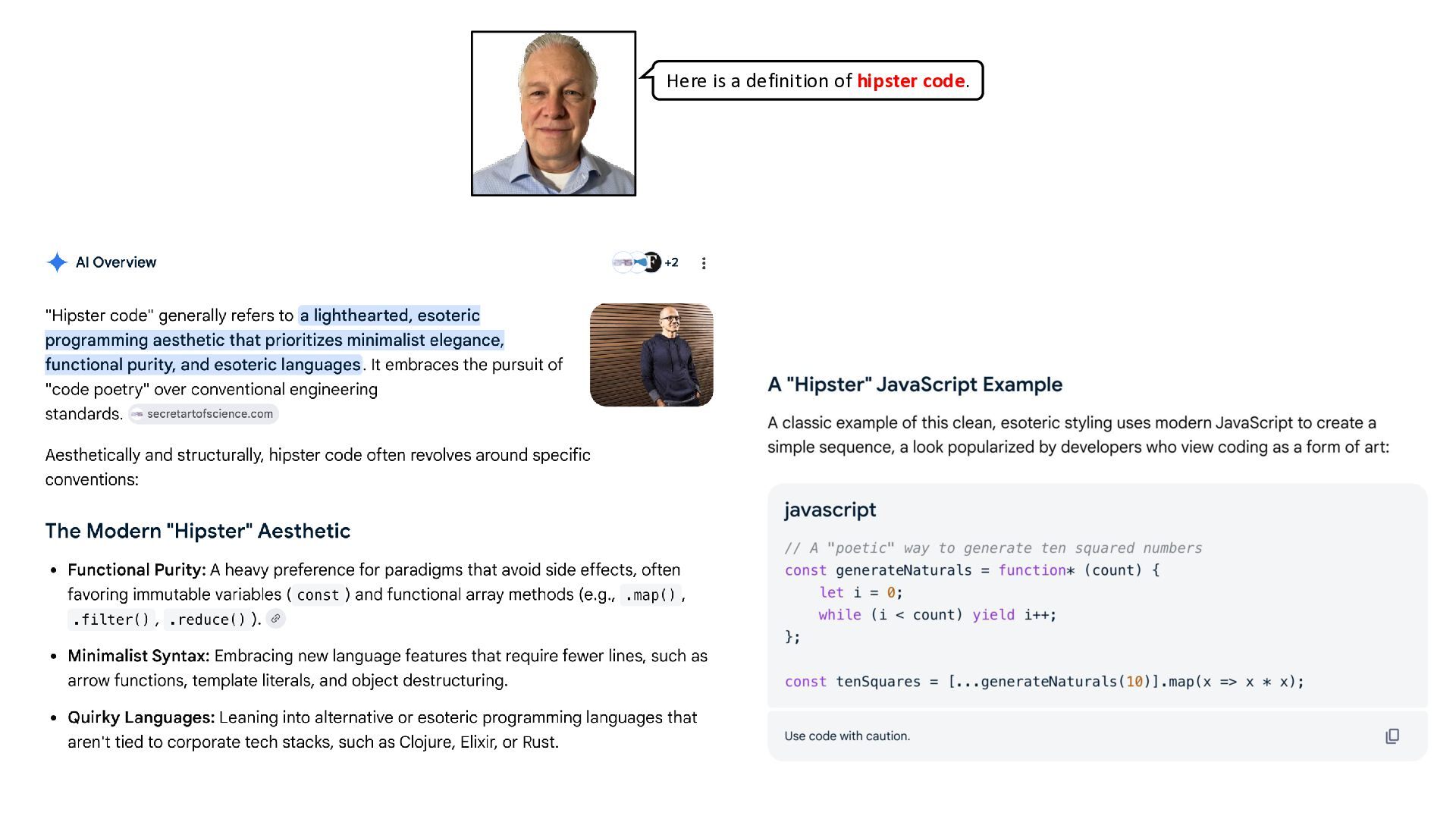
  15. • That code actively removes domain knowledge. The idea that

    we have towers and water is removed from the table and replaced with a list of integers. The clever removal of variable and function names, which is part of the strategy to get short/cool code, also removes any possibility to use domain terminology. To make things worse, even the input is called xs, neglecting our only chance to explain it was an array of tower heights. But anyway, xs is there just because the OP didn’t write the entire thing point free, which would have been considered even better (and even less informative, but who cares). • In fact, the only reminiscence of the domain is in the function name (rainfall). However, given that code alone, without an explanation of the problem to be solved, you would be able to understand the mechanical semantics (the way data is mechanically transformed) but not the domain semantics. There is nothing to guide you to an understanding of water collected between towers. • That approach (solve the exact problem, then make it loop free and math-looking) tends to create extremely fragile code. This has always been known as a weakness of straightforward functional decomposition, but among many other things it is being ignored by the latest generation of functional programmers, who seem unaware of what we have learnt in the past 30-40 years. • This unawareness is causing a funny revisionism I’ve seen floating around a lot lately, like:2017 • It’s ok if the code is hard to read: it’s called CODE so you have to DECODE it. • The idea that code should reflect the domain is a notion of the past. • Since naming is hard, functional code that gets away without variable and function names helps the programmer being more productive (don’t mind the fact that thinking about good names helps understanding the problem and that good names give hints to the reader about our solution;they are supposed to DECODE it anyway). rainfall :: [Int] -> Int rainfall xs = sum (zipWith (-) mins xs) where mins = zipWith min maxl maxr maxl = scanl1 max xs maxr = scanr1 max xs @CarloPescio
  16. As for the other code style shown in Programming as

    if the Domain (and Performance) Mattered, which is the opposite of the style used in the hipster code of the rainfall function, see the next slide.
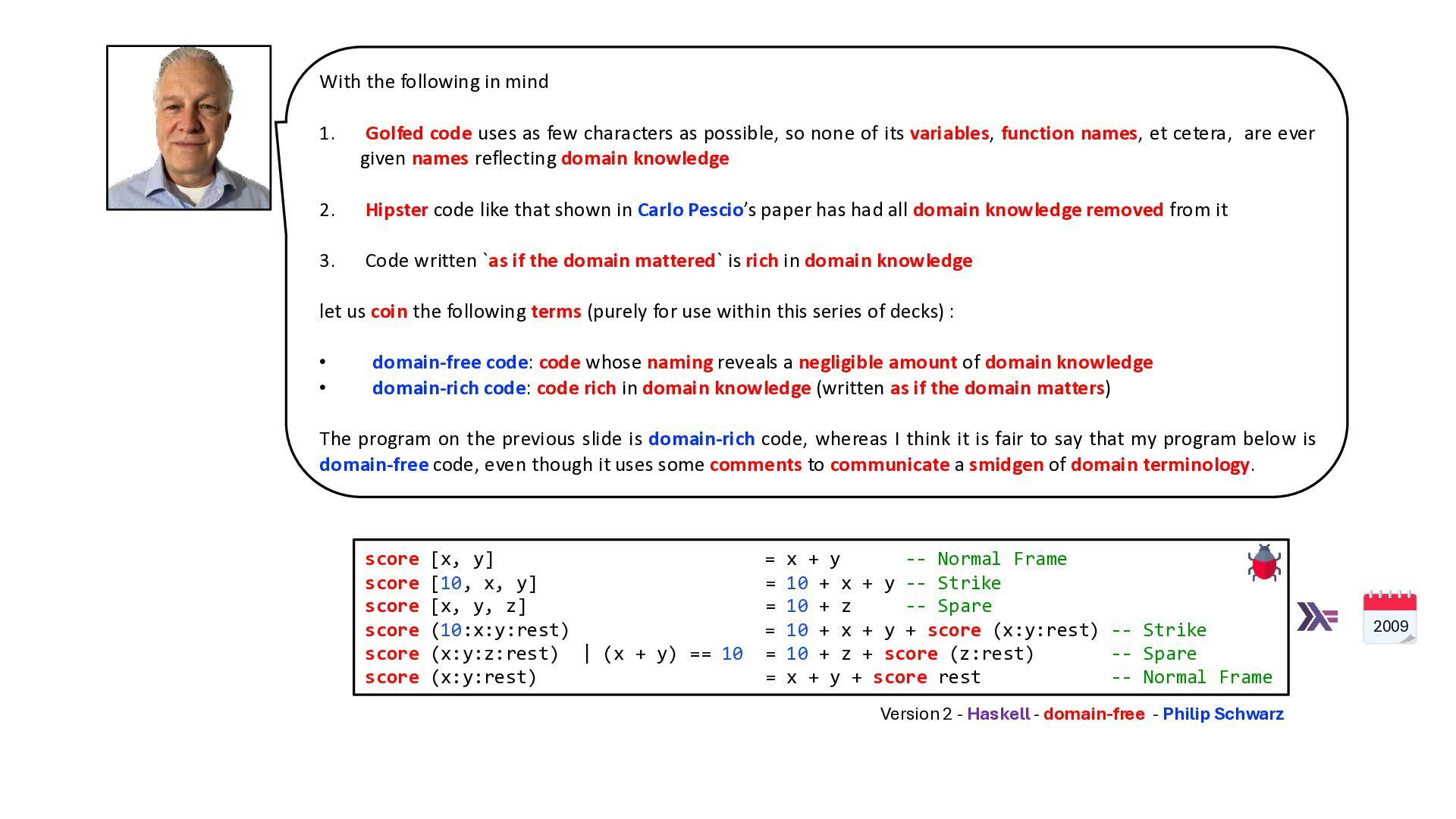
  17. With the following in mind 1. .Golfed code uses as

    few characters as possible, so none of its variables, function names, et cetera, are ever given names reflecting domain knowledge 2. Hipster code like that shown in Carlo Pescio’s paper has had all domain knowledge removed from it 3. Code written `as if the domain mattered` is rich in domain knowledge let us coin the following terms (purely for use within this series of decks) : • • domain-free code: code whose naming reveals a negligible amount of domain knowledge domain-rich code: code rich in domain knowledge (written as if the domain matters) The program on the previous slide is domain-rich code, whereas I think it is fair to say that my program below is domain-free code, even though it uses some comments to communicate a smidgen of domain terminology. score [x, y] score [10, x, y] score [x, y, z] score (10:x:y:rest) score (x:y:z:rest) | (x + y) == 10 score (x:y:rest) = x + y -- Normal Frame = 10 + x + y -- Strike = 10 + z -- Spare = 10 + x + y + score (x:y:rest) -- Strike = 10 + z + score (z:rest) -- Spare = x + y + score rest -- Normal Frame Version 2 - Haskell - domain-free - Philip Schwarz 2009
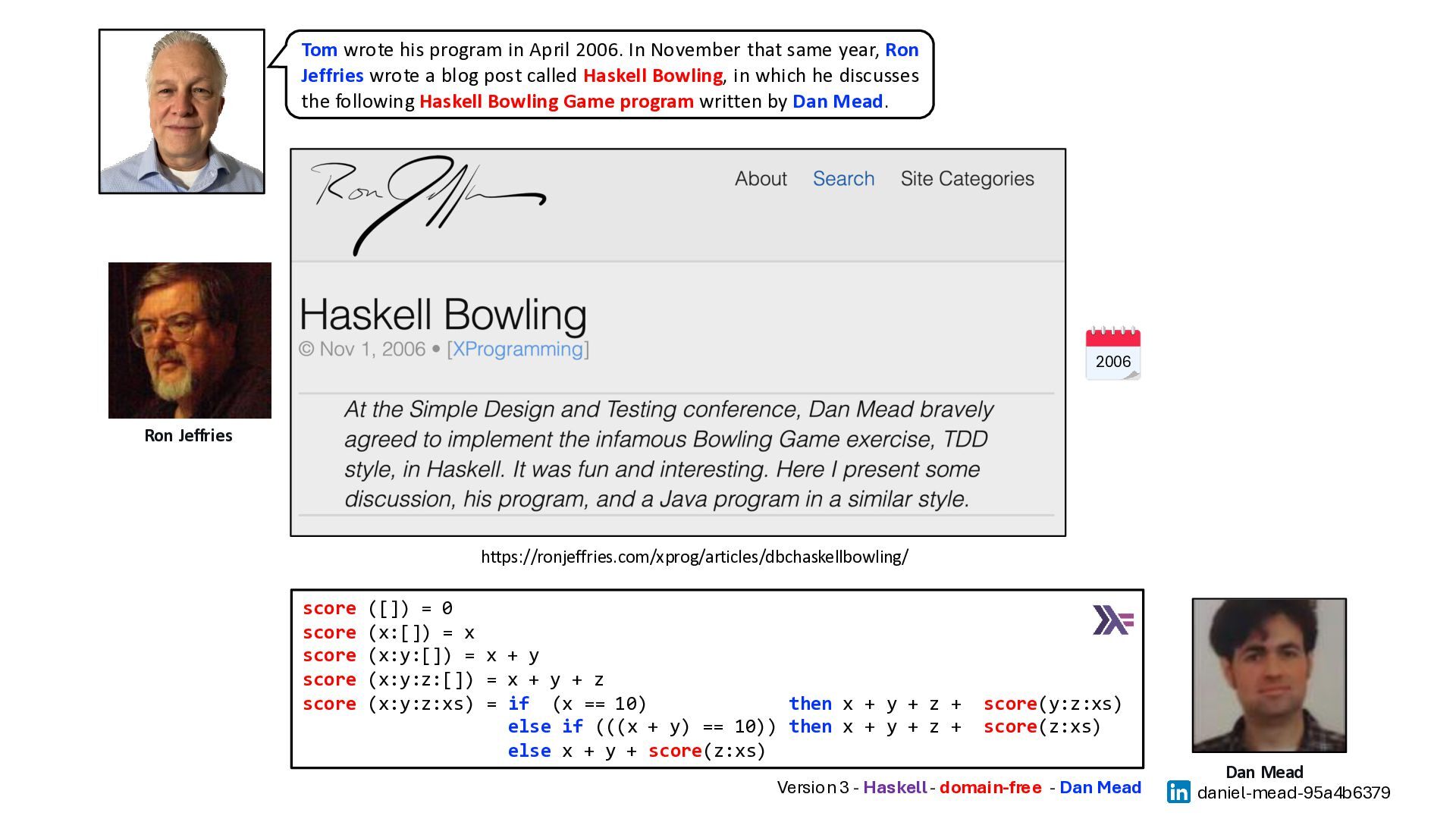
  18. Tom wrote his program in April 2006. In November that

    same year, Ron Jeffries wrote a blog post called Haskell Bowling, in which he discusses the following Haskell Bowling Game program written by Dan Mead. 2006 Ron Jeffries https://ronjeffries.com/xprog/articles/dbchaskellbowling/ score ([]) = 0 score (x:[]) = x score (x:y:[]) = x + y score (x:y:z:[]) = x + y + z score (x:y:z:xs) = if (x == 10) then x + y + z + else if (((x + y) == 10)) then x + y + z + else x + y + score(z:xs) score(y:z:xs) score(z:xs) Version 3 - Haskell - domain-free - Dan Mead Dan Mead daniel-mead-95a4b6379
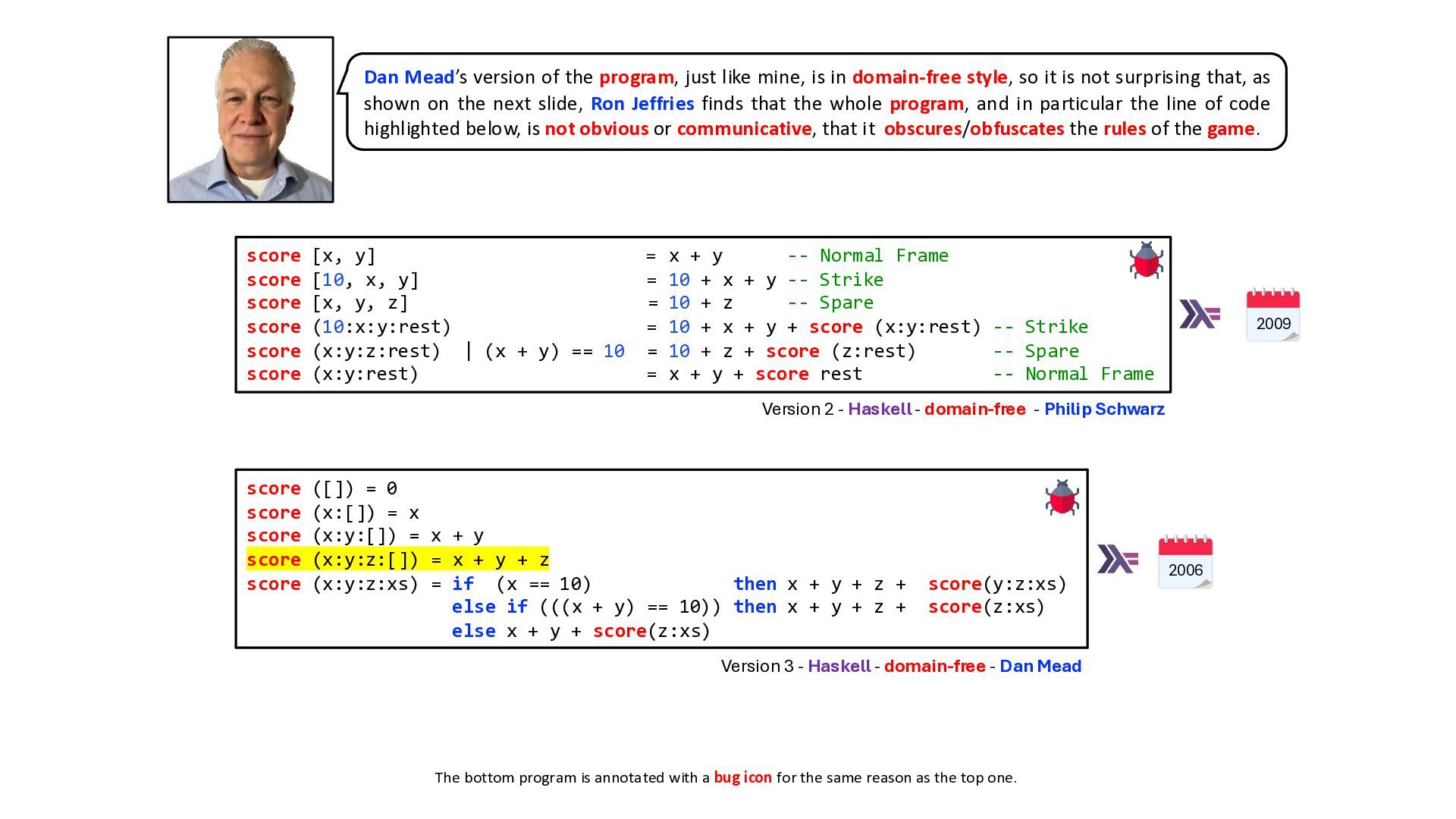
  19. Dan Mead’s version of the program, just like mine, is

    in domain-free style, so it is not surprising that, as shown on the next slide, Ron Jeffries finds that the whole program, and in particular the line of code highlighted below, is not obvious or communicative, that it obscures/obfuscates the rules of the game. score [x, y] score [10, x, y] score [x, y, z] score (10:x:y:rest) score (x:y:z:rest) | (x + y) == 10 score (x:y:rest) = x + y -- Normal Frame = 10 + x + y -- Strike = 10 + z -- Spare = 10 + x + y + score (x:y:rest) -- Strike = 10 + z + score (z:rest) -- Spare = x + y + score rest -- Normal Frame 2009 Version 2 - Haskell - domain-free - Philip Schwarz score ([]) = 0 score (x:[]) = x score (x:y:[]) = x + y score (x:y:z:[]) = x + y + z score (x:y:z:xs) = if (x == 10) then x + y + z + else if (((x + y) == 10)) then x + y + z + else x + y + score(z:xs) score(y:z:xs) score(z:xs) Version 3 - Haskell - domain-free - Dan Mead The bottom program is annotated with a bug icon for the same reason as the top one. 2006
  20. The x:y:z:[] rule handles the case of three rolls at

    the end of the game, i.e. a bonus roll. This rule is not, in my opinion, obvious or communicative. What it's relying on is that it happens that if you roll a strike, you get ten + the next two rolls, but the first roll (x) equals ten, and if you roll a spare, the score is ten plus the next one roll, but the first two (x + y) sum to ten. When I observe this truth in my demonstrations, a significant portion of the audience objects, saying that it obscures the rules of the game. Ron Jeffries score ([]) = 0 score (x:[]) = x score (x:y:[]) = x + y score (x:y:z:[]) = x + y + z score (x:y:z:xs) = if (x == 10) then x + y + z + else if (((x + y) == 10)) then x + y + z + else x + y + score(z:xs) 2006 score(y:z:xs) score(z:xs) Dan Mead This is all pretty straightforward, I think, except for the obfuscation of the rules of bowling that appears in the x+y+z, as already mentioned. Dan’s assertion was that the Haskell programs we get rather directly reflect our thoughts, and that they are compact and easy to understand. I would agree that with what we just figured out fresh in our mind, the code is clear – and it’s certainly compact. However, walking up to it, I do not find it clear. It is recursive, and its rules are a bit odd, mostly due to the need in the x:y:z rules to look for an item that may not be there, resulting in the special ending rules like x:y:[] and x:y:z:[]. And we are left with that tag rule x:[], which appears to be redundant, but it’s really hard to be sure. Nonetheless, it’s an interesting implementation that seems to get the right answers, in very few lines. And it was quite brave of Dan to sit in front of a bunch of people and try to improvise a solution. I find that scary when I do it, at least. So thanks to Dan for an interesting and thought-provoking session.
  21. While Ron Jeffries was intent on writing the Java program

    on the next two slides in a `similar style` to Dan Mead’s Haskell program, which is reflected, for example, in the fact that they both exploit recursion, we can see that while the code of the Haskell program is domain-free, the code in the Java program is domain-rich. By the way, I have annotated the Java program with the bug icon because as we’ll see later, the program suffers from the same problem as the two Haskell programs!
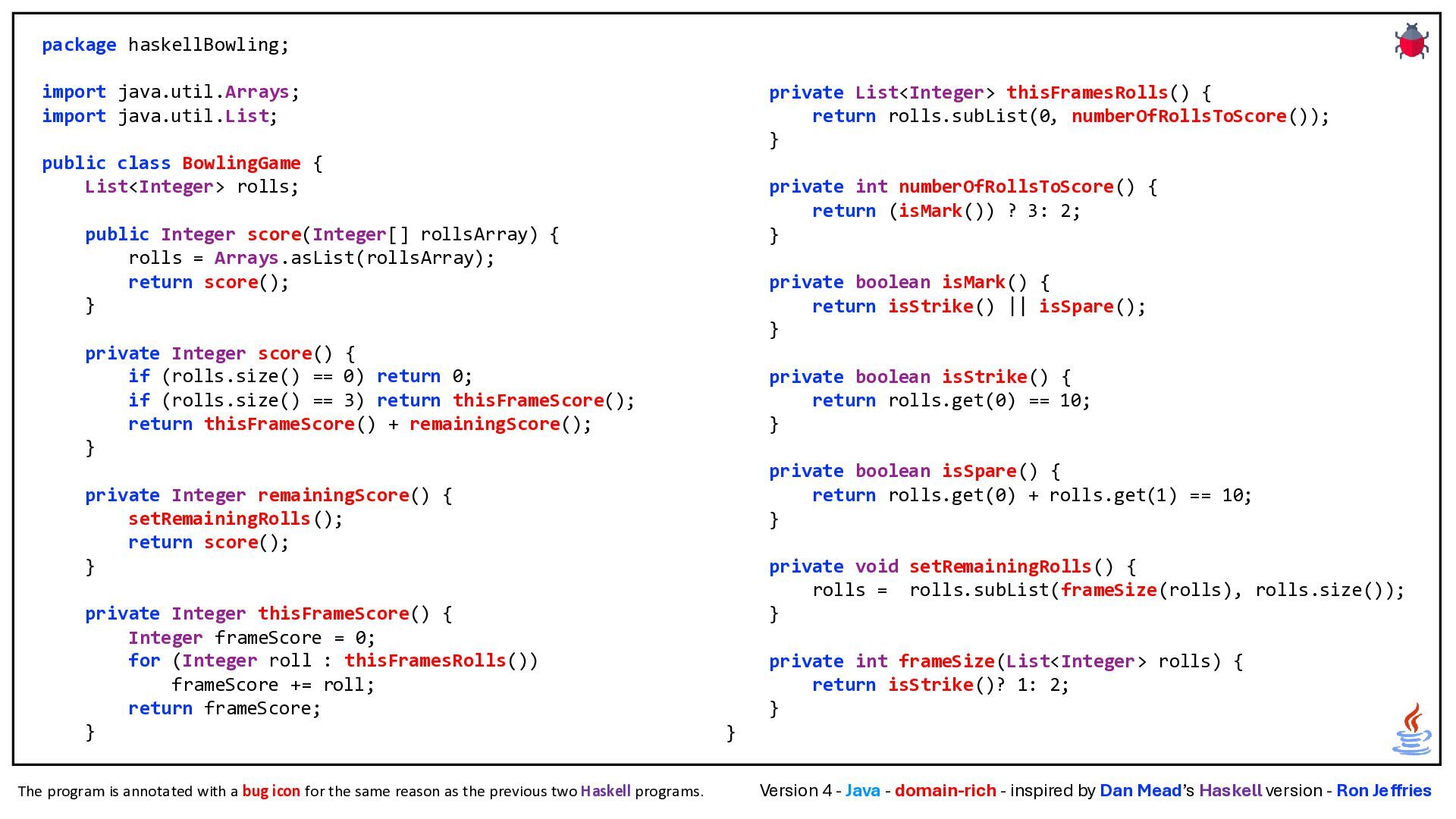
  22. package haskellBowling; import java.util.Arrays; import java.util.List; private List<Integer> thisFramesRolls() {

    return rolls.subList(0, numberOfRollsToScore()); } public class BowlingGame { List<Integer> rolls; private int numberOfRollsToScore() { return (isMark()) ? 3: 2; } public Integer score(Integer[] rollsArray) { rolls = Arrays.asList(rollsArray); return score(); } private boolean isMark() { return isStrike() || isSpare(); } private Integer score() { if (rolls.size() == 0) return 0; if (rolls.size() == 3) return thisFrameScore(); return thisFrameScore() + remainingScore(); } private boolean isStrike() { return rolls.get(0) == 10; } private boolean isSpare() { return rolls.get(0) + rolls.get(1) == 10; } private Integer remainingScore() { setRemainingRolls(); return score(); } private Integer thisFrameScore() { Integer frameScore = 0; for (Integer roll : thisFramesRolls()) frameScore += roll; return frameScore; } The program is annotated with a bug icon for the same reason as the previous two Haskell programs. private void setRemainingRolls() { rolls = rolls.subList(frameSize(rolls), rolls.size()); } private int frameSize(List<Integer> rolls) { return isStrike()? 1: 2; } } Version 4 - Java - domain-rich - inspired by Dan Mead’s Haskell version - Ron Jeffries
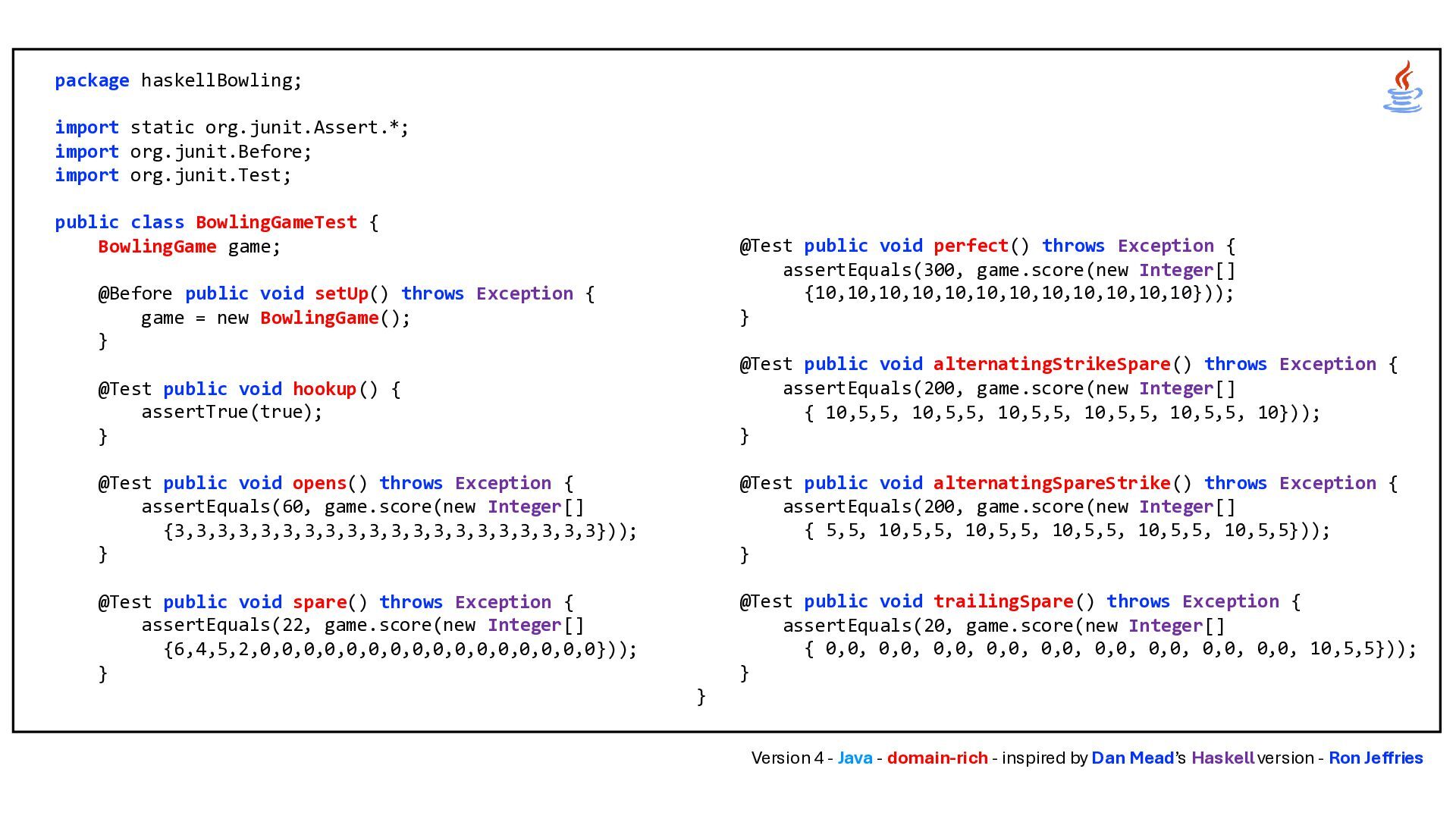
  23. package haskellBowling; import static org.junit.Assert.*; import org.junit.Before; import org.junit.Test; public

    class BowlingGameTest { BowlingGame game; @Test public void perfect() throws Exception { assertEquals(300, game.score(new Integer[] {10,10,10,10,10,10,10,10,10,10,10,10})); } @Before public void setUp() throws Exception { game = new BowlingGame(); } @Test public void hookup() { assertTrue(true); } @Test public void alternatingStrikeSpare() throws Exception { assertEquals(200, game.score(new Integer[] { 10,5,5, 10,5,5, 10,5,5, 10,5,5, 10,5,5, 10})); } @Test public void opens() throws Exception { assertEquals(60, game.score(new Integer[] {3,3,3,3,3,3,3,3,3,3,3,3,3,3,3,3,3,3,3,3})); } @Test public void alternatingSpareStrike() throws Exception { assertEquals(200, game.score(new Integer[] { 5,5, 10,5,5, 10,5,5, 10,5,5, 10,5,5, 10,5,5})); } @Test public void spare() throws Exception { assertEquals(22, game.score(new Integer[] {6,4,5,2,0,0,0,0,0,0,0,0,0,0,0,0,0,0,0,0})); } @Test public void trailingSpare() throws Exception { assertEquals(20, game.score(new Integer[] { 0,0, 0,0, 0,0, 0,0, 0,0, 0,0, 0,0, 0,0, 0,0, 10,5,5})); } } Version 4 - Java - domain-rich - inspired by Dan Mead’s Haskell version - Ron Jeffries
  24. See next slide for some of Ron Jeffries‘ observations as

    he compares the Haskell program with the Java one.
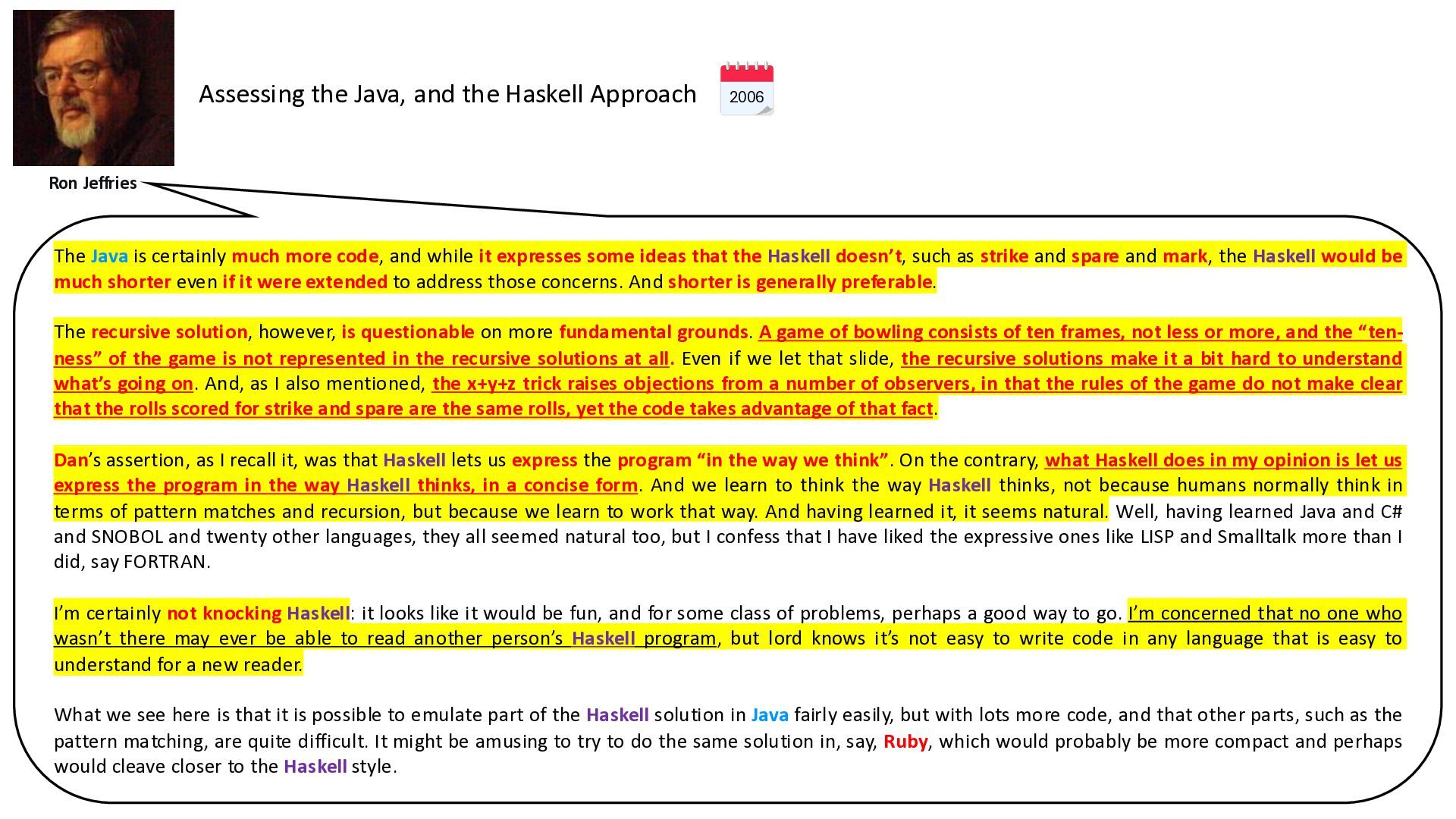
  25. Assessing the Java, and the Haskell Approach 2006 Ron Jeffries

    The Java is certainly much more code, and while it expresses some ideas that the Haskell doesn’t, such as strike and spare and mark, the Haskell would be much shorter even if it were extended to address those concerns. And shorter is generally preferable. The recursive solution, however, is questionable on more fundamental grounds. A game of bowling consists of ten frames, not less or more, and the “tenness” of the game is not represented in the recursive solutions at all. Even if we let that slide, the recursive solutions make it a bit hard to understand what’s going on. And, as I also mentioned, the x+y+z trick raises objections from a number of observers, in that the rules of the game do not make clear that the rolls scored for strike and spare are the same rolls, yet the code takes advantage of that fact. Dan’s assertion, as I recall it, was that Haskell lets us express the program “in the way we think”. On the contrary, what Haskell does in my opinion is let us express the program in the way Haskell thinks, in a concise form. And we learn to think the way Haskell thinks, not because humans normally think in terms of pattern matches and recursion, but because we learn to work that way. And having learned it, it seems natural. Well, having learned Java and C# and SNOBOL and twenty other languages, they all seemed natural too, but I confess that I have liked the expressive ones like LISP and Smalltalk more than I did, say FORTRAN. I’m certainly not knocking Haskell: it looks like it would be fun, and for some class of problems, perhaps a good way to go. I’m concerned that no one who wasn’t there may ever be able to read another person’s Haskell program, but lord knows it’s not easy to write code in any language that is easy to understand for a new reader. What we see here is that it is possible to emulate part of the Haskell solution in Java fairly easily, but with lots more code, and that other parts, such as the pattern matching, are quite difficult. It might be amusing to try to do the same solution in, say, Ruby, which would probably be more compact and perhaps would cleave closer to the Haskell style.
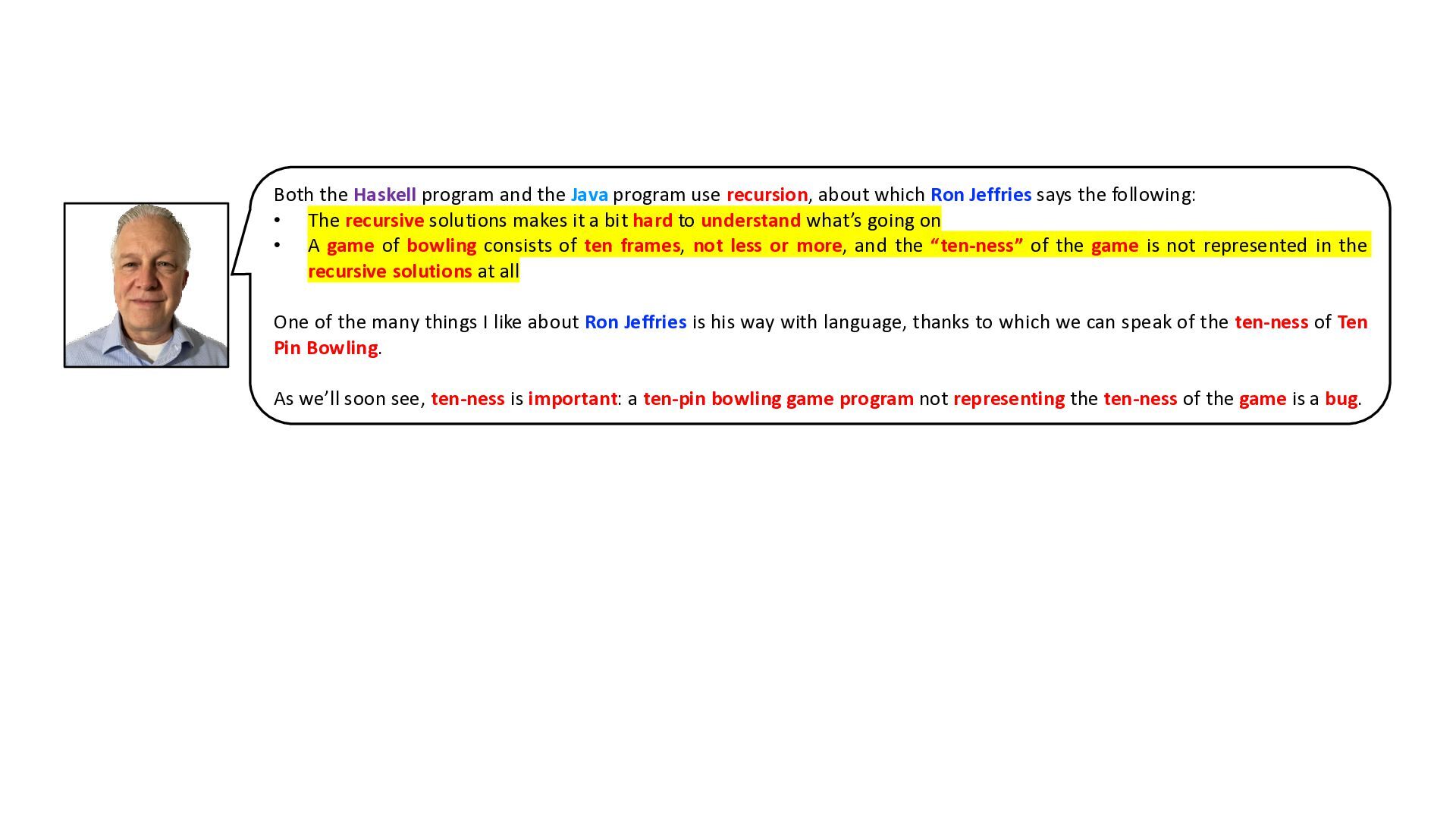
  26. Both the Haskell program and the Java program use recursion,

    about which Ron Jeffries says the following: • The recursive solutions makes it a bit hard to understand what’s going on • A game of bowling consists of ten frames, not less or more, and the “ten-ness” of the game is not represented in the recursive solutions at all One of the many things I like about Ron Jeffries is his way with language, thanks to which we can speak of the ten-ness of Ten Pin Bowling. As we’ll soon see, ten-ness is important: a ten-pin bowling game program not representing the ten-ness of the game is a bug.
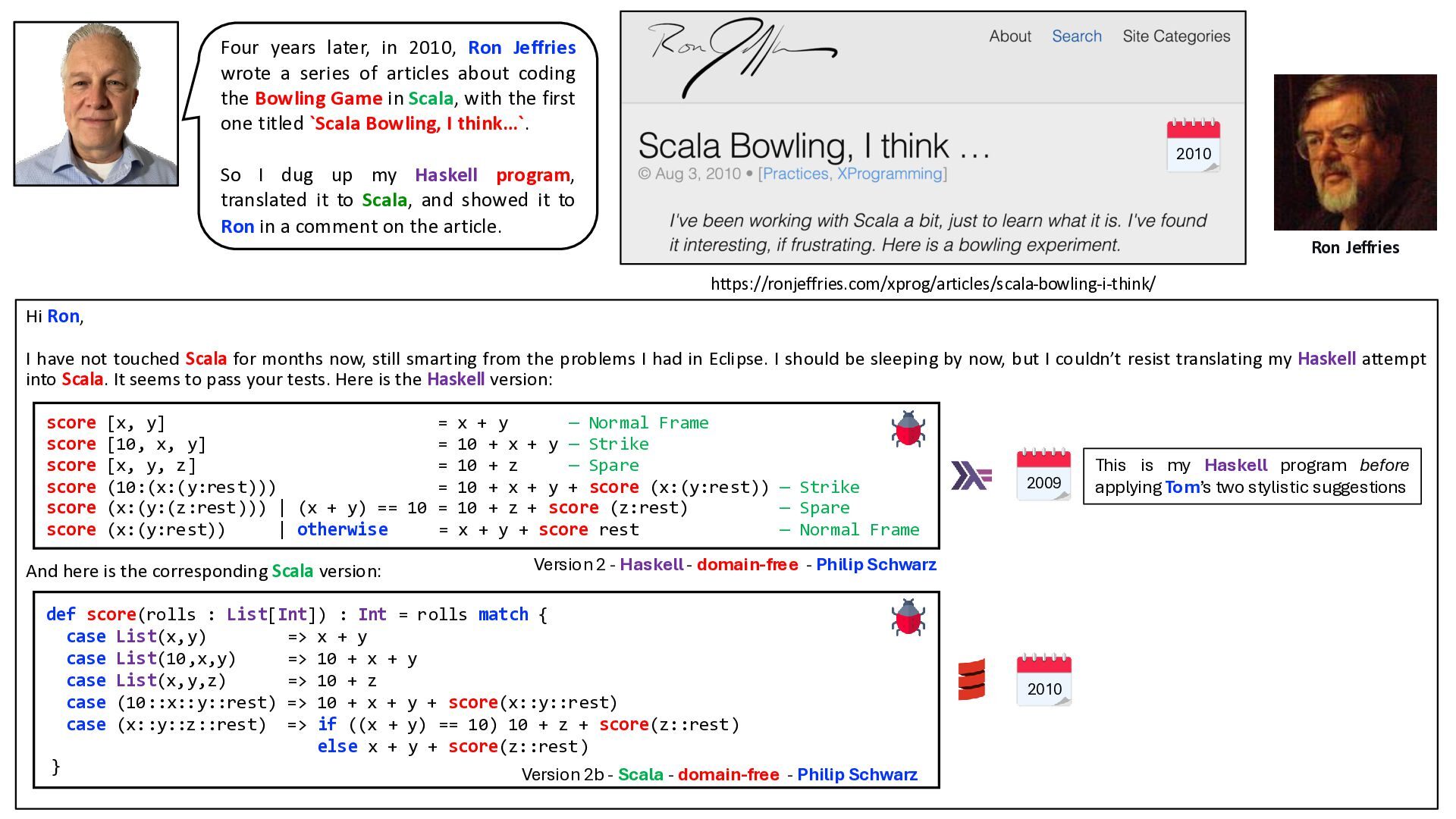
  27. Four years later, in 2010, Ron Jeffries wrote a series

    of articles about coding the Bowling Game in Scala, with the first one titled `Scala Bowling, I think…`. 2010 So I dug up my Haskell program, translated it to Scala, and showed it to Ron in a comment on the article. Ron Jeffries https://ronjeffries.com/xprog/articles/scala-bowling-i-think/ Hi Ron, I have not touched Scala for months now, still smarting from the problems I had in Eclipse. I should be sleeping by now, but I couldn’t resist translating my Haskell attempt into Scala. It seems to pass your tests. Here is the Haskell version: score [x, y] = x + y — Normal Frame score [10, x, y] = 10 + x + y — Strike score [x, y, z] = 10 + z — Spare score (10:(x:(y:rest))) = 10 + x + y + score (x:(y:rest)) — Strike score (x:(y:(z:rest))) | (x + y) == 10 = 10 + z + score (z:rest) — Spare score (x:(y:rest)) | otherwise = x + y + score rest — Normal Frame And here is the corresponding Scala version: 2009 Version 2 - Haskell - domain-free - Philip Schwarz def score(rolls : List[Int]) : Int = rolls match { case List(x,y) => x + y case List(10,x,y) => 10 + x + y case List(x,y,z) => 10 + z case (10::x::y::rest) => 10 + x + y + score(x::y::rest) case (x::y::z::rest) => if ((x + y) == 10) 10 + z + score(z::rest) else x + y + score(z::rest) } Version 2b - Scala - domain-free - Philip Schwarz 2010 This is my Haskell program before applying Tom’s two stylistic suggestions
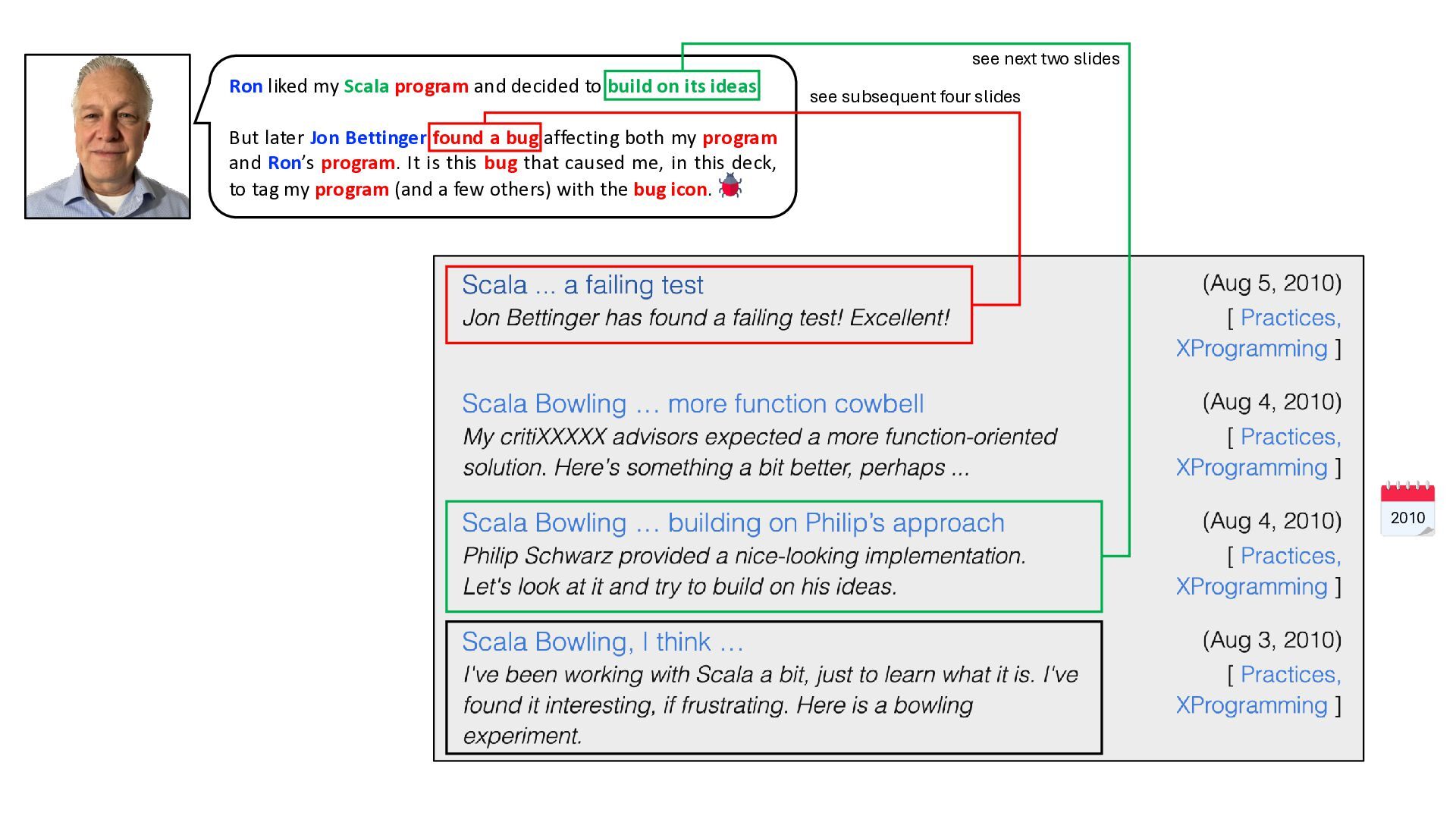
  28. see next two slides Ron liked my Scala program and

    decided to build on its ideas. see subsequent four slides But later Jon Bettinger found a bug affecting both my program and Ron’s program. It is this bug that caused me, in this deck, to tag my program (and a few others) with the bug icon. 2010
  29. object Game { def score(rolls: List[Int]):Int = { rolls match

    { case List(first, second) => first+second case List(first, second, third) => first + second + third case 10::second::third::theRest => 10 + second + third + score(second::third::theRest) case first::second::third::theRest if (first + second == 10) => 10 + third + score(third::theRest) case first::second::theRest => first + second + score(theRest) } } } Version 5 - Scala - domain-free - Ron Jeffries Ron Jeffries
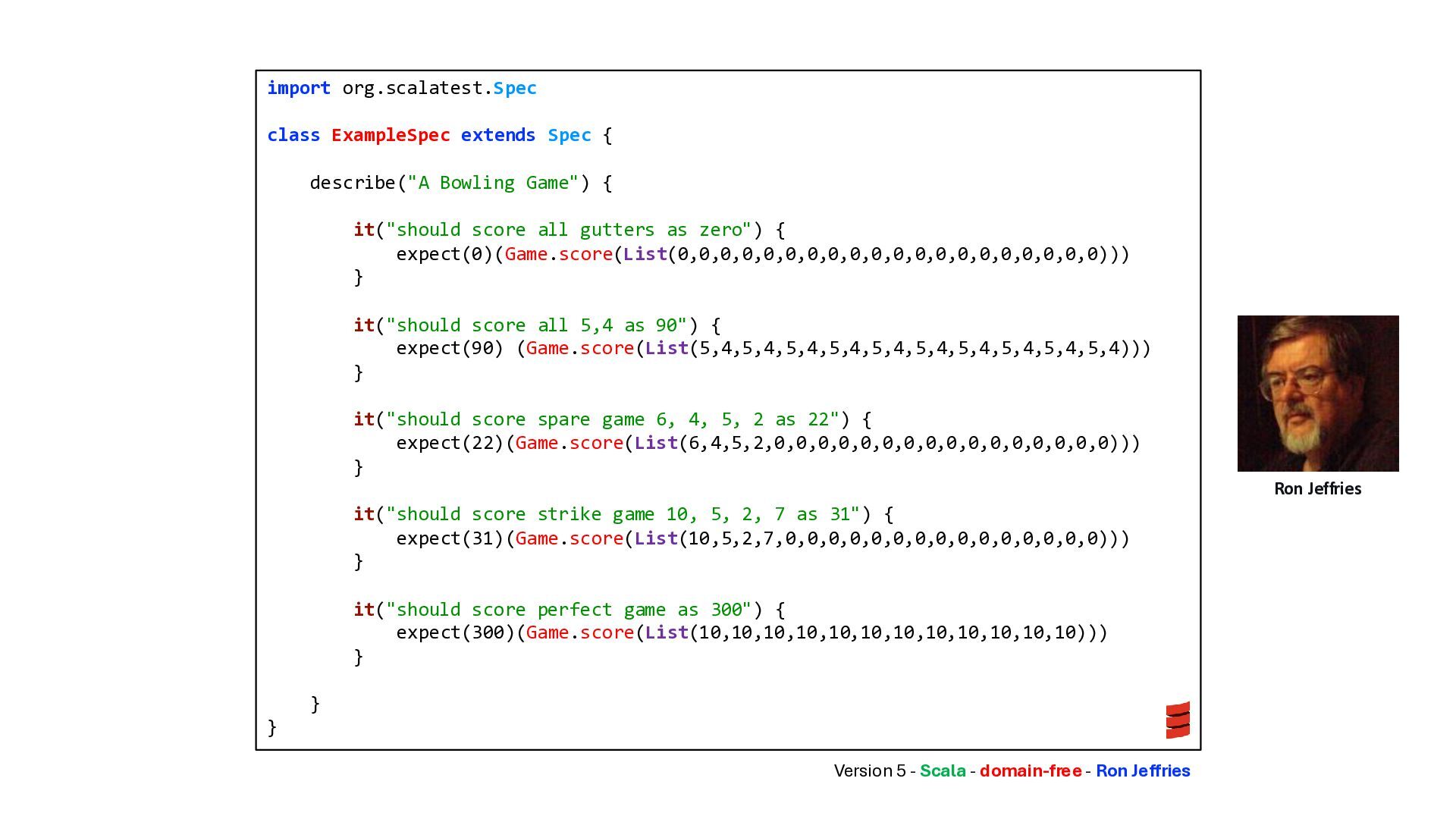
  30. import org.scalatest.Spec class ExampleSpec extends Spec { describe("A Bowling Game")

    { it("should score all gutters as zero") { expect(0)(Game.score(List(0,0,0,0,0,0,0,0,0,0,0,0,0,0,0,0,0,0,0,0))) } it("should score all 5,4 as 90") { expect(90) (Game.score(List(5,4,5,4,5,4,5,4,5,4,5,4,5,4,5,4,5,4,5,4))) } it("should score spare game 6, 4, 5, 2 as 22") { expect(22)(Game.score(List(6,4,5,2,0,0,0,0,0,0,0,0,0,0,0,0,0,0,0,0))) } it("should score strike game 10, 5, 2, 7 as 31") { expect(31)(Game.score(List(10,5,2,7,0,0,0,0,0,0,0,0,0,0,0,0,0,0,0))) } it("should score perfect game as 300") { expect(300)(Game.score(List(10,10,10,10,10,10,10,10,10,10,10,10))) } } } Version 5 - Scala - domain-free - Ron Jeffries Ron Jeffries
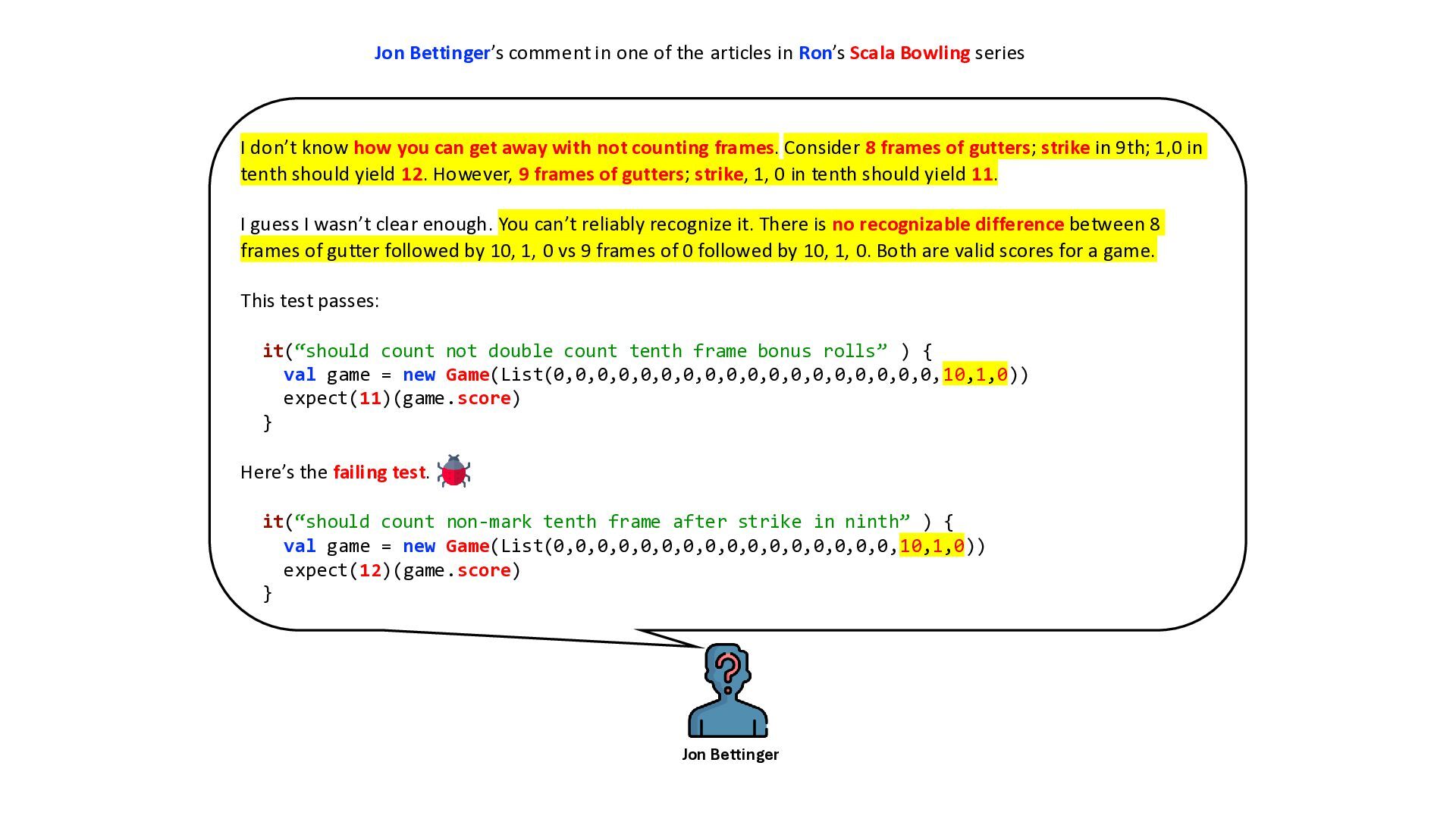
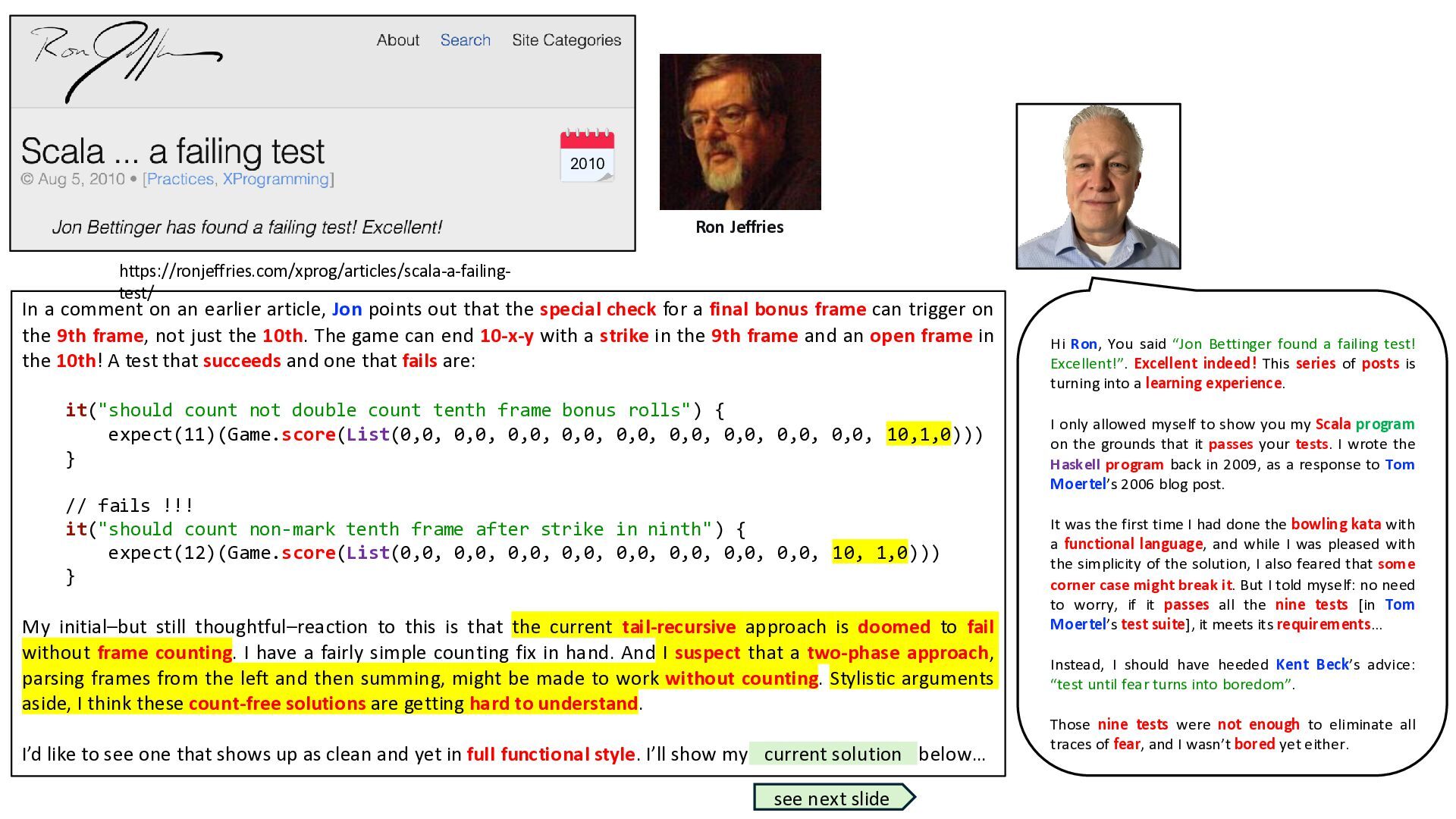
  31. Jon Bettinger’s comment in one of the articles in Ron’s

    Scala Bowling series I don’t know how you can get away with not counting frames. Consider 8 frames of gutters; strike in 9th; 1,0 in tenth should yield 12. However, 9 frames of gutters; strike, 1, 0 in tenth should yield 11. I guess I wasn’t clear enough. You can’t reliably recognize it. There is no recognizable difference between 8 frames of gutter followed by 10, 1, 0 vs 9 frames of 0 followed by 10, 1, 0. Both are valid scores for a game. This test passes: it(“should count not double count tenth frame bonus rolls” ) { val game = new Game(List(0,0,0,0,0,0,0,0,0,0,0,0,0,0,0,0,0,0,10,1,0)) expect(11)(game.score) } Here’s the failing test. it(“should count non-mark tenth frame after strike in ninth” ) { val game = new Game(List(0,0,0,0,0,0,0,0,0,0,0,0,0,0,0,0,10,1,0)) expect(12)(game.score) } Jon Bettinger
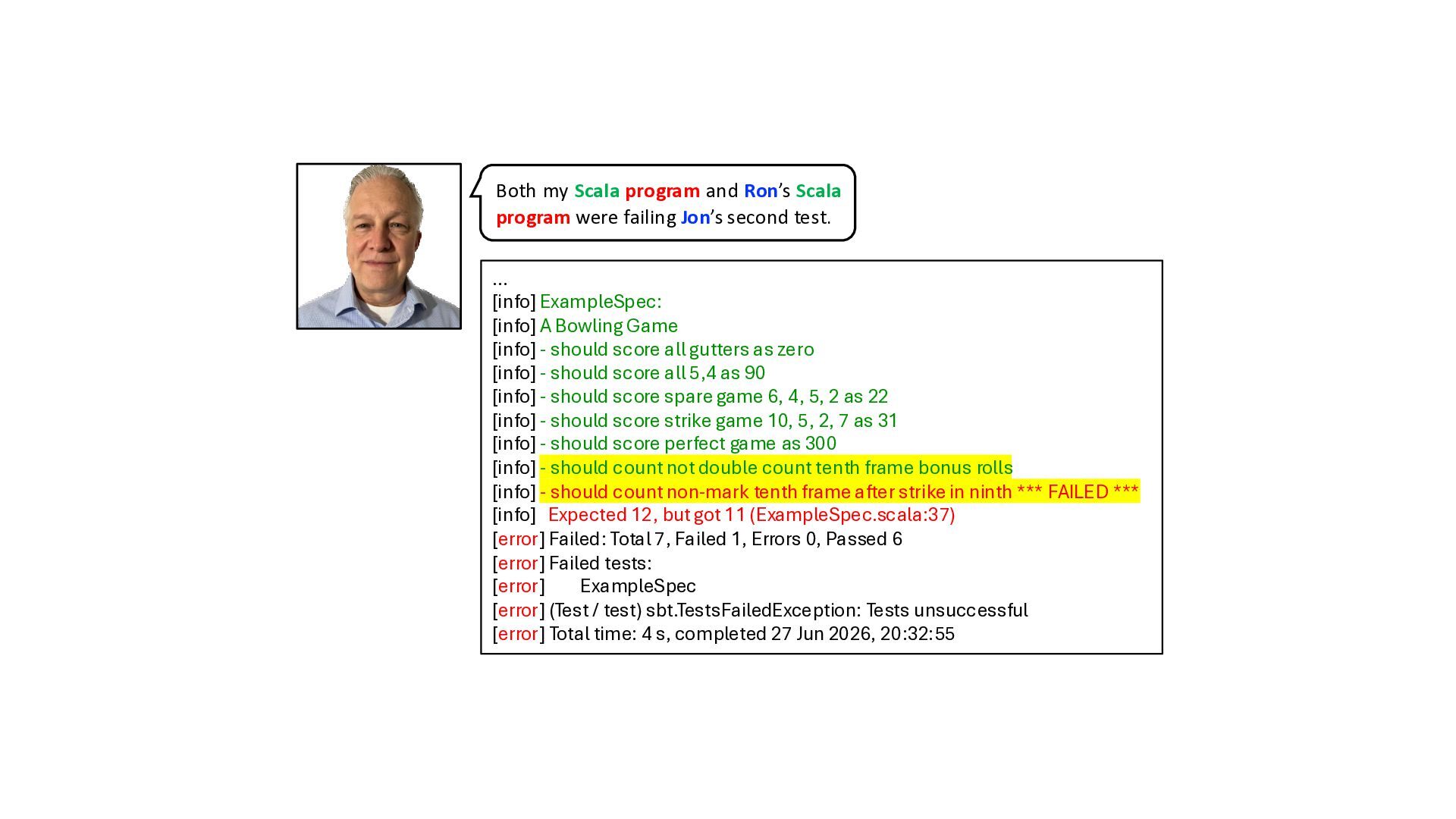
  32. Both my Scala program and Ron’s Scala program were failing

    Jon’s second test. … [info] ExampleSpec: [info] A Bowling Game [info] - should score all gutters as zero [info] - should score all 5,4 as 90 [info] - should score spare game 6, 4, 5, 2 as 22 [info] - should score strike game 10, 5, 2, 7 as 31 [info] - should score perfect game as 300 [info] - should count not double count tenth frame bonus rolls [info] - should count non-mark tenth frame after strike in ninth *** FAILED *** [info] Expected 12, but got 11 (ExampleSpec.scala:37) [error] Failed: Total 7, Failed 1, Errors 0, Passed 6 [error] Failed tests: [error] ExampleSpec [error] (Test / test) sbt.TestsFailedException: Tests unsuccessful [error] Total time: 4 s, completed 27 Jun 2026, 20:32:55
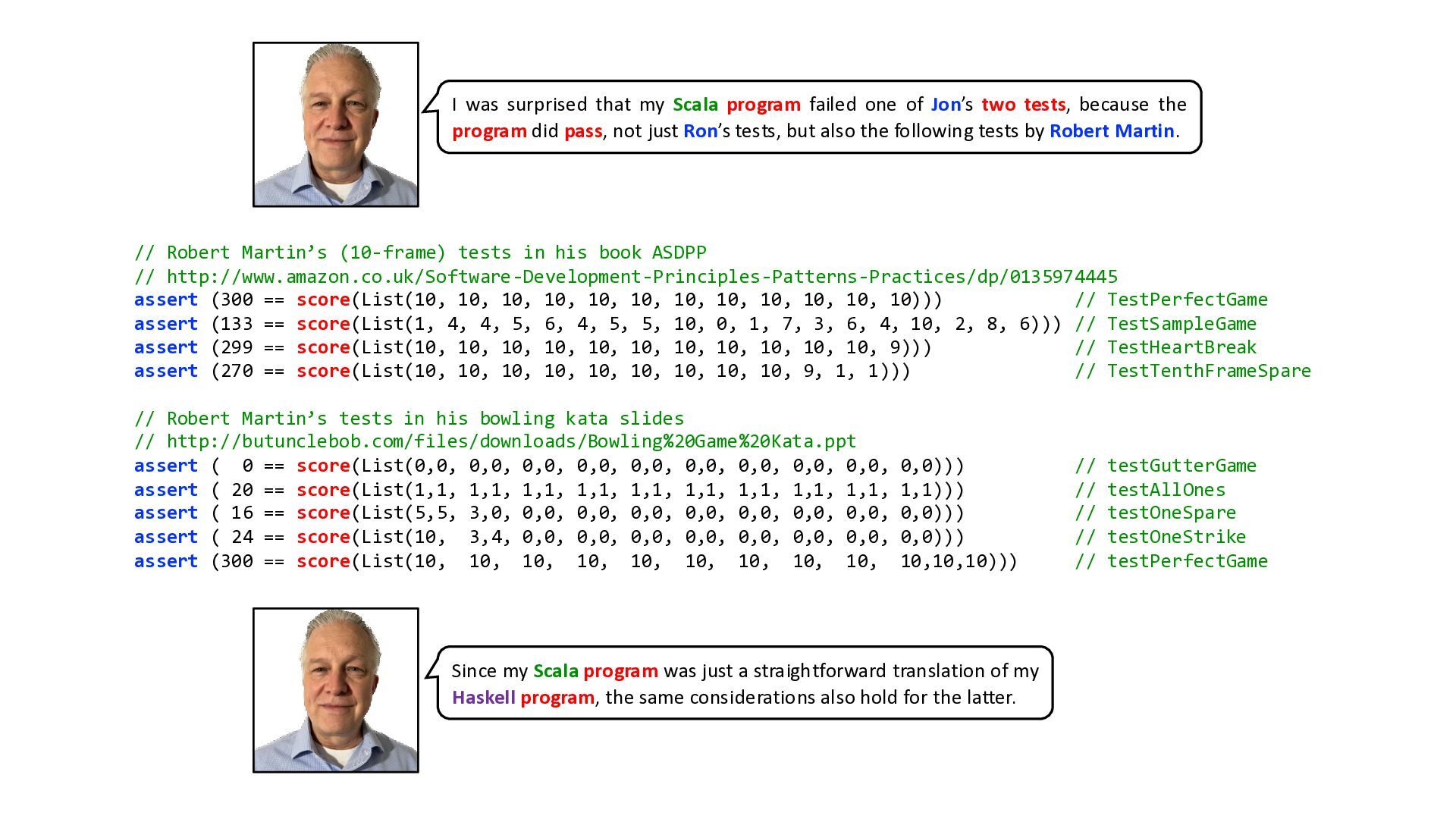
  33. I was surprised that my Scala program failed one of

    Jon’s two tests, because the program did pass, not just Ron’s tests, but also the following tests by Robert Martin. // Robert Martin’s (10-frame) tests in his book ASDPP // http://www.amazon.co.uk/Software-Development-Principles-Patterns-Practices/dp/0135974445 assert (300 == score(List(10, 10, 10, 10, 10, 10, 10, 10, 10, 10, 10, 10))) // TestPerfectGame assert (133 == score(List(1, 4, 4, 5, 6, 4, 5, 5, 10, 0, 1, 7, 3, 6, 4, 10, 2, 8, 6))) // TestSampleGame assert (299 == score(List(10, 10, 10, 10, 10, 10, 10, 10, 10, 10, 10, 9))) // TestHeartBreak assert (270 == score(List(10, 10, 10, 10, 10, 10, 10, 10, 10, 9, 1, 1))) // TestTenthFrameSpare // Robert Martin’s tests in his bowling kata slides // http://butunclebob.com/files/downloads/Bowling%20Game%20Kata.ppt assert ( 0 == score(List(0,0, 0,0, 0,0, 0,0, 0,0, 0,0, 0,0, 0,0, 0,0, 0,0))) assert ( 20 == score(List(1,1, 1,1, 1,1, 1,1, 1,1, 1,1, 1,1, 1,1, 1,1, 1,1))) assert ( 16 == score(List(5,5, 3,0, 0,0, 0,0, 0,0, 0,0, 0,0, 0,0, 0,0, 0,0))) assert ( 24 == score(List(10, 3,4, 0,0, 0,0, 0,0, 0,0, 0,0, 0,0, 0,0, 0,0))) assert (300 == score(List(10, 10, 10, 10, 10, 10, 10, 10, 10, 10,10,10))) Since my Scala program was just a straightforward translation of my Haskell program, the same considerations also hold for the latter. // testGutterGame // testAllOnes // testOneSpare // testOneStrike // testPerfectGame
  34. 2010 Ron Jeffries https://ronjeffries.com/xprog/articles/scala-a-failing-test/ In a comment on an earlier

    article, Jon points out that the special check for a final bonus frame can trigger on the 9th frame, not just the 10th. The game can end 10-x-y with a strike in the 9th frame and an open frame in the 10th! A test that succeeds and one that fails are: it("should count not double count tenth frame bonus rolls") { expect(11)(Game.score(List(0,0, 0,0, 0,0, 0,0, 0,0, 0,0, 0,0, 0,0, 0,0, 10,1,0))) } // fails !!! it("should count non-mark tenth frame after strike in ninth") { expect(12)(Game.score(List(0,0, 0,0, 0,0, 0,0, 0,0, 0,0, 0,0, 0,0, 10, 1,0))) } My initial–but still thoughtful–reaction to this is that the current tail-recursive approach is doomed to fail without frame counting. I have a fairly simple counting fix in hand. And I suspect that a two-phase approach, parsing frames from the left and then summing, might be made to work without counting. Stylistic arguments aside, I think these count-free solutions are getting hard to understand. I’d like to see one that shows up as clean and yet in full functional style. I’ll show my current currentsolution solution below… see next slide Hi Ron, You said “Jon Bettinger found a failing test! Excellent!”. Excellent indeed! This series of posts is turning into a learning experience. I only allowed myself to show you my Scala program on the grounds that it passes your tests. I wrote the Haskell program back in 2009, as a response to Tom Moertel’s 2006 blog post. It was the first time I had done the bowling kata with a functional language, and while I was pleased with the simplicity of the solution, I also feared that some corner case might break it. But I told myself: no need to worry, if it passes all the nine tests [in Tom Moertel’s test suite], it meets its requirements… Instead, I should have heeded Kent Beck’s advice: “test until fear turns into boredom”. Those nine tests were not enough to eliminate all traces of fear, and I wasn’t bored yet either.
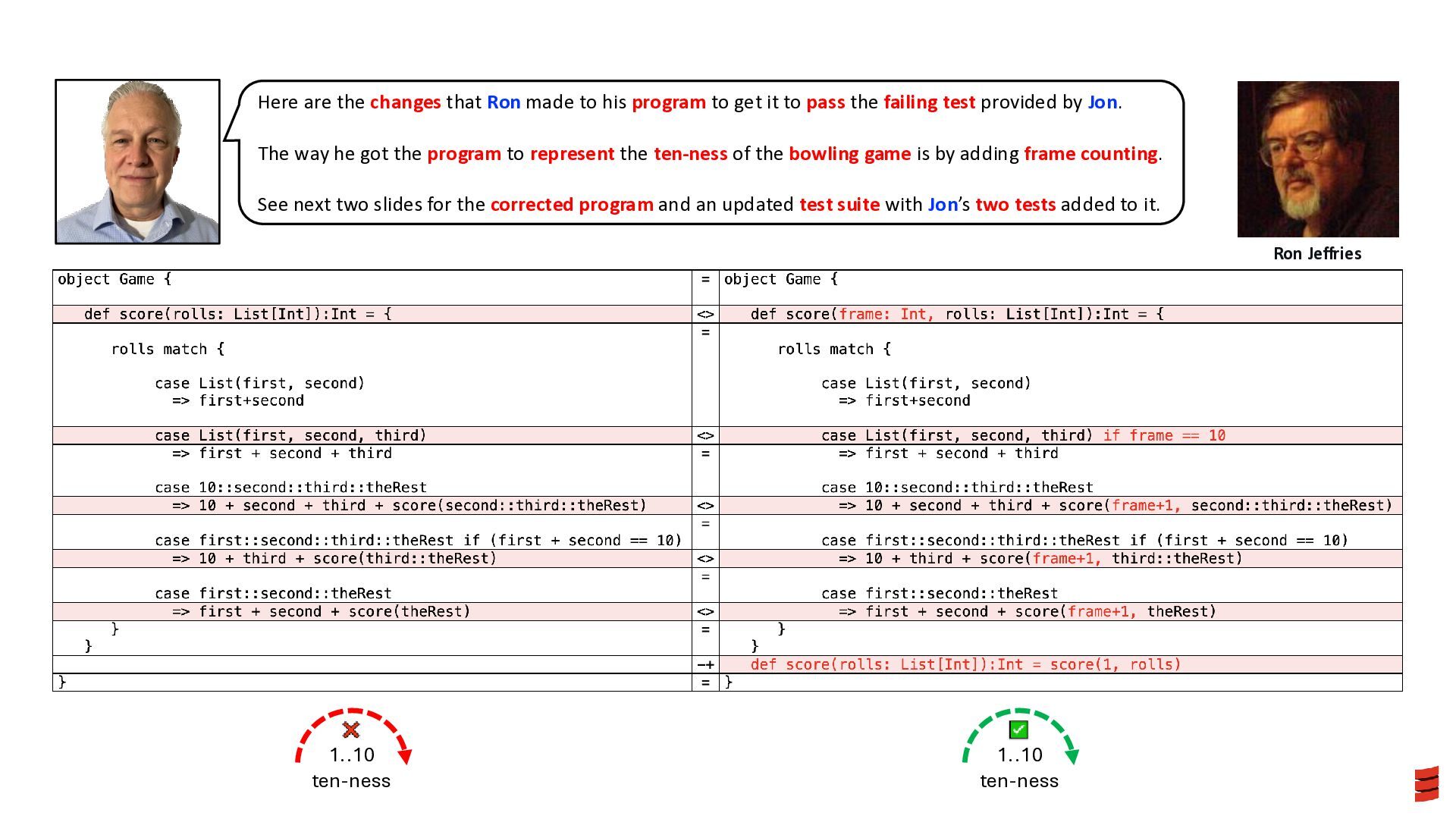
  35. Here are the changes that Ron made to his program

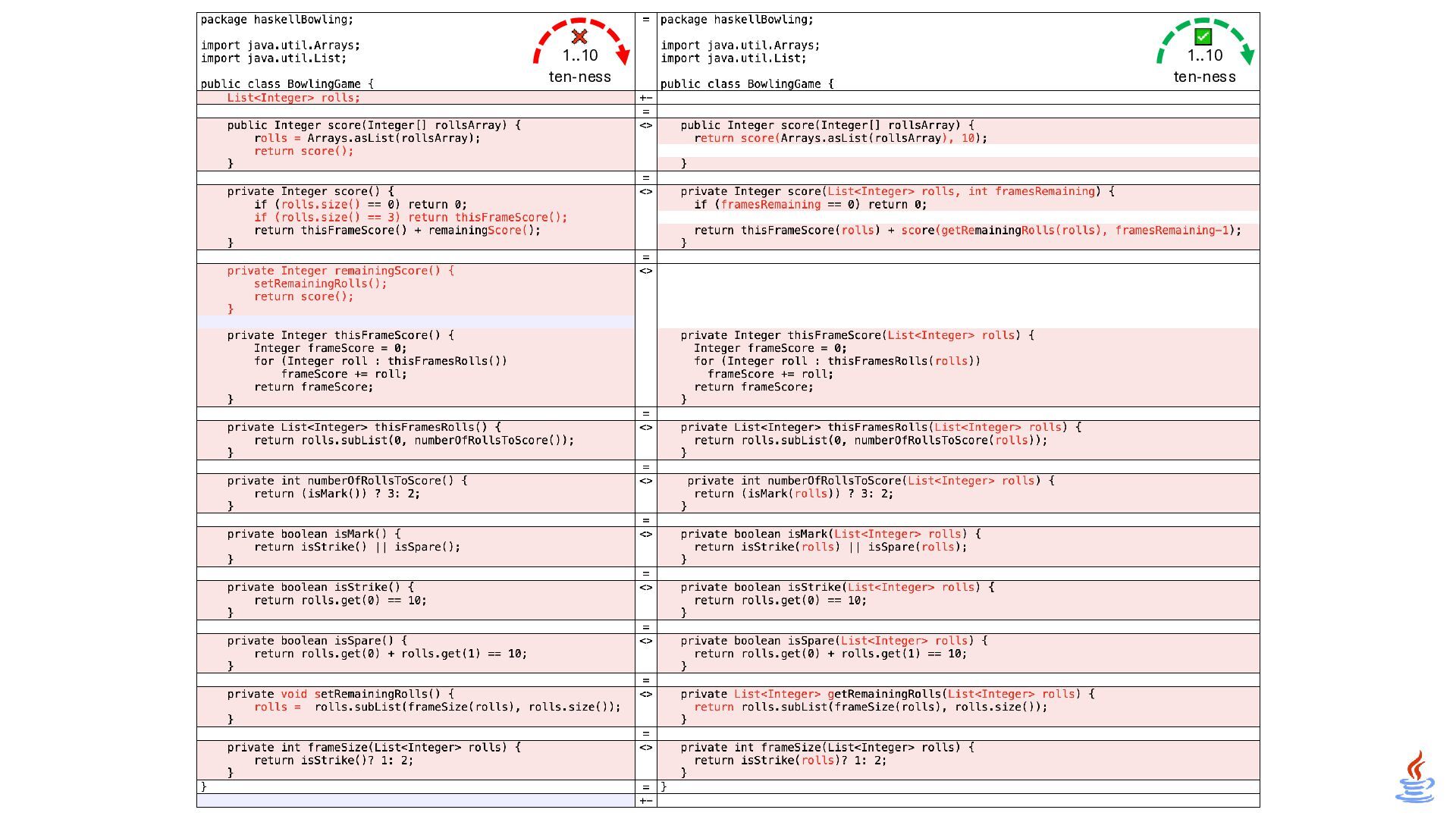
    to get it to pass the failing test provided by Jon. The way he got the program to represent the ten-ness of the bowling game is by adding frame counting. See next two slides for the corrected program and an updated test suite with Jon’s two tests added to it. Ron Jeffries ❌ 1..10 ten-ness ✅ 1..10 ten-ness
  36. object Game { def score(frame: Int, rolls: List[Int]):Int = {

    ✅ 1..10 ten-ness rolls match { case List(first, second) => first+second case List(first, second, third) if frame == 10 => first + second + third case 10::second::third::theRest => 10 + second + third + score(frame+1, second::third::theRest) case first::second::third::theRest if (first + second == 10) => 10 + third + score(frame+1, third::theRest) case first::second::theRest => first + second + score(frame+1, theRest) } } def score(rolls: List[Int]):Int = score(1, rolls) } Version 5b - Scala - domain-free - Version 5 corrected to model the ten-ness of the game - Ron Jeffries Ron Jeffries Frame counting could also be used to fix my buggy Haskell program, and Dan’s.
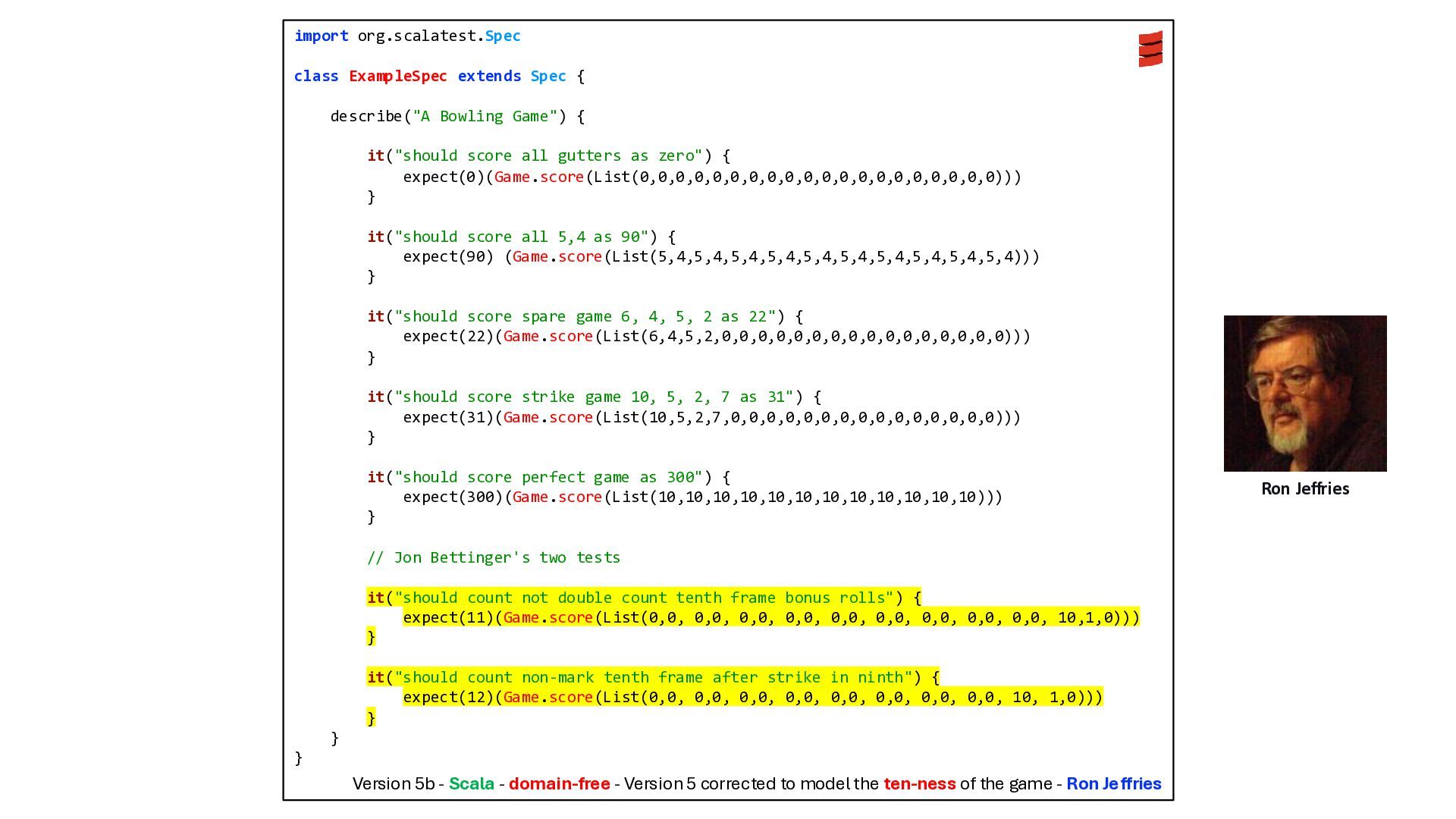
  37. import org.scalatest.Spec class ExampleSpec extends Spec { describe("A Bowling Game")

    { it("should score all gutters as zero") { expect(0)(Game.score(List(0,0,0,0,0,0,0,0,0,0,0,0,0,0,0,0,0,0,0,0))) } it("should score all 5,4 as 90") { expect(90) (Game.score(List(5,4,5,4,5,4,5,4,5,4,5,4,5,4,5,4,5,4,5,4))) } it("should score spare game 6, 4, 5, 2 as 22") { expect(22)(Game.score(List(6,4,5,2,0,0,0,0,0,0,0,0,0,0,0,0,0,0,0,0))) } it("should score strike game 10, 5, 2, 7 as 31") { expect(31)(Game.score(List(10,5,2,7,0,0,0,0,0,0,0,0,0,0,0,0,0,0,0))) } it("should score perfect game as 300") { expect(300)(Game.score(List(10,10,10,10,10,10,10,10,10,10,10,10))) } // Jon Bettinger's two tests it("should count not double count tenth frame bonus rolls") { expect(11)(Game.score(List(0,0, 0,0, 0,0, 0,0, 0,0, 0,0, 0,0, 0,0, 0,0, 10,1,0))) } it("should count non-mark tenth frame after strike in ninth") { expect(12)(Game.score(List(0,0, 0,0, 0,0, 0,0, 0,0, 0,0, 0,0, 0,0, 10, 1,0))) } } } Version 5b - Scala - domain-free - Version 5 corrected to model the ten-ness of the game - Ron Jeffries Ron Jeffries
  38. Ron’s corrected Scala program passes both Jon’s tests. … [info]

    ExampleSpec: [info] A Bowling Game [info] - should score all gutters as zero [info] - should score all 5,4 as 90 [info] - should score spare game 6, 4, 5, 2 as 22 [info] - should score strike game 10, 5, 2, 7 as 31 [info] - should score perfect game as 300 [info] - should count not double count tenth frame bonus rolls [info] - should count non-mark tenth frame after strike in ninth [info] Passed: Total 7, Failed 0, Errors 0, Passed 7 [success] Total time: 5 s, completed 27 Jun 2026, 20:44:31
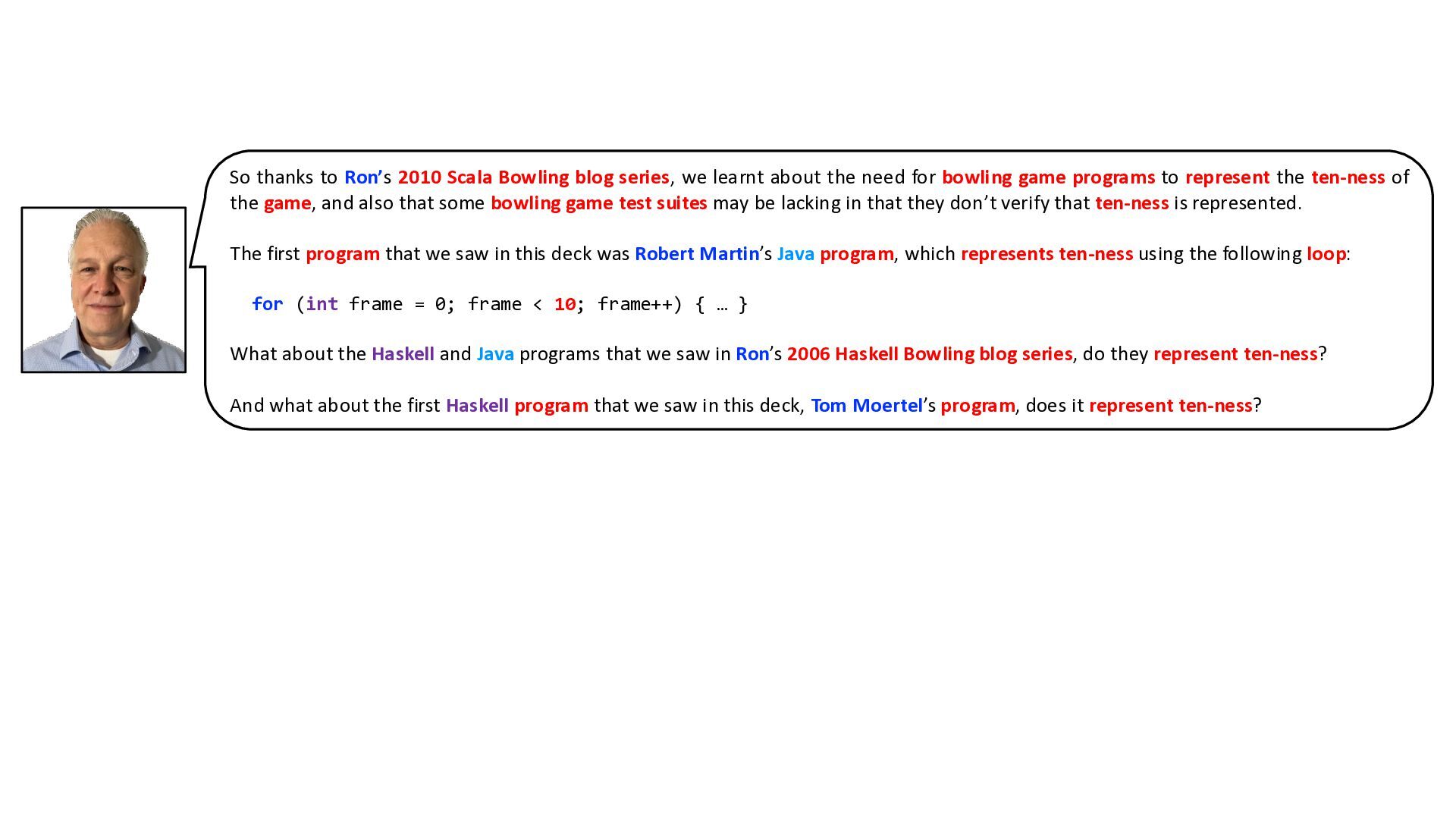
  39. So thanks to Ron’s 2010 Scala Bowling blog series, we

    learnt about the need for bowling game programs to represent the ten-ness of the game, and also that some bowling game test suites may be lacking in that they don’t verify that ten-ness is represented. The first program that we saw in this deck was Robert Martin’s Java program, which represents ten-ness using the following loop: for (int frame = 0; frame < 10; frame++) { … } What about the Haskell and Java programs that we saw in Ron’s 2006 Haskell Bowling blog series, do they represent ten-ness? And what about the first Haskell program that we saw in this deck, Tom Moertel’s program, does it represent ten-ness?
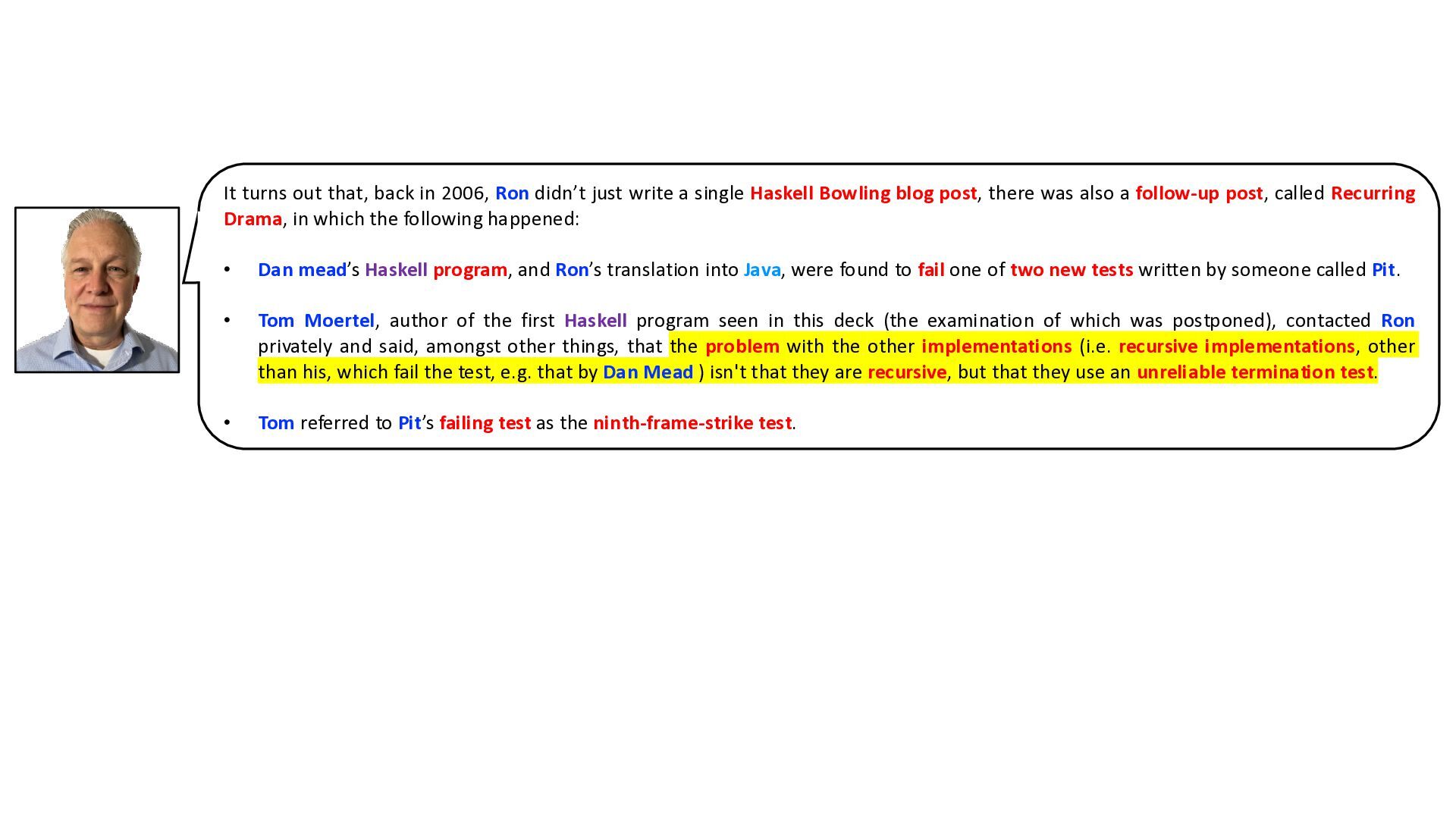
  40. It turns out that, back in 2006, Ron didn’t just

    write a single Haskell Bowling blog post, there was also a follow-up post, called Recurring Drama, in which the following happened: • Dan mead’s Haskell program, and Ron’s translation into Java, were found to fail one of two new tests written by someone called Pit. • Tom Moertel, author of the first Haskell program seen in this deck (the examination of which was postponed), contacted Ron privately and said, amongst other things, that the problem with the other implementations (i.e. recursive implementations, other than his, which fail the test, e.g. that by Dan Mead ) isn't that they are recursive, but that they use an unreliable termination test. • Tom referred to Pit’s failing test as the ninth-frame-strike test.
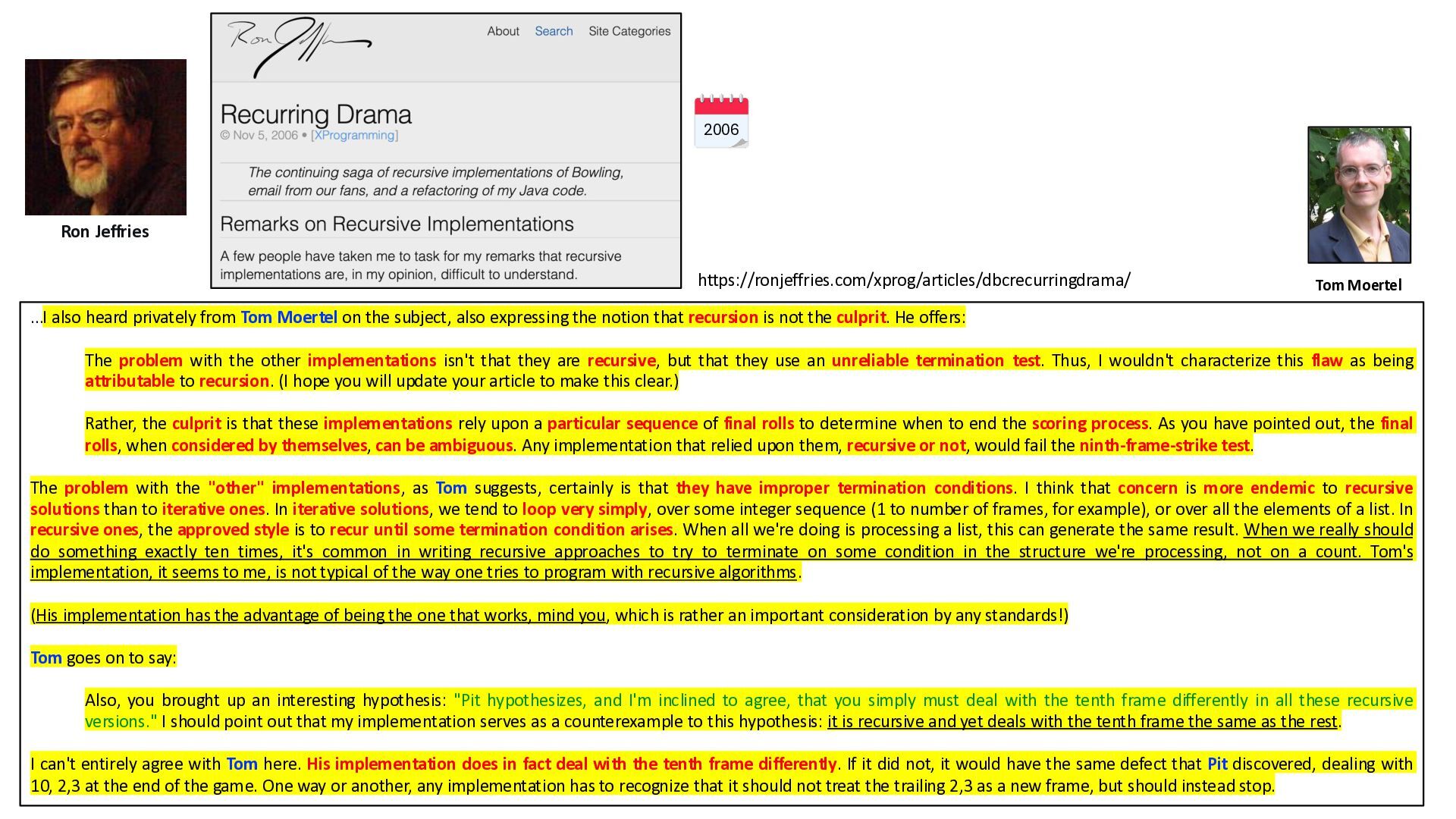
  41. 2006 Ron Jeffries https://ronjeffries.com/xprog/articles/dbcrecurringdrama/ Tom Moertel …I also heard privately

    from Tom Moertel on the subject, also expressing the notion that recursion is not the culprit. He offers: The problem with the other implementations isn't that they are recursive, but that they use an unreliable termination test. Thus, I wouldn't characterize this flaw as being attributable to recursion. (I hope you will update your article to make this clear.) Rather, the culprit is that these implementations rely upon a particular sequence of final rolls to determine when to end the scoring process. As you have pointed out, the final rolls, when considered by themselves, can be ambiguous. Any implementation that relied upon them, recursive or not, would fail the ninth-frame-strike test. The problem with the "other" implementations, as Tom suggests, certainly is that they have improper termination conditions. I think that concern is more endemic to recursive solutions than to iterative ones. In iterative solutions, we tend to loop very simply, over some integer sequence (1 to number of frames, for example), or over all the elements of a list. In recursive ones, the approved style is to recur until some termination condition arises. When all we're doing is processing a list, this can generate the same result. When we really should do something exactly ten times, it's common in writing recursive approaches to try to terminate on some condition in the structure we're processing, not on a count. Tom's implementation, it seems to me, is not typical of the way one tries to program with recursive algorithms. (His implementation has the advantage of being the one that works, mind you, which is rather an important consideration by any standards!) Tom goes on to say: Also, you brought up an interesting hypothesis: "Pit hypothesizes, and I'm inclined to agree, that you simply must deal with the tenth frame differently in all these recursive versions." I should point out that my implementation serves as a counterexample to this hypothesis: it is recursive and yet deals with the tenth frame the same as the rest. I can't entirely agree with Tom here. His implementation does in fact deal with the tenth frame differently. If it did not, it would have the same defect that Pit discovered, dealing with 10, 2,3 at the end of the game. One way or another, any implementation has to recognize that it should not treat the trailing 2,3 as a new frame, but should instead stop.
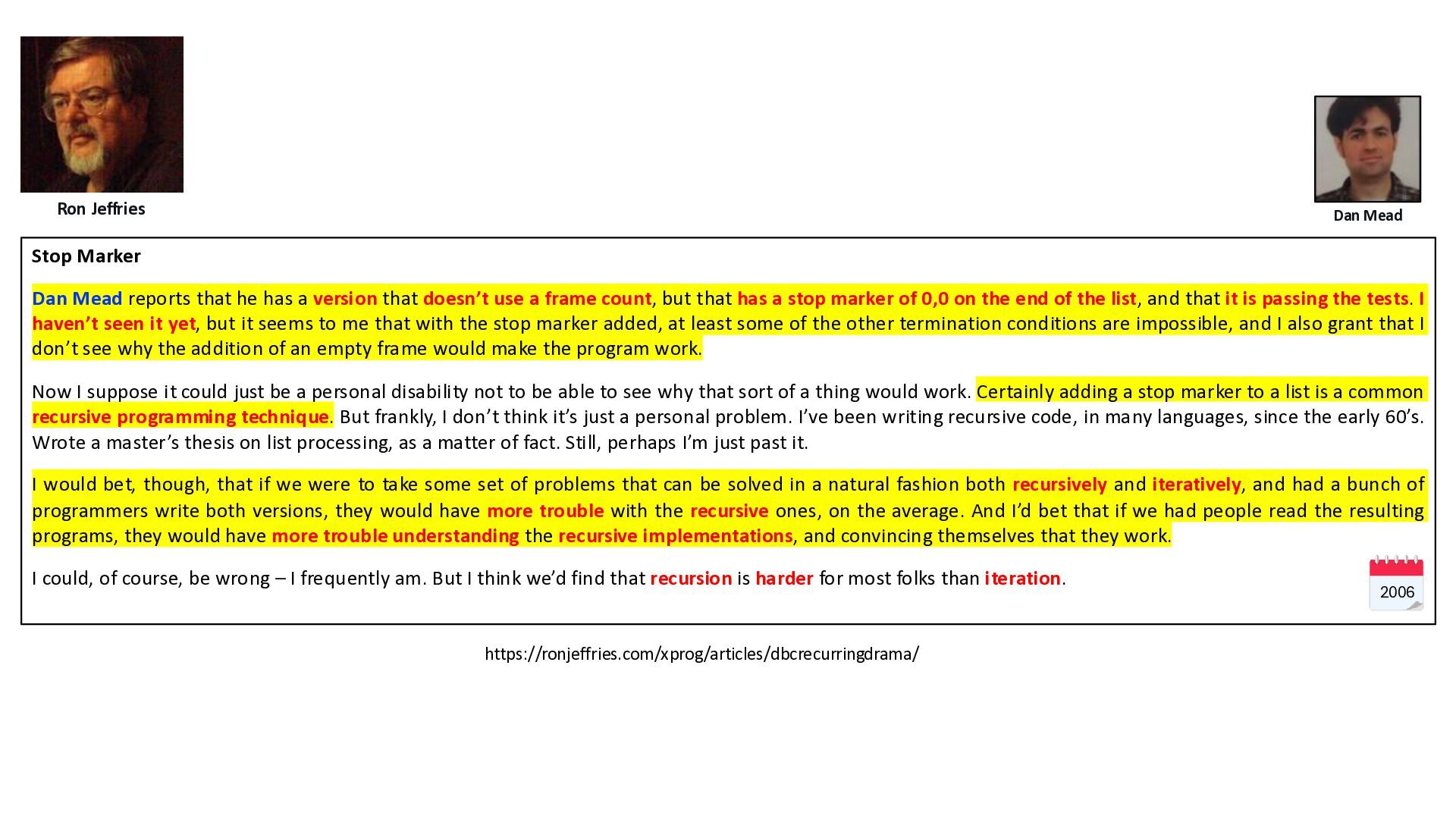
  42. Ron Jeffries Dan Mead Stop Marker Dan Mead reports that

    he has a version that doesn’t use a frame count, but that has a stop marker of 0,0 on the end of the list, and that it is passing the tests. I haven’t seen it yet, but it seems to me that with the stop marker added, at least some of the other termination conditions are impossible, and I also grant that I don’t see why the addition of an empty frame would make the program work. Now I suppose it could just be a personal disability not to be able to see why that sort of a thing would work. Certainly adding a stop marker to a list is a common recursive programming technique. But frankly, I don’t think it’s just a personal problem. I’ve been writing recursive code, in many languages, since the early 60’s. Wrote a master’s thesis on list processing, as a matter of fact. Still, perhaps I’m just past it. I would bet, though, that if we were to take some set of problems that can be solved in a natural fashion both recursively and iteratively, and had a bunch of programmers write both versions, they would have more trouble with the recursive ones, on the average. And I’d bet that if we had people read the resulting programs, they would have more trouble understanding the recursive implementations, and convincing themselves that they work. I could, of course, be wrong – I frequently am. But I think we’d find that recursion is harder for most folks than iteration. https://ronjeffries.com/xprog/articles/dbcrecurringdrama/ 2006
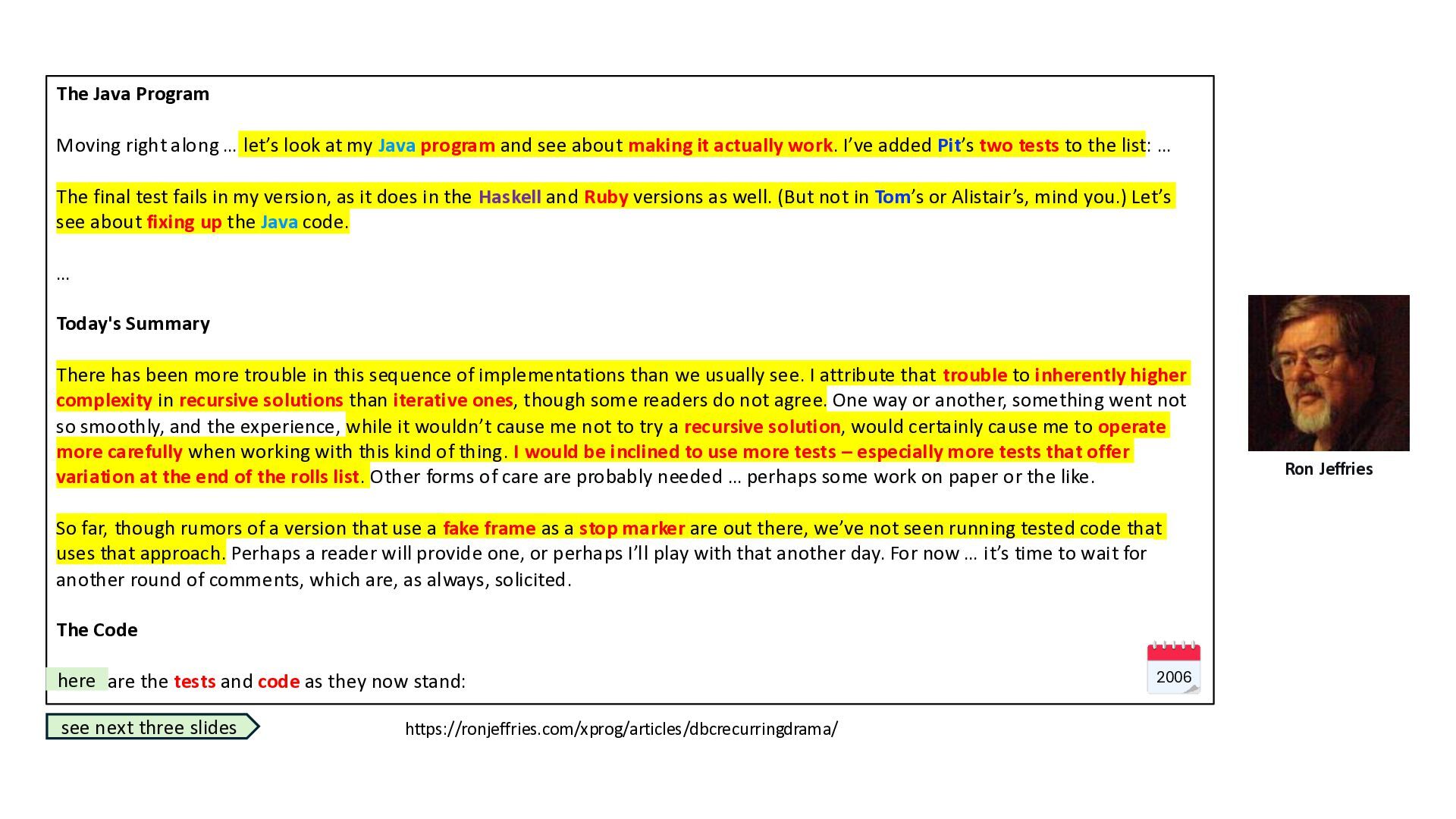
  43. The Java Program Moving right along … let’s look at

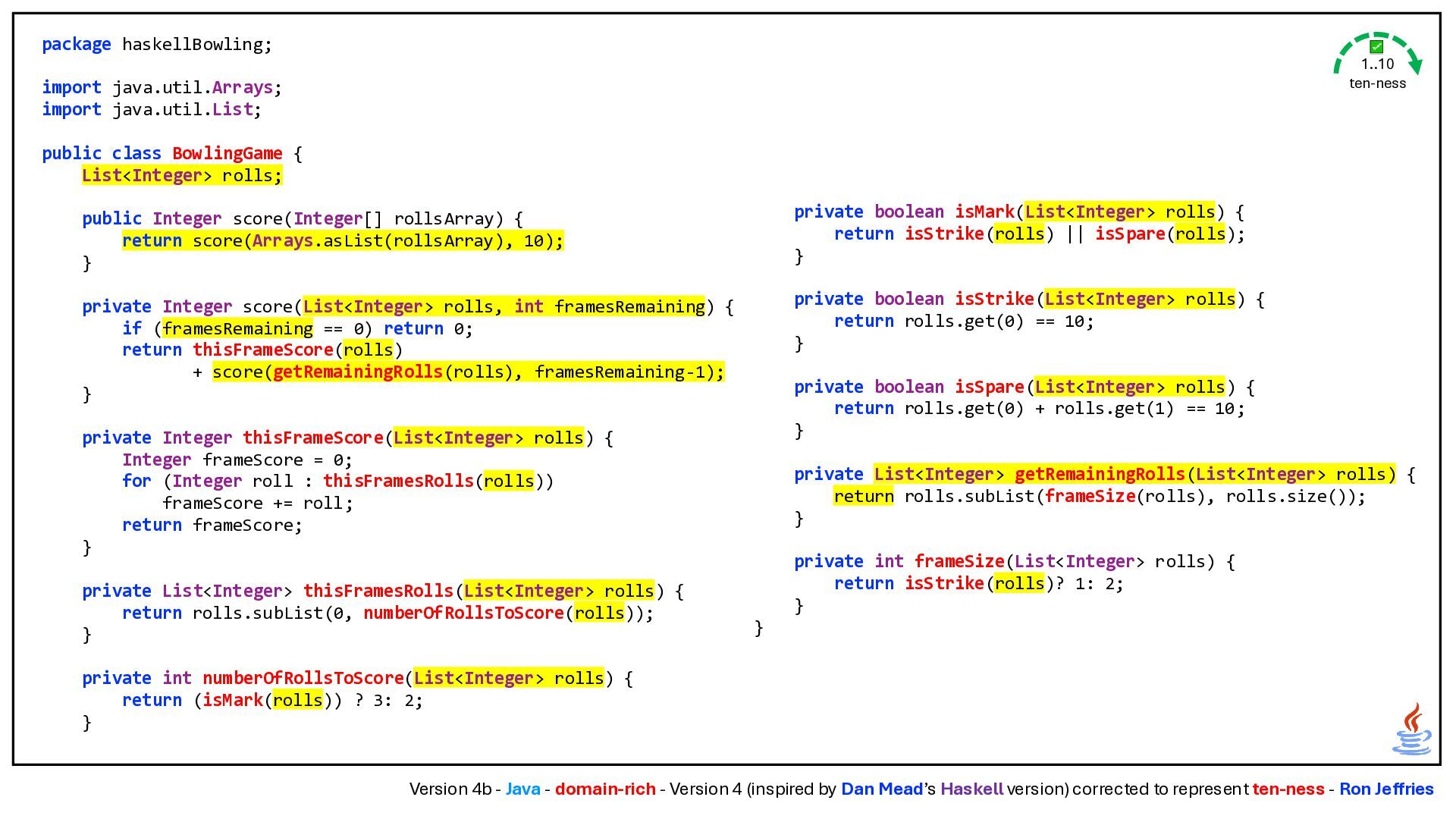
    my Java program and see about making it actually work. I’ve added Pit’s two tests to the list: … The final test fails in my version, as it does in the Haskell and Ruby versions as well. (But not in Tom’s or Alistair’s, mind you.) Let’s see about fixing up the Java code. … Today's Summary There has been more trouble in this sequence of implementations than we usually see. I attribute that trouble to inherently higher complexity in recursive solutions than iterative ones, though some readers do not agree. One way or another, something went not so smoothly, and the experience, while it wouldn’t cause me not to try a recursive solution, would certainly cause me to operate more carefully when working with this kind of thing. I would be inclined to use more tests – especially more tests that offer variation at the end of the rolls list. Other forms of care are probably needed … perhaps some work on paper or the like. So far, though rumors of a version that use a fake frame as a stop marker are out there, we’ve not seen running tested code that uses that approach. Perhaps a reader will provide one, or perhaps I’ll play with that another day. For now … it’s time to wait for another round of comments, which are, as always, solicited. The Code here are the tests and code as they now stand: Here see next three slides https://ronjeffries.com/xprog/articles/dbcrecurringdrama/ 2006 Ron Jeffries
  44. package haskellBowling; ✅ 1..10 ten-ness import java.util.Arrays; import java.util.List; public

    class BowlingGame { List<Integer> rolls; public Integer score(Integer[] rollsArray) { return score(Arrays.asList(rollsArray), 10); } private boolean isMark(List<Integer> rolls) { return isStrike(rolls) || isSpare(rolls); } private Integer score(List<Integer> rolls, int framesRemaining) { if (framesRemaining == 0) return 0; return thisFrameScore(rolls) + score(getRemainingRolls(rolls), framesRemaining-1); } private boolean isStrike(List<Integer> rolls) { return rolls.get(0) == 10; } private boolean isSpare(List<Integer> rolls) { return rolls.get(0) + rolls.get(1) == 10; } private Integer thisFrameScore(List<Integer> rolls) { Integer frameScore = 0; for (Integer roll : thisFramesRolls(rolls)) frameScore += roll; return frameScore; } private List<Integer> thisFramesRolls(List<Integer> rolls) { return rolls.subList(0, numberOfRollsToScore(rolls)); } private List<Integer> getRemainingRolls(List<Integer> rolls) { return rolls.subList(frameSize(rolls), rolls.size()); } private int frameSize(List<Integer> rolls) { return isStrike(rolls)? 1: 2; } } private int numberOfRollsToScore(List<Integer> rolls) { return (isMark(rolls)) ? 3: 2; } Version 4b - Java - domain-rich - Version 4 (inspired by Dan Mead’s Haskell version) corrected to represent ten-ness - Ron Jeffries
  45. @Test public void perfect() throws Exception { assertEquals(300, game.score(new Integer[]

    {10,10,10,10,10,10,10,10,10,10,10,10})); } package haskellBowling; import static org.junit.Assert.*; import org.junit.Before; import org.junit.Test; ✅ 1..10 ten-ness @Test public void alternatingStrikeSpare() throws Exception { assertEquals(200, game.score(new Integer[] { 10,5,5, 10,5,5, 10,5,5, 10,5,5, 10,5,5, 10})); } public class BowlingGameTest { BowlingGame game; @Before public void setUp() throws Exception { game = new BowlingGame(); } @Test public void alternatingSpareStrike() throws Exception { assertEquals(200, game.score(new Integer[] { 5,5, 10,5,5, 10,5,5, 10,5,5, 10,5,5, 10,5,5})); } @Test public void hookup() { assertTrue(true); } @Test public void trailingSpare() throws Exception { assertEquals(20, game.score(new Integer[] { 0,0, 0,0, 0,0, 0,0, 0,0, 0,0, 0,0, 0,0, 0,0, 10,5,5})); } @Test public void opens() throws Exception { assertEquals(60, game.score(new Integer[] {3,3,3,3,3,3,3,3,3,3,3,3,3,3,3,3,3,3,3,3})); } @Test public void pitStrikeFinalFrame() throws Exception { assertEquals(15, game.score(new Integer[] { 0,0, 0,0, 0,0, 0,0, 0,0, 0,0, 0,0, 0,0, 0,0, 10,2,3})); } @Test public void spare() throws Exception { assertEquals(22, game.score(new Integer[] {6,4,5,2,0,0,0,0,0,0,0,0,0,0,0,0,0,0,0,0})); } † @Test public void pitStrikeNinthFrame() throws Exception { assertEquals(20, game.score(new Integer[] { 0,0, 0,0, 0,0, 0,0, 0,0, 0,0, 0,0, 0,0, 10, 2,3})); } Pit } Version 4b - Java - domain-rich - Version 4 (inspired by Dan Mead’s Haskell version) corrected to include Pit’s two new tests - Ron Jeffries † This test is referred to by Tom Moertel as the ninth-frame-strike test.
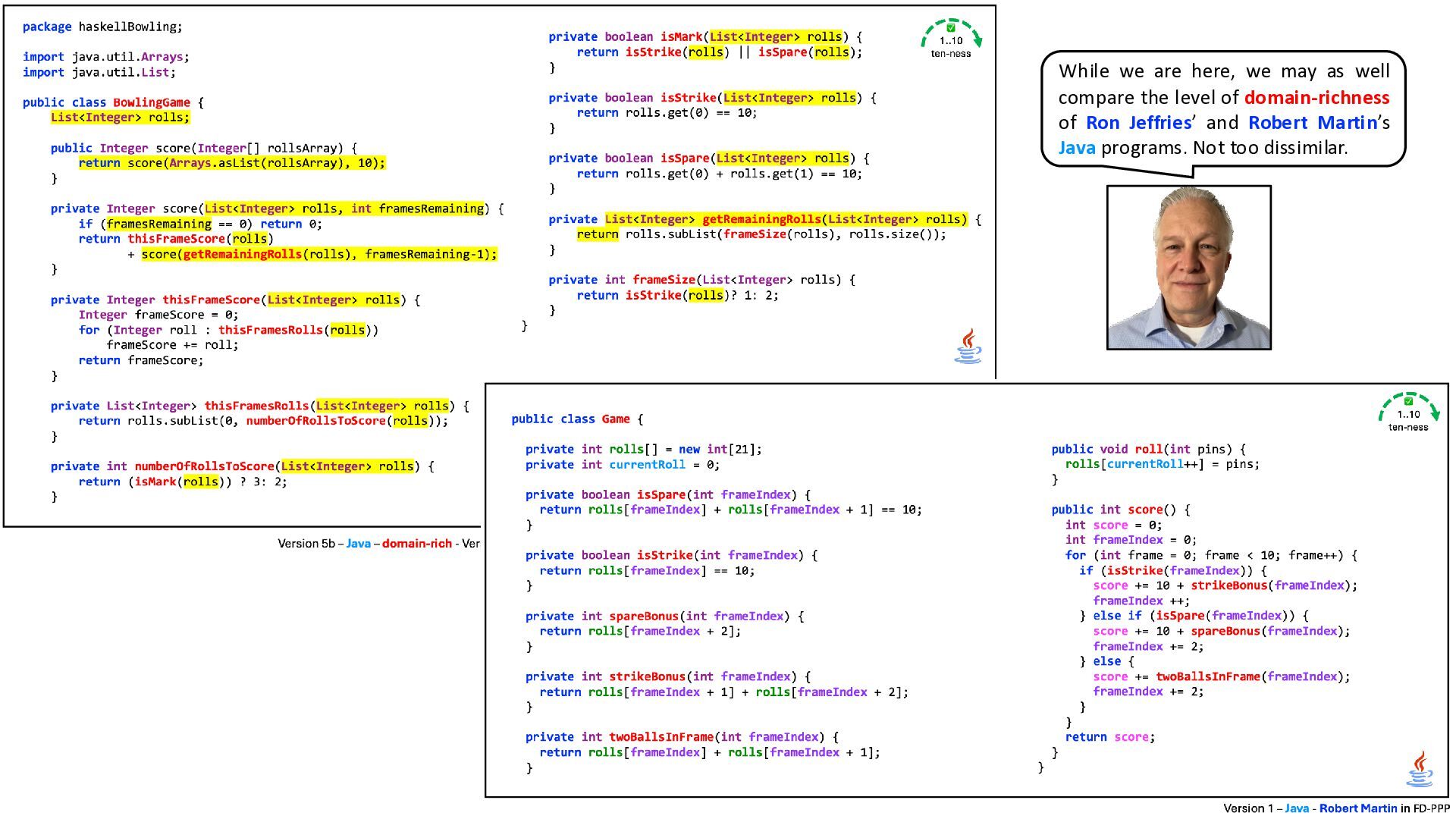
  46. While we are here, we may as well compare the

    level of domain-richness of Ron Jeffries’ and Robert Martin’s Java programs. Not too dissimilar.
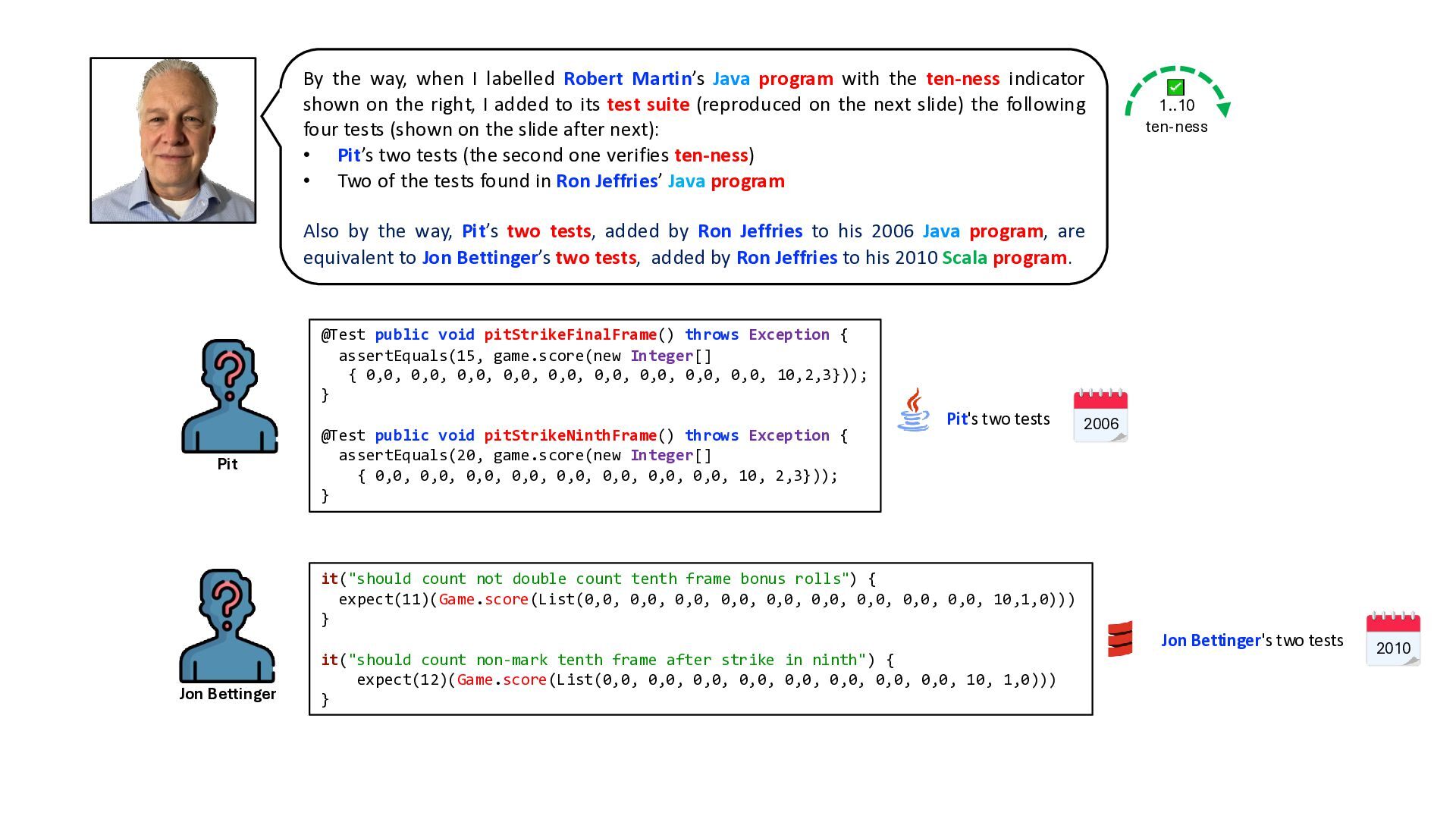
  47. By the way, when I labelled Robert Martin’s Java program

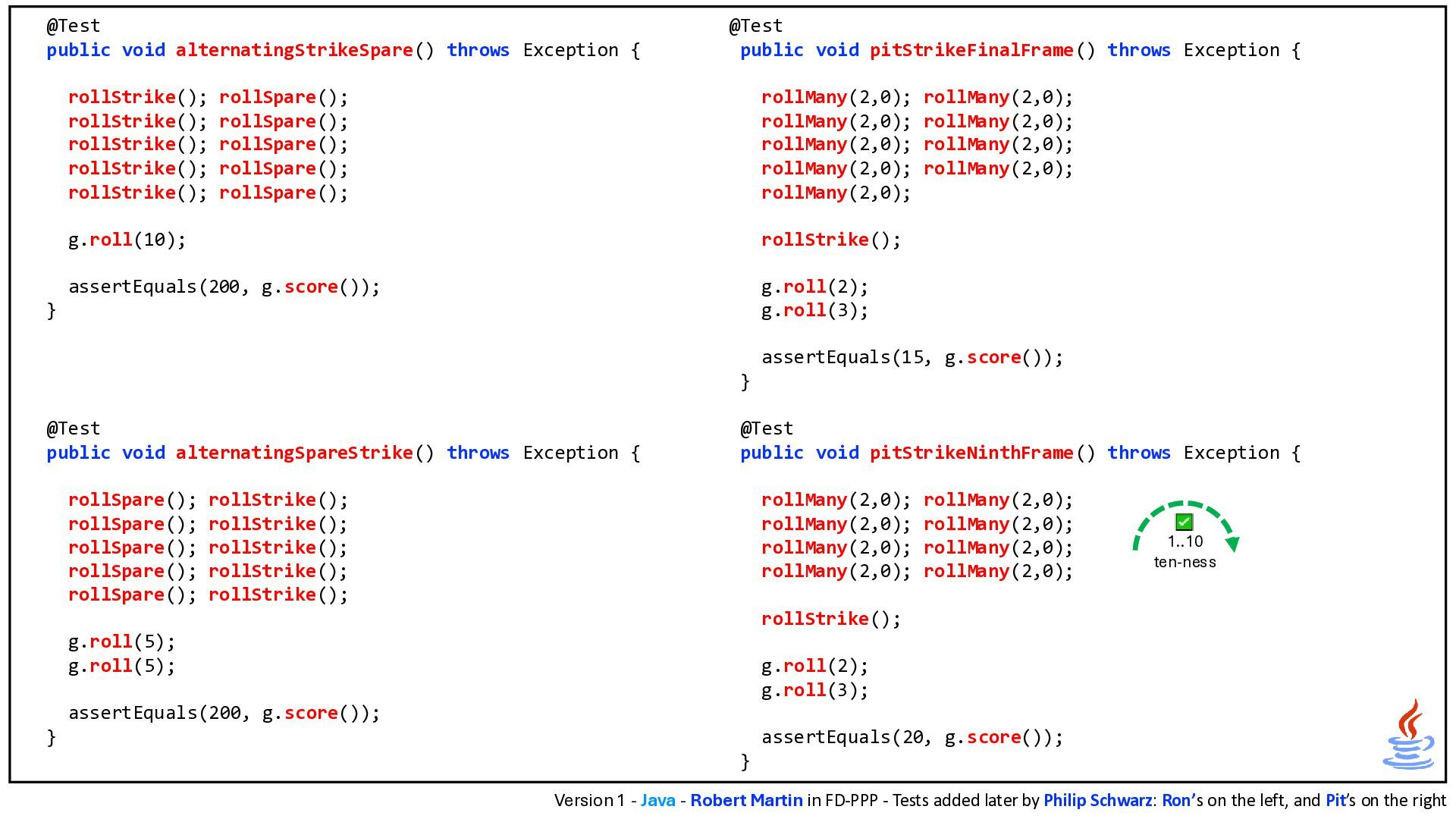
    with the ten-ness indicator shown on the right, I added to its test suite (reproduced on the next slide) the following four tests (shown on the slide after next): • Pit’s two tests (the second one verifies ten-ness) • Two of the tests found in Ron Jeffries’ Java program ✅ 1..10 ten-ness Also by the way, Pit’s two tests, added by Ron Jeffries to his 2006 Java program, are equivalent to Jon Bettinger’s two tests, added by Ron Jeffries to his 2010 Scala program. @Test public void pitStrikeFinalFrame() throws Exception { assertEquals(15, game.score(new Integer[] { 0,0, 0,0, 0,0, 0,0, 0,0, 0,0, 0,0, 0,0, 0,0, 10,2,3})); } Pit @Test public void pitStrikeNinthFrame() throws Exception { assertEquals(20, game.score(new Integer[] { 0,0, 0,0, 0,0, 0,0, 0,0, 0,0, 0,0, 0,0, 10, 2,3})); } Pit's two tests it("should count not double count tenth frame bonus rolls") { expect(11)(Game.score(List(0,0, 0,0, 0,0, 0,0, 0,0, 0,0, 0,0, 0,0, 0,0, 10,1,0))) } Jon Bettinger it("should count non-mark tenth frame after strike in ninth") { expect(12)(Game.score(List(0,0, 0,0, 0,0, 0,0, 0,0, 0,0, 0,0, 0,0, 10, 1,0))) } 2006 Jon Bettinger's two tests 2010
  48. import org.example.Game; import org.junit.Before; import org.junit.Test; import static org.junit.Assert.assertEquals; public

    class BowlingTest { private Game g; @Before public void setUp() throws Exception { g = new Game(); } private void rollMany(int n, int pins) { for (int i=0; i<n; i++) { g.roll(pins); } } @Test public void allOnes() throws Exception { rollMany(20, 1); assertEquals(20, g.score()); } @Test public void oneSpare() throws Exception { rollSpare(); g.roll(7); rollMany(17, 0); assertEquals(24, g.score()); } private void rollStrike() { g.roll(10); } @Test public void oneStrike() throws Exception { rollStrike(); g.roll(2); g.roll(3); rollMany(16, 0); assertEquals(20, g.score()); } @Test public void gutterGame() throws Exception { rollMany(20, 0); assertEquals(0, g.score()); } @Test public void perfectGame() throws Exception { rollMany(12, 10); assertEquals(300, g.score()); } private void rollSpare() { rollMany(2, 5); } Version 1 - Java – original test suite Robert Martin in FD-PPP
  49. @Test public void alternatingStrikeSpare() throws Exception { @Test public void

    pitStrikeFinalFrame() throws Exception { rollStrike(); rollSpare(); rollStrike(); rollSpare(); rollStrike(); rollSpare(); rollStrike(); rollSpare(); rollStrike(); rollSpare(); rollMany(2,0); rollMany(2,0); rollMany(2,0); rollMany(2,0); rollMany(2,0); rollMany(2,0); rollMany(2,0); rollMany(2,0); rollMany(2,0); g.roll(10); rollStrike(); assertEquals(200, g.score()); g.roll(2); g.roll(3); } assertEquals(15, g.score()); } @Test public void alternatingSpareStrike() throws Exception { @Test public void pitStrikeNinthFrame() throws Exception { rollSpare(); rollStrike(); rollSpare(); rollStrike(); rollSpare(); rollStrike(); rollSpare(); rollStrike(); rollSpare(); rollStrike(); rollMany(2,0); rollMany(2,0); rollMany(2,0); rollMany(2,0); rollMany(2,0); rollMany(2,0); rollMany(2,0); rollMany(2,0); ✅ 1..10 ten-ness rollStrike(); g.roll(5); g.roll(5); g.roll(2); g.roll(3); assertEquals(200, g.score()); } assertEquals(20, g.score()); } Version 1 - Java - Robert Martin in FD-PPP - Tests added later by Philip Schwarz: Ron’s on the left, and Pit’s on the right
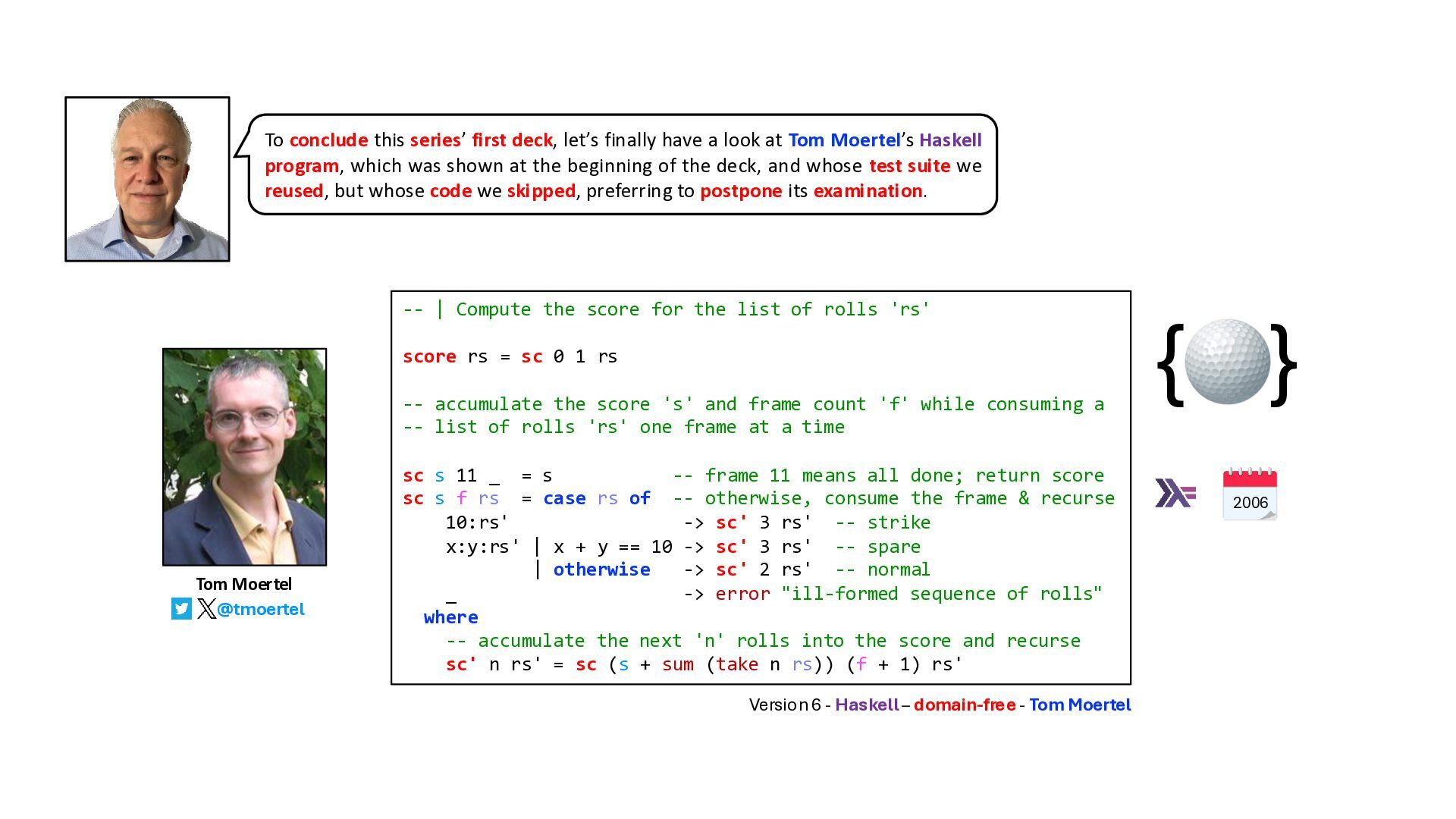
  50. To conclude this series’ first deck, let’s finally have a

    look at Tom Moertel’s Haskell program, which was shown at the beginning of the deck, and whose test suite we reused, but whose code we skipped, preferring to postpone its examination. -- | Compute the score for the list of rolls 'rs' score rs = sc 0 1 rs -- accumulate the score 's' and frame count 'f' while consuming a -- list of rolls 'rs' one frame at a time Tom Moertel @tmoertel sc s 11 _ = s -- frame 11 means all done; return score sc s f rs = case rs of -- otherwise, consume the frame & recurse 10:rs' -> sc' 3 rs' -- strike x:y:rs' | x + y == 10 -> sc' 3 rs' -- spare | otherwise -> sc' 2 rs' -- normal _ -> error "ill-formed sequence of rolls" where -- accumulate the next 'n' rolls into the score and recurse sc' n rs' = sc (s + sum (take n rs)) (f + 1) rs' Version 6 - Haskell – domain-free - Tom Moertel { } 2006
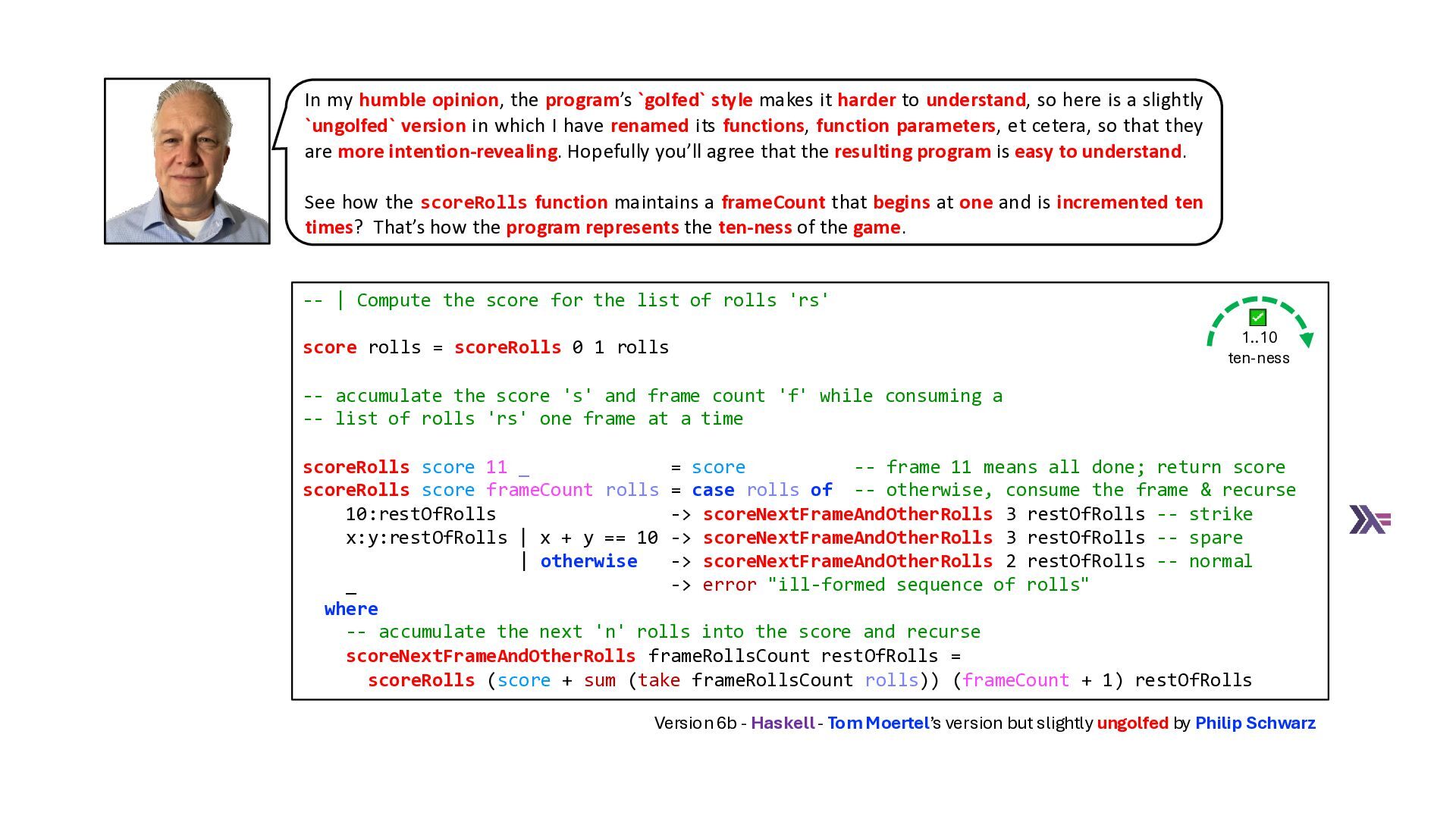
  51. In my humble opinion, the program’s `golfed` style makes it

    harder to understand, so here is a slightly `ungolfed` version in which I have renamed its functions, function parameters, et cetera, so that they are more intention-revealing. Hopefully you’ll agree that the resulting program is easy to understand. See how the scoreRolls function maintains a frameCount that begins at one and is incremented ten times? That’s how the program represents the ten-ness of the game. -- | Compute the score for the list of rolls 'rs' score rolls = scoreRolls 0 1 rolls ✅ 1..10 ten-ness -- accumulate the score 's' and frame count 'f' while consuming a -- list of rolls 'rs' one frame at a time scoreRolls score 11 _ = score -- frame 11 means all done; return score scoreRolls score frameCount rolls = case rolls of -- otherwise, consume the frame & recurse 10:restOfRolls -> scoreNextFrameAndOtherRolls 3 restOfRolls -- strike x:y:restOfRolls | x + y == 10 -> scoreNextFrameAndOtherRolls 3 restOfRolls -- spare | otherwise -> scoreNextFrameAndOtherRolls 2 restOfRolls -- normal _ -> error "ill-formed sequence of rolls" where -- accumulate the next 'n' rolls into the score and recurse scoreNextFrameAndOtherRolls frameRollsCount restOfRolls = scoreRolls (score + sum (take frameRollsCount rolls)) (frameCount + 1) restOfRolls Version 6b - Haskell - Tom Moertel’s version but slightly ungolfed by Philip Schwarz
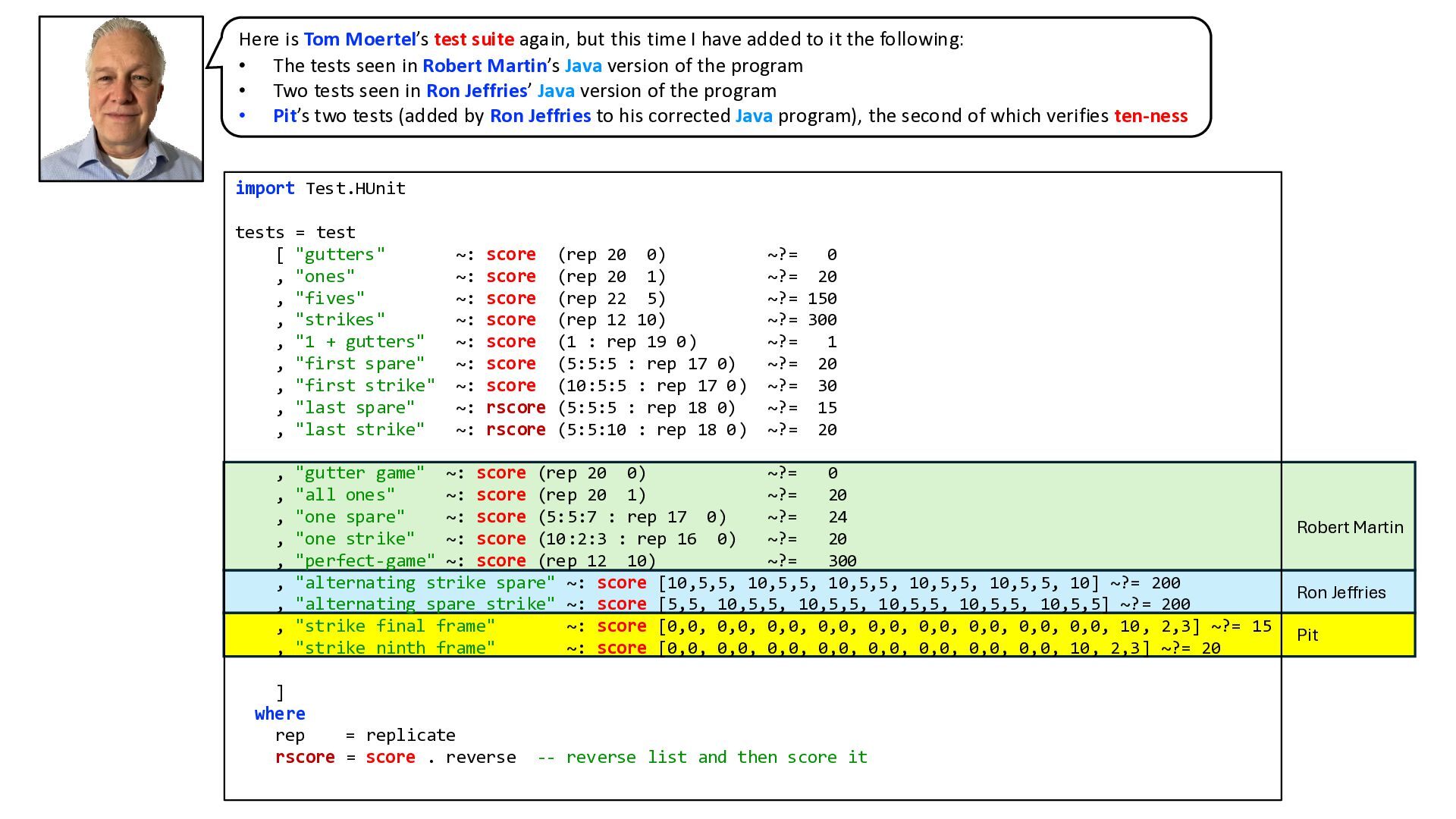
  52. Here is Tom Moertel’s test suite again, but this time

    I have added to it the following: • The tests seen in Robert Martin’s Java version of the program • Two tests seen in Ron Jeffries’ Java version of the program • Pit’s two tests (added by Ron Jeffries to his corrected Java program), the second of which verifies ten-ness import Test.HUnit tests = test [ "gutters" , "ones" , "fives" , "strikes" , "1 + gutters" , "first spare" , "first strike" , "last spare" , "last strike" ~: score (rep 20 0) ~: score (rep 20 1) ~: score (rep 22 5) ~: score (rep 12 10) ~: score (1 : rep 19 0) ~: score (5:5:5 : rep 17 0) ~: score (10:5:5 : rep 17 0) ~: rscore (5:5:5 : rep 18 0) ~: rscore (5:5:10 : rep 18 0) ~?= 0 ~?= 20 ~?= 150 ~?= 300 ~?= 1 ~?= 20 ~?= 30 ~?= 15 ~?= 20 , "gutter game" ~: score (rep 20 0) ~?= 0 , "all ones" ~: score (rep 20 1) ~?= 20 , "one spare" ~: score (5:5:7 : rep 17 0) ~?= 24 , "one strike" ~: score (10:2:3 : rep 16 0) ~?= 20 , "perfect-game" ~: score (rep 12 10) ~?= 300 , "alternating strike spare" ~: score [10,5,5, 10,5,5, 10,5,5, 10,5,5, 10,5,5, 10] ~?= 200 , "alternating spare strike" ~: score [5,5, 10,5,5, 10,5,5, 10,5,5, 10,5,5, 10,5,5] ~?= 200 , "strike final frame" ~: score [0,0, 0,0, 0,0, 0,0, 0,0, 0,0, 0,0, 0,0, 0,0, 10, 2,3] ~?= 15 , "strike ninth frame" ~: score [0,0, 0,0, 0,0, 0,0, 0,0, 0,0, 0,0, 0,0, 10, 2,3] ~?= 20 ] where rep = replicate rscore = score . reverse -- reverse list and then score it Robert Martin Ron Jeffries Pit