$30 off During Our Annual Pro Sale. View Details »

Pimp my Platform: Using AlloyDB with GKE

Pimp my Platform: Using AlloyDB with GKE

AlloyDB is GCP's new, fully-managed, PostgreSQL-compatible database service that recently went GA. It combines the benefits of the well-known (and loved) open-source DBMS PostgreSQL with those of Google managed services.
In this talk, Tobias will explain how AlloyDB works and the benefits it provides over a standalone PostgreSQL integration. Additionally, he will show how to integrate AlloyDB with applications running in Google Kubernetes Engine (GKE), according to Google best practices.
Tobias is a Cloud Developer and IT Consultant at Posedio GmbH. He is also a passionate backend and DevOps engineer and a certified Professional Google Cloud Developer.
Recently, he worked on migrating a customer's GKE workloads from CloudSQL to AlloyDB and is now looking forward to sharing his newfound expertise.

Avatar for Posedio

Posedio PRO

March 23, 2023
Tweet

More Decks by Posedio

Other Decks in Programming

Transcript

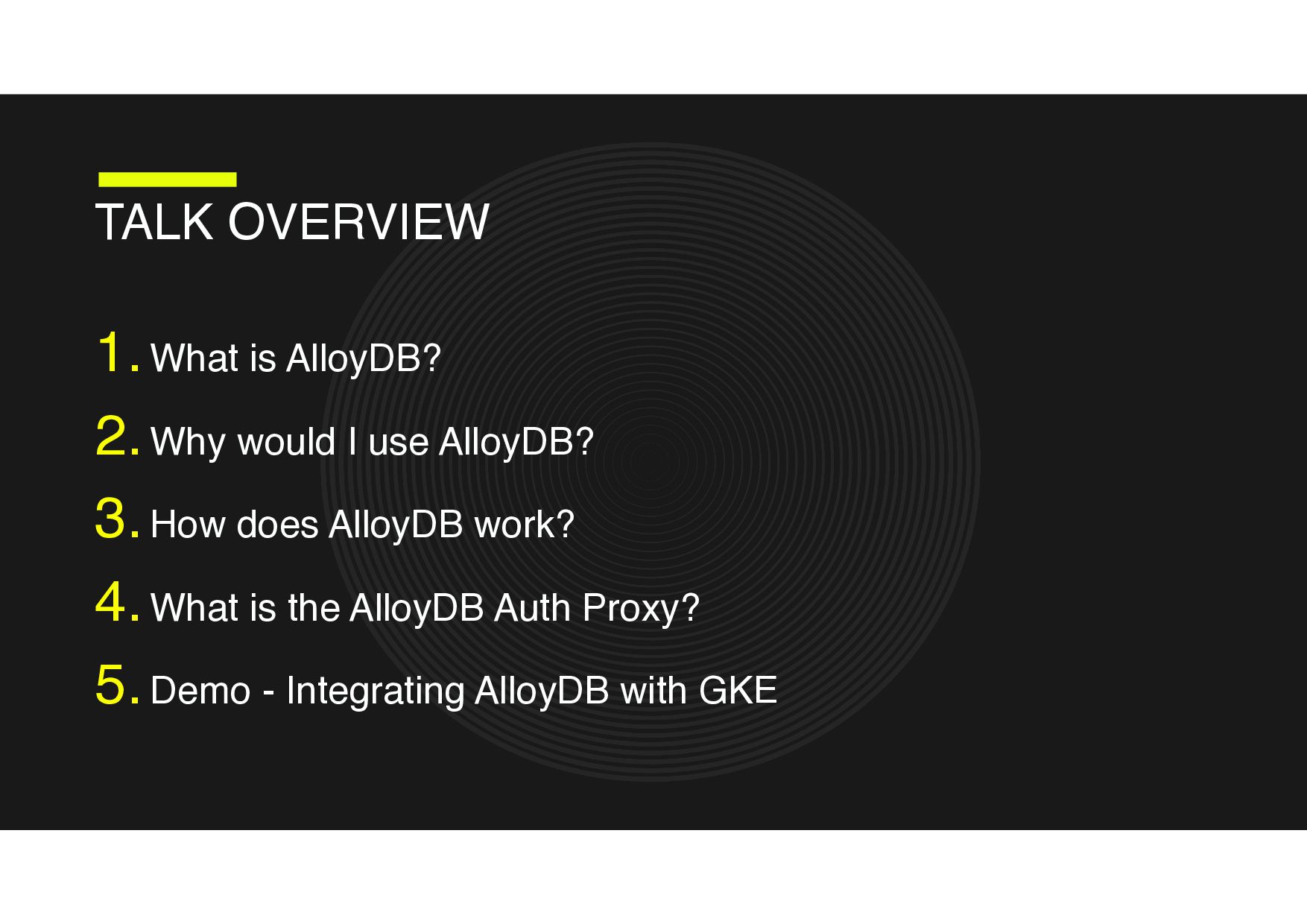
  1. TALK OVERVIEW 1.What is AlloyDB? 2.Why would I use AlloyDB?

    3.How does AlloyDB work? 4.What is the AlloyDB Auth Proxy? 5.Demo - Integrating AlloyDB with GKE
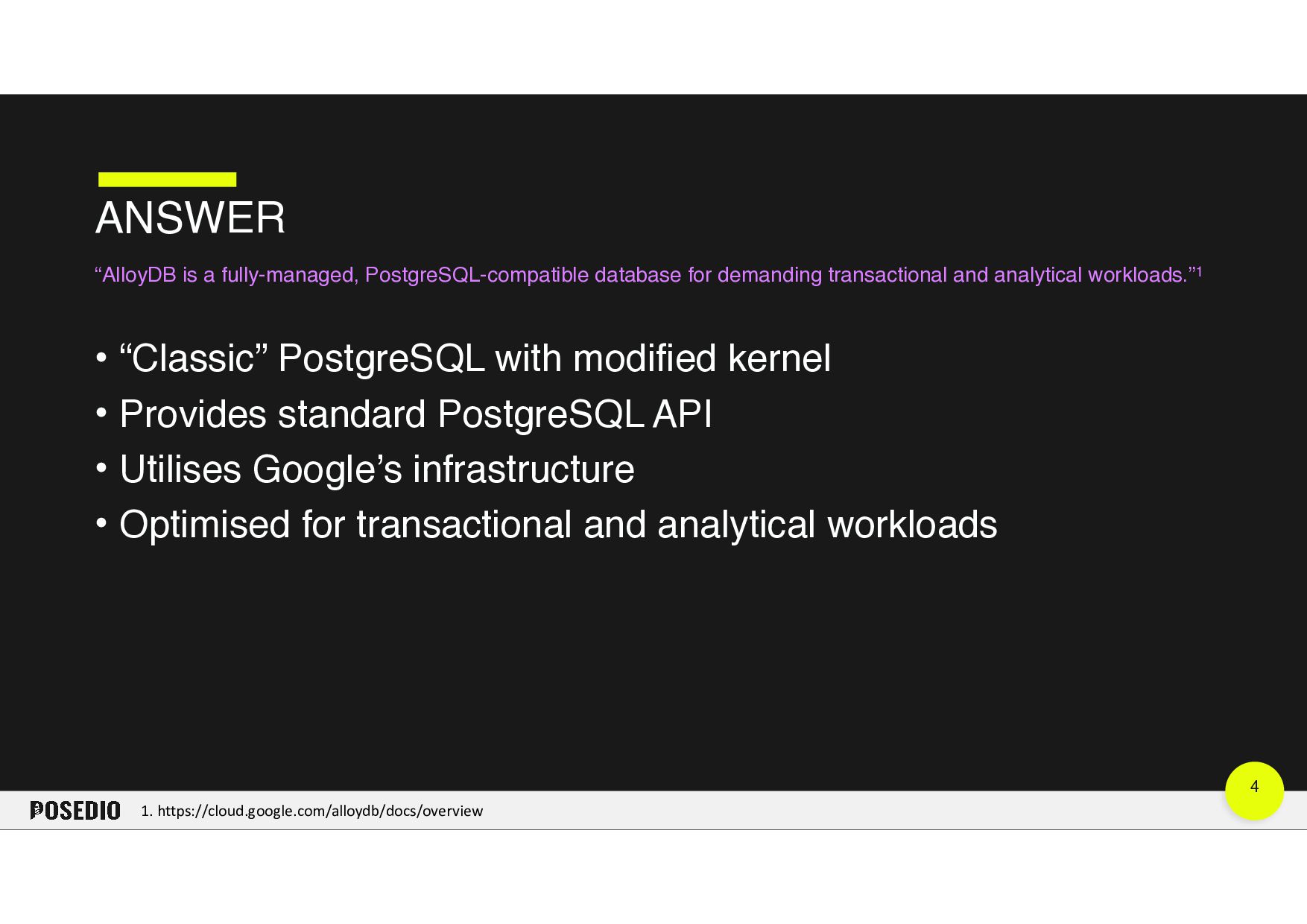
  2. 4 ANSWER • “Classic” PostgreSQL with modified kernel • Provides

    standard PostgreSQL API • Utilises Google’s infrastructure • Optimised for transactional and analytical workloads “AlloyDB is a fully-managed, PostgreSQL-compatible database for demanding transactional and analytical workloads.”1 1. https://cloud.google.com/alloydb/docs/overview
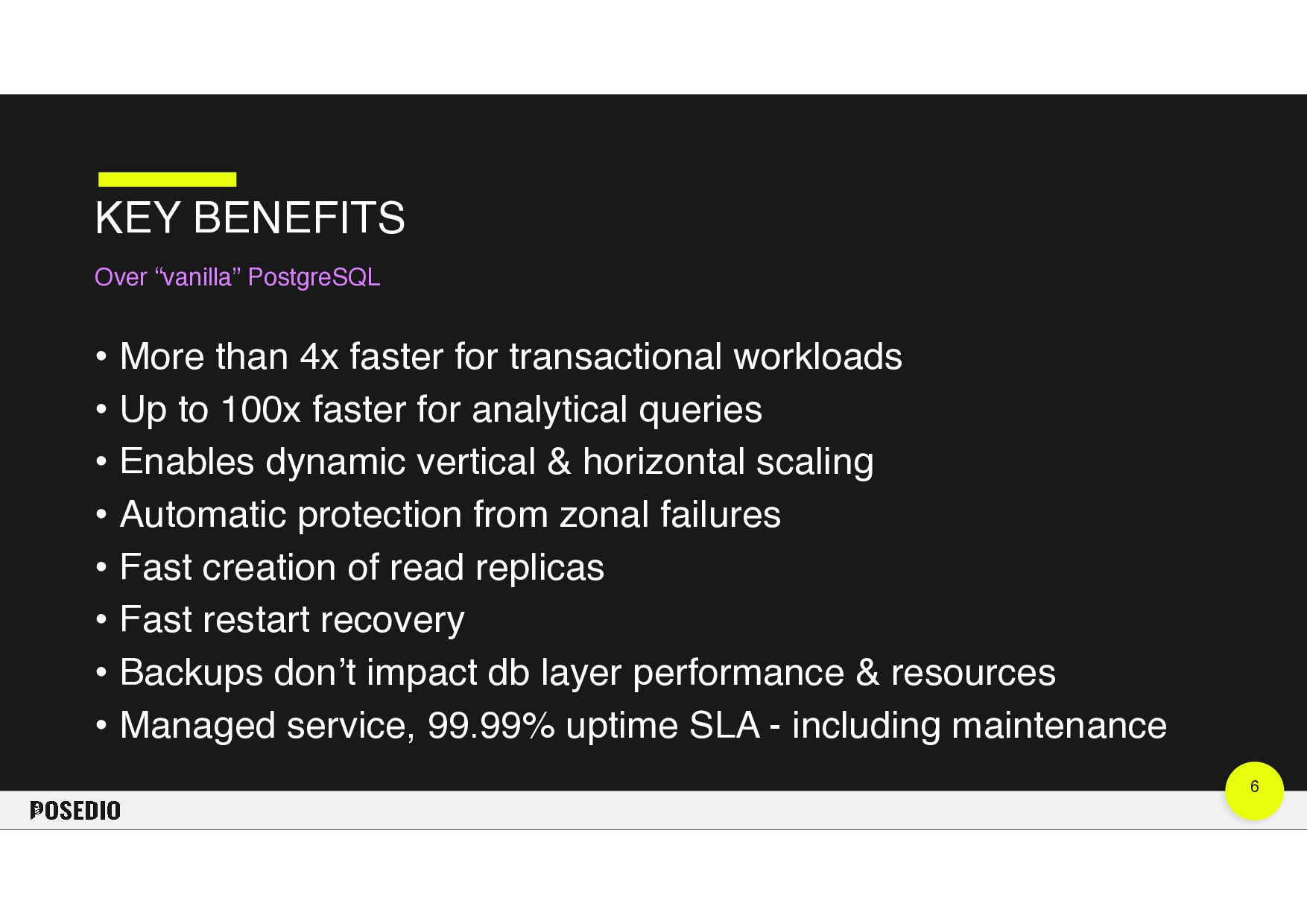
  3. 6 KEY BENEFITS • More than 4x faster for transactional

    workloads • Up to 100x faster for analytical queries • Enables dynamic vertical & horizontal scaling • Automatic protection from zonal failures • Fast creation of read replicas • Fast restart recovery • Backups don’t impact db layer performance & resources • Managed service, 99.99% uptime SLA - including maintenance Over “vanilla” PostgreSQL
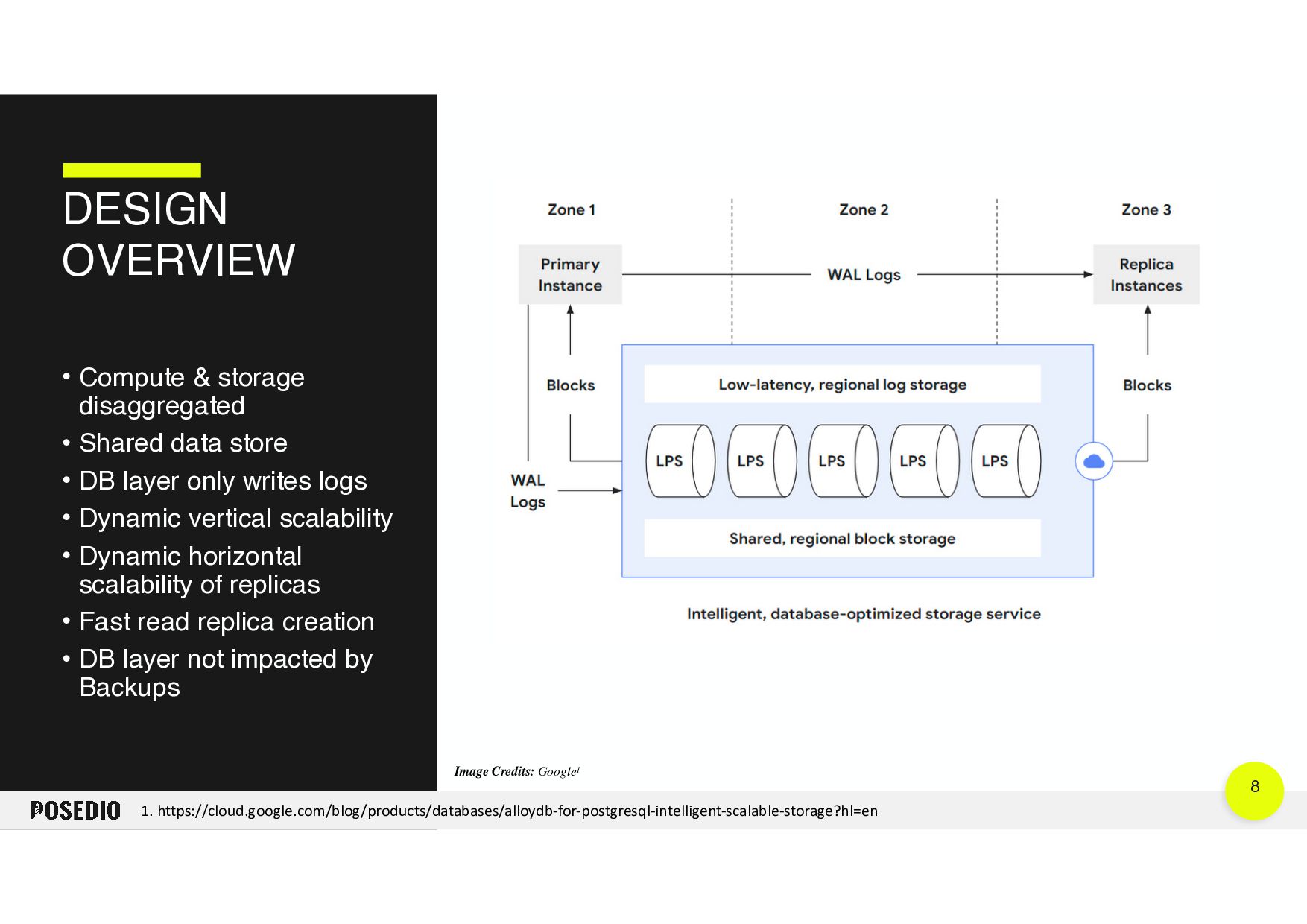
  4. 8 DESIGN OVERVIEW • Compute & storage disaggregated • Shared

    data store • DB layer only writes logs • Dynamic vertical scalability • Dynamic horizontal scalability of replicas • Fast read replica creation • DB layer not impacted by Backups Image Credits: Google1 1. https://cloud.google.com/blog/products/databases/alloydb-for-postgresql-intelligent-scalable-storage?hl=en
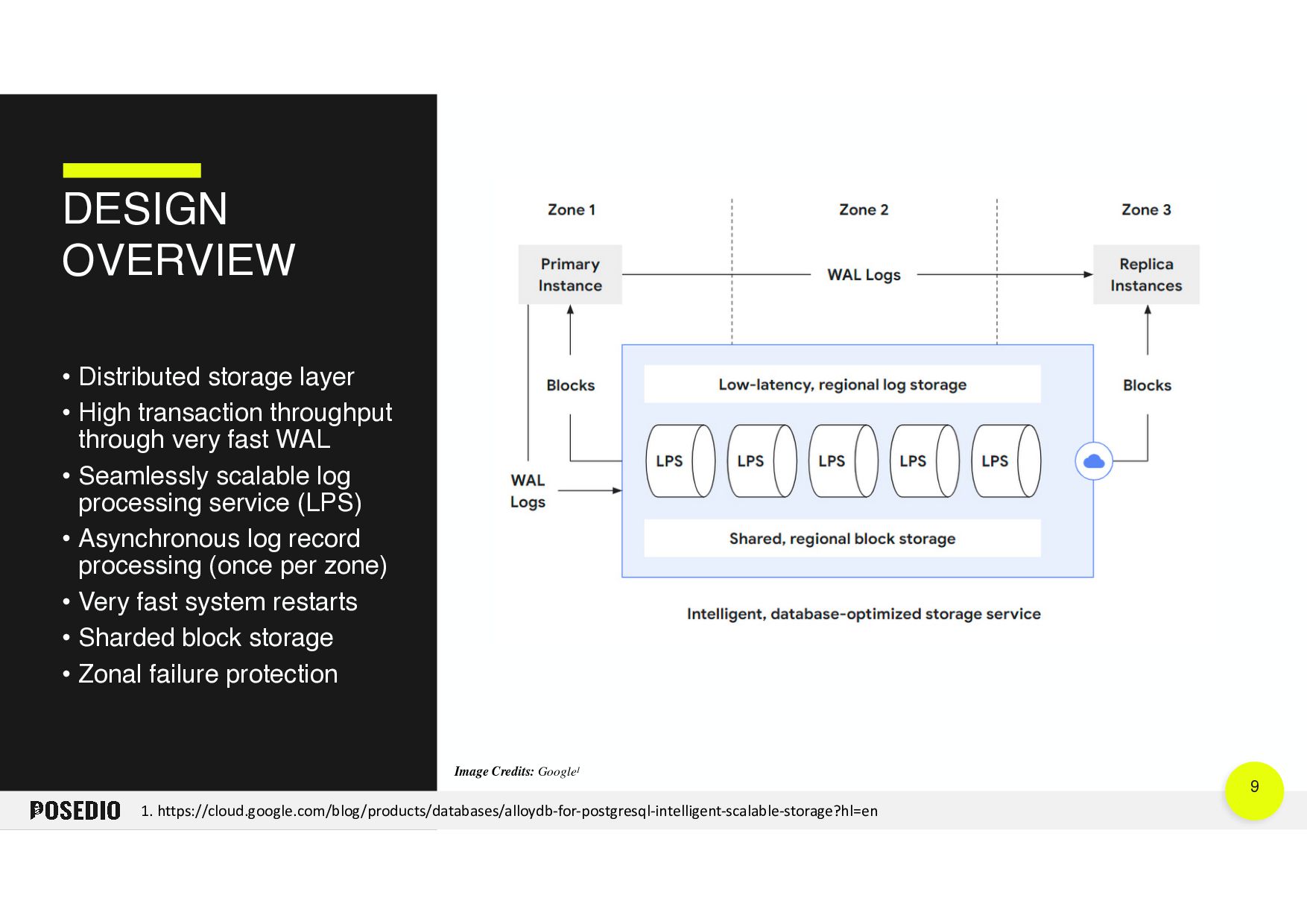
  5. 9 DESIGN OVERVIEW • Distributed storage layer • High transaction

    throughput through very fast WAL • Seamlessly scalable log processing service (LPS) • Asynchronous log record processing (once per zone) • Very fast system restarts • Sharded block storage • Zonal failure protection Image Credits: Google1 1. https://cloud.google.com/blog/products/databases/alloydb-for-postgresql-intelligent-scalable-storage?hl=en
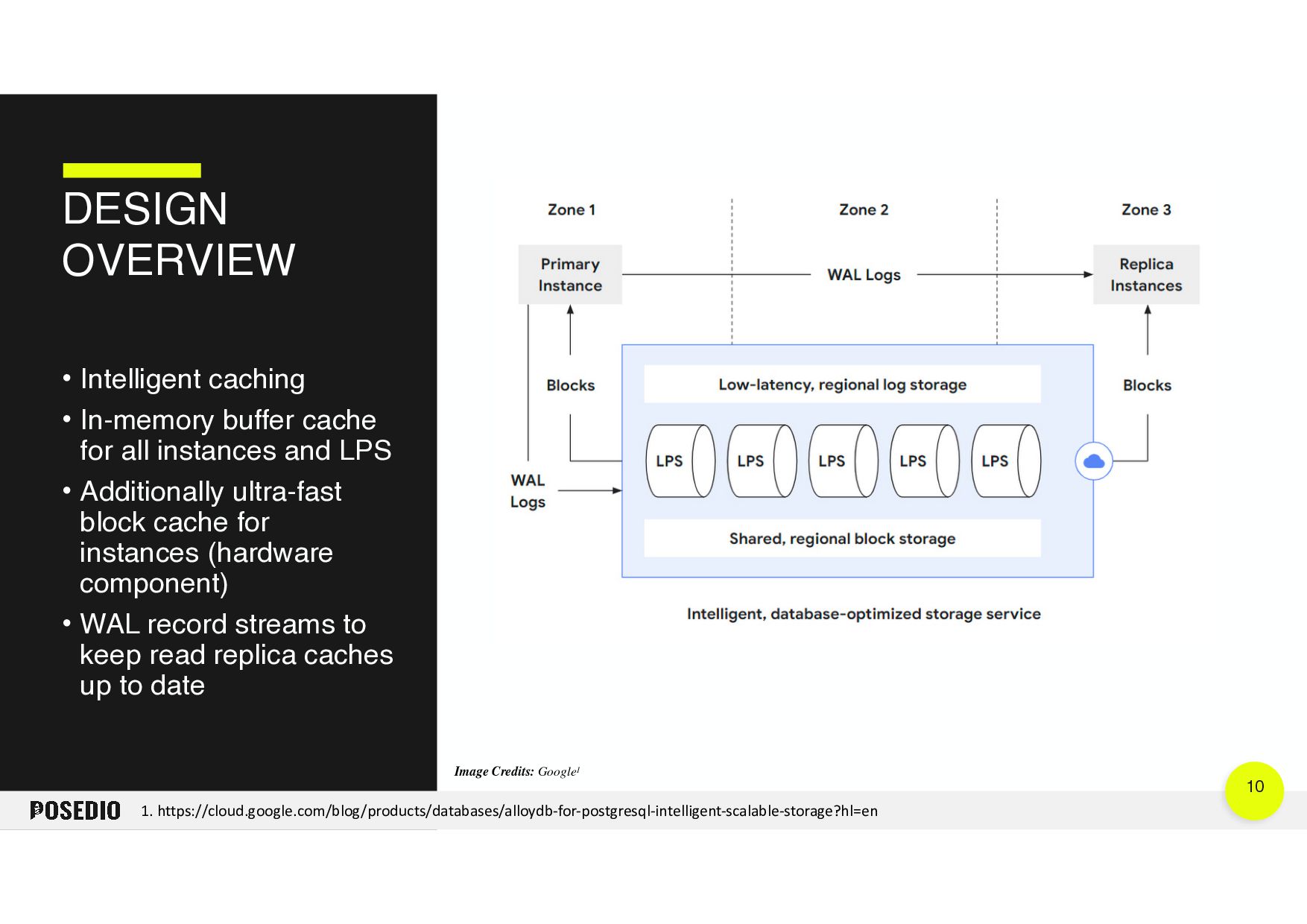
  6. 10 DESIGN OVERVIEW • Intelligent caching • In-memory buffer cache

    for all instances and LPS • Additionally ultra-fast block cache for instances (hardware component) • WAL record streams to keep read replica caches up to date Image Credits: Google1 1. https://cloud.google.com/blog/products/databases/alloydb-for-postgresql-intelligent-scalable-storage?hl=en
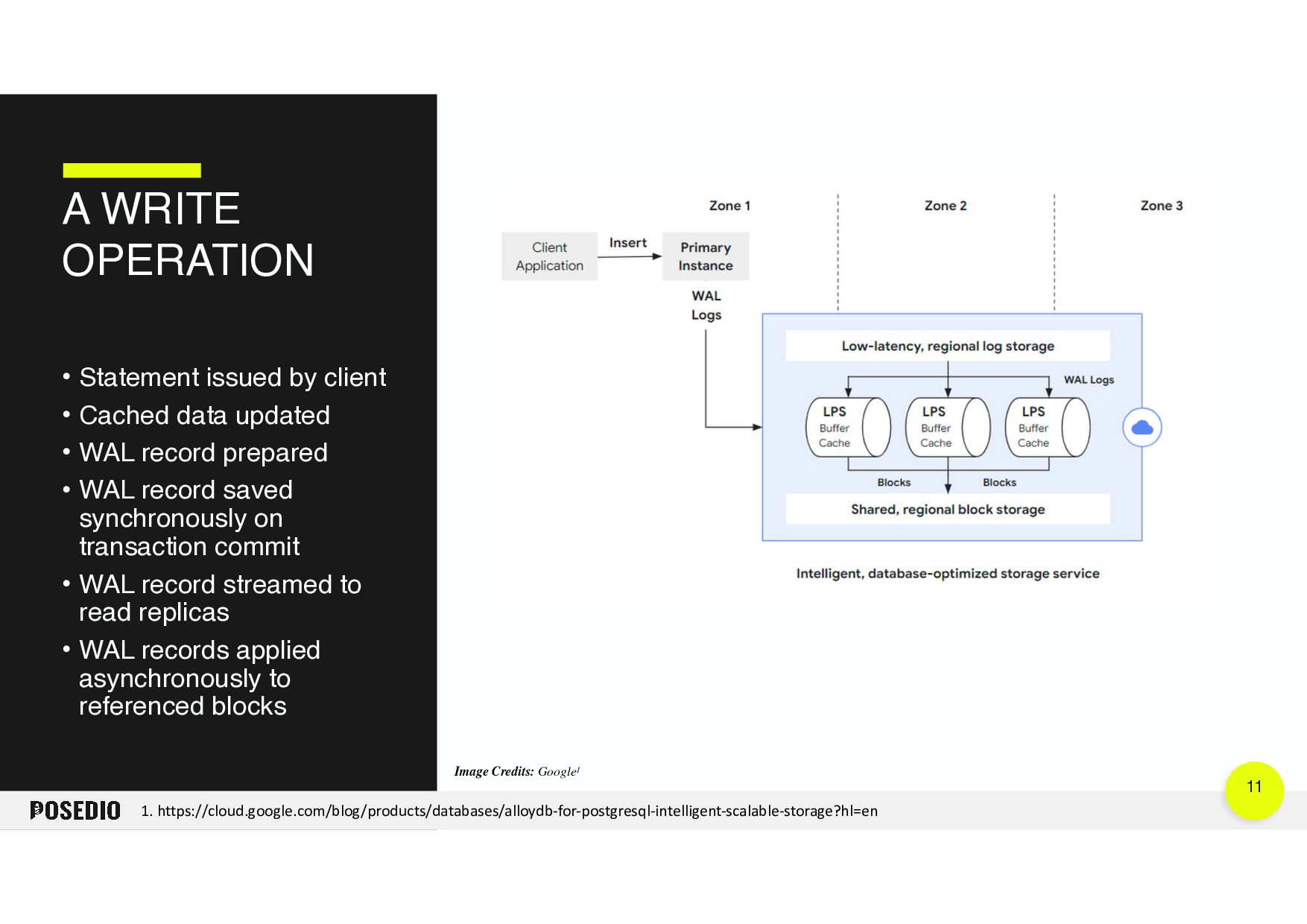
  7. 11 A WRITE OPERATION • Statement issued by client •

    Cached data updated • WAL record prepared • WAL record saved synchronously on transaction commit • WAL record streamed to read replicas • WAL records applied asynchronously to referenced blocks Image Credits: Google1 1. https://cloud.google.com/blog/products/databases/alloydb-for-postgresql-intelligent-scalable-storage?hl=en
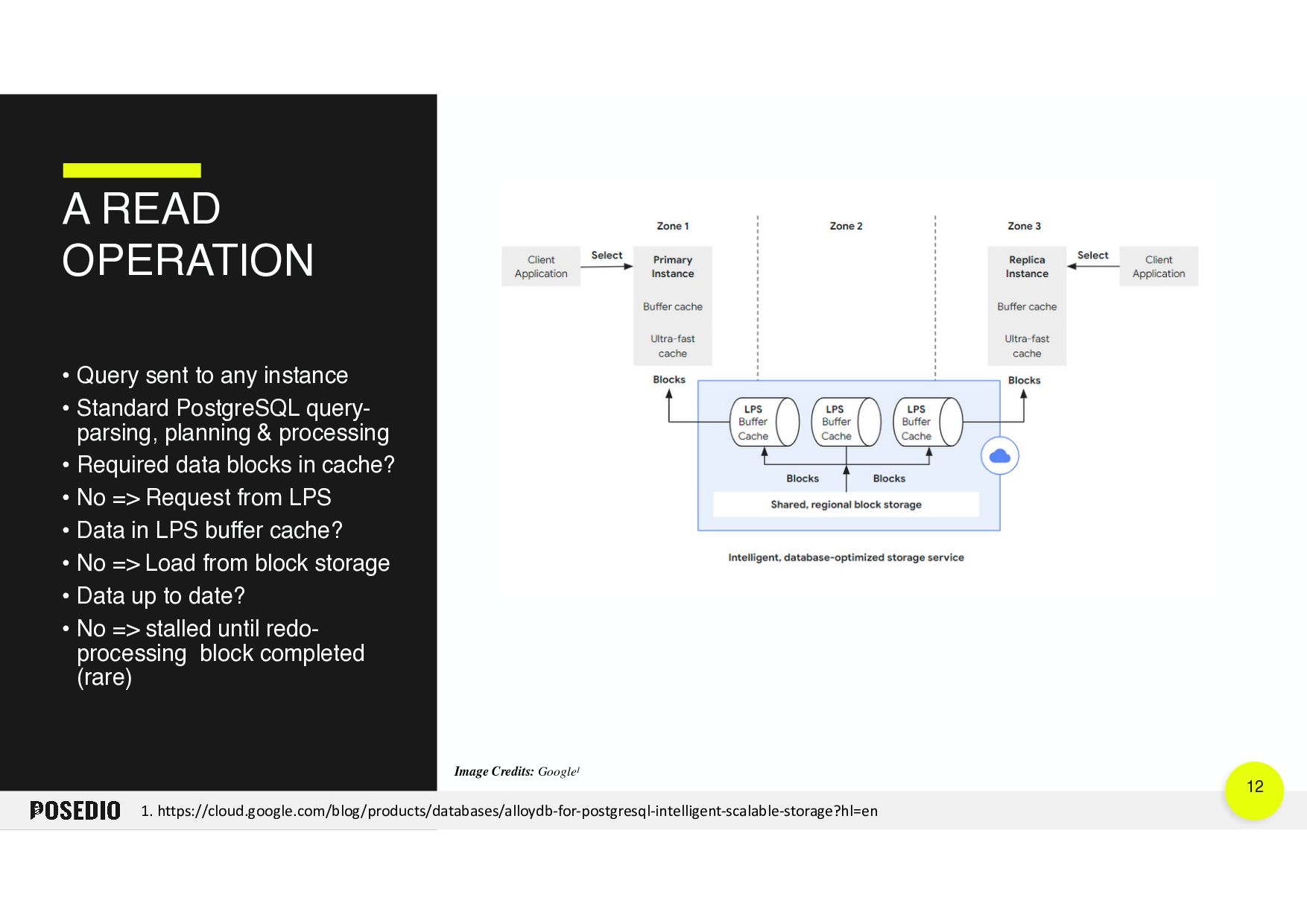
  8. 12 A READ OPERATION • Query sent to any instance

    • Standard PostgreSQL query- parsing, planning & processing • Required data blocks in cache? • No => Request from LPS • Data in LPS buffer cache? • No => Load from block storage • Data up to date? • No => stalled until redo- processing block completed (rare) Image Credits: Google1 1. https://cloud.google.com/blog/products/databases/alloydb-for-postgresql-intelligent-scalable-storage?hl=en
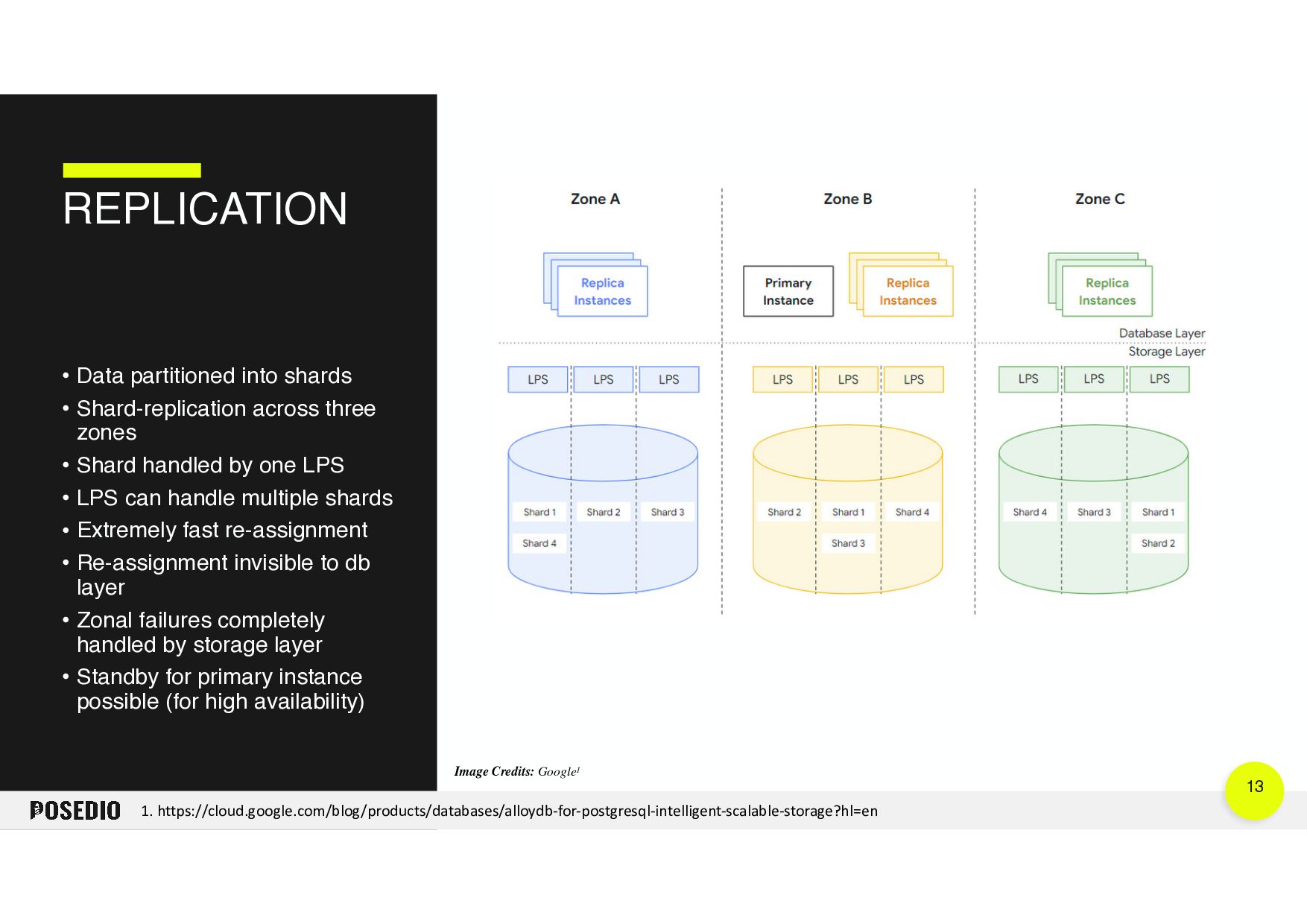
  9. 13 REPLICATION • Data partitioned into shards • Shard-replication across

    three zones • Shard handled by one LPS • LPS can handle multiple shards • Extremely fast re-assignment • Re-assignment invisible to db layer • Zonal failures completely handled by storage layer • Standby for primary instance possible (for high availability) Image Credits: Google1 1. https://cloud.google.com/blog/products/databases/alloydb-for-postgresql-intelligent-scalable-storage?hl=en
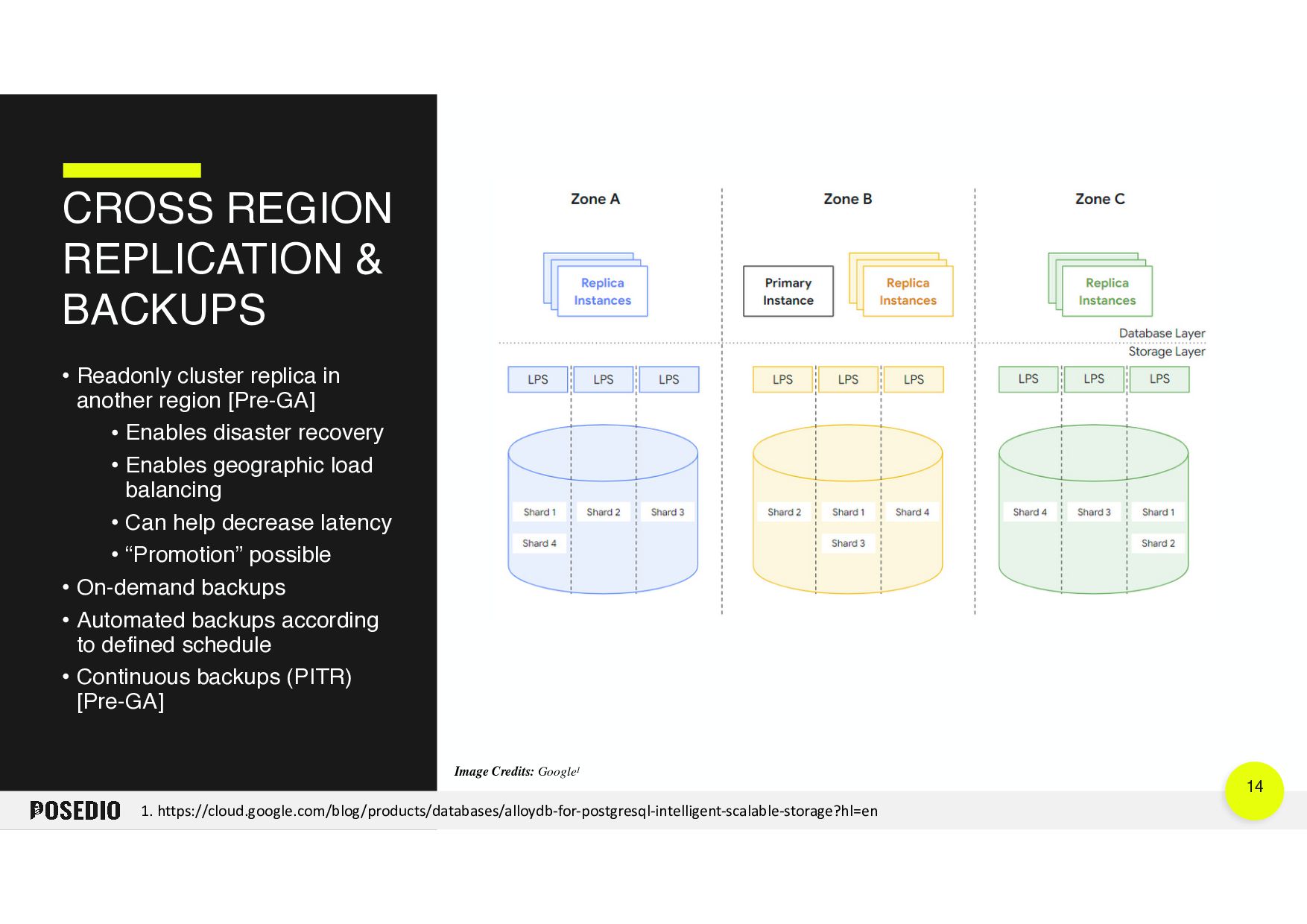
  10. 14 CROSS REGION REPLICATION & BACKUPS • Readonly cluster replica

    in another region [Pre-GA] • Enables disaster recovery • Enables geographic load balancing • Can help decrease latency • “Promotion” possible • On-demand backups • Automated backups according to defined schedule • Continuous backups (PITR) [Pre-GA] Image Credits: Google1 1. https://cloud.google.com/blog/products/databases/alloydb-for-postgresql-intelligent-scalable-storage?hl=en
  11. 15 SUPPORTED EXTENSIONS • Supports common extensions like • hypopg

    • pgaudit • pg_stat_statements • PostGIS • Provides product specific extensions like google_columnar_engine • Some extensions require setting certain database flags
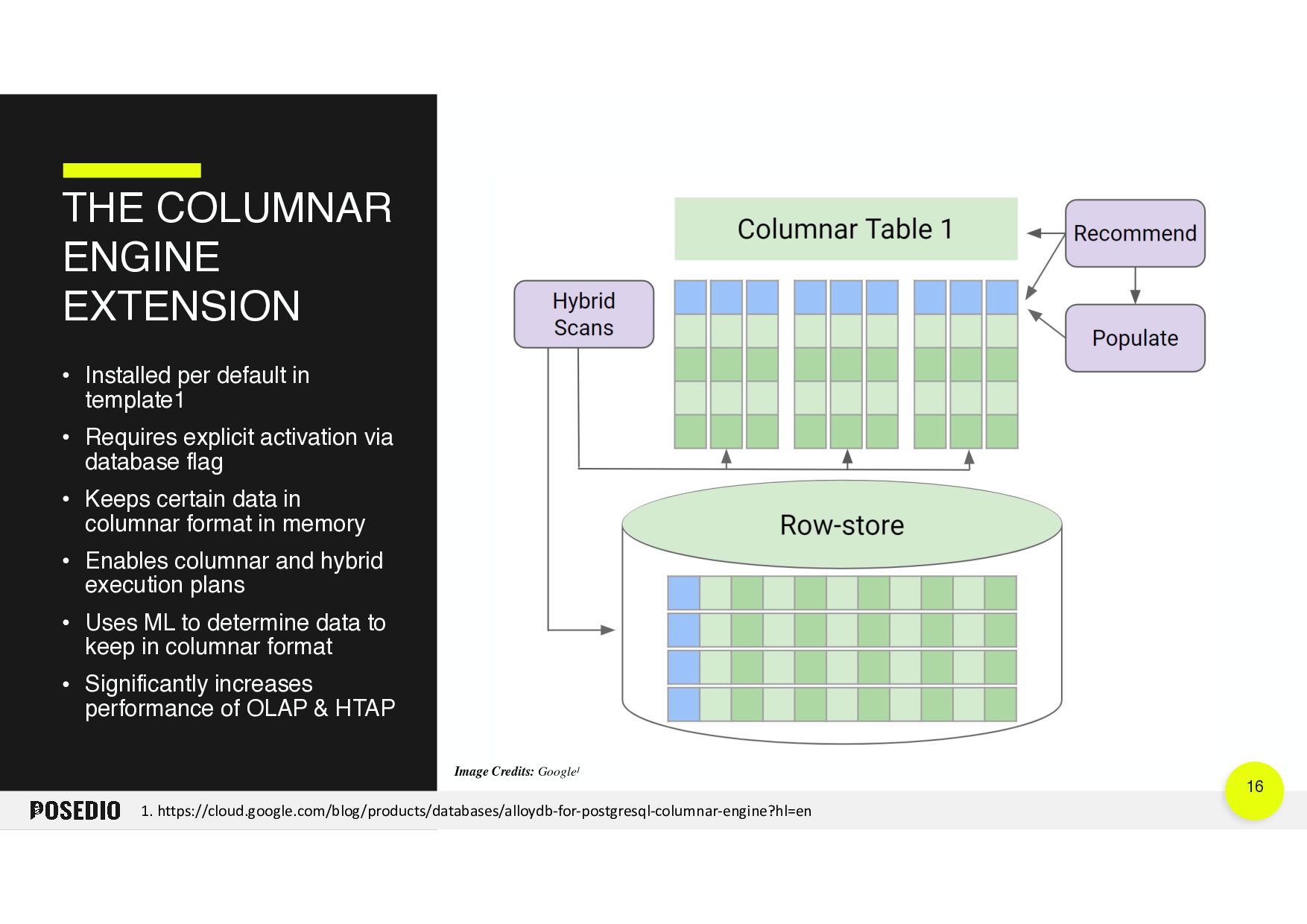
  12. 16 THE COLUMNAR ENGINE EXTENSION • Installed per default in

    template1 • Requires explicit activation via database flag • Keeps certain data in columnar format in memory • Enables columnar and hybrid execution plans • Uses ML to determine data to keep in columnar format • Significantly increases performance of OLAP & HTAP Image Credits: Google1 1. https://cloud.google.com/blog/products/databases/alloydb-for-postgresql-columnar-engine?hl=en
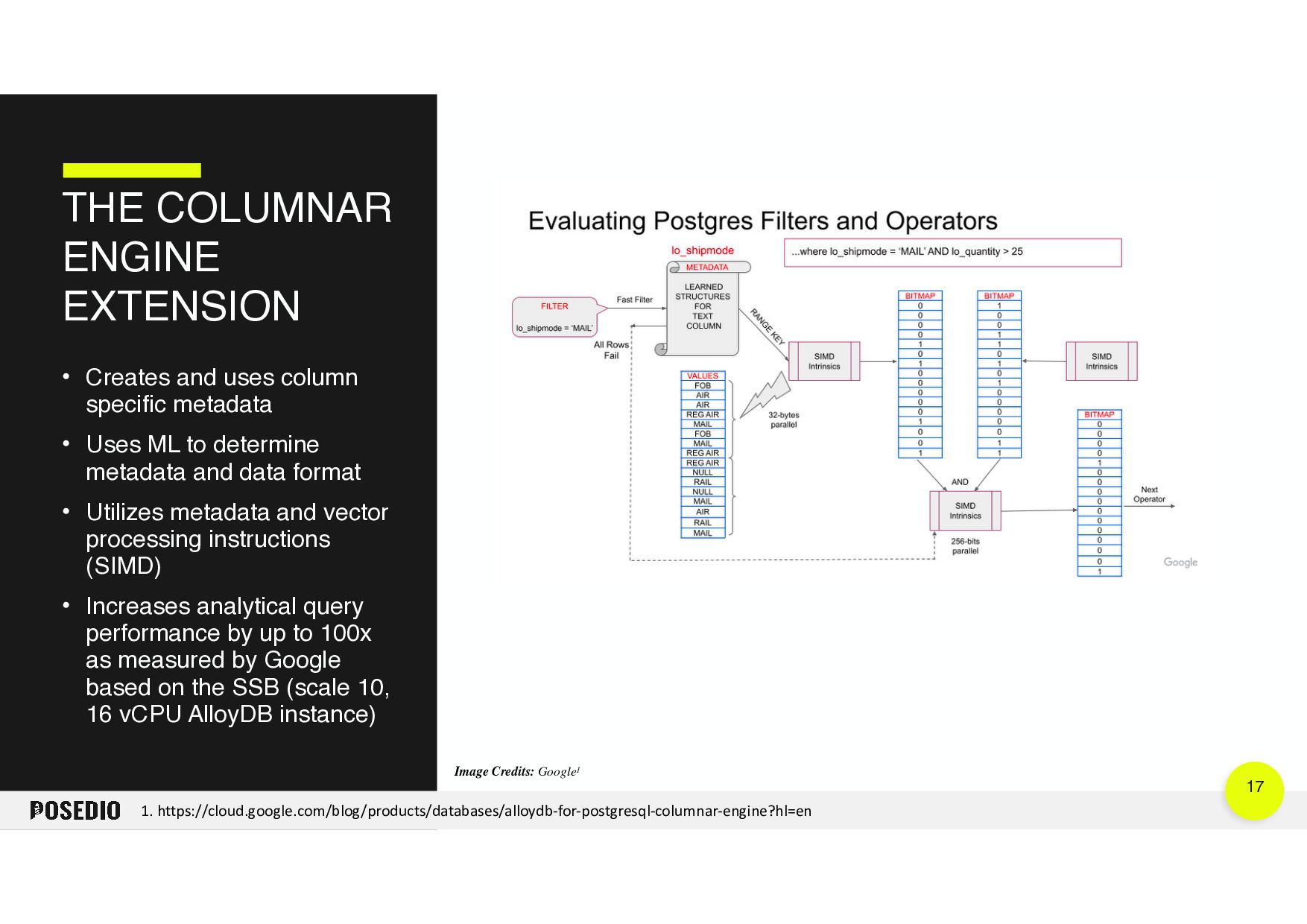
  13. 17 THE COLUMNAR ENGINE EXTENSION • Creates and uses column

    specific metadata • Uses ML to determine metadata and data format • Utilizes metadata and vector processing instructions (SIMD) • Increases analytical query performance by up to 100x as measured by Google based on the SSB (scale 10, 16 vCPU AlloyDB instance) Image Credits: Google1 1. https://cloud.google.com/blog/products/databases/alloydb-for-postgresql-columnar-engine?hl=en
  14. 19 THE AUTH PROXY • Lightweight Go application • Encrypts

    data traffic • Enables IAM based authorisation • Deploy on VM or as sidecar • Could become SPOF on VM • As sidecar availability needs to be assured • Application-authorisation through workload identity And what to mind using it in GKE
  15. THANK YOU! POSEDIO GMBH +43 660 9154419 [email protected] Weyringergasse 1-3,

    1040 Wien, 
 Millenium Park 4, 6980 Lustenau www.posedio.com