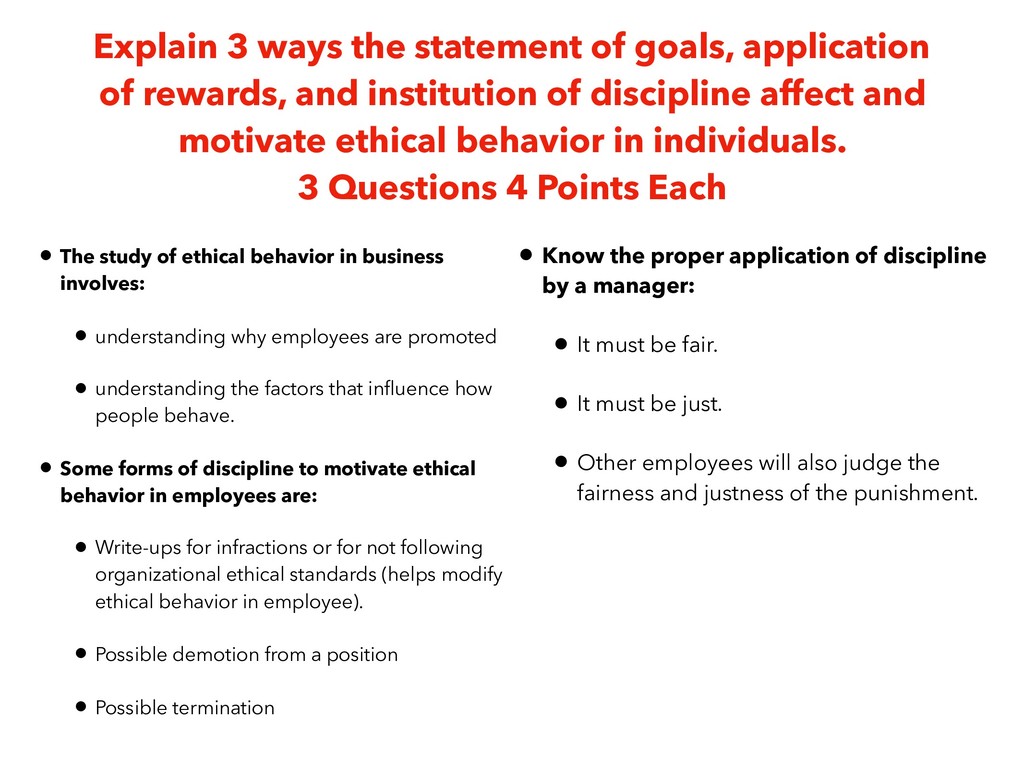
and institution of discipline affect and motivate ethical behavior in individuals. 3 Questions 4 Points Each • The study of ethical behavior in business involves: • understanding why employees are promoted • understanding the factors that influence how people behave. • Some forms of discipline to motivate ethical behavior in employees are: • Write-ups for infractions or for not following organizational ethical standards (helps modify ethical behavior in employee). • Possible demotion from a position • Possible termination • Know the proper application of discipline by a manager: • It must be fair. • It must be just. • Other employees will also judge the fairness and justness of the punishment.
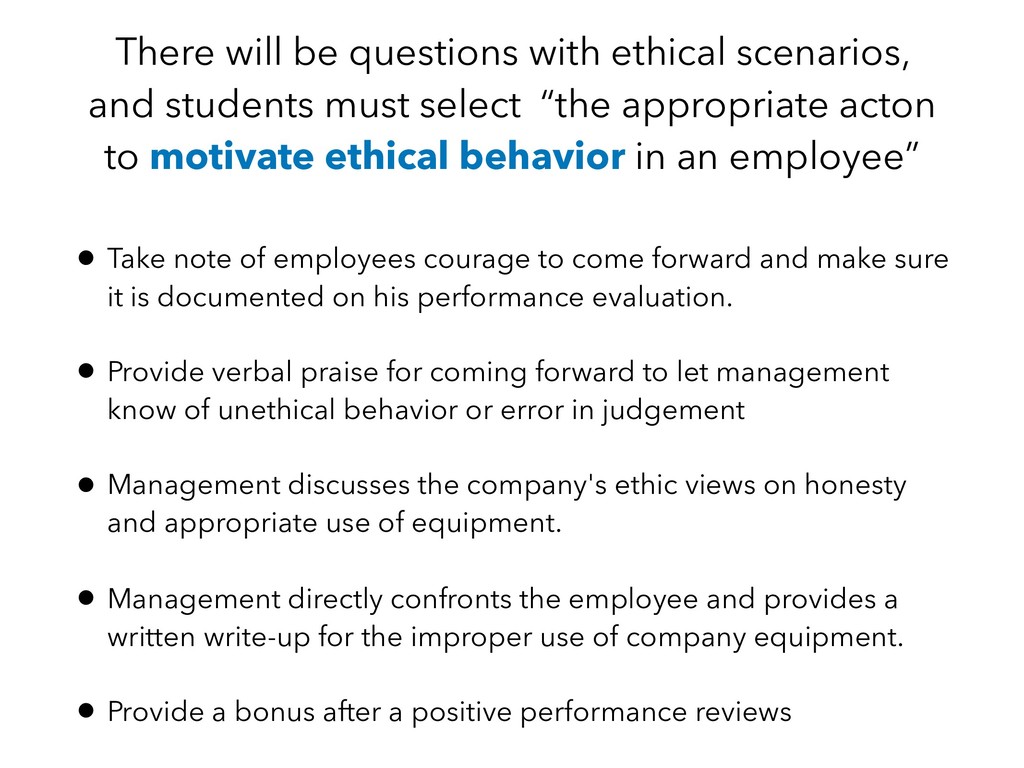
select “the appropriate acton to motivate ethical behavior in an employee” • Take note of employees courage to come forward and make sure it is documented on his performance evaluation. • Provide verbal praise for coming forward to let management know of unethical behavior or error in judgement • Management discusses the company's ethic views on honesty and appropriate use of equipment. • Management directly confronts the employee and provides a written write-up for the improper use of company equipment. • Provide a bonus after a positive performance reviews
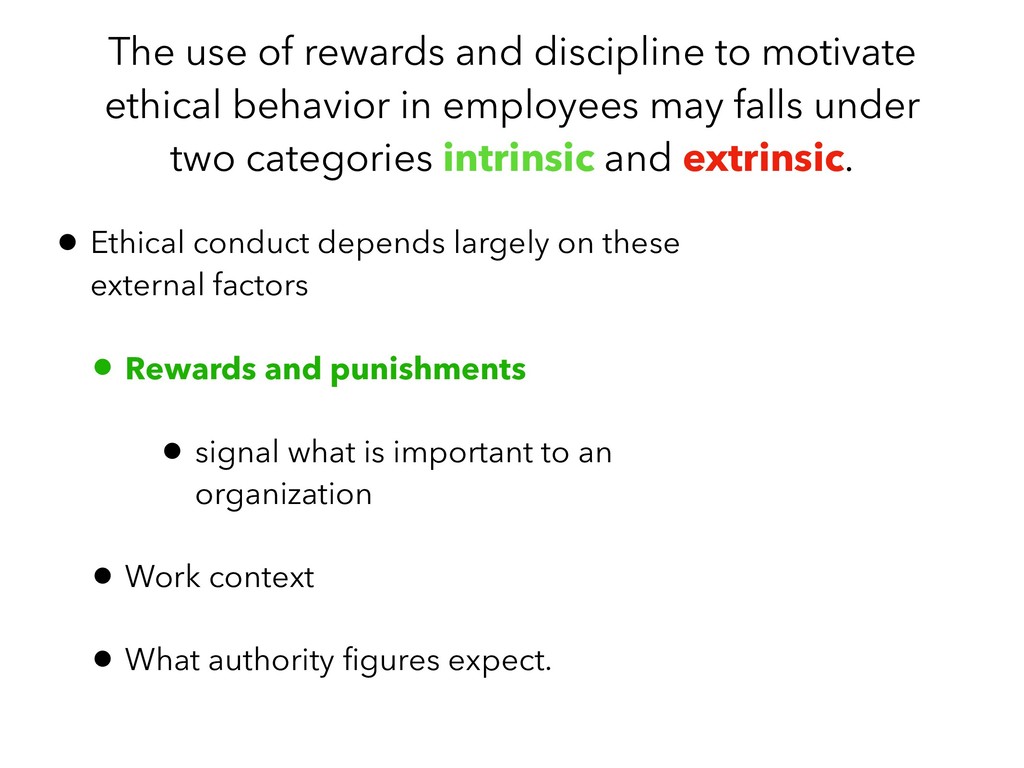
in employees may falls under two categories intrinsic and extrinsic. • Ethical conduct depends largely on these external factors • Rewards and punishments • signal what is important to an organization • Work context • What authority figures expect.
The different ways in which people behave in different situations and playing different roles. • Example: Behaves ethically at home and work, and unethically at school.
match what is really happening? • Group Norms- Informal standards of behavior • Rationalization such as “everyones is doing it.” • Reasons individuals may not feel personally responsible for their organizational actions: • Responsibility is diffused because it is taken away. • When individual responsibility is absolved because of membership in the organization. • Diffusion of responsibility (for example: 9/11 and how the FBI and CIA had a diffusion of responsibility). • Bystander Effect • Responsibility is diluted by psychological distance (cognitive separation between the self and other instances such as persons, events, or times). • Responsibility is shared with others in decision-making groups. • Social Learning Theory- workers don’t have to be personally rewarded (or punished) for a message to have an impact
disciplining unethical behavior. • Managers must be aware that conflicting role demands can pressure workers to be dishonest. • When a manager behave unethically we should remove the manager from their position in authority.
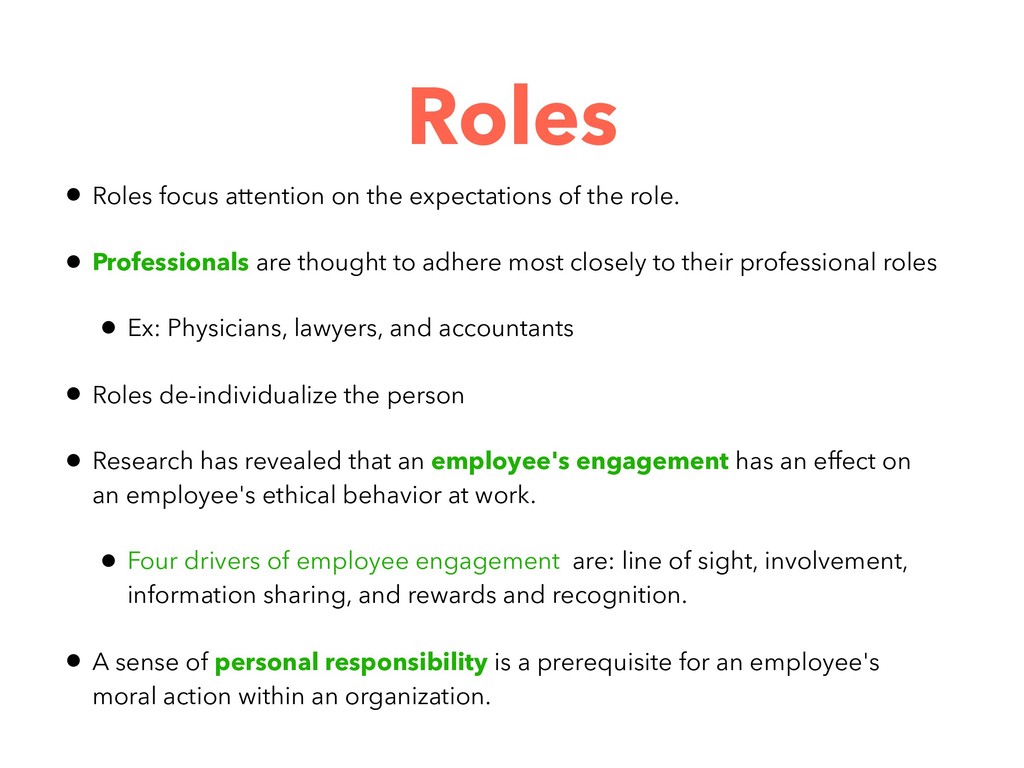
role. • Professionals are thought to adhere most closely to their professional roles • Ex: Physicians, lawyers, and accountants • Roles de-individualize the person • Research has revealed that an employee's engagement has an effect on an employee's ethical behavior at work. • Four drivers of employee engagement are: line of sight, involvement, information sharing, and rewards and recognition. • A sense of personal responsibility is a prerequisite for an employee's moral action within an organization.
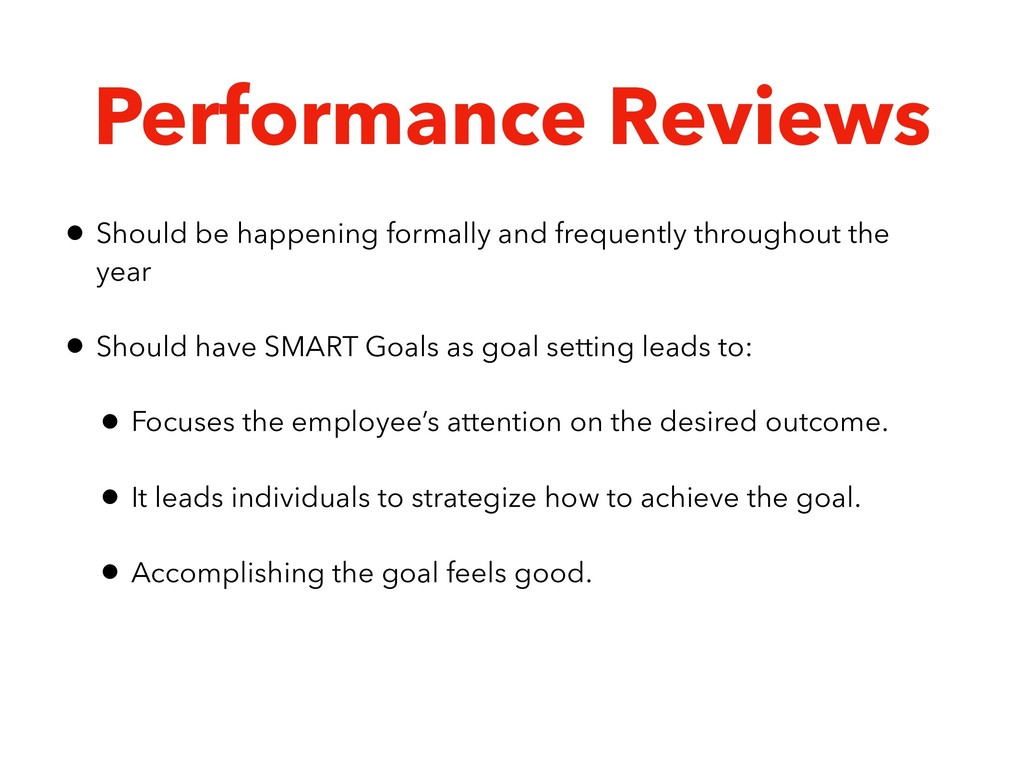
the year • Should have SMART Goals as goal setting leads to: • Focuses the employee’s attention on the desired outcome. • It leads individuals to strategize how to achieve the goal. • Accomplishing the goal feels good.
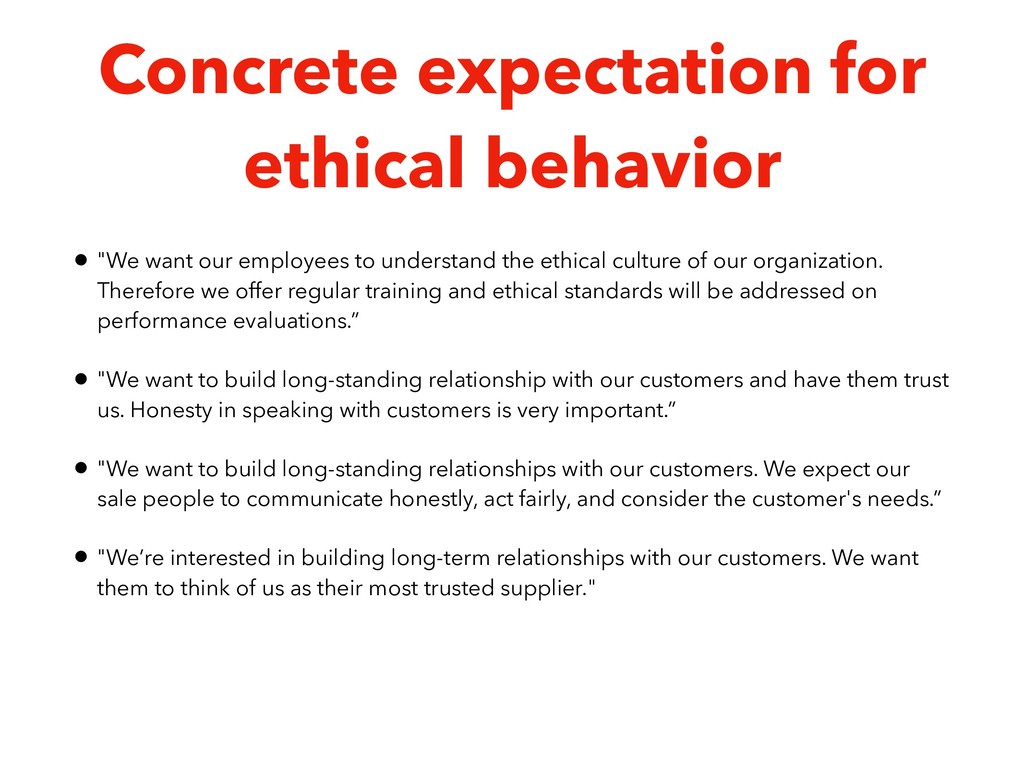
to understand the ethical culture of our organization. Therefore we offer regular training and ethical standards will be addressed on performance evaluations.” • "We want to build long-standing relationship with our customers and have them trust us. Honesty in speaking with customers is very important.” • "We want to build long-standing relationships with our customers. We expect our sale people to communicate honestly, act fairly, and consider the customer's needs.” • "We’re interested in building long-term relationships with our customers. We want them to think of us as their most trusted supplier."
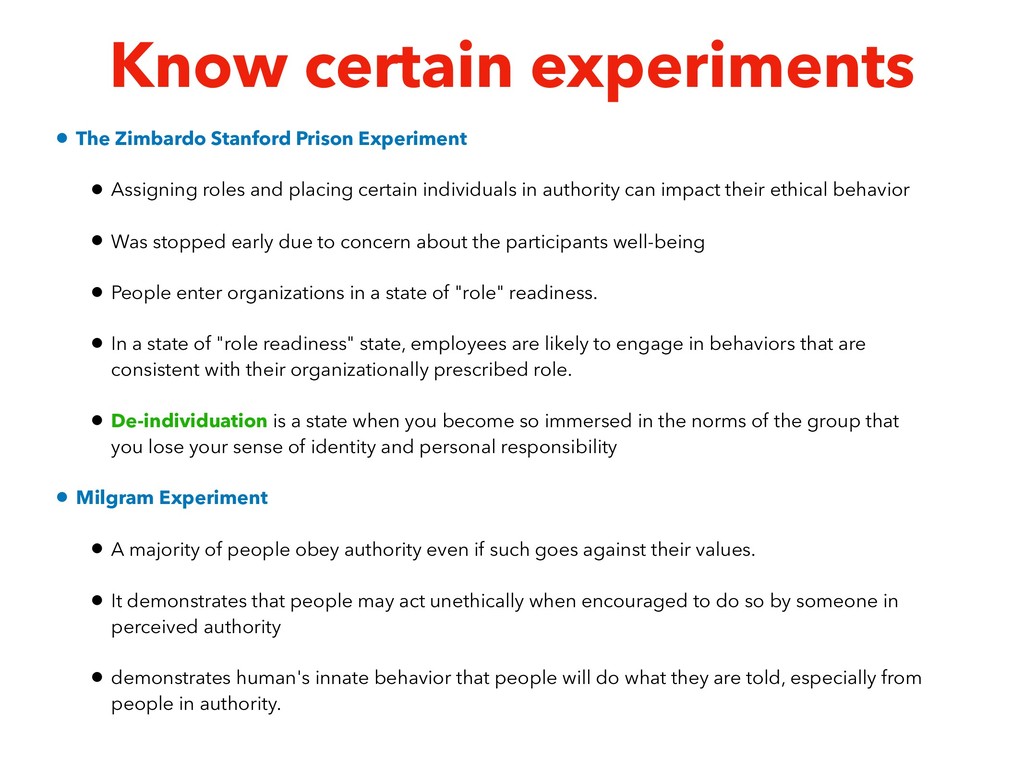
Assigning roles and placing certain individuals in authority can impact their ethical behavior • Was stopped early due to concern about the participants well-being • People enter organizations in a state of "role" readiness. • In a state of "role readiness" state, employees are likely to engage in behaviors that are consistent with their organizationally prescribed role. • De-individuation is a state when you become so immersed in the norms of the group that you lose your sense of identity and personal responsibility • Milgram Experiment • A majority of people obey authority even if such goes against their values. • It demonstrates that people may act unethically when encouraged to do so by someone in perceived authority • demonstrates human's innate behavior that people will do what they are told, especially from people in authority.
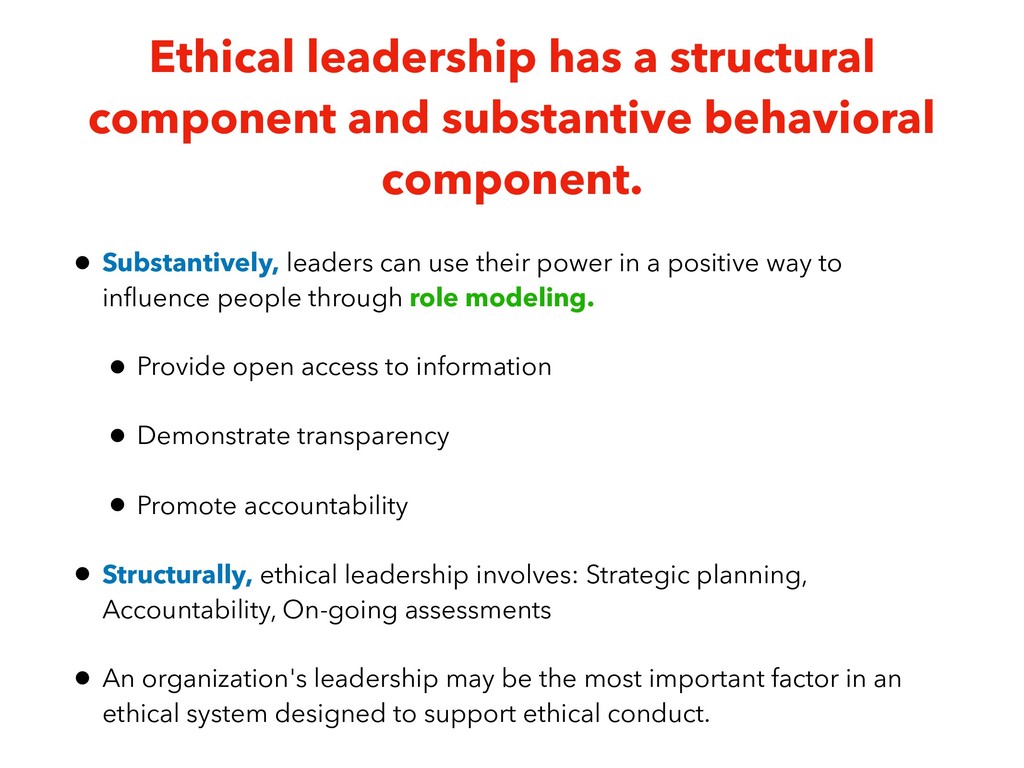
• Substantively, leaders can use their power in a positive way to influence people through role modeling. • Provide open access to information • Demonstrate transparency • Promote accountability • Structurally, ethical leadership involves: Strategic planning, Accountability, On-going assessments • An organization's leadership may be the most important factor in an ethical system designed to support ethical conduct.


 matleenalaakso
 bvr7352
 drpoonamkc
 eller86
 naochim2026
 juanmartin2026
 arnoknobbe
 masakiokuda
 cbtlibrary
 hiola
 rmw
 irinanazarova
 nwiizo
 rasmusluckow
 lfama
 baasie
 elsirapls
 maltzj
 michielstock
 jonoalderson
 addyosmani
 techseoconnect