Fairfax County’s Tree Canopy: Examining the Eff...
Sponsored
·
 Your Podcast. Everywhere. Effortlessly.
Share. Educate. Inspire. Entertain. You do you. We'll handle the rest.
→
Your Podcast. Everywhere. Effortlessly.
Share. Educate. Inspire. Entertain. You do you. We'll handle the rest.
→

Share
Embed
Fairfax County’s Tree Canopy: Examining the Effects of Land Development Regulations on Tree Canopy Conservation
Presentation given on July 31, 2025 at the Northern Virginia Urban Forest Roundtable held in Sterling, Virginia.

Eric Wiseman
August 03, 2025
Transcript
38 slides
-
Northern Virginia Urban Forest Roundtable • July 31st, 2025 Source:
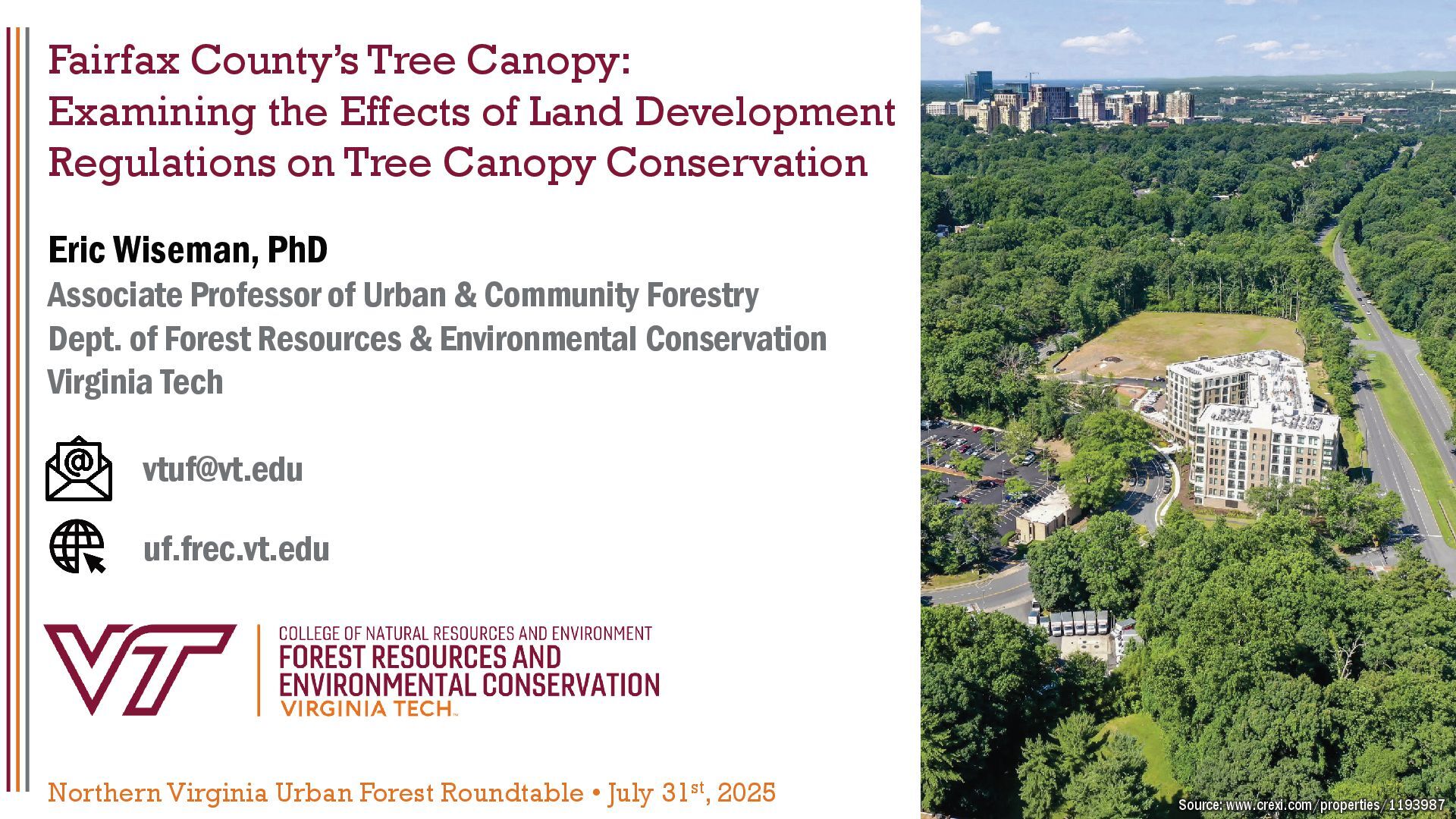
www.crexi.com/properties/1193987 Fairfax County’s Tree Canopy: Examining the Effects of Land Development Regulations on Tree Canopy Conservation Eric Wiseman, PhD Associate Professor of Urban & Community Forestry Dept. of Forest Resources & Environmental Conservation Virginia Tech [email protected] uf.frec.vt.edu -
02 • 38 Acknowledgements Casey Trees • Mark Buscaino •
Andrew Schichtel Fairfax County • Todd Nelson • Brian Keightley PlanIT Geo • Ian Hanou • Andy Evans • Michaila Musman • Brett Martin • Rachel Habig-Myers • Ben Wittman Virginia Tech • Meghan Failor • J. P. Gannon • Claire White Northern Virginia Urban Forest Roundtable • July 31st, 2025 -
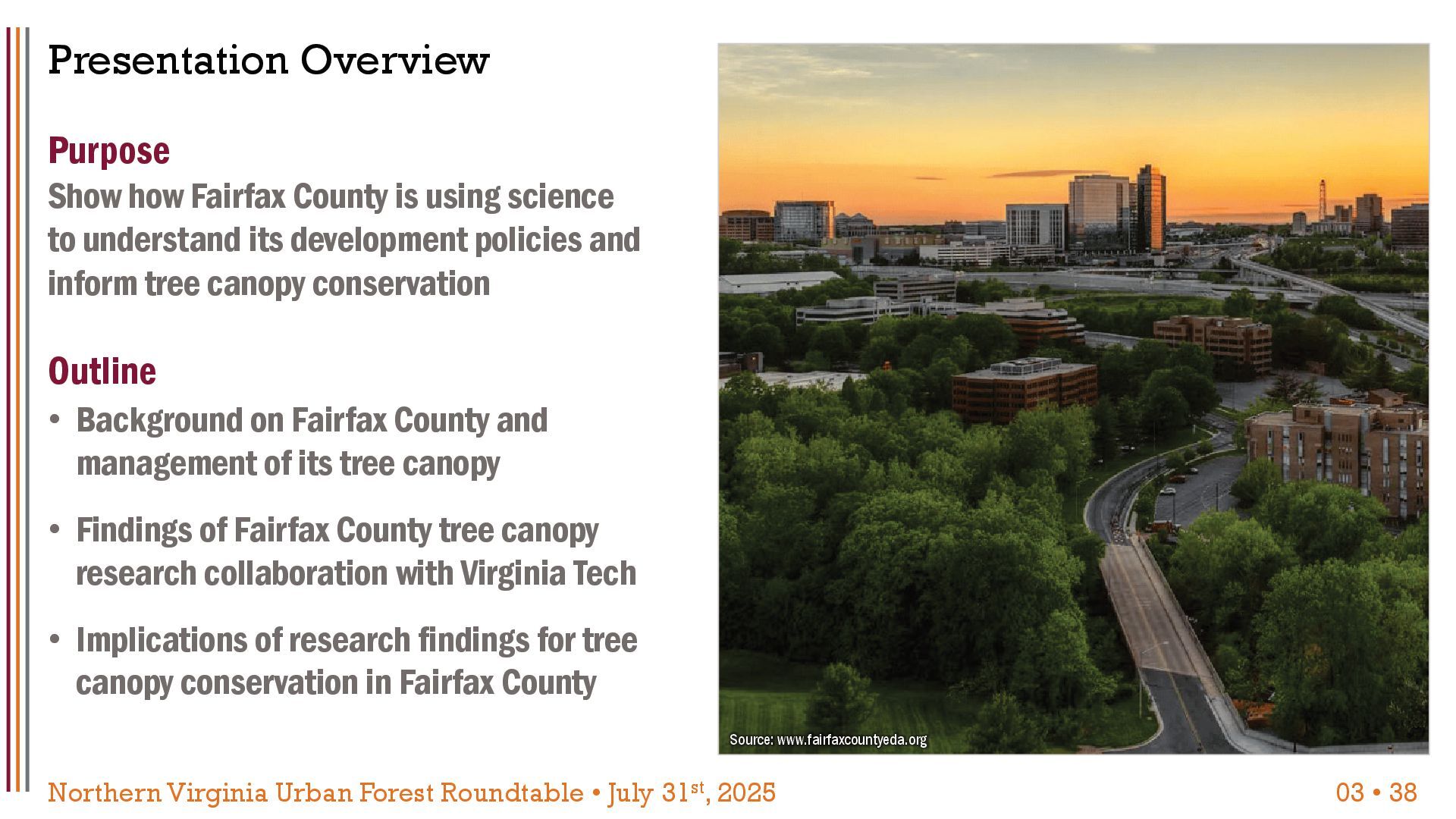
03 • 38 Presentation Overview • Background on Fairfax County
and management of its tree canopy • Findings of Fairfax County tree canopy research collaboration with Virginia Tech • Implications of research findings for tree canopy conservation in Fairfax County Source: www.fairfaxcountyeda.org Purpose Show how Fairfax County is using science to understand its development policies and inform tree canopy conservation Northern Virginia Urban Forest Roundtable • July 31st, 2025 Outline -
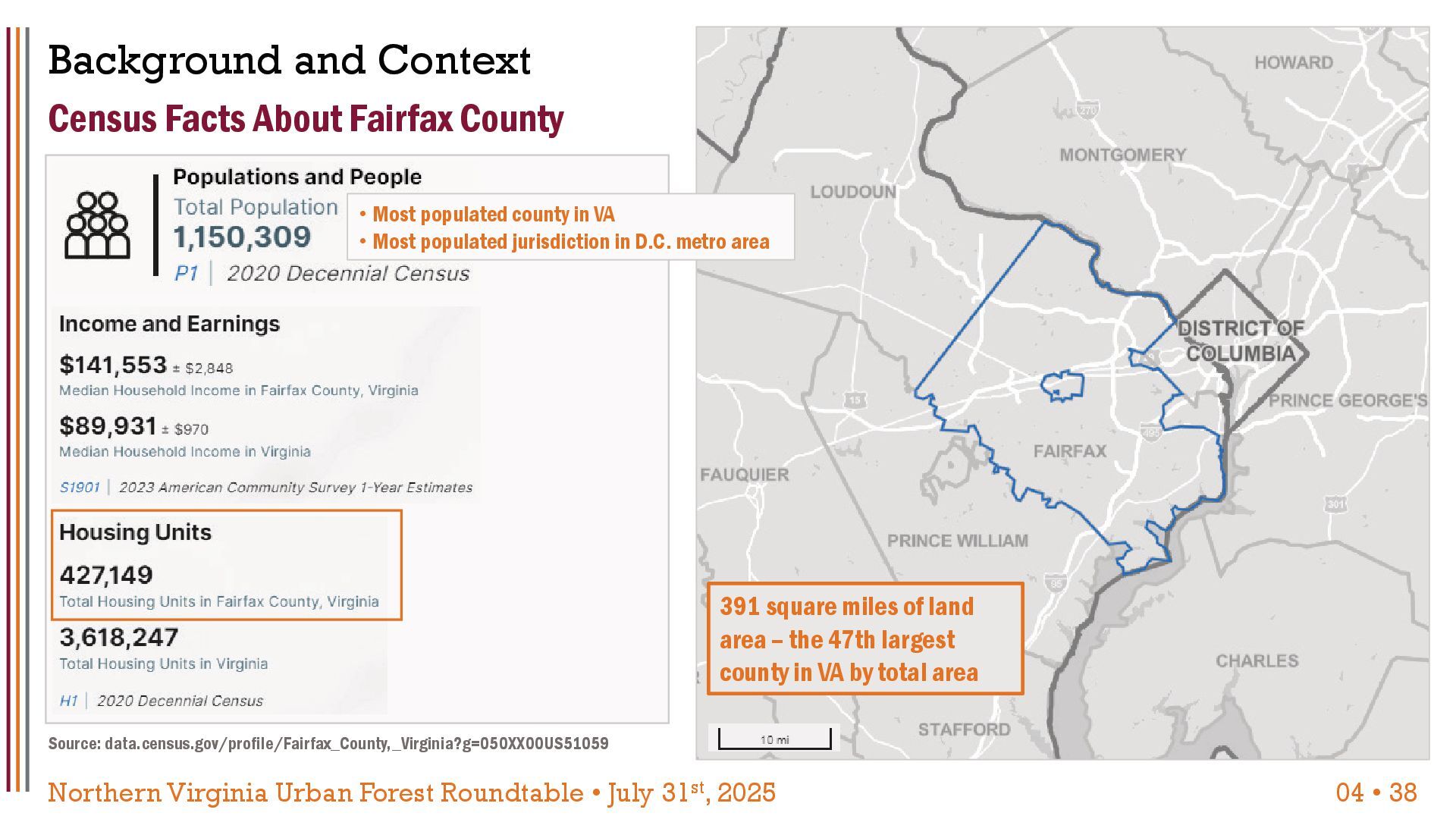
04 • 38 Background and Context Census Facts About Fairfax
County 391 square miles of land area – the 47th largest county in VA by total area Source: data.census.gov/profile/Fairfax_County,_Virginia?g=050XX00US51059 • Most populated county in VA • Most populated jurisdiction in D.C. metro area Northern Virginia Urban Forest Roundtable • July 31st, 2025 -
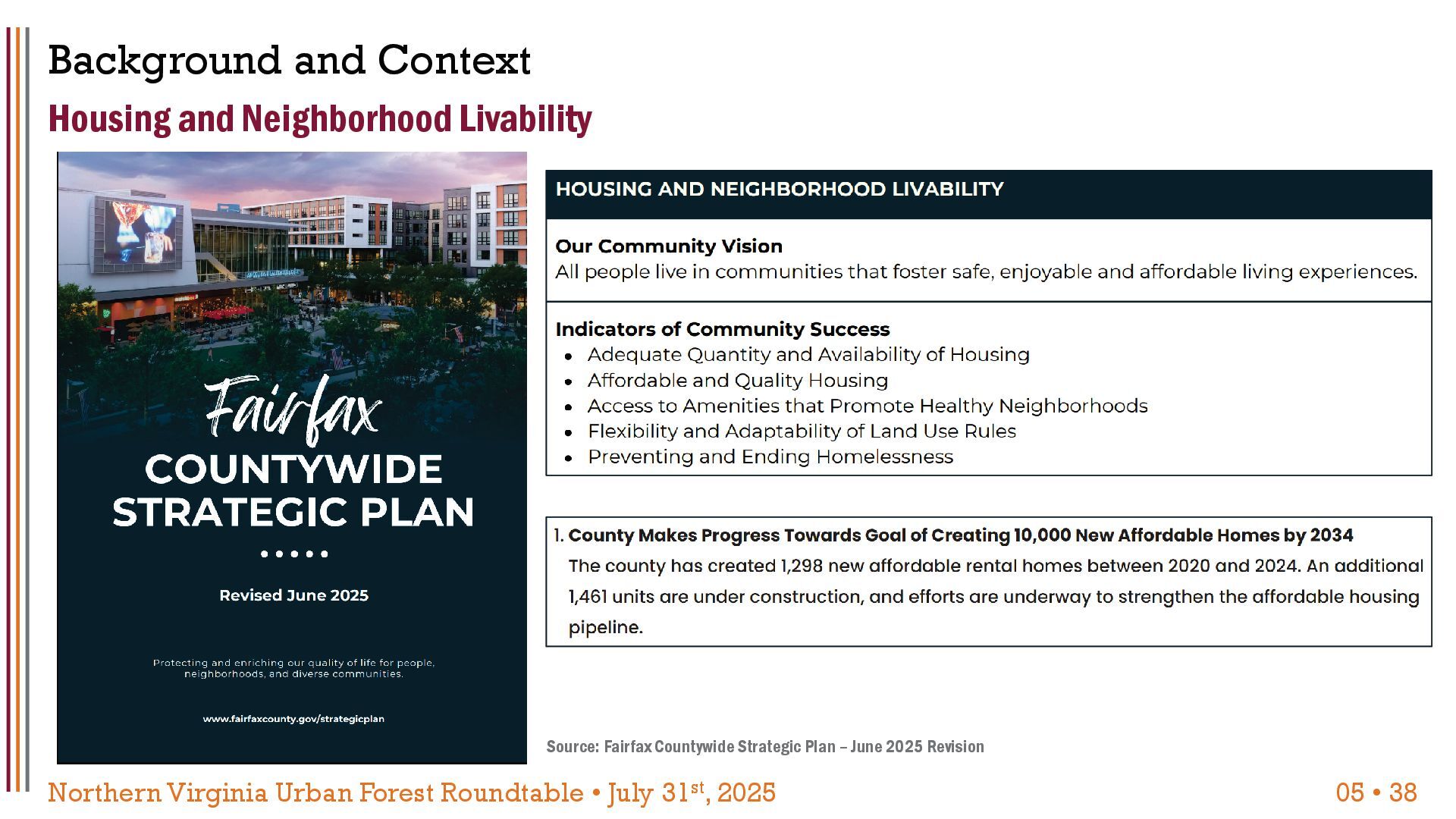
05 • 38 Background and Context Northern Virginia Urban Forest
Roundtable • July 31st, 2025 Housing and Neighborhood Livability Source: Fairfax Countywide Strategic Plan – June 2025 Revision -
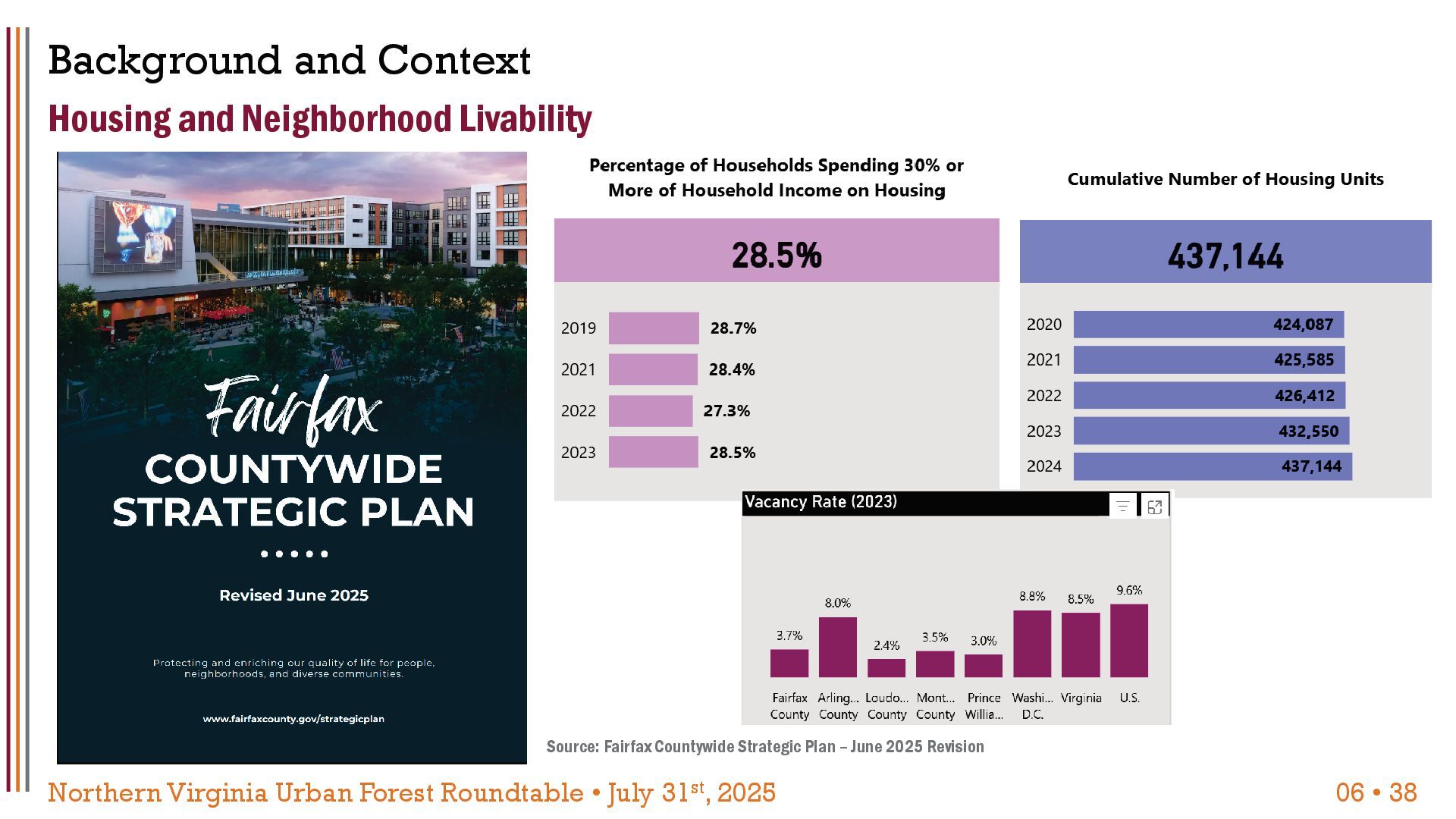
06 • 38 Background and Context Northern Virginia Urban Forest
Roundtable • July 31st, 2025 Housing and Neighborhood Livability Source: Fairfax Countywide Strategic Plan – June 2025 Revision -
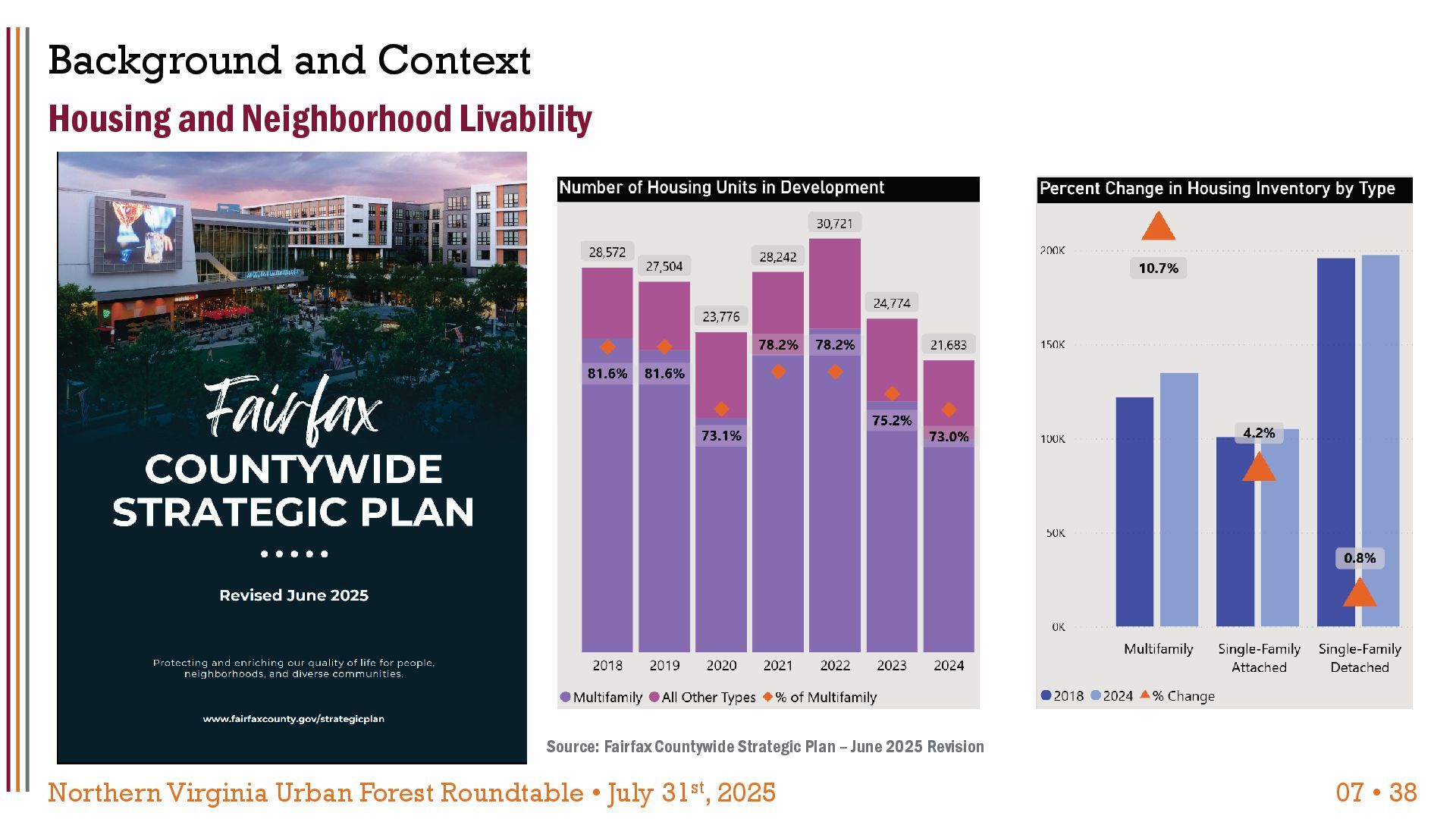
07 • 38 Background and Context Northern Virginia Urban Forest
Roundtable • July 31st, 2025 Housing and Neighborhood Livability Source: Fairfax Countywide Strategic Plan – June 2025 Revision -
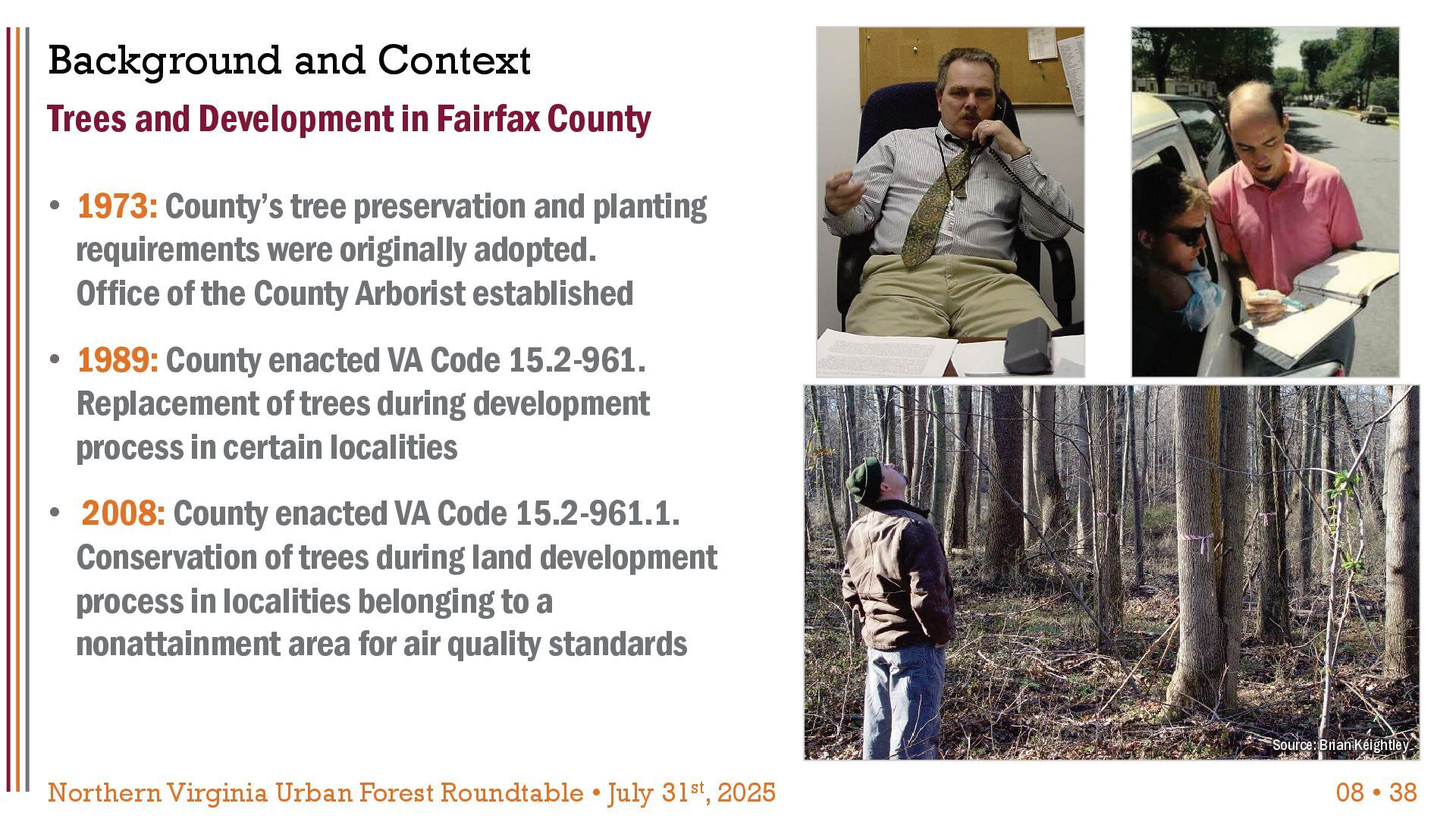
08 • 38 Background and Context • 1973: County’s tree
preservation and planting requirements were originally adopted. Office of the County Arborist established • 1989: County enacted VA Code 15.2-961. Replacement of trees during development process in certain localities • 2008: County enacted VA Code 15.2-961.1. Conservation of trees during land development process in localities belonging to a nonattainment area for air quality standards Trees and Development in Fairfax County Source: Brian Keightley Northern Virginia Urban Forest Roundtable • July 31st, 2025 -
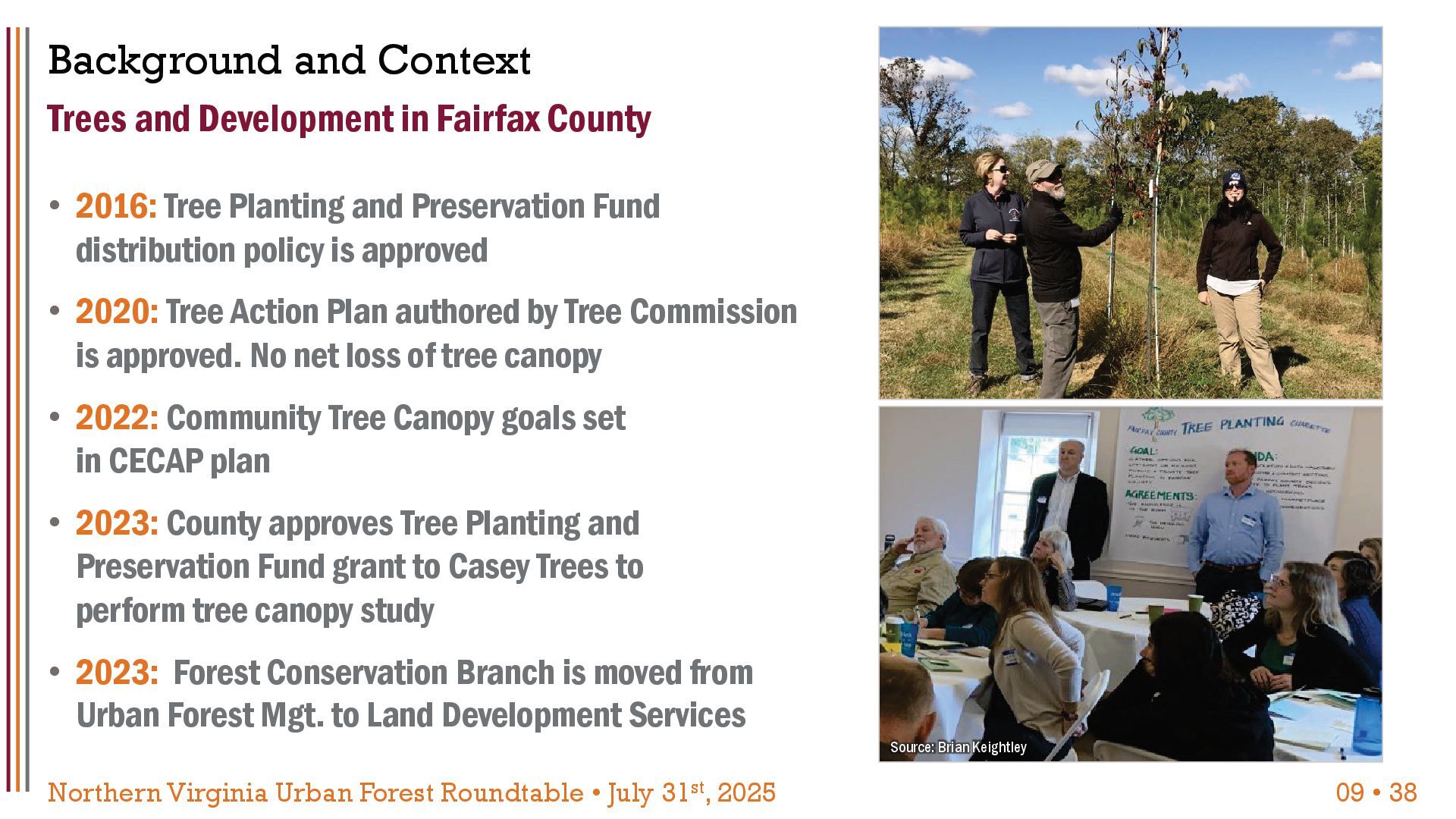
09 • 38 Background and Context • 2016: Tree Planting
and Preservation Fund distribution policy is approved • 2020: Tree Action Plan authored by Tree Commission is approved. No net loss of tree canopy • 2022: Community Tree Canopy goals set in CECAP plan • 2023: County approves Tree Planting and Preservation Fund grant to Casey Trees to perform tree canopy study • 2023: Forest Conservation Branch is moved from Urban Forest Mgt. to Land Development Services Trees and Development in Fairfax County Source: Brian Keightley Northern Virginia Urban Forest Roundtable • July 31st, 2025 -
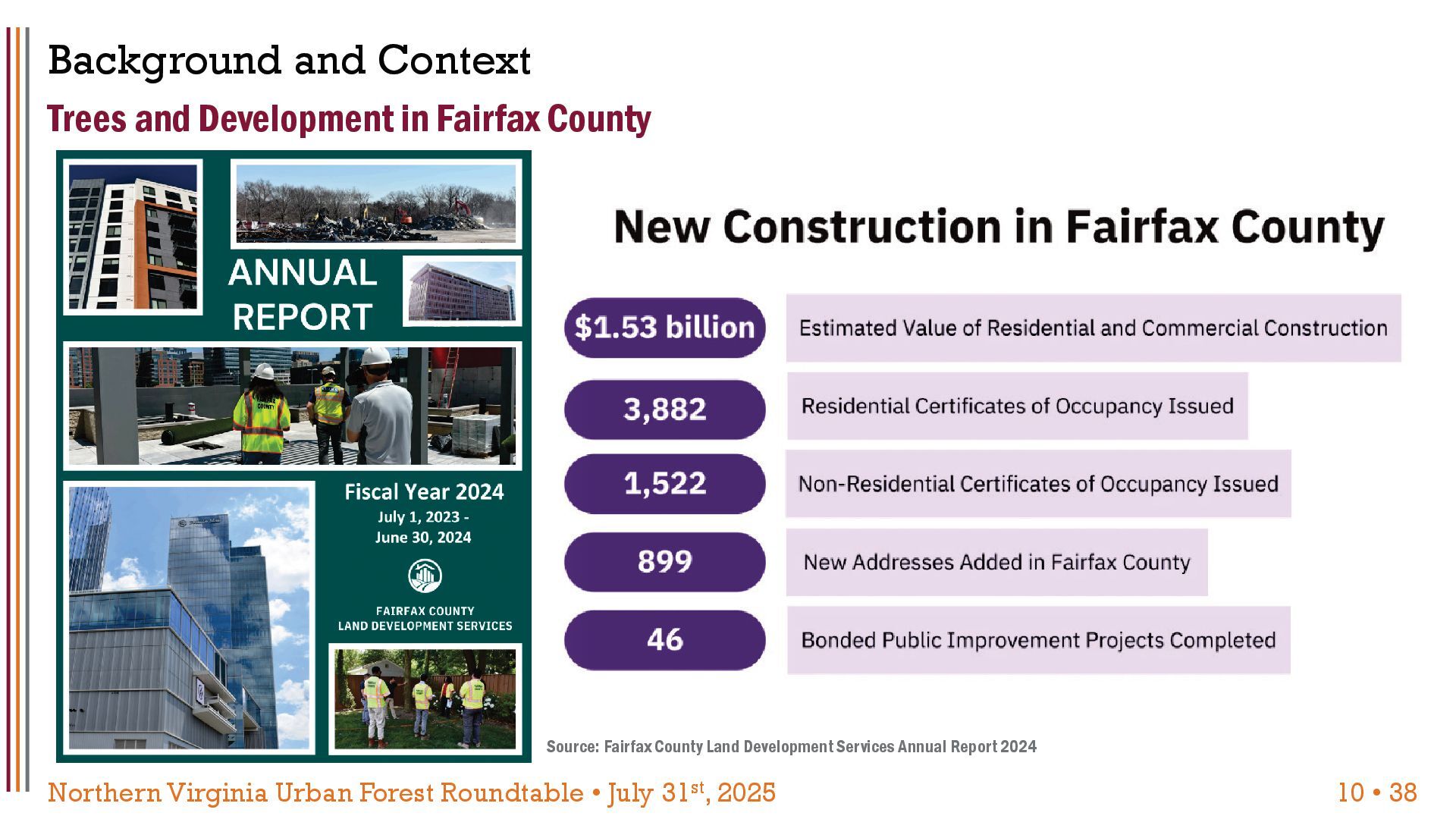
10 • 38 Background and Context Trees and Development in
Fairfax County Northern Virginia Urban Forest Roundtable • July 31st, 2025 Source: Fairfax County Land Development Services Annual Report 2024 -
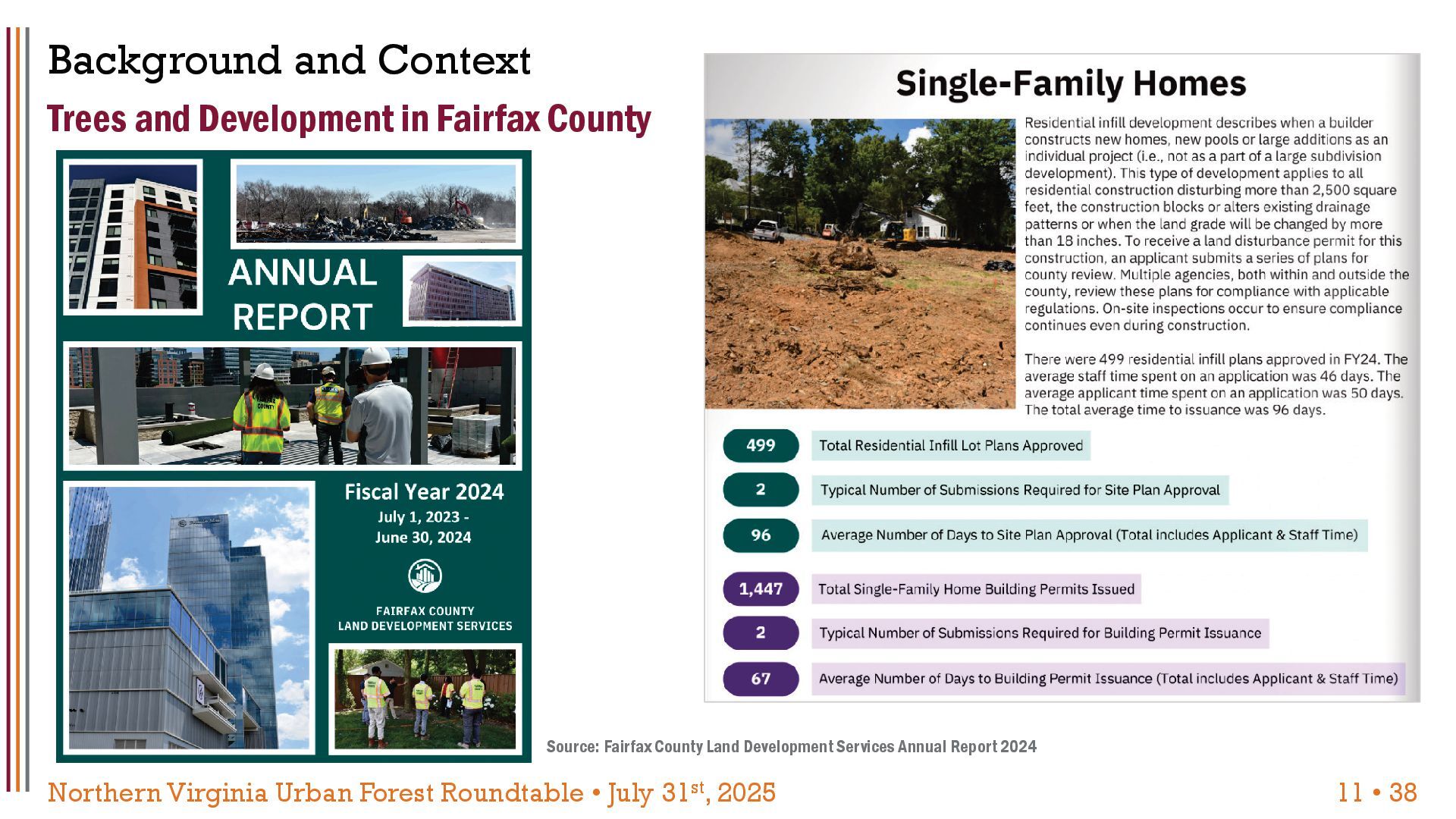
11 • 38 Background and Context Trees and Development in
Fairfax County Northern Virginia Urban Forest Roundtable • July 31st, 2025 Source: Fairfax County Land Development Services Annual Report 2024 -
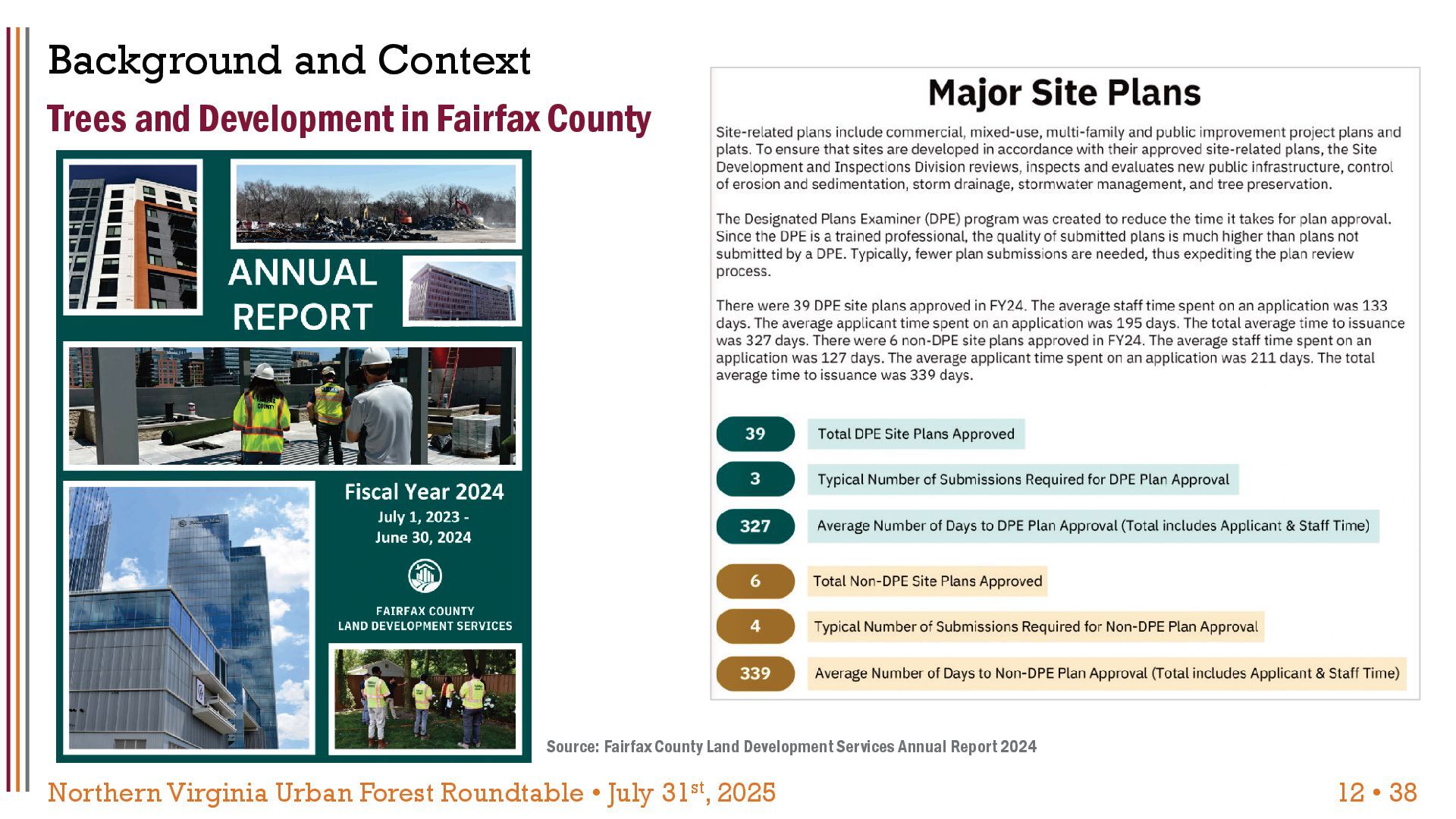
12 • 38 Background and Context Trees and Development in
Fairfax County Northern Virginia Urban Forest Roundtable • July 31st, 2025 Source: Fairfax County Land Development Services Annual Report 2024 -
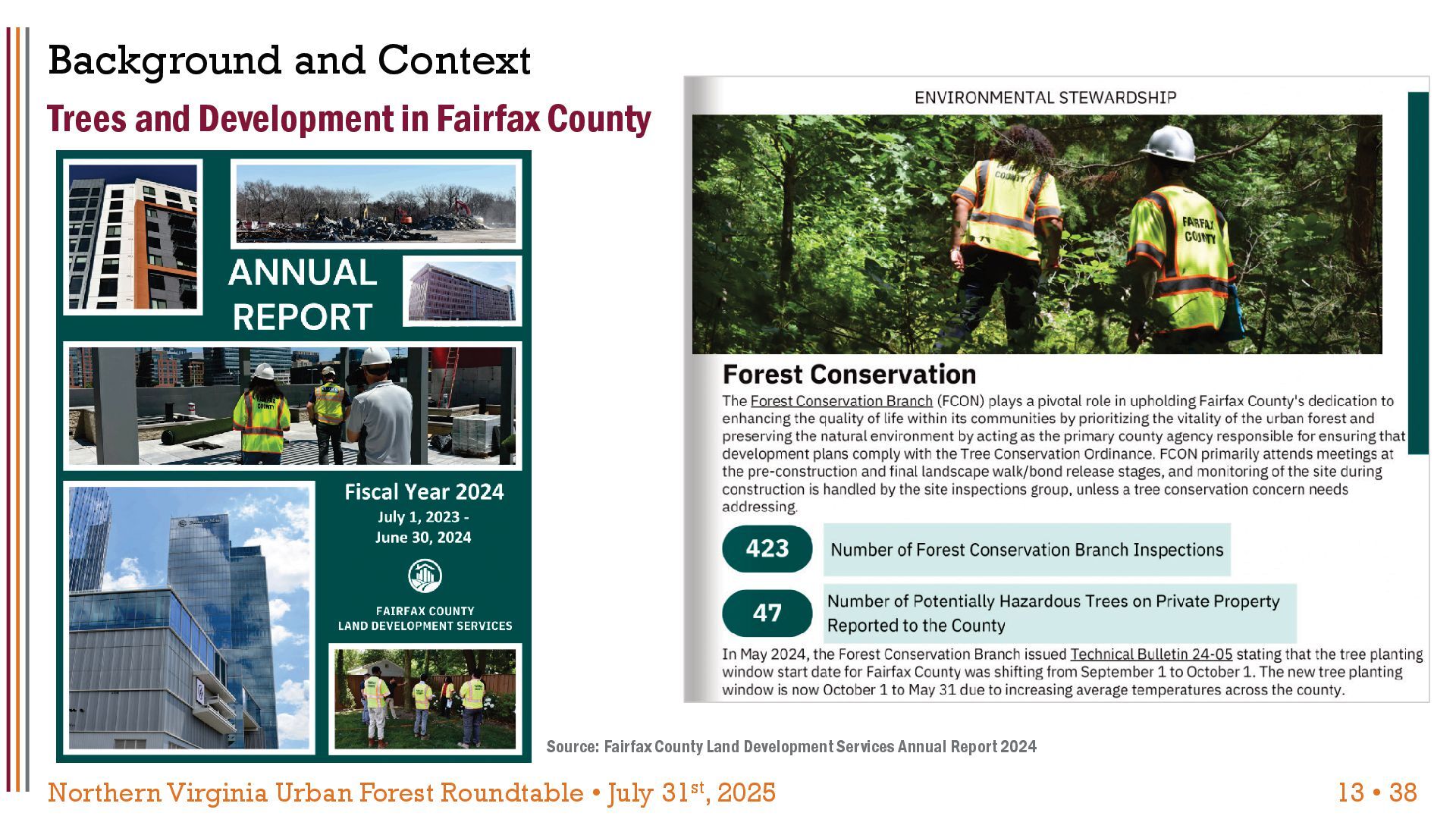
13 • 38 Background and Context Trees and Development in
Fairfax County Northern Virginia Urban Forest Roundtable • July 31st, 2025 Source: Fairfax County Land Development Services Annual Report 2024 -
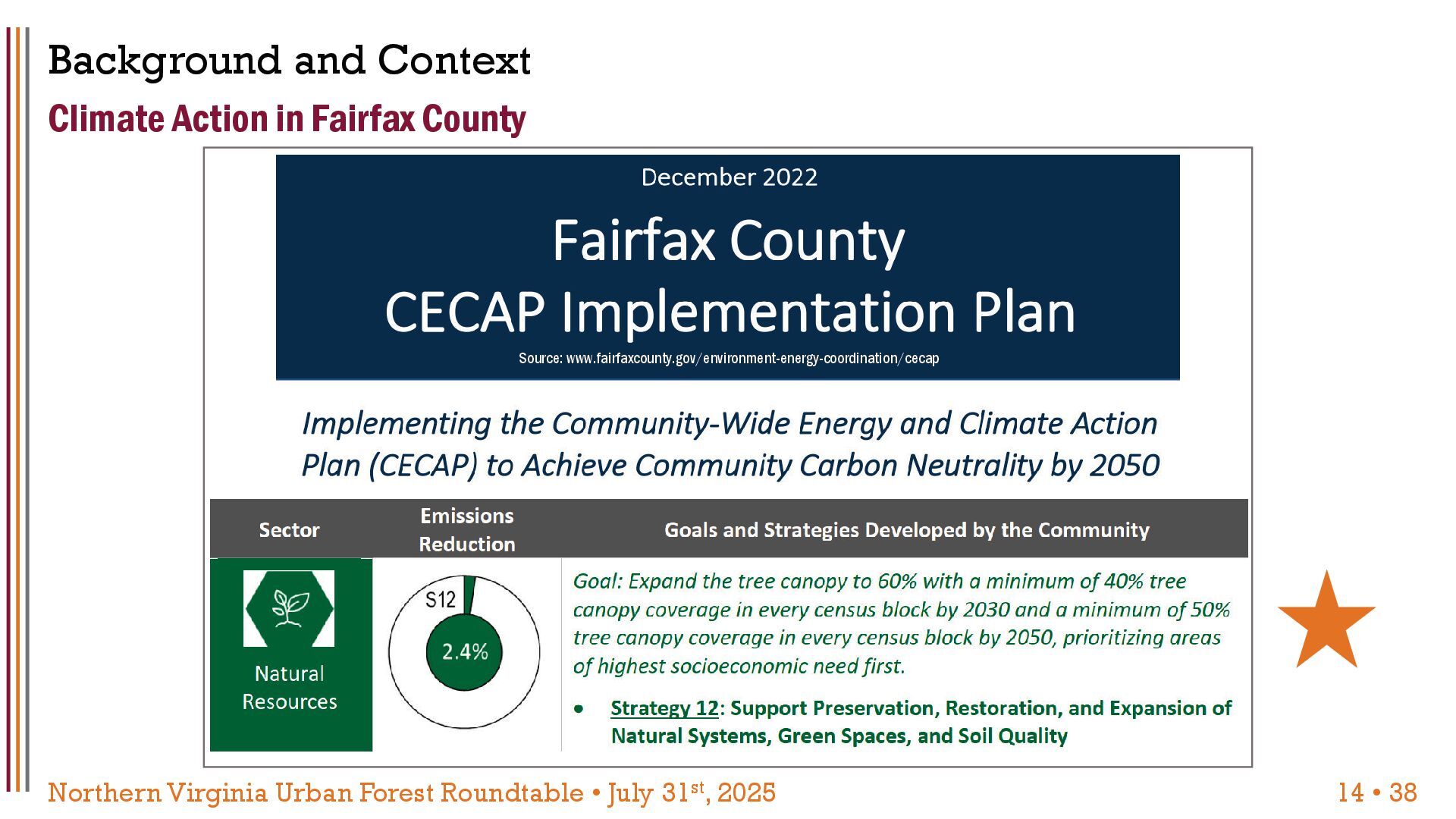
14 • 38 Background and Context Source: www.fairfaxcounty.gov/environment-energy-coordination/cecap Northern Virginia
Urban Forest Roundtable • July 31st, 2025 Climate Action in Fairfax County -
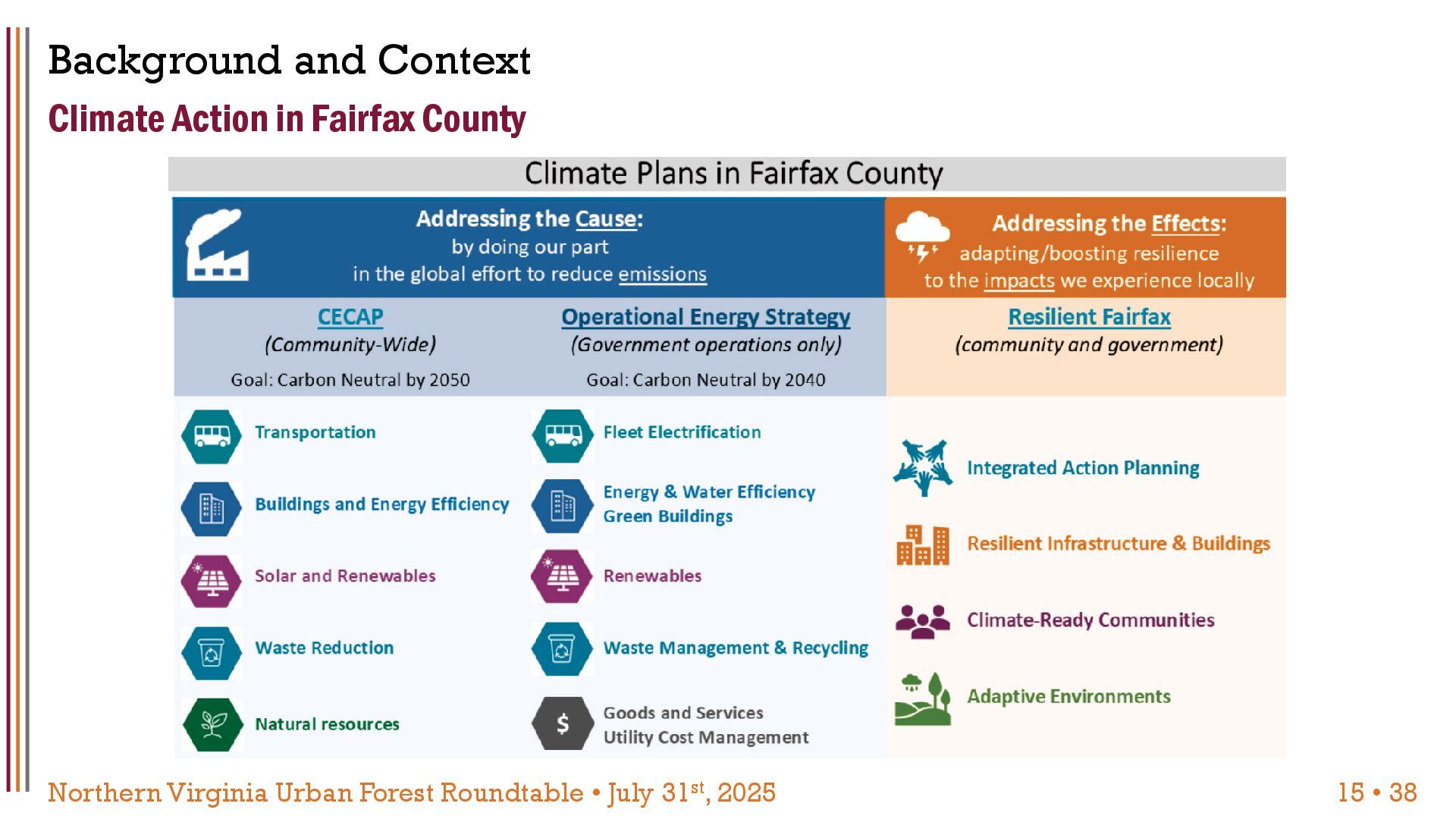
15 • 38 Background and Context Source: www.fairfaxcounty.gov/environment-energy-coordination/cecap Northern Virginia
Urban Forest Roundtable • July 31st, 2025 Climate Action in Fairfax County -
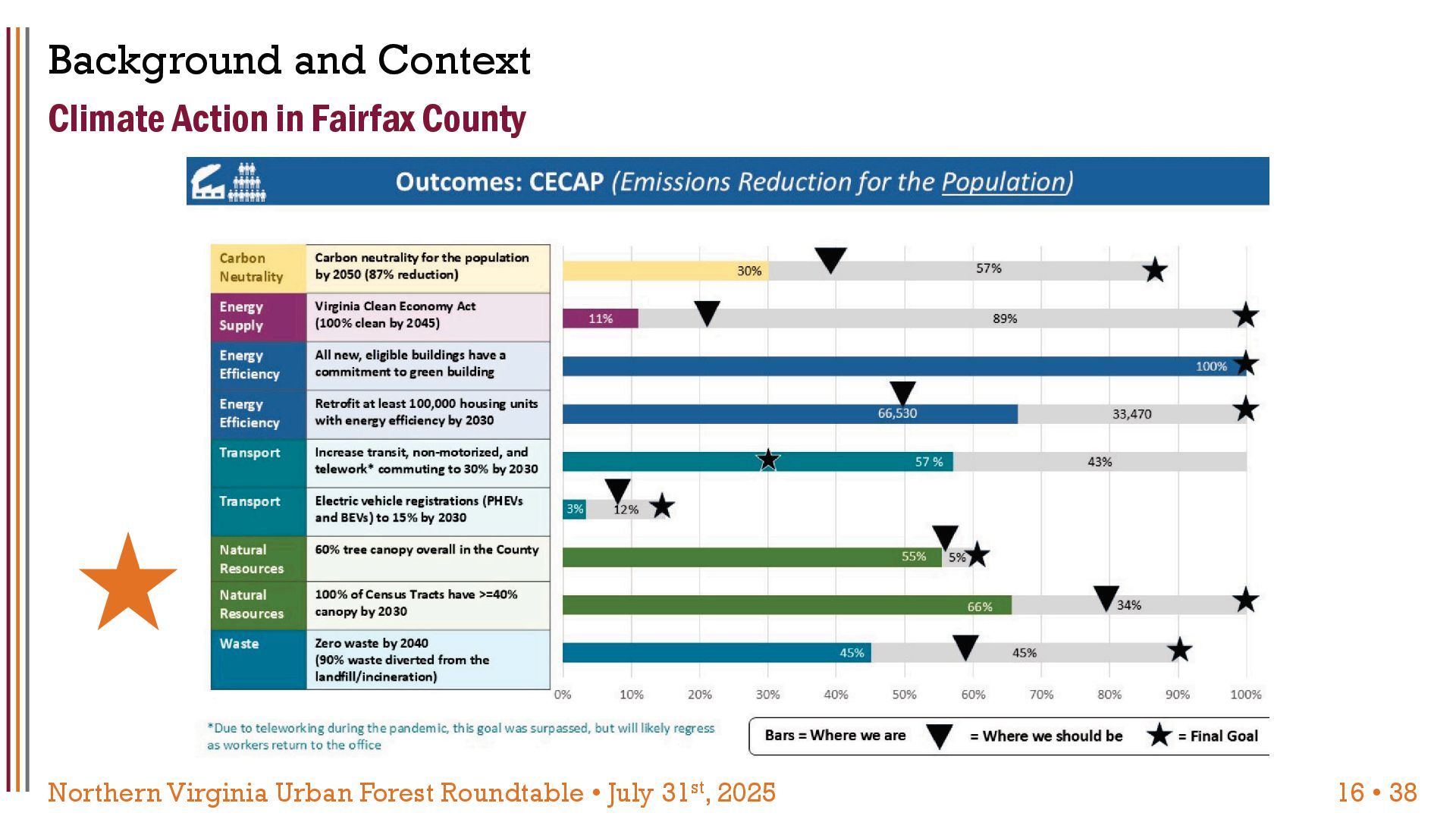
16 • 38 Background and Context Source: www.fairfaxcounty.gov/environment-energy-coordination/cecap Northern Virginia
Urban Forest Roundtable • July 31st, 2025 Climate Action in Fairfax County -
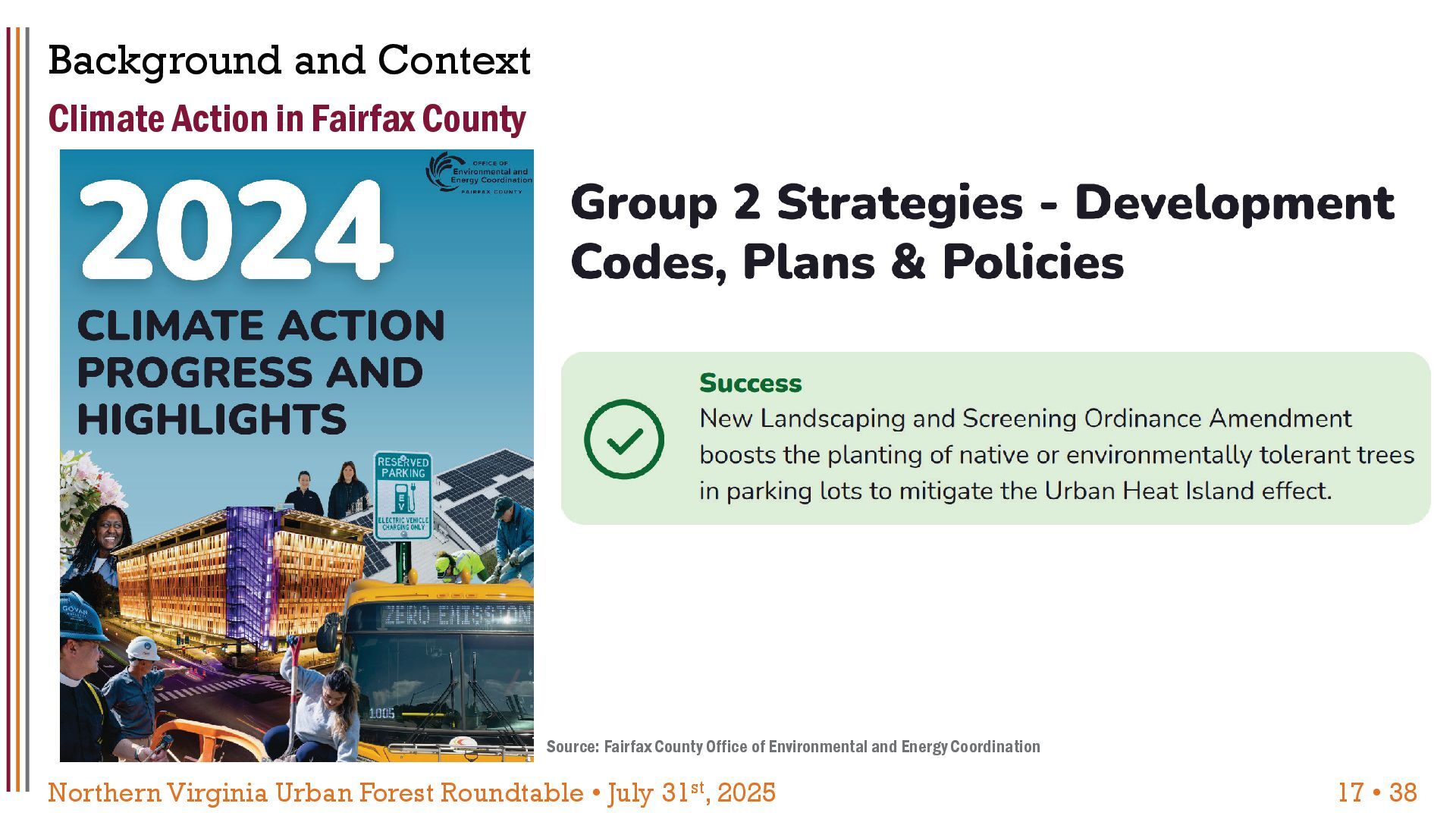
17 • 38 Background and Context Source: www.fairfaxcounty.gov/environment-energy-coordination/cecap Northern Virginia
Urban Forest Roundtable • July 31st, 2025 Source: Fairfax County Office of Environmental and Energy Coordination Climate Action in Fairfax County -
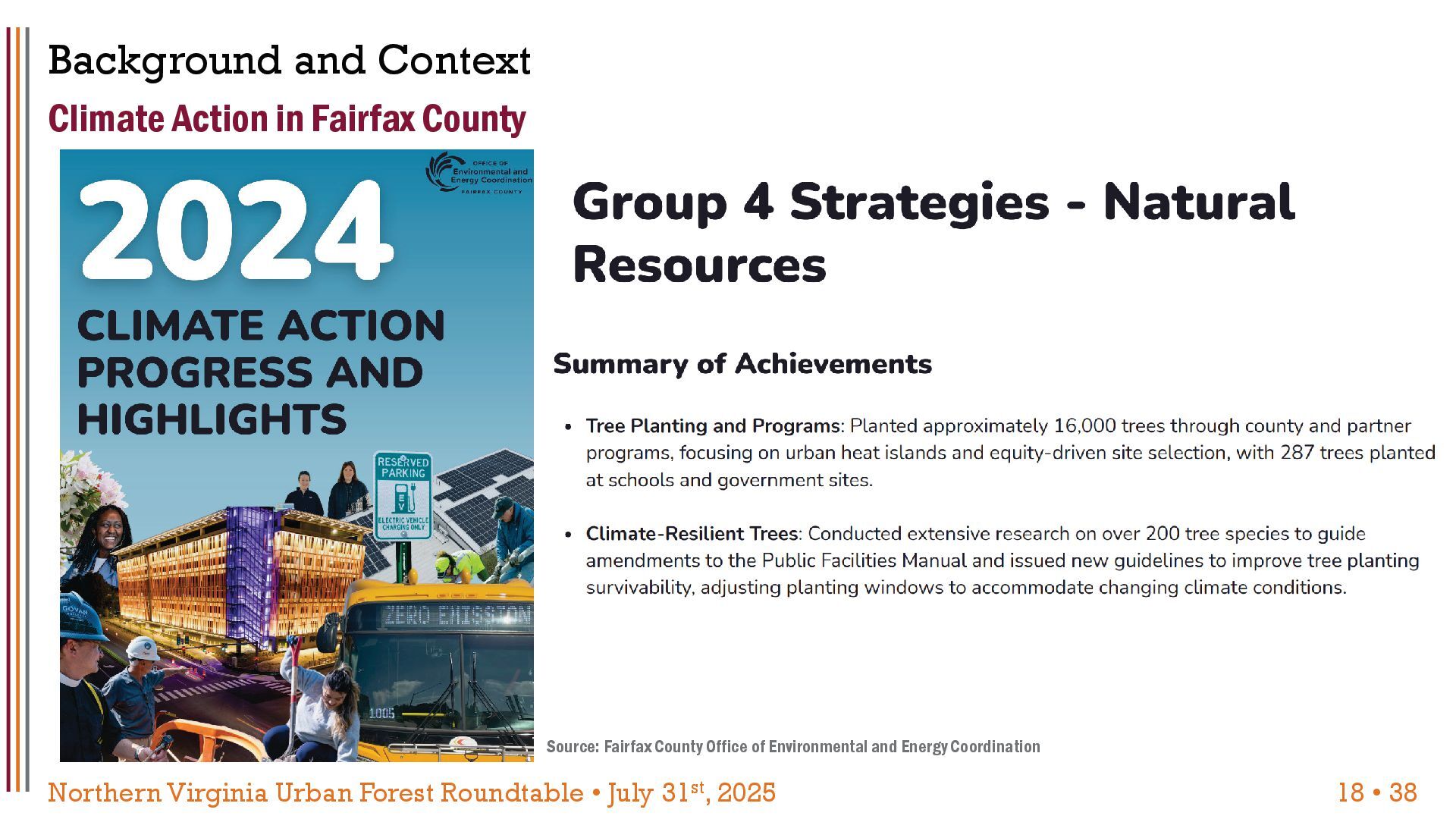
18 • 38 Background and Context Source: www.fairfaxcounty.gov/environment-energy-coordination/cecap Northern Virginia
Urban Forest Roundtable • July 31st, 2025 Source: Fairfax County Office of Environmental and Energy Coordination Climate Action in Fairfax County -
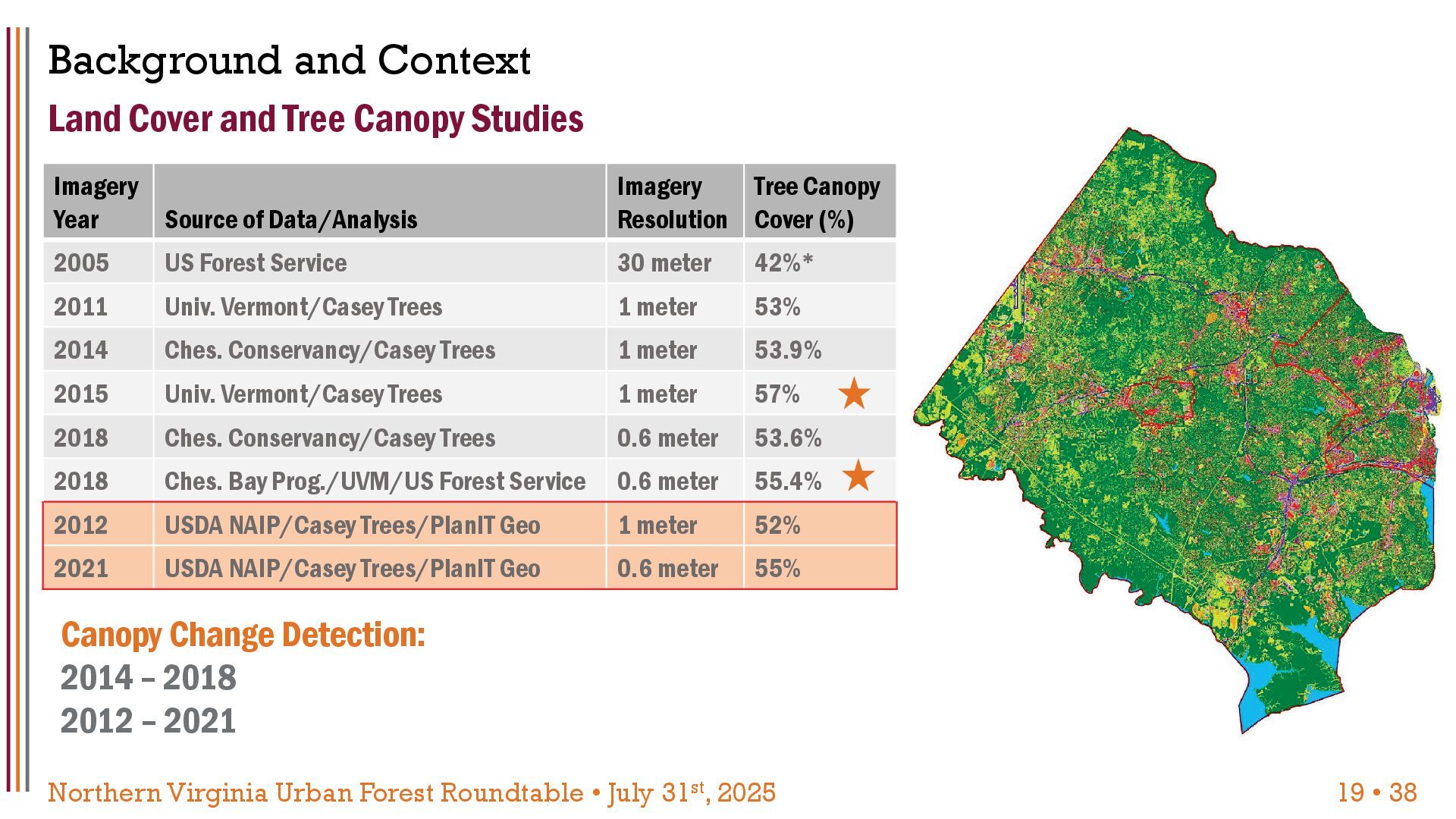
19 • 38 Background and Context Imagery Year Source of
Data/Analysis Imagery Resolution Tree Canopy Cover (%) 2005 US Forest Service 30 meter 42%* 2011 Univ. Vermont/Casey Trees 1 meter 53% 2014 Ches. Conservancy/Casey Trees 1 meter 53.9% 2015 Univ. Vermont/Casey Trees 1 meter 57% 2018 Ches. Conservancy/Casey Trees 0.6 meter 53.6% 2018 Ches. Bay Prog./UVM/US Forest Service 0.6 meter 55.4% 2012 USDA NAIP/Casey Trees/PlanIT Geo 1 meter 52% 2021 USDA NAIP/Casey Trees/PlanIT Geo 0.6 meter 55% Land Cover and Tree Canopy Studies Northern Virginia Urban Forest Roundtable • July 31st, 2025 Canopy Change Detection: 2014 – 2018 2012 – 2021 -
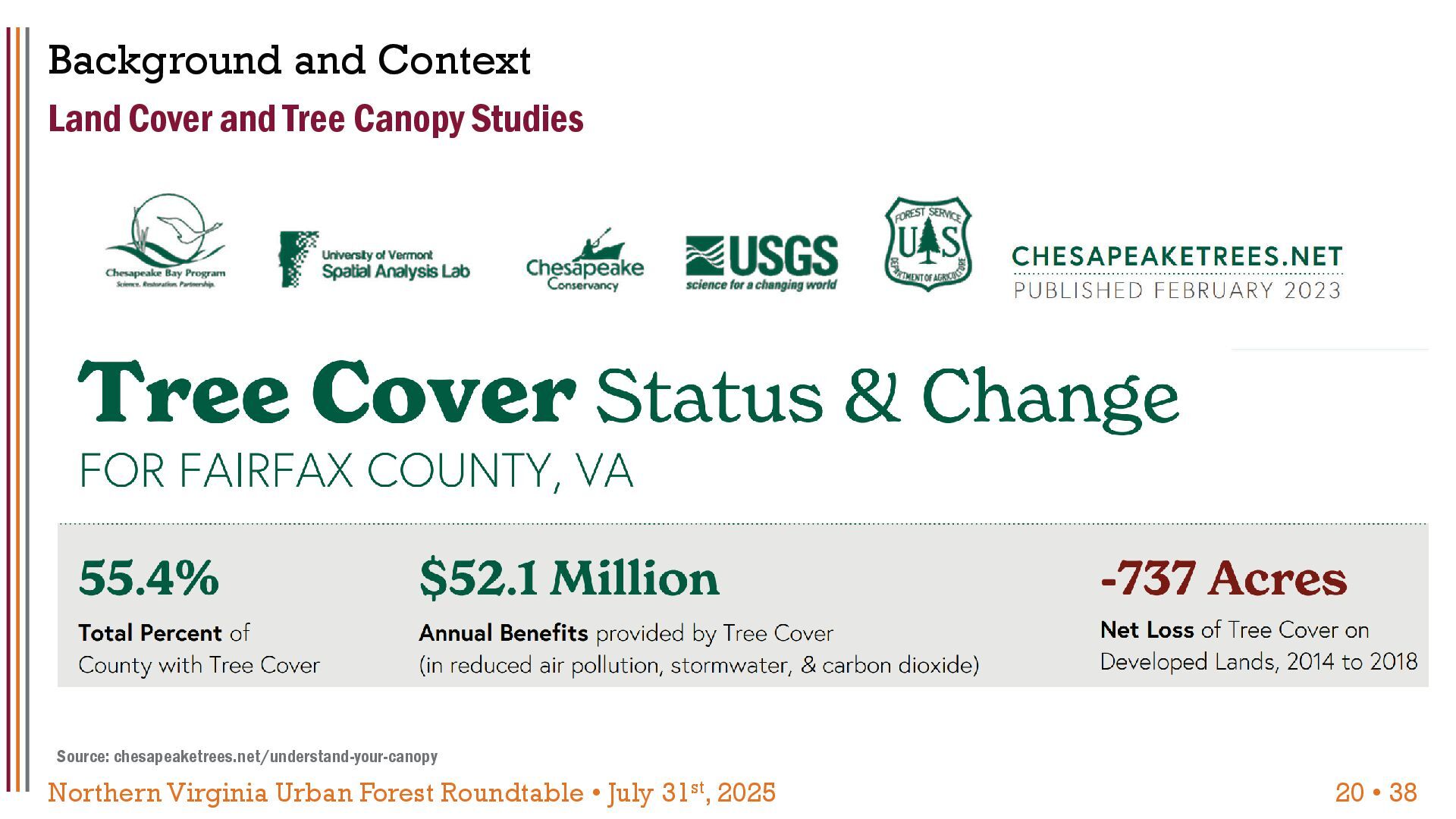
20 • 38 Background and Context Land Cover and Tree
Canopy Studies Northern Virginia Urban Forest Roundtable • July 31st, 2025 Source: chesapeaketrees.net/understand-your-canopy -
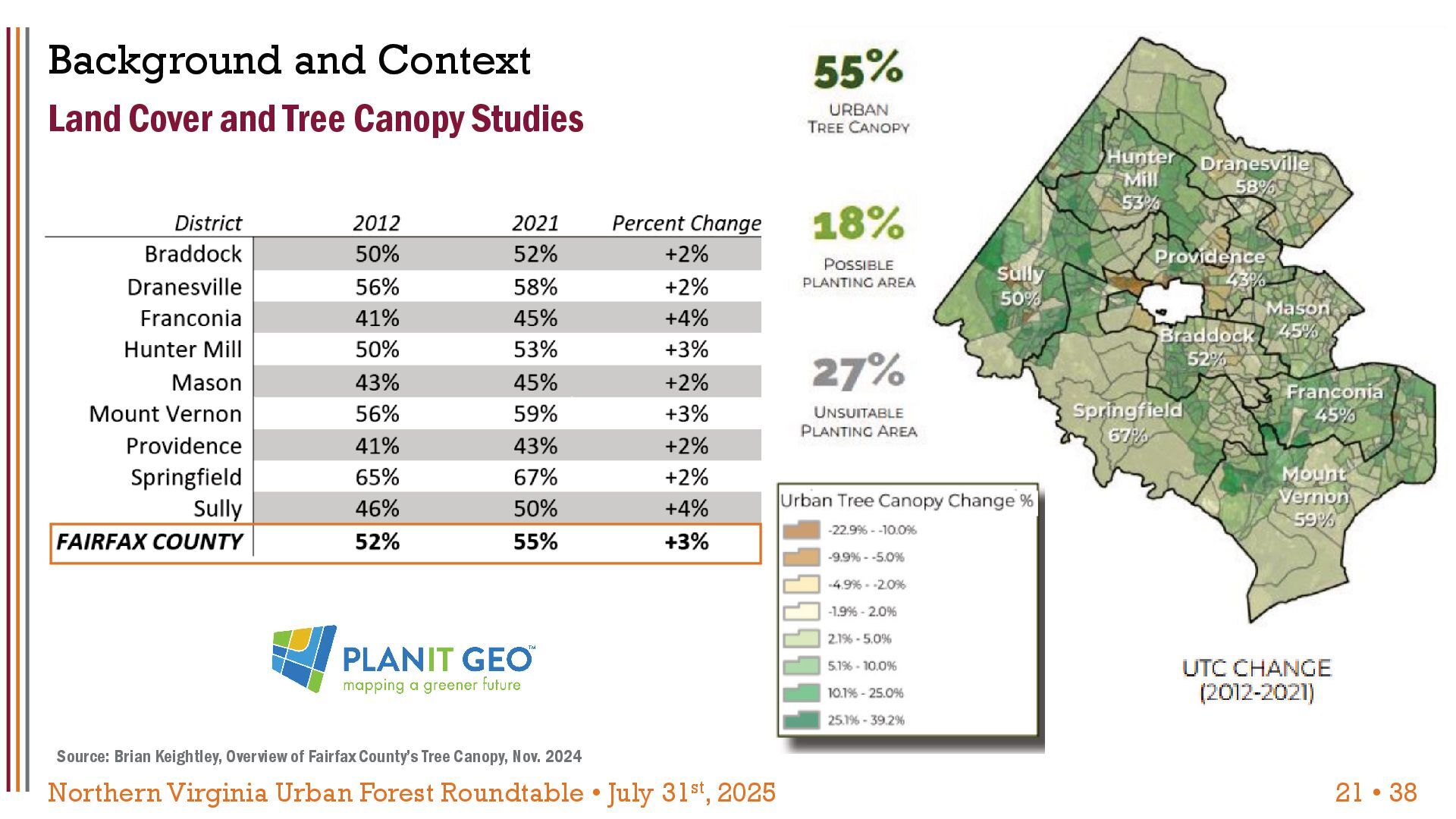
21 • 38 Background and Context Land Cover and Tree
Canopy Studies Northern Virginia Urban Forest Roundtable • July 31st, 2025 Source: Brian Keightley, Overview of Fairfax County’s Tree Canopy, Nov. 2024 -
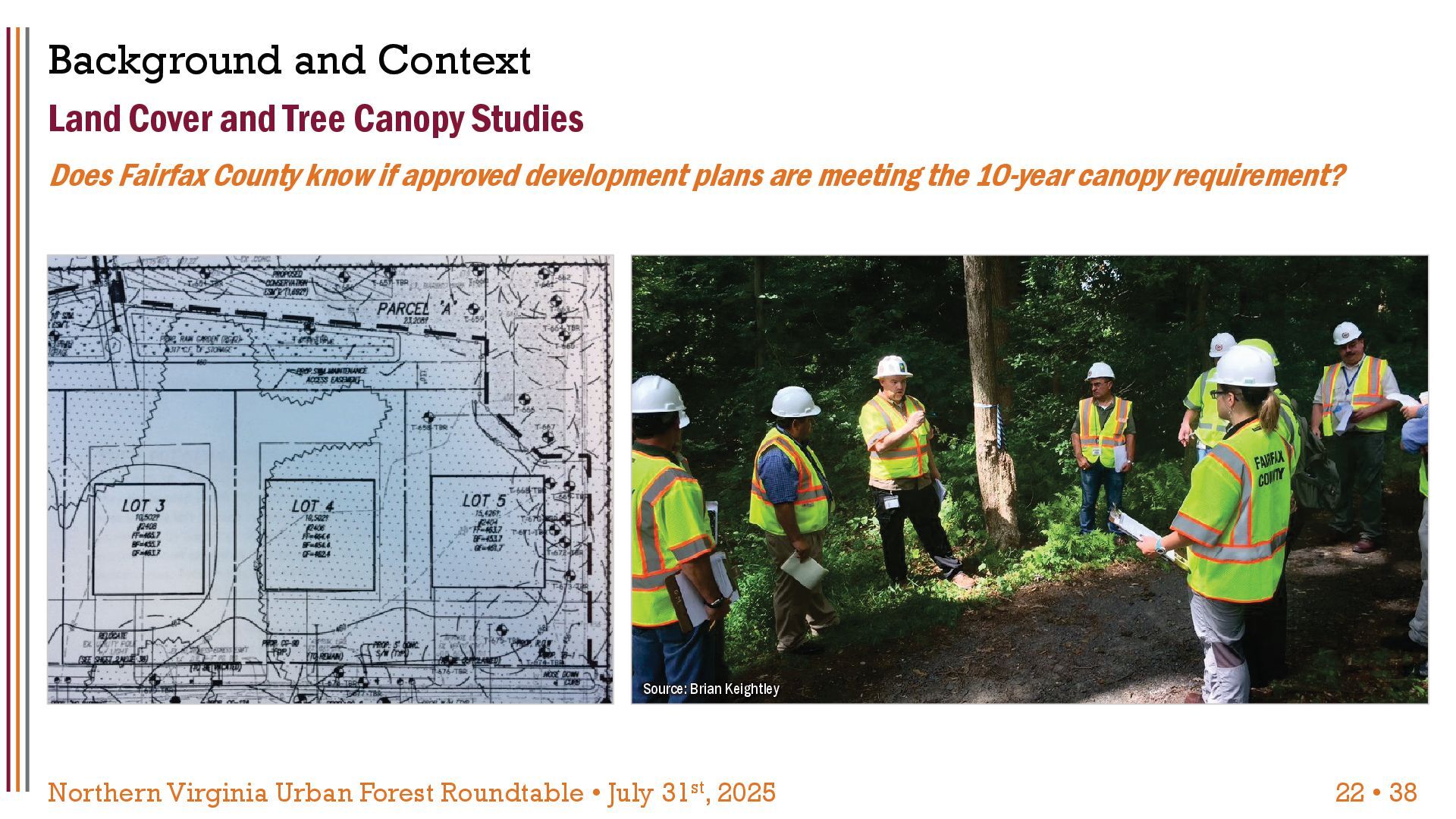
22 • 38 Background and Context Does Fairfax County know
if approved development plans are meeting the 10-year canopy requirement? Land Cover and Tree Canopy Studies Source: Brian Keightley Northern Virginia Urban Forest Roundtable • July 31st, 2025 -
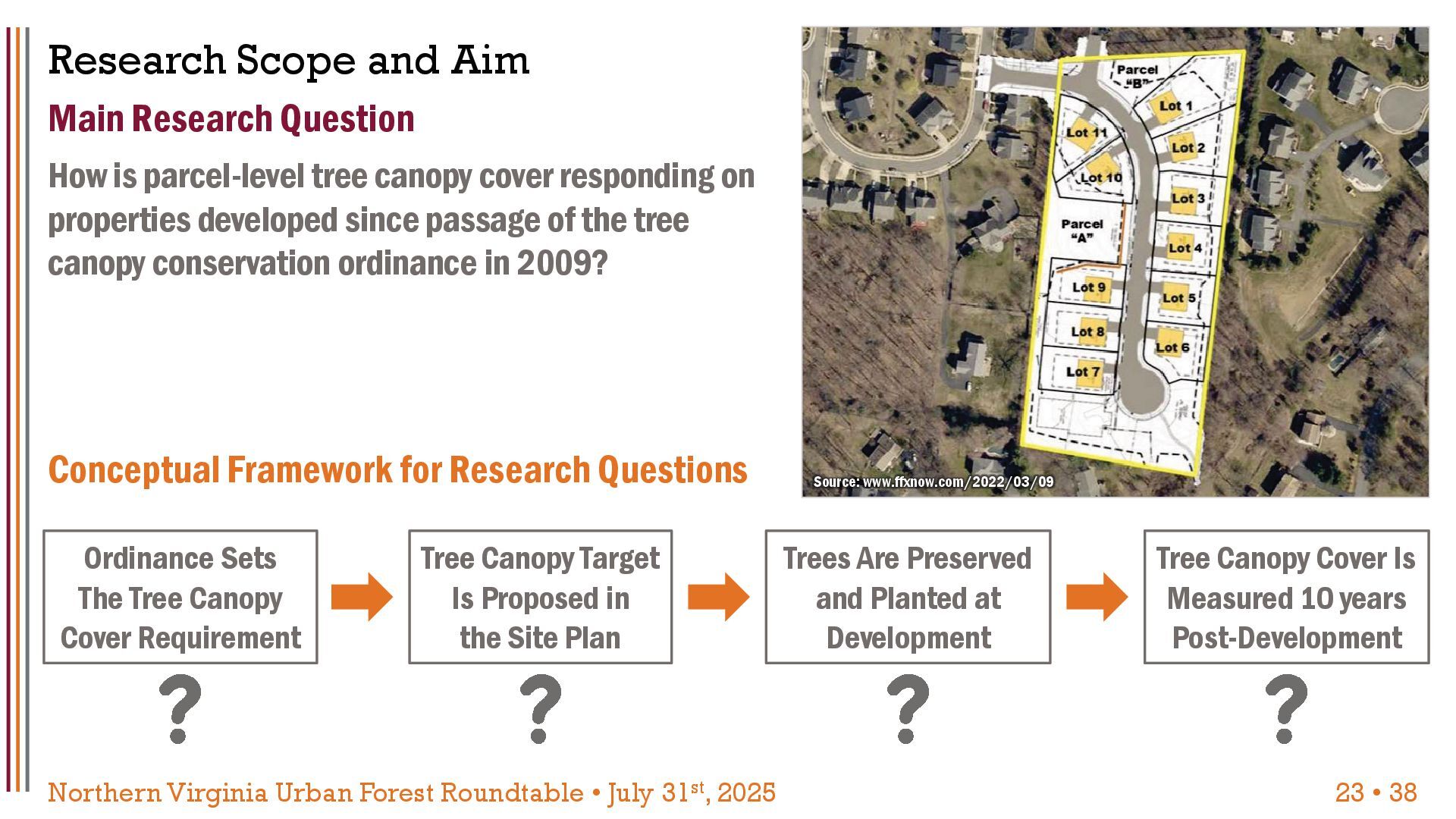
Research Scope and Aim 23 • 38 Main Research Question
How is parcel-level tree canopy cover responding on properties developed since passage of the tree canopy conservation ordinance in 2009? Conceptual Framework for Research Questions Ordinance Sets The Tree Canopy Cover Requirement Tree Canopy Target Is Proposed in the Site Plan Trees Are Preserved and Planted at Development Tree Canopy Cover Is Measured 10 years Post-Development Source: www.ffxnow.com/2022/03/09 Northern Virginia Urban Forest Roundtable • July 31st, 2025 -
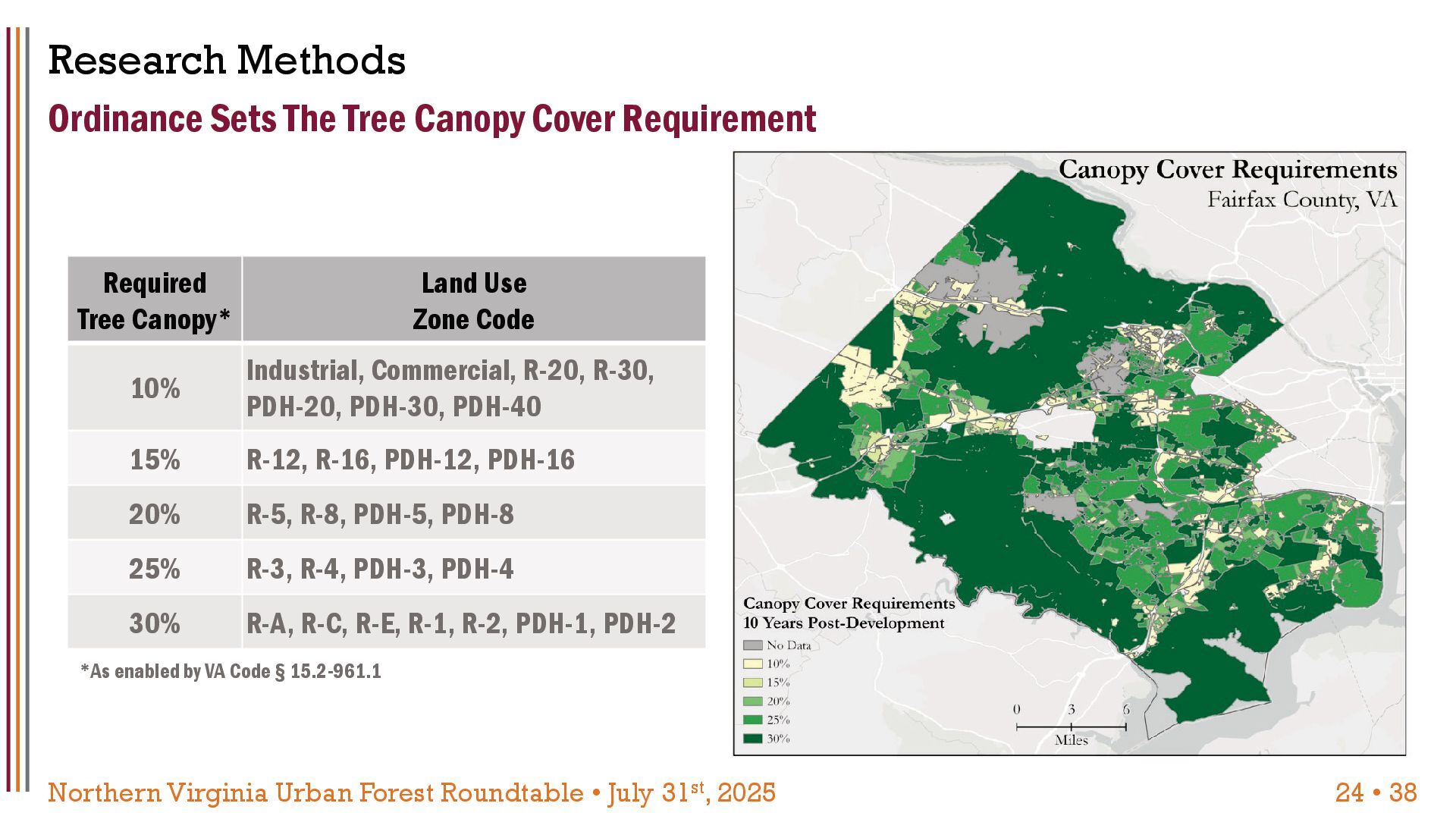
Research Methods 24 • 38 Ordinance Sets The Tree Canopy
Cover Requirement Required Tree Canopy* Land Use Zone Code 10% Industrial, Commercial, R-20, R-30, PDH-20, PDH-30, PDH-40 15% R-12, R-16, PDH-12, PDH-16 20% R-5, R-8, PDH-5, PDH-8 25% R-3, R-4, PDH-3, PDH-4 30% R-A, R-C, R-E, R-1, R-2, PDH-1, PDH-2 *As enabled by VA Code § 15.2-961.1 Northern Virginia Urban Forest Roundtable • July 31st, 2025 -
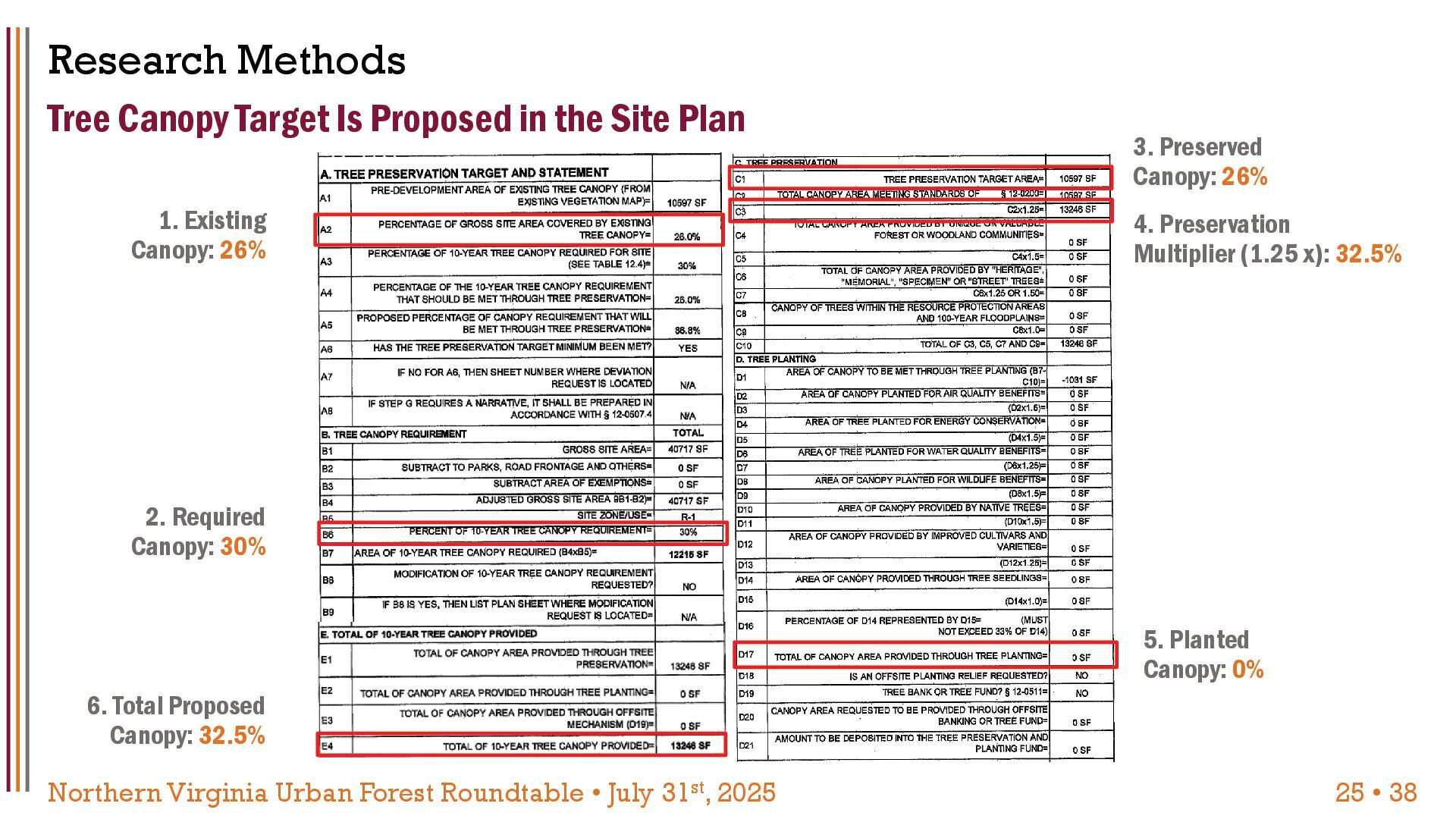
Research Methods 25 • 38 Tree Canopy Target Is Proposed
in the Site Plan 1. Existing Canopy: 26% 2. Required Canopy: 30% 6. Total Proposed Canopy: 32.5% 5. Planted Canopy: 0% 3. Preserved Canopy: 26% 4. Preservation Multiplier (1.25 x): 32.5% Northern Virginia Urban Forest Roundtable • July 31st, 2025 -
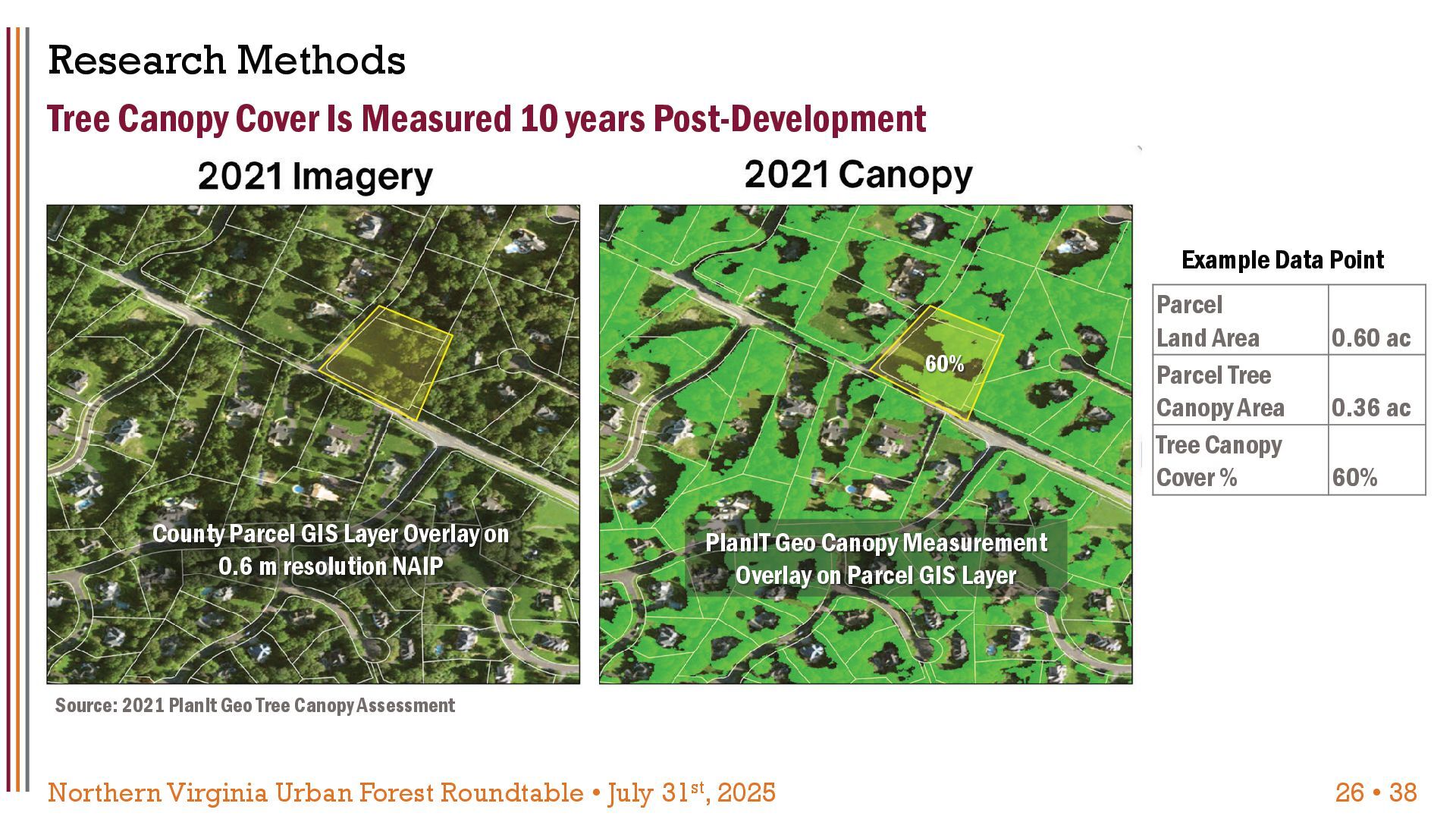
Research Methods 26 • 38 Tree Canopy Cover Is Measured
10 years Post-Development Parcel Land Area 0.60 ac Parcel Tree Canopy Area 0.36 ac Tree Canopy Cover % 60% Source: 2021 PlanIt Geo Tree Canopy Assessment 60% County Parcel GIS Layer Overlay on 0.6 m resolution NAIP PlanIT Geo Canopy Measurement Overlay on Parcel GIS Layer Example Data Point Northern Virginia Urban Forest Roundtable • July 31st, 2025 -
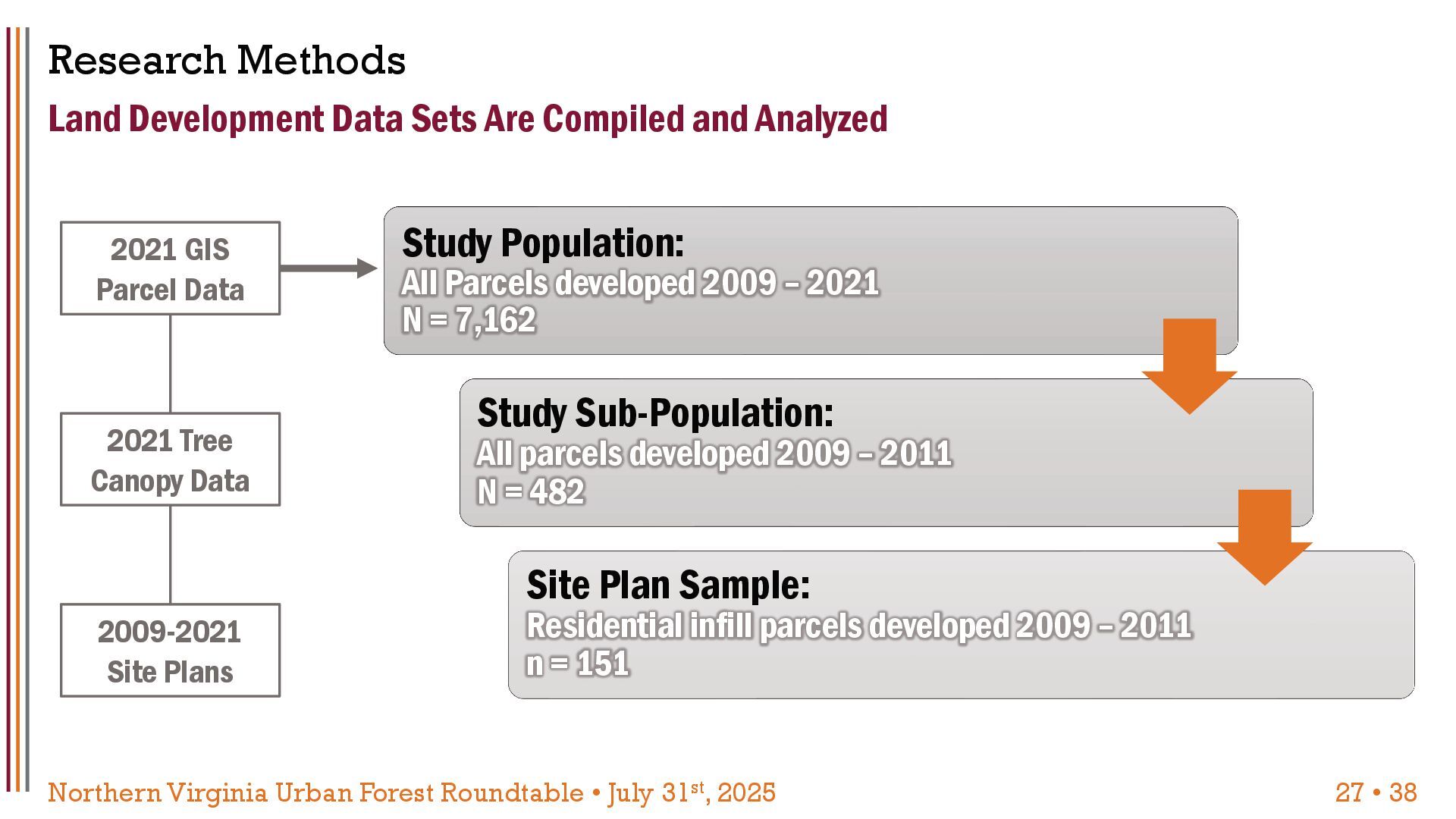
Research Methods 27 • 38 Land Development Data Sets Are
Compiled and Analyzed 2021 GIS Parcel Data 2021 Tree Canopy Data 2009-2021 Site Plans Study Population: All Parcels developed 2009 – 2021 N = 7,162 Study Sub-Population: All parcels developed 2009 – 2011 N = 482 Site Plan Sample: Residential infill parcels developed 2009 – 2011 n = 151 Northern Virginia Urban Forest Roundtable • July 31st, 2025 -
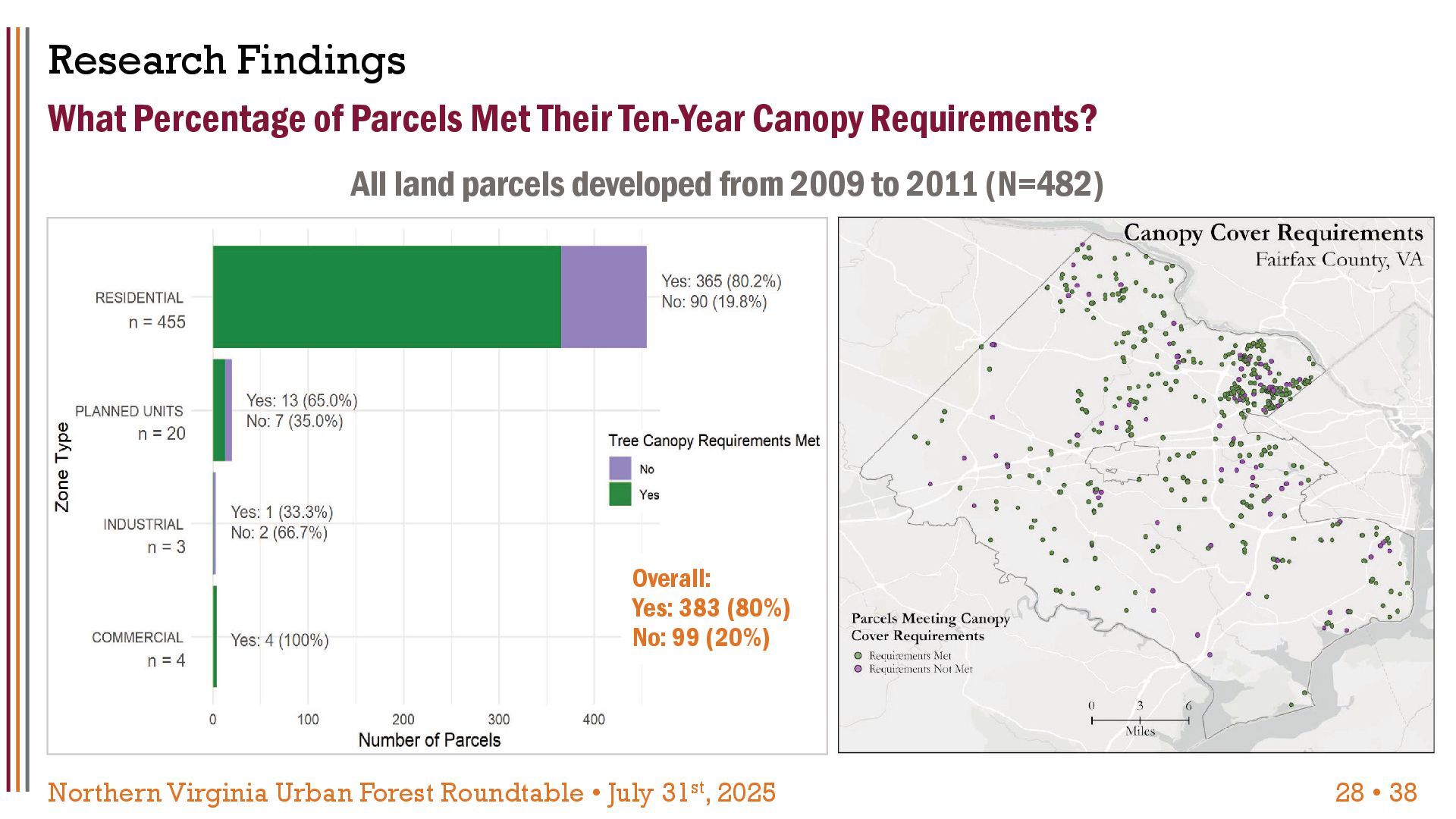
Research Findings 28 • 38 What Percentage of Parcels Met
Their Ten-Year Canopy Requirements? Overall: Yes: 383 (80%) No: 99 (20%) All land parcels developed from 2009 to 2011 (N=482) Northern Virginia Urban Forest Roundtable • July 31st, 2025 -
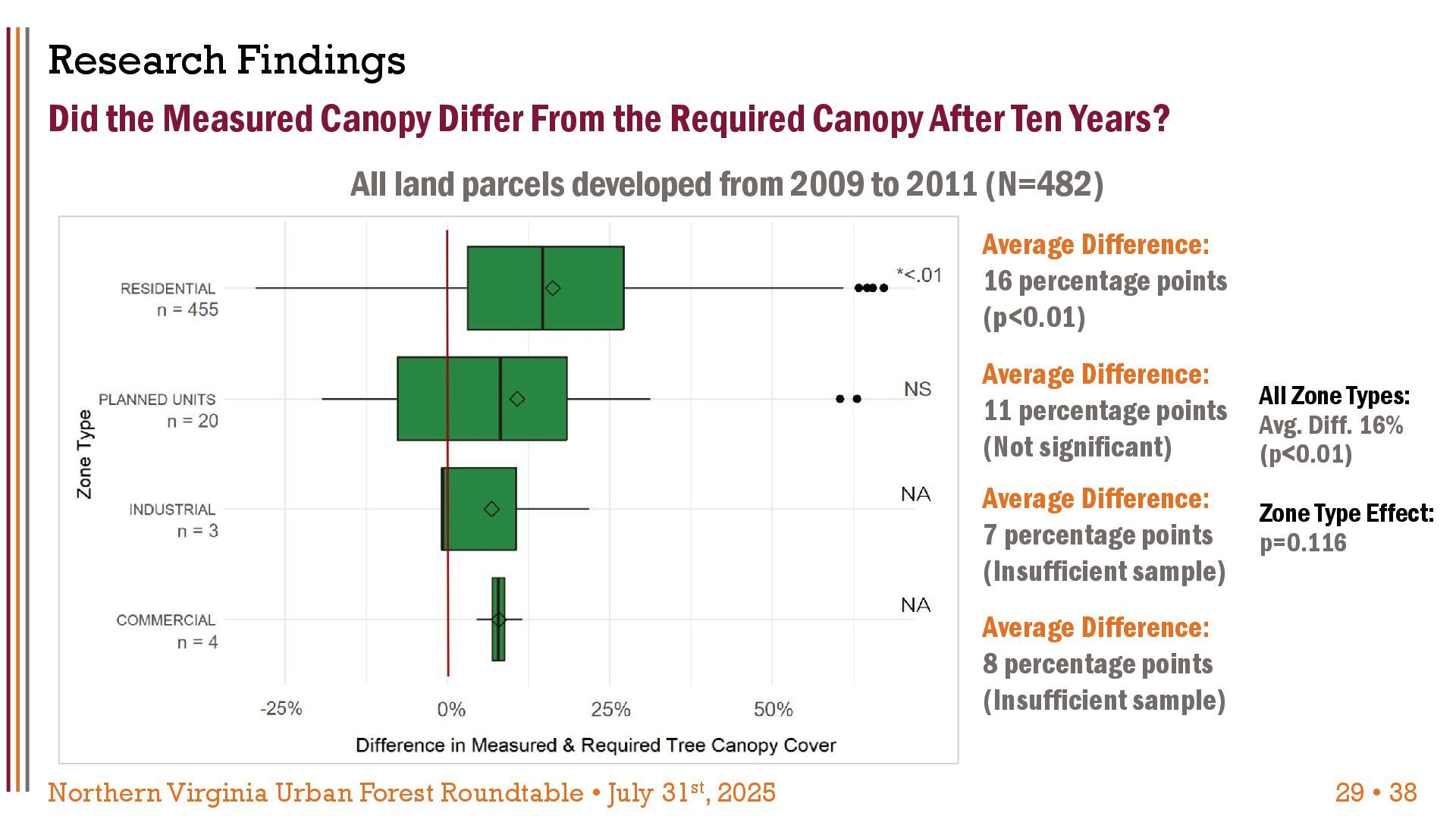
Research Findings 29 • 38 Did the Measured Canopy Differ
From the Required Canopy After Ten Years? All land parcels developed from 2009 to 2011 (N=482) Average Difference: 16 percentage points (p<0.01) Average Difference: 11 percentage points (Not significant) Average Difference: 7 percentage points (Insufficient sample) Average Difference: 8 percentage points (Insufficient sample) All Zone Types: Avg. Diff. 16% (p<0.01) Zone Type Effect: p=0.116 Northern Virginia Urban Forest Roundtable • July 31st, 2025 -
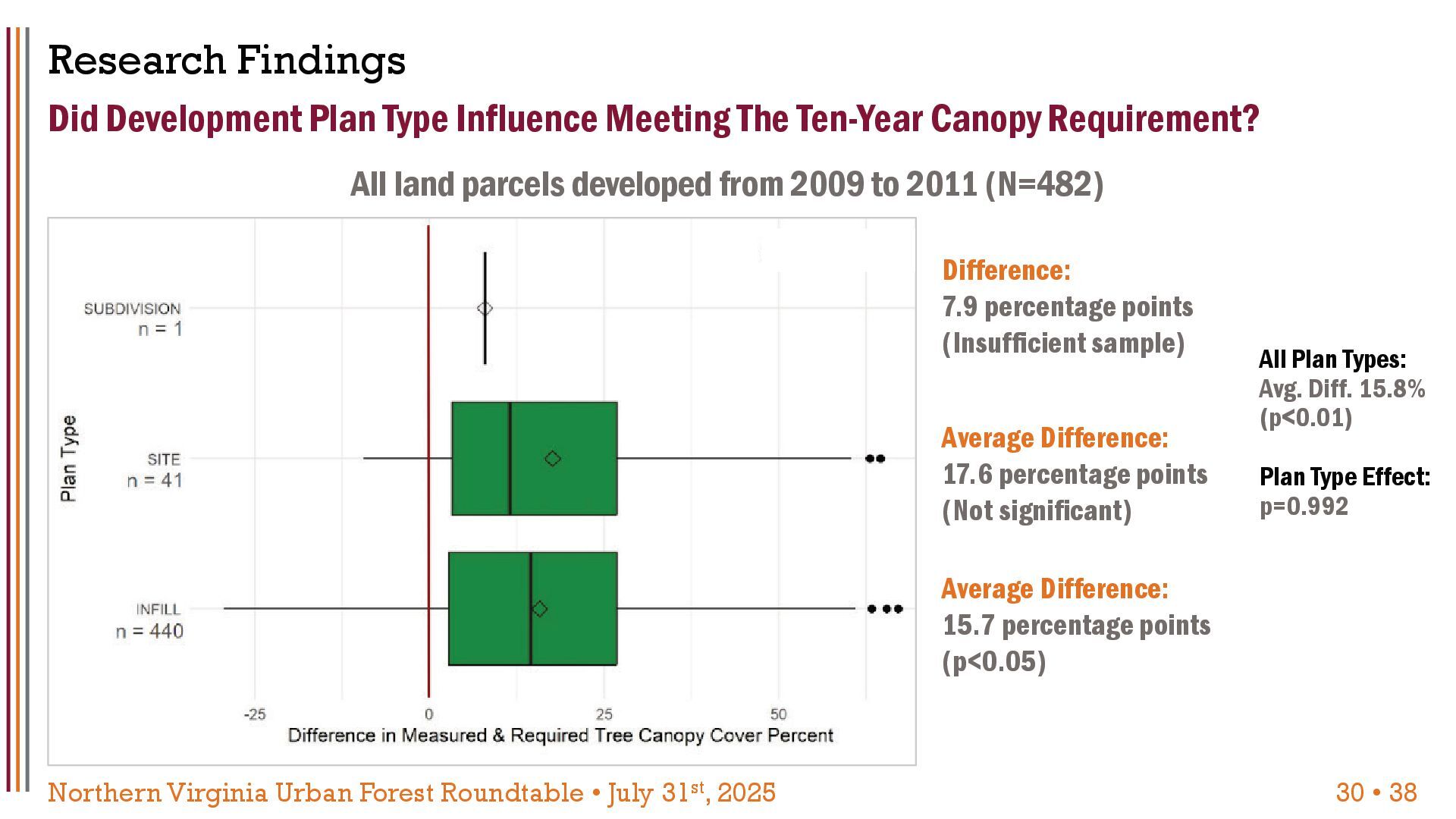
Research Findings 30 • 38 Did Development Plan Type Influence
Meeting The Ten-Year Canopy Requirement? All land parcels developed from 2009 to 2011 (N=482) Difference: 7.9 percentage points (Insufficient sample) Average Difference: 17.6 percentage points (Not significant) Average Difference: 15.7 percentage points (p<0.05) All Plan Types: Avg. Diff. 15.8% (p<0.01) Plan Type Effect: p=0.992 Northern Virginia Urban Forest Roundtable • July 31st, 2025 -
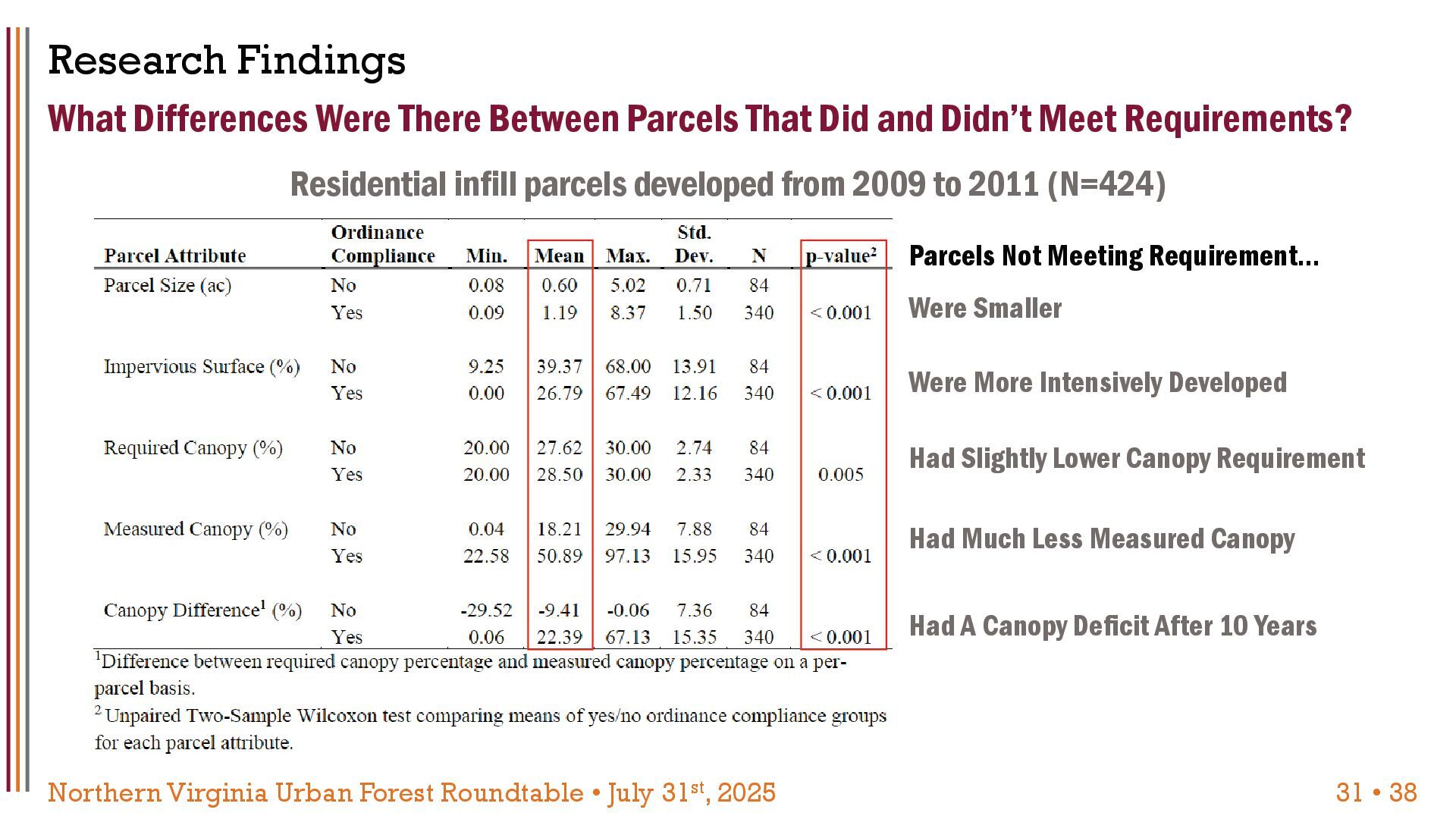
Research Findings 31 • 38 What Differences Were There Between
Parcels That Did and Didn’t Meet Requirements? Residential infill parcels developed from 2009 to 2011 (N=424) Parcels Not Meeting Requirement… Were Smaller Were More Intensively Developed Had Slightly Lower Canopy Requirement Had Much Less Measured Canopy Northern Virginia Urban Forest Roundtable • July 31st, 2025 Had A Canopy Deficit After 10 Years -
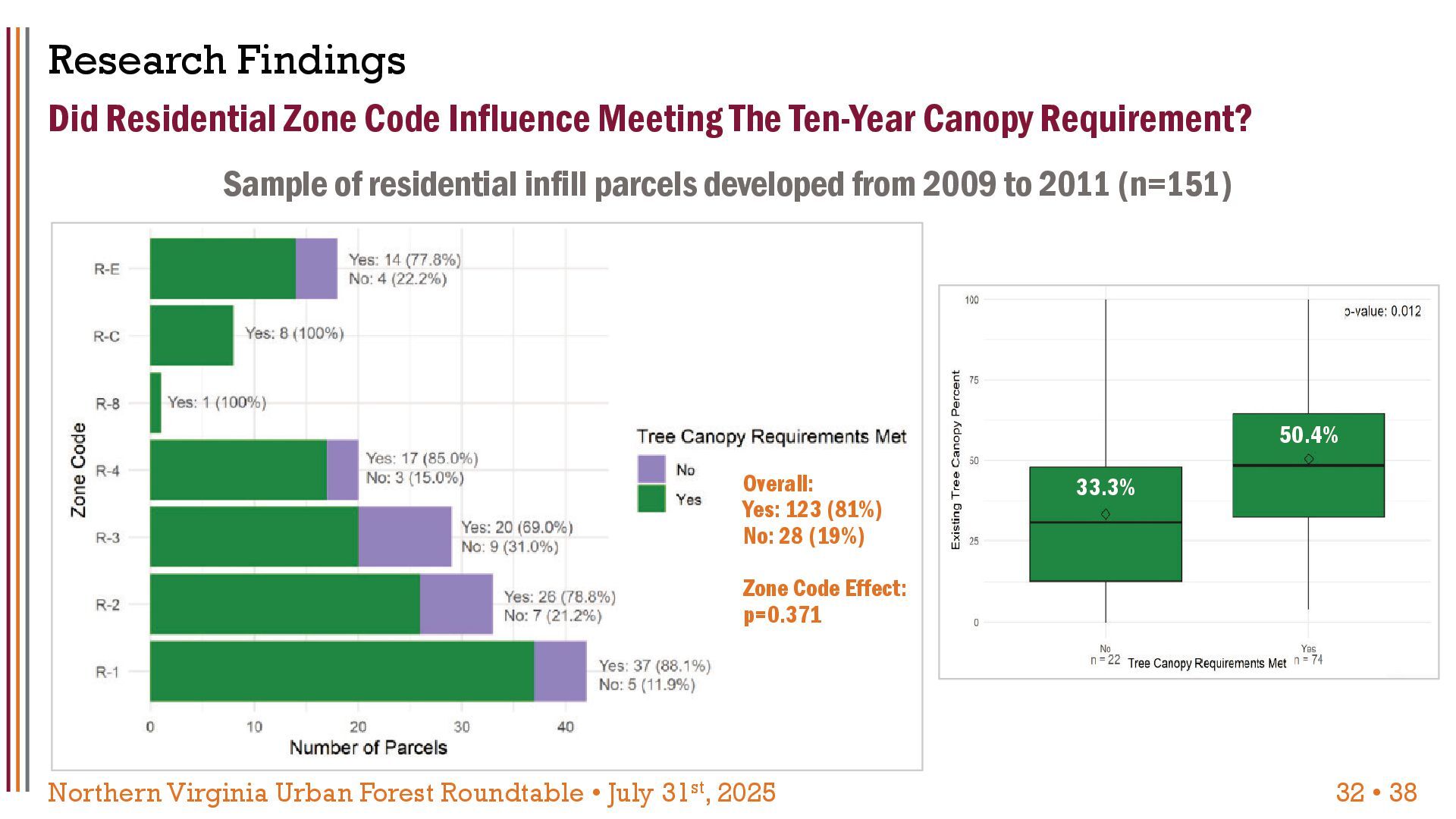
Research Findings 32 • 38 Did Residential Zone Code Influence
Meeting The Ten-Year Canopy Requirement? Sample of residential infill parcels developed from 2009 to 2011 (n=151) Overall: Yes: 123 (81%) No: 28 (19%) Zone Code Effect: p=0.371 33.3% 50.4% Northern Virginia Urban Forest Roundtable • July 31st, 2025 -
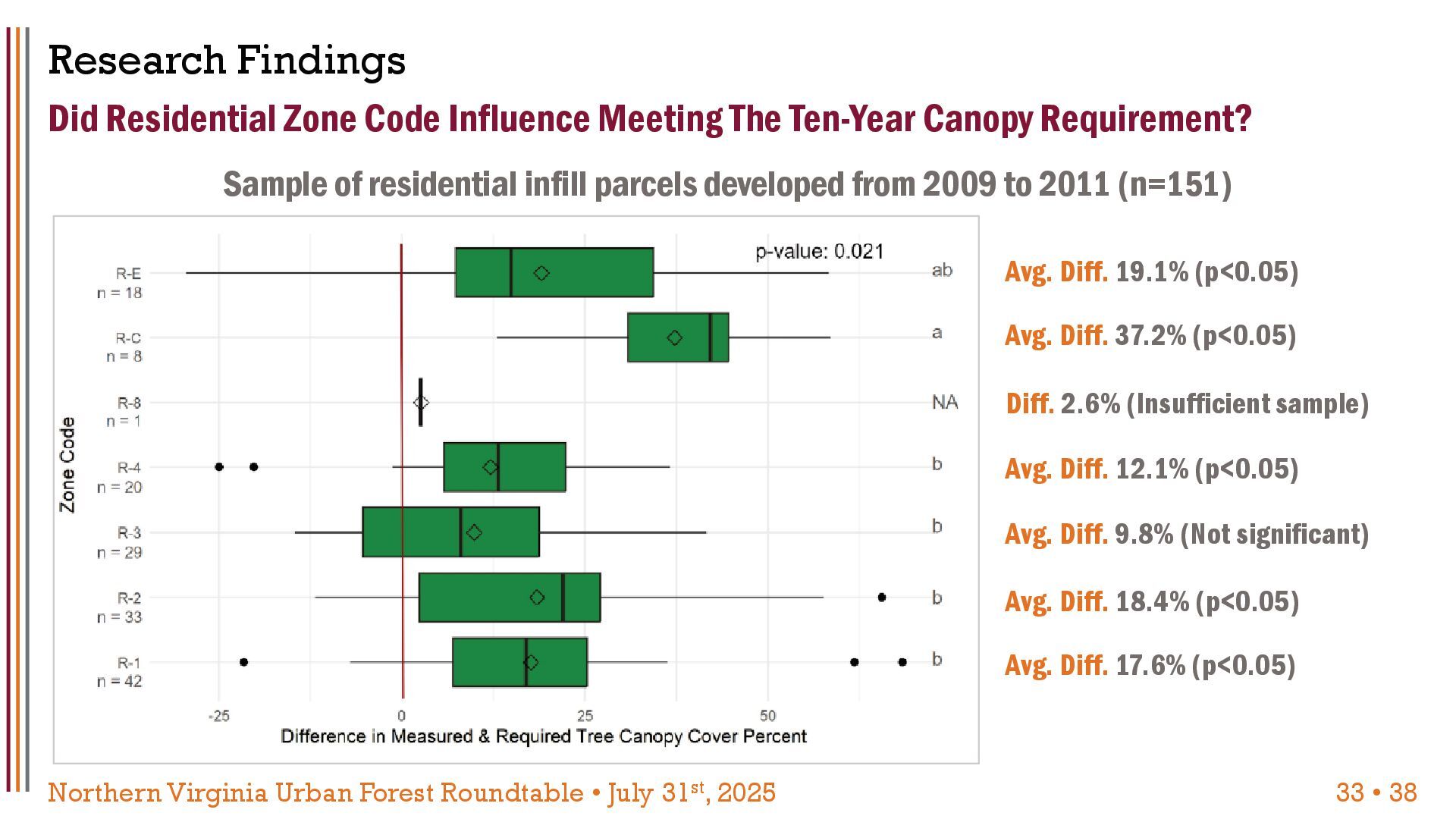
Research Findings 33 • 38 Did Residential Zone Code Influence
Meeting The Ten-Year Canopy Requirement? Sample of residential infill parcels developed from 2009 to 2011 (n=151) Avg. Diff. 19.1% (p<0.05) Avg. Diff. 37.2% (p<0.05) Diff. 2.6% (Insufficient sample) Avg. Diff. 12.1% (p<0.05) Avg. Diff. 9.8% (Not significant) Avg. Diff. 18.4% (p<0.05) Avg. Diff. 17.6% (p<0.05) Northern Virginia Urban Forest Roundtable • July 31st, 2025 -
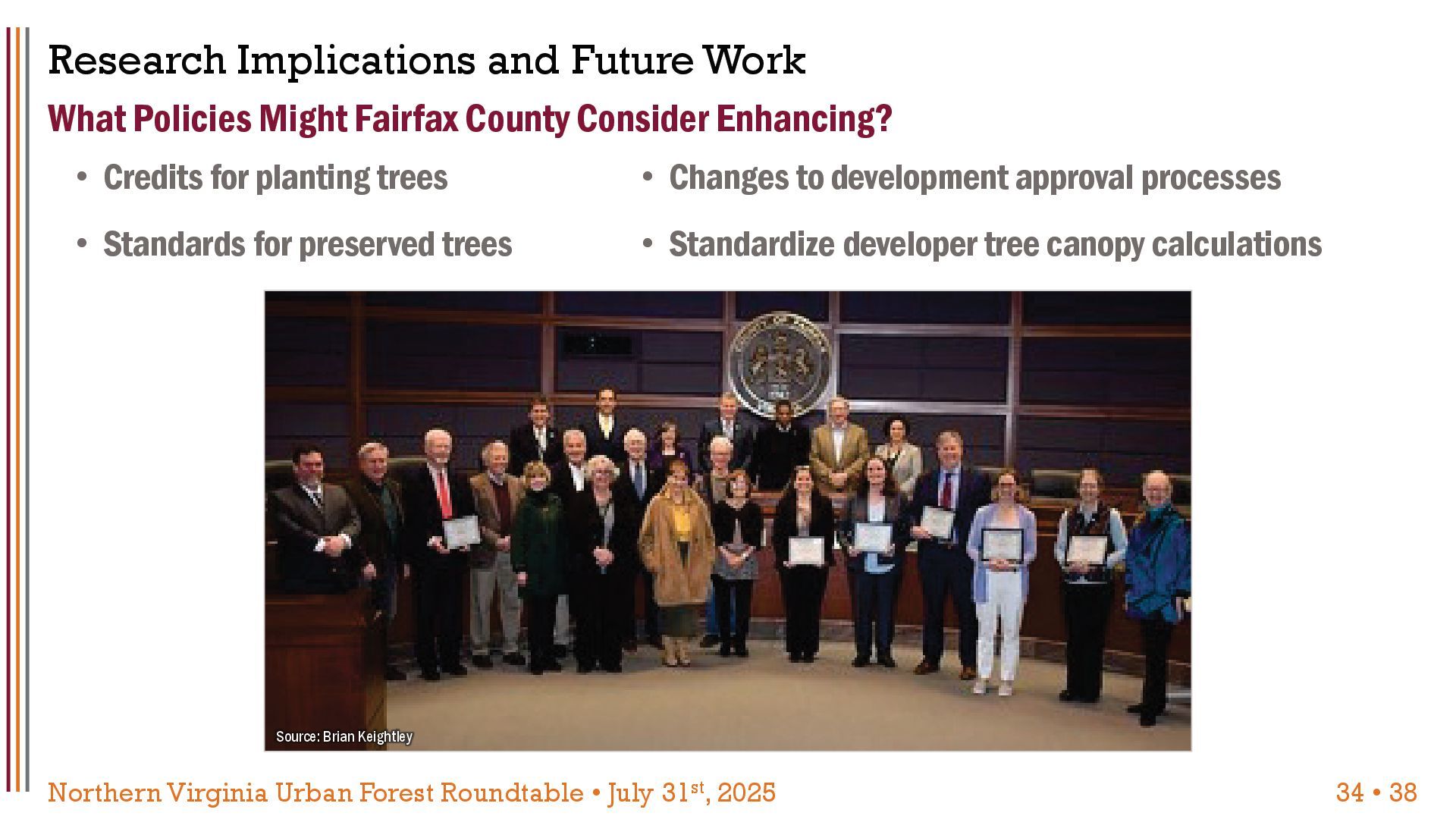
Research Implications and Future Work 34 • 38 • Credits
for planting trees • Standards for preserved trees What Policies Might Fairfax County Consider Enhancing? • Changes to development approval processes • Standardize developer tree canopy calculations Source: Brian Keightley Northern Virginia Urban Forest Roundtable • July 31st, 2025 -
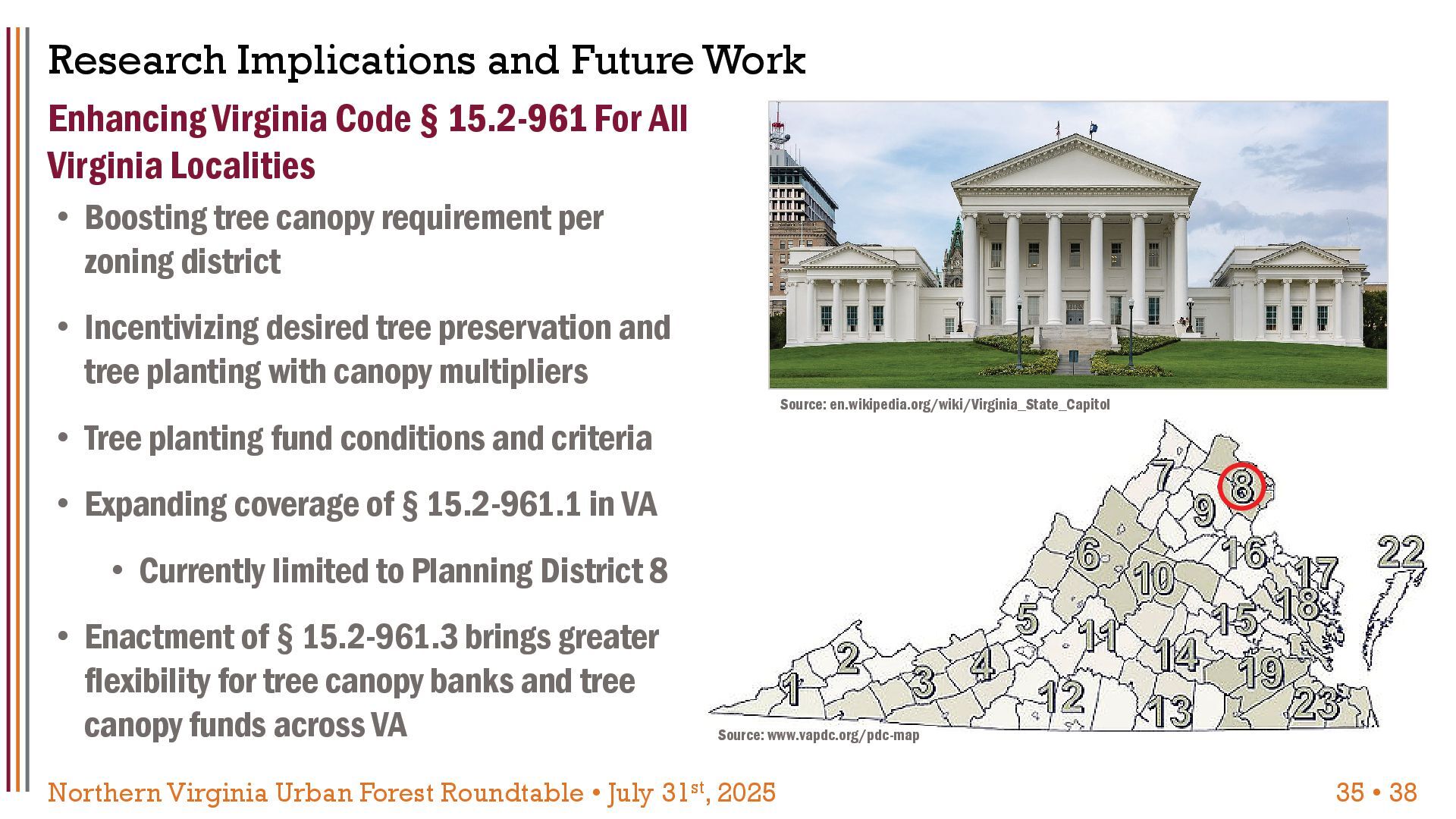
Research Implications and Future Work 35 • 38 • Boosting
tree canopy requirement per zoning district • Incentivizing desired tree preservation and tree planting with canopy multipliers • Tree planting fund conditions and criteria • Expanding coverage of § 15.2-961.1 in VA • Currently limited to Planning District 8 • Enactment of § 15.2-961.3 brings greater flexibility for tree canopy banks and tree canopy funds across VA Enhancing Virginia Code § 15.2-961 For All Virginia Localities Source: www.vapdc.org/pdc-map Source: en.wikipedia.org/wiki/Virginia_State_Capitol Northern Virginia Urban Forest Roundtable • July 31st, 2025 -
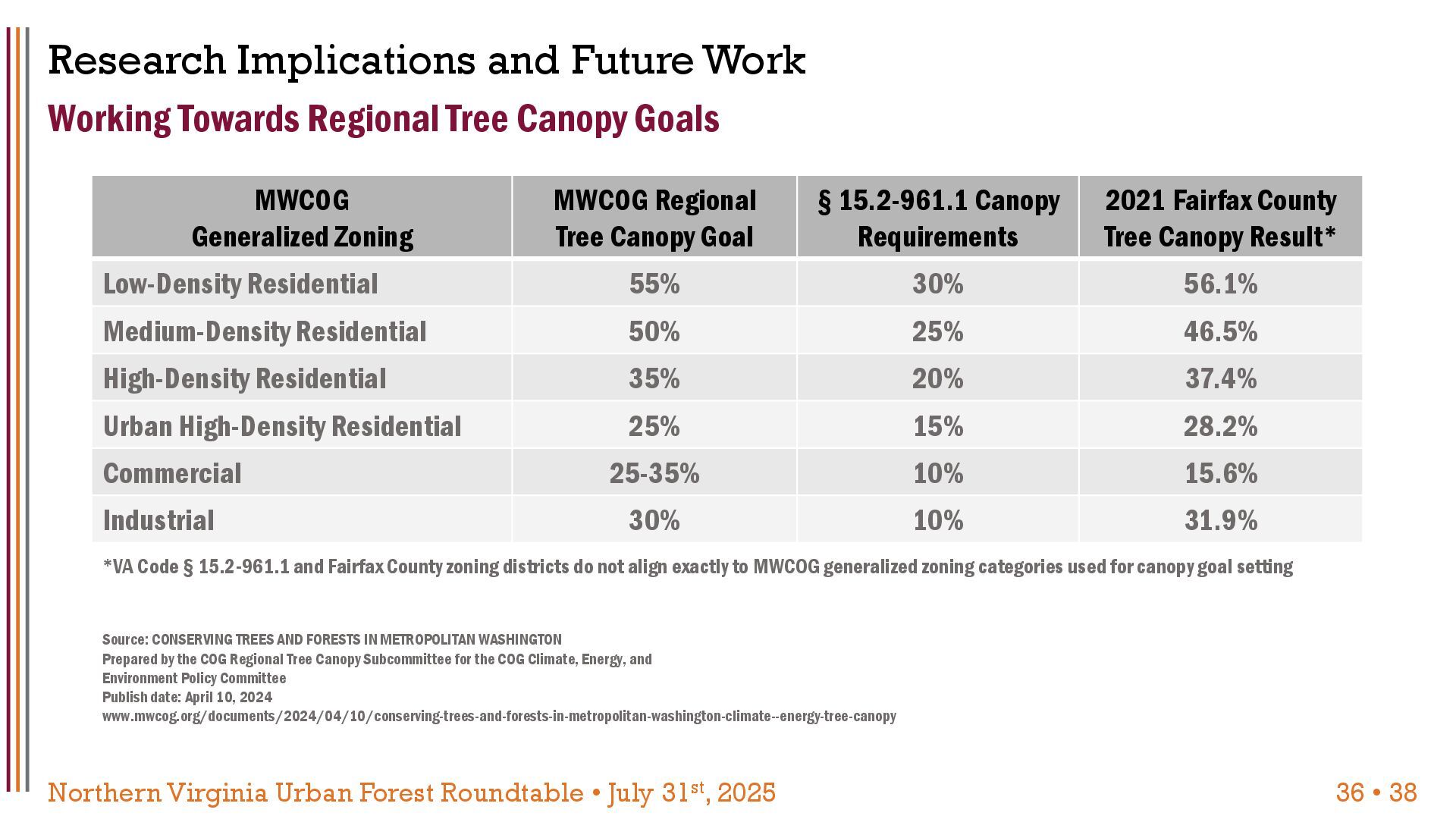
Research Implications and Future Work 36 • 38 MWCOG Generalized
Zoning MWCOG Regional Tree Canopy Goal § 15.2-961.1 Canopy Requirements 2021 Fairfax County Tree Canopy Result* Low-Density Residential 55% 30% 56.1% Medium-Density Residential 50% 25% 46.5% High-Density Residential 35% 20% 37.4% Urban High-Density Residential 25% 15% 28.2% Commercial 25-35% 10% 15.6% Industrial 30% 10% 31.9% *VA Code § 15.2-961.1 and Fairfax County zoning districts do not align exactly to MWCOG generalized zoning categories used for canopy goal setting Working Towards Regional Tree Canopy Goals Source: CONSERVING TREES AND FORESTS IN METROPOLITAN WASHINGTON Prepared by the COG Regional Tree Canopy Subcommittee for the COG Climate, Energy, and Environment Policy Committee Publish date: April 10, 2024 www.mwcog.org/documents/2024/04/10/conserving-trees-and-forests-in-metropolitan-washington-climate--energy-tree-canopy Northern Virginia Urban Forest Roundtable • July 31st, 2025 -
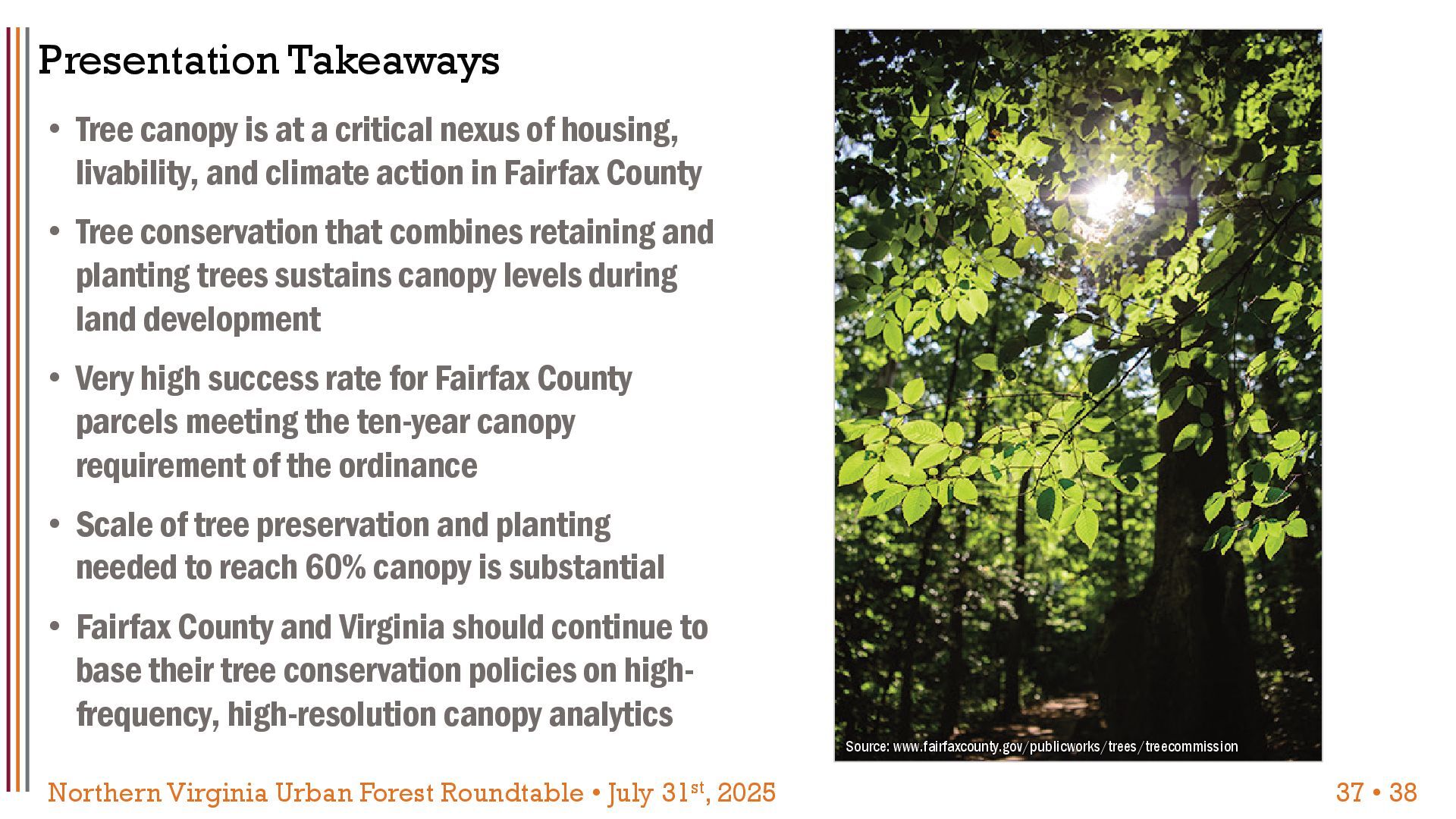
Presentation Takeaways 37 • 38 • Tree canopy is at
a critical nexus of housing, livability, and climate action in Fairfax County • Tree conservation that combines retaining and planting trees sustains canopy levels during land development • Very high success rate for Fairfax County parcels meeting the ten-year canopy requirement of the ordinance • Scale of tree preservation and planting needed to reach 60% canopy is substantial • Fairfax County and Virginia should continue to base their tree conservation policies on high- frequency, high-resolution canopy analytics Source: www.fairfaxcounty.gov/publicworks/trees/treecommission Northern Virginia Urban Forest Roundtable • July 31st, 2025 -
Northern Virginia Urban Forest Roundtable • July 31st, 2025 Fairfax
County’s Tree Canopy: Examining the Effects of Land Development Regulations on Tree Canopy Conservation Eric Wiseman, PhD Associate Professor of Urban & Community Forestry Dept. of Forest Resources & Environmental Conservation Virginia Tech [email protected] uf.frec.vt.edu 38 • 38
 pwiseman
 tagtag
 ykamit
 trycycle
 sshimizu2006
 xleitix
 yu4u
 akasan
 estie
 kusunokikeisuke
 konakalab
 baasie
 chriscoyier
 reverentgeek
 garrettdimon
 aleyda
 cassininazir
 davidcarrasco
 ianozsvald
 mojombo
 techseoconnect
 ks91