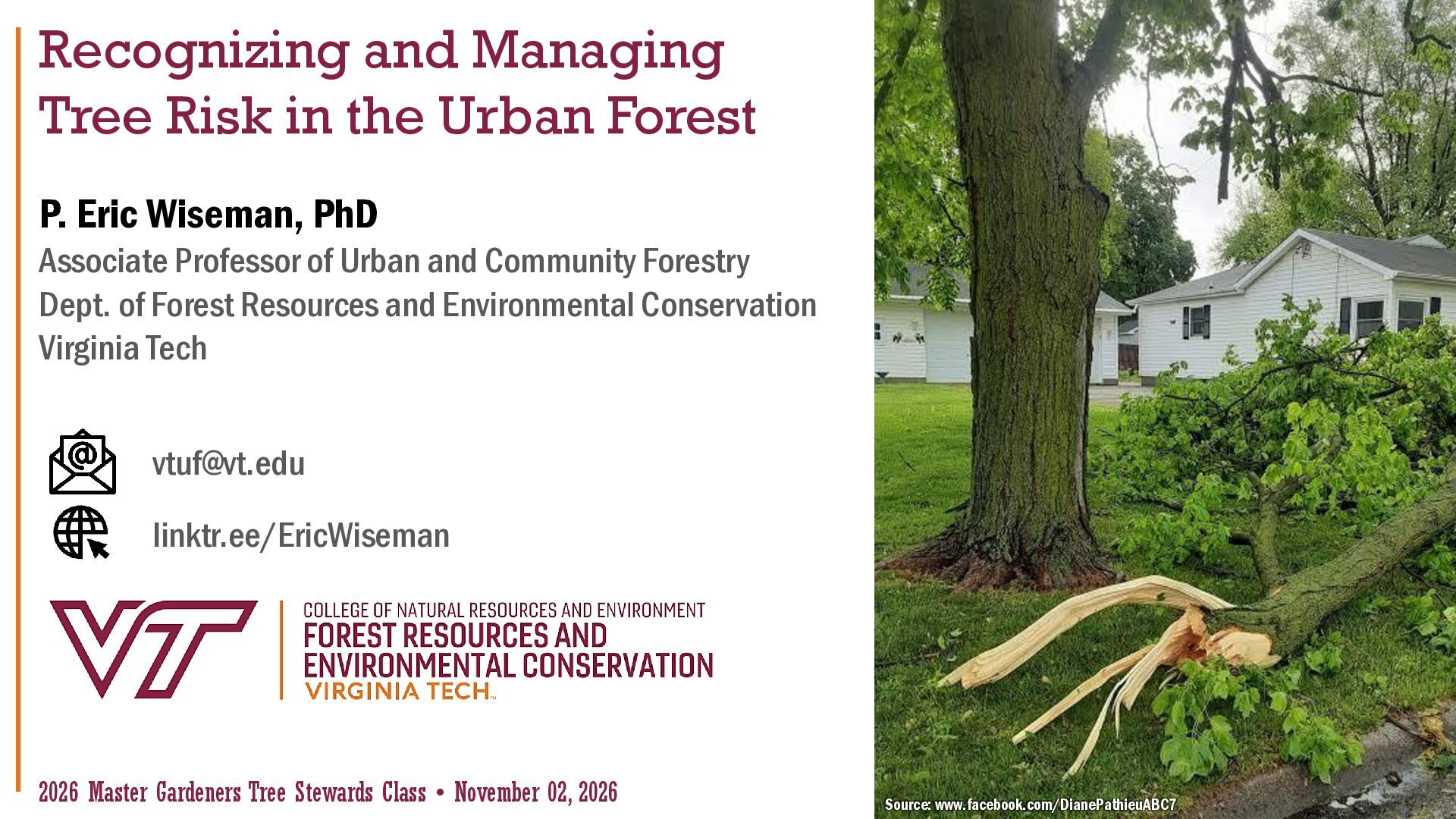
Eric Wiseman, PhD Associate Professor of Urban and Community Forestry Dept. of Forest Resources and Environmental Conservation Virginia Tech [email protected] linktr.ee/EricWiseman 2026 Master Gardeners Tree Stewards Class • November 02, 2026 Source: www.facebook.com/DianePathieuABC7
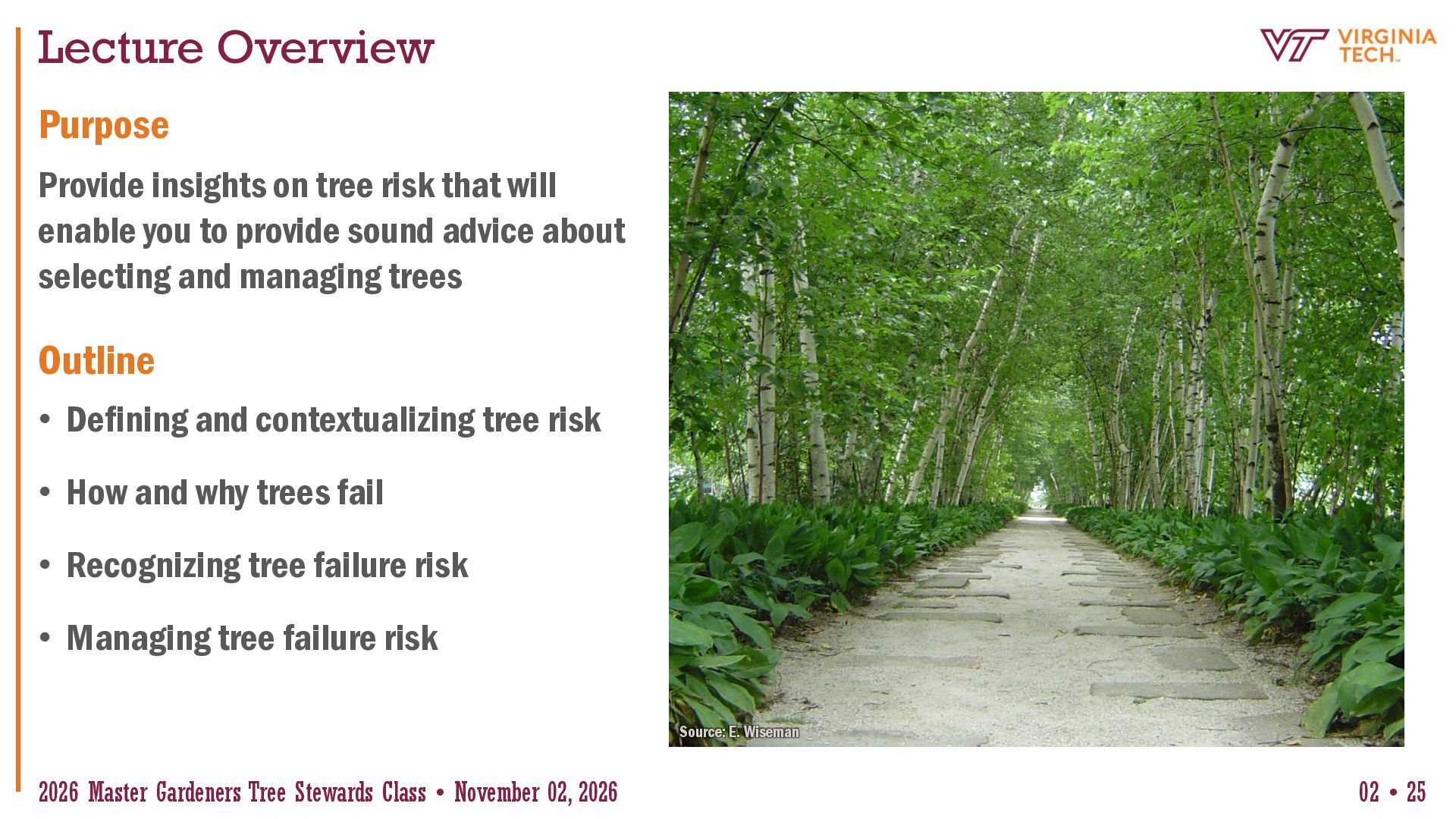
enable you to provide sound advice about selecting and managing trees Outline • Defining and contextualizing tree risk • How and why trees fail • Recognizing tree failure risk • Managing tree failure risk Source: E. Wiseman 2026 Master Gardeners Tree Stewards Class • November 02, 2026 02 • 25
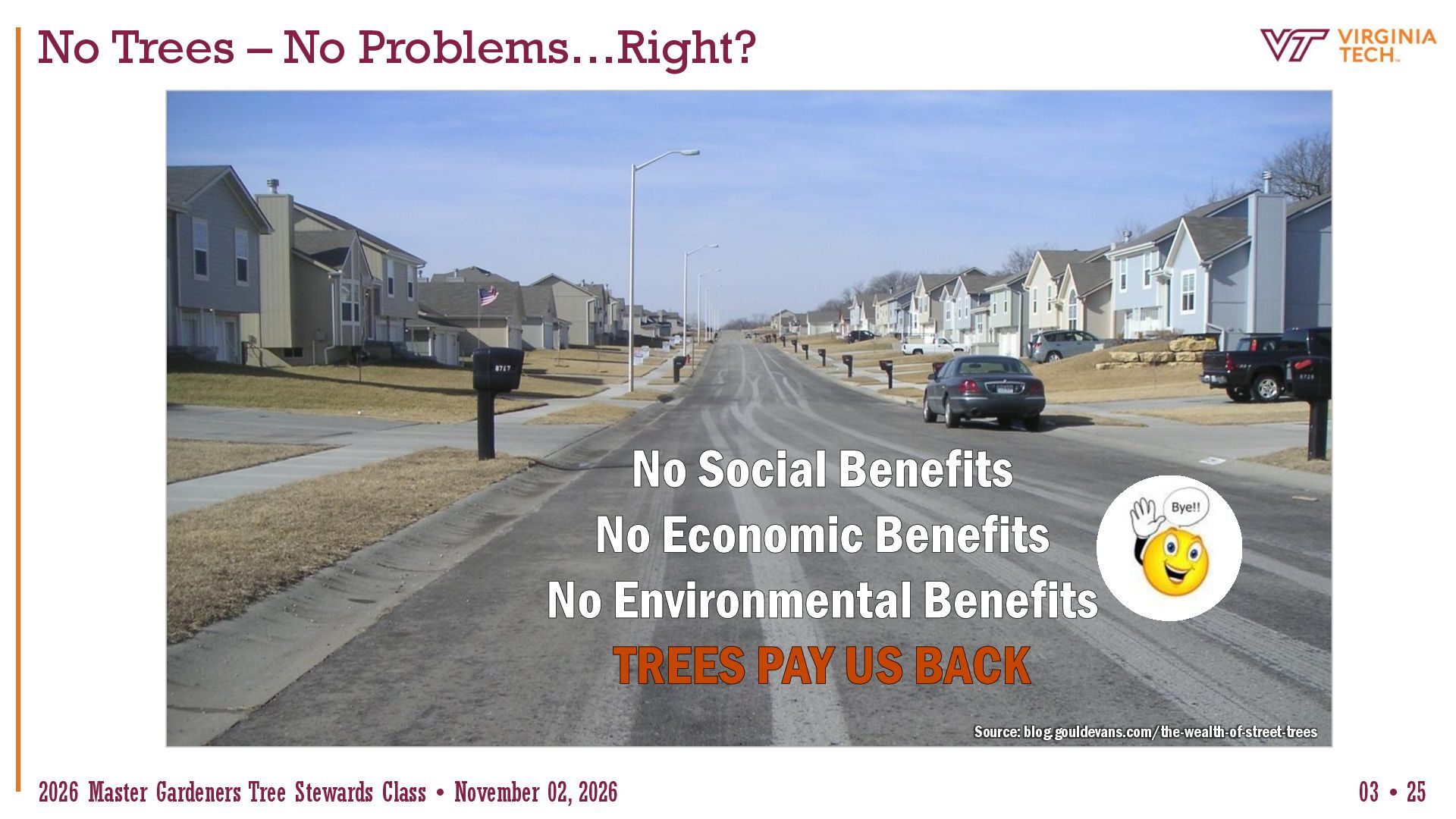
Benefits No Environmental Benefits TREES PAY US BACK Source: blog.gouldevans.com/the-wealth-of-street-trees 2026 Master Gardeners Tree Stewards Class • November 02, 2026 03 • 25
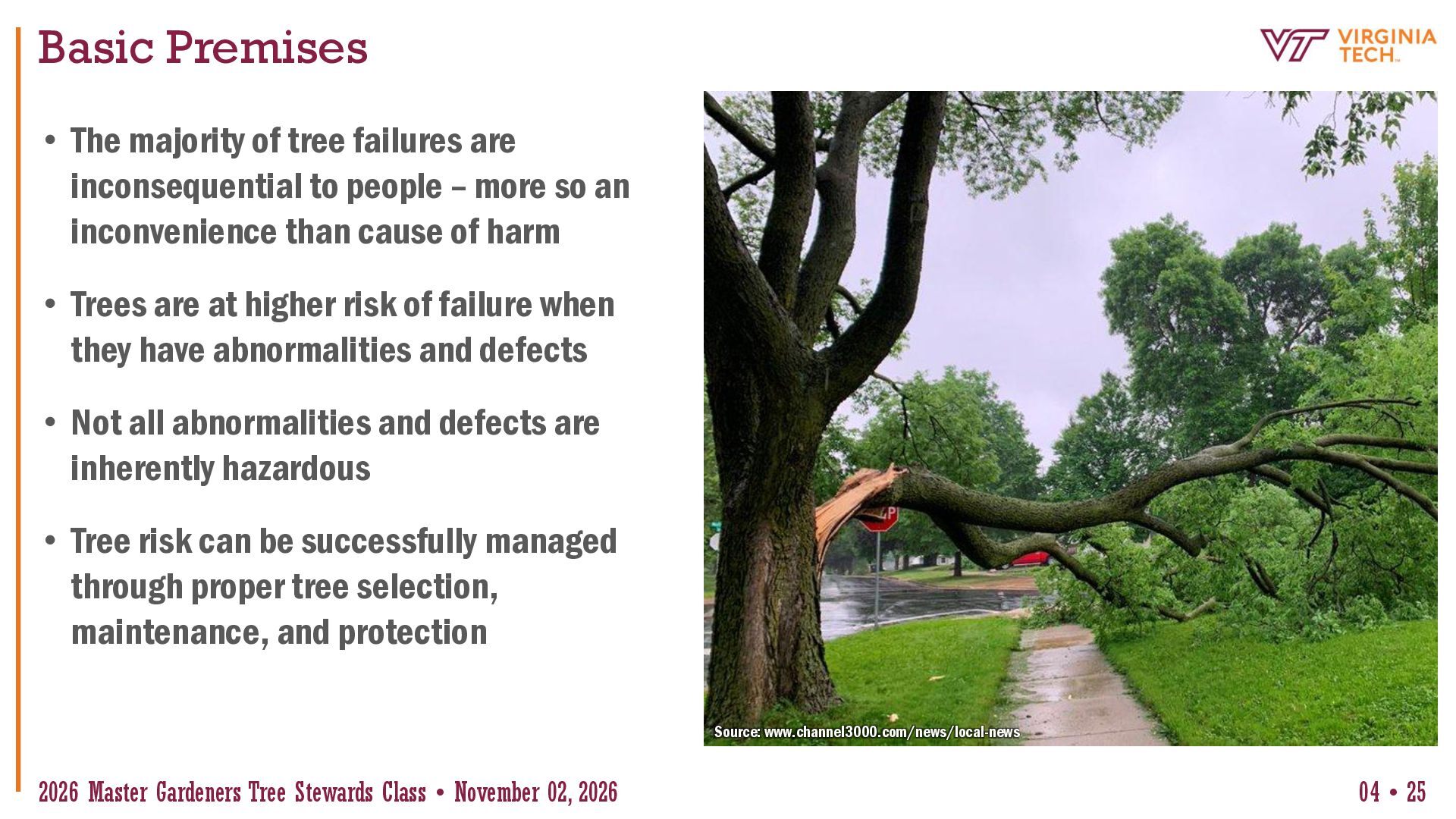
to people – more so an inconvenience than cause of harm • Trees are at higher risk of failure when they have abnormalities and defects • Not all abnormalities and defects are inherently hazardous • Tree risk can be successfully managed through proper tree selection, maintenance, and protection Source: www.channel3000.com/news/local-news 2026 Master Gardeners Tree Stewards Class • November 02, 2026 04 • 25
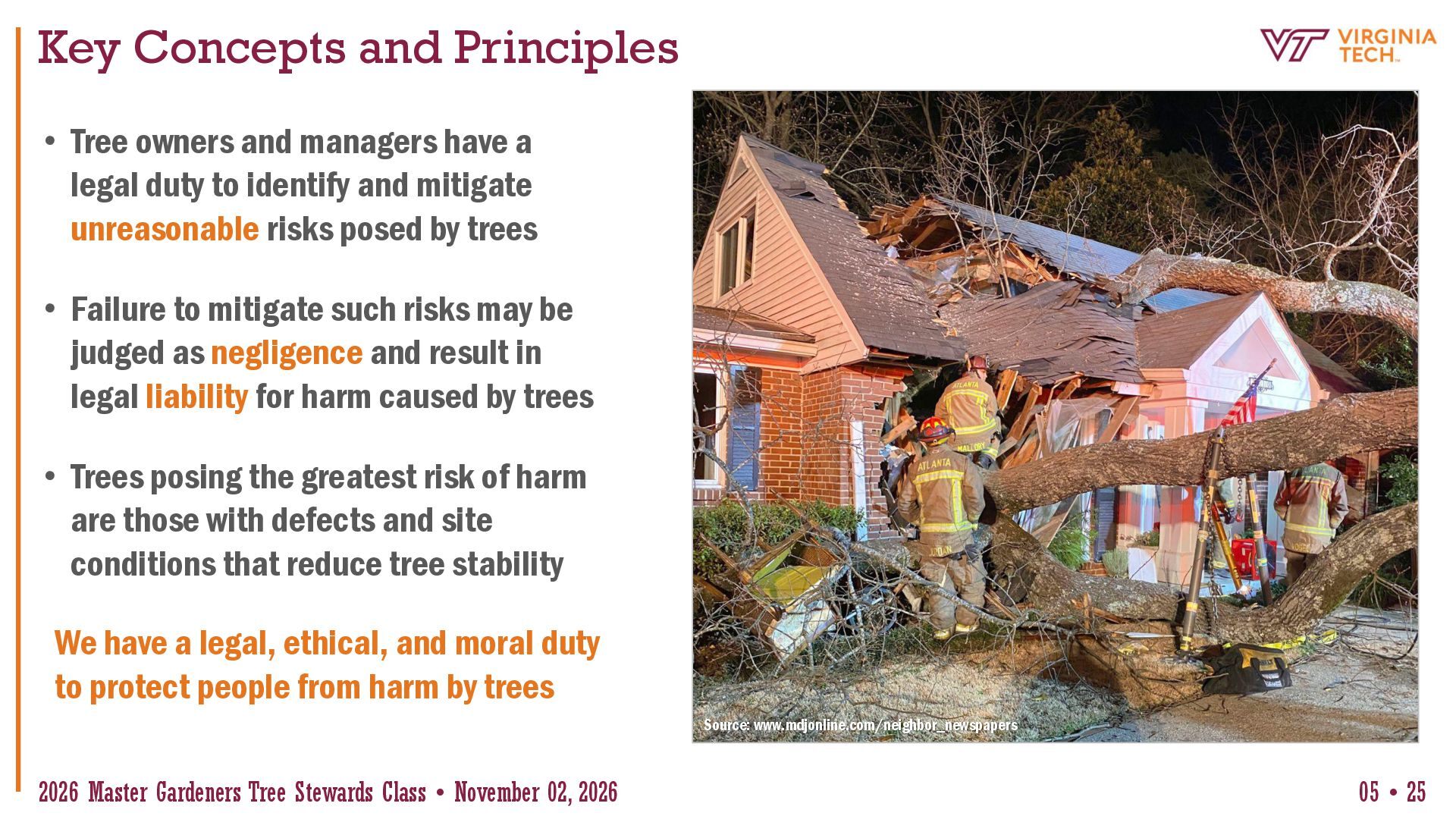
a legal duty to identify and mitigate unreasonable risks posed by trees • Failure to mitigate such risks may be judged as negligence and result in legal liability for harm caused by trees • Trees posing the greatest risk of harm are those with defects and site conditions that reduce tree stability We have a legal, ethical, and moral duty to protect people from harm by trees Source: www.mdjonline.com/neighbor_newspapers 2026 Master Gardeners Tree Stewards Class • November 02, 2026 05 • 25
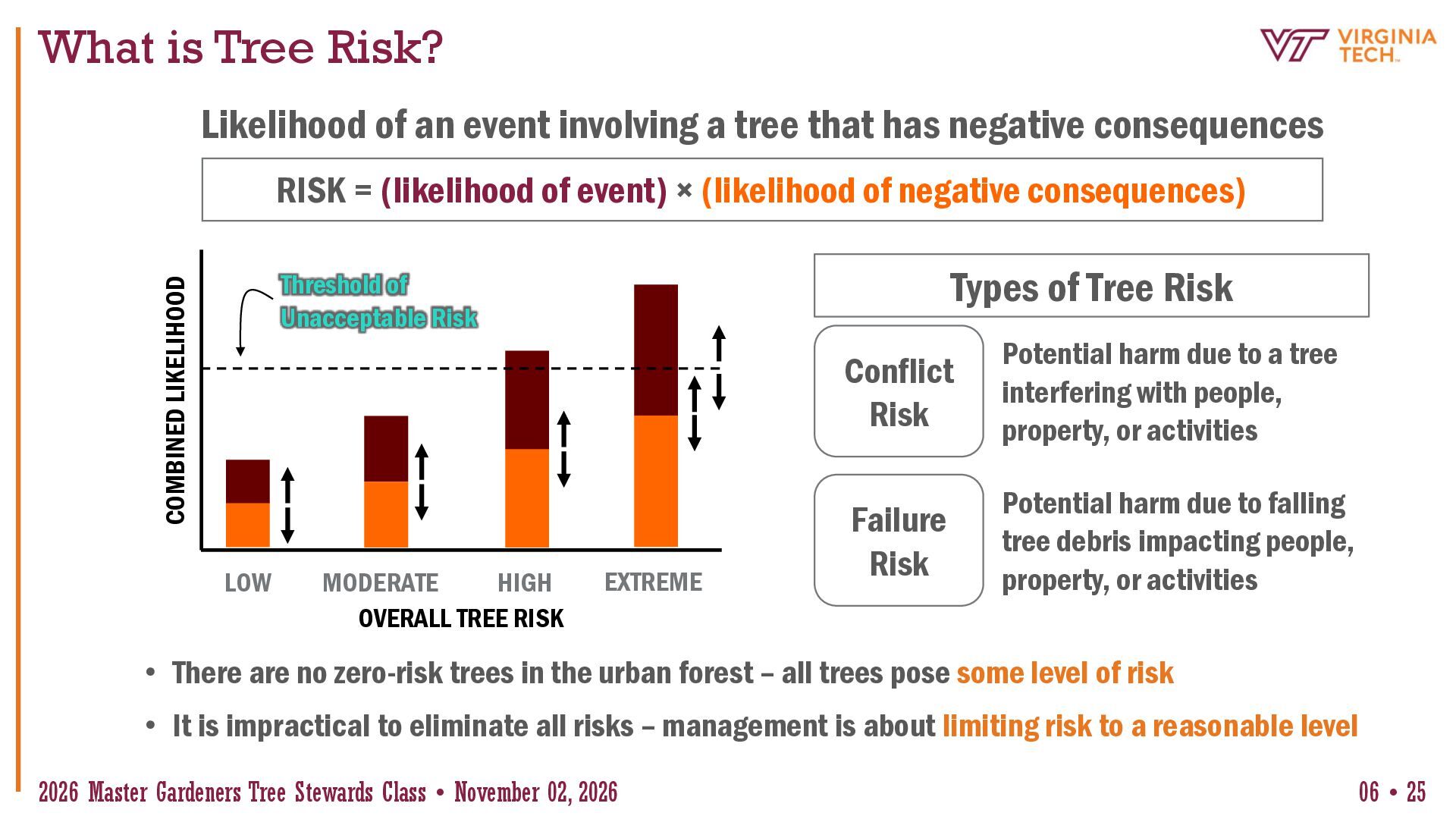
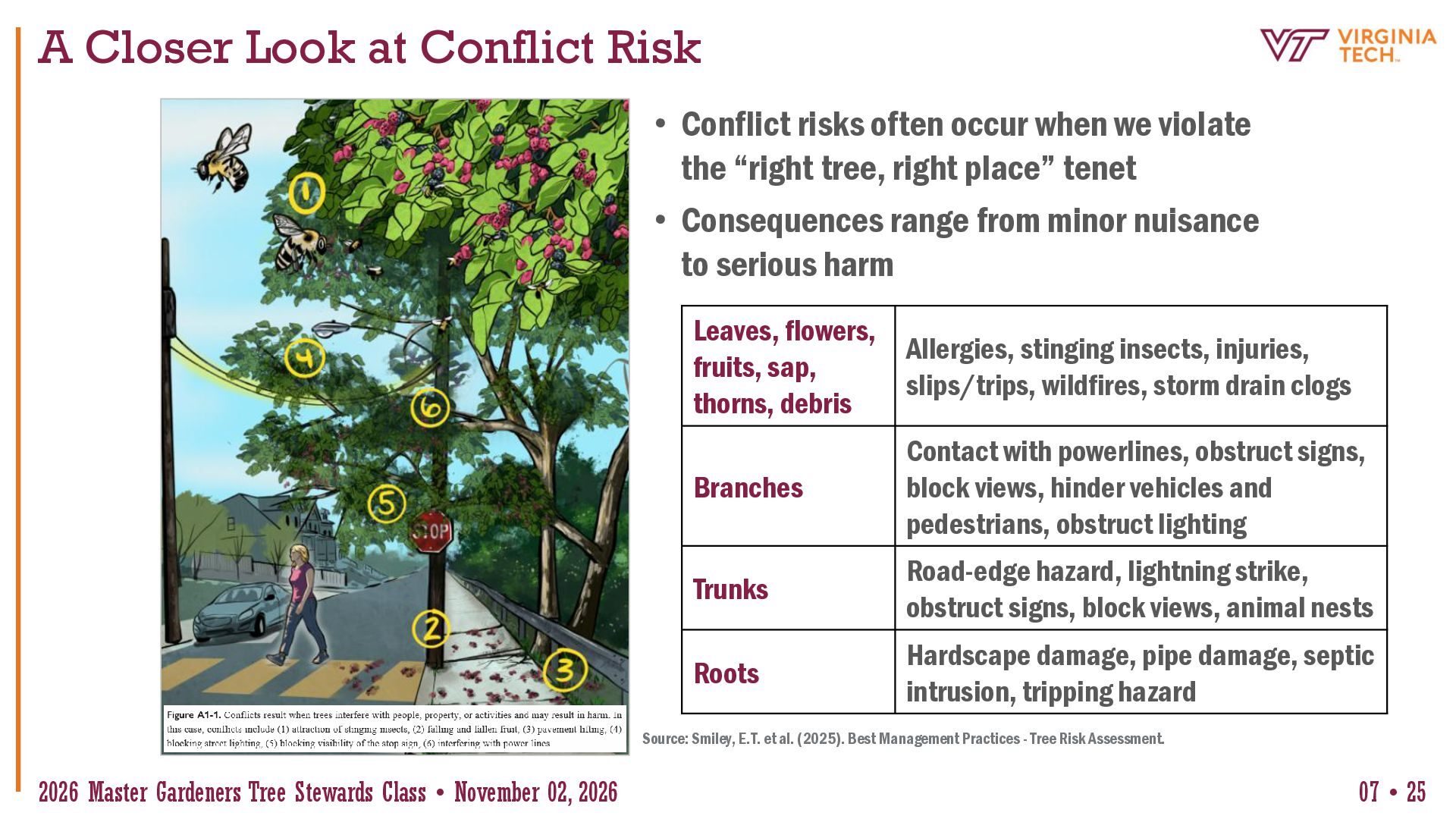
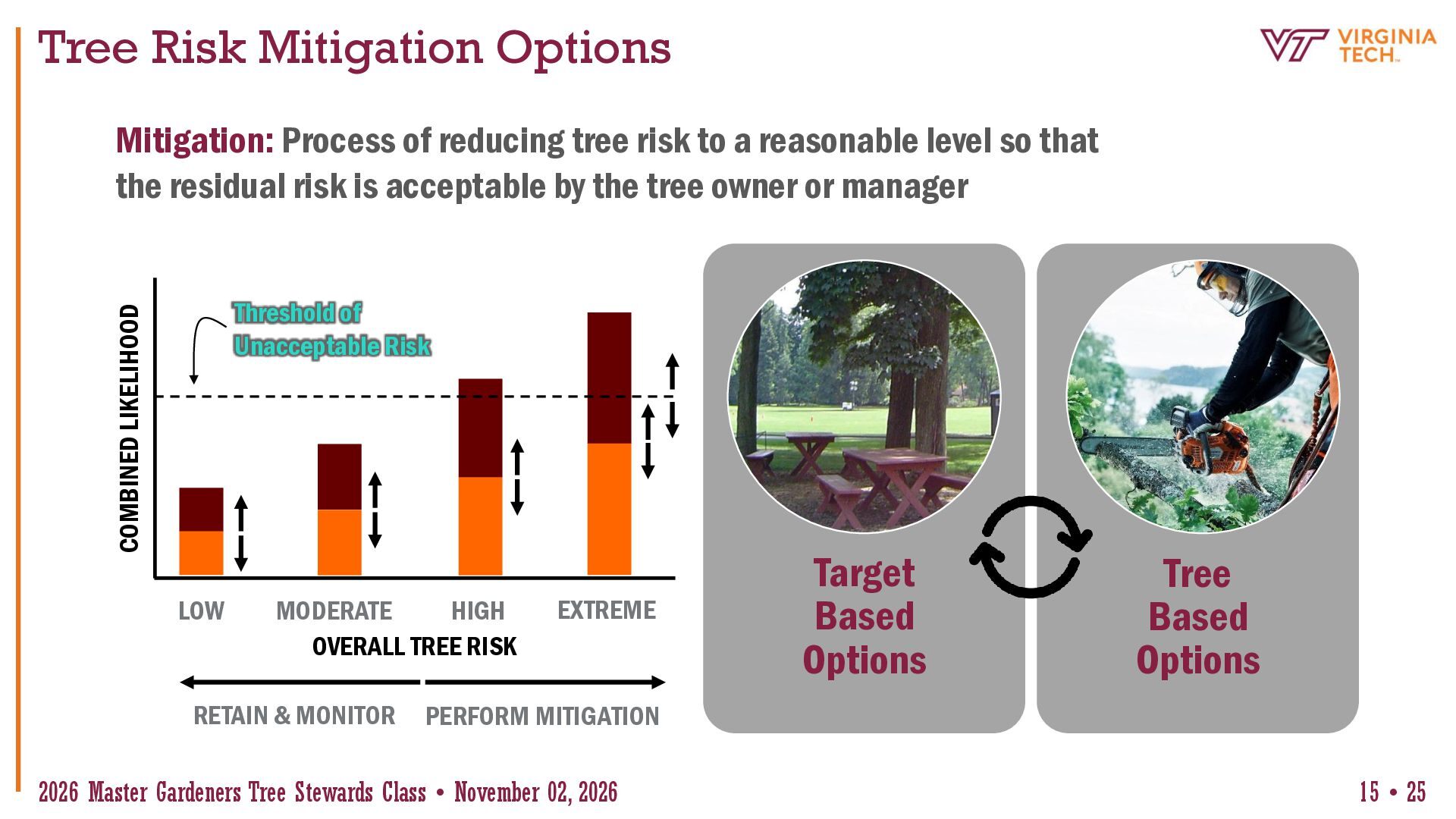
tree that has negative consequences RISK = (likelihood of event) × (likelihood of negative consequences) Types of Tree Risk COMBINED LIKELIHOOD Threshold of Unacceptable Risk LOW MODERATE HIGH OVERALL TREE RISK EXTREME Conflict Risk Potential harm due to a tree interfering with people, property, or activities Failure Risk Potential harm due to falling tree debris impacting people, property, or activities • There are no zero-risk trees in the urban forest – all trees pose some level of risk • It is impractical to eliminate all risks – management is about limiting risk to a reasonable level 2026 Master Gardeners Tree Stewards Class • November 02, 2026 06 • 25
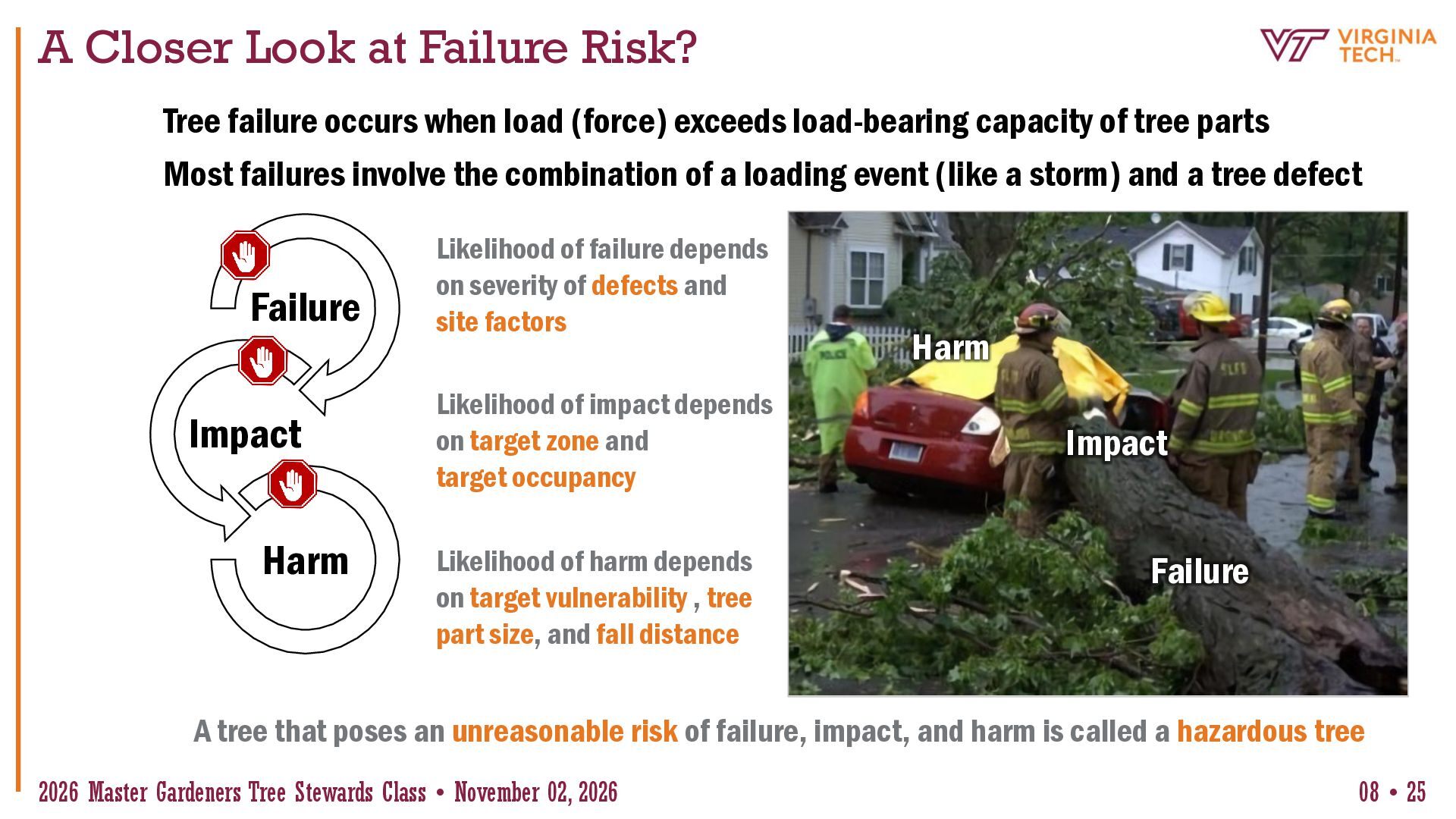
load (force) exceeds load-bearing capacity of tree parts Most failures involve the combination of a loading event (like a storm) and a tree defect Failure Impact Harm Likelihood of failure depends on severity of defects and site factors Likelihood of impact depends on target zone and target occupancy Likelihood of harm depends on target vulnerability , tree part size, and fall distance Harm Impact Failure A tree that poses an unreasonable risk of failure, impact, and harm is called a hazardous tree 2026 Master Gardeners Tree Stewards Class • November 02, 2026 08 • 25
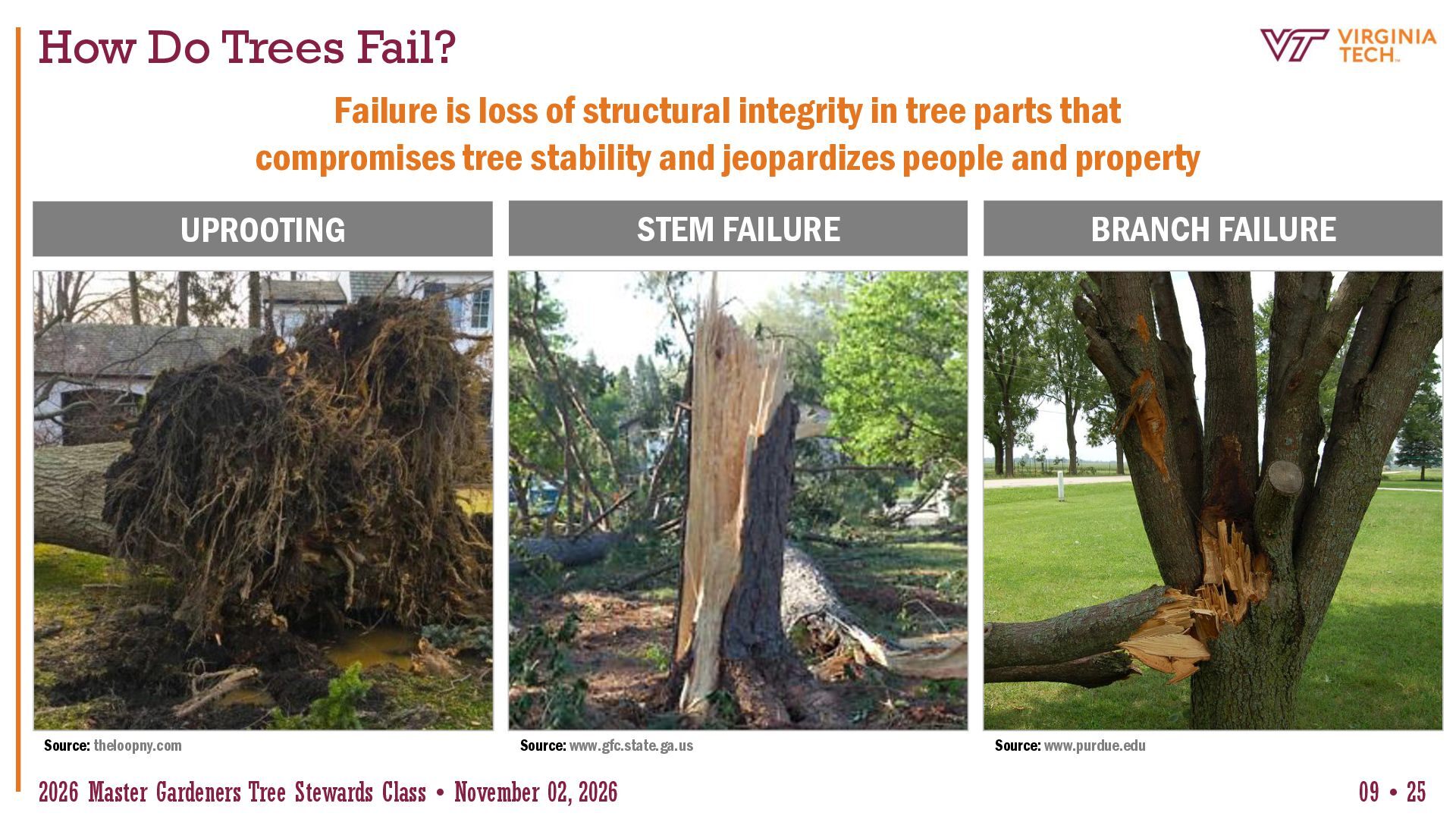
in tree parts that compromises tree stability and jeopardizes people and property STEM FAILURE UPROOTING Source: theloopny.com Source: www.gfc.state.ga.us 2026 Master Gardeners Tree Stewards Class • November 02, 2026 BRANCH FAILURE Source: www.purdue.edu 09 • 25
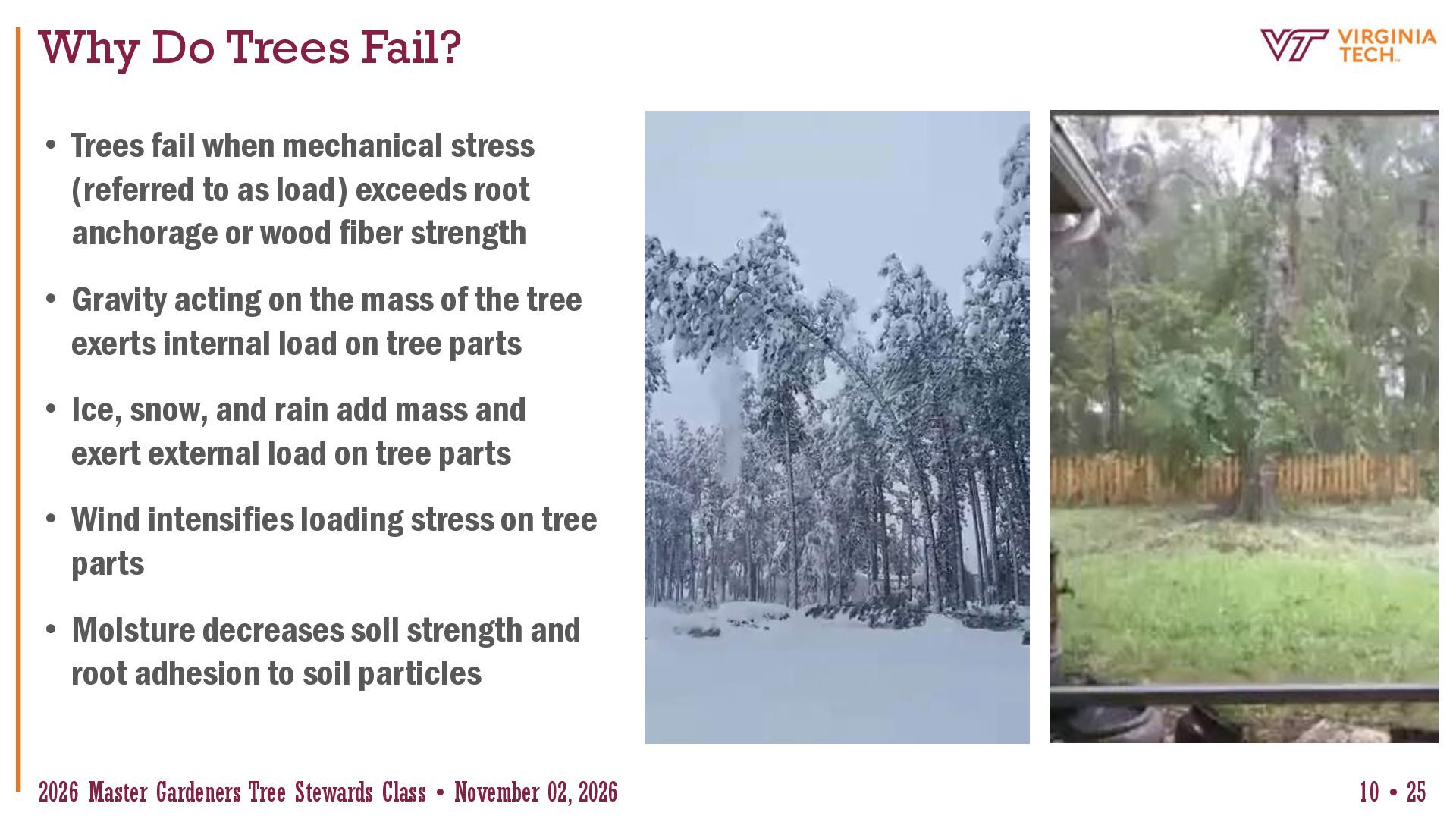
(referred to as load) exceeds root anchorage or wood fiber strength • Gravity acting on the mass of the tree exerts internal load on tree parts • Ice, snow, and rain add mass and exert external load on tree parts • Wind intensifies loading stress on tree parts • Moisture decreases soil strength and root adhesion to soil particles 2026 Master Gardeners Tree Stewards Class • November 02, 2026 10 • 25
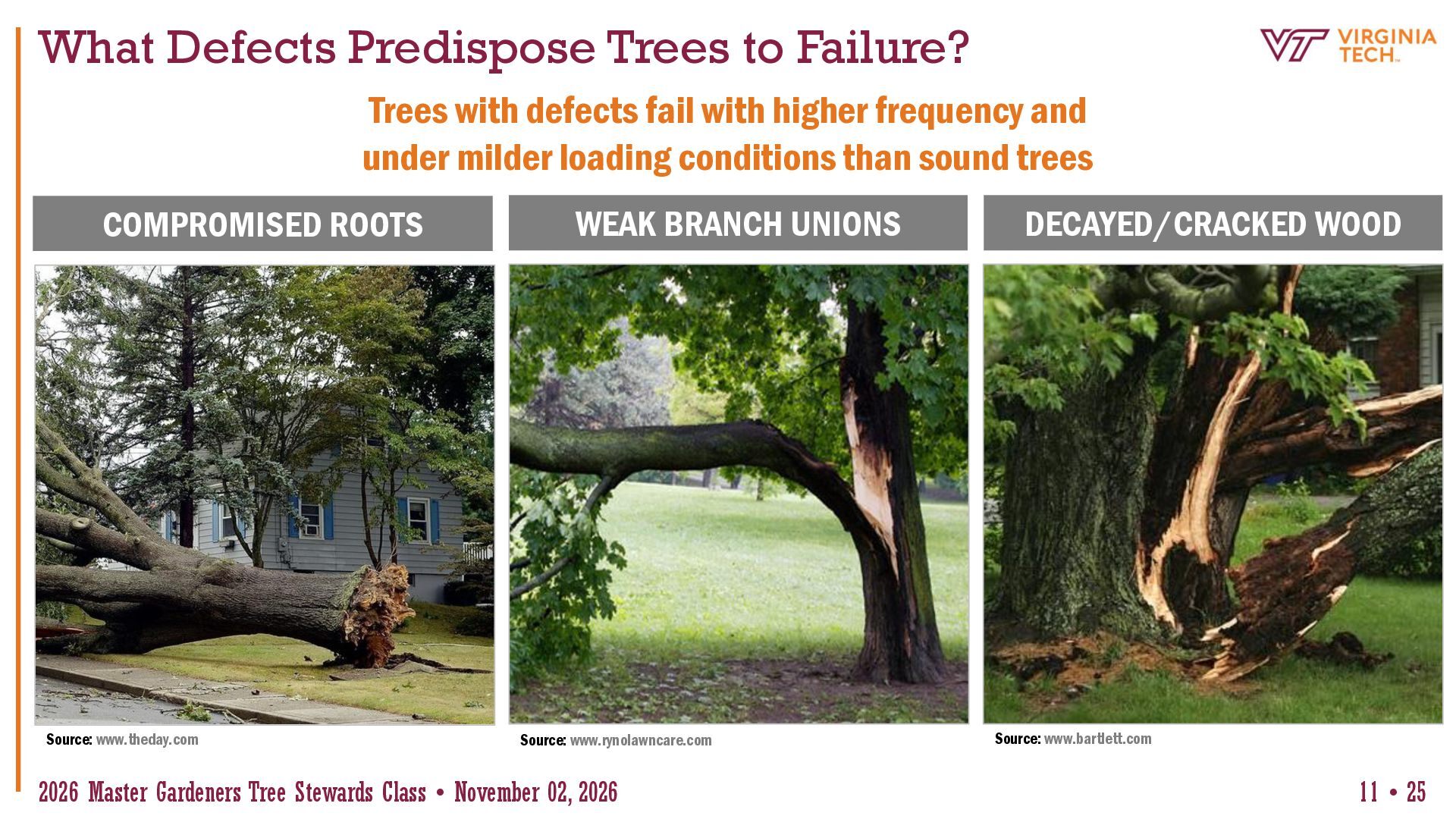
with higher frequency and under milder loading conditions than sound trees COMPROMISED ROOTS Source: www.theday.com WEAK BRANCH UNIONS Source: www.rynolawncare.com 2026 Master Gardeners Tree Stewards Class • November 02, 2026 DECAYED/CRACKED WOOD Source: www.bartlett.com 11 • 25
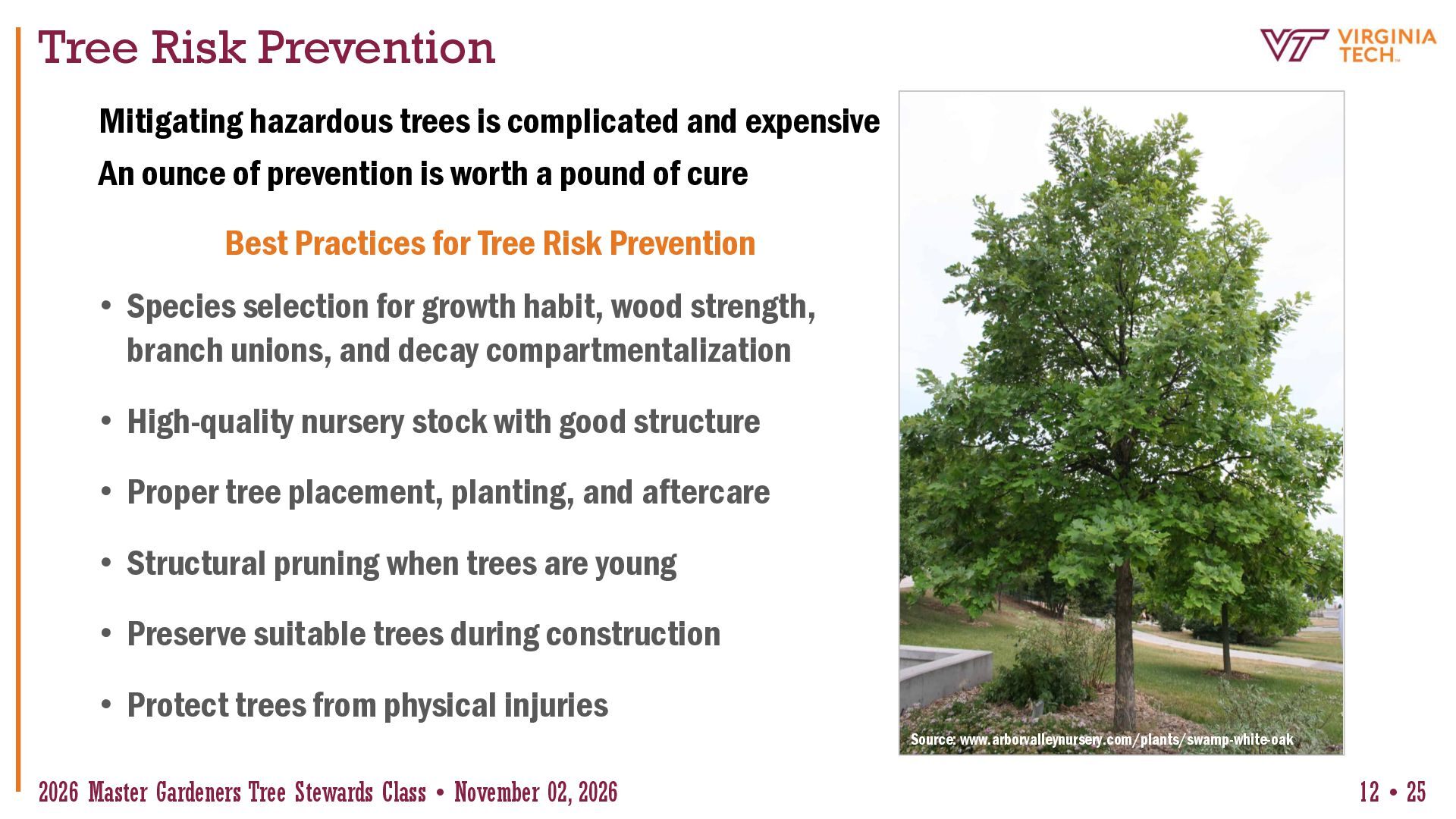
An ounce of prevention is worth a pound of cure Best Practices for Tree Risk Prevention • Species selection for growth habit, wood strength, branch unions, and decay compartmentalization • High-quality nursery stock with good structure • Proper tree placement, planting, and aftercare • Structural pruning when trees are young • Preserve suitable trees during construction • Protect trees from physical injuries Source: www.arborvalleynursery.com/plants/swamp-white-oak 2026 Master Gardeners Tree Stewards Class • November 02, 2026 12 • 25
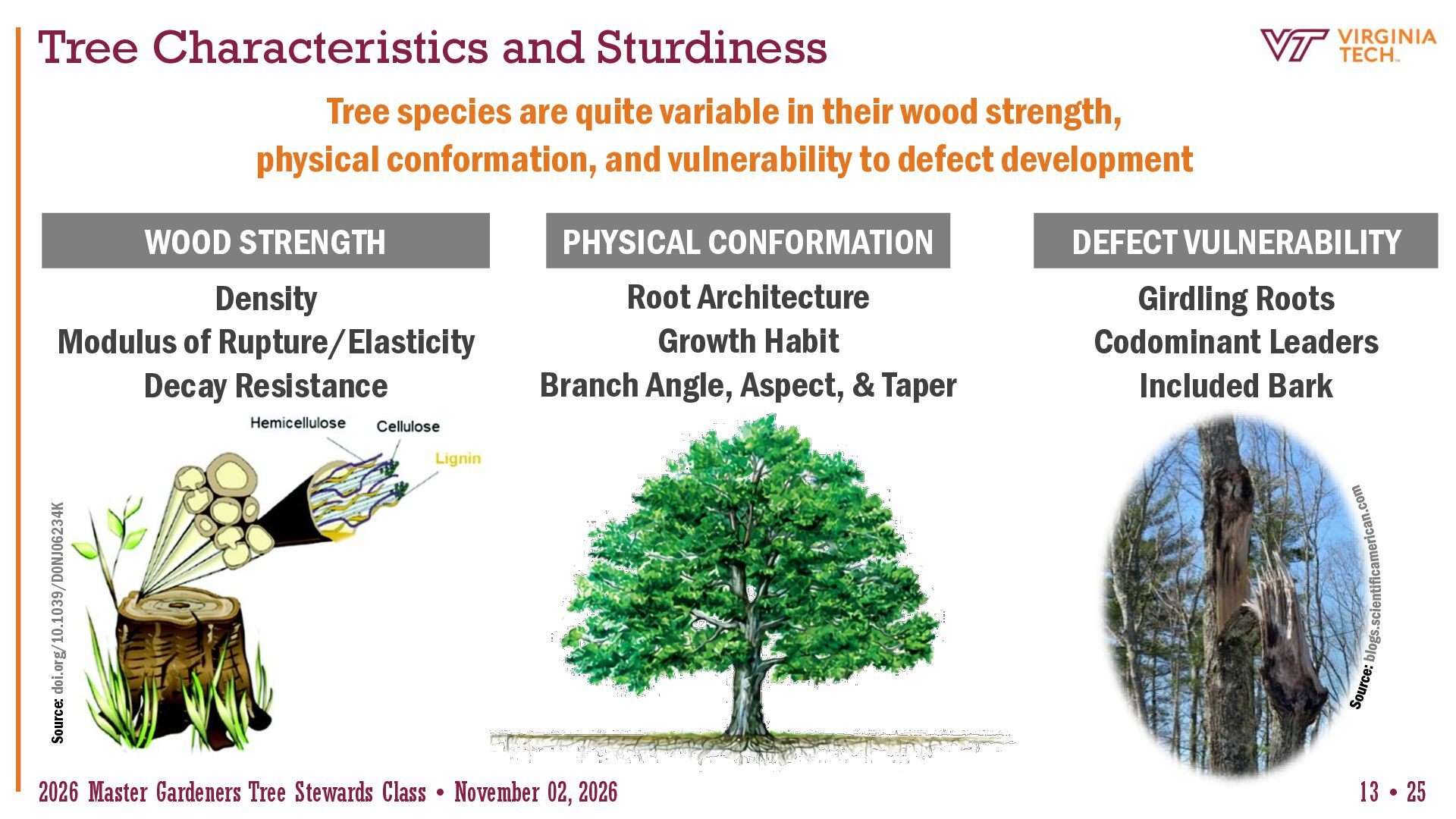
their wood strength, physical conformation, and vulnerability to defect development PHYSICAL CONFORMATION DEFECT VULNERABILITY Density Modulus of Rupture/Elasticity Decay Resistance Root Architecture Growth Habit Branch Angle, Aspect, & Taper Girdling Roots Codominant Leaders Included Bark 2026 Master Gardeners Tree Stewards Class • November 02, 2026 logs.scientificamerican.c r ce : b Sou Source: doi.org/10.1039/D0NJ06234K om WOOD STRENGTH 13 • 25
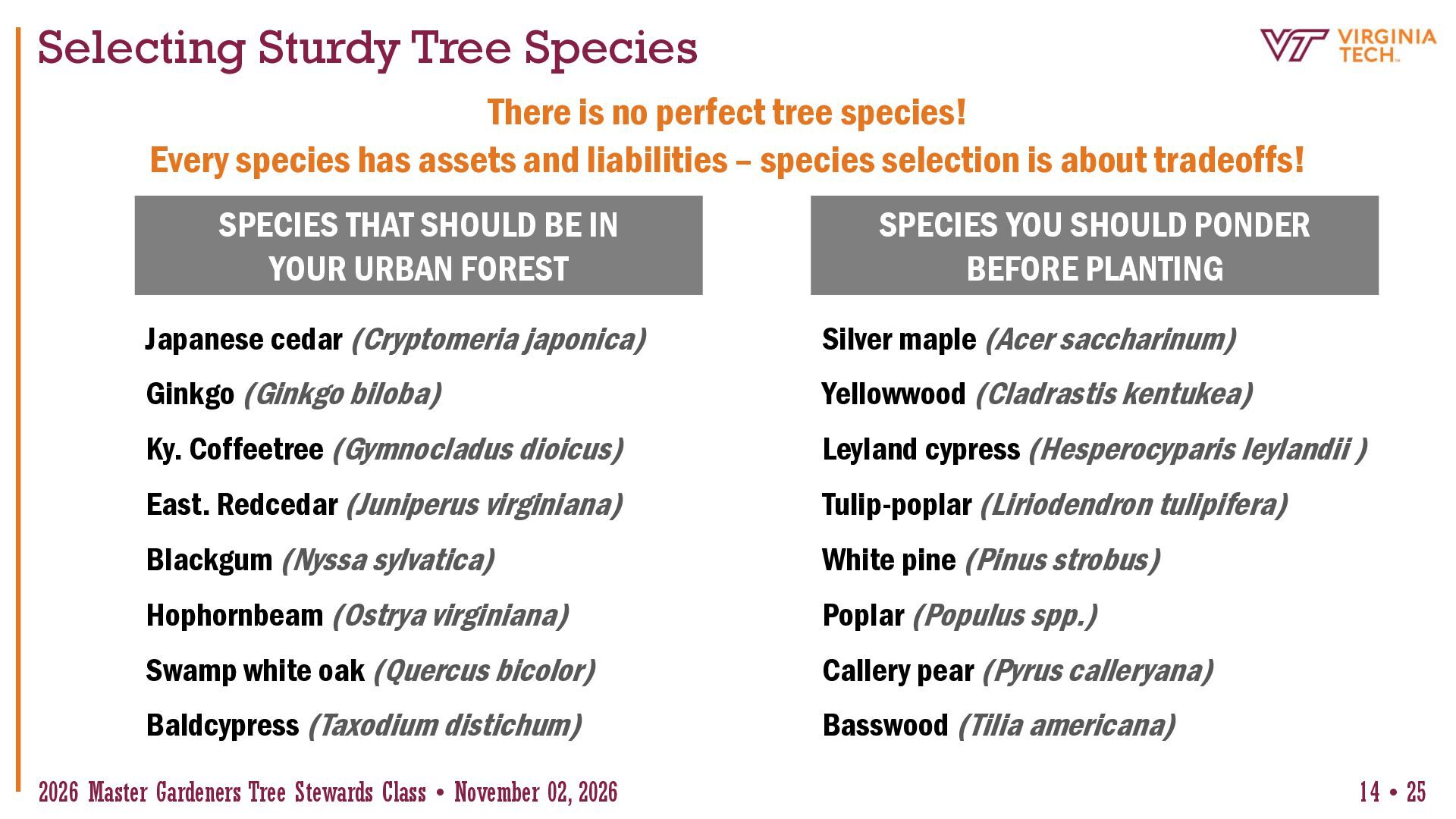
Every species has assets and liabilities – species selection is about tradeoffs! SPECIES THAT SHOULD BE IN YOUR URBAN FOREST SPECIES YOU SHOULD PONDER BEFORE PLANTING Japanese cedar (Cryptomeria japonica) Silver maple (Acer saccharinum) Ginkgo (Ginkgo biloba) Yellowwood (Cladrastis kentukea) Ky. Coffeetree (Gymnocladus dioicus) Leyland cypress (Hesperocyparis leylandii ) East. Redcedar (Juniperus virginiana) Tulip-poplar (Liriodendron tulipifera) Blackgum (Nyssa sylvatica) White pine (Pinus strobus) Hophornbeam (Ostrya virginiana) Poplar (Populus spp.) Swamp white oak (Quercus bicolor) Callery pear (Pyrus calleryana) Baldcypress (Taxodium distichum) Basswood (Tilia americana) 2026 Master Gardeners Tree Stewards Class • November 02, 2026 14 • 25
to a reasonable level so that the residual risk is acceptable by the tree owner or manager COMBINED LIKELIHOOD Threshold of Unacceptable Risk LOW MODERATE HIGH OVERALL TREE RISK RETAIN & MONITOR EXTREME Target Based Options Tree Based Options PERFORM MITIGATION 2026 Master Gardeners Tree Stewards Class • November 02, 2026 15 • 25
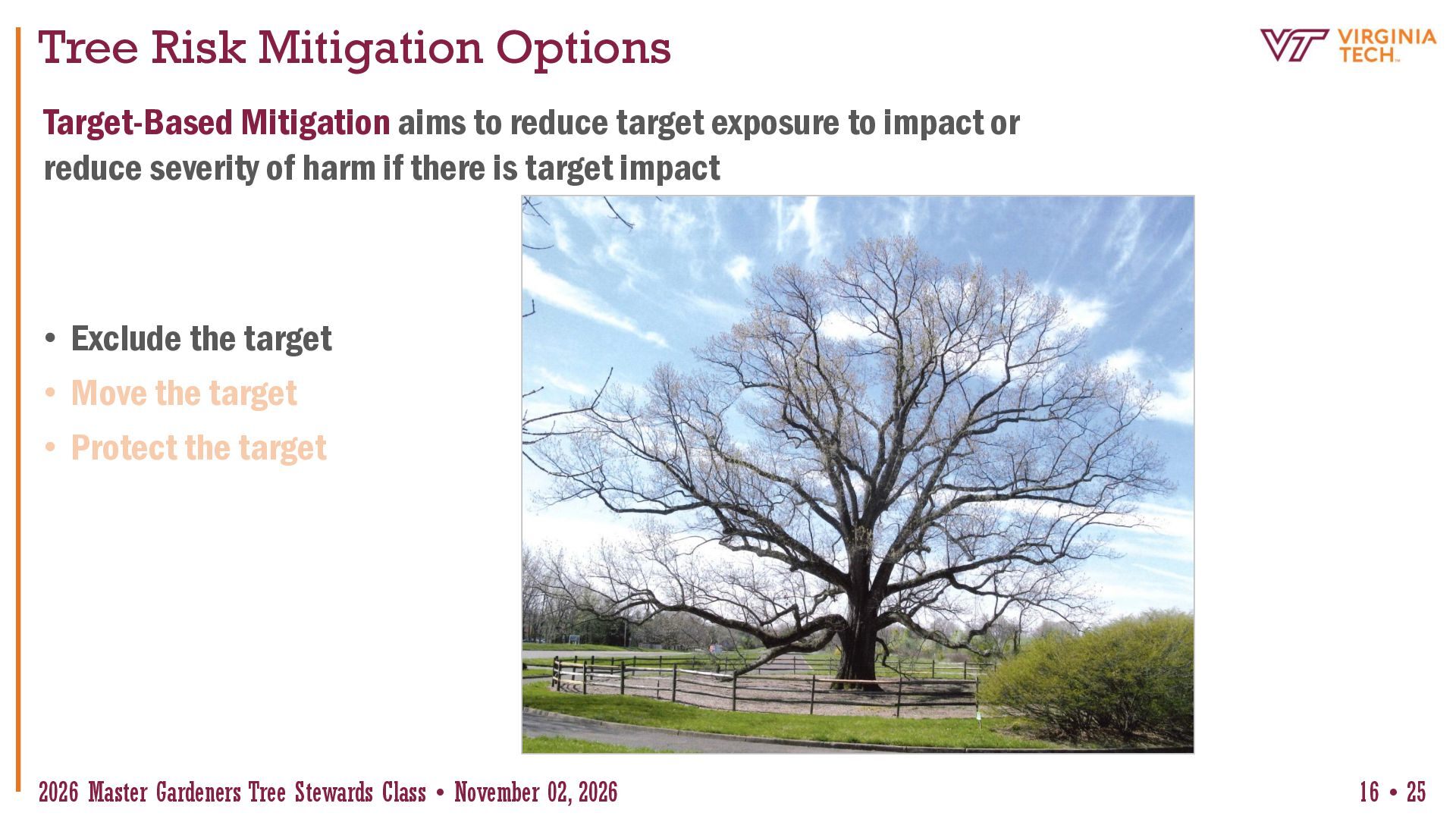
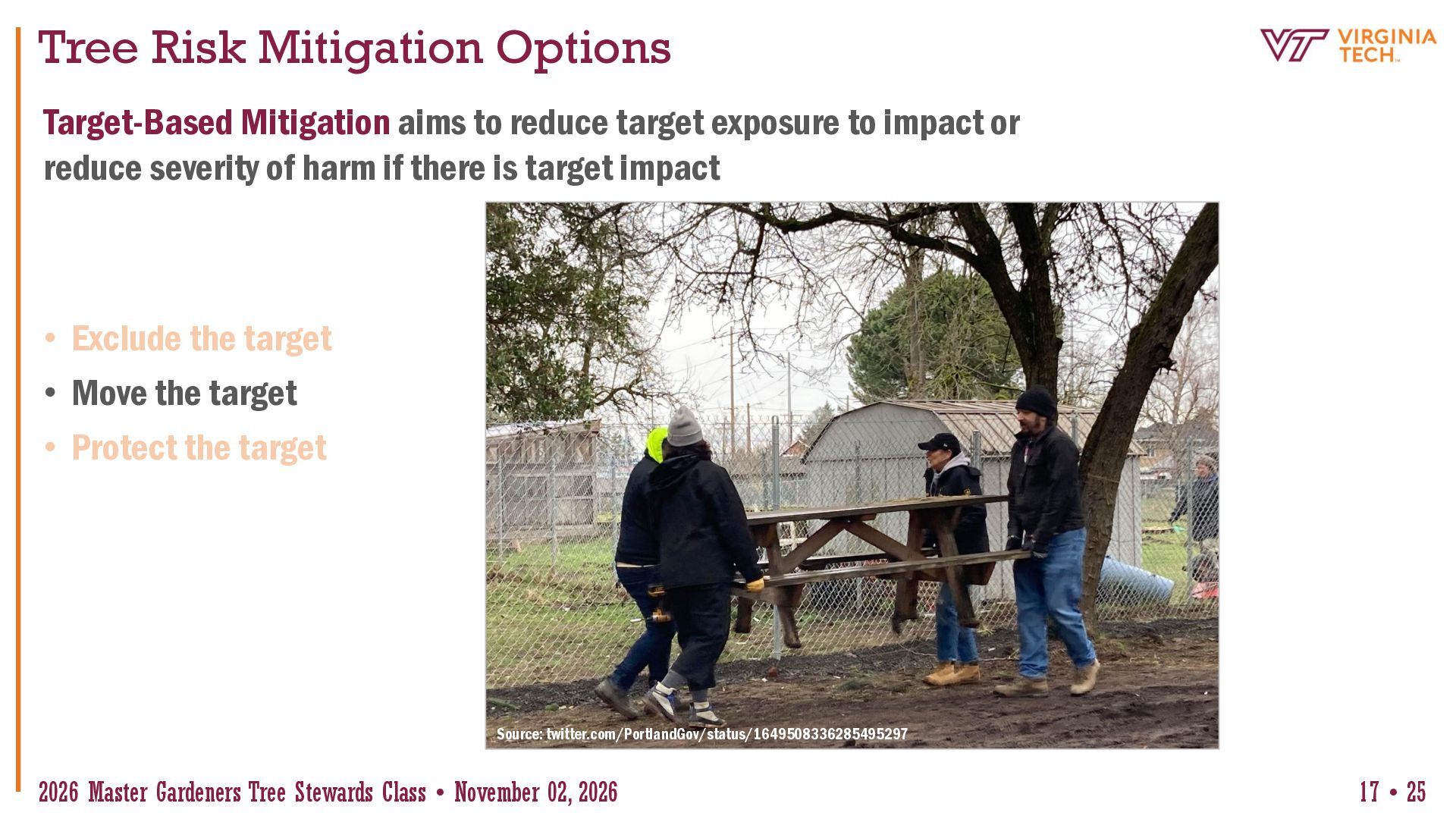
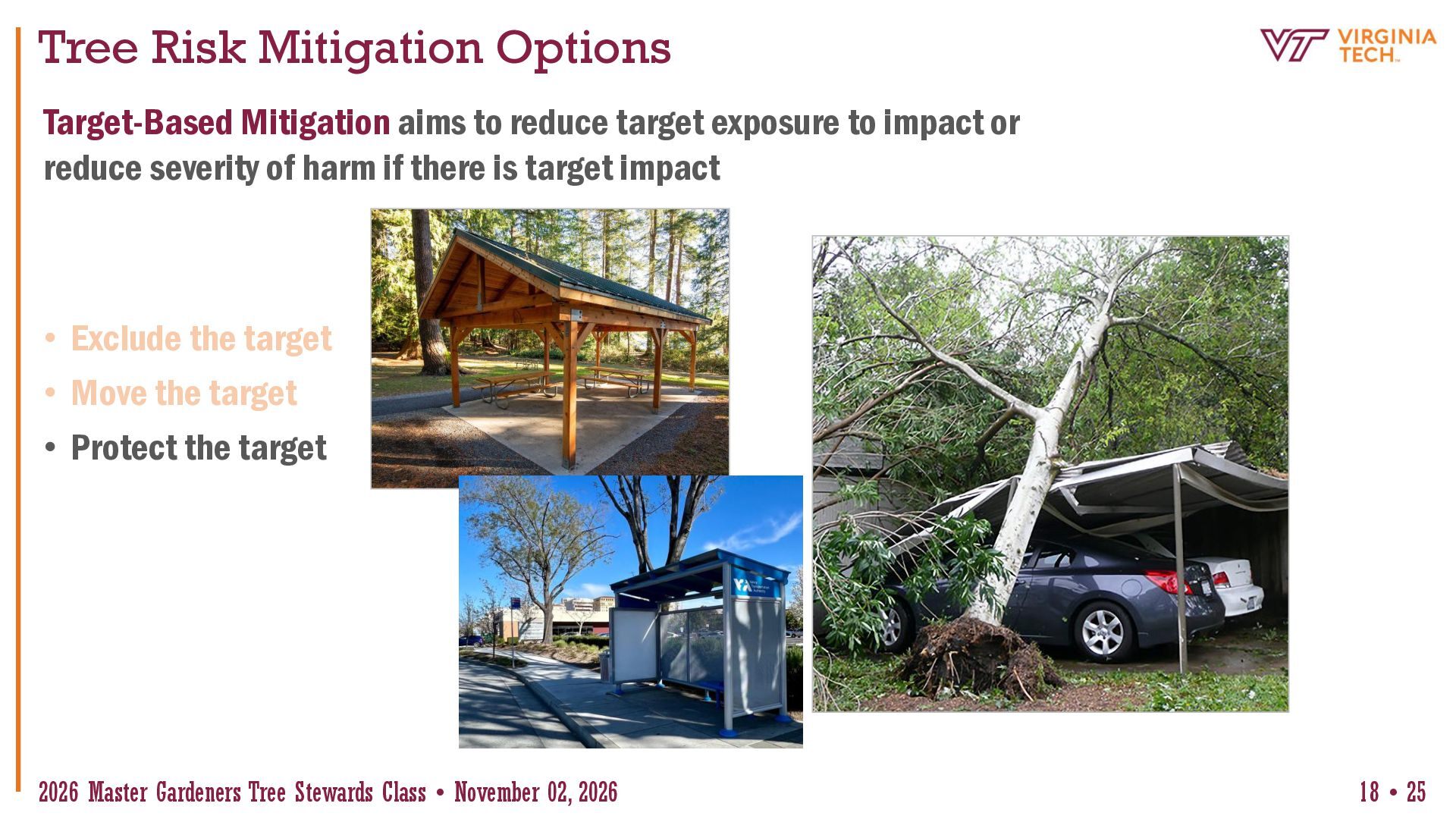
exposure to impact or reduce severity of harm if there is target impact • Exclude the target • Move the target • Protect the target 2026 Master Gardeners Tree Stewards Class • November 02, 2026 16 • 25
exposure to impact or reduce severity of harm if there is target impact • Exclude the target • Move the target • Protect the target Source: twitter.com/PortlandGov/status/1649508336285495297 2026 Master Gardeners Tree Stewards Class • November 02, 2026 17 • 25
exposure to impact or reduce severity of harm if there is target impact • Exclude the target • Move the target • Protect the target 2026 Master Gardeners Tree Stewards Class • November 02, 2026 18 • 25
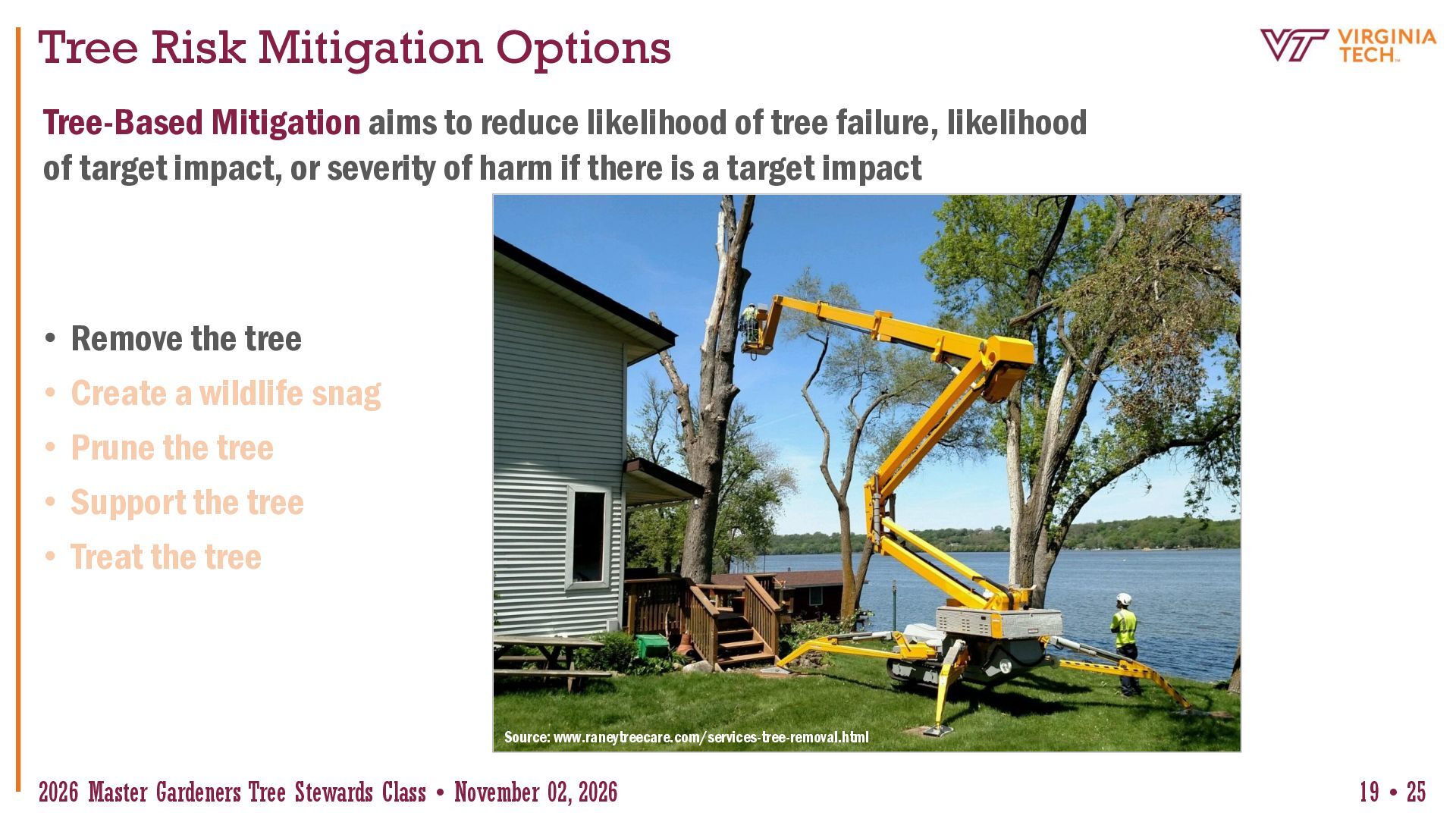
of tree failure, likelihood of target impact, or severity of harm if there is a target impact • Remove the tree • Create a wildlife snag • Prune the tree • Support the tree • Treat the tree Source: www.raneytreecare.com/services-tree-removal.html 2026 Master Gardeners Tree Stewards Class • November 02, 2026 19 • 25
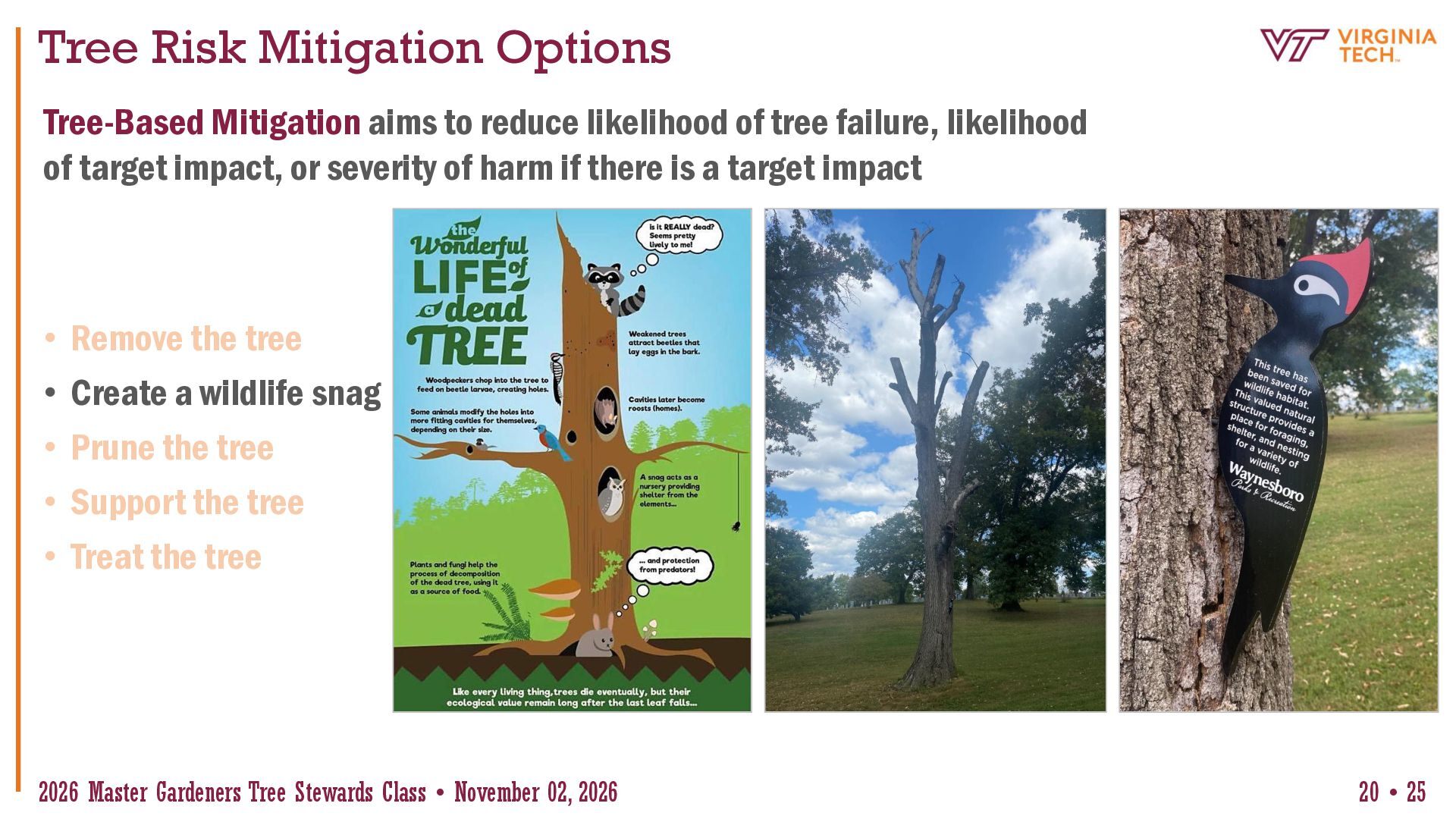
of tree failure, likelihood of target impact, or severity of harm if there is a target impact • Remove the tree • Create a wildlife snag • Prune the tree • Support the tree • Treat the tree 2026 Master Gardeners Tree Stewards Class • November 02, 2026 20 • 25
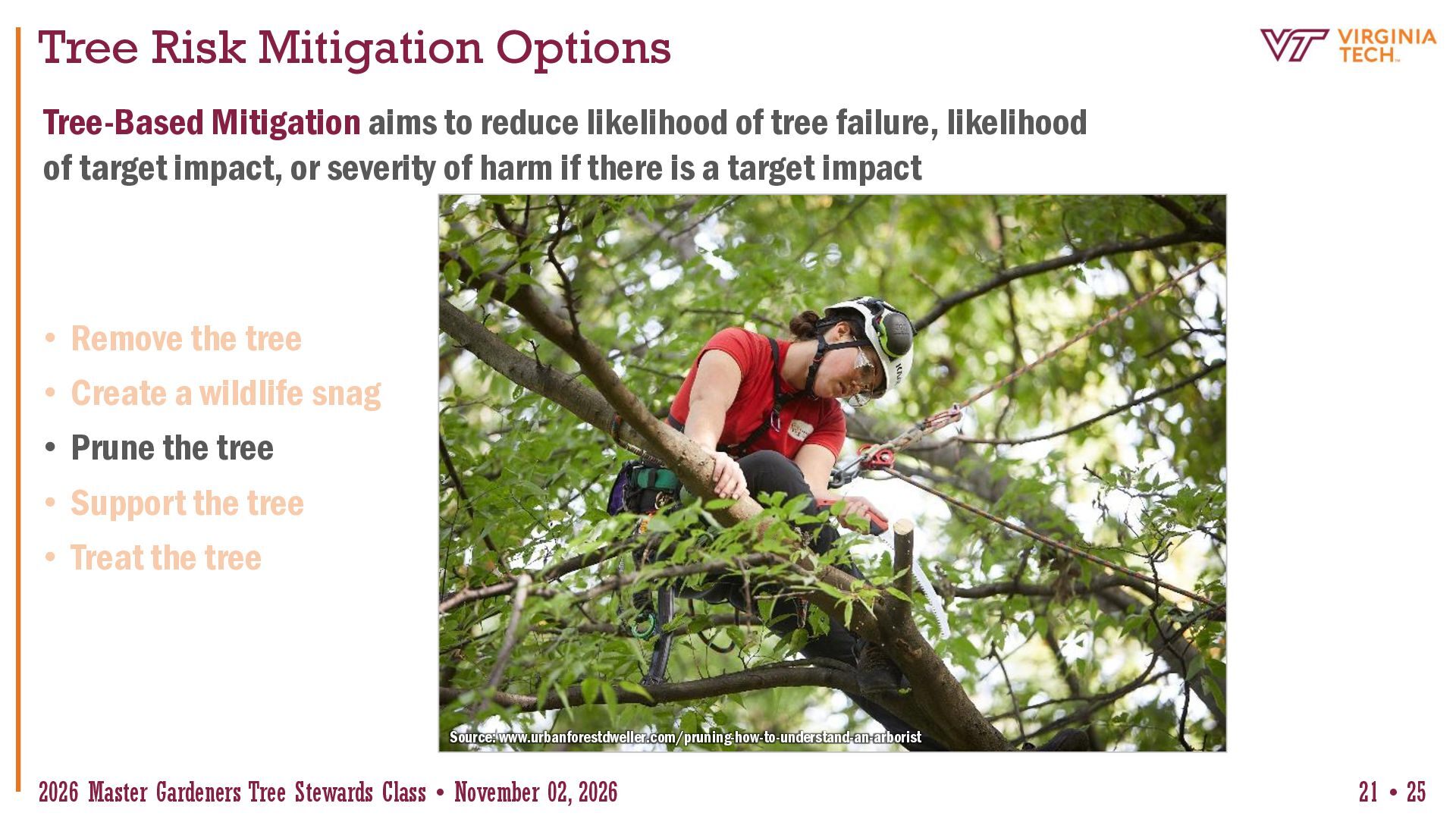
of tree failure, likelihood of target impact, or severity of harm if there is a target impact • Remove the tree • Create a wildlife snag • Prune the tree • Support the tree • Treat the tree Source: www.urbanforestdweller.com/pruning-how-to-understand-an-arborist 2026 Master Gardeners Tree Stewards Class • November 02, 2026 21 • 25
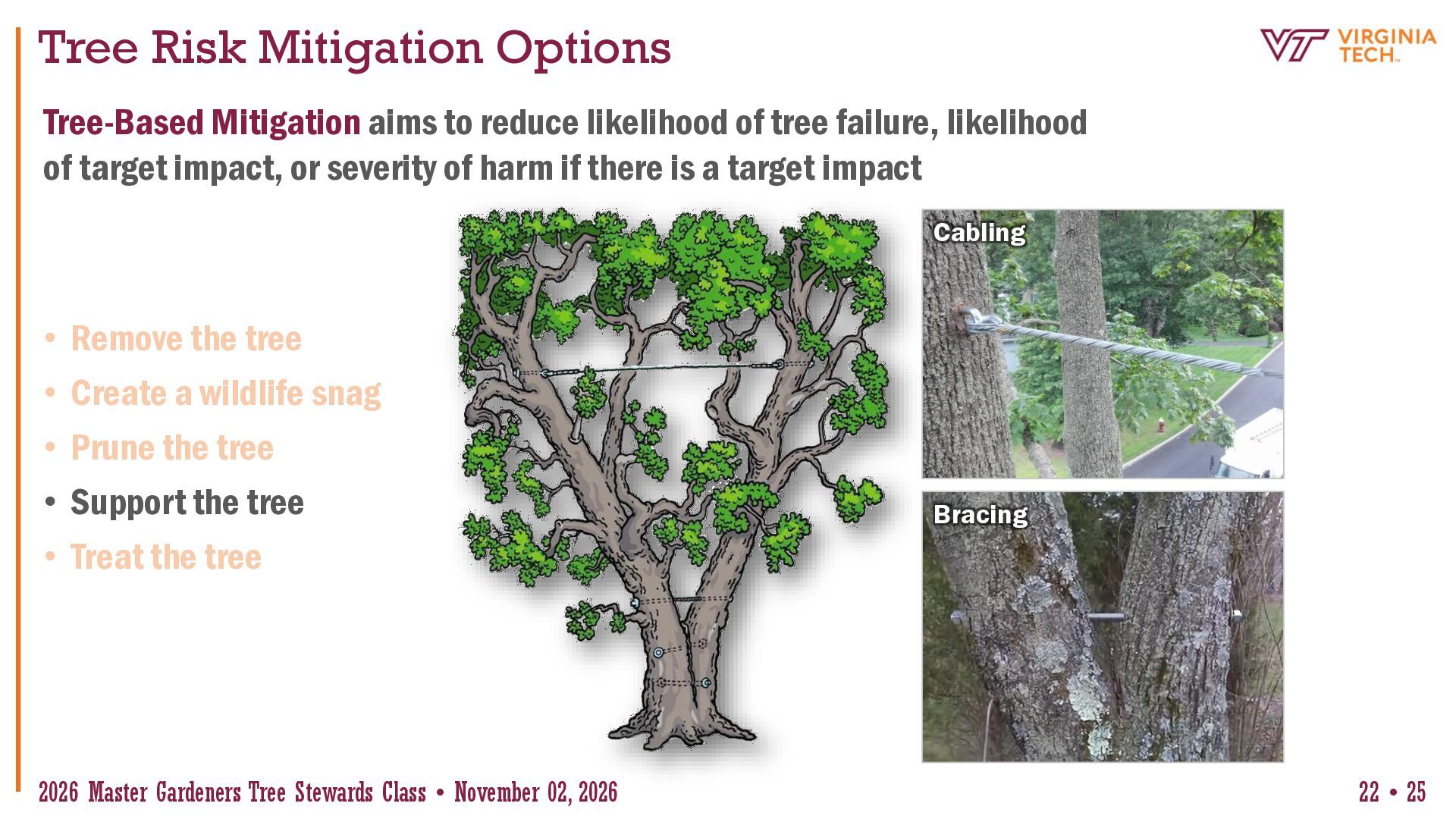
of tree failure, likelihood of target impact, or severity of harm if there is a target impact Cabling • Remove the tree • Create a wildlife snag • Prune the tree • Support the tree • Treat the tree 2026 Master Gardeners Tree Stewards Class • November 02, 2026 Bracing 22 • 25
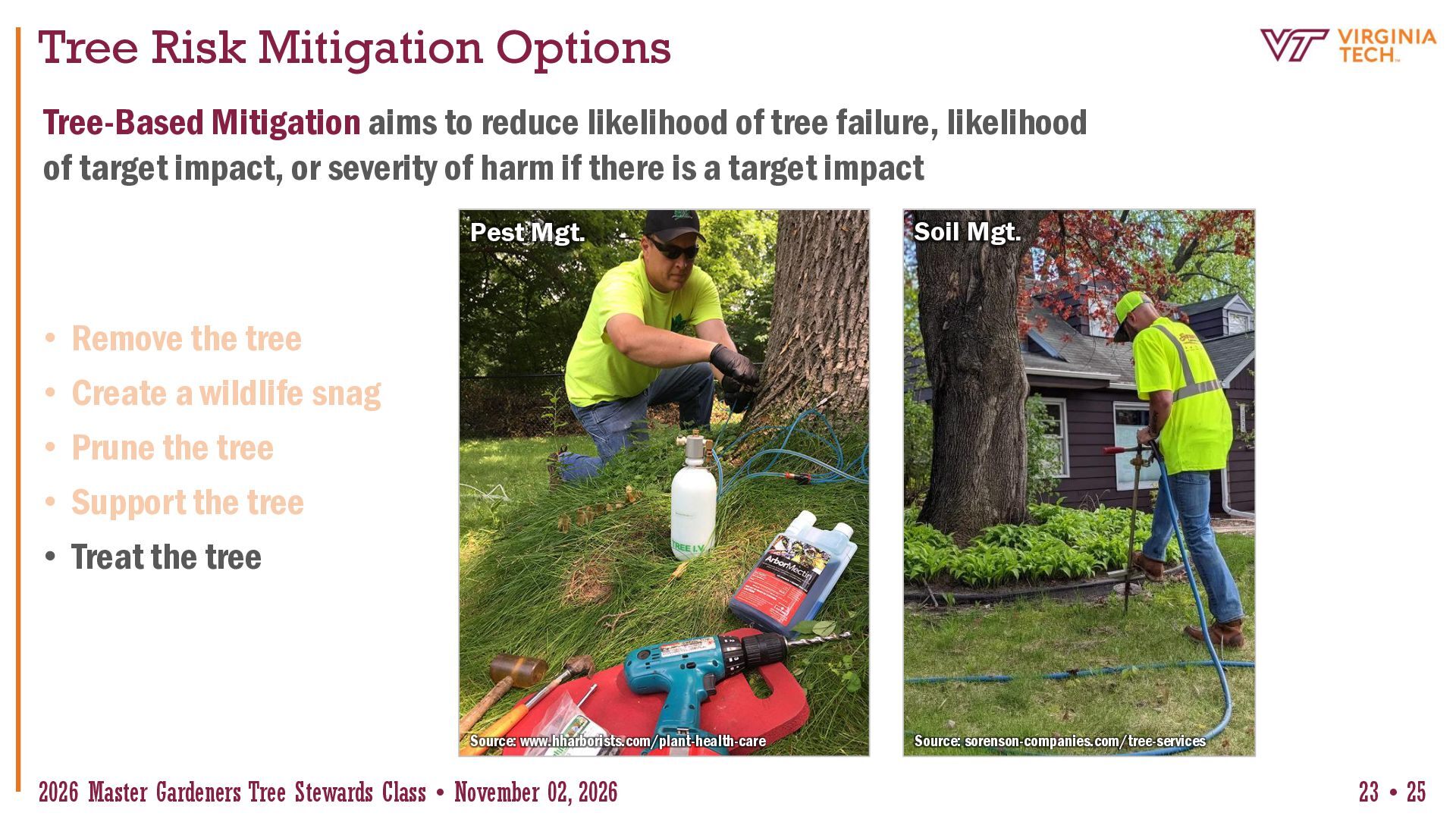
of tree failure, likelihood of target impact, or severity of harm if there is a target impact Pest Mgt. Soil Mgt. Source: www.hharborists.com/plant-health-care Source: sorenson-companies.com/tree-services • Remove the tree • Create a wildlife snag • Prune the tree • Support the tree • Treat the tree 2026 Master Gardeners Tree Stewards Class • November 02, 2026 23 • 25
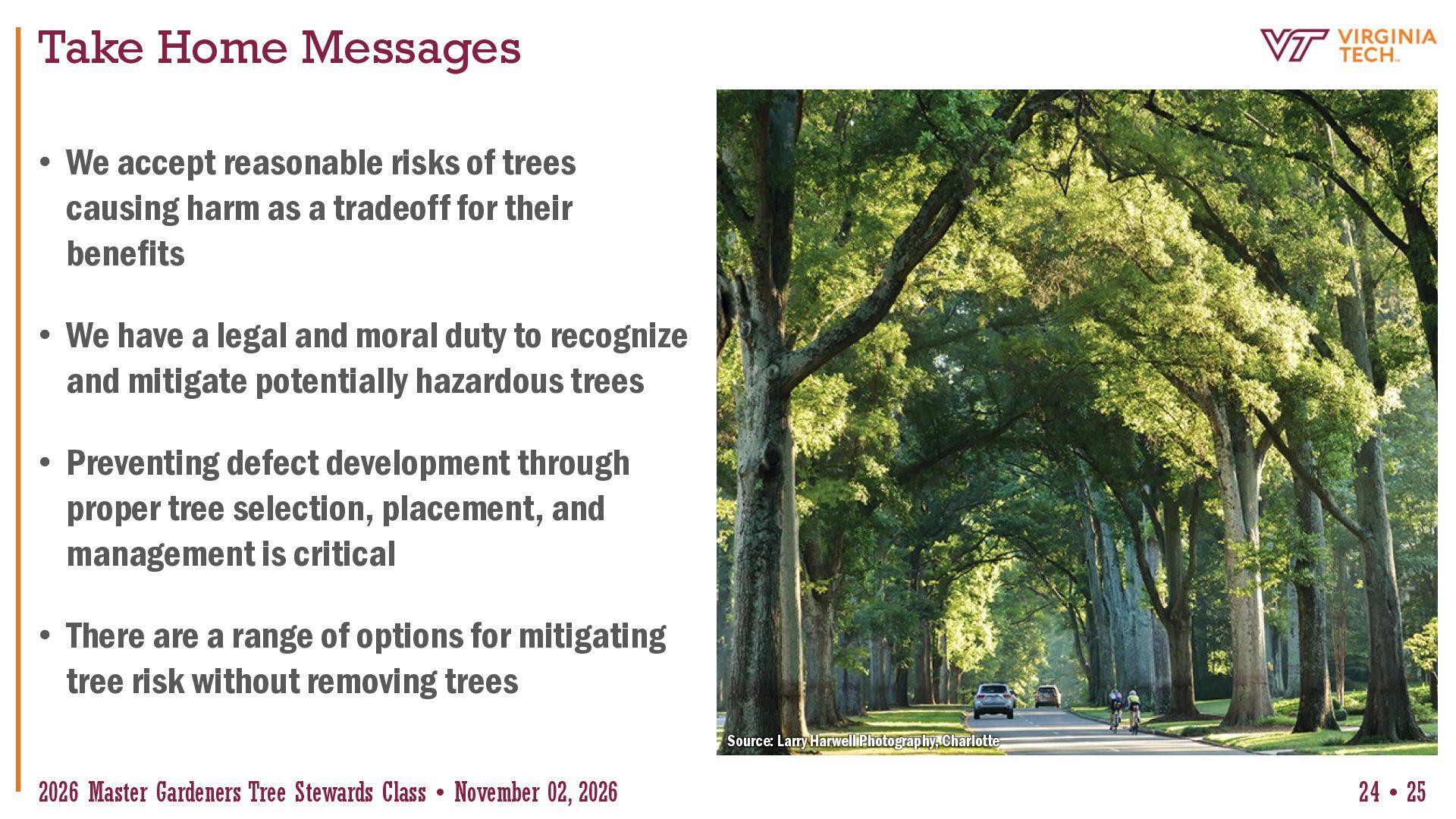
causing harm as a tradeoff for their benefits • We have a legal and moral duty to recognize and mitigate potentially hazardous trees • Preventing defect development through proper tree selection, placement, and management is critical • There are a range of options for mitigating tree risk without removing trees Source: Larry Harwell Photography, Charlotte 2026 Master Gardeners Tree Stewards Class • November 02, 2026 24 • 25
Eric Wiseman, PhD Associate Professor of Urban and Community Forestry Dept. of Forest Resources and Environmental Conservation Virginia Tech [email protected] linktr.ee/EricWiseman 2026 Master Gardeners Tree Stewards Class • November 02, 2026 25 • 25


 pwiseman
 jarvist
 trycycle
 miyayou
 tomoaki0705
 neutron63zf
 lychee1223
 naospon
 rajeshrinet
 estie
 brainpadpr
 tagtag
 livdayseo
 varn
 marktimemedia
 cassininazir
 helenjbeal
 katarinadahlin
 tapps
 rkaga
 morganepeng
 addyosmani
 aleyda
 mayatellez