Upgrade to Pro — share decks privately, control downloads, hide ads and more …

The impact of argument exposure and perceived a...

Sponsored · Your Podcast. Everywhere. Effortlessly. Share. Educate. Inspire. Entertain. You do you. We'll handle the rest. →

The impact of argument exposure and perceived argument strength on affective (de)polarization between climate action supporters and opponents. Evidence from the United States, Spain, and Germany

Slides presented at the 11th European Communication Conference (ECC), in Brno (Czech Republic), 9 September 2026.

In this study, we examined how experienced exposure to pro- and counter-attitudinal climate action arguments and their perceived strength affect affective (de)polarization between climate-action supporters and opponents over time. Data collection took place through a three-wave online panel survey in the United States, Germany, and Spain between June and August 2024, quota-sampled by age, gender, region, and education level to resemble the adult populations of each country. We used fixed-effects (FE) and random-effects-within-between (REWB) regression models for data analyses. The results showed that pro-attitudinal exposure and strength increase polarization, while counter-attitudinal exposure and strength decrease it (within-person effects). However, perceived argument strength, rather than mere exposure, proved to be the stronger driver, with depolarizing effects notably larger among opponents than among supporters. The REWB models showed the same pattern of effects at the between-person level: individuals who, on average, experienced more pro-attitudinal (counter-attitudinal) exposure and perceived pro- (counter-)attitudinal arguments as stronger were also more (less) affectively polarized than others, with strength again outweighing exposure once both were modeled together.

Avatar for Quirin Ryffel

Quirin Ryffel PRO

September 21, 2026

More Decks by Quirin Ryffel

Other Decks in Education

Transcript

  1. The impact of argument exposure and perceived argument strength on

    affective (de)polarization between climate action supporters and opponents Evidence from the United States, Spain, and Germany Thomas Zerback (Heinrich Heine University Düsseldorf, Germany) Quirin Ryffel (University of Zurich, Switzerland) 11th European Communication Conference Brno, Czech Republic 9 September 2026
  2. The impact of argument exposure and perceived argument strength on

    affective (de)polarization between climate action supporters and opponents Evidence from the United States, Spain, and Germany Thomas Zerback (Heinrich Heine University Düsseldorf, Germany) Quirin Ryffel (University of Zurich, Switzerland) 11th European Communication Conference Brno, Czech Republic 9 September 2026
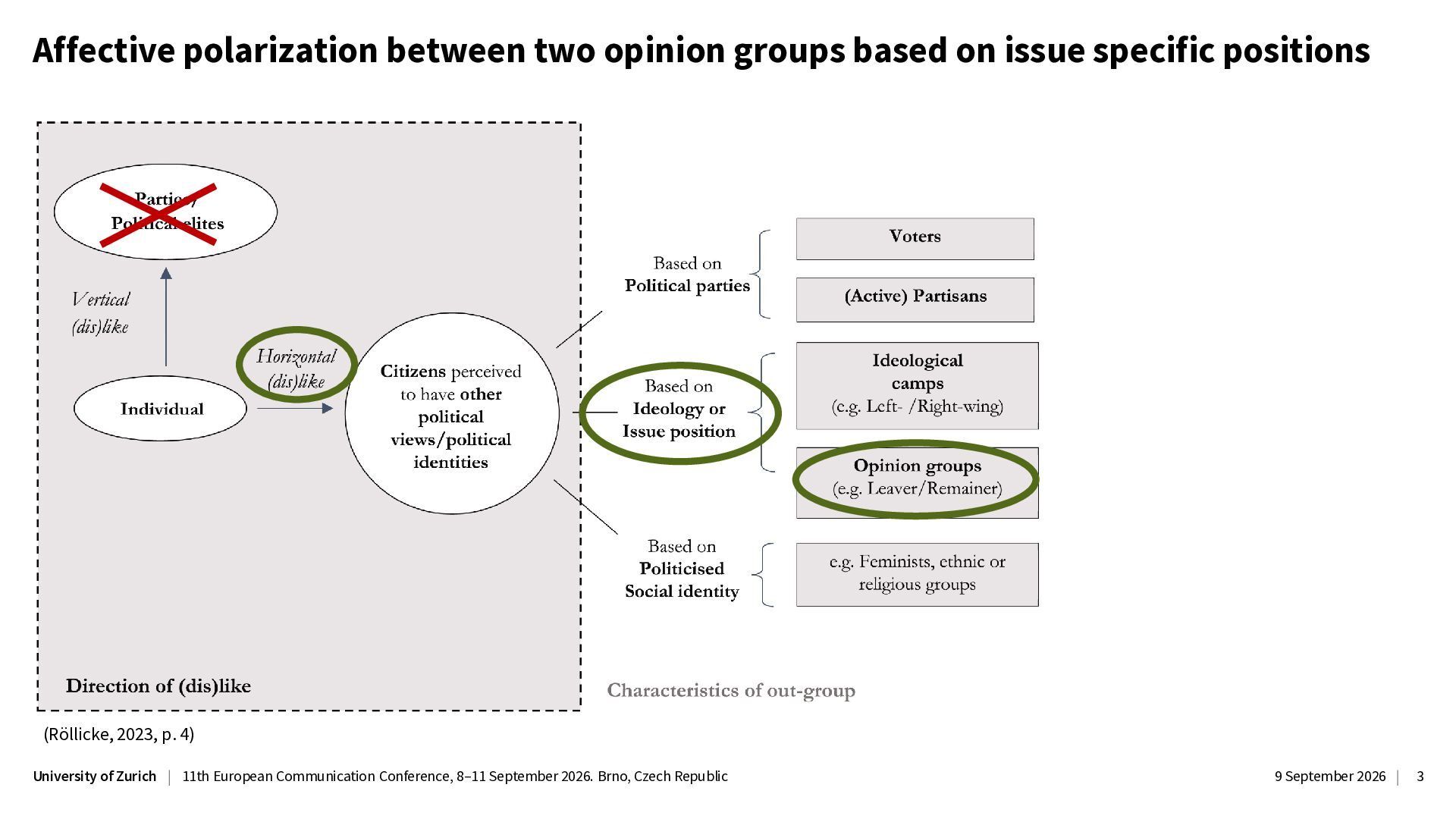
  3. Affective polarization between two opinion groups based on issue specific

    positions (Röllicke, 2023, p. 4) University of Zurich 11th European Communication Conference, 8–11 September 2026. Brno, Czech Republic 9 September 2026 3
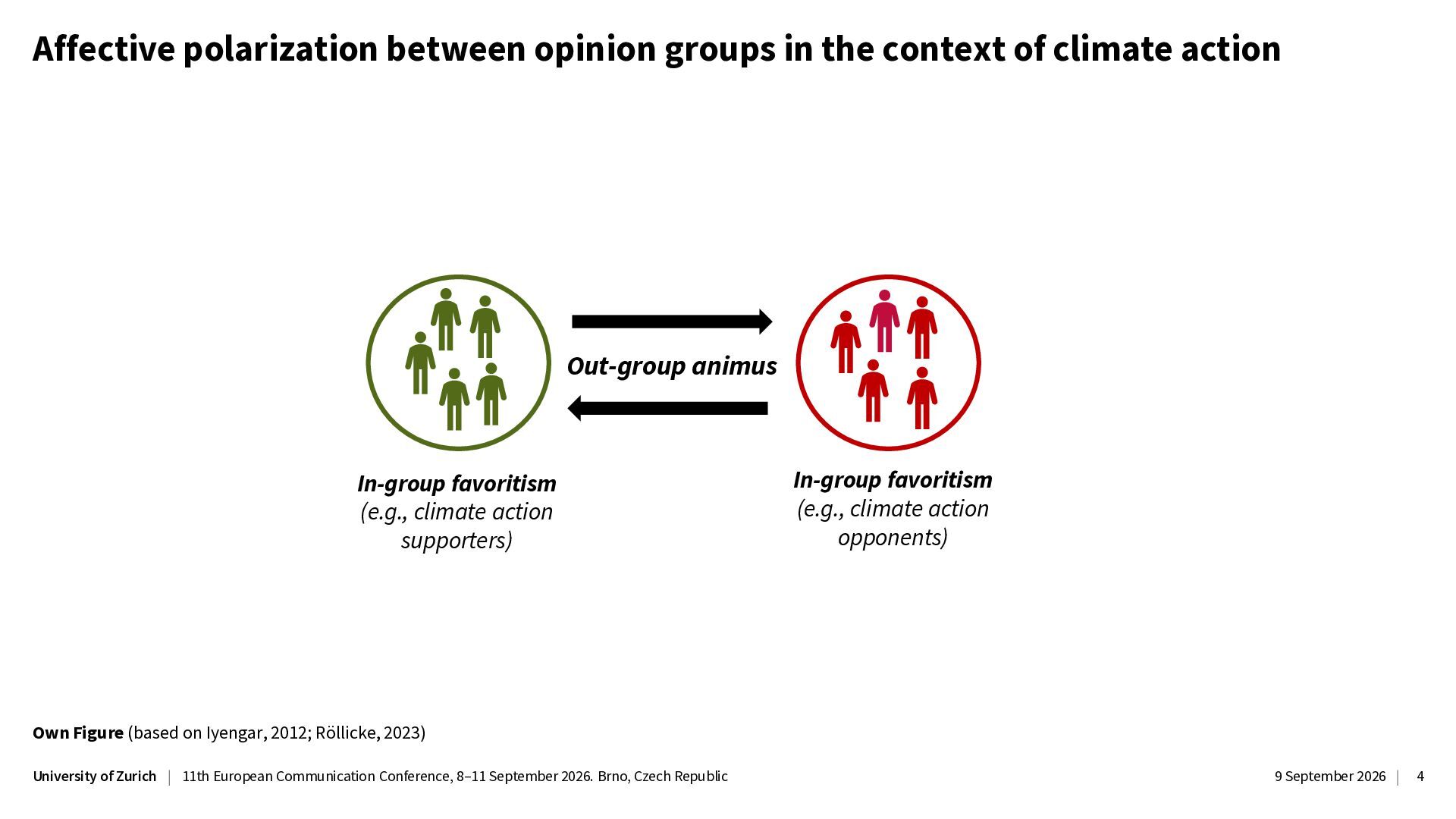
  4. Affective polarization between opinion groups in the context of climate

    action Out-group animus In-group favoritism (e.g., climate action supporters) In-group favoritism (e.g., climate action opponents) Own Figure (based on Iyengar, 2012; Röllicke, 2023) University of Zurich 11th European Communication Conference, 8–11 September 2026. Brno, Czech Republic 9 September 2026 4
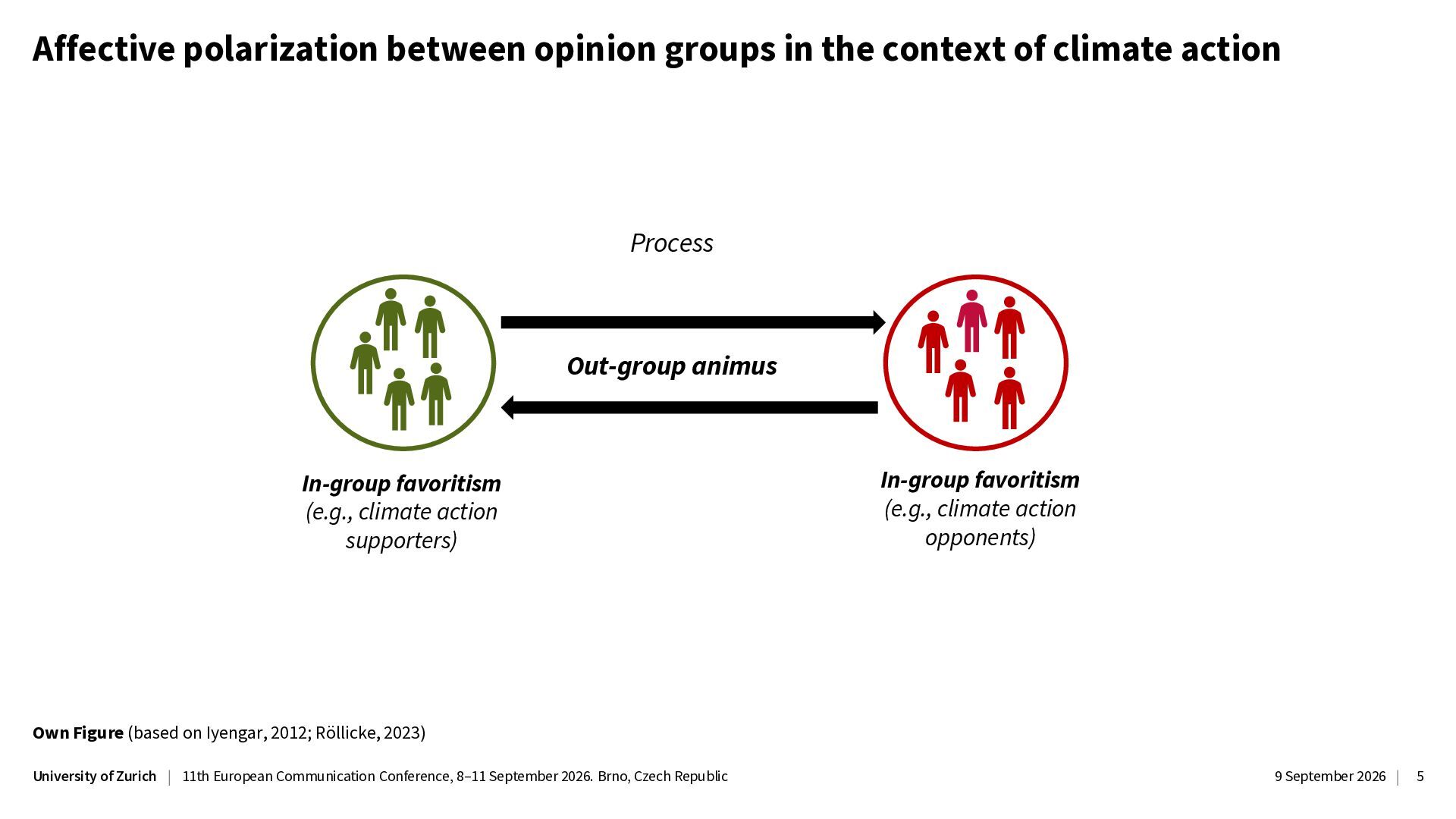
  5. Affective polarization between opinion groups in the context of climate

    action Process Out-group animus In-group favoritism (e.g., climate action supporters) In-group favoritism (e.g., climate action opponents) Own Figure (based on Iyengar, 2012; Röllicke, 2023) University of Zurich 11th European Communication Conference, 8–11 September 2026. Brno, Czech Republic 9 September 2026 5
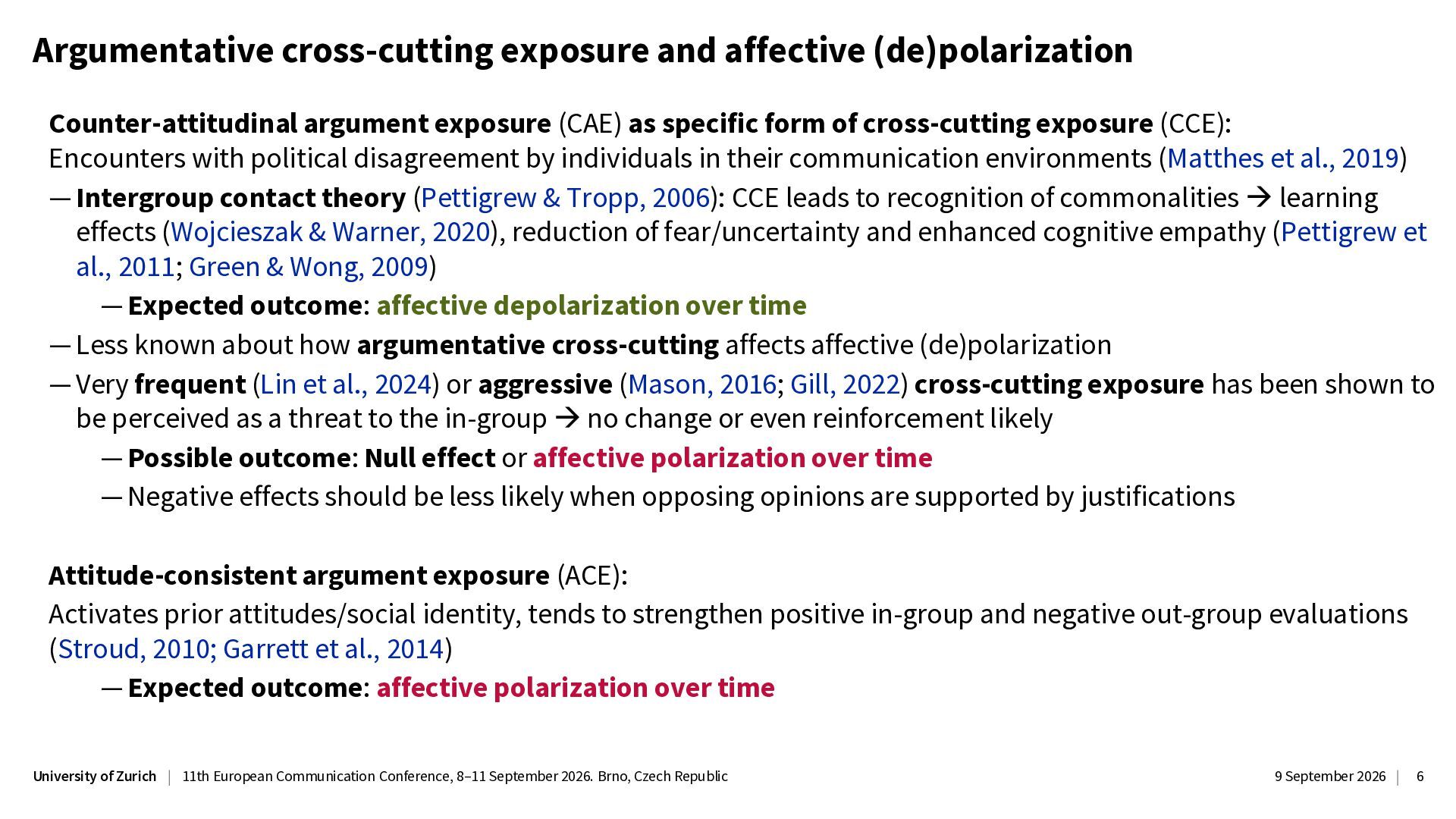
  6. Argumentative cross-cutting exposure and affective (de)polarization Counter-attitudinal argument exposure (CAE)

    as specific form of cross-cutting exposure (CCE): Encounters with political disagreement by individuals in their communication environments (Matthes et al., 2019) ― Intergroup contact theory (Pettigrew & Tropp, 2006): CCE leads to recognition of commonalities → learning effects (Wojcieszak & Warner, 2020), reduction of fear/uncertainty and enhanced cognitive empathy (Pettigrew et al., 2011; Green & Wong, 2009) ― Expected outcome: affective depolarization over time ― Less known about how argumentative cross-cutting affects affective (de)polarization ― Very frequent (Lin et al., 2024) or aggressive (Mason, 2016; Gill, 2022) cross-cutting exposure has been shown to be perceived as a threat to the in-group → no change or even reinforcement likely ― Possible outcome: Null effect or affective polarization over time ― Negative effects should be less likely when opposing opinions are supported by justifications Attitude-consistent argument exposure (ACE): Activates prior attitudes/social identity, tends to strengthen positive in-group and negative out-group evaluations (Stroud, 2010; Garrett et al., 2014) ― Expected outcome: affective polarization over time University of Zurich 11th European Communication Conference, 8–11 September 2026. Brno, Czech Republic 9 September 2026 6
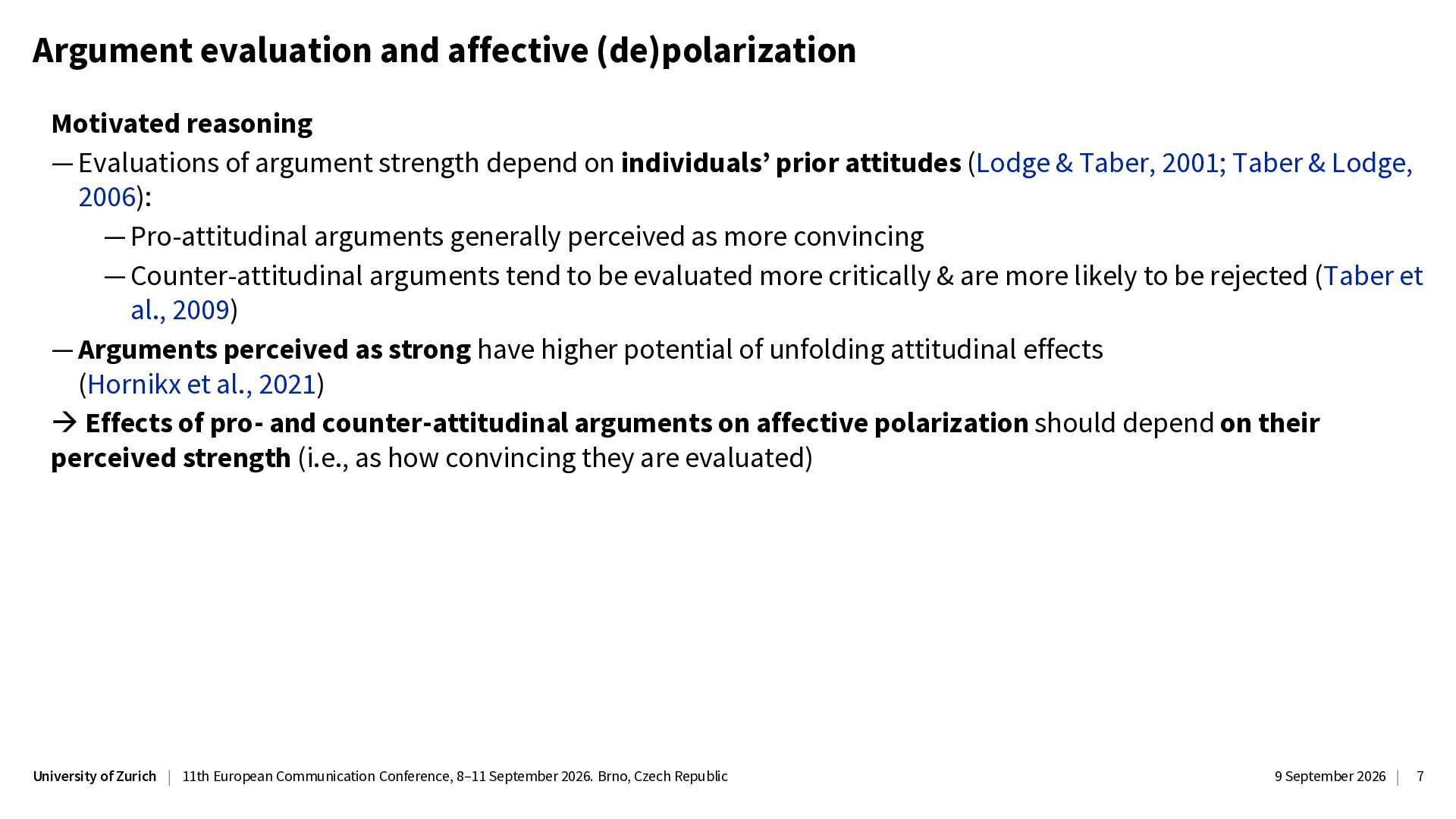
  7. Argument evaluation and affective (de)polarization Motivated reasoning ― Evaluations of

    argument strength depend on individuals’ prior attitudes (Lodge & Taber, 2001; Taber & Lodge, 2006): ― Pro-attitudinal arguments generally perceived as more convincing ― Counter-attitudinal arguments tend to be evaluated more critically & are more likely to be rejected (Taber et al., 2009) ― Arguments perceived as strong have higher potential of unfolding attitudinal effects (Hornikx et al., 2021) → Effects of pro- and counter-attitudinal arguments on affective polarization should depend on their perceived strength (i.e., as how convincing they are evaluated) University of Zurich 11th European Communication Conference, 8–11 September 2026. Brno, Czech Republic 9 September 2026 7
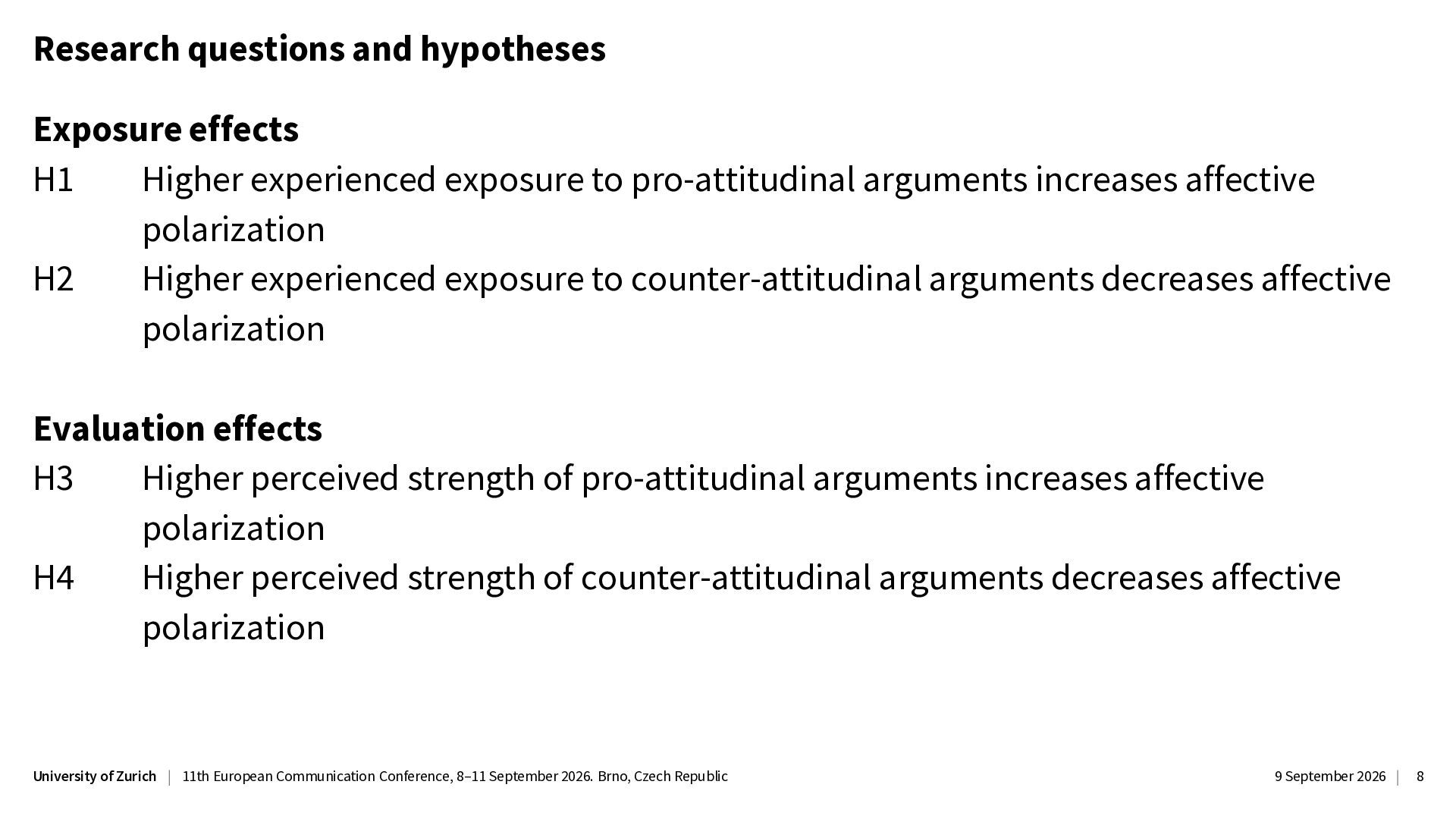
  8. Research questions and hypotheses Exposure effects H1 Higher experienced exposure

    to pro-attitudinal arguments increases affective polarization H2 Higher experienced exposure to counter-attitudinal arguments decreases affective polarization Evaluation effects H3 Higher perceived strength of pro-attitudinal arguments increases affective polarization H4 Higher perceived strength of counter-attitudinal arguments decreases affective polarization University of Zurich 11th European Communication Conference, 8–11 September 2026. Brno, Czech Republic 9 September 2026 8
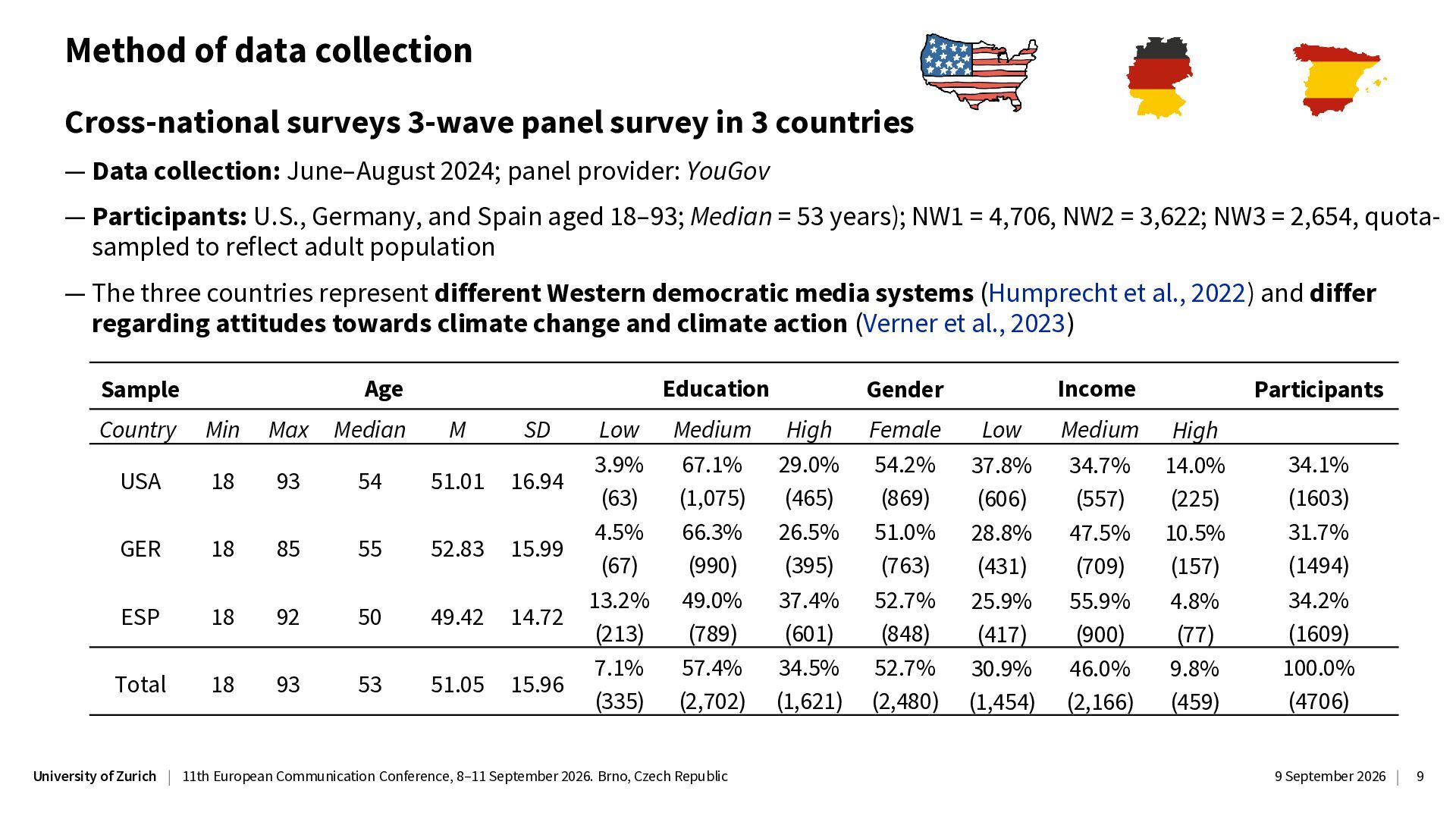
  9. Method of data collection Cross-national surveys 3-wave panel survey in

    3 countries ― Data collection: June–August 2024; panel provider: YouGov ― Participants: U.S., Germany, and Spain aged 18–93; Median = 53 years); NW1 = 4,706, NW2 = 3,622; NW3 = 2,654, quotasampled to reflect adult population ― The three countries represent different Western democratic media systems (Humprecht et al., 2022) and differ regarding attitudes towards climate change and climate action (Verner et al., 2023) Age Sample Country Min Max Median M SD USA 18 93 54 51.01 16.94 GER 18 85 55 52.83 15.99 ESP 18 92 50 49.42 14.72 Total 18 93 53 51.05 15.96 University of Zurich Education Gender Low Medium High 3.9% 67.1% 29.0% (63) (1,075) (465) 4.5% 66.3% 26.5% (67) (990) (395) 13.2% 49.0% 37.4% (213) (789) (601) 7.1% 57.4% 34.5% (335) (2,702) (1,621) Female 54.2% (869) 51.0% (763) 52.7% (848) 52.7% (2,480) 11th European Communication Conference, 8–11 September 2026. Brno, Czech Republic Income Low 37.8% (606) 28.8% (431) 25.9% (417) 30.9% (1,454) Medium 34.7% (557) 47.5% (709) 55.9% (900) 46.0% (2,166) Participants High 14.0% (225) 10.5% (157) 4.8% (77) 9.8% (459) 34.1% (1603) 31.7% (1494) 34.2% (1609) 100.0% (4706) 9 September 2026 9
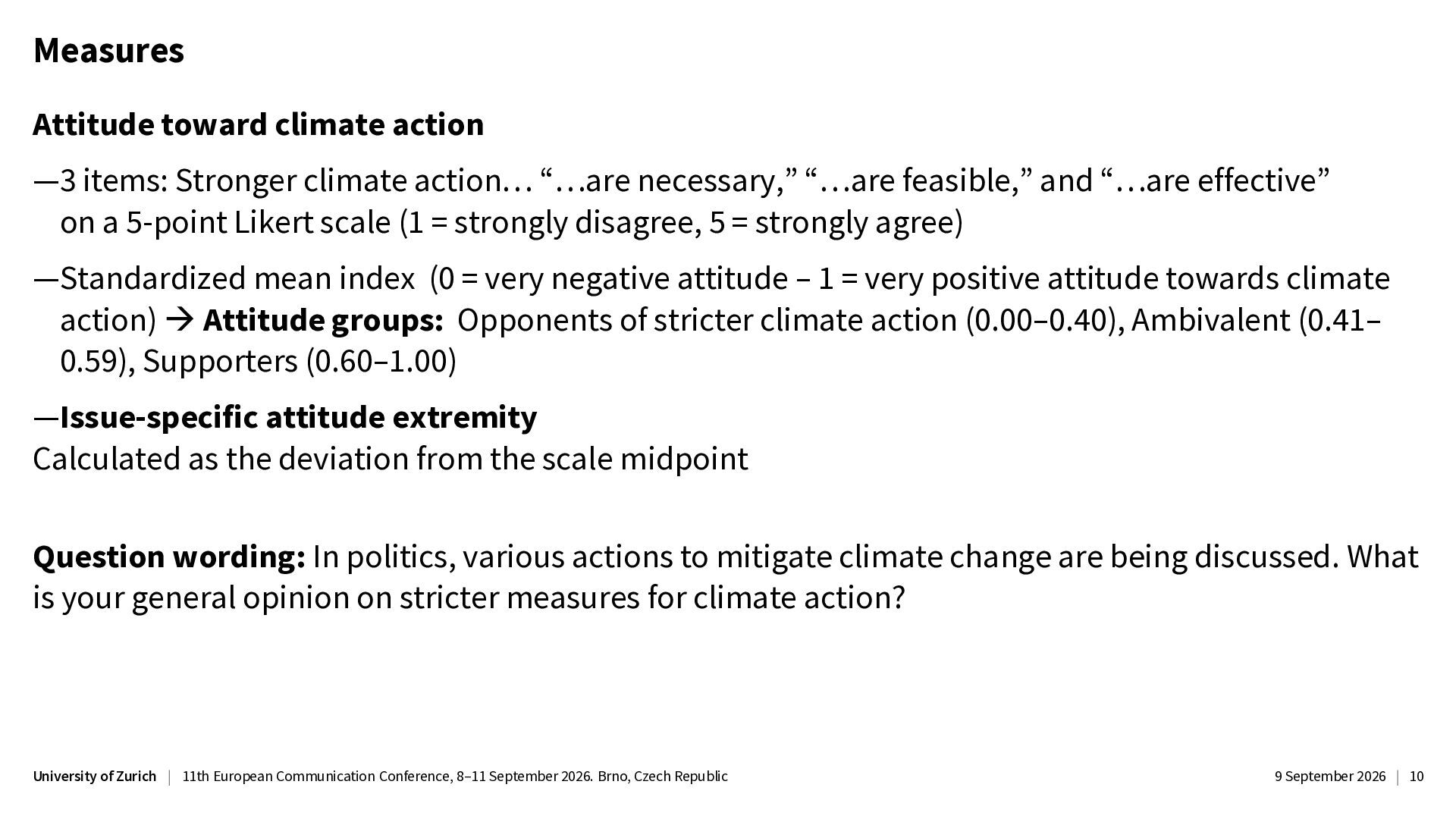
  10. Measures Attitude toward climate action ―3 items: Stronger climate action…

    “…are necessary,” “…are feasible,” and “…are effective” on a 5-point Likert scale (1 = strongly disagree, 5 = strongly agree) ―Standardized mean index (0 = very negative attitude – 1 = very positive attitude towards climate action) → Attitude groups: Opponents of stricter climate action (0.00–0.40), Ambivalent (0.41– 0.59), Supporters (0.60–1.00) ―Issue-specific attitude extremity Calculated as the deviation from the scale midpoint Question wording: In politics, various actions to mitigate climate change are being discussed. What is your general opinion on stricter measures for climate action? University of Zurich 11th European Communication Conference, 8–11 September 2026. Brno, Czech Republic 9 September 2026 10
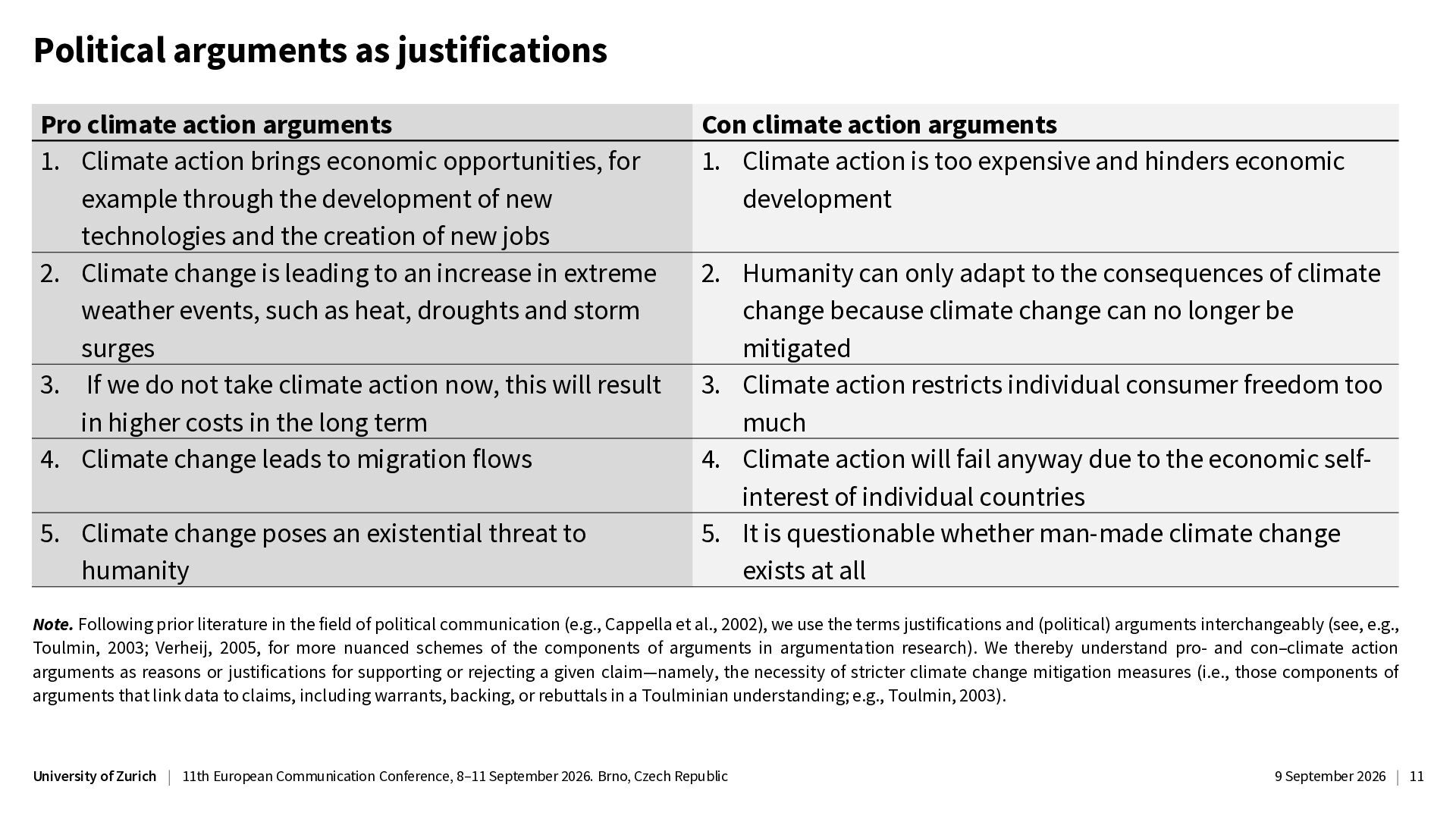
  11. Political arguments as justifications Pro climate action arguments 1. Climate

    action brings economic opportunities, for example through the development of new technologies and the creation of new jobs 2. Climate change is leading to an increase in extreme weather events, such as heat, droughts and storm surges 3. If we do not take climate action now, this will result in higher costs in the long term 4. Climate change leads to migration flows 5. Climate change poses an existential threat to humanity Con climate action arguments 1. Climate action is too expensive and hinders economic development 2. Humanity can only adapt to the consequences of climate change because climate change can no longer be mitigated 3. Climate action restricts individual consumer freedom too much 4. Climate action will fail anyway due to the economic selfinterest of individual countries 5. It is questionable whether man-made climate change exists at all Note. Following prior literature in the field of political communication (e.g., Cappella et al., 2002), we use the terms justifications and (political) arguments interchangeably (see, e.g., Toulmin, 2003; Verheij, 2005, for more nuanced schemes of the components of arguments in argumentation research). We thereby understand pro- and con–climate action arguments as reasons or justifications for supporting or rejecting a given claim—namely, the necessity of stricter climate change mitigation measures (i.e., those components of arguments that link data to claims, including warrants, backing, or rebuttals in a Toulminian understanding; e.g., Toulmin, 2003). University of Zurich 11th European Communication Conference, 8–11 September 2026. Brno, Czech Republic 9 September 2026 11
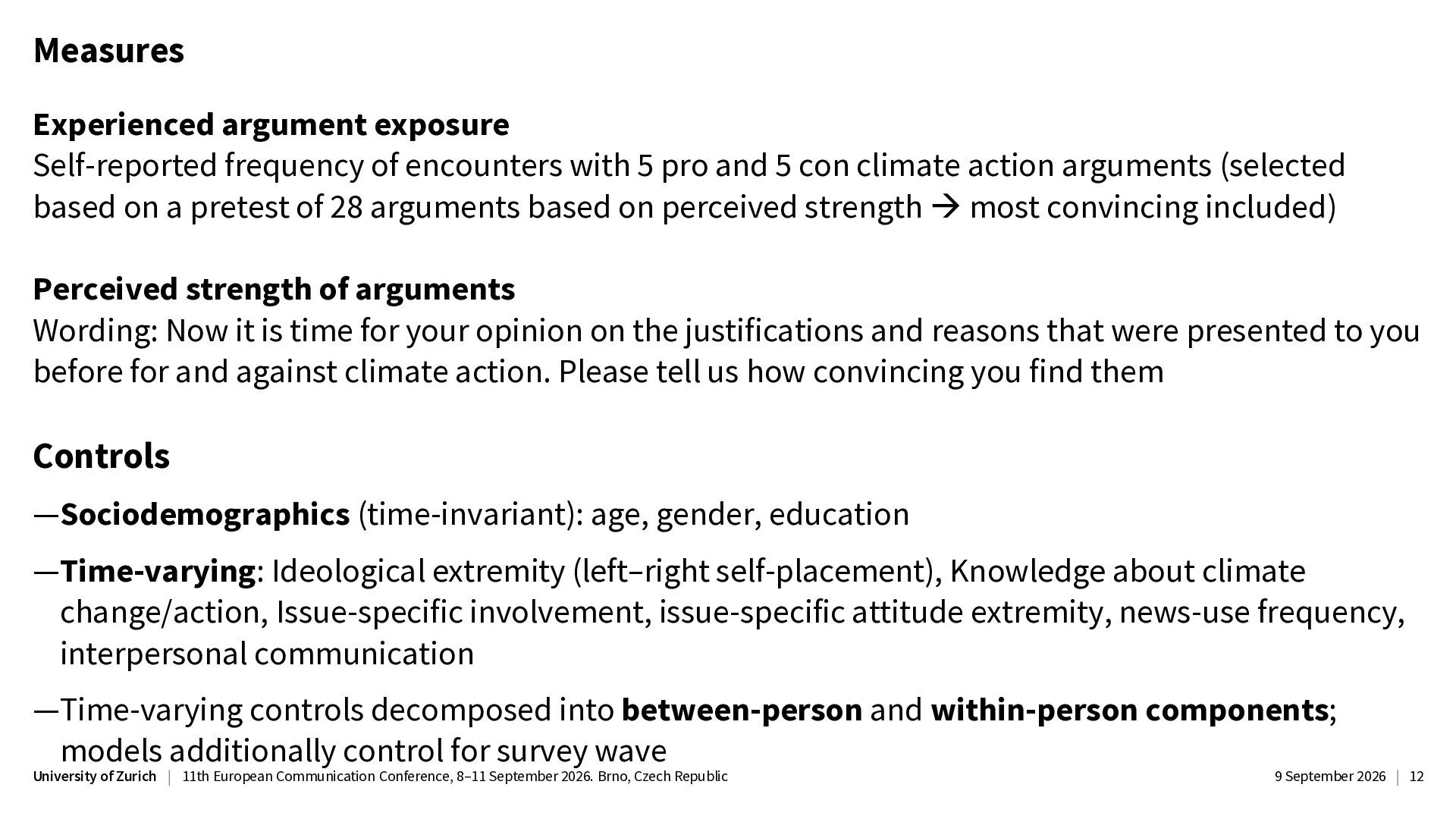
  12. Measures Experienced argument exposure Self-reported frequency of encounters with 5

    pro and 5 con climate action arguments (selected based on a pretest of 28 arguments based on perceived strength → most convincing included) Perceived strength of arguments Wording: Now it is time for your opinion on the justifications and reasons that were presented to you before for and against climate action. Please tell us how convincing you find them Controls ―Sociodemographics (time-invariant): age, gender, education ―Time-varying: Ideological extremity (left–right self-placement), Knowledge about climate change/action, Issue-specific involvement, issue-specific attitude extremity, news-use frequency, interpersonal communication ―Time-varying controls decomposed into between-person and within-person components; models additionally control for survey wave University of Zurich 11th European Communication Conference, 8–11 September 2026. Brno, Czech Republic 9 September 2026 12
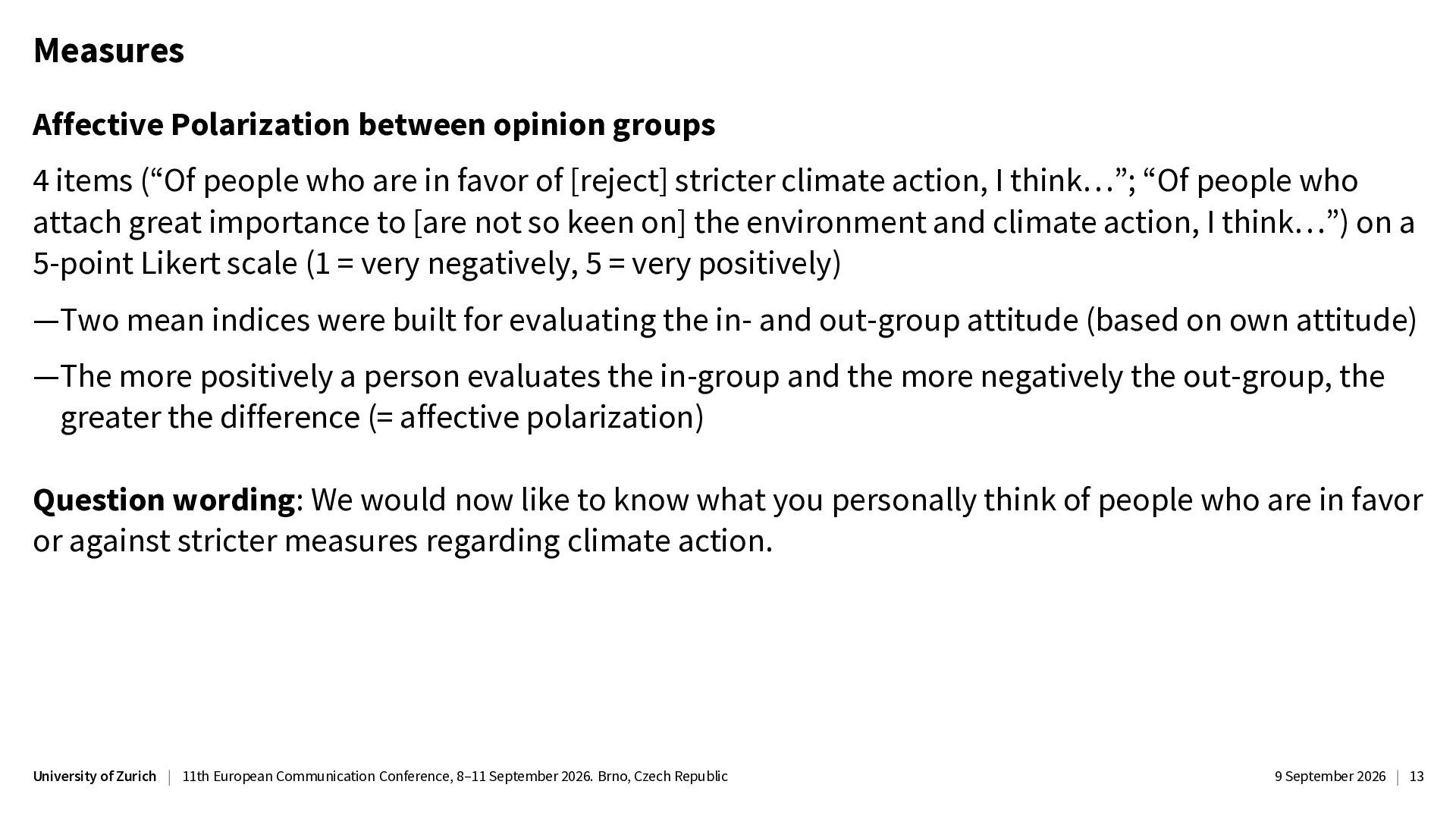
  13. Measures Affective Polarization between opinion groups 4 items (“Of people

    who are in favor of [reject] stricter climate action, I think…”; “Of people who attach great importance to [are not so keen on] the environment and climate action, I think…”) on a 5-point Likert scale (1 = very negatively, 5 = very positively) ―Two mean indices were built for evaluating the in- and out-group attitude (based on own attitude) ―The more positively a person evaluates the in-group and the more negatively the out-group, the greater the difference (= affective polarization) Question wording: We would now like to know what you personally think of people who are in favor or against stricter measures regarding climate action. University of Zurich 11th European Communication Conference, 8–11 September 2026. Brno, Czech Republic 9 September 2026 13
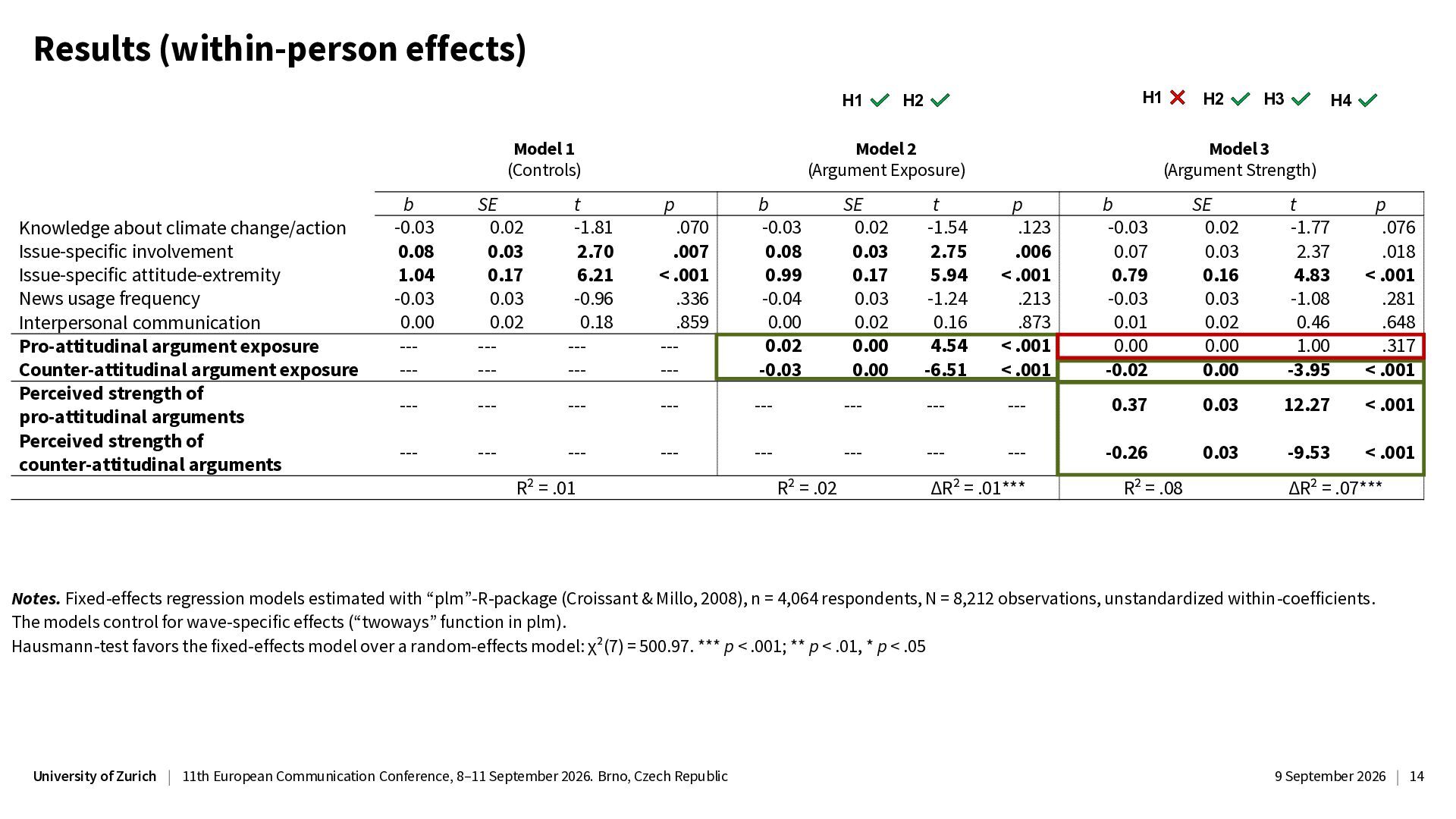
  14. Results (within-person effects) H1 Model 1 (Controls) Knowledge about climate

    change/action Issue-specific involvement Issue-specific attitude-extremity News usage frequency Interpersonal communication Pro-attitudinal argument exposure Counter-attitudinal argument exposure Perceived strength of pro-attitudinal arguments Perceived strength of counter-attitudinal arguments H1 H2 Model 2 (Argument Exposure) H2 H3 H4 Model 3 (Argument Strength) b -0.03 0.08 1.04 -0.03 0.00 ----- SE 0.02 0.03 0.17 0.03 0.02 ----- t -1.81 2.70 6.21 -0.96 0.18 ----- p .070 .007 < .001 .336 .859 ----- b -0.03 0.08 0.99 -0.04 0.00 0.02 -0.03 SE 0.02 0.03 0.17 0.03 0.02 0.00 0.00 t -1.54 2.75 5.94 -1.24 0.16 4.54 -6.51 p .123 .006 < .001 .213 .873 < .001 < .001 b -0.03 0.07 0.79 -0.03 0.01 0.00 -0.02 SE 0.02 0.03 0.16 0.03 0.02 0.00 0.00 t -1.77 2.37 4.83 -1.08 0.46 1.00 -3.95 p .076 .018 < .001 .281 .648 .317 < .001 --- --- --- --- --- --- --- --- 0.37 0.03 12.27 < .001 --- --- --- --- --- --- --- --- -0.26 0.03 -9.53 < .001 R² = .01 R² = .02 ΔR² = .01*** R² = .08 ΔR² = .07*** Notes. Fixed-effects regression models estimated with “plm”-R-package (Croissant & Millo, 2008), n = 4,064 respondents, N = 8,212 observations, unstandardized within-coefficients. The models control for wave-specific effects (“twoways” function in plm). Hausmann-test favors the fixed-effects model over a random-effects model: χ²(7) = 500.97. *** p < .001; ** p < .01, * p < .05 University of Zurich 11th European Communication Conference, 8–11 September 2026. Brno, Czech Republic 9 September 2026 14
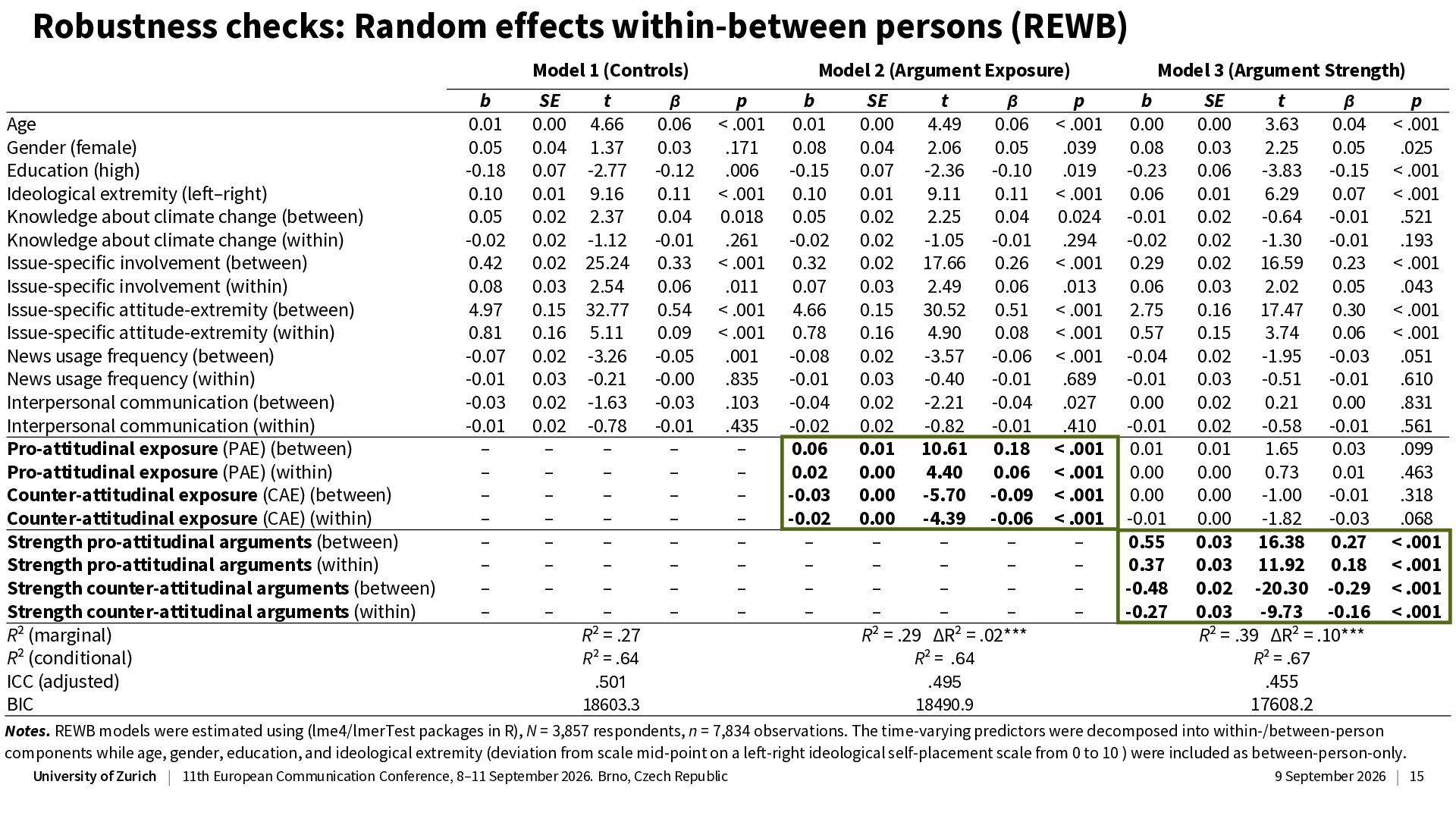
  15. Robustness checks: Random effects within-between persons (REWB) Model 1 (Controls)

    Age Gender (female) Education (high) Ideological extremity (left–right) Knowledge about climate change (between) Knowledge about climate change (within) Issue-specific involvement (between) Issue-specific involvement (within) Issue-specific attitude-extremity (between) Issue-specific attitude-extremity (within) News usage frequency (between) News usage frequency (within) Interpersonal communication (between) Interpersonal communication (within) Pro-attitudinal exposure (PAE) (between) Pro-attitudinal exposure (PAE) (within) Counter-attitudinal exposure (CAE) (between) Counter-attitudinal exposure (CAE) (within) Strength pro-attitudinal arguments (between) Strength pro-attitudinal arguments (within) Strength counter-attitudinal arguments (between) Strength counter-attitudinal arguments (within) R² (marginal) R² (conditional) ICC (adjusted) BIC b 0.01 0.05 -0.18 0.10 0.05 -0.02 0.42 0.08 4.97 0.81 -0.07 -0.01 -0.03 -0.01 – – – – – – – – SE t 0.00 4.66 0.04 1.37 0.07 -2.77 0.01 9.16 0.02 2.37 0.02 -1.12 0.02 25.24 0.03 2.54 0.15 32.77 0.16 5.11 0.02 -3.26 0.03 -0.21 0.02 -1.63 0.02 -0.78 – – – – – – – – – – – – – – – – R² = .27 β 0.06 0.03 -0.12 0.11 0.04 -0.01 0.33 0.06 0.54 0.09 -0.05 -0.00 -0.03 -0.01 – – – – – – – – Model 2 (Argument Exposure) p < .001 .171 .006 < .001 0.018 .261 < .001 .011 < .001 < .001 .001 .835 .103 .435 – – – – – – – – R² = .64 .501 18603.3 b 0.01 0.08 -0.15 0.10 0.05 -0.02 0.32 0.07 4.66 0.78 -0.08 -0.01 -0.04 -0.02 0.06 0.02 -0.03 -0.02 – – – – β SE t 0.00 4.49 0.06 0.04 2.06 0.05 0.07 -2.36 -0.10 0.01 9.11 0.11 0.02 2.25 0.04 0.02 -1.05 -0.01 0.02 17.66 0.26 0.03 2.49 0.06 0.15 30.52 0.51 0.16 4.90 0.08 0.02 -3.57 -0.06 0.03 -0.40 -0.01 0.02 -2.21 -0.04 0.02 -0.82 -0.01 0.01 10.61 0.18 0.00 4.40 0.06 0.00 -5.70 -0.09 0.00 -4.39 -0.06 – – – – – – – – – – – – R² = .29 ΔR² = .02*** R² = .64 .495 18490.9 p < .001 .039 .019 < .001 0.024 .294 < .001 .013 < .001 < .001 < .001 .689 .027 .410 < .001 < .001 < .001 < .001 – – – – Model 3 (Argument Strength) b 0.00 0.08 -0.23 0.06 -0.01 -0.02 0.29 0.06 2.75 0.57 -0.04 -0.01 0.00 -0.01 0.01 0.00 0.00 -0.01 0.55 0.37 -0.48 -0.27 β SE t 0.00 3.63 0.04 0.03 2.25 0.05 0.06 -3.83 -0.15 0.01 6.29 0.07 0.02 -0.64 -0.01 0.02 -1.30 -0.01 0.02 16.59 0.23 0.03 2.02 0.05 0.16 17.47 0.30 0.15 3.74 0.06 0.02 -1.95 -0.03 0.03 -0.51 -0.01 0.02 0.21 0.00 0.02 -0.58 -0.01 0.01 1.65 0.03 0.00 0.73 0.01 0.00 -1.00 -0.01 0.00 -1.82 -0.03 0.03 16.38 0.27 0.03 11.92 0.18 0.02 -20.30 -0.29 0.03 -9.73 -0.16 R² = .39 ΔR² = .10*** p < .001 .025 < .001 < .001 .521 .193 < .001 .043 < .001 < .001 .051 .610 .831 .561 .099 .463 .318 .068 < .001 < .001 < .001 < .001 R² = .67 .455 17608.2 Notes. REWB models were estimated using (lme4/lmerTest packages in R), N = 3,857 respondents, n = 7,834 observations. The time-varying predictors were decomposed into within-/between-person components while age, gender, education, and ideological extremity (deviation from scale mid-point on a left-right ideological self-placement scale from 0 to 10 ) were included as between-person-only. University of Zurich 11th European Communication Conference, 8–11 September 2026. Brno, Czech Republic 9 September 2026 15
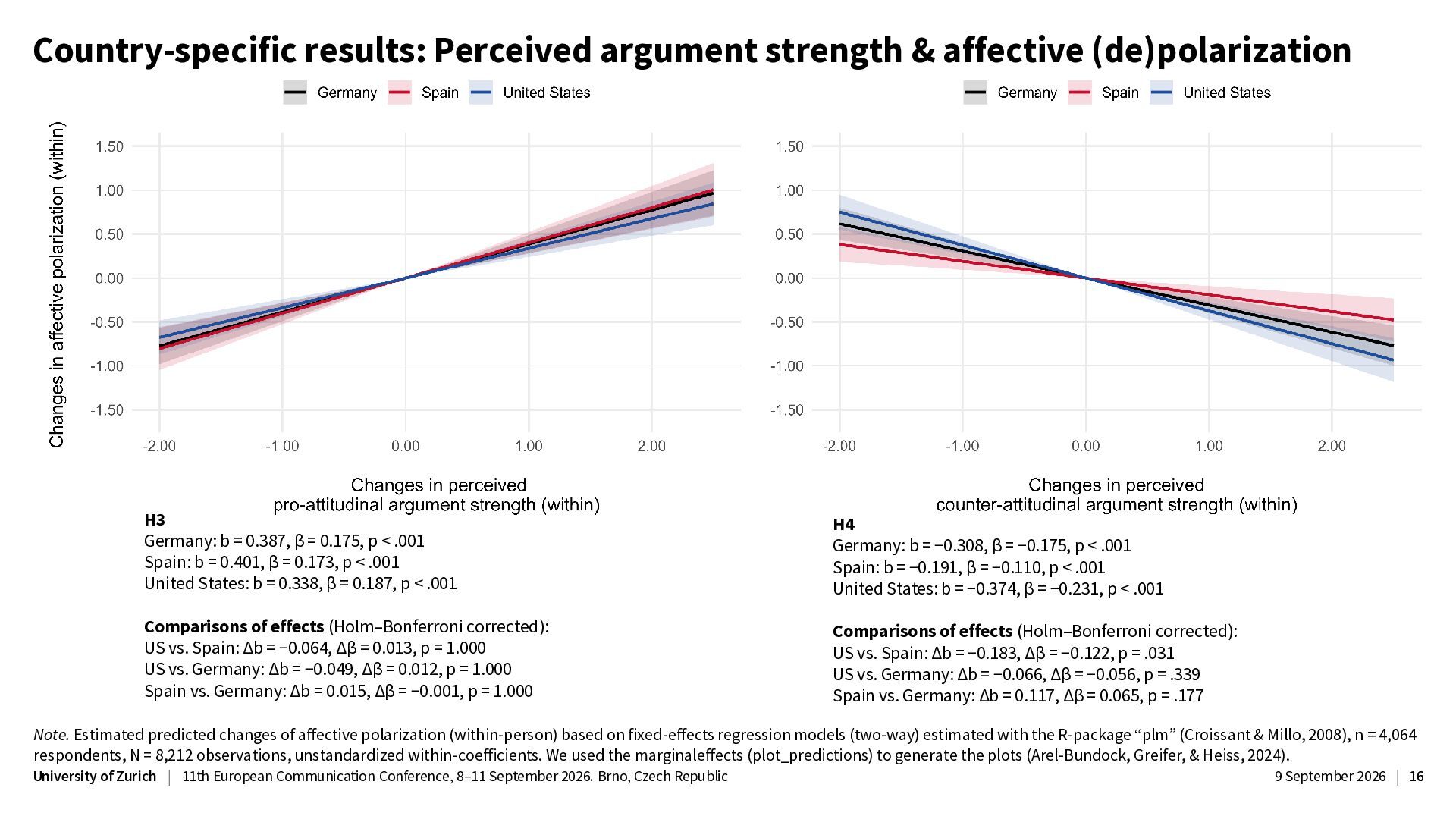
  16. Country-specific results: Perceived argument strength & affective (de)polarization H3 Germany:

    b = 0.387, β = 0.175, p < .001 Spain: b = 0.401, β = 0.173, p < .001 United States: b = 0.338, β = 0.187, p < .001 H4 Germany: b = −0.308, β = −0.175, p < .001 Spain: b = −0.191, β = −0.110, p < .001 United States: b = −0.374, β = −0.231, p < .001 Comparisons of effects (Holm–Bonferroni corrected): US vs. Spain: Δb = −0.064, Δβ = 0.013, p = 1.000 US vs. Germany: Δb = −0.049, Δβ = 0.012, p = 1.000 Spain vs. Germany: Δb = 0.015, Δβ = −0.001, p = 1.000 Comparisons of effects (Holm–Bonferroni corrected): US vs. Spain: Δb = −0.183, Δβ = −0.122, p = .031 US vs. Germany: Δb = −0.066, Δβ = −0.056, p = .339 Spain vs. Germany: Δb = 0.117, Δβ = 0.065, p = .177 Note. Estimated predicted changes of affective polarization (within-person) based on fixed-effects regression models (two-way) estimated with the R-package “plm” (Croissant & Millo, 2008), n = 4,064 respondents, N = 8,212 observations, unstandardized within-coefficients. We used the marginaleffects (plot_predictions) to generate the plots (Arel-Bundock, Greifer, & Heiss, 2024). University of Zurich 11th European Communication Conference, 8–11 September 2026. Brno, Czech Republic 9 September 2026 16
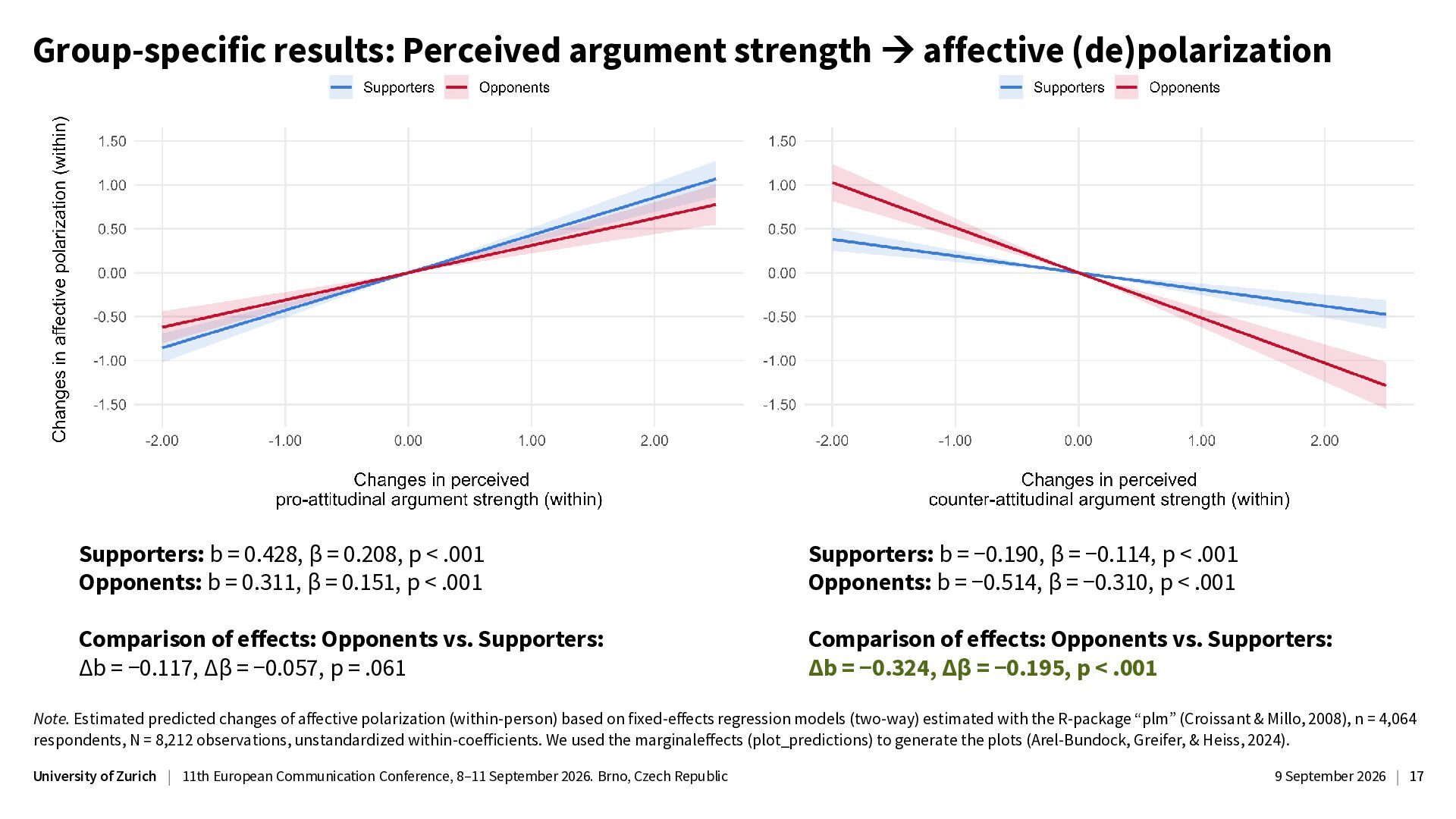
  17. Group-specific results: Perceived argument strength → affective (de)polarization Supporters: b

    = 0.428, β = 0.208, p < .001 Opponents: b = 0.311, β = 0.151, p < .001 Supporters: b = −0.190, β = −0.114, p < .001 Opponents: b = −0.514, β = −0.310, p < .001 Comparison of effects: Opponents vs. Supporters: Δb = −0.117, Δβ = −0.057, p = .061 Comparison of effects: Opponents vs. Supporters: Δb = −0.324, Δβ = −0.195, p < .001 Note. Estimated predicted changes of affective polarization (within-person) based on fixed-effects regression models (two-way) estimated with the R-package “plm” (Croissant & Millo, 2008), n = 4,064 respondents, N = 8,212 observations, unstandardized within-coefficients. We used the marginaleffects (plot_predictions) to generate the plots (Arel-Bundock, Greifer, & Heiss, 2024). University of Zurich 11th European Communication Conference, 8–11 September 2026. Brno, Czech Republic 9 September 2026 17
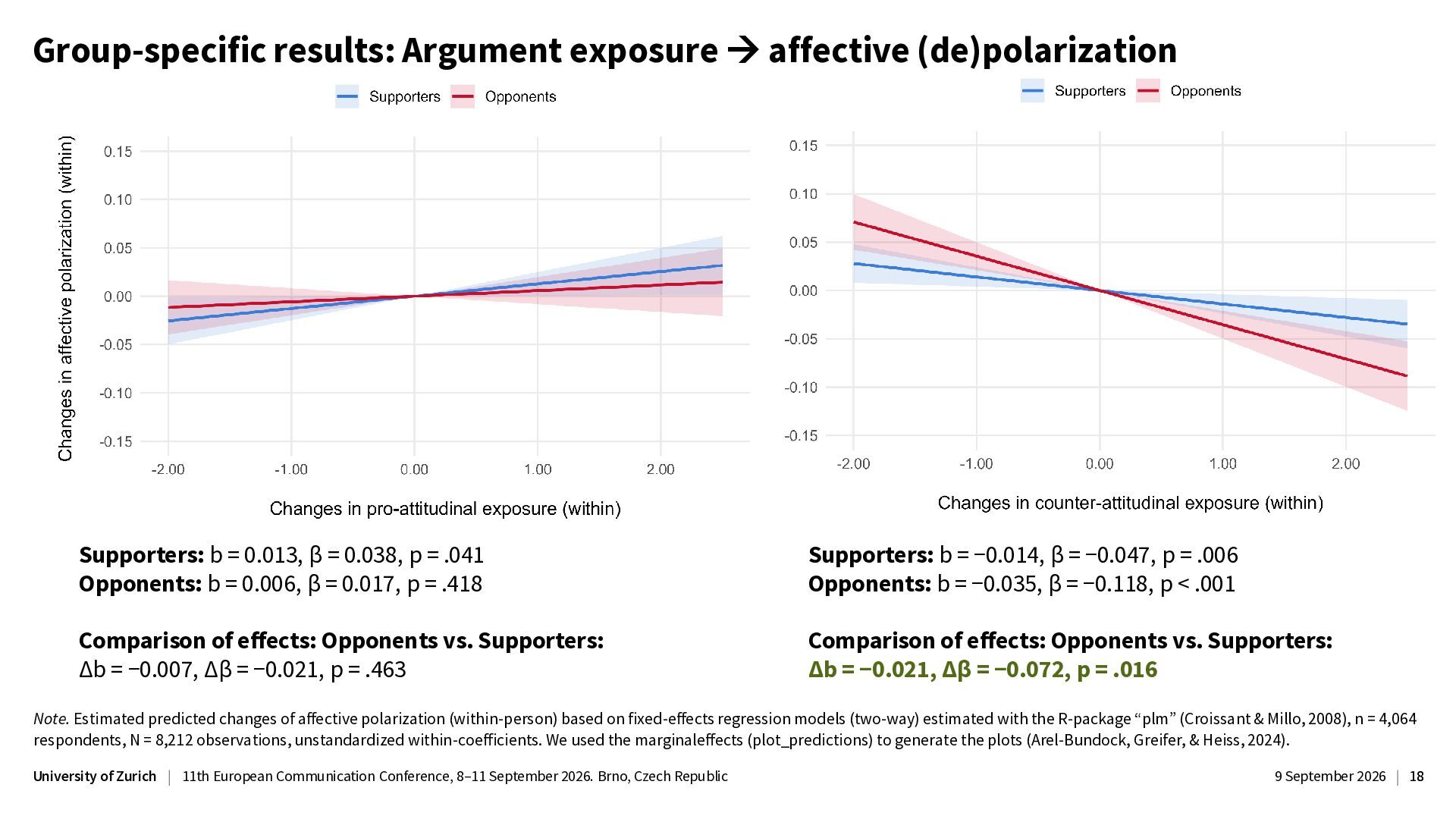
  18. Group-specific results: Argument exposure → affective (de)polarization Supporters: b =

    0.013, β = 0.038, p = .041 Opponents: b = 0.006, β = 0.017, p = .418 Supporters: b = −0.014, β = −0.047, p = .006 Opponents: b = −0.035, β = −0.118, p < .001 Comparison of effects: Opponents vs. Supporters: Δb = −0.007, Δβ = −0.021, p = .463 Comparison of effects: Opponents vs. Supporters: Δb = −0.021, Δβ = −0.072, p = .016 Note. Estimated predicted changes of affective polarization (within-person) based on fixed-effects regression models (two-way) estimated with the R-package “plm” (Croissant & Millo, 2008), n = 4,064 respondents, N = 8,212 observations, unstandardized within-coefficients. We used the marginaleffects (plot_predictions) to generate the plots (Arel-Bundock, Greifer, & Heiss, 2024). University of Zurich 11th European Communication Conference, 8–11 September 2026. Brno, Czech Republic 9 September 2026 18
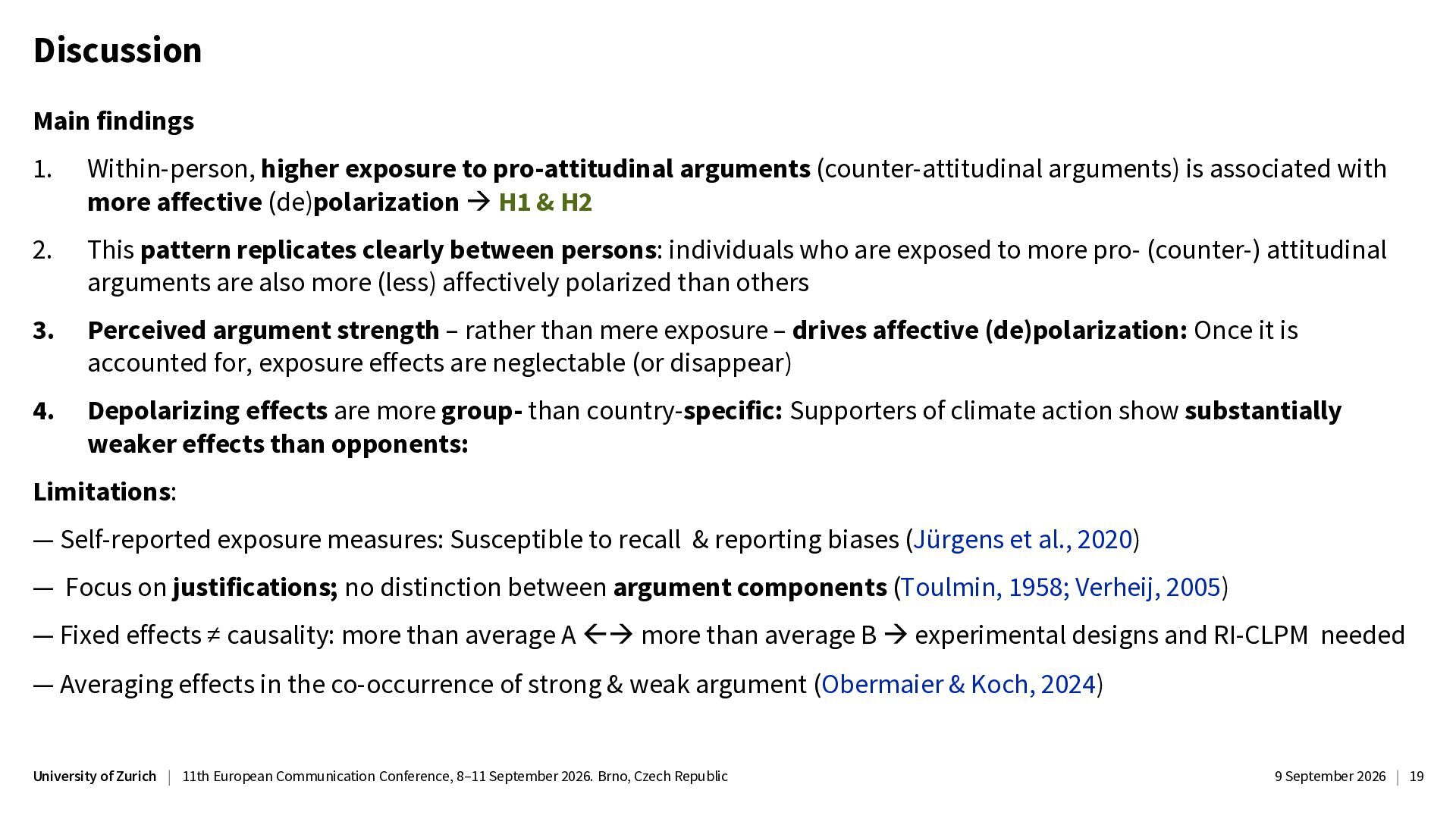
  19. Discussion Main findings 1. Within-person, higher exposure to pro-attitudinal arguments

    (counter-attitudinal arguments) is associated with more affective (de)polarization → H1 & H2 2. This pattern replicates clearly between persons: individuals who are exposed to more pro- (counter-) attitudinal arguments are also more (less) affectively polarized than others 3. Perceived argument strength – rather than mere exposure – drives affective (de)polarization: Once it is accounted for, exposure effects are neglectable (or disappear) 4. Depolarizing effects are more group- than country-specific: Supporters of climate action show substantially weaker effects than opponents: Limitations: ― Self-reported exposure measures: Susceptible to recall & reporting biases (Jürgens et al., 2020) ― Focus on justifications; no distinction between argument components (Toulmin, 1958; Verheij, 2005) ― Fixed effects ≠ causality: more than average A → more than average B → experimental designs and RI-CLPM needed ― Averaging effects in the co-occurrence of strong & weak argument (Obermaier & Koch, 2024) University of Zurich 11th European Communication Conference, 8–11 September 2026. Brno, Czech Republic 9 September 2026 19
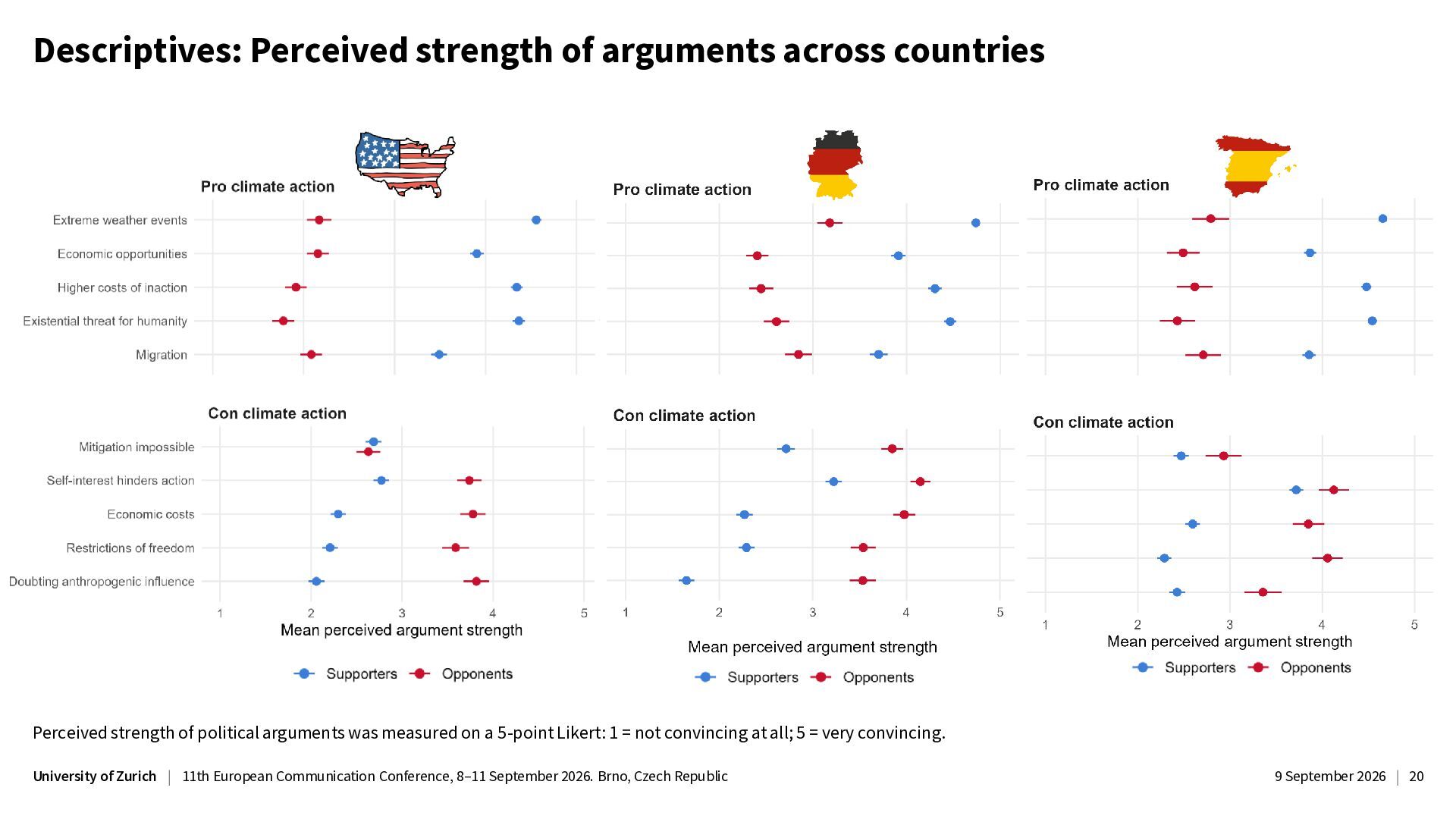
  20. Descriptives: Perceived strength of arguments across countries Perceived strength of

    political arguments was measured on a 5-point Likert: 1 = not convincing at all; 5 = very convincing. University of Zurich 11th European Communication Conference, 8–11 September 2026. Brno, Czech Republic 9 September 2026 20