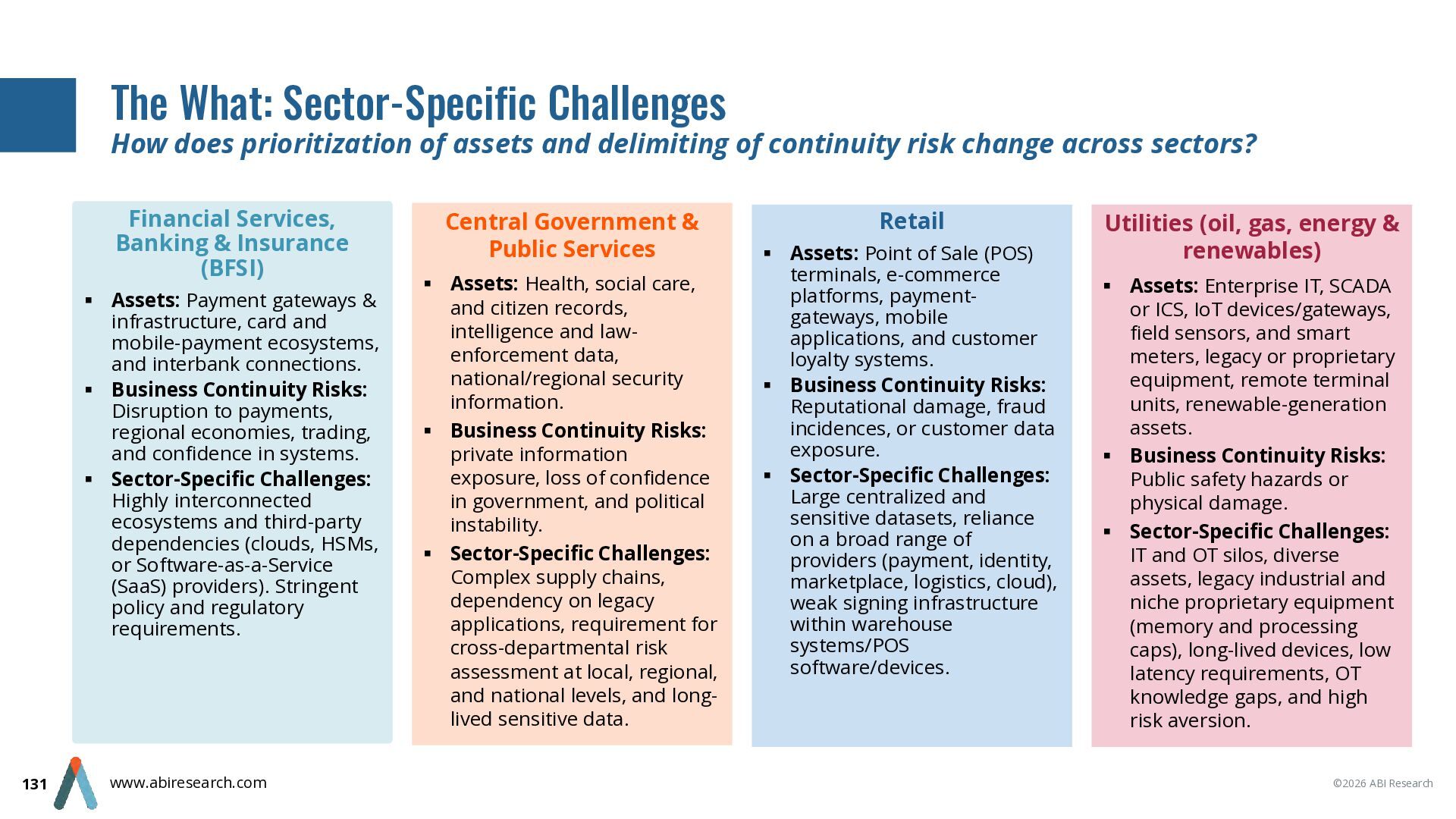
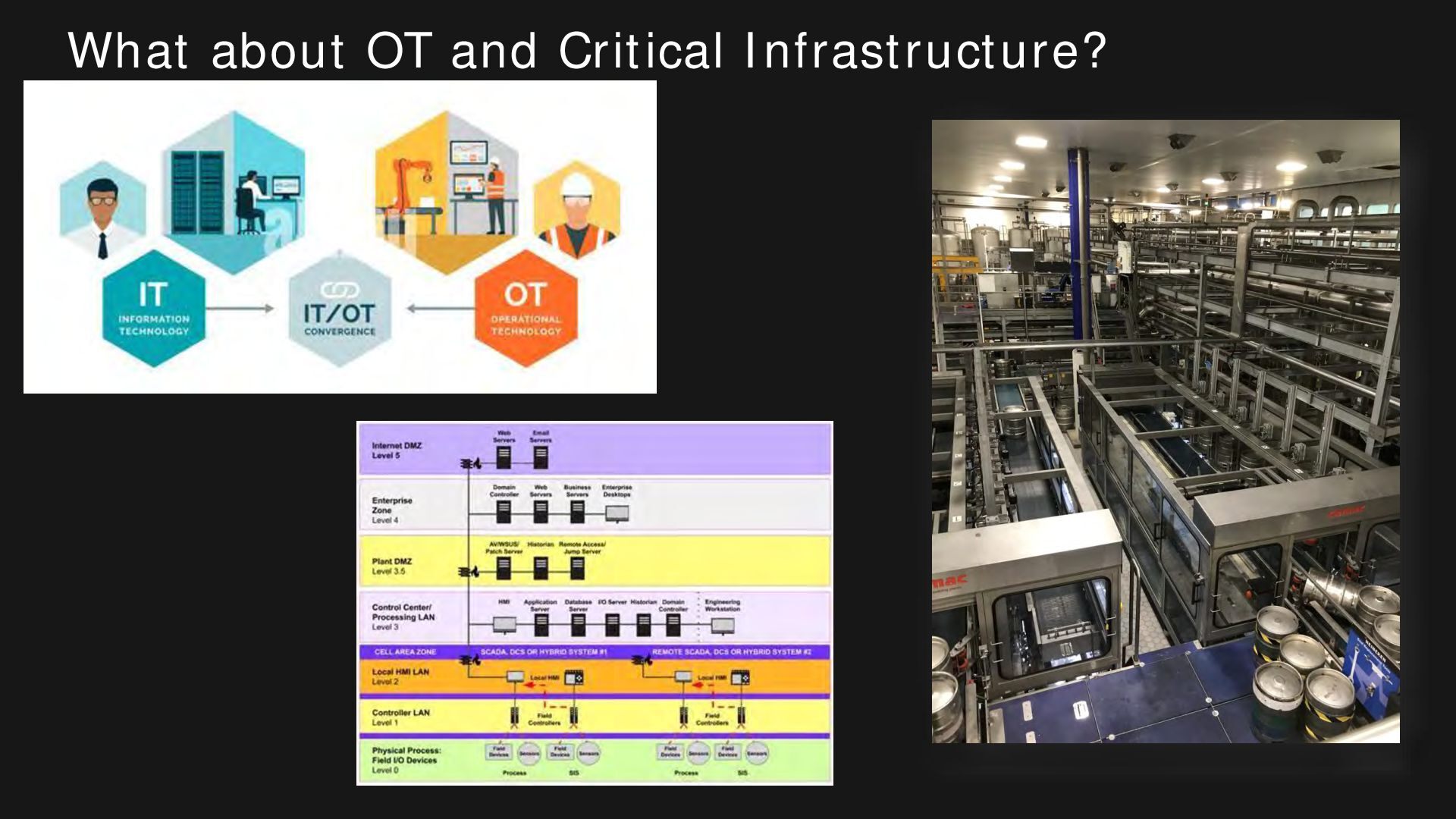
delimiting of continuity risk change across sectors? Financial Services, Banking & Insurance (BFSI) ▪ Assets: Payment gateways & infrastructure, card and mobile-payment ecosystems, and interbank connections. ▪ Business Continuity Risks: Disruption to payments, regional economies, trading, and confidence in systems. ▪ Sector-Specific Challenges: Highly interconnected ecosystems and third-party dependencies (clouds, HSMs, or Software-as-a-Service (SaaS) providers). Stringent policy and regulatory requirements. 131 www.abiresearch.com Central Government & Public Services ▪ Assets: Health, social care, and citizen records, intelligence and lawenforcement data, national/regional security information. ▪ Business Continuity Risks: private information exposure, loss of confidence in government, and political instability. ▪ Sector-Specific Challenges: Complex supply chains, dependency on legacy applications, requirement for cross-departmental risk assessment at local, regional, and national levels, and longlived sensitive data. Retail ▪ Assets: Point of Sale (POS) terminals, e-commerce platforms, paymentgateways, mobile applications, and customer loyalty systems. ▪ Business Continuity Risks: Reputational damage, fraud incidences, or customer data exposure. ▪ Sector-Specific Challenges: Large centralized and sensitive datasets, reliance on a broad range of providers (payment, identity, marketplace, logistics, cloud), weak signing infrastructure within warehouse systems/POS software/devices. Utilities (oil, gas, energy & renewables) ▪ Assets: Enterprise IT, SCADA or ICS, IoT devices/gateways, field sensors, and smart meters, legacy or proprietary equipment, remote terminal units, renewable-generation assets. ▪ Business Continuity Risks: Public safety hazards or physical damage. ▪ Sector-Specific Challenges: IT and OT silos, diverse assets, legacy industrial and niche proprietary equipment (memory and processing caps), long-lived devices, low latency requirements, OT knowledge gaps, and high risk aversion. ©2026 ABI Research


 raybugg
.png) codatum
codatum
 y0hgi
y0hgi
 endonanana
 tokuty
 carta_engineering
 akitoshiga
 ymotongpoo
 sh_fk2
 kenichiodo
 raspython3
 occhi
occhi
 satoshi7
 tammyeverts
 skoyamalab
 morganepeng
 letsgokoyo
 gurzu
gurzu
 maltzj
 techseoconnect
 michielstock
 aleyda
 paigeccino
 popppiees
 katarinadahlin


















![Thank you for listening! [email protected]](https://files.speakerdeck.com/presentations/acb36814c3754d2d8280712ce1ad31df/slide_115.jpg)