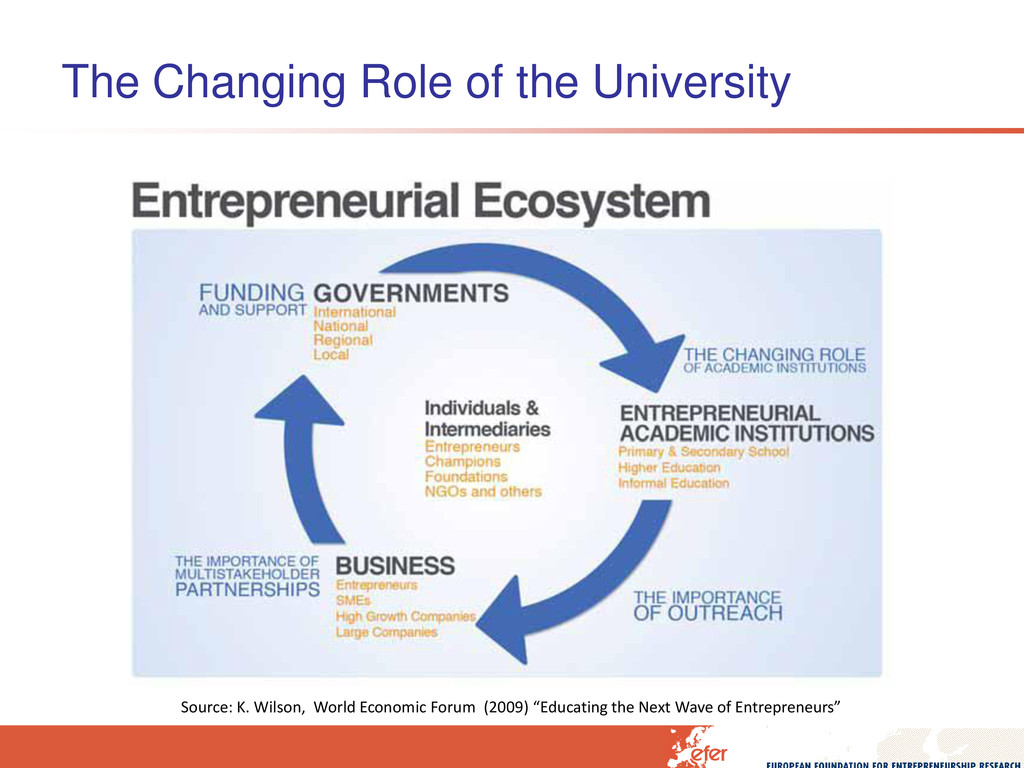
more important than in today’s environment – Renewing economic growth and creating jobs – Stimulating creativity and new approaches to global challenges – Entrepreneurs translate innovation into young, dynamic companies • Entrepreneurs have historically been key drivers of economic recovery in past recessionary periods. – Since 1980, companies less than five years old have accounted for virtually all net new job creation in the United States. – Many successful public companies were founded during recessions • More than half of the companies on the 2009 Fortune 500 list were launched during a recession or bear market – Unfortunately, the recent crisis has so far shown a drop in new firm starts – this must be addressed Source: Kauffman Foundation papers: "The Economic Future Just Happened“ by Dane Stangler, 2009 and “Entrepreneurs and Recessions: Do Downturns Matter?” by Paul Kedrosky, 2008
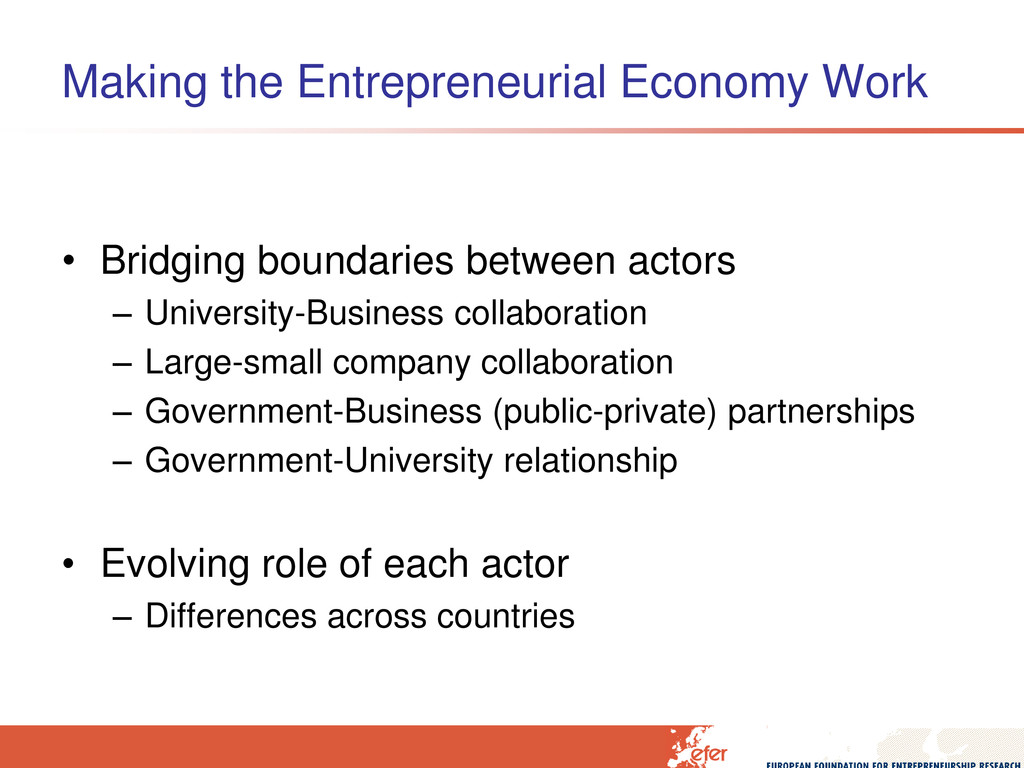
– University-Business collaboration – Large-small company collaboration – Government-Business (public-private) partnerships – Government-University relationship • Evolving role of each actor – Differences across countries
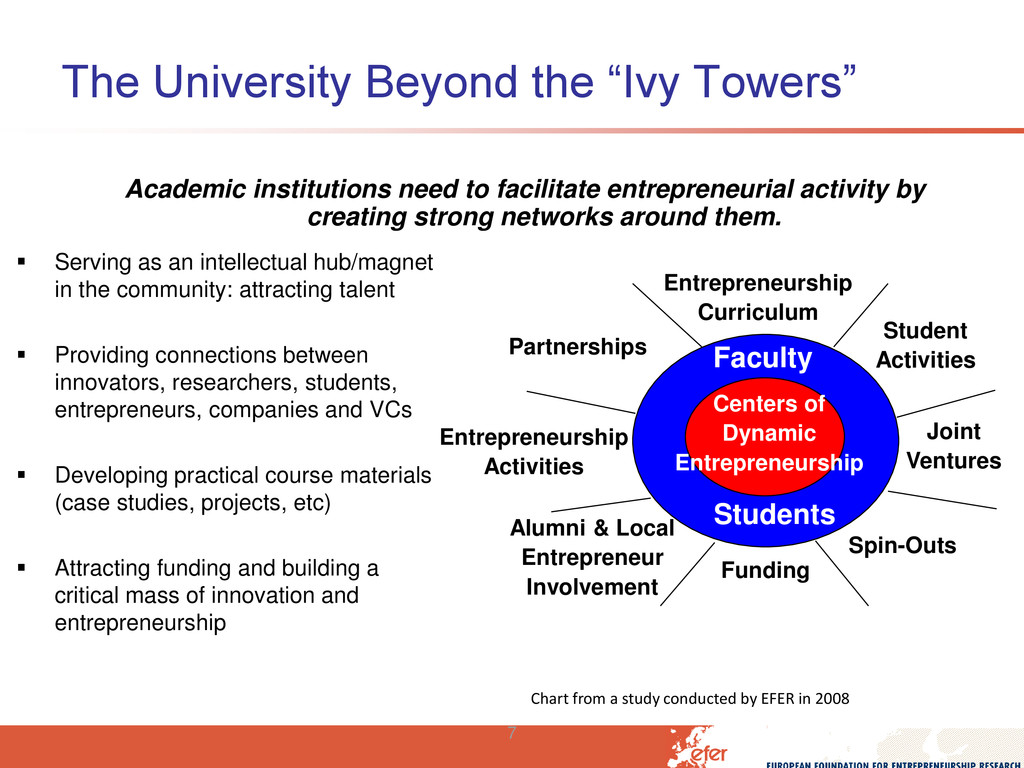
to facilitate entrepreneurial activity by creating strong networks around them. Serving as an intellectual hub/magnet in the community: attracting talent Providing connections between innovators, researchers, students, entrepreneurs, companies and VCs Developing practical course materials (case studies, projects, etc) Attracting funding and building a critical mass of innovation and entrepreneurship XX Faculty Students Centers of Dynamic Entrepreneurship Entrepreneurship Curriculum Partnerships Funding Alumni & Local Entrepreneur Involvement Student Activities Joint Ventures Spin-Outs Entrepreneurship Activities Chart from a study conducted by EFER in 2008
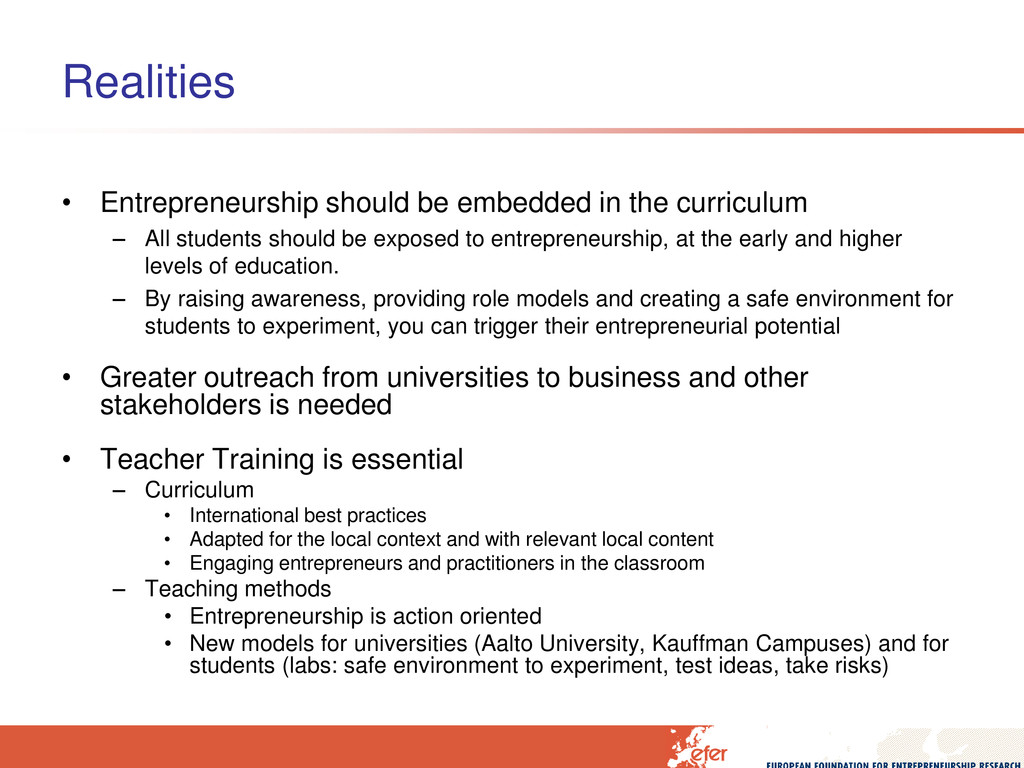
All students should be exposed to entrepreneurship, at the early and higher levels of education. – By raising awareness, providing role models and creating a safe environment for students to experiment, you can trigger their entrepreneurial potential • Greater outreach from universities to business and other stakeholders is needed • Teacher Training is essential – Curriculum • International best practices • Adapted for the local context and with relevant local content • Engaging entrepreneurs and practitioners in the classroom – Teaching methods • Entrepreneurship is action oriented • New models for universities (Aalto University, Kauffman Campuses) and for students (labs: safe environment to experiment, test ideas, take risks)
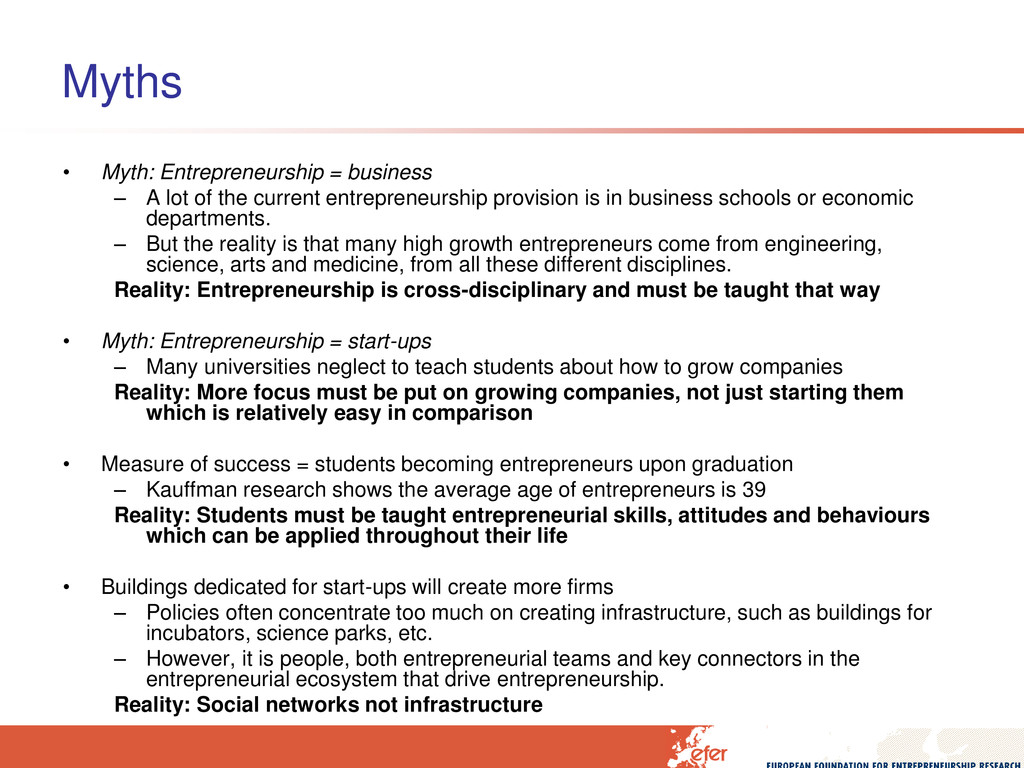
the current entrepreneurship provision is in business schools or economic departments. – But the reality is that many high growth entrepreneurs come from engineering, science, arts and medicine, from all these different disciplines. Reality: Entrepreneurship is cross-disciplinary and must be taught that way • Myth: Entrepreneurship = start-ups – Many universities neglect to teach students about how to grow companies Reality: More focus must be put on growing companies, not just starting them which is relatively easy in comparison • Measure of success = students becoming entrepreneurs upon graduation – Kauffman research shows the average age of entrepreneurs is 39 Reality: Students must be taught entrepreneurial skills, attitudes and behaviours which can be applied throughout their life • Buildings dedicated for start-ups will create more firms – Policies often concentrate too much on creating infrastructure, such as buildings for incubators, science parks, etc. – However, it is people, both entrepreneurial teams and key connectors in the entrepreneurial ecosystem that drive entrepreneurship. Reality: Social networks not infrastructure
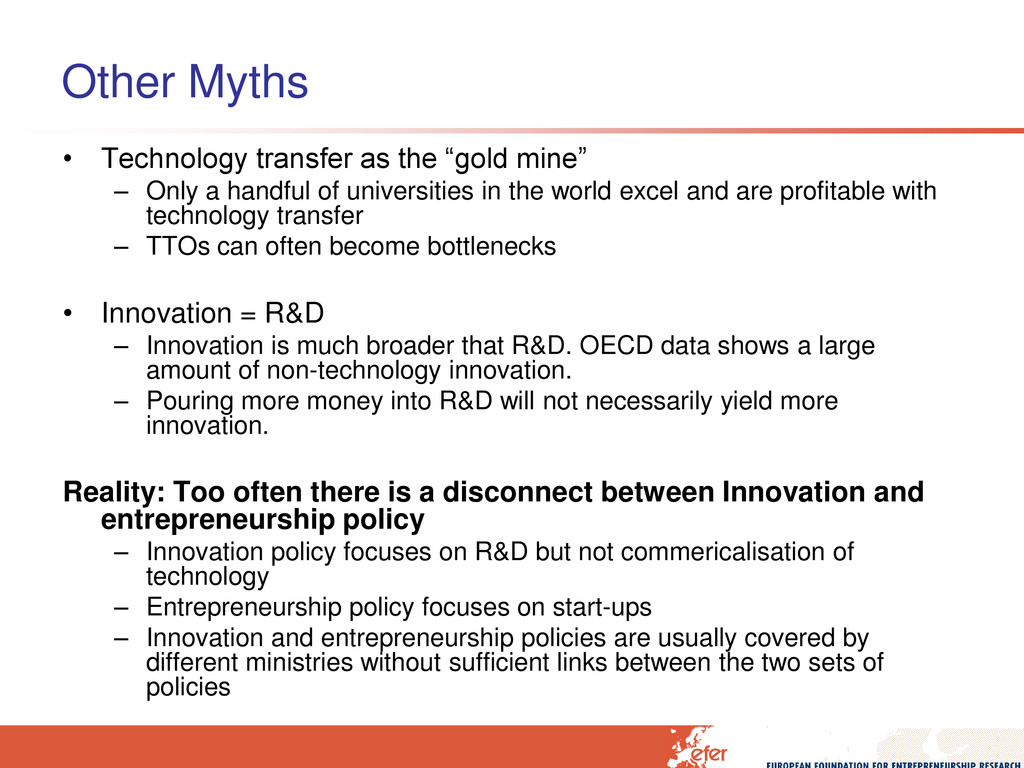
Only a handful of universities in the world excel and are profitable with technology transfer – TTOs can often become bottlenecks • Innovation = R&D – Innovation is much broader that R&D. OECD data shows a large amount of non-technology innovation. – Pouring more money into R&D will not necessarily yield more innovation. Reality: Too often there is a disconnect between Innovation and entrepreneurship policy – Innovation policy focuses on R&D but not commericalisation of technology – Entrepreneurship policy focuses on start-ups – Innovation and entrepreneurship policies are usually covered by different ministries without sufficient links between the two sets of policies
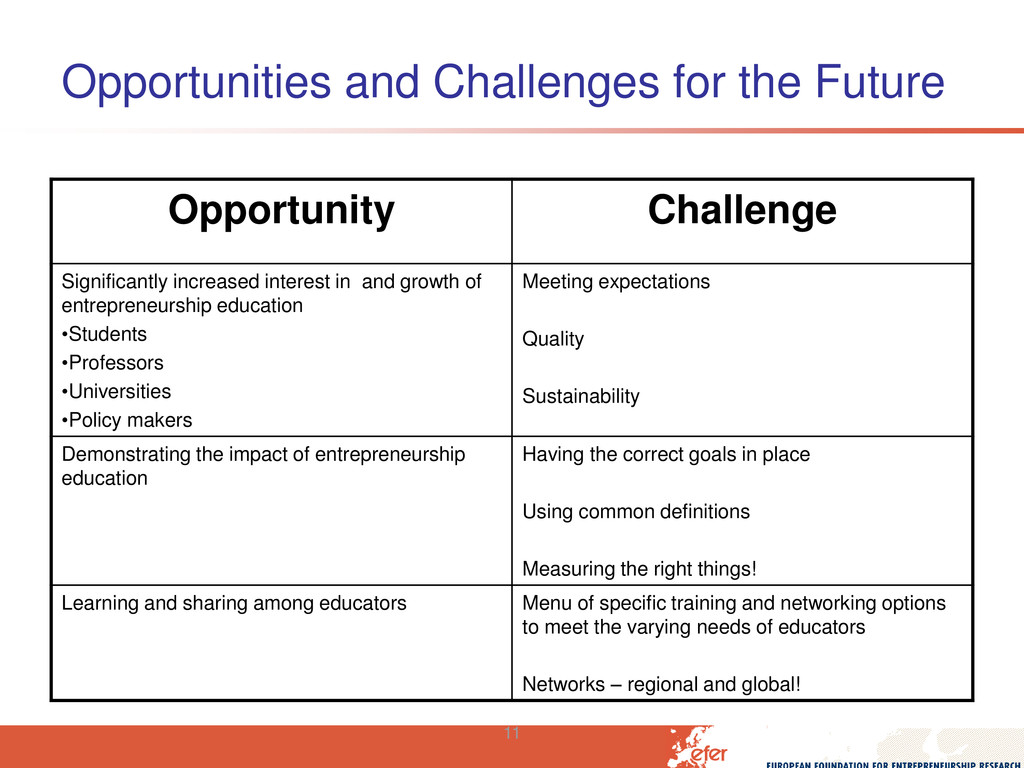
increased interest in and growth of entrepreneurship education •Students •Professors •Universities •Policy makers Meeting expectations Quality Sustainability Demonstrating the impact of entrepreneurship education Having the correct goals in place Using common definitions Measuring the right things! Learning and sharing among educators Menu of specific training and networking options to meet the varying needs of educators Networks – regional and global!
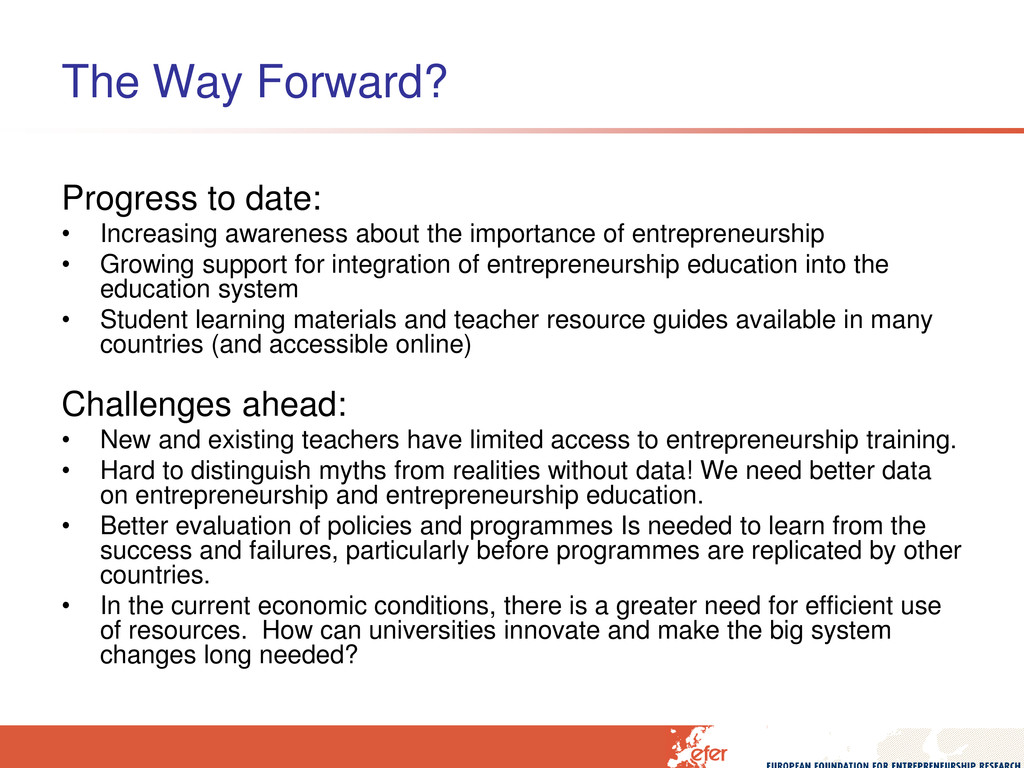
the importance of entrepreneurship • Growing support for integration of entrepreneurship education into the education system • Student learning materials and teacher resource guides available in many countries (and accessible online) Challenges ahead: • New and existing teachers have limited access to entrepreneurship training. • Hard to distinguish myths from realities without data! We need better data on entrepreneurship and entrepreneurship education. • Better evaluation of policies and programmes Is needed to learn from the success and failures, particularly before programmes are replicated by other countries. • In the current economic conditions, there is a greater need for efficient use of resources. How can universities innovate and make the big system changes long needed?
TTT 2001, HBS EECPCL 2005-2008, EEC 2009-onwards 2. Building and strengthening faculty networks and collaboration across national borders in Europe • EFER Roundtable Meetings: Frankfurt, Oslo, Barcelona, Aachen, Ljubljana, Gent, St. Petersburg, St Gallen, Riga 3. Encouraging and supporting the exchange of faculty between countries (EFER Bologna Faculty Exchange) 4. Conducting surveys and research
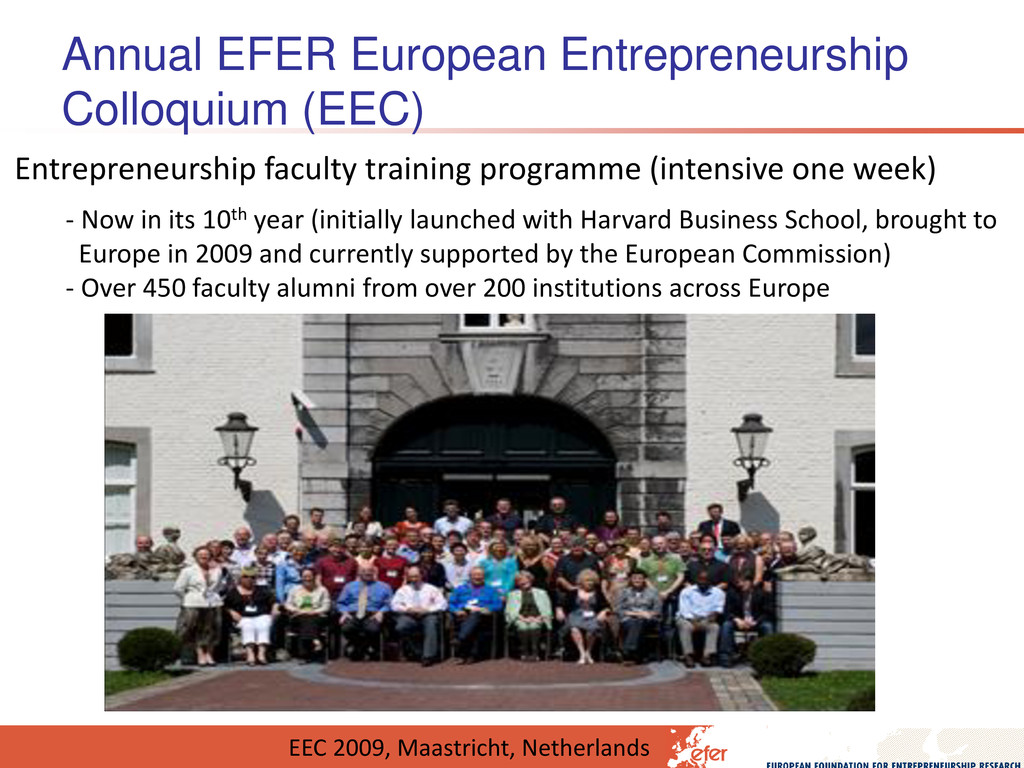
(intensive one week) - Now in its 10th year (initially launched with Harvard Business School, brought to Europe in 2009 and currently supported by the European Commission) - Over 450 faculty alumni from over 200 institutions across Europe EEC 2009, Maastricht, Netherlands
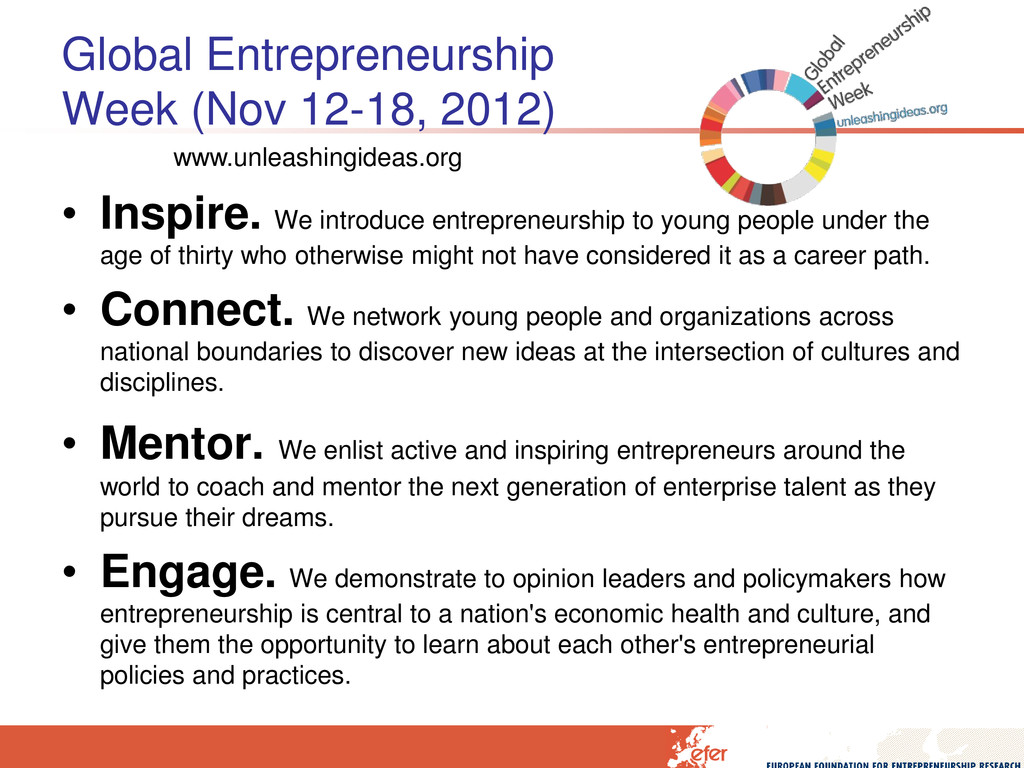
entrepreneurship to young people under the age of thirty who otherwise might not have considered it as a career path. • Connect. We network young people and organizations across national boundaries to discover new ideas at the intersection of cultures and disciplines. • Mentor. We enlist active and inspiring entrepreneurs around the world to coach and mentor the next generation of enterprise talent as they pursue their dreams. • Engage. We demonstrate to opinion leaders and policymakers how entrepreneurship is central to a nation's economic health and culture, and give them the opportunity to learn about each other's entrepreneurial policies and practices. www.unleashingideas.org
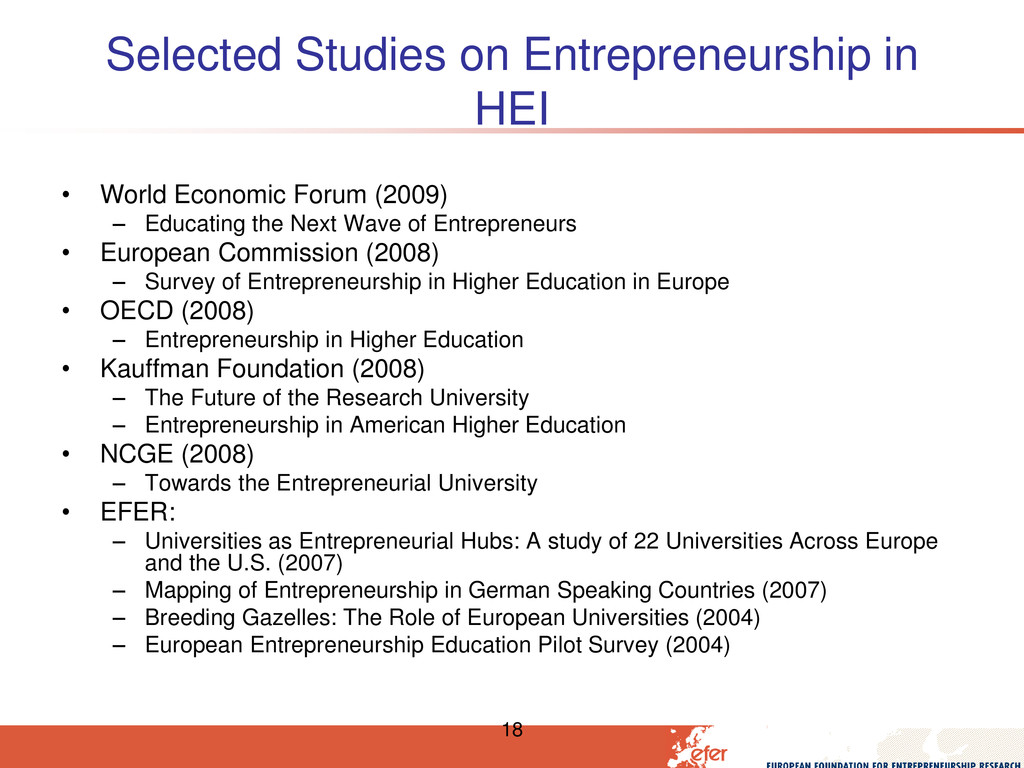
Forum (2009) – Educating the Next Wave of Entrepreneurs • European Commission (2008) – Survey of Entrepreneurship in Higher Education in Europe • OECD (2008) – Entrepreneurship in Higher Education • Kauffman Foundation (2008) – The Future of the Research University – Entrepreneurship in American Higher Education • NCGE (2008) – Towards the Entrepreneurial University • EFER: – Universities as Entrepreneurial Hubs: A study of 22 Universities Across Europe and the U.S. (2007) – Mapping of Entrepreneurship in German Speaking Countries (2007) – Breeding Gazelles: The Role of European Universities (2004) – European Entrepreneurship Education Pilot Survey (2004)


 ree12europe
 bunnchinn3
 pawan_pharm
 ichiroc
 akiraasano
 drpoonamkc
 ishii_mit
 ainischool
 cbtlibrary
 yatabe
 bvr7352
 terasawat
 moriyuya
 bluesmoon
 62gerente
 nikkihalliwell
 csswizardry
 sferik
 holman
.png) helenjbeal
helenjbeal
 leimatthew05
 akosma
 trishagee
 morganepeng
 kevinliebholz