Upgrade to Pro — share decks privately, control downloads, hide ads and more …

Work in progress: How have changes in the labou...

Work in progress: How have changes in the labour market over the past decade affected attitudes to work?

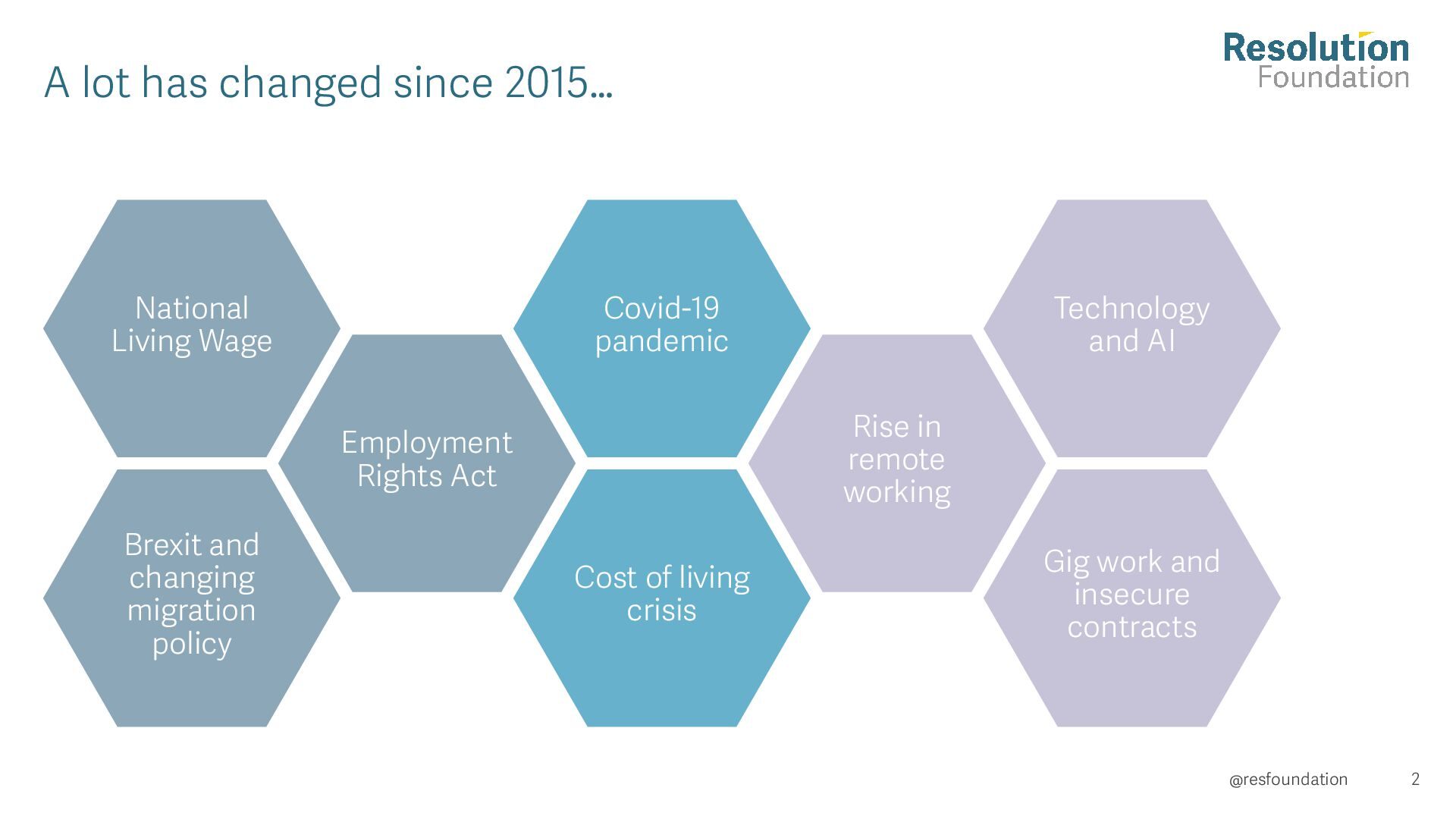
The UK labour market has changed profoundly over the past decade. The introduction of the National Living Wage, the rise of the gig economy and the legacy of the Covid-19 pandemic have prompted changes to the way we work. Further changes lie ahead too – from new employment rights protections to growing questions over the impacts of AI on jobs. And yet beneath all this change some aspects of the labour market – including many of its challenges like inactivity, low productivity and weak dynamism – feel remarkably similar to a decade ago.

Has a wider disengagement with work contributed to increased levels of inactivity? Has what people value in their jobs – and how hard they are willing to work – shifted in the wake of the Covid-19 pandemic, and could this help explain weak productivity growth? How far can attitudes to work help to explain the lack of dynamism in the economy? And how worried are workers about their jobs being displaced by AI?

The Resolution Foundation is hosting an in-person and interactive webinar to debate and answer these questions. Following a presentation of key findings from the latest British Social Attitudes (BSA) Survey, an expert panel will discuss how and why attitudes to work have changed over the past 10 years, and what these might mean for the UK labour market today and in the years ahead.

Avatar for Resolution Foundation

Resolution Foundation

November 03, 2026

More Decks by Resolution Foundation

Other Decks in Research

Transcript

  1. Work in progress How have changes in the labour market

    over the past decade affected attitudes to work? Sir John Curtice, Professor of politics at the University of Strathclyde and Senior Research Fellow at the National Centre for Social Research. Sarah O‘Connor, Columnist, reporter and associate editor at the Financial Times. Hannah Slaughter, Principal Economist at the Resolution Foundation Chair: Ruth Curtice, Chief Executive of the Resolution Foundation Wifi 2QAG_Guest Welcome_Guests #WorkProgress 1
  2. A lot has changed since 2015… National Living Wage Covid-19

    pandemic Rise in remote working Employment Rights Act Brexit and changing migration policy Technology and AI Cost of living crisis Gig work and insecure contracts @resfoundation 2
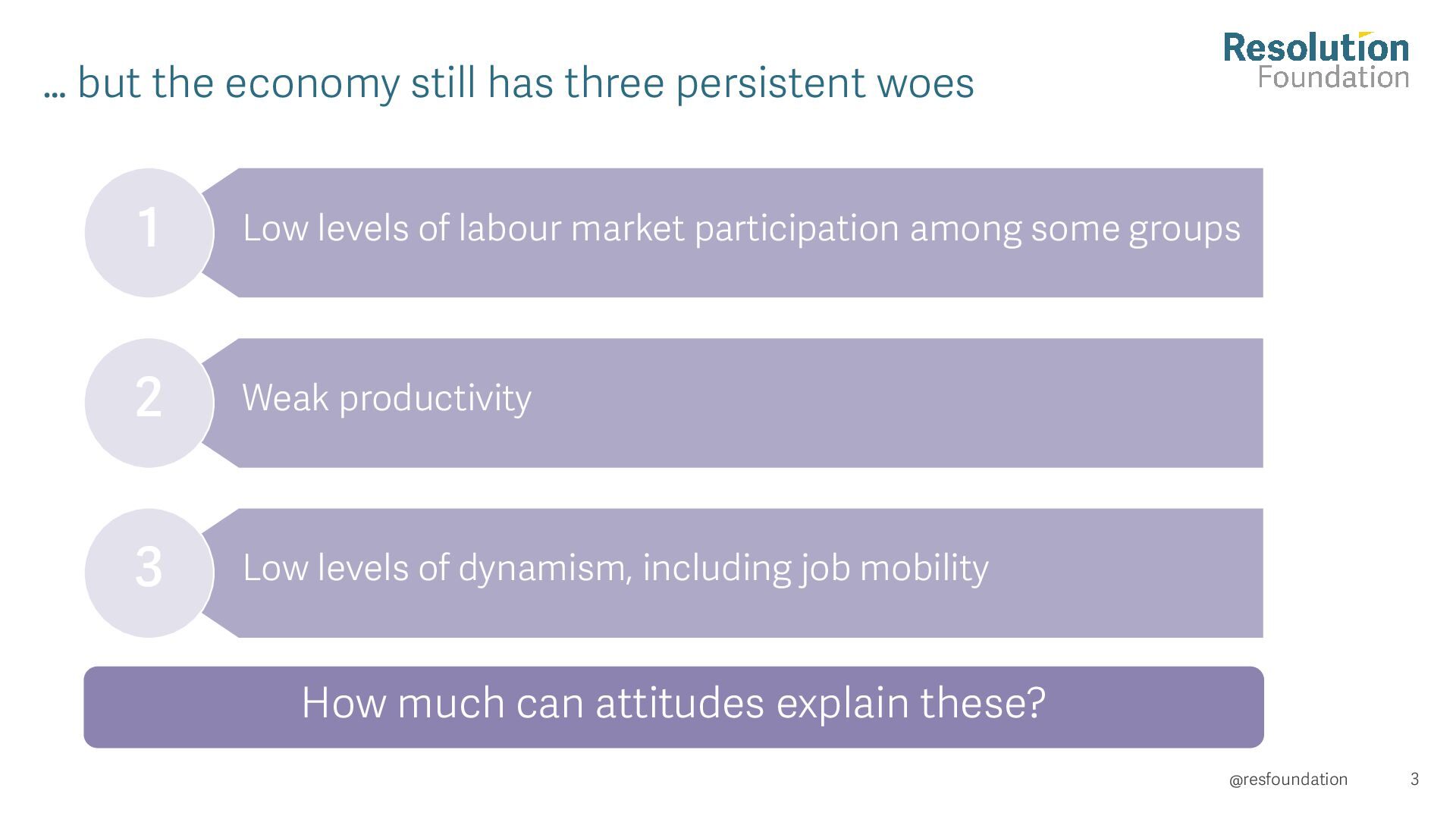
  3. … but the economy still has three persistent woes 1

    Low levels of labour market participation among some groups 2 Weak productivity 3 Low levels of dynamism, including job mobility How much can attitudes explain these? @resfoundation 3
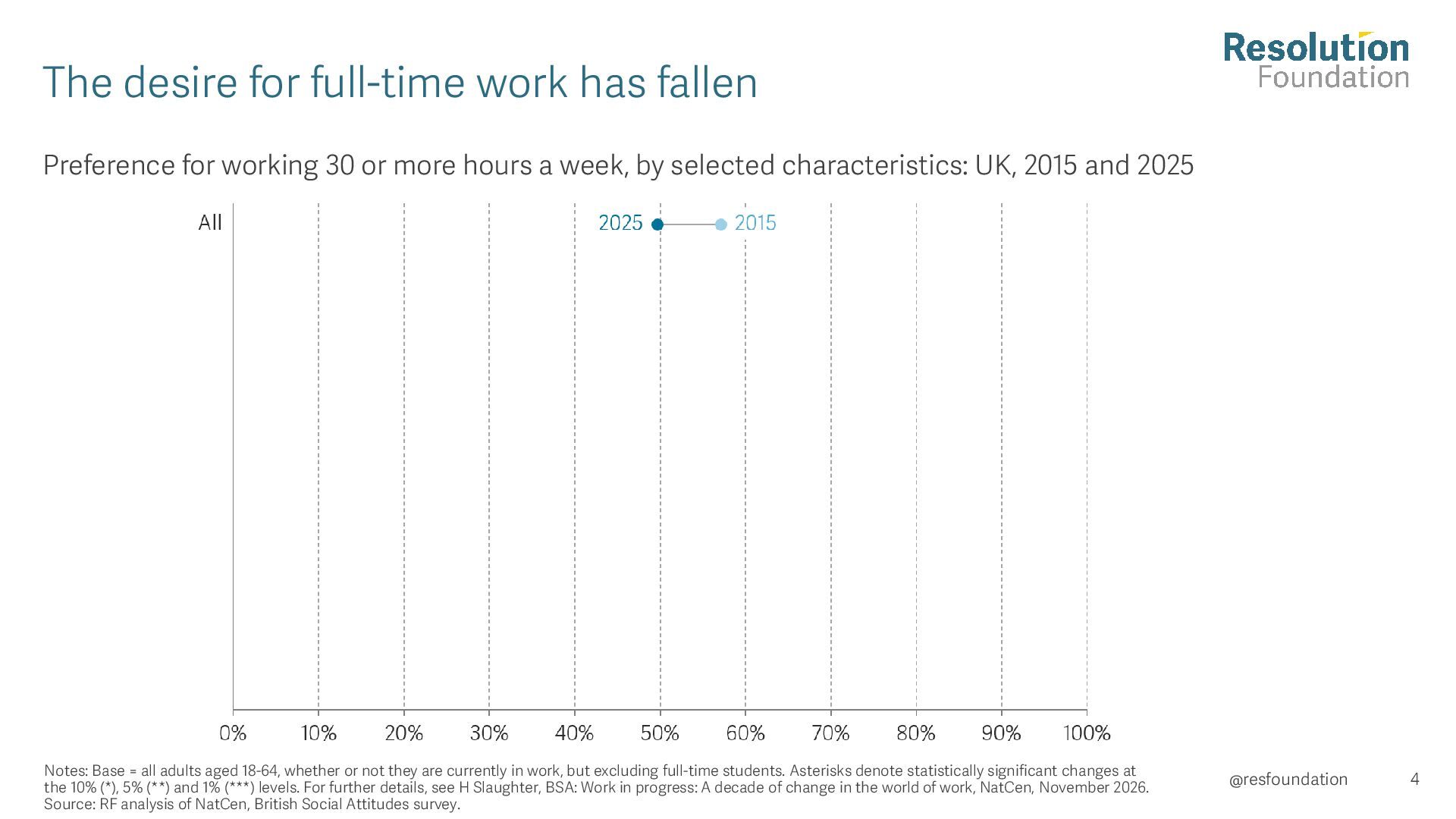
  4. The desire for full-time work has fallen Preference for working

    30 or more hours a week, by selected characteristics: UK, 2015 and 2025 Notes: Base = all adults aged 18-64, whether or not they are currently in work, but excluding full-time students. Asterisks denote statistically significant changes at the 10% (*), 5% (**) and 1% (***) levels. For further details, see H Slaughter, BSA: Work in progress: A decade of change in the world of work, NatCen, November 2026. Source: RF analysis of NatCen, British Social Attitudes survey. @resfoundation 4
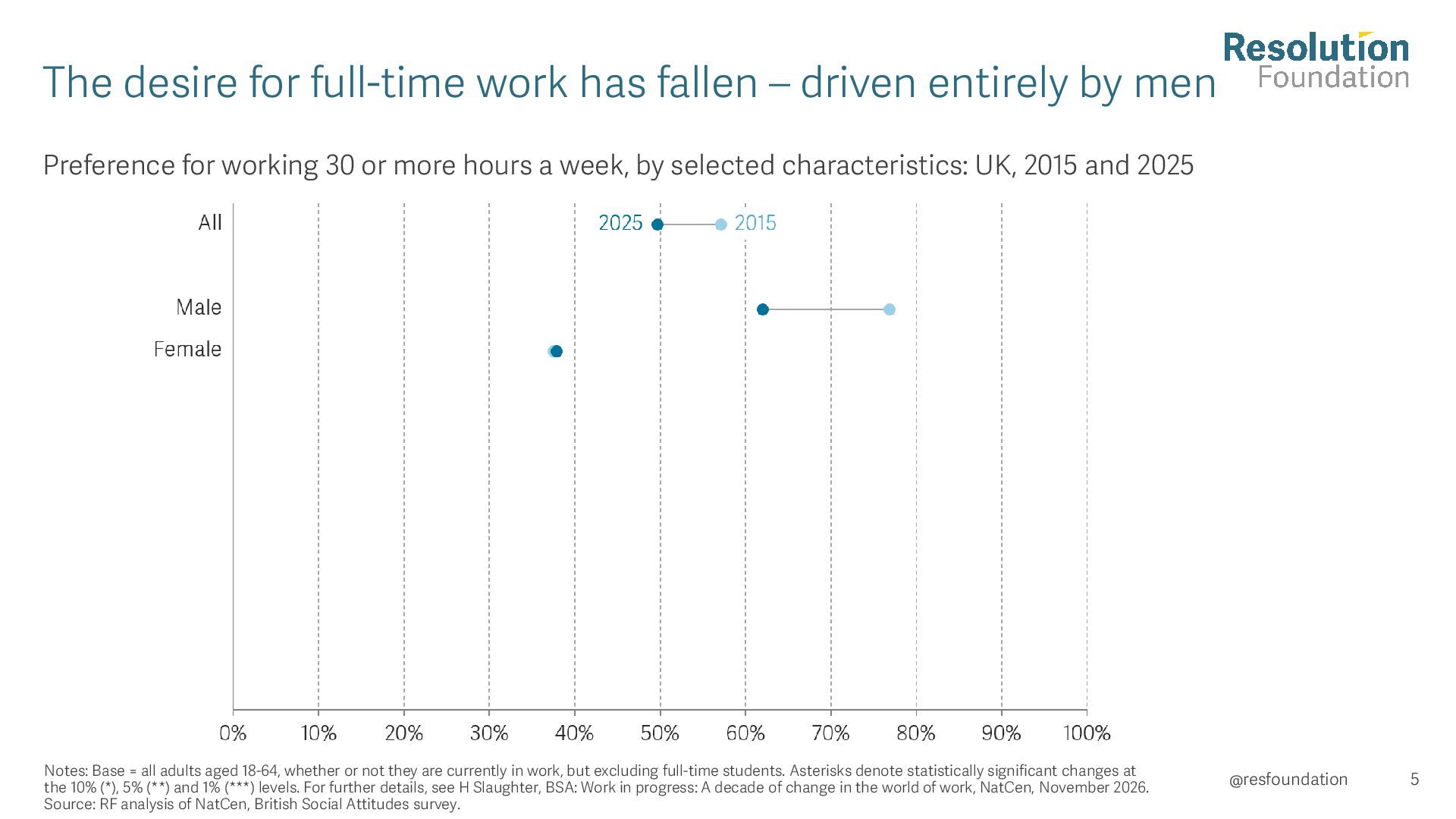
  5. The desire for full-time work has fallen – driven entirely

    by men Preference for working 30 or more hours a week, by selected characteristics: UK, 2015 and 2025 Notes: Base = all adults aged 18-64, whether or not they are currently in work, but excluding full-time students. Asterisks denote statistically significant changes at the 10% (*), 5% (**) and 1% (***) levels. For further details, see H Slaughter, BSA: Work in progress: A decade of change in the world of work, NatCen, November 2026. Source: RF analysis of NatCen, British Social Attitudes survey. @resfoundation 5
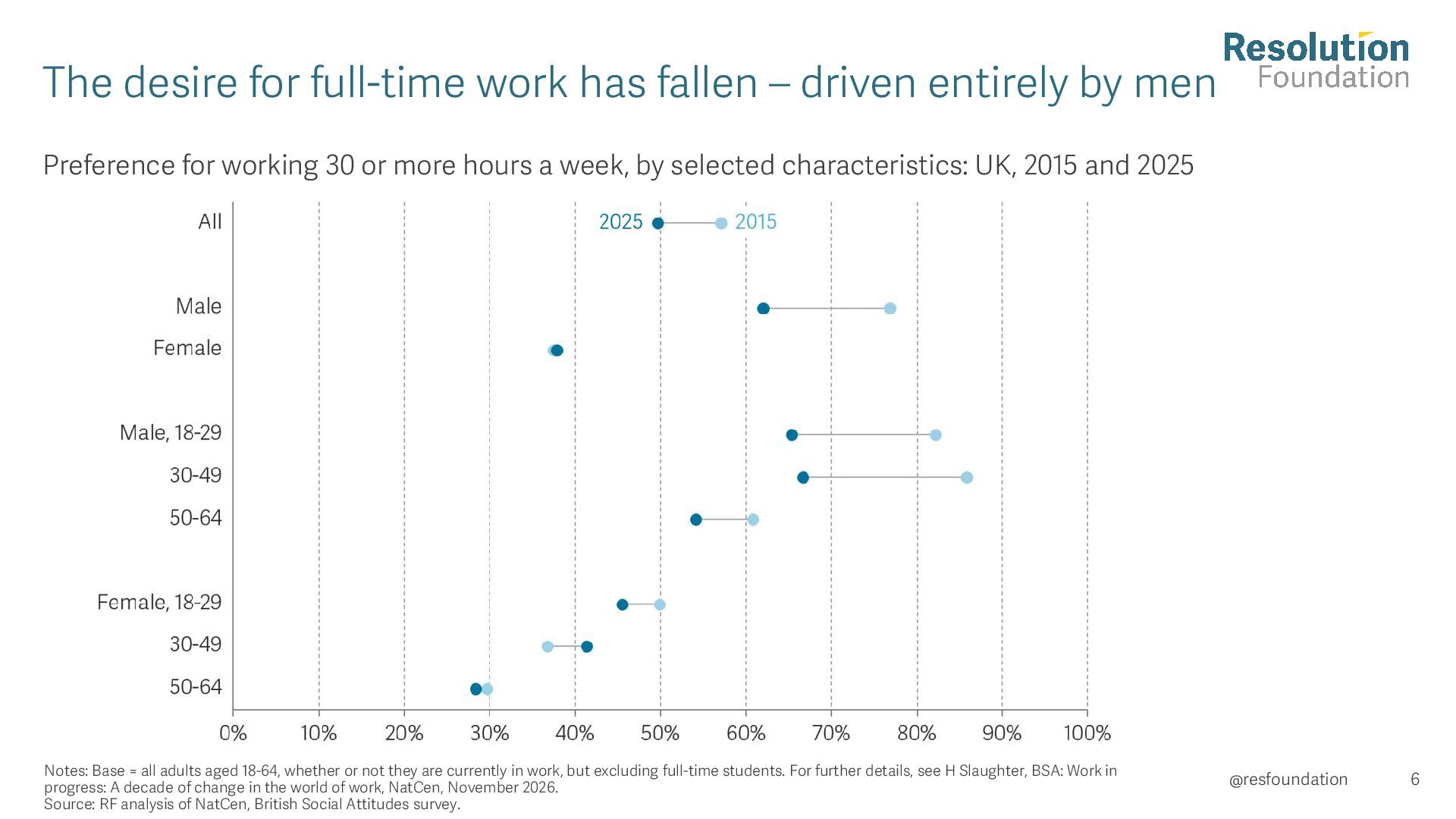
  6. The desire for full-time work has fallen – driven entirely

    by men Preference for working 30 or more hours a week, by selected characteristics: UK, 2015 and 2025 Notes: Base = all adults aged 18-64, whether or not they are currently in work, but excluding full-time students. For further details, see H Slaughter, BSA: Work in progress: A decade of change in the world of work, NatCen, November 2026. Source: RF analysis of NatCen, British Social Attitudes survey. @resfoundation 6
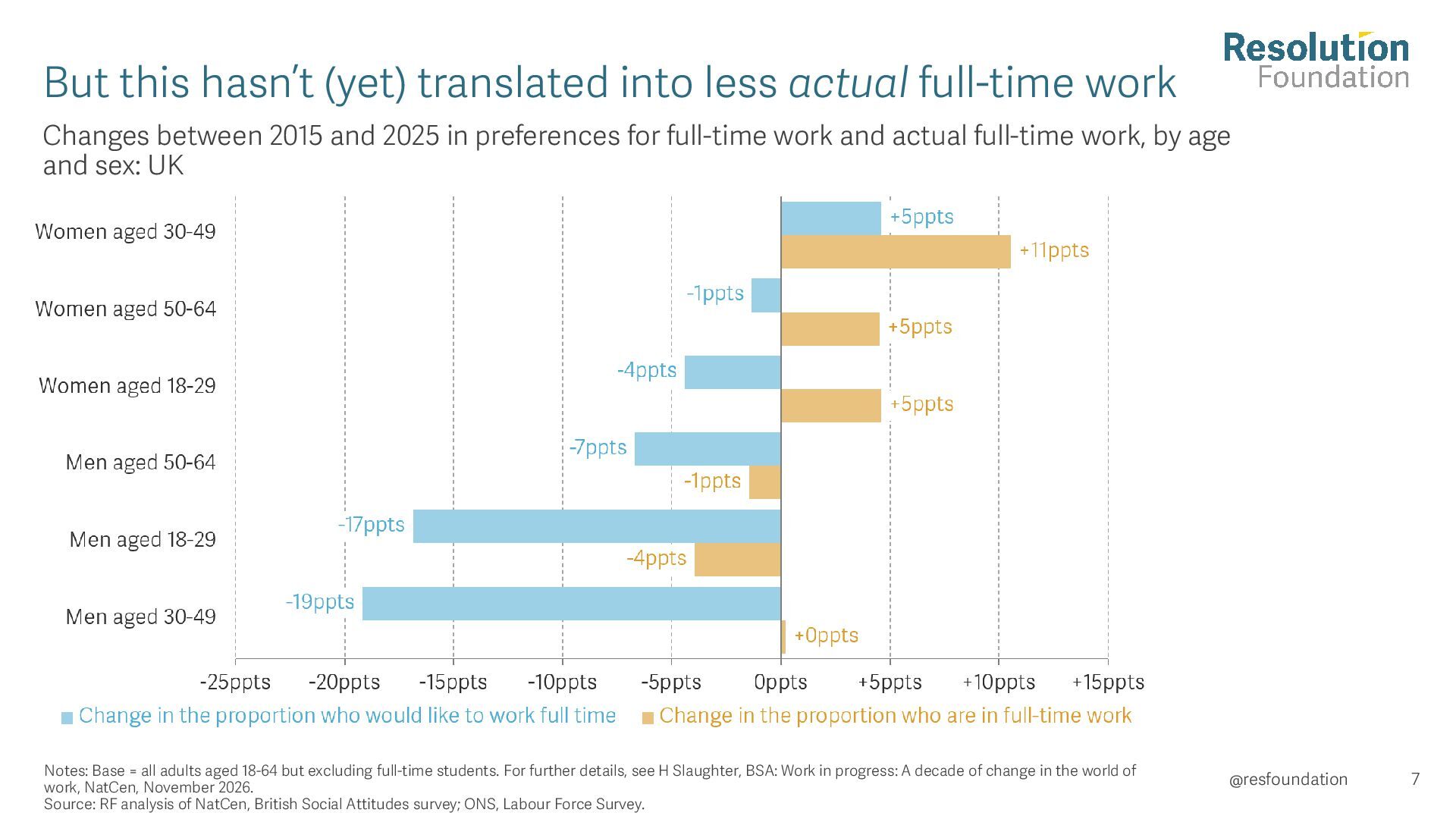
  7. But this hasn’t (yet) translated into less actual full-time work

    Changes between 2015 and 2025 in preferences for full-time work and actual full-time work, by age and sex: UK Notes: Base = all adults aged 18-64 but excluding full-time students. For further details, see H Slaughter, BSA: Work in progress: A decade of change in the world of work, NatCen, November 2026. Source: RF analysis of NatCen, British Social Attitudes survey; ONS, Labour Force Survey. @resfoundation 7
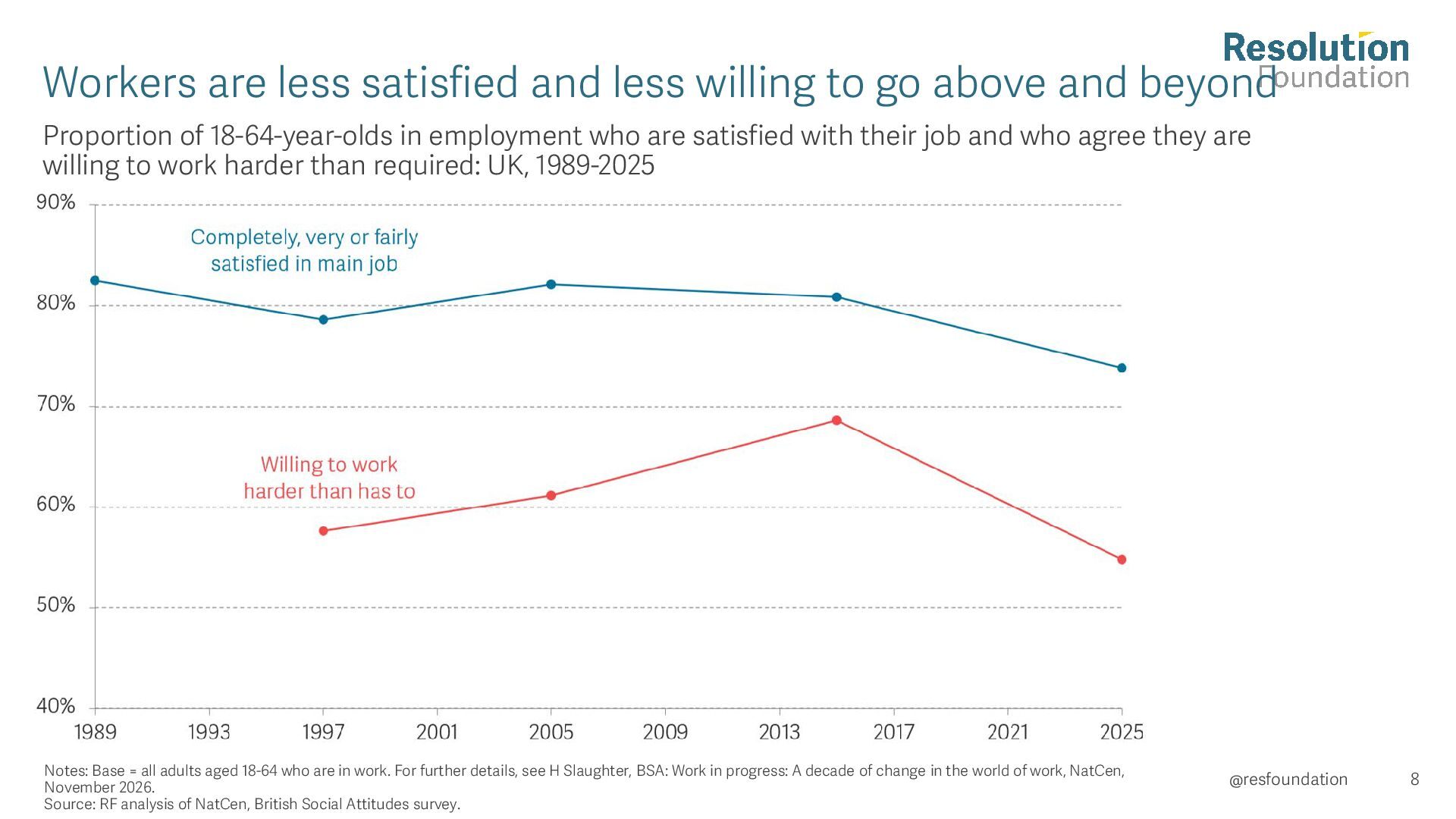
  8. Workers are less satisfied and less willing to go above

    and beyond Proportion of 18-64-year-olds in employment who are satisfied with their job and who agree they are willing to work harder than required: UK, 1989-2025 Notes: Base = all adults aged 18-64 who are in work. For further details, see H Slaughter, BSA: Work in progress: A decade of change in the world of work, NatCen, November 2026. Source: RF analysis of NatCen, British Social Attitudes survey. @resfoundation 8
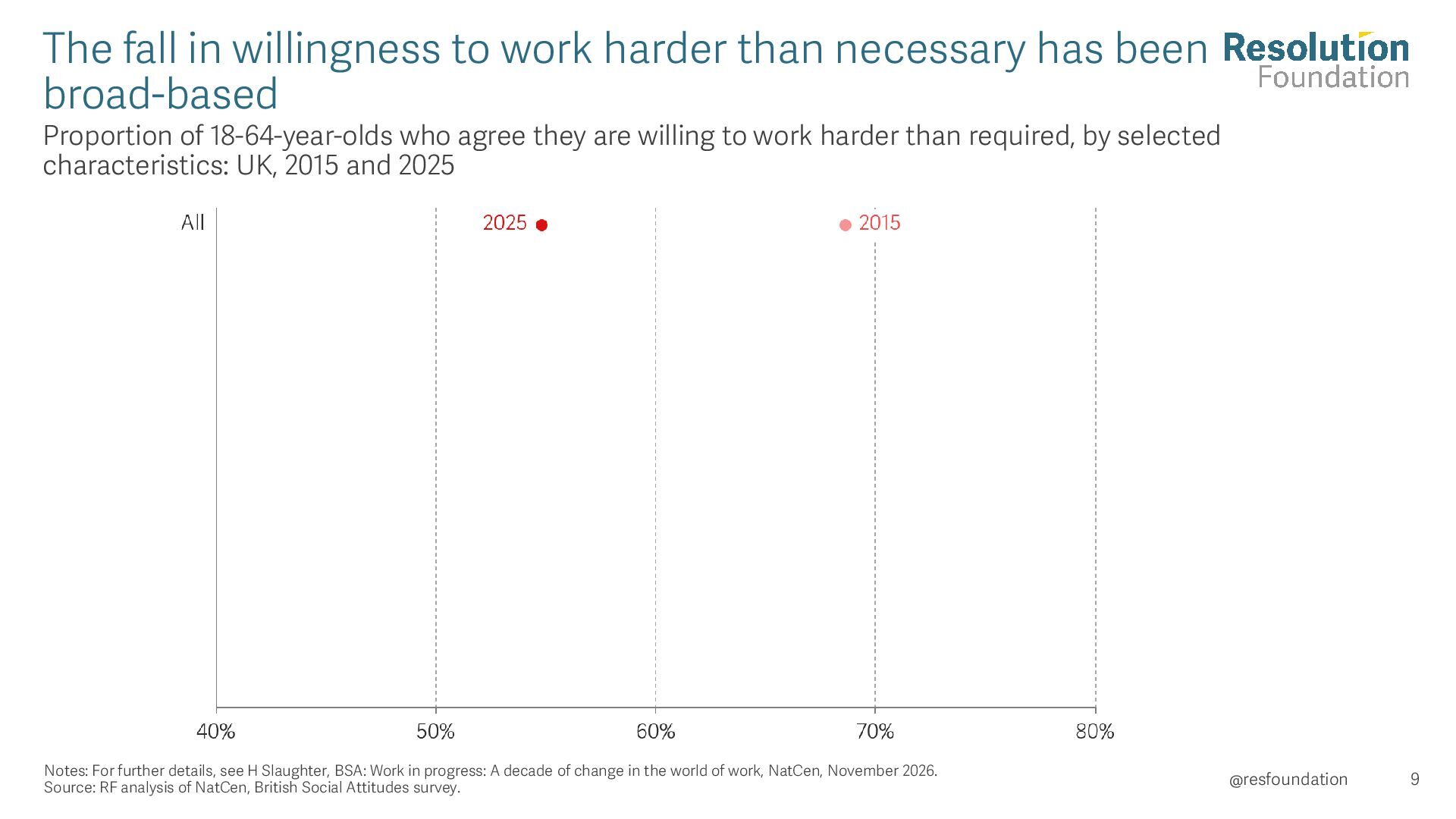
  9. The fall in willingness to work harder than necessary has

    been broad-based Proportion of 18-64-year-olds who agree they are willing to work harder than required, by selected characteristics: UK, 2015 and 2025 Notes: For further details, see H Slaughter, BSA: Work in progress: A decade of change in the world of work, NatCen, November 2026. Source: RF analysis of NatCen, British Social Attitudes survey. @resfoundation 9
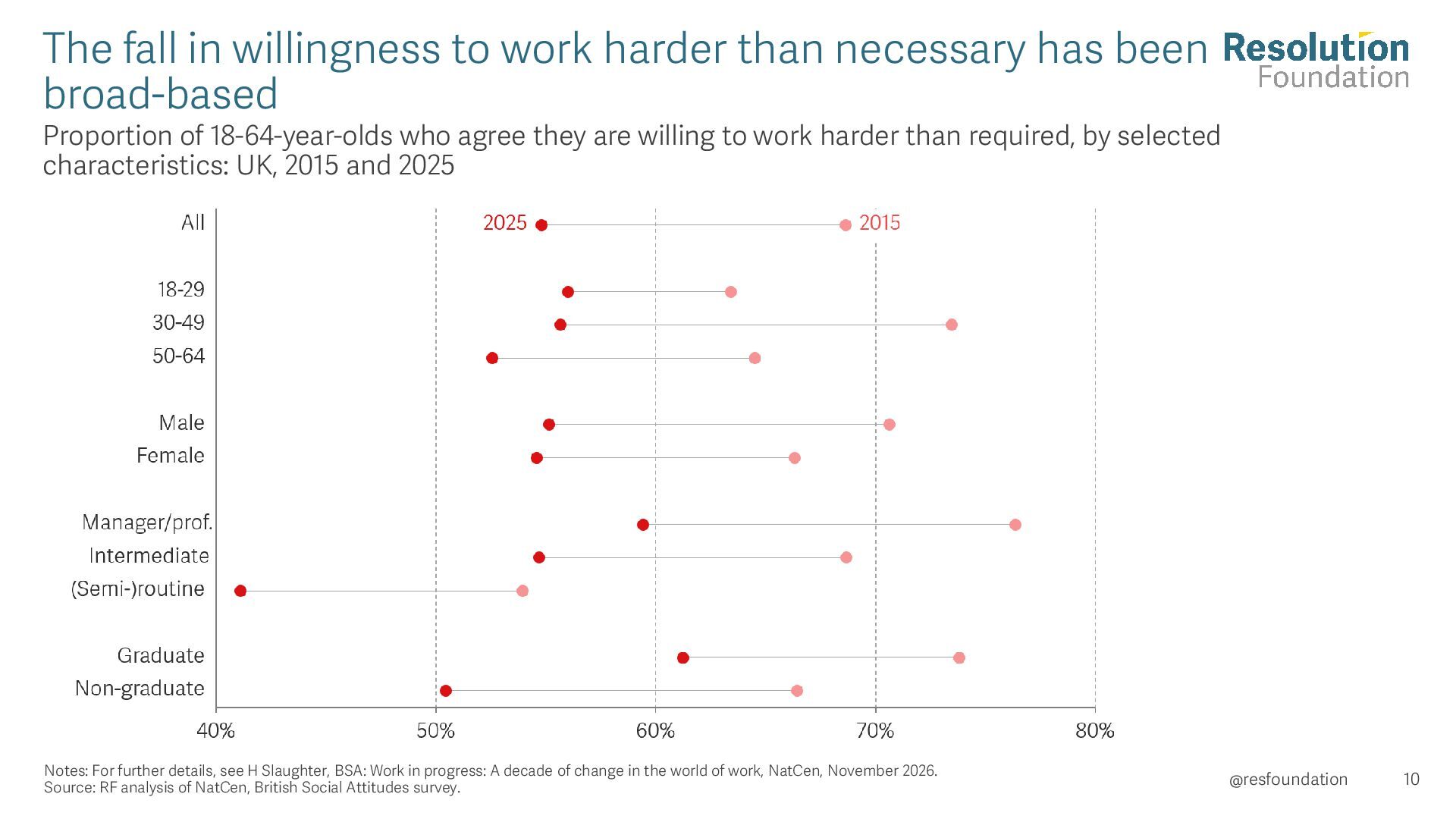
  10. The fall in willingness to work harder than necessary has

    been broad-based Proportion of 18-64-year-olds who agree they are willing to work harder than required, by selected characteristics: UK, 2015 and 2025 Notes: For further details, see H Slaughter, BSA: Work in progress: A decade of change in the world of work, NatCen, November 2026. Source: RF analysis of NatCen, British Social Attitudes survey. @resfoundation 10
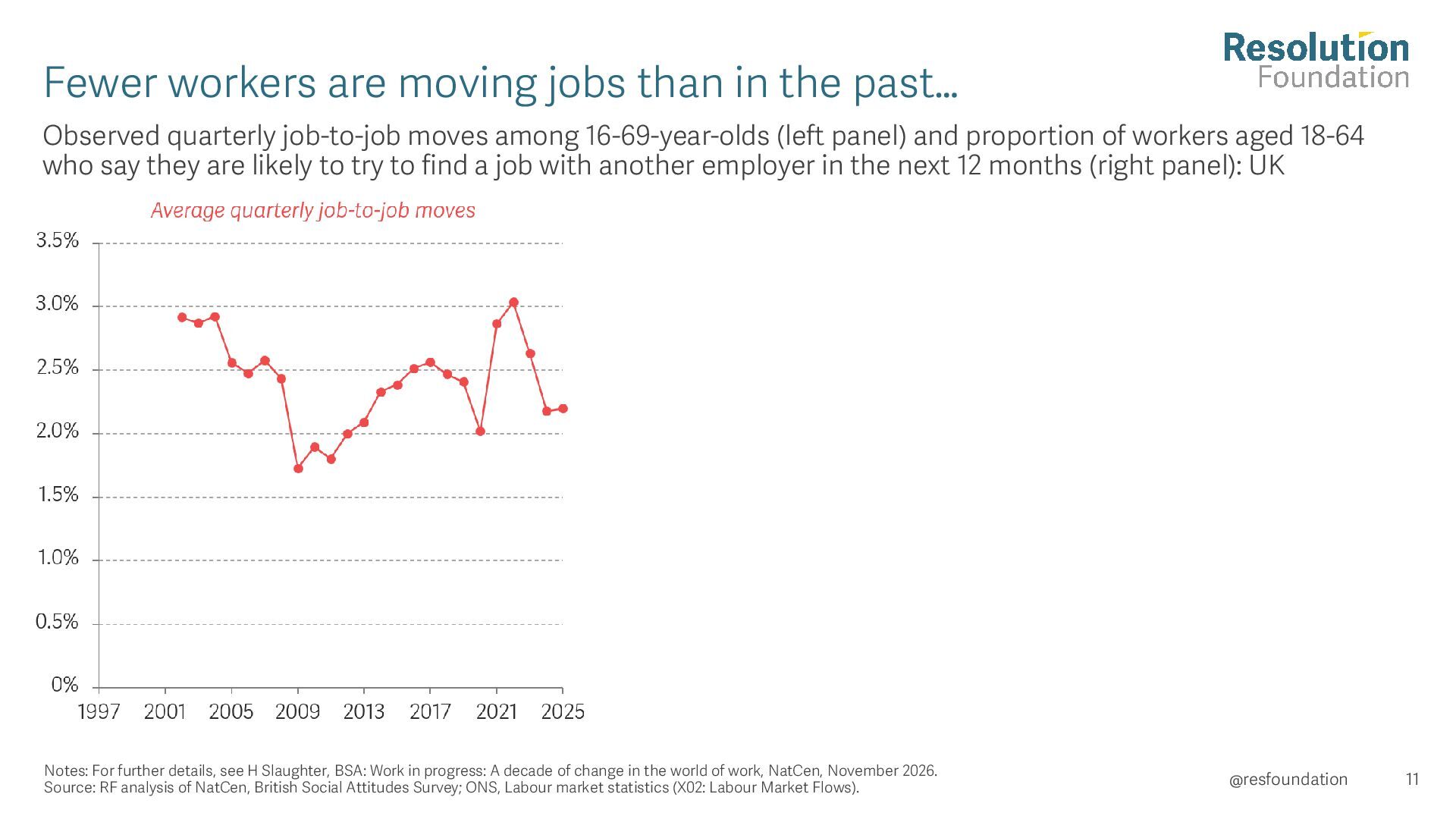
  11. Fewer workers are moving jobs than in the past… Observed

    quarterly job-to-job moves among 16-69-year-olds (left panel) and proportion of workers aged 18-64 who say they are likely to try to find a job with another employer in the next 12 months (right panel): UK Notes: For further details, see H Slaughter, BSA: Work in progress: A decade of change in the world of work, NatCen, November 2026. Source: RF analysis of NatCen, British Social Attitudes Survey; ONS, Labour market statistics (X02: Labour Market Flows). @resfoundation 11
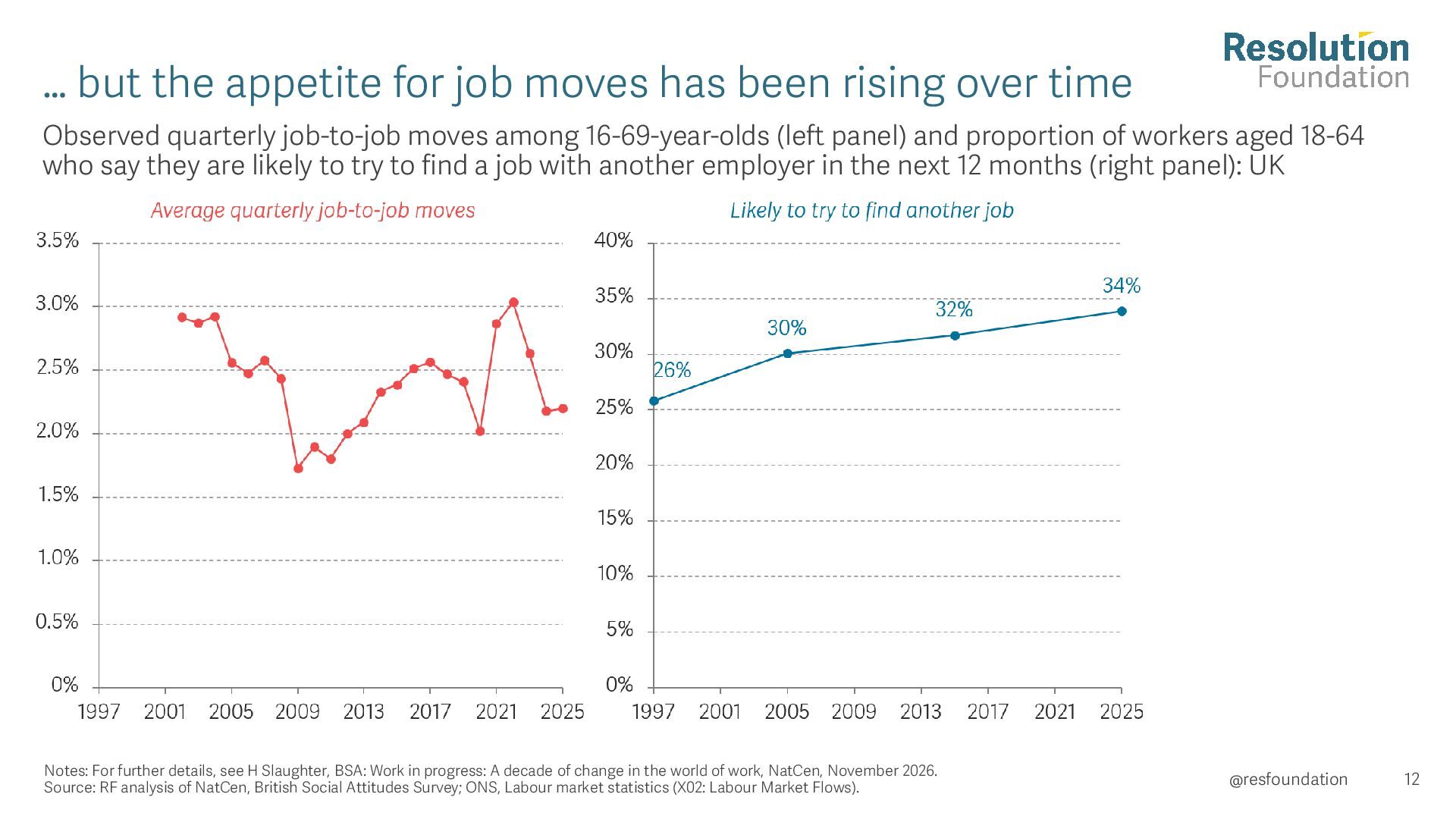
  12. … but the appetite for job moves has been rising

    over time Observed quarterly job-to-job moves among 16-69-year-olds (left panel) and proportion of workers aged 18-64 who say they are likely to try to find a job with another employer in the next 12 months (right panel): UK Notes: For further details, see H Slaughter, BSA: Work in progress: A decade of change in the world of work, NatCen, November 2026. Source: RF analysis of NatCen, British Social Attitudes Survey; ONS, Labour market statistics (X02: Labour Market Flows). @resfoundation 12
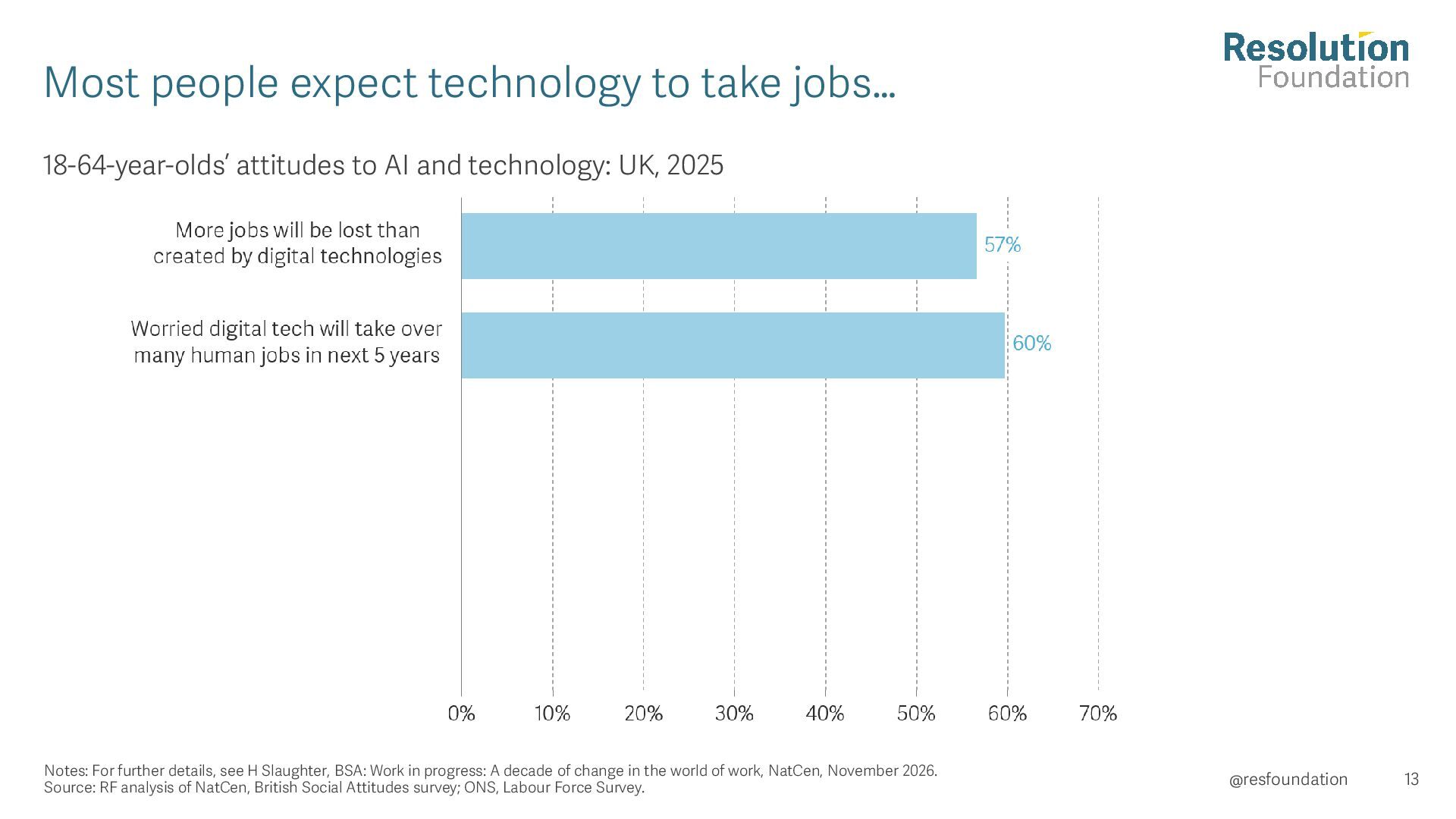
  13. Most people expect technology to take jobs… 18-64-year-olds’ attitudes to

    AI and technology: UK, 2025 Notes: For further details, see H Slaughter, BSA: Work in progress: A decade of change in the world of work, NatCen, November 2026. Source: RF analysis of NatCen, British Social Attitudes survey; ONS, Labour Force Survey. @resfoundation 13
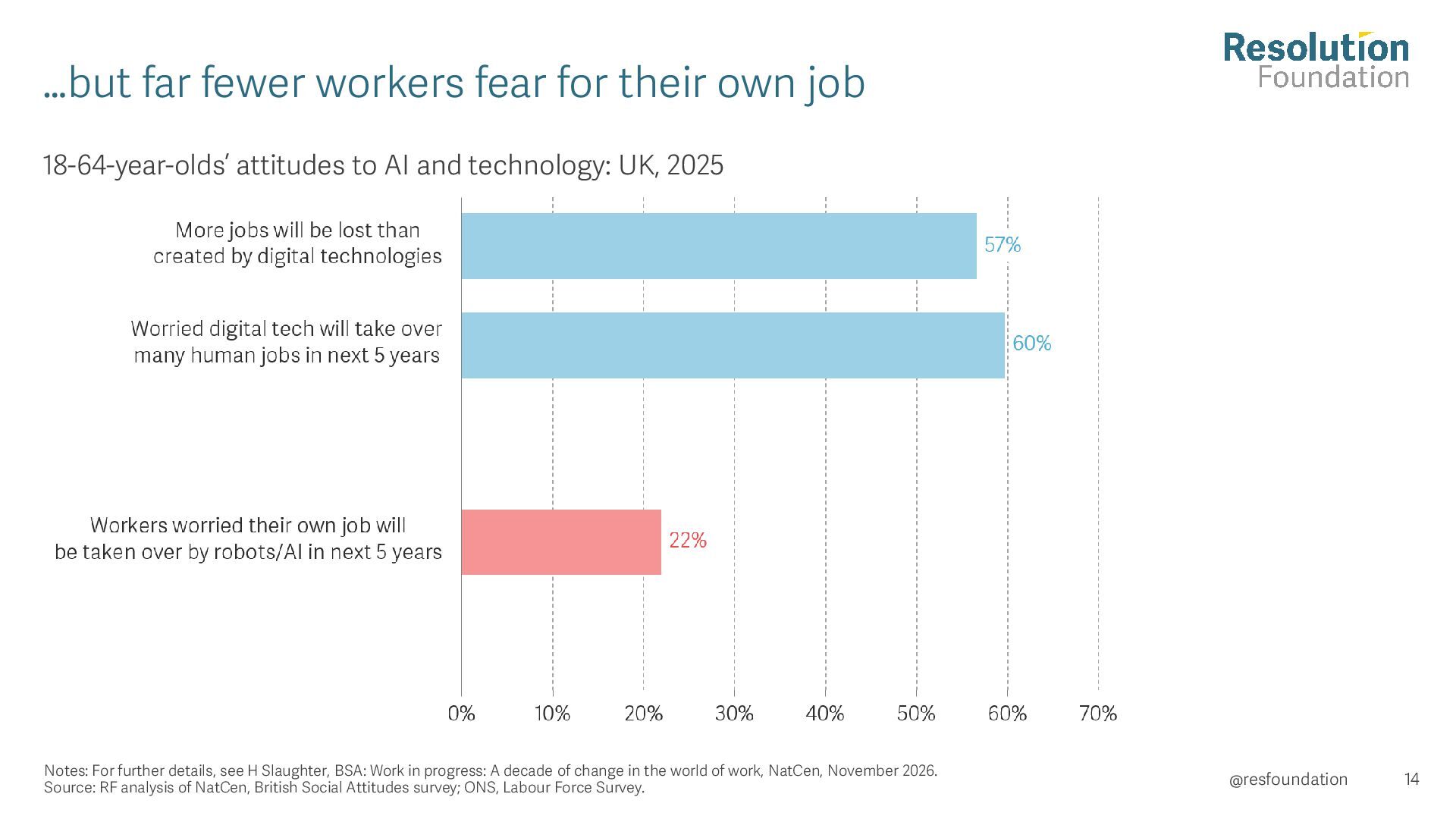
  14. …but far fewer workers fear for their own job 18-64-year-olds’

    attitudes to AI and technology: UK, 2025 Notes: For further details, see H Slaughter, BSA: Work in progress: A decade of change in the world of work, NatCen, November 2026. Source: RF analysis of NatCen, British Social Attitudes survey; ONS, Labour Force Survey. @resfoundation 14
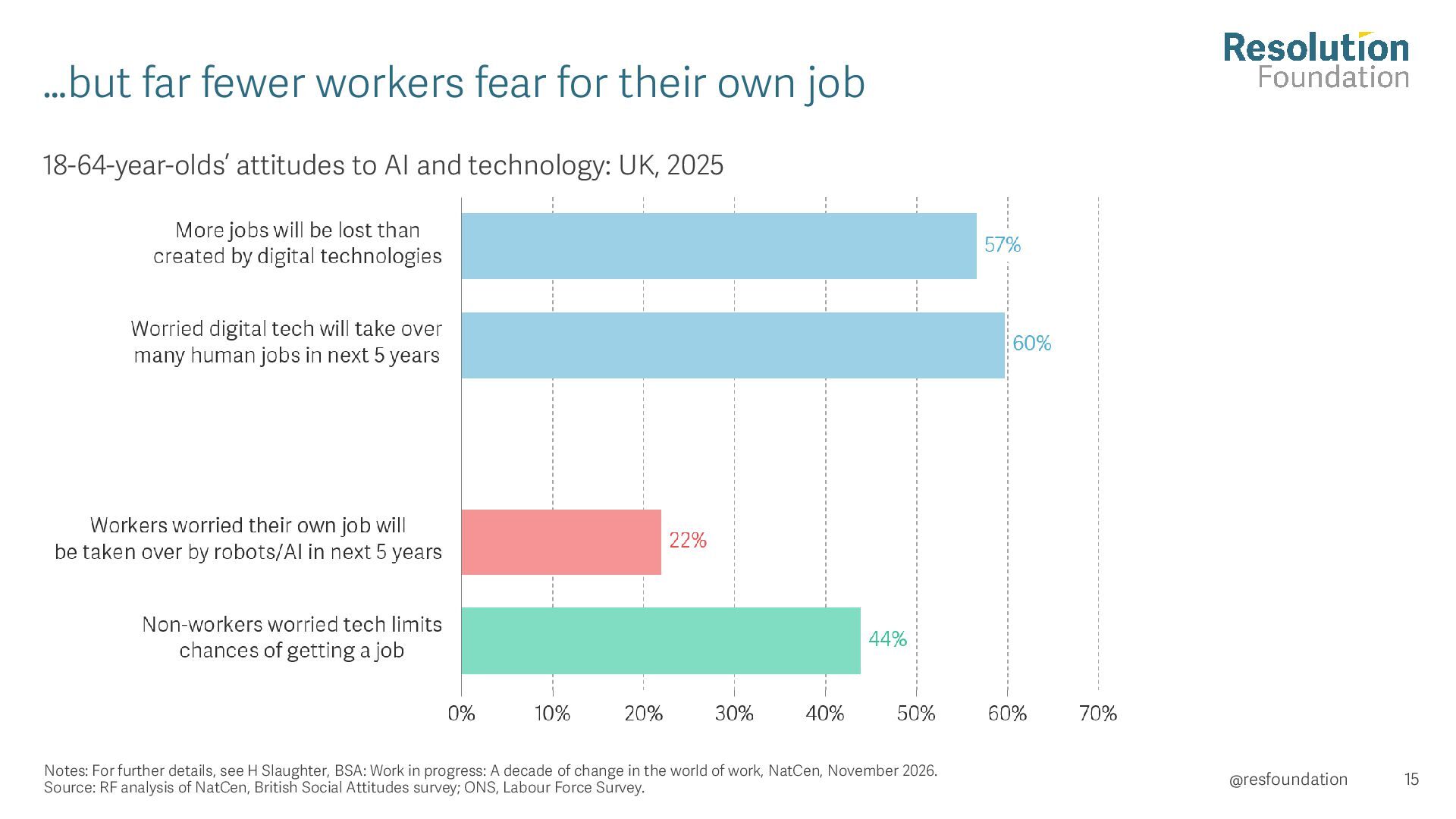
  15. …but far fewer workers fear for their own job 18-64-year-olds’

    attitudes to AI and technology: UK, 2025 Notes: For further details, see H Slaughter, BSA: Work in progress: A decade of change in the world of work, NatCen, November 2026. Source: RF analysis of NatCen, British Social Attitudes survey; ONS, Labour Force Survey. @resfoundation 15
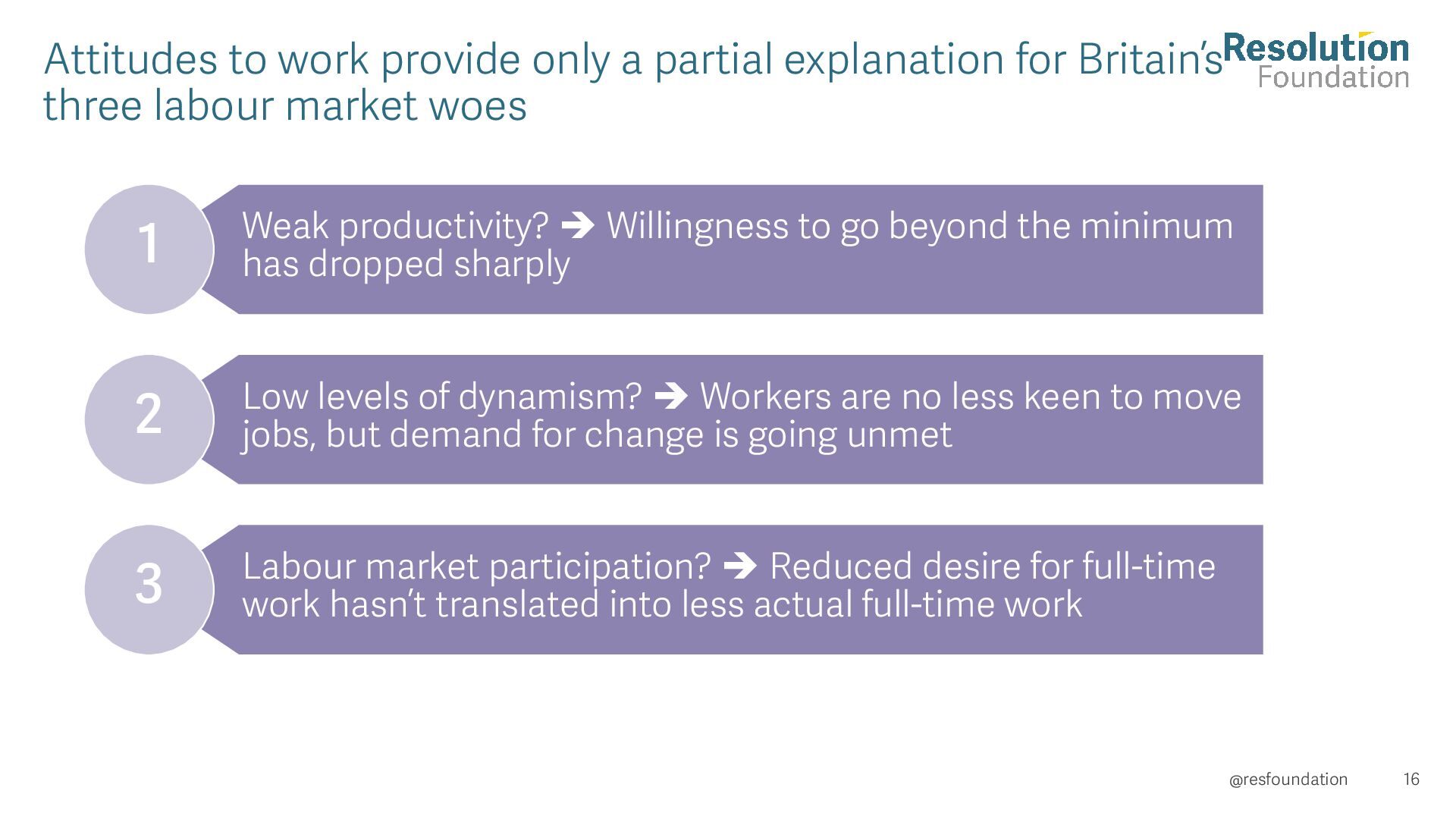
  16. Attitudes to work provide only a partial explanation for Britain’s

    three labour market woes 1 Weak productivity?  Willingness to go beyond the minimum has dropped sharply 2 Low levels of dynamism?  Workers are no less keen to move jobs, but demand for change is going unmet 3 Labour market participation?  Reduced desire for full-time work hasn’t translated into less actual full-time work @resfoundation 16
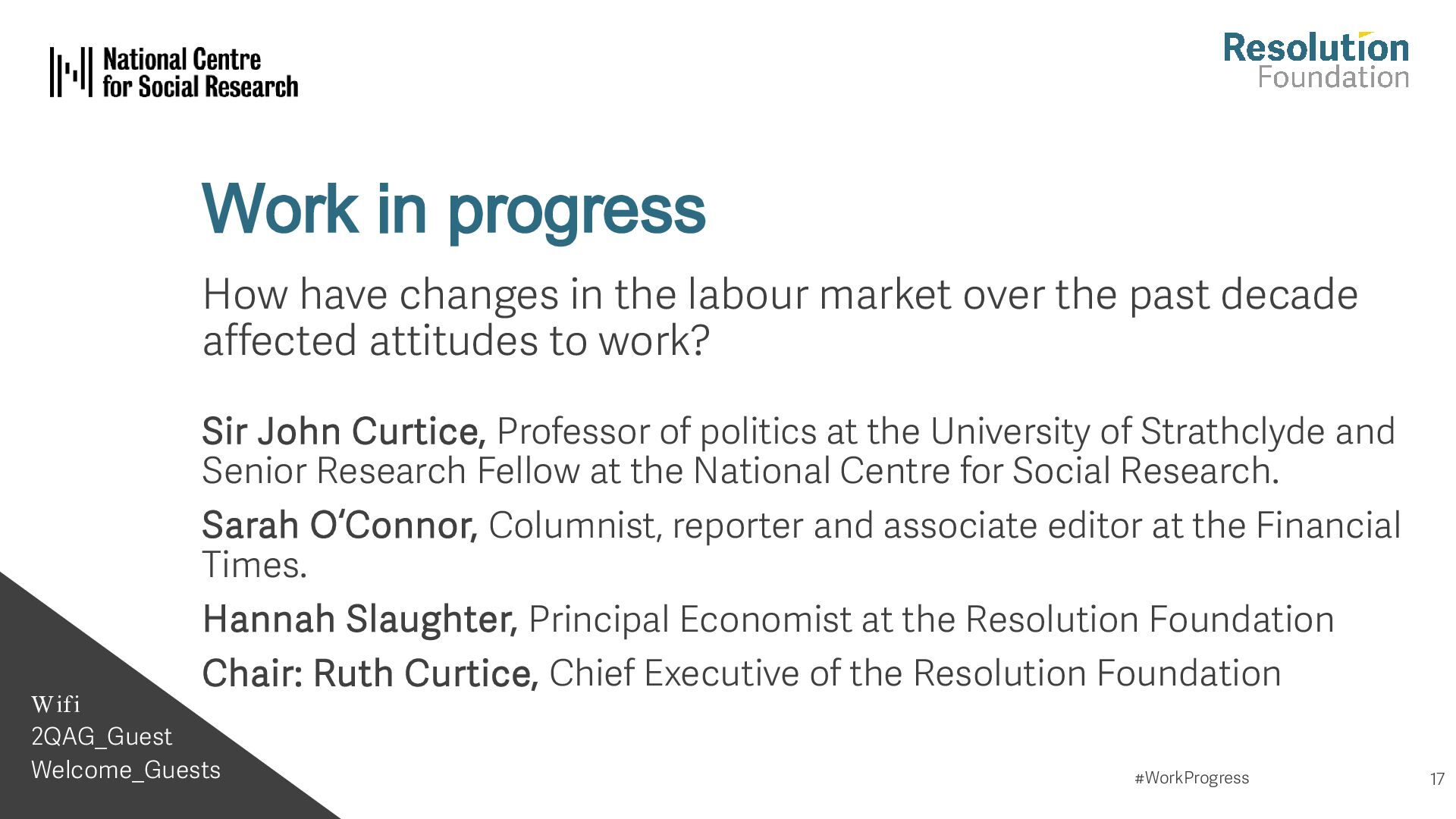
  17. Work in progress How have changes in the labour market

    over the past decade affected attitudes to work? Sir John Curtice, Professor of politics at the University of Strathclyde and Senior Research Fellow at the National Centre for Social Research. Sarah O‘Connor, Columnist, reporter and associate editor at the Financial Times. Hannah Slaughter, Principal Economist at the Resolution Foundation Chair: Ruth Curtice, Chief Executive of the Resolution Foundation Wifi 2QAG_Guest Welcome_Guests #WorkProgress 17